EP4516762A1 - Auf aluminiumoxid basierende wärmeleitfähige gerundete scheibenpartikel, herstellungsverfahren dafür, artikel, flüssigzusammensetzung, wärmeleitfähiger dünnfilm und element einer elektronischen vorrichtung - Google Patents
Auf aluminiumoxid basierende wärmeleitfähige gerundete scheibenpartikel, herstellungsverfahren dafür, artikel, flüssigzusammensetzung, wärmeleitfähiger dünnfilm und element einer elektronischen vorrichtung Download PDFInfo
- Publication number
- EP4516762A1 EP4516762A1 EP23795914.3A EP23795914A EP4516762A1 EP 4516762 A1 EP4516762 A1 EP 4516762A1 EP 23795914 A EP23795914 A EP 23795914A EP 4516762 A1 EP4516762 A1 EP 4516762A1
- Authority
- EP
- European Patent Office
- Prior art keywords
- thermally conductive
- raw material
- resin
- alumina
- mass
- Prior art date
- Legal status (The legal status is an assumption and is not a legal conclusion. Google has not performed a legal analysis and makes no representation as to the accuracy of the status listed.)
- Pending
Links
Images


Classifications
-
- C—CHEMISTRY; METALLURGY
- C04—CEMENTS; CONCRETE; ARTIFICIAL STONE; CERAMICS; REFRACTORIES
- C04B—LIME, MAGNESIA; SLAG; CEMENTS; COMPOSITIONS THEREOF, e.g. MORTARS, CONCRETE OR LIKE BUILDING MATERIALS; ARTIFICIAL STONE; CERAMICS; REFRACTORIES; TREATMENT OF NATURAL STONE
- C04B35/00—Shaped ceramic products characterised by their composition; Ceramics compositions; Processing powders of inorganic compounds preparatory to the manufacturing of ceramic products
- C04B35/01—Shaped ceramic products characterised by their composition; Ceramics compositions; Processing powders of inorganic compounds preparatory to the manufacturing of ceramic products based on oxide ceramics
- C04B35/10—Shaped ceramic products characterised by their composition; Ceramics compositions; Processing powders of inorganic compounds preparatory to the manufacturing of ceramic products based on oxide ceramics based on aluminium oxide
-
- C—CHEMISTRY; METALLURGY
- C09—DYES; PAINTS; POLISHES; NATURAL RESINS; ADHESIVES; COMPOSITIONS NOT OTHERWISE PROVIDED FOR; APPLICATIONS OF MATERIALS NOT OTHERWISE PROVIDED FOR
- C09K—MATERIALS FOR MISCELLANEOUS APPLICATIONS, NOT PROVIDED FOR ELSEWHERE
- C09K5/00—Heat-transfer, heat-exchange or heat-storage materials, e.g. refrigerants; Materials for the production of heat or cold by chemical reactions other than by combustion
- C09K5/08—Materials not undergoing a change of physical state when used
- C09K5/14—Solid materials, e.g. powdery or granular
-
- C—CHEMISTRY; METALLURGY
- C01—INORGANIC CHEMISTRY
- C01F—COMPOUNDS OF THE METALS BERYLLIUM, MAGNESIUM, ALUMINIUM, CALCIUM, STRONTIUM, BARIUM, RADIUM, THORIUM, OR OF THE RARE-EARTH METALS
- C01F7/00—Compounds of aluminium
- C01F7/02—Aluminium oxide; Aluminium hydroxide; Aluminates
- C01F7/44—Dehydration of aluminium oxide or hydroxide, i.e. all conversions of one form into another involving a loss of water
- C01F7/441—Dehydration of aluminium oxide or hydroxide, i.e. all conversions of one form into another involving a loss of water by calcination
- C01F7/442—Dehydration of aluminium oxide or hydroxide, i.e. all conversions of one form into another involving a loss of water by calcination in presence of a calcination additive
-
- C—CHEMISTRY; METALLURGY
- C04—CEMENTS; CONCRETE; ARTIFICIAL STONE; CERAMICS; REFRACTORIES
- C04B—LIME, MAGNESIA; SLAG; CEMENTS; COMPOSITIONS THEREOF, e.g. MORTARS, CONCRETE OR LIKE BUILDING MATERIALS; ARTIFICIAL STONE; CERAMICS; REFRACTORIES; TREATMENT OF NATURAL STONE
- C04B41/00—After-treatment of mortars, concrete, artificial stone or ceramics; Treatment of natural stone
- C04B41/0072—Heat treatment
-
- C—CHEMISTRY; METALLURGY
- C08—ORGANIC MACROMOLECULAR COMPOUNDS; THEIR PREPARATION OR CHEMICAL WORKING-UP; COMPOSITIONS BASED THEREON
- C08K—Use of inorganic or non-macromolecular organic substances as compounding ingredients
- C08K3/00—Use of inorganic substances as compounding ingredients
- C08K3/18—Oxygen-containing compounds, e.g. metal carbonyls
- C08K3/20—Oxides; Hydroxides
- C08K3/22—Oxides; Hydroxides of metals
-
- C—CHEMISTRY; METALLURGY
- C08—ORGANIC MACROMOLECULAR COMPOUNDS; THEIR PREPARATION OR CHEMICAL WORKING-UP; COMPOSITIONS BASED THEREON
- C08K—Use of inorganic or non-macromolecular organic substances as compounding ingredients
- C08K3/00—Use of inorganic substances as compounding ingredients
- C08K3/30—Sulfur-, selenium- or tellurium-containing compounds
-
- C—CHEMISTRY; METALLURGY
- C08—ORGANIC MACROMOLECULAR COMPOUNDS; THEIR PREPARATION OR CHEMICAL WORKING-UP; COMPOSITIONS BASED THEREON
- C08K—Use of inorganic or non-macromolecular organic substances as compounding ingredients
- C08K3/00—Use of inorganic substances as compounding ingredients
- C08K3/34—Silicon-containing compounds
-
- C—CHEMISTRY; METALLURGY
- C08—ORGANIC MACROMOLECULAR COMPOUNDS; THEIR PREPARATION OR CHEMICAL WORKING-UP; COMPOSITIONS BASED THEREON
- C08K—Use of inorganic or non-macromolecular organic substances as compounding ingredients
- C08K3/00—Use of inorganic substances as compounding ingredients
- C08K3/38—Boron-containing compounds
-
- C—CHEMISTRY; METALLURGY
- C09—DYES; PAINTS; POLISHES; NATURAL RESINS; ADHESIVES; COMPOSITIONS NOT OTHERWISE PROVIDED FOR; APPLICATIONS OF MATERIALS NOT OTHERWISE PROVIDED FOR
- C09D—COATING COMPOSITIONS, e.g. PAINTS, VARNISHES OR LACQUERS; FILLING PASTES; CHEMICAL PAINT OR INK REMOVERS; INKS; CORRECTING FLUIDS; WOODSTAINS; PASTES OR SOLIDS FOR COLOURING OR PRINTING; USE OF MATERIALS THEREFOR
- C09D11/00—Inks
- C09D11/02—Printing inks
- C09D11/03—Printing inks characterised by features other than the chemical nature of the binder
- C09D11/037—Printing inks characterised by features other than the chemical nature of the binder characterised by the pigment
-
- C—CHEMISTRY; METALLURGY
- C09—DYES; PAINTS; POLISHES; NATURAL RESINS; ADHESIVES; COMPOSITIONS NOT OTHERWISE PROVIDED FOR; APPLICATIONS OF MATERIALS NOT OTHERWISE PROVIDED FOR
- C09D—COATING COMPOSITIONS, e.g. PAINTS, VARNISHES OR LACQUERS; FILLING PASTES; CHEMICAL PAINT OR INK REMOVERS; INKS; CORRECTING FLUIDS; WOODSTAINS; PASTES OR SOLIDS FOR COLOURING OR PRINTING; USE OF MATERIALS THEREFOR
- C09D7/00—Features of coating compositions, not provided for in group C09D5/00; Processes for incorporating ingredients in coating compositions
- C09D7/40—Additives
- C09D7/60—Additives non-macromolecular
- C09D7/61—Additives non-macromolecular inorganic
-
- C—CHEMISTRY; METALLURGY
- C09—DYES; PAINTS; POLISHES; NATURAL RESINS; ADHESIVES; COMPOSITIONS NOT OTHERWISE PROVIDED FOR; APPLICATIONS OF MATERIALS NOT OTHERWISE PROVIDED FOR
- C09D—COATING COMPOSITIONS, e.g. PAINTS, VARNISHES OR LACQUERS; FILLING PASTES; CHEMICAL PAINT OR INK REMOVERS; INKS; CORRECTING FLUIDS; WOODSTAINS; PASTES OR SOLIDS FOR COLOURING OR PRINTING; USE OF MATERIALS THEREFOR
- C09D7/00—Features of coating compositions, not provided for in group C09D5/00; Processes for incorporating ingredients in coating compositions
- C09D7/40—Additives
- C09D7/66—Additives characterised by particle size
- C09D7/69—Particle size larger than 1000 nm
-
- C—CHEMISTRY; METALLURGY
- C09—DYES; PAINTS; POLISHES; NATURAL RESINS; ADHESIVES; COMPOSITIONS NOT OTHERWISE PROVIDED FOR; APPLICATIONS OF MATERIALS NOT OTHERWISE PROVIDED FOR
- C09D—COATING COMPOSITIONS, e.g. PAINTS, VARNISHES OR LACQUERS; FILLING PASTES; CHEMICAL PAINT OR INK REMOVERS; INKS; CORRECTING FLUIDS; WOODSTAINS; PASTES OR SOLIDS FOR COLOURING OR PRINTING; USE OF MATERIALS THEREFOR
- C09D7/00—Features of coating compositions, not provided for in group C09D5/00; Processes for incorporating ingredients in coating compositions
- C09D7/40—Additives
- C09D7/70—Additives characterised by shape, e.g. fibres, flakes or microspheres
-
- C—CHEMISTRY; METALLURGY
- C09—DYES; PAINTS; POLISHES; NATURAL RESINS; ADHESIVES; COMPOSITIONS NOT OTHERWISE PROVIDED FOR; APPLICATIONS OF MATERIALS NOT OTHERWISE PROVIDED FOR
- C09J—ADHESIVES; NON-MECHANICAL ASPECTS OF ADHESIVE PROCESSES IN GENERAL; ADHESIVE PROCESSES NOT PROVIDED FOR ELSEWHERE; USE OF MATERIALS AS ADHESIVES
- C09J11/00—Features of adhesives not provided for in group C09J9/00, e.g. additives
- C09J11/02—Non-macromolecular additives
- C09J11/04—Non-macromolecular additives inorganic
-
- C—CHEMISTRY; METALLURGY
- C04—CEMENTS; CONCRETE; ARTIFICIAL STONE; CERAMICS; REFRACTORIES
- C04B—LIME, MAGNESIA; SLAG; CEMENTS; COMPOSITIONS THEREOF, e.g. MORTARS, CONCRETE OR LIKE BUILDING MATERIALS; ARTIFICIAL STONE; CERAMICS; REFRACTORIES; TREATMENT OF NATURAL STONE
- C04B2235/00—Aspects relating to ceramic starting mixtures or sintered ceramic products
- C04B2235/02—Composition of constituents of the starting material or of secondary phases of the final product
- C04B2235/30—Constituents and secondary phases not being of a fibrous nature
- C04B2235/32—Metal oxides, mixed metal oxides, or oxide-forming salts thereof, e.g. carbonates, nitrates, (oxy)hydroxides, chlorides
- C04B2235/3217—Aluminum oxide or oxide forming salts thereof, e.g. bauxite, alpha-alumina
-
- C—CHEMISTRY; METALLURGY
- C04—CEMENTS; CONCRETE; ARTIFICIAL STONE; CERAMICS; REFRACTORIES
- C04B—LIME, MAGNESIA; SLAG; CEMENTS; COMPOSITIONS THEREOF, e.g. MORTARS, CONCRETE OR LIKE BUILDING MATERIALS; ARTIFICIAL STONE; CERAMICS; REFRACTORIES; TREATMENT OF NATURAL STONE
- C04B2235/00—Aspects relating to ceramic starting mixtures or sintered ceramic products
- C04B2235/02—Composition of constituents of the starting material or of secondary phases of the final product
- C04B2235/30—Constituents and secondary phases not being of a fibrous nature
- C04B2235/36—Glass starting materials for making ceramics, e.g. silica glass
-
- C—CHEMISTRY; METALLURGY
- C04—CEMENTS; CONCRETE; ARTIFICIAL STONE; CERAMICS; REFRACTORIES
- C04B—LIME, MAGNESIA; SLAG; CEMENTS; COMPOSITIONS THEREOF, e.g. MORTARS, CONCRETE OR LIKE BUILDING MATERIALS; ARTIFICIAL STONE; CERAMICS; REFRACTORIES; TREATMENT OF NATURAL STONE
- C04B2235/00—Aspects relating to ceramic starting mixtures or sintered ceramic products
- C04B2235/02—Composition of constituents of the starting material or of secondary phases of the final product
- C04B2235/50—Constituents or additives of the starting mixture chosen for their shape or used because of their shape or their physical appearance
- C04B2235/52—Constituents or additives characterised by their shapes
- C04B2235/5292—Flakes, platelets or plates
-
- C—CHEMISTRY; METALLURGY
- C04—CEMENTS; CONCRETE; ARTIFICIAL STONE; CERAMICS; REFRACTORIES
- C04B—LIME, MAGNESIA; SLAG; CEMENTS; COMPOSITIONS THEREOF, e.g. MORTARS, CONCRETE OR LIKE BUILDING MATERIALS; ARTIFICIAL STONE; CERAMICS; REFRACTORIES; TREATMENT OF NATURAL STONE
- C04B2235/00—Aspects relating to ceramic starting mixtures or sintered ceramic products
- C04B2235/02—Composition of constituents of the starting material or of secondary phases of the final product
- C04B2235/50—Constituents or additives of the starting mixture chosen for their shape or used because of their shape or their physical appearance
- C04B2235/52—Constituents or additives characterised by their shapes
- C04B2235/5296—Constituents or additives characterised by their shapes with a defined aspect ratio, e.g. indicating sphericity
-
- C—CHEMISTRY; METALLURGY
- C04—CEMENTS; CONCRETE; ARTIFICIAL STONE; CERAMICS; REFRACTORIES
- C04B—LIME, MAGNESIA; SLAG; CEMENTS; COMPOSITIONS THEREOF, e.g. MORTARS, CONCRETE OR LIKE BUILDING MATERIALS; ARTIFICIAL STONE; CERAMICS; REFRACTORIES; TREATMENT OF NATURAL STONE
- C04B2235/00—Aspects relating to ceramic starting mixtures or sintered ceramic products
- C04B2235/02—Composition of constituents of the starting material or of secondary phases of the final product
- C04B2235/50—Constituents or additives of the starting mixture chosen for their shape or used because of their shape or their physical appearance
- C04B2235/54—Particle size related information
- C04B2235/5418—Particle size related information expressed by the size of the particles or aggregates thereof
- C04B2235/5436—Particle size related information expressed by the size of the particles or aggregates thereof micrometer sized, i.e. from 1 to 100 micron
-
- C—CHEMISTRY; METALLURGY
- C04—CEMENTS; CONCRETE; ARTIFICIAL STONE; CERAMICS; REFRACTORIES
- C04B—LIME, MAGNESIA; SLAG; CEMENTS; COMPOSITIONS THEREOF, e.g. MORTARS, CONCRETE OR LIKE BUILDING MATERIALS; ARTIFICIAL STONE; CERAMICS; REFRACTORIES; TREATMENT OF NATURAL STONE
- C04B2235/00—Aspects relating to ceramic starting mixtures or sintered ceramic products
- C04B2235/70—Aspects relating to sintered or melt-casted ceramic products
- C04B2235/96—Properties of ceramic products, e.g. mechanical properties such as strength, toughness, wear resistance
- C04B2235/9607—Thermal properties, e.g. thermal expansion coefficient
-
- C—CHEMISTRY; METALLURGY
- C08—ORGANIC MACROMOLECULAR COMPOUNDS; THEIR PREPARATION OR CHEMICAL WORKING-UP; COMPOSITIONS BASED THEREON
- C08K—Use of inorganic or non-macromolecular organic substances as compounding ingredients
- C08K3/00—Use of inorganic substances as compounding ingredients
- C08K3/18—Oxygen-containing compounds, e.g. metal carbonyls
- C08K3/20—Oxides; Hydroxides
- C08K3/22—Oxides; Hydroxides of metals
- C08K2003/2227—Oxides; Hydroxides of metals of aluminium
-
- C—CHEMISTRY; METALLURGY
- C08—ORGANIC MACROMOLECULAR COMPOUNDS; THEIR PREPARATION OR CHEMICAL WORKING-UP; COMPOSITIONS BASED THEREON
- C08K—Use of inorganic or non-macromolecular organic substances as compounding ingredients
- C08K3/00—Use of inorganic substances as compounding ingredients
- C08K3/30—Sulfur-, selenium- or tellurium-containing compounds
- C08K2003/3045—Sulfates
-
- C—CHEMISTRY; METALLURGY
- C08—ORGANIC MACROMOLECULAR COMPOUNDS; THEIR PREPARATION OR CHEMICAL WORKING-UP; COMPOSITIONS BASED THEREON
- C08K—Use of inorganic or non-macromolecular organic substances as compounding ingredients
- C08K3/00—Use of inorganic substances as compounding ingredients
- C08K3/38—Boron-containing compounds
- C08K2003/382—Boron-containing compounds and nitrogen
- C08K2003/385—Binary compounds of nitrogen with boron
-
- C—CHEMISTRY; METALLURGY
- C08—ORGANIC MACROMOLECULAR COMPOUNDS; THEIR PREPARATION OR CHEMICAL WORKING-UP; COMPOSITIONS BASED THEREON
- C08K—Use of inorganic or non-macromolecular organic substances as compounding ingredients
- C08K2201/00—Specific properties of additives
- C08K2201/001—Conductive additives
-
- C—CHEMISTRY; METALLURGY
- C09—DYES; PAINTS; POLISHES; NATURAL RESINS; ADHESIVES; COMPOSITIONS NOT OTHERWISE PROVIDED FOR; APPLICATIONS OF MATERIALS NOT OTHERWISE PROVIDED FOR
- C09J—ADHESIVES; NON-MECHANICAL ASPECTS OF ADHESIVE PROCESSES IN GENERAL; ADHESIVE PROCESSES NOT PROVIDED FOR ELSEWHERE; USE OF MATERIALS AS ADHESIVES
- C09J2203/00—Applications of adhesives in processes or use of adhesives in the form of films or foils
- C09J2203/326—Applications of adhesives in processes or use of adhesives in the form of films or foils for bonding electronic components such as wafers, chips or semiconductors
Definitions
- the present invention relates to alumina-based thermally conductive rounded disc-shaped particles excellent in fillability and a method of producing the same.
- a number of materials have currently been studied as a thermally conductive material. As the degree of integration in semiconductor devices improves, the demand for heat dissipation is becoming stronger, and the development of materials with much higher thermal conductivity and insulation than conventional materials is becoming essential.
- a composite material (resin composition) obtained by kneading a thermally conductive filler into a resin is known as a material that satisfies these requirements.
- Patent Literature 3 There are also plate-shaped particles and a method of producing the same, which claim that the addition of an aluminum raw material, shape control material, and molybdenum oxide during firing can result in high dispersibility based on zeta potential.
- Patent Literature 4 there is a method for producing alumina-based thermally conductive particles using an aluminum raw material and a frit or a metal oxide.
- Alumina has a high Mohs hardness, and puts a load on blades and a shaft of an extruder, which makes it difficult to knead alumina into a resin composition or the like. In addition, component parts worn by alumina are liable to be mixed in, causing contamination. Because of its shape, plate-shaped alumina is used in a wide range of applications, including brightening materials, lubricants, and sliding materials. However, when plate-shaped alumina is applied to thermal conductive materials, its fillability into a resin tends to be inferior to that of other types of alumina due to its shape.
- Patent Literature 2 In the method using the diluent and mineralizer in Patent Literature 1 and the synthesis using the hydrothermal method in Patent Literature 2, particles with a small particle size and high aspect ratio are produced.
- aluminum hydroxide as a raw material needs to be pulverized in advance, and a large amount of diluent needs to be removed by washing with water after the heat treatment.
- the diluent is also a component that easily corrodes steel plates, increasing a burden on the manufacturing equipment.
- the hydrothermal method in Patent Literature 2 requires special manufacturing equipment. In addition, since reaction occurs at high temperature and high pressure, the size of the equipment is limited. Therefore, the amount that can be produced at one time is small in Patent Literature 2.
- Patent Literature 3 In the method of Patent Literature 3, in which an aluminum raw material, shape control material, and molybdenum oxide are added during firing, the amount of molybdenum added reaches several tens of percent of the aluminum raw material. Most of the molybdenum vaporizes during firing, but some remains and the particle surfaces are washed to reduce the residual molybdenum to some extent. However, since molybdenum, which has been pointed out as being harmful to health, is contained in the particles in Patent Literature 3, care must be taken when handling products that contain these particles. In addition, Patent Literature 3 mentions no aluminum raw material, and thus does not explain the effect of the difference in aluminum raw materials used. Furthermore, although Patent Literature 3 describes that zeta potential measurement may reveal that the particles have high dispersibility.
- Patent Literature 3 does not describe an actual example in which the particles were applied to a polymer material or the like. Also, there is no experimental data on thermal conductivity, so it is unclear how much particles can be added to a polymer composition and how the thermal conductivity changes when the particles are added.
- Patent Literature 4 The alumina-based thermally conductive particles using the glass frit and metal oxide described in Patent Literature 4 use similar materials, but the particles in Patent Literature 4 are thought to be spherical in shape. Although Patent Literature 4 describes that the particles can be controlled to have any other shape, particles in any other shape than spherical were not actually produced, and a technique for changing the shape is not specifically described. In addition, Patent Literature 4 fails to describe the amount of filling and fillability of the particles into a resin composition or the like.
- the invention has been made in light of the problems associated with such related techniques, and an object of the invention is to provide alumina-based thermally conductive rounded disc-shaped particles that are excellent in thermally conductivity, chemical resistance, water resistance, electrical insulation, and kneadability (fillability) into a resin and that enable production of materials and articles such as resin compositions with excellent moldability, as well as a method producing the same.
- an object of the invention is to provide alumina-based thermally conductive rounded disc-shaped particles that are excellent in thermally conductivity, chemical resistance, water resistance, electrical insulation, and kneadability (fillability) into a resin and that enable production of materials and articles such as resin compositions with excellent moldability, as well as a method producing the same.
- excellent crystallinity is obtained and an aspect ratio and a particle surface condition are adjustable by using a glass frit and, occasionally, an oxide raw material.
- the method of the invention it is possible to easily provide a disc shape of which thickness is greater than that of known plate-shaped alumina, and since the disc shape is a rounded disc-shape, its aspect ratio is not so large.
- the particles of the invention are also characterized by having a rounded shape as a whole without sharp corners, which improves its kneadability (fillability) into a resin.
- the problem to be solved by the invention includes providing a thermally conductive composition and an article using the alumina-based thermally conductive rounded disc-shaped particles.
- alumina-based thermally conductive rounded disc-shaped particles and a method of producing the same, as follows.
- alumina-based thermally conductive rounded disc-shaped particles that are excellent in thermally conductivity, chemical resistance, water resistance, electrical insulation, and kneadability (fillability) into a resin and enable production of materials and articles such as resin compositions with excellent moldability, as well as a method producing the same.
- a thermally conductive composition and an article using the alumina-based thermally conductive rounded disc-shaped particles can be provided.
- Alumina-based thermally conductive rounded disc-shaped particles according to the exemplary embodiment are obtained by firing a raw material mixture containing an aluminum raw material.
- the aluminum raw material is at least one selected from the group consisting of boehmite and aluminum hydroxide.
- the raw material mixture further contains a glass frit, and possibly contains at least one oxide raw material other than the glass frit selected from the group consisting of a boron compound, a titanium compound, a phosphorus compound, a tungsten compound, and a bismuth compound.
- the content of glass frit in the raw material mixture is in a range from 0.5 parts by mass to 5 parts by mass, to 100 parts by mass of the aluminum raw material.
- the rounded disc-shaped particles according to the exemplary embodiment will be described in detail.
- Resins generally have low thermal conductivity.
- a technique of adding a large amount of thermally conductive filler, such as alumina, to a resin is typically employed.
- the thermal conductivity peculiar to the thermally conductive filler is exhibited by blending the thermally conductive filler with the resin and dispersing it in the resin so that particles of the thermally conductive filler have contact points with each other.
- alumina with a larger particle size or true spherical alumina is used to facilitate dispersion of a large amount of alumina into the resin.
- Plate-shaped alumina has shape anisotropy, which increases the opportunity for surface contact, resulting in higher thermal conductivity in the plane direction.
- the plate-shaped alumina is often inferior to true spherical or crushed alumina in terms of the fillability into a resin due to its plate-like shape, and the plate-shaped alumina is also likely to be subject to formulation restrictions to achieve high thermal conductivity.
- the rounded disc-shaped particles according to the exemplary embodiment are obtained by firing a raw material mixture containing an aluminum raw material such as aluminum hydroxide, a glass frit, and possibly an oxide raw material other than the glass frit at a predetermined ratio.
- the glass frit also simply referred to as a frit or multicomponent glass, is used primarily in the ceramic industry, but the inventors have found it suitable for producing shape anisotropy in alumina.
- the glass frit that melts at a firing temperature or lower is favorable, and it is inferred that this melting defines a crystal direction of alumina during crystal growth of alumina, resulting in the rounded disc-shaped particles according to the exemplary embodiment.
- the glass frit melts and also serves as a mineralizer, which has the advantage of obtaining ⁇ -alumina at a lower temperature than usual. Addition of a small amount of glass frit easily provides the rounded disc-shaped ⁇ -alumina. Further, coupled with the action as the mineralizer, the glass frit also has the effect of smoothing the surface, providing the rounded disc-shaped particles with high wettability to resin. This makes it possible to produce materials or articles, such as resin compositions with improved thermal conductivity and excellent moldability. In addition, it is also possible to create more contact points between particles of fillers in combination with other thermally conductive fillers that have any other shape than the rounded disc, such as spherical or polygonal, which is one of favorable uses.
- the glass frit includes several metals uniformly fused together. Even if the oxides of these constituent metals are added separately, the melting points of the respective metal oxides are different and the same effect as in the exemplary embodiment is not provided. The inventors have confirmed the need to use the glass frit, which is multicomponent glass.
- the fused glass frit causes the particles to be fused with each other, resulting in particles with poor dispersibility, such as large particles or particles in the form of agglomerates.
- the inventors thus have specified a certain range for the amount of glass frit used.
- an oxide raw material other than the glass frit may be further mixed. These components are used to supplement the glass frit component.
- the oxide raw material is added to solve problems such as when the particles tend to agglomerate, when ⁇ -alumina is difficult to produce, or when the aspect ratio needs to be adjusted.
- primary particles need to satisfy the following conditions.
- the average particle size needs to be in a range from 1 ⁇ m to 50 ⁇ m.
- the average particle size is less than 1 ⁇ m, the kneadability (fillability) into the resin is reduced.
- the average particle size exceeds 50 ⁇ m, the effect of improving thermal conductivity is insufficient. From this perspective, the average particle size is preferably in a range from 1.1 ⁇ m to 30 ⁇ m, more preferably in a range from 1.2 ⁇ m to 20 ⁇ m.
- the average thickness needs to be in a range from 0.1 ⁇ m to 5 ⁇ m.
- the average thickness is less than 0.1 ⁇ m, the kneadability into the resin is reduced.
- the average thickness exceeds 5 ⁇ m, particles with a high aspect ratio are difficult to produce. From this perspective, the average thickness is preferably in a range from 0.2 ⁇ m to 3 ⁇ m, more preferably in a range from 0.3 ⁇ m to 1.5 ⁇ m.
- the aspect ratio needs to be more than 1 and 50 or less.
- the aspect ratio is calculated by dividing a value of the average particle size by a value of the average thickness (average particle size / average thickness).
- the aspect ratio is 1, no shape anisotropy is provided. Thus, the effect of thermal conductivity, especially in the form of a thin film or the like, cannot be exhibited sufficiently.
- the aspect ratio exceeds 50, fillability into the resin deteriorates, making it difficult to use with high fillability required for thermal conductive materials. From this perspective, the aspect ratio is preferably in a range from 2 to 45, more preferably in a range from 3 to 40, and still more preferably in a range from 3.5 to 36.
- the particle shape needs to be rounded disc-shaped.
- the particle shape can be confirmed by an observation result under an electron microscope.
- the average particle size can be measured using a laser diffraction particle size distribution analyzer. Specifically, measurement can be performed by a method described later in Examples. The average particle size can also be measured from an observation result under an electron microscope. The measured value with this method is almost the same as that obtained with the laser diffraction particle size distribution analyzer.
- the average thickness can be measured by an observation result under an electron microscope, as in the average particle size. Specifically, measurement can be performed by a method described later in Examples.
- the kneadability (fillability) of the rounded disc-shaped particles according to the exemplary embodiment into the resin is favorable for a variety of resins.
- evaluation is performed in terms of the filling amount of the particles to an epoxy resin, which is often used for electronic components.
- the particles are preferably filled at 250 parts by mass or more, more preferably at 300 parts by mass or more, to 100 parts by mass of the epoxy resin. At less than 250 parts by mass, the affinity to the resin is low and dispersion is poor. Further, since the amount of thermally conductive particles to the resin is small, sufficient thermal conductivity cannot be achieved.
- the filling amount is preferably 1,000 parts by mass or less. At more than 1,000 parts by mass, the amount of rounded disc-shaped particles is too high, resulting in poor moldability, processability, and strength of the resin.
- thermal conductivity of the rounded disc-shaped particles in the exemplary embodiment a numerical value obtained when 70 parts by mass of the particles are added to 30 parts by mass of the epoxy resin is used as an index.
- the thermal conductivity of the epoxy resin composition in such a case is preferably 0.9 W/m•K or more. Accordingly, high thermal conductivity is provided when used in electronic components, achieving a desired heat dissipation performance.
- the rounded disc-shaped particles according to the exemplary embodiment are excellent in thermal conductivity and in chemical resistance, water resistance, and electrical insulation. Further, the rounded disc-shaped particles according to the exemplary embodiment have high wettability to the resin and good kneadability (fillability) into the resin, enabling the production of a material such as a resin composition with excellent moldability and an article such as a coating material and an adhesive composition.
- the rounded disc-shaped particles according to the exemplary embodiment are obtained by firing a raw material mixture containing an aluminum raw material, a glass frit, and possibly an oxide raw material other than the glass frit, and preferably containing ⁇ -alumina as a main component.
- the aluminum raw material is at least one selected from the group consisting of aluminum hydroxide and boehmite.
- Boehmite and/or aluminum hydroxide is usable as the aluminum raw material.
- the shape and particle size of the aluminum raw material are not particularly limited, but considering the dispersibility and the like of the rounded disc-shaped particles, an average particle size of the aluminum raw material is preferably in a range from 1 ⁇ m to 50 ⁇ m. More specific shapes of the aluminum raw material include spherical, amorphous, and the like.
- Alumina is not suitable for use as the aluminum raw material, because the use of alumina as the aluminum raw material makes it difficult to produce the rounded disc-shaped particles referred to in the exemplary embodiment.
- the raw material mixture used with the aluminum raw material may contain an oxide raw material other than the glass frit, in addition to the glass frit.
- This oxide raw material is at least one selected from the group consisting of a boron compound, a titanium compound, a phosphorus compound, a tungsten compound, and a bismuth compound. Those can provide the effects of improving the dispersibility of rounded disc-shaped particles, promoting formation of ⁇ -alumina, or adjusting the aspect ratio.
- the glass frit includes several elements. Substances that are amorphous do not have a melting point, but instead have a softening point and a deformation point (yielding point).
- the exemplary embodiment focuses on the deformation point.
- the deformation point of the glass frit needs to be in a range from 300 degrees C to 800 degrees C. When the deformation point is 300 degrees C or less, the ratio of particle fusing increases, which is unfavorable because of poor dispersibility of particles. When the deformation point is 800 degrees C or more, it is difficult to form the rounded disc-shaped particles according to the exemplary embodiment, which is unfavorable.
- the deformation point of the glass frit is preferably in a range from 350 degrees C to 600 degrees C, more preferably in a range from 380 degrees C to 550 degrees C.
- the glass frit contains silicon and boron and further contains at least one element selected from the group consisting of lithium, sodium, potassium, magnesium, calcium, aluminum, zinc, fluorine, titanium, and phosphorus.
- the use of the glass frit with such a composition produces the rounded disc-shaped particles, which improves the wettability to the resin and further enhances the kneadability (fillability) into the resin.
- the glass frit preferably contains no lead.
- the boron compound which is an example of the oxide raw material other than the glass frit, may be, for instance, boric acid, sodium borate, ammonium borate, magnesium borate, and lithium borate.
- the titanium compound include rutile-type titanium oxide and anatase-type titanium oxide.
- the phosphorus compound include orthophosphoric acid, metaphosphoric acid, sodium orthophosphate, and sodium metaphosphate.
- the tungsten compound include tungsten oxide, ammonium tungstate, and sodium tungstate.
- the bismuth compound include bismuth oxide, basic bismuth carbonate, and sodium bismuthate.
- boric acid, sodium tungstate, bismuth oxide, or basic bismuth carbonate is preferably used, because those provide rounded disc-shaped particles with high fillability.
- containing at least one element selected from the group consisting of iron, cobalt, copper, manganese, and nickel can provide colored, thermally conductive, rounded disc-shaped particles.
- the oxide raw material may be any material that thermally decomposes or undergoes a phase transition to produce an oxide.
- a hydroxide, oxoacid salt, carbonate, hydrogencarbonate, ammonium salt, or the like is usable.
- the content of the glass frit in the raw material mixture needs to be in a range from 0.5 parts by mass to 5 parts by mass, to 100 parts by mass of the aluminum raw material.
- the content of the glass frit relative to 100 parts by mass of the aluminum raw material is less than 0.5 parts by mass, the development of the rounded disc shape is weak, and the effect as rounded disc-shaped particles cannot be expected.
- the content of the glass frit relative to 100 parts by mass of the aluminum raw material exceeds 5 parts by mass, particles are fused with each other with melting of the glass frit, resulting in rounded disc-shaped particles with poor dispersibility.
- the content of the glass frit in the raw material mixture is preferably more than 0.5 parts by mass and 3 parts by mass or less, more preferably 0.8 parts by mass or more and less than 3 parts by mass, and still more preferably in a range from 1 parts by mass to 2 parts by mass, to 100 parts by mass of the aluminum raw material.
- the content of the oxide raw material other than the glass frit in the raw material mixture is preferably in a range from 0.1 parts by mass to 6 parts by mass, to 100 parts by mass of the aluminum raw material.
- the content of the oxide raw material other than the glass frit relative to 100 parts by mass of the aluminum raw material exceeds 6 parts by mass, the development of the rounded disc shape of the grass frit may be adversely affected, and the thermal conductivity even tends to decrease.
- the content of the oxide raw material other than the glass frit relative to 100 parts by mass of the aluminum raw material is less than 0.1 parts by mass, the desired rounded disc-shaped particles tend not to be obtained.
- the content of the oxide raw material other than the glass frit in the raw material mixture is more preferably in a range from 0.2 parts by mass to 3 parts by mass, and still more preferably in a range from 0.3 parts by mass to 2 parts by mass, to 100 parts by mass of the aluminum raw material.
- the rounded disc-shaped particles according to the exemplary embodiment can have excellent thermal conductivity, chemical resistance, water resistance, and electrical insulation while maintaining various resistances, can have excellent kneadability (fillability) into the resin, and can enable the production of materials and articles such as resin compositions with excellent moldability.
- the rounded disc-shaped particles according to the exemplary embodiment have little effect on the thermal conductivity of alumina, because the contents of the glass frit and the oxide raw material other than the glass frit relative to the aluminum raw material can be designed to be small.
- the rounded disc-shaped particles according to the exemplary embodiment can be produced by a simple process of firing a powder mixture, which also provides a cost advantage.
- the rounded disc-shaped particles of the exemplary embodiment have good fillability into the resin, when considering their application to thermally conductive fillers, it is possible to solve a problem of conventional plate-shaped particles, which is the difficulty in designing with a high addition amount of the filler.
- the rounded disc-shaped particles according to the exemplary embodiment are suitable for use as a thermal conductive filler, but can also be used in other applications that match the conditions of use, such as abrasives, reflective materials, sliding materials, gas barrier materials, lubricants, hardness reinforcing materials, or mechanical strength reinforcing materials, which are applications for rounded disc-shaped alumina.
- the rounded disc-shaped particles according to the exemplary embodiment may be surface treated.
- Surface-treated rounded disc-shaped particles have improved affinity and dispersibility with the resin, and therefore, an article such as a resin composition with excellent thermal conductivity can be produced.
- a compound (treatment agent) used for the surface treatment include fatty acids, fatty acid esters, fatty acid metal salts, phosphate esters, phosphate ester metal salts, silane coupling agents, surfactants, polymer flocculants, titanates, and silicone.
- One or more of these treatment agents can be used alone or in combination.
- the amount of compound(s) used for the surface treatment is preferably in a range from 0.01 parts by mass to 5 parts by mass, to 100 parts by mass of the rounded disc-shaped particles.
- Exemplary treatment methods include a method of adding a treatment agent to powder of rounded disc-shaped particles, mixing the resultant mixture, and performing the treatment, and a method of adding water into powder of rounded disc-shaped particles, dispersing the powder, and then adding a treatment agent thereto, followed by filtration and drying.
- thermoplastic resin for example, a polyethylene resin, polypropylene resin, ethylene-propylene copolymer, ethylene-vinyl acetate copolymer, acrylonitrile-ethylene-styrene copolymer, acrylonitrile-butadiene-styrene copolymer, acrylonitrile-styrene copolymer, polyvinyl chloride resin, polystyrene resin, polyacrylonitrile resin, polyamide resin, thermoplastic polyimide resin, thermoplastic urethane resin, polyaminobismaleimide resin, polyamideimide resin, polyetherimide resin, polymethylmethacrylate resin, polyvinyl acetate resin, polycarbonate resin, polyacetal resin, polyethylene terephthalate resin, polybutylene
- thermoplastic resins can be used alone or in combination.
- thermosetting resin for example, a phenol resin, urea resin, epoxy resin, melamine resin, silicone resin, polyurethane resin, unsaturated polyester resin, alkyd resin, polyimide resin, acrylic resin, and (modified) polyphenylene ether can be used.
- thermosetting resins can be used alone or in combination.
- This production method makes it easy to obtain a thicker disc shape than conventional plate-shaped alumina, and also makes it easy to obtain a rounded disc shape of which aspect ratio is not so large.
- the reason thereof is not necessarily clear, but the inventors surmise as follows. Specifically, it is inferred that melting the glass frit at a firing temperature or lower defines the crystal direction of alumina during the crystal growth of alumina, resulting in the rounded disc-shaped particles according to the exemplary embodiment.
- Step (1) an aluminum raw material, a glass frit, and possibly an oxide raw material other than the glass frit are mixed.
- a device for mixing the aluminum raw material and the oxide raw material may be a machine such as a pot mill, Henschel mixer, air mix, conical blender, planetary ball mill, vibration mill, ribbon mixer, and vertical blender.
- the respective components are mixed by such a machine, and the resultant mixture is fired. It is only necessary to mix the respective components so that the respective components become uniform, and it is not necessary to pulverize the particles of each component.
- the content of each component in the raw material mixture is as described above.
- Step (2) the raw material mixture obtained in Step (1) is fired at a temperature in a range from 1,000 degrees C to 1,400 degrees C.
- the raw material mixture is fired in a range from 1,100 degrees C to 1,300 degrees C. Firing allows the aluminum raw material to be converted into crystallized ⁇ -alumina.
- the firing temperature is less than 1,000 degrees C, it is difficult to form an ⁇ -alumina structure.
- the thermal conductivity of transition alumina is lower than that of ⁇ -alumina, and thus firing is preferably performed to form ⁇ -alumina.
- a firing temperature exceeding 1,400 degrees C does not significantly change the properties of the resulting rounded disc-shaped particles, which is a waste of energy consumption.
- the fired product is disintegrated (crashed), if necessary, resulting in the alumina-based thermally conductive rounded disc-shaped particles according to the exemplary embodiment.
- Any known method is adoptable for disintegration with the use of various known machines such as a hammer mill, roll mill, ball mill, jet mill, bead mill, or vibration mill.
- the rounded disc-shaped particles according to the exemplary embodiment and any other thermally conductive filler such as alumina, boron nitride, graphite, zinc oxide, barium sulfate, talc, and magnesium oxide, are used in combination in a thermally conductive composition.
- thermally conductive filler such as alumina, boron nitride, graphite, zinc oxide, barium sulfate, talc, and magnesium oxide
- thermally conductive filler are added to materials such as a resin, rubber, and coating material to improve strength, functionality, and the like. As the content of thermally conductive filler increases, the melt flowability and mechanical strength of materials such as a resin typically decrease. In addition, when carbon-based fillers with conductivity are blended in the resin, insulation inherent to the resin are likely to be impaired. Ceramic-based fillers have insulation, but low thermal conductivity. Examples of the thermally conductive filler include metallic fillers such as silver, copper, aluminum, and iron; inorganic fillers such as alumina, magnesia, silica, boron nitride, aluminum nitride, silicon carbide, boron carbide, and titanium carbide; and carbon-based fillers such as diamond and graphite.
- metallic fillers such as silver, copper, aluminum, and iron
- inorganic fillers such as alumina, magnesia, silica, boron nitride, aluminum nitride, silicon carbide, boron carbide
- Fillers such as alumina, magnesium oxide, zinc oxide, silica, boron nitride, aluminum nitride, and diamond are considered to be preferred in electronic devices that require high electrical insulation.
- these fillers have many problems in terms of water resistance, chemical resistance, hardness, and electrical insulation.
- the rounded disc-shaped particles according to the exemplary embodiment can be suitably used as an improved filler because the weaknesses of the various fillers mentioned above have been improved and the rounded disc-shaped particles according to the exemplary embodiment have excellent properties.
- the rounded disc-shaped particles according to the exemplary embodiment are used together with the various thermally conductive fillers mentioned above to compensate for the weaknesses of existing thermally conductive fillers. That is, when using the rounded disc-shaped particles according to the exemplary embodiment in a thermally conductive composition containing the various thermally conductive fillers described above, the rounded disc-shaped particles according to the exemplary embodiment are preferably prepared according to the desired properties.
- the rounded disc-shaped particles according to the exemplary embodiment can be colored by adding at least one element selected from the group consisting of iron, cobalt, copper, manganese, and nickel, without adding pigments or dyes.
- the article according to the exemplary embodiment includes articles (thermally conductive articles, thermally conductive materials), such as gravure inks, coating liquids, resin compositions, and adhesive compositions, containing the aforementioned rounded disc-shaped particles. Also preferably, the article according to the exemplary embodiment further contains the various thermally conductive fillers mentioned above, if necessary.
- the rounded disc-shaped particles according to the exemplary embodiment can be added to a gravure ink, which is used as a topcoat agent for battery packaging materials and the like.
- the content of the rounded disc-shaped particles in the gravure ink is preferably in a range from 5 mass% to 80 mass%, more preferably in a range from 10 mass% to 50 mass%, to the whole gravure ink.
- Using such a gravure ink results in battery packaging materials with high thermal conductivity and high thermal emissivity as well as excellent chemical resistance such as acid resistance.
- the rounded disc-shaped particles according to the exemplary embodiment can be added to a coating liquid such as a coating material.
- the coating liquid may also be used as a preparation for coloration obtained by mixing and dispersing a coloring agent, a resin for forming a film or molded product, an organic solvent, and the like together with the rounded disc-shaped particles in a vehicle.
- the content of the rounded disc-shaped particles in the coating liquid is preferably in a range from 5 mass% to 80 mass%, more preferably in a range from 10 mass% to 70 mass%, to the whole coating liquid.
- the coating film or the coating product formed using the coating liquid prepared as described above has excellent water resistance, chemical resistance, and insulation, retains strength, and is excellent in thermal conductivity.
- the resin that can be contained in the coating liquid include polyolefin-based, polyester-based, polystyrene-based, acrylic-based, fluorine-based, polyamide-based, cellulose-based, polycarbonate-based, or polylactic acid-based thermoplastic resins; and urethane-based, phenolic-based, or silicone-based thermosetting resins. These resins may be emulsions.
- the coating liquid may contain "other components” selected according to the purpose to the extent that the object of the invention is not impaired.
- “other components” include antioxidants, UV absorbers, light stabilizers, dispersants, antistatic agents, lubricants, and disinfectants.
- Conventional known methods can be employed to apply the coating liquid. Specific examples thereof include spray coating, brush coating, electrostatic coating, curtain coating, coating using a roll coater, and immersion coating.
- conventional known methods can be employed to dry the coating liquid after coating to form a film. Specifically, methods such as natural drying or baking may be selected and employed as appropriate depending on the properties of the coating liquid and other factors.
- Using the coating liquid results in a coating film or a coating product obtained by applying the coating liquid to a base material.
- a base material a metal, glass, a natural resin, a synthetic resin, ceramics, wood, paper, fiber, non-woven fabric, woven fabric, leather, or the like can be selected according to the purpose.
- the coating film thus given functionality can be used in various industries such as manufacturing, agriculture, mining, or fishing, in addition to household use.
- There are no restrictions on the shape of coating which can be selected according to the purpose, such as a sheet form or a film form.
- a resin composition is obtained by blending the rounded disc-shaped particles according to the exemplary embodiment with a resin such as a polyamide resin or polyolefin resin. More specifically, the resin composition can be obtained by blending and mixing the rounded disc-shaped particles with the resin, along with other additives as needed, in accordance with a known method. In addition, a predetermined resin molded product can be produced by molding the obtained resin composition with an extruder.
- the content of the rounded disc-shaped particles in the resin composition is preferably in a range from 5 mass% to 95 mass%, to the whole resin composition. Setting the content of the rounded disc-shaped particles in the above range results in the resin composition that has more excellent water resistance, chemical resistance, and insulation, further retains strength, and is more excellent in moldability. When the content of the rounded disc-shaped particles exceeds 95 mass%, strength and moldability may decrease. When the content of the rounded disc-shaped particles is less than 5 mass%, thermal conductivity may be insufficient.
- the method of adding the rounded disc-shaped particles to the resin is not particularly limited, and any known method can be employed. For instance, in addition to the method of directly blending the rounded disc-shaped particles with the resin, followed by kneading and molding, it may be employed a method of using a composition (master batch) in which the rounded disc-shaped particles are dispersed in advance in the resin, lubricant, or the like, at high concentrations.
- exemplary other additives include antioxidants, UV absorbers, antistatic agents, antibacterial agents, stabilizers, cross-linking agents, plasticizers, lubricants, mold release agents, flame retardants, and inorganic fillers such as talc, alumina, clay, and silica.
- Metal soap, polyethylene wax, or the like can also be used as a dispersion aid for the rounded disc-shaped particles.
- the metal soap include lithium stearate, magnesium stearate, zinc stearate, calcium stearate, magnesium palmitate, calcium oleate, and cobalt oleate.
- the polyethylene wax various types of polyethylene wax, such as general polymerized, decomposed, or modified types, can be used.
- organic and inorganic pigments can also be blended as coloring agents in the coating liquid and the resin composition described above.
- exemplary coloring agents include organic pigments such as phthalocyanine-based pigments, azo-based pigments, azomethine-based pigments, isoindolinone-based pigments, quinacridone-based pigments, anthraquinone-based pigments, dioxazine-based pigments, and perinone/perylene-based pigments; complex oxide-based pigments other than black; titanium oxide-based pigments such as titanium oxide-based white pigments, titanium oxide-based yellow pigments, and titanium oxide-based black pigments; and inorganic pigments such as carbon black, ultramarine, and colcothar.
- organic pigments such as phthalocyanine-based pigments, azo-based pigments, azomethine-based pigments, isoindolinone-based pigments, quinacridone-based pigments, anthraquinone-based pigments, dioxazin
- Exemplary phthalocyanine-based pigments include brominated phthalocyanine blue pigments and phthalocyanine green pigments.
- Exemplary azo-based pigments include polycondensed azo-based pigments and azomethine azo-based pigments.
- the resin composition can also be obtained by melting and kneading a masterbatch compound in which the rounded disc-shaped particles, various pigments, additives, and the like are blended in a resin for a compound, using an extruder or similar machine.
- the resin composition can be obtained, for instance, by (i) a method of blending the rounded disc-shaped particles and dispersion aid in a resin for a compound, adding other additives as necessary, and mixing the mixture using a mixer such as a Henschel mixer; (ii) a method of kneading the masterbatch compound using a kneader or heated double-roll mill, cooling the compound, and pulverizing the compound into coarse powder using a pulverizer; and (iii) a method of feeding the masterbatch compound to an extruder and extruding the compound to form beads, columns, or other shapes. Molding methods are not particularly limited, and examples thereof include injection molding, extrusion molding, heat compression molding, blow molding, inflation molding, and vacuum molding.
- the rounded disc-shaped particles according to the exemplary embodiment can be added to an adhesive and used as an adhesive composition.
- the type of the resin contained in the adhesive is not limited and may be a resin with adhesiveness such as a urethane-based resin, an epoxy-based resin, a vinyl acetate-based resin, or an acrylic-based resin.
- the adhesion mechanism is also not limited and may be a chemical reaction type, solvent volatilization type, thermal melting type, thermal pressure type, or the like.
- the content of the rounded disc-shaped particles in the adhesive composition is preferably in a range from 5 mass% to 80 mass%, and more preferably in a range from 10 mass% to 50 mass%, to the whole adhesive composition.
- the thermally conductive article and the thermally conductive material are produced by the rounded disc-shaped particles according to the exemplary embodiment, and by using the thermally conductive article and the thermally conductive material, the rounded disc-shaped particles according to the exemplary embodiment can also be used as an electronic device that has heat dissipation (thermal conductivity) and has excellent chemical resistance, water resistance, and insulation. More specifically, the rounded disc-shaped particles according to the exemplary embodiment are usable for metal circuit boards, circuit boards, metal laminated boards, metal clad laminates with inner layer circuits, packaging materials for batteries, sealants, protective sheets, or the like. In addition, the rounded disc-shaped particles according to the exemplary embodiment are usable for adhesive sheets, heat dissipation sheets, heat dissipation coating agents, semiconductor sealants, adhesives, heat dissipation spacers, grease, or the like.
- a liquid composition according to the exemplary embodiment which is used to form a thermally conductive thin film, contains a thermally conductive component including the above-described rounded disc-shaped particles, a film-forming resin, and a liquid medium.
- the thermally conductive component further contains at least one selected from the group consisting of barium sulfate, talc, and boron nitride.
- the content of the rounded disc-shaped particles in the liquid composition is preferably in a range from 5 mass% to 80 mass%, and more preferably in a range from 10 mass% to 70 mass%, to the whole liquid composition.
- the content of the thermally conductive component to 100 parts by mass of the film-forming resin is preferably in a range from 50 parts by mass to 600 parts by mass.
- the thermally conductive thin film formed using the liquid composition prepared as described above has excellent water resistance, chemical resistance, and insulation, retains strength, and is excellent in thermal conductivity.
- the film-forming resin is at least one solvent soluble resin selected from the group consisting of an acrylic-based resin, a urethane-based resin, a urea-based resin, an epoxy-based resin, a rubber-based resin, a fluorine-based resin, a polyamide-based resin, a polyimide-based resin, a silicone-based resin, a cellulose-based resin, and a thermoplastic elastomer.
- the liquid medium is the same as that used in the coating liquid described above.
- the thermally conductive thin film according to the exemplary embodiment is a thin film formed by applying the above-described liquid composition.
- the thickness of the thermally conductive thin film is preferably in a range from 20 ⁇ m to 1,000 ⁇ m, more preferably in a range from 50 ⁇ m to 200 ⁇ m.
- a member for an electronic device includes a metal member and the above-described thermally conductive thin film disposed on a surface of the metal member.
- Examples of the metal member include metal circuit boards, circuit boards, metal laminated boards, and metal clad laminates with inner layer circuits. Examples
- a raw material mixture was obtained by putting 100 parts of the aluminum hydroxide A and one part of the glass frit A into a small mixer, then stirring and mixing. The resulting raw material mixture was fired at 1,200 degrees C for three hours in air and then disintegrated to produce thermally conductive rounded disc-shaped particles in powder form.
- thermally conductive rounded disc-shaped particles in powder form were produced as in Example 1 above, except that the types and amounts of aluminum raw material, glass frit, and oxide raw material shown in Table 1 were used.
- a raw material mixture was obtained by mixing 100 parts of the aluminum hydroxide A and seven parts of the glass frit A in the same manner as in Example 1. Power produced by firing the resulting raw material mixture at 1,200 degrees C for two hours in air was used as a sample for Comparative 2.
- Table 1 Aluminum raw material Glass frit Oxide raw material etc. Firing temperature (°C) Type Amount (parts) Type Amount (parts) Type Amount (parts) Ex. 1 Aluminum hydroxide A 100 Glass frit A 1 - - 1200 Ex. 2 Aluminum hydroxide A 100 Glass frit A 1 Sodium tungstate 0.5 1200 Ex. 3 Aluminum hydroxide A 100 Glass frit A 1 Boric acid 0.2 1200 Ex. 4 Aluminum hydroxide A 100 Glass frit B 1 - - 1200 Ex. 5 Aluminum hydroxide A 100 Glass frit C 1 Sodium tungstate 0.4 1200 Ex. 6 Aluminum hydroxide A 100 Glass frit A 1 Bismuth oxide 0.5 1200 Ex.
- Aluminum hydroxide B 100 Glass frit A 1 - - 1250 Ex. 8 Aluminum hydroxide B 100 Glass frit B 1 - - 1250 Ex. 9 Aluminum hydroxide B 100 Glass frit A 1.5 - - 1150 Ex. 10 Aluminum hydroxide B 100 Glass frit C 1 Sodium tungstate 0.4 1200 Ex. 11 Aluminum hydroxide B 100 Glass frit C 1 Bismuth oxide 0.4 1200 Ex. 12 Aluminum hydroxide C 100 Glass frit A 1 - - 1200 Ex. 13 Aluminum hydroxide C 100 Glass frit A 2 Sodium tungstate 0.4 1200 Ex. 14 Aluminum hydroxide C 100 Glass frit B 1 Boric acid 0.5 1200 Ex. 15 Aluminum hydroxide C 100 Glass frit C 2 Sodium tungstate 0.5 1200 Ex.
- Aluminum hydroxide C 100 Glass frit A 0.5 Sodium tungstate 0.4 1200 Glass frit C 1.5 Ex. 24 Aluminum hydroxide A 100 Glass frit A 1 Basic bismuth carbonate 0.9 1200 Boric acid 0.2 Ex. 25 Aluminum hydroxide B 100 Glass frit A 1 Sodium tungstate 0.4 1200 Titanium oxide 0.5 Ex. 26 Aluminum hydroxide C 100 Glass frit A 1.3 Sodium tungstate 0.4 1200 Boric acid 0.1 Ex. 27 Aluminum hydroxide A 100 Glass frit B 1 Sodium metaphosphate 0.3 1200 Ex. 28 Aluminum hydroxide B 100 Glass frit A 1 Sodium tungstate 0.5 1200 Boric acid 0.1 Basic cobalt carbonate 5 Comp. 1 Aluminum hydroxide A 100 - - - - 1200 Comp.
- the powders produced in Examples 1 to 28 and Comparatives 1 to 9 were each evaluated for a maximum filling amount in an epoxy resin.
- each of the powders was gradually added to the epoxy resin while kneading with a spatula, and an addition amount when a lumpy state could no longer be maintained and a powdery state appeared was used as the maximum filling amount. Based on the maximum filling amount at this time, the following evaluation criteria were used to evaluate fillability. Table 2 shows the results.
- the powders produced in Examples 1 to 28 and Comparatives 1 to 9 were each measured for the average particle size on Mastersizer 3000 (produced by Malvern Panalytical Ltd). Specifically, each of the powders was put into a 0.2% sodium metaphosphate solution and deflocculated for two minutes using an ultrasonic cleaner (ASU-6D, produced by AS ONE Corporation), followed by measurement. Table 2 shows the results.
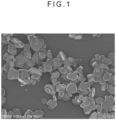
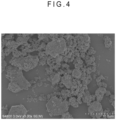
- Figs. 1 to 4 are electron micrographs of the powders produced in Examples 2, 19 and 26, and Comparative 2. In Comparatives 1 to 4, 8 and 9, the particle shape was disordered and the average thickness could not be measured, as shown in Fig. 4 .
- Example 1 Further, the powder produced in Example 1 was observed under an electron microscope and the average particle size was calculated for 10 particles, and it was confirmed that this measurement value was almost identical to the value obtained using Mastersizer 3000.
- the aspect ratio (average particle size/average thickness) was calculated from the values of the average particle size and the average thickness. Table 2 shows the results.
- Each resin composition obtained by kneading 30 parts of a mixed liquid of an epoxy resin (produced by Mitsubishi Chemical Group Corporation) and an amine curing agent (produced by DIC CORPORATION) and 70 parts of each thermally conductive oxide was mold-pressed to form a circular sheet molded product with a diameter of at least 100 mm and a thickness of at least 4 mm.
- Each molded product was then dried at a set temperature of 120 degrees C for 30 minutes, allowed to cool, and cut into four equal pieces to form a fan shape with a central angle of 90 degrees. Test pieces were thus prepared.
- the thermal conductivity of the prepared test pieces was measured using a thermophysical property measuring device by the hot-disk method (trade name "TPS-2500S", produced by Kyoto Electronics Manufacturing Co., Ltd). Table 2 shows the results.
- test pieces of the epoxy resin composition for evaluation which were used to measure the thermal conductivity, were used to measure a volume electrical resistivity value using an electrical resistivity meter. From the measurement results, insulation was evaluated according to the following evaluation criteria. Table 2 shows the results.
- Example 21 60 parts of the powder produced in Example 21 and 10 parts of Example 3 of Patent No. 6,209,695 were used for 70 parts of the thermally conductive oxide to prepare a test piece.
- the melt-kneaded product was then subjected to mold press molding at 175 degrees C using a 20 mm (length) ⁇ 20 mm (width) ⁇ 6 mm (height) mold, thereby preparing a test piece.
- the thermal conductivity of the prepared test piece was measured using a thermophysical property measuring device (trade name "TPS-2500S", produced by Kyoto Electronics Manufacturing Co., Ltd.).
- TPS-2500S thermophysical property measuring device
- the fillability was AA
- the abrasion moldability was A
- the insulation was A
- the thermal conductivity was 1.12 W/m•K Mixing particles of different shapes gave results within the ranges of Examples, almost the same as when only the rounded disc-shaped particles were used.
- Each coating liquid was prepared by mixing 15 parts of the powder (thermally conductive oxide) produced in each of Example 21 and Comparative 4, 62 parts of a urethane resin having a viscosity of 3,500 mPa•s, and 23 parts of ethyl acetate, and dispersing each mixture with a disper. After evenly applying each of the prepared coating liquids to release paper with a glass rod, it was placed in an oven at 100 degrees C for two minutes to evaporate the solvent, forming each coating film with a thickness of 50 ⁇ m (Application Example 1, Comparative Application Example 1).
- the coating liquid prepared using the thermally conductive oxide in Example 21 was applied to a nylon film for an exterior material of batteries using a gravure coater, and was used as a top coat for the exterior material of batteries. As a result, it was found that heat could be dissipated effectively, and the temperature increase in the battery could be reduced.
- Each dispersion liquid was prepared by mixing 35 parts of the powder (thermally conductive oxide) produced in each of Example 21 and Comparative 4 and 65 parts of polyester polyol having a viscosity of 300 mPa•s, and dispersing each mixture with a disper. There were mixed 98 parts of each of the prepared dispersion liquids and 2 parts of polyisocyanate having a viscosity of 2,600 mPa•s, and each mixture was stirred with a dissolver to obtain each urethane resin-based chemical reaction-type adhesive. After evenly applying each of the prepared adhesives to release paper with a glass rod, it was placed in an oven at 100 degrees C for two minutes to evaporate the solvent.
- Each dispersion liquid was obtained by mixing 20 parts of the powder (thermally conductive oxide) produced in each of Example 21 and Comparative 4, 63 parts of a polyurethane resin as a film-forming resin (trade name "SANPRENE IB-1700D", produced by Sanyo Chemical Industries, Ltd., a resin content of 30%, a solvent content of 70%), and 17 parts of a mixed solvent of methyl ethyl ketone, toluene, and isopropyl alcohol as a solvent, and stirring each mixture with a paint shaker (using glass beads, 2mm in diameter).
- SANPRENE IB-1700D a polyurethane resin as a film-forming resin
- each liquid composition After applying each liquid composition to release paper using a multi coater (trade name "K-303", produced by RK Print Coat Instruments Ltd.), the solvent was removed by hot air drying. Next, it was subjected to aging in a dryer at 40 degrees C for 48 hours to form each coating film for evaluation having a concentration of the thermally conductive component (filler) of 48% and a film thickness of approximately 100 ⁇ m.
- a multi coater trade name "K-303", produced by RK Print Coat Instruments Ltd.
- Each coating film for evaluation was cut out to a test piece having a size of 40 mm in length ⁇ 40 mm in width.
- the thermal conductivity of each of the obtained test pieces was measured using a "thin film measuring module" of a thermophysical property measuring device (trade name "TPS-2500S", produced by Kyoto Electronics Manufacturing Co., Ltd.).
- the thermal conductivity of the cured film in Comparative Application Example 3, which was formed using the ⁇ -alumina in Comparative 4 was 0.33 W/m•K
- the thermal conductivity of the cured film in Application Example 3 which was formed using the thermally conductive oxide in Example 21 was found to be high, 0.53 W/m•K.
- Each resin composition obtained by mixing 50 parts of polypropylene (produced by Prime Polymer Co., Ltd., MFR: 20 g/10 min) and 50 parts of each thermally conductive component was placed in a plastomill and melt-kneaded at a set temperature of 200 degrees C. Each melt-kneaded product was then subjected to mold press molding at 175 degrees C using a 20 mm (length) x 20 mm (width) x 6 mm (height) mold, thereby preparing each test piece.
- the thermal conductivity of each of the obtained test pieces was measured using a "standard isotropy measuring module" of the thermophysical property measuring device (trade name "TPS-25005", produced by Kyoto Electronics Manufacturing Co., Ltd.).
- Each coating film for evaluation was cut out to a test piece having a size of 40 mm in length ⁇ 40 mm in width ⁇ 100 ⁇ m in thickness.
- Each of the obtained test pieces was immersed in each of 5% hydrochloric acid, a 5% sulfuric acid aqueous solution, a 5% nitric acid aqueous solution, and a 5% sodium hydroxide aqueous solution, and stirred once a day and left to stand for one week.
- the mass of the test piece before the immersion and the mass of the test piece after the immersion were measured, and a mass change rate (%) was calculated based on the mass of the test piece before immersion to evaluate the chemical resistance according to the following evaluation criteria.
- the results were all A for both Application Example 3 and Comparative Application Example 3.
- each liquid composition was applied on corona-treated surfaces (treated PET, treated NY) and non-treated surfaces (non-treated PET, non-treated NY) of a biaxially oriented polyester film (trade name "ESTER Film E-5102", produced by Toyobo Co., Ltd.) and a biaxially oriented nylon film (trade name "HARDEN Film N1102, produced by Toyobo Co., Ltd.).
- the solvent was removed by hot air drying, and aging was performed in a dryer at 40 degrees C for 48 hours to prepare each test piece having a thin film on the film surface.
- a cellophane tape (trade name "CELLOTAPE (registered trademark)", produced by Nichiban Co., Ltd., 24 mm in width) was adhered to a surface of the thin film of each test piece, and the operation of peeling it in a vertical direction was performed three times at the same point. Thereafter, the condition of each thin film was checked to evaluate the adhesiveness according to the following evaluation criteria. The results were all A for both Application Example 3 and Comparative Application Example 3.
Landscapes
- Chemical & Material Sciences (AREA)
- Organic Chemistry (AREA)
- Engineering & Computer Science (AREA)
- Materials Engineering (AREA)
- Life Sciences & Earth Sciences (AREA)
- Chemical Kinetics & Catalysis (AREA)
- Inorganic Chemistry (AREA)
- Wood Science & Technology (AREA)
- Polymers & Plastics (AREA)
- Medicinal Chemistry (AREA)
- Health & Medical Sciences (AREA)
- Ceramic Engineering (AREA)
- Thermal Sciences (AREA)
- Physics & Mathematics (AREA)
- Structural Engineering (AREA)
- General Chemical & Material Sciences (AREA)
- Combustion & Propulsion (AREA)
- Geology (AREA)
- Manufacturing & Machinery (AREA)
- Nanotechnology (AREA)
- Compositions Of Macromolecular Compounds (AREA)
- Compounds Of Alkaline-Earth Elements, Aluminum Or Rare-Earth Metals (AREA)
- Compositions Of Oxide Ceramics (AREA)
Applications Claiming Priority (2)
| Application Number | Priority Date | Filing Date | Title |
|---|---|---|---|
| JP2022073469A JP7185798B1 (ja) | 2022-04-27 | 2022-04-27 | アルミナ系熱伝導性丸み盤状粒子及びその製造方法、熱伝導性組成物、物品、液状組成物、熱伝導性薄膜、並びに、電子機器用部材 |
| PCT/JP2023/008166 WO2023210166A1 (ja) | 2022-04-27 | 2023-03-03 | アルミナ系熱伝導性丸み盤状粒子及びその製造方法、熱伝導性組成物、物品、液状組成物、熱伝導性薄膜、並びに、電子機器用部材 |
Publications (2)
| Publication Number | Publication Date |
|---|---|
| EP4516762A1 true EP4516762A1 (de) | 2025-03-05 |
| EP4516762A4 EP4516762A4 (de) | 2025-09-24 |
Family
ID=84357696
Family Applications (1)
| Application Number | Title | Priority Date | Filing Date |
|---|---|---|---|
| EP23795914.3A Pending EP4516762A4 (de) | 2022-04-27 | 2023-03-03 | Auf aluminiumoxid basierende wärmeleitfähige gerundete scheibenpartikel, herstellungsverfahren dafür, artikel, flüssigzusammensetzung, wärmeleitfähiger dünnfilm und element einer elektronischen vorrichtung |
Country Status (7)
| Country | Link |
|---|---|
| US (1) | US20250109071A1 (de) |
| EP (1) | EP4516762A4 (de) |
| JP (1) | JP7185798B1 (de) |
| KR (1) | KR102853521B1 (de) |
| CN (1) | CN119072460A (de) |
| TW (1) | TWI838230B (de) |
| WO (1) | WO2023210166A1 (de) |
Families Citing this family (3)
| Publication number | Priority date | Publication date | Assignee | Title |
|---|---|---|---|---|
| JP7358669B1 (ja) | 2023-03-27 | 2023-10-10 | 大日精化工業株式会社 | 熱伝導性粒子及びその製造方法、混合物、物品、樹脂組成物、並びに、熱伝導性薄膜 |
| CN117164384B (zh) * | 2023-09-01 | 2025-09-02 | 清远市简一陶瓷有限公司 | 一种半透丝网印刷刷抛玉脂光泽瓷砖及其制备方法 |
| JP7643614B1 (ja) | 2024-03-29 | 2025-03-11 | 日本軽金属株式会社 | 板状アルミナ粉末及びその製造方法、並びに塗料又は化粧品 |
Family Cites Families (11)
| Publication number | Priority date | Publication date | Assignee | Title |
|---|---|---|---|---|
| US6209695B1 (en) | 1999-08-24 | 2001-04-03 | Borgwarner Inc. | Multi-speed transmission with no lag electronically controlled valving |
| JP2001261331A (ja) * | 2000-03-24 | 2001-09-26 | Kawai Sekkai Kogyo Kk | 円盤状ベーマイト及び円盤状アルミナ並びにそれらの製造方法並びに樹脂組成物 |
| JP3663369B2 (ja) * | 2001-06-18 | 2005-06-22 | 河合石灰工業株式会社 | 六角板状ベーマイト及び六角板状アルミナの製造方法 |
| AU2003900030A0 (en) | 2003-01-07 | 2003-01-23 | Advanced Nano Technologies Pty Ltd | Process for the production of ultrafine plate-like alumina particles |
| JP2008195569A (ja) | 2007-02-13 | 2008-08-28 | Kanto Denka Kogyo Co Ltd | アルミナ微粒子 |
| CN108910936B (zh) * | 2014-03-14 | 2021-01-12 | 大日精化工业株式会社 | 导热性复合氧化物、其制造方法、含导热性复合氧化物的组合物和其使用 |
| JP2016135841A (ja) * | 2015-01-15 | 2016-07-28 | 大日精化工業株式会社 | 熱伝導性複合酸化物、熱伝導性樹脂組成物及び塗工液 |
| JP6121074B1 (ja) * | 2015-09-16 | 2017-04-26 | 大日精化工業株式会社 | アルミナ系熱伝導性酸化物及びその製造方法 |
| JP6209695B1 (ja) * | 2017-03-02 | 2017-10-04 | 大日精化工業株式会社 | アルミナ系熱伝導性酸化物及びその製造方法 |
| JP6708281B2 (ja) | 2019-03-27 | 2020-06-10 | Dic株式会社 | 板状アルミナ粒子 |
| US12486176B2 (en) * | 2019-10-09 | 2025-12-02 | Dic Corporation | Composite particle and method of producing composite particle |
-
2022
- 2022-04-27 JP JP2022073469A patent/JP7185798B1/ja active Active
-
2023
- 2023-03-03 WO PCT/JP2023/008166 patent/WO2023210166A1/ja not_active Ceased
- 2023-03-03 EP EP23795914.3A patent/EP4516762A4/de active Pending
- 2023-03-03 US US18/858,406 patent/US20250109071A1/en active Pending
- 2023-03-03 KR KR1020247036066A patent/KR102853521B1/ko active Active
- 2023-03-03 CN CN202380036042.8A patent/CN119072460A/zh active Pending
- 2023-04-26 TW TW112115525A patent/TWI838230B/zh active
Also Published As
| Publication number | Publication date |
|---|---|
| US20250109071A1 (en) | 2025-04-03 |
| CN119072460A (zh) | 2024-12-03 |
| WO2023210166A1 (ja) | 2023-11-02 |
| KR20240161210A (ko) | 2024-11-12 |
| KR102853521B1 (ko) | 2025-09-02 |
| JP7185798B1 (ja) | 2022-12-07 |
| EP4516762A4 (de) | 2025-09-24 |
| JP2023162813A (ja) | 2023-11-09 |
| TW202342643A (zh) | 2023-11-01 |
| TWI838230B (zh) | 2024-04-01 |
Similar Documents
| Publication | Publication Date | Title |
|---|---|---|
| EP4516762A1 (de) | Auf aluminiumoxid basierende wärmeleitfähige gerundete scheibenpartikel, herstellungsverfahren dafür, artikel, flüssigzusammensetzung, wärmeleitfähiger dünnfilm und element einer elektronischen vorrichtung | |
| KR102070215B1 (ko) | 알루미나계 열 전도성 산화물 및 그의 제조 방법 | |
| TWI806853B (zh) | 粉末狀之氧化鋁系熱傳導性氧化物及其製造方法 | |
| KR101154107B1 (ko) | 충전제?유리 함유 수지 성형체 | |
| US10344145B2 (en) | Laser-markable and laser-weldable polymeric materials | |
| TWI712663B (zh) | 雷射可標記之聚合物及塗料 | |
| EP2351784B1 (de) | Masterbatch zur färbung von kunstharzen | |
| JP2019206459A (ja) | 熱伝導性酸化物及びその製造方法 | |
| US20190352180A1 (en) | Hexagonal boron nitride powder and production process therefor | |
| KR101148698B1 (ko) | 유리 함유 수지 성형체 | |
| JP7358669B1 (ja) | 熱伝導性粒子及びその製造方法、混合物、物品、樹脂組成物、並びに、熱伝導性薄膜 | |
| JP2009279829A (ja) | ガラス含有熱転写シート |
Legal Events
| Date | Code | Title | Description |
|---|---|---|---|
| STAA | Information on the status of an ep patent application or granted ep patent |
Free format text: STATUS: THE INTERNATIONAL PUBLICATION HAS BEEN MADE |
|
| PUAI | Public reference made under article 153(3) epc to a published international application that has entered the european phase |
Free format text: ORIGINAL CODE: 0009012 |
|
| STAA | Information on the status of an ep patent application or granted ep patent |
Free format text: STATUS: REQUEST FOR EXAMINATION WAS MADE |
|
| 17P | Request for examination filed |
Effective date: 20241122 |
|
| AK | Designated contracting states |
Kind code of ref document: A1 Designated state(s): AL AT BE BG CH CY CZ DE DK EE ES FI FR GB GR HR HU IE IS IT LI LT LU LV MC ME MK MT NL NO PL PT RO RS SE SI SK SM TR |
|
| DAV | Request for validation of the european patent (deleted) | ||
| DAX | Request for extension of the european patent (deleted) | ||
| REG | Reference to a national code |
Ref country code: DE Ref legal event code: R079 Free format text: PREVIOUS MAIN CLASS: C04B0035117000 Ipc: C01F0007442000 |
|
| A4 | Supplementary search report drawn up and despatched |
Effective date: 20250825 |
|
| RIC1 | Information provided on ipc code assigned before grant |
Ipc: C01F 7/442 20220101AFI20250819BHEP Ipc: C04B 35/117 20060101ALI20250819BHEP Ipc: C08K 3/22 20060101ALI20250819BHEP Ipc: C08K 3/30 20060101ALI20250819BHEP Ipc: C08K 3/34 20060101ALI20250819BHEP Ipc: C08K 3/38 20060101ALI20250819BHEP Ipc: C08L 101/00 20060101ALI20250819BHEP Ipc: C09K 5/14 20060101ALI20250819BHEP |