EP4516331A1 - Abbaubarer harnleiterstent und herstellungsverfahren dafür - Google Patents
Abbaubarer harnleiterstent und herstellungsverfahren dafür Download PDFInfo
- Publication number
- EP4516331A1 EP4516331A1 EP23842026.9A EP23842026A EP4516331A1 EP 4516331 A1 EP4516331 A1 EP 4516331A1 EP 23842026 A EP23842026 A EP 23842026A EP 4516331 A1 EP4516331 A1 EP 4516331A1
- Authority
- EP
- European Patent Office
- Prior art keywords
- glycolide
- ureteral stent
- copolymer
- biodegradable
- ethylene oxide
- Prior art date
- Legal status (The legal status is an assumption and is not a legal conclusion. Google has not performed a legal analysis and makes no representation as to the accuracy of the status listed.)
- Pending
Links
Images
Classifications
-
- A—HUMAN NECESSITIES
- A61—MEDICAL OR VETERINARY SCIENCE; HYGIENE
- A61L—METHODS OR APPARATUS FOR STERILISING MATERIALS OR OBJECTS IN GENERAL; DISINFECTION, STERILISATION OR DEODORISATION OF AIR; CHEMICAL ASPECTS OF BANDAGES, DRESSINGS, ABSORBENT PADS OR SURGICAL ARTICLES; MATERIALS FOR BANDAGES, DRESSINGS, ABSORBENT PADS OR SURGICAL ARTICLES
- A61L27/00—Materials for grafts or prostheses or for coating grafts or prostheses
- A61L27/14—Macromolecular materials
- A61L27/18—Macromolecular materials obtained otherwise than by reactions only involving carbon-to-carbon unsaturated bonds
-
- A—HUMAN NECESSITIES
- A61—MEDICAL OR VETERINARY SCIENCE; HYGIENE
- A61F—FILTERS IMPLANTABLE INTO BLOOD VESSELS; PROSTHESES; DEVICES PROVIDING PATENCY TO, OR PREVENTING COLLAPSING OF, TUBULAR STRUCTURES OF THE BODY, e.g. STENTS; ORTHOPAEDIC, NURSING OR CONTRACEPTIVE DEVICES; FOMENTATION; TREATMENT OR PROTECTION OF EYES OR EARS; BANDAGES, DRESSINGS OR ABSORBENT PADS; FIRST-AID KITS
- A61F2/00—Filters implantable into blood vessels; Prostheses, i.e. artificial substitutes or replacements for parts of the body; Appliances for connecting them with the body; Devices providing patency to, or preventing collapsing of, tubular structures of the body, e.g. stents
- A61F2/02—Prostheses implantable into the body
- A61F2/04—Hollow or tubular parts of organs, e.g. bladders, tracheae, bronchi or bile ducts
-
- A—HUMAN NECESSITIES
- A61—MEDICAL OR VETERINARY SCIENCE; HYGIENE
- A61L—METHODS OR APPARATUS FOR STERILISING MATERIALS OR OBJECTS IN GENERAL; DISINFECTION, STERILISATION OR DEODORISATION OF AIR; CHEMICAL ASPECTS OF BANDAGES, DRESSINGS, ABSORBENT PADS OR SURGICAL ARTICLES; MATERIALS FOR BANDAGES, DRESSINGS, ABSORBENT PADS OR SURGICAL ARTICLES
- A61L27/00—Materials for grafts or prostheses or for coating grafts or prostheses
- A61L27/02—Inorganic materials
- A61L27/04—Metals or alloys
- A61L27/047—Other specific metals or alloys not covered by A61L27/042 - A61L27/045 or A61L27/06
-
- A—HUMAN NECESSITIES
- A61—MEDICAL OR VETERINARY SCIENCE; HYGIENE
- A61L—METHODS OR APPARATUS FOR STERILISING MATERIALS OR OBJECTS IN GENERAL; DISINFECTION, STERILISATION OR DEODORISATION OF AIR; CHEMICAL ASPECTS OF BANDAGES, DRESSINGS, ABSORBENT PADS OR SURGICAL ARTICLES; MATERIALS FOR BANDAGES, DRESSINGS, ABSORBENT PADS OR SURGICAL ARTICLES
- A61L27/00—Materials for grafts or prostheses or for coating grafts or prostheses
- A61L27/50—Materials characterised by their function or physical properties, e.g. injectable or lubricating compositions, shape-memory materials, surface modified materials
-
- A—HUMAN NECESSITIES
- A61—MEDICAL OR VETERINARY SCIENCE; HYGIENE
- A61L—METHODS OR APPARATUS FOR STERILISING MATERIALS OR OBJECTS IN GENERAL; DISINFECTION, STERILISATION OR DEODORISATION OF AIR; CHEMICAL ASPECTS OF BANDAGES, DRESSINGS, ABSORBENT PADS OR SURGICAL ARTICLES; MATERIALS FOR BANDAGES, DRESSINGS, ABSORBENT PADS OR SURGICAL ARTICLES
- A61L27/00—Materials for grafts or prostheses or for coating grafts or prostheses
- A61L27/50—Materials characterised by their function or physical properties, e.g. injectable or lubricating compositions, shape-memory materials, surface modified materials
- A61L27/58—Materials at least partially resorbable by the body
-
- A—HUMAN NECESSITIES
- A61—MEDICAL OR VETERINARY SCIENCE; HYGIENE
- A61L—METHODS OR APPARATUS FOR STERILISING MATERIALS OR OBJECTS IN GENERAL; DISINFECTION, STERILISATION OR DEODORISATION OF AIR; CHEMICAL ASPECTS OF BANDAGES, DRESSINGS, ABSORBENT PADS OR SURGICAL ARTICLES; MATERIALS FOR BANDAGES, DRESSINGS, ABSORBENT PADS OR SURGICAL ARTICLES
- A61L31/00—Materials for other surgical articles, e.g. stents, stent-grafts, shunts, surgical drapes, guide wires, materials for adhesion prevention, occluding devices, surgical gloves, tissue fixation devices
- A61L31/02—Inorganic materials
- A61L31/028—Other inorganic materials not covered by A61L31/022 - A61L31/026
-
- A—HUMAN NECESSITIES
- A61—MEDICAL OR VETERINARY SCIENCE; HYGIENE
- A61L—METHODS OR APPARATUS FOR STERILISING MATERIALS OR OBJECTS IN GENERAL; DISINFECTION, STERILISATION OR DEODORISATION OF AIR; CHEMICAL ASPECTS OF BANDAGES, DRESSINGS, ABSORBENT PADS OR SURGICAL ARTICLES; MATERIALS FOR BANDAGES, DRESSINGS, ABSORBENT PADS OR SURGICAL ARTICLES
- A61L31/00—Materials for other surgical articles, e.g. stents, stent-grafts, shunts, surgical drapes, guide wires, materials for adhesion prevention, occluding devices, surgical gloves, tissue fixation devices
- A61L31/04—Macromolecular materials
- A61L31/06—Macromolecular materials obtained otherwise than by reactions only involving carbon-to-carbon unsaturated bonds
-
- A—HUMAN NECESSITIES
- A61—MEDICAL OR VETERINARY SCIENCE; HYGIENE
- A61L—METHODS OR APPARATUS FOR STERILISING MATERIALS OR OBJECTS IN GENERAL; DISINFECTION, STERILISATION OR DEODORISATION OF AIR; CHEMICAL ASPECTS OF BANDAGES, DRESSINGS, ABSORBENT PADS OR SURGICAL ARTICLES; MATERIALS FOR BANDAGES, DRESSINGS, ABSORBENT PADS OR SURGICAL ARTICLES
- A61L31/00—Materials for other surgical articles, e.g. stents, stent-grafts, shunts, surgical drapes, guide wires, materials for adhesion prevention, occluding devices, surgical gloves, tissue fixation devices
- A61L31/12—Composite materials, i.e. containing one material dispersed in a matrix of the same or different material
- A61L31/125—Composite materials, i.e. containing one material dispersed in a matrix of the same or different material having a macromolecular matrix
- A61L31/128—Composite materials, i.e. containing one material dispersed in a matrix of the same or different material having a macromolecular matrix containing other specific inorganic fillers not covered by A61L31/126 or A61L31/127
-
- A—HUMAN NECESSITIES
- A61—MEDICAL OR VETERINARY SCIENCE; HYGIENE
- A61L—METHODS OR APPARATUS FOR STERILISING MATERIALS OR OBJECTS IN GENERAL; DISINFECTION, STERILISATION OR DEODORISATION OF AIR; CHEMICAL ASPECTS OF BANDAGES, DRESSINGS, ABSORBENT PADS OR SURGICAL ARTICLES; MATERIALS FOR BANDAGES, DRESSINGS, ABSORBENT PADS OR SURGICAL ARTICLES
- A61L31/00—Materials for other surgical articles, e.g. stents, stent-grafts, shunts, surgical drapes, guide wires, materials for adhesion prevention, occluding devices, surgical gloves, tissue fixation devices
- A61L31/14—Materials characterised by their function or physical properties, e.g. injectable or lubricating compositions, shape-memory materials, surface modified materials
-
- A—HUMAN NECESSITIES
- A61—MEDICAL OR VETERINARY SCIENCE; HYGIENE
- A61L—METHODS OR APPARATUS FOR STERILISING MATERIALS OR OBJECTS IN GENERAL; DISINFECTION, STERILISATION OR DEODORISATION OF AIR; CHEMICAL ASPECTS OF BANDAGES, DRESSINGS, ABSORBENT PADS OR SURGICAL ARTICLES; MATERIALS FOR BANDAGES, DRESSINGS, ABSORBENT PADS OR SURGICAL ARTICLES
- A61L31/00—Materials for other surgical articles, e.g. stents, stent-grafts, shunts, surgical drapes, guide wires, materials for adhesion prevention, occluding devices, surgical gloves, tissue fixation devices
- A61L31/14—Materials characterised by their function or physical properties, e.g. injectable or lubricating compositions, shape-memory materials, surface modified materials
- A61L31/148—Materials at least partially resorbable by the body
-
- A—HUMAN NECESSITIES
- A61—MEDICAL OR VETERINARY SCIENCE; HYGIENE
- A61L—METHODS OR APPARATUS FOR STERILISING MATERIALS OR OBJECTS IN GENERAL; DISINFECTION, STERILISATION OR DEODORISATION OF AIR; CHEMICAL ASPECTS OF BANDAGES, DRESSINGS, ABSORBENT PADS OR SURGICAL ARTICLES; MATERIALS FOR BANDAGES, DRESSINGS, ABSORBENT PADS OR SURGICAL ARTICLES
- A61L31/00—Materials for other surgical articles, e.g. stents, stent-grafts, shunts, surgical drapes, guide wires, materials for adhesion prevention, occluding devices, surgical gloves, tissue fixation devices
- A61L31/14—Materials characterised by their function or physical properties, e.g. injectable or lubricating compositions, shape-memory materials, surface modified materials
- A61L31/18—Materials at least partially X-ray or laser opaque
-
- A—HUMAN NECESSITIES
- A61—MEDICAL OR VETERINARY SCIENCE; HYGIENE
- A61F—FILTERS IMPLANTABLE INTO BLOOD VESSELS; PROSTHESES; DEVICES PROVIDING PATENCY TO, OR PREVENTING COLLAPSING OF, TUBULAR STRUCTURES OF THE BODY, e.g. STENTS; ORTHOPAEDIC, NURSING OR CONTRACEPTIVE DEVICES; FOMENTATION; TREATMENT OR PROTECTION OF EYES OR EARS; BANDAGES, DRESSINGS OR ABSORBENT PADS; FIRST-AID KITS
- A61F2/00—Filters implantable into blood vessels; Prostheses, i.e. artificial substitutes or replacements for parts of the body; Appliances for connecting them with the body; Devices providing patency to, or preventing collapsing of, tubular structures of the body, e.g. stents
- A61F2/02—Prostheses implantable into the body
- A61F2/04—Hollow or tubular parts of organs, e.g. bladders, tracheae, bronchi or bile ducts
- A61F2002/048—Ureters
-
- A—HUMAN NECESSITIES
- A61—MEDICAL OR VETERINARY SCIENCE; HYGIENE
- A61F—FILTERS IMPLANTABLE INTO BLOOD VESSELS; PROSTHESES; DEVICES PROVIDING PATENCY TO, OR PREVENTING COLLAPSING OF, TUBULAR STRUCTURES OF THE BODY, e.g. STENTS; ORTHOPAEDIC, NURSING OR CONTRACEPTIVE DEVICES; FOMENTATION; TREATMENT OR PROTECTION OF EYES OR EARS; BANDAGES, DRESSINGS OR ABSORBENT PADS; FIRST-AID KITS
- A61F2210/00—Particular material properties of prostheses classified in groups A61F2/00 - A61F2/26 or A61F2/82 or A61F9/00 or A61F11/00 or subgroups thereof
- A61F2210/0004—Particular material properties of prostheses classified in groups A61F2/00 - A61F2/26 or A61F2/82 or A61F9/00 or A61F11/00 or subgroups thereof bioabsorbable
-
- A—HUMAN NECESSITIES
- A61—MEDICAL OR VETERINARY SCIENCE; HYGIENE
- A61F—FILTERS IMPLANTABLE INTO BLOOD VESSELS; PROSTHESES; DEVICES PROVIDING PATENCY TO, OR PREVENTING COLLAPSING OF, TUBULAR STRUCTURES OF THE BODY, e.g. STENTS; ORTHOPAEDIC, NURSING OR CONTRACEPTIVE DEVICES; FOMENTATION; TREATMENT OR PROTECTION OF EYES OR EARS; BANDAGES, DRESSINGS OR ABSORBENT PADS; FIRST-AID KITS
- A61F2230/00—Geometry of prostheses classified in groups A61F2/00 - A61F2/26 or A61F2/82 or A61F9/00 or A61F11/00 or subgroups thereof
- A61F2230/0063—Three-dimensional shapes
- A61F2230/0091—Three-dimensional shapes helically-coiled or spirally-coiled, i.e. having a 2-D spiral cross-section
-
- A—HUMAN NECESSITIES
- A61—MEDICAL OR VETERINARY SCIENCE; HYGIENE
- A61F—FILTERS IMPLANTABLE INTO BLOOD VESSELS; PROSTHESES; DEVICES PROVIDING PATENCY TO, OR PREVENTING COLLAPSING OF, TUBULAR STRUCTURES OF THE BODY, e.g. STENTS; ORTHOPAEDIC, NURSING OR CONTRACEPTIVE DEVICES; FOMENTATION; TREATMENT OR PROTECTION OF EYES OR EARS; BANDAGES, DRESSINGS OR ABSORBENT PADS; FIRST-AID KITS
- A61F2240/00—Manufacturing or designing of prostheses classified in groups A61F2/00 - A61F2/26 or A61F2/82 or A61F9/00 or A61F11/00 or subgroups thereof
- A61F2240/001—Designing or manufacturing processes
-
- A—HUMAN NECESSITIES
- A61—MEDICAL OR VETERINARY SCIENCE; HYGIENE
- A61L—METHODS OR APPARATUS FOR STERILISING MATERIALS OR OBJECTS IN GENERAL; DISINFECTION, STERILISATION OR DEODORISATION OF AIR; CHEMICAL ASPECTS OF BANDAGES, DRESSINGS, ABSORBENT PADS OR SURGICAL ARTICLES; MATERIALS FOR BANDAGES, DRESSINGS, ABSORBENT PADS OR SURGICAL ARTICLES
- A61L2430/00—Materials or treatment for tissue regeneration
- A61L2430/22—Materials or treatment for tissue regeneration for reconstruction of hollow organs, e.g. bladder, esophagus, urether, uterus
Definitions
- the present invention belongs to the field of biomedical materials and medical apparatuses and instruments, and specifically relates to a biodegradable ureteral stent and a preparation method therefor.
- Ureteral stents have been widely used in urological surgery, which are applicable to upper urinary tract surgery, lithotripsy using lithotripters, dilation of ureterostenosis, and other treatment processes, and can play important roles of draining urine and preventing ureterostenosis after implantation into ureters.
- ureteral stents are all non-degradable and are prepared from soft polyurethane elastomers or silicone rubber materials.
- the polyurethane stents are harder and easy to catheterize; and the silicone rubber stents are softer and have slightly poor catheterization performance.
- the hardness of the stents will remain unchanged.
- the ureteral stents need to be pulled out through an invasive operation, namely through a cystoscope, and patients will be in pain and are possible to have infections and other complications. Therefore, research and development of biodegradable ureteral stents have important clinical values.
- the ureteral stents will have differences in drainage time. Short-term temporary drainage of urine usually takes about 1-2 weeks, such as mild ureteral injuries, simple stones, pre-stenting, etc.; and common temporary drainage usually takes 3-6 weeks. Thus, different degradation materials need to be used. However, common basic requirements for the stents include that they should have mechanical performance of elastic materials, and their degradation fragments can be completely excreted out of the body as soon as possible, otherwise the risk of a series of complications will be increased.
- the ureteral stents are manufactured by using biodegradable polylactide (PLLA) or a lactide/glycolide copolymer (PLGA) as a raw material.
- PLLA biodegradable polylactide
- PLGA lactide/glycolide copolymer
- the PLLA and PLGA materials are plastic, which lack softness, have harder degraded fragments, and have a great possibility of being embedded or getting stuck in the renal pelvis, leading to various complications.
- a Chinese patent No. CN1672739A and a Chinese patent No. CN112516390A disclose a biodegradable ureteral stent, which relates to a glycolide- ⁇ -caprolactone copolymer material and has mechanical performance of elastic materials within a certain composition proportion range.
- such copolymer formed by a soft chain monomer ( ⁇ -caprolactone) and a hard chain monomer (glycolide) usually becomes increasingly hard with degradation in water. This is because a hard chain structure in the material, such as a glycolide chain segment, usually has a crystallization trend in a degradation process, and thus, the material is easy to get stuck or remain in the renal pelvis and other parts.
- the biodegradable materials obtained in the prior art cannot achieve the material properties which have not only mechanical performance similar to that of silicone rubbers and polyurethane elastic materials. but also can make its degradation fragments not to be stuck or not to remain in the renal pelvis. That is still a key point restricting the research progress in the art up to now and is also a primary reason why the degradable ureteral stents are currently not commercially available on the market.
- the present invention provides a biodegradable ureteral stent.
- the stent has mechanical strength of elastic materials, higher initial hardness (or modulus) and convenience in catheterization, gradually becomes increasingly soft with degradation in urine, and is easier to be excreted out of the body.
- a biodegradable ureteral stent is prepared from a composite material, and the composite material is formed by blending at least a glycolide- ⁇ -caprolactone copolymer, an ethylene oxide polymer, and barium sulfate with relative contents as follows:
- the above purpose is realized by using the composite material formed by blending the degradable glycolide- ⁇ -caprolactone copolymer, the ethylene oxide polymer, and the barium sulfate.
- the present invention and related studies find that when the stent is harder, degraded fragments are easy to get stuck at the position of the renal pelvis.
- the softness and hardness of a substrate is a key influencing factor.
- Common degradable elastic materials such as glycolide- ⁇ -caprolactone copolymers, L-lactide/ ⁇ -caprolactone copolymers, etc., usually become increasingly hard in a degradation process, and degraded fragments or segments are more difficult to pass through narrow sites of the ureteral .
- the glycolide- ⁇ -caprolactone copolymer can gradually become soft with degradation in water or urine, and is an elastic material with good mechanical strength and suitable softness and hardness
- the appropriate comonomer proportion range is that the weight percentage content of the glycolide is 51-58%.
- the weight percentage content of the glycolide is greater than 58%, the copolymer has an obvious crystallization trend and becomes hard in a degradation process; and when the weight percentage content of the glycolide is less than 51%, the copolymer has too poor mechanical performance and is too soft.
- the present invention also finds that by adding a certain content of the ethylene oxide polymer, such as polyethylene glycol or polyoxyethylene, to materials of the glycolide- ⁇ -caprolactone copolymer, the composite material can be further promoted to gradually become softer in a degradation process, smoother in surface, and easier to disintegrate and fracture, thereby being conducive to excretion of fractured fragments of the tubular stent.
- a certain content of the ethylene oxide polymer such as polyethylene glycol or polyoxyethylene
- the barium sulfate used is a commonly used radiopaque material in medical developer, which has good compatibility with the above materials and has a certain reinforcing effect.
- an intrinsic viscosity of the glycolide- ⁇ -caprolactone copolymer measured at 25 ⁇ 1°C in hexafluoroisopropanol at a concentration of 0.1 g/dl is 1.30-3.00 dl/g, and when the viscosity is greater, a degradation maintenance time is longer.
- a drainage time of the stent may be controlled by the intrinsic viscosity.
- the ethylene oxide polymer includes polyethylene glycol, polyethylene glycol monomethyl ether, polyethylene glycol dimethyl ether, and polyoxyethylene.
- a weight proportion of the ethylene oxide polymer in the composite material is 2-8%, and when the content of the ethylene oxide polymer is higher, the composite material is softer and faster to degrade.
- a molecular weight of the polyethylene glycol, the polyethylene glycol monomethyl ether, the polyethylene glycol dimethyl ether, or the polyoxyethylene is 1,000-1,000,000 Da.
- the molecular weight of the ethylene oxide polymer including the polyethylene glycol, the polyethylene glycol monomethyl ether, and the polyethylene glycol dimethyl ether is 5,000-40,000 Da.
- the ethylene oxide polymer is the polyoxyethylene, and the molecular weight is 50,000-400,000 Da.
- the barium sulfate may be replaced by other medical developers, including bismuth subcarbonate and a metal developer, and the developer used may include one or more.
- a preparation method for the glycolide- ⁇ -caprolactone copolymer includes: under the protection of nitrogen, sequentially adding stannous octanoate with a mass ratio of 0.005-0.1%, ⁇ -caprolactone, and glycolide to a reactor with a stirrer; raising the temperature of a reaction system from room temperature to 165-200°C within 30 minutes under stirring, maintaining the temperature for 18-30 hours, and then holding the system under vacuum for 1-4 hours; and transferring a copolymer out of the reactor, further breaking the copolymer, and placing the copolymer in a vacuum oven for vacuum drying at 50-110°C for 8-24 hours.
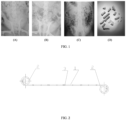
- the biodegradable ureteral stent of the present invention is of a hollow circular tubular structure (1), a fixing structure (2) for preventing sliding is disposed at two ends or one end, the fixing structure is preferably in a circular tubular coil shape, a tube wall is also provided with a plurality of penetrating drainage side holes (3), and a tube diameter is 1.0-4.0 mm.
- the biodegradable ureteral stent of the present invention is prepared by a melting extrusion method.
- the method specifically includes:
- An initial modulus at 100% deformation of the degradable ureteral stent of the present invention is 2-10 MPa, and the modulus at 100% deformation after degradation is not greater than an initial value.
- An initial Shore hardness (A) of the material used is 70-95, and the Shore hardness (A) after degradation is not greater than an initial value.
- various additives may be conventionally added to achieve different purposes, including but not limited to, a plasticizer, a lubricant, a dye, an antioxidant, an anti-hydrolysis agent, a melt thickener, a chain extender, a reinforcing agent, and a polymer modifier.
- a plasticizer e.g., ethylene glycol dimethacrylate copolymer
- a lubricant e.g., ethylene glycol dimethacrylate, polyethylene glycol dimethacrylate, poly(ethylene glycol) graft copolymer, graft copolymer, graft copolymer, graft copolymer, graft copolymer, graft copolymer, graft copolymer, graft copolymer, graft copolymer, graft copolymer, graft copolymer, graft copolymer, graft copolymer, graft copolymer, graft
- the present invention has the following beneficial effects.
- the copolymer by controlling the content of the glycolide monomer in the glycolide- ⁇ -caprolactone copolymer, the copolymer has appropriate mechanical strength and softness and hardness and gradually becomes soft with prolonging of the degradation time. Meanwhile, a certain proportion of the ethylene oxide polymer is added, such that the polymer has a lower constant stretch modulus after degradation and is softer and smoother, thus is more suitable for preparing a biodegradable ureter stent.
- a 0.04% stannous octanoate catalyst, 570 g of an ⁇ -caprolactone monomer (CL), and 580 g of a glycolide monomer (GA) were sequentially placed in a 3 L reactor.
- the temperature of a system was raised to 180°C within 25 minutes under the protection of nitrogen, a reaction was carried out for 25 hours at a stirring speed of 10-20 r/min, and the system was held under vacuum for 2 hours.
- a copolymer was transferred out of the reactor, further broken, and placed in a vacuum oven for vacuum drying at 90°C for 24 hours to obtain a glycolide- ⁇ -caprolactone copolymer 1 (PGC1).
- Weight percentage contents of the glycolide and the ⁇ -caprolactone in the copolymer were determined by a 1 H nuclear magnetic spectrum, and hexafluoroisopropanol was used as a solvent.
- the copolymer was prepared into a hexafluoroisopropanol solution at a concentration of 0.1 g/dl, and the intrinsic viscosity was tested by an Ubbelohde viscometer at 25°C.
- the copolymer was prepared into a sheet with a thickness of 2 mm by a hot pressing molding method on a press vulcanizer at 140°C, and the Shore hardness (A) of the material was tested by a Shore hardness tester.
- the copolymer was prepared into a dumbbell plate with a thickness of 2 mm, and the tensile strength at break and elongation at break of the material were tested on a universal mechanical tester at a speed of 200 mm/min.
- a 0.02% stannous octanoate catalyst, 540 g of an ⁇ -caprolactone monomer (CL), and 590 g of a glycolide monomer (GA) were sequentially placed in a 3 L reactor.
- the temperature of a system was raised to 170°C within 20 minutes under the protection of nitrogen, a reaction was carried out for 28 hours at a stirring speed of 10-20 r/min, and the system was held under vacuum for 1 hour.
- a copolymer was transferred out of the reactor, further broken, and placed in a vacuum oven for vacuum drying at 90°C for 24 hours to obtain a glycolide- ⁇ -caprolactone copolymer 2 (PGC2).
- PPC2 glycolide- ⁇ -caprolactone copolymer 2
- a 0.03% stannous octanoate catalyst, 530 g of an ⁇ -caprolactone monomer (CL), and 600 g of a glycolide monomer (GA) were sequentially placed in a 3 L reactor.
- the temperature of a system was raised to 190°C within 30 minutes under the protection of nitrogen, a reaction was carried out for 22 hours at a stirring speed of 10-20 r/min, and the system was held under vacuum for 4 hours.
- a copolymer was transferred out of the reactor, further broken, and placed in a vacuum oven for vacuum drying at 90°C for 24 hours to obtain a glycolide- ⁇ -caprolactone copolymer 3 (PGC3).
- PPC3 glycolide- ⁇ -caprolactone copolymer 3
- a 0.05% stannous octanoate catalyst, 480 g of an ⁇ -caprolactone monomer (CL), and 600 g of a glycolide monomer (GA) were sequentially placed in a 3 L reactor.
- the temperature of a system was raised to 195°C within 30 minutes under the protection of nitrogen, a reaction was carried out for 18 hours at a stirring speed of 10-20 r/min, and the system was held under vacuum for 4 hours.
- a copolymer was transferred out of the reactor, further broken, and placed in a vacuum oven for vacuum drying at 90°C for 24 hours to obtain a glycolide- ⁇ -caprolactone copolymer 4 (PGC4).
- PPC4 glycolide- ⁇ -caprolactone copolymer 4
- a 0.01% stannous octanoate catalyst, 470 g of an ⁇ -caprolactone monomer (CL), and 630 g of a glycolide monomer (GA) were sequentially placed in a 3 L reactor.
- the temperature of a system was raised to 190°C within 30 minutes under the protection of nitrogen, a reaction was carried out for 20 hours at a stirring speed of 10-20 r/min, and the system was held under vacuum for 2 hours.
- a copolymer was transferred out of the reactor, further broken, and placed in a vacuum oven for vacuum drying at 90°C for 24 hours to obtain a glycolide- ⁇ -caprolactone copolymer 5 (PGC5).
- PPC5 glycolide- ⁇ -caprolactone copolymer 5
- a 0.01% stannous octanoate catalyst, 470 g of an ⁇ -caprolactone monomer (CL), and 660 g of a glycolide monomer (GA) were sequentially placed in a 3 L reactor.
- the temperature of a system was raised to 184°C within 26 minutes under the protection of nitrogen, a reaction was carried out for 23 hours at a stirring speed of 10-20 r/min, and the system was held under vacuum for 3 hours.
- a copolymer was transferred out of the reactor, further broken, and placed in a vacuum oven for vacuum drying at 90°C for 24 hours to obtain a glycolide- ⁇ -caprolactone copolymer 6 (PGC6).
- PPC6 glycolide- ⁇ -caprolactone copolymer 6
- the composite materials prepared in the above examples were subjected to extrusion molding by an extruder at 120-150°C to obtain a degradable elastic tube body 1, respectively, wherein the tube body 1 had an outer diameter of 2 mm and an inner diameter of 1.1 mm.
- the tube body was subjected to bending shaping at 50-80°C to form a fixing structure with a coiled tubular coil 2 formed at one end or two ends.
- the tube body was subjected to punching (longitudinal aperture: 1.0 mm) at an equal distance (hole distance: 50 mm) by a punching device to form drainage holes 3, so as to obtain a degradable ureteral stent shown in FIG. 2 .
- ureteral stents were implanted into left and right ureters of the miniature pigs by a ureteroscopy method, in which tubular coils at upper ends were fixed in the renal pelvis, and tubular coils at lower ends were fixed in the bladder. Whether the ureteral stents with the situations of slipping, fracturing, and excretion at different time points were observed by an X-ray after ureteroscopy. The constant stretch modulus of the stents was tested by a universal mechanical tester at different time points to characterize changes in the softness and hardness. Results are shown in Table 5.
- the ureteral stents 1, 2, and 3 with addition of the ethylene oxide polymer have lower constant stretch modulus after degradation and are softer and smoother in surface, these ureteral stents have a shorter complete excretion time in vivo than the ureteral stents 4 and 5 without addition of the ethylene oxide polymer, and thus have a smaller possibility of incrustation in vivo.
- the various groups of ureteral stents have certain but not large differences in initial modulus, and can all undergo catheterization smoothly.
- the modulus of a commercial silicone rubber stent and a polyurethane stent is not changed with the degradation time.
- the tensile strength and modulus of the degradable ureteral stents of the present invention are between those of the silicone rubber stent and the polyurethane stent, and are closer to those of the polyurethane stent.
- FIG. 1 shows imaging observations of the biodegradable ureteral stent of the present invention excreted out of an animal.
- the biodegradable ureteral stent can be smoothly excreted from the renal pelvis, the ureters, and the bladder without residual fragments after degradation.
Landscapes
- Health & Medical Sciences (AREA)
- Life Sciences & Earth Sciences (AREA)
- Veterinary Medicine (AREA)
- Public Health (AREA)
- General Health & Medical Sciences (AREA)
- Animal Behavior & Ethology (AREA)
- Chemical & Material Sciences (AREA)
- Epidemiology (AREA)
- Vascular Medicine (AREA)
- Heart & Thoracic Surgery (AREA)
- Oral & Maxillofacial Surgery (AREA)
- Transplantation (AREA)
- Surgery (AREA)
- Dermatology (AREA)
- Medicinal Chemistry (AREA)
- Engineering & Computer Science (AREA)
- Inorganic Chemistry (AREA)
- Biomedical Technology (AREA)
- Chemical Kinetics & Catalysis (AREA)
- Gastroenterology & Hepatology (AREA)
- Pulmonology (AREA)
- Cardiology (AREA)
- Optics & Photonics (AREA)
- Materials Engineering (AREA)
- Composite Materials (AREA)
- Physics & Mathematics (AREA)
- Materials For Medical Uses (AREA)
Applications Claiming Priority (2)
| Application Number | Priority Date | Filing Date | Title |
|---|---|---|---|
| CN202210848552.2A CN115154664B (zh) | 2022-07-19 | 2022-07-19 | 一种可降解输尿管支架及其制备方法 |
| PCT/CN2023/102900 WO2024016960A1 (zh) | 2022-07-19 | 2023-06-27 | 一种可降解输尿管支架及其制备方法 |
Publications (2)
| Publication Number | Publication Date |
|---|---|
| EP4516331A1 true EP4516331A1 (de) | 2025-03-05 |
| EP4516331A4 EP4516331A4 (de) | 2025-08-13 |
Family
ID=83495320
Family Applications (1)
| Application Number | Title | Priority Date | Filing Date |
|---|---|---|---|
| EP23842026.9A Pending EP4516331A4 (de) | 2022-07-19 | 2023-06-27 | Abbaubarer harnleiterstent und herstellungsverfahren dafür |
Country Status (8)
| Country | Link |
|---|---|
| US (1) | US20250161015A1 (de) |
| EP (1) | EP4516331A4 (de) |
| JP (1) | JP7844060B2 (de) |
| KR (1) | KR20250004312A (de) |
| CN (1) | CN115154664B (de) |
| AU (1) | AU2023312013A1 (de) |
| CA (1) | CA3257419A1 (de) |
| WO (1) | WO2024016960A1 (de) |
Families Citing this family (1)
| Publication number | Priority date | Publication date | Assignee | Title |
|---|---|---|---|---|
| CN115154664B (zh) * | 2022-07-19 | 2023-07-04 | 浙江中在医疗科技有限公司 | 一种可降解输尿管支架及其制备方法 |
Family Cites Families (17)
| Publication number | Priority date | Publication date | Assignee | Title |
|---|---|---|---|---|
| JPH1033657A (ja) * | 1996-07-23 | 1998-02-10 | Dainippon Ink & Chem Inc | 生体内分解性材料及びその製造方法 |
| KR100408458B1 (ko) * | 2000-12-27 | 2003-12-06 | 한국과학기술연구원 | 생분해성 글리콜라이드/ε-카프로락톤 공중합체로부터 제조된 조직공학용 다공성 지지체 |
| EP1415671A1 (de) * | 2002-11-01 | 2004-05-06 | Polyganics B.V. | Bioabbaubare Drainagekatheter für medizinische Anwendungen |
| US8252064B2 (en) * | 2005-02-04 | 2012-08-28 | Poly-Med, Inc. | Fiber-reinforced composite absorbable endoureteral stent |
| CN1672739A (zh) * | 2005-05-10 | 2005-09-28 | 中国科学院成都有机化学有限公司 | 可吸收材料制成的输尿管支架管 |
| KR100961466B1 (ko) * | 2008-01-29 | 2010-06-08 | (주) 태웅메디칼 | 만성폐쇄성 폐질환용 스텐트 |
| CN103041454B (zh) * | 2012-12-11 | 2014-11-05 | 浙江微度医疗器械有限公司 | 一种用于可降解输尿管支架管的复合材料及可降解输尿管支架管 |
| EP2842583A1 (de) * | 2013-08-29 | 2015-03-04 | Ella-CS, s.r.o. | Biologisch abbaubare und biologisch erodierbare Polyurethane, Verfahren zu ihrer Herstellung und Verwendung |
| CN105169496A (zh) * | 2015-09-30 | 2015-12-23 | 苏州纳晶医药技术有限公司 | 一种可降解支架组合物 |
| CN106832234B (zh) * | 2017-03-06 | 2019-02-15 | 赛克赛斯生物科技股份有限公司 | 一种生物可降解的聚合物材料及其制备方法和应用 |
| JP2022515321A (ja) | 2018-11-30 | 2022-02-18 | ロイヴィオス リミテッド | コーティングおよび/または含浸された尿管カテーテルまたはステントならびに方法 |
| CN112521734B (zh) * | 2020-10-14 | 2023-03-31 | 浙江中在医疗科技有限公司 | 一种可降解医用弹性体材料及其用途 |
| CN112516390B (zh) * | 2020-10-14 | 2022-08-05 | 浙江中在医疗科技有限公司 | 一种可降解输尿管支架 |
| US12606701B2 (en) * | 2020-10-30 | 2026-04-21 | Toray Industries, Inc. | Polymer composition and molded article |
| CN113456880A (zh) * | 2021-07-31 | 2021-10-01 | 合肥启灏医疗科技有限公司 | 生物可降解材料及缝合钉 |
| CN113929882B (zh) * | 2021-09-30 | 2022-09-20 | 浙江大学 | 一种基于聚乙醇酸的可生物降解无规共聚物及其制备方法 |
| CN115154664B (zh) * | 2022-07-19 | 2023-07-04 | 浙江中在医疗科技有限公司 | 一种可降解输尿管支架及其制备方法 |
-
2022
- 2022-07-19 CN CN202210848552.2A patent/CN115154664B/zh active Active
-
2023
- 2023-06-27 EP EP23842026.9A patent/EP4516331A4/de active Pending
- 2023-06-27 JP JP2024568480A patent/JP7844060B2/ja active Active
- 2023-06-27 AU AU2023312013A patent/AU2023312013A1/en active Pending
- 2023-06-27 CA CA3257419A patent/CA3257419A1/en active Pending
- 2023-06-27 KR KR1020247038695A patent/KR20250004312A/ko active Pending
- 2023-06-27 US US18/872,652 patent/US20250161015A1/en active Pending
- 2023-06-27 WO PCT/CN2023/102900 patent/WO2024016960A1/zh not_active Ceased
Also Published As
| Publication number | Publication date |
|---|---|
| JP7844060B2 (ja) | 2026-04-13 |
| CA3257419A1 (en) | 2025-03-19 |
| JP2025515950A (ja) | 2025-05-20 |
| US20250161015A1 (en) | 2025-05-22 |
| KR20250004312A (ko) | 2025-01-07 |
| EP4516331A4 (de) | 2025-08-13 |
| CN115154664A (zh) | 2022-10-11 |
| CN115154664B (zh) | 2023-07-04 |
| AU2023312013A1 (en) | 2024-12-05 |
| WO2024016960A1 (zh) | 2024-01-25 |
Similar Documents
| Publication | Publication Date | Title |
|---|---|---|
| JP5600062B2 (ja) | 高弾性率ポリウレタン及びポリウレタン/尿素組成物 | |
| DE69423526T2 (de) | Elastomerische medizinische Vorrichtung | |
| EP3362493B1 (de) | Thermoplastische polyurethanmaterialien zur herstellung von medizinischen vorrichtungen | |
| CN107137789B (zh) | 一种具有形状记忆效应的输尿管支架管的制备方法及其应用 | |
| EP4516331A1 (de) | Abbaubarer harnleiterstent und herstellungsverfahren dafür | |
| JP6753863B2 (ja) | 新規な熱可塑性ポリウレタン、子宮内システム用t型フレームを調製するためのこれらの材料の使用およびこの材料から作られたt型フレーム | |
| CN103041454B (zh) | 一种用于可降解输尿管支架管的复合材料及可降解输尿管支架管 | |
| CN112521734B (zh) | 一种可降解医用弹性体材料及其用途 | |
| CN112516390B (zh) | 一种可降解输尿管支架 | |
| WO2019154521A1 (en) | Immobilisation device | |
| CN1672739A (zh) | 可吸收材料制成的输尿管支架管 | |
| CN119524217A (zh) | 一种用于消化道的可降解材料及其制备方法和应用 | |
| Mohsin | Synthesis and characterisation of poly glycerol sebacate bioelastomer | |
| CN119405909A (zh) | 一种动静脉内瘘血管外支架及其制备方法 | |
| HK40045023A (zh) | 热塑性聚氨酯、其用於制造宫内节育系统的t型框架的用途及由该材料制成的t型框架 | |
| HK1240257A1 (en) | Novel thermoplastic polyurethanes, use of these material for the preparation of t-frames for intrauterine systems and t-frames made out of this material |
Legal Events
| Date | Code | Title | Description |
|---|---|---|---|
| STAA | Information on the status of an ep patent application or granted ep patent |
Free format text: STATUS: THE INTERNATIONAL PUBLICATION HAS BEEN MADE |
|
| PUAI | Public reference made under article 153(3) epc to a published international application that has entered the european phase |
Free format text: ORIGINAL CODE: 0009012 |
|
| STAA | Information on the status of an ep patent application or granted ep patent |
Free format text: STATUS: REQUEST FOR EXAMINATION WAS MADE |
|
| 17P | Request for examination filed |
Effective date: 20241128 |
|
| AK | Designated contracting states |
Kind code of ref document: A1 Designated state(s): AL AT BE BG CH CY CZ DE DK EE ES FI FR GB GR HR HU IE IS IT LI LT LU LV MC ME MK MT NL NO PL PT RO RS SE SI SK SM TR |
|
| A4 | Supplementary search report drawn up and despatched |
Effective date: 20250716 |
|
| RIC1 | Information provided on ipc code assigned before grant |
Ipc: A61L 27/18 20060101AFI20250710BHEP Ipc: A61L 27/04 20060101ALI20250710BHEP Ipc: A61L 31/14 20060101ALI20250710BHEP Ipc: A61L 31/18 20060101ALI20250710BHEP |
|
| DAV | Request for validation of the european patent (deleted) | ||
| DAX | Request for extension of the european patent (deleted) |