TECHNICAL FIELD
-
The present disclosure relates to a cold-rolled aluminum alloy sheet and a method for producing the same. In this specification, a "cold-rolled aluminum alloy sheet" is a rolled sheet of an aluminum alloy that is rolled by hot rolling and cold rolling, and refers to a rolled sheet finished in a state of being cold-rolled or a rolled sheet subjected to thermal refining after being cold-rolled. An aluminum alloy may be referred to as an "AL alloy".
BACKGROUND ART
-
As aluminum-based beverage cans, two-piece aluminum cans produced by a seaming process performed on can bodies and can ends are in wide use. A can body is generally produced by the following steps. First, a cold-rolled aluminum alloy sheet is subjected to a DI (Drawing and Ironing) process and trimmed into a predetermined size. Then, after being degreased and cleaned, the resultant sheet is subjected to painting and printing, and is baked. Next, an edge of the resultant sheet is subjected to a necking process and a flanging process. As a result, a can body is produced. Such a two-piece can may also be referred to as a "DI can".
-
Recently, for producing beverage can bodies, a technology to use recycled billets of used beverage cans (UBCs) has been progressively developed. Use of such recycled billets allows CO2 emissions to be decreased by about 97% as compared with the case where new mintage is used, and is expected to contribute to realization of a carbon-neutral society.
-
The recycled billets of the UBCs may possibly have Si, Fe or the like incorporated thereto as impurities. In the case where Si and Fe are contained in such Al alloy ingots, Si forms an intermetallic compound together with Mn or Fe when the ingots are heat-treated, and thus decreases the amount of solid solution Mn or Fe. Such a decrease in the amount of solid solution Mn decreases the strength of an Al alloy sheet that is to be produced, which decreases the strength of the cans.
-
In Patent Document No. 1, the Applicant of the present application discloses that a cold-rolled Al alloy sheet for can bodies, formed to contain solid solution Mn at a content of 0.25% by mass or higher, solid solution Fe at a content of 0.02% by mass or higher and solid solution Si at a content of 0.07% by mass or higher after hot rolling, has fine precipitated particles (α phase) precipitated during the cold rolling optimized, has a superb moldability guaranteed, has a high short-term heat resistance, and exhibits a superb can strength even after being heat-treated.
CITATION LIST
PATENT LITERATURE
-
SUMMARY OF INVENTION
TECHNICAL PROBLEM
-
The present invention has an object of providing a cold-rolled aluminum alloy sheet having the strength thereof suppressed from being decreased by Si as impurities, and a method for producing the same.
SOLUTION TO PROBLEM
-
Embodiments of the present invention provide the solutions described in the following items.
-
- [Item 1]
A cold-rolled aluminum alloy sheet, comprising:
- a composition containing Si at a content of 0.15 to 0.40% by mass, Fe at a content of 0.30 to 0.80% by mass, Cu at a content of 0.10 to 0.50% by mass, Mn at a content of 0.80 to 1.20% by mass, and Mg at a content of 0.50 to 1.70% by mass; Zn at a content of 0.30% by mass or lower and Ti at a content of 0.15% by mass or lower as optional elements; and a remaining part formed of Al and unavoidable impurities,
- wherein:
- Fe is contained at a mass percentage ratio with respect to Si in the range of 1.97 ≤ Fe/Si ≤ 4.00,
- a ratio of the amount of solid solution Mn/the total amount of Mn is 0.17 or higher, and solid solution Si is contained at a content of 0.03% by mass or lower, and
- in an x-ray diffraction pattern, a peak diffraction strength at a Bragg angle (2θ ± 0.2°) of 18.26° ± 0.1° and a peak diffraction strength at a Bragg angle (2θ ± 0.2°) of 22.45° ± 0.1° have a ratio I(18.26° ± 0.1°)/I(22.45° ± 0.1°) of 0.11 or higher.
- [Item 2]
A method for producing the cold-rolled aluminum alloy sheet of item 1, the method comprising the steps of:
- preparing a slab having a composition containing Si at a content of 0.15 to 0.40% by mass, Fe at a content of 0.30 to 0.80% by mass, Cu at a content of 0.10 to 0.50% by mass, Mn at a content of 0.80 to 1.20% by mass, and Mg at a content of 0.50 to 1.70% by mass; and Zn at a content of 0.30% by mass or lower and Ti at a content of 0.15% by mass or lower as optional elements; Fe being contained at a mass percentage ratio with respect to Si in the range of 1.97 ≤ Fe/Si ≤ 4.00;
- performing a soaking process on the slab;
- hot-rolling the soaked slab to form a hot-rolled sheet; and
- cold-rolling the hot-rolled sheet to form a cold-rolled sheet,
- wherein the soaking process and the hot-rolling are performed such that in a graph in which a vertical axis represents a value obtained by a conductivity of the pre-soaking-process slab being subtracted from a conductivity of the hot-rolled sheet and a horizontal axis represents a value of Fe/Si, a line formed by plotting has a gradient that is -1.1 or higher and 0.2 or lower.
- [Item 3]
A method for producing the cold-rolled aluminum alloy sheet of item 1, the method comprising the steps of:
- preparing a slab having a composition containing Si at a content of 0.15 to 0.40% by mass, Fe at a content of 0.30 to 0.80% by mass, Cu at a content of 0.10 to 0.50% by mass, Mn at a content of 0.80 to 1.20% by mass, and Mg at a content of 0.50 to 1.70% by mass; and Zn at a content of 0.30% by mass or lower and Ti at a content of 0.15% by mass or lower as optional elements; Fe being contained at a mass percentage ratio with respect to Si in the range of 1.97 ≤ Fe/Si ≤ 4.00;
- performing a soaking process on the slab;
- hot-rolling the soaked slab to form a hot-rolled sheet; and
- cold-rolling the hot-rolled sheet to form a cold-rolled sheet,
- wherein where target values of elements of the slab are respectively Cu0, Mn0 and Mg0, and the cold-rolled sheet has a tensile strength of TS0 and a yield strength of YS0, a post-correction tensile strength TS shows a change of ±2.7 MPa or smaller after a correction represented by the following expression, and a post-correction yield strength YS shows a change of ±3.0 MPa or smaller after a correction represented by the following expression: Post-correction TS = TS0 - {(Cu - Cu0) × 87.5 + (Mn - Mn0) × 70.0 + (Mg - Mg0) × 50.5}, and Post-correction YS = YS0 - {(Cu - Cu0) × 88.0 + (Mn - Mn0) × 69.5 + (Mg - Mg0) × 49.0}.
- [Item 4] A method for producing the cold-rolled aluminum alloy sheet of item 1, the method comprising the steps of:
- preparing a slab having a composition containing Si at a content of 0.15 to 0.40% by mass, Fe at a content of 0.30 to 0.80% by mass, Cu at a content of 0.10 to 0.50% by mass, Mn at a content of 0.80 to 1.20% by mass, and Mg at a content of 0.50 to 1.70% by mass; and Zn at a content of 0.30% by mass or lower and Ti at a content of 0.15% by mass or lower as optional elements; Fe being contained at a mass percentage ratio with respect to Si in the range of 1.97 ≤ Fe/Si ≤ 4.00;
- performing a soaking process on the slab;
- hot-rolling the soaked slab to form a hot-rolled sheet; and
- cold-rolling the hot-rolled sheet to form a cold-rolled sheet,
- wherein for a calculation by an equilibrium diagram, where a maximum volume ratio of a β phase at 600°C to 700°C is V1 and a volume ratio of an α phase at a temperature in the soaking process is V2, V1/V2 ≥ 1.04 is fulfilled.
ADVANTAGEOUS EFFECTS OF INVENTION
-
Embodiments of the present invention provide a cold-rolled aluminum alloy sheet having the strength thereof suppressed from being decreased by Si as impurities, and a method for producing the same.
BRIEF DESCRIPTION OF DRAWINGS
-
- FIG. 1 is a graph in which a value obtained by a conductivity of a pre-soaking-process slab being subtracted from a conductivity of a hot-rolled sheet is plotted with respect to Fe/Si.
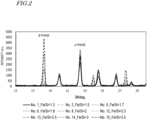
- FIG. 2 is a graph showing x-ray diffraction patterns of samples Nos. 1 through 15 in experiment examples.
DESCRIPTION OF EMBODIMENTS
-
Hereinafter, a cold-rolled aluminum alloy sheet and a method for producing the same according to an embodiment of the present invention will be described with reference to the drawings. A cold-rolled aluminum alloy sheet and a method for producing the same according to an embodiment of the present invention are not limited to those described below as examples.
-
A cold-rolled aluminum alloy sheet according to an embodiment of the present invention has a composition containing Si at a content of 0.15 to 0.40% by mass, Fe at a content of 0.30 to 0.80% by mass, Cu at a content of 0.10 to 0.50% by mass, Mn at a content of 0.80 to 1.20% by mass, and Mg at a content of 0.50 to 1.70% by mass; Zn at a content of 0.30% by mass or lower and Ti at a content of 0.15% by mass or lower as optional elements; and a remaining part formed of Al and unavoidable impurities. Fe is contained at a mass percentage ratio with respect to Si in the range of 1.97 ≤ Fe/Si ≤ 4.00. A ratio of the amount of solid solution Mn/the total amount of Mn is 0.17 or higher, and solid solution Si is contained at a content of 0.03% by mass or lower. The cold-rolled aluminum alloy sheet has a structure with which in an x-ray diffraction pattern provided by use of CuKα rays, the Bragg angle derived from an Al-Fe-Mn-Si-based intermetallic compound phase (i.e., α phase) has a peak of (2θ ± 0.2°) = 18.26° ± 0.1°, the Bragg angle derived from an Al6(Fe, Mn)-based intermetallic compound phase (i.e., β phase) has a peak of (2θ ± 0.2°) = 22.45° ± 0.1°, and the intensity ratio of the peak at the former Bragg angle with respect to the peak at the latter Bragg angle, i.e., I(18.26° ± 0.1°)/I(22.45° ± 0.1°), is 0.11 or higher. In the cold-rolled aluminum alloy sheet according to an embodiment of the present invention, as described below by way of experiment examples, the composition of the alloy containing Si and Fe, the amount of solid solution Si, and the amount of solid solution Mn are respectively controlled to be in the above-described ranges, and the volume ratio of the α phase with respect to the β phase is controlled to be in the above-described range. As a result, the cold-rolled aluminum alloy sheet has such characteristics (in particular, strength) as to be preferred for a use for bottle cans, in particular, bodies of DI cans. The composition of the alloy may be controlled by, for example, new mintage being added in accordance with the composition of the recycled billet. The volume ratio of the α phase with respect to the β phase may be controlled by a production method described below.
-
First, a technological significance of controlling the composition of the alloy to be in the above-described range will be described. In this specification, the composition of the alloy is represented by "% by mass" of each of the elements with respect to the total mass of the cold-rolled aluminum alloy sheet. The composition of the alloy may be measured by, for example, an optical emission spectrometer (SPECTROLAB produced by SPECTRO).
[Mn: 0.8 to 1.2% by mass]
-
Mn (manganese) contributes to an increase in the strength and an improvement in the short-term heat resistance of the cold-rolled aluminum alloy sheet (hereinafter, may be referred to simply as the "cold-rolled sheet"). While being cast, Mn forms, together with Fe, an intermetallic compound (Al-Mn-Fe-Si-based intermetallic compound or Al6(Mn, Fe)-based intermetallic compound). The α phase (Al-Mn-Fe-Si-based intermetallic compound) or the β phase (Al6(Fe, Mn) -based intermetallic compound) has a solid lubrication function, and, while being molded, suppresses baking with the mold, and thus improves surface properties of the can body. In particular, the α phase appears as a particle having a Vickers hardness exceeding 800, and has large effects of suppressing baking and thus improving the surface properties of the can body. In the case where the content of Mn is lower than 0.8% by mass, these effects may not be exhibited sufficiently. In the case where the content of Mn is higher than 1.2% by mass, the strength may be excessively high. Therefore, the content of Mn is controlled to be 0.8 to 1.2% by mass (this representation of the numerical range denotes 0.8% by mass or higher and 1.2% by mass or lower; this will be applied also to the following representations of the numerical ranges).
[Mg: 0.5 to 1.7% by mass]
-
Mg (magnesium) contributes to an increase in the strength of the cold-rolled sheet by existing in a solid solution state. In the case where the content of Mg is lower than 0.5% by mass, the strength may not be sufficiently high. In the case where the content of Mg is higher than 1.7% by mass, the moldability may be spoiled.
[Fe: 0.30 to 0.80% by mass]
-
While being cast, Fe (iron) forms, together with Mn, an intermetallic compound (Al-Mn-Fe-Si-based intermetallic compound or Al6(Mn, Fe)-based intermetallic compound). The α phase (Al-Mn-Fe-Si-based intermetallic compound) or the β phase (Al6(Fe, Mn)-based intermetallic compound) has a solid lubrication function, and, while being molded, suppresses baking. In the case where the content of Fe is lower than 0.25% by mass, the baking may not be sufficiently suppressed. By contrast, in the case where the content of Fe is higher than 0.6% by mass, the amount of the crystallized intermetallic compounds (the α phase and the β phase) is increased and coarse crystallized intermetallic compounds are formed excessively. As a result, the moldability may be spoiled.
[Si: 0.15 to 0.40% by mass]
-
While being cast, Si (silicon) forms, together with Mn and/or Fe, the above-described intermetallic compound, and has an effect of suppressing baking while being molded. In the case where the content of Si is lower than 0.15% by mass, the baking may not be sufficiently suppressed. By contrast, in the case where the content of Si is higher than 0.40% by mass, the α phase is formed excessively, and thus the moldability may be spoiled. In addition, the amount of solid solution Mn is decreased, and as a result, the short-term heat resistance may be decreased.
[Cu: 0.10 to 0.50% by mass]
-
While being cast, Cu (copper) forms, together with Mg, an Al-Cu-Mg-based intermetallic compound. The Al-Cu-Mg-based intermetallic compound exhibits an effect of suppressing a decrease in the strength in a painting and baking step. In the case where the content of Cu is lower than 0.10% by mass, the above-described effect may not be sufficiently provided. By contrast, in the case where the content of Cu is higher than 0.50% by mass, the work-hardenability at the time of molding is increased, and thus the moldability may be decreased.
[Zn: 0.30% by mass or lower]
-
Zn (zinc) causes age-precipitation of an Mg2Zn3Al2 intermetallic compound, and thus contributes to an increase in the strength. Note that in the case where the content of Zn is higher than 0.30% by mass, the corrosion resistance may be decreased. Therefore, in the case where Zn is to be incorporated, the content of Zn is preferably 0.03% by mass or lower. Zn does not need to be incorporated, but it is preferred that the content of Zn is 0.05% by mass or higher in order to provide the above-described effect.
[Ti: 0.15% by mass or lower]
-
Ti (titanium) has an effect of performing grain refinement of crystalline ingot grains. Note that in the case where the content of Ti is higher than 0.15% by mass, primary phase TiAl3 is crystallized, and thus the moldability may be decreased. In the case where Ti is to be incorporated, the content of Ti is preferably 0.15% by mass or lower. Ti does not need to be incorporated, but it is preferred that the content of Ti is 0.005% by mass or higher in order to provide the above-described effect. B (boron) may be incorporated with Ti. In this case, it is preferred that B has a content of 0.01% by mass or lower.
-
The remaining part other than the components mentioned above may be formed of Al and unavoidable impurities.
[Fe/Si: 1.97 to 4.00]
-
The present inventors have found that for optimizing the amount of solid solution Mn and the amount of solid solution Si, the mass percentage ratio of Fe with respect to Si, i.e., Fe/Si, is important. In the case where Fe/Si is lower than 1.97, a large amount of Si remains that does not form an Al-Mn-Fe-Si-based intermetallic compound as a result of reacting with an Al-Fe-Mn-based intermetallic compound during a homogenizing process (also referred to as a "soaking process"). Such Si is bonded with solid solution Mn during hot-rolling after the soaking process and forms an Al-Mn-Fe-Si-based intermetallic compound. As a result, the precipitation of the α phase is promoted. The α phase precipitated at this point is more sparse and more coarse than the α phase precipitated during cold-rolling, and therefore, has merely a very small effect of increasing the strength. In the case where Fe/Si is higher than 4.0, the amount of Fe is excessively large, and a crystallized coarse intermetallic compound is easily formed during the casting. The crystallized coarse intermetallic compound easily becomes a start point of cracks during the molding, and therefore, it is desired to suppress the formation of the crystallized coarse intermetallic compound.
-
The optimization of Fe/Si causes the followings. An Al6(Fe, Mn)-based intermetallic compound of an amount sufficient to react with solid solution Si during the soaking process exists during the casting, and during the soaking process, the amount of solid solution Si is sufficiently decreased. In this manner, the precipitation of the α phase in the hot-rolling performed after the soaking process is suppressed. As a result, an excessive decrease in the amount of solid solution Mn is suppressed.
-
The above-described cold-rolled aluminum alloy sheet according to an embodiment of the present invention may be produced in the following production method, as described below by way of experiment examples.
-
A production method according to an embodiment of the present invention includes a step of preparing a slab having the above-described predetermined composition, a step of performing a soaking process on the slab, a step of hot-rolling the soaked slab to form a hot-rolled sheet, and a step of cold-rolling the hot-rolled sheet to form a cold-rolled sheet. Now, a graph in which the vertical axis represents a value obtained by a conductivity of the pre-soaking-process slab being subtracted from a conductivity of the hot-rolled sheet and the horizontal axis represents a value of Fe/Si is assumed. The soaking process and the hot-rolling are performed such that a line formed by plotting in the graph has a gradient that is -1.1 or larger and 0.2 or smaller. In this manner, the above-described cold-rolled sheet may be produced.
-
A change in the amount of the solid solution from when the casting is finished until the hot rolling is finished may be evaluated by monitoring a change in the conductivity. Immediately after the casting, the cooling rate is high, and therefore, each of the elements stays as a solid solution in a supersaturated state in a parent phase of aluminum. The conductivity of the ingot is determined by the amount of the crystallized intermetallic compound. The conductivity of the hot-rolled sheet after the hot-rolling is increased by a precipitated intermetallic compound being generated and the amount of solid solution Mn being decreased mainly in a period from the soaking process to the hot-rolling. In the case where the mass percentage ratio of Fe with respect to Si, i.e., Fe/Si, is as low as Fe/Si < 1.97, the amount of decrease in the conductivity is smaller as Fe/Si is lower. That is, the gradient of the change in the conductivity with respect to Fe/Si is large. By contrast, in the case where Fe/Si is in the range of 1.97 ≤ Fe/Si ≤ 4.00, the change in the conductivity is almost the same regardless of the value of Fe/Si. The gradient of the change in the conductivity in this range is smaller than that in the case where Fe/Si < 1.97. That is, in the case of an alloy having a composition containing Fe at a certain ratio with respect to Si, the change in the conductivity caused in the period from the soaking process to the hot-rolling is small. An alloy having the change in the conductivity in the above-mentioned range is considered to have the amount of the solid solution atoms suppressed from being decreased by Si.
-
Regarding the step of preparing the slab in the production method according to an embodiment of the present invention, it is assumed that the target values of the elements of the slab are respectively Cu0, Mn0 and Mg0, and that the cold-rolled sheet has a tensile strength TS0 and a yield strength of YS0. With such settings, a post-correction tensile strength TS shows a change of ±2.7 MPa or smaller after the correction represented by the following expression, and a post-correction yield strength YS shows a change of ±3.0 MPa or smaller after the correction represented by the following expression. Post-correction TS = TS0 - {(Cu - Cu0) × 87.5 + (Mn - Mn0) × 70.0 + (Mg - Mg0) × 50.5} Post-correction YS = YS0 - {(Cu - Cu0) × 88.0 + (Mn - Mn0) × 69.5 + (Mg - Mg0) × 49.0}
-
As can be seen, the above-described cold-rolled sheet according to an embodiment of the present invention that is produced by the above-described production method may have a stable strength.
-
Another production method according to an embodiment of the present invention includes a step of preparing a slab having the above-described predetermined composition, a step of performing a soaking process on the slab, a step of hot-rolling the soaked slab to form a hot-rolled sheet, and a step of cold-rolling the hot-rolled sheet to form a cold-rolled sheet. Now, for a calculation by an equilibrium diagram, where the maximum volume ratio of the Al6(Fe, Mn) phase at 600°C to 700°C is V1, and the volume ratio of the α phase at a temperature in the soaking process is V2, V1/V2 ≥ 1.04 is fulfilled. In the case where V1/V2 fulfills this condition, a cold-rolled sheet having a stable strength as described above may be produced.
-
The equilibrium diagram of each element may be found by use of software JMatPro (produced by Sente Software Limited of the United Kingdom) based on a thermodynamic model called the "CALPHAD method". The maximum volume ratio V1 of the Al6(Fe, Mn) phase at 600°C to 700°C and the volume ratio V2 of the α phase at a temperature in the soaking process may be found by a calculation performed based on the obtained equilibrium diagram. A material structure fulfilling V1/V2 ≥ 1.04 is provided, so that a decrease in the material strength caused by solid solution Si may be suppressed.
-
Hereinafter, a cold-rolled aluminum alloy sheet and a method for producing the same according to an embodiment of the present invention will be described by way of representative experiment examples.
-
In the following experiment examples, cold-rolled sheets obtained as final products and test pieces produced from hot-rolled sheets as intermediate products during the production process were used to make the following evaluations in accordance with the techniques described below.
(1) Tensile strength (TS) and 0.2% yield strength in a rolling direction of cold-rolled sheets
-
A JIS 5 test piece was produced in a rolling direction from a cold-rolled sheet (original sheet) obtained in each of experiment examples. A tensile test was performed in accordance with JIS-Z-2241, and the tensile strength (TS) and the 0.2% yield strength (YS) in the rolling direction were measured. In each experiment example, the target values of Cu, Mn and Mg were respectively Cu0 = 0.15% by mass, Mn0 = 0.86% by mass, and Mg0 = 1.00% by mass. The post-correction TS and the post-correction YS were calculated from the following expressions. Post-correction TS = TS0 - {(Cu - Cu0) × 87.5 + (Mn - Mn0) × 70.0 + (Mg - Mg0) × 50.5} Post-correction YS = YS0 - {(Cu - Cu0) × 88.0 + (Mn - Mn0) × 69.5 + (Mg - Mg0) × 49.0}
-
The above-described correction expressions were found based on past experiment data and the current experiment data. Such experiment data was used to find the relationship between the strength and each of the components by machine learning. As a result, an almost linear relationship was obtained. From these, it is considered that as long as the composition contains the components at contents in the above-described ranges, the values of Cu0, Mn0 and Mg0 are respectively different from the above-mentioned values, and thus the above-mentioned expressions are usable.
(2) Measurement of the amount of solid solution Si and the amount of solid solution Mn (phenol dissolution method)
-
A small piece sample cut out from a cold-rolled sheet obtained in each of the experiment examples was immersed in 170°C phenol to dissolve a matrix component in the Al alloy. After this, benzyl alcohol was incorporated, and the resultant solution was filtrated through a filter having 0.1 µm pores while the solution was kept in a liquid state. The precipitated intermetallic compound captured on the filter was dissolved by a hydrochloric acid - hydrofluoric acid mixed solution. The resultant solution was diluted, and the resultant diluted solution was subjected to ICP (Inductively Coupled Plasma) optical emission spectroscopy. In this manner, the amount of solid solution Si and the amount of solid solution Mn were found.
(3) Conductivity
-
The conductivity of each of a non-soaked ingot, a post-hot-rolling sheet (hot-rolled sheet) and a post-cold-rolling sheet (cold-rolled sheet) was measured by a conductivity meter (SIGMATEST2.069 produced by Forester) at a frequency of 960 kHz, and an average of samples (n=3) was found. In the case where the test piece had a thickness less than 1 mm, a plurality of test pieces (sheets) were stacked so as to have a total thickness of 1 mm or greater, and the conductivity thereof was measured. FIG. 1 is a graph in which a value obtained by a conductivity of the pre-soaking-process slab being subtracted from a conductivity of the hot-rolled sheet is plotted with respect to Fe/Si.
(4) Identification of the crystalline phase
-
An x-ray diffraction pattern of the cold-rolled sheet obtained in each of the experiment examples was measured by an x-ray diffraction device (RINT-2000 produced by Rigaku Corporation) by use of CuKα rays of a wavelength λ = 1.54180 nm. FIG. 2 shows an x-ray diffraction pattern of each sample. Regarding the measured diffraction patterns, according to the ICDD (International Centre for Diffraction Data), 18.26° ± 0.1° is the peak of (Fe0.5Mn0.5)Al6, which is an Al-Fe-Mn-based intermetallic compound phase, by (1,1,0). 22.45° ± 0.1° is the peak of Al17(Fe3.2Mn0.8)Si2, which is an Al-Fe-Mn-Si-based intermetallic compound phase, by (0,1,3). The intensity ratio of these peaks, i.e., I(18.26°)/I(22.45°), was calculated.
(5) Equilibrium thermodynamic calculation
-
The contents of the five main elements (Si, Fe, Cu, Mn, Mg) were set, and the remaining part was set to be Al. Equilibrium thermodynamic diagrams from 700°C to room temperature were calculated by JMatPro. A 3104 aluminum alloy used as a can body material has a melting point of about 650°C, and the volume ratio of the liquid phase is 0 at a temperature specific to the alloy composition in the range of 600°C to 700°C. The crystalized intermetallic compound in the ingot was a phase generated in the range of 600°C to 700°C. Therefore, the point at which the volume ratio of the Al6(Fe, Mn) phase at 600°C to 700°C was maximum was defined as V1. The amount of generation of the Al-Fe-Mn-Si-based intermetallic compound at a temperature in the soaking process (e.g., 595°C) was defined as V2. In this manner, the volume ratio of the Al-Fe-Mn-based compound phase with respect to the Al-Fe-Mn-Si-based compound phase was defined.
-
Table 1 shows an alloy composition of each of samples 1 through 15 in experiment examples 1 through 15. The aluminum alloy of each composition was smelted in accordance with a common method, and then was cast by a laboratory casting machine by use of a DC casting method to form an ingot. Next, the resultant ingot was subjected to face milling as performed in a conventional manner. Then, the temperature of the ingot was raised to 595°C at a rate of 40°C/hours by use of an air furnace, and was a soaking process was performed still at 595°C for 90 minutes or longer.
-
Next, after the soaking process, the resultant ingot was hot-rolled by a laboratory roller in a manner in which an actual roller would have been used, until the thickness of the ingot was decreased to 2.8 mm. In a laboratory test, the heat capacity of a material is smaller than in the case where an actual roller is used, and therefore, re-crystallization by self-annealing does not occur. For this reason, the hot-rolled sheet was heat-treated at 355°C for 60 minutes in a manner in which an actual machine would have been used. The re-crystallized hot-rolled sheet was cold-rolled, and as a result, a cold-rolled sheet having a thickness of 0.28 mm was obtained. The total degree of processing in this step of cold-rolling was 90.0%.
-
A test piece was formed from a cold-rolled sheet obtained as described above in each experiment example, and the evaluations were made by the above-described methods. The results are shown in Table 2. Table 2 shows the following evaluation results of the cold-rolled sheets: the tensile strength, the work-hardening index n at a strain of 1.5 to 3% in the case where the true stress σ is represented by the true strain ε to the power of n, the corrected strength, ΔYS and ΔTS on the basis of sample No. 13 (0.0), the peak intensity ratio of XRD, i.e., I(18.26°)/I(22.45°), the phase volume ratio V1/V2, and the amount of solid solution.
[Table 1] | SAMPLE NO. | CHEMICAL COMPONENT/% BY MASS |
| Si | Fe | Cu | Mn | Mg | Fe/Si |
| 1 | 0.38 | 0.50 | 0.15 | 0.85 | 0.99 | 1.30 |
| 2 | 0.39 | 0.59 | 0.15 | 0.84 | 1.00 | 1.50 |
| 3 | 0.30 | 0.48 | 0.15 | 0.97 | 1.00 | 1.61 |
| 4 | 0.30 | 0.49 | 0.15 | 0.78 | 0.99 | 1.64 |
| 5 | 0.30 | 0.50 | 0.15 | 0.89 | 1.00 | 1.66 |
| 6 | 0.39 | 0.70 | 0.15 | 0.86 | 0.98 | 1.80 |
| 7 | 0.29 | 0.58 | 0.14 | 0.77 | 1.00 | 1.96 |
| 8 | 0.30 | 0.58 | 0.15 | 0.88 | 1.00 | 1.97 |
| 9 | 0.29 | 0.58 | 0.15 | 0.98 | 0.99 | 2.04 |
| 10 | 0.30 | 0.70 | 0.15 | 0.79 | 1.00 | 2.36 |
| 11 | 0.29 | 0.68 | 0.15 | 0.98 | 0.99 | 2.36 |
| 12 | 0.29 | 0.69 | 0.15 | 0.88 | 1.00 | 2.37 |
| 13 | 0.20 | 0.49 | 0.15 | 0.85 | 0.99 | 2.43 |
| 14 | 0.20 | 0.59 | 0.15 | 0.85 | 1.00 | 2.95 |
| 15 | 0.20 | 0.71 | 0.15 | 0.86 | 0.99 | 3.48 |
[Table 2] | SAMPLE No. | TENSILE CHARACTERISTICS | XRD PEAK STRENGTH RATIO | PHASE VOLUME RATIO V1/V2 | AMOUNT OF SOLID SOLUTION % BY MASS |
| YS/MPa 0.2% YIELD STRENGTH | TS/MPa TENSILE STRENGTH | ELONGATION (%) | WORK-HARDENING INDEX | CORRECTED YS/MPa 0.2% YIELD STRENGTH | CORRECTED TS/MPa TENSILE STRENGTH | ΔYS/MPa 0.2% YIELD STRENGTH | ΔTS/MPa TENSILE STRENGTH | I (18.26°) / I (22.45°) | PRIMARY PHASE β PHASE/ α PHASE | SOLID SOLUTION Mn/ TOTAL Mn | SOLID SOLUTION Si % BY MASS |
| 1 | 277.2 | 304.0 | 4.7 | 0.061 | 277.7 | 304.5 | -6.0 | -5.3 | 0.03 | 0.70 | 0.12 | 0.04 |
| 2 | 278.8 | 304.2 | 4.7 | 0.055 | 279.5 | 304.9 | -4.2 | -4.9 | 0.03 | 0.73 | 0.12 | 0.05 |
| 3 | 288.5 | 316.0 | 4.6 | 0.063 | 280.2 | 307.6 | -3.5 | -2.2 | | 0.97 | 0.18 | 0.04 |
| 4 | 276.2 | 301.6 | 4.8 | 0.061 | 281.6 | 307.0 | -2.1 | -2.8 | | 0.81 | 0.22 | 0.01 |
| 5 | 281.7 | 308.4 | 4.8 | 0.064 | 278.9 | 305.6 | -4.8 | -4.2 | 0.06 | 0.92 | 0.20 | 0.02 |
| 6 | 278.1 | 302.6 | 4.6 | 0.053 | 278.4 | 302.9 | -5.3 | -6.9 | 0.04 | 0.80 | 0.11 | 0.04 |
| 7 | 278.8 | 302.7 | 4.3 | 0.060 | 285.2 | 309.2 | 1.6 | -0.6 | | 1.01 | 0.19 | 0.04 |
| 8 | 284.7 | 310.6 | 4.7 | 0.062 | 282.6 | 308.5 | -1.1 | -1.3 | 0.11 | 1.04 | 0.20 | 0.02 |
| 9 | 291.5 | 318.5 | 4.8 | 0.061 | 283.0 | 309.9 | -0.7 | 0.1 | | 1.20 | 0.18 | 0.02 |
| 10 | 277.5 | 303.9 | 4.7 | 0.063 | 281.7 | 308.1 | -2.0 | -1.7 | | 1.36 | 0.17 | 0.02 |
| 11 | 294.0 | 319.6 | 4.5 | 0.057 | 285.5 | 311.0 | 1.8 | 1.2 | | 1.16 | 0.20 | 0.02 |
| 12 | 284.4 | 311.4 | 4.8 | 0.060 | 282.3 | 309.3 | -1.4 | -0.5 | 0.18 | 1.29 | 0.17 | 0.01 |
| 13 | 283.2 | 309.3 | 4.5 | 0.063 | 283.7 | 309.8 | 0.0 | 0.0 | 0.78 | 1.83 | 0.25 | 0.01 |
| 14 | 281.8 | 310.2 | 4.9 | 0.060 | 281.8 | 310.2 | -1.9 | 0.4 | 1.43 | 2.12 | 0.22 | 0.03 |
| 15 | 283.1 | 309.6 | 4.9 | 0.059 | 282.9 | 309.4 | -0.8 | -0.4 | 1.91 | 2.49 | 0.20 | 0.02 |
-
As can be seen from Table 2, among samples Nos. 1 through 15, samples Nos. 8 through 15 (examples) are each as follows. Each sample has a composition containing Si at a content of 0.15 to 0.40% by mass, Fe at a content of 0.30 to 0.80% by mass, Cu at a content of 0.10 to 0.50% by mass, Mn at a content of 0.80 to 1.20% by mass, and Mg at a content of 0.50 to 1.70% by mass; and a remaining part formed of Al and unavoidable impurities. Fe is contained at a mass percentage ratio with respect to Si in the range of 1.97 ≤ Fe/Si ≤ 4.00. A ratio of the amount of solid solution Mn/the total amount of Mn is 0.17 or higher, and solid solution Si is contained at a content of 0.03% by mass or lower. The cold-rolled aluminum alloy sheet has a structure with which in an x-ray diffraction pattern provided by use of CuKα rays, the Bragg angle derived from an Al-Fe-Mn-Si-based intermetallic compound phase (i.e., α phase) has a peak of (2θ ± 0.2°) = 18.26° ± 0.1°, the Bragg angle derived from an Al6(Fe, Mn)-based intermetallic compound phase (i.e., β phase) has a peak of (2θ ± 0.2°) = 22.45° ± 0.1°, and the intensity ratio of the peak at the former Bragg angle with respect to the peak at the latter Bragg angle, i.e., I(18.26° ± 0.1°)/I(22.45° ± 0.1°), is 0.11 or higher. In samples Nos. 8 through 15, the strength is stable with both ΔYS and ΔTS being within ±2 MPa, and the decrease in the strength caused by Si is suppressed, regardless of the content of Fe or Si.
-
By contrast, regarding each of samples Nos. 1 through 7 (comparative examples), it is seen that the strength is lower than that of sample No. 13 as a reference and that the strength is decreased by Si.
-
From FIG. 1 , it is seen that in the case where Fe/Si < 1.97, the conductivity is significantly increased from the conductivity of an ingot to the conductivity of a hot-rolled sheet and that in the case where 1.97 ≤ Fe/Si ≤ 4.00, the amount of increase in the conductivity is small. That is, it is considered that as long as the alloy composition has Fe/Si in the range of 1.97 ≤ Fe/Si ≤ 4.00, the change in the strength caused by a change in the amount of the solid solution is small even if the composition of the impurities in the UBC is changed by a certain degree.
-
As described above, according to an embodiment of the present invention, the composition of the aluminum alloy is appropriately adjusted, so that the volumes of the α phase and the β phase may be appropriately controlled and so that the ratio of the amount of solid solution Mn/the total amount of Mn may be 0.17 or higher and solid solution Si may be contained at a content of 0.03% by mass or lower. With such an arrangement, the amount of solid solution Mn may be suppressed from being decreased by Si during the period from the soaking process to the hot-rolling. Therefore, the decrease in the strength may be suppressed.
INDUSTRIAL APPLICABILITY
-
A cold-rolled aluminum alloy sheet and a method for producing the same according to an embodiment of the present invention are preferably usable as a cold-rolled aluminum alloy sheet for bottle cans (material sheet for bottle cans) and a method for producing the same. According to an embodiment of the present invention, the decrease in the strength caused by Si contained as impurities in recycled billets of UBCs may be suppressed. Therefore, use of the recycled billets of the UBCs may be promoted.