EP4512908A2 - Allelspezifische amplifizierung unter verwendung einer zusammensetzung aus überlappenden nicht-allelspezifischen primern und allelspezifischen blockeroligonukleotiden - Google Patents
Allelspezifische amplifizierung unter verwendung einer zusammensetzung aus überlappenden nicht-allelspezifischen primern und allelspezifischen blockeroligonukleotiden Download PDFInfo
- Publication number
- EP4512908A2 EP4512908A2 EP24208177.6A EP24208177A EP4512908A2 EP 4512908 A2 EP4512908 A2 EP 4512908A2 EP 24208177 A EP24208177 A EP 24208177A EP 4512908 A2 EP4512908 A2 EP 4512908A2
- Authority
- EP
- European Patent Office
- Prior art keywords
- subsequence
- target
- sequence
- blocker
- oligonucleotide
- Prior art date
- Legal status (The legal status is an assumption and is not a legal conclusion. Google has not performed a legal analysis and makes no representation as to the accuracy of the status listed.)
- Pending
Links
Images






Classifications
-
- C—CHEMISTRY; METALLURGY
- C12—BIOCHEMISTRY; BEER; SPIRITS; WINE; VINEGAR; MICROBIOLOGY; ENZYMOLOGY; MUTATION OR GENETIC ENGINEERING
- C12Q—MEASURING OR TESTING PROCESSES INVOLVING ENZYMES, NUCLEIC ACIDS OR MICROORGANISMS; COMPOSITIONS OR TEST PAPERS THEREFOR; PROCESSES OF PREPARING SUCH COMPOSITIONS; CONDITION-RESPONSIVE CONTROL IN MICROBIOLOGICAL OR ENZYMOLOGICAL PROCESSES
- C12Q1/00—Measuring or testing processes involving enzymes, nucleic acids or microorganisms; Compositions therefor; Processes of preparing such compositions
- C12Q1/68—Measuring or testing processes involving enzymes, nucleic acids or microorganisms; Compositions therefor; Processes of preparing such compositions involving nucleic acids
- C12Q1/6844—Nucleic acid amplification reactions
- C12Q1/686—Polymerase chain reaction [PCR]
-
- C—CHEMISTRY; METALLURGY
- C07—ORGANIC CHEMISTRY
- C07H—SUGARS; DERIVATIVES THEREOF; NUCLEOSIDES; NUCLEOTIDES; NUCLEIC ACIDS
- C07H21/00—Compounds containing two or more mononucleotide units having separate phosphate or polyphosphate groups linked by saccharide radicals of nucleoside groups, e.g. nucleic acids
- C07H21/04—Compounds containing two or more mononucleotide units having separate phosphate or polyphosphate groups linked by saccharide radicals of nucleoside groups, e.g. nucleic acids with deoxyribosyl as saccharide radical
-
- C—CHEMISTRY; METALLURGY
- C12—BIOCHEMISTRY; BEER; SPIRITS; WINE; VINEGAR; MICROBIOLOGY; ENZYMOLOGY; MUTATION OR GENETIC ENGINEERING
- C12Q—MEASURING OR TESTING PROCESSES INVOLVING ENZYMES, NUCLEIC ACIDS OR MICROORGANISMS; COMPOSITIONS OR TEST PAPERS THEREFOR; PROCESSES OF PREPARING SUCH COMPOSITIONS; CONDITION-RESPONSIVE CONTROL IN MICROBIOLOGICAL OR ENZYMOLOGICAL PROCESSES
- C12Q1/00—Measuring or testing processes involving enzymes, nucleic acids or microorganisms; Compositions therefor; Processes of preparing such compositions
- C12Q1/68—Measuring or testing processes involving enzymes, nucleic acids or microorganisms; Compositions therefor; Processes of preparing such compositions involving nucleic acids
- C12Q1/6809—Methods for determination or identification of nucleic acids involving differential detection
-
- C—CHEMISTRY; METALLURGY
- C12—BIOCHEMISTRY; BEER; SPIRITS; WINE; VINEGAR; MICROBIOLOGY; ENZYMOLOGY; MUTATION OR GENETIC ENGINEERING
- C12Q—MEASURING OR TESTING PROCESSES INVOLVING ENZYMES, NUCLEIC ACIDS OR MICROORGANISMS; COMPOSITIONS OR TEST PAPERS THEREFOR; PROCESSES OF PREPARING SUCH COMPOSITIONS; CONDITION-RESPONSIVE CONTROL IN MICROBIOLOGICAL OR ENZYMOLOGICAL PROCESSES
- C12Q1/00—Measuring or testing processes involving enzymes, nucleic acids or microorganisms; Compositions therefor; Processes of preparing such compositions
- C12Q1/68—Measuring or testing processes involving enzymes, nucleic acids or microorganisms; Compositions therefor; Processes of preparing such compositions involving nucleic acids
- C12Q1/6844—Nucleic acid amplification reactions
-
- C—CHEMISTRY; METALLURGY
- C12—BIOCHEMISTRY; BEER; SPIRITS; WINE; VINEGAR; MICROBIOLOGY; ENZYMOLOGY; MUTATION OR GENETIC ENGINEERING
- C12Q—MEASURING OR TESTING PROCESSES INVOLVING ENZYMES, NUCLEIC ACIDS OR MICROORGANISMS; COMPOSITIONS OR TEST PAPERS THEREFOR; PROCESSES OF PREPARING SUCH COMPOSITIONS; CONDITION-RESPONSIVE CONTROL IN MICROBIOLOGICAL OR ENZYMOLOGICAL PROCESSES
- C12Q1/00—Measuring or testing processes involving enzymes, nucleic acids or microorganisms; Compositions therefor; Processes of preparing such compositions
- C12Q1/68—Measuring or testing processes involving enzymes, nucleic acids or microorganisms; Compositions therefor; Processes of preparing such compositions involving nucleic acids
- C12Q1/6844—Nucleic acid amplification reactions
- C12Q1/6858—Allele-specific amplification
-
- C—CHEMISTRY; METALLURGY
- C40—COMBINATORIAL TECHNOLOGY
- C40B—COMBINATORIAL CHEMISTRY; LIBRARIES, e.g. CHEMICAL LIBRARIES
- C40B30/00—Methods of screening libraries
- C40B30/04—Methods of screening libraries by measuring the ability to specifically bind a target molecule, e.g. antibody-antigen binding, receptor-ligand binding
-
- C—CHEMISTRY; METALLURGY
- C12—BIOCHEMISTRY; BEER; SPIRITS; WINE; VINEGAR; MICROBIOLOGY; ENZYMOLOGY; MUTATION OR GENETIC ENGINEERING
- C12Q—MEASURING OR TESTING PROCESSES INVOLVING ENZYMES, NUCLEIC ACIDS OR MICROORGANISMS; COMPOSITIONS OR TEST PAPERS THEREFOR; PROCESSES OF PREPARING SUCH COMPOSITIONS; CONDITION-RESPONSIVE CONTROL IN MICROBIOLOGICAL OR ENZYMOLOGICAL PROCESSES
- C12Q2527/00—Reactions demanding special reaction conditions
- C12Q2527/107—Temperature of melting, i.e. Tm
-
- C—CHEMISTRY; METALLURGY
- C12—BIOCHEMISTRY; BEER; SPIRITS; WINE; VINEGAR; MICROBIOLOGY; ENZYMOLOGY; MUTATION OR GENETIC ENGINEERING
- C12Q—MEASURING OR TESTING PROCESSES INVOLVING ENZYMES, NUCLEIC ACIDS OR MICROORGANISMS; COMPOSITIONS OR TEST PAPERS THEREFOR; PROCESSES OF PREPARING SUCH COMPOSITIONS; CONDITION-RESPONSIVE CONTROL IN MICROBIOLOGICAL OR ENZYMOLOGICAL PROCESSES
- C12Q2537/00—Reactions characterised by the reaction format or use of a specific feature
- C12Q2537/10—Reactions characterised by the reaction format or use of a specific feature the purpose or use of
- C12Q2537/163—Reactions characterised by the reaction format or use of a specific feature the purpose or use of blocking probe
Definitions
- sequence listing is filed with the application in electronic format only and is incorporated by reference herein.
- sequence listing text file “14-21013- WO(260947.00251)_SL.txt” was created on May 18, 2015 , and is 13,144 bytes in size.
- DNA and RNA sequence can lead to big differences in overall physical health and wellness of organisms including human beings. For example, a single-base change in a bacterial genome can lead to antibiotic resistance, and a single-base change in a human genome can lead to cancer progression.
- genomics field and the accompanying discovery of many nucleic acid biomarker sequences and molecules, there is a strong demand from the biotechnology industry to develop reliable, robust, inexpensive, and precise nucleic acid assays that can discriminate single-base changes.
- many PCR-based assays have been developed that are allele-specific.
- PCR-based approaches to the selective detection of rare mutations can be broadly classified into two families of approaches: (A) allele-specific primers, and (B) non-allele-specific primers with allele-specific blockers.
- allele-specific primers include the amplification refractory mutation system (ARMS), allele-specific blocker PCR (ASB-PCR), and competitive allele specific TaqMan PCR (castPCR).
- Amplification refractory mutation system ARMS
- ASB-PCR allele-specific blocker PCR
- castPCR competitive allele specific TaqMan PCR
- B PNA blocker PCR and co-amplification at lower denaturation temperature PCR (COLD-PCR).
- allele-specific primers Prior to the present invention, allele-specific primers have generally been superior (higher mutation sensitivity) at detecting known single base mutations, while non-allele-specific primers with allele-specific blockers are generally applied for the detection of multiple closely clustered mutations (hotspots) or unknown mutation sequences.
- Allele-specific PCR primers such as ARMS, ASB-PCR, castPCR generally possess an allele-specific nucleotide at the 3'-most position of the primer.
- the allele-specific PCR primers employ the discrimination of the DNA polymerase enzyme to specifically extend properly paired bases, but are limited by the fact that, when an incorrect DNA polymerase extension event does occur, the rare allele nucleotide that was a part of the primer becomes incorporated in the template, and subsequently amplification cycles become non-specific.
- the allele-specific PCR primers are only specific up to the first incorrect amplification event. Allele-specific detection with non-allele-specific primers requires precise denaturation temperature control, and restricted analysis of smaller sequences. The allele-specific detection with non-allele-specific primers has low mutation sensitivity and is more vulnerable to polymerase-introduced errors.
- compositions of non-allele-specific primer and allele-specific blocker oligonucleotides with increased allele-specific amplification and improved mutation sensitivity is needed. Therefore, the development of new approaches suitable for the detection of a small amount of target in a large excess of variant is a prerequisite for the diagnostic applications.
- the present disclosure provides a composition of non-allele-specific primer and allele-specific blocker oligonucleotides to provide a more accurate and an efficient tool for disease diagnostic applications such as, cancer diagnosis and like.
- the present invention relates to a composition of overlapping a non-allele-specific primer oligonucleotide and an allele-specific blocker oligonucleotide for allele-specific amplification.
- the present invention provides an oligonucleotide composition including a blocker and a first primer oligonucleotide.
- the blocker oligonucleotide includes a first sequence having a target-neutral subsequence and a blocker variable subsequence.
- the blocker oligonucleotide may not include the blocker variable subsequence if the target nucleic acid to be detected is for the detection of an insertion.
- the blocker variable subsequence is flanked on its 3' and 5' ends by the target-neutral subsequence and is continuous with the target-neutral subsequence.
- the first primer oligonucleotide is sufficient to induce enzymatic extension; herein the first primer oligonucleotide includes a second sequence.
- the second sequence overlaps with the 5' end of the target-neutral subsequence by at least 5 nucleotides such that the second sequence includes an overlapping subsequence and a non-overlapping subsequence.
- the second sequence does not include any sequence homologous with the blocker variable subsequence.
- the present invention further relates to a method for amplification of a target sequence.
- the method includes obtaining a sample containing one or more copies of a first nucleic acid having a variant sequence and at least one copy of a second nucleic acid; herein the second nucleic acid have the target sequence.
- the target sequence and variant sequence each includes a homologous subsequence and a variable subsequence.
- the variable subsequence further includes at least one nucleotide.
- the variable subsequence of the target sequence is a target-specific subsequence and the variable subsequence of the variant sequence is a non-target specific subsequence.
- a blocker oligonucleotide is introduced to the sample.
- the blocker oligonucleotide includes a first sequence having a target-neutral subsequence and a blocker variable subsequence.
- the target-neutral subsequence is complementary to a portion of the homologous subsequence and the blocker variable subsequence is complementary to the non-target specific subsequence.
- the blocker variable subsequence is flanked on its 3' and 5' ends by the target-neutral subsequence and is continuous with the target-neutral subsequence.
- the first primer oligonucleotide is introduced to the sample.
- the first primer oligonucleotide is sufficient to induce enzymatic extension.
- the first primer oligonucleotide includes a second sequence, which is complementary to a second portion of the homologous subsequence. Further, the second sequence overlaps with the 5' end of the target-neutral subsequence by at least 5 nucleotides such that the second sequence includes an overlapping subsequence and a non-overlapping subsequence. The second sequence does not include any sequence complementary to the variable subsequence.
- a DNA polymerase, nucleoside triphosphates, and one or more reagents necessary for polymerase-based nucleic acid amplification are introduced to the sample; and the sample is reacted under conditions sufficient to achieve nucleic acid amplification.
- An advantage of the present invention is improved mutation sensitivity matching and/or exceeding allele-specific primer approaches.
- Another advantage of the present invention is a simple 2-step thermal cycling protocol with significant (8°C) temperature robustness.
- Yet another advantage of the present invention is to provide inexpensive DNA primer and blocker reagents without complex backbone or nucleotide modifications.
- Yet another advantage of the present invention is compatibility with high fidelity enzymes.
- Yet another advantage of the present invention is that the allele-specific blocker binds more strongly to the variant than to the target, so that the non-allele-specific primer more favourably displace blockers bound to target as compared to blockers bound to variant.
- the advantage of using non-allele-specific primers is that spuriously amplified variants result in amplification products (amplicons) bearing the variant sequence rather than the target sequence. Thus, specificity is compounded at every cycle.
- blocker oligonucleotide refers to at least one continuous strand of from about 12 to about 100 nucleotides in length and if so indicated herein, may further include a functional group or nucleotide sequence at its 3' end that prevents enzymatic extension during an amplification process such as polymerase chain reaction.
- primer oligonucleotide refers to a molecule comprising at least one continuous strand of from about 12 to about 100 nucleotides in length and sufficient to permit enzymatic extension during an amplification process such as polymerase chain reaction.
- target-neutral subsequence refers to a sequence of nucleotides that is complementary to a sequence in both a target nucleic acid and a variant nucleic acid.
- a desired nucleic acid sequence to be targeted for amplification may exist in a sample with a nucleic acid molecule having a predominantly homologous sequence with the target nucleic acid with the exception of a variable region (variant nucleic acid), such variable region in some instance being only a single nucleotide difference from the target nucleic acid.
- the target-neutral subsequence is complementary to at least a portion of the homologous sequence shared between the two nucleic acids, but not the variable region.
- blocker variable subsequence refers to a nucleotide sequence of a blocker oligonucleotide which is complementary to the variable region of the variant nucleic.
- overlapping subsequence refers to a nucleotide sequence of at least 5 nucleotides of a primer oligonucleotide that is homologous with a portion of the blocker oligonucleotide sequence used in a composition as described herein.
- the overlapping subsequence of the primer oligonucleotide may be homologous to any portion of the target-neutral subsequence of the blocker oligonucleotide, whether 5' or 3' of the blocker variable subsequence.
- non-overlapping subsequence refers to the sequence of a primer oligonucleotide that is not the overlapping subsequence.
- target sequence refers to the nucleotide sequence of a nucleic acid that harbours a desired allele, such as a single nucleotide polymorphism, to be amplified, identified, or otherwise isolated.
- variant sequence refers to the nucleotide sequence of a nucleic acid that does not harbour the desired allele. For example, in some instances, the variant sequence harbours the wild-type allele whereas the target sequence harbours the mutant allele.
- the variant sequence and the target sequence are derived from a common locus in a genome such that the sequences of each may be substantially homologous except for a region harbouring the desired allele, nucleotide or group or nucleotides that varies between the two.
- the present invention relates to an oligonucleotide composition.
- the oligonucleotide composition includes a non-allele-specific primer oligonucleotide and an allele-specific blocker oligonucleotide for allele-specific amplification.
- the oligonucleotide composition includes a blocker oligonucleotide and a first primer oligonucleotide.
- the blocker oligonucleotide includes a first sequence having a target-neutral subsequence and a blocker variable subsequence.
- the blocker variable subsequence is flanked on its 3' and 5' ends by the target-neutral subsequence and is continuous with the target-neutral subsequence, In other words, the blocker variable subsequence may divide the target-neutral subsequence into two portions, a portion to the 3' of the blocker variable subsequence and a portion to the 5'.
- the first primer oligonucleotide is sufficient to induce enzymatic extension; herein the first primer oligonucleotide includes a second sequence.
- the second sequence overlaps with the target-neutral subsequence by at least 5 nucleotides such that the second sequence includes an overlapping subsequence and a non-overlapping subsequence.
- the second sequence does not include the blocker variable subsequence.
- the primer oligonucleotide can be characterized as a non-allele specific primer.
- the overlapping region can be homologous to a portion of the target-neutral subsequence of the blocker oligonucleotide on either the 5' side of the blocker variable subsequence or on the 3' side of the blocker variable subsequence.
- the primer oligonucleotide overlapping subsequence is homologous with the target-neutral subsequence of the blocker on the 5' side of the blocker variable subsequence (denoted as "C" on the blocker).
- the target-neutral subsequence is the portions of the blocker on either side of the blocker variable subsequence C.
- FIG. 12 depicts one example where the overlapping subsequence of the primer is homologous with a portion of target-neutral subsequence of the blocker that is 3' of the blocker variable subsequence C.
- the blocker oligonucleotide further includes a functional group or a non-complementary sequence region at or near the 3' end, which prevents enzymatic extension.
- the functional group of the blocker oligonucleotide is selected from, but is not limited to, the group consisting of a 3-carbon spacer or a dideoxynucleotide.
- the second sequence yields a standard free energy of hybridization ( ⁇ G° PT ) and the first sequence yields a standard free energy of hybridization ( ⁇ G° BT ), which satisfies the following condition: + 2 kcal / mol ⁇ ⁇ G ° PT ⁇ ⁇ G ° BT ⁇ ⁇ 8 kcal / mol
- the non-overlapping subsequence yields a standard free energy of hybridization ( ⁇ G° 3 ), which satisfies the following condition: ⁇ 4 kcal / mol ⁇ ⁇ G ° 3 ⁇ ⁇ 12 kcal / mol
- the second sequence overlaps with the 5' end of the target-neutral subsequence by about 5 nucleotides to about 40 nucleotides. In another instance, the second sequence overlaps with the 5' end of the target-neutral subsequence by about 7 nucleotides to about 30 nucleotides.
- the concentration of the blocker oligonucleotide is about 2 to about 10,000 times greater than the concentration of the first primer oligonucleotide. In another instance, the concentration of the blocker oligonucleotide is about 5 to about 1,000 times greater than the concentration of the first primer oligonucleotide.
- the oligonucleotide composition further includes a second primer oligonucleotide sufficient to induce enzymatic extension.
- the second primer oligonucleotide includes a third sequence, which does not overlap the first sequence or second sequence, is target-neutral and is sufficient to use with the first primer oligonucleotide to amplify a region of a nucleic acid using polymerase chain reaction.
- the oligonucleotide composition further includes a second blocker oligonucleotide.
- the second blocker oligonucleotide includes a fourth sequence having a second target-neutral subsequence and a second blocker variable subsequence.
- the second blocker variable subsequence has the same sequence as the non-target specific subsequence of the target nucleic acid given that it is typically designed to bind the antisense sequence of the target.
- the second blocker variable subsequence is flanked on its 3' and 5' ends by the second target-neutral subsequence and is continuous with the second target-neutral subsequence.
- the third sequence overlaps with the 5' end of the second target-neutral subsequence by at least 5 nucleotides such that the third sequence includes a second overlapping subsequence and a second non-overlapping subsequence.
- the second blocker oligonucleotide further includes a second functional group or a second non-complementary sequence region at or near the 3' end, which prevents enzymatic extension.
- the second functional group of the second blocker oligonucleotide is selected from, but is not limited to, the group consisting of a 3-carbon spacer or a dideoxynucleotide.
- the third sequence yields a standard free energy of hybridization ( ⁇ G° PT2 ) and the fourth sequence yields a standard free energy of hybridization ( ⁇ G° BT2 ), which satisfies the following condition: + 2 kcal / mol ⁇ ⁇ G ° PT 2 ⁇ G ° BT 2 ⁇ ⁇ 8 kcal / mol
- the second non-overlapping subsequence yields a standard free energy of hybridization ( ⁇ G° 6 ), which satisfies the following condition: ⁇ 4 kcal / mol ⁇ ⁇ G ° 6 ⁇ ⁇ 12 kcal / mol .
- the third sequence overlaps with the 5' end of the second target-neutral subsequence by about 5 nucleotides to about 40 nucleotides. In another instance, the third sequence overlaps with the 5' end of the second target-neutral subsequence by about 7 nucleotides to about 30 nucleotides.
- the primer oligonucleotide and blocker oligonucleotide may each be from about 12 nucleotides in length to about 100 nucloeotides in length. In any of the above embodiments, the primer oligonucleotide and blocker oligonucleotide may each be from about 15 nucleotides in length to about 90 nucloeotides in length. In any of the above embodiments, the primer oligonucleotide and blocker oligonucleotide may each be from about 20 nucleotides in length to about 80 nucloeotides in length.
- the primer oligonucleotide and blocker oligonucleotide may each be from about 20 nucleotides in length to about 70 nucloeotides in length. In any of the above embodiments, the primer oligonucleotide and blocker oligonucleotide may each be from about 20 nucleotides in length to about 60 nucloeotides in length.
- the primer oligonucleotide and blocker oligonucleotide may each be 21, 22, 23, 24 , 26, 27, 28, 29, 30, 31, 32, 33, 34, 35, 36, 37, 38, 39, 40, 41, 42, 43, 44, 45, 46, 47, 48, 49, or 50 nucleotides in length.
- the concentration of the second blocker oligonucleotide is about 2 to about 10,000 times greater than the concentration of the second primer oligonucleotide. In another instance, the concentration of the second blocker oligonucleotide is about 5 to about 1,000 times greater than the concentration of the second primer oligonucleotide.. In another instance, the concentration of the second blocker oligonucleotide is about 10 to about 900 times greater than the concentration of the second primer oligonucleotide. In another instance, the concentration of the second blocker oligonucleotide is about 20 to about 800 times greater than the concentration of the second primer oligonucleotide..
- the concentration of the second blocker oligonucleotide is about 30 to about 700 times greater than the concentration of the second primer oligonucleotide. In another instance, the concentration of the second blocker oligonucleotide is about 40 to about 600 times greater than the concentration of the second primer oligonucleotide. In another instance, the concentration of the second blocker oligonucleotide is about 50 to about 500 times greater than the concentration of the second primer oligonucleotide. In another instance, the concentration of the second blocker oligonucleotide is about 60 to about 400 times greater than the concentration of the second primer oligonucleotide.
- the concentration of the second blocker oligonucleotide is about 70 to about 300 times greater than the concentration of the second primer oligonucleotide. In another instance, the concentration of the second blocker oligonucleotide is about 80 to about 200 times greater than the concentration of the second primer oligonucleotide. In another instance, the concentration of the second blocker oligonucleotide is about 90 to about 100 times greater than the concentration of the second primer oligonucleotide.
- the oligonucleotide composition further includes a reagent necessary for polymerase chain reaction.
- the oligonucleotide composition further includes a plurality of nucleoside triphosphates.
- the oligonucleotide composition further includes a DNA polymerase or an RNA polymerase.
- the oligonucleotide composition further includes a reagent necessary for polymerase chain reaction, a plurality of nucleoside triphosphates, a DNA polymerase.
- the blocker variable subsequence is a single nucleotide.
- the present invention further relates to a method for amplification of a target sequence.
- the method includes steps of (a) obtaining a sample containing one or more copies of a first nucleic acid having a variant sequence and at least one copy of a second nucleic acid; herein the second nucleic acid has the target sequence.
- the target sequence and variant sequence each has a homologous subsequence and a variable subsequence.
- the variable subsequence further includes at least one nucleotide, but may include 2-5 nucleotides.
- the variable subsequence of the target sequence is a target-specific subsequence and the variable subsequence of the variant sequence is a non-target specific subsequence.
- the method further comprises the step of (b) introducing a blocker oligonucleotide to the sample; herein the blocker oligonucleotide includes a first sequence having a target-neutral subsequence and a blocker variable subsequence.
- the target-neutral subsequence is complementary to a portion of the homologous subsequence and the blocker variable subsequence is complementary to the non-target specific subsequence.
- the blocker variable subsequence is flanked on its 3' and 5' ends by the target-neutral subsequence and is continuous with the target-neutral subsequence.
- the method further comprises the step of (c) introducing a first primer oligonucleotide to the sample.
- the first primer oligonucleotide is sufficient to induce enzymatic extension.
- the first primer oligonucleotide includes a second sequence. Further, the second sequence is complementary to a second portion of the homologous subsequence, and may overlap with the 5' end of the target-neutral subsequence by at least 5 nucleotides such that the second sequence includes an overlapping subsequence and a non-overlapping subsequence.
- the second sequence does not include any sequence complementary to the variable subsequence.
- the method further comprises the step of (d) introducing to the sample a DNA polymerase, nucleoside triphosphates, and one or more reagents necessary for polymerase-based nucleic acid amplification; and then (e) reacting the sample under conditions sufficient to achieve nucleic acid amplification.
- the blocker oligonucleotide further includes a functional group or a non-complementary sequence region at or near the 3' end, which prevents enzymatic extension.
- the functional group is selected from, but is not limited to, the group consisting of a 3-carbon spacer or a dideoxynucleotide.
- the second sequence yields a standard free energy of hybridization ( ⁇ G° PT ) and the first sequence yields a standard free energy of hybridization ( ⁇ G° BT ), which satisfies the following condition: + 2 kcal / mol ⁇ ⁇ G ° PT ⁇ G ° BT ⁇ ⁇ 8 kcal / mol
- the non-overlapping subsequence yields a standard free energy of hybridization ( ⁇ G° 3 ), which satisfies the following condition: ⁇ 4 kcal / mol ⁇ ⁇ G ° 3 ⁇ ⁇ 12 kcal / mol
- the second sequence overlaps with the 5' end of the target-neutral subsequence of the blocker by about 5 nucleotides to about 40 nucleotides (i.e., the "overlapping subsequence).
- the second sequence comprises an overlapping subsequence that is homologous with 5 nucleotides to about 40 nucleotides of the target-neutral subsequence of the blocker that is on the 5' side of the blocker variable subsequence of the blocker.
- the second sequence overlaps with the 5' end of the target-neutral subsequence by about 7 nucleotides to about 30 nucleotides.
- the second sequence comprises an overlapping subsequence that is homologous to the portion of the target neutral subsquence of the blocker that is on the 3' side of the blocker variable subsequence of the blocker.
- the concentration of the blocker oligonucleotide introduced into the sample is about 2 to about 10,000 times greater than the concentration of the first primer oligonucleotide introduced into the sample. In another instance, the concentration of the blocker oligonucleotide introduced into the sample is about 5 to about 1,000 times greater than the concentration of the first primer oligonucleotide introduced into the sample. In another instance, the concentration of the blocker oligonucleotide introduced into the sample is about 10 to about 500 times greater than the concentration of the first primer oligonucleotide introduced into the sample.
- the concentration of the blocker oligonucleotide introduced into the sample is about 20 to about 250 times greater than the concentration of the first primer oligonucleotide introduced into the sample. In another instance, the concentration of the blocker oligonucleotide introduced into the sample is about 40 to about 125 times greater than the concentration of the first primer oligonucleotide introduced into the sample. In another instance, the concentration of the blocker oligonucleotide introduced into the sample is about 50 to about 100 times greater than the concentration of the first primer oligonucleotide introduced into the sample.
- the concentration of the blocker oligonucleotide introduced into the sample is about 300 to about 400 times greater than the concentration of the first primer oligonucleotide introduced into the sample. In another instance, the concentration of the blocker oligonucleotide introduced into the sample is about 500 to about 600 times greater than the concentration of the first primer oligonucleotide introduced into the sample.
- the DNA polymerase is a thermostable DNA polymerase.
- the method further includes the conditions sufficient to achieve nucleic acid amplification by exposing the sample to at least 10 cycles.
- Each cycle has at least 2 different temperature exposures, one temperature exposure of at least 85°C, and one temperature exposure of no more than 75°C.
- the method further includes the step of introducing to the sample an enzyme selected from the group consisting of a nicking enzyme, a recombinase, a helicase, a RNAse a reverse transcriptase, or any combination thereof.
- the method further includes a step of introducing a second primer oligonucleotide into the sample.
- the second primer oligonucleotide includes a third sequence. Further, the third sequence does not overlap with the variable subsequence. Furthermore, the third sequence is target-neutral and is sufficient to use with the first primer oligonucleotide to amplify a region of a nucleic acid having the target sequence.
- the method further includes a step of introducing a second blocker oligonucleotide to the sample.
- the second blocker oligonucleotide includes a fourth sequence; herein the fourth sequence has a second target-neutral subsequence and a second blocker variable subsequence.
- the second blocker variable subsequence is the complementary sequence to the blocker variable subsequence.
- the second blocker variable subsequence is flanked on its 3' and 5' ends by the second target-neutral subsequence and is continuous with the second target-neutral subsequence.
- the third sequence overlaps with the 5' end of the second target-neutral subsequence by at least 5 nucleotides such that the third sequence includes a second overlapping subsequence and a second non-overlapping subsequence.
- the second blocker oligonucleotide further includes a second functional group or a second non-complementary sequence region at or near the 3' end, which prevents enzymatic extension.
- the second functional group is selected from, but is not limited to, the group consisting of a 3-carbon spacer or a dideoxynucleotide.
- the third sequence yields a standard free energy of hybridization ( ⁇ G° PT2 ) and the fourth sequence yields a standard free energy of hybridization ( ⁇ G° BT2 ), which satisfies the following condition: + 2 kcal / mol ⁇ ⁇ G ° PT 2 ⁇ G ° BT 2 ⁇ ⁇ 8 kcal / mol
- the second non-overlapping subsequence yields a standard free energy of hybridization ( ⁇ G° 6 ), which satisfies the following condition: ⁇ 4 kcal / mol ⁇ ⁇ G ° 6 ⁇ ⁇ 12 kcal / mol
- the third sequence overlaps with the 5' end of the second target-neutral subsequence by about 5 nucleotides to about 40 nucleotides. In another instance, the third sequence overlaps with the 5' end of the second target-neutral subsequence by about 7 nucleotides to about 30 nucleotides.
- the concentration of the second blocker oligonucleotide introduced into the sample is about 2 to about 10,000 times greater than the concentration of the second primer oligonucleotide introduced into the sample. In another instance, the concentration of the second blocker oligonucleotide introduced into the sample is about 5 to about 1,000 times greater than the concentration of the second primer oligonucleotide introduced into the sample.
- the method for amplification of a target sequence further includes a step of removing an aliquot from the sample; and repeating steps (b) through (e) defined above.
- FIG. 1 illustrates a schematic representation of the non-allele-specific primer and the allele-specific blocker for allele-specific amplification.
- a nucleic acid reagent mixture comprises two oligonucleotide species, a primer (primer oligonucleotide) and a variant specific blocker (blocker oligonucleotide), which act together to enable reliable rare target amplification in conjunction with a polymerase-based amplification method.
- the blocker may be modified at the 3' end with a non-extensible modification, such as a dideoxynucleotide or a 3-carbon linker.
- the sequences of the primer and blocker are rationally designed based on the thermodynamics of their hybridization to the target nucleic acid sequence and the variant nucleic acid sequence.
- the blocker is present in a significantly higher concentration than the primer, so that the preponderance of the target and the variant nucleic acid sequences bind to blocker before binding to primer.
- the primer binds transiently to the blocker-target or blocker-variant molecules, and possesses a probability for displacing the blocker in binding to the target or variant. Because the blocker sequence is specific to the variant target, its displacement from the variant is less thermodynamically favourable than its displacement from the target.
- the non-allele-specific primer amplifies the target sequence with higher yield/efficiency than it amplifies the variant sequence.
- the non-allele-specific nature of the primer means that spuriously amplified variant sequence bear the variant allele, rather than the target allele, so that subsequent amplification cycles also exhibit amplification bias in favour of the target.
- High concentration of the variant-specific blocker results in higher probability of blocker binding to both the target and the variant first, before the primer has an opportunity to bind.
- the primer initiates binding, to both the target-blocker or variant-blocker complex, via a unique region not overlapping with the blocker, and subsequently possibly displaces the blocker via a process of enzyme-free strand displacement.
- FIG. 2 illustrates a schematic representation of a thermodynamic design of a primer and a blocker.
- the sequences of the primer and the blocker are rationally designed to achieve desirable reaction thermodynamics.
- the primer, the blocker, the target, and the variant nucleic acid sequences are subdivided into regions comprising continuous nucleotides, denoted by the numbers 1 through 8 in Fig. 2 .
- the standard free energy of hybridization between the primer and the target ( ⁇ G° PT ) and the standard free energy of hybridization between the blocker and the target ( ⁇ G° BT ) satisfies: + 2 kcal / mol ⁇ ⁇ G ° PT ⁇ ⁇ G ° BT ⁇ ⁇ 8 kcal / mol
- the primer and blocker systems that satisfy the above inequality generate a large difference in the hybridization yields between primer bound to the target and primer bound to the variant in each cycle, resulting in a target-specific amplification.
- the process of enzyme-free strand displacement is guided by the relative thermodynamics of the primer binding versus the blocker binding.
- the blocker hybridizes more favourably to the variant (standard free energy of binding ⁇ G° BV ) than to the target (standard free energy of binding ⁇ G° BT , ⁇ G° BT > ⁇ G° BV because more negative ⁇ G° indicates stronger favourability).
- the primer and blocker usually should be designed so that ⁇ G° rxn1 ⁇ 0 and ⁇ G° rxn2 ⁇ 0.
- the ⁇ G° rxn1 and ⁇ G° rxn2 guidelines are not absolute.
- FIG. 3 illustrates a schematic representation of calculation of ⁇ G° values from sequence.
- ⁇ G° 1-5 , ⁇ G° 4-7 , and ⁇ G° 4-8 terms further include the standard free energy of hybridization initiation ( ⁇ G° init ), and the extra base stack adjoining the sixth region.
- Standard free energies, ⁇ G°, calculated using other methods may result in the same ⁇ G° PT , ⁇ G° PV , ⁇ G° BT , and ⁇ G° ⁇ V values, though the thermodynamics of individual regions (e.g. ⁇ G° 3-6 ) may differ.
- ⁇ G° PT , ⁇ G° PV , ⁇ G° BT , and ⁇ G° BV from the primer sequence, blocker sequence, target sequence, variant sequence, operational temperature, and operational buffer conditions are known to those skilled in the art.
- FIG. 4 shows a probe and a blocker design of the present invention and the subsequences around SMAD7 gene locus of two human repository samples NA18537 and NA18562.
- the design of a primer blocker set designed to specifically amplify the A variant of the SMAD7 single nucleotide polymorphism (SNP).
- the blocker is designed to be perfectly complementary to the variant template bearing a G-variant of the SMAD7 SNP, and is functionalized at the 3' end with a 3-carbon linker (C3) that prevents enzymatic extension by the Taq DNA polymerase.
- a reverse primer binds to the 3' of the forward primer, and is not specific to either allele.
- the blocker oligonucleotide comprises a target-neutral subsequence which includes the sequence to the 5' and 3' of the cytosine nucleotide that is depicted out of alignement with the remainder of the sequence - the cytosine nucleotide in this instance represents the blocker variable subsequence of the blocker.
- the overlapping subsequence of the primer oligonucleotide comprises sequence that is homologous to the blocker sequence on the 5' side of the blocker variable subsequence (the cytosine).
- FIG. 5 shows the performance of a primer-blocker pair targeting human SNP rs3789806 (C/G) C allele at annealing/extension temperature ranging from 56°C to 66°C.
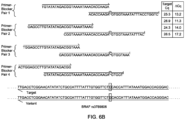
- FIG. 6A and FIG. 6B shows primer designs with more design space to avoid undesired interactions.
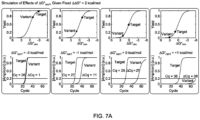
- FIG. 7A , and FIG. 7B shows controlling the allele-specific PCR behaviour via design of ⁇ G° rxn1 .
- Simulations in FIG. 7A suggest that when the primer and blocker are designed so that ⁇ G° rxn1 is more positive, ⁇ Cq values are greater. However, at more positive values of ⁇ G° rxn1 , the amplification of the target is also slowed, resulting in a larger value of Cq. Simulations assume a fixed ⁇ G° of 2 kcal/mol.
- Top sub graphs show the predicted effects of the different values of ⁇ G° rxn1 (stars) and ⁇ G° rxn2 (dots) on the hybridization yields.
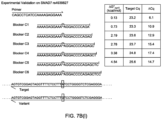
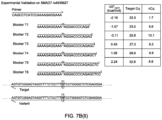
- FIG. 7B(I) and FIG. 7B(II) show experimental results of ⁇ G° rxn1 effects on amplification selectivity. Different ⁇ G° rxn1 values were achieved via lengthening or shortening the 3' end of the blocker. As expected, more positive ⁇ G° rxn1 results in larger Cq for both the target and the variant. We observed an optimal intermediate ⁇ G° rxn1 resulting in largest ⁇ Cq and relatively small Cq delay (Cq ⁇ 28) for the target. Unlike the simulations, ⁇ Cq did not increase monotonically with ⁇ G° rxn1 . The formation of primer-dimers and nonspecific amplification produces a Cq ceiling.
- FIG. 8 shows the blocker with a non-homologous sequence at the 3' end rather than a non-extensible chemical functionalization. Because the non-homologous sequences do not bind to the downstream region of either the target or the variant, the non-homologous region effectively prevents enzymatic extension.
- the target Cq and ⁇ Cq values are similar to those shown in Example 1, indicating that like functional groups such as a 3-carbon spacer or a didexoynucleotide, a non-homologous sequence at the 3' end can effectively prevent enzymatic extension
- fP, rP, and B represent the forward primer, the reverse primer, and the blocker (for the forward primer), respectively.
- the forward and reverse primers are designed to be separated by a short distance, so that they overlap with a variant-specific blocker.
- the primer-binding regions are separated by a single nucleotide whose identity varies between the target and the variant.
- the forward and reverse variant-specific blockers are partially complementary to each other because they bind to complementary strands of the target, and both span the variation region. The blockers are designed so that, despite their partial complementarity, at the operational conditions, the majority of blocker molecules are not hybridized to each other.
- FIG. 9A and FIG. 9B each shows a primer-blocker systems designed for human BRAF rs3789806 and IL23R rs1884444 SNPs were multiplexed in the same reaction.
- TaqMan ® probes targeting the corresponding downstream of the blocker binding regions were designed and used as the readout mechanism.
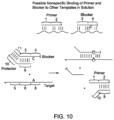
- FIG. 10 shows nonspecific binding of primer or blocker to other primers, blockers, or templates results in nonspecific amplification.
- the lower panel provides a design of a protector that suppresses the nonspecific binding of the primer and blocker.
- Protector oligonucleotides are partially complementary to the primer and blocker sequences. The presence of a stoichiometric excess of protectors result in both the primer and the blocker being partially double-stranded.
- the blocker possesses a new region 11, whose sequence is non complementary to region 5 on the nucleic acid sequence, and the protector possesses a new region 10, whose sequence is complementary to region 11.
- FIG. 11A and FIG. 11B each shows primer and blocker designs for detecting a deletion and an insertion.
- the primer is non-target-specific, this method can also be used to detect deletion or insertion with uncertain number of bases or uncertain position.
- FIG. 12 shows an inferior implementation of the present invention by placing the primer at the 3' of the SNP position and blocker at the 5' of the primer. This implementation generates hybridization specificity only in the first cycle, so the ⁇ Cq is smaller than the preferred design.
- FIG. 13 demonstrates selective amplification of fungal 18S DNA subsequences of 3 pathogenic fungi species in large excess of homologous human DNA. Because fungal 18S subsequences and its homologous human subsequence differ in multiple regions, we designed corresponding blocker species for both forward primer and reverse primer to maximize amplification specificity.
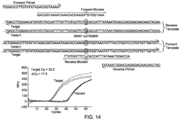
- FIG. 14 describes the use of target-specific amplification for both the forward and the reverse primer, by using two sets of variant-allele blockers, one for each primer.
- the blockers are partially complementary to each other, but at the operational conditions are not predominately hybridized to one another.
- the blockers and primers are designed so that the forward primer cannot extend off the reverse blocker, and the reverse primer cannot extend off the forward blocker.
- FIG. 14 shows preliminary experimental results.
- the primer and blocker combinations may be applied to other enzymatic amplification assays for nucleic acids, including but not limited to Nicking Enzyme Amplification Reaction (NEAR), Loop-mediated Isothermal Amplification (LAMP), and Rolling Circle Amplification (RCA).
- NEAR Nicking Enzyme Amplification Reaction
- LAMP Loop-mediated Isothermal Amplification
- RCA Rolling Circle Amplification
- the present invention is particularly suitable for the detection of a small amount of target in a large excess of variant.
- the variant may refer to the wildtype DNA sequence, and the target may refer a cancer DNA sequence.
- the variant may refer to the pathogen DNA sequence, and the target may refer to a homologous human DNA sequence.
- FIG. 4 shows an Example 1 of the present invention for the probe and the blocker design and the subsequences around SMAD7 gene locus of two human repository samples NA18537 and NA18562.
- Healthy human single nucleotide polymorphisms (SNP) rs4939827 (CIT) in SMAD7 gene locus were chosen for proof-of-concept validations.
- T allele as target and C allele variant were arbitrarily designated.
- Human repository genomic DNA samples NA18562 (homozygous of C allele) and NA18537 (homozygous of T allele) were purchased from Coriell ® , and the corresponding nucleotide sequences were obtained from 1000 Genomes website.
- the blocker was modified with a C3 spacer at the 3' end.
- qPCR experimental results distinguished 0.1% target (99.9% variant) from 0% target (100% variant).
- the 0.1% target sample was prepared by mixing 0.1% NA18537 with 99.9% NA18562.
- the average difference of quantification cycle ( ⁇ Cq) between 100% variant and 100% target was 14.8, and that between 100% variant (denoted as "WT” in the graph) and 0.1% target was 4.2. All experiments were performed in a 96-well plate in the Bio-Rad CFX96 TM qPCR machine.
- Table-1 shows examples of allele specific amplification results for four set of SNP pairs in human genomic DNA samples NA18562 and NA18537, drawn from the 1000 Genomes database.
- a primer and blocker design for each allele variant were designed and tested.
- the base identities shown in the "Blocker” column indicates the allele that was being suppressed (variant), and "-" means no blocker was added.
- large ⁇ Cq values between the two alleles, ranging from 7.1 to 14.6 were observed. All the experiments were performed in triplicates using 400 nM of each primer and 4 ⁇ M of blocker in Bio-rad iTaq TM SYBR ® Green Supermix. The performance of thermodynamically driven designs without any empirical optimization of primer and blocker sequences or experimental conditions were shown by the results.
- FIG. 5 shows an Example 2 of the present invention for the performance of a primer-blocker pair targeting human SNP rs3789806 (C/G) C allele at annealing/extension temperature ranging from 56°C to 66°C.
- the Example 2 showed good allele specific amplification from 56°C to 64°C and indicated at least 8°C of temperature robustness. 400 nM of each primer and 4 ⁇ M blocker were used, and other experimental conditions other than annealing/extension temperature were the same as described in Example 1.
- FIG. 6A and FIG. 6B show an Example 3 of the present invention.
- the designs of the Primers shown in the present invention provided more design space to avoid undesired interactions.
- the nucleic acid sequences of four sets of primer and blocker pairs that each specifically amplifies the human SNP rs3789806 C allele exhibited ⁇ C ⁇ > 11. 400 nM of each primer and 4 ⁇ M blocker were used, and other experimental conditions were the same as described in Example 1.
- FIG. 7A , FIG. 7B(I) and FIG. 7B(II) show an Example 4 of the present invention for controlling the allele-specific PCR behaviour via design of ⁇ G° rxn1 .
- Simulations in FIG. 7A suggested that when the primer and blocker were designed so that ⁇ G° rxn1 was more positive, ⁇ Cq values were greater. However, at more positive values of ⁇ G° rxn1 , the amplification of the target was slowed and resulted in a larger value of Cq. Simulations were assumed as fixed ⁇ G° of 2 kcal/mol.
- the top sub graphs predicted the effects of the different values of ⁇ G° rxn1 (stars) and ⁇ G° rxn2 (dots) on the hybridization yields.
- the bottom sub graphs predicted simulated amplification curve of the target and the variant for each primer and blocker pair. In all cases depicted, the concentration ratio of blocker to primer was 20:1.
- FIG. 7B(I) and FIG. 7B(II) show experimental results of ⁇ G° rxn1 effects on amplification selectivity. Different ⁇ G° rxn1 values were achieved via lengthening or shortening the 3' end of the blocker. As expected, more positive ⁇ G° rxn1 resulted in larger Cq for both the target and the variant.
- FIG. 8 shows an Example 5 of the present invention for the blocker with a non-homologous sequence at the 3' end rather than a non-extensible chemical functionalization. Because the non-homologous sequences do not bind to the downstream region of either the target or the variant, the non-homologous region effectively prevents enzymatic extension. 400 nM of each primer and 4 ⁇ M blocker were used, and other experimental conditions were the same as described in Example 1. The target Cq and ⁇ Cq values were similar to those shown in FIG. 4 , indicating that like functional groups such as a 3-carbon spacer or a didexoynucleotide, a non-homologous sequence at the 3' end effectively prevents enzymatic extension.
- fP, rP, and B represent the forward primer, the reverse primer, and the blocker (for the forward primer), respectively.
- FIG. 9A and FIG. 9B show an Example 6 of the present invention.
- a reverse primer was also needed, which was not allele-specific.
- SYBR ® Green Supermix and TaqMan ® were used in the experiments and the results were not significantly different between the two.
- the Primer-blocker systems designed for human BRAF rs3789806 and IL23R rs1884444 SNPs were multiplexed in the same reaction.
- TaqMan ® probes targeting the corresponding downstream of the blocker binding regions were designed and used as the readout mechanism.
- FIG. 9A shows the amplification results of multiplexed detection of BRAF rs3789806 G allele and IL23R rs1884444 T allele. The base identities denoted which allele the blockers were suppressing (variant).
- FIG. 10 shows an Example 7 of the present invention for nonspecific binding of primer or blocker to other primers, blockers, or templates.
- the Example 7 resulted in nonspecific amplification.
- the lower panel provided a design of a protector that suppressed the nonspecific binding of the primer and blocker.
- the blocker possessed a new region 11, whose sequence was non complementary to region 5 on the nucleic acid sequence, and the protector possessed a new region 10, whose sequence was complementary to region 11.
- FIG. 11A and FIG. 11B show an Example 8 of the present invention for primer and blocker designs for detecting a deletion and an insertion.
- Del rs200841330 was used to show proof-of-concept results. 400 nM of each primer and 4 ⁇ M blocker were used, and other experimental conditions were same as indicated in Example 1. Since the primer is non-allele-specific, this method can also be used to detect deletion or insertion with uncertain number of bases or uncertain position.
Landscapes
- Chemical & Material Sciences (AREA)
- Organic Chemistry (AREA)
- Life Sciences & Earth Sciences (AREA)
- Health & Medical Sciences (AREA)
- Engineering & Computer Science (AREA)
- Zoology (AREA)
- Wood Science & Technology (AREA)
- Proteomics, Peptides & Aminoacids (AREA)
- Chemical Kinetics & Catalysis (AREA)
- Molecular Biology (AREA)
- Biochemistry (AREA)
- General Health & Medical Sciences (AREA)
- Biotechnology (AREA)
- Genetics & Genomics (AREA)
- Analytical Chemistry (AREA)
- Immunology (AREA)
- General Engineering & Computer Science (AREA)
- Bioinformatics & Cheminformatics (AREA)
- Microbiology (AREA)
- Physics & Mathematics (AREA)
- Biophysics (AREA)
- General Chemical & Material Sciences (AREA)
- Medicinal Chemistry (AREA)
- Measuring Or Testing Involving Enzymes Or Micro-Organisms (AREA)
- Enzymes And Modification Thereof (AREA)
Applications Claiming Priority (4)
| Application Number | Priority Date | Filing Date | Title |
|---|---|---|---|
| US201462000114P | 2014-05-19 | 2014-05-19 | |
| PCT/US2015/031476 WO2015179339A1 (en) | 2014-05-19 | 2015-05-19 | Allele-specific amplification using a composition of overlapping non-allele-specific primer and allele-specific blocker oligonucleotides |
| EP21150302.4A EP3901278B1 (de) | 2014-05-19 | 2015-05-19 | Allelspezifische amplifizierung mit einer zusammensetzung aus überlappendem nicht-allelspezifischem primer und allelspezifischen blockeroligonukleotiden |
| EP15796383.6A EP3146080B1 (de) | 2014-05-19 | 2015-05-19 | Allelspezifische amplifizierung mit einer zusammensetzung aus überlappenden nicht-allelspezifischem primer und allelspezifische blockeroligonukleotide |
Related Parent Applications (2)
| Application Number | Title | Priority Date | Filing Date |
|---|---|---|---|
| EP21150302.4A Division EP3901278B1 (de) | 2014-05-19 | 2015-05-19 | Allelspezifische amplifizierung mit einer zusammensetzung aus überlappendem nicht-allelspezifischem primer und allelspezifischen blockeroligonukleotiden |
| EP15796383.6A Division EP3146080B1 (de) | 2014-05-19 | 2015-05-19 | Allelspezifische amplifizierung mit einer zusammensetzung aus überlappenden nicht-allelspezifischem primer und allelspezifische blockeroligonukleotide |
Publications (2)
| Publication Number | Publication Date |
|---|---|
| EP4512908A2 true EP4512908A2 (de) | 2025-02-26 |
| EP4512908A3 EP4512908A3 (de) | 2025-03-26 |
Family
ID=54554607
Family Applications (3)
| Application Number | Title | Priority Date | Filing Date |
|---|---|---|---|
| EP21150302.4A Active EP3901278B1 (de) | 2014-05-19 | 2015-05-19 | Allelspezifische amplifizierung mit einer zusammensetzung aus überlappendem nicht-allelspezifischem primer und allelspezifischen blockeroligonukleotiden |
| EP24208177.6A Pending EP4512908A3 (de) | 2014-05-19 | 2015-05-19 | Allelspezifische amplifizierung unter verwendung einer zusammensetzung aus überlappenden nicht-allelspezifischen primern und allelspezifischen blockeroligonukleotiden |
| EP15796383.6A Active EP3146080B1 (de) | 2014-05-19 | 2015-05-19 | Allelspezifische amplifizierung mit einer zusammensetzung aus überlappenden nicht-allelspezifischem primer und allelspezifische blockeroligonukleotide |
Family Applications Before (1)
| Application Number | Title | Priority Date | Filing Date |
|---|---|---|---|
| EP21150302.4A Active EP3901278B1 (de) | 2014-05-19 | 2015-05-19 | Allelspezifische amplifizierung mit einer zusammensetzung aus überlappendem nicht-allelspezifischem primer und allelspezifischen blockeroligonukleotiden |
Family Applications After (1)
| Application Number | Title | Priority Date | Filing Date |
|---|---|---|---|
| EP15796383.6A Active EP3146080B1 (de) | 2014-05-19 | 2015-05-19 | Allelspezifische amplifizierung mit einer zusammensetzung aus überlappenden nicht-allelspezifischem primer und allelspezifische blockeroligonukleotide |
Country Status (13)
| Country | Link |
|---|---|
| US (2) | US20170067090A1 (de) |
| EP (3) | EP3901278B1 (de) |
| JP (4) | JP2017515484A (de) |
| KR (1) | KR102343605B1 (de) |
| CN (2) | CN114032234A (de) |
| AU (2) | AU2015264357B2 (de) |
| BR (1) | BR112016027063A2 (de) |
| CA (1) | CA2985631A1 (de) |
| DK (1) | DK3146080T3 (de) |
| ES (1) | ES2861353T3 (de) |
| PH (1) | PH12016502542B1 (de) |
| RU (1) | RU2708992C2 (de) |
| WO (1) | WO2015179339A1 (de) |
Families Citing this family (54)
| Publication number | Priority date | Publication date | Assignee | Title |
|---|---|---|---|---|
| US8835358B2 (en) | 2009-12-15 | 2014-09-16 | Cellular Research, Inc. | Digital counting of individual molecules by stochastic attachment of diverse labels |
| GB2513024B (en) | 2012-02-27 | 2016-08-31 | Cellular Res Inc | A clonal amplification method |
| ES2857908T3 (es) | 2013-08-28 | 2021-09-29 | Becton Dickinson Co | Análisis masivamente paralelo de células individuales |
| WO2015077717A1 (en) | 2013-11-25 | 2015-05-28 | The Broad Institute Inc. | Compositions and methods for diagnosing, evaluating and treating cancer by means of the dna methylation status |
| WO2015085147A1 (en) | 2013-12-05 | 2015-06-11 | The Broad Institute Inc. | Polymorphic gene typing and somatic change detection using sequencing data |
| EP3082853A2 (de) | 2013-12-20 | 2016-10-26 | The Broad Institute, Inc. | Kombinationstherapie mit neoantigen-impfstoff |
| EP3234193B1 (de) | 2014-12-19 | 2020-07-15 | Massachusetts Institute of Technology | Molekulare biomarker für krebsimmuntherapie |
| ES3049406T3 (en) | 2014-12-19 | 2025-12-16 | Broad Inst Inc | Methods for profiling the t-cell-receptor repertoire |
| ES2836802T3 (es) | 2015-02-27 | 2021-06-28 | Becton Dickinson Co | Códigos de barras moleculares espacialmente direccionables |
| EP4180535A1 (de) | 2015-03-30 | 2023-05-17 | Becton, Dickinson and Company | Verfahren und zusammensetzungen für kombinatorische barcodierung |
| EP4582556A3 (de) | 2015-04-23 | 2025-10-08 | Becton, Dickinson and Company | Verfahren und zusammensetzungen zur gesamttranskriptomamplifikation |
| ES2745694T3 (es) | 2015-09-11 | 2020-03-03 | Cellular Res Inc | Métodos y composiciones para normalización de biblioteca de ácido nucleico |
| US10280455B2 (en) | 2015-12-30 | 2019-05-07 | Bio-Rad Laboratories, Inc. | Split-cycle and tape amplification |
| CN109563506A (zh) | 2016-05-06 | 2019-04-02 | 威廉马歇莱思大学 | 使用随机捕获探针文库的化学计量核酸纯化 |
| US10301677B2 (en) | 2016-05-25 | 2019-05-28 | Cellular Research, Inc. | Normalization of nucleic acid libraries |
| US10640763B2 (en) | 2016-05-31 | 2020-05-05 | Cellular Research, Inc. | Molecular indexing of internal sequences |
| US10202641B2 (en) | 2016-05-31 | 2019-02-12 | Cellular Research, Inc. | Error correction in amplification of samples |
| KR102522023B1 (ko) | 2016-09-26 | 2023-04-17 | 셀룰러 리서치, 인크. | 바코딩된 올리고뉴클레오티드 서열을 갖는 시약을 이용한 단백질 발현의 측정 |
| US11549149B2 (en) * | 2017-01-24 | 2023-01-10 | The Broad Institute, Inc. | Compositions and methods for detecting a mutant variant of a polynucleotide |
| EP3577232A1 (de) | 2017-02-01 | 2019-12-11 | Cellular Research, Inc. | Selektive amplifikation unter verwendung von blockierenden oligonukleotiden |
| KR102790050B1 (ko) | 2017-06-05 | 2025-04-04 | 백톤 디킨슨 앤드 컴퍼니 | 단일 세포를 위한 샘플 인덱싱 |
| JP2021500077A (ja) * | 2017-10-18 | 2021-01-07 | デイ ゼロ ダイアグノスティックス, インコーポレイテッド | Dna増幅の標的化抑制による混合dna試料中のdna集団の選択的富化 |
| WO2019164885A1 (en) * | 2018-02-20 | 2019-08-29 | William Marsh Rice University | Systems and methods for allele enrichment using multiplexed blocker displacement amplification |
| CN108220444A (zh) * | 2018-02-28 | 2018-06-29 | 无锡禾盛医疗器械有限公司 | 一种kras基因突变检测的引物探针组合及其应用 |
| EP4545647A3 (de) | 2018-05-03 | 2025-07-09 | Becton, Dickinson and Company | Molekulare barcodierung auf entgegengesetzten transkriptenden |
| WO2019213294A1 (en) | 2018-05-03 | 2019-11-07 | Becton, Dickinson And Company | High throughput multiomics sample analysis |
| EP4471156A3 (de) | 2018-10-01 | 2025-02-26 | Becton, Dickinson and Company | Bestimmung von 5'-transkriptsequenzen |
| JP7618548B2 (ja) | 2018-11-08 | 2025-01-21 | ベクトン・ディキンソン・アンド・カンパニー | ランダムプライミングを使用した単一細胞の全トランスクリプトーム解析 |
| WO2020123384A1 (en) * | 2018-12-13 | 2020-06-18 | Cellular Research, Inc. | Selective extension in single cell whole transcriptome analysis |
| EP3911754A4 (de) * | 2019-01-15 | 2022-10-12 | Tangen Biosciences Inc. | Verfahren zur unterdrückung von unspezifischen amplifikationsprodukten bei nukleinsäureamplifikationstechniken |
| ES2989967T3 (es) | 2019-01-23 | 2024-11-28 | Becton Dickinson Co | Oligonucleótidos asociados con anticuerpos |
| US12071617B2 (en) | 2019-02-14 | 2024-08-27 | Becton, Dickinson And Company | Hybrid targeted and whole transcriptome amplification |
| WO2020259678A1 (zh) * | 2019-06-26 | 2020-12-30 | 南京金斯瑞生物科技有限公司 | 一种含有阻断物的寡核苷酸 |
| CN120099137A (zh) | 2019-07-22 | 2025-06-06 | 贝克顿迪金森公司 | 单细胞染色质免疫沉淀测序测定 |
| CN114729350A (zh) | 2019-11-08 | 2022-07-08 | 贝克顿迪金森公司 | 使用随机引发获得用于免疫组库测序的全长v(d)j信息 |
| US20240279735A1 (en) * | 2019-12-20 | 2024-08-22 | Korea University Research And Business Foundation | Primers for detecting trace amount of rare single- nucleotide variant and method for specifically and sensitively detecting trace amount of rare single-nucleotide variant by using same |
| US11649497B2 (en) | 2020-01-13 | 2023-05-16 | Becton, Dickinson And Company | Methods and compositions for quantitation of proteins and RNA |
| WO2021155057A1 (en) | 2020-01-29 | 2021-08-05 | Becton, Dickinson And Company | Barcoded wells for spatial mapping of single cells through sequencing |
| WO2021173719A1 (en) | 2020-02-25 | 2021-09-02 | Becton, Dickinson And Company | Bi-specific probes to enable the use of single-cell samples as single color compensation control |
| EP4150118A1 (de) | 2020-05-14 | 2023-03-22 | Becton Dickinson and Company | Primer zur profilierung von immunrepertoire |
| EP4158055B1 (de) | 2020-06-02 | 2024-03-27 | Becton, Dickinson and Company | Oligonukleotide und perlen für 5 prime genexpressionsassay |
| KR20230028450A (ko) * | 2020-06-26 | 2023-02-28 | 윌리엄 마쉬 라이스 유니버시티 | 앰플리콘 포괄적 풍부화 |
| CN111647650B (zh) * | 2020-07-06 | 2023-06-27 | 河南赛诺特生物技术有限公司 | 检测人B-raf基因V600E突变的引物、引物探针组合物及试剂盒 |
| US11932901B2 (en) | 2020-07-13 | 2024-03-19 | Becton, Dickinson And Company | Target enrichment using nucleic acid probes for scRNAseq |
| WO2022026909A1 (en) | 2020-07-31 | 2022-02-03 | Becton, Dickinson And Company | Single cell assay for transposase-accessible chromatin |
| CN116547390A (zh) * | 2020-11-02 | 2023-08-04 | 阅尔基因美国公司 | 定量多重扩增子测序系统 |
| US11739443B2 (en) | 2020-11-20 | 2023-08-29 | Becton, Dickinson And Company | Profiling of highly expressed and lowly expressed proteins |
| CN112522369A (zh) * | 2020-12-08 | 2021-03-19 | 合肥欧创基因生物科技有限公司 | 一种ARMS-TaqMan Blocker体系的Blocker双链设计方法 |
| US12392771B2 (en) | 2020-12-15 | 2025-08-19 | Becton, Dickinson And Company | Single cell secretome analysis |
| WO2022146773A1 (en) | 2020-12-29 | 2022-07-07 | Nuprobe Usa, Inc. | Methods and compositions for sequencing and fusion detection using ligation tail adapters (lta) |
| WO2022155397A1 (en) | 2021-01-15 | 2022-07-21 | Nuprobe Usa, Inc. | Cycle multiplexing for highly multiplexed quantitative pcr |
| WO2022197688A1 (en) | 2021-03-16 | 2022-09-22 | Nuprobe Usa, Inc. | High sensitivity detection of microsatellite loci by blocker displacement amplification with multiple blockers and its use in microsatellite instability detection |
| WO2023077121A1 (en) * | 2021-11-01 | 2023-05-04 | Nuprobe Usa, Inc. | Rna quantitative amplicon sequencing for gene expression quantitation |
| CN119662835B (zh) * | 2025-02-20 | 2025-05-27 | 宁波熙宁检测技术有限公司 | 一种用于检测ezh2基因突变的核酸组合物、试剂盒及检测方法 |
Family Cites Families (16)
| Publication number | Priority date | Publication date | Assignee | Title |
|---|---|---|---|---|
| US6312892B1 (en) * | 1996-07-19 | 2001-11-06 | Cornell Research Foundation, Inc. | High fidelity detection of nucleic acid differences by ligase detection reaction |
| CN101076608B (zh) * | 2004-10-18 | 2013-04-17 | 布兰迪斯大学 | 在pcr扩增中提高再现性和降低引物错导的试剂和方法 |
| US20100009355A1 (en) * | 2006-03-14 | 2010-01-14 | Kolodney Michael S | Selective amplification of minority mutations using primer blocking high-affinity oligonucleotides |
| US8071338B2 (en) * | 2007-08-08 | 2011-12-06 | Roche Molecular Systems, Inc. | Suppression of amplification using an oligonucleotide and a polymerase significantly lacking 5′-3′ nuclease activity |
| EP2207896B1 (de) * | 2007-10-04 | 2014-01-29 | Commonwealth Scientific and Industrial Research Organisation | Nukleinsäureamplifikation |
| ES2527653T3 (es) * | 2008-10-20 | 2015-01-28 | F. Hoffmann-La Roche Ag | Amplificación específica de alelo usando un cebador con un nucleótido modificado |
| US8206929B2 (en) * | 2009-01-07 | 2012-06-26 | Roche Molecular Systems, Inc. | Nucleic acid amplification with allele-specific suppression of sequence variants |
| WO2010111682A2 (en) * | 2009-03-27 | 2010-09-30 | Life Technologies Corporation | Methods, compositions, and kits for detecting allelic variants |
| KR101312241B1 (ko) * | 2010-04-27 | 2013-09-27 | 사회복지법인 삼성생명공익재단 | 증폭억제시발체를 이용하는 유전자 돌연변이 검출 방법 |
| US20130059294A1 (en) * | 2010-05-16 | 2013-03-07 | Xiangdong Ren | Identification of polymorphic hepatitis b viruses and kras oncogene mutations and clinical use |
| CA2824223A1 (en) * | 2011-01-14 | 2012-07-19 | Genefirst Limited | Methods, compositions, and kits for determining the presence/absence of a variant nucleic acid sequence |
| CN103635593B (zh) * | 2011-05-04 | 2018-03-20 | 生物概念股份有限公司 | 用于检测核酸序列变体的方法 |
| CN104185683B (zh) * | 2011-12-30 | 2016-06-01 | 黄志凯 | 用以检测突变的方法与引物组 |
| EP2841598B1 (de) * | 2012-04-25 | 2018-03-14 | Ho, Tho Huu | Verfahren für konkurrenzfähige allelspezifische cdna-synthese und differenzielle amplifikation der cdna-produkte |
| CN103215361A (zh) * | 2013-04-18 | 2013-07-24 | 深圳联合医学科技有限公司 | 等位基因变体检测方法、试剂盒及组合物 |
| JP6652693B2 (ja) * | 2013-04-29 | 2020-02-26 | キアゲン ゲーエムベーハー | ブロッキングオリゴヌクレオチドを用いたdna増幅の方法 |
-
2015
- 2015-05-19 RU RU2016149307A patent/RU2708992C2/ru active
- 2015-05-19 EP EP21150302.4A patent/EP3901278B1/de active Active
- 2015-05-19 AU AU2015264357A patent/AU2015264357B2/en active Active
- 2015-05-19 EP EP24208177.6A patent/EP4512908A3/de active Pending
- 2015-05-19 BR BR112016027063A patent/BR112016027063A2/pt not_active Application Discontinuation
- 2015-05-19 CN CN202111356156.XA patent/CN114032234A/zh active Pending
- 2015-05-19 PH PH1/2016/502542A patent/PH12016502542B1/en unknown
- 2015-05-19 DK DK15796383.6T patent/DK3146080T3/da active
- 2015-05-19 CA CA2985631A patent/CA2985631A1/en active Pending
- 2015-05-19 CN CN201580039304.1A patent/CN106661627B/zh active Active
- 2015-05-19 KR KR1020167035369A patent/KR102343605B1/ko active Active
- 2015-05-19 ES ES15796383T patent/ES2861353T3/es active Active
- 2015-05-19 EP EP15796383.6A patent/EP3146080B1/de active Active
- 2015-05-19 WO PCT/US2015/031476 patent/WO2015179339A1/en not_active Ceased
- 2015-05-19 JP JP2016567863A patent/JP2017515484A/ja active Pending
-
2016
- 2016-11-18 US US15/355,235 patent/US20170067090A1/en not_active Abandoned
-
2020
- 2020-09-30 JP JP2020165028A patent/JP7126718B2/ja active Active
-
2021
- 2021-11-11 AU AU2021266291A patent/AU2021266291C1/en active Active
- 2021-11-29 US US17/536,204 patent/US20220090168A1/en active Pending
-
2022
- 2022-08-08 JP JP2022126459A patent/JP2022166131A/ja active Pending
-
2024
- 2024-09-06 JP JP2024153764A patent/JP2024167406A/ja active Pending
Also Published As
Similar Documents
| Publication | Publication Date | Title |
|---|---|---|
| AU2021266291C1 (en) | Allele-specific amplification using a composition of overlapping non-allele-specific primer and allele-specific blocker oligonucleotides | |
| US7618773B2 (en) | Headloop DNA amplification | |
| US20250361551A1 (en) | Modified primers for nucleic acid amplification and detection | |
| CN114717298A (zh) | 一种多重扩增方法 | |
| HK40065933A (en) | Allele-specific amplification using overlapping non-allele-specific primer and allele-specific blocker oligonucleotides | |
| HK1236578A1 (en) | Allele-specific amplification using a composition of overlapping non-allele-specific primer and allele-specific blocker oligonucleotides | |
| EP4085152A1 (de) | Chimäre primer und verwandte verfahren | |
| HK1236578B (zh) | 使用重叠非等位基因特异性引物和等位基因特异性阻断剂寡核苷酸的组合物进行等位基因特异性扩增 | |
| EP3377651B1 (de) | Verfahren und kit zur nukleinsäuredetektion | |
| Whitcombe | 6 Using Scorpion Primers for Genotyping |
Legal Events
| Date | Code | Title | Description |
|---|---|---|---|
| PUAI | Public reference made under article 153(3) epc to a published international application that has entered the european phase |
Free format text: ORIGINAL CODE: 0009012 |
|
| STAA | Information on the status of an ep patent application or granted ep patent |
Free format text: STATUS: THE APPLICATION HAS BEEN PUBLISHED |
|
| PUAL | Search report despatched |
Free format text: ORIGINAL CODE: 0009013 |
|
| AC | Divisional application: reference to earlier application |
Ref document number: 3146080 Country of ref document: EP Kind code of ref document: P Ref document number: 3901278 Country of ref document: EP Kind code of ref document: P |
|
| AK | Designated contracting states |
Kind code of ref document: A2 Designated state(s): AL AT BE BG CH CY CZ DE DK EE ES FI FR GB GR HR HU IE IS IT LI LT LU LV MC MK MT NL NO PL PT RO RS SE SI SK SM TR |
|
| AK | Designated contracting states |
Kind code of ref document: A3 Designated state(s): AL AT BE BG CH CY CZ DE DK EE ES FI FR GB GR HR HU IE IS IT LI LT LU LV MC MK MT NL NO PL PT RO RS SE SI SK SM TR |
|
| RIC1 | Information provided on ipc code assigned before grant |
Ipc: C12Q 1/686 20180101ALI20250219BHEP Ipc: C07H 21/04 20060101ALI20250219BHEP Ipc: C40B 30/04 20060101ALI20250219BHEP Ipc: C12Q 1/6858 20180101AFI20250219BHEP |
|
| STAA | Information on the status of an ep patent application or granted ep patent |
Free format text: STATUS: REQUEST FOR EXAMINATION WAS MADE |
|
| 17P | Request for examination filed |
Effective date: 20250919 |