EP4497744A1 - Verfahren zur herstellung von salicylsäureester - Google Patents
Verfahren zur herstellung von salicylsäureester Download PDFInfo
- Publication number
- EP4497744A1 EP4497744A1 EP23774944.5A EP23774944A EP4497744A1 EP 4497744 A1 EP4497744 A1 EP 4497744A1 EP 23774944 A EP23774944 A EP 23774944A EP 4497744 A1 EP4497744 A1 EP 4497744A1
- Authority
- EP
- European Patent Office
- Prior art keywords
- salicylic acid
- acid catalyst
- reaction
- solid acid
- producing
- Prior art date
- Legal status (The legal status is an assumption and is not a legal conclusion. Google has not performed a legal analysis and makes no representation as to the accuracy of the status listed.)
- Pending
Links
Images

Classifications
-
- C—CHEMISTRY; METALLURGY
- C07—ORGANIC CHEMISTRY
- C07C—ACYCLIC OR CARBOCYCLIC COMPOUNDS
- C07C67/00—Preparation of carboxylic acid esters
- C07C67/08—Preparation of carboxylic acid esters by reacting carboxylic acids or symmetrical anhydrides with the hydroxy or O-metal group of organic compounds
-
- C—CHEMISTRY; METALLURGY
- C07—ORGANIC CHEMISTRY
- C07C—ACYCLIC OR CARBOCYCLIC COMPOUNDS
- C07C69/00—Esters of carboxylic acids; Esters of carbonic or haloformic acids
- C07C69/76—Esters of carboxylic acids having a carboxyl group bound to a carbon atom of a six-membered aromatic ring
- C07C69/84—Esters of carboxylic acids having a carboxyl group bound to a carbon atom of a six-membered aromatic ring of monocyclic hydroxy carboxylic acids, the hydroxy groups and the carboxyl groups of which are bound to carbon atoms of a six-membered aromatic ring
- C07C69/88—Esters of carboxylic acids having a carboxyl group bound to a carbon atom of a six-membered aromatic ring of monocyclic hydroxy carboxylic acids, the hydroxy groups and the carboxyl groups of which are bound to carbon atoms of a six-membered aromatic ring with esterified carboxyl groups
Definitions
- the present invention relates to a method for producing a salicylic acid ester that is useful as pharmaceuticals.
- Methyl salicylate and glycol salicylate which are salicylic acid esters, have been thus far in wide use as antiinflammatory analgesics.
- NPL 1 a method in which methyl salicylate is produced with a batch-type reactor.
- NPL 1 a method in which salicylic acid, methanol and concentrated sulfuric acid are added to a batch-type reactor and an esterification reaction is caused at a high temperature, thereby producing methyl salicylate as shown in the following reaction formula is known.
- glycol salicylate a method in which glycol salicylate is produced using a batch-type reactor is known (PTL 1).
- PTL 1 a method in which glycol salicylate is produced using a batch-type reactor and an esterification reaction is caused at a high temperature, thereby producing glycol salicylate as shown in the following reaction formula is known.
- esterification reactions are reversible reactions.
- esterification reactions since an ester that is generated after the reaction and water cause a reverse reaction, there is a need to bias the equilibrium of the esterification reaction toward the generation system to obtain the ester, i.e., a target, at a high yield.
- a method for biasing the equilibrium of the esterification reaction toward the generation system normally, a method in which one reagent from either an alcohol or a carboxylic acid is used in excess or used to remove water and drive the water out of the system is known.
- productivity means the relative proportion of a product that is obtained by the injection of production factors (a facility, land, a building, energy, a raw material, labor, time and the like) into an ordinary generation activity.
- Esterification reactions for which an acid catalyst is used are divided into a case where the acid catalyst is melted in a reaction fluid and used (homogeneous system) and a case where the acid catalyst is present as a solid in the reaction fluid (heterogeneous system). Furthermore, the heterogeneous system is classified into a fluidized bed in which the acid catalyst flows together with a reaction fluid and a fixed bed in which the acid catalyst is at rest and does not move. It is known that, in esterification reactions using the fixed bed, the catalyst concentration per unit space can be set to be higher than that in esterification reactions using a fluidized bed or the homogeneous system, and it is possible to easily separate the reaction fluid and the catalyst. For example, production methods in which an esterification reaction is continuously performed using a fixed bed to enhance the productivity of the esterification reaction are known (PTL 2 and PTL 3).
- An object of the present invention is to provide a safer and industrially advantageous high-productivity method for producing a salicylic acid ester, in which a salicylic acid ester can be generated within a short reaction time at a high selectivity and a high yield, and the environmental load is low, and moreover the amount of an impurity generated is small.
- selectivity means the proportion of a salicylic acid ester generated in a plurality of products
- productivity the yield of a target that is obtained per unit time is used as an index.
- the present inventors found that, when salicylic acid and an alcohol are continuously passed through a column filled with a solid acid catalyst and reacted together, a salicylic acid ester can be generated within a short reaction time at a high selectivity and a favorable yield.
- the method is a safer-than-ever and industrially advantageous production method in which the amount of an impurity generated is small, and an environmental load is low, and moreover a salicylic acid ester can be continuously obtained at a high productivity and a low cost.
- a method for producing a salicylic acid ester of the present invention is a method in which a solution (hereinafter, referred to as the salicylic acid solution in some cases) of salicylic acid and an alcohol (hereinafter, referred to as “alcohol (1)” in some cases) represented by general formula (1) below is brought into contact with a solid acid catalyst.
- a solution hereinafter, referred to as the salicylic acid solution in some cases
- an alcohol hereinafter, referred to as "alcohol (1)” in some cases
- the solution of salicylic acid and an alcohol is continuously passed through the column filled with the solid acid catalyst, whereby an esterification reaction (hereinafter, referred to as “the esterification reaction of the present invention” in some cases)is caused, and a salicylic acid ester (hereinafter, referred to as “salicylic acid ester (2)” in some cases) represented by general formula (2) below is continuously produced (hereinafter, this step will be referred to as “the esterification step of the present invention” in some cases).
- X-R-OH ... (1) In the formula (1), R represents a linear or branched alkyl group having 1 to 6 carbon atoms. X represents a hydrogen atom or a hydroxyl group.) (In the formula (2), R and X are each as defined in the formula (1).)
- linear or branched alkyl group having 1 to 6 carbon atoms as R in the formulae (1) and (2) include lower alkyl groups such as a methyl group, an ethyl group, a linear or branched propyl group, a linear or branched butyl group, a linear or branched pentyl group and a linear or branched hexyl group.
- the alcohol (1) is a monovalent alcohol, and in a case where X is a hydroxyl group, the alcohol (1) is a divalent alcohol.
- the esterification step of the present invention means a step of causing an esterification reaction between salicylic acid and the alcohol to obtain an ester.
- a method for performing the esterification step is not particularly limited.
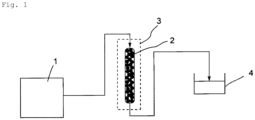
- Examples thereof include a method by a flow synthesis system in which a salicylic acid solution prepared in a preparation tank 1 is continuously passed through a reaction container 3 including a column filled with a solid acid catalyst 2 of the present invention, an esterification reaction of salicylic acid with the alcohol is continuously performed in the presence of the solid acid catalyst in the column, and a liquid reaction product containing a salicylic acid ester that flows out from the column is received in a collection tank 4 as shown in Figs. 1 and 2 .
- the flow synthesis system of Fig. 2 is different from the flow synthesis system of Fig. 1 in that a back pressure valve 5 is provided in a flow path that feeds the liquid reaction product from the reaction container 3 to the collection tank 4, but otherwise has the same configuration.
- salicylic acid that is a raw material for producing the salicylic acid ester (2)
- a commercially available product may be used or an acid obtained by applying a well-known method may be used.
- an alcohol corresponding to the salicylic acid ester (2), which is the target is used.
- methanol is preferably used in the case of producing methyl salicylate
- ethylene glycol is preferably used in the case of producing ethylene glycol salicylate.
- R in the formula (1) is normally 1 to 6, preferably 1 to 4, and particularly preferably 1 or 2.
- R is a linear or branched alkyl group and preferably a linear alkyl.
- the amount of the alcohol (1) used needs to be an amount at which the esterification reaction of the present invention progresses and is not particularly limited, but is normally 1 g to 100 g and preferably 3 g to 20 g per 1 g of the salicylic acid from the viewpoint of the productivity.
- the alcohol (1) enabling the intended salicylic acid ester (2) to be obtained by the esterification reaction is preferably used.
- the alcohol (1) is preferably methanol in the case of producing methyl salicylate, and the alcohol (1) is preferably ethylene glycol in the case of producing glycol salicylate.
- One of these solvents may be used singly or two or more thereof may be mixed and used in an arbitrary composition and an arbitrary ratio.
- the solvent is preferably used singly from the viewpoint of easiness in the removal of the solvent and the suppression of an impurity.
- the concentration of the salicylic acid in the salicylic acid solution is not particularly limited as long as there is no hindrance in the circulation into the column.
- the concentration of the salicylic acid in the salicylic acid solution is normally 0.1 mass% to 80 mass%, preferably 5 mass% to 75 mass%, and particularly preferably 10 mass% to 70 mass% from the viewpoint of the productivity and the reactivity. In a case where the concentration of the salicylic acid is too low, there is a concern that the reaction time may become long, and in a case where the concentration is too high, there is a concern that the reaction may not sufficiently progress.
- the solid acid catalyst a catalyst that makes the esterification reaction between the salicylic acid and the alcohol (1) progress is used.
- the solid acid catalyst in the present invention is normally an acid catalyst of a solid containing a base and an ion exchange group.
- Examples of the base include an organic adsorbent and an inorganic adsorbent.
- organic adsorbent examples include aromatic adsorbents such as styrene/divinylbenzene copolymers and divinylbenzene polymers; acrylic (co)polymers such as methyl methacrylate/bis(methacrylic acid)ethylene glycol copolymers. From the viewpoint of the reactivity and the durability of the solid acid catalyst, the aromatic adsorbents are preferable, and the styrene/divinylbenzene copolymers are particularly preferable.
- the degree of crosslinking of the organic adsorbent is normally 1 mass% to 20 mass% and preferably 2 mass% to 10 mass%.
- the degree of crosslinking represents the content (mass%) of divinyl benzene, which is a crosslinking agent, in the case of the styrene/divinylbenzene copolymers.
- the degree of crosslinking is within the above range, it is possible to improve the reactivity and the durability of the solid acid catalyst.
- Examples of the inorganic adsorbent include silica gel and alumina.
- Silica gel is preferable from the viewpoint of the cost and the reactivity.
- strong acid ion exchange groups or weak acid ion exchange groups can be used.
- strong acid ion exchange groups are preferable, and among them, a sulfonic acid group or an alkylsulfonic acid group are particularly preferable.
- the structure of the solid acid catalyst is not particularly limited, and gel-type, porous, highly porous or macroporous solid acid catalysts can be used.
- the shape of the solid acid catalyst is not particularly limited, and particulate, pellet-like, film-like or columnar solid acid catalysts can be used. From the viewpoint of the filling property into the column, particulate or pellet-like solid acid catalysts are preferable, and a particulate solid acid catalyst is more preferable.
- the solid acid catalyst is normally used in a state of filling the column.
- the size of the solid acid catalyst is not particularly limited as long as the solid acid catalyst is capable of filling the column and catalyzing the reaction.
- the particle diameter of the solid acid catalyst is normally 1 ⁇ m to 2000 ⁇ m and preferably 4 ⁇ m to 1000 ⁇ m from the viewpoint of the industrial handleability or the like.
- the most frequent particle diameter of the solid acid catalyst is normally 50 ⁇ m to 2000 ⁇ m, preferably 150 ⁇ m to 1500 ⁇ m and particularly preferably 250 ⁇ m to 1000 ⁇ m.
- the particle diameter of the solid acid catalyst is the average particle diameter measured according to a normal method by the laser diffraction-type particle size distribution measurement method.
- the specific surface area of the solid acid catalyst that is used in the present invention is preferably 100 m 2 /g to 2000 m 2 /g.
- the specific surface area is preferably 200 m 2 /g to 1000 m 2 /g from the viewpoint of the reactivity.
- the use of the solid acid catalyst having a specific surface area within the above range makes it possible to efficiently perform the reaction and to enhance the productivity.
- any solid acid catalysts can be used as long as the above-described conditions are satisfied, and examples thereof include commercially available products such as DIAION (registered trademark) SK104H, SK1BH, UBK530K, RCP145H manufactured by Mitsubishi Chemical Corporation; Amberlite (registered trademark) XH2071H manufactured by Organo Corporation; and TAYCACURE (registered trademark) SAC-6 manufactured by Tayca Corporation.
- DIAION registered trademark
- SK104H, SK1BH, UBK530K RCP145H manufactured by Mitsubishi Chemical Corporation
- Amberlite registered trademark
- TAYCACURE registered trademark
- One of these solid acid catalysts may be used singly or two or more thereof may be mixed and used.
- a flow synthesis system suitable for performing the method for producing a salicylic acid ester of the present invention is a system in which a reaction container having an inlet and an outlet is used and "the injection of a raw material from the inlet", “the reaction” and “the collection of a product from the outlet” are performed at the same time.
- This concept is well known to persons skilled in the art (for example, “ Flow Micro Synthesis” (Kagakudojin) published in 2014, p. 9 ).
- the shape of the column that is filled with the solid acid catalyst is not particularly limited as long as the column can be filled with the solid acid catalyst and is suitable for the reaction; however, normally, tubular columns can be used.
- the material of the column relating to the present invention is not particularly limited.
- Examples of the material of the column include glass, stainless steel (SUS), Hastelloy and TEFLON (registered trademark), and stainless steel or Hastelloy is preferable.
- the size of the column is not particularly limited as long as the column is suitable for the reaction.
- the column for example, thin tubular columns such as a column that is 10 mm in diameter and 100 mm in length and a column that is 10 mm in diameter and 250 mm in length can be used.
- Examples of the column filled with the catalyst include 4.6 mm ⁇ 100 mm SUS columns or Hastelloy columns closely packed with the solid acid catalyst.
- a tube that is used as a flow path for introducing the salicylic acid solution containing the salicylic acid and the alcohol (1), which are reactants, into the column and a flow path for discharging the liquid reaction product from the column is not particularly limited.
- Specific examples of the tube include TEFLON (registered trademark) tubes having an inner diameter of 1 mm.
- the introduction of the salicylic acid solution containing the salicylic acid and the alcohol (1), which are the reactants, into the column and the discharge of the liquid reaction product can be performed by liquid delivery using a syringe pump, a diaphragm pump, a mass controller or the like.
- a back pressure valve or an inline analyzer may be provided in the flow path on the side where the liquid reaction product is discharged from the column.
- the reaction temperature of the esterification reaction of the present invention means the outside temperature of the column filled with the solid acid catalyst of the present invention.
- the upper limit of the reaction temperature is normally 50°C or higher, preferably 70°C or higher, more preferably 90°C or higher, still more preferably 100°C or higher and particularly preferably 105°C or higher
- the lower limit is normally 200°C or lower, preferably 180°C or lower, more preferably 160°C or lower, still more preferably 150°C or lower and particularly preferably 140°C or lower.
- reaction temperature In a case where the reaction temperature is lower than the above lower limit, there are cases where the reactivity deteriorates. In a case where the reaction temperature is higher than the above upper limit, there are cases where decreases in the yield and the purity or the deterioration of the solid acid catalyst due to a side reaction occurs.
- the lower limit of the reaction pressure of the esterification reaction of the present invention is normally 0.1 MPa or higher, preferably 0.2 MPa or higher and particularly preferably 0.3 MPa or higher, and the upper limit is normally 1 MPa or lower, preferably 0.8 MPa or lower and particularly preferably 0.6 MPa or lower.
- the reaction pressure can be adjusted by applying a back pressure to the flow path posterior to the column filled with the solid acid catalyst of the present invention using the back pressure valve or the like.
- the reaction can be performed at a pressure adjusted so that the solvent becomes liquid even at the desired reaction temperature.
- the reaction pressure is not particularly limited, but is normally 0.1 MPa to 1 MPa.
- the reaction time of the esterification reaction of the present invention means the time (residence time) during which a reaction solution resides in the column filled with the solid acid catalyst.
- the reaction time may vary with the reaction temperature or the reaction pressure, but is normally one minute to 120 minutes.
- the salicylic acid ester (2) which is the target, may be isolated from the liquid reaction product obtained by the esterification step of the present invention by a treatment, such as neutralization, separation, concentration or filtration, of this liquid reaction product or by well-known purification means such as crystallization or column chromatography.
- Example 1 Production of ethylene glycol salicylate, solid acid catalyst: solid acid catalyst 1 (DIAION (registered trademark) SK104H)]
- a stainless steel column tube (Tokyo Rikakikai Co., Ltd., inner diameter: 10 mm, length: 100 mm) was filled with 5.86 g of a solid acid catalyst 1 [Mitsubishi Chemical Corporation, trade name: DIAION (registered trademark) SK104H, degree of crosslinking: 4%, average particle diameter: 730 ⁇ m] (voids in the column were as shown in Table 2) and mounted in a column-type flow reactor (EYELA, MCR-1000 type).
- a solid acid catalyst 1 [Mitsubishi Chemical Corporation, trade name: DIAION (registered trademark) SK104H, degree of crosslinking: 4%, average particle diameter: 730 ⁇ m] (voids in the column were as shown in Table 2) and mounted in a column-type flow reactor (EYELA, MCR-1000 type).
- Example 2 Production of ethylene glycol salicylate, solid acid catalyst: solid acid catalyst 3 (DIAION (registered trademark) UBK530K)]
- Example 2 A reaction was performed in the same manner except that, in Example 1, 5.86 g of the solid acid catalyst 1 was changed to 5.97 g of a solid acid catalyst 3 [Mitsubishi Chemical Corporation, trade name: DIAION (registered trademark) UBK530K, average particle diameter: 360 ⁇ m] (voids in the column were as shown in Table 2), the flow rate was changed from 0.039 mL/min (residence time: 60 min) to 0.042 mL/min (residence time: 60 min), and the column set temperature was changed from 105°C to 110°C.
- DIAION registered trademark
- UBK530K average particle diameter
- Example 2 A reaction was performed in the same manner except that, in Example 1, 5.86 g of the solid acid catalyst 1 was changed to 5.30 g of a solid acid catalyst 5 [Organo Corporation, trade name: Amberlite (registered trademark) XH2071H] (voids in the column were as shown in Table 2), and the flow rate was changed from 0.039 mL/min (residence time: 60 min) to 0.036 mL/min (residence time: 90 min).
- a solid acid catalyst 5 [Organo Corporation, trade name: Amberlite (registered trademark) XH2071H] (voids in the column were as shown in Table 2), and the flow rate was changed from 0.039 mL/min (residence time: 60 min) to 0.036 mL/min (residence time: 90 min).
- Example 2 A reaction was performed in the same manner except that, in Example 1, 5.86 g of the solid acid catalyst 1 was changed to 5.0 g of a solid acid catalyst 6 [Tayca Corporation, trade name: TAYCACURE (registered trademark) SAC-6, average particle diameter: 200 ⁇ m, specific surface area: 450 m 2 /g] (voids in the column were as shown in Table 2), the flow rate was changed from 0.039 mL/min (residence time: 60 min) to 0.049 mL/min (residence time: 90 min), and the column set temperature was changed from 105°C to 130°C.
- a solid acid catalyst 6 [Tayca Corporation, trade name: TAYCACURE (registered trademark) SAC-6, average particle diameter: 200 ⁇ m, specific surface area: 450 m 2 /g] (voids in the column were as shown in Table 2)
- the flow rate was changed from 0.039 mL/min (residence time: 60 min) to 0.049
- a stainless steel column tube (Tokyo Rikakikai Co., Ltd., inner diameter: 10 mm, length: 100 mm) was filled with 5.86 g of the solid acid catalyst 1 [Mitsubishi Chemical Corporation, trade name: DIAION (registered trademark) SK104H] (voids in the column were as shown in Table 3) and mounted in the column-type flow reactor (EYELA, MCR-1000 type).
- Example 5 A reaction was performed in the same manner except that, in Example 5, 5.86 g of the solid acid catalyst 1 was changed to 5.85 g of a solid acid catalyst 2 [Mitsubishi Chemical Corporation, trade name: DIAION (registered trademark) SK1BH] (voids in the column were as shown in Table 3) and the flow rate was changed from 0.305 mL/min (residence time: 10 min) to 0.155 mL/min (residence time: 20 min).
- DIAION registered trademark
- the method for producing a salicylic acid ester of the present invention is a safe method for producing a salicylic acid ester, in which a salicylic acid ester can be produced within a short reaction time at a high selectivity, a high yield and a high productivity, furthermore, the environmental load is low, and the amount of an impurity generated is small and also a production method enabling the continuous production of a salicylic acid ester and is thus industrially useful.
Landscapes
- Chemical & Material Sciences (AREA)
- Organic Chemistry (AREA)
- Organic Low-Molecular-Weight Compounds And Preparation Thereof (AREA)
- Low-Molecular Organic Synthesis Reactions Using Catalysts (AREA)
Applications Claiming Priority (2)
| Application Number | Priority Date | Filing Date | Title |
|---|---|---|---|
| JP2022047108 | 2022-03-23 | ||
| PCT/JP2023/011200 WO2023182349A1 (ja) | 2022-03-23 | 2023-03-22 | サリチル酸エステルの製造方法 |
Publications (2)
| Publication Number | Publication Date |
|---|---|
| EP4497744A1 true EP4497744A1 (de) | 2025-01-29 |
| EP4497744A4 EP4497744A4 (de) | 2026-04-08 |
Family
ID=88101592
Family Applications (1)
| Application Number | Title | Priority Date | Filing Date |
|---|---|---|---|
| EP23774944.5A Pending EP4497744A4 (de) | 2022-03-23 | 2023-03-22 | Verfahren zur herstellung von salicylsäureester |
Country Status (6)
| Country | Link |
|---|---|
| US (1) | US20250179001A1 (de) |
| EP (1) | EP4497744A4 (de) |
| JP (1) | JP7819757B2 (de) |
| KR (1) | KR20240161106A (de) |
| CN (1) | CN119095819A (de) |
| WO (1) | WO2023182349A1 (de) |
Family Cites Families (18)
| Publication number | Priority date | Publication date | Assignee | Title |
|---|---|---|---|---|
| US164128A (en) | 1875-06-08 | Improvement in sirup-pitchers | ||
| DE164128C (de) | 1903-12-02 | |||
| CA2083346A1 (en) * | 1991-12-13 | 1993-06-14 | Eric G. Lundquist | A catalyzed esterification process |
| JP4079480B2 (ja) | 1996-08-20 | 2008-04-23 | 三菱化学株式会社 | (メタ)アクリル酸エステルの製造方法 |
| JP5114712B2 (ja) | 2005-09-16 | 2013-01-09 | 国立大学法人東京工業大学 | 固体酸触媒 |
| MY151857A (en) * | 2006-12-27 | 2014-07-14 | Lion Corp | Method for producing fatty acid lower alkyl ester |
| CN101429127B (zh) * | 2008-10-24 | 2011-11-16 | 江苏大学 | 一种介孔分子筛固体超强酸催化合成水杨酸异戊酯的方法 |
| CN101787064B (zh) * | 2009-01-23 | 2013-03-13 | 高峰 | 阿糖胞苷衍生物及其在抗癌抗肿瘤中的用途 |
| CN101869847B (zh) * | 2010-06-28 | 2013-04-24 | 济南大学 | 微球型高分子固体酸酯化催化剂及其制备方法 |
| CN102408338A (zh) * | 2011-10-27 | 2012-04-11 | 杭州友邦香料香精有限公司 | 一种水杨酸酯的合成方法 |
| JP5927949B2 (ja) * | 2012-02-03 | 2016-06-01 | 三菱化学株式会社 | 脂肪酸エステルの製造方法及びバイオディーゼル燃料の製造方法 |
| JP6582440B2 (ja) * | 2015-02-25 | 2019-10-02 | Dic株式会社 | セルロースエステル樹脂用改質剤、セルロースエステル樹脂組成物、光学フィルム及び液晶表示装置 |
| CN105618148A (zh) * | 2015-12-31 | 2016-06-01 | 镇江高鹏药业有限公司 | 一种水杨酸甲酯合成用高效固体催化剂 |
| EP3778545B1 (de) | 2018-03-28 | 2025-05-21 | Mitsubishi Chemical Corporation | Verfahren zur herstellung von ungesättigten carbonsäureestern |
| WO2019203241A1 (ja) * | 2018-04-16 | 2019-10-24 | 国立研究開発法人理化学研究所 | メタ-フェノールスルホン酸系樹脂、及びその触媒としての利用 |
| CN110937998A (zh) | 2019-11-15 | 2020-03-31 | 华阴市锦前程药业有限公司 | 一种水杨酸乙二醇单酯的制备方法 |
| WO2021182144A1 (ja) | 2020-03-10 | 2021-09-16 | 日本ゼオン株式会社 | 有機エステルの製造方法及び製造装置 |
| JP2022047108A (ja) | 2020-09-11 | 2022-03-24 | トヨタ自動車株式会社 | 車両前部構造 |
-
2023
- 2023-03-22 EP EP23774944.5A patent/EP4497744A4/de active Pending
- 2023-03-22 CN CN202380026197.3A patent/CN119095819A/zh active Pending
- 2023-03-22 US US18/846,078 patent/US20250179001A1/en active Pending
- 2023-03-22 KR KR1020247029602A patent/KR20240161106A/ko active Pending
- 2023-03-22 JP JP2024509159A patent/JP7819757B2/ja active Active
- 2023-03-22 WO PCT/JP2023/011200 patent/WO2023182349A1/ja not_active Ceased
Also Published As
| Publication number | Publication date |
|---|---|
| KR20240161106A (ko) | 2024-11-12 |
| WO2023182349A1 (ja) | 2023-09-28 |
| EP4497744A4 (de) | 2026-04-08 |
| JP7819757B2 (ja) | 2026-02-25 |
| US20250179001A1 (en) | 2025-06-05 |
| JPWO2023182349A1 (de) | 2023-09-28 |
| CN119095819A (zh) | 2024-12-06 |
Similar Documents
| Publication | Publication Date | Title |
|---|---|---|
| KR102440432B1 (ko) | 고리형 카보네이트의 제조 장치 및 제조 방법 | |
| KR101988210B1 (ko) | 비닐 에스테르의 제조 방법 | |
| EP3118181A1 (de) | Verbundmetallkatalysatorzusammensetzung sowie verfahren und vorrichtung zur herstellung von 1,4-cyclohexanedimethanol damit | |
| CN102405205A (zh) | 制备乙酰丙酸烷基酯的方法 | |
| EP2206550B1 (de) | Mikroreaktor und chemisches flüssigphasenreaktionsverfahren mit dem mikroreaktor | |
| CN101289395B (zh) | 一种碳酸甲乙酯的制备方法 | |
| EP4497744A1 (de) | Verfahren zur herstellung von salicylsäureester | |
| US7119233B2 (en) | Method for preparing 3-(methylthio)propanal | |
| JP7690955B2 (ja) | アセトアミノフェンの製造方法 | |
| EP3001835A1 (de) | Verfahren zur kontinuierlichen herstellung von di-c1-3-alkylsuccinaten | |
| CN115677492A (zh) | 一种三羟甲基丙烷三丙烯酸酯的相分离催化合成方法 | |
| US20190185504A1 (en) | Process for producing sugar fatty acid ester using anion exchanger as catalyst | |
| CN107963977B (zh) | 一种利用微反应装置制备α-酮酰胺的方法 | |
| EP2552882B1 (de) | Verfahren zur herstellung von n-propylacetat und verfahren zur herstellung von allyl-acetat | |
| JP5662835B2 (ja) | グリセリンモノ(メタ)アクリレートの製造方法 | |
| CN111004123A (zh) | 一种3-乙氧基丙酸乙酯的制备方法 | |
| RU2703275C2 (ru) | Способ получения (s)-2-ацетилоксипропионовой кислоты и ее производных | |
| EP4149667A1 (de) | Skalierte synthese von lomustin unter kontinuierlichen strömungsbedingungen | |
| JPH0356134A (ja) | 反応蒸留装置 | |
| CN113166025A (zh) | 烷基羧酸酯的制备方法及烷基羧酸酯的制备装置 | |
| KR20050062527A (ko) | 비스페놀-a의 제조 방법 | |
| US20250011278A1 (en) | Method for producing acetaminophen | |
| JP3834883B2 (ja) | 塔型反応器を用いた連続製造方法 | |
| CN112250542A (zh) | 2-环己烷基环己醇的制法 | |
| JP5757126B2 (ja) | フローリアクターを用いたシャープレス不斉エポキシ化反応 |
Legal Events
| Date | Code | Title | Description |
|---|---|---|---|
| STAA | Information on the status of an ep patent application or granted ep patent |
Free format text: STATUS: THE INTERNATIONAL PUBLICATION HAS BEEN MADE |
|
| PUAI | Public reference made under article 153(3) epc to a published international application that has entered the european phase |
Free format text: ORIGINAL CODE: 0009012 |
|
| STAA | Information on the status of an ep patent application or granted ep patent |
Free format text: STATUS: REQUEST FOR EXAMINATION WAS MADE |
|
| 17P | Request for examination filed |
Effective date: 20240917 |
|
| AK | Designated contracting states |
Kind code of ref document: A1 Designated state(s): AL AT BE BG CH CY CZ DE DK EE ES FI FR GB GR HR HU IE IS IT LI LT LU LV MC ME MK MT NL NO PL PT RO RS SE SI SK SM TR |
|
| DAV | Request for validation of the european patent (deleted) | ||
| DAX | Request for extension of the european patent (deleted) | ||
| A4 | Supplementary search report drawn up and despatched |
Effective date: 20260311 |
|
| RIC1 | Information provided on ipc code assigned before grant |
Ipc: C07C 67/08 20060101AFI20260305BHEP Ipc: C07C 69/84 20060101ALI20260305BHEP |