EP4488304A1 - Photosetting composition, three-dimensionally shaped article, mold, method for manufacturing cured product, and method for manufacturing plate denture - Google Patents
Photosetting composition, three-dimensionally shaped article, mold, method for manufacturing cured product, and method for manufacturing plate denture Download PDFInfo
- Publication number
- EP4488304A1 EP4488304A1 EP23780081.8A EP23780081A EP4488304A1 EP 4488304 A1 EP4488304 A1 EP 4488304A1 EP 23780081 A EP23780081 A EP 23780081A EP 4488304 A1 EP4488304 A1 EP 4488304A1
- Authority
- EP
- European Patent Office
- Prior art keywords
- meth
- acrylic monomer
- group
- photocurable composition
- mold
- Prior art date
- Legal status (The legal status is an assumption and is not a legal conclusion. Google has not performed a legal analysis and makes no representation as to the accuracy of the status listed.)
- Pending
Links
Images


Classifications
-
- B—PERFORMING OPERATIONS; TRANSPORTING
- B29—WORKING OF PLASTICS; WORKING OF SUBSTANCES IN A PLASTIC STATE IN GENERAL
- B29C—SHAPING OR JOINING OF PLASTICS; SHAPING OF MATERIAL IN A PLASTIC STATE, NOT OTHERWISE PROVIDED FOR; AFTER-TREATMENT OF THE SHAPED PRODUCTS, e.g. REPAIRING
- B29C33/00—Moulds or cores; Details thereof or accessories therefor
- B29C33/38—Moulds or cores; Details thereof or accessories therefor characterised by the material or the manufacturing process
- B29C33/40—Plastics, e.g. foam or rubber
-
- B—PERFORMING OPERATIONS; TRANSPORTING
- B29—WORKING OF PLASTICS; WORKING OF SUBSTANCES IN A PLASTIC STATE IN GENERAL
- B29C—SHAPING OR JOINING OF PLASTICS; SHAPING OF MATERIAL IN A PLASTIC STATE, NOT OTHERWISE PROVIDED FOR; AFTER-TREATMENT OF THE SHAPED PRODUCTS, e.g. REPAIRING
- B29C64/00—Additive manufacturing, i.e. manufacturing of three-dimensional [3D] objects by additive deposition, additive agglomeration or additive layering, e.g. by 3D printing, stereolithography or selective laser sintering
- B29C64/10—Processes of additive manufacturing
- B29C64/106—Processes of additive manufacturing using only liquids or viscous materials, e.g. depositing a continuous bead of viscous material
- B29C64/124—Processes of additive manufacturing using only liquids or viscous materials, e.g. depositing a continuous bead of viscous material using layers of liquid which are selectively solidified
-
- A—HUMAN NECESSITIES
- A61—MEDICAL OR VETERINARY SCIENCE; HYGIENE
- A61C—DENTISTRY; APPARATUS OR METHODS FOR ORAL OR DENTAL HYGIENE
- A61C13/00—Dental prostheses; Making same
- A61C13/01—Palates or other bases or supports for the artificial teeth; Making same
-
- A—HUMAN NECESSITIES
- A61—MEDICAL OR VETERINARY SCIENCE; HYGIENE
- A61C—DENTISTRY; APPARATUS OR METHODS FOR ORAL OR DENTAL HYGIENE
- A61C13/00—Dental prostheses; Making same
- A61C13/01—Palates or other bases or supports for the artificial teeth; Making same
- A61C13/04—Palates or other bases or supports for the artificial teeth; Making same made by casting
-
- B—PERFORMING OPERATIONS; TRANSPORTING
- B29—WORKING OF PLASTICS; WORKING OF SUBSTANCES IN A PLASTIC STATE IN GENERAL
- B29C—SHAPING OR JOINING OF PLASTICS; SHAPING OF MATERIAL IN A PLASTIC STATE, NOT OTHERWISE PROVIDED FOR; AFTER-TREATMENT OF THE SHAPED PRODUCTS, e.g. REPAIRING
- B29C33/00—Moulds or cores; Details thereof or accessories therefor
- B29C33/38—Moulds or cores; Details thereof or accessories therefor characterised by the material or the manufacturing process
- B29C33/3842—Manufacturing moulds, e.g. shaping the mould surface by machining
-
- B—PERFORMING OPERATIONS; TRANSPORTING
- B33—ADDITIVE MANUFACTURING TECHNOLOGY
- B33Y—ADDITIVE MANUFACTURING, i.e. MANUFACTURING OF THREE-DIMENSIONAL [3-D] OBJECTS BY ADDITIVE DEPOSITION, ADDITIVE AGGLOMERATION OR ADDITIVE LAYERING, e.g. BY 3-D PRINTING, STEREOLITHOGRAPHY OR SELECTIVE LASER SINTERING
- B33Y10/00—Processes of additive manufacturing
-
- B—PERFORMING OPERATIONS; TRANSPORTING
- B33—ADDITIVE MANUFACTURING TECHNOLOGY
- B33Y—ADDITIVE MANUFACTURING, i.e. MANUFACTURING OF THREE-DIMENSIONAL [3-D] OBJECTS BY ADDITIVE DEPOSITION, ADDITIVE AGGLOMERATION OR ADDITIVE LAYERING, e.g. BY 3-D PRINTING, STEREOLITHOGRAPHY OR SELECTIVE LASER SINTERING
- B33Y70/00—Materials specially adapted for additive manufacturing
-
- B—PERFORMING OPERATIONS; TRANSPORTING
- B33—ADDITIVE MANUFACTURING TECHNOLOGY
- B33Y—ADDITIVE MANUFACTURING, i.e. MANUFACTURING OF THREE-DIMENSIONAL [3-D] OBJECTS BY ADDITIVE DEPOSITION, ADDITIVE AGGLOMERATION OR ADDITIVE LAYERING, e.g. BY 3-D PRINTING, STEREOLITHOGRAPHY OR SELECTIVE LASER SINTERING
- B33Y80/00—Products made by additive manufacturing
-
- C—CHEMISTRY; METALLURGY
- C08—ORGANIC MACROMOLECULAR COMPOUNDS; THEIR PREPARATION OR CHEMICAL WORKING-UP; COMPOSITIONS BASED THEREON
- C08F—MACROMOLECULAR COMPOUNDS OBTAINED BY REACTIONS ONLY INVOLVING CARBON-TO-CARBON UNSATURATED BONDS
- C08F290/00—Macromolecular compounds obtained by polymerising monomers on to polymers modified by introduction of aliphatic unsaturated end or side groups
- C08F290/02—Macromolecular compounds obtained by polymerising monomers on to polymers modified by introduction of aliphatic unsaturated end or side groups on to polymers modified by introduction of unsaturated end groups
- C08F290/06—Polymers provided for in subclass C08G
- C08F290/062—Polyethers
-
- C—CHEMISTRY; METALLURGY
- C08—ORGANIC MACROMOLECULAR COMPOUNDS; THEIR PREPARATION OR CHEMICAL WORKING-UP; COMPOSITIONS BASED THEREON
- C08F—MACROMOLECULAR COMPOUNDS OBTAINED BY REACTIONS ONLY INVOLVING CARBON-TO-CARBON UNSATURATED BONDS
- C08F290/00—Macromolecular compounds obtained by polymerising monomers on to polymers modified by introduction of aliphatic unsaturated end or side groups
- C08F290/02—Macromolecular compounds obtained by polymerising monomers on to polymers modified by introduction of aliphatic unsaturated end or side groups on to polymers modified by introduction of unsaturated end groups
- C08F290/06—Polymers provided for in subclass C08G
- C08F290/067—Polyurethanes; Polyureas
-
- B—PERFORMING OPERATIONS; TRANSPORTING
- B29—WORKING OF PLASTICS; WORKING OF SUBSTANCES IN A PLASTIC STATE IN GENERAL
- B29K—INDEXING SCHEME ASSOCIATED WITH SUBCLASSES B29B, B29C OR B29D, RELATING TO MOULDING MATERIALS OR TO MATERIALS FOR MOULDS, REINFORCEMENTS, FILLERS OR PREFORMED PARTS, e.g. INSERTS
- B29K2105/00—Condition, form or state of moulded material or of the material to be shaped
- B29K2105/0094—Condition, form or state of moulded material or of the material to be shaped having particular viscosity
-
- B—PERFORMING OPERATIONS; TRANSPORTING
- B29—WORKING OF PLASTICS; WORKING OF SUBSTANCES IN A PLASTIC STATE IN GENERAL
- B29K—INDEXING SCHEME ASSOCIATED WITH SUBCLASSES B29B, B29C OR B29D, RELATING TO MOULDING MATERIALS OR TO MATERIALS FOR MOULDS, REINFORCEMENTS, FILLERS OR PREFORMED PARTS, e.g. INSERTS
- B29K2833/00—Use of polymers of unsaturated acids or derivatives thereof as mould material
- B29K2833/04—Polymers of esters
- B29K2833/08—Polymers of acrylic acid esters, e.g. PMA, i.e. polymethylacrylate
-
- B—PERFORMING OPERATIONS; TRANSPORTING
- B29—WORKING OF PLASTICS; WORKING OF SUBSTANCES IN A PLASTIC STATE IN GENERAL
- B29K—INDEXING SCHEME ASSOCIATED WITH SUBCLASSES B29B, B29C OR B29D, RELATING TO MOULDING MATERIALS OR TO MATERIALS FOR MOULDS, REINFORCEMENTS, FILLERS OR PREFORMED PARTS, e.g. INSERTS
- B29K2995/00—Properties of moulding materials, reinforcements, fillers, preformed parts or moulds
- B29K2995/0037—Other properties
- B29K2995/0046—Elastic
-
- B—PERFORMING OPERATIONS; TRANSPORTING
- B29—WORKING OF PLASTICS; WORKING OF SUBSTANCES IN A PLASTIC STATE IN GENERAL
- B29K—INDEXING SCHEME ASSOCIATED WITH SUBCLASSES B29B, B29C OR B29D, RELATING TO MOULDING MATERIALS OR TO MATERIALS FOR MOULDS, REINFORCEMENTS, FILLERS OR PREFORMED PARTS, e.g. INSERTS
- B29K2995/00—Properties of moulding materials, reinforcements, fillers, preformed parts or moulds
- B29K2995/0037—Other properties
- B29K2995/0088—Molecular weight
-
- B—PERFORMING OPERATIONS; TRANSPORTING
- B29—WORKING OF PLASTICS; WORKING OF SUBSTANCES IN A PLASTIC STATE IN GENERAL
- B29L—INDEXING SCHEME ASSOCIATED WITH SUBCLASS B29C, RELATING TO PARTICULAR ARTICLES
- B29L2031/00—Other particular articles
- B29L2031/753—Medical equipment; Accessories therefor
- B29L2031/7532—Artificial members, protheses
- B29L2031/7536—Artificial teeth
Definitions
- the present disclosure relates to a photocurable composition, a three-dimensional modeling product, a mold, a method of producing a cured product, and a method of producing a plate denture.
- Dental products such as dental prostheses and instruments for intraoral use have been studied in recent years.
- methods of producing a three-dimensional modeling product such as a dental product by photomodeling using a 3D printer have been known (see, for example, Patent Document 1).
- Patent Document 1 Japanese Patent No. 4160311
- a mold of the patient's mouth is taken directly from the patient using an impression material, and a model that mimics the inside of the patient's mouth is made by referring to the impression material.
- a mold is then made from this model using silicone.
- a curable composition can be injected into it and the plate denture can be produced by room temperature polymerization.
- the conventional method that does not use photomodeling have the problem of complicated processes such as producing a model that mimics the inside of the patient's mouth and making a mold with silicone.
- the above-mentioned complication is eliminated by the method of directly producing a plate denture by photomodeling using a 3D printer.
- the materials that can be properly cured by photomodeling are very limited, so the characteristics of the resulting plate denture are also limited.
- the conventional method uses room temperature polymerization using a mold, but this method allows the use of many materials that can improve aesthetics and physical properties.
- the materials used in such room temperature polymerization are often not usable in photomodeling with a 3D printer. As a result, it is difficult to adjust the desired properties of the resulting plate denture when photomodeling with a 3D printer.
- the inventors have discovered a method of producing a mold for producing a plate denture by photomodeling with a 3D printer, and using the mold to produce a plate denture.
- the mold in case in which a mold of a plate denture is produced from a photocurable composition and then used to produce a plate denture, depending on the type of polymerizable composition used to produce the plate denture, the mold itself may shrink and deform when the polymerizable composition poured into the mold is polymerized during the production of the plate denture, which may result in deformation of the resulting plate denture.
- the plate denture When removing a plate denture obtained by polymerizing a polymerizable composition in a mold from the mold, the plate denture may become stuck in the mold due to the fact that it contains artificial teeth, making it physically difficult to remove.
- An object of one aspect of the present disclosure is to provide a photocurable composition capable of producing a mold that is suppressed from deforming during the production of a plate denture, or a mold that allows a plate denture to be easily removed from the mold when a denture is produced using the mold, and a three-dimensional modeling product, a mold, a method of producing a cured product, and a method of producing a plate denture which use this photocurable composition.
- An object of another aspect of the present disclosure is to provide a method of producing a plate denture capable of producing a plate denture in a simple manner.
- Means for solving the above-described problems include the following aspects.
- a photocurable composition capable of producing a mold that is suppressed from deforming during the production of a plate denture, or a mold that allows a plate denture to be easily removed from the mold when a denture is produced using the mold, and a three-dimensional modeling product, a mold, a method of producing a cured product, and a method of producing a plate denture which use this photocurable composition can be provided.
- a method of producing a plate denture capable of producing a plate denture in a simple manner.
- the indicated amount of the component in the composition means, unless otherwise specified, a total amount of the plural substances existing in the composition.
- the upper limit value or the lower limit value of one numerical range may be replaced with the upper limit value or the lower limit value of other numerical range.
- the upper limit value or the lower limit value of the numerical range may be replaced with a relevant value indicated in any of Examples.
- light is a concept that encompasses active energy rays such as ultraviolet rays and visible light beams.
- (meth)acrylate refers to an acrylate or a methacrylate
- (meth)acryloyl refers to acryloyl or methacryloyl
- (meth)acryl refers to acryl or methacryl.
- a photocurable composition of the present disclosure will be described in terms of the first and second embodiments.
- the preferred forms of the first embodiment and the preferred forms of the second embodiment may be combined as appropriate.
- the preferred uses and physical properties of the photocurable composition of the second embodiment are the same as those of the photocurable composition of the first embodiment.
- a photocurable composition of the first embodiment of the present disclosure contains a (meth)acrylic monomer component, and a photopolymerization initiator,
- the photocurable composition of the present disclosure contains a (meth)acrylic monomer component, and a photopolymerization initiator, the test piece A1 produced by the conditions described above has the storage elastic modulus at 25°C of 10 MPa or more and the storage elastic modulus at 37°C of 400 MPa or less.
- a mold that is suppressed from deforming during the production of a plate denture, or a mold that allows a plate denture to be easily removed from the mold when the plate denture is produced using the mold can be produced by using such a photocurable composition.
- the photocurable composition of the present disclosure is a composition that cures when irradiated with light, and a cured product is obtained by curing this composition.
- Photomodeling is preferable as a method of producing a cured product using the photocurable composition of the present disclosure.
- the photocurable composition of the present disclosure is preferably a photocurable composition for photomodeling, in other words, a cured product produced using the photocurable composition of the present disclosure is preferably a photofabrication product (i.e., a cured product by photomodeling).
- Photomodeling is a method in which a photocurable composition is irradiated with light to form a cured layer, and the process is repeated to stack the cured layer to obtain a cured product (i.e., a photofabrication product).
- Photomodeling may be inkjet photomodeling or liquid vat photomodeling (i.e., photomodeling using a vat).
- droplets of a photocurable composition are ejected from an inkjet nozzle onto a substrate, and the droplets attached to the substrate are irradiated with light to obtain a cured product.
- inkjet photomodeling for example, a head equipped with an inkjet nozzle and a light source is scanned in a plane while a photocurable composition is ejected from an inkjet nozzle onto a substrate, and the ejected photocurable composition is irradiated with light to form a cured layer.
- cured layers are successively stacked to obtain a cured product (i.e., a photofabrication product).
- vat photomodeling In vat photomodeling, a photocurable composition (i.e., an uncured photocurable composition in a liquid state; the same applies below) housed in a vat is partially cured by photoirradiation to form a cured layer, and the cured layer is disposed on one another by repeating this operation, whereby a three-dimensional modeling product is obtained.
- Vat photomodeling is different from inkjet photomodeling in that it uses a vat.
- Vat photomodeling is broadly classified into DLP (Digital Light Processing) photomodeling and SLA (Stereolithography) photomodeling.
- a photocurable composition in a vat is irradiated with planar light.
- DLP photomodeling is preferable as vat photomodeling.
- a 3D printer e.g., "CARA PRINT 4.0” manufactured by Kulzer GmbH, or “MAX UV” manufactured by Asiga) that includes the followings is employed:
- a gap equivalent to a single layer is created between the build table and the tray, and this gap is filled with a photocurable composition.
- the photocurable composition filling the gap is irradiated with planar light from below through the light transmitting section of the tray to cure the light-irradiated region, whereby a first cured layer is formed.
- the gap between the build table and the tray is expanded for another layer to be formed next, and the resulting space is filled with the photocurable composition.
- the photocurable composition filling the space is irradiated with light in the same manner as in the curing of the first layer to form a second cured layer.
- the above-described operations are repeated to dispose cured layers on one another, whereby a three-dimensional modeling product is produced.
- the thus produced three-dimensional modeling product may be further irradiated with light and thereby further cured.
- the use of the photocurable composition of the present disclosure is not particularly limited, and for example, it is preferably a photocurable composition used in the production of a mold, a dental product, or the like by photomodeling, and more preferably a photocurable composition used in the production of a mold by photomodeling.
- a mold used in the production of a plate denture examples include a mold used in the production of a plate denture.
- a plate denture may be produced by injecting a curable composition for producing a denture base into a mold in which artificial teeth have been arranged, and then curing the curable composition after injection.
- Examples of the dental product include a dental prosthesis, a medical instrument for intraoral use, a dental model, or a lost-foam casting model.
- Examples of the dental prosthesis include an inlay, a crown, a bridge, a temporary crown, and a temporary bridge.
- Examples of the medical instrument for intraoral use include a denture (for example, a complete denture, a partial dentures, or the like), a mouthpiece, a mouth guard, a orthodontic appliance, a bite splint, a splint for treating a temporomandibular joint disorder, an impression tray, and a surgical guide.
- a denture for example, a complete denture, a partial dentures, or the like
- a mouthpiece for example, a complete denture, a partial dentures, or the like
- a mouth guard for example, a complete denture, a partial dentures, or the like
- a orthodontic appliance for example, a complete denture, a partial dentures, or the like
- a bite splint for treating a temporomandibular joint disorder
- an impression tray for example, a surgical guide.
- Examples of the dental model include a jaw model.
- the storage elastic modulus at 25°C of the test piece A1 is 10 MPa or more and from the viewpoint of suppressing deformation of a mold (for example, from the viewpoint of suppressing deformation of a mold when a photocurable composition for producing denture base is injected into a mold produced by using the photocurable composition of the present disclosure and then polymerized), it is preferably 15 MPa or more, more preferably 30 MPa or more, and still more preferably 50 MPa or more.
- the upper limit of the storage elastic modulus at 25°C of the test piece A1 is not particularly limited and for example, from the viewpoint of the removability from a mold (for example, from the viewpoint of suppressing damage to a mold, a plate denture, or the like, when the plate denture is removed from the mold), it may be 2000 MPa or less, may be 1000 MPa or less, or may be 500 MPa or less.
- the storage elastic modulus at 37°C of the test piece A1 is 400 MPa or less and from the viewpoint of the removability from a mold, it is preferably 300 MPa or less, more preferably 250 MPa or less, and still more preferably 200 MPa or less.
- the lower limit of the storage elastic modulus at 37°C of the test piece A1 is not particularly limited and for example, from the viewpoint of suppressing deformation of a mold when in use, it may be 10 MPa or more, may be 30 MPa or more, or may be 50 MPa or more.
- the aromatic ring concentration in the (meth)acrylic monomer component is from 0.0015 mmol/g to 0.0042 mmol/g, more preferably from 0.0016 mmol/g to 0.0041 mmol/g, and still more preferably from 0.0017 mmol/g to 0.0040 mmol/g.
- the photocurable composition of the present disclosure is more excellent in the removability from a mold and can suitably suppress deformation of a mold during use, it is preferable to satisfy any of the following conditions (1) to (3).
- the urethane bond concentration in the (meth)acrylic monomer component may be from 0.0001 mmol/g to 0.0020 mmol/g as the aforementioned (2), may be from 0.0002 mmol/g to 0.0018 mmol/g, or may be from 0.0004 mmol/g to 0.0016 mmol/g
- the hydroxy group concentration in the (meth)acrylic monomer component may be from 0.0005 mmol/g to 0.0030 mmol/g as the aforementioned (3), may be from 0.0006 mmol/g to 0.0025 mmol/g, or may be from 0.0008 mmol/g to 0.0022 mmol/g.
- the photocurable composition of the present disclosure contains at least one type of a (meth)acrylic monomer component.
- the content of the (meth)acrylic monomer component with respect to the total amount of the photocurable composition of the present disclosure is preferably 60% by mass or more, more preferably 80% by mass or more, and still more preferably 90% by mass or more.
- the upper limit of the content of the (meth)acrylic monomer component with respect to the total amount of the photocurable composition of the present disclosure is not particularly limited as long as it is less than 100% by mass, and for example, may be 99.9% by mass or less.
- the (meth)acrylic monomer component means a monomer having one or more (meth)acryloyloxy group in a molecule.
- the photocurable composition of the present disclosure may contain or may not contain a photopolymerizable component other than the (meth)acrylic monomer component.
- Examples of the photopolymerizable component other than the (meth)acrylic monomer component include styrene, styrene derivatives, and (meth)acrylonitrile.
- the content of the photopolymerizable component other than the (meth)acrylic monomer component may be 20% by mass or less, may be 10% by mass or less, may be 5% by mass or less, or may be 1.0% by mass or less, with respect to the total amount of the photopolymerizable component in the photocurable composition of the present disclosure.
- the lower limit of the content of the photopolymerizable component other than the (meth)acrylic monomer component is not particularly limited, and for example, may be 0% by mass or more.
- the (meth)acrylic monomer constituting the (meth)acrylic monomer component may be any monomer as long as it has one or more (meth)acryloyl groups in the molecule, and there is no other particular limitation.
- the (meth)acrylic monomer may be a monofunctional (meth)acrylic monomer (i.e., a monomer having one (meth)acryloyl group in the molecule), a bifunctional (meth)acrylic monomer (i.e., a monomer having two (meth)acryloyl groups in the molecule), or a polyfunctional (meth)acrylic monomer (i.e., a monomer having three or more (meth)acryloyl groups in the molecule).
- a monofunctional (meth)acrylic monomer i.e., a monomer having one (meth)acryloyl group in the molecule
- a bifunctional (meth)acrylic monomer i.e., a monomer having two (meth)acryloyl groups in the molecule
- a polyfunctional (meth)acrylic monomer i.e., a monomer having three or more (meth)acryloyl groups in the molecule
- the (meth)acrylic monomer component preferably contains a di(meth)acrylic monomer (A) which has two (meth)acryloyloxy groups and an aromatic ring, and has a distance (hereinafter, also referred to as "distance d1") of from 25 ⁇ to 80 ⁇ between an oxygen atom forming an oxy group in one of the (meth)acryloyloxy groups and an oxygen atom forming an oxy group in another of the (meth)acryloyloxy groups.
- distance d1 a distance
- the (meth)acrylic monomer may contain one type of di(meth)acrylic monomer (A) alone or two or more types of di(meth)acrylic monomer (A).
- the d1 i.e., the distance between an oxygen atom forming an oxy group in one of the (meth)acryloyloxy groups and an oxygen atom forming an oxy group in another of the (meth)acryloyloxy groups refers to a linear distance between these two oxygen atoms.
- the d1 means a value determined using the "Display Distance Measurement” function of "CHEM 3D” (version 18.2.0.48) manufactured by PerkinElmer Co., Ltd.
- the d1 of the di(meth)acrylic monomer (A) is from 25 ⁇ to 80 ⁇ , for example, may be from 30 ⁇ to 60 ⁇ , or may be from 30 ⁇ to 50 ⁇ .
- the di(meth)acrylic monomer (A) preferably contains a cyclic structure.
- the cyclic structure include an aromatic structure and an alicyclic structure.
- the di(meth)acrylic monomer (A) preferably contains an aromatic structure, and more preferably contains a bisphenol structure such as bisphenol A or bisphenol F.
- the di(meth)acrylic monomer (A) may contain a total of one or more of at least one of an ethyleneoxy group or a propyleneoxy group.
- the molecular weight of the di(meth)acrylic monomer (A) is preferably from 650 to 1300, more preferably from 700 to 1200, and still more preferably from 750 to 1000.
- the weight average molecular weight of the di(meth)acrylic monomer (A) is preferably from 650 to 1300, more preferably from 700 to 1200, and still more preferably from 750 to 1000.
- the weight average molecular weight is measured by gel permeation chromatography (GPC).
- di(meth)acrylic monomer (A) examples include ethoxylated bisphenol A di(meth)acrylate, propoxylated bisphenol A di(meth)acrylate, ethoxylated bisphenol F di(meth)acrylate, and propoxylated bisphenol F di(meth)acrylate.
- the content of the di(meth)acrylic monomer (A) is preferably 30% by mass or more, more preferably from 40% by mass to 100% by mass, and still more preferably from 50% by mass to 100% by mass, with respect to the total amount of the (meth)acrylic monomer component.
- the (meth)acrylic monomer component preferably satisfies either of the following (a) or (b).
- the (meth)acrylic monomer component satisfies the aforementioned (a)
- the (meth)acrylic monomer component contains two or more types of di(meth)acrylic monomer (A), and the (meth)acrylic monomer component may or may not contain another (meth)acrylic monomer component.
- the (meth)acrylic monomer component containing two or more types of di(meth)acrylic monomers (A) not only reduces the storage elastic modulus at 25°C and the storage elastic modulus at 37°C of the test piece A1, but also makes it easier to control the reactivity than in a case in which one type of di(meth)acrylic monomer (A) is used, resulting in excellent operability during photofabrication.
- the total content of the di(meth)acrylic monomer (A) is preferably from 50% by mass to 100% by mass, more preferably from 70% by mass to 100% by mass, and still more preferably from 90% by mass to 100% by mass, with respect to the total amount of the (meth)acrylic monomer component.
- the (meth)acrylic monomer component contains the aforementioned di(meth)acrylic monomer (A) and (meth)acrylic monomer (B).
- the (meth)acrylic monomer component may independently contain one type of the di(meth)acrylic monomer (A) and the (meth)acrylic monomer, or may contain two or more types of them.
- di(meth)acrylic monomer (B-1), di(meth)acrylic monomer (B-2), and mono(meth)acrylic monomer (B-3) which are classified as the (meth)acrylic monomer will be described.
- the di(meth)acrylic monomer (B-1) is a (meth)acrylic monomer component which has two (meth)acryloyloxy groups and at least one of an aromatic ring or a urethane bond, and has the distance d1 of 10 ⁇ or more and less than 25 ⁇ . Use in the di(meth)acrylic monomer (B-1) tends to increase the storage elastic modulus at 25°C and the storage elastic modulus at 37°C of the test piece A1.
- the d1 in di(meth)acrylic monomer (B-1) may be from 12 ⁇ to 24 ⁇ , or may be from 14 ⁇ to 22 ⁇ .
- the molecular weight of the di(meth)acrylic monomer (B-1) is preferably from 400 to 800, more preferably from 400 to 700, and still more preferably from 400 to 650.
- the weight average molecular weight of the di(meth)acrylic monomer (B-1) is preferably from 400 to 800, more preferably from 400 to 700, and still more preferably from 400 to 650.
- the di(meth)acrylic monomer (B-1) has at least one of an aromatic ring or a urethane bond.
- the di(meth)acrylic monomer (B-1) may contain only one of an aromatic ring and a urethane bond, or may contain both an aromatic ring and a urethane bond.
- the di(meth)acrylic monomer (B-1) may contain an aromatic ring and does not contain a urethane bond
- the di(meth)acrylic monomer (B-1) may have at least one of an ethyleneoxy group or a propyleneoxy group
- the di(meth)acrylic monomer (B-1) may have a bisphenol structure and at least one of an ethyleneoxy group or a propyleneoxy group.
- the specific examples of the di(meth)acrylic monomer (B-1) include an ethoxylated bisphenol A di(meth)acrylate, propoxylated bisphenol A di(meth)acrylate, ethoxylated bisphenol F di(meth)acrylate, and propoxylated bisphenol F di(meth)acrylate
- di(meth)acrylic monomer (B-1) When the di(meth)acrylic monomer (B-1) contain a urethane bond, it may contain a compound represented by the following Formula (1).
- R 1 is a divalent chain hydrocarbon group
- the number of carbon atoms in the divalent chain hydrocarbon group is preferably from 1 to 20, more preferably from 1 to 10, and still more preferably from 2 to 6.
- the divalent chain hydrocarbon group in R 1 may be linear or branched, saturated or unsaturated, and may have a substituent.
- the divalent chain hydrocarbon group in R 1 is preferably a linear or branched alkylene group having from 1 to 20 carbon atoms, more preferably a linear or branched alkylene group having from 1 to 12 carbon atoms, and still more preferably a linear or branched alkylene group having from 1 to 10 carbon atoms.
- linear or branched alkylene group having from 1 to 20 carbon atoms described above include methylene group, ethylene group, propanediyl group, butanediyl group, pentanediyl group, hexanediyl group, heptanediyl group, octanediyl group, nonanediyl group, decanediyl group, undecanediyl group, dodecanediyl group, tridecanediyl group, tetradecanediyl group, pentadecanediyl group, octadecanediyl group, eicosylene group, vinylene group, propenediyl group, butenediyl group, pentanediyl group, ethynylene group, propynylene group, and 2,4,4-trimethylhexylene group.
- R 2 and R 3 are each independently a divalent chain hydrocarbon group which may have a substituent.
- the divalent chain hydrocarbon group suitable for R 2 and R 3 is the same as the divalent chain hydrocarbon group suitable for R 1 .
- the number of carbon atoms in the divalent chain hydrocarbon group which may have a substituent for R 2 and R 3 is preferably from 2 to 6, and more preferably from 2 to 3.
- R 2 and R 3 are the divalent chain hydrocarbon group which have the substituent
- a di(meth)acrylic monomer (B-2) is a (meth)acrylic monomer component which has two (meth)acryloyloxy groups and at least one of an aromatic ring or a urethane bond, and has the distance d1 of more than 80 ⁇ and less than 200 ⁇ . Use in the di(meth)acrylic monomer (B-2) tends to decrease the storage elastic modulus at 25°C and storage elastic modulus at 37°C of the test piece A1.
- the d1 of the di(meth)acrylic monomer (B-2) may be from 85 ⁇ to 150 ⁇ , or may be from 90 ⁇ to 120 ⁇ .
- the molecular weight of the di(meth)acrylic monomer (B-2) is preferably from 900 to 3000, more preferably from 1200 to 2500, and still more preferably from 1500 to 2000.
- the weight average molecular weight of the di(meth)acrylic monomer (B-2) is preferably from 900 to 3000, more preferably from 1200 to 2500, and still more preferably from 1500 to 2000.
- the di(meth)acrylic monomer (B-2) has at least one of an aromatic ring or a urethane bond.
- the di(meth)acrylic monomer (B-2) may contain only one of an aromatic ring and a urethane bond, or may contain both of an aromatic ring and a urethane bond.
- the di(meth)acrylic monomer (B-2) may contain a compound represented by Formula (2) described below.
- R 6 's are each independently a divalent chain hydrocarbon group, a divalent hydrocarbon group having an aromatic structure, or a divalent hydrocarbon group having an alicyclic structure,
- the divalent hydrocarbon group having an aromatic structure is preferably a divalent hydrocarbon group having an aromatic structure having from 6 to 20 carbon atoms (more preferably from 6 to 12 carbon atoms, and still more preferably from 6 to 10 carbon atoms) which may have a substituent.
- divalent hydrocarbon group having an aromatic structure examples include an arylene group, an alkylenearylene group, an alkylenearylenealkylene group, and an arylenealkylenearylene group.
- the divalent hydrocarbon group having an aromatic structure is preferably an alkylenearylene group or an alkylenearylenealkylene group.
- arylene group examples include a 1,3- or 1,4-phenylene group, a 1,3- or 1,4-phenylenedimethylene group, and a 1,3- or 1,4-phenylenediethylene group.
- the divalent hydrocarbon group having an alicyclic structure preferably has from 3 to 20 carbon atoms, more preferably from 6 to 12 carbon atoms, and still more preferably from 6 to 8 carbon atoms.
- Examples of the alicyclic structures include cyclopropylene group, cyclobutylene group, cyclopentylene group, cyclohexylene group, cyclohexenylene group, cycloheptylene group, cyclooctylene group, cyclononylene group, cyclodecylene group, cycloundecylene group, cyclododecylene group, cyclotridecylene group, cyclotetradecylene group, cyclopentadecylene group, cyclooctadecylene group, cycloicosylene group, bicyclohexylene group, norbomylene group, isobomylene group, adamantylene group, and methylenebiscyclohexylene group.
- the divalent hydrocarbon group having an alicyclic structure represented by R 6 in Formula (2) may have a substituent.
- substituents include a linear or branched alkyl group having from 1 to 6 carbon atoms.
- the preferable constitution of R 7 is the same as the preferable constitutions of R 2 and R 3 in Formula (1).
- R 8 is a divalent linking group.
- the divalent linking group include a polyether group, an alkylene group, an arylene group, an alkylenearylene group, and an alkylenearylenealkylene group.
- a polyether group is preferable, and a polyether group composed of an ether group having from 2 to 4 carbon atoms is more preferable.
- a mono(meth)acrylic monomer (B-3) is a (meth)acrylic monomer component having one (meth)acryloyloxy group and at least one of an aromatic ring or a hydroxy group.
- the molecular weight of the mono(meth)acrylic monomer (B-3) is preferably from 130 to 350, more preferably from 130 to 320, and still more preferably from 130 to 300.
- the weight average molecular weight of the mono(meth)acrylic monomer (B-3) is preferably from 130 to 350, more preferably from 130 to 320, and still more preferably from 130 to 300.
- the mono(meth)acrylic monomer (B-3) may contains a compound represented by the following Formula (3).
- R 11 is a monovalent organic group having at least one of an aromatic structure or a hydroxy group.
- the monovalent organic group having an aromatic structure in R 11 in Formula (3) is preferably a monovalent organic group having from 2 to 30 carbon atoms, and more preferably a monovalent organic group having from 3 to 20 carbon atoms.
- R 11 may be an organic group represented by the following Formula (4).
- L 1 is a single bond or a divalent chain hydrocarbon group having from 1 to 30 carbon atoms, which may have a heteroatom that is O or N.
- A is a hydroxyalkyl group having from 2 to 10 carbon atoms, or an aryl group having from 6 to 30 carbon atoms. * denotes a bonding position.
- the divalent chain hydrocarbon group represented by L 1 having from 1 to 30 carbon atoms, which may have a heteroatom that is O or N may be linear or branched.
- the divalent chain hydrocarbon group represented by L 1 having from 1 to 30 carbon atoms, which may have a heteroatom that is O or N preferably has the number of carbon atoms from 1 to 20, more preferably from 1 to 10, and still more preferably from 1 to 8.
- the number of heteroatoms in L 1 is preferably from 1 to 3 and more preferably 1 or 2.
- the divalent chain hydrocarbon group represented by L 1 above may have a substituent.
- Suitable examples of the substituent include an alkyl group having from 1 to 3 carbon atoms, a hydroxy group, and an alkyl group having from 1 to 3 carbon atoms in which 1 or 2 of the hydrogen atoms are substituted with a hydroxy group.
- the divalent chain hydrocarbon group represented by L 1 above may contain a urethane bond.
- the number of urethane bonds in L 1 may be 1 or 2.
- divalent chain hydrocarbon group represented by L 1 in Formula (4) above include the following groups.
- * denotes a bonding position.
- L 1 is preferably a single bond.
- the mono(meth)acrylic monomer (B-3) is preferably 4-hydroxybutyl(meth)acrylate or 2-hydroxypropyl(meth)acrylate.
- examples of an aromatic structure in the aryl group represented by A having from 6 to 30 carbon atoms include a phenyl structure, a biphenyl structure, a naphthyl structure, and an anthryl structure.
- the group represented by A in Formula (4) may have a substituent.
- Examples of the group represented by A in Formula (4) include the following examples. * denotes a bonding position.
- the content of the (meth)acrylic monomer (B) is preferably from 3% by mass to 80% by mass, more preferably from 10% by mass to 70% by mass, and still more preferably from 20% by mass to 60% by mass, with respect to the total amount of the (meth)acrylic monomer component.
- the total content of the di(meth)acrylic monomer (A) and the (meth)acrylic monomer (B) is preferably 80% by mass or more, more preferably 90% by mass or more, and still more preferably 95% by mass or more, with respect to the total amount of the (meth)acrylic monomer component contained in the photocurable composition of the present disclosure.
- the upper limit of the total content of the di(meth)acrylic monomer (A) and the (meth)acrylic monomer (B) is not particularly limited and may be 100% by mass or less.
- the storage elastic modulus of the test piece A1 at 25°C can be improved preferentially over the storage elastic modulus of the test piece A1 at 37°C by increasing the content of the acrylic group among the methacrylic group and acrylic group of the (meth)acrylic monomer component (for example, by increasing the content of the acrylic monomer in the photocurable composition).
- the storage elastic modulus of the test piece A1 at 37°C can be improved preferentially over the storage elastic modulus of the test piece A1 at 25°C by increasing the content of the methacrylic group among the methacrylic group and acrylic group of the (meth)acrylic monomer component (for example, by increasing the content of the methacrylic monomer in the photocurable composition).
- the storage elastic modulus of the test piece A1 at 25°C can be reduced preferentially over the storage elastic modulus of the test piece A1 at 37°C by reducing the content of the acrylic group among the methacrylic group and acrylic group of the (meth)acrylic monomer component (for example, by reducing the content of the acrylic monomer in the photocurable composition).
- the storage elastic modulus of the test piece A1 at 37°C can be reduced preferentially over the storage elastic modulus of the test piece A1 at 25°C by reducing the content of the methacrylic group among the methacrylic group and acrylic group of the (meth)acrylic monomer component (for example, by reducing the content of the methacrylic monomer in the photocurable composition).
- the photocurable composition of the present disclosure contains a photopolymerization initiator.
- the photocurable composition of the present disclosure may contain only one type of photopolymerization initiator, or may contain two or more types of photopolymerization initiators.
- the photopolymerization initiator is not particularly limited as long as it generates radicals when irradiated with light, and the photopolymerization initiator is preferably one which generates radicals when irradiated at a wavelength of light used for photomodeling.
- the wavelength of light used for photomodeling is generally, for example, from 365 nm to 500 nm, and from a practical standpoint, it is preferably from 365 nm to 430 nm, and more preferably from 365 nm to 420 nm.
- the photopolymerization initiator examples include an acylphosphine oxide-based compound, a benzoylformic acid alkyl compound, an alkylphenone-based compound, a titanocene-based compound, an oxime ester-based compound, a benzoin-based compound, an acetophenone-based compound, a benzophenone-based compound, a thioxanthone-based compound, an ⁇ -acyloxime ester-based compound, a phenylglyoxylate-based compound, a benzyl-based compound, an azo-based compound, a diphenyl sulfide-based compound, an organic dye-based compound, an iron-phthalocyanine-based compound, a benzoin ether-based compound, an anthraquinone-based compound, and the like.
- acylphosphine oxide-based compound examples include 2,4,6-trimethylbenzoyl-diphenyl-phosphine oxide, 2,6-dimethoxybenzoyl-diphenyl-phosphine oxide, bis(2,4,6-trimethylbenzoyl)-phenylphosphine oxide and the like
- the total content of the photopolymerization initiator in the photocurable composition of the present disclosure is preferably from 0.1% by mass to 5% by mass, more preferably from 0.5% by mass to 4% by mass, and still more preferably from 0.5% by mass to 3% by mass, with respect to the total amount of the photocurable composition.
- the content of the acylphosphine oxide-based compound may be from 50% by mass to 100% by mass, may be from 70% by mass to 100% by mass, or may be from 90% by mass to 100% by mass, with respect to the total amount of the photopolymerization initiator.
- each of the total content of two or more types of the di(meth)acrylic monomer (A) and the photopolymerization initiator or the total content of the di(meth)acrylic monomer (A), the (meth)acrylic monomer (B) and the photopolymerization initiator is independently preferably 80% by mass or more, more preferably 90% by mass or more, and still more preferably 95% by mass or more, with respect to the total amount of the photocurable composition of the present disclosure.
- the upper limit of the total content of two or more types of the di(meth)acrylic monomer (A) and the photopolymerization initiator or the total content of the di(meth)acrylic monomer (A), the (meth)acrylic monomer (B) and the photopolymerization initiator is not particularly limited, and may be 100% by mass or less.
- the photocurable composition of the present disclosure may contain one or more types of other components other than those described above, if necessary.
- the total mass of the (meth)acrylic monomer component and the photopolymerization initiator is preferably 30% by mass or more, more preferably 50% by mass or more, still more preferably 70% by mass or more, even still more preferably 80% by mass or more, and even still more preferably 90% by mass or more, with respective to the total amount of the photocurable composition.
- the other component examples include a colorant, a coupling agent such as a silane coupling agent (for example, 3-acryloxypropyltrimethoxysilane), additives such as a rubber agent, an ion trapping agent, an ion exchange agent, a leveling agent, a plasticizer, and a defoaming agent, a thermal polymerization initiator, and the like.
- a coupling agent such as a silane coupling agent (for example, 3-acryloxypropyltrimethoxysilane)
- additives such as a rubber agent, an ion trapping agent, an ion exchange agent, a leveling agent, a plasticizer, and a defoaming agent, a thermal polymerization initiator, and the like.
- the photocurable composition of the present disclosure contains the thermal polymerization initiator
- the thermal polymerization initiator include a thermal radical generator, an amine compound, and the like.
- Examples of the other component include an inorganic filler.
- the photocurable composition of the present disclosure preferably contains no inorganic filler (for example, silica, barium borosilicate glass, and the like.
- the content of the inorganic filler with respect to the total amount of the photocurable composition is preferably 60% by mass or less (more preferably 40% by mass or less, still more preferably 20% by mass or less, and particularly preferably 10% by mass or less).
- the method of preparation of the photocurable composition of the disclosure is not particularly limited.
- Examples of the method for preparing a photocurable composition of the disclosure include a method for mixing a (meth)acrylic monomer component, the photopolymerization initiator and another component if necessary.
- each component is not particularly limited, and examples thereof include a means such as dissolution by ultrasonic waves, a twin-arm stirrer, a roll mixer, a twinscrew extruder, a ball mill mixer, or a planetary stirrer.
- the photocurable composition of the present embodiment may be prepared by mixing each component, then removing impurities from the mixture with a filter, and further applying vacuum degassing treatment thereto.
- the photocurable composition of the present disclosure preferably has a viscosity of from 5 mPa s to 6,000 mPa ⁇ s as measured by an E-type viscometer under the conditions of 25°C and 50 rpm (hereinafter also simply referred to as "viscosity").
- rpm revolutions per minute
- the photocurable composition is excellent in handleability thereof upon production of the cured product (in particular the photofabrication product).
- the viscosity is more preferably from 10 mPa ⁇ s to 5,000 mPa ⁇ s, still more preferably from 20 mPa ⁇ s to 5,000 mPa ⁇ s, and even still more preferably from 100 mPa ⁇ s to 4,500 mPa ⁇ s.
- the photocurable composition of the second embodiment will be described below. Note that the description of the matters common to the aforementioned photocurable composition of the first embodiment will be omitted.
- a photocurable composition of the second embodiment of the present disclosure contains a (meth)acrylic monomer component, and a photopolymerization initiator, wherein the (meth)acrylic monomer component comprises:
- the photocurable composition of the present disclosure contains a (meth)acrylic monomer component and photopolymerization initiator, and the (meth)acrylic monomer component contains a mono(meth)acrylic monomer (X) and a di(meth)acrylic monomer (Y) and a polyfunctional (meth)acrylic monomer (Z).
- the photocurable composition it is possible to produce a mold that is suppressed from deforming during the production of a plate denture, or a mold that allows a plate denture to be easily removed from the mold when the plate denture is produced using the mold.
- a rectangular sheet-like test piece A1 with a length of 40 mm, a width of 10 mm, and a thickness of 1.0 mm is produced by photomodeling under conditions in which the photocurable composition is irradiated with visible light having a wavelength of 405 nm at an irradiation dose of 11 mJ/cm 2 to form a cured layer A1 with a thickness of 50 ⁇ m, the cured layer A1 is stacked in a thickness direction thereof to form a rectangular sheet-like modeling product A1 with a length of 40 mm, a width of 10 mm, and a thickness of 1.0 mm, and the modeling product A1 is irradiated with ultraviolet rays having a wavelength of 365 nm at an irradiation dose of 3 J/cm 2 to produce the test piece A1, from the viewpoint of suppressing deformation of a mold (for example, from the viewpoint of suppressing deformation of a mold when a photocurable composition for producing denture base
- the storage elastic modulus at 37°C of the test piece A1 may be 400 MPa or less, or from the viewpoint of suppressing deformation of a mold when in use, it may be 6 MPa or more.
- the storage elastic modulus at 25°C of the test piece A1 may be 10 MPa or less, for example, may be from 1 MPa to 10 MPa, or may be from 2 MPa to 8 MPa.
- the storage elastic modulus at 37°C of the test piece A1 may be from 0.5 MPa to 20 MPa, may be from 1 MPa to 10 MPa, or may be from 1 MPa to 6 MPa.
- the releasability of a member e.g., a plate denture
- the toughness when demolding is improved, making the cured product less likely to break.
- the (meth)acrylic monomer component contains a mono(meth)acrylic monomer (X) having one (meth)acryloyloxy group and an aromatic ring.
- a plate denture is easily removed from a mold (the releasability is improved), by using the mono(meth)acrylic monomer (X) and thus improving an aromatic ring concentration in the (meth)acrylic monomer component, and there is a tendency that breakage when a plate denture is removed from a mold can be suppressed (the toughness is improved).
- a mold in which deformation during the production of a plate denture is suppressed can be suitably produced, and the flexibility of the mold can be increased by using the monofunctional monomer, so that the shape recovery of the mold can also be improved.
- the mono(meth)acrylic monomer (X) is suitably used when adjusting the storage elastic modulus at 25°C or the storage elastic modulus at 37°C of the cured product of the photocurable composition to a low value.
- the molecular weight of the mono(meth)acrylic monomer (X) may be from 160 to 400, or may be from 180 to 300.
- the average molecular weight of the mono(meth)acrylic monomer (X) may be from 160 to 400, or may be from 180 to 300.
- Two types of mono(meth)acrylic monomers (X) having different molecular weights may be used in combination, which tends to increase the dispersibility of the mono(meth)acrylic monomer (X) in the polymer and improve the shape recovery speed.
- the mono(meth)acrylic monomer (X) is not particularly limited as long as it is a compound having one (meth)acryloyloxy group and an aromatic ring, and for example, may be a compound represented by the following Formula (5).
- R 1 is a divalent linking group
- R 2 is an alkyl group or an aryl group which may have a substituent
- R 3 is a hydrogen atom or a methyl group
- n is an integer of from 0 to 5.
- R 1 may be an alkylene group, an arylene group (such as a phenylene group), an alkylenearylene group (such as an alkylenephenylene group), an arylenealkylene group (such as a phenylenealkylene group), an alkyleneoxy group, an aryleneoxy group, or a combination of two or more of these.
- the hydrogen atoms contained in R 1 may be substituted with a hydroxy group, an alkyl group, an aryl group, an amino group, or the like.
- the number of atoms in the main chain of R 1 may be from 1 to 20, or may be from 2 to 10.
- the number of carbon atoms in R 1 may be from 1 to 20, or may be from 2 to 10.
- n is preferably 0 or 1.
- R 2 is preferably a phenyl group which may have a substituent.
- the number of carbon atoms in R 2 may be from 1 to 20, or may be from 1 to 10.
- substituents, which the alkyl group or aryl group in R 2 include a hydroxy group, an alkyl group, an aryl group, and an amino group.
- the (meth)acrylic monomer component contains a di(meth)acrylic monomer (Y) having at least one of a cyclic structure or a urethane bond, and two (meth)acryloyloxy groups and not having a siloxane bond.
- the di(meth)acrylic monomer (Y) having a cyclic structure preferably contributes to suppression of deformation of a mold during the production of a plate denture and to improvement of the water resistance of the mold.
- the aromatic ring concentration in the (meth)acrylic monomer component increases, and the mold releasability increases and the toughness tends to be excellent.
- the di(meth)acrylic monomer (Y) having a urethane bond can suppress breakage when a plate denture is removed from a mold, and tends to be excellent in toughness.
- the di(meth)acrylic monomer (Y) is preferably used when adjusting the storage elastic modulus at 25°C or storage elastic modulus at 37°C of the cured product of the photocurable composition to a high value.
- the di(meth)acrylic monomer (Y) is not particularly limited as long as it has at least one of a cyclic structure or a urethane bond, two (meth)acryloyloxy groups, and no siloxane bond.
- a cyclic structure include an aromatic cyclic structure and an alicyclic structure.
- the di(meth)acrylic monomer (Y) may have a distance of from 10 ⁇ to 200 ⁇ between an oxygen atom forming an oxy group in one of the (meth)acryloyloxy groups and an oxygen atom forming an oxy group in another of the (meth)acryloyloxy groups.
- the aforementioned distance between the oxygen atoms may be 10 ⁇ or more and less than 25 ⁇ , may be from 25 ⁇ to 80 ⁇ , or may be from more than 80 ⁇ and less than 200 ⁇ .
- the molecular weight of the di(meth)acrylic monomer (Y) may be from 400 to 5000.
- the weight average molecular weight of the di(meth)acrylic monomer (Y) may be from 400 to 5000.
- Two types of di(meth)acrylic monomers (Y) having different molecular weights may be used in combination, which tends to increase the dispersibility of the di(meth)acrylic monomer (Y) in the polymer and improve the shape recovery speed.
- the di(meth)acrylic monomer (Y) may be a compound represented by the following Formula (6-1), or in a case in which the di(meth)acrylic monomer (Y) contains a cyclic structure, it may be a compound represented by the following Formula (6-2). In a case in which the di(meth)acrylic monomer (Y) contains both a urethane bond and a cyclic structure, it may be a compound represented by the following Formula (6-1).
- R 1 's each independently represent an alkylene group, an ester bond, an alkyleneoxy group, or a combination of at least two or more of these, each of which may have a substituent
- R 2 's each independently represent an alkylene group, a divalent cyclic structure, an ester bond, a urethane bond, an alkyleneoxy group, or a combination of at least two or more of these, each of which may have a substituent
- R 3 's each independently represent a hydrogen atom or a methyl group.
- R 3 's are each independently a hydrogen atom or a methyl group
- R 4 's are each independently an alkylene group, an alkyleneoxy group, or a combination thereof, each of which may have a substituent
- R 6 is a divalent linking group containing a cyclic structure.
- R 1 is an alkylene group which may have a substituent or contains such an alkylene group
- substituent include a phenyloxy group
- the alkyleneoxy group may be an ethyleneoxy group, a propyleneoxy group, or the like.
- the plurality of alkyleneoxy groups may be polyethyleneoxy groups, polypropyleneoxy groups, or the like.
- R 1 may contain a structural unit derived from ⁇ -caprolactone, or may contain a plurality of structural units derived from ⁇ -caprolactone.
- R 1 may be an alkylene group-O-CO-alkylene group, of which the -O-CO-alkylene group may have a repeating structure (for example, from 2 to 10).
- the number of carbon atoms in R 1 may be from 1 to 50, or may be from 2 to 25.
- R 2 is an alkylene group (which may be linear or branched) which may have a substituent
- substituent include a hydroxy group, an alkyl group, an aryl group, an amino group, and the like.
- R 2 in case in which R 2 is a divalent cyclic structure or contains a divalent cyclic structure, examples of the cyclic structure include an aromatic ring or an alicyclic ring, and specific examples include a phenylene group and a cyclohexylene group.
- R 2 may also contain a group formed by a divalent cyclic structure and a divalent alkylene group (for example, an isophorone group, a methylenebis(cyclohexylene) group).
- R 2 may also be a divalent hydrocarbon group containing two cyclic structures, or a divalent linking group containing two urethane bonds and an alkyleneoxy group (for example, a divalent hydrocarbon group containing a cyclic structure-urethane bond-(poly)alkyleneoxy group-urethane bond-divalent hydrocarbon group containing a cyclic structure).
- the number of carbon atoms in R 2 may be from 1 to 200, or may be from 2 to 100.
- R 6 may be a phenylene group or a bisphenol skeleton (e.g., a bisphenol A skeleton or a bisphenol F skeleton).
- the number of carbon atoms in R 4 may be from 1 to 50, or may be from 2 to 30.
- the number of carbon atoms in R 6 may be from 1 to 50, or may be from 2 to 20.
- the (meth)acrylic monomer component contains a polyfunctional (meth)acrylic monomer (Z) having a siloxane bond (Si-O-Si) and two or more (meth)acryloyloxy groups.
- a plate denture is easily removed from a mold (the releasability is improved), by containing the polyfunctional (meth)acrylic monomer (Z) and thus improving an aromatic ring concentration in the (meth)acrylic monomer component, and there is a tendency that, when producing a plate denture, deformability is excellent and dimensional accuracy is excellent.
- the polyfunctional (meth)acrylic monomer (Z) is preferably used when adjusting the storage elastic modulus at 25°C or storage elastic modulus at 37°C of the cured product of the photocurable composition to a low value.
- the polyfunctional (meth)acrylic monomer (Z) has a siloxane bond (Si-O-Si) and two or more (meth)acryloyloxy groups.
- the polyfunctional (meth)acrylic monomer (Z) may contain a plurality of siloxane bonds (Si-O-Si), more specifically, may contain linear siloxane bonds, ladder-shaped siloxane bonds including linear and branched structure, cage-shaped siloxane bonds, or the like.
- the polyfunctional (meth)acrylic monomer (Z) may contain two or three or more (meth)acryloyloxy groups.
- siloxane bond examples include a dimethylsiloxane bond, a methylphenylsiloxane bond, and a diphenylsiloxane bond, the dimethylsiloxane bond is preferable.
- the polyfunctional (meth)acrylic monomer (Z) may be a compound containing a siloxane bond (Si-O-Si), and three (meth)acryloyloxy groups, or may be a silsesquioxane containing three or more (meth)acryloyloxy groups.
- the molecular weight of the polyfunctional (meth)acrylic monomer (Z) may be from 400 to 5000.
- the weight average molecular weight of the polyfunctional (meth)acrylic monomer (Z) may be from 400 to 4000.
- the polyfunctional (meth)acrylic monomer (Z) may be a compound represented by the following Formula (7).
- each R 1 is independently an alkylene group which may have a substituent
- each R 2 is independently an alkylene group which may have a substituent
- each R 3 is independently a hydrogen atom or a methyl group
- each R 4 is independently an alkyl group, a hydrogen atom or an aryl group
- m is an integer of 0 or more
- n is an integer of 0 or more
- 1 is an integer of 0 or more.
- R 1 is preferably a methylene group, an ethylene group, or a propylene group
- R 2 is more preferably a methylene group, an ethylene group, a propylene group, or a butylene group.
- the content of the mono(meth)acrylic monomer (X) is preferably from 30% by mass to 90% by mass, and more preferably from 40% by mass to 80% by mass, with respect to the total amount of the (meth)acrylic monomer component.
- the content of the di(meth)acrylic monomer (Y) is preferably from 5% by mass to 55% by mass, and more preferably from 10% by mass to 40% by mass, with respect to the total amount of the (meth)acrylic monomer component.
- the content of the polyfunctional (meth)acrylic monomer (Z) is preferably from 1% by mass to 60% by mass, and more preferably from 5% by mass to 50% by mass, with respect to the total amount of the (meth)acrylic monomer component.
- the total content of the mono(meth)acrylic monomer (X), the di(meth)acrylic monomer (Y) and the polyfunctional (meth)acrylic monomer (Z) is preferably from 50% by mass to 100% by mass, more preferably from 70% by mass to 100% by mass, and still more preferably from 90% by mass to 100% by mass.
- the siloxane bond concentration in the composition is preferably from 0.100 mmol/g to 3.000 mmol/g, and 0.300 mmol/g to 2.500 mmol/g.
- the siloxane bond concentration is 0.100 mmol/g or more, releasability tends to be improved, and in a case in which the siloxane bond concentration is 3.000 mmol/g or less, breakage tends to be suppressed when removing a plate denture from a mold and the mold tends to be excellent in toughness.
- the aromatic ring concentration in the (meth)acrylic monomer component is preferably from 0.0015 mmol/g to 0.0070 mmol/g, and more preferably from 0.0020 mmol/g to 0.0065 mmol/g.
- the siloxane bond concentration in the composition and the aromatic ring concentration in the (meth)acrylic monomer component each satisfy the aforementioned numerical ranges.
- the total content of the mono(meth)acrylic monomer (X), the di(meth)acrylic monomer (Y) the polyfunctional (meth)acrylic monomer (Z) and the photopolymerization initiator is preferably 80% by mass or more, more preferably 90% by mass or more, and still more preferably 95% by mass or more, with respect to the total amount of the photocurable composition of the present disclosure.
- the upper limit of the total content of the mono(meth)acrylic monomer (X), the di(meth)acrylic monomer (Y) the polyfunctional (meth)acrylic monomer (Z) and the photopolymerization initiator is not particularly limited and may be 100% by mass or less.
- a three-dimensional modeling product of the present disclosure includes a cured product of the photocurable composition of the present disclosure.
- the three-dimensional modeling product of the present disclosure is a mold
- deformation during the production of a plate denture can be suppressed, when a plate denture is produced using a mold, the plate denture can be easily removed from the mold.
- the three-dimensional modeling product of the present disclosure preferably includes a cured product by photomodeling (i.e., a photofabrication product).
- a method of producing a cured product is as described above.
- a preferred embodiment of the three-dimensional modeling product is a mold, and more specifically, a mold used in the production of a plate denture.
- a method of producing a cured product of the present disclosure includes a step of polymerizing a curable composition in the aforementioned mold.
- a mold is produced using the aforementioned photocurable composition of the present disclosure, a curable composition is injected into the produced mold and then a cured product is produced by polymerizing the injected curable composition.
- the curable composition injected into the mold is not particularly limited as long as it contains a polymerizable component that is polymerized by heat, light, or the like.
- a conventionally known curable composition for producing a denture base may be injected into the mold, and the curable composition for producing a denture base after injection may be cured.
- a method of producing a plate denture of the present disclosure includes a step of curing a photocurable composition by photomodeling to produce a mold used in a production of a plate denture, and a step of polymerizing a curable composition in the mold to produce a plate denture.
- the method of producing a plate denture of the present disclosure is a method of producing a plate denture by going through a method of producing a mold a method of producing the plate denture, and it is possible to produce a plate denture with a simple method compared with a conventional method of producing a plate denture using a mold.
- the step of producing a mold includes, for example, a step of obtaining three-dimensional impression data of the oral cavity of a plate denture user, a step of obtaining mold data from the obtained three-dimensional impression data, and a step of curing a photocurable composition by photomodeling based on the obtained mold data.
- the step of producing a plate denture includes a step of arranging artificial teeth in a mold, a step of injecting a curable composition for producing a denture base into the mold with the artificial teeth arranged in the mold, a step of curing the curable composition after injection, and a step of removing the produced plate denture from the mold.
- a photocurable composition used for the production of a mold is not particularly limited.
- the aforementioned photocurable composition of the present disclosure is preferably used as the photocurable composition used in producing a mold.
- Tables 1 to 3 were mixed to obtain photocurable compositions.
- Table 1 shows the details of each component, and Tables 2 and 3 show the mixing ratios of each component.
- a rectangular sheet-like test piece A1 with a length of 40 mm, a width of 10 mm, and a thickness of 1.0 mm was produced by photomodeling under conditions in which each of the photocurable compositions was irradiated with visible light having a wavelength of 405 nm at an irradiation dose of 11 mJ/cm 2 to form a cured layer A1 with a thickness of 50 ⁇ m, the cured layer A1 was stacked in a thickness direction thereof to form a rectangular sheet-like modeling product A1 with a length of 40 mm, a width of 10 mm, and a thickness of 1.0 mm, and the modeling product A1 was irradiated with ultraviolet rays having a wavelength of 365 nm at an irradiation dose of 3 J/cm 2 to produce the test piece A1.
- the produced test piece A1 was subjected to dynamic viscoelasticity measurement at a temperature rise range of 25°C to 200°C and a temperature rise rate of 3°C/min at a measurement frequency of 1 Hz to determine the storage elastic modulus at 25°C and the storage elastic modulus at 37°C.
- test piece A1 was produced using a DLP 3D printer (Kulzer GmbH, Cara Print 4.0), and the storage elastic modulus was measured using a dynamic viscoelasticity measuring device (Hitachi High-Tech Science Corporation, DMA7100).
- the viscosity of the obtained photocurable compositions was measured using an E-type viscometer under conditions of 25°C and 50 rpm.
- the viscosities of the photocurable compositions of Examples 1 to 19 were all in the range of 50 mPa ⁇ s to 3,000 mPa ⁇ s.
- a test piece A2 shown in FIG. 1 was produced by photomodeling under conditions in which each of the obtained photocurable composition was irradiated with visible light having a wavelength of 405 nm at an irradiation dose of 11 mJ/cm 2 to form a cured layer A1 with a thickness of 50 ⁇ m, the cured layer A1 was stacked in a thickness direction thereof to form a three-dimensional modeling product A2 shown in FIG. 1 , and the modeling product A2 was irradiated with ultraviolet rays having a wavelength of 365 nm at an irradiation dose of 3 J/cm 2 to produce the test piece A2.
- the test piece A2 has a shape in which L is 28 mm, L' is 20 mm, W is 2 mm, H is 24 mm, H' is 22 mm, and the width (D) is 2 mm.
- a (meth)acrylate polymer powder for plate denture production and Palapress (registered trademark) Vario manufactured by Kulzer GmbH, which was (meth)acrylate monomer liquid, were mixed in a ratio of 10 g powder: 7 mL liquid, and after the expansion stage (about 2 minutes at 23°C), the mixture was filled into the 2 mm wide gap of the produced test piece A2, and polymerized at 55°C and 2 bar pressure for 30 minutes.
- the length L of the test piece A2 was then measured with a micrometer (MDC-25PX manufactured by Mitutoyo Corporation), and the deviation (mm) from the design value (28 mm) was calculated.
- a test piece A3 shown in FIG. 2 was produced by photomodeling under conditions in which each of the obtained photocurable composition was irradiated with visible light having a wavelength of 405 nm at an irradiation dose of 11 mJ/cm 2 to form a cured layer A1 with a thickness of 50 ⁇ m, the cured layer A1 was stacked in a thickness direction thereof to form a three-dimensional modeling product A3 shown in FIG.2 , and the modeling product A3 was irradiated with ultraviolet rays having a wavelength of 365 nm at an irradiation dose of 3 J/cm 2 to produce the test piece A3.
- the test piece A3 has a shape in which L is 15 mm, L' is 2 mm, H is 12 mm, H' is 2 mm, R is 4 mm and the thickness (D) is 10 mm.
- test piece A3 An iron ball (diameter 10 mm) was inserted and removed between the two semi-cylinders of the obtained test piece A3 at a moving speed of 120.0 ⁇ 2.0 mm/min to perform a mounting/removal test. After 10 insertion and removal movements, the test piece was observed and evaluated as "A” if there was no change in shape and no cracks after the test, "B” if there was a change in shape and no cracks after the test, and "C” if a crack occurred after the test.
- Each of the photopolymerizable components 3 to 9 is classified as the di(meth)acrylic monomer (B-1) having two (meth)acryloyloxy groups, and at least one of an aromatic ring or a urethane bond, having the distance d1 of 10 ⁇ or more and less than 25 ⁇ .
- the photopolymerizable component 10 is classified as the di(meth)acrylic monomer (B-2) having two (meth)acryloyloxy groups, and at least one of an aromatic ring or a urethane bond, having the distance d1 of more than 80 ⁇ and less than 200 ⁇ .
- Each of the photopolymerizable components 11 to 17 is classified as the mono(meth)acrylic monomer (B-3) having one (meth)acryloyloxy group, and at least one of an aromatic ring or a hydroxy group.
- TMHDI trimethylhexamethylene diisocyanate, 1.60 mol
- the internal temperature of the flask was maintained at 60°C, and116 g (1.00 mol) of HEA added to a separate dropping funnel was added dropwise over 1 hour. As the internal temperature rose due to the reaction heat during the drop, the drop rate was controlled so that the temperature was below 80°C. After completion of the dropping of the total amount, the reaction was carried out for 5 hours while keeping the temperature at 80°C. At this time, the proceedings of reaction were tracked by HPLC analysis to confirm the endpoint of the reaction. The product was discharged from the reactor to obtain 840 g of a urethane acrylate (SUA-3). The viscosity at 40°C was 41,000 mPa ⁇ s.
- a plaster model of the upper or lower jaw was used to make a 3D impression data using a laboratory dental scanner (Kulzer GmbH, Cara Scan 4.0).
- the 3D impression data was uploaded to commercially available CAD software (manufactured by 3D Systems, Geomagic Design X).
- a mold for producing a plate denture was designed using the CAD software, the thickness of the mold was set to 2.0 mm, and 3D modeling data was obtained.
- the photocurable composition in Example 1 was irradiated with visible light having a wavelength of 405 nm at an irradiation dose of 11 mJ/cm 2 to form a cured layer with a thickness of 50 ⁇ m, and the cured layer was stacked in a thickness direction thereof and was modeled using the 3D modeling data of a mold which was obtained above to obtain a mold modeling product for the production of a plate denture.
- the obtained mold modeling product was irradiated with ultraviolet rays having a wavelength of 365 nm at an irradiation dose of 3 J/cm 2 and main cured to obtain a mold for the production of a plate denture.
- this method makes it easier to obtain a plate denture than conventional manual methods using wax dentures or silicone, and because a denture resin that is unsuitable for photomodeling can be used to produce a plate denture, it is suitable for obtaining the desired physical properties.
- Tables 4 to 7 were mixed to obtain photocurable compositions.
- Table 4 shows the details of each component, and Tables 5 to 7 show the mixing ratios of each component.
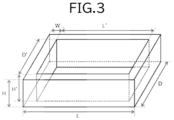
- a test piece A4 shown in FIG. 3 was produced by photomodeling under conditions in which each of the obtained photocurable composition was irradiated with visible light having a wavelength of 405 nm at an irradiation dose of 11 mJ/cm 2 to form a cured layer A1 with a thickness of 50 ⁇ m, the cured layer A1 was stacked in a thickness direction thereof to form a three-dimensional modeling product A4 shown in FIG.3 , and the modeling product A4 was irradiated with ultraviolet rays having a wavelength of 365 nm at an irradiation dose of 3 J/cm 2 to produce the test piece A4.
- the test piece A4 has a shape in which L is 24 mm, L' is 20 mm, W is 2 mm, H is 5 mm, H' is 3 mm, D is 14 mm, and D' is 10 mm.
- a (meth)acrylate polymer powder for plate denture production and Palapress (registered trademark) Vario manufactured by Kulzer GmbH, which was (meth)acrylate monomer liquid, were mixed in a ratio of 10 g powder: 7 mL liquid, 15 seconds after mixing, the mixture was filled into the space of the test piece A4 having dimensions L' (20 mm) x D' (10 mm) x H' (3 mm), and polymerized at 55°C and 2 bar pressure for 30 minutes.
- test piece A4 was removed from the polymer for producing a plate denture by peeling it off. Thereafter, the surface of the polymer for producing a plate denture that had been in contact with the test piece A4 was observed using a 3D shape measuring device (VR-3200, manufactured by Keyence Corporation), and the area value of the test piece A4 that had adhered to the polymer for producing a plate denture after removal was calculated, and the adhesion rate relative to the surface (200 mm 2 ) consisting of L' and D' was calculated. The smaller the adhesion rate, the better the releasability. The evaluation was performed as "A” if there was no surface adhesion, "B” if the surface adhesion was less than 5%, and “C” if the surface adhesion was 5% or more.
- a test piece A4 shown in FIG. 3 was produced by photomodeling under conditions in which each of the obtained photocurable composition was irradiated with visible light having a wavelength of 405 nm at an irradiation dose of 11 mJ/cm 2 to form a cured layer A1 with a thickness of 50 ⁇ m, the cured layer A1 was stacked in a thickness direction thereof to form a three-dimensional modeling product A4 shown in FIG.3 , and the modeling product A4 was irradiated with ultraviolet rays having a wavelength of 365 nm at an irradiation dose of 3 J/cm 2 to produce the test piece A4.
- the test piece A4 has a shape in which L is 24 mm, L' is 20 mm, W is 2 mm, H is 5 mm, H' is 3 mm, D is 14 mm, and D' is 10 mm.
- a (meth)acrylate polymer powder for plate denture production and Palapress (registered trademark) Vario manufactured by Kulzer GmbH, which was (meth)acrylate monomer liquid, were mixed in a ratio of 10 g powder: 7 mL liquid, 15 seconds after mixing, the mixture was filled into the space of the test piece A4 having dimensions L' (20 mm) x D' (10 mm) x H' (3 mm), and polymerized at 55°C and 2 bar pressure for 30 minutes.
- test piece A4 was removed from the polymer for producing a plate denture by peeling it off. After removal, the appearance of the test piece A4 was observed and evaluated as "A” if there was no breakage and "B" if there was a breakage.
- the obtained photocurable composition was modeled to the size of 8 mm length x 39 mm width x 4 mm thickness under conditions of visible light wavelength 405 nm and visible light illuminance 8.0 mJ/cm 2 using a 3D printer (Kulzer GmbH, Cara Print 4.0) to obtain a modeling product (layer width 50 ⁇ m).
- the obtained modeling product was irradiated with ultraviolet light of a wavelength of 365 nm at 10 J/cm 2 for main curing of the modeling product to obtain a photofabrication product.
- test piece The obtained photofabrication product (hereafter referred to as "test piece") was curved by applying stress so that both ends of the test piece in the longitudinal direction (horizontal direction) were in contact with each other, and the test piece was held in that state for 10 seconds. The stress was then released and the change in shape of the test piece was observed and evaluated according to the following criteria:
- reaction product was dissolved in 500 g of toluene, neutralized with a 10% aqueous solution of NaOH, and then washed with 150 g of a 5% aqueous solution of ammonium sulfate. Toluene was distilled under reduced pressure to obtain 390 g of a di(meth)acrylic monomer (SA-001). The viscosity at 25°C was 410 mPa ⁇ s.
- reaction temperature was kept at 70°C and the reaction was carried out for 5 hours. Then the reaction solution was neutralized with a 10% aqueous solution of NaOH, and then washed with 150 g of a 5% aqueous solution of ammonium sulfate. Ethyl acetate was distilled under reduced pressure to obtain 440 g of a polyfunctional (meth)acrylic monomer (SiA-001). The viscosity at 25°C was 110 mPa ⁇ s.
- the aforementioned photopolymerization initiator 1 (acylphosphine oxide compound, Omnirad 819: “Omnirad 819” manufactured by IGM Resins B.V.) was used.
Landscapes
- Health & Medical Sciences (AREA)
- Engineering & Computer Science (AREA)
- Chemical & Material Sciences (AREA)
- Manufacturing & Machinery (AREA)
- Materials Engineering (AREA)
- Oral & Maxillofacial Surgery (AREA)
- Mechanical Engineering (AREA)
- Public Health (AREA)
- General Health & Medical Sciences (AREA)
- Veterinary Medicine (AREA)
- Dentistry (AREA)
- Epidemiology (AREA)
- Life Sciences & Earth Sciences (AREA)
- Animal Behavior & Ethology (AREA)
- Organic Chemistry (AREA)
- Medicinal Chemistry (AREA)
- Polymers & Plastics (AREA)
- Chemical Kinetics & Catalysis (AREA)
- Physics & Mathematics (AREA)
- Optics & Photonics (AREA)
- Polymerisation Methods In General (AREA)
- Addition Polymer Or Copolymer, Post-Treatments, Or Chemical Modifications (AREA)
Applications Claiming Priority (3)
| Application Number | Priority Date | Filing Date | Title |
|---|---|---|---|
| JP2022052228 | 2022-03-28 | ||
| JP2023036051 | 2023-03-08 | ||
| PCT/JP2023/011620 WO2023190071A1 (ja) | 2022-03-28 | 2023-03-23 | 光硬化性組成物、立体造形物、鋳型、硬化物を製造する方法及び有床義歯の製造方法 |
Publications (1)
| Publication Number | Publication Date |
|---|---|
| EP4488304A1 true EP4488304A1 (en) | 2025-01-08 |
Family
ID=88202089
Family Applications (1)
| Application Number | Title | Priority Date | Filing Date |
|---|---|---|---|
| EP23780081.8A Pending EP4488304A1 (en) | 2022-03-28 | 2023-03-23 | Photosetting composition, three-dimensionally shaped article, mold, method for manufacturing cured product, and method for manufacturing plate denture |
Country Status (4)
| Country | Link |
|---|---|
| US (1) | US20250196403A1 (cg-RX-API-DMAC7.html) |
| EP (1) | EP4488304A1 (cg-RX-API-DMAC7.html) |
| JP (1) | JPWO2023190071A1 (cg-RX-API-DMAC7.html) |
| WO (1) | WO2023190071A1 (cg-RX-API-DMAC7.html) |
Families Citing this family (3)
| Publication number | Priority date | Publication date | Assignee | Title |
|---|---|---|---|---|
| US20240213072A1 (en) * | 2021-03-31 | 2024-06-27 | Nissan Chemical Corporation | Laminate, release agent composition, and method for manufacturing processed semiconductor substrate |
| TW202436411A (zh) * | 2022-11-29 | 2024-09-16 | 日商Dic股份有限公司 | 硬化性樹脂組成物 |
| WO2025225393A1 (ja) * | 2024-04-25 | 2025-10-30 | Dic株式会社 | 硬化性樹脂組成物、硬化性樹脂および硬化物 |
Family Cites Families (12)
| Publication number | Priority date | Publication date | Assignee | Title |
|---|---|---|---|---|
| DE10111704B4 (de) | 2001-03-12 | 2008-06-12 | Ivoclar Vivadent Ag | Verfahren zur Herstellung eines Kunststoffteils |
| JP5111880B2 (ja) | 2007-02-02 | 2013-01-09 | シーメット株式会社 | 面露光による光学的立体造形用樹脂組成物 |
| JP5235056B2 (ja) | 2007-02-02 | 2013-07-10 | シーメット株式会社 | 面露光による光学的立体造形用樹脂組成物 |
| JP5980626B2 (ja) * | 2011-08-31 | 2016-08-31 | 三洋化成工業株式会社 | 活性エネルギー線硬化性樹脂組成物 |
| DE102014118231B3 (de) * | 2014-12-09 | 2016-05-12 | Heraeus Kulzer Gmbh | Verfahren zur Herstellung einer Dentalprothese mit einer Schablone |
| JP6543974B2 (ja) * | 2015-03-16 | 2019-07-17 | 東洋インキScホールディングス株式会社 | 光学的立体造形用活性エネルギー線重合性樹脂組成物、及び立体造形物 |
| JP2020075941A (ja) * | 2016-12-05 | 2020-05-21 | Dic株式会社 | サージカルガイド用の立体造形物を形成するために用いられる光学的立体造形用光硬化性樹脂組成物 |
| DE102017211249A1 (de) * | 2017-07-03 | 2019-01-03 | Sirona Dental Systems Gmbh | Verfahren zur Herstellung einer künstlichen Gingiva |
| JP7289676B2 (ja) * | 2018-04-16 | 2023-06-12 | キヤノン株式会社 | 立体造形用の硬化性樹脂組成物 |
| JP7395830B2 (ja) * | 2019-03-11 | 2023-12-12 | Dic株式会社 | 医療用立体造形物、立体造形物及び医療用立体造形物の製造方法 |
| JP7512147B2 (ja) | 2020-09-23 | 2024-07-08 | 積水化学工業株式会社 | 管継手 |
| US20230124668A1 (en) | 2021-08-31 | 2023-04-20 | Fujicco Co., Ltd. | Psychological fatigue preventer or improver |
-
2023
- 2023-03-23 JP JP2024512295A patent/JPWO2023190071A1/ja active Pending
- 2023-03-23 WO PCT/JP2023/011620 patent/WO2023190071A1/ja not_active Ceased
- 2023-03-23 EP EP23780081.8A patent/EP4488304A1/en active Pending
- 2023-03-23 US US18/852,184 patent/US20250196403A1/en active Pending
Also Published As
| Publication number | Publication date |
|---|---|
| US20250196403A1 (en) | 2025-06-19 |
| WO2023190071A1 (ja) | 2023-10-05 |
| JPWO2023190071A1 (cg-RX-API-DMAC7.html) | 2023-10-05 |
Similar Documents
| Publication | Publication Date | Title |
|---|---|---|
| EP4488304A1 (en) | Photosetting composition, three-dimensionally shaped article, mold, method for manufacturing cured product, and method for manufacturing plate denture | |
| US10973742B2 (en) | Photocurable composition, denture base, and plate denture | |
| EP3360907B1 (en) | Photocurable composition, denture base, and plate denture | |
| EP3925994A1 (en) | Photocurable composition, cured product, and dental product | |
| JP2020528479A (ja) | ウレタン成分及び反応性希釈剤を含む光重合性組成物、物品、並びに方法 | |
| EP3641720B1 (en) | Radiation curable composition for additive manufacturing processes | |
| TR201809383T4 (tr) | Takma diş üretimi için yöntem. | |
| EP3735957A1 (en) | Stereolithography-type three-dimensional printing material used for preparing dental three-dimensional formed article | |
| EP3254667A1 (en) | Light-curable composition, denture, and plate denture | |
| US20230303746A1 (en) | Photocurable composition, denture base, and plate denture | |
| US11866527B2 (en) | Photocurable composition, cured product, and dental product | |
| US12371586B2 (en) | Photocurable composition, three-dimensional modeling product, and dental product | |
| WO2023190254A1 (ja) | 光硬化性組成物、立体造形物、口腔内に装着される器具及び耳内に装着される器具 | |
| WO2025009596A1 (ja) | 光硬化性組成物、立体造形物、鋳型、硬化物を製造する方法及び歯科用補綴物の製造方法 | |
| JP2022135159A (ja) | 光造形用硬化性組成物、及び歯科用製品 | |
| US20250346708A1 (en) | 3d printing compositions for stain resistant and more transparent dental materials from polyolefin derived polyols | |
| WO2023189684A1 (ja) | 光硬化性組成物、立体造形物、歯科用製品及びスプリント | |
| JP2023146821A (ja) | 光造形用硬化性組成物、歯科用製品及び義歯床 | |
| WO2024117203A1 (ja) | 光硬化性組成物、立体造形物、歯科用製品及びスプリント | |
| JP2025045906A (ja) | 器材の製造方法、光硬化性組成物、立体造形物及び鋳型 | |
| WO2025104550A1 (en) | Radiation curable composition for additive manufacturing processes |
Legal Events
| Date | Code | Title | Description |
|---|---|---|---|
| STAA | Information on the status of an ep patent application or granted ep patent |
Free format text: STATUS: THE INTERNATIONAL PUBLICATION HAS BEEN MADE |
|
| PUAI | Public reference made under article 153(3) epc to a published international application that has entered the european phase |
Free format text: ORIGINAL CODE: 0009012 |
|
| STAA | Information on the status of an ep patent application or granted ep patent |
Free format text: STATUS: REQUEST FOR EXAMINATION WAS MADE |
|
| 17P | Request for examination filed |
Effective date: 20240930 |
|
| AK | Designated contracting states |
Kind code of ref document: A1 Designated state(s): AL AT BE BG CH CY CZ DE DK EE ES FI FR GB GR HR HU IE IS IT LI LT LU LV MC ME MK MT NL NO PL PT RO RS SE SI SK SM TR |
|
| DAV | Request for validation of the european patent (deleted) | ||
| DAX | Request for extension of the european patent (deleted) |