EP4488024A1 - Verfahren zur herstellung eines geformten hochdichten schaumflockenverbundprodukts und dreidimensional geformtes schallabsorptionselement - Google Patents
Verfahren zur herstellung eines geformten hochdichten schaumflockenverbundprodukts und dreidimensional geformtes schallabsorptionselement Download PDFInfo
- Publication number
- EP4488024A1 EP4488024A1 EP23184031.5A EP23184031A EP4488024A1 EP 4488024 A1 EP4488024 A1 EP 4488024A1 EP 23184031 A EP23184031 A EP 23184031A EP 4488024 A1 EP4488024 A1 EP 4488024A1
- Authority
- EP
- European Patent Office
- Prior art keywords
- product
- binding agent
- semi
- density
- starting product
- Prior art date
- Legal status (The legal status is an assumption and is not a legal conclusion. Google has not performed a legal analysis and makes no representation as to the accuracy of the status listed.)
- Withdrawn
Links
Images
Classifications
-
- B—PERFORMING OPERATIONS; TRANSPORTING
- B29—WORKING OF PLASTICS; WORKING OF SUBSTANCES IN A PLASTIC STATE IN GENERAL
- B29C—SHAPING OR JOINING OF PLASTICS; SHAPING OF MATERIAL IN A PLASTIC STATE, NOT OTHERWISE PROVIDED FOR; AFTER-TREATMENT OF THE SHAPED PRODUCTS, e.g. REPAIRING
- B29C43/00—Compression moulding, i.e. applying external pressure to flow the moulding material; Apparatus therefor
- B29C43/02—Compression moulding, i.e. applying external pressure to flow the moulding material; Apparatus therefor of articles of definite length, i.e. discrete articles
- B29C43/14—Compression moulding, i.e. applying external pressure to flow the moulding material; Apparatus therefor of articles of definite length, i.e. discrete articles in several steps
-
- B—PERFORMING OPERATIONS; TRANSPORTING
- B29—WORKING OF PLASTICS; WORKING OF SUBSTANCES IN A PLASTIC STATE IN GENERAL
- B29C—SHAPING OR JOINING OF PLASTICS; SHAPING OF MATERIAL IN A PLASTIC STATE, NOT OTHERWISE PROVIDED FOR; AFTER-TREATMENT OF THE SHAPED PRODUCTS, e.g. REPAIRING
- B29C51/00—Shaping by thermoforming, i.e. shaping sheets or sheet like preforms after heating, e.g. shaping sheets in matched moulds or by deep-drawing; Apparatus therefor
- B29C51/02—Combined thermoforming and manufacture of the preform
-
- B—PERFORMING OPERATIONS; TRANSPORTING
- B29—WORKING OF PLASTICS; WORKING OF SUBSTANCES IN A PLASTIC STATE IN GENERAL
- B29C—SHAPING OR JOINING OF PLASTICS; SHAPING OF MATERIAL IN A PLASTIC STATE, NOT OTHERWISE PROVIDED FOR; AFTER-TREATMENT OF THE SHAPED PRODUCTS, e.g. REPAIRING
- B29C43/00—Compression moulding, i.e. applying external pressure to flow the moulding material; Apparatus therefor
- B29C43/006—Pressing and sintering powders, granules or fibres
-
- B—PERFORMING OPERATIONS; TRANSPORTING
- B29—WORKING OF PLASTICS; WORKING OF SUBSTANCES IN A PLASTIC STATE IN GENERAL
- B29C—SHAPING OR JOINING OF PLASTICS; SHAPING OF MATERIAL IN A PLASTIC STATE, NOT OTHERWISE PROVIDED FOR; AFTER-TREATMENT OF THE SHAPED PRODUCTS, e.g. REPAIRING
- B29C43/00—Compression moulding, i.e. applying external pressure to flow the moulding material; Apparatus therefor
- B29C43/32—Component parts, details or accessories; Auxiliary operations
- B29C43/52—Heating or cooling
-
- B—PERFORMING OPERATIONS; TRANSPORTING
- B29—WORKING OF PLASTICS; WORKING OF SUBSTANCES IN A PLASTIC STATE IN GENERAL
- B29C—SHAPING OR JOINING OF PLASTICS; SHAPING OF MATERIAL IN A PLASTIC STATE, NOT OTHERWISE PROVIDED FOR; AFTER-TREATMENT OF THE SHAPED PRODUCTS, e.g. REPAIRING
- B29C51/00—Shaping by thermoforming, i.e. shaping sheets or sheet like preforms after heating, e.g. shaping sheets in matched moulds or by deep-drawing; Apparatus therefor
- B29C51/002—Shaping by thermoforming, i.e. shaping sheets or sheet like preforms after heating, e.g. shaping sheets in matched moulds or by deep-drawing; Apparatus therefor characterised by the choice of material
-
- B—PERFORMING OPERATIONS; TRANSPORTING
- B29—WORKING OF PLASTICS; WORKING OF SUBSTANCES IN A PLASTIC STATE IN GENERAL
- B29C—SHAPING OR JOINING OF PLASTICS; SHAPING OF MATERIAL IN A PLASTIC STATE, NOT OTHERWISE PROVIDED FOR; AFTER-TREATMENT OF THE SHAPED PRODUCTS, e.g. REPAIRING
- B29C51/00—Shaping by thermoforming, i.e. shaping sheets or sheet like preforms after heating, e.g. shaping sheets in matched moulds or by deep-drawing; Apparatus therefor
- B29C51/08—Deep drawing or matched-mould forming, i.e. using mechanical means only
- B29C51/082—Deep drawing or matched-mould forming, i.e. using mechanical means only by shaping between complementary mould parts
-
- B—PERFORMING OPERATIONS; TRANSPORTING
- B29—WORKING OF PLASTICS; WORKING OF SUBSTANCES IN A PLASTIC STATE IN GENERAL
- B29C—SHAPING OR JOINING OF PLASTICS; SHAPING OF MATERIAL IN A PLASTIC STATE, NOT OTHERWISE PROVIDED FOR; AFTER-TREATMENT OF THE SHAPED PRODUCTS, e.g. REPAIRING
- B29C51/00—Shaping by thermoforming, i.e. shaping sheets or sheet like preforms after heating, e.g. shaping sheets in matched moulds or by deep-drawing; Apparatus therefor
- B29C51/26—Component parts, details or accessories; Auxiliary operations
- B29C51/42—Heating or cooling
- B29C51/421—Heating or cooling of preforms, specially adapted for thermoforming
-
- B—PERFORMING OPERATIONS; TRANSPORTING
- B29—WORKING OF PLASTICS; WORKING OF SUBSTANCES IN A PLASTIC STATE IN GENERAL
- B29K—INDEXING SCHEME ASSOCIATED WITH SUBCLASSES B29B, B29C OR B29D, RELATING TO MOULDING MATERIALS OR TO MATERIALS FOR MOULDS, REINFORCEMENTS, FILLERS OR PREFORMED PARTS, e.g. INSERTS
- B29K2105/00—Condition, form or state of moulded material or of the material to be shaped
- B29K2105/04—Condition, form or state of moulded material or of the material to be shaped cellular or porous
-
- B—PERFORMING OPERATIONS; TRANSPORTING
- B29—WORKING OF PLASTICS; WORKING OF SUBSTANCES IN A PLASTIC STATE IN GENERAL
- B29K—INDEXING SCHEME ASSOCIATED WITH SUBCLASSES B29B, B29C OR B29D, RELATING TO MOULDING MATERIALS OR TO MATERIALS FOR MOULDS, REINFORCEMENTS, FILLERS OR PREFORMED PARTS, e.g. INSERTS
- B29K2105/00—Condition, form or state of moulded material or of the material to be shaped
- B29K2105/06—Condition, form or state of moulded material or of the material to be shaped containing reinforcements, fillers or inserts
-
- B—PERFORMING OPERATIONS; TRANSPORTING
- B29—WORKING OF PLASTICS; WORKING OF SUBSTANCES IN A PLASTIC STATE IN GENERAL
- B29K—INDEXING SCHEME ASSOCIATED WITH SUBCLASSES B29B, B29C OR B29D, RELATING TO MOULDING MATERIALS OR TO MATERIALS FOR MOULDS, REINFORCEMENTS, FILLERS OR PREFORMED PARTS, e.g. INSERTS
- B29K2105/00—Condition, form or state of moulded material or of the material to be shaped
- B29K2105/26—Scrap or recycled material
-
- B—PERFORMING OPERATIONS; TRANSPORTING
- B29—WORKING OF PLASTICS; WORKING OF SUBSTANCES IN A PLASTIC STATE IN GENERAL
- B29K—INDEXING SCHEME ASSOCIATED WITH SUBCLASSES B29B, B29C OR B29D, RELATING TO MOULDING MATERIALS OR TO MATERIALS FOR MOULDS, REINFORCEMENTS, FILLERS OR PREFORMED PARTS, e.g. INSERTS
- B29K2995/00—Properties of moulding materials, reinforcements, fillers, preformed parts or moulds
- B29K2995/0001—Properties of moulding materials, reinforcements, fillers, preformed parts or moulds having particular acoustical properties
- B29K2995/0002—Properties of moulding materials, reinforcements, fillers, preformed parts or moulds having particular acoustical properties insulating
-
- B—PERFORMING OPERATIONS; TRANSPORTING
- B29—WORKING OF PLASTICS; WORKING OF SUBSTANCES IN A PLASTIC STATE IN GENERAL
- B29L—INDEXING SCHEME ASSOCIATED WITH SUBCLASS B29C, RELATING TO PARTICULAR ARTICLES
- B29L2031/00—Other particular articles
- B29L2031/30—Vehicles, e.g. ships or aircraft, or body parts thereof
Definitions
- the invention relates to a method to manufacture a shaped high-density foam flake composite product.
- Foam flake composite sheets are manufactured by mixing foam flakes with a thermoplastic binding agent, by arranging this material as a layer, typically air laid, and then heating this layer to a temperature so that the binding agent is brought into its molten state to bond the foam flakes to each other, after which the sheet is consolidated.
- the foam flakes to manufacture a foam flake composite sheet are typically recycled for example from post-consumer foam waste such as end-of-life upholstery or mattresses, or from post-industry waste. Alternatively, or in combination with recycled foam flakes, also juvenile foam flakes may be used.
- the density of such foam flake composite sheet is typically in the range of 20-150 kg/m 3 . The obtained density is mainly defined by the mean density of the used foam flakes, by the amount of binding agent and by the degree of compression during the consolidation step.
- the binding agent used is typically a thermoplastic binding agent, which may be provided in the typically air-laid sheet in the form of a granulate or powder and/or melt fibres.
- Melt fibres have a needle-like elongated shape.
- To manufacture such foam flake composite sheets also bi-component fibres are used. These have a core and a melt fibre shell, whereas the melt fibre shell has a lower melting temperature than the core. In order to bond the foam flakes to each other when using such bi-component fibres, only the melt fibre shell is brought into its molten state.
- a high density sheet with a three-dimensional shape is required. This is typically carried out in a thermocompression mould allowing compression and shaping of such foam flake composite sheet in one step.
- One problem in forming such three-dimensional high density foam flake composite sheet is the requirement, that the sheet needs to be heated up to a temperature in which the binding agent is molten, in order to conform the sheet to the mould geometry and to carry out the thermocompression process. Due to the inhomogeneity of such foam flake composite sheet, it is not easy to provide a homogeneously heated foam flake composite sheet, which is then to be introduced into such thermocompression mould.
- FR 3 130 681 A1 discloses a method for producing a low-density foam flake composite product.
- This low-density foam flake composite product can be used to provide a sound absorbing member according to the mass-spring-system, if such low-density foam flake composite product is bonded to a mass layer.
- the product obtained by the method disclosed in this prior art document is the spring-layer of such mass-spring-system.
- Such low-density foam flake composite product is manufactured by placing the mixture of foam flakes and binding agent into a mould having a cavity of different thicknesses, such that after applying heat to melt the binding agent in order to bond the foam flakes to each other, the product achieved has sections of a lower and a higher thickness.
- the foam flake composite product is shaped as to its thickness in the manufacturing process to provide the low-density foam flake composite product.
- the binding agent used according to this method are bi-component fibres. This prior art method does not disclose how to manufacture a high-density foam flake composite product, which is three-dimensionally shaped in its extension defined by its main surface sides.
- the technical problem to be solved by the invention disclosed is to provide a method, with which three-dimensionally shaped foam flake composite sheets of higher density can be manufactured without encountering the drawbacks sketched out above.
- extension When referring to the extension of a sheet product or a shaped product, the word "extension" is defined as follows:
- the x- and y-extension define the extension of such product according to its main surface sides, for example its flat faces.
- the z-extension is the extension in the direction of the thickness of such sheet or product.
- the three-dimensional shape is a shape applied mostly in z-direction.
- the shaped high-density foam flake composite product is manufactured in two steps.
- a low-density foam flake composite sheet as starting product is compressed in order to increase its density.
- This step of compression is carried out at a temperature, in which the binding agent or at least the majority of it is in its molten state.
- the compression applied to the flat sides, defining the extension of the starting product leads to a compression of the foam flakes (compression in z-direction) and typically also to a movement between foam flake boundaries.
- the compression force applied is also active on the thermoplastic binder between the foam flakes.
- step (i) the density of the starting product is increased. Typically, density is increased by a factor of at least 3. The degree of compression is dependent on the later use of the final product. Typically, the density of the starting product will be increased five to ten times or even more. It is within the range of the claimed invention, that the compression step is carried out on the complete surface of the starting product, but also to only a section thereof.
- Step (i) a semi-finished sheet product which is compressed in its z-direction in at least a section thereof, is provided.
- Step (i) allows to obtain such sheet product in almost any required density being higher than the density of the starting product without needing to manufacture such product with foam flakes having the density needed for the sheet product.
- Another major benefit of this compressing step is, that the surfaces of the semi-finished sheet product, being in contact with the pressing tool, are very smooth. Such smooth surface of the semi-finished sheet product is in particular of benefit for conducting the second step (step (ii)) of the manufacturing process.
- step (i) the constituents of the starting product are rearranged to each other and binding agent is brought into surface cavities of the foam flakes.
- This improved interconnection of the foam flakes combined with a smooth surface which is basically provided by binding agent brought to the surface due to the compression of step (i) is responsible that this semi-finished sheet product is resistive to tensile stress acting on the surface of the semi-finished sheet product when being thermoformed into its desired three-dimensional shape in a mould during step (ii).
- thermoforming of the semi-finished sheet product into complex three-dimensional shapes, including small radii and angled segments is enabled, without tearing problems.
- the semi-finished sheet product Prior to conducting the thermoforming step (ii), the semi-finished sheet product is heated in order to bring binding agent into its molten state. This is typically carried out outside of the thermoforming mould. Having carried out step (i) prior to such heating step also gives a benefit for such heating. Heating such semi-finished product is a lot easier and a lot quicker than heating an uncompressed foam flake composite material. The ground for this is that by the compression step (i) the volume (its thickness) of the starting product is significantly reduced. By this the thermal insulation properties of a low-density foam flake composite sheet are significantly reduced. Heating such high-density foam flake composite material as semi-finished product up to the core is also a lot more reliable due to a homogenization of the material making up the semi-finished sheet product.
- the semi-finished sheet product Due to these properties of the semi-finished sheet product, through and through heating of it can be carried out even with only a heat source from one side of the sheet product. This facilitates the manufacturing process. Further, the heat can be provided by an infrared heat source and still bring the semi-finished sheet product throughout its thickness to a temperature to melt the binding agent.
- step (i) In the step of heating the semi-finished sheet product it was encountered, that this does not increase its thickness, which means, that the density set by step (i) remains unchanged although the semi-finished sheet product is heated up again.
- the effect is used, that the recovery force introduced into the foam flakes due to the compression is sufficiently lower than the cohesive force of the binding agent, avoiding such expansion. This facilitates handling of the heated semi-finished sheet product.
- the shaped foam flake composite product After thermoforming the heated semi-finished product in the mould into its desired shape, the shaped foam flake composite product remains within the mould until the binding agent has consolidated. Then the mould is opened and the shaped high-density foam flake composite product is demoulded. Also due to the smooth surface of the semi-finished sheet product, typically no demoulding agents or mechanical demoulding aids are needed, in order to demould the shaped foam flake composite product with its at least one high-density section.
- the foam flakes used to provide the starting product could be comminuted residues from open-cell or mix-cell foams. These residues may be obtained by recycling end-of-life foam products, including flexible, semi-rigid or even rigid foam.
- open-cell flexible foam flakes preferably from polyurethane, are used for this manufacturing method.
- mixed types of foam flakes depending on the intended use of the shaped foam flake composite product. Should this for example be intended to be a part of a sound absorption system, then melamine foam flakes may be introduced into the foam flake mixture, since these foam flakes have good sound absorption properties.
- the typical size of such foam flakes is between 2 mm and 40 mm and have a density of 10 to 70 kg/m 3 .
- step (ii) the semi-finished sheet product is shaped in such a manner, that it is bent in order to bring it into a three-dimensional shape. Shaping is carried out in the z-direction of the semi-finished sheet product.
- the thermoplastic binding agent is selected from a thermoplastic granulate or powder, or melt fibres, or a mixture thereof.
- melt fibres are used to provide at least part of the binding agent, if not all of it.
- the melt fibres are bi-component fibres. The benefit of melt fibres is that these will be aligned more or less in a transverse direction to the direction of compressing the starting product. Due to these fibres and their longitudinal extension within the foam flakes during the compression step, the semi-finished sheet product, when heated to conduct the thermoforming step, is capable of withstanding even higher tensile stresses.
- other fibres besides melt fibres
- a mixture of fibres may be added to the mixture comprising the foam flakes and the thermoplastic binding agent to manufacture the starting product.
- Structural fibers such as glass fibers, aramide fibers, carbon fibers, metal fibers
- Textile fibers pref. recycled
- natural fibers such as kenaf, wood, hemp, coconut, cork, cane, carboard, wool
- additives may be added to introduce functional properties to the foam flake composite product (such as fire retardants, biocidal agents, heavy fillers and others).
- This high-density foam flake composite product can be used by itself or it may be used as a base substrate to apply an additional layer on at least one of its surfaces extending basically in the x-y-plane.
- This additional layer could for example be a low-density foam flake composite sheet, which is bonded to one of the faces extending in the x-y-plane of the high-density foam flake composite product.
- Such layered foam flake composite product with significantly different densities in its layers can be used as a mass spring noise absorbing member, which in contrast to prior art noise absorbing members is three-dimensionally shaped. This, of course, is only one of numerous possible applications for the use of the product manufactured with the claimed method.
- the binding agent within the starting product is distributed in a graded manner. This means, that the surface of the starting product extending in the x-y-plane, to which an additional layer shall be bonded, has a higher amount of binding agent compared to other sections of the thickness of the starting product. In case on both these opposing surfaces of the starting product an additional layer shall be bonded, then on and near to the surface of both surfaces it is preferred to have an increased amount of binding agent.
- the additional layer is selected from one of a low-density foam flake composite sheet, an acoustic non-woven sheet or a deco layer.
- the step of bonding an additional layer to the base substrate can be carried out at or during different steps of the manufacturing process. This can be carried out in the compression step (step (i)), in the thermoforming step (step (ii)), between these two steps or following the thermoforming step (step(ii)). Carrying out this bonding step to bond one additional layer to one of the surfaces of the base substrate extending in the x-y-plane during step (i) or in (ii) has the benefit, that then the heat already applied to the base substrate can be used so that no additional heating step needs to be applied, and so that no additional bonding layers (adhesive webs) need to be applied to bond the additional layer to the base substrate.
- the starting product is heated in the tool used for compressing the starting product in step (i).
- the press used has heated pressing plates.
- the starting product can be heated or is still heated by a preceding manufacturing step prior to introducing it into the press for the compression step (i), even if such heating is not carried out to be a heating all the way through to the core.
- Step (i) can be carried out batchwise or in-line with the manufacturing line to manufacture the starting product.
- the compression step is carried out in-line with the manufacturing process to manufacture the starting product, the compression can be carried out by using one or double belt inline compression machinery.
- thermoforming step (step ii) is carried out in a mould having a temperature on its surfaces contacting the semi-finished sheet product being lower than the melting temperature of the binding agent.
- Such temperature is typically in the range of 20°C to 95°C and more preferred between 25°C to 65°C.
- step (i) may be carried out being non-uniform over its surface extending in the x-y-plane.
- a further increase in density can also be applied to the semi-finished sheet product during the thermoforming step (step (ii)).
- the increase in density if additionally provided by this step, will be significantly lower than applied in the compression step of step (i).
- An additional compression in step (ii) can be applied, if in certain sections of the final product the thickness of the final product shall be different from each other, typically for adjustment to the vicinity, to where the final product shall be mounted.
- the initial thickness of the starting product may be in the range from 5 to 200 mm with an initial density of 20 to 150 kg/m 3 .
- the target thickness of the semi-finished sheet product is typically in the range of 2 to 5 mm with a density of 600 to 900 kg/m 3 .
- the increase in density is significant. Therefore, the final product manufactured with this method can well be used as part of an acoustic damping system (sound absorption system) according to the mass-spring-system, in which this product is the mass-layer.
- the spring-layer could well be a foam flake composite sheet product applied thereto as an additional layer as sketched out above.
- this step can be used to integrate into the interface between the base substrate and the additional layer any other element needed in the final product.
- This may for example be one or more sensors for sensing for example temperature, vibrations, tension or the like. Then no further bonding steps are required to implement these functional elements into the final product.
- this method may be used to provide in an easy and cost-effective manner a three-dimensionally shaped sound absorption member of the mass-spring-type.
- the shape of such sound absorption member is for example adapted to the geometry of the inside body of parts of a vehicle, for example the hood, the door or any other part.
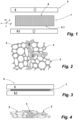
- the starting product 1 is made up of foam flakes 2 (see figure 2 ), which are bonded to each other by a binding agent 3.
- the binding agent 3 has thermoplastic properties, which means, that the binding agent 3 can be re-heated several times to its melting temperature and consolidated by cooling.
- the binding agent is provided by bi-component fibres, of which the outer shell resembles the thermoplastic binding agent.
- the material mix has been heated to a temperature so that the binding agent melts and thereby bonds the foam flakes 2 to each other.
- the core of the bi-component fibres is not depicted.
- the starting product is introduced into a press 4, comprising two press tools 5, 5.1.
- the press tools are arranged on the sides of the surfaces 6, 6.1 of the starting product extending in the x-y-plane.
- the press tools 5, 5.1 can be moved in the direction towards each other and thereby compress the starting product 1.
- the press tools 5, 5.1 are heated in order to melt the binding agent 3 within the starting product 1.
- the starting product is introduced into the press whilst already having the necessary temperature so that the binding agent is molten.
- the starting product is introduced into the press pre-heated below its melting temperature and that in such press also the press tools are heated in order to increase the temperature to melt the binding agent.
- the starting product 1 with its molten binding agent 3 is compressed in order to increase its density.
- the thickness of the starting product 1 is reduced significantly, as schematically depicted and to be seen in a comparison between figures 1 and 3 .
- the compressed starting product which is the high-density foam flake composite semi-finished sheet product 7, remains within the closed press 4 for about about 2-10 minutes. Then the press 4 is opened and the semi-finished sheet product 7 is removed. The heated press tools stay heated. The semi-finished sheet product 7 is removed while still being hot.
- Figure 4 shows an enlarged section of the semi-finished sheet product 7. Due to the compression not only the pores but also the pore membranes defining the skeletal structure of the foam flakes 2 enclosing the pores are depicted to be compressed. In fact, only the pore volume is reduced significantly by compressing these, not the thickness of the pore membranes. By reducing the thickness of the starting product 1, the density is increased. In reality the density of the semi-finished sheet product 7 is a lot higher than the impression of Figure4 seems to show.
- the binding agent 3 extends between the foam flakes 2 bonding these to each other. Due to the compression step carried out, the binding agent 3 is pressed into surface cavities of the foam flakes 2 as schematically depicted in Figure 4 . Movements between foam flakes 2 promote that binding agent 3 is introduced into such cavities. Since in the depicted embodiment the foam flakes 2 are open-cell flexible foam flakes, binding agent 3 may also be pressed into pores, which are in contact to surface cavities. The foam flakes 2 are thus interlinked by the binding agent 3 a lot better and more thoroughly. Further, due to the compression, binding agent 3 is also pressed out of the starting product 1 in the direction to its surfaces contacting the press tools 5, 5.1. This is responsible that these surfaces 6, 6.1 of the semi-finished sheet product 7 are very smooth.
- Heating of the starting product 1 during this compression step by the press tools 5, 5.1 has the further advantage, that heating the starting product 1 and closing the press 4 may be carried out simultaneously. It is not necessary that the compression step is only then started, when the starting product 1 has been heated through and through.
- the heated press tools 5, 5.1 bring their heat with increasing compression deeper and deeper into the starting product 1, whereas the outer sections in respect of its thickness are already molten.
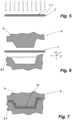
- a second manufacturing step - step (ii) - the semi-finished sheet product 7 is subjected to a thermoforming process.
- the semi-finished sheet product 7 is heated by IR-heating means as depicted in Figure 5 .
- surface 7.1 extending in the x-y-plane
- heating can be carried out from one side of the semi-finished sheet product only and still achieve in a short time a through and through heating to a temperature so that the binding agent 3 melts.
- the heated semi-finished sheet product 7 is introduced into a mould 8 (see Figure 6 ) depicting the mould 8 with its two mould parts 9, 9.1.
- the mould 8 is then closed to thermoform the semi-finished sheet product 7 by pressing it into the mould cavity.
- the mould parts 9, 9.1 are kept at a temperature well below the melting temperature of the binding agent 3. In the depicted embodiment the mould parts 9, 9.1 are kept at a temperature of 45°C to 50°C.
- thermoforming process is finished.
- the thermoformed semi-finished sheet product remains within the mould 8, until the shaped product 10 has cooled to a temperature well below the melting temperature of the binding agent 3.
- the three-dimensionally shaped high-density foam flake composite product 10 is demoulded. Due to the smooth surface of the semi-finished sheet product 7 no demoulding agent is needed in order to remove the shaped foam flake composite product 10 from the mould parts 9, 9.1.
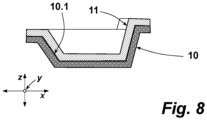
- a low-density composite foam flake sheet 11 is bonded as an additional layer on the surface 10.1 extending in the x-y-plane of the product 10. This is carried out by heating the surface 10.1 of the shaped foam flake composite product 10, to which the additional layer, here: the low-density composite foam flake sheet 11 is to be bonded.
- the superficial binding agent in the shaped foam flake composite product 10 is used as binding agent to bond the additional layer 11.
- a bonding force basically in z-direction is applied in order to increase adhesion strength between these two layers 10, 11.
- the additional layer is low-density composite foam flake sheet 11 the compression force will be typically higher than applying such force, if a non-compressive additional layer is to be bonded to such surface of the three-dimensionally shaped foam flake composite product.
- the shaped high-density foam flake composite product 10 is the substrate, on which the additional layer is applied to.
- the additional layer 11 is applied to the substrate after having provided the shaped high-density foam flake composite product 10. This layered product with the shaped high-density foam flake composite product 10 and the additional layer 11 is used as a sound absorption member of the mass-spring type.
- the low-density composite foam flake sheet 11 has at least one zone of local higher compression, in order to improve the bonding strength when bonding it to one of the surfaces of the three-dimensionally shaped foam flake composite product 10.
Landscapes
- Engineering & Computer Science (AREA)
- Mechanical Engineering (AREA)
- Manufacturing & Machinery (AREA)
- Laminated Bodies (AREA)
Priority Applications (2)
| Application Number | Priority Date | Filing Date | Title |
|---|---|---|---|
| EP23184031.5A EP4488024A1 (de) | 2023-07-07 | 2023-07-07 | Verfahren zur herstellung eines geformten hochdichten schaumflockenverbundprodukts und dreidimensional geformtes schallabsorptionselement |
| PCT/EP2024/069200 WO2025012212A1 (en) | 2023-07-07 | 2024-07-08 | Method to manufacture a shaped high-density foam flake composite product and three-dimensionally shaped sound absorption member |
Applications Claiming Priority (1)
| Application Number | Priority Date | Filing Date | Title |
|---|---|---|---|
| EP23184031.5A EP4488024A1 (de) | 2023-07-07 | 2023-07-07 | Verfahren zur herstellung eines geformten hochdichten schaumflockenverbundprodukts und dreidimensional geformtes schallabsorptionselement |
Publications (1)
| Publication Number | Publication Date |
|---|---|
| EP4488024A1 true EP4488024A1 (de) | 2025-01-08 |
Family
ID=87245399
Family Applications (1)
| Application Number | Title | Priority Date | Filing Date |
|---|---|---|---|
| EP23184031.5A Withdrawn EP4488024A1 (de) | 2023-07-07 | 2023-07-07 | Verfahren zur herstellung eines geformten hochdichten schaumflockenverbundprodukts und dreidimensional geformtes schallabsorptionselement |
Country Status (2)
| Country | Link |
|---|---|
| EP (1) | EP4488024A1 (de) |
| WO (1) | WO2025012212A1 (de) |
Citations (6)
| Publication number | Priority date | Publication date | Assignee | Title |
|---|---|---|---|---|
| CA2136773A1 (en) * | 1993-11-29 | 1995-05-30 | Bernhard Eder | Multi-layered structural member |
| CN102218866A (zh) * | 2010-04-02 | 2011-10-19 | 株式会社广谷 | 车辆用内饰材的制造方法 |
| US20130316102A1 (en) * | 2012-05-28 | 2013-11-28 | Toyota Boshoku Kabushiki Kaisha | Vehicle component |
| EP2364881B1 (de) * | 2010-03-09 | 2015-05-13 | Autoneum Management AG | Automobilverkleidungsteil zur Schallisolierung und -absorbtion |
| FR3114263A1 (fr) | 2020-09-24 | 2022-03-25 | Treves Products, Services & Innovation | Procédé de réalisation d’un panneau de protection acoustique pour véhicule automobile |
| FR3130681A1 (fr) | 2021-12-20 | 2023-06-23 | Treves Products, Services & Innovation | Procédé de réalisation d’un panneau de protection acoustique pour véhicule automobile |
-
2023
- 2023-07-07 EP EP23184031.5A patent/EP4488024A1/de not_active Withdrawn
-
2024
- 2024-07-08 WO PCT/EP2024/069200 patent/WO2025012212A1/en not_active Ceased
Patent Citations (6)
| Publication number | Priority date | Publication date | Assignee | Title |
|---|---|---|---|---|
| CA2136773A1 (en) * | 1993-11-29 | 1995-05-30 | Bernhard Eder | Multi-layered structural member |
| EP2364881B1 (de) * | 2010-03-09 | 2015-05-13 | Autoneum Management AG | Automobilverkleidungsteil zur Schallisolierung und -absorbtion |
| CN102218866A (zh) * | 2010-04-02 | 2011-10-19 | 株式会社广谷 | 车辆用内饰材的制造方法 |
| US20130316102A1 (en) * | 2012-05-28 | 2013-11-28 | Toyota Boshoku Kabushiki Kaisha | Vehicle component |
| FR3114263A1 (fr) | 2020-09-24 | 2022-03-25 | Treves Products, Services & Innovation | Procédé de réalisation d’un panneau de protection acoustique pour véhicule automobile |
| FR3130681A1 (fr) | 2021-12-20 | 2023-06-23 | Treves Products, Services & Innovation | Procédé de réalisation d’un panneau de protection acoustique pour véhicule automobile |
Also Published As
| Publication number | Publication date |
|---|---|
| WO2025012212A1 (en) | 2025-01-16 |
Similar Documents
| Publication | Publication Date | Title |
|---|---|---|
| US20130127092A1 (en) | Moulded multilayer plastics component with continuously reinforced fibre plies and process for producing this component | |
| KR101348269B1 (ko) | 열가소적으로 변형가능한 섬유 강화 반제품의 생산방법 | |
| US4025686A (en) | Molded composite article and method for making the article | |
| CN102470614B (zh) | 用于制造部件的注塑方法 | |
| US5900300A (en) | High modulus and stiffness polymer foam/GMT composites | |
| US8043542B2 (en) | Method for the production of fiber-reinforced polypropylene molded parts containing pores | |
| US20100219561A1 (en) | Method for Producing a Panel or Housing Part of a Vehicle | |
| CN102821933A (zh) | 用于加工smc多层结构件的方法 | |
| JPH06259082A (ja) | 発泡材料パネル | |
| CN102529840A (zh) | 一种多层结构的汽车用隔音垫及其制造方法 | |
| JP2019094439A (ja) | 成形用複合構造材、樹脂成形品、及び樹脂成形品の製造方法 | |
| US20050140059A1 (en) | Method and device for producing nonwoven moulded bodies | |
| US20170144388A1 (en) | Moulded Product for Automotive Panels | |
| KR101697699B1 (ko) | 자동차용 2중 엔진 커버 노이즈 방지재와 그 제조방법 | |
| CA1341057C (en) | Process for forming a contoured insulating sheet | |
| WO2025012212A1 (en) | Method to manufacture a shaped high-density foam flake composite product and three-dimensionally shaped sound absorption member | |
| KR20060066584A (ko) | 인테리어 라이닝용 헤드라이너의 제조 방법 | |
| KR20040041025A (ko) | 차량 내장용 내장재 제조방법 | |
| JP7322631B2 (ja) | 乗物用内装材の製造方法 | |
| JP3121652B2 (ja) | 自動車用天井材 | |
| JPH06155645A (ja) | 繊維複合体の製造方法 | |
| KR20190037023A (ko) | 파형 버블구조를 갖는 차량용 내장재 및 그 제조방법 | |
| JP3571166B2 (ja) | 木質系基材層の表面にクッション層が部分的に一体化されているドアトリム基材の製造方法 | |
| JP5185513B2 (ja) | 発泡体を含む繊維成形体の製造方法 | |
| JPH06200463A (ja) | 繊維複合体の製造方法 |
Legal Events
| Date | Code | Title | Description |
|---|---|---|---|
| PUAI | Public reference made under article 153(3) epc to a published international application that has entered the european phase |
Free format text: ORIGINAL CODE: 0009012 |
|
| STAA | Information on the status of an ep patent application or granted ep patent |
Free format text: STATUS: THE APPLICATION HAS BEEN PUBLISHED |
|
| AK | Designated contracting states |
Kind code of ref document: A1 Designated state(s): AL AT BE BG CH CY CZ DE DK EE ES FI FR GB GR HR HU IE IS IT LI LT LU LV MC ME MK MT NL NO PL PT RO RS SE SI SK SM TR |
|
| STAA | Information on the status of an ep patent application or granted ep patent |
Free format text: STATUS: THE APPLICATION IS DEEMED TO BE WITHDRAWN |
|
| 18D | Application deemed to be withdrawn |
Effective date: 20250709 |