EP4485490A1 - Schaltgerät mit verbesserter lichtbogenlöschung - Google Patents
Schaltgerät mit verbesserter lichtbogenlöschung Download PDFInfo
- Publication number
- EP4485490A1 EP4485490A1 EP23181766.9A EP23181766A EP4485490A1 EP 4485490 A1 EP4485490 A1 EP 4485490A1 EP 23181766 A EP23181766 A EP 23181766A EP 4485490 A1 EP4485490 A1 EP 4485490A1
- Authority
- EP
- European Patent Office
- Prior art keywords
- arc splitting
- splitting blades
- arc
- contacts
- contact
- Prior art date
- Legal status (The legal status is an assumption and is not a legal conclusion. Google has not performed a legal analysis and makes no representation as to the accuracy of the status listed.)
- Pending
Links
Images




Classifications
-
- H—ELECTRICITY
- H01—ELECTRIC ELEMENTS
- H01H—ELECTRIC SWITCHES; RELAYS; SELECTORS; EMERGENCY PROTECTIVE DEVICES
- H01H50/00—Details of electromagnetic relays
- H01H50/54—Contact arrangements
- H01H50/546—Contact arrangements for contactors having bridging contacts
-
- H—ELECTRICITY
- H01—ELECTRIC ELEMENTS
- H01H—ELECTRIC SWITCHES; RELAYS; SELECTORS; EMERGENCY PROTECTIVE DEVICES
- H01H9/00—Details of switching devices, not covered by groups H01H1/00 - H01H7/00
- H01H9/30—Means for extinguishing or preventing arc between current-carrying parts
- H01H9/34—Stationary parts for restricting or subdividing the arc, e.g. barrier plate
- H01H9/36—Metal parts
-
- H—ELECTRICITY
- H01—ELECTRIC ELEMENTS
- H01H—ELECTRIC SWITCHES; RELAYS; SELECTORS; EMERGENCY PROTECTIVE DEVICES
- H01H9/00—Details of switching devices, not covered by groups H01H1/00 - H01H7/00
- H01H9/30—Means for extinguishing or preventing arc between current-carrying parts
- H01H9/44—Means for extinguishing or preventing arc between current-carrying parts using blow-out magnet
- H01H9/443—Means for extinguishing or preventing arc between current-carrying parts using blow-out magnet using permanent magnets
Definitions
- the invention relates to a switching device, e.g. for high voltage applications.
- Switching devices are used for opening or closing a conducting path in an electrical circuit.
- contacts are moved from a closed position to an open position or vice versa.
- arcs may be generated between the contacts, as the current flow between the contacts is abruptly interrupted. These arcs may damage the switching device over time, if the arcs are not extinguished quickly and reliably.
- a switching device comprising a housing having a contact chamber, at least one pair of contacts, wherein the contacts of the at least one pair are arranged in the contact chamber and are adapted to be moved from a closed position, in which the contacts contact each other, to an open position, in which the contacts are spaced apart from one another by a contact gap, at least one blowout magnet configured to create a magnetic field for distracting arcs generated in the open position, at least one stack of electrically decoupled arc splitting blades for receiving the arcs, the arc splitting blades at least partially located in the contact chamber, wherein a distance between the at least one stack of arc splitting blades and the contact gap is smaller than 3 lengths of the contact gap.
- the magnetic field of the blowout magnet directs the arc generated in the contact gap in the direction one of the arc splitting blades. Once the arc has reached one of the arc splitting blades it is split into several smaller arc within the stack and thus quickly extinguished without creating much smoke and/or ablation.
- the claimed distance between the contact gap and the stack of arc splitting blades makes sure that almost any arc reaches the stack. As a side effect, the size of the switching device becomes more compact.
- the contacts may be both movable, while in another embodiment one contact may be movable and the other contact of the pair of contacts may be stationary.
- the at least one stack of arc splitting blades may overlap the contact with respect to the switching direction.
- the switching direction may correspond to the direction, along which the contacts are moved from an open position to a closed position or from a closed position to an open position.
- the term "overlapping" may mean that the stacks are positioned next to the contact gap.
- At least two stacks of arc splitting blades may be arranged opposite to each other with respect to the contact gap.
- the stacks may be opposite to a connection line of two pairs of contacts and/or a connection line of the magnets.
- the connection line between two pairs of contacts may correspond a connection line between two contact gaps.
- the at least two stacks may have a symmetrical design with respect to a plane of symmetry which intersects the pair of contacts.
- Each pair of contacts may be assigned two, preferably exactly two stacks of arc splitting blades.
- more or less than two stacks of arc splitting blades may be assigned to each pair of contacts.
- each stack of arc splitting blades may comprise exact six arc splitting blades. More or less than six arc splitting blades may be provided in each stack of arc splitting blades.
- the arc splitting blades of the at least one stack of arc splitting blades may be electrically decoupled from each other and/or or from the contacts.
- the arc splitting blades may be formed as simple plates.
- the housing in particular the housing wall, may surround at least partially at least one pair of contacts and/or the contact gap.
- the housing and/or the housing wall may also surround the at least one stack of arc splitting blades.
- blowout magnets that, in particular, may be located opposite to each other and/or may be arranged with the at least one pair of contacts interposed therebetween
- the magnetic field created by the at least one blowout magnet may at least partially penetrate the contact chamber and may direct the arcs towards the arc splitting blades.
- the direction may be caused by a magnetic force, in particular the Lorentz-force.
- the direction of distraction of the arc may be perpendicular to the magnetic field and perpendicular to the direction of motion of the arc.
- the direction of distraction may be described by the right-hand rule. If more than one blowout magnet is provided, the magnetic fields created by the blowout magnets may extend in different directions.
- the at least one blowout magnet may be a permanent magnet or an electromagnet. If more than one blowout magnet is provided, both a permanent magnet and an electromagnet may be used as blowout magnets.
- the switching device may further comprise a partitioning wall for receiving and extinguishing arcs that are deflected to the center of the switching device.
- the partitioning wall may be located in the contact chamber.
- the partitioning wall extends between two pairs of contacts, in particular along a direction, which is parallel to the direction of the contact gap.
- the partitioning wall may extend between the contact gaps, such that the partitioning wall is located between the two contact gaps of two pairs of contacts.
- the partitioning wall may be made of an insulating material and may be monolithically formed with or connected to the housing.
- the partitioning wall may be removable from the housing, e.g. via an access opening in the housing wall.
- the partitioning wall further may comprise at least one stack of arc splitting blades.
- the arc splitting blades of a stack of arc splitting blades may be arranged parallel to each other.
- a parallel arrangement of the arc splitting blades has advantages with regard to the assembly, since the alignment of the arc splitting blades relative to each other or relative to the housing is simplified.
- a normal axis of the arc splitting blades may extend along a stacking direction.
- the stacking direction may extend parallel to the switching direction, i.e. parallel to the contact gap. However, in another embodiment, the stacking direction may be perpendicular to the switching direction.
- the normal axis of the arc splitting blades may possibly extend along a normal axis of the at least one blowout magnet and/or along a connection line between the blowout magnets.
- At least two arc splitting blades in the same stack of arc splitting blades may have an inclination relative to one other.
- Arc splitting blades inclined relative to each other can be directed to a common area, in particular even to a common point.
- the arc splitting blades of a stack can be directed, for example, to the area or point in the contact chamber where the arcs are most likely to occur.
- Such an arrangement of arc splitting blades improves the arc extinguishing capability of the switching device.
- the longitudinal axes of at least two arc splitting blades, preferably of all arc splitting blades of one stack, may intersect in a common point.
- the common point may be the center point of the contact gap and/or the point where the arcs emerge most likely.
- At least two, preferably all arc splitting blades of one stack may point towards the contact gap, in particular the center of the contact gap.
- all pairs of two adjacent arc splitting blades may have the same inclination with respect to each other.
- the distance between two adjacent arc splitting blades may decrease or increase along the longitudinal axes of the arc splitting blades.
- the plane of at least some, preferably all, arc splitting blades of a stack are oriented tangential to the direction of the magnetic field of a blowout magnet at the location of the respective arc splitting blade.
- this blowout magnet may be the blowout magnet that generates a Lorentz force directed towards the stack.
- At least one arc splitting blade of a stack of arc splitting blades may protrude further into the contact chamber towards the contacts then at least one other arc splitting blade of the same stack of arc splitting blades.
- all arc splitter blades of a stack are located at the same distance from the contact blade. A difference of ⁇ 20 % of the distance may be considered as the same distance. Such an arrangement increases the probability that an arc is caught by one of the arc splitting blades.
- An arc splitting blade may protrude further into the contact chamber towards the contacts or the contact gap, respectively, the further it is spaced from the contact or the contact gap, respectively, in relation to the switching direction.
- an arc splitting blade located at the end of the stack may protrude further into the contact chamber and/or the contact gap than an arc splitting blade inside the stack.
- the ends of the arc splitting blades that protrude further into the contact chamber may be closer to the contact gap, in particular closer to the center of the contact gap, than the ends of the arc splitting blades that protrude less.
- the arc splitting blades may further be oriented symmetrically around a center plane of the stack and/or a center arc splitting blade.
- the center plane may extend in the middle of a stack with respect to the stacking direction and/or may extend along the center arc splitting blade.
- At least one arc splitting blade of the at least one stack of arc splitting blades may comprise a recess or, synonymously, a notch, at an end facing towards the contacts.
- a recess increases the frontal surface of the arc splitting blades at their end facing towards the contacts.
- An enlarged frontal surface facilitates the absorption of the arcs, which are directed towards the arc splitting blades.
- the recess in particular their footpring or base area, may have a rounded contour with respect to a longitudinal plane of the arc splitting blade, for example the shape of a circle segment or a parabolic shape.
- the contour may - at least partially - be convex or concave.
- the contour may extend along the lateral surface of a cylinder, the longitudinal axis of which may extend along the switching direction. Analogously, the contour may extend along the lateral surface of a sphere, whose center is in the center of the contact gap.
- a length of the recesses may extend along a direction facing towards the contact gap, and/or may extend along the loot longitudinal axis of the arc splitting blades.
- the lengths of the recesses of the arc splitting blades may change, in particular gradually, along the switching direction.
- the bottom arc splitting blade and/or the top arc splitting blade may have the recess with the greatest length, and/or the center arc splitting blade may have the recess with the least length.
- the shape of the recesses may be different or identical at each arc splitting blade.
- the change of the shapes of the recesses may be gradually.
- all pairs of two adjacent arc splitting blades may have the same difference in the length of the recesses.
- the recess may at least partially extend around the contact gap.
- the recess may be U-shaped and/or may comprise legs that may form the recess between them.
- the distance between adjacent arc splitting blades may be less than 75% of the length of the contact gap. This proportionality allows the number of arc splitting blades next to the contact gap to be increased, which improves the extinction of the arcs.
- the length of the contact gap may correspond to the distance between two contacts of one pair of contacts, when the contacts are maximally opened or maximally spaced apart from one another, respectively. A deviation of 5 percentage points from the proportionality factor of 75% is tolerated.
- the distance between adjacent arc splitting blades may at least be as large as the thickness of the arc splitting blades.
- the arc splitting blades In order for the arcs to be extinguished reliably and quickly, the arc splitting blades must be electrically decoupled from each other. The suggested distance between adjacent arc splitting blades ensures that the arc splitting blades do not touch each other even under difficult environmental conditions, e.g. under the influence of vibrations.
- the thickness may correspond to the average thickness of a single arc splitting blade or to the average thickness of all arc splitting blades, in particular of the same stack of arc splitting blades.
- At least one of the arc splitting blades may have at least one tapered section at the end facing towards the contacts.
- the electromagnetic field strength is increased, which improves the absorption of an arc deflected towards the arc splitting blades.
- the end of the arc splitting blade may also face towards the contact gap.
- the tapered section may for example be pointed, tipped, rounded, or sharpened.
- the tapered section may further comprise a bevel, a chamfer or an edge.
- the thickness of the tapered section may be smaller than the thickness of the arc splitting blade.
- the arc splitting blade may be tapered along its longitudinal axis and along the direction of the contacts, ending in particular in a cutting edge.
- At least two stacks of arc splitting blades may be arranged opposite to each other with respect to the contact gap. If alternating current flows through the contacts, the direction of the current through the contacts reverses periodically. Depending on this, the directions of movement of the arcs also reverse. Since - according to the right-hand rule - the direction of deflection of the arcs is perpendicular to the magnetic field of the at least one blowout magnet and perpendicular to the direction of movement of the arcs, the arcs are deflected in opposite directions depending on the direction of current. By providing at least two opposing stacks of arc splitting blades, all arcs can be absorbed and thus extinguished, regardless of where they have been deflected.
- the at least one blowout magnet may be arranged in such a way that the magnetic field it produces causes the arcs to be deflected from the contact gap in the direction of the arc splitting blades of one of the stacks.
- the field lines of the at least one blowout magnet may extend perpendicularly to the length direction of the contact gap.
- the blowout magnets may be arranged in such a way that the magnetic fields, in particular the magnetic field lines, of the blowout magnets are aligned. As a result, the magnetic forces exerted on the arcs may extend in the same direction, causing a faster deflection of the arcs.
- the stacks may be opposite to the connection line of two pairs of contacts and/or the connection line between two blowout magnets.
- the connection line between two pairs of contacts may be the connection line between two contacts gaps, in particular the centers of the contact gaps.
- Each contact pair may be assigned exactly two stacks of arc splitting blades.
- the housing may at least partially be made of ceramic.
- an inner surface of the housing wall that encloses the contact chamber, and/or or the partitioning wall may at least partially be made of ceramic. Ceramic materials are resistant to high temperatures, which increases the thermal load capacity and thus the service life of such a switching device.
- the at least one arc splitting blade may be overmolded by the housing.
- the arc splitting blades may be inserted into the injection mold of the housing during the injection moulding process.
- the switching device may comprise an insert configured to be inserted into the housing, the insert further comprising at least one stack of arc splitting blades.
- an insert can simplify the assembly of the switching device, since the arc splitting blades can be inserted into the housing not individually, but in stacks and as part of the insert. Furthermore, the arc splitting blades can be assembled with the insert under more favourable conditions.
- Each of the arc splitting blades may be seated in a slot, chute or channel of the insert.
- the insert may be a premolded assembly. In particular for establishing a press-fit between the insert and the housing, the insert may be insertable into the housing.
- the at least one stack of arc splitting blades may extend further along a switching direction than the contact gap.
- the stacks of arc splitting blades can better absorb arcs that are at least partially deflected in the direction above or below the contact gap.
- a switching device according to this embodiment absorbs the arcs particularly reliably.
- the switching direction may correspond to the direction extending along the longitudinal axis of the contact gap and/or along the length of the contact gap.
- the switching direction may further extend along the direction, along which the contacts are moved from the open position to the closed position or from the closed position to the open position.
- areas of the stack that extend beyond the contact gap may each have an equal number of arc splitting blades. In this way, arcs can be reliably absorbed, regardless of whether they are deflected in the direction above or below the contact gap.
- exactly 3 arc splitting blades may be present above and below the contact gap with respect to the switching direction and/or all areas of the stack that extend beyond the contact gap may comprise 3 arc splitting blades.
- a number of arc splitting blades above the contact gap with respect to the switching direction may correspond to a number of arc splitting blades below the contact gap with respect to the switching direction.
- At least one of the arc splitting blades may be made of copper. Copper has a high electrical conductivity, which increases the ability of the arc splitting blades to absorb arcs.
- all arc splitting blades are made of copper.
- the at least one arc splitting blade may further be made of aluminum and/or steel.
- the arc splitting blades may be monolithically formed or plated.
- the at least one arc splitting blade may comprise at least one inlay made of copper, aluminum, or steel.
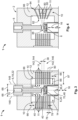
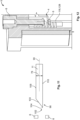
- switching devices according to several possible embodiments is described with reference to Fig.1 to Fig. 13 .
- - according to some embodiments two pairs 4 of contacts 6, two blowout magnets 8 and at least two stacks 10 of arc splitting blades 11 are shown.
- the invention is not limited to these embodiments, as they are purely exemplary and serve for illustration purposes only.
- the switching device 1 may also have only a single pair 4 of contacts 6, only one blowout magnet 8, and a single stack 10 of arc splitting blades 11.
- the contact device 1 comprises a housing 2, two pairs 4 of contacts 6, blowout magnets 8, and stacks 10 of arc splitting blades 11.
- the housing 2 has a substantially cuboid shape and comprises a housing wall 12 that encloses a contact chamber 14. Inside the contact chamber 14, the pairs 4 of contacts 6 are arranged.
- Each pair 4 of contacts 6 comprises two contacts 6 that are adapted to be opened and closed along a switching direction 16.
- each pair for of contacts 6 comprises a stationary contact 18 and a movable contact 20.
- the stationary contacts 18 are substantially cylindrical contact studs 22 that are partially received in the housing wall 12.
- the movable contacts 20 of both pairs 4 of contacts 6 are located on a contact bridge 24, which is connected to a plunger 26 by a contact bridge holder 30 and a spring 32.
- the contact bridge 24 is, together with the movable contacts 20, movable along the switching direction 16.
- a contact gap 36 is formed between the contacts 6.
- the contact gap 36 has a length 38 with respect to the switching direction 16.
- the length 38 of the contact gap 36 is the distance between the contacts 6, in particular between contact pills 40 of the same pair 4 of contacts 6.
- the contact pills 40 may be located at an axial end 42 of each of the contacts 6 facing towards the contact gap 36.
- the contact pills 40 are configured to contact each other when the contacts 6 of a pair 4 of contacts 6 are in a closed position 44 (see Fig. 8 ).
- a contact 6 may further comprise a contact head 46.
- the contact head 46 is located at the axial ends 47 of the contact studs 22.
- the contact head 46 has a convex curvature with respect to a longitudinal axis 48 of each contact stud 20.
- the contact head 46 may further comprise a shoulder 50, a rear surface 52 of the shoulder 50 facing away from the contact gap 36.
- a normal axis 54 of the rear surface 52 of the shoulder 50 may extend along the longitudinal axis 48 of the contact studs 22 and away from the contact gap 36.
- the contact device 1 may comprise two cuboid blowout magnets 8 that are positioned on an outer surface 56 of the housing wall 12.
- the blowout magnets 8 are oriented parallel to each other and normal axes 58 of the blowout magnets 8 extend along a connection line 60 between the stationary contacts 18.
- the blowout magnets 8 create a magnetic field for exerting a magnetic force 134 on an arc 64 occurring in the contact chamber 14 when the contacts 6 are in the open position 34.
- the magnetic field of the blowout magnets 8 at least partially penetrates the contact chamber 14.
- the pair 4 of contacts 6 and the stacks 10 of arc splitting blades 11 are positioned between the blowout magnets 8 and thus, in the operating state 62, are affected by the magnetic field created by the blowout magnets 8.
- each pair 4 of contacts 6 has two stacks 10 of arc splitting blades 11, the stacks 10 being opposite to one another with respect to the contact gap 36.
- Each stack 10 of arc splitting blades 11 comprises multiple arc splitting blades 11 that are spaced apart from each other along a stacking direction 66.
- the stacking direction 66 extends along the switching direction 16 and perpendicular to the normal axes 58 of the blowout magnets 8.
- the arc splitting blades 11 of each stack 10 are electrically decoupled from one another and are provided for receiving and splitting arcs 64 occurring inside the contact chamber 14 and being deflected by the blowout magnets 8 towards the arc splitting blades 11.
- At least one stack 10 of arc splitting blades 11 may at least partially overlap - with respect to the switching direction 16 - sections 142 adjacent to the contact gap 36 with respect to the switching direction 16.
- an upper section 144 may extend from the contact pill 40 of the stationary contact 18 along the switching direction 16 and away from the contact gap 36
- a lower section 146 may extend from the contact pill 40 of the movable contact 20 along the switching direction 16 and away from the contact gap 36.
- equal numbers of arc splitting blades 11 overlap both the upper section 144 and the lower section 146 with respect to the switching direction 16.
- 3 arc splitting blades 11 overlap both the upper section 144 and the lower section 146 with respect to the switching direction 16, while two arc splitting blades 11 overlap the contact gap 36 with respect to the switching direction 16.
- the distance 68 between the at least one stack 10 of arc splitting blades 11 and the contact gap 36 is smaller than 3 lengths 38 of the contact gap 36.
- the distance 68 between the at least one stack 10 of arc splitting blades 11 and the contact gap 36 may represent the shortest distance between a contact gap axis 70, which extends through the contact pills 40 of both contacts 6 of the same pair 4 of contacts 6, and an end plane 148 of the stack 10 facing towards the contacts 6.
- the end plane 148 of the stack extends through the arc splitting blade ends 82 facing towards the contacts 6.
- all arc splitting blades 11 of both stacks 10 protrude from the housing wall 12 into the contact chamber 14 to the same extent, so that the end planes 148 of the stacks 10 of arc splitting blades 11 are parallel to the contact gap axis 70.
- the contact gap axis 70 of the switching device 1 shown in Fig. 3 is identical to the longitudinal axis 48 of the contact stud 22.
- each of the arc splitting blades 11 is separately received inside the housing wall 12 of the housing 2.
- the arc splitting blades 11 may be overmolded by the housing 2.
- the switching device 1 may further comprise an insert 74.
- the insert 74 comprises a stack 10 of arc splitting blades 11, of which each is attached to the insert 74.
- the insert 74 is press-fitted into the housing wall 12 of the housing 2.
- the arc splitting blades 11 may be arranged parallel to each other and adjacent arc splitting blades 11 may be spaced apart from each other by a distance 76.
- the distance 76 between adjacent arc splitting blades 11 of a stack 10 of arc splitting blades 11 may be maximally about 75% of the length 38 of the contact gap 36.
- the distance 76 of adjacent arc splitting blades 11 may be at least as large as a thickness 78 of the arc splitting blades 11.
- the thickness 78 of the arc splitting blades 11 may be measured along the stacking direction 66. In case the arc splitting blades 11 have different thicknesses 78, the distance 76 of adjacent arc splitting blades 11 may be at least as large as the thickest of the arc splitting blades 11.
- At least two arc splitting blades 11 of a stack 10 of arc splitting blades 11 may have an inclination 80 relative to each other.
- all pairs 10 of adjacent arc splitting blades 11 have the same inclination 80 relative to each other and all arc splitting blades 11 point towards the contact gap 36.
- a distance between the ends 82 of two adjacent arc splitting blades 11 facing towards the contacts 6 is smaller than a distance between the ends 84 facing away from the contacts 6 of two adjacent arc splitting blades 11 with respect to the switching direction 16.
- Each of the arc splitting blades 11 protrudes from an inner side 86 of the housing wall 12 towards the contacts 6, so that ends 82 of the arc splitting blades 11 facing towards the contacts 6 are located in the contact chamber 14.
- all arc splitting blades 11 protrude perpendicularly from the housing wall 12.
- all arc splitting blades 11 shown in Fig. 3 have the same length 87 and protrude equally far from the inner side 86 of the housing wall 12 into the contact chamber 14.
- a protruding distance 88 with respect to longitudinal axes 90 of the arc splitting blades 11 between ends 82 of the arc splitting blades 11 facing towards the contacts 6 and the inner side 86 of the housing wall 12 may be identical for all arc splitting blades 11.
- the arc splitting blades 11 may protrude from the inner side 86 of the housing wall 12 into the contact chamber 14 to different extents. As shown in Fig. 5 , the arc splitting blades 11 closest to a center plane 92 of the stack 10 of arc splitting blades 11 may for example have the smallest protruding distance 88 and the arc splitting blades 11 that are spaced apart furthest from the center plane 92 of the stack 10 of arc splitting blades 11 with respect to the stacking direction 66 may have the largest protruding distance 88.
- the center plane 92 extends perpendicular to the stacking direction 66 and is arranged in the middle of a top splitter blade 94 and a bottom splitter blade 96 with respect to the stacking direction 66.
- the top splitter blade 94 and the bottom splitter blade 96 may be furthest away from the center plane 92 with respect to the stacking direction 66.
- the arc splitting blades 11 further may comprise a tapered section 98 that is located at the ends 82 of the arc splitting blades 11 facing towards the contacts 6.
- the tapered section 98 shown in Fig. 6 comprises bevels 100 that taper along the longitudinal axis 90 of the arc splitting blades 11 and towards the contacts 6.
- the thickness 78 of the arc splitting blades 11 decreases along the longitudinal axis 90 of the arc splitting blade 11 and towards the contacts 6.
- the arc splitting blades 11 comprises an edge 104 that extends along a whole width 106 of the arc splitting blades 11.
- the width 106 of the arc splitting blades 11 may extend along the connection line 60 between two stationary contacts 18. According to another embodiment, the edge 104 may only extend sectionally along the width 106 of the arc splitting blades 11.
- the tapered section 98 may also be designed differently.
- the tapered section 98 of the embodiment shown in Fig. 11 has only a single bevel 100 extending from a top surface 108 to a bottom surface 110 of the arc splitting blade 11 and thus tapers along the longitudinal axis 90 of the arc splitting blades 11 and towards the contacts 6.
- the thickness 78 of the arc splitting blade 11 decreases along the longitudinal axis 90 of the arc splitting blade 11 and towards the contacts 6.
- the bevel 100 ends in an edge 104 that is located on the bottom surface 110.
- the edge 104 may be located on the top surface 108 of the arc splitting blade 11.
- At least one arc splitting blade 11 may comprise a recess 112 at an end 82 of the arc splitting blade 11 facing towards the contacts 6.
- the recess 112 shown in Fig. 7 is formed by a substantially U-shaped end section 114 of the arc splitting blade 11.
- the U-shaped arc splitting blade 11 comprises two legs 116 that are opposite to each other with respect to the longitudinal axis 90 of the arc splitting blade 11.
- the recess 112 is built symmetrically to the longitudinal axis 90 of the arc splitting blade 11.
- an electrical current flows through the switching device 1, as the contacts 6 are in the closed position 44.
- the contacts 6 of each pair 4 of contacts 6 are in contact with each other, so that the contact pills 40 of the contacts 6 of each pair 4 of contacts 6 abut each other.
- a path of the electrical current 118 may extend from a first stationary contact 120 to a first movable contact 122, from the first movable contact 122 to a second movable contact 124 via the contact bridge 24, and from the second movable contact 124 to a second stationary contact 126. All contacts 6 thus may form an electrical circuit 128.
- only two contacts 6 of the same pair 4 of contacts 6 may form an electrical circuit 128, so that the path of the electrical current 118 may extend between two contacts 6 of the same pair 4 of contacts 6 (indicated through dotted line).
- the contact bridge 24 comprising the movable contacts 20 is moved away from the stationary contacts 18, the contacts 6 of each pair 4 of contacts 6 are moved from the closed position 44 into the open position 34.
- the contact gap 36 is formed between both the first stationary contact 120 and the first movable contact 122 as well as between the second stationary contact 126 and the second movable contact 124.
- arcs 64 may occur in the contact gap 36.
- an arc 64 is formed in each contact gap 36.
- each arc 64 has an initial direction of movement 130 which, in the embodiment shown, extends along the connecting line 132 of the contact pills 40 of each pair 4 of contacts 6 (see detail view in Fig. 13 )
- the blowout magnets 8 create a magnetic field, which penetrates the contact chamber 14.
- the magnetic field created by the blowout magnets 8 distracts the arcs 64 by exerting a magnetic force 134 on the arcs 64.
- the magnetic force 134 thereby points in a direction perpendicular to a direction of movement 136 of the arcs 64 and perpendicular to the field lines 138 of the magnetic field. Consequently, each arc 64 is distracted towards an arc splitting blade 11 that absorbs the arc 64.
- each stack 10 of arc splitting blades 11 are electrically decoupled from one another, the adsorbed arc 64 jumps over to an adjacent arc splitting blade 11. In this way, each arc 64 is split into multiple smaller arcs 64, until the arcs 64 are completely extinguished.
- the current flow through the switching device 1 may be bidirectional.
- the switching device 1 is used e.g. for switching an alternating current
- the polarization of the current changes periodically.
- the direction of the current flow between the contacts 6 of a pair of contacts 4 also changes periodically.
- the directions of the current flow may be opposite to each other. Arcs occurring during opening of the contacts 6 thus may have different initial directions of movement 130, which may be exactly opposite to each other in dependence on the alternating directions of the current flow.
- the magnetic force 134 exerted on the arcs 64 extends perpendicular to the direction of movement 136 of the arcs 64 and perpendicular to the field lines 138 of the magnetic field created by the at least one blowout magnet 8, the arcs 64 are deflected in opposite directions depending on the direction of the current.
- two opposing stacks 10 of arc splitting blades 11 may be provided.
Landscapes
- Physics & Mathematics (AREA)
- Electromagnetism (AREA)
- Arc-Extinguishing Devices That Are Switches (AREA)
Priority Applications (1)
| Application Number | Priority Date | Filing Date | Title |
|---|---|---|---|
| EP23181766.9A EP4485490A1 (de) | 2023-06-27 | 2023-06-27 | Schaltgerät mit verbesserter lichtbogenlöschung |
Applications Claiming Priority (1)
| Application Number | Priority Date | Filing Date | Title |
|---|---|---|---|
| EP23181766.9A EP4485490A1 (de) | 2023-06-27 | 2023-06-27 | Schaltgerät mit verbesserter lichtbogenlöschung |
Publications (1)
| Publication Number | Publication Date |
|---|---|
| EP4485490A1 true EP4485490A1 (de) | 2025-01-01 |
Family
ID=87002984
Family Applications (1)
| Application Number | Title | Priority Date | Filing Date |
|---|---|---|---|
| EP23181766.9A Pending EP4485490A1 (de) | 2023-06-27 | 2023-06-27 | Schaltgerät mit verbesserter lichtbogenlöschung |
Country Status (1)
| Country | Link |
|---|---|
| EP (1) | EP4485490A1 (de) |
Citations (6)
| Publication number | Priority date | Publication date | Assignee | Title |
|---|---|---|---|---|
| JPS62198013A (ja) * | 1986-02-25 | 1987-09-01 | 三菱電機株式会社 | 開閉器 |
| DE102015013413A1 (de) * | 2015-10-19 | 2017-04-20 | Abb Ag | Elektrisches Installationsgerät mit Lichtbogenlöscheinrichtung |
| DE102016213073A1 (de) * | 2016-07-18 | 2018-01-18 | Ellenberger & Poensgen Gmbh | Schaltsystem |
| US11056305B2 (en) * | 2016-05-31 | 2021-07-06 | Byd Company Limited | Relay |
| WO2022057606A1 (zh) * | 2020-09-17 | 2022-03-24 | 华为数字能源技术有限公司 | 一种直流接触器、配电盒、动力电池总成与车辆 |
| US20230085584A1 (en) * | 2021-09-13 | 2023-03-16 | Song Chuan Precision Co., Ltd. | Electromagnetic relay |
-
2023
- 2023-06-27 EP EP23181766.9A patent/EP4485490A1/de active Pending
Patent Citations (6)
| Publication number | Priority date | Publication date | Assignee | Title |
|---|---|---|---|---|
| JPS62198013A (ja) * | 1986-02-25 | 1987-09-01 | 三菱電機株式会社 | 開閉器 |
| DE102015013413A1 (de) * | 2015-10-19 | 2017-04-20 | Abb Ag | Elektrisches Installationsgerät mit Lichtbogenlöscheinrichtung |
| US11056305B2 (en) * | 2016-05-31 | 2021-07-06 | Byd Company Limited | Relay |
| DE102016213073A1 (de) * | 2016-07-18 | 2018-01-18 | Ellenberger & Poensgen Gmbh | Schaltsystem |
| WO2022057606A1 (zh) * | 2020-09-17 | 2022-03-24 | 华为数字能源技术有限公司 | 一种直流接触器、配电盒、动力电池总成与车辆 |
| US20230085584A1 (en) * | 2021-09-13 | 2023-03-16 | Song Chuan Precision Co., Ltd. | Electromagnetic relay |
Similar Documents
| Publication | Publication Date | Title |
|---|---|---|
| EP2901468B1 (de) | Kurzschluss-abschaltungsschalter | |
| CN114220718B (zh) | 直流电路断路器 | |
| JP7179206B2 (ja) | 開閉器 | |
| CN108140506B (zh) | 用于电开关的接触装置以及电开关 | |
| KR101401201B1 (ko) | 진공밸브 | |
| US20240363296A1 (en) | Bi-directional double-break contactor | |
| EP4485490A1 (de) | Schaltgerät mit verbesserter lichtbogenlöschung | |
| EP1294003B1 (de) | Kontaktanordnung für einen Vakuumschalter und Vakuumschalter mit einer solchen Kontaktanordnung | |
| EP3193348B1 (de) | Lichtbogenkammeranordnung und -verfahren | |
| JP6702063B2 (ja) | 電磁継電器 | |
| EP0055008B1 (de) | Vakuumschalter | |
| KR102820127B1 (ko) | 전기 스위치 리미터 폴 및 이러한 리미터 폴을 포함하는 dc 전기 스위치 | |
| US11804348B2 (en) | Arc path formation unit and direct current relay including same | |
| US10224162B2 (en) | Switching device with arc extinguishing device | |
| JP2022017498A (ja) | 接触子カバーを有するスイッチ装置 | |
| JP6838484B2 (ja) | スイッチ | |
| JP7110031B2 (ja) | 真空遮断器 | |
| KR101601619B1 (ko) | 진공 밸브 | |
| EP2851921B1 (de) | Elektrodenanordnung und Vakuumschalter damit | |
| JPWO2019180931A1 (ja) | 電磁接触器 | |
| JP7490152B2 (ja) | 開閉器 | |
| JP2003092050A (ja) | 真空インタラプタ用接触子及び真空インタラプタ | |
| JP7809158B2 (ja) | リレーまたはコンタクタのためのコンタクトブリッジアセンブリ | |
| US8963028B2 (en) | Multi-point tilt switch | |
| EP3073501B1 (de) | Linearer mehrpoliger schalter |
Legal Events
| Date | Code | Title | Description |
|---|---|---|---|
| PUAI | Public reference made under article 153(3) epc to a published international application that has entered the european phase |
Free format text: ORIGINAL CODE: 0009012 |
|
| STAA | Information on the status of an ep patent application or granted ep patent |
Free format text: STATUS: THE APPLICATION HAS BEEN PUBLISHED |
|
| AK | Designated contracting states |
Kind code of ref document: A1 Designated state(s): AL AT BE BG CH CY CZ DE DK EE ES FI FR GB GR HR HU IE IS IT LI LT LU LV MC ME MK MT NL NO PL PT RO RS SE SI SK SM TR |
|
| STAA | Information on the status of an ep patent application or granted ep patent |
Free format text: STATUS: REQUEST FOR EXAMINATION WAS MADE |
|
| 17P | Request for examination filed |
Effective date: 20250701 |