EP4485409A1 - Papierblatthandhabungsvorrichtung - Google Patents
Papierblatthandhabungsvorrichtung Download PDFInfo
- Publication number
- EP4485409A1 EP4485409A1 EP22928509.3A EP22928509A EP4485409A1 EP 4485409 A1 EP4485409 A1 EP 4485409A1 EP 22928509 A EP22928509 A EP 22928509A EP 4485409 A1 EP4485409 A1 EP 4485409A1
- Authority
- EP
- European Patent Office
- Prior art keywords
- conveyance unit
- guide
- module
- paper sheet
- opening
- Prior art date
- Legal status (The legal status is an assumption and is not a legal conclusion. Google has not performed a legal analysis and makes no representation as to the accuracy of the status listed.)
- Pending
Links
Images




Classifications
-
- B—PERFORMING OPERATIONS; TRANSPORTING
- B65—CONVEYING; PACKING; STORING; HANDLING THIN OR FILAMENTARY MATERIAL
- B65H—HANDLING THIN OR FILAMENTARY MATERIAL, e.g. SHEETS, WEBS, CABLES
- B65H29/00—Delivering or advancing articles from machines; Advancing articles to or into piles
- B65H29/52—Stationary guides or smoothers
-
- G—PHYSICS
- G07—CHECKING-DEVICES
- G07D—HANDLING OF COINS OR VALUABLE PAPERS, e.g. TESTING, SORTING BY DENOMINATIONS, COUNTING, DISPENSING, CHANGING OR DEPOSITING
- G07D11/00—Devices accepting coins; Devices accepting, dispensing, sorting or counting valuable papers
- G07D11/10—Mechanical details
-
- G—PHYSICS
- G07—CHECKING-DEVICES
- G07D—HANDLING OF COINS OR VALUABLE PAPERS, e.g. TESTING, SORTING BY DENOMINATIONS, COUNTING, DISPENSING, CHANGING OR DEPOSITING
- G07D11/00—Devices accepting coins; Devices accepting, dispensing, sorting or counting valuable papers
- G07D11/10—Mechanical details
- G07D11/16—Handling of valuable papers
-
- G—PHYSICS
- G07—CHECKING-DEVICES
- G07D—HANDLING OF COINS OR VALUABLE PAPERS, e.g. TESTING, SORTING BY DENOMINATIONS, COUNTING, DISPENSING, CHANGING OR DEPOSITING
- G07D11/00—Devices accepting coins; Devices accepting, dispensing, sorting or counting valuable papers
- G07D11/20—Controlling or monitoring the operation of devices; Data handling
- G07D11/26—Servicing, repairing or coping with irregularities, e.g. power failure or vandalism
-
- B—PERFORMING OPERATIONS; TRANSPORTING
- B65—CONVEYING; PACKING; STORING; HANDLING THIN OR FILAMENTARY MATERIAL
- B65H—HANDLING THIN OR FILAMENTARY MATERIAL, e.g. SHEETS, WEBS, CABLES
- B65H2601/00—Problem to be solved or advantage achieved
- B65H2601/10—Ensuring correct operation
- B65H2601/11—Clearing faulty handling, e.g. jams
-
- B—PERFORMING OPERATIONS; TRANSPORTING
- B65—CONVEYING; PACKING; STORING; HANDLING THIN OR FILAMENTARY MATERIAL
- B65H—HANDLING THIN OR FILAMENTARY MATERIAL, e.g. SHEETS, WEBS, CABLES
- B65H2701/00—Handled material; Storage means
- B65H2701/10—Handled articles or webs
- B65H2701/19—Specific article or web
- B65H2701/1912—Banknotes, bills and cheques or the like
Definitions
- the present invention relates to a paper sheet handling apparatus.
- a drawer module may be disposed so as to be drawable.
- the drawer module conveys and stores a paper sheet.
- a cross conveyance unit that conveys a paper sheet in a cross direction crossing a pull-out direction is disposed between the paper sheet handling apparatus and a drawable drawer module.
- a gap is provided between the drawer module and the cross conveyance unit so that damage due to contact between the drawer module and the cross conveyance unit does not occur when the drawer module is housed.
- the gap is bound by the component dimensional accuracy so that the drawer module and the cross conveyance unit do not interfere with each other and the gap does not become wide enough to interfere with conveyance of the paper sheet even if a dimensional variation range becomes wide.
- it is difficult to flexibly cope with an unexpected change in a minute distance between the drawer module and the cross conveyance unit and a change in a positional relationship in order to secure a condition with component dimensional accuracy by a fixed component.
- the drawer module has an openable and closable opening/closing conveyance unit
- the opening/closing conveyance unit comes into contact with the cross conveyance unit or the like and transitions from the half-locked state to the locked state.
- An object of the present invention is to provide a paper sheet handling apparatus capable of pressing a drawer module in a cross direction crossing a pull-out direction while avoiding damage.
- a paper sheet handling apparatus includes: a drawable drawer module; a cross conveyance unit configured to convey, between the cross conveyance unit and the drawer module, a paper sheet in a cross direction crossing a pull-out direction of the drawer module; and a biasing guide disposed at an end portion of the cross conveyance unit on a side of the drawer module and configured to bias the drawer module in the cross direction.
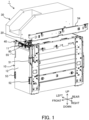
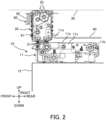
- Fig. 1 is a left side view illustrating an internal structure of the banknote processing machine 1.
- an upward-and-downward direction, a forward-and-rearward direction, and a left-and-right direction illustrated in Fig. 1 and Figs. 2 to 12B to be described below are illustrative only in a case where a customer side of the banknote processing machine 1 is the front direction.
- the upward-and-downward direction is a vertical direction
- the forward-and-rearward direction and the left-and-right direction are horizontal directions.
- the banknote processing machine 1 illustrated in Fig. 1 is used for, for example, an ATM, a bill recycle unit (BRU), a cash dispenser (CD), a teller cash recycler (TCR), and the like, and includes a lower module 10, an intermediate conveyance unit 20, an upper module 30, a frame 40, slide rails 51 to 55, and a guide mechanism 60.
- a banknote is an example of a paper sheet
- the banknote processing machine 1 is an example of the paper sheet handling apparatus.
- the paper sheet handling apparatus may be any apparatus as long as the apparatus conveys the paper sheet or performs some processing on the paper sheet.
- the lower module 10 is an example of a drawable drawer module, and for example, can be housed inside the frame 40 and pulled out both forwards and rearwards along the three slide rails 51 to 53 and 55 extending in the forward-and-rearward direction. However, it is sufficient that the lower module 10 can be drawable in at least one direction (for example, forwards).
- the lower module 10 includes an opening/closing conveyance unit 11 disposed at a front portion in the uppermost stage of the lower module 10, and a banknote accommodation unit 12 disposed below the opening/closing conveyance unit 11 and configured to accommodate, for example, a plurality of cassettes for accommodating banknotes.
- the opening/closing conveyance unit 11 includes an opening portion 11a, an opening/closing shaft 11b, a lock member 11c, and a comb tooth guide 11d.
- the opening portion 11a is provided over the entire upper portion of the opening/closing conveyance unit 11.
- the opening portion 11a rotates around the opening/closing shaft 11b provided at a rear portion of the opening/closing conveyance unit 11 and formed to extend in the left-and-right direction (refer to an arrow in Fig. 5 ). Then, as illustrated in Fig. 5 , the opening portion 11a is locked in a horizontal state and is opened from the front side by rotating upwards to expose the inside of the opening/closing conveyance unit 11.
- the opening portion 11a has a lock shaft 11a-1, two collars 11a-2, and two tip guides 11a-3.
- the lock shaft 11a-1 extends in the left-and-right direction in the vicinity of the center of the opening portion 11a in the forward-and-rearward direction, and protrudes from both left and right ends of the opening portion 11a. Further, the lock shaft 11a-1 is biased rearwards by an elastic body (not illustrated), and is hooked on the lock member 11c at each of the left and right ends when the opening portion 11a is in the horizontal state. As a result, the opening/closing conveyance unit 11 is in the locked state.
- the lock shaft 11a-1 is moved forwards against biasing force of the elastic body (not illustrated) so as to release the state of being hooked on the lock member 11c, and the opening portion 11a is rotated upwards around the opening/closing shaft 11b.
- the two collars 11a-2 are rotatably disposed at both left and right ends of the non-rotatable lock shaft 11a-1 and contact the lock member 11c. As a result, the lock shaft 11a-1 can smoothly move along the lock member 11c and be caught by the lock member 11c.
- the two tip guides 11a-3 are provided at front portions of both left and right ends of the opening portion 11a, and are provided so as to be inclined downwards toward the front side. Accordingly, as will be described later, when the opening/closing conveyance unit 11 is housed from the rear side, the opening/closing conveyance unit 11 (lower module 10) is easily housed.
- the comb tooth guide 11d guides banknotes conveyed to and from the intermediate conveyance unit 20 to be described later.
- the intermediate conveyance unit 20 is disposed above the front portion of the opening/closing conveyance unit 11 and conveys a banknote in the upward-and-downward direction between the lower module 10 (opening/closing conveyance unit 11) and the upper module 30.
- the intermediate conveyance unit 20 is an example of a cross conveyance unit that conveys a banknote (a paper sheet) to and from the lower module 10 (drawer module) in a cross direction crossing a pull-out direction of the lower module 10.
- the cross direction is not limited to the upward-and-downward direction as long as the cross direction crosses the pull-out direction (forward-and-rearward direction) of the lower module 10.
- the intermediate conveyance unit 20 includes a comb tooth guide 21 provided at a lower end (lower module 10 side) and a comb tooth guide 22 provided at an upper end (upper module 30 side). It is noted that a partition member (not illustrated) that separates the lower module 10 from the upper module 30 is disposed behind the intermediate conveyance unit 20.
- the partition member is, for example, a part of a safe that houses the lower module 10 (frame 40).
- the comb tooth guide 21 extends downwards toward the lower module 10 (opening/closing conveyance unit 11) in the housed state, and is positioned so as to be alternately aligned in the left-and-right direction with the comb tooth guide 11d of the lower module 10 (opening/closing conveyance unit 11), thereby guiding the banknote.
- the comb tooth guide 22 extends upwards toward the upper module 30 in the housed state, and is positioned so as to be alternately aligned in the left-and-right direction with the comb tooth guide (not illustrated) of the upper module 30, thereby guiding the banknote.
- the comb tooth guides 21 and 22, the comb tooth guide 11d of the above-described lower module 10 (opening/closing conveyance unit 11), and the comb tooth guide of the upper module 30 are preferably rotatable so as to fall from a guiding state to a retracted state when load is applied at the time of occurrence of a jam, thereby preventing damage of the comb tooth guide and banknote damage.
- these comb tooth guides may be moved by a mechanism (not illustrated) so as to be in the guiding state when the lower module 10 or the upper module 30 is housed and to be in the retracted state retracted from the guiding state when the lower module 10 or the upper module is pulled out.
- the upper module 30 illustrated in Fig. 1 is preferably capable of conveying a banknote to and from the intermediate conveyance unit 20 and pulling out the banknote forwards or rearwards along a plurality of slide rails such as a slide rail 54 extending in the forward-and-rearward direction.
- the upper module 30 conveys the banknote received from a customer to the intermediate conveyance unit 20 (lower module 10), and delivers the withdrawn banknote from the intermediate conveyance unit 20 (lower module 10).
- the frame 40 houses the lower module 10.
- the slide rails 51 to 53 and 55 described above for enabling the lower module 10 to be drawable in the forward-and-rearward direction are fixed to the frame 40.
- two leaf springs 41 (since two leaf springs are hidden by the frame 40, they are not shown in the drawing, so each of the leaf springs is illustrated by a broken line which is a hidden line) are provided on the inner upper surface at the rear end of the frame 40.
- the leaf spring 41 protrudes toward the lower module 10 (downwards) in a V shape, and biases the lower module 10 downwards (in the cross direction crossing the pull-out direction).
- the leaf spring 41 is fixed to the inner upper surface of the frame 40 in a long hole extending in the forward-and-rearward direction of the leaf spring 41 so as to be retractable forwards at the time of contacting the lower module 10.
- another elastic body such as rubber or another spring may be disposed, or the leaf spring 41 may be omitted in a case where the lower module 10 is not pulled out rearwards.
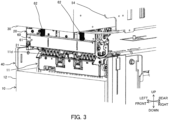
- the guide mechanism 60 includes a biasing guide 61 and two compression springs 62.
- the biasing guide 61 is disposed at a lower end (an end portion on the lower module 10 side) of the intermediate conveyance unit 20, and biases the lower module 10 downwards (an example of the cross direction) by being biased downwards by the two compression springs 62, each of which is an example of an elastic body. It is noted that an upper end which is one end of the compression spring 62 is fixed to, for example, the upper module 30, a member for accommodating the upper module 30, and a fixing member such as the intermediate conveyance unit 20. Further, when the biasing guide 61 itself is an elastic body such as a leaf spring, the elastic body (compression spring 62) can be omitted.
- the biasing guide 61 has a U shape in right side view, and a guide surface 61a at a lower end which is a tip is curved such that a central portion in the forward-and-rearward direction (the pull-out direction of the lower module 10) is located closest to the side of the lower module 10.
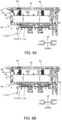
- housing of the lower module 10 from the front side when the opening/closing conveyance unit 11 is in a half-opened half-locked state S1 will be described with reference to Figs. 6A to 6D .
- the biasing guide 61 is biased downwards by the compression spring 62. Further, the guide surface 61a of the biasing guide 61 is located below the lower end of the intermediate conveyance unit 20 and the frame 40 (the upper portion of the frame 40).
- the opening/closing conveyance unit 11 since the opening/closing conveyance unit 11 is in the half-locked state S1, the upper surface of the opening portion 11a is inclined upwards toward the front side. Therefore, when the opening/closing conveyance unit 11 is in the half-locked state S1, the lower module 10 is housed from the front side, and the opening/closing conveyance unit 11 reaches the lower side of the biasing guide 61, the opening/closing conveyance unit 11 comes into contact with the biasing guide 61 and is biased downwards.
- the opening portion 11a approaches a horizontal state thereof with the opening/closing shaft 11b as a rotation center.
- the above-described leaf spring 41 protrudes downwards in a V shape from the inner upper surface of the frame 40.
- the upper surface of the opening portion 11a may be inclined upwards toward the front side up to a height in contact with the upper portion of the frame 40.
- the tip guide 11a-3 provided at the front end of the opening portion 11a comes into contact with the upper portion of the frame 40.
- the opening portion 11a approaches a horizontal state thereof with the opening/closing shaft 11b as a rotation center, and can get under the upper portion of the frame 40.
- the comb tooth guide 21 at the lower end of the intermediate conveyance unit 20 described above extends downwards toward the lower module 10 (opening/closing conveyance unit 11) in the housed state, and is positioned so as to be alternately aligned in the left-and-right direction with the comb tooth guide 11d of the lower module 10 (guiding state S11), thereby guiding the banknote.
- the comb tooth guide 21 is preferably retracted from the guiding state S11, as illustrated in Fig. 9B , by the above-described mechanism (not illustrated) (retracted state S12) .
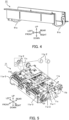
- a retracting mechanism 70 that retreats the comb tooth guide 21 to the retracted state S12 may be disposed in the banknote processing machine 1.
- the retracting mechanism 70 includes a rack 71, a base portion 72, a spring 73, and a gear 74.
- the rack 71 is provided with a tooth surface 71a extending in the upward-and-downward direction on the rear surface, and for example, two pins 71b (only two pins 71b at the right end are illustrated) protrude from the left and right ends.
- the tooth surface 71a has a lower portion positioned on the rear side and an upper portion positioned on the front side.
- the lower portion of the tooth surface 71a meshes with a gear 21a of the comb tooth guide 21.
- the upper portion of the tooth surface 71a meshes with the gear 74 meshing with a gear 22a of the comb tooth guide 22.
- the base portion 72 illustrated in Fig. 10A is fixed to the biasing guide 61.
- the base portion 72 is provided with a long hole 72a formed to extend in the forward-and-rearward direction and configured to allow the pin 71b of the above-described rack 71 to be inserted thereinto.
- the rack 71 described above is movable in the forward-and-rearward direction with respect to the base portion 72 and the biasing guide 61. Further, the rack 71 can ascend and descend together with the base portion 72 and the biasing guide 61.
- the spring 73 is, for example, a compression spring having one end (front end) fixed to the rack 71 and the other end (rear end) fixed to the biasing guide 61.
- the spring 73 urges the rack 71 forwards such that the rack 71 (tooth surface 71a) does not mesh with the gear 21a of the comb tooth guide 21 and the gear 74.
- the biasing guide 61 is provided at the lower end of the intermediate conveyance unit 20 (an example of the cross conveyance unit), but for example, the intermediate conveyance unit 20 may be disposed on one of the left and right sides of the lower module 10 (an example of the drawer module), and may be disposed at the left end or the right end which is the end portion of the intermediate conveyance unit 20 on the lower module 10 side when the banknote is conveyed in the left-and-right direction.
- the biasing guide 61 biases the opening/closing conveyance unit 11 so as to set the opening/closing conveyance unit 11 in the half-locked state S1 to the locked state S2, so that it is possible to suppress occurrence of damage when the opening/closing conveyance unit 11 is housed in the half-locked state S1, but the biasing guide 61 may bias the drawer module not having the opening/closing conveyance unit 11.
- the banknote processing machine 1 includes, as an example of the cross conveyance unit, the intermediate conveyance unit 20 that conveys a banknote between the lower module 10 and the upper module 30, but the cross conveyance unit is not limited to one that conveys a banknote between two modules.
- the banknote processing machine 1 includes the lower module 10 and the upper module 30, but the banknote processing machine 1 may include at least one drawer module (for example, the lower module 10).
- the configuration of each unit of the banknote processing machine 1 is also freely selected, and for example, the retracting mechanism 70 in the modification is not limited to the configuration including the rack 71, the base portion 72, the spring 73, and the gear 74.
- the banknote processing machine 1 which is an example of the paper sheet handling apparatus, includes the lower module 10, which is an example of a drawable drawer module, the intermediate conveyance unit 20, which is an example of a cross conveyance unit, and the biasing guide 61.
- the intermediate conveyance unit 20 conveys a banknote (paper sheet) to and from the lower module 10 in the cross direction (downwards) crossing the pull-out direction (forward-and-rearward direction) of the lower module 10.
- the biasing guide 61 is disposed at the lower end of the intermediate conveyance unit 20 (an example of an end portion on the lower module 10 side) and biases the lower module 10 in the cross direction (downwards).
- the biasing guide 61 biases the lower module 10 downwards, so that even if a gap between the lower module 10 and the intermediate conveyance unit 20 is not an optimum gap in consideration of an assembly accumulation error including a component dimensional variation, the biasing guide 61 is pushed back to the lower module 10 if the gap is narrow, and contact between the intermediate conveyance unit 20 and the lower module 10 can be prevented. Further, since the biasing guide 61 biases the lower module 10 downwards, even if the gap between the lower module 10 and the intermediate conveyance unit 20 is wide, the biasing guide 61 can set the opening/closing conveyance unit 11 in the half-locked state S1 to the locked state S2 or can guide housing of the lower module 10 as described later. Therefore, according to the present embodiment, it is possible to press the lower module 10 (drawer module) in the cross direction crossing the pull-out direction while avoiding damage.
- the lower module 10 which is an example of the drawer module, includes the opening/closing conveyance unit 11 which can be opened and closed, and the biasing guide 61 biases the opening/closing conveyance unit 11 to be in the locked state S2.
- the tip (guide surface 61a) of the biasing guide 61 is curved such that the central portion in the pull-out direction is located closest to the lower module 10 side.
- the intermediate conveyance unit 20 includes the comb tooth guide 21 that is movable to the guiding state S11 extending toward the lower module 10 and the retracted state S12 retracted from the guiding state S11.
- the banknote processing machine 1 further includes the retracting mechanism 70 that moves the comb tooth guide 21 (and the comb tooth guide 22) to the retracted state S12 when the biasing guide 61 is pressed to the opposite side (upwards) from the lower module 10.
- the comb tooth guide 21 is moved to the retracted state S12 by a simple work of lifting the biasing guide 61 before the lower module 10 is pulled out, and the load due to the remaining banknote can be reduced, thereby making it possible to prevent occurrence of damage of each unit and banknote damage.
- the present invention is not limited to the above-described embodiment as it is, and can be embodied by modifying the components thereof.
- various inventions can be formed by appropriately combining the plurality of components disclosed in the present embodiment.
- various modifications and applications of the invention can be made without departing from the gist of the invention.
Landscapes
- Physics & Mathematics (AREA)
- General Physics & Mathematics (AREA)
- Engineering & Computer Science (AREA)
- Mechanical Engineering (AREA)
- Pile Receivers (AREA)
- Delivering By Means Of Belts And Rollers (AREA)
- Feeding Of Articles By Means Other Than Belts Or Rollers (AREA)
Applications Claiming Priority (1)
| Application Number | Priority Date | Filing Date | Title |
|---|---|---|---|
| PCT/JP2022/007138 WO2023161978A1 (ja) | 2022-02-22 | 2022-02-22 | 紙葉類取扱装置 |
Publications (2)
| Publication Number | Publication Date |
|---|---|
| EP4485409A1 true EP4485409A1 (de) | 2025-01-01 |
| EP4485409A4 EP4485409A4 (de) | 2025-05-07 |
Family
ID=87765142
Family Applications (1)
| Application Number | Title | Priority Date | Filing Date |
|---|---|---|---|
| EP22928509.3A Pending EP4485409A4 (de) | 2022-02-22 | 2022-02-22 | Papierblatthandhabungsvorrichtung |
Country Status (4)
| Country | Link |
|---|---|
| US (1) | US12589967B2 (de) |
| EP (1) | EP4485409A4 (de) |
| JP (1) | JP7608673B2 (de) |
| WO (1) | WO2023161978A1 (de) |
Family Cites Families (9)
| Publication number | Priority date | Publication date | Assignee | Title |
|---|---|---|---|---|
| JP3916035B2 (ja) | 2000-11-24 | 2007-05-16 | 日立オムロンターミナルソリューションズ株式会社 | 紙幣取扱装置 |
| JP5122325B2 (ja) * | 2008-02-26 | 2013-01-16 | 日立オムロンターミナルソリューションズ株式会社 | 紙葉搬送機構及び紙葉取り扱い装置 |
| WO2012056789A1 (ja) * | 2010-10-27 | 2012-05-03 | 日立オムロンターミナルソリューションズ株式会社 | 紙葉類取扱装置及び現金自動取引装置 |
| JP5500146B2 (ja) | 2011-09-14 | 2014-05-21 | 沖電気工業株式会社 | 媒体取引装置 |
| JP6438642B2 (ja) * | 2012-12-20 | 2018-12-19 | 沖電気工業株式会社 | 紙葉類取扱装置 |
| JP6532654B2 (ja) | 2014-06-19 | 2019-06-19 | グローリー株式会社 | 貨幣処理装置 |
| JP2014209377A (ja) * | 2014-07-02 | 2014-11-06 | 日立オムロンターミナルソリューションズ株式会社 | 紙葉類取扱装置及び現金自動取引装置 |
| JP6350141B2 (ja) * | 2014-09-05 | 2018-07-04 | 沖電気工業株式会社 | 紙葉類搬送装置及び紙葉類取扱装置 |
| JP7544479B2 (ja) * | 2019-12-27 | 2024-09-03 | グローリー株式会社 | 紙葉類処理装置 |
-
2022
- 2022-02-22 EP EP22928509.3A patent/EP4485409A4/de active Pending
- 2022-02-22 JP JP2024502589A patent/JP7608673B2/ja active Active
- 2022-02-22 WO PCT/JP2022/007138 patent/WO2023161978A1/ja not_active Ceased
-
2024
- 2024-07-31 US US18/790,424 patent/US12589967B2/en active Active
Also Published As
| Publication number | Publication date |
|---|---|
| EP4485409A4 (de) | 2025-05-07 |
| WO2023161978A1 (ja) | 2023-08-31 |
| JP7608673B2 (ja) | 2025-01-06 |
| JPWO2023161978A1 (de) | 2023-08-31 |
| US12589967B2 (en) | 2026-03-31 |
| US20240383714A1 (en) | 2024-11-21 |
Similar Documents
| Publication | Publication Date | Title |
|---|---|---|
| JP5216805B2 (ja) | 紙葉類処理装置 | |
| JP5724717B2 (ja) | 媒体処理装置及び媒体取引装置 | |
| KR101077192B1 (ko) | 매체 반송 장치 및 지폐 취급 장치 | |
| JP5274355B2 (ja) | 紙葉類取扱装置 | |
| JP4655777B2 (ja) | 紙幣入出金機 | |
| CN109285268B (zh) | 闸门机构及现金循环处理装置 | |
| EP2323109A1 (de) | Vorrichtung zur Papierblatthandhabung | |
| CN107004320A (zh) | 介质处理装置和介质交易装置 | |
| CN104919503B (zh) | 拉出装置以及介质交易装置 | |
| EP4485409A1 (de) | Papierblatthandhabungsvorrichtung | |
| KR101046821B1 (ko) | 카세트의 푸쉬플레이트 잠금장치 | |
| JP5684587B2 (ja) | 紙幣識別機の紙幣取り出し機構および紙幣識別機 | |
| CN115136214B (zh) | 纸张类处理装置 | |
| CN108292458B (zh) | 介质处理装置和介质交易装置 | |
| EP4296983B1 (de) | Papierblatthandhabungsvorrichtung | |
| JP5511109B2 (ja) | 紙葉類処理装置 | |
| JPH11328479A (ja) | 紙幣処理機 | |
| JP2017090986A (ja) | 紙葉類収納カセットおよび紙葉類処理装置 | |
| JP7426178B2 (ja) | 紙葉類取扱装置 | |
| EP4586225A1 (de) | Kassettenanschlussvorrichtung für geldautomaten | |
| JP4206477B2 (ja) | 遊技機用台間機、及び紙幣取扱装置 | |
| JP4321513B2 (ja) | 紙幣収納装置および紙幣処理装置 | |
| JP7197860B2 (ja) | 貨幣処理システム及び表示装置 | |
| JPH04450Y2 (de) | ||
| WO2025134585A1 (ja) | パネルユニット取付け構造および装置 |
Legal Events
| Date | Code | Title | Description |
|---|---|---|---|
| STAA | Information on the status of an ep patent application or granted ep patent |
Free format text: STATUS: THE INTERNATIONAL PUBLICATION HAS BEEN MADE |
|
| PUAI | Public reference made under article 153(3) epc to a published international application that has entered the european phase |
Free format text: ORIGINAL CODE: 0009012 |
|
| STAA | Information on the status of an ep patent application or granted ep patent |
Free format text: STATUS: REQUEST FOR EXAMINATION WAS MADE |
|
| 17P | Request for examination filed |
Effective date: 20240809 |
|
| AK | Designated contracting states |
Kind code of ref document: A1 Designated state(s): AL AT BE BG CH CY CZ DE DK EE ES FI FR GB GR HR HU IE IS IT LI LT LU LV MC MK MT NL NO PL PT RO RS SE SI SK SM TR |
|
| A4 | Supplementary search report drawn up and despatched |
Effective date: 20250403 |
|
| RIC1 | Information provided on ipc code assigned before grant |
Ipc: G07D 11/26 20190101ALI20250328BHEP Ipc: G07D 11/10 20190101ALI20250328BHEP Ipc: B65H 29/52 20060101ALI20250328BHEP Ipc: G07D 11/16 20190101AFI20250328BHEP |
|
| DAV | Request for validation of the european patent (deleted) | ||
| DAX | Request for extension of the european patent (deleted) |