EP4482284A1 - Elektronische vorrichtung und verfahren zur herstellung einer elektronischen vorrichtung - Google Patents
Elektronische vorrichtung und verfahren zur herstellung einer elektronischen vorrichtung Download PDFInfo
- Publication number
- EP4482284A1 EP4482284A1 EP22925980.9A EP22925980A EP4482284A1 EP 4482284 A1 EP4482284 A1 EP 4482284A1 EP 22925980 A EP22925980 A EP 22925980A EP 4482284 A1 EP4482284 A1 EP 4482284A1
- Authority
- EP
- European Patent Office
- Prior art keywords
- substrate
- bump
- protrusion
- electronic device
- base material
- Prior art date
- Legal status (The legal status is an assumption and is not a legal conclusion. Google has not performed a legal analysis and makes no representation as to the accuracy of the status listed.)
- Pending
Links
Images










Classifications
-
- G—PHYSICS
- G06—COMPUTING OR CALCULATING; COUNTING
- G06N—COMPUTING ARRANGEMENTS BASED ON SPECIFIC COMPUTATIONAL MODELS
- G06N10/00—Quantum computing, i.e. information processing based on quantum-mechanical phenomena
- G06N10/20—Models of quantum computing, e.g. quantum circuits or universal quantum computers
-
- G—PHYSICS
- G06—COMPUTING OR CALCULATING; COUNTING
- G06N—COMPUTING ARRANGEMENTS BASED ON SPECIFIC COMPUTATIONAL MODELS
- G06N10/00—Quantum computing, i.e. information processing based on quantum-mechanical phenomena
- G06N10/40—Physical realisations or architectures of quantum processors or components for manipulating qubits, e.g. qubit coupling or qubit control
-
- H—ELECTRICITY
- H10—SEMICONDUCTOR DEVICES; ELECTRIC SOLID-STATE DEVICES NOT OTHERWISE PROVIDED FOR
- H10N—ELECTRIC SOLID-STATE DEVICES NOT OTHERWISE PROVIDED FOR
- H10N60/00—Superconducting devices
- H10N60/01—Manufacture or treatment
- H10N60/0912—Manufacture or treatment of Josephson-effect devices
-
- H—ELECTRICITY
- H10—SEMICONDUCTOR DEVICES; ELECTRIC SOLID-STATE DEVICES NOT OTHERWISE PROVIDED FOR
- H10N—ELECTRIC SOLID-STATE DEVICES NOT OTHERWISE PROVIDED FOR
- H10N60/00—Superconducting devices
- H10N60/80—Constructional details
- H10N60/81—Containers; Mountings
-
- H—ELECTRICITY
- H10—SEMICONDUCTOR DEVICES; ELECTRIC SOLID-STATE DEVICES NOT OTHERWISE PROVIDED FOR
- H10N—ELECTRIC SOLID-STATE DEVICES NOT OTHERWISE PROVIDED FOR
- H10N60/00—Superconducting devices
- H10N60/80—Constructional details
- H10N60/81—Containers; Mountings
- H10N60/815—Containers; Mountings for Josephson-effect devices
-
- H—ELECTRICITY
- H10—SEMICONDUCTOR DEVICES; ELECTRIC SOLID-STATE DEVICES NOT OTHERWISE PROVIDED FOR
- H10N—ELECTRIC SOLID-STATE DEVICES NOT OTHERWISE PROVIDED FOR
- H10N69/00—Integrated devices, or assemblies of multiple devices, comprising at least one superconducting element covered by group H10N60/00
-
- H—ELECTRICITY
- H10—SEMICONDUCTOR DEVICES; ELECTRIC SOLID-STATE DEVICES NOT OTHERWISE PROVIDED FOR
- H10W—GENERIC PACKAGES, INTERCONNECTIONS, CONNECTORS OR OTHER CONSTRUCTIONAL DETAILS OF DEVICES COVERED BY CLASS H10
- H10W72/00—Interconnections or connectors in packages
- H10W72/01—Manufacture or treatment
- H10W72/012—Manufacture or treatment of bump connectors, dummy bumps or thermal bumps
-
- H—ELECTRICITY
- H10—SEMICONDUCTOR DEVICES; ELECTRIC SOLID-STATE DEVICES NOT OTHERWISE PROVIDED FOR
- H10W—GENERIC PACKAGES, INTERCONNECTIONS, CONNECTORS OR OTHER CONSTRUCTIONAL DETAILS OF DEVICES COVERED BY CLASS H10
- H10W72/00—Interconnections or connectors in packages
- H10W72/071—Connecting or disconnecting
- H10W72/072—Connecting or disconnecting of bump connectors
-
- H—ELECTRICITY
- H10—SEMICONDUCTOR DEVICES; ELECTRIC SOLID-STATE DEVICES NOT OTHERWISE PROVIDED FOR
- H10W—GENERIC PACKAGES, INTERCONNECTIONS, CONNECTORS OR OTHER CONSTRUCTIONAL DETAILS OF DEVICES COVERED BY CLASS H10
- H10W72/00—Interconnections or connectors in packages
- H10W72/20—Bump connectors, e.g. solder bumps or copper pillars; Dummy bumps; Thermal bumps
-
- B—PERFORMING OPERATIONS; TRANSPORTING
- B82—NANOTECHNOLOGY
- B82Y—SPECIFIC USES OR APPLICATIONS OF NANOSTRUCTURES; MEASUREMENT OR ANALYSIS OF NANOSTRUCTURES; MANUFACTURE OR TREATMENT OF NANOSTRUCTURES
- B82Y10/00—Nanotechnology for information processing, storage or transmission, e.g. quantum computing or single electron logic
Definitions
- the disclosed technology relates to an electronic device and a method for manufacturing the electronic device.
- a quantum computing device As a technique relating to a quantum operation device, the following techniques have been known.
- a quantum computing device has been known that includes a substrate including Jozefson bonding and an interposer substrate bonded to the substrate via a bump.
- a quantum device includes a plurality of protrusions provided on a surface of a quantum bit chip and a heat sink having a plurality of depressions arranged to fit into the plurality of protrusions.
- a quantum device includes a substrate including a superconductor quantum device and a cap layer that is bonded to the above substrate so as to form a cavity sealed between the above substrate.
- the substrates are bonded to each other by bonding a plurality of bumps provided on one substrate to a pad provided on another substrate.
- the plurality of bumps is deformed by applying a pressing force to press one substrate against the other substrate, and is crimped to the pad.
- the pressing force is not applied to some bumps having a relatively low height, and there is a possibility that bonding failures occur in some bumps with the relatively low height.
- An object of the disclosed technology is to prevent bonding failures of a bump, in an electronic device including a plurality of substrates bonded to each other via the bump.
- An electronic device includes a first substrate that includes a circuit element and a second substrate that is laminated on the first substrate and covers the circuit element.
- One of the first substrate and the second substrate includes a bump bonded to another one of the first substrate and the second substrate.
- the bump includes a tapered protrusion that includes a base material of the substrate and of which an area of a cross section intersecting with a lamination direction of the first substrate and the second substrate is gradually reduced toward a front end.
- the bump includes a tapered conductive film that covers a surface of the protrusion and reflects a shape of the protrusion.
- an electronic device including a plurality of substrates bonded to each other via a bump, it is possible to suppress bonding failures of the bumps.
- FIG. 1 is a plan view illustrating an example of a configuration of a quantum operation device 10 according to an embodiment of the disclosed technology.
- the quantum operation device 10 includes a qubit element (Qubit) 20, a resonator 21, and a reading electrode 22, provided on a first substrate 30.
- the quantum operation device 10 is an example of an electronic device in the disclosed technology.
- the qubit element 20 and the resonator 21 are examples of a circuit element in the disclosed technology.
- the qubit element 20 is an element that forms a coherent two-level system using superconductivity.
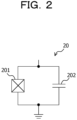
- FIG. 2 is a diagram illustrating an example of a circuit configuration of the qubit element 20.
- the qubit element 20 performs a quantum operation using nonlinear energy, and includes a transmon qubit circuit in which a superconducting Josephson device 201 and a capacitor 202 are coupled in parallel.
- the superconducting Josephson device 201 includes a pair of superconductors that exhibit superconductivity at a temperature equal to or lower than a predetermined critical temperature, and an ultrathin insulator having a thickness of about several nm sandwiched between the pair of superconductors.
- the superconductor may be, for example, aluminum, and the insulator may be, for example, aluminum oxide.
- the plurality of qubit elements 20 is coupled to other adjacent qubit elements 20 via an inter-bit wiring line 24.
- Capacitors 23 are provided in a path of the inter-bit wiring line 24.
- each of the qubit elements 20 creates a quantum entanglement state with the other adjacent qubit elements 20 and performs the quantum operation.
- the resonator 21 interacts with the qubit element 20 to read a bit signal indicating a state of the qubit element 20.
- the resonator 21 is coupled to the qubit element 20 via a capacitor (not illustrated).
- FIG. 4 is a diagram illustrating an example of a circuit configuration of the resonator 21.
- the resonator 21 includes a resonance circuit in which a superconducting inductor 211 and a capacitor 212 are coupled in parallel.
- the reading electrode 22 is an electrode that is coupled to the resonator 21 and extracts the bit signal read by the resonator 21 to outside.
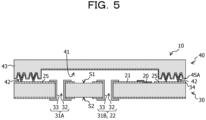
- FIG. 5 is a schematic cross-sectional view illustrating an example of the configuration of the quantum operation device 10. Note that, FIG. 5 extracts and illustrates only periphery configurations of the single qubit element 20.
- the quantum operation device 10 includes the first substrate 30 and a second substrate 40 that are laminated.
- the qubit element 20 and the resonator 21 are provided on a first surface S1 of the first substrate 30, the qubit element 20 and the resonator 21 are provided.
- Through-vias 31A and 31B are provided in the first substrate 30.
- Each of the through-vias 31A and 31B includes a through-hole 32 that passes through the first substrate 30 and a conductive film 33 that covers an inner wall of the through-hole 32.
- the conductive film 33 includes portions extending to the first surface S1 of the first substrate 30 and a second surface S2 on an opposite side to the first surface S1.
- the through-via 31A is used to supply a ground potential to the first substrate 30 and the second substrate 40.
- the through-via 31B functions as the reading electrode 22.
- an insulator or a semiconductor can be used, and for example, silicon can be suitably used.
- a conductive film 34 configuring a pad 25 and other wiring lines is provided on a surface of the first substrate 30, a conductive film 34 configuring a pad 25 and other wiring lines is provided.
- the resonator 21 may include this conductive film 34.
- the pad 25 is electrically coupled to the through-via 31A, and the ground potential is supplied from outside via the through-via 31A.
- each of the conductive film 33 forming the through-vias 31A and 31B and the conductive film 34 configuring the pad 25 and the other wiring lines be formed of metal that exhibits superconductivity at a temperature equal to or lower than a predetermined temperature.
- a material of the conductive film 34 configuring the pad 25 and the other wiring lines for example, titanium nitride (TiN) can be suitably used.
- a material of the conductive film 33 forming the through-vias 31A and 31B for example, aluminum (Al) can be suitably used.
- the second substrate 40 is laminated on a side of the first surface S1 of the first substrate 30.
- the second substrate 40 functions as a cover that covers the qubit element 20 and the resonator 21.
- the second substrate 40 includes a cavity 41 on a surface facing the first surface S1 of the first substrate 30, and a space is formed around the qubit element 20 and the resonator 21.
- the second substrate 40 includes a plurality of bumps 42 provided on an outer periphery of the cavity 41, and the plurality of bumps 42 is bonded to the pad 25 provided on the first substrate 30. Note that, in a case where it is possible to form a gap between the first substrate 30 and the second substrate 40, it is not necessary to provide the cavity 41 on the second substrate 40.
- FIG. 6A is a plan view illustrating an example of a configuration of the second substrate 40.
- FIG. 6B is a cross-sectional view taken along 6B-6B in FIG. 6A .
- the plurality of bumps 42 is arranged in a plurality of lines so as to surround the cavity 41.
- Each of the plurality of bumps 42 includes a plurality of protrusions 44 including a base material 43 of the second substrate 40 and conductive films 45A and 45B that cover a surface of each of the plurality of protrusions 44.
- the protrusion 44 is formed by micromachining the base material 43, by etching.
- an area of a cross section intersecting with a lamination direction of the first substrate 30 and the second substrate 40 (that is, height direction of bump 42) is gradually reduced toward a front end of the bump 42. That is, the protrusion 44 has a tapered shape.
- the protrusion 44 is a portion to be a core of the bump 42.
- the conductive film 45A covers an entire surface of the second substrate 40 facing the first substrate 30, including the surface of the protrusion 44.
- the conductive film 45B covers a surface of the conductive film 45A, in a formation region of the protrusion 44 of the second substrate 40. Portions of the conductive films 45A and 45B covering the protrusion 44 form the bumps 42.
- the portion of the conductive films 45A and 45B covering the protrusion 44 has a tapered shape reflecting the shape of the protrusion 44.
- the front end of the bump 42 protrudes from the surface of the base material 43, and when the second substrate 40 is stacked on the first substrate 30 in a process for bonding the second substrate 40 to the first substrate 30, the front end of the bump 42 is brought into contact with the first substrate 30.
- each of the conductive films 45A and 45B be formed of metal that exhibits superconductivity at the temperature equal to or lower than the predetermined temperature.
- a material of the conductive film 45A for example, titanium nitride (TiN) can be suitably used.
- TiN titanium nitride
- a material of the conductive film 45B for example, indium (In) can be suitably used.
- the base material 43 of the second substrate 40 an insulator or a semiconductor can be used, and for example, silicon can be suitably used. In a case where the base material 43 includes, for example, silicon, the protrusion 44 that forms the portion to be the core of the bump 42 includes silicon.
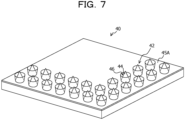
- FIG. 7 is a perspective view illustrating an example of a structure of the bump 42.
- the plurality of bumps 42 may have a conical shape. That is, the protrusion 44 formed on the base material 43 of the second substrate 40 may have a plurality of anchor structure portions.
- the plurality of bumps 42 may have a pyramid shape such as a triangular pyramid or a quadrangular pyramid.
- the base material 43 of the second substrate 40 has a plurality of recesses 46 provided around each protrusion 44.
- the plurality of recesses 46 is provided respectively corresponding to the plurality of protrusions 44.
- Each of the recesses 46 surrounds an outer periphery of the corresponding protrusion 44.
- each protrusion 44 is provided inside of the corresponding recess 46.
- the recess 46 is formed by etching a region corresponding to the periphery of the protrusion 44 of the base material 43 of the second substrate 40.
- the protrusion 44 corresponds to a remaining portion of the base material 43 without being etched, in etching for forming the recess 46.
- FIGs. 8A and 8B are cross-sectional views illustrating an example of a method for bonding the bump 42 provided on the second substrate 40 and the pad 25 provided on the first substrate 30.
- the front end of the bump 42 (conductive film 45B) is bonded to the pad 25.
- the pressing force load
- the front end of the bump 42 that is, the conductive film 45B is deformed to be crushed, and the bump 42 and the pad 25 are crimped. It is preferable to bond the bump 42 to the pad 25 at room temperature.
- the ground potential is supplied to the conductive film 45A that covers the surface of the second substrate 40.
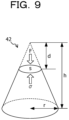
- FIG. 9 is a diagram of the modeled conical bump 42.
- a radius of a bottom surface of the bump 42 is set to r, and a height of the bump 42 is set to h.
- a stress acting on the bump 42 when a pressing force F is applied to the bump 42 is set to ⁇
- a crushing amount of the bump 42 is set to d
- a cross-sectional area of a crushed front end portion of the bump 42 is set to S.
- the stress ⁇ can be expressed by the following formula (1)
- the pressing force F can be expressed by the following formula (2).
- FIG. 10 is a graph illustrating an example of a relationship between the pressing force F to be applied to the bump 42 and the height h of the bump 42, in a case where the bump 42 is deformed so that the crushing amount d of the bump 42 is zero to 10 um. Note that it is estimated as setting an initial height of the bump 42 to 15 pm, setting the radius r of the bottom surface of the bump 42 to five um, and setting the stress ⁇ to 2.14 MPa. As illustrated in FIG. 10 , as the cross-sectional area S increases with a progress of the deformation of the bump 42, the pressing force F necessary for deforming the bump 42 increases.
- the bump 42 Since the bump 42 has a tapered shape, an area of the front end of the bump 42 can be reduced. As a result, a relatively small pressing force can deform the bump 42 with a large crushing amount. By increasing the crushing amount of the bump 42, even in a case where the heights of the bumps 42 are uneven due to manufacturing variations, it is possible to apply the pressing force (load) to all the bumps 42. That is, it is possible to reduce a risk of occurrence of bonding failures in some bumps with a relatively low height.
- the base material 43 of the second substrate 40 is prepared.
- a silicon substrate having a thickness of about 525 um can be suitably used as the base material 43 ( FIG. 11A ).
- a resist 80 having a thickness of about five um is formed on the surface of the base material 43.
- patterning corresponding to the bump 42 is performed on the resist 80 ( FIG. 11B ).
- a circular mask 80a having a diameter ⁇ 1 is formed in a portion corresponding to the protrusion 44, and an annular opening 200b having a diameter ⁇ 2 corresponding to the recess 46 is formed so as to surround a periphery of the mask 80a.
- the diameter ⁇ 1 is, for example, about 15 um
- the diameter ⁇ 2 is, for example, about 30 um.
- a distance L1 between the openings 80b adjacent to each other is, for example, 25 um.
- An inner peripheral portion of the surface of the base material 43 is covered with a mask 80c.
- the base material 43 is etched by using an inductively coupled plasma (ICP) etching device ( FIG. 11C ). It is preferable to set ICP power to be equal to or less than 2000 W, RF bias power to be equal to or less than 35 W, a chamber pressure to be equal to or less than 60 mTorr, and a gas ratio (C4F8: SF6) to 3: 7.
- ICP power is set to be equal to or less than 2000 W
- RF bias power to be equal to or less than 35 W
- a chamber pressure to be equal to or less than 60 mTorr
- a gas ratio (C4F8: SF6) to 3: 7.
- a diameter ⁇ 3 at an upper end of the recess 46 is larger than a diameter ⁇ 4 at a lower end. That is, the recess 46 having the tapered shape is formed.
- a shape of the protrusion 44 is a conical shape.
- the diameter ⁇ 3 at the upper end of the recess 46 is about 40 um, and the diameter ⁇ 4 at the lower end of the recess 46 is about 30 um.
- a depth D1 of the recess 46 is about 15 um.
- a diameter ⁇ 5 at a lower end of the protrusion 44 is about 10 um.
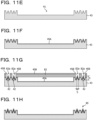
- a dry film 81 is formed on the surface of the base material 43. Subsequently, by executing the exposure and development processing on the dry film 81, an opening 81a corresponding to the cavity 41 is formed in the dry film 81 ( FIG. 11D ).
- the cavity 41 having a depth of about 300 ⁇ m is formed in the base material 43 ( FIG. 11E ).
- the etching of the base material 43 can be performed by reactive ion etching (RIE).
- RIE reactive ion etching
- a step for covering a side surface of the cavity 41 being formed with a protection film and a step for further etching a bottom surface of the cavity 41 being formed are alternately performed.
- CF gas is used in the step for covering the side surface of the cavity 41 with the protection film
- SF6 gas is used in the step for etching the bottom surface of the cavity 41.
- the conductive film 45A having a thickness of about 0.2 ⁇ m is formed on the entire surface of the base material 43 by a sputtering method ( FIG. 11F ).
- a material of the conductive film 45A titanium nitride (TiN) can be suitably used.
- a dry film 82 is formed on the surface of the base material 43. Subsequently, by executing the exposure and development processing on the dry film 82, an opening 82a corresponding to the bump 42 is formed in the dry film 82 ( FIG. 11G ).
- the opening 82a has a circular shape having a diameter of about 30 ⁇ m and is formed at a position where the bump 42 is formed.
- the conductive film 45B having a thickness of about 25 ⁇ m is formed in a portion of the surface of the conductive film 45A exposed from the opening 82a of the dry film 82, by a vapor deposition method ( FIG. 11G ).
- the conductive film 45B is also formed on the dry film 82.
- As a material of the conductive film 45B indium (In) can be suitably used.
- the conductive films 45A and 45B are formed along a surface shape of the base material 43, and are formed in a conical shape reflecting the shape of the protrusion 44 in a portion covering the protrusion 44.
- the conical bump 42 in which the protrusion 44, the conductive film 45A, and the conductive film 45B are laminated is formed on the second substrate 40.
- the dry film 82 is removed together with the conductive film 45B deposited on its surface ( FIG. 11H ). Through each process described above, the second substrate 40 is completed.
- a base material 35 of the first substrate 30 is prepared.
- a silicon substrate having a thickness of about 525 ⁇ m can be suitably used as the base material 35 ( FIG. 12A ).
- a heat dissipation substrate 90 is attached to a second surface S2 of the base material 35.
- a resist 83 is formed on a first surface S 1 of the base material 35, and openings 83a corresponding to the through-vias 31A and 31B are formed in the resist 83 ( FIG. 12B ).
- the conductive film 34 is formed on the entire first surface S1 and second surface S2 of the base material 35, by the sputtering method ( FIG. 12D ).
- a material of the conductive film 34 titanium nitride (TiN) can be suitably used.
- the conductive film 33 is formed on the entire first surface S1 and second surface S2 of the base material 35, by the vapor deposition method.
- the conductive film 34 formed in advance is covered with the conductive film 33.
- the conductive film 33 is also formed on the inner wall of the through-hole 32 ( FIG. 12E ).
- aluminum (Al) can be suitably used as a material of the conductive film 33.
- the conductive films 33 and 34 are patterned, by photolithography and etching. As a result, the through-vias 31A and 31B, the resonator 21, the pad 25, and the other wiring lines are formed ( FIG. 12F ).
- the superconducting Josephson device constituting the qubit element 20 is formed by undergoing, for example, a process of forming a first electrode (not illustrated) containing aluminum (Al) on the first surface S1 of the base material 35 by the vapor deposition method, a process of forming an ultrathin oxide film (not illustrated) having a thickness of about several nm on a surface of the first electrode, using an O 2 gas, and a process of forming a second electrode (not illustrated) containing aluminum (Al) on a surface of the oxide film by the vapor deposition method.
- Patterning for the first electrode and the second electrode may be performed by, for example, a lift-off method using a patterned resist (not illustrated).
- an opening pattern of the resist may have a cross shape including a first straight line portion along a first direction and a second straight line portion along a second direction orthogonal to the first direction, and the first electrode may be formed at a portion corresponding to the first straight line portion by performing vapor deposition while performing inclination about the first direction as a rotation axis.
- the second electrode may be formed at a portion corresponding to the second straight line portion by performing vapor deposition while performing inclination about the second direction as a rotation axis.
- patterning for the first electrode and the second electrode can be performed with a single resist. Through each process described above, the first substrate 30 is completed.
- the first substrate 30 and the second substrate 40 are housed in a vacuum chamber (not illustrated), and a bonding surface of the first substrate 30 and the second substrate 40 is irradiated with an ion beam in the vacuum chamber ( FIG. 13A ).
- a bonding surface of the first substrate 30 and the second substrate 40 is irradiated with an ion beam in the vacuum chamber ( FIG. 13A ).
- elements that hinder bonding such as an oxide film, a hydroxyl group, or water molecules, existing on the surfaces of the pad 25 and the bump 42 forming a bonding portion are removed, and the surface of the conductive film forming the pad 25 and the bump 42 is activated.
- Inert gas such as argon is used for the ion beam.
- the first substrate 30 and the second substrate 40 are bonded in the vacuum chamber. That is, in a state where the bump 42 provided on the second substrate 40 and the pad 25 provided on the first substrate 30 are brought into contact with each other, a pressing force (load) for pressing the first substrate 30 and the second substrate 40 against each other is applied. As a result, the front end of the bump 42 (conductive film 45B) is deformed to be crushed, and the bump 42 and the pad 25 are bonded. It is preferable to bond the bump 42 to the pad 25 at room temperature. Since the surface of the conductive film forming the bump 42 and the pad 25 is activated by irradiation of the ion beam, strong bonding can be obtained at room temperature (about 25°C). This approach is called surface-activated room-temperature bonding. By bonding the substrates to each other at room temperature, characteristic fluctuations associated with heating of the qubit element 20 are suppressed. Through each process described above, the quantum operation device 10 is completed.
- the quantum operation device 10 includes the first substrate 30 on which the circuit elements such as the qubit element 20 or the resonator 21 are provided and the second substrate 40 that is laminated on the first substrate 30 and covers the qubit element 20 and the resonator 21.
- the second substrate 40 includes the base material 43, and includes the bump 42 including the tapered protrusion 44 of which the area of the cross section intersecting with the lamination direction of the substrate is gradually reduced toward the front end, the tapered conductive films 45A and 45B that cover the surface of the protrusion 44 and reflect the shape of the protrusion 44.
- the bump 42 is bonded to the pad 25 on the first substrate 30.
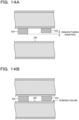
- FIGs. 14A and 14B are cross-sectional views illustrating bonding between a bump 42X and a pad 25X according to a comparative example.
- a shape of the bump 42X according to the comparative example an area of a cross section intersecting with a height direction is larger than the bump 42 according to the first embodiment, and a height of the bump is substantially constant. That is, the shape of the bump 42X is not a tapered shape. Furthermore, the heights of the bumps 42X are uneven, due to manufacturing variations.
- the pressing force is applied in a state where the bump 42X and the pad 25X are brought into contact with each other.
- the area of the cross section intersecting with the height direction is relatively large, a crushing amount of the bump 42X with respect to a predetermined pressing force decreases.
- the crushing amount of the bump 42X is small, as illustrated in FIG. 14B , the pressing force is not applied to some of the bumps 42X having a relatively low height, and there is a possibility that bonding failures occur in some of the bumps 42X having the relatively low height.
- the bump 42 included in the quantum operation device 10 according to the embodiment of the disclosed technology has a tapered shape, the area of the front end of the bump 42 can be reduced. As a result, a relatively small pressing force can deform the bump 42 with a large crushing amount.
- By increasing the crushing amount of the bump 42 even in a case where the heights of the bumps 42 are uneven due to manufacturing variations, it is possible to apply the pressing force to all the bumps. That is, it is possible to reduce a risk of occurrence of bonding failures in some bumps with a relatively low height.
- FIG. 15 is a cross-sectional view illustrating an example of a method for forming a bump 42Y according to the comparative example.
- the bump 42Y according to the comparative example does not include the protrusion 44 according to the embodiment of the disclosed technology. That is, a portion to be a core of the bump 42Y does not include the base material 43, and includes only the conductive film 45B.
- the bump 42Y according to the comparative example is formed by a lift-off method using a resist 200 having an opening 200a with a high aspect ratio. That is, the conductive film 45B forming the bump 42Y is deposited on the conductive film 45A exposed from the opening 200a of the resist 200.
- the fine opening 200a is closed by the conductive film 45B. As a result, it is difficult to form the bump with the high aspect ratio.
- the bump 42 according to the embodiment of the disclosed technology includes the tapered protrusion 44 including the base material 43 of the second substrate 40 and the tapered conductive films 45A and 45B that cover the surface of the protrusion 44 and reflect the shape of the protrusion 44. That is, the portion to be the core of the bump 42 according to the embodiment of the disclosed technology includes the base material 43.
- the base material 43 is relatively easily micromachined into a desired shape, by an existing etching technique. By forming the portion to be the core of the bump 42 by the base material 43 of the second substrate 40, it is possible to easily form the fine bump 42 with the high aspect ratio having the tapered shape.
- the portion to be the core of the bump 42 by the protrusion 44 of the base material 43, it is possible to make the protrusion 44 function as a stopper that prevents the bump 42 from being excessively crushed. Furthermore, by providing the recess 46 around the protrusion 44, it is possible to secure the strength of the bump 42.
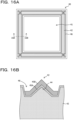
- FIG. 16A is a plan view illustrating an example of a configuration of a second substrate 40 according to a second embodiment of the disclosed technology.
- FIG. 16B is a cross-sectional view taken along 16B-16B in FIG. 16A .
- the second substrate 40 according to the second embodiment is different from the first embodiment in a structure of a bump 42.
- a protrusion 44 including a base material 43 of the second substrate 40 according to the present embodiment has an integral annular structure portion surrounding a periphery of a cavity 41. That is, on the base material 43 of the second substrate 40, the protrusion 44 having a continuous rectangular coronal shape surrounding an outer periphery of a circuit element such as a qubit element 20 or a resonator 21 provided on a first substrate 30 is provided.
- the protrusion 44 has a tapered shape of which an area of a cross section intersecting with its height direction is gradually reduced toward a front end.
- a shape of a portion of the protrusion 44 forming one side of the coronal structure may be a quadrangular pyramid.
- the second substrate 40 includes a recess 46 provided around the protrusion 44.
- the recess 46 is provided in a coronal shape along a coronal structure of the protrusion 44.
- the bump 42 has the integrated annular structure so that a space around the qubit element 20 and the resonator 21 can be sealed. By evacuating this space, adsorption of a substance to the qubit element 20 can be prevented without forming a protection film that causes a dielectric loss on a surface of the qubit element 20.
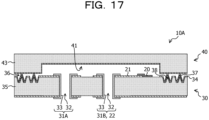
- FIG. 17 is a cross-sectional view illustrating an example of a configuration of a quantum operation device 10A according to a third embodiment of the disclosed technology.
- the quantum operation device 10A according to the third embodiment is different from the quantum operation device 10 according to the first and second embodiments in that a bump 36 forming a bonding portion between a first substrate 30 and a second substrate 40 is provided on a first substrate 30.
- the bump 36 includes a tapered protrusion 38 that includes a base material 35 of the first substrate 30 and of which an area of a cross section intersecting with a lamination direction of the first substrate 30 and the second substrate 40 is gradually reduced toward a front end.
- the bump 36 includes tapered conductive films 34 and 37 that cover a surface of the protrusion 38 and reflect a shape of the protrusion 38. According to the quantum operation device 10A according to the third embodiment, it is possible to suppress bonding failures of the bump, similarly to the quantum operation device 10 according to the first embodiment.
- the disclosed technology is applied to the quantum operation device 10 including the qubit element 20.
- the disclosed technology is not limited to this aspect. It is possible to apply the disclosed technology to an electronic device including a circuit element other than a superconducting device such as a transistor, a resistance element, or a capacitor.
Landscapes
- Engineering & Computer Science (AREA)
- General Physics & Mathematics (AREA)
- Theoretical Computer Science (AREA)
- Physics & Mathematics (AREA)
- Mathematical Analysis (AREA)
- Computing Systems (AREA)
- Evolutionary Computation (AREA)
- Condensed Matter Physics & Semiconductors (AREA)
- Computational Mathematics (AREA)
- Mathematical Optimization (AREA)
- Pure & Applied Mathematics (AREA)
- Data Mining & Analysis (AREA)
- General Engineering & Computer Science (AREA)
- Mathematical Physics (AREA)
- Software Systems (AREA)
- Artificial Intelligence (AREA)
- Manufacturing & Machinery (AREA)
- Wire Bonding (AREA)
- Internal Circuitry In Semiconductor Integrated Circuit Devices (AREA)
Applications Claiming Priority (1)
| Application Number | Priority Date | Filing Date | Title |
|---|---|---|---|
| PCT/JP2022/005649 WO2023152961A1 (ja) | 2022-02-14 | 2022-02-14 | 電子装置及び電子装置の製造方法 |
Publications (2)
| Publication Number | Publication Date |
|---|---|
| EP4482284A1 true EP4482284A1 (de) | 2024-12-25 |
| EP4482284A4 EP4482284A4 (de) | 2025-04-30 |
Family
ID=87564009
Family Applications (1)
| Application Number | Title | Priority Date | Filing Date |
|---|---|---|---|
| EP22925980.9A Pending EP4482284A4 (de) | 2022-02-14 | 2022-02-14 | Elektronische vorrichtung und verfahren zur herstellung einer elektronischen vorrichtung |
Country Status (4)
| Country | Link |
|---|---|
| US (1) | US20240389478A1 (de) |
| EP (1) | EP4482284A4 (de) |
| JP (1) | JP7750315B2 (de) |
| WO (1) | WO2023152961A1 (de) |
Families Citing this family (1)
| Publication number | Priority date | Publication date | Assignee | Title |
|---|---|---|---|---|
| JPWO2025046715A1 (de) * | 2023-08-28 | 2025-03-06 |
Family Cites Families (9)
| Publication number | Priority date | Publication date | Assignee | Title |
|---|---|---|---|---|
| JPH11163204A (ja) * | 1997-11-28 | 1999-06-18 | Fujitsu Ltd | 半導体装置及びその実装構造 |
| JP2000306952A (ja) * | 1999-04-20 | 2000-11-02 | Nitto Denko Corp | 実装用配線基板およびその製造方法 |
| JP4180331B2 (ja) * | 2001-10-30 | 2008-11-12 | 大日本印刷株式会社 | プリント配線基板、プリント配線基板用レリーフパターン付金属板、及び、プリント配線基板の製造方法 |
| WO2005097396A1 (ja) * | 2004-04-08 | 2005-10-20 | Matsushita Electric Industrial Co., Ltd. | 接合方法及びその装置 |
| JP2009231721A (ja) * | 2008-03-25 | 2009-10-08 | Toppan Printing Co Ltd | 半導体装置とその製造方法 |
| CA3036945C (en) | 2016-09-14 | 2023-10-03 | Google Llc | Reducing dissipation and frequency noise in quantum devices using a local vacuum cavity |
| US10692795B2 (en) | 2018-11-13 | 2020-06-23 | International Business Machines Corporation | Flip chip assembly of quantum computing devices |
| US10692831B1 (en) * | 2019-02-21 | 2020-06-23 | International Business Machines Corporation | Stud bumps for post-measurement qubit frequency modification |
| US10944039B2 (en) | 2019-06-19 | 2021-03-09 | International Business Machines Corporation | Fabricating transmon qubit flip-chip structures for quantum computing devices |
-
2022
- 2022-02-14 EP EP22925980.9A patent/EP4482284A4/de active Pending
- 2022-02-14 WO PCT/JP2022/005649 patent/WO2023152961A1/ja not_active Ceased
- 2022-02-14 JP JP2023580031A patent/JP7750315B2/ja active Active
-
2024
- 2024-07-25 US US18/784,252 patent/US20240389478A1/en active Pending
Also Published As
| Publication number | Publication date |
|---|---|
| WO2023152961A1 (ja) | 2023-08-17 |
| EP4482284A4 (de) | 2025-04-30 |
| US20240389478A1 (en) | 2024-11-21 |
| JPWO2023152961A1 (de) | 2023-08-17 |
| JP7750315B2 (ja) | 2025-10-07 |
Similar Documents
| Publication | Publication Date | Title |
|---|---|---|
| JP7457078B2 (ja) | 正確なチップ間分離のためのストッパとしてのピラー | |
| KR100213606B1 (ko) | 반도체장치 및 그 본딩패드구조 | |
| KR910006967B1 (ko) | 반도체 장치의 범프 전극 구조 및 그 형성 방법 | |
| US7833830B2 (en) | 3D interconnect with protruding contacts | |
| JP5405322B2 (ja) | トレンチコンデンサを備えた半導体装置とその製造方法 | |
| KR102951009B1 (ko) | 플립 칩 양자 컴퓨팅 디바이스들을 위한 큐비트 주파수 튜닝 구조들 및 제조 방법들 | |
| JP2021504935A (ja) | 量子ビット(キュービット)フリップ・チップ・アセンブリを形成するための方法およびフリップ・チップ装置 | |
| US20240389478A1 (en) | Electronic device and method for manufacturing electronic device | |
| EP3987576B1 (de) | Herstellung von transmon-qubit-flipchip-strukturen für quantenberechnungsvorrichtungen | |
| JP2006303401A (ja) | バンプの形成方法及び構造 | |
| TWI281234B (en) | Multilayer wiring board and its manufacturing method | |
| US5548118A (en) | Hybrid integrated circuit | |
| KR100350936B1 (ko) | 반도체 장치 | |
| US11289638B2 (en) | Superconducting qubit lifetime and coherence improvement via backside etching | |
| TWI607535B (zh) | 重配置線路結構及其製作方法 | |
| JP2004095885A (ja) | 半導体装置及びその製造方法 | |
| EP4590108B1 (de) | Verfahren zur herstellung einer qubit-vorrichtung | |
| EP4200906A2 (de) | Kombinierte trägerplatte und gehäuse zur verwendung in einer höckergebundenen chipanordnung | |
| US20220115348A1 (en) | 3d modified surface to enable improved bond strength and yield of electrical interconnections | |
| US20230126725A1 (en) | Method of preparing radio frequency filter | |
| US20260005144A1 (en) | Device comprising a metallic wire and fabrication process of the device | |
| EP4645178B1 (de) | Ionenfallenherstellungsverfahren | |
| EP4694659A1 (de) | Verfahren zur herstellung einer quantenvorrichtung und quantenvorrichtung | |
| EP4654808A1 (de) | Vorrichtung und verfahren zur herstellung einer vorrichtung | |
| JP2005175231A (ja) | 半導体装置およびその製造方法 |
Legal Events
| Date | Code | Title | Description |
|---|---|---|---|
| STAA | Information on the status of an ep patent application or granted ep patent |
Free format text: STATUS: THE INTERNATIONAL PUBLICATION HAS BEEN MADE |
|
| PUAI | Public reference made under article 153(3) epc to a published international application that has entered the european phase |
Free format text: ORIGINAL CODE: 0009012 |
|
| STAA | Information on the status of an ep patent application or granted ep patent |
Free format text: STATUS: REQUEST FOR EXAMINATION WAS MADE |
|
| 17P | Request for examination filed |
Effective date: 20240725 |
|
| AK | Designated contracting states |
Kind code of ref document: A1 Designated state(s): AL AT BE BG CH CY CZ DE DK EE ES FI FR GB GR HR HU IE IS IT LI LT LU LV MC MK MT NL NO PL PT RO RS SE SI SK SM TR |
|
| REG | Reference to a national code |
Ref country code: DE Ref legal event code: R079 Free format text: PREVIOUS MAIN CLASS: H10N0060100000 Ipc: H01L0023000000 |
|
| A4 | Supplementary search report drawn up and despatched |
Effective date: 20250328 |
|
| RIC1 | Information provided on ipc code assigned before grant |
Ipc: B82Y 10/00 20110101ALN20250324BHEP Ipc: H10N 69/00 20230101ALI20250324BHEP Ipc: H10N 60/81 20230101ALI20250324BHEP Ipc: H10N 60/01 20230101ALI20250324BHEP Ipc: H10N 60/00 20230101ALI20250324BHEP Ipc: G06N 10/40 20220101ALI20250324BHEP Ipc: G06N 10/20 20220101ALI20250324BHEP Ipc: H01L 23/00 20060101AFI20250324BHEP |
|
| DAV | Request for validation of the european patent (deleted) | ||
| DAX | Request for extension of the european patent (deleted) |