EP4480946A1 - Salts for use in electrolyte compositions or as electrode additives - Google Patents
Salts for use in electrolyte compositions or as electrode additives Download PDFInfo
- Publication number
- EP4480946A1 EP4480946A1 EP24185244.1A EP24185244A EP4480946A1 EP 4480946 A1 EP4480946 A1 EP 4480946A1 EP 24185244 A EP24185244 A EP 24185244A EP 4480946 A1 EP4480946 A1 EP 4480946A1
- Authority
- EP
- European Patent Office
- Prior art keywords
- compound
- alkyl
- optionally substituted
- electrode
- aryl
- Prior art date
- Legal status (The legal status is an assumption and is not a legal conclusion. Google has not performed a legal analysis and makes no representation as to the accuracy of the status listed.)
- Pending
Links
Classifications
-
- C—CHEMISTRY; METALLURGY
- C07—ORGANIC CHEMISTRY
- C07C—ACYCLIC OR CARBOCYCLIC COMPOUNDS
- C07C311/00—Amides of sulfonic acids, i.e. compounds having singly-bound oxygen atoms of sulfo groups replaced by nitrogen atoms, not being part of nitro or nitroso groups
- C07C311/50—Compounds containing any of the groups, X being a hetero atom, Y being any atom
- C07C311/51—Y being a hydrogen or a carbon atom
-
- C—CHEMISTRY; METALLURGY
- C07—ORGANIC CHEMISTRY
- C07D—HETEROCYCLIC COMPOUNDS
- C07D207/00—Heterocyclic compounds containing five-membered rings not condensed with other rings, with one nitrogen atom as the only ring hetero atom
- C07D207/02—Heterocyclic compounds containing five-membered rings not condensed with other rings, with one nitrogen atom as the only ring hetero atom with only hydrogen or carbon atoms directly attached to the ring nitrogen atom
- C07D207/44—Heterocyclic compounds containing five-membered rings not condensed with other rings, with one nitrogen atom as the only ring hetero atom with only hydrogen or carbon atoms directly attached to the ring nitrogen atom having three double bonds between ring members or between ring members and non-ring members
- C07D207/444—Heterocyclic compounds containing five-membered rings not condensed with other rings, with one nitrogen atom as the only ring hetero atom with only hydrogen or carbon atoms directly attached to the ring nitrogen atom having three double bonds between ring members or between ring members and non-ring members having two doubly-bound oxygen atoms directly attached in positions 2 and 5
- C07D207/448—Heterocyclic compounds containing five-membered rings not condensed with other rings, with one nitrogen atom as the only ring hetero atom with only hydrogen or carbon atoms directly attached to the ring nitrogen atom having three double bonds between ring members or between ring members and non-ring members having two doubly-bound oxygen atoms directly attached in positions 2 and 5 with only hydrogen atoms or radicals containing only hydrogen and carbon atoms directly attached to other ring carbon atoms, e.g. maleimide
-
- C—CHEMISTRY; METALLURGY
- C07—ORGANIC CHEMISTRY
- C07D—HETEROCYCLIC COMPOUNDS
- C07D207/00—Heterocyclic compounds containing five-membered rings not condensed with other rings, with one nitrogen atom as the only ring hetero atom
- C07D207/02—Heterocyclic compounds containing five-membered rings not condensed with other rings, with one nitrogen atom as the only ring hetero atom with only hydrogen or carbon atoms directly attached to the ring nitrogen atom
- C07D207/44—Heterocyclic compounds containing five-membered rings not condensed with other rings, with one nitrogen atom as the only ring hetero atom with only hydrogen or carbon atoms directly attached to the ring nitrogen atom having three double bonds between ring members or between ring members and non-ring members
- C07D207/444—Heterocyclic compounds containing five-membered rings not condensed with other rings, with one nitrogen atom as the only ring hetero atom with only hydrogen or carbon atoms directly attached to the ring nitrogen atom having three double bonds between ring members or between ring members and non-ring members having two doubly-bound oxygen atoms directly attached in positions 2 and 5
- C07D207/448—Heterocyclic compounds containing five-membered rings not condensed with other rings, with one nitrogen atom as the only ring hetero atom with only hydrogen or carbon atoms directly attached to the ring nitrogen atom having three double bonds between ring members or between ring members and non-ring members having two doubly-bound oxygen atoms directly attached in positions 2 and 5 with only hydrogen atoms or radicals containing only hydrogen and carbon atoms directly attached to other ring carbon atoms, e.g. maleimide
- C07D207/452—Heterocyclic compounds containing five-membered rings not condensed with other rings, with one nitrogen atom as the only ring hetero atom with only hydrogen or carbon atoms directly attached to the ring nitrogen atom having three double bonds between ring members or between ring members and non-ring members having two doubly-bound oxygen atoms directly attached in positions 2 and 5 with only hydrogen atoms or radicals containing only hydrogen and carbon atoms directly attached to other ring carbon atoms, e.g. maleimide with hydrocarbon radicals, substituted by hetero atoms, directly attached to the ring nitrogen atom
-
- C—CHEMISTRY; METALLURGY
- C07—ORGANIC CHEMISTRY
- C07D—HETEROCYCLIC COMPOUNDS
- C07D233/00—Heterocyclic compounds containing 1,3-diazole or hydrogenated 1,3-diazole rings, not condensed with other rings
- C07D233/54—Heterocyclic compounds containing 1,3-diazole or hydrogenated 1,3-diazole rings, not condensed with other rings having two double bonds between ring members or between ring members and non-ring members
- C07D233/66—Heterocyclic compounds containing 1,3-diazole or hydrogenated 1,3-diazole rings, not condensed with other rings having two double bonds between ring members or between ring members and non-ring members with hetero atoms or with carbon atoms having three bonds to hetero atoms with at the most one bond to halogen, e.g. ester or nitrile radicals, directly attached to ring carbon atoms
- C07D233/72—Two oxygen atoms, e.g. hydantoin
-
- C—CHEMISTRY; METALLURGY
- C07—ORGANIC CHEMISTRY
- C07D—HETEROCYCLIC COMPOUNDS
- C07D233/00—Heterocyclic compounds containing 1,3-diazole or hydrogenated 1,3-diazole rings, not condensed with other rings
- C07D233/54—Heterocyclic compounds containing 1,3-diazole or hydrogenated 1,3-diazole rings, not condensed with other rings having two double bonds between ring members or between ring members and non-ring members
- C07D233/66—Heterocyclic compounds containing 1,3-diazole or hydrogenated 1,3-diazole rings, not condensed with other rings having two double bonds between ring members or between ring members and non-ring members with hetero atoms or with carbon atoms having three bonds to hetero atoms with at the most one bond to halogen, e.g. ester or nitrile radicals, directly attached to ring carbon atoms
- C07D233/90—Carbon atoms having three bonds to hetero atoms with at the most one bond to halogen, e.g. ester or nitrile radicals
-
- C—CHEMISTRY; METALLURGY
- C07—ORGANIC CHEMISTRY
- C07D—HETEROCYCLIC COMPOUNDS
- C07D233/00—Heterocyclic compounds containing 1,3-diazole or hydrogenated 1,3-diazole rings, not condensed with other rings
- C07D233/96—Heterocyclic compounds containing 1,3-diazole or hydrogenated 1,3-diazole rings, not condensed with other rings having three double bonds between ring members or between ring members and non-ring members
-
- C—CHEMISTRY; METALLURGY
- C07—ORGANIC CHEMISTRY
- C07D—HETEROCYCLIC COMPOUNDS
- C07D239/00—Heterocyclic compounds containing 1,3-diazine or hydrogenated 1,3-diazine rings
- C07D239/02—Heterocyclic compounds containing 1,3-diazine or hydrogenated 1,3-diazine rings not condensed with other rings
- C07D239/24—Heterocyclic compounds containing 1,3-diazine or hydrogenated 1,3-diazine rings not condensed with other rings having three or more double bonds between ring members or between ring members and non-ring members
- C07D239/28—Heterocyclic compounds containing 1,3-diazine or hydrogenated 1,3-diazine rings not condensed with other rings having three or more double bonds between ring members or between ring members and non-ring members with hetero atoms or with carbon atoms having three bonds to hetero atoms with at the most one bond to halogen, directly attached to ring carbon atoms
- C07D239/46—Two or more oxygen, sulphur or nitrogen atoms
- C07D239/52—Two oxygen atoms
- C07D239/54—Two oxygen atoms as doubly bound oxygen atoms or as unsubstituted hydroxy radicals
-
- C—CHEMISTRY; METALLURGY
- C07—ORGANIC CHEMISTRY
- C07D—HETEROCYCLIC COMPOUNDS
- C07D239/00—Heterocyclic compounds containing 1,3-diazine or hydrogenated 1,3-diazine rings
- C07D239/02—Heterocyclic compounds containing 1,3-diazine or hydrogenated 1,3-diazine rings not condensed with other rings
- C07D239/24—Heterocyclic compounds containing 1,3-diazine or hydrogenated 1,3-diazine rings not condensed with other rings having three or more double bonds between ring members or between ring members and non-ring members
- C07D239/28—Heterocyclic compounds containing 1,3-diazine or hydrogenated 1,3-diazine rings not condensed with other rings having three or more double bonds between ring members or between ring members and non-ring members with hetero atoms or with carbon atoms having three bonds to hetero atoms with at the most one bond to halogen, directly attached to ring carbon atoms
- C07D239/46—Two or more oxygen, sulphur or nitrogen atoms
- C07D239/52—Two oxygen atoms
- C07D239/54—Two oxygen atoms as doubly bound oxygen atoms or as unsubstituted hydroxy radicals
- C07D239/545—Two oxygen atoms as doubly bound oxygen atoms or as unsubstituted hydroxy radicals with other hetero atoms or with carbon atoms having three bonds to hetero atoms with at the most one bond to halogen, directly attached to ring carbon atoms
-
- C—CHEMISTRY; METALLURGY
- C07—ORGANIC CHEMISTRY
- C07D—HETEROCYCLIC COMPOUNDS
- C07D403/00—Heterocyclic compounds containing two or more hetero rings, having nitrogen atoms as the only ring hetero atoms, not provided for by group C07D401/00
- C07D403/02—Heterocyclic compounds containing two or more hetero rings, having nitrogen atoms as the only ring hetero atoms, not provided for by group C07D401/00 containing two hetero rings
- C07D403/04—Heterocyclic compounds containing two or more hetero rings, having nitrogen atoms as the only ring hetero atoms, not provided for by group C07D401/00 containing two hetero rings directly linked by a ring-member-to-ring-member bond
-
- H—ELECTRICITY
- H01—ELECTRIC ELEMENTS
- H01M—PROCESSES OR MEANS, e.g. BATTERIES, FOR THE DIRECT CONVERSION OF CHEMICAL ENERGY INTO ELECTRICAL ENERGY
- H01M10/00—Secondary cells; Manufacture thereof
- H01M10/05—Accumulators with non-aqueous electrolyte
- H01M10/052—Li-accumulators
-
- H—ELECTRICITY
- H01—ELECTRIC ELEMENTS
- H01M—PROCESSES OR MEANS, e.g. BATTERIES, FOR THE DIRECT CONVERSION OF CHEMICAL ENERGY INTO ELECTRICAL ENERGY
- H01M10/00—Secondary cells; Manufacture thereof
- H01M10/05—Accumulators with non-aqueous electrolyte
- H01M10/052—Li-accumulators
- H01M10/0525—Rocking-chair batteries, i.e. batteries with lithium insertion or intercalation in both electrodes; Lithium-ion batteries
-
- H—ELECTRICITY
- H01—ELECTRIC ELEMENTS
- H01M—PROCESSES OR MEANS, e.g. BATTERIES, FOR THE DIRECT CONVERSION OF CHEMICAL ENERGY INTO ELECTRICAL ENERGY
- H01M10/00—Secondary cells; Manufacture thereof
- H01M10/05—Accumulators with non-aqueous electrolyte
- H01M10/056—Accumulators with non-aqueous electrolyte characterised by the materials used as electrolytes, e.g. mixed inorganic/organic electrolytes
- H01M10/0564—Accumulators with non-aqueous electrolyte characterised by the materials used as electrolytes, e.g. mixed inorganic/organic electrolytes the electrolyte being constituted of organic materials only
- H01M10/0566—Liquid materials
- H01M10/0567—Liquid materials characterised by the additives
-
- H—ELECTRICITY
- H01—ELECTRIC ELEMENTS
- H01M—PROCESSES OR MEANS, e.g. BATTERIES, FOR THE DIRECT CONVERSION OF CHEMICAL ENERGY INTO ELECTRICAL ENERGY
- H01M10/00—Secondary cells; Manufacture thereof
- H01M10/05—Accumulators with non-aqueous electrolyte
- H01M10/056—Accumulators with non-aqueous electrolyte characterised by the materials used as electrolytes, e.g. mixed inorganic/organic electrolytes
- H01M10/0564—Accumulators with non-aqueous electrolyte characterised by the materials used as electrolytes, e.g. mixed inorganic/organic electrolytes the electrolyte being constituted of organic materials only
- H01M10/0566—Liquid materials
- H01M10/0569—Liquid materials characterised by the solvents
-
- H—ELECTRICITY
- H01—ELECTRIC ELEMENTS
- H01M—PROCESSES OR MEANS, e.g. BATTERIES, FOR THE DIRECT CONVERSION OF CHEMICAL ENERGY INTO ELECTRICAL ENERGY
- H01M10/00—Secondary cells; Manufacture thereof
- H01M10/42—Methods or arrangements for servicing or maintenance of secondary cells or secondary half-cells
- H01M10/4235—Safety or regulating additives or arrangements in electrodes, separators or electrolyte
-
- H—ELECTRICITY
- H01—ELECTRIC ELEMENTS
- H01M—PROCESSES OR MEANS, e.g. BATTERIES, FOR THE DIRECT CONVERSION OF CHEMICAL ENERGY INTO ELECTRICAL ENERGY
- H01M4/00—Electrodes
- H01M4/02—Electrodes composed of, or comprising, active material
- H01M4/13—Electrodes for accumulators with non-aqueous electrolyte, e.g. for lithium-accumulators; Processes of manufacture thereof
-
- H—ELECTRICITY
- H01—ELECTRIC ELEMENTS
- H01M—PROCESSES OR MEANS, e.g. BATTERIES, FOR THE DIRECT CONVERSION OF CHEMICAL ENERGY INTO ELECTRICAL ENERGY
- H01M4/00—Electrodes
- H01M4/02—Electrodes composed of, or comprising, active material
- H01M4/36—Selection of substances as active materials, active masses, active liquids
- H01M4/60—Selection of substances as active materials, active masses, active liquids of organic compounds
-
- H—ELECTRICITY
- H01—ELECTRIC ELEMENTS
- H01M—PROCESSES OR MEANS, e.g. BATTERIES, FOR THE DIRECT CONVERSION OF CHEMICAL ENERGY INTO ELECTRICAL ENERGY
- H01M4/00—Electrodes
- H01M4/02—Electrodes composed of, or comprising, active material
- H01M4/62—Selection of inactive substances as ingredients for active masses, e.g. binders, fillers
-
- H—ELECTRICITY
- H01—ELECTRIC ELEMENTS
- H01M—PROCESSES OR MEANS, e.g. BATTERIES, FOR THE DIRECT CONVERSION OF CHEMICAL ENERGY INTO ELECTRICAL ENERGY
- H01M2220/00—Batteries for particular applications
- H01M2220/20—Batteries in motive systems, e.g. vehicle, ship, plane
-
- Y—GENERAL TAGGING OF NEW TECHNOLOGICAL DEVELOPMENTS; GENERAL TAGGING OF CROSS-SECTIONAL TECHNOLOGIES SPANNING OVER SEVERAL SECTIONS OF THE IPC; TECHNICAL SUBJECTS COVERED BY FORMER USPC CROSS-REFERENCE ART COLLECTIONS [XRACs] AND DIGESTS
- Y02—TECHNOLOGIES OR APPLICATIONS FOR MITIGATION OR ADAPTATION AGAINST CLIMATE CHANGE
- Y02E—REDUCTION OF GREENHOUSE GAS [GHG] EMISSIONS, RELATED TO ENERGY GENERATION, TRANSMISSION OR DISTRIBUTION
- Y02E60/00—Enabling technologies; Technologies with a potential or indirect contribution to GHG emissions mitigation
- Y02E60/10—Energy storage using batteries
Definitions
- the technical field generally relates to salts for use in electrolyte compositions or as additive in electrode material, and to methods for the preparation.
- the technical field also relates to electrolyte compositions and electrode materials containing such salts and to batteries containing them.
- Battery electrolytes being either liquid, gel or solid, generally consists in one or more lithium salts dissolved in a solvent and/or a solvating polymer. Additives may also further be added to improve the electrolyte's properties, e.g. its stability. Some of these salts may also be included in an electrode material to improve ionic conductivity of the material.
- LiPF 6 lithium hexafluorophosphate
- HF hydrofluoric acid
- LiFSI and LiTFSI as well as LiTDI.
- These salts also have their own drawbacks.
- the TFSI anion is very reactive and often leads to the corrosion of the aluminum current collector even at low voltage.
- Both LiFSI and LiTFSI are not recommended for high voltage applications and are expensive.
- LiTDI is more stable than the other two but is very hygroscopic and has conductivity and solubility issues.
- a compound for instance a salt, for use in electrolyte compositions and/or as additive in electrode materials.
- the compound is as defined in Formula I: wherein,
- R 3 is NHSO 2 R 4 .
- R 3 is NHSO 2 OR 4 .
- R 4 is a C 1-6 alkyl substituted with at least one of fluorine and alkoxy, or R 4 is a C 6 aryl substituted with at least one fluorine atom.
- R 3 is a heterocycle.
- at least one of R 1 and R 2 is CN, or both of R 1 and R 2 are CN.
- the compound of Formula I is compound is selected from: or a tautomer thereof.
- the compound is as defined in Formula II: wherein,
- R 5 is an unsubstituted C 1-6 alkyl group. In another embodiment, R 5 is a fluorinated C 1-6 alkyl group. In a further embodiment, R 6 is a fluorinated C 1 - 6 alkyl group. In yet another embodiment, R 6 is a fluorinated C 6 aryl group. In yet another embodiment, at least one of R 5 and R 6 is an optionally substituted C 6 aryl group (e.g. a C 6 aryl group substituted with one or more fluorine atoms). In other embodiments, the compound is of Formula II, provided that when R 6 is trifluoromethyl, then R 5 is other than methyl or trifluoromethyl.
- the compound of Formula II is compound is selected from: or a tautomer thereof.
- the compound is as defined in Formula III: wherein,
- R 7 is a fluorine atom. In another embodiment, R 7 is selected from fluorine substituted C 1-6 alkyl groups. In a further embodiment, L 1 is a covalent bond or L 1 is a linker selected from optionally substituted C 6 aryl groups.
- the compound of Formula III is compound is selected from: or a tautomer thereof.
- the compound is as defined in Formula IV: wherein,
- X 1 is a carbon atom.
- R 8 and R 9 are different. Alternatively, R 8 and R 9 are the same.
- at least one of R 8 and R 9 is CN or optionally substituted C 1-6 alkyl.
- R 8 and R 9 are both CN or optionally substituted C 1-6 alkyl, or R 8 and R 9 are both CN, or R 8 and R 9 are both fluorine substituted C 1-6 alkyl.
- X 1 is a nitrogen atom.
- R 9 is a fluorine substituted SO 2 Alkyl (e.g. SO 2 CF 3 ).
- m is 0. In a further embodiment m is 1.
- the compound of Formula IV is compound is selected from: or a tautomer thereof.
- the compound is as defined in Formula V:
- R 1 and R 2 are CN.
- both of R 1 and R 2 are CN.
- X 1 is a carbon atom.
- X 1 is a carbon atom and R 8 and R 9 are both CN or optionally substituted C 1-6 alkyl, or X 1 is a carbon atom and R 8 and R 9 are both CN, or X 1 is a carbon atom and R 8 and R 9 are both fluorine substituted C 1-6 alkyl.
- X 1 is a nitrogen atom.
- X 1 is a nitrogen atom and R 9 is a fluorine substituted SO 2 Alkyl (e.g. SO 2 CF 3 ).
- the compound of Formula V is compound is selected from: or a tautomer thereof.
- a compound according to any one of the foregoing embodiments wherein M is Li and n is 1.
- the compound is as herein defined and is a di-salt (e.g. a dianion forming a salt with two alkali metal anions, where applicable).
- the compounds of Formulae I, IV and V the compound may include a further anion on a second nitrogen atom.
- Compounds E1 to E4 may form a disalt, such as, for compound E2:
- the present technology relates to an electrode material comprising, as an additive, a compound as herein defined, and at least one electrochemically active material.
- the present technology relates to an electrolyte composition
- an electrolyte composition comprising a compound as herein described.
- the electrolyte composition further comprises a compatible solvent.
- the electrolyte composition further comprises a compatible solvating polymer.
- an electrochemical cell comprising an electrolyte, an electrode and a counter-electrode, wherein at least one of the electrode or counter-electrode comprises an electrode material comprising, as an additive, a compound as herein defined, and at least one electrochemically active material.
- an electrochemical cell which comprises an electrolyte composition comprising a compound as herein defined, an electrode and a counter-electrode.
- the electrochemical cell comprises a compound as herein defined in an electrolyte composition and in at least one electrode material.
- electrochemical cell is included in a battery, an electrochromic device, or a capacitor.
- the battery is a lithium or lithium-ion battery. In other examples, the battery is a sodium or potassium battery.
- electrochemical cell as herein defined in electrical or hybrid vehicles, or in ubiquitous IT devices.
- the compound may be as defined in Formula I: wherein,
- R 3 is NHSO 2 R 4 , or R 3 is NHSO 2 OR 4 .
- R 3 is NHSO 2 R 4 or NHSO 2 OR 4 and R 4 is a C 1-6 alkyl substituted with at least one of fluorine and alkoxy, or R 4 is a C 6 aryl substituted with at least one fluorine atom.
- R 3 is a C 5-6 heterocycle (e.g. a non-aromatic C 5-6 heterocycle linked through a nitrogen atom, such as a maleimide).
- at least one of R 1 and R 2 is CN, or both of R 1 and R 2 are CN.
- Examples of compounds of Formula I include, without limitation, Compounds A1 to A5 a defined above, or a tautomer thereof.
- the compound may also be defined as in Formula II: wherein,
- R 5 is an unsubstituted C 1-6 alkyl group (such as methyl, ethyl, propyl, isopropyl and the like), or R 5 is a fluorinated C 1-6 alkyl group (e.g. trifluoromethyl, and the like).
- R 6 is a fluorinated C 1-6 alkyl group (e.g. trifluoromethyl, and the like) or R 6 is a fluorinated C 6 aryl group (e.g. pentafluorophenyl, and the like).
- Other examples include compounds of Formula II wherein at least one of R 5 and R 6 is an optionally substituted C 6 aryl group.
- the compound is of Formula II, provided that when R 6 is trifluoromethyl, then R 5 is other than methyl or trifluoromethyl.
- Examples of compounds of Formula II include, without limitation, Compounds B1 to B4, as herein defined, or a tautomer thereof.
- the compound is Compounds B3 or B4, as herein defined, or a tautomer thereof.
- the compound may also be as defined in Formula III: wherein,
- R 7 is a fluorine atom or R 7 is selected from fluorine substituted C 1 - 6 alkyl groups.
- L 1 is a covalent bond.
- L 1 is a linker selected from optionally substituted C 6 aryl groups.
- Examples of compounds of Formula III include, without limitation, Compounds C1 to C4, as herein defined, or a tautomer thereof.
- the compound may further be defined as in Formula IV: wherein,
- X 1 is a carbon atom.
- R 8 and R 9 may be the same or different.
- X 1 is a carbon atom and at least one of R 8 and R 9 is CN or optionally substituted C 1-6 alkyl.
- X 1 is a carbon atom and R 8 and R 9 are both CN or optionally substituted C 1-6 alkyl, or R 8 and R 9 are both CN, or R 8 and R 9 are both fluorine substituted C 1-6 alkyl.
- X 1 is a nitrogen atom.
- X 1 is a nitrogen atom, R 8 is absent and R 9 is a fluorine substituted SO 2 Alkyl (e.g. SO 2 CF 3 ).
- m is 0.
- m is 1.
- Examples of compounds of Formula IV include, without limitation, Compounds D1 to D6, as herein defined, or a tautomer thereof.
- the compound may also further be defined as in Formula V:
- R 1 and R 2 are CN, or both of R 1 and R 2 are CN.
- X 1 is a carbon atom.
- X 1 is a carbon atom and R 8 and R 9 are both CN or optionally substituted C 1-6 alkyl, or X 1 is a carbon atom and R 8 and R 9 are both CN, or X 1 is a carbon atom and R 8 and R 9 are both fluorine substituted C 1-6 alkyl.
- X 1 is a nitrogen atom.
- X 1 is a nitrogen atom and R 9 is a fluorine substituted SO 2 Alkyl (e.g. SO 2 CF 3 ).
- Examples of compounds of Formula V include, without limitation, Compounds E1 to E4, as herein defined, or a tautomer thereof.
- the compound is as defined in any one of Formulae I to V, wherein M is Li and n is 1.
- the compound is as herein defined and is a di-salt (e.g. a dianion forming a salt with two alkali metal anions, where applicable).
- the compounds of Formulae I, IV and V the compound may include a further anion on a second nitrogen atom. Further contemplated are the free forms of any of the salts referred to herein.
- alkyl refers to saturated hydrocarbons having from one to sixteen carbon atoms, including linear or branched alkyl groups.
- alkyl groups include, without limitation, methyl, ethyl, propyl, butyl, pentyl, hexyl, heptyl, octyl, nonyl, decyl, isopropyl, tert -butyl, sec -butyl, isobutyl, and the like.
- alkyl group is located between two functional groups, then the term alkyl also encompasses alkylene groups such as methylene, ethylene, propylene, and the like.
- C 1 -C n alkyl refers to an alkyl group having from 1 to the indicated "n" number of carbon atoms.
- alkoxy as used herein means an alkyl group having an oxygen atom attached thereto.
- Representative alkoxy groups include groups having 1 to about 6 carbon atoms, e.g., methoxy, ethoxy, propoxy, tert -butoxy and the like.
- Examples of alkoxy groups include methoxy, ethoxy, isopropyloxy, propoxy, butoxy, pentoxy, fluoromethoxy, difluoromethoxy, trifluoromethoxy, chloromethoxy, dichloromethoxy, trichloromethoxy groups and the like.
- alkoxy includes both unsubstituted or substituted alkoxy groups, etc., as well as halogenated alkyloxy groups.
- aryl refers to aromatic groups having 4n+2 ⁇ (pi) electrons, wherein n is an integer from 1 to 3, in a conjugated monocyclic or polycyclic system (fused or not) and having six to fourteen ring atoms.
- a polycyclic ring system includes at least one aromatic ring.
- Aryl may be directly attached, or connected via a C 1 -C 3 alkyl group (also referred to as arylalkyl or aralkyl).
- aryl groups include, without limitation, phenyl, benzyl, phenethyl, 1-phenylethyl, tolyl, naphthyl, biphenyl, terphenyl, indenyl, benzocyclooctenyl, benzocycloheptenyl, azulenyl, acenaphthylenyl, fluorenyl, phenanthrenyl, anthracenyl, and the like.
- aryl includes both unsubstituted aryl groups and substituted aryl groups.
- C 6 -C n aryl refers to an aryl group having from 6 to the indicated "n" number of carbons in the ring structure.
- heterocycle or “heterocyclic” include heterocycloalkyl and heteroaryl groups.
- heterocycles include, without limitation, acridinyl, azocinyl, benzimidazolyl, benzofuranyl, benzothiofuranyl, benzothiophenyl, benzoxazolyl, benzthiazolyl, benztriazolyl, benztetrazolyl, benzisoxazolyl, benzisothiazolyl, benzimidazolinyl, carbazolyl, 4 ⁇ H-carbazolyl, carbolinyl, chromanyl, chromenyl, cinnolinyl, decahydroquinolinyl, 2H,6H-1,5,2-dithiazinyl, dihydrofuro[2,3-b]tetrahydrofuran, furanyl, furazanyl, imidazolidinyl, imidazolinyl, imidazo
- substituted when in association with any of the foregoing groups refers to a group substituted at one or more position with substituents such as cyano, halogen, nitro, trifluoromethyl, lower alkyl, cycloalkyl, heterocycloalkyl, aryl, heteroaryl, lower alkoxy, aryloxy, benzyloxy, benzyl, sulfonyl, sulfonate, sulfonamide, phosphonato, phosphinato, oxo, and the like. Any of the above substituents can be further substituted if permissible, e.g. if the group contains an alkyl group, an alkoxy group, an aryl group, or other.
- substituents such as cyano, halogen, nitro, trifluoromethyl, lower alkyl, cycloalkyl, heterocycloalkyl, aryl, heteroaryl, lower alkoxy, aryloxy, benzy
- an electrode material comprising, as an additive, a compound as herein defined, and at least one electrochemically active material.
- the electrochemically active material may be a material for use in a negative electrode.
- the electrochemically active material may be a material for use in a positive electrode.
- electrochemically active materials include, without limitation, titanates and lithium titanates (e.g. TiO 2 , Li 2 TiO 3 , Li 4 Ti 5 O 12 , H 2 Ti 5 O 11 , H 2 Ti 4 O 9 , or a combination thereof), lithium and metal phosphates (e.g. LiM'PO 4 where M' is Fe, Ni, Mn, Co, or a combination thereof), vanadium oxides (e.g.
- LiVsOs, V 2 O 5 , LiV 2 O 5 , and the like), and other lithium and metal oxides such as LiMn 2 O 4 , LiM"O 2 (M" being Mn, Co, Ni, or a combination thereof), Li(NiM′′′)O 2 (M′′′ being Mn, Co, Al, Fe, Cr, Ti, Zr, and the like, or a combination thereof), or a combination thereof.
- the active material is selected from Lithium iron phosphate (LFP), lithium manganese iron phosphate (LMFP), lithium titanate (LTO), graphite, and lithium nickel manganese cobalt oxide (NMC).
- the particles may be freshly formed or of commercial source, in the form of microparticles or nanoparticles and may further include a carbon coating.
- the electrode material may also optionally include additional components like conductive materials, inorganic particles, glass or ceramic particles, and the like.
- conductive materials include carbon black, Ketjen TM black, acetylene black, graphite, graphene, carbon fibers, nanofibers (e.g. VGCF) or nanotubes, or a combination thereof.
- the electrode material may also further comprise a binder.
- binders include water soluble binders such as SBR (styrene butadiene rubber), NBR (butadiene acrylonitrile rubber), HNBR (hydrogenated NBR), CHR (epichlorohydrin rubber), ACM (acrylate rubber), and the like, and cellulose-based binders (e.g.
- carboxyalkylcellulose hydroxyalkylcellulose, and combinations), or any combination of two or more of these.
- the carboxyalkylcellulose may be carboxymethylcellulose (CMC) or carboxyethylcellulose.
- Hydroxypropylcellulose is an example of hydroxyalkylcellulose.
- binders include fluorine-containing polymeric binders such as PVDF and PTFE, and ion-conductive polymer binders such as block copolymers composed of at least one lithium-ion solvating segment and at least one cross-linkable segment.
- the present technology relates to an electrolyte composition
- an electrolyte composition comprising a compound as herein described.
- the electrolyte may be a liquid, gel or solid polymer electrolyte and, in the case of a lithium or lithium-ion electrochemical cell, is conductive to lithium ions.
- the electrolyte composition further comprises a compatible solvent.
- the electrolyte composition further comprises a compatible solvating polymer.
- electrolytes are prepared by dissolution of one or more of the present compounds in an appropriate electrolyte solvent or solvating polymer for polymer electrolyte preparation.
- the compounds as lithium salts can be dissolved at an appropriate concentration, for example between 0.05 and 3 mol/litre.
- other salts of the present compounds should be dissolved, for example, sodium salts for sodium batteries, magnesium salts for magnesium batteries, and the like.
- Non-limiting examples of electrolyte solvents include organic solvents such as ethers, carbonate esters, cyclic carbonate esters, aliphatic carboxylic acid esters, aromatic carboxylic acid esters, phosphate esters, sulfite esters, nitriles, amides, alcohols, sulfoxides, sulfolane, nitromethane, 1,3-dimethyl-2-imidazolidinone, 1,3-dimethyl-3,4,5,6-tetrahydro-2(1,H)-pyrimidinone, 3-methyl-2-oxazolidinone, or a mixture thereof.
- the solvent may also be an aqueous solvent, i.e. water or a mixture comprising water.
- solvents include dimethyl carbonate, diethyl carbonate, ethyl methyl carbonate, propylene carbonate, ethylene carbonate, ⁇ -butyrolactone, glyme, diglyme, triglyme, tetraglyme, sulfolane, tetraethylsulfamide, acetonitrile, pyruvonitrile, propionitrile, methoxypropionitrile, dimethylaminopropionitrile, butyronitrile, isobutyronitrile, valeronitrile, pivalonitrile, isovaléronitrile, glutaronitrile, formulationthoxyglutaronitrile, 2-methylglutaronitrile, 3-methylglutaronitrile, adiponitrile, malononitrile, and combinations thereof.
- Various additives may also be included in the electrolyte composition to improve its properties.
- Electrochemical cells as herein described comprise an electrolyte, an electrode and a counter-electrode, wherein at least one of the electrode or counter-electrode comprises an electrode material comprising, as an additive, a compound as herein defined, and at least one electrochemically active material as defined above.
- an electrochemical cell which comprises an electrolyte composition comprising a compound as herein defined, an electrode and a counter-electrode.
- the electrochemical cell comprises a compound as herein defined in an electrolyte composition and in at least one electrode material.
- the electrochemical cell is included in a battery, an electrochromic device, or a capacitor.
- the battery is a lithium or lithium-ion battery.
- the battery is a sodium or potassium battery.
- electrochemical cell as herein defined in electrical or hybrid vehicles, or in ubiquitous IT devices.
- the solution was filtered on Celite ® to eliminate inorganic residues.
- the organic solution was concentrated under reduced pressure until dryness.
- the solid residue was purified by silica gel chromatography using hexanes/ethyl acetate (1/1) as eluent. A crystalline yellow solid was isolated after evaporation. This yellow solid was then dissolved in water and monohydrated lithium hydroxide was added until a slight excess of base was detected using a pH paper.
- the solution was concentrated until dryness by reduced pressure distillation.
- the solid was suspended in diethyl carbonate (DEC) and stirred overnight at room temperature.
- the solution was passed through Celite ® and the clear solution was concentrated under reduced pressure and dried in a vacuum oven for 24 hours.
- DEC diethyl carbonate
- 2,4,6-Trichloro-[1,3,5]-triazine (1 eq.) was added to a room temperature solution of sulfonic acid (1 eq.) in dry acetone, followed by trimethylamine (1 eq.) dropwise. The solution was stirred vigorously and heated at 90°C overnight. The reaction mixture was cooled to room temperature and, under nitrogen, 2-amino-1H-imidazole-4,5-dicarbonitrile (1.2 eq.), DMAP (0.25 eq.) and lithium carbonate (2 eq.) were added. The mixture was stirred vigorously and heated at 90°C for 2 days. The reaction mixture was cooled down to room temperature. Distilled water was added, and the solution was extracted using dichloromethane.
- the combined organic layers were washed with water and acidic water, dried using MgSO 4 and filtered.
- the solution was filtered on Celite ® to eliminate inorganic residues.
- the organic solution was concentrated under reduced pressure until dryness.
- the solid residue was purified by silica gel chromatography using hexanes/ethyl acetate (1/1) as eluent. A crystalline yellow solid was isolated. The yellow solid was then dissolved in water and monohydrated lithium hydroxide was added until a slight excess of base was detected using a pH paper. The solution was concentrated until dryness by reduced pressure distillation.
- the solid was suspended in diethyl carbonate (DEC) and stirred overnight at room temperature. The solution was passed through Celite ® and the clear solution was concentrated under reduced pressure and dried in a vacuum oven for 24 hours.
- DEC diethyl carbonate
- the solution was filtered on Celite ® to eliminate inorganic residues.
- the organic solution was concentrated under reduced pressure until dryness.
- the solid residue was purified by silica gel chromatography using hexanes/ethyl acetate (1/1) as eluent. A crystalline yellow solid was isolated. The yellow solid was then dissolved in water and monohydrated lithium hydroxide was added until a slight excess of base was detected using a pH paper.
- the solution was concentrated until dryness by reduced pressure distillation.
- the solid was suspended in diethyl carbonate (DEC) and stirred overnight at room temperature.
- the solution was passed through Celite ® and the clear solution was concentrated under reduced pressure and dried in a vacuum oven for 24 hours.
- DEC diethyl carbonate
- Step 1 A solution of 2-methoxyethan-1-ol in THF was added dropwise to a solution of sulfuryl chloride (1.2 eq) in THF at -75°C. The reaction mixture was warmed up to room temperature. The solution was concentrated until dryness under reduced pressure. The colorless oil obtained was used without purification.
- Step 2 2-amino-1H-imidazole-4,5-dicarbonitrile (1.1 eq), 2-methoxyethan-1-sulfonylchloride (1 eq), lithium carbonate (2 eq) and N'N-dimethylaminopyridine (DMAP) (0.25 eq) were introduced in a Schlenk flask. The solids were degassed by vacuum-N 2 cycles. Dry acetone (1M) was added and the suspension was stirred vigorously and heated under reflux overnight. The reaction mixture was cooled to room temperature. Distilled water was added and the resulting solution was extracted using dichloromethane. The organic layers were combined, washed with water and acidic water, dried on MgSO 4 and filtered.
- DMAP N'N-dimethylaminopyridine
- the organic solution obtained was concentrated under reduced pressure until dryness.
- the resulting brown oil was purified by silica gel chromatography. A yellow oil was isolated.
- the resulting compound was converted to its lithium salt by dissolution in water and addition of lithium hydroxide.
- the solution was concentrated until dryness by reduced pressure distillation.
- the solid was suspended in diethyl carbonate (DEC) and stirred overnight at room temperature.
- the solution was passed through Celite ® and the clear solution was concentrated under reduced pressure and dried in a vacuum oven for 24 hours.
- the crude oil was then dissolved in water and monohydrated lithium hydroxide was added until a slight excess of base was detected using a pH paper.
- the solution was concentrated until dryness by reduced pressure distillation.
- the solid was suspended in diethyl carbonate (DEC) and stirred overnight at room temperature.
- the solution was passed through Celite ® and the clear solution was concentrated under reduced pressure and dried in a vacuum oven for 24 hours.
- Trifluorocetamide (1.1 eq), trifluorosulfonylchloride (1 eq), lithium carbonate (2 eq) and N'N-dimethylaminopyridine (DMAP) (0.25 eq) were introduced in a Schlenk flask. The solids were degassed by vacuum-N 2 cycles. Dry acetone (1M) was added and the suspension was stirred vigorously and heated under reflux overnight. The reaction mixture was cooled to room temperature. Distilled water was added, and the solution was extracted using dichloromethane. The organic layers were combined, washed with water, dried on MgSO 4 and filtered. The organic solution was concentrated to dryness under reduced pressure.
- DMAP N'N-dimethylaminopyridine
- the crude oil was then dissolved in water and monohydrated lithium hydroxide was added until a slight excess of base was detected using a pH paper.
- the solution was concentrated until dryness by reduced pressure distillation.
- the solid was suspended in diethyl carbonate (DEC) and stirred overnight at room temperature.
- the solution was passed through Celite ® and the clear solution was concentrated under reduce pressure and dried in vacuum oven for 24 hours.
- the crude solid was then dissolved in water and monohydrated lithium hydroxide was added until a slight excess of base was detected using a pH paper.
- the solution was concentrated until dryness by reduced pressure distillation.
- the solid was suspended in diethyl carbonate (DEC) and stirred overnight at room temperature.
- the solution was passed through Celite ® and the clear solution was concentrated under reduced pressure and dried in a vacuum oven for 24 hours.
- Trifulorocetamide (1.1 eq), pentafluorobenzenesulfonyl chloride (1 eq), lithium carbonate (2 eq) and N'N-dimethylaminopyridine (DMAP) (0.25 eq) were introduced in a Schlenk flask. The solids were degassed by vacuum-N 2 cycles. Dry acetone (1M) was added and the suspension was stirred vigorously and heated under reflux overnight. The reaction mixture was cooled to room temperature, distilled water was added, and the solution was extracted using dichloromethane. The organic layers were combined, washed with water, dried on MgSO 4 and filtered.
- DMAP N'N-dimethylaminopyridine
- the crude solid was then dissolved in water and monohydrated lithium hydroxide was added until a slight excess of base was detected using a pH paper.
- the solution was concentrated until dryness by reduced pressure distillation.
- the solid was suspended in diethyl carbonate (DEC) and stirred overnight at room temperature.
- the solution was passed on Celite ® and the clear solution was concentrated under reduce pressure and dried in vacuum oven for 24 hours.
- Step 1 Sulfanilamide, lithium carbonate (1 eq.) and 4-nitrophenyl trifluoromethanesulfonate were mixed and ground using a mortar and pestle. The molten mixture was stirred at 180°C for one hour under nitrogen. Deionized water was added to the hot mixture under vigorous stirring. The insoluble suspended solid was removed by filtration. Water was removed under reduced pressure. The solid was washed with cold THF, ethyl acetate and a white solid was filtered. The yellow filtrate was evaporated under reduce pressure and the yellow solid was dried overnight at 40°C under vacuum.
- Step 2 A THF solution of the solid from step 1 was added to a solution of maleic anhydride in 1 ,4-dioxane and the resulting mixture was stirred at room temperature for 12 hours. The corresponding carboxylic acid was isolated as a white solid by filtration and was dried under vacuum at 60°C for 4 hours.
- Step 3 A acetic anhydride solution of the carboxylic acid from step 2 and sodium acetate was heated at 70°C for 3 hours. Then, the solution was poured into an excess of diethyl ether to complete the precipitation. The resulting precipitate was isolated by filtration and dried under vacuum at 60°C overnight.
- a solution of diaminomaleonitrile (8.0 g, 74.0 mmol) in anhydrous tetrahydrofuran (250 mL) is introduced in an inert reactor and the solution is degassed.
- Phosgene (7.32 g, 74.0 mmol) is added and the mixture is stirred for 1 hour.
- Ethanethiol (14.9 g, 148.0 mmol) is then added and the mixture is stirred for another 16 h.
- the solvent and volatile compounds are removed under vacuum.
- Acetone (100 mL) and 5 drops of 12 M HCl are added and the mixture is heated for 16 h at 120°C until a complete discoloration from orange to grey-white is observed.
- the product is a grey-white powder.
Landscapes
- Chemical & Material Sciences (AREA)
- Organic Chemistry (AREA)
- General Chemical & Material Sciences (AREA)
- Electrochemistry (AREA)
- Chemical Kinetics & Catalysis (AREA)
- Engineering & Computer Science (AREA)
- Manufacturing & Machinery (AREA)
- General Physics & Mathematics (AREA)
- Inorganic Chemistry (AREA)
- Condensed Matter Physics & Semiconductors (AREA)
- Physics & Mathematics (AREA)
- Materials Engineering (AREA)
- Secondary Cells (AREA)
- Plural Heterocyclic Compounds (AREA)
- Battery Electrode And Active Subsutance (AREA)
- Organic Low-Molecular-Weight Compounds And Preparation Thereof (AREA)
- Electric Double-Layer Capacitors Or The Like (AREA)
- Primary Cells (AREA)
Abstract
Description
- This application claims priority to
United States provisional application No. 62/477,161 filed on March 27th, 2017 - The technical field generally relates to salts for use in electrolyte compositions or as additive in electrode material, and to methods for the preparation. The technical field also relates to electrolyte compositions and electrode materials containing such salts and to batteries containing them.
- Battery electrolytes, being either liquid, gel or solid, generally consists in one or more lithium salts dissolved in a solvent and/or a solvating polymer. Additives may also further be added to improve the electrolyte's properties, e.g. its stability. Some of these salts may also be included in an electrode material to improve ionic conductivity of the material. Among the salts generally used, LiPF6 (lithium hexafluorophosphate) possesses interesting properties, but degrades in the presence of water to form hydrofluoric acid (HF). This HF formed may result in a dissolution of the cathode material.
- Other salts were also developed, including LiFSI and LiTFSI as well as LiTDI. These salts also have their own drawbacks. For example, the TFSI anion is very reactive and often leads to the corrosion of the aluminum current collector even at low voltage. Both LiFSI and LiTFSI are not recommended for high voltage applications and are expensive. LiTDI is more stable than the other two but is very hygroscopic and has conductivity and solubility issues.
- Therefore, it is highly desirable to develop new salts for use in electrolyte compositions or as additives in electrode materials, for instance, having one or more of the following advantages compared to currently used salts: improved ionic conductivity, lower production costs, improved solubility in electrolyte solvents, and/or the formation of a more conductive SEI.
- According to one aspect, here is described a compound, for instance a salt, for use in electrolyte compositions and/or as additive in electrode materials. In one embodiment, the compound is as defined in Formula I:

- R1 and R2 are independently selected from H, F, CN, NO2, optionally substituted alkyl, preferably CN;
- R3 is selected from NHSO2R4, NHSO2OR4, SO2NHSO2R4, SO2NHSO2OR4 or an optionally substituted heterocycle;
- R4 is selected from fluorine, optionally substituted C1-6alkyl, and optionally substituted C6aryl;
- (Mn+)1/n is a metal cation, wherein M is a metal and n is 1 or 2, for instance M is an alkali metal, alkaline earth metal, for instance, M is Li, Na, or K, or M is Li and n is 1;
- or a tautomer thereof.
- In one embodiment, R3 is NHSO2R4. In another embodiment, R3 is NHSO2OR4. For instance, R4 is a C1-6alkyl substituted with at least one of fluorine and alkoxy, or R4 is a C6aryl substituted with at least one fluorine atom. In another embodiment, R3 is a heterocycle. In another embodiment, at least one of R1 and R2 is CN, or both of R1 and R2 are CN.
- In a further embodiment, the compound of Formula I is compound is selected from:


- According to another embodiment, the compound is as defined in Formula II:

- R5 is selected from optionally substituted C1-6alkyl and optionally substituted C6aryl; and
- R6 is selected from optionally substituted C1-6alkyl and optionally substituted C6aryl;
- (Mn+)1/n is a metal cation, wherein M is a metal and n is 1 or 2, for instance M is an alkali metal, alkaline earth metal, for instance, M is Li, Na, or K, or M is Li and n is 1;
- or a tautomer thereof.
- In one embodiment, R5 is an unsubstituted C1-6alkyl group. In another embodiment, R5 is a fluorinated C1-6alkyl group. In a further embodiment, R6 is a fluorinated C1-6alkyl group. In yet another embodiment, R6 is a fluorinated C6aryl group. In yet another embodiment, at least one of R5 and R6 is an optionally substituted C6aryl group (e.g. a C6aryl group substituted with one or more fluorine atoms). In other embodiments, the compound is of Formula II, provided that when R6 is trifluoromethyl, then R5 is other than methyl or trifluoromethyl.
- In a further embodiment, the compound of Formula II is compound is selected from:


- According to a further embodiment, the compound is as defined in Formula III:


- R7 is selected from a fluorine atom and optionally substituted C1-6alkyl; and
- L1 is a covalent bond or a linker selected from optionally substituted C1-6alkyl and optionally substituted C6aryl;
- (Mn+)1/n is a metal cation, wherein M is a metal and n is 1 or 2, for instance M is an alkali metal, alkaline earth metal, for instance, M is Li, Na, or K, or M is Li and n is 1;
- or a tautomer thereof.
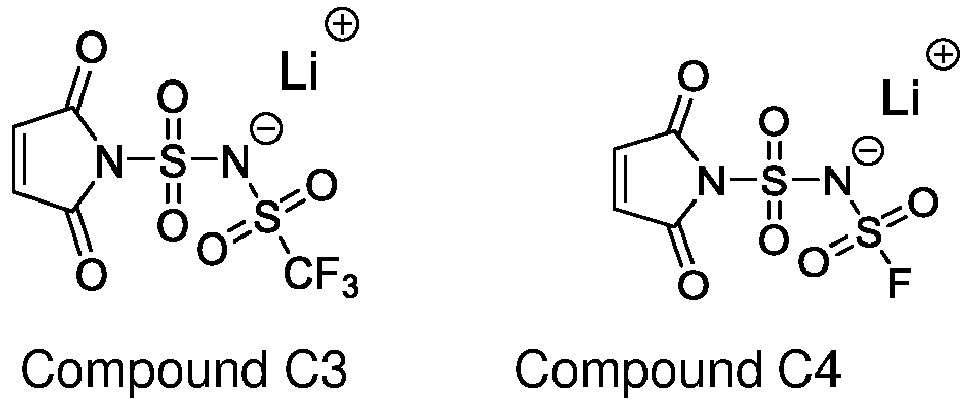
- In one embodiment, R7 is a fluorine atom. In another embodiment, R7 is selected from fluorine substituted C1-6alkyl groups. In a further embodiment, L1 is a covalent bond or L1 is a linker selected from optionally substituted C6aryl groups.
- In a further embodiment, the compound of Formula III is compound is selected from:

- According to another embodiment, the compound is as defined in Formula IV:

- X1 is a carbon or nitrogen atom;
- R8 and R9 are each independently F, CN or optionally substituted C1-6alkyl when X1 is a carbon atom; or
- R8 is absent and R9 is an optionally substituted SO2Alkyl or optionally substituted C1-6alkyl when X1 is a nitrogen atom;
- (Mn+)1/n is a metal cation, wherein M is a metal and n is 1 or 2, for instance M is an alkali metal, alkaline earth metal, for instance, M is Li, Na, or K, or M is Li and n is 1;
- m is an integer selected from 0 or 1;
- or a tautomer thereof.
- In one embodiment, X1 is a carbon atom. In one embodiment, R8 and R9 are different. Alternatively, R8 and R9 are the same. In another embodiment, at least one of R8 and R9 is CN or optionally substituted C1-6alkyl. In one embodiment, R8 and R9 are both CN or optionally substituted C1-6alkyl, or R8 and R9 are both CN, or R8 and R9 are both fluorine substituted C1-6alkyl. In another embodiment, X1 is a nitrogen atom. For example, X1 is a nitrogen atom and R9 is a fluorine substituted SO2Alkyl (e.g. SO2CF3). In another embodiment, m is 0. In a further embodiment m is 1.
- In a further embodiment, the compound of Formula IV is compound is selected from:


- According to yet another embodiment, the compound is as defined in Formula V:

- wherein, R1, R2, R8, R9, X1, M and n are as previously defined, or R8 and R9 are absent and X1 is an oxygen atom;
- or a tautomer thereof.
- In one embodiment, at least one of R1 and R2 is CN. For example, both of R1 and R2 are CN. In another embodiment, X1 is a carbon atom. For example, X1 is a carbon atom and R8 and R9 are both CN or optionally substituted C1-6alkyl, or X1 is a carbon atom and R8 and R9 are both CN, or X1 is a carbon atom and R8 and R9 are both fluorine substituted C1-6alkyl. In another embodiment, X1 is a nitrogen atom. For instance, X1 is a nitrogen atom and R9 is a fluorine substituted SO2Alkyl (e.g. SO2CF3).
- In a further embodiment, the compound of Formula V is compound is selected from:


- In one embodiment, described is a compound according to any one of the foregoing embodiments, wherein M is Li and n is 1. In another embodiment, the compound is as herein defined and is a di-salt (e.g. a dianion forming a salt with two alkali metal anions, where applicable). For example, the compounds of Formulae I, IV and V, the compound may include a further anion on a second nitrogen atom. For instance, Compounds E1 to E4 may form a disalt, such as, for compound E2:

- Further contemplated are the free forms of any of the salts referred to herein.
- According to another aspect, the present technology relates to an electrode material comprising, as an additive, a compound as herein defined, and at least one electrochemically active material.
- According to another aspect, the present technology relates to an electrolyte composition comprising a compound as herein described. For instance, the electrolyte composition further comprises a compatible solvent. In another example, the electrolyte composition further comprises a compatible solvating polymer.
- In a further aspect, also contemplated is an electrochemical cell comprising an electrolyte, an electrode and a counter-electrode, wherein at least one of the electrode or counter-electrode comprises an electrode material comprising, as an additive, a compound as herein defined, and at least one electrochemically active material. Alternatively, contemplated is an electrochemical cell which comprises an electrolyte composition comprising a compound as herein defined, an electrode and a counter-electrode. In one embodiment, the electrochemical cell comprises a compound as herein defined in an electrolyte composition and in at least one electrode material. In one embodiment, electrochemical cell is included in a battery, an electrochromic device, or a capacitor. For instance, the battery is a lithium or lithium-ion battery. In other examples, the battery is a sodium or potassium battery.
- According to another aspect, described in the use of the electrochemical cell as herein defined in electrical or hybrid vehicles, or in ubiquitous IT devices.
- Other features and advantages of the present technology will be better understood upon reading of the description herein below.
- Here are described compounds (e.g. salts) intended for use as electrode material additives or as a component of an electrolyte composition. Compounds described are of one of Formulae I to V as herein defined. Exemplary compounds are also described and should not be interpreted as limiting the scope of the broader formulae.
- Accordingly, the compound may be as defined in Formula I:

- R1 and R2 are independently selected from H, F, CN, NO2, optionally substituted alkyl, preferably CN;
- R3 is selected from NHSO2R4, NHSO2OR4, SO2NHSO2R4, SO2NHSO2OR4 or an optionally substituted heterocycle;
- R4 is selected from fluorine, optionally substituted C1-6alkyl, and optionally substituted C6aryl;
- (Mn+)1/n is a metal cation, wherein M is a metal and n is 1 or 2, for instance M is an alkali metal, alkaline earth metal, for instance, M is Li, Na, or K, or M is Li and n is 1;
- or a tautomer thereof.
- For example, R3 is NHSO2R4, or R3 is NHSO2OR4. For instance, R3 is NHSO2R4 or NHSO2OR4 and R4 is a C1-6alkyl substituted with at least one of fluorine and alkoxy, or R4 is a C6aryl substituted with at least one fluorine atom. In another example, R3 is a C5-6heterocycle (e.g. a non-aromatic C5-6heterocycle linked through a nitrogen atom, such as a maleimide). In another embodiment, at least one of R1 and R2 is CN, or both of R1 and R2 are CN.
- Examples of compounds of Formula I include, without limitation, Compounds A1 to A5 a defined above, or a tautomer thereof.
- The compound may also be defined as in Formula II:


- R5 is selected from optionally substituted C1-6alkyl and optionally substituted C6aryl; and
- R6 is selected from optionally substituted C1-6alkyl and optionally substituted C6aryl;
- (Mn+)1/n is a metal cation, wherein M is a metal and n is 1 or 2, for instance M is an alkali metal, alkaline earth metal, for instance, M is Li, Na, or K, or M is Li and n is 1;
- or a tautomer thereof.
- For example, R5 is an unsubstituted C1-6alkyl group (such as methyl, ethyl, propyl, isopropyl and the like), or R5 is a fluorinated C1-6alkyl group (e.g. trifluoromethyl, and the like). In another example, R6 is a fluorinated C1-6alkyl group (e.g. trifluoromethyl, and the like) or R6 is a fluorinated C6aryl group (e.g. pentafluorophenyl, and the like). Other examples include compounds of Formula II wherein at least one of R5 and R6 is an optionally substituted C6aryl group. In other examples, the compound is of Formula II, provided that when R6 is trifluoromethyl, then R5 is other than methyl or trifluoromethyl.
- Examples of compounds of Formula II include, without limitation, Compounds B1 to B4, as herein defined, or a tautomer thereof. For instance, the compound is Compounds B3 or B4, as herein defined, or a tautomer thereof.
- The compound may also be as defined in Formula III:

- R7 is selected from a fluorine atom and optionally substituted C1-6alkyl; and
- L1 is a covalent bond or a linker selected from optionally substituted C1-6alkyl and optionally substituted C6aryl;
- (Mn+)1/n is a metal cation, wherein M is a metal and n is 1 or 2, for instance M is an alkali metal, alkaline earth metal, for instance, M is Li, Na, or K, or M is Li and n is 1;
- or a tautomer thereof.
- For example, R7 is a fluorine atom or R7 is selected from fluorine substituted C1-6alkyl groups. According to some examples, L1 is a covalent bond. According to other examples, L1 is a linker selected from optionally substituted C6aryl groups.
- Examples of compounds of Formula III include, without limitation, Compounds C1 to C4, as herein defined, or a tautomer thereof.
- The compound may further be defined as in Formula IV:

- X1 is a carbon or nitrogen atom;
- R8 and R9 are each independently F, CN or optionally substituted C1-6alkyl when X1 is a carbon atom; or
- R8 is absent and R9 is an optionally substituted SO2Alkyl or optionally substituted C1-6alkyl when X1 is a nitrogen atom;
- (Mn+)1/n is a metal cation, wherein M is a metal and n is 1 or 2, for instance M is an alkali metal, alkaline earth metal, for instance, M is Li, Na, or K, or M is Li and n is 1;
- m is an integer selected from 0 or 1;
- or a tautomer thereof.
- In some examples, X1 is a carbon atom. When X1 is a carbon atom, R8 and R9 may be the same or different. For instance, X1 is a carbon atom and at least one of R8 and R9 is CN or optionally substituted C1-6alkyl. For instance, X1 is a carbon atom and R8 and R9 are both CN or optionally substituted C1-6alkyl, or R8 and R9 are both CN, or R8 and R9 are both fluorine substituted C1-6alkyl. According to other examples, X1 is a nitrogen atom. For example, X1 is a nitrogen atom, R8 is absent and R9 is a fluorine substituted SO2Alkyl (e.g. SO2CF3). In one example, m is 0. In a further example, m is 1.
- Examples of compounds of Formula IV include, without limitation, Compounds D1 to D6, as herein defined, or a tautomer thereof.
- The compound may also further be defined as in Formula V:

- wherein, R1, R2, R8, R9, X1, M and n are as previously defined, or R8 and R9 are absent and X1 is an oxygen atom;
- or a tautomer thereof.
- For example, at least one of R1 and R2 is CN, or both of R1 and R2 are CN. In some examples, X1 is a carbon atom. For instance, X1 is a carbon atom and R8 and R9 are both CN or optionally substituted C1-6alkyl, or X1 is a carbon atom and R8 and R9 are both CN, or X1 is a carbon atom and R8 and R9 are both fluorine substituted C1-6alkyl. In other examples, X1 is a nitrogen atom. For instance, X1 is a nitrogen atom and R9 is a fluorine substituted SO2Alkyl (e.g. SO2CF3).
- Examples of compounds of Formula V include, without limitation, Compounds E1 to E4, as herein defined, or a tautomer thereof.
- According to one example, the compound is as defined in any one of Formulae I to V, wherein M is Li and n is 1. In another embodiment, the compound is as herein defined and is a di-salt (e.g. a dianion forming a salt with two alkali metal anions, where applicable). For example, the compounds of Formulae I, IV and V, the compound may include a further anion on a second nitrogen atom. Further contemplated are the free forms of any of the salts referred to herein.
- As used herein, the term "alkyl" refers to saturated hydrocarbons having from one to sixteen carbon atoms, including linear or branched alkyl groups. Examples of alkyl groups include, without limitation, methyl, ethyl, propyl, butyl, pentyl, hexyl, heptyl, octyl, nonyl, decyl, isopropyl, tert-butyl, sec-butyl, isobutyl, and the like. When the alkyl group is located between two functional groups, then the term alkyl also encompasses alkylene groups such as methylene, ethylene, propylene, and the like. The term "C1-Cnalkyl" refers to an alkyl group having from 1 to the indicated "n" number of carbon atoms.
- The term "alkoxy" as used herein means an alkyl group having an oxygen atom attached thereto. Representative alkoxy groups include groups having 1 to about 6 carbon atoms, e.g., methoxy, ethoxy, propoxy, tert-butoxy and the like. Examples of alkoxy groups include methoxy, ethoxy, isopropyloxy, propoxy, butoxy, pentoxy, fluoromethoxy, difluoromethoxy, trifluoromethoxy, chloromethoxy, dichloromethoxy, trichloromethoxy groups and the like. The term alkoxy includes both unsubstituted or substituted alkoxy groups, etc., as well as halogenated alkyloxy groups.
- The term "aryl" refers to aromatic groups having 4n+2 π(pi) electrons, wherein n is an integer from 1 to 3, in a conjugated monocyclic or polycyclic system (fused or not) and having six to fourteen ring atoms. A polycyclic ring system includes at least one aromatic ring. Aryl may be directly attached, or connected via a C1-C3alkyl group (also referred to as arylalkyl or aralkyl). Examples of aryl groups include, without limitation, phenyl, benzyl, phenethyl, 1-phenylethyl, tolyl, naphthyl, biphenyl, terphenyl, indenyl, benzocyclooctenyl, benzocycloheptenyl, azulenyl, acenaphthylenyl, fluorenyl, phenanthrenyl, anthracenyl, and the like. The term aryl includes both unsubstituted aryl groups and substituted aryl groups. The term "C6-Cnaryl" refers to an aryl group having from 6 to the indicated "n" number of carbons in the ring structure.
- The terms "heterocycle" or "heterocyclic" include heterocycloalkyl and heteroaryl groups. Examples of heterocycles include, without limitation, acridinyl, azocinyl, benzimidazolyl, benzofuranyl, benzothiofuranyl, benzothiophenyl, benzoxazolyl, benzthiazolyl, benztriazolyl, benztetrazolyl, benzisoxazolyl, benzisothiazolyl, benzimidazolinyl, carbazolyl, 4αH-carbazolyl, carbolinyl, chromanyl, chromenyl, cinnolinyl, decahydroquinolinyl, 2H,6H-1,5,2-dithiazinyl, dihydrofuro[2,3-b]tetrahydrofuran, furanyl, furazanyl, imidazolidinyl, imidazolinyl, imidazolyl, 1H-indazolyl, indolenyl, indolinyl, indolizinyl, indolyl, 3H-indolyl, isobenzofuranyl, isochromanyl, isoindazolyl, isoindolinyl, isoindolyl, isoquinolinyl, isothiazolyl, isoxazolyl, methylenedioxyphenyl, morpholinyl, naphthyridinyl, octahydroisoquinolinyl, oxadiazolyl, 1,2,3-oxadiazolyl, 1,2,4-oxadiazolyl, 1,2,5-oxadiazolyl, 1,3,4-oxadiazolyl, oxazolidinyl, oxazolyl, oxazolidinyl, pyrimidinyl, phenanthridinyl, phenanthrolinyl, phenazinyl, phenothiazinyl, phenoxathiinyl, phenoxazinyl, phthalazinyl, piperazinyl, piperidinyl, piperidonyl, 4-piperidonyl, piperonyl, pteridinyl, purinyl, pyranyl, pyrazinyl, pyrazolidinyl, pyrazolinyl, pyrazolyl, pyridazinyl, pyridooxazole, pyridoimidazole, pyridothiazole, pyridinyl, pyridyl, pyrimidinyl, pyrrolidinyl, pyrrolinyl, 2H-pyrrolyl, pyrrolyl, quinazolinyl, quinolinyl, 4H-quinolizinyl, quinoxalinyl, quinuclidinyl, tetrahydrofuranyl, tetrahydroisoquinolinyl, tetrahydroquinolinyl, tetrazolyl, 6H-1,2,5-thiadiazinyl, 1,2,3-thiadiazolyl, 1,2,4-thiadiazolyl, 1,2,5-thiadiazolyl, 1,3,4-thiadiazolyl, thianthrenyl, thiazolyl, thienyl, thienothiazolyl, thienooxazolyl, thienoimidazolyl, thiophenyl, triazinyl, 1,2,3-triazolyl, 1,2,4-triazolyl, 1,2,5-triazolyl, 1,3,4-triazolyl, xanthenyl, and the like. The term heterocycle includes both unsubstituted heterocyclic groups and substituted heterocyclic groups.
- The term "substituted", when in association with any of the foregoing groups refers to a group substituted at one or more position with substituents such as cyano, halogen, nitro, trifluoromethyl, lower alkyl, cycloalkyl, heterocycloalkyl, aryl, heteroaryl, lower alkoxy, aryloxy, benzyloxy, benzyl, sulfonyl, sulfonate, sulfonamide, phosphonato, phosphinato, oxo, and the like. Any of the above substituents can be further substituted if permissible, e.g. if the group contains an alkyl group, an alkoxy group, an aryl group, or other.
- Also described is an electrode material comprising, as an additive, a compound as herein defined, and at least one electrochemically active material. The electrochemically active material may be a material for use in a negative electrode. Alternatively, the electrochemically active material may be a material for use in a positive electrode. Examples of electrochemically active materials include, without limitation, titanates and lithium titanates (e.g. TiO2, Li2TiO3, Li4Ti5O12, H2Ti5O11, H2Ti4O9, or a combination thereof), lithium and metal phosphates (e.g. LiM'PO4 where M' is Fe, Ni, Mn, Co, or a combination thereof), vanadium oxides (e.g. LiVsOs, V2O5, LiV2O5, and the like), and other lithium and metal oxides such as LiMn2O4, LiM"O2 (M" being Mn, Co, Ni, or a combination thereof), Li(NiM‴)O2 (M‴ being Mn, Co, Al, Fe, Cr, Ti, Zr, and the like, or a combination thereof), or a combination thereof. For instance, the active material is selected from Lithium iron phosphate (LFP), lithium manganese iron phosphate (LMFP), lithium titanate (LTO), graphite, and lithium nickel manganese cobalt oxide (NMC). The particles may be freshly formed or of commercial source, in the form of microparticles or nanoparticles and may further include a carbon coating.
- The electrode material may also optionally include additional components like conductive materials, inorganic particles, glass or ceramic particles, and the like. Examples of conductive materials include carbon black, Ketjen™ black, acetylene black, graphite, graphene, carbon fibers, nanofibers (e.g. VGCF) or nanotubes, or a combination thereof. The electrode material may also further comprise a binder. Examples of binders include water soluble binders such as SBR (styrene butadiene rubber), NBR (butadiene acrylonitrile rubber), HNBR (hydrogenated NBR), CHR (epichlorohydrin rubber), ACM (acrylate rubber), and the like, and cellulose-based binders (e.g. carboxyalkylcellulose, hydroxyalkylcellulose, and combinations), or any combination of two or more of these. For instance, the carboxyalkylcellulose may be carboxymethylcellulose (CMC) or carboxyethylcellulose. Hydroxypropylcellulose is an example of hydroxyalkylcellulose. Other examples of binders include fluorine-containing polymeric binders such as PVDF and PTFE, and ion-conductive polymer binders such as block copolymers composed of at least one lithium-ion solvating segment and at least one cross-linkable segment.
- According to another aspect, the present technology relates to an electrolyte composition comprising a compound as herein described. The electrolyte may be a liquid, gel or solid polymer electrolyte and, in the case of a lithium or lithium-ion electrochemical cell, is conductive to lithium ions. For instance, the electrolyte composition further comprises a compatible solvent. In another example, the electrolyte composition further comprises a compatible solvating polymer.
- For example, electrolytes are prepared by dissolution of one or more of the present compounds in an appropriate electrolyte solvent or solvating polymer for polymer electrolyte preparation. For use in lithium and lithium ion batteries, the compounds as lithium salts can be dissolved at an appropriate concentration, for example between 0.05 and 3 mol/litre. For other types of batteries, other salts of the present compounds should be dissolved, for example, sodium salts for sodium batteries, magnesium salts for magnesium batteries, and the like.
- Non-limiting examples of electrolyte solvents include organic solvents such as ethers, carbonate esters, cyclic carbonate esters, aliphatic carboxylic acid esters, aromatic carboxylic acid esters, phosphate esters, sulfite esters, nitriles, amides, alcohols, sulfoxides, sulfolane, nitromethane, 1,3-dimethyl-2-imidazolidinone, 1,3-dimethyl-3,4,5,6-tetrahydro-2(1,H)-pyrimidinone, 3-methyl-2-oxazolidinone, or a mixture thereof. In particular examples, the solvent may also be an aqueous solvent, i.e. water or a mixture comprising water.
- Examples of solvents include dimethyl carbonate, diethyl carbonate, ethyl methyl carbonate, propylene carbonate, ethylene carbonate, γ-butyrolactone, glyme, diglyme, triglyme, tetraglyme, sulfolane, tetraethylsulfamide, acetonitrile, pyruvonitrile, propionitrile, methoxypropionitrile, dimethylaminopropionitrile, butyronitrile, isobutyronitrile, valeronitrile, pivalonitrile, isovaléronitrile, glutaronitrile, méthoxyglutaronitrile, 2-methylglutaronitrile, 3-methylglutaronitrile, adiponitrile, malononitrile, and combinations thereof. Various additives may also be included in the electrolyte composition to improve its properties.
- Non-limiting examples of polymers for use in electrolytes (e.g. gel or solid) include polyethylene oxide) and its copolymers and block-copolymers, polypropylene oxide) and its copolymers and block-copolymers, poly(dimethylsiloxane) and its copolymers and block-copolymers, poly(alkylene carbonate) and their copolymers and block-copolymers, poly(alkylenesulfone) and its copolymers and block-copolymers, poly(alkylenesulfamides) and its copolymers and block-copolymers, polyurethanes and their copolymers and block-copolymers, poly(vinylalcohol) and its copolymers and block-copolymers and combinations thereof. Additionally, branched or cross-linked solvating polymers may also be included. Various additives may also be included in the polymer electrolyte composition to improve its properties.
- Electrochemical cells as herein described comprise an electrolyte, an electrode and a counter-electrode, wherein at least one of the electrode or counter-electrode comprises an electrode material comprising, as an additive, a compound as herein defined, and at least one electrochemically active material as defined above. Alternatively, contemplated is an electrochemical cell which comprises an electrolyte composition comprising a compound as herein defined, an electrode and a counter-electrode. In one embodiment, the electrochemical cell comprises a compound as herein defined in an electrolyte composition and in at least one electrode material. In one embodiment, the electrochemical cell is included in a battery, an electrochromic device, or a capacitor. For instance, the battery is a lithium or lithium-ion battery. In other examples, the battery is a sodium or potassium battery.
- According to another aspect, described in the use of the electrochemical cell as herein defined in electrical or hybrid vehicles, or in ubiquitous IT devices.
- The following non-limiting examples are illustrative embodiments and should not be construed as further limiting the scope of the present application.
-

- 2-Amino-1H-imidazole-4,5-dicarbonitrile (1.1 eq), trifluorosulfonylchloride (1 eq), lithium carbonate (2 eq) and N'N-dimethylaminopyridine (DMAP) (0.25 eq) were introduced in a Schlenk flask. The solids were degassed by vacuum-N2 cycles. Dry acetone (1M) was added and the suspension was vigorously stirred and heated under reflux overnight. The reaction mixture was cooled down to room temperature. Distilled water was added, and the solution was extracted using dichloromethane. The combined organic layers were washed with water and acidic water, dried using MgSO4 and filtered. The solution was filtered on Celite® to eliminate inorganic residues. The organic solution was concentrated under reduced pressure until dryness. The solid residue was purified by silica gel chromatography using hexanes/ethyl acetate (1/1) as eluent. A crystalline yellow solid was isolated after evaporation. This yellow solid was then dissolved in water and monohydrated lithium hydroxide was added until a slight excess of base was detected using a pH paper. The solution was concentrated until dryness by reduced pressure distillation. The solid was suspended in diethyl carbonate (DEC) and stirred overnight at room temperature. The solution was passed through Celite® and the clear solution was concentrated under reduced pressure and dried in a vacuum oven for 24 hours.

- 2,4,6-Trichloro-[1,3,5]-triazine (1 eq.) was added to a room temperature solution of sulfonic acid (1 eq.) in dry acetone, followed by trimethylamine (1 eq.) dropwise. The solution was stirred vigorously and heated at 90°C overnight. The reaction mixture was cooled to room temperature and, under nitrogen, 2-amino-1H-imidazole-4,5-dicarbonitrile (1.2 eq.), DMAP (0.25 eq.) and lithium carbonate (2 eq.) were added. The mixture was stirred vigorously and heated at 90°C for 2 days. The reaction mixture was cooled down to room temperature. Distilled water was added, and the solution was extracted using dichloromethane. The combined organic layers were washed with water and acidic water, dried using MgSO4 and filtered. The solution was filtered on Celite® to eliminate inorganic residues. The organic solution was concentrated under reduced pressure until dryness. The solid residue was purified by silica gel chromatography using hexanes/ethyl acetate (1/1) as eluent. A crystalline yellow solid was isolated. The yellow solid was then dissolved in water and monohydrated lithium hydroxide was added until a slight excess of base was detected using a pH paper. The solution was concentrated until dryness by reduced pressure distillation. The solid was suspended in diethyl carbonate (DEC) and stirred overnight at room temperature. The solution was passed through Celite® and the clear solution was concentrated under reduced pressure and dried in a vacuum oven for 24 hours.

- 2-Amino-1H-imidazole-4,5-dicarbonitrile (1.1 eq), pentafluorosulfonylchloride (1 eq), lithium carbonate (2 eq) and N'N-dimethylaminopyridine (DMAP) (0.25 eq) were introduced in a Schlenk flask. The solids were degassed by vacuum-N2 cycles. Dry acetone (1M) was added and the suspension was vigorously stirred and heated under reflux. The reaction mixture was cooled down to room temperature. Distilled water was added, and the solution was extracted using dichloromethane. The combined organic layers were washed with water and acidic water, dried using MgSO4 and filtered. The solution was filtered on Celite® to eliminate inorganic residues. The organic solution was concentrated under reduced pressure until dryness. The solid residue was purified by silica gel chromatography using hexanes/ethyl acetate (1/1) as eluent. A crystalline yellow solid was isolated. The yellow solid was then dissolved in water and monohydrated lithium hydroxide was added until a slight excess of base was detected using a pH paper. The solution was concentrated until dryness by reduced pressure distillation. The solid was suspended in diethyl carbonate (DEC) and stirred overnight at room temperature. The solution was passed through Celite® and the clear solution was concentrated under reduced pressure and dried in a vacuum oven for 24 hours.

- Step 1: A solution of 2-methoxyethan-1-ol in THF was added dropwise to a solution of sulfuryl chloride (1.2 eq) in THF at -75°C. The reaction mixture was warmed up to room temperature. The solution was concentrated until dryness under reduced pressure. The colorless oil obtained was used without purification.

- Step 2: 2-amino-1H-imidazole-4,5-dicarbonitrile (1.1 eq), 2-methoxyethan-1-sulfonylchloride (1 eq), lithium carbonate (2 eq) and N'N-dimethylaminopyridine (DMAP) (0.25 eq) were introduced in a Schlenk flask. The solids were degassed by vacuum-N2 cycles. Dry acetone (1M) was added and the suspension was stirred vigorously and heated under reflux overnight. The reaction mixture was cooled to room temperature. Distilled water was added and the resulting solution was extracted using dichloromethane. The organic layers were combined, washed with water and acidic water, dried on MgSO4 and filtered. The organic solution obtained was concentrated under reduced pressure until dryness. The resulting brown oil was purified by silica gel chromatography. A yellow oil was isolated. The resulting compound was converted to its lithium salt by dissolution in water and addition of lithium hydroxide. The solution was concentrated until dryness by reduced pressure distillation. The solid was suspended in diethyl carbonate (DEC) and stirred overnight at room temperature. The solution was passed through Celite® and the clear solution was concentrated under reduced pressure and dried in a vacuum oven for 24 hours.

- 2-amino-1H-imidazole-4,5-dicarbonitrile and maleic anhydride were dissolved in 1,4-dioxane. The solution was heated at 150°C during 10 hours by microwaves activation. The mixture was precipitated in cold diethyl ether and filtrated. The yellowish filtrate was evaporated, and a pale yellow highly hydroscopic solid was isolated. The solid was then dissolved in water and monohydrated lithium hydroxide was added until a slight excess of base was detected using a pH paper. The solution was concentrated until dryness by reduced pressure distillation. The solid was suspended in diethyl carbonate (DEC) and stirred overnight at room temperature. The solution was passed through Celite® and the clear solution was concentrated under reduced pressure and dried in a vacuum oven for 24 hours.
-

- Acetamide (1.1 eq), trifluorosulfonylchloride (1 eq), lithium carbonate (2 eq) and N'N-dimethylaminopyridine (DMAP) (0.25 eq) were introduced in a Schlenk flask. The solids were degassed by vacuum-N2 cycles. Dry acetone (1M) was added and the suspension was stirred vigorously and heated under reflux overnight. The reaction mixture was cooled down to room temperature. Distilled water was added, and the solution was extracted using dichloromethane. The combined organic phases were washed with water, dried on MgSO4 and filtered. The organic solution was concentrated to dryness under reduced pressure. The crude oil was then dissolved in water and monohydrated lithium hydroxide was added until a slight excess of base was detected using a pH paper. The solution was concentrated until dryness by reduced pressure distillation. The solid was suspended in diethyl carbonate (DEC) and stirred overnight at room temperature. The solution was passed through Celite® and the clear solution was concentrated under reduced pressure and dried in a vacuum oven for 24 hours.

- Trifluorocetamide (1.1 eq), trifluorosulfonylchloride (1 eq), lithium carbonate (2 eq) and N'N-dimethylaminopyridine (DMAP) (0.25 eq) were introduced in a Schlenk flask. The solids were degassed by vacuum-N2 cycles. Dry acetone (1M) was added and the suspension was stirred vigorously and heated under reflux overnight. The reaction mixture was cooled to room temperature. Distilled water was added, and the solution was extracted using dichloromethane. The organic layers were combined, washed with water, dried on MgSO4 and filtered. The organic solution was concentrated to dryness under reduced pressure. The crude oil was then dissolved in water and monohydrated lithium hydroxide was added until a slight excess of base was detected using a pH paper. The solution was concentrated until dryness by reduced pressure distillation. The solid was suspended in diethyl carbonate (DEC) and stirred overnight at room temperature. The solution was passed through Celite® and the clear solution was concentrated under reduce pressure and dried in vacuum oven for 24 hours.

- Acetamide (1.1 eq), pentafluorobenzenesulfonyl chloride (1 eq), lithium carbonate (2 eq) and N'N-dimethylaminopyridine (DMAP) (0.25 eq) were introduced in a Schlenk flask. The solids were degassed by vacuum-N2 cycles. Dry acetone (1M) was added and the suspension was stirred vigorously and heated under reflux overnight. The reaction mixture was cooled to room temperature, distilled water was added, and the solution was extracted using dichloromethane. The organic layers were combined, washed with water, dried on MgSO4 and filtered. The crude solid was then dissolved in water and monohydrated lithium hydroxide was added until a slight excess of base was detected using a pH paper. The solution was concentrated until dryness by reduced pressure distillation. The solid was suspended in diethyl carbonate (DEC) and stirred overnight at room temperature. The solution was passed through Celite® and the clear solution was concentrated under reduced pressure and dried in a vacuum oven for 24 hours.

- Trifulorocetamide (1.1 eq), pentafluorobenzenesulfonyl chloride (1 eq), lithium carbonate (2 eq) and N'N-dimethylaminopyridine (DMAP) (0.25 eq) were introduced in a Schlenk flask. The solids were degassed by vacuum-N2 cycles. Dry acetone (1M) was added and the suspension was stirred vigorously and heated under reflux overnight. The reaction mixture was cooled to room temperature, distilled water was added, and the solution was extracted using dichloromethane. The organic layers were combined, washed with water, dried on MgSO4 and filtered. The crude solid was then dissolved in water and monohydrated lithium hydroxide was added until a slight excess of base was detected using a pH paper. The solution was concentrated until dryness by reduced pressure distillation. The solid was suspended in diethyl carbonate (DEC) and stirred overnight at room temperature. The solution was passed on Celite® and the clear solution was concentrated under reduce pressure and dried in vacuum oven for 24 hours.
-

- Step 1: Sulfanilamide, lithium carbonate (1 eq.) and 4-nitrophenyl trifluoromethanesulfonate were mixed and ground using a mortar and pestle. The molten mixture was stirred at 180°C for one hour under nitrogen. Deionized water was added to the hot mixture under vigorous stirring. The insoluble suspended solid was removed by filtration. Water was removed under reduced pressure. The solid was washed with cold THF, ethyl acetate and a white solid was filtered. The yellow filtrate was evaporated under reduce pressure and the yellow solid was dried overnight at 40°C under vacuum.

- Step 2: A THF solution of the solid from step 1 was added to a solution of maleic anhydride in 1 ,4-dioxane and the resulting mixture was stirred at room temperature for 12 hours. The corresponding carboxylic acid was isolated as a white solid by filtration and was dried under vacuum at 60°C for 4 hours.

- Step 3: A acetic anhydride solution of the carboxylic acid from step 2 and sodium acetate was heated at 70°C for 3 hours. Then, the solution was poured into an excess of diethyl ether to complete the precipitation. The resulting precipitate was isolated by filtration and dried under vacuum at 60°C overnight.
-

- A solution of diaminomaleonitrile (1.0 g, 4.625 mmol) and anhydrous dimethylformamide (10 mL) is added to an inert reactor. The compound 2-[bis(methylthio)methylene]malononitrile (DM3) (0.787 g, 4.625 mmol) is added and the mixture stirred for 16 hours at 120°C. Solvents and volatile compounds are removed under vacuum. The resulting product is purified by silica-gel chromatography using a mixture of ethyl acetate and hexanes as eluent.

- A solution of compound DM3 (0.500 g, 2.94 mmol) in methanol (50 mL) is inserted into an inert reactor (pressure bomb). Ammonia (0.500 g, 29.4 mmol) is added and the reaction mixture is stirred for 16 hours at 70°C. Solvent and volatile compounds are removed under vacuum. The compound obtained (DM3-NH2) is used without further purification.
- A solution of compound DM3-NH2 (0.500 g, 4.63 mmol) in THF (50 mL) is introduced in an inert reactor. Oxalyl chloride (0.587 g, 4.63 mmol) is added and the reaction mixture is stirred for 16 hours at room temperature. The solvent and volatile compounds are removed under vacuum. The product is purified by recrystallization in alcohols.

- A solution of diaminomaleonitrile (8.0 g, 74.0 mmol) in anhydrous tetrahydrofuran (250 mL) is introduced in an inert reactor and the solution is degassed. Phosgene (7.32 g, 74.0 mmol) is added and the mixture is stirred for 1 hour. Ethanethiol (14.9 g, 148.0 mmol) is then added and the mixture is stirred for another 16 h. The solvent and volatile compounds are removed under vacuum. Acetone (100 mL) and 5 drops of 12 M HCl are added and the mixture is heated for 16 h at 120°C until a complete discoloration from orange to grey-white is observed. The product is a grey-white powder.
- Conductivity measurements were carried out with a biologic conductivity meter (model MCS-10) using a platinum cell (type HTCC: parallel plates platinized platinum on glass holder). The salts were dried in a vacuum oven at 70°C for one night prior to use, and PC/EMC/DMC (4/3/3) or distilled water were used as solvent. Solutions of LiCI (in water) or LiPF6 (in PC/EMC/DMC) were used as references.
Table 1. Conductivity results Compound Concentration (mol/L) Conductivity (mS/cm) Reference Concentration (mol/L) Conductivity (mS/cm) A1 0.1M 0.64 LiPF6 0.1M 2.96 A2 0.3M 0.63 LiPF6 0.3M 6.78 A5 0.1M 0.04 LiPF6 0.1M 2.96 A5 0.1M 21.66 LiCl 0.1M 9.75 E2* 0.1M 9.71 LiCl 0.1M 9.75 * In its di-lithium salt form. - Numerous modifications could be made to any of the embodiments described above without departing from the scope of the present invention. Any references, patents or scientific literature documents referred to in this application are incorporated herein by reference in their entirety for all purposes.
Claims (19)
- A compound as defined in any one of Formulae II to V:

 R1 and R2 are independently selected from H, F, CN, NO2, and optionally substituted alkyl;R5 is selected from optionally substituted C1-6alkyl and optionally substituted C6aryl;R6 is selected from optionally substituted C1-6alkyl and optionally substituted C6aryl;R7 is selected from a fluorine atom and optionally substituted C1-6alkyl;R8 and R9 are each independently F, CN or optionally substituted C1-6alkyl when X1 is a carbon atom in Formula IV or V; orR8 is absent and R9 is an optionally substituted SO2Alkyl or optionally substituted C1-6alkyl when X1 is a nitrogen atom in Formula IV or V; orR8 and R9 are absent and X1 is an oxygen atom in Formula V;L1 is a covalent bond, or a linker selected from optionally substituted C1-6alkyl and optionally substituted C6aryl;m is an integer selected from 0 or 1; and(Mn+)1/n is a metal cation, wherein M is a metal and n is 1 or 2;or a tautomer thereof.
 - The compound of claim 1, wherein at least one of R1 and R2 is CN.
- The compound of claim 2, wherein both of R1 and R2 are CN.
- The compound of claim 1, wherein R5 is an unsubstituted C1-6alkyl group or a fluorinated C1-6alkyl group.
- The compound of claim 1 or 4, wherein R6 is a fluorinated C1-6alkyl group or a fluorinated C6aryl group.
- The compound of claim 1, wherein R7 is a fluorine atom or is selected from fluorine substituted C1-6alkyl groups.
- The compound of claim 1 or 6, wherein L1 is a covalent bond or a linker selected from optionally substituted C6aryl groups.
- The compound of claim 1, wherein X1 is a carbon atom.
- The compound of claim 8, wherein at least one of R8 and R9 is CN or optionally substituted C1-6alkyl, preferably R8 and R9 are both CN or optionally substituted C1-6alkyl, more preferably R8 and R9 are both CN or are both fluorine substituted C1-6alkyl.
- The compound of claim 1, wherein X1 is a nitrogen atom.
- The compound of claim 10, wherein R9 is a fluorine substituted SO2alkyl, preferably R9 is SO2CF3.
- The compound of any one of claims 1 to 11, wherein M is an alkali metal or alkaline earth metal and n is 1 or 2, preferably M is Li, Na, or K and n is 1, most preferably M is Li and n is 1.
- The compound of claim 1, wherein said compound is selected from:


- Electrode material comprising a compound as defined in any one of claims 1 to 13 as an additive and at least one electrochemically active material.
- An electrolyte composition comprising a compound as defined in any one of claims 1 to 13.
- The electrolyte composition of claim 15, further comprising a compatible solvent or a compatible solvating polymer.
- An electrochemical cell comprising:- an electrolyte, an electrode and a counter-electrode, wherein at least one of the electrode or counter-electrode comprises an electrode material as defined in claim 18; or- an electrolyte comprising an electrolyte composition as defined in claim 19 or 20, an electrode and a counter-electrode.
- The electrochemical cell of claim 21, wherein said electrochemical cell is a battery, an electrochromic device, or a capacitor, preferably a lithium or lithium-ion battery.
- Use of the electrochemical cell of any one of claims 21 to 23 in electrical or hybrid vehicles, or in ubiquitous IT devices.
Applications Claiming Priority (3)
| Application Number | Priority Date | Filing Date | Title |
|---|---|---|---|
| US201762477161P | 2017-03-27 | 2017-03-27 | |
| PCT/CA2018/050370 WO2018176134A1 (en) | 2017-03-27 | 2018-03-27 | Salts for use in electrolyte compositions or as electrode additives |
| EP18774359.6A EP3601233B1 (en) | 2017-03-27 | 2018-03-27 | Salts for use in electrolyte compositions or as electrode additives |
Related Parent Applications (2)
| Application Number | Title | Priority Date | Filing Date |
|---|---|---|---|
| EP18774359.6A Division-Into EP3601233B1 (en) | 2017-03-27 | 2018-03-27 | Salts for use in electrolyte compositions or as electrode additives |
| EP18774359.6A Division EP3601233B1 (en) | 2017-03-27 | 2018-03-27 | Salts for use in electrolyte compositions or as electrode additives |
Publications (1)
| Publication Number | Publication Date |
|---|---|
| EP4480946A1 true EP4480946A1 (en) | 2024-12-25 |
Family
ID=63673880
Family Applications (2)
| Application Number | Title | Priority Date | Filing Date |
|---|---|---|---|
| EP18774359.6A Active EP3601233B1 (en) | 2017-03-27 | 2018-03-27 | Salts for use in electrolyte compositions or as electrode additives |
| EP24185244.1A Pending EP4480946A1 (en) | 2017-03-27 | 2018-03-27 | Salts for use in electrolyte compositions or as electrode additives |
Family Applications Before (1)
| Application Number | Title | Priority Date | Filing Date |
|---|---|---|---|
| EP18774359.6A Active EP3601233B1 (en) | 2017-03-27 | 2018-03-27 | Salts for use in electrolyte compositions or as electrode additives |
Country Status (9)
| Country | Link |
|---|---|
| US (2) | US12018000B2 (en) |
| EP (2) | EP3601233B1 (en) |
| JP (3) | JP7330894B2 (en) |
| KR (3) | KR102816969B1 (en) |
| CN (2) | CN110461823B (en) |
| CA (1) | CA3057377A1 (en) |
| HU (1) | HUE069643T2 (en) |
| PL (1) | PL3601233T3 (en) |
| WO (1) | WO2018176134A1 (en) |
Families Citing this family (14)
| Publication number | Priority date | Publication date | Assignee | Title |
|---|---|---|---|---|
| CN113661589B (en) * | 2019-04-10 | 2024-07-26 | 株式会社村田制作所 | Lithium-ion secondary battery |
| CN110797576B (en) * | 2019-11-08 | 2020-11-27 | 广州天赐高新材料股份有限公司 | A high-voltage lithium-ion battery electrolyte and lithium-ion battery |
| CN111342126B (en) * | 2020-03-18 | 2021-12-10 | 江苏中奕和创智能科技有限公司 | Method for prolonging service life of electric appliance in high-temperature overvoltage environment |
| CN111525186B (en) * | 2020-04-09 | 2021-03-02 | 常州大学 | All-solid-state polymer electrolyte based on zwitterionic liquid modified polyvinyl alcohol and preparation method thereof |
| CN111477962B (en) * | 2020-05-29 | 2021-07-20 | 珠海市赛纬电子材料股份有限公司 | Non-aqueous electrolyte of lithium ion battery and lithium ion battery containing non-aqueous electrolyte |
| JP2023544821A (en) * | 2020-10-09 | 2023-10-25 | シオン・パワー・コーポレーション | Electrochemical cells and/or components thereof containing nitrogen-containing species and methods of forming them |
| US20220115705A1 (en) * | 2020-10-09 | 2022-04-14 | Sion Power Corporation | Electrochemical cells comprising nitrogen-containing species, and methods of forming them |
| CN116981656B (en) * | 2021-03-17 | 2025-09-26 | 三井化学株式会社 | Lithium (N-carbonyl)sulfonamide compound, additive for lithium secondary battery, non-aqueous electrolyte for lithium secondary battery, lithium secondary battery precursor, lithium secondary battery, and method for producing lithium secondary battery |
| US12438195B2 (en) | 2021-07-29 | 2025-10-07 | Lg Energy Solution, Ltd. | Non-aqueous electrolyte, and lithium secondary battery comprising the same |
| CN114105882B (en) * | 2021-11-24 | 2022-11-15 | 中节能万润股份有限公司 | Imidazole structure group-based isocyanate electrolyte additive and application thereof |
| JP7716965B2 (en) * | 2021-11-24 | 2025-08-01 | 住友化学株式会社 | Electrolyte composition and battery |
| US11680041B1 (en) * | 2021-12-07 | 2023-06-20 | Ses Holdings Pte. Ltd. | Processes for producing high-purity N,N-dialkyl perfluoroalkylsulfonamide |
| CN114497737B (en) * | 2022-01-13 | 2023-08-25 | 珠海冠宇电池股份有限公司 | Nonaqueous electrolyte and lithium ion battery containing same |
| WO2024232342A1 (en) | 2023-05-08 | 2024-11-14 | 住友化学株式会社 | Method for producing organic lithium salt, composition containing said organic lithium salt, and polymer |
Citations (6)
| Publication number | Priority date | Publication date | Assignee | Title |
|---|---|---|---|---|
| CA2194127A1 (en) * | 1996-12-30 | 1998-06-30 | Christophe Michot | Delocalized anions for use as electrolytic solutes |
| WO1998029388A1 (en) * | 1996-12-30 | 1998-07-09 | Hydro-Quebec | Perfluorinated amide salts and their uses as ionic conducting materials |
| WO2010023413A1 (en) * | 2008-08-29 | 2010-03-04 | Centre National De La Recherche Scientifique | Pentacyclic anion salt and use thereof as an electrolyte |
| WO2015049435A1 (en) * | 2013-10-03 | 2015-04-09 | Arkema France | Composition including a pentacyclic anion salt and use thereof as a battery electrolyte |
| JP2016118619A (en) * | 2014-12-19 | 2016-06-30 | 東洋インキScホールディングス株式会社 | Colored composition for color filter, and color filter |
| WO2017158310A1 (en) * | 2016-03-18 | 2017-09-21 | Blue Solutions | Lithium metal polymer battery having a high energy density |
Family Cites Families (119)
| Publication number | Priority date | Publication date | Assignee | Title |
|---|---|---|---|---|
| US3341548A (en) * | 1964-04-29 | 1967-09-12 | Hoffmann La Roche | Nitroimidazoles and their preparation |
| US3637845A (en) | 1969-04-14 | 1972-01-25 | Minnesota Mining & Mfg | Fluoroalkanesulfonamides |
| PH18106A (en) * | 1981-02-18 | 1985-03-21 | Merrell Dow Pharma | Novel-4-aroylimidazol-2-ones |
| EP0093915A1 (en) * | 1982-05-10 | 1983-11-16 | Gruppo Lepetit S.P.A. | Novel beta-lactam derivatives |
| FR2606217B1 (en) | 1986-10-30 | 1990-12-14 | Elf Aquitaine | NOVEL ION CONDUCTIVE MATERIAL CONSISTING OF A SALT SOLUTION IN A LIQUID ELECTROLYTE |
| YU47834B (en) | 1989-08-10 | 1996-01-09 | Schering Agrochemical Limited | THE AZOLE PESTICIDE |
| JPH0752299B2 (en) | 1989-12-08 | 1995-06-05 | キヤノン株式会社 | Electrophotographic photoreceptor |
| JP2641073B2 (en) | 1989-12-26 | 1997-08-13 | キヤノン株式会社 | Electrophotographic photoreceptor |
| DE4217366A1 (en) * | 1992-05-26 | 1993-12-02 | Bayer Ag | Imides and their salts and their use |
| JPH1192446A (en) * | 1997-09-19 | 1999-04-06 | New Japan Chem Co Ltd | Sulfonimide and its production |
| JP4637334B2 (en) | 2000-08-29 | 2011-02-23 | 富士フイルム株式会社 | Electrolyte composition and electrochemical cell |
| JP2002373712A (en) | 2001-06-14 | 2002-12-26 | Fuji Photo Film Co Ltd | Photoelectric conversion element and photocell |
| WO2003012900A1 (en) | 2001-07-31 | 2003-02-13 | Tokuyama Corporation | Novel onium salt, electrolyte for nonaqueous cell containing the novel onium salt for nonaqueous cell, and method for optimizing negative electrode using electrolyte containing onium salt |
| JP4187653B2 (en) | 2001-10-25 | 2008-11-26 | 三洋電機株式会社 | Nonaqueous electrolyte secondary battery |
| JP2003203674A (en) | 2001-10-29 | 2003-07-18 | Sanyo Electric Co Ltd | Nonaqueous electrolyte secondary cell |
| CN100370641C (en) | 2001-12-21 | 2008-02-20 | 三洋电机株式会社 | Nonaqueous electrolyte secondary battery |
| JP2004006215A (en) | 2002-04-11 | 2004-01-08 | Sanyo Electric Co Ltd | Secondary battery |
| US7709158B1 (en) | 2002-05-09 | 2010-05-04 | Electrochem Solutions, Inc. | Guanidine derivatives as cations for ambient temperature molten sales in electrochemical power sources |
| JP4189193B2 (en) | 2002-10-02 | 2008-12-03 | 株式会社トクヤマ | Method for producing metal salt of asymmetric organic anion |
| JP2004203763A (en) | 2002-12-24 | 2004-07-22 | Tokuyama Corp | Hydrophobic sulfonium salt |
| JP2004269491A (en) | 2003-02-21 | 2004-09-30 | Kanto Denka Kogyo Co Ltd | Method for producing perfluoroalkylimide compound |
| WO2004078898A1 (en) | 2003-03-06 | 2004-09-16 | Tokuyama Corporation | Antistatic detergent |
| US20040191629A1 (en) | 2003-03-26 | 2004-09-30 | Sanyo Electric Co., Ltd. | Positive electrode, non-aqueous electrolyte secondary battery, and method of manufacturing the same |
| JP2005104845A (en) | 2003-09-26 | 2005-04-21 | Tosoh Corp | Quaternary ammonium-based room temperature molten salt and production method |
| JP2005104846A (en) | 2003-09-26 | 2005-04-21 | Tosoh Corp | Quaternary ammonium-based room temperature molten salt and its production method |
| JP2005139100A (en) | 2003-11-05 | 2005-06-02 | Tosoh Corp | Room temperature molten salt |
| JP2005158880A (en) | 2003-11-21 | 2005-06-16 | Tokuyama Corp | Non-aqueous electrolyte |
| JP4319536B2 (en) | 2003-12-19 | 2009-08-26 | 三星エスディアイ株式会社 | Lithium secondary battery |
| US7691925B2 (en) | 2004-03-08 | 2010-04-06 | Nitto Denko Corporation | Pressure-sensitive adhesive composition, pressure-sensitive adhesive sheets and surface protecting film |
| TW200617124A (en) | 2004-06-01 | 2006-06-01 | Nitto Denko Corp | Pressure-sensitive adhesive composition, pressure-sensitive adhesive sheet and surface protecting film |
| JP4871495B2 (en) | 2004-06-11 | 2012-02-08 | 三光化学工業株式会社 | Antistatic composition, method for producing the same, and molded article using the same |
| JP4640544B2 (en) | 2004-08-16 | 2011-03-02 | パイオトレック株式会社 | Gphrato copolymer having poly (quaternary ammonium salt) side chain and electrolyte membrane |
| JP4559800B2 (en) | 2004-08-30 | 2010-10-13 | 株式会社トクヤマ | Cleaning agent for electrical and electronic parts |
| GB0423554D0 (en) | 2004-10-22 | 2004-11-24 | Cancer Rec Tech Ltd | Therapeutic compounds |
| US7534509B2 (en) | 2004-11-03 | 2009-05-19 | Toyota Jidosha Kabushiki Kaisha | Ambient-temperature molten salts and process for producing the same |
| JP2006206457A (en) | 2005-01-25 | 2006-08-10 | Toyota Motor Corp | Cyclic ammonium molten salt and use thereof |
| JP4706267B2 (en) | 2005-01-25 | 2011-06-22 | トヨタ自動車株式会社 | Multi-substituted imidazolium molten salt and its use |
| JP2006210022A (en) * | 2005-01-25 | 2006-08-10 | Toyota Motor Corp | Electrolytes and their use |
| JP2006210817A (en) | 2005-01-31 | 2006-08-10 | Tokuyama Corp | Non-aqueous electrolyte for electrochemical capacitors |
| CN101137740B (en) | 2005-03-08 | 2011-04-13 | 株式会社德山 | Lubricant composition for fixed abrasive grinding magnetic head |
| US20090032105A1 (en) | 2005-04-11 | 2009-02-05 | Nippon Kayaku Kabushiki Kaisha | Electrolyte Composition for Photoelectric Converter and Photoelectric Converter Using Same |
| JP2006347938A (en) | 2005-06-15 | 2006-12-28 | Nippon Kayaku Co Ltd | Diimmonium compound and use of the same |
| JP2007016007A (en) | 2005-07-11 | 2007-01-25 | Univ Of Tokyo | Optically active imidazolium salt having surface asymmetry and method for producing the same |
| JP4873400B2 (en) | 2005-08-12 | 2012-02-08 | 独立行政法人産業技術総合研究所 | One-pot synthesis from olefin to carbonate by direct oxygen oxidation and carbon dioxide fixation |
| JP2007051241A (en) | 2005-08-19 | 2007-03-01 | Trekion Co Ltd | Antistatic method of acetyl cellulose |
| US20070119302A1 (en) | 2005-11-14 | 2007-05-31 | Maciej Radosz | Polymers containing ionic groups for gas separation and storage |
| AU2007245495A1 (en) | 2006-04-26 | 2007-11-08 | Astex Therapeutics Limited | Imidazo[4, 5-b]pyridin-2-one and oxazolo[4, 5-b]pyridin-2-one compounds and analogs thereof as cancer therapeutic compounds |
| JPWO2007125845A1 (en) | 2006-04-28 | 2009-09-10 | 国立大学法人横浜国立大学 | Sulfonimide type monomer and polymer thereof |
| DK2089417T3 (en) | 2006-10-12 | 2015-03-23 | Bhi Ltd Partnership | Methods, Compounds, Compositions and Vehicles for Delivery of 3-Amion-1-Propanesulfonic Acid |
| JP2008260737A (en) | 2007-04-13 | 2008-10-30 | Fujifilm Corp | Triarylamine derivative |
| JP5121287B2 (en) | 2007-04-13 | 2013-01-16 | 富士フイルム株式会社 | Triarylamine derivatives |
| JP2008260899A (en) | 2007-04-13 | 2008-10-30 | Fujifilm Corp | Resin composition and laminate including the same |
| JP2009117168A (en) | 2007-11-06 | 2009-05-28 | Sumitomo Electric Ind Ltd | All-solid battery and method for manufacturing the same |
| JP2009179671A (en) | 2008-01-30 | 2009-08-13 | Toyo Ink Mfg Co Ltd | Slightly water-soluble antistatic polymerizable compound, antistatic polymerizable composition containing the compound, and antistatic polymer |
| WO2009123784A2 (en) | 2008-01-31 | 2009-10-08 | Drexel University | Supercapacitor compositions, devices, and related methods |
| FR2933814B1 (en) | 2008-07-11 | 2011-03-25 | Commissariat Energie Atomique | IONIC LIQUID ELECTROLYTES COMPRISING A SURFACTANT AND ELECTROCHEMICAL DEVICES SUCH AS ACCUMULATORS COMPRISING SAME |
| KR20100019661A (en) | 2008-08-11 | 2010-02-19 | 동우 화인켐 주식회사 | Anti-static hard coating composition and anti-static hard coating film using the same |
| FR2935547B1 (en) | 2008-08-29 | 2011-03-25 | Commissariat Energie Atomique | IONIC LIQUID ELECTROLYTES AND ELECTROCHEMICAL DEVICES SUCH AS ACCUMULATORS COMPRISING SAME. |
| CN102210000B (en) | 2008-09-09 | 2015-05-06 | Cap-Xx有限公司 | charge storage device |
| MX2011006219A (en) | 2008-12-11 | 2011-06-28 | Respivert Ltd | P38 map kinase inhibitors. |
| WO2010090253A1 (en) | 2009-02-09 | 2010-08-12 | コニカミノルタホールディングス株式会社 | Sheet-like illumination device |
| US8288040B2 (en) | 2009-02-17 | 2012-10-16 | Toyota Motor Engineering & Manufacturing North America, Inc. | High voltage electrolyte |
| JP5688527B2 (en) | 2009-03-30 | 2015-03-25 | パイオトレック株式会社 | Fluoropolymer production method |
| CN102598389B (en) * | 2009-06-24 | 2015-04-01 | 丰田自动车工程及制造北美公司 | High voltage electrolyte |
| GB0922623D0 (en) | 2009-12-23 | 2010-02-10 | Cambridge Entpr Ltd | Methods for the purification of cucurbituril |
| JP2011198508A (en) | 2010-03-17 | 2011-10-06 | Sony Corp | Lithium secondary battery, electrolyte for lithium secondary battery, power tool, electric vehicle, and power storage system |
| JP5639780B2 (en) | 2010-03-26 | 2014-12-10 | 富士フイルム株式会社 | Actinic ray-sensitive or radiation-sensitive resin composition and pattern forming method using the same |
| JP5540863B2 (en) | 2010-04-22 | 2014-07-02 | 住友化学株式会社 | RESIN FILM WITH ADHESIVE AND OPTICAL LAMINATE USING THE SAME |
| GB201010193D0 (en) | 2010-06-17 | 2010-07-21 | Respivert Ltd | Medicinal use |
| JP2012126877A (en) | 2010-11-24 | 2012-07-05 | Toyo Ink Sc Holdings Co Ltd | Pressure sensitive adhesive composition and pressure sensitive adhesive film using the same |
| CN102760576B (en) | 2011-04-27 | 2015-09-23 | 海洋王照明科技股份有限公司 | A kind of double electric layer capacitor electrolytic solution and use the double electric layer capacitor of this electrolyte |
| CN102760574B (en) | 2011-04-27 | 2015-08-26 | 海洋王照明科技股份有限公司 | A kind of double electric layer capacitor electrolytic solution and use the double electric layer capacitor of this electrolyte |
| CN102760578B (en) | 2011-04-27 | 2016-05-18 | 海洋王照明科技股份有限公司 | A kind of capacitor electrolyte and use the capacitor of this electrolyte |
| CN102760577A (en) | 2011-04-27 | 2012-10-31 | 海洋王照明科技股份有限公司 | Double-electric layer capacitor electrolyte and double-electric layer capacitor using same |
| WO2012175900A1 (en) | 2011-06-24 | 2012-12-27 | Cambridge Enterprise Limited | Plasmonic junctions for surface-enhanced spectroscopy |
| BR112014001868B1 (en) | 2011-07-26 | 2022-01-11 | Cambridge Enterprise Limited | SUPRAMOLECULAR CAPSULES, METHOD FOR PREPARING SUCH CAPSULES AND NON-THERAPEUTIC METHOD OF DISTRIBUTING A COMPONENT TO A PLACE |
| CN102956360A (en) | 2011-08-17 | 2013-03-06 | 海洋王照明科技股份有限公司 | Capacitor electrolyte and capacitor using same |
| JP2013060551A (en) | 2011-09-14 | 2013-04-04 | Klueber Lubrication Muenchen Kg | Lubricating grease composition |
| JP2014528953A (en) | 2011-09-29 | 2014-10-30 | ヤンセン ファーマシューティカ エヌ.ベー. | Process for the preparation of sulfamide derivatives |
| JP5833764B2 (en) * | 2011-09-30 | 2015-12-16 | 山東軒竹医薬科技有限公司 | Antibacterial substances of oxazolidones with condensed rings |
| DE102011054119A1 (en) | 2011-09-30 | 2013-04-04 | Westfälische Wilhelms Universität Münster | Electrochemical cell |
| JP2013084668A (en) | 2011-10-06 | 2013-05-09 | Sony Corp | Electrochemical capacitor |
| JP5834325B2 (en) | 2011-12-22 | 2015-12-16 | 東洋インキScホールディングス株式会社 | Pressure-sensitive adhesive composition and pressure-sensitive adhesive film using the same |
| GB201301648D0 (en) | 2013-01-30 | 2013-03-13 | Cambridge Entpr Ltd | Nested supramolecular capsules |
| US11491227B2 (en) | 2012-02-20 | 2022-11-08 | Cambridge Enterprise Limited | Cucurbituril-based hydrogels |
| JP5892490B2 (en) | 2012-03-19 | 2016-03-23 | 国立大学法人横浜国立大学 | Sulfur-based secondary battery |
| WO2013180807A2 (en) | 2012-03-20 | 2013-12-05 | Pellion Technologies, Inc. | Non-aqueous electrolyte for high voltage rechargeable magnesium batteries |
| JP5858234B2 (en) | 2012-03-21 | 2016-02-10 | 国立研究開発法人産業技術総合研究所 | Lithium-ion battery electrolyte |
| CN103377834B (en) | 2012-04-20 | 2016-12-14 | 海洋王照明科技股份有限公司 | A kind of double electric layer capacitor electrolytic solution |
| CN103377836A (en) | 2012-04-20 | 2013-10-30 | 海洋王照明科技股份有限公司 | Double electric layer capacitor electrolytic solution |
| KR101413237B1 (en) | 2012-05-21 | 2014-06-27 | 한국과학기술연구원 | Elastomer with high dielectric properties and fabrication method therof |
| JP2014007117A (en) * | 2012-06-27 | 2014-01-16 | Yokohama National Univ | Li BASED SECONDARY BATTERY |
| JP2014096213A (en) | 2012-11-07 | 2014-05-22 | Yokohama National Univ | Alkali metal-air secondary battery |
| JP2014096290A (en) | 2012-11-09 | 2014-05-22 | Sumitomo Chemical Co Ltd | Sodium secondary battery |
| US8871754B2 (en) | 2012-11-19 | 2014-10-28 | Irm Llc | Compounds and compositions for the treatment of parasitic diseases |
| LT2925757T (en) | 2012-11-19 | 2017-12-27 | Novartis Ag | Compounds and compositions for the treatment of parasitic diseases |
| KR101477779B1 (en) * | 2013-01-02 | 2014-12-31 | 한양대학교 산학협력단 | Electrolyte for lithium air battery comprising thiophene derivative, and lithium air battery employing the same |
| US9296754B2 (en) | 2013-03-15 | 2016-03-29 | Novartis Ag | Compounds and compositions for the treatment of parasitic diseases |
| WO2014151630A2 (en) | 2013-03-15 | 2014-09-25 | Irm Llc | Compounds and compositions for the treatment of parasitic diseases |
| WO2014151729A1 (en) | 2013-03-15 | 2014-09-25 | Irm Llc | Compounds and compositions for the treatment of parasitic diseases |
| JP2014194866A (en) | 2013-03-28 | 2014-10-09 | Daikin Ind Ltd | Electrolytic solution, electrochemical device, lithium ion secondary battery, module, and cyclic n-acyl sulfonamide compound |
| JP6410021B2 (en) * | 2013-07-19 | 2018-10-24 | パイオトレック株式会社 | Conductive binder used for positive electrode and / or negative electrode |
| FR3010236B1 (en) | 2013-09-05 | 2017-01-13 | Arkema France | ADDITIVES FOR IMPROVING THE IONIC CONDUCTIVITY OF LI-ION BATTERY ELECTRODES |
| CN103451717B (en) | 2013-09-05 | 2016-05-25 | 太原理工大学 | A kind of preparation method of organometallic polymer material |
| JP2015108098A (en) | 2013-12-05 | 2015-06-11 | 東洋インキScホールディングス株式会社 | Active energy ray-polymerizable resin composition and laminate |
| JP5824729B2 (en) | 2013-12-18 | 2015-11-25 | 東洋インキScホールディングス株式会社 | Coloring composition for color filter, and color filter |
| BR112016014004B1 (en) | 2013-12-19 | 2022-11-01 | Novartis Ag | COMPOUNDS FOR THE TREATMENT OF PARASITIC DISEASES, THEIR USES, AND PHARMACEUTICAL COMPOSITIONS |
| WO2015097121A1 (en) | 2013-12-23 | 2015-07-02 | Norgine B.V. | Compounds useful as ccr9 modulators |
| JP6340871B2 (en) | 2014-03-31 | 2018-06-13 | 東洋インキScホールディングス株式会社 | Coloring composition for color filter, and color filter |
| JP6405791B2 (en) | 2014-08-26 | 2018-10-17 | 東洋インキScホールディングス株式会社 | Coloring composition for color filter, and color filter |
| KR20160063505A (en) | 2014-11-26 | 2016-06-07 | 주식회사 디엠에스 | Purifying container and purifying method |
| KR20160084765A (en) | 2015-01-06 | 2016-07-14 | 한양대학교 산학협력단 | Electrolyte for sodium sulfur batteries and sodium sulfur batteries including the same |
| US10259809B2 (en) | 2015-02-03 | 2019-04-16 | Trillium Therapeutics Inc. | Fluorinated imidazo[4,5-C]quinoline derivatives as inhibitors of bromodomain containing proteins |
| JP6467303B2 (en) | 2015-07-03 | 2019-02-13 | 東洋インキScホールディングス株式会社 | Coloring composition for solid-state imaging device, color filter, and solid-state imaging device |
| CR20180323A (en) | 2015-11-20 | 2018-08-06 | Idorsia Pharmaceuticals Ltd | DERIVATIVES OF INDOL N-SUBSTITUTES AS MODULATORS OF PGE2 RECEIVERS |
| US11319299B2 (en) | 2016-03-01 | 2022-05-03 | Propellon Therapeutics Inc. | Substituted carboxamides as inhibitors of WDR5 protein-protein binding |
| US20200055883A1 (en) | 2017-02-17 | 2020-02-20 | Eisai R&D Management Co., Ltd. | Cyclic di-nucleotides derivative for the treatment of cancer |
| EA202190196A1 (en) | 2017-03-23 | 2021-08-31 | Джакобио Фармасьютикалс Ко., Лтд. | NEW HETEROCYCLIC DERIVATIVES USED AS SHP2 INHIBITORS |
| TW201900179A (en) | 2017-05-18 | 2019-01-01 | 瑞士商愛杜西亞製藥有限公司 | Benzofuran and benzothiophene derivatives as PGE2 receptor modulators |
-
2018
- 2018-03-27 KR KR1020237044040A patent/KR102816969B1/en active Active
- 2018-03-27 CN CN201880020602.XA patent/CN110461823B/en active Active
- 2018-03-27 EP EP18774359.6A patent/EP3601233B1/en active Active
- 2018-03-27 US US16/494,435 patent/US12018000B2/en active Active
- 2018-03-27 KR KR1020197031835A patent/KR102618946B1/en active Active
- 2018-03-27 PL PL18774359.6T patent/PL3601233T3/en unknown
- 2018-03-27 CN CN202311065362.4A patent/CN117105827A/en active Pending
- 2018-03-27 JP JP2019552897A patent/JP7330894B2/en active Active
- 2018-03-27 CA CA3057377A patent/CA3057377A1/en active Pending
- 2018-03-27 HU HUE18774359A patent/HUE069643T2/en unknown
- 2018-03-27 WO PCT/CA2018/050370 patent/WO2018176134A1/en not_active Ceased
- 2018-03-27 KR KR1020257017928A patent/KR20250084983A/en active Pending
- 2018-03-27 EP EP24185244.1A patent/EP4480946A1/en active Pending
-
2023
- 2023-08-09 JP JP2023129973A patent/JP2023157931A/en not_active Withdrawn
-
2024
- 2024-05-10 US US18/661,081 patent/US20240317690A1/en active Pending
- 2024-10-01 JP JP2024172117A patent/JP2024180410A/en active Pending
Patent Citations (6)
| Publication number | Priority date | Publication date | Assignee | Title |
|---|---|---|---|---|
| CA2194127A1 (en) * | 1996-12-30 | 1998-06-30 | Christophe Michot | Delocalized anions for use as electrolytic solutes |
| WO1998029388A1 (en) * | 1996-12-30 | 1998-07-09 | Hydro-Quebec | Perfluorinated amide salts and their uses as ionic conducting materials |
| WO2010023413A1 (en) * | 2008-08-29 | 2010-03-04 | Centre National De La Recherche Scientifique | Pentacyclic anion salt and use thereof as an electrolyte |
| WO2015049435A1 (en) * | 2013-10-03 | 2015-04-09 | Arkema France | Composition including a pentacyclic anion salt and use thereof as a battery electrolyte |
| JP2016118619A (en) * | 2014-12-19 | 2016-06-30 | 東洋インキScホールディングス株式会社 | Colored composition for color filter, and color filter |
| WO2017158310A1 (en) * | 2016-03-18 | 2017-09-21 | Blue Solutions | Lithium metal polymer battery having a high energy density |
Non-Patent Citations (2)
| Title |
|---|
| MATSUMOTO HAJIME ET AL: "Room temperature ionic liquids based on small aliphatic ammonium cations and asymmetric amide anions", CHEMICAL COMMUNICATIONS, no. 16, 25 July 2002 (2002-07-25), UK, pages 1726 - 1727, XP093220926, ISSN: 1359-7345, Retrieved from the Internet <URL:https://pubs.rsc.org/en/content/articlepdf/2002/cc/b204046h> DOI: 10.1039/b204046h * |
| NIEDZICKI L ET AL: "New type of imidazole based salts designed specifically for lithium ion batteries", ELECTROCHIMICA ACTA, ELSEVIER, AMSTERDAM, NL, vol. 55, no. 4, 25 January 2010 (2010-01-25), pages 1450 - 1454, XP026867410, ISSN: 0013-4686, [retrieved on 20090513] * |
Also Published As
| Publication number | Publication date |
|---|---|
| JP2020515558A (en) | 2020-05-28 |
| EP3601233A4 (en) | 2021-01-06 |
| CN110461823B (en) | 2023-08-11 |
| EP3601233B1 (en) | 2024-08-14 |
| KR102816969B1 (en) | 2025-06-10 |
| KR20190134691A (en) | 2019-12-04 |
| CA3057377A1 (en) | 2018-10-04 |
| JP2024180410A (en) | 2024-12-26 |
| KR20240005976A (en) | 2024-01-12 |
| PL3601233T3 (en) | 2025-01-07 |
| KR20250084983A (en) | 2025-06-11 |
| HUE069643T2 (en) | 2025-03-28 |
| US20240317690A1 (en) | 2024-09-26 |
| KR102618946B1 (en) | 2023-12-29 |
| WO2018176134A1 (en) | 2018-10-04 |
| CN110461823A (en) | 2019-11-15 |
| US12018000B2 (en) | 2024-06-25 |
| JP7330894B2 (en) | 2023-08-22 |
| JP2023157931A (en) | 2023-10-26 |
| US20200087262A1 (en) | 2020-03-19 |
| EP3601233A1 (en) | 2020-02-05 |
| CN117105827A (en) | 2023-11-24 |
Similar Documents
| Publication | Publication Date | Title |
|---|---|---|
| EP3601233B1 (en) | Salts for use in electrolyte compositions or as electrode additives | |
| KR100900132B1 (en) | Quaternary ammonium salt, electrolyte, electrolyte solution and electrochemical device | |
| EP3583644B1 (en) | Electrode materials and processes for their preparation | |
| JPH06503842A (en) | Bis(perfluorosulfonyl)methane derivatives, their production methods and their uses | |
| JP2010260867A (en) | Quaternary ammonium salt, and method for producing the same | |
| JP6170646B1 (en) | Electrolyte composition, secondary battery, and method of using secondary battery | |
| KR100920555B1 (en) | Electrolyte solution and nonaqueous electrolyte lithium secondary battery | |
| KR100685563B1 (en) | Stable Bis (trifluoromethyl) amide Salts and Methods for Preparing the Same | |
| WO2006117872A1 (en) | Ionic fluid containing phosphonium cation and process for producing the same | |
| JP6532157B2 (en) | Ionic liquid, method for producing the same and use thereof | |
| EP1840124A1 (en) | Quaternary ammonium salt, electrolyte, electrolyte solution and electrochemical device | |
| KR20190033539A (en) | A method for producing an ionic liquid for an electrolyte comprising an ether group having a high ion conductivity | |
| HK40119322A (en) | Salts for use in electrolyte compositions or as electrode additives | |
| JP5680509B2 (en) | Battery electrolyte containing mesoionic compound and battery containing the electrolyte | |
| JP6871008B2 (en) | Electrolytes for lithium-ion secondary batteries, electrolytes for lithium-ion secondary batteries using them, and lithium-ion secondary batteries | |
| JP2004043407A (en) | Ionic liquid | |
| US20200165197A1 (en) | Sulfonamide macromolecules useful as single-ion conducting polymer electrolyte | |
| JP4766914B2 (en) | Cyclic ionic liquid containing S and method for producing the same | |
| US10910642B1 (en) | Redox flow battery having ligand-metal complex | |
| KR102216570B1 (en) | Solvent for solid electrolytes synthesis including onium composite and solid electrolytes synthesis method using the same | |
| WO2014042124A1 (en) | Electrolytic solution for lithium cell and method for manufacturing same, and lithium cell provided with said electrolytic solution for lithium cell | |
| JPWO2006118232A1 (en) | Ionic liquid having phosphonium cation and method for producing the same |
Legal Events
| Date | Code | Title | Description |
|---|---|---|---|
| PUAI | Public reference made under article 153(3) epc to a published international application that has entered the european phase |
Free format text: ORIGINAL CODE: 0009012 |
|
| STAA | Information on the status of an ep patent application or granted ep patent |
Free format text: STATUS: REQUEST FOR EXAMINATION WAS MADE |
|
| 17P | Request for examination filed |
Effective date: 20240628 |
|
| AC | Divisional application: reference to earlier application |
Ref document number: 3601233 Country of ref document: EP Kind code of ref document: P |
|
| AK | Designated contracting states |
Kind code of ref document: A1 Designated state(s): AL AT BE BG CH CY CZ DE DK EE ES FI FR GB GR HR HU IE IS IT LI LT LU LV MC MK MT NL NO PL PT RO RS SE SI SK SM TR |
|
| REG | Reference to a national code |
Ref country code: HK Ref legal event code: DE Ref document number: 40119322 Country of ref document: HK |