EP4477901A1 - Scharniermechanismus und elektronische vorrichtung - Google Patents
Scharniermechanismus und elektronische vorrichtung Download PDFInfo
- Publication number
- EP4477901A1 EP4477901A1 EP24765511.1A EP24765511A EP4477901A1 EP 4477901 A1 EP4477901 A1 EP 4477901A1 EP 24765511 A EP24765511 A EP 24765511A EP 4477901 A1 EP4477901 A1 EP 4477901A1
- Authority
- EP
- European Patent Office
- Prior art keywords
- sliding
- rotating
- groove
- base
- housing support
- Prior art date
- Legal status (The legal status is an assumption and is not a legal conclusion. Google has not performed a legal analysis and makes no representation as to the accuracy of the status listed.)
- Pending
Links
Images



Classifications
-
- F—MECHANICAL ENGINEERING; LIGHTING; HEATING; WEAPONS; BLASTING
- F16—ENGINEERING ELEMENTS AND UNITS; GENERAL MEASURES FOR PRODUCING AND MAINTAINING EFFECTIVE FUNCTIONING OF MACHINES OR INSTALLATIONS; THERMAL INSULATION IN GENERAL
- F16C—SHAFTS; FLEXIBLE SHAFTS; ELEMENTS OR CRANKSHAFT MECHANISMS; ROTARY BODIES OTHER THAN GEARING ELEMENTS; BEARINGS
- F16C11/00—Pivots; Pivotal connections
- F16C11/04—Pivotal connections
-
- H—ELECTRICITY
- H05—ELECTRIC TECHNIQUES NOT OTHERWISE PROVIDED FOR
- H05K—PRINTED CIRCUITS; CASINGS OR CONSTRUCTIONAL DETAILS OF ELECTRIC APPARATUS; MANUFACTURE OF ASSEMBLAGES OF ELECTRICAL COMPONENTS
- H05K5/00—Casings, cabinets or drawers for electric apparatus
- H05K5/02—Details
- H05K5/0217—Mechanical details of casings
- H05K5/0226—Hinges
-
- F—MECHANICAL ENGINEERING; LIGHTING; HEATING; WEAPONS; BLASTING
- F16—ENGINEERING ELEMENTS AND UNITS; GENERAL MEASURES FOR PRODUCING AND MAINTAINING EFFECTIVE FUNCTIONING OF MACHINES OR INSTALLATIONS; THERMAL INSULATION IN GENERAL
- F16C—SHAFTS; FLEXIBLE SHAFTS; ELEMENTS OR CRANKSHAFT MECHANISMS; ROTARY BODIES OTHER THAN GEARING ELEMENTS; BEARINGS
- F16C11/00—Pivots; Pivotal connections
-
- G—PHYSICS
- G06—COMPUTING OR CALCULATING; COUNTING
- G06F—ELECTRIC DIGITAL DATA PROCESSING
- G06F1/00—Details not covered by groups G06F3/00 - G06F13/00 and G06F21/00
- G06F1/16—Constructional details or arrangements
- G06F1/1613—Constructional details or arrangements for portable computers
- G06F1/1615—Constructional details or arrangements for portable computers with several enclosures having relative motions, each enclosure supporting at least one I/O or computing function
- G06F1/1616—Constructional details or arrangements for portable computers with several enclosures having relative motions, each enclosure supporting at least one I/O or computing function with folding flat displays, e.g. laptop computers or notebooks having a clamshell configuration, with body parts pivoting to an open position around an axis parallel to the plane they define in closed position
-
- G—PHYSICS
- G06—COMPUTING OR CALCULATING; COUNTING
- G06F—ELECTRIC DIGITAL DATA PROCESSING
- G06F1/00—Details not covered by groups G06F3/00 - G06F13/00 and G06F21/00
- G06F1/16—Constructional details or arrangements
- G06F1/1613—Constructional details or arrangements for portable computers
- G06F1/1633—Constructional details or arrangements of portable computers not specific to the type of enclosures covered by groups G06F1/1615 - G06F1/1626
- G06F1/1637—Details related to the display arrangement, including those related to the mounting of the display in the housing
- G06F1/1652—Details related to the display arrangement, including those related to the mounting of the display in the housing the display being flexible, e.g. mimicking a sheet of paper, or rollable
-
- G—PHYSICS
- G06—COMPUTING OR CALCULATING; COUNTING
- G06F—ELECTRIC DIGITAL DATA PROCESSING
- G06F1/00—Details not covered by groups G06F3/00 - G06F13/00 and G06F21/00
- G06F1/16—Constructional details or arrangements
- G06F1/1613—Constructional details or arrangements for portable computers
- G06F1/1633—Constructional details or arrangements of portable computers not specific to the type of enclosures covered by groups G06F1/1615 - G06F1/1626
- G06F1/1656—Details related to functional adaptations of the enclosure, e.g. to provide protection against EMI, shock, water, or to host detachable peripherals like a mouse or removable expansions units like PCMCIA cards, or to provide access to internal components for maintenance or to removable storage supports like CDs or DVDs, or to mechanically mount accessories
-
- G—PHYSICS
- G06—COMPUTING OR CALCULATING; COUNTING
- G06F—ELECTRIC DIGITAL DATA PROCESSING
- G06F1/00—Details not covered by groups G06F3/00 - G06F13/00 and G06F21/00
- G06F1/16—Constructional details or arrangements
- G06F1/1613—Constructional details or arrangements for portable computers
- G06F1/1633—Constructional details or arrangements of portable computers not specific to the type of enclosures covered by groups G06F1/1615 - G06F1/1626
- G06F1/1675—Miscellaneous details related to the relative movement between the different enclosures or enclosure parts
- G06F1/1681—Details related solely to hinges
-
- G—PHYSICS
- G09—EDUCATION; CRYPTOGRAPHY; DISPLAY; ADVERTISING; SEALS
- G09F—DISPLAYING; ADVERTISING; SIGNS; LABELS OR NAME-PLATES; SEALS
- G09F9/00—Indicating arrangements for variable information in which the information is built-up on a support by selection or combination of individual elements
- G09F9/30—Indicating arrangements for variable information in which the information is built-up on a support by selection or combination of individual elements in which the desired character or characters are formed by combining individual elements
- G09F9/301—Indicating arrangements for variable information in which the information is built-up on a support by selection or combination of individual elements in which the desired character or characters are formed by combining individual elements flexible foldable or roll-able electronic displays, e.g. thin LCD, OLED
-
- H—ELECTRICITY
- H04—ELECTRIC COMMUNICATION TECHNIQUE
- H04M—TELEPHONIC COMMUNICATION
- H04M1/00—Substation equipment, e.g. for use by subscribers
- H04M1/02—Constructional features of telephone sets
- H04M1/0202—Portable telephone sets, e.g. cordless phones, mobile phones or bar type handsets
- H04M1/0206—Portable telephones comprising a plurality of mechanically joined movable body parts, e.g. hinged housings
- H04M1/0208—Portable telephones comprising a plurality of mechanically joined movable body parts, e.g. hinged housings characterized by the relative motions of the body parts
- H04M1/0214—Foldable telephones, i.e. with body parts pivoting to an open position around an axis parallel to the plane they define in closed position
- H04M1/0216—Foldable in one direction, i.e. using a one degree of freedom hinge
- H04M1/022—The hinge comprising two parallel pivoting axes
-
- H—ELECTRICITY
- H04—ELECTRIC COMMUNICATION TECHNIQUE
- H04M—TELEPHONIC COMMUNICATION
- H04M1/00—Substation equipment, e.g. for use by subscribers
- H04M1/02—Constructional features of telephone sets
- H04M1/0202—Portable telephone sets, e.g. cordless phones, mobile phones or bar type handsets
- H04M1/026—Details of the structure or mounting of specific components
- H04M1/0266—Details of the structure or mounting of specific components for a display module assembly
- H04M1/0268—Details of the structure or mounting of specific components for a display module assembly including a flexible display panel
Definitions
- This application relates to the field of electronic device technologies, and in particular, to a hinge mechanism and an electronic device.
- a mobile phone with a foldable flexible display, a tablet computer with a foldable flexible display, a wearable electronic device with a foldable flexible display, and the like are an important evolution direction of intelligent electronic devices in the future.
- An existing foldable electronic device includes a flexible display and a hinge, and the flexible display is unfolded and folded through the hinge.
- the hinge is further configured to provide support for the flexible display of the electronic device in different folding states.
- An inward foldable electronic device is used as an example.
- the flexible display In a folding or unfolding process, the flexible display is located on an inner side of rotation of the hinge. Because a rotation radius of the flexible display is less than a rotation radius of the hinge, the flexible display is prone to be pulled or arched. Consequently, the flexible display is damaged after being used for a long time.
- the current hinge usually includes a rotating assembly and a sliding assembly.
- the rotating assembly is configured to fold and unfold the hinge
- the sliding assembly is configured to limit a rotation direction of the rotating assembly.
- a structure of such a hinge is complex, a requirement on manufacturing precision is high, and manufacturing costs are high.
- This application provides a hinge mechanism and an electronic device, so that a rotating assembly implements both rotation and sliding functions, to reduce a quantity of parts of the hinge mechanism.
- this application provides a hinge mechanism.
- the hinge mechanism includes a base, a first rotating assembly, and a second rotating assembly, where the first rotating assembly and the second rotating assembly are respectively disposed on two sides of the base.
- the first rotating assembly includes a first rotating shaft, a first rotating member, a first sliding member, and a first housing support.
- the first rotating shaft is disposed on a side of the base.
- the first rotating member is rotatably connected to the base through the first rotating shaft.
- An end of the first sliding member is rotatably connected to the base, another end of the first sliding member is slidably connected to the first rotating member, and the first sliding member is capable of sliding relative to the first rotating member in a direction parallel to the first rotating shaft.
- the first housing support is slidably connected to the first rotating member, and the first housing support is capable of sliding relative to the first rotating member in a direction perpendicular to the first rotating shaft.
- the first sliding member is provided with a first spiral rotating part, and a first spiral groove is provided on a side that is of the base and that is close to the first sliding member.
- the first spiral rotating part is accommodated in the first spiral groove and rotates in the first spiral groove, so that the first sliding member slides relative to the first rotating member in the direction parallel to the first rotating shaft.
- One of the first housing support and the first sliding member is provided with a first slanting groove
- the other of the first housing support and the first sliding member is provided with a first protrusion
- the first protrusion is capable of sliding in the first slanting groove, to push the first housing support to slide relative to the first rotating member in a direction away from the base when the first rotating assembly and the second rotating assembly rotate toward each other.
- the first housing support is provided with the first slanting groove
- the first sliding member is further provided with the first protrusion
- the first protrusion is limited in the first slanting groove.
- the second rotating assembly includes a second rotating shaft, a second rotating member, a second sliding member, and a second housing support.
- the second rotating shaft is disposed on another side of the base, and the second rotating shaft and the first rotating shaft are disposed in parallel.
- the second rotating member is rotatably connected to the base through the second rotating shaft.
- An end of the second sliding member is rotatably connected to the base, and another end of the second sliding member is slidably connected to the second rotating member.
- the second housing support is slidably connected to the second rotating member.
- the second sliding member is provided with a second spiral rotating part, a second spiral groove is provided on a side that is of the base and that is close to the second sliding member, and the second spiral rotating part is accommodated in the second spiral groove and rotates in the second spiral groove, so that the second sliding member slides relative to the second rotating member in the direction parallel to the second rotating shaft.
- One of the second housing support and the second sliding member is provided with a second slanting groove
- the other of the second housing support and the second sliding member is provided with a second protrusion
- the second protrusion is capable of sliding in the second slanting groove, to push the second housing support to slide relative to the second rotating member in a direction away from the base when the first rotating assembly and the second rotating assembly rotate toward each other.
- the second housing support is provided with the second slanting groove
- the second sliding member is further provided with the second protrusion
- the second protrusion is limited in the second slanting groove.
- the first rotating assembly and the second rotating assembly rotate toward each other, the first rotating member rotates around the first rotating shaft, and the first sliding member rotates relative to the base.
- the first sliding member slides, by using the first spiral rotating part and the first spiral groove, relative to the first rotating member in the direction parallel to the first rotating shaft.
- the first protrusion simultaneously slides in the first slanting groove, to push the first housing support to slide relative to the first rotating member in the direction away from the base.
- the second rotating member rotates around the second rotating shaft, and the second sliding member rotates relative to the base.
- the second sliding member slides, by using the second spiral rotating part and the second spiral groove, relative to the second rotating member in the direction parallel to the second rotating shaft.
- the second protrusion simultaneously slides in the second slanting groove, to push the second housing support to slide relative to the second rotating member in the direction away from the base. Both the first housing support and the second housing support slide in the directions away from the base, so that a length of the hinge mechanism is increased. This ensures that a flexible display is not squeezed.
- the first rotating assembly and the second rotating assembly rotate opposite to each other, the first rotating member rotates around the first rotating shaft, and the first sliding member rotates relative to the base and slides relative to the first rotating member in the direction parallel to the first rotating shaft, so that the first protrusion slides in the first slanting groove, to push the first housing support to slide relative to the first rotating member in a direction close to the base.
- the second rotating member rotates around the second rotating shaft, and the second sliding member rotates relative to the base and slides relative to the second rotating member in the direction parallel to the second rotating shaft, so that the second protrusion slides in the second slanting groove, to push the second housing support to slide relative to the second rotating member in a direction close to the base.
- Both the first housing support and the second housing support slide in the directions close to the base, so that a length of the hinge mechanism is shortened. This ensures that the flexible display is not pulled.
- the length of the hinge mechanism when the hinge mechanism is folded, the length of the hinge mechanism may be increased in a direction perpendicular to the base, and the first housing support, the second housing support, and the base may enclose the accommodation space.
- the hinge mechanism When the hinge mechanism is unfolded, the length of the hinge mechanism may be shortened in a direction perpendicular to the base, and the first housing support, the second housing support, and the base may be unfolded and form a support surface.
- the hinge mechanism does not exert an action force like a tensile force or a compression force on the flexible display. This can improve a use effect and security of an electronic device.
- the first rotating assembly and the second rotating assembly may respectively limit rotation directions.
- a hinge module may further include a sliding connection member.
- a first limiting notch is provided on a side that is of the first sliding member and that is close to the first rotating shaft, and an end of the sliding connection member is limited in the first limiting notch and sleeved on the first rotating shaft.
- a second limiting notch is provided on a side that is of the second sliding member and that is close to the second rotating shaft, and another end of the sliding connection member is limited in the second limiting notch and sleeved on the second rotating shaft.
- the sliding connection member slides on the first rotating shaft and the second rotating shaft, to push the first sliding member and the second sliding member to synchronously slide in a same direction, and then synchronous motion of the first rotating assembly and the second rotating assembly is implemented. Due to a combination design of the spiral grooves, the first rotating assembly and the second rotating assembly that have a folding structure feature may be combined with the sliding connection member to implement synchronous motion, and no complex synchronization module needs to be added. This can further reduce a quantity of parts of the hinge mechanism, and simplify a structure of the hinge mechanism.
- a shape of the sliding connection member in the hinge mechanism is not specifically limited.
- the sliding connection member may be in a cross shape or a straight shape.
- a sliding connection between the first rotating member and the first sliding member may be implemented by using a sliding groove and a sliding part.
- the first sliding member may be provided with a first sliding groove parallel to the first rotating shaft, and the first rotating member is provided with a first sliding part.
- the first sliding part is accommodated in the first sliding groove and slides in the first sliding groove, to implement the sliding connection between the first rotating member and the first sliding member.
- the second sliding member may be provided with a second sliding groove parallel to the second rotating shaft, and the second rotating member is provided with a second sliding part.
- the second sliding part is accommodated in the second sliding groove and slides in the second sliding groove, to implement a sliding connection between the second rotating member and the second sliding member.
- the first rotating member is provided with a third sliding groove parallel to the first rotating shaft, and the first sliding member is further provided with a third sliding part.
- the third sliding part is accommodated in the third sliding slot and slides in the third sliding groove, to implement the sliding connection between the first rotating member and the first sliding member.
- the second rotating member is provided with a fourth sliding groove parallel to the second rotating shaft, and the second sliding member is further provided with a fourth sliding part.
- the fourth sliding part is accommodated in the fourth sliding groove and slides in the fourth sliding groove, to implement a sliding connection between the second rotating member and the second sliding member.
- the first rotating member and the second rotating member may be of frame structures.
- the first rotating member includes a first frame body and a first rotating part.
- the first frame body encloses a first hollow area, and the first frame body is separately slidably connected to the first sliding member and the first housing support.
- the first rotating part is disposed on a side that is of the first frame body and that is close to the base, and is rotatably connected to the first rotating shaft.
- the first sliding member includes a first sliding block body.
- the first sliding block body is disposed in the first hollow area of the first frame body, and the first spiral rotating part is disposed on a side that is of the first sliding block body and that is close to the base.
- the first sliding member moves in the first hollow area in the direction parallel to the first rotating shaft.
- the second rotating member may include a second frame body and a second rotating part.
- the second frame body encloses a second hollow area, and the second frame body is separately slidably connected to the second sliding member and the second housing support.
- the second rotating part is disposed on a side that is of the second frame body and that is close to the base, and is rotatably connected to the second rotating shaft.
- the second sliding member includes a second sliding block body.
- the second sliding block body is disposed in the second hollow area of the second frame body, and the second spiral rotating part is disposed on a side that is of the second sliding block body and that is close to the base.
- the first protrusion may be disposed on the first sliding block body of the first sliding member, and the first protrusion passes through the first hollow area and is slidably connected to the first slanting groove.
- the second protrusion may be disposed on the second sliding block body of the second sliding member, and the second protrusion passes through the second hollow area and is slidably connected to the second slanting groove.
- shapes of the first protrusion and the second protrusion may not be specifically limited.
- a shape of a cross section that is of the first protrusion and that is parallel to the first sliding block body may be a circle, an ellipse, or a rectangle
- a shape of a cross section that is of the second protrusion and that is parallel to the second sliding block body may be a circle, an ellipse, or a rectangle.
- the first slanting groove extends in a direction away from the base from a side close to the base to a side away from the base, and may form a first included angle with the first rotating shaft, where the first included angle is an acute angle.
- the first sliding member slides in the direction parallel to the first rotating shaft, the first included angle is formed between a moving track of the first protrusion and the base.
- the moving track of the first protrusion includes a first track component in the direction parallel to the first rotating shaft and a second track component in the direction perpendicular to the base. The second track component of the first protrusion may push the first housing support to move relative to the first rotating member in the direction close to or away from the base.
- the second slanting groove extends in a direction away from the base, and may form a second included angle with the second rotating shaft, where the second included angle is an acute angle.
- the second included angle is formed between a moving track of the second protrusion and the base.
- the moving track of the second protrusion includes a third track component in the direction parallel to the second rotating shaft and a fourth track component in the direction perpendicular to the base. The fourth track component of the second protrusion may push the second housing support to move relative to the second rotating member in the direction close to or away from the base.
- the flexible display maintains a constant length in a folding process and unfolding process, and the flexible display is not pulled or arched.
- the first rotating assembly and the second rotating assembly rotate toward each other, the first protrusion slides in the first slanting groove in a direction close to the base, and the second protrusion slides in the second slanting groove in a direction close to the base.
- the first housing support may be further provided with a first limiting sliding groove, where the first limiting sliding groove extends in a direction away from the base.
- the first rotating member is provided with a first limiting sliding part.
- the first limiting sliding part is accommodated in the first limiting sliding groove and is capable of sliding in the first limiting sliding groove, to implement the sliding connection between the first housing support and the first rotating member.
- the second housing support may be further provided with a second limiting sliding groove, where the second limiting sliding groove extends in a direction away from the base.
- the second rotating member is provided with a second limiting sliding part.
- the second limiting sliding part is accommodated in the second limiting sliding groove and is capable of sliding in the second limiting sliding groove, to implement the sliding connection between the second housing support and the second rotating member.
- the first housing support may be provided with a third limiting sliding part
- the first rotating member may be provided with a third limiting sliding groove
- the third limiting sliding groove extends in a direction away from the base.
- the third limiting sliding part is accommodated in the third limiting sliding groove and slides in the third limiting sliding groove, to implement the sliding connection between the first housing support and the first rotating member.
- the second housing support may be provided with a fourth limiting sliding part
- the second rotating member may be provided with a fourth limiting sliding groove
- the fourth limiting sliding groove extends in a direction away from the base.
- the fourth limiting sliding part is accommodated in the fourth limiting sliding groove and is capable of sliding in the fourth limiting sliding groove, to implement the sliding connection between the second housing support and the second rotating member.
- the hinge mechanism may further include a first door plate and a second door plate that are oppositely disposed on the two sides of the base.
- the first door plate and the second door plate are configured to provide support for the flexible display.
- the first door plate is rotatably connected to the first housing support and slidably connected to the first rotating member.
- the second door plate is rotatably connected to the second housing support and slidably connected to the second rotating member.
- the first door plate and the second door plate each are disposed at an included angle with the base, so that the first door plate, the second door plate, and the base enclose triangle-like space, and then a part of the flexible display is accommodated in the space in a water drop shape.
- first support surface on a side that is of the first door plate and that faces the flexible display
- second support surface on a side that is of the second door plate and that faces the flexible display
- third support surface on a side that is of the base and that faces the flexible display.
- the first support surface, the second support surface, and the third support surface may form a flat support surface for supporting the flexible display.
- the flexible display may be disposed on a side of the hinge mechanism, and continuously cover the first housing support, the first door plate, the base, the second door plate, and the second housing support. In this way, the first support surface, the second support surface, and the third support surface provide good support for the flexible display. This prevents the flexible display from being depressed or arched.
- a first arc-shaped rotating block is provided on a side that is of the first door plate and that is away from the flexible display, and a first arc-shaped guiding groove is provided on a side that is of the first housing support and that faces the first door plate.
- the first arc-shaped rotating block may be accommodated in the first arc-shaped guiding groove and slide in the first arc-shaped guiding groove, to implement a rotating connection between the first door plate and the first housing support.
- a second arc-shaped rotating block is provided on a side that is of the second door plate and that is away from the flexible display, and a second arc-shaped guiding groove is provided on a side that is of the second housing support and that faces the second door plate.
- the second arc-shaped rotating block is accommodated in the second arc-shaped guiding groove and slides in the second arc-shaped guiding groove, to implement a rotating connection between the second door plate and the second housing support.
- a first track groove may be further provided on the side that is of the first door plate and that is away from the flexible display, and the first rotating member is provided with a first pin.
- the first pin is accommodated in the first track groove and slides in the first track groove, to drive the first door plate to move relative to the first housing support.
- a second track groove may be further provided on the side that is of the second door plate and that is away from the flexible display, and the second rotating member is provided with a second pin.
- the second pin is accommodated in the second track groove and slides in the second track groove, to drive the second door plate to move relative to the second housing support.
- this application provides an electronic device.
- the electronic device includes a flexible display, a first housing, a second housing, and the hinge mechanism according to the first aspect.
- the first housing and the second housing are respectively disposed on two opposite sides of a base, the first housing is fastened to a first housing support, the second housing is fastened to a second housing support, and a flexible display continuously covers the first housing, the second housing, and the hinge mechanism, and is separately fastened to the first housing and the second housing.
- the hinge mechanism may form space for accommodating the flexible display, so that the flexible display is accommodated in the space in a water drop shape. This can prevent the flexible display from being squeezed and undesirable phenomena such as a crease from occurring.
- the hinge mechanism itself may implement a steering limitation. This can reduce a quantity of parts of the hinge mechanism, and simplify a structure of the electronic device.
- this application provides a hinge mechanism and an electronic device, so that a rotating assembly implements both rotation and sliding functions, to reduce a quantity of parts of the hinge mechanism.
- the hinge mechanism may be applied to, but is not limited to, a foldable electronic device, for example, a mobile phone, an intelligent wearable device, a tablet computer, or a notebook computer.
- a foldable electronic device for example, a mobile phone, an intelligent wearable device, a tablet computer, or a notebook computer.
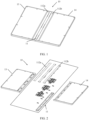
- FIG. 1 and FIG. 2 are diagrams of an electronic device in an unfolded state according to an embodiment of this application.
- FIG. 2 is a three-dimensional assembly diagram of the electronic device in FIG. 1 .
- An electronic device 10 provided in this application may be an inward foldable electronic device.
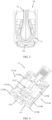
- FIG. 3 is a partial diagram of an electronic device in a folded state according to an embodiment of this application.
- the electronic device 10 may further include a flexible display 12, a first housing 13, and a second housing 14.
- the flexible display 12 is disposed on the hinge mechanism 11.
- the first housing 13 and the second housing 14 are disposed on two sides of the hinge mechanism 11, and may rotate around the hinge mechanism 11.
- the electronic device 10 may be folded and unfolded in different use scenarios.
- the flexible display 12 is disposed on a same side of the hinge mechanism 11, the first housing 13, and the second housing 14, and is connected to the hinge mechanism 11, the first housing 13, and the second housing 14.
- an outer surface that is of the first housing 13 and that is away from the flexible display 12 and an outer surface that is of the second housing 14 and that is away from the flexible display 12 may be jointly used as an appearance surface of the electronic device 10, and the flexible display 12 is configured to display an image.
- the first housing 13 and the second housing 14 are disposed toward each other, and the flexible display 12 is folded and is in a water drop shape, so that a stress exerted on the flexible display 12 by folding the first housing 13 and the second housing 14 can be reduced.
- a process in which the electronic device 10 switches from the unfolded state to the folded state or switches from the folded state to the unfolded state is a process in which the first housing 13 and the second housing 14 rotate around the hinge mechanism 11. In this process, the flexible display 12 is bent or unfolded along with the first housing 13 and the second housing 14.
- FIG. 4 is a diagram of a structure of a hinge mechanism according to an embodiment of this application.
- FIG. 5 is a three-dimensional assembly diagram of the hinge mechanism in FIG. 4 .
- the hinge mechanism 11 includes a base 110 and at least one hinge module 111.
- FIG. 6 is a diagram of a structure of a base according to an embodiment of this application. As shown in FIG. 6 , the base 110 is provided with a first spiral groove 1101a and a second spiral groove 1101b. Still as shown in FIG. 5 and FIG.
- the hinge module 111 may include a first rotating assembly 1111a and a second rotating assembly 11 11b, and the first rotating assembly 1111a and the second rotating assembly 1111b are respectively disposed on two sides of the base 110.
- the first rotating assembly 1111a may include a first rotating shaft 1113a, a first rotating member 1114a, a first sliding member 1115a, and a first housing support 1116a.
- the first rotating shaft 1113a is disposed on a side of the base 110.
- the first rotating member 1114a is rotatably connected to the base 110 through the first rotating shaft 1113a.
- the second rotating assembly 1111b may include a second rotating shaft 1113b, a second rotating member 1114b, a second sliding member 1115b, and a second housing support 1116b.
- the second rotating shaft 1113b is disposed on another side of the base 110.
- the second rotating member 1114b is rotatably connected to the base 110 through the second rotating shaft 1113b.
- An end of the second sliding member 1115b is rotatably connected to the base 110, another end of the second sliding member 1115b is slidably connected to the second rotating member 1114b, and the second sliding member 1115b may slide relative to the second rotating member 1114b in a direction parallel to the second rotating shaft 1113b.
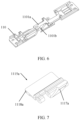
- FIG. 7 is a diagram of a structure of a first sliding member according to an embodiment of this application.
- FIG. 8 is a diagram of another structure of a hinge mechanism according to an embodiment of this application.
- the first sliding member 1115a is provided with a first spiral rotating part 1117a.
- the first spiral rotating part 1117a may be accommodated in the first spiral groove 1101a and rotate in the first spiral groove 1101a, so that the first sliding member 1115a slides relative to the first rotating member 1114a in the direction parallel to the first rotating shaft 1113a.
- the first housing support 1116a is provided with a first slanting groove 1121a.
- FIG. 9 is a diagram of another structure of a hinge mechanism according to an embodiment of this application.
- the first sliding member 1115a is provided with a first protrusion 1123a, and the first protrusion 1123a is limited in the first slanting groove 1121a and may slide in the first slanting groove 1121a.
- the second sliding member 1115b is provided with a second spiral rotating part 1117b.
- the second spiral rotating part 1117b may be accommodated in the second spiral groove 1101b and rotate in the second spiral groove 1101b, so that the second sliding member 1115b slides relative to the second rotating member 1114b in the direction parallel to the second rotating shaft 1113b.
- the second housing support 1116b is provided with a second slanting groove 1121b
- the second sliding member 1115b is provided with a second protrusion 1123b.
- the second protrusion 1123b is limited in the second slanting groove 1121b and may slide in the second slanting groove 1121b.
- the first rotating assembly 1111a and the second rotating assembly 1111b rotate toward each other, the first rotating member 1114a rotates around the first rotating shaft 1113a, and the first sliding member 1115a rotates relative to the base 110.
- the first sliding member 1115a slides, by using the first spiral rotating part 1117a and the first spiral groove 1 101a, relative to the first rotating member 1114a in the direction parallel to the first rotating shaft 1113a.
- the first protrusion 1123a simultaneously slides in the first slanting groove 1121a, to push the first housing support 1116a to slide relative to the first rotating member 1114a in a direction away from the base 110.
- the second rotating member 1114b rotates around the second rotating shaft 1113b, and the second sliding member 1115b rotates relative to the base 110.
- the second sliding member 1115b slides, by using the second spiral rotating part 1117b and the second spiral groove 1101b, relative to the second rotating member 1114b in the direction parallel to the second rotating shaft 1113b.
- the second protrusion 1123b simultaneously slides in the second slanting groove 1121b, to push the second housing support 1116b to slide relative to the second rotating member 1114b in the direction away from the base 110.
- Both the first housing support 1116a and the second housing support 1116b slide in the direction away from the base 110, so that a length of the hinge mechanism 11 is increased. This ensures that the flexible display 12 is not squeezed.
- the first housing support 1116a, the second housing support 1116b, and the base 110 may enclose accommodation space for accommodating the flexible display 12.
- the hinge mechanism 11 When the hinge mechanism 11 is unfolded, the first rotating assembly 1111a and the second rotating assembly 1111b rotate opposite to each other, the first rotating member 1114a rotates around the first rotating shaft 1113a, and the first sliding member 1115a rotates relative to the base 110 and slides relative to the first rotating member 1114a in the direction parallel to the first rotating shaft 1113a, so that the first protrusion 1123a slides in the first slanting groove 1121a, to push the first housing support 1116a to slide relative to the first rotating member 1114a in a direction close to the base 110.
- the second rotating member 1114b rotates around the second rotating shaft 1113b
- the second sliding member 1115b rotates relative to the base 110 and slides relative to the second rotating member 1114b in the direction parallel to the second rotating shaft 1113b, so that the second protrusion 1123b slides in the second slanting groove 1121b, to push the second housing support 1116b to slide relative to the second rotating member 1114b in a direction close to the base 110.
- Both the first housing support 1116a and the second housing support 1116b slide in the directions close to the base 110, so that a length of the hinge mechanism 11 is shortened. This ensures that the flexible display 12 is not pulled.
- the hinge mechanism 11 when the hinge mechanism 11 is in an unfolded state, the first housing support 1116a, the second housing support 1116b, and the base 110 may be unfolded and form a support surface.
- the hinge mechanism 11 when the hinge mechanism 11 is folded, the length of the hinge mechanism 11 may be increased in a direction perpendicular to the base 110, and the first housing support 1116a, the second housing support 1116b, and the base 110 may enclose the accommodation space.
- the hinge mechanism 11 When the hinge mechanism 11 is unfolded, the length of the hinge mechanism 11 may be shortened in a direction perpendicular to the base 110, and the first housing support 1116a, the second housing support 1116b, and the base 110 may be unfolded and form the support surface.
- the hinge mechanism 11 does not exert an action force like a tensile force or a compression force on the flexible display 12. This can improve a use effect and security of the electronic device 10.
- first rotating assembly 1111a and the second rotating assembly 1111b may respectively limit rotation directions. This can reduce a quantity of parts of the hinge mechanism 11, and then simplify a structure of the hinge mechanism 11.
- the structure of the hinge mechanism 11 is simple, when the hinge mechanism 11 is in the folded state, screen accommodation space for accommodating the flexible display 12 also becomes larger, and then screen accommodation can be better performed. This prevents a fold from appearing in the flexible display 12.
- a sliding connection between the first rotating member 1114a and the first sliding member 1115a may be implemented by using a sliding groove and a sliding part.
- the first sliding member 1115a may be provided with a first sliding groove 1118a parallel to the first rotating shaft 1113a.
- the first rotating member 1114a is provided with a first sliding part 1119a.
- the first sliding part 1119a may be accommodated in the first sliding groove 1118a and rotate in the first sliding groove 1118a, to implement the sliding connection between the first rotating member 1114a and the first sliding member 1115a.
- the second sliding member 1115b is provided with a second sliding groove 1118b parallel to the second rotating shaft 1113b.
- the second rotating member 1114b is provided with a second sliding part 1119b.
- the second sliding part 1119b may be accommodated in the second sliding groove 1118b and slide in the second sliding groove 1118b, to implement a sliding connection between the second rotating member 1114b and the second sliding member 1115b.
- locations of the sliding parts and the sliding grooves are not limited to the foregoing technical solution.
- the first sliding member 1115a may be provided with a first sliding part 1119a, and the first rotating member 1114a is provided with a first sliding groove 1118a parallel to the first rotating shaft 1113a.
- the second sliding member 1115b is provided with a second sliding part 1119b, and the second rotating member 1114b is provided with a second sliding groove 1118b parallel to the second rotating shaft 1113b.
- the first slanting groove 1121a and the second slanting groove 1121b may be symmetrically disposed relative to the base 110, and each are disposed at an acute angle with the base 110, so that the first housing support 1116a and the second housing support 1116b may separately move in the directions away from the base 110. This can ensure that the flexible display 12 remains a constant length in the folding process and the unfolding process, and prevents the flexible display 12 from being pulled or arched.
- the first slanting groove 1121a extends in a direction away from the base 110 from a side close to the base 110 to a side away from the base 110, and may form a first included angle with the first rotating shaft 1113a, where the first included angle is an acute angle.
- the first sliding member 1115a slides in the direction parallel to the first rotating shaft 1113a
- the first included angle is formed between a moving track of the first protrusion 1123a and the base 110.
- the moving track of the first protrusion 1123a includes a first track component in the direction parallel to the first rotating shaft 1113a and a second track component in the direction perpendicular to the base 110.
- the second track component of the first protrusion 1123a may push the first housing support 1116a to move relative to the first rotating member 1114a in the direction close to or away from the base 110.
- the second slanting groove 1121b extends in a direction away from the base 110 from a side close to the base 110 to a side away from the base 110, and may form a second included angle with the second rotating shaft 1113b, where the second included angle is an acute angle.
- the second sliding member 1115b slides in the direction parallel to the second rotating shaft 1113b, the second included angle is formed between a moving track of the second protrusion 1123b and the base 110.
- the moving track of the second protrusion 1123b includes a third track component in the direction parallel to the second rotating shaft 1113b and a fourth track component in the direction perpendicular to the base 110.
- the fourth track component of the second protrusion 1123b may push the second housing support 1116b to move relative to the second rotating member 1114b in the direction close to or away from the base 110.
- the first rotating assembly 1111a and the second rotating assembly 1111b rotate toward each other, the first protrusion 1123a slides in the first slanting groove 1121a in a direction close to the base 110, and the second protrusion 1123b slides in the second slanting groove 1121b in a direction close to the base 110.
- the first housing support 1116a may be provided with a first limiting sliding groove 1120a, where an extension direction of the first limiting sliding groove 1120a is perpendicular to the first rotating shaft 1113a.
- the first rotating member 1114a may be provided with a first limiting sliding part 1122a.
- the first limiting sliding part 1122a may be accommodated in the first limiting sliding groove 1120a and slide in the first limiting sliding groove 1120a, to implement the sliding connection between the first housing support 1116a and the first rotating member 1114a.
- the second housing support 1116b is provided with a second limiting sliding groove 1120b, where an extension direction of the second limiting sliding groove 1120b is perpendicular to the second rotating shaft 1113b.
- the second rotating member 1114b is provided with a second limiting sliding part 1122b.
- the second limiting sliding part 1122b may be accommodated in the second limiting sliding groove 1120b and slide in the second limiting sliding groove 1120b, to implement the sliding connection between the second housing support 1116b and the second rotating member 1114b.
- specific locations of the limiting sliding grooves and the limiting sliding parts are not limited.
- the first housing support 1116a may be provided with a first limiting sliding part 1122a
- the first rotating member 1114a may be provided with a first limiting sliding groove 1120a
- the second housing support 1116b is provided with a second limiting sliding part 1122b
- the second rotating member 1114b is provided with a second limiting sliding groove 1120b.
- the first rotating member 1114a and the second rotating member 1114b may be of frame structures.
- the first rotating member 1114a includes a first frame body 1129a and a first rotating part 1130a.
- the first frame body 1129a encloses a first hollow area 1131a, and the first frame body 1129a is separately slidably connected to the first sliding member 1115a and the first housing support 1116a.
- the first rotating part 1130a is disposed on a side that is of the first frame body 1129a and that is close to the base 110, and is rotatably connected to the first rotating shaft 1113a.
- the first sliding member 1115a includes a first sliding block body 1132a.
- the first sliding block body 1132a is disposed in the first hollow area 1131a of the first frame body 1129a, and the first spiral rotating part 1117a is disposed on a side that is of the first sliding block body 1132a and that is close to the base 110.
- the first sliding member 1115a moves in the first hollow area 1131a in the direction parallel to the first rotating shaft 1113a.
- the second rotating member 1114b may include a second frame body 1129b and a second rotating part 1130b.
- the second frame body 1129b encloses a second hollow area 1131b, and the second frame body 1129b is separately slidably connected to the second sliding member 1115b and the second housing support 1116b.
- the second rotating part 1130b is disposed on a side that is of the second frame body 1129b and that is close to the base 110, and is rotatably connected to the second rotating shaft 1113b.
- the second sliding member 1115b includes a second sliding block body 1132b.
- the second sliding block body 1132b is disposed in the second hollow area 1131b of the second frame body 1129b, and the second spiral rotating part 1117b is disposed on a side that is of the second sliding block body 1132b and that is close to the base 110.
- the second sliding member 1115b moves in the second hollow area 1131b in the direction parallel to the second rotating shaft 1113b. In this way, space utilization can be improved, and miniaturization of the hinge mechanism 11 is facilitated.
- the second rotating assembly 1111b is used as an example.
- the second rotating member 1114b and the second sliding member 1115b separately rotate relative to the base 110.
- the second rotating shaft 1113b passes through the second spiral groove 1101b, the second spiral rotating part 1117b, and the second rotating part 1130b, and is installed on the base 110.
- a rotation axis center of the second rotating member 1114b overlaps a rotation axis center of the second sliding member 1115b.
- the second rotating member 1114b and the second sliding member 1115b share one rotation axis center.
- a rotation axis center of the second rotating member 1114b may alternatively not overlap a rotation axis center of the second sliding member 1115b.
- the second rotating shaft 1113b passes through the second rotating part 1130b of the second rotating member 1114b, and is installed on the base 110.
- the second rotating assembly 1111b may further include a third rotating shaft (which is not shown in the figure) parallel to the second rotating shaft 1113b.
- the third rotating shaft passes through the second spiral groove 1101b and the second spiral rotating part 1117b, and is installed on the base 110.
- the first protrusion 1123a may be disposed on the first sliding block body 1132a of the first sliding member 1115a, and the first protrusion 1123a passes through the first hollow area 1131a and is slidably connected to the first slanting groove 1121a.
- the second protrusion 1123b may be disposed on the second sliding block body 1132b of the second sliding member 1115b, and the second protrusion 1123b passes through the second hollow area 1131b and is slidably connected to the second slanting groove 1121b.
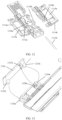
- FIG. 10 is a diagram of a folded hinge mechanism according to an embodiment of this application.
- the first protrusion 1123a slides toward the base 110 from an end that is of the first slanting groove 1121a and that is away from the base 110
- the second protrusion 1123b slides toward the base 110 from an end that is of the second slanting groove 1121b and that is away from the base 110, to push the first housing support 1116a and the second housing support 1116b to move in the direction perpendicular to the base 110.
- the first housing support 1116a and the second housing support 1116b may move toward the base 110 or move in a direction away from the base 110, so that a length of the hinge mechanism 11 in the direction perpendicular to the base 110 may be increased, to adapt to a location change of a neutral layer of the flexible display 12 in the folding or unfolding process, and then prevent the flexible display 12 from being arched or pulled in the process.
- shapes of the first protrusion 1123a and the second protrusion 1123b may not be specifically limited.
- a shape of a cross section that is of the first protrusion 1123a and that is parallel to the first sliding block body 1132a may be a circle, an ellipse, or a rectangle.
- a shape of a cross section that is of the second protrusion 1123b and that is parallel to the second sliding block body 1132b may be a circle, an ellipse, or a rectangle.
- the hinge module 111 may further include a sliding connection member 1112.
- the sliding connection member 1112 is disposed between the first rotating assembly 1111a and the second rotating assembly 1111b, where a first end 1112a of the sliding connection member 1112 is sleeved on the first rotating shaft 1113a and may slide along the first rotating shaft 1113a.
- a second end 1112b of the sliding connection member 1112 is sleeved on the second rotating shaft 1113b and may slide along the second rotating shaft 1113b.
- the first sliding member 1115a is connected to the first end 1112a
- the second sliding member 1115b is connected to the second end 1112b.
- a shape of the sliding connection member 1112 is not specifically limited.
- the sliding connection member 1112 may be in a cross shape or a straight shape.
- FIG. 11 is a diagram of another folded hinge mechanism according to an embodiment of this application.
- the first rotating member 1114a rotates around the first rotating shaft 1113a, to drive the first sliding member 1115a to rotate relative to the base 110 and simultaneously slide along the first rotating shaft 1113a.
- the second rotating member 1114b rotates around the second rotating shaft 1113b, to drive the second sliding member 1115b to rotate relative to the base 110 and simultaneously slide along the second rotating shaft 1113b.
- the first sliding member 1115a slides along the first rotating shaft 1113a to drive the sliding connection member 1112 to slide along the first rotating shaft 1113a
- the second sliding member 1115b slides along the second rotating shaft 1113b to drive the sliding connection member 1112 to slide along the second rotating shaft 1113b. Because the sliding connection member 1112 slides along both the first rotating shaft 1113a and the second rotating shaft 1113b, the first sliding member 1115a and the second sliding member 1115b may be pushed to synchronously slide, so that the first rotating member 1114a and the second rotating member 1114b synchronously rotate relative to the base 110.
- the first rotating assembly 1111a and the second rotating assembly 111 1b that have a folding structure feature may be combined with the sliding connection member 1112 by using a combination design of the spiral grooves to implement synchronous motion, and no complex synchronization module needs to be added. This can reduce a quantity of parts of the hinge mechanism 11, and simplify a structure of the hinge mechanism 11.
- FIG. 12 is a diagram of another structure of a hinge mechanism according to an embodiment of this application.
- the first spiral rotating part 1117a may be sleeved on the first rotating shaft 1113a.
- the first spiral rotating part 1117a is provided with a first limiting notch 1124a, and the first end 1112a of the sliding connection member 1112 is limited in the first limiting notch 1124a.
- the second spiral rotating part 1117b may be sleeved on the second rotating shaft 1113b.
- the second spiral rotating part 1117b is provided with a second limiting notch 1124b, and the second end 1112b of the sliding connection member 1112 is limited in the second limiting notch 1124b.
- the first spiral rotating part 1117a may drive the first end 1112a of the sliding connection member 1112 to slide along the first rotating shaft 1113a
- the second spiral rotating part 1117b may drive the second end 1112b of the sliding connection member 1112 to slide along the second rotating shaft 1113b, so that the sliding connection member 1112 slides along the first rotating shaft 1113a and the second rotating shaft 1113b.
- FIG. 13 is a diagram of another structure of a hinge mechanism according to an embodiment of this application.
- the hinge mechanism 11 may further include a first door plate 112a and a second door plate 112b that are oppositely disposed on the two sides of the base 110.
- the first door plate 112a is disposed close to the first rotating assembly 1111a
- the second door plate 112b is disposed close to the second rotating assembly 1111b
- the first door plate 112a and the second door plate 112b are configured to provide support for the flexible display 12.
- the first door plate 112a is rotatably connected to the first housing support 1116a and slidably connected to the first rotating member 1114a.
- the second door plate 112b is rotatably connected to the second housing support 1116b and slidably connected to the second rotating member 1114b.
- first rotating assembly 1111a and the second rotating assembly 1111b rotate toward each other, the first door plate 112a may rotate relative to the first housing support 1116a and slide relative to the first rotating member 1114a, and the second door plate 112b rotates relative to the second housing support 1116b and slides relative to the second rotating member 1114b.
- the first door plate 112a and the second door plate 112b each are disposed at an included angle with the base 110, so that the first door plate 112a, the second door plate 112b, and the base 110 enclose triangle-like space, and then a part of the flexible display 12 is accommodated in the space in a water drop shape.
- the first door plate 112a and the second door plate 112b may be in contact with the base 110, or may not be in contact with the base 110.
- the included angle formed between the first door plate 112a and the base 110 may be an included angle formed when the first door plate 112a is in contact with the base 110, or may be an included angle formed between an extension line of the first door plate 112a and the base 110.
- the included angle is an acute angle.
- the included angle formed between the second door plate 112b and the base 110 may be an included angle formed when the second door plate 112b is in contact with the base 110, or may be an included angle formed between an extension line of the second door plate 112b and the base 110.
- the included angle is an acute angle.
- a first arc-shaped rotating block 1125a is provided on a side that is of the first door plate 112a and that is away from the flexible display 12, and a first arc-shaped guiding groove 1126a is provided on a side that is of the first housing support 1116a and that faces the first door plate 112a.
- the first arc-shaped rotating block 1125a may be accommodated in the first arc-shaped guiding groove 1126a and slide in the first arc-shaped guiding groove 1126a, to implement a rotating connection between the first door plate 112a and the first housing support 1116a.
- a second arc-shaped rotating block is provided on a side that is of the second door plate 112b and that is away from the flexible display 12, and a second arc-shaped guiding groove is provided on a side that is of the second housing support 1116b and that faces the second door plate 112b.
- the second arc-shaped rotating block is accommodated in the second arc-shaped guiding groove and slides in the second arc-shaped guiding groove, to implement a rotating connection between the second door plate 112b and the second housing support 1116b.
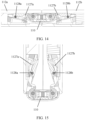
- FIG. 14 is a diagram of an unfolded hinge mechanism according to an embodiment of this application.
- FIG. 15 is a diagram of a folded hinge mechanism according to an embodiment of this application. As shown in FIG. 14 and FIG. 15 , when the first housing support 1116a and the second housing support 1116b are folded toward each other or unfolded, the first door plate 112a and the second door plate 112b are also folded or unfolded along with the first housing support 1116a and the second housing support 1116b. When the flexible display 12 is specifically disposed, the flexible display 12 is located on a side of the hinge mechanism 11 and disposed close to the first door plate 112a and the second door plate 112b.
- first support surface on a side that is of the first door plate 112a and that faces the flexible display 12
- second support surface on a side that is of the second door plate 112b and that faces the flexible display 12
- third support surface on a side that is of the base 110 and that faces the flexible display 12.
- a first track groove 1127a may be further provided on the side that is of the first door plate 112a and that is away from the flexible display 12, and the first rotating member 1114a is provided with a first pin 1128a.
- the first pin 1128a is accommodated in the first track groove 1127a and slides in the first track groove 1127a, to drive the first door plate 112a to move relative to the first housing support 1116a.
- a second track groove 1127b may be further provided on the side that is of the second door plate 112b and that is away from the flexible display 12, and the second rotating member 1114b is provided with a second pin 1128b.
- the second pin 1128b is accommodated in the second track groove 1127b and slides in the second track groove 1127b, to drive the second door plate 112b to move relative to the second housing support 1116b.
Landscapes
- Engineering & Computer Science (AREA)
- Theoretical Computer Science (AREA)
- Computer Hardware Design (AREA)
- General Engineering & Computer Science (AREA)
- Physics & Mathematics (AREA)
- General Physics & Mathematics (AREA)
- Human Computer Interaction (AREA)
- Mechanical Engineering (AREA)
- Mathematical Physics (AREA)
- Microelectronics & Electronic Packaging (AREA)
- Signal Processing (AREA)
- Telephone Set Structure (AREA)
- Pivots And Pivotal Connections (AREA)
- Casings For Electric Apparatus (AREA)
Applications Claiming Priority (2)
| Application Number | Priority Date | Filing Date | Title |
|---|---|---|---|
| CN202310383872.XA CN118728836A (zh) | 2023-03-31 | 2023-03-31 | 一种转轴机构及电子设备 |
| PCT/CN2024/078193 WO2024198787A1 (zh) | 2023-03-31 | 2024-02-22 | 一种转轴机构及电子设备 |
Publications (2)
| Publication Number | Publication Date |
|---|---|
| EP4477901A1 true EP4477901A1 (de) | 2024-12-18 |
| EP4477901A4 EP4477901A4 (de) | 2025-08-06 |
Family
ID=92856951
Family Applications (1)
| Application Number | Title | Priority Date | Filing Date |
|---|---|---|---|
| EP24765511.1A Pending EP4477901A4 (de) | 2023-03-31 | 2024-02-22 | Scharniermechanismus und elektronische vorrichtung |
Country Status (6)
| Country | Link |
|---|---|
| US (1) | US12628296B2 (de) |
| EP (1) | EP4477901A4 (de) |
| JP (1) | JP7775565B2 (de) |
| KR (1) | KR20240154636A (de) |
| CN (2) | CN118728836A (de) |
| WO (1) | WO2024198787A1 (de) |
Families Citing this family (4)
| Publication number | Priority date | Publication date | Assignee | Title |
|---|---|---|---|---|
| CN112995368B (zh) * | 2019-12-13 | 2021-12-21 | 华为技术有限公司 | 一种铰链和移动终端 |
| CN116557406A (zh) * | 2022-01-30 | 2023-08-08 | 华为技术有限公司 | 一种转轴机构及电子设备 |
| US12560195B2 (en) * | 2022-02-28 | 2026-02-24 | Boe Technology Group Co., Ltd. | Rotation shaft mechanism and electronic device |
| WO2026091024A1 (zh) * | 2024-10-31 | 2026-05-07 | 荣耀终端股份有限公司 | 一种转轴机构及电子设备 |
Family Cites Families (16)
| Publication number | Priority date | Publication date | Assignee | Title |
|---|---|---|---|---|
| TWI518256B (zh) * | 2013-08-26 | 2016-01-21 | 仁寶電腦工業股份有限公司 | 樞軸結構 |
| CN206918043U (zh) * | 2017-04-19 | 2018-01-23 | 广东欧珀移动通信有限公司 | 转轴组件及可折叠终端 |
| EP3757409B1 (de) | 2018-04-17 | 2024-11-27 | Huawei Technologies Co., Ltd. | Öffnungs- und schliessmechanismus und elektronische vorrichtung |
| CN111357261B (zh) | 2018-08-07 | 2021-05-07 | 华为技术有限公司 | 转轴连接机构和可折叠的设备 |
| US11294431B2 (en) | 2019-08-02 | 2022-04-05 | Dell Products L.P. | Synchronized dual axis pivot hinge |
| CN116517948A (zh) * | 2019-12-13 | 2023-08-01 | 华为技术有限公司 | 一种转轴机构和电子设备 |
| CN114449068A (zh) * | 2020-10-31 | 2022-05-06 | 华为技术有限公司 | 铰链机构及可折叠的电子设备 |
| WO2022119353A1 (ko) * | 2020-12-03 | 2022-06-09 | 주식회사 파인테크닉스 | 폴더블 구조를 갖는 휴대단말기의 힌지장치 |
| CN116568937B (zh) * | 2020-12-30 | 2025-09-16 | 三星电子株式会社 | 包括铰链模块的电子装置 |
| CN113067924B (zh) * | 2021-03-19 | 2023-05-23 | 维沃移动通信有限公司 | 折叠机构、支架结构和电子设备 |
| KR102977342B1 (ko) | 2021-05-25 | 2026-06-15 | 삼성전자주식회사 | 폴더블 전자 장치 |
| KR102880868B1 (ko) * | 2021-08-17 | 2025-11-04 | 삼성전자주식회사 | 힌지 어셈블리 및 이를 포함하는 전자 장치 |
| TWM631213U (zh) * | 2022-05-12 | 2022-08-21 | 鑫禾科技股份有限公司 | 樞轉裝置 |
| CN115118800B (zh) * | 2022-06-07 | 2024-08-06 | 维沃移动通信(重庆)有限公司 | 电子设备 |
| CN115103044A (zh) * | 2022-06-10 | 2022-09-23 | 维沃移动通信有限公司 | 电子设备 |
| CN115306817B (zh) * | 2022-08-24 | 2024-03-08 | Oppo广东移动通信有限公司 | 折叠装置、壳体组件、电子设备及可折叠的电子设备 |
-
2023
- 2023-03-31 CN CN202310383872.XA patent/CN118728836A/zh active Pending
-
2024
- 2024-02-22 CN CN202480003360.9A patent/CN119585538A/zh active Pending
- 2024-02-22 WO PCT/CN2024/078193 patent/WO2024198787A1/zh not_active Ceased
- 2024-02-22 KR KR1020247032276A patent/KR20240154636A/ko active Pending
- 2024-02-22 EP EP24765511.1A patent/EP4477901A4/de active Pending
- 2024-02-22 JP JP2024560280A patent/JP7775565B2/ja active Active
- 2024-10-03 US US18/905,602 patent/US12628296B2/en active Active
Also Published As
| Publication number | Publication date |
|---|---|
| JP7775565B2 (ja) | 2025-11-26 |
| EP4477901A4 (de) | 2025-08-06 |
| WO2024198787A1 (zh) | 2024-10-03 |
| CN118728836A (zh) | 2024-10-01 |
| KR20240154636A (ko) | 2024-10-25 |
| US12628296B2 (en) | 2026-05-12 |
| JP2025516114A (ja) | 2025-05-27 |
| CN119585538A (zh) | 2025-03-07 |
| US20250027531A1 (en) | 2025-01-23 |
Similar Documents
| Publication | Publication Date | Title |
|---|---|---|
| JP7775565B2 (ja) | ヒンジ機構及び電子デバイス | |
| JP7607299B2 (ja) | ヒンジ機構及び電子機器 | |
| EP3845996B1 (de) | Drehwelle und elektronische vorrichtung mit der drehwelle | |
| KR20230130141A (ko) | 힌지 및 인폴딩 플렉서블 스크린 이동 단말기 | |
| CN113314037B (zh) | 柔性显示面板、电子装置以及铰链 | |
| EP3637742A1 (de) | Scharnier eines mobilen endgeräts mit flexiblem bildschirm und mobiles endgerät mit flexiblem bildschirm | |
| KR20230142793A (ko) | 폴딩 기구, 지지 구조물 및 전자 장치 | |
| CN110905908B (zh) | 极高屏占比折叠显示设备的铰链结构及折叠显示设备 | |
| CN111828462B (zh) | 转动机构、折叠机构及通讯设备 | |
| WO2022206537A1 (zh) | 铰链组件及电子设备 | |
| CN111901458B (zh) | 折叠机构及通讯设备 | |
| US20240028085A1 (en) | Liquid crystal display panel and alignment method thereof | |
| JP7735587B2 (ja) | ヒンジ機構及び電子デバイス | |
| WO2024139433A1 (zh) | 一种可折叠的电子设备及其转轴机构 | |
| JP2025518648A (ja) | ヒンジ機構及び電子デバイス | |
| CN115405614A (zh) | 铰链结构和电子装置 | |
| WO2023093860A1 (zh) | 转轴机构及电子设备 | |
| CN119072041A (zh) | 铰链及折叠显示装置 | |
| CN213960109U (zh) | 折叠机构及通讯设备 | |
| EP4478154A1 (de) | Scharnier und klappbare elektronische vorrichtung | |
| CN114578897A (zh) | 折叠铰链结构及折叠终端设备 | |
| EP4550765A1 (de) | Faltbare elektronische vorrichtung und scharnier | |
| JP2025518649A (ja) | ヒンジ機構及び電子デバイス | |
| CN117404386A (zh) | 转轴装置、折叠壳体及电子设备 | |
| CN117722430A (zh) | 转轴结构以及电子装置 |
Legal Events
| Date | Code | Title | Description |
|---|---|---|---|
| STAA | Information on the status of an ep patent application or granted ep patent |
Free format text: STATUS: UNKNOWN |
|
| STAA | Information on the status of an ep patent application or granted ep patent |
Free format text: STATUS: THE INTERNATIONAL PUBLICATION HAS BEEN MADE |
|
| PUAI | Public reference made under article 153(3) epc to a published international application that has entered the european phase |
Free format text: ORIGINAL CODE: 0009012 |
|
| STAA | Information on the status of an ep patent application or granted ep patent |
Free format text: STATUS: THE APPLICATION HAS BEEN PUBLISHED |
|
| AK | Designated contracting states |
Kind code of ref document: A1 Designated state(s): AL AT BE BG CH CY CZ DE DK EE ES FI FR GB GR HR HU IE IS IT LI LT LU LV MC ME MK MT NL NO PL PT RO RS SE SI SK SM TR |
|
| STAA | Information on the status of an ep patent application or granted ep patent |
Free format text: STATUS: REQUEST FOR EXAMINATION WAS MADE |
|
| 17P | Request for examination filed |
Effective date: 20250403 |
|
| A4 | Supplementary search report drawn up and despatched |
Effective date: 20250704 |
|
| RIC1 | Information provided on ipc code assigned before grant |
Ipc: F16C 11/04 20060101AFI20250630BHEP |
|
| DAV | Request for validation of the european patent (deleted) | ||
| DAX | Request for extension of the european patent (deleted) |