EP4458985A1 - Verfahren zum nachweis mehrerer zielnukleinsäuren - Google Patents
Verfahren zum nachweis mehrerer zielnukleinsäuren Download PDFInfo
- Publication number
- EP4458985A1 EP4458985A1 EP22914814.3A EP22914814A EP4458985A1 EP 4458985 A1 EP4458985 A1 EP 4458985A1 EP 22914814 A EP22914814 A EP 22914814A EP 4458985 A1 EP4458985 A1 EP 4458985A1
- Authority
- EP
- European Patent Office
- Prior art keywords
- signal
- detected
- primer
- nucleic acids
- probe
- Prior art date
- Legal status (The legal status is an assumption and is not a legal conclusion. Google has not performed a legal analysis and makes no representation as to the accuracy of the status listed.)
- Pending
Links
Images


Classifications
-
- C—CHEMISTRY; METALLURGY
- C12—BIOCHEMISTRY; BEER; SPIRITS; WINE; VINEGAR; MICROBIOLOGY; ENZYMOLOGY; MUTATION OR GENETIC ENGINEERING
- C12Q—MEASURING OR TESTING PROCESSES INVOLVING ENZYMES, NUCLEIC ACIDS OR MICROORGANISMS; COMPOSITIONS OR TEST PAPERS THEREFOR; PROCESSES OF PREPARING SUCH COMPOSITIONS; CONDITION-RESPONSIVE CONTROL IN MICROBIOLOGICAL OR ENZYMOLOGICAL PROCESSES
- C12Q1/00—Measuring or testing processes involving enzymes, nucleic acids or microorganisms; Compositions therefor; Processes of preparing such compositions
- C12Q1/68—Measuring or testing processes involving enzymes, nucleic acids or microorganisms; Compositions therefor; Processes of preparing such compositions involving nucleic acids
- C12Q1/6876—Nucleic acid products used in the analysis of nucleic acids, e.g. primers or probes
-
- C—CHEMISTRY; METALLURGY
- C12—BIOCHEMISTRY; BEER; SPIRITS; WINE; VINEGAR; MICROBIOLOGY; ENZYMOLOGY; MUTATION OR GENETIC ENGINEERING
- C12Q—MEASURING OR TESTING PROCESSES INVOLVING ENZYMES, NUCLEIC ACIDS OR MICROORGANISMS; COMPOSITIONS OR TEST PAPERS THEREFOR; PROCESSES OF PREPARING SUCH COMPOSITIONS; CONDITION-RESPONSIVE CONTROL IN MICROBIOLOGICAL OR ENZYMOLOGICAL PROCESSES
- C12Q1/00—Measuring or testing processes involving enzymes, nucleic acids or microorganisms; Compositions therefor; Processes of preparing such compositions
- C12Q1/68—Measuring or testing processes involving enzymes, nucleic acids or microorganisms; Compositions therefor; Processes of preparing such compositions involving nucleic acids
- C12Q1/6844—Nucleic acid amplification reactions
- C12Q1/6853—Nucleic acid amplification reactions using modified primers or templates
-
- C—CHEMISTRY; METALLURGY
- C12—BIOCHEMISTRY; BEER; SPIRITS; WINE; VINEGAR; MICROBIOLOGY; ENZYMOLOGY; MUTATION OR GENETIC ENGINEERING
- C12Q—MEASURING OR TESTING PROCESSES INVOLVING ENZYMES, NUCLEIC ACIDS OR MICROORGANISMS; COMPOSITIONS OR TEST PAPERS THEREFOR; PROCESSES OF PREPARING SUCH COMPOSITIONS; CONDITION-RESPONSIVE CONTROL IN MICROBIOLOGICAL OR ENZYMOLOGICAL PROCESSES
- C12Q1/00—Measuring or testing processes involving enzymes, nucleic acids or microorganisms; Compositions therefor; Processes of preparing such compositions
- C12Q1/68—Measuring or testing processes involving enzymes, nucleic acids or microorganisms; Compositions therefor; Processes of preparing such compositions involving nucleic acids
- C12Q1/6844—Nucleic acid amplification reactions
- C12Q1/686—Polymerase chain reaction [PCR]
-
- C—CHEMISTRY; METALLURGY
- C12—BIOCHEMISTRY; BEER; SPIRITS; WINE; VINEGAR; MICROBIOLOGY; ENZYMOLOGY; MUTATION OR GENETIC ENGINEERING
- C12Q—MEASURING OR TESTING PROCESSES INVOLVING ENZYMES, NUCLEIC ACIDS OR MICROORGANISMS; COMPOSITIONS OR TEST PAPERS THEREFOR; PROCESSES OF PREPARING SUCH COMPOSITIONS; CONDITION-RESPONSIVE CONTROL IN MICROBIOLOGICAL OR ENZYMOLOGICAL PROCESSES
- C12Q1/00—Measuring or testing processes involving enzymes, nucleic acids or microorganisms; Compositions therefor; Processes of preparing such compositions
- C12Q1/68—Measuring or testing processes involving enzymes, nucleic acids or microorganisms; Compositions therefor; Processes of preparing such compositions involving nucleic acids
- C12Q1/6876—Nucleic acid products used in the analysis of nucleic acids, e.g. primers or probes
- C12Q1/6883—Nucleic acid products used in the analysis of nucleic acids, e.g. primers or probes for diseases caused by alterations of genetic material
- C12Q1/6886—Nucleic acid products used in the analysis of nucleic acids, e.g. primers or probes for diseases caused by alterations of genetic material for cancer
-
- C—CHEMISTRY; METALLURGY
- C12—BIOCHEMISTRY; BEER; SPIRITS; WINE; VINEGAR; MICROBIOLOGY; ENZYMOLOGY; MUTATION OR GENETIC ENGINEERING
- C12Q—MEASURING OR TESTING PROCESSES INVOLVING ENZYMES, NUCLEIC ACIDS OR MICROORGANISMS; COMPOSITIONS OR TEST PAPERS THEREFOR; PROCESSES OF PREPARING SUCH COMPOSITIONS; CONDITION-RESPONSIVE CONTROL IN MICROBIOLOGICAL OR ENZYMOLOGICAL PROCESSES
- C12Q1/00—Measuring or testing processes involving enzymes, nucleic acids or microorganisms; Compositions therefor; Processes of preparing such compositions
- C12Q1/70—Measuring or testing processes involving enzymes, nucleic acids or microorganisms; Compositions therefor; Processes of preparing such compositions involving virus or bacteriophage
- C12Q1/701—Specific hybridization probes
-
- C—CHEMISTRY; METALLURGY
- C12—BIOCHEMISTRY; BEER; SPIRITS; WINE; VINEGAR; MICROBIOLOGY; ENZYMOLOGY; MUTATION OR GENETIC ENGINEERING
- C12Q—MEASURING OR TESTING PROCESSES INVOLVING ENZYMES, NUCLEIC ACIDS OR MICROORGANISMS; COMPOSITIONS OR TEST PAPERS THEREFOR; PROCESSES OF PREPARING SUCH COMPOSITIONS; CONDITION-RESPONSIVE CONTROL IN MICROBIOLOGICAL OR ENZYMOLOGICAL PROCESSES
- C12Q2600/00—Oligonucleotides characterized by their use
- C12Q2600/16—Primer sets for multiplex assays
-
- Y—GENERAL TAGGING OF NEW TECHNOLOGICAL DEVELOPMENTS; GENERAL TAGGING OF CROSS-SECTIONAL TECHNOLOGIES SPANNING OVER SEVERAL SECTIONS OF THE IPC; TECHNICAL SUBJECTS COVERED BY FORMER USPC CROSS-REFERENCE ART COLLECTIONS [XRACs] AND DIGESTS
- Y02—TECHNOLOGIES OR APPLICATIONS FOR MITIGATION OR ADAPTATION AGAINST CLIMATE CHANGE
- Y02A—TECHNOLOGIES FOR ADAPTATION TO CLIMATE CHANGE
- Y02A50/00—TECHNOLOGIES FOR ADAPTATION TO CLIMATE CHANGE in human health protection, e.g. against extreme weather
- Y02A50/30—Against vector-borne diseases, e.g. mosquito-borne, fly-borne, tick-borne or waterborne diseases whose impact is exacerbated by climate change
Definitions
- the present invention relates to the field of molecular biology, in particular to a method for detecting multiple target nucleic acids in a single sample container.
- PCR Polymerase chain reaction
- PCR is a molecular biological technique for enzymatic replication of DNA without using a living organism.
- PCR is commonly used in medical and biological research laboratories to undertake a variety of tasks, such as diagnosis of infectious diseases, gene cloning, phenotype identification of experimental animals, transcriptome research, detection of genetic diseases, identification of genetic fingerprints, and paternity testing. Because of unrivaled abilities of PCR to replicate and be precise, it is considered by molecular biologists to be a preferred method for nucleic acid detection.
- qPCR Real Time Quantitative PCR
- Digital PCR is a technique for absolute quantification of nucleic acid molecules that utilizes the principle of limiting dilution to distribute one fluorescence quantitative PCR reaction system into thousands of individual nanoliter microreactors so that each microreactor contains no, or one or more copies of a target nucleic acid molecule (DNA target) to be simultaneously subj ected to single-molecule template PCR amplification.
- fluorescence quantitative PCR which collects fluorescence at each amplification cycle
- digital PCR collects a fluorescence signal of each reaction unit independently at the end of amplification, and finally works out an original number of copies or concentration of a target molecule through the principle of Poisson distribution and the ratio of positive/negative reaction units.
- digital PCR may perform accurate absolute quantitative detection without relying on a Ct value and a standard curve, and has the advantages of high sensitivity as well as high accuracy. Since digital PCR only determines two amplification states of "yes/no" when performing result interpretation, there is also no need to detect an intersection of a fluorescence signal and a set threshold line, and it is completely independent of identification of the Ct value, so that the impact of amplification efficiency on digital PCR reaction and result interpretation is greatly reduced, and the tolerance to a PCR reaction inhibitor is greatly improved.
- the process of distributing the reaction system in a digital PCR experiment may greatly reduce the concentration of a background sequence that competes with a target sequence locally, and thus digital PCR is particularly suitable for detection of a rare mutation in a complex background, and is currently mostly applied in liquid biopsies to realize detection of rare mutation markers in peripheral blood of tumor patients.
- the present invention provides a method for detecting multiple target nucleic acids, including the following contents:
- the multiple target nucleic acids can be detected (at least octuple reaction may be realized on digital PCR).
- the realization of multiplex detection not only relies on fluorescence channels, but also uses different melting temperatures in the same fluorescence channel (i.e., the same signal channel), and different targets may be distinguished by the presence or absence of fluorescence through a finite number of photographs, which has low fluorescence recognition requirements for digital PCR, is easy to operate and saves time.
- one signal acquisition is performed at each signal acquisition temperature; and n different signal acquisition temperatures are used, and thus n signal acquisitions are performed.
- n refers to the number of signal acquisitions; and n ⁇ the number of classes of the target nucleic acids, that is, the number of signal acquisitions ⁇ the number of classes of the target nucleic acids.
- numbers of classes of target nucleic acids contained in the signals obtained from the two adjacent signal channel acquisitions under the same signal channel differ by one at most; in certain embodiments, the numbers of classes of the target nucleic acids contained in the signals obtained from the two adjacent signal channel acquisitions under the same signal channel differ by one; and in certain embodiments, the signal obtained from the signal channel acquisition with the maximum signal acquisition temperature contains at most one kind of target nucleic acid.
- the "one kind of target nucleic acid" further includes one class of target nucleic acid that is classified but not typed.
- signal acquisition includes the following operations: performing a first signal acquisition on the reaction product at a first temperature, heating up to a second temperature for a second signal acquisition, continuing heating up to a third temperature for a third signal acquisition, continuing heating up and signal acquisition, until all of the target nucleic acids in the sample to be detected are detected. It may also include operations for signal acquisitions in continuous cooling: for example, performing a first signal acquisition on the reaction product at a first temperature, cooling down to a second temperature for a second signal acquisition, continuing cooling down to a third temperature for a third signal acquisition, continuing cooling down and signal acquisition, until all of the target nucleic acids in the sample to be detected are detected.
- each signal acquisition only includes one signal channel acquisition, that is, each signal acquisition refers to one signal acquisition under a certain signal channel (fluorescence channel).
- two adjacent signal channel acquisitions refer to two adjacent signal acquisitions, the numbers of classes of target nucleic acids contained in signals obtained from two adjacent signal channel acquisitions differ by one, and thus the number of signal acquisitions is equal to the number of classes of the target nucleic acids.
- the sample to be detected contains three kinds of target nucleic acids
- a first signal acquisition is performed on the reaction product at a first temperature (equivalent to a signal channel acquisition) to obtain a signal, which contains three kinds of targets
- the reaction product heats up to a second temperature for a second signal acquisition to obtain a signal, which contains two kinds of targets
- the reaction product continues heating up to a third temperature for a third signal acquisition to obtain a signal, which contains one kind of target.
- the presence of the target nucleic acids may be determined by comparing the signals of the two adjacent signal acquisitions.
- the disappeared signal is a first target
- the other part of the signals disappears during the third signal acquisition compared to the second signal acquisition
- the other part of the signals that has disappeared is a second target
- the signal that is still presented in the third signal acquisition is a third target.
- two kinds of probes in the primer-probe composition there are two kinds of probes in the primer-probe composition (two kinds of probes refer to two classes of probes that are modified with different detection labels or fluorophores and have different base sequences), and thus at least one signal acquisition includes two signal channel acquisitions.
- Two signal channel acquisitions refer to one signal acquisition under each of two signal channels (fluorescence channels).
- a person skilled in the art may predict the melting temperature of the reaction product and further predict the temperature required for the reaction product representing the target nucleic acid to generate a detectable signal, and a fluorescence channel in which it is located.
- a person skilled in the art may select a suitable signal acquisition temperature and a suitable signal channel (fluorescence channel) for a signal acquisition.
- analysis may be simultaneously performed in single-tube reaction in two dimensions of a fluorescence channel and a melting temperature. That is, by using the same fluorescence channel, different targets may be detected through different signal acquisition temperatures; or by using different fluorescence channels, the detection of the classes of the targets which are a product of the number of the fluorescence channels and signal acquisition temperature characteristics can be achieved.
- the amplification reagent may further include some reagents that promote PCR reaction, such as KCl, MgCl 2 , Tris-HCl, dithiothreitol (DTT) and (NH 4 ) 2 SO 4 .
- some reagents that promote PCR reaction such as KCl, MgCl 2 , Tris-HCl, dithiothreitol (DTT) and (NH 4 ) 2 SO 4 .
- the amplification reagent in addition to a polymerase with polymerization activity, further includes other enzymes that act on nucleic acids, such as exonuclease and endonuclease.
- two adjacent signal channel acquisitions under the same signal channel means that signal acquisition temperatures used for the two signal channel acquisitions are close.
- the reaction product is placed at a first temperature for a first signal channel acquisition, heats up to a second temperature for a second signal channel acquisition, and continues heating up to a third temperature for a third signal channel acquisition.
- the first signal channel acquisition and the second signal channel acquisition are two adjacent signal channel acquisitions
- the second signal channel acquisition and the third signal channel acquisition are two adjacent signal channel acquisitions
- the first signal channel acquisition and the third signal channel acquisition are not two adjacent signal channel acquisitions.
- signal acquisition temperatures used for two adjacent signal channel acquisitions differ by 4°C or above to realize a difference of one between the numbers of classes of target nucleic acids contained in signals obtained from the two adjacent signal channel acquisitions under the same signal channel, avoiding the situation in which there is no difference in the target nucleic acid signals obtained from the two adjacent signal channel acquisitions, thereby reducing the number of signal channel acquisitions and simplifying operation steps.
- the signal acquisition temperature is 0-95°C.
- the selection of the signal acquisition temperature may be determined by a person skilled in the art according to the actual situation of the designed primer-probe composition. For example, through the design of the primer-probe composition, a person skilled in the art may predict that the reaction product representing the target nucleic acid has a melting temperature of T. If it is desired to detect the signal of the target nucleic acid, the signal acquisition temperature ⁇ T; and if it is not desired to detect the signal of the target nucleic acid, the signal acquisition temperature > T.
- each signal acquisition includes m signal channel acquisitions; and m refers to the number of classes of detection labels of a probe in the primer-probe composition.
- each signal acquisition refers to two signal channel acquisitions under two signal channels.
- the primer-probe composition for the five kinds of targets contains two kinds of probes, with the first probe detecting three kinds of targets and the second probe detecting two kinds of targets. Thus, only three signal acquisitions are required for the reaction product, and each signal acquisition refers to two signal channel acquisitions under two signal channels.
- the number of signal acquisitions is set in terms of the detection channel that detects the maximum number of targets, which realizes that the number of signal acquisitions ⁇ the number of classes of target nucleic acids, and reduces the number of signal acquisitions.
- the design of the primer-probe composition chooses not to perform a signal acquisition in channels that do not have an expected target, thereby reducing the number of signal acquisitions and simplifying operation steps.
- the above method for detecting multiple target nucleic acids refers to a digital PCR detection method for multiple target nucleic acid.
- the method further includes: distributing the reaction system into 500 or more reaction units, with each reaction unit containing one target nucleic acid of the sample to be detected or containing no target nucleic acids of the sample to be detected.
- the signal acquisitions refer to acquisitions of fluorescence signals by means of a camera.
- the signal channel acquisitions refer to acquisitions of the fluorescence signals by means of the camera under a fluorescence signal channel.
- the primer-probe composition, the sample to be detected (containing two kinds of targets) and the amplification reagent are mixed to obtain a reaction system, and the reaction system is distributed into 500 or more reaction units to form countless small droplets, each of which contains at most one target nucleic acid of the sample to be detected but contains necessary components suitable for amplification of nucleic acids, e.g., the primer-probe composition and amplification reagents such as the nucleic acid polymerase.
- All the small droplets are placed into the condition that allows the nucleic acid polymerase to perform hybridization and extension reaction (in certain embodiments, i.e., a PCR amplification condition) to obtain a reaction product (amplification product), which undergoes a first photograph at a first temperature, part of the small droplets shines, and a positive signal with two kinds of targets is obtained.
- the reaction product heats up to a second temperature for a second photograph, and it is found that certain small droplets undergoing the first photograph do not shine, and certain small droplets still shine.
- the small droplets that still shine in the second photograph serve as first targets
- the small droplets that do not shine in the second photograph but shine in the first photograph serve as second targets.
- Specific classes of the two kinds of targets may be analyzed according to temperatures and fluorescence channels used in the two photographs.
- the number of the first targets is obtained by analyzing the number of the shining small droplets in the second photograph.
- the number of the second targets may be obtained by analyzing a difference value between the numbers of the shining small droplets in the first photograph and the second photograph.
- the condition that allows the nucleic acid polymerase to perform hybridization and extension reaction includes: initial denaturation at about 85°C to about 105°C for 0 to about 15 min; denaturation at about 85°C to about 105°C for about 1 to about 60 s, and annealing and extending at about 40°C to about 75°C for about 3 to about 90 s, for 20 to 60 cycles; preferably, when a target in the sample to be detected is RNA, the amplification reagent further includes a reverse transcriptase, and a reaction condition for a first PCR amplification of the reaction system includes: reverse transcription at about 30 to about 65°C for about 2 to about 30 min; initial denaturation at about 85°C to about 105°C for 0 to about 15 min; denaturation at about 85°C to about 105°C for about 1 to about 60 s, and annealing and extending at about 40°C to about 75°C for about 3 to about 90 s, for 20 to 60 cycles
- the above condition that allows the nucleic acid polymerase to perform hybridization and extension reaction includes: initial denaturation at about 85°C to about 105°C for 0 to about 15 min; denaturation at about 85°C to about 105°C for about 2 to about 60 s, and annealing and extending at about 40°C to about 75°C for about 10 to about 90 s, for 20 to 60 cycles.
- the amplification reagent when a target nucleic acid in the sample to be detected contains RNA, the amplification reagent further includes a reverse transcriptase, and the condition that allows the nucleic acid polymerase to perform hybridization and extension reaction includes: reverse transcription at about 30 to about 65°C for about 2 to about 30 min; initial denaturation at about 85°C to about 105°C for 0 to 15 min; denaturation at 85°C to105°C for 2 to 60 s, and annealing and extending at 40°C to 75°C for 10 to 90 s, for 20 to 60 cycles.
- the above primer-probe composition in the method for detecting multiple target nucleic acids, includes a first probe and a first primer mixture; the first primer mixture includes at least two kinds of primer sets, and the different kinds of primer sets specifically bind to different kinds of target nucleic acids respectively.
- the primer sets in the first primer mixture specifically bind to the corresponding target nucleic acids to generate a pre-product, the pre-product contains a single-stranded pre-product specifically binding to the first probe, and the single-stranded pre-product specifically binds to the first probe and extends by >_ 0 base to form a double-stranded product, and formation of the double-stranded product causes a detectable signal change.
- the different kinds of primer sets in the first primer mixture and the corresponding target nucleic acids generate different single-stranded pre-products
- the different single-stranded pre-products and the first probe form different double-stranded products
- the different double-stranded products have different melting temperatures.
- the melting temperatures of the different double-stranded products differ by 4°C or above.
- the first probe refers to one class of probe that is modified with the same detection labels and may have the same or different base sequences. That is, the number of classes of probes is determined according to the number of classes of detection labels thereof.
- a signal generated from one kind of probe may undergo a signal acquisition in one detection channel (or a fluorescence channel); and signals generated from two kinds of probes may undergo signal acquisitions in two different detection channels.
- the same detection labels do not mean that detection groups for modification are exactly the same.
- the detection groups include fluorophores and quenchers. Signals generated from probes may also undergo signal acquisitions in one detection channel (or a fluorescence channel) as long as the fluorophores are the same.
- At least two kinds of primer sets refers to at least two classes of primer sets.
- Each primer set is specific to a different kind of target nucleic acid, that is, each kind of primer set can specifically bind to a corresponding target nucleic acid.
- one kind of primer set can specifically bind to one class of non-typed target nucleic acids all, and thus this class of non-typed target nucleic acids may also be considered as one kind of target nucleic acid.
- a primer set belongs to a double-primer case, i.e., including a pair of upstream and downstream primers specific to the same target nucleic acid.
- a primer set belongs to a single-primer case, i.e., only containing one kind of primer specific to a certain target nucleic acid. The primer can specifically bind to the corresponding target nucleic acid but cannot specifically bind to other kinds of target nucleic acids.
- a common primer may be presented in different kinds of primer sets.
- the same primer is included in two kinds of primer sets.
- the same kind of primer refers to sequences of primers being exactly the same.
- a first single-stranded pre-product generated from a primer set specific to a certain target nucleic acid does not extend after specifically binding to a probe (i.e., extending by 0 base).
- a person skilled in the art may, according to actual demands, achieve the above effect of "specifically binding but not extending” by designing a primer sequence in the primer set and/or a sequence of the probe. For example, it is designed in such a way that the first single-stranded pre-product generated from the primer set bound to a 5' end of the probe, or it is designed in such a way that a 3' end of the first single-stranded pre-product generated from the primer set contains a region that is not complementarily paired with the probe.
- a melting temperature of an oligonucleotide is related to factors such as the length and composition of the oligonucleotide.
- a person skilled in the art may adjust the melting temperature of the oligonucleotide according to actual needs. For example, a higher melting temperature may be obtained by increasing the GC content of the oligonucleotide, making the length of the oligonucleotide longer. Therefore, a person skilled in the art may, according to actual situations, adjust sequence compositions of primers and/or probes to make the different primers to form different single-stranded pre-products. The different single-stranded pre-products specifically bind to the first probe at different locations, thereby forming different double-stranded products with different melting temperatures.
- a person skilled in the art may, according to actual situations, make the double-stranded products representing different targets different, and the different double-stranded products have the different melting temperatures, so that signals of different target nucleic acids are obtained under different signal acquisition temperatures.
- the melting temperatures of the different double-stranded products representing the different targets may differ by 4°C or above through the design of primer probes.
- the primer-probe composition further includes a second probe and a second primer mixture; the second probe and the first probe have different base sequences and are modified with different detection labels; and the second primer mixture includes at least one kind of primer set, and different kinds of primer sets specifically bind to different kinds of target nucleic acids respectively.
- the number of classes of probes is determined according to the number of classes of detection labels thereof. Different kinds of probes need to perform signal acquisitions under different detection channels due to different detection labels. In certain embodiments, different detection labels do not mean that detection groups for modification are completely different.
- the detection groups include fluorophores and quenchers. Signals generated from two kinds of probes may also undergo signal acquisitions in two detection channels (or fluorescence channels) as long as the fluorophores are different (the quenchers may be the same or different).
- the increase in the number of classes of probes may realize signal detection of different target nucleic acids under different channels, and thus may realize more multiplex detection of the target nucleic acids.
- the primer-probe composition for target nucleic acid detection further includes a third probe and a third primer mixture, a fourth probe and a fourth primer mixture, a fifth probe and a fifth primer mixture, a sixth probe and a sixth primer mixture, or more probes and primer mixtures.
- Different probes are modified with different detection labels and have different base sequences; and primer sets in different primer mixtures are also different.
- a person skilled in the art may design more kinds of primer sets corresponding to the target nucleic acids and more kinds of probes corresponding to the primer sets as needed.
- the primer sets in the second primer mixture specifically bind to the corresponding target nucleic acids to generate a pre-product
- the pre-product contains a single-stranded pre-product specifically binding to the second probe
- the single-stranded pre-product specifically binds to the second probe and extends by >_ 0 base to form a double-stranded product
- formation of the double-stranded product causes a detectable signal change.
- the different kinds of primer sets in the second primer mixture and the corresponding target nucleic acids generate different single-stranded pre-products
- the different single-stranded pre-products and the second probe form different double-stranded products
- the different double-stranded products have different melting temperatures.
- the melting temperatures of the different double-stranded products differ by 4°C or above.
- the first probe or the second probe is a sequence that does not specifically bind to any target nucleic acids, and includes a probe signal detection region (H), and sequences of the probe signal detection regions (H) of the different probes are different from each other; each primer set includes a first primer and a second primer, and the first primer contains target sequence binding regions 1; the second primer contains primer signal detection regions (h) and target sequence binding regions 2, and the primer signal detection regions (h) are located at 5' ends of the target sequence binding regions 2; each primer signal detection region (h) is a sequence that does not specifically bind to any target nucleic acids and partially or wholly identical to the probe signal detection region (H) of the corresponding probe; and sequences of the primer signal detection regions (h) of the second primers in the different primer sets are different from each other.
- the target sequence binding regions 1 and the target sequence binding regions 2 specifically bind to different locations of the target nucleic acids respectively.
- primer signal detection region (h) with a sequence that is partially or wholly identical to the probe signal detection region (H) of the corresponding probe means that reverse complementary sequences (h') of the primer signal detection regions (h) can specifically bind to part or all of the sequences of the probe signal detection regions (H) of the probes.
- the first primer and the second primer specifically bind to the target nucleic acids to generate a pre-product
- the pre-product contains a single-stranded pre-product with the reverse complementary sequences (h') of the primer signal detection regions (h).
- the reverse complementary sequences (h') of the single-stranded pre-product specifically bind to the probe signal detection regions (H) of the probes and extend by >_ 0 base to form a double-stranded product, and formation of the double-stranded product causes a detectable signal change.
- sequences of the primer signal detection regions (h) of the second primers in the different primer sets are different from each other. That is, the sequences of the primer signal detection regions (h) of the second primers in the different primer sets have different bases and/or lengths, so that reverse complementary sequences (h') of different single-stranded pre-products are different.
- the different single-stranded pre-products specifically bind to the probes and extend by 0 or more bases to form different double-stranded products, and the melting temperatures of the different double-stranded products can be separated from each other; alternatively, the different single-stranded pre-products specifically bind to different kinds of probes respectively and extend by >_ 0 base to form different double-stranded products, the melting temperatures of the different double-stranded products cannot be separated from each other, however, since the different double-stranded products have different kinds of probes, these double-stranded products may be separated through different detection channels. That is, the different kinds of target nucleic acids may be distinguished through the melting temperatures and/or the detection channels to realize multiplex detection.
- the primer signal detection regions (h) of the second primer and the target sequence binding regions 2 are spaced by 0-20 bases.
- the first probe or the second probe further includes a primer anchoring region (A'); the first primer of the at least one kind of primer set in the first primer mixture or the second primer mixture further includes a probe anchoring region (A), and the probe anchoring region (A) is located at a 5' end of the target sequence binding region 1; and the probe anchoring region (A) does not specifically bind to any target nucleic acids but specifically binds to the primer anchoring region (A').
- the first primer and the second primer in the above primer sets specifically bind to the target nucleic acids to generate a pre-product
- the pre-product contains a single-stranded pre-product with the probe anchoring regions (A) and the reverse complementary sequences (h') of the primer signal detection regions (h).
- the probe anchoring regions (A) and the reverse complementary sequences (h') of the single-stranded pre-product specifically bind to the primer anchoring regions (A') of the probes and the probe signal detection regions (H) respectively and extend by >_ 0 base to form a double-stranded product, and formation of the double-stranded product causes a detectable signal change.
- the different primer sets and the target nucleic acids thereof By adjusting the probe anchoring regions (A) of the first primers in the different primer sets and/or sequence compositions and/or lengths of the primer signal detection regions (h) of the second primers in the different primer sets, the different primer sets and the target nucleic acids thereof generate different single-stranded pre-products.
- the different single-stranded pre-products specifically bind to the probes to generate different annealing temperatures, and specifically bind to the probes and extend by >_ 0 base to form double-stranded products with different melting temperatures, so that the lower an annealing temperature required for a single-stranded pre-product generated from a certain kind of primer set and a target nucleic acid thereof specifically binding to a probe, the higher a melting temperature of a double-stranded product formed by the single-stranded pre-product specifically binding to the probe and extending by >_ 0 base.
- the target sequence binding regions 1 of the first primers in the different primer sets have different sequences; the probe anchoring regions (A) of the first primers in the different primer sets may be the same or different; and preferably, the probe anchoring regions (A) of the first primer and the target sequence binding regions 1 are spaced by 0-20 bases.
- the second primer of at most one kind of primer set further includes an extension blocking region (M), the extension blocking region (M) is located at a 5' end of the primer signal detection region (h), and neither the extension blocking region (M) nor a complementary sequence thereof specifically binds to any probes or any target nucleic acids.
- the above first primers and the second primer containing the extension blocking region (M) specifically bind to target nucleic acids respectively to generate a pre-product, and the pre-product contains a single-stranded pre-product with the reverse complementary sequence (h') of the primer signal detection region (h).
- the reverse complementary sequence (h') of the single-stranded pre-product specifically binds to the probe and extends by 0 base to form a double-stranded product (due to the presence of the extension blocking region, the single-stranded pre-product specifically binds to the probe and does not extend), thereby causing the probe to generate a detectable signal change.
- First primer mixture “second primer mixture”, etc. are only used for the purpose of description to distinguish defined objects. Each of them represents one set of primer mixtures that specifically binds to probes.
- the primer mixtures include a plurality kinds of primer sets, and reverse complementary sequences (h') of primer signal detection regions (h) contained in second primers in the primer sets each may specifically bind to the same kind of probe. However, the primer sets in the "first primer mixture” and the “second primer mixture” specifically bind to different kinds of probes.
- the second primer of at most one kind of primer set contains an extension blocking region (M).
- M extension blocking region
- the kind of primer set specifically binds to a target nucleic acid to generate a single-stranded pre-product, which requires a maximum annealing temperature for specifically binding to a probe, and specifically binds to the probe without extending to generate a double-stranded product with a minimum melting temperature.
- first primer and second primer are only used for the purpose of description to distinguish the defined objects, instead of defining the order or primary and secondary in any way.
- first primer and the second primer of the primer sets are structurally interchangeable.
- the first primer contains primer signal detection regions (h) and target sequence binding regions
- the second primer contains target sequence binding regions; or for example, the first primer contains primer signal detection regions (h) and target sequence binding regions, and the second primer contains probe anchoring regions (A) and target sequence binding regions.
- first primer is also known as “forward primer”
- second primer is also known as "reverse primer”.
- the probe is a freely designed sequence that is not paired with and does not bind to any target nucleic acids, and the probe is modified with detection labels.
- the detection labels include a first detection group and a second detection group, and the first detection group and the second detection group generate a change in signal through a change in distance; preferably, the first detection group and the second detection group are spaced by 3-250 angstroms; preferably, by 3-201 angstroms; more preferably, 3-140 angstroms; and/or the first detection group is a reporter dye, and the second detection group is a quencher or other modification groups that can generate a signal change with the first detection group through fluorescence resonance energy transfer.
- locations of the first detection group and the second detection group on the probe make the reverse complementary sequence (h') of the single-stranded pre-product specifically bind to the probe (P) and extend by >_ 0 base to form a double-stranded product.
- the probe may generate a detectable signal change as long as the formation of the double-stranded product can cause the locations of the first detection group and the second detection group to change.
- the locations of the first detection group and the second detection group are interchangeable.
- the probes are in a single-stranded state or have other secondary structures, at which point, there is a relatively short distance between the first detection group and the second detection group, and the efficiency of fluorescence resonance energy transfer is relatively high; and if the first primer contains probe anchoring regions (A), in the absence of the target nucleic acids to be detected, even if primer anchoring regions (A') of the probes are complementary with the probe anchoring regions (A) in the first primer, other parts of the probes are in a single-stranded state or have other secondary structures, at which point, there is still a relatively short distance between the first detection group and the second detection group, and the efficiency of fluorescence resonance energy transfer is relatively high.
- the first primer and the second primer specifically bind to target sequences respectively and extend to generate a double-stranded amplification product, with one single-stranded amplification product specifically binding to the probes to form a double-stranded product.
- the distance between the first detection group and the second detection group becomes long, and the efficiency of fluorescence resonance energy transfer is reduced, so that a fluorescence signal changes and may be detected by an instrument.
- mixing a primer-probe composition, a sample to be detected and an amplification reagent to obtain a reaction system, and placing the reaction system in a condition that allows a nucleic acid polymerase to perform hybridization and extension reaction, so as to obtain a reaction product specifically include the following contents.
- a forward primer (F1) and a reverse primer (R1) specifically bind to a target sequence 1 respectively and extend to generate a double-stranded pre-amplification product, with one single-stranded pre-amplification product (S1) sequentially having a probe anchoring region (A1), a target sequence, a reverse complementary sequence (h1') of a primer signal detection region, and a reverse complementary sequence (M') of an extension blocking region from a 5' end to a 3' end;
- a forward primer (F2) and a reverse primer (R2) specifically bind to a target sequence 2 respectively and extend to generate a double-stranded pre-amplification product, with one single-stranded pre-amplification product (S2) sequentially having a probe anchoring region (A2), a target sequence, and a reverse complementary sequence (h2') of a primer signal detection region from a 5' end
- placing the reaction product at n different signal acquisition temperatures for n signal acquisitions, and analyzing whether there is a difference of presence or absence between signals obtained from two signal acquisitions at adjacent signal acquisitions temperature under a same signal channel to determine presence or absence of the target nucleic acids in the sample to be detected specifically include the following contents.
- a first signal acquisition is performed at a first signal acquisition temperature (t1, t1 ⁇ T1), since the single-stranded amplification products S1, S2 and S3 form all or part of double-stranded structures D1, D2 and D3 together with the probe (P) respectively, compared to the state of the probe (P) before PCR, the distance between a first detection group and a second detection group becomes long, and the efficiency of fluorescence resonance energy transfer is relatively low, so that a fluorescence signal changes and may be detected by an instrument; heating up is performed to a second signal acquisition temperature (t2, T1 ⁇ t2 ⁇ T2) for a second signal acquisition, since the second signal acquisition temperature (t2) is greater than the melting temperature of the amplified double-stranded product (D1), the amplified double-stranded product (D1) formed by the single-stranded pre-amplification product (S1) and the probe (P) cannot form the double-stranded structure, with no fluorescence signal generated, while the amplified double-
- placing the reaction product at n different signal acquisition temperatures for n signal acquisitions, and analyzing whether there is a difference of presence or absence between signals obtained from two signal acquisitions at adjacent signal acquisitions temperature under a same signal channel to determine presence or absence of the target nucleic acids in the sample to be detected specifically include the following contents.
- a first signal acquisition is performed at a first signal acquisition temperature (t3, T2 ⁇ t3 ⁇ T3), since the first signal acquisition temperature (t3) is greater than melting temperatures of the amplified double-stranded products (D1 and D2), the amplified double-stranded product (D 1) formed by the single-stranded pre-amplification product (S 1) and the probe (P) and the amplified double-stranded product (D2) formed by the single-stranded pre-amplification product (S2) and the probe (P) cannot form the double-stranded structures, while as for the amplified double-stranded product (D3) formed by the single-stranded pre-amplification product (S3) and the probe (P), compared to the state of the probe (P) before PCR, the distance between the first detection group and the second detection group becomes long, and the efficiency of fluorescence resonance energy transfer is relatively low, so that the fluorescence signal changes and may
- a second aspect of the present invention provides a device for detecting multiple target nucleic acids, including:
- control part controls the temperature adjustment part to adjust the temperature of the micro liquids in the reaction liquid containing part to be t3, the plurality of micro liquids containing the first material to be detected, the plurality of micro liquids containing the second material to be detected and a plurality of micro liquids containing a third material to be detected generate signals to form a second mixed signal, wherein, t3 ⁇ t1, and t3 and t1 differ by 4°C or above.
- t1 and t2 differ by 4°C or above.
- t1 and t2 differ by 4°C.
- the signal analysis part subtracts the second signal from the first mixed signal to obtain the first signal.
- the plurality of micro liquids are flatly laid at the bottom of the reaction liquid containing part and always maintain the same position state.
- the first signal is a fluorescence signal generated from the micro liquids containing the first material to be detected
- the second signal is a fluorescence signal generated from the micro liquids containing the second material to be detected
- the first mixed signal is a fluorescence signal generated from the micro liquids containing the first material to be detected and the micro liquids containing the second material to be detected.
- the signal analysis part subtracts the fluorescence signal generated from the micro liquids containing the second material to be detected at the same position from the first mixed signal generated from the micro liquids to obtain the first signal.
- the signal analysis part subtracts the first mixed signal generated from the micro liquids containing the first material to be detected and the micro liquids containing the second material to be detected at the same position from the second mixed signal generated from the micro liquids to obtain a third signal
- the third signal is a fluorescence signal generated from micro liquids containing the third material to be detected.
- each micro liquid contains a reaction reagent, which includes an amplification substance for amplifying nucleic acids and a marking substance for marking the nucleic acids.
- the amplification substance may amplify different nucleic acid molecules, and the marking substance can bind to the nucleic acids at a certain temperature to generate a detectable signal.
- the reaction reagent includes a primer-probe composition and an amplification reagent;
- the amplification reagent includes a nucleic acid polymerase and dNTPs;
- the primer-probe composition includes a first probe and a first primer mixture;
- the different kinds of primer sets in the first primer mixture and the corresponding target nucleic acids generate different single-stranded pre-products
- the different single-stranded pre-products and the first probe form different double-stranded products
- the different double-stranded products have different melting temperatures; in certain embodiments, the melting temperatures of the different double-stranded products differ by 4°C or above.
- the primer-probe composition further includes a second probe and a second primer mixture; the second probe and the first probe have different base sequences and are modified with different detection labels; the second primer mixture includes at least one kind of primer set, and different kinds of primer sets specifically bind to different kinds of target nucleic acids respectively;
- the primer sets in the second primer mixture specifically bind to the corresponding target nucleic acids to generate a pre-product
- the pre-product contains a single-stranded pre-product specifically binding to the second probe
- the single-stranded pre-product specifically binds to the second probe and extends by >_ 0 base to form a double-stranded product
- formation of the double-stranded product causes a detectable signal change
- the different kinds of primer sets in the second primer mixture and the corresponding target nucleic acids generate different single-stranded pre-products
- the different single-stranded pre-products and the second probe form different double-stranded products
- the different double-stranded products have different melting temperatures; preferably, the melting temperatures of the different double-stranded products differ by 4°C or above.
- the first probe or the second probe is a sequence that does not specifically bind to any target nucleic acids, and includes a probe signal detection region (H), and sequences of the probe signal detection regions (H) of the different probes are different from each other;
- the primer-probe composition and the digital PCR detection method according to the present invention have the following advantages.
- the digital PCR analysis system disperses a reaction system containing a sample, a primer-probe composition and an amplification reagent into four reaction wells for amplification and detection (each reaction well containing a plurality of small droplets, each of which being a reaction unit).
- each reaction well containing a plurality of small droplets, each of which being a reaction unit.
- the accompanying figures of the following examples are each provided with a graphical result of the droplets in one of the reaction wells.
- a dual detection primer probe system for detecting carbapenem antibiotics resistant VIM gene mutation and carbapenem antibiotics resistant KPC gene mutation is shown in Table 1.
- Table 1 base sequences of primer probes in Example 1 Names of primer probes Serial numbers Nucleotide sequences (5'-3') Modification P1 SEQ ID NO: 1 T16-ROX, T31-BHQ2 3' Spacer C3 F1-1 SEQ ID NO: 2 / R1-1 SEQ ID NO: 3 / F1-2 SEQ ID NO: 4 / R1-2 SEQ ID NO: 5 /
- both a forward primer F1-1 (SEQ ID NO: 2) and a reverse primer R1-1 (SEQ ID NO: 3) are specific primers designed for a target sequence of carbapenem antibiotics resistant VIM gene mutation.
- F1-1 has an overall length of 39 bp, with first to 23rd bases at a 3' end serving as a target sequence binding region, and first to 13th bases at a 5' end being reversely complementary with first to 13th base sequences at a 5' end of a probe P1 (SEQ ID NO: 1); and the R1-1 primer has an overall length of 49 bp, with first to 25th bases at a 3' end serving as a target sequence binding region, sixth to 21st bases at a 5' end being the same as 16th to 31 st base sequences at the 5' end of the probe P1 (SEQ ID NO: 1), and first to fifth bases at the 5' end serving as an amplification blocking region.
- Both a forward primer F1-2 (SEQ ID NO: 4) and a reverse primer R1-2 (SEQ ID NO: 5) are specific primers designed for a target sequence of carbapenem antibiotics resistant KPC gene mutation.
- F2 has an overall length of 37 bp, with first to 21st bases at a 3' end serving as a target sequence binding region, and first to 13th bases at a 5' end being reversely complementary with first to 13th base sequences at the 5' end of the probe P1 (SEQ ID NO: 1); and the R1-2 primer has an overall length of 35 bp, with first to 22nd bases at a 3' end serving as a target sequence binding region, and first to tenth bases at a 5' end being exactly the same as 32nd to 41st base sequences at the 5' end of the probe P1 (SEQ ID NO: 1).
- the above primer probe system is used for detection of two kinds of target nucleic acids, and a reaction system used in detection is shown in Table 2.
- Table 2 detection reaction system in Example 1 Reagent composition Concentration 2 ⁇ PCR Reaction Buffer 1 ⁇ DNA Polymerase 2U Forward primer (F1-1) 500 nM Reverse primer (R1-1) 100 nM Forward primer (F1-2) 500 nM Reverse primer (R1-2) 100 nM Probe (P1) 400 nM Nucleic acid template of carbapenem antibiotics resistant VIM gene mutation 2000 copies Nucleic acid template of carbapenem antibiotics resistant KPC gene mutation 1000 copies Ultrapure water Added to 20 ⁇ L Note: 2 ⁇ PCR Reaction Buffer includes 3 mM MgCl 2 , 30 mM Tris-HCl with pH of 8.3, 0.5 mM dNTP, and 70 mM (NH 4 ) 2 SO 4 .
- Sample preparation a nucleic acid template of carbapenem antibiotics resistant VIM gene mutation and a nucleic acid template of carbapenem antibiotics resistant KPC gene mutation were simultaneously used as positive samples for detection. Pure water was used as a no template control (NTC).
- NTC no template control
- reaction preparation after sample preparation was completed, a reaction system was configured according to the ratios in Table 2.
- Digital PCR amplification and signal acquisition after a digital PCR tube cap was sealed, the samples were gently mixed, and then briefly centrifuged and left for standing for 5 min at room temperature. A digital PCR tube was placed in a handheld centrifuge again, briefly centrifuged and transferred to a sample stand of a digital PCR instrument (D600 full-automatic digital PCR analysis system of Maccura Biotechnology Co., Ltd). Amplification and lighting procedures used were: initial denaturation at 95°C for 2 min; denaturation at 94°C for 10 s, and annealing and extending at 56°C for 30 s, for a total of 45 cycles; a first signal acquisition at 50°C; and a second signal acquisition at 68°C.
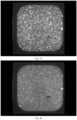
- Fig. 1A is a diagram of droplets at a first signal acquisition temperature (50°C), and positive droplets (i.e., bright spots) different from a background can be seen; and Fig. 1B is a diagram of droplets at a second signal acquisition temperature (68°C), positive droplets different from the background can be seen, and the number of the positive droplets is reduced compared to Fig. 1A (part of the positive droplets in Fig. 1A is not presented at corresponding locations in Fig. 1B ).
- the positive droplets still presented in Fig. 1B are signals of the positive sample of carbapenem antibiotics resistant KPC gene mutation, and by analyzing the number of the positive droplets, the content of the positive sample of KPC gene mutation may further be determined; and the positive droplets not presented in Fig. 1B but presented in Fig. 1A are signals of the sample of carbapenem antibiotics resistant VIM gene mutation, and by analyzing a difference value between the positive droplets in Fig. 1A and Fig. 1B , the content of the positive sample of VIM gene mutation may further be determined.
- multiple target nucleic acids can be detected.
- the realization of multiplex detection not only relies on fluorescence channels, but also uses different melting temperatures in the same fluorescence channel (i.e., the same signal channel), and different targets may be distinguished by distinguishing the presence or absence of fluorescence through a finite number of photographs, which has low fluorescence recognition requirements for digital PCR, is easy to operate and saves time.
- a triple detection primer probe system for detecting carbapenem antibiotics resistant VIM gene mutation, carbapenem antibiotics resistant KPC gene mutation and carbapenem antibiotics resistant OXA-48 gene mutation is shown in Table 3.
- Table 3 base sequences of primer probes in Example 2 Names of primer probes Serial numbers Nucleotide sequences (5'-3') Modification P2 SEQ ID NO: 1 T16-ROX, T31-BHQ2 3'Spacer C3 F2-1 SEQ ID NO: 2 / R2-1 SEQ ID NO: 3 / F2-2 SEQ ID NO: 4 / R2-2 SEQ ID NO: 5 / F2-3 SEQ ID NO: 6 / R2-3 SEQ ID NO: 7 /
- both a forward primer F2-1 (SEQ ID NO: 2) and a reverse primer R2-1 (SEQ ID NO: 3) are specific primers designed for a target sequence of carbapenem antibiotics resistant VIM gene mutation.
- F2-1 has an overall length of 39 bp, with first to 23rd bases at a 3' end serving as a target sequence binding region, and first to 13th bases at a 5' end being reversely complementary with first to 13th base sequences at a 5' end of a probe P2 (SEQ ID NO: 1); and the R2-1 primer has an overall length of 49 bp, with first to 25th bases at a 3' end serving as a target sequence binding region, sixth to 21st bases at a 5' end being the same as 16th to 31 st base sequences at the 5' end of the probe P2 (SEQ ID NO: 1), and first to fifth bases at the 5' end serving as an amplification blocking region.
- Both a forward primer F2-2 (SEQ ID NO: 4) and a reverse primer R2-2 (SEQ ID NO: 5) are specific primers designed for a target sequence of carbapenem antibiotics resistant KPC gene mutation.
- F2-2 has an overall length of 37 bp, with first to 21st bases at a 3' end serving as a target sequence binding region, and first to 13th bases at a 5' end being reversely complementary with first to 13th base sequences at the 5' end of the probe P2 (SEQ ID NO: 1); and the R2-2 primer has an overall length of 35 bp, with first to 22nd bases at a 3' end serving as a target sequence binding region, and first to tenth bases at a 5' end being exactly the same as 32nd to 41st base sequences at the 5' end of the probe P2 (SEQ ID NO: 1).
- Both a forward primer F2-3 (SEQ ID NO: 6) and a reverse primer R2-3 (SEQ ID NO: 7) are specific primers designed for a target sequence of carbapenem antibiotics resistant OXA-48 gene mutation.
- F2-3 has an overall length of 35 bp, with first to 19th bases at a 3' end serving as a target sequence binding region, and first to 13th bases at a 5' end being reversely complementary with first to 13th base sequences at the 5' end of the probe P2 (SEQ ID NO: 1); and the R2-2 primer has an overall length of 37 bp, with first to 24th bases at a 3' end serving as a target sequence binding region, and first to tenth bases at a 5' end being exactly the same as first to tenth base sequences at a 3' end of the probe P2 (SEQ ID NO: 1).
- Sample preparation a nucleic acid template of carbapenem antibiotics resistant VIM gene mutation, a nucleic acid template of carbapenem antibiotics resistant KPC gene mutation and a nucleic acid template of carbapenem antibiotics resistant OXA-48 gene mutation were simultaneously used as positive samples for detection. Pure water was used as a no template control (NTC).
- NTC no template control
- reaction preparation after sample preparation was completed, a reaction system was configured according to the ratios in Table 4.
- Digital PCR amplification and signal acquisition after a digital PCR tube cap was sealed, the samples were gently mixed, and then briefly centrifuged and left for standing for 5 min at room temperature. A digital PCR tube was placed in a handheld centrifuge again, briefly centrifuged and transferred to a sample stand of a digital PCR instrument (D600 full-automatic digital PCR analysis system of Maccura Biotechnology Co., Ltd).
- Amplification and lighting procedures used were: initial denaturation at 95°C for 2 min; denaturation at 94°C for 10 s, and annealing and extending at 56°C for 30 s, for a total of 45 cycles; incubation at a constant temperature of 40°C for 3 min; a first signal acquisition at 50°C; a second signal acquisition at 68°C; and a third signal acquisition at 77°C.
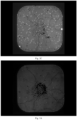
- Fig. 2A is a diagram of droplets at a first signal acquisition temperature (50°C), and positive droplets (i.e., bright spots) different from a background can be seen
- Fig. 2B is a diagram of droplets at a second signal acquisition temperature (68°C), positive droplets different from the background can be seen, and the number of the positive droplets is reduced compared to Fig. 2A (part of the positive droplets in Fig. 2A is not presented at corresponding locations in Fig. 2B );
- Fig. 2C is a diagram of droplets at a third signal acquisition temperature (77°C), and positive droplets different from the background can be seen, and the number of the positive droplets is reduced compared to Fig. 2B (part of the positive droplets in Fig. 2B is not presented at corresponding locations in Fig. 2C ).
- the positive droplets still presented in Fig. 2C are signals of the positive sample of carbapenem antibiotics resistant OXA-48 gene mutation, and by analyzing the number of the positive droplets, the content of the positive sample of OXA-48 gene mutation may further be determined;
- the positive droplets not presented in Fig. 2C but presented in Fig. 2B are signals of carbapenem antibiotics resistant KPC gene mutation, and by analyzing a difference value between the positive droplets in Fig. 2B and Fig. 2C , the content of the positive sample of KPC gene mutation may further be determined;
- the positive droplets not presented in Fig. 2B but presented in Fig. 2A are signals of the sample of carbapenem antibiotics resistant VIM gene mutation, and by analyzing a difference value between the positive droplets in Fig. 2A and Fig. 2B , the content of the positive sample of VIM gene mutation may further be determined.
- multiple target nucleic acids can be detected.
- the realization of multiplex detection not only relies on fluorescence channels, but also uses different melting temperatures in the same fluorescence channel (i.e., the same signal channel), and different targets may be distinguished by distinguishing the presence or absence of fluorescence through a finite number of photographs, which has low fluorescence recognition requirements for digital PCR, is easy to operate and saves time.
- a dual detection primer probe system for detecting carbapenem antibiotics resistant VIM gene mutation and carbapenem antibiotics resistant OXA-48 gene mutation is shown in Table 5.
- Table 5 base sequences of primer probes in Example 3 Names of primer probes Serial numbers Nucleotide sequences (5'-3') Modification P3 SEQ ID NO: 8 T16-CY5, T31-BHQ2 3'Spacer C3 F3-1 SEQ ID NO: 9 / R3-1 SEQ ID NO: 10 / F3-2 SEQ ID NO: 11 / R3-2 SEQ ID NO: 12 /
- both a forward primer F3-1 (SEQ ID NO: 9) and a reverse primer R3-1 (SEQ ID NO: 10) are specific primers designed for a target sequence of carbapenem antibiotics resistant VIM gene mutation.
- F3-1 has an overall length of 39 bp, with first to 23rd bases at a 3' end serving as a target sequence binding region, and first to 13th bases at a 5' end being reversely complementary with first to 13th base sequences at a 5' end of a probe P3 (SEQ ID NO: 8); and the R3-1 primer has an overall length of 49 bp, with first to 25th bases at a 3' end serving as a target sequence binding region, sixth to 21st bases at a 5' end being the same as 16th to 31 st base sequences at the 5' end of the probe P3 (SEQ ID NO: 8), and first to fifth bases at the 5' end serving as an amplification blocking region.
- Both a forward primer F3-2 (SEQ ID NO: 11) and a reverse primer R3-2 (SEQ ID NO: 12) are specific primers designed for a target sequence of carbapenem antibiotics resistant OXA-48 gene mutation.
- F3-2 has an overall length of 35 bp, with first to 19th bases at a 3' end serving as a target sequence binding region, and first to 13th bases at a 5' end being reversely complementary with first to 13th base sequences at the 5' end of the probe P3 (SEQ ID NO: 8); and the R3-2 primer has an overall length of 38 bp, with first to 24th bases at a 3' end serving as a target sequence binding region, and first to 11th bases at a 5' end being exactly the same as 32nd to 42nd base sequences at the 5' end of the probe P3 (SEQ ID NO: 8).
- the above primer probe system is used for detection of two kinds of target nucleic acids, and a reaction system used in detection is shown in Table 6.
- Table 6 detection reaction system in Example 3 Reagent composition Concentration 2 ⁇ PCR Reaction Buffer 1 ⁇ DNA Polymerase 2U Forward primer (F3-1) 500 nM Reverse primer (R3-1) 100 nM Forward primer (F3-2) 500 nM Reverse primer (R3-2) 100 nM Probe (P3) 400 nM Nucleic acid template of carbapenem antibiotics resistant VIM gene mutation 10 copies Nucleic acid template of carbapenem 100 copies antibiotics resistant OXA-48 gene mutation Ultrapure water Added to 20 ⁇ L Note: 2 ⁇ PCR Reaction Buffer includes 3 mM MgCl 2 , 30 mM Tris-HCl with pH of 8.3, 0.5 mM dNTP, and 70 mM (NH 4 ) 2 SO 4 .
- Sample preparation a nucleic acid template of carbapenem antibiotics resistant VIM gene mutation and a nucleic acid template of carbapenem antibiotics resistant OXA-48 gene mutation were simultaneously used as positive samples for detection. Pure water was used as a no template control (NTC).
- NTC no template control
- reaction preparation after sample preparation was completed, a reaction system was configured according to the ratios in Table 6.
- Digital PCR amplification and signal acquisition after a digital PCR tube cap was sealed, the samples were gently mixed, and then briefly centrifuged and left for standing for 5 min at room temperature. A digital PCR tube was placed in a handheld centrifuge again, briefly centrifuged and transferred to a sample stand of a digital PCR instrument (D600 full-automatic digital PCR analysis system of Maccura Biotechnology Co., Ltd).
- Amplification and lighting procedures used were: initial denaturation at 95°C for 2 min; denaturation at 94°C for 10 s, and annealing and extending at 56°C for 30 s, for a total of 45 cycles; a constant temperature of 52°C for 3 min; a first signal acquisition at 70°C; and a second signal acquisition at 50°C.
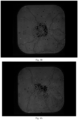
- Fig. 3A is a diagram of droplets at a first signal acquisition temperature (70°C), and positive droplets (i.e., bright spots) different from a background can be seen; and Fig. 3B is a diagram of droplets at a second signal acquisition temperature (50°C), positive droplets different from the background can be seen, and the number of the positive droplets is increased compared to Fig. 3A (part of negative droplets in Fig. 3A is positive droplets at corresponding locations in Fig. 3B ).
- the positive droplets presented in Fig. 3A are signals of the positive sample of carbapenem antibiotics resistant OXA-48 gene mutation, and by analyzing the number of the positive droplets, the content of the positive sample of OXA-48 gene mutation may further be determined; and the positive droplets not presented in Fig. 3A but presented in Fig. 3B are signals of the sample of carbapenem antibiotics resistant VIM gene mutation, and by analyzing a difference value between the positive droplets in Fig. 3A and Fig. 3B , the content of the positive sample of VIM gene mutation may further be determined.
- multiple target nucleic acids can be detected.
- the realization of multiplex detection not only relies on fluorescence channels, but also uses different melting temperatures in the same fluorescence channel (i.e., the same signal channel), and different targets may be distinguished by distinguishing the presence or absence of fluorescence through a finite number of photographs, which has low fluorescence recognition requirements for digital PCR, is easy to operate and saves time.
- a triple detection primer probe system for detecting carbapenem antibiotics resistant VIM gene mutation, carbapenem antibiotics resistant OXA-48 gene mutation and carbapenem antibiotics resistant IMP gene mutation is shown in Table 7.
- Table 7 base sequences of primer probes in Example 4 Names of primer probes Serial numbers Nucleotide sequences (5'-3') Modification P4 SEQ ID NO: 8 T16-CY5, T31-BHQ2 3'Spacer C3 F4-1 SEQ ID NO: 9 / R4-1 SEQ ID NO: 10 / F4-2 SEQ ID NO: 11 / R4-2 SEQ ID NO: 12 / F4-3 SEQ ID NO: 13 R4-3 SEQ ID NO: 14
- Both a forward primer F4-1 (SEQ ID NO: 9) and a reverse primer R4-1 (SEQ ID NO: 10) are specific primers designed for a target sequence of carbapenem antibiotics resistant VIM gene mutation.
- F4-1 has an overall length of 39 bp, with first to 23rd bases at a 3' end serving as a target sequence binding region, and first to 13th bases at a 5' end being reversely complementary with first to 13th base sequences at a 5' end of a probe P4 (SEQ ID NO: 18); and the R4-1 primer has an overall length of 49 bp, with first to 25th bases at a 3' end serving as a target sequence binding region, sixth to 21st bases at a 5' end being the same as 16th to 31 st base sequences at the 5' end of the probe P4 (SEQ ID NO: 18), and first to fifth bases at the 5' end serving as an amplification blocking region.
- Both a forward primer F4-2 (SEQ ID NO: 11) and a reverse primer R4-2 (SEQ ID NO: 12) are specific primers designed for a target sequence of carbapenem antibiotics resistant OXA-48 gene mutation.
- F4-2 has an overall length of 35 bp, with first to 19th bases at a 3' end serving as a target sequence binding region, and first to 13th bases at a 5' end being reversely complementary with first to 13th base sequences at the 5' end of the probe P4 (SEQ ID NO: 8); and the R4-2 primer has an overall length of 38 bp, with first to 24th bases at a 3' end serving as a target sequence binding region, and first to 11th bases at a 5' end being exactly the same as 32nd to 42nd base sequences at the 5' end of the probe P4 (SEQ ID NO: 8).
- Both a forward primer F4-3 (SEQ ID NO: 13) and a reverse primer R4-3 (SEQ ID NO: 14) are specific primers designed for a target sequence of carbapenem antibiotics resistant IMP gene mutation.
- F4-3 has an overall length of 40 bp, with first to 24th bases at a 3' end serving as a target sequence binding region, and first to 13th bases at a 5' end being reversely complementary with first to 13th base sequences at the 5' end of the probe P4 (SEQ ID NO: 8); and the R4-3 primer has an overall length of 35 bp, with first to 23rd bases at a 3' end serving as a target sequence binding region, and first to ninth bases at a 5' end being exactly the same as first to ninth base sequences at a 3' end of the probe P4 (SEQ ID NO: 8).
- Sample preparation a nucleic acid template of carbapenem antibiotics resistant VIM gene mutation, a nucleic acid template of carbapenem antibiotics resistant OXA-48 gene mutation and a nucleic acid template of carbapenem antibiotics resistant IPM gene mutation were simultaneously used as positive samples for detection. Pure water was used as a no template control (NTC).
- NTC no template control
- reaction preparation after sample preparation was completed, a reaction system was configured according to the ratios in Table 8.
- Digital PCR amplification and signal acquisition after a digital PCR tube cap was sealed, the samples were gently mixed, and then briefly centrifuged and left for standing for 5 min at room temperature. A digital PCR tube was placed in a handheld centrifuge again, briefly centrifuged and transferred to a sample stand of a digital PCR instrument (D600 full-automatic digital PCR analysis system of Maccura Biotechnology Co., Ltd).
- Amplification and lighting procedures used were: initial denaturation at 95°C for 2 min; denaturation at 94°C for 10 s, and annealing and extending at 56°C for 30 s, for a total of 45 cycles; incubation at a constant temperature of 40°C for 3 min; a first signal acquisition at 77°C; a second signal acquisition at 70°C; and a third signal acquisition at 50°C.
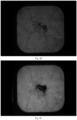
- Fig. 4A is a diagram of droplets at a first signal acquisition temperature (77°C), and positive droplets (i.e., bright spots)different from a background can be seen
- Fig. 4B is a diagram of droplets at a second signal acquisition temperature (70°C), positive droplets different from the background can be seen, and the number of the positive droplets is increased compared to Fig. 4A (part of negative droplets in Fig. 4A is positive droplets at corresponding locations in Fig. 4B);
- Fig. 4C is a diagram of droplets at a third signal acquisition temperature (50°C), positive droplets different from the background can be seen, and the number of the positive droplets is increased compared to Fig. 4B (part of negative droplets in Fig. 4B is positive droplets at corresponding locations in Fig. 4C ).
- the positive droplets presented in Fig. 4A are signals of the positive sample of carbapenem antibiotics resistant IMP gene mutation, and by analyzing the number of the positive droplets, the content of the positive sample of IMP gene mutation may further be determined;
- the positive droplets not presented in Fig. 4A but presented in Fig. 4B are signals of the sample of carbapenem antibiotics resistant OXA-48 gene mutation, and by analyzing a difference value between the positive droplets in Fig. 4A and Fig. 4B , the content of the positive sample of OXA-48 gene mutation may further be determined;
- the positive droplets not presented in Fig. 4B but presented in Fig. 4C are signals of the sample of carbapenem antibiotics resistant VIM gene mutation, and by analyzing a difference value between the positive droplets in Fig. 4B and Fig. 4C , the content of the positive sample of VIM gene mutation may further be determined.
- multiple target nucleic acids can be detected.
- the realization of multiplex detection not only relies on fluorescence channels, but also uses different melting temperatures in the same fluorescence channel (i.e., the same signal channel), and different targets may be distinguished by distinguishing the presence or absence of fluorescence through a finite number of photographs, which has low fluorescence recognition requirements for digital PCR, is easy to operate and saves time.
- An embodiment of the present application provides a multiple target nucleic acid detection device for multiplex detection of nucleic acids, which can distinguish different targets by distinguishing the presence or absence of fluorescence through a finite number of photographs, has low fluorescence recognition requirements for digital PCR, is easy to operate and saves time.
- first, second, etc. used in the present application may be used herein for describing various elements, but these elements are not limited to these terms. These terms are only used for distinguishing the first element from another element.
- a first material to be detected may be referred to as a second material to be detected, and similarly, the second material to be detected may be referred to as the first material to be detected.
- Both the first material to be detected and the second material to be detected are materials to be detected, but they are not the same material to be detected.
- the term "a plurality of' used in the embodiments of the present application refers to two, or two or more.
- the device for detecting multiple target nucleic acids is used for detecting a sample to be detected.
- the sample to be detected may include one kind of component to be detected, and may also include two, three, four, five or even more kinds of components to be detected.
- the plurality kinds of components to be detected in the sample to be detected may be detected through the nucleic acid detection device according to the implementation.
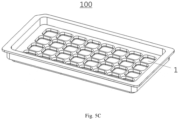
- the device for detecting multiple target nucleic acids includes a reaction liquid containing part 1, a temperature adjustment part 2, a signal detection part 3, a control part 4 and a signal analysis part 5.
- the reaction liquid containing part 1 is configured to contain a sample to be detected containing a component to be detected and a reaction reagent capable of reacting with the component to be detected to provide a place for various reaction between the sample to be detected and the reaction reagent.
- the temperature adjustment part 2 is configured to adjust the temperature of a mixed liquid in the reaction liquid containing part 1 to make the sample to be detected and the reaction reagent react differently at different temperatures.
- the signal detection part 3 is configured to detect a signal generated from a specific substance undergoing specific reaction in the mixed liquid, and the signal may be an optical signal and may also be an electric signal.
- the control part 4 is configured to control the temperature adjustment part 2 to adjust the temperature of the mixed liquid in the reaction liquid containing part 1 in different temperature modes, and control the signal detection part 3 to detect the signal generated from the specific substance in the mixed liquid.
- the signal analysis part 5 is configured to analyze the signal acquired by the signal detection part 3.
- the sample to be detected is a body fluid from a human body or an animal body, and includes different substances to be detected, which may be nucleic acids or proteins.
- the implementation illustrates the technical solutions with the substances to be detected being the nucleic acids.
- nucleic acid extraction purification operation may be performed to extract the nucleic acids, which may be performed manually or with a specialized nucleic acid extractor.
- nucleic acid extraction purification operation may also not be performed.
- the sample to be detected includes different nucleic acid molecules to be detected, such as a first material to be detected (a first target nucleic acid to be detected), a second material to be detected (a second target nucleic acid to be detected), a third material to be detected (a third target nucleic acid to be detected), a fourth material to be detected (a fourth target nucleic acid to be detected), and a fifth material to be detected (a fifth target nucleic acid to be detected).
- a first material to be detected a first target nucleic acid to be detected
- a second material to be detected a second target nucleic acid to be detected
- a third material to be detected a third target nucleic acid to be detected
- a fourth material to be detected a fourth target nucleic acid to be detected
- a fifth material to be detected a fifth target nucleic acid to be detected
- the reaction reagent includes an amplification substance for amplifying nucleic acids and a marking substance for marking the nucleic acids.
- the amplification substance may amplify different nucleic acid molecules, and the marking substance can bind to the nucleic acids at a certain temperature to generate a detectable signal.
- the different nucleic acids bind to the marking substance over different temperature ranges, and separate from the marking substance over different temperature ranges after binding.
- Primers in the amplification substance for amplifying the different nucleic acids are different, and the marking substance for marking the different nucleic acids may be the same and may also be different. In certain embodiments, the same marking substance is used for marking the different nucleic acids.
- the reaction reagent includes a primer-probe composition and an amplification reagent.
- the amplification reagent includes a nucleic acid polymerase and dNTPs.
- the primer-probe composition includes a probe and a primer mixture.
- the primer mixture includes at least two kinds of the primer sets, and the different kinds of primer sets specifically bind to the different kinds of target nucleic acids respectively; and the primer sets in the primer mixture specifically bind to the corresponding target nucleic acids to generate a pre-product, the pre-product contains a single-stranded pre-product specifically binding to a first probe, and the single-stranded pre-product specifically binds to the first probe and extends by >_ 0 base to form a double-stranded product, and the formation of the double-stranded product causes a detectable signal change.
- the different kinds of primer sets in a first primer mixture and the corresponding target nucleic acids generate different single-stranded pre-products
- the different single-stranded pre-products and the first probe form different double-stranded products
- the different double-stranded products have different melting temperatures; and in certain embodiments, the melting temperatures of the different double-stranded products differ by 4°C or above.
- the micro liquids may be tiny droplets formed in an emulsion, and may also be trace liquids contained in micro wells of a container.
- Each micro liquid contains at most one unit of nucleic acid molecule and a reaction reagent sufficient to amplify and mark a plurality kinds of target nucleic acids.
- each first material to be detected and each second material to be detected are distributed into different micro liquids, and there is a sufficient number of reagent in one micro liquid, which may not only meet the demand for amplifying and marking the first material to be detected in the micro liquid, but also meet the demand for amplifying and marking the second material to be detected in the micro liquid.
- the process of making micro liquids may adopt a method in which the micro liquids are formed through high-frequency vibration: the sample and the sufficient number of reagent are sucked through a microchannel, the microchannel stretches under an oily liquid for high-frequency vibration, micro liquids of the sample and the reagent in the microchannel are discharged at a certain velocity in the vibration process, so that micro droplets, i.e., the micro liquids are thrown out through vibration, and the micro liquids are incompatible and non-reactive with the oily liquid.
- micro-partition regions in the container, so that by adding the micro liquids of the sample to be detected and the reaction reagent into the micro-partition regions, there is at most one unit of nucleic acid molecule in each micro-partition region.
- the reaction liquid containing part is a box-like container with an upward opening.
- Nucleic acids to be detected and a reagent are added into the box-like container through a liquid filling mechanism (i.e., the method in which micro liquids are formed through high-frequency vibration as described above), and the nucleic acids to be detected and the reagent may also be added into the box-like container by a laboratorian.
- the reaction liquid containing part is a cavity communicating with a microchannel, and the nucleic acids to be detected and the reagent are driven into the cavity by a microfluid driving structure.
- micro liquids containing the nucleic acids to be detected and the reagent are encapsulated in 500 or more, e.g., about 20,000 micro liquids, each of which contains one or no target nucleic acid molecules to be detected. Regardless of the number of classes of materials to be detected in the sample, all the materials to be detected are distributed into different micro liquids (it is an ideal state, and it is possible that a small number of micro liquids each contain one or more target nucleic acid molecules to be detected).
- illustration is made with the reaction liquid containing part being the box-like container.
- An oily liquid is injected into the reaction liquid containing part, and the oily liquid is incompatible and non-reactive with the sample and the reagent.
- the micro liquids are formed in the oily liquid in a mode of high-frequency vibration, and flatly laid at the bottom of the reaction liquid containing part under the force of their own gravities.
- a well plate 100 is composed of a plurality of reaction liquid containing parts 1, the bottoms of which are each in a flat plate shape, so that the plurality of micro liquids are flatly laid at the bottoms of the reaction liquid containing parts 1.
- the temperature adjustment part 2 is provided below, above or to the side of the reaction liquid containing part 1, which may provide heat to the reaction liquid containing part 1 and may also absorb heat from the reaction liquid containing part 1, thereby realizing the functions of heating up and cooling down of the micro liquids in the reaction liquid containing part 1.
- the temperature adjustment part 2 may vary the temperature of the micro liquids in the reaction liquid containing part 1 within a range of 4°C to 105°C. A shown in Fig.
- a placement location special for placing the reaction liquid containing part may be provided on the temperature adjustment part, and the reaction liquid containing part 1 is placed on the placement location when the temperature of the reaction liquid containing part 1 needs to be adjusted.
- the temperature adjustment part 2 may be provided in a reasonable orientation of the reaction liquid containing part 1 in combination with factors such as heating efficiency.
- the temperature adjustment part 2 is provided below the well plate 100 composed of the plurality of reaction liquid containing parts 1, and contacts to heat and cool the flat well plate 100, so that the temperature of the micro liquid in each reaction liquid containing part 1 in the well plate 100 changes with the temperature rise and fall of the well plate 100.
- the signal detection part 3 is provided in the vicinity of the reaction liquid containing part 1.
- the signal detection part may be a device (a camera or a photoelectric device) for detecting optical signals (e.g., a fluorescence signal) or a device capable of detecting electric signals.
- the signal detection part is the camera, the signals flatly laid in the reaction liquid containing part may be photographed.
- the signal detection part 3 is movable relative to the reaction liquid containing part 1, and when it is required to detect signals, a controller controls a driving mechanism to move the signal detection part 3 to the position close to the reaction liquid containing part 1 (e.g., above, as shown in Fig. 5A ).
- the signal detection part 3 may also be fixedly provided relative to the reaction liquid containing part.
- control part 4 is communicably connected to the temperature adjustment part 2 and the signal detection part 3.
- the control part may include a first control part and a second control part (not shown in the figure).
- the first control part is communicably connected to the temperature adjustment part to control the temperature adjustment part to run in different modes
- the second control part is communicably connected to the signal detection part to control the signal detection part to acquire the signals from the micro liquids in the reaction liquid containing part.
- the control part may also be a single part, which may simultaneously control the temperature adjustment part and the signal detection part.
- the signal analysis part 5 is communicably connected to the signal detection part 3.
- the signal analysis part is configured to perform analysis according to the signals acquired by the signal detection part to obtain signals of target nucleic acids to be detected, thereby obtaining information, such as whether a sample to be detected contains the target nucleic acids to be detected, and the types and number of the obtained target nucleic acids to be detected.
- a sample to be detected contains a first material to be detected (a first target nucleic acid to be detected) and a second material to be detected (a second target nucleic acid to be detected).
- a first associated product to be detected generated from the first material to be detected (the target nucleic acid to be detected undergoes operations such as polymerase chain reaction (PCR) and/or nucleic acid hybridization and/or nucleic acid enzyme digestion to generate the corresponding associated product to be detected, and under normal conditions, the associated product to be detected is a nucleic acid) may bind to a marking substance in a reagent; and a second associated product to be detected generated from the second material to be detected may also bind to the marking substance in the reagent.
- PCR polymerase chain reaction
- the first associated product to be detected in a certain temperature mode, is generated from the first material to be detected and binds to the marking substance, and at the same time, in this temperature mode, the second associated product to be detected is generated from the second material to be detected and binds to the marking substance.
- the first associated product to be detected and the second associated product to be detected have different separation temperatures.
- the first associated product to be detected may be separated from the marking substance in the reagent within a first separation temperature range
- the second associated product to be detected may be separated from the marking substance in the reagent within a second separation temperature range.
- the first separation temperature range and the second separation temperature range have different minimum temperatures. In the example, the minimum temperature of the second separation temperature range is greater than that of the first separation temperature range.
- the first associated product to be detected may be separated from the marking substance at a temperature greater than or equal to a temperature t1
- the second associated product to be detected may be separated from the marking substance at a temperature greater than or equal to a temperature t2, where the temperature t2 is greater than the temperature t1.
- a mixed liquid of the sample to be detected and the reaction reagent (containing a primer-probe composition and an amplification reagent) is added to the reaction liquid containing part to form a plurality of micro liquid, and the control part performs the following controls.
- the control part controls the temperature adjustment part to adjust the temperature of the micro liquids in the reaction liquid containing part, so that the target nucleic acids to be detected in the sample to be detected generate associated products to be detected associated therewith (the nucleic acids to be detected contain the first nucleic acid to be detected and the second nucleic acid to be detected, but are presented in different micro liquids); and in this process, the micro liquids may undergo a plurality of temperature cycles, in each of which the micro liquids will change to a plurality of different temperatures and maintain at this temperature for a certain time, and there may be a plurality of cycles, e.g., 20-60, e.g., about 40.
- the micro liquids will reach a high-temperature state, double-stranded nucleic acids become single-stranded nucleic acids, then the micro liquids reach a low-temperature state, and the single-stranded nucleic acids undergo annealing and extending processes (annealing and extending may also be performed at different temperatures respectively, and the extending temperature is greater than the annealing temperature).
- the numbers of the different target nucleic acids to be detected and/or the different associated products to be detected in the sample to be detected are increased (i.e., the quantities of the target nucleic acids to be detected and/or the associated products to be detected in each micro liquid are increased, but the types of the nucleic acids to be detected remain unchanged), which is easier to detect.
- the target nucleic acids to be detected and/or the associated products to be detected are increased in number, and bind to the marking substance in the reagent, so that the plurality of micro liquids containing the first material to be detected or the second material to be detected simultaneously generate signals.
- the micro liquids Before performing 40 temperature cycles, the micro liquids may be heated to a temperature t0, so that the nucleic acids to be detected in the sample are initially denaturated for a period of time (about 2-5 min). Initial denaturation for a period of time is designed to change the target nucleic acids from a double-stranded state into a single-stranded state.
- the control part controls the temperature adjustment part to adjust the temperature of the micro liquids to be t1, a plurality of micro liquids containing the first material to be detected and a plurality of micro liquids containing the second material to be detected generate signals to form a first mixed signal.
- the second material to be detected or the associated product thereof is in a state of binding to the marking substance, thus generating a signal
- the first material to be detected or the associated product thereof is also in a state of binding to the marking substance, thus generating a signal.
- this nucleic acid molecule to be detected may be the first nucleic acid to be detected and may also be the second nucleic acid to be detected, at the temperature t1, both the micro liquids containing the first nucleic acid to be detected and the micro liquids containing the second nucleic acid to be detected can generate signals. If a plurality of micro liquids overlap, signals emitted from such micro liquids are invalid signals; and signals emitted from single micro liquids that do not overlap are valid signals.
- control part controls the temperature adjustment part to adjust the temperature of the micro liquids to be t2 (t2 > t1), and a plurality of micro liquids only containing the second material to be detected generate a signal to form a second signal.
- the first material to be detected or the associated product thereof is separated from the marking substance, thus generating no detectable signals.
- the second material to be detected or the associated product thereof still maintains in a state of binding to the marking substance, thus generating a signal.
- this nucleic acid molecule to be detected may be the first nucleic acid to be detected and may also be the second nucleic acid to be detected, at the temperature t2, only the plurality of micro liquids where the second nucleic acid to be detected is located can generate signals. If a plurality of micro liquids overlap, signals emitted from such micro liquids are invalid signals; and signals emitted from single micro liquids that do not overlap are valid signals.
- t1 and t2 differ by 4°C or above, e.g., by 4-40°C, e.g., by 4-30°C, 4-20°C, 4-18°C, 4-15°C, 4-12°C, 4-10°C, 4-8°C, 4-6°C, 4-5°C, or 4°C.
- the plurality of micro liquids are flatly laid at the bottom of the reaction liquid containing part and always maintain the same position state.
- the signal detection part detects signals generated from the micro liquids through the above controls of the control part
- the numbers of classes of target nucleic acids contained in signals obtained from two adjacent signal acquisitions differ by one (i.e., the first mixed signal contains the signals of the first material to be detected and the second material to be detected, but the second signal only contains the signal of the first material to be detected).
- the signal analysis part performs the following operations.
- a first signal is worked out according to the first mixed signal and the second signal acquired by the signal detection part.
- the signal analysis part subtracts the second signal from the first mixed signal to obtain the first signal. Specifically, the signal analysis part subtracts the fluorescence signal generated from the micro liquids containing the second material to be detected at the same position from the first mixed signal generated from the micro liquids to obtain the first signal.
- the first signal is a fluorescence signal generated from the micro liquids containing the first material to be detected
- the second signal is a fluorescence signal generated from the micro liquids containing the second material to be detected
- the first mixed signal is a fluorescence signal generated from the micro liquids containing the first material to be detected and the micro liquids containing the second material to be detected.
- the fluorescence signal generated from the micro liquids containing the second material to be detected may be directly obtained.
- this nucleic acid molecule to be detected may be the first nucleic acid to be detected and may also be the second nucleic acid to be detected.
- the number of the micro liquids generating signals in the first mixed signal By analyzing the number of the micro liquids generating signals in the first mixed signal, the total number of the first material to be detected and the second material to be detected is obtained; by analyzing the number of the micro liquids generating signals in the second signal, the number of the second material to be detected is obtained; and by subtracting the number of the second material to be detected generating the second signal from the total number of the first material to be detected and the second material to be detected generating the first mixed signal, the number of the first material to be detected is obtained.
- a sample to be detected contains a first material to be detected (a first target nucleic acid to be detected), a second material to be detected (a second target nucleic acid to be detected), and a third material to be detected (a third target nucleic acid to be detected).
- a first associated product to be detected generated from the first material to be detected (the target nucleic acid to be detected undergoes operations such as polymerase chain reaction (PCR) and/or nucleic acid hybridization and/or nucleic acid enzyme digestion to generate the corresponding associated product to be detected, and under normal conditions, the associated product to be detected is a nucleic acid) may bind to a marking substance in a reagent; and a second associated product to be detected generated from the second material to be detected may bind to the marking substance in the reagent, and a third associated product to be detected generated from the third material to be detected may bind to the marking substance in the reagent.
- PCR polymerase chain reaction
- the first associated product to be detected in a certain temperature mode, is generated from the first material to be detected and binds to the marking substance.
- the second associated product to be detected is generated from the second material to be detected and binds to the marking substance
- the third associated product to be detected generated from the third material to be detected is generated from the second material to be detected and binds to the marking substance.
- the first associated product to be detected, the second associated product to be detected and the third associated product to be detected have different separation temperatures.
- the first associated product to be detected may be separated from the marking substance in the reagent within a first separation temperature range
- the second associated product to be detected may be separated from the marking substance in the reagent within a second separation temperature range
- the third associated product to be detected may be separated from the marking substance in the reagent within a third separation temperature range.
- the first separation temperature range, the second separation temperature range and the third separation temperature range have different minimum temperatures. In the embodiment, the minimum temperature of the third separation temperature range is less than that of the first separation temperature range, and the minimum temperature of the first separation temperature range is less than that of the second separation temperature range.
- the first associated product to be detected may be separated from the marking substance at a temperature greater than or equal to a temperature t1
- the second associated product to be detected may be separated from the marking substance at a temperature greater than or equal to a temperature t2
- the third associated product to be detected may be separated from the marking substance at a temperature greater than or equal to a temperature t3, where the temperatures t3 ⁇ t1 ⁇ t2.
- a mixed liquid of the sample to be detected and the reaction reagent (containing a primer-probe composition and an amplification reagent) is added to the reaction liquid containing part to form a plurality of micro liquid, and the control part performed the following controls.
- the control part controls the temperature adjustment part to adjust the temperature of the micro liquids in the reaction liquid containing part, so that the target nucleic acids to be detected in the sample to be detected generate associated products to be detected associated therewith (the target nucleic acids to be detected contain the first material to be detected, the second material to be detected and the third material to be detected, but they are presented in different micro liquids); and in this process, the micro liquids may undergo a plurality of temperature cycles, in each of which the micro liquids will change to a plurality of different temperatures and maintain at this temperature for a certain time, and there may be a plurality of cycles, e.g., 20-60, e.g., about 40.
- the micro liquids will reach a high-temperature state, double-stranded nucleic acids become single-stranded nucleic acids, then the micro liquids reach a low-temperature state, and the single-stranded nucleic acids undergo annealing and extending processes (annealing and extending may also be performed at different temperatures respectively, and the extending temperature is greater than the annealing temperature).
- the numbers of the different target nucleic acids to be detected and/or the different associated products to be detected in the sample to be detected are increased (i.e., the quantities of the target nucleic acids to be detected and/or the associated products to be detected in each micro liquid are increased, but the types of the nucleic acids to be detected remain unchanged), which is easier to detect.
- the target nucleic acids to be detected and/or the associated products to be detected are increased in number, and bind to the marking substance in the reagent, so that the plurality of micro liquids containing the first material to be detected or the second material to be detected or the third material to be detected simultaneously generate signals.
- the micro liquids Before performing 40 temperature cycles, the micro liquids may be heated to a temperature t0, so that the nucleic acids to be detected in the sample are initially denaturated for a period of time (about 2-5 min). Initial denaturation for a period of time is designed to change the target nucleic acids from a double-stranded state into a single-stranded state.
- the control part controls the temperature adjustment part to adjust the temperature of the micro liquids to be t3, a plurality of micro liquids containing the first material to be detected, a plurality of micro liquids containing the second material to be detected and a plurality of micro liquids containing the third material to be detected generate signals to form a second mixed signal.
- the second material to be detected or the associated product thereof is in a state of binding to the marking substance, thus generating a signal
- the first material to be detected or the associated product thereof is also in a state of binding to the marking substance, thus generating a signal
- the third material to be detected or the associated product thereof is also in a state of binding to the marking substance, thus generating a signal.
- this nucleic acid molecule to be detected may be the first nucleic acid to be detected and may also be the second nucleic acid to be detected or the third nucleic acid to be detected, at the temperature t3, all of the micro liquids containing the first nucleic acid to be detected, the micro liquids containing the second nucleic acid to be detected and the micro liquids containing the third nucleic acid to be detected can generate signals. If a plurality of micro liquids overlapped, signals emitted from such micro liquids are invalid signals; and signals emitted from single micro liquids that do not overlap are valid signals.
- the control part controls the temperature adjustment part to adjust the temperature of the micro liquids to be t1 (t1 > t3), and a plurality of micro liquids containing the first material to be detected and a plurality of micro liquids containing the second material to be detected generate signals to form a first mixed signal.
- the second material to be detected or the associated product thereof is in a state of binding to the marking substance, thus generating a signal
- the first material to be detected or the associated product thereof is also in a state of binding to the marking substance, thus generating a signal
- the third material to be detected or the associated product thereof is in a state of being separated from the marking substance, thus generating no signals.
- this nucleic acid molecule to be detected may be the first nucleic acid to be detected and may also be the second nucleic acid to be detected, at the temperature t1, both the micro liquids containing the first nucleic acid to be detected and the micro liquids containing the second nucleic acid to be detected can generate signals. If a plurality of micro liquids overlap, signals emitted from such micro liquids are invalid signals; and signals emitted from single micro liquids that do not overlap are valid signals.
- control part controls the temperature adjustment part to adjust the temperature of the micro liquids to be t2 (t2 > 11), and a plurality of micro liquids only containing the second material to be detected generate a signal to form a second signal.
- the first material to be detected or the associated product thereof is separated from the marking substance
- the third material to be detected or the associated product thereof is separated from the marking substance, thus both generating no detectable signals.
- the second material to be detected or the associated product thereof still maintains in a state of binding to the marking substance, thus generating a signal.
- the first mixed signal and the second signal, t1 and t2 differ by 4°C or above, e.g., by 4-40°C, e.g., by 4-30°C, 4-20°C, 4-18°C, 4-15°C, 4-12°C, 4-10°C, 4-8°C, 4-6°C, 4-5°C, or 4°C.
- t1 and t3 differ by 4°C or above, e.g., by 4-40°C, e.g., by 4-30°C, 4-20°C, 4-18°C, 4-15°C, 4-12°C, 4-10°C, 4-8°C, 4-6°C, 4-5°C, or 4°C.
- the plurality of micro liquids are flatly laid at the bottom of the reaction liquid containing part and always maintain the same position state.
- the signal detection part detects signals generated from the micro liquids through the above controls of the control part
- the numbers of classes of target nucleic acids contained in signals obtained from two adjacent signal acquisitions differ by one (i.e., the second mixed signal contains the signals of the first material to be detected, the second material to be detected and the third material to be detected
- the first mixed signal contained the signals of the first material to be detected and the second material to be detected, but the second signal only contains the signal of the first material to be detected.
- the signal analysis part performs the following operations.
- a third signal is worked out according to the first mixed signal and the second mixed signal acquired by the signal detection part.
- the signal analysis part subtracts first mixed signal from the second mixed signal to obtain the third signal. Specifically, the signal analysis part subtracts the first mixed signal generated from the micro liquids containing the first material to be detected and the micro liquids containing the second material to be detected at the same position from the second mixed signal generated from the micro liquids to obtain the third signal.
- the second mixed signal iss a fluorescence signal generated from the micro liquids containing the first material to be detected, the micro liquids containing the second material to be detected and the micro liquids containing the third material to be detected;
- the first mixed signal is a fluorescence signal generated from the micro liquids containing the first material to be detected and the micro liquids containing the second material to be detected;
- the third signal is a fluorescence signal generated from the micro liquids containing the third material to be detected.
- a first signal is worked out according to the first mixed signal and the second signal acquired by the signal detection part.
- the signal analysis part subtracts the second signal from the first mixed signal to obtain the first signal. Specifically, the signal analysis part subtracts the fluorescence signal generated from the micro liquids containing the second material to be detected at the same position from the first mixed signal generated from the micro liquids to obtain the first signal.
- the first signal is a fluorescence signal generated from the micro liquids containing the first material to be detected
- the second signal is a fluorescence signal generated from the micro liquids containing the second material to be detected
- the first mixed signal is a fluorescence signal generated from the micro liquids containing the first material to be detected and the micro liquids containing the second material to be detected.
- the fluorescence signal generated from the micro liquids containing the second material to be detected may be directly obtained.
- this nucleic acid molecule to be detected may be the first nucleic acid to be detected and may also be the second nucleic acid to be detected or the third nucleic acid to be detected.
- the number of the micro liquids generating signals in the second mixed signal By analyzing the number of the micro liquids generating signals in the second mixed signal, the total number of the first material to be detected, the second material to be detected and the third material to be detected is obtained; by analyzing the number of the micro liquids generating signals in the first mixed signal, the total number of the first material to be detected and the second material to be detected is obtained; by analyzing the number of micro liquids generating signals in the second signal, the number of the second material to be detected is obtained; by subtracting the total number of the first material to be detected and the second material to be detected generating the first mixed signal from the total number of the first material to be detected, the second material to be detected and the third material to be detected generating the second mixed signal, the number of the third material to be detected is obtained; by subtracting the number of the second material to be detected generating the second signal from the total number of the first material to be detected and the second material to be detected generating the first mixed signal, the number of the first material to be detected is obtained.
- a sample to be detected contains a fourth material to be detected (a fourth target nucleic acid to be detected) and a fifth material to be detected (a fifth target nucleic acid to be detected).
- a fourth associated product to be detected generated from the fourth material to be detected (the target nucleic acid to be detected undergoes operations such as polymerase chain reaction (PCR) and/or nucleic acid hybridization and/or nucleic acid enzyme digestion to generate the corresponding associated product to be detected, and under normal conditions, the associated product to be detected is a nucleic acid) may bind to a marking substance in a reagent; and similarly, a fifth associated product to be detected generated from the fifth material to be detected may also bind to the marking substance in the reagent.
- PCR polymerase chain reaction
- a fifth associated product to be detected generated from the fifth material to be detected may also bind to the marking substance in the reagent.
- the fourth associated product to be detected in a certain temperature mode, is generated from the fourth material to be detected and binds to the marking substance, and at the same time, in this temperature mode, the fifth associated product to be detected is generated from the fifth material to be detected and binds to the marking substance.
- the fourth associated product to be detected and the fifth associated product to be detected have different separation temperatures.
- the fourth associated product to be detected may be separated from the marking substance in the reagent within a fourth separation temperature range
- the fifth associated product to be detected may be separated from the marking substance in the reagent within a fifth separation temperature range.
- the fourth separation temperature range and the fifth separation temperature range have different minimum temperatures. In the embodiment, the minimum temperature of the fourth separation temperature range is greater than that of the fifth separation temperature range.
- the fourth associated product to be detected may be separated from the marking substance at a temperature greater than or equal to a temperature t4, and the fifth associated product to be detected may be separated from the marking substance at a temperature greater than or equal to a temperature t5, wherein the temperature t4 is greater than the temperature t5.
- a mixed liquid of the sample to be detected and the reaction reagent (containing a primer-probe composition and an amplification reagent) is added to the reaction liquid containing part to form a plurality of micro liquid, and the control part performs the following controls.
- the control part controls the temperature adjustment part to adjust the temperature of the micro liquids in the reaction liquid containing part, so that the target nucleic acids to be detected in the sample to be detected generate associated products to be detected associated therewith (the target nucleic acids to be detected contain the fourth nucleic acid to be detected and the fifth nucleic acid to be detected, but are presented in different micro liquids); and in this process, the micro liquids may undergo a plurality of temperature cycles, in each of which the micro liquids will change to a plurality of different temperatures and maintain at this temperature for a certain time, and there may be a plurality of cycles, e.g., 20-60, e.g., about 40.
- the micro liquids will reach a high-temperature state, double-stranded nucleic acids become single-stranded nucleic acids, then the micro liquids reach a low-temperature state, and the single-stranded nucleic acids undergo annealing and extending processes (annealing and extending may also be performed at different temperatures respectively, and the extending temperature is greater than the annealing temperature).
- the numbers of the different target nucleic acids to be detected and/or the different associated products to be detected in the sample to be detected are increased (i.e., the quantities of the target nucleic acids to be detected and/or the associated products to be detected in each micro liquid are increased, but the types of the nucleic acids to be detected remain unchanged), which is easier to detect.
- the target nucleic acids to be detected and/or the associated products to be detected are increased in number, and bind to the marking substance in the reagent, so that the plurality of micro liquids containing the fourth material to be detected or the fifth material to be detected simultaneously generate signals.
- the micro liquids Before performing 40 temperature cycles, the micro liquids may be heated to a temperature t0, so that the nucleic acids to be detected in the sample are initially denaturated for a period of time (about 2-5 min). Initial denaturation for a period of time is designed to change the target nucleic acids from a double-stranded state into a single-stranded state.
- the control part controls the temperature adjustment part to adjust the temperature of the micro liquids to be t4, a plurality of micro liquids only containing the fourth material to be detected generate a signal to form a fourth signal.
- the fifth material to be detected or the associated product thereof is separated from the marking substance, thus generating no detectable signals.
- the fourth material to be detected or the associated product thereof still maintains in a state of binding to the marking substance, thus generating a signal.
- this nucleic acid molecule to be detected may be the fourth nucleic acid to be detected and may also be the fifth nucleic acid to be detected, at the temperature t4, only the plurality of micro liquids where the fourth nucleic acid to be detected is located can generate signals. If a plurality of micro liquids overlap, signals emitted from such micro liquids are invalid signals; and signals emitted from single micro liquids that do not overlap are valid signals.
- the control part controls the temperature adjustment part to adjust the temperature of the micro liquids to be t5 (t5 ⁇ t4), and a plurality of micro liquids containing the fourth material to be detected and a plurality of micro liquids containing the fifth material to be detected generate signals to form a third mixed signal.
- the fourth material to be detected or the associated product thereof is in a state of binding to the marking substance, thus generating a signal
- the fifth material to be detected or the associated product thereof is also in a state of binding to the marking substance, thus generating a signal.
- this nucleic acid molecule to be detected may be the fourth nucleic acid to be detected and may also be the fifth nucleic acid to be detected, at the temperature t5, both the micro liquids containing the fourth nucleic acid to be detected and the micro liquids containing the fifth nucleic acid to be detected can generate signals. If a plurality of micro liquids overlapped, signals emitted from such micro liquids were invalid signals; and signals emitted from single micro liquids that do not overlap are valid signals.
- t4 and t5 differ by 4°C or above, e.g., by 4-40°C, e.g., by 4-30°C, 4-20°C, 4-18°C, 4-15°C, 4-12°C, 4-10°C, 4-8°C, 4-6°C, 4-5°C, or 4°C.
- the plurality of micro liquids are flatly laid at the bottom of the reaction liquid containing part and always maintain the same position state.
- the signal detection part detects signals generated from the micro liquids through the above controls of the control part
- the numbers of classes of target nucleic acids contained in signals obtained from two adjacent signal acquisitions differ by one (i.e., the fourth signal only contains the signal of the fourth material to be detected, but the third mixed signal contains the signals of the fourth material to be detected and the fifth material to be detected).
- the signal analysis part performs the following operations.
- a fifth signal is worked out according to the fourth signal and the third mixed signal acquired by the signal detection part.
- the signal analysis part subtracts the fourth signal from the third mixed signal to obtain the fifth signal. Specifically, the signal analysis part subtracts the fluorescence signal generated from the micro liquids containing the fourth material to be detected at the same position from the third mixed signal generated from the micro liquids to obtain the fifth signal.
- the fourth signal is a fluorescence signal generated from the micro liquids containing the fourth material to be detected
- the fifth signal is a fluorescence signal generated from the micro liquids containing the fifth material to be detected
- the third mixed signal is a fluorescence signal generated from the micro liquids containing the fourth material to be detected and the micro liquids containing the fifth material to be detected.
- the fluorescence signal generated from the micro liquids containing the fourth material to be detected may be directly obtained.
- this nucleic acid molecule to be detected may be the fourth nucleic acid to be detected and may also be the fifth nucleic acid to be detected.
- the total number of the fourth material to be detected and the fifth material to be detected is obtained; by analyzing the number of the micro liquids generating signals in the fourth signal, the number of the fourth material to be detected is obtained; and by subtracting the number of the fourth material to be detected generating the fourth signal from the total number of the fourth material to be detected and the fifth material to be detected generating the third mixed signal, the number of the fifth material to be detected is obtained.
- a person skilled in the art may, according to the above embodiments, reasonably infer how to use the technical solutions of the present application to realize time-saving and efficient quadruple nucleic acid detection (detection of four kinds of target nucleic acids in the sample to be detected), quintuple nucleic acid detection (detection of five kinds of target nucleic acids in the sample to be detected), sextuple nucleic acid detection (detection of six kinds of target nucleic acids in the sample to be detected), or more multiple nucleic acid detection.
- the program may be stored in a non-volatile computer-readable storage medium, and when the program is executed, the processes in the method of the above method embodiments may be included.
- the storage medium may be a magnetic disk, an optical disk, an ROM, etc.
- Any reference to a memory, a storage, a database, or other mediums as used herein may include a non-volatile and/or volatile memory.
- Suitable non-volatile memory may include an ROM, a Programmable ROM (PROM), an Erasable PROM (EPROM), an Electrically Erasable PROM (EEPROM), or a flash memory.
- the volatile memory may include a random access memory (RAM), which is used as an external cache memory.
- the RAM may have multiple forms, such as a Static RAM (SRAM), a Dynamic Random Access Memory (DRAM), a synchronous DRAM (SDRAM), a Double Data Rate SDRAM (DDR SDRAM), an Enhanced Synchronous DRAM (ESDRAM), a Synchlink DRAM (SLDRAM), a Rambus DRAM (RDRAM) and a Direct Rambus DRAM (DRDRAM).
- SRAM Static RAM
- DRAM Dynamic Random Access Memory
- SDRAM synchronous DRAM
- DDR SDRAM Double Data Rate SDRAM
- ESDRAM Enhanced Synchronous DRAM
- SLDRAM Synchlink DRAM
- RDRAM Rambus DRAM
- DRAM Direct Rambus DRAM
- the functional units in the embodiments/examples of the present application may be integrated in one processing unit, or each unit may physically exist separately, or two or more units may be integrated in one unit.
- the above integrated unit may be implemented either in the form of hardware or in the form of a software function unit.
- the above integrated unit may be stored in a computer-accessible memory if it is implemented in the form of the software function unit and sold or used as an independent product.
- the technical solutions of the present application essentially, or the part contributing to the prior art, or all or part of the technical solutions may be presented in the form of a software product.
- the computer software product is stored in a memory including several requests to enable a computer device (which may be a personal computer, a server, a network device, or the like) to perform part or all of the steps of the methods described in the embodiments/examples of the present application.
- a device for detecting multiple target nucleic acids and a detection method according to the embodiments/examples of the present application are introduced above in details.
- the principles and implementations of the present application are set forth herein with specific examples.
- the description of the above embodiments/examples is only for the purpose of assisting in understanding the method and core concept of the present application.
Landscapes
- Chemical & Material Sciences (AREA)
- Life Sciences & Earth Sciences (AREA)
- Organic Chemistry (AREA)
- Proteomics, Peptides & Aminoacids (AREA)
- Health & Medical Sciences (AREA)
- Zoology (AREA)
- Wood Science & Technology (AREA)
- Engineering & Computer Science (AREA)
- Analytical Chemistry (AREA)
- Immunology (AREA)
- Molecular Biology (AREA)
- Bioinformatics & Cheminformatics (AREA)
- Biotechnology (AREA)
- Biophysics (AREA)
- Physics & Mathematics (AREA)
- Genetics & Genomics (AREA)
- Biochemistry (AREA)
- Microbiology (AREA)
- General Engineering & Computer Science (AREA)
- General Health & Medical Sciences (AREA)
- Chemical Kinetics & Catalysis (AREA)
- Virology (AREA)
- Measuring Or Testing Involving Enzymes Or Micro-Organisms (AREA)
- Investigating, Analyzing Materials By Fluorescence Or Luminescence (AREA)
- Investigating Or Analysing Materials By The Use Of Chemical Reactions (AREA)
- Apparatus Associated With Microorganisms And Enzymes (AREA)
Applications Claiming Priority (2)
| Application Number | Priority Date | Filing Date | Title |
|---|---|---|---|
| CN202111617233.2A CN116356075A (zh) | 2021-12-27 | 2021-12-27 | 一种用于检测的引物探针、引物探针组及其应用 |
| PCT/CN2022/142473 WO2023125562A1 (zh) | 2021-12-27 | 2022-12-27 | 多种靶核酸检测的方法 |
Publications (2)
| Publication Number | Publication Date |
|---|---|
| EP4458985A1 true EP4458985A1 (de) | 2024-11-06 |
| EP4458985A4 EP4458985A4 (de) | 2026-03-25 |
Family
ID=86937500
Family Applications (2)
| Application Number | Title | Priority Date | Filing Date |
|---|---|---|---|
| EP22914812.7A Pending EP4458991A4 (de) | 2021-12-27 | 2022-12-27 | Primersonde zur detektion, primersondensatz und anwendung davon |
| EP22914814.3A Pending EP4458985A4 (de) | 2021-12-27 | 2022-12-27 | Verfahren zum nachweis mehrerer zielnukleinsäuren |
Family Applications Before (1)
| Application Number | Title | Priority Date | Filing Date |
|---|---|---|---|
| EP22914812.7A Pending EP4458991A4 (de) | 2021-12-27 | 2022-12-27 | Primersonde zur detektion, primersondensatz und anwendung davon |
Country Status (5)
| Country | Link |
|---|---|
| US (2) | US20250101514A1 (de) |
| EP (2) | EP4458991A4 (de) |
| JP (1) | JP2025501166A (de) |
| CN (3) | CN116356075A (de) |
| WO (2) | WO2023125560A1 (de) |
Families Citing this family (5)
| Publication number | Priority date | Publication date | Assignee | Title |
|---|---|---|---|---|
| CN115651971A (zh) * | 2021-12-27 | 2023-01-31 | 迈克生物股份有限公司 | 多重分时核酸检测装置及检测方法 |
| EP4458984A4 (de) * | 2021-12-27 | 2026-05-13 | Maccura Biotechnology Co Ltd | Verfahren zum nachweis einer zielnukleinsäure |
| CN120265769A (zh) * | 2023-10-08 | 2025-07-04 | 迈克生物股份有限公司 | 引物探针组合物、核酸检测方法及应用 |
| CN119876445B (zh) * | 2025-03-26 | 2025-10-28 | 北京大学第一医院(北京大学第一临床医学院) | 用于检测生殖道病原体的组合物及其制备方法和应用 |
| CN119876355B (zh) * | 2025-03-26 | 2025-08-29 | 北京大学第一医院(北京大学第一临床医学院) | 用于实时荧光定量pcr的组合物及其应用 |
Family Cites Families (31)
| Publication number | Priority date | Publication date | Assignee | Title |
|---|---|---|---|---|
| KR100479789B1 (ko) * | 1996-06-04 | 2005-07-07 | 유니버시티 오브 유타 리서치 파운데이션 | Pcr하는동안에하이브리드반응의모니터방법 |
| US20090068643A1 (en) * | 2005-11-23 | 2009-03-12 | Integrated Dna Technologies, Inc. | Dual Function Primers for Amplifying DNA and Methods of Use |
| JP2009148245A (ja) * | 2007-06-12 | 2009-07-09 | Toyobo Co Ltd | 核酸の迅速な検出方法 |
| DE102007031137A1 (de) * | 2007-06-13 | 2008-12-18 | Attomol Gmbh Molekulare Diagnostika | Verfahren und Sonden/Primärsystem zum "real time" Nachweis eines Nukleinsäuretargets |
| EP2162551B1 (de) * | 2007-07-03 | 2017-08-23 | Genaphora LTD. | Chmäre primer für verbesserte nukleinsäureamplifkationsreaktionen |
| US9234232B2 (en) * | 2008-07-31 | 2016-01-12 | Oxitec Limited | Multiplex amplification and detection |
| US8039215B2 (en) * | 2009-03-10 | 2011-10-18 | Roche Molecular Systems, Inc. | Multiplex quantitative nucleic acid amplification and melting assay |
| RU2451086C1 (ru) * | 2010-12-03 | 2012-05-20 | Государственное образовательное учреждение высшего профессионального образования Смоленская государственная медицинская академия федерального агентства по здравоохранению и социальному развитию | Способ детекции специфических нуклеотидных последовательностей и нуклеотидных замен с помощью пцр в режиме реального времени с эффектом гашения флуоресценции зонда праймером |
| SG194722A1 (en) * | 2011-05-09 | 2013-12-30 | Fluidigm Corp | Probe based nucleic acid detection |
| DE102011055247A1 (de) * | 2011-11-10 | 2013-05-16 | Albert-Ludwigs-Universität Freiburg | Multianalyt-Reportersystem |
| CN103074450B (zh) | 2013-01-25 | 2014-09-03 | 海尔施生物医药股份有限公司 | 一种同步检测三十种腹泻致病菌的试剂盒及其检测方法 |
| CN103276094B (zh) * | 2013-06-08 | 2015-09-09 | 瀚吉康生物科技(北京)有限公司 | 多重pcr检测方法及试剂盒 |
| ES2961374T3 (es) * | 2015-04-24 | 2024-03-11 | Atila Biosystems Incorporated | Amplificación con cebadores de composición de nucleótidos limitada |
| CN105803074B (zh) * | 2016-04-12 | 2019-12-13 | 浙江大学 | 一种被双向链置换的引物型核酸荧光探针 |
| CN106399577B (zh) * | 2016-12-15 | 2018-06-15 | 湖南圣湘生物科技有限公司 | 一种用于单通道双靶点核酸检测的实时荧光pcr检测方法 |
| CN107090519B (zh) | 2017-04-05 | 2020-03-20 | 苏州协云基因科技有限公司 | 呼吸道常见病原体多重rt-pcr联合基因芯片检测试剂盒 |
| CN107236815A (zh) * | 2017-07-18 | 2017-10-10 | 江西贤聚景欣医药生物科技有限公司 | 用于靶核酸序列检测的多重淬灭荧光探针及方法 |
| CN107630098B (zh) * | 2017-11-13 | 2019-11-08 | 湖南圣湘生物科技有限公司 | 用于联合检测多种呼吸道细菌的荧光pcr检测体系、试剂盒及检测方法 |
| CN108913759A (zh) * | 2018-07-24 | 2018-11-30 | 江西南兴医疗科技有限公司 | 一种用于靶序列检测的荧光pcr引物、探针和检测方法 |
| CN109136350A (zh) * | 2018-09-18 | 2019-01-04 | 厦门基科生物科技有限公司 | 单标记通用探针与特异性引物的组合物及其dna检测方法 |
| CN110964814B (zh) * | 2018-09-30 | 2024-05-03 | 迈克生物股份有限公司 | 用于核酸序列变异检测的引物、组合物及方法 |
| CN109576352B (zh) * | 2018-11-25 | 2022-03-15 | 江苏宏微特斯医药科技有限公司 | 单管检测多个待测目标核酸序列的方法、探针及其试剂盒 |
| KR102097721B1 (ko) * | 2019-01-24 | 2020-04-06 | 주식회사 시선바이오머티리얼스 | 태그서열 snp를 이용한 단일 검출 프로브 기반 다중 표적 검출방법 |
| CN110592215A (zh) * | 2019-09-27 | 2019-12-20 | 迈克生物股份有限公司 | 检测核酸序列的组合物及检测方法 |
| CN110541033B (zh) * | 2019-09-27 | 2023-11-14 | 迈克生物股份有限公司 | Egfr基因突变检测用组合物及检测方法 |
| CN111909990B (zh) * | 2020-08-28 | 2023-11-28 | 亚能生物技术(深圳)有限公司 | 单管同时检测基因的缺失突变和点突变的荧光pcr检测方法 |
| CN112111566A (zh) * | 2020-09-23 | 2020-12-22 | 迈克生物股份有限公司 | 多重核酸检测方法、组合及试剂盒 |
| CN114621996A (zh) * | 2020-12-08 | 2022-06-14 | 厦门致善生物科技股份有限公司 | 一种检测一种或多种聚合酶活性的方法 |
| CN113699033B (zh) * | 2021-08-10 | 2024-12-03 | 上海交通大学 | 一种基于熔解曲线的多重数字核酸分析装置和分析方法 |
| EP4458984A4 (de) * | 2021-12-27 | 2026-05-13 | Maccura Biotechnology Co Ltd | Verfahren zum nachweis einer zielnukleinsäure |
| CN117701689A (zh) * | 2022-09-14 | 2024-03-15 | 迈克生物股份有限公司 | 多重pcr反应体系 |
-
2021
- 2021-12-27 CN CN202111617233.2A patent/CN116356075A/zh active Pending
-
2022
- 2022-12-27 CN CN202280007180.9A patent/CN116670302A/zh active Pending
- 2022-12-27 WO PCT/CN2022/142454 patent/WO2023125560A1/zh not_active Ceased
- 2022-12-27 US US18/724,610 patent/US20250101514A1/en active Pending
- 2022-12-27 EP EP22914812.7A patent/EP4458991A4/de active Pending
- 2022-12-27 CN CN202280006311.1A patent/CN116670277A/zh active Pending
- 2022-12-27 EP EP22914814.3A patent/EP4458985A4/de active Pending
- 2022-12-27 JP JP2024539076A patent/JP2025501166A/ja active Pending
- 2022-12-27 US US18/724,405 patent/US20250059602A1/en active Pending
- 2022-12-27 WO PCT/CN2022/142473 patent/WO2023125562A1/zh not_active Ceased
Also Published As
| Publication number | Publication date |
|---|---|
| EP4458991A1 (de) | 2024-11-06 |
| EP4458985A4 (de) | 2026-03-25 |
| CN116670302A (zh) | 2023-08-29 |
| CN116670277A (zh) | 2023-08-29 |
| JP2025501166A (ja) | 2025-01-17 |
| WO2023125560A1 (zh) | 2023-07-06 |
| US20250101514A1 (en) | 2025-03-27 |
| CN116356075A (zh) | 2023-06-30 |
| US20250059602A1 (en) | 2025-02-20 |
| WO2023125562A1 (zh) | 2023-07-06 |
| EP4458991A4 (de) | 2026-01-28 |
Similar Documents
| Publication | Publication Date | Title |
|---|---|---|
| US20250101514A1 (en) | Method for detecting multiple target nucleic acids | |
| Tan et al. | Current commercial dPCR platforms: technology and market review | |
| US11649487B2 (en) | Nucleic acid amplification | |
| Gaňová et al. | Multiplexed digital polymerase chain reaction as a powerful diagnostic tool | |
| US9347097B2 (en) | Arrangement for determining the concentration of nucleic acids | |
| EP2759604B1 (de) | Kontrollnukleinsäure für mehrere Parameter | |
| EP4458984A1 (de) | Verfahren zum nachweis einer zielnukleinsäure | |
| US11254960B2 (en) | Nucleic acid amplification | |
| WO2015076919A1 (en) | Nucleic Acid Amplification | |
| US20080124716A1 (en) | Method and device for time-effective biomolecule detection | |
| CN117043334A (zh) | 对靶标核酸进行检测的方法 | |
| Haldar et al. | Genetic sequencing and editing using microfluidics: System on chip approach | |
| HK40060957A (en) | Nucleic acid amplification | |
| CN121992088A (zh) | 基于数字微流控的单细胞数字pcr及其应用 | |
| HK40016308A (en) | Nucleic acid amplification | |
| HK40016308B (en) | Nucleic acid amplification | |
| UA146047U (uk) | Спосіб визначення рнк коронавірусу sars cov-2 методом ізотермічної ампліфікації lamp в реальному часі | |
| HK1238303A1 (en) | Nucleic acid amplification |
Legal Events
| Date | Code | Title | Description |
|---|---|---|---|
| STAA | Information on the status of an ep patent application or granted ep patent |
Free format text: STATUS: THE INTERNATIONAL PUBLICATION HAS BEEN MADE |
|
| PUAI | Public reference made under article 153(3) epc to a published international application that has entered the european phase |
Free format text: ORIGINAL CODE: 0009012 |
|
| STAA | Information on the status of an ep patent application or granted ep patent |
Free format text: STATUS: REQUEST FOR EXAMINATION WAS MADE |
|
| 17P | Request for examination filed |
Effective date: 20240702 |
|
| AK | Designated contracting states |
Kind code of ref document: A1 Designated state(s): AL AT BE BG CH CY CZ DE DK EE ES FI FR GB GR HR HU IE IS IT LI LT LU LV MC ME MK MT NL NO PL PT RO RS SE SI SK SM TR |
|
| DAV | Request for validation of the european patent (deleted) | ||
| DAX | Request for extension of the european patent (deleted) | ||
| RIC1 | Information provided on ipc code assigned before grant |
Ipc: C12Q 1/686 20180101AFI20251127BHEP Ipc: C12N 15/11 20060101ALI20251127BHEP Ipc: C12M 1/34 20060101ALI20251127BHEP Ipc: C12M 1/38 20060101ALI20251127BHEP Ipc: C12Q 1/6886 20180101ALI20251127BHEP Ipc: C12Q 1/70 20060101ALI20251127BHEP |
|
| RIN1 | Information on inventor provided before grant (corrected) |
Inventor name: ZHAO, YUHANG Inventor name: HU, WAN'ER Inventor name: WANG, HAIXIN Inventor name: HUANG, QIUPING |
|
| A4 | Supplementary search report drawn up and despatched |
Effective date: 20260225 |
|
| RIC1 | Information provided on ipc code assigned before grant |
Ipc: C12Q 1/686 20180101AFI20260219BHEP Ipc: C12N 15/11 20060101ALI20260219BHEP Ipc: C12M 1/34 20060101ALI20260219BHEP Ipc: C12M 1/38 20060101ALI20260219BHEP Ipc: C12Q 1/6886 20180101ALI20260219BHEP Ipc: C12Q 1/70 20060101ALI20260219BHEP |