EP4450433A1 - Behälterbehandlungsanlage - Google Patents
Behälterbehandlungsanlage Download PDFInfo
- Publication number
- EP4450433A1 EP4450433A1 EP22911089.5A EP22911089A EP4450433A1 EP 4450433 A1 EP4450433 A1 EP 4450433A1 EP 22911089 A EP22911089 A EP 22911089A EP 4450433 A1 EP4450433 A1 EP 4450433A1
- Authority
- EP
- European Patent Office
- Prior art keywords
- container
- stacking
- section
- containers
- stacked
- Prior art date
- Legal status (The legal status is an assumption and is not a legal conclusion. Google has not performed a legal analysis and makes no representation as to the accuracy of the status listed.)
- Pending
Links
Images






Classifications
-
- B—PERFORMING OPERATIONS; TRANSPORTING
- B65—CONVEYING; PACKING; STORING; HANDLING THIN OR FILAMENTARY MATERIAL
- B65G—TRANSPORT OR STORAGE DEVICES, e.g. CONVEYORS FOR LOADING OR TIPPING, SHOP CONVEYOR SYSTEMS OR PNEUMATIC TUBE CONVEYORS
- B65G60/00—Simultaneously or alternatively stacking and de-stacking of articles
-
- B—PERFORMING OPERATIONS; TRANSPORTING
- B65—CONVEYING; PACKING; STORING; HANDLING THIN OR FILAMENTARY MATERIAL
- B65G—TRANSPORT OR STORAGE DEVICES, e.g. CONVEYORS FOR LOADING OR TIPPING, SHOP CONVEYOR SYSTEMS OR PNEUMATIC TUBE CONVEYORS
- B65G37/00—Combinations of mechanical conveyors of the same kind, or of different kinds, of interest apart from their application in particular machines or use in particular manufacturing processes
- B65G37/02—Flow-sheets for conveyor combinations in warehouses, magazines or workshops
-
- B—PERFORMING OPERATIONS; TRANSPORTING
- B65—CONVEYING; PACKING; STORING; HANDLING THIN OR FILAMENTARY MATERIAL
- B65G—TRANSPORT OR STORAGE DEVICES, e.g. CONVEYORS FOR LOADING OR TIPPING, SHOP CONVEYOR SYSTEMS OR PNEUMATIC TUBE CONVEYORS
- B65G57/00—Stacking of articles
- B65G57/30—Stacking of articles by adding to the bottom of the stack
- B65G57/305—Stacking of articles by adding to the bottom of the stack by means of rotary devices or endless elements
- B65G57/308—Stacking of articles by adding to the bottom of the stack by means of rotary devices or endless elements by means of endless elements
-
- B—PERFORMING OPERATIONS; TRANSPORTING
- B65—CONVEYING; PACKING; STORING; HANDLING THIN OR FILAMENTARY MATERIAL
- B65G—TRANSPORT OR STORAGE DEVICES, e.g. CONVEYORS FOR LOADING OR TIPPING, SHOP CONVEYOR SYSTEMS OR PNEUMATIC TUBE CONVEYORS
- B65G59/00—De-stacking of articles
- B65G59/06—De-stacking from the bottom of the stack
- B65G59/061—De-stacking from the bottom of the stack articles being separated substantially along the axis of the stack
- B65G59/066—De-stacking from the bottom of the stack articles being separated substantially along the axis of the stack by means of rotary devices or endless elements
-
- B—PERFORMING OPERATIONS; TRANSPORTING
- B65—CONVEYING; PACKING; STORING; HANDLING THIN OR FILAMENTARY MATERIAL
- B65G—TRANSPORT OR STORAGE DEVICES, e.g. CONVEYORS FOR LOADING OR TIPPING, SHOP CONVEYOR SYSTEMS OR PNEUMATIC TUBE CONVEYORS
- B65G2201/00—Indexing codes relating to handling devices, e.g. conveyors, characterised by the type of product or load being conveyed or handled
- B65G2201/02—Articles
- B65G2201/0235—Containers
-
- B—PERFORMING OPERATIONS; TRANSPORTING
- B65—CONVEYING; PACKING; STORING; HANDLING THIN OR FILAMENTARY MATERIAL
- B65G—TRANSPORT OR STORAGE DEVICES, e.g. CONVEYORS FOR LOADING OR TIPPING, SHOP CONVEYOR SYSTEMS OR PNEUMATIC TUBE CONVEYORS
- B65G2203/00—Indexing code relating to control or detection of the articles or the load carriers during conveying
- B65G2203/02—Control or detection
- B65G2203/0208—Control or detection relating to the transported articles
- B65G2203/0258—Weight of the article
-
- B—PERFORMING OPERATIONS; TRANSPORTING
- B65—CONVEYING; PACKING; STORING; HANDLING THIN OR FILAMENTARY MATERIAL
- B65G—TRANSPORT OR STORAGE DEVICES, e.g. CONVEYORS FOR LOADING OR TIPPING, SHOP CONVEYOR SYSTEMS OR PNEUMATIC TUBE CONVEYORS
- B65G2814/00—Indexing codes relating to loading or unloading articles or bulk materials
- B65G2814/03—Loading or unloading means
- B65G2814/0301—General arrangements
- B65G2814/0304—Stacking devices
-
- B—PERFORMING OPERATIONS; TRANSPORTING
- B65—CONVEYING; PACKING; STORING; HANDLING THIN OR FILAMENTARY MATERIAL
- B65G—TRANSPORT OR STORAGE DEVICES, e.g. CONVEYORS FOR LOADING OR TIPPING, SHOP CONVEYOR SYSTEMS OR PNEUMATIC TUBE CONVEYORS
- B65G2814/00—Indexing codes relating to loading or unloading articles or bulk materials
- B65G2814/03—Loading or unloading means
- B65G2814/0301—General arrangements
- B65G2814/0308—Destacking devices
Definitions
- the present invention relates to a container processing facility in which a stacked container group composed of a plurality of containers stacked on each other is transferred between the container processing facility and a transport vehicle that transports the stacked container group and processing is performed on the containers included in the stacked container group.
- Patent Document 1 discloses an unstacker that sequentially separates containers from a multilayer container group composed of a plurality of containers stacked on each other.
- the unstacker disclosed in Patent Document 1 is configured to be installed in a food plant.
- a multilayer container group obtained by stacking containers containing objects to be delivered, such as food, is delivered from the food plant to a retail shop or the like, and after the delivery is complete, the empty containers are stacked on each other and returned to the food plant. Then, unstacking processing for sequentially separating the containers from the returned multilayer container group is performed by the unstacker, and the containers separated from the multilayer container group are conveyed to place food therein.
- Patent Document 1 Registered Japanese Utility Model No. 3047732
- Patent Document 1 In a container processing facility (the food plant in Patent Document 1) in which processing is performed on containers included in a stacked container group, it is naturally desirable to appropriately perform the processing on the containers while efficiently conveying the containers.
- Patent Document 1 does not mention this aspect.
- a container processing facility is a container processing facility in which a stacked container group composed of a plurality of containers stacked on each other is transferred between the container processing facility and a transport vehicle configured to transport the stacked container group and processing is performed on the containers included in the stacked container group, the container processing facility including: a loading section adjacent to a travel path of the transport vehicle and configured to receive the stacked container group from the transport vehicle; an unloading section adjacent to the travel path and configured to transfer the stacked container group to the transport vehicle; a work station including a device configured to perform work on the containers or an output device configured to output a work instruction to a worker who performs work on the containers; an unstacking device configured to perform unstacking processing for sequentially separating the containers from the stacked container group; a stacking device configured to perform stacking processing for generating the stacked container group by sequentially stacking the plurality of containers; a first conveyor device configured to convey the stacked container group received from the transport vehicle at the loading section to the unstacking device and
- the transport vehicle, a section of the first conveyor device upstream of the unstacking device, and a section of the second conveyor device downstream of the stacking device can convey a stacked container group composed of a plurality of containers stacked on each other, rather than conveying individual containers, and the containers separated from the stacked container group can be conveyed in the work station. Therefore, the container processing facility according to this configuration is capable of appropriately performing processing on the containers while efficiently conveying the containers.
- a work device 82 corresponds to a "device configured to perform work on the containers"
- a second conveying direction T2 corresponds to a "conveying direction of the second conveyor device”.
- a stacked container group 9 composed of a plurality of containers 90 stacked on each other is transferred between the container processing facility 100 and a transport vehicle 60 that transports the stacked container group 9, and processing is performed on the containers 90 included in the stacked container group 9.
- the processing performed on the containers 90 of the stacked container group 9 includes work that is performed in a work station 80, which will be described later, on the containers 90 separated from the stacked container group 9.
- the containers 90 are capable of being stacked (i.e., piled) on each other in an up-down direction V (vertical direction). As shown in FIG. 6 , each container 90 has a box shape and is open upward. As shown in FIG. 1 , each container 90 has a rectangular shape as viewed in the up-down direction V (in a plan view) in the present embodiment. Each container 90 is capable of being stacked on another container 90 with a bottom portion of the container 90 fitted into the upper opening of the other container 90. In the present embodiment, each container 90 is capable of being stacked on another container 90 that contains an object (not shown). A stacked container group 9 is obtained by sequentially stacking a plurality of containers 90 by fitting the bottom portion of each container 90 into the upper opening of another container 90.
- the transport vehicle 60 transports the stacked container group 9 by traveling along a prescribed travel path 6.
- the transport vehicle 60 is configured to travel on a floor surface.
- the transport vehicle 60 includes a power storage device 64 (e.g., a lithium ion battery) that is chargeable from the outside, and a driving unit (e.g., an electric motor) that generates driving force for causing the transport vehicle 60 to travel operates with power supplied from the power storage device 64.
- the travel path 6 of the transport vehicle 60 may be formed physically with use of a rail or the like or may be set virtually. In the present embodiment, the travel path 6 is set virtually.
- the transport vehicle 60 includes a support portion 61 that supports the stacked container group 9. That is to say, the containers 90 stacked on each other are supported by the support portion 61.
- the support portion 61 includes a conveyor (a roller conveyor in the example shown in FIG. 1 ) for conveying the stacked container group 9 in a vehicle left-right direction (a horizontal direction H that is orthogonal to a traveling direction of the transport vehicle 60), and the support portion 61 is formed on the conveyor.
- the conveyor provided in the support portion 61 (specifically, a drive unit of the conveyor, such as an electric motor) operates with power supplied from the power storage device 64.
- the transport vehicle 60 includes a transfer device 62 for transferring the containers 90 between the support portion 61 and transfer target locations.
- the container processing facility 100 includes a container shelf for housing containers 90, and the travel path 6 of the transport vehicle 60 is set via the container shelf, although this is not shown in the drawings.
- the transfer target locations of the containers 90 transferred by the transfer device 62 include the container shelf, and the transfer device 62 transfers containers 90 housed in the container shelf to the support portion 61 and transfers containers 90 supported by the support portion 61 to the container shelf.
- the transport vehicle 60 takes out containers 90 included in a stacked container group 9 that is to be conveyed to the loading section 2, which will be described later, from the container shelf with use of the transfer device 62 and houses containers 90 included in a stacked container group 9 conveyed from the unloading section 3, which will be described later, in the container shelf with use of the transfer device 62.
- the transfer device 62 (specifically, a drive unit of the transfer device 62, such as an electric motor) operates with power supplied from the power storage device 64.
- the container processing facility 100 includes the loading section 2 that receives a stacked container group 9 from the transport vehicle 60, the unloading section 3 from which a stacked container group 9 is transferred to the transport vehicle 60, the work station 80, an unstacking device 1A, a stacking device 1B, a first conveyor device 41, and a second conveyor device 42.
- the work station 80 only one work station 80 is provided on a conveyance path of containers 90 or a stacked container group 9 between the loading section 2 and the unloading section 3, but a configuration is also possible in which a plurality of work stations 80 are provided on the conveyance path of containers 90 or a stacked container group 9 between the loading section 2 and the unloading section 3.
- the container processing facility 100 includes a control device 8, which is simply shown in FIG. 1 .
- Each function of the control device 8 is realized through cooperation between hardware such as an arithmetic processing device and a program executed by the hardware.
- the control device 8 does not necessarily need to be constituted by a single piece of hardware and may also be constituted by a set of multiple pieces of hardware (multiple pieces of hardware separate from each other) capable of performing wired or wireless communication with each other.
- the control device 8 controls operations of sections of the container processing facility 100. Specifically, control units (device controllers) provided in the sections of the container processing facility 100 control driving of driving force sources (e.g., electric motors) respectively provided in the sections in accordance with instructions from the control device 8, and thus operations of the sections of the container processing facility 100 are controlled.
- control units device controllers
- driving force sources e.g., electric motors
- the operations of the sections of the container processing facility 100 controlled by the control device 8 include: an operation for receiving a stacked container group 9 from the transport vehicle 60 by the loading section 2; an operation for transferring a stacked container group 9 to the transport vehicle 60 by the unloading section 3; an unstacking operation (an operation for performing unstacking processing) performed by the unstacking device 1A; a stacking operation (an operation for performing stacking processing) performed by the stacking device 1B; an operation for conveying a container 90 or a stacked container group 9 by the first conveyor device 41; and an operation for conveying a container 90 or a stacked container group 9 by the second conveyor device 42.
- the operations of the sections of the container processing facility 100 controlled by the control device 8 include an operation for performing work on a container 90 by the work device 82.
- the operations of the sections of the container processing facility 100 controlled by the control device 8 include an operation for outputting a work instruction by the output device 84.
- the loading section 2 is adjacent to the travel path 6 of the transport vehicle 60. Specifically, the loading section 2 is adjacent to the travel path 6 in a path width direction W that is orthogonal to both the up-down direction V and a travel direction R extending along the travel path 6.
- the position of the right transport vehicle 60 of the illustrated two transport vehicles 60 is the position on the travel path 6 corresponding to the loading section 2.
- the loading section 2 receives a stacked container group 9 from the transport vehicle 60.
- the loading section 2 includes a conveyor (a belt conveyor C2 in the example shown in FIG. 1 ) for conveying the stacked container group 9 in the horizontal direction H.
- the conveyor provided in the loading section 2 and the conveyor provided in the support portion 61 of the transport vehicle 60 are operated to move the stacked container group 9 from the transport vehicle 60 (specifically, the support portion 61) to the loading section 2.
- the unloading section 3 is adjacent to the travel path 6 of the transport vehicle 60. Specifically, the unloading section 3 is adjacent to the travel path 6 in the path width direction W.
- the loading section 2 and the unloading section 3 are respectively adjacent to different portions of the same straight section in the travel direction R in the example shown in FIG. 1 .
- the position of the left transport vehicle 60 of the illustrated two transport vehicles 60 is the position on the travel path 6 corresponding to the unloading section 3.
- the unloading section 3 transfers a stacked container group 9 to the transport vehicle 60.
- the unloading section 3 includes a conveyor (a belt conveyor C2 in the example shown in FIG. 1 ) for conveying the stacked container group 9 in the horizontal direction H.
- the conveyor provided in the unloading section 3 and the conveyor provided in the support portion 61 of the transport vehicle 60 are operated to move the stacked container group 9 from the unloading section 3 to the transport vehicle 60 (specifically, the support portion 61).
- the loading section 2 and the unloading section 3 are disposed on the same side of the travel path 6 in the path width direction W.
- the loading section 2 and the unloading section 3 are at the same position in the path width direction W and spaced apart from each other in the travel direction R. That is to say, the loading section 2 and the unloading section 3 are provided side by side with a distance therebetween in the travel direction R.
- the distance between the loading section 2 and the unloading section 3 in the travel direction R is set in such a manner that a transport vehicle 60 (the right transport vehicle 60 in FIG. 1 ) transferring a stacked container group 9 to the loading section 2 and another transport vehicle 60 (the left transport vehicle 60 in FIG. 1 ) receiving a stacked container group 9 from the unloading section 3 can be arranged next to each other in the travel direction R without interfering with each other.
- a transport vehicle 60 the right transport vehicle 60 in FIG. 1
- another transport vehicle 60 the left transport vehicle 60 in FIG. 1
- the distance between the loading section 2 and the unloading section 3 in the travel direction R is set in such a manner that it is not possible to arrange another transport vehicle 60 between the transport vehicle 60 transferring a stacked container group 9 to the loading section 2 and the transport vehicle 60 receiving a stacked container group 9 from the unloading section 3.
- At least one of the loading section 2 and the unloading section 3 is a target section 4 that includes a power supply portion 5 for supplying power to a transport vehicle 60 that is stopped to transfer a stacked container group 9 to the target section 4 or receive a stacked container group 9 from the target section 4.
- both the loading section 2 and the unloading section 3 are the target section 4 and include the power supply portion 5.
- a configuration is also possible in which only one of the loading section 2 and the unloading section 3 is the target section 4 and includes the power supply portion 5.
- each transport vehicle 60 includes a power receiving portion 63 that is electrically connected to the power storage device 64. Power is supplied from the power supply portion 5 to the transport vehicle 60 in a state where the power supply portion 5 and the power receiving portion 63 are electrically connected, and the power storage device 64 is charged with the supplied power.
- the power storage device 64 is charged with the supplied power.
- the power supply portion 5 is provided on a lower side V2 of a surface of the target section 4 for supporting a stacked container group 9 (specifically, a conveyance plane of the conveyor provided in the target section 4), and the power receiving portion 63 is provided on the lower side V2 of a surface of the support portion 61 of the transport vehicle 60 for supporting a stacked container group 9 (specifically, a conveyance plane of the conveyor provided in the support portion 61).
- power is supplied from the power supply portion 5 to the transport vehicle 60 (specifically, the power receiving portion 63) with use of a contact method (a wired method). Therefore, after the transport vehicle 60 is stopped at the target section 4, at least one of the power supply portion 5 and the power receiving portion 63 is moved to electrically connect a power supply terminal included in the power supply portion 5 and a power receiving terminal included in the power receiving portion 63 in a contact manner, and power is supplied from the power supply portion 5 to the transport vehicle 60 in this state.
- a contact method a wired method
- a configuration is also possible in which power is supplied from the power supply portion 5 to the transport vehicle 60 (specifically, the power receiving portion 63) with use of a contactless method (a wireless method) such as an electromagnetic induction method or a magnetic resonance method.
- a contactless method a wireless method
- power is supplied from the power supply portion 5 to the transport vehicle 60 in a state where a power supply coil included in the power supply portion 5 and a power receiving coil included in the power receiving portion 63 are electrically connected in a contactless manner.
- the work device 82 or the output device 84 is disposed in the work station 80.
- the work device 82 is a device for performing a work on the containers 90.
- the output device 84 is a device for giving work instructions to a worker 83 who performs the work on the containers 90.
- a work subject 81 that includes at least one of the work device 82 and the worker 83 is disposed in the work station 80.
- the output device 84 is disposed in the work station 80.
- the output device 84 is, for example, a display (monitor) for displaying the work instructions on a screen.
- the output device 84 may also be a monitor of a portable terminal held by the worker 83 or a smart glass (a display device integrated with an eyeglass) worn by the worker 83.
- picking is performed in the work station 80 to take out objects contained in a container 90 from the container 90.
- the objects contained in the container 90 are taken out via the upper opening of the container 90.
- the objects taken out from the container 90 are placed into a shipment container, for example.
- the work device 82 is disposed in the work station 80
- the work device 82 is a picking device (a picking robot) that takes out objects from a container 90.
- the output device 84 is disposed in the work station 80
- the work instructions output from the output device 84 include the number of objects to be taken out from the container 90.
- the first conveyor device 41 is a device for conveying a stacked container group 9 received from the transport vehicle 60 at the loading section 2 to the unstacking device 1A and conveying containers 90 sequentially separated from the stacked container group 9 by the unstacking device 1A to the work station 80.
- the first conveyor device 41 conveys the containers 90 or the stacked container group 9 along a horizontal plane. That is to say, in the present embodiment, a first conveying direction T1 that is the conveying direction of the first conveyor device 41 is a horizontal direction H.
- a first conveying direction T1 that is the conveying direction of the first conveyor device 41 is a horizontal direction H.
- first upstream section 41A a section of the first conveyor device 41 between the loading section 2 and the unstacking device 1A
- first downstream section 41B a section of the first conveyor device 41 between the unstacking device 1A and the work station 80
- first downstream section 41B a section of the first conveyor device 41 between the unstacking device 1A and the work station 80
- the unstacking device 1A is not included in the first upstream section 41A and the first downstream section 41B.
- a plurality of containers 90 stacked on each other are collectively conveyed in the first upstream section 41A, and the containers 90 are conveyed one by one in the first downstream section 41B.
- the second conveyor device 42 is a device for conveying the containers 90 from the work station 80 to the stacking device 1B and conveying a stacked container group 9 generated by sequentially stacking the plurality of containers 90 in the stacking device 1B to the unloading section 3.
- the second conveyor device 42 conveys the containers 90 or the stacked container group 9 along a horizontal plane. That is to say, in the present embodiment, a second conveying direction T2 that is the conveying direction of the second conveyor device 42 is a horizontal direction H.
- a second conveying direction T2 that is the conveying direction of the second conveyor device 42 is a horizontal direction H.
- a section of the second conveyor device 42 between the work station 80 and the stacking device 1B will be referred to as a "second upstream section 42A”
- a section of the second conveyor device 42 between the stacking device 1B and the unloading section 3 will be referred to as a "second downstream section 42B”.
- the stacking device 1B is not included in the second upstream section 42A and the second downstream section 42B.
- the containers 90 are conveyed one by one in the second upstream section 42A, and the plurality of containers 90 are collectively conveyed by being stacked on each other in the second downstream section 42B.
- a particular horizontal direction H (here, a horizontal direction H that is parallel to the travel direction R) will be referred to as a "first horizontal direction H1”, and a horizontal direction H that is orthogonal to the first horizontal direction H1 (here, a horizontal direction H that is parallel to the path width direction W) will be referred to as a "second horizontal direction H2".
- the first conveyor device 41 and the second conveyor device 42 are arranged in such a manner that the conveyance path of containers 90 or a stacked container group 9 between the loading section 2 and the unloading section 3 has an angular U-shape as viewed in the up-down direction.
- the unstacking device 1A is disposed in one of the two mutually-facing side portions of the U-shape, the stacking device 1B is disposed in the other side portion of the U-shape, and the work station 80 is disposed in a bottom portion of the U-shape.
- the unstacking device 1A and the stacking device 1B are disposed at the same position in the second horizontal direction H2.
- the first upstream section 41A is arranged so as to convey a stacked container group 9 along the second horizontal direction H2 away from the travel path 6.
- the first downstream section 41B is arranged so as to convey containers 90 along the second horizontal direction H2 away from the travel path 6 and then convey the containers 90 along the first horizontal direction H1 toward the work station 80.
- the second upstream section 42A is arranged so as to convey the containers 90 along the first horizontal direction H1 away from the work station 80 and then convey the containers 90 along the second horizontal direction H2 toward the travel path 6.
- the second downstream section 42B is arranged so as to convey the containers 90 (specifically, a stacked container group 9) along the second horizontal direction H2 toward the travel path 6.
- the first conveyor device 41 and the second conveyor device 42 include roller conveyors C1, belt conveyors C2, and direction change conveyors C3.
- each roller conveyor C1 includes a plurality of rollers 51 that are driven to rotate.
- a plane (a virtual plane) including respective upper ends of the plurality of rollers 51 constitutes a conveyance plane of the roller conveyor C1.
- each belt conveyor C2 includes belts 52 that are driven to rotate (driven to circulate). Upper surfaces of the belts 52 constitute a conveyance plane of the belt conveyor C2.
- each belt conveyor C2 is a belt conveyor (a double belt conveyor) that includes two (a pair of) belts 52 separately disposed on two sides in a conveyance width direction (a direction that is orthogonal to the conveying direction as viewed in the up-down direction).
- Each direction change conveyor C3 is capable of changing the conveying direction by 90 degrees as viewed in the up-down direction. Although descriptions of details are omitted, each direction change conveyor C3 includes a first conveying unit that conveys containers 90 in the first horizontal direction H1 and a second conveying unit that conveys the containers 90 in the second horizontal direction H2.
- Each direction change conveyor C3 is configured to convey the containers 90 in the first horizontal direction H1 by raising the first conveying unit up to the conveyance plane and lowering the second conveying unit from the conveyance plane, and convey the containers 90 in the second horizontal direction H2 by raising the second conveying unit up to the conveyance plane and lowering the first conveying unit from the conveyance plane.
- the first upstream section 41A is configured in such a manner that a plurality of stacked container groups 9 can be arranged next to each other in the conveying direction (i.e., in the first conveying direction T1).
- the first upstream section 41A includes three belt conveyors C2 arranged in the conveying direction and is configured in such a manner that three stacked container groups 9 can be separately disposed on the three belt conveyors C2. That is to say, the first upstream section 41Ais configured in such a manner that three stacked container groups 9 can be arranged next to each other in the conveying direction.
- the most upstream belt conveyor C2 of the three belt conveyors C2 in the first conveying direction T1 is provided in the loading section 2. Also, these three belt conveyors C2 are capable of performing conveying operations independently of each other.
- the three belt conveyors C2 included in the first upstream section 41A are capable of performing conveying operations independently of a roller conveyor C 1 provided at an unstacking target location P (see FIG. 1 ), which will be described later. Therefore, in the present embodiment, it is possible to convey and stop a stacked container group 9 in the first upstream section 41A without affecting the unstacking processing performed by the unstacking device 1A.
- the first downstream section 41B includes a roller conveyor C 1, a direction change conveyor C3, and a roller conveyor C1 in this order from the upstream side along the conveying direction (i.e., the first conveying direction T1).
- These three conveyors included in the first downstream section 41B are capable of performing conveying operations independently of the roller conveyor C 1 provided at the unstacking target location P. Therefore, in the present embodiment, it is possible to convey and stop containers 90 in the first downstream section 41B without affecting the unstacking processing performed by the unstacking device 1A. Note that, out of these three conveyors, the most downstream conveyor in the first conveying direction T1 is provided in the work station 80.
- the second downstream section 42B is configured in such a manner that a plurality of stacked container groups 9 can be arranged next to each other in the conveying direction (i.e., in the second conveying direction T2).
- the second downstream section 42B includes three belt conveyors C2 arranged in the conveying direction and is configured in such a manner that three stacked container groups 9 can be separately disposed on the three belt conveyors C2. That is to say, the second downstream section 42B is configured in such a manner that three stacked container groups 9 can be arranged next to each other in the conveying direction.
- the most downstream conveyor in the second conveying direction T2 is provided in the unloading section 3.
- these three belt conveyors C2 are capable of performing conveying operations independently of each other.
- the three belt conveyors C2 included in the second downstream section 42B are capable of performing conveying operations independently of a belt conveyor C2 provided at a stacking target location Q (see FIG. 1 ), which will be described later. Therefore, in the present embodiment, it is possible to convey and stop a stacked container group 9 in the second downstream section 42B without affecting the stacking processing performed by the stacking device 1B.
- the second upstream section 42A includes two roller conveyors C 1, a direction change conveyor C3, and a roller conveyor C 1 in this order from the upstream side along the conveying direction (i.e., the second conveying direction T2).
- These four conveyors included in the second upstream section 42A are capable of performing conveying operations independently of the belt conveyor C2 provided at the stacking target location Q. Therefore, in the present embodiment, it is possible to convey and stop containers 90 in the second upstream section 42A without affecting the stacking processing performed by the stacking device 1B. Note that, out of the four conveyors, the most upstream conveyor in the second conveying direction T2 is provided in the work station 80.
- a common conveyor in this example, a roller conveyor C 1 is used as the conveyor included in the first downstream section 41B and provided in the work station 80 and the conveyor included in the second upstream section 42A and provided in the work station 80.
- the first conveyor device 41 and the second conveyor device 42 are distinguished from each other at least conceptually and may also be configured to include a common device (here, the roller conveyor C 1) as in the example shown in FIG. 1 .
- a weighing section 7 for measuring the weight of a container 90 that is being conveyed by the second conveyor device 42 is provided in a region between the work station 80 and the stacking device 1B on the conveyance path of the second conveyor device 42.
- the "region between the work station 80 and the stacking device 1B on the conveyance path of the second conveyor device 42" includes the work station 80.
- the weighing section 7 includes a weighing device 53 that measures the weight of a container 90 placed on a conveyance plane 42S of the second conveyor device 42.
- the weighing section 7 is located downstream of the work station 80 in the second conveying direction T2.
- the weighing section 7 is provided at the roller conveyor C 1 that is adjacent to the downstream side of the roller conveyor C 1 provided in the work station 80 in the second conveying direction T2.
- information indicating the weight of the container 90 measured at the weighing section 7 is transmitted to the control device 8, and the control device 8 performs an inspection based on the weight of the container 90 measured at the weighing section 7 to confirm whether or not the work was appropriately performed in the work station 80.
- picking is performed in the work station 80 to take out objects contained in a container 90 from the container 90.
- the control device 8 determines that the work was appropriately performed in the work station 80. Note that, if the weighing section 7 is provided in the work station 80, the control device 8 determines that the work performed in the work station 80 is complete when the weight of the container 90 measured at the weighing section 7 corresponds to the determination reference weight described above.
- the unstacking device 1A performs the unstacking processing for sequentially separating containers 90 from a stacked container group 9.
- the unstacking device 1A executes the unstacking processing on a stacked container group 9 placed at the unstacking target location P (see FIG. 1 ) on the conveyance path of the first conveyor device 41.
- the stacking device 1B performs the stacking processing for generating a stacked container group 9 by sequentially stacking a plurality of containers 90 on each other.
- the stacking device 1B executes the stacking processing on a container 90 placed at the stacking target location Q (see FIG. 1 ) on the conveyance path of the second conveyor device 42.
- the first conveyor device 41 including the unstacking target location P is constituted by the roller conveyor C1.
- this configuration makes it easier to move a stacked container group 9 in the conveyance width direction (a direction orthogonal to the first conveying direction T1 as viewed in the up-down direction) at the unstacking target location P.
- a portion of the first downstream section 41B also includes the roller conveyors C 1. Accordingly, in the example shown in FIG. 1 , the portion of the first conveyor device 41 including the unstacking target location P and the portion of the first downstream section 41B are constituted by the roller conveyors C 1.
- the second conveyor device 42 including the stacking target location Q is constituted by the belt conveyor C2.
- this configuration makes it easier to suppress slippage between a stacked container group 9 and the second conveyor device 42 at the stacking target location Q. Therefore, even if a stacked container group 9 generated by the stacking device 1B is heavy, it is possible to suppress slippage between the stacked container group 9 and the second conveyor device 42 and appropriately convey the stacked container group 9 from the stacking target location Q.
- the belt conveyors C2 are also provided in the entire second downstream section 42B. Accordingly, in the example shown in FIG. 1 , the portion of the second conveyor device 42 including the stacking target location Q and the entire second downstream section 42B are constituted by the belt conveyors C2.
- a stopper 50 configured to protrude and retract from the conveyance plane 42S of the second conveyor device 42 is disposed at a position corresponding to a downstream edge of the stacking target location Q in the second conveying direction T2 (an edge on the downstream side in the second conveying direction T2).
- the portion of the second conveyor device 42 including the stacking target location Q is constituted by the belt conveyor C2. Therefore, upper surfaces of the belts 52 of the belt conveyor C2 constitute the conveyance plane 42S of the second conveyor device 42 at the stacking target location Q (see FIG. 12 ).
- the belt conveyor C2 constituting the portion of the second conveyor device 42 including the stacking target location Q is a double belt conveyor including a pair of belts 52.
- the stopper 50 is disposed between the pair of belts 52 as viewed in the up-down direction. Note that a configuration is also possible in which, in the second conveying direction T2, the stopper 50 is adjacent to the downstream side of the belt conveyor C2 constituting the portion of the second conveyor device 42 including the stacking target location Q, as in the example shown in FIGS. 12 to 20 .
- the unstacking device 1A and the stacking device 1B have a common configuration. That is to say, in the present embodiment, a container processing apparatus 1 is used as the unstacking device 1A and another container processing apparatus 1 that has the same configuration as the aforementioned container processing apparatus 1 is used as the stacking device 1B.
- the unstacking device 1A and the stacking device 1B will not be distinguished from each other and will be each referred to as "the container processing apparatus 1" in descriptions of the common configuration.
- the container processing apparatus 1 executes at least one of: the stacking processing for generating a stacked container group 9 by sequentially stacking a plurality of containers 90; and the unstacking processing for sequentially separating containers 90 from a stacked container group 9 constituted by a plurality of containers 90 stacked on each other.
- each container processing apparatus 1 executes only one of the stacking processing and the unstacking processing. Specifically, the container processing apparatus 1 used as the unstacking device 1A executes only the unstacking processing, and the container processing apparatus 1 used as the stacking device 1B executes only the stacking processing.
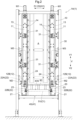
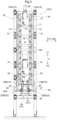
- the container processing apparatus 1 includes a conveyor device 40, a first lifting device 10, and a second lifting device 20.
- the conveyor device 40 is omitted in FIG. 4 .
- the container processing apparatus 1 further includes a support body 30 supporting the conveyor device 40, the first lifting device 10, and the second lifting device 20.
- the support body 30 is formed by coupling frame members.
- the conveyor device 40 conveys a container 90 placed on a placement plane 40S in a conveying direction T that intersects the up-down direction V.
- a container group arrangement region A that is a region in which a stacked container group 9 is arranged is set above (on the upper side V1 of) the placement plane 40S.
- the conveying operation of the conveyor device 40 is controlled by a control unit (not shown) included in the container processing apparatus 1.
- the container processing apparatus 1 shown in FIGS. 2 to 4 is used as the unstacking device 1A. Accordingly, the portion of the first conveyor device 41 including the unstacking target location P (see FIG. 1 ) constitutes the conveyor device 40 included in the unstacking device 1A.
- the conveying direction T in which the conveyor device 40 conveys a container 90 matches the first conveying direction T1.
- the roller conveyor C1 constituting the portion of the first conveyor device 41 including the unstacking target location P constitutes the conveyor device 40 included in the unstacking device 1A, and the conveyance plane of the roller conveyor C 1 is the placement plane 40S of the conveyor device 40 (see FIGS. 5 and 6 ).
- the portion of the second conveyor device 42 including the stacking target location Q constitutes the conveyor device 40 included in the stacking device 1B.
- the conveying direction T in which the conveyor device 40 conveys a container 90 matches the second conveying direction T2.
- the belt conveyor C2 constituting the portion of the second conveyor device 42 including the stacking target location Q constitutes the conveyor device 40 included in the stacking device 1B, and the conveyance plane 42S of the belt conveyor C2 is the placement plane 40S of the conveyor device 40.
- the first lifting device 10 holds, lifts, and lowers a stacked container group 9. That is to say, the first lifting device 10 is capable of collectively holding, lifting, and lowering a plurality of containers 90 stacked on each other.
- the first lifting device 10 is positioned in such a manner as to hold, lift, and lower the containers 90 above (on the upper side V1 of) the placement plane 40S.
- the first lifting device 10 includes a pair of first locking units 11 facing each other and sandwiching the container group arrangement region A therebetween, and first drive units M1 (in the present embodiment, electric motors) that drive the pair of first locking units 11.
- Driving of the pair of first locking units 11 by the first drive units M1 is controlled by the control unit (not shown) included in the container processing apparatus 1.
- the first drive units M1 are respectively provided for the first locking units 11, and the pair of first locking units 11 are driven by the pair of first drive units M1. Note that there is no difference between the pair of first drive units M1 in the manner of driving the first locking units 11, and the pair of first locking units 11 are driven by the pair of first drive units M1 in the same manner as in a case where a common first drive unit M1 that drives the pair of first locking units 11 is provided. Therefore, in the following description, the pair of first drive units M1 will be described as a single first drive unit M1.
- the second lifting device 20 holds, lifts, and lowers the lowest container 90 of a stacked container group 9. That is to say, the second lifting device 20 is capable of holding, lifting, and lowering a single container 90 (specifically, the lowest container 90 of a stacked container group 9).
- the second lifting device 20 is positioned in such a manner as to hold, lift, and lower the container 90 above (on the upper side V1 of) the placement plane 40S.
- the second lifting device 20 includes a pair of second locking units 21 facing each other and sandwiching the container group arrangement region A therebetween, and second drive units M2 (in the present embodiment, electric motors) that drive the pair of second locking units 21. Driving of the pair of second locking units 21 by the second drive units M2 is controlled by the control unit (not shown) included in the container processing apparatus 1.
- the second drive units M2 are respectively provided for the second locking units 21, and the pair of second locking units 21 are driven by the pair of second drive units M2. Note that there is no difference between the pair of second drive units M2 in the manner of driving the second locking units 21, and the pair of second locking units 21 are driven by the pair of second drive units M2 in the same manner as in a case where a common second drive unit M2 that drives the pair of second locking units 21 is provided. Therefore, in the following description, the pair of second drive units M2 will be described as a single second drive unit M2.
- first facing direction D1 the direction in which the pair of first locking units 11 face each other
- second facing direction D2 the direction in which the pair of second locking units 21 face each other
- first facing direction D 1 and the second facing direction D2 are parallel (parallel or substantially parallel) to each other.
- the conveying direction T is orthogonal to the first facing direction D1 as viewed in the up-down direction (see FIG. 4 ).
- the container processing apparatus 1 is installed in such a manner that the first facing direction D1 and the second facing direction D2 extend along the first horizontal direction H1 and the conveying direction T extends along the second horizontal direction H2.
- the first lifting device 10 further includes third drive units M3 (in the present embodiment, electric motors) that move the pair of first locking units 11 toward each other and away from each other in the first facing direction D1. Operations of the third drive units M3 for moving the pair of first locking units 11 toward each other and away from each other are controlled by the control unit (not shown) included in the container processing apparatus 1.
- third drive units M3 in the present embodiment, electric motors
- the third drive units M3 are respectively provided for the first locking units 11, and both of the first locking units 11 are moved by the pair of third drive units M3 in the first facing direction D1 toward each other and away from each other. Note that there is no difference between the pair of third drive units M3 in the manner of moving the first locking units 11 in the first facing direction D1, and the pair of first locking units 11 are driven by the pair of third drive units M3 in the same manner as in a case where a common third drive unit M3 that moves the pair of first locking units 11 toward each other and away from each other is provided. Therefore, in the following description, the pair of third drive units M3 will be described as a single third drive unit M3.
- the third drive unit M3 is configured to move the pair of first locking units 11 toward the upper side V1 while moving the pair of first locking units 11 toward each other in the first facing direction D1.
- each of the first locking units 11 is coupled to the support body 30 via a coupling mechanism 31 (here, a link mechanism), and the third drive unit M3 moves the pair of first locking units 11 via the coupling mechanisms 31 toward each other and away from each other in the first facing direction D1.
- a coupling mechanism 31 here, a link mechanism
- the coupling mechanisms 31 couple the pair of first locking units 11 to the support body 30 in such a manner that the pair of first locking units 11 move toward the upper side V1 as the pair of first locking units 11 move toward each other in the first facing direction D1, and the pair of first locking units 11 move toward the lower side V2 as the pair of first locking units 11 move away from each other in the first facing direction D1.
- each of the first locking units 11 includes a first endless member 13 wound around a pair of first rotary members 12 that are spaced apart from each other in the up-down direction V and a plurality of first locking portions 14 fixed to an outer circumferential portion of the first endless member 13 at a constant interval along the extending direction of the first endless member 13.
- timing pulleys can be used as the first rotary members 12 and a toothed belt can be used as the first endless member 13.
- each of the first locking units 11 includes two first rotary units each including the pair of first rotary members 12 and the first endless member 13 wound around the first rotary members 12. These two first rotary units are configured in such a manner that the respective first endless members 13 rotate (circulate) synchronously with each other. In the present embodiment, these two first rotary units are spaced apart from each other in the conveying direction T.
- the first drive unit M1 is configured to drive a pair of first endless members 13 included in the pair of first locking units 11 in such a manner that the first endless members 13 rotate (circulate) synchronously with each other. That is to say, the first drive unit M1 drives the first endless member 13 (in the present embodiment, the first endless members 13 of the two first rotary units) included in one of the first locking units 11 and the first endless member 13 (in the present embodiment, the first endless members 13 of the two first rotary units) included in the other first locking unit 11 in such a manner that the first endless members 13 rotate synchronously with each other.
- the first rotary member 12 located on the upper side V1 will be referred to as an "upper first rotary member 12A”
- the first rotary member 12 located on the lower side V2 will be referred to as a "lower first rotary member 12B”.
- the first drive unit M1 is configured to rotate the upper first rotary member 12A. That is to say, in the present embodiment, the upper first rotary member 12A is a driving rotary member, and the lower first rotary member 12B is a driven rotary member.
- each first locking unit 11 of the pair of first locking units 11 is positioned in such a manner that the plurality of first locking portions 14 are respectively locked to side surfaces S (see FIGS. 5 and 6 ) of a plurality of containers 90 included in a stacked container group 9 arranged in the container group arrangement region A, in a state where the first locking portions 14 are lined up along the up-down direction V and face the container group arrangement region A.
- This configuration enables the first lifting device 10 to collectively hold, lift, and lower the plurality of containers 90 included in the stacked container group 9.
- the containers 90 are held from both sides in the first facing direction D1 by the first locking portions 14 fixed to the first endless members 13 included in one of the first locking units 11 and the first locking portions 14 fixed to the first endless members 13 included in the other first locking unit 11.
- the first locking units 11 are configured in such a manner that, when the first locking portions 14 move downward (move downward in the container group arrangement region A) as the first endless members 13 rotate, the first locking units 11 (the first locking portions 14) are unlocked from the side surfaces S of the lowest container 90 before the lowest container 90 is placed on the placement plane 40S.
- each of the second locking units 21 includes a second endless member 23 wound around a pair of second rotary members 22 that are spaced apart from each other in the up-down direction V and second locking portions 24 fixed to an outer circumferential portion of the second endless member 23.
- a configuration is also possible in which only one second locking portion 24 is fixed to the outer circumferential potion of the second endless member 23, in the present embodiment, a plurality of (specifically, two) second locking portions 24 are fixed to the outer circumferential portion of the second endless member 23 at a constant interval along the extending direction of the second endless member 23.
- timing pulleys can be used as the second rotary members 22 and a toothed belt can be used as the second endless member 23.
- each of the second locking units 21 includes two second rotary units each including the pair of second rotary members 22 and the second endless member 23 wound around the second rotary members 22. These two second rotary units are configured in such a manner that the respective second endless members 23 rotate (circulate) synchronously with each other. In the present embodiment, these two second rotary units are spaced apart from each other in the conveying direction T.
- the second drive unit M2 is configured to drive a pair of second endless members 23 included in the pair of second locking units 21 in such a manner that the second endless members 23 rotate (circulate) synchronously with each other. That is to say, the second drive unit M2 drives the second endless member 23 (in the present embodiment, the second endless members 23 of the two second rotary units) included in one of the second locking units 21 and the second endless member 23 (in the present embodiment, the second endless members 23 of the two second rotary units) included in the other second locking unit 21 in such a manner that the second endless members 23 rotate synchronously with each other.
- the second rotary member 22 located on the upper side V1 will be referred to as an "upper second rotary member 22A”
- the second rotary member 22 located on the lower side V2 will be referred to as a “lower second rotary member 22B”.
- the second drive unit M2 is configured to rotate the upper second rotary member 22A. That is to say, in the present embodiment, the upper second rotary member 22A is a driving rotary member, and the lower second rotary member 22B is a driven rotary member.
- the lower second rotary member 22B is located on the lower side V2 relative to the lower first rotary member 12B.
- the lower second rotary member 22B is located on the lower side V2 relative to the lower first rotary member 12B
- the entire lower second rotary member 22B is located on the lower side V2 relative to the lowest portion of the lower first rotary member 12B.
- each second locking unit 21 of the pair of second locking units 21 is positioned in such a manner that the second locking portions 24 are locked to a side surface S (see FIGS. 5 and 6 ) of the lowest container 90 of a stacked container group 9 arranged in the container group arrangement region A, in a state where the second locking portions 24 face the container group arrangement region A.
- This configuration enables the second lifting device 20 to hold, lift, and lower only the lowest container 90 of the stacked container group 9.
- the container 90 is held from both sides in the second facing direction D2 by the second locking portions 24 fixed to the second endless members 23 included in one of the second locking units 21 and the second locking portions 24 fixed to the second endless members 23 included in the other second locking unit 21.
- the second locking units 21 are configured in such a manner that, when the second locking portions 24 move downward (move downward in the container group arrangement region A) as the second endless members 23 rotate, the second locking units 21 (the second locking portions 24) are unlocked from the side surfaces S of the lowest container 90 at the same time as the lowest container 90 is placed on the placement plane 40S.
- the second locking portions 24 do not necessarily need to be unlocked "at the same time” in the strict sense of the word as the lowest container 90 is placed on the placement plane 40S, and there may be a certain period between these two events (e.g., a period that is short enough to consider that the two events occur at the same time).
- the container processing apparatus 1 it is possible to collectively hold, lift, and lower a plurality of containers 90 included in a stacked container group 9 with use of the first lifting device 10, and hold, lift, and lower only the lowest container 90 of the stacked container group 9 with use of the second lifting device 20.
- the first drive unit M1 and the second drive unit M2 are configured to operate independently of each other. Therefore, the pair of first locking units 11 of the first lifting device 10 and the pair of second locking units 21 of the second lifting device 20 can be caused to operate independently of each other.
- This configuration makes it possible to smoothly transfer the lowest container 90 between the stacked container group 9 and the conveyor device 40 with use of the second lifting device 20 in the unstacking processing and the stacking processing, which will be described later.
- the side surfaces S of each container 90 include first lock target portions 91 to which the first locking portions 14 are locked and second lock target portions 92 to which the second locking portions 24 are locked.
- protrusions (ribs) protruding outward from the side surfaces S are formed on the side surfaces S of each container 90 in such a manner as to extend in a horizontal direction H, and the protrusions constitute the first lock target portions 91 and the second lock target portions 92.
- the protrusions formed on the side surfaces S of each container 90 are used as the first lock target portions 91 and the second lock target portions 92.
- the first locking portions 14 are locked to lower surfaces of the first lock target portions 91 as shown in FIG.
- a first locking portion 14 fixed to the first endless member 13 of one of the two first rotary units included in each first locking unit 11 and a first locking portion 14 fixed to the first endless member 13 of the other first rotary unit are locked to a side surface S of a container 90 at different positions in the horizontal direction H (here, the second horizontal direction H2).
- a second locking portion 24 fixed to the second endless member 23 of one of the two second rotary units included in each second locking unit 21 and a second locking portion 24 fixed to the second endless member 23 of the other second rotary unit are locked to a side surface S of the container 90 at different positions in the horizontal direction H (here, the second horizontal direction H2).
- first target side surface S1 the side surface S of the container 90 to which the first locking portions 14 are locked
- second target side surface S2 the side surface S of the container 90 to which the second locking portions 24 are locked
- first target side surfaces S1 two side surfaces S respectively facing opposite sides in the first facing direction D1
- second target side surfaces S2 two side surfaces S respectively facing opposite sides in the second facing direction D2
- first facing direction D1 and the second facing direction D2 are parallel to each other.
- the first target side surfaces S1 and the second target side surfaces S2 are common side surfaces S as shown in FIG. 6 .
- each surface S that is the first target side surface S1 as well as the second target side surface S2 has two second lock target portions 92 between two first lock target portions 91 in the horizontal direction H (here, the second horizontal direction H2).
- the second lock target portions 92 are located at positions that are different from the positions of the first lock target portions 91 in the horizontal direction H (here, the second horizontal direction H2).
- the second lock target portions 92 are located on the lower side V2 relative to the first lock target portions 91.
- a first rotation axis X1 that is the rotation axis of the first rotary members 12 extends along the second horizontal direction H2.
- a second rotation axis X2 that is the rotation axis of the second rotary members 22 extends along the second horizontal direction H2.
- the first target side surfaces S1 and the second target side surfaces S2 are orthogonal to the first horizontal direction H1. Accordingly, in the present embodiment, rotation axes (first rotation axes X1) of the pair of first rotary members 12 extend along the horizontal direction H and a direction parallel to the first target side surfaces S1.
- rotation axes (second rotation axes X2) of the pair of second rotary members 22 extend along the horizontal direction H and a direction parallel to the second target side surfaces S2. Therefore, it is possible to lock the second locking portions 24 to the second lock target portions 92 and release the second locking portions 24 therefrom by rotating the second endless members 23.
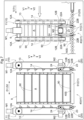
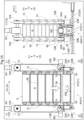
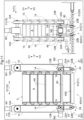
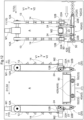
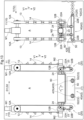
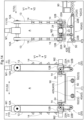
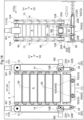
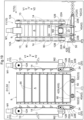
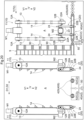
- FIGS. 7 to 11 show scenes in the unstacking processing in chronological order, and the larger the figure number of a drawing is, the later the scene shown in the drawing is.
- FIGS. 7 to 11 a front view and a side view of the container processing apparatus 1 (the unstacking device 1A) are shown side by side to facilitate understanding.
- a stacked container group 9 that is to be subjected to the unstacking processing is conveyed to the unstacking target location P (see FIG. 1 ) through a conveying operation of the conveyor device 40 (the first conveyor device 41).
- the stacked container group 9 conveyed to the unstacking target location P is arranged in the container group arrangement region A.
- the distance between the pair of first locking units 11 in the first facing direction D1 is increased to such an extent that the first locking portions 14 fixed to the first endless members 13 do not interfere with the stacked container group 9 to avoid interference between the first locking units 11 and the stacked container group 9.
- rotation positions of the second endless members 23 are adjusted to positions at which the second locking portions 24 do not interfere with the stacked container group 9 to avoid interference between the second locking units 21 and the stacked container group 9.
- the second lifting device 20 may also include a fourth drive unit (e.g., an electric motor) that moves the pair of second locking units 21 toward each other and away from each other in the second facing direction D2.
- a fourth drive unit e.g., an electric motor
- the pair of first locking units 11 are driven to hold all containers 90 other than the lowest container 90 (in the example shown in FIG. 8 , the second through seventh containers 90 as counted from the bottom) with use of the first lifting device 10.
- all the containers 90 other than the lowest container 90 are held by the first lifting device 10 by reducing the distance between the pair of first locking units 11 in the first facing direction D1 until the first locking portions 14 fixed to the first endless members 13 overlap the first lock target portions 91 (see FIG.
- the plurality of first locking portions 14 are fixed to the outer circumferential portion of each first endless member 13 at a constant interval along the extending direction of the first endless member 13, and the interval corresponds to an interval in the up-down direction V between respective first lock target portions 91 of two containers 90 that are adjacent to each other in the up-down direction V in the stacked container group. Therefore, the first locking portions 14 are locked to the respective side surfaces S of the containers 90 other than the lowest container 90 as shown in FIG. 8 .
- the pair of first endless members 13 included in the pair of first locking units 11 are rotated until the second container 90 as counted from the bottom is lifted to a height (hereinafter referred to as a "conveyance allowing height") at which the second container 90 as counted from the bottom is removed from the lowest container 90 to allow the lowest container 90 to be conveyed in the conveying direction T (the first conveying direction T1).
- the lowest container 90 is conveyed in the conveying direction T (see the right drawing in FIG. 8 ).
- the pair of first locking units 11 move toward the upper side V1 as a result of the distance between the pair of first locking units 11 in the first facing direction D1 being reduced, but the first locking portions 14 are not locked to the first lock target portions 91 of the containers 90 even when the distance between the pair of first locking units 11 in the first facing direction D1 is reduced.
- a configuration is also possible in which the first locking portions 14 are locked to the first lock target portions 91 of the containers 90 as a result of the distance between the pair of first locking units 11 in the first facing direction D1 being reduced.
- the pair of second endless members 23 included in the pair of second locking units 21 are rotated to arrange the second locking portions 24 at positions at which the second locking portions 24 can be locked to the second lock target portions 92 (see FIG. 6 ) of the new lowest container 90 (the second container 90 as counted from the bottom when conveyed to the unstacking target location P) as shown in FIG. 9 .
- the pair of first endless members 13 included in the pair of first locking units 11 are rotated in such a direction that the first locking portions 14 move downward in the container group arrangement region A to lower the new lowest container 90 (hereinafter simply referred to as "the lowest container 90") to a height at which the second locking portions 24 are locked to the second lock target portions 92 of the container 90 (the height of the container 90 shown in FIG. 14 ).
- the second locking portions 24 are locked to the second lock target portions 92 of the lowest container 90 in which the first locking portions 14 are locked to the first lock target portions 91.
- the pair of first endless members 13 included in the pair of first locking units 11 are rotated in such a direction that the first locking portions 14 move downward in the container group arrangement region A
- the pair of second endless members 23 included in the pair of second locking units 21 are rotated in such a direction that the second locking portions 24 move downward in the container group arrangement region A
- the first locking portions 14 are unlocked from the first lock target portions 91 of the lowest container 90, and the lowest container 90 can be lowered to the placement plane 40S while being held by the second lifting device 20 as shown in FIG. 10 .
- the lower second rotary members 22B are located on the lower side V2 relative to the lower first rotary members 12B, and therefore, the second lifting device 20 can lift and lower the container 90 in a region that is on the lower side V2 in the up-down direction V relative to a lowest position at which the first lifting device 10 can hold the container 90. Therefore, even after the first locking portions 14 are unlocked from the first lock target portions 91, it is possible to lower the lowest container 90 while holding the container 90 with use of the second lifting device 20.
- the second locking portions 24 are kept locked to the second lock target portions 92 until the lowest container 90 is placed onto the placement plane 40S, and the second locking portions 24 are unlocked from the second lock target portions 92 when the weight of the lowest container 90 is supported by the placement plane 40S.
- the first locking units 11 are configured in such a manner that, when the first locking portions 14 move downward as the first endless members 13 rotate, the first locking units 11 (the first locking portions 14) are unlocked from the side surfaces S of the lowest container 90 before the lowest container 90 is placed on the placement plane 40S.
- the second locking units 21 are configured in such a manner that, when the second locking portions 24 move downward as the second endless members 23 rotate, the second locking units 21 (the second locking portions 24) are unlocked from the side surfaces S of the lowest container 90 at the same time as the lowest container 90 is placed on the placement plane 40S.
- the first locking portions 14 are unlocked from the side surfaces S of the lowest container 90 before the lowest container 90 is placed on the placement plane 40S, and accordingly, it is possible to separate the lowest container 90 from the group of other containers 90 held by the first lifting device 10 toward the lower side V2 and lower the lowest container 90 onto the placement plane 40S.
- the pair of second endless members 23 included in the pair of second locking units 21 are rotated until the second locking portions 24 come to positions at which the second locking portions 24 do not interfere with the lowest container 90 as shown in FIG. 11 , and accordingly, the lowest container 90 can be conveyed (see the right drawing in FIG. 11 ).
- the lowest container 90 can be conveyed (see the right drawing in FIG. 11 ).
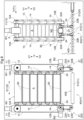
- FIGS. 12 to 20 show scenes in the stacking processing in chronological order, and the larger the figure number of a drawing is, the later the scene shown in the drawing is.
- FIGS. 12 to 20 a front view and a side view of the container processing apparatus 1 (the stacking device 1B) are shown side by side to facilitate understanding.
- a container 90 that is to be subjected to the stacking processing is conveyed to the stacking target location Q (see FIG. 1 ) through a conveying operation of the conveyor device 40 (the second conveyor device 42).
- rotation positions of the first endless members 13 are adjusted to positions at which the first locking portions 14 do not interfere with the container 90 to avoid interference between the first locking units 11 and the container 90
- rotation positions of the second endless members 23 are adjusted to positions at which the second locking portions 24 do not interfere with the container 90 to avoid interference between the second locking units 21 and the container 90.
- the stopper 50 is caused to protrude toward the upper side V1 from the placement plane 40S (the conveyance plane 42S).
- the pair of second locking units 21 are driven to lift the container 90 placed on the placement plane 40S with use of the second lifting device 20.
- the pair of second endless members 23 included in the pair of second locking units 21 are rotated in such a direction that the second locking portions 24 move upward in the container group arrangement region A to hold and lift the container 90 placed on the placement plane 40S with use of the second lifting device 20.
- the container 90 is held by the second lifting device 20 with the second locking portions 24 being locked to the second lock target portions 92 of the container 90.
- the pair of second endless members 23 included in the pair of second locking units 21 are rotated until the container 90 is lifted to a height at which the container 90 can be held by the first lifting device 10 (in other words, a height at which the first locking portions 14 can be locked to the first lock target portions 91 of the container 90).
- the pair of first endless members 13 included in the pair of first locking units 11 are rotated until the container 90 held by the first lifting device 10 is lifted to a height at which the container 90 allows conveyance of a new container 90 that is to be subjected to the stacking processing, and the pair of second endless members 23 included in the pair of second locking units 21 are rotated until the second locking portions 24 come to positions at which the second locking portions 24 do not interfere with the new container 90.
- a new container 90 to be subjected to the stacking processing is conveyed.
- the new container 90 to be subjected to the stacking processing is added as the lowest container 90 to the container 90 or a stacked container group 9 held by the first lifting device 10, and accordingly, the new container 90 to be subjected to the stacking processing will be hereinafter referred to as "the lowest container 90".
- the pair of second endless members 23 included in the pair of second locking units 21 are rotated in such a direction that the second locking portions 24 move upward in the container group arrangement region A to lift the lowest container 90 placed on the placement plane 40S to a height at which the bottom portion of the container 90 held by the first lifting device 10 is fitted to the upper opening of the lowest container 90.
- the pair of first endless members 13 included in the pair of first locking units 11 are rotated in such a direction that the first locking portions 14 move upward in the container group arrangement region A
- the pair of second endless members 23 included in the pair of second locking units 21 are rotated in such a direction that the second locking portions 24 move upward in the container group arrangement region A
- the first locking portions 14 are locked to the first lock target portions 91 of the lowest container 90 in which the second locking portions 24 are locked to the second lock target portions 92 as shown in FIG. 17 , and thus the lowest container 90 can be held by the first lifting device 10.
- the pair of first endless members 13 included in the pair of first locking units 11 are rotated until the stacked container group 9 held by the first lifting device 10 is lifted to a height at which the stacked container group 9 allows conveyance of a new container 90 that is to be subjected to the stacking processing, and the pair of second endless members 23 included in the pair of second locking units 21 are rotated until the second locking portions 24 come to positions at which the second locking portions 24 do not interfere with the new container 90, although this operation is not illustrated.
- the pair of first endless members 13 included in the pair of first locking units 11 are rotated in such a direction that the first locking portions 14 move downward in the container group arrangement region A until the bottom portion of the lowest container 90 of the stacked container group 9 held by the first lifting device 10 fits into the upper opening of the last container 90, and thereafter, the distance between the pair of first locking units 11 in the first facing direction D1 is increased to avoid interference between the first locking portions 14 fixed to the first endless members 13 and the stacked container group 9 as shown in FIG. 19 .
- the stopper 50 is caused to retract toward the lower side V2 so as not to protrude toward the upper side V1 from the placement plane 40S (the conveyance plane 42S) as shown in FIG. 20 , and then the stacked container group 9 generated in the stacking processing is conveyed from the stacking target location Q (see FIG. 1 ) through a conveying operation of the conveyor device 40 (the second conveyor device 42).
- a container processing facility in which a stacked container group composed of a plurality of containers stacked on each other is transferred between the container processing facility and a transport vehicle configured to transport the stacked container group and processing is performed on the containers included in the stacked container group, the container processing facility including: a loading section adjacent to a travel path of the transport vehicle and configured to receive the stacked container group from the transport vehicle; an unloading section adjacent to the travel path and configured to transfer the stacked container group to the transport vehicle; a work station including a device configured to perform work on the containers or an output device configured to output a work instruction to a worker who performs work on the containers; an unstacking device configured to perform unstacking processing for sequentially separating the containers from the stacked container group; a stacking device configured to perform stacking processing for generating the stacked container group by sequentially stacking the plurality of containers; a first conveyor device configured to convey the stacked container group received from the transport vehicle at the loading section to the unstacking device and convey the containers sequentially separated from the stacked
- the transport vehicle, a section of the first conveyor device upstream of the unstacking device, and a section of the second conveyor device downstream of the stacking device can convey a stacked container group composed of a plurality of containers stacked on each other, rather than conveying individual containers, and the containers separated from the stacked container group can be conveyed in the work station. Therefore, the container processing facility according to this configuration is capable of appropriately performing processing on the containers while efficiently conveying the containers.
- the loading section and the unloading section are spaced apart from each other in the travel direction by a distance that allows a transport vehicle transferring a stacked container group to the loading section and a transport vehicle receiving a stacked container group from the unloading section to be arranged next to each other in the travel direction without interfering with each other.
- a first transport vehicle can transfer a stacked container group to the loading section at the same time as a second transport vehicle receives a stacked container group from the unloading section. Therefore, it is easy to increase the efficiency of loading and unloading stacked container groups with use of the transport vehicles.
- the first conveyor device includes a first upstream section between the loading section and the unstacking device, the first upstream section being configured to allow a plurality of the stacked container groups to be arranged next to each other along a conveying direction of the first upstream section and allow the stacked container groups to be conveyed and stopped without affecting the unstacking processing performed by the unstacking device, and the second conveyor device includes a second downstream section between the stacking device and the unloading section, the second downstream section being configured to allow a plurality of the stacked container groups to be arranged next to each other along a conveying direction of the second downstream section and allow the stacked container groups to be conveyed and stopped without affecting the stacking processing performed by the stacking device.
- the first upstream section of the first conveyor device can serve as a buffer for temporarily arranging stacked container groups conveyed to the loading section until the stacked container groups are conveyed to the unstacking device.
- the second downstream section of the second conveyor device can serve as a buffer for temporarily arranging stacked container groups generated by the stacking device until the stacked container groups are transferred from the unloading section to the transport vehicle.
- the first upstream section and the second downstream section can serve as buffers as described above, and therefore, this configuration makes it easy to increase the efficiency of processing containers in the container processing facility as a whole.
- the stacking device executes the stacking processing on the containers placed at a stacking target location on a conveyance path of the second conveyor device
- the container processing facility further includes a stopper configured to protrude and retract from a conveyance plane of the second conveyor device at a position corresponding to a downstream edge of the stacking target location in a conveying direction of the second conveyor device.
- This configuration makes it easy to appropriately stop a container conveyed by the second conveyor device at the stacking target location by making the stopper protrude upward from the conveyance plane of the second conveyor device while the stacking processing is executed by the stacking device. Also, it is possible to appropriately convey a stacked container group from the stacking target location with use of the second conveyor device by making the stopper retract downward so as not to protrude upward from the conveyance plane of the second conveyor device after the stacking processing is completed by the stacking device.
- the unstacking device executes the unstacking processing on the stacked container group placed at an unstacking target location on a conveyance path of the first conveyor device
- the stacking device executes the stacking processing on the containers placed at a stacking target location on a conveyance path of the second conveyor device
- at least a portion of the first conveyor device including the unstacking target location is constituted by a roller conveyor
- at least a portion of the second conveyor device including the stacking target location is constituted by a belt conveyor.
- the portion of the first conveyor device including the unstacking target location is constituted by the roller conveyor, and therefore, a stacked container group can be easily moved in a conveyance width direction (a direction orthogonal to the conveying direction as viewed in the up-down direction) at the unstacking target location, when compared with a case where the portion is constituted by a belt conveyor. Therefore, when a stacked container group conveyed to the unstacking target location is positioned in the conveyance width direction before the unstacking processing is performed by the unstacking device, it is easy to adjust the position of the stacked container group in the conveyance width direction.
- the portion of the second conveyor device including the stacking target location is constituted by the belt conveyor, and therefore, it is easy to suppress slippage between a stacked container group and the second conveyor device at the stacking target location, when compared with a case where the portion is constituted by a roller conveyor. Therefore, even if the stacked container group generated by the stacking device is heavy, it is possible to suppress slippage between the stacked container group and the second conveyor device and appropriately convey the stacked container group from the stacking target location.
- the container processing facility further includes a weighing section configured to measure a weight of a container that is being conveyed by the second conveyor device between the work station and the stacking device on the conveyance path of the second conveyor device.
- At least one of the loading section and the unloading section is a target section that includes a power supply portion for supplying power to the transport vehicle that is stopped to transfer the stacked container group to the target section or receive the stacked container group from the target section.
- the container processing facility according to the present disclosure is only required to achieve at least one of the effects described above.
Landscapes
- Engineering & Computer Science (AREA)
- Mechanical Engineering (AREA)
- Intermediate Stations On Conveyors (AREA)
- Stacking Of Articles And Auxiliary Devices (AREA)
- De-Stacking Of Articles (AREA)
- Warehouses Or Storage Devices (AREA)
- Loading Or Unloading Of Vehicles (AREA)
Applications Claiming Priority (2)
| Application Number | Priority Date | Filing Date | Title |
|---|---|---|---|
| JP2021208044A JP7574792B2 (ja) | 2021-12-22 | 2021-12-22 | 容器処理設備 |
| PCT/JP2022/046238 WO2023120381A1 (ja) | 2021-12-22 | 2022-12-15 | 容器処理設備(container processing facility) |
Publications (2)
| Publication Number | Publication Date |
|---|---|
| EP4450433A1 true EP4450433A1 (de) | 2024-10-23 |
| EP4450433A4 EP4450433A4 (de) | 2025-12-17 |
Family
ID=86902583
Family Applications (1)
| Application Number | Title | Priority Date | Filing Date |
|---|---|---|---|
| EP22911089.5A Pending EP4450433A4 (de) | 2021-12-22 | 2022-12-15 | Behälterbehandlungsanlage |
Country Status (7)
| Country | Link |
|---|---|
| US (1) | US12509312B2 (de) |
| EP (1) | EP4450433A4 (de) |
| JP (1) | JP7574792B2 (de) |
| KR (1) | KR20240126039A (de) |
| CN (1) | CN118434650A (de) |
| TW (1) | TW202332646A (de) |
| WO (1) | WO2023120381A1 (de) |
Families Citing this family (2)
| Publication number | Priority date | Publication date | Assignee | Title |
|---|---|---|---|---|
| JP7537420B2 (ja) * | 2021-12-22 | 2024-08-21 | 株式会社ダイフク | 容器処理装置 |
| JP2023105056A (ja) * | 2022-01-05 | 2023-07-28 | 株式会社三洋物産 | 遊技機 |
Family Cites Families (23)
| Publication number | Priority date | Publication date | Assignee | Title |
|---|---|---|---|---|
| US3448867A (en) | 1964-12-11 | 1969-06-10 | Rex Chainbelt Inc | Material handling system |
| DE1920999B1 (de) * | 1969-04-24 | 1970-07-02 | Schaefer Foerderanlagen | Palettier- und Beschickungs- sowie Entladevorrichtung fuer auf Paletten stapelbare Flaschenkaesten |
| DE2107489C3 (de) * | 1971-02-17 | 1975-02-27 | Mannesmann Ag, 4000 Duesseldorf | Palettenförderanlage für Handgepäck auf Flughäfen |
| US3937335A (en) * | 1972-04-11 | 1976-02-10 | Lanham Machinery Company, Inc. | Automatic bread pan control system |
| JPS5255288A (en) * | 1975-10-31 | 1977-05-06 | Toyo Seikan Kaisha Ltd | Method of and apparatus for supplying and taking out substance to be sterilized for sterilizer |
| CH620170A5 (de) * | 1977-06-03 | 1980-11-14 | Bobst Fils Sa J | |
| GB2086831A (en) * | 1980-11-05 | 1982-05-19 | Vickers Ltd | Device for stacking and destacking containers |
| JPH03106721A (ja) * | 1989-09-21 | 1991-05-07 | Mitsubishi Electric Corp | 縦型ウエーハ搬送装置 |
| US5281080A (en) * | 1992-07-13 | 1994-01-25 | Slave Lake Pulp Corporation | Pulp slab stacker |
| KR100191130B1 (ko) * | 1992-10-01 | 1999-06-15 | 이도 스스므 | 물품 반송설비 |
| US5501571A (en) * | 1993-01-21 | 1996-03-26 | International Business Machines Corporation | Automated palletizing system |
| JP3047732U (ja) | 1997-10-02 | 1998-04-24 | 株式会社三協 | コンテナ引離し装置付きアンスタッカー |
| US20050002772A1 (en) * | 2003-07-03 | 2005-01-06 | Stone Robert L. | Mail container handling system |
| JP5342997B2 (ja) | 2007-03-12 | 2013-11-13 | 国立大学法人徳島大学 | アレルギー疾患の判定方法 |
| US20100101430A1 (en) * | 2008-10-24 | 2010-04-29 | Cremona Inoxidable S.R.L. | Stackable mold unit for obtaining a molded cooked food product |
| NO340313B1 (no) * | 2014-01-08 | 2017-03-27 | Jakob Hatteland Logistics As | Fjernstyrt kjøretøy for å plukke opp lagringsbeholdere fra et lagringssystem, lagringssystem for lagring av beholdere og fremgangsmåte for å bytte en strømkilde |
| US9242796B1 (en) * | 2014-09-10 | 2016-01-26 | International Business Machines Corporation | Dynamic tape storage library for data management |
| US11407588B2 (en) * | 2015-06-24 | 2022-08-09 | Hds Mercury, Inc. | Multiple degree of freedom mobile robot loader-unloader system and method |
| US20190352047A1 (en) * | 2018-05-15 | 2019-11-21 | Cannon Equipment Llc | Systems, apparatuses, and methods for loading containers onto pallets and dollies |
| CN109110511B (zh) | 2018-09-20 | 2020-03-17 | 北京机械设备研究所 | 一种托盘自动拆码垛机构及自动拆码垛方法 |
| CN111217113B (zh) * | 2020-02-17 | 2021-10-22 | 浙江捷创智能技术有限公司 | 一种周转箱上料装置及上料方法 |
| KR102758628B1 (ko) | 2020-02-26 | 2025-01-22 | 무라다기카이가부시끼가이샤 | 전지 검사 시스템 |
| CN111620134B (zh) * | 2020-05-15 | 2024-11-26 | 天津长荣科技集团股份有限公司 | 一种纸垛自动输送系统 |
-
2021
- 2021-12-22 JP JP2021208044A patent/JP7574792B2/ja active Active
-
2022
- 2022-12-15 KR KR1020247021205A patent/KR20240126039A/ko active Pending
- 2022-12-15 EP EP22911089.5A patent/EP4450433A4/de active Pending
- 2022-12-15 WO PCT/JP2022/046238 patent/WO2023120381A1/ja not_active Ceased
- 2022-12-15 CN CN202280085192.3A patent/CN118434650A/zh active Pending
- 2022-12-15 US US18/721,725 patent/US12509312B2/en active Active
- 2022-12-20 TW TW111148944A patent/TW202332646A/zh unknown
Also Published As
| Publication number | Publication date |
|---|---|
| KR20240126039A (ko) | 2024-08-20 |
| WO2023120381A1 (ja) | 2023-06-29 |
| EP4450433A4 (de) | 2025-12-17 |
| TW202332646A (zh) | 2023-08-16 |
| JP7574792B2 (ja) | 2024-10-29 |
| US12509312B2 (en) | 2025-12-30 |
| JP2023092818A (ja) | 2023-07-04 |
| US20250051110A1 (en) | 2025-02-13 |
| CN118434650A (zh) | 2024-08-02 |
Similar Documents
| Publication | Publication Date | Title |
|---|---|---|
| EP4450433A1 (de) | Behälterbehandlungsanlage | |
| EP3064285B1 (de) | Artikelsortierungsvorrichtung | |
| CN112958475B (zh) | 包裹拆分重新建包输送方法 | |
| CN107499563A (zh) | 多工位晶体振荡器测试分类打标编带一体设备 | |
| CN207121168U (zh) | 一种物料的自动化配送系统 | |
| CN117208450A (zh) | 一种货物立体分拣系统 | |
| US10676009B2 (en) | Transportable modular system for dispensing and boxing food and beverage items | |
| US20220219904A1 (en) | Transport rack and transport rack docking interface | |
| CN110626692A (zh) | 可移动式密集存拣装置、组合式仓储系统及其组装方法 | |
| EP4450427A1 (de) | Behälterbehandlungsvorrichtung | |
| CN215286762U (zh) | 行李托盘提升装置 | |
| US11492161B2 (en) | Bag supply system | |
| CN215088982U (zh) | 一种用于物品称重的动态称重机 | |
| CN116174326A (zh) | 一种用于窄带输送机的智能分拣系统及其分拣方法 | |
| CN218506742U (zh) | 货物运输系统及仓储系统 | |
| US11281172B1 (en) | Inventory handling apparatus | |
| KR101651730B1 (ko) | 수하물처리시스템용 터브 공급장치 및 터브 공급방법 | |
| CN115771693A (zh) | 架台单元 | |
| CN222040965U (zh) | 计数装置 | |
| BE1028435B1 (nl) | Een verpakkingssysteem voor het assembleren van een verpakking | |
| JP7358690B2 (ja) | 仕分けステーション及びそれを備える物品集配システム | |
| CN209814312U (zh) | 一种物流柜 | |
| CN118124914A (zh) | 计数装置及计数控制方法 | |
| JP2023133010A (ja) | 集品ステーション及びそれを備える物品集配システム | |
| CN115742912A (zh) | 物品搬运车 |
Legal Events
| Date | Code | Title | Description |
|---|---|---|---|
| STAA | Information on the status of an ep patent application or granted ep patent |
Free format text: STATUS: THE INTERNATIONAL PUBLICATION HAS BEEN MADE |
|
| PUAI | Public reference made under article 153(3) epc to a published international application that has entered the european phase |
Free format text: ORIGINAL CODE: 0009012 |
|
| STAA | Information on the status of an ep patent application or granted ep patent |
Free format text: STATUS: REQUEST FOR EXAMINATION WAS MADE |
|
| 17P | Request for examination filed |
Effective date: 20240716 |
|
| AK | Designated contracting states |
Kind code of ref document: A1 Designated state(s): AL AT BE BG CH CY CZ DE DK EE ES FI FR GB GR HR HU IE IS IT LI LT LU LV MC ME MK MT NL NO PL PT RO RS SE SI SK SM TR |
|
| DAV | Request for validation of the european patent (deleted) | ||
| DAX | Request for extension of the european patent (deleted) | ||
| A4 | Supplementary search report drawn up and despatched |
Effective date: 20251118 |
|
| RIC1 | Information provided on ipc code assigned before grant |
Ipc: B65G 57/30 20060101AFI20251112BHEP Ipc: B65G 60/00 20060101ALI20251112BHEP Ipc: B65G 37/02 20060101ALI20251112BHEP Ipc: B65G 59/06 20060101ALI20251112BHEP |