EP4450294A1 - Schreibgerät - Google Patents
Schreibgerät Download PDFInfo
- Publication number
- EP4450294A1 EP4450294A1 EP22907478.6A EP22907478A EP4450294A1 EP 4450294 A1 EP4450294 A1 EP 4450294A1 EP 22907478 A EP22907478 A EP 22907478A EP 4450294 A1 EP4450294 A1 EP 4450294A1
- Authority
- EP
- European Patent Office
- Prior art keywords
- writing
- cap
- writing instrument
- ink
- pen tip
- Prior art date
- Legal status (The legal status is an assumption and is not a legal conclusion. Google has not performed a legal analysis and makes no representation as to the accuracy of the status listed.)
- Pending
Links
Images



Classifications
-
- B—PERFORMING OPERATIONS; TRANSPORTING
- B43—WRITING OR DRAWING IMPLEMENTS; BUREAU ACCESSORIES
- B43K—IMPLEMENTS FOR WRITING OR DRAWING
- B43K1/00—Nibs; Writing-points
- B43K1/12—Writing-points comprising fibres; Felt pads
-
- B—PERFORMING OPERATIONS; TRANSPORTING
- B43—WRITING OR DRAWING IMPLEMENTS; BUREAU ACCESSORIES
- B43K—IMPLEMENTS FOR WRITING OR DRAWING
- B43K8/00—Pens with writing-points other than nibs or balls
- B43K8/02—Pens with writing-points other than nibs or balls with writing-points comprising fibres, felt, or similar porous or capillary material
-
- B—PERFORMING OPERATIONS; TRANSPORTING
- B43—WRITING OR DRAWING IMPLEMENTS; BUREAU ACCESSORIES
- B43K—IMPLEMENTS FOR WRITING OR DRAWING
- B43K8/00—Pens with writing-points other than nibs or balls
- B43K8/02—Pens with writing-points other than nibs or balls with writing-points comprising fibres, felt, or similar porous or capillary material
- B43K8/03—Ink reservoirs; Ink cartridges
-
- B—PERFORMING OPERATIONS; TRANSPORTING
- B43—WRITING OR DRAWING IMPLEMENTS; BUREAU ACCESSORIES
- B43K—IMPLEMENTS FOR WRITING OR DRAWING
- B43K23/00—Holders or connectors for writing implements; Means for protecting the writing-points
- B43K23/08—Protecting means, e.g. caps
-
- B—PERFORMING OPERATIONS; TRANSPORTING
- B43—WRITING OR DRAWING IMPLEMENTS; BUREAU ACCESSORIES
- B43K—IMPLEMENTS FOR WRITING OR DRAWING
- B43K23/00—Holders or connectors for writing implements; Means for protecting the writing-points
- B43K23/08—Protecting means, e.g. caps
- B43K23/12—Protecting means, e.g. caps for pens
-
- C—CHEMISTRY; METALLURGY
- C09—DYES; PAINTS; POLISHES; NATURAL RESINS; ADHESIVES; COMPOSITIONS NOT OTHERWISE PROVIDED FOR; APPLICATIONS OF MATERIALS NOT OTHERWISE PROVIDED FOR
- C09D—COATING COMPOSITIONS, e.g. PAINTS, VARNISHES OR LACQUERS; FILLING PASTES; CHEMICAL PAINT OR INK REMOVERS; INKS; CORRECTING FLUIDS; WOODSTAINS; PASTES OR SOLIDS FOR COLOURING OR PRINTING; USE OF MATERIALS THEREFOR
- C09D11/00—Inks
- C09D11/16—Writing inks
Definitions
- the present specification relates to a writing instrument that is equipped with a cap, and relates to a writing instrument in which condensation does not occur in a cap.
- This problem is intrinsic to a writing instrument having a pen tip with a large writing portion and including a transparent cap.
- a water evaporation prevention and condensation prevention device for a writing instrument is known.
- This water evaporation prevention and condensation prevention device is characterized in that a liquid absorber having continuous pores is installed in a barrel of a writing instrument containing an ink cylinder containing an aqueous ink in the barrel, and a saturated aqueous solution of a salt is absorbed in the liquid absorber, the saturated aqueous solution of a salt giving a relative humidity of 75 to 95% in a closed atmosphere at normal temperature (see, e.g., Patent Document 1).
- the following writing instrument is known:
- the water evaporation prevention and condensation prevention device for a writing instrument of the Patent Document 1 above is to prevent water evaporation and condensation by mounting the liquid absorber having continuous pores and specific physical properties in the barrel, and to disclose a technique close to the present invention.
- the present invention is to inhibit or prevent condensation and more effectively prevent drying-up during storage from the viewpoints of ink composition, and physical properties, and thus the technical idea of the present invention is different from that described in Patent Document 1.
- An object of the present invention is to provide a writing instrument in which condensation does not occur in a cap even though the writing instrument is equipped with the cap and which has high writing instrument quality and commercial value.
- Another object of the present invention is to provide a writing instrument that can more effectively prevent drying-up during storage.
- each of the writing instruments according to the above objects is achieved by providing the writing instrument with at least a barrel in which an aqueous ink is contained, a pen tip provided on a tip side of the barrel and capable of discharging the aqueous ink, and a cap that is removably attached on the pen tip side of the barrel, and preparing the aqueous ink to have specific physical properties and specific blending composition, and have completed the present invention.
- the writing instrument of the present invention is a writing instrument including at least:
- An inner surface of the cap is preferably subjected to a hydrophilization treatment.
- a writing instrument having high writing instrument quality and commercial value in which condensation does not occur in a cap even though the writing instrument is equipped with the cap.
- a condensed liquid spreads on the cap inner surface and increases the surface area to promote the volatilization of the condensed liquid. This provides the writing instrument with the ability to further prevent drying-up of the pen tip during storage (in a state where the cap is attached).
- the writing instrument of the present embodiment is a writing instrument A including at least:
- the aqueous ink used in the present embodiment needs to have a vapor pressure of 10.3 to 12.3 kPa at 50°C.
- the blending composition of the aqueous ink is not particularly limited as long as the vapor pressure falls within this range, and for example, the aqueous ink preferably contains at least a coloring material and water.
- coloring material examples include those used for writing instruments, for example, a dye dissolved or dispersed in water; an inorganic or organic pigment system that has been known in the art, such as titanium oxide; colored resin fine particles or a dispersion thereof [including a resin particle pigment containing a pigment, a pseudo pigment produced by coloring a resin emulsion with a dye, a white plastic pigment, or a hollow resin pigment (particles)] ; a pigment multilayer-coating the surface of the base material of silica or mica with iron oxide or titanium oxide; a thermochromic pigment; a photochromic pigment; and a composite pigment of these.
- a dye dissolved or dispersed in water an inorganic or organic pigment system that has been known in the art, such as titanium oxide
- colored resin fine particles or a dispersion thereof including a resin particle pigment containing a pigment, a pseudo pigment produced by coloring a resin emulsion with a dye, a white plastic pigment, or a hollow resin pigment (particles)]
- the dye examples include a fluorescent dye, a water-soluble dye, and an oil-soluble dye.
- the fluorescent dye that can be used is not particularly limited as long as the dye has good color development, and examples include Basic Yellow 1 and 40; Basic Red 1, 1:1, and 13; Basic Violet 1, 7, 10, and 11:1; Basic Orange 22; Basic Blue 7; Basic Green 1; Acid Yellow 3 and 7; Acid Red 52, 77, 87, and 92; Acid Blue 9; Disperse Yellow 121, 82, and 83; Disperse Orange 11, Disperse Red 58; Disperse Blue 7; Direct Yellow 85; Direct Orange 8; Direct Red 9; Direct Blue 22; Direct Green 6; Solvent Yellow 44; Solvent Red 49; Solvent Blue 5; and Solvent Green 7.
- an azomethine-based, xanthene-based, or triphenylmethane-based fluorescent dye is preferably used from the viewpoints of color development and ink stability.
- particularly preferred examples of the fluorescent dye include azomethine-based fluorescent dyes such as Basic Yellow 1 and 40; xanthene-based fluorescent dyes such as Basic Red 1:1 and Basic Violet 11:1; triphenylmethane-based fluorescent dyes such as Basic Violet 1. These dyes may be used alone or in combination of two or more types.
- oil-soluble dye examples include C.I. Solvent Black 7 and 123; C.I. Solvent Blue 2, 25, 55, and 70; C.I. Solvent Red 8, 49, and 100; C.I. Solvent Violet 8 and 21; C.I. Solvent Green 3; C.I. Solvent Yellow 21, 44, and 61; and C.I. Solvent Orange 37.
- basic dyes such as Malachite Green (C.I. 42000), Victoria Blue FB (C.I. 44045), Methyl Violet FN (C.I.42535) , Rhodamine F4G (C.I. 45160), and
- the inorganic pigment examples include azo lake, insoluble azo pigments, chelate azo pigments, phthalocyanine pigments, perylene and perinone pigments, and nitroso pigments. More specific examples include inorganic pigments, such as carbon black, titanium black, zinc oxide, colcothar, aluminum, chromium oxide, iron black, cobalt blue, iron oxide yellow, viridian, zinc sulfide, lithopone, cadmium yellow, vermilion, cadmium red, chrome yellow, molybdate orange, zinc chromate, strontium chromate, white carbon, clay, talc, ultramarine blue, precipitated barium sulfate, barite powder, calcium carbonate, white lead, navy blue and white, Prussian blue, manganese violet, aluminum powder, and brass powder; and organic pigments, such as C.
- inorganic pigments such as carbon black, titanium black, zinc oxide, colcothar, aluminum, chromium oxide, iron black, cobalt blue
- Examples of the colored resin fine particles or the dispersion thereof include:
- thermochromic pigment examples include a thermochromic pigment produced by microencapsulating a thermochromic composition to achieve a predetermined average particle size (e.g., 0.1 to 10 um), the thermochromic composition containing at least:
- photochromic pigment examples include:
- the "average particle size” is a value of D50 calculated on a volume basis with a refractive index of 1.81 using a particle size distribution analyzer HR9320-X100 (available from Nikkiso Co., Ltd.).
- coloring materials can be used alone or in a combination of two or more types (hereinafter referred to simply as "at least one").
- the (total) (solid) content of these coloring materials is preferably 0.1 to 40 mass% and more preferably 1 to 30 mass% relative to the total amount of the aqueous ink.
- the content of the coloring material of 0.1 mass% or more When the content of the coloring material of 0.1 mass% or more, sufficient drawn line density can be achieved, whereas when the content is 40 mass% or less, an increase in viscosity is suppressed, and the ink has good fluidity, which is preferred.
- the aqueous ink of the present embodiment can contain a component commonly used in aqueous inks, such as, for example, a dispersant, a surfactant, a glycol, a glycol ether, a hydrophilic polyhydric alcohol, a water-soluble betaine, a viscosity modifier, a fixing resin, a rust inhibitor, an antiseptic or antibacterial agent, or a pH adjuster, as necessary in a range of having the effects of the present invention in addition to the coloring material and, as a solvent, water (such as tap water, purified water, distilled water, ion-exchanged water, or pure water) as a balance.
- a component commonly used in aqueous inks such as, for example, a dispersant, a surfactant, a glycol, a glycol ether, a hydrophilic polyhydric alcohol, a water-soluble betaine, a viscosity modifier, a fixing resin, a rust inhibitor, an anti
- the aqueous ink can contain a water-soluble resin as the dispersant and fixing resin that can be used.
- a water-soluble resin such as acrylic resins, poly(vinyl alcohol), poly(vinylpyrrolidone), poly(ethylene oxide), and urethane-based resins
- resin emulsions such as acrylic emulsions, vinyl acetate-based emulsions, urethane-based emulsions, and polyolefin-based emulsions.
- the surfactant that can be used is not particularly limited, and at least one surfactant selected from fluorine-based surfactants, acetylene glycol-based surfactants, and silicone-based surfactants can be used.
- glycol and glycol ether examples include glycols, such as ethylene glycol, propylene glycol, diethylene glycol, triethylene glycol, tripropylene glycol, tetraethylene glycol, dipropylene glycol, polyethylene glycol, polypropylene glycol, neopentyl glycol, 1,3-octylene glycol, hexylene glycol, tripropylene glycol, thiodiethylene glycol, and glycerin; and glycol ethers, such as ethylene glycol monomethyl ether and diethylene glycol monomethyl ether. One of these may be used, or two or more of these may be used in combination.
- glycols such as ethylene glycol, propylene glycol, diethylene glycol, triethylene glycol, tripropylene glycol, tetraethylene glycol, dipropylene glycol, polyethylene glycol, polypropylene glycol, neopentyl glycol, 1,3-octylene glycol, hex
- hydrophilic polyhydric alcohol examples include pentaerythritol, trimethylolethane, and trimethylolpropane.
- the water-soluble betaine (amphoteric compound) is a compound having a positive charge and a negative charge that are not adjacent to each other in the same molecule and having no charge as a whole molecule.
- the positively charged site is preferably a quaternary ammonium cation.
- betaine include, but are not particularly limited to, trimethylglycine, ⁇ -butyrobetaine, homarine, trigonelline, carnitine, homoserine betaine, valine betaine, lysine betaine, ornithine betaine, alanine betaine, stachydrine, and glutamic acid betaine.
- trimethylglycine ⁇ -butyrobetaine, or carnitine is preferred, and trimethylglycine is more preferred.
- the use of such a water-soluble betaine tends to further improve the effects of the present invention.
- One water-soluble betaine may be used alone, or two or more types may be used in combination.
- a natural polymer such as a polysaccharide, or a synthetic polymer
- examples of the polysaccharide that can be used include arabic gum, tragacanth gum, guar gum, locust bean gum, alginic acid, carrageenan, gelatin, xanthan gum, welan gum, succinoglycan, diutan gum, dextran, cellulose derivatives such as methyl cellulose, ethyl cellulose, hydroxyethyl cellulose, and carboxymethyl cellulose, and starch glycolic acid and its salts.
- Examples of the synthetic polymer that can be used include poly(vinylpyrrolidone), poly(vinyl methyl ether), poly (acrylic acid) and its salts, poly(ethylene oxide), a vinyl acetate-poly(vinylpyrrolidone) copolymer, a styrene-acrylic acid copolymer and its salt, and an isobutylene maleic anhydride copolymer and its salt.
- phenol sodium omadine, sodium benzoate, benzisothiazoline, or a benzimidazole compound
- examples of the rust inhibitor that can be used include benzotriazole, tolyltriazole, dicyclohexylammonium nitrite, and saponins.
- an amine compound such as triethanolamine, diethanolamine, monoethanolamine, dimethylethanolamine, morpholine, or triethylamine, ammonia, or a hydroxide of an alkali metal, such as sodium hydroxide, potassium hydroxide, or lithium hydroxide can be used.
- the aqueous ink contains at least the coloring material and water and has a vapor pressure of 10.3 to 12.3 kPa at 50°C.
- the aqueous ink having a vapor pressure of 10.3 to 12.5 kPa at 50°C can be preferably prepared by suitably combining (e.g., the type and the blended amount) of a polyhydric alcohol (pentaerythritol, trimethylolethane, or trimethylolpropane) and a water-soluble betaine (amphoteric compound) such as trimethylglycine in addition to the glycol described above.
- a polyhydric alcohol penentaerythritol, trimethylolethane, or trimethylolpropane
- amphoteric compound such as trimethylglycine
- the "vapor pressure at 50°C” refers to a value measured by a static method.
- the use of the aqueous ink having a vapor pressure of 10.3 to 12.3 kPa at 50°C, preferably a vapor pressure of 10.3 to 12.0 kPa at 50°C, and particularly preferably a vapor pressure of 10.3 to 11.1 kPa at 50°C allows a cap-equipped writing instrument to exhibit a unique effect without causing condensation in the cap as described below.
- An aqueous ink having a vapor pressure of less than 10.3 kPa at 50°C would have high ink viscosity, making it impossible to write normally with the ink and reducing the drying properties of the drawn line. Meanwhile, an aqueous ink having a vapor pressure of more than 12.3 kPa at 50°C would fail to prevent condensation and cause a problem of drying-up of the pen tip at the time of removal of the cap, which is not preferred.
- the aqueous ink of the present embodiment for a writing instrument the aqueous ink having a composition having a vapor pressure in a range of 10.3 to 12.3 kPa at 50°C, is obtained by, for example,
- the pH (25°C) of the aqueous ink of the present embodiment is desired to be adjusted to preferably 5 to 10 and more preferably 6 to 9.5 using a pH adjuster from the viewpoints of usability, safety, stability of the ink itself, and matching properties with the ink container.
- FIG. 1(a) is a plan view of the writing instrument equipped with a cap of the present embodiment
- FIG. 1(b) is a front view thereof
- FIG. 1(c) is a vertical cross-sectional view thereof as seen from the front.
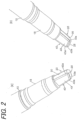
- FIG. 2 is enlarged perspective views of the pen tip of the writing instrument of FIG. 1; (a) is an enlarged perspective view of the pen tip as seen from one direction, and (b) is an enlarged perspective view of the pen tip as seen from a direction rotated by 180° with respect to that in (a).
- the writing instrument A of the present embodiment is loaded with the aqueous ink having the above characteristics, and as illustrated in FIGS. 1(a) to (c) , the writing instrument A is a twin-type writing instrument including:
- the barrel 10 is formed, for example, of a thermoplastic resin or a thermosetting resin, and is formed of a cylindrical body for containing the ink absorber 15 impregnated with the aqueous ink having the above characteristics.
- One end on the right side in the drawing is a holding portion 11 having a fitting portion for fixing a holder 55 by fitting, the holder 55 for holding the rod-shaped thin character-type pen tip 50.
- a front barrel 16 is attached to the other end on the left side for fixing the pen tip 20 having the visible portion serving as the window portion through which the writing direction is visible.
- the barrel 10 is molded into a cylindrical shape using, for example, a resin containing polypropylene and functions as the writing instrument main body (barrel body) .
- the barrel 10 is molded to be opaque or transparent (and translucent), either may be adopted from the viewpoint of appearance and practicality.
- the ink absorber 15 is impregnated with the aqueous ink having a vapor pressure of 10.3 to 12.5 kPa at 50°C as described above and includes, for example, a fiber bundle composed of:
- the pen tip 20 is formed of a writing core 30 having at least a writing portion 25, and a holding body 40 having the visible portion.
- the writing core 30 having the writing portion 25 is attached to the holding body 40 described below by adhesion, welding, or fitting.
- the writing core 30 has:
- the shape and thickness of the writing core 30 having the writing portion 25 are determined from the viewpoints of, for example, an aspect of attaching to the holding body 40, the shape of the writing portion 25, maximization of the visible area of the visible portion 43, and efficiently flowing out (supplying) the ink to the writing portion.
- the lateral length and the longitudinal length correspond to the lateral length and the circumferential length of the attachment surface of the below-described holding body 40 for fixing the thin plate bodies 31, 31 of the writing core 30, and these lengths are suitably determined for efficiently flowing out the ink to the writing portion 25.
- the thicknesses of the thin plate bodies 31, 31 other than the writing portion 25 of the writing core 30 are preferably 0.3 to 3.0 mm and most preferably 0.5 to 1.0 mm from the viewpoint of maximizing the visible area of the visible portion 43.
- the writing portion 25 is integrally formed with the thin plate bodies 31, 31 of the writing core 30 and has an inclined shape (knife-cut shape) to be inclined to facilitate writing, and this inclination is appropriately determined in accordance with the usability for writing.
- the writing portion 25 produces a large line width and is desired to be a writing portion to produce a line width of preferably 1 mm or more and more preferably 2 mm or more.
- the writing core 30 including the writing portion 25 of the present embodiment is integrally formed of a sintered core obtained by sintering plastic powder.
- the writing portion 25 and the thin plate bodies 31, 31 of the writing core 30 are integrally formed of the same material, but the writing portion 25 and the thin plate bodies 31, 31 may be formed of different members and may be connected, bonded, or brought into contact.
- the writing portion 25 is formed of, for example, a porous material having pores, and specific examples of the material include a sponge body, a sintered body, a fiber bundle body, a foam body, a spongy body, a felt body, and a porous body.
- Examples of the material that can be used for forming the porous body include natural fiber, animal hair fiber, a polyacetal-based resin, a polyethylene-based resin, an acrylic resin, a polyester-based resin, a polyamide-based resin, a polyurethane-based resin, a polyolefin-based resin, a polyvinyl-based resin, a polycarbonate-based resin, a polyether-based resin, and a polyphenylene-based resin.
- the writing portion 25 may be formed of a sintered body obtained by sintering any plastic powder
- the thin plate bodies 31, 31 may be formed of a fabric such as a nonwoven fabric, a woven fabric, or a knitted fabric, or a liquid-permeable material, such as a liquid-permeable foam.
- the holding body 40 fixes the writing portion 25 and the thin plate bodies 31, 31 of the writing core 30 and is fixed to a tip opening of the front barrel 16 of the writing instrument main body 10, and has the visible portion (visual recognition portion) 43 through which the writing direction is visible.
- the portions (thin plate-like bodies 31, 31) in contact with the side surfaces of the holding body 40 of the writing core 30 have a rectangular cross-sectional shape, and the outer peripheral edges of the visible portion 43, which are the front end portions of the holding body 40, are formed as inclined refracting surfaces 43a, 43a.
- the portions in contact with the side surfaces of the holding body 40 of the writing core 30 have a rectangular cross-sectional shape, which can increase the width of the visible portion 43 relative to the cross-sectional area.
- the outer peripheral edges of the visible portion 43 of the holding body 40 are formed as the inclined refracting surfaces 43a, 43a, which allows the rectangular cross section to look thin and allows the area of the visible portion 43 to look larger as compared with a case of the related art.
- the entire holding body 40 is formed of a hard material and, for example, formed of a hard material providing visibility, such as glass or a resin having no rubber elasticity.
- a resin having no rubber elasticity and providing visibility include a material having a visible light transmittance of 50% or more, such as PP, PE, PET, PEN, nylon (including amorphous nylon in addition to common nylon, such as 6 nylon or 12 nylon), acrylic resin, polymethylpentene, polystyrene, or ABS.
- Formation of the entire holding body 40 by molding of such a resin allows letters and characters written in the writing direction to be effectively visible through the visible portion 43. Only the visible portion 43 (including the inclined refracting surfaces 43a, 43a) may be formed of a material providing visibility.
- the visible light transmittance can be determined by measuring the reflectance with a multiple light source spectrocolorimeter [available from Suga Test Instruments Co., Ltd., (MSC-5N)].
- the holding body 40 may be formed from one of the above materials, or two or more of the above materials from the viewpoint of further improvements in durability and visibility.
- the holding body 40 can be formed by any molding method such as injection molding or blow molding.
- the thin plate bodies 31, 31 of the writing core 30 are fixed to the attachment surfaces of angular U-shaped (U-shaped) holding grooves of the holding body 40 by adhesion with an adhesive or welding, and are fixed to the writing portion 25.
- the thicknesses of the thin plate bodies 31, 31 are smaller than the thickness of the writing portion 25, and the width of the ink guide portion is preferably less than 90% and more preferably 50 to 80% of the width of the visible portion 43 of the holding body 40.
- the pen tip 50 is a rod-shaped pen tip of a thin character type and has a circular cross section, and the rear end portion (ink absorber side) of the pen tip 50 is inserted into the ink absorber 15, and the aqueous ink having the vapor pressure characteristics described above in the ink absorber is supplied to the pen tip 50 by capillary force.
- This pen tip 50 is formed of a porous material; for example, formed of a parallel fiber bundle composed of one type or a combination of two or more types of natural fiber, animal hair fiber, a polyacetal-based resin, a polyethylene-based resin, an acrylic resin, a polyester-based resin, a polyamide-based resin, a polyurethane-based resin, a polyolefin-based resin, a polyvinyl-based resin, a polycarbonate-based resin, a polyether-based resin, and a polyphenylene-based resin; a processed fiber bundle obtained by processing a fiber bundle, such as felt, or a fiber core obtained by processing a fiber bundle of these with a resin; or a porous body (sintered core) obtained from plastic powder of a thermoplastic resin, such as a polyolefin-based resin, an acrylic resin, a polyester-based resin, a polyamide-based resin, or a polyurethane-based resin.
- a porous material for example, formed of
- the pen tip 50 is preferably formed of a fiber bundle core, a fiber core, a sintered core, a felt core, a sponge core, or an inorganic porous core, and is particularly preferably formed of a fiber core, from the viewpoints of deformation moldability and productivity.
- the porosity, size, and hardness of the pen tip 50 to be used vary depending on the type of ink or the type of writing instrument.
- the porosity is preferably 30 to 60%.
- the "porosity" is calculated as follows. Firstly, a writing core having a known mass and apparent volume is immersed in water and sufficiently impregnated with water, and then the mass is measured in a state of being taken out from water.
- the volume of water impregnated into the writing core is calculated.
- the cap 60 formed of a material having transparency and the cap 70 having an inner cap are removably attached by fitting to the outer peripheral portion on one pen tip 20 side and the outer peripheral portion on the other pen tip 50 side of the barrel 10.
- the cap 60 and the cap 70 can be formed of, for example, a material having no transparency (material providing no visibility) or a material having transparency (material providing visibility).
- Examples of the material having no transparency include resins having no transparency (providing no visibility) and materials obtained using a colorant providing no visibility, such as carbon black, in a resin having transparency (providing visibility).
- Examples of the material having transparency (providing visibility) include glass and materials composed of a resin having no rubber elasticity.
- the resin having transparency (providing visibility) and having no rubber elasticity include a material having a visible light transmittance of 50% or more, such as PP, PE, PET, PEN, nylon (including amorphous nylon in addition to common nylon, such as 6 nylon or 12 nylon), acrylic resin, polymethylpentene, polystyrene, and ABS. Formation of the cap 60 and the cap 70 by molding of such a resin allows the pen tips 20 and 50 to be seen (visible) from the outside through the cap 60 and the cap 70, respectively.
- the cap 60 and the cap 70 may be entirely formed of a material having no transparency (material providing no visibility) or a material having transparency (providing visibility).
- the cap 60 and the cap 70 may be partially formed of a material having transparency (providing visibility) instead of being entirely formed of a material having transparency (providing visibility).
- the aqueous ink having the above characteristics in the present embodiment is a thermochromic ink
- contamination of the surroundings can be prevented by forming a thermoplastic elastomer having a capability of erasing pencil lines (rate of erasing letters and characters) specified in JIS S 6050-2002 of less than 70% on the top of the cap 60 to thereby form a friction body that easily generates frictional heat by rubbing motion and is low wear to reduce the generation of eraser dust during friction.
- an inner surface 61 of the cap 60 and/or a surface 17 of the front barrel 16 are preferably subjected to a hydrophilization treatment to make them hydrophilic.
- Subjecting the inner surface 61 of the cap 60 and/or the surface 17 of the front barrel 16 to a hydrophilization treatment reduces their contact angles and improves their wettabilities. This spreads the condensed liquid on the inner surface 61 of the cap 60 and the surface 17 of the front barrel 16 and increases the surface area and promotes the volatilization of the condensed liquid.
- This provides a writing instrument that can prevent drying-up of the pen tip 20 during storage (in a state where the cap 60 is attached).
- the inner surface 71 of the cap 70 may also be subjected to a hydrophilization treatment to prevent drying-up of the pen tip 50.
- hydrophilization treatment examples include a coating agent for coating with a material with a contact angle with water of less than 90°; activation treatment, such as plasma treatment, ozone treatment, corona treatment, flame treatment, or radical activation treatment with an electron beam; and application of a hydrophilizing agent.
- the coating agent examples include activating agent solutions described below; nonionic types, such as fatty acid esters of polyhydric alcohols, higher fatty acid esters of sugars, polyoxyalkylene higher fatty acid esters, and alkyl phosphate esters; anionic types, such as phosphate esters, alkyl sulfonate salts of a higher fatty acid amide, and alkyl allyl sulfonate salts; derivatives of polyalkylene glycols; fluorochemical surfactants; and polyether-modified silicones.
- nonionic types such as fatty acid esters of polyhydric alcohols, higher fatty acid esters of sugars, polyoxyalkylene higher fatty acid esters, and alkyl phosphate esters
- anionic types such as phosphate esters, alkyl sulfonate salts of a higher fatty acid amide, and alkyl allyl sulfonate salts
- the hydrophilization treatment can be performed with a polycyclic phenyl-type nonionic surfactant, such as poly(oxyethylene) distyrenated phenyl ether, poly(oxyethylene) monostyrenated phenyl ether, or poly (oxyethylene) cumyl phenyl ether; and an ionic surfactant, such as a sulfate salt of the polycyclic phenyl-type nonionic surfactant; an alkylphenol-type nonionic surfactant, such as poly(oxyethylene) alkylphenyl ether; a linear hydrocarbon-type nonionic surfactant, such as poly (oxyethylene)-hardened castor oil or a poly(oxyethylene) alkyl (C10 to C18) ester; or a sorbitan derivative.
- a polycyclic phenyl-type nonionic surfactant such as poly(oxyethylene) distyrenated phenyl ether, poly(oxyethylene) monostyrenated
- the aforementioned activation treatment method such as plasma treatment, ozone treatment, corona treatment, flame treatment, or radical activation treatment with an electron beam, is appropriately selected in accordance with the material of the cap.
- specific methods of the activation treatment include a method of treating the inner surface of the cap 60 and the surface of the front barrel 16 with corona or plasma in an atmosphere of vacuum to atmospheric pressure.
- the hydrophilizing agent include water-soluble resins, such as poly(vinyl alcohol), ethylene-vinyl alcohol copolymers, and ethylene-vinyl acetate copolymers; and silicate-based hydrophilizing agents containing an inorganic metal.
- the contact angle of the inner surface of the cap 60 or the surface of the front barrel 16 with water is desired to be less than 90°, and the contact angle can be controlled by suitably selecting the hydrophilization treatment.
- the cap 60 or the front barrel 16 may be formed of a material having a contact angle with water of less than 90°.
- the material having this characteristic include poly(ethylene terephthalate) (PET), poly(butylene terephthalate) (PBT), and 66 nylon, and the cap 60 or the front barrel 16 is integrally molded or two-color molded from such a material.
- a twin-type writing instrument A can be easily manufactured by inserting the ink absorber 15 containing the aqueous ink having the above vapor pressure characteristics into the writing instrument main body 10 and holding; on the tip side, fixing the pen tip 20 having the above configuration by sequentially fitting through the front barrel 16; and on the other side, fixing by fitting the holder 55 to which the pen tip 50 is fixed.
- the aqueous ink having the vapor pressure described above absorbed in the ink absorber 15 is efficiently supplied by capillary force to the writing portion 25 through the thin plate bodies 31, 31 of the writing core 30 at the pen tip 20 as well as to the pen tip 50, and is used for writing.
- the cap 60 (including the cap 70) formed of a material having no transparency (material providing no visibility)
- the use of the aqueous ink having a vapor pressure of 10.3 to 12.3 kPa at 50°C eliminates the occurrence of condensation in the cap 60 and provides the writing instrument with high writing instrument quality and high commercial value.
- the cap 60 (including the cap 70) formed of a material having transparency and having a large internal volume is used to show the pen tip 20 and the writing instrument is mistakenly placed in an environment with temperature change or temperature gradient, for example, a place exposed to direct sunlight, a place near a heating vent, a place near a heat source such as a PC, or on an electric carpet
- the use of the aqueous ink having a vapor pressure of 10.3 to 12.3 kPa at 50°C eliminates the occurrence of condensation in the cap 60 and does not impair the appearance.
- the inner surface 61 of the cap 60 reduces the contact angle between the condensed liquid and the inner surface 61 of the cap 60 and increases the surface area, which can promote the volatilization of the condensed liquid.
- the condensed liquid spreads on the inner surface 61 of the cap 60. This allows the condensed liquid to come into contact with a heating portion and promotes the volatilization of the condensed liquid, and makes it possible to prevent drying-up of the pen tip during storage (in a state where the cap is attached).
- Exposing the pen core to temperature change or temperature distribution allows the ink to volatilize from the pen tip and to condense in the cap 60. This accelerates the volatilization of the ink from the pen tip 20. This also quickly volatilizes condensed droplets in the cap 60 and can restore the ink in the pen tip 60. This can quickly volatilize the condensed droplets and can prevent the drying-up of the pen tip during storage (in a state where the cap is attached). Furthermore, this eliminates the need for a material for preventing evaporation into the ink, the material having been added for drying-up during storage, and can enhance the drying property, adherence, and strike-through resistance of the ink.
- the cap 60 (including the cap 70, the same shall apply hereinafter) formed of a material having transparency and having a large internal volume to show the pen tip 20, even when the writing instrument is mistakenly placed in an environment with temperature change or temperature gradient, for example, a place exposed to direct sunlight, a place near a heating vent, a place near a heat source such as a PC, or on an electric carpet, the use of the aqueous ink having a vapor pressure of 10.3 to 12.3 kPa at 50°C eliminates the occurrence of condensation in the cap 60 and does not impair the appearance.
- the pen tip 50 is similar to a pen tip generally used in the art, and thus the function of the pen tip 20 will be described.
- the pen tip 20 has the visible portion (window portion) 43 through which the writing direction is visible, and the aqueous ink having the vapor pressure characteristics described above in the ink absorber 15 reaches the writing portion 25 by the capillary force of the thin plate bodies 31, 31 of the writing core 30 and is used for writing.
- looking at the visible side through the visible portion (window portion) 43 facilitates easy adjustment of the starting position of drawing and makes it possible to stop drawing exactly at a desired part of the end of drawing and to prevent excessive drawing and to prevent the drawing from extending off.
- the pen tip 20 guides the ink from the ink absorber 15 to the writing portion 25 through thin plate bodies 31, 31 of the writing core 30, the thin plate bodies 31, 31 having a thickness smaller than that of the writing portion 25 and outflow properties.
- these thin plate bodies 31, 31 are formed of a sheet-like porous body and thus have good ink outflow properties and need not be designed to be thick and do not interfere with the visible portion 43.
- the portions in contact with the side surfaces of the holding body 40 of the writing core 30 have a rectangular cross-sectional shape, which can increase the width of the visible portion 43 relative to the cross-sectional area.
- the outer peripheral edges of the visible portion 43 of the holding body 40 are formed as the inclined refracting surfaces 43a, 43a, which allows the rectangular cross section to look thin.
- a line can be drawn with the writing portion 25 while the writing direction is visually recognized through the visible portion 43.
- the thin plate bodies 31, 31 having the above characteristics efficiently supply the ink to the integrally formed writing portion 25, thus achieving good ink outflow properties and providing the writing instrument with the ability to achieve maximization of the effective area of the visible portion 43 without impairing the ink outflow properties.
- the writing instrument of the present second embodiment is a writing instrument B including at least:
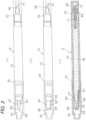
- FIG. 3 (a) is a plan view of the writing instrument equipped with a cap of the present second embodiment
- FIG. 3(b) is a front view thereof
- FIG. 3 (c) is a vertical cross-sectional view thereof as seen from the front.
- FIG. 4 is enlarged perspective views of the pen tip of the writing instrument of FIG. 1;
- (a) is an enlarged perspective view of the pen tip as seen from one direction, and
- (b) is an enlarged perspective view of the pen tip as seen from a direction rotated by 180° with respect to that in (a).
- the writing instrument of the present embodiment is the writing instrument B including at least:
- the writing core 30 of the embodiment having a U-shaped outer shape is used, but the second embodiment is different in that a writing core 35 having an L-shaped outer shape is attached to a holding body 40 as illustrated in FIGS. 3 and 4 .
- a writing portion 36 of the writing core 35 of the second embodiment has a shape similar to that of the writing portion of the above embodiment and has an inclined shape (knife-cut shape) to be inclined to facilitate writing.
- a thin plate body 37 is integrally provided continuously from the end side of the writing portion 36 and has an L-shaped outer shape, and a cross section of the thin plate body 37 has a rectangular shape.
- the holding body 40 fixes the writing portion 36 and the thin plate body 37 of the writing core 35 and is fixed to a tip opening of a front barrel 16 of a writing instrument main body 10.
- the holding body 40 forms the attachment surfaces for attaching the thin plate bodies 31, 31 on the upper and lower sides, but in the present embodiment, the outer shape is in L-shape, and thus the holding body 40 attaches the thin plate body 37 only on the lower side.
- the use of the aqueous ink having a vapor pressure of 10.3 to 12.3 kPa at 50°C eliminates the occurrence of condensation in the cap 60 and does not impair the appearance.
- the writing core 35 has an L-shaped outer shape and thus is configured not to attach the thin plate body 31 on the upper surface side of the visible portion 43 as compared with the writing core having the U-shaped outer shape of FIG. 1 , and thus has nothing to block, allowing enlargement of the area of the visible portion correspondingly.
- the portion in contact with the side surface of the holding body 40 of the writing core 35 has a rectangular cross-sectional shape, which can increase the width of the visible portion 43 on the bottom surface side relative to the cross-sectional area.
- the outer peripheral edges of the visible portion 43 of the holding body 40 are formed as the inclined refracting surfaces 43a, 43a, which allows the rectangular cross section to look thin and allows the area of the visible portion 43 to look larger than that of FIG. 1 .
- the pen tip 20 of the second embodiment is attached in the same manner as in the writing instrument of FIG. 1 and has the visible portion (window portion) 43 through which the writing direction is visible, and the aqueous ink in the ink absorber 15 reaches the writing portion 36 by the capillary force of the writing core 35 and is used for writing.
- looking at the visible side through the visible portion (window portion) 43 facilitates easy adjustment of the starting position of drawing and makes it possible to stop drawing exactly at a desired part of the end of drawing and to prevent excessive drawing and to prevent the drawing from extending off.
- the pen tip 20 guides the aqueous ink from the ink absorber 15 to the writing portion 36 through the thin plate body 37 of the writing core 35, the thin plate body 37 having a thickness smaller than that of the writing portion 36 and outflow properties.
- this thin plate body 37 is formed of a material having even better ink supply capability than that of the embodiment of FIG. 1 above and thus has good ink outflow properties and need not be designed to be thick and does not interfere with the visible portion 43.
- the portions in contact with the side surfaces of the holding body 40 of the writing core 35 have a rectangular cross-sectional shape, which can increase the width of the visible portion 43 relative to the cross-sectional area.
- the outer peripheral edges of the visible portion 43 of the holding body 40 are formed as the inclined refracting surfaces 43a, 43a, which allows the rectangular cross section to look thin.
- a line can be drawn with the writing portion 36 while the writing direction is visually recognized through the visible portion 43.
- the thin plate body 37 having the above characteristics efficiently supplies the ink to the integrally formed writing portion 36, thus achieving good ink outflow properties and providing the writing instrument with the ability to achieve maximization of the effective area of the visible portion 43 better than the embodiment of FIG. 1 without impairing the ink outflow properties.
- the inner surfaces 61 and 71 of the caps 60 and 70 may be subjected to a hydrophilization treatment.
- a writing instrument C of the third embodiment is a marking pen-type writing instrument, and the writing instrument C includes at least:
- the aqueous ink used in the third embodiment is the aqueous ink having the vapor pressure characteristics described in detail in the first embodiment, and thus description thereof will be omitted.
- the writing instrument C of the third embodiment includes the barrel 80 constituting a writing instrument main body, an ink absorber 85, an ink guide core 95, the pen tip 90, and the cap 65.
- the barrel 80 is formed of a material similar to that of the barrel 10 of the first embodiment and has a bottomed cylindrical rear barrel 81 for containing the ink absorber 85 impregnated with the aqueous ink having the above characteristics, and a front barrel 86 for fixing the pen tip 90.
- the rear barrel 81 is formed by, for example, molding a synthetic resin containing PP into a long bottomed elliptic cylindrical shape, and functions as a main body (barrel) of the writing instrument. As illustrated in FIGS. 5(a) to (c) , the rear barrel 81 is provided with a holding member 82 formed of a holding piece for holding the rear end portion of the ink absorber 85 inside the rear end side, and the entire rear barrel and the front barrel described below are molded to be opaque or transparent (and translucent), but either may be adopted from the viewpoint of appearance and practicality.
- the rear barrel 81 is configured to fix the front barrel 86 to an opening on the pen tip side of the rear barrel 81 by fitting.
- the ink absorber 85 is formed of a material similar to that of the ink absorber 15 of the first embodiment.
- the ink guide core 95 for the aqueous ink in the ink absorber 85 is inserted and fixed in an insertion-fixation hole 97 formed in a holding body 96 described below and, similarly to the ink absorbers 15 and 85, has a fiber bundle, a fiber bundle core obtained by processing a fiber bundle, such as felt, or a hard sponge, a resin particle porous body formed of a resin particle sintered body, or a core having continuous pores (flow paths), such as a sliver core.
- the shape and structure of the ink guide core 95 is not particularly limited as long as the aqueous ink having the vapor pressure characteristics or blending characteristics described above impregnated in the ink absorber 85 can be supplied through the ink guide core 95 to a pen core 98 serving as the writing portion of the pen tip 90.
- Examples of the cross-sectional shape of the ink guide core 95 include a circle, an ellipse, a square, a rectangle, a trapezoid, a parallelogram, a rhombus, a semicylindrical shape, and a half-moon shape.
- the cross-sectional shape is a circular shape.
- the pen tip 90 includes:
- the entire pen tip 90 or the holding body 96 thus configured is formed of a material providing visibility, for example, a material such as PP, PE, PET, PEN, nylon (including amorphous nylon in addition to common nylon, such as 6 nylon or 12 nylon), acrylic resin, polymethylpentene, polystyrene, and ABS, and is preferably formed of a material having a visible light transmittance of 50% or more.
- a material such as PP, PE, PET, PEN, nylon (including amorphous nylon in addition to common nylon, such as 6 nylon or 12 nylon), acrylic resin, polymethylpentene, polystyrene, and ABS, and is preferably formed of a material having a visible light transmittance of 50% or more.
- the entire pen tip 90 or the holding body 96 can be formed by using one type of the above materials, or from the viewpoint of further improvement in durability and visibility, using two or more types of materials.
- the entire pen tip 90 or the holding body 96 is formed of two or more types of materials, at least one of them is preferably formed of a material having a visible light transmittance of 50% or more.
- the entire pen tip 90 or the holding body 96 can be formed by any molding method, such as injection molding or blow molding.
- FIG. 6(a) illustrates an example of a state where the cap is removed from the writing instrument C of the present embodiment, and is a view illustrating the holding body 96 formed of a material providing visibility.
- FIG. 6(b) is a view illustrating the holding body 96 formed of a material providing no visibility.
- the writing instrument C of the present embodiment can be easily manufactured by holding the ink absorber 85 containing the ink and the ink guide core 95 in the rear barrel 81 constituting the barrel of the writing instrument, and sequentially attaching the pen tip 90 equipped with the pen core 98, and the front barrel 86 by fitting or a like process.
- the cap 65 is formed by molding of a material having transparency (material providing visibility) and having a visible light transmittance of 50% or more, and thus the pen tip 90 can be seen (visible) from the outside through the cap 65.
- the thus-configured writing instrument C of the present embodiment eliminates the occurrence of condensation in the cap 65 and does not impair the appearance.
- the shape of the pen tip 90 and the color tone of the aqueous ink e.g., an ink color of yellow or pink
- the writing instrument is provided with high writing instrument quality and high commercial value.
- the aqueous ink having the above characteristics can be more continuously and efficiently supplied from the ink absorber 85 to the ink guide core 95 and the pen core 98 by capillary force action.
- This provides the writing instrument with the ability to ensure an appropriate ink flow rate for prevention of blur in writing, to stabilize the writing flow rate, and to sufficiently use up the aqueous ink in the ink absorber 85.
- the pen tip 90 includes the pen core 98 serving as the writing portion, and the holding body 96 holding the pen core 98 and having at least one ink guide core 95 for supplying the ink to the writing portion.
- the pen tip 90 supplies the aqueous ink contained in the ink absorber 85 through the ink guide core 95 provided in the holding body 96, and the holding body 96 is formed of a material providing visibility as illustrated in FIG. 6 (a) .
- the entire surface (entirety) of the holding body 96, except for the ink guide core 95 serves as the visible portion through which the writing direction is visible.
- the area ratio of the visible portion can be adjusted to 40% or more relative to the pen tip protruding from the front barrel 86 tip portion.
- the area ratio of the visible portion on the holding body 96 side surfaces is also adjusted to 40% or more, and the ink guide core 95 is formed at the central part in the longitudinal direction of the holding body 96, and the lateral length, the diameter, and the cross-sectional area of the ink guide core 95 are suitably set to preferred given ranges.
- This can provide sufficient visibility that allows letters and characters written in the writing direction to be more reliably read as compared with the case of the related art, and provides the writing instrument with the ability to be used until the end of writing.
- the pen core 98 has a convex curved surface and is configured to allow stable writing with little change in thickness even if the writing angle is not stable.
- the ink guide core 95 is inserted into the insertion-fixation hole 97 of the holding body 96 and is not disposed in the central part of the holding body 96 or is disposed outside the central part of the holding body 96 (the insertion-fixation hole 97 is eccentrically disposed) . This can make the visible area look wider in the case where the holding body 96 has transparency (visibility).
- FIG. 6 (b) is a view illustrating the holding body 96 formed of a material providing no visibility. In this configuration, the ink guide core 95 is invisible.
- the writing instruments A to C of the embodiments described above correspond to a type in which the aqueous ink having the vapor pressure characteristics of the first embodiment is absorbed in the ink absorber 15 or 85.
- the writing instrument may be a direct liquid-type writing instrument, for example, a collector-type writing instrument in which the aqueous ink having the vapor pressure characteristics used in the present invention is directly contained in the barrel and the aqueous ink is supplied through a relay core to the writing portion of the pen tip.
- the pen tip 20 or 90 has a window portion through which the writing direction is visible.
- the shape and structure of the pen tip are not particularly limited as long as the writing instrument is equipped with a cap that is removably attached on the pen tip side of the barrel and is formed of a material having transparency (material providing visibility) or a material having no transparency (material providing no visibility).
- Each aqueous ink composition for a writing instrument was prepared by an ordinary method according to the blending formulation shown in Table 1 below.
- a pen tip and a writing instrument in accordance with the configuration below and FIGS. 1 and 2 were used.
- the below-described dimensions and physical properties the pen tip and the holding body were used.
- the resulting writing instrument was used and allowed to stand on a hot carpet for 9 hours, and the presence or absence of condensation in the caps 60 and 70 was evaluated according to the following evaluation criteria.
- Each of the writing instruments of Examples 1 to 10 corresponds to that illustrated in FIGS. 1 and 2 .
- the ink from the ink absorber 15 is guided to the writing portion 25 through thin plate bodies 31, 31 having a thickness smaller than that of the writing portion 25 and outflow properties.
- the writing core 30 having the U-shaped outer shape and including the writing portion 25 and the thin plate bodies 31, 31 is formed of the polyethylene sintered core having the above configuration and thus has increased strength of the capillary force relative to the porosity, and its thickness can be extremely reduced.
- the writing core 30 had good ink outflow properties, eliminating the need for designing the ink guide portion to be thick and not interfering with the visible portion 43.
- the portions in contact with the side surfaces of the holding body 40 of the writing core 30 have a rectangular cross-sectional shape, which can increase the width of the visible portion 43 relative to the cross-sectional area.
- the outer peripheral edges of the visible portion 43 of the holding body 40 are formed as the inclined refracting surfaces 43a, 43a, which allows the rectangular cross section to look thin.
- a line can be drawn by the writing portion 25 while the writing direction is visually recognized through the visible portion 43.
- the thin plate bodies 31, 31 having the above characteristics efficiently supplies the ink to the integrally formed writing portion 25, thus achieving good ink outflow properties.
- writing was possible without blurring even after the writing instrument was dropped from a height of 1 m.
- the inner surface of the cap was subjected to a hydrophilization treatment.
- the inner surfaces of the caps 60 and 70 were subjected to a hydrophilization treatment by the following method.
- the inner surfaces of the caps 60 and 70 were subjected to a hydrophilization treatment by application of a polysilicate-based hydrophilic coating agent "NP-235 (available from Daiko Technical Corporation)” and then drying at room temperature (25°C).
- NP-235 available from Daiko Technical Corporation
- the writing instrument can be suitably utilized for a pen core-type writing instrument called a felt-tip pen or a marking pen, in which a porous body is mainly used as a writing portion.
Landscapes
- Chemical & Material Sciences (AREA)
- Life Sciences & Earth Sciences (AREA)
- Engineering & Computer Science (AREA)
- Materials Engineering (AREA)
- Wood Science & Technology (AREA)
- Organic Chemistry (AREA)
- Pens And Brushes (AREA)
- Inks, Pencil-Leads, Or Crayons (AREA)
Applications Claiming Priority (3)
| Application Number | Priority Date | Filing Date | Title |
|---|---|---|---|
| JP2021205416 | 2021-12-17 | ||
| JP2022172667A JP7277660B1 (ja) | 2021-12-17 | 2022-10-27 | 筆記具 |
| PCT/JP2022/046006 WO2023112955A1 (ja) | 2021-12-17 | 2022-12-14 | 筆記具 |
Publications (2)
| Publication Number | Publication Date |
|---|---|
| EP4450294A1 true EP4450294A1 (de) | 2024-10-23 |
| EP4450294A4 EP4450294A4 (de) | 2025-12-17 |
Family
ID=86382639
Family Applications (1)
| Application Number | Title | Priority Date | Filing Date |
|---|---|---|---|
| EP22907478.6A Pending EP4450294A4 (de) | 2021-12-17 | 2022-12-14 | Schreibgerät |
Country Status (5)
| Country | Link |
|---|---|
| US (1) | US12325255B2 (de) |
| EP (1) | EP4450294A4 (de) |
| JP (2) | JP7277660B1 (de) |
| CN (1) | CN118369217A (de) |
| WO (1) | WO2023112955A1 (de) |
Family Cites Families (13)
| Publication number | Priority date | Publication date | Assignee | Title |
|---|---|---|---|---|
| JPS585786U (ja) | 1981-07-01 | 1983-01-14 | 株式会社サクラクレパス | 筆記具の水分蒸発防止兼結露防止装置 |
| CA1268814A (en) | 1984-06-13 | 1990-05-08 | Larry Wayne Moore | Apparatus and methods for fluid level sensing |
| FR2729966B1 (fr) * | 1995-02-01 | 1998-12-04 | Mitsubishi Pencil Co | Encre dispersee dans l'eau, a faible viscosite, pour stylo a bille, et stylo a bille |
| JP2006257378A (ja) * | 2005-02-21 | 2006-09-28 | Pilot Ink Co Ltd | 筆記具 |
| JP5511259B2 (ja) * | 2009-08-18 | 2014-06-04 | パイロットインキ株式会社 | 可逆熱変色性水性インキ組成物及びそれを用いた筆記具、筆記具セット |
| JP6549900B2 (ja) | 2015-05-25 | 2019-07-24 | 三菱鉛筆株式会社 | 塗布具 |
| JP7107652B2 (ja) * | 2016-08-24 | 2022-07-27 | 三菱鉛筆株式会社 | 筆記具 |
| JP7084787B2 (ja) | 2018-05-30 | 2022-06-15 | 三菱鉛筆株式会社 | 筆記具 |
| US20210316566A1 (en) * | 2018-08-07 | 2021-10-14 | Mitsubishi Pencil Company, Limited | Pen tip and writing tool equipped with the pen tip |
| JP2020049672A (ja) | 2018-09-25 | 2020-04-02 | 株式会社パイロットコーポレーション | 筆記具 |
| WO2021029255A1 (ja) | 2019-08-09 | 2021-02-18 | 三菱鉛筆株式会社 | 筆記具 |
| JP7638630B2 (ja) * | 2019-08-09 | 2025-03-04 | 三菱鉛筆株式会社 | 筆記具 |
| WO2021219754A1 (en) * | 2020-04-30 | 2021-11-04 | Societe Bic | Water-based ink composition with color-changing by evaporation |
-
2022
- 2022-10-27 JP JP2022172667A patent/JP7277660B1/ja active Active
- 2022-12-14 WO PCT/JP2022/046006 patent/WO2023112955A1/ja not_active Ceased
- 2022-12-14 US US18/718,309 patent/US12325255B2/en active Active
- 2022-12-14 CN CN202280081033.6A patent/CN118369217A/zh active Pending
- 2022-12-14 EP EP22907478.6A patent/EP4450294A4/de active Pending
-
2023
- 2023-05-08 JP JP2023076641A patent/JP2023095978A/ja active Pending
Also Published As
| Publication number | Publication date |
|---|---|
| JP2023090636A (ja) | 2023-06-29 |
| WO2023112955A1 (ja) | 2023-06-22 |
| JP7277660B1 (ja) | 2023-05-19 |
| JP2023095978A (ja) | 2023-07-06 |
| US20250042194A1 (en) | 2025-02-06 |
| CN118369217A (zh) | 2024-07-19 |
| EP4450294A4 (de) | 2025-12-17 |
| US12325255B2 (en) | 2025-06-10 |
Similar Documents
| Publication | Publication Date | Title |
|---|---|---|
| ES2909383T3 (es) | Uso de un cuerpo de fricción para lograr termocromía | |
| JP7321331B2 (ja) | 筆記具 | |
| EP2192161A1 (de) | Schreibartikel enthaltend eine chemisch korrigierbare Tinte und Flüssigkeiten zur Entfärbung von Tinten | |
| KR100720698B1 (ko) | 필기구 | |
| JP2022107786A (ja) | 筆記具 | |
| CN112533765A (zh) | 笔尖以及具备该笔尖的书写工具 | |
| EP4450294A1 (de) | Schreibgerät | |
| JP2023120452A (ja) | 筆記具 | |
| EP3805008A1 (de) | Schreibvorrichtung | |
| JP2023104219A (ja) | 筆記具製品 | |
| JP7781653B2 (ja) | 筆記具 | |
| US4840833A (en) | Ink composition and a pressure sensitive reproducing | |
| KR102056352B1 (ko) | 보드마커용 잉크 조성물 및 그 제조방법 | |
| EP4711424A1 (de) | Wässrige tintenzusammensetzung für schreibutensilien und damit erhaltenes schreibutensilien | |
| JP2024141831A (ja) | 塗布具 | |
| JP7251600B2 (ja) | 塗布具 | |
| JP2025146290A (ja) | 筆記具用水性インク組成物、この水性インク組成物を搭載した筆記具 | |
| JP4812305B2 (ja) | 水性インキ組成物 | |
| JP7224137B2 (ja) | 筆記具 | |
| HK40043329B (en) | Writing tool | |
| JP2023177334A (ja) | 水性インキ組成物 | |
| JP2019136934A (ja) | 筆記具 | |
| JP2023005427A (ja) | 筆記具用水性インキセット | |
| JP2025057950A (ja) | 筆記具用水性インク組成物 | |
| JP2020062779A (ja) | 筆記具 |
Legal Events
| Date | Code | Title | Description |
|---|---|---|---|
| STAA | Information on the status of an ep patent application or granted ep patent |
Free format text: STATUS: THE INTERNATIONAL PUBLICATION HAS BEEN MADE |
|
| PUAI | Public reference made under article 153(3) epc to a published international application that has entered the european phase |
Free format text: ORIGINAL CODE: 0009012 |
|
| STAA | Information on the status of an ep patent application or granted ep patent |
Free format text: STATUS: REQUEST FOR EXAMINATION WAS MADE |
|
| 17P | Request for examination filed |
Effective date: 20240629 |
|
| AK | Designated contracting states |
Kind code of ref document: A1 Designated state(s): AL AT BE BG CH CY CZ DE DK EE ES FI FR GB GR HR HU IE IS IT LI LT LU LV MC ME MK MT NL NO PL PT RO RS SE SI SK SM TR |
|
| DAV | Request for validation of the european patent (deleted) | ||
| DAX | Request for extension of the european patent (deleted) | ||
| A4 | Supplementary search report drawn up and despatched |
Effective date: 20251119 |
|
| RIC1 | Information provided on ipc code assigned before grant |
Ipc: B43K 8/02 20060101AFI20251113BHEP Ipc: B43K 23/12 20060101ALI20251113BHEP Ipc: C09D 11/16 20140101ALI20251113BHEP Ipc: B43K 8/03 20060101ALI20251113BHEP |
|
| STAA | Information on the status of an ep patent application or granted ep patent |
Free format text: STATUS: EXAMINATION IS IN PROGRESS |