EP4450168A1 - Schlitzartige sprühdüse, auftragungsvorrichtung und verfahren zur herstellung von filmbeschichtetem material - Google Patents
Schlitzartige sprühdüse, auftragungsvorrichtung und verfahren zur herstellung von filmbeschichtetem material Download PDFInfo
- Publication number
- EP4450168A1 EP4450168A1 EP22907075.0A EP22907075A EP4450168A1 EP 4450168 A1 EP4450168 A1 EP 4450168A1 EP 22907075 A EP22907075 A EP 22907075A EP 4450168 A1 EP4450168 A1 EP 4450168A1
- Authority
- EP
- European Patent Office
- Prior art keywords
- coating fluid
- discharge ports
- air
- coating
- fluid
- Prior art date
- Legal status (The legal status is an assumption and is not a legal conclusion. Google has not performed a legal analysis and makes no representation as to the accuracy of the status listed.)
- Pending
Links
Images





Classifications
-
- B—PERFORMING OPERATIONS; TRANSPORTING
- B05—SPRAYING OR ATOMISING IN GENERAL; APPLYING FLUENT MATERIALS TO SURFACES, IN GENERAL
- B05B—SPRAYING APPARATUS; ATOMISING APPARATUS; NOZZLES
- B05B7/00—Spraying apparatus for discharge of liquids or other fluent materials from two or more sources, e.g. of liquid and air, of powder and gas
- B05B7/02—Spray pistols; Apparatus for discharge
- B05B7/06—Spray pistols; Apparatus for discharge with at least one outlet orifice surrounding another approximately in the same plane
-
- B—PERFORMING OPERATIONS; TRANSPORTING
- B05—SPRAYING OR ATOMISING IN GENERAL; APPLYING FLUENT MATERIALS TO SURFACES, IN GENERAL
- B05B—SPRAYING APPARATUS; ATOMISING APPARATUS; NOZZLES
- B05B1/00—Nozzles, spray heads or other outlets, with or without auxiliary devices such as valves, heating means
- B05B1/14—Nozzles, spray heads or other outlets, with or without auxiliary devices such as valves, heating means with multiple outlet openings; with strainers in or outside the outlet opening
-
- B—PERFORMING OPERATIONS; TRANSPORTING
- B05—SPRAYING OR ATOMISING IN GENERAL; APPLYING FLUENT MATERIALS TO SURFACES, IN GENERAL
- B05B—SPRAYING APPARATUS; ATOMISING APPARATUS; NOZZLES
- B05B13/00—Machines or plants for applying liquids or other fluent materials to surfaces of objects or other work by spraying, not covered by groups B05B1/00 - B05B11/00
- B05B13/02—Means for supporting work; Arrangement or mounting of spray heads; Adaptation or arrangement of means for feeding work
- B05B13/0278—Arrangement or mounting of spray heads
-
- B—PERFORMING OPERATIONS; TRANSPORTING
- B05—SPRAYING OR ATOMISING IN GENERAL; APPLYING FLUENT MATERIALS TO SURFACES, IN GENERAL
- B05B—SPRAYING APPARATUS; ATOMISING APPARATUS; NOZZLES
- B05B7/00—Spraying apparatus for discharge of liquids or other fluent materials from two or more sources, e.g. of liquid and air, of powder and gas
- B05B7/02—Spray pistols; Apparatus for discharge
- B05B7/025—Nozzles having elongated outlets, e.g. slots, for the material to be sprayed
-
- B—PERFORMING OPERATIONS; TRANSPORTING
- B05—SPRAYING OR ATOMISING IN GENERAL; APPLYING FLUENT MATERIALS TO SURFACES, IN GENERAL
- B05B—SPRAYING APPARATUS; ATOMISING APPARATUS; NOZZLES
- B05B7/00—Spraying apparatus for discharge of liquids or other fluent materials from two or more sources, e.g. of liquid and air, of powder and gas
- B05B7/02—Spray pistols; Apparatus for discharge
- B05B7/08—Spray pistols; Apparatus for discharge with separate outlet orifices, e.g. to form parallel jets, i.e. the axis of the jets being parallel, to form intersecting jets, i.e. the axis of the jets converging but not necessarily intersecting at a point
- B05B7/0807—Spray pistols; Apparatus for discharge with separate outlet orifices, e.g. to form parallel jets, i.e. the axis of the jets being parallel, to form intersecting jets, i.e. the axis of the jets converging but not necessarily intersecting at a point to form intersecting jets
- B05B7/0815—Spray pistols; Apparatus for discharge with separate outlet orifices, e.g. to form parallel jets, i.e. the axis of the jets being parallel, to form intersecting jets, i.e. the axis of the jets converging but not necessarily intersecting at a point to form intersecting jets with at least one gas jet intersecting a jet constituted by a liquid or a mixture containing a liquid for controlling the shape of the latter
-
- B—PERFORMING OPERATIONS; TRANSPORTING
- B05—SPRAYING OR ATOMISING IN GENERAL; APPLYING FLUENT MATERIALS TO SURFACES, IN GENERAL
- B05B—SPRAYING APPARATUS; ATOMISING APPARATUS; NOZZLES
- B05B7/00—Spraying apparatus for discharge of liquids or other fluent materials from two or more sources, e.g. of liquid and air, of powder and gas
- B05B7/02—Spray pistols; Apparatus for discharge
- B05B7/08—Spray pistols; Apparatus for discharge with separate outlet orifices, e.g. to form parallel jets, i.e. the axis of the jets being parallel, to form intersecting jets, i.e. the axis of the jets converging but not necessarily intersecting at a point
- B05B7/0884—Spray pistols; Apparatus for discharge with separate outlet orifices, e.g. to form parallel jets, i.e. the axis of the jets being parallel, to form intersecting jets, i.e. the axis of the jets converging but not necessarily intersecting at a point the outlet orifices for jets constituted by a liquid or a mixture containing a liquid being aligned
-
- B—PERFORMING OPERATIONS; TRANSPORTING
- B05—SPRAYING OR ATOMISING IN GENERAL; APPLYING FLUENT MATERIALS TO SURFACES, IN GENERAL
- B05B—SPRAYING APPARATUS; ATOMISING APPARATUS; NOZZLES
- B05B7/00—Spraying apparatus for discharge of liquids or other fluent materials from two or more sources, e.g. of liquid and air, of powder and gas
- B05B7/24—Spraying apparatus for discharge of liquids or other fluent materials from two or more sources, e.g. of liquid and air, of powder and gas with means, e.g. a container, for supplying liquid or other fluent material to a discharge device
- B05B7/2489—Spraying apparatus for discharge of liquids or other fluent materials from two or more sources, e.g. of liquid and air, of powder and gas with means, e.g. a container, for supplying liquid or other fluent material to a discharge device an atomising fluid, e.g. a gas, being supplied to the discharge device
- B05B7/2494—Spraying apparatus for discharge of liquids or other fluent materials from two or more sources, e.g. of liquid and air, of powder and gas with means, e.g. a container, for supplying liquid or other fluent material to a discharge device an atomising fluid, e.g. a gas, being supplied to the discharge device a liquid being supplied from a pressurized or compressible container to the discharge device
-
- B—PERFORMING OPERATIONS; TRANSPORTING
- B05—SPRAYING OR ATOMISING IN GENERAL; APPLYING FLUENT MATERIALS TO SURFACES, IN GENERAL
- B05C—APPARATUS FOR APPLYING FLUENT MATERIALS TO SURFACES, IN GENERAL
- B05C5/00—Apparatus in which liquid or other fluent material is projected, poured or allowed to flow on to the surface of the work
- B05C5/02—Apparatus in which liquid or other fluent material is projected, poured or allowed to flow on to the surface of the work the liquid or other fluent material being discharged through an outlet orifice by pressure, e.g. from an outlet device in contact or almost in contact, with the work
-
- B—PERFORMING OPERATIONS; TRANSPORTING
- B05—SPRAYING OR ATOMISING IN GENERAL; APPLYING FLUENT MATERIALS TO SURFACES, IN GENERAL
- B05C—APPARATUS FOR APPLYING FLUENT MATERIALS TO SURFACES, IN GENERAL
- B05C5/00—Apparatus in which liquid or other fluent material is projected, poured or allowed to flow on to the surface of the work
- B05C5/02—Apparatus in which liquid or other fluent material is projected, poured or allowed to flow on to the surface of the work the liquid or other fluent material being discharged through an outlet orifice by pressure, e.g. from an outlet device in contact or almost in contact, with the work
- B05C5/0254—Coating heads with slot-shaped outlet
-
- B—PERFORMING OPERATIONS; TRANSPORTING
- B05—SPRAYING OR ATOMISING IN GENERAL; APPLYING FLUENT MATERIALS TO SURFACES, IN GENERAL
- B05C—APPARATUS FOR APPLYING FLUENT MATERIALS TO SURFACES, IN GENERAL
- B05C5/00—Apparatus in which liquid or other fluent material is projected, poured or allowed to flow on to the surface of the work
- B05C5/02—Apparatus in which liquid or other fluent material is projected, poured or allowed to flow on to the surface of the work the liquid or other fluent material being discharged through an outlet orifice by pressure, e.g. from an outlet device in contact or almost in contact, with the work
- B05C5/027—Coating heads with several outlets, e.g. aligned transversally to the moving direction of a web to be coated
-
- B—PERFORMING OPERATIONS; TRANSPORTING
- B05—SPRAYING OR ATOMISING IN GENERAL; APPLYING FLUENT MATERIALS TO SURFACES, IN GENERAL
- B05D—PROCESSES FOR APPLYING FLUENT MATERIALS TO SURFACES, IN GENERAL
- B05D1/00—Processes for applying liquids or other fluent materials
- B05D1/02—Processes for applying liquids or other fluent materials performed by spraying
-
- B—PERFORMING OPERATIONS; TRANSPORTING
- B05—SPRAYING OR ATOMISING IN GENERAL; APPLYING FLUENT MATERIALS TO SURFACES, IN GENERAL
- B05B—SPRAYING APPARATUS; ATOMISING APPARATUS; NOZZLES
- B05B13/00—Machines or plants for applying liquids or other fluent materials to surfaces of objects or other work by spraying, not covered by groups B05B1/00 - B05B11/00
- B05B13/02—Means for supporting work; Arrangement or mounting of spray heads; Adaptation or arrangement of means for feeding work
- B05B13/0207—Means for supporting work; Arrangement or mounting of spray heads; Adaptation or arrangement of means for feeding work the work being an elongated body, e.g. wire or pipe
-
- B—PERFORMING OPERATIONS; TRANSPORTING
- B05—SPRAYING OR ATOMISING IN GENERAL; APPLYING FLUENT MATERIALS TO SURFACES, IN GENERAL
- B05B—SPRAYING APPARATUS; ATOMISING APPARATUS; NOZZLES
- B05B14/00—Arrangements for collecting, re-using or eliminating excess spraying material
- B05B14/40—Arrangements for collecting, re-using or eliminating excess spraying material for use in spray booths
-
- B—PERFORMING OPERATIONS; TRANSPORTING
- B05—SPRAYING OR ATOMISING IN GENERAL; APPLYING FLUENT MATERIALS TO SURFACES, IN GENERAL
- B05B—SPRAYING APPARATUS; ATOMISING APPARATUS; NOZZLES
- B05B16/00—Spray booths
- B05B16/60—Ventilation arrangements specially adapted therefor
Definitions
- the present invention relates to a slot-type spray nozzle, a coating device using the slot-type spray nozzle, and a manufacturing method of a film-coated member using the coating device.
- spray coating devices are known which spray coating fluid after forming droplets of the coating fluid by a spray nozzle (hereinafter, also simply referred to as a "nozzle").
- Patent Literature 1 discloses a spray coating device that forms a thin coating film on a wide substrate, the spray coating device in which a plurality of two-fluid single-hole type spray nozzles, capable of forming a thin film by discharging compressed air simultaneously with coating fluid, micronizing the coating fluid by a strong striking force (collision force with the coating fluid) of the discharged air, and spraying the coating fluid, is arrayed at equal intervals in a width direction of a substrate, by conveying the substrate while spraying the coating fluid simultaneously such that the coating fluid sprayed from the nozzles overlaps.
- a strong striking force collision force with the coating fluid
- each nozzle is an independent component, variations in spray state are likely to occur due to individual differences of the nozzles, namely, the variation in shape among the nozzles.
- the discharged air and the coating fluid droplets sprayed from each nozzle fly while expanding in the width direction in the form of a fan shape, a cone shape, or the like, application stripes are likely to occur due to interference at portions where the application overlaps between the nozzles, and it is difficult to form a uniform coating film.
- Patent Literature 2 discloses a slot-type spray nozzle having a plurality of coating fluid discharge ports in an application width direction of a substrate and a pair of air discharge ports arranged in such a manner as to sandwich the coating fluid discharge ports that are continuously or intermittently opened over the width direction in the vicinity of the coating fluid discharge ports.
- the spray nozzle discharges the coating fluid to generate a coating fluid pool exposed at the distal end of the coating fluid discharge port and instantaneously repeats an operation of applying a striking force of discharged air to the coating fluid pool to separate the coating fluid pool from the spray nozzle, thereby enabling generation of fine coating fluid droplets.
- the spray nozzle has a single nozzle over the application width, the variation in the shape at each coating fluid discharge port can be suppressed as compared with those in a single-hole type nozzle, and the coating fluid can be sprayed with high uniformity in the application width direction.
- a slot-type spray nozzle that discharges substantially continuous band-shaped air tends to have a larger discharged air flow rate than a structure in which a plurality of two-fluid single-hole type nozzles is arranged, and as the discharged air flow rate is larger, the ambient air outside the nozzle is drawn, and thus the flow of the discharged air is likely to be disturbed.
- the present invention has been made in view of the above disadvantage and provides a spray nozzle capable of forming fine coating fluid droplets even in a case where a discharged air flow rate is reduced and uniformly forming a thin coating film on a wide substrate. Furthermore, a spray coating device using the spray nozzle and a manufacturing method of a film-coated member using the spray coating device are provided.
- a slot-type spray nozzle includes: a plurality of coating fluid discharge ports arranged in one direction; and a pair of air discharge ports continuously or intermittently opened in a vicinity of the coating fluid discharge ports in a width direction, the width direction being the one direction, the air discharge ports being arranged to sandwich the coating fluid discharge ports, the air discharge ports being formed in such a manner that air discharged from the air discharge ports obliquely intersects with a discharge direction of coating fluid, in which the slot-type spray nozzle further includes a pair of fluid holding surfaces extending in the discharging direction of the coating fluid from sides forming both ends in the width direction of the coating fluid discharge ports, the fluid holding surfaces facing each other across the coating fluid discharge ports, and
- the slot-type spray nozzle according to the present invention preferably has the following embodiments.
- a coating device includes: the slot-type spray nozzle according to the present invention; a supply unit configured to supply the coating fluid and the air to the slot-type spray nozzle; a support unit configured to support a to-be-coated member; and a moving unit configured to relatively move the to-be-coated member supported by the support unit with respect to the slot-type spray nozzle.
- a manufacturing method of a film-coated member according to the present invention includes: using the coating device according to the present invention; discharging the coating fluid from the coating fluid discharge ports while discharging the air from the air discharge ports; and spraying the coating fluid onto the to-be-coated member supported by the support unit to manufacture a member on which a coating film is formed.
- an air flow rate discharged from the air discharge ports is within a range of 900 NL/min to 1500 NL/min per width of 1 m.
- the "width direction” means a direction in which a plurality of coating fluid discharge ports are arranged.
- a coating film can be formed thinly, widely, and uniformly on a substrate.
- the present inventors have found that coating fluid droplets are micronized by being separated from a spray nozzle in a state where a coating fluid pool generated at the distal end of the nozzle is small. More specifically, the present invention has been devised since it has been found that the uniformity of the coating film is improved by reducing the discharged air flow rate to mitigate deterioration of the straightness at the time when the coating fluid droplets fly while the state in which a thin film can be formed is maintained due to a fact that the coating fluid droplets are micronized by matching the position at which a coating fluid pool is separated with the position at which the striking force of the discharged air is obtained and reducing a contact area between the coating fluid pool and a nozzle surface.
- the gas component of air or the outside air used in the present invention is not particularly limited as long as it is a gas suitable for coating, and air, nitrogen gas, or the like can be used.
- the ambient pressure of the outside air is not particularly limited and can be subjected to an atmospheric pressure environment, a reduced pressure environment, or the like.
- the coating fluid used for spray coating is not particularly limited, and examples thereof include solutions of inorganic substances or organic substances, slurries in which inorganic substances or organic substances are dispersed in a binder and a solvent, or the like.
- the viscosity of the coating fluid is required to be low enough to micronize the coating fluid by the striking force of the discharged air and is generally preferably less than or equal to 500 mPa ⁇ s.
- FIG. 1 is a perspective view illustrating a schematic structure of a spray nozzle of the present invention. Illustrated in FIG. 1 is a part of a spray nozzle 10, and hatching in the drawing indicates a cross section of the spray nozzle 10.
- the spray nozzle 10 has a longitudinal direction in a direction orthogonal to a conveyance direction D of a long substrate 40, namely, in the width direction of the substrate 40 and is disposed in such a manner as to face an application surface of the substrate 40 with a certain distance from the substrate 40.
- the coating fluid is supplied from a coating fluid supply port 16 included at the center of the spray nozzle 10 in the width direction, spread in the width direction by a coating fluid manifold 18, and discharged from coating fluid discharge ports 31.
- discharged air is supplied from air supply ports 15a and 15b included at the centers in the width direction of the front face and the back face of the spray nozzle 10, respectively, spread in the width direction by air manifolds 17a and 17b, discharged from air discharge ports 33a and 33b, and converts the coating fluid discharged from the coating fluid discharge ports 31 into droplets by the striking force of the air.
- the coating fluid formed into droplets adheres onto the substrate 40 being conveyed along the flow of the discharged air, thereby forming a coating film 41.
- the material of members constituting the spray nozzle 10 is not particularly limited; however, it is preferable that all the members are made of a metal material, particularly stainless steel, from the viewpoint of working accuracy, durability, corrosion resistance, and the like.
- FIG. 2 is a bottom view of the spray nozzle of the present invention as viewed from the coating fluid discharge port side.
- the coating fluid discharge ports 31 On the bottom surface of the spray nozzle 10 illustrated in FIG. 2 , the coating fluid discharge ports 31 has a rectangular opening end, and a plurality of coating fluid discharge ports 31 is arranged at equal intervals in the width direction (left and right direction in FIG. 2 ), whereby a coating fluid discharge width W1 is obtained as a whole.
- An optimum value of a width W2 of each of the coating fluid discharge ports 31 varies depending on the viscosity of the coating fluid in use and the flow rate of the coating fluid to be discharged; however, the width W2 is preferably more than or equal to 100 ⁇ m from the viewpoint of reducing the variation in the shape of the discharge ports and is preferably less than or equal to 400 ⁇ m in order to make the coating fluid to be distributed from the coating fluid manifold 18 to each of the coating fluid discharge ports 31 uniform in the amount. Furthermore, an arrangement pitch P of the coating fluid discharge ports 31 is preferably less than or equal to 10 mm from the viewpoint of uniformity in the width direction of a coating film.
- the air discharge width W3 is longer than the coating fluid discharge width W1 in order to uniformly micronize the whole coating fluid discharged from the coating fluid discharge ports 31 by the striking force of the air.
- the air discharge ports 33a and 33b may be each opened in one slit continuous in the width direction as illustrated in FIG. 2 or may be opened intermittently corresponding to the coating fluid discharge ports 31 on a one-to-one basis. In the case of being opened intermittently, it may be circular, elliptical, or the like. In the case of being opened intermittently, an opening length in the width direction is preferably larger than W2.
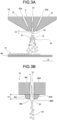
- FIG. 3A and FIG. 3B are diagrams for explaining a flying state of coating fluid droplets at the time of spray nozzle application of the present invention.
- FIG. 3A is a cross-sectional view (hereinafter, a width-direction cross-sectional view) as viewed from the width direction.
- FIG. 3B is a cross-sectional view of a distal end of one coating fluid discharge port as viewed from the conveyance direction of the substrate.
- coating fluid F is discharged from a coating fluid discharge port 31 illustrated in FIG. 3A , and furthermore, air G is discharged from the pair of air discharge ports 33a and 33b arranged in such a manner as to sandwich the coating fluid discharge port 31.
- fluid holding surface forming members 34L and 34R are provided which have fluid holding surfaces 35L and 35R, respectively, extending in the discharge direction of the coating fluid from substantially the entire lengths of the sides forming both ends in the width direction of the coating fluid discharge ports 31.
- the discharged coating fluid F is in a state of being bridged and held between the pair of fluid holding surfaces 35L and 35R of the fluid holding surface forming members 34L and 34R, respectively. Furthermore, a coating fluid pool 37 is formed in the vicinity of distal ends 36L and 36R of the fluid holding surfaces 35L and 35R which are nozzle tips.
- the striking force of the air G see FIG. 3A
- the coating fluid is separated with the distal ends 36L and 36R being fluid separation positions, and coating fluid droplets 42 having a size corresponding to the size of the coating fluid pool 37 are formed.
- the countless coating fluid droplets 42 generated by instantaneous repetitions of generation and separation of the coating fluid pool 37 fly towards the substrate 40 together with the air G, thereby forming the coating film 41.
- the coating fluid pool 37 is in contact with four inner surfaces forming the rectangular coating fluid discharge port in the width direction and the thickness direction.
- the coating fluid pool 37 is only in contact with the two fluid holding surfaces 35L and 35R with a small contact area, which makes it easier to separate the coating fluid pool, and thus the droplets can be micronized even with a small air striking force.
- the fluid pool 37 is substantially in contact with the four inner surfaces forming the rectangular coating fluid discharge port 31 in the width direction and the thickness direction, and the effect of the present invention cannot be achieved. Therefore, H1 needs to be more than or equal to 30 ⁇ m.
- H1 is preferably less than or equal to 400 ⁇ m.
- the supply conditions of the air G discharged from the air discharge ports 33a and 33b cannot be generally defined depending on a desired type of coating fluid, a desired coating film thickness, and others; however, from the viewpoint of minimizing the air flow rate to be used while maintaining the striking force for micronizing droplets and the viewpoint of minimizing disturbance of the discharged air flow, the pressure measured in the air manifolds 17a and 17b is preferably approximately in a range of 50 kPa to 200 kPa, and the air flow rate is preferably within a range of 900 NL/min to 1500 NL/min per air discharge width of 1 m.
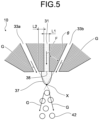
- FIGS. 4A, 4B , and 5 are diagrams for explaining generation of coating fluid droplets at the time of spray nozzle application.
- FIG. 4A is a width-direction cross-sectional view of the distal end of the spray nozzle of the present invention.
- FIG. 4B is a diagram in which the coating fluid is removed from the state illustrated in FIG. 4A .
- FIG. 5 is a width-direction cross-sectional view of a distal end of a spray nozzle of the prior art having no fluid holding surfaces.
- the coating fluid droplets 42 are generated at a position (hereinafter, simply referred to as a "striking force position") X1 where the striking force of the discharged air G is obtained.
- the striking force position X1 is an intersection of a pair of virtual extension lines Va and Vb extending in the air discharge direction from the ridge portions of the air discharge ports 33a and 33b on the side of the coating fluid discharge ports 31.
- the coating fluid pool 37 is generated in a space between nozzle tips 36L (36R) as the fluid separation position and the striking force position, the coating fluid pool 37 can be made smaller by bringing the nozzle tips 36L (36R) close to the striking force position X and making the space smaller, whereby the generated coating fluid droplets 42 can also be made smaller.
- the fluid holding members 34L (34R) are brought close to the striking force position X1 to obliquely intersect with the virtual extension lines Va and Vb and points X2a and X2b, the discharged air G collides with the fluid holding member 34L (34 R) and is disturbed, whereby the application accuracy may be deteriorated.
- the distances from the coating fluid discharge port to the points X2a and X2b can be expressed by L2/tan ⁇ , where ⁇ (for example, let an angle formed by the virtual extension line Vb and the fluid holding surface of the fluid holding member 34L be ⁇ ) denotes an angle (acute angle) formed by the discharge direction of the air discharged from an air discharge port and the discharge direction of the coating fluid, and L2 ( ⁇ m) denotes an interval between the coating fluid discharge port and the air discharge port.
- the angle ⁇ may be referred to as an "air discharge angle ⁇ ".
- the discharge direction length H1 ( ⁇ m) of the fluid holding surface needs to fall within a range of the following Inequation (1).
- the coating fluid pool 37 is generated between a distal end 38 of the coating fluid discharge port and the striking force position, the fluid pool 37 becomes larger than that of the spray nozzle of the present invention, and generated coating fluid droplets 42 also become larger.
- FIGS. 6A and 6B are diagrams for explaining the preferred embodiment of the spray nozzle of the present invention.
- FIG. 6A is a width-direction cross-sectional view.
- FIG. 6B is a diagram of a distal end of one coating fluid discharge port as viewed from the conveyance direction of the substrate.
- the fluid holding surface 35L (35R) is formed by forming the coating fluid discharge ports 31 from a comb-shaped shim 12 and the pair of nozzle blocks 13a and 13b that clamp the comb-shaped shim 12 and making the comb-shaped shim 12 protrude in the discharge direction of the coating fluid from the distal ends of the nozzle blocks 13a and 13b.
- the coating fluid discharge port 31 to the fluid holding surface 35L (35R) is flush with no connection portion, and thus the discharge of the coating fluid can be stabilized.
- each of fluid holding surfaces 35L (35R) corresponding to one of the plurality of coating fluid discharge ports 31 is formed of a single component, the variation in shape can be suppressed, whereby a high application accuracy can be maintained.
- a surface S (the same applies to the back surface) of a portion of the comb-shaped shim 12 protruding from a nozzle block illustrated in FIG. 6B has fluid repellency against water, the surface S observable from the thickness direction of the comb-shaped shim 12.
- the term "having fluid repellency against water” means that a contact angle of the surface S to pure water is more than or equal to 90°, and more preferably more than or equal to 120°.
- the comb-shaped shim is made of a metal material, particularly stainless steel, from the viewpoint of working accuracy, durability, corrosion resistance, and the like. Therefore, as a method for imparting fluid repellency, coating such as a fluororesin or a water-repellent plating film can be used. From the viewpoint of fluid repellency durability, a method of modifying the metal surface by micro-nano patterning or the like to impart fluid repellency is more preferable.
- the term "substantially orthogonal” means that an error in manufacturing is allowed and that an angle formed by a normal line of the fluid holding surface 35L or 35R and the width direction is less than or equal to 5 degrees.
- the radiuses of curvature of the ridge lines of the distal ends 36L and 36R of the fluid holding surfaces 35L and 35R, respectively are less than or equal to 30 ⁇ m. Since the smaller the radiuses of curvature are, the more stable the separation of the coating fluid pool at the ridge portions is, the variation in the ejection direction of the coating fluid droplets can be reduced when the coating fluid pool is separated by the discharged air.
- ⁇ is less than or equal to 45 degrees
- the number of coating fluid droplets flying in the substrate advancing direction is small, and thus the number of coating fluid droplets scattering without adhering to the substrate is also small, whereby a decrease in the use efficiency of the coating fluid can be suppressed.
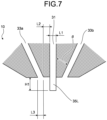
- An interval L2 between the coating fluid discharge port 31 and the air discharge port 33a or 33b is preferably less than or equal to 100 ⁇ m. In a case where the interval L2 is less than or equal to 100 ⁇ m, the distance from the air discharge ports distal ends 33a and 33b to the striking force position is short, and thus the striking force of the air applied to the coating fluid can be sufficiently increased. In addition, since the length H1 of the fluid holding surface 35L (35R) can be made short, the coating fluid can be stably bridged and held.
- a gap (for example, a gap L3) of each of the air discharge ports 33a and 33b is preferably less than or equal to 100 ⁇ m.
- the interval L3 is less than or equal to 100 ⁇ m, the average flow rate of the discharged air is sufficiently high, and the striking force of the air applied to the coating fluid is also sufficiently large, and thus the coating fluid droplets can be micronized. Furthermore, the amount of air for micronizing the coating fluid droplets can also be reduced.
- FIG. 8 is an exploded perspective view for explaining the structure of the spray nozzle illustrated in FIGS. 6A and 6B .
- the spray nozzle 10 includes components denoted by reference numerals 12, 13a, 13b, 14a, and 14b.
- Reference numerals 13a and 13b denote inner blocks for forming the coating fluid manifold 18 and the coating fluid discharge ports 31.
- One inner block 13a has the coating fluid supply port 16 for receiving the coating fluid and the coating fluid manifold 18 for spreading the coating fluid in the width direction.
- the coating fluid supply port 16 communicates from an outer surface of the inner block 13a to the coating fluid manifold 18.
- reference numeral 12 denotes the comb-shaped shim sandwiched between the inner blocks 13a and 13b, and when the inner blocks 13a and 13b and the shim 12 are combined, the plurality of coating fluid discharge ports 31 is formed in the width direction by the gaps between comb teeth of the shim 12.
- a height H3 of the shim 12 is higher than heights H4 of the inner blocks 13a and 13b, and by making the height H3 higher than the height H4 by the length H1, the comb-shaped shim 12 protrudes by the length H1 in the discharging direction of the coating fluid from the distal end ends of the nozzle blocks 13a and 13b, whereby the fluid holding surfaces are formed.
- Reference numerals 14a and 14b denote the outer blocks, which are combined with the inner blocks 13a and 13b, respectively, to form the air discharge ports for discharging air.
- the shape of the air discharge ports in this case is one continuous slit in the width direction.
- the outer blocks 14a and 14b has, respectively, the air supply ports 15a and 15b that receive air and the air manifolds 17a and 17b that spread the air in the width direction on the mating surface side with the outer blocks 14a and 14b, respectively.
- the air supply ports 15a and 15b communicate from outer surfaces of the outer blocks 14a and 14b to the air manifolds 17a and 17b, respectively.
- FIG. 9 is a side view illustrating a schematic structure of a coating device using the spray nozzle of the present invention.
- a spray coating device 60 of FIG. 9 includes a coating unit 80 having a spray nozzle 10, a supply unit 70 that supplies coating fluid and air to the spray nozzle 10, and a feed roll 61 that is a moving unit that relatively moves the substrate 40 with respect to the spray nozzle 10.
- the coating unit 80 includes the spray nozzle 10, a backup roll 81 which is a support unit of the substrate, a booth 82 covering around the spray nozzle 10 and the backup roll 81, a waste fluid collecting tank 83, and a decompression unit 84.
- the backup roll 81 supports the substrate being conveyed at an application location by the spray nozzle.
- the booth 82 has a substantially closed system closing the inside of the booth 82 except for an inlet opening 85, an outlet opening 86, and the like through which the substrate 40 passes and prevents scattering of the coating fluid droplets discharged from the spray nozzle 10 to the outside of the coating unit 80.
- a lower opening 87 of the booth communicates with the waste fluid collecting tank 83, and excessive coating fluid generated in the booth falls along slopes 88 in the booth and is collected in the discharged fluid collecting tank 83 via the lower opening 87.
- a rear opening 89 of the booth is connected to the decompression unit 84 via an intake pipe 90.
- the supply unit 70 supplies the coating fluid to the spray nozzle 10 via a coating fluid pipe 73 by a coating fluid tank 71 and a metering pump 72. Moreover, air whose pressure has been adjusted by a compressed air source 74 and a pressure regulating valve 75 is supplied to the spray nozzle 10 via an air pipe 76 and a branch pipe 77.
- the feed roll 61 as a moving unit is coupled to a driving unit (not illustrated).
- the substrate 40 is conveyed in the conveyance direction D at a desired conveyance speed by rotating the feed roll 61 by the drive unit.
- a uniform coating film 41 can be formed on the substrate 40 being conveyed, and a film-coated member 43 can be manufactured.
- a drying unit that dries the coating film 41 on the film-coated member 43 conveyed from the coating device 60 may be further included.
- a method of drying the coating film in the drying unit is not particularly limited, and a method of blowing a heat medium such as hot air, a heat oven method using a heater, or the like can be used.
- the spray coating device 60 of FIG. 9 exemplifies an aspect in which the coating unit 80 is not moved and the substrate 40 is conveyed (moved) by the moving unit
- the coating device of the present invention may employ an aspect in which the substrate 40 is not moved, whereas the coating unit 80 is moved by the moving unit.
- spray conditions were prepared in which the discharge direction length H1 ( ⁇ m) of the fluid holding surfaces, the shape of the fluid holding surfaces, the interval L2 ( ⁇ m) between a coating fluid discharge port and an air discharge port, and the air flow rate (NL/min) per width of 1 m are changed as shown in Table 1 to obtain comparative examples and examples.
- the shape of the fluid holding surfaces being "orthogonal" means that the fluid holding surfaces are orthogonal to the width direction, and in the case of "narrowing-end” or “spreading-end", the angle (dihedral angle) formed by the pair of fluid holding surfaces facing each other is set to 30°.
- the coating fluid discharge width W1 was set to 1000 mm
- the gap L1 of the coating fluid discharge ports was set to 100 ⁇ m
- the air discharge angle ⁇ was set to 25°
- the air discharge ports were each set to have one slit shape in the width direction.
- a dispersion liquid in which a resist pigment was dispersed in propylene glycol monomethyl ether acetate (PMA) was used such that a solid content concentration was 14 mass% and a viscosity was 4.0 cp, and a spray flow rate of the coating fluid was set to 100 ml/min.
- a thin coating film can be formed by the spraying cannot be uniformly determined depending on desired spraying conditions such as the substrate conveyance speed or the flow rate of the coating fluid, and thus the comparison and evaluation were performed on the basis of the fineness of an average diameter of generated droplets.
- the diameter of the coating fluid droplet sprayed from the spray nozzle was measured using a laser diffraction type particle size distribution meter FLD-319A manufactured by Seika Digital Image CORPORATION. The measurement was performed by irradiating a coating fluid droplet group at a position 120 mm away from the spray nozzle distal end in the discharge direction with a laser beam in a direction orthogonal to the width direction of the spray nozzle and the discharge direction. The measured average droplet diameter was evaluated according to the following evaluation ranks. Incidentally, the Sauter mean diameter was used as the average droplet diameter.
- coating fluid was sprayed onto a PET film under each condition in Table 1 to form a coating film.
- the coating film thickness of the prepared coating film was measured at intervals of 10 mm in the width direction, and then the variation from the film thickness average value was calculated, whereby the coating film uniformity was evaluated depending on the following evaluation ranks. Note that the distance from the spray nozzle distal end to the substrate was set to 120 mm.
- the substrate was a PET film having a substrate width of 1000 mm and a thickness of 100 ⁇ m and was conveyed at a speed of 1 m/min.
- Example 1 Setting conditions and evaluation results in Example 1 are shown in Table 1.
- Example 1 Conditions were the same as those in Example 1 except that H1 was modified to 100 ⁇ m. Both the average droplet diameter and the uniformity of the coating film thickness showed good results. Setting conditions and evaluation results in Example 2 are shown in Table 1.
- Example 2 Conditions were the same as those in Example 2 except that the air discharge flow rate was increased to 1600 NL/min per 1 m width. Although the discharged air was disturbed as compared with Example 2, both the average droplet diameter and the uniformity of the coating film thickness were good. Setting conditions and evaluation results in Example 3 are shown in Table 1.
- Example 4 Conditions were the same as those in Example 2 except that the shape of the fluid holding surface was changed to a narrowing-end shape. Although the coating fluid discharged from some of the plurality of coating fluid discharge ports arranged in the width direction spread onto the fluid holding surface forming members, both the average droplet diameter and the uniformity of the coating film thickness showed good results. Setting conditions and evaluation results in Example 4 are shown in Table 1.
- Example 5 Conditions were the same as those in Example 2 except that the shape of the fluid holding surface was changed to a spreading-end shape. Although the coating fluid discharged from some of the plurality of coating fluid discharge ports arranged in the width direction could not be retained up to the nozzle tip and was transformed into coating fluid droplets, both the average droplet diameter and the uniformity of the coating film thickness showed good results. Setting conditions and evaluation results in Example 5 are shown in Table 1.
- Example 1 Conditions were the same as those in Example 1 except that H1 was modified to 0 ⁇ m.
- the average diameter of the coating fluid droplets was large, and granular unevenness was generated in the coating film due to the large average diameter, and thus the coating film uniformity was low. Setting conditions and evaluation results in Comparative Example 1 are shown in Table 1.
- Example 1 Conditions were the same as those in Example 1 except that H1 was modified to 150 ⁇ m. Since the discharged air collided with the fluid holding surface forming member, the flow of the discharged air was disturbed, and thus the coating film uniformity was low. Setting conditions and evaluation results in Comparative Example 3 are shown in Table 1.
- Example 6 Conditions were the same as those in Example 6 except that H1 was modified to 100 ⁇ m.
- the average diameter of the coating fluid droplets was large, and granular unevenness was generated in the coating film due to the large average diameter, and thus the coating film uniformity was low. Setting conditions and evaluation results in Comparative Example 4 are shown in Table 1.
- Example 6 Conditions were the same as those in Example 6 except that H1 was modified to 300 ⁇ m. Since the discharged air collided with the fluid holding surface forming member, the flow of the discharged air was disturbed, and thus the coating film uniformity was low. Setting conditions and evaluation results in Comparative Example 5 are shown in Table 1.
- the present invention is effective as a slot-type spray nozzle, a coating device, and a manufacturing method of a film-coated member capable of forming fine coating fluid droplets even in a case where a discharged air flow rate is reduced and uniformly forming a thin coating film on a wide substrate.
Landscapes
- Nozzles (AREA)
Applications Claiming Priority (2)
| Application Number | Priority Date | Filing Date | Title |
|---|---|---|---|
| JP2021204235 | 2021-12-16 | ||
| PCT/JP2022/041239 WO2023112542A1 (ja) | 2021-12-16 | 2022-11-04 | スロット型スプレーノズル、塗布装置および塗布膜付き部材の製造方法 |
Publications (2)
| Publication Number | Publication Date |
|---|---|
| EP4450168A1 true EP4450168A1 (de) | 2024-10-23 |
| EP4450168A4 EP4450168A4 (de) | 2025-12-10 |
Family
ID=86774072
Family Applications (1)
| Application Number | Title | Priority Date | Filing Date |
|---|---|---|---|
| EP22907075.0A Pending EP4450168A4 (de) | 2021-12-16 | 2022-11-04 | Schlitzartige sprühdüse, auftragungsvorrichtung und verfahren zur herstellung von filmbeschichtetem material |
Country Status (6)
| Country | Link |
|---|---|
| US (1) | US20250041885A1 (de) |
| EP (1) | EP4450168A4 (de) |
| JP (1) | JPWO2023112542A1 (de) |
| KR (1) | KR20240116719A (de) |
| CN (1) | CN118176063A (de) |
| WO (1) | WO2023112542A1 (de) |
Families Citing this family (2)
| Publication number | Priority date | Publication date | Assignee | Title |
|---|---|---|---|---|
| CN218945476U (zh) * | 2022-11-29 | 2023-05-02 | 宁德时代新能源科技股份有限公司 | 涂布模头和涂布设备 |
| CN119926540A (zh) * | 2025-01-20 | 2025-05-06 | 深圳市亿优威光科技有限公司 | 一种液膜产生装置与应用 |
Family Cites Families (11)
| Publication number | Priority date | Publication date | Assignee | Title |
|---|---|---|---|---|
| US5421921A (en) * | 1992-07-08 | 1995-06-06 | Nordson Corporation | Segmented slot die for air spray of fibers |
| JP3278664B2 (ja) * | 1993-03-02 | 2002-04-30 | 株式会社サンツール | カーテンファイバー状スプレー塗布装置における塗布ノズル装置 |
| JP4609806B2 (ja) * | 2000-09-29 | 2011-01-12 | 株式会社サンツール | カーテンファイバー状スプレー塗布装置 |
| US20050120947A1 (en) * | 2003-12-09 | 2005-06-09 | Konica Minolta Photo Imaging, Inc. | Coating apparatus and coating method |
| JP2006026576A (ja) | 2004-07-20 | 2006-02-02 | Konica Minolta Photo Imaging Inc | 塗布方法及びそれに用いるスロットノズルスプレー装置 |
| US20070125877A1 (en) * | 2005-12-01 | 2007-06-07 | 3M Innovative Properties Company | Multi-component liquid spray systems |
| US20070125888A1 (en) * | 2005-12-01 | 2007-06-07 | 3M Innovative Properties Company | Multi-component liquid spray systems |
| JP2013111512A (ja) | 2011-11-28 | 2013-06-10 | Sharp Corp | 薄膜形成装置および薄膜形成方法 |
| JP6159711B2 (ja) * | 2012-03-28 | 2017-07-05 | 藤崎電機株式会社 | 液体噴射装置及び液体噴射方法 |
| JP6148579B2 (ja) * | 2013-09-03 | 2017-06-14 | 花王株式会社 | スリットノズル |
| JP7472550B2 (ja) * | 2020-03-05 | 2024-04-23 | 東レ株式会社 | 溶液紡糸口金 |
-
2022
- 2022-11-04 WO PCT/JP2022/041239 patent/WO2023112542A1/ja not_active Ceased
- 2022-11-04 KR KR1020247016668A patent/KR20240116719A/ko active Pending
- 2022-11-04 US US18/718,558 patent/US20250041885A1/en active Pending
- 2022-11-04 EP EP22907075.0A patent/EP4450168A4/de active Pending
- 2022-11-04 JP JP2022569547A patent/JPWO2023112542A1/ja active Pending
- 2022-11-04 CN CN202280072524.4A patent/CN118176063A/zh active Pending
Also Published As
| Publication number | Publication date |
|---|---|
| US20250041885A1 (en) | 2025-02-06 |
| JPWO2023112542A1 (de) | 2023-06-22 |
| KR20240116719A (ko) | 2024-07-30 |
| EP4450168A4 (de) | 2025-12-10 |
| CN118176063A (zh) | 2024-06-11 |
| WO2023112542A1 (ja) | 2023-06-22 |
Similar Documents
| Publication | Publication Date | Title |
|---|---|---|
| EP4450168A1 (de) | Schlitzartige sprühdüse, auftragungsvorrichtung und verfahren zur herstellung von filmbeschichtetem material | |
| DE69207021T2 (de) | Sprüheinheit zur Bildung von Flachstrahlen | |
| CN101495241B (zh) | 喷嘴装置、使用该喷嘴装置的药液的供给方法 | |
| US4715535A (en) | Powder spray gun | |
| US9950326B2 (en) | Coating nozzle for high-viscosity paint | |
| JPS595021B2 (ja) | 粉末材料の均一散布装置 | |
| CN105983511B (zh) | 涂布装置和涂布方法 | |
| JP3544650B2 (ja) | 気体−液体吹きスリットノズル | |
| US12186769B2 (en) | Spray coating device and spray coating method | |
| US20070125877A1 (en) | Multi-component liquid spray systems | |
| JP5700030B2 (ja) | 成膜装置 | |
| US20050208225A1 (en) | Coating apparatus and coating method | |
| US8789492B2 (en) | Coating apparatus and method | |
| JP4503717B2 (ja) | 塗装ヘッド | |
| JP7581937B2 (ja) | スプレーノズル、塗布装置および塗布膜付き部材の製造方法 | |
| US6425531B1 (en) | Atomizer foil, atomizer having such an atomizer foil and use of such atomizer foil | |
| WO2025052843A1 (ja) | 塗布装置および塗膜付き基材の製造方法 | |
| JP2023113283A (ja) | 塗布膜付き基材の製造方法およびスプレー塗布装置 | |
| TWI891079B (zh) | 塗覆裝置,以及塗覆方法 | |
| JP4332105B2 (ja) | カーテン塗布方法及びカーテン塗布装置 | |
| JPH0522283Y2 (de) | ||
| JP2742706B2 (ja) | エアレスノズル | |
| JPH08281156A (ja) | 被膜形成板状体の製造方法および被膜形成溶液噴霧装置 | |
| CZ225490A3 (cs) | Zařízení pro rozdělování práškovité pevné látky rozptýlené v plynu na pohybující se substrát |
Legal Events
| Date | Code | Title | Description |
|---|---|---|---|
| STAA | Information on the status of an ep patent application or granted ep patent |
Free format text: STATUS: THE INTERNATIONAL PUBLICATION HAS BEEN MADE |
|
| PUAI | Public reference made under article 153(3) epc to a published international application that has entered the european phase |
Free format text: ORIGINAL CODE: 0009012 |
|
| STAA | Information on the status of an ep patent application or granted ep patent |
Free format text: STATUS: REQUEST FOR EXAMINATION WAS MADE |
|
| 17P | Request for examination filed |
Effective date: 20240529 |
|
| AK | Designated contracting states |
Kind code of ref document: A1 Designated state(s): AL AT BE BG CH CY CZ DE DK EE ES FI FR GB GR HR HU IE IS IT LI LT LU LV MC ME MK MT NL NO PL PT RO RS SE SI SK SM TR |
|
| DAV | Request for validation of the european patent (deleted) | ||
| DAX | Request for extension of the european patent (deleted) | ||
| REG | Reference to a national code |
Ref country code: DE Ref legal event code: R079 Free format text: PREVIOUS MAIN CLASS: B05B0007060000 Ipc: B05B0007020000 |
|
| A4 | Supplementary search report drawn up and despatched |
Effective date: 20251110 |
|
| RIC1 | Information provided on ipc code assigned before grant |
Ipc: B05B 7/02 20060101AFI20251104BHEP Ipc: B05B 7/08 20060101ALI20251104BHEP Ipc: B05B 7/24 20060101ALI20251104BHEP Ipc: B05C 5/02 20060101ALI20251104BHEP Ipc: B05D 1/02 20060101ALI20251104BHEP Ipc: B05B 13/02 20060101ALN20251104BHEP Ipc: B05B 14/40 20180101ALN20251104BHEP Ipc: B05B 16/60 20180101ALN20251104BHEP |