EP4431562A2 - Thermoplastische zusammensetzungen mit guter stabilität - Google Patents
Thermoplastische zusammensetzungen mit guter stabilität Download PDFInfo
- Publication number
- EP4431562A2 EP4431562A2 EP24184165.9A EP24184165A EP4431562A2 EP 4431562 A2 EP4431562 A2 EP 4431562A2 EP 24184165 A EP24184165 A EP 24184165A EP 4431562 A2 EP4431562 A2 EP 4431562A2
- Authority
- EP
- European Patent Office
- Prior art keywords
- component
- polymer
- weight
- bis
- composition
- Prior art date
- Legal status (The legal status is an assumption and is not a legal conclusion. Google has not performed a legal analysis and makes no representation as to the accuracy of the status listed.)
- Pending
Links
Classifications
-
- C—CHEMISTRY; METALLURGY
- C08—ORGANIC MACROMOLECULAR COMPOUNDS; THEIR PREPARATION OR CHEMICAL WORKING-UP; COMPOSITIONS BASED THEREON
- C08L—COMPOSITIONS OF MACROMOLECULAR COMPOUNDS
- C08L69/00—Compositions of polycarbonates; Compositions of derivatives of polycarbonates
-
- C—CHEMISTRY; METALLURGY
- C08—ORGANIC MACROMOLECULAR COMPOUNDS; THEIR PREPARATION OR CHEMICAL WORKING-UP; COMPOSITIONS BASED THEREON
- C08K—Use of inorganic or non-macromolecular organic substances as compounding ingredients
- C08K5/00—Use of organic ingredients
- C08K5/36—Sulfur-, selenium-, or tellurium-containing compounds
- C08K5/41—Compounds containing sulfur bound to oxygen
- C08K5/42—Sulfonic acids; Derivatives thereof
-
- C—CHEMISTRY; METALLURGY
- C08—ORGANIC MACROMOLECULAR COMPOUNDS; THEIR PREPARATION OR CHEMICAL WORKING-UP; COMPOSITIONS BASED THEREON
- C08L—COMPOSITIONS OF MACROMOLECULAR COMPOUNDS
- C08L51/00—Compositions of graft polymers in which the grafted component is obtained by reactions only involving carbon-to-carbon unsaturated bonds; Compositions of derivatives of such polymers
- C08L51/04—Compositions of graft polymers in which the grafted component is obtained by reactions only involving carbon-to-carbon unsaturated bonds; Compositions of derivatives of such polymers grafted on to rubbers
-
- C—CHEMISTRY; METALLURGY
- C08—ORGANIC MACROMOLECULAR COMPOUNDS; THEIR PREPARATION OR CHEMICAL WORKING-UP; COMPOSITIONS BASED THEREON
- C08L—COMPOSITIONS OF MACROMOLECULAR COMPOUNDS
- C08L69/00—Compositions of polycarbonates; Compositions of derivatives of polycarbonates
- C08L69/005—Polyester-carbonates
Definitions
- the present invention relates to thermoplastic impact-modified polycarbonate and/or polyester carbonate molding compounds and their compositions, a process for producing the molding compounds, the use of the molding compounds for producing molded articles and the molded articles themselves.
- Thermoplastic polycarbonate and polyestercarbonate compositions have been known for a long time and are used to produce molded articles for a wide range of applications, for example in the automotive sector, for rail vehicles, for the construction sector, in the electrical/electronics sector and for household appliances.
- Other thermoplastics are often added as blend partners to improve the rheological and mechanical properties.
- graft polymers are used as impact modifiers, particularly to increase toughness at low temperatures.
- EP 1 609 818 A2 discloses polycarbonate compositions containing esters of sulfur-containing organic acids which exhibit improved stability of the polycarbonate against thermal stress.
- EP 1 612 231 A1 discloses a process for producing polycarbonate, wherein esters of organic sulfur-containing acids are added between medium and high viscosity reactors, as well as the use of these esters for inhibiting catalytically active impurities in the production of polycarbonate by the melt transesterification process.
- WO 2013/160371 A1 discloses PC/ABS compositions, in particular those based on ABS produced by the emulsion polymerization process, wherein the compositions are characterized by a low content of free bisphenol-A.
- WO 2013/160373 A1 discloses PC/ABS compositions containing polycarbonate with a low OH end group content (preferably produced by the interfacial polymerization process) and ABS with a low alkali content (preferably produced by the bulk polymerization process), which are characterized by high thermal processing stability with respect to gloss level, polycarbonate degradation and content of free bisphenol A and have improved stress cracking resistance.
- WO 2007/065579 A1 discloses polycarbonate compositions containing graft polymer which are stabilized by the addition of a Brönstedt acid.
- thermal stabilizers carries the risk that, although thermal stability is improved, other properties are compromised. For example, resistance under warm, humid conditions (i.e. resistance to hydrolytic polymer degradation) is often reduced by the use of thermal stabilizers as additives.
- component B contains both B.1 and B.2, the stated proportion of component B is the sum of the proportions of B.1 and B.2.
- the composition consists of at least 90% by weight, particularly preferably at least 95% by weight, especially preferably at least 98% by weight of components A to D. In a further preferred embodiment, the composition consists only of components A to D.
- the thermoplastic molding compound is a molding compound containing aromatic polycarbonate, particularly preferably aromatic polycarbonate containing structural elements derived from bisphenol-A, particularly preferably aromatic polycarbonate based exclusively on bisphenol-A as diphenol.
- a further object was to provide a process by which an impact-modified polycarbonate and polyester carbonate composition can be produced and in which the resulting molding compound has good thermal stability.
- component B contains both B.1 and B.2, the stated proportion of component B is the sum of the proportions of B.1 and B.2.
- Component A consists of at least one representative selected from the group consisting of aromatic polycarbonate and aromatic polyester carbonate and optionally additionally aromatic polyester.
- Component A preferably contains aromatic polycarbonate.
- Aromatic polycarbonates and/or aromatic polyester carbonates according to component A which are suitable according to the invention are known from the literature or can be prepared by processes known from the literature (for the preparation of aromatic polycarbonates, see, for example, Schnell, “Chemistry and Physics of Polycarbonates,” Interscience Publishers, 1964 as well as the DE-AS 1 495 626 , DE-A 2 232 877 , DE-A 2 703 376 , DE-A 2 714 544 , DE-A 3 000 610 , DE-A 3 832 396 ; for the production of aromatic polyester carbonates, e.g. DE-A 3 077 934 ).
- Aromatic polycarbonates are produced, for example, by reacting diphenols with carbonic acid halides, preferably phosgene and/or with aromatic dicarboxylic acid dihalides, preferably benzenedicarboxylic acid dihalides, using the interfacial process, optionally using chain terminators, for example monophenols and optionally using trifunctional or more than trifunctional branching agents, for example triphenols or tetraphenols. Production via a melt polymerization process by reacting diphenols with, for example, diphenyl carbonate is also possible.
- Preferred diphenols are hydroquinone, resorcinol, dihydroxydiphenols, bis-(hydroxyphenyl)-C 1 -C 5 -alkanes, bis-(hydroxyphenyl)-C 5 -C 6 -cycloalkanes, bis-(hydroxyphenyl) ethers, bis-(hydroxyphenyl) sulfoxides, bis-(hydroxyphenyl) ketones, bis-(hydroxyphenyl) sulfones and ⁇ , ⁇ ,-bis-(hydroxyphenyl)-diisopropylbenzenes and their nuclear-brominated and/or nuclear-chlorinated derivatives.
- R 3 stands for C 1 -C 4 alkyl, aralkyl or aryl, preferably methyl or phenyl, most preferably phenyl.
- diphenols are 4,4'-dihydroxydiphenyl, bisphenol-A, 2,4-bis(4-hydroxyphenyl)-2-methylbutane, 1,1-bis(4-hydroxyphenyl)cyclohexane, 1,1-bis(4-hydroxyphenyl)-3,3,5-trimethylcyclohexane, 4,4'-dihydroxydiphenyl sulfide, 4,4'-dihydroxydiphenyl sulfone and their di- and tetrabrominated or chlorinated derivatives such as, for example, 2,2-bis(3-chloro-4-hydroxyphenyl)propane, 2,2-bis(3,5-dichloro-4-hydroxyphenyl)propane or 2,2-bis(3,5-dibromo-4-hydroxyphenyl)propane. 2,2-bis(4-hydroxyphenyl)propane (bisphenol-A) is particularly preferred.
- the diphenols can be used individually or as any mixture.
- the diphenols are known from the literature or are obtainable using processes known from the literature.
- Chain terminators suitable for the production of thermoplastic aromatic polycarbonates are, for example, phenol, p-chlorophenol, p-tert-butylphenol or 2,4,6-tribromophenol, but also long-chain alkylphenols, such as 4-[2-(2,4,4-trimethylpentyl)]-phenol, 4-(1,3-tetramethylbutyl)-phenol according to DE-A 2 842 005 or monoalkylphenol or dialkylphenols with a total of 8 to 20 carbon atoms in the alkyl substituents, such as 3,5-di-tert-butylphenol, p-iso-octylphenol, p-tert-octylphenol, p-dodecylphenol and 2-(3,5-dimethylheptyl)phenol and 4-(3,5-dimethylheptyl)phenol.
- the amount of chain terminators to be used is generally between 0.5 mol% and 10 mol%, based on the
- thermoplastic, aromatic polycarbonates can be branched in a known manner, preferably by incorporating 0.05 to 2.0 mol%, based on the sum of the diphenols used, of trifunctional or more than trifunctional compounds, for example those with three or more phenolic groups.
- Both homopolycarbonates and copolycarbonates are suitable.
- copolycarbonates according to the invention according to component A 1 to 25% by weight, preferably 2.5 to 25% by weight, based on the total amount of Diphenols, polydiorganosiloxanes with hydroxyaryloxy end groups. These are known ( US$ 3,419,634 ) and can be produced by processes known from the literature.
- the production of polydiorganosiloxane-containing copolycarbonates is DE-A 3 334 782 described.
- preferred polycarbonates are the copolycarbonates of bisphenol A with up to 15 mol%, based on the molar sum of diphenols, of other diphenols mentioned as preferred or particularly preferred, in particular 2,2-bis(3,5-dibromo-4-hydroxyphenyl)propane.
- Aromatic dicarboxylic acid dihalides for the preparation of aromatic polyester carbonates are preferably the diacid dichlorides of isophthalic acid, terephthalic acid, diphenyl ether-4,4'-dicarboxylic acid and naphthalene-2,6-dicarboxylic acid.
- a carbonic acid halide preferably phosgene, is additionally used as a bifunctional acid derivative.
- chain terminators which can be used for the production of aromatic polyester carbonates include their chlorocarbonic acid esters and the acid chlorides of aromatic monocarboxylic acids, which may optionally be substituted by C 1 to C 22 alkyl groups or by halogen atoms, as well as aliphatic C 2 to C 22 monocarboxylic acid chlorides.
- the amount of chain terminators is 0.1 to 10 mol% in each case, based on moles of diphenol in the case of phenolic chain terminators and on moles of dicarboxylic acid dichloride in the case of monocarboxylic acid chloride chain terminators.
- the aromatic polyester carbonates can also contain incorporated aromatic hydroxycarboxylic acids.
- the aromatic polyester carbonates can be linear or branched in a known manner (see DE-A 2 940 024 and DE-A 3 007 934 ).
- Branching agents which can be used are, for example, trifunctional or polyfunctional carboxylic acid chlorides, such as trimesic acid trichloride, cyanuric acid trichloride, 3,3'-,4,4'-benzophenonetetracarboxylic acid tetrachloride, 1,4,5,8-naphthalenetetracarboxylic acid tetrachloride or pyromellitic acid tetrachloride, in amounts of 0.01 to 1.0 mol% (based on dicarboxylic acid dichlorides used) or trifunctional or polyfunctional phenols, such as phloroglucinol, 4,6-dimethyl-2,4,6-tri-(4-hydroxyphenyl)-hept-2-ene, 4,6-Dimethyl-2,4-6-tri-(4-hydroxyphenyl)-heptane, 1,3,5-tri-(4-hydroxyphenyl)-benzene, 1,1,1-tri-(4-hydroxyphenyl)-ethan
- the proportion of carbonate structural units can vary as desired.
- the proportion of carbonate groups is preferably up to 100 mol%, in particular up to 80 mol%, particularly preferably up to 50 mol%, based on the sum of ester groups and carbonate groups.
- Both the ester and the carbonate portion of the aromatic polyester carbonates can be present in the form of blocks or randomly distributed in the polycondensate.
- the aromatic polycarbonates or polyester carbonates suitable as component A have a weight-average molecular weight M w (determined by gel permeation chromatography (GPC) in methylene chloride with polycarbonate as standard) of 15,000 g/mol to 50,000 g/mol, preferably from 22,000 g/mol to 35,000 g/mol, in particular from 24,000 to 32,000 g/mol.
- M w weight-average molecular weight
- the structural units of formulas (IV) to (VII) are derived from and result from the diphenols used to produce the polycarbonate.
- diphenols used to produce the polycarbonate.
- the phenyl rings of the rearrangement structures are unsubstituted.
- Aromatic polycarbonates and/or polyester carbonates containing such frieze structures are produced in a particular embodiment by the melt polymerization process.
- the aromatic polycarbonates and/or polyester carbonates used as component A have a content of phenolic OH end groups of preferably at least 100 mg/kg, particularly preferably at least 200 mg/kg, more preferably at least 300 mg/kg, in particular at least 400 mg/kg.
- the concentration of phenolic OH end groups in component A is determined by infrared spectroscopy according to Horbach, A.; Veiel, U.; Wunderlich, H., Macromolecular Chemistry, 1965, Volume 88, pp. 215-231 .
- the aromatic polycarbonates and/or polyester carbonates used as component A have a content of phenolic OH end groups of preferably at least 100 mg/kg, particularly preferably at least 200 mg/kg, further preferably at least 300 mg/kg, in particular at least 400 mg/kg and contain one or more Fries structures of the general formulas (IV) to (VII).
- the aromatic polycarbonates and/or polyester carbonates used as component A have a content of phenolic OH end groups of preferably at least 100 mg/kg, particularly preferably at least 200 mg/kg, further preferably at least 300 mg/kg, in particular at least 400 mg/kg, contain one or more Fries structures of the general formulas (IV) to (VII) and were prepared in the melt polymerization process.
- component A contains one or more aromatic polyesters in addition to the polycarbonate and/or polyester carbonate.
- Suitable aromatic polyesters are, in preferred form, polyalkylene terephthalates.
- these are reaction products of aromatic dicarboxylic acids or their reactive derivatives, such as dimethyl esters or anhydrides, and aliphatic, cycloaliphatic or araliphatic diols, as well as mixtures of these reaction products.
- Particularly preferred aromatic polyalkylene terephthalates contain at least 80% by weight, preferably at least 90% by weight, based on the dicarboxylic acid component, of terephthalic acid residues and at least 80% by weight, preferably at least 90% by weight, based on the diol component, of ethylene glycol and/or butanediol-1,4-residues.
- the preferred aromatic polyalkylene terephthalates can contain, in addition to terephthalic acid residues, up to 20 mol%, preferably up to 10 mol%, residues of other aromatic or cycloaliphatic dicarboxylic acids with 8 to 14 C atoms or aliphatic dicarboxylic acids with 4 to 12 C atoms, such as residues of phthalic acid, isophthalic acid, naphthalene-2,6-dicarboxylic acid, 4,4'-diphenyldicarboxylic acid, succinic acid, adipic acid, sebacic acid, azelaic acid, cyclohexanediacetic acid.
- the preferred aromatic polyalkylene terephthalates can contain, in addition to ethylene glycol or butanediol-1,4 residues, up to 20 mol%, preferably up to 10 mol%, other aliphatic diols with 3 to 12 C atoms or cycloaliphatic diols with 6 to 21 C atoms, e.g.
- the aromatic polyalkylene terephthalates can be prepared by incorporating relatively small amounts of tri- or tetrahydric alcohols or tri- or tetrabasic carboxylic acids, e.g. DE-A 1 900 270 and US-PS 3 692 744
- preferred branching agents are trimesic acid, trimellitic acid, trimethylolethane and -propane and pentaerythritol.
- aromatic polyalkylene terephthalates which have been prepared solely from terephthalic acid and its reactive derivatives (e.g. its dialkyl esters) and ethylene glycol and/or 1,4-butanediol, and mixtures of these polyalkylene terephthalates.
- Preferred mixtures of aromatic polyalkylene terephthalates contain 1 to 50 wt.%, preferably 1 to 30 wt.%, polyethylene terephthalate and 50 to 99 wt.%, preferably 70 to 99 wt.%, polybutylene terephthalate.
- the aromatic polyalkylene terephthalates preferably used have a viscosity number of 0.4 to 1.5 dl/g, preferably 0.5 to 1.2 dl/g, measured in phenol/o-dichlorobenzene (1:1 parts by weight) in a concentration of 0.05 g/ml according to ISO 307 at 25°C in the Ubbelohde viscometer.
- the aromatic polyalkylene terephthalates can be produced by known methods (see e.g. Plastics Handbook, Volume VIII, p. 695 ff., Carl-Hanser-Verlag, Kunststoff 1973 ).
- component A contains an aromatic polycarbonate, particularly preferably based on bisphenol-A.
- component A is free of polyesters, and in a particularly preferred embodiment, free of polyesters and polyester carbonates.
- component A is an aromatic polycarbonate, particularly preferably an aromatic polycarbonate containing structural units derived from bisphenol-A, in particular an aromatic polycarbonate which is based exclusively on bisphenol-A as diphenol.
- Component B is a rubber-based graft polymer B.1 or alternatively a mixture of such a rubber-based graft polymer B.1 with rubber-free vinyl (co)polymers B.2.
- the glass transition temperature is determined for all components by means of differential scanning calorimetry (DSC) according to DIN EN 61006 (version of 1994) at a heating rate of 10 K/min with determination of the Tg as the midpoint temperature (tangent method).
- DSC differential scanning calorimetry
- the graft base B.1.2 generally has an average particle size (D50 value) of 0.05 to 10.00 ⁇ m, preferably of 0.1 to 5.0 ⁇ m and particularly preferably of 0.2 to 1.5 ⁇ m.
- the average particle size D50 is the diameter above and below which 50% by weight of the particles lie. Unless otherwise specified in the present invention, it is expressly stated otherwise, for all components by ultracentrifuge measurement ( W. Scholtan, H. Lange, Colloid, Z. and Z. Polymers 250 (1972), 782-1796 ) certainly.
- the monomers B.1.1 are preferably mixtures of B.1.1.1 50 to 99% by weight, particularly preferably 65 to 85% by weight, further preferably 70 to 80% by weight, in each case based on the sum of B.1.1.1 and B.1.1.2, vinylaromatics and/or core-substituted vinylaromatics (such as styrene, ⁇ -methylstyrene, p-methylstyrene, p-chlorostyrene) and/or (meth)acrylic acid (C1-C8) alkyl esters, such as methyl methacrylate, ethyl methacrylate), and B.1.1.2 1 to 50% by weight, particularly preferably 15 to 35% by weight, further preferably 20 to 30% by weight, each based on the sum of B.1.1.1 and B.1.1.2, vinyl cyanides (unsaturated nitriles such as acrylonitrile and methacrylonitrile) and/or (meth)acrylic acid (C1-C
- Preferred monomers B.1.1.1 are selected from at least one of the monomers styrene, ⁇ -methylstyrene and methyl methacrylate
- preferred monomers B.1.1.2 are selected from at least one of the monomers acrylonitrile, maleic anhydride and methyl methacrylate.
- Particularly preferred monomers are B.1.1.1 styrene and B.1.1.2 acrylonitrile.
- preferred monomers are B.1.1.1 methyl methacrylate and B.1.1.2 methyl methacrylate.
- Suitable graft bases B.1.2 of the graft polymers include, for example, diene rubbers, EP(D)M rubbers, i.e. those based on ethylene/propylene and optionally diene, acrylate, polyurethane, silicone, chloroprene, ethylene/vinyl acetate and acrylate-silicone composite rubbers
- Preferred grafting bases B.1.2 are diene rubbers, preferably containing butadiene, or copolymers of dienes, preferably containing butadiene, and other copolymerizable vinyl monomers (e.g. according to B.1.1.1 and B.1.1.2) or mixtures of one or more of the aforementioned components.
- B.1.2 is styrene-butadiene rubber, particularly preferably styrene-butadiene block copolymer rubber.
- the gel content of the graft base B.1.2 is at least 30 wt. %, preferably at least 40 wt. %, in particular at least 60 wt. %, in each case based on B.1.2 and measured as the insoluble content in toluene.
- the gel content of the graft base B.1.2 is determined at 25°C in a suitable solvent as the fraction insoluble in these solvents ( M. Hoffmann, H. Krömer, R. Kuhn, Polymer Analysis I and II, Georg Thieme-Verlag, Stuttgart 1977 ).
- the graft copolymers in component B are produced by radical polymerization, e.g. by emulsion, suspension, solution or bulk polymerization. Mixtures of graft polymers produced by different processes can also be used as component B.1.
- Suitable graft polymers B.1 are also ABS polymers obtained by redox initiation with an initiator system of organic hydroperoxide and ascorbic acid according to US Patent 4 937 285 be manufactured.
- component B.1 is understood to mean exclusively the graft polymer as defined above, while the copolymer contained in the manufacturing process which is not chemically bound to the graft base and is not enclosed in the rubber particles is assigned to component B.2.
- component B When using graft polymers B.1 produced by emulsion polymerization, component B usually contains lithium in a concentration of ⁇ 1 mg/kg, often B is free of lithium.
- component B When using graft polymers B.1 produced by emulsion polymerization, component B usually contains a total content of other alkali metals of > 10 mg/kg, often > 20 mg/kg.
- the alkali metal content is determined by optical emission spectrometry using inductively coupled plasma (ICP-OES) with an internal standard.
- ICP-OES inductively coupled plasma
- the sample is digested in concentrated nitric acid in the microwave at 200°C and 200 bar, diluted to 1 M nitric acid and measured.
- the graft base B.1.2 of graft polymers B.1 produced in emulsion polymerization have an average particle size (D50 value) of 0.05 to 2.00 ⁇ m, preferably from 0.1 to 1.0 ⁇ m, particularly preferably from 0.2 to 0.5 ⁇ m.
- component B When using graft polymers B.1 produced by bulk polymerization, component B usually contains lithium in a concentration of >1 mg/kg, often in a concentration of >2 mg/kg.
- component B When using graft polymers B.1 produced by bulk polymerization, component B usually contains a total content of other alkali metals of ⁇ 10 mg/kg, often ⁇ 5 mg/kg.
- the graft base B.1.2 of graft polymers B.1 produced in suspension, solution or bulk polymerization have an average particle size (D50 value) of 0.3 to 10.00 ⁇ m, preferably of 0.4 to 5.0 ⁇ m, particularly preferably of 0.5 to 1.5 ⁇ m.
- MBS modifiers with a core-shell structure and modifiers with a core-shell structure containing a core made of a silicone, acrylate or silicone-acrylate composite rubber and a shell made of either styrene and acrylonitrile or alternatively of methyl methacrylate.
- Component B.2 consists of (co)polymers of at least one monomer from the group of vinyl aromatics, vinyl cyanides (unsaturated nitriles), (meth)acrylic acid (C1 to C8) alkyl esters, unsaturated carboxylic acids and derivatives (such as anhydrides and imides) of unsaturated carboxylic acids.
- component B.2 are (co)polymers of
- B.2.1 50 to 99% by weight, preferably 65 to 85% by weight, particularly preferably 70 to 80% by weight, based on the (co)polymer C, of at least one monomer selected from the group of vinylaromatics (such as styrene, ⁇ -methylstyrene), ring-substituted vinylaromatics (such as p-methylstyrene, p-chlorostyrene) and (meth)acrylic acid (C1-C8) alkyl esters (such as methyl methacrylate, n-butyl acrylate, tert-butyl acrylate) and
- vinylaromatics such as styrene, ⁇ -methylstyrene
- ring-substituted vinylaromatics such as p-methylstyrene, p-chlorostyrene
- (meth)acrylic acid (C1-C8) alkyl esters such as methyl methacrylate,
- B.2.2 1 to 50% by weight, preferably 15 to 35% by weight, particularly preferably 20 to 30% by weight, based on the (co)polymer C, of at least one monomer selected from the group of vinyl cyanides (such as, for example, unsaturated nitriles such as acrylonitrile and methacrylonitrile), (meth)acrylic acid (C1-C8) alkyl esters (such as, for example, methyl methacrylate, n-butyl acrylate, tert-butyl acrylate), unsaturated carboxylic acids and derivatives of unsaturated carboxylic acids (for example maleic anhydride and N-phenylmaleimide).
- vinyl cyanides such as, for example, unsaturated nitriles such as acrylonitrile and methacrylonitrile
- (meth)acrylic acid (C1-C8) alkyl esters such as, for example, methyl methacrylate, n-butyl acrylate, tert-
- These (co)polymers B.2 are resinous, thermoplastic and rubber-free.
- copolymer of B.2.1 styrene and B.2.2 acrylonitrile is particularly preferred.
- B.2 is a polymer of B.2.1 and B.2.2 is methyl methacrylate.
- This rubber-free vinyl (co)polymer B.2 has a weight-average molecular weight M w of 30 to 250 kg/mol, preferably 70 to 200 kg/mol, in particular 90 to 180 kg/mol.
- the weight-average molecular weight Mw of the rubber-free vinyl (co)polymer B.2 in component B is measured in the context of the present invention by gel permeation chromatography (GPC) in tetrahydrofuran against polystyrene as a standard.
- Component C is a sulfonic acid ester or a mixture of different sulfonic acid esters.
- the sulfonic acid esters used in component C are esters of aromatic sulfonic acids R-SO 2 (OH), where R is a C 6 - to C 20 -aryl or C 7 - to C 12 -aralkyl, preferably selected from the list consisting of phenyl, cresyl, xylenyl, propylphenyl, butylphenyl, tert-butylphenyl, particularly preferably selected from the list consisting of phenyl, cresyl, xylenyl, most preferably phenyl.
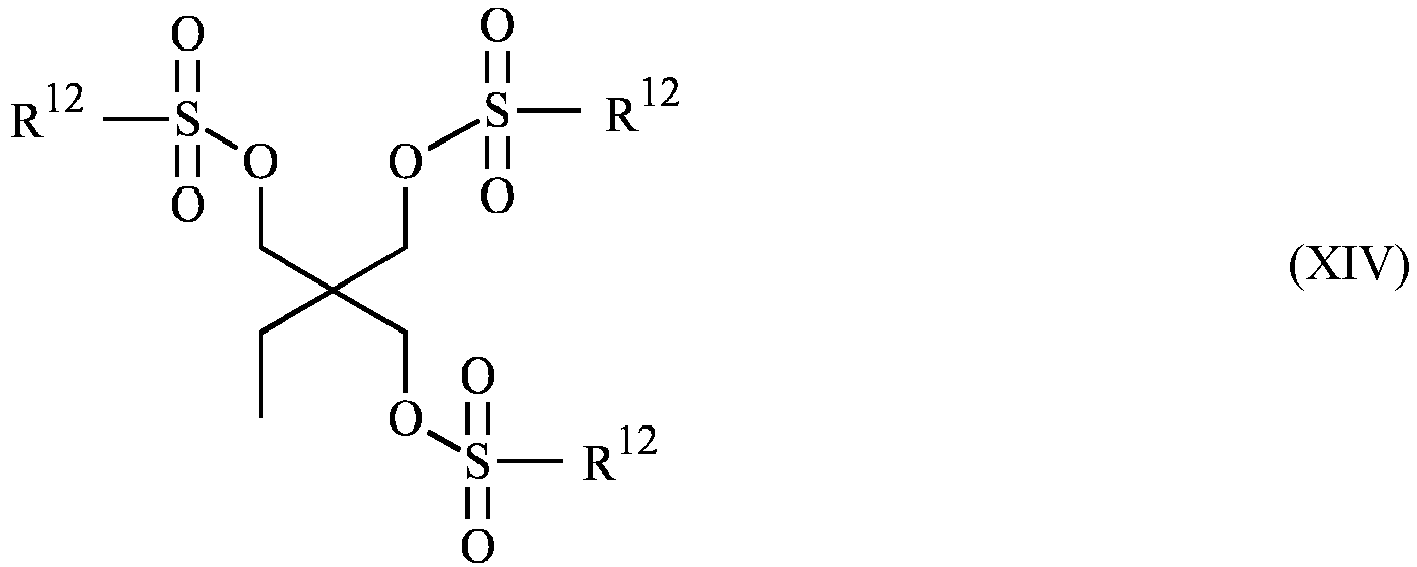
- R 12 in the formulas (XI) to (XVI) each independently represents C 6 - to C 20 -aryl or C 7 - to C 12 -aralkyl, preferably selected from the list consisting of phenyl, cresyl, xylenyl, propylphenyl, butylphenyl, tert-butylphenyl, particularly preferably selected from the list consisting of phenyl, cresyl, xylenyl, most preferably phenyl.
- the most preferred component C is the sulfonic acid ester according to formula (XVII)
- the compounds according to component C according to the invention can be added to the composition individually or in any mixtures with one another.
- the compounds according to component C preferably have melting points greater than 30°C, preferably greater than 40°C and particularly preferably greater than 50°C and boiling points at 1 mbar greater than 150°C, preferably greater than 200°C and particularly preferably greater than 230°C.
- the composition can contain one or more further additives as component D, preferably selected from the group consisting of flame retardants (e.g. organic phosphorus or halogen compounds, in particular bisphenol-A-based oligophosphate), anti-dripping agents (e.g. compounds from the substance classes of fluorinated polyolefins, silicones and aramid fibers), flame retardant synergists (e.g. nanoscale metal oxides), smoke inhibitors (e.g. zinc borate), lubricants and mold release agents (e.g. pentaerythritol tetrastearate), nucleating agents, antistatic agents or conductivity additives, further stabilizers (e.g.
- flame retardants e.g. organic phosphorus or halogen compounds, in particular bisphenol-A-based oligophosphate
- anti-dripping agents e.g. compounds from the substance classes of fluorinated polyolefins, silicones and aramid fibers
- antibacterial additives e.g. silver or silver salts
- scratch resistance-improving additives e.g. silicone oils
- IR absorbents e.g. silicone oils
- optical brighteners e.g. silicone oils
- fluorescent additives e.g. carbon fibers, talc, mica, kaolin, CaCOs
- fillers and reinforcing materials e.g. carbon fibers
- the composition is free of flame retardants, anti-dripping agents, flame retardant synergists and smoke inhibitors.
- the composition is free of fillers and reinforcing agents.
- the composition is free of flame retardants, anti-drip agents, flame retardant synergists, smoke inhibitors as well as fillers and reinforcing agents.
- the composition contains at least one polymer additive selected from the group consisting of lubricants and mold release agents, stabilizers, flow promoters, compatibilizers as well as dyes and pigments.
- the additives used according to component D are selected from the group consisting of lubricants and mold release agents, stabilizers, flow promoters, compatibilizers and dyes and pigments, wherein the compositions are free from further polymer additives.
- Thermoplastic molding compounds can be produced from the compositions according to the invention.
- thermoplastic molding compositions according to the invention can be produced, for example, by mixing the respective components of the compositions in a known manner and melt compounding and melt extruding them at temperatures of preferably 200°C to 350°C, more preferably at 230 to 330°C, particularly preferably from 250 to 310°C in conventional units such as internal kneaders, extruders and twin-screw extruders. This process is generally referred to as compounding in the context of this application. Molding composition is therefore understood to mean the product that is obtained when the components of the composition are melt compounded and melt extruded.
- Mixing at room temperature or elevated temperature and/or melt compounding of components A to D and possibly other components of the composition can be carried out independently of one another in a known manner in a single step or in several sub-steps. This means, for example, that some of the components can be dosed via the main feed of an extruder and the remaining components can be added later in the compounding process via a side extruder.
- component C is first premixed in a first step with the entire amount or a partial amount of component A at room temperature and optionally and preferably melt compounded at an elevated temperature of preferably 200 to 350°C, and the other components of the compositions are only then added in a second step and finally the molding compound according to the invention is compounded.
- the invention also relates to a process for producing the molding compositions according to the invention.
- the molding compositions according to the invention can be used to produce molded articles of any kind. These can be produced, for example, by injection molding, extrusion and blow molding processes. Another form of processing is the production of molded articles by deep drawing from previously produced sheets or films.
- compositions directly into an injection molding machine or an extrusion unit and process them into molded articles.
- moldings that can be produced from the compositions and molding materials according to the invention are films, profiles, housing parts of all kinds, e.g. for household appliances such as juicers, coffee machines, mixers; for office machines such as monitors, flat screens, notebooks, printers, copiers; panels, pipes, electrical installation ducts, windows, doors and other profiles for the construction sector (interior fittings and exterior applications) as well as electrical and electronic parts such as switches, plugs and sockets and components for commercial vehicles, in particular for the automotive sector.
- household appliances such as juicers, coffee machines, mixers
- office machines such as monitors, flat screens, notebooks, printers, copiers
- panels pipes, electrical installation ducts, windows, doors and other profiles for the construction sector (interior fittings and exterior applications) as well as electrical and electronic parts such as switches, plugs and sockets and components for commercial vehicles, in particular for the automotive sector.
- compositions and molding materials according to the invention are also suitable for producing the following molded bodies or molded parts: interior fittings for rail vehicles, ships, aircraft, buses and other motor vehicles, interior components and body parts for motor vehicles, housings of electrical devices containing small transformers, housings for devices for information processing and transmission, housings and cladding of medical devices, massage devices and housings therefor, toy vehicles for children, flat wall elements, housings for safety devices, heat-insulated transport containers, molded parts for sanitary and bathroom equipment, cover grilles for ventilation openings and housings for garden tools.
- Component A1 contains a total of 691 mg/kg of structural units according to formulas IV to VII, of which 363 mg/kg of structural units according to formula IV, 56 mg/kg of structural units according to formula V, 17 mg/kg of structural units according to formula VI and 255 mg/kg of structural units according to formula VII.
- Component A has a phenolic OH end group content of 480 mg/kg.
- Linear polycarbonate based on bisphenol A produced by the interfacial polymerization process, with a weight-average molecular weight MW of 28,000 g/mol (determined by GPC in methylene chloride against a BPA-PC standard).
- Component A1 contains no structural units according to any of the formulas IV to VII and a phenolic OH end group content of 150 mg/kg.
- ABS Acrylonitrile-butadiene-styrene
- acetone-soluble styrene-acrylonitrile copolymer in component B1 has a weight-average molecular weight M w (measured by GPC in tetrahydrofuran as solvent with polystyrene as standard) of 165 kg/mol.
- M w weight-average molecular weight measured by GPC in tetrahydrofuran as solvent with polystyrene as standard
- the average rubber particle size D50 measured by ultracentrifugation, is 0.85 ⁇ m.
- the melt flow rate (MVR) of component B1 measured according to ISO 1133 (version of 2012) at 220°C with a punch load of 10 kg, is 6.7 ml/10 min.
- Component B1 contains 3 mg/kg Li and a total of less than 1 mg/kg of other alkali metals (each determined by ICP-OES).
- alkali metal contents were determined in B2 using ICP-OES: Li ⁇ 1 mg/kg, Na: 10 mg/kg, K: 25 mg/kg, where the value ⁇ 1 mg/kg means that the element lithium could not be detected with a detection limit of the analytical method of 1 mg/kg.
- the mixture is very slowly poured into a mixture of 3 liters of distilled water, about 4 kg of ice and 3 liters of dichloromethane while stirring vigorously.
- the temperature should not exceed 35°C.
- the organic phase is then precipitated in approx. 10 liters of methanol, filtered off with suction and washed with methanol until thin-layer chromatography indicates a clean product.
- the sample is then dried in a vacuum drying oven at 60°C until the mass is constant.
- Pentaerythritol tetrastearate, Loxiol TM P 861/3.5 Special (Emery Oleochemicals GmbH, Düsseldorf, Germany).
- Irganox TM B900 mixture of 80% Irgafos TM 168 (tris(2,4-di-tert-butyl-phenyl)-phosphite) and 20% Irganox TM 1076 (2,6-di-tert-butyl-4-(octadecanoxycarbonylethyl)-phenol); BASF (Ludwigshafen, Germany).
- the components were mixed on a ZSK-25 twin-screw extruder from Coperion, Werner & Pfleiderer at a melt temperature of 260°C and under a vacuum of 50 mbar (absolute).
- the molded bodies measuring 60 mm x 40 mm x 2 mm were produced on an Arburg 270 E injection molding machine at a melt temperature of 270°C or 300°C and a mold temperature of 80°C.
- the percentage increase in the content of free bisphenol-A ⁇ [BPA] was determined during the production of the molded articles by injection molding.
- compositions containing graft polymer prepared by the bulk polymerization process containing lithium and the component C1 according to the invention provide an advantageous combination of improved thermal stability (determined as an increase in the content of free bisphenol A in the injection molding process) and high hydrolysis stability is achieved.
- thermal stability determined as an increase in the content of free bisphenol A in the injection molding process
- hydrolysis stability is good, but the thermal stability is completely inadequate.
- the thermal stability is improved, but not to the level achieved with the inventive component C1 and at the expense of significantly worsened hydrolysis stability.
- Table 2 summarizes experimental data in which compositions containing graft polymer prepared by the emulsion polymerization process were investigated.
- compositions containing graft polymer produced by the emulsion polymerization process are distinguished from the compositions containing graft polymer produced by the bulk polymerization process by a lower ⁇ BPA but a higher ⁇ MVR (hydrolysis).
- inventive component C1 achieves advantageous behavior compared to the non-inventive component C2 or compared to compositions without a component C.
Landscapes
- Chemical & Material Sciences (AREA)
- Health & Medical Sciences (AREA)
- Chemical Kinetics & Catalysis (AREA)
- Medicinal Chemistry (AREA)
- Polymers & Plastics (AREA)
- Organic Chemistry (AREA)
- Compositions Of Macromolecular Compounds (AREA)
Abstract
Description
- Die vorliegende Erfindung betrifft thermoplastische schlagzähmodifizierte Polycarbonat- und/oder Polyestercarbonat Formmassen und deren Zusammensetzungen, ein Verfahren zur Herstellung der Formmassen, die Verwendung der Formmassen zur Herstellung von Formkörpern und die Formkörper selbst.
- Thermoplastische Polycarbonat und Polyestercarbonat-Zusammensetzungen sind seit langem bekannt und aus diesen Materialien werden für eine Vielzahl von Anwendungen Formkörper hergestellt, beispielsweise im Automobilbereich, für Schienenfahrzeuge, für den Bausektor, im Bereich Elektro/Elektronik und bei Haushaltsgeräten. Zur Verbesserung der rheologischen und mechanischen Eigenschaften werden häufig weitere Thermoplaste als Blendpartner zugesetzt. In vielen Fällen werden insbesondere zur Steigerung der Zähigkeit bei tiefen Temperaturen Pfropfpolymerisate als Schlagzähmodifikatoren verwendet.
- Die Herstellung von Formkörpern aus den Formmassen mit solchen Zusammensetzungen erfolgt in der Regel unter erhöhten Temperaturen und führt zu einer thermischen Belastung der Formmassen. Dadurch können sich unerwünschte Abbaureaktionen ergeben, die das Verarbeitungsverhalten der Formmassen und die Eigenschaften der Formkörper negativ beeinflussen. Deshalb werden bei der Herstellung der Formmassen häufig Thermostabilisatoren zugesetzt, die diese Abbaureaktionen unterdrücken sollen.
-
EP 1 609 818 A2 offenbart Polycarbonat-Zusammensetzungen enthaltend Ester Schwefelenthaltender organischer Säuren, die eine verbesserte Stabilität des Polycarbonats gegenüber thermischer Belastung aufweisen. -
EP 1 612 231 A1 offenbart ein Verfahren zur Herstellung von Polycarbonat, wobei Ester von organischen Schwefel-enthaltenden Säuren zwischen Mittel- und Hochviskosreaktor zugesetzt werden, sowie die Verwendung dieser Ester zur Inhibierung von katalytisch aktiven Verunreinigungen bei der Herstellung von Polycarbonat nach dem Schmelzeumesterungsverfahren. - Diese Dokumente offenbaren aber keine schlagzähmodifizierten Zusammensetzungen enthaltend Pfropfpolymerisat. Bei Mischungen von Polycarbonat- und Polyestercarbonat mit anderen Thermoplasten kann sich die Empfindlichkeit gegenüber thermischer Belastung aber weiter erhöhen und eine besondere Stabilisierung notwendig machen. Ebenso können weitere Einflussfaktoren für das Erreichen der gewünschten Eigenschaften wichtig werden.
-
WO 2013/160371 A1 offenbart PC/ABS-Zusammensetzungen, insbesondere solche basierend auf im Emulsionspolymerisationsverfahren hergestelltem ABS, wobei sich die Zusammensetzungen durch einen geringen Gehalt an freiem Bisphenol-A auszeichnen. -
WO 2013/160373 A1 offenbart PC/ABS-Zusammensetzungen enthaltend Polycarbonat mit geringem OH-Endgruppengehalt (bevorzugt hergestellt im Phasengrenzflächenpolymerisationsverfahren) und ABS mit geringem Alkali-Gehalt (bevorzugt hergestellt im Masse-Polymerisationsverfahren), die sich durch eine hohe thermische Verarbeitungsstabilität in Bezug auf Glanzgrad, Polycarbonatabbau und Gehalt an freiem Bisphenol-A auszeichnen und eine verbesserte Spannungsrißbeständigkeit aufweisen. -
WO 2007/065579 A1 offenbart Polycarbonat-Zusammensetzungen enthaltend Pfropfpolymerisat, die durch Zugabe einer Brönstedt Säure stabilisiert werden. - Die Zugabe von Additiven, besonders Säuren, als Thermostabilisatoren birgt allerdings das Risiko, dass zwar die thermische Stabilität verbessert wird, gleichzeitig aber andere Eigenschaften in Mitleidenschaft gezogen werden. So wird häufig die Beständigkeit unter feucht-warmen Bedingungen (d.h. Beständigkeit gegenüber hydrolytischem Polymerabbau) durch den Einsatz von Thermostabilisatoren als Additiven verringert.
- Es war also wünschenswert, schlagzähmodifizierte Polycarbonat-oder Polyestercarbonat-Zusammensetzungen, optional weiterhin enthaltend Polyester, und daraus hergestellte Formmassen bereitzustellen, die sich durch die Kombination einer guten Stabilität gegenüber thermischer Belastung und eine guten Hydrolysestabilität auszeichnen.
- Es wurde nun überraschenderweise gefunden, dass Zusammensetzung zur Erzeugung einer thermoplastischen Formmasse, wobei die Zusammensetzung zumindest die folgenden Bestandteile enthält:
- A) 30 bis 94 Gew.-%, bevorzugt 40 bis 80 Gew.-%, besonders bevorzugt 50 bis 75 Gew.-% eines Polymers oder einer Polymermischung bestehend aus mindestens einem Vertreter ausgewählt aus aromatischem Polycarbonat und aromatischem Polyestercarbonat und optional zusätzlich enthaltend aromatischen Polyester,
- B) 5 bis 65 Gew.-%, bevorzugt 10 bis 50 Gew.-%, besonders bevorzugt 20 bis 45 Gew.-% kautschukbasiertes Pfropfpolymerisat B.1, optional in Mischung mit kautschukfreiem Vinyl(co)polymerisat B.2,
- C) 0,001 bis 1 Gew.-%, bevorzugt 0,002 bis 0,2 Gew.-%, besonders bevorzugt 0,005 bis 0,05 Gew.-% mindestens eines Sulfonsäureesters, bevorzugt eines Esters einer aromatischen Sulfonsäure, besonders bevorzugt eines Esters einer Sulfonsäure einer der unten dargestellten Formeln (XI) bis (XVI), am stärksten bevorzugt des Sulfonsäureesters gemäß der unten dargestellten Formel (XVII),
- D) 0 bis 30 Gew.-%, bevorzugt 0,1 bis 10 Gew.-%, besonders bevorzugt 0,2 bis 5 Gew.-% eines oder mehrerer Polymeradditive
- Wenn die Komponente B sowohl B.1 als auch B.2 enthält, ist der angegebene Anteil der Komponente B die Summe der Anteile von B.1 und B.2.
- In bevorzugten Ausfiihrungsform besteht die Zusammensetzung zu mindestens 90 Gew.-%, besonders bevorzugt zu mindestens 95 Gew.-%, insbesondere bevorzugt mindestens 98 Gew.-% aus den Komponenten A bis D. In einer weiter bevorzugten Ausfiihrungsform besteht die Zusammensetzung nur aus den Komponenten A bis D.
- In bevorzugter Ausfiihrungsform handelt es sich bei der thermoplastischen Formmasse um eine Formmasse enthaltend aromatisches Polycarbonat, besonders bevorzugt um aromatisches Polycarbonat enthaltend von Bisphenol-A abgeleitete Strukturelemente, insbesondere bevorzugt um aromatisches Polycarbonat ausschließlich auf Basis von Bisphenol-A als Diphenol.
- Eine weitere Aufgabe bestand darin, ein Verfahren bereitzustellen, mit dem eine schlagzähmodifizierte Polycarbonat- und Polyestercarbonat Zusammensetzung hergestellt werden kann und bei dem die erhaltene Formmasse eine gute thermische Stabilität aufweist.
- Es war insbesondere wünschenswert, ein Verfahren bereitzustellen, mit dem eine Zusammensetzung enthaltend als Komponente A Polycarbonate und/oder Polyestercarbonate enthaltend Fries-Strukturen gemäß den unten aufgeführten Formeln IV bis VII zu einer thermisch stabilen Formmasse verarbeitet werden kann, insbesondere auch dann, wenn die Zusammensetzung Lithium enthält (beispielsweise eingebracht als verfahrensbedingte Verunreinigung des Pfropfpolymerisats B). Formmassen hergestellt aus solchen Zusammensetzungen weisen oft vorteilhafte rheologische und mechanische Eigenschaften auf und basieren auf kommerziell gut verfügbaren Inhaltsstoffen. Allerdings ist die thermische Stabilität insbesondere solcher Formmassen für manche Anwendungen nicht ausreichend, so dass ein besonderer Bedarf nach einem verbesserten Herstellverfahren bestand.
- Es wurde nun gefunden, dass ein Verfahren zur Herstellung einer schlagzähmodifizierten thermoplastischen Formmasse enthaltend
- A) 30 bis 94 Gew.-%, bevorzugt 40 bis 80 Gew.-%, besonders bevorzugt 50 bis 75 Gew.-% eines Polymers oder einer Polymermischung bestehend aus mindestens einem Vertreter ausgewählt aus aromatischem Polycarbonat und aromatischem Polyestercarbonat und optional zusätzlich enthaltend aromatischen Polyester,
- B) 5 bis 65 Gew.-%, bevorzugt 10 bis 50 Gew.-%, besonders bevorzugt 20 bis 45 Gew.-% kautschukbasiertes Pfropfpolymerisat B.1, optional in Mischung mit kautschukfreiem Vinyl(co)polymerisat B.2,
- D) 0 bis 30 Gew.-%, bevorzugt 0,1 bis 10 Gew.-%, besonders bevorzugt 0,2 bis 5 Gew.-% eines oder mehrerer Polymeradditive,
- wobei die Komponenten bei einer Temperatur von 200 bis 350 °C miteinander vermischt und in einem Compoundierungsaggregat aufgeschmolzen und ineinander dispergiert werden,
- dadurch gekennzeichnet, dass im Verfahren als Komponente C) ein Ester einer Sulfonsäure in einer Konzentration von 0,001 bis 1 Gew.-% der Zusammensetzung zugesetzt wird und
- dadurch gekennzeichnet, dass entweder das Mischen der Komponenten A, B, C und Dund ggf. weiterer Komponenten der Zusammensetzung in einem einzigen Schritt erfolgt oder aber alternativ die Komponente C zunächst in einem ersten Schritt mit der Gesamtmenge oder einer Teilmenge der Komponente A bei Raumtemperatur oder bei einer erhöhten Temperatur von bevorzugt 200 bis 350°C vorgemischt wird,
- die angestrebten Verbesserungen erreicht.
- Wenn die Komponente B sowohl B.1 als auch B.2 enthält, ist der angegebene Anteil der Komponente B die Summe der Anteile von B.1 und B.2.
- Komponente A besteht aus mindestens einem Vertreter ausgewählt aus der Gruppe bestehend aus aromatischem Polycarbonat und aromatischem Polyestercarbonat und optional zusätzlich aromatischem Polyester.
- Bevorzugt enthält Komponente A aromatisches Polycarbonat.
- Besonders bevorzugt wird als Komponente A ein oder mehrere aromatische Polycarbonate eingesetzt.
- Erfindungsgemäß geeignete aromatische Polycarbonate und/oder aromatische Polyestercarbonate gemäß Komponente A sind literaturbekannt oder nach literaturbekannten Verfahren herstellbar (zur Herstellung aromatischer Polycarbonate siehe beispielsweise Schnell, "Chemistry and Physics of Polycarbonates", Interscience Publishers, 1964 sowie die
DE-AS 1 495 626 ,DE-A 2 232 877 ,DE-A 2 703 376 ,DE-A 2 714 544 ,DE-A 3 000 610 ,DE-A 3 832 396 ; zur Herstellung aromatischer Polyestercarbonate, z. B.DE-A 3 077 934 ). - Die Herstellung aromatischer Polycarbonate erfolgt z. B. durch Umsetzung von Diphenolen mit Kohlensäurehalogeniden, vorzugsweise Phosgen und/oder mit aromatischen Dicarbonsäuredihalogeniden, vorzugsweise Benzoldicarbonsäuredihalogeniden, nach dem Phasengrenzflächenverfahren, gegebenenfalls unter Verwendung von Kettenabbrechern, beispielsweise Monophenolen und gegebenenfalls unter Verwendung von trifunktionellen oder mehr als trifunktionellen Verzweigern, beispielsweise Triphenolen oder Tetraphenolen. Ebenso ist eine Herstellung über ein Schmelzepolymerisationsverfahren durch Umsetzung von Diphenolen mit beispielsweise Diphenylcarbonat möglich.
- Diphenole zur Herstellung der aromatischen Polycarbonate und/oder aromatischen Polyestercarbonate sind vorzugsweise solche der Formel (I)

- A
- eine Einfachbindung, C1 bis C5-Alkylen, C2 bis C5-Alkyliden, C5 bis C6-Cycloalkyliden, -O-, -SO-, -CO-, -S-, -SO2-, C6 bis C12-Arylen, an das weitere aromatische gegebenenfalls Heteroatome enthaltende Ringe kondensiert sein können, oder ein Rest der Formel (II) oder (III)


- B
- jeweils C1 bis C12-Alkyl, vorzugsweise Methyl, Halogen, vorzugsweise Chlor und/oder Brom
- x
- jeweils unabhängig voneinander 0, 1 oder 2,
- p
- 1 oder 0 sind, und
- R5 und R6
- für jedes X1 individuell wählbar, unabhängig voneinander Wasserstoff oder C1 bis C6-Alkyl, vorzugsweise Wasserstoff, Methyl oder Ethyl,
- X1
- Kohlenstoff und
- m
- eine ganze Zahl von 4 bis 7, bevorzugt 4 oder 5 bedeuten, mit der Maßgabe, dass an mindestens einem Atom X1, R5 und R6 gleichzeitig Alkyl sind.
- Bevorzugte Diphenole sind Hydrochinon, Resorcin, Dihydroxydiphenole, Bis-(hydroxyphenyl)-C1-C5-alkane, Bis-(hydroxyphenyl)-C5-C6-cycloalkane, Bis-(hydroxyphenyl)-ether, Bis-(hydroxyphenyl)-sulfoxide, Bis-(hydroxyphenyl)-ketone, Bis-(hydroxyphenyl)-sulfone und α,α,-Bis-(hydroxyphenyl)-diisopropyl-benzole sowie deren kernbromierte und/oder kernchlorierte Derivate.
- Weitere bevorzugte Diphenole sind solche der allgemeinen Formel (Ia), (Ib) und (Ic):

- Besonders bevorzugte Diphenole sind 4,4'-Dihydroxydiphenyl, Bisphenol-A, 2,4-Bis(4-hydroxyphenyl)-2-methylbutan, 1,1 -Bis-(4-hydroxyphenyl)-cyclohexan, 1,1-Bis-(4-hydroxyphenyl)-3.3.5-trimethylcyclohexan, 4,4'-Dihydroxydiphenylsulfid, 4,4'-Dihydroxydiphenylsulfon sowie deren di- und tetrabromierten oder chlorierten Derivate wie beispielsweise 2,2-Bis(3-Chlor-4-hydroxyphenyl)-propan, 2,2-Bis-(3,5-dichlor-4-hydroxyphenyl)-propan oder 2,2-Bis-(3,5-dibrom-4-hydroxyphenyl)-propan. Insbesondere bevorzugt ist 2,2-Bis-(4-hydroxyphenyl)-propan (Bisphenol-A).
- Es können die Diphenole einzeln oder als beliebige Mischungen eingesetzt werden. Die Diphenole sind literaturbekannt oder nach literaturbekannten Verfahren erhältlich.
- Für die Herstellung der thermoplastischen, aromatischen Polycarbonate geeignete Kettenabbrecher sind beispielsweise Phenol, p-Chlorphenol, p-tert.-Butylphenol oder 2,4,6-Tribromphenol, aber auch langkettige Alkylphenole, wie 4-[2-(2,4,4-Trimethylpentyl)]-phenol, 4-(1,3-Tetramethylbutyl)-phenol gemäß
DE-A 2 842 005 oder Monoalkylphenol oder Dialkylphenole mit insgesamt 8 bis 20 Kohlenstoffatomen in den Alkylsubstituenten, wie 3,5-di-tert.-Butylphenol, p-iso-Octylphenol, p-tert.-Octylphenol, p-Dodecylphenol und 2-(3,5-Dimethylheptyl)-phenol und 4-(3,5-Dimethylheptyl)-phenol. Die Menge an einzusetzenden Kettenabbrechern beträgt im allgemeinen zwischen 0,5 Mol%, und 10 Mol%, bezogen auf die Molsumme der jeweils eingesetzten Diphenole. - Die thermoplastischen, aromatischen Polycarbonate können in bekannter Weise verzweigt sein, und zwar vorzugsweise durch den Einbau von 0,05 bis 2,0 Mol%, bezogen auf die Summe der eingesetzten Diphenole, an dreifunktionellen oder mehr als dreifunktionellen Verbindungen, beispielsweise solchen mit drei und mehr phenolischen Gruppen.
- Geeignet sind sowohl Homopolycarbonate als auch Copolycarbonate. Zur Herstellung erfindungsgemäßer Copolycarbonate gemäß Komponente A können auch 1 bis 25 Gew.%, vorzugsweise 2,5 bis 25 Gew.%, bezogen auf die Gesamtmenge an einzusetzenden Diphenolen, Polydiorganosiloxane mit Hydroxyaryloxy-Endgruppen eingesetzt werden. Diese sind bekannt (
US 3 419 634 ) und nach literaturbekannten Verfahren herstellbar. Die Herstellung Polydiorganosiloxanhaltiger Copolycarbonate ist in derDE-A 3 334 782 beschrieben. - Bevorzugte Polycarbonate sind neben den Bisphenol-A-Homopolycarbonaten die Copolycarbonate von Bisphenol-A mit bis zu 15 Mol%, bezogen auf die Molsummen an Diphenolen, anderen als bevorzugt oder besonders bevorzugt genannten Diphenolen, insbesondere 2,2-Bis(3,5-dibrom-4-hydroxyphenyl)-propan.
- Aromatische Dicarbonsäuredihalogenide zur Herstellung von aromatischen Polyestercarbonaten sind vorzugsweise die Disäuredichloride der Isophthalsäure, Terephthalsäure, Diphenylether-4,4'-dicarbonsäure und der Naphthalin-2,6-dicarbonsäure.
- Besonders bevorzugt sind Gemische der Disäuredichloride der Isophthalsäure und der Terephthalsäure im Verhältnis zwischen 1:20 und 20:1.
- Bei der Herstellung von Polyestercarbonaten wird zusätzlich ein Kohlensäurehalogenid, vorzugsweise Phosgen, als bifunktionelles Säurederivat mit verwendet.
- Als Kettenabbrecher für die Herstellung der aromatischen Polyestercarbonate kommen außer den bereits genannten Monophenolen noch deren Chlorkohlensäureester sowie die Säurechloride von aromatischen Monocarbonsäuren, die gegebenenfalls durch C1 bis C22-Alkylgruppen oder durch Halogenatome substituiert sein können, sowie aliphatische C2 bis C22-Monocarbonsäurechloride in Betracht.
- Die Menge an Kettenabbrechern beträgt jeweils 0,1 bis 10 Mol%, bezogen im Falle der phenolischen Kettenabbrecher auf Mol Diphenol und im Falle von Monocarbonsäurechlorid-Kettenabbrecher auf Mol Dicarbonsäuredichlorid.
- Die aromatischen Polyestercarbonate können auch aromatische Hydroxycarbonsäuren eingebaut enthalten.
- Die aromatischen Polyestercarbonate können sowohl linear als auch in bekannter Weise verzweigt sein (siehe dazu
DE-A 2 940 024 undDE-A 3 007 934 ). - Als Verzweigungsmittel können beispielsweise drei- oder mehrfunktionelle Carbonsäurechloride, wie Trimesinsäuretrichlorid, Cyanursäuretrichlorid, 3,3'-,4,4'-Benzophenontetracarbonsäuretetrachlorid, 1,4,5,8-Napthalintetracarbon-säuretetrachlorid oder Pyromellithsäuretetrachlorid, in Mengen von 0,01 bis 1,0 Mol% (bezogen auf eingesetzte Dicarbonsäuredichloride) oder drei- oder mehrfunktionelle Phenole, wie Phloroglucin, 4,6-Dimethyl-2,4,6-tri-(4-hydroxyphenyl)-hept-2-en, 4,6-Dimethyl-2,4-6-tri-(4-hydroxyphenyl)-heptan, 1,3,5-Tri-(4-hydroxyphenyl)-benzol, 1,1,1-Tri-(4-hydroxyphenyl)-ethan, Tri-(4-hydroxyphenyl)-phenylmethan, 2,2-Bis[4,4-bis(4-hydroxy-phenyl)-cyclohexyl]-propan, 2,4-Bis(4-hydroxyphenyl-isopropyl)-phenol, Tetra-(4-hydroxyphenyl)-methan, 2,6-Bis(2-hydroxy-5-methyl-benzyl)-4-methyl-phenol, 2-(4-Hydroxyphenyl)-2-(2,4-dihydroxyphenyl)-propan, Tetra-(4-[4-hydroxyphenyl-isopropyl]-phenoxy)-methan, 1,4-Bis[4,4'-dihydroxytriphenyl)-methyl]-benzol, in Mengen von 0,01 bis 1,0 Mol% bezogen auf eingesetzte Diphenole verwendet werden. Phenolische Verzweigungsmittel können mit den Diphenolen vorgelegt, Säurechlorid-Verzweigungsmittel können zusammen mit den Säuredichloriden eingetragen werden.
- In den thermoplastischen, aromatischen Polyestercarbonaten kann der Anteil an Carbonatstruktureinheiten beliebig variieren. Vorzugsweise beträgt der Anteil an Carbonatgruppen bis zu 100 Mol%, insbesondere bis zu 80 Mol%, besonders bevorzugt bis zu 50 Mol%, bezogen auf die Summe an Estergruppen und Carbonatgruppen. Sowohl der Esterals auch der Carbonatanteil der aromatischen Polyestercarbonate kann in Form von Blöcken oder statistisch verteilt im Polykondensat vorliegen.
- In einer bevorzugten Ausführungsform weisen die als Komponente A geeigneten aromatischen Polycarbonate oder Polyestercarbonate ein gewichtsgemitteltes Molekulargewicht Mw (ermittelt durch Gelpermeationschromatographie (GPC) in Methylenchlorid mit Polycarbonat als Standard) von 15000 g/mol bis 50000 g/mol, bevorzugt von 22000 g/mol bis 35000 g/mol, insbesondere von 24000 bis 32000 g/mol auf.
- In einer besonderen Ausfuhrungsform enthalten die als Komponente A zum Einsatz kommenden Polcarbonate oder Polyestercarbonate eine oder mehrere Strukturen der allgemeinen Formeln (IV) bis (VII), welche die Folge von Fries-Umlagerungs-Reaktionen sind und die im Folgenden als "Fries-Strukturen" oder "Umlagerungsstrukturen" bezeichnet werden,


- in denen die Phenylringe unabhängig voneinander ein- oder zweifach mit C1 - C8-Alkyl, Halogen wie Chlor oder Brom, bevorzugt C1-C4-Alkyl, besonders Methyl substituiert sein können und A die bei Formel (I) angegebene Bedeutung hat,
- wobei in dieser besonderen Ausfuhrungsform die Menge der Struktureinheiten (IV) bis (VII) in Summe mindestens 50 mg/kg beträgt, bezogen auf die Summe von aromatischem Polycarbonat und Polyestercarbonat gemäß Komponente A. Bevorzugt beträgt die Menge der Struktureinheiten (IV) bis (VII) 50 bis 10000 mg/kg, besonders bevorzugt 100 bis 3000 mg/kg, ganz besonders bevorzugt 200-1200 mg/kg, jeweils bezogen auf die Summe von aromatischem Polycarbonat und Polyestercarbonat gemäß Komponente A.
- Die Struktureinheiten der Formeln (IV) bis (VII) sind abgeleitet von und resultieren aus den für die Herstellung des Polycarbonats eingesetzten Diphenolen. So sind z.B. im Falle von Bisphenol A als Diphenol die Phenylringe der Umlagerungsstrukturen unsubstituiert.
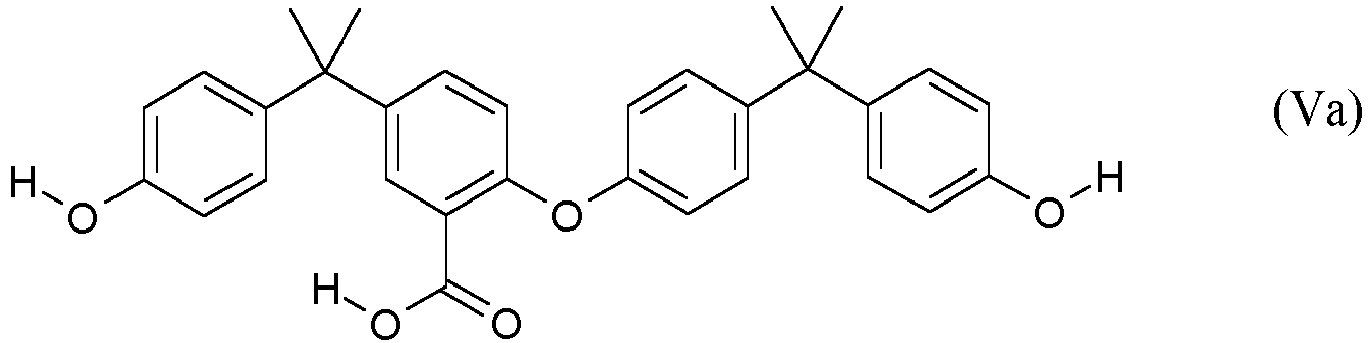
- Bei dem Abbau durch alkalische Verseifung der aromatischen Polycarbonate und/oder aromatischen Polyestercarbonate gemäß Komponente A zu Analysezwecken werden die für die jeweiligen Umlagerungsstrukturen charakteristischen niedermolekularen Abbauprodukte der Formeln (IVa) bis (VIIa), beispielhaft für Bisphenol A als Diphenol (d.h. für A = Isopropyliden) gezeigt, gebildet und deren Mengen nach Auftrennung mittels HPLC mit kemmagnetischer Resonanzspektroskopie (1H NMR) bestimmt.



- Solche Fries-Strukturen enthaltende aromatische Polycarbonate und/oder Polyestercarbonate werden in einer besonderen Ausführungsforin im Schmelzepolymerisationsverfahren hergestellt.
- In einer weiteren Ausführungsforin weisen die als Komponente A zum Einsatz kommenden aromatischen Polycarbonate und/oder Polyestercarbonate einen Gehalt an phenolischen OH-Endgruppen von bevorzugt mindestens 100 mg/kg, besonders bevorzugt von mindestens 200 mg/kg, weiter bevorzugt von mindestens 300 mg/kg, insbesondere von mindestens 400 mg/kg auf.
- Die Bestimmung der Konzentration an phenolischen OH-Endgruppen in der Komponente A erfolgt mittels Infrarotspektroskopie gemäß Horbach, A.; Veiel, U.; Wunderlich, H., Makromolekulare Chemie, 1965, Band 88, S. 215-231.
- In einer weiteren Ausfuhrungsform weisen die als Komponente A zum Einsatz kommenden aromatischen Polycarbonate und/oder Polyestercarbonate einen Gehalt an phenolischen OH-Endgruppen von bevorzugt mindestens 100 mg/kg, besonders bevorzugt von mindestens 200 mg/kg, weiter bevorzugt von mindestens 300 mg/kg, insbesondere von mindestens 400 mg/kg auf und enthalten eine oder mehrere Fries-Strukturen der allgemeinen Formeln (IV) bis (VII).
- In einer weiteren Ausfuhrungsform weisen die als Komponente A zum Einsatz kommenden aromatischen Polycarbonate und/oder Polyestercarbonate einen Gehalt an phenolischen OH-Endgruppen von bevorzugt mindestens 100 mg/kg, besonders bevorzugt von mindestens 200 mg/kg, weiter bevorzugt von mindestens 300 mg/kg, insbesondere von mindestens 400 mg/kg auf, enthalten eine oder mehrere Fries-Strukturen der allgemeinen Formeln (IV) bis (VII) und wurden im Schmelzepolymerisationsverfahren hergestellt.
- In einer weiteren Ausführungsforin enthält die Komponente A zusätzlich zu dem Polycarbonat und/oder Polyestercarbonat noch einen oder mehrere aromatische Polyester.
- In Frage kommende aromatische Polyester sind in bevorzugter Ausführungsfonn Polyalkylenterephthalate.
- Es handelt sich hierbei in besonders bevorzugter Ausfuhrungsform um Reaktionsprodukte aus aromatischen Dicarbonsäuren oder ihren reaktionsfähigen Derivaten, wie Dimethylester oder Anhydride, und aliphatischen, cycloaliphatischen oder araliphatischen Diolen sowie Mischungen dieser Reaktionsprodukte.
- Besonders bevorzugte aromatische Polyalkylenterephthalate enthalten mindestens 80 Gew.-%, vorzugsweise mindestens 90 Gew.-%, bezogen auf die Dicarbonsäurekomponente Terephthalsäurereste und mindestens 80 Gew.-%, vorzugsweise mindestens 90 Gew-%, bezogen auf die Diolkomponente Ethylenglykol- und/oder Butandiol-1,4-Reste.
- Die bevorzugten aromatischen Polyalkylenterephthalate können neben Terephthalsäureresten bis zu 20 mol-%, vorzugsweise bis zu 10 mol-%, Reste anderer aromatischer oder cycloaliphatischer Dicarbonsäuren mit 8 bis 14 C-Atomen oder aliphatischer Dicarbonsäuren mit 4 bis 12 C Atomen enthalten, wie z.B. Reste von Phthalsäure, Isophthalsäure, Naphthalin-2,6-dicarbonsäure, 4,4'-Diphenyldi-carbonsäure, Bernsteinsäure, Adipinsäure, Sebacinsäure, Azelainsäure, Cyclohexandiessigsäure.
- Die bevorzugten aromatischen Polyalkylenterephthalate können neben Ethylenglykol bzw. Butan¬diol-1,4-Resten bis zu 20 mol-%, vorzugsweise bis zu 10 mol-%, andere aliphatische Diole mit 3 bis 12 C Atomen oder cycloaliphatische Diole mit 6 bis 21 C Atomen enthalten, z.B. Reste von Propandiol-1,3, 2-Ethylpropandiol-1,3, Neopentylglykol, Pentandiol-1,5, Hexandiol-1,6, Cyclohexan-dimethanol-1,4, 3-Ethylpentandiol-2,4, 2-Methylpentandiol-2,4, 2,2,4-Trimethylpentandiol-1,3, 2-Ethylhexandiol-1,3, 2,2-Diethylpropandiol-1,3, Hexandiol-2,5, 1,4-Di-(β-hydroxyethoxy)-benzol, 2,2-Bis-(4-hydroxycyclohexyl)-propan, 2,4-Dihydroxy-1,1,3,3-tetramethyl-cyclobutan, 2,2-Bis-(4-β-hydroxyethoxy-phenyl)-propan und 2,2-Bis-(4-hydroxypropoxyphenyl)-propan (
DE-A 2 407 674 ,2 407 776 ,2 715 932 ). - Die aromatischen Polyalkylenterephthalate können durch Einbau relativ kleiner Mengen 3- oder 4-wertiger Alkohole oder 3- oder 4-basischer Carbonsäuren, z.B. gemäß
DE-A 1 900 270 undUS-PS 3 692 744 , verzweigt werden. Beispiele bevorzugter Verzweigungsmittel sind Trimesinsäure, Trimellithsäure, Trimethylolethan und -propan und Pentaerythrit. - Besonders bevorzugt sind aromatische Polyalkylenterephthalate, die allein aus Terephthalsäure und deren reaktionsfähigen Derivaten (z.B. deren Dialkylestern) und Ethylenglykol und/oder Butandiol-1,4 hergestellt worden sind, und Mischungen dieser Polyalkylenterephthalate.
- Bevorzugte Mischungen von aromatischen Polyalkylenterephthalaten enthalten 1 bis 50 Gew.-%, vorzugsweise 1 bis 30 Gew.-%, Polyethylenterephthalat und 50 bis 99 Gew.-%, vorzugsweise 70 bis 99 Gew.-%, Polybutylenterephthalat.
- Die vorzugsweise verwendeten aromatischen Polyalkylenterephthalate besitzen eine Viskositätszahl von 0,4 bis 1,5 dl/g, vorzugsweise 0,5 bis 1,2 dl/g, gemessen in Phenol/o-Dichlorbenzol (1:1 Gewichtsteile) in einer Konzentration von 0,05g/ml gemäß ISO 307 bei 25°C im Ubbelohde-Viskosimeter.
- Die aromatischen Polyalkylenterephthalate lassen sich nach bekannten Methoden herstellen (s. z.B. Kunststoff-Handbuch, Band VIII, S. 695 ff., Carl-Hanser-Verlag, München 1973).
- In einer bevorzugten Ausfuhrungsform enthält Komponente A ein aromatisches Polycarbonat, besonders bevorzugt auf Basis von Bisphenol-A. In einer weiter bevorzugten Ausführungsform ist Komponente A frei von Polyestern, in besonders bevorzugter Ausführungsform frei von Polyestern und Polyestercarbonaten.
- In einer weiteren bevorzugten Ausfuhrungsform handelt es sich bei Komponente A um ein aromatisches Polycarbonat, besonders bevorzugt um ein aromatisches Polycarbonat enthaltend vom Bisphenol-A abgeleitete strukturelle Einheiten, insbesondere um ein aromatisches Polycarbonat, welches ausschließlich auf Bisphenol-A als Diphenol basiert.
- Bei der Komponente B handelt es sich um kautschukbasiertes Pfropfpolymerisat B.1 oder alternativ um eine Mischung eines solchen kautschukbasierten Pfropfpolymerisats B.1 mit kautschukfreien Vinyl(Co)Polymerisaten B.2.
- Die erfindungsgemäß in Komponente B zum Einsatz kommenden Pfropfpolymerisate B.1 umfassen
- B.1.1 5 bis 95 Gew.-%, vorzugsweise 20 bis 92 Gew.-%, insbesondere 30 bis 91 Gew.-%, bezogen auf das Pfropfpolymerisat, wenigstens eines Vinylmonomeren auf
- B.1.2 95 bis 5 Gew.-%, vorzugsweise 80 bis 8 Gew.-%, insbesondere 70 bis 9 Gew.-%, bezogen auf das Pfropfpolymerisat, einer oder mehrerer kautschukelastischer Pfropfgrundlagen mit Glasübergangstemperaturen < 10°C, weiter bevorzugt von < 0°C, besonders bevorzugt < -20°C,
- wobei die aus den Monomeren B.1.1 gebildeten Polymerketten chemisch an die Pfropfgrundlage B. 1.2 gebunden sind oder in den Kautschukpartikeln so eingeschlossen sind, dass sie bei der Herstellung und Verarbeitung der erfindungsgemäßen Zusammensetzungen nicht aus den Kautschukpartikeln austreten.
- Die Glasübergangstemperatur wird, sofern in der vorliegenden Erfindung nicht ausdrücklich anders beschrieben, für alle Komponenten mittels dynamischer Differenzkalorimetrie (DSC) nach DIN EN 61006 (Version von 1994) bei einer Heizrate von 10 K/min mit Bestimmung der Tg als Mittelpunkttemperatur (Tangentenmethode) ermittelt.
- Die Pfropfgrundlage B.1.2 hat im Allgemeinen eine mittlere Teilchengröße (D50-Wert) von 0,05 bis 10,00 µm, vorzugsweise von 0,1 bis 5,0 µm und besonders bevorzugt von 0,2 bis 1,5 µm.
- Die mittlere Teilchengröße D50 ist der Durchmesser, oberhalb und unterhalb dessen jeweils 50 Gew.-% der Teilchen liegen. Er wird, soweit in der vorliegenden Erfindung nicht ausdrücklich anders beschrieben, für alle Komponenten mittels Ultrazentrifugenmessung (W. Scholtan, H. Lange, Kolloid, Z. und Z. Polymere 250 (1972), 782-1796) bestimmt.
- Die Monomere B.1.1 sind vorzugsweise Gemische aus
B.1.1.1 50 bis 99 Gew.-%, besonders bevorzugt 65 bis 85 Gew.-%, weiter bevorzugt 70 bis 80 Gew.-%, jeweils bezogen auf die Summe aus B.1.1.1 und B.1.1.2, Vinylaromaten und/oder kernsubstituierten Vinylaromaten (wie Styrol, α-Methylstyrol, p-Methylstyrol, p-Chlorstyrol) und/oder (Meth)Acrylsäure-(C1-C8)-Alkylester, wie Methylmethacrylat, Ethylmethacrylat), und B.1.1.2 1 bis 50 Gew.-%, besonders bevorzugt 15 bis 35 Gew.-%, weiter bevorzugt 20 bis 30 Gew.-%, jeweils bezogen auf die Summe aus B.1.1.1 und B.1.1.2, Vinylcyanide (ungesättigte Nitrile wie Acrylnitril und Methacrylnitril) und/oder (Meth)Acrylsäure-(C1-C8)-Alkylester, wie Methylmethacrylat, n-Butylacrylat, t-Butylacrylat, und/oder Derivate (wie Anhydride und Imide) ungesättigter Carbonsäuren, beispielsweise Maleinsäureanhydrid. - Bevorzugte Monomere B.1.1.1 sind ausgewählt aus mindestens einem der Monomere Styrol, α-Methylstyrol und Methylmethacrylat, bevorzugte Monomere B.1.1.2 sind ausgewählt aus mindestens einem der Monomere Acrylnitril, Maleinsäureanhydrid und Methylmethacrylat. Besonders bevorzugte Monomere sind B.1.1.1 Styrol und B.1.1.2 Acrylnitril. Alternativ bevorzugte Monomere sind B.1.1.1 Methylmethacrylat und B.1.1.2 Methylmethacrylat.
- Als Pfropfgrundlage B.1.2 der Pfropfpolymerisate eignen sich beispielsweise Dienkautschuke, EP(D)M-Kautschuke, also solche auf Basis Ethylen/Propylen und gegebenenfalls Dien, Acrylat-, Polyurethan-, Silikon-, Chloropren, Ethylen/Vinylacetat- sowie Acrylat-Silikon-Komposit-Kautschuke
- Bevorzugte Pfropfgrundlagen B.1.2 sind Dienkautschuke, bevorzugt enthaltend Butadien oder Copolymerisate aus Dienen, bevorzugt enthaltend Butadien, und weiteren copolymerisierbaren Vinyl-Monomeren (z.B. gemäß B.1.1.1 und B.1.1.2) oder Gemische aus einer oder mehrerer der zuvor genannten Komponenten.
- Besonders bevorzugt ist als Pfropfgrundlage B.1.2 reiner Polybutadienkautschuk. In einer weiteren bevorzugten Ausführungsform handelt es sich bei B.1.2 um Styrol-Butadien-Kautschuk, besonders bevorzugt um Styrol-Butadien-Blockcopolymer-Kautschuk.
- Der Gelanteil der Pfropfgrundlage B.1.2 beträgt mindestens 30 Gew. %, vorzugsweise mindestens 40 Gew.-%, insbesondere mindestens 60 Gew.-%, jeweils bezogen auf B.1.2 und gemessen als unlöslicher Anteil in Toluol.
- Der Gelgehalt der Pfropfgrundlage B.1.2 wird bei 25°C in einem geeigneten Lösungsmittel als in diesen Lösungsmitteln unlöslicher Anteil bestimmt (M. Hoffmann, H. Krömer, R. Kuhn, Polymeranalytik I und II, Georg Thieme-Verlag, Stuttgart 1977).
- Geeignete Polymerisate gemäß Komponente B sind beispielsweise ABS- oder MBS-Polymerisate, wie sie z.B. in der
DE-OS 2 035 390 (=US PS 3 644 574 ) oder in derDE-OS 2 248 242 (=GB-PS 1 409 275 - Die Pfropfcopolymerisate in Komponente B werden durch radikalische Polymerisation, z.B. durch Emulsions-, Suspensions-, Lösungs- oder Massepolymerisation hergestellt. Als Komponente B.1 können auch Mischungen von in unterschiedlichen Verfahren hergestellten Pfropfpolymerisaten verwendet werden.
- Geeignete Pfropfpolymerisate B.1 sind auch ABS-Polymerisate, die durch Redox-Initiierung mit einem Initiatorsystem aus organischem Hydroperoxid und Ascorbinsäure gemäß
US-P 4 937 285 hergestellt werden. - Bei der Pfropfung werden die Pfropfmonomere B. 1.1 bekanntlich nicht unbedingt vollständig auf die Pfropfgrundlage aufgepfropft. Produkte von Pfropfungsreaktionen enthalten insofern oft noch signifikante Anteile an freiem (d.h. nicht chemisch an die Pfropfgrundlage gebundenem) Copolymerisat mit einer Zusammensetzung analog zu dem der Pfropfhülle. Im Sinne der vorliegenden Erfindung wird unter Komponente B.1 ausschließlich das wie oben definierte Pfropfpolymer verstanden, während das herstellungsbedingt enthaltene nicht chemisch an die Pfropfgrundlage gebundene und nicht in die Kautschukpartikel eingeschlossene Copolymerisat der Komponente B.2 zugeordnet wird.
- Der Anteil an diesem freiem Copolymer in Produkten von Pfropfungsreaktionen lässt sich aus deren Gelgehalten ermitteln (Anteil an freiem Copolymer = 100 Gew.-% - Gel-Gehalt des Produktes in Gew.-%), wobei der Gelgehalt bei 25°C in einem geeigneten Lösungsmittel (wie etwa Aceton) als in diesen Lösungsmitteln unlöslicher Anteil bestimmt wird.
- Wenn die Pfropfpolymerisate B.1 in Emulsions-Polymerisation hergestellt werden, so umfassen diese
- B. 1.1 5 bis 75 Gew.-%, bevorzugt 20 bis 60 Gew.-%, besonders bevorzugt 25 bis 50 Gew.-%, bezogen auf das Pfropfpolymerisat, wenigstens eines Vinylmonomeren auf
- B. 1.2 95 bis 25 Gew.-%, bevorzugt 80 bis 40 Gew.-%, besonders bevorzugt 75 bis 50 Gew.-%, bezogen auf das Pfropfpolymerisat, einer oder mehrerer kautschukelastischer Pfropfgrundlagen mit Glasübergangstemperaturen < 10°C, weiter bevorzugt von < 0°C, besonders bevorzugt < -20°C.
- Bei Verwendung von in Emulsionspolymerisation hergestellten Pfropfpolymerisaten B.1 enthält die Komponente B meist Lithium in einer Konzentration von < 1 mg/kg, oft ist B frei von Lithium.
- Bei Verwendung von in Emulsionspolymerisation hergestellten Pfropfpolymerisaten B.1 enthält die Komponente B meist einen Gehalt an anderen Alkalimetallen von in Summe > 10 mg/kg, oft > 20 mg/kg.
- Der Gehalt an Alkalimetallen wird ermittelt durch optische Emissionsspektrometrie mittels induktiv gekoppeltem Plasma (ICP-OES) mit internem Standard. Hierzu wird die Probe in konzentrierter Salpetersäure in der Mikrowelle bei 200°C und 200 bar aufgeschlossen, auf 1 M Salpetersäure verdünnt und vermessen.
- Die Pfropfgrundlage B.1.2 von in Emulsionspolymerisation hergestellten Pfropfpolymerisaten B.1 haben eine mittlere Teilchengröße (D50-Wert) von 0,05 bis 2,00 µm, bevorzugt von 0,1 bis 1,0 µm, besonders bevorzugt von 0,2 bis 0,5 µm.
- Wenn die Pfropfpolymerisate B.1 in Suspensions-, Lösungs- oder Massepolymerisation hergestellt werden, so umfassen diese
- B. 1.1 80 bis 95 Gew.-%, bevorzugt 84 bis 92 Gew.-%, besonders bevorzugt 87 bis 91 Gew.-%, bezogen auf das Pfropfpolymerisat, wenigstens eines Vinylmonomeren auf
- B.1.2 20 bis 5 Gew.-%, bevorzugt 16 bis 8 Gew.-%, besonders bevorzugt 13 bis 9 Gew.-%, bezogen auf das Pfropfpolymerisat, einer oder mehrerer kautschukelastischer Pfropfgrundlagen mit Glasübergangstemperaturen < 10°C, weiter bevorzugt von < 0°C, besonders bevorzugt < -20°C.
- Bei Verwendung von in Massepolymerisation hergestellten Pfropfpolymerisaten B.1 enthält die Komponente B meist Lithium in einer Konzentration von >1 mg/kg, oft in einer Konzentration von > 2 mg/kg.
- Bei Verwendung von in Massepolymerisation hergestellten Pfropfpolymerisaten B.1 enthält die Komponente B meist einen Gehalt an anderen Alkalimetallen von in Summe < 10 mg/kg, oft < 5 mg/kg.
- Die Pfropfgrundlage B.1.2 von in Suspensions-, Lösungs- oder Massepolymerisation hergestellten Pfropfpolymerisaten B.1 haben eine mittlere Teilchengröße (D50-Wert) von 0,3 bis 10,00 µm, bevorzugt von 0,4 bis 5,0 µm, besonders bevorzugt von 0,5 bis 1,5 µm.
- Weitere besonders geeignete im Emulsions-Polymerisationsverfahren hergestellte Pfropfpolymerisate sind MBS-Modifikatoren mit Kern-Schale-Struktur sowie Modifikatoren mit Kern-Schale-Struktur enthaltend einen Kern aus einem Silikon-, Acrylat- oder Silikon-Acrylat-Kompositkautschuk und eine Hülle aus entweder Styrol und Acrylnitril oder alternativ aus Methylmethacrylat.
- Bei der Komponente B.2 handelt es sich um (Co)Polymerisate von mindestens einem Monomeren aus der Gruppe der Vinylaromaten, Vinylcyanide (ungesättigte Nitrile), (Meth)-Acrylsäure-(C1 bis C8)-Alkylester, ungesättigte Carbonsäuren sowie Derivate (wie Anhydride und Imide) ungesättigter Carbonsäuren.
- B.2.1 50 bis 99 Gew.-%, bevorzugt 65 bis 85 Gew.-%, besonders bevorzugt 70 bis 80 Gew.-% bezogen auf das (Co)Polymerisat C mindestens eines Monomeren ausgewählt aus der Gruppe der Vinylaromaten (wie beispielsweise Styrol, α-Methylstyrol), kernsubstituierten Vinylaromaten (wie beispielsweise p-Methylstyrol, p-Chlorstyrol) und (Meth)Acrylsäure-(C1-C8)-Alkylester (wie beispielsweise Methylmethacrylat, n-Butylacrylat, tert.-Butylacrylat) und
- B.2.2 1 bis 50 Gew.-%, bevorzugt 15 bis 35 Gew.-%, besonders bevorzugt 20 bis 30 Gew.-% bezogen auf das (Co)Polymerisat C mindestens eines Monomeren ausgewählt aus der Gruppe der Vinylcyanide (wie beispielsweise ungesättigte Nitrile wie Acrylnitril und Methacrylnitril), (Meth)Acrylsäure-(C1-C8)-Alkylester (wie beispielsweise Methylmethacrylat, n-Butylacrylat, tert.-Butylacrylat), ungesättigte Carbonsäuren und Derivate ungesättigter Carbonsäuren (beispielsweise Maleinsäureanhydrid und N-Phenyl-Maleinimid).
- Diese (Co)Polymerisate B.2 sind harzartig, thermoplastisch und kautschukfrei.
- Besonders bevorzugt ist das Copolymerisat aus B.2.1 Styrol und B.2.2 Acrylnitril.
- In einer weiteren bevorzugten Ausfuhrungsform ist B.2 ein Polymerisat ein B.2.1 und B.2.2 Methylmethacrylat.
- Dieses kautschukfreie Vinyl(co)polymerisat B.2 weist in ein gewichtgemitteltes Molekulargewicht Mw 30 bis 250 kg/mol, bevorzugt von 70 bis 200 kg/mol, insbesondere von 90 bis 180 kg/mol auf.
- Das gewichtsgemittelte Molekulargewicht Mw des kautschukfreien Vinyl(co)polymerisats B.2 in Komponente B wird im Rahmen der vorliegenden Erfindung per Gelpermeationschromatographie (GPC) in Tetrahydrofuran gegen Polystyrol als Standard gemessen.
- Bei der Komponente C handelt es sich um einen Sulfonsäureester oder eine Mischung verschiedener Sulfonsäureester.
- In bevorzugter Ausfuhrungsform handelt es sich bei den in Komponente C zum Einsatz kommenden Sulfonsäureestern um Ester aromatischer Sulfonsäuren R-SO2(OH), wobei R ein C6- bis C20-Aryl oder C7- bis C12-Aralkyl, bevorzugt ausgewählt aus der Liste bestehend aus Phenyl, Kresyl, Xylenyl, Propylphenyl, Butylphenyl, tert.-Butylphenyl, besonders bevorzugt ausgewählt aus der Liste bestehend aus Phenyl, Kresyl, Xylenyl, am stärksten bevorzugt Phenyl ist.
- Beispiele von als Komponente C geeignete Ester sind ausgewählt aus mindestens einer Verbindung gemäß
- a) der Formel (VIII)

- b) der Formel (IX)

- c) der Formel (X)

- R1
- unabhängig für Wasserstoff oder unsubstituiertes oder durch Halogen substituiertes C1-C20-Alkyl steht,
- R2 und R3
- unabhängig voneinander für Wasserstoff, C1-C6-Alkyl oder C4-C30-Alkylcarboxyl, oder für den Rest

- R1
- die oben genannte Bedeutung hat,
- m
- unabhängig voneinander für 0 oder 1 steht,
- n
- für 0, 1 oder 2 steht,
- R5 und R6
- unabhängig für Wasserstoff oder für C1-C20-Alkyl stehen, wobei Alkyl durch Halogen substituiert sein kann,
- R11
- unabhängig für Wasserstoff oder Di-(C1-C4)-Alkylamino steht.
- Weitere Beispiele von als Komponente C geeignete und bevorzugt als solche zum Einsatz kommende Sulfonsäureester sind Verbindungen gemäß der Formeln (XI) bis (XVI).




- Am stärksten bevorzugt ist als Komponente C der Sulfonsäureester gemäß Formel (XVII)

- Die erfindungsgemäßen Verbindungen gemäß Komponente C können einzeln oder in beliebigen Mischungen untereinander der Zusammensetzung zugesetzt werden.
- Die Verbindungen gemäß Komponente C haben bevorzugt Schmelzpunkte größer als 30°C, bevorzugt größer 40°C und besonders bevorzugt größer 50°C und Siedepunkte bei 1 mbar größer 150°C, bevorzugt größer 200°C und besonders bevorzugt größer 230°C.
- Die Zusammensetzung kann als Komponente D ein oder mehrere weitere Additive enthalten, bevorzugt ausgewählt aus der Gruppe bestehend aus Flammschutzmitteln (z.B. organische Phosphor- oder Halogenverbindungen, insbesondere Bisphenol-A basierendes Oligophosphat), Antidrippingmitteln (beispielsweise Verbindungen der Substanzklassen der fluorierten Polyolefine, der Silikone sowie Aramidfasern), Flammschutzsynergisten (beispielsweise nanoskalige Metalloxide), Rauchinhibitoren (beispielsweise Zinkborat), Gleit- und Entformungsmitteln (beispielsweise Pentaerythrittetrastearat), Nukleiermitteln, Antistatika bzw. Leitfähigkeitsadditiven, weiteren Stabilisatoren (z.B. Hydrolyse-, Wärmealterungs- und Umesterungsstabilisatoren, UV-Stabilisatoren, Brönstedt-saure Verbindungen, Fließfähigkeitspromotoren, Verträglichkeitsvermittlern, Schlagzähigkeitsmodifikatoren ohne Kern-Schale-Struktur, antibakteriell wirkenden Additiven (beispielsweise Silber oder Silbersalze), kratzfestigkeitsverbessernden Additiven (beispielsweise Silikonöle), IR-Absorbentien, optischen Aufhellern, fluoreszierenden Additiven, weiteren von den Komponenten A und B verschiedenen polymeren Bestandteilen (beispielsweise funktionelle Blendpartner), Farbstoffen und Pigmenten sowie Füll- und Verstärkungsstoffen (beispielsweise Karbonfasern, Talk, Glimmer, Kaolin, CaCOs).
- In bevorzugter Ausführungsform ist die Zusammensetzung frei von Flammschutzmitteln, Antidrippingmitteln, Flammschutzsynergisten und Rauchinhibitoren.
- In ebenfalls bevorzugter Ausfuhrungsform ist die Zusammensetzung frei von Füll- und Verstärkungsstoffen.
- In besonders bevorzugter Ausfuhrungsform ist die Zusammensetzung frei von Flammschutzmitteln, Antidrippingmitteln, Flammschutzsynergisten, Rauchinhibitoren sowie Füll- und Verstärkungsstoffen.
- In bevorzugter Ausführungsform enthält die Zusammensetzung mindestens ein Polymeradditiv ausgewählt aus der Gruppe bestehend aus Gleit- und Entformungsmitteln, Stabilisatoren, Fließfähigkeitspromotoren, Verträglichkeitsvermittlern sowie Farbstoffen und Pigmenten.
- In einer weiter bevorzugten Ausführungsform sind die gemäß Komponente D zum Einsatz kommenden Additive ausgewählt aus der Gruppe bestehend aus Gleit- und Entformungsmitteln, Stabilisatoren, Fließfähigkeitspromotoren, Verträglichkeitsvermittlern sowie Farbstoffen und Pigmenten, wobei die Zusammensetzungen frei sind von weiteren Polymeradditiven.
- Im Folgenden werden folgende besondere Ausführungsformen 1 bis 31 der vorliegenden Erfindung aufgeführt.
- 1. Zusammensetzung zur Erzeugung einer thermoplastischen Formmasse, wobei die Zusammensetzung zumindest die folgenden Bestandteile enthält oder aus ihnen besteht:
- A) 30 bis 94 Gew.-% eines Polymers oder einer Polymermischung bestehend aus mindestens einem Vertreter ausgewählt aus aromatischem Polycarbonat und aromatischem Polyestercarbonat und optional zusätzlich enthaltend aromatischen Polyester,
- B) 5 bis 65 Gew.-% kautschukbasiertes Pfropfpolymerisat B.1 optional in Mischung mit kautschukfreiem Vinyl(co)polymerisat B.2,
- C) 0,001 bis 1 Gew.-% mindestens eines Esters einer Sulfonsäure,
- D) 0 bis 30 Gew.-% eines oder mehrerer Polymeradditive.
- 2. Zusammensetzung gemäß Ausfuhrungsform 1, wobei Komponente A ein aromatisches Polycarbonat enthält oder ist.
- 3. Zusammensetzung gemäß einer der vorherigen Ausfiihrungsformen, wobei die Komponente C ein Ester einer aromatischen Sulfonsäure ist.
- 4. Zusammensetzung gemäß einer der vorherigen Ausfiihrungsformen, wobei Komponente C ausgewählt ist aus mindestens einer Verbindung gemäß den oben genannten Formeln (XI) bis (XVI).
- 5. Zusammensetzung gemäß einer der vorherigen Ausführungsfonnen, wobei als Komponente C der Sulfonsäureester gemäß der oben genannten Formel (XVII) eingesetzt wird.
- 6. Zusammensetzung gemäß einer der vorherigen Ausfiihrungsformen enthaltend
- 40-80 Gew.-% der Komponente A,
- 10-50 Gew.-% der Komponente B
- 0,002-0,2 Gew.-% der Komponente C und
- 0,1-10 Gew.-% der Komponente D.
- 7. Zusammensetzung gemäß einer der vorherigen Ausfiihrungsformen enthaltend
- 50-75 Gew.-% der Komponente A,
- 20-45 Gew.-% der Komponente B
- 0,005-0,05 Gew.-% der Komponente C und
- 0,2-5 Gew.-% der Komponente D.
- 8. Zusammensetzungen gemäß einer der vorherigen Ausführungsfonnen, wobei die Komponente B einen Lithiumgehalt von < 1 mg/kg aufweist.
- 9. Zusammensetzung gemäß einer der vorherigen Ausfiihrungsformen, wobei die Komponente B einen Gehalt an von Lithium verschiedenen Alkalimetallen von in Summe >10 mg/kg aufweist.
- 10. Zusammensetzung gemäß einer der vorherigen Ausführungsfonnen, wobei die Komponente B einen Gehalt an von Lithium verschiedenen Alkalimetallen von in Summe > 20 mg/kg aufweist.
- 11. Zusammensetzung gemäß einer der vorherigen Ausfiihrungsformen, wobei die Komponente B frei von Lithium ist.
- 12. Zusammensetzung gemäß einer der vorherigen Ausfiihrungsformen, enthaltend als Komponente D mindestens ein Additiv ausgewählt aus der Gruppe bestehend aus Gleit- und Entformungsmitteln, Stabilisatoren, Fließfähigkeitspromotoren, Verträglichkeitsvermittlern sowie Farbstoffen und Pigmenten.
- 13. Zusammensetzung gemäß einer der vorherigen Ausführungsfonnen, wobei die Komponente A einen Anteil an phenolischen OH Endgruppen von mindestens 200 mg/kg aufweist.
- 14. Zusammensetzung gemäß einer der vorherigen Ausfiihrungsformen bestehend zu mindestens 90 Gew.-% aus den Komponenten A, B, C und D.
- 15. Zusammensetzung gemäß einer der vorherigen Ausführungsfonnen bestehend zu mindestens 95 Gew.-% aus den Komponenten A, B, C und D.
- 16. Zusammensetzung gemäß einer der vorherigen Ausfiihrungsformen bestehend aus den Komponenten A, B, C und D.
- 17. Verfahren zur Herstellung einer schlagzähmodifizierten thermoplastischen Formmasse enthaltend
- A) 30 bis 94 Gew.-% eines Polymers oder einer Polymermischung bestehend aus mindestens einem Vertreter ausgewählt aus aromatischem Polycarbonat und aromatischem Polyestercarbonat und optional zusätzlich enthaltend aromatischen Polyester,
- B) 5 bis 65 Gew.-% eines kautschukbasierten Pfropfpolymerisats B.1 optional in Mischung mit kautschukfreiem Vinyl(co)polymerisat B.2,
- D) 0 bis 30 Gew.-% eines oder mehrerer Polymeradditive,
- wobei die Komponenten miteinander vermischt und bei einer Temperatur von 200 bis 350 °C in einem Compoundierungsaggregat aufgeschmolzen und ineinander dispergiert werden,
- dadurch gekennzeichnet, dass im Verfahren als Komponente C ein Ester einer Sulfonsäure in einer Konzentration von 0,001 bis 1 Gew.-% der Zusammensetzung zugesetzt wird und
- das Mischen der Komponenten A, B C und D und ggf. weiterer Komponenten der Zusammensetzung in einem einzigen Schritt erfolgt oder aber alternativ die Komponente C zunächst in einem ersten Schritt mit der Gesamtmenge oder einer Teilmenge der Komponente A bei Raumtemperatur oder bei einer erhöhten Temperatur vorgemischt wird.
- 18. Verfahren gemäß Ausführungsform 17, wobei
- 40-80 Gew.-% der Komponente A,
- 10-50 Gew.-% der Komponente B
- 0,002-0,2 Gew.-% der Komponente C und
- 0,1-10 Gew.-% der Komponente D
- eingesetzt werden.
- 19. Verfahren gemäß Ausführungsform 17, wobei
- 50-75 Gew.-% der Komponente A,
- 20-45 Gew.-% der Komponente B
- 0,005-0,05 Gew.-% der Komponente C und
- 0,2-5 Gew.-% der Komponente D
- eingesetzt werden.
- 20. Verfahren gemäß einer der Ausfiihrungsformen 17 bis 19, wobei als Komponente A aromatisches Polycarbonat und/oder aromatisches Polyestercarbonat zum Einsatz kommt, welches Fries-Strukturen gemäß mindestens einer der oben genannten Formeln (IV) bis (VII) enthält,
wobei Komponente A die Struktureinheiten (IV) bis (VII) in einer Menge von in Summe 50 bis 10000 mg/kg, bezogen auf die Summe der Gew.-Anteile der in Komponente A enthaltenden Polycarbonate und Polyestercarbonate enthält. - 21. Verfahren gemäß Ausfuhrungsform 20, wobei Komponente A die Struktureinheiten (IV) bis (VII) in einer Menge von in Summe 100 bis 3000 mg/kg, bezogen auf die Summe der Gew.-Anteile der in Komponente A enthaltenden Polycarbonate und Polyestercarbonate enthält.
- 22. Verfahren gemäß Ausfuhrungsform 20, wobei Komponente A die Struktureinheiten (IV) bis (VII) in einer Menge von in Summe 200 bis 1200 mg/kg, bezogen auf die Summe der Gew.-Anteile der in Komponente A enthaltenden Polycarbonate und Polyestercarbonate enthält.
- 23. Verfahren gemäß einer der Ausfiihrungsformen 17 bis 22, wobei die Komponente C ausgewählt ist aus mindestens einer Verbindung gemäß den oben genannten Formeln (XI) bis (XVI).
- 24. Verfahren gemäß einer der Ausfiihrungsformen 17 bis 23, wobei die Komponente C die Verbindung gemäß Formel (XVII) ist.
- 25. Verfahren gemäß einer der Ausfiihrungsformen 17 bis 24, wobei die Komponente B Lithium in einer Konzentration von > 1 mg/kg enthält.
- 26. Verfahren gemäß einer der Ausfiihrungsformen 17 bis 24, wobei die Komponente B Lithium in einer Konzentration von > 2 mg/kg enthält.
- 27. Verfahren gemäß einer der Ausführungsforinen 17 bis 26, wobei die Komponente B einen Gehalt an von Lithium verschiedenen Alkalimetallen von in Summe <10 mg/kg aufweist.
- 28. Verfahren gemäß einer der Ausführungsforinen 17 bis 26, wobei die Komponente B einen Gehalt an von Lithium verschiedenen Alkalimetallen von in Summe <5 mg/kg aufweist.
- 29. Formmasse, erhalten oder erhältlich nach einem Verfahren gemäß einer der Ausführungsforinen 17 bis 28.
- 30. Verwendung einer Zusammensetzung nach einer der Ausfiihrungsformen 1 bis 16 oder einer Formmasse nach Ausfuhrungsform 29 zur Herstellung von Formkörpern.
- 31. Formkörper, erhalten oder erhältlich aus einer Zusammensetzung nach einer der Ausführungsforinen 1 bis 16 oder aus einer Formmasse nach Ausfuhrungsform 29.
- Aus den erfindungsgemäßen Zusammensetzungen können thermoplastische Formmassen hergestellt werden.
- Die erfindungsgemäßen thermoplastischen Formmassen können beispielsweise hergestellt werden, indem man die jeweiligen Bestandteile der Zusammensetzungen in bekannter Weise vermischt und bei Temperaturen von bevorzugt 200°C bis 350°C, weiter bevorzugt bei 230 bis 330°C, besonders bevorzugt von 250 bis 310°C in üblichen Aggregaten wie beispielsweise Innenknetern, Extrudern und Doppelwellenschnecken schmelzcompoundiert und schmelzextrudiert. Dieser Prozess wird im Rahmen dieser Anmeldung allgemein als Compoundieren bezeichnet. Unter Formmasse wird also das Produkt verstanden, das erhaltend wird, wenn die Bestandteile der Zusammensetzung schmelzcompoundiert und schmelzextrudiert werden.
- Das Mischen bei Raumtemperatur oder erhöhter Temperatur und/oder das Schmelzecompoundieren der Komponenten A bis D und ggf. weiterer Komponenten der Zusammensetzung kann dabei unabhängig voneinander in bekannter Weise in einem einzigen Schritt oder aber in mehreren Teilschritten erfolgen. Das bedeutet beispielsweise, dass manche der Bestandteile über den Haupteinzug eines Extruders dosiert und die restlichen Bestandteile über einen Seitenextruder später im Compoundierungsverfahren zugeführt werden können.
- In einer besonderen Ausführungsform wird die Komponente C zunächst in einem ersten Schritt mit der Gesamtmenge oder einer Teilmenge der Komponente A bei Raumtemperatur vorgemischt und optional und bevorzugt bei einer erhöhten Temperatur von bevorzugt 200 bis 350°C schmelzecompoundiert, und die weiteren Komponenten der Zusammensetzungen erst danach in einem zweiten Schritt zugesetzt und schließlich die erfindungsgemäße Formmasse compoundiert.
- Gegenstand der Erfindung ist auch ein Verfahren zur Herstellung der erfindungsgemäßen Formmassen.
- Die erfindungsgemäßen Formmassen können zur Herstellung von Formkörpern jeder Art verwendet werden. Diese können beispielsweise durch Spritzguss, Extrusion und Blasformverfahren hergestellt werden. Eine weitere Form der Verarbeitung ist die Herstellung von Formkörpern durch Tiefziehen aus zuvor hergestellten Platten oder Folien.
- Es ist auch möglich, die Bestandteile der Zusammensetzungen direkt in eine Spritzgussmaschine oder in ein Extrusionsaggregat zu dosieren und zu Formkörper zu verarbeiten.
- Beispiele für solche Formkörper, die aus den erfindungsgemäßen Zusammensetzungen und Formmassen hergestellt werden können, sind Folien, Profile, Gehäuseteile jeder Art, z.B. für Haushaltsgeräte wie Saftpressen, Kaffeemaschinen, Mixer; für Büromaschinen wie Monitore, Flatscreens, Notebooks, Drucker, Kopierer; Platten, Rohre, Elektroinstallationskanäle, Fenster, Türen und weitere Profile für den Bausektor (Innenausbau und Außenanwendungen) sowie Elektro- und Elektronikteile wie Schalter, Stecker und Steckdosen und Bauteile für Nutzfahrzeuge, insbesondere für den Automobilbereich. Die erfindungsgemäßen Zusammensetzungen und Formmassen eignen sich auch zur Herstellung von folgenden Formkörpern oder Formteilen: Innenausbauteile für Schienenfahrzeuge, Schiffe, Flugzeuge, Busse und andere Kraftfahrzeuge, Interiorbauteile und Karosserieteile für Kraftfahrzeuge, Gehäuse von Kleintransformatoren enthaltenden Elektrogeräten, Gehäuse für Geräte zur Informationsverarbeitung und -Übermittlung, Gehäuse und Verkleidung von medizinischen Geräten, Massagegeräte und Gehäuse dafür, Spielfahrzeuge für Kinder, flächige Wandelemente, Gehäuse für Sicherheitseinrichtungen, wärmeisolierte Transportbehältnisse, Formteile für Sanitär- und Badausrüstungen, Abdeckgitter für Lüfteröffnungen und Gehäuse für Gartengeräte.
- Lineares Polycarbonat auf Basis Bisphenol-A, hergestellt im Schmelzepolymerisationsverfahren, mit einem gewichtsgemittelten Molekulargewicht Mw von 28.000 g/mol (bestimmt durch GPC in Methylenchlorid gegen einen BPA-PC-Standard). Die Komponente A1 enthält in Summe 691 mg/kg von Struktureinheiten gemäß der Formeln IV bis VII, davon 363 mg/kg von Struktureinheiten gemäß der Formel IV, 56 mg/kg von Struktureinheiten gemäß der Formel V, 17 mg/kg von Struktureinheiten gemäß der Formel VI und 255 mg/kg von Struktureinheiten gemäß der Formel VII. Komponente A weist einen phenolischen OH-Endgruppengehalt von 480 mg/kg auf.
- Lineares Polycarbonat auf Basis Bisphenol-A, hergestellt im Phasengrenzflächenpolymerisationsverfahren, mit einem gewichtsgemittelten Molekulargewicht MW von 28.000 g/mol (bestimmt durch GPC in Methylenchlorid gegen einen BPA-PC-Standard). Die Komponente A1 enthält keine Struktureinheiten gemäß einer der Formeln IV bis VII und einen phenolischen OH-Endgruppengehalt von 150 mg/kg.
- Acrylnitril-Butadien-Styrol (ABS)-Polymer, hergestellt im Masse-Polymerisationsverfahren, welches eine disperse Phase aus Polybutadien-haltigen Kautschukpartikeln mit Inklusionen aus Styrol-Acrylnitril-Copolymerisat und eine Styrol-Acrylnitril-Copolymerisat-Matrix enthält, ein A:B:S-Verhältnis von 23:10:67 Gew.-% und einen Gelgehalt, bestimmt als in Aceton unlöslicher Anteil, von 20 Gew.-% aufweist. Das freie, das heißt in Aceton lösliche Styrol-Acrylnitril-Copolymer in Komponente B1 weist ein gewichtsgemitteltes Molekulargewicht Mw (gemessen per GPC in Tetrahydrofuran als Lösungsmittel mit Polystyrol als Standard) von 165 kg/mol auf. Die mittlere Kautschukpartikelgröße D50, gemessen per Ultrazentrifugation, beträgt 0,85 µm. Die Schmelzeflussrate (MVR) der Komponente B1, gemessen nach ISO 1133 (Version von 2012) bei 220°C mit einer Stempellast von 10 kg, beträgt 6,7 ml/10 min. Komponente B1 enthält 3 mg/kg Li und in Summe weniger als 1 mg/kg an weiteren Alkalimetallen (jeweils bestimmt mittels ICP-OES).
- Präcompound aus 50 Gew.-% eines ABS-Pfropfpolymerisats mit Kern-Schale-Struktur, hergestellt durch Emulsionspolymerisation von 50 Gew.-%, bezogen auf das ABS-Pfropfpolymerisat, einer Mischung aus 23 Gew.-% Acrylnitril und 77 Gew.-% Styrol in Gegenwart von 50 Gew.-% bezogen auf das ABS-Pfropfpolymersiat eines teilchenförmigen vernetzten Polybutadienkautschuks (mittlerer Teilchendurchmesser d50 = 0,25 µm) und 50 Gew.-% eines Copolymerisats aus 77 Gew.-% Styrol und 23 Gew.-% Acrylnitril mit einem gewichtsgemitteltem Molekulargewicht Mw von 130000 g/mol (bestimmt durch GPC in Tetrahydrofuran als Lösungsmittel und mit Polystyrol als Standard). Mittels ICP-OES wurden in B2 folgende Alkalimetallgehalte ermittelt: Li < 1 mg/kg, Na: 10 mg/kg, K: 25 mg/kg, wobei die Angabe <1 mg/kg bedeutet, dass das Element Lithium mit einer Nachweisgrenze des analytischen Verfahrens von 1 mg/kg nicht nachgewiesen werden konnte.
-

-

- 552,6 g (6,0 Mol) Glycerin der Fa. KMF und 4746g (60 Mol) Pyridin der Firma Aldrich werden unter Stickstoff vorgelegt und homogen gelöst. 3196,8 g ( 18,1Mol) Benzolsulfonsäurechlorid werden sehr langsam zugetropft, wobei eine Temperatur von 30 bis 35°C nicht überschritten werden sollte. Anschließend wird 1 Stunde bei 40°C gerührt.
- Der Ansatz wird sehr langsam in eine Mischung aus 3 Liter destilliertem Wasser, etwa 4 kg Eis und 3 Liter Dichlormethan unter starkem Rühren abgelassen. Hierbei sollte eine Temperatur von 35°C nicht überschritten werden.
- Die organische Phase wird anschließend in ca. 10 Liter Methanol gefällt, abgesaugt und so lange mit Methanol gewaschen bis ein Nachweis in der Dünnschichtchromatographie auf ein sauberes Produkt hinweist.
- Anschließend wird bis zur Massenkonstanz im Vakuumtrockenschrank bei 60°C getrocknet.
-
- Schmelzpunkt Fp. 81-83°C
- 1H-NMR (400 MHz, TMS, CDCl3) δ = 7,8 ppm (m, 6H), 7,7 (m, 3H), 7,55 (m, 6H), 4,75 (m, 1H), 4,1 (d, 4H).
- Phosphorige Säure H3PO3 (> 99%ig), (Sigma-Aldrich GmbH, Darmstadt, Deutschland)
- Pentaerythrittetrastearat, Loxiol™ P 861/3.5 Special (Emery Oleochemicals GmbH, Düsseldorf, Deutschland).
- Irganox™ B900 (Gemisch aus 80% Irgafos™ 168 (Tris(2,4-di-tert-butyl-phenyl)-phosphit) und 20% Irganox™ 1076 (2,6-Di-tert-butyl-4-(octadecanoxycarbonylethyl)-phenol); BASF (Ludwigshafen, Deutschland).
- Das Mischen der Komponenten erfolgte auf einem Zweiwellenextruder ZSK-25 der Fa. Coperion, Werner & Pfleiderer bei einer Massetemperatur von 260°C und unter Anlegen eines Unterdrucks von 50 mbar (absolut). Die Formkörper der Abmessung 60 mm x 40 mm x 2 mm wurden bei 270°C bzw. 300°C Massetemperatur und einer Werkzeugtemperatur von 80°C auf einer Spritzgießmaschine Typ Arburg 270 E hergestellt.
- Als Indikator für die Verarbeitungsstabilität wurde der prozentuale Anstieg des Gehalts an freiem Bisphenol-A Δ[BPA] bei der Herstellung der Formkörper im Spritzguss ermittelt.
- Hierfür wurden die Gehalte an freiem Bisphenol-A im compoundierten Granulat [BPA]Granulat und in den Spritzgussformkörpern [BPA]Spntzgusskörper ermittelt und der Anstieg daraus berechnet gemäß der Formel:

- Zur Bestimmung des Gehaltes an freiem Bisphenol-A wurden die Proben in Dichlormethan gelöst und mit Methanol umgefällt. Der ausgefallene Polymeranteil wurde abfiltriert und die Filtrationslösung eingeengt. Der Gehalt an freiem BPA in der eingeengten Filtratlösung wurde durch HPLC mit UV-Detektion mit einem externen Standard bestimmt.
- Als Maß für die Hydrolysebeständigkeit der Zusammensetzungen dient die relative Änderung des MVRs gemessen gemäß ISO 1133 (Version von 2012) bei 260°C mit einer Stempellast von 5 kg und mit einer Haltezeit von 5 min bei einer 7-tägigen Feucht-Warm-Lagerung (FWL-Lagerung) des Granulats bei 95°C und 100% relativer Luftfeuchte. Dabei wird der relative Anstieg des MVR-Wertes gegenüber dem MVR-Wert vor der entsprechenden Lagerung als ΔMVR(hydr) berechnet, welcher sich durch nachstehende Formel definiert:

Tabelle 1: Zusammensetzungen und ihre Eigenschaften Komponenten [Gew.-Teile] V1 2 V3 A1 60 60 60 B1 40 40 40 C1 0,02 C2 0,02 D1 0,75 0,75 0,75 D2 0,10 0,10 0,10 Eigenschaften Δ BPA [%], Spritzguss bei 300°C 933 400 550 Δ MVR (Hydrolyse) [%] 5 11 363 - Die Daten in Tabelle 1 zeigen, dass mit Zusammensetzungen enthaltend Pfropfpolymerisat hergestellt im Massepolymerisationsverfahren enthaltend Lithium und die erfindungsgemäße Komponente C1 eine vorteilhafte Kombination aus verbesserter thermischer Stabilität (ermittelt als Anstieg des Gehalts von freiem Bisphenol A im Spritzgussverfahren) und hoher Hydrolysestabilität erreicht wird. Ohne eine Komponente C ist zwar die Hydrolysestabilität gut, aber die thermische Stabilität völlig unzureichend. Mit der nicht erfindungsgemäßen Komponente C2 wird zwar die thermische Stabilität verbessert, aber nicht auf das mit der erfindungsgemäßen Komponente C1 erzielte Niveau und auf Kosten einer deutlich verschlechterten Hydrolysestabilität.
- In Tabelle 2 sind Versuchsdaten zusammengestellt, bei denen Zusammensetzungen enthaltend Pfropfpolymerisat hergestellt im Emulsionspolymerisationsverfahren untersucht wurden.
Tabelle 2: Zusammensetzungen und ihre Eigenschaften Komponenten [Gew.-Teile] V4 5 V6 A1 60 60 60 B2 40 40 40 C1 0,02 C2 0,02 D1 0,75 0,75 0,75 D2 0,10 0,10 0,10 Eigenschaften Δ BPA [%], Spritzguss bei 300°C 271 188 680 Δ MVR (Hydrolyse) [%] 26 24 116 - Analog den Ergebnissen aus Tabelle 1 zeigen die Daten aus Tabelle 2, dass durch die Zugabe der erfindungsgemäßen Komponente C1 die Kombination aus thermischer Stabilität und Hydrolysestabilität am besten ist.
- Die Zusammensetzungen enthaltend Pfropfpolymerisat hergestellt im Emulsionspolymerisationsverfahren zeichnen sich gegenüber den Zusammensetzungen enthaltend Pfropfpolymerisat hergestellt im Massepolymerisationsverfahren durch ein geringeres Δ BPA, aber ein höheres Δ MVR (Hydrolyse) aus. In beiden Fällen wird aber durch die erfindungsgemäße Komponente C1 ein vorteilhaftes Verhalten gegenüber der nicht erfindungsgemäßen Komponente C2 oder gegenüber Zusammensetzungen ohne eine Komponente C erreicht.
Tabelle 3: Zusammensetzungen und ihre Eigenschaften Komponenten [Gew.-Teile] V6 7 V8 9 A1 60 60 A2 60 60 B1 40 40 40 40 C1 0,01 0,01 D1 0,75 0,75 0,75 0,75 D2 0,10 0,10 0,10 0,10 Eigenschaften Δ BPA [%], Spritzguss bei 270°C 204 191 207 93 - Die Daten in Tabelle 3 zeigen, dass sich die Zugabe der erfindungsgemäßen Komponente C1 besonders positiv auf die Verarbeitungsstabilität auswirkt, wenn in Verbindung mit einem Pfropfpolymerisat enthaltend Lithium als Komponente A ein aromatisches Polycarbonat enthaltend Fries-Strukturen gemäß den Formeln (IV) bis (VII) eingesetzt wird. In einem solchen Fall (Beispiel 9) wird der Anstieg des freien Bisphenol A im Spritzguss durch den Zusatz der Komponente C1 erheblich deutlicher reduziert als in Beispiel 7, in dessen Zusammensetzung Komponente A keine Fries-Strukturen gemäß den Formeln (IV) bis (VII) enthält.
Claims (15)
- Zusammensetzung zur Erzeugung einer thermoplastischen Formmasse, wobei die Zusammensetzung zumindest die folgenden Bestandteile enthält oder aus ihnen besteht:A) 30 bis 94 Gew.-% eines Polymers oder einer Polymermischung bestehend aus mindestens einem Vertreter ausgewählt aus aromatischem Polycarbonat und aromatischem Polyestercarbonat und optional zusätzlich enthaltend aromatischen Polyester, wobei die Komponente A einen Anteil an phenolischen OH Endgruppen von mindestens 300 mg/kg aufweist,B) 5 bis 65 Gew.-% kautschukbasiertes Pfropfpolymerisat B.1 optional in Mischung mit kautschukfreiem Vinyl(co)polymerisat B.2, wobei die Komponente B einen Gehalt an von Lithium verschiedenen Alkalimetallen von in Summe >10 mg/kg aufweist,C) 0,001 bis 1 Gew.-% mindestens eines Esters einer Sulfonsäure,D) 0 bis 30 Gew.-% eines oder mehrerer Polymeradditive.
- Zusammensetzung gemäß Anspruch 1, wobei Komponente A ein aromatisches Polycarbonat enthält oder ist.
- Zusammensetzung gemäß Anspruch 1 oder 2, wobei Komponente C ausgewählt ist aus mindestens einer Verbindung gemäß den Formeln (XI) bis (XVI)



- Zusammensetzung gemäß einem der vorherigen Ansprüche, wobei als Komponente C der Sulfonsäureester gemäß Formel (XVII) eingesetzt wird.

- Zusammensetzung gemäß einem der vorherigen Ansprüche enthaltend50-75 Gew.-% der Komponente A,20-45 Gew.-% der Komponente B0,005-0,05 Gew.-% der Komponente C und0,2-5 Gew.-% der Komponente D.
- Zusammensetzungen gemäß einem der vorherigen Ansprüche, wobei die Komponente B einen Lithiumgehalt von < 1 mg/kg aufweist.
- Zusammensetzung gemäß einem der vorhergehenden Ansprüche, enthaltend als Komponente D mindestens ein Additiv ausgewählt aus der Gruppe bestehend aus Gleit- und Entformungsmitteln, Stabilisatoren, Fließfähigkeitspromotoren, Verträglichkeitsvermittlern sowie Farbstoffen und Pigmenten.
- Zusammensetzung gemäß einem der vorherigen Ansprüche, wobei die Komponente A einen Anteil an phenolischen OH Endgruppen von mindestens 400 mg/kg aufweist.
- Zusammensetzung gemäß einem der vorherigen Ansprüche, wobei als Komponente A aromatisches Polycarbonat und/oder aromatisches Polyestercarbonat zum Einsatz kommt, welches Fries-Strukturen gemäß mindestens einer der Formeln (IV) bis (VII) enthält


 wobei A steht füreine Einfachbindung, C1 bis C5-Alkylen, C2 bis C5-Alkyliden, C5 bis C6-Cycloalkyliden, -O-, -SO-, -CO-, -S-, -SO2-, C6 bis C12-Arylen, an das weitere aromatische gegebenenfalls Heteroatome enthaltende Ringe kondensiert sein können,oder einen Rest der Formel (II) oder (III)
 wobeiR5 und R6 für jedes X1 individuell wählbar, unabhängig voneinander Wasserstoff oder C1 bis C6-Alkyl,X1 Kohlenstoff undm eine ganze Zahl von 4 bis 7, bedeuten,mit der Maßgabe, dass an mindestens einem Atom X1, R5 und R6 gleichzeitig Alkyl sind,wobei Komponente A die Struktureinheiten (IV) bis (VII) in einer Menge von in Summe 50 bis 10000 mg/kg, bezogen auf die Summe der Gew.-Anteile der in Komponente A enthaltenden Polycarbonate und Polyestercarbonate enthält.
 - Zusammensetzung gemäß einem der vorhergehenden Ansprüche, wobei die Komponente B.1 in Emulsionspolymerisation hergestellt wird.
- Zusammensetzung gemäß einem der vorhergehenden Ansprüche, wobei dieKomponente B frei von Lithium ist.
- Verfahren zur Herstellung einer schlagzähmodifizierten thermoplastischen Formmasse enthaltendA) 30 bis 94 Gew.-% eines Polymers oder einer Polymermischung bestehend aus mindestens einem Vertreter ausgewählt aus aromatischem Polycarbonat und aromatischem Polyestercarbonat und optional zusätzlich enthaltend aromatischen Polyester, wobei die Komponente A einen Anteil an phenolischen OH Endgruppen von mindestens 300 mg/kg aufweist,B) 5 bis 65 Gew.-% kautschukbasiertes Pfropfpolymerisat B.1 optional in Mischung mit kautschukfreiem Vinyl(co)polymerisat B.2, wobei die Komponente B einen Gehalt an von Lithium verschiedenen Alkalimetallen von in Summe >10 mg/kg aufweist,D) 0 bis 30 Gew.-% eines oder mehrerer Polymeradditive.wobei die Komponenten miteinander vermischt und bei einer Temperatur von 200 bis 350 °C in einem Compoundierungsaggregat aufgeschmolzen und ineinander dispergiert werden,dadurch gekennzeichnet, dass im Verfahren als Komponente C ein Ester einer Sulfonsäure in einer Konzentration von 0,001 bis 1 Gew.-% der Zusammensetzung zugesetzt wird unddas Mischen der Komponenten A, B, C und D und ggf. weiterer Komponenten der Zusammensetzung in einem einzigen Schritt erfolgt oder aber alternativ die Komponente C zunächst in einem ersten Schritt mit der Gesamtmenge oder einer Teilmenge der Komponente A bei Raumtemperatur oder bei einer erhöhten Temperatur vorgemischt wird.
- Formmasse, erhalten oder erhältlich aus einer Formmasse gemäß einem der Ansprüche 1 bis 11.
- Verwendung einer Zusammensetzung nach einem der Ansprüche 1 bis 11 oder einer Formmasse nach Anspruch 13 zur Herstellung von Formkörpern.
- Formkörper, erhalten oder erhältlich aus einer Zusammensetzung nach einem der Ansprüche 1 bis 11 oder aus einer Formmasse nach Anspruch 13.
Applications Claiming Priority (3)
| Application Number | Priority Date | Filing Date | Title |
|---|---|---|---|
| EP17208343 | 2017-12-19 | ||
| PCT/EP2018/085128 WO2019121463A1 (de) | 2017-12-19 | 2018-12-17 | Thermoplastische zusammensetzungen mit guter stabilität |
| EP18815745.7A EP3728469B1 (de) | 2017-12-19 | 2018-12-17 | Thermoplastische zusammensetzungen mit guter stabilität |
Related Parent Applications (1)
| Application Number | Title | Priority Date | Filing Date |
|---|---|---|---|
| EP18815745.7A Division EP3728469B1 (de) | 2017-12-19 | 2018-12-17 | Thermoplastische zusammensetzungen mit guter stabilität |
Publications (2)
| Publication Number | Publication Date |
|---|---|
| EP4431562A2 true EP4431562A2 (de) | 2024-09-18 |
| EP4431562A3 EP4431562A3 (de) | 2024-12-04 |
Family
ID=60673945
Family Applications (2)
| Application Number | Title | Priority Date | Filing Date |
|---|---|---|---|
| EP24184165.9A Pending EP4431562A3 (de) | 2017-12-19 | 2018-12-17 | Thermoplastische zusammensetzungen mit guter stabilität |
| EP18815745.7A Active EP3728469B1 (de) | 2017-12-19 | 2018-12-17 | Thermoplastische zusammensetzungen mit guter stabilität |
Family Applications After (1)
| Application Number | Title | Priority Date | Filing Date |
|---|---|---|---|
| EP18815745.7A Active EP3728469B1 (de) | 2017-12-19 | 2018-12-17 | Thermoplastische zusammensetzungen mit guter stabilität |
Country Status (6)
| Country | Link |
|---|---|
| US (1) | US20210171767A1 (de) |
| EP (2) | EP4431562A3 (de) |
| KR (1) | KR102725450B1 (de) |
| CN (1) | CN111448255B (de) |
| TW (1) | TW201936747A (de) |
| WO (1) | WO2019121463A1 (de) |
Families Citing this family (1)
| Publication number | Priority date | Publication date | Assignee | Title |
|---|---|---|---|---|
| US11762457B1 (en) | 2019-09-27 | 2023-09-19 | Apple Inc. | User comfort monitoring and notification |
Citations (23)
| Publication number | Priority date | Publication date | Assignee | Title |
|---|---|---|---|---|
| US3419634A (en) | 1966-01-03 | 1968-12-31 | Gen Electric | Organopolysiloxane polycarbonate block copolymers |
| DE1900270A1 (de) | 1968-01-04 | 1969-11-06 | Rhodiaceta | Neue thermoplastische Formmassen |
| DE2035390A1 (de) | 1969-07-17 | 1971-01-28 | Eastman Kodak Co , Rochester, N Y (VStA) | Formmasse zur Herstellung von Polyester formkorpern |
| DE1495626B1 (de) | 1960-03-30 | 1971-06-09 | Bayer Ag | Verfahren zum herstellen von polyestern |
| DE2248242A1 (de) | 1971-10-01 | 1973-04-12 | Gen Electric | Verstaerkte interkristalline thermoplastische polyester-zusammensetzungen |
| DE2232877A1 (de) | 1972-07-05 | 1974-01-17 | Dynamit Nobel Ag | Verfahren zur kontinuierlichen kondensation von polyarylester |
| DE2407674A1 (de) | 1973-03-30 | 1974-10-10 | Tokyo Kosei Kaken Co | Fahrbare vorrichtung zum schleifen und reinigen von boeden |
| DE2407776A1 (de) | 1974-02-19 | 1975-09-04 | Licentia Gmbh | Schaltung zur regelung der betriebsspannung fuer die transistor-zeilenendstufe eines fernsehempfaengers |
| DE2703376A1 (de) | 1976-01-29 | 1977-08-04 | Sumitomo Chemical Co | Verfahren zur herstellung aromatischer copolyester |
| DE2714544A1 (de) | 1976-04-02 | 1977-10-06 | Allied Chem | Bisphenol-a-terephthalat-carbonat- copolymer und verfahren zu dessen herstellung |
| DE2715932A1 (de) | 1977-04-09 | 1978-10-19 | Bayer Ag | Schnellkristallisierende poly(aethylen/alkylen)-terephthalate |
| DE2842005A1 (de) | 1978-09-27 | 1980-04-10 | Bayer Ag | Polycarbonate mit alkylphenyl-endgruppen, ihre herstellung und ihre verwendung |
| DE3000610A1 (de) | 1979-01-10 | 1980-07-17 | Sumitomo Chemical Co | Verfahren zur herstellung von aromatischen polyestern |
| DE2940024A1 (de) | 1979-10-03 | 1981-04-16 | Bayer Ag, 5090 Leverkusen | Aromatische polyester, verfahren zu ihrer herstellung und ihre verwendung zur herstellung von spritzgussartikeln, folien und ueberzuegen |
| DE3007934A1 (de) | 1980-03-01 | 1981-09-17 | Bayer Ag, 5090 Leverkusen | Aromatische polyestercarbonate, verfahren zu ihrer herstellung und ihre verwendung zur herstellung von spritzgussartikeln, folien und ueberzuegen |
| DE3334782A1 (de) | 1983-04-19 | 1984-10-25 | Bayer Ag, 5090 Leverkusen | Verfahren zur herstellung von polydiorganosiloxanen mit hydroxyaryloxy-endgruppen |
| DE3832396A1 (de) | 1988-08-12 | 1990-02-15 | Bayer Ag | Dihydroxydiphenylcycloalkane, ihre herstellung und ihre verwendung zur herstellung von hochmolekularen polycarbonaten |
| US4937285A (en) | 1987-11-10 | 1990-06-26 | Bayer Aktiengesellschaft | Use of redox graft polymers to improve the petroleum-resistance of thermoplastic, aromatic polycarbonate and/or polyester carbonate moulding compositions |
| EP1609818A2 (de) | 2004-06-24 | 2005-12-28 | Bayer MaterialScience AG | Thermostabilisierte Polycarbonat-Zusammensetzungen |
| EP1612231A1 (de) | 2004-07-01 | 2006-01-04 | Bayer MaterialScience AG | Inhibierung von katalytisch aktiven Verunreinigungen in Polycarbonat nach dem Schmelzeumesterungsverfahren |
| WO2007065579A1 (de) | 2005-12-09 | 2007-06-14 | Bayer Materialscience Ag | Polycarbonat-formmassen |
| WO2013160373A1 (de) | 2012-04-27 | 2013-10-31 | Bayer Materialscience Ag | Verarbeitungsstabile pc/abs-zusammensetzungen |
| WO2013160371A1 (de) | 2012-04-27 | 2013-10-31 | Bayer Materialscience Ag | Pc/abs-zusammensetzungen mit guter thermischer und chemischer beständigkeit |
Family Cites Families (6)
| Publication number | Priority date | Publication date | Assignee | Title |
|---|---|---|---|---|
| US5055523A (en) * | 1989-03-20 | 1991-10-08 | Ce Plastics Japan Limited | Aromatic polycarbonate resin composition |
| JP3255309B2 (ja) * | 1993-03-11 | 2002-02-12 | 電気化学工業株式会社 | 熱安定性と金型耐腐食特性に優れた樹脂組成物 |
| DE102004030664A1 (de) * | 2004-06-24 | 2006-01-12 | Bayer Materialscience Ag | Benzol- und Toluolsulfonsäureester als Additive in Polycarbonat |
| DE102009059075A1 (de) * | 2009-12-18 | 2011-06-22 | Bayer MaterialScience AG, 51373 | Flammgeschützte, schlagzähmodifizierte, kratzfeste Polycarbonat-Formmassen mit guten mechanischen Eigenschaften |
| JP5771542B2 (ja) * | 2012-02-10 | 2015-09-02 | 出光興産株式会社 | ポリカーボネート樹脂組成物及びその成形体 |
| TW201609954A (zh) * | 2014-05-13 | 2016-03-16 | 拜耳材料科學股份有限公司 | 水解安定性聚碳酸酯-聚酯組成物 |
-
2018
- 2018-12-17 CN CN201880081306.0A patent/CN111448255B/zh active Active
- 2018-12-17 EP EP24184165.9A patent/EP4431562A3/de active Pending
- 2018-12-17 KR KR1020207016626A patent/KR102725450B1/ko active Active
- 2018-12-17 EP EP18815745.7A patent/EP3728469B1/de active Active
- 2018-12-17 US US16/771,722 patent/US20210171767A1/en not_active Abandoned
- 2018-12-17 WO PCT/EP2018/085128 patent/WO2019121463A1/de not_active Ceased
- 2018-12-17 TW TW107145409A patent/TW201936747A/zh unknown
Patent Citations (26)
| Publication number | Priority date | Publication date | Assignee | Title |
|---|---|---|---|---|
| DE1495626B1 (de) | 1960-03-30 | 1971-06-09 | Bayer Ag | Verfahren zum herstellen von polyestern |
| US3419634A (en) | 1966-01-03 | 1968-12-31 | Gen Electric | Organopolysiloxane polycarbonate block copolymers |
| DE1900270A1 (de) | 1968-01-04 | 1969-11-06 | Rhodiaceta | Neue thermoplastische Formmassen |
| US3692744A (en) | 1968-01-04 | 1972-09-19 | Rhodiaceta | Injection molded branched polyesters |
| DE2035390A1 (de) | 1969-07-17 | 1971-01-28 | Eastman Kodak Co , Rochester, N Y (VStA) | Formmasse zur Herstellung von Polyester formkorpern |
| US3644574A (en) | 1969-07-17 | 1972-02-22 | Eastman Kodak Co | Shaped articles of blends of polyesters and polyvinyls |
| DE2248242A1 (de) | 1971-10-01 | 1973-04-12 | Gen Electric | Verstaerkte interkristalline thermoplastische polyester-zusammensetzungen |
| GB1409275A (en) | 1971-10-01 | 1975-10-08 | Gen Electric | Reinforced thermoplastic compositions |
| DE2232877A1 (de) | 1972-07-05 | 1974-01-17 | Dynamit Nobel Ag | Verfahren zur kontinuierlichen kondensation von polyarylester |
| DE2407674A1 (de) | 1973-03-30 | 1974-10-10 | Tokyo Kosei Kaken Co | Fahrbare vorrichtung zum schleifen und reinigen von boeden |
| DE2407776A1 (de) | 1974-02-19 | 1975-09-04 | Licentia Gmbh | Schaltung zur regelung der betriebsspannung fuer die transistor-zeilenendstufe eines fernsehempfaengers |
| DE2703376A1 (de) | 1976-01-29 | 1977-08-04 | Sumitomo Chemical Co | Verfahren zur herstellung aromatischer copolyester |
| DE2714544A1 (de) | 1976-04-02 | 1977-10-06 | Allied Chem | Bisphenol-a-terephthalat-carbonat- copolymer und verfahren zu dessen herstellung |
| DE2715932A1 (de) | 1977-04-09 | 1978-10-19 | Bayer Ag | Schnellkristallisierende poly(aethylen/alkylen)-terephthalate |
| DE2842005A1 (de) | 1978-09-27 | 1980-04-10 | Bayer Ag | Polycarbonate mit alkylphenyl-endgruppen, ihre herstellung und ihre verwendung |
| DE3000610A1 (de) | 1979-01-10 | 1980-07-17 | Sumitomo Chemical Co | Verfahren zur herstellung von aromatischen polyestern |
| DE2940024A1 (de) | 1979-10-03 | 1981-04-16 | Bayer Ag, 5090 Leverkusen | Aromatische polyester, verfahren zu ihrer herstellung und ihre verwendung zur herstellung von spritzgussartikeln, folien und ueberzuegen |
| DE3007934A1 (de) | 1980-03-01 | 1981-09-17 | Bayer Ag, 5090 Leverkusen | Aromatische polyestercarbonate, verfahren zu ihrer herstellung und ihre verwendung zur herstellung von spritzgussartikeln, folien und ueberzuegen |
| DE3334782A1 (de) | 1983-04-19 | 1984-10-25 | Bayer Ag, 5090 Leverkusen | Verfahren zur herstellung von polydiorganosiloxanen mit hydroxyaryloxy-endgruppen |
| US4937285A (en) | 1987-11-10 | 1990-06-26 | Bayer Aktiengesellschaft | Use of redox graft polymers to improve the petroleum-resistance of thermoplastic, aromatic polycarbonate and/or polyester carbonate moulding compositions |
| DE3832396A1 (de) | 1988-08-12 | 1990-02-15 | Bayer Ag | Dihydroxydiphenylcycloalkane, ihre herstellung und ihre verwendung zur herstellung von hochmolekularen polycarbonaten |
| EP1609818A2 (de) | 2004-06-24 | 2005-12-28 | Bayer MaterialScience AG | Thermostabilisierte Polycarbonat-Zusammensetzungen |
| EP1612231A1 (de) | 2004-07-01 | 2006-01-04 | Bayer MaterialScience AG | Inhibierung von katalytisch aktiven Verunreinigungen in Polycarbonat nach dem Schmelzeumesterungsverfahren |
| WO2007065579A1 (de) | 2005-12-09 | 2007-06-14 | Bayer Materialscience Ag | Polycarbonat-formmassen |
| WO2013160373A1 (de) | 2012-04-27 | 2013-10-31 | Bayer Materialscience Ag | Verarbeitungsstabile pc/abs-zusammensetzungen |
| WO2013160371A1 (de) | 2012-04-27 | 2013-10-31 | Bayer Materialscience Ag | Pc/abs-zusammensetzungen mit guter thermischer und chemischer beständigkeit |
Non-Patent Citations (3)
| Title |
|---|
| HORBACH, A.VEIEL, U.WUNDERLICH, H.: "Makromolekulare Chemie", vol. 88, 1965, pages: 215 - 231 |
| SCHNELL: "Chemistry and Physics of Polycarbonates", 1964, INTERSCIENCE PUBLISHERS |
| W. SCHOLTANH. LANGEKOLLOID, Z, Z. POLYMERE, vol. 250, 1972, pages 782 - 1796 |
Also Published As
| Publication number | Publication date |
|---|---|
| EP3728469B1 (de) | 2024-07-24 |
| TW201936747A (zh) | 2019-09-16 |
| CN111448255B (zh) | 2022-10-18 |
| KR20200090805A (ko) | 2020-07-29 |
| US20210171767A1 (en) | 2021-06-10 |
| CN111448255A (zh) | 2020-07-24 |
| EP4431562A3 (de) | 2024-12-04 |
| KR102725450B1 (ko) | 2024-11-04 |
| EP3728469A1 (de) | 2020-10-28 |
| WO2019121463A1 (de) | 2019-06-27 |
Similar Documents
| Publication | Publication Date | Title |
|---|---|---|
| EP2257590B1 (de) | Schlagzähmodifizierte polycarbonat-zusammensetzungen mit einer guten kombination aus rohton, hydrolyse- und schmelzestabilität | |
| EP2382269B1 (de) | Flammgeschützte schlagzähmodifizierte polycarbonat-zusammensetzungen | |
| EP1355987B1 (de) | Flammwidrige; mineralverstärkte polycarbonatzusammensetzungen mit hoher bindenahtfestigkeit | |
| EP1490436B1 (de) | Schlagzähmodifizierte polycarbonat-zusammensetzung, enthaltend kalzinierten talk | |
| EP2373743B1 (de) | Saure phosphorverbindungen enthaltende schlagzähmodifizierte polycarbonat-zusammensetzungen mit basisch gefälltem emulsionspfropfpolymersiat | |
| EP1971641B1 (de) | Polycarbonat-formmassen | |
| EP2097477B1 (de) | Schlagzähmodifizierte gefüllte polycarbonat-zusammensetzungen | |
| EP2125952B1 (de) | Schlagzähmodifizierte polycarbonat-zusammensetzungen | |
| EP1641880B1 (de) | Polycarbonatformmassen mit verbesserter schmelzefliessfähigkeit und chemikalienbeständigkeit | |
| EP3310858B1 (de) | Flammgeschütze polycarbonat-polyester-zusammensetzungen | |
| EP2841501B1 (de) | Pc/abs-zusammensetzungen mit guter thermischer und chemischer beständigkeit | |
| EP2928955B1 (de) | Flammgeschützte polycarbonatformmassen v | |
| EP2655513B1 (de) | Antistatische polycarbonat-formmassen | |
| WO2014086944A1 (de) | Flammgeschützte polycarbonatformmassen ii | |
| EP3365390B1 (de) | Verfahren zur herstellung von polycarbonat-formmassen mit verbesserter thermischer verarbeitungsstabilität | |
| WO2014086743A1 (de) | Flammgeschützte polycarbonatformmassen i | |
| EP2609153B1 (de) | SCHLAGZÄHMODIFIZIERTE POLYESTER/POLYCARBONAT-ZUSAMMENSETZUNGEN MIT VERBESSERTER REIßDEHNUNG | |
| EP4025580B1 (de) | Polyphosphazen und formmasse enthaltend das polyphosphazen | |
| EP2283074B1 (de) | Tieftemperaturzähe polycarbonat-blends | |
| EP3448932B1 (de) | Antistatische thermoplastische formmassen | |
| EP0695785B1 (de) | Mischungen aus Polycarbonat, phenolisch hydroxyfunktionellen verzweigten Dimerfettsäurepolyestern und gegebenenfalls Pfropfpolymerisat | |
| EP3728469B1 (de) | Thermoplastische zusammensetzungen mit guter stabilität | |
| EP1846504B1 (de) | Polycarbonatformmassen mit verbesserter hydrolysebestaendigkeit | |
| EP0585778B1 (de) | Verfahren zur Herstellung von Pulvermischungen für matte Polycarbonat-Formmassen | |
| EP3143088B1 (de) | Hydrolysestabile polycarbonat-polyester-zusammensetzungen |
Legal Events
| Date | Code | Title | Description |
|---|---|---|---|
| PUAI | Public reference made under article 153(3) epc to a published international application that has entered the european phase |
Free format text: ORIGINAL CODE: 0009012 |
|
| STAA | Information on the status of an ep patent application or granted ep patent |
Free format text: STATUS: THE APPLICATION HAS BEEN PUBLISHED |
|
| AC | Divisional application: reference to earlier application |
Ref document number: 3728469 Country of ref document: EP Kind code of ref document: P |
|
| AK | Designated contracting states |
Kind code of ref document: A2 Designated state(s): AL AT BE BG CH CY CZ DE DK EE ES FI FR GB GR HR HU IE IS IT LI LT LU LV MC MK MT NL NO PL PT RO RS SE SI SK SM TR |
|
| REG | Reference to a national code |
Ref country code: DE Ref legal event code: R079 Free format text: PREVIOUS MAIN CLASS: C08K0005420000 Ipc: C08L0069000000 |
|
| PUAL | Search report despatched |
Free format text: ORIGINAL CODE: 0009013 |
|
| AK | Designated contracting states |
Kind code of ref document: A3 Designated state(s): AL AT BE BG CH CY CZ DE DK EE ES FI FR GB GR HR HU IE IS IT LI LT LU LV MC MK MT NL NO PL PT RO RS SE SI SK SM TR |
|
| RIC1 | Information provided on ipc code assigned before grant |
Ipc: C08K 5/42 20060101ALI20241028BHEP Ipc: C08L 55/02 20060101ALI20241028BHEP Ipc: C08L 69/00 20060101AFI20241028BHEP |
|
| STAA | Information on the status of an ep patent application or granted ep patent |
Free format text: STATUS: REQUEST FOR EXAMINATION WAS MADE |
|
| 17P | Request for examination filed |
Effective date: 20250604 |