EP3365390B1 - Verfahren zur herstellung von polycarbonat-formmassen mit verbesserter thermischer verarbeitungsstabilität - Google Patents
Verfahren zur herstellung von polycarbonat-formmassen mit verbesserter thermischer verarbeitungsstabilität Download PDFInfo
- Publication number
- EP3365390B1 EP3365390B1 EP16784499.2A EP16784499A EP3365390B1 EP 3365390 B1 EP3365390 B1 EP 3365390B1 EP 16784499 A EP16784499 A EP 16784499A EP 3365390 B1 EP3365390 B1 EP 3365390B1
- Authority
- EP
- European Patent Office
- Prior art keywords
- weight
- acid
- component
- parts
- components
- Prior art date
- Legal status (The legal status is an assumption and is not a legal conclusion. Google has not performed a legal analysis and makes no representation as to the accuracy of the status listed.)
- Active
Links
Classifications
-
- C—CHEMISTRY; METALLURGY
- C08—ORGANIC MACROMOLECULAR COMPOUNDS; THEIR PREPARATION OR CHEMICAL WORKING-UP; COMPOSITIONS BASED THEREON
- C08L—COMPOSITIONS OF MACROMOLECULAR COMPOUNDS
- C08L69/00—Compositions of polycarbonates; Compositions of derivatives of polycarbonates
-
- C—CHEMISTRY; METALLURGY
- C08—ORGANIC MACROMOLECULAR COMPOUNDS; THEIR PREPARATION OR CHEMICAL WORKING-UP; COMPOSITIONS BASED THEREON
- C08J—WORKING-UP; GENERAL PROCESSES OF COMPOUNDING; AFTER-TREATMENT NOT COVERED BY SUBCLASSES C08B, C08C, C08F, C08G or C08H
- C08J3/00—Processes of treating or compounding macromolecular substances
- C08J3/20—Compounding polymers with additives, e.g. colouring
- C08J3/203—Solid polymers with solid and/or liquid additives
-
- C—CHEMISTRY; METALLURGY
- C08—ORGANIC MACROMOLECULAR COMPOUNDS; THEIR PREPARATION OR CHEMICAL WORKING-UP; COMPOSITIONS BASED THEREON
- C08J—WORKING-UP; GENERAL PROCESSES OF COMPOUNDING; AFTER-TREATMENT NOT COVERED BY SUBCLASSES C08B, C08C, C08F, C08G or C08H
- C08J3/00—Processes of treating or compounding macromolecular substances
- C08J3/005—Processes for mixing polymers
-
- C—CHEMISTRY; METALLURGY
- C08—ORGANIC MACROMOLECULAR COMPOUNDS; THEIR PREPARATION OR CHEMICAL WORKING-UP; COMPOSITIONS BASED THEREON
- C08J—WORKING-UP; GENERAL PROCESSES OF COMPOUNDING; AFTER-TREATMENT NOT COVERED BY SUBCLASSES C08B, C08C, C08F, C08G or C08H
- C08J3/00—Processes of treating or compounding macromolecular substances
- C08J3/18—Plasticising macromolecular compounds
-
- C—CHEMISTRY; METALLURGY
- C08—ORGANIC MACROMOLECULAR COMPOUNDS; THEIR PREPARATION OR CHEMICAL WORKING-UP; COMPOSITIONS BASED THEREON
- C08K—Use of inorganic or non-macromolecular organic substances as compounding ingredients
- C08K3/00—Use of inorganic substances as compounding ingredients
- C08K3/16—Halogen-containing compounds
-
- C—CHEMISTRY; METALLURGY
- C08—ORGANIC MACROMOLECULAR COMPOUNDS; THEIR PREPARATION OR CHEMICAL WORKING-UP; COMPOSITIONS BASED THEREON
- C08K—Use of inorganic or non-macromolecular organic substances as compounding ingredients
- C08K3/00—Use of inorganic substances as compounding ingredients
- C08K3/30—Sulfur-, selenium- or tellurium-containing compounds
-
- C—CHEMISTRY; METALLURGY
- C08—ORGANIC MACROMOLECULAR COMPOUNDS; THEIR PREPARATION OR CHEMICAL WORKING-UP; COMPOSITIONS BASED THEREON
- C08K—Use of inorganic or non-macromolecular organic substances as compounding ingredients
- C08K3/00—Use of inorganic substances as compounding ingredients
- C08K3/32—Phosphorus-containing compounds
-
- C—CHEMISTRY; METALLURGY
- C08—ORGANIC MACROMOLECULAR COMPOUNDS; THEIR PREPARATION OR CHEMICAL WORKING-UP; COMPOSITIONS BASED THEREON
- C08K—Use of inorganic or non-macromolecular organic substances as compounding ingredients
- C08K5/00—Use of organic ingredients
- C08K5/04—Oxygen-containing compounds
- C08K5/09—Carboxylic acids; Metal salts thereof; Anhydrides thereof
-
- C—CHEMISTRY; METALLURGY
- C08—ORGANIC MACROMOLECULAR COMPOUNDS; THEIR PREPARATION OR CHEMICAL WORKING-UP; COMPOSITIONS BASED THEREON
- C08K—Use of inorganic or non-macromolecular organic substances as compounding ingredients
- C08K5/00—Use of organic ingredients
- C08K5/16—Nitrogen-containing compounds
- C08K5/17—Amines; Quaternary ammonium compounds
- C08K5/175—Amines; Quaternary ammonium compounds containing COOH-groups; Esters or salts thereof
-
- C—CHEMISTRY; METALLURGY
- C08—ORGANIC MACROMOLECULAR COMPOUNDS; THEIR PREPARATION OR CHEMICAL WORKING-UP; COMPOSITIONS BASED THEREON
- C08K—Use of inorganic or non-macromolecular organic substances as compounding ingredients
- C08K5/00—Use of organic ingredients
- C08K5/49—Phosphorus-containing compounds
- C08K5/51—Phosphorus bound to oxygen
- C08K5/53—Phosphorus bound to oxygen bound to oxygen and to carbon only
- C08K5/5317—Phosphonic compounds, e.g. R—P(:O)(OR')2
-
- C—CHEMISTRY; METALLURGY
- C08—ORGANIC MACROMOLECULAR COMPOUNDS; THEIR PREPARATION OR CHEMICAL WORKING-UP; COMPOSITIONS BASED THEREON
- C08L—COMPOSITIONS OF MACROMOLECULAR COMPOUNDS
- C08L51/00—Compositions of graft polymers in which the grafted component is obtained by reactions only involving carbon-to-carbon unsaturated bonds; Compositions of derivatives of such polymers
- C08L51/04—Compositions of graft polymers in which the grafted component is obtained by reactions only involving carbon-to-carbon unsaturated bonds; Compositions of derivatives of such polymers grafted on to rubbers
-
- C—CHEMISTRY; METALLURGY
- C08—ORGANIC MACROMOLECULAR COMPOUNDS; THEIR PREPARATION OR CHEMICAL WORKING-UP; COMPOSITIONS BASED THEREON
- C08L—COMPOSITIONS OF MACROMOLECULAR COMPOUNDS
- C08L67/00—Compositions of polyesters obtained by reactions forming a carboxylic ester link in the main chain; Compositions of derivatives of such polymers
-
- C—CHEMISTRY; METALLURGY
- C08—ORGANIC MACROMOLECULAR COMPOUNDS; THEIR PREPARATION OR CHEMICAL WORKING-UP; COMPOSITIONS BASED THEREON
- C08J—WORKING-UP; GENERAL PROCESSES OF COMPOUNDING; AFTER-TREATMENT NOT COVERED BY SUBCLASSES C08B, C08C, C08F, C08G or C08H
- C08J2369/00—Characterised by the use of polycarbonates; Derivatives of polycarbonates
-
- C—CHEMISTRY; METALLURGY
- C08—ORGANIC MACROMOLECULAR COMPOUNDS; THEIR PREPARATION OR CHEMICAL WORKING-UP; COMPOSITIONS BASED THEREON
- C08J—WORKING-UP; GENERAL PROCESSES OF COMPOUNDING; AFTER-TREATMENT NOT COVERED BY SUBCLASSES C08B, C08C, C08F, C08G or C08H
- C08J2455/00—Characterised by the use of homopolymers or copolymers, obtained by polymerisation reactions only involving carbon-to-carbon unsaturated bonds, not provided for in groups C08J2423/00 - C08J2453/00
- C08J2455/02—Acrylonitrile-Butadiene-Styrene [ABS] polymers
-
- C—CHEMISTRY; METALLURGY
- C08—ORGANIC MACROMOLECULAR COMPOUNDS; THEIR PREPARATION OR CHEMICAL WORKING-UP; COMPOSITIONS BASED THEREON
- C08K—Use of inorganic or non-macromolecular organic substances as compounding ingredients
- C08K3/00—Use of inorganic substances as compounding ingredients
- C08K3/30—Sulfur-, selenium- or tellurium-containing compounds
- C08K2003/3009—Sulfides
- C08K2003/3018—Sulfides of magnesium, calcium, strontium or barium
-
- C—CHEMISTRY; METALLURGY
- C08—ORGANIC MACROMOLECULAR COMPOUNDS; THEIR PREPARATION OR CHEMICAL WORKING-UP; COMPOSITIONS BASED THEREON
- C08K—Use of inorganic or non-macromolecular organic substances as compounding ingredients
- C08K3/00—Use of inorganic substances as compounding ingredients
- C08K3/32—Phosphorus-containing compounds
- C08K2003/329—Phosphorus containing acids
-
- C—CHEMISTRY; METALLURGY
- C08—ORGANIC MACROMOLECULAR COMPOUNDS; THEIR PREPARATION OR CHEMICAL WORKING-UP; COMPOSITIONS BASED THEREON
- C08L—COMPOSITIONS OF MACROMOLECULAR COMPOUNDS
- C08L2201/00—Properties
- C08L2201/08—Stabilised against heat, light or radiation or oxydation
Definitions
- the present invention relates to a compounding process for producing impact-modified polycarbonate compositions.
- the present invention also relates to polycarbonate compositions, the use of these compositions for the production of moldings and moldings comprising these compositions, and the use of acid mixtures for stabilizing impact-modified polycarbonate compositions.
- components are often used which have a polycarbonate-decomposing effect or contain constituents with a polycarbonate-decomposing effect, but in which further processing (cleaning) is not expedient in terms of process technology, is possible or is not desired for economic reasons .
- the constituents with a polycarbonate-decomposing effect which may be present in the components used for the production of impact-modified polycarbonate compositions, are, for example, production-related impurities and / or additives added to the components.
- components with a polycarbonate-decomposing effect are to be understood below as those components which have this effect themselves and also those components which contain polycarbonate-decomposing constituents.
- the polycarbonate decomposing effect of the components can be triggered, for example, by functional groups contained in these components.
- Such groups have an alkaline effect, for example.
- Examples of such functional groups are amino groups and hydroxyl groups.
- fillers such as talc or other commercially available polymer additives such as some antistatic agents (e.g. polyetheramides), lubricants and mold release agents (e.g. ethylene bisstearamide), stabilizers (e.g. benzotriazoles or sterically hindered amines used as light stabilizers), pigments (e.g. titanium dioxide) , Nitrogen-containing organic dyes (for example azo compounds or pyrazolones) and nitrogen-containing flame retardants (for example phosphonate amines) have a polycarbonate-decomposing effect.
- some antistatic agents e.g. polyetheramides
- lubricants and mold release agents e.g. ethylene bisstearamide
- stabilizers e.g. benzotriazoles or sterically hindered amines used as light stabilizers
- pigments e.g. titanium dioxide
- Nitrogen-containing organic dyes for example azo compounds or pyrazolones
- nitrogen-containing flame retardants for example
- the impact modifiers themselves which are used in the production / compounding of impact-modified polycarbonate compositions, often contain components with a polycarbonate-disrupting effect due to the production process.
- these include, for example, polymerization auxiliaries, for example emulsifiers, or precipitants used in the workup processes of emulsion polymerizations.
- the polycarbonate itself can also contain components with a polycarbonate-disrupting effect, such as sodium hydroxide or alkaline polymerization catalysts used in the laundry.
- the components with a polycarbonate decomposing effect can trigger a catalytically induced reduction in the polycarbonate molecular weight at high temperatures, which typically occur during the production and processing of the polycarbonate molding compositions.
- Such polycarbonate degradation often manifests itself in damage to the properties of the molding compositions or through surface changes.
- the selection of the possible components for such polycarbonate compositions is greatly restricted.
- thermoplastic compositions containing polycarbonate, mineral filler and an acid or an acid salt, and optionally further thermoplastic polymers as blend partners, for example selected from the group comprising polyester and (rubber-modified) vinyl copolymers.
- the application discloses that the addition of the acid or the acidic salt reduces the thermally induced polycarbonate molecular weight reduction and thereby improves the impact resistance and ductility.
- EP 1 893 691 A1 discloses compositions containing aromatic polycarbonate, aromatic polyester, filler, rubber-containing copolymers and stabilizers and their preparation. An aqueous solution of phosphoric acid is used as a stabilizer. The compositions are suitable for the production of moldings with good mechanical properties and good surface quality.
- EP 0 576 950 A2 and WO 2007/065579 A1 describe polycarbonate-ABS compositions containing basic impurities, which are stabilized with organic carboxylic acids.
- WO 2009/118114 A1 discloses impact-modified polycarbonate compositions with an improved combination of light raw tone and good hydrolysis and processing stability containing polycarbonate, rubber-modified graft polymer containing production-related residues of a fatty acid salt emulsifier, the graft polymer in aqueous dispersion having a pH of greater than 7 and an acidic additive .
- Hydroxy-functionalized mono- and polycarboxylic acids as well as phosphoric acid and sodium and potassium salts of phosphoric acid are disclosed as acidic additives in this application.
- WO 2013/060687 A1 discloses impact-modified polycarbonate compositions with good raw tone, improved thermal stability and improved processing stability, measured by the stability of the degree of gloss with variation of the processing temperature, containing a Bronsted acid compound applied to an inorganic or organic adsorber or absorber.
- a Bronsted acid compound phosphoric acid, phosphorous acid, phosphinic acid and their alkylated or arylated derivatives are disclosed as examples.
- WO 2013/060685 A1 discloses a process for the preparation of stabilized impact modified polycarbonate compositions, in which an acidic compound is applied to a graft polymer powder in a highly dilute aqueous solution before this powder is thus moistened with the aqueous acid solution in the compounding.
- compositions produced in the process should usually be distinguished by good thermal processing stability in downstream thermal forming processes, measured by the breakdown of the polycarbonate molecular weight, and should usually be suitable for the production of moldings with a generally good surface quality (few surface defects) after heat-wet storage.
- compositions produced by the processes should preferably also have good hydrolysis stability, as measured by the breakdown of the polycarbonate molecular weight under moist and warm storage conditions, and should have a bright raw tone which is stable over a preferably wide process window during thermal shaping, and the molded articles produced from the compositions should be preferred have a high gloss.
- High process temperatures in the production of the impact-modified polycarbonate compositions in the sense of the aforementioned task mean temperatures measured in the melt at the nozzle head of the compounding unit, for example from 290 ° C. to 310 ° C.
- the melt in processes in which both steps (ii) and (iii) are used, the melt can first be cooled and thereby solidified and then granulated, or alternatively the melt can be cut and then solidified by cooling .
- Strand granulation is an example of the first-mentioned embodiment, and underwater granulation is an example of the alternative embodiment.
- process step (i) is a compounding using, for example, a single-shaft extruder with or without kneading pins, an internal kneader, a co-kneader, a planetary roller extruder, a ring extruder or a co-rotating or counter-rotating, closely meshing or tangent two - or multi-shaft extruder.
- process step (i) is a compounding using a co-kneader, a co-rotating twin or multi-screw extruder or a ring extruder.
- the compounding according to process step (i) is carried out in a co-rotating, closely intermeshing twin-screw extruder.
- the resulting composition which is in the form of a melt, is degassed by applying a negative pressure.
- the method includes steps (i), (ii) and (iii). A method consisting of steps (i), (ii) and (iii) is preferred.
- step (i) in addition to components A), B), C), D, E) and F), other components can optionally be used.
- the components A), B), C), D, E) and F) together make up at least 80% by weight of all components used in step (i).
- step (i) no further components apart from A), B), C), D), E) and F) are used in step (i).
- component E) is not used in step (i).
- component E) is used in step (i) and at the same time component D) has a gel content of at least 70% by weight, preferably at least 80% by weight, particularly preferably at least 90% by weight , in each case measured as a fraction insoluble in acetone and based on component D).
- At least one of the components used in process step (i), in particular at least one of the components selected from the group consisting of components A, D and E, very particularly component D contains an alkali metal, alkaline earth metal, aluminum or Transition metal salt, in particular an alkaline earth metal salt of a strong mineral acid, for example a chloride, sulfate or nitrate salt.
- the alkaline earth metal salts are magnesium sulfate or calcium chloride, in particular magnesium sulfate.
- components B and C are used in total in the minimum amount necessary to achieve the desired processing stability. This amount depends on the type and amounts of the components used in the respective composition with a polycarbonate-decomposing effect and is therefore not to be generally quantified but to be determined experimentally for the particular composition by a series of tests with different total amounts of components B and C.
- components B and C are used in such concentrations that the impact-modified polycarbonate compositions produced in the process according to the invention contain the free acid according to at least one of components B and C.
- Aromatic polycarbonates and / or aromatic polyester carbonates according to component A which are suitable according to the invention are known from the literature or can be prepared by processes known from the literature (for the production of aromatic polycarbonates, see for example Schnell, "Chemistry and Physics of Polycarbonates", Interscience Publishers, 1964 as well as the DE-AS 1 495 626 , DE-A 2 232 877 , DE-A 2 703 376 , DE-A 2 714 544 , DE-A 3 000 610 , DE-A 3 832 396 ; for the production of aromatic polyester carbonates, e.g. B. DE-A 3 077 934 ).
- aromatic polycarbonates takes place e.g. B. by reacting diphenols with carbonic acid halides, preferably phosgene and / or with aromatic dicarboxylic acid dihalides, preferably benzenedicarboxylic acid dihalides, by the phase interface method, if appropriate using chain terminators, for example monophenols and optionally using trifunctional or more than trifunctional branching agents, for example triphenols or tetraphenols. It is also possible to use a melt polymerization process by reacting diphenols with, for example, diphenyl carbonate.
- Preferred diphenols are hydroquinone, resorcinol, dihydroxydiphenols, bis (hydroxyphenyl) -C 1 -C 5 alkanes, bis (hydroxyphenyl) -C 5 -C 6 cycloalkanes, bis (hydroxyphenyl) ether, bis (hydroxyphenyl) sulfoxides, bis (hydroxyphenyl) ketones, bis (hydroxyphenyl) sulfones and ⁇ , ⁇ -bis (hydroxyphenyl) diisopropyl benzenes and their core-brominated and / or core-chlorinated derivatives.
- diphenols are 4,4'-dihydroxydiphenyl, bisphenol-A, 2,4-bis (4-hydroxyphenyl) -2-methylbutane, 1,1-bis (4-hydroxyphenyl) cyclohexane, 1,1-bis- (4-hydroxyphenyl) -3.3.5-trimethylcyclohexane, 4,4'-dihydroxydiphenyl sulfide, 4,4'-dihydroxydiphenyl sulfone and their di- and tetrabrominated or chlorinated derivatives such as 2,2-bis (3-chloro-4-hydroxyphenyl) propane, 2,2-bis (3,5-dichloro-4-hydroxyphenyl) propane or 2,2-bis (3,5-dibromo-4-hydroxyphenyl) propane. 2,2-Bis (4-hydroxyphenyl) propane (bisphenol-A) is particularly preferred.
- the diphenols can be used individually or as any mixtures.
- the diphenols are known from the literature or can be obtained by processes known from the literature.
- Chain terminators suitable for the production of the thermoplastic, aromatic polycarbonates are, for example, phenol, p-chlorophenol, p-tert-butylphenol or 2,4,6-tribromophenol, but also long-chain alkylphenols, such as 4- [2- (2,4,4 -Trimethylpentyl)] - phenol, 4- (1,3-tetramethylbutyl) phenol according to DE-A 2 842 005 or monoalkylphenol or dialkylphenols with a total of 8 to 20 carbon atoms in the alkyl substituents, such as 3,5-di-tert-butylphenol, p-iso-octylphenol, p-tert-octylphenol, p-dodecylphenol and 2- (3,5- Dimethylheptyl) phenol and 4- (3,5-dimethylheptyl) phenol.
- the amount of chain terminators to be used is generally between 0.5 mol% and 10 mol%
- thermoplastic, aromatic polycarbonates can be branched in a known manner, preferably by incorporating 0.05 to 2.0 mol%, based on the sum of the diphenols used, of trifunctional or more than trifunctional compounds, for example those with three and more phenolic groups.
- copolycarbonates Both homopolycarbonates and copolycarbonates are suitable.
- copolycarbonates according to the invention according to component A 1 to 25% by weight, preferably 2.5 to 25% by weight, based on the total amount of diphenols to be used, polydiorganosiloxanes with hydroxyaryloxy end groups can also be used. These are known ( US 3,419,634 ) and can be produced by methods known from the literature. The production of polydiorganosiloxane-containing copolycarbonates is in the DE-A 3 334 782 described.
- preferred polycarbonates are the copolycarbonates of bisphenol-A with up to 15 mol%, based on the molar sum of diphenols, of other diphenols mentioned as preferred or particularly preferred, in particular 2,2-bis (3,5- dibromo-4-hydroxyphenyl) propane.
- Aromatic dicarboxylic acid dihalides for the production of aromatic polyester carbonates are preferably the diacid dichlorides of isophthalic acid, terephthalic acid, diphenyl ether-4,4'-dicarboxylic acid and naphthalene-2,6-dicarboxylic acid.
- Mixtures of the diacid dichlorides of isophthalic acid and terephthalic acid in a ratio between 1:20 and 20: 1 are particularly preferred.
- a carbonic acid halide preferably phosgene, is also used as a bifunctional acid derivative.
- the chain terminators for the preparation of the aromatic polyester carbonates are their chlorocarbonic acid esters and the acid chlorides of aromatic monocarboxylic acids, which may be substituted by C 1 to C 22 alkyl groups or by halogen atoms, and aliphatic C 2 to C 22 monocarboxylic acid chlorides into consideration.
- the amount of chain terminators is in each case 0.1 to 10 mol%, based on moles of diphenol in the case of the phenolic chain terminators and on moles of dicarboxylic acid dichloride in the case of monocarboxylic acid chloride chain terminators.
- the aromatic polyester carbonates can also contain aromatic hydroxycarboxylic acids.
- the aromatic polyester carbonates can be linear or branched in a known manner (see DE-A 2 940 024 and DE-A 3 007 934 ).
- Trifunctional carboxylic acid chlorides such as trimesic acid trichloride, cyanuric acid trichloride, 3,3 '-, 4,4'-benzophenone-tetracarboxylic acid tetrachloride, 1,4,5,8-naphthalenetetracarbonate acid tetrachloride or pyromellitic acid tetrachloride, in amounts of 0.01, for example, can be used as branching agents up to 1.0 mol% (based on the dicarboxylic acid dichlorides used) or trifunctional or multifunctional phenols, such as phloroglucin, 4,6-dimethyl-2,4,6-tri- (4-hydroxyphenyl) -hept-2-ene, 4, 6-dimethyl-2,4-6-tri- (4-hydroxyphenyl) heptane, 1,3,5-tri- (4-hydroxyphenyl) benzene, 1,1,1-tri- (4-hydroxyphenyl) - ethane, tri- (4
- the proportion of carbonate structural units in the thermoplastic, aromatic polyester carbonates can vary as desired.
- the proportion of carbonate groups is preferably up to 100 mol%, in particular up to 80 mol%, particularly preferably up to 50 mol%, based on the sum of ester groups and carbonate groups.
- Both the ester and the carbonate content of the aromatic polyester carbonates can be present in the form of blocks or randomly distributed in the polycondensate.
- component A has a weight-average molecular weight M w (determined by gel permeation chromatography (GPC) in methylene chloride with polycarbonate as the standard) from 15000 g / mol to 50,000 g / mol, preferably from 22000 g / mol to 35000 g / mol, in particular from 24000 to 32000 g / mol.
- M w weight-average molecular weight
- component A a polycarbonate or polyester carbonate or a mixture of several polycarbonates and / or polyester carbonates according to the description can be used beforehand.
- Component B is a Bronsted acidic organic, i.e. Compound containing carbon and hydrogen.
- the phosphorous acid esters of the formula (IV) can be prepared in a known manner by reacting triphenyl phosphite with corresponding dihydroxy compounds in the presence of water (cf., for example DE-A 29 29 229 ).
- the phosphorous acid ester is particularly preferred, where X is methylene, R 7 is cyclohexyl and R 8 is methyl (formula (V)).
- EDTA ethylenediaminetetraacetic acid
- V the compound of the formula (V)
- Component C is an inorganic, i.e. Carbon-free acidic phosphorus compound.
- phosphorus compounds according to the invention are phosphoric acid, phosphorous acid and phosphinic acid and their oligomers, polymers and acidic salts.
- Phosphorous acid (H 3 PO 3 ) is preferably used as component C.
- H 3 PO 3 is more preferably used as a solid with a water content of not more than 5% by weight, particularly preferably not more than 2% by weight.
- H 3 PO 3 is used with a water content of 0.01 to 5% by weight, most preferably with a water content of 0.05 to 2% by weight.
- Component D consists of D1 and / or D2 and optionally additionally D3.
- Component D1 is a graft polymer prepared by the emulsion polymerization process from
- D1.1.1) 65 to 85 wt .-%, preferably 70 to 80 wt .-%, based on D1.1, of at least one monomer selected from the group of vinyl aromatics (such as styrene, ⁇ -methylstyrene), core-substituted vinyl aromatics (such as for example p-methylstyrene, p-chlorostyrene) and methacrylic acid (C1-C8) alkyl esters (such as methyl methacrylate, ethyl methacrylate) and
- vinyl aromatics such as styrene, ⁇ -methylstyrene
- core-substituted vinyl aromatics such as for example p-methylstyrene, p-chlorostyrene
- methacrylic acid (C1-C8) alkyl esters such as methyl methacrylate, ethyl methacrylate
- D1.1.2) 15 to 35% by weight, preferably 20 to 30% by weight, based on D1.1, of at least one monomer selected from the group of vinyl cyanides (such as, for example, unsaturated nitriles such as acrylonitrile and methacrylonitrile), (meth) Acrylic acid (C1-C8) alkyl esters (such as methyl methacrylate, n-butyl acrylate, tert-butyl acrylate) and derivatives (such as anhydrides and imides) of unsaturated carboxylic acids (e.g. maleic anhydride and N-phenyl-maleimide) on D1.2) 95 to 5% by weight, preferably 90 to 30% by weight, particularly preferably 80 to 40% by weight, based on component D1, of at least one graft base.
- vinyl cyanides such as, for example, unsaturated nitriles such as acrylonitrile and methacrylonitrile
- the graft base preferably has a glass transition temperature ⁇ 0 ° C, more preferably ⁇ - 20 ° C, particularly preferably ⁇ -60 ° C.
- glass transition temperatures are determined using dynamic differential calorimetry (DSC) in accordance with the standard DIN EN 61006 Heating rate of 10 K / min with definition of Tg as the midpoint temperature (tangent method) and nitrogen as protective gas.
- DSC dynamic differential calorimetry
- the graft particles in component D1 preferably have an average particle size (D50 value) of 0.1 to 0.8 ⁇ m, preferably 0.15 to 0.6 ⁇ m, particularly preferably 0.2 to 0.5 ⁇ m.
- the average particle size D50 is the diameter above and below which 50% by weight of the particles lie.
- the graft particle size distribution and the values derived from it are determined by means of ultracentrifuge measurement ( W. Scholtan, H. Lange, Kolloid, Z. and Z. Polymer 250 (1972), 782-796 ) certainly.
- the emulsion graft polymer according to component D1 contains less than 15% by weight, particularly preferably less than 10% by weight, very particularly preferably less than 5% by weight, based on the gel fraction of the polymer, of graft particles with a particle diameter of over 800 nm.
- Preferred monomers D1.1.1 are selected from at least one of the monomers styrene, ⁇ -methylstyrene and methyl methacrylate
- preferred monomers D1.1.2 are selected from at least one of the monomers acrylonitrile, maleic anhydride and methyl methacrylate.
- Particularly preferred monomers are D1.1.1 styrene and D1.1.2 acrylonitrile.
- Graft bases D1.2 suitable for the graft polymers D1 are, for example, diene rubbers, diene-vinyl block copolymer rubbers, EP (D) M rubbers, that is to say those based on ethylene / propylene and, if appropriate, diene, acrylate, polyurethane, silicone, chloroprene - And ethylene / vinyl acetate rubbers and mixtures of such rubbers or silicone-acrylate composite rubbers in which the silicone and the acrylate components are chemically bonded to one another (for example by grafting) or penetrate one another in such a way that they do not essentially separate from one another to let.
- EP (D) M rubbers that is to say those based on ethylene / propylene and, if appropriate, diene, acrylate, polyurethane, silicone, chloroprene - And ethylene / vinyl acetate rubbers and mixtures of such rubbers or silicone-acrylate composite rubbers in which the silicone and the acrylate components
- Preferred graft bases D1.2 are diene rubbers (for example based on butadiene or isoprene), diene-vinyl block copolymer rubbers (for example based on butadiene and styrene blocks), copolymers of diene rubbers with other copolymerizable monomers (for example in accordance with D1.1.1 and D1 .1.2) and mixtures of the aforementioned rubber types. Pure polybutadiene rubber and styrene-butadiene block copolymer rubber are particularly preferred.
- the gel fraction of the graft polymers is at least 15% by weight, preferably at least 60% by weight, particularly preferably at least 75% by weight (measured in acetone).
- the gel content of the graft polymers is determined at 25 ° C. as a fraction insoluble in acetone as solvent ( M. Hoffmann, H. Krömer, R. Kuhn, Polymeranalytik I and II, Georg Thieme-Verlag, Stuttgart 1977 ).
- the graft polymers D1 are produced by radical polymerization.
- the graft polymer D1 generally comprises free, i.e. Copolymer of D1.1.1 and D1.1.2 not chemically bound to the rubber base, which is soluble in suitable solvents (e.g. acetone).
- Component D2 is a graft polymer, prepared by bulk, solution or suspension polymerization process, from D2.1) 5 to 95% by weight, preferably 80 to 93% by weight, particularly preferably 85 to 92% by weight, very particularly preferably 87 to 93% by weight, based on component D2, of a mixture out D2.1.1) 65 to 85 wt .-%, preferably 70 to 80 wt .-%, based on the mixture D.2.1, of at least one monomer selected from the group of vinyl aromatics (such as styrene, ⁇ -methylstyrene), core-substituted vinyl aromatics (such as p-methylstyrene, p-chlorostyrene) and methacrylic acid (C1-C8) alkyl esters (such as methyl methacrylate, ethyl methacrylate) and D2.1.2) 15 to 35% by weight, preferably 20 to 30% by weight, based on the mixture D2.1, of at least one monomer selected
- maleic anhydride and N-phenyl-maleimide) to D2.2) 95 to 5% by weight, preferably 20 to 7% by weight, particularly preferably 15 to 8% by weight, very particularly preferably 13 to 7% by weight, based on component D2, at least a graft base.
- the graft base preferably has a glass transition temperature ⁇ 0 ° C, preferably ⁇ -20 ° C, particularly preferably ⁇ -60 ° C.
- the graft particles in component D2 preferably have an average particle size (D50 value) of 0.1 to 2 ⁇ m, preferably 0.2 to 1 ⁇ m, particularly preferably 0.3 to 0.7 ⁇ m.
- the graft particle size distribution and the values derived from it are determined by means of ultracentrifuge measurement ( W. Scholtan, H. Lange, Kolloid, Z. and Z. Polymer 250 (1972), 782-796 ) certainly.
- the graft polymer according to component D2 contains less than 40% by weight, particularly preferably less than 30% by weight, in particular less than 20% by weight, based on the gel fraction of the graft polymer, of graft particles with a particle diameter of more than 800 nm.
- Preferred monomers D2.1.1 are selected from at least one of the monomers styrene, ⁇ -methylstyrene and methyl methacrylate
- preferred monomers D2.1.2 are selected from at least one of the monomers acrylonitrile, maleic anhydride and methyl methacrylate.
- Particularly preferred monomers are D2.1.1 styrene and D2.1.2 acrylonitrile.
- Preferred graft bases D2.2 are diene rubbers (for example based on butadiene or isoprene), diene-vinyl block copolymer rubbers (for example based on butadiene and styrene blocks), copolymers of diene rubbers with other copolymerizable monomers (for example in accordance with D2.1.1 and D2 .1.2) and mixtures of the aforementioned rubber types.
- Polybutadiene rubber, styrene-butadiene block copolymer rubbers and mixtures of styrene-butadiene block copolymer rubbers with polybutadiene rubber are particularly preferred as the graft base D2.2.
- the gel fraction of the graft polymers D2 is preferably 10 to 40% by weight, particularly preferably 15 to 30% by weight, very particularly preferably 17 to 23% by weight (measured in acetone).
- Particularly preferred polymers D2 are, for example, ABS polymers produced by radical polymerization, which in a preferred embodiment up to 10% by weight, particularly preferably up to 5% by weight, particularly preferably 2 to 5% by weight, in each case based on the Graft polymer D2, containing n-butyl acrylate.
- the graft polymer D2 generally comprises, for production reasons, free, i.e. Copolymer of D2.1.1 and D2.1.2 not chemically bound to the rubber base, which is characterized in that it can be dissolved in suitable solvents (e.g. acetone).
- suitable solvents e.g. acetone
- Component D2 preferably contains free copolymer of D2.1.1 and D2.1.2, which has a weight-average molecular weight (Mw), determined by gel permeation chromatography using polystyrene as the standard, of preferably 50,000 to 200,000 g / mol, particularly preferably of 70,000 to 160,000 g / mol , particularly preferably from 80,000 to 120,000 g / mol.
- Mw weight-average molecular weight
- Component D3 is (co) polymers of at least one monomer from the group of vinyl aromatics, vinyl cyanides (unsaturated nitriles), (meth) acrylic acid (C1 to C8) alkyl esters, unsaturated carboxylic acids and derivatives (such as anhydrides and imides) unsaturated carboxylic acids.
- component D3 Particularly suitable as component D3 are (co) polymers D3.1 50 to 99% by weight, preferably 65 to 85% by weight, particularly preferably 70 to 80% by weight, based on the (co) polymer D3 of at least one monomer selected from the group of vinyl aromatics (such as styrene, for example) , ⁇ -methylstyrene), nucleus-substituted vinyl aromatics (such as p-methylstyrene, p-chlorostyrene) and (meth) acrylic acid (C1-C8) alkyl esters (such as methyl methacrylate, n-butyl acrylate, tert-butyl acrylate) and D3.2 1 to 50% by weight, preferably 15 to 35% by weight, particularly preferably 20 to 30% by weight, based on the (co) polymer D3 of at least one monomer selected from the group of vinyl cyanides (such as, for example, unsaturated ones Nitriles such as acrylonitrile and me
- These (co) polymers D3 are resin-like, thermoplastic and rubber-free.
- the copolymer of D3.1 styrene and D3.2 acrylonitrile is particularly preferred.
- Such (co) polymers D3 are known and can be prepared by radical polymerization, in particular by emulsion, suspension, solution or bulk polymerization.
- the (co) polymers D3 have a weight-average molecular weight (Mw), determined by gel permeation chromatography with polystyrene as the standard, of preferably 50,000 to 200,000 g / mol, particularly preferably from 70,000 to 150,000 g / mol, particularly preferably from 80,000 to 120,000 g / mol.
- Mw weight-average molecular weight
- polyesters suitable as component E according to the invention are aliphatic or aromatic polyesters, preferably aromatic polyesters and, in a particularly preferred embodiment, polyalkylene terephthalates.
- these are reaction products made from aromatic dicarboxylic acids or their reactive derivatives, such as dimethyl esters or anhydrides, and aliphatic, cycloaliphatic or araliphatic diols and mixtures of these reaction products.
- Particularly preferred polyalkylene terephthalates contain at least 80% by weight, preferably at least 90% by weight, based on the dicarboxylic acid component of terephthalic acid residues and at least 80% by weight, preferably at least 90% by weight, based on the diol component of ethylene glycol and / or butanediol. 1,4 residues.
- the preferred polyalkylene terephthalates can contain up to 20 mol%, preferably up to 10 mol%, of residues of other aromatic or cycloaliphatic dicarboxylic acids with 8 to 14 C atoms or aliphatic dicarboxylic acids with 4 to 12 C atoms, e.g. Residues of phthalic acid, isophthalic acid, naphthalene-2,6-dicarboxylic acid, 4,4'-diphenyldicarboxylic acid, succinic acid, adipic acid, sebacic acid, azelaic acid, cyclohexanediacetic acid.
- the preferred polyalkylene terephthalates can contain up to 20 mol%, preferably up to 10 mol%, other aliphatic diols with 3 to 12 carbon atoms or cycloaliphatic diols with 6 to 21 carbon atoms.
- Contain atoms for example residues of 1,3-propanediol, 2-ethyl-1,3-propanediol, neopentyl glycol, 1,5-pentanediol, 1,6-hexanediol, 1,4-cyclohexane-dimethanol, 2,4-3-ethylpentanediol, 2-methylpentanediol-2,4,2,2,4-trimethylpentanediol-1,3,2-ethylhexanediol-1,3,2,2-diethylpropanediol-1,3, hexanediol-2,5,1,4-di- ( ⁇ -hydroxyethoxy) benzene, 2,2-bis (4-hydroxycyclohexyl) propane, 2,4-dihydroxy-1,1,3,3-tetramethylcyclobutane, 2,2-bis (4- ⁇ -hydroxyethoxyphenyl) propane and 2,2-bis
- the polyalkylene terephthalates can by incorporating relatively small amounts of trihydric or tetravalent alcohols or trihydric or tetra-basic carboxylic acids, for example according to DE-A 1 900 270 and U.S. PS 3,692,744 to be branched.
- preferred branching agents are trimesic acid, trimellitic acid, trimethylol ethane and propane and pentaerythritol.
- polyalkylene terephthalates which have been produced solely from terephthalic acid and its reactive derivatives (e.g. its dialkyl esters) and ethylene glycol and / or 1,4-butanediol, and mixtures of these polyalkylene terephthalates.
- Polyalkylene terephthalates contain 1 to 50% by weight, preferably 1 to 30% by weight, polyethylene terephthalate and 50 to 99% by weight, preferably 70 to 99% by weight, polybutylene terephthalate.
- the preferably used polyalkylene terephthalates preferably have a viscosity number of 0.4 to 1.5 dl / g, preferably 0.5 to 1.2 dl / g, measured in phenol / o-dichlorobenzene (1: 1 parts by weight) in a concentration of 0 , 05g / ml according to ISO 307 at 25 ° C in an Ubbelohde viscometer.
- the polyalkylene terephthalates can be prepared by known methods (see e.g. Kunststoff-Handbuch, Volume VIII, p. 695 ff., Carl-Hanser-Verlag, Kunststoff 1973 ).
- Component F can be one or more further additives different from components A, B, C, D and E, preferably selected from the group consisting of flame retardants (for example organic phosphorus or halogen compounds, in particular bisphenol A-based oligophosphate), antidripping agents (for example compounds of the substance classes of fluorinated polyolefins, silicones and aramid fibers), flame retardant synergists (for example nanoscale metal oxides), smoke inhibitors (for example zinc borate), lubricants and mold release agents (for example pentaerythritol tetrastearate), nucleating agents, antistatic agents, conductivity additives, heat stabilizers (for example, heat stabilizers) - and UV stabilizers and transesterification inhibitors), flowability promoters, compatibilizers, other impact modifiers, other polymeric components (for example functional blend partners), fillers and reinforcing materials (for example carbon fiber) rn, talc, mica, kaolin, CaCO 3 ) as well as
- At least one polymer additive selected from the group consisting of lubricants and mold release agents, stabilizers, flowability promoters, compatibilizers, further impact modifiers other than component D, further polymeric components, dyes and pigments is used.
- At least one polymer additive selected from the group consisting of lubricants and mold release agents, stabilizers, flowability promoters, compatibilizers, further impact modifiers other than component D, further polymeric constituents, dyes and pigments and no further polymer additives is used.
- pentaerythritol tetrastearate is used as the mold release agent.
- At least one representative selected from the group consisting of sterically hindered phenols, organic phosphites and sulfur-based co-stabilizers is used as the stabilizer.
- At least one member selected from the group consisting of octadecyl 3- (3,5-di-tert-butyl-4-hydroxyphenyl) propionate and tris (2,4-di-tert-butylphenyl) phosphite is used as the stabilizer .
- a combination of octadecyl 3- (3,5-di-tert-butyl-4-hydroxyphenyl) propionate and tris (2,4-di-tert-butylphenyl) phosphite is used as the stabilizer.
- pentaerythritol tetrastearate is used as a mold release agent, and a combination of octadecyl 3- (3,5-di-tert-butyl-4-hydroxyphenyl) propionate and tris (2,4-di-tert-butylphenyl) phosphite is optionally at least used as a stabilizer a pigment or colorant and no other polymer additives are used.
- compositions (molding compositions) produced by the process according to the invention can be used to produce moldings of any type. These can be produced, for example, by injection molding, extrusion and blow molding. Another form of processing is the production of shaped bodies by deep drawing from previously produced sheets or foils.
- moldings are foils, profiles, housing parts of any kind, e.g. for household appliances such as juicers, coffee machines, mixers; for office machines such as monitors, flat screens, notebooks, printers, copiers; Panels, pipes, electrical installation ducts, windows, doors and other profiles for the construction sector (interior and exterior applications) as well as electrical and electronic parts such as switches, plugs and sockets and components for commercial vehicles, especially for the automotive sector.
- household appliances such as juicers, coffee machines, mixers
- office machines such as monitors, flat screens, notebooks, printers, copiers
- Panels, pipes, electrical installation ducts, windows, doors and other profiles for the construction sector (interior and exterior applications) as well as electrical and electronic parts such as switches, plugs and sockets and components for commercial vehicles, especially for the automotive sector.
- compositions according to the invention are also suitable for the production of the following shaped articles or molded parts: interior fittings for rail vehicles, ships, airplanes, buses and other motor vehicles, body parts for motor vehicles, housings for electrical devices containing small transformers, housings for devices for information processing and transmission, housings and cladding of medical devices, massage devices and housings therefor, play vehicles for children, flat wall elements, housings for safety devices, heat-insulated transport containers, molded parts for sanitary and bathroom equipment, cover grilles for ventilation openings and housings for garden tools.
- compositions produced by the process according to the invention are also particularly suitable for the production of moldings or molded parts with a Class A surface requirement and high-gloss finish, which, if appropriate, are partially or completely subjected to a further surface treatment step, for example painting, film back-injection, metallization by vacuum evaporation or galvanization can be.
- high-gloss means a degree of gloss determined in reflection in accordance with DIN 67530 at a measuring angle of 60 ° of at least 95, preferably at least 97, particularly preferably at least 99.
- the invention therefore also includes moldings or moldings at least one of the compositions according to the invention with a complete or partial high-gloss finish which, if appropriate, has been partially or completely subjected to a further surface treatment step by, for example, painting, film injection, metallization by vacuum evaporation or galvanization.
- the invention also relates to the compositions produced by the process according to the invention and also moldings or moldings comprising compositions produced by the process according to the invention.
- Linear polycarbonate based on bisphenol-A with a weight-average molecular weight Mw of 25500 g / mol (determined by gel permeation chromatography (GPC) in methyl chloride as solvent and with polycarbonate as standard).
- Pentaerythritol tetrastearate as a lubricant / mold release agent
- Irganox® B900 Mixture of 80% Irgafos® 168 (tris (2,4-di-tert-butyl-phenyl) phosphite) and 20% Irganox® 1076 (2,6-di-tert-butyl-4- (octadecanoxycarbonylethyl) phenol); BASF (Ludwigshafen, Germany)
- Irganox® 1076 (2,6-di-tert-butyl-4- (octadecanoxycarbonylethyl) phenol
- BASF Laudwigshafen, Germany
- components A, B, C, D and F were introduced into the feed zone of a twin-screw extruder (ZSK133SC) from Coperion, Werner & Pfleiderer (Stuttgart, Germany), with a specific energy input on the extruder drive of 145 Wh / kg in the melting and kneading zone of the extruder to a temperature of approx. 300 ° C and thereby melted, kneaded at this temperature and thereby the plasticized Components dispersed into each other.
- a speed of 355 min -1 and a throughput of 5000 kg / h were used.
- the mixture compounded in this way was degassed in the following degassing zone of the extruder by applying a vacuum of 200 mbar (absolute) to the melt.
- the degassed melt was discharged from the extruder at a temperature of approx. 300 ° C. and granulated by underwater granulation, cooled and thereby solidified.
- the tendency to form surface defects with blister topology was assessed on plates measuring 150 mm ⁇ 105 mm ⁇ 3.2 mm, on an injection molding machine (Arburg) at a melt temperature of 260 ° C. and a mold temperature of 80 ° C were produced. An injection molding tool with a high gloss finish on both sides was used. The plates produced in this way did not have any surface defects with vesicular topology before the hot-humid storage.
- the blistering was assessed visually without the use of magnifying technical aids (microscopes, magnifying glasses, etc.) after a three-day wet-warm storage of these plates at 40 ° C. and a relative air humidity of> 95%.
- the MVR serves as a measure of any reduction in polycarbonate molecular weight during thermal stress during the compounding and was carried out on the pellets produced by compounding after drying at 100 ° C. for 4 h in a circulating air dryer according to ISO1133 at a melt temperature of 300 ° C. with a stamp load of 2. 16 kg determined after a holding time of 5 min.
- the iMVR was determined under the same conditions as the MVR, but with an extended holding time of 15 min.
- the difference between iMVR and MVR serves as an indication for a thermally induced polycarbonate molecular weight reduction to be expected at high melt temperatures in injection molding and thus as a measure of the processing stability in injection molding.
- Example 2 shows that only the process according to the invention (Example 2), in which a combination of an organic acidic compound and a relatively small amount of an inorganic acidic compound compared to the use concentration of the organic acidic compound was used, has the desired properties leads. It is particularly surprising here that, despite the lower concentration of both organic acid compared to comparative example V1 and inorganic acid compared to comparative example V3, and also a lower total acid concentration compared to both comparative examples V1 and V3, good thermal stability results.
- V3 exclusively inorganic acid
Landscapes
- Chemical & Material Sciences (AREA)
- Health & Medical Sciences (AREA)
- Chemical Kinetics & Catalysis (AREA)
- Medicinal Chemistry (AREA)
- Polymers & Plastics (AREA)
- Organic Chemistry (AREA)
- Compositions Of Macromolecular Compounds (AREA)
- Processes Of Treating Macromolecular Substances (AREA)
Description
- Die vorliegende Erfindung betrifft ein Compoundierungsverfahren zur Herstellung von schlagzähmodifizierten Polycarbonat-Zusammensetzungen.
- Die vorliegende Erfindung betrifft auch Polycarbonat-Zusammensetzungen, die Verwendung dieser Zusammensetzungen zur Herstellung von Formkörpern und Formkörper enthaltend diese Zusammensetzungen sowie die Verwendung von Säuremischungen zur Stabilisierung von schlagzähmodifizierten Polycarbonat-Zusammensetzungen.
- Bei der Herstellung von schlagzähmodifizierten Polycarbonat-Zusammensetzungen kommen oft Komponenten zum Einsatz, die eine Polycarbonat zersetzende Wirkung haben oder Bestandteile mit Polycarbonat zersetzender Wirkung enthalten, bei denen aber eine weitere Aufarbeitung (Reinigung) verfahrenstechnisch nicht sinnvoll, nicht möglich oder aus wirtschaftlichen Gründen nicht gewollt ist.
- Bei den Bestandteilen mit Polycarbonat zersetzender Wirkung, die in den zur Herstellung von schlagzähmodifizierten Polycarbonat-Zusammensetzungen zum Einsatz kommenden Komponenten enthalten sein können, handelt es sich beispielsweise um herstellungsbedingte Verunreinigungen und/oder um den Komponenten zugesetzte Additive.
- Im Rahmen der Erfindung sind im Folgenden unter Komponenten mit Polycarbonat zersetzender Wirkung solche Komponenten zu verstehen, die diese Wirkung selbst aufweisen und auch solche Komponenten, die Polycarbonat zersetzende Bestandteile enthalten.
- Die Polycarbonat zersetzende Wirkung der Komponenten kann beispielsweise durch in diesen Komponenten enthaltene funktionelle Gruppen ausgelöst werden. Solche Gruppen haben beispielsweise eine alkalische Wirkung. Beispiele für solche funktionellen Gruppen sind Aminogruppen und Hydroxylgruppen.
- Beispielsweise weisen viele handelsüblichen Füllstoffe wie beispielsweise Talk oder andere handelsübliche Polymeradditive wie beispielsweise einige Antistatika (beispielsweise Polyetheramide), Gleit- und Entformungsmittel (beispielsweise Ethylenbisstearamid), Stabilisatoren (beispielsweise als Lichtschutzmittel zum Einsatz kommende Benzotriazole oder sterisch gehinderte Amine), Pigmente (beispielsweise Titandioxid), Stickstoff-enthaltende organische Farbstoffe (beispielsweise Azoverbindungen oder Pyrazolone) und Stickstoff-enthaltende Flammschutzmittel (beispielsweise Phosphonatamine) eine Polycarbonat zersetzende Wirkung auf. Außerdem enthalten auch die Schlagzähmodifikatoren selbst, die bei der Herstellung/Compoundierung von schlagzähmodifizierten Polycarbonat-Zusammensetzungen verwendet werden, herstellungsbedingt oft Bestandteile mit Polycarbonat zersetzender Wirkung. Dazu zählen beispielsweise Polymerisationshilfsstoffe, beispielsweise Emulgatoren, oder in den Aufarbeitungsprozessen von Emulsionspolymerisationen eingesetzte Fällmittel. Auch das Polycarbonat selbst kann herstellungsbedingt Bestandteile mit Polycarbonat zersetzender Wirkung enthalten, wie beispielsweise in der Wäsche zum Einsatz kommendes Natriumhydroxid oder alkalische Polymerisationskatalysatoren.
- Die Komponenten mit Polycarbonat zersetzender Wirkung können bei hohen Temperaturen, wie sie typischerweise bei der Herstellung und Verarbeitung der Polycarbonat-Formmassen auftreten, eine katalytisch induzierte Reduzierung des Polycarbonat Molekulargewichts auslösen. Ein solcher Polycarbonatabbau äußert sich oft in einer Schädigung der Eigenschaften der Formmassen oder durch Oberflächenveränderungen. Dadurch wird die Auswahl der möglichen Komponenten für solche Polycarbonat-Zusammensetzungen sehr stark eingeschränkt.
- Aus dem Stand der Technik ist es bekannt, schlagzähmodifizierten Polycarbonat-Zusammensetzungen zur Verminderung der schädlichen Wirkung von Komponenten mit Polycarbonat zersetzender Wirkung saure Verbindungen zuzusetzen.
-
US 2006/0287422 A1 beschreibt thermoplastische Zusammensetzungen enthaltend Polycarbonat, mineralischen Füllstoff und eine Säure oder ein saures Salz, sowie optional weitere thermoplastische Polymere als Blendpartner, beispielsweise ausgewählt aus der Gruppe enthaltend Polyester und (kautschukmodifizierte) Vinylcopolymere. Die Anmeldung offenbart, dass durch den Zusatz der Säure oder des sauren Salzes der thermisch induzierte Polycarbonatmolekulargewichtsabbau reduziert und die Schlagzähigkeit und Duktilität dadurch verbessert wird. -
EP 1 893 691 A1 offenbart Zusammensetzungen enthaltend aromatisches Polycarbonat, aromatischen Polyester, Füllstoff, kautschukhaltige Copolymere und Stabilisatoren sowie deren Herstellung. Als Stabilisator wird u.a. eine wässrige Lösung von Phosphorsäure verwendet. Die Zusammensetzungen eignen sich zur Herstellung von Formkörpern mit guten mechanischen Eigenschaften und guter Oberflächengüte. -
EP 0 576 950 A2 undWO 2007/065579 A1 beschreiben basische Verunreinigungen enthaltende Polycarbonat-ABS-Zusammensetzungen, die mit organischen Carbonsäuren stabilisiert werden. - In der
WO 2010/063381 A1 werden schlagzähmodifizierte Polycarbonat-Zusammensetzungen mit verbesserter Kombination aus Hydrolyse- und Verarbeitungsstabilität beschrieben enthaltend Polycarbonat, ein basisch verunreinigtes Emulsionspfropfpolymerisat und eine saure Phosphorverbindung mit mindestens einer P-OH-Funktionalität. -
WO 2009/118114 A1 offenbart schlagzähmodifizierte Polycarbonat-Zusammensetzungen mit verbesserter Kombination aus hellem Rohton sowie guter Hydrolyse- und Verarbeitungsstabilität enthaltend Polycarbonat, kautschukmodifiziertes Pfropfpolymerisat enthaltend herstellungsbedingte Rückstände eines Fettsäuresalz-Emulgators, wobei das Pfropfpolymerisat in wässriger Dispersion einen pH-Wert von größer als 7 aufweist, und ein saures Additiv. Als saure Additive werden in dieser Anmeldung hydroxyfunktionalisierte Mono- und Polycarbonsäuren sowie Phosphorsäure und Natrium- und Kaliumsalze der Phosphorsäure offenbart. -
WO 2013/060687 A1 offenbart schlagzähmodifizierte Polycarbonat-Zusammensetzungen mit gutem Rohton, verbesserter Thermostabilität und verbesserter Verarbeitungsstabilität, gemessen an der Stabilität des Glanzgrades unter Variation der Verarbeitungstemperatur, enthaltend eine Brönsted-saure Verbindung aufgezogen auf einem anorganischen oder organischen Adsorber oder Absorber. Beispielhaft werden als Brönstedt-saure Verbindung Phosphorsäure, phosphorige Säure, Phosphinsäure sowie deren alkylierte bzw. arylierte Derivate offenbart. -
WO 2013/060685 A1 offenbart ein Verfahren zur Herstellung stabilisierter schlagzähmodifizierter Polycarbonat-Zusammensetzungen, bei welchem eine saure Verbindung in einer hochverdünnten wässrigen Lösung auf ein Pfropfpolymerpulver aufgezogen wird, bevor dieses so mit der wässrigen Säurelösung angefeuchtete Pulver in die Compoundierung eingebracht wird. - Die Verwendung der im Stand der Technik beschriebenen Säuren in Verfahren zur Herstellung von schlagzähmodifizierten Polycarbonat-Zusammensetzungen mit guter Verarbeitungsstabilität bei der thermischen Umformung führt aber bei der Herstellung der Zusammensetzungen durch Compoundierung im Allgemeinen zu Polycarbonatmolekulargewichtsabbau, sofern im Herstellverfahren hohe Temperaturen eingesetzt werden. Die zur Erhöhung der Anlagenkapazität erwünschte Erhöhung des Durchsatzes bei der Compoundierung führt aber eben zu solchen hohen Prozesstemperaturen. Das heißt, dass bei Einsatz der im Stand der Technik beschriebenen Säuren die realisierbaren Durchsätze in der Regel limitiert sind. Darüber hinaus ist es bei der Compoundierung zur Erzielung einer optimalen Aufschmelzung der polymeren Komponenten der Zusammensetzung sowie einer optimalen Dispergierung aller Komponente, welche zur Erzielung optimaler Materialeigenschaften, zum Beispiel maximaler Duktilität, anzustreben ist, oft erforderlich, die Verfahrensparameter so zu wählen, dass ein hoher spezifischer, das heißt auf die durchgesetzte Produktmenge bezogener Energieeintrag resultiert. Dieses ist beispielsweise durch Auswahl geeigneter Schneckenkonfigurationen und/oder durch Reduktion des Drehmomentes bei einem definierten Durchsatz möglich. Somit ist verständlich, dass Verfahren zur Herstellung von schlagzähmodifizierten Polycarbonat-Zusammensetzungen, die zur Erzielung ausreichender Verarbeitungsstabilität der Zusammensetzungen bei der thermischen Umformung auf niedrigere Verfahrenstemperaturen beschränkt sind, sowohl aus ökonomischer als auch technischer Sicht nachteilhaft sind. Weiterhin führt der Zusatz von Säuren gemäß dem Stand der Technik auch häufig zu nachteiligen Eigenschaften bei den Polycarbonat-Zusammensetzungen wie starken Molekulargewichtsabbau oder Auftreten von Oberflächendefekten unter feucht-warmen Lagerungsbedingungen, Verschlechterung des Rohtons und/oder starker Veränderung des Oberflächenglanzes bei hohen Verarbeitungstemperaturen.
- Es war somit wünschenswert, ein Verfahren zur Herstellung von schlagzähmodifizierten Polycarbonat-Zusammensetzungen, optional unter Einsatz von Komponenten mit Polycarbonat zersetzender Wirkung, bereitzustellen, welches sich auch bei hohen Prozesstemperaturen zur Herstellung von Zusammensetzungen mit vorteilhaften Eigenschaften eignet. Diese im Verfahren hergestellten Zusammensetzungen sollten sich üblicherweise durch eine gute thermische Verarbeitungsstabilität in nachgeschalteten thermischen Umformungsprozessen gemessen am Abbau des Polycarbonat-Molekulargewichtes auszeichnen und sich üblicherweise zur Herstellung von Formkörpern mit einer im Allgemeinen guten Oberflächenqualität (wenigen Oberflächendefekten) nach Wärme-Feucht-Lagerung eignen. Bevorzugt sollten die nach den Verfahren hergestellten Zusammensetzungen weiterhin eine gute Hydrolysestabilität, gemessen am Abbau des Polycarbonat-Molekulargewichtes unter feucht-warmen Lagerungsbedingungen, und einen hellen, über ein bevorzugt weites Prozessfenster bei der thermischen Umformung stabilen Rohton zeigen sowie die aus den Zusammensetzungen hergestellten Formkörper bevorzugt einen hohen Glanz aufweisen.
- Unter hohen Prozesstemperaturen bei der Herstellung der schlagzähmodifizierten Polycarbonat-Zusammensetzungen im Sinne der zuvor genannten Aufgabenstellung sind Temperaturen gemessen in der Schmelze am Düsenkopf des Compoundierungsaggregats von beispielsweise 290°C bis 310°C zu verstehen.
- Ein Gegenstand der vorliegenden Erfindung ist daher ein Verfahren zur Herstellung von schlagzähmodifizierten Polycarbonat-Zusammensetzungen enthaltend die Schritte (i), (ii) und optional (iii), wobei
- (i) in einem ersten Schritt
- A) 10 bis 98 Gew.-Teile, bevorzugt 30 bis 97 Gew.-Teile, besonders bevorzugt 40 bis 95 Gew.-Teile, ganz besonders bevorzugt 50 bis 80 Gew.-Teile mindestens eines Polymers ausgewählt aus der Gruppe der aromatischen Polycarbonate und aromatischen Polyestercarbonate,
- B) 0,001 bis 0,3 Gew.- Teile, bevorzugt 0,005 bis 0,2 Gew.- Teile, besonders bevorzugt 0,01 bis 0,1 Gew.- Teile, ganz besonders bevorzugt 0,02 bis 0,07 Gew.- Teile mindestens einer organischen, das heißt Kohlenstoff und Wasserstoff enthaltenden Brönsted-Säure,
- C) 0,0001 bis 0,004 Gew-Teile, bevorzugt 0,0005 bis 0,004 Gew.-Teile, besonders bevorzugt 0,001 bis 0,004 Gew.-Teile, ganz besonders bevorzugt 0,002 bis 0,004 Gew.-Teile mindestens einer anorganischen, das heißt kein Kohlenstoff enthaltenden brönsted-sauren Phosphorverbindung,
- D) 1 bis 90 Gew.-Teile, bevorzugt 3 bis 70 Gew.-Teile, besonders bevorzugt 5 bis 60 Gew.-Teile, ganz besonders bevorzugt 7 bis 50 Gew.-Teile mindestens eines kautschukhaltigen Vinyl(co)polymerisats,
- E) optional bis zu 90 Gew.-Teile, bevorzugt bis zu 70 Gew.-Teile, besonders bevorzugt bis zu 60 Gew.-Teile, ganz besonders bevorzugt bis zu 50 Gew.-Teile mindestens eines Polyesters,
- F) bis zu bis 30 Gew.-Teile, bevorzugt bis zu 25 Gew.-Teile, besonders bevorzugt 0,1 bis 20 Gew.-Teile, ganz besonders bevorzugt 0,2 bis 10 Gew.-Teile mindestens eines Additivs,
wobei das Verhältnis der Gewichtsanteile der im Verfahrensschritt (i) eingesetzten Komponenten B zu C im Bereich von 2 bis 100, bevorzugt im Bereich von 3 bis 60, besonders bevorzugt im Bereich von 5 bis 50, weiter bevorzugt im Bereich von 8 bis 30 liegt,
durch Zuführung thermischer und/oder mechanischer Energie aufgeheizt, mindestens die Komponenten A) und D) dadurch aufgeschmolzen und alle eingesetzten Komponenten dadurch miteinander vermischt, ineinander gelöst oder ineinander dispergiert werden,
und
in weiteren Schritten (ii) und optional (iii)
die aus Verfahrensschritt (i) resultierende Schmelze (ii) durch Abkühlen wieder verfestigt und (iii) optional granuliert wird,
wobei die Verfahrensschritte (ii) und (iii) in beliebiger Reihenfolge zueinander durchgeführt werden können. - Das heißt, es kann bei Verfahren, bei denen sowohl die Schritte (ii) als auch (iii) zum Einsatz kommen, entweder zunächst die Schmelze abgekühlt und dadurch verfestigt und anschließend granuliert werden, oder aber alternativ die Schmelze geschnitten und danach durch Abkühlung verfestigt werden.
- Als Beispiel für die zuerst genannte Ausführungsform sei die Stranggranulation, als Beispiel für die alternative Ausführungsform die Unterwassergranulation genannt.
- Beim Verfahrensschritt (i) handelt es sich in einer Ausführungsform um eine Compoundierung unter Einsatz beispielsweise eines Einwellenextruders mit oder ohne Knetstiften, eines Innenkneters, eines Co-Kneters, eines Planetwalzenextruders, eines Ringextruders oder eines gleich- oder gegenläufig rotierenden, dicht kämmenden oder tangierenden Zwei- oder Mehrwellenextruders.
- In einer weiteren Ausführungsform handelt es sich beim Verfahrensschritt (i) um eine Compoundierung unter Einsatz eines Co-Kneters, eines gleichläufig rotierenden Zwei- oder Mehrwellenextruders oder eines Ringextruders.
- In einer besonderen Ausführungsform erfolgt die Compoundierung gemäß Verfahrensschritt (i) in einem gleichläufig rotierenden, dichtkämmenden Doppelwellenextruder.
- In einer speziellen Ausführungsform wird im Verfahrensschritt (i) die resultierende, als Schmelze vorliegende Zusammensetzung durch Anlegen eines Unterdrucks entgast.
- In einer Ausführungsform enthält das Verfahren die Schritte (i), (ii) und (iii). Bevorzugt ist ein Verfahren bestehend aus den Schritten (i), (ii) und (iii).
- In Schritt (i) können neben den Komponenten A), B), C), D, E) und F) optional weitere Komponenten zum Einsatz kommen. Die Komponenten A), B), C), D, E) und F) machen zusammen mindestens 80 Gew.-% aller in Schritt (i) eingesetzten Komponenten aus.
- In einer bevorzugten Ausführungsform kommen in Schritt (i) keine weiteren Komponenten außer A), B), C), D), E) und F) zum Einsatz.
- In einer weiteren bevorzugten Ausführungsform kommt in Schritt (i) die Komponente E) nicht zum Einsatz.
- In einer weiteren Ausführungsform kommt in Schritt (i) die Komponente E) zum Einsatz und gleichzeitig ist die Komponente D) durch einen Gelgehalt von mindestens 70 Gew.-%, bevorzugt mindestens 80 Gew.-%, besonders bevorzugt mindestens 90 Gew.-%, jeweils gemessen als in Aceton unlöslicher Anteil und bezogen auf die Komponente D), gekennzeichnet.
- In einer weiteren Ausführungsform enthält mindestens eine der in Verfahrensschritt (i) eingesetzten Komponenten, insbesondere mindestens eine der Komponenten ausgewählt aus der Gruppe bestehend aus den Komponenten A, D und E, ganz besonders die Komponente D ein Alkali-, Erdalkali-, Aluminium- oder Übergangsmetallsalz, insbesondere ein Erdalkalisalz einer starken Mineralsäure, beispielsweise ein Chlorid-, Sulfat- oder Nitrat-Salz. In speziellen Ausführungsformen handelt es sich bei den Erdalkalisalzen um Magnesiumsulfat oder Calciumchlorid, insbesondere um Magnesiumsulfat.
- In einer weiteren Ausführungsform werden die Komponenten B und C in Summe in der minimal zur Erreichung der gewünschten Verarbeitungsstabilität notwendigen Menge eingesetzt. Diese Menge hängt von Art und Mengen der in der jeweiligen Zusammensetzung zum Einsatz kommenden Komponenten mit Polycarbonat zersetzender Wirkung ab und ist insofern nicht allgemein zu beziffern sondern für die jeweilige Zusammensetzung durch eine Reihe von Versuchen mit unterschiedlicher Gesamtmenge an Komponenten B und C experimentell zu ermitteln.
- In einer weiteren Ausführungsform werden die Komponenten B und C in solchen Konzentrationen eingesetzt, dass die im erfindungsgemäßen Verfahren hergestellten schlagzähmodifizierten Polycarbonat-Zusammensetzungen die freie Säure gemäß mindestens einer der Komponenten B und C enthalten.
- Erfindungsgemäß geeignete aromatische Polycarbonate und/oder aromatische Polyestercarbonate gemäß Komponente A sind literaturbekannt oder nach literaturbekannten Verfahren herstellbar (zur Herstellung aromatischer Polycarbonate siehe beispielsweise Schnell, "Chemistry and Physics of Polycarbonates", Interscience Publishers, 1964 sowie die
DE-AS 1 495 626 DE-A 2 232 877 ,DE-A 2 703 376 ,DE-A 2 714 544 ,DE-A 3 000 610 ,DE-A 3 832 396 ; zur Herstellung aromatischer Polyestercarbonate, z. B.DE-A 3 077 934 ). - Die Herstellung aromatischer Polycarbonate erfolgt z. B. durch Umsetzung von Diphenolen mit Kohlensäurehalogeniden, vorzugsweise Phosgen und/oder mit aromatischen Dicarbonsäuredihalogeniden, vorzugsweise Benzoldicarbonsäuredihalogeniden, nach dem Phasengrenzflächenverfahren, gegebenenfalls unter Verwendung von Kettenabbrechern, beispielsweise Monophenolen und gegebenenfalls unter Verwendung von trifunktionellen oder mehr als trifunktionellen Verzweigern, beispielsweise Triphenolen oder Tetraphenolen. Ebenso ist eine Herstellung über ein Schmelzepolymerisationsverfahren durch Umsetzung von Diphenolen mit beispielsweise Diphenylcarbonat möglich.
- Diphenole zur Herstellung der aromatischen Polycarbonate und/oder aromatischen Polyestercarbonate sind vorzugsweise solche der Formel (I)

- A
- eine Einfachbindung, C1 bis C5-Alkylen, C2 bis C5-Alkyliden, C5 bis C6-Cycloalkyliden, - O-, -SO-, -CO-, -S-, -SO2-, C6 bis C12-Arylen, an das weitere aromatische gegebenenfalls Heteroatome enthaltende Ringe kondensiert sein können, oder ein Rest der Formel (II) oder (III)


- B
- jeweils C1 bis C12-Alkyl, vorzugsweise Methyl, Halogen, vorzugsweise Chlor und/oder Brom
- x
- jeweils unabhängig voneinander 0, 1 oder 2,
- p
- 1 oder 0 sind, und
- R5 und R6
- für jedes X1 individuell wählbar, unabhängig voneinander Wasserstoff oder C1 bis C6-Alkyl, vorzugsweise Wasserstoff, Methyl oder Ethyl,
- X1
- Kohlenstoff und
- m
- eine ganze Zahl von 4 bis 7, bevorzugt 4 oder 5 bedeuten, mit der Maßgabe, dass an mindestens einem Atom X1, R5 und R6 gleichzeitig Alkyl sind.
- Bevorzugte Diphenole sind Hydrochinon, Resorcin, Dihydroxydiphenole, Bis-(hydroxyphenyl)-C1-C5-alkane, Bis-(hydroxyphenyl)-C5-C6-cycloalkane, Bis-(hydroxyphenyl)-ether, Bis-(hydroxyphenyl)-sulfoxide, Bis-(hydroxyphenyl)-ketone, Bis-(hydroxyphenyl)-sulfone und α,α-Bis-(hydroxyphenyl)-diisopropyl-benzole sowie deren kernbromierte und/oder kernchlorierte Derivate.
- Besonders bevorzugte Diphenole sind 4,4'-Dihydroxydiphenyl, Bisphenol-A, 2,4-Bis(4-hydroxyphenyl)-2-methylbutan, 1,1-Bis-(4-hydroxyphenyl)-cyclohexan, 1,1-Bis-(4-hydroxyphenyl)-3.3.5-trimethylcyclohexan, 4,4'-Dihydroxydiphenylsulfid, 4,4'-Dihydroxydiphenylsulfon sowie deren di- und tetrabromierten oder chlorierten Derivate wie beispielsweise 2,2-Bis(3-Chlor-4-hydroxyphenyl)-propan, 2,2-Bis-(3,5-dichlor-4-hydroxyphenyl)-propan oder 2,2-Bis-(3,5-dibrom-4-hydroxyphenyl)-propan. Insbesondere bevorzugt ist 2,2-Bis-(4-hydroxyphenyl)-propan (Bisphenol-A).
- Es können die Diphenole einzeln oder als beliebige Mischungen eingesetzt werden. Die Diphenole sind literaturbekannt oder nach literaturbekannten Verfahren erhältlich.
- Für die Herstellung der thermoplastischen, aromatischen Polycarbonate geeignete Kettenabbrecher sind beispielsweise Phenol, p-Chlorphenol, p-tert.-Butylphenol oder 2,4,6-Tribromphenol, aber auch langkettige Alkylphenole, wie 4-[2-(2,4,4-Trimethylpentyl)]-phenol, 4-(1,3-Tetramethylbutyl)-phenol gemäß
DE-A 2 842 005 oder Monoalkylphenol oder Dialkylphenole mit insgesamt 8 bis 20 Kohlenstoffatomen in den Alkylsubstituenten, wie 3,5-di-tert.-Butylphenol, p-iso-Octylphenol, p-tert.-Octylphenol, p-Dodecylphenol und 2-(3,5-Dimethylheptyl)-phenol und 4-(3,5-Dimethylheptyl)-phenol. Die Menge an einzusetzenden Kettenabbrechern beträgt im allgemeinen zwischen 0,5 Mol%, und 10 Mol%, bezogen auf die Molsumme der jeweils eingesetzten Diphenole. - Die thermoplastischen, aromatischen Polycarbonate können in bekannter Weise verzweigt sein, und zwar vorzugsweise durch den Einbau von 0,05 bis 2,0 Mol%, bezogen auf die Summe der eingesetzten Diphenole, an dreifunktionellen oder mehr als dreifunktionellen Verbindungen, beispielsweise solchen mit drei und mehr phenolischen Gruppen.
- Geeignet sind sowohl Homopolycarbonate als auch Copolycarbonate. Zur Herstellung erfindungsgemäßer Copolycarbonate gemäß Komponente A können auch 1 bis 25 Gew.%, vorzugsweise 2,5 bis 25 Gew.%, bezogen auf die Gesamtmenge an einzusetzenden Diphenolen, Polydiorganosiloxane mit Hydroxyaryloxy-Endgruppen eingesetzt werden. Diese sind bekannt (
US 3 419 634 ) und nach literaturbekannten Verfahren herstellbar. Die Herstellung Polydiorganosiloxanhaltiger Copolycarbonate ist in derDE-A 3 334 782 beschrieben. - Bevorzugte Polycarbonate sind neben den Bisphenol-A-Homopolycarbonaten die Copolycarbonate von Bisphenol-A mit bis zu 15 Mol%, bezogen auf die Molsummen an Diphenolen, anderen als bevorzugt oder besonders bevorzugt genannten Diphenolen, insbesondere 2,2-Bis(3,5-dibrom-4-hydroxyphenyl)-propan.
- Aromatische Dicarbonsäuredihalogenide zur Herstellung von aromatischen Polyestercarbonaten sind vorzugsweise die Disäuredichloride der Isophthalsäure, Terephthalsäure, Diphenylether-4,4'-dicarbonsäure und der Naphthalin-2,6-dicarbonsäure.
- Besonders bevorzugt sind Gemische der Disäuredichloride der Isophthalsäure und der Terephthalsäure im Verhältnis zwischen 1:20 und 20:1.
- Bei der Herstellung von Polyestercarbonaten wird zusätzlich ein Kohlensäurehalogenid, vorzugsweise Phosgen, als bifunktionelles Säurederivat mit verwendet.
- Als Kettenabbrecher für die Herstellung der aromatischen Polyestercarbonate kommen außer den bereits genannten Monophenolen noch deren Chlorkohlensäureester sowie die Säurechloride von aromatischen Monocarbonsäuren, die gegebenenfalls durch C1 bis C22-Alkylgruppen oder durch Halogenatome substituiert sein können, sowie aliphatische C2 bis C22-Monocarbonsäurechloride in Betracht.
- Die Menge an Kettenabbrechern beträgt jeweils 0,1 bis 10 Mol%, bezogen im Falle der phenolischen Kettenabbrecher auf Mol Diphenol und im Falle von Monocarbonsäurechlorid-Kettenabbrecher auf Mol Dicarbonsäuredichlorid.
- Die aromatischen Polyestercarbonate können auch aromatische Hydroxycarbonsäuren eingebaut enthalten.
- Die aromatischen Polyestercarbonate können sowohl linear als auch in bekannter Weise verzweigt sein (siehe dazu
DE-A 2 940 024 undDE-A 3 007 934 ). - Als Verzweigungsmittel können beispielsweise drei- oder mehrfunktionelle Carbonsäurechloride, wie Trimesinsäuretrichlorid, Cyanursäuretrichlorid, 3,3'-,4,4'-Benzophenon-tetracarbonsäuretetrachlorid, 1,4,5,8-Napthalintetracarbon-säuretetrachlorid oder Pyromellithsäuretetrachlorid, in Mengen von 0,01 bis 1,0 Mol% (bezogen auf eingesetzte Dicarbonsäuredichloride) oder drei- oder mehrfunktionelle Phenole, wie Phloroglucin, 4,6-Dimethyl-2,4,6-tri-(4-hydroxyphenyl)-hept-2-en, 4,6-Dimethyl-2,4-6-tri-(4-hydroxyphenyl)-heptan, 1,3,5-Tri-(4-hydroxyphenyl)-benzol, 1,1,1-Tri-(4-hydroxyphenyl)-ethan, Tri-(4-hydroxyphenyl)-phenylmethan, 2,2-Bis[4,4-bis(4-hydroxy-phenyl)-cyclohexyl]-propan, 2,4-Bis(4-hydroxyphenyl-isopropyl)-phenol, Tetra-(4-hydroxyphenyl)-methan, 2,6-Bis(2-hydroxy-5-methylbenzyl)-4-methyl-phenol, 2-(4-Hydroxyphenyl)-2-(2,4-dihydroxyphenyl)-propan, Tetra-(4-[4-hydroxyphenyl-isopropyl]-phenoxy)-methan, 1,4-Bis[4,4'-dihydroxytri-phenyl)-methyl]-benzol, in Mengen von 0,01 bis 1,0 Mol% bezogen auf eingesetzte Diphenole verwendet werden. Phenolische Verzweigungsmittel können mit den Diphenolen vorgelegt, Säurechlorid-Verzweigungsmittel können zusammen mit den Säuredichloriden eingetragen werden.
- In den thermoplastischen, aromatischen Polyestercarbonaten kann der Anteil an Carbonatstruktureinheiten beliebig variieren. Vorzugsweise beträgt der Anteil an Carbonatgruppen bis zu 100 Mol%, insbesondere bis zu 80 Mol%, besonders bevorzugt bis zu 50 Mol%, bezogen auf die Summe an Estergruppen und Carbonatgruppen. Sowohl der Ester- als auch der Carbonatanteil der aromatischen Polyestercarbonate kann in Form von Blöcken oder statistisch verteilt im Polykondensat vorliegen.
- In einer bevorzugten Ausführungsform weist die Komponente A ein gewichtsgemitteltes Molekulargewicht Mw (ermittelt durch Gelpermeationschromatographie (GPC) in Methylenchlorid mit Polycarbonat als Standard) von 15000 g/mol bis 50000 g/mol, bevorzugt von 22000 g/mol bis 35000 g/mol, insbesondere von 24000 bis 32000 g/mol auf.
- Als Komponente A kann ein Polycarbonat oder Polyestercarbonat oder eine Mischung mehrerer Polycarbonate und/oder Polyestercarbonate gemäß der Beschreibung zuvor zum Einsatz kommen.
- Bei der Komponente B handelt es sich um eine brönsted-saure organische, d.h. Kohlenstoff und Wasserstoff enthaltene Verbindung.
- Bei der Komponente B handelt es sich bevorzugt um eine Verbindung ausgewählt aus der Gruppe bestehend aus Ethylendiamintetraessigsäure (EDTA), Nitriloessigsäure, Ethylenglycol-bis(aminoethylether)-N,N,N',N'-tetraessigsäure (EGTA), Diethylentriaminpentaessigsäure (DTPA), Phenylphosphonsäure, p-Toluolsulfonsäure und Substanzen der Formel (IV), bevorzugt um Ethylendiamintetraessigsäure (EDTA) oder Substanzen der Formel (IV), besonders bevorzugt um Substanzen der Formel (IV)
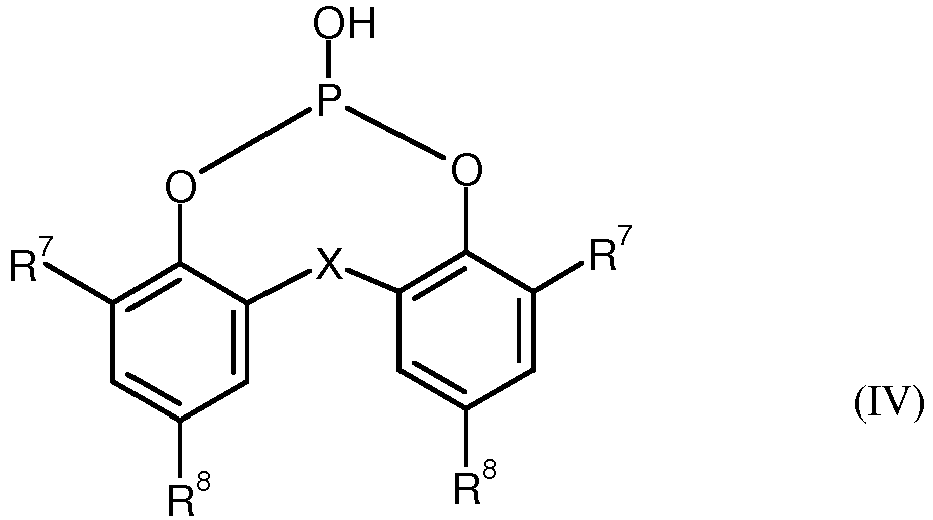
- R7 und R8
- gleich oder verschieden sind und für C1-C9-Alkyl, C5-C6-Cycloalkyl, C7-C9-Aralkyl oder C6-C10-Aryl stehen und
- X
- für -S- oder R9-CH mit R9 für Wasserstoff, C1-C6-Alkyl oder C5-C6-Cycloalkyl steht.
- Die Phosphorigsäureester der Formel (IV) können in bekannter Weise hergestellt werden durch Umsetzung von Triphenylphosphit mit entsprechenden Dihydroxyverbindungen in Gegenwart von Wasser (vgl. z.B.
DE-A 29 29 229 ). - Unter den Verbindungen der Formel (IV) ist besonders bevorzugt der Phosphorigsäureester, worin X für Methylen, R7 für Cyclohexyl und R8 für Methyl stehen (Formel (V)).

- Besonders bevorzugt werden als Komponente B Ethylendiamintetraessigsäure (EDTA) oder die Verbindung gemäß Formel (V) eingesetzt, am meisten bevorzugt die Verbindung gemäß Formel (V).
- Bei der Komponente C handelt es sich um eine anorganische, d.h. Kohlenstoff-freie saure Phosphorverbindung. Beispiele für solche erfindungsgemäßen Phosphorverbindungen sind Phosphorsäure, phosphorige Säure und Phosphinsäure und deren Oligomere, Polymere sowie sauer wirkende Salze.
- Als Komponente C kommt bevorzugt phosphorige Säure (H3PO3) zum Einsatz.
- Weiter bevorzugt wird H3PO3 als Feststoff mit einem Wassergehalt von nicht mehr als 5 Gew.-%, besonders bevorzugt von nicht mehr als 2 Gew.-% eingesetzt.
- In einer weiter bevorzugten Ausführungsform wird H3PO3 mit einem Wassergehalt von 0,01 bis 5 Gew.-%, am meisten bevorzugt mit einem Wassergehalt von 0,05 bis 2 Gew.-% eingesetzt.
- Die Komponente D besteht aus D1 und/oder D2 sowie optional zusätzlich D3.
- Bei der Komponente D1 handelt es sich um Pfropfpolymerisate, hergestellt im Emulsionspolymersiationsverfahren, von
- D1.1) 5 bis 95 Gew.-%, vorzugsweise 10 bis 70 Gew.-%, besonders bevorzugt 20 bis 60 Gew.-%, bezogen auf die Komponente D1, einer Mischung aus
- D1.1.1) 65 bis 85 Gew.-%, bevorzugt 70 bis 80 Gew.-%, bezogen auf D1.1, mindestens eines Monomeren ausgewählt aus der Gruppe der Vinylaromaten (wie beispielsweise Styrol, α-Methylstyrol), kernsubstituierten Vinylaromaten (wie beispielsweise p-Methylstyrol, p-Chlorstyrol) und Methacrylsäure-(C1-C8)-Alkylester (wie beispielsweise Methylmethacrylat, Ethylmethacrylat) und
- D1.1.2) 15 bis 35 Gew.-%, bevorzugt 20 bis 30 Gew.-%, bezogen auf D1.1, mindestens eines Monomeren ausgewählt aus der Gruppe der Vinylcyanide (wie beispielsweise ungesättigte Nitrile wie Acrylnitril und Methacrylnitril), (Meth)Acrylsäure-(C1-C8)-Alkylester (wie beispielsweise Methylmethacrylat, n-Butylacrylat, tert.-Butylacrylat) und Derivate (wie beispielsweise Anhydride und Imide) ungesättigter Carbonsäuren (beispielsweise Maleinsäureanhydrid und N-Phenyl-Maleinimid)
auf
D1.2) 95 bis 5 Gew.-%, vorzugsweise 90 bis 30 Gew.-%, besonders bevorzugt 80 bis 40 Gew.-%, bezogen auf die Komponente D1, wenigstens einer Pfropfgrundlage. - Die Pfropfgrundlage hat bevorzugt eine Glasübergangstemperatur < 0°C, weiter bevorzugt < - 20°C, besonders bevorzugt <-60°C.
- Glasübergangstemperaturen werden, soweit in der vorliegenden Erfindung nicht anders angegeben, mittels dynamischer Differenzkalorimetrie (DSC) gemäß der Norm DIN EN 61006 bei einer Heizrate von 10 K/min mit Definition der Tg als Mittelpunkttemperatur (Tangentenmethode) und Stickstoff als Schutzgas bestimmt.
- Die Pfropfpartikel in der Komponente D1 weisen bevorzugt eine mittlere Teilchengröße (D50-Wert) von 0,1 bis 0,8 µm, vorzugsweise von 0,15 bis 0,6 µm, besonders bevorzugt von 0,2 bis 0,5 µm auf.
- Die mittlere Teilchengröße D50 ist der Durchmesser, oberhalb und unterhalb dessen jeweils 50 Gew.-% der Teilchen liegen.
- Die Pfropfpartikelteilchengrößenverteilung und daraus abgeleitete Werte werden mittels Ultrazentrifugenmessung (W. Scholtan, H. Lange, Kolloid, Z. und Z. Polymere 250 (1972), 782-796) bestimmt.
- In bevorzugter Ausführungsform enthält das Emulsionspfropfpolymerisat gemäß Komponente D1 weniger als 15 Gew.-%, besonders bevorzugt weniger als 10 Gew.-%, ganz besonders bevorzugt weniger als 5 Gew.-%, bezogen auf den Gelanteil des Polymerisats, Pfropfpartikel mit einem Partikeldurchmesser von über 800 nm.
- Bevorzugte Monomere D1.1.1 sind ausgewählt aus mindestens einem der Monomere Styrol, α-Methylstyrol und Methylmethacrylat, bevorzugte Monomere D1.1.2 sind ausgewählt aus mindestens einem der Monomere Acrylnitril, Maleinsäureanhydrid und Methylmethacrylat.
- Besonders bevorzugte Monomere sind D1.1.1 Styrol und D1.1.2 Acrylnitril.
- Für die Pfropfpolymerisate D1 geeignete Pfropfgrundlagen D1.2 sind beispielsweise Dienkautschuke, Dien-Vinyl-Blockcopolymer-Kautschuke, EP(D)M-Kautschuke, also solche auf Basis Ethylen/Propylen und gegebenenfalls Dien, Acrylat-, Polyurethan-, Silikon-, Chloropren- und Ethylen/Vinylacetat-Kautschuke sowie Mischungen aus solchen Kautschuken bzw. Silikon-Acrylat-Kompositkautschuke, in denen die Silikon- und die Acrylatkomponenten chemisch miteinander (z.B. durch Pfropfung) verbunden sind oder sich so gegenseitig durchdringen, dass sie sich nicht wesentlich voneinander trennen lassen.
- Bevorzugte Pfropfgrundlagen D1.2 sind Dienkautschuke (z.B. auf Basis von Butadien oder Isopren), Dien-Vinyl-Blockcopolymer-Kautschuke (z.B. auf Basis von Butadien- und Styrolblöcken), Copolymerisate von Dienkautschuken mit weiteren copolymerisierbaren Monomeren (z.B. gemäß D1.1.1 und D1.1.2) und Mischungen aus den zuvor genannten Kautschuktypen. Besonders bevorzugt sind reiner Polybutadienkautschuk und Styrol-Butadien-Blockcopolymerkautschuk.
- Der Gelanteil der Pfropfpolymerisate beträgt mindestens 15 Gew.-%, bevorzugt mindestens 60 Gew.-%, besonders bevorzugt mindestens 75 Gew.-% (gemessen in Aceton).
- Der Gelgehalt der Pfropfpolymerisate wird, soweit in der vorliegenden Erfindung nicht anders angegeben, bei 25°C als in Aceton als Lösungsmittel unlöslicher Anteil bestimmt (M. Hoffmann, H. Krömer, R. Kuhn, Polymeranalytik I und II, Georg Thieme-Verlag, Stuttgart 1977).
- Die Pfropfpolymerisate D1 werden hergestellt durch radikalische Polymerisation.
- Das Pfropfpolymerisat D1 umfasst herstellungsbedingt im Allgemeinen freies, d.h. nicht chemisch an die Kautschukgrundlage gebundenes Copolymerisat aus D1.1.1 und D1.1.2, das in geeigneten Lösungsmitteln (z.B. Aceton) löslich ist.
- Bei der Komponente D2 handelt es sich um Pfropfpolymerisate, hergestellt im Masse-, Lösungs- oder Suspensionspolymerisationsverfahren, von
D2.1) 5 bis 95 Gew.-%, vorzugsweise 80 bis 93 Gew.-%, besonders bevorzugt 85 bis 92 Gew.-%, ganz besonders bevorzugt 87 bis 93 Gew.-%, bezogen auf die Komponente D2, einer Mischung aus
D2.1.1) 65 bis 85 Gew.-%, bevorzugt 70 bis 80 Gew.-%, bezogen auf die Mischung D.2.1, mindestens eines Monomeren ausgewählt aus der Gruppe der Vinylaromaten (wie beispielsweise Styrol, α-Methylstyrol), kernsubstituierten Vinylaromaten (wie beispielsweise p-Methylstyrol, p-Chlorstyrol) und Methacrylsäure-(C1-C8)-Alkylester (wie beispielsweise Methylmethacrylat, Ethylmethacrylat) und
D2.1.2) 15 bis 35 Gew.-%, bevorzugt 20 bis 30 Gew.-% bezogen auf die Mischung D2.1, mindestens eines Monomeren ausgewählt aus der Gruppe der Vinylcyanide (wie beispielsweise ungesättigte Nitrile wie Acrylnitril und Methacrylnitril), (Meth)Acrylsäure-(C1-C8)-Alkylester (wie beispielsweise Methylmethacrylat, n-Butylacrylat, tert.-Butylacrylat) und Derivate (wie beispielsweise Anhydride und Imide) ungesättigter Carbonsäuren (beispielsweise Maleinsäureanhydrid und N-Phenyl-Maleinimid)
auf D2.2) 95 bis 5 Gew.-%, vorzugsweise 20 bis 7 Gew.-%, besonders bevorzugt 15 bis 8 Gew.-%, ganz besonders bevorzugt 13 bis 7 Gew.-%, bezogen auf die Komponente D2, wenigstens einer Pfropfgrundlage. - Die Pfropfgrundlage hat vorzugsweise eine Glasübergangstemperatur < 0°C, bevorzugt < -20°C, besonders bevorzugt < -60°C.
- Die Pfropfpartikel in der Komponente D2 weisen bevorzugt eine mittlere Teilchengröße (D50-Wert) von 0,1 bis 2 µm, vorzugsweise von 0,2 bis 1 µm, besonders bevorzugt von 0,3 bis 0,7 µm auf.
- Die Pfropfpartikelteilchengrößenverteilung und daraus abgeleitete Werte werden mittels Ultrazentrifugenmessung (W. Scholtan, H. Lange, Kolloid, Z. und Z. Polymere 250 (1972), 782-796) bestimmt.
- In bevorzugter Ausführungsform enthält das Pfropfpolymerisat gemäß Komponente D2 weniger als 40 Gew.-%, besonders bevorzugt weniger als 30 Gew.-%, insbesondere weniger als 20 Gew.-%, bezogen auf den Gelanteil des Pfropfpolymersiats, Pfropfpartikel mit einem Partikeldurchmesser von über 800 nm.
- Bevorzugte Monomere D2.1.1 sind ausgewählt aus mindestens einem der Monomere Styrol, α-Methylstyrol und Methylmethacrylat, bevorzugte Monomere D2.1.2 sind ausgewählt aus mindestens einem der Monomere Acrylnitril, Maleinsäureanhydrid und Methylmethacrylat.
- Besonders bevorzugte Monomere sind D2.1.1 Styrol und D2.1.2 Acrylnitril.
- Bevorzugte Pfropfgrundlagen D2.2 sind Dienkautschuke (z.B. auf Basis von Butadien oder Isopren), Dien-Vinyl-Blockcopolymer-Kautschuke (z.B. auf Basis von Butadien- und Styrolblöcken), Copolymerisate von Dienkautschuken mit weiteren copolymerisierbaren Monomeren (z.B. gemäß D2.1.1 und D2.1.2) und Mischungen aus den zuvor genannten Kautschuktypen. Besonders bevorzugt als Pfropfgrundlage D2.2 sind Polybutadienkautschuk, Styrol-Butadien-Blockcopolymerkautschuke und Mischungen von Styrol-Butadien-Blockcopolymerkautschuken mit Polybutadienkautschuk.
- Der Gelanteil der Pfropfpolymerisate D2 beträgt vorzugsweise 10 bis 40 Gew.-%, besonders bevorzugt 15 bis 30 Gew.-%, ganz besonders bevorzugt 17 bis 23 Gew.-% (gemessen in Aceton).
- Besonders bevorzugte Polymerisate D2 sind z.B. ABS-Polymerisate hergestellt durch radikalische Polymerisation, welche in bevorzugter Ausführungsform bis zu 10 Gew.-%, besonders bevorzugt bis zu 5 Gew.-%, besonders bevorzugt 2 bis 5 Gew.-%, jeweils bezogen auf das Pfropfpolymerisat D2, an n-Butylacrylat enthalten.
- Das Pfropfpolymerisat D2 umfasst im Allgemeinen herstellungsbedingt freies, d.h. nicht chemisch an die Kautschukgrundlage gebundenes Copolymerisat aus D2.1.1 und D2.1.2, welches sich dadurch auszeichnet, dass es in geeigneten Lösungsmittel (z.B. Aceton) gelöst werden kann.
- Bevorzugt enthält die Komponente D2 freies Copolymerisat aus D2.1.1 und D2.1.2, welches ein gewichtsgemitteltes Molekulargewicht (Mw), bestimmt per Gelpermeationschromatographie mit Polystyrol als Standard, von bevorzugt 50000 bis 200000 g/mol, besonders bevorzugt von 70000 bis 160000 g/mol, besonders bevorzugt von 80000 bis 120000 g/mol aufweist.
- Bei Komponente D3 handelt es sich um (Co)Polymerisate aus mindestens einem Monomeren aus der Gruppe der Vinylaromaten, Vinylcyanide (ungesättigte Nitrile), (Meth)Acrylsäure-(C1 bis C8)-Alkylester, ungesättigte Carbonsäuren sowie Derivate (wie Anhydride und Imide) ungesättigter Carbonsäuren.
- Insbesondere geeignet sind als Komponente D3 (Co)Polymerisate aus
D3.1 50 bis 99 Gew.-%, bevorzugt 65 bis 85 Gew.-%, besonders bevorzugt 70 bis 80 Gew.-% bezogen auf das (Co)Polymerisat D3 mindestens eines Monomeren ausgewählt aus der Gruppe der Vinylaromaten (wie beispielsweise Styrol, α-Methylstyrol), kernsubstituierten Vinylaromaten (wie beispielsweise p-Methylstyrol, p-Chlorstyrol) und (Meth)Acrylsäure-(C1-C8)-Alkylester (wie beispielsweise Methylmethacrylat, n-Butylacrylat, tert.-Butylacrylat) und
D3.2 1 bis 50 Gew.-%, bevorzugt 15 bis 35 Gew.-%, besonders bevorzugt 20 bis 30 Gew.-% bezogen auf das (Co)Polymerisat D3 mindestens eines Monomeren ausgewählt aus der Gruppe der Vinylcyanide (wie beispielsweise ungesättigte Nitrile wie Acrylnitril und Methacrylnitril), (Meth)Acrylsäure-(C1-C8)-Alkylester (wie beispielsweise Methylmethacrylat, n-Butylacrylat, tert.-Butylacrylat), ungesättigte Carbonsäuren und Derivate ungesättigter Carbonsäuren (beispielsweise Maleinsäureanhydrid und N-Phenyl-Maleinimid). - Diese (Co)Polymerisate D3 sind harzartig, thermoplastisch und kautschukfrei. Besonders bevorzugt ist das Copolymerisat aus D3.1 Styrol und D3.2 Acrylnitril.
- Derartige (Co)Polymerisate D3 sind bekannt und lassen sich durch radikalische Polymerisation, insbesondere durch Emulsions-, Suspensions-, Lösungs- oder Massepolymerisation herstellen. Die (Co)Polymerisate D3 besitzen ein gewichtsgemitteltes Molekulargewicht (Mw), bestimmt per Gelpermeationschromatographie mit Polystyrol als Standard, von bevorzugt 50000 bis 200000 g/mol, besonders bevorzugt von 70000 bis 150000 g/mol, besonders bevorzugt von 80000 bis 120000 g/mol.
- Die erfindungsgemäß als Komponente E in Frage kommenden Polyester sind aliphatische oder aromatische Polyester, bevorzugt aromatische Polyester und in besonders bevorzugter Ausführungsform Polyalkylenterephthalate. Es handelt sich hierbei in besonders bevorzugter Ausführungsform um Reaktionsprodukte aus aromatischen Dicarbonsäuren oder ihren reaktionsfähigen Derivaten, wie Dimethylestern oder Anhydriden, und aliphatischen, cycloaliphatischen oder araliphatischen Diolen sowie Mischungen dieser Reaktionsprodukte.
- Besonders bevorzugte Polyalkylenterephthalate enthalten mindestens 80 Gew.-%, vorzugsweise mindestens 90 Gew.-%, bezogen auf die Dicarbonsäurekomponente Terephthalsäurereste und mindestens 80 Gew.-%, vorzugsweise mindestens 90 Gew-%, bezogen auf die Diolkomponente Ethylenglykol- und/oder Butandiol-1,4-Reste.
- Die bevorzugten Polyalkylenterephthalate können neben Terephthalsäureresten bis zu 20 mol-%, vorzugsweise bis zu 10 mol-%, Reste anderer aromatischer oder cycloaliphatischer Dicarbonsäuren mit 8 bis 14 C-Atomen oder aliphatischer Dicarbonsäuren mit 4 bis 12 C-Atomen enthalten, wie z.B. Reste von Phthalsäure, Isophthalsäure, Naphthalin-2,6-dicarbonsäure, 4,4'-Diphenyldicarbonsäure, Bernsteinsäure, Adipinsäure, Sebacinsäure, Azelainsäure, Cyclohexandiessigsäure.
- Die bevorzugten Polyalkylenterephthalate können neben Ethylenglykol- bzw. Butandiol-1,4-Resten bis zu 20 mol-%, vorzugsweise bis zu 10 mol-%, andere aliphatische Diole mit 3 bis 12 C-Atomen oder cycloaliphatische Diole mit 6 bis 21 C-Atomen enthalten, z.B. Reste von Propandiol-1,3, 2-Ethylpropandiol-1,3, Neopentylglykol, Pentandiol-1,5, Hexandiol-1,6, Cyclohexan-dimethanol-1,4, 3-Ethylpentandiol-2,4, 2-Methylpentandiol-2,4, 2,2,4-Trimethylpentandiol-1,3, 2-Ethylhexandiol-1,3, 2,2-Diethylpropandiol-1,3, Hexandiol-2,5, 1,4-Di-(β-hydroxyethoxy)-benzol, 2,2-Bis-(4-hydroxycyclohexyl)-propan, 2,4-Dihydroxy-1,1,3,3-tetramethyl-cyclobutan, 2,2-Bis-(4-β-hydroxyethoxy-phenyl)-propan und 2,2-Bis-(4-hydroxypropoxyphenyl)-propan (
DE-A 2 407 674 ,2 407 776 ,2 715 932 ). - Die Polyalkylenterephthalate können durch Einbau relativ kleiner Mengen 3- oder 4-wertiger Alkohole oder 3- oder 4-basischer Carbonsäuren, z.B. gemäß
DE-A 1 900 270 und US-PS3 692 744 , verzweigt werden. Beispiele bevorzugter Verzweigungsmittel sind Trimesinsäure, Trimellithsäure, Trimethylolethan und -propan und Pentaerythrit. - Besonders bevorzugt sind Polyalkylenterephthalate, die allein aus Terephthalsäure und deren reaktionsfähigen Derivaten (z.B. deren Dialkylestern) und Ethylenglykol und/oder Butandiol-1,4 hergestellt worden sind, und Mischungen dieser Polyalkylenterephthalate.
- Mischungen von Polyalkylenterephthalaten enthalten 1 bis 50 Gew.-%, vorzugsweise 1 bis 30 Gew.-%, Polyethylenterephthalat und 50 bis 99 Gew.-%, vorzugsweise 70 bis 99 Gew.-%, Polybutylenterephthalat.
- Die vorzugsweise verwendeten Polyalkylenterephthalate besitzen bevorzugt eine Viskositätszahl von 0,4 bis 1,5 dl/g, vorzugsweise 0,5 bis 1,2 dl/g, gemessen in Phenol/o-Dichlorbenzol (1:1 Gewichtsteile) in einer Konzentration von 0,05g/ml gemäß ISO 307 bei 25°C im Ubbelohde-Viskosimeter. Die Polyalkylenterephthalate lassen sich nach bekannten Methoden herstellen (s. z.B. Kunststoff-Handbuch, Band VIII, S. 695 ff., Carl-Hanser-Verlag, München 1973).
- Als Komponente F können ein oder mehrere weitere von den Komponenten A, B, C, D und E verschiedene Additive eingesetzt werden, bevorzugt ausgewählt aus der Gruppe bestehend aus Flammschutzmitteln (z.B. organische Phosphor- oder Halogenverbindungen, insbesondere Bisphenol-A basierendes Oligophosphat), Antidrippingmitteln (beispielsweise Verbindungen der Substanzklassen der fluorierten Polyolefine, der Silikone sowie Aramidfasern), Flammschutzsynergisten (beispielsweise nanoskalige Metalloxide), Rauchinhibitoren (beispielsweise Zinkborat), Gleit- und Entformungsmitteln (beispielsweise Pentaerythrittetrastearat), Nukleiermitteln, Antistatika, Leitfähigkeitsadditiven, Stabilisatoren (z.B. Hydrolyse-, Wärmealterungs- und UV-Stabilisatoren sowie Umesterungsinhibitoren), Fließfähigkeitspromotoren, Verträglichkeitsvermittlern, weiteren Schlagzähigkeitsmodifikatoren, weiteren polymeren Bestandteilen (beispielsweise funktionelle Blendpartner), Füll- und Verstärkungsstoffen (beispielsweise Karbonfasern, Talk, Glimmer, Kaolin, CaCO3) sowie Farbstoffen und Pigmenten (beispielsweise Titandioxid oder Eisenoxid).
- In bevorzugter Ausführungsform wird mindestens ein Polymeradditiv ausgewählt aus der Gruppe bestehend aus Gleit- und Entformungsmitteln, Stabilisatoren, Fließfähigkeitspromotoren, Verträglichkeitsvermittlern, weiteren von Komponente D verschiedenen Schlagzähigkeitsmodifikatoren, weiteren polymeren Bestandteilen, Farbstoffen und Pigmenten, eingesetzt.
- In besonders bevorzugter Ausführungsform wird mindestens ein Polymeradditiv ausgewählt aus der Gruppe bestehend aus Gleit- und Entformungsmitteln, Stabilisatoren, Fließfähigkeitspromotoren, Verträglichkeitsvermittlern, weiteren von Komponente D verschiedenen Schlagzähigkeitsmodifikatoren, weiteren polymeren Bestandteilen, Farbstoffen und Pigmenten und keine weitere Polymeradditive eingesetzt.
- In bevorzugter Ausführungsform wird als Entformungsmittel Pentaerythrittetrastearat eingesetzt.
- In bevorzugter Ausführungsform wird als Stabilisator mindestens ein Vertreter ausgewählt aus der Gruppe bestehend aus sterisch gehinderten Phenolen, organischen Phosphiten und Schwefelbasierten Co-Stabilisatoren eingesetzt.
- In besonders bevorzugter Ausführungsform wird als Stabilisator mindestens ein Vertreter ausgewählt aus der Gruppe bestehend aus Octadecyl 3-(3,5-di-tert-butyl-4-hydroxyphenyl) propionat und Tris(2,4-di-tert-butylphenyl)phosphit eingesetzt.
- In speziell bevorzugter Ausführungsform wird als Stabilisator eine Kombination aus Octadecyl 3-(3,5-di-tert-butyl-4-hydroxyphenyl)propionat und Tris(2,4-di-tert-butylphenyl)phosphit eingesetzt.
- In einer weiter bevorzugten Ausführungsform wird als Entformungsmittel Pentaerythrittetrastearat, als Stabilisator eine Kombination aus Octadecyl 3-(3,5-di-tert-butyl-4-hydroxyphenyl)propionat und Tris(2,4-di-tert-butylphenyl)phosphit optional mindestens ein Pigment oder Farbmittel und keine weiteren Polymeradditive eingesetzt.
- Die nach dem erfindungsgemäßen Verfahren hergestellten Zusammensetzungen (Formmassen) können zur Herstellung von Formkörpern jeder Art verwendet werden. Diese können beispielsweise durch Spritzguss, Extrusion und Blasformverfahren hergestellt werden. Eine weitere Form der Verarbeitung ist die Herstellung von Formkörpern durch Tiefziehen aus zuvor hergestellten Platten oder Folien.
- Beispiele für solche Formkörper sind Folien, Profile, Gehäuseteile jeder Art, z.B. für Haushaltsgeräte wie Saftpressen, Kaffeemaschinen, Mixer; für Büromaschinen wie Monitore, Flatscreens, Notebooks, Drucker, Kopierer; Platten, Rohre, Elektroinstallationskanäle, Fenster, Türen und weitere Profile für den Bausektor (Innenausbau und Außenanwendungen) sowie Elektro- und Elektronikteile wie Schalter, Stecker und Steckdosen und Bauteile für Nutzfahrzeuge, insbesondere für den Automobilbereich. Die erfindungsgemäßen Zusammensetzungen eignen sich auch zur Herstellung von folgenden Formkörpern oder Formteilen: Innenausbauteile für Schienenfahrzeuge, Schiffe, Flugzeuge, Busse und andere Kraftfahrzeuge, Karosserieteile für Kraftfahrzeuge, Gehäuse von Kleintransformatoren enthaltenden Elektrogeräten, Gehäuse für Geräte zur Informationsverarbeitung und -Übermittlung, Gehäuse und Verkleidung von medizinischen Geräten, Massagegeräte und Gehäuse dafür, Spielfahrzeuge für Kinder, flächige Wandelemente, Gehäuse für Sicherheitseinrichtungen, wärmeisolierte Transportbehältnisse, Formteile für Sanitär- und Badausrüstungen, Abdeckgitter für Lüfteröffnungen und Gehäuse für Gartengeräte.
- Die nach dem erfindungsgemäßen Verfahren hergestellten Zusammensetzungen eignen sich besonders auch zur Herstellung von Formkörpern oder Formteilen mit Class-A-Oberflächen-Anforderung und Hochglanz-Finish, welche gegebenenfalls partiell oder vollständig einem weiteren Oberflächenbehandlungsschritt durch beispielsweise Lackierung, Folienhinterspritzung, Metallisierung durch Vakuumbedampfung oder Galvanisierung unterzogen werden können.
- Unter "hochglänzend" verstanden wird im Sinne der vorliegenden Erfindung ein Glanzgrad ermittelt in Reflexion gemäß DIN 67530 bei einem Messwinkel von 60° von mindestens 95, bevorzugt von mindestens 97, besonders bevorzugt von mindestens 99. Gegenstand der Erfindung sind somit auch Formkörper oder Formteile enthaltend mindestens eine der erfindungsgemäßen Zusammensetzungen mit vollständigem oder partiellen Hochglanz-Finish, welche gegebenenfalls partiell oder vollständig einem weiteren Oberflächenbehandlungsschritt durch beispielsweise Lackierung, Folienhinterspritzung, Metallisierung durch Vakuumbedampfung oder Galvanisierung unterzogen wurden.
- Gegenstand der Erfindung sind auch die nach dem erfindungsgemäßen Verfahren hergestellten Zusammensetzungen und auch Formkörper oder Formteile enthaltend nach dem erfindungsgemäßen Verfahren hergestellte Zusammensetzungen.
- Eingesetzte Komponenten:
- Lineares Polycarbonat auf Basis Bisphenol-A mit einem gewichtsgemittelten Molekulargewicht Mw von 25500 g/mol (bestimmt durch Gelpermeationschromatographie (GPC) in Methylchlorid als Lösungsmittel und mit Polycarbonat als Standard).
- Phosphorigsäureester des Bis-(2-hydroxy-3-cyclohexyl-5-methyl-phenyl)-methans

- Phosphorige Säure (99 %), Sigma-Aldrich Chemie GmbH
- ABS-Abmischung mit einem Verhältnis von Acrylnitril : Butadien : Styrol, bezogen auf die Abmischung, von 19:24:57 Gew.-%, enthaltend ein in Emulsionspolymerisation hergestelltes, unter Verwendung von Magnesiumsulfat gefälltes, in basischem Milieu aufgearbeitetes und basische Verunreinigungen sowie Magnesiumsulfat enthaltendes ABS-Polymerisat gemäß Komponente D1, ein in Massepolymerisation hergestelltes ABS-Polymerisat gemäß Komponente D2 und ein SAN-Polymerisat gemäß Komponente D3.
- Pentaerythrittetrastearat als Gleit-/Entformungsmittel
- Thermostabilisator, Irganox® B900 (Gemisch aus 80% Irgafos® 168 (Tris(2,4-di-tert-butyl-phenyl)-phosphit) und 20% Irganox® 1076 (2,6-Di-tert-butyl-4-(octadecanoxycarbonylethyl)-phenol); BASF (Ludwigshafen, Deutschland)
- Thermostabilisator, Irganox® 1076 (2,6-Di-tert-butyl-4-(octadecanoxycarbonylethyl)-phenol); BASF (Ludwigshafen, Deutschland)
- Ruß, Black Pearls 800, Cabot Corporation (USA)
- Im ersten Verfahrensschritt (i) wurden die Komponenten A, B, C, D und F in die Einzugszone eines Zweiwellenextruders (ZSK133SC) der Fa. Coperion, Werner & Pfleiderer (Stuttgart, Deutschland) gegeben, mit einem spezifischen Energieeintrag am Extruderantrieb von 145 Wh/kg in der Aufschmelze- und Knetzone des Extruders auf eine Temperatur von ca. 300°C gebracht und dadurch aufgeschmolzen, bei dieser Temperatur geknetet und dadurch die plastifizierten Komponenten ineinander dispergiert. Dabei wurden eine Drehzahl von 355 min-1 und ein Durchsatz von 5000 kg/h verwendet. Die so compoundierte Mischung wurde in der folgenden Entgasungszone des Extruders durch Anlegen eines Unterdrucks von 200 mbar (absolut) an die Schmelze entgast. Im zweiten und dritten Verfahrensschritt (ii) und (iii) wurde die entgaste Schmelze über eine Düse aus dem Extruder mit einer Temperatur von ca. 300°C ausgetragen und durch Unterwassergranulation granuliert, abgekühlt und dadurch verfestigt.
- Die Beurteilung der Neigung zur Ausbildung oberflächiger Defekte mit Bläschentopologie (Blistering) erfolgte an Platten der Abmessung 150 mm x 105 mm x 3,2 mm, die auf einer Spritzgussmaschine (Fa. Arburg) bei einer Schmelzetemperatur von 260°C und einer Werkzeugtemperatur von 80°C hergestellt wurden. Hierbei kam ein beidseitig hochglanzpoliertes Spritzgusswerkzeug zum Einsatz. Die so hergestellten Platten wiesen vor der Wärme-Feucht-Lagerung keinerlei oberflächige Defekte mit Bläschentopologie auf. Das Blistering wurde visuell ohne Verwendung vergrößernder technischer Hilfsmittel (Mikroskope, Lupen, etc.) beurteilt nach einer dreitägigen Feucht-Warm-Lagerung dieser Platten bei 40°C und einer relativen Luftfeuchte von >95%. Dabei wurden alle visuell sichtbaren Bläschen-Defekte auf beiden Seiten von insgesamt zwei Platten mit den zuvor definierten Abmessungen (d.h. auf einer effektiven Oberfläche von 4 · 15 cm ·10,5 cm = 630 cm2) ausgezählt. Unter dieser rein visuellen Begutachtung ohne vergrößernde technische Hilfsmittel werden der Erfahrung nach alle Defekte mit einem Durchmesser ab etwa 100-200 µm berücksichtigt.
- Der MVR dient als Maß für etwaigen Polycarbonatmolekulargewichtsabbau bei der thermischen Belastung während der Compoundierung und wurde an den durch Compoundierung hergestellten Pellets nach Trocknung bei 100°C für 4 h in einem Umlufttrockner nach ISO1133 bei einer Schmelzetemperatur von 300°C mit einer Stempellast von 2,16 kg nach einer Haltezeit von 5 min ermittelt.
- Der iMVR wurde unter denselben Bedingungen wie der MVR, jedoch mit verlängerter Haltezeit von 15 min bestimmt. Die Differenz aus iMVR und MVR dient als Indikation für einen bei hohen Schmelzetemperaturen im Spritzguss zu erwartenden, thermisch induzierten Polycarbonatmolekulargewichtsabbau und somit als Maß für die Verarbeitungsstabilität im Spritzguss.

- Die Beispiele in Tabelle 1 zeigen, dass nur das erfindungsgemäße Verfahren (Beispiel 2), bei dem eine Kombination aus organischer saurer Verbindung und einer im Vergleich zur Einsatzkonzentration der organischen sauren Verbindung relativ kleinen Menge einer anorganischen sauren Verbindung zum Einsatz kam, zu den gewünschten Eigenschaften führt. Überraschend ist hier insbesondere, dass trotz geringerer Einsatzkonzentration an sowohl organischer Säure gegenüber Vergleichsbeispiel V1 und anorganischer Säure gegenüber Vergleichsbeispiel V3 sowie auch einer geringeren Säuregesamtkonzentration gegenüber beiden Vergleichsbeispielen V1 und V3 eine gute thermische Stabilität resultiert.
- Das Verfahren unter Verwendung von ausschließlich organischer Säure (V1) führt zu erhöhtem thermisch induzierten Polycarbonatmolekulargewichtsabbau schon während der Compoundierung, obwohl bereits eine höhere Konzentration an Säure als in dem erfindungsgemäßen Beispiel 2 zum Einsatz kommt. Die in dem erfindungsgemäßen Beispiel 2 eingesetzte Menge an organischer Säure reicht insofern allein nicht zur Inhibierung des thermisch induzierten Polycarbonatmolekulargewichtsabbaus während der Compoundierung aus.
- Die Verwendung von ausschließlich anorganischer Säure (V3) führt zu mangelhaftem Blistering-Verhalten selbst bei sehr kleiner Einsatzmenge. Diese wurde so gewählt, dass sie in der gewählten Zusammensetzung gerade noch ausreichend ist, den thermisch induzierten Polycarbonatmolekulargewichtsabbau während der Compoundierung und bei der weiteren thermischen Verarbeitung sicher zu inhibieren.
Claims (15)
- Verfahren zur Herstellung von schlagzähmodifizierten Polycarbonat-Zusammensetzungen enthaltend die Schritte (i), (ii) und optional (iii), wobei(i) in einem ersten Schrittwobei das Verhältnis der Gewichtsanteile der im Verfahrensschritt (i) eingesetzten Komponenten B zu C im Bereich von 2 bis 100 liegt,A) 10 bis 98 Gew.-Teile mindestens eines Polymers ausgewählt aus der Gruppe der aromatischen Polycarbonate und aromatischen Polyestercarbonate,B) 0,001 bis 0,3 Gew.- Teile mindestens einer organischen, Brönsted-Säure,C) 0,0001 bis 0,004 Gew-Teile mindestens einer anorganischen, brönsted-sauren Phosphorverbindung,D) 1 bis 90 Gew.-Teile mindestens eines kautschukhaltigen Vinyl(co)polymerisats,E) optional bis zu 90 Gew.-Teile mindestens eines Polyesters,F) optional bis zu 30 Gew.-Teile mindestens eines Additivs,
durch Zuführung thermischer und/oder mechanischer Energie aufgeheizt, mindestens die Komponenten A) und D) dadurch aufgeschmolzen und alle eingesetzten Komponenten dadurch miteinander vermischt, ineinander gelöst oder ineinander dispergiert werden,
und
in einem weiteren Schritt (ii)
die aus Verfahrensschritt (i) resultierende Schmelze (ii) durch Abkühlen wieder verfestigt und (iii) optional granuliert wird,
wobei die Verfahrensschritte (ii) und (iii) in beliebiger Reihenfolge zueinander durchgeführt werden können. - Verfahren gemäß Anspruch 1, dadurch gekennzeichnet, dass die Komponente B im Schritt (i) in einem Anteil von 0,01 bis 0,1 Gew.- Teilen bezogen auf die Summe der Gewichtsteile der Komponenten A bis F zum Einsatz kommt.
- Verfahren gemäß Anspruch 1 oder 2, dadurch gekennzeichnet, dass die Komponente C im Schritt (i) in einem Anteil von 0,002 bis 0,004 Gew.-Teile bezogen auf die Summe der Gewichtsteile der Komponenten A bis F zum Einsatz kommt.
- Verfahren gemäß einem der vorherigen Ansprüche, dadurch gekennzeichnet, dass das Verhältnis der Komponenten B zu C im Bereich von 8 bis 30 liegt.
- Verfahren gemäß einem der vorherigen Ansprüche, dadurch gekennzeichnet, dass Komponente A in einem Anteil von 50 bis 80 Gew.-Teilen, Komponente B in einem Anteil von 0,02 bis 0,07 Gew.- Teilen, Komponente C in einem Anteil von 0,002 bis 0,004 Gew.-Teilen, Komponente D in einem Anteil von 7 bis 50 Gew.-Teilen, Komponente E in einem Anteil von 0 bis 50 Gew.-Teilen und Komponente F in einem Anteil von 0,2 bis 10 Gew.-Teilen zum Einsatz kommen.
- Verfahren gemäß einem der vorherigen Ansprüche, dadurch gekennzeichnet, dass die Komponente B ausgewählt ist aus der Gruppe bestehend aus Ethylendiamintetraessigsäure (EDTA), Nitriloessigsäure, Ethylenglycol-bis(aminoethylether)-N,N,N',N'-tetraessigsäure (EGTA), Diethylentriaminpentaessigsäure (DTPA), Phenylphosphonsäure, p-Toluolsulfonsäure und Substanzen der allgemeinen Formel
 R7 und R8 gleich oder verschieden sind und für C1-C9-Alkyl, C5-C6-Cycloalkyl, C7-C9-Aralkyl oder C6-C10-Aryl stehen undX für -S- oder R9-CH mit R9 für Wasserstoff, C1-C6-Alkyl oder C5-C6-Cycloalkyl steht.
 - Verfahren gemäß einem der vorherigen Ansprüche, dadurch gekennzeichnet, dass als Komponente B der Phosphorigsäurester gemäß folgender Struktur

- Verfahren gemäß einem der Ansprüche 1 bis 6, dadurch gekennzeichnet, dass als Komponente B Ethylendiamintetraessigsäure (EDTA) eingesetzt wird.
- Verfahren gemäß einem der vorherigen Ansprüche, dadurch gekennzeichnet, dass als Komponente C phosphorige Säure (H3PO3) eingesetzt wird.
- Verfahren gemäß einem der vorherigen Ansprüche, dadurch gekennzeichnet, dass Komponente D Magnesiumsulfat oder Calciumchlorid enthält.
- Verfahren gemäß einem der vorherigen Ansprüche, dadurch gekennzeichnet, dass in Schritt (i) mindestens eine Komponente mit Polycarbonat zersetzender Wirkung eingesetzt wird.
- Verwendung von Säuremischungen bestehend aus einer organischen, Brönsted-Säure und einer anorganischen, brönsted-sauren Phosphorverbindung zur Stabilisierung von schlagzähmodifizierten Polycarbonat-Zusammensetzungen, wobei das Gewichtsverhältnis der organischen zur anorganischen Brönsted-Säure im Bereich von 2 bis 100 liegt.
- Zusammensetzungen erhältlich nach einem der Verfahren gemäß den Ansprüchen 1 bis 11.
- Verwendung von Zusammensetzungen gemäß Anspruch 13 zur Herstellung von Formkörpern.
- Formkörper enthaltend eine Zusammensetzung gemäß Anspruch 13.
Applications Claiming Priority (2)
| Application Number | Priority Date | Filing Date | Title |
|---|---|---|---|
| EP15191306 | 2015-10-23 | ||
| PCT/EP2016/075236 WO2017068045A1 (de) | 2015-10-23 | 2016-10-20 | Verfahren zur herstellung von polycarbonat-formmassen mit verbesserter thermischer verarbeitungsstabilität |
Publications (2)
| Publication Number | Publication Date |
|---|---|
| EP3365390A1 EP3365390A1 (de) | 2018-08-29 |
| EP3365390B1 true EP3365390B1 (de) | 2020-06-17 |
Family
ID=54539817
Family Applications (1)
| Application Number | Title | Priority Date | Filing Date |
|---|---|---|---|
| EP16784499.2A Active EP3365390B1 (de) | 2015-10-23 | 2016-10-20 | Verfahren zur herstellung von polycarbonat-formmassen mit verbesserter thermischer verarbeitungsstabilität |
Country Status (5)
| Country | Link |
|---|---|
| US (1) | US10844182B2 (de) |
| EP (1) | EP3365390B1 (de) |
| KR (1) | KR20180075500A (de) |
| CN (1) | CN108137917B (de) |
| WO (1) | WO2017068045A1 (de) |
Families Citing this family (6)
| Publication number | Priority date | Publication date | Assignee | Title |
|---|---|---|---|---|
| DE102017221039B4 (de) * | 2017-11-24 | 2020-09-03 | Tesa Se | Verfahren zur Herstellung einer Haftklebemasse auf Basis von Acrylnitril-Butadien-Kautschuk |
| FR3078068B1 (fr) | 2018-02-16 | 2020-11-06 | Arkema France | Polymere a couches multiples comprenant un fragment comprenant du phosphore, son procede de preparation, son utilisation et composition comprenant celui-ci |
| WO2019190705A1 (en) * | 2018-03-29 | 2019-10-03 | Dow Global Technologies Llc | Bicomponent fiber and polymer composition thereof |
| EP3620485A1 (de) * | 2018-09-04 | 2020-03-11 | Covestro Deutschland AG | Verfahren zur herstellung einer formmasse mit verbesserten eigenschaften |
| WO2021233727A1 (de) * | 2020-05-18 | 2021-11-25 | Covestro Deutschland Ag | Polycarbonat blend mit verringerten störgeräuschen |
| EP4039746A1 (de) * | 2021-02-08 | 2022-08-10 | Covestro Deutschland AG | Polycarbonat-polyester zusammensetzung, formmasse und formkörper mit guter schlagzähigkeit und hoher thermischer belastbarkeit |
Family Cites Families (26)
| Publication number | Priority date | Publication date | Assignee | Title |
|---|---|---|---|---|
| DE1495626B1 (de) | 1960-03-30 | 1971-06-09 | Bayer Ag | Verfahren zum herstellen von polyestern |
| US3419634A (en) | 1966-01-03 | 1968-12-31 | Gen Electric | Organopolysiloxane polycarbonate block copolymers |
| FR1580834A (de) | 1968-01-04 | 1969-09-12 | ||
| DE2232877B2 (de) | 1972-07-05 | 1980-04-10 | Werner & Pfleiderer, 7000 Stuttgart | Verfahren zur Herstellung von Polyestern |
| JPS5039599B2 (de) | 1973-03-30 | 1975-12-18 | ||
| DE2407776A1 (de) | 1974-02-19 | 1975-09-04 | Licentia Gmbh | Schaltung zur regelung der betriebsspannung fuer die transistor-zeilenendstufe eines fernsehempfaengers |
| JPS5292295A (en) | 1976-01-29 | 1977-08-03 | Sumitomo Chem Co Ltd | Preparation of aromatic polyester |
| IT1116721B (it) | 1976-04-02 | 1986-02-10 | Allied Chem | Copolimero bisfenolo a tereftalato carbonato lavorabili in massa fusa |
| DE2715932A1 (de) | 1977-04-09 | 1978-10-19 | Bayer Ag | Schnellkristallisierende poly(aethylen/alkylen)-terephthalate |
| DE2842005A1 (de) | 1978-09-27 | 1980-04-10 | Bayer Ag | Polycarbonate mit alkylphenyl-endgruppen, ihre herstellung und ihre verwendung |
| JPS5594930A (en) | 1979-01-10 | 1980-07-18 | Sumitomo Chem Co Ltd | Preparation of aromatic polyester by improved bulk polymerization process |
| DE2929229A1 (de) | 1979-07-19 | 1981-02-12 | Bayer Ag | Stabilisierte thermoplastische formmassen |
| DE2940024A1 (de) | 1979-10-03 | 1981-04-16 | Bayer Ag, 5090 Leverkusen | Aromatische polyester, verfahren zu ihrer herstellung und ihre verwendung zur herstellung von spritzgussartikeln, folien und ueberzuegen |
| DE3007934A1 (de) | 1980-03-01 | 1981-09-17 | Bayer Ag, 5090 Leverkusen | Aromatische polyestercarbonate, verfahren zu ihrer herstellung und ihre verwendung zur herstellung von spritzgussartikeln, folien und ueberzuegen |
| DE3334782A1 (de) | 1983-04-19 | 1984-10-25 | Bayer Ag, 5090 Leverkusen | Verfahren zur herstellung von polydiorganosiloxanen mit hydroxyaryloxy-endgruppen |
| DE3832396A1 (de) | 1988-08-12 | 1990-02-15 | Bayer Ag | Dihydroxydiphenylcycloalkane, ihre herstellung und ihre verwendung zur herstellung von hochmolekularen polycarbonaten |
| DE4221935A1 (de) | 1992-07-03 | 1994-01-05 | Bayer Ag | Thermoplastische Formmassen |
| US20060270767A1 (en) | 2005-05-26 | 2006-11-30 | Van Gisbergen Josephus Gerardu | Mineral filled polyester polycarbonate composition |
| US20060287422A1 (en) | 2005-06-16 | 2006-12-21 | General Electric Company | Thermoplastic polycarbonate compositions with improved mechanical properties, articles made therefrom and method of manufacture |
| DE102005058847A1 (de) | 2005-12-09 | 2007-06-14 | Bayer Materialscience Ag | Polycarbonat-Formmassen |
| BRPI0909118A2 (pt) | 2008-03-22 | 2015-11-24 | Bayer Materialscience Ag | composições de policarbonato com resiliência modificada contendo uma boa combinação de tons crus, estabilidade a hidrólise e estabilidade a fusão. |
| DE102008060536A1 (de) | 2008-12-04 | 2010-06-10 | Bayer Materialscience Ag | Saure Phosphorverbindungen enthaltende schlagzähmodifizierte Polycarbonat-Zusammensetzungen mit basisch gefälltem Emulsionspfropfpolymersiat |
| DE102009009680A1 (de) * | 2009-02-19 | 2010-08-26 | Bayer Materialscience Ag | Compoundierungsverfahren zur Herstellung von Polymer-Zusammensetzungen mit reduziertem Gehalt an flüchtigen organischen Verbindungen |
| WO2013060685A1 (de) | 2011-10-26 | 2013-05-02 | Bayer Intellectual Property Gmbh | Verfahren zur herstellung und stabilisierung von schlagzähmodifizierten polycarbonat- zusammensetzungen unter verwendung von verdünnten lösungen saurer verbindungen |
| CA2853186A1 (en) | 2011-10-26 | 2013-05-02 | Bayer Intellectual Property Gmbh | Stabilized polycarbonate compositions comprising mixtures of silicic acid and an inorganic acid |
| CN104140087A (zh) * | 2013-05-09 | 2014-11-12 | 新沂市汉菱生物工程有限公司 | 一种亚磷酸的生产方法 |
-
2016
- 2016-10-20 US US15/769,799 patent/US10844182B2/en active Active
- 2016-10-20 KR KR1020187010945A patent/KR20180075500A/ko not_active Withdrawn
- 2016-10-20 CN CN201680061938.1A patent/CN108137917B/zh active Active
- 2016-10-20 WO PCT/EP2016/075236 patent/WO2017068045A1/de not_active Ceased
- 2016-10-20 EP EP16784499.2A patent/EP3365390B1/de active Active
Non-Patent Citations (1)
| Title |
|---|
| None * |
Also Published As
| Publication number | Publication date |
|---|---|
| KR20180075500A (ko) | 2018-07-04 |
| WO2017068045A1 (de) | 2017-04-27 |
| US10844182B2 (en) | 2020-11-24 |
| CN108137917B (zh) | 2021-04-30 |
| EP3365390A1 (de) | 2018-08-29 |
| CN108137917A (zh) | 2018-06-08 |
| US20190382541A1 (en) | 2019-12-19 |
Similar Documents
| Publication | Publication Date | Title |
|---|---|---|
| EP2097477B1 (de) | Schlagzähmodifizierte gefüllte polycarbonat-zusammensetzungen | |
| EP2373743B1 (de) | Saure phosphorverbindungen enthaltende schlagzähmodifizierte polycarbonat-zusammensetzungen mit basisch gefälltem emulsionspfropfpolymersiat | |
| EP1971641B1 (de) | Polycarbonat-formmassen | |
| EP3365390B1 (de) | Verfahren zur herstellung von polycarbonat-formmassen mit verbesserter thermischer verarbeitungsstabilität | |
| EP2097478A1 (de) | Schlagzähmodifizierte gefüllte polycarbonat-zusammensetzungen | |
| DE10213431A1 (de) | Schlagzähmodifizierte Polymer-Zusammensetzung | |
| EP2928955B1 (de) | Flammgeschützte polycarbonatformmassen v | |
| EP2928954A1 (de) | Flammgeschützte polycarbonatformmassen ii | |
| EP2125952A1 (de) | Schlagzähmodifizierte polycarbonat-zusammensetzungen | |
| EP2657298A1 (de) | PC/ABS-Zusammensetzungen mit guter thermischer und chemischer Beständigkeit | |
| EP2609153B1 (de) | SCHLAGZÄHMODIFIZIERTE POLYESTER/POLYCARBONAT-ZUSAMMENSETZUNGEN MIT VERBESSERTER REIßDEHNUNG | |
| WO2014086743A1 (de) | Flammgeschützte polycarbonatformmassen i | |
| EP1527136A1 (de) | Flammwidrige formmassen | |
| WO2002068533A1 (de) | Flammwidrige polycarbonat-zusammensetzungen mit erhöhter chemikalienbeständigkeit | |
| EP2225316B1 (de) | Flammgeschützte schlagzähmodifizierte polycarbonat-zusammensetzungen | |
| EP2771403B1 (de) | Verfahren zur herstellung und stabilisierung von schlagzähmodifizierten polycarbonat- zusammensetzungen unter verwendung von verdünnten lösungen saurer verbindungen | |
| EP1846504B1 (de) | Polycarbonatformmassen mit verbesserter hydrolysebestaendigkeit | |
| EP3728469B1 (de) | Thermoplastische zusammensetzungen mit guter stabilität | |
| EP3356461B1 (de) | Polycarbonat-zusammensetzungen mit verbesserter stabilisierung |
Legal Events
| Date | Code | Title | Description |
|---|---|---|---|
| STAA | Information on the status of an ep patent application or granted ep patent |
Free format text: STATUS: UNKNOWN |
|
| STAA | Information on the status of an ep patent application or granted ep patent |
Free format text: STATUS: THE INTERNATIONAL PUBLICATION HAS BEEN MADE |
|
| PUAI | Public reference made under article 153(3) epc to a published international application that has entered the european phase |
Free format text: ORIGINAL CODE: 0009012 |
|
| STAA | Information on the status of an ep patent application or granted ep patent |
Free format text: STATUS: REQUEST FOR EXAMINATION WAS MADE |
|
| 17P | Request for examination filed |
Effective date: 20180523 |
|
| AK | Designated contracting states |
Kind code of ref document: A1 Designated state(s): AL AT BE BG CH CY CZ DE DK EE ES FI FR GB GR HR HU IE IS IT LI LT LU LV MC MK MT NL NO PL PT RO RS SE SI SK SM TR |
|
| AX | Request for extension of the european patent |
Extension state: BA ME |
|
| DAV | Request for validation of the european patent (deleted) | ||
| DAX | Request for extension of the european patent (deleted) | ||
| STAA | Information on the status of an ep patent application or granted ep patent |
Free format text: STATUS: EXAMINATION IS IN PROGRESS |
|
| 17Q | First examination report despatched |
Effective date: 20190404 |
|
| GRAP | Despatch of communication of intention to grant a patent |
Free format text: ORIGINAL CODE: EPIDOSNIGR1 |
|
| STAA | Information on the status of an ep patent application or granted ep patent |
Free format text: STATUS: GRANT OF PATENT IS INTENDED |
|
| INTG | Intention to grant announced |
Effective date: 20200320 |
|
| GRAS | Grant fee paid |
Free format text: ORIGINAL CODE: EPIDOSNIGR3 |
|
| GRAA | (expected) grant |
Free format text: ORIGINAL CODE: 0009210 |
|
| STAA | Information on the status of an ep patent application or granted ep patent |
Free format text: STATUS: THE PATENT HAS BEEN GRANTED |
|
| AK | Designated contracting states |
Kind code of ref document: B1 Designated state(s): AL AT BE BG CH CY CZ DE DK EE ES FI FR GB GR HR HU IE IS IT LI LT LU LV MC MK MT NL NO PL PT RO RS SE SI SK SM TR |
|
| REG | Reference to a national code |
Ref country code: GB Ref legal event code: FG4D Free format text: NOT ENGLISH |
|
| REG | Reference to a national code |
Ref country code: CH Ref legal event code: EP |
|
| REG | Reference to a national code |
Ref country code: IE Ref legal event code: FG4D Free format text: LANGUAGE OF EP DOCUMENT: GERMAN |
|
| REG | Reference to a national code |
Ref country code: DE Ref legal event code: R096 Ref document number: 502016010269 Country of ref document: DE |
|
| REG | Reference to a national code |
Ref country code: AT Ref legal event code: REF Ref document number: 1281250 Country of ref document: AT Kind code of ref document: T Effective date: 20200715 |
|
| RAP2 | Party data changed (patent owner data changed or rights of a patent transferred) |
Owner name: COVESTRO DEUTSCHLAND AG |
|
| RAP2 | Party data changed (patent owner data changed or rights of a patent transferred) |
Owner name: COVESTRO INTELLECTUAL PROPERTY GMBH & CO. KG |
|
| PG25 | Lapsed in a contracting state [announced via postgrant information from national office to epo] |
Ref country code: SE Free format text: LAPSE BECAUSE OF FAILURE TO SUBMIT A TRANSLATION OF THE DESCRIPTION OR TO PAY THE FEE WITHIN THE PRESCRIBED TIME-LIMIT Effective date: 20200617 Ref country code: FI Free format text: LAPSE BECAUSE OF FAILURE TO SUBMIT A TRANSLATION OF THE DESCRIPTION OR TO PAY THE FEE WITHIN THE PRESCRIBED TIME-LIMIT Effective date: 20200617 Ref country code: NO Free format text: LAPSE BECAUSE OF FAILURE TO SUBMIT A TRANSLATION OF THE DESCRIPTION OR TO PAY THE FEE WITHIN THE PRESCRIBED TIME-LIMIT Effective date: 20200917 Ref country code: GR Free format text: LAPSE BECAUSE OF FAILURE TO SUBMIT A TRANSLATION OF THE DESCRIPTION OR TO PAY THE FEE WITHIN THE PRESCRIBED TIME-LIMIT Effective date: 20200918 Ref country code: LT Free format text: LAPSE BECAUSE OF FAILURE TO SUBMIT A TRANSLATION OF THE DESCRIPTION OR TO PAY THE FEE WITHIN THE PRESCRIBED TIME-LIMIT Effective date: 20200617 |
|
| REG | Reference to a national code |
Ref country code: LT Ref legal event code: MG4D |
|
| REG | Reference to a national code |
Ref country code: NL Ref legal event code: MP Effective date: 20200617 |
|
| PG25 | Lapsed in a contracting state [announced via postgrant information from national office to epo] |
Ref country code: LV Free format text: LAPSE BECAUSE OF FAILURE TO SUBMIT A TRANSLATION OF THE DESCRIPTION OR TO PAY THE FEE WITHIN THE PRESCRIBED TIME-LIMIT Effective date: 20200617 Ref country code: RS Free format text: LAPSE BECAUSE OF FAILURE TO SUBMIT A TRANSLATION OF THE DESCRIPTION OR TO PAY THE FEE WITHIN THE PRESCRIBED TIME-LIMIT Effective date: 20200617 Ref country code: BG Free format text: LAPSE BECAUSE OF FAILURE TO SUBMIT A TRANSLATION OF THE DESCRIPTION OR TO PAY THE FEE WITHIN THE PRESCRIBED TIME-LIMIT Effective date: 20200917 Ref country code: HR Free format text: LAPSE BECAUSE OF FAILURE TO SUBMIT A TRANSLATION OF THE DESCRIPTION OR TO PAY THE FEE WITHIN THE PRESCRIBED TIME-LIMIT Effective date: 20200617 |
|
| PG25 | Lapsed in a contracting state [announced via postgrant information from national office to epo] |
Ref country code: NL Free format text: LAPSE BECAUSE OF FAILURE TO SUBMIT A TRANSLATION OF THE DESCRIPTION OR TO PAY THE FEE WITHIN THE PRESCRIBED TIME-LIMIT Effective date: 20200617 Ref country code: AL Free format text: LAPSE BECAUSE OF FAILURE TO SUBMIT A TRANSLATION OF THE DESCRIPTION OR TO PAY THE FEE WITHIN THE PRESCRIBED TIME-LIMIT Effective date: 20200617 |
|
| PG25 | Lapsed in a contracting state [announced via postgrant information from national office to epo] |
Ref country code: RO Free format text: LAPSE BECAUSE OF FAILURE TO SUBMIT A TRANSLATION OF THE DESCRIPTION OR TO PAY THE FEE WITHIN THE PRESCRIBED TIME-LIMIT Effective date: 20200617 Ref country code: EE Free format text: LAPSE BECAUSE OF FAILURE TO SUBMIT A TRANSLATION OF THE DESCRIPTION OR TO PAY THE FEE WITHIN THE PRESCRIBED TIME-LIMIT Effective date: 20200617 Ref country code: SM Free format text: LAPSE BECAUSE OF FAILURE TO SUBMIT A TRANSLATION OF THE DESCRIPTION OR TO PAY THE FEE WITHIN THE PRESCRIBED TIME-LIMIT Effective date: 20200617 Ref country code: ES Free format text: LAPSE BECAUSE OF FAILURE TO SUBMIT A TRANSLATION OF THE DESCRIPTION OR TO PAY THE FEE WITHIN THE PRESCRIBED TIME-LIMIT Effective date: 20200617 Ref country code: PT Free format text: LAPSE BECAUSE OF FAILURE TO SUBMIT A TRANSLATION OF THE DESCRIPTION OR TO PAY THE FEE WITHIN THE PRESCRIBED TIME-LIMIT Effective date: 20201019 Ref country code: CZ Free format text: LAPSE BECAUSE OF FAILURE TO SUBMIT A TRANSLATION OF THE DESCRIPTION OR TO PAY THE FEE WITHIN THE PRESCRIBED TIME-LIMIT Effective date: 20200617 |
|
| PG25 | Lapsed in a contracting state [announced via postgrant information from national office to epo] |
Ref country code: SK Free format text: LAPSE BECAUSE OF FAILURE TO SUBMIT A TRANSLATION OF THE DESCRIPTION OR TO PAY THE FEE WITHIN THE PRESCRIBED TIME-LIMIT Effective date: 20200617 Ref country code: PL Free format text: LAPSE BECAUSE OF FAILURE TO SUBMIT A TRANSLATION OF THE DESCRIPTION OR TO PAY THE FEE WITHIN THE PRESCRIBED TIME-LIMIT Effective date: 20200617 Ref country code: IS Free format text: LAPSE BECAUSE OF FAILURE TO SUBMIT A TRANSLATION OF THE DESCRIPTION OR TO PAY THE FEE WITHIN THE PRESCRIBED TIME-LIMIT Effective date: 20201017 |
|
| REG | Reference to a national code |
Ref country code: DE Ref legal event code: R097 Ref document number: 502016010269 Country of ref document: DE |
|
| PLBE | No opposition filed within time limit |
Free format text: ORIGINAL CODE: 0009261 |
|
| STAA | Information on the status of an ep patent application or granted ep patent |
Free format text: STATUS: NO OPPOSITION FILED WITHIN TIME LIMIT |
|
| PG25 | Lapsed in a contracting state [announced via postgrant information from national office to epo] |
Ref country code: DK Free format text: LAPSE BECAUSE OF FAILURE TO SUBMIT A TRANSLATION OF THE DESCRIPTION OR TO PAY THE FEE WITHIN THE PRESCRIBED TIME-LIMIT Effective date: 20200617 |
|
| 26N | No opposition filed |
Effective date: 20210318 |
|
| PG25 | Lapsed in a contracting state [announced via postgrant information from national office to epo] |
Ref country code: SI Free format text: LAPSE BECAUSE OF FAILURE TO SUBMIT A TRANSLATION OF THE DESCRIPTION OR TO PAY THE FEE WITHIN THE PRESCRIBED TIME-LIMIT Effective date: 20200617 |
|
| REG | Reference to a national code |
Ref country code: CH Ref legal event code: PL |
|
| PG25 | Lapsed in a contracting state [announced via postgrant information from national office to epo] |
Ref country code: LU Free format text: LAPSE BECAUSE OF NON-PAYMENT OF DUE FEES Effective date: 20201020 Ref country code: MC Free format text: LAPSE BECAUSE OF FAILURE TO SUBMIT A TRANSLATION OF THE DESCRIPTION OR TO PAY THE FEE WITHIN THE PRESCRIBED TIME-LIMIT Effective date: 20200617 |
|
| REG | Reference to a national code |
Ref country code: BE Ref legal event code: MM Effective date: 20201031 |
|
| PG25 | Lapsed in a contracting state [announced via postgrant information from national office to epo] |
Ref country code: FR Free format text: LAPSE BECAUSE OF NON-PAYMENT OF DUE FEES Effective date: 20201031 |
|
| PG25 | Lapsed in a contracting state [announced via postgrant information from national office to epo] |
Ref country code: CH Free format text: LAPSE BECAUSE OF NON-PAYMENT OF DUE FEES Effective date: 20201031 Ref country code: BE Free format text: LAPSE BECAUSE OF NON-PAYMENT OF DUE FEES Effective date: 20201031 Ref country code: LI Free format text: LAPSE BECAUSE OF NON-PAYMENT OF DUE FEES Effective date: 20201031 |
|
| PG25 | Lapsed in a contracting state [announced via postgrant information from national office to epo] |
Ref country code: IE Free format text: LAPSE BECAUSE OF NON-PAYMENT OF DUE FEES Effective date: 20201020 |
|
| PG25 | Lapsed in a contracting state [announced via postgrant information from national office to epo] |
Ref country code: TR Free format text: LAPSE BECAUSE OF FAILURE TO SUBMIT A TRANSLATION OF THE DESCRIPTION OR TO PAY THE FEE WITHIN THE PRESCRIBED TIME-LIMIT Effective date: 20200617 Ref country code: MT Free format text: LAPSE BECAUSE OF FAILURE TO SUBMIT A TRANSLATION OF THE DESCRIPTION OR TO PAY THE FEE WITHIN THE PRESCRIBED TIME-LIMIT Effective date: 20200617 Ref country code: CY Free format text: LAPSE BECAUSE OF FAILURE TO SUBMIT A TRANSLATION OF THE DESCRIPTION OR TO PAY THE FEE WITHIN THE PRESCRIBED TIME-LIMIT Effective date: 20200617 |
|
| PG25 | Lapsed in a contracting state [announced via postgrant information from national office to epo] |
Ref country code: MK Free format text: LAPSE BECAUSE OF FAILURE TO SUBMIT A TRANSLATION OF THE DESCRIPTION OR TO PAY THE FEE WITHIN THE PRESCRIBED TIME-LIMIT Effective date: 20200617 |
|
| PGFP | Annual fee paid to national office [announced via postgrant information from national office to epo] |
Ref country code: GB Payment date: 20220922 Year of fee payment: 7 |
|
| REG | Reference to a national code |
Ref country code: AT Ref legal event code: MM01 Ref document number: 1281250 Country of ref document: AT Kind code of ref document: T Effective date: 20211020 |
|
| PG25 | Lapsed in a contracting state [announced via postgrant information from national office to epo] |
Ref country code: AT Free format text: LAPSE BECAUSE OF NON-PAYMENT OF DUE FEES Effective date: 20211020 |
|
| PGFP | Annual fee paid to national office [announced via postgrant information from national office to epo] |
Ref country code: IT Payment date: 20220927 Year of fee payment: 7 |
|
| GBPC | Gb: european patent ceased through non-payment of renewal fee |
Effective date: 20231020 |
|
| PG25 | Lapsed in a contracting state [announced via postgrant information from national office to epo] |
Ref country code: GB Free format text: LAPSE BECAUSE OF NON-PAYMENT OF DUE FEES Effective date: 20231020 |
|
| PG25 | Lapsed in a contracting state [announced via postgrant information from national office to epo] |
Ref country code: GB Free format text: LAPSE BECAUSE OF NON-PAYMENT OF DUE FEES Effective date: 20231020 |
|
| PG25 | Lapsed in a contracting state [announced via postgrant information from national office to epo] |
Ref country code: IT Free format text: LAPSE BECAUSE OF NON-PAYMENT OF DUE FEES Effective date: 20231020 |
|
| PG25 | Lapsed in a contracting state [announced via postgrant information from national office to epo] |
Ref country code: IT Free format text: LAPSE BECAUSE OF NON-PAYMENT OF DUE FEES Effective date: 20231020 |
|
| PGFP | Annual fee paid to national office [announced via postgrant information from national office to epo] |
Ref country code: DE Payment date: 20240925 Year of fee payment: 9 |