EP4428635A1 - Programm, informationsverarbeitungsvorrichtung und verfahren - Google Patents
Programm, informationsverarbeitungsvorrichtung und verfahren Download PDFInfo
- Publication number
- EP4428635A1 EP4428635A1 EP22910441.9A EP22910441A EP4428635A1 EP 4428635 A1 EP4428635 A1 EP 4428635A1 EP 22910441 A EP22910441 A EP 22910441A EP 4428635 A1 EP4428635 A1 EP 4428635A1
- Authority
- EP
- European Patent Office
- Prior art keywords
- reaction
- parameter
- information processing
- processing device
- substance
- Prior art date
- Legal status (The legal status is an assumption and is not a legal conclusion. Google has not performed a legal analysis and makes no representation as to the accuracy of the status listed.)
- Granted
Links
Images







Classifications
-
- G—PHYSICS
- G16—INFORMATION AND COMMUNICATION TECHNOLOGY [ICT] SPECIALLY ADAPTED FOR SPECIFIC APPLICATION FIELDS
- G16C—COMPUTATIONAL CHEMISTRY; CHEMOINFORMATICS; COMPUTATIONAL MATERIALS SCIENCE
- G16C20/00—Chemoinformatics, i.e. ICT specially adapted for the handling of physicochemical or structural data of chemical particles, elements, compounds or mixtures
- G16C20/10—Analysis or design of chemical reactions, syntheses or processes
-
- G—PHYSICS
- G05—CONTROLLING; REGULATING
- G05B—CONTROL OR REGULATING SYSTEMS IN GENERAL; FUNCTIONAL ELEMENTS OF SUCH SYSTEMS; MONITORING OR TESTING ARRANGEMENTS FOR SUCH SYSTEMS OR ELEMENTS
- G05B13/00—Adaptive control systems, i.e. systems automatically adjusting themselves to have a performance which is optimum according to some preassigned criterion
- G05B13/02—Adaptive control systems, i.e. systems automatically adjusting themselves to have a performance which is optimum according to some preassigned criterion electric
- G05B13/04—Adaptive control systems, i.e. systems automatically adjusting themselves to have a performance which is optimum according to some preassigned criterion electric involving the use of models or simulators
-
- G—PHYSICS
- G05—CONTROLLING; REGULATING
- G05B—CONTROL OR REGULATING SYSTEMS IN GENERAL; FUNCTIONAL ELEMENTS OF SUCH SYSTEMS; MONITORING OR TESTING ARRANGEMENTS FOR SUCH SYSTEMS OR ELEMENTS
- G05B13/00—Adaptive control systems, i.e. systems automatically adjusting themselves to have a performance which is optimum according to some preassigned criterion
- G05B13/02—Adaptive control systems, i.e. systems automatically adjusting themselves to have a performance which is optimum according to some preassigned criterion electric
- G05B13/04—Adaptive control systems, i.e. systems automatically adjusting themselves to have a performance which is optimum according to some preassigned criterion electric involving the use of models or simulators
- G05B13/048—Adaptive control systems, i.e. systems automatically adjusting themselves to have a performance which is optimum according to some preassigned criterion electric involving the use of models or simulators using a predictor
-
- B—PERFORMING OPERATIONS; TRANSPORTING
- B01—PHYSICAL OR CHEMICAL PROCESSES OR APPARATUS IN GENERAL
- B01J—CHEMICAL OR PHYSICAL PROCESSES, e.g. CATALYSIS OR COLLOID CHEMISTRY; THEIR RELEVANT APPARATUS
- B01J19/00—Chemical, physical or physico-chemical processes in general; Their relevant apparatus
- B01J19/0006—Controlling or regulating processes
- B01J19/0033—Optimalisation processes, i.e. processes with adaptive control systems
-
- C—CHEMISTRY; METALLURGY
- C10—PETROLEUM, GAS OR COKE INDUSTRIES; TECHNICAL GASES CONTAINING CARBON MONOXIDE; FUELS; LUBRICANTS; PEAT
- C10G—CRACKING HYDROCARBON OILS; PRODUCTION OF LIQUID HYDROCARBON MIXTURES, e.g. BY DESTRUCTIVE HYDROGENATION, OLIGOMERISATION, POLYMERISATION; RECOVERY OF HYDROCARBON OILS FROM OIL-SHALE, OIL-SAND, OR GASES; REFINING MIXTURES MAINLY CONSISTING OF HYDROCARBONS; REFORMING OF NAPHTHA; MINERAL WAXES
- C10G11/00—Catalytic cracking, in the absence of hydrogen, of hydrocarbon oils
- C10G11/14—Catalytic cracking, in the absence of hydrogen, of hydrocarbon oils with preheated moving solid catalysts
- C10G11/18—Catalytic cracking, in the absence of hydrogen, of hydrocarbon oils with preheated moving solid catalysts according to the "fluidised-bed" technique
-
- C—CHEMISTRY; METALLURGY
- C10—PETROLEUM, GAS OR COKE INDUSTRIES; TECHNICAL GASES CONTAINING CARBON MONOXIDE; FUELS; LUBRICANTS; PEAT
- C10G—CRACKING HYDROCARBON OILS; PRODUCTION OF LIQUID HYDROCARBON MIXTURES, e.g. BY DESTRUCTIVE HYDROGENATION, OLIGOMERISATION, POLYMERISATION; RECOVERY OF HYDROCARBON OILS FROM OIL-SHALE, OIL-SAND, OR GASES; REFINING MIXTURES MAINLY CONSISTING OF HYDROCARBONS; REFORMING OF NAPHTHA; MINERAL WAXES
- C10G11/00—Catalytic cracking, in the absence of hydrogen, of hydrocarbon oils
- C10G11/14—Catalytic cracking, in the absence of hydrogen, of hydrocarbon oils with preheated moving solid catalysts
- C10G11/18—Catalytic cracking, in the absence of hydrogen, of hydrocarbon oils with preheated moving solid catalysts according to the "fluidised-bed" technique
- C10G11/187—Controlling or regulating
-
- C—CHEMISTRY; METALLURGY
- C10—PETROLEUM, GAS OR COKE INDUSTRIES; TECHNICAL GASES CONTAINING CARBON MONOXIDE; FUELS; LUBRICANTS; PEAT
- C10G—CRACKING HYDROCARBON OILS; PRODUCTION OF LIQUID HYDROCARBON MIXTURES, e.g. BY DESTRUCTIVE HYDROGENATION, OLIGOMERISATION, POLYMERISATION; RECOVERY OF HYDROCARBON OILS FROM OIL-SHALE, OIL-SAND, OR GASES; REFINING MIXTURES MAINLY CONSISTING OF HYDROCARBONS; REFORMING OF NAPHTHA; MINERAL WAXES
- C10G47/00—Cracking of hydrocarbon oils, in the presence of hydrogen or hydrogen- generating compounds, to obtain lower boiling fractions
- C10G47/36—Controlling or regulating
-
- C—CHEMISTRY; METALLURGY
- C10—PETROLEUM, GAS OR COKE INDUSTRIES; TECHNICAL GASES CONTAINING CARBON MONOXIDE; FUELS; LUBRICANTS; PEAT
- C10G—CRACKING HYDROCARBON OILS; PRODUCTION OF LIQUID HYDROCARBON MIXTURES, e.g. BY DESTRUCTIVE HYDROGENATION, OLIGOMERISATION, POLYMERISATION; RECOVERY OF HYDROCARBON OILS FROM OIL-SHALE, OIL-SAND, OR GASES; REFINING MIXTURES MAINLY CONSISTING OF HYDROCARBONS; REFORMING OF NAPHTHA; MINERAL WAXES
- C10G9/00—Thermal non-catalytic cracking, in the absence of hydrogen, of hydrocarbon oils
-
- C—CHEMISTRY; METALLURGY
- C10—PETROLEUM, GAS OR COKE INDUSTRIES; TECHNICAL GASES CONTAINING CARBON MONOXIDE; FUELS; LUBRICANTS; PEAT
- C10G—CRACKING HYDROCARBON OILS; PRODUCTION OF LIQUID HYDROCARBON MIXTURES, e.g. BY DESTRUCTIVE HYDROGENATION, OLIGOMERISATION, POLYMERISATION; RECOVERY OF HYDROCARBON OILS FROM OIL-SHALE, OIL-SAND, OR GASES; REFINING MIXTURES MAINLY CONSISTING OF HYDROCARBONS; REFORMING OF NAPHTHA; MINERAL WAXES
- C10G99/00—Subject matter not provided for in other groups of this subclass
-
- G—PHYSICS
- G05—CONTROLLING; REGULATING
- G05B—CONTROL OR REGULATING SYSTEMS IN GENERAL; FUNCTIONAL ELEMENTS OF SUCH SYSTEMS; MONITORING OR TESTING ARRANGEMENTS FOR SUCH SYSTEMS OR ELEMENTS
- G05B13/00—Adaptive control systems, i.e. systems automatically adjusting themselves to have a performance which is optimum according to some preassigned criterion
- G05B13/02—Adaptive control systems, i.e. systems automatically adjusting themselves to have a performance which is optimum according to some preassigned criterion electric
- G05B13/0265—Adaptive control systems, i.e. systems automatically adjusting themselves to have a performance which is optimum according to some preassigned criterion electric the criterion being a learning criterion
-
- G—PHYSICS
- G06—COMPUTING OR CALCULATING; COUNTING
- G06F—ELECTRIC DIGITAL DATA PROCESSING
- G06F30/00—Computer-aided design [CAD]
- G06F30/20—Design optimisation, verification or simulation
- G06F30/27—Design optimisation, verification or simulation using machine learning, e.g. artificial intelligence, neural networks, support vector machines [SVM] or training a model
-
- G—PHYSICS
- G16—INFORMATION AND COMMUNICATION TECHNOLOGY [ICT] SPECIALLY ADAPTED FOR SPECIFIC APPLICATION FIELDS
- G16C—COMPUTATIONAL CHEMISTRY; CHEMOINFORMATICS; COMPUTATIONAL MATERIALS SCIENCE
- G16C20/00—Chemoinformatics, i.e. ICT specially adapted for the handling of physicochemical or structural data of chemical particles, elements, compounds or mixtures
- G16C20/70—Machine learning, data mining or chemometrics
-
- G—PHYSICS
- G01—MEASURING; TESTING
- G01N—INVESTIGATING OR ANALYSING MATERIALS BY DETERMINING THEIR CHEMICAL OR PHYSICAL PROPERTIES
- G01N2201/00—Features of devices classified in G01N21/00
- G01N2201/12—Circuits of general importance; Signal processing
- G01N2201/122—Kinetic analysis; determining reaction rate
Definitions
- the present invention relates to an information processing device and a method a program.
- a reaction state of heavy oil such as an index value such as parameter related to a reaction speed is determined by a simulation, and there was a problem that it is not possible to predict the reaction state more accurately.
- reaction states of various chemical reactions in the process of manufacturing not only for a heavy oil but also products such as chemicals (e.g. industrial chemicals, chemical fertilisers, paper, pulp, rubber, synthetic fibres, synthetic resins, petroleum products, pharmaceuticals, dyes, detergents, cosmetics and biotechnology products are determined through experimental data and observations of actually operating reaction device, and there was a problem that it is not possible to predict the reaction state more accurately.
- chemicals e.g. industrial chemicals, chemical fertilisers, paper, pulp, rubber, synthetic fibres, synthetic resins, petroleum products, pharmaceuticals, dyes, detergents, cosmetics and biotechnology products are determined through experimental data and observations of actually operating reaction device, and there was a problem that it is not possible to predict the reaction state more accurately.
- An object of the present disclosure is to provide a technology that can accurately predict a reaction state and control the reaction.
- An information processing device is an information processing device including a processor.
- the information processing device executes a step of accepting input as learning data of values indicating an oil quality of a heavy oil that is subject to a heavy oil decomposition, an operational parameter related to a heavy oil decomposition device that performs a heavy oil decomposition, and a reaction state when the heavy oil decomposition is performed in the heavy oil decomposition device using the operating parameter, a step of learning, using the learning data, a first model that outputs the reaction state of the heavy oil decomposition in response to inputting the oil quality of the heavy oil and the operating parameter, and a step of storing the learned first model in a storage unit.
- the technology of the present disclosure relates to a technology for predicting reaction states in chemical reactions such as heavy oil decomposition and chemical products (e.g., industrial chemicals, chemical fertilizers, paper, pulp, rubber, synthetic fibers, synthetic resins, petroleum products, pharmaceuticals, dyes, detergents, cosmetics, bioproducts), etc.
- chemical products e.g., industrial chemicals, chemical fertilizers, paper, pulp, rubber, synthetic fibers, synthetic resins, petroleum products, pharmaceuticals, dyes, detergents, cosmetics, bioproducts
- the heavy oil is oil extracted from the bottom of an atmospheric distillation column or a vacuum distillation column when crude oil is distilled, or a crude oil equivalent thereto.
- the decomposition reaction of the heavy oil is a complex reaction affected by various operating parameter, it was difficult to quantify, control, and optimize the reaction state in real time during actual operation. It was difficult to accurately predict the reaction state by simply performing a simulation because the reaction state changes from moment to moment in a heavy oil decomposition device in actual operation.
- the technology of the present disclosure prepares a model that learned the relationship between values indicating the reaction state of the heavy oil, and, the operating parameter and the oil quality of the heavy oil.
- the reaction state of the heavy oil is, for example, a parameter related to the reaction speed of the oily component of the heavy oil, an index value indicating equilibrium catalytic activity, etc.
- the index value indicating the equilibrium catalyst activity is, for example, the value of the activity of the equilibrium catalyst obtained by analysis, the amount of metal components deposited on the catalyst, etc.
- the information processing system 1 predicts and quantifies values indicating the reaction state of the heavy oil in real time.
- the information processing system 1 can control the reaction by inputting the value indicating the reaction state and the operating parameter to a physical model prepared in advance to predict product yield, etc. In this way, by optimizing the decomposition reaction of the heavy oil and contributing to the reduction of OPEX such as improving product yield and reducing the amount of catalyst input, it is also possible to contribute to improving the refinery revenues.
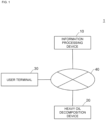
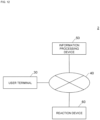
- the information processing system 1 according to the present disclosure will be described using FIG. 1 .
- the information processing system 1 according to the present disclosure includes the information processing device 10, a heavy oil decomposition device 20, a user terminal 30, and a network 40.
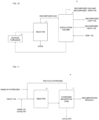
- FIG. 2 is a diagram showing the configuration of the information processing device 10.
- the information processing device 10 is, for example, a laptop computer, a rack-mounted or tower-type computer, a smartphone, etc. Further, the information processing device 10 may be configured as one system by a plurality of information processing devices, or may be configured with redundancy. How to allocate the plurality of functions required to implement the information processing device 10 can be determined as appropriate in view of the processing capacity of each piece of hardware, the specifications required of the information processing device 10, etc.
- the information processing device 10 includes a processor 11, a memory 12, a storage 13, a communication IF 14, and an input/output IF 15.
- the processor 11 is hardware for executing a set of instructions written in a program, and is composed of an arithmetic unit, registers, peripheral circuits, etc.
- the memory 12 is for temporarily storing programs and data processed by the programs, and is, for example, a volatile memory such as DRAM (Dynamic Random Access Memory).
- DRAM Dynamic Random Access Memory
- the storage 13 is a storage device for storing data, and is, for example, a flash memory, an HDD (Hard Disc Drive), or an SSD (Solid State Drive).
- the communication IF 14 is an interface for inputting and outputting signals so that the information processing device 10 communicates with an external device.
- the communication IF 14 is connected to a network 40 such as a LAN, the Internet, or wide area Ethernet by wire or wirelessly.
- the input/output IF 15 functions as an interface with an input device (for example, a pointing device such as a mouse, a keyboard) for receiving input operations, and an output device (display, speaker, etc.) for presenting information.
- an input device for example, a pointing device such as a mouse, a keyboard
- an output device for presenting information.
- the heavy oil decomposition device 20 is a device that decomposes heavy oil into light decomposed oil through a predetermined decomposition reaction.
- decomposed oil include light gas (including LPG), gasoline, and middle distillates.
- the heavy oil decomposition device 20 decomposes heavy oil by, for example, fluid catalytic cracking (FCC), thermal cracking, hydrocracking, etc. In the following, the FCC will be explained as the heavy oil decomposition device 20.
- FCC fluid catalytic cracking
- the heavy oil decomposition device 20 has a function of controlling a reactor 21 and a regenerator 22, and a function of transmitting and receiving predetermined information to and from the information processing device 10 through communication.
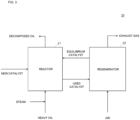
- FIG. 3 is a diagram showing an example of the configuration of the heavy oil decomposition device 20.
- the example in FIG. 3 is a case where the heavy oil decomposition device 20 decomposes heavy oil using FCC.
- the heavy oil decomposition device 20 includes the reactor 21 and the regenerator 22.
- the reactor 21 is a device that brings heavy oil as a raw material into contact with a catalyst to cause a decomposition reaction and obtain a decomposition product. Specifically, when heavy oil, steam, and a catalyst are introduced, the reactor 21 brings the heavy oil into contact with the catalyst. Next, the reactor 21 obtains decomposed oil by decomposing the heavy oil by a decomposition reaction caused by contacting the heavy oil with the catalyst. Furthermore, the reactor 21 introduces stream into the obtained decomposed oil to remove the decomposed oil adhering to the catalyst. The reactor 21 then outputs the decomposed oil. Additionally, the reactor 21 passes the used catalyst to the regenerator 22.
- the regenerator 22 regenerates the catalyst used in the reactor 21.
- coke carbon
- the regenerator 22 regenerates the catalyst by burning coke attached to the surface of the catalyst at high temperature, and supplies the regenerated catalyst to the reactor 21 so as to keep the activity within the reactor 21 constant.
- the regenerator 22 discharges exhaust gas generated by burning.
- the user terminal 30 is a terminal operated by a user.
- the user is, for example, a person who operates and manages the heavy oil decomposition device 20.
- the user terminal 30 is, for example, a smartphone, a personal computer, etc.
- the information processing device 10, the heavy oil decomposition device 20, and the user terminal 30 are configured to be able to communicate with each other via a network 40.
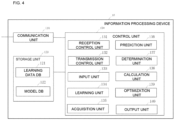
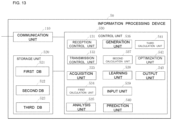
- FIG. 4 is a block diagram showing the functional configuration of the information processing device 10. As shown in FIG. 2 , the information processing device 10 includes a communication unit 110, a storage unit 120, and a control unit 130.
- the communication unit 110 performs processing for the information processing device 10 to communicate with an external device.
- the storage unit 120 stores data and programs used by the information processing device 10.
- the storage unit 120 stores a learning data DB 121, a model DB 122, etc.
- the learning data DB 121 is a database that holds learning data used when learning processing is performed.
- the learning data includes a set of the oil quality of the heavy oil that is the target of heavy oil decomposition, the operating parameter related to the heavy oil decomposition device 20 that performs heavy oil decomposition, and actual data of values indicating the reaction state when the heavy oil is decomposed in the heavy oil decomposition device 20 using the operating parameter.
- the oil quality of heavy oil is information regarding the oil quality of heavy oil, such as the density, metal concentration, and nitrogen concentration, etc. of heavy oil.
- the operating parameter include, for example, parameteruch as the flow rate of heavy oil, the amount of catalyst, the amount of steam inflow to the heavy oil decomposition device 20, the pressure, the internal temperature, the temperature of the catalyst, the ratio of the catalyst to heavy oil in the reactor 21, the pressure, internal temperature, and catalyst temperature in the regenerator 22.
- the learning data adopts a first parameter related to the decomposition reaction of heavy oil among the above operating parameter as the operating parameter.
- parameter related to reaction speed include reaction speed constant, frequency factor, activation energy, etc.
- the reaction speed constant of the Arrhenius equation is expressed, for example, by the following formula.
- k is the reaction speed constant
- R is the gas constant
- T is the absolute temperature
- E is the activation energy
- A is the frequency factor.
- the operating parameter for example, when the value indicating the reaction state is an index value indicating the equilibrium catalyst activity, a second parameter related to the equilibrium catalyst activity among the above-mentioned operating parameter is adopted as the operating parameter.
- the model DB 122 is a database that holds various models and model parameter.
- the model DB 122 holds a heavy oil reaction state prediction model (hereinafter referred to as a first model).
- the first model is a model that outputs the reaction state of heavy oil decomposition in response to inputting the oil quality of heavy oil and the operating parameter.
- the first model is a reaction speed constant prediction model (hereinafter referred to as a second model).
- the second model is a model that outputs a reaction speed constant in response to inputting the oil quality of heavy oil and the first parameter.
- the first model may be an equilibrium catalyst activity prediction model (hereinafter referred to as a third model).
- the third model is a model that outputs an index value indicating equilibrium catalyst activity in response to inputting the oil quality of heavy oil and a second parameter.
- Each of the first to third models may be any model such as a machine learning model or a neural network.
- the first to third models may use, for example, a linear regression model to express the relationship between the oil quality of heavy oil, the operating parameter, and the reaction state of heavy oil decomposition.
- the model DB 122 may hold both the second model and the third model. The present disclosure describes an example where the model DB 122 holds both a second and a third model.
- model DB 122 holds models other than those described above.
- the model DB 122 holds a physical model that outputs a product yield or an index value that contributes to the product yield by inputting the oil quality of heavy oil, the first parameter, the reaction speed constant for heavy oil decomposition determined by the second model, the second parameter, and an index value indicating equilibrium catalytic activity determined by the third model.
- the control unit 130 performs the functions shown in a reception control unit 131, a transmission control unit 132, an input unit 133, a learning unit 134, an acquisition unit 135, a prediction unit 136, a determination unit 137, a calculation unit 138, an optimization unit 139, an output unit 140, etc. when the processor 11 of the information processing device 10 performs processing according to the program.
- the reception control unit 131 controls a process where the information processing device 10 receives a signal from an external device according to a communication protocol.
- the transmission control unit 132 controls a process where the information processing device 10 transmits a signal to an external device according to a communication protocol.
- the input unit 133 accepts input of the oil quality of the heavy oil to be subjected to heavy oil decomposition, the operating parameter related to the heavy oil decomposition device 20 that performs heavy oil decomposition and a value indicating the reaction state when the heavy oil is decomposed in the heavy oil decomposition device 20 using the operating parameter, as learning data.
- the input unit 133 acquires learning data from the learning data DB 121.
- the learning unit 134 learns the second model and the third model using the acquired learning data.
- the learning unit 134 learns the second model using the oil quality of the heavy oil, the first parameter, and the reaction speed constant among the learning data. For example, if the second model is a linear regression model, the learning unit 134 learns the second model using the reaction speed constant as an objective variable, the oil quality of the heavy oil and the first parameter as explanatory variables.
- the second model learns the correlation between the first parameter and the reaction speed constant of the decomposition reaction when the heavy oil decomposition is performed using the first parameter for each oily component of the heavy oil.
- the learning unit 134 learns the correlation between the reaction speed constant and the operating parametero that the second model outputs reaction speed constants that react with other oily components due to the heavy oil decomposition and change to each of gasoline, coke, flue gas, etc., for each of oil equivalent to vacuum residue (VR) that is the oily component of the heavy oil and oil equivalent to vacuum gas oil (VGO), etc.
- VR oil equivalent to vacuum residue
- VGO vacuum gas oil
- the learning unit 134 can learn not only the number of raw oil components but also the interrelationships of multiple operating parameter, in the decomposition reaction of the heavy oil that has an infinite number of continuous boiling point components.
- the second model learned in this manner can accurately predict the reaction speed constant.
- the learning unit 134 then stores the learned second model in the model DB 122.
- the learning unit 134 also learns the third model using the oil quality of the heavy oil, the second parameter, and the index value indicating the equilibrium catalyst activity among the learning data. For example, if the third model is a linear regression model, the learning unit 134 learns the third model using the index value indicating the equilibrium catalyst activity as the objective variable, the oil quality of the heavy oil and the second parameter as the explanatory variables.
- the catalyst circulates within the reactor 21 and regenerator 22 of the heavy oil decomposition device 20. Catalyst deterioration that occurs in the reactor 21 can be recovered to some extent in the regenerator 22. However, even in the regenerator 22, it is not possible to completely recover the deterioration of the catalyst, so in order to keep the activity of the catalyst constant, in addition to recovery in the regenerator 22, it is necessary to supply new catalyst. However, the amount of new catalyst to be introduced is determined based on past empirical rules. In actual operation, the catalyst deterioration speed varies depending on changes in the heavy oil being processed. For this reason, it was difficult to adjust the catalytic activity to the desired level.
- the technology of the present disclosure has the effects of statically determining the equilibrium catalyst activity, optimizing the amount of new catalyst input, and reducing the equilibrium catalyst analysis cost and labor.
- the learned third model there is no need to consider the time required for analysis, so if the oil quality of the heavy oil and the second parameter in actual operation are available, the equilibrium catalyst activity can be obtained in real time.
- the learning unit 134 then stores the learned third model in the model DB 122.
- the learning unit 134 can relearn first model by using the learning data, a third parameter that is an operating parameter regarding the heavy oil decomposition device 20 that is performing heavy oil decomposition, and a value that indicates the predicted reaction state.
- the learning unit 134 performs relearning based on, for example, the timing where the analysis results are obtained.
- the learning unit 134 acquires the learning data, a third parameter that is an operating parameter regarding the actually operating heavy oil decomposition device 20 acquired later, and a value indicating the reaction state obtained by the analysis described later, and relearns each model. For example, the learning unit 134 relearns the second model from the learning data, the first parameter of the third parameter, and the analyzed reaction speed constant. Further, for example, the learning unit 134 relearns the third model from the learning data, the second parameter of the third parameter, and the analyzed index value indicating the equilibrium catalytic activity.
- the learning unit 134 relearns the second model and the third model at the timing when the analysis results are obtained, thereby obtaining index values indicating the reaction speed constant and equilibrium catalyst activity in real time with higher accuracy. For example, in order to obtain a predetermined equilibrium catalyst activity, it is necessary to adjust the amount of new catalyst to be introduced. In order to accurately determine the amount of new catalyst to be introduced, analysis results of equilibrium catalyst activity are required. This analytical result of equilibrium catalyst activity requires time for analysis after the catalyst is taken out. For this reason, it took time to reflect the analysis results in simulations used for prediction.
- the learning unit 134 can relearn the second model and the third model at the timing when the analysis results are obtained, it is possible to obtain index values indicating the reaction speed and equilibrium catalytic activity more accurately in real time. For example, the prediction accuracy can be quickly tracked even under the influence of changes in catalysts, etc.
- the acquisition unit 135 acquires a third parameter that is an operating parameter regarding a heavy oil decomposition device that is performing heavy oil decomposition, oil quality of the heavy oil, and learned second and third models.
- the acquisition unit 135 acquires the third parameter and the oil quality of the heavy oil to be introduced into the heavy oil decomposition device from the heavy oil decomposition device 20. It is noted that the acquisition unit 135 may acquire the third parameter and the oil quality of the heavy oil by receiving them from the user terminal 30. The acquisition unit 135 also acquires the learned second model and third model from the model DB 122.
- the acquisition unit 135 acquires the analysis result of the reaction state. Specifically, the acquisition unit 135 acquires the results of analyzing the reaction state based on actual operating parameter, decomposition products, catalysts, etc.
- the prediction unit 136 predicts a value indicating the reaction state by inputting the oil quality of the heavy oil and the third parameter into the first model.
- the prediction unit 136 predicts the reaction speed constant by inputting the oil quality of the heavy oil and the first parameter of the third parameter into the second model.
- the prediction unit 136 predicts an index value indicating the equilibrium catalyst activity by inputting the oil quality of the heavy oil and the second parameter of the third parameter into the third model.
- the determination unit 137 determines the optimum amount of new catalyst to be introduced into the heavy oil decomposition device 20 based on the index value indicating the equilibrium catalyst activity.
- the determination unit 137 calculates the amount of catalyst that should be introduced to bring the equilibrium catalytic activity to a predetermined value, based on the index value indicating the equilibrium catalytic activity. Then, the determination unit 137 determines the calculated amount as the optimal amount of new catalyst.
- the calculation unit 138 uses the oil quality of the heavy oil, the third parameter, and the value indicating the reaction state to calculate the product yield or an index value contributing to the product yield.
- the calculation unit 138 first obtains a reaction model from the model DB 122. Next, the calculation unit 138 calculates the product yield or an index value contributing to the product yield by using the oil quality of the heavy oil, the first parameter of the third parameter, the determined reaction speed constant for heavy oil decomposition, the second parameter of the third parameter, and the index value indicating the determined equilibrium catalyst activity, and the reaction model.
- the product yield is, for example, the yield of decomposed oil obtained by the heavy oil decomposition device 20.
- the index values contributing to the product yield is operating parameter necessary for determining the product yield, etc.
- the index value is, for example, reaction temperature, reaction time, catalyst concentration, etc.
- the optimization unit 139 uses the determined product yield or an index value contributing to the product yield, oil quality of the heavy oil, the operating parameter, and values indicating the reaction state to determine the operating parameter for optimal product yield.
- the optimization unit 139 first determines the optimum product yield by using the product yield or an index value contributing to the product yield, the oil quality of the heavy oil, the first parameter and the reaction speed constant, of the third parameter, and the second parameter and the index value indicating equilibrium catalytic activity, of the third parameter. For example, the optimization unit 139 inputs the oil quality of the heavy oil, the third parameter, the determined reaction speed, and the determined equilibrium catalyst activity into a model for searching for the optimal product yield to search for the optimal product yield.
- the optimization unit 139 determines optimal operating parameter by using the oil quality of the heavy oil, the first parameter and the reaction speed of the third parameter, the second parameter and an index value indicating equilibrium catalyst activity of the third parameter, and the determined optimal product yield. It is noted that the optimization unit 139 may also be configured to use the learned second model and third model to determine the optimal operating parameter.
- the output unit 140 outputs the predicted reaction speed constant and index value indicating the equilibrium catalyst activity to an output device, etc.
- the output unit 140 may be configured to output and display the predicted reaction speed constant and the index value indicating the equilibrium catalyst activity to an external device via communication.
- the output unit 140 outputs the determined amount of new catalyst.
- the new catalyst is fed into the heavy oil decomposition device 20.
- the output unit 140 outputs the determined product yield or an index value contributing to the product yield.
- the output unit 140 outputs the determined optimal operating parameter.
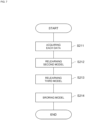
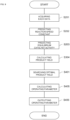
- FIG. 5 is a flowchart showing an example of the flow of learning processing performed by the information processing device 10.
- the information processing device 10 executes the process at an arbitrary timing (for example, upon receiving a learning process start signal, etc.).
- step S101 the input unit 133 inputs oil quality of the heavy oil to be subjected to heavy oil decomposition, the operating parameter related to the heavy oil decomposition device 20 that performs heavy oil decomposition, and a value indicating a reaction state when the heavy oil is decomposed in the heavy oil decomposition device 20 as learning data.
- step S102 the learning unit 134 learns the second model and the third model using the acquired learning data.
- step S103 the learning unit 134 stores the learned second model and third model in the model DB 122, and ends the process.
- FIG. 6 is a flowchart showing an example of the flow of prediction processing performed by the information processing device 10.
- the information processing device 10 executes this process by inputting the oil quality of the heavy oil and the operating parameter.
- step S201 the acquisition unit 135 acquires a third parameter that is an operating parameter regarding the heavy oil decomposition device 20 that is currently performing heavy oil decomposition, the oil quality of the heavy oil, the learned second and third model.
- step S202 the prediction unit 136 predicts the reaction speed constant by inputting the oil quality of the heavy oil and the first parameter of the third parameter into the second model.
- step S203 the prediction unit 136 predicts an index value indicating the equilibrium catalyst activity by inputting the oil quality of the heavy oil and the second parameter of the third parameter into the third model.
- step S204 the output unit 140 outputs the predicted reaction speed constant and the index value indicating the equilibrium catalyst activity to an output device, etc.
- the information processing device 10 can execute the prediction process at any timing, it can predict in real time a value indicating the reaction state of the heavy oil decomposition device 20 in operation..
- FIG. 7 is a flowchart showing an example of the flow of relearning processing performed by the information processing device 10.
- the information processing device 10 executes the process at an arbitrary timing (for example, when acquiring a reaction state analysis result, receiving a relearning process start signal, etc.).
- step S211 the acquisition unit 135 acquires a third parameter that is an operating parameter regarding the heavy oil decomposition device 20 that is performing heavy oil decomposition, the oil quality of the heavy oil, and the reaction state obtained by the analysis, and the learned second and third model.
- step S212 the learning unit 134 relearns the second model by using the learning data, the third parameter that is an operating parameter regarding the heavy oil decomposition device 20 that is performing heavy oil decomposition, and the analyzed reaction speed constant.
- step S213 the learning unit 134 relearns the third model by using the learning data, a third parameter that is an operating parameter regarding the heavy oil decomposition device 20 that is performing heavy oil decomposition, and an index value indicating the analyzed equilibrium catalyst activity.
- step S214 the learning unit 134 stores the relearned second and third model in the model DB 122, and ends the process.
- the information processing device 10 can execute the prediction process at any timing, it can predict a value indicating the reaction state of the heavy oil decomposition device 20 in operation in real time.
- FIG. 8 is a flowchart showing an example of the flow of product yield calculation processing performed by the information processing device 10.
- the information processing device 10 executes the process by inputting the oil quality of the heavy oil and the operating parameter, etc. It is noted that processes that are common to the prediction process are given the same reference numerals , and the description thereof will be omitted.
- step S304 the calculation unit 138 calculates a product yield or an index value contributing to the product yield by using the oil quality of the heavy oil, the third parameter, and the value indicating the reaction state.
- step S305 the output unit 140 outputs the determined product yield or the determined index value contributing to the product yield, and ends the process.
- FIG. 9 is a flowchart showing an example of the flow of optimization calculation processing performed by the information processing device 10.
- the information processing device 10 executes the processing at an arbitrary timing. It is noted that processes that are common to the prediction process and the product yield calculation process are given the same reference numerals, and the description thereof will be omitted.
- step S401 the optimization unit 139 determines the optimal product yield by using a product yield or an index value contributing to the product yield, oil quality of the heavy oil, the first parameter and the reaction speed of the third parameter, a second parameter and an index value indicating equilibrium catalytic activity of the third parameter.
- step S405 the optimization unit 139 determines the operating parameter that achieve the determined optimal product yield by using the determined product yield or index value contributing to the product yield, oil quality of the heavy oil, operating parameter, and values indicating the reaction state.
- step S406 the output unit 140 outputs the determined optimal operating parameter, and ends the process.
- the oil quality of the heavy oil that is the target of heavy oil decomposition, the operating parameter for the heavy oil decomposition device that performs heavy oil decomposition, and a value indicating the reaction state when the heavy oil is decomposed in the heavy oil decomposition device using operating parameter are accepted as learning data input.
- the first model that outputs a reaction state of heavy oil decomposition in response to inputting the oil quality of the heavy oil and the operating parameter is learned using the learning data, the learned first model is stored in the storage unit.
- the third parameter that is an operating parameter regarding a heavy oil decomposition device that is performing heavy oil decomposition, oil quality of the heavy oil, and the learned first model are obtained, by inputting the oil quality of the heavy oil and the third parameter into the first model, a value indicating the reaction state is predicted, and by outputting the value indicating the reaction state, it is possible to predict the reaction state of heavy oil decomposition with high accuracy.
- the first model that, in response to input of oil quality of the heavy oil that is subject to heavy oil decomposition and operating parameter related to the heavy oil decomposition device that performs heavy oil decomposition, outputs a value indicating a reaction state when the heavy oil is decomposed in the heavy oil decomposition device using the operating parameter is acquired. And, the input of the oil quality of the heavy oil and operating parameter is accepted, a value indicating the reaction state is determined using the oil quality of the heavy oil, the operating parameter, and the first model. And, the product yield or index values contributing to the product yield is determined by using the oil quality of the heavy oil, operating parameter, and values indicating the reaction state. Thereby, it is possible to improve product yield and contribute to improving refinery profits.
- the second embodiment relates to a technique for predicting reaction states in various chemical reactions in the process of manufacturing chemical products (for example, industrial chemicals, chemical fertilizers, paper, pulp, rubber, synthetic fibers, synthetic resins, petroleum products, pharmaceuticals, dyes, detergents, cosmetics, bio products), etc. (hereinafter simply referred to as chemicals, etc.).
- the technique according to the second embodiment will be described as a technique for predicting a value indicating a reaction state when a chemical reaction is performed in the reaction device based on the operating parameter related to the reaction device that performs a predetermined chemical reaction and information regarding the chemical substances used in the chemical reaction in the reaction device.
- Reaction models that model chemical reactions of conventional chemicals include items that are difficult to quantify, such as mass transfer. These values are determined by referring to existing papers or by experiment. For this reason, it takes a lot of time to create a reaction model, and furthermore, in a physical model such as a reaction model, the number of parameter that humans can consider is limited.
- the technology of the present disclosure prepares a model that learned the relationship between parameter of a reaction state of a chemical, etc., operating parameter, and information regarding the chemical substance.
- Parameter of the reaction state include, for example, parameter related to the reaction speed of chemical substances, index values indicating catalytic activity, etc. Thereby, the technology of the present disclosure can accurately predict the reaction state related to the production of chemical products, etc.
- the technology of the present disclosure calculates parameter of an apparent reaction state depending on operating parameter and chemical substances by using past chemical reaction results, experimental results, etc.
- the technology of the present disclosure learns the model by using parameter of this apparent reaction state. As a result, it is possible to accurately quantify the influence of each operational parameter that is difficult to quantify in a data-driven manner, contributing to speeding up and improving the accuracy of reaction model construction.
- the information processing system 2 according to the present disclosure will be described using FIG. 12 .
- the information processing system 2 according to the present disclosure is configured to include an information processing device 50, a reaction device 60, a user terminal 30, and a network 40.
- FIG. 13 is a block diagram showing the functional configuration of the information processing device 50.
- the information processing device 50 includes a communication unit 110, a storage unit 520, and a control unit 530.
- the storage unit 520 stores data and programs used by the information processing device 50.
- the storage unit 520 stores a first DB 521, a second DB 522, a third DB 523, etc.
- the first DB 521 is a database that holds learning data used in the model learning/building process of the prediction model.
- the learning data is data obtained by performing the chemical reaction in the past.
- the learning data is a set of real data consisting of information regarding the substance to be subjected to a chemical reaction, operating parameter regarding the reaction device 60 that performs a predetermined chemical reaction, parameter of the reaction state when the substance is chemically reacted in the reaction device 60 using the operating parameter, etc.
- FIG. 14 is a diagram showing an example of the data structure of the first DB 521.
- each record in the first DB 521 includes an item "ID”, an item “substance”, an item “quantity”, an item “operating parameter”, an item “catalyst activity”, etc. It is noted that the items shown here are not all, and there may be no items shown here, or there may be other items.
- the item "ID" stores information for identifying each record.
- the item "substance” stores the name of the substance used in the chemical reaction.
- Information regarding substance stores information regarding the substance used in the chemical reaction.
- Information regarding the substance includes, for example, the physical quality of the substance, the amount used, and the weight, etc. It is noted that when there are multiple substances, the item may also be stored including the ratio of the quantities of the substances.
- the item "operating parameter” stores the operating parameter of the reaction device.
- the operating parameters are, for example, parameters such as the size of the reactor of the reaction device 60, the flow rate of material into the reaction device 60, the amount of catalyst, the pressure, the internal temperature, the temperature of the catalyst, the ratio of catalyst to material.
- the item "catalytic activity” is data regarding the catalytic activity used in the reaction device 60 based on to the operating parameter.
- Data regarding catalyst activity includes the catalyst used, the amount of catalyst inflow, and an index value indicating catalyst activity, etc.
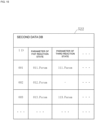
- the second DB 522 stores the parameter of a reaction state that is a reaction state of a substance.
- FIG. 15 is a diagram showing an example of the data structure of the second DB 522. As shown in FIG. 15 , each record in the second DB 522 includes an item "ID”, an item “parameter of first reaction state”, an item “parameter of third reaction state”, etc. It is noted that the items shown here are not all, and other items may be included.
- the item “ID” stores information for identifying each record. This "ID” is linked to the "ID" of the first DB 521.
- the item "parameter of first reaction state” stores parameter of a reaction state when the substance is chemically reacted in the reaction device 60 based on the operating parameter in the corresponding ID.
- the parameter of the first reaction state include, for example, reaction speed, reaction speed constant, frequency factor, activation energy, and catalytic activity, etc.
- the parameter of the first reaction state are, for example, the parameter of the first reaction state calculated by the reaction model.
- the item "parameter of third reaction state” stores the parameter of the third reaction state that is the reaction state of the substance.
- the parameter of the third reaction state include, for example, reaction speed, reaction speed constant, frequency factor, activation energy, and catalytic activity, etc.
- the parameter of the third reaction state are the parameter of the third reaction state calculated by the modified model.
- the third DB 523 is a database that holds various models and model parameter.
- the third DB 523 holds models used in the technology of the present disclosure, such as prediction models, reaction models, modified models, and physical models, and their parameter.
- the prediction model is a model that outputs parameter of a reaction state, that is a reaction state of a substance in response to input of information regarding the substance and operating parameter.
- the parameter of the reaction state is, for example, a reaction speed constant of a substance when a predetermined chemical reaction is performed in the reaction device 60. Any model such as a machine learning model or a neural network can be used as the prediction model.
- the prediction model may represent the relationship between information about the substance, operating parameter, and reaction state of a predetermined chemical reaction, for example, by using a linear regression model.
- a reaction model is a physical model that determines the parameter of a reaction state.
- the reaction model is, for example, a predetermined reaction kinetics model.
- the modified model is a model obtained by modifying the reaction model.
- the modified model will be described later.
- the yield model is a model that outputs a product yield or an index value contributing to the product yield by inputting information regarding substances, operating parameter, and reaction speed constants.
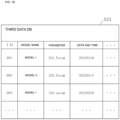
- FIG. 16 is a diagram showing an example of the data structure of the third DB 523.
- each record in the third DB 523 includes an item "ID”, an item “model name”, an item “parameter”, an item “date and time”, etc. It is noted that the items shown here are not all, and there may be no items shown here, or there may be other items.
- the item "ID" stores information for identifying each record.
- model name stores the name of the model.
- the item "parameter” stores the parameter of the corresponding model.
- the item "date and time” stores the learning date and time or acquisition date and time of the model.
- the control unit 530 performs the functions shown in a reception control unit 131, a transmission control unit 132, an acquisition unit 533, a first calculation unit 534, an analysis unit 535, a generation unit 536, a second calculation unit 537, a learning unit 538, an input unit 539, a prediction unit 540, a third calculation unit 541, an optimization unit 542, an output unit 543, etc. by the processor 11 of the information processing device 50 performing processing according to the program,
- the acquisition unit 533 acquires data necessary for calculating parameter of reaction state from the first DB 521.
- the acquisition unit 533 acquires a set of actual data consisting of information regarding the substance used in the chemical reaction in the reaction device 60, operating parameter of the reaction device 60, other data from when the chemical reaction was performed in the past (for example, catalyst activity, product yield, etc.), etc. from the first DB 521.
- the acquisition unit 533 acquires the reaction model and the parameter of the reaction model from the third DB 523.
- the first calculation unit 534 calculates the parameter of a first reaction state that is predicted the reaction state of a substance when a chemical reaction is performed in the reaction device 60 with predetermined operating parameter by using information regarding the substance used in the chemical reaction in the reaction device 60 and the operating parameter of the reaction device 60.
- the technology of the present disclosure uses parameter of an apparent reaction state by determining the parameter of the first reaction state.
- the technology of the present disclosure aims to improve the accuracy of a prediction model by using the parameter of this apparent reaction state.
- the first calculation unit 534 first obtains information regarding the substance used in the chemical reaction in the reaction device 60 and the operating parameter of the reaction device 60 from the first DB 521. Next, the first calculation unit 534 determines, as the parameter of the first reaction state, a parameter of a first reaction rate-limiting that is predicted the reaction speed of the substance when a chemical reaction is performed in the reaction device 60 with predetermined operating parameter. More specifically, the first calculation unit 534 determines the reaction speed or reaction speed constant by using the acquired information regarding the substance used in the chemical reaction in the reaction device 60, the operating parameter of the reaction device 60, and the reaction model.
- k is the reaction speed constant
- t time
- C is the substance concentration
- kC 2 is the reaction speed
- the first calculation unit 534 calculates, for example, k as a parameter of the first reaction speed.
- the calculated parameter of the first reaction state are stored in the second DB 522.
- the analysis unit 535 quantifies the reaction rate-limiting by analyzing the reaction rate-limiting of the chemical reaction when the chemical reaction is performed in the reaction device 60 with predetermined operating parameter by using the correlation between the parameter of the first reaction state and the predetermined reaction rate-limiting in the chemical reaction.
- the analysis unit 535 first analyzes the reaction rate-limiting in the reaction device 60.
- the analysis unit 535 analyzes the reaction rate-limiting of the chemical reaction when the chemical reaction is performed in the reaction device 60 with the operating parameter by using the correlation between the parameter of the first reaction state and each of a plurality of factors that affect the parameter of the first reaction state in a chemical reaction.
- the reaction rate-limiting is something that affects the determination of parameter of the reaction state among the steps that make up a reaction.
- the reaction rate-limiting is, for example, the one that takes the longest time in each step constituting the reaction that determines the reaction speed.
- Reaction rate-limiting can be expressed by multiple factors that affect the parameter of the first reaction state. Such factors include, for example, the true reaction speed, the speed of substance diffusion in the solvent, the catalyst adsorption equilibrium, the catalyst activity, etc.
- the analysis unit 535 analyzes the correlation between the parameter of the first reaction state that is the parameter of the apparent reaction state, and the numerical value derived from the formula of each of the plurality of factors.
- reaction speed dependence if it is a true reaction speed constant
- substance diffusion dependence if it is the speed of substance diffusion in the solvent
- catalyst adsorption dependent if it is catalyst adsorption equilibrium
- catalyst activity dependence if it is catalytic activity.
- the analysis unit 535 quantifies each of the multiple factors that influence the analyzed parameter of the first reaction state. Specifically, for example, in the case of catalyst activity rate-limiting, the analysis unit 535 determines a linear approximation equation between the apparent reaction speed constant and the catalyst activity by using data on different catalyst activities for the operating parameter and the correlation between each catalyst activity and the apparent reaction speed constant. The analysis unit 535 can quantify the rate-limiting of catalyst activity in the chemical reaction by determining the catalyst activity at the operating parameter using the determined linear approximation equation.
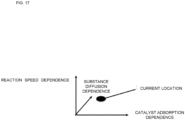
- FIG. 17 is a diagram showing an example of what is the reaction rate-limiting depending on the operating state.
- FIG. 17 shows the relationship between reaction speed dependence, substance diffusion dependence, and catalyst adsorption dependence in operating parameter.
- the analysis unit 535 analyzes and quantifies the relationship between the parameter of the first reaction state and each of the multiple factors that influence the parameter of the first reaction state, its position relative to other reaction rate-limiting is visualized regarding the reaction speed of the substance in the operating parameter.
- analysis unit 535 may be configured to display a graph quantifying the reaction rate-limiting on an output device such as a screen.
- the generation unit 536 generates a modified model where a reaction model representing a chemical reaction is modified by using each of the multiple factors that influence the quantified parameter of the first reaction state.
- the generation unit 536 generates a modified model where the correlation is reflected in the reaction model using each of a plurality of factors that influence the quantified parameter of one reaction state. For example, if the catalyst activity coefficient a that corrects k was determined by quantifying the catalyst activity dependence, the generation unit 536 modifies the reaction model by substituting ak' for k in the equation of the reaction model. Similarly, the generation unit 536 modifies the reaction model by substituting a predetermined equation for the substance concentration C based on substance diffusion dependence, etc.
- the generation unit 536 then stores the generated modified model in the third DB 523.
- the second calculation unit 537 determines the parameter of a third reaction state that predicted the reaction state of the substance when a chemical reaction is performed in the reaction device 60 using the operating parameter, by using the modified model.
- the second calculation unit 537 determines, as a parameter of the third reaction state, a parameter of a third reaction speed that is a prediction of the reaction rate of the substance when a chemical reaction is performed in the reaction device 60 with predetermined operating parameter. More specifically, the second calculation unit 537 calculates the reaction speed or reaction speed constant as a parameter of the third reaction state by using the acquired operating parameter, information regarding the substance, parameter of the first reaction state, and the modified model. Then, the second calculation unit 537 stores the calculated parameter of the third reaction state in the second DB 522. It is noted that the parameter of the third reaction state is also a parameter of an apparent reaction state.
- the learning unit 538 learns a prediction model that outputs parameter of a second reaction state that is a reaction state of the substance in response to inputting information regarding the substance and operating parameter by using the information regarding the substance stored in the first DB 521 and the acquired operating parameter, and parameter of the apparent reaction state (parameter of first reaction state or parameter of third reaction state) calculated and stored in the second DB 522 as learning data.
- the learning unit 538 learns a prediction model that outputs a parameter of a second reaction rate as a parameter of a second reaction state in response to inputting information regarding the substance and operating parameter by using the information regarding the substance stored in the first DB 521, the acquired operating parameter, and the determined parameter of apparent reaction state (parameter of first reaction state or parameter of third reaction state) as learning data.
- the learning unit 538 can use the parameter of the first reaction state or the parameter of the third reaction state for learning as the parameter of the apparent reaction state.
- the parameter of the third reaction state apply to the reaction model the influence of each of the multiple factors that affect the parameter of the first reaction state that are difficult to quantify. Therefore, the parameter of the third reaction state can contribute to improving the learning accuracy of the prediction model more than the parameter of the first reaction state. Furthermore, since a modified model is not created using the parameter of the first reaction state, it is suitable when it is desired to obtain a more accurate prediction model more quickly. Which parameter the learning unit 538 uses for learning can be arbitrarily determined.
- the learning unit 538 learns the prediction model using the same learning method as in the first embodiment.
- the prediction model can learn the correlation between the reaction speed or reaction speed constant that changes with changes in the substance and the operating parameter. Therefore, by using the learned prediction model, it is possible to accurately predict the reaction speed or reaction speed constant in actual operation.
- the learning unit 538 then stores the learned prediction model in the third DB 523.
- the input unit 539 accepts input of information regarding substances and operating parameter.
- the input unit 539 accepts input of information regarding a substance where parameter of the reaction state of the substance in the reaction device 60 are desired to determined, and operating parameter in the reaction state that is desired to determine.
- the prediction unit 540 determines the parameter of the second reaction state using the information regarding the substance, the operating parameter, and the prediction model.
- the prediction unit 540 first acquires the learned prediction model from the third DB 523.
- the prediction unit 540 determines the parameter of the second reaction state by inputting the input information regarding the substance and the operating parameter into the prediction model.
- the third calculation unit 541 determines a product yield or an index value contributing to the product yield by using information regarding the substance, operating parameter, and parameter of the second reaction state.
- the third calculation unit 541 first acquires a yield model from the third DB 523. Next, the third calculation unit 541 determines the product yield or the index value contributing to the product yield by using the information regarding the substance, the operating parameter, the parameter of the second reaction state, and the yield model.
- the product yield is, for example, the yield of chemicals etc. obtained by the reaction device 60.
- the index values contributing to the product yield include operating parameter necessary for determining the product yield.
- the index values include, for example, reaction temperature, reaction time, catalyst concentration, reaction pressure, and substrate concentration of solvent.
- the optimization unit 542 determines operating parameter that achieve optimal product yield by using the determined product yield or index value contributing to the product yield, information regarding the substance, operating parameter, and parameter of the second reaction state.
- the optimization unit 542 first determines the optimal product yield by using the product yield or the index value contributing to the product yield, information regarding heavy substances, operating parameter, and parameter of the second reaction state. For example, the optimization unit 542 searches for the optimal product yield by inputting the product yield or the index value contributing to the product yield, information regarding the substance, operating parameter, and parameter of the second reaction state into a model for searching for the optimal product yield.
- the optimization unit 542 determines optimal operating parameter by using the product yield or the index value contributing to the product yield, information regarding the substance, parameter of the second reaction state, and the determined optimal product yield. It is noted that the optimization unit 542 may be configured to determine optimal operating parameter by also using the learned prediction model.
- the output unit 543 outputs optimal operating parameter.
- the output unit 543 can output using the same method as the output unit 140. Further, the output unit 543 may also be configured to output the predicted parameter of the second reaction state, the determined product yield or the index value contributing to the product yield.
- the catalyst activity may be determined, or the product yield, etc. may be determined using the determined catalyst activity by using the technology of the first embodiment.
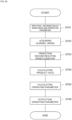
- FIG. 18 is a flowchart showing an example of the flow of learning processing performed by the information processing device 50.
- the information processing device 50 executes this process at an arbitrary timing (for example, upon receiving a learning process start signal).
- the acquisition unit 533 acquires information regarding substances used in a chemical reaction and operating parameter of the reaction device from the first DB 521.
- the information processing device 50 executes a process of calculating parameter of the apparent reaction state.
- the learning unit 538 learns the prediction model that outputs parameter of the second reaction state that is a reaction state of the substance in response to inputting information regarding the substance and operating parameter, by using the acquired information regarding the substance, the acquired operating parameter, and the determined parameter of the apparent reaction state as learning data.
- the learning unit 538 stores the learned prediction model in the third DB 523, and ends the process.
- FIG. 19 is a flowchart showing an example of the flow of the calculation processing in the step S502 by the information processing device 50.
- the first calculation unit 534 determines parameter of the first reaction state predicted as a reaction state of a substance when a chemical reaction is performed in the reaction device 60 with predetermined operating parameter by using the obtained information on the substances used in the chemical reaction and the operating parameter of the reaction device.
- the analysis unit 535 analyzes the reaction rate-limiting in the reaction device 60 by analyzing the acquired data.
- the analysis unit 535 displays a graph quantifying the reaction rate-limiting on an output device such as a screen.
- the analysis unit 535 quantifies each analyzed reaction rate-limiting.
- the generation unit 536 generates a modified model that is a modified reaction model representing a chemical reaction by using each of the plurality of factors that influence the quantified parameter of the first reaction state.
- the second calculation unit 537 determines parameter of the third reaction state predicted by using the modified model as the reaction state of the substance when a chemical reaction is performed with the operating parameter in the reaction device 60, and returns.
- FIG. 20 is a flowchart showing an example of the flow of prediction processing performed by the information processing device 50.
- the information processing device 50 executes the processing by inputting information regarding the substance and operating parameter.
- the input unit 539 accepts input of information regarding substances and operating parameter.
- the prediction unit 540 acquires the learned prediction model from the third DB 523.
- the prediction unit 540 determines the parameter of the second reaction state by inputting the input information regarding the substance and the operating parameter into the prediction model.
- the third calculation unit 541 determines the product yield or the index value contributing to the product yield by using information regarding the substance, operating parameter, and parameter of the second reaction state.
- the optimization unit 542 determines operating parameter that achieve the optimum product yield by using the determines product yield or index value contributing to the product yield, information regarding the substance, operating parameter, and parameter of the second reaction state.
- the output unit 543 outputs the optimal operating parameter, and ends the process.
- operating parameter regarding a reaction device that performs a predetermined chemical reaction and information regarding substances used in the chemical reaction in the reaction device are acquired.
- the parameter of a first reaction state predicted as the reaction state of the substance when a chemical reaction is performed in the reaction device using the operating parameter is determined.
- a prediction model that outputs parameter of a second reaction state that is a reaction state of the substance in response to inputting information regarding the substance and operating parameter is learned by using acquired information regarding the substance, acquired operating parameter, and parameter of the first reaction state as learning data.
- a learned prediction model is stored in a storage unit.
- a reaction rate-limiting is quantified by analyzing the reaction rate-limiting of the chemical reaction when the chemical reaction is performed with operating parameter in the reaction device by using the correlation between the parameter of the first reaction state and the predetermined reaction rate in the chemical reaction.
- a modified model is generated by modifying a reaction model showing a chemical reaction by using the quantified reaction rate-limiting, parameter of a third reaction state are predicted to determine as the reaction state of the substance when a chemical reaction is performed in the reaction device with the operating parameter by using the modified model.
- a prediction model is learned by using the acquired information regarding the substance, the acquired operating parameter, and the parameter of the third reaction state as learning data.
- parameter of an apparent reaction state according to operating parameter and chemical substances are calculated by using past chemical reaction results, experimental results, etc.
- the model is learned by using parameter of this apparent reaction state. This makes it possible to accurately quantify in a data-driven manner the influence of each of multiple factors that affect the parameter of the first reaction state that are difficult to quantify, contributing to faster and more accurate construction of the reaction model.
- each function of the information processing device 10 and the information processing device 50 may be configured in another device.
- each DB of the storage unit 120 may be constructed as an external database.
- the technology of the first embodiment and the technology of the second embodiment can be combined as appropriate.
- FIG. 10 and FIG. 11 show an example of a configuration where the heavy oil decomposition device 20 performs thermal decomposition and hydrocracking.
- the following configuration example is an example for explanation, and does not limit the heavy oil decomposition device 20 for thermal decomposition and hydrocracking.
- FIG. 10 is a diagram showing an example of the configuration of the heavy oil decomposition device 20.
- the example in FIG. 10 is a case where the heavy oil decomposition device 20 decomposes the heavy oil by thermal decomposition.
- the heavy oil decomposition device 20 includes a distillation column 23, a heating furnace 24, and a reactor 25.
- the heavy oil decomposition device 20 has a function of controlling a distillation column 23, a heating furnace 24, and a reactor 25 during thermal decomposition, and a function of transmitting and receiving predetermined information with the information processing device 10 through communication.
- the distillation column 23 receives the heavy oil as a raw material, separates each component of the heavy oil (light gas, naphtha fraction, middle distillate, each component up to heavy components, and coke) by distillation according to their boiling points, and outputs the separated components.
- the distillation column 23 passes the heavy oil outputted from the bottom of the distillation column 23 to the heating furnace 24 among the output components.
- the heating furnace 24 heats the heavy oil separated by the distillation column 23 to a temperature necessary for thermal decomposition, and outputs the high temperature heavy oil.
- the heating furnace 24 passed the output high temperature heavy oil to the reactor 25.
- the reactor 25 decomposes the high temperature heavy oil heated by the heating furnace 24 and outputs decomposed gas and coke.
- the reactor 25 performs batch cycle operation or semi-batch cycle operation. After the reaction, the reactor 25 is warmed up in preparation for the next reaction after purging of heavy oil remaining inside the reactor 25 and decoking to remove coke adhering to the surface of the reactor 25.
- FIG. 11 is a diagram showing an example of the configuration of the heavy oil decomposition device 20.
- the example in FIG. 11 is a case where the heavy oil decomposition device 20 decomposes the heavy oil by hydrocracking.
- the heavy oil decomposition device 20 includes a reactor 26 and a hydrogen separation tank 27.
- the heavy oil decomposition device 20 has a function of controlling a reactor 26 and a hydrogen separation tank 27 in hydrocracking, and a function of transmitting and receiving predetermined information with the information processing device 10 through communication.
- the reactor 26 is a device for causing a decomposition reaction by bringing the heavy oil, that is a raw material, into contact with a catalyst and hydrogen, and obtaining decomposition product (light gas, naphtha fraction, middle distillate, various components up to heavy components, coke, sludge components, etc.). Specifically, when heavy oil, hydrogen, and a catalyst are introduced into the reactor 26, the reactor 26 brings the heavy oil into contact with hydrogen and the catalyst. Next, the reactor 26 obtains a decomposition product of heavy oil decomposed by a decomposition reaction when the heavy oil is brought into contact with hydrogen and a catalyst. The reactor 26 then outputs the decomposed oil.
- decomposition product light gas, naphtha fraction, middle distillate, various components up to heavy components, coke, sludge components, etc.
- the hydrogen separation tank 27 separates the decomposition products decomposed by the reactor 26 and hydrogen (including the catalyst in the case of slurry bed hydrocracking).
- the hydrogen separation tank 27 includes a high-pressure hydrogen separation tank, a medium-pressure hydrogen separation tank, and a low-pressure hydrogen separation tank (including a catalyst separation tank in the case of slurry bed hydrocracking), and separates the decomposition products and hydrogen (in the case of slurry bed hydrocracking, the catalyst is also separated) in each tank.
- the hydrogen separation tank 27 outputs the separated decomposition products and hydrogen (catalyst in the case of slurry bed hydrocracking).
- An information processing device (10) for predicting a heavy oil reaction state comprising a processor (11), wherein
- An information processing device including a processor (11), wherein
- a method for a computer including a processor (11), to execute:
- a method for a computer including a processor (10) to execute:
Landscapes
- Engineering & Computer Science (AREA)
- Chemical & Material Sciences (AREA)
- Oil, Petroleum & Natural Gas (AREA)
- Chemical Kinetics & Catalysis (AREA)
- Evolutionary Computation (AREA)
- Physics & Mathematics (AREA)
- Artificial Intelligence (AREA)
- Organic Chemistry (AREA)
- Medical Informatics (AREA)
- Software Systems (AREA)
- Computer Vision & Pattern Recognition (AREA)
- General Chemical & Material Sciences (AREA)
- Theoretical Computer Science (AREA)
- General Physics & Mathematics (AREA)
- Health & Medical Sciences (AREA)
- Automation & Control Theory (AREA)
- Crystallography & Structural Chemistry (AREA)
- Computing Systems (AREA)
- Life Sciences & Earth Sciences (AREA)
- Bioinformatics & Cheminformatics (AREA)
- Bioinformatics & Computational Biology (AREA)
- Geometry (AREA)
- Databases & Information Systems (AREA)
- Data Mining & Analysis (AREA)
- General Engineering & Computer Science (AREA)
- Computer Hardware Design (AREA)
- General Health & Medical Sciences (AREA)
- Analytical Chemistry (AREA)
- Thermal Sciences (AREA)
- Production Of Liquid Hydrocarbon Mixture For Refining Petroleum (AREA)
- Feedback Control In General (AREA)
- Management, Administration, Business Operations System, And Electronic Commerce (AREA)
Applications Claiming Priority (2)
| Application Number | Priority Date | Filing Date | Title |
|---|---|---|---|
| PCT/JP2021/047814 WO2023119544A1 (ja) | 2021-12-23 | 2021-12-23 | プログラム、情報処理装置、及び方法 |
| PCT/JP2022/030118 WO2023119711A1 (ja) | 2021-12-23 | 2022-08-05 | プログラム、情報処理装置、及び方法 |
Publications (4)
| Publication Number | Publication Date |
|---|---|
| EP4428635A1 true EP4428635A1 (de) | 2024-09-11 |
| EP4428635A4 EP4428635A4 (de) | 2025-01-22 |
| EP4428635C0 EP4428635C0 (de) | 2025-11-19 |
| EP4428635B1 EP4428635B1 (de) | 2025-11-19 |
Family
ID=86901744
Family Applications (1)
| Application Number | Title | Priority Date | Filing Date |
|---|---|---|---|
| EP22910441.9A Active EP4428635B1 (de) | 2021-12-23 | 2022-08-05 | Programm, informationsverarbeitungsvorrichtung und verfahren |
Country Status (6)
| Country | Link |
|---|---|
| US (2) | US20240428892A1 (de) |
| EP (1) | EP4428635B1 (de) |
| JP (2) | JP7756105B2 (de) |
| KR (1) | KR20240125618A (de) |
| TW (2) | TWI827408B (de) |
| WO (2) | WO2023119544A1 (de) |
Family Cites Families (24)
| Publication number | Priority date | Publication date | Assignee | Title |
|---|---|---|---|---|
| JPH0784606A (ja) * | 1993-09-09 | 1995-03-31 | Idemitsu Kosan Co Ltd | 多段断熱反応器の最適化制御方法及びその装置 |
| JP2001273474A (ja) * | 2000-01-20 | 2001-10-05 | Idemitsu Kosan Co Ltd | 分析値推定方法、およびこの方法を実行させるプログラムを記録したコンピュータ読み取り可能な記録媒体 |
| JP3668405B2 (ja) * | 2000-02-25 | 2005-07-06 | 株式会社日立製作所 | ごみ焼却炉の制御方法及び装置 |
| JP4828719B2 (ja) | 2001-04-27 | 2011-11-30 | 一般財団法人石油エネルギー技術センター | 石油コンビナートの運転条件の推定方法 |
| JP2003233402A (ja) | 2002-02-08 | 2003-08-22 | Petroleum Energy Center | 処理条件設定装置、その方法、そのプログラムおよび処理プラント |
| JP2004008908A (ja) * | 2002-06-06 | 2004-01-15 | Mazda Motor Corp | 流体中の所定成分の濃度変化予測方法及び反応速度解析法 |
| US7113835B2 (en) * | 2004-08-27 | 2006-09-26 | Alstom Technology Ltd. | Control of rolling or moving average values of air pollution control emissions to a desired value |
| CN101526814B (zh) * | 2009-02-03 | 2011-05-04 | 东北大学 | 湿法冶金浸出过程浸出率预测与优化操作方法 |
| JP7015108B2 (ja) * | 2016-12-07 | 2022-02-02 | 三菱重工業株式会社 | 運用支援装置、機器運用システム、運用方法、制御方法及びプログラム |
| US10915837B2 (en) * | 2017-05-25 | 2021-02-09 | Cosmo Oil Co., Ltd. | Method, server, computer-readable command, and recording medium for providing recommended operation condition for plant |
| EP3645166B1 (de) * | 2017-06-30 | 2025-03-26 | SRI International | Vorrichtungen für reaktionsscreening und optimierung und verfahren dafür |
| AU2018408886A1 (en) | 2018-02-15 | 2020-08-20 | Chiyoda Corporation | Plant operation condition setting support system, learning device, and operation condition setting support device |
| US10901403B2 (en) * | 2018-02-20 | 2021-01-26 | Uop Llc | Developing linear process models using reactor kinetic equations |
| US10996639B2 (en) * | 2019-03-11 | 2021-05-04 | Mitsubishi Electric Research Laboratories, Inc. | Model predictive control of systems with continuous and discrete elements of operations |
| JP7376886B2 (ja) * | 2019-03-29 | 2023-11-09 | 国立研究開発法人産業技術総合研究所 | 分子反応モデリング方法 |
| JP7460657B2 (ja) * | 2019-05-09 | 2024-04-02 | アスペンテック・コーポレーション | 機械学習を専門知識及び第一原理と組み合わせて行うプロセス産業のモデリング |
| CN110648729B (zh) * | 2019-10-29 | 2022-02-22 | 中国石油化工股份有限公司 | 一种催化裂化模型建立方法与装置 |
| CN115053189A (zh) * | 2020-02-04 | 2022-09-13 | 株式会社大赛璐 | 预测装置、预测方法以及程序 |
| CN111475957B (zh) * | 2020-04-13 | 2024-02-02 | 华东理工大学 | 一种基于装置机理的炼油过程生产计划优化方法 |
| JP7583535B2 (ja) * | 2020-06-01 | 2024-11-14 | 株式会社クボタ | 学習モデル生成装置 |
| MY203924A (en) * | 2020-06-05 | 2024-07-24 | Chiyoda Corp | Operation state estimation system, training device, estimation device, state estimator generation method, and estimation method |
| CN111899793B (zh) * | 2020-06-12 | 2024-04-30 | 中国石油天然气股份有限公司 | 一种分子级装置的实时优化方法、装置、系统及存储介质 |
| CN111863143A (zh) * | 2020-07-31 | 2020-10-30 | 中国石油化工股份有限公司 | 一种用于催化裂化动力学模型的参数估值方法及装置 |
| CN114203264B (zh) * | 2021-11-30 | 2024-05-14 | 华南理工大学 | 基于深度学习的化学反应转化率预测方法、系统及介质 |
-
2021
- 2021-12-23 WO PCT/JP2021/047814 patent/WO2023119544A1/ja not_active Ceased
- 2021-12-23 JP JP2022563051A patent/JP7756105B2/ja active Active
-
2022
- 2022-08-05 KR KR1020247023889A patent/KR20240125618A/ko active Pending
- 2022-08-05 US US18/719,517 patent/US20240428892A1/en not_active Abandoned
- 2022-08-05 JP JP2023517661A patent/JP7354477B1/ja active Active
- 2022-08-05 WO PCT/JP2022/030118 patent/WO2023119711A1/ja not_active Ceased
- 2022-08-05 EP EP22910441.9A patent/EP4428635B1/de active Active
- 2022-12-20 TW TW111148866A patent/TWI827408B/zh active
- 2022-12-20 TW TW111148865A patent/TWI829479B/zh active
-
2025
- 2025-07-15 US US19/269,154 patent/US20250342915A1/en active Pending
Also Published As
| Publication number | Publication date |
|---|---|
| EP4428635A4 (de) | 2025-01-22 |
| KR20240125618A (ko) | 2024-08-19 |
| US20240428892A1 (en) | 2024-12-26 |
| WO2023119711A1 (ja) | 2023-06-29 |
| US20250342915A1 (en) | 2025-11-06 |
| EP4428635C0 (de) | 2025-11-19 |
| JP7354477B1 (ja) | 2023-10-02 |
| JPWO2023119711A1 (de) | 2023-06-29 |
| JPWO2023119544A1 (de) | 2023-06-29 |
| TWI829479B (zh) | 2024-01-11 |
| JP7756105B2 (ja) | 2025-10-17 |
| WO2023119544A1 (ja) | 2023-06-29 |
| TW202407582A (zh) | 2024-02-16 |
| TW202326309A (zh) | 2023-07-01 |
| TWI827408B (zh) | 2023-12-21 |
| EP4428635B1 (de) | 2025-11-19 |
Similar Documents
| Publication | Publication Date | Title |
|---|---|---|
| Yang et al. | A hybrid deep learning and mechanistic kinetics model for the prediction of fluid catalytic cracking performance | |
| Song et al. | Modeling the hydrocracking process with deep neural networks | |
| Ramli et al. | Composition prediction of a debutanizer column using equation based artificial neural network model | |
| Basak et al. | Industrial hydrocracker model based on novel continuum lumping approach for optimization in petroleum refinery | |
| Sadighi et al. | Optimizing an industrial scale naphtha catalytic reforming plant using a hybrid artificial neural network and genetic algorithm technique | |
| Steurtewagen et al. | Machine learning refinery sensor data to predict catalyst saturation levels | |
| Ravutla et al. | Effects of surrogate hybridization and adaptive sampling for simulation-based optimization | |
| EP4428635B1 (de) | Programm, informationsverarbeitungsvorrichtung und verfahren | |
| Nguyen et al. | A framework for developing a structure-based lumping kinetic model for the design and simulation of refinery reactors | |
| Lukec et al. | Prediction of sulphur content in the industrial hydrotreatment process | |
| Khajah et al. | Modeling and active constrained optimization of C5/C6 isomerization via Artificial Neural Networks | |
| Iapteff et al. | Reducing the number of experimental points to fit kinetic models: A Bayesian approach | |
| Jung et al. | Neural network models for atmospheric residue desulfurization using real plant data with novel training strategies | |
| Browning et al. | Kinetic modeling of deep vacuum residue hydroconversion in a pilot scale continuous slurry reactor with recycle | |
| Celse et al. | Stabilization time modeling for hydroprocessing: Identification of the dominant factors | |
| JP2023094622A (ja) | プログラム、情報処理装置、及び方法 | |
| Becker et al. | Applications of Monte Carlo Markov Chains in Kinetic Modelling of Hydroprocessing with Transfer Learning: Parameter Identification from Pilot Plant and Industrial Data | |
| Becker et al. | Improving Model Robustness with Transfer Learning for Product Property Models | |
| Agarwal et al. | Generating data-driven models from molecular-level kinetic models: A kinetic model speedup strategy | |
| Iplik | Energy Savings for Petroleum Processing: Using Mathematical Models, Optimal Control and Diagnostics | |
| Ramachandran et al. | Data analysis, modeling and control performance enhancement of an industrial fluid catalytic cracking unit | |
| Chen et al. | Scale-up of complex molecular reaction system by hybrid mechanistic modeling and deep transfer learning | |
| TR202014625A1 (tr) | Hidrokraker reaktör sıcaklık optimizasyonu için hammadde içerisindeki azotun önceden tahminleme sistem ve yöntemi. | |
| Farsang et al. | Online monitoring of catalyst deactivation based on data reconciliation and flowsheeting simulator | |
| Martello et al. | Enhancing Autoencoder-Based Machine Learning through the Use of Process Control Gain and Relative Gain Arrays as Cost Functions |
Legal Events
| Date | Code | Title | Description |
|---|---|---|---|
| STAA | Information on the status of an ep patent application or granted ep patent |
Free format text: STATUS: THE INTERNATIONAL PUBLICATION HAS BEEN MADE |
|
| PUAI | Public reference made under article 153(3) epc to a published international application that has entered the european phase |
Free format text: ORIGINAL CODE: 0009012 |
|
| STAA | Information on the status of an ep patent application or granted ep patent |
Free format text: STATUS: REQUEST FOR EXAMINATION WAS MADE |
|
| 17P | Request for examination filed |
Effective date: 20240606 |
|
| AK | Designated contracting states |
Kind code of ref document: A1 Designated state(s): AL AT BE BG CH CY CZ DE DK EE ES FI FR GB GR HR HU IE IS IT LI LT LU LV MC MK MT NL NO PL PT RO RS SE SI SK SM TR |
|
| RAP3 | Party data changed (applicant data changed or rights of an application transferred) |
Owner name: CHIYODA CORPORATION |
|
| A4 | Supplementary search report drawn up and despatched |
Effective date: 20241219 |
|
| RIC1 | Information provided on ipc code assigned before grant |
Ipc: G05B 13/02 20060101ALI20241213BHEP Ipc: G05B 13/04 20060101AFI20241213BHEP |
|
| DAV | Request for validation of the european patent (deleted) | ||
| DAX | Request for extension of the european patent (deleted) | ||
| GRAP | Despatch of communication of intention to grant a patent |
Free format text: ORIGINAL CODE: EPIDOSNIGR1 |
|
| STAA | Information on the status of an ep patent application or granted ep patent |
Free format text: STATUS: GRANT OF PATENT IS INTENDED |
|
| INTG | Intention to grant announced |
Effective date: 20250616 |
|
| GRAS | Grant fee paid |
Free format text: ORIGINAL CODE: EPIDOSNIGR3 |
|
| GRAA | (expected) grant |
Free format text: ORIGINAL CODE: 0009210 |
|
| STAA | Information on the status of an ep patent application or granted ep patent |
Free format text: STATUS: THE PATENT HAS BEEN GRANTED |
|
| AK | Designated contracting states |
Kind code of ref document: B1 Designated state(s): AL AT BE BG CH CY CZ DE DK EE ES FI FR GB GR HR HU IE IS IT LI LT LU LV MC MK MT NL NO PL PT RO RS SE SI SK SM TR |
|
| REG | Reference to a national code |
Ref country code: CH Ref legal event code: F10 Free format text: ST27 STATUS EVENT CODE: U-0-0-F10-F00 (AS PROVIDED BY THE NATIONAL OFFICE) Effective date: 20251119 Ref country code: GB Ref legal event code: FG4D |
|
| REG | Reference to a national code |
Ref country code: CH Ref legal event code: R17 Free format text: ST27 STATUS EVENT CODE: U-0-0-R10-R17 (AS PROVIDED BY THE NATIONAL OFFICE) Effective date: 20251121 |
|
| REG | Reference to a national code |
Ref country code: DE Ref legal event code: R096 Ref document number: 602022025432 Country of ref document: DE |
|
| REG | Reference to a national code |
Ref country code: IE Ref legal event code: FG4D |
|
| U01 | Request for unitary effect filed |
Effective date: 20251218 |
|
| U07 | Unitary effect registered |
Designated state(s): AT BE BG DE DK EE FI FR IT LT LU LV MT NL PT RO SE SI Effective date: 20251223 |
|
| PG25 | Lapsed in a contracting state [announced via postgrant information from national office to epo] |
Ref country code: ES Free format text: LAPSE BECAUSE OF FAILURE TO SUBMIT A TRANSLATION OF THE DESCRIPTION OR TO PAY THE FEE WITHIN THE PRESCRIBED TIME-LIMIT Effective date: 20251119 |
|
| PG25 | Lapsed in a contracting state [announced via postgrant information from national office to epo] |
Ref country code: NO Free format text: LAPSE BECAUSE OF FAILURE TO SUBMIT A TRANSLATION OF THE DESCRIPTION OR TO PAY THE FEE WITHIN THE PRESCRIBED TIME-LIMIT Effective date: 20260219 |
|
| PG25 | Lapsed in a contracting state [announced via postgrant information from national office to epo] |
Ref country code: HR Free format text: LAPSE BECAUSE OF FAILURE TO SUBMIT A TRANSLATION OF THE DESCRIPTION OR TO PAY THE FEE WITHIN THE PRESCRIBED TIME-LIMIT Effective date: 20251119 |
|
| PG25 | Lapsed in a contracting state [announced via postgrant information from national office to epo] |
Ref country code: RS Free format text: LAPSE BECAUSE OF FAILURE TO SUBMIT A TRANSLATION OF THE DESCRIPTION OR TO PAY THE FEE WITHIN THE PRESCRIBED TIME-LIMIT Effective date: 20260219 |
|
| PG25 | Lapsed in a contracting state [announced via postgrant information from national office to epo] |
Ref country code: IS Free format text: LAPSE BECAUSE OF FAILURE TO SUBMIT A TRANSLATION OF THE DESCRIPTION OR TO PAY THE FEE WITHIN THE PRESCRIBED TIME-LIMIT Effective date: 20260319 |