EP4407706A1 - Positivelektrodenfolie, herstellungsverfahren dafür und natrium-ionen-batterie - Google Patents
Positivelektrodenfolie, herstellungsverfahren dafür und natrium-ionen-batterie Download PDFInfo
- Publication number
- EP4407706A1 EP4407706A1 EP22927587.0A EP22927587A EP4407706A1 EP 4407706 A1 EP4407706 A1 EP 4407706A1 EP 22927587 A EP22927587 A EP 22927587A EP 4407706 A1 EP4407706 A1 EP 4407706A1
- Authority
- EP
- European Patent Office
- Prior art keywords
- metal oxide
- transition metal
- positive plate
- polyanionic compound
- layered transition
- Prior art date
- Legal status (The legal status is an assumption and is not a legal conclusion. Google has not performed a legal analysis and makes no representation as to the accuracy of the status listed.)
- Pending
Links
- 238000002360 preparation method Methods 0.000 title claims abstract description 24
- FKNQFGJONOIPTF-UHFFFAOYSA-N Sodium cation Chemical compound [Na+] FKNQFGJONOIPTF-UHFFFAOYSA-N 0.000 title claims abstract description 14
- 229910001415 sodium ion Inorganic materials 0.000 title claims abstract description 14
- 239000002245 particle Substances 0.000 claims abstract description 62
- 229910000314 transition metal oxide Inorganic materials 0.000 claims abstract description 61
- 150000001875 compounds Chemical class 0.000 claims abstract description 58
- 239000010406 cathode material Substances 0.000 claims abstract description 26
- 238000005056 compaction Methods 0.000 claims abstract description 14
- 238000009826 distribution Methods 0.000 claims abstract description 9
- 239000006258 conductive agent Substances 0.000 claims description 24
- 239000007767 bonding agent Substances 0.000 claims description 21
- 239000006257 cathode slurry Substances 0.000 claims description 20
- OKTJSMMVPCPJKN-UHFFFAOYSA-N Carbon Chemical compound [C] OKTJSMMVPCPJKN-UHFFFAOYSA-N 0.000 claims description 16
- 239000002002 slurry Substances 0.000 claims description 16
- 238000001035 drying Methods 0.000 claims description 12
- 239000002904 solvent Substances 0.000 claims description 10
- 239000002041 carbon nanotube Substances 0.000 claims description 9
- 229910021393 carbon nanotube Inorganic materials 0.000 claims description 9
- 239000011248 coating agent Substances 0.000 claims description 9
- 238000000576 coating method Methods 0.000 claims description 9
- 229910052742 iron Inorganic materials 0.000 claims description 9
- 229910052748 manganese Inorganic materials 0.000 claims description 9
- VNWKTOKETHGBQD-UHFFFAOYSA-N methane Chemical compound C VNWKTOKETHGBQD-UHFFFAOYSA-N 0.000 claims description 8
- 239000002033 PVDF binder Substances 0.000 claims description 7
- 229920002981 polyvinylidene fluoride Polymers 0.000 claims description 7
- 239000000126 substance Substances 0.000 claims description 7
- 229910052759 nickel Inorganic materials 0.000 claims description 6
- 238000002156 mixing Methods 0.000 claims description 4
- 229920000049 Carbon (fiber) Polymers 0.000 claims description 3
- 239000004917 carbon fiber Substances 0.000 claims description 3
- 229910052804 chromium Inorganic materials 0.000 claims description 3
- 229910052802 copper Inorganic materials 0.000 claims description 3
- 229910021389 graphene Inorganic materials 0.000 claims description 3
- 229910002804 graphite Inorganic materials 0.000 claims description 3
- 239000010439 graphite Substances 0.000 claims description 3
- 229910052749 magnesium Inorganic materials 0.000 claims description 3
- -1 polytetrafluoroethylene Polymers 0.000 claims description 3
- 229910052719 titanium Inorganic materials 0.000 claims description 3
- 229910052720 vanadium Inorganic materials 0.000 claims description 3
- 229910052726 zirconium Inorganic materials 0.000 claims description 3
- 239000004642 Polyimide Substances 0.000 claims description 2
- 229920002125 Sokalan® Polymers 0.000 claims description 2
- 239000004584 polyacrylic acid Substances 0.000 claims description 2
- 229920002239 polyacrylonitrile Polymers 0.000 claims description 2
- 229920001721 polyimide Polymers 0.000 claims description 2
- 229920001343 polytetrafluoroethylene Polymers 0.000 claims description 2
- 239000004810 polytetrafluoroethylene Substances 0.000 claims description 2
- 229920003048 styrene butadiene rubber Polymers 0.000 claims description 2
- 238000005516 engineering process Methods 0.000 abstract description 4
- 230000000052 comparative effect Effects 0.000 description 13
- 239000010410 layer Substances 0.000 description 12
- 239000000463 material Substances 0.000 description 11
- 239000011734 sodium Substances 0.000 description 11
- 229910052782 aluminium Inorganic materials 0.000 description 8
- XAGFODPZIPBFFR-UHFFFAOYSA-N aluminium Chemical compound [Al] XAGFODPZIPBFFR-UHFFFAOYSA-N 0.000 description 8
- 239000011888 foil Substances 0.000 description 8
- 238000000034 method Methods 0.000 description 7
- 230000014759 maintenance of location Effects 0.000 description 6
- WHXSMMKQMYFTQS-UHFFFAOYSA-N Lithium Chemical compound [Li] WHXSMMKQMYFTQS-UHFFFAOYSA-N 0.000 description 5
- SECXISVLQFMRJM-UHFFFAOYSA-N N-Methylpyrrolidone Chemical compound CN1CCCC1=O SECXISVLQFMRJM-UHFFFAOYSA-N 0.000 description 5
- 229910020657 Na3V2(PO4)3 Inorganic materials 0.000 description 5
- 229910052744 lithium Inorganic materials 0.000 description 5
- 238000012360 testing method Methods 0.000 description 5
- 239000011149 active material Substances 0.000 description 4
- 230000015572 biosynthetic process Effects 0.000 description 4
- 238000010586 diagram Methods 0.000 description 4
- 229910044991 metal oxide Inorganic materials 0.000 description 4
- 150000004706 metal oxides Chemical class 0.000 description 4
- 230000008569 process Effects 0.000 description 4
- XLYOFNOQVPJJNP-UHFFFAOYSA-N water Substances O XLYOFNOQVPJJNP-UHFFFAOYSA-N 0.000 description 4
- DGAQECJNVWCQMB-PUAWFVPOSA-M Ilexoside XXIX Chemical compound C[C@@H]1CC[C@@]2(CC[C@@]3(C(=CC[C@H]4[C@]3(CC[C@@H]5[C@@]4(CC[C@@H](C5(C)C)OS(=O)(=O)[O-])C)C)[C@@H]2[C@]1(C)O)C)C(=O)O[C@H]6[C@@H]([C@H]([C@@H]([C@H](O6)CO)O)O)O.[Na+] DGAQECJNVWCQMB-PUAWFVPOSA-M 0.000 description 3
- 229910004615 Na2MnP2O7 Inorganic materials 0.000 description 3
- 229910021312 NaFePO4 Inorganic materials 0.000 description 3
- 229910019463 NaV2 Inorganic materials 0.000 description 3
- HEMHJVSKTPXQMS-UHFFFAOYSA-M Sodium hydroxide Chemical compound [OH-].[Na+] HEMHJVSKTPXQMS-UHFFFAOYSA-M 0.000 description 3
- 238000009825 accumulation Methods 0.000 description 3
- 230000032683 aging Effects 0.000 description 3
- 239000003513 alkali Substances 0.000 description 3
- 230000001351 cycling effect Effects 0.000 description 3
- 238000011161 development Methods 0.000 description 3
- 230000018109 developmental process Effects 0.000 description 3
- 239000003792 electrolyte Substances 0.000 description 3
- 238000011056 performance test Methods 0.000 description 3
- 230000002441 reversible effect Effects 0.000 description 3
- 238000005096 rolling process Methods 0.000 description 3
- 229910052708 sodium Inorganic materials 0.000 description 3
- 239000012798 spherical particle Substances 0.000 description 3
- VEXZGXHMUGYJMC-UHFFFAOYSA-N Hydrochloric acid Chemical compound Cl VEXZGXHMUGYJMC-UHFFFAOYSA-N 0.000 description 2
- CDBYLPFSWZWCQE-UHFFFAOYSA-L Sodium Carbonate Chemical compound [Na+].[Na+].[O-]C([O-])=O CDBYLPFSWZWCQE-UHFFFAOYSA-L 0.000 description 2
- UIIMBOGNXHQVGW-UHFFFAOYSA-M Sodium bicarbonate Chemical compound [Na+].OC([O-])=O UIIMBOGNXHQVGW-UHFFFAOYSA-M 0.000 description 2
- 238000004146 energy storage Methods 0.000 description 2
- 238000011049 filling Methods 0.000 description 2
- 230000006872 improvement Effects 0.000 description 2
- 238000012986 modification Methods 0.000 description 2
- 230000004048 modification Effects 0.000 description 2
- 239000011148 porous material Substances 0.000 description 2
- 239000000843 powder Substances 0.000 description 2
- 230000035945 sensitivity Effects 0.000 description 2
- 238000006467 substitution reaction Methods 0.000 description 2
- BVKZGUZCCUSVTD-UHFFFAOYSA-M Bicarbonate Chemical compound OC([O-])=O BVKZGUZCCUSVTD-UHFFFAOYSA-M 0.000 description 1
- BVKZGUZCCUSVTD-UHFFFAOYSA-L Carbonate Chemical compound [O-]C([O-])=O BVKZGUZCCUSVTD-UHFFFAOYSA-L 0.000 description 1
- HBBGRARXTFLTSG-UHFFFAOYSA-N Lithium ion Chemical compound [Li+] HBBGRARXTFLTSG-UHFFFAOYSA-N 0.000 description 1
- 229910014520 Na0.75MnO2 Inorganic materials 0.000 description 1
- 229910004567 Na2CoP2O7 Inorganic materials 0.000 description 1
- 229910004589 Na2FeP2O7 Inorganic materials 0.000 description 1
- 229910019333 NaMnPO4 Inorganic materials 0.000 description 1
- 229910019441 NaTi2(PO4)3 Inorganic materials 0.000 description 1
- 230000006399 behavior Effects 0.000 description 1
- 230000009286 beneficial effect Effects 0.000 description 1
- 230000003139 buffering effect Effects 0.000 description 1
- 229910052799 carbon Inorganic materials 0.000 description 1
- 230000008859 change Effects 0.000 description 1
- 238000006243 chemical reaction Methods 0.000 description 1
- 239000003153 chemical reaction reagent Substances 0.000 description 1
- 239000002131 composite material Substances 0.000 description 1
- 238000013329 compounding Methods 0.000 description 1
- 239000013078 crystal Substances 0.000 description 1
- 238000002425 crystallisation Methods 0.000 description 1
- 230000008025 crystallization Effects 0.000 description 1
- 239000008367 deionised water Substances 0.000 description 1
- 229910021641 deionized water Inorganic materials 0.000 description 1
- 230000000694 effects Effects 0.000 description 1
- 239000000706 filtrate Substances 0.000 description 1
- 238000001914 filtration Methods 0.000 description 1
- 229910052739 hydrogen Inorganic materials 0.000 description 1
- 239000001257 hydrogen Substances 0.000 description 1
- 229910052909 inorganic silicate Inorganic materials 0.000 description 1
- 239000011229 interlayer Substances 0.000 description 1
- 238000005342 ion exchange Methods 0.000 description 1
- 229910001416 lithium ion Inorganic materials 0.000 description 1
- 230000007246 mechanism Effects 0.000 description 1
- 229910052751 metal Inorganic materials 0.000 description 1
- 239000002184 metal Substances 0.000 description 1
- 238000007709 nanocrystallization Methods 0.000 description 1
- 238000003918 potentiometric titration Methods 0.000 description 1
- 239000000047 product Substances 0.000 description 1
- 238000011084 recovery Methods 0.000 description 1
- 229910000030 sodium bicarbonate Inorganic materials 0.000 description 1
- 229910000029 sodium carbonate Inorganic materials 0.000 description 1
- 239000007787 solid Substances 0.000 description 1
- 238000003756 stirring Methods 0.000 description 1
Images
Classifications
-
- H—ELECTRICITY
- H01—ELECTRIC ELEMENTS
- H01M—PROCESSES OR MEANS, e.g. BATTERIES, FOR THE DIRECT CONVERSION OF CHEMICAL ENERGY INTO ELECTRICAL ENERGY
- H01M4/00—Electrodes
- H01M4/02—Electrodes composed of, or comprising, active material
- H01M4/36—Selection of substances as active materials, active masses, active liquids
- H01M4/362—Composites
- H01M4/366—Composites as layered products
-
- H—ELECTRICITY
- H01—ELECTRIC ELEMENTS
- H01M—PROCESSES OR MEANS, e.g. BATTERIES, FOR THE DIRECT CONVERSION OF CHEMICAL ENERGY INTO ELECTRICAL ENERGY
- H01M10/00—Secondary cells; Manufacture thereof
- H01M10/05—Accumulators with non-aqueous electrolyte
- H01M10/054—Accumulators with insertion or intercalation of metals other than lithium, e.g. with magnesium or aluminium
-
- H—ELECTRICITY
- H01—ELECTRIC ELEMENTS
- H01M—PROCESSES OR MEANS, e.g. BATTERIES, FOR THE DIRECT CONVERSION OF CHEMICAL ENERGY INTO ELECTRICAL ENERGY
- H01M4/00—Electrodes
- H01M4/02—Electrodes composed of, or comprising, active material
- H01M4/04—Processes of manufacture in general
- H01M4/0402—Methods of deposition of the material
- H01M4/0404—Methods of deposition of the material by coating on electrode collectors
-
- H—ELECTRICITY
- H01—ELECTRIC ELEMENTS
- H01M—PROCESSES OR MEANS, e.g. BATTERIES, FOR THE DIRECT CONVERSION OF CHEMICAL ENERGY INTO ELECTRICAL ENERGY
- H01M4/00—Electrodes
- H01M4/02—Electrodes composed of, or comprising, active material
- H01M4/04—Processes of manufacture in general
- H01M4/043—Processes of manufacture in general involving compressing or compaction
-
- H—ELECTRICITY
- H01—ELECTRIC ELEMENTS
- H01M—PROCESSES OR MEANS, e.g. BATTERIES, FOR THE DIRECT CONVERSION OF CHEMICAL ENERGY INTO ELECTRICAL ENERGY
- H01M4/00—Electrodes
- H01M4/02—Electrodes composed of, or comprising, active material
- H01M4/04—Processes of manufacture in general
- H01M4/0471—Processes of manufacture in general involving thermal treatment, e.g. firing, sintering, backing particulate active material, thermal decomposition, pyrolysis
-
- H—ELECTRICITY
- H01—ELECTRIC ELEMENTS
- H01M—PROCESSES OR MEANS, e.g. BATTERIES, FOR THE DIRECT CONVERSION OF CHEMICAL ENERGY INTO ELECTRICAL ENERGY
- H01M4/00—Electrodes
- H01M4/02—Electrodes composed of, or comprising, active material
- H01M4/13—Electrodes for accumulators with non-aqueous electrolyte, e.g. for lithium-accumulators; Processes of manufacture thereof
- H01M4/131—Electrodes based on mixed oxides or hydroxides, or on mixtures of oxides or hydroxides, e.g. LiCoOx
-
- H—ELECTRICITY
- H01—ELECTRIC ELEMENTS
- H01M—PROCESSES OR MEANS, e.g. BATTERIES, FOR THE DIRECT CONVERSION OF CHEMICAL ENERGY INTO ELECTRICAL ENERGY
- H01M4/00—Electrodes
- H01M4/02—Electrodes composed of, or comprising, active material
- H01M4/13—Electrodes for accumulators with non-aqueous electrolyte, e.g. for lithium-accumulators; Processes of manufacture thereof
- H01M4/136—Electrodes based on inorganic compounds other than oxides or hydroxides, e.g. sulfides, selenides, tellurides, halogenides or LiCoFy
-
- H—ELECTRICITY
- H01—ELECTRIC ELEMENTS
- H01M—PROCESSES OR MEANS, e.g. BATTERIES, FOR THE DIRECT CONVERSION OF CHEMICAL ENERGY INTO ELECTRICAL ENERGY
- H01M4/00—Electrodes
- H01M4/02—Electrodes composed of, or comprising, active material
- H01M4/13—Electrodes for accumulators with non-aqueous electrolyte, e.g. for lithium-accumulators; Processes of manufacture thereof
- H01M4/139—Processes of manufacture
- H01M4/1391—Processes of manufacture of electrodes based on mixed oxides or hydroxides, or on mixtures of oxides or hydroxides, e.g. LiCoOx
-
- H—ELECTRICITY
- H01—ELECTRIC ELEMENTS
- H01M—PROCESSES OR MEANS, e.g. BATTERIES, FOR THE DIRECT CONVERSION OF CHEMICAL ENERGY INTO ELECTRICAL ENERGY
- H01M4/00—Electrodes
- H01M4/02—Electrodes composed of, or comprising, active material
- H01M4/13—Electrodes for accumulators with non-aqueous electrolyte, e.g. for lithium-accumulators; Processes of manufacture thereof
- H01M4/139—Processes of manufacture
- H01M4/1397—Processes of manufacture of electrodes based on inorganic compounds other than oxides or hydroxides, e.g. sulfides, selenides, tellurides, halogenides or LiCoFy
-
- H—ELECTRICITY
- H01—ELECTRIC ELEMENTS
- H01M—PROCESSES OR MEANS, e.g. BATTERIES, FOR THE DIRECT CONVERSION OF CHEMICAL ENERGY INTO ELECTRICAL ENERGY
- H01M4/00—Electrodes
- H01M4/02—Electrodes composed of, or comprising, active material
- H01M4/36—Selection of substances as active materials, active masses, active liquids
- H01M4/362—Composites
- H01M4/364—Composites as mixtures
-
- H—ELECTRICITY
- H01—ELECTRIC ELEMENTS
- H01M—PROCESSES OR MEANS, e.g. BATTERIES, FOR THE DIRECT CONVERSION OF CHEMICAL ENERGY INTO ELECTRICAL ENERGY
- H01M4/00—Electrodes
- H01M4/02—Electrodes composed of, or comprising, active material
- H01M4/36—Selection of substances as active materials, active masses, active liquids
- H01M4/48—Selection of substances as active materials, active masses, active liquids of inorganic oxides or hydroxides
- H01M4/50—Selection of substances as active materials, active masses, active liquids of inorganic oxides or hydroxides of manganese
- H01M4/505—Selection of substances as active materials, active masses, active liquids of inorganic oxides or hydroxides of manganese of mixed oxides or hydroxides containing manganese for inserting or intercalating light metals, e.g. LiMn2O4 or LiMn2OxFy
-
- H—ELECTRICITY
- H01—ELECTRIC ELEMENTS
- H01M—PROCESSES OR MEANS, e.g. BATTERIES, FOR THE DIRECT CONVERSION OF CHEMICAL ENERGY INTO ELECTRICAL ENERGY
- H01M4/00—Electrodes
- H01M4/02—Electrodes composed of, or comprising, active material
- H01M4/36—Selection of substances as active materials, active masses, active liquids
- H01M4/48—Selection of substances as active materials, active masses, active liquids of inorganic oxides or hydroxides
- H01M4/52—Selection of substances as active materials, active masses, active liquids of inorganic oxides or hydroxides of nickel, cobalt or iron
- H01M4/525—Selection of substances as active materials, active masses, active liquids of inorganic oxides or hydroxides of nickel, cobalt or iron of mixed oxides or hydroxides containing iron, cobalt or nickel for inserting or intercalating light metals, e.g. LiNiO2, LiCoO2 or LiCoOxFy
-
- H—ELECTRICITY
- H01—ELECTRIC ELEMENTS
- H01M—PROCESSES OR MEANS, e.g. BATTERIES, FOR THE DIRECT CONVERSION OF CHEMICAL ENERGY INTO ELECTRICAL ENERGY
- H01M4/00—Electrodes
- H01M4/02—Electrodes composed of, or comprising, active material
- H01M4/36—Selection of substances as active materials, active masses, active liquids
- H01M4/58—Selection of substances as active materials, active masses, active liquids of inorganic compounds other than oxides or hydroxides, e.g. sulfides, selenides, tellurides, halogenides or LiCoFy; of polyanionic structures, e.g. phosphates, silicates or borates
- H01M4/5825—Oxygenated metallic salts or polyanionic structures, e.g. borates, phosphates, silicates, olivines
-
- H—ELECTRICITY
- H01—ELECTRIC ELEMENTS
- H01M—PROCESSES OR MEANS, e.g. BATTERIES, FOR THE DIRECT CONVERSION OF CHEMICAL ENERGY INTO ELECTRICAL ENERGY
- H01M4/00—Electrodes
- H01M4/02—Electrodes composed of, or comprising, active material
- H01M4/62—Selection of inactive substances as ingredients for active masses, e.g. binders, fillers
- H01M4/621—Binders
- H01M4/622—Binders being polymers
-
- H—ELECTRICITY
- H01—ELECTRIC ELEMENTS
- H01M—PROCESSES OR MEANS, e.g. BATTERIES, FOR THE DIRECT CONVERSION OF CHEMICAL ENERGY INTO ELECTRICAL ENERGY
- H01M4/00—Electrodes
- H01M4/02—Electrodes composed of, or comprising, active material
- H01M4/62—Selection of inactive substances as ingredients for active masses, e.g. binders, fillers
- H01M4/621—Binders
- H01M4/622—Binders being polymers
- H01M4/623—Binders being polymers fluorinated polymers
-
- H—ELECTRICITY
- H01—ELECTRIC ELEMENTS
- H01M—PROCESSES OR MEANS, e.g. BATTERIES, FOR THE DIRECT CONVERSION OF CHEMICAL ENERGY INTO ELECTRICAL ENERGY
- H01M4/00—Electrodes
- H01M4/02—Electrodes composed of, or comprising, active material
- H01M4/62—Selection of inactive substances as ingredients for active masses, e.g. binders, fillers
- H01M4/624—Electric conductive fillers
- H01M4/625—Carbon or graphite
-
- H—ELECTRICITY
- H01—ELECTRIC ELEMENTS
- H01M—PROCESSES OR MEANS, e.g. BATTERIES, FOR THE DIRECT CONVERSION OF CHEMICAL ENERGY INTO ELECTRICAL ENERGY
- H01M4/00—Electrodes
- H01M4/02—Electrodes composed of, or comprising, active material
- H01M2004/021—Physical characteristics, e.g. porosity, surface area
-
- H—ELECTRICITY
- H01—ELECTRIC ELEMENTS
- H01M—PROCESSES OR MEANS, e.g. BATTERIES, FOR THE DIRECT CONVERSION OF CHEMICAL ENERGY INTO ELECTRICAL ENERGY
- H01M4/00—Electrodes
- H01M4/02—Electrodes composed of, or comprising, active material
- H01M2004/026—Electrodes composed of, or comprising, active material characterised by the polarity
- H01M2004/028—Positive electrodes
-
- Y—GENERAL TAGGING OF NEW TECHNOLOGICAL DEVELOPMENTS; GENERAL TAGGING OF CROSS-SECTIONAL TECHNOLOGIES SPANNING OVER SEVERAL SECTIONS OF THE IPC; TECHNICAL SUBJECTS COVERED BY FORMER USPC CROSS-REFERENCE ART COLLECTIONS [XRACs] AND DIGESTS
- Y02—TECHNOLOGIES OR APPLICATIONS FOR MITIGATION OR ADAPTATION AGAINST CLIMATE CHANGE
- Y02E—REDUCTION OF GREENHOUSE GAS [GHG] EMISSIONS, RELATED TO ENERGY GENERATION, TRANSMISSION OR DISTRIBUTION
- Y02E60/00—Enabling technologies; Technologies with a potential or indirect contribution to GHG emissions mitigation
- Y02E60/10—Energy storage using batteries
Definitions
- the present disclosure relates to the technical field of battery technology, and particularly, to a positive plate and a preparation method thereof and a sodium-ion battery.
- the most promising cathode materials of sodium-ion batteries mainly include layered transition metal oxides and polyanionic compounds.
- the layered transition metal oxides exhibit higher capacity per gram and meet the needs of high energy density, however, have poor air stability, and are easy to undergo ion exchange reactions with hydrogen ions of water molecules in the air, and generate alkaline oxides such as Na 2 CO 3 , NaHCO 3 , and NaOH on the surface of the material and directly absorb water molecules as interlayer crystallization water, which may change the crystal structure of the material and reduce the crystallinity of the material.
- the formation of a strongly alkaline environment on the surface of the material will cause the bonding agent to be defluorinated and fail, and the alkali will corrode the current collector aluminum foil with amphoteric metal characteristics, which will seriously affect the performance of the battery.
- the commonly used solution in the industry is to make the layered transition metal oxides of the material into micron-sized polycrystalline or monocrystalline particles, which are supplementarily subjected to doping or coating improvement, which however cannot effectively improve the air stability of the material.
- Polyanionic compounds have attracted much attention due to their stable skeleton structure, excellent cycle performance, and good air stability, but their poor intrinsic electronic conductivity also poses challenges to the large-scale use of the material.
- the main improvement methods include nano-crystallization and carbon compounding, which however reduce the volumetric energy density of the material.
- An object of the present disclosure is to provide a positive plate, to solve the technical problems of poor air stability and low volumetric energy density of the positive plate in the prior art.
- Another object of the present disclosure is to provide a preparation method for the positive plate.
- Another object of the present disclosure is to provide the sodium-ion battery.
- a range of ⁇ 1 is 4.4 ⁇ 4.65g/cm 3 ; and a range of ⁇ 2 is 2.5 ⁇ 3.5g/cm 3 .
- a particle size D 50 of the layered transition metal oxide is 4 ⁇ 12 ⁇ m.
- a particle size D 10 of the layered transition metal oxide is 1.27 ⁇ 3.82 ⁇ m.
- a particle size D ' 50 of the polyanionic compound is 0.41 ⁇ 1.24 ⁇ m.
- the at least one cathode material layer further includes a conductive agent and a bonding agent.
- the conductive agent includes at least one of carbon nanotube, conductive carbon black, conductive graphite, graphene, and carbon fiber.
- the bonding agent include polyvinylidene fluoride.
- a total mass of the conductive agent and the bonding agent accounts for no more than 5% of a mass of the at least one cathode material layer.
- a mass ratio of the conductive agent to the bonding agent is (1.5-3.5): (1.5-3.5).
- a compaction density of the positive plate is 3.0 ⁇ 3.6g/cm 3 .
- the preparation method of the positive plate includes the following steps: preparing a cathode slurry, wherein the cathode slurry contains the layered transition metal oxide and the polyanionic compound; and coating the cathode slurry on the at least one side surface of the current collector, and then performing drying and compacting.
- the cathode slurry further contains a conductive agent, a bonding agent, and a solvent.
- a preparation method of the cathode slurry specifically includes: dissolving the bonding agent into the solvent, adding the conductive agent and mixing them evenly to obtain a conductive slurry; and mixing the conductive slurry, the layered transition metal oxide, and the polyanionic compound evenly, to obtain a cathode slurry.
- a temperature of the drying is 75-120°C.
- a pressure adopted by the compacting is 20-100MPa.
- the sodium-ion battery including the positive plate.
- a positive plate includes a current collector and at least one cathode material layer provided on at least one side surface of the current collector; the at least one cathode material layer includes a layered transition metal oxide and a polyanionic compound.
- a chemical formula of the layered transition metal oxide includes Na x MO 2 , wherein 0.6 ⁇ x ⁇ 1.0, and M includes at least one of Fe, Mn, Cr, Ni, Co, Cu, Mg, Zr, and Ti.
- a chemical formula of the polyanionic compound includes at least one of NaAPO 4 , Na y E 2 (XO 4 ) 3 , and Na 2 QP 2 O 7 , wherein A includes Fe and/or Mn, 1 ⁇ y ⁇ 4, E includes at least one of V, Fe, Ni, Mn, and Ti, X includes at least one of P, S, and Si, and Q includes at least one of Fe, Mn, and Co.
- a mass ratio of the layered transition metal oxide to the polyanionic compound is expressed as 2 + 1 ⁇ 1 / ⁇ 2 ⁇ 4 2 + 1 ⁇ 1 / ⁇ 2 , wherein ⁇ 1 indicates a true density of the layered transition metal oxide, and ⁇ 2 indicates a true density of the polyanionic compound, 1.25 ⁇ ⁇ 1 / ⁇ 2 ⁇ 1.86 .
- a particle size distribution of the layered transition metal oxide satisfies: ( 3 ⁇ 2 ) D 50 ⁇ D 10 ⁇ 2 ⁇ 1 D 50 .
- a particle size of the polyanionic compound satisfies: D ′ 50 ⁇ 2 ⁇ 1 4 D 50 .
- the positive plate obtained by controlling the particle size relationship, particle size distribution, and mass ratio relationship between the transition metal oxide and the polyanionic compound may have not only effectively improved air stability, but also higher compaction density and excellent electrochemical performance.
- the true density refers to the actual mass of solid matter per unit volume of the material in an absolutely compact state, that is, the density after removing the internal pores or the voids between particles.
- the determination method refers to GB/T 24586-2009 .
- ⁇ 1 indicates the average value of true densities of a plurality of the layered transition metal oxides.
- the polyanionic compound is selected from a plurality of oxides, ⁇ 2 indicates the average value of true densities of a plurality of the polyanionic compounds.
- the mechanism of the present disclosure includes: it is assumed that all particles are spherical particles, and the spherical particles are arranged in a way of sphere stacking, where second-level particles are filled between first-level particles, third-level particles are filled between the first-level particles and the second-level particles, and so forth, the porosity of the first-level particles is -38%, the porosity of the second-level particles is -15%, the porosity of the third-level particles is -5%, and the porosity of fourth-level particles is -2%, and when the distribution of particles of different sizes reaches the third level, filling with smaller particles may not greatly reduce the porosity and increase the volume density of the particles.
- the present disclosure is based on the accumulation of three-level particles, wherein the filling and accumulation are performed with D 50 of the transition metal oxide as the first-level particles and D 10 thereof as the second-level particles, and D 50 of the polyanionic compound as the third-level particles, and the sizes of the second-level particles and the third-level particles are calculated according to the size of the first-level particles, respectively.
- the density of accumulation corresponding to the compaction density/volume density of the electrode plate
- the polyanionic compound in the electrode plate evenly distributed on the outer layer of the layered oxide, to block the contact between the layered transition metal oxide and air.
- D 50 of the transition metal oxide and D 50 of the polyanionic compound are regarded as the average particle sizes
- the surface area of the spherical particles of the corresponding metal oxide may be obtained by calculation.
- the polyanionic compound coats the transition metal oxide in the middle
- the polyanionic compound is further assumed to be circular, and the sum of all circular areas is not less than the surface area of the layered oxide, therefore, according to the areas of the transition metal oxide and the polyanionic compound, the relationship between the number of particles of the transition metal oxide and the number of particles of the polyanionic compound may be further obtained, and by combining the particle sizes, the numbers of particles, and the true densities of the transition metal oxide and the polyanionic compound, the final mass relationship between the two materials may be obtained.
- the compaction density may not only increase the compaction density, but also reduce the air sensitivity of the material. While the compaction density is increased, the pores are reduced to a certain extent, and contact between the metal oxide and air is reduced.
- the metal oxide has high capacity and poor circulation, while the polyanionic compound has low capacity and good circulation, the metal oxide, as the main body, is compounded with a part of the polyanionic compound, to improve cycle performance while ensuring high capacity.
- the particle size of the polyanionic compound satisfies: D ′ 50 ⁇ 2 ⁇ 1 4 D 50 .
- x includes but is not limited to 0.6, 0.7, 0.8, 0.9 or 1.0.
- the chemical formula of the layered transition metal oxide includes NaNi 1/3 Fe 1/3 Mn 1/3 O 2 , NaNi 1/3 Fe 1/3 Mg 1/3 O 2 , NaNi 1/5 Fe 2/5 Mn 2/5 O 2 , NaNi 1/3 Fe 1/3 Ti 1/3 O 2 , NaNi 3/9 Fe 3/9 Mn 2/9 Zr 1/9 O 2 , Na 0.9 Cu 0.25 Fe 0.3 Mn 0.45 O 2 , Na 2/3 Ni 1/3 Mn 5/6 Ti 1/6 O 2 , Na 0.75 MnO 2 , Na 2/3 Mn 2/3 Ni 1/3 O 2 , Na 2/3 Mn 5/9 Ni 3/9 Cr 1/9 O 2 , or NaNi 1/5 Fe 1/5 Cu 1/5 Mn 2/5 O 2 , and so forth.
- the polyanionic compound NaAPO 4 is NaFePO 4 , or NaMnPO 4 .
- y includes but is not limited to 1, 2, 3, and 4, and Na y E 2 (XO 4 ) 3 may be NaV 2 (PO 4 ) 3 , NaFe 2 (PO 4 ) 3 , NaNi 2 (PO 4 ) 3 , NaTi 2 (PO 4 ) 3 , NaV 2 (SO 4 ) 3 , or NaV 2 (SiO 4 ) 3 , and so forth.
- Na 2 QP 2 O 7 is Na 2 FeP 2 O 7 , Na 2 MnP 2 O 7 , or Na 2 CoP 2 O 7 .
- the range of ⁇ 1 is 4.4 ⁇ 4.65g/cm 3 , such as 4.5g/cm 3 , 4.52g/cm 3 , or 4.6g/cm 3 , and so forth.
- the range of ⁇ 2 is 2.5 ⁇ 3.5g/cm 3 , such as 2.64g/cm 3 , 2.72g/cm 3 , 2.8g/cm 3 , 3g/cm 3 or 3.2g/cm 3 , and so forth.
- the value of ⁇ 1 / ⁇ 2 includes but is not limited to 1.3, 1.4, 1.46, 1.5, 1.52, 1.6, or 1.8, and so forth.
- the particle size D 50 of the layered transition metal oxide is 4 ⁇ 12 ⁇ m, such as 5.03 ⁇ m, 6.87 ⁇ m, 7.4 ⁇ m, 8 ⁇ m, 9 ⁇ m, or 10 ⁇ m, and so forth.
- the particle size D 10 of the layered transition metal oxide is 1.27 ⁇ 3.82 ⁇ m, such as 1.3 ⁇ m, 1.52 ⁇ m, 1.83 ⁇ m, 2.44 ⁇ m, 2.5 ⁇ m, 2.8 ⁇ m, 3 ⁇ m, 3.15 ⁇ m, 3.5 ⁇ m, 3.76 ⁇ m, and so forth.
- the particle size D' 50 of the polyanionic compound is 0.41 ⁇ 1.24 ⁇ m, such as 0.44 ⁇ m, 0.51 ⁇ m, 0.62 ⁇ m, 0.7 ⁇ m, 0.9 ⁇ m, 1 ⁇ m, or 1.2 ⁇ m, and so forth.
- the cathode material layer further includes a conductive agent and a bonding agent.
- the conductive agent includes at least one of carbon nanotube (CNT), conductive carbon black (SP), conductive graphite, graphene, and carbon fiber.
- the conductive agent includes conductive carbon black and carbon nanotube, and the mass ratio of conductive carbon black to carbon nanotube is (1-3):0.5, such as 1:0.5, 1.5:0.5, 2:0.5, 2.5:0.5, and 2.8:0.5, and so forth.
- the bonding agent includes at least one of polyvinylidene fluoride (PVDF), polytetrafluoroethylene, polyacrylic acid, polyacrylonitrile, styrene-butadiene rubber, and polyimide.
- PVDF polyvinylidene fluoride
- polyacrylic acid polyacrylonitrile
- styrene-butadiene rubber polyimide.
- the total mass of the conductive agent and the bonding agent accounts for no more than 5% of the mass of the at least one cathode material layer, such as 0.5%, 0.8%, 1%, 1.5%, 2%, 3%, 4%, 4.8%, and so forth.
- the ratio of the total mass of the conductive agent and the bonding agent to the mass of the cathode material layer is 1%-4.8%.
- the mass ratio of the conductive agent to the bonding agent is (1.5-3.5): (1.5-3.5), such as 1.5:3.5, 2:3, 3.5:1.5, and so forth.
- the compaction density of the positive plate is 3.0 ⁇ 3.6g/cm 3 , such as 3.1g/cm 3 , 3.2g/cm 3 , 3.3g/cm 3 , 3.4g/cm 3 , 3.5g/cm 3 , and so forth.
- the present disclosure further relates to a preparation method of the positive plate, including the following steps: preparing a cathode slurry, wherein the cathode slurry contains the layered transition metal oxide and the polyanionic compound; and coating the cathode slurry on the at least one side surface of the current collector, and then performing drying and compacting.
- the preparation method of the positive plate of the present disclosure is simple and easy to be operated, i.e., coating the cathode slurry containing the layered transition metal oxide and the polyanionic compound on the at least one side surface of the current collector, and then performing drying and compacting.
- the current collector in the present disclosure includes aluminum foil or composite aluminum foil.
- the cathode slurry further includes the conductive agent, the bonding agent, and solvent.
- the solvent includes N-methyl pyrrolidone (NMP).
- the preparation method of the cathode slurry specifically includes: dissolving the bonding agent into the solvent, adding the conductive agent and dispersing them evenly to obtain a uniform conductive slurry; and then adding the layered transition metal oxide and the polyanionic compound into the conductive slurry, and dispersing them evenly to obtain the cathode slurry.
- a temperature of the drying is 75-120°C. In an embodiment, a temperature of the drying is 80°C, 90°C, 95°C, 100°C, 110°C or 115°C, and so forth.
- a pressure adopted by the compacting is 20-100MPa. In an embodiment, a pressure adopted by the compacting is 30MPa, 40MPa, 50MPa, 60MPa, 70MPa, 80MPa, 90MPa, 95MPa, and so forth.
- the present disclosure also relates to a sodium-ion battery, including the positive plate.
- the sodium-ion battery of the present disclosure has excellent electrochemical performance.
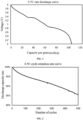
- FIG. 1 A discharge curve diagram of a cell in Example 1 of the present disclosure is shown in FIG. 1 .
- FIG. 2 A curve diagram of a cycle retention rate of a cell in Example 3 of the present disclosure is shown in FIG. 2 .
- a preparation method of a positive plate included the following steps:
- the positive plate of the present example, negative plate, separator, electrolyte, and so forth were assembled to form a battery, which was subjected to processes such as maturing, formation, and aging to obtain a cell to be tested.
- the preparation method of the positive plate was the same as in Example 1, except that the layered transition metal oxide was 88 parts by mass and the polyanionic compound was 7.5 parts by mass.
- the preparation method of the positive plate was the same as in Example 1, except that the layered transition metal oxide contained NaNi 1/3 Fe 1/3 Mn 1/3 O 2 and Na 0.9 Cu 0.25 Fe 0.3 Mn 0.45 O 2 with a mass ratio of 1:1, the polyanionic compound contained NaFePO 4 , Na 3 V 2 (PO 4 ) 3 , and Na 2 MnP 2 O 7 with a mass ratio of 1:1:1, and the true density of Na 2 MnP 2 O 7 was 3.26g/cm 3 .
- a preparation method of a positive plate included the following steps:
- the positive plate of the present comparative example, negative plate, separator, electrolyte, and so forth were assembled to obtain a battery, which was subjected to processes such as maturing, formation, and aging, to obtain a cell to be tested.
- a preparation method of a positive plate included the following steps:
- the positive plate of the present comparative example, negative plate, separator, electrolyte, and so forth were assembled to obtain a battery, which was subjected to processes such as maturing, formation, and aging, to obtain a cell to be tested.
- Electrochemical performance test was performed on the positive plates and the sodium-ion batteries in the examples and the comparative examples by the following method.
- the positive plate was placed in an environment with a humidity of 26 ⁇ 3% for 12 hours, and then the powder on the electrode plate was separated from the aluminum foil, and transferred to a beaker, followed with adding deionized water, stirring for 60 seconds, filtering, transferring the filtrate to a sample table of the potentiometric titrator, and performing potentiometric titration with hydrochloric acid.
- the carbonate and bicarbonate obtained in the test were converted into sodium-ion content, wherein the content calculation basis was the mass of the layered transition metal oxide in the cathode powder after separated from the aluminum foil.
- the layered transition metal oxide with large particle size and the polyanionic compound with small particle size are filled with each other, wherein the polyanionic compound, regarded as the main part, and the conductive agent and the bonding agent, regarded as the auxiliary part, are evenly dispersed on the surface of the layered transition metal oxide, which on the one hand enables the positive plate to have a higher compaction density, to effectively increase the energy density of the battery, and on the other hand, enables the combined positive plate has both better air stability and cycle performance.
- the active material of Comparative Example 1 only adopts the layered transition metal oxide, and the obtained positive plate has low compaction density and poor retention rate after cycling for 500 times.
- the active material of Comparative Example 2 only adopts the polyanionic compound, and the obtained positive plate has low compaction density and low reversible capacity.
- the particle size distribution of the active material in Comparative Example 3 is not within the protection scope of the present disclosure, and the obtained positive plate has low compaction density and poor cycle retention rate.
Landscapes
- Chemical & Material Sciences (AREA)
- Chemical Kinetics & Catalysis (AREA)
- Electrochemistry (AREA)
- General Chemical & Material Sciences (AREA)
- Engineering & Computer Science (AREA)
- Manufacturing & Machinery (AREA)
- Materials Engineering (AREA)
- Inorganic Chemistry (AREA)
- Composite Materials (AREA)
- Crystallography & Structural Chemistry (AREA)
- Battery Electrode And Active Subsutance (AREA)
- Secondary Cells (AREA)
Applications Claiming Priority (2)
| Application Number | Priority Date | Filing Date | Title |
|---|---|---|---|
| CN202211514774.7A CN115799447A (zh) | 2022-11-29 | 2022-11-29 | 正极片及其制备方法和钠离子电池 |
| PCT/CN2022/138078 WO2024113407A1 (zh) | 2022-11-29 | 2022-12-09 | 正极片及其制备方法和钠离子电池 |
Publications (2)
| Publication Number | Publication Date |
|---|---|
| EP4407706A1 true EP4407706A1 (de) | 2024-07-31 |
| EP4407706A4 EP4407706A4 (de) | 2024-10-23 |
Family
ID=85443325
Family Applications (1)
| Application Number | Title | Priority Date | Filing Date |
|---|---|---|---|
| EP22927587.0A Pending EP4407706A4 (de) | 2022-11-29 | 2022-12-09 | Positivelektrodenfolie, herstellungsverfahren dafür und natrium-ionen-batterie |
Country Status (6)
| Country | Link |
|---|---|
| US (1) | US20250079443A1 (de) |
| EP (1) | EP4407706A4 (de) |
| JP (1) | JP7715823B6 (de) |
| CN (1) | CN115799447A (de) |
| AU (1) | AU2022442103B2 (de) |
| WO (1) | WO2024113407A1 (de) |
Families Citing this family (8)
| Publication number | Priority date | Publication date | Assignee | Title |
|---|---|---|---|---|
| CN119948640A (zh) * | 2023-04-18 | 2025-05-06 | 宁德时代新能源科技股份有限公司 | 正极活性材料组合物、正极极片、电池及用电装置 |
| CN117981111B (zh) * | 2023-04-20 | 2026-01-13 | 宁德新能源科技有限公司 | 正极材料、正极极片、钠离子二次电池和用电装置 |
| CN118825212B (zh) * | 2023-04-21 | 2026-01-16 | 宁德时代新能源科技股份有限公司 | 钠金属电池的正极活性材料、正极极片、电池单体、钠金属电池及用电装置 |
| CN116885197A (zh) * | 2023-09-07 | 2023-10-13 | 四川易纳能新能源科技有限公司 | 正极极片及其制备方法和钠离子电池 |
| CN119786598A (zh) * | 2023-10-08 | 2025-04-08 | 华为数字能源技术有限公司 | 钠离子电池、电池包和储能系统 |
| CN117293302B (zh) * | 2023-11-24 | 2024-06-07 | 山东海化集团有限公司 | 一种钠离子电池复合正极材料及其制备方法 |
| CN120878834A (zh) * | 2024-04-23 | 2025-10-31 | 宁德时代新能源科技股份有限公司 | 聚阴离子类含钠正极材料及其制备方法、正极极片、电池及用电装置 |
| CN120164924A (zh) * | 2025-03-17 | 2025-06-17 | 溧阳中科海钠科技有限责任公司 | 一种复合钠离子正极材料及其制备方法、正极片和钠离子电池 |
Family Cites Families (12)
| Publication number | Priority date | Publication date | Assignee | Title |
|---|---|---|---|---|
| JP2011134551A (ja) | 2009-12-24 | 2011-07-07 | Sumitomo Chemical Co Ltd | 電極活物質、電極およびナトリウム二次電池 |
| JP6028285B2 (ja) | 2012-02-23 | 2016-11-16 | 国立研究開発法人産業技術総合研究所 | ナトリウム二次電池正極材料、該ナトリウム二次電池用正極材料の製造方法、該ナトリウム二次電池用正極材料を用いるナトリウム二次電池用電極、該ナトリウム二次電池用電極を備える非水系ナトリウム二次電池、及び該非水系ナトリウム二次電池を用いる電気機器 |
| JP2014072049A (ja) | 2012-09-28 | 2014-04-21 | Sanyo Electric Co Ltd | 非水電解質二次電池 |
| JP6442633B2 (ja) | 2017-05-29 | 2018-12-19 | 太平洋セメント株式会社 | リチウムイオン二次電池用正極活物質複合体又はナトリウムイオン二次電池用正極活物質複合体、これらを用いた二次電池、並びにこれらの製造方法 |
| CN109449446B (zh) * | 2018-10-17 | 2020-09-11 | 宁德时代新能源科技股份有限公司 | 二次电池 |
| CN111799470B (zh) * | 2019-04-08 | 2021-10-15 | 宁德时代新能源科技股份有限公司 | 正极极片及钠离子电池 |
| WO2021114401A1 (zh) * | 2019-12-09 | 2021-06-17 | 苏州大学 | 铁基钠离子电池正极材料,其制备方法以及钠离子全电池 |
| CN113871565B (zh) * | 2021-09-22 | 2023-05-26 | 雅迪科技集团有限公司 | 钠离子电池 |
| CN115000374B (zh) | 2022-06-13 | 2024-05-31 | 星恒电源股份有限公司 | 一种复合正极材料、钠离子电池正极片及钠离子电池 |
| CN115241422B (zh) * | 2022-06-21 | 2024-06-25 | 上海璞钠能源科技有限公司 | 一种钠离子电池用正极材料及其制备方法 |
| CN115172671A (zh) * | 2022-06-24 | 2022-10-11 | 上海交通大学 | 一种钠离子二次电池用复合正极极片和钠离子电池 |
| CN115132987B (zh) * | 2022-06-28 | 2025-09-05 | 星恒电源股份有限公司 | 一种多层包覆的钠离子电池正极材料,制备方法及钠离子电池 |
-
2022
- 2022-11-29 CN CN202211514774.7A patent/CN115799447A/zh active Pending
- 2022-12-09 WO PCT/CN2022/138078 patent/WO2024113407A1/zh not_active Ceased
- 2022-12-09 US US18/283,464 patent/US20250079443A1/en active Pending
- 2022-12-09 JP JP2023554324A patent/JP7715823B6/ja active Active
- 2022-12-09 AU AU2022442103A patent/AU2022442103B2/en active Active
- 2022-12-09 EP EP22927587.0A patent/EP4407706A4/de active Pending
Also Published As
| Publication number | Publication date |
|---|---|
| WO2024113407A1 (zh) | 2024-06-06 |
| JP7715823B2 (ja) | 2025-07-30 |
| CN115799447A (zh) | 2023-03-14 |
| US20250079443A1 (en) | 2025-03-06 |
| JP7715823B6 (ja) | 2025-08-21 |
| AU2022442103B2 (en) | 2025-04-24 |
| JP2025501034A (ja) | 2025-01-17 |
| EP4407706A4 (de) | 2024-10-23 |
| AU2022442103A1 (en) | 2024-06-13 |
Similar Documents
| Publication | Publication Date | Title |
|---|---|---|
| EP4407706A1 (de) | Positivelektrodenfolie, herstellungsverfahren dafür und natrium-ionen-batterie | |
| EP3800712B1 (de) | Aktives elektrodenmaterial und verfahren zu seiner herstellung, natrium-ionen-akkumulator und diese enthaltende vorrichtung | |
| CN108844878A (zh) | 负极极片、极片活性比表面积的测试方法及电池 | |
| US12548773B2 (en) | Positive active material, positive electrode plate, lithium-ion battery, and electrical device | |
| EP4220757A1 (de) | Siliciumbasiertes negativelektrodenmaterial mit silikatgerüst, negativelektrodenplatte und lithiumbatterie | |
| EP4207360A1 (de) | Negativelektrode, herstellungsverfahren dafür und anwendung davon | |
| KR20100137486A (ko) | 전극용 메조포러스 물질 | |
| CN106927508B (zh) | 一种蜂窝状纳米结构MnO2锂离子电池阳极材料的制备方法 | |
| CN116387472A (zh) | 一种钠离子电池负极浆料、负极片和钠离子电池 | |
| CN115295799A (zh) | 正极活性材料、磷酸铁锂厚电极及其制备方法和应用 | |
| WO2025091605A1 (zh) | 正极极片及其制备方法及锂离子电池 | |
| CN116885099A (zh) | 负极片和锂离子电池 | |
| CN115020638A (zh) | 一种锂离子电池 | |
| CN115133145A (zh) | 一种基于氢氧化镍正极和钛基离子嵌入型负极的水系锂/钠离子电池 | |
| CN115954435B (zh) | 一种正极极片及其制备方法和应用 | |
| WO2025130004A1 (zh) | 正极极片、正极极片的制备方法以及锂离子电池 | |
| CN118572027A (zh) | 多层全固态复合正极极片和全固态电池 | |
| CN116864669A (zh) | 一种正极活性物质及其制备方法、正极片和钠离子电池 | |
| CN116314748A (zh) | 一种正极材料及其制备方法以及正极极片与钠离子电池 | |
| Somavanshi et al. | Evaluating the electrochemical performance of graphite and silicon-based materials in energy storage device | |
| CN119133383B (zh) | 一种电池负极材料及其制备方法和应用 | |
| US20240105930A1 (en) | Transition metal layered oxides, positive electrode material, and sodium-ion battery | |
| CN114937759B (zh) | 一种钠基复合正极材料、电极及电化学装置 | |
| US20250223189A1 (en) | Positive electrode active material with controlled specific surface area, method of preparing same, and positive electrode containing same | |
| EP4376116A1 (de) | Negativelektrodenplatte, batterie, batteriepack und elektrische vorrichtung |
Legal Events
| Date | Code | Title | Description |
|---|---|---|---|
| STAA | Information on the status of an ep patent application or granted ep patent |
Free format text: STATUS: UNKNOWN |
|
| STAA | Information on the status of an ep patent application or granted ep patent |
Free format text: STATUS: THE INTERNATIONAL PUBLICATION HAS BEEN MADE |
|
| PUAI | Public reference made under article 153(3) epc to a published international application that has entered the european phase |
Free format text: ORIGINAL CODE: 0009012 |
|
| STAA | Information on the status of an ep patent application or granted ep patent |
Free format text: STATUS: REQUEST FOR EXAMINATION WAS MADE |
|
| 17P | Request for examination filed |
Effective date: 20230829 |
|
| AK | Designated contracting states |
Kind code of ref document: A1 Designated state(s): AL AT BE BG CH CY CZ DE DK EE ES FI FR GB GR HR HU IE IS IT LI LT LU LV MC ME MK MT NL NO PL PT RO RS SE SI SK SM TR |
|
| STAA | Information on the status of an ep patent application or granted ep patent |
Free format text: STATUS: EXAMINATION IS IN PROGRESS |
|
| A4 | Supplementary search report drawn up and despatched |
Effective date: 20240920 |
|
| RIC1 | Information provided on ipc code assigned before grant |
Ipc: H01M 4/36 20060101ALI20240916BHEP Ipc: H01M 4/02 20060101ALI20240916BHEP Ipc: H01M 4/62 20060101ALI20240916BHEP Ipc: H01M 4/58 20100101ALI20240916BHEP Ipc: H01M 4/1397 20100101ALI20240916BHEP Ipc: H01M 4/1391 20100101ALI20240916BHEP Ipc: H01M 4/04 20060101ALI20240916BHEP Ipc: H01M 10/054 20100101ALI20240916BHEP Ipc: H01M 4/525 20100101ALI20240916BHEP Ipc: H01M 4/505 20100101ALI20240916BHEP Ipc: H01M 4/136 20100101ALI20240916BHEP Ipc: H01M 4/131 20100101AFI20240916BHEP |
|
| 17Q | First examination report despatched |
Effective date: 20241002 |