EP4407014A1 - Schmiermittelzusammensetzung und wälzlager - Google Patents
Schmiermittelzusammensetzung und wälzlager Download PDFInfo
- Publication number
- EP4407014A1 EP4407014A1 EP22872874.7A EP22872874A EP4407014A1 EP 4407014 A1 EP4407014 A1 EP 4407014A1 EP 22872874 A EP22872874 A EP 22872874A EP 4407014 A1 EP4407014 A1 EP 4407014A1
- Authority
- EP
- European Patent Office
- Prior art keywords
- lubricant composition
- steel
- sodium salt
- oil
- bearing
- Prior art date
- Legal status (The legal status is an assumption and is not a legal conclusion. Google has not performed a legal analysis and makes no representation as to the accuracy of the status listed.)
- Pending
Links
Images


Classifications
-
- F—MECHANICAL ENGINEERING; LIGHTING; HEATING; WEAPONS; BLASTING
- F16—ENGINEERING ELEMENTS AND UNITS; GENERAL MEASURES FOR PRODUCING AND MAINTAINING EFFECTIVE FUNCTIONING OF MACHINES OR INSTALLATIONS; THERMAL INSULATION IN GENERAL
- F16C—SHAFTS; FLEXIBLE SHAFTS; ELEMENTS OR CRANKSHAFT MECHANISMS; ROTARY BODIES OTHER THAN GEARING ELEMENTS; BEARINGS
- F16C19/00—Bearings with rolling contact, for exclusively rotary movement
- F16C19/02—Bearings with rolling contact, for exclusively rotary movement with bearing balls essentially of the same size in one or more circular rows
- F16C19/04—Bearings with rolling contact, for exclusively rotary movement with bearing balls essentially of the same size in one or more circular rows for radial load mainly
- F16C19/06—Bearings with rolling contact, for exclusively rotary movement with bearing balls essentially of the same size in one or more circular rows for radial load mainly with a single row or balls
-
- C—CHEMISTRY; METALLURGY
- C10—PETROLEUM, GAS OR COKE INDUSTRIES; TECHNICAL GASES CONTAINING CARBON MONOXIDE; FUELS; LUBRICANTS; PEAT
- C10M—LUBRICATING COMPOSITIONS; USE OF CHEMICAL SUBSTANCES EITHER ALONE OR AS LUBRICATING INGREDIENTS IN A LUBRICATING COMPOSITION
- C10M125/00—Lubricating compositions characterised by the additive being an inorganic material
-
- C—CHEMISTRY; METALLURGY
- C10—PETROLEUM, GAS OR COKE INDUSTRIES; TECHNICAL GASES CONTAINING CARBON MONOXIDE; FUELS; LUBRICANTS; PEAT
- C10M—LUBRICATING COMPOSITIONS; USE OF CHEMICAL SUBSTANCES EITHER ALONE OR AS LUBRICATING INGREDIENTS IN A LUBRICATING COMPOSITION
- C10M125/00—Lubricating compositions characterised by the additive being an inorganic material
- C10M125/10—Metal oxides, hydroxides, carbonates or bicarbonates
-
- C—CHEMISTRY; METALLURGY
- C10—PETROLEUM, GAS OR COKE INDUSTRIES; TECHNICAL GASES CONTAINING CARBON MONOXIDE; FUELS; LUBRICANTS; PEAT
- C10M—LUBRICATING COMPOSITIONS; USE OF CHEMICAL SUBSTANCES EITHER ALONE OR AS LUBRICATING INGREDIENTS IN A LUBRICATING COMPOSITION
- C10M125/00—Lubricating compositions characterised by the additive being an inorganic material
- C10M125/22—Compounds containing sulfur, selenium or tellurium
-
- C—CHEMISTRY; METALLURGY
- C10—PETROLEUM, GAS OR COKE INDUSTRIES; TECHNICAL GASES CONTAINING CARBON MONOXIDE; FUELS; LUBRICANTS; PEAT
- C10M—LUBRICATING COMPOSITIONS; USE OF CHEMICAL SUBSTANCES EITHER ALONE OR AS LUBRICATING INGREDIENTS IN A LUBRICATING COMPOSITION
- C10M129/00—Lubricating compositions characterised by the additive being an organic non-macromolecular compound containing oxygen
- C10M129/02—Lubricating compositions characterised by the additive being an organic non-macromolecular compound containing oxygen having a carbon chain of less than 30 atoms
- C10M129/68—Esters
- C10M129/76—Esters containing free hydroxy or carboxyl groups
-
- C—CHEMISTRY; METALLURGY
- C10—PETROLEUM, GAS OR COKE INDUSTRIES; TECHNICAL GASES CONTAINING CARBON MONOXIDE; FUELS; LUBRICANTS; PEAT
- C10M—LUBRICATING COMPOSITIONS; USE OF CHEMICAL SUBSTANCES EITHER ALONE OR AS LUBRICATING INGREDIENTS IN A LUBRICATING COMPOSITION
- C10M141/00—Lubricating compositions characterised by the additive being a mixture of two or more compounds covered by more than one of the main groups C10M125/00 - C10M139/00, each of these compounds being essential
- C10M141/02—Lubricating compositions characterised by the additive being a mixture of two or more compounds covered by more than one of the main groups C10M125/00 - C10M139/00, each of these compounds being essential at least one of them being an organic oxygen-containing compound
-
- C—CHEMISTRY; METALLURGY
- C10—PETROLEUM, GAS OR COKE INDUSTRIES; TECHNICAL GASES CONTAINING CARBON MONOXIDE; FUELS; LUBRICANTS; PEAT
- C10M—LUBRICATING COMPOSITIONS; USE OF CHEMICAL SUBSTANCES EITHER ALONE OR AS LUBRICATING INGREDIENTS IN A LUBRICATING COMPOSITION
- C10M141/00—Lubricating compositions characterised by the additive being a mixture of two or more compounds covered by more than one of the main groups C10M125/00 - C10M139/00, each of these compounds being essential
- C10M141/10—Lubricating compositions characterised by the additive being a mixture of two or more compounds covered by more than one of the main groups C10M125/00 - C10M139/00, each of these compounds being essential at least one of them being an organic phosphorus-containing compound
-
- C—CHEMISTRY; METALLURGY
- C10—PETROLEUM, GAS OR COKE INDUSTRIES; TECHNICAL GASES CONTAINING CARBON MONOXIDE; FUELS; LUBRICANTS; PEAT
- C10M—LUBRICATING COMPOSITIONS; USE OF CHEMICAL SUBSTANCES EITHER ALONE OR AS LUBRICATING INGREDIENTS IN A LUBRICATING COMPOSITION
- C10M169/00—Lubricating compositions characterised by containing as components a mixture of at least two types of ingredient selected from base-materials, thickeners or additives, covered by the preceding groups, each of these compounds being essential
- C10M169/04—Mixtures of base-materials and additives
-
- F—MECHANICAL ENGINEERING; LIGHTING; HEATING; WEAPONS; BLASTING
- F16—ENGINEERING ELEMENTS AND UNITS; GENERAL MEASURES FOR PRODUCING AND MAINTAINING EFFECTIVE FUNCTIONING OF MACHINES OR INSTALLATIONS; THERMAL INSULATION IN GENERAL
- F16C—SHAFTS; FLEXIBLE SHAFTS; ELEMENTS OR CRANKSHAFT MECHANISMS; ROTARY BODIES OTHER THAN GEARING ELEMENTS; BEARINGS
- F16C33/00—Parts of bearings; Special methods for making bearings or parts thereof
- F16C33/30—Parts of ball or roller bearings
- F16C33/66—Special parts or details in view of lubrication
-
- F—MECHANICAL ENGINEERING; LIGHTING; HEATING; WEAPONS; BLASTING
- F16—ENGINEERING ELEMENTS AND UNITS; GENERAL MEASURES FOR PRODUCING AND MAINTAINING EFFECTIVE FUNCTIONING OF MACHINES OR INSTALLATIONS; THERMAL INSULATION IN GENERAL
- F16C—SHAFTS; FLEXIBLE SHAFTS; ELEMENTS OR CRANKSHAFT MECHANISMS; ROTARY BODIES OTHER THAN GEARING ELEMENTS; BEARINGS
- F16C33/00—Parts of bearings; Special methods for making bearings or parts thereof
- F16C33/30—Parts of ball or roller bearings
- F16C33/66—Special parts or details in view of lubrication
- F16C33/6603—Special parts or details in view of lubrication with grease as lubricant
- F16C33/6633—Grease properties or compositions, e.g. rheological properties
-
- C—CHEMISTRY; METALLURGY
- C10—PETROLEUM, GAS OR COKE INDUSTRIES; TECHNICAL GASES CONTAINING CARBON MONOXIDE; FUELS; LUBRICANTS; PEAT
- C10M—LUBRICATING COMPOSITIONS; USE OF CHEMICAL SUBSTANCES EITHER ALONE OR AS LUBRICATING INGREDIENTS IN A LUBRICATING COMPOSITION
- C10M2201/00—Inorganic compounds or elements as ingredients in lubricant compositions
- C10M2201/06—Metal compounds
-
- C—CHEMISTRY; METALLURGY
- C10—PETROLEUM, GAS OR COKE INDUSTRIES; TECHNICAL GASES CONTAINING CARBON MONOXIDE; FUELS; LUBRICANTS; PEAT
- C10M—LUBRICATING COMPOSITIONS; USE OF CHEMICAL SUBSTANCES EITHER ALONE OR AS LUBRICATING INGREDIENTS IN A LUBRICATING COMPOSITION
- C10M2201/00—Inorganic compounds or elements as ingredients in lubricant compositions
- C10M2201/06—Metal compounds
- C10M2201/062—Oxides; Hydroxides; Carbonates or bicarbonates
-
- C—CHEMISTRY; METALLURGY
- C10—PETROLEUM, GAS OR COKE INDUSTRIES; TECHNICAL GASES CONTAINING CARBON MONOXIDE; FUELS; LUBRICANTS; PEAT
- C10M—LUBRICATING COMPOSITIONS; USE OF CHEMICAL SUBSTANCES EITHER ALONE OR AS LUBRICATING INGREDIENTS IN A LUBRICATING COMPOSITION
- C10M2201/00—Inorganic compounds or elements as ingredients in lubricant compositions
- C10M2201/08—Inorganic acids or salts thereof
- C10M2201/084—Inorganic acids or salts thereof containing sulfur, selenium or tellurium
-
- C—CHEMISTRY; METALLURGY
- C10—PETROLEUM, GAS OR COKE INDUSTRIES; TECHNICAL GASES CONTAINING CARBON MONOXIDE; FUELS; LUBRICANTS; PEAT
- C10M—LUBRICATING COMPOSITIONS; USE OF CHEMICAL SUBSTANCES EITHER ALONE OR AS LUBRICATING INGREDIENTS IN A LUBRICATING COMPOSITION
- C10M2201/00—Inorganic compounds or elements as ingredients in lubricant compositions
- C10M2201/085—Phosphorus oxides, acids or salts
-
- C—CHEMISTRY; METALLURGY
- C10—PETROLEUM, GAS OR COKE INDUSTRIES; TECHNICAL GASES CONTAINING CARBON MONOXIDE; FUELS; LUBRICANTS; PEAT
- C10M—LUBRICATING COMPOSITIONS; USE OF CHEMICAL SUBSTANCES EITHER ALONE OR AS LUBRICATING INGREDIENTS IN A LUBRICATING COMPOSITION
- C10M2201/00—Inorganic compounds or elements as ingredients in lubricant compositions
- C10M2201/086—Chromium oxides, acids or salts
-
- C—CHEMISTRY; METALLURGY
- C10—PETROLEUM, GAS OR COKE INDUSTRIES; TECHNICAL GASES CONTAINING CARBON MONOXIDE; FUELS; LUBRICANTS; PEAT
- C10M—LUBRICATING COMPOSITIONS; USE OF CHEMICAL SUBSTANCES EITHER ALONE OR AS LUBRICATING INGREDIENTS IN A LUBRICATING COMPOSITION
- C10M2201/00—Inorganic compounds or elements as ingredients in lubricant compositions
- C10M2201/10—Compounds containing silicon
- C10M2201/102—Silicates
-
- C—CHEMISTRY; METALLURGY
- C10—PETROLEUM, GAS OR COKE INDUSTRIES; TECHNICAL GASES CONTAINING CARBON MONOXIDE; FUELS; LUBRICANTS; PEAT
- C10M—LUBRICATING COMPOSITIONS; USE OF CHEMICAL SUBSTANCES EITHER ALONE OR AS LUBRICATING INGREDIENTS IN A LUBRICATING COMPOSITION
- C10M2205/00—Organic macromolecular hydrocarbon compounds or fractions, whether or not modified by oxidation as ingredients in lubricant compositions
- C10M2205/02—Organic macromolecular hydrocarbon compounds or fractions, whether or not modified by oxidation as ingredients in lubricant compositions containing acyclic monomers
- C10M2205/028—Organic macromolecular hydrocarbon compounds or fractions, whether or not modified by oxidation as ingredients in lubricant compositions containing acyclic monomers containing aliphatic monomers having more than four carbon atoms
- C10M2205/0285—Organic macromolecular hydrocarbon compounds or fractions, whether or not modified by oxidation as ingredients in lubricant compositions containing acyclic monomers containing aliphatic monomers having more than four carbon atoms used as base material
-
- C—CHEMISTRY; METALLURGY
- C10—PETROLEUM, GAS OR COKE INDUSTRIES; TECHNICAL GASES CONTAINING CARBON MONOXIDE; FUELS; LUBRICANTS; PEAT
- C10M—LUBRICATING COMPOSITIONS; USE OF CHEMICAL SUBSTANCES EITHER ALONE OR AS LUBRICATING INGREDIENTS IN A LUBRICATING COMPOSITION
- C10M2207/00—Organic non-macromolecular hydrocarbon compounds containing hydrogen, carbon and oxygen as ingredients in lubricant compositions
- C10M2207/28—Esters
- C10M2207/2805—Esters used as base material
-
- C—CHEMISTRY; METALLURGY
- C10—PETROLEUM, GAS OR COKE INDUSTRIES; TECHNICAL GASES CONTAINING CARBON MONOXIDE; FUELS; LUBRICANTS; PEAT
- C10M—LUBRICATING COMPOSITIONS; USE OF CHEMICAL SUBSTANCES EITHER ALONE OR AS LUBRICATING INGREDIENTS IN A LUBRICATING COMPOSITION
- C10M2207/00—Organic non-macromolecular hydrocarbon compounds containing hydrogen, carbon and oxygen as ingredients in lubricant compositions
- C10M2207/28—Esters
- C10M2207/283—Esters of polyhydroxy compounds
-
- C—CHEMISTRY; METALLURGY
- C10—PETROLEUM, GAS OR COKE INDUSTRIES; TECHNICAL GASES CONTAINING CARBON MONOXIDE; FUELS; LUBRICANTS; PEAT
- C10M—LUBRICATING COMPOSITIONS; USE OF CHEMICAL SUBSTANCES EITHER ALONE OR AS LUBRICATING INGREDIENTS IN A LUBRICATING COMPOSITION
- C10M2209/00—Organic macromolecular compounds containing oxygen as ingredients in lubricant compositions
- C10M2209/02—Macromolecular compounds obtained by reactions only involving carbon-to-carbon unsaturated bonds
- C10M2209/023—Macromolecular compounds obtained by reactions only involving carbon-to-carbon unsaturated bonds used as base material
-
- C—CHEMISTRY; METALLURGY
- C10—PETROLEUM, GAS OR COKE INDUSTRIES; TECHNICAL GASES CONTAINING CARBON MONOXIDE; FUELS; LUBRICANTS; PEAT
- C10M—LUBRICATING COMPOSITIONS; USE OF CHEMICAL SUBSTANCES EITHER ALONE OR AS LUBRICATING INGREDIENTS IN A LUBRICATING COMPOSITION
- C10M2223/00—Organic non-macromolecular compounds containing phosphorus as ingredients in lubricant compositions
- C10M2223/02—Organic non-macromolecular compounds containing phosphorus as ingredients in lubricant compositions having no phosphorus-to-carbon bonds
- C10M2223/04—Phosphate esters
- C10M2223/045—Metal containing thio derivatives
-
- C—CHEMISTRY; METALLURGY
- C10—PETROLEUM, GAS OR COKE INDUSTRIES; TECHNICAL GASES CONTAINING CARBON MONOXIDE; FUELS; LUBRICANTS; PEAT
- C10N—INDEXING SCHEME ASSOCIATED WITH SUBCLASS C10M RELATING TO LUBRICATING COMPOSITIONS
- C10N2010/00—Metal present as such or in compounds
- C10N2010/02—Groups 1 or 11
-
- C—CHEMISTRY; METALLURGY
- C10—PETROLEUM, GAS OR COKE INDUSTRIES; TECHNICAL GASES CONTAINING CARBON MONOXIDE; FUELS; LUBRICANTS; PEAT
- C10N—INDEXING SCHEME ASSOCIATED WITH SUBCLASS C10M RELATING TO LUBRICATING COMPOSITIONS
- C10N2020/00—Specified physical or chemical properties or characteristics, i.e. function, of component of lubricating compositions
- C10N2020/01—Physico-chemical properties
- C10N2020/02—Viscosity; Viscosity index
-
- C—CHEMISTRY; METALLURGY
- C10—PETROLEUM, GAS OR COKE INDUSTRIES; TECHNICAL GASES CONTAINING CARBON MONOXIDE; FUELS; LUBRICANTS; PEAT
- C10N—INDEXING SCHEME ASSOCIATED WITH SUBCLASS C10M RELATING TO LUBRICATING COMPOSITIONS
- C10N2030/00—Specified physical or chemical properties which is improved by the additive characterising the lubricating composition, e.g. multifunctional additives
- C10N2030/02—Pour-point; Viscosity index
-
- C—CHEMISTRY; METALLURGY
- C10—PETROLEUM, GAS OR COKE INDUSTRIES; TECHNICAL GASES CONTAINING CARBON MONOXIDE; FUELS; LUBRICANTS; PEAT
- C10N—INDEXING SCHEME ASSOCIATED WITH SUBCLASS C10M RELATING TO LUBRICATING COMPOSITIONS
- C10N2030/00—Specified physical or chemical properties which is improved by the additive characterising the lubricating composition, e.g. multifunctional additives
- C10N2030/06—Oiliness; Film-strength; Anti-wear; Resistance to extreme pressure
-
- C—CHEMISTRY; METALLURGY
- C10—PETROLEUM, GAS OR COKE INDUSTRIES; TECHNICAL GASES CONTAINING CARBON MONOXIDE; FUELS; LUBRICANTS; PEAT
- C10N—INDEXING SCHEME ASSOCIATED WITH SUBCLASS C10M RELATING TO LUBRICATING COMPOSITIONS
- C10N2040/00—Specified use or application for which the lubricating composition is intended
- C10N2040/02—Bearings
-
- C—CHEMISTRY; METALLURGY
- C10—PETROLEUM, GAS OR COKE INDUSTRIES; TECHNICAL GASES CONTAINING CARBON MONOXIDE; FUELS; LUBRICANTS; PEAT
- C10N—INDEXING SCHEME ASSOCIATED WITH SUBCLASS C10M RELATING TO LUBRICATING COMPOSITIONS
- C10N2040/00—Specified use or application for which the lubricating composition is intended
- C10N2040/14—Electric or magnetic purposes
-
- C—CHEMISTRY; METALLURGY
- C10—PETROLEUM, GAS OR COKE INDUSTRIES; TECHNICAL GASES CONTAINING CARBON MONOXIDE; FUELS; LUBRICANTS; PEAT
- C10N—INDEXING SCHEME ASSOCIATED WITH SUBCLASS C10M RELATING TO LUBRICATING COMPOSITIONS
- C10N2050/00—Form in which the lubricant is applied to the material being lubricated
- C10N2050/10—Form in which the lubricant is applied to the material being lubricated semi-solid; greasy
-
- F—MECHANICAL ENGINEERING; LIGHTING; HEATING; WEAPONS; BLASTING
- F16—ENGINEERING ELEMENTS AND UNITS; GENERAL MEASURES FOR PRODUCING AND MAINTAINING EFFECTIVE FUNCTIONING OF MACHINES OR INSTALLATIONS; THERMAL INSULATION IN GENERAL
- F16C—SHAFTS; FLEXIBLE SHAFTS; ELEMENTS OR CRANKSHAFT MECHANISMS; ROTARY BODIES OTHER THAN GEARING ELEMENTS; BEARINGS
- F16C2326/00—Articles relating to transporting
- F16C2326/01—Parts of vehicles in general
- F16C2326/02—Wheel hubs or castors
-
- Y—GENERAL TAGGING OF NEW TECHNOLOGICAL DEVELOPMENTS; GENERAL TAGGING OF CROSS-SECTIONAL TECHNOLOGIES SPANNING OVER SEVERAL SECTIONS OF THE IPC; TECHNICAL SUBJECTS COVERED BY FORMER USPC CROSS-REFERENCE ART COLLECTIONS [XRACs] AND DIGESTS
- Y02—TECHNOLOGIES OR APPLICATIONS FOR MITIGATION OR ADAPTATION AGAINST CLIMATE CHANGE
- Y02E—REDUCTION OF GREENHOUSE GAS [GHG] EMISSIONS, RELATED TO ENERGY GENERATION, TRANSMISSION OR DISTRIBUTION
- Y02E10/00—Energy generation through renewable energy sources
- Y02E10/70—Wind energy
- Y02E10/72—Wind turbines with rotation axis in wind direction
Definitions
- the present invention relates to a lubricant composition used for a gear and a bearing portion of a continuously variable transmission of an automobile, a speed-increasing gear of a wind power generator, and the like, and a rolling bearing using the lubricant composition.
- bearings lubricated with a gear oil or a hydraulic operating oil are used for a hydraulic motor, a hydraulic pump, and an axle planetary unit.
- An operating oil is generally used as these oils.
- Patent Document 1 describes a lubricant composition that contains a predetermined amount of a phosphorus-based extreme pressure agent and is excellent in metal fatigue life, wear resistance, and electrical insulation properties even when the viscosity thereof is reduced.
- Patent Document 1 JP 2019-073572 A
- the lubricant composition described in Patent Document 1 even when the metal fatigue life and the wear resistance are good under normal use conditions, the lubricant composition may be insufficient as a countermeasure for corrosion wear under harsh conditions such as high speed and high load under high humidity.
- a seal having a structure in which a seal torque is reduced may be adopted in a bearing to which a lubricating oil having a low viscosity is applied.
- water easily enters the internal space of the bearing, and adhesion, corrosion wear, and early peeling at a contact portion (such as a raceway surface) easily occur due to contact between steel portions caused by oil film breakage.
- the present invention has been made in view of the above problem, and an object of the present invention is to provide a lubricant composition capable of suppressing wear and the like in a steel bearing portion under harsh conditions, and a rolling bearing using the lubricant composition.
- a lubricant composition of the present invention is used for a bearing portion made of steel, and the lubricant composition contains an inorganic sodium salt (Na x M y O z ), and a natural potential of the steel in an aqueous solution at 25°C in which the inorganic sodium salt is dissolved at a concentration of 1 mass% is 0.04 V or higher.
- an inorganic sodium salt Na x M y O z
- a natural potential of the steel in an aqueous solution at 25°C in which the inorganic sodium salt is dissolved at a concentration of 1 mass% is 0.04 V or higher.
- the inorganic sodium salt contains at least one selected from sodium molybdate (Na 2 MoO 4 ) and sodium sulfite (Na 2 SO 3 ).
- the lubricant composition contains a sorbitan-based ester.
- the lubricant composition contains zinc alkyldithiophosphate.
- the lubricant composition is a grease containing a thickener.
- a rolling bearing of the present invention includes an inner ring, an outer ring, a plurality of rolling elements interposed between the inner ring and the outer ring, and a lubricant composition enclosed or supplied in a space inside the bearing, wherein the lubricant composition is the lubricant composition of the present invention described above.
- the lubricant composition of the present invention is used for a bearing portion made of steel, and contains an inorganic sodium salt, and a natural potential of the steel in an aqueous solution at 25°C in which the inorganic sodium salt is dissolved at a concentration of 1 mass% is 0.04 V or higher, so that it is possible to form a coating film (corrosion-resistant coating film) unlikely to be corroded on the steel surface.
- a coating film corrosion-resistant coating film
- the inorganic sodium salt contains at least one selected from sodium molybdate and sodium sulfite, and thus a thickness of the corrosion-resistant coating film formed on the steel surface is further increased, which makes the corrosion wear resistance and the adhesion suppression effect more excellent.
- the lubricant composition contains a sorbitan-based ester or zinc alkyldithiophosphate, and thus, the lubricant composition is more excellent in corrosion wear resistance and adhesion suppressing effect.
- the rolling bearing of the present invention uses the lubricant composition, and thus, adhesion and corrosion wear in the bearing portion made of steel can be suppressed even under harsh conditions such as high speed and high load under high humidity. Accordingly, the rolling bearing can be suitably used as a bearing used for a continuously variable transmission of an automobile, a speed-increasing gear of a wind power generator, and the like.
- the present inventors have conducted intensive studies on a lubricant composition to be used for lubrication to suppress wear and the like in a bearing portion made of steel under harsh conditions such as high speed and high load under high humidity. As a result, it has been found that when the lubricant composition contains an inorganic sodium salt (25°C, 1 mass% aqueous solution) with which the natural potential of steel is 0.04 V or higher, an unexpectedly excellent wear suppressing effect can be obtained.
- the present invention is based on such findings.
- the lubricant composition of the present invention is used for a bearing portion made of steel.
- the lubricant composition contains an inorganic sodium salt.
- the present invention is characterized in that the natural potential of steel in an aqueous solution at 25°C in which the inorganic sodium salt is dissolved at a concentration of 1 mass% is 0.04 V or higher.
- the natural potential means a potential unique to a metal, which is maintained in an environment where the metal exists.
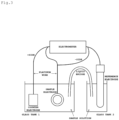
- the natural potential refers to a potential difference at the time point when a reference electrode, a counter electrode, and a sample electrode are immersed in a sample solution having a predetermined concentration, and are left to stand for a certain period of time under a predetermined temperature condition, and the oxidation-reduction state on the surface of the sample electrode reaches equilibrium.
- a test piece having a free shape such as a plate shape or an annular shape can be used, and in the present invention, it is preferable to use an annular test piece.
- the lubricant composition of the present invention contains an inorganic sodium salt (25°C, 1 mass% aqueous solution) with which the natural potential of steel is 0.04 V or higher as described above, and thus, a coating film (corrosion-resistant coating film) which is unlikely to be corroded is formed on the steel surface.
- a coating film corrosion-resistant coating film
- This corrosion-resistant coating film is an oxide film, and thus, it is considered that an oxide film thicker than that when the natural potential of steel is lower than 0.04 V is formed.
- the natural potential of steel in an aqueous solution at 25°C in which the inorganic sodium salt is dissolved at a concentration of 1 mass% is preferably 0.06 V or higher, more preferably 0.08 V or higher, and still more preferably 0.10 V or higher from the viewpoint of forming a thicker corrosion-resistant coating film to improve wear resistance.
- the inorganic sodium salt is preferably water-soluble. When the inorganic sodium salt is water-soluble, the inorganic sodium salt is dissolved in water that has entered the bearing space, so that a corrosion-resistant coating film is more easily formed.
- the inorganic sodium salt that can be used in the present invention preferably contains at least one selected from sodium molybdate and sodium sulfite, and more preferably contains sodium molybdate.
- the sodium molybdate used in the present invention can be used as either an anhydride or a hydrate.
- a blending amount of sodium molybdate is preferably 0.1 to 5 mass% with respect to the total amount of the lubricant composition.
- the blending amount is more preferably 0.1 to 2 mass%, and still more preferably 1 to 2 mass%. When the blending amount of sodium molybdate is less than 0.1 mass%, it is difficult to obtain sufficient wear resistance.
- sodium molybdate reacts with a frictional wearing surface or an iron-based metal fresh surface exposed by wear in the bearing portion to form a film containing a molybdenum compound together with iron oxide.
- the rolling surface of the bearing is covered with the iron oxide or molybdenum compound film, and the thickness of the corrosion-resistant film formed on the steel surface is increased, thereby making the corrosion wear resistance and the adhesion suppression effect more excellent.
- the lubricant composition preferably contains a sorbitan-based ester.
- the sorbitan-based ester include sorbitan fatty acid esters such as sorbitan laurate, sorbitan monooleate, sorbitan trioleate, sorbitan tribehenate, sorbitan stearate, sorbitan tristearate, and sorbitan caprylate, but are not limited thereto.
- the sorbitan-based ester is more preferably sorbitan monooleate or sorbitan trioleate from the viewpoint of dispersibility of the inorganic sodium salt.
- the sorbitan-based ester due to interaction between a particle surface of the inorganic sodium salt dispersed in the lubricant composition and the sorbitan-based ester, the sorbitan-based ester forms an adsorption film on the particle surface to stabilize the particle.
- the sorbitan-based ester has a tetrahydrofuran structure (5-membered cyclic ether structure) having an appropriate coordination ability, and thus, the sorbitan-based ester is excellent in dispersibility of the inorganic sodium salt. It is considered that as a result, the finer inorganic sodium salt can be stably present in the lubricant composition for a long period of time without aggregation, and the corrosion-resistant coating film can be more effectively formed.
- the sorbitan-based ester adsorption film is also formed on the surface of the bearing rolling surface, and thus can contribute to improvement of wear resistance.
- the blending proportion of the sorbitan-based ester in the lubricant composition of the present invention is preferably 0.05 to 5 mass%.
- the blending proportion is more preferably 0.1 to 2 mass%, and may be 1 to 2 mass%.
- the proportion is less than 0.05 mass%, the effect of dispersing the inorganic sodium salt and the effect of improving the wear resistance may be poor.
- the proportion exceeds 5 mass%, the effect of dispersing the inorganic sodium salt and the effect of improving the wear resistance may reach a plateau.
- a wet grinding method may be employed in production of the lubricant composition in which the inorganic sodium salt is dispersed.
- the method include a method in which an inorganic sodium salt or the like having no affinity for a liquid phase is pulverized in the presence of a sorbitan-based ester in a certain amount of a base oil serving as a liquid phase, and then the mixture is diluted with the base oil so as to give a predetermined concentration, and other additives are added as necessary.
- This allows the inorganic sodium salt such as molybdate to be easily wrapped in the sorbitan-based ester, so that dispersibility is improved, and aggregation and precipitation are less likely to occur.
- the lubricant composition preferably contains zinc alkyldithiophosphate.
- a coating film is formed with zinc alkyldithiophosphate, the corrosion-resistant coating film is protected, which makes the corrosion wear resistance and the adhesion suppression effect further excellent.
- the coating film is a reaction film with the oxide film or the molybdenum compound described above.
- the zinc alkyldithiophosphate is more preferably zinc alkyldithiophosphate having a primary alkyl group having 1 to 30 carbon atoms (hereinafter, referred to as pri-ZnDTP).
- pri-ZnDTP is represented by the following formula (1).
- R 1 and R 2 each represent a primary alkyl group having 1 to 30 carbon atoms.
- the primary alkyl group means that, in the substituents R 1 and R 2 , a carbon atom directly bonded to an oxygen atom in zinc dialkyldithiophosphate is a primary carbon atom.
- R 1 and R 2 examples include a methyl group, an ethyl group, a propyl group, a butyl group, an isobutyl group, a pentyl group, an isopentyl group, a hexyl group, an isohexyl group, a 2-ethylhexyl group, a heptyl group, an octyl group, a nonyl group, a decyl group, a dodecyl group, a tetradecyl group, a hexadecyl group, an octadecyl group, an eicosyl group, a docosyl group, and a tetracosyl group.
- R 1 and R 2 may be the same as or different from each other.
- the substituents R 1 and R 2 preferably have 6 to 24 carbon atoms, more preferably 8 to 16 carbon atoms.
- pri-ZnDTP As the pri-ZnDTP represented by the above formula (1), one kind may be used, or two or more kinds may be used in combination.
- a blending amount of the zinc alkyldithiophosphate is preferably 0.1 to 5 mass% with respect to the total amount of the lubricant composition.
- the blending amount is more preferably 0.1 to 2 mass%, and still more preferably 1 to 2 mass%.
- the blending amount of zinc alkyldithiophosphate is less than 0.1 mass%, it is difficult to obtain improvement in corrosion wear resistance and adhesion suppression effect.
- any base oil can be used without particular limitation as long as it is usually used in a rolling bearing.
- examples thereof include mineral oils such as a paraffin-based mineral oil and a naphthene-based mineral oil, synthetic hydrocarbon oils such as a poly- ⁇ -olefin oil (PAO oil) and an alkylbenzene oil, an ester oil, an ether oil, a silicone oil, and a fluorine oil.
- PAO oil poly- ⁇ -olefin oil
- alkylbenzene oil an alkylbenzene oil
- ester oil an ester oil
- an ether oil an ether oil
- silicone oil a fluorine oil
- the synthetic hydrocarbon oil is more preferably PAO oil.
- the PAO oil is a mixture of an oligomer or a polymer of an ⁇ -olefin or an isomerized ⁇ -olefin.
- Specific examples of the ⁇ -olefin include 1-octene, 1-nonene, 1-decene, 1-dodecene, 1-tridecene, 1-tetradecene, 1-pentadecene, 1-hexadecene, 1-heptadecene, 1-octadecene, 1-nonadecene, 1-eicosene, 1-docosene, and 1-tetradocosene, and usually, a mixture thereof is used.
- the ester oil include polyol ester oil, phosphate ester oil, polymer ester oil, aromatic ester oil, carbonate ester oil, diester oil, and polyglycol oil.
- a kinematic viscosity (in a case of a mixed oil, a kinematic viscosity of the mixed oil) of the base oil is preferably 10 to 150 mm 2 /s at 40°C. It is more preferably 10 to 100 mm 2 /s, still more preferably 20 to 80 mm 2 /s, and most preferably 20 to 40 mm 2 /s.
- the lubricant composition of the present invention may further contain other additives as long as the object of the present invention is not impaired.
- additives include antioxidants such as amine-based, phenol-based, and sulfur-based compounds, rust inhibitors such as sulfonates, and oil agents such as esters and alcohols.
- Examples of the form of the lubricant composition of the present invention include (1) a lubricating oil composition containing a base oil and an inorganic sodium salt, and (2) a grease composition containing a base oil, a thickener, and an inorganic sodium salt.
- the base oil is preferably contained in an amount of 90 mass% or more and may be 95 mass% or more with respect to the total amount of the lubricating oil composition.
- the base oil preferably is contained in an amount of 60 mass% to 95 mass% with respect to the total amount of the base oil and the thickener.
- the thickener to be blended when the lubricant composition of the present invention is used as a grease composition is not particularly limited, and general thickeners usually used in the field of grease can be used.
- a soap-based thickener such as a metal soap or a composite metal soap
- a non-soap-based thickener such as benton, silica gel, a urea compound, or a urea urethane compound can be used.
- Examples of the metal soap include sodium soap, calcium soap, aluminum soap, and lithium soap
- examples of the urea compound and the urea urethane compound include a diurea compound, a triurea compound, a tetraurea compound, another polyurea compound, and a diurethane compound.
- the urea compound is obtained by reacting a polyisocyanate component and a monoamine component.
- the polyisocyanate component include phenylene diisocyanate, tolylene diisocyanate, diphenyl diisocyanate, diphenylmethane diisocyanate, octadecane diisocyanate, decane diisocyanate, and hexane diisocyanate.
- the monoamine component an aliphatic monoamine, an alicyclic monoamine, or an aromatic monoamine can be used.
- Examples of the aliphatic monoamine include hexylamine, octylamine, dodecylamine, hexadecylamine, octadecylamine, stearylamine, and oleylamine.
- Examples of the alicyclic monoamine include cyclohexylamine.
- Examples of the aromatic monoamine include aniline and p-toluidine.
- worked penetration is preferably in a range of 200 to 350.
- the worked penetration is more preferably in a range of 250 to 300.
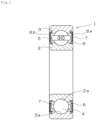
- FIG. 1 is a cross-sectional view of a deep groove ball bearing.
- a rolling bearing 1 an inner ring 2 having an inner ring rolling surface 2a on an outer peripheral surface thereof and an outer ring 3 having an outer ring rolling surface 3a on an inner peripheral surface thereof are concentrically disposed, and a plurality of rolling elements 4 are disposed between the inner ring rolling surface 2a and the outer ring rolling surface 3a.
- the rolling elements 4 are held by a retainer 5.
- both axial end openings 8a and 8b of the inner and outer rings are sealed by a sealing member 6, and the above-described lubricant composition 7 is enclosed at least around the rolling elements 4 in the space inside the bearing.
- the inner ring 2, the outer ring 3, and the rolling elements 4 are made of a steel material, and the lubricant composition 7 is interposed between rolling surfaces of the inner ring 2 and the outer ring 3, and the rolling elements 4, so that the bearing is lubricated.
- the steel material constituting the bearing members such as the inner ring 2, the outer ring 3, and the rolling elements 4 is any material generally used as a bearing material, and examples thereof include high-carbon chromium bearing steel (SUJ1, SUJ2, SUJ3, SUJ4, SUJ5, and the like, JIS G 4805), carburized steel (SCr420, SCM420, and the like, JIS G 4053), and stainless steel (SUS440C and the like, JIS G 4303), high speed steel (M50 and the like), and cold rolled steel.
- the sealing member 6 may be made of metal or a rubber molded body alone, or may be a composite of a rubber molded body and a metal plate, a plastic plate, or a ceramic plate. A composite of a rubber molded body and a metal plate is preferable from the viewpoint of durability and ease of fixing.
- the ball bearing (including the sealing member) is illustrated as the bearing in FIG. 1
- the form of the rolling bearing of the present invention is not limited thereto.
- the bearing can also be used as a cylindrical roller bearing, a tapered roller bearing, a self-aligning roller bearing, a needle roller bearing, a thrust cylindrical roller bearing, a thrust tapered roller bearing, a thrust needle roller bearing, a thrust self-aligning roller bearing, or the like.
- the lubricant composition is supplied and enclosed in the space inside the bearing (bearing portion), and thus adhesion and corrosion wear in the bearing portion made of steel can be suppressed even under harsh conditions such as high speed and high load under high humidity, which makes wear resistance excellent. Accordingly, the rolling bearing can be suitably used as a bearing used for a continuously variable transmission of an automobile, a speed-increasing gear of a wind power generator, and the like.
- FIG. 2 illustrates an example of a speed-increasing gear of a wind power generator to which the rolling bearing of the present invention is applied.
- FIG. 2 is a cross-sectional view of a speed-increasing gear.
- a planetary gear mechanism 26 serving as a primary speed-increasing gear and a secondary speed-increasing gear 27 are provided between an input shaft 22 and an output shaft 23.
- a planetary gear 29 is mounted on a carrier 28 integrated with the input shaft 22, the planetary gear 29 is meshed with an internally toothed ring gear 30 and a sun gear 31, and a shaft integrated with the sun gear 31 is an intermediate output shaft 32.
- the secondary speed-increasing gear 27 includes a gear train that transmits rotation of the intermediate output shaft 32 to the output shaft 23 via a plurality of gears 33 to 36.
- the planetary gear 29, a rolling bearing 37 made of bearing steel supporting the planetary gear 29, the ring gear 30, and the respective components serving as the gear 33 of the secondary speed-increasing gear 27 are immersed in a lubricating oil 25 in a lubricating oil reservoir 24a in a housing 24.
- the lubricating oil 25 is the lubricant composition described above.
- the lubricating oil reservoir 24a is circulated by a circulating oil supply means (not illustrated) including a pump and a pipe. Note that the circulating oil supply means is not necessarily provided, and may be an oil bath lubrication type.
- the speed-increasing gear in the wind power generator is installed outdoors, and there is a possibility that moisture is mixed into the lubricating oil due to fluctuations in humidity or exposure to wind and rain.
- the lubricant composition of the present invention even under such lubricating conditions, adhesion and corrosion wear in the bearing portion made of steel can be suppressed, so that the life of the speed-increasing gear can be extended. As a result, the frequency of maintenance of the wind power generator can be reduced.
- the present invention can also be used as a method for evaluating a lubricant composition.
- the evaluation method is an evaluation method for evaluating wear resistance of a lubricant composition to be used in a bearing portion made of steel, and the evaluation method includes measuring a natural potential of steel in an aqueous solution at 25°C in which an inorganic sodium salt contained in the lubricant composition is dissolved at a concentration of 1 mass%, and evaluating the wear resistance of the lubricant composition based on the natural potential obtained by the measurement.
- evaluating the wear resistance means that superiority or inferiority of the wear resistance of the lubricant composition is determined.
- the magnitude of the natural potential affects wear resistance in a sliding test in the presence of the lubricant composition as shown in Examples described below.
- a lubricant composition containing an inorganic sodium salt having a natural potential of 0.04 V or higher tends to be excellent in wear resistance.
- the wear resistance can be evaluated by the magnitude of the natural potential of the inorganic sodium salt among lubricant compositions having the same composition except for the inorganic sodium salt.
- a lubricant composition containing an inorganic sodium salt having a natural potential of 0.04 V or higher can be evaluated to be superior in wear resistance to a lubricant composition containing an inorganic sodium salt having a natural potential of lower than 0.04 V (for example, 0.02 V or lower).
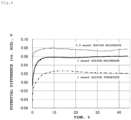
- FIG. 4 shows a result of natural potential measurement. It is found that for all the three sample solutions, the potential difference greatly increases at the beginning of the measurement, and shows a substantially constant value after 10 hours from the start of the measurement.
- the solution concentration was 1 mass%
- the natural potential of sodium molybdate was 0.05 to 0.06 V
- the natural potential of sodium tungstate was 0.02 to 0.03 V
- sodium molybdate showed a relatively high natural potential value. This result suggests that sodium molybdate forms an oxide film thicker than that of sodium tungstate.
- the natural potential of 0.5 mass% sodium molybdate was 0.07 to 0.09 V.
- the wear depth test was performed under the following test conditions using a testing apparatus illustrated in FIG. 5 .
- An annular steel flat plate and three steel balls were immersed in a hot water bath of various lubricant compositions, and the steel balls were rotated for a predetermined time along the annular ring while applying a load in a steel flat plate direction.
- the wear depth was measured by measuring the depth of a slight recess formed on the rolling surface of the steel flat plate after the steel ball was rotated for a predetermined time.
- a region surrounded by a dotted line is a measurement site.
- Table 1 shows results of composition, natural potential, and wear depth of lubricant compositions containing various inorganic sodium salts.
- the natural potential described in Table 1 is the natural potential of steel in an aqueous solution at 25°C in which the inorganic sodium salt contained in each composition is dissolved at a concentration of 1 mass%.
- contents of the base oil, the additive, and the inorganic sodium salt indicate content ratios (mass%) with respect to the lubricant composition (base oil + additive + inorganic sodium salt), respectively.
- the lubricant compositions of Example 1 to 8 contain, as the inorganic sodium salt, an inorganic sodium salt with which the natural potential of steel in an aqueous solution at 25°C dissolved at a concentration of 1 mass% is 0.04 V or higher.
- Example 2 had a smaller wear depth than that of Example 8, and sodium molybdate having a higher natural potential than that of sodium sulfite had an excellent wear resistance improving effect.
- the wear depth was smaller in Example 3 and Example 2 than in Example 4, and the combined use of the sorbitan-based ester and sodium molybdate was excellent in the effect of improving the wear resistance.
- the wear depth decreased in the order of Example 3 > Example 2 > Example 6, and thus it was found that the effect of improving the wear resistance was large in the order of sorbitan monooleate ⁇ sorbitan trioleate ⁇ zinc dithiophosphate in a case of the same blending amount.
- Example 7 was smaller than those of Example 2 and Example 6, and thus it has been found that the combined use of the sorbitan-based ester, zinc dithiophosphate, and sodium molybdate is particularly excellent in the effect of improving the wear resistance. It is considered that this is due to a synergistic effect of the effect of forming an adsorption film on the surface of sodium molybdate particles by the sorbitan-based ester and the effect of protecting (reinforcing) the corrosion-resistant coating film of sodium molybdate by the reaction film of zinc dithiophosphate.
- the wear depth of Example 5 was smaller than that of Example 2, and thus it has been found that the PAO oil was more excellent in the effect of improving the wear resistance than the ester oil. Note that in Example 1 in which the blending amount of sodium molybdate was relatively small, the natural potential was higher than that in Example 2, but the wear depth was the same value.
- the lubricant composition of the present invention can suppress wear and the like in a bearing portion made of steel under harsh conditions such as high speed and high load under high humidity, and is excellent in wear resistance. Accordingly, the lubricant composition can be suitably used for a bearing used for a continuously variable transmission of an automobile, a speed-increasing gear of a wind power generator, and the like.
Landscapes
- Chemical & Material Sciences (AREA)
- Engineering & Computer Science (AREA)
- General Engineering & Computer Science (AREA)
- Chemical Kinetics & Catalysis (AREA)
- General Chemical & Material Sciences (AREA)
- Oil, Petroleum & Natural Gas (AREA)
- Organic Chemistry (AREA)
- Mechanical Engineering (AREA)
- Inorganic Chemistry (AREA)
- Lubricants (AREA)
- Rolling Contact Bearings (AREA)
Applications Claiming Priority (2)
| Application Number | Priority Date | Filing Date | Title |
|---|---|---|---|
| JP2021154974A JP7836161B2 (ja) | 2021-09-23 | 2021-09-23 | 潤滑剤組成物および転がり軸受 |
| PCT/JP2022/034924 WO2023048120A1 (ja) | 2021-09-23 | 2022-09-20 | 潤滑剤組成物および転がり軸受 |
Publications (2)
| Publication Number | Publication Date |
|---|---|
| EP4407014A1 true EP4407014A1 (de) | 2024-07-31 |
| EP4407014A4 EP4407014A4 (de) | 2024-12-25 |
Family
ID=85719498
Family Applications (1)
| Application Number | Title | Priority Date | Filing Date |
|---|---|---|---|
| EP22872874.7A Pending EP4407014A4 (de) | 2021-09-23 | 2022-09-20 | Schmiermittelzusammensetzung und wälzlager |
Country Status (5)
| Country | Link |
|---|---|
| EP (1) | EP4407014A4 (de) |
| JP (1) | JP7836161B2 (de) |
| KR (1) | KR20240069747A (de) |
| CN (1) | CN117957299A (de) |
| WO (1) | WO2023048120A1 (de) |
Family Cites Families (10)
| Publication number | Priority date | Publication date | Assignee | Title |
|---|---|---|---|---|
| JP2006316081A (ja) * | 2005-05-10 | 2006-11-24 | Ntn Corp | グリース組成物およびグリース封入転がり軸受 |
| JP2006316082A (ja) * | 2005-05-10 | 2006-11-24 | Ntn Corp | グリース組成物およびグリース封入転がり軸受 |
| JP2007327638A (ja) * | 2006-05-10 | 2007-12-20 | Ntn Corp | 一方向クラッチ |
| JP5738712B2 (ja) * | 2011-08-03 | 2015-06-24 | 協同油脂株式会社 | グリース組成物 |
| JP2013173956A (ja) * | 2013-06-10 | 2013-09-05 | Ntn Corp | グリース封入軸受 |
| CN104212555A (zh) * | 2014-08-22 | 2014-12-17 | 青岛承天伟业机械制造有限公司 | 一种改进的降噪润滑脂 |
| JP6646379B2 (ja) * | 2015-08-10 | 2020-02-14 | Ntn株式会社 | グリース組成物およびグリース封入転がり軸受 |
| JP2019073572A (ja) | 2017-10-12 | 2019-05-16 | Emgルブリカンツ合同会社 | 潤滑油組成物 |
| CN109762628A (zh) * | 2017-11-09 | 2019-05-17 | 贵州丰达轴承有限公司 | 一种轴承润滑油及制备方法 |
| JP7511351B2 (ja) * | 2020-01-31 | 2024-07-05 | Ntn株式会社 | グリース組成物およびグリース封入軸受 |
-
2021
- 2021-09-23 JP JP2021154974A patent/JP7836161B2/ja active Active
-
2022
- 2022-09-20 CN CN202280063208.0A patent/CN117957299A/zh active Pending
- 2022-09-20 WO PCT/JP2022/034924 patent/WO2023048120A1/ja not_active Ceased
- 2022-09-20 KR KR1020247011897A patent/KR20240069747A/ko active Pending
- 2022-09-20 EP EP22872874.7A patent/EP4407014A4/de active Pending
Also Published As
| Publication number | Publication date |
|---|---|
| JP7836161B2 (ja) | 2026-03-26 |
| EP4407014A4 (de) | 2024-12-25 |
| CN117957299A (zh) | 2024-04-30 |
| KR20240069747A (ko) | 2024-05-20 |
| WO2023048120A1 (ja) | 2023-03-30 |
| JP2023046364A (ja) | 2023-04-04 |
Similar Documents
| Publication | Publication Date | Title |
|---|---|---|
| EP1847586B1 (de) | Schmierfettzusammensetzung für nabeneinheitslager und nabeneinheitslager für fahrzeuge | |
| JP7042375B2 (ja) | ハブユニット | |
| EP1719812A1 (de) | Schmierfett, wälzlager, doppelgelenk und rollende teile | |
| EP3118287B1 (de) | Schmierfettzusammensetzung und schmierfettgefülltes radlager | |
| EP2612899B1 (de) | Schmierfettzusammensetzung für ein lager einer welleneinheit | |
| EP2749631A1 (de) | Schmierfettzusammensetzung und kugelvorrichtung | |
| EP3018192B1 (de) | Biologisch abbaubare fettzusammensetzung für windgenerator | |
| US10597598B2 (en) | Grease composition and grease-sealed roller bearing | |
| CN105008738A (zh) | 润滑脂封入轴承 | |
| JP6736041B2 (ja) | グリース組成物および車両用転動装置 | |
| EP2660305A1 (de) | Schmierfettzusammensetzung, mit schmiermittel vorgeschmiertes lager, universalgelenk und linearbewegungsvorrichtung | |
| EP4177324A1 (de) | Schmierfettzusammensetzung und wälzlager | |
| JP7511351B2 (ja) | グリース組成物およびグリース封入軸受 | |
| EP3312263A1 (de) | Fettzusammensetzung und wälzlager mit darin versiegelter fettzusammensetzung versiegelt | |
| JP2019039470A (ja) | 転がり軸受 | |
| EP4502118A1 (de) | Schmierfettzusammensetzung | |
| EP4407014A1 (de) | Schmiermittelzusammensetzung und wälzlager | |
| EP3178910B1 (de) | Schmierfettzusammensetzung | |
| JP2013035946A (ja) | グリースおよび密封軸受 | |
| JP2013035973A (ja) | 拡散性水素抑制潤滑組成物、転動部品、転動装置、および拡散性水素量抑制方法 | |
| JP2008069882A (ja) | グリース封入密封型転がり軸受 | |
| JP2023050040A (ja) | 潤滑剤組成物および密封型転がり軸受 | |
| US12152214B2 (en) | Grease composition and rolling bearing | |
| WO2025041862A1 (ja) | 密封装置 | |
| JP2025030953A (ja) | 密封装置 |
Legal Events
| Date | Code | Title | Description |
|---|---|---|---|
| STAA | Information on the status of an ep patent application or granted ep patent |
Free format text: STATUS: THE INTERNATIONAL PUBLICATION HAS BEEN MADE |
|
| PUAI | Public reference made under article 153(3) epc to a published international application that has entered the european phase |
Free format text: ORIGINAL CODE: 0009012 |
|
| STAA | Information on the status of an ep patent application or granted ep patent |
Free format text: STATUS: REQUEST FOR EXAMINATION WAS MADE |
|
| 17P | Request for examination filed |
Effective date: 20240314 |
|
| AK | Designated contracting states |
Kind code of ref document: A1 Designated state(s): AL AT BE BG CH CY CZ DE DK EE ES FI FR GB GR HR HU IE IS IT LI LT LU LV MC MK MT NL NO PL PT RO RS SE SI SK SM TR |
|
| A4 | Supplementary search report drawn up and despatched |
Effective date: 20241125 |
|
| RIC1 | Information provided on ipc code assigned before grant |
Ipc: C10N 40/14 20060101ALI20241119BHEP Ipc: C10N 20/02 20060101ALI20241119BHEP Ipc: C10M 125/10 20060101ALI20241119BHEP Ipc: C10N 50/10 20060101ALI20241119BHEP Ipc: C10N 40/04 20060101ALI20241119BHEP Ipc: C10N 40/02 20060101ALI20241119BHEP Ipc: C10N 30/12 20060101ALI20241119BHEP Ipc: C10N 30/06 20060101ALI20241119BHEP Ipc: C10N 10/12 20060101ALI20241119BHEP Ipc: C10N 10/02 20060101ALI20241119BHEP Ipc: C10M 137/10 20060101ALI20241119BHEP Ipc: C10M 129/76 20060101ALI20241119BHEP Ipc: C10M 107/02 20060101ALI20241119BHEP Ipc: C10M 105/32 20060101ALI20241119BHEP Ipc: F16C 33/66 20060101ALI20241119BHEP Ipc: F16C 19/06 20060101ALI20241119BHEP Ipc: C10M 169/04 20060101ALI20241119BHEP Ipc: C10M 141/10 20060101ALI20241119BHEP Ipc: C10M 141/02 20060101ALI20241119BHEP Ipc: C10M 125/22 20060101ALI20241119BHEP Ipc: C10M 125/00 20060101AFI20241119BHEP |
|
| DAV | Request for validation of the european patent (deleted) | ||
| DAX | Request for extension of the european patent (deleted) | ||
| STAA | Information on the status of an ep patent application or granted ep patent |
Free format text: STATUS: EXAMINATION IS IN PROGRESS |
|
| 17Q | First examination report despatched |
Effective date: 20250721 |
|
| GRAP | Despatch of communication of intention to grant a patent |
Free format text: ORIGINAL CODE: EPIDOSNIGR1 |
|
| STAA | Information on the status of an ep patent application or granted ep patent |
Free format text: STATUS: GRANT OF PATENT IS INTENDED |
|
| INTG | Intention to grant announced |
Effective date: 20251209 |