EP4405097B1 - Catalyseur vpo à sélectivité et stabilité améliorées et son procédé de préparation - Google Patents
Catalyseur vpo à sélectivité et stabilité améliorées et son procédé de préparation Download PDFInfo
- Publication number
- EP4405097B1 EP4405097B1 EP23794020.0A EP23794020A EP4405097B1 EP 4405097 B1 EP4405097 B1 EP 4405097B1 EP 23794020 A EP23794020 A EP 23794020A EP 4405097 B1 EP4405097 B1 EP 4405097B1
- Authority
- EP
- European Patent Office
- Prior art keywords
- vpo
- catalyst
- vpo catalyst
- strength
- zno
- Prior art date
- Legal status (The legal status is an assumption and is not a legal conclusion. Google has not performed a legal analysis and makes no representation as to the accuracy of the status listed.)
- Active
Links
Images




Classifications
-
- B—PERFORMING OPERATIONS; TRANSPORTING
- B01—PHYSICAL OR CHEMICAL PROCESSES OR APPARATUS IN GENERAL
- B01J—CHEMICAL OR PHYSICAL PROCESSES, e.g. CATALYSIS OR COLLOID CHEMISTRY; THEIR RELEVANT APPARATUS
- B01J27/00—Catalysts comprising the elements or compounds of halogens, sulfur, selenium, tellurium, phosphorus or nitrogen; Catalysts comprising carbon compounds
- B01J27/14—Phosphorus; Compounds thereof
- B01J27/186—Phosphorus; Compounds thereof with arsenic, antimony, bismuth, vanadium, niobium, tantalum, polonium, chromium, molybdenum, tungsten, manganese, technetium or rhenium
- B01J27/195—Phosphorus; Compounds thereof with arsenic, antimony, bismuth, vanadium, niobium, tantalum, polonium, chromium, molybdenum, tungsten, manganese, technetium or rhenium with vanadium, niobium or tantalum
- B01J27/198—Vanadium
-
- B—PERFORMING OPERATIONS; TRANSPORTING
- B01—PHYSICAL OR CHEMICAL PROCESSES OR APPARATUS IN GENERAL
- B01J—CHEMICAL OR PHYSICAL PROCESSES, e.g. CATALYSIS OR COLLOID CHEMISTRY; THEIR RELEVANT APPARATUS
- B01J35/00—Catalysts, in general, characterised by their form or physical properties
- B01J35/30—Catalysts, in general, characterised by their form or physical properties characterised by their physical properties
- B01J35/34—Mechanical properties
- B01J35/37—Crush or impact strength
-
- B—PERFORMING OPERATIONS; TRANSPORTING
- B01—PHYSICAL OR CHEMICAL PROCESSES OR APPARATUS IN GENERAL
- B01J—CHEMICAL OR PHYSICAL PROCESSES, e.g. CATALYSIS OR COLLOID CHEMISTRY; THEIR RELEVANT APPARATUS
- B01J35/00—Catalysts, in general, characterised by their form or physical properties
- B01J35/50—Catalysts, in general, characterised by their form or physical properties characterised by their shape or configuration
- B01J35/55—Cylinders or rings
-
- B—PERFORMING OPERATIONS; TRANSPORTING
- B01—PHYSICAL OR CHEMICAL PROCESSES OR APPARATUS IN GENERAL
- B01J—CHEMICAL OR PHYSICAL PROCESSES, e.g. CATALYSIS OR COLLOID CHEMISTRY; THEIR RELEVANT APPARATUS
- B01J37/00—Processes, in general, for preparing catalysts; Processes, in general, for activation of catalysts
- B01J37/0009—Use of binding agents; Moulding; Pressing; Powdering; Granulating; Addition of materials ameliorating the mechanical properties of the product catalyst
-
- C—CHEMISTRY; METALLURGY
- C07—ORGANIC CHEMISTRY
- C07D—HETEROCYCLIC COMPOUNDS
- C07D307/00—Heterocyclic compounds containing five-membered rings having one oxygen atom as the only ring hetero atom
- C07D307/02—Heterocyclic compounds containing five-membered rings having one oxygen atom as the only ring hetero atom not condensed with other rings
- C07D307/34—Heterocyclic compounds containing five-membered rings having one oxygen atom as the only ring hetero atom not condensed with other rings having two or three double bonds between ring members or between ring members and non-ring members
- C07D307/56—Heterocyclic compounds containing five-membered rings having one oxygen atom as the only ring hetero atom not condensed with other rings having two or three double bonds between ring members or between ring members and non-ring members with hetero atoms or with carbon atoms having three bonds to hetero atoms with at the most one bond to halogen, e.g. ester or nitrile radicals, directly attached to ring carbon atoms
- C07D307/60—Two oxygen atoms, e.g. succinic anhydride
-
- B—PERFORMING OPERATIONS; TRANSPORTING
- B01—PHYSICAL OR CHEMICAL PROCESSES OR APPARATUS IN GENERAL
- B01J—CHEMICAL OR PHYSICAL PROCESSES, e.g. CATALYSIS OR COLLOID CHEMISTRY; THEIR RELEVANT APPARATUS
- B01J2235/00—Indexing scheme associated with group B01J35/00, related to the analysis techniques used to determine the catalysts form or properties
- B01J2235/10—Infrared [IR]
-
- B—PERFORMING OPERATIONS; TRANSPORTING
- B01—PHYSICAL OR CHEMICAL PROCESSES OR APPARATUS IN GENERAL
- B01J—CHEMICAL OR PHYSICAL PROCESSES, e.g. CATALYSIS OR COLLOID CHEMISTRY; THEIR RELEVANT APPARATUS
- B01J2235/00—Indexing scheme associated with group B01J35/00, related to the analysis techniques used to determine the catalysts form or properties
- B01J2235/15—X-ray diffraction
Definitions
- the invention relates to a VPO catalyst in the form of a shaped body for the oxidation of hydrocarbons with molecular oxygen, in particular for the oxidation of butane to maleic anhydride with molecular oxygen, wherein the VPO catalyst contains between 0.05 wt.% to 7.0 wt.% Zn, which is partially present as ZnO and, in infrared spectroscopy carried out in transmission, has a first absorption band with a maximum between 790 cm -1 to 810 cm -1 and possibly a second absorption band with a maximum between 820 cm -1 to 840 cm -1 , characterized in that only the first absorption band is present or the strength of the first absorption band is greater than the strength of the second absorption band and that the VPO catalyst, when examined by powder X-ray diffraction, has reflections at 31.7 ° to 31.9 °, 34.3 ° to 34.5 ° and 36.2 ° to 36.4 °, in a measurement with a D4 Endeavor
- the strength of the absorption bands is determined by setting a first straight line so that it tangentially touches the spectrum immediately to the left and right below the relevant band, then a second straight line is drawn starting from the maximum of the band in the direction of constant wavelength and decreasing absorption and the intersection of the two straight lines is determined, whereby the strength of the absorption band is defined as the length between the maximum and the intersection.
- the lateral crushing strength is measured with a Zwick Z0.5 device using the ASTM D4179 standard with a constant force rate of 20.0 N/s, whereby 100 tablets are placed individually with the cylinder axis parallel to the measuring jaw surface and measured in order to determine an average breaking force, which represents the lateral crushing strength.
- Maleic anhydride is a chemical intermediate of great economic importance. It is used, for example, in the production of alkyd and polyester resins, either alone or in combination with other acids. In addition, it is also a versatile intermediate for chemical synthesis, for example for the synthesis of ⁇ -butyrolactone, tetrahydrofuran and 1,4-butanediol, which in turn are used as solvents or can be further processed into polymers such as polytetrahydrofuran or polyvinylpyrrolidone.
- Maleic anhydride is usually produced by partial oxidation of n-butane in the gas phase with molecular oxygen or with a gas containing molecular oxygen in the presence of a vanadium phosphorus oxide catalyst (VPO catalyst) containing vanadyl pyrophosphate (VPP).
- VPO catalyst vanadium phosphorus oxide catalyst
- VPP vanadyl pyrophosphate
- vanadyl pyrophosphate contains vanadium with a valency of + 4 and is particularly suitable for the production of maleic anhydride from unbranched saturated or unsaturated hydrocarbons with at least four carbon atoms. Both fixed bed reactors and fluidized bed reactors are used.
- VPO catalysts have only a low intrinsic activity in the reaction of n-butane to maleic anhydride. Therefore, a large amount of catalyst is required for sufficient conversion.
- VPO catalysts are among the most expensive non-precious metal catalysts available, mainly due to the high cost of their starting materials. As a result, the task is to improve the catalytic performance (activity and selectivity) and also the service life and mechanical stability of such catalysts. It is known from the state of the art that the performance of VPO catalysts can be improved by adding foreign elements to the vanadium phosphorus oxide phase (VPO phase), for example by adding molybdenum (Mo promoter or Mo doping).
- VPO phase vanadium phosphorus oxide phase
- Mo promoter or Mo doping molybdenum
- US 5,929,256 discloses the synthesis of an active molybdenum-modified vanadium-phosphorus catalyst for the production of maleic anhydride.
- a compound containing essentially 5-valent vanadium is reacted with a compound containing 5-valent phosphorus in an alcoholic medium which is suitable for reducing the vanadium to an oxidation state below 5.
- molybdenum is incorporated into the reaction product, whereby a solid, molybdenum-modified precursor composition is formed.
- the alcohol is removed to obtain a dried solid molybdenum-modified precursor composition.
- Molded bodies containing the dried solid molybdenum-modified precursor compound are molded.
- the dried and molded molybdenum-modified precursor compositions are activated to convert them into the active catalyst.
- US 5,070,060 discloses an improvement in the oxidation catalyst used for the partial oxidation of n-butane and containing vanadium and phosphorus, zinc and lithium mixed oxides comprising the addition of a molybdenum compound modifier in an amount of about 0.005 to 0.025/1 Mo/V to the catalyst during the reaction of the reduced vanadium compound with concentrated phosphoric acid.
- the addition of Mo produces a catalyst that is very stable, a more active system and has a longer shelf life than the unmodified catalyst.
- US 3,980,585 discloses a catalyst complex suitable for the conversion of normal C 4 hydrocarbons to maleic anhydride in the gas phase, comprising the components vanadium, phosphorus and copper and one of the elements selected from the group Te, Zr, Ni, Ce, W, Pd, Ag, Mn, Cr, Zn, Mo, Re, Sm, La, Hf, Ta, Th, Co, U and Sn, preferably with an alkali metal or an alkaline earth metal.
- US 4,056,487 discloses one suitable for the partial oxidation of alkanes to the corresponding anhydrides, for example of normal C 4 hydrocarbons which are converted to maleic anhydride in the gas phase, comprising the components vanadium, phosphorus and oxygen, Nb, Cu, Mo, Ni, Co and Cr. Preference is given to the compositions which additionally contain one or more elements from Ce, Nd, Ba, Hf, U, Ru, Re, Li or Mg.
- US 4,515,904 discloses a process for the preparation of a phosphorus-vanadium catalyst and a phosphorus-vanadium co-metal catalyst for use in the production of maleic anhydride from butane, the process comprising reacting a vanadium compound in an organic ether solvent having from about 2 to about 10 carbon atoms with a phosphorus halide at a temperature of from about 0°C to about 200°C in the presence of water or an aliphatic alcohol having from about 1 to about 8 carbon atoms; removing the solvent; and activating the catalyst by the addition of butane or other hydrocarbon starting material and a phosphorus compound at a temperature of from about 300°C to about 500°C.
- US 5,158,923 discloses an improvement in the oxidation catalyst used for the partial oxidation of n-butane and containing vanadium and phosphorus, zinc and lithium mixed oxides comprising the addition of a molybdenum compound modifier in an amount of about 0.005 to 0.025 Mo/V to the catalyst during digestion of the reduced vanadium compound by concentrated phosphoric acid.
- the addition of Mo produces a catalyst which is very stable, a more active system and has a longer shelf life than the unmodified catalyst.
- US 5,262,548 discloses an improvement in the oxidation catalyst used for the partial oxidation of n-butane and containing vanadium and phosphorus, zinc and lithium mixed oxides comprising the addition of a molybdenum compound modifier in an amount of about 0.005 to 0.025 Mo/V to the catalyst during digestion of the reduced vanadium compound by concentrated phosphoric acid.
- the addition of Mo produces a catalyst which is a very stable active system and which has a longer lifetime than the unmodified catalyst.
- WO 2013062919 A1 discloses a process for preparing a promoted VPO catalyst, wherein the catalyst comprises the mixed oxides of vanadium and phosphorus and wherein the catalyst is promoted with at least one of niobium, cobalt, iron, zinc, molybdenum or titanium, the process comprising the steps of: (i) preparing a VPO catalyst comprising vanadyl pyrophosphate as the main component and containing less than 5 wt.% vanadyl phosphate, (ii) contacting the VPO catalyst with a solution comprising a compound as a metal source with at least one metal selected from the group consisting of niobium, cobalt, iron, zinc, molybdenum or titanium to form a metal-impregnated VPO catalyst, and (iii) drying the metal-impregnated VPO catalyst to form the promoted VPO catalyst.
- a niobium-activated VPO catalyst is prepared.
- US 6,407,030 B1 discloses a process for preparing a catalyst which can be used for the synthesis of maleic anhydride by the oxidation of saturated and/or unsaturated C 4 hydrocarbons.
- a vanadium(V) compound is reacted with a mixture of phosphonic and phosphoric acid in a specific ratio in a solvent mixture comprising a structure former and an entraining agent, the water of reaction being distilled off together with the entraining agent and the resulting precursor being subjected to calcination.
- US 4,132,670 A discloses the preparation of a crystalline vanadium(IV) phosphate composition having an intrinsic surface area of more than 10 m 2 /g by the reaction of orthophosphoric acid with a vanadium(IV) oxy compound.
- the vanadium compound is suspended in a suitable organic medium containing hydroxyl groups, for example isobutanol, and brought into contact with the acid at a temperature in the range of 20 °C to 210 °C until the conversion is complete.
- US 4,382,876 discloses a process for producing catalysts for the gas phase oxidation of saturated or unsaturated hydrocarbons to maleic anhydride, comprising the steps: (a) mixing a vanadium compound containing pentavalent vanadium with orthophosphoric acid in an alcohol from the series of monovalent lower aliphatic alcohols having 2 to 8 C atoms, optionally in the presence of promoters and a reducing agent combination of H 3 PO 3 and alcohol, wherein the sum of H 3 PO 3 and H 3 PO 4 is controlled such that an atomic ratio of P to V of 1.0 to 1.2 is achieved and wherein the H 3 PO 3 is used in substoichiometric amounts such that they are sufficient to reduce the vanadium to an oxidation state of only 4.2 to 4.4 and wherein the reducing agent combination is then used to further reduce the vanadium to an oxidation state between 3.9 and 4.0, wherein any water present is removed by heating as an azeotrope with the alcohol distilled off; (b) adding titanium dioxide obtained
- WO 9529006 A1 discloses a process for the preparation of oxidation catalysts containing vanadium-phosphorus mixed oxides, consisting of contacting a phosphorus compound with a vanadium compound in an organic solvent under conditions which enable the preparation, recovery and drying of the precursor and the calcination of the precursor under an atmosphere containing air, steam or inert gas or a mixture thereof at a temperature between 350 °C and 550 °C for the time required to obtain active catalysts, and use of the catalysts for the preparation of maleic anhydride by oxidation of aliphatic hydrocarbons.
- US 5,185,455 discloses the improvement of a process for the production of maleic anhydride by catalytic oxidation of n-butane in the presence of trimethyl phosphate over a fixed bed catalyst of vanadium phosphorus oxide in a tubular reactor.
- US 5,280,003 discloses an improvement of an oxidation catalyst used for the partial oxidation of n-butane and containing mixed oxides of vanadium and phosphorus, zinc, lithium and molybdenum, comprising its preparation by carrying out the crystallization step under static conditions which enable more uniform conditions for crystal growth.
- the static conditions are maintained by heating the solvent under reflux during the crystallization period.
- US 4,251,390 discloses the improvement of an oxidation catalyst used for the partial oxidation of n-butane, which contains vanadium and mixed phosphorus oxides, characterized in that a zinc compound in an amount of 0.15 to 0.001 Zn/V is added to the catalyst during the reaction of the reduced vanadium portion with concentrated phosphoric acid.
- a zinc compound in an amount of 0.15 to 0.001 Zn/V is added to the catalyst during the reaction of the reduced vanadium portion with concentrated phosphoric acid.
- the addition of zinc produces a catalyst which is more easily activated and which is very stable to heating of the reaction system.
- Small amounts of lithium and silicon compounds also have additional desirable catalytic effects without reducing the advantage of the zinc compound.
- DE 10 2014 004786 A1 relates to a catalyst which contains a vanadium-phosphorus oxide and an alkali metal, wherein the weight fraction of alkali metal in the vanadium-phosphorus oxide is in the range from 10 to 400 ppm, based on the total weight of the vanadium-phosphorus oxide, a process for its preparation and the use of the catalyst for the gas phase oxidation of hydrocarbons, in particular for the preparation of maleic anhydride.
- VPO catalysts containing a VPP phase In order to produce VPO catalysts containing a VPP phase, a reduction of vanadium pentoxide (V 2 O 5 ) is usually carried out in the presence of phosphoric acid in an organic alcoholic solvent with benzyl alcohol as a reducing agent, whereby vanadyl hydrogen phosphate (VHP) is formed in addition to benzaldehyde.
- V 2 O 5 vanadium pentoxide
- VHP vanadyl hydrogen phosphate
- VHP phase is converted to the vanadyl pyrophosphate phase by the action of heat, with the elimination of water.
- VPO catalysts One problem with the catalytic conversion of butane to maleic anhydride using VPO catalysts is that the process must be operated in a pore diffusion-limited regime. Here, the porosity then has a direct influence on the catalytic yield. Care must therefore be taken to ensure that the pore structure is not negatively affected during shaping (e.g. by tableting). However, this has the consequence that the mechanical stability of the molded bodies suffers. However, this must be large enough for the tablets to survive the filling process (falling into a reaction tube approximately 6 m long) intact. Otherwise, the back pressure in the process would be too high due to the smaller fragments, which would lead to high compressor costs or reduced throughputs. One technical task is therefore to increase the mechanical strength of the molded bodies without negatively affecting the pore structure. At the same time, there is a need for VPO catalysts with improved performance, i.e. improved activity, selectivity and stability.
- the object of the present invention was therefore to provide an improved VPO catalyst for the gas phase oxidation of hydrocarbons, in particular for the production of maleic anhydride, which, compared to previously conventional catalysts, has higher catalytic performance, in particular improved selectivity and at the same time significantly improved mechanical strength.
- a VPO catalyst in the form of a shaped body for the oxidation of hydrocarbons with molecular oxygen, in particular for the oxidation of butane to maleic anhydride with molecular oxygen, wherein the VPO catalyst contains between 0.05 wt.% to 7.0 wt.% Zn, which is partially present as ZnO and, when infrared spectroscopy is carried out in transmission, has a first absorption band with a maximum between 790 cm -1 to 810 cm -1 and possibly a second absorption band with a maximum between 820 cm -1 to 840 cm -1 , characterized in that only the first absorption band is present or the strength of the first absorption band is greater than the strength of the second absorption band and that the VPO catalyst, when examined by powder X-ray diffractometry, has reflections at 31.7 ° to 31.9 °, 34.3 ° to 34.5 ° and 36.2 ° to 36.4 °, when measured with a D4 Endeavor from
- the strength of the absorption band is determined by setting a first straight line so that it touches the spectrum tangentially immediately to the left and right below the relevant band, then a second straight line is drawn starting from the maximum of the band in the direction of constant wavelength and decreasing absorption and the intersection of the two straight lines is determined, whereby the strength of the absorption band is defined as the length between the maximum and the intersection.
- the ratio of the strength of the first absorption band to the strength of the second absorption band is preferably over 1.1, preferably over 2.
- the molded articles according to the invention have a lateral crushing strength of more than 25 N, preferably between 25 N to 200 N, wherein the lateral crushing strength is measured with a Zwick Z0.5 device using the ASTM D4179 standard with a constant force rate of 20.0 N/s, wherein 100 tablets are each individually placed with the cylinder axis parallel to the measuring jaw surface and measured to determine an average breaking force which represents the lateral crushing strength.
- the VPO catalyst of the invention when examined by powder X-ray diffraction using Cu-K ⁇ radiation, exhibits reflections at 31.7° to 31.9°, 34.3° to 34.5° and 36.2° to 36.4°.
- the VPO catalyst according to the invention comprises the VPO phase, or consists or consists essentially of it.
- the VPO catalyst according to the invention comprises the VPO phase with a content of more than 70 wt. %, preferably more than 80 wt. %, more preferably more than 90 wt. %, based on the total weight of the VPO catalyst.
- the VPO catalyst can comprise VPP, dopants and unreacted oxides of the starting materials, such as vanadium pentoxide or phosphorus oxide.
- the VPO catalyst according to the invention can optionally contain, for example, between 0.1 wt.% and 1 wt.%, preferably between 0.4 wt.% and 0.7 wt.% Mo, based on the total weight of the VPO catalyst.
- the VPO catalyst according to the invention can also contain alkali metals such as Na, K, preferably 80 to 300 ppm alkali metal.
- the VPO catalyst according to the invention can also contain carbon, e.g. in the form of graphite, e.g. in an amount of 3% by weight to 5% by weight, based on the total weight of the catalyst.
- the graphite present serves, for example, as a tabletting aid.
- the VPO catalyst according to the invention comprises ZnO, but may also contain other Zn compounds.
- the Zn content resulting from the presence of ZnO and possibly other Zn compounds must be between 0.05% by weight and 7.0% by weight in the VPO catalyst, preferably between 0.1% by weight and 6.0% by weight, more preferably between 0.2% by weight and 4.0% by weight, most preferably between 0.7% by weight and 3.0% by weight of Zn, in each case based on the total weight of the catalyst.
- the VPO catalyst according to the invention contains ZnO and, if the content of these two phases is sufficiently high, the catalyst exhibits reflections in an XRD powder diffractogram recorded using Cu-K ⁇ radiation that are typical of the ZnO phase. In particular, sharp reflections are detected at 31.7° to 31.9°, 34.3° to 34.5°, 36.2° to 36.4°.
- the presence of ZnO causes a stabilization of the catalyst particles so that they have a higher mechanical strength compared to the strength without the presence of ZnO.
- the presence of ZnO also causes an improvement in the catalytic performance (ie the activity, selectivity and stability) of the catalyst particles, in particular an increase in the selectivity.
- the VPO catalyst according to the invention is in the form of a shaped body, the shape of the shaped body can be designed differently depending on the desired contact time, flow rate and back pressure during the catalytic conversion.
- the VPO catalyst in the form of a shaped body is understood to mean shaped bodies that are produced by a shaping step such as tabletting.
- a large number of the shaped bodies according to the invention form a layer or a catalyst bed in the tube bundle reactor through which the reactants butane, in particular n-butane, and air are passed.
- the molded body should not be smaller than a minimum size, which results, for example, from the fact that the molded body must not fit into an imaginary cube of 3 mm ⁇ 3 mm ⁇ 3 mm without exceeding its boundaries at one point.
- the molded body according to the invention can be in a conventional cylinder shape.
- the cylinder then has a height (length along the cylinder axis) of 3 mm to 8 mm and a substantially round base with a diameter of 3 mm to 8 mm.
- the cylinder preferably has a central axial opening, which can have a diameter of 1 mm to 3 mm, for example.
- the molded body according to the invention can have a height of 4.7 mm, an external diameter of 4.7 mm and a central axial opening with a diameter of 1.3 mm.
- This molded body then has a geometric surface of 1.2 cm 2 , a volume of 0.075 cm 3 and a mass of 0.12 g.
- a filling density of 0.85 g/cm 3 to 0.89 g/cm 3 results.
- the molded bodies according to the invention can have a height of 5.6 mm, an external diameter of 5.5 mm and a central axial opening with a diameter of 2.3 mm. These molded bodies then have a geometric surface area of 1.77 cm 2 , a volume of 0.111 cm 3 and a mass of 0.18 g. When a large number of these molded bodies are filled into a 21 mm reactor, a filling density of 0.72 g/cm 3 to 0.76 g/cm 3 results.
- Preferred shaped bodies for use in the reactor concept according to the invention are those described in EP 2643086 A1
- the preferred double alpha form is particularly characterized in that each individual molded body is designed as a cylinder with an outer base surface [1], a cylinder surface [2], a cylinder axis and at least one continuous opening [3] running parallel to the cylinder axis and the outer base surface [1] of the cylinder has at least four lobes [4a, 4b, 4c, 4d], wherein a geometric base body enclosing the molded bodies is a prism which has a prism base with a length and a width, the length being greater than the width and the lobes [4a, 4b, 4c, 4d] being enclosed by prism corners of the prism base ( Figure 9 ).
- a shaped body in a double alpha form with a height (length along the cylinder axis) of 3 mm to 8 mm, a length of 5 mm to 9 mm and a width of 4 mm to 8 mm and an inner hole diameter of 1 mm to 4 mm.
- shaped bodies in a double alpha form with a height of 5.6 mm, a length of 6.7 mm, a width of 5.8 mm and an inner hole diameter of 2.1 mm.
- These shaped catalyst bodies have a geometric surface area of 2.37 cm 2 , a volume of 0.154 cm 3 and a mass of 0.24 g. When filled into a 21 mm reactor, the filling density is 0.60 g/cm 3 to 0.62 g/cm 3 .
- the VPO catalyst or the shaped body according to the invention preferably has a lateral compressive strength of more than 25 N, preferably between 25 N and 200 N.
- a lateral compressive strength of the VPO catalyst or the shaped body of more than 30 N to 150 N is particularly preferred, even more preferably of more than 35 N to 100 N.
- the VPO catalyst according to the invention or the shaped body in cylindrical form has a lateral compressive strength of more than 25 N, preferably between 25 N and 50 N.
- a lateral compressive strength of the VPO catalyst or the shaped body of more than 30 N to 45 N is particularly preferred, even more preferably of more than 35 N to 40 N.
- the VPO catalyst according to the invention or the shaped body in double alpha form has a lateral compressive strength of more than 50 N, preferably between 50 N and 200 N.
- a lateral compressive strength of the VPO catalyst or the shaped body of more than 100 N to 170 N is particularly preferred, even more preferably of more than 120 N to 150 N.
- a catalyst precursor containing vanadyl hydrogen phosphate is prepared in a generally known manner.
- a V(V) compound in solution is reduced in a reaction mixture using a reducing agent in the presence of a P(V) compound, optionally a Mo compound, in a reduction step.
- the reaction mixture can consist of 45% to 90% by weight of solvent, 5% to 15% by weight of reducing agent, 5% to 15% by weight of V(V) compound, up to 1% by weight of Mo compound and between 5 and 25% by weight of P(V) compound.
- the V(V) compound used as starting material in the reaction mixture for producing the vanadyl hydrogen phosphate is a compound containing vanadium in the oxidation state V and is preferably V 2 O 5 .
- the P(V) compound used as starting material in the reaction mixture for producing the vanadyl hydrogen phosphate is a compound containing phosphorus in the oxidation state V and is preferably phosphoric acid or a phosphate salt such as Na 3 PO 4 .
- phosphoric acid H 3 PO 4
- it is preferably anhydrous (100% phosphoric acid) or phosphoric acid that contains only small amounts of water, ie phosphoric acid with a concentration of 98 to 100%, preferably 99 to 100% (the information refers to the usually stated percentage by weight of pure phosphoric acid in relation to the weight of the water-phosphoric acid mixture).
- phosphoric acid with more than 100% can be used, which reacts immediately with any water present in the reaction mixture at the beginning to form phosphoric acid with a concentration of 98 to 100%, preferably 99 to 100%, preferably 100%, so that no phosphoric acid with a concentration of more than 100% is present in the reaction mixture and at the same time no more than 0.2% by weight of water, based on the weight of the reaction mixture, remains in the reaction mixture.
- the Mo compound which can optionally be used as starting material in the reaction mixture for producing the vanadyl hydrogen phosphate is any compound containing molybdenum, for example molybdenum trioxide, ammonium heptamolybdate ((NH 4 ) 6 Mo 7 O 24 )*4H 2 O), ammonium paramolybdate ((NH 4 ) 6 Mo 7 O 2 *4H 2 O), meta molybdate, molybdic acid (H 2 MoO 4 ) and their salts such as (NH 4 ) 2 MoO 4 , Na 2 MoO 4 , K 2 MoO 4 or (NH 4 ) 2 Mo 2 O 7 .
- the reducing agent present in the reaction mixture for producing the vanadyl hydrogen phosphate can be any reducing agent capable of reducing the V(V) compound to at least partially form vanadyl hydrogen phosphate.
- the reducing agent is an organic reducing agent such as ethanol, isobutanol or an aromatic alcohol, including in particular benzyl alcohol.
- the solvent present in the reaction mixture for preparing the vanadyl hydrogen phosphate is preferably an alcohol, particularly preferably a high-boiling aliphatic alcohol, in particular isobutanol, alternatively ethanol or isopropanol.
- the starting materials are provided in a suitable reaction vessel in order to carry out the reduction step and to obtain the vanadyl hydrogen phosphate of the catalyst precursor.
- the reaction mixture is heated above room temperature, for example up to a temperature of 100 °C.
- the reaction vessel preferably has a reflux condenser and a device for stirring the reaction mixture.
- the reaction vessel is equipped with a device that allows the water formed during the reduction to be removed from the reaction mixture, i.e. a water separator, such as a Dean Stark trap.
- the reduction to vanadyl hydrogen phosphate is preferably carried out under reflux at normal pressure, the temperature being increased depending on the boiling point of the solvent used, and preferably only a single reflux step is carried out in the process according to the invention.
- the catalyst precursor preferably contains vanadyl hydrogen phosphate as the main phase or can even consist essentially of a vanadyl hydrogen phosphate phase.
- the molybdenum that may also be present in the catalyst precursor can be present as a dopant in the vanadyl hydrogen phosphate phase, where molybdenum doping is understood to mean that the molybdenum is either incorporated into the vanadyl hydrogen phosphate phase or is present on its surface.
- vanadyl hydrogen phosphate phase In addition to the vanadyl hydrogen phosphate phase, other vanadium-phosphorus mixed oxides in which vanadium has an oxidation state of IV or even III can be formed during the reduction.
- the reduction does not have to be complete, so that portions of the V(V) compound and the P(V) compound also remain in the catalyst precursor.
- the catalyst precursor has an average oxidation state of vanadium of 3.8 to 4.2.
- the water produced during the reduction can be removed from the reaction mixture during the reduction.
- the removal of water during the reduction takes place either physically, e.g. with the aid of a water separator, or chemically by using compounds that bind the water, e.g. drying agents or anhydrides such as phosphoric acid with a concentration of more than 100%.
- the reaction mixture can, for example, contain anhydrides that react with water and bind it; in particular, the reaction mixture can contain phosphoric acid with a concentration of more than 100%.
- the suspension obtained after the reduction step can be filtered, for example, in an inert gas atmosphere such as nitrogen or a noble gas.
- inert gas means any gas that does not react with the catalyst precursor under the given conditions during filtration, but at the same time displaces oxygen from the air so that the risk of explosion is minimized.
- Filtration is carried out by means known to those skilled in the art, typically by a filter press, a decanter or a suction filter. Filtration gives an uncalcined catalyst precursor that is still moistened with solvent.
- the catalyst precursor obtained by filtration can then be dried, this is typically done at a temperature above room temperature, e.g. at a temperature of up to 150 °C at reduced pressure or vacuum or under inert gas, to obtain a dried catalyst precursor.
- inert gas means any gas which does not react with the catalyst precursor under the drying conditions, but at the same time displaces oxygen from the air so that the risk of explosion is minimized, for example nitrogen or a noble gas.
- drying takes place under reduced pressure or vacuum between 50 °C and 150 °C, preferably between 90 °C and 140 °C.
- calcination can be carried out to obtain the catalyst precursor. Calcination takes place at an elevated temperature between 150 °C and 350 °C, preferably between 230 °C and 290 °C under inert gas.
- inert gas means any gas that does not react with the catalyst precursor under the conditions of calcination but displaces oxygen from the air so that the risk of explosion is minimized, for example nitrogen or a noble gas.
- graphite can be added to the dried catalyst precursor to facilitate shaping in process step b).
- the dried catalyst precursor can also be compacted and/or granulated to obtain a compacted or granulated dried catalyst precursor.
- the catalyst precursor can be compacted into plates using a roller compactor with a contact pressure of 190 bar, a gap width of 0.60 mm and a roller speed of 7 rpm, and granulated through a 1 mm sieve.
- the catalyst precursor obtained is formed into the catalyst moldings, for example by tableting.
- the granulate is pressed into the desired tablet shape and size using a rotary tablet press.
- the resulting catalyst moldings are activated at a temperature above 200 °C.
- Activation typically takes place in a gas mixture consisting of air, inert gas and water vapor, whereby any gas that does not react with the catalyst molding under the given conditions during activation can serve as the inert gas; the inert gas is particularly preferably nitrogen or a noble gas.
- activation can also take place in process gas, i.e. in a gas mixture containing air and butane.
- Activation takes place at a temperature in the range from 300 °C to 500 °C, preferably in the range from 350 °C to 450 °C.
- the finished VPO catalyst is obtained as a product of the process.
- the tableted VPO catalyst typically has a lateral compressive strength of above 25 N, typically between 25 N and 200 N.
- the inventive production process for the VPO catalyst in the form of shaped bodies is characterized in that after process step a) ZnO is added to the catalyst precursor or mixed with it.
- the ZnO i.e. zinc(II) oxide, is used here as a powder mediator solid.
- the ZnO can also be added to the catalyst precursor using a metering device and a mixer.
- sufficient ZnO is added to prepare the catalyst according to the invention. For example, based on the weight of the dried catalyst precursor (without ZnO), 0.5 wt.% to 7.0 wt.%, preferably 1.0 wt.% to 5.0 wt.%, more preferably 1.5 wt.% to 3.5 wt.% of ZnO can be added in solid form.
- the ZnO is added to the catalyst precursor, ie after its preparation in process step a), for example by a reduction step, but before the formation of the catalyst moldings in process step c).
- the ZnO is added to the dried catalyst precursor, particularly preferably to the dried and calcined catalyst precursor.
- another solid metal compound preferably a metal compound in powder form, is added. It is preferred that a solid Mg compound is also contained in the binder, for example MgO.
- the invention further relates to a process for the preparation of maleic anhydride by catalytic oxidation of n-butane, wherein a reactant gas comprising oxygen and n-butane is passed through a reactor tube in which a bed of VPO catalysts according to the invention is located.
- a heating mantle is placed on a laboratory boy and a 2L four-necked flask is placed in it.
- a half-moon stirrer with a suitable stirrer cap, which is connected to the stirrer by means of a stirrer coupling.
- a thermometer in the right opening there is a thermometer, in the left a riser pipe to the reflux condenser.
- the opening in the front middle is used to fill with the chemicals, after which the nitrogen flush is connected there.
- the entire apparatus can also be flooded with nitrogen. To do this, the nitrogen is first passed through a gas washing bottle and then into the apparatus and then discharged from the condenser at the top through a gas washing bottle.
- the suspension which contains the catalyst precursor as a solid, it is transferred from the four-necked flask into a suction filter and the liquid is sucked off.
- the moist filter cake is pressed dry in a press overnight at 14 to 18 bar.
- the pressed filter cake is filled into the evaporation flask of a rotary evaporator.
- the filter cake is dried overnight at 110 °C under water jet vacuum.
- the powder dried in this way is placed in a suitable calcining pot in an oven and calcined in a N 2 atmosphere at temperatures of 200 to 300 °C for 9 hours.
- the granulate is pressed using a rotary tablet press into the desired tablet shape with the appropriate height, e.g. 5.6 ⁇ 5.6 ⁇ 2.3 mm, and side crush strength.
- the activation which produces vanadyl pyrophosphate, is carried out in a retort built into a programmable oven under controlled conditions.
- the calcined tablets are evenly filled into the retort and the retort is tightly sealed.
- the catalyst is then activated in a moist air-nitrogen mixture (50% absolute humidity), first at over 300 °C for 5 hours and then at over 400 °C for 9 hours.
- the VPO catalysts according to the invention were prepared analogously to Example 1, with the exception that the calcined powder of the catalyst precursor was mixed per 100 g with 4.5 g (Example 2), 1.8 g (Example 3), 5.0 g (Example 4), 2.0 g (Example 5), 1.0 g (Example 6), 0.5 g (Example 7) ZnO powder (commercial ZnO particle size ⁇ 100 ⁇ m, impurity below 0.05 wt. %) and 0.5 g (Example 2) and 0.2 g (Example 3) MgO powder and simultaneously with the graphite.
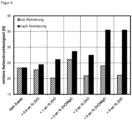
- VPO catalysts according to Examples 1 to 7 were tested for their fracture strength before and after activation.
- XRD diffractograms of the VPO catalysts were created and tested for their catalytic selectivity.
- the VPO catalyst according to the invention is also characterized by infrared spectroscopic features.
- Conventional non-inventive VPO catalysts without ZnO have a maximum in the IR spectrum at 790 cm -1 to 810 cm -1 (first absorption band) and a second maximum between 820 cm-1 to 840 cm-1 (second absorption band), the second absorption band being stronger than the first absorption band ( Figure 1 , (1)).
- the VPO catalysts according to the invention are characterized by the fact that they only exhibit the first absorption band.
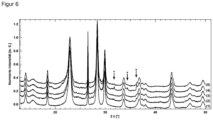
- Figure 7 shows that the XRD reflections observed when ZnO is added after calcination and before tabletting, especially at 31.7 to 31.9°, 34.3 to 34.5°, 36.2 to 36.4°, are not visible when ZnO is added at the beginning of the reflux step.
- Figure 7 diffractogram (8).
- Figure 8 shows the XRD diffractograms of the VPO catalysts according to comparative examples 11 and 12 (diffractograms (11) and (12)) in comparison with the VPO catalyst prepared according to the invention according to example 5 (diffractogram (5)). It can be seen that the addition of the ZnO compound to the activated tablets shows no reflections, in particular at 31.7 to 31.9°, 34.3 to 34.5°, 36.2 to 36.4°.
- the VPO catalyst according to Comparative Example 13 was prepared analogously to the VPO catalyst according to Example 2, whereby 10 wt. % binder of the type SECAR 71 and 4 wt. % graphite were added to the calcined powder.
- the stability of a VPO catalyst can be determined very well by measuring the stability with regard to the by-product water, because during the reaction, a considerable amount of water vapor is present due to the oxidation reaction, which can damage the catalyst.
- the stability with regard to the by-product water of the VPO catalyst according to the invention according to Example 4 was therefore tested in comparison to a VPO catalyst produced with conventional binder according to Comparative Example 13.
- the selectivity of the untreated samples was tested, then both samples were impregnated with water and the selectivity test was repeated (Comparative Example 14). It can be seen that the catalyst according to the invention does not suffer any loss of selectivity due to the water impregnation within the measurement tolerance.
- VPO catalysts according to Examples 15 and 16 were prepared analogously to the VPO catalyst according to Example 1, but without the addition of ammonium dimolybdate, so that the resulting VPO catalyst was free of Mo.
- Example 15 1 wt.% (Example 15) or 2 wt.% ZnO (Example 16), based on the total weight of the calcined powder, was added to the calcined powder.
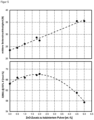
- Table 1 shows, an increase in catalytic selectivity in combination with an increase in lateral crushing strength is also achieved with the Mo-free VPO catalysts.
- the Figure 2 The IR spectra shown, carried out in transmission, also show that for these two samples according to the invention, the intensity of the band at 790 cm -1 to 810 cm -1 (first absorption band) is stronger than the maximum between 820 cm -1 to 840 cm -1 .
- V 2 O 5 150 g of V 2 O 5 are placed in a four-necked flask. 300 mL of benzyl alcohol and 1200 mL of isobutanol are added. After inerting with N 2, the suspension is Stir and heat to reflux for 10 hours. After cooling to a maximum of 40°C while stirring, 7.51 g of ammonium dimolybdate, 6.60 g of iron(III) nitrate nonahydrate, 2.55 g of cerium(III) nitrate hexahydrate and 4.5 g of niobium ammonium oxalate are added. After adding 138 mL of phosphoric acid (85%) while stirring within 15 minutes and rendering it inert with N 2 , the suspension is heated to reflux again for 24 hours while stirring.
- phosphoric acid 85%
- the suspension containing the catalyst precursor After the suspension containing the catalyst precursor has cooled, it is transferred from the four-necked flask into a suction filter and the liquid is sucked off. The moist filter cake is washed once with ethanol (100%) and the liquid is sucked off again in the suction filter. The same procedure is then repeated with bidistilled water.
- the washed filter cake is filled into the evaporation flask of a rotary evaporator.
- the filter cake is dried overnight at 120 °C under water jet vacuum.
- the powder dried in this way is placed in a suitable calcining pot in an oven and calcined in a N 2 atmosphere at temperatures of 200 to 300 °C for 9 h.
- the granulate is pressed using a rotary tablet press into the desired tablet shape with the appropriate height, e.g. 5.6 ⁇ 5.6 ⁇ 2.3 mm, and side crush strength.
- the following temperature treatment is carried out in a retort installed in a programmable oven under controlled conditions.
- the calcined tablets are evenly filled into the retort and the retort is tightly closed.
- the catalyst is then treated in an air stream at 120°C for 18 hours.
- the VPO catalyst according to Example 18 was prepared analogously to the VPO catalyst according to Example 1, wherein 2.1 wt.% Zn 3 (PO 4 ) 2 , based on the total weight of the calcined powder, was added to the calcined powder after calcination and before tabletting.
- the non-inventive samples according to Examples 17 and 18 show a significantly lower selectivity compared to the inventive samples.
- the IR spectra carried out in transmission show Figure 3 that in these two non-inventive samples, the intensity of the band at 790 cm -1 to 810 cm -1 (first absorption band) is not stronger than the maximum between 820 cm -1 to 840 cm -1 (Example 17) or both bands are absent (Example 18).
- Table 1 Example binder Amount of binder [wt.%] Lateral compressive strength before activation [N] Lateral compressive strength after activation [N] IR, XR D Fig . Selectivity 85% (MA) [%] 1 (comparison) - 0.0 23.4 23.5 1.6 64.5 2 (Invention) 9ZnO / 1MgO* 5.0 24.1 35.5 1.6 61.1 3 (Invention) 9ZnO / 1MgO* 2.0 26.1 28.7 1.6 67.8 4 (Invention) ZnO 5.0 21.1 35.5 1.6 58.5 5 (Invention) ZnO 2.0 20.9 27.5 1, 6, 7, 8 68.2 6 (Invention) ZnO 1.0 20.2 26.1 1 66.8 7 (Invention) ZnO 0.5 22.8 24.6 1 66.8 8 (Comparison) ZnO 2.0 24.0 22.2 7 - 9 (Invention) ZnO 2.0 - - 7 - 10 (Invention) ZnO 2.0 -
- the catalysts were characterized using infrared spectroscopy (IR) in transmission.
- IR infrared spectroscopy
- the intensity of the infrared radiation from a source (I 0 ) is determined as a function of the wavelength after it has passed through a sample (I).
- the absorption of the IR radiation and thus the excitation of vibration modes in the material under investigation leads to a wavelength-dependent attenuation of the infrared radiation.
- the absorption, calculated using log(l 0 /l) is plotted against the wave number for the spectrum.
- the measurements were carried out on a Nicolet Nexus 470 FTIR spectrometer with a liquid nitrogen cooled mercury cadmium tellurium (MCT) detector, an "IR Source Everglo" as an IR source and a HeNe laser for frequency calibration.
- MCT liquid nitrogen cooled mercury cadmium tellurium
- IR Source Everglo as an IR source
- HeNe laser for frequency calibration.
- tablets of the respective catalysts were finely ground and A thin pellet of 11 mm diameter was produced using a hand stamp press with approx. 10 mg of material. This was mounted in a vacuum chamber with KBr windows and placed in the beam path. The sample was then pretreated for 2 hours at 200°C and a pressure of 10 -4 mbar to remove adsorbed water.
- the vacuum chamber with the sample was cooled to 77 K using liquid nitrogen and the spectrum was recorded at a pressure of 10 -4 mbar with a step size of 2 cm -1 , an aperture of 72 and an optical velocity of 0.64.
- the strength of the two absorption bands with a maximum in the range between 790 cm -1 to 810 cm -1 and 820 cm -1 to 840 cm -1 corresponds to the strength of the absorption in the region of the maximum of the band in comparison to the spectral background.
- a first straight line was set as a linear background so that it tangentially touches the spectrum, i.e. the background of the spectrum, immediately (i.e. within the frequency range up to a neighboring absorption band) to the left and right below the band in question.
- a line is then drawn vertically downwards from the maximum of the band (S0), i.e. in the direction of constant wavelength and decreasing absorption, and the intersection point of this line with the linear background (S1) is determined.
- the strength of the absorption band is defined as the length of the line S0 to S1.
- a Zwick Z0.5 device was used to measure the breaking strength of the molded bodies in order to determine the force required for the break. The measurements were carried out in accordance with the ASTM D4179 standard. To dry the molded bodies before the measurement, they were stored in a drying cabinet at 100°C for at least 3 hours and the subsequent measurement of the breaking strength was carried out within a maximum of 1 hour after the end of drying. The device was operated in accordance with the ASTM D4179 standard at a constant force rate of 20.0 N/s. For each example, 100 tablets were placed one after the other with the cylinder axis parallel to the measuring jaw surface (in the ASTM D4179 standard the "RADIAL CRUSH") and measured. The mean value was then determined from the 100 individual values of the force required to break the molded body, which corresponds to the average breaking force of the molded body. All information on the lateral crushing strength in this application refers to lateral crushing strengths obtained using the method described here.
- the catalysts were characterized using X-ray powder diffraction (XRD). X-rays are diffracted at the crystalline areas of the sample at different diffraction angles. The diffraction angle is measured or plotted in 2 ⁇ . Depending on the phase present, characteristic reflections occur depending on the diffraction angle. Based on these diffraction patterns, the diffraction pattern can be assigned to existing phases using a database.
- XRD X-ray powder diffraction
- the measurements were carried out on a D4 Endeavor from Bruker AXS with Cu-K ⁇ radiation and a LYNXEYE detector.
- the diffraction patterns were recorded in an angle range 2 ⁇ from 5 to 50 ° with a step size of 0.02 ° at a recording time of 1.5 s per step with a fixed divergence aperture of 0.3 °.
- the samples were finely ground and pressed into a sample holder.
- the variation of the diffraction angle was made possible in the apparatus by tilting the sample. All information on XRD reflections in this application refers to XRD reflections obtained using this methodology.
- the diffractograms were standardized. To do this, the data point with the smallest intensity value is first found for each diffractogram. This value is subtracted from all intensity values of the respective diffractogram. The maximum intensity of the (024) reflection (located at a 2 ⁇ value of 28.4-28.5°) is then determined in the respective diffractogram. All intensity values of the respective diffractogram are divided by this value.
Landscapes
- Chemical & Material Sciences (AREA)
- Organic Chemistry (AREA)
- Engineering & Computer Science (AREA)
- Materials Engineering (AREA)
- Chemical Kinetics & Catalysis (AREA)
- Catalysts (AREA)
Claims (17)
- Catalyseur VPO sous forme d'un corps moulé pour l'oxydation d'hydrocarbures avec de l'oxygène moléculaire, en particulier pour l'oxydation de butane en anhydride maléique avec de l'oxygène moléculaire, dans lequel le catalyseur VPO contient entre 0,05% en poids et 7,0% en poids de Zn, qui est partiellement présent sous forme de ZnO et qui présente, par spectroscopie infrarouge réalisée en transmission, une première bande d'absorption avec un maximum compris entre 790 cm-1 et 810 cm-1 et éventuellement une deuxième bande d'absorption avec un maximum compris entre 820 cm-1 et 840 cm-1, caractérisé en ce que seule la première bande d'absorption est présente ou que l'intensité de la première bande d'absorption est supérieure à l'intensité de la deuxième bande d'absorption, l'intensité des bandes d'absorption étant déterminée en plaçant chaque fois une première droite de telle sorte qu'elle touche tangentiellement le spectre immédiatement à gauche et à droite en dessous de la bande concernée, ensuite, une deuxième droite est guidée à partir du maximum de la bande dans la direction de la longueur d'onde constante et de l'absorption décroissante et le point d'intersection des deux droites est déterminé, l'intensité de la bande d'absorption étant définie comme la longueur entre le maximum et le point d'intersection et que le catalyseur VPO, lorsqu'il est examiné par diffractométrie des rayons X sur poudre, présente des réflexions à 31, 7 ° à 31,9 °, 34,3 ° à 34,5 ° et 36,2 ° à 36,4 °, lors d'une mesure avec un D4 Endeavor de la société Bruker AXS avec un rayonnement Cu-Kα et un détecteur LYNXEYE, les diffractogrammes étant enregistrés dans une plage angulaire 2θ de 5 ° à 50 ° avec un pas de 0,02 ° pour une durée d'enregistrement de 1,5 s par pas avec un diaphragme de divergence fixe de 0,3 °.
- Catalyseur VPO selon la revendication 1, caractérisé en ce que le rapport entre l'intensité de la première bande d'absorption et l'intensité de la deuxième bande d'absorption est supérieur à 1,1, de préférence supérieur à 2.
- Catalyseur VPO selon l'une des revendications précédentes, caractérisé en ce que le catalyseur VPO contient une teneur en Mo entre 0,1 % et 1 % en poids, de préférence entre 0,4 % et 0,7 % en poids de Mo, par rapport au poids total du catalyseur VPO.
- Catalyseur VPO selon l'une quelconque des revendications précédentes, caractérisé en ce que le catalyseur VPO contient entre 0,1 % et 6 % en poids, de préférence entre 0,2 % et 4 % en poids de Zn, de manière plus préférée entre 0,5 % et 3,5 % en poids, par rapport au poids total du catalyseur VPO.
- Catalyseur VPO selon l'une quelconque des revendications précédentes, caractérisé en ce que le catalyseur VPO a la composition élémentaire suivante :- 0,5 % en poids à 7 % en poids de Zn,- 0 % en poids à 0,7 % en poids de Mo,- 26 % en poids à 31 % en poids de V,- 17 % en poids à 21 % en poids de P,- 3 % en poids à 5 % en poids de C,le reste étant de l'oxygène, dans chaque cas par rapport au poids total du catalyseur VPO.
- Catalyseur VPO selon l'une quelconque des revendications précédentes, caractérisé en ce que le corps moulé présente une résistance à la compression latérale supérieure à 25 N, de préférence comprise entre 25 N et 200 N, la résistance à la compression latérale étant mesurée à l'aide d'un appareil Zwick Z0.5 en utilisant la norme ASTM D4179 avec un taux de force constant de 20,0 N/s, 100 pastilles étant placées individuellement avec l'axe du cylindre parallèle à la surface de la mâchoire de mesure et mesurées afin de déterminer une force de rupture moyenne représentant la résistance à la compression latérale.
- Catalyseur VPO selon l'une des revendications précédentes, caractérisé en ce que le corps moulé présente une forme double alpha, avec une hauteur de 3 mm à 8 mm, une longueur de 5 mm à 9 mm, une largeur de 4 mm à 8 mm et un diamètre intérieur de trou de 1 mm à 4 mm.
- Catalyseur VPO selon l'une quelconque des revendications 1 à 6, caractérisé en ce que le corps moulé a une forme cylindrique, avec une hauteur de 3 mm à 8 mm, une base sensiblement ronde avec un diamètre de 3 mm à 8 mm et une ouverture axiale centrale avec un diamètre de 1 mm à 3 mm.
- Procédé de préparation d'un catalyseur VPO selon l'une quelconque des revendications 1 à 8, comprenant les étapes consistant à:a) Préparation d'un précurseur de catalyseur contenant de l'hydrogénophosphate de vanadyle,b) Moulage du précurseur de catalyseur en corps moulés,c) activer les corps moulés pour former une phase VPO,caractérisé en ce que, après l'étape a), ZnO est mélangé avec le précurseur de catalyseur.
- Procédé de préparation d'un catalyseur VPO selon la revendication 9, caractérisé en ce que la préparation du précurseur de catalyseur contenant de l'hydrogénophosphate de vanadyle dans l'étape a) est réalisée par la réduction d'un composé V(V) en présence d'un composé P(V) par un agent réducteur organique pendant une étape de reflux à pression normale dans un solvant organique.
- Procédé de préparation d'un catalyseur VPO selon la revendication 9 ou 10, caractérisé en ce que le précurseur de catalyseur obtenu à l'étape a) est filtré dans une étape a1) et est séché et/ou calciné dans une étape a2) à une température maximale de 300°C.
- Procédé de préparation d'un catalyseur VPO selon la revendication 11, caractérisé en ce que l'étape a2) est réalisée en deux étapes, dans une première étape, on sèche dans du vide à une température comprise entre 90°C et 140°C pendant une durée de 1 h à 24 h et dans une deuxième étape, on calcine dans de l'azote à une température comprise entre 230°C et 290°C pendant une durée de 1 h à 24 h.
- Procédé de préparation d'un catalyseur VPO selon les revendications 9 à 12, caractérisé en ce que l'étape d'activation est réalisée dans un mélange gazeux constitué d'air, de gaz inerte et de vapeur d'eau, à une température comprise entre 300 °C et 500 °C, de préférence entre 350 °C et 450 °C, pendant une durée de 1 h à 24 h.
- Procédé de préparation d'un catalyseur VPO selon l'une des revendications 9 à 13, caractérisé en ce que, après l'étape a), le précurseur de catalyseur est en outre mélangé avec un composé de Mg, de préférence MgO.
- Procédé de préparation de l'anhydride maléique par oxydation catalytique du n-butane, dans lequel on fait passer un gaz d'éduction comprenant de l'oxygène et du n-butane à travers un tube de réacteur dans lequel se trouve une charge de catalyseurs VPO selon l'une des revendications 1 à 8.
- Procédé selon la revendication 15, caractérisé en ce que le lit de catalyseurs VPO est présent dans le tube de réacteur à une température comprise entre 300°C et 420°C.
- Procédé selon l'une des revendications 15 ou 16, caractérisé en ce que le gaz d'éduction contient entre 0,2 et 10 % en volume de n-butane et entre 5 et 50 % en volume d'oxygène et est envoyé à travers le tube réacteur à une vitesse spatio-temporelle comprise entre 1100 h-1 et 2500 h-1, de préférence entre 1300 h-1 et 1600 h-1.
Applications Claiming Priority (2)
| Application Number | Priority Date | Filing Date | Title |
|---|---|---|---|
| EP22202894.6A EP4357019A1 (fr) | 2022-10-21 | 2022-10-21 | Catalyseur vpo à sélectivité et stabilité améliorées et son procédé de préparation |
| PCT/EP2023/079180 WO2024084003A1 (fr) | 2022-10-21 | 2023-10-19 | Catalyseur vpo ayant une sélectivité améliorée et une stabilité améliorée et son procédé de production |
Publications (2)
| Publication Number | Publication Date |
|---|---|
| EP4405097A1 EP4405097A1 (fr) | 2024-07-31 |
| EP4405097B1 true EP4405097B1 (fr) | 2024-11-20 |
Family
ID=83902905
Family Applications (2)
| Application Number | Title | Priority Date | Filing Date |
|---|---|---|---|
| EP22202894.6A Withdrawn EP4357019A1 (fr) | 2022-10-21 | 2022-10-21 | Catalyseur vpo à sélectivité et stabilité améliorées et son procédé de préparation |
| EP23794020.0A Active EP4405097B1 (fr) | 2022-10-21 | 2023-10-19 | Catalyseur vpo à sélectivité et stabilité améliorées et son procédé de préparation |
Family Applications Before (1)
| Application Number | Title | Priority Date | Filing Date |
|---|---|---|---|
| EP22202894.6A Withdrawn EP4357019A1 (fr) | 2022-10-21 | 2022-10-21 | Catalyseur vpo à sélectivité et stabilité améliorées et son procédé de préparation |
Country Status (4)
| Country | Link |
|---|---|
| EP (2) | EP4357019A1 (fr) |
| CN (1) | CN120018907B (fr) |
| HU (1) | HUE070403T2 (fr) |
| WO (1) | WO2024084003A1 (fr) |
Families Citing this family (1)
| Publication number | Priority date | Publication date | Assignee | Title |
|---|---|---|---|---|
| WO2025219457A2 (fr) * | 2024-04-18 | 2025-10-23 | Clariant International Ltd | Catalyseur vpo se présentant sous la forme d'un corps moulé amélioré et procédé de fabrication correspondant |
Family Cites Families (20)
| Publication number | Priority date | Publication date | Assignee | Title |
|---|---|---|---|---|
| US3980585A (en) | 1974-05-28 | 1976-09-14 | Petro-Tex Chemical Corporation | Catalyst and process for preparing maleic anhydride from C4 hydrocarbons |
| US4056487A (en) | 1975-10-02 | 1977-11-01 | Petro-Tex Chemical Corporation | Vanadium phosphorus oxygen oxidation catalysts useful for preparing anhydrides from alkanes |
| US4251390A (en) | 1979-06-11 | 1981-02-17 | Denka Chemical Corporation | Partial oxidation catalyst |
| US4283307A (en) * | 1980-06-02 | 1981-08-11 | Denka Chemical Corporation | Catalyst structure for the partial oxidation of n-butane to produce maleic anhydride |
| US4515904A (en) | 1983-09-30 | 1985-05-07 | Standard Oil Company (Indiana) | Catalysts for the production of maleic anhydride by the oxidation of butane |
| US5262548A (en) | 1990-05-21 | 1993-11-16 | Scientific Design Company, Inc. | Phosphorous/vanadium oxidation catalyst |
| US5070060A (en) | 1990-05-21 | 1991-12-03 | Scientific Design Company, Inc. | Phosphorous/vanadium oxidation catalyst |
| US5158923A (en) | 1990-05-21 | 1992-10-27 | Scientific Design Company, Inc. | Phosphorous/vanadium oxidation catalyst |
| US5280003A (en) | 1992-08-24 | 1994-01-18 | Scientific Design Company, Inc. | Static condition process for the preparation of phosphorous/vanadium oxidation catalyst |
| US5945368A (en) | 1995-10-02 | 1999-08-31 | Huntsman Petrochemical Corporation | Molybdenum-modified vanadium-phosphorus oxide catalysts for the production of maleic anhydride |
| DE19727235A1 (de) * | 1997-06-26 | 1999-01-07 | Consortium Elektrochem Ind | Verfahren zur Herstellung von Schalenkatalysatoren für die Synthese von Maleinsäureanhydrid durch Gasphasenoxidation |
| DE19840224C2 (de) * | 1998-09-03 | 2002-09-12 | Consortium Elektrochem Ind | Verfahren zur Herstellung von Katalysatoren für die Synthese von Maleinsäureanhydrid durch Gasphasenoxidation |
| DE10015365C2 (de) * | 2000-03-23 | 2002-09-19 | Inst Angewandte Chemie Berlin | Mischkatalysator aus Oxovanadiumdiphosphat und weiteren Komponenten |
| DE10211449A1 (de) * | 2002-03-15 | 2003-09-25 | Basf Ag | Katalysator-Precursor für die Herstellung von Maleinsäureanhydrid und Verfahren zu dessen Herstellung |
| TW200719968A (en) * | 2005-10-31 | 2007-06-01 | Sued Chemie Ag | Catalyst molding for partial oxidation reactions |
| DE102010052126A1 (de) | 2010-11-22 | 2012-05-24 | Süd-Chemie AG | Katalysatorformkörper für durchströmte Festbettreaktoren |
| US8658557B2 (en) | 2011-10-25 | 2014-02-25 | Ineos Usa Llc | Catalyst for n-butane oxidation to maleic anhydride |
| DE102014004786B4 (de) | 2014-04-02 | 2021-09-30 | Clariant International Ltd. | Alkalimetall-modifizierter Vanadium-Phosphor-Oxid (VPO)-Katalysator |
| US9675966B2 (en) * | 2015-07-16 | 2017-06-13 | Ineos Europe Ag | Catalyst for n-butane oxidation to maleic anhydride |
| DE102019100983A1 (de) * | 2019-01-16 | 2020-07-16 | Clariant International Ltd | Verfahren zur herstellung eines vpo-katalysators |
-
2022
- 2022-10-21 EP EP22202894.6A patent/EP4357019A1/fr not_active Withdrawn
-
2023
- 2023-10-19 CN CN202380072217.0A patent/CN120018907B/zh active Active
- 2023-10-19 EP EP23794020.0A patent/EP4405097B1/fr active Active
- 2023-10-19 HU HUE23794020A patent/HUE070403T2/hu unknown
- 2023-10-19 WO PCT/EP2023/079180 patent/WO2024084003A1/fr not_active Ceased
Also Published As
| Publication number | Publication date |
|---|---|
| EP4357019A1 (fr) | 2024-04-24 |
| HUE070403T2 (hu) | 2025-06-28 |
| EP4405097A1 (fr) | 2024-07-31 |
| CN120018907B (zh) | 2026-03-31 |
| CN120018907A (zh) | 2025-05-16 |
| WO2024084003A1 (fr) | 2024-04-25 |
Similar Documents
| Publication | Publication Date | Title |
|---|---|---|
| DE60038064T2 (de) | Verwendung eines zusätzlichen promoters in verbindung mit einem kohlenstoff geträgerten edelmetall enthaltenden katalysator für oxidationsreaktionen in flüssiger phase | |
| DE69636206T2 (de) | Verfahren zur Herstellung eines Katalysators | |
| EP3576875B1 (fr) | Systhèse d'un catalyseur movtenb à partir d'oxydes métalliques peu coûteux | |
| DE102017000862A1 (de) | Synthese eines MoVNbTe-Katalysators mit reduziertem Gehalt an Niob und Tellur und höherer Aktivität für die oxidative Dehydrierung von Ethan | |
| DE102011109774B4 (de) | Katalysatormaterial für die Oxidation von Kohlenwasserstoffen | |
| WO2018141653A1 (fr) | Synthèse d'un catalyseur movnbte présentant une surface spécifique plus importante et une activité accrue pour la déshydrogénation oxydante d'éthane en éthylène | |
| WO2013021034A1 (fr) | Catalyseur pour l'oxydation d'hydrocarbures, constitué de molybdène, vanadium, niobium, tellure, manganèse et cobalt | |
| DE112018000736T5 (de) | Verfahren zur Herstellung von Katalysatoren für die Propylen-Ammonoxidation | |
| DE2044130A1 (de) | Verfahren zur Herstellung von Katalysatoren des Eisenmolybdattyps sowie deren Verwendung zur katalytischen Oxydation von Alkoholen zu Aldehyden | |
| DE10053494A1 (de) | Katalysator und Verfahren zur Herstellung von Maleinsäureanhydrid | |
| EP3682968B1 (fr) | Procédé de fabrication d'un catalyseur vpo | |
| DE69514537T2 (de) | Heteropolysäurekatalysatoren mit ausgetauschten kationen und vanadium für die dampfphasen-oxidation | |
| WO1998024829A1 (fr) | Procede ameliore de production de polytetrahydrofurane | |
| WO2024084003A1 (fr) | Catalyseur vpo ayant une sélectivité améliorée et une stabilité améliorée et son procédé de production | |
| EP1117482B1 (fr) | Procede de production de catalyseurs destines a la synthese de l'anhydride de l'acide maleique par oxygenation en phase gazeuse | |
| WO2025219457A2 (fr) | Catalyseur vpo se présentant sous la forme d'un corps moulé amélioré et procédé de fabrication correspondant | |
| DE10196202B4 (de) | Verfahren zur Herstellung eines Präzipitats und eines Katalysators | |
| DE3248600A1 (de) | Verwendung von mo-v-cu-p-katalysatoren zur oxydehydrierung von isobuttersaeure oder deren estern | |
| EP4605128A1 (fr) | Catalyseur à l'oxyde de vanadium et de phosphore (vpo) mécaniquement stable et procédé pour la production de celui-ci | |
| DE102021108191A1 (de) | Molybdän-bismut-eisen-nickel-mischoxid-material und verfahren zu dessen herstellung | |
| WO2005087696A1 (fr) | Procede de production de monoethers de monoalkyleneglycol | |
| WO2010040468A2 (fr) | Catalyseur à base d'uranium et son procédé de fabrication ainsi que son utilisation | |
| DE19645066C2 (de) | Verfahren zur Herstellung von Katalysatoren für die Gasphasenoxidation von C¶4¶-Kohlenwasserstoffen zu Maleinsäureanhydrid | |
| EP1968743A1 (fr) | Conversion d'un pre-catalyseur en un bronze d'oxyde d'argent-vanadium catalytiquement actif | |
| CN117943073A (zh) | 机械稳定的vpo催化剂及其制备方法 |
Legal Events
| Date | Code | Title | Description |
|---|---|---|---|
| STAA | Information on the status of an ep patent application or granted ep patent |
Free format text: STATUS: UNKNOWN |
|
| STAA | Information on the status of an ep patent application or granted ep patent |
Free format text: STATUS: THE INTERNATIONAL PUBLICATION HAS BEEN MADE |
|
| PUAI | Public reference made under article 153(3) epc to a published international application that has entered the european phase |
Free format text: ORIGINAL CODE: 0009012 |
|
| STAA | Information on the status of an ep patent application or granted ep patent |
Free format text: STATUS: REQUEST FOR EXAMINATION WAS MADE |
|
| 17P | Request for examination filed |
Effective date: 20240422 |
|
| AK | Designated contracting states |
Kind code of ref document: A1 Designated state(s): AL AT BE BG CH CY CZ DE DK EE ES FI FR GB GR HR HU IE IS IT LI LT LU LV MC ME MK MT NL NO PL PT RO RS SE SI SK SM TR |
|
| GRAP | Despatch of communication of intention to grant a patent |
Free format text: ORIGINAL CODE: EPIDOSNIGR1 |
|
| STAA | Information on the status of an ep patent application or granted ep patent |
Free format text: STATUS: GRANT OF PATENT IS INTENDED |
|
| INTG | Intention to grant announced |
Effective date: 20240812 |
|
| GRAS | Grant fee paid |
Free format text: ORIGINAL CODE: EPIDOSNIGR3 |
|
| GRAA | (expected) grant |
Free format text: ORIGINAL CODE: 0009210 |
|
| STAA | Information on the status of an ep patent application or granted ep patent |
Free format text: STATUS: THE PATENT HAS BEEN GRANTED |
|
| AK | Designated contracting states |
Kind code of ref document: B1 Designated state(s): AL AT BE BG CH CY CZ DE DK EE ES FI FR GB GR HR HU IE IS IT LI LT LU LV MC ME MK MT NL NO PL PT RO RS SE SI SK SM TR |
|
| DAV | Request for validation of the european patent (deleted) | ||
| DAX | Request for extension of the european patent (deleted) | ||
| REG | Reference to a national code |
Ref country code: GB Ref legal event code: FG4D Free format text: NOT ENGLISH |
|
| REG | Reference to a national code |
Ref country code: CH Ref legal event code: EP |
|
| P01 | Opt-out of the competence of the unified patent court (upc) registered |
Free format text: CASE NUMBER: APP_58172/2024 Effective date: 20241024 |
|
| REG | Reference to a national code |
Ref country code: DE Ref legal event code: R096 Ref document number: 502023000320 Country of ref document: DE |
|
| REG | Reference to a national code |
Ref country code: IE Ref legal event code: FG4D Free format text: LANGUAGE OF EP DOCUMENT: GERMAN |
|
| REG | Reference to a national code |
Ref country code: LT Ref legal event code: MG9D |
|
| REG | Reference to a national code |
Ref country code: NL Ref legal event code: MP Effective date: 20241120 |
|
| PG25 | Lapsed in a contracting state [announced via postgrant information from national office to epo] |
Ref country code: PT Free format text: LAPSE BECAUSE OF FAILURE TO SUBMIT A TRANSLATION OF THE DESCRIPTION OR TO PAY THE FEE WITHIN THE PRESCRIBED TIME-LIMIT Effective date: 20250320 Ref country code: HR Free format text: LAPSE BECAUSE OF FAILURE TO SUBMIT A TRANSLATION OF THE DESCRIPTION OR TO PAY THE FEE WITHIN THE PRESCRIBED TIME-LIMIT Effective date: 20241120 Ref country code: IS Free format text: LAPSE BECAUSE OF FAILURE TO SUBMIT A TRANSLATION OF THE DESCRIPTION OR TO PAY THE FEE WITHIN THE PRESCRIBED TIME-LIMIT Effective date: 20250320 |
|
| PG25 | Lapsed in a contracting state [announced via postgrant information from national office to epo] |
Ref country code: FI Free format text: LAPSE BECAUSE OF FAILURE TO SUBMIT A TRANSLATION OF THE DESCRIPTION OR TO PAY THE FEE WITHIN THE PRESCRIBED TIME-LIMIT Effective date: 20241120 Ref country code: NL Free format text: LAPSE BECAUSE OF FAILURE TO SUBMIT A TRANSLATION OF THE DESCRIPTION OR TO PAY THE FEE WITHIN THE PRESCRIBED TIME-LIMIT Effective date: 20241120 |
|
| PG25 | Lapsed in a contracting state [announced via postgrant information from national office to epo] |
Ref country code: BG Free format text: LAPSE BECAUSE OF FAILURE TO SUBMIT A TRANSLATION OF THE DESCRIPTION OR TO PAY THE FEE WITHIN THE PRESCRIBED TIME-LIMIT Effective date: 20241120 |
|
| PG25 | Lapsed in a contracting state [announced via postgrant information from national office to epo] |
Ref country code: ES Free format text: LAPSE BECAUSE OF FAILURE TO SUBMIT A TRANSLATION OF THE DESCRIPTION OR TO PAY THE FEE WITHIN THE PRESCRIBED TIME-LIMIT Effective date: 20241120 |
|
| PG25 | Lapsed in a contracting state [announced via postgrant information from national office to epo] |
Ref country code: NO Free format text: LAPSE BECAUSE OF FAILURE TO SUBMIT A TRANSLATION OF THE DESCRIPTION OR TO PAY THE FEE WITHIN THE PRESCRIBED TIME-LIMIT Effective date: 20250220 |
|
| PG25 | Lapsed in a contracting state [announced via postgrant information from national office to epo] |
Ref country code: LV Free format text: LAPSE BECAUSE OF FAILURE TO SUBMIT A TRANSLATION OF THE DESCRIPTION OR TO PAY THE FEE WITHIN THE PRESCRIBED TIME-LIMIT Effective date: 20241120 Ref country code: GR Free format text: LAPSE BECAUSE OF FAILURE TO SUBMIT A TRANSLATION OF THE DESCRIPTION OR TO PAY THE FEE WITHIN THE PRESCRIBED TIME-LIMIT Effective date: 20250221 |
|
| PG25 | Lapsed in a contracting state [announced via postgrant information from national office to epo] |
Ref country code: PL Free format text: LAPSE BECAUSE OF FAILURE TO SUBMIT A TRANSLATION OF THE DESCRIPTION OR TO PAY THE FEE WITHIN THE PRESCRIBED TIME-LIMIT Effective date: 20241120 |
|
| PG25 | Lapsed in a contracting state [announced via postgrant information from national office to epo] |
Ref country code: RS Free format text: LAPSE BECAUSE OF FAILURE TO SUBMIT A TRANSLATION OF THE DESCRIPTION OR TO PAY THE FEE WITHIN THE PRESCRIBED TIME-LIMIT Effective date: 20250220 |
|
| REG | Reference to a national code |
Ref country code: HU Ref legal event code: AG4A Ref document number: E070403 Country of ref document: HU |
|
| PG25 | Lapsed in a contracting state [announced via postgrant information from national office to epo] |
Ref country code: SM Free format text: LAPSE BECAUSE OF FAILURE TO SUBMIT A TRANSLATION OF THE DESCRIPTION OR TO PAY THE FEE WITHIN THE PRESCRIBED TIME-LIMIT Effective date: 20241120 |
|
| PG25 | Lapsed in a contracting state [announced via postgrant information from national office to epo] |
Ref country code: DK Free format text: LAPSE BECAUSE OF FAILURE TO SUBMIT A TRANSLATION OF THE DESCRIPTION OR TO PAY THE FEE WITHIN THE PRESCRIBED TIME-LIMIT Effective date: 20241120 |
|
| PG25 | Lapsed in a contracting state [announced via postgrant information from national office to epo] |
Ref country code: EE Free format text: LAPSE BECAUSE OF FAILURE TO SUBMIT A TRANSLATION OF THE DESCRIPTION OR TO PAY THE FEE WITHIN THE PRESCRIBED TIME-LIMIT Effective date: 20241120 |
|
| PG25 | Lapsed in a contracting state [announced via postgrant information from national office to epo] |
Ref country code: RO Free format text: LAPSE BECAUSE OF FAILURE TO SUBMIT A TRANSLATION OF THE DESCRIPTION OR TO PAY THE FEE WITHIN THE PRESCRIBED TIME-LIMIT Effective date: 20241120 |
|
| PG25 | Lapsed in a contracting state [announced via postgrant information from national office to epo] |
Ref country code: SK Free format text: LAPSE BECAUSE OF FAILURE TO SUBMIT A TRANSLATION OF THE DESCRIPTION OR TO PAY THE FEE WITHIN THE PRESCRIBED TIME-LIMIT Effective date: 20241120 |
|
| PG25 | Lapsed in a contracting state [announced via postgrant information from national office to epo] |
Ref country code: CZ Free format text: LAPSE BECAUSE OF FAILURE TO SUBMIT A TRANSLATION OF THE DESCRIPTION OR TO PAY THE FEE WITHIN THE PRESCRIBED TIME-LIMIT Effective date: 20241120 |
|
| REG | Reference to a national code |
Ref country code: DE Ref legal event code: R097 Ref document number: 502023000320 Country of ref document: DE |
|
| PG25 | Lapsed in a contracting state [announced via postgrant information from national office to epo] |
Ref country code: SE Free format text: LAPSE BECAUSE OF FAILURE TO SUBMIT A TRANSLATION OF THE DESCRIPTION OR TO PAY THE FEE WITHIN THE PRESCRIBED TIME-LIMIT Effective date: 20241120 |
|
| PLBE | No opposition filed within time limit |
Free format text: ORIGINAL CODE: 0009261 |
|
| STAA | Information on the status of an ep patent application or granted ep patent |
Free format text: STATUS: NO OPPOSITION FILED WITHIN TIME LIMIT |
|
| 26N | No opposition filed |
Effective date: 20250821 |
|
| PGFP | Annual fee paid to national office [announced via postgrant information from national office to epo] |
Ref country code: HU Payment date: 20251021 Year of fee payment: 3 |
|
| PGFP | Annual fee paid to national office [announced via postgrant information from national office to epo] |
Ref country code: DE Payment date: 20251028 Year of fee payment: 3 |
|
| PGFP | Annual fee paid to national office [announced via postgrant information from national office to epo] |
Ref country code: AT Payment date: 20260113 Year of fee payment: 3 |
|
| PGFP | Annual fee paid to national office [announced via postgrant information from national office to epo] |
Ref country code: IT Payment date: 20251031 Year of fee payment: 3 |
|
| PGFP | Annual fee paid to national office [announced via postgrant information from national office to epo] |
Ref country code: TR Payment date: 20251007 Year of fee payment: 3 |