EP4404294A1 - Ternäres substituiertes vanadiumphosphat-elektrodenmaterial - Google Patents
Ternäres substituiertes vanadiumphosphat-elektrodenmaterial Download PDFInfo
- Publication number
- EP4404294A1 EP4404294A1 EP23172954.2A EP23172954A EP4404294A1 EP 4404294 A1 EP4404294 A1 EP 4404294A1 EP 23172954 A EP23172954 A EP 23172954A EP 4404294 A1 EP4404294 A1 EP 4404294A1
- Authority
- EP
- European Patent Office
- Prior art keywords
- electrode active
- active material
- electrode
- sodium
- ranges
- Prior art date
- Legal status (The legal status is an assumption and is not a legal conclusion. Google has not performed a legal analysis and makes no representation as to the accuracy of the status listed.)
- Granted
Links
Images




Classifications
-
- H—ELECTRICITY
- H01—ELECTRIC ELEMENTS
- H01M—PROCESSES OR MEANS, e.g. BATTERIES, FOR THE DIRECT CONVERSION OF CHEMICAL ENERGY INTO ELECTRICAL ENERGY
- H01M4/00—Electrodes
- H01M4/02—Electrodes composed of, or comprising, active material
- H01M4/36—Selection of substances as active materials, active masses, active liquids
- H01M4/58—Selection of substances as active materials, active masses, active liquids of inorganic compounds other than oxides or hydroxides, e.g. sulfides, selenides, tellurides, halogenides or LiCoFy; of polyanionic structures, e.g. phosphates, silicates or borates
- H01M4/5825—Oxygenated metallic salts or polyanionic structures, e.g. borates, phosphates, silicates, olivines
-
- H—ELECTRICITY
- H01—ELECTRIC ELEMENTS
- H01M—PROCESSES OR MEANS, e.g. BATTERIES, FOR THE DIRECT CONVERSION OF CHEMICAL ENERGY INTO ELECTRICAL ENERGY
- H01M4/00—Electrodes
- H01M4/02—Electrodes composed of, or comprising, active material
- H01M4/13—Electrodes for accumulators with non-aqueous electrolyte, e.g. for lithium-accumulators; Processes of manufacture thereof
- H01M4/136—Electrodes based on inorganic compounds other than oxides or hydroxides, e.g. sulfides, selenides, tellurides, halogenides or LiCoFy
-
- C—CHEMISTRY; METALLURGY
- C01—INORGANIC CHEMISTRY
- C01B—NON-METALLIC ELEMENTS; COMPOUNDS THEREOF; METALLOIDS OR COMPOUNDS THEREOF NOT COVERED BY SUBCLASS C01C
- C01B25/00—Phosphorus; Compounds thereof
- C01B25/16—Oxyacids of phosphorus; Salts thereof
- C01B25/26—Phosphates
- C01B25/30—Alkali metal phosphates
-
- C—CHEMISTRY; METALLURGY
- C01—INORGANIC CHEMISTRY
- C01G—COMPOUNDS CONTAINING METALS NOT COVERED BY SUBCLASSES C01D OR C01F
- C01G31/00—Compounds of vanadium
- C01G31/006—Compounds containing vanadium, with or without oxygen or hydrogen, and containing two or more other elements
-
- H—ELECTRICITY
- H01—ELECTRIC ELEMENTS
- H01M—PROCESSES OR MEANS, e.g. BATTERIES, FOR THE DIRECT CONVERSION OF CHEMICAL ENERGY INTO ELECTRICAL ENERGY
- H01M10/00—Secondary cells; Manufacture thereof
- H01M10/05—Accumulators with non-aqueous electrolyte
- H01M10/054—Accumulators with insertion or intercalation of metals other than lithium, e.g. with magnesium or aluminium
-
- H—ELECTRICITY
- H01—ELECTRIC ELEMENTS
- H01M—PROCESSES OR MEANS, e.g. BATTERIES, FOR THE DIRECT CONVERSION OF CHEMICAL ENERGY INTO ELECTRICAL ENERGY
- H01M4/00—Electrodes
- H01M4/02—Electrodes composed of, or comprising, active material
- H01M4/13—Electrodes for accumulators with non-aqueous electrolyte, e.g. for lithium-accumulators; Processes of manufacture thereof
- H01M4/139—Processes of manufacture
- H01M4/1397—Processes of manufacture of electrodes based on inorganic compounds other than oxides or hydroxides, e.g. sulfides, selenides, tellurides, halogenides or LiCoFy
-
- H—ELECTRICITY
- H01—ELECTRIC ELEMENTS
- H01M—PROCESSES OR MEANS, e.g. BATTERIES, FOR THE DIRECT CONVERSION OF CHEMICAL ENERGY INTO ELECTRICAL ENERGY
- H01M4/00—Electrodes
- H01M4/02—Electrodes composed of, or comprising, active material
- H01M4/36—Selection of substances as active materials, active masses, active liquids
- H01M4/58—Selection of substances as active materials, active masses, active liquids of inorganic compounds other than oxides or hydroxides, e.g. sulfides, selenides, tellurides, halogenides or LiCoFy; of polyanionic structures, e.g. phosphates, silicates or borates
-
- H—ELECTRICITY
- H01—ELECTRIC ELEMENTS
- H01M—PROCESSES OR MEANS, e.g. BATTERIES, FOR THE DIRECT CONVERSION OF CHEMICAL ENERGY INTO ELECTRICAL ENERGY
- H01M4/00—Electrodes
- H01M4/02—Electrodes composed of, or comprising, active material
- H01M4/36—Selection of substances as active materials, active masses, active liquids
- H01M4/58—Selection of substances as active materials, active masses, active liquids of inorganic compounds other than oxides or hydroxides, e.g. sulfides, selenides, tellurides, halogenides or LiCoFy; of polyanionic structures, e.g. phosphates, silicates or borates
- H01M4/5805—Phosphides
-
- H—ELECTRICITY
- H01—ELECTRIC ELEMENTS
- H01M—PROCESSES OR MEANS, e.g. BATTERIES, FOR THE DIRECT CONVERSION OF CHEMICAL ENERGY INTO ELECTRICAL ENERGY
- H01M4/00—Electrodes
- H01M4/02—Electrodes composed of, or comprising, active material
- H01M4/36—Selection of substances as active materials, active masses, active liquids
- H01M4/58—Selection of substances as active materials, active masses, active liquids of inorganic compounds other than oxides or hydroxides, e.g. sulfides, selenides, tellurides, halogenides or LiCoFy; of polyanionic structures, e.g. phosphates, silicates or borates
- H01M4/583—Carbonaceous material, e.g. graphite-intercalation compounds or CFx
- H01M4/587—Carbonaceous material, e.g. graphite-intercalation compounds or CFx for inserting or intercalating light metals
-
- H—ELECTRICITY
- H01—ELECTRIC ELEMENTS
- H01M—PROCESSES OR MEANS, e.g. BATTERIES, FOR THE DIRECT CONVERSION OF CHEMICAL ENERGY INTO ELECTRICAL ENERGY
- H01M4/00—Electrodes
- H01M4/02—Electrodes composed of, or comprising, active material
- H01M4/62—Selection of inactive substances as ingredients for active masses, e.g. binders, fillers
- H01M4/624—Electric conductive fillers
- H01M4/625—Carbon or graphite
-
- C—CHEMISTRY; METALLURGY
- C01—INORGANIC CHEMISTRY
- C01P—INDEXING SCHEME RELATING TO STRUCTURAL AND PHYSICAL ASPECTS OF SOLID INORGANIC COMPOUNDS
- C01P2002/00—Crystal-structural characteristics
- C01P2002/70—Crystal-structural characteristics defined by measured X-ray, neutron or electron diffraction data
- C01P2002/74—Crystal-structural characteristics defined by measured X-ray, neutron or electron diffraction data by peak-intensities or a ratio thereof only
-
- C—CHEMISTRY; METALLURGY
- C01—INORGANIC CHEMISTRY
- C01P—INDEXING SCHEME RELATING TO STRUCTURAL AND PHYSICAL ASPECTS OF SOLID INORGANIC COMPOUNDS
- C01P2004/00—Particle morphology
- C01P2004/01—Particle morphology depicted by an image
- C01P2004/03—Particle morphology depicted by an image obtained by SEM
-
- C—CHEMISTRY; METALLURGY
- C01—INORGANIC CHEMISTRY
- C01P—INDEXING SCHEME RELATING TO STRUCTURAL AND PHYSICAL ASPECTS OF SOLID INORGANIC COMPOUNDS
- C01P2006/00—Physical properties of inorganic compounds
- C01P2006/40—Electric properties
-
- Y—GENERAL TAGGING OF NEW TECHNOLOGICAL DEVELOPMENTS; GENERAL TAGGING OF CROSS-SECTIONAL TECHNOLOGIES SPANNING OVER SEVERAL SECTIONS OF THE IPC; TECHNICAL SUBJECTS COVERED BY FORMER USPC CROSS-REFERENCE ART COLLECTIONS [XRACs] AND DIGESTS
- Y02—TECHNOLOGIES OR APPLICATIONS FOR MITIGATION OR ADAPTATION AGAINST CLIMATE CHANGE
- Y02E—REDUCTION OF GREENHOUSE GAS [GHG] EMISSIONS, RELATED TO ENERGY GENERATION, TRANSMISSION OR DISTRIBUTION
- Y02E60/00—Enabling technologies; Technologies with a potential or indirect contribution to GHG emissions mitigation
- Y02E60/10—Energy storage using batteries
Definitions
- the present invention relates to an electrode material. More particularly, the present invention relates to a ternary substituted vanadium phosphate electrode active material and a battery comprising the same.
- two electrodes and an electrolyte are commonly employed with electrochemical reactions proceeding at both electrodes with more or less significant changes in the composition of the electrolyte.
- constituents of the electrolyte solution are consumed or new ones are generated during electrochemical process in a cell.
- the associated changes in properties of the electrolyte are mostly unwelcome because they might, for e.g., result in reduced ionic conductivity and increased internal resistance of the device.
- a certain minimum amount of electrolyte is essential.
- Typical examples of metal-ion batteries reported in various studies include sodium, lithium, potassium, magnesium, calcium, and fluorine-ion batteries.
- sodium-based secondary batteries using sodium instead of lithium has been re-examined.
- the reserves of sodium are abundant, and if it is possible to produce a secondary battery using sodium instead of lithium, the secondary battery may be produced at low costs.
- expensive nickel and cobalt may not be used as positive electrode materials for sodium-ion batteries, unlike lithium-ion batteries that essentially use nickel and cobalt as positive electrode materials.
- sodium secondary batteries have physical properties different from existing lithium secondary batteries. As renewable energy sources are intermittent, energy storage systems are very essential to store the energy whenever available. For this purpose, the energy storage system used should have large storage capacity and it should be relatively cheap.
- the electrode material is a critical factor affecting battery performance and cost relative to other materials.
- the currently researched electrode material a novel NASICON type sodium vanadium phosphate material, has excellent stability and relatively high specific capacity.
- the electrochemical properties, especially the conductivity and the high-rate long-cycle performance, of the sodium vanadium phosphate cathode material synthesized by chemical synthesis are limited. Further in this regard, materials such as layered transition metal oxides, tunnel type oxide materials, sulphates, polyanion compounds, phosphates, pyrophosphates, Prussian blue analogues, etc. have also been reported.
- Polyanion compounds especially phosphates with P-O bonds are stronger and known to have very robust structure which will not undergo any structural change during charging and discharging. Therefore, various studies are being conducted to optimize the phosphate electrode material itself which would not only provide enhanced properties but also be used across different metal-ion batteries.
- CN114256446A discloses a polyanion type positive electrode material.
- the electrode material disclosed here has a general formula: A 3 V 2-m B m (PO 4 ) 3-n D n /C.
- the electrode material has been disclosed for application as a positive electrode material in metal-ion batteries.
- CN114156470A discloses a sodium-rich sodium vanadium zinc phosphate material.
- the material is represented by general formula: Na 3+x V 2-x Zn x (PO 4 ) 3 /C (NVZP) and finds application as positive electrode (or cathode) in a sodium-ion battery.
- CN114538400A relates to a multi-cation substituted phosphate electrode material.
- the element-doped sodium vanadium phosphate electrode material disclosed here has high proportion of sodium over other metals.
- CN114156470A discloses a sodium-rich phase zinc vanadium sodium phosphate material.
- a preparation method is disclosed which requires mixing vanadium source, sodium source, phosphorus source and zinc source in a certain mole ratio and subjected to reaction under magnetic stirring.
- the electrode material finds application in sodium-ion battery.
- an object of the present invention to provide an electrode material for metal-ion batteries effective in mitigating one or more of the challenges in the state of the art.
- the present invention provides an electrode active material of general formula 1: A y B (3+x-y) V (2-x) C x (PO 4 ) (3-(z/3)) D z (1) wherein,
- C is selected from Mg, Ti, Cr, Al, Fe, Bi, Sr, Mn, Co, Ni, Cu, Zn, Sc, Tc, Pd, Mo, Sn, and W.
- x ranges between 0.01 to 0.5
- y ranges between 0.01 to 0.1
- z ranges between 0.01 to 0.1.
- the electrode active material is coated with one or more selected from the group consisting of electrically conductive carbon, precious metals, and metals.
- the present invention relates to a method for producing the electrode active material.
- the method comprises the following steps: obtaining a solution comprising precursors of each of A, B, C, D, V, and PO 4 , wherein A, B, C, D, V, and PO 4 are as defined above.
- the solution is mixed at a temperature ranging between 60°C to 120°C to obtain a gel.
- the gel is dried by freeze drying, and calcined to obtain the electrode active material.
- the step of drying is carried out at a temperature ranging between -30°C to -55°C.
- the solution further comprises a carbon source selected from citric acid, glucose, sucrose, fructose, ascorbic acid, lignin, polysaccharide, hydrolyzed starch, dextrin, and molasses.
- the method further comprises the step of grinding the dried gel, prior to the step of calcining the dried gel.
- the precursor of A is selected from the group consisting of lithium hydroxide, lithium carbonate, lithium perchlorate, potassium hydroxide, potassium carbonate, potassium perchlorate, potassium chloride, potassium sulfate and potassium nitrate.
- the precursor of B is selected from the group consisting of lithium hydroxide, lithium carbonate, lithium perchlorate, sodium carbonate, sodium hydroxide, sodium dihydrogen phosphate, sodium oxalate, sodium citrate, sodium phosphate, disodium hydrogen phosphate, sodium chloride, sodium dodecylbenzene sulfonate, sodium sulfate, sodium nitrate, potassium hydroxide, potassium carbonate, potassium perchlorate, potassium chloride, potassium sulfate and potassium nitrate.
- the precursor of C is a hydroxide salt or a nitrate salt or a sulphate salt of one or more selected from the group consisting of Mg, Ti, Cr, Al, Fe, Bi, Sr, Mn, Co, Ni, Cu, Zn, Sc, Tc, Pd, Mo, Sn, and W.
- the precursor of V is selected from the group consisting of ammonium metavanadate, vanadium pentoxide, vanadyl acetylacetonate, vanadyl sulfate, vanadium dioxide, and vanadium trioxide.
- the precursor of PO 4 is selected from the group consisting of monoammonium phosphate, diammonium phosphate, phosphoric acid, monosodium phosphate, ammonium phosphate, disodium phosphate and ammonium dihydrogen phosphate.
- the precursor of D is selected from the group consisting of potassium fluoride, sodium fluoride, ammonium fluoride, lithium fluoride, potassium chloride, sodium chloride, ammonium chloride, magnesium chloride, lithium chloride, potassium bromide, sodium bromide, ammonium bromide, lithium bromide, potassium iodide, sodium iodide, ammonium iodide, and lithium iodide.
- the present invention relates to an electrode material for metal ion battery comprising the above electrode active material.
- the electrode material further comprises a binder.
- the binder is selected from the group consisting of polyvinylidene fluoride, polyvinyl alcohol, polyacrylic acid, alginic acid, carboxymethylcellulose (CMC), starch, hydroxypropylcellulose, regenerated cellulose, polyvinylpyrrolidone, tetrafluoroethylene, polyethylene, polypropylene, an ethylene-propylene-diene terpolymer (EPDM), sulfonated EPDM, styrene-butadiene rubber, and fluorinated rubber.
- the electrode material further comprises an electrically conductive material selected from carbon black, acetylene black, ketjen black, reduced graphene oxide, and carbon nanotube.
- the present invention relates to a method for producing the electrode material.
- the method comprises obtaining a slurry comprising the electrode active material, binder, and one or more selected from the group consisting of electrically conductive carbon, precious metals, and metals.
- the amount of the electrode active material ranges between 50 wt.% to 90 wt.%
- the amount of the binder ranges between 1 wt.% to 20 wt.%, said wt.% based on the total weight of the slurry.
- the method further comprises coating the slurry on the electrically conductive material followed by drying to obtain the electrode material.
- the present invention relates to a metal-ion battery comprising the above electrode material.
- steps of a method or use or assay there is no time or time interval coherence between the steps, that is, the steps may be carried out simultaneously or there may be intervals of seconds, minutes, hours, days, weeks, months, or even years between such steps, unless otherwise indicated in the application as set forth hereinabove or below.
- the terms “sodiate” and “sodiation” may refer to a process of adding sodium to the electrode active material.
- the terms “desodiate” and “desodiation” may refer to a process of removing sodium from the electrode active material.
- charge and “charging” may refer to a process of providing electrochemical energy to a cell.
- discharge and “discharging” refer to a process for removing electrochemical energy from a cell, for example, when using the cell to perform desired work.
- positive electrode may refer to an electrode (often called a cathode) where electrochemical reduction / sodiation occur during a discharging process.
- negative electrode may refer to an electrode (often called an anode) where electrochemical oxidation / desodiation occurs during a discharging process.
- the present invention is directed towards an electrode active material.
- the electrode active material is represented by general formula 1: A y B (3+x-y) V (2-x) C x (PO 4 ) (3-(z/3)) D z (1) wherein,
- the proviso implies that A and B are selected such that both do not represent the same element simultaneously. Said otherwise, when A is Li, B is Na or K; and when A is K, B is Li or Na.
- NVP Na 3 V 2 (PO 4 ) 3
- base material Na 3.2 V 1.8 Zn 0.2 (PO 4 ) 3
- base material Na 3.2 V 1.8 Zn 0.2
- each of A, B, C, and D represent elements from the Periodic Table. These elements are doped onto the base material to obtain the electrode active material of general formula 1.
- the substitution A is selected from Li or K, elements from the Periodic Table.
- the substitution A is K or potassium.
- the electrode active material of general formula 1a is K y B (3+x-y) V (2-x) C x (PO 4 ) (3-(z/3)) D z (1a) wherein,
- the substitution B is selected from Li, Na, and K, elements from the Periodic Table.
- the substitution B is Na or sodium.
- the electrode active material with B as Na may be referred to as sodium vanadium phosphate electrode active material.
- the sodium vanadium phosphate electrode active material is further subjected to substitution with A, C, and D elements and hence, it may be referred to as ternary substituted sodium vanadium phosphate electrode active material.
- the ternary substituted material of this sort has not been reported in the state-of-the-art and hence, is unique per se.
- the electrode active material of general formula 1b is A y Na (3+x-y) V (2-x) C x (PO 4 ) (3-(z/3)) D z (1b) wherein,
- the substitution C is one of transition metal, post-transition metal, or alkaline earth metal from the Periodic Table.
- suitable transition metals include Ti, Cr, Fe, Mn, Co, Ni, Cu, Zn, Sc, Tc, Pd, Mo, and W, as represented by Groups 3 to 12 of the Periodic Table.
- suitable post-transition metals include Al, Sn, and Bi, as represented by Groups 13 to 15 of the Periodic Table.
- suitable alkaline earth metals include Mg, Sr, and Ca, as represented by Group 2 of the Periodic Table.
- C is selected from Mg, Ti, Cr, Al, Fe, Bi, Sr, Mn, Co, Ni, Cu, Zn, Sc, Tc, Pd, Mo, Sn, and W.
- C is selected from Mn, Co, Ni, Cu, and Zn. More preferably, C is Zn or zinc.
- the electrode active material of general formula 1c is A y B (3+x-y) V (2-x) Zn x (PO 4 ) (3-(z/3)) D z (1c) wherein,
- substitution D is selected from F, Cl, Br and I, halogens from the Periodic Table.
- D is F or fluorine.
- the electrode active material of general formula 1d is A y B (3+x-y) V (2-x) C x (PO 4 ) (3-(z/3)) F z (1d) wherein,
- x is a real number ranging between 0.005 to 1.0, or 0.005 to 0.8, or 0.01 to 0.8. In still another embodiment, x ranges between 0.01 to 0.5, or 0.05 to 0.6, or 0.05 to 0.4. In yet another embodiment, x ranges between 0.1 to 0.4, or 0.1 to 0.3.
- y is a real number ranging between 0.001 to 0.3, or 0.005 to 0.3, or 0.01 to 0.3. In another embodiment, y ranges between 0.01 to 0.1, or 0.02 to 0.1, or 0.02 to 0.08. In still another embodiment, y ranges between 0.03 to 0.08, or 0.03 to 0.06.
- z is a real number ranging between 0.001 to 0.3, or 0.005 to 0.3, or 0.01 to 0.3. In another embodiment, z ranges between 0.01 to 0.1, or 0.02 to 0.1, or 0.02 to 0.08. In still another embodiment, z ranges between 0.04 to 0.07.
- the electrode active material may be coated with one or more selected from the group consisting of electrically conductive carbon, precious metals, and metals. This further improves the electrical conductivity of the material.
- the precious metal is selected from Au, Ag and Pt.
- the metal is selected from Cu and Al.
- the electrode active material is coated with electrically conductive carbon as it increases electrical conductivity without significantly increasing the production cost and weight.
- electrically conductive carbon include carbon black, carbon nanotubes, and graphene.
- the electrode active material is coated with carbon.
- a carbon source is added while synthesizing the material. Suitable examples of carbon source include citric acid, glucose, sucrose, fructose, ascorbic acid, polysaccharide, hydrolyzed starch, dextrin, and molasses.
- Another aspect of the present invention relates to a method for producing the electrode active material, as described above. Accordingly, the embodiments described hereinabove in respect of the electrode active material are applicable here as well.
- the method for producing the electrode active material comprises the following steps:
- the precursor of A is selected from the group consisting of lithium hydroxide, lithium carbonate, lithium perchlorate, potassium hydroxide, potassium carbonate, potassium perchlorate, potassium chloride, potassium sulfate, and potassium nitrate.
- the precursor of A is selected from the group consisting of lithium carbonate, lithium perchlorate, potassium hydroxide, potassium carbonate, and potassium perchlorate.
- the precursor of A is selected from the group consisting of potassium hydroxide, potassium carbonate, and potassium perchlorate.
- the precursor of A is potassium hydroxide.
- the precursor of B is selected from the group consisting of lithium hydroxide, lithium carbonate, lithium perchlorate, sodium carbonate, sodium hydroxide, sodium dihydrogen phosphate, sodium oxalate, sodium citrate, sodium phosphate, disodium hydrogen phosphate, sodium chloride, sodium dodecylbenzene sulfonate, sodium sulfate, sodium nitrate, potassium hydroxide, potassium carbonate, potassium perchlorate, potassium chloride, potassium sulfate and potassium nitrate.
- the precursor of B is selected from the group consisting of lithium hydroxide, lithium carbonate, sodium dodecylbenzene sulfonate, sodium sulfate, sodium nitrate, potassium hydroxide, potassium carbonate, potassium perchlorate, potassium chloride, potassium sulfate and potassium nitrate.
- the precursor of B is selected from the group consisting of sodium dodecylbenzene sulfonate, sodium sulfate, and sodium nitrate.
- the precursor of B is sodium nitrate.
- the precursor of C is a hydroxide salt or a nitrate salt or a sulphate salt of one or more selected from the group consisting of Mg, Ti, Cr, Al, Fe, Bi, Sr, Mn, Co, Ni, Cu, Zn, Sc, Tc, Pd, Mo, Sn, and W.
- the precursor of C is a nitrate salt of one or more selected from the group consisting of Mg, Ti, Cr, Al, Fe, Bi, Sr, Mn, Co, Ni, Cu, Zn, Sc, Tc, Pd, Mo, Sn, and W.
- the precursor of C is zinc nitrate.
- the precursor of V or vanadium is selected from the group consisting of ammonium metavanadate, vanadium pentoxide, vanadyl acetylacetonate, vanadyl sulfate, vanadium dioxide, and vanadium trioxide.
- the precursor of V is ammonium metavanadate.
- the precursor of PO 4 or phosphate is selected from the group consisting of monoammonium phosphate, diammonium phosphate, phosphoric acid, monosodium phosphate, ammonium phosphate, disodium phosphate and ammonium dihydrogen phosphate.
- the precursor of PO 4 is ammonium dihydrogen phosphate.
- the precursor of D is selected from the group consisting of potassium fluoride, sodium fluoride, ammonium fluoride, lithium fluoride, potassium chloride, sodium chloride, ammonium chloride, magnesium chloride, lithium chloride, potassium bromide, sodium bromide, ammonium bromide, lithium bromide, potassium iodide, sodium iodide, ammonium iodide, and lithium iodide.
- the precursor of D is selected from the group consisting of potassium fluoride, sodium fluoride, ammonium fluoride, lithium fluoride, potassium chloride, sodium chloride, ammonium bromide, lithium bromide, and lithium iodide.
- the precursor of D is ammonium fluoride.
- the method for producing the electrode active material comprises the following steps:
- Suitable amounts of the precursors of each of A, B, C, D, V, and PO 4 can be appropriately selected to obtain the compound of general formula 1.
- the precursor of A is present in an amount ranging between 0.005 wt.% to 5 wt.% based on the total weight of the solution.
- the precursor of B is present in an amount ranging between 1 wt.% to 30 wt.% based on the total weight of the solution.
- the precursor of C is present in an amount ranging between 0.1 wt.% to 10 wt.% based on the total weight of the solution.
- the precursor of V is present in an amount ranging between 1.0 wt.% to 20 wt.% based on the total weight of the solution.
- the precursor of PO 4 is present in an amount ranging between 5 wt.% to 30 wt.% based on the total weight of the solution.
- the precursor of D is present in an amount ranging between 0.005 wt.% to 5 wt.% based on the total weight of the solution.
- the solution further includes a carbon source.
- the carbon source reduces the vanadium ions in the solution. After calcination, the carbon source in the solution is converted to carbon having a uniform thickness over the surface of the electrode active material. This carbon coating improves the electronic conductivity of the material.
- Suitable examples of carbon source include citric acid, glucose, sucrose, fructose, ascorbic acid, lignin, polysaccharide, hydrolyzed starch, dextrin, and molasses.
- the carbon source is citric acid.
- Suitable amounts of carbon source are known to the person skilled in the art. However, in an embodiment, the carbon source may be added in an amount ranging between 10 wt.% to 50 wt.% based on the total weight of the solution.
- the method for producing the electrode active material comprises the following steps:
- the present method is based on sol-gel technique, wherein the above solution is mixed at temperature ranging between 60°C to 120°C and the gel is obtained.
- the temperature ranges between 60°C to 110°C, or 60°C to 100°C, or 60°C to 90°C.
- the duration for which the temperature is maintained ranges between 1 h to 12 h, or 2hto 10 h, or 3 h to 8 h.
- Suitable mixing means in the present context are known to the person skilled in the art. For instance, a stirrer may be employed for mixing the solution. Further, suitable solvents, surfactants and other additives used generally in the context of preparing electrode materials are also known to the person skilled in the art and may therefore be used in the present invention as well. Hence, the present invention is not limited by the same.
- the gel is obtained, it is subjected to freeze drying. Suitable temperature for drying ranges between -30°C to -55°C. Subsequently, the freeze-dried gel is subject to grinding to obtain fine powders, followed by calcination to obtain the electrode active material.
- Calcination generally comprises heating the fine powders, typically in an inert atmosphere, for example nitrogen or helium or argon or a mixture thereof.
- Suitable temperature range for calcination range between 300°C to 1000°C, or 300°C to 950°C, or 300°C to 900°C, for a duration ranging between 2 h to 12 h, or 2 h to 10 h, or 4 h to 10 h.
- Another aspect of the present invention relates to an electrode material for a metal ion battery comprising the electrode active material, as described above. Accordingly, the embodiments described hereinabove in respect of the electrode active material are applicable here as well.
- the electrode material comprises a binder.
- the binder serves to facilitate adhesion between the electrode active material and to improve the binding of the electrode active material to a current collector.
- Suitable binders are selected from the group consisting of polyvinylidene fluoride, polyvinyl alcohol, polyacrylic acid, alginic acid, carboxymethylcellulose (CMC), starch, hydroxypropylcellulose, regenerated cellulose, polyvinylpyrrolidone, tetrafluoroethylene, polyethylene, polypropylene, an ethylene-propylene-diene terpolymer (EPDM), sulfonated EPDM, styrene-butadiene rubber, and fluorinated rubber.
- a solvent for the binder may also be included.
- Suitable examples of the solvent include such as, but not limited to, N-methylpyrrolidone (NMP), acetone, ethanol, and water.
- the electrode material comprises an electrically conductive material.
- the electrically conductive material any material that is generally used in a metal-ion battery may be used, and examples thereof include carbon-based materials such as carbon black, acetylene black, Ketjen black, reduced graphene oxide, and carbon nanotube; metal-based materials such as metal powder or metal fibers such as copper, nickel, aluminum, and silver; electrically conductive polymers such as polyphenylene derivatives; or mixtures thereof.
- the content of the electrically conductive material that is used may be suitably controlled.
- the electrically conductive material is selected from carbon black, acetylene black, ketjen black, reduced graphene oxide, and carbon nanotube.
- Suitable particle size of the electrically conductive material is known to the person skilled in the art. However, the size should be selected in a manner that slurry preparation remains unaffected.
- Yet another aspect of the present invention relates to a method for producing the electrode material, as described above. Accordingly, the embodiments described hereinabove in respect of the electrode material and the electrode active material are applicable here as well.
- the method for producing the electrode material comprises the following steps:
- the slurry comprises electrode active material, binder, and electrically conductive carbon.
- the amount of the electrode active material in the slurry ranges between 50 wt.% to 90 wt.% based on the total weight of the slurry. In an embodiment, the amount ranges between 60 wt.% to 90 wt.%, or 70 wt.% to 90 wt.%.
- the amount of the binder in the slurry ranges between 1 wt.% to 20 wt.% based on the total weight of the slurry. In an embodiment, the amount ranges between 5 wt.% to 20 wt.%, or 5 wt.% to 15 wt.%.
- the slurry also includes one or more selected from the group consisting of electrically conductive carbon, precious metals, and metals. Suitable amounts of these materials include 1 wt.% to 20 wt.% based on the total weight of the slurry. In an embodiment, the amount ranges between 5 wt.% to 20 wt.%, or 5 wt.% to 15 wt.%.
- the precious metal is selected from Au, Ag and Pt. In still another preferred embodiment, the metal is selected from Cu and Al.
- the slurry is applied to the surface of electrically conductive material.
- the slurry may coat the surface of the electrically conductive material to a suitable thickness, for instance 300 ⁇ m.
- suitable thickness for instance 300 ⁇ m.
- the person skilled in the art is aware of suitable coating thickness and hence, the present invention is not limited by the same.
- the step of drying is carried at a temperature ranging between 60°C to 130°C.
- Still another aspect of the present invention relates to a metal-ion battery comprising the electrode material, as described above, and an electrolyte. Accordingly, the embodiments described hereinabove in respect of the electrode material are applicable here as well.
- the electrode material of the present invention may be employed in any metal-ion battery along with the typical components thereof, such as but not limited to, current collector, electrolyte and separator.
- the current collector is not particularly limited as long as it has electrical conductivity without causing chemical changes in the battery.
- the current collector may be, for example, aluminum, nickel, titanium, fired carbon, copper or stainless steel, which may be optionally surface-treated with carbon, nickel, titanium, silver, or the like.
- the current collector may be an aluminum-cadmium alloy.
- fine irregularities may be formed on the surface of the current collector to enhance the binding force of the positive electrode active material to the surface, and the current collector may be used in various forms such as a film, a sheet, a foil, a net, a porous material, foam, and a non-woven fabric.
- the electrolyte may include a liquid electrolyte, a gel polymer, a solid electrolyte, or a combination thereof.
- the liquid electrolyte may include a sodium salt, an organic solvent, or a combination thereof; and the gel electrolyte may include an organic solid electrolyte containing a polymer compound, an inorganic solid electrolyte, or a combination thereof.
- the solid electrolyte may include an organic solid electrolyte containing a polymer compound, an inorganic solid electrolyte, or a combination thereof.
- the electrolyte when it is a liquid electrolyte, it includes an electrolyte salt and a solvent.
- the electrolyte salt that is used in the present invention includes one or more selected from the group consisting of sodium-containing hydroxides (e.g., sodium hydroxide (NaOH), etc.), borates (e.g., sodium metaborate (NaBO 2 ), borax (Na 2 B 4 O 7 ), boric acid (H 3 BO 3 ), etc.), phosphates (e.g., sodium phosphate tribasic (Na 3 PO 4 ), sodium pyrophosphate (Na 2 HPO 4 ), etc.), chloric acid (e.g., NaClO 4 , etc.), NaAlCl 4 , NaAsF 6 , NaBF 4 , NaPF 6 , NaSbF 6 , NaCF 3 SO 3 , and NaN(SO 2 CF 3 ) 2 , sodium fluoride, sodium sulfate, sodium s
- a solvent may be used without particular limitation, as long as it may serve as a medium through which ions involved in the electrochemical reaction of the battery may move.
- the solvent may be an aqueous solvent such as water or an alcohol, or a non-aqueous solvent such as an ester solvent, an ether solvent, a ketone solvent, an aromatic hydrocarbon solvent, an alkoxyalkane solvent, or a carbonate solvent. It is possible to use one or a mixture of two or more selected from among these solvents.
- Suitable solvents can be selected from the group consisting of trimethyl phosphate (TMP), triethyl phosphate (TEP), methyl ethyl carbonate, methylpropionate carbonate, ethyl propionate, ethyl acetate, ethyl methyl carbonate, methyl formate, propylene carbonate, ethylene carbonate, vinylene carbonate, fluoroethylene carbonate, methyl acetate, triethylene glycoldimethyl ether, dimethyl sulfone, dimethyl ether, ethylene sulfite, diethyl carbonate, dimethyl carbonate, propylene oxide, propylene sulfite, ethylene glycol monobutyl ether, ethylene glycol monomethyl ether, ethylene glycol monoethyl ether, propyl acetate, methyl butanone, methyl isobutylketone, toluene cyclohexanone, ethylene glycol dimethylether and Tetraethylene glycol di
- the separator separates the negative electrode and the positive electrode from each other, and provides a channel for metal ions to move, and any known separator may be used for this purpose. Said otherwise, it is possible to use a separator having excellent electrolyte solution moisturizing ability while having low resistance to electrolyte ion movement.
- the separator may be selected from among glass microfibers, polyester, Teflon, polyethylene, polypropylene, polytetrafluoroethylene (PTFE), or combinations thereof, and may be in the form of nonwoven fabric or woven fabric.
- a polyolefin-based polymer separator such as polyethylene or polypropylene is mainly used for metal-ion secondary battery, and a coated separator containing a ceramic component or a polymer material may also be used to ensure heat resistance or mechanical strength.
- the separator may have a single-layer or multi-layer structure.
- the electrode material in accordance with the present invention is assembled along with other components to obtain the secondary metal-ion battery.
- the present invention provides for an improved electrode active material having good electrochemical performance in terms of rate capability and cyclability over NVP and NVZP. Further, the electrode active material of the present invention has fast charging-discharging capability with good cyclability. Moreover, the present invention provides for a facile fabrication of electrode material with minimal processing conditions using the sol-gel technique.
- Suitable amounts of NH 4 VO 3 , KOH, Zn(NO 3 ) 2 , NaNO 3 , NH 4 H 2 PO 4 , NH 4 F, citric acid, and CTAB was added to deionized water until completely dissolved, to obtain a solution. Subsequently, the solution was kept under stirring at 80°C for 6 h. The solution then turned into a gel. The gel was subsequently freeze dried and ground into fine powder.
- a comparative material represented by Na 3 V 2 (PO 4 ) 3 (referred as NVP) was prepared with the aforementioned ingredients.
- Figures 1(a) and 1(b) provide the low and high magnification SEM images of the present invention material KNVZPF. From the SEM images, a porous structure with irregular morphology is evident. The size of the particle ranges between 3 to 5 ⁇ m.
- Figure 2 shows the XRD patterns of NVP, NVZP, NVZPF and the present invention KNVZPF.
- This comparison reflects the rhombohedral structure of NVP which matched the standard JCPJDS card no 62-0345 with R3c space group.
- the XRD pattern of KNVZPF matches the standard NVP with no secondary phase formation, thereby indicating fine substitution of K, Zn and F over sodium, vanadium and phosphate sites. Thus, despite substitution of K, Zn and F, the crystal structure is unaltered.
- a slurry was prepared with the electrode active material, electrically conductive material and binder in the weight ratio 80:10:10. Subsequently, the slurry was coated on the electrically conductive material and subjected to calendaring at temperature of 80°C to obtain the electrode (cathode). Several samples of the electrode having 15mm diameter were subsequently prepared for further testing.
- Glass fiber separator was cut in to 19mm diameter.
- the electrode samples and separators were transferred into an Argon filled glovebox.
- Half cells were fabricated with Na metal as the counter and reference electrode.
- 1M NaClO 4 in propylene carbonate with 5% fluoroethylene carbonate or 1M NaClO 4 in propylene carbonate with 5% vinylene carbonate was used as electrolyte.
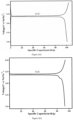
- Figures 3(a)-(c) show the charge discharge profiles at 0.1C rate of KNVZPF of the aforesaid Inv. Ex. 1-3.
- the charge discharge profile looks similar to NVP.
- a flat potential is observed at 3.4V characteristic of the redox reaction of typical NVP material.
- the discharge capacities are 101 mAh/g, 97 mAh/g and 94 mAh/g for Inv. Ex. 1-3 respectively.
- Figures 4(a)-(c) depict the rate performance of KNVZPF for the aforesaid Inv. Ex. 1-3.
- Figure 5 depicts the cycle performance of KNVZPF (Inv. Ex. 1) cycled at very high C-rate of 10C. The capacity retention is 88% after 2000 cycles.
- the electrode active material and the electrode material in accordance with the present invention is superior in terms of its electrochemical cycling properties, when compared with NVP and/or NVZP materials known in the art. Further, the electrode active material of the present invention is also comparable with NVZPF, which is a binary substituted NVP material.
Landscapes
- Chemical & Material Sciences (AREA)
- Chemical Kinetics & Catalysis (AREA)
- Electrochemistry (AREA)
- General Chemical & Material Sciences (AREA)
- Inorganic Chemistry (AREA)
- Engineering & Computer Science (AREA)
- Organic Chemistry (AREA)
- Materials Engineering (AREA)
- Manufacturing & Machinery (AREA)
- Crystallography & Structural Chemistry (AREA)
- Battery Electrode And Active Subsutance (AREA)
- Secondary Cells (AREA)
Applications Claiming Priority (1)
| Application Number | Priority Date | Filing Date | Title |
|---|---|---|---|
| IN202341003842 | 2023-01-19 |
Publications (3)
| Publication Number | Publication Date |
|---|---|
| EP4404294A1 true EP4404294A1 (de) | 2024-07-24 |
| EP4404294B1 EP4404294B1 (de) | 2025-10-01 |
| EP4404294C0 EP4404294C0 (de) | 2025-10-01 |
Family
ID=86378237
Family Applications (1)
| Application Number | Title | Priority Date | Filing Date |
|---|---|---|---|
| EP23172954.2A Active EP4404294B1 (de) | 2023-01-19 | 2023-05-11 | Ternäres substituiertes vanadiumphosphat-elektrodenmaterial |
Country Status (5)
| Country | Link |
|---|---|
| US (1) | US20240253991A1 (de) |
| EP (1) | EP4404294B1 (de) |
| JP (1) | JP7648676B2 (de) |
| KR (1) | KR102897026B1 (de) |
| AU (1) | AU2023203049B2 (de) |
Families Citing this family (1)
| Publication number | Priority date | Publication date | Assignee | Title |
|---|---|---|---|---|
| CN118929617B (zh) * | 2024-10-12 | 2025-03-18 | 山东海化集团有限公司 | 一种焦磷酸钒钠/碳复合材料的合成方法及其应用 |
Citations (3)
| Publication number | Priority date | Publication date | Assignee | Title |
|---|---|---|---|---|
| CN114156470A (zh) | 2021-11-30 | 2022-03-08 | 电子科技大学 | 富钠相磷酸锌钒钠复合材料及制备和应用 |
| CN114256446A (zh) | 2020-09-23 | 2022-03-29 | 湖南农业大学 | 一种聚阴离子型正极材料及其制备方法和应用 |
| CN114538400A (zh) | 2020-11-24 | 2022-05-27 | 天津理工大学 | 多元阳离子取代磷酸盐电极材料及其制备方法 |
Family Cites Families (10)
| Publication number | Priority date | Publication date | Assignee | Title |
|---|---|---|---|---|
| JP2530494B2 (ja) * | 1989-04-28 | 1996-09-04 | キョーラク株式会社 | プラスチックの中空体の製造方法 |
| JP5384935B2 (ja) | 2005-03-28 | 2014-01-08 | ヴァレンス テクノロジー インコーポレーテッド | 二次電気化学電池 |
| CN102664267B (zh) * | 2012-04-13 | 2015-04-22 | 浙江工业大学 | 共掺杂的磷酸钒锂正极材料及其应用 |
| US10637059B2 (en) | 2015-06-19 | 2020-04-28 | Centre National De La Recherche Scientifique | Method for producing a positive electrode composite material for Na ion battery |
| CN109841801A (zh) | 2017-11-28 | 2019-06-04 | 中国科学院大连化学物理研究所 | 一种碳包覆NaxRyM2(PO4)3材料及其制备和应用 |
| CN112186135B (zh) | 2020-09-23 | 2021-11-19 | 西安交通大学 | 一种包覆有金属氧化物层的氟磷酸钒钠电极及其制备方法 |
| JP7608154B2 (ja) | 2020-12-28 | 2025-01-06 | 日本化学工業株式会社 | リン酸バナジウムリチウムの製造方法 |
| CN115172742A (zh) | 2022-09-02 | 2022-10-11 | 江苏正力新能电池技术有限公司 | 预碱金属化磷酸钒钠,其制备方法以及钠离子电池 |
| CN115360340B (zh) * | 2022-09-23 | 2024-12-31 | 北京理工大学 | 一种阴阳离子功能化掺杂改性的高熵聚阴离子型正极材料、制备方法及其应用 |
| CN115377413A (zh) | 2022-09-30 | 2022-11-22 | 河南大学 | 一种改性的锰基聚阴离子型钠离子电池正极材料及制备方法和应用 |
-
2023
- 2023-05-11 EP EP23172954.2A patent/EP4404294B1/de active Active
- 2023-05-16 AU AU2023203049A patent/AU2023203049B2/en active Active
- 2023-05-16 JP JP2023080788A patent/JP7648676B2/ja active Active
- 2023-06-09 US US18/332,349 patent/US20240253991A1/en active Pending
- 2023-06-22 KR KR1020230080458A patent/KR102897026B1/ko active Active
Patent Citations (3)
| Publication number | Priority date | Publication date | Assignee | Title |
|---|---|---|---|---|
| CN114256446A (zh) | 2020-09-23 | 2022-03-29 | 湖南农业大学 | 一种聚阴离子型正极材料及其制备方法和应用 |
| CN114538400A (zh) | 2020-11-24 | 2022-05-27 | 天津理工大学 | 多元阳离子取代磷酸盐电极材料及其制备方法 |
| CN114156470A (zh) | 2021-11-30 | 2022-03-08 | 电子科技大学 | 富钠相磷酸锌钒钠复合材料及制备和应用 |
Also Published As
| Publication number | Publication date |
|---|---|
| AU2023203049B2 (en) | 2024-10-24 |
| KR20240115701A (ko) | 2024-07-26 |
| KR102897026B1 (ko) | 2025-12-08 |
| EP4404294B1 (de) | 2025-10-01 |
| JP7648676B2 (ja) | 2025-03-18 |
| AU2023203049A1 (en) | 2024-08-08 |
| US20240253991A1 (en) | 2024-08-01 |
| JP2024102784A (ja) | 2024-07-31 |
| EP4404294C0 (de) | 2025-10-01 |
Similar Documents
| Publication | Publication Date | Title |
|---|---|---|
| JP5268134B2 (ja) | 正極活物質の製造方法およびそれを用いた非水電解質電池 | |
| US8951673B2 (en) | High rate, long cycle life battery electrode materials with an open framework structure | |
| KR102157404B1 (ko) | 개선된 전기화학적 성능을 갖는 lmfp 캐소드 물질 | |
| KR101534386B1 (ko) | 배합된 캐소드 활물질을 갖는 비수계 이차 배터리 | |
| KR101805541B1 (ko) | 복합양극활물질, 이를 포함하는 양극 및 리튬전지, 및 이의 제조방법 | |
| KR102570264B1 (ko) | 양극 활물질 및 그 제조방법, 상기 양극 활물질을 채용한 양극과 리튬 전지 | |
| JP2020105063A (ja) | ドープニオブ酸チタンおよび電池 | |
| KR20090125278A (ko) | 리튬 이온 2차 전지를 위한 양극 활성 물질로서 리튬 인산철을 제조하는 방법 | |
| JPWO2000060679A1 (ja) | 正極活物質の製造方法及び非水電解質二次電池の製造方法 | |
| KR20140108102A (ko) | 복합 양극 활물질 및 그 제조방법, 상기 복합 양극 활물질을 채용한 양극과 리튬 전지 | |
| KR101973047B1 (ko) | 복합양극활물질, 이를 포함하는 양극 및 리튬전지, 및 이의 제조방법 | |
| KR20120117234A (ko) | 양극활물질, 그 제조방법 및 이를 채용한 양극 및 리튬전지 | |
| CN115498183A (zh) | 一种改性磷酸钒锰钠正极材料、其制备及应用 | |
| JP5777870B2 (ja) | リチウム二次電池用陽極材料の製造方法 | |
| KR101613498B1 (ko) | 양극 활물질, 이를 채용한 양극과 리튬 전지 및 이의 제조방법 | |
| EP4404294B1 (de) | Ternäres substituiertes vanadiumphosphat-elektrodenmaterial | |
| EP4403516B1 (de) | Binäres substituiertes vanadiumphosphat-elektrodenmaterial | |
| EP4490107A1 (de) | Elektrodenmaterial | |
| US11444278B2 (en) | Cathode material for lithium secondary battery, and preparation method therefor | |
| JP3577744B2 (ja) | リチウム二次電池正極材料およびニッケル酸リチウムの製造方法 | |
| KR102958698B1 (ko) | 양극 활물질 및 그 제조방법, 양극시트, 배터리 및 전기장치 | |
| EP4475204A1 (de) | Pvdf-weichmacher zur elektrodenherstellung und universelle batterieanwendung davon | |
| KR20240100797A (ko) | 플루오린이 코팅된 리튬 이차전지용 양극활물질, 이의 제조방법 및 이를 포함하는 리튬 이차전지 | |
| KR20240178049A (ko) | 리튬 이차 전지용 양극 활물질 및 이를 포함하는 리튬 이차 전지 | |
| CN121964772A (zh) | 一种富锂锰基锂离子电池及其制备方法 |
Legal Events
| Date | Code | Title | Description |
|---|---|---|---|
| PUAI | Public reference made under article 153(3) epc to a published international application that has entered the european phase |
Free format text: ORIGINAL CODE: 0009012 |
|
| STAA | Information on the status of an ep patent application or granted ep patent |
Free format text: STATUS: REQUEST FOR EXAMINATION WAS MADE |
|
| 17P | Request for examination filed |
Effective date: 20230511 |
|
| AK | Designated contracting states |
Kind code of ref document: A1 Designated state(s): AL AT BE BG CH CY CZ DE DK EE ES FI FR GB GR HR HU IE IS IT LI LT LU LV MC ME MK MT NL NO PL PT RO RS SE SI SK SM TR |
|
| RIC1 | Information provided on ipc code assigned before grant |
Ipc: H01M 4/587 20100101ALI20250321BHEP Ipc: H01M 4/58 20100101ALI20250321BHEP Ipc: H01M 4/1397 20100101ALI20250321BHEP Ipc: H01M 4/136 20100101AFI20250321BHEP |
|
| GRAP | Despatch of communication of intention to grant a patent |
Free format text: ORIGINAL CODE: EPIDOSNIGR1 |
|
| STAA | Information on the status of an ep patent application or granted ep patent |
Free format text: STATUS: GRANT OF PATENT IS INTENDED |
|
| INTG | Intention to grant announced |
Effective date: 20250506 |
|
| GRAS | Grant fee paid |
Free format text: ORIGINAL CODE: EPIDOSNIGR3 |
|
| GRAA | (expected) grant |
Free format text: ORIGINAL CODE: 0009210 |
|
| STAA | Information on the status of an ep patent application or granted ep patent |
Free format text: STATUS: THE PATENT HAS BEEN GRANTED |
|
| AK | Designated contracting states |
Kind code of ref document: B1 Designated state(s): AL AT BE BG CH CY CZ DE DK EE ES FI FR GB GR HR HU IE IS IT LI LT LU LV MC ME MK MT NL NO PL PT RO RS SE SI SK SM TR |
|
| REG | Reference to a national code |
Ref country code: GB Ref legal event code: FG4D Ref country code: CH Ref legal event code: F10 Free format text: ST27 STATUS EVENT CODE: U-0-0-F10-F00 (AS PROVIDED BY THE NATIONAL OFFICE) Effective date: 20251001 |
|
| REG | Reference to a national code |
Ref country code: DE Ref legal event code: R096 Ref document number: 602023007044 Country of ref document: DE |
|
| REG | Reference to a national code |
Ref country code: IE Ref legal event code: FG4D |
|
| U01 | Request for unitary effect filed |
Effective date: 20251103 |
|
| U07 | Unitary effect registered |
Designated state(s): AT BE BG DE DK EE FI FR IT LT LU LV MT NL PT RO SE SI Effective date: 20251119 |
|
| PG25 | Lapsed in a contracting state [announced via postgrant information from national office to epo] |
Ref country code: ES Free format text: LAPSE BECAUSE OF FAILURE TO SUBMIT A TRANSLATION OF THE DESCRIPTION OR TO PAY THE FEE WITHIN THE PRESCRIBED TIME-LIMIT Effective date: 20251001 |
|
| PG25 | Lapsed in a contracting state [announced via postgrant information from national office to epo] |
Ref country code: NO Free format text: LAPSE BECAUSE OF FAILURE TO SUBMIT A TRANSLATION OF THE DESCRIPTION OR TO PAY THE FEE WITHIN THE PRESCRIBED TIME-LIMIT Effective date: 20260101 |
|
| PG25 | Lapsed in a contracting state [announced via postgrant information from national office to epo] |
Ref country code: HR Free format text: LAPSE BECAUSE OF FAILURE TO SUBMIT A TRANSLATION OF THE DESCRIPTION OR TO PAY THE FEE WITHIN THE PRESCRIBED TIME-LIMIT Effective date: 20251001 |
|
| PG25 | Lapsed in a contracting state [announced via postgrant information from national office to epo] |
Ref country code: RS Free format text: LAPSE BECAUSE OF FAILURE TO SUBMIT A TRANSLATION OF THE DESCRIPTION OR TO PAY THE FEE WITHIN THE PRESCRIBED TIME-LIMIT Effective date: 20260101 |
|
| PG25 | Lapsed in a contracting state [announced via postgrant information from national office to epo] |
Ref country code: IS Free format text: LAPSE BECAUSE OF FAILURE TO SUBMIT A TRANSLATION OF THE DESCRIPTION OR TO PAY THE FEE WITHIN THE PRESCRIBED TIME-LIMIT Effective date: 20260201 |
|
| PG25 | Lapsed in a contracting state [announced via postgrant information from national office to epo] |
Ref country code: CZ Free format text: LAPSE BECAUSE OF FAILURE TO SUBMIT A TRANSLATION OF THE DESCRIPTION OR TO PAY THE FEE WITHIN THE PRESCRIBED TIME-LIMIT Effective date: 20251001 |
|
| PG25 | Lapsed in a contracting state [announced via postgrant information from national office to epo] |
Ref country code: PL Free format text: LAPSE BECAUSE OF FAILURE TO SUBMIT A TRANSLATION OF THE DESCRIPTION OR TO PAY THE FEE WITHIN THE PRESCRIBED TIME-LIMIT Effective date: 20251001 |