EP4403518A1 - Formkörper auf siliciumbasis und verfahren zur kontinuierlichen herstellung von siliciumoxid damit - Google Patents
Formkörper auf siliciumbasis und verfahren zur kontinuierlichen herstellung von siliciumoxid damit Download PDFInfo
- Publication number
- EP4403518A1 EP4403518A1 EP22870312.0A EP22870312A EP4403518A1 EP 4403518 A1 EP4403518 A1 EP 4403518A1 EP 22870312 A EP22870312 A EP 22870312A EP 4403518 A1 EP4403518 A1 EP 4403518A1
- Authority
- EP
- European Patent Office
- Prior art keywords
- silicon
- molded body
- based molded
- particle diameter
- powder
- Prior art date
- Legal status (The legal status is an assumption and is not a legal conclusion. Google has not performed a legal analysis and makes no representation as to the accuracy of the status listed.)
- Pending
Links
Images

Classifications
-
- C—CHEMISTRY; METALLURGY
- C01—INORGANIC CHEMISTRY
- C01B—NON-METALLIC ELEMENTS; COMPOUNDS THEREOF; METALLOIDS OR COMPOUNDS THEREOF NOT COVERED BY SUBCLASS C01C
- C01B33/00—Silicon; Compounds thereof
-
- H—ELECTRICITY
- H01—ELECTRIC ELEMENTS
- H01M—PROCESSES OR MEANS, e.g. BATTERIES, FOR THE DIRECT CONVERSION OF CHEMICAL ENERGY INTO ELECTRICAL ENERGY
- H01M4/00—Electrodes
- H01M4/02—Electrodes composed of, or comprising, active material
- H01M4/36—Selection of substances as active materials, active masses, active liquids
- H01M4/362—Composites
- H01M4/364—Composites as mixtures
-
- C—CHEMISTRY; METALLURGY
- C01—INORGANIC CHEMISTRY
- C01B—NON-METALLIC ELEMENTS; COMPOUNDS THEREOF; METALLOIDS OR COMPOUNDS THEREOF NOT COVERED BY SUBCLASS C01C
- C01B33/00—Silicon; Compounds thereof
- C01B33/113—Silicon oxides; Hydrates thereof
- C01B33/12—Silica; Hydrates thereof, e.g. lepidoic silicic acid
- C01B33/126—Preparation of silica of undetermined type
-
- C—CHEMISTRY; METALLURGY
- C01—INORGANIC CHEMISTRY
- C01B—NON-METALLIC ELEMENTS; COMPOUNDS THEREOF; METALLOIDS OR COMPOUNDS THEREOF NOT COVERED BY SUBCLASS C01C
- C01B33/00—Silicon; Compounds thereof
- C01B33/113—Silicon oxides; Hydrates thereof
-
- C—CHEMISTRY; METALLURGY
- C04—CEMENTS; CONCRETE; ARTIFICIAL STONE; CERAMICS; REFRACTORIES
- C04B—LIME, MAGNESIA; SLAG; CEMENTS; COMPOSITIONS THEREOF, e.g. MORTARS, CONCRETE OR LIKE BUILDING MATERIALS; ARTIFICIAL STONE; CERAMICS; REFRACTORIES; TREATMENT OF NATURAL STONE
- C04B38/00—Porous mortars, concrete, artificial stone or ceramic ware; Preparation thereof
- C04B38/009—Porous or hollow ceramic granular materials, e.g. microballoons
-
- H—ELECTRICITY
- H01—ELECTRIC ELEMENTS
- H01M—PROCESSES OR MEANS, e.g. BATTERIES, FOR THE DIRECT CONVERSION OF CHEMICAL ENERGY INTO ELECTRICAL ENERGY
- H01M4/00—Electrodes
- H01M4/02—Electrodes composed of, or comprising, active material
- H01M4/36—Selection of substances as active materials, active masses, active liquids
- H01M4/48—Selection of substances as active materials, active masses, active liquids of inorganic oxides or hydroxides
- H01M4/483—Selection of substances as active materials, active masses, active liquids of inorganic oxides or hydroxides for non-aqueous cells
-
- C—CHEMISTRY; METALLURGY
- C01—INORGANIC CHEMISTRY
- C01B—NON-METALLIC ELEMENTS; COMPOUNDS THEREOF; METALLOIDS OR COMPOUNDS THEREOF NOT COVERED BY SUBCLASS C01C
- C01B33/00—Silicon; Compounds thereof
- C01B33/113—Silicon oxides; Hydrates thereof
- C01B33/12—Silica; Hydrates thereof, e.g. lepidoic silicic acid
- C01B33/18—Preparation of finely divided silica neither in sol nor in gel form; After-treatment thereof
- C01B33/181—Preparation of finely divided silica neither in sol nor in gel form; After-treatment thereof by a dry process
- C01B33/182—Preparation of finely divided silica neither in sol nor in gel form; After-treatment thereof by a dry process by reduction of a siliceous material, e.g. with a carbonaceous reducing agent and subsequent oxidation of the silicon monoxide formed
-
- C—CHEMISTRY; METALLURGY
- C01—INORGANIC CHEMISTRY
- C01P—INDEXING SCHEME RELATING TO STRUCTURAL AND PHYSICAL ASPECTS OF SOLID INORGANIC COMPOUNDS
- C01P2006/00—Physical properties of inorganic compounds
- C01P2006/10—Solid density
-
- C—CHEMISTRY; METALLURGY
- C01—INORGANIC CHEMISTRY
- C01P—INDEXING SCHEME RELATING TO STRUCTURAL AND PHYSICAL ASPECTS OF SOLID INORGANIC COMPOUNDS
- C01P2006/00—Physical properties of inorganic compounds
- C01P2006/14—Pore volume
-
- C—CHEMISTRY; METALLURGY
- C01—INORGANIC CHEMISTRY
- C01P—INDEXING SCHEME RELATING TO STRUCTURAL AND PHYSICAL ASPECTS OF SOLID INORGANIC COMPOUNDS
- C01P2006/00—Physical properties of inorganic compounds
- C01P2006/80—Compositional purity
-
- C—CHEMISTRY; METALLURGY
- C04—CEMENTS; CONCRETE; ARTIFICIAL STONE; CERAMICS; REFRACTORIES
- C04B—LIME, MAGNESIA; SLAG; CEMENTS; COMPOSITIONS THEREOF, e.g. MORTARS, CONCRETE OR LIKE BUILDING MATERIALS; ARTIFICIAL STONE; CERAMICS; REFRACTORIES; TREATMENT OF NATURAL STONE
- C04B2111/00—Mortars, concrete or artificial stone or mixtures to prepare them, characterised by specific function, property or use
- C04B2111/00474—Uses not provided for elsewhere in C04B2111/00
- C04B2111/00853—Uses not provided for elsewhere in C04B2111/00 in electrochemical cells or batteries, e.g. fuel cells
-
- H—ELECTRICITY
- H01—ELECTRIC ELEMENTS
- H01M—PROCESSES OR MEANS, e.g. BATTERIES, FOR THE DIRECT CONVERSION OF CHEMICAL ENERGY INTO ELECTRICAL ENERGY
- H01M4/00—Electrodes
- H01M4/02—Electrodes composed of, or comprising, active material
- H01M2004/026—Electrodes composed of, or comprising, active material characterised by the polarity
- H01M2004/027—Negative electrodes
-
- Y—GENERAL TAGGING OF NEW TECHNOLOGICAL DEVELOPMENTS; GENERAL TAGGING OF CROSS-SECTIONAL TECHNOLOGIES SPANNING OVER SEVERAL SECTIONS OF THE IPC; TECHNICAL SUBJECTS COVERED BY FORMER USPC CROSS-REFERENCE ART COLLECTIONS [XRACs] AND DIGESTS
- Y02—TECHNOLOGIES OR APPLICATIONS FOR MITIGATION OR ADAPTATION AGAINST CLIMATE CHANGE
- Y02E—REDUCTION OF GREENHOUSE GAS [GHG] EMISSIONS, RELATED TO ENERGY GENERATION, TRANSMISSION OR DISTRIBUTION
- Y02E60/00—Enabling technologies; Technologies with a potential or indirect contribution to GHG emissions mitigation
- Y02E60/10—Energy storage using batteries
Definitions
- the present disclosure relates to a silicon-based molded body and a method for continuously preparing silicon oxide using the same, and more particularly, to a silicon-based molded body that may improve production efficiency of silicon oxide by inducing a solid-liquid reaction with liquid silicon and a method for continuously preparing silicon oxide using the same.
- silicon-based materials which are the most promising materials for high capacity among the anode materials that determine the capacity of lithium secondary batteries, is actively underway.
- silicon oxide was manufactured in the form of nano powder particle using a dry or wet manufacturing process.
- the dry process used a method of reacting a trace amount of oxygen with metallic silicon or heating and evaporating silicon raw material powder particle and depositing it on a surface of a substrate to prepare silicon oxide.
- the dry process has the disadvantage of increased manufacturing costs and a long manufacturing time, and in particular, quality of the prepared silicon oxide is not uniform.
- silicon oxide and a metal additive were each volatilized and mixed to prepare metal-doped silicon oxide.
- silicon oxide and a metal additive were each volatilized and mixed to prepare metal-doped silicon oxide.
- uniform doping is difficult due to a change in specific surface area due to pressure and temperature difference and exhaustion of the metal additive, resulting in non-uniformity in the doped metal content.
- An aspect of the present disclosure is to provide a silicon-based molded body capable of improving production efficiency of silicon oxide including metal through a solid-liquid reaction induced with liquid silicon.
- Another aspect of the present disclosure is to provide a silicon-based molded body capable of improving composition uniformity of silicon oxide including metal as well as improving the production efficiency described above.
- Another aspect of the present disclosure is to provide a method for continuously preparing silicon oxide, capable of continuously preparing silicon oxide including metal with excellent production efficiency using the silicon-based molded body described above.
- a silicon-based molded body includes: a first powder particle including silicon; a second powder particle including silicon dioxide; and a third powder particle including one or more metals selected from the group consisting of alkali metal, alkaline earth metal, transition metal, and post-transition metal, wherein average particle diameters (D50) of at least two types of powder particles among the first to third powder particles are different from each other and the silicon-based molded body is formed by press-molding a mixture of the first to third powder particles.
- D50 average particle diameters
- the silicon-based molded body may satisfy the Relational expression 1 below: A D 50 + B D 50 / C D 9 ⁇ C D 10 ⁇ 5
- a D 5 is an average particle diameter of powder particle A having a largest average particle diameter among two or more types of powder particles having different average particle diameters
- B D 50 is an average particle diameter of powder particle B having a smallest average particle diameter
- C D 90 is a particle diameter (D90) corresponding to 90% of a volume accumulation from a side with a smaller particle diameter in mixed powder particles C including the powder particle A and the powder particle B
- C D 10 is a particle diameter (D10) corresponding to 10% of a volume accumulation of the mixed powder particles C.
- a porosity of the silicon-based molded body defined by a percentage for a ratio of a difference ( T d - S d ) between a true density T d and a molding density S d to the true density may be 5 to 65%.
- a molar ratio of silicon : silicon dioxide included in the silicon-based molded body may be 1:0.25 to 4.
- the third powder particle is a powder particle of a complex oxide including the metal and silicon.
- a strength of the silicon-based molded body may be 1.5 to 6 N/mm 2 .
- the silicon-based molded body may be for preparing silicon oxide.
- the silicon-based molded body may be for preparing silicon oxide that reacts with liquid silicon.
- Another aspect of the present disclosure provides a silicon-based molded body kit for preparing silicon oxide, including the silicon-based molded body described above and including two or more silicon-based molded bodies having different molar ratios of silicon: silicon dioxide.
- Another aspect of the present disclosure provides a method for continuously preparing silicon oxide.
- the method for continuously preparing silicon oxide includes: a) continuously introducing a silicon-based molded body to a molten silicon to induce a solid-liquid reaction; and b) condensing and precipitating a gaseous silicon oxide produced by the solid-liquid reaction, wherein the silicon-based molded body includes: a first powder particle including silicon; a second powder particle including silicon dioxide; and a third powder particle including one or more metals selected from the group consisting of alkali metal, alkaline earth metal, transition metal, and post-transition metal, wherein average particle diameters (D50) of at least two types of powder particles among the first to third powder particles are different from each other and the silicon-based molded body is formed by press-molding a mixture of the first to third powder particles.
- D50 average particle diameters
- the silicon-based molded body may satisfy Condition 1 below:
- Condition 1 a silicon-based molded boy satisfying Relational expression 1 below: A D 50 + B D 5 / C D 90 ⁇ C D 10 ⁇ 5
- a D 50 is an average particle diameter of powder particle A having a largest average particle diameter among two or more types of powder particles having different average particle diameters
- B D 5 is an average particle diameter of powder particle B having a smallest average particle diameter
- C D 9 is a particle diameter (D90) corresponding to 90% of a volume accumulation from a side with a smaller particle diameter in mixed powder particles C including the powder particle A and the powder particle B
- C D 10 is a particle diameter (D10) corresponding to 10% of a volume accumulation of the mixed powder particles C).
- the silicon-based molded body may further satisfy one or more of conditions 2 to 4 below:
- the silicon-based molded body in step a) may be calcined at 120 to 900°C.
- an impurity residual rate of the calcined silicon-based molded body may be 20% or less.
- the silicon-based molded body may be a silicon-based molded body kit including two or more silicon-based molded bodies having different molar ratios of silicon:silicon dioxide.
- each silicon-based molded body included in the silicon-based molded body kit in step a) is independently introduced into the molten silicon
- a temperature of the molten silicon may be 1400 to 1800°C.
- the silicon-based molded body according to the present disclosure includes a first powder particle including silicon; a second powder particle including silicon dioxide; and a third powder particle including one or more metals selected from the group consisting of alkali metal, alkaline earth metal, transition metal, and post-transition metal, wherein average particle diameters (D50) of at least two types of powder particles among the first to third powder particles are different from each other and the silicon-based molded body is formed by press-molding a mixture of the first to third powder particles, and thus, there is an advantage in that the production efficiency of silicon oxide may be improved when inducing a solid-liquid reaction with liquid silicon.
- D50 average particle diameters
- the prepared silicon oxide may be used as an anode material for lithium secondary batteries having excellent discharge capacity characteristics.
- a particle diameter described in the specification and the attached patent claims is a value measured based on a particle diameter distribution, which is an indicator of what size (particle diameter) particles are included in a particle group to be measured and in what proportion.
- the particle diameter distribution is measured through a laser diffraction scattering method using scattered light when light is irradiated to particles and refers to a cumulative particle diameter distribution according to volume.
- D10 refers to a particle diameter corresponding to 10% of a volume accumulation from a side with a smaller particle diameter
- D90 refers to a particle diameter corresponding to 90% of the volume accumulation from the side with the smaller particle diameter
- D50 refers to a particle diameter (hereinafter, referred to as an average particle diameter) corresponding to 50% of the volume accumulation from the side with the smaller particle diameter, where the volume accumulation from the smaller side is 50%.
- a silicon-based molded body includes a first powder particle including silicon; a second powder particle including silicon dioxide; and a third powder particle including one or more metals selected from the group consisting of alkali metal, alkaline earth metal, transition metal, and post-transition metal, wherein average particle diameters (D50) of at least two types of powder particles among the first to third powder particles are different from each other and the silicon-based molded body is formed by press-molding a mixture of the first to third powder particles.
- D50 average particle diameters
- silicon oxide-based materials as anode materials included in secondary batteries may solve the volume expansion problem of conventional silicon-based anode materials and may be advantageous for high capacity, and as such, the silicon oxide-based materials have come to prominence as next-generation anode materials.
- silicon oxide which is conventionally prepared using a dry process of reacting a small amount of oxygen with metallic silicon or heating and evaporating silicon raw material powder particles, has the disadvantages of low economic feasibility due to high manufacturing costs and low production efficiency due to a long manufacturing time.
- the silicon-based molded body according to an embodiment of the present disclosure is formed by press-molding a mixture of the aforementioned first to third powder particles, and since the average particle diameters (D50) of powder particles of at least two of the first powder particle to the second powder particle are different from each other, when the silicon-based molded body is used as a raw material to prepare silicon oxide, the production efficiency of silicon oxide including metal may be significantly improved.
- the silicon-based molded body according to an embodiment of the present disclosure may be used for preparing silicon oxide, and more specifically, for preparing silicon oxide reacting with liquid silicon.
- the silicon-based molded body may refer to a solid molded body formed by press-molding a mixture of the aforementioned first to third powder particles.
- the third powder particle including one or more metals selected from the group consisting of alkali metals, alkaline earth metals, transition metals, and post-transition metals may be a powder particle of a complex oxide including the aforementioned metals and silicon.
- the alkali metal may be one or more selected from the group consisting of lithium (Li), sodium (Na), potassium (K), rubidium (Rb), and cesium (Cs)
- the alkaline earth metal may be one or more selected from the group consisting of beryllium (Be), magnesium (Mg), and calcium (Ca)
- the transition metal may be one or more selected from the group consisting of titanium (Ti), zirconium (Zr), vanadium (V), niobium (Nb), chromium (Cr), molybdenum (Mo), manganese (Mn), iron (Fe), cobalt (Co), nickel (Ni), copper (Cu), and zinc (Zn)
- the post-transition metal may be one or more selected from the group consisting of aluminum (Al), gallium (Ga), indium (In), tin (Sn), and bismuth (Bi).
- the metal included in the third powder particle may include a lanthanide metal, such as scandium (Sc) or yttrium (Y).
- a lanthanide metal such as scandium (Sc) or yttrium (Y).
- the third powder particle may be a powder particle of a complex oxide including the metal and silicon, and in this case, the metal included in the third powder particle may be an alkaline earth metal, and thus, the third powder particle may be a powder particle of a complex oxide including an alkaline earth metal and silicon.
- the third powder particle may be a powder particle of a complex oxide including magnesium and silicon
- the complex oxide may be a complex oxide including one or more magnesium silicates selected from MgSiO 3 and Mg 2SiO 4 .
- the average particle diameter (D50) of the third powder particle may be 5 to 100 um, specifically, 10 to 80 um, and more specifically, 15 to 60 ⁇ m.
- the formability of the silicon-based molded body may be further improved along with the first and second powder particles, which are described below.
- the silicon-based molded body according to an embodiment of the present disclosure may include the first powder particle including silicon and the second powder particle including silicon dioxide in addition to the aforementioned third powder particle.
- the average particle diameters (D50) of at least two types of powder particles, among the first to third powder particles, may be different from each other.
- the silicon-based molded body refers to that the first to third powder particles are physically bound together and have a shape that may be introduced into molten silicon and does not mean that the molded body is chemically homogeneous partially or particle characteristics of the first to third powder particles are lost as the first to third powder particles are sintered.
- the silicon-based molded body may satisfy Relational expression 1 below: A D 50 + B D 50 / C D 90 ⁇ C D 10 ⁇ 5
- a D 50 is an average particle diameter of powder particle A having a largest average particle diameter among two or more types of powder particles having different average particle diameters
- B D 50 is an average particle diameter of powder particle B having a smallest average particle diameter
- C D 90 is a particle diameter (D90) corresponding to 90% of a volume accumulation from a side with a smaller particle diameter in mixed powder particles C including the powder particle A and the powder particle B
- C D 10 is a particle diameter (D10) corresponding to 10% of a volume accumulation of the mixed powder particles C.
- Relational expression 1 may satisfy 5 or less, 4 or less, 3 or less, 2 or less, and may be substantially, 0.1 or more, and more substantially, 0.3 or more.
- Relational expression 1 is less than 0.3, the formability of the silicon-based molded body, which is press-formed, may be improved, but reaction efficiency may decrease when inducing a solid-liquid reaction with liquid silicon, and if Relational expression 1 exceeds 5, the formability of the silicon-based molded body may be lowered, and therefore, it is advantageous for Relational expression 1 to satisfy the aforementioned conditions.
- powder particle A having the largest average particle diameter may be a first powder particle including silicon
- powder particle B having the smallest average particle diameter may be a second powder particle including silicon dioxide.
- the second powder particle including silicon dioxide is powder particle A having the largest average particle diameter and the first powder particle including silicon is powder particle B is not excluded.
- powder particle A may be the third powder particle including the aforementioned metal
- powder particle B may be the first powder particle or the second powder particle.
- powder particle A is the third powder particle including the aforementioned metal and powder particle B is the second powder particle including silicon dioxide.
- the average particle diameter of the first powder particle including silicon may be 5 to 40 um, specifically, 5 to 30 ⁇ m, and more specifically, 8 to 25 ⁇ m.
- the average particle diameter of the second powder particle including silicon dioxide may be 0.01 to 25 um, specifically, 0.5 to 15 ⁇ m, and more specifically, 1 to 10 ⁇ m.
- a porosity of the silicon-based molded body defined by a percentage ( T d - S d )/ T d ⁇ 100) for a ratio of a difference( T d - S d ) between a true density T d and a molding density S d to the true density may be 5 to 69%, specifically, 5 to 65%, more specifically, 10 to 65%, more specifically, 20 to 65%, and more specifically, 35 to 65%.
- the true density is an average value of repeated measurements of 6 or more times using a density meter (AccPyc II1340 from Micromeritics) based on the standard ASTM C 604, and may be 1.5 to 5.0 g/cm 3 , specifically, 2.0 to 4.0 g/cm 3 .
- the molding density is an average value of apparent densities measured for 50 arbitrary molded bodies immediately after molding, and may be 0.5 to 4.0 g/cm 3 , specifically, 0.7 to 3.0 g/cm 3 .
- the apparent density may be a value calculated through the formula G ⁇ D 2 2 ⁇ ⁇ ⁇ H after measuring the diameter (D), height (H), and weight (G) of each molded body.
- the porosity of the silicon-based molded body is less than 5%, the strength of the silicon-based molded body may be improved, but physical damage to the silicon-based molded body, such as cracks and breakage, may occur during the manufacturing process, and if the porosity exceeds 69%, the strength may be low and the shape of the silicon-based molded body may not be maintained, and thus, it is advantageous for the porosity of the silicon-based molded body to satisfy the aforementioned range.
- a solid-liquid reaction with liquid silicon may be induced during a silicon oxide preparing process, which will be described below, and since the porosity of the silicon-based molded body satisfies the aforementioned range, a production rate of silicon oxide may be improved.
- the strength of the silicon-based molded body may be 1 to 10 N/mm 2 , specifically, 1.5 to 6 N/mm 2 , and more specifically, 2 to 4 N/mm 2 .
- the strength may be a compressive strength measured through a compression test using a universal testing machine after preparing each silicon-based molded body according to the specimen standard of ASTM D 3410, which is a strength test standard.
- the strength (compressive strength) of the silicon-based molded body satisfies the aforementioned range, not only may the production rate of silicon oxide prepared through a solid-liquid reaction induced with liquid silicon in the silicon oxide preparing process described below be improved, but also the solid-liquid reaction may be induced stably.
- a molar ratio of silicon to silicon dioxide included in the silicon-based molded body may be 1:0.01 to 10, specifically, 1:0.1 to 8, and more specifically, 1:0.25 to 4.
- the silicon-based molded body may include a plurality of independent silicon-based molded bodies having different molar ratios of silicon:silicon dioxide within the aforementioned range.
- the silicon-based molded body may include a first silicon-based molded body, a second silicon-based molded body, a third silicon-based molded body, a fourth silicon-based molded body, a fifth silicon-based molded body, a sixth silicon-based molded body, a seventh silicon-based molded body, and an eighth silicon-based molded body having molar ratios of silicon:silicon dioxide as 1:0.25, 1:0.5, 1:1, 1:1.5, 1:2, 1:2.5, 1:4, and 1:6, respectively.
- each of the silicon-based molded bodies described above is only an example, and the present disclosure is not limited by the number of each silicon-based molded body included in the silicon-based molded body and the corresponding molar ratios of silicon: silicon dioxide, and different molar ratios of silicon:silicon dioxide and the corresponding number of each of silicon-based molded bodies may be freely selected within the aforementioned range.
- the silicon-based molded body includes a plurality of independent silicon-based molded bodies having different molar ratios of silicon:silicon dioxide within the aforementioned range, a decrease in the reaction rate of the induced solid-liquid reaction may be suppressed by selectively introducing each silicon-based molded body to induce the solid-liquid reaction with liquid silicon during the process of preparing silicon oxide to be described below.
- the silicon-based molded body according to the present disclosure may be formed by press-molding a mixture of the aforementioned first to third powder particles, and the shape of the silicon-based molded body varies depending on the shape of a mold for press-molding.
- the shape of the silicon-based molded body may be cylindrical, prismatic, conical, truncated cone, polygonal pyramid, truncated polygonal pyramid, sphere, hemisphere, tube, pyramid, etc., but the present disclosure is not limited by the shape of the silicon-based molded body.
- the present disclosure provides a silicon-based molded body kit for preparing silicon oxide, including two or more silicon-based molded bodies having different molar ratios of silicon:silicon dioxide.
- the two or more silicon-based molded bodies included in the silicon-based molded body kit for preparing silicon oxide are independent and may have different molar ratios of silicon:silicon dioxide.
- the silicon-based molded body kit for preparing silicon oxide may include 2 or more, 3 or more, 4 or more, 5 or more, 6 or more, 7 or more, 8 or more, 9 or more, 10 or more, 11 or more, 12 or more, 13 or more, 14 or more, and 15 or more independent silicon-based molded bodies having different molar ratios of silicon: silicon dioxide, and may include 100 or less, substantially, 50 or less independent silicon-based molded bodies, but an upper limit value thereof is not limited.
- the present disclosure provides a method for manufacturing a silicon-based molded body, capable of manufacturing the silicon-based molded body described above.
- the method for manufacturing a silicon-based molded body includes a) preparing a mixture of a first powder particle including silicon, a second powder particle including silicon dioxide, and a third powder particle including one or more metals selected from the group consisting of alkali metal, alkaline earth metal, transition metal, and post-transition metal, b) filling a mold with the prepared mixed powder particles; and c) press-molding the mixed powder particles filling the mold.
- the first powder particle, second powder particle, and third powder particle included in the mixed powder particles in step a) of preparing the mixed powder particles are the same as or similar to those described above, and detailed descriptions are omitted.
- the mixed powder particles may be prepared by introducing the first powder particle, second powder particle, and third powder particle to a mixer commonly known in the art, such as a pedal mixer, extruder, Banbury mixer, kneader, or mixing roll to be prepared.
- a mixer commonly known in the art, such as a pedal mixer, extruder, Banbury mixer, kneader, or mixing roll to be prepared.
- the first powder particle, the second powder particle, and the third powder particle may be mixed in consideration of the components of silicon and silicon dioxide included in the first powder particle, the second powder particle, and the third powder particle so that the molar ratio of silicon and silicon dioxide included in the mixed powder particles satisfies the aforementioned range.
- the mixed powder particles may include 1 to 80 parts by weight of the first powder particle, 0.1 to 80 parts by weight of the second powder particle, and 0.1 to 80 parts by weight of the third powder particle, based on 100 parts by weight of the mixed powder particles.
- the filling may be performed by introducing the mixed powder particles into the mold so that a depth filled by the mixed powder particles is 1 to 5 cm, specifically, 1 to 2 cm.
- the press-molding step includes c-1) a first pressing step for deaeration in the mixed powder particles; and c-2) a second pressing step for controlling porosity.
- the porosity a the porosity of a finally obtained silicon-based molded body and is the same as or similar to that described above, so detailed descriptions are omitted.
- the first pressing step may be performed so that a volume change rate is 50 to 70%, specifically, 55 to 65%, based on an initial filling volume of the mixed powder particles filled in step b).
- the volume change rate is less than 50% based on the initial filling volume of the mixed powder particles in the first pressing step, deaeration in the mixed powder particles may not be performed smoothly, and if the volume change rate exceeds 70%, there may be a limitation in controlling the porosity in the second pressing step to be described below, and therefore, the first pressing step may be performed within the aforementioned range.
- the second pressing step may be performed so that the volume change rate is 55 to 90%, specifically, 60 to 90%, more specifically, 66 to 90%, and even more specifically 66 to 81%, based on the initial filling volume.
- the porosity may be lowered as the volume change rate is greater compared to the initial filling volume, and may be increased as the volume change rate is decreased.
- the aforementioned porosity may be affected not only by the second pressing step but also by the particle diameter distribution of each powder particle included in the mixed powder particles.
- the step of press-molding the mixed powder particles filling the mold includes the first pressing step for deaeration in the mixed powder particles and the second pressing step for controlling the porosity, a silicon-based molded body satisfying the porosity and strength characteristics described above may be provided.
- a method for continuously preparing silicon oxide includes: a) continuously introducing a silicon-based molded body to a molten silicon to induce a solid-liquid reaction; and b) condensing and precipitating gaseous silicon oxide produced by the solid-liquid reaction, wherein the silicon-based molded body includes: a first powder particle including silicon; a second powder particle including silicon dioxide; and a third powder particle including one or more metals selected from the group consisting of alkali metal, alkaline earth metal, transition metal, and post-transition metal, wherein an average particle diameter (D50) of at least two types of powder particles among the first to third powder particles are different from each other and the silicon-based molded body is formed by press-molding a mixture of the first to third powder particles.
- D50 average particle diameter
- the silicon oxide according to an embodiment of the present disclosure is continuously manufactured through a solid-liquid reaction between the aforementioned silicon-based molded body and liquid silicon, and not only may the production rate of silicon oxide be significantly improved, but also composition uniformity of silicon oxide including the metal included in the third powder particle may be significantly improved.
- silicon oxide including metal may be continuously prepared in a single process without any additional equipment or follow-up processes.
- FIG. 1 is a flowchart of a method for continuously preparing silicon oxide according to an embodiment of the present disclosure.
- a) a step of continuously introducing a silicon-based molded body to a molten silicon to induce a solid-liquid reaction is performed.
- the silicon-based molded body includes a first powder particle including silicon; a second powder particle including silicon dioxide; and a third powder particle including one or more metals selected from the group consisting of alkali metal, alkaline earth metal, transition metal, and post-transition metal, wherein average particle diameters (D50) of at least two types of powder particles among the first to third powder particles are different from each other and the silicon-based molded body is formed by press-molding a mixture of the first to third powder particles.
- D50 average particle diameters
- first to third powder particles may be the same as or similar to those described above.
- the silicon-based molded body may satisfy Condition 1 below.
- a D 50 is an average particle diameter of powder particle A having a largest average particle diameter among two or more types of powder particles having different average particle diameters
- B D 50 is an average particle diameter of powder particle B having a smallest average particle diameter
- C D 90 is a particle diameter (D90) corresponding to 90% of a volume accumulation from a side with a smaller particle diameter in mixed powder particles C including the powder particle A and the powder particle B
- C D 10 is a particle diameter (D10) corresponding to 10% of a volume accumulation of the mixed powder particles C.
- the silicon-based molded body does not satisfy the aforementioned Condition 1, a desired shape of the molded body may not formed or the shape itself may not be maintained when press-molding the mixture of the first to third powder particles, and therefore, it is preferable that the silicon-based molded body satisfies Condition 1 above.
- Relational expression 1 of Condition 1 may satisfy 5 or less, 4 or less, 3 or less, and 2 or less, preferably, 0.3 or more, and more preferably, 0.6 or more.
- powder particle A having the largest average particle diameter may be the first powder particle including silicon
- powder particle B having the smallest average particle diameter may be the second powder particle including silicon dioxide
- a case in which the second powder particle including silicon dioxide is powder particle A having the largest average particle diameter and the first powder particle including silicon is powder particle B is not excluded.
- powder particle A may be a third powder particle including the aforementioned metal
- powder particle B may be the first powder particle or the second powder particle.
- powder particle A may be the third powder particle including the aforementioned metal and powder particle B to be the second powder particle including silicon dioxide.
- an average particle diameter of the first powder particle may be 5 to 40 um, specifically 5 to 30 um, more specifically, 8 to 25 ⁇ m
- an average particle diameter of the second powder particle may be 0.01 to 25 um, specifically 0.5 to 15 um, more specifically, 1 to 10 ⁇ m
- an average particle diameter of the third powder particle may be 5 to 100 um, specifically, 10 to 80 um, and more specifically, 15 to 60 ⁇ m.
- the silicon-based molded body may further satisfy one or more of Conditions 2 to 4 below.
- the silicon-based molded body has a porosity of 5 to 65% defined by a percentage for a ratio of a difference( T d - S d ) between a true density T d and a molding density S d to the true density.
- the silicon-based molded body has a strength of 1.5 to 6 N/mm 2
- the silicon-based molded body has 1:0.25 to 4 as a molar ratio of silicon:silicon dioxide.
- a porosity of the silicon-based molded body defined by a percentage ( T d - S d )/ T d ⁇ 100) for a ratio of a difference( T d - S d ) between a true density T d and a molding density S d to the true density in Condition 2 may be 5 to 69%, specifically, 5 to 65%, more specifically, 10 to 65%, more specifically, 20 to 65%, and more specifically, 35 to 65%.
- the true density is an average value of repeated measurements of 6 or more times using a density meter (AccPyc II1340 from Micromeritics) based on the standard ASTM C 604, and may be 1.5 to 5.0 g/cm 3 , specifically, 2.0 to 4.0 g/cm 3 .
- the molding density is an average value of apparent densities measured for 50 arbitrary molded bodies immediately after molding, and may be 0.5 to 4.0 g/cm 3 , specifically, 0.7 to 3.0 g/cm 3 .
- the apparent density may be a value calculated through the formula G ⁇ D 2 2 ⁇ ⁇ ⁇ H after measuring the diameter (D), height (H), and weight (G) of each molded body.
- the strength of Condition 3 may be a compressive strength measured through a compression test using a universal testing machine after preparing each silicon-based molded body according to the specimen standard of ASTM D 3410, which is a strength test standard, and the strength of the silicon-based molded body may be 1 to 10 N/mm 2 , specifically, 1.5 to 6 N/mm 2 , and more specifically, 2 to 4 N/mm 2 .
- the molar ratio of silicon to silicon dioxide included in the silicon-based molded body may be 1:0.01 to 10, specifically, 1:0.1 to 8, and more specifically, 1:0.25 to 4.
- the reaction efficiency when inducing a solid-liquid reaction with liquid silicon may be improved, thereby significantly improving the production efficiency of silicon oxide.
- the silicon-based molded body may satisfy one or more of the aforementioned Condition 2 to Condition 4, two or more of the aforementioned Condition 2 to Condition 4, or all of Condition 2 to Condition 4.
- the silicon-based molded body may be a silicon-based molded body kit including two or more silicon-based molded bodies having different molar ratios of silicon:silicon dioxide.
- the silicon-based molded body may be a silicon-based molded body kit including a plurality of independent silicon-based molded bodies having different molar ratios of silicon:silicon dioxide within the aforementioned range
- the plurality of independent molded bodies included in the silicon-based molded body kit may include a first silicon-based molded body, a second silicon-based molded body, a third silicon-based molded body, a fourth silicon-based molded body, a fifth silicon-based molded body, a sixth silicon-based molded body, a seventh silicon-based molded body, and an eighth silicon-based molded body having molar ratios of silicon:silicon dioxide as 1:0.25, 1:0.5, 1:1, 1:1.5, 1:2, 1:2.5, 1:4, and 1:6, respectively.
- each of the silicon-based molded bodies described above is only an example, and the present disclosure is not limited by the number of each silicon-based molded body included in the silicon-based molded body and the corresponding molar ratios of silicon: silicon dioxide, and different molar ratios of silicon:silicon dioxide and the corresponding number of each of silicon-based molded bodies may be freely selected within the aforementioned range.
- the silicon-based molded body kit may include 2 or more, 3 or more, 4 or more, 5 or more, 6 or more, 7 or more, 8 or more, 9 or more, 10 or more, 11 or more, 12 or more, 13 or more, 14 or more, and 15 or more independent silicon-based molded bodies having different molar ratios of silicon: silicon dioxide, and may include 100 or less, substantially, 50 or less independent silicon-based molded bodies, but an upper limit value thereof is not limited.
- each silicon-based molded body included in the silicon-based molded body kit may be independently introduced into the molten silicon, and here, the silicon-based molded body initially introduced into the molten silicon is a silicon-based molded body in which the molar ratio of silicon to silicon dioxide substantially satisfies 1:1, and after the initial introduction, each silicon-based molded body included in the silicon-based molded body kit may be selectively introduced to suppress lowering of the reaction rate of the induced solid-liquid reaction.
- the fact that the initially introduced molar ratio of silicon:silicon dioxide substantially satisfies 1:1 may mean that the molar ratio of silicon:silicon dioxide is 1:0.9 to 1.1, specifically 1:0.95 to 1.05.
- silicon oxide may be generated through a solid-liquid reaction induced by liquid silicon and solid-phase silicon-based molded body, and at this time, silicon-based molded bodies having different molar ratios are independently introduced into the molten silicon according to exhaustion of raw materials during the solid-liquid reaction. As a result, a decrease in the reaction rate of the solid-liquid reaction may be suppressed.
- a silicon-based molded body having a molar ratio of silicon:silicon dioxide substantially satisfying 1:1 is first introduced into the molten silicon, if more of the molten silicon is consumed as the solid-liquid reaction progresses, a silicon-based molded body in which silicon and silicon dioxide are mixed in a molar ratio of 1:0.25 may be introduced, thereby increasing the ratio of Si and thus preventing a decrease in the reaction rate.
- a silicon-based molded body in which silicon and silicon dioxide are mixed at a molar ratio of 1:4 may be introduced, thereby increasing the rate of SiO 2 , and thus, preventing a decrease in reaction rate.
- the production efficiency of continuously prepared silicon oxide may be significantly improved.
- the shape of the silicon-based molded body formed by press-molding a mixture of the aforementioned first to third powder particles may have various shapes depending on the shape of the mold for press-molding.
- the shape of the silicon-based molded body may be cylindrical, prismatic, conical, truncated cone, polygonal pyramid, truncated polygonal pyramid, sphere, hemisphere, tube, pyramid, or the like, but the present disclosure is not limited by the shape of the silicon-based molded body.
- the silicon-based molded body in step a) may be calcined at 120 to 900°C.
- the calcined silicon-based molded body may be a silicon-based molded body from which impurities, such as moisture, OH groups, CO, CO 2 gas, and other oxidation sources present in the silicon-based molded body were removed.
- the calcined silicon-based molded body has been subjected to a calcining process for the purpose of volatilizing and removing impurities present in the silicon-based molded body, and the calcining process may be performed at 100 to 1100°C, specifically, 110 to 1000°C, more specifically, 120 to 900°C, and more specifically, 500 to 900°C.
- a calcination temperature is less than 100°C, volatilization and removal of impurities may occur incompletely, and if the calcination temperature exceeds 1100°C, a specific surface area and/or porosity of the silicon-based molded body may be reduced, causing a problem of lowering the production efficiency of silicon oxide, and therefore, the calcining process is preferably performed within the aforementioned calcination temperature range.
- the silicon-based molded body may be calcined at 500 to 900°C.
- an impurity residual rate of the calcined silicon-based molded body may be 20% or less, 15% or less, 10% or less, substantially, 0.5% or more, and more substantially, 1% or more.
- the impurity residual rate may refer to a rate of an actual mass reduction amount of the silicon-based molded body calcined in the aforementioned calcination temperature range with respect to a mass reduction amount of the silicon-based molded body calcined at the calcination temperature of 1300°C compared to an initial mass of the silicon-based molded body immediately after molding, that is, the silicon-based molded body before calcination.
- impurities such as moisture, OH groups, CO, CO 2 gas, and other oxidation sources, may be substantially removed, so the mass reduction amount of the silicon-based molded body calcined at the calcination temperature of 1300°C may be maximum.
- impurities such as moisture, OH groups, CO, CO 2 gas, and other oxidation sources
- the mass reduction amount of the silicon-based molded body calcined at the calcination temperature of 1300°C may be maximum.
- the impurity residual rate there is a trade-off relationship between the impurity residual rate and a decrease in specific surface area and/or porosity of the calcined silicon-based molded body according to the calcination temperature, and thus, it is advantageous for the impurity residual rate to satisfy the aforementioned range in terms of improvement of the productivity of silicon oxide and improvement of battery capacity and efficiency of secondary batteries when the prepared silicon oxide is used as an anode material.
- the temperature of the molten silicon may be 1400 to 1800°C, specifically, 1500 to 1700°C.
- the temperature of the molten silicon is less than 1,400°C, silicon may not melt and molten silicon may not be formed, and if the temperature exceeds 1,800°C, time to reach a target temperature, a temperature increase time being maintained, and cooling time to reach the end of the process may significantly lengthen due to a high insulation effect.
- Silicon oxide may be generated inside the molten silicon, that is, through a solid-liquid reaction with the silicon-based molded body completely supported within the molten silicon, and even when the silicon-based molded body is located at the interface of the molten silicon, silicon oxide may be generated as liquid silicon penetrates into internal pores of the silicon-based molded by due to capillary action.
- a metal compound may be additionally introduced into the molten silicon.
- the metal compound may be a compound including a metal included as a doping element in a silicon oxide-based anode material for the purpose of improving the performance of the secondary battery, and any metal compound known in the art may be used without limitation.
- the gaseous silicon oxide produced by the solid-liquid reaction may be precipitated on a separately provided collection plate.
- any method known in the art for precipitation of the gaseous silicon oxide may be used without limitation.
- gaseous silicon oxide may be condensed and precipitated on the collection plate at 500 to 1200°C, specifically, 550 to 1000°C.
- the generated silicon oxide may be rapidly cooled and precipitated as nanoparticles having a significantly high specific surface area, and if the temperature of the collection plate exceeds 1,200°C, the generated silicon oxide may experience an additional heat treatment effect on the collection plate and crystal grains may grow excessively, so, when the silicon oxide is used as an anode material of secondary batteries, the charge/discharge capacity maintenance rate may be lowered. Therefore, the temperature of the collection plate may satisfy the aforementioned range.
- silicon oxide prepared according to the aforementioned method for continuously preparing silicon oxide may be used as an anode material for lithium secondary batteries.
- the x value of the prepared silicon oxide (SiOx) may be 0.6 to 1.1 as a result of measurement through X-ray photoelectron spectroscopy (XPS) analysis or energy dispersive X-ray spectroscopy (EDXS) of a scanning electron microscope (SEM) device.
- XPS X-ray photoelectron spectroscopy
- EDXS energy dispersive X-ray spectroscopy
- the x value is less than 0.6, volume expansion may become significantly large when silicon oxide is used as an anode material for lithium secondary batteries, and if the x value exceeds 1.1, an initial reversibility efficiency of the lithium secondary battery may be lowered.
- silicon oxide When silicon oxide is prepared using a silicon-based molded body including a metal element, silicon oxide including a compound indicated as M a Si b O c or M a M' a Si b O c may be prepared.
- M and M' are metals that have a high capacity when combined with silicon oxide and may reduce silicon oxide, and may be metals included in the aforementioned third powder particle and/or metal compounds additionally introduced into the molten silicon.
- a or a+a' may be 1 to 8
- b may be 1 to 4
- c may be 3 to 20. If a or a+a' is less than 1, ionic conductivity and electrical conductivity may not be significantly improved, and if a or a+a' is more than 8, crystallization may decrease. If b is less than 1, the capacity of the lithium secondary battery may not increase significantly, and if b is more than 4, ionic conductivity and electrical conductivity may decrease. If c is less than 3, crystallization of M a Si b O c or M a M' a Si b O c may be degraded, and if c is more than 20, the storage capacity of lithium ions may be reduced.
- silicon oxide prepared according to an embodiment of the present disclosure is applied as an anode material for a lithium secondary battery, the following electrochemical properties may be achieved.
- An initial reversibility efficiency which is the ratio (D/C) of the capacity C for lithium alloying with constant current and constant voltage up to 0.005 V using lithium metal as a counter electrode and the capacity D for lithium dealloying with constant current up to 1.5 V, may be implemented to be 75% or more.
- the capacity of lithium alloying performed with a constant current and constant voltage up to 0.005 V and then lithium dealloying performed with a constant current up to 1.5 V using lithium metal as a counter electrode may be 1,000 to 2,350 mAh/g.
- the present disclosure may provide a silicon oxide preparing apparatus capable of continuously preparing the silicon oxide described above.
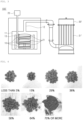
- FIGS. 2 and 3 are cross-sectional views of the silicon oxide preparing apparatuses 100 and 100' capable of continuously preparing the silicon oxide described above.
- the silicon oxide preparing apparatus 100 and 100' may include a container 10, a feeder 20, and collecting units 30 and 30'.
- one or more containers 10 may be provided as a space for accommodating molten silicon and may be stacked in multiple stages and located in a vertical direction.
- the container 10 may be formed of a material, such as graphite or quartz, and there is no particular limitation on the material, but the container 10 formed of a graphite material may be preferably used.
- a reaction unit 11 may be formed on the outside of the container 10.
- the reaction unit 11 may provide a temporary storage space before collecting the generated silicon oxide in the collecting units 30 and 30', which are described below.
- a discharge portion 12 may be formed on one side of the reaction unit 11 to discharge silicon oxide to the collecting units 30 and 30'.
- the container 10 may be heated by a heater 13.
- molten silicon may be prepared by setting the temperature of the heater 13 above a melting point of silicon.
- a silicon-based molded body may be supplied to the molten silicon prepared in the container 10 through the feeder 20.
- the silicon-based molded body may be continuously supplied to the molten silicon on the container 10 through a supply pipe 21 in communication with the feeder 20.
- One supply pipe 21 may be provided for each container 10 stacked in multiple stages to supply the silicon-based molded body.
- the silicon-based molded body as a raw material may be supplied to each container 10 simultaneously as well as independently.
- the silicon-based molded body and the method for continuously preparing silicon oxide using the same according to the present disclosure are described in more detail through examples.
- the following examples are only a reference for describing the present disclosure in detail, and the present disclosure is not limited thereto and may be implemented in various forms.
- a mixture was prepared by mixing silicon (33 wt%), silicon dioxide (7 wt%), and magnesium silicate (60 wt%), a magnesium-based material, as raw materials, homogeneously through a powder particle mixer.
- a mixing molar ratio of silicon:silicon dioxide in the total mixture raw materials including magnesium silicate was 1:1, and the particle diameters (D10, D50, and D90) for each raw material were measured using a laser diffraction particle diameter analyzer (LA-960, HORIBA).
- the mixture prepared using each raw material having a different particle diameter distribution was introduced into a mold and then pressed so that a volume change rate was 70% based on the initial filling volume of the mixture, thereby preparing silicon-based molded bodies of Example 1 to Example 7 to have a pellet shape.
- Example 1 to Example 7 are summarized in Table 1 below, in which each raw material has a different particle diameter distribution.
- a D 50 is an average particle diameter of powder particle A having a largest average particle diameter among two or more types of powder particles having different average particle diameters
- B D 50 is an average particle diameter of powder particle B having a smallest average particle diameter
- C D 90 is a particle diameter (D90) corresponding to 90% of a volume accumulation from a side with a smaller particle diameter in mixed powder particles C including the powder particle A and the powder particle B
- C D 10 is a particle diameter (D10) corresponding to 10% of a volume accumulation of the mixed powder particles C.
- Example 7 when the value E, which is the result of Calculation formula 1, exceeded 5 (Example 7), the formability decreased and it was difficult to manufacture a silicon-based molded body. In addition, in the case of Example 6 in which the particle diameter distribution deviation was small, it was confirmed that some pellet-shaped silicon-based molded bodies were manufactured but a large amount of powder particles were still mixed.
- Example 1 to Example 5 it was confirmed that the pellet shape substantially free of powder particles was maintained and that the formability was excellent.
- the porosity was adjusted by filling the mixture into the mold and then applying first pressing and second pressing. Specifically, in the first pressing step, the mixture was pressed so that the volume change rate was 60% based on the initial filling volume, and the molded body was deaerated along with the first press-molding, and the porosity was controlled through the second pressing performed subsequently. At this time, the porosity was controlled through the second pressing by adjusting the volume change rate to be within the range of 66 to 90% based on the initial filling volume of the mixture.
- each silicon-based molded body was continuously introduced into a molten silicon container at 1,600°C in a vacuum chamber using a feeder for 1 hour to induce a solid-liquid reaction.
- the product produced through the solid-liquid reaction was condensed on a collection plate at 550°C to produce silicon oxide including magnesium.
- Silicon oxide was prepared in the same manner as in Example 9, except that a mixture ratio of silicon:silica in the total mixture raw material including magnesium silicate was set to 1:4.
- Silicon oxide was prepared in the same manner as in Example 9, except that the mixture ratio of silicon:silica in the total mixture raw material including magnesium silicate was set to 1:0.25.
- Silicon oxide was prepared in the same manner as in Example 8, except that a mixture including nano-silica dispersion, a silicon-based material, instead of magnesium silicate, was filled into a mold and molded to have a porosity of 5% to produce a silicon-based molded body.
- Silicon oxide was prepared in the same manner as in Example 8, except that the mixture was filled into a mold and molded to have a porosity of 3.5% to produce a silicon-based molded body.
- Silicon oxide was prepared in the same manner as in Example 8, except that the mixture was filled into a mold and molded to have a porosity of 70% to produce a silicon-based molded body.
- Silicon oxide was prepared in the same manner as in Example 8, except that silicon-based molded body was added in in the absence of molten silicon.
- true density of the silicon-based molded body was checked using a density meter (AccPyc II1340 from Micromeritics), and the true density measurement principle is as follows.
- true density based on Boyle's law, stating that the pressure and volume of a certain amount of gas included in a certain container are inversely proportional, helium gas is injected into a space in which the sample is present and pressure that changes when the volume of the space is changed is measured.
- the measurement conditions for true density are a gas velocity of 0.1 psi ⁇ g/min at room temperature, and for one measurement, a measurement container (cylindrical container having a diameter of 1.8 cm and a height of 4 cm) of the density meter is filled more than half and then measured, and the true density was calculated as an average value of the values measured repeatedly six times or more.
- molding density of the silicon-based molded body is an average value of the apparent density immediately after molding, and the apparent density of the cylindrical molded body was calculated using the formula G ⁇ D 2 2 ⁇ ⁇ ⁇ H after measuring the diameter D, height H, and weight G. At this time, the apparent density was checked by selecting 50 randomly formed silicon-based molded bodies, and the molding density was calculated as an average value of each density.
- the porosity of the silicon-based molded body was calculated by a percentage ( T d - S d )/ T d ⁇ 100) for a ratio of a difference ( T d - S d ) between a true density T d and a molding density S d to the true density using the true density, which is a density of only the pure silicon-based molded body excluding empty spaces within the silicon-based molded body, and the molding density, which is the average value of the apparent density including pores in the silicon-based molded body.
- the strength of the silicon-based molded body was measured through a compression test using a universal testing machine (AG-Xplus 100kN from Shimadzu), and a displacement distance and load were measured by applying pressure over time.
- the specifications of the strength analysis tester complied with ISO 7500-1, and the specimens were manufactured according to the specimen specifications of ASTM D 3410, the strength test standard for polymer composite materials.
- the maximum load that the silicon-based molded body could withstand was checked depending on whether there was a crack or breaking sound in the silicon-based molded body or a location of an inflection point in the graph, and the strength was checked by dividing the maximum load by a contact area.
- the specimens were processed to have a constant rectangular cross-section, and at least five specimens were prepared and tested when analyzed under the same conditions.
- a production rate of silicon oxide prepared using each of the silicon-based molded bodies having the aforementioned characteristics as raw materials may be obtained by time taken for the silicon-based molded body to be completely removed after injecting 1 kg of the silicon-based molded body is injected into the molten silicon container in a vacuum chamber using a feeder, and was calculated using Calculation formula 2 below.
- S is the supply amount of the silicon-based molded body
- a L is the area of the molten silicon
- V is a volatilization time of the silicon-based molded body.
- the area of the container equipped with the molten silicon was equally fixed at 2920 cm 2 and the supply amount of the silicon-based molded body was equally fixed at 1 kg, and the production rate was calculated by measuring the volatilization time.
- the standard for completely vaporizing and removing the molding raw materials was checked with the naked eyes, and there may be a measurement error of ⁇ 5%.
- Example 8 to Example 15 the production rate value satisfied more than 0.1 kg/min ⁇ m 2
- Comparative Example 3 although the silicon-based molded body having the same specifications as those of Example 9 was used, since the silicon-based molded body reacts with solid silicon rather than molten silicon, a solid-solid phase reaction occurs and silicon oxide was produced at a low rate of 0.05 kg/min ⁇ m 2 .
- FIG. 4 is a diagram illustrating optical images of silicon-based molded bodies according to porosity. Referring to FIG. 4 , it can be seen that, when a silicon-based molded body is manufactured by molding a silicon-based mixture to have a porosity of 5% to 65%, the silicon-based molded body is not broken and the properties are maintained and used for manufacturing silicon oxide.
- Example 9 in the case of preparing silicon oxide by making the characteristics of the silicon-based molded bodies the same, it can be seen that, when the silicon-based molded bodies are introduced into the molten silicon, the production rate of silicon oxide is faster through the solid-liquid reaction, compared to a reaction of silicon-based molded body with solid silicon.
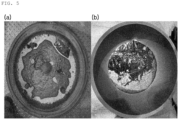
- FIGS. 5(a) and 5(b) are photographs illustrating different remaining amounts of molten silicon remaining in the containers when preparing silicon oxide.
- FIG. 5(a) is a photograph illustrating that a small amount of molten silicon was consumed
- FIG. 5(b) is a photograph illustrating that much of the molten silicon was consumed.
- silicon oxide may be continuously produced using Example 13 in which a mixture molar ratio of Si:SiO 2 with a higher molar ratio of silica is 1:4, and the silicon oxide production rate at this time was 0.23 kg/min ⁇ m 2 .
- Example 9 the silicon-based molded body of Example 9 was subjected to a calcining process at each temperature, and then silicon oxide was manufactured, and the initial efficiency results of secondary batteries when the impurity residual rate, specific surface area, production rate of silicon oxide, Si/O atomic ratio, and the anode material are applied are summarized in Table 3 below.
- the silicon oxide production rate changes from an increasing trend to a downward trend due to a decrease in specific surface area.
- the calcination temperature is 1200°C or higher, sintering, not calcination, occurs, the specific surface area rapidly decreases, a volatilization rate of the raw material also decreased, so the silicon oxide production rate rapidly decreased.
Landscapes
- Chemical & Material Sciences (AREA)
- Organic Chemistry (AREA)
- Inorganic Chemistry (AREA)
- Composite Materials (AREA)
- Chemical Kinetics & Catalysis (AREA)
- Electrochemistry (AREA)
- General Chemical & Material Sciences (AREA)
- Engineering & Computer Science (AREA)
- Ceramic Engineering (AREA)
- Materials Engineering (AREA)
- Structural Engineering (AREA)
- Silicon Compounds (AREA)
Applications Claiming Priority (2)
| Application Number | Priority Date | Filing Date | Title |
|---|---|---|---|
| KR20210122903 | 2021-09-15 | ||
| PCT/KR2022/013794 WO2023043228A1 (ko) | 2021-09-15 | 2022-09-15 | 규소계 성형체 및 이를 이용한 규소산화물의 연속 제조방법 |
Publications (2)
| Publication Number | Publication Date |
|---|---|
| EP4403518A1 true EP4403518A1 (de) | 2024-07-24 |
| EP4403518A4 EP4403518A4 (de) | 2025-07-02 |
Family
ID=85603219
Family Applications (1)
| Application Number | Title | Priority Date | Filing Date |
|---|---|---|---|
| EP22870312.0A Pending EP4403518A4 (de) | 2021-09-15 | 2022-09-15 | Formkörper auf siliciumbasis und verfahren zur kontinuierlichen herstellung von siliciumoxid damit |
Country Status (4)
| Country | Link |
|---|---|
| US (1) | US20240317591A1 (de) |
| EP (1) | EP4403518A4 (de) |
| KR (2) | KR102543368B1 (de) |
| WO (1) | WO2023043228A1 (de) |
Family Cites Families (9)
| Publication number | Priority date | Publication date | Assignee | Title |
|---|---|---|---|---|
| JP3852579B2 (ja) * | 2001-12-26 | 2006-11-29 | 信越化学工業株式会社 | 金属元素ドープ酸化珪素粉末の製造方法及び製造装置 |
| KR101318185B1 (ko) * | 2013-02-13 | 2013-10-15 | 한국에너지기술연구원 | 슬라이딩 타입의 출탕 구조를 갖는 실리콘 용융 도가니를 구비하는 SiOx 나노 분말 제조 장치 및 이를 이용한 SiOx 나노 분말 제조 방법 |
| KR101561182B1 (ko) * | 2013-03-27 | 2015-10-19 | 대주전자재료 주식회사 | 산화규소 제조용 산화규소계 소결체 및 이의 제조방법 |
| JP6496672B2 (ja) * | 2016-01-21 | 2019-04-03 | 信越化学工業株式会社 | 負極活物質の製造方法及び非水電解質二次電池の製造方法 |
| US12412888B2 (en) * | 2017-12-01 | 2025-09-09 | Daejoo Electronic Materials Co., Ltd. | Negative electrode active material for non-aqueous electrolyte secondary battery comprising silicon oxide composite and manufacturing method thereof |
| CN108199031B (zh) * | 2018-01-16 | 2020-04-10 | 毛伟波 | 一种高非晶态一氧化硅材料、制备方法及其用途 |
| CN111072038B (zh) * | 2019-12-27 | 2021-01-01 | 江西壹金新能源科技有限公司 | 一种用于锂离子电池负极的改性一氧化硅材料及其制备方法 |
| KR102299178B1 (ko) * | 2020-04-16 | 2021-09-07 | 주식회사 테라테크노스 | 규소산화물 제조장치 및 제조방법, 규소산화물 음극재 |
| EP3922601A4 (de) * | 2020-04-16 | 2022-05-25 | Tera Technos Co., Ltd. | Vorrichtung und verfahren zur herstellung von siliziumoxiden und material für negative siliziumoxidelektroden |
-
2022
- 2022-09-15 WO PCT/KR2022/013794 patent/WO2023043228A1/ko not_active Ceased
- 2022-09-15 KR KR1020220116173A patent/KR102543368B1/ko active Active
- 2022-09-15 US US18/692,103 patent/US20240317591A1/en active Pending
- 2022-09-15 EP EP22870312.0A patent/EP4403518A4/de active Pending
-
2023
- 2023-05-02 KR KR1020230056945A patent/KR20230066529A/ko active Pending
Also Published As
| Publication number | Publication date |
|---|---|
| KR102543368B1 (ko) | 2023-06-15 |
| WO2023043228A1 (ko) | 2023-03-23 |
| EP4403518A4 (de) | 2025-07-02 |
| KR20230040297A (ko) | 2023-03-22 |
| KR20230066529A (ko) | 2023-05-16 |
| US20240317591A1 (en) | 2024-09-26 |
Similar Documents
| Publication | Publication Date | Title |
|---|---|---|
| EP3629412B1 (de) | Festelektrolyt einer lithiumsekundärbatterie und sulfidverbindung für den festelektrolyten | |
| KR102162070B1 (ko) | 리튬 이차전지용 황화물계 고체 전해질 | |
| EP3009210B1 (de) | Herstellungsverfahren von beta tantalum pulver, tantalum pulver, benützung von tantalum pulver im festelektrolytkondensator | |
| CN107437633B (zh) | 氧化物电解质烧结体和该氧化物电解质烧结体的制造方法 | |
| TWI618285B (zh) | 粉末、包含此種粉末之電極及電池組 | |
| CN104125927A (zh) | 多孔质硅粒子及多孔质硅复合体粒子 | |
| US9620778B2 (en) | Method for producing a fused product | |
| CN114402469B (zh) | 锂离子传导性氧化物 | |
| US11855254B2 (en) | Solid electrolyte | |
| JP2019121462A (ja) | 酸化物電解質焼結体で被覆された電極活物質の製造方法、酸化物電解質焼結体で被覆された電極活物質、及び、硫化物固体電池 | |
| KR102901230B1 (ko) | 탄소질 매트릭스 입자의 분말 및 이러한 분말을 포함하는 배터리 음극에 사용하기 위한 복합 분말 | |
| JP6982712B2 (ja) | リチウムイオン伝導性酸化物焼結体およびその用途 | |
| EP4403518A1 (de) | Formkörper auf siliciumbasis und verfahren zur kontinuierlichen herstellung von siliciumoxid damit | |
| US12378125B2 (en) | Device and method of preparing siox, and siox anode material | |
| JP7035281B2 (ja) | リチウムイオン伝導性酸化物およびその用途 | |
| CN117203719A (zh) | 固体电解质、固体电解质的制造方法及电池 | |
| JP2021510907A (ja) | 電池の負極に使用するための複合粉体及びかかる複合粉体を含む電池 | |
| KR101561182B1 (ko) | 산화규소 제조용 산화규소계 소결체 및 이의 제조방법 | |
| JP6518325B2 (ja) | ガーネット型イオン伝導体を含む構造体 | |
| US20250343224A1 (en) | A powder for use in the negative electrode of a battery, a method for preparing such a powder and a battery comprising such a powder | |
| CN113443632A (zh) | Si系活性物质的制造方法 | |
| JP2015183269A (ja) | 固体電解質薄膜形成用スパッタリングターゲット及び薄膜 | |
| JP7669033B2 (ja) | 固体電解質、固体電解質製造用の粉末および固体電解質の製造方法 | |
| EP4052876A1 (de) | Verfahren zur herstellung eines lithium-übergangsmetall-verbundoxids | |
| Hirono | Invention of Silicon Oxide-Based Anode Materials for Rechargeable Batteries |
Legal Events
| Date | Code | Title | Description |
|---|---|---|---|
| STAA | Information on the status of an ep patent application or granted ep patent |
Free format text: STATUS: THE INTERNATIONAL PUBLICATION HAS BEEN MADE |
|
| PUAI | Public reference made under article 153(3) epc to a published international application that has entered the european phase |
Free format text: ORIGINAL CODE: 0009012 |
|
| STAA | Information on the status of an ep patent application or granted ep patent |
Free format text: STATUS: REQUEST FOR EXAMINATION WAS MADE |
|
| 17P | Request for examination filed |
Effective date: 20240415 |
|
| AK | Designated contracting states |
Kind code of ref document: A1 Designated state(s): AL AT BE BG CH CY CZ DE DK EE ES FI FR GB GR HR HU IE IS IT LI LT LU LV MC MK MT NL NO PL PT RO RS SE SI SK SM TR |
|
| DAV | Request for validation of the european patent (deleted) | ||
| DAX | Request for extension of the european patent (deleted) | ||
| RIC1 | Information provided on ipc code assigned before grant |
Ipc: C23C 16/01 20060101ALI20250225BHEP Ipc: C23C 14/24 20060101ALI20250225BHEP Ipc: C01B 33/18 20060101ALI20250225BHEP Ipc: H01M 4/02 20060101ALI20250225BHEP Ipc: H01M 4/48 20100101ALI20250225BHEP Ipc: H01M 4/36 20060101ALI20250225BHEP Ipc: C04B 40/00 20060101ALI20250225BHEP Ipc: C04B 38/00 20060101ALI20250225BHEP Ipc: C04B 35/16 20060101ALI20250225BHEP Ipc: C04B 35/14 20060101ALI20250225BHEP Ipc: C04B 14/04 20060101ALI20250225BHEP Ipc: C01B 33/113 20060101AFI20250225BHEP |
|
| A4 | Supplementary search report drawn up and despatched |
Effective date: 20250603 |
|
| RIC1 | Information provided on ipc code assigned before grant |
Ipc: C04B 111/00 20060101ALI20250527BHEP Ipc: C23C 16/01 20060101ALI20250527BHEP Ipc: C23C 14/24 20060101ALI20250527BHEP Ipc: C01B 33/18 20060101ALI20250527BHEP Ipc: H01M 4/02 20060101ALI20250527BHEP Ipc: H01M 4/48 20100101ALI20250527BHEP Ipc: H01M 4/36 20060101ALI20250527BHEP Ipc: C04B 40/00 20060101ALI20250527BHEP Ipc: C04B 38/00 20060101ALI20250527BHEP Ipc: C04B 35/16 20060101ALI20250527BHEP Ipc: C04B 35/14 20060101ALI20250527BHEP Ipc: C04B 14/04 20060101ALI20250527BHEP Ipc: C01B 33/113 20060101AFI20250527BHEP |