EP4393902A1 - Verfahren zur herstellung von p-xylol - Google Patents
Verfahren zur herstellung von p-xylol Download PDFInfo
- Publication number
- EP4393902A1 EP4393902A1 EP21958216.0A EP21958216A EP4393902A1 EP 4393902 A1 EP4393902 A1 EP 4393902A1 EP 21958216 A EP21958216 A EP 21958216A EP 4393902 A1 EP4393902 A1 EP 4393902A1
- Authority
- EP
- European Patent Office
- Prior art keywords
- reaction
- naphtha
- xylene
- methanol
- molecular sieve
- Prior art date
- Legal status (The legal status is an assumption and is not a legal conclusion. Google has not performed a legal analysis and makes no representation as to the accuracy of the status listed.)
- Granted
Links
Images
Classifications
-
- C—CHEMISTRY; METALLURGY
- C07—ORGANIC CHEMISTRY
- C07C—ACYCLIC OR CARBOCYCLIC COMPOUNDS
- C07C2/00—Preparation of hydrocarbons from hydrocarbons containing a smaller number of carbon atoms
- C07C2/86—Preparation of hydrocarbons from hydrocarbons containing a smaller number of carbon atoms by condensation between a hydrocarbon and a non-hydrocarbon
- C07C2/862—Preparation of hydrocarbons from hydrocarbons containing a smaller number of carbon atoms by condensation between a hydrocarbon and a non-hydrocarbon the non-hydrocarbon contains only oxygen as hetero-atoms
- C07C2/864—Preparation of hydrocarbons from hydrocarbons containing a smaller number of carbon atoms by condensation between a hydrocarbon and a non-hydrocarbon the non-hydrocarbon contains only oxygen as hetero-atoms the non-hydrocarbon is an alcohol
-
- C—CHEMISTRY; METALLURGY
- C07—ORGANIC CHEMISTRY
- C07C—ACYCLIC OR CARBOCYCLIC COMPOUNDS
- C07C15/00—Cyclic hydrocarbons containing only six-membered aromatic rings as cyclic parts
- C07C15/02—Monocyclic hydrocarbons
- C07C15/067—C8H10 hydrocarbons
- C07C15/08—Xylenes
-
- B—PERFORMING OPERATIONS; TRANSPORTING
- B01—PHYSICAL OR CHEMICAL PROCESSES OR APPARATUS IN GENERAL
- B01J—CHEMICAL OR PHYSICAL PROCESSES, e.g. CATALYSIS OR COLLOID CHEMISTRY; THEIR RELEVANT APPARATUS
- B01J29/00—Catalysts comprising molecular sieves
- B01J29/04—Catalysts comprising molecular sieves having base-exchange properties, e.g. crystalline zeolites
- B01J29/06—Crystalline aluminosilicate zeolites; Isomorphous compounds thereof
- B01J29/40—Crystalline aluminosilicate zeolites; Isomorphous compounds thereof of the pentasil type, e.g. types ZSM-5, ZSM-8 or ZSM-11, as exemplified by patent documents US3702886, GB1334243 and US3709979, respectively
-
- B—PERFORMING OPERATIONS; TRANSPORTING
- B01—PHYSICAL OR CHEMICAL PROCESSES OR APPARATUS IN GENERAL
- B01J—CHEMICAL OR PHYSICAL PROCESSES, e.g. CATALYSIS OR COLLOID CHEMISTRY; THEIR RELEVANT APPARATUS
- B01J29/00—Catalysts comprising molecular sieves
- B01J29/04—Catalysts comprising molecular sieves having base-exchange properties, e.g. crystalline zeolites
- B01J29/06—Crystalline aluminosilicate zeolites; Isomorphous compounds thereof
- B01J29/40—Crystalline aluminosilicate zeolites; Isomorphous compounds thereof of the pentasil type, e.g. types ZSM-5, ZSM-8 or ZSM-11, as exemplified by patent documents US3702886, GB1334243 and US3709979, respectively
- B01J29/405—Crystalline aluminosilicate zeolites; Isomorphous compounds thereof of the pentasil type, e.g. types ZSM-5, ZSM-8 or ZSM-11, as exemplified by patent documents US3702886, GB1334243 and US3709979, respectively containing rare earth elements, titanium, zirconium, hafnium, zinc, cadmium, mercury, gallium, indium, thallium, tin or lead
-
- B—PERFORMING OPERATIONS; TRANSPORTING
- B01—PHYSICAL OR CHEMICAL PROCESSES OR APPARATUS IN GENERAL
- B01J—CHEMICAL OR PHYSICAL PROCESSES, e.g. CATALYSIS OR COLLOID CHEMISTRY; THEIR RELEVANT APPARATUS
- B01J29/00—Catalysts comprising molecular sieves
- B01J29/04—Catalysts comprising molecular sieves having base-exchange properties, e.g. crystalline zeolites
- B01J29/06—Crystalline aluminosilicate zeolites; Isomorphous compounds thereof
- B01J29/40—Crystalline aluminosilicate zeolites; Isomorphous compounds thereof of the pentasil type, e.g. types ZSM-5, ZSM-8 or ZSM-11, as exemplified by patent documents US3702886, GB1334243 and US3709979, respectively
- B01J29/42—Crystalline aluminosilicate zeolites; Isomorphous compounds thereof of the pentasil type, e.g. types ZSM-5, ZSM-8 or ZSM-11, as exemplified by patent documents US3702886, GB1334243 and US3709979, respectively containing iron group metals, noble metals or copper
- B01J29/46—Iron group metals or copper
-
- B—PERFORMING OPERATIONS; TRANSPORTING
- B01—PHYSICAL OR CHEMICAL PROCESSES OR APPARATUS IN GENERAL
- B01J—CHEMICAL OR PHYSICAL PROCESSES, e.g. CATALYSIS OR COLLOID CHEMISTRY; THEIR RELEVANT APPARATUS
- B01J37/00—Processes, in general, for preparing catalysts; Processes, in general, for activation of catalysts
- B01J37/02—Impregnation, coating or precipitation
- B01J37/0201—Impregnation
-
- C—CHEMISTRY; METALLURGY
- C10—PETROLEUM, GAS OR COKE INDUSTRIES; TECHNICAL GASES CONTAINING CARBON MONOXIDE; FUELS; LUBRICANTS; PEAT
- C10G—CRACKING HYDROCARBON OILS; PRODUCTION OF LIQUID HYDROCARBON MIXTURES, e.g. BY DESTRUCTIVE HYDROGENATION, OLIGOMERISATION, POLYMERISATION; RECOVERY OF HYDROCARBON OILS FROM OIL-SHALE, OIL-SAND, OR GASES; REFINING MIXTURES MAINLY CONSISTING OF HYDROCARBONS; REFORMING OF NAPHTHA; MINERAL WAXES
- C10G29/00—Refining of hydrocarbon oils, in the absence of hydrogen, with other chemicals
- C10G29/20—Organic compounds not containing metal atoms
- C10G29/22—Organic compounds not containing metal atoms containing oxygen as the only hetero atom
-
- C—CHEMISTRY; METALLURGY
- C10—PETROLEUM, GAS OR COKE INDUSTRIES; TECHNICAL GASES CONTAINING CARBON MONOXIDE; FUELS; LUBRICANTS; PEAT
- C10G—CRACKING HYDROCARBON OILS; PRODUCTION OF LIQUID HYDROCARBON MIXTURES, e.g. BY DESTRUCTIVE HYDROGENATION, OLIGOMERISATION, POLYMERISATION; RECOVERY OF HYDROCARBON OILS FROM OIL-SHALE, OIL-SAND, OR GASES; REFINING MIXTURES MAINLY CONSISTING OF HYDROCARBONS; REFORMING OF NAPHTHA; MINERAL WAXES
- C10G3/00—Production of liquid hydrocarbon mixtures from oxygen-containing organic materials, e.g. fatty oils, fatty acids
- C10G3/42—Catalytic treatment
- C10G3/44—Catalytic treatment characterised by the catalyst used
- C10G3/48—Catalytic treatment characterised by the catalyst used further characterised by the catalyst support
- C10G3/49—Catalytic treatment characterised by the catalyst used further characterised by the catalyst support containing crystalline aluminosilicates, e.g. molecular sieves
-
- C—CHEMISTRY; METALLURGY
- C07—ORGANIC CHEMISTRY
- C07C—ACYCLIC OR CARBOCYCLIC COMPOUNDS
- C07C2529/00—Catalysts comprising molecular sieves
- C07C2529/04—Catalysts comprising molecular sieves having base-exchange properties, e.g. crystalline zeolites, pillared clays
- C07C2529/06—Crystalline aluminosilicate zeolites; Isomorphous compounds thereof
- C07C2529/40—Crystalline aluminosilicate zeolites; Isomorphous compounds thereof of the pentasil type, e.g. types ZSM-5, ZSM-8 or ZSM-11
-
- C—CHEMISTRY; METALLURGY
- C07—ORGANIC CHEMISTRY
- C07C—ACYCLIC OR CARBOCYCLIC COMPOUNDS
- C07C2529/00—Catalysts comprising molecular sieves
- C07C2529/04—Catalysts comprising molecular sieves having base-exchange properties, e.g. crystalline zeolites, pillared clays
- C07C2529/06—Crystalline aluminosilicate zeolites; Isomorphous compounds thereof
- C07C2529/40—Crystalline aluminosilicate zeolites; Isomorphous compounds thereof of the pentasil type, e.g. types ZSM-5, ZSM-8 or ZSM-11
- C07C2529/42—Crystalline aluminosilicate zeolites; Isomorphous compounds thereof of the pentasil type, e.g. types ZSM-5, ZSM-8 or ZSM-11 containing iron group metals, noble metals or copper
- C07C2529/46—Iron group metals or copper
-
- C—CHEMISTRY; METALLURGY
- C07—ORGANIC CHEMISTRY
- C07C—ACYCLIC OR CARBOCYCLIC COMPOUNDS
- C07C2529/00—Catalysts comprising molecular sieves
- C07C2529/04—Catalysts comprising molecular sieves having base-exchange properties, e.g. crystalline zeolites, pillared clays
- C07C2529/06—Crystalline aluminosilicate zeolites; Isomorphous compounds thereof
- C07C2529/40—Crystalline aluminosilicate zeolites; Isomorphous compounds thereof of the pentasil type, e.g. types ZSM-5, ZSM-8 or ZSM-11
- C07C2529/48—Crystalline aluminosilicate zeolites; Isomorphous compounds thereof of the pentasil type, e.g. types ZSM-5, ZSM-8 or ZSM-11 containing arsenic, antimony, bismuth, vanadium, niobium, tantalum, polonium, chromium, molybdenum, tungsten, manganese, technetium or rhenium
-
- C—CHEMISTRY; METALLURGY
- C10—PETROLEUM, GAS OR COKE INDUSTRIES; TECHNICAL GASES CONTAINING CARBON MONOXIDE; FUELS; LUBRICANTS; PEAT
- C10G—CRACKING HYDROCARBON OILS; PRODUCTION OF LIQUID HYDROCARBON MIXTURES, e.g. BY DESTRUCTIVE HYDROGENATION, OLIGOMERISATION, POLYMERISATION; RECOVERY OF HYDROCARBON OILS FROM OIL-SHALE, OIL-SAND, OR GASES; REFINING MIXTURES MAINLY CONSISTING OF HYDROCARBONS; REFORMING OF NAPHTHA; MINERAL WAXES
- C10G2400/00—Products obtained by processes covered by groups C10G9/00 - C10G69/14
- C10G2400/30—Aromatics
-
- Y—GENERAL TAGGING OF NEW TECHNOLOGICAL DEVELOPMENTS; GENERAL TAGGING OF CROSS-SECTIONAL TECHNOLOGIES SPANNING OVER SEVERAL SECTIONS OF THE IPC; TECHNICAL SUBJECTS COVERED BY FORMER USPC CROSS-REFERENCE ART COLLECTIONS [XRACs] AND DIGESTS
- Y02—TECHNOLOGIES OR APPLICATIONS FOR MITIGATION OR ADAPTATION AGAINST CLIMATE CHANGE
- Y02P—CLIMATE CHANGE MITIGATION TECHNOLOGIES IN THE PRODUCTION OR PROCESSING OF GOODS
- Y02P20/00—Technologies relating to chemical industry
- Y02P20/50—Improvements relating to the production of bulk chemicals
- Y02P20/52—Improvements relating to the production of bulk chemicals using catalysts, e.g. selective catalysts
Definitions
- the present application relates to a method for preparing p-xylene, in particular to a method for preparing p-xylene by coupling conversion of methanol, naphtha and CO 2 on a zeolite molecular sieve-based catalyst, and belongs to the field of petrochemical industry.
- Aromatic hydrocarbons represented by three benzene compounds are basic chemical raw materials, in which the p-xylene, as a most concerned product in the aromatic hydrocarbons, has a large market scale and depends on import in large quantities.
- the output of the p-xylene reached 13.46 million tons
- the import volume reached 15.94 million tons
- the foreign-trade dependence was 52%.
- the p-xylene is mainly produced from naphtha by a catalytic reforming and aromatic hydrocarbon combination device.
- the technology has many steps, a complicated process and huge investment, and therefore, a large part of aromatic hydrocarbons are obtained by the technology of preparing aromatic hydrocarbons from the naphtha.
- the aromatic hydrocarbons produced by catalytic reforming of the naphtha account for 80% of the amount of petroleum-based aromatic hydrocarbons. Therefore, rapid development of CO 2 utilization technologies, especially conversion of CO 2 into aromatic hydrocarbons, has important economic and social significance. On the one hand, the problem of shortage of chemicals in China can be solved. On the other hand, due to a large market scale of aromatic hydrocarbon products, large-scale emission reduction of CO 2 can be realized.
- CN108160104A discloses a catalyst for hydrogenation of carbon dioxide to produce aromatic hydrocarbons and a preparation method and application thereof.
- a nano-metal oxide&ZSM-5 molecular sieve catalyst obtained by mechanical mixing, grinding mixing or ball milling is used, the content of C 5+ components in carbon dioxide hydrogenation products is up to 80%, and the selectivity of aromatic hydrocarbons is 70% or above.
- CN107840778A discloses a method for preparing aromatic hydrocarbons by hydrogenation of carbon dioxide under the action of a composite catalyst.
- the composite catalyst is obtained by mixing an iron-based catalyst for hydrogenation of carbon dioxide to produce low carbon olefins as a first component with a metal-modified or unmodified molecular sieve mainly having the effect of aromatization of olefins.
- the conversion rate of CO 2 is 33%
- the selectivity of C 5+ hydrocarbons can reach 65%
- aromatic hydrocarbons account for 63% of the C 5+ hydrocarbons.
- sources of hydrogen are also a key problem limiting industrial application.
- the present application provides a new technical route for preparing aromatic hydrocarbons by means of CO 2 , namely coupling of naphtha as a raw material and CO 2 to produce aromatic hydrocarbons, which provides a new way for production of aromatic hydrocarbons and large-scale utilization of CO 2 .
- a method for preparing p-xylene is provided.
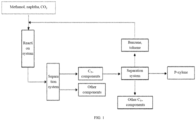
- the method can be used for not only preparing xylene, but also obtaining benzene and toluene, and the benzene and the toluene can be recycled as reaction materials.
- the conditions for the reaction are as follows: the reaction temperature is in a range from 500°C to 600°C, the reaction pressure is in a range from 0.1 MPa to 3 MPa, the weight hourly space velocity of the naphtha is in a range from 0.5 h -1 to 2 h -1 , the weight hourly space velocity of the CO 2 is in a range from 0.5 h -1 to 2 h -1 , and the weight hourly space velocity of the methanol is in a range from 0.5 h -1 to 2 h -1 .
- reaction temperature is independently selected from any value or a range value determined by any two of 450°C, 480°C, 500°C, 520°C, 550°C, 570°C, 600°C, 620°C and 650°C.
- the weight hourly space velocity of the CO 2 is independently selected from any value or a range value determined by any two of 0.1 h -1 , 0.2 h -1 , 0.5 h -1 , 0.7 h -1 , 1 h -1 , 1.2 h -1 , 1.5 h -1 , 2 h -1 , 2.5 h -1 and 3 h -1 .
- the amount ratio of the CO 2 , the naphtha and the methanol is (0.3-2):1:(0.3-2).
- the amount ratio of the CO 2 , the naphtha and the methanol is (0.3-1.5):1:(0.3-1.5).
- the amount ratio of the CO 2 , the naphtha and the methanol is (0.5-1.0):1:(0.5-1.0).
- the amount ratio of the CO 2 , the naphtha and the methanol is 1:3:2.
- the amount ratio of the CO 2 , the naphtha and the methanol is 0.8: 1:0.6.
- the amount ratio of the CO 2 , the naphtha and the methanol is 0.8:1:1.2.
- components containing benzene and toluene in a mixture obtained after the reaction are separated from the obtained mixture, returned to a reaction system and co-fed with the raw materials for a reaction on the catalyst to produce p-xylene.
- the catalyst is an acidic molecular sieve.
- the HZSM-5 zeolite molecular sieve has a silica-alumina ratio (Si/Al ratio) of 10-50.
- the silica-alumina ratio of the HZSM-5 zeolite molecular sieve is not a main factor affecting catalytic activity, and a silica-alumina ratio (Si/Al ratio) commonly used is selected.
- a metal used for metal modification is selected from at least one of La, Zn, Ga, Fe, Mo and Cr.
- the HZSM-5 zeolite molecular sieve modified by metal modification and silanization reagent modification is an HZSM-5 zeolite molecular sieve obtained by carrying out metal modification first and then carrying out silanization reagent modification continuously.
- At least one of the R 1 , the R 2 , the R 3 and the R 4 is selected from C 1-10 alkoxyl.
- the silanization reagent is selected from tetraethyl silicate and/or tetramethyl silicate.
- conditions for the impregnation are as follows: the impregnation temperature is 60-100°C, and the impregnation time is 2-10 hours.
- the impregnation temperature is independently selected from any value or a range value determined by any two of 60°C, 65°C, 70°C, 75°C, 80°C, 85°C, 90°C, 95°C and 100°C.
- the solid-liquid ratio of the HZSM-5 zeolite molecular sieve to the metal salt solution is 1:10 to 1:1.
- the drying is carried out in an air atmosphere at 100-150°C.
- the calcination is carried out in an air atmosphere at 500-700°C.
- the preparation of a catalyst further includes the following steps: subjecting a material containing a silanization reagent and the metal-modified HZSM-5 zeolite molecular sieve to contact treatment, and carrying out purging with an inert gas, followed by calcination to obtain an HZSM-5 zeolite molecular sieve modified by metal modification and silanization reagent modification.
- the contact treatment is carried out at a temperature of a range from 250°C to 450°C.
- the contact treatment is carried out at a temperature of 300°C.
- the weight hourly space velocity of the silanization reagent is 0.2 h -1 .
- the inert gas is selected from at least one of nitrogen, helium and argon.
- the [Zn]HZSM-5 molecular sieve sample, pseudo-boehmite, silica sol, xanthan gum (biological gum) and water were uniformly mixed, followed by beating, milling and defoaming to obtain slurry.
- the slurry includes the following parts by weight of components: [Zn]HZSM-5 35 parts by weight, Al 2 O 3 20 parts by weight, SiO 2 45 parts by weight, H 2 O 240 parts by weight, and xanthan gum 1 part by weight.
- Example 20 Preparation of a catalyst used for coupling conversion of methanol, naphtha and CO 2 to produce p-xylene and reaction evaluation
- the temperature was adjusted to a reaction temperature of 550°C in a nitrogen atmosphere.
- Raw materials, methanol and naphtha were fed by a micro-feed pump, and the flow of CO 2 was controlled by a mass flow meter.
- the mass ratio of the raw material CO 2 , the naphtha and the methanol was 0.8: 1:0.6
- the weight hourly space velocity of the naphtha was 1.0 h -1
- the weight hourly space velocity of the CO 2 was 0.8 h -1
- the weight hourly space velocity of the methanol was 0.6 h -1
- the reaction pressure was 0.1 MPa.
- a resulting mixture was purged with nitrogen, heated to 550°C, and then calcined in an air atmosphere for 4 hours to obtain a fixed bed catalyst used for coupling conversion of naphtha and CO 2 to produce benzene, toluene and p-xylene, named as FXNCC-1.
- a catalyst used for coupling conversion of naphtha and CO 2 to produce benzene, toluene and p-xylene was prepared on-line in a micro-fixed bed reactor.
- Conditions for on-line preparation of the catalyst are as follows. 5 g of the FX-[Zn]HZSM-5 catalyst prepared in Example 2 was loaded into a fixed bed reactor, treated with nitrogen at 50 ml/min at 550°C for 1 hour, and then cooled to 300°C in a nitrogen atmosphere. In the nitrogen atmosphere (controlled by a mass flow meter, 100 ml/min), tetraethyl silicate was pumped into the reactor at a weight hourly space velocity of 0.05 h -1 at normal pressure. After feeding for 240 minutes, the feeding was stopped.
Landscapes
- Chemical & Material Sciences (AREA)
- Organic Chemistry (AREA)
- Engineering & Computer Science (AREA)
- Chemical Kinetics & Catalysis (AREA)
- Materials Engineering (AREA)
- Crystallography & Structural Chemistry (AREA)
- Oil, Petroleum & Natural Gas (AREA)
- General Chemical & Material Sciences (AREA)
- Organic Low-Molecular-Weight Compounds And Preparation Thereof (AREA)
- Catalysts (AREA)
- Low-Molecular Organic Synthesis Reactions Using Catalysts (AREA)
Applications Claiming Priority (2)
| Application Number | Priority Date | Filing Date | Title |
|---|---|---|---|
| CN202111122218.0A CN115850004B (zh) | 2021-09-24 | 2021-09-24 | 一种制备对二甲苯的方法 |
| PCT/CN2021/137211 WO2023045105A1 (zh) | 2021-09-24 | 2021-12-10 | 一种制备对二甲苯的方法 |
Publications (3)
| Publication Number | Publication Date |
|---|---|
| EP4393902A1 true EP4393902A1 (de) | 2024-07-03 |
| EP4393902A4 EP4393902A4 (de) | 2024-12-25 |
| EP4393902B1 EP4393902B1 (de) | 2026-05-06 |
Family
ID=85653134
Family Applications (1)
| Application Number | Title | Priority Date | Filing Date |
|---|---|---|---|
| EP21958216.0A Active EP4393902B1 (de) | 2021-09-24 | 2021-12-10 | Verfahren zur herstellung von p-xylol |
Country Status (5)
| Country | Link |
|---|---|
| US (1) | US12534423B2 (de) |
| EP (1) | EP4393902B1 (de) |
| JP (1) | JP7688231B2 (de) |
| CN (1) | CN115850004B (de) |
| WO (1) | WO2023045105A1 (de) |
Family Cites Families (26)
| Publication number | Priority date | Publication date | Assignee | Title |
|---|---|---|---|---|
| JP3862095B2 (ja) | 1994-11-23 | 2006-12-27 | エクソンモービル・ケミカル・パテンツ・インク | ゼオライト結合ゼオライト触媒を用いる炭化水素転化プロセス |
| RU2114811C1 (ru) | 1996-12-16 | 1998-07-10 | Конструкторско-технологический институт каталитических и адсорбционных процессов на цеолитах "Цеосит" СО РАН | Способ получения параксилола (его варианты) |
| US7049260B2 (en) * | 2003-06-03 | 2006-05-23 | Chevron Phillips Chemical Company Lp | Selective para-xylene production via methylation of toluene with methanol in the presence of modified HZSM-5 catalyst |
| JP2011079815A (ja) | 2009-09-09 | 2011-04-21 | Mitsubishi Chemicals Corp | p−キシレンの製造方法 |
| CN102199446A (zh) * | 2010-03-23 | 2011-09-28 | 中国海洋石油总公司 | 一种采用含有甲醇的原料制备芳烃的方法 |
| CN102531821B (zh) | 2010-12-28 | 2015-03-25 | 中国科学院大连化学物理研究所 | 采用改性zsm-5分子筛催化剂催化甲醇耦合石脑油催化裂解反应的方法 |
| CN102746098B (zh) | 2011-04-20 | 2015-01-07 | 中国石油化工股份有限公司 | 苯和甲醇或二甲醚制二甲苯的方法 |
| US9505676B2 (en) | 2012-05-03 | 2016-11-29 | Exxonmobil Chemical Patents Inc. | Hydrocarbon conversion process |
| CN104556108B (zh) | 2013-10-24 | 2019-09-24 | 中国石油化工股份有限公司 | 一种具有zsm-5结构的氢型锗硅分子筛及其制备方法 |
| CN104557419A (zh) | 2013-10-28 | 2015-04-29 | 中国石油化工股份有限公司 | 甲醇或二甲醚制芳烃的方法 |
| CN105272798B (zh) * | 2014-06-04 | 2017-11-17 | 中国科学院大连化学物理研究所 | 一种高选择性制备对二甲苯联产丙烯的方法 |
| JP6408611B2 (ja) | 2014-06-04 | 2018-10-17 | 中国科学院大▲連▼化学物理研究所Dalian Institute Of Chemical Physics,Chinese Academy Of Sciences | メタノール及び/又はジメチルエーテルからp−キシレン及びプロピレンを製造する方法 |
| US20180346394A1 (en) * | 2015-12-04 | 2018-12-06 | Sabic Global Technologies B.V. | Alkane aromatization by oxidative dehydrogenation with co2 |
| CN107469857B (zh) | 2016-06-07 | 2020-12-01 | 中国科学院大连化学物理研究所 | 一种催化剂及合成气直接转化制芳烃的方法 |
| CN107840778B (zh) | 2016-09-19 | 2020-09-04 | 中国科学院大连化学物理研究所 | 一种二氧化碳加氢制取芳烃的方法 |
| CN108786904B (zh) * | 2017-04-27 | 2020-08-11 | 中国科学院大连化学物理研究所 | 一种制低碳烯烃联产对二甲苯的催化剂的原位制备方法 |
| CN108794294B (zh) | 2017-04-27 | 2020-12-11 | 中国科学院大连化学物理研究所 | 流化床气体分布器、应用其的反应器及生产对二甲苯联产低碳烯烃的方法 |
| WO2018217337A1 (en) * | 2017-05-22 | 2018-11-29 | Exxonmobil Chemical Patents Inc. | Integrated aromatics formation and methylation |
| CN108160104B (zh) | 2017-12-22 | 2021-02-12 | 中国科学院上海高等研究院 | 一种用于二氧化碳一步加氢制备芳烃的催化剂及其制备方法和应用 |
| CN110496640B (zh) | 2018-05-17 | 2022-09-06 | 中国科学院大连化学物理研究所 | 一种对二甲苯合成用催化剂及其制备方法和应用 |
| JP7091842B2 (ja) * | 2018-05-29 | 2022-06-28 | 日本製鉄株式会社 | パラキシレン製造用触媒、パラキシレン製造用触媒の製造方法、およびパラキシレンの製造方法 |
| CN111187134A (zh) * | 2018-11-15 | 2020-05-22 | 中国科学院大连化学物理研究所 | 一种由甲醇和/或二甲醚制备对二甲苯联产汽油的方法 |
| CN111187132A (zh) | 2018-11-15 | 2020-05-22 | 中国科学院大连化学物理研究所 | 一种由甲醇和/或二甲醚制备汽油联产对二甲苯的方法 |
| CN111187141A (zh) * | 2018-11-15 | 2020-05-22 | 中国科学院大连化学物理研究所 | 一种由甲醇和/或二甲醚制备对二甲苯联产汽油的方法 |
| CN111559949B (zh) | 2020-05-29 | 2022-12-02 | 中国海洋石油集团有限公司 | 一种利用富碳天然气增产对二甲苯的系统及方法 |
| CN115845908B (zh) * | 2021-09-24 | 2025-07-15 | 中国科学院大连化学物理研究所 | 石脑油和二氧化碳耦合转化制苯、甲苯和对二甲苯的方法 |
-
2021
- 2021-09-24 CN CN202111122218.0A patent/CN115850004B/zh active Active
- 2021-12-10 WO PCT/CN2021/137211 patent/WO2023045105A1/zh not_active Ceased
- 2021-12-10 JP JP2024516705A patent/JP7688231B2/ja active Active
- 2021-12-10 EP EP21958216.0A patent/EP4393902B1/de active Active
- 2021-12-10 US US18/694,415 patent/US12534423B2/en active Active
Also Published As
| Publication number | Publication date |
|---|---|
| EP4393902A4 (de) | 2024-12-25 |
| WO2023045105A1 (zh) | 2023-03-30 |
| JP2024531753A (ja) | 2024-08-29 |
| EP4393902B1 (de) | 2026-05-06 |
| JP7688231B2 (ja) | 2025-06-03 |
| CN115850004A (zh) | 2023-03-28 |
| CN115850004B (zh) | 2025-04-18 |
| US12534423B2 (en) | 2026-01-27 |
| US20240317658A1 (en) | 2024-09-26 |
Similar Documents
| Publication | Publication Date | Title |
|---|---|---|
| EP3744423A1 (de) | Katalysator und verfahren zur direkten umwandlung von synthesegas in ein kohlenstoffarmes olefin | |
| GB2570592A (en) | Catalyst for synthesizing aromatic hydrocarbons and preparation method thereof | |
| Guan et al. | Development of catalysts for the production of aromatics from syngas | |
| CN109701629B (zh) | 用于制低碳烯烃的组合催化剂及其使用方法 | |
| EP3632556A1 (de) | Katalysator und verfahren zur direkten umwandlung von synthesegas zur zubereitung von flüssigem brennstoff und zur herstellung von leichten olefinen | |
| EP4393904A1 (de) | Verfahren zur kupplung und umwandlung von naphtha und kohlendioxid zur herstellung von benzol, toluol und p-xylol | |
| EP4393902A1 (de) | Verfahren zur herstellung von p-xylol | |
| CN106607005B (zh) | 含氮化合物固体吸附剂及其制备方法 | |
| Tao et al. | Catalytic conversion of CH3Br to aromatics over PbO-modified HZSM-5 | |
| CN117299191B (zh) | 一种催化剂及co2与聚烯烃耦合转化制备高品质汽油的方法 | |
| CN111073687B (zh) | 一种清洁汽油的制备方法 | |
| RU2841664C2 (ru) | Способ получения п-ксилола | |
| CN103657707B (zh) | 低碳烃芳构化催化剂制备方法 | |
| WO2025065781A1 (zh) | 一种co与聚烯烃耦合转化制备芳烃的方法 | |
| CN103539620A (zh) | 低碳烃芳构化制备芳烃的方法 | |
| CN111073685B (zh) | 一种低硫低烯烃清洁汽油的生产方法 | |
| CN115109608A (zh) | 一种制备低芳烃含量液体燃料的方法 | |
| CN106609156B (zh) | 炼厂气脱除烯烃的方法 | |
| RU2844556C2 (ru) | Способ получения бензола, толуола и п-ксилола путем совместной конверсии лигроина и углекислого газа | |
| Klemt et al. | The preparation of hydrocracking catalysts using mesoporous aluminosilicates MCM-41—influence of the preparation conditions on the catalytic behaviour | |
| CN101176850A (zh) | 用于乙醇脱水制乙烯的催化剂及制备方法及用途 | |
| CN115850005B (zh) | 一种芳烃的制备方法 | |
| CN102533313B (zh) | 一种催化裂解制备乙烯和丙烯的方法 | |
| CN115851309A (zh) | 一种石脑油和二氧化碳耦合转化制芳烃的方法 | |
| JP2024124632A (ja) | 金属含有ゼオライトおよびそれを含む触媒 |
Legal Events
| Date | Code | Title | Description |
|---|---|---|---|
| STAA | Information on the status of an ep patent application or granted ep patent |
Free format text: STATUS: THE INTERNATIONAL PUBLICATION HAS BEEN MADE |
|
| PUAI | Public reference made under article 153(3) epc to a published international application that has entered the european phase |
Free format text: ORIGINAL CODE: 0009012 |
|
| STAA | Information on the status of an ep patent application or granted ep patent |
Free format text: STATUS: REQUEST FOR EXAMINATION WAS MADE |
|
| 17P | Request for examination filed |
Effective date: 20240328 |
|
| AK | Designated contracting states |
Kind code of ref document: A1 Designated state(s): AL AT BE BG CH CY CZ DE DK EE ES FI FR GB GR HR HU IE IS IT LI LT LU LV MC MK MT NL NO PL PT RO RS SE SI SK SM TR |
|
| A4 | Supplementary search report drawn up and despatched |
Effective date: 20241121 |
|
| RIC1 | Information provided on ipc code assigned before grant |
Ipc: B01J 29/46 20060101ALI20241115BHEP Ipc: B01J 29/40 20060101ALI20241115BHEP Ipc: C07C 15/08 20060101ALI20241115BHEP Ipc: C10G 29/22 20060101ALI20241115BHEP Ipc: C10G 35/095 20060101ALI20241115BHEP Ipc: C10G 3/00 20060101ALI20241115BHEP Ipc: C07C 2/86 20060101AFI20241115BHEP |
|
| DAV | Request for validation of the european patent (deleted) | ||
| DAX | Request for extension of the european patent (deleted) | ||
| GRAP | Despatch of communication of intention to grant a patent |
Free format text: ORIGINAL CODE: EPIDOSNIGR1 |
|
| STAA | Information on the status of an ep patent application or granted ep patent |
Free format text: STATUS: GRANT OF PATENT IS INTENDED |
|
| INTG | Intention to grant announced |
Effective date: 20251002 |
|
| RAP3 | Party data changed (applicant data changed or rights of an application transferred) |
Owner name: DALIAN INSTITUTE OF CHEMICAL PHYSICS,CHINESE ACADEMY OF SCIENCES |
|
| GRAS | Grant fee paid |
Free format text: ORIGINAL CODE: EPIDOSNIGR3 |
|
| GRAA | (expected) grant |
Free format text: ORIGINAL CODE: 0009210 |
|
| STAA | Information on the status of an ep patent application or granted ep patent |
Free format text: STATUS: THE PATENT HAS BEEN GRANTED |