EP4390502A1 - Optical scanning device and image forming apparatus - Google Patents
Optical scanning device and image forming apparatus Download PDFInfo
- Publication number
- EP4390502A1 EP4390502A1 EP23209999.4A EP23209999A EP4390502A1 EP 4390502 A1 EP4390502 A1 EP 4390502A1 EP 23209999 A EP23209999 A EP 23209999A EP 4390502 A1 EP4390502 A1 EP 4390502A1
- Authority
- EP
- European Patent Office
- Prior art keywords
- luminous flux
- scanning direction
- optical
- main scanning
- polygon mirror
- Prior art date
- Legal status (The legal status is an assumption and is not a legal conclusion. Google has not performed a legal analysis and makes no representation as to the accuracy of the status listed.)
- Pending
Links
Images




Classifications
-
- G—PHYSICS
- G02—OPTICS
- G02B—OPTICAL ELEMENTS, SYSTEMS OR APPARATUS
- G02B26/00—Optical devices or arrangements for the control of light using movable or deformable optical elements
- G02B26/08—Optical devices or arrangements for the control of light using movable or deformable optical elements for controlling the direction of light
- G02B26/10—Scanning systems
- G02B26/12—Scanning systems using multifaceted mirrors
- G02B26/127—Adaptive control of the scanning light beam, e.g. using the feedback from one or more detectors
-
- G—PHYSICS
- G02—OPTICS
- G02B—OPTICAL ELEMENTS, SYSTEMS OR APPARATUS
- G02B27/00—Optical systems or apparatus not provided for by any of the groups G02B1/00 - G02B26/00, G02B30/00
- G02B27/0025—Optical systems or apparatus not provided for by any of the groups G02B1/00 - G02B26/00, G02B30/00 for optical correction, e.g. distorsion, aberration
- G02B27/0031—Optical systems or apparatus not provided for by any of the groups G02B1/00 - G02B26/00, G02B30/00 for optical correction, e.g. distorsion, aberration for scanning purposes
-
- G—PHYSICS
- G02—OPTICS
- G02B—OPTICAL ELEMENTS, SYSTEMS OR APPARATUS
- G02B26/00—Optical devices or arrangements for the control of light using movable or deformable optical elements
- G02B26/08—Optical devices or arrangements for the control of light using movable or deformable optical elements for controlling the direction of light
- G02B26/10—Scanning systems
- G02B26/12—Scanning systems using multifaceted mirrors
-
- G—PHYSICS
- G02—OPTICS
- G02B—OPTICAL ELEMENTS, SYSTEMS OR APPARATUS
- G02B26/00—Optical devices or arrangements for the control of light using movable or deformable optical elements
- G02B26/08—Optical devices or arrangements for the control of light using movable or deformable optical elements for controlling the direction of light
- G02B26/10—Scanning systems
- G02B26/12—Scanning systems using multifaceted mirrors
- G02B26/125—Details of the optical system between the polygonal mirror and the image plane
-
- G—PHYSICS
- G03—PHOTOGRAPHY; CINEMATOGRAPHY; ANALOGOUS TECHNIQUES USING WAVES OTHER THAN OPTICAL WAVES; ELECTROGRAPHY; HOLOGRAPHY
- G03G—ELECTROGRAPHY; ELECTROPHOTOGRAPHY; MAGNETOGRAPHY
- G03G15/00—Apparatus for electrographic processes using a charge pattern
- G03G15/04—Apparatus for electrographic processes using a charge pattern for exposing, i.e. imagewise exposure by optically projecting the original image on a photoconductive recording material
- G03G15/043—Apparatus for electrographic processes using a charge pattern for exposing, i.e. imagewise exposure by optically projecting the original image on a photoconductive recording material with means for controlling illumination or exposure
Definitions
- toner, paper dust, and dust in the air may enter an optical box through gaps between the optical box and a lid.
- dust adheres to an edge of each reflecting surface of the rotatable polygon mirror in a rotational direction.
- the adhered dust reduces a light quantity at the beginning and end of writing in an image area.
- a density at an edge of the image becomes lighter, resulting in uneven image density.
- the purpose of the present invention is to detect changes over time in the rotatable polygon mirror of an optical scanning device, even while the device is in operation, and to achieve high image quality while suppressing image degradation over time.
- the optical scanning device 101 also has an opening diaphragm 3 consisting of a through hole and a rotatable polygon mirror 4.
- the rotatable polygon mirror 4 has, for example, four reflecting surfaces 12, deflects the laser luminous flux L, and scans it in the main scanning direction.
- the optical scanning device 101 has an optical deflector 5 that drives the rotatable polygon mirror 4 by a driving motor (not shown).
- the optical scanning device 101 has a beam detector 6 (hereinafter BD 6) that detects the laser luminous flux L deflected and scanned by the optical deflector 5 to determine the writing start position of the laser luminous flux L on the surface of the photosensitive drum 8.
- BD 6 beam detector 6
- the light quantity sensor 16 is installed upstream in the main scanning direction from the BD 6 and functions as a detection unit for detecting the light quantity of the laser luminous flux L.
- the light quantity sensor 16 detects a decrease in the reflectance of the reflecting surface 12 of the rotatable polygon mirror 4 by detecting the light quantity.
- the optical scanning device 101 has a scanning lens 7, which is a first optical member (optical member) having the function of an f ⁇ lens that serves as an image forming unit for guiding the laser luminous flux L deflected and scanned by the optical deflector 5 onto the surface of the photosensitive drum 8 and forming an image.
- the f ⁇ lens has lens characteristics (f ⁇ characteristics) such that when the laser light enters at an angle ⁇ , it forms an image of a size (f ⁇ ⁇ ) multiplied by the focal length f of the f ⁇ lens.
- the optical scanning device 101 has an optical box 9 that houses each optical member including the optical deflector 5.
- the optical box 9 is made of black resin, for example, and formed by injection molding.
- the laser luminous flux L emitted from the semiconductor laser unit 1 is made to be collimated or converged in the main scanning direction by the anamorphic collimator lens 2, and converged in the sub-scanning direction.
- the laser luminous flux L then passes through the opening diaphragm 3 to limit the luminous flux width and forms a focal line image extending long in the main scanning direction on the reflecting surface 12 of the rotatable polygon mirror 4.
- the laser luminous flux L formed on the reflecting surface 12 of the rotatable polygon mirror 4 is deflected and scanned by rotating the rotatable polygon mirror 4.
- the laser luminous flux L reflected on the reflecting surface 12 scans on the light quantity sensor 16. It then enters the BD lens 14 as the rotatable polygon mirror 4 rotates and scans on the BD 6 with the light focused in the main scanning direction.
- the laser luminous flux L then enters a long scanning lens 7 in the main scanning direction.
- the scanning lens 7, which functions as an f ⁇ lens, is designed to focus the laser luminous flux L to form a spot on the surface of the photosensitive drum 8 and to maintain a constant spot scanning speed.
- the scanning lens 7 is formed with an aspherical lens.
- the rotation of the rotatable polygon mirror 4 deflects and scans the laser luminous flux L.
- Main scanning is performed by the laser luminous flux L on the surface of the photosensitive drum 8
- sub-scanning is performed by rotating and driving the photosensitive drum 8 around its axis. This forms an electrostatic latent image on the surface of the photosensitive drum 8, which is uniformly charged by a charging unit (not shown), in accordance with the image information.
- a control portion 100 has a CPU 100a, ROM 100b, RAM 100c, and a timer 100d.
- the control portion 100 performs various controls according to programs stored in the ROM 100b in advance, referring to parameters, tables, etc. stored in the ROM 100b and the timer 100d, while using the RAM 100c as a temporary work area.
- BD 6 outputs a signal to the control portion 100 when a laser luminous flux L is introduced.
- the light quantity sensor 16 outputs a signal to the control portion 100 in proportion to the amount of light introduced.
- the control portion 100 can also control the semiconductor laser unit 1 based on the detection results of the BD 6 and the light quantity sensor 16.
- the control portion 100 functions as a control unit to control the light source based on the signal output by the BD 6 and the light quantity detected by the light quantity sensor 16.
- Part (a) of Figure 2 is a partially enlarged view of the optical scanning device 101 showing the configuration in the vicinity of BD 6.
- the optical scanning device 101 has a BD 6, an optical box 9, and a BD lens 14.
- BD 6 has a light-receiving surface 10.
- the optical box 9 has a through hole 13.
- the laser luminous flux L reflected by the rotatable polygon mirror 4 shown in Figure 1 passes through the BD lens 14, becomes a focused beam in the main scanning direction, and is scanned in the arrow X direction in part (a) of Figure 2 as the rotatable polygon mirror 4 rotates in the arrow A direction (clockwise direction) in Figure 1 .
- the laser luminous flux L scanned in the arrow X direction in part (a) of Figure 2 passes through the through hole 13 in the optical box 9 and enters the light-receiving surface 10 of the BD 6.
- the control portion 100 detects the luminous flux at BD 6, and based on the signal output from BD 6, it is used as the synchronous detection timing for the writing position in the main scanning direction on the photosensitive drum 8.
- Part (b) of Figure 2 is a partially enlarged view of the configuration near the light quantity sensor 16 of the optical scanning device 101.
- the optical scanning device 101 has a light quantity sensor 16.
- the light quantity sensor 16 has a light-receiving surface 17.
- the optical box 9 has a through hole 18.
- Part (b) of Figure 2 also shows the laser luminous flux L reflected by the reflecting surface 12 of the rotatable polygon mirror 4, which is not shown in the Figure.
- the light quantity sensor 16 and the through hole 18 are provided upstream of the BD 6 and the through hole 13 in the arrow X direction, in other words, in the main scanning direction.
- the laser luminous flux L is scanned in the arrow X direction in part (b) of Figure 2 as the rotatable polygon mirror 4 rotates in the arrow A direction in Figure 1 .
- the laser luminous flux L scanned in the arrow X direction in part (b) of Figure 2 passes through the through hole 18 in the optical box 9 and scans on the light-receiving surface 17 of the light quantity sensor 16.
- the laser luminous flux L becomes a long focal line extending in the main scanning direction on the reflecting surface 12 of the rotatable polygon mirror 4, it becomes a luminous flux that is approximately parallel or weakly convergent in the main scanning direction and spread out in the sub-scanning direction.
- This laser luminous flux L becomes an elliptical Sp luminous flux with a long axis of 3 mm and a short axis of 1 mm, for example, on the light-receiving surface 17 of the light quantity sensor 16.
- Figure 3 shows the amount of light entering the light-receiving surface 17 of the laser luminous flux L on the vertical axis, with time on the horizontal axis.
- the amount of light entering the light-receiving surface 17 as the laser luminous flux L scans the light quantity sensor 16 in the direction of the arrow X in part (b) of Figure 2 is shown in graph a in Figure 3 .
- graph a shown in Figure 3 after the end of the laser luminous flux L enters the light-receiving surface 17, the amount of light entering the light-receiving surface 17 gradually increases as the laser luminous flux L travels in the arrow X direction in part (b) of Figure 2 on the light-receiving surface 17. Then, the threshold value R1 is reached at time t0.
- the threshold value R1 is an arbitrarily set value to match the maximum input light quantity to the light-receiving surface 17, for example, 20% to 50% of it.
- the light quantity sensor 16 compares the input light quantity with the threshold value R1 and outputs a square wave signal, for example, to the control portion 100 while the input light quantity is greater than the threshold value R1.
- the control portion 100 shall measure the pulse width tp1 with a timer 100D.
- the control portion 100 shall measure the pulse width tp2 with the timer 100d.
- the control portion 100 can detect a decrease in reflectance of the rotatable polygon mirror 4 by comparing the magnitude of the pulse width tp1 and the pulse width tp2.
- control portion 100 can determine that the smaller the pulse width tp2 is in relation to the pulse width tp1 (the larger the difference between tp1 and tp2), the greater the degree of contamination of the reflecting surface 12 of the rotatable polygon mirror 4.
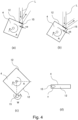
- Parts (a) and (b) of Figure 4 are schematic views showing the positions where the laser luminous flux L entering the light quantity sensor 16 and BD 6 is reflected by the reflecting surface 12 of the rotatable polygon mirror 4.
- Part (a) of Figure 4 shows the position where the laser luminous flux L entering the light quantity sensor 16 is reflected by the rotatable polygon mirror 4.
- Part (b) of Figure 4 shows the position where the laser luminous flux L entering the BD 6 is reflected by the rotatable polygon mirror 4.
- a corner 15 indicates the corner of the reflecting surface 12 of the rotatable polygon mirror 4.
- the rotatable polygon mirror 4 rotates in the direction of arrow A in parts (a) and (b) of Figure 4 , and the laser luminous flux L reflected by the reflecting surface 12 of the rotatable polygon mirror 4 scans over the sensor in the order of the light quantity sensor 16 and BD 6.
- the distance between the position where the laser luminous flux L is reflected by the reflecting surface 12 of the rotatable polygon mirror 4 and the corner 15 of the rotatable polygon mirror 4 is represented as distance ca in part (a) of Figure 4 and distance cb in part (b) of Figure 4 .
- ca ⁇ cb and the laser luminous flux L of the light quantity sensor 16, which is located upstream in the main scanning direction, is more reflected at the edge (near corner 15) of the reflecting surface 12 of the rotatable polygon mirror 4.
- the laser luminous flux L received by the light quantity sensor 16 is affected by the edge of the reflecting surface 12 of the rotatable polygon mirror 4.
- Parts (c) and (d) of Figure 4 show the air flow in the vicinity of the rotatable polygon mirror 4 as it rotates and the dirt that adheres to the reflecting surface 12.
- Part (c) of Figure 4 shows the rotatable polygon mirror 4 viewed from above
- part (d) of Figure 4 shows the reflecting surface 12 viewed from the front.
- the pulse width tp1 when the pulse width tp1 is measured in the initial state (graph a) where the reflecting surface 12 is clean, the pulse width tp1 is stored in a storage medium (not shown), for example, in RAM 100c, that the image forming apparatus has.
- the memory portion may be a RAM 100c, and the control portion 100 stores the measured pulse width tp1 in the RAM 100c.
- the control portion 100 measures the pulse width tp2 for each certain number of printed sheets.
- the pulse width tp2 may be measured for each number of sheets printed, or at each elapse of a predetermined time, or at any other timing.
- results obtained by experiments, etc. can be stored in the ROM 100b in advance and used to correct the light quantity.
- the results obtained by experiments, etc. may be, for example, as follows. It may be a table that associates the pulse width tp1 with the position in the main scanning direction and the initial light quantity at that position, a table that associates the pulse width tp2 at a given timing with the position in the main scanning direction and the light quantity at that position at that timing, and so on.
- the control portion 100 can estimate the light quantity distribution on the photosensitive drum 8 based on the information stored on the ROM 100b from the measured pulse width tp2 value, and can change the light quantity of the laser luminous flux L during scanning to bring the light quantity distribution closer to the initial uniform state. By measuring the pulse width tp2 and changing the light quantity during scanning, the light quantity distribution on the photosensitive drum 8 can be corrected, thereby suppressing the phenomenon of lightening of the density of printed matter that occurs over time.
- the optical box 9 is deformed.
- the deformation of the optical box 9 changes the posture of the semiconductor laser unit 1 and the anamorphic collimator lens 2, and the scanning position of the laser luminous flux L on the light quantity sensor 16 and on the photosensitive drum 8 in the sub-scanning direction.
- the control portion 100 Similar to the detection method for the position of the laser luminous flux L in the sub-scanning direction of the rotatable polygon mirror 4, the control portion 100 first stores the initial pulse width tp1 in, for example, the RAM 100c. Then, the pulse width tp2 is detected at regular intervals, for example, from the time the power source of the image forming apparatus is turned on until the power source is turned off, and the control portion 100 compares the pulse width tp1 with the pulse width tp2. This allows the detection of changes in the scanning position in the sub-scanning direction on the BD 6.
- the scanning position in the sub-scanning direction on the BD 6 is correlated with the scanning position in the sub-scanning direction on the photosensitive drum 8. Therefore, the control portion 100 can estimate the scanning position in the sub-scanning direction on the photosensitive drum 8 from the scanning position in the sub-scanning direction on the BD 6 by knowing the relationship equation in advance. Based on the estimated scanning position in the sub-scanning direction on the photosensitive drum 8, the control portion 100 can, for example, correct the image writing timing in the sub-scanning direction by one line when the scanning position in the sub-scanning direction deviates by more than half of the scanning interval on the surface of the recording material.
- the light quantity correction is based on the long-term pulse width tp2 change, and the laser luminous flux L positional deviation in the sub-scanning direction can be detected by detecting the short- to medium-term pulse width tp2 change, such as from the power source of the image forming apparatus from power on to power off. Therefore, the control portion 100 can perform the light quantity correction and the correction of the position in the sub-scanning direction in parallel.
- image degradation can be prevented by detecting and correcting the decrease in reflectance of the reflecting surface 12 of the rotatable polygon mirror 4 with the light quantity sensor 16 while the image forming apparatus (in other words, the optical scanning apparatus) is in operation.
- the control portion 100 corrects the light quantity of the laser luminous flux L emitted from the light source based on the light quantity detected by the light quantity sensor 16.
- the control portion 100 also corrects the deviation of the position (scanning portion) where the laser luminous flux L scans in the sub-scanning direction based on the light quantity detected by the light quantity sensor 16.
- the correction of the light quantity and the correction of the displacement of the scanning position in the sub-scanning direction are the same for the subsequent embodiments.
- changes over time in the rotatable polygon mirror of the optical scanning device can be detected even while the device is in operation, and high image quality can be achieved while suppressing image degradation over time.
- the simple configuration makes it possible to detect misalignment of the scanning position in the sub-scanning direction on the surface to be scanned, thereby achieving higher image quality of the output image of the image forming apparatus.
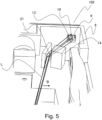
- FIG. 5 is a perspective explanatory view showing the configuration near the BD 6 of the optical scanning device 102 of Embodiment 2.
- the dashed line represents the optical path on the other side of the BD lens 14, which does not interfere with the BD lens 14.
- Embodiment 2 differs from Embodiment 1 in that the optical box 9 has a reflecting surface 21 and that the BD 6 also serves as a light quantity sensor.
- the BD 6 has a light-receiving surface 10 and is provided upstream in the main scanning direction from a scanning lens 7.
- the BD 6 functions as an output unit that outputs a signal in response to the reception of the laser luminous flux L input through the BD lens 14 at the light-receiving surface 10.
- the BD 6 also detects the light quantity of the laser luminous flux L upstream in the main scanning direction from the BD lens 14, which is input without (without through) the BD lens 14.
- the laser luminous flux L not via the BD lens 14 is input to the light-receiving surface 10
- the laser luminous flux L via the BD lens 14 is input to the light-receiving surface 10.
- each laser luminous flux L is input to the light-receiving surface 10 with a time difference.
- the control portion 100 controls the light source based on the light quantity of the laser luminous flux L input to the light-receiving surface 10 without going through the BD lens 14.
- the same configuration as in embodiment 1 is marked with the same symbols and omitted from the description.
- the laser luminous flux L is reflected by the reflecting surface 21 integrated with the optical box 9 and enters the light-receiving surface 10 of the BD 6 without passing through the lenses and other components including the BD lens 14.
- the reflecting surface 21 integrated with the optical box 9, which is a reflecting member reflects the laser luminous flux L scanned by the rotatable polygon mirror 4 and guides it to the light-receiving surface 10 of the BD 6 without passing through the BD lens 14.
- the shape of the laser luminous flux L as it scans the light-receiving surface 10 is elliptical, similar to the elliptical shape Sp shown in part (b) of Figure 2 . Therefore, the same method as that shown in Figure 3 can be used to detect the decrease in reflectance of the rotatable polygon mirror 4 and the scanning position in the sub-scanning direction. In other words, in Embodiment 2, the control portion 100 can correct the light quantity and the scanning position in the sub-scanning direction based on the pulse widths tp1 and tp2 from the detection results of the BD 6.
- the rotatable polygon mirror 4 then rotates in the direction of arrow A in Figure 1 , and the laser luminous flux L is scanned in the direction of arrow B in Figure 5 and enters the BD lens 14.
- the laser luminous flux L passing through the BD lens 14 is focused and enters the light-receiving surface 10 of the BD 6.
- the luminous flux is detected by the BD 6, and this timing is used as the synchronous detection timing of the writing position in the main scanning direction.
- the reflecting surface 21 is, for example, a mirror with a metallic film or dielectric multilayer deposited on the optical box 9.
- the reflecting surface 21 may also be a highly reflective sheet attached to the optical box 9.
- the surface of the optical box 9 itself may be used. However, even if the surface of the optical box 9 is used as is, the reflecting surface 21 must have a reflectance of 30% or higher for the following reasons.
- the minimum and maximum values of the light quantity usage range are preferably minimum/maximum ⁇ 1/2.
- the light quantity sensor may not be able to accurately measure the light quantity if it falls below 15% of the maximum incoming light quantity. Therefore, minimum/maximum value x reflectance ⁇ 15% must be satisfied. Therefore, a reflectance of 30% or more is required.
- Part (a) of Figure 6 shows the incident angle dependence of reflectance of PMMA (Poly Methyl Methacrylate) (polymethyl methacrylate resin), a commonly used resin.
- Part (a) of Figure 6 shows the incident angle (°(degree)) on the horizontal axis and reflectance (%) on the vertical axis.
- the incident angle is the angle that the incident light makes with the normal of the reflecting surface 21.
- the thick solid line shows the incident angle dependence on the reflectance Rs of S-polarized light
- the thin solid line shows the incident angle dependence on the reflectance Rp of P-polarized light.
- the optical box 9 is made of resin mixed with various materials to increase its strength. Therefore, part (a) of Figure 6 is not strictly equivalent to the incident angle dependence of the reflectance of the optical box 9, but it can be considered to be roughly equivalent. From part (a) of Figure 6 , it can be seen that the incident angle of the laser luminous flux L on the reflecting surface 12 must be at least 70° for S-polarized light and 80° for P-polarized light in order to satisfy a reflectance of 30% or more.
- Part (b) of Figure 6 shows the semiconductor laser 22 encapsulated in the semiconductor laser unit 1 of Figure 1 .
- the output light of the semiconductor laser 22 is linearly polarized as shown by the dashed line in part (b) of Figure 6 .
- the semiconductor laser 22 can rotate in the arrow Z direction. Therefore, by rotating the semiconductor laser 22 as indicated by the arrow Z in part (b) of Figure 6 , the ratio of S-polarization and P-polarization of the laser luminous flux L to the reflecting surface 21 can be adjusted.
- the semiconductor laser 22 is rotated so that it reflects mostly S-polarized light.
- the semiconductor laser 22 can be rotated and adjusted so that the laser luminous flux L reflected by the reflecting surface 21 has a larger proportion of S-polarized light than P-polarized light.
- the BD 6 can also serve as a light quantity sensor, and with a simpler configuration, it is possible to detect a decrease in reflectance of the rotatable polygon mirror 4 and the scanning position in the sub-scanning direction while the image forming apparatus is in operation.
- Embodiment 2, as described above, can detect changes over time in the rotatable polygon mirror of the optical scanning device even while the device is in operation, and can achieve high image quality while suppressing image degradation over time.
- Figure 7 is a perspective explanatory view showing the configuration near the BD 6 of the optical scanning device 103 of Embodiment 3.
- the dashed lines represent the optical path passing through the BD lens 14 and the optical path on the other side of the BD lens 14 that exits from the BD lens 14.
- Embodiment 3 differs from Embodiment 2 in that the lens end surface 24, which is a part of an end portion 23 of the BD lens 14 that does not have a lens function, plays the role of the reflecting surface 21 of Embodiment 2.
- the BD lens 14 which is the second optical component, has a first portion that focuses the laser luminous flux L scanned by the rotatable polygon mirror 4 in the main scanning direction to enter the light-receiving surface 10 of the BD 6.
- the BD lens 14 also has an end portion 23, which is the second portion that does not focus the laser luminous flux L scanned by the rotatable polygon mirror 4 in the main scanning direction and allows it to enter the light-receiving surface 10 of the BD 6.
- the laser luminous flux L enters the end portion 23 of the BD lens 14, which does not have a lens function, reflects on the inner surface of the lens end surface 24 (reflecting in the direction of the light-receiving surface 10), and passes through the end portion 23 of the BD lens 14. Since the end portion 23 is a transparent member that does not have a lens function, the shape of the laser luminous flux L as it scans the light-receiving surface 10 is elliptical, similar to the elliptical shape Sp shown in part (b) of Figure 2 .
- the same method as that shown in Figure 3 can be used to detect the decrease in reflectance of the rotatable polygon mirror 4 and the scanning position in the sub-scanning direction.
- the control portion 100 can correct the light quantity and the scanning position in the sub-scanning direction based on the pulse widths tp1 and tp2 from the detection results of the BD 6.
- the laser luminous flux L enters the light-receiving surface 10 of the BD 6 in a focused state, as in the method shown in part (a) of Figure 2 .
- the luminous flux is detected by the BD 6, and this timing is used as the synchronous detection timing of the writing position in the main scanning direction.
- the lens end surface 24 is, for example, a mirror with a metallic film or dielectric multilayer film deposited on the end surface of the BD lens 14.
- the lens end surface 24 may also be made of a highly reflective sheet attached to the end surface.
- the BD lens 14 is provided with a lens end surface 24 that does not have a lens function, allowing design freedom in the shape around the BD lens 14 and enabling the design of a more compact scanning optical device. According to the above embodiment 3, it is possible to detect changes over time in the rotatable polygon mirror of the optical scanning device even while the device is in operation, and to achieve high image quality while suppressing image degradation over time.
- FIG 8 is a schematic configuration of a laser beam printer as a configuration example of an image forming apparatus.
- a laser beam printer 1000 (hereinafter referred to as "printer 1000") is equipped with a photosensitive drum 1010, a charging portion 1020, and a developing portion 1030, as a developing unit.
- the photosensitive drum 1010 is an image bearer on which an electrostatic latent image is formed, and corresponds to the photosensitive drum 8 of embodiments 1 to 3.
- the charging portion 1020 uniformly charges the photosensitive drum 1010.
- An optical scanning device 1025 which is an exposure unit, forms an electrostatic latent image by scanning a laser light on the photosensitive drum 1010 in accordance with image data.
- the optical scanning device 1025 is shown in simplified form in Figure 8 .
- the optical scanning device 1025 corresponds to the optical scanning device 101 of Embodiment 1, the optical scanning device 102 of Embodiment 2, and the optical scanning device 103 of Embodiment 3.
- the developing portion 1030 develops the electrostatic latent image formed on the photosensitive drum 1010 with toner, a developer, to form a toner image, a developer image.
- the toner image formed on the photosensitive drum 1010 (on the photosensitive member) is transferred to a sheet P as recording material supplied from a cassette 1040 by a transfer portion 1050, which is the transfer unit.
- the unfixed toner image transferred to the sheet P is fixed by a fixing unit 1060 and discharged to a discharge tray 1070.
- the photosensitive drum 1010, charging portion 1020, developing portion 1030, and transfer portion 1050 are an image forming portion.
- the printer 1000 is also equipped with a power supply portion 1080, and power is supplied from the power supply portion 1080 to driving portions such as motors and to a control portion 5000.
- the control portion 5000 has a CPU (not shown) and controls the image forming operations by the image forming portion and the sheet P transport operations.
- the control portion 5000 may correspond to the control portion 100 of embodiments 1 to 3.
- the printer 1000 After a predetermined time elapses when the printer 1000 finishes a print operation, it transitions to a standby state in which the print operation can be immediately executed. After another predetermined time elapses, the printer 1000 transitions from the standby state to a sleep state, a low power consumption mode, in order to reduce power consumption during standby time.
- the printer 1000 has three states: the sleep state, which is the second mode, the standby state, and the print state, which is the first mode, and the control portion 5000 makes the printer transition to each state.
- the image forming apparatus to which the optical scanning devices 101, 102, and 103 of Embodiments 1 to 3 can be applied is not limited to the configuration shown in Figure 8 .
- Embodiment 4 it is possible to detect changes over time in the rotatable polygon mirror of the optical scanning device even while the device is in operation, and to achieve high image quality while suppressing image degradation over time.
- An optical scanning device includes a light source, a rotatable polygon mirror, an optical member, an output portion and a detector.
- the optical member guides the luminous flux scanned by the rotatable polygon mirror to an image bearing member.
- the output portion is provided on an upstream side of the optical member in the scanning direction and outputs a signal corresponding to receiving the luminous flux.
- the detector is provided on the upstream side of the output portion and detects a light quantity of the luminous flux.
- a controller controls the light source based on the signal outputted from the output portion and the light quantity detected by the detector.
- the luminous flux reaching the detector is reflected at a position closer to an end portion of a reflecting surface of the rotatable polygon mirror in the main scanning direction than the luminous flux reaching the output portion.
Landscapes
- Physics & Mathematics (AREA)
- General Physics & Mathematics (AREA)
- Optics & Photonics (AREA)
- Facsimile Scanning Arrangements (AREA)
- Mechanical Optical Scanning Systems (AREA)
- Laser Beam Printer (AREA)
Applications Claiming Priority (1)
| Application Number | Priority Date | Filing Date | Title |
|---|---|---|---|
| JP2022201923A JP2024087228A (ja) | 2022-12-19 | 2022-12-19 | 光学走査装置及び画像形成装置 |
Publications (1)
| Publication Number | Publication Date |
|---|---|
| EP4390502A1 true EP4390502A1 (en) | 2024-06-26 |
Family
ID=88837196
Family Applications (1)
| Application Number | Title | Priority Date | Filing Date |
|---|---|---|---|
| EP23209999.4A Pending EP4390502A1 (en) | 2022-12-19 | 2023-11-15 | Optical scanning device and image forming apparatus |
Country Status (4)
| Country | Link |
|---|---|
| US (1) | US20240201487A1 (https=) |
| EP (1) | EP4390502A1 (https=) |
| JP (1) | JP2024087228A (https=) |
| CN (1) | CN118226640A (https=) |
Families Citing this family (1)
| Publication number | Priority date | Publication date | Assignee | Title |
|---|---|---|---|---|
| JP2024126127A (ja) | 2023-03-07 | 2024-09-20 | キヤノン株式会社 | 走査光学装置、画像形成装置及び走査光学装置の組み立て方法 |
Citations (7)
| Publication number | Priority date | Publication date | Assignee | Title |
|---|---|---|---|---|
| JP2002023082A (ja) * | 2000-07-11 | 2002-01-23 | Ricoh Co Ltd | 光走査装置 |
| US20070081071A1 (en) * | 2005-10-12 | 2007-04-12 | Canon Kabushiki Kaisha | Optical scanning apparatus and image-forming apparatus using the same |
| US20080049797A1 (en) * | 2006-08-23 | 2008-02-28 | Canon Kabushiki Kaisha | Laser light control device for image forming apparatus, and image forming apparatus |
| US20090195635A1 (en) * | 2008-02-06 | 2009-08-06 | Masaaki Ishida | Optical scanning device and image forming apparatus |
| US8072667B2 (en) * | 2008-03-14 | 2011-12-06 | Ricoh Company, Ltd. | Optical scanning device and image forming apparatus |
| US20120050444A1 (en) * | 2010-08-25 | 2012-03-01 | Kohji Sakai | Optical scanning device and image forming apparatus |
| JP6736368B2 (ja) | 2016-06-16 | 2020-08-05 | キヤノン株式会社 | 光学走査装置及び画像形成装置 |
Family Cites Families (3)
| Publication number | Priority date | Publication date | Assignee | Title |
|---|---|---|---|---|
| US6839076B2 (en) * | 2003-04-29 | 2005-01-04 | Kabushiki Kaisha Toshiba | Light scanning unit for use in image forming apparatus |
| KR102002539B1 (ko) * | 2013-01-31 | 2019-10-01 | 휴렛-팩커드 디벨롭먼트 컴퍼니, 엘.피. | 광 주사 장치, 광 주사 장치의 동기 검지 불량 검출 방법 및 이를 채용한 전자 사진 방식의 화상 형성 장치 |
| KR102006796B1 (ko) * | 2013-02-12 | 2019-08-05 | 휴렛-팩커드 디벨롭먼트 컴퍼니, 엘.피. | 광 주사 장치 및 이를 채용한 화상 형성 장치 |
-
2022
- 2022-12-19 JP JP2022201923A patent/JP2024087228A/ja active Pending
-
2023
- 2023-11-13 US US18/507,666 patent/US20240201487A1/en active Pending
- 2023-11-15 EP EP23209999.4A patent/EP4390502A1/en active Pending
- 2023-12-14 CN CN202311714909.9A patent/CN118226640A/zh active Pending
Patent Citations (7)
| Publication number | Priority date | Publication date | Assignee | Title |
|---|---|---|---|---|
| JP2002023082A (ja) * | 2000-07-11 | 2002-01-23 | Ricoh Co Ltd | 光走査装置 |
| US20070081071A1 (en) * | 2005-10-12 | 2007-04-12 | Canon Kabushiki Kaisha | Optical scanning apparatus and image-forming apparatus using the same |
| US20080049797A1 (en) * | 2006-08-23 | 2008-02-28 | Canon Kabushiki Kaisha | Laser light control device for image forming apparatus, and image forming apparatus |
| US20090195635A1 (en) * | 2008-02-06 | 2009-08-06 | Masaaki Ishida | Optical scanning device and image forming apparatus |
| US8072667B2 (en) * | 2008-03-14 | 2011-12-06 | Ricoh Company, Ltd. | Optical scanning device and image forming apparatus |
| US20120050444A1 (en) * | 2010-08-25 | 2012-03-01 | Kohji Sakai | Optical scanning device and image forming apparatus |
| JP6736368B2 (ja) | 2016-06-16 | 2020-08-05 | キヤノン株式会社 | 光学走査装置及び画像形成装置 |
Also Published As
| Publication number | Publication date |
|---|---|
| JP2024087228A (ja) | 2024-07-01 |
| US20240201487A1 (en) | 2024-06-20 |
| CN118226640A (zh) | 2024-06-21 |
Similar Documents
| Publication | Publication Date | Title |
|---|---|---|
| US7876486B2 (en) | Optical scanning apparatus, optical writing apparatus, and image forming apparatus | |
| US7301554B2 (en) | Light scanning device, scanning line adjusting method, scanning line adjusting control method, image forming apparatus, and image forming method | |
| US7154640B2 (en) | Multi-beam scanning apparatus and image forming apparatus using the same | |
| US11194264B2 (en) | Optical scanning apparatus with offset beam detect sensor for scan line positioning in sub-scan direction and image forming apparatus with optical scanning apparatus | |
| EP1491934A1 (en) | Optical scanner and electrophotographic printer employing the same | |
| EP4390502A1 (en) | Optical scanning device and image forming apparatus | |
| JP2004184657A (ja) | 走査光学装置及びそれを用いた画像形成装置 | |
| JP2004233824A (ja) | マルチビーム走査装置 | |
| US20050168788A1 (en) | Optical scanning apparatus and image forming apparatus | |
| JP3564026B2 (ja) | 光走査装置及びマルチビーム光走査装置及びそれを用いた画像形成装置 | |
| JP3740339B2 (ja) | 光走査光学系及びマルチビーム光走査光学系及びそれを用いた画像形成装置 | |
| US20100321461A1 (en) | Optical scanner and image forming apparatus including same | |
| JP4430143B2 (ja) | 光学装置 | |
| JP6740029B2 (ja) | 光学走査装置およびその製造方法 | |
| US7177060B2 (en) | Optical scanning apparatus and image forming apparatus | |
| JP6497913B2 (ja) | 走査光学装置及び画像形成装置 | |
| JP4444605B2 (ja) | 光走査装置及びそれを用いた画像形成装置 | |
| US6341030B1 (en) | Light beam optical scanner and image forming apparatus | |
| JP2003222811A (ja) | 走査光学装置 | |
| US11460790B2 (en) | Optical scanning device and image forming apparatus including same | |
| EP1584965B1 (en) | Optical scanning device and image forming apparatus incorporating the same | |
| US20250138449A1 (en) | Image forming apparatus | |
| JP7395386B2 (ja) | スキャナユニット及びそれを用いた画像形成装置 | |
| JP2005292845A (ja) | 走査光学系及びマルチビーム走査光学系及びそれを用いた画像形成装置 | |
| JP2010107554A (ja) | 光走査装置および画像形成装置 |
Legal Events
| Date | Code | Title | Description |
|---|---|---|---|
| PUAI | Public reference made under article 153(3) epc to a published international application that has entered the european phase |
Free format text: ORIGINAL CODE: 0009012 |
|
| STAA | Information on the status of an ep patent application or granted ep patent |
Free format text: STATUS: THE APPLICATION HAS BEEN PUBLISHED |
|
| AK | Designated contracting states |
Kind code of ref document: A1 Designated state(s): AL AT BE BG CH CY CZ DE DK EE ES FI FR GB GR HR HU IE IS IT LI LT LU LV MC ME MK MT NL NO PL PT RO RS SE SI SK SM TR |
|
| STAA | Information on the status of an ep patent application or granted ep patent |
Free format text: STATUS: REQUEST FOR EXAMINATION WAS MADE |
|
| 17P | Request for examination filed |
Effective date: 20250102 |
|
| GRAP | Despatch of communication of intention to grant a patent |
Free format text: ORIGINAL CODE: EPIDOSNIGR1 |
|
| STAA | Information on the status of an ep patent application or granted ep patent |
Free format text: STATUS: GRANT OF PATENT IS INTENDED |
|
| INTG | Intention to grant announced |
Effective date: 20260219 |