EP4368687B1 - Korrosionsinhibitor und industrielles schmiermittel damit - Google Patents
Korrosionsinhibitor und industrielles schmiermittel damit Download PDFInfo
- Publication number
- EP4368687B1 EP4368687B1 EP23207147.2A EP23207147A EP4368687B1 EP 4368687 B1 EP4368687 B1 EP 4368687B1 EP 23207147 A EP23207147 A EP 23207147A EP 4368687 B1 EP4368687 B1 EP 4368687B1
- Authority
- EP
- European Patent Office
- Prior art keywords
- corrosion inhibitor
- acid
- thiadiazole
- lubricant
- phosphonate
- Prior art date
- Legal status (The legal status is an assumption and is not a legal conclusion. Google has not performed a legal analysis and makes no representation as to the accuracy of the status listed.)
- Active
Links
Images

Classifications
-
- C—CHEMISTRY; METALLURGY
- C09—DYES; PAINTS; POLISHES; NATURAL RESINS; ADHESIVES; COMPOSITIONS NOT OTHERWISE PROVIDED FOR; APPLICATIONS OF MATERIALS NOT OTHERWISE PROVIDED FOR
- C09K—MATERIALS FOR MISCELLANEOUS APPLICATIONS, NOT PROVIDED FOR ELSEWHERE
- C09K15/00—Anti-oxidant compositions; Compositions inhibiting chemical change
- C09K15/04—Anti-oxidant compositions; Compositions inhibiting chemical change containing organic compounds
- C09K15/30—Anti-oxidant compositions; Compositions inhibiting chemical change containing organic compounds containing heterocyclic ring with at least one nitrogen atom as ring member
-
- C—CHEMISTRY; METALLURGY
- C07—ORGANIC CHEMISTRY
- C07D—HETEROCYCLIC COMPOUNDS
- C07D285/00—Heterocyclic compounds containing rings having nitrogen and sulfur atoms as the only ring hetero atoms, not provided for by groups C07D275/00 - C07D283/00
- C07D285/01—Five-membered rings
- C07D285/02—Thiadiazoles; Hydrogenated thiadiazoles
- C07D285/04—Thiadiazoles; Hydrogenated thiadiazoles not condensed with other rings
- C07D285/12—1,3,4-Thiadiazoles; Hydrogenated 1,3,4-thiadiazoles
- C07D285/125—1,3,4-Thiadiazoles; Hydrogenated 1,3,4-thiadiazoles with oxygen, sulfur or nitrogen atoms, directly attached to ring carbon atoms, the nitrogen atoms not forming part of a nitro radical
-
- C—CHEMISTRY; METALLURGY
- C10—PETROLEUM, GAS OR COKE INDUSTRIES; TECHNICAL GASES CONTAINING CARBON MONOXIDE; FUELS; LUBRICANTS; PEAT
- C10M—LUBRICATING COMPOSITIONS; USE OF CHEMICAL SUBSTANCES EITHER ALONE OR AS LUBRICATING INGREDIENTS IN A LUBRICATING COMPOSITION
- C10M135/00—Lubricating compositions characterised by the additive being an organic non-macromolecular compound containing sulfur, selenium or tellurium
- C10M135/32—Heterocyclic sulfur, selenium or tellurium compounds
- C10M135/36—Heterocyclic sulfur, selenium or tellurium compounds the ring containing sulfur and carbon with nitrogen or oxygen
-
- C—CHEMISTRY; METALLURGY
- C10—PETROLEUM, GAS OR COKE INDUSTRIES; TECHNICAL GASES CONTAINING CARBON MONOXIDE; FUELS; LUBRICANTS; PEAT
- C10M—LUBRICATING COMPOSITIONS; USE OF CHEMICAL SUBSTANCES EITHER ALONE OR AS LUBRICATING INGREDIENTS IN A LUBRICATING COMPOSITION
- C10M137/00—Lubricating compositions characterised by the additive being an organic non-macromolecular compound containing phosphorus
- C10M137/02—Lubricating compositions characterised by the additive being an organic non-macromolecular compound containing phosphorus having no phosphorus-to-carbon bond
- C10M137/04—Phosphate esters
-
- C—CHEMISTRY; METALLURGY
- C10—PETROLEUM, GAS OR COKE INDUSTRIES; TECHNICAL GASES CONTAINING CARBON MONOXIDE; FUELS; LUBRICANTS; PEAT
- C10M—LUBRICATING COMPOSITIONS; USE OF CHEMICAL SUBSTANCES EITHER ALONE OR AS LUBRICATING INGREDIENTS IN A LUBRICATING COMPOSITION
- C10M137/00—Lubricating compositions characterised by the additive being an organic non-macromolecular compound containing phosphorus
- C10M137/12—Lubricating compositions characterised by the additive being an organic non-macromolecular compound containing phosphorus having a phosphorus-to-carbon bond
-
- C—CHEMISTRY; METALLURGY
- C10—PETROLEUM, GAS OR COKE INDUSTRIES; TECHNICAL GASES CONTAINING CARBON MONOXIDE; FUELS; LUBRICANTS; PEAT
- C10M—LUBRICATING COMPOSITIONS; USE OF CHEMICAL SUBSTANCES EITHER ALONE OR AS LUBRICATING INGREDIENTS IN A LUBRICATING COMPOSITION
- C10M141/00—Lubricating compositions characterised by the additive being a mixture of two or more compounds covered by more than one of the main groups C10M125/00 - C10M139/00, each of these compounds being essential
- C10M141/10—Lubricating compositions characterised by the additive being a mixture of two or more compounds covered by more than one of the main groups C10M125/00 - C10M139/00, each of these compounds being essential at least one of them being an organic phosphorus-containing compound
-
- C—CHEMISTRY; METALLURGY
- C10—PETROLEUM, GAS OR COKE INDUSTRIES; TECHNICAL GASES CONTAINING CARBON MONOXIDE; FUELS; LUBRICANTS; PEAT
- C10M—LUBRICATING COMPOSITIONS; USE OF CHEMICAL SUBSTANCES EITHER ALONE OR AS LUBRICATING INGREDIENTS IN A LUBRICATING COMPOSITION
- C10M169/00—Lubricating compositions characterised by containing as components a mixture of at least two types of ingredient selected from base-materials, thickeners or additives, covered by the preceding groups, each of these compounds being essential
- C10M169/04—Mixtures of base-materials and additives
-
- C—CHEMISTRY; METALLURGY
- C10—PETROLEUM, GAS OR COKE INDUSTRIES; TECHNICAL GASES CONTAINING CARBON MONOXIDE; FUELS; LUBRICANTS; PEAT
- C10M—LUBRICATING COMPOSITIONS; USE OF CHEMICAL SUBSTANCES EITHER ALONE OR AS LUBRICATING INGREDIENTS IN A LUBRICATING COMPOSITION
- C10M2203/00—Organic non-macromolecular hydrocarbon compounds and hydrocarbon fractions as ingredients in lubricant compositions
- C10M2203/003—Organic non-macromolecular hydrocarbon compounds and hydrocarbon fractions as ingredients in lubricant compositions used as base material
-
- C—CHEMISTRY; METALLURGY
- C10—PETROLEUM, GAS OR COKE INDUSTRIES; TECHNICAL GASES CONTAINING CARBON MONOXIDE; FUELS; LUBRICANTS; PEAT
- C10M—LUBRICATING COMPOSITIONS; USE OF CHEMICAL SUBSTANCES EITHER ALONE OR AS LUBRICATING INGREDIENTS IN A LUBRICATING COMPOSITION
- C10M2219/00—Organic non-macromolecular compounds containing sulfur, selenium or tellurium as ingredients in lubricant compositions
- C10M2219/10—Heterocyclic compounds containing sulfur, selenium or tellurium compounds in the ring
- C10M2219/104—Heterocyclic compounds containing sulfur, selenium or tellurium compounds in the ring containing sulfur and carbon with nitrogen or oxygen in the ring
- C10M2219/106—Thiadiazoles
-
- C—CHEMISTRY; METALLURGY
- C10—PETROLEUM, GAS OR COKE INDUSTRIES; TECHNICAL GASES CONTAINING CARBON MONOXIDE; FUELS; LUBRICANTS; PEAT
- C10M—LUBRICATING COMPOSITIONS; USE OF CHEMICAL SUBSTANCES EITHER ALONE OR AS LUBRICATING INGREDIENTS IN A LUBRICATING COMPOSITION
- C10M2223/00—Organic non-macromolecular compounds containing phosphorus as ingredients in lubricant compositions
- C10M2223/06—Organic non-macromolecular compounds containing phosphorus as ingredients in lubricant compositions having phosphorus-to-carbon bonds
-
- C—CHEMISTRY; METALLURGY
- C10—PETROLEUM, GAS OR COKE INDUSTRIES; TECHNICAL GASES CONTAINING CARBON MONOXIDE; FUELS; LUBRICANTS; PEAT
- C10N—INDEXING SCHEME ASSOCIATED WITH SUBCLASS C10M RELATING TO LUBRICATING COMPOSITIONS
- C10N2030/00—Specified physical or chemical properties which is improved by the additive characterising the lubricating composition, e.g. multifunctional additives
- C10N2030/12—Inhibition of corrosion, e.g. anti-rust agents or anti-corrosives
-
- C—CHEMISTRY; METALLURGY
- C10—PETROLEUM, GAS OR COKE INDUSTRIES; TECHNICAL GASES CONTAINING CARBON MONOXIDE; FUELS; LUBRICANTS; PEAT
- C10N—INDEXING SCHEME ASSOCIATED WITH SUBCLASS C10M RELATING TO LUBRICATING COMPOSITIONS
- C10N2040/00—Specified use or application for which the lubricating composition is intended
- C10N2040/02—Bearings
Definitions
- the present disclosure relates to corrosion inhibitors suitable for heavy duty or industrial lubricants achieving good wear performance, low copper corrosion, and/or low roller bearing weight loss.
- gears and axles can be operated at full-load capacity and/or with frequent stop-and-go operations putting additional stress and strain on the hardware.
- lubricants for heavy duty gear and axle applications need additive chemistry to reliably protect gears and axles under both the full-load and the stop-and-go operating conditions.
- lubricants for such heavy-duty applications require, for example, the fluid to meet one or more performance characteristics of extreme pressure, antiwear, friction, and/or copper corrosion to suggest but a few of the common requirements of driveline hardware fluids.
- a number of additives may be included in the lubricant to achieve such performance.
- lubricants often include sulfurized additives, such as a thiadiazole compound, to protect gears and other components from corrosion and wear.
- these lubricants will also have a phosphorus compound to act as either an antiwear additive or a friction modifier.
- One means of determining the antiwear capacity of a gear lubricant is to run a FE8 bearing test according to DIN 51819-3 (80 hours, 7.5 rpm, 100 kN, and 80°C).
- Phosphonate diesters and in particular dimethyl octadecyl phosphonate, are known to provide bearing protection in the FE8 bearing test.
- thiadiazole corrosion inhibitors when used in combination with phosphonate diesters, tend to interact with the diester and can degrade the diester to a monoester form.
- Monoester variants of phosphonates are not as effective in protecting against roller bearing wear.
- CN109574957 describes a preparation method for 2,5-bis(alkyldithio)-1,3,4-thiadiazole. Liquid chromatography seems to be used to isolate such compounds. Hipler et al (Journal of Molecular Structure 658 (2003) 179-191 ) describe the synthesis and crystal structures of mercapto functionalised 1,3,4-thiadiazoles. The described syntheses include the preparation of the compound 2,5-bis(tert-butyldithio)-1,3,4-thiadiazole as a colourless crystalline solid.
- a corrosion inhibitor is described herein made by a process comprising (a) reacting a 1,3,4-dimercapto thiadiazole or alkali metal salt thereof with an alkyl mercaptan in the presence of an acid to form a first reaction intermediate; (b) reacting the first reaction intermediate with hydrogen peroxide to form the corrosion inhibitor; and (c) wherein the 1,3,4-dimercapto thiadiazole or alkali metal salt thereof, the alkyl mercaptan, and the hydrogen peroxide are provided at a molar ratio of 1 : 1.95 - 2.15 : greater than 2.0.
- the corrosion inhibitor is a blend of compound Ia and Ib with 95 to 99.5 weight percent of compounds of Formula Ia and 0.05 to 5 weight percent of compounds of Formula Ib wherein each R 1 of Formula Ia and/or Formula Ib is, independently, a linear or branched C4 to C20 hydrocarbyl group.
- the corrosion inhibitor of the previous paragraph may be combined with optional features or embodiments in any combination.
- These optional features or embodiments may include one or more of the following: wherein the acid is a strong acid provided in molar excess to the 1,3,4-dimercapto thiadiazole; and/or wherein the corrosion inhibitor has a total acid number of 10 or less; and/or wherein the process further includes heating the corrosion inhibitor to a temperature effective to separate any aqueous layer and optionally subjecting the heated corrosion inhibitor to a vacuum strip; and/or wherein the alkyl moiety of the alkyl mercaptan is an aliphatic or aromatic hydrocarbyl group; and/or wherein the alkyl moiety of the alkyl mercaptan is a linear or branched C1 to C30 hydrocarbyl group; and/or wherein the dimercapto thiadiazole or alkali metal salt thereof, the alkyl mercaptan, and the hydrogen peroxide are provided at a m
- a lubricant comprising: (a) a majority of base oil; and (b) a corrosion inhibitor made by a process comprising: (i) reacting a 1,3,4-dimercapto thiadiazole or alkali metal salt thereof with an alkyl mercaptan in the presence of an acid to form a first reaction intermediate; (ii) reacting the first reaction intermediate with hydrogen peroxide to form the corrosion inhibitor; and (iii) wherein the 1,3,4-dimercapto thiadiazole or alkali metal salt thereof, the alkyl mercaptan, and the hydrogen peroxide are provided at a molar ratio of 1 : 1.95 - 2.15 : greater than 2.0; wherein the corrosion inhibitor is a blend of compound Ia and Ib with 95 to 99.5 weight percent of compounds of Formula Ia as defined above and 0.05 to 5 weight percent of compounds of Formula Ib as defined above.
- the lubricant of the previous paragraph may be combined with optional features or embodiments in any combination.
- These optional features or embodiments may include one or more of the following: wherein the acid is a strong acid provided in molar excess to the 1,3,4-dimercapto thiadiazole; and/or further comprising one or more phosphonate ester compounds including, based on the total weight percent of phosphonate ester compounds, about 90 weight percent or more of a phosphonate diester and no more than about 10 weight percent of a phosphonate monoester; and/or wherein the phosphonate diester has a structure of Formula II wherein R 2 is a C1 to C50 hydrocarbyl group and each R 3 is, independently, a C1 to C20 alkyl group; and/or wherein the phosphonate diester is dimethyl octadecyl phosphonate (DMOP); and/or wherein the phosphonate monoester has a structure of Formula III wherein R
- the corrosion inhibitor additive of the previous paragraph may be combined with optional features or embodiments in any combination.
- These optional features or embodiments may include the corrosion inhibitor being obtained from a dimercapto thiadiazole or alkali metal salt thereof, an alkyl mercaptan, and a hydrogen peroxide provided at a molar ratio of 1 : 1.95 - 2.15 : 2.1 - 2.4.
- any embodiment of the corrosion inhibitor or lubricant of this Summary is described for achieving a passing FAG FE8 roller bearing weight loss of about 12 mg or less pursuant to DIN 51819-3 after 80 hours of runtime at 80°C, 7.5 rpm, and 100 kN
- gear fluid refers to a finished lubrication product comprising a major amount of a base oil plus a minor amount of an additive composition as discussed herein.
- gear fluids are for use in extreme pressure situations such as for transmissions and gear drive components having metal-on-metal contact situations, for instance, in a transmission (manual or automatic) and/or a gear differential.
- hydrocarbyl substituent or “hydrocarbyl group” is used in its ordinary sense, which is well-known to those skilled in the art. Specifically, it refers to a group having a carbon atom directly attached to the remainder of the molecule and having a predominantly hydrocarbon character.
- Each hydrocarbyl group is independently selected from hydrocarbon substituents, and substituted hydrocarbon substituents containing one or more of halo groups, hydroxyl groups, alkoxy groups, mercapto groups, nitro groups, nitroso groups, amino groups, pyridyl groups, furyl groups, imidazolyl groups, oxygen and nitrogen, and wherein no more than two non-hydrocarbon substituents are present for every ten carbon atoms in the hydrocarbyl group.
- percent by weight or “wt%” or “weight percent”, unless expressly stated otherwise, means the percentage the recited component represents to the weight of the entire composition. All percent numbers herein, unless specified otherwise, is weight percent.
- soluble oil-soluble
- dispenser dispensers
- soluble dissolvable, miscible, or capable of being suspended in the oil in all proportions.
- the foregoing terms do mean, however, that they are, for instance, soluble, suspendable, dissolvable, or stably dispersible in oil to an extent sufficient to exert their intended effect in the environment in which the oil is employed.
- additional incorporation of other additives may also permit incorporation of higher levels of a particular additive, if desired.
- alkyl refers to straight, branched, cyclic, and/or substituted saturated chain moieties from about 1 to about 200 carbon atoms.
- alkenyl refers to straight, branched, cyclic, and/or substituted unsaturated chain moieties from about 3 to about 30 carbon atoms.
- aryl refers to single and multi-ring aromatic compounds that may include alkyl, alkenyl, alkylaryl, amino, hydroxyl, alkoxy, halo substituents, and/or heteroatoms including, but not limited to, nitrogen, and oxygen.
- the molecular weight is determined by gel permeation chromatography (GPC) using commercially available polystyrene standards (with a Mn of about 180 to about 18,000 as the calibration reference).
- Mn molecular weight
- the molecular weight (Mn) for any embodiment herein may be determined with a gel permeation chromatography (GPC) instrument obtained from Waters or the like instrument and the data processed with Waters Empower Software or the like software.
- the GPC instrument may be equipped with a Waters Separations Module and Waters Refractive Index detector (or the like optional equipment).
- the GPC operating conditions may include a guard column, 4 Agilent PLgel columns (length of 300 ⁇ 7.5 mm; particle size of 5 ⁇ , and pore size ranging from 100-10000 ⁇ ) with the column temperature at about 40 °C. Un-stabilized HPLC grade tetrahydrofuran (THF) may be used as solvent, at a flow rate of 1.0 mL/min.
- THF Un-stabilized HPLC grade tetrahydrofuran
- the GPC instrument may be calibrated with commercially available polystyrene (PS) standards having a narrow molecular weight distribution ranging from 500 - 380,000 g/mol. The calibration curve can be extrapolated for samples having a mass less than 500 g/mol.
- PS polystyrene
- Samples and PS standards can be in dissolved in THF and prepared at concentration of 0.1-0.5 weight percent and used without filtration. GPC measurements are also described in US 5,266,223 . The GPC method additionally provides molecular weight distribution information; see, for example, W. W. Yau, J. J. Kirkland and D. D. Bly, "Modern Size Exclusion Liquid Chromatography", John Wiley and Sons, New York, 1979 . As used herein, the total acid number may be measured by ASTM D664.
- corrosion inhibitors suitable for heavy-duty and/or industrial lubricants and industrial lubricating compositions including such corrosion inhibitors include unique corrosion inhibitors combined with one or more phosphonate diesters to provide good copper corrosion and roller bearing protection at the same time.
- the corrosion inhibitors and lubricants including such corrosion inhibitors are suitable for use as industrial gear oils for transmission fluids (i.e., manual, automatic, or dual-clutch transmissions), gear fluids, axle fluids, differential fluids, and/or lubricating fluids for other gear-type applications configured for heavy-duty use such as turbines, wind turbines, and the like.
- a corrosion inhibitor is made by a unique process with select molar ratios of a dimercapto thiadiazole or alkali metal salt thereof, an alkyl mercaptan, and a hydrogen peroxide to form a corrosion inhibitor maximizing a dialkyl-dithiothiadiazole content.
- the corrosion inhibitor has a maximized amount of the dialkyl thiadiazole compound with 95 to 99.5 weight percent of a 2,5-dialkyl-dithiothiadiazole compound of Formula Ia and 0.05 to 5 weight percent of a monoalkyl-dithiothiadiazole compound of Formula Ib.
- Such corrosion inhibitor is suitable for use in lubricants including one or more phosphonate diesters and configured to maintain high levels of the diester.
- lubricants herein with the phosphonate diester and the unique corrosion inhibitor also have a weight ratio of phosphonate diester-to-phosphonate monoester of about 90:10 to 98:2 for at least about 8 weeks at 25°C, 40°C, or 50°C.
- the novel corrosion inhibitors herein are made by a process comprising (a) reacting a 1,3,4-dimercapto thiadiazole or alkali metal salt thereof with an alkyl mercaptan in the presence of an acid to form a first reaction intermediate; (b) reacting the first reaction intermediate with hydrogen peroxide to form the corrosion inhibitor; and (c) wherein the dimercapto thiadiazole or alkali metal salt thereof, the alkyl mercaptan, and the hydrogen peroxide are provided in specific molar ratios including 1.95 to 2.15 molar equivalents of the alkyl mercaptan relative to the thiadiazole and also greater than 2.0 molar equivalents of the hydrogen peroxide to the thiadiazole, and preferably, 2.1 to 2.4 molar equivalents of the hydrogen peroxide to the thiadiazole.
- Such tightly controlled molar ratios of reactants are configured to maximize the dialkyl-dithiothiadiazole content in the resulting mixture.
- the 1,3,4-dimercapto thiadiazole or alkali metal salt thereof, the alkyl mercaptan, and the hydrogen peroxide are provided at a molar ratio of 1 : 1.95 - 2.15 : greater than 2.0, and preferably, a molar ratio of 1 : 1.95 - 2.15 : 2.1 - 2.4.
- the methods herein first react 1,3,4-dimercapto thiadiazole or an alkali metal salt thereof with an alkyl mercaptan in the presence of an optional solvent and/or acid at a temperature of about 0°C to about 100°C, preferably, about 15°C to about 85°C, and more preferably, about 70°C to about 85°C to form first reaction intermediate.
- an alkali metal salt of the dimercapto thiadiazole such as sodium salt of 2,5-dimercapto-1,3,4-thiadiazole, or for instance, sodium 2,5-dimercapto-1,3,4-thiadiazole
- an inorganic acid such as, for example, sulfuric acid, nitric acid, hydrochloric acid, phosphoric acid, hydrobromic acid, perchloric acid, hydroiodic acid, p-toluenesulfonic acid, and/or methanesulfonic acid, and the like.
- the acid is a strong acid provided in a molar excess to the 1,3,4-dimercapto thiadiazole.
- a strong acid reference to one that is completely dissociated or ionized in an aqueous solution.
- the acid is sulfuric acid.
- the first reaction intermediate may be further reacted with hydrogen peroxide to form the corrosion inhibitor herein.
- the hydrogen peroxide and inorganic acid, if used, are added slowly in their respective steps and it may be preferred to add the hydrogen peroxide over a period of about 3 or more hours, preferably about 3 to about 6 hours, and more preferably, about 3 to about 4 hours.
- the resulting reaction mixture After addition of the hydrogen peroxide, it may be advantageous to maintain the resulting reaction mixture at a temperature in the above-noted range and/or increase the temperature to above 85°C and, preferably about 88°C to about 100°C for a short period of time to finalize the reaction product of the first reaction step.
- the organic layer may then be optionally washed with water and/or optionally stripped of solvent to produce the first reaction product mixture from this first reaction step.
- Suitable alkyl mercaptans have the general formula R-SH wherein R can be aliphatic or aromatic hydrocarbyl group including, but not limited to, acyclic, alicyclic, aralkyl, aryl, and alkaryl radicals or mixtures of such radicals.
- the hydrocarbyl group may include from 1 to 30 carbons and, preferably, are linear or branched alkyl groups containing from 4 to 16 carbons.
- alkyl mercaptans may be, but not limited to, ethyl mercaptan, propyl mercaptan, butyl mercaptan, hexyl mercaptan, octyl mercaptan, nonyl mercaptan, dodecyl mercaptan, tridecyl mercaptan, hexadecyl mercaptan, octadecyl mercaptan, cyclohexyl mercaptan, phenyl mercaptan, tolyl mercaptan, benzyl mercaptan, naphthyl mercaptan, styryl mercaptan, and the like, and mixtures thereof.
- a preferred alkyl mercaptan is tert-nonyl mercaptan.
- the reaction step may occur in the presence of an optional solvent.
- the solvent may be any suitable solvent chemically inert with hydrogen peroxide.
- the solvent may be refluxed during the reaction and, if needed, may assist in controlling the reaction temperature.
- Suitable solvents may be water, methanol, acetone, phenol, isopropanol, ethanol, pentanol, ethylene glycol, glycerol, erythritol, and the like, or mixtures thereof.
- inorganic acids may also be used in the reaction and suitable inorganic acids are those acids that will readily react with sodium or other alkali metal substituents to form a water soluble salt.
- suitable inorganic acids include, but are not limited to, sulfuric acid, phosphoric acid, sulfurous acid, phosphorous acid, hydrochloric acid, hydrofluoric acid, and the like, and combinations thereof. In one approach, sulfuric acid is preferred.
- the methods herein further including heating the thiadiazole corrosion inhibitor to a temperature effective to separate any aqueous layer and optionally subjecting the heated thiadiazole corrosion inhibitor from step to a vacuum strip. Heating may be to a temperature of about 100°C to about 110°C under vacuum for up to 1 to 2 hours as needed to form the final corrosion inhibitors herein.
- the formed corrosion inhibitor additive includes (a) about 95 weight percent or more of a 2,5-dialkyl-dithiothiadiazole compound; (b) a monoalkyl-dithiothiadiazole compound, but no more than about 5 weight percent of the monoalkyldithiothiadaizole; and (c) wherein the total acid number of the corrosion inhibitor is about 10 or less.
- the corrosion inhibitor is obtained from a 1,3,4-dimercapto thiadiazole or alkali metal salt thereof, an alkyl mercaptan, and a hydrogen peroxide provided at a molar ratio of 1: 1.95 to 2.15 : 2.1 to 2.4.
- Suitable treat rates of the corrosion inhibitor in the lubricants of this disclosure may be about 0.1 to about 1.0 weight percent, preferably about 0.2 to about 0.6 weight percent, and more preferably about 0.2 to about 0.4 weight percent.
- Industrial or heavy duty lubricating oil compositions herein may further include low amounts of phosphonate diesters to provide, among other features, improved roller bearing wear protection. If included, the compositions may include less than about 0.5 weight percent, in other approaches, less than about 0.4 weight percent, in further approaches, less than about 0.3 percent, and in yet further approaches, about 0.25 percent or less of the phosphonate diesters. In other approaches, the compositions herein may include about 0.05 weight percent or more, or about 0.1 weight percent or more, or about 0.15 weight percent or more of the phosphonate diester. In embodiments herein, lubricating oil compositions including the corrosion inhibitor discussed above maintain high levels of the phosphonate diester during aging and, as shown in the Examples below, maintain about 10 weight percent or less of monoester phosphonates.
- the phosphonate diesters may have a structure of Formula II wherein R 2 is a C1 to C50 hydrocarbyl chain (preferably a C1 to C30, more preferably a C10 to C20 hydrocarbyl chain) and each R 3 is, independently, a C1 to C20 alkyl group, a C1 to C10 alkyl group or, preferably, a C1 to C4 alkyl group.
- R 2 is a C1 to C50 hydrocarbyl chain (preferably a C1 to C30, more preferably a C10 to C20 hydrocarbyl chain) and each R 3 is, independently, a C1 to C20 alkyl group, a C1 to C10 alkyl group or, preferably, a C1 to C4 alkyl group.
- Suitable phosphonate diesters may include O,O-di-(primary alkyl)acyclic hydrocarbyl phosphonates in which the primary alkyl groups are the same or different and each independently containing 1 to 4 carbon atoms and in which the acyclic hydrocarbyl group bonded to the phosphorus atom may contain 12 to 30 carbon atoms and is a linear hydrocarbyl group free of acetylenic unsaturation.
- Exemplary compounds include O,O-dimethyl hydrocarbyl phosphonates, O,O-diethyl hydrocarbyl phosphonates, O,O-dipropyl hydrocarbyl phosphonates, O,O-dibutyl hydrocarbyl phosphonates, O,O-diiso-butyl hydrocarbyl phosphonates, and analogous compounds in which the two alkyl groups differ, such as, for example, O-ethyl-O-methyl hydrocarbyl phosphonates, O-butyl-O-propyl hydrocarbyl phosphonates, and O-butyl-O-isobutyl hydrocarbyl phosphonates, wherein in each case the hydrocarbyl group is linear and is saturated or contains one or more olefinic double bonds, each double bond preferably being an internal double bond.
- Suitable compounds include compounds in which both O,O-alkyl groups are identical to each other.
- Other suitable compounds include compounds in which the hydrocarbyl group bonded to the phosphorus atom contains 16 to 20 carbon atoms.
- a particularly suitable hydrocarbyl phosphonate diester is dimethyl octadecyl phosphonate.
- Suitable phosphonate diesters include, but are not limited to, dimethyl triacontyl phosphonate, dimethyl triacontenyl phosphonate, dimethyl eicosyl phosphonate, dimethyl hexadecyl phosphonate, dimethyl hexadecenyl phosphonate, dimethyl tetracontenyl phosphonate, dimethyl hexacontyl phosphonate, dimethyl dodecyl phosphonate, dimethyl dodecenyl phosphonate and the like.
- suitable base oils for use in the lubricating composition or gear fluids herein include mineral oils, synthetic oils, and include all common mineral oil basestocks.
- the mineral oil may be naphthenic or paraffinic. Viscosities of the heavy-duty or industrial gear oils herein may range from a KV100 (ASTM 445) of about 5 cSt to about 50 cSt, or about 10 cSt to about 40 cSt, or about 20 cSt to about 40 cSt.
- the mineral oil may be refined by conventional methodology using acid, alkali, and clay or other agents such as aluminium chloride, or may be an extracted oil produced, e.g.
- the mineral oil may be hydrotreated or hydrofined, dewaxed by chilling or catalytic dewaxing processes, or hydrocracked, such as the Yubase ® family of hydrockracked base oils from SK Innovation Co., Ltd. (Seoul, Korea).
- the mineral oil may be produced from natural crude sources or be composed of isomerized wax materials or residues of other refining processes.
- the base oil or base oil of lubricating viscosity used in the compositions herein may be selected from any suitable base oil for driveline or gear oil applications.
- Examples include the base oils in Groups I-V as specified in the American Petroleum Institute (API) Base Oil Interchangeability Guidelines. These three base oil groups are as follows: TABLE 1: Base Oil Types Base Oil Category Sulfur (%) Saturates (%) Viscosity Index Group I > 0.03 and/or ⁇ 90 80 to 120 Group II ⁇ 0.03 and ⁇ 90 80 to 120 Group III ⁇ 0.03 and ⁇ 90 ⁇ 120 Group IV All polyalphaolefins (PAOs) Group V All others not included in Groups I, II, III, or IV
- Groups I, II, and III are mineral oil process stocks and may be preferred for the driveline or gear fluids of the present application. It should be noted that although Group III base oils are derived from mineral oil, the rigorous processing that these fluids undergo causes their physical properties to be very similar to some true synthetics, such as PAOs. Therefore, oils derived from Group III base oils may be referred to as synthetic fluids in the industry. Suitable oils may be derived from hydrocracking, hydrogenation, hydrofinishing, unrefined, refined, and re-refined oils, and mixtures thereof.
- the base oil may be a blend of Group I and Group II oils and the blend may be about 0% to about 100% of the Group I oil, about 0% to about 100% of the Group II oil, about 0% to about 100% of the Group III oil, or various blends of Group I and II, Group I and III, or Group II and III oil blends.
- Unrefined oils are those derived from a natural, mineral, or synthetic source without or with little further purification treatment. Refined oils are similar to the unrefined oils except that they have been treated in one or more purification steps, which may result in the improvement of one or more properties. Examples of suitable purification techniques are solvent extraction, secondary distillation, acid or base extraction, filtration, percolation, and the like. Oils refined to the quality of an edible may or may not be useful. Edible oils may also be called white oils. In some embodiments, lubricating oil compositions are free of edible or white oils.
- Re-refined oils are also known as reclaimed or reprocessed oils. These oils are obtained similarly to refined oils using the same or similar processes. Often these oils are additionally processed by techniques directed to removal of spent additives and oil breakdown products.
- Mineral oils may include oils obtained by drilling or from plants and animals or any mixtures thereof.
- oils may include, but are not limited to, castor oil, lard oil, olive oil, peanut oil, corn oil, soybean oil, and linseed oil, as well as mineral lubricating oils, such as liquid petroleum oils and solvent-treated or acid-treated mineral lubricating oils of the paraffinic, naphthenic or mixed paraffinic-naphthenic types.
- Such oils may be partially or fully hydrogenated, if desired. Oils derived from coal or shale may also be useful.
- the major amount of base oil included in the gear fluids herein may be selected from the group consisting of Group I, Group II, a Group III, and a combination of two or more of the foregoing, and wherein the major amount of base oil is other than base oils that arise from provision of additive components or viscosity index improvers in the composition.
- the major amount of base oil included in a lubricating composition may be selected from the group consisting of Group I, a Group II, and a combination of two or more of the foregoing, and wherein the major amount of base oil is other than base oils that arise from provision of additive components or viscosity index improvers in the composition.
- the base oil may also be any of the synthetic base oils.
- Useful synthetic lubricating oils may include hydrocarbon oils such as polymerized, oligomerized, or interpolymerized olefins (e.g., polybutylenes, polypropylenes, propyleneisobutylene copolymers); poly(1-hexenes), poly(1-octenes), trimers or oligomers of 1-decene, e.g., poly(1-decenes), such materials being often referred to as ⁇ -olefins, and mixtures thereof; alkyl-benzenes (e.g.
- dodecylbenzenes dodecylbenzenes, tetradecylbenzenes, dinonylbenzenes, di-(2-ethylhexyl)-benzenes); polyphenyls (e.g., biphenyls, terphenyls, alkylated polyphenyls); diphenyl alkanes, alkylated diphenyl alkanes, alkylated diphenyl ethers and alkylated diphenyl sulfides and the derivatives, analogs and homologs thereof or mixtures thereof.
- Polyalphaolefins are typically hydrogenated materials.
- oils include polyol esters, diesters, liquid esters of phosphorus-containing acids (e.g., tricresyl phosphate, trioctyl phosphate, and the diethyl ester of decane phosphonic acid), or polymeric tetrahydrofurans.
- Synthetic oils may be produced by Fischer-Tropsch reactions and typically may be hydroisomerized Fischer-Tropsch hydrocarbons or waxes. In one embodiment oils may be prepared by a Fischer-Tropsch gas-to-liquid synthetic procedure as well as other gas-to-liquid oils.
- the amount of the base oil of lubricating viscosity in the compositions herein may be the balance remaining after subtracting from 100 wt% the sum of the amount of the performance additives.
- the oil of lubricating viscosity that may be present in a finished fluid may be a "major amount,” such as greater than about 50 wt%, greater than about 60 wt%, greater than about 70 wt%, greater than about 80 wt%, greater than about 85 wt%, greater than about 90 wt%, or greater than about 95 wt%.
- a preferred base oil or base oil of lubricating viscosity has less than about 25 ppm sulfur, a viscosity index greater than about 120 ppm, and a kinematic viscosity at about 100°C of about 2to about8 cSt.
- the base oil of lubricating viscosity has less than about 25 ppm sulfur, a viscosity index greater than 120, and a kinematic viscosity at 100°C of about 4 cSt.
- the base oil may have CP (paraffinic carbon content) of greater than 40%, greater than 45%, greater than 50%, greater than 55%, or greater than 90%.
- the base oil may have a CA (aromatic carbon content) of less than 5%, less than 3%, or less than 1%.
- the base oil may have a CN (naphthenic carbon content) of less than 60%, less than 55%, less than 50%, or less than 50% and greater than 30%.
- the base oil may have a ratio of 1 ring naphthenes to 2-6 ring naphthenes of less than 2 or less than 1.5 or less than 1.
- a suitable driveline, transmission, or gear lubricant composition herein may include additive components in the ranges listed in the following Table 2.
- Table 2 Suitable and Preferred Driveline or Gear Fluid Compositions Component wt% (Suitable Embodiments) wt% (Other Embodiments) Corrosion Inhibitor 0.05 - 0.2 0.1 -0.15 Phosphonate Diester (i.e., DMOP) 0.1 - 0.5 0.2 - 0.3 Antioxidant(s) 0.1 - 5.0 0.01 - 4.0
- Detergent(s) 0.0 - 15.0 1.0 - 8.0
- the percentages of each component above represent the weight percent of each component, based upon the weight of the total final additive or lubricating oil composition.
- the balance of the lubricating oil composition consists of one or more base oils or solvents. Additives used in formulating the compositions described herein may be blended into the base oil or solvent individually or in various sub-combinations. However, it may be suitable to blend all of the components concurrently using an additive concentrate (i.e., additives plus a diluent, such as a hydrocarbon solvent).
- the lubricating composition described herein may be formulated to provide lubrication, enhanced friction performance properties, and improved copper corrosion for various applications.
- the driveline lubricating compositions herein may be used for lubricating a machine part, such as a gear.
- Lubricating fluids according to the present disclosure can be used in gear applications, such as industrial gear applications, automotive gear applications, axles, and stationary gearboxes.
- Gear-types can include, but are not limited to, spur, spiral, worm, rack and pinion, involute, bevel, helical, planetary, and hypoid gears and as well as limited-slip applications and differentials.
- the driveline lubricating compositions disclosed herein are also suitable for automatic or manual transmissions, including step automatic transmissions, continuously variable transmissions, semi-automatic transmissions, automated manual transmissions, toroidal transmissions, and dual clutch transmissions.
- the driveline lubricating compositions herein are particularly suited for use in axles, transfer cases, differentials, such as straight differentials, turning differentials, limited-slip differentials, clutch-type differentials, and locking differentials, and the like.
- the lubricant including such additives noted above may also include one or more optional components so long as such components and amounts thereof do not impact the performance characteristics as described in the above paragraphs. These optional components are described in the following paragraphs.
- the lubricant composition herein may comprise one or more phosphorus-containing compounds that may impart anti-wear benefits to the fluid.
- the one or more phosphorus-containing compounds may be present in the lubricating oil composition in an amount ranging from about 0 wt% to about 15 wt%, or about 0.01 wt% to about 10 wt%, or about 0.05 wt% to about 5 wt%, or about 0.1 wt% to about 3 wt% of the lubricating oil composition.
- the phosphorus-containing compound may provide up to 5000 ppm phosphorus, or from about 50 to about 5000 ppm phosphorus, or from about 300 to about 1500 ppm phosphorus, or up to 600 ppm phosphorus, or up to 900 ppm phosphorus to the lubricant composition.
- the one or more phosphorus-containing compounds may include ashless phosphorus-containing compounds.
- suitable phosphorus-containing compound include, but are not limited to, thiophosphates, dithiophosphates, phosphates, phosphoric acid esters, phosphate esters, phosphites, phosphonates, phosphorus-containing carboxylic esters, ethers, or amides salts thereof, and mixtures thereof.
- Phosphorus containing anti-wear agents are more fully described in European Patent 0612839 .
- phosphonate and phosphite are used often interchangeably in the lubricant industry.
- dibutyl hydrogen phosphonate is often referred to as dibutyl hydrogen phosphite.
- inventive lubricant composition to include a phosphorus-containing compound that may be referred to as either a phosphite or a phosphonate.
- the compound may have about 5 to about 20 weight percent phosphorus, or about 5 to about 15 weight percent phosphorus, or about 8 to about 16 weight percent phosphorus, or about 6 to about 9 weight percent phosphorus.
- the inclusion of the phosphorus-containing compound in combination with the above described dispersant to a lubricant compositions unexpectedly imparts positive frictional characteristics, such as a low friction coefficient, to the lubricant composition.
- the inventive effect is even further pronounced in some cases where the phosphorus-containing compound, on its own, imparts negative frictional characteristics to the fluid.
- the lubricant composition has an improved, i.e., lower, friction coefficient. That is, the dispersants herein tend to transform fluids containing phosphorus-containing compounds having relatively poor friction coefficients into fluids with improved frictional properties.
- Another type of phosphorus-containing compound that when combined with the olefin copolymer dispersant herein imparts improved frictional characteristics to a lubricating composition is an ashless (metal free) phosphorus-containing compound.
- the ashless phosphorus-containing compound may be dialkyl dithiophosphate ester, amyl acid phosphate, diamyl acid phosphate, dibutyl hydrogen phosphonate, dimethyl octadecyl phosphonate, salts thereof, and mixtures thereof.
- the ashless phosphorus-containing compound may be have the formula: wherein R1 is S or O; R2 is -OR, -OH, or -R"; R3 is -OR", -OH, or SR′′′ C(O)OH; R4 is -OR"; R′′′ is C1 to C3 branched or linear alkyl chain; and R" is a C1 to C18 hydrocarbyl chain.
- R1 is S or O
- R2 is -OR, -OH, or -R"
- R3 is -OR", -OH, or SR′′′ C(O)OH
- R4 is -OR”
- R′′′ is C1 to C3 branched or linear alkyl chain
- R" is a C1 to C18 hydrocarbyl chain.
- the lubricant composition comprises a phosphorus-containing compound of Formula XIV wherein R1 is S; R2 is -OR"; R3 is S R ′′′COOH; R4 is -OR"; R ′′′is C3 branched alkyl chain; R" is C4; and wherein the phosphorus-containing compound is present in an amount to deliver between 80-900 ppm phosphorus to the lubricant composition.
- the lubricant composition comprises a phosphorus-containing compound of Formula XIV wherein R1 is O; R2 is -OH; R3 is -OR" or -OH; R4 is -OR"; R" is C5; and wherein phosphorus-containing compound is present in an amount to deliver between 80-1500 ppm phosphorus to the lubricant composition.
- the lubricant composition comprises a phosphorus-containing compound of Formula XIV wherein R1 is O; R2 is OR"; R3 is H; R4 is -OR"; R" is C4; and wherein the one or more phosphorus-containing compound(s) is present in an amount to deliver between 80-1550 ppm phosphorus to the lubricant composition.
- the lubricant composition comprises a phosphorus-containing compound of Formula XIV wherein R1 is O; R2 is -R"; R3 is -OCH3 or -OH; R4 is -OCH3; R" is C18; and wherein the one or more phosphorus-containing compound(s) is present in an amount to deliver between 80-850 ppm phosphorus to the lubricant composition.
- the phosphorus-containing compound has the structure shown in Formula XIV and delivers about 80 to about 4500 ppm phosphorus to the lubricant composition. In other embodiments, the phosphorus-containing compound is present in an amount to deliver between about 150 and about 1500 ppm phosphorus, or between about 300 and about 900 ppm phosphorus, or between about 800 to 1600 ppm phosphorus, or about 900 to about 1800 ppm phosphorus, to the lubricant composition.
- the lubricant composition may also include other anti-wear agents that are nonphosphorus-containing compounds.
- antiwear agents include borate esters, borate epoxides, thiocarbamate compounds (including thiocarbamate esters, alkylene-coupled thiocarbamates, and bis(S-alkyldithiocarbamyl)disulfides, thiocarbamate amides, thiocarbamic ethers, alkylene-coupled thiocarbamates, and bis(S-alkyldithiocarbamyl) disulfides, and mixtures thereof), sulfurized olefins, tridecyl adipate, titanium compounds, and long chain derivatives of hydroxyl carboxylic acids, such as tartrate derivatives, tartramides, tartrimides, citrates, and mixtures thereof.
- a suitable thiocarbamate compound is molybdenum dithiocarbamate.
- Suitable tartrate derivatives or tartrimides may contain alkyl-ester groups, where the sum of carbon atoms on the alkyl groups may be at least 8.
- the tartrate derivative or tartrimide may contain alkyl-ester groups, where the sum of carbon atoms on the alkyl groups may be at least 8.
- the antiwear agent may in one embodiment include a citrate.
- the additional anti-wear agent may be present in ranges including about 0 wt% to about 15 wt%, or about 0.01 wt% to about 10 wt%, or about 0.05 wt% to about 5 wt%, or about 0.1 wt% to about 3 wt% of the lubricating oil composition.
- the lubricant compositions of the disclosure may also contain other extreme pressure agent(s) so long as the lubricating compositions herein include the noted amounts and profiles set forth herein.
- the optional extreme pressure agent may contain sulfur and may contain at least 12 percent by weight sulfur.
- the extreme pressure agent added to the lubricating oil is sufficient to provide at least 350 ppm sulfur, 500 ppm sulfur, 760 ppm sulfur, from about 350 to about 2,000 ppm sulfur, from about 2,000 to about 30,000 ppm sulfur, or from about 2,000 to about 4,800 ppm sulfur, or about 4,000 to about 25,000 ppm sulfur to the lubricant composition.
- sulfur-containing extreme pressure agents include sulfurized animal or vegetable fats or oils, sulfurized animal or vegetable fatty acid esters, fully or partially esterified esters of trivalent or pentavalent acids of phosphorus, sulfurized olefins (see, for example U.S. Pat. Nos.
- organo-sulfur compounds selected from sulfurized olefins, sulfur-containing amino heterocyclic compounds, ,5-dimercapto-1,3,4-thiadiazole, polysulfides having a majority of S3 and S4 sulfides, sulfurized fatty acids, sulfurized branched olefins, organic polysulfides, and mixtures thereof.
- One suitable class of extreme pressure agents are polysulfides composed of one or more compounds represented by the formula: Ra-Sx-Rb where Ra and Rb are hydrocarbyl groups each of which may contain 1 to 18, and in other approaches, 3 to 18 carbon atoms and x is may be in the range of from 2 to 8, and typically in the range of from 2 to 5, especially 3. In some approaches, x is an integer from 3 to 5 with about 30 to about 60 percent of x being an integer of 3 or 4.
- the hydrocarbyl groups can be of widely varying types such as alkyl, cycloalkyl, alkenyl, aryl, or aralkyl.
- Sulfurized isobutenes made by reacting an olefin, such as isobutene, with sulfur.
- Sulfurized isobutene SIB
- SIB sulfurized polyisobutylene
- Various methods have been disclosed in the prior art for the preparation of sulfurized olefins. See, for example, U.S. Pat. No.
- the hindered phenol antioxidant may be an ester and may include, e.g., Irganox ® L-135 available from BASF or an addition product derived from 2,6-di-tert-butylphenol and an alkyl acrylate, wherein the alkyl group may contain about 1 to about 18, or about 2 to about 12, or about 2 to about 8, or about 2 to about 6, or about 4 carbon atoms.
- Another commercially available hindered phenol antioxidant may be an ester and may include Ethanox ® 4716 available from Albemarle Corporation.
- Useful antioxidants may include diarylamines and phenols.
- the lubricating oil composition may contain a mixture of a diarylamine and a phenol, such that each antioxidant may be present in an amount sufficient to provide up to about 5 wt%, based on the weight of the lubricant composition.
- the antioxidant may be a mixture of about 0.3 wt% to about 1.5 wt% diarylamine and about 0.4 wt% to about 2.5 wt% phenol, based on the lubricant composition.
- Suitable olefins that may be sulfurized to form a sulfurized olefin include propylene, butylene, isobutylene, polyisobutylene, pentene, hexene, heptene, octene, nonene, decene, undecene, dodecene, tridecene, tetradecene, pentadecene, hexadecene, heptadecene, octadecene, nonadecene, eicosene or mixtures thereof.
- hexadecene, heptadecene, octadecene, nonadecene, eicosene or mixtures thereof and their dimers, trimers and tetramers are especially useful olefins.
- the olefin may be a Diels-Alder adduct of a diene such as 1,3-butadiene and an unsaturated ester, such as, butylacrylate.
- sulfurized olefin includes sulfurized fatty acids and their esters.
- the fatty acids are often obtained from vegetable oil or animal oil and typically contain about 4 to about 22 carbon atoms.
- suitable fatty acids and their esters include triglycerides, oleic acid, linoleic acid, palmitoleic acid or mixtures thereof.
- the fatty acids are obtained from lard oil, tall oil, peanut oil, soybean oil, cottonseed oil, sunflower seed oil or mixtures thereof.
- Fatty acids and/or ester may be mixed with olefins, such as ⁇ -olefins.
- the one or more antioxidant(s) may be present in ranges about 0 wt% to about 20 wt%, or about 0.1 wt% to about 10 wt%, or about 1 wt% to about 5 wt%, of the lubricating oil composition.
- Dispersants contained in the lubricant composition may include, but are not limited to, an oil soluble polymeric hydrocarbon backbone having functional groups that are capable of associating with particles to be dispersed.
- the dispersants comprise amine, alcohol, amide, or ester polar moieties attached to the polymer backbone often via a bridging group.
- Dispersants may be selected from Mannich dispersants as described in U.S. Pat. Nos. 3,634,515 , 3,697,574 and 3,736,357 ; ashless succinimide dispersants as described in U.S. Pat. Nos. 4,234,435 and 4,636,322 ; amine dispersants as described in U.S. Pat. Nos.
- the additional dispersant may be derived from a polyalphaolefin (PAO) succinic anhydride, an olefin maleic anhydride copolymer.
- PAO polyalphaolefin
- the additional dispersant may be described as a poly-PIBSA.
- the additional dispersant may be derived from an anhydride which is grafted to an ethylene-propylene copolymer.
- Another additional dispersant may be a high molecular weight ester or half ester amide.
- Dispersants are often known as ashless-type dispersants because, prior to mixing in a lubricating oil composition, they do not contain ash-forming metals and they do not normally contribute any ash when added to a lubricant.
- Ashless type dispersants are characterized by a polar group attached to a relatively high molecular weight hydrocarbon chain.
- Typical ashless dispersants include N-substituted long chain alkenyl succinimides. Examples of N-substituted long chain alkenyl succinimides include polyisobutylene succinimide with the number average molecular weight of the polyisobutylene substituent being in the range about 350 to about 50,000, or to about 5,000, or to about 3,000, as measured by GPC.
- Succinimide dispersants and their preparation are disclosed, for instance in U.S. Pat. No. 7,897,696 or U.S. Pat. No. 4,234,435 .
- the alkenyl substituent may be prepared from polymerizable monomers containing about 2 to about 16, or about 2 to about 8, or about 2 to about 6 carbon atoms.
- Succinimide dispersants are typically the imide formed from a polyamine, typically a poly(ethyleneamine).
- Preferred amines are selected from polyamines and hydroxyamines.
- polyamines that may be used include, but are not limited to, diethylene triamine (DETA), triethylene tetramine (TETA), tetraethylene pentamine (TEPA), and higher homologues such as pentaethylamine hexamine (PEHA), and the like.
- DETA diethylene triamine
- TETA triethylene tetramine
- TEPA tetraethylene pentamine
- PEHA pentaethylamine hexamine
- a suitable heavy polyamine is a mixture of polyalkylene-polyamines comprising small amounts of lower polyamine oligomers such as TEPA and PEHA (pentaethylene hexamine) but primarily oligomers with 6 or more nitrogen atoms, 2 or more primary amines per molecule, and more extensive branching than conventional polyamine mixtures.
- a heavy polyamine preferably includes polyamine oligomers containing 7 or more nitrogens per molecule and with 2 or more primary amines per molecule.
- the heavy polyamine comprises more than 28 wt. % (e.g. >32 wt. %) total nitrogen and an equivalent weight of primary amine groups of 120-160 grams per equivalent.
- suitable polyamines are commonly known as PAM and contain a mixture of ethylene amines where TEPA and pentaethylene hexamine (PEHA) are the major part of the polyamine, usually less than about 80%.
- PAM has 8.7-8.9 milliequivalents of primary amine per gram (an equivalent weight of 115 to 112 grams per equivalent of primary amine) and a total nitrogen content of about 33-34 wt. %. Heavier cuts of PAM oligomers with practically no TEPA and only very small amounts of PEHA but containing primarily oligomers with more than 6 nitrogens and more extensive branching, may produce dispersants with improved dispersancy.
- the present disclosure further comprises at least one polyisobutylene succinimide dispersant derived from polyisobutylene with a number average molecular weight in the range about 350 to about 50,000, or to about 5000, or to about 3000, as determined by GPC.
- the polyisobutylene succinimide may be used alone or in combination with other dispersants.
- polyisobutylene when included, may have greater than 50 mol%, greater than 60 mol%, greater than 70 mol%, greater than 80 mol%, or greater than 90 mol% content of terminal double bonds.
- PIB is also referred to as highly reactive PIB ("HR-PIB").
- HR-PIB having a number average molecular weight ranging from about 800 to about 5000, as determined by GPC, is suitable for use in embodiments of the present disclosure.
- Conventional PIB typically has less than 50 mol%, less than 40 mol%, less than 30 mol%, less than 20 mol%, or less than 10 mol% content of terminal double bonds.
- An HR-PIB having a number average molecular weight ranging from about 900 to about 3000 may be suitable, as determined by GPC.
- Such HR-PIB is commercially available, or can be synthesized by the polymerization of isobutene in the presence of a non-chlorinated catalyst such as boron trifluoride, as described in US Patent No. 4,152,499 to Boerzel, et al. and U.S. Patent No. 5,739,355 to Gateau, et al.
- HR-PIB may lead to higher conversion rates in the reaction, as well as lower amounts of sediment formation, due to increased reactivity.
- a suitable method is described in U.S. Patent No. 7,897,696 .
- the present disclosure further comprises at least one dispersant derived from polyisobutylene succinic anhydride ("PIBSA").
- PIBSA polyisobutylene succinic anhydride
- the PIBSA may have an average of between about 1.0 and about 2.0 succinic acid moieties per polymer.
- the % actives of the alkenyl or alkyl succinic anhydride can be determined using a chromatographic technique. This method is described in column 5 and 6 in U.S. Pat. No. 5,334,321 . The percent conversion of the polyolefin is calculated from the % actives using the equation in column 5 and 6 in U.S. Pat. No. 5,334,321 .
- the dispersant may be derived from a polyalphaolefin (PAO) succinic anhydride. In one embodiment, the dispersant may be derived from olefin maleic anhydride copolymer. As an example, the dispersant may be described as a poly-PIBSA. In an embodiment, the dispersant may be derived from an anhydride which is grafted to an ethylene-propylene copolymer.
- PAO polyalphaolefin
- olefin maleic anhydride copolymer As an example, the dispersant may be described as a poly-PIBSA. In an embodiment, the dispersant may be derived from an anhydride which is grafted to an ethylene-propylene copolymer.
- a suitable class of nitrogen-containing dispersants may be derived from olefin copolymers (OCP), more specifically, ethylene-propylene dispersants which may be grafted with maleic anhydride.
- OCP olefin copolymers
- a more complete list of nitrogen-containing compounds that can be reacted with the functionalized OCP are described in U.S. Patent Nos. 7,485,603 ; 7,786,057 ; 7,253,231 ; 6,107,257 ; and 5,075,383 ; and/or are commercially available.
- Mannich bases are materials that are formed by the condensation of a higher molecular weight, alkyl substituted phenol, a polyalkylene polyamine, and an aldehyde such as formaldehyde. Mannich bases are described in more detail in U.S. Patent No. 3,634,515 .
- a suitable class of dispersants may also be high molecular weight esters or half ester amides.
- a suitable dispersant may also be post-treated by conventional methods by a reaction with any of a variety of agents. Among these are boron, urea, thiourea, dimercaptothiadiazoles, carbon disulfide, aldehydes, ketones, carboxylic acids, hydrocarbon-substituted succinic anhydrides, maleic anhydride, nitriles, epoxides, carbonates, cyclic carbonates, hindered phenolic esters, and phosphorus compounds. US 7,645,726 ; US 7,214,649 ; and US 8,048,831 are referenced.
- both the compounds may be post-treated, or further post-treatment, with a variety of post-treatments designed to improve or impart different properties.
- post-treatments include those summarized in columns 27-29 of U.S. Pat. No. 5,241,003 .
- Such treatments include, treatment with: Inorganic phosphorous acids or anhydrates (e.g., U.S. Pat. Nos. 3,403,102 and 4,648,980 ); Organic phosphorous compounds (e.g., U.S. Pat. No. 3,502,677 ); Phosphorous pentasulfides; Boron compounds as already noted above (e.g., U.S. Pat. Nos.
- Urea, thiourea or guanidine e.g., U.S. Pat. Nos. 3,312,619 ; 3,865,813 ; and British Patent GB 1,065,595
- Organic sulfonic acid e.g., U.S. Pat. No. 3,189,544 and British Patent GB 2,140,811
- Alkenyl cyanide e.g., U.S. Pat. Nos. 3,278,550 and 3,366,569
- Diketene e.g., U.S. Pat. No. 3,546,243
- a diisocyanate e.g., U.S. Pat. No.
- Cyclic carbamate, cyclic thiocarbamate or cyclic dithiocarbamate e.g., U.S. Pat. Nos. 4,663,062 and 4,666,459
- Hydroxyaliphatic carboxylic acid e.g., U.S. Pat. Nos. 4,482,464 ; 4,521,318 ; 4,713,189
- Oxidizing agent e.g., U.S. Pat. No. 4,379,064
- Combination of phosphorus pentasulfide and a polyalkylene polyamine e.g., U.S. Pat. No.
- the TBN of a suitable dispersant may be from about 10 to about 65 mg KOH/g dispersant, on an oil-free basis, which is comparable to about 5 to about 30 TBN if measured on a dispersant sample containing about 50% diluent oil. TBN is measured by the method of ASTM D2896.
- the optional dispersant additive may be a hydrocarbyl substituted succinamide or succinimide dispersant.
- the hydrocarbyl substituted succinamide or succinimide dispersant may be derived from a hydrocarbyl substituted acylating agent reacted with a polyalkylene polyamine and wherein the hydrocarbyl substituent of the succinamide or the succinimide dispersant is a linear or branched hydrocarbyl group having a number average molecular weight of about 250 to about 5,000 as measured by GPC using polystyrene as a calibration reference.
- the polyalkylene polyamine used to form the dispersant has the Formula wherein each R and R', independently, is a divalent C1 to C6 alkylene linker, each R 1 and R 2 , independently, is hydrogen, a C1 to C6 alkyl group, or together with the nitrogen atom to which they are attached form a 5- or 6-membered ring optionally fused with one or more aromatic or non-aromatic rings, and n is an integer from 0 to 8.
- the polyalkylene polyamine is selected from the group consisting of a mixture of polyethylene polyamines having an average of 5 to 7 nitrogen atoms, triethylenetetramine, tetraethylenepentamine, and combinations thereof.
- the dispersant if present, can be used in an amount sufficient to provide up to about 10 wt%, based upon the final weight of the lubricating oil composition.
- Another amount of the dispersant that can be used may be about 0.1 wt% to about 10 wt%, or about 0.1 wt% to about 10 wt%, or about 3 wt% to about 8 wt%, or about 1 wt% to about 6 wt%, based upon the final weight of the lubricating oil composition.
- the lubricant compositions herein also may optionally contain one or more viscosity index improvers.
- Suitable viscosity index improvers may include polyolefins, olefin copolymers, ethylene/propylene copolymers, polyisobutenes, hydrogenated styrene-isoprene polymers, styrene/maleic ester copolymers, hydrogenated styrene/butadiene copolymers, hydrogenated isoprene polymers, alpha-olefin maleic anhydride copolymers, polymethacrylates, polyacrylates, polyalkyl styrenes, hydrogenated alkenyl aryl conjugated diene copolymers, or mixtures thereof.
- Viscosity index improvers may include star polymers and suitable examples are described in US Publication No. 20120101017A1 .
- the lubricating oil compositions herein also may optionally contain one or more dispersant viscosity index improvers in addition to a viscosity index improver or in lieu of a viscosity index improver.
- Suitable viscosity index improvers may include functionalized polyolefins, for example, ethylene-propylene copolymers that have been functionalized with the reaction product of an acylating agent (such as maleic anhydride) and an amine; polymethacrylates functionalized with an amine, or esterified maleic anhydride-styrene copolymers reacted with an amine.
- the total amount of viscosity index improver and/or dispersant viscosity index improver may be about 0 wt% to about 20 wt%, about 0.1 wt% to about 15 wt%, about 0.1 wt% to about 12 wt%, or about 0.5 wt% to about 10 wt%, about 3 wt% to about 20 wt%, about 3 wt% to about 15 wt%, about 5 wt% to about 15 wt%, or about 5 wt% to about 10 wt%, of the lubricating oil composition.
- the viscosity index improver is a polyolefin or olefin copolymer having a number average molecular weight of about 10,000 to about 500,000, about 50,000 to about 200,000, or about 50,000 to about 150,000.
- the viscosity index improver is a hydrogenated styrene/butadiene copolymer having a number average molecular weight of about 40,000 to about 500,000, about 50,000 to about 200,000, or about 50,000 to about150,000.
- the viscosity index improver is a polymethacrylate having a number average molecular weight of about 10,000 to about 500,000, about 50,000 to about 200,000, or about 50,000 to about 150,000.
- additives may be selected to perform one or more functions required of lubricant composition. Further, one or more of the mentioned additives may be multi-functional and provide functions in addition to or other than the function prescribed herein.
- the other additives may be in addition to specified additives of the present disclosure and/or may comprise one or more of metal deactivators, viscosity index improvers, ashless TBN boosters, antiwear agents, corrosion inhibitors, rust inhibitors, dispersants, dispersant viscosity index improvers, extreme pressure agents, antioxidants, foam inhibitors, demulsifiers, emulsifiers, pour point depressants, seal swelling agents and mixtures thereof.
- fully-formulated lubricating oil will contain one or more of these additives.
- Suitable metal deactivators may include derivatives of benzotriazoles (typically tolyltriazole), dimercaptothiadiazole derivatives, 1,2,4-triazoles, benzimidazoles, 2-alkyldithiobenzimidazoles, or 2-alkyldithiobenzothiazoles; foam inhibitors including copolymers of ethyl acrylate and 2-ethylhexylacrylate and optionally vinyl acetate; demulsifiers including trialkyl phosphates, polyethylene glycols, polyethylene oxides, polypropylene oxides and (ethylene oxide-propylene oxide) polymers; pour point depressants including esters of maleic anhydride-styrene, polymethacrylates, polyacrylates or polyacrylamides.
- benzotriazoles typically tolyltriazole
- dimercaptothiadiazole derivatives 1,2,4-triazoles
- benzimidazoles 2-alkyldithiobenzimidazoles
- Suitable foam inhibitors include silicon-based compounds, such as siloxane.
- Suitable pour point depressants may include a polymethylmethacrylates or mixtures thereof. Pour point depressants may be present in an amount sufficient to provide from about 0 wt% to about 1 wt%, about 0.01 wt% to about 0.5 wt%, or about 0.02 wt% to about 0.04 wt% based upon the final weight of the lubricating oil composition.
- Suitable rust inhibitors may be a single compound or a mixture of compounds having the property of inhibiting corrosion of ferrous metal surfaces.
- Non-limiting examples of rust inhibitors useful herein include oil-soluble high molecular weight organic acids, such as 2-ethylhexanoic acid, lauric acid, myristic acid, palmitic acid, oleic acid, linoleic acid, linolenic acid, behenic acid, and cerotic acid, as well as oil-soluble polycarboxylic acids including dimer and trimer acids, such as those produced from tall oil fatty acids, oleic acid, and linoleic acid.
- oil-soluble high molecular weight organic acids such as 2-ethylhexanoic acid, lauric acid, myristic acid, palmitic acid, oleic acid, linoleic acid, linolenic acid, behenic acid, and cerotic acid
- oil-soluble polycarboxylic acids including dimer and trim
- Suitable corrosion inhibitors include long-chain alpha, omega-dicarboxylic acids in the molecular weight range of about 600 to about 3000 and alkenylsuccinic acids in which the alkenyl group contains about 10 or more carbon atoms such as, tetrapropenylsuccinic acid, tetradecenylsuccinic acid, and hexadecenylsuccinic acid.
- alkenylsuccinic acids include the half esters of alkenyl succinic acids having about 8 to about 24 carbon atoms in the alkenyl group with alcohols such as the polyglycols. The corresponding half amides of such alkenyl succinic acids are also useful.
- a useful rust inhibitor is a high molecular weight organic acid.
- an engine oil is devoid of a rust inhibitor.
- the rust inhibitor if present, can be used in optional amount sufficient to provide about 0 wt% to about 5 wt%, about 0.01 wt% to about 3 wt%, about 0.1 wt% to about 2 wt%, based upon the final weight of the lubricating oil composition.
- the lubricant composition may also include corrosion inhibitors (it should be noted that some of the other mentioned components may also have copper corrosion inhibition properties). Suitable inhibitors of copper corrosion include ether amines, polyethoxylated compounds such as ethoxylated amines and ethoxylated alcohols, imidazolines, monoalkyl and dialkyl thiadiazole, and the like.
- Thiazoles, triazoles and thiadiazoles may also be used in the lubricants.
- Examples include benzotriazole, tolyltriazole, octyltriazole, decyltriazole; dodecyltriazole, 2-mercaptobenzothiazole, 2,5-dimercapto-1,3,4-thiadiazole, 2-mercapto-5-hydrocarbylthio-1,3,4-thiadiazoles, and 2-mercapto-5-hydrocarbyldithio-1,3,4-thiadiazoles.
- the lubricant composition includes a 1,3,4-thiadiazole, such as 2-hydrocarbyldithio-5-mercapto-1,3,4-dithiadiazole.
- Anti-foam/Surfactant agents may also be included in a fluid according to the present invention.
- Various agents are known for such use.
- Copolymers of ethyl acrylate and hexyl ethyl acrylate, such as PC-1244, available from Solutia may be used.
- silicone fluids, such as 4% DCF may be included.
- Mixtures of anti-foam agents may also be present in the lubricant composition.
- a comparative corrosion inhibitor including a mixture of dialkyl-thiadiazole compounds and monoalkyl-thiadiazole compounds was prepared as follows: a 2 liter kettle equipped with baffles, a condenser, and gas outlet connected to caustic/bleach scrubbers was charged with 43.3% aqueous sodium 2,5-dimercapto-1,3,4-thiadiazole (NaDMTD, 504.0 g, 1.267 moles), 98.7% tert-nonyl mercaptan (334.0 g, 2.059 moles), and 95% sulfuric acid (77.8 g, 0.75 moles).
- NaDMTD sodium 2,5-dimercapto-1,3,4-thiadiazole
- This reaction had 1.624 molar equivalents of the alkyl mercaptan relative to the thiadiazole and 1.675 molar equivalents of the hydrogen peroxide to the thiadiazole forming an overall reaction molar ratio of the thiadiazole to the mercaptan to the peroxide of 1 : 1.62 : 1.68.
- the sample had a total acid number (TAN) of about 30.6, and the final product contained a 74.3:25.4 molar ratio of dialkyl-thiadiazole to monoalkyl-thiadiazole as measured by C NMR.
- a comparative corrosion inhibitor was prepared as follows: a 2 liter kettle equipped with baffles, a condenser, and gas outlet connected to caustic/bleach scrubbers was charged with 43.3% sodium 2,5-dimercapto-1,3,4-thiadiazole (NaDMTD, 447.6 g, 1.125 moles), 98.7% tert-nonyl mercaptan (413.0 g, 2.546 moles), and 95% sulfuric acid (70.5 g, 0.68 moles). To this mixture 50% hydrogen peroxide (198.0 g, 2.912 moles) was added. The reaction temperature was then increased to about 90°C and a water layer separated off followed by a vacuum strip at a temperature of about 110°C or less.
- NaDMTD sodium 2,5-dimercapto-1,3,4-thiadiazole
- 98.7% tert-nonyl mercaptan (413.0 g, 2.546 moles)
- sulfuric acid 70.5 g, 0.68
- This reaction had 2.262 molar equivalents of the alkyl mercaptan relative to the thiadiazole and 2.587 molar equivalents of the hydrogen peroxide to the thiadiazole forming an overall reaction molar ratio of the thiadiazole to the mercaptan to the peroxide of 1 : 2.26 : 2.59.
- the sample had a total acid number (TAN) of about 22, and the final product had a molar ratio of dialkyl-thiadiazole to monoalkyl-thiadiazole as measured by C NMR of greater than 91:9.
- An inventive corrosion inhibitor primarily including dialkyl-thiadiazole compounds was prepared as follows: a 2 liter kettle equipped with baffles, a condenser, and gas outlet connected to caustic/bleach scrubbers was charged with 43.3% aqueous sodium 2,5-dimercapto-1,3,4-thiadiazole (NaDMTD, 447.6 g, 1.125 moles), 98.7% tert-nonyl mercaptan (386.0 g, 2.379 moles), and 95% sulfuric acid (69.1 g, 0.70 moles). To this mixture, 50% hydrogen peroxide (167.3 g, 2.460 moles) was added over 3 hours and 50 minutes at a temperature of about 75°C to about 85°C. The reaction temperature was then increased to about 90°C and a water layer separated off followed by a vacuum strip at a temperature of about 110°C or less.
- NaDMTD sodium 2,5-dimercapto-1,3,4-thiadiazole
- This reaction had 2.113 molar equivalents of the alkyl mercaptan relative to the thiadiazole and 2.186 molar equivalents of the hydrogen peroxide to the thiadiazole forming an overall reaction molar ratio of the thiadiazole to the mercaptan to the peroxide of 1 : 2.11 : 2.19.
- the sample had a total acid number (TAN) of about 8, and the final product had undetectable levels of monalkyl thiadiazole compounds with a molar ratio of dialkyl-thiadiazole to monoalkyl-thiadiazole as measured by C NMR of greater than 99:1.
- Another inventive corrosion inhibitor primarily including dialkyl-thiadiazole compounds was prepared as follows: a 2 liter kettle equipped with baffles, a condenser, and gas outlet connected to caustic/bleach scrubbers was charged with 43.3% aqueous sodium 2,5-dimercapto-1,3,4-thiadiazole (NaDMTD, 500 g, 1.257 moles), 98.7% tert-nonyl mercaptan (408.7 g, 2.519 moles), and 95% sulfuric acid (74.1 g, 0.72 moles). To this mixture was added 50% hydrogen peroxide (188.5 g, 2.772 moles) over 3 hours and 50 minutes at a temperature of about 75°C to about 85°C. A sample was removed following the mercaptan/peroxide addition and a total acid number (TAN) of less than about 10 measured. The reaction temperature was increased to 90°C and a water layer separated off followed by a vacuum strip at about 110°C or less.
- TAN total acid number
- This reaction had 2.004 molar equivalents of the alkyl mercaptan relative to the thiadiazole and a peroxide factor of 2.205 molar equivalents of the hydrogen peroxide to the thiadiazole forming an overall reaction molar ratio of the thiadiazole to the mercaptan to the peroxide of 1 : 2.00 : 2.21.
- the sample had a total acid number (TAN) of about 8, and the final product had undetectable levels of monalkyl thiadiazole compounds with a molar ratio of dialkyl-thiadiazole to monoalkyl-thiadiazole as measured by C NMR of greater than 99:1.
- Another inventive corrosion inhibitor primarily including dialkyl-thiadiazole compounds was prepared as follows: a 2 liter kettle equipped with baffles, a condenser, and gas outlet connected to caustic/bleach scrubbers was charged with 43.3% aqueous sodium 2,5-dimercapto-1,3,4-thiadiazole (NaDMTD, 160 g, 0.402 moles), 98.7% tert-nonyl mercaptan (127.2 g, 0.874 moles), and 95% sulfuric acid (23.5 g, 0.228 moles). To this mixture was added 50% hydrogen peroxide (59.8 g, 0.879 moles) over 3 hours and 50 minutes at a temperature of about 75°C to about 85°C. A sample was removed following the mercaptan/peroxide addition and a total acid number (TAN) of less than about 10 measured. The reaction temperature was increased to 90°C and a water layer separated off followed by a vacuum strip at about 110°C or less.
- TAN total
- This reaction had 1.949 molar equivalents of the alkyl mercaptan relative to the thiadiazole and 2.186 molar equivalents of the hydrogen peroxide to the thiadiazole forming an overall reaction molar ratio of the thiadiazole to the mercaptan to the peroxide of 1 : 1.95 : 2.19.
- the sample had a total acid number (TAN) of about 10, and the final product had undetectable levels of monalkyl thiadiazole compounds with a molar ratio of dialkyl-thiadiazole to monoalkyl-thiadiazole as measured by C NMR of greater than 99:1.
- the corrosion inhibitors of Comparative Example 1 and Example 1 were each formulated into a finished lubricant at a treat rate of 0.35 weight percent.
- the finished lubricants also included 0.25 weight percent of dimethyl octadecyl phosphonate (DMOP) and the same base additive package in a Group 4 base oil having a KV100 of 39.2 cSt.
- DMOP dimethyl octadecyl phosphonate
- the finished lubricants were thermally aged at about 40°C or about 55°C and evaluated for the presence of methyl octadecyl phosphonate (MOP).
- the graphs of FIGS. 1 and 2 show a marked improvement in DMOP stability for the finished lubricant including the inventive thiadiazole corrosion inhibitor of Example 1 as compared to the finished lubricant including the comparative thiadiazole corrosion inhibitor of Comparative Example 1.
- the finished lubricants were also evaluated for copper corrosion pursuant to ASTM D130 at 121°C after 3 hours, the relative ratio of DMOP to MOP after 8 weeks of storage at room temperature (25°C), and FAG FE8 roller bearing weight loss was measured pursuant to DIN 51819-3 at 80 hours, 7.5 rpm, 100 kN, and 80°C run conditions. Results are provided in Table 3 below. Table 3 Copper Corrosion Rating DMOP:MOP molar ratio FAG FE8 Roller Bearing Weight Loss, mg Comparative Example 1 1B 83 : 17 19 Example 1 1B 95 : 5 10
- finished lubricants including the inventive corrosion inhibitor of Example 1 had the same copper corrosion rating as a finished lubricant including the comparative corrosion inhibitor of Comparative Example 1, but the inventive lubricants and additives had a higher molar ratio of the phosphonate diester (DMOP) relative to the phosphonate monoester (MOP) and, as a result, a dramatically improved roller bearing weight loss. Similar results are expected with the lubricants of Examples 2 and 3 and Comparative Example 2.
- DMOP phosphonate diester
- MOP phosphonate monoester
- an antioxidant includes two or more different antioxidants.
- the term “include” and its grammatical variants are intended to be non-limiting, such that recitation of items in a list is not to the exclusion of other like items that can be substituted or added to the listed items.
- each range disclosed herein is to be interpreted as a disclosure of each specific value within the disclosed range that has the same number of significant digits.
- a range from 1 to 4 is to be interpreted as an express disclosure of the values 1, 2, 3 and 4 as well as any range of such values.
- each lower limit of each range disclosed herein is to be interpreted as disclosed in combination with each upper limit of each range and each specific value within each range disclosed herein for the same component, compounds, substituent or parameter.
- this disclosure to be interpreted as a disclosure of all ranges derived by combining each lower limit of each range with each upper limit of each range or with each specific value within each range, or by combining each upper limit of each range with each specific value within each range. That is, it is also further understood that any range between the endpoint values within the broad range is also discussed herein.
- a range from 1 to 4 also means a range from 1 to 3, 1 to 2, 2 to 4, 2 to 3, and so forth.
Landscapes
- Chemical & Material Sciences (AREA)
- Organic Chemistry (AREA)
- Chemical Kinetics & Catalysis (AREA)
- General Chemical & Material Sciences (AREA)
- Oil, Petroleum & Natural Gas (AREA)
- Engineering & Computer Science (AREA)
- Materials Engineering (AREA)
- Lubricants (AREA)
- Preventing Corrosion Or Incrustation Of Metals (AREA)
Claims (12)
- Korrosionsinhibitor, der durch ein Verfahren hergestellt wird, das umfasst:(a) Umsetzen eines 1,3,4-Dimercaptothiadiazols oder eines Alkalimetallsalzes davon mit einem Alkylmercaptan in Gegenwart einer Säure, um ein erstes Reaktionszwischenprodukt zu bilden;(b) Umsetzen des ersten Reaktionszwischenprodukts mit Wasserstoffperoxid, um den Korrosionsinhibitor zu bilden; und(c) wobei das 1,3,4-Dimercaptothiadiazol oder das Alkalimetallsalz davon, das Alkylmercaptan und das Wasserstoffperoxid in einem Molverhältnis von 1 : 1,95 - 2,15 : größer als 2,0 bereitgestellt sind;wobei der Korrosionsinhibitor eine Mischung aus Verbindung Ia und Ib mit 95 bis 99,5 Gewichtsprozent Verbindungen der Formel Ia und 0,05 bis 5 Gewichtsprozent an Verbindungen der Formel Ib ist

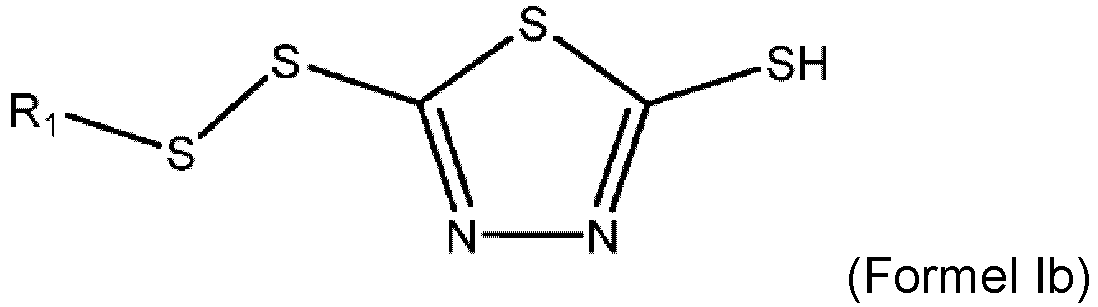 worin jedes R1 der Formel Ia und/oder Formel Ib unabhängig voneinander eine lineare oder verzweigte C4- bis C20-Kohlenwasserstoffgruppe ist.
 - Korrosionsinhibitor nach Anspruch 1, wobei die Säure eine starke Säure ist, die im molaren Überschuss zu dem 1,3,4-Dimercaptothiadiazol bereitsgestellt ist.
- Korrosionsinhibitor nach Anspruch 1, wobei der Korrosionsinhibitor eine Gesamtsäurezahl von 10 oder weniger aufweist.
- Korrosionsinhibitor nach Anspruch 1, wobei das Verfahren ferner das Erhitzen des Korrosionsinhibitors auf eine Temperatur, die die Abtrennung einer wässrigen Schicht bewirkt, und gegebenenfalls das Unterziehen des erhitzten Korrosionsinhibitors einem Vakuumstreifen einschließt.
- Korrosionsinhibitor nach Anspruch 1, wobei das Dimercaptothiadiazol oder das Alkalimetallsalz davon, das Alkylmercaptan und das Wasserstoffperoxid in einem Molverhältnis von 1 : 1,95 - 2,15 : 2,1 - 2,4 bereitgestellt sind.
- Schmiermittel, umfassend:a) eine größere Menge Basisöl; und(b) ein Korrosionsinhibitor, der durch ein Verfahren hergestellt wird, das umfasst:(i) Umsetzen eines 1,3,4-Dimercaptothiadiazols oder eines Alkalimetallsalzes davon mit einem Alkylmercaptan in Gegenwart einer Säure, um ein erstes Reaktionszwischenprodukt zu bilden;(ii) Umsetzen des ersten Reaktionszwischenprodukts mit Wasserstoffperoxid zum Bilden des Korrosionsinhibitors; und(iii) wobei das 1,3,4-Dimercaptothiadiazol oder das Alkalimetallsalz davon, das Alkylmercaptan und das Wasserstoffperoxid in einem Molverhältnis von 1 : 1,95 - 2,15 : größer als 2,0 bereitgestellt sind;wobei der Korrosionsinhibitor eine Mischung aus Verbindung Ia und Ib mit 95 bis 99,5 Gewichtsprozent Verbindungen der Formel Ia und 0,05 bis 5 Gewichtsprozent an Verbindungen der Formel Ib ist
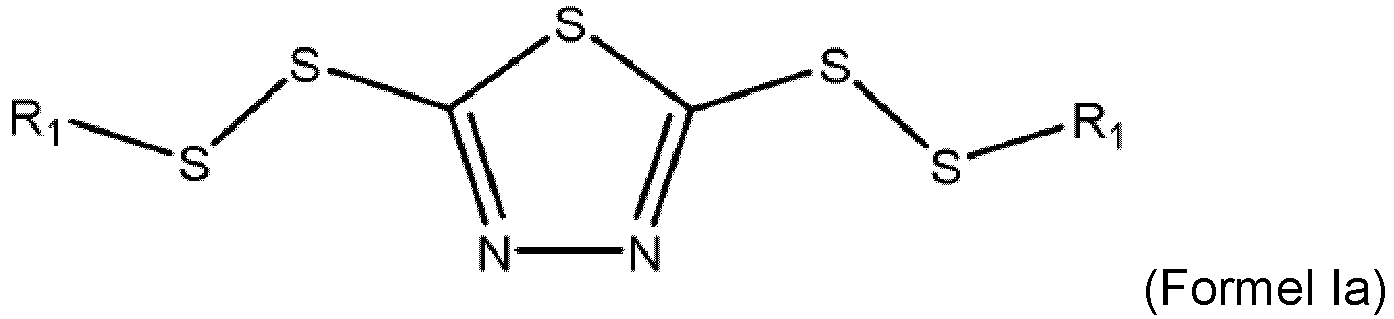
 worin jedes R1 der Formel Ia und/oder Formel Ib unabhängig voneinander eine lineare oder verzweigte C4- bis C20-Kohlenwasserstoffgruppe ist.
 - Schmiermittel nach Anspruch 6, wobei die Säure eine starke Säure ist, die im molaren Überschuss zu dem 1,3,4-Dimercaptothiadiazol bereitsgestellt ist.
- Schmiermittel nach Anspruch 6, wobei das Schmiermittel ferner eine oder mehrere Phosphonatesterverbindungen umfasst, einschließlich, bezogen auf den Gesamtgewichtsanteil der Phosphonatesterverbindungen, 90 Gewichtsprozent oder mehr eines Phosphonatdiesters und nicht mehr als 10 Gewichtsprozent eines Phosphonatmonoesters.
- Schmiermittel nach Anspruch 8, wobei der Phosphonatdiester die Struktur der Formel II aufweist:

- Schmiermittel nach Anspruch 8, wobei der Phosphonatmonoester eine Struktur der Formel III aufweist

- Schmiermittel nach Anspruch 6, wobei das Verfahren ferner das Erhitzen des Korrosionsinhibitors auf eine Temperatur, die die Abtrennung einer wässrigen Schicht bewirkt, und gegebenenfalls das Unterziehen des erhitzten Korrosionsinhibitors einem Vakuumstreifen einschließt.
- Schmiermittel nach Anspruch 6, wobei das Schmiermittel einen FAG FE8-Wälzlager-Gewichtsverlust von 12 mg oder weniger gemäß DIN 51819-3 nach 80 Stunden Laufzeit bei 80 °C, 7,5 U/min und 100 kN aufweist.
Applications Claiming Priority (2)
| Application Number | Priority Date | Filing Date | Title |
|---|---|---|---|
| US202263424383P | 2022-11-10 | 2022-11-10 | |
| GB2217954.3A GB2623137B (en) | 2022-11-10 | 2022-11-29 | Corrosion inhibitor and industrial lubricant including the same |
Publications (3)
| Publication Number | Publication Date |
|---|---|
| EP4368687A1 EP4368687A1 (de) | 2024-05-15 |
| EP4368687B1 true EP4368687B1 (de) | 2025-06-25 |
| EP4368687C0 EP4368687C0 (de) | 2025-06-25 |
Family
ID=88647422
Family Applications (1)
| Application Number | Title | Priority Date | Filing Date |
|---|---|---|---|
| EP23207147.2A Active EP4368687B1 (de) | 2022-11-10 | 2023-10-31 | Korrosionsinhibitor und industrielles schmiermittel damit |
Country Status (4)
| Country | Link |
|---|---|
| US (1) | US12378494B2 (de) |
| EP (1) | EP4368687B1 (de) |
| JP (1) | JP2024070241A (de) |
| KR (1) | KR102798878B1 (de) |
Family Cites Families (196)
| Publication number | Priority date | Publication date | Assignee | Title |
|---|---|---|---|---|
| US2237625A (en) | 1938-10-07 | 1941-04-08 | Sharples Solvents Corp | Sulphurization of sulphur-containing organic conpounds |
| US2237627A (en) | 1939-10-10 | 1941-04-08 | Sharples Solvents Corp | Sulphurization of organic polysulphides |
| US2527948A (en) | 1948-09-02 | 1950-10-31 | Phillips Pctroleum Company | Production of dialkyl polysulfides |
| US2695316A (en) | 1949-12-19 | 1954-11-23 | Phillips Petroleum Co | Catalytic preparation of polysulfides from alkyl sulfides |
| US3022351A (en) | 1957-03-07 | 1962-02-20 | Phillips Petroleum Co | Production of organic polysulfides |
| US2995569A (en) | 1957-05-02 | 1961-08-08 | Socony Mobil Oil Co Inc | Process for preparation of alkyl-1, 2-dithiole-3-thiones |
| US3366569A (en) | 1959-03-30 | 1968-01-30 | Lubrizol Corp | Lubricating compositions containing the reaction product of a substituted succinic acid-producing compound, an amino compound, and an alkenyl cyanide |
| DE1248643B (de) | 1959-03-30 | 1967-08-31 | The Lubrizol Corporation, Cleveland, Ohio (V. St. A.) | Verfahren zur Herstellung von öllöslichen aeylierten Aminen |
| US3087932A (en) * | 1959-07-09 | 1963-04-30 | Standard Oil Co | Process for preparing 2, 5-bis(hydrocarbondithio)-1, 3, 4-thiadiazole |
| US3256185A (en) | 1961-06-12 | 1966-06-14 | Lubrizol Corp | Lubricant containing acylated aminecarbon disulfide product |
| US3178663A (en) | 1961-06-26 | 1965-04-13 | Bendix Corp | Single speed and multispeed unitary synchro structure |
| US3185647A (en) | 1962-09-28 | 1965-05-25 | California Research Corp | Lubricant composition |
| US3458530A (en) | 1962-11-21 | 1969-07-29 | Exxon Research Engineering Co | Multi-purpose polyalkenyl succinic acid derivative |
| NL302077A (de) | 1962-12-19 | |||
| GB1054276A (de) | 1963-05-17 | |||
| DE1250430B (de) | 1963-05-20 | |||
| GB1054093A (de) | 1963-06-17 | |||
| US3312619A (en) | 1963-10-14 | 1967-04-04 | Monsanto Co | 2-substituted imidazolidines and their lubricant compositions |
| GB1065595A (en) | 1963-07-22 | 1967-04-19 | Monsanto Co | Imidazolines and imidazolidines and oil compositions containing the same |
| US3390086A (en) | 1964-12-29 | 1968-06-25 | Exxon Research Engineering Co | Sulfur containing ashless disperant |
| US3574576A (en) | 1965-08-23 | 1971-04-13 | Chevron Res | Distillate fuel compositions having a hydrocarbon substituted alkylene polyamine |
| US3392201A (en) | 1965-08-25 | 1968-07-09 | Phillips Petroleum Co | Process for making alkyl trisulfides |
| US3697574A (en) | 1965-10-22 | 1972-10-10 | Standard Oil Co | Boron derivatives of high molecular weight mannich condensation products |
| US3736357A (en) | 1965-10-22 | 1973-05-29 | Standard Oil Co | High molecular weight mannich condensation products from two different alkyl-substituted hydroxy-aromatic compounds |
| GB1162175A (en) | 1966-10-01 | 1969-08-20 | Orobis Ltd | Novel Compounds and their use as Lubricant Additives |
| US3533943A (en) | 1966-11-10 | 1970-10-13 | Mobil Oil Corp | Lubricant compositions |
| FR1553249A (de) | 1967-01-20 | 1969-01-10 | ||
| US3471404A (en) | 1967-03-06 | 1969-10-07 | Mobil Oil Corp | Lubricating compositions containing polysulfurized olefin |
| US3519564A (en) | 1967-08-25 | 1970-07-07 | Lubrizol Corp | Heterocyclic nitrogen-sulfur compositions and lubricants containing them |
| US3865813A (en) | 1968-01-08 | 1975-02-11 | Lubrizol Corp | Thiourea-acylated polyamine reaction product |
| US3634515A (en) | 1968-11-08 | 1972-01-11 | Standard Oil Co | Alkylene polyamide formaldehyde |
| US3573205A (en) | 1968-12-17 | 1971-03-30 | Chevron Res | Diisocyanate modified polyisobutenyl-succinimides as lubricating oil detergents |
| US3859318A (en) | 1969-05-19 | 1975-01-07 | Lubrizol Corp | Products produced by post-treating oil-soluble esters of mono- or polycarboxylic acids and polyhydric alcohols with epoxides |
| US3649229A (en) | 1969-12-17 | 1972-03-14 | Mobil Oil Corp | Liquid hydrocarbon fuels containing high molecular weight mannich bases |
| US3708522A (en) | 1969-12-29 | 1973-01-02 | Lubrizol Corp | Reaction products of high molecular weight carboxylic acid esters and certain carboxylic acid acylating reactants |
| US3703504A (en) | 1970-01-12 | 1972-11-21 | Mobil Oil Corp | Process for producing sulfurized olefins |
| US3673090A (en) | 1970-06-11 | 1972-06-27 | Texaco Inc | Sulfurization of triisobutylene and products resulting therefrom |
| US3703505A (en) | 1970-08-31 | 1972-11-21 | Mobil Oil Corp | Preparation of sulfurized olefins |
| US3796661A (en) | 1971-07-19 | 1974-03-12 | Texaco Inc | Sulfurized triisobutylene |
| US3749695A (en) | 1971-08-30 | 1973-07-31 | Chevron Res | Lubricating oil additives |
| US3865740A (en) | 1972-05-22 | 1975-02-11 | Chevron Res | Multifunctional lubricating oil additive |
| GB1440129A (en) | 1972-11-13 | 1976-06-23 | Tenneco Chem | Lubricant compositions |
| NL159136C (de) | 1973-04-12 | |||
| US3954639A (en) | 1974-03-14 | 1976-05-04 | Chevron Research Company | Lubricating oil composition containing sulfate rust inhibitors |
| US3873454A (en) | 1974-03-22 | 1975-03-25 | Mobil Oil | Lubricant composition |
| US4344854A (en) | 1975-03-21 | 1982-08-17 | The Lubrizol Corporation | Sulfurized compositions |
| US4119549A (en) | 1975-03-21 | 1978-10-10 | The Lubrizol Corporation | Sulfurized compositions |
| US4119550A (en) | 1975-03-21 | 1978-10-10 | The Lubrizol Corporation | Sulfurized compositions |
| CA1064463A (en) | 1975-03-21 | 1979-10-16 | Kirk E. Davis | Sulfurized compositions |
| GB1560667A (en) | 1976-09-24 | 1980-02-06 | Cooper & Co Ltd Edwin | Sulphurize olefins and their use as lubricant additives |
| DE2702604C2 (de) | 1977-01-22 | 1984-08-30 | Basf Ag, 6700 Ludwigshafen | Polyisobutene |
| US4218332A (en) | 1977-09-16 | 1980-08-19 | The United States Of America As Represented By The Secretary Of Agriculture | Tetrasulfide extreme pressure lubricant additives |
| US4204969A (en) | 1978-10-10 | 1980-05-27 | Edwin Cooper, Inc. | Lubricant composition containing sulfurized olefin extreme pressure additive |
| US4240958A (en) | 1978-12-20 | 1980-12-23 | Mobil Oil Corporation | Process of preparing sulfurized olefins |
| US4234435A (en) | 1979-02-23 | 1980-11-18 | The Lubrizol Corporation | Novel carboxylic acid acylating agents, derivatives thereof, concentrate and lubricant compositions containing the same, and processes for their preparation |
| US4298481A (en) | 1979-02-23 | 1981-11-03 | Tenneco Chemicals, Inc. | High temperature grease compositions |
| US4260501A (en) | 1979-05-11 | 1981-04-07 | Mobil Oil Corporation | Lubricant compositions containing antioxidant mixtures comprising substituted thiazoles and substituted thiadiazole compounds |
| US4410436A (en) | 1981-11-09 | 1983-10-18 | Union Oil Company Of California | Lubricating oil containing a boron compound and corrosion inhibitors |
| CA1152975A (en) | 1980-08-11 | 1983-08-30 | Joosup Shim | Lubricant compositions containing antioxidant mixtures of thiazoles and thiadiazoles |
| DE3065464D1 (en) | 1980-08-12 | 1983-12-08 | Mobil Oil Corp | Lubricant compositions containing antioxidant mixtures of triazoles and thiadiazoles |
| US4338205A (en) | 1980-08-25 | 1982-07-06 | Exxon Research & Engineering Co. | Lubricating oil with improved diesel dispersancy |
| US4379064A (en) | 1981-03-20 | 1983-04-05 | Standard Oil Company (Indiana) | Oxidative passivation of polyamine-dispersants |
| JPS58140064A (ja) | 1982-02-13 | 1983-08-19 | Nippon Soda Co Ltd | ジアルキルトリスルフイド類の製造方法 |
| US4472306A (en) | 1982-12-10 | 1984-09-18 | Texaco Inc. | Sulfurizing tri-isobutylene in the presence of a promotor |
| US4482464A (en) | 1983-02-14 | 1984-11-13 | Texaco Inc. | Hydrocarbyl-substituted mono- and bis-succinimide having polyamine chain linked hydroxyacyl radicals and mineral oil compositions containing same |
| DE3330920A1 (de) * | 1983-08-27 | 1985-03-07 | Rhein-Chemie Rheinau Gmbh, 6800 Mannheim | Verfahren zur herstellung von 2-(hydrocarbyldithio)-5-mercapto-1,3,4-thia diazolen |
| US4648980A (en) | 1983-09-22 | 1987-03-10 | Chevron Research Company | Hydrocarbon soluble nitrogen containing dispersant - fluorophosphoric acid adducts |
| US4579675A (en) | 1983-11-09 | 1986-04-01 | Texaco Inc. | N-substituted enaminones and oleaginous compositions containing same |
| US4521318A (en) | 1983-11-14 | 1985-06-04 | Texaco Inc. | Lubricant compositions containing both hydrocarbyl substituted mono and bissuccinimide having polyamine chain linked hydroxacyl radicals, and neopentyl derivative |
| US4554086A (en) | 1984-04-26 | 1985-11-19 | Texaco Inc. | Borate esters of hydrocarbyl-substituted mono- and bis-succinimides containing polyamine chain linked hydroxyacyl groups and lubricating oil compositions containing same |
| US4612132A (en) | 1984-07-20 | 1986-09-16 | Chevron Research Company | Modified succinimides |
| US4617137A (en) | 1984-11-21 | 1986-10-14 | Chevron Research Company | Glycidol modified succinimides |
| US4666460A (en) | 1985-04-12 | 1987-05-19 | Chevron Research Company | Modified succinimides (III) |
| US4666459A (en) | 1985-04-12 | 1987-05-19 | Chevron Research Company | Modified succinimides (VII) |
| US4614603A (en) | 1985-04-12 | 1986-09-30 | Chevron Research Company | Modified succinimides (III) |
| US4670170A (en) | 1985-04-12 | 1987-06-02 | Chevron Research Company | Modified succinimides (VIII) |
| US4617138A (en) | 1985-04-12 | 1986-10-14 | Chevron Research Company | Modified succinimides (II) |
| US4648886A (en) | 1985-04-12 | 1987-03-10 | Chevron Research Company | Modified succinimides (V) |
| US4647390A (en) | 1985-04-12 | 1987-03-03 | Chevron Research Company | Lubricating oil compositions containing modified succinimides (V) |
| US4668246A (en) | 1985-04-12 | 1987-05-26 | Chevron Research Company | Modified succinimides (IV) |
| US4614522A (en) | 1985-04-12 | 1986-09-30 | Chevron Research Company | Fuel compositions containing modified succinimides (VI) |
| US4645515A (en) | 1985-04-12 | 1987-02-24 | Chevron Research Company | Modified succinimides (II) |
| US4590303A (en) | 1985-06-03 | 1986-05-20 | General Electric Company | Method for making bisphenol |
| US4646860A (en) | 1985-07-03 | 1987-03-03 | The United States Of America As Represented By The Administrator Of The National Aeronautics And Space Administration | Personnel emergency carrier vehicle |
| FR2588881B1 (fr) | 1985-10-18 | 1988-01-15 | Inst Francais Du Petrole | Compositions d'olefines polysulfurees, leur preparation et leur utilisation comme additifs pour lubrifiants |
| US4636322A (en) | 1985-11-04 | 1987-01-13 | Texaco Inc. | Lubricating oil dispersant and viton seal additives |
| US4711736A (en) | 1986-02-24 | 1987-12-08 | Mobil Oil Corporation | Sulfurized olefins as antiwear/extreme pressure additives for lubricants and fuels and compositions thereof |
| US4719001A (en) | 1986-03-26 | 1988-01-12 | Union Oil Company Of California | Antifoulant additives for high temperature hydrocarbon processing |
| US4663064A (en) | 1986-03-28 | 1987-05-05 | Texaco Inc. | Dibaisic acid lubricating oil dispersant and viton seal additives |
| US4652387A (en) | 1986-07-30 | 1987-03-24 | Mobil Oil Corporation | Borated reaction products of succinic compounds as lubricant dispersants and antioxidants |
| US4713189A (en) | 1986-08-20 | 1987-12-15 | Texaco, Inc. | Precoupled mono-succinimide lubricating oil dispersants and viton seal additives |
| US4699724A (en) | 1986-08-20 | 1987-10-13 | Texaco Inc. | Post-coupled mono-succinimide lubricating oil dispersant and viton seal additives |
| US4963275A (en) | 1986-10-07 | 1990-10-16 | Exxon Chemical Patents Inc. | Dispersant additives derived from lactone modified amido-amine adducts |
| AU598329B2 (en) | 1986-11-06 | 1990-06-21 | Lubrizol Corporation, The | Metal salt fuel additive stabilized with a thiadiazole |
| US4713191A (en) | 1986-12-29 | 1987-12-15 | Texaco Inc. | Diiscyanate acid lubricating oil dispersant and viton seal additives |
| GB8704682D0 (en) | 1987-02-27 | 1987-04-01 | Exxon Chemical Patents Inc | Low phosphorus lubricants |
| US4971711A (en) | 1987-07-24 | 1990-11-20 | Exxon Chemical Patents, Inc. | Lactone-modified, mannich base dispersant additives useful in oleaginous compositions |
| US4871465A (en) | 1987-09-30 | 1989-10-03 | Amoco Corporation | Chlorine-free silver protective lubricant composition (II) |
| US4849118A (en) | 1987-09-30 | 1989-07-18 | Amoco Corporation | Chlorine-free silver protective lubricant composition (III) |
| US5026495A (en) | 1987-11-19 | 1991-06-25 | Exxon Chemical Patents Inc. | Oil soluble dispersant additives useful in oleaginous compositions |
| US4954274A (en) | 1987-12-29 | 1990-09-04 | Zaweski Edward F | Sulfurized olefin extreme pressure additives |
| US5266223A (en) | 1988-08-01 | 1993-11-30 | Exxon Chemical Patents Inc. | Ethylene alpha-olefin polymer substituted mono-and dicarboxylic acid dispersant additives |
| CA2011367C (en) | 1988-08-30 | 1997-07-08 | Henry Ashjian | Reaction products of alkenyl succinimides with ethylenediamine carboxy acids as fuel detergents |
| US4857214A (en) | 1988-09-16 | 1989-08-15 | Ethylk Petroleum Additives, Inc. | Oil-soluble phosphorus antiwear additives for lubricants |
| US4948386A (en) | 1988-11-07 | 1990-08-14 | Texaco Inc. | Middle distillate containing storage stability additive |
| US4963278A (en) | 1988-12-29 | 1990-10-16 | Mobil Oil Corporation | Lubricant and fuel compositions containing reaction products of polyalkenyl succinimides, aldehydes, and triazoles |
| US4966720A (en) | 1989-01-31 | 1990-10-30 | Ethyl Petroleum Additives, Inc. | Oil soluble sulfurized olefins and two temperature zone process for their preparation |
| JPH0699701B2 (ja) | 1989-02-10 | 1994-12-07 | コスモ石油株式会社 | パワーステアリング用作動流体組成物 |
| CA2013545C (en) | 1989-04-03 | 1999-01-26 | Glen Paul Fetterman Jr. | Improved ashless lubricant compositions for internal combustion engines |
| DE69026581T2 (de) | 1989-12-13 | 1996-11-14 | Exxon Chemical Patents Inc | Polyolefin-substituierte Amine mit gepfropften Polymeren aus aromatischen Aminmonomeren für Ölzusammensetzungen |
| US4981492A (en) | 1989-12-13 | 1991-01-01 | Mobil Oil Corporation | Borated triazole-substituted polyalkenyl succinimides as multifunctional lubricant and fuel additives |
| US5075383A (en) | 1990-04-11 | 1991-12-24 | Texaco Inc. | Dispersant and antioxidant additive and lubricating oil composition containing same |
| US4973412A (en) | 1990-05-07 | 1990-11-27 | Texaco Inc. | Multifunctional lubricant additive with Viton seal capability |
| US5241003A (en) | 1990-05-17 | 1993-08-31 | Ethyl Petroleum Additives, Inc. | Ashless dispersants formed from substituted acylating agents and their production and use |
| US5030249A (en) | 1990-10-01 | 1991-07-09 | Texaco Inc. | Gasoline detergent additive |
| US5039307A (en) | 1990-10-01 | 1991-08-13 | Texaco Inc. | Diesel fuel detergent additive |
| US5302304A (en) | 1990-12-21 | 1994-04-12 | Ethyl Corporation | Silver protective lubricant composition |
| JP3005310B2 (ja) | 1991-04-30 | 2000-01-31 | 東燃株式会社 | 潤滑油組成物 |
| US5177212A (en) | 1991-07-26 | 1993-01-05 | R.T. Vanderbilt Company, Inc. | Phenolic derivatives of 2,5-dimercapto-1,3,4-thiadiazoles |
| US5643859A (en) | 1992-12-17 | 1997-07-01 | Exxon Chemical Patents Inc. | Derivatives of polyamines with one primary amine and secondary of tertiary amines |
| US5334321A (en) | 1993-03-09 | 1994-08-02 | Chevron Research And Technology Company, A Division Of Chevron U.S.A. Inc. | Modified high molecular weight succinimides |
| DE69420796T2 (de) | 1993-07-30 | 2000-01-13 | Tonen Corp., Tokio/Tokyo | Flüssige Zusammensetzung für Flüssigkeitsreibungskupplung |
| US5936041A (en) | 1994-06-17 | 1999-08-10 | Exxon Chemical Patents Inc | Dispersant additives and process |
| EP0765351B1 (de) | 1994-06-17 | 1999-01-13 | Exxon Chemical Patents Inc. | Amidierung von esterfunktionalisierten kohlenwasserstoff-polymeren |
| JPH08165483A (ja) | 1994-12-16 | 1996-06-25 | Nippon Oil Co Ltd | アクティブサスペンション用流体組成物 |
| FR2730496B1 (fr) | 1995-02-15 | 1997-04-25 | Inst Francais Du Petrole | Procede de fabrication d'anhydride alkenyls ou polyalkenylsucciniques sans formation de resines |
| US5585338A (en) | 1995-11-28 | 1996-12-17 | Exxon Research And Engineering Company | Aviation turbine oils of improved load carrying capacity containing mercaptobenzoic acid |
| US5821205A (en) | 1995-12-01 | 1998-10-13 | Chevron Chemical Company | Polyalkylene succinimides and post-treated derivatives thereof |
| US5801130A (en) | 1995-12-22 | 1998-09-01 | Exxon Research And Engineering Company | High load-carrying turbo oils containing amine phosphate and dimercaptothiadiazole derivatives |
| US5792729A (en) | 1996-08-20 | 1998-08-11 | Chevron Chemical Corporation | Dispersant terpolymers |
| US6107257A (en) | 1997-12-09 | 2000-08-22 | Ethyl Corporation | Highly grafted, multi-functional olefin copolymer VI modifiers |
| US6399548B1 (en) | 2000-09-22 | 2002-06-04 | Chevron Oronite Company Llc | Functional fluids |
| US20020151443A1 (en) | 2001-02-09 | 2002-10-17 | Sanjay Srinivasan | Automatic transmission fluids with improved anti-wear properties |
| CA2371832A1 (en) | 2001-03-05 | 2002-09-05 | Ethyl Corporation | Power transmission fluids with enhanced lubricating properties |
| DE60212292T2 (de) | 2001-11-06 | 2007-05-31 | The Lubrizol Corp. (n.d.Ges.d. Staates Ohio), Wickliffe | Flüssigkeit für Getriebe mit veringerter Rostfrasskorrosion |
| US7265080B2 (en) | 2002-06-12 | 2007-09-04 | Nsk Ltd. | Rolling bearing, rolling bearing for fuel cell, compressor for fuel cell system and fuel cell system |
| US7759294B2 (en) | 2003-10-24 | 2010-07-20 | Afton Chemical Corporation | Lubricant compositions |
| US7452851B2 (en) * | 2003-10-24 | 2008-11-18 | Afton Chemical Corporation | Lubricant compositions |
| US7214649B2 (en) | 2003-12-31 | 2007-05-08 | Afton Chemical Corporation | Hydrocarbyl dispersants including pendant polar functional groups |
| WO2005093020A1 (ja) | 2004-03-25 | 2005-10-06 | Nippon Oil Corporation | 産業機械装置用潤滑性組成物 |
| US20060025314A1 (en) | 2004-07-28 | 2006-02-02 | Afton Chemical Corporation | Power transmission fluids with enhanced extreme pressure and antiwear characteristics |
| US7645726B2 (en) | 2004-12-10 | 2010-01-12 | Afton Chemical Corporation | Dispersant reaction product with antioxidant capability |
| US7786059B2 (en) | 2004-12-21 | 2010-08-31 | Chevron Oronite Company Llc | Anti-wear additive composition and lubricating oil composition containing the same |
| US7253231B2 (en) | 2005-01-31 | 2007-08-07 | Afton Chemical Corporation | Grafted multi-functional olefin copolymer VI modifiers and uses thereof |
| US7485603B2 (en) | 2005-02-18 | 2009-02-03 | Infineum International Limited | Soot dispersants and lubricating oil compositions containing same |
| US7851418B2 (en) | 2005-06-03 | 2010-12-14 | Exxonmobil Research And Engineering Company | Ashless detergents and formulated lubricating oil containing same |
| JP2009501810A (ja) | 2005-07-12 | 2009-01-22 | キング インダストリーズ,インク. | タングステン酸アミン及び潤滑剤組成物 |
| JP5030402B2 (ja) | 2005-08-15 | 2012-09-19 | Jx日鉱日石エネルギー株式会社 | 潤滑油組成物 |
| CN100395322C (zh) | 2005-08-31 | 2008-06-18 | 中国石油化工股份有限公司 | 含纳米抗磨剂的热轧油组合物 |
| CN100443576C (zh) | 2005-09-28 | 2008-12-17 | 中国石油化工股份有限公司 | 由水分散性粘土制备的热轧油组合物 |
| CN100425681C (zh) | 2005-09-28 | 2008-10-15 | 中国石油化工股份有限公司 | 含油分散性粘土抗磨防滑剂的热轧油组合物 |
| EP2027236B1 (de) | 2006-04-24 | 2016-06-08 | The Lubrizol Corporation | Schmierzusammensetzung für sternpolymere |
| EP2046925A2 (de) | 2006-07-27 | 2009-04-15 | The Lubrizol Corporation | Schmierverfahren und zugehörige schmiermittelzusammensetzungen |
| GB0614987D0 (en) | 2006-07-28 | 2006-09-06 | Mcalpine & Co Ltd | Waste Outlet |
| US7897696B2 (en) | 2007-02-01 | 2011-03-01 | Afton Chemical Corporation | Process for the preparation of polyalkenyl succinic anhydrides |
| US7786057B2 (en) | 2007-02-08 | 2010-08-31 | Infineum International Limited | Soot dispersants and lubricating oil compositions containing same |
| US20080194442A1 (en) | 2007-02-13 | 2008-08-14 | Watts Raymond F | Methods for lubricating a transmission |
| JP2010521559A (ja) * | 2007-03-13 | 2010-06-24 | ザ ルブリゾル コーポレイション | 多機能性ドライブライン流体 |
| US20090093384A1 (en) | 2007-10-03 | 2009-04-09 | The Lubrizol Corporation | Lubricants That Decrease Micropitting for Industrial Gears |
| AU2009222194B2 (en) | 2008-02-29 | 2013-12-19 | The Lubrizol Corporation | Liquid extreme pressure additive |
| US20110177988A1 (en) | 2008-03-19 | 2011-07-21 | The Lubrizol Corporation | Antiwear Composition and Method of Lubricating Driveline Device |
| US20090318319A1 (en) * | 2008-06-23 | 2009-12-24 | Afton Chemical Corporation | Friction modifiers for slideway applications |
| FR2947549B1 (fr) * | 2009-07-06 | 2011-08-05 | Mlpc Internat | Procede de preparation de bis-dmtd |
| JP2011190331A (ja) | 2010-03-12 | 2011-09-29 | Idemitsu Kosan Co Ltd | 潤滑油組成物 |
| CN101830865B (zh) | 2010-03-19 | 2012-05-02 | 华东交通大学 | 一种含羟基的噻二唑衍生物及其制备方法和应用 |
| CN101857580B (zh) | 2010-04-27 | 2011-11-30 | 华东交通大学 | 一种含羟基和黄原酸的噻二唑衍生物及其制备方法和应用 |
| US8999905B2 (en) | 2010-10-25 | 2015-04-07 | Afton Chemical Corporation | Lubricant additive |
| EP2675875B1 (de) | 2011-02-16 | 2017-09-13 | The Lubrizol Corporation | Schmierstoffzusammensetzung für einen antriebsstrang |
| US9540582B2 (en) | 2011-02-16 | 2017-01-10 | The Lubrizol Corporation | Method of lubricating a driveline device |
| CN102766506B (zh) | 2011-05-06 | 2014-10-15 | 中国石油天然气股份有限公司 | 一种全传动系统用润滑油组合物 |
| FR2984348B1 (fr) * | 2011-12-16 | 2015-02-27 | Total Raffinage Marketing | Compositions lubrifiantes pour transmissions |
| JP5809090B2 (ja) * | 2012-03-21 | 2015-11-10 | Jx日鉱日石エネルギー株式会社 | 工作機械用潤滑油組成物 |
| EP2829592B1 (de) | 2012-03-21 | 2019-08-14 | Idemitsu Kosan Co., Ltd | Motorschmierölzusammensetzung aus einer aluminiumlegierung und schmierverfahren damit |
| CN104204165A (zh) | 2012-03-21 | 2014-12-10 | 出光兴产株式会社 | 内燃机油用润滑油组合物 |
| US9150812B2 (en) | 2012-03-22 | 2015-10-06 | Exxonmobil Research And Engineering Company | Antioxidant combination and synthetic base oils containing the same |
| CN103509636B (zh) | 2012-06-21 | 2015-01-21 | 中国石油天然气股份有限公司 | 一种高速列车专用齿轮润滑油组合物 |
| US8410032B1 (en) * | 2012-07-09 | 2013-04-02 | Afton Chemical Corporation | Multi-vehicle automatic transmission fluid |
| US20140038864A1 (en) | 2012-08-06 | 2014-02-06 | Exxonmobil Research And Engineering Company | Method for improving nitrile seal compatibility with lubricating oils |
| JP6158567B2 (ja) | 2013-04-10 | 2017-07-05 | シーシーアイ株式会社 | 作動液 |
| FR3009309B1 (fr) | 2013-08-02 | 2016-10-07 | Total Marketing Services | Compositions lubrifiantes pour transmissions |
| CN104087390B (zh) | 2014-07-25 | 2016-08-24 | 中国石油化工股份有限公司 | 一种冷冻机油 |
| CN104725740A (zh) | 2015-03-23 | 2015-06-24 | 苏州市神龙门窗有限公司 | 一种门窗型材用高塑性材料及其制备方法 |
| KR101715372B1 (ko) | 2016-05-26 | 2017-03-15 | 이종호 | 녹 제거 및 방지용 조성물, 및 이를 제조하는 방법 |
| US10647939B2 (en) * | 2016-11-18 | 2020-05-12 | International Petroleum Products & Additives Company, Inc. | Thiadiazole components, compositions, and methods |
| CN107034001A (zh) | 2017-04-28 | 2017-08-11 | 舒城久联精密机械有限公司 | 一种精密机械精加工中的极压乳化液 |
| CN108251196B (zh) | 2018-01-15 | 2021-09-10 | 金雪驰科技(马鞍山)有限公司 | 一种压缩机油及其应用 |
| JP2020041055A (ja) | 2018-09-11 | 2020-03-19 | Emgルブリカンツ合同会社 | 潤滑油組成物 |
| CN109574957A (zh) * | 2018-12-11 | 2019-04-05 | 沾化大荣化工科技有限公司 | 一种2,5-双(烷基二硫代)-1,3,4-噻二唑类金属减活剂的制备方法 |
| US10808198B2 (en) | 2019-01-16 | 2020-10-20 | Afton Chemical Corporation | Lubricant containing thiadiazole derivatives |
| JP2022525421A (ja) * | 2019-03-20 | 2022-05-13 | ビーエーエスエフ ソシエタス・ヨーロピア | 潤滑剤組成物 |
| US11214755B2 (en) | 2019-04-10 | 2022-01-04 | Eneos Corporation | Lubricating oil composition |
| US12291510B2 (en) * | 2019-09-17 | 2025-05-06 | The Lubrizol Corporation | 2,5-dimercapto-1,3,4-thiadiazole (DMTD) derivatives |
| JP2021066809A (ja) | 2019-10-23 | 2021-04-30 | Emgルブリカンツ合同会社 | 潤滑油組成物 |
| JP2021080429A (ja) | 2019-11-15 | 2021-05-27 | Emgルブリカンツ合同会社 | 潤滑油組成物 |
| JP2021080339A (ja) | 2019-11-15 | 2021-05-27 | Emgルブリカンツ合同会社 | 潤滑油組成物 |
| US20240352374A1 (en) | 2021-08-17 | 2024-10-24 | The Lubrizol Corporation | Method of Lubricating an Automotive or Industrial Gear |
-
2023
- 2023-10-31 EP EP23207147.2A patent/EP4368687B1/de active Active
- 2023-11-01 JP JP2023187361A patent/JP2024070241A/ja active Pending
- 2023-11-03 KR KR1020230150746A patent/KR102798878B1/ko active Active
- 2023-11-09 US US18/505,646 patent/US12378494B2/en active Active
Also Published As
| Publication number | Publication date |
|---|---|
| US12378494B2 (en) | 2025-08-05 |
| JP2024070241A (ja) | 2024-05-22 |
| KR102798878B1 (ko) | 2025-04-21 |
| KR20240070412A (ko) | 2024-05-21 |
| EP4368687A1 (de) | 2024-05-15 |
| US20240174939A1 (en) | 2024-05-30 |
| EP4368687C0 (de) | 2025-06-25 |
Similar Documents
| Publication | Publication Date | Title |
|---|---|---|
| EP4296338B1 (de) | Phosphor-verschleissschutzsystem für verbesserten getriebeschutz | |
| EP4386070B1 (de) | Antriebsstrang und übertragungsflüssigkeiten für verschleiss und verschleiss bei niedriger geschwindigkeit | |
| EP4438699A1 (de) | Verschleissschutzsystem für verbesserte kupferkorrosion | |
| EP4438701A1 (de) | Verschleissschutzsystem für verbesserte kupferkorrosion | |
| EP4368687B1 (de) | Korrosionsinhibitor und industrielles schmiermittel damit | |
| GB2623137A (en) | Corrosion inhibitor and industrial lubricant including the same | |
| EP4342964B1 (de) | Extreme-pressure-additive mit verbesserter kupferkorrosion | |
| EP4442797B1 (de) | Schmiermittelzusammensetzung für getriebeflüssigkeiten | |
| US12305142B1 (en) | Industrial lubricant | |
| EP4438700B1 (de) | Verschleissschutzsystem für verbesserte kupferkorrosion | |
| EP4640796A1 (de) | Schmiermittelzusammensetzung für getriebeflüssigkeiten und nassbremsen |
Legal Events
| Date | Code | Title | Description |
|---|---|---|---|
| PUAI | Public reference made under article 153(3) epc to a published international application that has entered the european phase |
Free format text: ORIGINAL CODE: 0009012 |
|
| STAA | Information on the status of an ep patent application or granted ep patent |
Free format text: STATUS: REQUEST FOR EXAMINATION WAS MADE |
|
| 17P | Request for examination filed |
Effective date: 20231031 |
|
| AK | Designated contracting states |
Kind code of ref document: A1 Designated state(s): AL AT BE BG CH CY CZ DE DK EE ES FI FR GB GR HR HU IE IS IT LI LT LU LV MC ME MK MT NL NO PL PT RO RS SE SI SK SM TR |
|
| STAA | Information on the status of an ep patent application or granted ep patent |
Free format text: STATUS: EXAMINATION IS IN PROGRESS |
|
| 17Q | First examination report despatched |
Effective date: 20240626 |
|
| GRAP | Despatch of communication of intention to grant a patent |
Free format text: ORIGINAL CODE: EPIDOSNIGR1 |
|
| STAA | Information on the status of an ep patent application or granted ep patent |
Free format text: STATUS: GRANT OF PATENT IS INTENDED |
|
| GRAS | Grant fee paid |
Free format text: ORIGINAL CODE: EPIDOSNIGR3 |
|
| INTG | Intention to grant announced |
Effective date: 20250411 |
|
| GRAA | (expected) grant |
Free format text: ORIGINAL CODE: 0009210 |
|
| STAA | Information on the status of an ep patent application or granted ep patent |
Free format text: STATUS: THE PATENT HAS BEEN GRANTED |
|
| AK | Designated contracting states |
Kind code of ref document: B1 Designated state(s): AL AT BE BG CH CY CZ DE DK EE ES FI FR GB GR HR HU IE IS IT LI LT LU LV MC ME MK MT NL NO PL PT RO RS SE SI SK SM TR |
|
| REG | Reference to a national code |
Ref country code: GB Ref legal event code: FG4D |
|
| REG | Reference to a national code |
Ref country code: CH Ref legal event code: EP |
|
| REG | Reference to a national code |
Ref country code: CH Ref legal event code: EP |
|
| REG | Reference to a national code |
Ref country code: IE Ref legal event code: FG4D |
|
| REG | Reference to a national code |
Ref country code: DE Ref legal event code: R096 Ref document number: 602023004296 Country of ref document: DE |
|
| U01 | Request for unitary effect filed |
Effective date: 20250711 |
|
| U07 | Unitary effect registered |
Designated state(s): AT BE BG DE DK EE FI FR IT LT LU LV MT NL PT RO SE SI Effective date: 20250716 |
|
| U1N | Appointed representative for the unitary patent procedure changed after the registration of the unitary effect |
Representative=s name: J A KEMP LLP; GB |
|
| PG25 | Lapsed in a contracting state [announced via postgrant information from national office to epo] |
Ref country code: NO Free format text: LAPSE BECAUSE OF FAILURE TO SUBMIT A TRANSLATION OF THE DESCRIPTION OR TO PAY THE FEE WITHIN THE PRESCRIBED TIME-LIMIT Effective date: 20250925 Ref country code: GR Free format text: LAPSE BECAUSE OF FAILURE TO SUBMIT A TRANSLATION OF THE DESCRIPTION OR TO PAY THE FEE WITHIN THE PRESCRIBED TIME-LIMIT Effective date: 20250926 |
|
| PG25 | Lapsed in a contracting state [announced via postgrant information from national office to epo] |
Ref country code: HR Free format text: LAPSE BECAUSE OF FAILURE TO SUBMIT A TRANSLATION OF THE DESCRIPTION OR TO PAY THE FEE WITHIN THE PRESCRIBED TIME-LIMIT Effective date: 20250625 |
|
| PG25 | Lapsed in a contracting state [announced via postgrant information from national office to epo] |
Ref country code: RS Free format text: LAPSE BECAUSE OF FAILURE TO SUBMIT A TRANSLATION OF THE DESCRIPTION OR TO PAY THE FEE WITHIN THE PRESCRIBED TIME-LIMIT Effective date: 20250925 |
|
| U20 | Renewal fee for the european patent with unitary effect paid |
Year of fee payment: 3 Effective date: 20251027 |