EP4337828B1 - Mundstueckbelagpapier mit thermisch expandierbaren partikeln - Google Patents
Mundstueckbelagpapier mit thermisch expandierbaren partikeln Download PDFInfo
- Publication number
- EP4337828B1 EP4337828B1 EP22725974.4A EP22725974A EP4337828B1 EP 4337828 B1 EP4337828 B1 EP 4337828B1 EP 22725974 A EP22725974 A EP 22725974A EP 4337828 B1 EP4337828 B1 EP 4337828B1
- Authority
- EP
- European Patent Office
- Prior art keywords
- lining paper
- mouthpiece lining
- thermally expandable
- expandable particles
- printing
- Prior art date
- Legal status (The legal status is an assumption and is not a legal conclusion. Google has not performed a legal analysis and makes no representation as to the accuracy of the status listed.)
- Active
Links
Images


Classifications
-
- A—HUMAN NECESSITIES
- A24—TOBACCO; CIGARS; CIGARETTES; SIMULATED SMOKING DEVICES; SMOKERS' REQUISITES
- A24C—MACHINES FOR MAKING CIGARS OR CIGARETTES
- A24C5/00—Making cigarettes; Making tipping materials for, or attaching filters or mouthpieces to, cigars or cigarettes
- A24C5/46—Making paper tubes for cigarettes
-
- A—HUMAN NECESSITIES
- A24—TOBACCO; CIGARS; CIGARETTES; SIMULATED SMOKING DEVICES; SMOKERS' REQUISITES
- A24C—MACHINES FOR MAKING CIGARS OR CIGARETTES
- A24C5/00—Making cigarettes; Making tipping materials for, or attaching filters or mouthpieces to, cigars or cigarettes
- A24C5/56—Making tipping materials, e.g. sheet cork for mouthpieces of cigars or cigarettes, by mechanical means
-
- A—HUMAN NECESSITIES
- A24—TOBACCO; CIGARS; CIGARETTES; SIMULATED SMOKING DEVICES; SMOKERS' REQUISITES
- A24C—MACHINES FOR MAKING CIGARS OR CIGARETTES
- A24C5/00—Making cigarettes; Making tipping materials for, or attaching filters or mouthpieces to, cigars or cigarettes
- A24C5/56—Making tipping materials, e.g. sheet cork for mouthpieces of cigars or cigarettes, by mechanical means
- A24C5/565—Making tipping materials, e.g. sheet cork for mouthpieces of cigars or cigarettes, by mechanical means by treating the tipping material with a liquid or viscous solution, e.g. paraffine
-
- A—HUMAN NECESSITIES
- A24—TOBACCO; CIGARS; CIGARETTES; SIMULATED SMOKING DEVICES; SMOKERS' REQUISITES
- A24D—CIGARS; CIGARETTES; TOBACCO SMOKE FILTERS; MOUTHPIECES OF CIGARS OR CIGARETTES; MANUFACTURE OF TOBACCO SMOKE FILTERS OR MOUTHPIECES
- A24D1/00—Cigars; Cigarettes
- A24D1/02—Cigars; Cigarettes with special covers
-
- A—HUMAN NECESSITIES
- A24—TOBACCO; CIGARS; CIGARETTES; SIMULATED SMOKING DEVICES; SMOKERS' REQUISITES
- A24D—CIGARS; CIGARETTES; TOBACCO SMOKE FILTERS; MOUTHPIECES OF CIGARS OR CIGARETTES; MANUFACTURE OF TOBACCO SMOKE FILTERS OR MOUTHPIECES
- A24D1/00—Cigars; Cigarettes
- A24D1/02—Cigars; Cigarettes with special covers
- A24D1/025—Cigars; Cigarettes with special covers the covers having material applied to defined areas, e.g. bands for reducing the ignition propensity
-
- A—HUMAN NECESSITIES
- A24—TOBACCO; CIGARS; CIGARETTES; SIMULATED SMOKING DEVICES; SMOKERS' REQUISITES
- A24D—CIGARS; CIGARETTES; TOBACCO SMOKE FILTERS; MOUTHPIECES OF CIGARS OR CIGARETTES; MANUFACTURE OF TOBACCO SMOKE FILTERS OR MOUTHPIECES
- A24D1/00—Cigars; Cigarettes
- A24D1/04—Cigars; Cigarettes with mouthpieces or filter-tips
-
- A—HUMAN NECESSITIES
- A24—TOBACCO; CIGARS; CIGARETTES; SIMULATED SMOKING DEVICES; SMOKERS' REQUISITES
- A24D—CIGARS; CIGARETTES; TOBACCO SMOKE FILTERS; MOUTHPIECES OF CIGARS OR CIGARETTES; MANUFACTURE OF TOBACCO SMOKE FILTERS OR MOUTHPIECES
- A24D3/00—Tobacco smoke filters, e.g. filter tips or filtering inserts; Filters specially adapted for simulated smoking devices; Mouthpieces of cigars or cigarettes
- A24D3/02—Manufacture of tobacco smoke filters
-
- A—HUMAN NECESSITIES
- A24—TOBACCO; CIGARS; CIGARETTES; SIMULATED SMOKING DEVICES; SMOKERS' REQUISITES
- A24D—CIGARS; CIGARETTES; TOBACCO SMOKE FILTERS; MOUTHPIECES OF CIGARS OR CIGARETTES; MANUFACTURE OF TOBACCO SMOKE FILTERS OR MOUTHPIECES
- A24D3/00—Tobacco smoke filters, e.g. filter tips or filtering inserts; Filters specially adapted for simulated smoking devices; Mouthpieces of cigars or cigarettes
- A24D3/18—Mouthpieces of cigars or cigarettes; Manufacture thereof
-
- D—TEXTILES; PAPER
- D21—PAPER-MAKING; PRODUCTION OF CELLULOSE
- D21H—PULP COMPOSITIONS; PREPARATION THEREOF NOT COVERED BY SUBCLASSES D21C OR D21D; IMPREGNATING OR COATING OF PAPER; TREATMENT OF FINISHED PAPER NOT COVERED BY CLASS B31 OR SUBCLASS D21G; PAPER NOT OTHERWISE PROVIDED FOR
- D21H21/00—Non-fibrous material added to the pulp, characterised by its function, form or properties; Paper-impregnating or coating material, characterised by its function, form or properties
- D21H21/14—Non-fibrous material added to the pulp, characterised by its function, form or properties; Paper-impregnating or coating material, characterised by its function, form or properties characterised by function or properties in or on the paper
-
- D—TEXTILES; PAPER
- D21—PAPER-MAKING; PRODUCTION OF CELLULOSE
- D21H—PULP COMPOSITIONS; PREPARATION THEREOF NOT COVERED BY SUBCLASSES D21C OR D21D; IMPREGNATING OR COATING OF PAPER; TREATMENT OF FINISHED PAPER NOT COVERED BY CLASS B31 OR SUBCLASS D21G; PAPER NOT OTHERWISE PROVIDED FOR
- D21H27/00—Special paper not otherwise provided for, e.g. made by multi-step processes
-
- D—TEXTILES; PAPER
- D21—PAPER-MAKING; PRODUCTION OF CELLULOSE
- D21H—PULP COMPOSITIONS; PREPARATION THEREOF NOT COVERED BY SUBCLASSES D21C OR D21D; IMPREGNATING OR COATING OF PAPER; TREATMENT OF FINISHED PAPER NOT COVERED BY CLASS B31 OR SUBCLASS D21G; PAPER NOT OTHERWISE PROVIDED FOR
- D21H5/00—Special paper or cardboard not otherwise provided for
- D21H5/12—Special paper or cardboard not otherwise provided for characterised by the use of special fibrous materials
- D21H5/14—Special paper or cardboard not otherwise provided for characterised by the use of special fibrous materials of cellulose fibres only
- D21H5/16—Tobacco or cigarette paper
-
- A—HUMAN NECESSITIES
- A24—TOBACCO; CIGARS; CIGARETTES; SIMULATED SMOKING DEVICES; SMOKERS' REQUISITES
- A24D—CIGARS; CIGARETTES; TOBACCO SMOKE FILTERS; MOUTHPIECES OF CIGARS OR CIGARETTES; MANUFACTURE OF TOBACCO SMOKE FILTERS OR MOUTHPIECES
- A24D3/00—Tobacco smoke filters, e.g. filter tips or filtering inserts; Filters specially adapted for simulated smoking devices; Mouthpieces of cigars or cigarettes
- A24D3/04—Tobacco smoke filters characterised by their shape or structure
Definitions
- the invention relates to a tipping paper with thermally expandable particles.
- the invention relates in particular to tipping paper for cigarettes and heat-not-burn consumer articles or, in general, to tipping papers for aerosol-generating consumer articles.
- the tipping paper is the part of the aerosol-generating consumer product that is touched by the person's lips when smoking a filter cigarette or heating the heat-not-burn consumer product.
- the tipping paper surrounds the filter portion and typically extends slightly into the longitudinal area of the tobacco rod or aerosol-generating substrate, where it envelops the cigarette paper or the wrapping material of the aerosol-generating substrate.
- the tipping paper forms the outermost wrapping material of an aerosol-generating consumer product and, unlike cigarette paper, is not burned during use.
- the tipping paper is usually actually paper, but it can also be a film or a composite material made up of several layers of different materials.
- the mouthpiece tipping paper often has a print. This print can, for example, resemble cork. However, mouthpiece tipping papers are also used that are white in the area touched by the lips.
- the WO2019110768A1 discloses a heat-expandable centering element in the form of an additional element located on the outside of the casing material.
- the centering element is, for example, a bimetallic element.
- the WO2017115196A1 relates to a smoking article that itself contains a flammable heat source. To extinguish the burning heat source, it is moved into a tube.
- the tube may have a heat-responsive material on the inside to assist in extinguishing the burning heat source.
- the object underlying the invention is to provide a structured tipping paper and an improved method for producing a structured tipping paper.
- the tipping paper contains thermally expandable particles which can be expanded by the action of heat to produce a raised structure or at least an elevation.
- the thermally expandable particles are contained in the substrate of the tipping paper.
- the substrate is preferably paper, in particular a so-called base paper with a grammage of 30 to 60 g/m 2 , particularly preferably 30 to 50 g/m 2 .
- the substrate may comprise a film, in particular made of cellulose hydrate, in addition to the base paper.
- the substrate may consist of a film, in particular of cellulose hydrate, or be present as a laminate of multiple films. In these cases, the thermally expandable particles may be contained in a film.
- the tipping paper is actually a paper and the thermally expandable particles are contained in the paper, in particular by being enclosed in the fiber matrix of the paper during the papermaking process.
- the thermally expandable particles are printed or coated
- the thermally expandable particles can be applied with a non-film-forming printing ink or a film-forming clear varnish or colored varnish.
- the expansion of the particles is preferably achieved by the action of heat when a web of tipping paper is transported along a hot cylinder or a hot embossing roller of a hot foil machine.
- a hot stamping foil is applied in addition to the heating or with the heating. This creates a hot stamping foil on the raised areas created by the expanded particles, which can further visually highlight the raised areas.
- the expansion can also be carried out with other machines which enable targeted or structured heating of the tipping paper web, for example thermal printers, in particular thermal Braille printers.
- the heating occurs on the tipping paper if it is already attached to an aerosol-generating consumer product.
- the tipping paper forms the outer layer of the consumer product. Heating preferably occurs before the consumer product is packaged for sale. In another variant, heating only occurs when the consumer uses the consumer product, for example, by heating it in a heat-not-burn device.
- a print or coating comprising thermally expandable particles is applied to the tipping paper, with the subsequent structure being formed by heating with a structured surface.
- a print or coating containing thermally expandable particles is applied in a structured manner to the tipping paper.
- the subsequent structure can also be formed by heating a surface or by heating an aerosol-generating consumer article that is provided with the tipping paper.
- a flat area is provided with the printing or coating, which area extends in a band-like manner along an entire side of the tipping paper, so that an annular area with thermally expandable particles is present on the aerosol-generating product.
- the expansion is preferably carried out on a continuously moving belt of tipping paper, which is provided with the thermally expanded structure between two rollers (embossing roller and counter-pressure roller) by transferring the embossing structure of the embossing roller to the tipping paper by heat and pressure.
- the expandable particles are applied with a varnish and are thus contained in a varnish layer on the tipping paper.
- a varnish is a film-forming substance.
- the varnish is a clear varnish which hardens to form a transparent varnish layer.
- the clear varnish nitrocellulose varnish is particularly preferred.
- the clear coat preferably comprises nitrocellulose or ethylcellulose, the thermally expandable particles, and one or more solvents selected from the group of solvents comprising: ethanol, ethyl acetate, and isopropanol. These solvents can be present as an aqueous solution, so that the coat comprises thermally expandable particles, nitrocellulose or ethylcellulose, an organic solvent, and water.
- the clear coat can also comprise effect pigments.
- the clear coat composition is preferably applied in an amount of 0.25 g/m 2 to 2 g/m 2 , particularly preferably 0.5 g/m 2 to 1 g/m 2 .
- the varnish is a colored varnish which hardens to form a colored varnish layer.
- the colored varnish comprises nitrocellulose or ethylcellulose, the thermally expandable particles and color pigments, and one or more solvents selected from the group of solvents comprising: ethanol, ethyl acetate, and isopropanol. These solvents can be present as an aqueous solution, so that the colored varnish comprises nitrocellulose or ethylcellulose, color pigments, an organic solvent, and water.
- the colored varnish can also contain additives and/or fillers.
- the colored varnish can also contain effect pigments.
- the color coating composition is preferably applied in an amount of 0.25 g/m 2 to 8 g/m 2 , particularly preferably 1 g/m 2 to 4 g/m 2 .
- the colored varnish is applied to the surface as a single-color coating.
- the coating can be in the form of a single band or several spaced-apart bands.
- the varnish composition preferably has a viscosity of 8 to 16 seconds, particularly 10-14 seconds. The viscosity value is determined using a flow cup test with a cup diameter of 4 mm (ISO cup 4 mm according to EN ISO 2431 version 1993-02-15).
- the application of the clear varnish or colored varnish is preferably carried out by gravure printing, in particular rotogravure printing.
- the lacquer layer is preferably applied in 1, less preferably 2, layers.
- the application is preferably carried out directly onto the base paper of the tipping paper.
- the base paper preferably has a grammage of 30 to 60 g/m 2 , particularly preferably 30 to 50 g/m 2 .
- the coating takes the form of one or more bands of colored varnish applied to a white base paper.
- the coated tipping paper preferably has at least one white area and one area with a colored layer, which preferably extend in a band-like manner in the circumferential direction of the aerosol-generating consumer product.
- the expandable particles are applied with a water-based printing ink and are thus included in the printing on the tipping paper.
- the water-based printing ink preferably has a viscosity of 15 to 60 seconds, more preferably 16-35 seconds, in particular 16-21 seconds.
- the water-based printing ink is preferably applied in an amount of 0.25 g/m 2 to 8 g/m 2 , particularly preferably 1 g/m 2 to 4 g/m 2 .
- the mouthpiece covering paper has a color application that imitates the appearance of cork.
- the paint application can be a layer of colored varnish as already described.
- the color application can be a non-film-forming coating or printing, for example in the form of a colored ink or printing ink, wherein a clear varnish can be applied over the colored coating as described above.
- the clear varnish layer is preferably applied over the entire tipping paper or registered to form one or more band-shaped color layers.
- the expandable particles can be contained in the colored ink or printing ink and/or in the clear varnish layer.
- the color ink and/or varnish is applied to a continuously moving web of base paper. After application, the web is preferably moved through a drying device.
- Heating dryers especially hot air dryers and/or heated rollers, are preferred as drying devices.
- Infrared radiators can also be used as an alternative or in addition to the drying process.
- Drying is preferably carried out at temperatures below the expansion temperature of the particles.
- the expandable particles are contained in a print or varnish layer applied in a region-by-region or structured manner, drying can also take place above the expansion temperature, so that the elevation is formed during drying.
- the material web is wound into a reel or fed directly to an embossing device or hotfoil machine to produce the thermally expanded structure. After the structure has been produced, the material web is wound into a reel or the structured material web is fed to a cigarette manufacturing machine.
- the tipping paper can be provided with foil elements, particularly metallic foil elements, in the hotfoil machine. These are often thin ribbons or logos.
- Hot stamping is performed using conventional methods, whereby the foil element is applied to the tipping paper using pressure and heat from a transfer element.
- the areas of the tipping paper that will be coated with the foil elements are heated more intensely during the hot stamping process, causing the particles beneath a foil element to expand.
- a machine for coating the tipping paper with ink can be arranged upstream of the machine for coating the tipping paper with varnish, or the machine for coating the tipping paper with varnish can also have means for coating with another printing ink.
- a machine for printing the tipping paper can also be available, which prints multi-colored logos onto the tipping paper.
- the tipping paper is moved as a belt through the respective machine, with the application of printing ink or varnish and the hot stamping preferably taking place continuously in the longitudinal direction of the belt.
- the strip of tipping paper is not transferred from one machine to the next, but is wound into a reel after each machine and transferred to the next machine.
- the belt which is moved through the machine for coating the tipping paper with printing ink or varnish, is composed of several tipping papers transverse to the direction of movement, whereby the direction of the tipping paper which is transverse to the direction of movement, i.e. along the width of the belt, is later arranged in the longitudinal direction of the consumer article.
- the machine for printing or coating the tipping paper with printing ink or varnish has a cutting device which cuts the strip in the longitudinal direction after it has been provided with the printing ink or varnish layer, so that at least two narrower strips of tipping paper coated with printing ink or varnish are obtained, which are each wound up into a reel.
- these reels are fed with narrower ribbons to the machine for hot stamping the tipping paper.
- thermally expandable particles are expandable microspheres, which expand into hollow spheres with a larger volume when exposed to heat.
- the expandable microspheres can contain a gas or a liquid, which expands under the influence of heat, or which evaporates with an increase in volume. The deformation is irreversible and persists after cooling.
- the thermally expandable particles are preferably in the form of thermoplastic polymer particles or gel particles.
- the expansion of the particles is preferably achieved through contact technology. This involves transferring a raised structure from a hot surface to the die lining as a raised structure. This contrasts with conventional embossing processes, in which the raised structure of a surface is transferred to the die lining as depressions.
- the expansion of the particles can also be carried out contactless, for example by heating the area to be expanded with a laser beam.
- the expandable particles preferably have an expansion temperature of 100°C to 250°C.
- the expandable particles preferably have an average particle size of 1 ⁇ m to 50 ⁇ m in the unexpanded state. Upon expansion, their diameter preferably increases five to fifteen times.
- inorganic particles such as expanded mica, expanded graphite or perlite can also be used.
- the tipping paper is heated selectively using a laser beam.
- Tip tipping paper can be given a structured surface using a laser directly after printing or coating, or on the cigarette machine, or on the finished cigarette before packaging.
- the laser can be used to create fine lines, logos, codes, QR codes, or company symbols (coat of arms, identifying marks, etc.) as a raised structure on areas of the tipping paper where thermally expandable particles are present.
- the laser can be moved line by line across the surface of the tipping paper, with the laser beam only hitting the tipping paper or the laser being switched on on the later raised areas.
- the laser beam can also be moved across the surface of the tipping paper according to a predefined path along two coordinates. If the laser beam is applied to a continuously moving path of the tipping paper, moving the laser beam transversely to the transport direction of the tipping paper may be sufficient.
- the path of the laser beam and/or the on-off pattern of the laser beam can be individually programmed, allowing differently shaped elevations to be created on the tipping paper.
- the elevations of tipping papers arranged consecutively in the web direction can differ from one another in their shape or position, or, if a code is present, in their meaning.
- the elevations of tipping papers arranged consecutively across the web direction can differ from one another in their shape or position, or, if a code is present, in their meaning.
- the tipping paper is coated with a varnish or a water-based printing ink only in certain areas, whereby the thermally expandable particles are contained in the varnish or printing ink.
- the expandable particles are only in certain areas on the tipping paper, so that the tipping paper has at least one area with expandable particles and at least one area without expandable particles. At least one of the areas can be in the form of a symbol, code or pattern.
- the varnish or water-based printing can be transparent or can match the colour of the background or the area of the tipping paper not covered with this varnish or water-based printing.
- the area containing expandable particles cannot be visually distinguished from the area without expandable particles. Only when heated do the areas become tactile and therefore possibly also visually distinguishable, since after heating the areas containing expandable particles stand out from the other areas in relief.
- the heating can be carried out on the web material of the tipping paper, on the cigarette machine or on a finished aerosol-generating consumer article before, during or after use.
- This design variant makes it possible to create a security feature that is not initially visible, but can be made detectable by heating in order to detect counterfeit products that do not have this security feature.
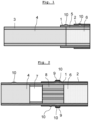
- Fig. 1 illustrates an exemplary structure of a filter cigarette equipped with a tipping paper 1 according to the invention, which comprises a lacquer layer or print 2.
- the substrate of the tipping paper 1 or the lacquer layer or print 2 contains thermally expandable particles.
- a conventional filter cigarette further comprises a cigarette paper 3, which wraps a rod 4 of aerosol-generating substrate, which in a filter cigarette is usually referred to as a tobacco rod.
- a conventional filter cigarette further comprises a filter paper 5, which wraps the filter 6.
- the tipping paper 1 in question can also be used on cigarettes without filters.
- Fig. 2 illustrates an exemplary structure of a heat-not-burn consumer article equipped with a tipping paper 1 according to the invention, which comprises a lacquer layer or print 2.
- the substrate of the tipping paper 1 or the lacquer layer or print 2 contains thermally expandable particles.
- a typical heat-not-burn consumer article further comprises a strand 4 of aerosol-generating substrate, a hollow section 7, a cooling section 8 and a filter 6. These sections may or may not each comprise their own wrapping materials.
- the tipping paper 1 can extend over the entire length of the Heat-Not-Burn consumer article. be multi-layered and, for example, have an inner aluminum layer, at least in the area of the strand 4. Contrary to what is shown, however, a mouthpiece covering paper 1 can also be attached to the heat-not-burn consumer article, which extends only over a partial area of the heat-not-burn consumer article, in which case an additional wrapping material for the strand and optionally also the other components 6, 7, 8 can be present.
- the Heat-Not-Burn consumer article can be heated with an electronic device (Heat-Not-Burn device), whereby the Heat-Not-Burn consumer article is inserted into the device with the strand 4 first, so that the tipping paper 1 and the printing or lacquer layer 2 present thereon are exposed to the user's lips. As shown, it can be provided that no printing or lacquer layer 2 is present in the area in which the strand 4 is present or in the area that is inserted into the device.
- the heat-not-burn consumer article may have a heat source in front of the strand 4, in particular in the form of coal.
- a print or lacquer layer 2 containing thermally expandable particles can be present in the area of the heat source or in the area of the strand 4, so that the raised structure is created when the consumer article is used if the print or lacquer layer 2 is only present in some areas or in a structured manner.
- the printing or varnish layer 2 can, as shown in the Fig. 1 and 2 shown, extend only over a partial area of the tipping paper 1 and are present, for example, only in the rear end of the aerosol-generating consumer article facing away from the strand 4.
- the tipping paper 1 may have perforations, which may be present in the area which is not provided with a print or lacquer layer 2, or by the Printing or varnish layer 2 and the base paper can run.
- the tipping paper 1 can be provided with the printing or lacquer layer 2 over its entire surface, as in Fig. 3 is illustrated.
- the tipping paper 1 may additionally comprise a foil element 9, which may be applied over the printing or lacquer layer 2, or in an area which is not covered by the printing or lacquer layer 2.
- the printing or varnish layer 2 can be a clear varnish layer or a colored varnish layer or a color application of a non-film-forming printing ink or printing ink.
- a clear coat this can be applied to a white base paper or to a color-printed or coated base paper.
- the clear coat can cover a larger area than the color print or coating.
- the colored lacquer layer itself forms the colored coating or the colored area of the tipping paper.
- FIG. 4 A strip of isolated tipping paper 1 is shown in a top view, comprising a base paper, a print or lacquer layer 2, and three foil elements 9.
- the print or lacquer layer 2 is illustrated by the dotted area.
- Fig. 1 to 4 exemplary elevations 10 are shown which can be produced within the scope of the present invention.
- the thermally expanding particles are only present in the base paper or in the substrate of the Mouthpiece tipping paper 1, in particular enclosed therein.
- the thermally expanding particles expand in this partial area and an elevation 10 is formed in the base paper or in the substrate of the mouthpiece tipping paper 1.
- These elevations 10 can be present in an area of the mouthpiece tipping paper 1 which has no printing or varnish layer 2.
- These elevations 10 can also be present in an area of the mouthpiece tipping paper 1 which has a printing or varnish layer 2, wherein the elevations 10 are present beneath the printing or varnish layer 2.
- the thermally expanding particles are contained, for example, in the base paper or in the substrate of the tipping paper 1 and in the printing or lacquer layer 2.
- These elevations 10 can be present in an area of the tipping paper 1 which has no printing or lacquer layer 2.
- These elevations 10 can also be present in an area of the tipping paper 1 which has a printing or lacquer layer 2, wherein the elevations 10 are present under the printing or lacquer layer 2 and in the printing or lacquer layer 2. If the heat is applied over a small area, the expansion of the particles can be limited to the printing or lacquer layer 2, as illustrated by the small elevation 10 on the underside of the consumer article.
- Fig. 2 Also illustrated is a band of a foil element 9, which was applied to the tipping paper 1 by hot stamping. Due to the heat applied during hot stamping, the particles below the band of the foil element 9 are expanded, so that an elevation 10 is present, which is registered with the band of the foil element 9.
- the thermally expanding particles are contained, for example, only in the printing or lacquer layer 2, in particular in the printing or lacquer layer 2.
- heating the tipping paper 1 causes the particles in the printing or lacquer layer 2 to expand, so that the substrate, in particular the base paper, does not have any elevations 10.
- the elevations 10 are present in the printing or lacquer layer 2 and can be formed by local heat exposure with or without the attachment of a foil element 9.
- the foil element 9 can be in the form of a band on the tipping paper 1, as already mentioned, or as in Fig. 4 also illustrated as a locally limited foil element 9, for example in the form of a dot or logo.
- elevations 10 in the print or lacquer layer 2 which are dot-shaped and not covered by foil elements 9.
- the dots can be arranged according to Braille characters.
- the dots or other shapes can also run as a regular pattern across the entire surface of the print or lacquer layer 2.
- a regular pattern of elevations 10 or Braille characters as elevations 10 can of course also be found in the variants of the Fig. 1 and 2 in the substrate or base paper of the tipping paper 1.
- a raised structure or at least one elevation 10 in a flat area where thermally expandable particles are present can be formed by heating with a laser beam which is moved over this area.
- the lettering ABC is written as a raised structure using the laser beam.
- the thermally expandable particles can be present in the substrate or the printing or lacquer layer 2.
- the tipping paper 1 can be without coloured printing
- the thermally expandable particles can be present in the base paper or in a colorless print or transparent lacquer layer 2.
- This colorless print or transparent lacquer layer 2 can be present on the entire surface of the tipping paper 1 or on one or more partial areas. Depending on the energy of the laser beam, this can also cause a color change in the tipping paper 1, so that the structure either only stands out tactilely from the surrounding areas or additionally in color.
- the raised structure or the at least one elevation 10 could be formed by a hot stamp or by heating through the openings of a stencil.
- a print or lacquer layer 2 containing thermally expandable particles can only be present in certain areas on the tipping paper 1.
- Two areas or structures are printed or coated, each represented as the lettering ABC.
- a raised structure or elevation 10 can be created in both areas or just one of the areas.
- the areas with thermally expandable particles do not differ in color from the surrounding surface. This can be achieved by transparent printing or varnishing or by a colored printing or varnishing which is in the background color or the color of the surrounding section.
- the dotted area symbolizes a print that imitates cork.
- the print or lacquer layer 2 in this area can therefore be either transparent or in the color of the imitation cork print.
- the tipping paper 1 in the sense of the outermost wrapping material of an aerosol-generating consumer article, which is not burned during consumption, can be attached to a heat-not-burn consumer article in such a way that it is in the area of the Strand 4 is present.
- the tipping paper 1 preferably has an area with printing or lacquer layer 2 containing thermally expandable particles, which is surrounded or interspersed by an area without thermally expandable particles, wherein this area with thermally expandable particles is heated when heated by a heat-not-burn device.
- the examples are purely illustrative.
- the tipping paper 1 with elevations 10 formed by thermally expanded particles can be present on any type of aerosol-generating consumer article, for example, as wrapping material for cigars or cigarillos or as sheets of wrapping material for hand-rolled cigarettes.
- the tipping paper 1 is to be arranged on the aerosol-generating consumer article such that the printing or lacquer layer 2 is located on the outside of the aerosol-generating consumer article. If the printing or lacquer layer 2 is present only in a partial area, this area can be arranged facing away from the strand 4 or in the area of the strand 4 of a heat-not-burn consumer article.
Landscapes
- Engineering & Computer Science (AREA)
- Mechanical Engineering (AREA)
- Printing Methods (AREA)
- Paper (AREA)
- Laminated Bodies (AREA)
- Cigarettes, Filters, And Manufacturing Of Filters (AREA)
Description
- Die Erfindung betrifft ein Mundstückbelagpapier mit thermisch expandierbaren Partikeln.
- Die Erfindung betrifft insbesondere Mundstückbelagpapier für Zigaretten und Heat-Not-Burn Konsumartikeln bzw. allgemein von Mundstücken von aerosoloerzeugenden Konsumartikeln.
- Das Mundstückbelagpapier, oft auch als "Tippingpapier" oder kurz "Tipping" bezeichnet, ist jener Teil des aerosoloerzeugenden Konsumartikels, welcher beim Rauchen einer Filterzigarette bzw. beim Erhitzen des Heat-Not-Burn Konsumartikels durch die Lippen der Person berührt wird. Das Mundstückbelagpapier umhüllt den Filterteil und ragt üblicherweise in Längsrichtung des Konsumartikels auch geringfügig in den Längsbereich des Tabakstranges bzw. des aerosolerzeugenden Substrats und umhüllt dort das Zigarettenpapier bzw. das Hüllmaterial des aerosolerzeugenden Substrats. Das Mundstückbelagpapier bildet das äußerste Hüllmaterial eines aerosolerzeugenden Konsumartikels und wird im Gegensatz zum Zigarettenpapier bei Verwendung des Konsumartikels nicht verbrannt.
- Das Mundstückbelagpapier ist zumeist tatsächlich ein Papier, es kann aber auch eine Folie sein oder auch ein Verbundmaterial aus mehreren Schichten verschiedener Materialien.
- Oft weist das Mundstückbelagpapier eine Bedruckung auf. Beispielsweise kann diese Bedruckung an Kork erinnern. Es werden aber auch Mundstückbelagpapiere verwendet, welche im Bereich, welcher durch die Lippen berührt wird, weiß vorliegen.
- Aus der
US9307789B2 - Die
WO2019110768A1 offenbart ein wärmeexpandierbares Zentrierelement in Form eines zusätzlichen Elements, das außen am Hüllmaterial vorliegt. Das Zentrierelement ist beispielsweise ein Bimetallelement. - Die
WO2017115196A1 betrifft einen Rauchartikel, welcher selbst eine brennbare Hitzequelle umfasst. Zum Löschen der brennenden Hitzequelle wird diese in ein Rohr bewegt, wobei das Rohr an der Innenseite ein auf Hitze reagierendes Material aufweisen kann, um das Löschen der brennenden Hitzequelle zu unterstützen. - Die der Erfindung zu Grunde liegende Aufgabe ist es, ein strukturiertes Mundstückbelagpapier und ein verbessertes Verfahren zur Herstellung eines strukturierten Mundstückbelagpapiers bereit zu stellen.
- Für das Lösen der Aufgabe wird ein Mundstückbelagpapier gemäß Anspruch 1 vorgeschlagen.
- Das Mundstückbelagpapier enthält thermisch expandierbare Partikel, welche durch Hitzeeinwirkung zur Herstellung einer erhabenen Struktur oder zumindest einer Erhebung expandierbar sind.
- In einer Ausführungsvariante sind die thermisch expandierbaren Partikel im Substrat des Mundstückbelagpapiers enthalten.
- Das Substrat ist bevorzugt Papier, insbesondere ein sogenanntes Basispapier mit einer von Grammatur 30 bis 60 g/m2, besonders bevorzugt 30 bis 50 g/m2.
- Weniger bevorzugt kann das Substrat zusätzlich zum Basispapier eine Folie, insbesondere aus Zellulosehydrat, umfassen. Weniger bevorzugt kann das Substrat aus einer Folie, insbesondere aus Zellulosehydrat, bestehen oder als Laminat aus mehreren Folien vorliegen. In diesen Fällen können die thermisch expandierbaren Partikel in einer Folie enthalten sein.
- Bevorzugt ist das Mundstückbelagpapier tatsächlich ein Papier und die thermisch expandierbaren Partikel sind im Papier enthalten, insbesondere indem diese beim Papierherstellungsprozess in der Fasermatrix des Papiers eingeschlossen werden.
- In einer zweiten Ausführungsvariante sind die thermisch expandierbaren Partikel in einer Bedruckung oder Beschichtung enthalten. Die thermisch expandierbaren Partikel können dabei mit einer nicht-filmbildenden Druckfarbe bzw. Tinte oder einem filmbildenden Klarlack oder Farblack aufgebracht werden.
- Das Expandieren der Partikel erfolgt bevorzugt durch Hitzeeinwirkung bei Transport einer Bahn von Mundstückbelagpapier entlang eines heißen Zylinders bzw. einer heißen Prägewalze einer Hotfoil-Maschine.
- In einer ersten Variante erfolgt dabei lediglich ein Erhitzen, sodass entgegen des herkömmlichen Gebrauchs der Hotfoil-Maschine keine Heißprägefolie aufgebracht wird.
- In einer zweiten Variante wird zusätzlich zum Erhitzen bzw. mit dem Erhitzen eine Heißprägefolie aufgebracht. Dadurch liegt an den erhabenen Bereichen, welche durch die expandierten Partikel hervorgerufen werden, eine Heißprägefolie vor, welche die erhabenen Bereiche zusätzlich optisch hervorheben kann.
- Das Expandieren kann auch mit anderen Maschinen vorgenommen werden, welche ein gezieltes bzw. strukturiertes Erhitzen der Bahn des Mundstückbelagpapiers ermöglichen, beispielsweise Thermodrucker, insbesondere thermische Brailledrucker.
- In einer anderen Variante erfolgt das Erhitzen am Mundstückbelagpapier, wenn dieses bereits an einer aerosolerzeugenden Konsumware vorliegt. Das Mundstückbelagpapier bildet dabei die äußere Lage der Konsumware. Das Erhitzen erfolgt dabei bevorzugt bevor die Konsumware für den Verkauf verpackt wird. In einer anderen Variante erfolgt das Erhitzen erst beim Gebrauch der Konsumware durch den Konsumenten, beispielsweise durch Erhitzen in einem Heat not Burn Gerät.
- In einer Ausführungsvariante wird eine Bedruckung oder Beschichtung, welche thermisch expandierbare Partikel aufweist, flächig am Mundstückbelagpapier aufgebracht, wobei die spätere Struktur durch Erhitzen mit einer strukturierten Oberfläche gebildet wird.
- In einer Ausführungsvariante wird eine Bedruckung oder Beschichtung, welche thermisch expandierbare Partikel aufweist, strukturiert am Mundstückbelagpapier aufgebracht. In diesem Fall kann die spätere Struktur auch durch flächiges Erhitzen mit einer Oberfläche gebildet werden oder durch Erhitzen eines aerosolerzeugenden Konsumartikels, welcher mit dem Mundstückbelagpapier versehen ist.
- In einer Ausführungsvariante wird ein flächiger Bereich mit der Bedruckung oder Beschichtung versehen, welcher Bereich sich bandförmig entlang einer ganzen Seite des Mundstückbelagpapiers erstreckt, sodass am aerosolerzeugenden Produkt ein ringförmiger Bereich mit thermisch expandierbaren Partikeln vorliegt.
- Das Expandieren wird bevorzugt an einem kontinuierlich bewegten Band von Mundstückbelagpapier ausgeführt, wobei dieses zwischen zwei Walzen (Prägewalze und Gegendruckwalze) mit der thermisch expandierten Struktur versehen wird, indem die Prägestruktur der Prägewalze durch Hitze und Druck auf das Mundstückbelagpapier übertragen wird.
- In einer Ausführungsvariante werden die expandierbaren Partikel mit einem Lack aufgebracht und sind am Mundstückbelagpapier somit in einer Lackschicht enthalten.
- Als Lack ist eine filmbildende Substanz zu verstehen.
- In einer ersten Ausführungsvariante ist der Lack ein Klarlack, welcher zu einer transparenten Lackschicht aushärtet.
- Besonders bevorzugt ist der Klarlack Nitrozelluloselack.
- Der Klarlack umfasst bevorzugt Nitrozellulose oder Ethylzellulose die thermisch expandierbaren Partikel und ein oder mehrere Lösemittel ausgewählt aus der Gruppe von Lösemitteln umfassend: Ethanol, Ethylacetat, Isopropanol. Die genannten Lösemittel können als wässrige Lösung vorliegen, sodass der Lack thermisch expandierbare Partikel, Nitrozellulose oder Ethylzellulose, ein organisches Lösemittel und Wasser umfasst. Der Klarlack kann zudem Effektpigmente umfassen.
- Der Auftrag der Klarlackzusammensetzung erfolgt bevorzugt in einer Menge von 0,25 g/m2 bis 2 g/m2, besonders bevorzugt 0,5 g/m2 bis 1 g/m2.
- In einer zweiten Ausführungsvariante ist der Lack ein Farblack, welcher zu einer farbigen Lackschicht aushärtet.
- Der Farblack umfasst Nitrozellulose oder Ethylzellulose, die thermisch expandierbaren Partikel und Farbpigmente und ein oder mehrere Lösemittel ausgewählt aus der Gruppe von Lösemitteln umfassend: Ethanol, Ethylacetat, Isopropanol. Die genannten Lösemittel können als wässrige Lösung vorliegen, sodass der Farblack Nitrozellulose oder Ethylzellulose, Farbpigmente und ein organisches Lösemittel und Wasser umfasst. Der Farblack kann zudem Zusatzstoffe wie Additive und/oder Füllstoffe enthalten.
- Der Farblack kann zudem Effektpigmente umfassen.
- Der Auftrag der Farblackzusammensetzung erfolgt bevorzugt in einer Menge von 0,25 g/m2 bis 8 g/m2, besonders bevorzugt 1 g/m2 bis 4 g/m2.
- Der Farblack wird in Form einer einfärbigen Beschichtung der Oberfläche aufgetragen. Die Beschichtung kann als ein Band oder mehrere zueinander beabstandete Bänder vorliegen. Die Lackzusammensetzung weist bevorzugt eine Viskosität von 8 bis 16 Sekunden, insbesondere 10-14 Sekunden auf. Der Wert der Viskosität wird mit einem Auslaufbechertest mit einem Becherdurchmesser von 4mm (ISO Becher 4 mm nach EN ISO 2431 Version 1993-02-15) bestimmt.
- Der Auftrag des Klarlacks oder Farblacks erfolgt bevorzugt durch Tiefdruck, insbesondere Rotationstiefdruck.
- Der Auftrag der Lackschicht erfolgt bevorzugt in 1, weniger bevorzugt 2, Lagen.
- Der Auftrag erfolgt bevorzugt direkt auf das Basispapier des Mundstückbelagpapiers.
- Das Basispapier weist bevorzugt eine Grammatur von 30 bis 60 g/m2 auf, besonders bevorzugt 30 bis 50 g/m2.
- Der Auftrag des Lacks erfolgt bevorzugt auf eine unbehandelte Oberfläche des Basispapiers. Das Basispapier ist somit bevorzugt nicht gestrichen ausgeführt.
- In einer Ausführungsvariante erfolgt die Beschichtung in Form von einem oder mehreren Bändern eines Farblacks, welche auf weißem Basispapier vorliegen. Das beschichtete Mundstückbelagpapier weißt bevorzugt zumindest einen weißen Bereich und einen Bereich mit Farbschicht auf, wobei diese bevorzugt bandförmig in Umfangsrichtung der aerosolerzeugenden Konsumware verlaufen.
- In einer Ausführungsvariante werden die expandierbaren Partikel mit einer wasserbasierten Druckfarbe aufgebracht und sind am Mundstückbelagpapier somit in der Bedruckung enthalten.
- Die wasserbasierte Druckfarbe weist bevorzugt eine Viskosität von 15 bis 60 Sekunden, besonders bevorzugt 16-35 Sekunden, insbesondere 16-21 Sekunden auf.
- Der Auftrag der wasserbasierten Druckfarbe erfolgt bevorzugt in einer Menge von 0,25 g/m2 bis 8 g/m2, besonders bevorzugt 1 g/m2 bis 4 g/m2.
- Bevorzugt weißt das Mundstückbelagpapier einen Farbauftrag auf, welcher das Aussehen von Kork nachahmt.
- Der Farbauftrag kann in einer Ausführungsvariante wie bereits beschrieben eine Farblackschicht sein.
- Der Farbauftrag kann in einer zweiten Ausführungsvariante eine nicht-filmbildende Beschichtung oder Bedruckung sein, beispielsweise in Form einer Farbtinte oder Druckfarbe, wobei über der farbigen Beschichtung wie oben beschrieben Klarlack aufgebracht sein kann. Die Klarlackschicht liegt dabei bevorzugt flächig über das gesamte Mundstückbelagpapier oder registriert zu einer bandförmigen Farbschicht oder mehreren bandförmigen Farbschichten vor. Die expandierbaren Partikel können in der Farbtinte oder Druckfarbe und/oder in der Klarlackschicht enthalten sein.
- Der Auftrag der Farbtinte und/oder des Lacks erfolgt auf eine kontinuierlich bewegte Materialbahn des Basispapiers. Nach dem Auftrag wird die Materialbahn bevorzugt durch eine Trocknungsvorrichtung bewegt.
- Als Trocknungsvorrichtungen werden bevorzugt Heiztrockner eingesetzt, insbesondere Heißlufttrockner und/oder beheizte Walzen. Weniger bevorzugt können alternativ oder zusätzlich auch Infrarotstrahler eingesetzt werden.
- Das Trocknen erfolgt bevorzugt bei Temperaturen, welche unterhalb der Expansionstemperatur der Partikel liegen.
- Wenn die expandierbaren Partikel in einer bereichsweise oder strukturiert aufgetragenen Bedruckung oder Lackschicht enthalten sind, kann die Trocknung auch über der Expansionstemperatur erfolgen, sodass die Erhebung bei der Trocknung gebildet wird.
- Nach dem Trocknen der Lackschicht wird die Materialbahn zu einer Bobine aufgerollt oder direkt einer Prägevorrichtung oder Hotfoil-Maschine zur Herstellung der thermisch expandierten Struktur zugeführt. Nach Herstellung der Struktur wird die Materialbahn zu einer Bobine aufgerollt oder die strukturierte Materialbahn einer Zigarettenherstellungsmaschine zugeführt.
- Das Mundstückbelagpapier kann in der Hotfoil-Maschine mit Folien-Elementen, insbesondere metallischen Folien-Elementen, versehen werden. Diese liegen insbesondere als dünne Bänder oder Logos vor.
- Das Heißprägen erfolgt nach bekannten Verfahren, wobei das Folienelement durch Druck und Hitze von einem Transferelement auf das Mundstückbelagpapier aufgebracht wird. Die Bereiche des Mundstückbelagpapiers, welche mit den Folienelementen versehen werden, werden beim Heißprägeverfahren stärker erhitzt, sodass die unter einem Folienelement befindlichen Partikel expandieren.
- Die Erfindung umfasst auch eine Anlage zur Herstellung eines Mundstückbelagpapiers, umfassend:
- eine Maschine zur Bedruckung oder Beschichtung des Mundstückbelagpapiers mit Druckfarbe oder Lack,
- eine Maschine zum Heißprägen des Mundstückbelagpapiers.
- Optional kann noch eine Maschine zum Beschichten des Mundstückbelagpapiers mit Tinte der Maschine zur Beschichtung des Mundstückbelagpapiers mit Lack vorgeordnet sein oder die Maschine zur Beschichtung des Mundstückbelagpapiers mit Lack zudem Mittel zur Beschichtung mit einer weiteren Druckfarbe aufweisen.
- Optional kann zudem eine Maschine zum Bedrucken des Mundstückbelagpapiers vorhanden sein, welche mehrfärbige Logos auf das Mundstückbelagpapier aufdruckt.
- Das Mundstückbelagpapier wird als Band durch die jeweilige Maschine bewegt, wobei der Auftrag von Druckfarbe oder Lack und das Heißprägen bevorzugt jeweils kontinuierlich in Längsrichtung des Bandes erfolgt.
- In einer vorteilhaften Ausführungsvariante wird das Band des Mundstückbelagpapiers nicht von einer Maschine zur nächsten übergeben, sondern nach der jeweiligen Maschine zu einer Bobine aufgewickelt und an die nächste Maschine übergeben.
- Das Band, welches durch die Maschine zur Beschichtung des Mundstückbelagpapiers mit Druckfarbe oder Lack bewegt wird, ist quer zur Bewegungsrichtung aus mehreren Mundstückbelagpapieren zusammengesetzt, wobei jene Richtung des Mundstückbelagpapiers, welche quer zur Bewegungsrichtung, also entlang der Breite des Bandes vorliegt, später in Längsrichtung des Konsumartikels angeordnet ist.
- Bevorzugt weist die Maschine zur Bedruckung oder Beschichtung des Mundstückbelagpapiers mit Druckfarbe oder Lack eine Schneidevorrichtung auf, welche das Band nach dem Versehen mit der Druckfarbe oder Lackschicht in Längsrichtung schneidet, sodass zumindest zwei schmälere Bänder aus mit Druckfarbe oder Lack beschichteten Mundstückbelagpapieren erhalten werden, welche jeweils zu einer Bobine aufgewickelt werden.
- Bevorzugt werden diese Bobinen mit schmäleren Bändern der Maschine zum Heißprägen des Mundstückbelagpapiers zugeführt.
- Als thermisch expandierbare Partikel eignen sich insbesondere expandierbare Mikrokugeln, welche bei Hitzeeinwirkung zu Hohlkugeln mit einem größeren Volumen expandieren. Die expandierbaren Mikrokugeln können ein Gas oder eine Flüssigkeit enthalten, welches Gas sich unter Hitzeeinwirkung ausdehnt bzw. welche Flüssigkeit unter Volumenzuwachs verdampft. Die Verformung ist dabei irreversibel bzw. bleibt nach dem Abkühlen bestehen.
- Die thermisch expandierbaren Partikel liegen bevorzugt als thermoplastische Polymerpartikel oder Gelpartikel vor.
- Die Expansion der Partikel erfolgt vorzugsweise durch Kontakttechnik. Dabei wird eine erhabene Struktur einer heißen Oberfläche als erhabene Struktur auf das Mundstückbelagapiers übertragen. Dies steht im Gegensatz zu herkömmlichen Prägevorgängen, bei welchen die erhabene Struktur einer Oberfläche als Vertiefungen auf das Mundstückbelagapier übertragen wird.
- Die Expansion der Partikel kann auch kontaktlos erfolgen, indem beispielsweise der zu expandierende Teilbereich mit einem Laserstrahl erhitzt wird.
- Die expandierbaren Partikel weisen bevorzugt eine Expansionstemperatur von 100°C bis 250°C auf.
- Die expandierbaren Partikel liegen bevorzugt im nicht expandierten Zustand mit einer mittleren Partikelgröße von 1 µm bis 50 µm vor. Bei der Expansion vergrößert sich ihr Durchmesser bevorzugt auf das fünffache bis fünfzehnfache.
- Neben Mikrohohlkugeln aus Polymer können auch anorganische Partikel wie Blähglimmer, Blähgraphit oder Perlit verwendet werden.
- In einer Ausführungsvariante wird das Mundstückbelagpapier punktuell mittels Laserstrahl erhitzt. Dadurch kann das Mundstückbelagpapier direkt nach der Bedruckung oder Beschichtung oder an der Zigarettenmaschine oder an der fertigen Zigarette vor Verpackung mittels Laser mit einer strukturierten Oberfläche versehen werden. Durch den Laser können feine Linien, Logos, Codes, QR-Codes oder Firmensymbole (Wappen, Erkennungszeichen usw.) als erhabene Struktur an Bereichen des Mundstückbelagpapiers erzeugt werden, an welchen thermisch expandierbare Partikel vorliegen. Der Laser kann dabei Zeile für Zeile über die Oberfläche des Mundstückbelagpapiers bewegt werden, wobei nur an den später erhabenen Flächen der Laserstrahl auf das Mundstückbelagpapier trifft bzw. der Laser an ist. Der Laserstrahl kann auch entsprechend einer vordefinierten Bahn entlang von zwei Koordinaten über die Oberfläche des Mundstückbelagpapiers bewegt werden. Wenn das Bestrahlen mit dem Laserstrahl an einer kontinuierlich bewegten Bahn des Mundstückbelagpapiers erfolgt kann eine Bewegung des Laserstrahls quer zur Transportrichtung des Mundstückbelagpapiers ausreichen.
- Die Bahn des Laserstrahls und/oder das Ein-Aus Muster des Laserstrahls kann individuell programmiert werden, sodass unterschiedlich geformte Erhebungen am Mundstückbelagpapier realisierbar sind. In einer Ausführungsvariante können sich die Erhebungen von in Bahnrichtung aufeinanderfolgenden Mundstückbelagpapieren in ihrer Form oder Lage oder bei Vorliegen eines Codes in ihrer Bedeutung voneinander unterscheiden. In einer Ausführungsvariante können sich die Erhebungen von quer zur Bahnrichtung aufeinanderfolgenden Mundstückbelagpapieren in ihrer Form oder Lage oder bei Vorliegen eines Codes in ihrer Bedeutung voneinander unterscheiden.
- In einer anderen Ausführungsvariante wird das Mundstückbelagpapier nur bereichsweise mit einem Lack oder einer wasserbasierten Druckfarbe versehen, wobei die thermisch expandierbaren Partikel im Lack oder in der Druckfarbe enthalten sind. Dadurch liegen die expandierbaren Partikel nur bereichsweise am Mundstückbelagpapier vor, sodass das Mundstückbelagpapier zumindest einen Bereich mit expandierbaren Partikeln aufweist und zumindest einen Bereich ohne expandierbare Partikel. Zumindest einer der Bereiche kann als Symbol, Code oder Muster vorliegen. Der Lack oder die wasserbasierte Bedruckung kann dabei transparent oder entsprechend der Farbe des Untergrunds oder des nicht mit diesem Lack oder dieser wasserbasierten Bedruckung versehenen Bereichs des Mundstückbelagpapiers vorliegen. Dadurch ist der Bereich, welcher expandierbare Partikel aufweist optisch nicht vom Bereich, welcher keine expandierbaren Partikel aufweist, unterscheidbar. Erst durch Erhitzen werden die Bereiche taktil und dadurch ggf. auch optisch unterscheidbar, da sich nach dem Erhitzen die Bereiche, welche expandierbare Partikel aufweisen, reliefartig von den anderen Bereichen abheben.
- Das Erhitzen kann dabei am Bahnmaterial des Mundstückbelagpapiers, an der Zigarettenmaschine oder an einem fertigen aerosolerzeugenden Konsumartikel vor, während oder nach dem Gebrauch erfolgen.
- Durch diese Ausführungsvariante lässt sich ein zunächst nicht erkennbares Sicherheitsmerkmal realisieren, welches durch Erhitzen detektierbar gemacht werden kann, um Produktfälschungen, welche dieses Sicherheitsmerkmal nicht aufweisen, nachweisen zu können.
- Die Erfindung wird an Hand von Zeichnungen veranschaulicht:
- Fig. 1
- : veranschaulicht die Anwendung eines beispielhaften erfindungsgemäßen Mundstückbelagpapiers an einer Filterzigarette.
- Fig. 2
- : veranschaulicht die Anwendung eines beispielhaften erfindungsgemäßen Mundstückbelagpapiers an einem Heat-not-Burn Konsumartikel.
- Fig. 3
- : veranschaulicht die Anwendung eines beispielhaften erfindungsgemäßen Mundstückbelagpapiers an einer Filterzigarette.
- Fig. 4
- : veranschaulicht ein beispielhaftes erfindungsgemäßes Mundstückbelagpapier.
- Fig. 5
- : veranschaulicht die Herstellung einer Erhebung mittels Laser.
- Fig. 6
- : veranschaulicht ein weiteres beispielhaftes erfindungsgemäßes Mundstückbelagpapier.
-
Fig. 1 veranschaulicht einen beispielhaften Aufbau einer Filterzigarette, welche mit einem erfindungsgemäßen Mundstückbelagpapier 1 ausgestattet ist, welches eine Lackschicht oder Bedruckung 2 umfasst. Das Substrat des Mundstückbelagpapiers 1 oder die Lackschicht oder Bedruckung 2 enthält thermisch expandierbare Partikel. - Eine übliche Filterzigarette umfasst weiters ein Zigarettenpapier 3, welches einen Strang 4 aus aerosolerzeugendem Substrat umhüllt, welcher bei einer Filterzigarette meist als Tabakstrang bezeichnet wird. Eine übliche Filterzigarette umfasst weiters ein Filterpapier 5, welches den Filter 6 umhüllt. Das gegenständliche Mundstückbelagpapier 1 kann aber auch an Zigaretten ohne Filter vorgesehen sein.
-
Fig. 2 veranschaulicht einen beispielhaften Aufbau eines Heat-Not-Burn Konsumartikels, welcher mit einem erfindungsgemäßen Mundstückbelagpapier 1 ausgestattet ist, welches eine Lackschicht oder Bedruckung 2 umfasst. Das Substrat des Mundstückbelagpapiers 1 oder die Lackschicht oder Bedruckung 2 enthält thermisch expandierbare Partikel. - Ein üblicher Heat-Not-Burn Konsumartikel umfasst weiters einen Strang 4 aus aerosolerzeugendem Substrat, einen hohlen Abschnitt 7, einen Abkühlabschnitt 8 und einen Filter 6. Diese Abschnitte können jeweils eigene Hüllmaterialien umfassen oder nicht.
- Da beim Heat-Not-Burn Konsumartikel eine Erhitzung des Strangs 4 ohne Verbrennung des Hüllmaterials erfolgt, kann sich das Mundstückbelagpapier 1 über die gesamte Länge des Heat-Not-Burn Konsumartikels erstrecken. Das Mundstückbelagpapier 1 kann dabei mehrlagig ausgeführt sein und beispielsweise eine innenliegende Aluminiumlage, zumindest im Bereich des Strangs 4, aufweisen. Anders als dargestellt, kann aber auch beim Heat-Not-Burn Konsumartikel ein Mundstückbelagpapier 1 angebracht sein, welches sich nur über einen Teilbereich des Heat-Not-Burn Konsumartikels erstreckt, wobei in diesem Fall ein zusätzliches Hüllmaterial für den Strang und optional auch die weiteren Komponenten 6, 7, 8 vorhanden sein kann.
- Der Heat-Not-Burn Konsumartikel kann mit einem elektronischen Gerät (Heat-Not-Burn Gerät) erhitzt werden, wobei der Heat-Not-Burn Konsumartikel mit dem Strang 4 voran in das Gerät eingeführt wird, sodass das Mundstückbelagpapier 1 und die daran vorliegende Bedruckung oder Lackschicht 2 für die Lippen des Nutzers freiliegen. Wie dargestellt, kann vorgesehen sein, dass in jenem Bereich, in welchem der Strang 4 vorliegt, bzw. in jenem Bereich, welcher in das Gerät geführt wird, keine Bedruckung oder Lackschicht 2 vorhanden ist.
- In einer anderen bekannten Ausführung kann der Heat-Not-Burn Konsumartikel vor dem Strang 4 eine Hitzequelle aufweisen, insbesondere in Form von Kohle.
- Eine Bedruckung oder Lackschicht 2, welche thermisch expandierbare Partikel enthält, kann im Bereich der Hitzequelle oder im Bereich des Stranges 4 vorliegen, sodass die erhabene Struktur bei Verwendung des Konsumartikels entsteht, wenn die Bedruckung oder Lackschicht 2 nur bereichsweise bzw. strukturiert vorliegt.
- Die Bedruckung oder Lackschicht 2 kann sich, wie in den
Fig. 1 und 2 dargestellt, nur über einen Teilbereich des Mundstückbelagpapiers 1 erstrecken und beispielsweise nur im hinteren, dem Strang 4 abgewandten Ende des aerosolerzeugenden Konsumartikels vorliegen. - Das Mundstückbelagpapier 1 kann Perforationen aufweisen, welche in jenem Bereich, welcher nicht mit einer Bedruckung oder Lackschicht 2 versehen ist, vorliegen können, oder durch die Bedruckung oder Lackschicht 2 und das Basispapier verlaufen können.
- In einer anderen Ausführungsvariante kann das Mundstückbelagpapier 1 vollflächig mit der Bedruckung oder Lackschicht 2 versehen sein, wie in
Fig. 3 veranschaulicht ist. - Wie in den
Figuren 2 bis 4 veranschaulicht ist, kann das Mundstückbelagpapier 1 zusätzlich ein Folienelement 9 aufweisen, wobei dieses über der Bedruckung oder Lackschicht 2 angebracht sein kann, oder in einem Bereich, welcher nicht von der Bedruckung oder Lackschicht 2 bedeckt ist. - Die Bedruckung oder Lackschicht 2 kann eine Klarlackschicht oder eine Farblackschicht sein oder ein Farbauftrag einer nicht-filmbildenden Druckfarbe oder Drucktinte.
- Im Fall einer Klarlackschicht kann diese auf weißem Basispapier vorliegen oder auf farbig bedrucktem oder beschichtetem Basispapier. Die Klarlackschicht kann dabei einen größeren Bereich abdecken als die farbige Bedruckung oder Beschichtung.
- Im Fall einer Farblackschicht bildet die Farblackschicht selbst die farbige Beschichtung bzw. den farbigen Bereich des Mundstückbelagpapiers.
- In
Fig. 4 ist ein Streifen eines vereinzelten Mundstückbelagpapiers 1 in Ansicht von oben dargestellt, welches ein Basispapier, eine Bedruckung oder Lackschicht 2, und drei Folienelemente 9 umfasst. Die Bedruckung oder Lackschicht 2 wird durch die gepunktete Fläche veranschaulicht. - Dadurch, dass das Basispapier des Mundstückbelagpapiers 1 oder die Bedruckung oder Lackschicht 2 thermisch expandierbare Partikel enthält, kann eine an der Oberfläche taktil wahrnehmbare Struktur erzeugt werden. In den
Fig. 1 bis 4 sind bespielhafte Erhebungen 10 dargestellt, welche im Rahmen der gegenständlichen Erfindung herstellbar sind. - Im Beispiel der
Fig. 1 sind die thermisch expandierenden Partikel beispielsweise nur im Basispapier bzw. im Substrat des Mundstückbelagpapiers 1 enthalten, insbesondere in diesem eingeschlossen. Bei Erhitzen eines Teilbereichs des Mundstückbelagpapiers 1 expandieren in diesem Teilbereich die thermisch expandierenden Partikel und es entsteht eine Erhebung 10 im Basispapier bzw. im Substrat des Mundstückbelagpapiers 1. Diese Erhebungen 10 können in einem Bereich des Mundstückbelagpapiers 1 vorliegen, welcher keine Bedruckung oder Lackschicht 2 aufweist. Diese Erhebungen 10 können auch in einem Bereich des Mundstückbelagpapiers 1 vorliegen, welcher eine Bedruckung oder Lackschicht 2 aufweist, wobei die Erhebungen 10 unter der Bedruckung oder Lackschicht 2 vorliegen. - Im Beispiel der
Fig. 2 sind die thermisch expandierenden Partikel beispielsweise im Basispapier bzw. im Substrat des Mundstückbelagpapiers 1 und in der Bedruckung oder Lackschicht 2 enthalten. Diese Erhebungen 10 können in einem Bereich des Mundstückbelagpapiers 1 vorliegen, welcher keine Bedruckung oder Lackschicht 2 aufweist. Diese Erhebungen 10 können auch in einem Bereich des Mundstückbelagpapiers 1 vorliegen, welcher eine Bedruckung oder Lackschicht 2 aufweist, wobei die Erhebungen 10 unter der Bedruckung oder Lackschicht 2 und in der Bedruckung oder Lackschicht 2 vorliegen. Wenn die Hitzeeinwirkung kleinflächig erfolgt, kann die Expansion der Partikel auf die Bedruckung oder Lackschicht 2 beschränkt erfolgen, wie an der kleinen Erhebung 10 an der Unterseite des Konsumartikels veranschaulicht ist. - In
Fig. 2 ist zudem ein Band eines Folienelements 9 veranschaulicht, welches durch Heißprägen am Mundstückbelagpapier 1 aufgebracht wurde. Durch die Hitzeeinwirkung beim Heißprägen liegen die Partikel unterhalb des Bandes des Folienelements 9 expandiert vor, sodass eine Erhebung 10 vorliegt, welche registriert zum Band des Folienelements 9 vorliegt. - In
Fig. 3 und 4 ist veranschaulicht, dass die thermisch expandierenden Partikel beispielsweise nur in der Bedruckung oder Lackschicht 2 enthalten sind, insbesondere in der Bedruckung oder Lackschicht 2 eingeschlossen sind. Das Erhitzen des Mundstückbelagpapiers 1 bewirkt in diesem Fall ein Expandieren der Partikel in der Bedruckung oder Lackschicht 2, sodass das Substrat, insbesondere Basispapier keine Erhebungen 10 aufweist. Das inFig. 4 veranschaulichte Folienelement 9 im Bereich des nicht mit der Bedruckung oder Lackschicht 2 versehenen Substrats bewirkt somit keine Erhebung 10. Wie inFig. 3 und Fig. 4 veranschaulicht ist, liegen die Erhebungen 10 in der Bedruckung oder Lackschicht 2 vor und können durch lokale Hitzeeinwirkung mit oder ohne Anbringung eines Folienelements 9 gebildet werden. Das Folienelement 9 kann wie bereits erwähnt bandförmig am Mundstückbelagpapier 1 vorliegen, oder wie inFig. 4 zudem veranschaulicht, als lokal begrenztes Folienelement 9, beispielsweise in Form eines Punktes oder Logos. - In den
Fig. 3 und 4 sind zudem Erhebungen 10 in der Bedruckung oder Lackschicht 2 dargestellt, welche punktförmig vorliegen und nicht mit Folienelementen 9 überdeckt sind. Die Punkte können entsprechend von Zeichen der Brailleschrift angeordnet sein. Die Punkte oder andere Formen können auch als regelmäßiges Muster über die gesamte Oberfläche der Bedruckung oder Lackschicht 2 verlaufen. - Ein regelmäßiges Muster von Erhebungen 10 oder Zeichen der Brailleschrift als Erhebungen 10 können natürlich auch bei den Varianten der
Fig. 1 und 2 im Substrat bzw. Basispapier des Mundstückbelagpapiers 1 vorliegen. - Wie in
Fig. 5 veranschaulicht ist, kann eine erhabene Struktur bzw. zumindest eine Erhebung 10 in einem flächigen Bereich, an welchem thermisch expandierbare Partikel vorliegen, durch Erhitzen mit einem Laserstrahl gebildet werden, welcher über diesen Bereich bewegt wird. Im Beispiel derFig. 5 wird mit dem Laserstrahl der Schriftzug ABC als erhabene Struktur geschrieben. Die thermisch expandierbaren Partikel können dabei im Substrat oder der Bedruckung oder Lackschicht 2 vorliegen. Im Beispiel derFig. 5 ist zudem veranschaulicht, dass das Mundstückbelagpapier 1 ohne farbige Bedruckung vorliegen kann, wobei die thermisch expandierbaren Partikel dabei im Basispapier oder einer farblosen Bedruckung oder transparenten Lackschicht 2 vorliegen können. Diese farblose Bedruckung oder transparente Lackschicht 2 kann an der gesamten Fläche des Mundstückbelagpapiers 1 oder an einem oder mehreren Teilbereichen vorliegen. Je nach Energie des Laserstrahls kann dieser auch eine Farbänderung des Mundstückbelagpapiers 1 hervorrufen, sodass die Struktur sich entweder nur taktil von den umgebenden Bereichen abhebt oder zusätzlich im Farbton. - Anstelle eines Laserstrahls könnten die erhabene Struktur bzw. die zumindest eine Erhebung 10 durch einen heißen Stempel oder durch Erhitzen durch die Öffnungen einer Schablone hindurch gebildet sein.
- Wie in
Fig. 6 veranschaulicht ist, kann eine Bedruckung oder Lackschicht 2 enthaltend thermisch expandierbare Partikel nur bereichsweise am Mundstückbelagpapier 1 vorliegen. Im Beispiel derFig. 6 sind zwei Bereiche bzw. Strukturen aufgedruckt bzw. beschichtet, welche jeweils als Schriftzug ABC dargestellt sind. Durch Erhitzung des Mundstückbelagpapiers 1 oder des jeweiligen Bereichs, kann in beiden Bereichen oder auch nur einem der Bereiche eine erhabene Struktur bzw. eine Erhebung 10 erzeugt werden. Wie dargestellt ist bevorzugt, dass sich die Bereiche mit thermisch expandierbaren Partikeln farblich nicht von der umgebenden Oberfläche unterscheiden. Dies kann durch transparente Bedruckung oder Lackierung erfolgen oder dadurch, dass eine farbige Bedruckung oder Lackierung erfolgt, welche in der Untergrundfarbe bzw. der Farbe des umgebenden Abschnitts vorliegt. Im Beispiel derFig. 6 symbolisiert der gepunktete Bereich eine Bedruckung, welche Kork nachahmt. Die Bedruckung oder Lackschicht 2 in diesem Bereich kann somit entweder transparent oder im Farbton der Korkimitat-Bedruckung erfolgen. - Das Mundstückbelagpapier 1 im Sinne des äußersten Hüllmaterials eines aerosolerzeugenden Konsumartikels, welches beim Konsum nicht verbrannt wird, kann so an einem Heat-not-Burn Konsumartikel angebracht sein, dass dieses im Bereich des Stranges 4 vorliegt. Das Mundstückbelagpapier 1 weist dabei bevorzugt einen Bereich mit Bedruckung oder Lackschicht 2 enthaltend thermisch expandierbare Partikel auf, welcher von einem Bereich ohne thermisch expandierbare Partikel umgeben oder durchsetzt ist, wobei dieser Bereich mit thermisch expandierbaren Partikel beim Erhitzen durch ein Heat-Not-Burn Gerät erhitzt wird.
- Die Beispiele sind rein erläuternd zu verstehen. Das Mundstückbelagpapier 1 mit Erhebungen 10, welche durch thermisch expandierte Partikel gebildet sind, kann an jeder Art von aerosolerzeugendem Konsumartikel vorliegen, beispielsweise als Hüllmaterial von Zigarren oder Zigarillos oder auch als Blätter von Hüllmaterial für selbst zu rollende Zigaretten.
- Das Mundstückbelagpapier 1 ist derart an dem aerosolerzeugenden Konsumartikel anzuordnen, dass die Bedruckung oder Lackschicht 2 an der Außenseite des aerosolerzeugenden Konsumartikels liegt. Sofern die Bedruckung oder Lackschicht 2 nur in einem Teilbereich vorliegt, so kann dieser abgewandt vom Strang 4 angeordnet sein, oder im Bereich des Strangs 4 eines Heat-Not-Burn Konsumartikels.
Claims (14)
- Mundstückbelagpapier (1), welches durch Hitzeeinwirkung mit zumindest einer Erhebung (10) versehbar ist, dadurch gekennzeichnet, dass das Mundstückbelagpapier thermisch expandierbare Partikel umfasst, welche im Substrat des Mundstückbelagpapiers (1) oder einer Bedruckung oder Lackschicht (2) vorliegen, welche Bedruckung oder Lackschicht (2) auf dem Substrat des Mundstückbelagpapiers (1) vorliegt.
- Mundstückbelagpapier (1) nach Anspruch 1 dadurch gekennzeichnet, dass dieses zumindest eine Erhebung (10) aufweist, wobei die Erhebung (10) durch thermisch expandierte Partikel gebildet ist, welche durch Hitzeeinwirkung auf das Mundstückbelagpapier (1) aus den thermisch expandierbaren Partikel gebildet sind.
- Mundstückbelagpapier (1) nach einem der Ansprüche 1 bis 2, dadurch gekennzeichnet, dass die thermisch expandierbaren Partikel im Substrat des Mundstückbelagpapiers (1) vorliegen und das Substrat Papier ist.
- Mundstückbelagpapier (1) nach einem der Ansprüche 1 bis 3, dadurch gekennzeichnet, dass die thermisch expandierbaren Partikel in der Bedruckung oder Lackschicht (2) vorliegen.
- Mundstückbelagpapier (1) nach Anspruch 4, dadurch gekennzeichnet, dass die Bedruckung oder Lackschicht (2), welche die thermisch expandierbaren Partikel enthält, nur bereichsweise am Mundstückbelagpapier (1) vorliegt, sodass das Mundstückbelagpapier zumindest einen Oberflächenbereich aufweist, an welchem thermisch expandierbare Partikel vorliegen und zumindest einen Oberflächenbereich aufweist, an welchem keine thermisch expandierbaren Partikel vorliegen.
- Mundstückbelagpapier (1) nach Anspruch 5, dadurch gekennzeichnet, dass sich zumindest ein Oberflächenbereich, an welchem thermisch expandierbare Partikel vorliegen von zumindest einem Oberflächenbereich, an welchem keine thermisch expandierbaren Partikel vorliegen, optisch nicht unterscheidet, wobei die Bereiche nach Hitzeeinwirkung aufgrund der expandierten Partikel unterscheidbar sind.
- Mundstückbelagpapier (1) nach einem der Ansprüche 1 bis 6, dadurch gekennzeichnet, dass die Bedruckung oder Lackschicht (2) durch Auftrag einer Druckfarbe, Drucktinte, Klarlackschicht oder Farblackschicht gebildet ist.
- Mundstückbelagpapier (1) nach einem der Ansprüche 1 bis 7, dadurch gekennzeichnet, dass über der zumindest einen Erhebung (10) ein Folienelement (9) vorliegt.
- Verfahren zur Herstellung eines Mundstückbelagpapiers (1) welches zumindest eine Erhebung (10) aufweist, dadurch gekennzeichnet, dass ein Mundstückbelagpapier (1), welches thermisch expandierbare Partikel im Substrat des Mundstückbelagpapiers (1) oder einer Bedruckung oder Lackschicht (2) am Substrat aufweist, mit einer heißen Oberfläche in Kontakt gebracht wird oder von einem Laserstrahl bestrahlt wird, sodass die thermisch expandierbaren Partikel in jenen Bereichen des Mundstückbelagpapiers (1), welche in Kontakt mit der heißen Oberfläche stehen oder vom Laserstrahl erhitzt werden, expandieren und die Erhebung (10) bilden.
- Verfahren nach Anspruch 9, dadurch gekennzeichnet, dass eine kontinuierliche Bahn von Mundstückbelagpapier (1) entlang einer Prägewalze mit einer heißen strukturierten Oberfläche bewegt wird, wobei die Erhebungen der Struktur der Prägewalze als Erhebungen (10) auf das Mundstückbelagpapier (1) übertragen werden.
- Verfahren nach Anspruch 9, dadurch gekennzeichnet, dass eine kontinuierliche Bahn von Mundstückbelagpapier (1) durch eine Heißprägevorrichtung bewegt wird, mit welcher Heißprägevorrichtung Folienelemente (9) am Mundstückbelagpapier (1) angebracht werden, wobei thermisch expandierbare Partikel des Mundstückbelagpapiers (1), welche im Bereich eines anbringbaren Folienelements (9) vorliegen, expandieren und eine Erhebung (10) bilden.
- Aerosolerzeugender Konsumartikel umfassend ein Mundstückbelagpapier (1) nach einem der Ansprüche 1 bis 8, dadurch gekennzeichnet, dass nach Erhitzung des Mundstückbelagpapiers (1) an der Außenseite des Konsumartikels eine Erhebung (10) an der Stelle des erhitzten Bereichs vorliegt.
- Aerosolerzeugender Konsumartikel nach Anspruch 12, dadurch gekennzeichnet, dass die Erhebung (10) in Form eines Symbols, einer Struktur oder eines Codes vorliegt.
- Vorrichtung zur Herstellung eines Mundstückbelagpapiers (1) nach einem der Ansprüche 1 bis 8, dadurch gekennzeichnet, dass diese eine Maschine zur Bedruckung oder Beschichtung des Mundstückbelagpapiers (1) aufweist und eine Maschine zum Heißprägen des Mundstückbelagpapiers (1) aufweist, wobei durch jede Maschine ein Band transportierbar ist, welches in Querrichtung aus mehreren Mundstückbelagpapieren (1) für je einen aerosolerzeugenden Konsumartikel zusammengesetzt ist.
Applications Claiming Priority (2)
| Application Number | Priority Date | Filing Date | Title |
|---|---|---|---|
| ATA50370/2021A AT524684B1 (de) | 2021-05-12 | 2021-05-12 | Mundstückbelagpapier |
| PCT/AT2022/060153 WO2022236350A1 (de) | 2021-05-12 | 2022-05-04 | Mundstueckbelagpapier mit thermisch expandierbaren partikeln |
Publications (3)
| Publication Number | Publication Date |
|---|---|
| EP4337828A1 EP4337828A1 (de) | 2024-03-20 |
| EP4337828C0 EP4337828C0 (de) | 2025-06-18 |
| EP4337828B1 true EP4337828B1 (de) | 2025-06-18 |
Family
ID=81850613
Family Applications (1)
| Application Number | Title | Priority Date | Filing Date |
|---|---|---|---|
| EP22725974.4A Active EP4337828B1 (de) | 2021-05-12 | 2022-05-04 | Mundstueckbelagpapier mit thermisch expandierbaren partikeln |
Country Status (13)
| Country | Link |
|---|---|
| US (1) | US20240251843A1 (de) |
| EP (1) | EP4337828B1 (de) |
| JP (1) | JP2024518451A (de) |
| KR (1) | KR20240031227A (de) |
| CN (2) | CN115336787A (de) |
| AR (1) | AR125821A1 (de) |
| AT (1) | AT524684B1 (de) |
| BR (1) | BR112023022204A2 (de) |
| CA (1) | CA3212710A1 (de) |
| ES (1) | ES3038648T3 (de) |
| MX (1) | MX2023012072A (de) |
| PH (1) | PH12023552776A1 (de) |
| WO (1) | WO2022236350A1 (de) |
Families Citing this family (1)
| Publication number | Priority date | Publication date | Assignee | Title |
|---|---|---|---|---|
| AT524684B1 (de) * | 2021-05-12 | 2022-08-15 | Tannpapier Gmbh | Mundstückbelagpapier |
Family Cites Families (11)
| Publication number | Priority date | Publication date | Assignee | Title |
|---|---|---|---|---|
| JPS6289998U (de) * | 1985-11-25 | 1987-06-09 | ||
| AT511936B1 (de) | 2011-12-01 | 2013-04-15 | Tannpapier Gmbh | Mundstückbelagspapier für einen rauchartikel |
| US10524503B2 (en) * | 2014-09-29 | 2020-01-07 | Philip Morris Products S.A. | Slideable extinguisher |
| MX2018002696A (es) * | 2015-09-11 | 2018-04-13 | Philip Morris Products Sa | Componente de multiples segmentos para un articulo generador de aerosol. |
| SG11201805507UA (en) * | 2015-12-30 | 2018-07-30 | Philip Morris Products Sa | Retractable heat source for aerosol generating article |
| KR20180093004A (ko) * | 2015-12-31 | 2018-08-20 | 필립모리스 프로덕츠 에스.에이. | 파단 가능한 에어로졸 발생 물품 |
| JP7395474B2 (ja) * | 2017-12-07 | 2023-12-11 | フィリップ・モーリス・プロダクツ・ソシエテ・アノニム | 熱膨張可能な調心要素を有するエアロゾル発生物品 |
| EP3793382B1 (de) * | 2018-05-17 | 2022-11-02 | Philip Morris Products S.A. | Mehrteilige komponente mit intumeszierender beschichtung |
| JP2020185678A (ja) * | 2019-05-10 | 2020-11-19 | カシオ計算機株式会社 | 被覆層を有する媒体、被覆層を有する媒体の製造方法及び触感変更方法 |
| JP7006661B2 (ja) * | 2019-06-14 | 2022-01-24 | カシオ計算機株式会社 | 造形物の製造方法及び造形装置 |
| AT524684B1 (de) * | 2021-05-12 | 2022-08-15 | Tannpapier Gmbh | Mundstückbelagpapier |
-
2021
- 2021-05-12 AT ATA50370/2021A patent/AT524684B1/de active
- 2021-09-09 CN CN202111057840.8A patent/CN115336787A/zh active Pending
- 2021-09-09 CN CN202122179978.7U patent/CN217038871U/zh active Active
-
2022
- 2022-05-04 EP EP22725974.4A patent/EP4337828B1/de active Active
- 2022-05-04 KR KR1020237042344A patent/KR20240031227A/ko active Pending
- 2022-05-04 CA CA3212710A patent/CA3212710A1/en active Pending
- 2022-05-04 WO PCT/AT2022/060153 patent/WO2022236350A1/de not_active Ceased
- 2022-05-04 MX MX2023012072A patent/MX2023012072A/es unknown
- 2022-05-04 BR BR112023022204A patent/BR112023022204A2/pt unknown
- 2022-05-04 JP JP2023568634A patent/JP2024518451A/ja active Pending
- 2022-05-04 US US18/290,075 patent/US20240251843A1/en active Pending
- 2022-05-04 PH PH1/2023/552776A patent/PH12023552776A1/en unknown
- 2022-05-04 ES ES22725974T patent/ES3038648T3/es active Active
- 2022-05-10 AR ARP220101230A patent/AR125821A1/es active IP Right Grant
Also Published As
| Publication number | Publication date |
|---|---|
| AT524684B1 (de) | 2022-08-15 |
| EP4337828A1 (de) | 2024-03-20 |
| KR20240031227A (ko) | 2024-03-07 |
| CN115336787A (zh) | 2022-11-15 |
| US20240251843A1 (en) | 2024-08-01 |
| AR125821A1 (es) | 2023-08-16 |
| MX2023012072A (es) | 2023-10-24 |
| AT524684A4 (de) | 2022-08-15 |
| CA3212710A1 (en) | 2022-11-17 |
| EP4337828C0 (de) | 2025-06-18 |
| CN217038871U (zh) | 2022-07-26 |
| BR112023022204A2 (pt) | 2023-12-19 |
| WO2022236350A1 (de) | 2022-11-17 |
| JP2024518451A (ja) | 2024-05-01 |
| PH12023552776A1 (en) | 2024-04-15 |
| ES3038648T3 (en) | 2025-10-14 |
Similar Documents
| Publication | Publication Date | Title |
|---|---|---|
| DE4110801C1 (de) | ||
| EP1682351B2 (de) | Verfahren und vorrichtung zum kombinationsdruck | |
| DE3855784T2 (de) | Formprägen von beschichteten blättern | |
| DE3411511C2 (de) | Verfahren zum Aufbringen von Markierungen auf die Außenseite einer Zigarettenumwicklung | |
| CN104924790B (zh) | 高精度套印叠烫烫金接装纸及其制作方法 | |
| WO2018162196A2 (de) | Verfahren zur herstellung eines decals und ein decal sowie eine vorrichtung zur herstellung eines decals und ein verfahren zum dekorieren von oberflächen von gegenständen | |
| DE2649479B2 (de) | HeiBprägefolie sowie Verfahren und Vorrichtung zu ihrer Herstellung | |
| CN103974634A (zh) | 用于吸烟物品的接装纸 | |
| AT524684B1 (de) | Mundstückbelagpapier | |
| EP3984383B1 (de) | Rauchartikel mit einem erhitzten segment mit einem tabakprodukt | |
| AT524654B1 (de) | Nanogeprägtes Mundstückbelagpapier | |
| KR100993076B1 (ko) | 흡연 용품의 권지 인쇄 방법 | |
| DE102014222677A1 (de) | Verfahren und Vorrichtung zur Abformung von Mikrostrukturen | |
| EP4374712A1 (de) | Verfahren zum aufbringen einer markierung auf ein verpackungsmaterial für einen artikel zur aerosolerzeugung | |
| WO2023041586A1 (en) | Laser-etched aerosol-generating article wrapper, aerosol-generating articles comprising such, and their method of manufacture | |
| AT18626U1 (de) | Schichtaufbau mit Thermochromen oder pH-sensitiven Substanzen | |
| FI74087C (fi) | Foerfarande foer framstaellning av omslagspapper foer cigarrettfilter. | |
| DE2437696C3 (de) | Matrize für die Herstellung von Mehrfachkopien | |
| DE102005024989A1 (de) | Verfahren und Vorrichtung zur Erzeugung latenter Information auf einem Druckprodukt | |
| EP0857569A1 (de) | Verfahren und Vorrichtung zum Herstellen von bedruckten Haftzetteln | |
| GB2064939A (en) | Improvements relating to tipping material for smoking articles | |
| HK1195457B (en) | Tipping paper for a smoking article | |
| HK1195457A (en) | Tipping paper for a smoking article |
Legal Events
| Date | Code | Title | Description |
|---|---|---|---|
| STAA | Information on the status of an ep patent application or granted ep patent |
Free format text: STATUS: UNKNOWN |
|
| STAA | Information on the status of an ep patent application or granted ep patent |
Free format text: STATUS: THE INTERNATIONAL PUBLICATION HAS BEEN MADE |
|
| PUAI | Public reference made under article 153(3) epc to a published international application that has entered the european phase |
Free format text: ORIGINAL CODE: 0009012 |
|
| STAA | Information on the status of an ep patent application or granted ep patent |
Free format text: STATUS: REQUEST FOR EXAMINATION WAS MADE |
|
| 17P | Request for examination filed |
Effective date: 20231010 |
|
| AK | Designated contracting states |
Kind code of ref document: A1 Designated state(s): AL AT BE BG CH CY CZ DE DK EE ES FI FR GB GR HR HU IE IS IT LI LT LU LV MC MK MT NL NO PL PT RO RS SE SI SK SM TR |
|
| DAV | Request for validation of the european patent (deleted) | ||
| DAX | Request for extension of the european patent (deleted) | ||
| GRAP | Despatch of communication of intention to grant a patent |
Free format text: ORIGINAL CODE: EPIDOSNIGR1 |
|
| STAA | Information on the status of an ep patent application or granted ep patent |
Free format text: STATUS: GRANT OF PATENT IS INTENDED |
|
| INTG | Intention to grant announced |
Effective date: 20250130 |
|
| GRAS | Grant fee paid |
Free format text: ORIGINAL CODE: EPIDOSNIGR3 |
|
| GRAA | (expected) grant |
Free format text: ORIGINAL CODE: 0009210 |
|
| STAA | Information on the status of an ep patent application or granted ep patent |
Free format text: STATUS: THE PATENT HAS BEEN GRANTED |
|
| AK | Designated contracting states |
Kind code of ref document: B1 Designated state(s): AL AT BE BG CH CY CZ DE DK EE ES FI FR GB GR HR HU IE IS IT LI LT LU LV MC MK MT NL NO PL PT RO RS SE SI SK SM TR |
|
| REG | Reference to a national code |
Ref country code: GB Ref legal event code: FG4D Free format text: NOT ENGLISH |
|
| REG | Reference to a national code |
Ref country code: CH Ref legal event code: EP |
|
| REG | Reference to a national code |
Ref country code: DE Ref legal event code: R096 Ref document number: 502022004335 Country of ref document: DE |
|
| REG | Reference to a national code |
Ref country code: CH Ref legal event code: EP |
|
| REG | Reference to a national code |
Ref country code: IE Ref legal event code: FG4D Free format text: LANGUAGE OF EP DOCUMENT: GERMAN |
|
| U01 | Request for unitary effect filed |
Effective date: 20250708 |
|
| U07 | Unitary effect registered |
Designated state(s): AT BE BG DE DK EE FI FR IT LT LU LV MT NL PT RO SE SI Effective date: 20250714 |
|
| PG25 | Lapsed in a contracting state [announced via postgrant information from national office to epo] |
Ref country code: NO Free format text: LAPSE BECAUSE OF FAILURE TO SUBMIT A TRANSLATION OF THE DESCRIPTION OR TO PAY THE FEE WITHIN THE PRESCRIBED TIME-LIMIT Effective date: 20250918 Ref country code: GR Free format text: LAPSE BECAUSE OF FAILURE TO SUBMIT A TRANSLATION OF THE DESCRIPTION OR TO PAY THE FEE WITHIN THE PRESCRIBED TIME-LIMIT Effective date: 20250919 |
|
| REG | Reference to a national code |
Ref country code: ES Ref legal event code: FG2A Ref document number: 3038648 Country of ref document: ES Kind code of ref document: T3 Effective date: 20251014 |
|
| PG25 | Lapsed in a contracting state [announced via postgrant information from national office to epo] |
Ref country code: HR Free format text: LAPSE BECAUSE OF FAILURE TO SUBMIT A TRANSLATION OF THE DESCRIPTION OR TO PAY THE FEE WITHIN THE PRESCRIBED TIME-LIMIT Effective date: 20250618 |
|
| PG25 | Lapsed in a contracting state [announced via postgrant information from national office to epo] |
Ref country code: RS Free format text: LAPSE BECAUSE OF FAILURE TO SUBMIT A TRANSLATION OF THE DESCRIPTION OR TO PAY THE FEE WITHIN THE PRESCRIBED TIME-LIMIT Effective date: 20250918 |
|
| PG25 | Lapsed in a contracting state [announced via postgrant information from national office to epo] |
Ref country code: IS Free format text: LAPSE BECAUSE OF FAILURE TO SUBMIT A TRANSLATION OF THE DESCRIPTION OR TO PAY THE FEE WITHIN THE PRESCRIBED TIME-LIMIT Effective date: 20251018 |
|
| PG25 | Lapsed in a contracting state [announced via postgrant information from national office to epo] |
Ref country code: SM Free format text: LAPSE BECAUSE OF FAILURE TO SUBMIT A TRANSLATION OF THE DESCRIPTION OR TO PAY THE FEE WITHIN THE PRESCRIBED TIME-LIMIT Effective date: 20250618 |
|
| PG25 | Lapsed in a contracting state [announced via postgrant information from national office to epo] |
Ref country code: CZ Free format text: LAPSE BECAUSE OF FAILURE TO SUBMIT A TRANSLATION OF THE DESCRIPTION OR TO PAY THE FEE WITHIN THE PRESCRIBED TIME-LIMIT Effective date: 20250618 |
|
| PG25 | Lapsed in a contracting state [announced via postgrant information from national office to epo] |
Ref country code: PL Free format text: LAPSE BECAUSE OF FAILURE TO SUBMIT A TRANSLATION OF THE DESCRIPTION OR TO PAY THE FEE WITHIN THE PRESCRIBED TIME-LIMIT Effective date: 20250618 |
|
| PG25 | Lapsed in a contracting state [announced via postgrant information from national office to epo] |
Ref country code: SK Free format text: LAPSE BECAUSE OF FAILURE TO SUBMIT A TRANSLATION OF THE DESCRIPTION OR TO PAY THE FEE WITHIN THE PRESCRIBED TIME-LIMIT Effective date: 20250618 |
|
| PLBE | No opposition filed within time limit |
Free format text: ORIGINAL CODE: 0009261 |
|
| STAA | Information on the status of an ep patent application or granted ep patent |
Free format text: STATUS: NO OPPOSITION FILED WITHIN TIME LIMIT |
|
| REG | Reference to a national code |
Ref country code: CH Ref legal event code: L10 Free format text: ST27 STATUS EVENT CODE: U-0-0-L10-L00 (AS PROVIDED BY THE NATIONAL OFFICE) Effective date: 20260430 |