EP4337828B1 - Papier manchette avec des particules thermo-expansibles - Google Patents
Papier manchette avec des particules thermo-expansibles Download PDFInfo
- Publication number
- EP4337828B1 EP4337828B1 EP22725974.4A EP22725974A EP4337828B1 EP 4337828 B1 EP4337828 B1 EP 4337828B1 EP 22725974 A EP22725974 A EP 22725974A EP 4337828 B1 EP4337828 B1 EP 4337828B1
- Authority
- EP
- European Patent Office
- Prior art keywords
- lining paper
- mouthpiece lining
- thermally expandable
- expandable particles
- printing
- Prior art date
- Legal status (The legal status is an assumption and is not a legal conclusion. Google has not performed a legal analysis and makes no representation as to the accuracy of the status listed.)
- Active
Links
Images


Classifications
-
- A—HUMAN NECESSITIES
- A24—TOBACCO; CIGARS; CIGARETTES; SIMULATED SMOKING DEVICES; SMOKERS' REQUISITES
- A24C—MACHINES FOR MAKING CIGARS OR CIGARETTES
- A24C5/00—Making cigarettes; Making tipping materials for, or attaching filters or mouthpieces to, cigars or cigarettes
- A24C5/46—Making paper tubes for cigarettes
-
- A—HUMAN NECESSITIES
- A24—TOBACCO; CIGARS; CIGARETTES; SIMULATED SMOKING DEVICES; SMOKERS' REQUISITES
- A24C—MACHINES FOR MAKING CIGARS OR CIGARETTES
- A24C5/00—Making cigarettes; Making tipping materials for, or attaching filters or mouthpieces to, cigars or cigarettes
- A24C5/56—Making tipping materials, e.g. sheet cork for mouthpieces of cigars or cigarettes, by mechanical means
-
- A—HUMAN NECESSITIES
- A24—TOBACCO; CIGARS; CIGARETTES; SIMULATED SMOKING DEVICES; SMOKERS' REQUISITES
- A24C—MACHINES FOR MAKING CIGARS OR CIGARETTES
- A24C5/00—Making cigarettes; Making tipping materials for, or attaching filters or mouthpieces to, cigars or cigarettes
- A24C5/56—Making tipping materials, e.g. sheet cork for mouthpieces of cigars or cigarettes, by mechanical means
- A24C5/565—Making tipping materials, e.g. sheet cork for mouthpieces of cigars or cigarettes, by mechanical means by treating the tipping material with a liquid or viscous solution, e.g. paraffine
-
- A—HUMAN NECESSITIES
- A24—TOBACCO; CIGARS; CIGARETTES; SIMULATED SMOKING DEVICES; SMOKERS' REQUISITES
- A24D—CIGARS; CIGARETTES; TOBACCO SMOKE FILTERS; MOUTHPIECES OF CIGARS OR CIGARETTES; MANUFACTURE OF TOBACCO SMOKE FILTERS OR MOUTHPIECES
- A24D1/00—Cigars; Cigarettes
- A24D1/02—Cigars; Cigarettes with special covers
-
- A—HUMAN NECESSITIES
- A24—TOBACCO; CIGARS; CIGARETTES; SIMULATED SMOKING DEVICES; SMOKERS' REQUISITES
- A24D—CIGARS; CIGARETTES; TOBACCO SMOKE FILTERS; MOUTHPIECES OF CIGARS OR CIGARETTES; MANUFACTURE OF TOBACCO SMOKE FILTERS OR MOUTHPIECES
- A24D1/00—Cigars; Cigarettes
- A24D1/02—Cigars; Cigarettes with special covers
- A24D1/025—Cigars; Cigarettes with special covers the covers having material applied to defined areas, e.g. bands for reducing the ignition propensity
-
- A—HUMAN NECESSITIES
- A24—TOBACCO; CIGARS; CIGARETTES; SIMULATED SMOKING DEVICES; SMOKERS' REQUISITES
- A24D—CIGARS; CIGARETTES; TOBACCO SMOKE FILTERS; MOUTHPIECES OF CIGARS OR CIGARETTES; MANUFACTURE OF TOBACCO SMOKE FILTERS OR MOUTHPIECES
- A24D1/00—Cigars; Cigarettes
- A24D1/04—Cigars; Cigarettes with mouthpieces or filter-tips
-
- A—HUMAN NECESSITIES
- A24—TOBACCO; CIGARS; CIGARETTES; SIMULATED SMOKING DEVICES; SMOKERS' REQUISITES
- A24D—CIGARS; CIGARETTES; TOBACCO SMOKE FILTERS; MOUTHPIECES OF CIGARS OR CIGARETTES; MANUFACTURE OF TOBACCO SMOKE FILTERS OR MOUTHPIECES
- A24D3/00—Tobacco smoke filters, e.g. filter tips or filtering inserts; Filters specially adapted for simulated smoking devices; Mouthpieces of cigars or cigarettes
- A24D3/02—Manufacture of tobacco smoke filters
-
- A—HUMAN NECESSITIES
- A24—TOBACCO; CIGARS; CIGARETTES; SIMULATED SMOKING DEVICES; SMOKERS' REQUISITES
- A24D—CIGARS; CIGARETTES; TOBACCO SMOKE FILTERS; MOUTHPIECES OF CIGARS OR CIGARETTES; MANUFACTURE OF TOBACCO SMOKE FILTERS OR MOUTHPIECES
- A24D3/00—Tobacco smoke filters, e.g. filter tips or filtering inserts; Filters specially adapted for simulated smoking devices; Mouthpieces of cigars or cigarettes
- A24D3/18—Mouthpieces of cigars or cigarettes; Manufacture thereof
-
- D—TEXTILES; PAPER
- D21—PAPER-MAKING; PRODUCTION OF CELLULOSE
- D21H—PULP COMPOSITIONS; PREPARATION THEREOF NOT COVERED BY SUBCLASSES D21C OR D21D; IMPREGNATING OR COATING OF PAPER; TREATMENT OF FINISHED PAPER NOT COVERED BY CLASS B31 OR SUBCLASS D21G; PAPER NOT OTHERWISE PROVIDED FOR
- D21H21/00—Non-fibrous material added to the pulp, characterised by its function, form or properties; Paper-impregnating or coating material, characterised by its function, form or properties
- D21H21/14—Non-fibrous material added to the pulp, characterised by its function, form or properties; Paper-impregnating or coating material, characterised by its function, form or properties characterised by function or properties in or on the paper
-
- D—TEXTILES; PAPER
- D21—PAPER-MAKING; PRODUCTION OF CELLULOSE
- D21H—PULP COMPOSITIONS; PREPARATION THEREOF NOT COVERED BY SUBCLASSES D21C OR D21D; IMPREGNATING OR COATING OF PAPER; TREATMENT OF FINISHED PAPER NOT COVERED BY CLASS B31 OR SUBCLASS D21G; PAPER NOT OTHERWISE PROVIDED FOR
- D21H27/00—Special paper not otherwise provided for, e.g. made by multi-step processes
-
- D—TEXTILES; PAPER
- D21—PAPER-MAKING; PRODUCTION OF CELLULOSE
- D21H—PULP COMPOSITIONS; PREPARATION THEREOF NOT COVERED BY SUBCLASSES D21C OR D21D; IMPREGNATING OR COATING OF PAPER; TREATMENT OF FINISHED PAPER NOT COVERED BY CLASS B31 OR SUBCLASS D21G; PAPER NOT OTHERWISE PROVIDED FOR
- D21H5/00—Special paper or cardboard not otherwise provided for
- D21H5/12—Special paper or cardboard not otherwise provided for characterised by the use of special fibrous materials
- D21H5/14—Special paper or cardboard not otherwise provided for characterised by the use of special fibrous materials of cellulose fibres only
- D21H5/16—Tobacco or cigarette paper
-
- A—HUMAN NECESSITIES
- A24—TOBACCO; CIGARS; CIGARETTES; SIMULATED SMOKING DEVICES; SMOKERS' REQUISITES
- A24D—CIGARS; CIGARETTES; TOBACCO SMOKE FILTERS; MOUTHPIECES OF CIGARS OR CIGARETTES; MANUFACTURE OF TOBACCO SMOKE FILTERS OR MOUTHPIECES
- A24D3/00—Tobacco smoke filters, e.g. filter tips or filtering inserts; Filters specially adapted for simulated smoking devices; Mouthpieces of cigars or cigarettes
- A24D3/04—Tobacco smoke filters characterised by their shape or structure
Definitions
- the invention relates to a tipping paper with thermally expandable particles.
- the invention relates in particular to tipping paper for cigarettes and heat-not-burn consumer articles or, in general, to tipping papers for aerosol-generating consumer articles.
- the tipping paper is the part of the aerosol-generating consumer product that is touched by the person's lips when smoking a filter cigarette or heating the heat-not-burn consumer product.
- the tipping paper surrounds the filter portion and typically extends slightly into the longitudinal area of the tobacco rod or aerosol-generating substrate, where it envelops the cigarette paper or the wrapping material of the aerosol-generating substrate.
- the tipping paper forms the outermost wrapping material of an aerosol-generating consumer product and, unlike cigarette paper, is not burned during use.
- the tipping paper is usually actually paper, but it can also be a film or a composite material made up of several layers of different materials.
- the mouthpiece tipping paper often has a print. This print can, for example, resemble cork. However, mouthpiece tipping papers are also used that are white in the area touched by the lips.
- the WO2019110768A1 discloses a heat-expandable centering element in the form of an additional element located on the outside of the casing material.
- the centering element is, for example, a bimetallic element.
- the WO2017115196A1 relates to a smoking article that itself contains a flammable heat source. To extinguish the burning heat source, it is moved into a tube.
- the tube may have a heat-responsive material on the inside to assist in extinguishing the burning heat source.
- the object underlying the invention is to provide a structured tipping paper and an improved method for producing a structured tipping paper.
- the tipping paper contains thermally expandable particles which can be expanded by the action of heat to produce a raised structure or at least an elevation.
- the thermally expandable particles are contained in the substrate of the tipping paper.
- the substrate is preferably paper, in particular a so-called base paper with a grammage of 30 to 60 g/m 2 , particularly preferably 30 to 50 g/m 2 .
- the substrate may comprise a film, in particular made of cellulose hydrate, in addition to the base paper.
- the substrate may consist of a film, in particular of cellulose hydrate, or be present as a laminate of multiple films. In these cases, the thermally expandable particles may be contained in a film.
- the tipping paper is actually a paper and the thermally expandable particles are contained in the paper, in particular by being enclosed in the fiber matrix of the paper during the papermaking process.
- the thermally expandable particles are printed or coated
- the thermally expandable particles can be applied with a non-film-forming printing ink or a film-forming clear varnish or colored varnish.
- the expansion of the particles is preferably achieved by the action of heat when a web of tipping paper is transported along a hot cylinder or a hot embossing roller of a hot foil machine.
- a hot stamping foil is applied in addition to the heating or with the heating. This creates a hot stamping foil on the raised areas created by the expanded particles, which can further visually highlight the raised areas.
- the expansion can also be carried out with other machines which enable targeted or structured heating of the tipping paper web, for example thermal printers, in particular thermal Braille printers.
- the heating occurs on the tipping paper if it is already attached to an aerosol-generating consumer product.
- the tipping paper forms the outer layer of the consumer product. Heating preferably occurs before the consumer product is packaged for sale. In another variant, heating only occurs when the consumer uses the consumer product, for example, by heating it in a heat-not-burn device.
- a print or coating comprising thermally expandable particles is applied to the tipping paper, with the subsequent structure being formed by heating with a structured surface.
- a print or coating containing thermally expandable particles is applied in a structured manner to the tipping paper.
- the subsequent structure can also be formed by heating a surface or by heating an aerosol-generating consumer article that is provided with the tipping paper.
- a flat area is provided with the printing or coating, which area extends in a band-like manner along an entire side of the tipping paper, so that an annular area with thermally expandable particles is present on the aerosol-generating product.
- the expansion is preferably carried out on a continuously moving belt of tipping paper, which is provided with the thermally expanded structure between two rollers (embossing roller and counter-pressure roller) by transferring the embossing structure of the embossing roller to the tipping paper by heat and pressure.
- the expandable particles are applied with a varnish and are thus contained in a varnish layer on the tipping paper.
- a varnish is a film-forming substance.
- the varnish is a clear varnish which hardens to form a transparent varnish layer.
- the clear varnish nitrocellulose varnish is particularly preferred.
- the clear coat preferably comprises nitrocellulose or ethylcellulose, the thermally expandable particles, and one or more solvents selected from the group of solvents comprising: ethanol, ethyl acetate, and isopropanol. These solvents can be present as an aqueous solution, so that the coat comprises thermally expandable particles, nitrocellulose or ethylcellulose, an organic solvent, and water.
- the clear coat can also comprise effect pigments.
- the clear coat composition is preferably applied in an amount of 0.25 g/m 2 to 2 g/m 2 , particularly preferably 0.5 g/m 2 to 1 g/m 2 .
- the varnish is a colored varnish which hardens to form a colored varnish layer.
- the colored varnish comprises nitrocellulose or ethylcellulose, the thermally expandable particles and color pigments, and one or more solvents selected from the group of solvents comprising: ethanol, ethyl acetate, and isopropanol. These solvents can be present as an aqueous solution, so that the colored varnish comprises nitrocellulose or ethylcellulose, color pigments, an organic solvent, and water.
- the colored varnish can also contain additives and/or fillers.
- the colored varnish can also contain effect pigments.
- the color coating composition is preferably applied in an amount of 0.25 g/m 2 to 8 g/m 2 , particularly preferably 1 g/m 2 to 4 g/m 2 .
- the colored varnish is applied to the surface as a single-color coating.
- the coating can be in the form of a single band or several spaced-apart bands.
- the varnish composition preferably has a viscosity of 8 to 16 seconds, particularly 10-14 seconds. The viscosity value is determined using a flow cup test with a cup diameter of 4 mm (ISO cup 4 mm according to EN ISO 2431 version 1993-02-15).
- the application of the clear varnish or colored varnish is preferably carried out by gravure printing, in particular rotogravure printing.
- the lacquer layer is preferably applied in 1, less preferably 2, layers.
- the application is preferably carried out directly onto the base paper of the tipping paper.
- the base paper preferably has a grammage of 30 to 60 g/m 2 , particularly preferably 30 to 50 g/m 2 .
- the coating takes the form of one or more bands of colored varnish applied to a white base paper.
- the coated tipping paper preferably has at least one white area and one area with a colored layer, which preferably extend in a band-like manner in the circumferential direction of the aerosol-generating consumer product.
- the expandable particles are applied with a water-based printing ink and are thus included in the printing on the tipping paper.
- the water-based printing ink preferably has a viscosity of 15 to 60 seconds, more preferably 16-35 seconds, in particular 16-21 seconds.
- the water-based printing ink is preferably applied in an amount of 0.25 g/m 2 to 8 g/m 2 , particularly preferably 1 g/m 2 to 4 g/m 2 .
- the mouthpiece covering paper has a color application that imitates the appearance of cork.
- the paint application can be a layer of colored varnish as already described.
- the color application can be a non-film-forming coating or printing, for example in the form of a colored ink or printing ink, wherein a clear varnish can be applied over the colored coating as described above.
- the clear varnish layer is preferably applied over the entire tipping paper or registered to form one or more band-shaped color layers.
- the expandable particles can be contained in the colored ink or printing ink and/or in the clear varnish layer.
- the color ink and/or varnish is applied to a continuously moving web of base paper. After application, the web is preferably moved through a drying device.
- Heating dryers especially hot air dryers and/or heated rollers, are preferred as drying devices.
- Infrared radiators can also be used as an alternative or in addition to the drying process.
- Drying is preferably carried out at temperatures below the expansion temperature of the particles.
- the expandable particles are contained in a print or varnish layer applied in a region-by-region or structured manner, drying can also take place above the expansion temperature, so that the elevation is formed during drying.
- the material web is wound into a reel or fed directly to an embossing device or hotfoil machine to produce the thermally expanded structure. After the structure has been produced, the material web is wound into a reel or the structured material web is fed to a cigarette manufacturing machine.
- the tipping paper can be provided with foil elements, particularly metallic foil elements, in the hotfoil machine. These are often thin ribbons or logos.
- Hot stamping is performed using conventional methods, whereby the foil element is applied to the tipping paper using pressure and heat from a transfer element.
- the areas of the tipping paper that will be coated with the foil elements are heated more intensely during the hot stamping process, causing the particles beneath a foil element to expand.
- a machine for coating the tipping paper with ink can be arranged upstream of the machine for coating the tipping paper with varnish, or the machine for coating the tipping paper with varnish can also have means for coating with another printing ink.
- a machine for printing the tipping paper can also be available, which prints multi-colored logos onto the tipping paper.
- the tipping paper is moved as a belt through the respective machine, with the application of printing ink or varnish and the hot stamping preferably taking place continuously in the longitudinal direction of the belt.
- the strip of tipping paper is not transferred from one machine to the next, but is wound into a reel after each machine and transferred to the next machine.
- the belt which is moved through the machine for coating the tipping paper with printing ink or varnish, is composed of several tipping papers transverse to the direction of movement, whereby the direction of the tipping paper which is transverse to the direction of movement, i.e. along the width of the belt, is later arranged in the longitudinal direction of the consumer article.
- the machine for printing or coating the tipping paper with printing ink or varnish has a cutting device which cuts the strip in the longitudinal direction after it has been provided with the printing ink or varnish layer, so that at least two narrower strips of tipping paper coated with printing ink or varnish are obtained, which are each wound up into a reel.
- these reels are fed with narrower ribbons to the machine for hot stamping the tipping paper.
- thermally expandable particles are expandable microspheres, which expand into hollow spheres with a larger volume when exposed to heat.
- the expandable microspheres can contain a gas or a liquid, which expands under the influence of heat, or which evaporates with an increase in volume. The deformation is irreversible and persists after cooling.
- the thermally expandable particles are preferably in the form of thermoplastic polymer particles or gel particles.
- the expansion of the particles is preferably achieved through contact technology. This involves transferring a raised structure from a hot surface to the die lining as a raised structure. This contrasts with conventional embossing processes, in which the raised structure of a surface is transferred to the die lining as depressions.
- the expansion of the particles can also be carried out contactless, for example by heating the area to be expanded with a laser beam.
- the expandable particles preferably have an expansion temperature of 100°C to 250°C.
- the expandable particles preferably have an average particle size of 1 ⁇ m to 50 ⁇ m in the unexpanded state. Upon expansion, their diameter preferably increases five to fifteen times.
- inorganic particles such as expanded mica, expanded graphite or perlite can also be used.
- the tipping paper is heated selectively using a laser beam.
- Tip tipping paper can be given a structured surface using a laser directly after printing or coating, or on the cigarette machine, or on the finished cigarette before packaging.
- the laser can be used to create fine lines, logos, codes, QR codes, or company symbols (coat of arms, identifying marks, etc.) as a raised structure on areas of the tipping paper where thermally expandable particles are present.
- the laser can be moved line by line across the surface of the tipping paper, with the laser beam only hitting the tipping paper or the laser being switched on on the later raised areas.
- the laser beam can also be moved across the surface of the tipping paper according to a predefined path along two coordinates. If the laser beam is applied to a continuously moving path of the tipping paper, moving the laser beam transversely to the transport direction of the tipping paper may be sufficient.
- the path of the laser beam and/or the on-off pattern of the laser beam can be individually programmed, allowing differently shaped elevations to be created on the tipping paper.
- the elevations of tipping papers arranged consecutively in the web direction can differ from one another in their shape or position, or, if a code is present, in their meaning.
- the elevations of tipping papers arranged consecutively across the web direction can differ from one another in their shape or position, or, if a code is present, in their meaning.
- the tipping paper is coated with a varnish or a water-based printing ink only in certain areas, whereby the thermally expandable particles are contained in the varnish or printing ink.
- the expandable particles are only in certain areas on the tipping paper, so that the tipping paper has at least one area with expandable particles and at least one area without expandable particles. At least one of the areas can be in the form of a symbol, code or pattern.
- the varnish or water-based printing can be transparent or can match the colour of the background or the area of the tipping paper not covered with this varnish or water-based printing.
- the area containing expandable particles cannot be visually distinguished from the area without expandable particles. Only when heated do the areas become tactile and therefore possibly also visually distinguishable, since after heating the areas containing expandable particles stand out from the other areas in relief.
- the heating can be carried out on the web material of the tipping paper, on the cigarette machine or on a finished aerosol-generating consumer article before, during or after use.
- This design variant makes it possible to create a security feature that is not initially visible, but can be made detectable by heating in order to detect counterfeit products that do not have this security feature.
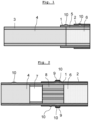
- Fig. 1 illustrates an exemplary structure of a filter cigarette equipped with a tipping paper 1 according to the invention, which comprises a lacquer layer or print 2.
- the substrate of the tipping paper 1 or the lacquer layer or print 2 contains thermally expandable particles.
- a conventional filter cigarette further comprises a cigarette paper 3, which wraps a rod 4 of aerosol-generating substrate, which in a filter cigarette is usually referred to as a tobacco rod.
- a conventional filter cigarette further comprises a filter paper 5, which wraps the filter 6.
- the tipping paper 1 in question can also be used on cigarettes without filters.
- Fig. 2 illustrates an exemplary structure of a heat-not-burn consumer article equipped with a tipping paper 1 according to the invention, which comprises a lacquer layer or print 2.
- the substrate of the tipping paper 1 or the lacquer layer or print 2 contains thermally expandable particles.
- a typical heat-not-burn consumer article further comprises a strand 4 of aerosol-generating substrate, a hollow section 7, a cooling section 8 and a filter 6. These sections may or may not each comprise their own wrapping materials.
- the tipping paper 1 can extend over the entire length of the Heat-Not-Burn consumer article. be multi-layered and, for example, have an inner aluminum layer, at least in the area of the strand 4. Contrary to what is shown, however, a mouthpiece covering paper 1 can also be attached to the heat-not-burn consumer article, which extends only over a partial area of the heat-not-burn consumer article, in which case an additional wrapping material for the strand and optionally also the other components 6, 7, 8 can be present.
- the Heat-Not-Burn consumer article can be heated with an electronic device (Heat-Not-Burn device), whereby the Heat-Not-Burn consumer article is inserted into the device with the strand 4 first, so that the tipping paper 1 and the printing or lacquer layer 2 present thereon are exposed to the user's lips. As shown, it can be provided that no printing or lacquer layer 2 is present in the area in which the strand 4 is present or in the area that is inserted into the device.
- the heat-not-burn consumer article may have a heat source in front of the strand 4, in particular in the form of coal.
- a print or lacquer layer 2 containing thermally expandable particles can be present in the area of the heat source or in the area of the strand 4, so that the raised structure is created when the consumer article is used if the print or lacquer layer 2 is only present in some areas or in a structured manner.
- the printing or varnish layer 2 can, as shown in the Fig. 1 and 2 shown, extend only over a partial area of the tipping paper 1 and are present, for example, only in the rear end of the aerosol-generating consumer article facing away from the strand 4.
- the tipping paper 1 may have perforations, which may be present in the area which is not provided with a print or lacquer layer 2, or by the Printing or varnish layer 2 and the base paper can run.
- the tipping paper 1 can be provided with the printing or lacquer layer 2 over its entire surface, as in Fig. 3 is illustrated.
- the tipping paper 1 may additionally comprise a foil element 9, which may be applied over the printing or lacquer layer 2, or in an area which is not covered by the printing or lacquer layer 2.
- the printing or varnish layer 2 can be a clear varnish layer or a colored varnish layer or a color application of a non-film-forming printing ink or printing ink.
- a clear coat this can be applied to a white base paper or to a color-printed or coated base paper.
- the clear coat can cover a larger area than the color print or coating.
- the colored lacquer layer itself forms the colored coating or the colored area of the tipping paper.
- FIG. 4 A strip of isolated tipping paper 1 is shown in a top view, comprising a base paper, a print or lacquer layer 2, and three foil elements 9.
- the print or lacquer layer 2 is illustrated by the dotted area.
- Fig. 1 to 4 exemplary elevations 10 are shown which can be produced within the scope of the present invention.
- the thermally expanding particles are only present in the base paper or in the substrate of the Mouthpiece tipping paper 1, in particular enclosed therein.
- the thermally expanding particles expand in this partial area and an elevation 10 is formed in the base paper or in the substrate of the mouthpiece tipping paper 1.
- These elevations 10 can be present in an area of the mouthpiece tipping paper 1 which has no printing or varnish layer 2.
- These elevations 10 can also be present in an area of the mouthpiece tipping paper 1 which has a printing or varnish layer 2, wherein the elevations 10 are present beneath the printing or varnish layer 2.
- the thermally expanding particles are contained, for example, in the base paper or in the substrate of the tipping paper 1 and in the printing or lacquer layer 2.
- These elevations 10 can be present in an area of the tipping paper 1 which has no printing or lacquer layer 2.
- These elevations 10 can also be present in an area of the tipping paper 1 which has a printing or lacquer layer 2, wherein the elevations 10 are present under the printing or lacquer layer 2 and in the printing or lacquer layer 2. If the heat is applied over a small area, the expansion of the particles can be limited to the printing or lacquer layer 2, as illustrated by the small elevation 10 on the underside of the consumer article.
- Fig. 2 Also illustrated is a band of a foil element 9, which was applied to the tipping paper 1 by hot stamping. Due to the heat applied during hot stamping, the particles below the band of the foil element 9 are expanded, so that an elevation 10 is present, which is registered with the band of the foil element 9.
- the thermally expanding particles are contained, for example, only in the printing or lacquer layer 2, in particular in the printing or lacquer layer 2.
- heating the tipping paper 1 causes the particles in the printing or lacquer layer 2 to expand, so that the substrate, in particular the base paper, does not have any elevations 10.
- the elevations 10 are present in the printing or lacquer layer 2 and can be formed by local heat exposure with or without the attachment of a foil element 9.
- the foil element 9 can be in the form of a band on the tipping paper 1, as already mentioned, or as in Fig. 4 also illustrated as a locally limited foil element 9, for example in the form of a dot or logo.
- elevations 10 in the print or lacquer layer 2 which are dot-shaped and not covered by foil elements 9.
- the dots can be arranged according to Braille characters.
- the dots or other shapes can also run as a regular pattern across the entire surface of the print or lacquer layer 2.
- a regular pattern of elevations 10 or Braille characters as elevations 10 can of course also be found in the variants of the Fig. 1 and 2 in the substrate or base paper of the tipping paper 1.
- a raised structure or at least one elevation 10 in a flat area where thermally expandable particles are present can be formed by heating with a laser beam which is moved over this area.
- the lettering ABC is written as a raised structure using the laser beam.
- the thermally expandable particles can be present in the substrate or the printing or lacquer layer 2.
- the tipping paper 1 can be without coloured printing
- the thermally expandable particles can be present in the base paper or in a colorless print or transparent lacquer layer 2.
- This colorless print or transparent lacquer layer 2 can be present on the entire surface of the tipping paper 1 or on one or more partial areas. Depending on the energy of the laser beam, this can also cause a color change in the tipping paper 1, so that the structure either only stands out tactilely from the surrounding areas or additionally in color.
- the raised structure or the at least one elevation 10 could be formed by a hot stamp or by heating through the openings of a stencil.
- a print or lacquer layer 2 containing thermally expandable particles can only be present in certain areas on the tipping paper 1.
- Two areas or structures are printed or coated, each represented as the lettering ABC.
- a raised structure or elevation 10 can be created in both areas or just one of the areas.
- the areas with thermally expandable particles do not differ in color from the surrounding surface. This can be achieved by transparent printing or varnishing or by a colored printing or varnishing which is in the background color or the color of the surrounding section.
- the dotted area symbolizes a print that imitates cork.
- the print or lacquer layer 2 in this area can therefore be either transparent or in the color of the imitation cork print.
- the tipping paper 1 in the sense of the outermost wrapping material of an aerosol-generating consumer article, which is not burned during consumption, can be attached to a heat-not-burn consumer article in such a way that it is in the area of the Strand 4 is present.
- the tipping paper 1 preferably has an area with printing or lacquer layer 2 containing thermally expandable particles, which is surrounded or interspersed by an area without thermally expandable particles, wherein this area with thermally expandable particles is heated when heated by a heat-not-burn device.
- the examples are purely illustrative.
- the tipping paper 1 with elevations 10 formed by thermally expanded particles can be present on any type of aerosol-generating consumer article, for example, as wrapping material for cigars or cigarillos or as sheets of wrapping material for hand-rolled cigarettes.
- the tipping paper 1 is to be arranged on the aerosol-generating consumer article such that the printing or lacquer layer 2 is located on the outside of the aerosol-generating consumer article. If the printing or lacquer layer 2 is present only in a partial area, this area can be arranged facing away from the strand 4 or in the area of the strand 4 of a heat-not-burn consumer article.
Landscapes
- Engineering & Computer Science (AREA)
- Mechanical Engineering (AREA)
- Printing Methods (AREA)
- Paper (AREA)
- Laminated Bodies (AREA)
- Cigarettes, Filters, And Manufacturing Of Filters (AREA)
Claims (14)
- Papier de revêtement d'embout buccal (1) qui peut être pourvu d'au moins une bosse (10) par l'application de chaleur, caractérisé en ce que le papier de revêtement d'embout buccal comprend des particules thermiquement expansibles qui sont présentes dans le substrat du papier de revêtement d'embout buccal (1) ou dans une impression ou une couche de vernis (2), ladite impression ou couche de vernis (2) étant présente sur le substrat du papier de revêtement d'embout buccal (1).
- Papier de revêtement d'embout buccal (1) selon la revendication 1, caractérisé en ce qu'il présente au moins une bosse (10), la bosse (10) étant formée par des particules thermiquement expansées qui sont formées par l'application de chaleur sur le papier de revêtement d'embout buccal (1) à partir des particules thermiquement expansibles.
- Papier de revêtement d'embout buccal (1) selon l'une des revendications 1 à 2, caractérisé en ce que les particules thermiquement expansibles sont présentes dans le substrat du papier de revêtement d'embout buccal (1) et le substrat est du papier.
- Papier de revêtement d'embout buccal (1) selon l'une des revendications 1 à 3, caractérisé en ce que les particules thermiquement expansibles sont présentes dans dans l'impression ou la couche de vernis (2).
- Papier de revêtement d'embout buccal (1) selon la revendication 4, caractérisé en ce que l'impression ou la couche de vernis (2), qui contient les particules thermiquement expansibles, n'est présente que dans certains zones sur le papier de revêtement d'embout buccal (1), de sorte que le papier de revêtement d'embout buccal (1) présente au moins une zone de surface sur laquelle des particules thermiquement expansibles sont présentes et au moins une zone de surface sur laquelle aucune particule thermiquement expansible n'est présente.
- Papier de revêtement d'embout buccal (1) selon la revendication 5, caractérisé en ce qu'au moins une zone de surface sur laquelle des particules thermiquement expansibles sont présentes ne se distingue pas visuellement d'au moins une zone de surface sur laquelle aucune particule thermiquement expansible n'est présente, les zones pouvant être distinguées après l'application de chaleur en raison des particules expansées.
- Papier de revêtement d'embout (1) selon l'une des revendications 1 à 6, caractérisé en ce que l'impression ou la couche de vernis (2) est formée par l'application d'une encre d'imprimerie, d'une couche de vernis transparent ou d'une couche de vernis coloré.
- Papier de revêtement d'embout buccal (1) selon l'une des revendications 1 à 7, caractérisé en ce qu'un élément de film (9) est présent au-dessus de ladite au moins une bosse (10).
- Procédé de fabrication d'un papier de revêtement d'embout buccal (1) qui présente au moins une bosse (10), caractérisé en ce qu'un papier de revêtement d'embout buccal (1) qui présente des particules thermiquement expansibles dans le substrat du papier de revêtement d'embout buccal (1) ou dans une impression ou une couche de vernis (2) sur le substrat, est mis en contact avec une surface chaude ou irradié par un faisceau laser, de sorte que les particules thermiquement expansibles dans les zones du papier de revêtement d'embout buccal (1) qui sont en contact avec la surface chaude ou qui sont chauffées par le faisceau laser se dilatent et forment la bosse (10).
- Procédé selon la revendication 9, caractérisé en ce qu'une bande continue de papier de revêtement d'embout buccal (1) est déplacée le long d'un rouleau gaufreur ayant une surface structurée chaude, les bosses de la structure du roulage gaufreur étant transférées sous forme de bosses (10) sur le papier de revêtement d'embout buccal (1).
- Procédé selon la revendication 9, caractérisé en ce qu'une bande continue de papier de revêtement d'embout buccal (1) est déplacée à travers un dispositif d'estampage à chaud, avec lequel des éléments de film (9) sont fixés au papier de revêtement d'embout buccal (1), des particules thermiquement expansibles du papier de revêtement d'embout buccal (1), qui sont présentes dans la zone d'un élément de film (9) à être appliqué, se dilatant et formant une bosse (10).
- Article de consommation générant un aérosol comprenant un papier de revêtement d'embout buccal (1) selon l'une des revendications 1 à 8, caractérisé en ce que, après chauffage du papier de revêtement d'embout buccal (1), une bosse (10) est présente sur l'extérieur de l'article de consommation à l'endroit de la zone chauffée.
- Article de consommation générant un aérosol selon la revendication 12, caractérisé en ce que la bosse (10) se présente sous la forme d'un symbole, d'une structure ou d'un code.
- Dispositif de fabrication d'un papier de revêtement d'embout buccal (1) selon l'une des revendications 1 à 8, caractérisé en ce qu'il comprend une machine d'impression ou d'enduction du papier de revêtement d'embout buccal (1) et une machine d'estampage à chaud du papier de revêtement d'embout buccal (1), chaque machine pouvant transporter une bande composée, dans une direction transversale, de plusieurs papiers de revêtement d'embout buccal (1) pour un article de consommation générant un aérosol.
Applications Claiming Priority (2)
| Application Number | Priority Date | Filing Date | Title |
|---|---|---|---|
| ATA50370/2021A AT524684B1 (de) | 2021-05-12 | 2021-05-12 | Mundstückbelagpapier |
| PCT/AT2022/060153 WO2022236350A1 (fr) | 2021-05-12 | 2022-05-04 | Papier de manchette à particules thermiquement expansibles |
Publications (3)
| Publication Number | Publication Date |
|---|---|
| EP4337828A1 EP4337828A1 (fr) | 2024-03-20 |
| EP4337828C0 EP4337828C0 (fr) | 2025-06-18 |
| EP4337828B1 true EP4337828B1 (fr) | 2025-06-18 |
Family
ID=81850613
Family Applications (1)
| Application Number | Title | Priority Date | Filing Date |
|---|---|---|---|
| EP22725974.4A Active EP4337828B1 (fr) | 2021-05-12 | 2022-05-04 | Papier manchette avec des particules thermo-expansibles |
Country Status (13)
| Country | Link |
|---|---|
| US (1) | US20240251843A1 (fr) |
| EP (1) | EP4337828B1 (fr) |
| JP (1) | JP2024518451A (fr) |
| KR (1) | KR20240031227A (fr) |
| CN (2) | CN115336787A (fr) |
| AR (1) | AR125821A1 (fr) |
| AT (1) | AT524684B1 (fr) |
| BR (1) | BR112023022204A2 (fr) |
| CA (1) | CA3212710A1 (fr) |
| ES (1) | ES3038648T3 (fr) |
| MX (1) | MX2023012072A (fr) |
| PH (1) | PH12023552776A1 (fr) |
| WO (1) | WO2022236350A1 (fr) |
Families Citing this family (1)
| Publication number | Priority date | Publication date | Assignee | Title |
|---|---|---|---|---|
| AT524684B1 (de) * | 2021-05-12 | 2022-08-15 | Tannpapier Gmbh | Mundstückbelagpapier |
Family Cites Families (11)
| Publication number | Priority date | Publication date | Assignee | Title |
|---|---|---|---|---|
| JPS6289998U (fr) * | 1985-11-25 | 1987-06-09 | ||
| AT511936B1 (de) | 2011-12-01 | 2013-04-15 | Tannpapier Gmbh | Mundstückbelagspapier für einen rauchartikel |
| US10524503B2 (en) * | 2014-09-29 | 2020-01-07 | Philip Morris Products S.A. | Slideable extinguisher |
| MX2018002696A (es) * | 2015-09-11 | 2018-04-13 | Philip Morris Products Sa | Componente de multiples segmentos para un articulo generador de aerosol. |
| SG11201805507UA (en) * | 2015-12-30 | 2018-07-30 | Philip Morris Products Sa | Retractable heat source for aerosol generating article |
| KR20180093004A (ko) * | 2015-12-31 | 2018-08-20 | 필립모리스 프로덕츠 에스.에이. | 파단 가능한 에어로졸 발생 물품 |
| JP7395474B2 (ja) * | 2017-12-07 | 2023-12-11 | フィリップ・モーリス・プロダクツ・ソシエテ・アノニム | 熱膨張可能な調心要素を有するエアロゾル発生物品 |
| EP3793382B1 (fr) * | 2018-05-17 | 2022-11-02 | Philip Morris Products S.A. | Composant à segments multiples avec revêtement intumescent |
| JP2020185678A (ja) * | 2019-05-10 | 2020-11-19 | カシオ計算機株式会社 | 被覆層を有する媒体、被覆層を有する媒体の製造方法及び触感変更方法 |
| JP7006661B2 (ja) * | 2019-06-14 | 2022-01-24 | カシオ計算機株式会社 | 造形物の製造方法及び造形装置 |
| AT524684B1 (de) * | 2021-05-12 | 2022-08-15 | Tannpapier Gmbh | Mundstückbelagpapier |
-
2021
- 2021-05-12 AT ATA50370/2021A patent/AT524684B1/de active
- 2021-09-09 CN CN202111057840.8A patent/CN115336787A/zh active Pending
- 2021-09-09 CN CN202122179978.7U patent/CN217038871U/zh active Active
-
2022
- 2022-05-04 EP EP22725974.4A patent/EP4337828B1/fr active Active
- 2022-05-04 KR KR1020237042344A patent/KR20240031227A/ko active Pending
- 2022-05-04 CA CA3212710A patent/CA3212710A1/fr active Pending
- 2022-05-04 WO PCT/AT2022/060153 patent/WO2022236350A1/fr not_active Ceased
- 2022-05-04 MX MX2023012072A patent/MX2023012072A/es unknown
- 2022-05-04 BR BR112023022204A patent/BR112023022204A2/pt unknown
- 2022-05-04 JP JP2023568634A patent/JP2024518451A/ja active Pending
- 2022-05-04 US US18/290,075 patent/US20240251843A1/en active Pending
- 2022-05-04 PH PH1/2023/552776A patent/PH12023552776A1/en unknown
- 2022-05-04 ES ES22725974T patent/ES3038648T3/es active Active
- 2022-05-10 AR ARP220101230A patent/AR125821A1/es active IP Right Grant
Also Published As
| Publication number | Publication date |
|---|---|
| AT524684B1 (de) | 2022-08-15 |
| EP4337828A1 (fr) | 2024-03-20 |
| KR20240031227A (ko) | 2024-03-07 |
| CN115336787A (zh) | 2022-11-15 |
| US20240251843A1 (en) | 2024-08-01 |
| AR125821A1 (es) | 2023-08-16 |
| MX2023012072A (es) | 2023-10-24 |
| AT524684A4 (de) | 2022-08-15 |
| CA3212710A1 (fr) | 2022-11-17 |
| EP4337828C0 (fr) | 2025-06-18 |
| CN217038871U (zh) | 2022-07-26 |
| BR112023022204A2 (pt) | 2023-12-19 |
| WO2022236350A1 (fr) | 2022-11-17 |
| JP2024518451A (ja) | 2024-05-01 |
| PH12023552776A1 (en) | 2024-04-15 |
| ES3038648T3 (en) | 2025-10-14 |
Similar Documents
| Publication | Publication Date | Title |
|---|---|---|
| DE4110801C1 (fr) | ||
| EP1682351B2 (fr) | Procede et dispositif de pression combinee | |
| DE3855784T2 (de) | Formprägen von beschichteten blättern | |
| DE3411511C2 (de) | Verfahren zum Aufbringen von Markierungen auf die Außenseite einer Zigarettenumwicklung | |
| CN104924790B (zh) | 高精度套印叠烫烫金接装纸及其制作方法 | |
| WO2018162196A2 (fr) | Procédé pour produire une décalcomanie, et une décalcomanie ainsi qu'un dispositif pour produire une décalcomanie, et un procédé pour décorer des surfaces d'objets | |
| DE2649479B2 (de) | HeiBprägefolie sowie Verfahren und Vorrichtung zu ihrer Herstellung | |
| CN103974634A (zh) | 用于吸烟物品的接装纸 | |
| AT524684B1 (de) | Mundstückbelagpapier | |
| EP3984383B1 (fr) | Article à fumer avec un segment chauffé comprenant un produit de tabac | |
| AT524654B1 (de) | Nanogeprägtes Mundstückbelagpapier | |
| KR100993076B1 (ko) | 흡연 용품의 권지 인쇄 방법 | |
| DE102014222677A1 (de) | Verfahren und Vorrichtung zur Abformung von Mikrostrukturen | |
| EP4374712A1 (fr) | Procédé d'application d'un marquage sur un matériau d'emballage pour un article de génération d'aérosol | |
| WO2023041586A1 (fr) | Enveloppe d'article de génération d'aérosol gravée au laser, articles de génération d'aérosol comprenant une telle enveloppe, et leur procédé de fabrication | |
| AT18626U1 (de) | Schichtaufbau mit Thermochromen oder pH-sensitiven Substanzen | |
| FI74087C (fi) | Foerfarande foer framstaellning av omslagspapper foer cigarrettfilter. | |
| DE2437696C3 (de) | Matrize für die Herstellung von Mehrfachkopien | |
| DE102005024989A1 (de) | Verfahren und Vorrichtung zur Erzeugung latenter Information auf einem Druckprodukt | |
| EP0857569A1 (fr) | Méthode et dispositif pour la fabrication des étiquettes adhésives | |
| GB2064939A (en) | Improvements relating to tipping material for smoking articles | |
| HK1195457B (en) | Tipping paper for a smoking article | |
| HK1195457A (en) | Tipping paper for a smoking article |
Legal Events
| Date | Code | Title | Description |
|---|---|---|---|
| STAA | Information on the status of an ep patent application or granted ep patent |
Free format text: STATUS: UNKNOWN |
|
| STAA | Information on the status of an ep patent application or granted ep patent |
Free format text: STATUS: THE INTERNATIONAL PUBLICATION HAS BEEN MADE |
|
| PUAI | Public reference made under article 153(3) epc to a published international application that has entered the european phase |
Free format text: ORIGINAL CODE: 0009012 |
|
| STAA | Information on the status of an ep patent application or granted ep patent |
Free format text: STATUS: REQUEST FOR EXAMINATION WAS MADE |
|
| 17P | Request for examination filed |
Effective date: 20231010 |
|
| AK | Designated contracting states |
Kind code of ref document: A1 Designated state(s): AL AT BE BG CH CY CZ DE DK EE ES FI FR GB GR HR HU IE IS IT LI LT LU LV MC MK MT NL NO PL PT RO RS SE SI SK SM TR |
|
| DAV | Request for validation of the european patent (deleted) | ||
| DAX | Request for extension of the european patent (deleted) | ||
| GRAP | Despatch of communication of intention to grant a patent |
Free format text: ORIGINAL CODE: EPIDOSNIGR1 |
|
| STAA | Information on the status of an ep patent application or granted ep patent |
Free format text: STATUS: GRANT OF PATENT IS INTENDED |
|
| INTG | Intention to grant announced |
Effective date: 20250130 |
|
| GRAS | Grant fee paid |
Free format text: ORIGINAL CODE: EPIDOSNIGR3 |
|
| GRAA | (expected) grant |
Free format text: ORIGINAL CODE: 0009210 |
|
| STAA | Information on the status of an ep patent application or granted ep patent |
Free format text: STATUS: THE PATENT HAS BEEN GRANTED |
|
| AK | Designated contracting states |
Kind code of ref document: B1 Designated state(s): AL AT BE BG CH CY CZ DE DK EE ES FI FR GB GR HR HU IE IS IT LI LT LU LV MC MK MT NL NO PL PT RO RS SE SI SK SM TR |
|
| REG | Reference to a national code |
Ref country code: GB Ref legal event code: FG4D Free format text: NOT ENGLISH |
|
| REG | Reference to a national code |
Ref country code: CH Ref legal event code: EP |
|
| REG | Reference to a national code |
Ref country code: DE Ref legal event code: R096 Ref document number: 502022004335 Country of ref document: DE |
|
| REG | Reference to a national code |
Ref country code: CH Ref legal event code: EP |
|
| REG | Reference to a national code |
Ref country code: IE Ref legal event code: FG4D Free format text: LANGUAGE OF EP DOCUMENT: GERMAN |
|
| U01 | Request for unitary effect filed |
Effective date: 20250708 |
|
| U07 | Unitary effect registered |
Designated state(s): AT BE BG DE DK EE FI FR IT LT LU LV MT NL PT RO SE SI Effective date: 20250714 |
|
| PG25 | Lapsed in a contracting state [announced via postgrant information from national office to epo] |
Ref country code: NO Free format text: LAPSE BECAUSE OF FAILURE TO SUBMIT A TRANSLATION OF THE DESCRIPTION OR TO PAY THE FEE WITHIN THE PRESCRIBED TIME-LIMIT Effective date: 20250918 Ref country code: GR Free format text: LAPSE BECAUSE OF FAILURE TO SUBMIT A TRANSLATION OF THE DESCRIPTION OR TO PAY THE FEE WITHIN THE PRESCRIBED TIME-LIMIT Effective date: 20250919 |
|
| REG | Reference to a national code |
Ref country code: ES Ref legal event code: FG2A Ref document number: 3038648 Country of ref document: ES Kind code of ref document: T3 Effective date: 20251014 |
|
| PG25 | Lapsed in a contracting state [announced via postgrant information from national office to epo] |
Ref country code: HR Free format text: LAPSE BECAUSE OF FAILURE TO SUBMIT A TRANSLATION OF THE DESCRIPTION OR TO PAY THE FEE WITHIN THE PRESCRIBED TIME-LIMIT Effective date: 20250618 |
|
| PG25 | Lapsed in a contracting state [announced via postgrant information from national office to epo] |
Ref country code: RS Free format text: LAPSE BECAUSE OF FAILURE TO SUBMIT A TRANSLATION OF THE DESCRIPTION OR TO PAY THE FEE WITHIN THE PRESCRIBED TIME-LIMIT Effective date: 20250918 |
|
| PG25 | Lapsed in a contracting state [announced via postgrant information from national office to epo] |
Ref country code: IS Free format text: LAPSE BECAUSE OF FAILURE TO SUBMIT A TRANSLATION OF THE DESCRIPTION OR TO PAY THE FEE WITHIN THE PRESCRIBED TIME-LIMIT Effective date: 20251018 |
|
| PG25 | Lapsed in a contracting state [announced via postgrant information from national office to epo] |
Ref country code: SM Free format text: LAPSE BECAUSE OF FAILURE TO SUBMIT A TRANSLATION OF THE DESCRIPTION OR TO PAY THE FEE WITHIN THE PRESCRIBED TIME-LIMIT Effective date: 20250618 |
|
| PG25 | Lapsed in a contracting state [announced via postgrant information from national office to epo] |
Ref country code: CZ Free format text: LAPSE BECAUSE OF FAILURE TO SUBMIT A TRANSLATION OF THE DESCRIPTION OR TO PAY THE FEE WITHIN THE PRESCRIBED TIME-LIMIT Effective date: 20250618 |
|
| PG25 | Lapsed in a contracting state [announced via postgrant information from national office to epo] |
Ref country code: PL Free format text: LAPSE BECAUSE OF FAILURE TO SUBMIT A TRANSLATION OF THE DESCRIPTION OR TO PAY THE FEE WITHIN THE PRESCRIBED TIME-LIMIT Effective date: 20250618 |
|
| PG25 | Lapsed in a contracting state [announced via postgrant information from national office to epo] |
Ref country code: SK Free format text: LAPSE BECAUSE OF FAILURE TO SUBMIT A TRANSLATION OF THE DESCRIPTION OR TO PAY THE FEE WITHIN THE PRESCRIBED TIME-LIMIT Effective date: 20250618 |
|
| PLBE | No opposition filed within time limit |
Free format text: ORIGINAL CODE: 0009261 |
|
| STAA | Information on the status of an ep patent application or granted ep patent |
Free format text: STATUS: NO OPPOSITION FILED WITHIN TIME LIMIT |
|
| REG | Reference to a national code |
Ref country code: CH Ref legal event code: L10 Free format text: ST27 STATUS EVENT CODE: U-0-0-L10-L00 (AS PROVIDED BY THE NATIONAL OFFICE) Effective date: 20260430 |