EP4337734B1 - Zusammensetzungen mit plättchenförmigen übergangsmetallpartikeln - Google Patents
Zusammensetzungen mit plättchenförmigen übergangsmetallpartikeln Download PDFInfo
- Publication number
- EP4337734B1 EP4337734B1 EP22728579.8A EP22728579A EP4337734B1 EP 4337734 B1 EP4337734 B1 EP 4337734B1 EP 22728579 A EP22728579 A EP 22728579A EP 4337734 B1 EP4337734 B1 EP 4337734B1
- Authority
- EP
- European Patent Office
- Prior art keywords
- alkyl
- meth
- group
- formula
- phenyl
- Prior art date
- Legal status (The legal status is an assumption and is not a legal conclusion. Google has not performed a legal analysis and makes no representation as to the accuracy of the status listed.)
- Active
Links
Classifications
-
- C—CHEMISTRY; METALLURGY
- C09—DYES; PAINTS; POLISHES; NATURAL RESINS; ADHESIVES; COMPOSITIONS NOT OTHERWISE PROVIDED FOR; APPLICATIONS OF MATERIALS NOT OTHERWISE PROVIDED FOR
- C09D—COATING COMPOSITIONS, e.g. PAINTS, VARNISHES OR LACQUERS; FILLING PASTES; CHEMICAL PAINT OR INK REMOVERS; INKS; CORRECTING FLUIDS; WOODSTAINS; PASTES OR SOLIDS FOR COLOURING OR PRINTING; USE OF MATERIALS THEREFOR
- C09D151/00—Coating compositions based on graft polymers in which the grafted component is obtained by reactions only involving carbon-to-carbon unsaturated bonds; Coating compositions based on derivatives of such polymers
- C09D151/10—Coating compositions based on graft polymers in which the grafted component is obtained by reactions only involving carbon-to-carbon unsaturated bonds; Coating compositions based on derivatives of such polymers grafted on to inorganic materials
-
- B—PERFORMING OPERATIONS; TRANSPORTING
- B42—BOOKBINDING; ALBUMS; FILES; SPECIAL PRINTED MATTER
- B42D—BOOKS; BOOK COVERS; LOOSE LEAVES; PRINTED MATTER CHARACTERISED BY IDENTIFICATION OR SECURITY FEATURES; PRINTED MATTER OF SPECIAL FORMAT OR STYLE NOT OTHERWISE PROVIDED FOR; DEVICES FOR USE THEREWITH AND NOT OTHERWISE PROVIDED FOR; MOVABLE-STRIP WRITING OR READING APPARATUS
- B42D25/00—Information-bearing cards or sheet-like structures characterised by identification or security features; Manufacture thereof
- B42D25/30—Identification or security features, e.g. for preventing forgery
- B42D25/324—Reliefs
-
- B—PERFORMING OPERATIONS; TRANSPORTING
- B42—BOOKBINDING; ALBUMS; FILES; SPECIAL PRINTED MATTER
- B42D—BOOKS; BOOK COVERS; LOOSE LEAVES; PRINTED MATTER CHARACTERISED BY IDENTIFICATION OR SECURITY FEATURES; PRINTED MATTER OF SPECIAL FORMAT OR STYLE NOT OTHERWISE PROVIDED FOR; DEVICES FOR USE THEREWITH AND NOT OTHERWISE PROVIDED FOR; MOVABLE-STRIP WRITING OR READING APPARATUS
- B42D25/00—Information-bearing cards or sheet-like structures characterised by identification or security features; Manufacture thereof
- B42D25/30—Identification or security features, e.g. for preventing forgery
- B42D25/328—Diffraction gratings; Holograms
-
- B—PERFORMING OPERATIONS; TRANSPORTING
- B42—BOOKBINDING; ALBUMS; FILES; SPECIAL PRINTED MATTER
- B42D—BOOKS; BOOK COVERS; LOOSE LEAVES; PRINTED MATTER CHARACTERISED BY IDENTIFICATION OR SECURITY FEATURES; PRINTED MATTER OF SPECIAL FORMAT OR STYLE NOT OTHERWISE PROVIDED FOR; DEVICES FOR USE THEREWITH AND NOT OTHERWISE PROVIDED FOR; MOVABLE-STRIP WRITING OR READING APPARATUS
- B42D25/00—Information-bearing cards or sheet-like structures characterised by identification or security features; Manufacture thereof
- B42D25/30—Identification or security features, e.g. for preventing forgery
- B42D25/351—Translucent or partly translucent parts, e.g. windows
-
- B—PERFORMING OPERATIONS; TRANSPORTING
- B42—BOOKBINDING; ALBUMS; FILES; SPECIAL PRINTED MATTER
- B42D—BOOKS; BOOK COVERS; LOOSE LEAVES; PRINTED MATTER CHARACTERISED BY IDENTIFICATION OR SECURITY FEATURES; PRINTED MATTER OF SPECIAL FORMAT OR STYLE NOT OTHERWISE PROVIDED FOR; DEVICES FOR USE THEREWITH AND NOT OTHERWISE PROVIDED FOR; MOVABLE-STRIP WRITING OR READING APPARATUS
- B42D25/00—Information-bearing cards or sheet-like structures characterised by identification or security features; Manufacture thereof
- B42D25/30—Identification or security features, e.g. for preventing forgery
- B42D25/36—Identification or security features, e.g. for preventing forgery comprising special materials
-
- B—PERFORMING OPERATIONS; TRANSPORTING
- B42—BOOKBINDING; ALBUMS; FILES; SPECIAL PRINTED MATTER
- B42D—BOOKS; BOOK COVERS; LOOSE LEAVES; PRINTED MATTER CHARACTERISED BY IDENTIFICATION OR SECURITY FEATURES; PRINTED MATTER OF SPECIAL FORMAT OR STYLE NOT OTHERWISE PROVIDED FOR; DEVICES FOR USE THEREWITH AND NOT OTHERWISE PROVIDED FOR; MOVABLE-STRIP WRITING OR READING APPARATUS
- B42D25/00—Information-bearing cards or sheet-like structures characterised by identification or security features; Manufacture thereof
- B42D25/30—Identification or security features, e.g. for preventing forgery
- B42D25/36—Identification or security features, e.g. for preventing forgery comprising special materials
- B42D25/364—Liquid crystals
-
- B—PERFORMING OPERATIONS; TRANSPORTING
- B42—BOOKBINDING; ALBUMS; FILES; SPECIAL PRINTED MATTER
- B42D—BOOKS; BOOK COVERS; LOOSE LEAVES; PRINTED MATTER CHARACTERISED BY IDENTIFICATION OR SECURITY FEATURES; PRINTED MATTER OF SPECIAL FORMAT OR STYLE NOT OTHERWISE PROVIDED FOR; DEVICES FOR USE THEREWITH AND NOT OTHERWISE PROVIDED FOR; MOVABLE-STRIP WRITING OR READING APPARATUS
- B42D25/00—Information-bearing cards or sheet-like structures characterised by identification or security features; Manufacture thereof
- B42D25/30—Identification or security features, e.g. for preventing forgery
- B42D25/36—Identification or security features, e.g. for preventing forgery comprising special materials
- B42D25/378—Special inks
-
- B—PERFORMING OPERATIONS; TRANSPORTING
- B42—BOOKBINDING; ALBUMS; FILES; SPECIAL PRINTED MATTER
- B42D—BOOKS; BOOK COVERS; LOOSE LEAVES; PRINTED MATTER CHARACTERISED BY IDENTIFICATION OR SECURITY FEATURES; PRINTED MATTER OF SPECIAL FORMAT OR STYLE NOT OTHERWISE PROVIDED FOR; DEVICES FOR USE THEREWITH AND NOT OTHERWISE PROVIDED FOR; MOVABLE-STRIP WRITING OR READING APPARATUS
- B42D25/00—Information-bearing cards or sheet-like structures characterised by identification or security features; Manufacture thereof
- B42D25/40—Manufacture
- B42D25/405—Marking
- B42D25/41—Marking using electromagnetic radiation
-
- B—PERFORMING OPERATIONS; TRANSPORTING
- B42—BOOKBINDING; ALBUMS; FILES; SPECIAL PRINTED MATTER
- B42D—BOOKS; BOOK COVERS; LOOSE LEAVES; PRINTED MATTER CHARACTERISED BY IDENTIFICATION OR SECURITY FEATURES; PRINTED MATTER OF SPECIAL FORMAT OR STYLE NOT OTHERWISE PROVIDED FOR; DEVICES FOR USE THEREWITH AND NOT OTHERWISE PROVIDED FOR; MOVABLE-STRIP WRITING OR READING APPARATUS
- B42D25/00—Information-bearing cards or sheet-like structures characterised by identification or security features; Manufacture thereof
- B42D25/40—Manufacture
- B42D25/405—Marking
- B42D25/425—Marking by deformation, e.g. embossing
-
- C—CHEMISTRY; METALLURGY
- C08—ORGANIC MACROMOLECULAR COMPOUNDS; THEIR PREPARATION OR CHEMICAL WORKING-UP; COMPOSITIONS BASED THEREON
- C08F—MACROMOLECULAR COMPOUNDS OBTAINED BY REACTIONS ONLY INVOLVING CARBON-TO-CARBON UNSATURATED BONDS
- C08F220/00—Copolymers of compounds having one or more unsaturated aliphatic radicals, each having only one carbon-to-carbon double bond, and only one being terminated by only one carboxyl radical or a salt, anhydride ester, amide, imide or nitrile thereof
- C08F220/02—Monocarboxylic acids having less than ten carbon atoms; Derivatives thereof
- C08F220/10—Esters
-
- C—CHEMISTRY; METALLURGY
- C08—ORGANIC MACROMOLECULAR COMPOUNDS; THEIR PREPARATION OR CHEMICAL WORKING-UP; COMPOSITIONS BASED THEREON
- C08F—MACROMOLECULAR COMPOUNDS OBTAINED BY REACTIONS ONLY INVOLVING CARBON-TO-CARBON UNSATURATED BONDS
- C08F220/00—Copolymers of compounds having one or more unsaturated aliphatic radicals, each having only one carbon-to-carbon double bond, and only one being terminated by only one carboxyl radical or a salt, anhydride ester, amide, imide or nitrile thereof
- C08F220/02—Monocarboxylic acids having less than ten carbon atoms; Derivatives thereof
- C08F220/52—Amides or imides
- C08F220/54—Amides, e.g. N,N-dimethylacrylamide or N-isopropylacrylamide
- C08F220/56—Acrylamide; Methacrylamide
-
- C—CHEMISTRY; METALLURGY
- C08—ORGANIC MACROMOLECULAR COMPOUNDS; THEIR PREPARATION OR CHEMICAL WORKING-UP; COMPOSITIONS BASED THEREON
- C08F—MACROMOLECULAR COMPOUNDS OBTAINED BY REACTIONS ONLY INVOLVING CARBON-TO-CARBON UNSATURATED BONDS
- C08F222/00—Copolymers of compounds having one or more unsaturated aliphatic radicals, each having only one carbon-to-carbon double bond, and at least one being terminated by a carboxyl radical and containing at least one other carboxyl radical in the molecule; Salts, anhydrides, esters, amides, imides, or nitriles thereof
-
- C—CHEMISTRY; METALLURGY
- C08—ORGANIC MACROMOLECULAR COMPOUNDS; THEIR PREPARATION OR CHEMICAL WORKING-UP; COMPOSITIONS BASED THEREON
- C08F—MACROMOLECULAR COMPOUNDS OBTAINED BY REACTIONS ONLY INVOLVING CARBON-TO-CARBON UNSATURATED BONDS
- C08F222/00—Copolymers of compounds having one or more unsaturated aliphatic radicals, each having only one carbon-to-carbon double bond, and at least one being terminated by a carboxyl radical and containing at least one other carboxyl radical in the molecule; Salts, anhydrides, esters, amides, imides, or nitriles thereof
- C08F222/10—Esters
- C08F222/1006—Esters of polyhydric alcohols or polyhydric phenols
- C08F222/102—Esters of polyhydric alcohols or polyhydric phenols of dialcohols, e.g. ethylene glycol di(meth)acrylate or 1,4-butanediol dimethacrylate
-
- C—CHEMISTRY; METALLURGY
- C08—ORGANIC MACROMOLECULAR COMPOUNDS; THEIR PREPARATION OR CHEMICAL WORKING-UP; COMPOSITIONS BASED THEREON
- C08F—MACROMOLECULAR COMPOUNDS OBTAINED BY REACTIONS ONLY INVOLVING CARBON-TO-CARBON UNSATURATED BONDS
- C08F287/00—Macromolecular compounds obtained by polymerising monomers on to block polymers
-
- C—CHEMISTRY; METALLURGY
- C08—ORGANIC MACROMOLECULAR COMPOUNDS; THEIR PREPARATION OR CHEMICAL WORKING-UP; COMPOSITIONS BASED THEREON
- C08F—MACROMOLECULAR COMPOUNDS OBTAINED BY REACTIONS ONLY INVOLVING CARBON-TO-CARBON UNSATURATED BONDS
- C08F292/00—Macromolecular compounds obtained by polymerising monomers on to inorganic materials
-
- C—CHEMISTRY; METALLURGY
- C08—ORGANIC MACROMOLECULAR COMPOUNDS; THEIR PREPARATION OR CHEMICAL WORKING-UP; COMPOSITIONS BASED THEREON
- C08F—MACROMOLECULAR COMPOUNDS OBTAINED BY REACTIONS ONLY INVOLVING CARBON-TO-CARBON UNSATURATED BONDS
- C08F293/00—Macromolecular compounds obtained by polymerisation on to a macromolecule having groups capable of inducing the formation of new polymer chains bound exclusively at one or both ends of the starting macromolecule
- C08F293/005—Macromolecular compounds obtained by polymerisation on to a macromolecule having groups capable of inducing the formation of new polymer chains bound exclusively at one or both ends of the starting macromolecule using free radical "living" or "controlled" polymerisation, e.g. using a complexing agent
-
- C—CHEMISTRY; METALLURGY
- C08—ORGANIC MACROMOLECULAR COMPOUNDS; THEIR PREPARATION OR CHEMICAL WORKING-UP; COMPOSITIONS BASED THEREON
- C08K—Use of inorganic or non-macromolecular organic substances as compounding ingredients
- C08K3/00—Use of inorganic substances as compounding ingredients
- C08K3/02—Elements
- C08K3/08—Metals
-
- C—CHEMISTRY; METALLURGY
- C08—ORGANIC MACROMOLECULAR COMPOUNDS; THEIR PREPARATION OR CHEMICAL WORKING-UP; COMPOSITIONS BASED THEREON
- C08K—Use of inorganic or non-macromolecular organic substances as compounding ingredients
- C08K5/00—Use of organic ingredients
- C08K5/49—Phosphorus-containing compounds
-
- C—CHEMISTRY; METALLURGY
- C08—ORGANIC MACROMOLECULAR COMPOUNDS; THEIR PREPARATION OR CHEMICAL WORKING-UP; COMPOSITIONS BASED THEREON
- C08K—Use of inorganic or non-macromolecular organic substances as compounding ingredients
- C08K7/00—Use of ingredients characterised by shape
-
- C—CHEMISTRY; METALLURGY
- C08—ORGANIC MACROMOLECULAR COMPOUNDS; THEIR PREPARATION OR CHEMICAL WORKING-UP; COMPOSITIONS BASED THEREON
- C08L—COMPOSITIONS OF MACROMOLECULAR COMPOUNDS
- C08L53/00—Compositions of block copolymers containing at least one sequence of a polymer obtained by reactions only involving carbon-to-carbon unsaturated bonds; Compositions of derivatives of such polymers
-
- C—CHEMISTRY; METALLURGY
- C09—DYES; PAINTS; POLISHES; NATURAL RESINS; ADHESIVES; COMPOSITIONS NOT OTHERWISE PROVIDED FOR; APPLICATIONS OF MATERIALS NOT OTHERWISE PROVIDED FOR
- C09D—COATING COMPOSITIONS, e.g. PAINTS, VARNISHES OR LACQUERS; FILLING PASTES; CHEMICAL PAINT OR INK REMOVERS; INKS; CORRECTING FLUIDS; WOODSTAINS; PASTES OR SOLIDS FOR COLOURING OR PRINTING; USE OF MATERIALS THEREFOR
- C09D153/00—Coating compositions based on block copolymers containing at least one sequence of a polymer obtained by reactions only involving carbon-to-carbon unsaturated bonds; Coating compositions based on derivatives of such polymers
-
- C—CHEMISTRY; METALLURGY
- C09—DYES; PAINTS; POLISHES; NATURAL RESINS; ADHESIVES; COMPOSITIONS NOT OTHERWISE PROVIDED FOR; APPLICATIONS OF MATERIALS NOT OTHERWISE PROVIDED FOR
- C09D—COATING COMPOSITIONS, e.g. PAINTS, VARNISHES OR LACQUERS; FILLING PASTES; CHEMICAL PAINT OR INK REMOVERS; INKS; CORRECTING FLUIDS; WOODSTAINS; PASTES OR SOLIDS FOR COLOURING OR PRINTING; USE OF MATERIALS THEREFOR
- C09D4/00—Coating compositions, e.g. paints, varnishes or lacquers, based on organic non-macromolecular compounds having at least one polymerisable carbon-to-carbon unsaturated bond ; Coating compositions, based on monomers of macromolecular compounds of groups C09D183/00 - C09D183/16
-
- C—CHEMISTRY; METALLURGY
- C09—DYES; PAINTS; POLISHES; NATURAL RESINS; ADHESIVES; COMPOSITIONS NOT OTHERWISE PROVIDED FOR; APPLICATIONS OF MATERIALS NOT OTHERWISE PROVIDED FOR
- C09D—COATING COMPOSITIONS, e.g. PAINTS, VARNISHES OR LACQUERS; FILLING PASTES; CHEMICAL PAINT OR INK REMOVERS; INKS; CORRECTING FLUIDS; WOODSTAINS; PASTES OR SOLIDS FOR COLOURING OR PRINTING; USE OF MATERIALS THEREFOR
- C09D7/00—Features of coating compositions, not provided for in group C09D5/00; Processes for incorporating ingredients in coating compositions
- C09D7/40—Additives
- C09D7/60—Additives non-macromolecular
- C09D7/61—Additives non-macromolecular inorganic
-
- C—CHEMISTRY; METALLURGY
- C09—DYES; PAINTS; POLISHES; NATURAL RESINS; ADHESIVES; COMPOSITIONS NOT OTHERWISE PROVIDED FOR; APPLICATIONS OF MATERIALS NOT OTHERWISE PROVIDED FOR
- C09D—COATING COMPOSITIONS, e.g. PAINTS, VARNISHES OR LACQUERS; FILLING PASTES; CHEMICAL PAINT OR INK REMOVERS; INKS; CORRECTING FLUIDS; WOODSTAINS; PASTES OR SOLIDS FOR COLOURING OR PRINTING; USE OF MATERIALS THEREFOR
- C09D7/00—Features of coating compositions, not provided for in group C09D5/00; Processes for incorporating ingredients in coating compositions
- C09D7/40—Additives
- C09D7/66—Additives characterised by particle size
- C09D7/68—Particle size between 100-1000 nm
-
- C—CHEMISTRY; METALLURGY
- C09—DYES; PAINTS; POLISHES; NATURAL RESINS; ADHESIVES; COMPOSITIONS NOT OTHERWISE PROVIDED FOR; APPLICATIONS OF MATERIALS NOT OTHERWISE PROVIDED FOR
- C09D—COATING COMPOSITIONS, e.g. PAINTS, VARNISHES OR LACQUERS; FILLING PASTES; CHEMICAL PAINT OR INK REMOVERS; INKS; CORRECTING FLUIDS; WOODSTAINS; PASTES OR SOLIDS FOR COLOURING OR PRINTING; USE OF MATERIALS THEREFOR
- C09D7/00—Features of coating compositions, not provided for in group C09D5/00; Processes for incorporating ingredients in coating compositions
- C09D7/40—Additives
- C09D7/70—Additives characterised by shape, e.g. fibres, flakes or microspheres
-
- C—CHEMISTRY; METALLURGY
- C08—ORGANIC MACROMOLECULAR COMPOUNDS; THEIR PREPARATION OR CHEMICAL WORKING-UP; COMPOSITIONS BASED THEREON
- C08K—Use of inorganic or non-macromolecular organic substances as compounding ingredients
- C08K3/00—Use of inorganic substances as compounding ingredients
- C08K3/02—Elements
- C08K3/08—Metals
- C08K2003/0806—Silver
-
- C—CHEMISTRY; METALLURGY
- C08—ORGANIC MACROMOLECULAR COMPOUNDS; THEIR PREPARATION OR CHEMICAL WORKING-UP; COMPOSITIONS BASED THEREON
- C08K—Use of inorganic or non-macromolecular organic substances as compounding ingredients
- C08K3/00—Use of inorganic substances as compounding ingredients
- C08K3/02—Elements
- C08K3/08—Metals
- C08K2003/0831—Gold
-
- C—CHEMISTRY; METALLURGY
- C08—ORGANIC MACROMOLECULAR COMPOUNDS; THEIR PREPARATION OR CHEMICAL WORKING-UP; COMPOSITIONS BASED THEREON
- C08K—Use of inorganic or non-macromolecular organic substances as compounding ingredients
- C08K3/00—Use of inorganic substances as compounding ingredients
- C08K3/02—Elements
- C08K3/08—Metals
- C08K2003/085—Copper
-
- C—CHEMISTRY; METALLURGY
- C08—ORGANIC MACROMOLECULAR COMPOUNDS; THEIR PREPARATION OR CHEMICAL WORKING-UP; COMPOSITIONS BASED THEREON
- C08K—Use of inorganic or non-macromolecular organic substances as compounding ingredients
- C08K2201/00—Specific properties of additives
- C08K2201/002—Physical properties
- C08K2201/003—Additives being defined by their diameter
Definitions
- compositions comprising
- the coatings, obtained with said compositions, show one color, when observed in transmission and another color, when observed in reflection on both sides of the cured coating.
- WO2014/058904A1 relates to a process for increasing the optical density of a stable, silver nanoplate solution, comprising:
- JP2019182984A relates to a water-based inkjet ink containing water, a water soluble organic solvent, metal particles, a dispersant adsorbed on a surface of the metal particle, a surfactant, and content of an aprotic polar solvent based on all mass of the water-based inkjet ink is 40 mass% or less, and the surfactant is a fluorine-based surfactant having a hydrophilic group and a hydrophobic group.
- US2017246690 discloses a method for synthesizing metal nanoparticles, the method comprising:
- EP3156156 relates to a fine silver particle dispersion, which comprises fine silver particles, a short chain amine having 5 or less carbon atoms and a highly polar solvent, and a partition coefficient logP of the short chain amine is -1.0 to 1.4.
- the method for producing the fine silver particles of EP3156156 comprises a first step for preparing a mixed liquid of a silver compound which is decomposed by reduction to produce a metal silver, and a short chain amine having a partition coefficient logP of -1.0 to 1.4, and a second step for reducing the silver compound in the mixed liquid to produce a fine silver particle where a short chain amine having 5 or less carbon atoms which is adhered to at least a part of the surface of the particle.
- EP2559786 discloses a method comprising:
- US9028724 discloses a method for preparing a dispersion of nanoparticles, comprising: dispersing nanoparticles having hydrophobic ligands on the surface in a hydrophobic solvent to form a first dispersion; mixing the first dispersion with a surface modification solution comprising (a) at least one wetting-dispersing agent selected from polydimethylsilane, alkylol ammonium salt of an acidic polyester and alkylol ammonium salt of a polyacrylic acid, (b) a surfactant, and (c) an aqueous-based solvent to form a first mixture solution; mixing the first mixture solution with a ligand removal agent to form a second mixture solution containing hydrophilic nanoparticles and separating the hydrophilic nanoparticles from the second mixture solution; and dispersing the hydrophilic nanoparticles in an aqueous-based solvent, wherein the nanoparticles comprise one of a metal and a metal oxide.
- EP2667990B1 relates to a process comprising:
- EP1791702B9 relates to an ink for ink-jet printing or digital printing comprising a vehicle and metallic particles having a weight average particle size of from 40 nm to 1 micrometres, preferably from 50 nm to 500 nm, wherein the loading of metallic nanoparticles in the ink is comprised between 2 percent by weight and 75 percent by weight, preferably from 2 percent to 40 percent by weight, and the viscosity of the ink is comprised between 10 and 40 cP.
- WO09/056401 relates to a method for the synthesis, isolation and re-dispersion in organic matrixes of nano-shaped transition metal particles, selected from the group consisting of Zn, Ag, Cu, Au, Ta, Ni, Pd, Pt, Co, Rh, Ir, Fe, Ru, and Ti, comprising
- WO2010108837 relates to a method of manufacturing shaped transition metal particles in the form of nanoplatelets, which metal is selected from the group consisting of Cu, Ag, Au, Zn, Cd, Ti, Cr, Mn, Fe, Co, Ni, Ru, Rh, Pd, Os, Ir and Pt, which method comprises the steps of first a) adding a reducing agent to an aqueous mixture comprising a transition metal salt and a polymeric dispersant, and subsequently b) treating the obtained colloidal dispersion with a peroxide, wherein the aqueous mixture in step a) comprises the transition metal salt in a concentration of higher than 2 mmol per liter.
- WO11064162 relates to security, or decorative element, comprising a substrate, which may contain indicia or other visible features in or on its surface, and on at least part of the said substrate surface, a coating comprising platelet shaped transition metal particles having a longest dimension of edge length of from 15 nm to 1000 nm, preferably from 15 nm to 600 nm and particularly from 20 nm to 500 nm, and a thickness of from 2 nm to 100 nm, preferably from 2 to 40 nm and particularly from 4 to 30 nm and a method for forming for forming an optically variable image (an optically variable device) on a substrate comprising the steps of: forming an optically variable image (OVI) on a discrete portion of the substrate; and depositing a coating composition comprising platelet shaped transition metal particles having a longest dimension of edge length of from 15 nm to 1000 nm, preferably from 15 nm to 600 nm and particularly from 20 nm to 500 nm,
- WO2013/186167 discloses a method for forming a surface relief microstructure, especially an optically variable image (an optically variable device, OVD) on a substrate comprising the steps of:
- WO2014/041121 and WO2014/187750 relate to security elements, comprising a coating comprising platelet shaped transition metal particles having a longest dimension of edge length of from 15 nm to 1000 nm, preferably from 15 nm to 600 nm and particularly from 20 nm to 500 nm, and a thickness of from 2 nm to 100 nm, preferably from 2 to 40 nm and particularly from 4 to 30 nm.
- WO2020/083794 relates to compositions, comprising silver nanoplatelets, wherein the mean diameter of the silver nanoplatelets, present in the composition, is in the range of 20 to 70 nm with standard deviation being less than 50% and the mean thickness of the silver nanoplatelets, present in the composition, is in the range of 5 to 30 nm with standard deviation being less than 50%, wherein the mean aspect ratio of the silver nanoplatelets is higher than 1.5, a process for its production, printing inks containing the compositions and their use in security products.
- the highest wavelength absorption maximum of the population of all silver nanoplatelets in the composition being within the range of 450 to 550 nm.
- a coating, comprising the composition shows a red, or magenta color in transmission and a greenish-metallic color in reflection.
- WO2020/224982 relates to compositions, comprising silver nanoplatelets, wherein the number mean diameter of the silver nanoplatelets, present in the composition, is in the range of 50 to 150 nm with standard deviation being less than 60% and the number mean thickness of the silver nanoplatelets, present in the composition, is in the range of 5 to 30 nm with standard deviation being less than 50%, wherein the mean aspect ratio of the silver nanoplatelets is higher than 2.0 and the highest wavelength absorption maximum of the population of all silver nanoplatelets in the composition being within the range of 560 to 800 nm.
- European patent application no. 20171077.9 relates to compositions, comprising platelet-shaped transition metal particles, which bear a surface modifying agent of formula A-(CHR 9 ) r -R 10 (V), wherein if r is 1, A is a C 1 -C 25 alkyl group substituted with one, or more fluorine atoms; a C 2 -C 25 alkenyl substituted with one, or more fluorine atoms; a C 2 -C 25 alkynyl group substituted with one, or more fluorine atoms; a C 3 -C 20 cycloalkyl group substituted with one, or more fluorine atoms; or a C 6 -C 24 aryl group substituted with one, or more fluorine atoms, CF 3 or -O-CF 3 groups; if r is 0, A is a C 6 -C 24 aryl group substituted with one, or more fluorine atoms, CF 3 or -O-CF
- European patent application no. 21154989.4 relates to A radically curable composition, comprising
- coatings obtained after curing of the radically curable compositions of the present invention show one color, when observed in transmission and another color, when observed in reflection on both sides of the cured coating.
- compositions comprising
- the number mean diameter and the number mean thickness are determined by transmission electron microscopy (TEM).
- security document refers to a document which is usually protected against counterfeit or fraud by at least one security feature.
- security documents include without limitation value documents and value commercial goods.
- UV-Vis curable and “UV-Vis curing” refers to radiation-curing by photopolymerization, under the influence of an irradiation having wavelength components in the UV or in the UV and visible part of the electromagnetic spectrum (typically 100 nm to 800 nm, preferably between 150 and 600 nm and more preferably between 200 and 400 nm).
- the present invention preferably provides UV-Vis radiation radically curable printing inks, preferably selected from the group consisting of UV-Vis radiation radically curable rotogravure printing inks, UV-Vis radiation radically curable flexography security inks and UV-Vis radiation radically curable screen printing security inks and more preferably UV-Vis radiation radically curable screen printing security inks.
- Reactive diluents are generally described in P. K. T. Oldring (ed.), Chemistry & Technology of UV & EB Formulations for Coatings, Inks & paints, Vol. II, Chapter III: Reactive Diluents for UV & EB Curable Formulations, Wiley and SITA technology, London 1997 .
- a “reactive diluent” is a component that contains at least one free radically reactive group (e.g., an ethylenically-unsaturated group) that can co-react with components (C) (e.g., is capable of undergoing addition polymerization).
- the reactive diluent (B) may comprise two different types of radically polymerizable ethylenically unsaturated groups in one molecule, for example, acrylate and methacrylate, acrylate and acrylamide, or acrylate and vinyl ester groups.
- the reactive diluent (B) is a relatively low molecular weight compound having a weight average molecular weight MW less than 800 g/mol.
- the reactive diluent (B) may be a single diluent, or a mixture of two, or more diluents.
- composition of the present invention comprises the reactive diluent(s) (B), it is contained in an amount of 5 to 90 % by weight , preferably 10 to 90 % by weight, more preferably 30 to 90 % by weight based on the total weight of the composition.
- composition of the present invention may contain a monofunctional, difunctional, trifunctional, or tetrafunctional diluent having one, two, three, or four unsaturated carbon-carbon bonds.
- the reactive diluent B may be an epoxyacrylate selected from reaction products of (meth)acrylic acid with aromatic glycidyl ethers or aliphatic glycidyl ethers.
- Aromatic glycidyl ethers are, for example, bisphenol A diglycidyl ether, bisphenol F diglycidyl ether, bisphenol B diglycidyl ether, bisphenol S diglycidyl ether, hydroquinone diglycidyl ether, alkylation products of phenol/dicyclopentadiene, e.g., 2,5-bis[(2,3-epoxypropoxy)phenyl]octahydro-4,7-methano-5H-indene ( CAS No.
- aliphatic glycidyl ethers include 1,4-butanediol diglycidyl ether, 1,6-hexanediol diglycidyl ether, trimethylolpropane triglycidyl ether, pentaerythritol tetraglycidyl ether, 1,1,2,2-tetrakis[4-(2,3-epoxypropoxy)phenyl]ethane ( CAS No.
- the reactive diluent (B) is preferably selected from monofunctional (meth)acrylates, difunctional (meth)acrylates, trifunctional (meth)acrylates, tetrafunctional (meth)acrylates, pentafunctional (meth)acrylates, hexafunctional (meth)acrylates, monofunctional vinylamides, monofunctional vinyl esters, monofunctional (meth)acrylamides, di(meth)acrylamides, divinyl esters, divinyl amide, trimethylolpropane formal (meth)acrylates, N-vinyloxazolidinones, N-Vinyl-caprolactam (NVC) and N-Vinyl-pyrrolidone (NVP) and mixtures thereof.
- An example of monofunctional vinyl esters is 1-hexanoic acid vinyl ester.
- Examples of monofunctional vinylamides include N-vinyl-pyrrolidone, N-vinylcaprolactame, N-(hydroxymethyl)vinylamide, N-hydroxyethyl vinylamide, N-isopropylvinylamide, N-isopropylmethvinylamide, N-tert-butylvinylamide, N,N'-methylenebisvinylamide, N-(isobutoxymethyl)vinylamide, N-(butoxymethyl)vinylamide, N-[3-(dimethylamino)propyl]methvinylamide, N,N-dimethylvinylamide, N,N-diethylvinylamide and N-methyl-N-vinylacetamide.
- Examples of monofunctional (meth)acrylamides include acryloylmorpholine, methacryloylmorpholine, N-(hydroxymethyl)acrylamide, N-hydroxyethyl acrylamide, N-isopropylacrylamide, N-isopropylmethacrylamide, N-tert-butylacrylamide, N,N'-methylenebisacrylamide, N-(isobutoxymethyl)acrylamide, N-(butoxymethyl)acrylamide, N-[3-(dimethylamino)propyl]methacrylamide, N,N-dimethylacrylamide, N,N-diethylacrylamide, N-(hydroxymethyl)methacrylamide, N-hydroxyethyl methacrylamide, N-isopropylmethacrylamide, N-isopropylmethmethacrylamide, N-tert-butylmethacrylamide, N-(isobutoxymethyl)methacrylamide, N-(butoxymethyl)methacrylamide, N-[3-(
- the reactive diluent (B) is preferably selected from monofunctional (meth)acrylates, difunctional (meth)acrylates, trifunctional (meth)acrylates, tetrafunctional (meth)acrylates, pentafunctional (meth)acrylates, hexafunctional (meth)acrylates, divinyl esters and mixtures thereof.
- Examples of monofunctional (meth)acrylates include without limitation octyl acrylate; decyl acrylate; lauryl acrylate, tridecyl acrylate; isodecyl acrylate; stearyl acrylate, 2-(2-ethoxyethoxy)ethyl acrylate, octyl methacrylate, lauryl methacrylate, isodecyl methacrylate, tridecyl methacrylate; tetradecyl methacrylate; isodecyl methacrylate and stearyl methacrylate, 3,3,5-trimethylcyclohexyl acrylate; isobornyl acrylate; 4-tert-butylcyclohexyl acrylate; cyclohexylmethacrylate, isobornyl methacrylate, tetrahydrofurfuryl acrylate, (5-ethyl-1,3-dioxan-5-yl)methyl
- the monofunctional (meth)acrylates may include hydroxyethyl acrylate, hydroxypropyl acrylate and glycidyl acrylate, N-(2-hydroxyethyl)acrylate, hydroxyethyl methacrylate, hydroxypropyl methacrylate, benzyl acrylate and glycidyl methacrylate.
- difunctional (meth)acrylate examples include bisphenol A ethoxylate diacrylate, bisphenol A glycerolate diacrylate, glycerol diacrylate, triglycerol diacrylate, poly(ethylene glycol)-block-poly(propylene glycol)-block-poly(ethylene glycol) diacrylate, tricyclo[5.2.1.0 2,6 ]decanedimethanol diacrylate, (ethoxylated) trimethylolpropane methyl ether diacrylate, (propoxylated) trimethylolpropane methyl ether diacrylate, cyclohexanediol diacrylate, cyclohexanedimethanol diacrylate, cyclohexanedimethanol diacrylate, bisphenol A ethoxylate dimethacrylate, bisphenol A glycerolate dimethacrylate, glycerol dimethacrylate, triglycerol dimethacrylate, poly(ethylene glycol)-block
- the difunctional (meth)acrylate is preferably a compound of formula
- difunctional (meth)acrylates of formula (XXa) are propylene glycol diacrylate, dipropylene glycol diacrylate, tripropylene glycol diacrylate, tetrapropylene glycol diacrylate, ethylene glycol diacrylate, diethylene glycol diacrylate, triethylene glycol diacrylate, tetraethylene glycol diacrylate, 1,3-propanediol diacrylate, 1,2-butanediol diacrylate, 1,3-butanediol diacrylate, 1,4-butanediol diacrylate, pentanediol diacrylate, hexanediol diacrylate, (ethoxylated) 1,4-butanediol diacrylate, (propoxylated) 1,4-butanediol diacrylate, (ethoxylated) 1,5-pentanediol diacrylate, (propoxylated) 1,5-pentanediol diacrylate
- trifunctional (meth)acrylates are trimethylolpropane triacrylate (TMPTA), trimethylolpropane trimethacrylate (TMPTMA), ethoxylated trimethylolpropane triacrylates (in particular selected from the group consisting of ethoxylated (EO3) trimethylolpropane triacrylates, ethoxylated (EO6) trimethylolpropane triacrylates, ethoxylated (EO9) trimethylolpropane triacrylates), propoxylated trimethylolpropane triacrylates (PO3 TMPTA), ethoxylated glycerol triacrylates and propoxylated glycerol triacrylates (GPTA), pentaerythritol triacrylates (PETA), a mixture of pentaerythritol triacrylate and tetraacrylate, ethoxylated pentaerythritol triacrylates, propoxylated pentaerythritol triacrylates
- tetrafunctional (meth)acrylates are bistrimethylolpropane tetraacrylate (DiTMPTA), pentaerythritol tetracrylate (PETA), tetramethylolmethane tetramethacrylate, pentaerythritol tetramethacrylate, bistrimethylolpropane tetraacrylate, bistrimethylolpropane tetramethacrylate, ethoxylated bistrimethylolpropane tetraacrylate, propoxylated bistrimethylolpropane tetraacrylate, ethoxylated pentaerythritol tetraacrylate (EPETA), propoxylated pentaerythritol tetraacrylate, dipentaerythritol tetraacrylate, ethoxylated dipentaerythritol tetraacrylate, propoxylated dipentaerythr
- pentafunctional (meth)acrylates are dipentaerythritol pentaacrylate, sorbitol pentaacrylate and mixtures thereof.
- hexafunctional (meth)acrylates are dipentaerythritol hexaacrylate, EBECRYL ® 1290, which is a hexafunctional aliphatic urethane hexaacrylate and mixtures thereof.
- the reactive diluent (B) is selected from divinyladipate, dipropylene glycol diacrylate, tripropylene glycol diacrylate, dipropylene glycol dimethacrylate, tripropylene glycol dimethacrylate, diethylene glycol diacrylate, triethylene glycol diacrylate, diethylene glycol dimethacrylate, triethylene glycol dimethacrylate, butanediol diacrylate, butanediol dimethacrylate, hexanediol diacrylate, hexanediol dimethacrylate, octanediol diacrylate, octanediol dimethacrylate, nonanediol diacrylate, nonanediol dimethacrylate, decanediol diacrylate, decanediol dimethacrylate, cyclohexanediol diacrylate, cyclohexanedio
- Radically curable oligomers as used herein refers to relatively high molecular weight polymeric compounds having a weight average molecular weight (MW) higher than about 800 g/mol.
- MW weight average molecular weight
- the weight average molecular weights described herein are determined by GPC (gel permeation chromatography).
- the radically curable oligomers (C) are preferably (meth)acrylate oligomers which may be branched or essentially linear, and the (meth)acrylate functional group or groups, respectively, can be terminal groups and/or pendant side groups bonded to the oligomer backbone.
- (meth)acrylate in the context of the present invention refers to the acrylate as well as the corresponding methacrylate.
- the radically curable oligomers are (meth)acrylic oligomers, urethane (meth)acrylate oligomers, polyester (meth)acrylate oligomers, polyether based (meth)acrylate oligomers, amine modified polyether based (meth)acrylate oligomers or epoxy (meth)acrylate oligomers, more preferably urethane (meth)acrylate oligomers and epoxy (meth)acrylate oligomers.
- the functionality of the oligomer is not limited but is preferably not greater than 3.
- the oligomer (C) is preferably selected from (meth)acrylic oligomers, urethane (meth)acrylate oligomers, polyester (meth)acrylate oligomers, polyether based (meth)acrylate oligomers, amine modified polyether based (meth)acrylate oligomers or epoxy (meth)acrylate oligomers, more preferably urethane (meth)acrylate oligomers, polyester (meth)acrylate oligomers, polyether based (meth)acrylate oligomers, and epoxy (meth)acrylate oligomers and mixtures thereof.
- urethane (meth)acrylate oligomers include aliphatic urethane (meth)acrylate oligomers, in particular diacrylates, triacrylates, tetraacrylates and hexaacrylates, such as those sold by Sartomer under the grade number starting with CN90, CN92, CN93, CN94, CN95, CN96, CN98, CN99 and those sold by Allnex under the designation Ebecryl ® 225, 230, 242, 244, 245, 246, 264, 265, 266, 267, 271 , 280/15IB, 284, 286, 294/25HD, 1258, 1291 , 4101 , 4141 , 4201 , 4250, 4220, 4265, 4396, 4397, 4491, 4513, 4666, 4680, 4683, 4738, 4740, 4820, 4858, 4859, 5129, 81 10, 8209, 8254, 8296, 8307, 840
- the urethane (meth)acrylate oligomers may be based upon polyethers or polyesters, which are reacted with aromatic, aliphatic, or cycloaliphatic diisocyanates and capped with hydroxy acrylates.
- Particularly suitable aliphatic urethane (meth)acrylate oligomers are sold by Rahn under the designation Genomer ® 4316 and particularly suitable aromatic urethane (meth)acrylate oligomers are sold by Allnex under the designation Ebercryl ® 2003.
- epoxy (meth)acrylate oligomers include without limitation aliphatic epoxy (meth)acrylate oligomers, in particular monoacrylates, diacrylates and triacrylates, and aromatic epoxy (meth)acrylate oligomers, in particular bisphenol-A (meth)acrylate oligomers, such as those sold by Sartomer under the grade number starting with 104, 109.1XX as well as CN2003EU, UVE150/80 and UVE151 M; such as those sold by Allnex under the designation Ebecryl ® 600, 604, 605, 609, 641 , 646, 648, 812, 1606, 1608, 3105, 3300, 3203, 3416, 3420, 3608, 3639, 3700, 3701 , 3702, 3703, 3708, 3730, 3740, 5848, 6040.
- the oligomer (C) is an urethane (meth)acrylate (C) which is obtainable by reaction of the following components:
- the production of the urethane (meth)acrylate (C) can be done in the presence of at least one reactive diluent.
- the isocyanate component (a) is added to a mixture of components (b), (c) and (d).
- Aromatic diisocyanates are preferred and include naphthylene 1.5- diisocyanate (NDI), tolylene 2,4- and/or 2,6-diisocyanate (TDI), diphenylmethane 2,2'-, 2,4'- and/or 4,4'-diisocyanate (MDI), 3,3'-dimethyl-4,4'-diisocyanato-diphenyl (TODI), p-phenylene diisocyanate (PDI), diphenylethan-4,4'-diisoyanate (EDI), diphenylmethandiisocyanate, 3,3'-dimethyl-diphenyl-diisocyanate, 1,2-diphenylethandiisocyanate and/or phenylene diisocyanat.
- NDI naphthylene 1.5- diisocyanate
- TDI tolylene 2,4- and/or 2,6-diisocyanate
- MDI diphenylmethan
- H12MDI 4,4'-, 2,4'- and/or 2,2'-methylenedicyclohexyl diisocyanate
- IPDI isophorone diisocyanates
- TDI tolylene 2,4- and/or 2,6-diisocyanate
- Preferred components (b) are polyalkylene ether with 2 hydroxy groups, which are essentially, preferably exclusively formed from ethylene oxide and/or propylene oxide. Such compounds are often referred to as polyethylene/propylene glycols or polyalkylene glycols.
- the number average molecular weight Mn may range preferably from 500 and 2000 g/mol.
- the OH numbers (53240 DIN, potentiometric) are preferably in a range of about 20 to 300 mg KOH/g of polymer.
- the hydroxyalkylacrylate, or hydroxyalkylmethacrylate (A1) is preferably a compound of formula wherein R 111 is a hydrogen atom, or a methyl group, and n5 is 2 to 6, especially 2 to 4.
- Examples of (A1) include 2-hydroxyethyl acrylate, 2-hydroxyethyl methacrylate, 2- or 3-hydroxypropyl acrylate, 2- or 3-hydroxypropyl methacrylate, 4-hydroxybutyl methacrylate and 4-hydroxybutyl acrylate.
- 2-Hydroxyethyl acrylate is most preferred.
- the component (d) comprises at least one, e.g. 1 to 3, more preferably 2 to 3 and most preferably exactly 2 isocyanate-reactive groups and at least one, preferably one, or two acid function.
- the acid groups are preferably carboxylic acid groups.
- the isocyanate-reactive groups are selected from hydroxyl, mercapto, primary and/or secondary amino groups. Hydroxy groups are preferred.
- mercaptoacetic acid thioglycolic acid
- mercaptopropionic acid mercaptosuccinic acid
- hydroxyacetic acid hydroxypropionic acid (lactic acid)
- 2-hydroxysuccinic acid hydroxypivalic acid
- dimethylolpropionic acid dimethylolbutyric acid
- hydroxydecanoic acid hydroxydodecanoic acid
- 12-hydroxystearic acid glycine (aminoacetic acid)
- Dimethylolbutyric acid is preferred and dimethylolpropionic acid is especially preferred.
- At least one, preferably one basic compound is present for neutralization or partial neutralization of the acid groups of component (d).
- Examples of basic compounds (e) are inorganic and organic bases such as alkali and alkaline earth metal hydroxides, oxides, carbonates, bicarbonates and ammonia or tert-amines.
- the neutralization or partial neutralization is done with sodium hydroxide or potassium hydroxide or tert-amines, such as triethylamine, tri-n-butylamine or ethyl diisopropylamine.
- the amount of introduced chemically bonded acid groups and the degree of neutralization of the acid groups should preferably be sufficient to ensure the dispersion of the polyurethane in an aqueous medium, which is known in the art.
- the component (f) is a monoalcohol having exactly one hydroxy function and comprising no further functional group.
- Examples of the optional component (f) are methanol, ethanol, n-propanol, isopropanol and n-butanol.
- the function of the compounds (f) is, in the preparation of the urethane (meth) acrylates (C) to saturate any remaining, unreacted isocyanate groups.
- the preparation of the urethane (meth)acrylate (C) can be done in the presence of a reactive diluent.
- Preferred compounds reactive diluents have one to four, preferably one two to four, more preferably two (meth)acrylate groups.
- Particularly preferred reactive diluents have a boiling point higher than 200 °C at atmospheric pressure.
- Examples are the reactive diluents comprising 1 to 4 (meth)acrylate groups (B) described above. The same preferences apply as with respect to the reactive diluent (B).
- the obtained urethane (meth)acrylate (C) already contains reactive diluent (B), which is preferably selected from dipropylene glycol diacrylate, tripropylene glycol diacrylate, dipropylene glycol dimethacrylate, tripropylene glycol dimethacrylate, diethylene glycol diacrylate, triethylene glycol diacrylate, diethylene glycol dimethacrylate, triethylene glycol dimethacrylate, hexanediol diacrylate, hexanediol dimethacrylate, octanediol diacrylate, octanediol dimethacrylate, nonanediol diacrylate, nonanediol dimethacrylate, decanediol diacrylate, decanediol dimethacrylate,
- B reactive diluent
- photoinitiators are known to the person skilled in the art and for example published by Kurt Dietliker in "A compilation of photoinitiators commercially available for UV today", Sita Technology Textbook, Edinburgh, London, 2002 and include aminoketones (e.g. alpha-aminoketones), hydroxyketones (e.g. alpha-hydroxyketones), alkoxyketones (e.g. alpha-alkoxyketones), acetophenones, benzophenones, ketosulfones, benzyl ketals, benzoin ethers, phosphine oxides, phenylglyoxylates, and thioxanthones.
- aminoketones e.g. alpha-aminoketones
- hydroxyketones e.g. alpha-hydroxyketones
- alkoxyketones e.g. alpha-alkoxyketones
- acetophenones benzophenones, ketos
- ketosulfone includes 1-[4-(4- benzoylphenylsulfanyl)phenyl]-2-methyl-2-(4-methylphenylsulfonyl)propan-1 -one.
- a suitable example of benzyl ketals includes 2,2-dimethoxy-2-phenylacetophenone.
- benzoin ethers include without limitation 2-ethoxy-1 ,2-diphenylethanone; 2-isopropoxy-1,2-diphenylethanone; 2-isobutoxy-1,2- diphenylethanone ( CAS no. 22499-12-3 ); 2-butoxy-1,2-diphenylethanone; 2,2- dimethoxy-1 ,2-diphenylethanone; and 2,2-diethoxyacetophenone.
- Suitable acylphosphine oxide compounds are of the formula XII wherein
- Examples are mixtures of bis(2,6-dimethoxybenzoyl)-2,4,4-trimethylpentylphosphine oxide with 1-hydroxy-cyclohexyl-phenyl-ketone, of bis(2,4,6-trimethylbenzoyl)-phenylphosphine oxide with 2-hydroxy-2-methyl-1-phenyl-propan-1-one, of bis(2,4,6-trimethylbenzoyl)-phenylphosphine oxide with ethyl (2,4,6 trimethylbenzoyl phenyl) phosphinic acid ester, etc.
- Suitable benzophenone compounds are compounds of the formula X: wherein
- benzophenone a mixture of 2,4,6-trimethylbenzophenone and 4-methylbenzophenone
- 4-phenylbenzophenone 4-methoxybenzophenone, 4,4'-dimethoxybenzophenone, 4,4'-dimethylbenzophenone, 4,4'-dichlorobenzophenone, 4,4'-dimethylaminobenzophenone, 4,4'-diethylaminobenzophenone, 4-methylbenzophenone, 2,4,6-trimethylbenzophenone, 4-(4-methylthiophenyl)benzophenone, 3,3'-dimethyl-4-methoxybenzophenone, methyl-2-benzoylbenzoate, 4-(2-hydroxyethylthio)benzophenone, 4-(4-tolylthio)benzophenone, 4-benzoyl-N,N,N-trimethylbenzenemethanaminium chloride, 2-hydroxy-3-(4-benzoylphenoxy)-N,N,N,N-
- 1-hydroxy-cyclohexyl-phenyl-ketone (optionally in admixture with benzophenone), 2-methyl-1[4-(methylthio)phenyl]-2-morpholinopropan-1-one, 2-benzyl-2-dimethylamino-1-(4-morpholinophenyl)-butan-1-one, 2-dimethylamino-2-(4-methyl-benzyl)-1-(4-morpholin-4-yl-phenyl)-butan-1-one, (3,4-dimethoxy-benzoyl)-1-benzyl-1-dimethylamino propane, 1-[4-(2-hydroxyethoxy)-phenyl]-2-hydroxy-2-methyl-1-propan-1-one, 2,2-dimethoxy-1,2-diphenylethan-1-one, 2-hydroxy-2-methyl-1-phenyl-propan-1-one, 2-hydroxy-1- ⁇ 4-[4-(2-hydroxy-2-methyl-propionyl)-benzyl]-phenyl
- Suitable phenylglyoxylate compounds are of the formula XIII wherein R 60 is hydrogen, C 1 -C 12 alkyl or
- compositions of the present invention comprise at least one radical photoinitiator, which can be activated by irradiation with UV light in the range of 300 to 400 nm, especially 310 to 340 nm.
- the photonitiator (D) is preferably a compound of the formula wherein
- the block copolymer which comprises at least a block A and a block B, wherein
- the block copolymer contains one or more blocks of type "A", which may differ in block length (i.e. different number of monomer units).
- the block A of the block copolymer has an average number of monomer units (A1) and (A2) of from 5 to 1000, more preferably from 10 to 500, even more preferably from 15 to 300, most preferred 20 to 100.
- R F-1 is a group of formula -(X 3 ) x -(CF 2 ) x1 -CF 3 (XXII), wherein x is 0 or 1; x1 is an integer of 2 to 17, especially 3 to 11, very especially 3 to 7; and X 3 is a divalent non-fluorinated C 1-4 alkylene group, which can be substituted or unsubstituted.
- x is 1 and X 3 is -(CH 2 ) 1 . 4 -; such as, for example, -CH 2 -, -CH 2 -CH 2 -; -CH 2 -CH 2 -CH 2 -; or -CH 2 -CH 2 -CH 2 -CH 2 -.
- the block B may contain two, or more different monomer units.
- block copolymer contains two or more blocks of type "B", they may differ in block length (i.e. different number of monomer units).
- the block B of the block copolymer has an average number of monomer units which are derived from the fluorinated (meth)acrylic ester of formula (XX) of at least 0.25, more preferably at least 0.5, or at least 1.
- the block B of the block copolymer has an average number of monomer units which are derived from the fluorinated (meth)acrylic ester of formula (XX) of from 0.25 to 40, more preferably 0.5 to 30, even more preferably 1 to 20.
- the block B of the block copolymer has an average numer of monomer units which are derived from the fluorinated acrylic ester of formula (XX) of from 0.25 to 40, more preferably 0.5 to 30, even more preferably 1 to 20.
- the block copolymer has a number average molecular weight M n of from 1000 to 100,000 g/mol, more preferably from 2,000 to 50,000 g/mol, even more preferably 3,000 to 25,000 g/mol.
- the block copolymer comprises the monomer units derived from the fluorinated (meth)acrylic ester of formula (XX) in an amount of from 0.1 wt% to 70 wt%, more preferably from 0.5 wt% to 50 wt%, even more preferably from 1 wt% to 35 wt%.
- the block copolymer has a fluorine content of from 0.05 wt% to 35 wt%, more preferably from 0.25 wt% to 33 wt%, even more preferably from 0.5 wt% to 31 wt%.
- the block copolymer has a polydispersity index PDI (i.e. Mw/Mn) of less than 1.90, more preferably of less than 1.60, even more preferably of less than 1.40, or even less than 1.30.
- PDI polydispersity index
- the block copolymer is preferably obtained by a controlled free radical polymerization (sometimes also referred to as "controlled radical polymerization”). Methods of "controlled free radical polymerization” are generally known to the skilled person.
- the controlled free radical polymerization is selected from nitroxide-mediated controlled polymerization (NMP), atom transfer radical polymerization (ATRP), or from reversible addition-fragmentation chain transfer polymerization (RAFT).
- NMP nitroxide-mediated controlled polymerization
- ATRP atom transfer radical polymerization
- RAFT reversible addition-fragmentation chain transfer polymerization
- RAFT reversible addition-fragmentation chain transfer polymerisation
- chain transfer agents which react by reversible addition- fragmentation chain transfer
- RAFT describes a method of polymer synthesis by radical polymerization in the presence of a free radical source and using chain transfer agents which react by reversible addition-fragmentation chain transfer.
- the chain transfer agent is, for example, 2-phenylprop-2-yl dithiobenzoate (Ph-C(CH 3 ,CH 3 )-S-C(S)-Ph), or benzyldithioacetate (Ph-CH 2 -S-C(S)-CH 3 ) as described in WO98/01478 , carbamates such as benzyl 1-pyrrolecarbodithioate, as described in WO99/31144 ; alkylxanthates, such as ethyl ⁇ (O-ethylxanthyl propionate), as described in WO 98/58974 .
- WO96/30421 discloses a controlled polymerisation process of ethylenically unsaturated polymers, such as styrene or (meth)acrylates, by employing the Atomic Transfer Radical Polymerisation (ATRP) method.
- ATRP Atomic Transfer Radical Polymerisation
- This method produces defined oligomeric homopolymers and copolymers, including block copolymers.
- Initiators are employed, which generate radical atoms, such as •Cl, in the presence of a redox system of transition metals of different oxidation states, e.g. Cu(I) and Cu(II), providing "living" or controlled radical polymerisation.
- the controlled radical polymerization is a nitroxide mediated controlled polymerization, which preferably uses a polymerization regulator system based on polymerization regulator compounds being preferably selected from nitroxylether having the structural element wherein X represents a group having at least one carbon atom and is such that the free radical X• derived from X is capable of initiating polymerization.
- the nitroxylether is preferably a compound of formula (O1).
- the block copolymer can be obtained by a process comprising the steps
- Block copolymers represented by formula are preferred.
- the silver nanoplatelets have a number mean diameter in the range of from 15 to 1000 nm, especially 15 nm to 700, very especially 20 to 600 nm.
- the number mean thickness is preferably in the range of from 2 nm to 40 nm, especially 4 nm to 35, very especially 4 to 30 nm.
- silver nanoplatelets is a term used in the art and as such is understood by the skilled person.
- silver nanoplatelets are preferably silver nanoplatelets having a number mean diameter of in the range from 15 nm to 700 and a number mean thickness in the range of from 2 nm to 40 nm, especially a number mean diameter in the range of from 20 to 600 nm and a number mean thickness in the range of from 2 nm to 40 nm and very especially a number mean diameter in the range of from 20 nm to 300 nm and a number mean thickness in the range of from 4 to 30 nm.
- the diameter is the longer side of the nanoplatelet (width).
- the thickness is the shorter side of the nanoplatelet (height).
- the aspect ratio of the silver nanoplatelets is the ratio of its longest dimension, such as, for example, its diameter to its shortest dimension, such as, for example, its thickness.
- the aspect ratio of a disk is the ratio of its diameter to its thickness.
- the mean aspect ratio (defined as the ratio of mean diameter to mean thickness) being larger than 1.5, preferably larger than 1.6 and more preferably larger than 1.7.
- the silver nanoplatelets may be in the form of disks, regular hexagons, triangles, especially equilateral triangles, and truncated triangles, especially truncated equilateral triangles, or mixtures thereof. They are preferably in the form of disks, truncated triangles, hexagons, or mixtures thereof.
- a "surface modified silver nanoplatelet (nanoparticle)" is a silver nanoplatelet (nanoparticle) having attached to its surface one or more surface stabilizing agents and optionally one, or more stabilizing agents.
- surface modified silver nanoplatelets bear one, or more surface stabilizing agents described above, or below and optionally one, or more stabilizing agents described above, or below on their surface.
- the mean aspect ratio of the silver nanoplatelets is higher than 1.5.
- the present invention relates to compositions comprising silver nanoplatelets, the production of which is described in WO2020/083794 .
- the diameter of a silver nanoplatelet is the longest dimension of said silver nanoplatelet and corresponds to the maximum dimension of said silver nanoplatelet when oriented parallel to the plane of a transmission electron microscopy image (TEM).
- TEM transmission electron microscopy image
- the term "number mean diameter of the silver nanoplatelets” refers to the mean diameter determined by transmission electron microscopy (TEM) using Fiji image analysis software based on the measurement of at least 300 randomly selected silver nanoplatelets oriented parallel to the plane of a transmission electron microscopy image (TEM), wherein the diameter of a silver nanoplatelet is the maximum dimension of said silver nanoplatelet oriented parallel to the plane of a transmission electron microscopy image (TEM).
- TEM analysis was conducted on a dispersion containing nanoplatelets in isopropanol using an EM 910 instrument from ZEISS in bright field mode at an e-beam acceleration voltage of 100kV.
- the thickness of a silver nanoplatelet is the shortest dimension of said nanoplatelet and corresponds to the maximum thickness of said silver nanoplatelet.
- the term "number mean thickness of silver nanoplatelets” refers to the mean thickness determined by transmission electron microscopy (TEM) based on the manual measurement of at least 50 randomly selected silver nanoplatelets oriented perpendicular to the plane of the TEM image, wherein the thickness of the silver nanoplatelet is the maximum thickness of said silver nanoplatelet.
- TEM analysis was conducted on a dispersion containing silver nanoplatelets in isopropanol using an EM 910 instrument from ZEISS in bright field mode at an e-beam acceleration voltage of 100kV.
- number mean diameter, or number mean thickness is in the range of from X to Y nm (or is from X to Y nm)" means: X nm ⁇ number mean diameter, or number mean thickness ⁇ Y nm.
- the number mean diameter of the silver nanoplatelets is preferably in the range of 25 to 65 nm, more preferably 35 to 55 nm.
- the standard deviation being less than 50%, preferably less than 40%.
- the number mean thickness of the silver nanoplatelets is preferably in the range 7 to 25 nm, more preferably 8 to 25 nm.
- the standard deviation being less than 50%, preferably less than 40%.
- the mean aspect ratio (defined as the ratio of mean diameter to mean thickness) being larger than 1.5, preferably larger than 1.6 and more preferably larger than 1.7.
- the mean diameter of the silver nanoplatelets is in the range of 35 to 55 nm with standard deviation being less than 40% and the mean thickness of the silver nanoplatelets is in the range of 8 to 25 nm with standard deviation being less than 40%.
- the mean aspect ratio of the silver nanoplatelets is higher than 1.7.
- the highest wavelength absorption maximum of the population of all silver nanoplatelets in the composition being within the range of 450 to 550 nm, preferably 460 to 540 nm, most preferably 465 to 535 nm (measured in water at ca. 5*10-5 M (mol/l) concentration of silver).
- the absorption maximum has a full width at half maximum (FWHM) value in the range of 20 to 180 nm, preferably 30 to 150 nm, more preferably 35 to 130 nm.
- FWHM full width at half maximum
- the mean diameter of the silver nanoplatelets is in the range of 40 to 50 nm.
- the standard deviation being less than 30%.
- the mean thickness of the silver nanoplatelets is in the range of 15 to 22 nm.
- the standard deviation being less than 30%.
- the mean aspect ratio of the silver nanoplatelets is higher than 1.7.
- the highest wavelength absorption maximum of the population of all silver nanoplatelets in the composition being within the range of 480 to 500 nm (measured in water at ca. 5*10-5 M (mol/l) concentration of silver).
- the absorption maximum has a full width at half maximum (FWHM) value in the range of 70 to 95 nm.
- the molar extinction coefficient of silver nanoplatelets measured at the highest wavelength absorption maximum of the population of all silver nanoplatelets in the composition, is higher than 4000 L/(cm*mol AG ), especially higher than 5000 L/(cm*mol Ag ), very especially higher than 6000 L/(cm*mol Ag ).
- the silver nanoplatelets bear one, or more surface stabilizing agents of formula on their
- the surface stabilizing agent of formula (I) has preferably a number average molecular weight of from 1000 to 20000, and more preferably from 1000 to 10000, most preferred from 1000 to 6000. All molecular weights specified in this text have the unit of [g/mol] and refer, unless indicated otherwise, to the number average molecular weight (Mn).
- the compounds comprise, for example, ethylene oxide units (EO) and propylene oxide units (PO), the order of (EO) and (PO) may not be fixed (random copolymers).
- R' is H, or C 1 -C 18 alkyl
- R 2 , R 3 , R 4 , R 5 , R 6 and R 7 are independently of each other H, CH 3 , or C 2 H 5
- k1 is 22 to 450
- k2 and k3 are independently of each other 0, or integers in the range of from 1 to 250
- k4 is 0, or 1
- k5 is an integer in the range of from 1 to 5.
- R' is H, or C 1 -C 4 alkyl
- R 2 , R 3 , R 4 , R 5 , R 6 and R 7 are independently of each other H, or CH 3
- k1 is 22 to 450
- k2 and k3 are independently of each other 0, or integers in the range of from 8 to 200
- k4 is 0
- k5 is an integer in the range of from 1 to 4.
- the most preferred surface stabilizing agent has the formula wherein R 1 is H, or a C 1 -C 8 alkyl group, and
- the most preferred surface stabilizing agents are derived from MPEG thiols (poly(ethylene glycol) methyl ether thiols) having an average M n of 2000 to 6000, such as, for example, MPEG 2000 thiol (A-1, average M n 2,000), MPEG 3000 thiol (A-2), MPEG 4000 thiol (A-3) MPEG 5000 thiol (A-4), MPEG 6000 thiol (A-5), PEG thiols (O-(2-mercaptoethyl)-poly(ethylene glycol)) having an average M n of 2000 to 6000, such as, for example, PEG 2000 thiol (A-6, average M n 2,000), PEG 3000 thiol (A-7), PEG 4000 thiol (A-8), PEG 5000 thiol (A-9), PEG 6000 thiol (A-10).
- MPEG thiols poly(ethylene glycol) methyl ether thi
- composition may comprise further stabilization agents.
- Stabilizing agents may include, for example, phosphines; phosphine oxides; alkyl phosphonic acids; oligoamines, such as ethylenediamine, diethylene triamine, triethylene tetramine, spermidine, spermine; compounds of formula (Ila), (IIb) and (IIc) described below; dendrimers, and salts and combinations thereof.
- the stabilizing agent may be a compound of formula R 20 -X 4 (Ila), wherein R 20 a linear or branched C 1 -C 25 alkyl group, or C 1 -C 25 alkenyl group, which may be substituted by one, or more groups selected from -OH, -SH, -NH 2 , or -COOR 19 , wherein R 19 is a hydrogen atom, or a C 1 -C 25 alkyl group, and X 4 is -OH, -SH, -NH 2 , or -COOR 19' , wherein R 19' is a hydrogen atom, a C 1 -C 25 alkyl group, or a C 2 -C 25 alkenyl group, which may be substituted by one, or more groups selected from -OH, -SH, -NH 2 , or -COOR 19 ", wherein R 19 " is a hydrogen atom, or a C 1 -C 25 alkyl group.
- Examples of compounds of formula (IIa) are 1-methylamine, 1-dodecylamine, 1-hexadecylamine, citric acid, oleic acid, D-cysteine, 1-dodecanethiol, 9-mercapto-1-nonanol, 1-thioglycerol, 11-amino-1-undecanethiol, cysteamine, 3-mercaptopropanoic acid, 8-mercaptooctanoic acid and 1,2-ethanedithiol.
- the stabilizing agent may be a compound of formula wherein
- the stabilizing agent is a "polyhydric phenol", which is a compound, containing an optionally substituted benzene ring and at least 2 hydroxy groups attached to it.
- polyhydric phenol comprises polyphenols, such as, for example, tannic acid and polycyclic aromatic hydrocarbons which consist of fused benzene rings, wherein at least one benzene ring has at least 2 hydroxy groups attached to it, such as, for example, 1,2-dihydroxynaphthalene.
- the "polyhydric phenol” may be substituted. Suitable substituents are described below.
- the polyhydric phenol is preferably a compound of formula
- the polyhydric phenol is more preferably a compound of formula (IIc'), wherein
- the polyhydric phenol is a compound of formula wherein R 26 is a hydrogen atom, a C 1- C 18 alkyl group, or a C 1 -C 18 alkoxy group, especially a C 1 -C 8 alkoxy group, such as, for example, (methyl gallate, C-1), (ethyl gallate, C-2), (propyl gallate, C-3), (isopropyl gallate, C-4) (butyl gallate, C-5), (octyl gallate, C-6) and (lauryl gallate, C-7).
- R 26 is a hydrogen atom, a C 1- C 18 alkyl group, or a C 1 -C 18 alkoxy group, especially a C 1 -C 8 alkoxy group, such as, for example, (methyl gallate, C-1), (ethyl gallate, C-2), (propyl gallate, C-3), (isopropyl gallate, C-4) (butyl gallate, C-5), (octy
- An unsubstituted or substituted amino group is, for example, a group of formula -NR 27 R 28 , wherein R 27 and R 28 are independently of each other a hydrogen atom, a C 1- C 18 alkyl group, a phenyl group, preferably a hydrogen atom, or a C 1- C 18 alkyl group.
- the stabilizing agent is selected from compounds of formula (IIb), (IIc), or mixtures thereof.
- the mean diameter of the silver nanoplatelets is in the range of 40 to 50 nm.
- the standard deviation being less than 30%.
- the mean thickness of the silver nanoplatelets is in the range of 15 to 22 nm.
- the standard deviation being less than 30%.
- the mean aspect ratio of the silver nanoplatelets is higher than 1.7.
- the highest wavelength absorption maximum of the population of all silver nanoplatelets in the composition being within the range of 480 to 500 nm (measured in water at ca. 5*10-5 M (mol/l) concentration of silver).
- the absorption maximum has a full width at half maximum (FWHM) value in the range of 70 to 95 nm.
- the silver nanoplatelets preferably bear a surface stabilizing agent of formula wherein R 1 is H, or a C 1 -C 8 alkyl group,
- the silver nanoplatelets preferably bear a stabilizing agent of formula (IIb) and optionally a stabilizing agent of formula (IIc).
- the stabilizing agent of formula (IIb) is especially a compound (B-1), (B-2), (B-3), (B-4), (B-5), (B-6), or (B-7), very especially a compound (B-3).
- the stabilizing agent of formula (IIc) is especially a compound (C-1), (C-2), (C-3), (C-4), (C-5), (C-6), (C-7), (C-8), or (C-9), very especially a compound (C-2).
- the mean diameter of the silver nanoplatelets is in the range of 37 to 47 nm.
- the standard deviation being less than 30% and the mean thickness of the silver nanoplatelets is in the range of 9 to 15 nm.
- the standard deviation being less than 30%.
- the mean aspect ratio of the silver nanoplatelets is higher than 1.7.
- the highest wavelength absorption maximum of the population of all silver nanoplatelets in the composition being within the range of 510 to 530 nm (measured in water at ca. 5*10-5 M (mol/l) concentration of silver).
- the absorption maximum has a full width at half maximum (FWHM) value in the range of 70 to 90 nm.
- the silver nanoplatelets preferably bear a surface stabilizing agent of formula wherein R 1 is H, or a C 1 -C 8 alkyl group,
- the silver nanoplatelets preferably bear a stabilizing agent of formula (IIb) and optionally a stabilizing agent of formula (IIc).
- the stabilizing agent of formula (IIb) is especially a compound (B-1), (B-2), (B-3), (B-4), (B-5), (B-6), or (B-7), very especially a compound (B-3).
- the stabilizing agent of formula (IIc) is especially a compound (C-1), (C-2), (C-3), (C-4), (C-5), (C-6), (C-7), (C-8), or (C-9), very especially a compound (C-2).
- the composition comprises silver nanoplatelets, wherein the number mean diameter of the silver nanoplatelets, present in the composition, is in the range of 50 to 150 nm with standard deviation being less than 60% and the number mean thickness of the silver nanoplatelets, present in the composition, is in the range of 5 to 30 nm with standard deviation being less than 50%.
- the mean aspect ratio of the silver nanoplatelets is higher than 2.0.
- the highest wavelength absorption maximum of the population of all silver nanoplatelets in the composition being within the range of 560 to 800 nm.
- a coating comprising the silver nanoplatelets, shows a turquoise, or blue color in transmission and a yellowish metallic color in reflection.
- compositions are described in PCT/EP2020/061373 .
- the mean aspect ratio of the silver nanoplatelets is higher than 2.0.
- the surface modified silver nanoplatelets bear a surface modifying agent of formula (V) and optionally further surface stabilizing agents described above, or below on their surface and optionally comprise one, or more stabilizing agents.
- the number mean diameter of the silver nanoplatelets is in the range of 50 to 150 nm, preferably 60 to 140 nm, more preferably 70 to 120 nm.
- the standard deviation being less than 60%, preferably less than 50%.
- the number mean thickness of the silver nanoplatelets is in the range of 5 to 30 nm, preferably 7 to 25 nm, more preferably 8 to 25 nm.
- the standard deviation being less than 50%, preferably less than 30%.
- the mean aspect ratio (defined as the ratio of number mean diameter to number mean thickness) being larger than 2.0, preferably larger than 2.2 and more preferably larger than 2.5.
- the number mean diameter of the silver nanoplatelets is in the range of 70 to 120 nm.
- the standard deviation being less than 50%
- the number mean thickness of the silver nanoplatelets is in the range of 8 to 25 nm.
- the standard deviation being less than 30%.
- the mean aspect ratio of the silver nanoplatelets is higher than 2.5.
- the highest wavelength absorption maximum of the population of all silver nanoplatelets in the composition being within the range of 560 to 800 nm, preferably 580 to 800 nm, most preferably 600 to 800 nm (measured in water at ca. 5*10-5 M (mol/l) concentration of silver).
- the molar extinction coefficient of the silver nanoplatelets measured at the highest wavelength absorption maximum of the population of all silver nanoplatelets in the composition, is higher than 4000 L/(cm*mol Ag ), especially higher than 5000 L/(cm*mol Ag ), very especially higher than 6000 L/(cm*mol Ag ).
- the silver nanoplatelets bear a surface stabilizing agent of formula (I) described above on their surface.
- a surface stabilizing agent of formula is more
- the most preferred surface stabilizing agents are derived from MPEG thiols (poly(ethylene glycol) methyl ether thiols) having an average M n of 2000 to 6000, such as, for example, MPEG 2000 thiol (A-1, average M n 2,000), MPEG 3000 thiol (A-2), MPEG 4000 thiol (A-3) MPEG 5000 thiol (A-4), MPEG 6000 thiol (A-5), PEG thiols (O-(2-mercaptoethyl)-poly(ethylene glycol)) having an average M n of 2000 to 6000, such as, for example, PEG 2000 thiol (A-6, average M n 2,000), PEG 3000 thiol (A-7), PEG 4000 thiol (A-8), PEG 5000 thiol (A-9), PEG 6000 thiol (A-10).
- MPEG thiols poly(ethylene glycol) methyl ether thi
- the silver nanoplatelets bear a surface stabilizing agent which is a polymer, or copolymer described in WO200674969 , which can be obtained by a process comprising the steps
- the second step ii) is preferably a transesterification reaction.
- the alcohol is preferably an ethoxylate of formula R A -[O-CH 2 -CH 2 -] n1 -OH (A), wherein R A is saturated or unsaturated, linear or branched chain alkyl with 1 -22 carbon atoms, or alkylaryl or dialkylaryl with up to 24 carbon atoms and n1 is 1 to 150.
- step i1) or i2) is carried out twice and a block copolymer is obtained wherein in the first or second radical polymerization step the monomer or monomer mixture contains 50 to 100% by weight, based on total monomers, of a C 1 -C 6 alkyl ester of acrylic or methacrylic acid and in the second or first radical polymerization step respectively, the ethylenically unsaturated monomer or monomer mixture contains at least a monomer without primary or secondary ester bond.
- the monomer or monomer mixture contains from 50 to 100% by weight based on total monomers of a C 1 -C 6 alkyl ester of acrylic or methacrylic acid (first monomer) and in the second polymerization step the ethylenically unsaturated monomer or monomer mixture comprises 4-vinyl-pyridine or pyridinium-ion, 2-vinyl-pyridine or pyridinium-ion, vinyl-imidazole or imidazolinium-ion, 3-dimethylaminoethylacrylamide, 3-dimethylaminoethylmethacrylamide, or corresponding ammonium ion, 3-dimethylaminopropylacrylamide, or corresponding ammonium ion, or 3-dimethylaminopropylmethacrylamide, or corresponding ammonium ion (second monomer).
- the nitroxylether is preferably a compound of formula (O1).
- the surface stabilizing agent is preferably a copolymer which can be obtained by a process comprising the steps
- Copolymers represented by formula are more preferred, where R 11 and R 12 are H or methyl, m, n and p are independently of each other integers from 1 to 200, o is an integer from 1 to 150, especially an integer from 1 to 149.
- the order of monomers with indices m and n may be fixed (block copolymers) or not fixed (random copolymers).
- Examples of preferred copolymers are the copolymers described in Example A3 (D-1), Example A6 (D-2) of WO200674969 .
- the silver nanoplatelets comprise one, or more surface stabilizing agents of formula (I) and one, or more surface stabilizing agents of formula (III).
- composition may further comprise stabilizing agents.
- Stabilizing agents may include, for example, phosphines; phosphine oxides; alkyl phosphonic acids; oligoamines, such as ethylenediamine, diethylene triamine, triethylene tetramine, spermidine, spermine; compounds of formula (Ila), (IIb), (IIc) and (IId) described above; surfactants; dendrimers, and salts and combinations thereof.
- the stabilizing agent may be a compound of formula R 20 -X 4 (Ila), wherein R 20 and X 4 are defined above.
- Examples of compounds of formula (IIa) are 1-methylamine, 1-dodecylamine, 1-hexadecylamine, citric acid, oleic acid, D-cysteine, 1-dodecanethiol, 9-mercapto-1-nonanol, 1-thioglycerol, 11-amino-1-undecanethiol, cysteamine, 3-mercaptopropanoic acid, 8-mercaptooctanoic acid and 1,2-ethanedithiol.
- the stabilizing agent may be a compound of formula wherein R 21a and R 21b are defined above.
- Examples of compounds of formula (IIb) are compounds (B-1), (B-2),(B-3), (B-4), (B-5), (B-6) and (B-7).
- the stabilizing agent is a "polyhydric phenol", which is defined above.
- the polyhydric phenol is preferably a compound of formula wherein R 25 , n3 and m3 are defined above, more a compound of formula wherein m3, R 258 and R 25b are defined above.
- the polyhydric phenol is a compound of formula (IIca), wherein R 25 is defined above.
- the polyhydric phenol is a compound of formula wherein R 26 is a hydrogen atom, a C 1- C 18 alkyl group, or a C 1 -C 18 alkoxy group, especially a C 1 -C 8 alkoxy group, such as, for example, methyl gallate (C-1), ethyl gallate (C-2), propyl gallate (C-3), isopropyl gallate (C-4), butyl gallate (C-5), octyl gallate (C-6) and lauryl gallate (C-7).
- R 26 is a hydrogen atom, a C 1- C 18 alkyl group, or a C 1 -C 18 alkoxy group, especially a C 1 -C 8 alkoxy group, such as, for example, methyl gallate (C-1), ethyl gallate (C-2), propyl gallate (C-3), isopropyl gallate (C-4), butyl gallate (C-5), octyl gallate (C-6)
- the stabilizing agent is selected from compounds of formula (IIb), (IIc), or mixtures thereof.
- the silver nanoplatelets comprise one, or more surface stabilizing agents of formula (I) and one, or more surface stabilizing agents of formula (III).
- the silver nanoplatelet compositions may comprise one, or more stabilizing agents of formula (IIb).
- Processes for producing the composition according to the present invention are, for example, described in WO2020/083794 and WO2020/224982 .
- composition of the present application is preferably solvent free.
- the surfactant (E), such as, for example, the fluorinated block copolymer E-1, may be prepared in a form of solution in a solvent, or solvent mixture, such as, for example, 1-methoxy-2-propylacetate, 1-methoxy-2-propanol, or a mixture thereof.
- the amount of the solvent, or solvent mixture of the surfactant (E), such as, for example, the fluorinated block copolymer E-1, contained in the composition is smaller than 2 % by weight, more preferred smaller than 1 % by weight based on the whole amount the composition.
- the present invention is directed to a UV-Vis radiation radically curable ink, comprising:
- the reactive diluent (B) is selected from divinyladipate, dipropylene glycol diacrylate, tripropylene glycol diacrylate, dipropylene glycol dimethacrylate, tripropylene glycol dimethacrylate, diethylene glycol diacrylate, triethylene glycol diacrylate, diethylene glycol dimethacrylate, triethylene glycol dimethacrylate, butanediol diacrylate, butanediol dimethacrylate, hexanediol diacrylate, hexanediol dimethacrylate, octanediol diacrylate, octanediol dimethacrylate, nonanediol diacrylate, nonanediol dimethacrylate, decanediol diacrylate, decanediol dimethacrylate, cyclohexanediol diacrylate, cyclohexanedio
- the oligomer is preferably a urethane (meth)acrylate (C), which is preferably obtainable by reaction of the following components:
- the photonitiator (D) is a compound of the formula (XII), a compound of the formula (XI), or the photoinitiator is a mixture of different compounds of the formula (XII), or the photoinitiator is a mixture of compounds of the formula (XII) and (XI).
- the surfactant (E) is preferably a compound of formula (XXI), more preferred a compound of formula (XXla).
- composition of the present application is preferably a UV-Vis radically curable ink, especially a UV-Vis radically curable security ink.
- the printing (or coating) composition may comprise a polymeric binder.
- the p olymeric binder is a high-molecular-weight organic compound conventionally used in coating compositions.
- High molecular weight organic materials usually have molecular weights of about from 103 to 108 g/mol or even more. They may be, for example, natural resins, drying oils, rubber or casein, or natural substances derived therefrom, such as chlorinated rubber, oil-modified alkyd resins, viscose, cellulose ethers or esters, such as ethylcellulose, cellulose acetate, cellulose propionate, cellulose acetobutyrate or nitrocellulose, but especially totally synthetic organic polymers (thermosetting plastics and thermoplastics), as are obtained by polymerisation, polycondensation or polyaddition.
- polystyrene resins such as polyethylene, polypropylene or polyisobutylene
- substituted polyolefins such as polymerisation products of vinyl chloride, vinyl acetate, styrene, acrylonitrile, acrylic acid esters, methacrylic acid esters or butadiene, and also copolymerisation products of the said monomers, such as especially ABS or EVA.
- a thermoplastic resin may be used, examples of which include, polyethylene based polymers [polyethylene (PE), ethylene-vinyl acetate copolymer (EVA), vinyl chloride-vinyl acetate copolymer, vinyl alcohol-vinyl acetate copolymer, polypropylene (PP), vinyl based polymers [poly(vinyl chloride) (PVC), poly(vinyl butyral) (PVB), poly(vinyl alcohol) (PVA), poly(vinylidene chloride) (PVdC), poly(vinyl acetate) (PVAc), poly(vinyl formal) (PVF)], polystyrene based polymers [polystyrene (PS), styreneacrylonitrile copolymer (AS), acrylonitrile-butadiene-styrene copolymer (ABS)], acrylic based polymers [poly(methyl methacrylate) (PMMA), poly(ethylene based polymers
- thermosetting resins such as resol type phenolic resin, a urea resin, a melamine resin, a polyurethane resin, an epoxy resin, an unsaturated polyester and the like, and natural resins such as protein, gum, shellac, copal, starch and rosin may also be used.
- the polymeric binder preferably comprises nitrocellulose, ethyl cellulose, cellulose acetate, cellulose acetate propionate (CAP), cellulose acetate butyrate (CAB), alcohol soluble propionate (ASP), vinyl chloride copolymers, vinyl acetate homo- or copolymers, vinyl ester homo- or copolymers, vinyl ether homo- or copolymers, acrylic polymers, polyurethane, polyamide, rosin ester resins, aldehyde or ketone resins, polyurethane, polyethyleneterephthalate, terpene phenol resins, olefin copolymers, silicone copolymers, cellulose, polyamide, polyester and rosin ester resins, shellac and mixtures thereof.
- the polymeric binder is selected from the group consisting of nitro cellulose, vinyl chloride copolymers, vinyl ester, especially, vinyl acetate copolymers, vinyl, acrylic, urethane, polythyleneterephthalate, terpene phenol, polyolefin, cellulose, polyamide, polyester and rosin ester resins or mixtures thereof.
- polymeric binder is at least partially soluble in the composition.
- composition of the present invention is preferably solvent-free.
- solvent means a compound with boiling point of below 250°C, preferably, below 200°C, which substantially evaporates during and/or after coating or printing of the compositions according to the present invention prior to the radiation curing step.
- solvent-free means that the amount of solvent is smaller than 5%, preferably smaller than 3%, more preferably smaller than 2 %, most preferred smaller than 1 % by weight based on the whole amount the composition.
- the solvent is preferably selected from alcohols (such as ethanol, 1-propanol, 2-propanol, 1-butanol, 2-butanol, isobutanol, tert-butanol, tert-pentanol), cyclic or acyclic ethers (such as diethyl ether, tetrahydrofuran and 2-methyltetrahydrofurane), cyclic or acyclic ketones (such as acetone, 2-butanone, 3-pentanone, cyclopentanone), ether-alcohols (such as 2-methoxyethanol, 1-methoxy-2-propanol, ethylene glycol monobutyl ether, diethylene glycol monoethyl ether, diethylene glycol monopropyl ether, 1-methoxy-2-propylacetate and diethylene glycol monobutyl ether), esters (such as ethyl acetate, ethyl propionate, 1-methoxy-2-prop
- the printing (or coating) composition may comprise various additives (I).
- additives include thermal inhibitors, coinitiators and/or sensitizers, light stabilisers, optical brighteners, fillers and pigments, as well as white and coloured pigments, dyes, antistatics, wetting agents, flow auxiliaries, lubricants, waxes, anti-adhesive agents, dispersants, emulsifiers, adhesion promoters, anti-oxidants; fillers, e.g.
- talcum talcum, gypsum, silicic acid, rutile, carbon black, zinc oxide, iron oxides; reaction accelerators, thickeners, matting agents, antifoams, leveling agents and other adjuvants customary, for example, in lacquer, ink and coating technology.
- light stabilizers are: Phosphites and phosphonites (processing stabilizer) , for example triphenyl phosphite, diphenylalkyl phosphites, phenyldialkyl phosphites, tris(nonylphenyl) phosphite, trilauryl phosphite, trioctadecyl phosphite, distearylpentaerythritol diphosphite, tris(2,4-di-tert-butylphenyl) phosphite, diisodecyl pentaerythritol diphosphite, bis(2,4-di-tert-butylphenyl)pentaerythritol diphosphite, bis(2,4-di-cumylphenyl)pentaerythritol diphosphite, bis(2,6-di-tert-butyl-4-methyl
- the quinone methides may be used in combination with highly sterically hindered nitroxyl radicals as described, for example, in US20110319535 .
- the quinone methides are used typically in a proportion of from about 0.01 to 0.3% by weight, preferably from about 0.04 to 0.15% by weight, based on the total weight of the UV curable composition.
- Leveling agents used which additionally also serve to improve scratch resistance, can be the products TEGO ® Rad 2100, TEGO ® Rad 2200, TEGO ® Rad 2300, TEGO ® Rad 2500, TEGO ® Rad 2600, TEGO ® Rad 2700 and TEGO ® Twin 4000, likewise obtainable from Tego.
- auxiliaries are obtainable from BYK, for example as BYK ® -300, BYK ® -306, BYK ® -307, BYK ® -310, BYK ® -320, BYK ® -322, BYK ® -331, BYK ® -333, BYK ® -337, BYK ® -341, Byk ® 354, Byk ® 361 N, BYK ® -378 and BYK ® -388.
- Leveling agents are typically used in a proportion of from about 0.005 to 1.0% by weight, preferably from about 0.01 to 0.2% by weight, based on the total weight of the UV curable composition.
- the radically curable compositions, in particular the coating, or printing ink compositions of the present invention may be used for the production of decorative, or security elements.
- the present application relates to security, or decorative elements, comprising a substrate, which may contain indicia or other visible features in or on its surface, and and on at least part of the said substrate surface, a coating, comprising the composition according to the present invention.
- the coating comprising the composition according to the present invention, shows a color in transmission and a different color in reflection, such as, for example, a red, or magenta color in transmission and a greenish-metallic color in reflection, or a blue color in transmission and a gold color in reflection.
- the coating comprising the composition according to the present invention shows metallic reflection aspect on both sides of the coating, i.e. on the substrate side and on the top side.
- the substrate may comprise paper, leather, fabric such as silk, cotton, tyvac, filmic material or metal, such as aluminium.
- the substrate may be in the form of one or more sheets or a web.
- the substrate may be mould made, woven, non-woven, cast, calendared, blown, extruded and/or biaxially extruded.
- the substrate may comprise paper, fabric, man made fibres and polymeric compounds.
- the substrate may comprise any one or more selected from the group comprising paper, papers made from wood pulp or cotton or synthetic wood free fibres and board.
- the paper/board may be coated, calendared or machine glazed; coated, uncoated, mould made with cotton or denim content, Tyvac, linen, cotton, silk, leather, polythyleneterephthalate, Propafilm ® polypropylene, polyvinylchloride, rigid PVC, cellulose, tri-acetate, acetate polystyrene, polyethylene, nylon, acrylic and polyetherimide board.
- the polyethyleneterephthalate substrate may be Melinex type film (obtainable from DuPont Films Willimington Delaware, such as, for example, product ID Melinex HS-2), or oriented polypropylene.
- the substrates being transparent films or non-transparent substrates like opaque plastic, paper including but not limited to banknote, voucher, passport, and any other security or fiduciary documents, self-adhesive stamp and excise seals, card, tobacco, pharmaceutical, computer software packaging and certificates of authentication, aluminium, and the like.
- the substrates can be plain such as in metallic (e.g. Al foil) or plastic foils (e.g. PET foil), but paper is regarded also as a plain substrate in this sense.
- Non-plain substrates or structured substrates comprise a structure, which was intentionally created, such as a hologram, or any other structure, created, for example, by embossing.
- compositions comprising silver nanoplatelets with different highest wavelength absorption maximums may be used to print dichromic, or trichromic patterns.
- the patterns may have a defined shape, such as, for example, a symbol, a stripe, a geometrical shape, a design, lettering, an alphanumeric character, the representation of an object or parts thereof. Reference is made to 2020/156858.
- the coating (or layer), comprising the composition according to the present invention, which shows a color in transmission and a different color in reflection, can be used as functional semitransparent and/or metallic layer in known decorative, or security elements, which are, for example, described in WO2011/064162 , WO2014/041121 , WO2014/187750 , WO15120975A1 , WO16091381A1 , WO16173696 , WO2017114590 , WO2017092865 , WO2017080641 , WO2017028950 , WO2017008897 , WO2016173695 WO17054922A1 and WO17008905A3 .
- the present invention relates to
- Methods for producing the security, or decorative elements (or security features) comprise the steps of (a) printing, preferably by a printing process selected from the group consisting of rotogravure processes, flexography processes and screen printing processes the UV-Vis radiation radically curable security inks of the present invention on a substrate, and (b) curing the UV-Vis radiation radically curable security ink so as to form the security, or decorative elements (or one or more security features).
- layer (b) is preferably done by gravure, flexographic, ink jet, offset, or screen printing process.
- a protective layer (c) may be applied on top of layer (b).
- the protective layer is preferably transparent or translucent.
- coatings are known to the skilled person. For example, water borne coatings, UV-cured coatings or laminated coatings may be used.
- UV-cured coatings are preferably derived from UV curable compositions which are preferably deposited by means of gravure, offset flexographic, ink jet, offset and screen printing process.
- the UV curable composition comprises
- the UV curable composition comprises (b1) an epoxy-acrylate (10 to 60%) and (b2) one or several (monofunctional and multifunctional) acrylates (20 to 90%) and (a) one, or several photoinitiators (1 to 15%). wherein the amounts of components a), b1) and b2) add up to 100%.
- the epoxy-acrylate is selected from reaction products of (meth)acrylic acid with aromatic glycidyl ethers, or aliphatic glycidyl ethers.
- Aromatic glycidyl ethers are, for example, bisphenol A diglycidyl ether, bisphenol F diglycidyl ether, bisphenol B diglycidyl ether, bisphenol S diglycidyl ether, hydroquinone diglycidyl ether, alkylation products of phenol/dicyclopentadiene, e.g., 2,5-bis[(2,3-epoxypropoxy)phenyl]octahydro-4,7-methano-5H-indene ( CAS No.
- aliphatic glycidyl ethers examples include 1,4-butanediol diglycidyl ether, 1,6-hexanediol diglycidyl ether, trimethylolpropane triglycidyl ether, pentaerythritol tetraglycidyl ether, 1,1,2,2-tetrakis[4-(2,3-epoxypropoxy)phenyl]ethane ( CAS No. [27043-37-4 ]), diglycidyl ether of polypropylene glycol ( ⁇ , ⁇ -bis(2,3-epoxypropoxy)poly(oxypropylene), CAS No. [16096-30-3 ]) and of hydrogenated bisphenol A (2,2-bis[4-(2,3-epoxypropoxy)cyclohexyl]propane, CAS No. [13410-58-7 ]).
- the one or several acrylates are preferably multifunctional monomers which are selected from trimethylolpropane triacrylate, trimethylolethane triacrylate, trimethylolpropane trimethacrylate, trimethylolethane trimethacrylate, tetramethylene glycol dimethacrylate, triethylene glycol dimethacrylate, tetraethylene glycol diacrylate, tripropylene glycol diacrylate (TPGDA), dipropylene glycol diacrylate (DPGDA), pentaerythritol diacrylate, pentaerythritol triacrylate, pentaerythritol tetraacrylate, dipentaerythritol diacrylate, dipentaerythritol triacry ⁇ late, dipentaerythritol tetraacrylate, dipentaerythritol pentaacrylate, dipentaerythritol hexa-acrylate, tripentaerythrito
- the UV curable composition comprises: Bisphenol A epoxyacrylate with 25% TPGDA 1 - 35 % by weight Dipropylene glycol diacrylate (DPGDA) 30 - 45 % by weight Ethoxylated trimethylol propane triacrylate (TMEOPTA) 10 - 50% by weight Reactive tertiary amine 1 - 15% by weight Photoinitiator: 5 - 10 % by weight
- the amounts of the components-the of UV curable composition add up to 100 % by weight.
- the UV curable composition comprises: Tripropylene glycol diacrylate (TPGDA) 1 - 25 % by weight Dipropylene glycol diacrylate (DPGDA) 30 - 45 % by weight Ethoxylated trimethylol propane triacrylate (TMEOPTA) 10 - 50% by weight Reactive tertiary amine 1 - 15% by weight Photoinitiator: 5 - 9 % by weight
- the amounts of the components-the of UV curable composition add up to 100 % by weight.
- the photoinitiator is preferably a blend of an alpha-hydroxy ketone, alpha-alkoxyketone or alpha-aminoketone compound of the formula (XI) and a benzophenone compound of the formula (X); or a blend of an alpha-hydroxy ketone, alpha-alkoxyketone or alpha-aminoketone compound of the formula (XI), a benzophenone compound of the formula (X) and an acylphosphine oxide compound of the formula (XII).
- the UV curable composition may comprise various additives.
- additives include thermal inhibitors, coinitiators and/or sensitizers, light stabilisers, optical brighteners, fillers and pigments, as well as white and coloured pigments, dyes, antistatics, wetting agents, flow auxiliaries, lubricants, waxes, anti-adhesive agents, dispersants, emulsifiers, anti-oxidants; fillers, e.g. talcum, gypsum, silicic acid, rutile, carbon black, zinc oxide, iron oxides; reaction accelerators, thickeners, matting agents, antifoams, leveling agents and other adjuvants customary, for example, in lacquer, ink and coating technology.
- coinitiators/sensitisers are especially aromatic carbonyl compounds, for example benzophenone, thioxanthone, especially isopropyl thioxanthone, anthraquinone and 3-acylcoumarin derivatives, terphenyls, styryl ketones, and also 3-(aroylmethylene)-thiazolines, camphor quinone, and also eosine, rhodamine and erythrosine dyes.
- Amines for example, can also be regarded as photosensitisers when the photoinitiator consists of a benzophenone or benzophenone derivative.
- the security element of the invention can be affixed to a variety of objects through various attachment mechanisms, such as pressure sensitive adhesives or hot stamping processes, to provide for enhanced security measures such as anticounterfeiting.
- the security article can be utilized in the form of a label, a tag, a ribbon, a security thread, and the like, for application to a variety of objects such as security documents, monetary currency, credit cards, merchandise, etc.
- the present invention is also directed to a product, comprising the security element according to the present invention, and to the use of the security element according to the present invention for the prevention of counterfeit or reproduction, on a document of value, right, identity, a security label or a branded good.
- a method of detecting the authenticity of the security element according to the present invention may comprise the steps of:
- composition of the present invention can used in methods for forming an optically variable image (an optically variable device), which are, for example, described in EP2886343A1 , EP2886343A1 , EP2886356B1 , WO11064162 , WO2013/186167 and WO14118567A1 .
- the present invention relates to
- Said method may comprise the steps of:
- the thickness of the layer obtained in step b) is preferably in the range of 0.2 to 20 micrometer, preferably 0.25 to 15 micrometer, especially, 0.25 to 10 micrometer.
- the thickness of a cured coating, obtained with the compositions of the present invention is preferably in the range of 0.2 to 20 micrometer, preferably, 0.2 to 15 micrometer, especially 0.2 to 10 micrometer.
- compositions comprising silver nanoplatelets, which bear on their surface surface stabilizing agents and stabilizing agents may be used in the production of security elements, comprising prisms ( US2014232100 , WO18045429 ), lenses ( US2014247499 ), and/or micromirrors ( US2016170219 ).
- compositions comprising silver nanoplatelets, which bear on their surface surface stabilizing agents and stabilizing agents may show surface enhanced Raman scattering (SERS).
- SERS surface enhanced Raman scattering
- UV-Vis spectra of dispersions were recorded on Varian Cary 50 UV-Visible spectrophotometer at such concentration of dispersions as to achieve the optical density of 0.3 to 1.5 at 1 cm optical path.
- TEM analysis of dispersions and coatings was performed on EM 910 instrument from ZEISS in bright field mode at an e-beam acceleration voltage of 100kV. At least 2 representative images with scale in different magnification were recorded in order to characterize the dominant particle morphology for each sample.
- the diameter of the particles was determined from TEM images as maximum dimension of nanoplatelets, oriented parallel to the plane of the image, using Fiji image analysis software, based on the measurement of at least 300 randomly selected particles.
- the thickness of the particles was measured manually as the maximum thickness of nanoplatelets, oriented perpendicular to the plane of the image, from a TEM image, based on the measurement of at least 50 randomly selected particles.
- alkoxyamine O1 2,6-diethyl-2,3,6-trimethyl-1-(1-phenylethoxy)- 4-piperidinone
- the monomer was fed over 420min. Afterwards the mixture was allowed to further polymerize upon aimed total monomer conversion. As soon as the targeted monomer conversion of n-butyl acrylate and 2-Hydroxyethyl acrylate was obtained, vacuum was applied, and residual monomer was removed by vacuum distillation at 105 °C and ⁇ 15 mbar. The solid content was >98%.
- Melinex 506 PET foil substrate was coated with a UV-curable varnish Lumogen OVD 311 (commercially available from BASF SE), using K bar wired handcoater #1 and the obtained coating was cured with a medium pressure Hg lamp (total UV dose ca. 500 mJ/cm 2 ).
- a UV-curable varnish Lumogen OVD 311 commercially available from BASF SE
- Example 1 (cf. Example 1 of WO2020/083794)
- Preparation of Solution A 925 g of the solution, obtained in Synthesis Example 2, are mixed with 250 g of de-ionized water. Separately, 720.5 g of silver nitrate are dissolved in 450 g of deionized water and both solutions are mixed at room temperature. 485.6 g of diethylenetriamine are added dropwise, while maintaining the temperature between 25 at 30 °C. After the addition is complete, 211 g of 25% w/w ammonia solution in water and 114 g of methylglycine diacetic acid trisodium salt, 40% w/w solution in water, are added and the resulting solution is cooled to ca. +3°C.
- Preparation of Solution B 1170 g of de-ionized water are placed in a reactor and stirred at room temperature under vacuum (100 mbar) for 10 min. Vacuum is released with nitrogen gas, and the procedure is repeated another 2 times for removing the dissolved oxygen. Then 53 g of hydrazine monohydrate is added, followed by addition of 42.4 g of 25% w/w ammonia solution in water and the solution temperature is brought to 45°C. After that, 2 g of 1-octanol and 0.5 g of borane-morpholine complex are added and the mixture is stirred for 5 min at 45°C.
- Solution A The whole amount of Solution A is dosed into Solution B with a constant rate over 75 min under the surface, while maintaining the temperature of Solution B at 45°C, resulting in a dispersion of silver nanoplatelets (total silver concentration 10.4% w/w).
- the dispersion is cooled to 25°C, then 24 g of cpd. ( B-3 ) are added to the dispersion and the stirring is continued for 1 h.
- the stirrer is stopped and the dispersion is allowed to sediment for 24 h at room temperature.
- 2300 g of supernatant are pumped out with a peristaltic pump, 2200 g of de-ionized water are added and the mixture is stirred for 1 h at room temperature.
- 230 g of anhydrous sodium sulfate are added in portions with stirring. Stirring is continued for 20 min after addition of last portion of sodium sulfate, the stirrer is stopped and the dispersion is allowed to sediment for 24 h at room temperature.
- Yield 2360 g of silver nanoplatelets dispersion in water. Dry content of silver nanoplatelets in the resulting dispersion is 19.4% w/w, yield of silver nanoplatelets (based on total silver, introduced in reaction) is 90%.
- Highest wavelength absorption maximum of the obtained silver nanoplatelets is located at 490 nm, when measured in water at ca. 5*10 -5 M concentration of silver). FWHM of this maximum is 85 nm.
- Example 2 (cf. Example 1 of WO2020/224982)
- Solution B was dosed with a peristaltic pump at a constant rate over 2 h into Solution A under the liquid surface via a cooled (0°C) dosing tube, resulting in spherical silver nanoplatelets dispersion.
- the Solution A was stirred at 250 RPM.
- reaction mixture was warmed up to +5°C within 15 minutes, and a solution of 862 mg of KCI in 10 g of deionized water was added in one portion, followed by addition of 9.6 g of ethylenediaminetetraacetic acid (EDTA) in 4 equal portions with 10 minutes time intervals.
- EDTA ethylenediaminetetraacetic acid
- the resulting dispersion of Ag nanoplatelets was subjected to ultrafiltration using a Millipore Amicon 8400 stirred ultrafiltration cell.
- the dispersion was diluted to 400 g weight with de-ionized water and ultrafiltered to the end volume of ca. 50 mL using a polyethersulfone (PES) membrane with 300 kDa cut-off value.
- PES polyethersulfone
- the procedure was repeated in total 4 times to provide 60 g of Ag nanoplatelets dispersion in water.
- 0.17 g of compound ( B-3 ) was added to the dispersion.
- the dispersion was further ultrafiltered in isopropanol.
- the dispersion was ultrafiltered to the volume of ca. 50 mL using a polyethersulfone (PES) membrane with 500 kDa cut-off value. The procedure was repeated in total 4 times to provide 72 g of Ag nanoplatelets dispersion in isopropanol.
- PES polyethersulfone
- Ag content 24.1% w/w; Solids content (at 250°C) 25.7% w/w; Purity 93.5% w/w of silver based on solids content at 250°C.
- Example 1 100 g of the dispersion, prepared according to Step c) of Example 1, was placed in a 0.5 L round-bottom flask and 50 g of DPGDA was added. 1-methoxy-2-propanol was removed on rotary evaporator at 10 mbar pressure and 50°C bath temperature, until no more solvent was distilled off. The solids content was adjusted to 42% by addition DPGDA to obtain the dispersion of silver nanoplatelets in DPGDA.
- Example 2 50 g (12.85 g of solids) of dispersion, obtained in Example 2, Step b4) was placed in a 250 mL round bottom flask and DPGDA (30.0 g) was added. The resulting mixture was concentrated on rotary evaporator at 20 mbar pressure and 50°C bath temperature, till no more solvent was distilled off. The solids content was adjusted to 25% w/w by addition of DPGDA.
- Example 3 The dispersions of silver nanoplatelets in Laromer DPGDA, obtained in Example 3 (Comparative Example 1 and Examples 1 to 3 of the present application) or Example 4 (Comparative Examples 2 and 3 and Examples 4 to 8 of the present application) were mixed with additional components and homogenized thoroughly to obtain coating compositions. Reference is made to Tables 1 and 2.
- Silver nanoplatelets solids (excluding DPGDA) from Example 4.
- the solids include (surface) stabilizing agents, present in the dispersion and on the surface of Ag nanoplatelets.
- Dipropylene glycol diacrylate commercially available from BASF SE.
- Urethane acrylate UA-1 (excluding DPGDA) from Synthesis Example 1.
- Trimethylolpropane ethoxylate (ca. 3.3 mol EO) triacrylate, commercially available from BASF SE. 6)
- Omnirad ® 819 phenyl-bis(2,4,6-trimethylbenzoyl)phosphine oxide.
Landscapes
- Chemical & Material Sciences (AREA)
- Organic Chemistry (AREA)
- Chemical Kinetics & Catalysis (AREA)
- Health & Medical Sciences (AREA)
- Medicinal Chemistry (AREA)
- Polymers & Plastics (AREA)
- Engineering & Computer Science (AREA)
- Materials Engineering (AREA)
- Wood Science & Technology (AREA)
- Life Sciences & Earth Sciences (AREA)
- Manufacturing & Machinery (AREA)
- Inorganic Chemistry (AREA)
- Crystallography & Structural Chemistry (AREA)
- Toxicology (AREA)
- General Health & Medical Sciences (AREA)
- Electromagnetism (AREA)
- Physics & Mathematics (AREA)
- Nanotechnology (AREA)
- Paints Or Removers (AREA)
- Addition Polymer Or Copolymer, Post-Treatments, Or Chemical Modifications (AREA)
- Graft Or Block Polymers (AREA)
- Pharmaceuticals Containing Other Organic And Inorganic Compounds (AREA)
- Compositions Of Macromolecular Compounds (AREA)
- Manufacture Of Metal Powder And Suspensions Thereof (AREA)
- Powder Metallurgy (AREA)
Claims (15)
- Radikalisch härtbare Zusammensetzung, insbesondere durch UV-Vis-Strahlung radikalisch härtbare Druckfarbe, umfassend(A) plättchenförmige Übergangsmetallpartikel, wobei der anzahlgemittelte Durchmesser der in der Zusammensetzung vorhandenen plättchenförmigen Übergangsmetallpartikel in dem Bereich von 15 nm bis 1000 nm liegt, wie durch das in der Beschreibung definierte Verfahren bestimmt, wobei das Übergangsmetall ausgewählt ist aus Silber, Kupfer, Gold und Palladium, insbesondere Silber und Kupfer, besonders Silber;(B) ein oder mehrere reaktive Verdünnungsmittel (B);(C) gegebenenfalls ein oder mehrere Oligomere (C);(D) einen oder mehrere Photoinitiatoren (D);(E) wenigstens ein Tensid (E), das ein Blockcopolymer umfassend wenigstens einen Block A und einen Block B ist, wobeia) der Block A umfassta1) Monomereinheiten (A1) abgeleitet von einer Verbindung ausgewählt aus Alkyl(meth)acrylaten, Alkyl(meth)acrylamiden und einem beliebigen Gemisch davon, unda2) Monomereinheiten (A2) abgeleitet von einem Hydroxygruppe- oder Ethergruppe-enthaltenden Alkyl(meth)acrylat;b) der Block B Monomereinheiten (B) abgeleitet von einer Verbindung ausgewählt aus fluorierten (Meth)acrylsäureestern der Formel
H2C=CR46(C(O)ORF-1) (XX)
umfasst, wobeiR46 H oder eine Methylgruppe ist; undRF-1 ein organischer Rest, der eine perfluorierte Alkylgruppe enthält, ist;(F) gegebenenfalls ein oder mehrere polymere Bindemittel; und(G) gegebenenfalls ein oder mehrere Lösungsmittel;(H) gegebenenfalls weitere Zusatzstoffe. - Radikalisch härtbare Zusammensetzung nach Anspruch 1, wobei das Blockcopolymer wenigstens einen Block A und einen Block B umfasst, wobeia) der Block A Monomereinheiten (A1) abgeleitet von einer Verbindung ausgewählt aus C1-C18Alkyl (meth) acrylaten, bevorzugter C1-C10Alkyl (meth) acrylaten (H2C=CR47' (C(O)OR49; wobei R47' H oder eine Methylgruppe ist; und R49 eine C1-C18Alkylgruppe ist, und Monomereinheiten (A2) abgeleitet von einer Verbindung ausgewählt aus einem Hydroxygruppe- oder Ethergruppe-enthaltenden Alkyl(meth)acrylat der Formel H2C=CR47(C(O)OR48)(XXIII) umfasst, wobeiR47 H oder eine Methylgruppe ist; undR48 eine Hydroxy-C1-C8alkylgruppe, insbesondere eine Hydroxy-C1-C4alkylgruppe, oder eine C1-C3Alkoxy-C1-C5alkylgruppe ist; undb) der Block B Monomereinheiten (B) abgeleitet von einer Verbindung ausgewählt aus fluorierten (Meth) acrylsäureestern der Formel H2C=CR46(C(O)O(X3)x-(CF2)x1-CF3) (XXa) umfasst, wobei R46 H oder eine Methylgruppe ist, x 0 oder 1 ist; x1 eine ganze Zahl von 2 bis 17, insbesondere 3 bis 11, besonders 3 bis 7 ist; und X3 eine zweiwertige nichtfluorierte C1-4Alkylengruppe ist, die substituiert oder unsubstituiert sein kann; x vorzugsweise 1 ist und X3 vorzugsweise -(CH2)1-4- ist.
- Radikalisch härtbare Zusammensetzung nach einem der Ansprüche 1 bis 3, wobei das Blockcopolymer dargestellt wird durch die Formel
 wobei o1 30 bis 100 ist; o2 10 bis 40 ist und o3 1 bis 15 ist;RF-1 eine Gruppe (X3)x-(CF2)x1-CF3 ist, wobei x 1 ist, x1 eine ganze Zahl 1 bis 7 ist und X3 -(CH2)1-4- ist;R46 H oder eine Methylgruppe ist, insbesondere H; R47 H oder eine Methylgruppe ist, insbesondere H; R47' H oder eine Methylgruppe ist, insbesondere H;R48 eine Hydroxy-C1-C4alkylgruppe ist;R49 eine C1-C10Alkylgruppe ist.
 - Radikalisch härtbare Zusammensetzung nach einem der Ansprüche 1 bis 4, wobei das Blockcopolymer dargestellt wird durch die Formel
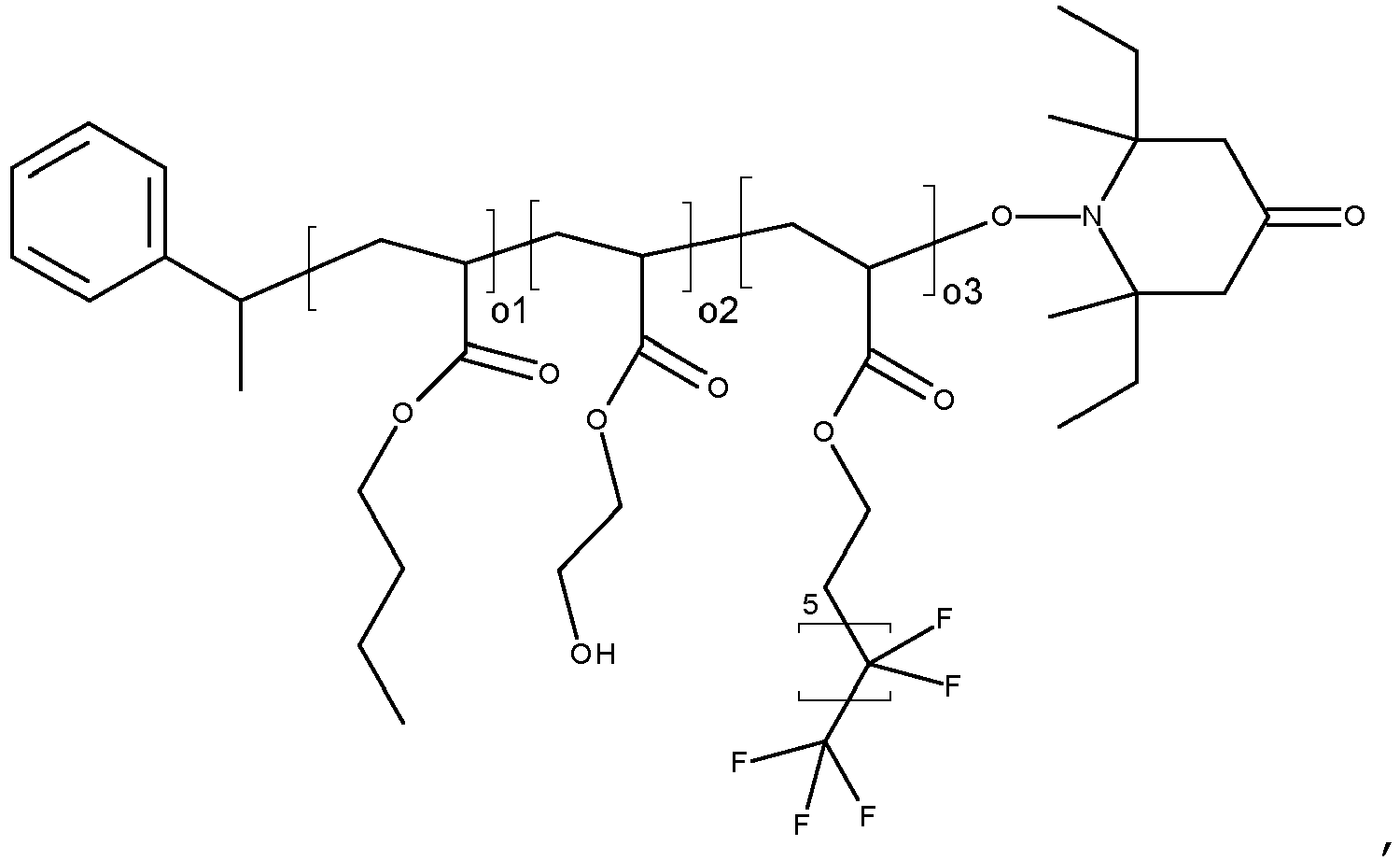
- Radikalisch härtbare Zusammensetzung nach einem der Ansprüche 1 bis 3, wobei die Übergangsmetallpartikel in Form von Nanoplättchen vorliegen und einen anzahlgemittelten Durchmesser von 20 bis 600 nm und eine anzahlgemittelte Dicke von 2 nm bis 40 nm, insbesondere einen anzahlgemittelten Durchmesser von 20 nm bis 300 nm und eine anzahlgemittelte Dicke von 4 bis 30 nm, aufweisen.
- Radikalisch härtbare Zusammensetzung nach einem der Ansprüche 1 bis 5, wobei die Silber-Nanoplättchen auf ihrer Oberfläche ein Oberflächenstabilisierungsmittel tragen, das ausgewählt ist aus Oberflächenstabilisierungsmitteln der Formel
 R1 H, C1-C18Alkyl, Phenyl, C1-C8Alkylphenyl oder CH2COOH ist;R2, R3, R4, R5, R6 und R7 unabhängig voneinander H, C1-C8Alkyl oder Phenyl sind;Y O oder NR8 ist;R8 H oder C1-C8Alkyl ist;k1 eine ganze Zahl in dem Bereich von 1 bis 500 ist;k2 und k3 unabhängig voneinander 0 oder ganze Zahlen in dem Bereich von 1 bis 250 sind;k4 0 oder 1 ist;k5 eine ganze Zahl in dem Bereich von 1 bis 5 ist, insbesondereOberflächenstabilisierungsmittel der Formel
 R1 H oder eine C1-C8Alkylgruppe ist undk1 22 bis 450 ist, insbesondere 22 bis 150; und Oberflächenstabilisierungsmittel, die Polymere oder Copolymere sind, die durch ein Verfahren erhalten sind, das die Schritte umfassti1) bei einem ersten Schritt Polymerisieren eines oder mehrerer ethylenisch ungesättigter Monomere in Gegenwart wenigstens eines Nitroxylethers mit dem Strukturelement
 wobei X eine Gruppe mit wenigstens einem Kohlenstoffatom darstellt und so ist, dass das von X abgeleitete freie Radikal X• fähig ist, Polymerisation auszulösen; oder i2) bei einem ersten Schritt Polymerisieren eines oder mehrerer ethylenisch ungesättigter Monomere in Gegenwart wenigstens eines stabilen freien Nitroxylradikals
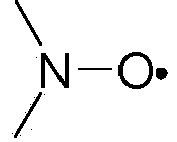 wobei wenigstens ein bei den Schritten i1) oder i2) verwendetes Monomer ein C1-C6Alkyl- oder Hydroxy-C1-C6alkylester von Acryl- oder Methacrylsäure ist; und gegebenenfallsii) einen zweiten Schritt umfassend Modifizieren des bei i1) oder i2) hergestellten Polymers oder Copolymers durch eine Umesterungsreaktion, eine Amidierung, Hydrolyse oder Anhydridmodifizierung oder eine Kombination davon, insbesondere Copolymere dargestellt durch die Formel
 (III), wobei R11 und R12 H oder Methyl sind, m, n und p unabhängig voneinander ganze Zahlen von 1 bis 200 sind, o eine ganze Zahl von 1 bis 150 ist, insbesondere eine ganze Zahl von 1 bis 149; und Gemische davon.
 - Radikalisch härtbare Zusammensetzung nach einem der Ansprüche 1 bis 6, umfassend ein oder mehrere Stabilisierungsmittel ausgewählt aus der Gruppe bestehend aus Verbindungen der Formel
 R21a ein Wasserstoffatom, ein Halogenatom, eine C1-C8Alkoxygruppe oder eine C1-C8Alkylgruppe ist,R21b ein Wasserstoffatom oder eine Gruppe der Formel - CHR24-N(R22)(R23) ist,R22 und R23 unabhängig voneinander eine C1-C8Alkyl-, eine Hydroxy-C1-C8alkylgruppe sind,oder eine Gruppe der Formel -[(CH2CH2)-O]n1-CH2CH2-OH, wobei n1 1 bis 5 ist,R24 H oder C1-C8Alkyl ist, und Verbindungen der Formel
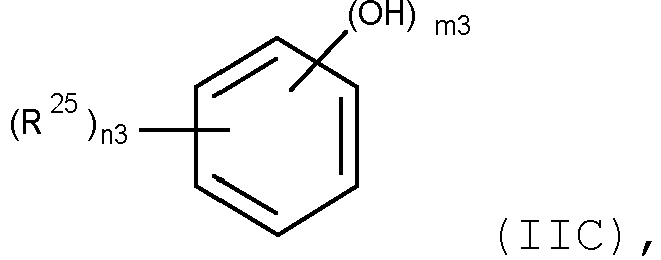 R25 bei jedem Auftreten gleich oder verschieden sein kann und ein Wasserstoffatom, ein Halogenatom, eine C1-C18Alkylgruppe, eine C1-C18Alkoxygruppe oder eine Gruppe - C(=O)-R26 ist,R26 ein Wasserstoffatom, eine Hydroxygruppe, eine C1-C18Alkylgruppe, eine unsubstituierte oder substituierte Aminogruppe, eine unsubstituierte oder substituierte Phenylgruppe oder eine C1-C18Alkoxygruppe ist, undn3 eine Zahl von 1 bis 4 ist,m3 eine Zahl von 2 bis 4 ist unddie Summe von m3 und n3 6 ist.
 - Radikalisch härtbare Zusammensetzung nach einem der Ansprüche 1 bis 7, wobei der Photoinitiator (D) eine Verbindung der Formel
 R50 unsubstituiertes Cyclohexyl, Cyclopentyl, Phenyl, Naphthyl oder Biphenylyl ist; oder Cyclohexyl, Cyclopentyl, Phenyl, Naphthyl oder Biphenylyl ist, das mit einem oder mehreren Halogen, C1-C12Alkyl, C1-C12Alkoxy, C1-C12Alkylthio oder mit NR53R54 substituiert ist;oder R50 unsubstituiertes C1-C20Alkyl ist oder C1-C20-Alkyl ist, das mit einem oder mehreren Halogen, C1-C12Alkoxy, C1-C12Alkylthio, NR53R54 oder mit - (CO) -O-C1-C24Alkyl substituiert ist;R51 unsubstituiertes Cyclohexyl, Cyclopentyl, Phenyl, Naphthyl oder Biphenylyl ist oder Cyclohexyl, Cyclopentyl, Phenyl, Naphthyl oder Biphenylyl ist, das mit einem oder mehreren Halogen, C1-C12Alkyl, C1-C12Alkoxy, C1-C12Alkylthio oder mit NR53R54 substituiert ist; oder R51 -(CO)R'52 ist; oder R51 C1-C12Alkyl ist, das unsubstituiert oder mit einem oder mehreren Halogen, C1-C12Alkoxy, C1-C12Alkylthio oder mit NR53R54 substituiert ist;R52 und R'52 unabhängig voneinander unsubstituiertes Cyclohexyl, Cyclopentyl, Phenyl, Naphthyl oder Biphenylyl sind oder Cyclohexyl, Cyclopentyl, Phenyl, Naphthyl oder Biphenylyl sind, das mit einem oder mehreren Halogen, C1-C4Alkyl oder C1-C4Alkoxy substituiert ist; oder R52 ein 5- oder 6-gliedriger heterocyclischer Ring umfassend ein S-Atom oder ein N-Atom ist;R53 und R54 unabhängig voneinander Wasserstoff, unsubstituiertes C1-C12Alkyl oder C1-C12Alkyl sind, das mit einem oder mehreren OH oder SH substituiert ist, wobei die Alkylkette gegebenenfalls durch ein bis vier Sauerstoffatome unterbrochen ist; oder R53 und R54 unabhängig voneinander C2-C12Alkenyl, Cyclopentyl, Cyclohexyl, Benzyl oder Phenyl sind, oder der Photoinitiator (C) eine Verbindung der Formel
 R29 Wasserstoff oder C1-C18Alkoxy ist;R30 Wasserstoff, C1-C18Alkyl, C1-C12Hydroxyalkyl, C1-C18Alkoxy, OCH2CH2-OR34, Morpholino, S-C1-C18Alkyl, eine

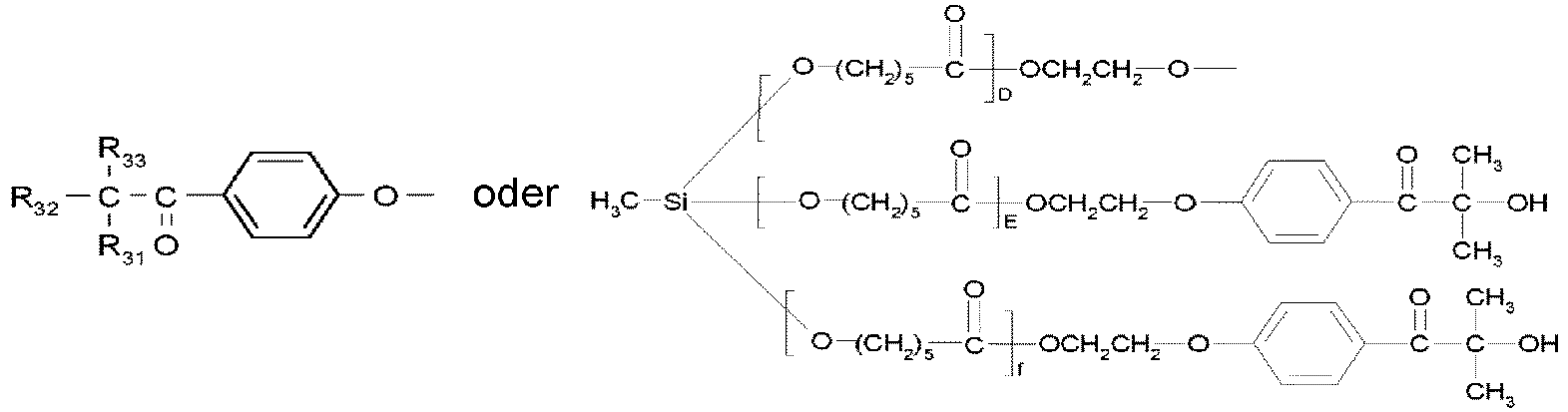 c 2-10 ist;G1 und G2 unabhängig voneinander Endgruppen der polymeren Struktur sind, vorzugsweise Wasserstoff oder Methyl;R34 Wasserstoff,
 R31 Hydroxy, C1-C16Alkoxy, Morpholino, Dimethylamino oder -O(CH2CH2O)g-C1-C16Alkyl ist;g 1-20 ist;R32 und R33 unabhängig voneinander Wasserstoff, C1-C6Alkyl, C1-C16Alkoxy oder -O(CH2CH2O)g-C1-C16Alkyl sind; oder unsubstituiertes Phenyl oder Benzyl sind; oder mit C1-C12Alkyl substituiertes Phenyl oder Benzyl sind; oder R32 und R33 zusammen mit dem Kohlenstoffatom, an das sie gebunden sind, einen Cyclohexylring bilden;R35 Wasserstoff, OR36 oder NR37R38 ist;R36 Wasserstoff, C1-C12Alkyl ist, das gegebenenfalls durch ein oder mehrere nicht aufeinanderfolgende O-Atome unterbrochen ist, welches nicht unterbrochene oder unterbrochene C1-C12Alkyl gegebenenfalls mit einem oder mehreren OH substituiert ist,oder R36
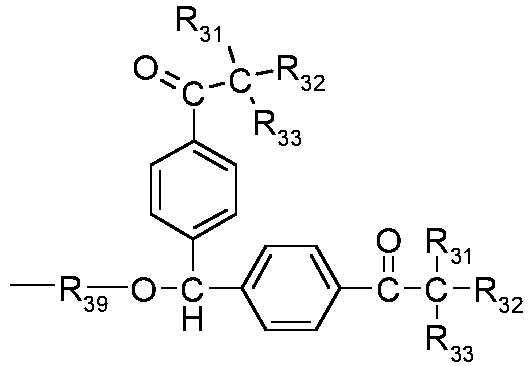 R37 und R38 unabhängig voneinander Wasserstoff oder C1-C12Alkyl sind, das unsubstituiert ist oder mit einem oder mehreren OH substituiert ist;R39 C1-C12Alkylen, das gegebenenfalls durch ein oder mehrere nicht aufeinanderfolgende O unterbrochen ist, - (CO) -NH-C1-C12Alkylen-NH-(CO) - oder
 mit der Maßgabe, dass R31, R32 und R33 nicht alle zusammen C1-C16Alkoxyoder -O(CH2CH2O)g-C1-C16Alkyl sind, oder der Photoinitiator ein Gemisch verschiedener Verbindungen der Formel (XII) ist oder der Photoinitiator ein Gemisch von Verbindungen der Formeln (XII) und (XI) ist.
 - Radikalisch härtbare Zusammensetzung nach einem der Ansprüche 1 bis 8, wobei das/die reaktiven Verdünnungsmittel (B) ausgewählt sind aus monofunktionellen (Meth)acrylaten, difunktionellen (Meth)acrylaten, trifunktionellen (Meth)acrylaten, tetrafunktionellen (Meth)acrylaten, pentafunktionellen (Meth)acrylaten, hexafunktionellen (Meth)acrylaten, monofunktionellen Vinylamiden, monofunktionellen Vinylestern, monofunktionellen (Meth)acrylamiden, Di(meth)acrylamiden, Divinylestern, Divinylamid, Trimethylolpropanformal(meth)acrylaten, N-Vinyloxazolidinonen, N-Vinylcaprolactam (NVC) und N-Vinylpyrrolidon (NVP) und Gemischen davon; insbesondere das/die reaktiven Verdünnungsmittel (B) ausgewählt sind aus Divinyladipat, Dipropylenglycoldiacrylat, Tripropylenglycoldiacrylat, Dipropylenglycoldimethacrylat, Diethylenglycoldiacrylat, Triethylenglycoldiacrylat, Diethylenglycoldimethacrylat, Triethylenglycoldimethacrylat, Butandioldiacrylat, Butandioldimethacrylat, Hexandioldiacrylat, Hexandioldimethacrylat, Octandioldiacrylat, Octandioldimethacrylat, Nonandioldiacrylat, Nonandioldimethacrylat, Decandioldiacrylat, Decandioldimethacrylat, Cyclohexandioldiacrylat, Cyclohexandioldimethacrylat, Cyclohexandimethanoldiacrylat, Cyclohexandimethanoldimethacrylat, (ethoxyliertem) Neopentylglycoldiacrylat, (propoxyliertem) Neopentylglycoldiacrylat, (ethoxyliertem) Neopentylglycoldimethacrylat, (propoxyliertem) Neopentylglycoldimethacrylat, Trimethylolpropantriacrylat (TMPTA), Trimethylolpropantrimethacrylat (TMPTMA), ethoxylierten Trimethylolpropantriacrylaten, ethoxylierten Trimethylolpropantrimethacrylaten, propoxylierten Trimethylolpropantriacrylaten, propoxylierten Trimethylolpropantrimethacrylaten, ethoxylierten Glycerintriacrylaten, ethoxylierten Glycerintrimethacrylaten, propoxylierten Glycerintriacrylaten, propoxylierten Glycerintrimethacrylaten, Bistrimethylolpropantetraacrylat, Bistrimethylolpropantetramethacrylat, ethoxylierten Bistrimethylolpropantetraacrylaten, propoxylierten Bistrimethylolpropantetraacrylaten, Pentaerythrittetraacrylat, Pentaerythrittetramethacrylat, ethoxylierten Pentaerythrittetraacrylaten, ethoxylierten Pentaerythrittetramethacrylaten, propoxylierten Pentaerythrittetraacrylaten, propoxylierten Pentaerythrittetramethacrylaten, Dipentaerythrithexaacrylat, ethoxylierten Dipentaerythrithexaacrylaten, propoxylierten Dipentaerythrithexaacrylaten und Gemischen davon.
- Radikalisch härtbare Zusammensetzung nach einem der Ansprüche 1 bis 9, wobei das/die Oligomere (C) ausgewählt sind aus (Meth)acryloligomeren, Urethan(meth)acrylatoligomeren, Polyester(meth)acrylatoligomeren, (Meth)acrylatoligomeren auf Polyetherbasis, aminmodifizierten (Meth)acrylatoligomeren auf Polyetherbasis und Epoxy(meth)acrylatoligomeren, bevorzugter Urethan(meth)acrylatoligomeren und Epoxy(meth)acrylatoligomeren und Gemischen davon; insbesondere (Meth)acryloligomeren, Urethan(Meth)acrylatoligomeren, Polyester(meth)acrylatoligomeren, (Meth)acrylatoligomeren auf Polyetherbasis, aminmodifizierten (Meth)acrylatoligomeren auf Polyetherbasis oder Epoxy(meth)acrylatoligomeren, besonders Urethan(meth)acrylaten (C), die durch Umsetzung der folgenden Komponenten erhältlich sind:(a) wenigstens ein Isocyanat mit zwei Isocyanatgruppen,(b) wenigstens ein Polyalkylenoxidpolyether mit wenigstens 2 Hydroxygruppen,(c) wenigstens ein hydroxyfunktionelles (Meth)acrylat mit einer Hydroxygruppe und einer (Meth)acrylatgruppe,(d) wenigstens eine Verbindung mit wenigstens einer isocyanatreaktiven Gruppe und wenigstens einer Säurefunktion,(e) wenigstens eine basische Verbindung, die zur Neutralisation oder teilweisen Neutralisation der Säuregruppen der Komponente (d) vorhanden ist,(f) gegebenenfalls wenigstens ein Monoalkohol mit einer Hydroxyfunktion.
- Sicherheits- oder Dekorelement, umfassend ein Substrat, das Zeichen oder andere sichtbare Merkmale in oder auf seiner Oberfläche enthalten kann, und auf wenigstens einem Teil der Substratoberfläche eine Beschichtung umfassend die Zusammensetzung nach einem der Ansprüche 1 bis 10.
- Sicherheits- oder Dekorelement nach Anspruch 11, wobei das Sicherheitselement oder Dekorelement ein Substrat umfasst, wobei eine Beschichtung auf wenigstens einem Teil des Substrats wenigstens eine Flüssigkristallverbindung umfasst, wobei die Beschichtung auf der Rückseite des Substrats aufgebracht ist, wenn das Substrat transparent oder lichtdurchlässig ist, oder auf der Oberflächenseite, wenn das Substrat transparent, lichtdurchlässig, reflektierend oder lichtundurchlässig ist, und eine weitere Beschichtung auf wenigstens einem Teil der Beschichtung, die die Flüssigkristallverbindung enthält, oder direkt auf dem Substrat, wenn die Beschichtung, die die Flüssigkristallverbindung enthält, auf der Rückseite des Substrats angeordnet ist, wobei die weitere Beschichtung von der Zusammensetzung nach einem der Ansprüche 1 bis 10 gebildet ist; oderdas Sicherheitselement oder Dekorelement aus einer interferenzfähigen Mehrschichtstruktur besteht, wobei die interferenzfähige Mehrschichtstruktur eine Reflexionsschicht, eine dielektrische Schicht und eine teilweise transparente Schicht aufweist, wobei die dielektrische Schicht zwischen der Reflexionsschicht und der teilweise transparenten Schicht angeordnet ist, wobei die Reflexionsschicht von einer Farbschicht gebildet ist, die die Zusammensetzung nach einem der Ansprüche 1 bis 10 umfasst; oderdas Sicherheitselement oder Dekorelement ein transparentes Trägersubstrat, eine Schicht, die ein diffraktives optisches Element (DOE) enthält, und eine halbtransparente Funktionsschicht, die von der Zusammensetzung nach einem der Ansprüche 1 bis 10 gebildet ist, umfasst; oderdas Sicherheits- oder Dekorelement ein Blister für Tabletten ist, der ein transparentes Trägersubstrat umfasst, das eine halbtransparente Funktionsschicht enthält, die von der Zusammensetzung nach einem der Ansprüche 1 bis 10 gebildet ist; oderdas Sicherheits- oder Dekorelement eine Verpackung ist, die einen folienförmigen Kunststoffteil und eine Abdeckfolie umfasst, wobei der folienförmige Kunststoffteil die Vorderseite der Verpackung definiert und die Abdeckfolie die Rückseite der Verpackung definiert, und die Abdeckfolie auf der Grundlage eines Trägersubstrats steht, das mit einer halbtransparenten Funktionsschicht versehen ist, die von der Zusammensetzung nach einem der Ansprüche 1 bis 10 gebildet ist; oderSicherheits- oder Dekorelement, umfassend ein Substrat, eine Komponente mit Brechungsindexmodulation,insbesondere ein Volumenhologramm, das erhältlich ist durch Exponieren eines Aufzeichnungsmaterials gegenüber aktinischer Strahlung, und darauf eine Beschichtung auf wenigstens einem Teil der Brechungsindexmodulationsschicht, die von der Zusammensetzung nach einem der Ansprüche 1 bis 10 gebildet ist; oderSicherheits- oder Dekorelement, umfassend ein Substrat, eine UV-Lackschicht auf wenigstens einem Teil des Substrats, das auf wenigstens einem Teil seiner Oberfläche eine Nano- oder Mikrostruktur aufweist, und auf wenigstens einem Teil der UV-Lackschicht und/oder auf wenigstens einem Teil der Nano- oder Mikrostrukturschicht eine Beschichtung, die von der Zusammensetzung nach einem der Ansprüche 1 bis 10 gebildet ist; oderSicherheits- oder Dekorelement, fähig zur Interferenz in dem sichtbaren Spektralbereich, umfassend ein Substrat, das gegebenenfalls auf wenigstens einem Teil seiner Oberfläche eine Nano- oder Mikrostruktur trägt, und auf wenigstens einem Teil des Substrats und/oder auf wenigstens einem Teil der Nano- oder Mikrostruktur eine Beschichtung, die mit den Zusammensetzungen nach einem der Ansprüche 1 bis 10 erhalten ist, wobei die Beschichtung eine Interferenzfarbe zeigt; oderSicherheits- oder Dekorelement umfassendi) eine reflektierende Schicht, die mit den Zusammensetzungen nach einem der Ansprüche 1 bis 10 erhalten ist,ii) eine transparente oder lichtdurchlässige Abstandsschicht undiii) zusätzlich eine transparente oder lichtdurchlässige Schicht mit einem Brechungsindex, der sich von dem Brechungsindex der Abstandshalterschicht um wenigstens 0,1, vorzugsweise wenigstens 0,2, höchst bevorzugt wenigstens 0,3 unterscheidet; wobei die Abstandshalterschicht ii) zwischen der reflektierenden Schicht i) und der Schicht iii) und dem Sicherheits- oder Dekorelement, das eine Interferenzfarbe zeigt, angeordnet ist.
- Produkt, umfassend das Sicherheits- oder Dekorelement nach Ansprüchen 11 oder 12.
- Verwendung des Sicherheits- oder Dekorelements nach Anspruch 11 oder 12 zum Verhindern von Fälschung oder Vervielfältigung auf einem Wert-, Rechts-, Identitätdokument, einem Sicherheitsetikett oder einer Markenware.
- Verfahren zur Herstellung eines Sicherheits- oder Dekorelements, umfassend die Schritte:a) Bereitstellen eines Substrats, das gegebenenfalls eine Oberflächenrelief-Nano- oder Mikrostruktur trägt,b1) Aufbringen einer Zusammensetzung nach Ansprüchen 1 bis 10 auf wenigstens einen Teil des Substrats,b2) gegebenenfalls Prägen einer Nano- oder Mikrostruktur in die bei Schritt b1) erhaltene Beschichtung undc) Härten der Zusammensetzung mit aktinischer Strahlung.
Applications Claiming Priority (2)
| Application Number | Priority Date | Filing Date | Title |
|---|---|---|---|
| EP21173520 | 2021-05-12 | ||
| PCT/EP2022/062753 WO2022238468A1 (en) | 2021-05-12 | 2022-05-11 | Compositions, comprising platelet-shaped transition metal particles |
Publications (2)
| Publication Number | Publication Date |
|---|---|
| EP4337734A1 EP4337734A1 (de) | 2024-03-20 |
| EP4337734B1 true EP4337734B1 (de) | 2025-04-23 |
Family
ID=75914373
Family Applications (1)
| Application Number | Title | Priority Date | Filing Date |
|---|---|---|---|
| EP22728579.8A Active EP4337734B1 (de) | 2021-05-12 | 2022-05-11 | Zusammensetzungen mit plättchenförmigen übergangsmetallpartikeln |
Country Status (7)
| Country | Link |
|---|---|
| US (1) | US20240287281A1 (de) |
| EP (1) | EP4337734B1 (de) |
| CN (1) | CN117321151A (de) |
| AU (1) | AU2022273179A1 (de) |
| CA (1) | CA3218468A1 (de) |
| MX (1) | MX2023013396A (de) |
| WO (1) | WO2022238468A1 (de) |
Families Citing this family (1)
| Publication number | Priority date | Publication date | Assignee | Title |
|---|---|---|---|---|
| WO2024231418A1 (en) | 2023-05-08 | 2024-11-14 | Basf Se | Compositions, comprising silver nanoplatelets |
Family Cites Families (44)
| Publication number | Priority date | Publication date | Assignee | Title |
|---|---|---|---|---|
| US5763548A (en) | 1995-03-31 | 1998-06-09 | Carnegie-Mellon University | (Co)polymers and a novel polymerization process based on atom (or group) transfer radical polymerization |
| BR9710219A (pt) | 1996-07-10 | 1999-08-10 | Du Pont | Processo para a sintese de polímeros agente de transferéncia de cadeia e polímero |
| FR2764892B1 (fr) | 1997-06-23 | 2000-03-03 | Rhodia Chimie Sa | Procede de synthese de polymeres a blocs |
| CA2337339A1 (en) | 1997-07-21 | 1999-02-04 | Commonwealth Scientific And Industrial Research Organisation | Synthesis of dithioester chain transfer agents and use of bis(thioacyl) disulfides or dithioesters as chain transfer agents |
| DE69836501T3 (de) | 1997-12-18 | 2013-07-18 | Commonwealth Scientific And Industrial Research Organisation | Polymerisationsverfahren mit lebenden eigenschaften und daraus hergestellte polymere |
| KR101123607B1 (ko) | 2003-12-10 | 2012-03-21 | 시바 홀딩 인크 | 니트록실 매개되는 중합반응에 의해 제조된 균전제를함유하는 피복 조성물 |
| EP1873199A1 (de) | 2004-09-03 | 2008-01-02 | Ciba Specialty Chemicals Holding Inc. | In-Can Stabilisatoren |
| WO2006074969A1 (en) | 2005-01-11 | 2006-07-20 | Ciba Specialty Chemicals Holding Inc. | Process for the post-modification of homo and copolymers prepared by controlled free radical polymerization processes |
| EP1791702B9 (de) | 2005-01-14 | 2011-09-14 | Cabot Corporation | Sicherheitseinrichtungen sowie verwendung und herstellungsverfahren davon |
| CA2699583C (en) | 2007-09-27 | 2016-04-19 | Francesca Peri | Isolable and redispersable transition metal nanoparticles their preparation and use as ir absorbers |
| JP5591125B2 (ja) | 2008-02-22 | 2014-09-17 | ビーエーエスエフ ソシエタス・ヨーロピア | フルオロ平滑化剤 |
| US9095898B2 (en) | 2008-09-15 | 2015-08-04 | Lockheed Martin Corporation | Stabilized metal nanoparticles and methods for production thereof |
| US8802151B2 (en) | 2009-03-24 | 2014-08-12 | Basf Se | Preparation of shaped metal particles and their uses |
| KR101651915B1 (ko) | 2009-09-14 | 2016-08-29 | 한화케미칼 주식회사 | 금속 나노입자 수계 분산액의 제조방법 |
| RU2562031C2 (ru) | 2009-11-27 | 2015-09-10 | Басф Се | Композиции для покрытий защитных элементов и голограмм |
| JP6066396B2 (ja) | 2011-08-17 | 2017-01-25 | ローム アンド ハース エレクトロニック マテリアルズ エルエルシーRohm and Haas Electronic Materials LLC | 無電解金属化のための安定な触媒 |
| FR2979734B1 (fr) | 2011-09-02 | 2014-05-23 | Arjowiggins Security | Structure de securite comportant une structure optique reflechissante, et procede associe. |
| DE102011114647A1 (de) | 2011-09-30 | 2013-04-04 | Giesecke & Devrient Gmbh | Sicherheitselement mit mehreren optisch variablen Strukturen |
| CN104395091A (zh) | 2012-06-14 | 2015-03-04 | 巴斯夫欧洲公司 | 生产安全元件和全息图的方法 |
| AU2013314269B2 (en) | 2012-09-17 | 2017-07-06 | Basf Se | Security elements and method for their manufacture |
| RU2646809C2 (ru) | 2012-10-11 | 2018-03-07 | Нанокомпозикс, Инк. | Композиции серебряных нанопластин и способы |
| DE102012020550A1 (de) | 2012-10-19 | 2014-04-24 | Giesecke & Devrient Gmbh | Optisch variables Flächenmuster |
| GB2510381B (en) | 2013-02-01 | 2015-11-04 | Rue De Int Ltd | Security devices and methods of manufacture thereof |
| BR112015028902A2 (pt) | 2013-05-21 | 2017-07-25 | Basf Se | elemento de segurança, método para formar um elemento de segurança, produto de segurança, e, uso de um elemento de segurança |
| DE102013019585A1 (de) | 2013-11-21 | 2015-05-21 | Giesecke & Devrient Gmbh | Verfahren zum Herstellen eines Wertdokuments und eines Sicherheitselements, daraus erhältliches Wertdokument und Sicherheitselement und Vorrichtung zur Durchführung des Verfahrens |
| DE102013021180A1 (de) | 2013-12-17 | 2015-06-18 | Giesecke & Devrient Gmbh | Verfahren zum Herstellen eines Wertdokuments, daraus erhältliches Wertdokument und Vorrichtung zur Durchführung des Verfahrens |
| DE102014001842A1 (de) | 2014-02-11 | 2015-08-13 | Giesecke & Devrient Gmbh | Verfahren zum Herstellen eines Sicherheitselements mit Negativschrift und daraus erhältliches Sicherheitselement |
| WO2015190076A1 (ja) | 2014-06-11 | 2015-12-17 | バンドー化学株式会社 | 銀微粒子分散体、銀微粒子及びその製造方法 |
| US20170246690A1 (en) | 2014-06-20 | 2017-08-31 | Rhodia Operations | Stabilizing agent-free metal nanoparticle synthesis and uses of metal nanoparticles synthesized therefrom |
| DE102014018204A1 (de) | 2014-12-09 | 2016-06-09 | Giesecke & Devrient Gmbh | Sicherheitselement, Verfahren zum Herstellen desselben und mit dem Sicherheitselement ausgestatteter Datenträger |
| DE102015005453A1 (de) | 2015-04-28 | 2016-11-03 | Giesecke & Devrient Gmbh | Sicherheitselement mit zwei aneinander angrenzenden Sicherheitsmerkmalen |
| DE102015005446A1 (de) | 2015-04-28 | 2016-11-03 | Giesecke & Devrient Gmbh | Sicherheitselement mit Mehrschichtstruktur |
| DE102015008971A1 (de) | 2015-07-10 | 2017-01-12 | Giesecke & Devrient Gmbh | Sicherheitselement und Datenträger |
| DE102015009164A1 (de) | 2015-07-14 | 2017-01-19 | Giesecke & Devrient Gmbh | Datenträger mit Durchbrechungsbereich |
| DE102015010744A1 (de) | 2015-08-17 | 2017-02-23 | Giesecke & Devrient Gmbh | Sicherheitselement, Verfahren zum Herstellen desselben und mit dem Sicherheitselement ausgestatteter Datenträger |
| DE102015015730A1 (de) | 2015-09-28 | 2017-03-30 | Giesecke & Devrient Gmbh | Verpackung, Abdeckfolie und Verwendung einer Folie als Abdeckfolie |
| DE102015014505A1 (de) | 2015-11-10 | 2017-05-11 | Giesecke & Devrient Gmbh | Sicherheitselement, Verfahren zum Herstellen desselben und mit dem Sicherheitselement ausgestatteter Datenträger |
| DE102015015733A1 (de) | 2015-12-01 | 2017-06-01 | Giesecke & Devrient Gmbh | Sicherheitselement und mit demselben ausgestatteter Datenträger |
| DE102016000592A1 (de) | 2015-12-30 | 2017-07-06 | Giesecke & Devrient Gmbh | Kunststofffolienformteil, Herstellungsverfahren und Blister |
| AU2016101590B4 (en) | 2016-09-08 | 2017-05-18 | Ccl Secure Pty Ltd | A 3d micromirror device |
| EP3658701A1 (de) * | 2017-07-28 | 2020-06-03 | Basf Se | Verfahren zur herstellung von metallischen nanopartikelschichten und deren verwendung für dekorations- oder sicherheitselemente |
| JP7147233B2 (ja) | 2018-04-09 | 2022-10-05 | コニカミノルタ株式会社 | 水系インクジェットインク、インクセット、および画像形成方法 |
| EP3870381A1 (de) | 2018-10-25 | 2021-09-01 | Basf Se | Zusammensetzungen mit silbernanoplättchen |
| US12515253B2 (en) | 2019-05-06 | 2026-01-06 | Basf Se | Compositions, comprising silver nanoplatelets |
-
2022
- 2022-05-11 EP EP22728579.8A patent/EP4337734B1/de active Active
- 2022-05-11 US US18/559,811 patent/US20240287281A1/en active Pending
- 2022-05-11 WO PCT/EP2022/062753 patent/WO2022238468A1/en not_active Ceased
- 2022-05-11 CN CN202280034065.0A patent/CN117321151A/zh active Pending
- 2022-05-11 CA CA3218468A patent/CA3218468A1/en active Pending
- 2022-05-11 MX MX2023013396A patent/MX2023013396A/es unknown
- 2022-05-11 AU AU2022273179A patent/AU2022273179A1/en active Pending
Also Published As
| Publication number | Publication date |
|---|---|
| MX2023013396A (es) | 2023-11-27 |
| CN117321151A (zh) | 2023-12-29 |
| AU2022273179A1 (en) | 2023-11-30 |
| US20240287281A1 (en) | 2024-08-29 |
| EP4337734A1 (de) | 2024-03-20 |
| WO2022238468A1 (en) | 2022-11-17 |
| CA3218468A1 (en) | 2022-11-17 |
Similar Documents
| Publication | Publication Date | Title |
|---|---|---|
| CN112912191B (zh) | 包含银纳米小片的组合物 | |
| US12515253B2 (en) | Compositions, comprising silver nanoplatelets | |
| US20240309174A1 (en) | Compositions, comprising silver nanoplatelets | |
| US11945254B2 (en) | Security element | |
| EP4337734B1 (de) | Zusammensetzungen mit plättchenförmigen übergangsmetallpartikeln | |
| WO2019206845A1 (en) | Process for the production of strongly adherent (embossed) films on flexible substrates | |
| US20230241675A1 (en) | Compositions, comprising platelet-shaped transition metal particles | |
| WO2023072740A1 (en) | A method for producing interference elements | |
| US12296391B2 (en) | Security element | |
| WO2024231418A1 (en) | Compositions, comprising silver nanoplatelets |
Legal Events
| Date | Code | Title | Description |
|---|---|---|---|
| STAA | Information on the status of an ep patent application or granted ep patent |
Free format text: STATUS: UNKNOWN |
|
| STAA | Information on the status of an ep patent application or granted ep patent |
Free format text: STATUS: THE INTERNATIONAL PUBLICATION HAS BEEN MADE |
|
| PUAI | Public reference made under article 153(3) epc to a published international application that has entered the european phase |
Free format text: ORIGINAL CODE: 0009012 |
|
| STAA | Information on the status of an ep patent application or granted ep patent |
Free format text: STATUS: REQUEST FOR EXAMINATION WAS MADE |
|
| 17P | Request for examination filed |
Effective date: 20231212 |
|
| AK | Designated contracting states |
Kind code of ref document: A1 Designated state(s): AL AT BE BG CH CY CZ DE DK EE ES FI FR GB GR HR HU IE IS IT LI LT LU LV MC MK MT NL NO PL PT RO RS SE SI SK SM TR |
|
| DAV | Request for validation of the european patent (deleted) | ||
| DAX | Request for extension of the european patent (deleted) | ||
| GRAP | Despatch of communication of intention to grant a patent |
Free format text: ORIGINAL CODE: EPIDOSNIGR1 |
|
| STAA | Information on the status of an ep patent application or granted ep patent |
Free format text: STATUS: GRANT OF PATENT IS INTENDED |
|
| RIC1 | Information provided on ipc code assigned before grant |
Ipc: C08F 220/56 20060101ALI20241107BHEP Ipc: C08F 220/10 20060101ALI20241107BHEP Ipc: C09D 4/00 20060101ALI20241107BHEP Ipc: C09D 153/00 20060101ALI20241107BHEP Ipc: C09D 151/10 20060101ALI20241107BHEP Ipc: C09D 5/00 20060101ALI20241107BHEP Ipc: C08L 53/00 20060101ALI20241107BHEP Ipc: C08K 3/08 20060101ALI20241107BHEP Ipc: C08F 293/00 20060101ALI20241107BHEP Ipc: C08F 292/00 20060101ALI20241107BHEP Ipc: C08F 287/00 20060101ALI20241107BHEP Ipc: C08F 222/10 20060101ALI20241107BHEP Ipc: C08F 222/00 20060101ALI20241107BHEP Ipc: B42D 25/30 20140101ALI20241107BHEP Ipc: B42D 25/425 20140101ALI20241107BHEP Ipc: C09D 7/61 20180101ALI20241107BHEP Ipc: C09D 7/40 20180101AFI20241107BHEP |
|
| INTG | Intention to grant announced |
Effective date: 20241115 |
|
| GRAS | Grant fee paid |
Free format text: ORIGINAL CODE: EPIDOSNIGR3 |
|
| GRAA | (expected) grant |
Free format text: ORIGINAL CODE: 0009210 |
|
| STAA | Information on the status of an ep patent application or granted ep patent |
Free format text: STATUS: THE PATENT HAS BEEN GRANTED |
|
| AK | Designated contracting states |
Kind code of ref document: B1 Designated state(s): AL AT BE BG CH CY CZ DE DK EE ES FI FR GB GR HR HU IE IS IT LI LT LU LV MC MK MT NL NO PL PT RO RS SE SI SK SM TR |
|
| REG | Reference to a national code |
Ref country code: GB Ref legal event code: FG4D |
|
| REG | Reference to a national code |
Ref country code: CH Ref legal event code: EP |
|
| REG | Reference to a national code |
Ref country code: DE Ref legal event code: R096 Ref document number: 602022013598 Country of ref document: DE |
|
| REG | Reference to a national code |
Ref country code: IE Ref legal event code: FG4D |
|
| PGFP | Annual fee paid to national office [announced via postgrant information from national office to epo] |
Ref country code: DE Payment date: 20250528 Year of fee payment: 4 |
|
| PGFP | Annual fee paid to national office [announced via postgrant information from national office to epo] |
Ref country code: CH Payment date: 20250601 Year of fee payment: 4 |
|
| PGFP | Annual fee paid to national office [announced via postgrant information from national office to epo] |
Ref country code: AT Payment date: 20250721 Year of fee payment: 4 |
|
| REG | Reference to a national code |
Ref country code: NL Ref legal event code: MP Effective date: 20250423 |
|
| PG25 | Lapsed in a contracting state [announced via postgrant information from national office to epo] |
Ref country code: NL Free format text: LAPSE BECAUSE OF FAILURE TO SUBMIT A TRANSLATION OF THE DESCRIPTION OR TO PAY THE FEE WITHIN THE PRESCRIBED TIME-LIMIT Effective date: 20250423 |
|
| REG | Reference to a national code |
Ref country code: AT Ref legal event code: MK05 Ref document number: 1787761 Country of ref document: AT Kind code of ref document: T Effective date: 20250423 |
|
| PG25 | Lapsed in a contracting state [announced via postgrant information from national office to epo] |
Ref country code: FI Free format text: LAPSE BECAUSE OF FAILURE TO SUBMIT A TRANSLATION OF THE DESCRIPTION OR TO PAY THE FEE WITHIN THE PRESCRIBED TIME-LIMIT Effective date: 20250423 Ref country code: PT Free format text: LAPSE BECAUSE OF FAILURE TO SUBMIT A TRANSLATION OF THE DESCRIPTION OR TO PAY THE FEE WITHIN THE PRESCRIBED TIME-LIMIT Effective date: 20250825 Ref country code: ES Free format text: LAPSE BECAUSE OF FAILURE TO SUBMIT A TRANSLATION OF THE DESCRIPTION OR TO PAY THE FEE WITHIN THE PRESCRIBED TIME-LIMIT Effective date: 20250423 |
|
| REG | Reference to a national code |
Ref country code: LT Ref legal event code: MG9D |
|
| PG25 | Lapsed in a contracting state [announced via postgrant information from national office to epo] |
Ref country code: NO Free format text: LAPSE BECAUSE OF FAILURE TO SUBMIT A TRANSLATION OF THE DESCRIPTION OR TO PAY THE FEE WITHIN THE PRESCRIBED TIME-LIMIT Effective date: 20250723 Ref country code: GR Free format text: LAPSE BECAUSE OF FAILURE TO SUBMIT A TRANSLATION OF THE DESCRIPTION OR TO PAY THE FEE WITHIN THE PRESCRIBED TIME-LIMIT Effective date: 20250724 |
|
| PG25 | Lapsed in a contracting state [announced via postgrant information from national office to epo] |
Ref country code: PL Free format text: LAPSE BECAUSE OF FAILURE TO SUBMIT A TRANSLATION OF THE DESCRIPTION OR TO PAY THE FEE WITHIN THE PRESCRIBED TIME-LIMIT Effective date: 20250423 |
|
| PG25 | Lapsed in a contracting state [announced via postgrant information from national office to epo] |
Ref country code: BG Free format text: LAPSE BECAUSE OF FAILURE TO SUBMIT A TRANSLATION OF THE DESCRIPTION OR TO PAY THE FEE WITHIN THE PRESCRIBED TIME-LIMIT Effective date: 20250423 |
|
| PG25 | Lapsed in a contracting state [announced via postgrant information from national office to epo] |
Ref country code: HR Free format text: LAPSE BECAUSE OF FAILURE TO SUBMIT A TRANSLATION OF THE DESCRIPTION OR TO PAY THE FEE WITHIN THE PRESCRIBED TIME-LIMIT Effective date: 20250423 Ref country code: AT Free format text: LAPSE BECAUSE OF FAILURE TO SUBMIT A TRANSLATION OF THE DESCRIPTION OR TO PAY THE FEE WITHIN THE PRESCRIBED TIME-LIMIT Effective date: 20250423 |
|
| PG25 | Lapsed in a contracting state [announced via postgrant information from national office to epo] |
Ref country code: RS Free format text: LAPSE BECAUSE OF FAILURE TO SUBMIT A TRANSLATION OF THE DESCRIPTION OR TO PAY THE FEE WITHIN THE PRESCRIBED TIME-LIMIT Effective date: 20250723 |
|
| PG25 | Lapsed in a contracting state [announced via postgrant information from national office to epo] |
Ref country code: IS Free format text: LAPSE BECAUSE OF FAILURE TO SUBMIT A TRANSLATION OF THE DESCRIPTION OR TO PAY THE FEE WITHIN THE PRESCRIBED TIME-LIMIT Effective date: 20250823 |
|
| PG25 | Lapsed in a contracting state [announced via postgrant information from national office to epo] |
Ref country code: LV Free format text: LAPSE BECAUSE OF FAILURE TO SUBMIT A TRANSLATION OF THE DESCRIPTION OR TO PAY THE FEE WITHIN THE PRESCRIBED TIME-LIMIT Effective date: 20250423 |
|
| PG25 | Lapsed in a contracting state [announced via postgrant information from national office to epo] |
Ref country code: DK Free format text: LAPSE BECAUSE OF FAILURE TO SUBMIT A TRANSLATION OF THE DESCRIPTION OR TO PAY THE FEE WITHIN THE PRESCRIBED TIME-LIMIT Effective date: 20250423 Ref country code: SM Free format text: LAPSE BECAUSE OF FAILURE TO SUBMIT A TRANSLATION OF THE DESCRIPTION OR TO PAY THE FEE WITHIN THE PRESCRIBED TIME-LIMIT Effective date: 20250423 |
|
| PG25 | Lapsed in a contracting state [announced via postgrant information from national office to epo] |
Ref country code: LU Free format text: LAPSE BECAUSE OF NON-PAYMENT OF DUE FEES Effective date: 20250511 |
|
| PG25 | Lapsed in a contracting state [announced via postgrant information from national office to epo] |
Ref country code: CZ Free format text: LAPSE BECAUSE OF FAILURE TO SUBMIT A TRANSLATION OF THE DESCRIPTION OR TO PAY THE FEE WITHIN THE PRESCRIBED TIME-LIMIT Effective date: 20250423 |
|
| PG25 | Lapsed in a contracting state [announced via postgrant information from national office to epo] |
Ref country code: EE Free format text: LAPSE BECAUSE OF FAILURE TO SUBMIT A TRANSLATION OF THE DESCRIPTION OR TO PAY THE FEE WITHIN THE PRESCRIBED TIME-LIMIT Effective date: 20250423 |
|
| PG25 | Lapsed in a contracting state [announced via postgrant information from national office to epo] |
Ref country code: SK Free format text: LAPSE BECAUSE OF FAILURE TO SUBMIT A TRANSLATION OF THE DESCRIPTION OR TO PAY THE FEE WITHIN THE PRESCRIBED TIME-LIMIT Effective date: 20250423 |
|
| PG25 | Lapsed in a contracting state [announced via postgrant information from national office to epo] |
Ref country code: IT Free format text: LAPSE BECAUSE OF FAILURE TO SUBMIT A TRANSLATION OF THE DESCRIPTION OR TO PAY THE FEE WITHIN THE PRESCRIBED TIME-LIMIT Effective date: 20250423 |
|
| PG25 | Lapsed in a contracting state [announced via postgrant information from national office to epo] |
Ref country code: MC Free format text: LAPSE BECAUSE OF FAILURE TO SUBMIT A TRANSLATION OF THE DESCRIPTION OR TO PAY THE FEE WITHIN THE PRESCRIBED TIME-LIMIT Effective date: 20250423 |