EP4335447B1 - Kulturüberstand von aus zahnmark gewonnenen stammzellen zur verbesserung von myopie, astigmatismus, presbyopie, augenermüdung oder verschwommenem sehen - Google Patents
Kulturüberstand von aus zahnmark gewonnenen stammzellen zur verbesserung von myopie, astigmatismus, presbyopie, augenermüdung oder verschwommenem sehen Download PDFInfo
- Publication number
- EP4335447B1 EP4335447B1 EP22827897.4A EP22827897A EP4335447B1 EP 4335447 B1 EP4335447 B1 EP 4335447B1 EP 22827897 A EP22827897 A EP 22827897A EP 4335447 B1 EP4335447 B1 EP 4335447B1
- Authority
- EP
- European Patent Office
- Prior art keywords
- stem cells
- ocular symptom
- improving agent
- culture supernatant
- dental pulp
- Prior art date
- Legal status (The legal status is an assumption and is not a legal conclusion. Google has not performed a legal analysis and makes no representation as to the accuracy of the status listed.)
- Active
Links
Images



Classifications
-
- A—HUMAN NECESSITIES
- A61—MEDICAL OR VETERINARY SCIENCE; HYGIENE
- A61P—SPECIFIC THERAPEUTIC ACTIVITY OF CHEMICAL COMPOUNDS OR MEDICINAL PREPARATIONS
- A61P27/00—Drugs for disorders of the senses
- A61P27/02—Ophthalmic agents
-
- A—HUMAN NECESSITIES
- A61—MEDICAL OR VETERINARY SCIENCE; HYGIENE
- A61K—PREPARATIONS FOR MEDICAL, DENTAL OR TOILETRY PURPOSES
- A61K35/00—Medicinal preparations containing materials or reaction products thereof with undetermined constitution
- A61K35/12—Materials from mammals; Compositions comprising non-specified tissues or cells; Compositions comprising non-embryonic stem cells; Genetically modified cells
- A61K35/28—Bone marrow; Haematopoietic stem cells; Mesenchymal stem cells of any origin, e.g. adipose-derived stem cells
-
- A—HUMAN NECESSITIES
- A61—MEDICAL OR VETERINARY SCIENCE; HYGIENE
- A61K—PREPARATIONS FOR MEDICAL, DENTAL OR TOILETRY PURPOSES
- A61K35/00—Medicinal preparations containing materials or reaction products thereof with undetermined constitution
- A61K35/12—Materials from mammals; Compositions comprising non-specified tissues or cells; Compositions comprising non-embryonic stem cells; Genetically modified cells
- A61K35/32—Bones; Osteocytes; Osteoblasts; Tendons; Tenocytes; Teeth; Odontoblasts; Cartilage; Chondrocytes; Synovial membrane
-
- A—HUMAN NECESSITIES
- A61—MEDICAL OR VETERINARY SCIENCE; HYGIENE
- A61P—SPECIFIC THERAPEUTIC ACTIVITY OF CHEMICAL COMPOUNDS OR MEDICINAL PREPARATIONS
- A61P27/00—Drugs for disorders of the senses
- A61P27/02—Ophthalmic agents
- A61P27/10—Ophthalmic agents for accommodation disorders, e.g. myopia
Definitions
- the present invention relates to an ocular symptom-improving agent for use in improving an ocular symptom.
- PTL 1 describes a pharmaceutical composition for treating at least one of allergic rhinitis and pollinosis which contains an immortalized stem cell culture supernatant containing a secretory component from immortalized stem cells obtained by culturing immortalized stem cells or the secretory component and in which the immortalized stem cells are either dental pulp stem cells or bone marrow stem cells.
- PTL 1 discloses in Examples that ocular symptoms of pollinosis were improved by administering a culture supernatant using an immortalized dental pulp stem cell culture supernatant to humans as nose drops.
- PTL 2 describes a suppressor agent or a therapeutic agent for a cataract containing a culture supernatant component obtained by culturing mesenchymal stem cells.
- PTL 2 discloses in Examples that cataracts were improved by administering a culture supernatant component using bone marrow mesenchymal stem cells as mesenchymal stem cells to rats as eye drops.
- PTL 3 describes a hardening-preventing agent or a therapeutic agent for lens tissues containing a culture supernatant component obtained by culturing mesenchymal stem cells.
- PTL 3 discloses in Examples that the ability of compressing and recovering of lens tissues was improved by administering a culture supernatant component using bone marrow mesenchymal stem cells as mesenchymal stem cells to rats as eye drops.
- a problem to be solved by the invention is to provide a novel ocular symptom-improving agent related to myopia, astigmatism, presbyopia, eye fatigue or blurred vision.
- a culture supernatant of dental pulp-derived stem cells can improve an ocular symptom related to myopia, astigmatism or presbyopia (in particular, eyesight or astigmatism grade) and can also improve eye fatigue or blurred vision.
- PTL 1 which uses immortalized cells of dental pulp-derived stem cells, improvement of myopia, astigmatism, presbyopia, eye fatigue or blurred vision is not examined.
- PTLs 2 and 3 a culture supernatant of dental pulp-derived stem cells is not examined.
- PTL 3 mentions presbyopia, PTL 3 merely examines that the ability of compressing and recovering of rat lens tissues was improved and fails to examine how far the eyesight of a human patient with presbyopia would be actually improved.
- a novel ocular symptom-improving agent related to myopia, astigmatism, presbyopia, eye fatigue or blurred vision can be provided.
- the ocular symptom-improving agent for use according to the invention is a composition containing a culture supernatant of dental pulp-derived stem cells or immortalized stem cells thereof and is used for improving a symptom of myopia, astigmatism, presbyopia, eye fatigue or blurred vision.
- a novel ocular symptom-improving agent related to myopia, astigmatism, presbyopia, eye fatigue or blurred vision can be provided.
- eye fatigue or blurred vision can be improved, or myopia, astigmatism or presbyopia can be improved.
- myopia, astigmatism or presbyopia can be preferably improved, and myopia or presbyopia can be more preferably improved.
- the range of the "improvement” in the invention includes not only treatment for completely curing a disease but also temporal treatment or recovery of a disease, even when the disease is not completely cured, stop of the progress of a disease or delay compared to a case without any treatment.
- the "improvement of an ocular symptom" in the invention includes not only recovery of the eyesight but also temporal correction of the eyesight and recovery of the eyesight, the vision or the focusing function which is temporarily deteriorated due to eye fatigue or blurred vision and also includes recovery or temporal recovery of the astigmatism grade.
- an ocular symptom in particular, eyesight or astigmatism grade
- an ocular symptom-improving agent for a certain period after the completion of the administration and in which the ocular symptom then returns to the original state
- the ocular symptom then returns to the original state
- Myopia refers to inability to focus at a far focal point.
- myopia is caused by deterioration of the ability of the eye to focus and refers to the state in which distant vision for seeing a distant object is difficult.
- the lens of the eye is a tissue refracting light. To see a distant object, the muscles around the lens pull the lens to reduce the thickness, while to see a close object, the surrounding muscles relax, and the thickness returns to the original thickness due to the elasticity of the lens to focus on the object.
- myopia In the case of myopia, light focuses in front of the retina, and thus an object does not appear clearly.
- Myopia is roughly classified into two types, namely refractive myopia, which is caused because the index of refraction of the cornea or the lens is too strong, and axial myopia, which is caused because the eye's axial length that is the length of the eyeball in the front-back direction is too long.
- Refractive myopia refers to the state in which the thickness of the lens playing the role of a lens is not regulated accurately and in which the lens focuses in front of the retina
- refractive myopia is a symptom caused by deterioration of the movement of the lens through temporal paralysis of the ciliary body due to eyestrain (asthenopia), accommodative spasm, tonic accommodation or the like (also called “accommodation disturbance” below).
- the accommodation disturbance has also been called pseudomyopia, refractive myopia or tonic accommodation myopia, and these are dysfunctions based on transient accommodative spasm or tonic accommodation and are improved by resting the eyes, stopping convulsion of the ciliary body with eye drops to relax the strain of the lens or the like.
- Axial myopia refers to the state in which the eye's axial length is long and thus light focuses in front of the retina even when the lens is adjusted thin enough, and it is believed that axial myopia is irreversible and cannot be recovered to the original state. Axial myopia is improved by suppressing the elongation of the eye's axial length, shortening the eye's axial length or the like.
- Myopia is caused because focusing especially on a distant object becomes difficult due to these factors.
- the "distance" eyesight is believed to be the eyesight at a focal point of one meter or more from the eyes.
- excellent distance eyesight with naked eyes is also called emmetropia.
- the ocular symptom-improving agent when used for improving myopia, the ocular symptom-improving agent preferably improves at least one of uncorrected eyesight and corrected eyesight and more preferably improves both of uncorrected eyesight and corrected eyesight.
- the uncorrected eyesight is improved preferably by 10% or more based on the eyesight of the subject before the administration regarded as 100%, more preferably by 20% or more, particularly preferably by 30% or more.
- the corrected eyesight is improved preferably by 20% or more based on the eyesight of the subject before the administration regarded as 100%, more preferably by 50% or more, particularly preferably by 100% or more.
- Astigmatism refers to the inability of the eye to focus on a point object and to create a focused image on the retina.
- Astigmatism is visual error or refractive error, and because the eye cannot focus on a point object and create a focused image on the retina, the person has blurred vision. Astigmatism is caused by an abnormal curvature of the cornea, namely irregular curvature or asphericity of the cornea (the curvature of the cornea is not even in all the directions).
- a perfect cornea is spherical, but the cornea of a person with astigmatism is not spherical. In other words, the cornea is curved more in one direction than in other directions, or the curvature is steep. Thus, the image is not focused on one point but is rather spread.
- the cornea In astigmatism which can be generally corrected (the state of perpendicular symmetric regular astigmatism), the cornea is distorted in an ellipse shape (approximately a rugby ball shape), and thus the eyesight can be corrected by adding refractive correction strength, namely the cylinder, in the direction with the small curvature with a lens.
- refractive correction strength namely the cylinder
- keratoconus is a disease in which the cornea bulges for unknown reason.
- the ocular symptom-improving agent when used for improving astigmatism, the ocular symptom-improving agent preferably improves the astigmatism grade (or astigmatic grade) and more preferably improves the astigmatism grade of uncorrected eyesight.
- the astigmatism grade is improved preferably by 1 or more, more preferably by 2 or more, particularly preferably by 3 or more.
- Presbyopia refers to the inability to focus on a near focal point.
- presbyopia is caused by deterioration of the ability of the eye to focus and refers to the state in which near vision for seeing a close object is difficult.
- the lens of the eye is a tissue refracting light. To see a distant object, the muscles around the lens pull the lens to reduce the thickness, while to see a close object, the surrounding muscles relax, and the thickness returns to the original thickness due to the elasticity of the lens to focus on the object.
- the lens hardens and loses the elasticity, or the anterior surface of the lens, which is necessary for shifting the focal point from a distant object to a close object, is curved largely. As a result, focusing especially on a close object is difficult, and presbyopia is developed.
- Presbyopia is a normal and inevitable effect of aging, and a first sign generally appears at the age of 40 or later.
- presbyopia the state with a long minimum focal distance of an individual having excellent distance eyesight with naked eyes is often called presbyopia.
- the near eyesight is the eyesight at a focal point of less than one meter from the eyes.
- the minimum focal distance at which an object is focused is known as the "near point”.
- the ocular symptom-improving agent when used for improving presbyopia, the ocular symptom-improving agent preferably improves at least one of the eyesight at a focus distance of 33 cm and the eyesight at a focus distance of 50 cm and more preferably improves both of the eyesight at a focus distance of 33 cm and the eyesight at a focus distance of 50 cm.
- the uncorrected eyesight at a focus distance of 33 cm of a subject with old eyes is improved preferably by 10% or more based on the eyesight of the subject before the administration regarded as 100%, more preferably by 20% or more, particularly preferably by 30% or more.
- the uncorrected eyesight at a focus distance of 50 cm of a subject with old eyes is improved preferably by 10% or more based on the eyesight of the subject before the administration regarded as 100%, more preferably by 50% or more, particularly preferably by 100% or more.
- Eye fatigue includes a type caused by overuse of the eyes such as reading, staring operation and observing operation or psychological strain, a type caused by VDT (Visual Display Terminal) operation which is rapidly increasing with the spread of personal computers and the like.
- VDT Visual Display Terminal
- the HFC-1 value is a value showing the frequency of high-frequency component for staring into a certain distance of the accommodative microfluctuations which are caused when the refractive index of the eyes is continuously recorded.
- the high-frequency component indicates the vibrations of the lens, namely the vibrations of the ciliary muscles, and a higher frequency of the high-frequency component means that a stronger stress is applied to the ciliary muscles.
- the HFC-1 value is high, the ciliary muscles are strained, and the eyes are in fatigue state.
- the VAS value is a value obtained by measuring, as the severeness of subjective symptom, the length (mm) of the line marked by the panelist as the degree of symptom on a subjective symptom examination sheet with a line of 10 cm, where the panelist checks at 0 mm when the panelist does not feel eyestrain and checks at 100 mm when the panelist feels strong eyestrain, and calculating the value as the eye fatigue score. That is, as the VAS value is higher, the subjective symptom score of eye fatigue is higher.
- Blurred vision refers to a symptom in which the vision blurs due to deterioration of the focusing function of the eyes and in which it takes time to focus when seeing a distant object after seeing a close object.
- Blurred vision can be caused by overuse of the eyes, inflammation such as a cataract and conjunctivitis, old eyes caused with aging or the like.
- myopia and presbyopia which are decreases in the visual function caused by degeneration of the lens (aging of the eyes, deterioration of the focusing function of the eyes or the like), can be improved.
- improvement or temporal correction of degeneration of the lens is believed to be possible.
- the movement of the axis of the eyeball improves and blurred vision can be improved by improving the focusing function.
- refractive myopia which is a decrease in the visual function caused by convulsion or strain of the ciliary body or strain or movement of the lens
- improvement of convulsion, strain or the like of the ciliary body due to eye fatigue (eyestrain), asthenopia, accommodative spasm, tonic accommodation or the like, improvement of strain or movement of the lens, improvement of movement of the axis of the eyeball and improvement of refractive myopia are also believed to be possible. That is, that refractive myopia can be improved means that eyestrain is not caused easily, which is believed to mean that eye fatigue can also be improved.
- the ocular symptom-improving agent for use according to the invention is preferable because both myopia and presbyopia can be improved without sacrificing distance eyesight.
- the ocular symptom-improving agent of the invention can improve both myopia and presbyopia, according to the various mechanisms of action above, the movement of the axis of the eyeball improves, and eye fatigue and blurred vision are also believed to be able to be improved.
- astigmatism can be improved.
- a mechanism of action of the ocular symptom-improving agent for use according to the invention by making the cornea close to a spherical shape by improving regular distortion, irregular distortion or a partial bulge of the cornea, improvement or temporal correction of regular astigmatism, cornea irregular astigmatism, keratoconus or the like is believed to be possible.
- the ocular symptom-improving agent for use according to the invention is a composition containing a culture supernatant of dental pulp-derived stem cells or immortalized stem cells thereof.
- the active ingredient of the ocular symptom-improving agent for use according to the invention is a culture supernatant of dental pulp-derived stem cells.
- the culture supernatant of immortalized stem cells of dental pulp-derived stem cells has a similar active ingredient as that of the culture supernatant of dental pulp-derived stem cells.
- Preferable aspects of the culture supernatant of dental pulp-derived stem cells are sometimes explained below, and preferable aspects of the culture supernatant of immortalized stem cells of dental pulp-derived stem cells are similar.
- the ocular symptom-improving agent for use according to the invention preferably consists of a culture supernatant of dental pulp-derived stem cells or immortalized stem cells.
- the culture supernatant of dental pulp-derived stem cells preferably does not substantially contain serum.
- the serum content of the culture supernatant of dental pulp-derived stem cells is preferably 1 mass% or less, more preferably 0.1 mass% or less, particularly preferably 0.01 mass% or less.
- the dental pulp-derived stem cells may be derived from a human or from a nonhuman animal.
- the nonhuman animal may be the same as the animal (species) as the subject of the administration of the ocular symptom-improving agent for use according to the invention described below and is preferably a mammal.
- the dental pulp-derived stem cells used for the culture supernatant are not particularly restricted. Dental pulp stem cells from exfoliated deciduous teeth, deciduous dental pulp stem cells obtained by another method and permanent dental pulp stem cells (DPSCs) can be used.
- DPSCs permanent dental pulp stem cells
- Somatic stem cells derived from dental pulp can produce vascular endothelial growth factors (VEGFs), hepatocyte growth factors (HGFs), insulin-like growth factors (IGFs), platelet-derived growth factors (PDGFs), transforming growth factors-beta (TGF- ⁇ )-1 and -3, TGF-a, KGF, HBEGF, SPARC, other growth factors and various cytokines such as chemokine. Many other bioactive substances such as exosomes can also be produced.
- the dental pulp-derived stem cells used for the culture supernatant of dental pulp-derived stem cells are particularly preferably dental pulp-derived stem cells containing many proteins, and deciduous dental pulp stem cells are preferably used. That is, in the invention, a culture supernatant of deciduous dental pulp stem cells is preferably used.
- the dental pulp-derived stem cells used in the invention may be natural cells or genetically modified cells as long as the intended treatment can be achieved.
- immortalized stem cells of dental pulp-derived stem cells can be used.
- immortalized stem cells which are capable of proliferating substantially infinitely, the amounts and the compositions of the biological factors contained in the culture supernatant of the stem cells can be stabilized over a long period of time.
- the immortalized stem cells of dental pulp-derived stem cells are not particularly restricted.
- the immortalized stem cells are preferably non-tumor immortalized stem cells.
- the immortalized stem cells of dental pulp-derived stem cells can be prepared by adding one of the following small molecule compounds (inhibitors) or any combination thereof to dental pulp-derived stem cells and culturing the cells.
- TGF ⁇ receptor inhibitors are not particularly limited as long as the TGF ⁇ receptor inhibitors have the action of inhibiting the function of transforming growth factor (TGF) ⁇ receptor, and examples thereof include 2-(5-benzo[1,3]dioxol-4-yl-2-tert-butyl-1H-imidazol-4-yl)-6-methylpyridine, 3-(6-methylpyridin-2-yl)-4-(4-quinolyl)-1-phenylthiocarbamoyl-1H-pyrazole (A-83-01), 2-[(5-chloro-2-fluorophenyl)pteridin-4-yl]pyridin-4-ylamine (SD-208), 3-[(pyridin-2-yl)-4-(4-quinonyl)]-1H-pyrazole and 2-(3-(6-methylpyridin-2-yl)-1H-pyrazol-4-yl)-1,5-naphthyridine (all are from Merck), SB43
- ROCK inhibitors are not particularly limited as long as the ROCK inhibitors have the action of inhibiting the function of Rho-binding kinase.
- examples of the ROCK inhibitors include GSK269962A (Axonmedchem), Fasudil hydrochloride (Tocris Bioscience), Y-27632 and H-1152 (both are from FUJIFILM Wako Pure Chemical Corporation) and the like. Y-27632 is preferable.
- GSK3 inhibitors are not particularly limited as long as GSK-3 (glycogen synthase kinase 3) is inhibited, and examples thereof include A 1070722, BIO and BIO-acetoxime (all are from TOCRIS) and the like.
- MEK inhibitors are not particularly limited as long as the MEK inhibitors have the action of inhibiting the function of MEK (MAP kinase-ERK kinase), and examples thereof include AZD6244, CI-1040 (PD184352), PD0325901, RDEA119 (BAY86-9766), SL327 and U0126-EtOH (all are from Selleck), PD98059, U0124 and U0125 (all are from Cosmo Bio Co., Ltd.) and the like.
- MEK inhibitors include AZD6244, CI-1040 (PD184352), PD0325901, RDEA119 (BAY86-9766), SL327 and U0126-EtOH (all are from Selleck), PD98059, U0124 and U0125 (all are from Cosmo Bio Co., Ltd.) and the like.
- the culture supernatant of dental pulp-derived stem cells or immortalized stem cells thereof does not contain other somatic stem cells than the dental pulp-derived stem cells.
- the ocular symptom-improving agent for use according to the invention may contain mesenchymal stem cells other than the dental pulp-derived stem cells or other somatic stem cells but preferably does not contain such cells.
- somatic stem cells other than the mesenchymal stem cells include stem cells derived from the dermal system, the digestive system, the myeloid system, the nerve system and the like, but the somatic stem cells are not limited to the examples.
- examples of the somatic stem cells of the dermal system include epithelial stem cells, hair follicle stem cells and the like.
- Examples of the somatic stem cells of the digestive system include pancreatic (general) stem cells, hepatic stem cells and the like.
- somatic stem cells of the myeloid system include hematopoietic stem cells and the like.
- somatic stem cells of the nerve system include neural stem cells, retinal stem cells and the like.
- the ocular symptom-improving agent for use according to the invention may contain stem cells other than somatic stem cells but preferably does not contain such stem cells.
- the stem cells other than somatic stem cells include embryonic stem cells (ES cells), induced pluripotent stem cells (iPS cells) and embryonal carcinoma cells (EC cells).
- the method for preparing the culture supernatant of dental pulp-derived stem cells or immortalized stem cells thereof is not particularly restricted, and a conventional method can be used.
- the culture supernatant of dental pulp-derived stem cells is a culture solution obtained by culturing dental pulp-derived stem cells.
- a culture supernatant which can be used for the invention can be obtained by culturing dental pulp-derived stem cells and then separating and removing the cell components.
- a culture supernatant which has been appropriately subjected to various treatments for example, centrifugation, concentration, solvent substitution, dialysis, freezing, drying, lyophilization, dilution, desalination, preservation or the like may also be used.
- the dental pulp-derived stem cells for obtaining the culture supernatant of dental pulp-derived stem cells can be selected by a normal method and can be selected based on the size and the morphology of the cells or as adherent cells.
- the dental pulp-derived stem cells can be selected from dental pulp cells collected from an exfoliated deciduous tooth or a permanent tooth as adherent cells or passaged cells thereof.
- the culture supernatant of dental pulp-derived stem cells used can be a culture supernatant obtained by culturing selected stem cells.
- the "culture supernatant of dental pulp-derived stem cells” is preferably a culture solution which does not contain the cells themselves obtained by culturing the dental pulp-derived stem cells or the like.
- the culture supernatant of dental pulp-derived stem cells used in the invention preferably does not contain any cells (regardless of the kinds of cells) as a whole in an aspect. Due to the feature, the composition of the aspect is clearly distinguished of course from the dental pulp-derived stem cells themselves and also from various compositions containing dental pulp-derived stem cells.
- a typical example of the aspect is a composition which does not contain dental pulp-derived stem cells and which is composed only of a culture supernatant of dental pulp-derived stem cells.
- the culture supernatant of dental pulp-derived stem cells used in the invention may contain a culture supernatant of both deciduous dental pulp-derived stem cells and adult dental pulp-derived stem cells.
- the culture supernatant of dental pulp-derived stem cells used in the invention preferably contains a culture supernatant of deciduous dental pulp-derived stem cells as an active ingredient, more preferably in an amount of 50 mass% or more, preferably 90 mass% or more.
- the culture supernatant of dental pulp-derived stem cells used in the invention is further particularly preferably a composition composed only of a culture supernatant of deciduous dental pulp-derived stem cells.
- a basal medium, a basal medium supplemented with serum and the like or the like can be used for the culture solution of dental pulp-derived stem cells for obtaining the culture supernatant.
- the basal medium which can be used include, in addition to Dulbecco's modified Eagle's medium (DMEM), Iscove's modified Dulbecco's medium (IMDM) (GIBCO and the like), Ham's F12 medium (SIGMA, GIBCO and the like), RPMI1640 medium and the like.
- the component that can be added to the medium examples include serum (fetal bovine serum, human serum, sheep serum and the like), serum replacements (knockout serum replacement (KSR) and the like), bovine serum albumin (BSA), antibiotics, various vitamins and various minerals.
- serum fetal bovine serum, human serum, sheep serum and the like
- serum replacements knockout serum replacement (KSR) and the like
- bovine serum albumin BSA
- antibiotics various vitamins and various minerals.
- a serum-free medium should be used throughout the whole process or for the last passaging culture or the last passaging culture steps.
- a serum-free medium a medium which does not contain serum
- a culture supernatant of dental pulp-derived stem cells which does not contain serum can be prepared.
- passaging culture is conducted once or more times and when the last passaging culture or the last passaging culture steps are conducted in a serum-free medium
- a culture supernatant of dental pulp-derived stem cells which does not contain serum can also be obtained.
- a culture supernatant of dental pulp-derived stem cells which does not contain serum can also be obtained by removing serum from the recovered culture supernatant using dialysis, solvent substitution using a column or the like.
- the dental pulp-derived stem cells For culturing the dental pulp-derived stem cells for obtaining the culture supernatant, generally used conditions can be applied as they are.
- isolation and selection steps of the stem cells are preferably appropriately adjusted to the type of the stem cells.
- One skilled in the art can appropriately isolate and select dental pulp-derived stem cells according to the type of the dental pulp-derived stem cells.
- the dental pulp-derived stem cells When the dental pulp-derived stem cells are cultured, the cells are preferably cultured in an incubator, for example at a temperature of 37°C under the conditions of 5% CO 2 .
- the cells are preferably passaged before reaching the confluency.
- the number of cell passaging of the dental pulp-derived stem cells is not particularly restricted and can be appropriately selected depending on the purpose.
- the ocular symptom-improving agent for use according to the invention may contain another component in addition to the culture supernatant of dental pulp-derived stem cells depending on the species of the animal as the subject of the administration or the purpose as long as the effects of the invention are not impaired.
- the other component include nutritional components, antibiotics, cytokines, protectants, carriers, excipients, disintegrating agents, buffers, pH-adjusting agents, emulsifiers, suspending agents, soothing agents, stabilizers, preservatives, antiseptics and the like.
- the other component may be a component which is generally contained in eye drops.
- Examples of the nutritional components include fatty acids, vitamins and the like.
- antibiotics examples include penicillin, streptomycin, gentamicin and the like.
- the carriers may be materials known as pharmaceutically acceptable carriers.
- the ocular symptom-improving agent for use according to the invention may be the culture supernatant itself of dental pulp-derived stem cells or may be a pharmaceutical composition further containing a pharmaceutically acceptable carrier or excipient or the like.
- the purpose of the pharmaceutical composition is to promote administration of the culture supernatant of dental pulp-derived stem cells to the subject of the administration.
- the pharmaceutically acceptable carrier is preferably a carrier (including a diluent) which does not cause significant irritation in the subject of the administration and which does not inhibit the biological activity and the characteristics of the administered composition.
- a carrier including a diluent
- examples of the carrier include propylene glycol, (physiological) saline, an emulsion, a buffer, a medium such as DMEM and RPMI and a low-temperature preservation medium containing a component for removing free radicals.
- the ocular symptom-improving agent for use according to the invention may contain the active ingredient of a conventionally known ocular symptom-improving agent.
- a conventionally known ocular symptom-improving agent One skilled in the art can appropriately change depending on the use, the subject of the administration and the like.
- the ocular symptom-improving agent for use according to the invention preferably does not contain specific substances.
- the ocular symptom-improving agent for use according to the invention preferably does not contain dental pulp-derived stem cells.
- the culture supernatant of dental pulp-derived stem cells is preferably one obtained by removing the dental pulp-derived stem cells from the recovered culture solution.
- a culture supernatant of dental pulp-derived stem cells from which at least a part of the components which do not contribute to improvement of an ocular symptom, such as the residual medium components (the components remaining in the culture solution after the culture, of the components of the culture solution before the culture) and the water of the culture solution, have been further removed is also included in the culture supernatant of dental pulp-derived stem cells.
- the ocular symptom-improving agent for use according to the invention may contain MCP-1 or another cytokine.
- the other cytokine include those described in [0014] to [0020] of JP2018-023343A and the like.
- the ocular symptom-improving agent for use according to the invention may contain Siglec-9 or another sialic acid-binding immunoglobulin-like lectin.
- the ocular symptom-improving agent for use according to the invention preferably does not substantially contain serum (fetal bovine serum, human serum, sheep serum or the like). Moreover, the ocular symptom-improving agent for use according to the invention preferably does not substantially contain the conventional serum replacements such as knockout serum replacement (KSR).
- serum fetal bovine serum, human serum, sheep serum or the like.
- the ocular symptom-improving agent for use according to the invention preferably does not substantially contain the conventional serum replacements such as knockout serum replacement (KSR).
- KSR knockout serum replacement
- the amounts (solid amounts) of the other components in the ocular symptom-improving agent for use according to the invention are each preferably 1 mass% or less, more preferably 0.1 mass% or less, particularly preferably 0.01 mass% or less.
- the method for producing the ocular symptom-improving agent for use according to the invention is not particularly restricted.
- the ocular symptom-improving agent may be prepared by preparing a culture supernatant of dental pulp-derived stem cells by the above method.
- the ocular symptom-improving agent for use according to the invention may be in a form in which the culture supernatant of dental pulp-derived stem cells is packed in a container, a form in which the culture supernatant of dental pulp-derived stem cells is solidified by freezing and/or drying and formulated or packed in a container or another form.
- the container include a tube, a centrifuge tube, a bag, an eye drop container and the like which are suitable for cryopreservation.
- the freezing temperature can be, for example, -20°C to -196°C.
- the ocular symptom-improving agent is preferably used for administration to a subject with myopia, astigmatism or presbyopia for a therapeutically effective period.
- the ocular symptom-improving agent is more preferably used for administration to a subject with myopia, astigmatism or presbyopia one or more times a day for a therapeutically effective period.
- the ocular symptom-improving agent is preferably used for correcting an ocular symptom.
- the ocular symptom-improving agent is more preferably used for temporarily correcting an ocular symptom of a subject with myopia, astigmatism or presbyopia for an administration period during which the agent is administered to the subject.
- the ocular symptom-improving agent is particularly preferably used for temporarily correcting the ocular symptom of the subject for the administration period and for two months after the completion of the administration and is further particularly preferably used for temporarily correcting the ocular symptom of the subject for the administration period and for three months after the completion of the administration.
- the ocular symptom-improving agent for use according to the invention contains a culture supernatant of dental pulp-derived stem cells and thus is used also for applications in restorative medicine.
- a culture supernatant of dental pulp-derived stem cells is preferably used for applications in restorative medicine.
- stem cells do not play the main role in regeneration and that liquid components produced by the stem cells repair the organ with the autologous stem cells. Difficult problems of the conventional stem cell transplantation, such as malignant transformation, standardization, the administration method, preservation and the culture method, are solved, and restorative medicine is enabled by a culture supernatant of dental pulp-derived stem cells.
- the restoration using the culture supernatant of dental pulp-derived stem cells does not easily cause neoplastic transformation or the like and is considered to be safer because cell transplantation is not required.
- the culture supernatant of dental pulp-derived stem cells has advantages because one with uniformly standardized quality can be used. Because mass production and an efficient administration method can be selected, use with a low cost for a wide range of diseases is enabled.
- the administered culture supernatant of dental pulp-derived stem cells circulates in the body and restores and regenerates any damaged tissue found through activation of the stem cells themselves due to the homing effect.
- the culture supernatant stimulates the pituitary gland, restores the hormone balance and facilitates the metabolic cycle to the original state.
- the method for improving an ocular symptom includes administering an effective amount of the ocular symptom-improving agent to a subject with myopia, astigmatism or presbyopia.
- the step of administering the ocular symptom-improving agent for use according to the invention to a subject with myopia, astigmatism or presbyopia is not particularly restricted.
- the administration method can be application of eye drops or ointment to the eyes, spraying or inhalation to the oral cavity, the nasal cavity or the respiratory tract, infusion, local administration, nasal drops or the like and is preferably little invasive.
- ocular administration to a subject with myopia, astigmatism or presbyopia is preferable.
- the number of administrations and the intervals of administration are not particularly restricted.
- the number of administrations can be one or more times a week and is preferably five times or more, more preferably six times or more, particularly preferably seven times or more.
- the intervals of administration are preferably an hour to a week, more preferably half a day to a week, particularly preferably a day (once a day) or a higher frequency.
- the number and the intervals can be appropriately adjusted in accordance with the species of the subject of the administration and the symptom of the subject of the administration.
- the ocular symptom-improving agent is preferably used for administration to a subject with myopia, astigmatism or presbyopia one or more times a day for a therapeutically effective period.
- the subject of the administration is a human
- the number of administrations per week is preferably higher, and the agent is preferably administered five times or more a week for a therapeutically effective period or preferably administered every day.
- the dose to a human is preferably 0.01 to 5 ml per eye, more preferably 0.02 to 1 ml, further particularly preferably 0.03 to 0.07 ml (about one drop).
- the dose can be appropriately adjusted in accordance with the symptom of the subject of the administration.
- the method for improving an ocular symptom is preferably a method for correcting an ocular symptom (preferably eyesight or astigmatism grade, more preferably eyesight).
- an ocular symptom preferably eyesight or astigmatism grade, more preferably eyesight
- an ocular symptom of the subject is preferably temporarily corrected for an administration period during which the ocular symptom-improving agent is administered to the subject.
- the therapeutically effective period of the ocular symptom-improving agent for use according to the invention is preferably one month or longer from the start of the administration, preferably two months or longer, particularly preferably three months or longer.
- the degree of improvement of myopia, astigmatism or presbyopia preferably gradually increases.
- an administration period for continuously administering the ocular symptom-improving agent of the invention may be provided, or the administration may be stopped once.
- the ocular symptom-improving agent may be administered to the subject again according to the need of the subject.
- the intermission period between after stopping the administration period and before starting a second or subsequent administration period for administering the ocular symptom-improving agent to the subject again can be appropriately set in accordance with the constitution of the subject, the degree of improvement of the ocular symptom or the need.
- the intermission period is not particularly restricted. By providing the intermission period after the therapeutically effective period, the degree of improvement of the ocular symptom gradually decreases from an increased state in the intermission period, and the degree of improvement of the ocular symptom (in particular, eyesight or astigmatism grade) sometimes returns to zero.
- the period from the completion of the administration period until the degree of improvement of the ocular symptom returns to zero is called an effective correction period.
- the effective correction period differs with the symptom of the subject, the constitution or the degree of improvement of the ocular symptom.
- the effective correction period is longer in a subject with presbyopia than a subject with myopia.
- the intermission period is preferably until the degree of improvement of the ocular symptom returns to zero. That is, the intermission period is preferably completed during the effective correction period.
- a second or subsequent administration period for administering the ocular symptom-improving agent to the subject again is preferably repeatedly provided after a predetermined intermission period from the administration period.
- a second or subsequent administration period for administering the ocular symptom-improving agent to the subject again is more preferably repeatedly provided in the effective correction period from the administration period.
- the animal (species) as the subject to which the ocular symptom-improving agent for use according to the invention is administered is not particularly restricted.
- the animal as the subject to which the ocular symptom-improving agent of the invention is administered is preferably a mammal, a bird (chicken, quail, duck or the like) or fish (salmon, trout, tuna, bonito or the like).
- the mammal may be a human or a nonhuman mammal.
- the nonhuman mammal is more preferably a cow, a pig, a horse, a goat, a sheep, a monkey, a dog, a cat, a mouse, a rat, a guinea pig or a hamster.
- the subject to which the ocular symptom-improving agent for use according to the invention is administered is preferably a human.
- the subject of the administration in the method for improving an ocular symptom may be a human or a nonhuman animal, but the subject of the administration is preferably a nonhuman animal.
- the ocular symptom-improving agent for use according to the invention may be administered or applied to a subject with an eye disease other than myopia, astigmatism and presbyopia or may be administered or applied to a subject without any other eye disease.
- the subject of the administration is preferably a subject without a cataract or glaucoma.
- the ocular symptom-improving agent for use according to the invention may be used in combination with a conventionally known ocular symptom-improving agent.
- a DMEM culture solution was prepared.
- DMEM medium was used instead of the DMEM/HamF12 mixture medium
- human deciduous dental pulp-derived stem cells were seeded to the DMEM culture solution to culture dental pulp-derived stem cells, and the culture supernatant was collected.
- the prepared culture supernatant of dental pulp-derived stem cells was used as the ocular symptom-improving sample agent of Example 1.
- the DMEM culture solution was used as the sample of Comparative Example 1 and used as a control.
- Example 1 Of 26 adult myopia patients without a cataract and glaucoma, the ocular symptom-improving sample agent of Example 1 was ocularly administered to 18 patients, and the sample of Comparative Example 1 was ocularly administered to eight patients, each once every morning at a dose of one drop (about 0.05 ml) to both eyes. The treatment period was three months after starting the administration.
- the eyesight values of the left and right eyes of the patients were measured before the administration, two weeks (2W), one month (1M), two months (2M) and three months (3M) after starting the administration, one month after the completion of the three-month administration (post 1M) and three months after the completion of the administration (post 3M).
- the average uncorrected eyesight values of the left and right eyes of the 18 patients to whom the ocular symptom-improving sample agent of Example 1 was administered were calculated based on the eyesight before the administration (pre eyesight) regarded as 100%.
- the average uncorrected eyesight values of the left and right eyes of the eight patients to whom the sample of Comparative Example 1 was administered were calculated based on the eyesight before the administration regarded as 100%. The obtained results are shown in Fig. 1 .
- Fig. 1 it was found that the uncorrected eyesight improved significantly when the ocular symptom-improving sample agent of Example 1 was administered compared to the case in which the sample of Comparative Example 1, which was the DMEM culture solution, was administered. It was also found that the agent is particularly useful for an application for temporarily correcting an ocular symptom (in particular, eyesight) of a subject with myopia for an administration period during which the agent is administered to the subject and for three months after the completion of the administration.
- an ocular symptom in particular, eyesight
- the agent when the agent is administered to a subject with myopia, the degree of improvement of an ocular symptom is higher in the administration period (immediately before the completion of the administration period) than one month after the completion of the administration (post 1M) or three months after the completion of the administration (post 3M).
- the corrected eyesight values of 10 patients with correction with eyeglasses were also measured at the same timings. Specifically, the corrected eyesight values of eight of the patients to whom the ocular symptom-improving sample agent prepared in Example 1 was administered and the corrected eyesight values of two of the patients to whom the sample prepared in Comparative Example 1 was administered were measured.
- the average corrected eyesight values with eyeglasses of the left and right eyes of the eight patients to whom the ocular symptom-improving sample agent of Example 1 was administered were calculated based on the eyesight before the administration regarded as 100%.
- the average corrected eyesight values with eyeglasses of the left and right eyes of the two patients to whom the sample of Comparative Example 1 was administered were calculated based on the eyesight before the administration regarded as 100%.
- the obtained results are shown in Fig. 2 .
- Fig. 2 it was found that the corrected eyesight improved significantly when the ocular symptom-improving sample agent of Example 1 was administered compared to the case in which the sample of Comparative Example 1, which was the DMEM culture solution, was administered. From Fig. 2 , it was also found that the agent is particularly useful for an application for temporarily correcting an ocular symptom (in particular, eyesight) of a subject with myopia for an administration period during which the agent is administered to the subject and for three months after the completion of the administration.
- an ocular symptom in particular, eyesight
- the agent when the agent is administered to a subject with myopia, the degree of improvement of an ocular symptom is higher in the administration period (immediately before the completion of the administration period) than one month after the completion of the administration (post 1M) or three months after the completion of the administration (post 3M).
- the ocular symptom-improving agent of the invention can improve myopia and can improve both uncorrected eyesight and corrected eyesight.
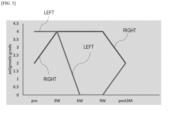
- the astigmatism grades (or the astigmatic grades) of three patients with astigmatism were also measured at the same timings. Specifically, the astigmatism grades with naked eyes of three of the patients to whom the ocular symptom-improving sample agent prepared in Example 1 was administered were measured. The obtained results of the right eyes and the left eyes of the patients are shown in Figs. 3 to 5 .
- presbyopia of 14 patients with presbyopia at the age of 40 or older was also evaluated at the same timings. Specifically, the eyesight values at focus distances of 33 cm and 50 cm with naked eyes of 14 of the patients to whom the ocular symptom-improving sample agent prepared in Example 1 was administered were measured. The average uncorrected eyesight values of the left and right eyes were calculated based on the eyesight before the administration (pre eyesight) regarded as 100%. The obtained results are shown in Fig. 6 .
- presbyopia improved significantly when the ocular symptom-improving sample agent of Example 1 was administered. That is, it was found that the ocular symptom-improving agent of the invention can improve presbyopia and can improve both of the eyesight at a focus distance of 33 cm and the eyesight at a focus distance of 50 cm. From Fig. 6 , it was also found that the agent is particularly useful for an application for temporarily correcting an ocular symptom (in particular, eyesight) of a subject with presbyopia for an administration period during which the agent is administered to the subject and for three months after the completion of the administration.
- an ocular symptom in particular, eyesight
- the agent when the agent is administered to a subject with presbyopia, the degree of improvement of an ocular symptom is higher in the administration period (immediately before the completion of the administration period) than one month after the completion of the administration (post 1M) or three months after the completion of the administration (post 3M).
- the ocular symptom-improving agent of the invention is extremely useful for an application for temporarily correcting an ocular symptom (in particular, eyesight) of a subject with presbyopia for an administration period during which the agent is administered to the subject and for three months after the completion of the administration.
- the ocular symptom-improving agent of the invention can improve both myopia and presbyopia and is thus believed to be able to improve convulsion or strain of the ciliary body, strain or movement of the lens, degeneration of the lens or the focusing function of the eyes and improve the movement of the axis of the eyeball, considering the mechanisms of action.
- convulsion or strain of the ciliary body, strain or movement of the lens, degeneration of the lens or the focusing function of the eyes can be improved and when the movement of the axis of the eyeball improves, eye fatigue and blurred vision are believed to be further improved.
- a culture supernatant of adipose-derived stem cells was prepared in the same manner as in Example 1 (Preparation of Culture Supernatant of Dental Pulp-Derived Stem Cells) in 0054 of the description of the present application except for using adipose-derived stem cells.
- the ocular symptom-improving sample agent of Example 1 (the culture supernatant of dental pulp-derived stem cells) was ocularly administered to the right eyes of three adult myopia patients without a cataract and glaucoma (patient A aged 25 years, patient B aged 30 years and patient C aged 50 years), and a sample of Comparative Example A (the culture supernatant of adipose-derived stem cells) was ocularly administered to the left eyes, each once every morning at a dose of one drop (about 0.05 ml). The treatment period was three months after starting the administration.
- the eyesight values of the naked left and right eyes of the three patients were measured before the administration (pre), one month (1M), two months (2M) and three months (3M) after starting the administration.
- the eyesight values (uncorrected eyesight for patient B aged 30 years, and corrected eyesight for patient C aged 50 years) at a focus distance of 33 cm of the left and right eyes were similarly measured.
- the uncorrected eyesight values or the corrected eyesight values of the right eyes and the left eyes of the patients were calculated based on the eyesight before the administration (pre eyesight) regarded as 100%. The obtained results are shown in the tables below.
Landscapes
- Health & Medical Sciences (AREA)
- Life Sciences & Earth Sciences (AREA)
- Public Health (AREA)
- General Health & Medical Sciences (AREA)
- Chemical & Material Sciences (AREA)
- Veterinary Medicine (AREA)
- Medicinal Chemistry (AREA)
- Pharmacology & Pharmacy (AREA)
- Engineering & Computer Science (AREA)
- Animal Behavior & Ethology (AREA)
- Immunology (AREA)
- Developmental Biology & Embryology (AREA)
- Cell Biology (AREA)
- Zoology (AREA)
- Biomedical Technology (AREA)
- Epidemiology (AREA)
- Virology (AREA)
- Biotechnology (AREA)
- Rheumatology (AREA)
- Bioinformatics & Cheminformatics (AREA)
- Orthopedic Medicine & Surgery (AREA)
- Nuclear Medicine, Radiotherapy & Molecular Imaging (AREA)
- General Chemical & Material Sciences (AREA)
- Organic Chemistry (AREA)
- Chemical Kinetics & Catalysis (AREA)
- Ophthalmology & Optometry (AREA)
- Hematology (AREA)
- Medicines Containing Material From Animals Or Micro-Organisms (AREA)
Claims (13)
- Ein Mittel zur Verbesserung von Augensymptomen, das eine Zusammensetzung ist, die einen Kulturüberstand von aus Zahnpulpa gewonnenen Stammzellen oder einen Kulturüberstand von immortalisierten Stammzellen von aus Zahnpulpa gewonnenen Stammzellen enthält, zur Verwendung zur Verbesserung von Myopie, Astigmatismus oder Alterssichtigkeit.
- Das Mittel zur Verbesserung von Augensymptomen zur Verwendung gemäß Anspruch 1, das aus dem Kulturüberstand von aus Zahnpulpa gewonnenen Stammzellen oder dem Kulturüberstand von immortalisierten Stammzellen besteht.
- Das Mittel zur Verbesserung von Augensymptomen zur Verwendung gemäß Anspruch 1 oder 2, das zur Verbesserung der Myopie verwendet wird und das mindestens eines von unkorrigiertem Sehvermögen und korrigiertem Sehvermögen verbessert.
- Das Mittel zur Verbesserung von Augensymptomen zur Verwendung gemäß Anspruch 1 oder 2, das zur Verbesserung der Alterssichtigkeit verwendet wird und das mindestens eines von der Sehkraft bei einer Fokusentfernung von 33 cm und der Sehkraft bei einer Fokusentfernung von 50 cm verbessert.
- Das Mittel zur Verbesserung von Augensymptomen zur Verwendung gemäß einem der Ansprüche 1 bis 4, das zur okularen Verabreichung des Mittels zur Verbesserung der Augensymptome an ein Subjekt mit Myopie, Astigmatismus oder Alterssichtigkeit verwendet wird.
- Das Mittel zur Verbesserung von Augensymptomen zur Verwendung gemäß Anspruch 5, wobei es sich bei dem Subjekt um einen Menschen handelt.
- Das Mittel zur Verbesserung von Augensymptomen zur Verwendung gemäß Anspruch 5 oder 6, wobei es sich bei dem Subjekt um ein Subjekt ohne Katarakt oder Glaukom handelt.
- Das Mittel zur Verbesserung von Augensymptomen zur Verwendung gemäß einem der Ansprüche 5 bis 7, das zur Verabreichung des Mittels zur Verbesserung der Augensymptome an das Subjekt ein- oder mehrmals täglich über einen therapeutisch wirksamen Zeitraum verwendet wird.
- Das Mittel zur Verbesserung von Augensymptomen zur Verwendung gemäß einem der Ansprüche 1 bis 8,wobei das Mittel zur Verbesserung von Augensymptomen zur Korrektur eines Augensymptoms verwendet wird, unddas zur vorübergehenden Korrektur eines Augensymptoms eines Subjekts mit Myopie, Astigmatismus oder Alterssichtigkeit für einen Verabreichungszeitraum verwendet wird, während dem dem Subjekt das Mittel zur Verbesserung der Augensymptome verabreicht wird.
- Das Mittel zur Verbesserung von Augensymptomen zur Verwendung gemäß Anspruch 9, das zur vorübergehenden Korrektur des Augensymptoms des Subjekts während des Verabreichungszeitraums und für drei Monate nach Abschluss der Verabreichung verwendet wird.
- Das Mittel zur Verbesserung von Augensymptomen zur Verwendung gemäß Anspruch 1, wobei das Subjekt ein nichtmenschliches Tier ist.
- Das Mittel zur Verbesserung von Augensymptomen zur Verwendung gemäß Anspruch 1, bei dem nach einer vorbestimmten Zeitspanne ab der Verabreichungsperiode wiederholt eine zweite oder nachfolgende Verabreichungsperiode zur erneuten Verabreichung des Mittels zur Verbesserung von Augensymptomen an das Subjekt vorgesehen ist.
- Nicht-therapeutische Verwendung eines Mittels zur Verbesserung von Augensymptomen, das eine Zusammensetzung ist, die einen Kulturüberstand von aus Zahnpulpa gewonnenen Stammzellen oder einen Kulturüberstand von immortalisierten Stammzellen von aus Zahnpulpa gewonnenen Stammzellen enthält, zur Verbesserung von Augenermüdung oder verschwommenem Sehen.
Applications Claiming Priority (2)
| Application Number | Priority Date | Filing Date | Title |
|---|---|---|---|
| JP2021102516A JP7007770B1 (ja) | 2021-06-21 | 2021-06-21 | 眼症状改善剤および眼症状の改善方法 |
| PCT/JP2022/003751 WO2022269973A1 (ja) | 2021-06-21 | 2022-02-01 | 眼症状改善剤および眼症状の改善方法 |
Publications (4)
| Publication Number | Publication Date |
|---|---|
| EP4335447A4 EP4335447A4 (de) | 2024-03-13 |
| EP4335447A1 EP4335447A1 (de) | 2024-03-13 |
| EP4335447C0 EP4335447C0 (de) | 2025-06-18 |
| EP4335447B1 true EP4335447B1 (de) | 2025-06-18 |
Family
ID=80856427
Family Applications (1)
| Application Number | Title | Priority Date | Filing Date |
|---|---|---|---|
| EP22827897.4A Active EP4335447B1 (de) | 2021-06-21 | 2022-02-01 | Kulturüberstand von aus zahnmark gewonnenen stammzellen zur verbesserung von myopie, astigmatismus, presbyopie, augenermüdung oder verschwommenem sehen |
Country Status (5)
| Country | Link |
|---|---|
| US (1) | US20240269191A1 (de) |
| EP (1) | EP4335447B1 (de) |
| JP (1) | JP7007770B1 (de) |
| CN (1) | CN117545495A (de) |
| WO (1) | WO2022269973A1 (de) |
Family Cites Families (17)
| Publication number | Priority date | Publication date | Assignee | Title |
|---|---|---|---|---|
| EP1996013A4 (de) * | 2005-09-21 | 2010-03-10 | Dask Technologies Llc | Verfahren und zusammensetzungen für die organ- und gewebefunktionalität |
| CN103037872B (zh) | 2010-03-26 | 2015-12-02 | 国立大学法人名古屋大学 | 损伤部位治疗用组合物 |
| KR101859124B1 (ko) * | 2010-05-03 | 2018-05-21 | 더 텍사스 에이 & 엠 유니버시티 시스템 | 눈 손상 및 질환 치료용 성체 줄기 세포/전구 세포 및 줄기 세포 단백질 |
| CA2870466A1 (en) * | 2012-04-16 | 2013-10-24 | The Regents Of The University Of California | Ocular therapeutics using embryonic stem cell microvesicles |
| CN102732586B (zh) * | 2012-06-26 | 2014-05-21 | 亚太干细胞科研中心有限公司 | 一种间充质干细胞分泌素的制备方法 |
| JP2016128396A (ja) * | 2015-01-09 | 2016-07-14 | 上田 実 | iPS細胞培養上清を含む医薬組成物およびその製造方法、化粧品およびその製造方法、抗加齢組成物、疾患発症抑制方法、疾患治療方法、組織異常治療方法ならびに美容方法 |
| JP2016210730A (ja) * | 2015-05-08 | 2016-12-15 | 上田 実 | 医薬組成物及びその製造方法並びに医薬品 |
| JP2018023343A (ja) | 2016-08-12 | 2018-02-15 | 国立大学法人山口大学 | 細胞培養用培地、及び細胞培養方法 |
| WO2018074421A1 (ja) * | 2016-10-21 | 2018-04-26 | ライオン株式会社 | 眼科用剤及び眼科用薬 |
| US11058729B2 (en) * | 2018-01-25 | 2021-07-13 | The United States Of America, As Represented By The Secretary, Department Of Health And Human Services | Exosomes and miRNA to treat glaucoma |
| CN109419770A (zh) * | 2018-03-07 | 2019-03-05 | 厦门艾赛生物科技有限公司 | 一种间充质干细胞外泌体滴眼液及其制备方法和应用 |
| JP7052439B6 (ja) * | 2018-03-12 | 2022-06-24 | 東洋紡株式会社 | 水晶体の硬化防止剤または治療剤 |
| JP7077690B2 (ja) * | 2018-03-16 | 2022-05-31 | 東洋紡株式会社 | 白内障抑制剤 |
| JP7052480B6 (ja) * | 2018-03-28 | 2022-06-24 | 東洋紡株式会社 | 水晶体の硬化防止剤または治療剤の製造方法 |
| CN108853146A (zh) * | 2018-09-27 | 2018-11-23 | 天津欣普赛尔生物医药科技有限公司 | 一种修复眼部损伤细胞因子的滴眼液及制备方法 |
| JP6884935B2 (ja) * | 2018-12-20 | 2021-06-09 | 株式会社システムエッヂ | 再生治療用組成物の製造方法 |
| CN110433137A (zh) * | 2019-09-04 | 2019-11-12 | 北京中广天一生物科技有限公司 | 一种间充质干细胞旁分泌因子在滴眼液中的应用 |
-
2021
- 2021-06-21 JP JP2021102516A patent/JP7007770B1/ja active Active
-
2022
- 2022-02-01 CN CN202280042893.9A patent/CN117545495A/zh active Pending
- 2022-02-01 WO PCT/JP2022/003751 patent/WO2022269973A1/ja not_active Ceased
- 2022-02-01 EP EP22827897.4A patent/EP4335447B1/de active Active
- 2022-02-01 US US18/569,991 patent/US20240269191A1/en active Pending
Also Published As
| Publication number | Publication date |
|---|---|
| EP4335447C0 (de) | 2025-06-18 |
| CN117545495A (zh) | 2024-02-09 |
| JP2023001664A (ja) | 2023-01-06 |
| JP7007770B1 (ja) | 2022-02-10 |
| WO2022269973A1 (ja) | 2022-12-29 |
| US20240269191A1 (en) | 2024-08-15 |
| EP4335447A1 (de) | 2024-03-13 |
Similar Documents
| Publication | Publication Date | Title |
|---|---|---|
| US20260014206A1 (en) | Pharmaceutical composition for use in improving quality of scalp or skin, wound healing, or improving quality of hair | |
| US20250017976A1 (en) | Using autologous mesenchymal stem cells to treat multiple system atrophy | |
| JP2021038268A (ja) | 再生治療用組成物及び再生治療用組成物の製造方法 | |
| EP4335447A1 (de) | Mittel zur verbesserung von augensymptomen und verfahren zur verbesserung von augensymptomen | |
| US8277795B2 (en) | Methods and compositions for treating motor neuron diseases comprising mesenchymal stem cells | |
| US20250152649A1 (en) | Pharmaceutical composition for use in increasing hair, modifying scalp or skin, healing a wound, promoting osteogenesis, or modifying hair | |
| CN117750964A (zh) | 含有成纤维细胞的肾疾病治疗用医药组合物 | |
| WO2025022842A1 (ja) | ドライアイの治療剤又は予防剤 | |
| US20140212404A1 (en) | Compositions and Methods for Treating Injuries to the Visual System of a Human | |
| EP4173630A1 (de) | Pharmazeutische zusammensetzung mit stammzellenkonditioniertem medium und daraus isoliertes exosom als wirkstoff zur vorbeugung oder behandlung von augenerkrankungen | |
| KR101871810B1 (ko) | 줄기세포를 포함하는 턱관절 장애 예방 또는 치료용 약학적 조성물 | |
| WO2023199828A1 (ja) | 微小粒子、血管新生眼疾患の予防薬または治療薬および血管新生眼疾患の改善方法 | |
| KR20070113088A (ko) | 운동신경원질환 치료용 조성물 및 그 치료방법 | |
| CN120324337B (zh) | 一种含多元微量元素和干细胞提取物的滴眼液及其制备方法和应用 | |
| US20250222035A1 (en) | Processes for making and using a mesenchyme stem cell secretome for limbal stem cell deficiency (lscd) treatment | |
| CA3070854C (en) | Pharmaceutical composition for use in increasing hair, modifying scalp or skin, healing a wound, promoting osteogenesis, or modifying hair | |
| CN120678888A (zh) | 一种治疗神经损伤的蛋白与生物材料组合物及其应用 | |
| US20230048106A1 (en) | Composition for regenerating growth plate | |
| KR20240101473A (ko) | 연골 분화능이 증진된 줄기세포의 선별 방법 및 이를 포함하는 세포 치료제 | |
| KR20240107625A (ko) | 외분비샘 조직재생을 위한 제대 유래 줄기세포의 용도 | |
| KR20230129667A (ko) | 중간엽 줄기세포로부터 추출된 엑소좀을 함유하는 망막변성질환 예방 또는 치료용 조성물 | |
| HK40030380A (en) | Pharmaceutical composition to be used for increasing hair, modifying scalp or skin, healing wounds, promoting osteogenesis, or modifying hair | |
| HK40033331A (en) | Pharmaceutical composition for use in improving quality of scalp or skin, wound healing, or improving quality of hair | |
| HK40033331B (en) | Pharmaceutical composition for use in improving quality of scalp or skin, wound healing, or improving quality of hair |
Legal Events
| Date | Code | Title | Description |
|---|---|---|---|
| STAA | Information on the status of an ep patent application or granted ep patent |
Free format text: STATUS: THE INTERNATIONAL PUBLICATION HAS BEEN MADE |
|
| PUAI | Public reference made under article 153(3) epc to a published international application that has entered the european phase |
Free format text: ORIGINAL CODE: 0009012 |
|
| STAA | Information on the status of an ep patent application or granted ep patent |
Free format text: STATUS: REQUEST FOR EXAMINATION WAS MADE |
|
| 17P | Request for examination filed |
Effective date: 20231205 |
|
| A4 | Supplementary search report drawn up and despatched |
Effective date: 20240202 |
|
| AK | Designated contracting states |
Kind code of ref document: A1 Designated state(s): AL AT BE BG CH CY CZ DE DK EE ES FI FR GB GR HR HU IE IS IT LI LT LU LV MC MK MT NL NO PL PT RO RS SE SI SK SM TR |
|
| STAA | Information on the status of an ep patent application or granted ep patent |
Free format text: STATUS: EXAMINATION IS IN PROGRESS |
|
| 17Q | First examination report despatched |
Effective date: 20240709 |
|
| DAV | Request for validation of the european patent (deleted) | ||
| DAX | Request for extension of the european patent (deleted) | ||
| GRAP | Despatch of communication of intention to grant a patent |
Free format text: ORIGINAL CODE: EPIDOSNIGR1 |
|
| STAA | Information on the status of an ep patent application or granted ep patent |
Free format text: STATUS: GRANT OF PATENT IS INTENDED |
|
| INTG | Intention to grant announced |
Effective date: 20250116 |
|
| GRAS | Grant fee paid |
Free format text: ORIGINAL CODE: EPIDOSNIGR3 |
|
| GRAA | (expected) grant |
Free format text: ORIGINAL CODE: 0009210 |
|
| STAA | Information on the status of an ep patent application or granted ep patent |
Free format text: STATUS: THE PATENT HAS BEEN GRANTED |
|
| AK | Designated contracting states |
Kind code of ref document: B1 Designated state(s): AL AT BE BG CH CY CZ DE DK EE ES FI FR GB GR HR HU IE IS IT LI LT LU LV MC MK MT NL NO PL PT RO RS SE SI SK SM TR |
|
| REG | Reference to a national code |
Ref country code: GB Ref legal event code: FG4D |
|
| REG | Reference to a national code |
Ref country code: CH Ref legal event code: EP |
|
| REG | Reference to a national code |
Ref country code: DE Ref legal event code: R096 Ref document number: 602022016223 Country of ref document: DE |
|
| REG | Reference to a national code |
Ref country code: CH Ref legal event code: EP |
|
| REG | Reference to a national code |
Ref country code: IE Ref legal event code: FG4D |
|
| U01 | Request for unitary effect filed |
Effective date: 20250618 |
|
| U07 | Unitary effect registered |
Designated state(s): AT BE BG DE DK EE FI FR IT LT LU LV MT NL PT RO SE SI Effective date: 20250626 |
|
| PG25 | Lapsed in a contracting state [announced via postgrant information from national office to epo] |
Ref country code: NO Free format text: LAPSE BECAUSE OF FAILURE TO SUBMIT A TRANSLATION OF THE DESCRIPTION OR TO PAY THE FEE WITHIN THE PRESCRIBED TIME-LIMIT Effective date: 20250918 Ref country code: GR Free format text: LAPSE BECAUSE OF FAILURE TO SUBMIT A TRANSLATION OF THE DESCRIPTION OR TO PAY THE FEE WITHIN THE PRESCRIBED TIME-LIMIT Effective date: 20250919 |
|
| PG25 | Lapsed in a contracting state [announced via postgrant information from national office to epo] |
Ref country code: HR Free format text: LAPSE BECAUSE OF FAILURE TO SUBMIT A TRANSLATION OF THE DESCRIPTION OR TO PAY THE FEE WITHIN THE PRESCRIBED TIME-LIMIT Effective date: 20250618 |
|
| PG25 | Lapsed in a contracting state [announced via postgrant information from national office to epo] |
Ref country code: RS Free format text: LAPSE BECAUSE OF FAILURE TO SUBMIT A TRANSLATION OF THE DESCRIPTION OR TO PAY THE FEE WITHIN THE PRESCRIBED TIME-LIMIT Effective date: 20250918 |
|
| PG25 | Lapsed in a contracting state [announced via postgrant information from national office to epo] |
Ref country code: IS Free format text: LAPSE BECAUSE OF FAILURE TO SUBMIT A TRANSLATION OF THE DESCRIPTION OR TO PAY THE FEE WITHIN THE PRESCRIBED TIME-LIMIT Effective date: 20251018 |
|
| PG25 | Lapsed in a contracting state [announced via postgrant information from national office to epo] |
Ref country code: SM Free format text: LAPSE BECAUSE OF FAILURE TO SUBMIT A TRANSLATION OF THE DESCRIPTION OR TO PAY THE FEE WITHIN THE PRESCRIBED TIME-LIMIT Effective date: 20250618 |
|
| PG25 | Lapsed in a contracting state [announced via postgrant information from national office to epo] |
Ref country code: CZ Free format text: LAPSE BECAUSE OF FAILURE TO SUBMIT A TRANSLATION OF THE DESCRIPTION OR TO PAY THE FEE WITHIN THE PRESCRIBED TIME-LIMIT Effective date: 20250618 |
|
| PG25 | Lapsed in a contracting state [announced via postgrant information from national office to epo] |
Ref country code: PL Free format text: LAPSE BECAUSE OF FAILURE TO SUBMIT A TRANSLATION OF THE DESCRIPTION OR TO PAY THE FEE WITHIN THE PRESCRIBED TIME-LIMIT Effective date: 20250618 |
|
| PG25 | Lapsed in a contracting state [announced via postgrant information from national office to epo] |
Ref country code: SK Free format text: LAPSE BECAUSE OF FAILURE TO SUBMIT A TRANSLATION OF THE DESCRIPTION OR TO PAY THE FEE WITHIN THE PRESCRIBED TIME-LIMIT Effective date: 20250618 |
|
| PG25 | Lapsed in a contracting state [announced via postgrant information from national office to epo] |
Ref country code: ES Free format text: LAPSE BECAUSE OF FAILURE TO SUBMIT A TRANSLATION OF THE DESCRIPTION OR TO PAY THE FEE WITHIN THE PRESCRIBED TIME-LIMIT Effective date: 20250618 |
|
| U20 | Renewal fee for the european patent with unitary effect paid |
Year of fee payment: 5 Effective date: 20260121 |
|
| PGFP | Annual fee paid to national office [announced via postgrant information from national office to epo] |
Ref country code: GB Payment date: 20260220 Year of fee payment: 5 |
|
| PLBE | No opposition filed within time limit |
Free format text: ORIGINAL CODE: 0009261 |
|
| STAA | Information on the status of an ep patent application or granted ep patent |
Free format text: STATUS: NO OPPOSITION FILED WITHIN TIME LIMIT |
|
| REG | Reference to a national code |
Ref country code: CH Ref legal event code: L10 Free format text: ST27 STATUS EVENT CODE: U-0-0-L10-L00 (AS PROVIDED BY THE NATIONAL OFFICE) Effective date: 20260430 |