EP4306167A2 - Induzierte expression des aus dem gehirn abgeleiteten neurotrophen faktors (bdnf) zur behandlung von neuromuskulären, neurodegenerativen, autoimmun-, entwicklungs- und/oder stoffwechselerkrankungen - Google Patents
Induzierte expression des aus dem gehirn abgeleiteten neurotrophen faktors (bdnf) zur behandlung von neuromuskulären, neurodegenerativen, autoimmun-, entwicklungs- und/oder stoffwechselerkrankungen Download PDFInfo
- Publication number
- EP4306167A2 EP4306167A2 EP23188878.5A EP23188878A EP4306167A2 EP 4306167 A2 EP4306167 A2 EP 4306167A2 EP 23188878 A EP23188878 A EP 23188878A EP 4306167 A2 EP4306167 A2 EP 4306167A2
- Authority
- EP
- European Patent Office
- Prior art keywords
- effective dose
- disease
- treat
- examples
- prevent
- Prior art date
- Legal status (The legal status is an assumption and is not a legal conclusion. Google has not performed a legal analysis and makes no representation as to the accuracy of the status listed.)
- Granted
Links
Images






Classifications
-
- A—HUMAN NECESSITIES
- A61—MEDICAL OR VETERINARY SCIENCE; HYGIENE
- A61K—PREPARATIONS FOR MEDICAL, DENTAL OR TOILETRY PURPOSES
- A61K31/00—Medicinal preparations containing organic active ingredients
- A61K31/045—Hydroxy compounds, e.g. alcohols; Salts thereof, e.g. alcoholates
- A61K31/05—Phenols
- A61K31/06—Phenols the aromatic ring being substituted by nitro groups
-
- A—HUMAN NECESSITIES
- A61—MEDICAL OR VETERINARY SCIENCE; HYGIENE
- A61K—PREPARATIONS FOR MEDICAL, DENTAL OR TOILETRY PURPOSES
- A61K9/00—Medicinal preparations characterised by special physical form
- A61K9/0012—Galenical forms characterised by the site of application
- A61K9/0019—Injectable compositions; Intramuscular, intravenous, arterial, subcutaneous administration; Compositions to be administered through the skin in an invasive manner
-
- A—HUMAN NECESSITIES
- A61—MEDICAL OR VETERINARY SCIENCE; HYGIENE
- A61K—PREPARATIONS FOR MEDICAL, DENTAL OR TOILETRY PURPOSES
- A61K9/00—Medicinal preparations characterised by special physical form
- A61K9/0012—Galenical forms characterised by the site of application
- A61K9/0053—Mouth and digestive tract, i.e. intraoral and peroral administration
-
- A—HUMAN NECESSITIES
- A61—MEDICAL OR VETERINARY SCIENCE; HYGIENE
- A61P—SPECIFIC THERAPEUTIC ACTIVITY OF CHEMICAL COMPOUNDS OR MEDICINAL PREPARATIONS
- A61P21/00—Drugs for disorders of the muscular or neuromuscular system
-
- A—HUMAN NECESSITIES
- A61—MEDICAL OR VETERINARY SCIENCE; HYGIENE
- A61P—SPECIFIC THERAPEUTIC ACTIVITY OF CHEMICAL COMPOUNDS OR MEDICINAL PREPARATIONS
- A61P25/00—Drugs for disorders of the nervous system
-
- A—HUMAN NECESSITIES
- A61—MEDICAL OR VETERINARY SCIENCE; HYGIENE
- A61P—SPECIFIC THERAPEUTIC ACTIVITY OF CHEMICAL COMPOUNDS OR MEDICINAL PREPARATIONS
- A61P25/00—Drugs for disorders of the nervous system
- A61P25/08—Antiepileptics; Anticonvulsants
-
- A—HUMAN NECESSITIES
- A61—MEDICAL OR VETERINARY SCIENCE; HYGIENE
- A61P—SPECIFIC THERAPEUTIC ACTIVITY OF CHEMICAL COMPOUNDS OR MEDICINAL PREPARATIONS
- A61P25/00—Drugs for disorders of the nervous system
- A61P25/14—Drugs for disorders of the nervous system for treating abnormal movements, e.g. chorea, dyskinesia
-
- A—HUMAN NECESSITIES
- A61—MEDICAL OR VETERINARY SCIENCE; HYGIENE
- A61P—SPECIFIC THERAPEUTIC ACTIVITY OF CHEMICAL COMPOUNDS OR MEDICINAL PREPARATIONS
- A61P25/00—Drugs for disorders of the nervous system
- A61P25/14—Drugs for disorders of the nervous system for treating abnormal movements, e.g. chorea, dyskinesia
- A61P25/16—Anti-Parkinson drugs
-
- A—HUMAN NECESSITIES
- A61—MEDICAL OR VETERINARY SCIENCE; HYGIENE
- A61P—SPECIFIC THERAPEUTIC ACTIVITY OF CHEMICAL COMPOUNDS OR MEDICINAL PREPARATIONS
- A61P25/00—Drugs for disorders of the nervous system
- A61P25/28—Drugs for disorders of the nervous system for treating neurodegenerative disorders of the central nervous system, e.g. nootropic agents, cognition enhancers, drugs for treating Alzheimer's disease or other forms of dementia
-
- A—HUMAN NECESSITIES
- A61—MEDICAL OR VETERINARY SCIENCE; HYGIENE
- A61P—SPECIFIC THERAPEUTIC ACTIVITY OF CHEMICAL COMPOUNDS OR MEDICINAL PREPARATIONS
- A61P3/00—Drugs for disorders of the metabolism
-
- A—HUMAN NECESSITIES
- A61—MEDICAL OR VETERINARY SCIENCE; HYGIENE
- A61P—SPECIFIC THERAPEUTIC ACTIVITY OF CHEMICAL COMPOUNDS OR MEDICINAL PREPARATIONS
- A61P37/00—Drugs for immunological or allergic disorders
- A61P37/02—Immunomodulators
Definitions
- Brain-derived neurotrophic factor is one of several endogenous proteins that play key roles in neuronal development. BDNF influences nerve growth as a neurotrophin and/or as a myokine. Therefore there is a need for improved methods for inducing expression of BDNF.
- the present invention relates to the discovery that BDNF can be endogenously induced to increase expression by administration of DNP, and that there is a dose range between 0.001 mg/kg to less than 10 mg/kg that is useful in expression of BDNF and not harmful to the patient. Further, many approaches are underway to get BDNF across the blood brain barrier to treat a host of diseases.
- these diseases include, but are not limited to, traumatic injury, stroke, Huntington's disease, Epilepsy, Multiple Sclerosis (MS), Lupus, Type-1 and Type-2 diabetes, Maturity Onset Diabetes of the Young (MODY), Myasthenia gravis (MG), rheumatoid arthritis (RA), Graves' disease, Guillain-Barré syndrome (GBS), metabolic syndrome, Duchenne Muscular Dystrophy (DMD), severe burns, aging, Amyotrophic Lateral Sclerosis (ALS), Friedreich's Ataxia, Batten Disease, Alzheimer's disease, Optic neuritis, Leber's hereditary optic neuropathy (LHON), Autism, Rett syndrome, Batten Disease, Angelman's Syndrome, Leigh disease, Fragile-X Syndrome, Schizophrenia, Depression, Parkinson's disease and mitochondrial diseases. Treatment works by the process of reversing, slowing or preventing neuromuscular, neurodegenerative, autoimmune, developmental and/or metabolic disorders.
- MODY Myasth
- the present invention relates to methods of treatment of neuromuscular, neurodegenerative, autoimmune, developmental and/or metabolic disease and pharmaceutical compositions, including unit doses, for treatment of neuromuscular, neurodegenerative, autoimmune, developmental and/or metabolic disease.
- the present invention relates to endogenously inducing the systemic organs of a person to increase expression of brain derived neurotrophin factor ("BDNF") via administering mitochondrial uncoupler (protonophore or ionophore) 2, 4-dinitrophenol (“DNP”) or bipartite dinitrophenol isoforms (2,3-, 2,4-, 2,5-, 2,6-, 3,4-, or 3,5-DNP) or mitochondrial uncouplers or weak acid's with a dissociable proton such as CCCP, FCCP, SF 6847, Flufenamic acid, PCP, TTFB, etc., to a patient in need thereof, using an effective dose of about 0.001mg/kg to 5 mg/kg, as well as the associated pharmaceutical composition
- the present invention provides for a method of treating traumatic CNS injury, neurodegenerative disease, and/or autoimmune diseases, and/or developmental disorders, and/or metabolic disease by administrating DNP in the dose range of 0.01 mg/kg of body weight to less than 10 mg/kg of body weight to increase BDNF to attenuate disease progression or provide relief from symptoms.
- the invention provides a method of treatment for at least the following diseases: Traumatic Brain Injury (TBI), Ischemic stroke, Huntington's disease (Adult-onset Huntington's, Juvenile Huntington's disease), Epilepsy (Cluster Seizures, Refractory Seizures, Atypical Absence Seizures, Atonic Seizures, Clonic Seizures, myoclonic seizures, tonic seizures, Tonic-Clonic Seizures, Simple Partial Seizures, Complex Partial Seizures, Secondary Generalized Seizures, Febrile Seizures, Nonepileptic Seizures, Gelastic and Dacrystic Seizures, and Absence Seizures), Multiple Sclerosis (MS) (relapse-remitting multiple sclerosis (RRMS), Secondary-progressive MS (SPMS), Primary-progressive MS (PPMS), and Progressive-relapsing MS (PRMS)), Lupus (Systemic Lupus Erythematosus (SLE),
- TBI
- the present invention relates to a composition of DNP, or a pharmaceutically acceptable salt, solvate, or hydrate thereof, comprising an effective dose of DNP, wherein the effective dose of the DNP is in the range of 0.001 mg/kg of body weight to 5 mg/kg of body weight.
- the present invention relates to a pharmaceutical composition of DNP, or a pharmaceutically acceptable salt, solvate, or hydrate thereof, comprising a unit dose, wherein the unit dose is in the range of 0.1 mg to 300 mg.
- the present invention relates to a method of treating neuromuscular or autoimmune or developmental or neurodegenerative or metabolic disorders, comprising receiving an effective dose of DNP, or a pharmaceutically acceptable salt thereof, over period sufficiently long to achieve remission of the symptoms of the disease, wherein the effective dose of the DNP is continued to be received in the dose range of 0.001 mg/kg of body weight to 5 mg/kg of body weight to increase BDNF to attenuate disease progression or provide remission of symptoms.
- a fifth aspect of the present invention relates to a method of treating neuromuscular or autoimmune or developmental or metabolic or neurodegenerative disorders, comprising: providing instructions to administer an effective dose of DNP, or a pharmaceutically acceptable salt thereof, over period sufficiently long to achieve remission of the symptoms of the disease, wherein the effective dose of the DNP is instructed to be received in the dose range of 0.001 mg/kg of body weight to 5 mg/kg of body weight.
- endogenous means growing or produced by growth from deep tissue, e.g. by growth from a person's brain.
- the term “endogenous”, unless otherwise defined, means caused by factors inside the organism or system.
- the term “endogenous”, unless otherwise defined, means produced or synthesized within the organism or system.
- muscle wasting means atrophy of a person's muscle (e.g. diaphragm for breathing). Muscle atrophy is when muscles waste away. The main reason for muscle wasting is a lack of physical activity. This can happen when a disease or injury makes it difficult or impossible for you to move an arm or leg.
- the terms “effective dose” or “effective relief' are measured objectively using one or more of the following quantitative assessments to achieve a validated assessment of the effectiveness of the dose or relief: ADS COG for Alzheimer's Disease; HDRS for Huntington's Disease; the Parkinson Rating Scale for Parkinson's Disease; the FSS and EDSS for Multiple Sclerosis; the ALSAQ for ALS; Stroke Assessment Scales of Stroke such as the NIH Stroke Scale or Barthel Index; Childhood Autism Rating Scale (CARS) for Autism; 6-minute walk test for Duchenne muscular dystrophy (DMD); and a seizure severity scale for seizures.
- ADS COG for Alzheimer's Disease
- HDRS for Huntington's Disease
- the Parkinson Rating Scale for Parkinson's Disease
- the FSS and EDSS for Multiple Sclerosis
- the ALSAQ for ALS
- Stroke Assessment Scales of Stroke such as the NIH Stroke Scale or Barthel Index
- Childhood Autism Rating Scale (CARS) for Autism
- the term “about” means plus or minus 10% of the value referenced.
- “about 1 mg/kg” means 0.9 mg/kg to 1.1 mg/kg.
- Mitochondria uncouplers e.g., 2, 4- dinitrophenol (DNP)
- DNP 2, 4- dinitrophenol
- Mitochondria uncoupling can have a protective effect on brain cells by enhancing respiratory rates by mild uncoupling which leads to lower cellular stress due to a mechanism of action (MOA) of: 1) increasing oxygen (O 2 ) consumption, which prevents formation of superoxide radical anions (O 2 - ) by decreasing O 2 tension in the microenvironment, 2) providing more oxidized levels of respiratory chain intermediates, such as in Complex I and III, known as a substantial source of reactive oxygen species (ROSs), 3) maintaining NADH levels lower, which prevents ROS formation by mitochondrial matrix flavoproteins and 4) lower membrane potential ( ⁇ ), a condition which thermodynamically disfavors reverse of electron transfer from Complex II to I.
- MOA mechanism of action of: 1) increasing oxygen (O 2 ) consumption, which prevents formation of superoxide radical anions (O 2 - ) by decreasing O 2 tension in the microenvironment, 2) providing more oxidized levels of respiratory chain intermediates, such as in Complex I and III, known as a substantial source of reactive
- neurite outgrowth may, in theory, be achieved with the use of uncouplers beyond the use for lowering ROSs. It is known that DNP can lower ROSs species with an acute single dose post-ischemia, and reduce infarct volume, however the benefits of improved outcome and recovery by repair can be accomplished with increasing expression of BDNF, requiring chronic treatment to induce sufficient levels of this neurotrophin. Infarct volume may therefore be further reduced from repair/growth of the damaged tissue by chronic DNP treatment.
- the present invention relates to the discovery that BDNF can be endogenously induced to increase expression with the treatment of DNP, and that there is a dose range of DNP that is effective and is not too high to be harmful, nor too low and provide no effect.
- the effectiveness of DNP in inducing BDNF does not increase linearly as the dose of DNP is increased.
- DNP Difenor nucleic acid
- Mitochondrial uncouplers do not directly act upon a protein, but on a location, namely the mitochondrial matrix.
- the mitochondrial matrix is a pH basic environment due to the pumping out of protons (hydrogen or H + ) through the cytochromes.
- mitochondrial uncouplers are weak acids with a dissociable proton, they are attracted to the basic environment of the mitochondrial matrix, where they travel as a cation and drop off a proton (H + ), then leave unprotonated back into the acidic environment of cytosol as an anion, to then get reprotonated back to a cation and start the cycle over again until metabolized and/or eliminated. This event lowers the mitochondrial membrane potential, which results in an increase in energy expenditure with the consumption of glucose and lipids in an attempt to re-establish the membrane potential.
- H + proton
- DNP does not act directly through a protein or touch a protein, but just goes into a unique location within the cell of which happens to be the only location with a pH basic environment. It also lowers intra-mitochondria calcium.
- Adenylate cyclase the enzyme that synthesizes 3'5'-cyclic monophosphate (cyclic AMP or cAMP), otherwise known as "second messenger", is highly sensitive to changes in calcium and magnesium and it has been shown that DNP up-regulates cAMP supplies.
- the cascade affect of up-regulating adenylate cyclase and producing more cAMP, then converts DNP's non-genomic effect, into a genomic effect, which changes expression of a host of genes, including increasing the transcription factor for BDNF, known as cAMP-responsive element-binding protein (CREB).
- CREB cAMP-responsive element-binding protein
- BDNF is lower in Huntington's Disease, and restoring BDNF to near normal levels is considered to be critical to attenuate disease onset. Therefore, treatment with DNP that effectively crosses the blood brain barrier and induces endogenous expression of BDNF is advantageous for treating diseases for which increased expression of BDNF will provide neuroprotection.
- Rett Syndrome is considered a developmental disorder in young girls and is associated with lower levels of BDNF. Restoring levels back to near normal levels may prevent the stunting of head growth that appears around approximately 18 months of age as one marker of onset.
- BDNF multiple sclerosis
- MS multiple sclerosis
- BDNF levels are elevated in the brain and striking axonal protection from the autoimmune disorder that destroys the myelin sheaths under chronic treatment of DNP.
- Others have shown that BDNF can lower glucose levels in models of obesity and diabetes.
- Others have found that young, non-obese insulin resistant patients have low circulating levels of BDNF, which acts as a paracrine and may be a factor in the metabolic syndrome. Therefore, an elevated and sustained increase in BDNF may provide a broad effect in neurodegeneration, development, autoimmune, metabolic and neuromuscular disorders.
- an increase of BDNF in both central and/or peripheral compartments may be beneficial.
- BDNF is also expressed in other muscle tissues and thought to act as a myokine to provide neuromuscular or muscle protection, in addition to protection from neurodegeneration.
- the dose range of about 0.001 to 5 mg/kg has been shown to be effective in treating muscular, neuromuscular, neurodegenerative, autoimmune, developmental and/or metabolic diseases, such as, for example, traumatic injury, stroke, Huntington's disease, Epilepsy, Multiple Sclerosis (MS), Lupus, Type-1 and Type-2 diabetes, MODY, metabolic syndrome, Duchenne Muscular Dystrophy (DMD), severe burns, aging, Amyotrophic Lateral Sclerosis (ALS), Friedreich's Ataxia, Batten Disease, Alzheimer's disease, Optic neuritis, Autism, Rett syndrome, Batten Disease, Angelman's Syndrome, Fragile-X Syndrome, Schizophrenia, Depression, and Parkinson's disease.
- muscular, neuromuscular, neurodegenerative, autoimmune, developmental and/or metabolic diseases such as, for example, traumatic injury, stroke, Huntington's disease, Epilepsy, Multiple Sclerosis (MS), Lupus, Type-1 and Type-2 diabetes, MODY, metabolic syndrome, Duchenne Muscular Dystrophy (DMD
- the invention shows use of DNP in the effective dose range of about 0.01 to less than 10mg/kg to induce expression of BDNF in the brain of mammals, which avoid inducing too much BDNF to be harmful, or have no effect by inducing too little BDNF.
- mitochondrial uncoupler DNP was tested in a range of doses in mice from 0.5 mg/kg of DNP to 10 mg/kg of DNP under oral chronic treatment to titrate the amount of drug in the brain required to induce increases of BDNF endogenously within the brain. It was discovered that DNP does in fact induce BDNF within the brain, but the highest dose of 10 mg/kg had a reduced level of BDNF compared with the next two lower doses. Therefore, it was discovered that there is a specific and limited dose range of DNP that is necessary to achieve statistically significant survival and behavioral benefit for a host of diseases that benefit from increased BDNF levels.
- diseases and disorders of the systemic organs and brain, islets of Langerhans, liver and brain may benefit from titrating the BDNF levels with a specific and limited DNP dose, such as, but not limited to, Traumatic Brain Injury (TBI), Ischemic stroke, Huntington's disease (Adult-onset Huntington's, Juvenile Huntington's disease), Epilepsy (Cluster Seizures, Refractory Seizures, Atypical Absence Seizures, Atonic Seizures, Clonic Seizures, myoclonic seizures, tonic seizures, Tonic-Clonic Seizures, Simple Partial Seizures, Complex Partial Seizures, Secondary Generalized Seizures, Febrile Seizures, Nonepileptic Seizures, Gelastic and Dacrystic Seizures, and Absence Seizures), Multiple Sclerosis (MS) (relapse-remitting multiple sclerosis (RRMS), Secondary-progressive MS (SPMS), Primary-pro
- MS
- Brain tissue was used for semi quantitative polymerase chain reaction (PCR) to determine endogenous BDNF levels normalized to GapDH to determine delta-delta CT changes in mRNA.
- Data shows the delta-delta CT change for each dose level of DNP expressed as a percent change relative to the control group, which was given a placebo.
- Fig. 1 shows that administration of DNP in Wildtype Mouse increases BDNF levels in the brain between 0.1 mg/kg DNP and 10 mg/kg DNP, and we have identified a bell-shaped curve such that at the higher dose of 10.0 mg/kg DNP, less BDNF is expressed.
- a higher dose range of DNP may benefit patient populations that are in need of higher BDNF levels, such as Huntington's Disease, Rett Syndrome, Epilepsy, and Multiple Sclerosis (MS), and other forms of neurodegeneration and muscle or neuromuscular disorders, since BDNF is a myokine and can provide a positive benefit to muscle wasting.
- BDNF is a myokine and can provide a positive benefit to muscle wasting.
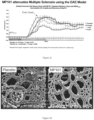
- Figure 2a shows the changes of BDNF protein levels by immunoblot from a mouse model of MS, Experimental Autoimmune Encephalomyelitis (EAE).
- EAE Experimental Autoimmune Encephalomyelitis
- Figure 2b shows the percent changes of BDNF protein levels by immunoblot from a mouse model of MS, Experimental Autoimmune encephalomyelitis (EAE) 3-weeks post-treatment.
- Figure 2c shows the effect of MP101 on progression of the phenotype in the MS model on clinical scores showing attenuation of disease progression.
- Figure 2d shows a representative mouse spinal cord electron microscopy image at Day-16 ( ⁇ peak of onset) of MP101 5 mg/kg treated mouse compared to placebo.
- the protective myelin sheaths surrounding the axons and axons are completely intact as compared to the placebo group.
- MP101 was tested in a model of Rett Syndrome using Mecp2 mutant mice.
- Rett Syndrome is a developmental disorder in young girls, with first symptoms starting at about 18-months of age, including reduced head growth.
- Figures 3a, 3b , 3c and 4 show the effects of treating these mutant mice with MP101 at 0.5, 1 mg/kg and 5 mg/kg by oral gavage.
- Mecp2 mutant mice a model of Rett Syndrome
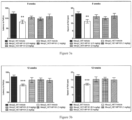
- Mecp2 mutant mice were treated with MP101 (DNP) at 6-weeks of age and tested on their coordination to walk on a rotating cylinder (rotarod).
- Wildtype mice are used as a benchmark for general decline in behavior compared to Mecp2 mutant mice treated with Vehicle, 0.5mg/kg MP101, 1mg/kg MP101 and 5mg/kg MP101 by oral gavage.
- Fig. 3a the data shows that at 8-weeks of age, the mutant vehicle treated mice lost their ability to walk on the rotarod, whereas the wildtype mice and drug treated animals fall less and can handle higher speeds of rotation.
- Fig. 3b the data shows similar findings at Week-12 of age after 1-month of treatment.
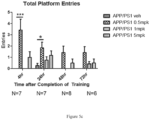
- Alzheimer's Disease representing about 70% of all dementia cases, was evaluated using the APP/PS1 mice, which express the APPswe mutation and PS 1 deltaE9 mutation and develop relatively rapid A ⁇ pathology and cognitive deficits.
- the APP/PS1 mice were treated for 4-months by oral gavage delivery with MP101 (DNP) at 0.5, 1 and 5 mg/kg.
- Figs. 5a, 5b and 5c show that MP101 have improved cognition compared to Vehicle treated mice.
- the amount of time spent in the quadrant is an indicator of whether the mice remember the general location, with increased time indicating increased memory.
- Figs 5a, 5b and 5c show that at all doses with DNP, the APP/PS1 mice improved in short term memory when tested on the Morris Water Maze for cognition in remembering where the hidden platform was, relative to vehicle which could not.
- Fig. 5a shows the distance traveled looking for the platform in the quadrant with the hidden platform
- Fig. 5b shows the amount of time spent in the quadrant where the platform is hidden
- Fig. 5c shows the number of entries from the platform. The amount of time spent in the quadrant is an indicator of whether the subject remembers the general location.
- DNP was also evaluated for a treatment of Epilepsy.
- the kanic acid model is an acute model of epilepsy caused by an injection in the right hippocampus of an analogue of glutamate (kanic acid) that over-stimulates the neurons causing death.
- Figure 6 shows the effect of treating wildtype mice for 14-days by oral gavage at 1, 5 and 10 mg/kg with MP101 (DNP), prior to injection of kanic acid to determine if DNP as a protective effect to the effects on over-stimulation and death by kanic acid.
- DNP MP101
- Figure 6 shows that after 2-weeks of treatment with MP101 (DNP) at 1, 5 and 10 mg/kg by oral gavage and then a kanic acid injection into the brain of a mouse, there is a shortening of seizure time.
- DNP provided neural protection from over-stimulation caused by kanic acid relative to the Vehicle.
- SIRT3 KO is a model of a heightened sensitivity to glutamate-induced calcium overload and excitotoxicity, and oxidative and mitochondrial stress, therefore ideal for evaluating Parkinson's Disease, Huntington's Disease and temporal lobe epilepsy.
- Figure 7 shows that MP101 protected the dopaminergic neurons from the toxic effects of 6-OHDA.
- Figs. 7a and 7b show the effects of DNP (MP101) treatment for 14-Days by oral gavage in protecting dopaminergic neuronal loss when the right striatum is injected with 6-OHDA after the last day.
- Fig. 7a show that when the mice are placed in a cylinder, the percent of left and right paw touches on the wall is improved in wildtype mice, and
- Fig. 7b shows that in the SIRT3 KO mice, which are more vulnerable to Parkinson's disease, there is improved motor coordination when treated with MP101 (DNP) and placed on a rotating cylinder (rotarod).
- DNP MP101
- MP101 (DNP) was used in a mouse model of Huntington's Disease, the "Fragment Model" N171-82 HD mice, to determine its neuroprotective effects.
- the N171-82 HD mice were treated with MP101 at 0.5, 1 and 5 mg/kg by oral gavage daily for greater than 17-weeks.
- the mice were tested for changes in behavioral, loss of brain volume, spiny neurons and general neurons.
- Figs 8a, 8b, 8c , 8d, 8e , and 8f show the effects of DNP (MP101 drug treatment).
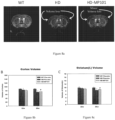
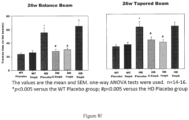
- Figs 8a-8f show the effects of MP101 in the Huntington's Disease model N171-82Q after 13-weeks (age 22 weeks) and/or 17-weeks (age 26-weeks) of treatment with DNP.
- Fig. 8a shows an MRI image of brain volume changes of wildtype (WT), mutant Huntington mice Vehicle (HD) and MP101 treated mice (HD-MP101).
- Fig. 8b shows the quantitative brain volume loss in the cortex.
- Fig. 8c shows the quantitative brain volume loss in the striatum.
- HD placebo (HD) shows loss in both Ctx and Str.
- MP-101 shows minor loss in cortex and striatum.
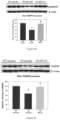
- Fig. 8d shows that treatment with DNP preserves medium spiny neurons using biomarker DARPP32 at 26-weeks of age.
- Fig. 8e shows that treatment with DNP preserves general neuronal loss with biomarker to postsynaptic protein PSD95 levels in N171-82Q HD mice.
- Fig. 8f shows that treatment with DNP improves motor function in both the tapered beam and balance beam after 17-weeks of treatment.
- the present invention describes methods and formulations related to the effective use of DNP to increase BDNF to attenuate disease progression or provide remission of symptoms in certain diseases.
- a method of use of the invention may include a method of treating a neurodegenerative, neuromuscular, developmental, metabolic, auto-immune or mitochondrial disorder, including those related to aging, comprising administering to a patient in need of treatment an effective dose of DNP, or a pharmaceutically acceptable salt thereof, over a period sufficiently long to achieve remission of the symptoms of the disease, wherein the effective dose of the DNP is continued in the dose range of 0.001 mg/kg of body weight to 5 mg/kg of body weight to increase BDNF to attenuate disease progression or provide remission of symptoms.
- a method of use of the invention may include a method of treating a neurodegenerative, neuromuscular, developmental, metabolic, autoimmune or mitochondrial disorder, including those related to aging, comprising administering to a patient in need of treatment an effective dose of DNP, or a pharmaceutically acceptable salt thereof, over a period sufficiently long to achieve remission of the symptoms of the disease, wherein the effective dose of the DNP is continued in the dose range of about 0.001 mg/kg of body weight to about 5 mg/kg of body weight to increase BDNF to attenuate disease progression or provide remission of symptoms.
- a method of use of the invention may include a method of treating a neurodegenerative, neuromuscular, developmental, metabolic, auto-immune or mitochondrial disorder, including those related to aging and any of the aforementioned diseases or conditions, comprising administering to a patient in need of treatment an effective dose of DNP, or a pharmaceutically acceptable salt thereof, over a period sufficiently long to achieve remission of the symptoms of the disease, wherein the effective dose of the DNP is continued in the dose range of 0.01 mg/kg of body weight to 5 mg/kg of body weight to increase BDNF to attenuate disease progression or provide remission of symptoms.
- a method of use of the invention may include a method of treating a neurodegenerative, neuromuscular, developmental, metabolic, auto-immune or mitochondrial disorder, including those related to aging and any of the aforementioned diseases or conditions, comprising administering to a patient in need of treatment an effective dose of DNP, or a pharmaceutically acceptable salt thereof, over a period sufficiently long to achieve remission of the symptoms of the disease, wherein the effective dose of the DNP is continued in the dose range of about 0.01 mg/kg of body weight to about 5 mg/kg of body weight to increase BDNF to attenuate disease progression or provide remission of symptoms.
- a method of use of the invention may include a method of treating a neurodegenerative, neuromuscular, developmental, metabolic, auto-immune or mitochondrial disorder, including those related to aging and any of the aforementioned diseases or conditions, comprising administering to a patient in need of treatment an effective dose of DNP, or a pharmaceutically acceptable salt thereof, over a period sufficiently long to achieve remission of the symptoms of the disease, wherein the effective dose of the DNP is continued in the dose range of 0.01 mg/kg of body weight to 1 mg/kg of body weight to increase BDNF to attenuate disease progression or provide remission of symptoms.
- a method of use of the invention may include a method of treating a neurodegenerative, neuromuscular, developmental, metabolic, auto-immune or mitochondrial disorder, including those related to aging and any of the aforementioned diseases or conditions, comprising administering to a patient in need of treatment an effective dose of DNP, or a pharmaceutically acceptable salt thereof, over a period sufficiently long to achieve remission of the symptoms of the disease, wherein the effective dose of the DNP is continued in the dose range of about 0.01 mg/kg of body weight to about 1 mg/kg of body weight to increase BDNF to attenuate disease progression or provide remission of symptoms.
- a method of use of the invention may include a method of treating a neurodegenerative, neuromuscular, developmental, metabolic, auto-immune or mitochondrial disorder, including those related to aging and any of the aforementioned diseases or conditions, comprising administering to a patient in need of treatment an effective dose of DNP, or a pharmaceutically acceptable salt thereof, over a period sufficiently long to achieve remission of the symptoms of the disease, wherein the effective dose of the DNP is continued in the dose range of 0.005 mg/kg of body weight to 2 mg/kg of body weight to increase BDNF to attenuate disease progression or provide remission of symptoms.
- a method of use of the invention may include a method of treating a neurodegenerative, neuromuscular, developmental, metabolic, auto-immune or mitochondrial disorder, including those related to aging and any of the aforementioned diseases or conditions, comprising administering to a patient in need of treatment an effective dose of DNP, or a pharmaceutically acceptable salt thereof, over a period sufficiently long to achieve remission of the symptoms of the disease, wherein the effective dose of the DNP is continued in the dose range of about 0.005 mg/kg of body weight to about 2 mg/kg of body weight to increase BDNF to attenuate disease progression or provide remission of symptoms.
- a method of use of the invention may include a method of treating a neurodegenerative, neuromuscular, developmental, metabolic, autoimmune or mitochondrial disorder, including those related to aging and any of the aforementioned diseases or conditions, comprising administering to a patient in need of treatment an effective dose of DNP, or a pharmaceutically acceptable salt thereof, over a period sufficiently long to achieve remission of the symptoms of the disease, wherein the effective dose of the DNP is continued in the dose range of 0.02 mg/kg of body weight to 0.9 mg/kg of body weight to increase BDNF to attenuate disease progression or provide remission of symptoms.
- a method of use of the invention may include a method of treating a neurodegenerative, neuromuscular, developmental, metabolic, autoimmune or mitochondrial disorder, including those related to aging and any of the aforementioned diseases or conditions, comprising administering to a patient in need of treatment an effective dose of DNP, or a pharmaceutically acceptable salt thereof, over a period sufficiently long to achieve remission of the symptoms of the disease, wherein the effective dose of the DNP is continued in the dose range of about 0.02 mg/kg of body weight to about 0.9 mg/kg of body weight to increase BDNF to attenuate disease progression or provide remission of symptoms.
- a method of use of the invention may include a method of treating a neurodegenerative, neuromuscular, developmental, metabolic, autoimmune or mitochondrial disorder, including those related to aging and any of the aforementioned diseases or conditions, comprising administering to a patient in need of treatment an effective dose of DNP, or a pharmaceutically acceptable salt thereof, over a period sufficiently long to achieve remission of the symptoms of the disease, wherein the effective dose of the DNP is continued in the dose range of 0.02 mg/kg of body weight to 0.06 mg/kg of body weight to increase BDNF to attenuate disease progression or provide remission of symptoms.
- a method of use of the invention may include a method of treating a neurodegenerative, neuromuscular, developmental, metabolic, autoimmune or mitochondrial disorder, including those related to aging and any of the aforementioned diseases or conditions, comprising administering to a patient in need of treatment an effective dose of DNP, or a pharmaceutically acceptable salt thereof, over a period sufficiently long to achieve remission of the symptoms of the disease, wherein the effective dose of the DNP is continued in the dose range of about 0.02 mg/kg of body weight to about 0.06 mg/kg of body weight to increase BDNF to attenuate disease progression or provide remission of symptoms.
- a method of use of the invention may include a method of treating a neurodegenerative, neuromuscular, developmental, metabolic, autoimmune or mitochondrial disorder, including those related to aging and any of the aforementioned diseases or conditions, comprising administering to a patient in need of treatment an effective dose of DNP, or a pharmaceutically acceptable salt thereof, over a period sufficiently long to achieve remission of the symptoms of the disease, wherein the effective dose of the DNP is continued in the dose range of 0.05 mg/kg of body weight to 0.09 mg/kg of body weight to increase BDNF to attenuate disease progression or provide remission of symptoms.
- a method of use of the invention may include a method of treating a neurodegenerative, neuromuscular, developmental, metabolic, autoimmune or mitochondrial disorder, including those related to aging and any of the aforementioned diseases or conditions, comprising administering to a patient in need of treatment an effective dose of DNP, or a pharmaceutically acceptable salt thereof, over a period sufficiently long to achieve remission of the symptoms of the disease, wherein the effective dose of the DNP is continued in the dose range of about 0.05 mg/kg of body weight to about 0.09 mg/kg of body weight to increase BDNF to attenuate disease progression or provide remission of symptoms.
- a method of use of the invention may include a method of treating a neurodegenerative, neuromuscular, developmental, metabolic, autoimmune or mitochondrial disorder, including those related to aging and any of the aforementioned diseases or conditions, comprising administering to a patient in need of treatment an effective dose of DNP, or a pharmaceutically acceptable salt thereof, over a period sufficiently long to achieve remission of the symptoms of the disease, wherein the effective dose of the DNP is continued in the dose range of 0.2 mg/kg of body weight to 0.6 mg/kg of body weight to increase BDNF to attenuate disease progression or provide remission of symptoms.
- a method of use of the invention may include a method of treating a neurodegenerative, neuromuscular, developmental, metabolic, autoimmune or mitochondrial disorder, including those related to aging and any of the aforementioned diseases or conditions, comprising administering to a patient in need of treatment an effective dose of DNP, or a pharmaceutically acceptable salt thereof, over a period sufficiently long to achieve remission of the symptoms of the disease, wherein the effective dose of the DNP is continued in the dose range of about 0.2 mg/kg of body weight to about 0.6 mg/kg of body weight to increase BDNF to attenuate disease progression or provide remission of symptoms.
- a method of use of the invention may include a method of treating a neurodegenerative, neuromuscular, developmental, metabolic, autoimmune or mitochondrial disorder, including those related to aging and any of the aforementioned diseases or conditions, comprising administering to a patient in need of treatment an effective dose of DNP, or a pharmaceutically acceptable salt thereof, over a period sufficiently long to achieve remission of the symptoms of the disease, wherein the effective dose of the DNP is continued in the dose range of 0.5 mg/kg of body weight to 0.9 mg/kg of body weight to increase BDNF to attenuate disease progression or provide remission of symptoms.
- a method of use of the invention may include a method of treating a neurodegenerative, neuromuscular, developmental, metabolic, autoimmune or mitochondrial disorder, including those related to aging and any of the aforementioned diseases or conditions, comprising administering to a patient in need of treatment an effective dose of DNP, or a pharmaceutically acceptable salt thereof, over a period sufficiently long to achieve remission of the symptoms of the disease, wherein the effective dose of the DNP is continued in the dose range of about 0.5 mg/kg of body weight to about 0.9 mg/kg of body weight to increase BDNF to attenuate disease progression or provide remission of symptoms.
- a method of use of the invention may include a method of treating a neurodegenerative, neuromuscular, developmental, metabolic, autoimmune or mitochondrial disorder, including those related to aging and any of the aforementioned diseases or conditions, comprising administering to a patient in need of treatment an effective dose of DNP, or a pharmaceutically acceptable salt thereof, over a period sufficiently long to achieve remission of the symptoms of the disease, wherein the effective dose of the DNP is continued in the dose range of 0.01 mg/kg of body weight to 0.1 mg/kg of body weight to increase BDNF to attenuate disease progression or provide remission of symptoms.
- a method of use of the invention may include a method of treating a neurodegenerative, neuromuscular, developmental, metabolic, autoimmune or mitochondrial disorder, including those related to aging and any of the aforementioned diseases or conditions, comprising administering to a patient in need of treatment an effective dose of DNP, or a pharmaceutically acceptable salt thereof, over a period sufficiently long to achieve remission of the symptoms of the disease, wherein the effective dose of the DNP is continued in the dose range of about 0.01 mg/kg of body weight to about 0.1 mg/kg of body weight to increase BDNF to attenuate disease progression or provide remission of symptoms.
- a method of use of the invention may include a method of treating a neurodegenerative, neuromuscular, developmental, metabolic, autoimmune or mitochondrial disorder, including those related to aging and any of the aforementioned diseases or conditions, comprising administering to a patient in need of treatment an effective dose of DNP, or a pharmaceutically acceptable salt thereof, over a period sufficiently long to achieve remission of the symptoms of the disease, wherein the effective dose of the DNP is continued in the dose range of 0.01 mg/kg of body weight to 0.5 mg/kg of body weight to increase BDNF to attenuate disease progression or provide remission of symptoms.
- a method of use of the invention may include a method of treating a neurodegenerative, neuromuscular, developmental, metabolic, autoimmune or mitochondrial disorder, including those related to aging and any of the aforementioned diseases or conditions, comprising administering to a patient in need of treatment an effective dose of DNP, or a pharmaceutically acceptable salt thereof, over a period sufficiently long to achieve remission of the symptoms of the disease, wherein the effective dose of the DNP is continued in the dose range of about 0.01 mg/kg of body weight to about 0.5 mg/kg of body weight to increase BDNF to attenuate disease progression or provide remission of symptoms.
- a method of use of the invention may include a method of treating a neurodegenerative, neuromuscular, developmental, metabolic, autoimmune or mitochondrial disorder, including those related to aging and any of the aforementioned diseases or conditions, comprising administering to a patient in need of treatment an effective dose of DNP, or a pharmaceutically acceptable salt thereof, over a period sufficiently long to achieve remission of the symptoms of the disease, wherein the effective dose of the DNP is continued in the dose range of 0.05 mg/kg of body weight to 0.5 mg/kg of body weight to increase BDNF to attenuate disease progression or provide remission of symptoms.
- a method of use of the invention may include a method of treating a neurodegenerative, neuromuscular, developmental, metabolic, autoimmune or mitochondrial disorder, including those related to aging and any of the aforementioned diseases or conditions, comprising administering to a patient in need of treatment an effective dose of DNP, or a pharmaceutically acceptable salt thereof, over a period sufficiently long to achieve remission of the symptoms of the disease, wherein the effective dose of the DNP is continued in the dose range of about 0.05 mg/kg of body weight to about 0.5 mg/kg of body weight to increase BDNF to attenuate disease progression or provide remission of symptoms.
- a method of use of the invention may include a method of treating a neurodegenerative, neuromuscular, developmental, metabolic, autoimmune or mitochondrial disorder, including those related to aging and any of the aforementioned diseases or conditions, comprising administering to a patient in need of treatment an effective dose of DNP, or a pharmaceutically acceptable salt thereof, over a period sufficiently long to achieve remission of the symptoms of the disease, wherein the effective dose of the DNP is continued in the dose range of 0.05 mg/kg of body weight to 0.9 mg/kg of body weight to increase BDNF to attenuate disease progression or provide remission of symptoms.
- a method of use of the invention may include a method of treating a neurodegenerative, neuromuscular, developmental, metabolic, autoimmune or mitochondrial disorder, including those related to aging and any of the aforementioned diseases or conditions, comprising administering to a patient in need of treatment an effective dose of DNP, or a pharmaceutically acceptable salt thereof, over a period sufficiently long to achieve remission of the symptoms of the disease, wherein the effective dose of the DNP is continued in the dose range of about 0.05 mg/kg of body weight to about 0.9 mg/kg of body weight to increase BDNF to attenuate disease progression or provide remission of symptoms.
- a method of use of the invention may include a method of treating a neurodegenerative, neuromuscular, developmental, metabolic, auto-immune or mitochondrial disorder, including those related to aging and any of the aforementioned diseases or conditions, comprising administering to a patient in need of treatment an effective dose of DNP, or a pharmaceutically acceptable salt thereof, over a period sufficiently long to achieve remission of the symptoms of the disease, wherein the effective dose of the DNP is continued in the dose range of 0.02 mg/kg of body weight to 1 mg/kg of body weight to increase BDNF to attenuate disease progression or provide remission of symptoms.
- a method of use of the invention may include a method of treating a neurodegenerative, neuromuscular, developmental, metabolic, auto-immune or mitochondrial disorder, including those related to aging and any of the aforementioned diseases or conditions, comprising administering to a patient in need of treatment an effective dose of DNP, or a pharmaceutically acceptable salt thereof, over a period sufficiently long to achieve remission of the symptoms of the disease, wherein the effective dose of the DNP is continued in the dose range of about 0.02 mg/kg of body weight to about 1 mg/kg of body weight to increase BDNF to attenuate disease progression or provide remission of symptoms.
- a method of use of the invention may include a method of treating a neurodegenerative, neuromuscular, developmental, metabolic, auto-immune or mitochondrial disorder, including those related to aging, comprising administering to a patient in need of treatment an effective dose of DNP, or a pharmaceutically acceptable salt thereof, over a period sufficiently long to achieve remission of the symptoms of the disease, wherein the effective dose of the DNP is continued in the dose range of 0.01 mg/kg of body weight to 0.1 mg/kg of body weight to increase BDNF to attenuate disease progression or provide remission of symptoms.
- a method of use of the invention may include a method of treating a neurodegenerative, neuromuscular, developmental, metabolic, auto-immune or mitochondrial disorder, including those related to aging, comprising administering to a patient in need of treatment an effective dose of DNP, or a pharmaceutically acceptable salt thereof, over a period sufficiently long to achieve remission of the symptoms of the disease, wherein the effective dose of the DNP is continued in the dose range of about 0.01 mg/kg of body weight to about 0.1 mg/kg of body weight to increase BDNF to attenuate disease progression or provide remission of symptoms.
- a method of use of the invention may include a method of treating a neurodegenerative, neuromuscular, developmental, metabolic, auto-immune or mitochondrial disorder, including those related to aging, comprising administering to a patient in need of treatment an effective dose of DNP, or a pharmaceutically acceptable salt thereof, over a period sufficiently long to achieve remission of the symptoms of the disease, wherein the effective dose of the DNP is continued in the dose range of 0.1 mg/kg of body weight to 1 mg/kg of body weight to increase BDNF to attenuate disease progression or provide remission of symptoms.
- a method of use of the invention may include a method of treating a neurodegenerative, neuromuscular, developmental, metabolic, auto-immune or mitochondrial disorder, including those related to aging, comprising administering to a patient in need of treatment an effective dose of DNP, or a pharmaceutically acceptable salt thereof, over a period sufficiently long to achieve remission of the symptoms of the disease, wherein the effective dose of the DNP is continued in the dose range of about 0.1 mg/kg of body weight to about 1 mg/kg of body weight to increase BDNF to attenuate disease progression or provide remission of symptoms.
- a method of use of the invention may include a method of treating neuromuscular or neurodegenerative disorder related to aging, comprising administering to a patient in need of treatment of a traumatic CNS injury or neurodegenerative disease an effective dose of DNP, or a pharmaceutically acceptable salt thereof, over a period sufficiently long to achieve remission of the symptoms of the disease, wherein the effective dose of the DNP is continued in the dose range of 1 mg/kg of body weight to 5 mg/kg of body weight to increase BDNF to attenuate disease progression or provide remission of symptoms.
- a method of use of the invention may include a method of treating neuromuscular or neurodegenerative disorder related to aging, comprising administering to a patient in need of treatment of a traumatic CNS injury or neurodegenerative disease an effective dose of DNP, or a pharmaceutically acceptable salt thereof, over a period sufficiently long to achieve remission of the symptoms of the disease, wherein the effective dose of the DNP is continued in the dose range of about 1 mg/kg of body weight to about 5 mg/kg of body weight to increase BDNF to attenuate disease progression or provide remission of symptoms.
- administration of DNP, or a pharmaceutically acceptable salt thereof, in any form or combination as described herein, for any purpose as described herein is in the dose range of about 0.001 mg/kg of body weight to about 5 mg/kg of body weight, about 0.001 mg/kg of body weight to about 4 mg/kg of body weight, about 0.001 mg/kg of body weight to about 3 mg/kg of body weight, about 0.001 mg/kg of body weight to about 0.005 mg/kg of body weight, about 0.005 mg/kg of body weight to about .01 mg/kg of body weight, about 0.01 mg/kg of body weight to about 1 of body weight, about 0.01 mg/kg of body weight to about 0.1 of body weight, about 0.02 mg/kg of body weight to about 0.08 of body weight, about 0.025 mg/kg of body weight to about 0.06 of body weight, about 0.03 mg/kg of body weight to about 0.05 of body weight, about 0.05 mg/kg of body weight to about 0.1 of body weight, about 0.04 mg/kg of
- administration of DNP, or a pharmaceutically acceptable salt thereof, in any form or combination as described herein, for any purpose as described herein is in the dose range of 0.001 mg/kg of body weight to 5 mg/kg of body weight, 0.001 mg/kg of body weight to 4 mg/kg of body weight, 0.001 mg/kg of body weight to 3 mg/kg of body weight, 0.001 mg/kg of body weight to 0.005 mg/kg of body weight, 0.005 mg/kg of body weight to 0.01 mg/kg of body weight, 0.01 mg/kg of body weight to 1 of body weight, 0.01 mg/kg of body weight to 0.1 of body weight, 0.02 mg/kg of body weight to 0.08 of body weight, 0.025 mg/kg of body weight to 0.06 of body weight, 0.03 mg/kg of body weight to 0.05 of body weight, 0.05 mg/kg of body weight to 0.1 of body weight, 0.04 mg/kg of body weight to 0.06 of body weight, 0.06 mg/kg of body weight to 0.09 of body weight,
- administration of DNP, or a pharmaceutically acceptable salt thereof, in any form or combination as described herein, for any purpose as described herein is about 0.001 mg/kg, about 0.002 mg/kg, about 0.003 mg/kg, about 0.004 mg/kg, about 0.005 mg/kg, about 0.006 mg/kg, about 0.007 mg/kg, about 0.008 mg/kg, about 0.009 mg/kg, about 0.01 mg/kg, about 0.015 mg/kg, about 0.02 mg/kg, about 0.025 mg/kg, about 0.03 mg/kg, about 0.035 mg/kg, about 0.04 mg/kg, about 0.045 mg/kg, about 0.05 mg/kg, about 0.055 mg/kg, about 0.06 mg/kg, about 0.065 mg/kg, about 0.07 mg/kg, about 0.075 mg/kg, about 0.08 mg/kg, about 0.085 mg/kg, about 0.09 mg/kg, about 0.095 mg/kg, about 0.1 mg/kg, about 0.15 mg
- administration of DNP, or a pharmaceutically acceptable salt thereof, in any form or combination as described herein, for any purpose as described herein is 0.001 mg/kg, 0.002 mg/kg, 0.003 mg/kg, 0.004 mg/kg, 0.005 mg/kg, 0.006 mg/kg, 0.007 mg/kg, 0.008 mg/kg, 0.009 mg/kg, 0.01 mg/kg, 0.015 mg/kg, 0.02 mg/kg, 0.025 mg/kg, 0.03 mg/kg, 0.035 mg/kg, 0.04 mg/kg, 0.045 mg/kg, 0.05 mg/kg, 0.055 mg/kg, 0.06 mg/kg, 0.065 mg/kg, 0.07 mg/kg, 0.075 mg/kg, 0.08 mg/kg, 0.085 mg/kg, 0.09 mg/kg, 0.095 mg/kg, about 0.1 mg/kg, 0.15 mg/kg, 0.2 mg/kg, 0.25 mg/kg, 0.3 mg/kg, 0.35 mg/kg, about 0.1 mg/
- administration of DNP, or a pharmaceutically acceptable salt thereof, in any form or combination as described herein, for any purpose as described herein is about 10 mg/kg of body weight or less, about 5 mg/kg of body weight or less, about 4.5 mg/kg or less, about 4 mg/kg or less, about 3.5 mg/kg or less, about 3 mg/kg or less, about 2.5 mg/kg or less, about 2 mg/kg or less, about 1.5 mg/kg or less, about 1 mg/kg or less, about 0.95 mg/kg or less, about 0.9 mg/kg or less, about 0.85 mg/kg or less, about 0.8 mg/kg or less, about 0.75 mg/kg or less, about 0.7 mg/kg or less, about 0.65 mg/kg or less, about 0.6 mg/kg or less, about 0.55 mg/kg or less, about 0.5 mg/kg or less, about 0.45 mg/kg or less, about 0.4 mg/kg or less, about 0.35 mg/kg or less, about 0.3 mg/kg or less, about 0.25 mg
- administration of DNP, or a pharmaceutically acceptable salt thereof, in any form or combination as described herein, for any purpose as described herein is about 4 mg/kg or more, about 3.5 mg/kg or more, about 3 mg/kg or more, about 2.5 mg/kg or more, about 2 mg/kg or more, about 1.5 mg/kg or more, about 1 mg/kg or more, about 0.95 mg/kg or more, about 0.9 mg/kg or more, about 0.85 mg/kg or more, about 0.8 mg/kg or more, about 0.75 mg/kg or more, about 0.7 mg/kg or more, about 0.65 mg/kg or more, about 0.6 mg/kg or more, about 0.55 mg/kg or more, about 0.5 mg/kg or more, about 0.45 mg/kg or more, about 0.4 mg/kg or more, about 0.35 mg/kg or more, about 0.3 mg/kg or more, about 0.25 mg/kg or more, about 0.2 mg/kg or more, about 0.15 mg/kg or more, about 0.1 mg/kg or more
- the effective dose is delivered orally. In some examples, the effective does is delivered intravenously. In some examples, the effective does is delivered intravenously by means of an intravenous drip along with saline. In some examples, the effective does is delivered intravenously by means of an intravenous drip along with other medicines, vitamins, fluids or nutrition. In some examples, the effective does is delivered subcutaneously. In some examples, the effective dose is delivered topically. In some examples, the effective dose is delivered transdermally. In some examples, the effective dose is combined with other necessary medicines, vitamins, fluids or nutrition.
- the effective dose is used to treat, prevent or alleviate any of the following diseases or conditions by inducing BDNF with DNP treatment: Traumatic Brain Injury (TBI), Ischemic stroke, Huntington's disease (Adult-onset Huntington's, Juvenile Huntington's disease), Epilepsy (Cluster Seizures, Refractory Seizures, Atypical Absence Seizures, Atonic Seizures, Clonic Seizures, myoclonic seizures, tonic seizures, Tonic-Clonic Seizures, Simple Partial Seizures, Complex Partial Seizures, Secondary Generalized Seizures, Febrile Seizures, Nonepileptic Seizures, Gelastic and Dacrystic Seizures, and Absence Seizures), Multiple Sclerosis (MS) (relapse-remitting multiple sclerosis (RRMS), Secondary-progressive MS (SPMS), Primary-progressive MS (PPMS), and Progressive-relapsing MS (PRMS)), Lupus (
- the effective dose used to treat, prevent or alleviate the symptoms of Huntington's disease is 0.005 mg/kg to 1.0 mg/kg. In some examples, the effective dose used to treat, prevent or alleviate Huntington's disease is 0.01 mg/kg to 0.5 mg/kg. In some examples, the effective dose used to treat, prevent or alleviate Huntington's disease is 0.01 mg/kg to 0.1 mg/kg. In some examples, the effective dose used to treat, prevent or alleviate Huntington's disease is 0.02 mg/kg to 0.1 mg/kg. In some examples, the effective dose used to treat, prevent or alleviate Huntington's disease is 0.02 mg/kg to 0.4 mg/kg.
- the effective dose used to treat, prevent or alleviate Huntington's disease is 0.025 mg/kg to 0.4 mg/kg. In some examples, the effective dose used to treat, prevent or alleviate Huntington's disease is 0.025 mg/kg to 0.08 mg/kg. In some examples, the effective dose used to treat, prevent or alleviate Huntington's disease is 0.03 mg/kg to 0.075 mg/kg. In some examples, the effective dose used to treat, prevent or alleviate Huntington's disease is 0.035 mg/kg to 0.4 mg/kg. In some examples, the effective dose used to treat, prevent or alleviate Huntington's disease is 0.035 mg/kg to 0.1 mg/kg.
- the effective dose used to treat, prevent or alleviate Huntington's disease is 0.035 mg/kg to 0.09 mg/kg. In some examples, the effective dose used to treat, prevent or alleviate Huntington's disease is 0.035 mg/kg to 0.08 mg/kg. In some examples, the effective dose used to treat, prevent or alleviate Huntington's disease is 0.035 mg/kg to 0.075 mg/kg. In some examples, the effective dose used to treat, prevent or alleviate Huntington's disease is 0.045 mg/kg to 0.055 mg/kg. In some examples, the effective dose used to treat, prevent or alleviate Huntington's disease is 0.055 mg/kg to 0.085 mg/kg.
- the effective dose used to treat, prevent or alleviate Huntington's disease is 0.055 mg/kg to 0.065 mg/kg. In some examples, the effective dose used to treat, prevent or alleviate Huntington's disease is 0.065 mg/kg to 0.075 mg/kg. In some examples, the effective dose used to treat, prevent or alleviate Huntington's disease is 0.075 mg/kg to 0.1 mg/kg. In some examples, the effective dose used to treat, prevent or alleviate Huntington's disease is 0.07 mg/kg to 0.09 mg/kg. In some examples, the effective dose used to treat, prevent or alleviate Huntington's disease is 0.085 mg/kg to 0.1 mg/kg.
- the effective dose used to treat, prevent or alleviate Huntington's disease is 0.09 mg/kg to 0.2 mg/kg. In some examples, the effective dose used to treat, prevent or alleviate Huntington's disease is 0.1 mg/kg to 0.3 mg/kg. In some examples, the effective dose used to treat, prevent or alleviate Huntington's disease is 0.2 mg/kg to 0.4 mg/kg.
- the effective dose used to treat, prevent or alleviate the symptoms of Huntington's disease is about 0.005 mg/kg to about 1.0 mg/kg. In some examples, the effective dose used to treat, prevent or alleviate Huntington's disease is about 0.01 mg/kg to about 0.5 mg/kg. In some examples, the effective dose used to treat, prevent or alleviate Huntington's disease is about 0.01 mg/kg to about 0.1 mg/kg. In some examples, the effective dose used to treat, prevent or alleviate Huntington's disease is about 0.02 mg/kg to about 0.1 mg/kg. In some examples, the effective dose used to treat, prevent or alleviate Huntington's disease is about 0.02 mg/kg to about 0.4 mg/kg.
- the effective dose used to treat, prevent or alleviate Huntington's disease is about 0.025 mg/kg to about 0.4 mg/kg. In some examples, the effective dose used to treat, prevent or alleviate Huntington's disease is about 0.025 mg/kg to about 0.08 mg/kg. In some examples, the effective dose used to treat, prevent or alleviate Huntington's disease is about 0.03 mg/kg to about 0.075 mg/kg. In some examples, the effective dose used to treat, prevent or alleviate Huntington's disease is about 0.035 mg/kg to about 0.4 mg/kg. In some examples, the effective dose used to treat, prevent or alleviate Huntington's disease is about 0.035 mg/kg to about 0.1 mg/kg.
- the effective dose used to treat, prevent or alleviate Huntington's disease is about 0.035 mg/kg to about 0.09 mg/kg. In some examples, the effective dose used to treat, prevent or alleviate Huntington's disease is about 0.035 mg/kg to about 0.08 mg/kg. In some examples, the effective dose used to treat, prevent or alleviate Huntington's disease is about 0.035 mg/kg to about 0.075 mg/kg. In some examples, the effective dose used to treat, prevent or alleviate Huntington's disease is about 0.045 mg/kg to about 0.055 mg/kg. In some examples, the effective dose used to treat, prevent or alleviate Huntington's disease is about 0.055 mg/kg to about 0.085 mg/kg.
- the effective dose used to treat, prevent or alleviate Huntington's disease is about 0.055 mg/kg to about 0.065 mg/kg. In some examples, the effective dose used to treat, prevent or alleviate Huntington's disease is about 0.065 mg/kg to about 0.075 mg/kg. In some examples, the effective dose used to treat, prevent or alleviate Huntington's disease is about 0.075 mg/kg to about 0.1 mg/kg. In some examples, the effective dose used to treat, prevent or alleviate Huntington's disease is about 0.07 mg/kg to about 0.09 mg/kg. In some examples, the effective dose used to treat, prevent or alleviate Huntington's disease is about 0.085 mg/kg to about 0.1 mg/kg.
- the effective dose used to treat, prevent or alleviate Huntington's disease is about 0.09 mg/kg to about 0.2 mg/kg. In some examples, the effective dose used to treat, prevent or alleviate Huntington's disease is about 0.1 mg/kg to about 0.3 mg/kg. In some examples, the effective dose used to treat, prevent or alleviate Huntington's disease is about 0.2 mg/kg to about 0.4 mg/kg.
- the effective dose used to treat, prevent or alleviate the symptoms of Huntington's disease is 0.001 mg/kg or more. In some examples, the effective dose used to treat, prevent or alleviate the symptoms of Huntington's disease is 0.002 mg/kg or more. In some examples, the effective dose used to treat, prevent or alleviate the symptoms of Huntington's disease is 0.003 mg/kg or more. In some examples, the effective dose used to treat, prevent or alleviate the symptoms of Huntington's disease is 0.004 mg/kg or more. In some examples, the effective dose used to treat, prevent or alleviate the symptoms of Huntington's disease is 0.005 mg/kg or more.
- the effective dose used to treat, prevent or alleviate the symptoms of Huntington's disease is 0.01 mg/kg or more. In some examples, the effective dose used to treat, prevent or alleviate the symptoms of Huntington's disease is 0.025 mg/kg or more. In some examples, the effective dose used to treat, prevent or alleviate the symptoms of Huntington's disease is 0.035 mg/kg or more. In some examples, the effective dose used to treat, prevent or alleviate the symptoms of Huntington's disease is 0.05 mg/kg or more. In some examples, the effective dose used to treat, prevent or alleviate the symptoms of Huntington's disease is 0.075 mg/kg or more.
- the effective dose used to treat, prevent or alleviate the symptoms of Huntington's disease is 0.1 mg/kg or more. In some examples, the effective dose used to treat, prevent or alleviate the symptoms of Huntington's disease is 1 mg/kg or less. In some examples, the effective dose used to treat, prevent or alleviate the symptoms of Huntington's disease is 0.5 mg/kg or less. In some examples, the effective dose used to treat, prevent or alleviate the symptoms of Huntington's disease is 0.35 mg/kg or less. In some examples, the effective dose used to treat, prevent or alleviate the symptoms of Huntington's disease is 0.25 mg/kg or less. In some examples, the effective dose used to treat, prevent or alleviate the symptoms of Huntington's disease is 0.1 mg/kg or less.
- the effective dose used to treat, prevent or alleviate the symptoms of Huntington's disease is 0.075 mg/kg or less. In some examples, the effective dose used to treat, prevent or alleviate the symptoms of Huntington's disease is 0.05 mg/kg or less. In some examples, the effective dose used to treat, prevent or alleviate the symptoms of Huntington's disease is 0.01 mg/kg or less. In all cases, the dose described herein is greater than zero mg/kg and less than 5 mg/kg.
- the effective dose used to treat, prevent or alleviate the symptoms of Multiple Sclerosis is 0.01 mg/kg to 5 mg/kg. In some examples, the effective dose used to treat, prevent or alleviate the symptoms of Multiple Sclerosis (MS) is 0.01 mg/kg to 1 mg/kg. In some examples, the effective dose used to treat, prevent or alleviate the symptoms of Multiple Sclerosis (MS) is 0.05 mg/kg to 5 mg/kg. In some examples, the effective dose used to treat, prevent or alleviate the symptoms of Multiple Sclerosis (MS) is 0.05 mg/kg to 1 mg/kg. In some examples, the effective dose used to treat, prevent or alleviate Multiple Sclerosis (MS) is 0.06 mg/kg to 1 mg/kg.
- the effective dose used to treat, prevent or alleviate Multiple Sclerosis is 0.07 mg/kg to 0.9 mg/kg. In some examples, the effective dose used to treat, prevent or alleviate Multiple Sclerosis (MS) is 0.075 mg/kg to 0.8 mg/kg. In some examples, the effective dose used to treat, prevent or alleviate Multiple Sclerosis (MS) is 0.07 mg/kg to 0.1 mg/kg. In some examples, the effective dose used to treat, prevent or alleviate Multiple Sclerosis (MS) is 0.08 mg/kg to 0.5 mg/kg. In some examples, the effective dose used to treat, prevent or alleviate Multiple Sclerosis (MS) is 0.1 mg/kg to 0.8 mg/kg.
- the effective dose used to treat, prevent or alleviate Multiple Sclerosis is 0.3 mg/kg to 0.8 mg/kg. In some examples, the effective dose used to treat, prevent or alleviate Multiple Sclerosis (MS) is 0.4 mg/kg to 0.7 mg/kg. In some examples, the effective dose used to treat, prevent or alleviate Multiple Sclerosis (MS) is 0.7 mg/kg to 0.8 mg/kg. In some examples, the effective dose used to treat, prevent or alleviate Multiple Sclerosis (MS) is 0.8 mg/kg to 1 mg/kg.
- the effective dose used to treat, prevent or alleviate the symptoms of Multiple Sclerosis is about 0.05 mg/kg to about 5 mg/kg. In some examples, the effective dose used to treat, prevent or alleviate the symptoms of Multiple Sclerosis (MS) is about 0.01 mg/kg to about 1 mg/kg. In some examples, the effective dose used to treat, prevent or alleviate the symptoms of Multiple Sclerosis (MS) is about 0.05 mg/kg to about 5 mg/kg. In some examples, the effective dose used to treat, prevent or alleviate the symptoms of Multiple Sclerosis (MS) is about 0.05 mg/kg to about 1 mg/kg. In some examples, the effective dose used to treat, prevent or alleviate Multiple Sclerosis (MS) is about 0.06 mg/kg to about 1 mg/kg.
- the effective dose used to treat, prevent or alleviate Multiple Sclerosis is about 0.07 mg/kg to about 0.9 mg/kg. In some examples, the effective dose used to treat, prevent or alleviate Multiple Sclerosis (MS) is about 0.075 mg/kg to about 0.8 mg/kg. In some examples, the effective dose used to treat, prevent or alleviate Multiple Sclerosis (MS) is about 0.07 mg/kg to about 0.1 mg/kg. In some examples, the effective dose used to treat, prevent or alleviate Multiple Sclerosis (MS) is about 0.08 mg/kg to about 0.5 mg/kg. In some examples, the effective dose used to treat, prevent or alleviate Multiple Sclerosis (MS) is about 0.1 mg/kg to about 0.8 mg/kg.
- the effective dose used to treat, prevent or alleviate Multiple Sclerosis is about 0.3 mg/kg to about 0.8 mg/kg. In some examples, the effective dose used to treat, prevent or alleviate Multiple Sclerosis (MS) is about 0.4 mg/kg to about 0.7 mg/kg. In some examples, the effective dose used to treat, prevent or alleviate Multiple Sclerosis (MS) is about 0.7 mg/kg to about 0.8 mg/kg. In some examples, the effective dose used to treat, prevent or alleviate Multiple Sclerosis (MS) is about 0.8 mg/kg to about 1 mg/kg.
- the effective dose used to treat, prevent or alleviate Multiple Sclerosis is 1.0 mg/kg or less. In some examples, the effective dose used to treat, prevent or alleviate Multiple Sclerosis (MS) is 0.9 mg/kg or less. In some examples, the effective dose used to treat, prevent or alleviate Multiple Sclerosis (MS) is 0.8 mg/kg or less. In some examples, the effective dose used to treat, prevent or alleviate Multiple Sclerosis (MS) is 0.7 mg/kg or less. In some examples, the effective dose used to treat, prevent or alleviate Multiple Sclerosis (MS) is 0.6 mg/kg or less. In some examples, the effective dose used to treat, prevent or alleviate Multiple Sclerosis (MS) is 0.5 mg/kg or less.
- the effective dose used to treat, prevent or alleviate Multiple Sclerosis is 0.4 mg/kg or less. In some examples, the effective dose used to treat, prevent or alleviate Multiple Sclerosis (MS) is 0.3 mg/kg or less. In some examples, the effective dose used to treat, prevent or alleviate Multiple Sclerosis (MS) is 0.2 mg/kg or less. In some examples, the effective dose used to treat, prevent or alleviate Multiple Sclerosis (MS) is 0.1 mg/kg or less. In some examples, the effective dose used to treat, prevent or alleviate Multiple Sclerosis (MS) is 0.09 mg/kg or less. In some examples, the effective dose used to treat, prevent or alleviate Multiple Sclerosis (MS) is 0.08 mg/kg or less.
- the effective dose used to treat, prevent or alleviate Multiple Sclerosis is 0.07 mg/kg or less. In some examples, the effective dose used to treat, prevent or alleviate Multiple Sclerosis (MS) is 0.05 mg/kg or less. In some examples, the effective dose used to treat, prevent or alleviate Multiple Sclerosis (MS) is 0.01 mg/kg or more. In some examples, the effective dose used to treat, prevent or alleviate Multiple Sclerosis (MS) is 0.05 mg/kg or more. In some examples, the effective dose used to treat, prevent or alleviate Multiple Sclerosis (MS) is 0.06 mg/kg or more. In some examples, the effective dose used to treat, prevent or alleviate Multiple Sclerosis (MS) is 0.07 mg/kg or more.
- the effective dose used to treat, prevent or alleviate Multiple Sclerosis is 0.08 mg/kg or more. In some examples, the effective dose used to treat, prevent or alleviate Multiple Sclerosis (MS) is 0.09 mg/kg or more. In some examples, the effective dose used to treat, prevent or alleviate Multiple Sclerosis (MS) is 0.1 mg/kg or more. In some examples, the effective dose used to treat, prevent or alleviate Multiple Sclerosis (MS) is 0.15 mg/kg or more. In some examples, the effective dose used to treat, prevent or alleviate Multiple Sclerosis (MS) is 0.2 mg/kg or more. In some examples, the effective dose used to treat, prevent or alleviate Multiple Sclerosis (MS) is 0.25 mg/kg or more.
- the effective dose used to treat, prevent or alleviate Multiple Sclerosis is 0.3 mg/kg or more. In some examples, the effective dose used to treat, prevent or alleviate Multiple Sclerosis (MS) is 0.35 mg/kg or more. In some examples, the effective dose used to treat, prevent or alleviate Multiple Sclerosis (MS) is 0.4 mg/kg or more. In some examples, the effective dose used to treat, prevent or alleviate Multiple Sclerosis (MS) is 0.45 mg/kg or more. In some examples, the effective dose used to treat, prevent or alleviate Multiple Sclerosis (MS) is 0.5 mg/kg or more. In some examples, the effective dose used to treat, prevent or alleviate Multiple Sclerosis (MS) is 0.55 mg/kg or more.
- the effective dose used to treat, prevent or alleviate Multiple Sclerosis is 0.6 mg/kg or more. In some examples, the effective dose used to treat, prevent or alleviate Multiple Sclerosis (MS) is 0.65 mg/kg or more. In some examples, the effective dose used to treat, prevent or alleviate Multiple Sclerosis (MS) is 0.70 mg/kg or more. In some examples, the effective dose used to treat, prevent or alleviate Multiple Sclerosis (MS) is 0.75 mg/kg or more. In some examples, the effective dose used to treat, prevent or alleviate Multiple Sclerosis (MS) is 0.8 mg/kg or more. In some examples, the effective dose used to treat, prevent or alleviate Multiple Sclerosis (MS) is 1.0 mg/kg or more. In all cases, the dose described herein is greater than zero mg/kg and less than 5 mg/kg.
- the effective dose used to treat, prevent or alleviate Epilepsy is 0.05 mg/kg to 1 mg/kg. In some examples, the effective dose used to treat, prevent or alleviate Epilepsy is 0.5 mg/kg to 1 mg/kg. In some examples, the effective dose used to treat, prevent or alleviate Epilepsy is 0.6 mg/kg to 0.9 mg/kg. In some examples, the effective dose used to treat, prevent or alleviate Epilepsy is 0.7 mg/kg to 0.8 mg/kg. In some examples, the effective dose used to treat, prevent or alleviate Epilepsy is about 0.5 mg/kg to about 1 mg/kg. In some examples, the effective dose used to treat, prevent or alleviate Epilepsy is about 0.6 mg/kg to about 0.9 mg/kg.
- the effective dose used to treat, prevent or alleviate Epilepsy is about 0.7 mg/kg to about 0.8 mg/kg. In some examples, the effective dose used to treat, prevent or alleviate Epilepsy is 0.1 mg/kg or more. In some examples, the effective dose used to treat, prevent or alleviate Epilepsy is 0.4 mg/kg or more. In some examples, the effective dose used to treat, prevent or alleviate Epilepsy is 0.5 mg/kg or more. In some examples, the effective dose used to treat, prevent or alleviate Epilepsy is 0.6 mg/kg or more. In some examples, the effective dose used to treat, prevent or alleviate Epilepsy is 0.7 mg/kg or more.
- the effective dose used to treat, prevent or alleviate Epilepsy is 0.8 mg/kg or more. In some examples, the effective dose used to treat, prevent or alleviate Epilepsy is 1 mg/kg or less. In some examples, the effective dose used to treat, prevent or alleviate Epilepsy is 0.9 mg/kg or less. In some examples, the effective dose used to treat, prevent or alleviate Epilepsy is 0.8 mg/kg or less. In some examples, the effective dose used to treat, prevent or alleviate Epilepsy is 0.7 mg/kg or less. In some examples, the effective dose used to treat, prevent or alleviate Epilepsy is 0.5 mg/kg or less. In all cases, the dose described herein is greater than zero mg/kg and less than 5 mg/kg.
- the effective dose used to treat, prevent or alleviate the symptoms of Rett Syndrome is 0.005 mg/kg to 1 mg/kg. In some examples, the effective dose used to treat, prevent or alleviate Rett Syndrome is 0.02 mg/kg to 1 mg/kg. In some examples, the effective dose used to treat, prevent or alleviate Rett Syndrome is 0.01 mg/kg to 0.5 mg/kg. In some examples, the effective dose used to treat, prevent or alleviate Rett Syndrome is 0.02 mg/kg to 0.4 mg/kg. In some examples, the effective dose used to treat, prevent or alleviate Rett Syndrome is 0.025 mg/kg to 0.4 mg/kg.
- the effective dose used to treat, prevent or alleviate Rett Syndrome is 0.025 mg/kg to 0.08 mg/kg. In some examples, the effective dose used to treat, prevent or alleviate Rett Syndrome is 0.03 mg/kg to 0.075 mg/kg. In some examples, the effective dose used to treat, prevent or alleviate Rett Syndrome is 0.035 mg/kg to 0.4 mg/kg. In some examples, the effective dose used to treat, prevent or alleviate Rett Syndrome is 0.035 mg/kg to 0.1 mg/kg. In some examples, the effective dose used to treat, prevent or alleviate Rett Syndrome is 0.035 mg/kg to 0.09 mg/kg.
- the effective dose used to treat, prevent or alleviate Rett Syndrome is 0.035 mg/kg to 0.08 mg/kg. In some examples, the effective dose used to treat, prevent or alleviate Rett Syndrome is 0.035 mg/kg to 0.075 mg/kg. In some examples, the effective dose used to treat, prevent or alleviate Rett Syndrome is 0.045 mg/kg to 0.055 mg/kg. In some examples, the effective dose used to treat, prevent or alleviate Rett Syndrome is 0.055 mg/kg to 0.085 mg/kg. In some examples, the effective dose used to treat, prevent or alleviate Rett Syndrome is 0.055 mg/kg to 0.065 mg/kg.
- the effective dose used to treat, prevent or alleviate Rett Syndrome is 0.065 mg/kg to 0.075 mg/kg. In some examples, the effective dose used to treat, prevent or alleviate Rett Syndrome is 0.075 mg/kg to 0.1 mg/kg. In some examples, the effective dose used to treat, prevent or alleviate Rett Syndrome is 0.07 mg/kg to 0.09 mg/kg. In some examples, the effective dose used to treat, prevent or alleviate Rett Syndrome is 0.085 mg/kg to 0.1 mg/kg. In some examples, the effective dose used to treat, prevent or alleviate Rett Syndrome is 0.09 mg/kg to 0.2 mg/kg.
- the effective dose used to treat, prevent or alleviate the symptoms of Rett Syndrome is about 0.005 mg/kg to about 1.0 mg/kg. In some examples, the effective dose used to treat, prevent or alleviate Rett Syndrome is about 0.02 mg/kg to about 1 mg/kg. In some examples, the effective dose used to treat, prevent or alleviate Rett Syndrome is about 0.01 mg/kg to about 0.5 mg/kg. In some examples, the effective dose used to treat, prevent or alleviate Rett Syndrome is about 0.02 mg/kg to about 0.4 mg/kg. In some examples, the effective dose used to treat, prevent or alleviate Rett Syndrome is about 0.025 mg/kg to about 0.4 mg/kg.
- the effective dose used to treat, prevent or alleviate Rett Syndrome is about 0.025 mg/kg to about 0.08 mg/kg. In some examples, the effective dose used to treat, prevent or alleviate Rett Syndrome is about 0.03 mg/kg to about 0.075 mg/kg. In some examples, the effective dose used to treat, prevent or alleviate Rett Syndrome is about 0.035 mg/kg to about 0.4 mg/kg. In some examples, the effective dose used to treat, prevent or alleviate Rett Syndrome is about 0.035 mg/kg to about 0.1 mg/kg. In some examples, the effective dose used to treat, prevent or alleviate Rett Syndrome is about 0.035 mg/kg to about 0.09 mg/kg.
- the effective dose used to treat, prevent or alleviate Rett Syndrome is about 0.035 mg/kg to about 0.08 mg/kg. In some examples, the effective dose used to treat, prevent or alleviate Rett Syndrome is about 0.035 mg/kg to about 0.075 mg/kg. In some examples, the effective dose used to treat, prevent or alleviate Rett Syndrome is about 0.045 mg/kg to about 0.055 mg/kg. In some examples, the effective dose used to treat, prevent or alleviate Rett Syndrome is about 0.055 mg/kg to about 0.085 mg/kg. In some examples, the effective dose used to treat, prevent or alleviate Rett Syndrome is about 0.055 mg/kg to about 0.065 mg/kg.
- the effective dose used to treat, prevent or alleviate Rett Syndrome is about 0.065 mg/kg to about 0.075 mg/kg. In some examples, the effective dose used to treat, prevent or alleviate Rett Syndrome is about 0.075 mg/kg to about 0.1 mg/kg. In some examples, the effective dose used to treat, prevent or alleviate Rett Syndrome is about 0.07 mg/kg to about 0.09 mg/kg. In some examples, the effective dose used to treat, prevent or alleviate Rett Syndrome is about 0.085 mg/kg to about 0.1 mg/kg. In some examples, the effective dose used to treat, prevent or alleviate Rett Syndrome is about 0.09 mg/kg to about 0.2 mg/kg.
- the effective dose used to treat, prevent or alleviate the symptoms of Rett Syndrome is 0.01 mg/kg or more. In some examples, the effective dose used to treat, prevent or alleviate the symptoms of Rett Syndrome is 0.02 mg/kg or more. In some examples, the effective dose used to treat, prevent or alleviate the symptoms of Rett Syndrome is 0.03 mg/kg or more. In some examples, the effective dose used to treat, prevent or alleviate the symptoms of Rett Syndrome is 0.04 mg/kg or more. In some examples, the effective dose used to treat, prevent or alleviate the symptoms of Rett Syndrome is 0.05 mg/kg or more. In some examples, the effective dose used to treat, prevent or alleviate the symptoms of Rett Syndrome is 0.06 mg/kg or more.
- the effective dose used to treat, prevent or alleviate the symptoms of Rett Syndrome is 0.07 mg/kg or more. In some examples, the effective dose used to treat, prevent or alleviate the symptoms of Rett Syndrome is 0.08 mg/kg or more. In some examples, the effective dose used to treat, prevent or alleviate the symptoms of Rett Syndrome is 0.09 mg/kg or more. In some examples, the effective dose used to treat, prevent or alleviate the symptoms of Rett Syndrome is 0.5 mg/kg or less. In some examples, the effective dose used to treat, prevent or alleviate the symptoms of Rett Syndrome is 0.3 mg/kg or less. In some examples, the effective dose used to treat, prevent or alleviate the symptoms of Rett Syndrome is 0.1 mg/kg or less.
- the effective dose used to treat, prevent or alleviate the symptoms of Rett Syndrome is 0.075 mg/kg or less. In some examples, the effective dose used to treat, prevent or alleviate the symptoms of Rett Syndrome is 0.05 mg/kg or less. In some examples, the effective dose used to treat, prevent or alleviate the symptoms of Rett Syndrome is 0.01 mg/kg or less. In all cases, the dose described herein is greater than zero mg/kg and less than 5 mg/kg.
- the effective dose used to treat, prevent or alleviate the symptoms of Parkinson's Disease is 0.01 mg/kg to 1 mg/kg. In some examples, the effective dose used to treat, prevent or alleviate the symptoms of Parkinson's Disease is 0.01 mg/kg to 0.5 mg/kg. In some examples, the effective dose used to treat, prevent or alleviate the symptoms of Parkinson's Disease is 0.05 mg/kg to 0.5 mg/kg. In some examples, the effective dose used to treat, prevent or alleviate Parkinson's Disease is 0.05 mg/kg to 0.1 mg/kg. In some examples, the effective dose used to treat, prevent or alleviate Parkinson's Disease is 0.06 mg/kg to 0.5 mg/kg.
- the effective dose used to treat, prevent or alleviate Parkinson's Disease is 0.07 mg/kg to 0.4 mg/kg. In some examples, the effective dose used to treat, prevent or alleviate Parkinson's Disease is 0.08 mg/kg to 0.4 mg/kg. In some examples, the effective dose used to treat, prevent or alleviate Parkinson's Disease is 0.09 mg/kg to 0.4 mg/kg. In some examples, the effective dose used to treat, prevent or alleviate Parkinson's Disease is 0.075 mg/kg to 0.1 mg/kg. In some examples, the effective dose used to treat, prevent or alleviate Parkinson's Disease is 0.09 mg/kg to 0.2 mg/kg.
- the effective dose used to treat, prevent or alleviate Parkinson's Disease is 0.1 mg/kg to 0.4 mg/kg. In some examples, the effective dose used to treat, prevent or alleviate Parkinson's Disease is 0.2 mg/kg to 0.5 mg/kg.
- the effective dose used to treat, prevent or alleviate the symptoms of Parkinson's Disease is about 0.01 mg/kg to about 1 mg/kg. In some examples, the effective dose used to treat, prevent or alleviate the symptoms of Parkinson's Disease is about 0.01 mg/kg to about 0.5 mg/kg. In some examples, the effective dose used to treat, prevent or alleviate the symptoms of Parkinson's Disease is about 0.05 mg/kg to about 0.5 mg/kg. In some examples, the effective dose used to treat, prevent or alleviate Parkinson's Disease is about 0.05 mg/kg to about 0.1 mg/kg. In some examples, the effective dose used to treat, prevent or alleviate Parkinson's Disease is about 0.06 mg/kg to about 0.5 mg/kg.
- the effective dose used to treat, prevent or alleviate Parkinson's Disease is about 0.07 mg/kg to about 0.4 mg/kg. In some examples, the effective dose used to treat, prevent or alleviate Parkinson's Disease is about 0.08 mg/kg to about 0.4 mg/kg. In some examples, the effective dose used to treat, prevent or alleviate Parkinson's Disease is about 0.09 mg/kg to about 0.4 mg/kg. In some examples, the effective dose used to treat, prevent or alleviate Parkinson's Disease is about 0.075 mg/kg to about 0.1 mg/kg. In some examples, the effective dose used to treat, prevent or alleviate Parkinson's Disease is about 0.09 mg/kg to about 0.2 mg/kg.
- the effective dose used to treat, prevent or alleviate Parkinson's Disease is about 0.1 mg/kg to about 0.4 mg/kg. In some examples, the effective dose used to treat, prevent or alleviate Parkinson's Disease is about 0.2 mg/kg to about 0.5 mg/kg.
- the effective dose used to treat, prevent or alleviate Parkinson's Disease is 1.0 mg/kg or less. In some examples, the effective dose used to treat, prevent or alleviate Parkinson's Disease is 0.5 mg/kg or less. In some examples, the effective dose used to treat, prevent or alleviate Parkinson's Disease is 0.4 mg/kg or less. In some examples, the effective dose used to treat, prevent or alleviate Parkinson's Disease is 0.3 mg/kg or less. In some examples, the effective dose used to treat, prevent or alleviate Parkinson's Disease is 0.2 mg/kg or less. In some examples, the effective dose used to treat, prevent or alleviate Parkinson's Disease is 0.1 mg/kg or less.
- the effective dose used to treat, prevent or alleviate Parkinson's Disease is 0.09 mg/kg or less. In some examples, the effective dose used to treat, prevent or alleviate Parkinson's Disease is 0.08 mg/kg or less. In some examples, the effective dose used to treat, prevent or alleviate Parkinson's Disease is 0.07 mg/kg or less. In some examples, the effective dose used to treat, prevent or alleviate Parkinson's Disease is 0.05 mg/kg or less. In some examples, the effective dose used to treat, prevent or alleviate Parkinson's Disease is 0.01 mg/kg or more. In some examples, the effective dose used to treat, prevent or alleviate Parkinson's Disease is 0.05 mg/kg or more.
- the effective dose used to treat, prevent or alleviate Parkinson's Disease is 0.06 mg/kg or more. In some examples, the effective dose used to treat, prevent or alleviate Parkinson's Disease is 0.07 mg/kg or more. In some examples, the effective dose used to treat, prevent or alleviate Parkinson's Disease is 0.08 mg/kg or more. In some examples, the effective dose used to treat, prevent or alleviate Parkinson's Disease is 0.09 mg/kg or more. In some examples, the effective dose used to treat, prevent or alleviate Parkinson's Disease is 0.1 mg/kg or more. In some examples, the effective dose used to treat, prevent or alleviate Parkinson's Disease is 0.15 mg/kg or more.
- the effective dose used to treat, prevent or alleviate Parkinson's Disease is 0.2 mg/kg or more. In some examples, the effective dose used to treat, prevent or alleviate Parkinson's Disease is 0.25 mg/kg or more. In some examples, the effective dose used to treat, prevent or alleviate Parkinson's Disease is 0.3 mg/kg or more. In some examples, the effective dose used to treat, prevent or alleviate Multiple Sclerosis (MS) is 0.35 mg/kg or more. In some examples, the effective dose used to treat, prevent or alleviate Parkinson's Disease is 0.4 mg/kg or more. In some examples, the effective dose used to treat, prevent or alleviate Parkinson's Disease is 0.45 mg/kg or more. In some examples, the effective dose used to treat, prevent or alleviate Parkinson's Disease is 0.5 mg/kg or more. In all cases, the dose described herein is greater than zero mg/kg and less than 5 mg/kg.
- the effective dose used to treat, prevent or alleviate the symptoms of Alzheimer's is .005 mg/kg to 1.0 mg/kg. In some examples, the effective dose used to treat, prevent or alleviate Alzheimer's is 0.01 mg/kg to 0.5 mg/kg. In some examples, the effective dose used to treat, prevent or alleviate Alzheimer's is 0.02 mg/kg to 0.4 mg/kg. In some examples, the effective dose used to treat, prevent or alleviate Alzheimer's is 0.025 mg/kg to 0.4 mg/kg. In some examples, the effective dose used to treat, prevent or alleviate Alzheimer's is 0.025 mg/kg to 0.08 mg/kg.
- the effective dose used to treat, prevent or alleviate Alzheimer's is 0.03 mg/kg to 0.075 mg/kg. In some examples, the effective dose used to treat, prevent or alleviate Alzheimer's is 0.035 mg/kg to 0.4 mg/kg. In some examples, the effective dose used to treat, prevent or alleviate Alzheimer's is 0.035 mg/kg to 0.1 mg/kg. In some examples, the effective dose used to treat, prevent or alleviate Alzheimer's is 0.035 mg/kg to 0.09 mg/kg. In some examples, the effective dose used to treat, prevent or alleviate Alzheimer's is 0.035 mg/kg to 0.08 mg/kg.
- the effective dose used to treat, prevent or alleviate Alzheimer's is 0.035 mg/kg to 0.075 mg/kg. In some examples, the effective dose used to treat, prevent or alleviate Alzheimer's is 0.045 mg/kg to 0.055 mg/kg. In some examples, the effective dose used to treat, prevent or alleviate Alzheimer's is 0.055 mg/kg to 0.085 mg/kg. In some examples, the effective dose used to treat, prevent or alleviate Alzheimer's is 0.055 mg/kg to 0.065 mg/kg. In some examples, the effective dose used to treat, prevent or alleviate Alzheimer's is 0.065 mg/kg to 0.075 mg/kg.
- the effective dose used to treat, prevent or alleviate Alzheimer's is 0.075 mg/kg to 0.1 mg/kg. In some examples, the effective dose used to treat, prevent or alleviate Alzheimer's is 0.07 mg/kg to 0.09 mg/kg. In some examples, the effective dose used to treat, prevent or alleviate Alzheimer's is 0.085 mg/kg to 0.1 mg/kg. In some examples, the effective dose used to treat, prevent or alleviate Alzheimer's is 0.09 mg/kg to 0.2 mg/kg. In some examples, the effective dose used to treat, prevent or alleviate Alzheimer's is 0.1 mg/kg to 0.3 mg/kg. In some examples, the effective dose used to treat, prevent or alleviate Alzheimer's is 0.2 mg/kg to 0.4 mg/kg.
- the effective dose used to treat, prevent or alleviate the symptoms of Alzheimer's is about 0.005 mg/kg to about 1.0 mg/kg. In some examples, the effective dose used to treat, prevent or alleviate Alzheimer's is about 0.01 mg/kg to about 0.5 mg/kg. In some examples, the effective dose used to treat, prevent or alleviate Alzheimer's is about 0.02 mg/kg to about 0.4 mg/kg. In some examples, the effective dose used to treat, prevent or alleviate Alzheimer's is about 0.025 mg/kg to about 0.4 mg/kg. In some examples, the effective dose used to treat, prevent or alleviate Alzheimer's is about 0.025 mg/kg to about 0.08 mg/kg.
- the effective dose used to treat, prevent or alleviate Alzheimer's is about 0.03 mg/kg to about 0.075 mg/kg. In some examples, the effective dose used to treat, prevent or alleviate Alzheimer's is about 0.035 mg/kg to about 0.4 mg/kg. In some examples, the effective dose used to treat, prevent or alleviate Alzheimer's is about 0.035 mg/kg to about 0.1 mg/kg. In some examples, the effective dose used to treat, prevent or alleviate Alzheimer's is about 0.035 mg/kg to about 0.09 mg/kg. In some examples, the effective dose used to treat, prevent or alleviate Alzheimer's is about 0.035 mg/kg to about 0.08 mg/kg.
- the effective dose used to treat, prevent or alleviate Alzheimer's is about 0.035 mg/kg to about 0.075 mg/kg. In some examples, the effective dose used to treat, prevent or alleviate Alzheimer's is about 0.045 mg/kg to about 0.055 mg/kg. In some examples, the effective dose used to treat, prevent or alleviate Alzheimer's is about 0.055 mg/kg to about 0.085 mg/kg. In some examples, the effective dose used to treat, prevent or alleviate Alzheimer's is about 0.055 mg/kg to about 0.065 mg/kg. In some examples, the effective dose used to treat, prevent or alleviate Alzheimer's is about 0.065 mg/kg to about 0.075 mg/kg.
- the effective dose used to treat, prevent or alleviate Alzheimer's is about 0.075 mg/kg to about 0.1 mg/kg. In some examples, the effective dose used to treat, prevent or alleviate Alzheimer's is about 0.07 mg/kg to about 0.09 mg/kg. In some examples, the effective dose used to treat, prevent or alleviate Alzheimer's is about 0.085 mg/kg to about 0.1 mg/kg. In some examples, the effective dose used to treat, prevent or alleviate Alzheimer's is about 0.09 mg/kg to about 0.2 mg/kg. In some examples, the effective dose used to treat, prevent or alleviate Alzheimer's is about 0.1 mg/kg to about 0.3 mg/kg. In some examples, the effective dose used to treat, prevent or alleviate Alzheimer's is about 0.2 mg/kg to about 0.4 mg/kg.
- the effective dose used to treat, prevent or alleviate the symptoms of Alzheimer's is 0.001 mg/kg or more. In some examples, the effective dose used to treat, prevent or alleviate the symptoms of Alzheimer's is 0.002 mg/kg or more. In some examples, the effective dose used to treat, prevent or alleviate the symptoms of Alzheimer's is 0.003 mg/kg or more. In some examples, the effective dose used to treat, prevent or alleviate the symptoms of Alzheimer's is 0.004 mg/kg or more. In some examples, the effective dose used to treat, prevent or alleviate the symptoms of Alzheimer's is 0.005 mg/kg or more. In some examples, the effective dose used to treat, prevent or alleviate the symptoms of Alzheimer's is 0.01 mg/kg or more.
- the effective dose used to treat, prevent or alleviate the symptoms of Alzheimer's is 0.025 mg/kg or more. In some examples, the effective dose used to treat, prevent or alleviate the symptoms of Alzheimer's is 0.035 mg/kg or more. In some examples, the effective dose used to treat, prevent or alleviate the symptoms of Alzheimer's is 0.05 mg/kg or more. In some examples, the effective dose used to treat, prevent or alleviate the symptoms of Alzheimer's is 0.075 mg/kg or more. In some examples, the effective dose used to treat, prevent or alleviate the symptoms of Alzheimer's is 0.1 mg/kg or more. In some examples, the effective dose used to treat, prevent or alleviate the symptoms of Alzheimer's is 0.5 mg/kg or less.
- the effective dose used to treat, prevent or alleviate the symptoms of Alzheimer's is 0.35 mg/kg or less. In some examples, the effective dose used to treat, prevent or alleviate the symptoms of Alzheimer's is 0.25 mg/kg or less. In some examples, the effective dose used to treat, prevent or alleviate the symptoms of Alzheimer's is 0.1 mg/kg or less. In some examples, the effective dose used to treat, prevent or alleviate the symptoms of Alzheimer's is 0.075 mg/kg or less. In some examples, the effective dose used to treat, prevent or alleviate the symptoms of Alzheimer's is 0.05 mg/kg or less. In all cases, the dose described herein is greater than zero mg/kg and less than 5 mg/kg.
- the invention is a method of treating any of these diseases, or of treating neuromuscular, neurodegenerative, autoimmune, developmental, metabolic, or any disorder related to aging, comprising administering to a patient in need of treatment of a traumatic CNS injury or neurodegenerative disease an effective dose of DNP, or a pharmaceutically acceptable salt thereof, over a period sufficiently long to achieve remission of the symptoms of the disease, wherein the effective dose of the DNP is continued in the dose range of 0.001 mg/kg of body weight to 5 mg/kg of body weight to induce BDNF expression in brain.
- the invention comprises administration of DNP, wherein the dose of DNP is useful to prevent harm in humans, as a means to avoid inducing too much BDNF, or have no effect by inducing too little BDNF.
- the invention also comprises enhancing expression of BDNF, which provides protection from muscle wasting or muscle dysfunction, since BDNF is expressed not only in brain, but in muscle and may act as a myokine.
- the invention is a method of treating neuromuscular or neurodegenerative or autoimmune or developmental or metabolic disorders, comprising receiving an effective dose of DNP, or a pharmaceutically acceptable salt thereof, over period sufficiently long to achieve remission of the symptoms of the disease, wherein the effective dose of the DNP is continued to be received in the dose range of 0.001 mg/kg of body weight to 5 mg/kg of body weight to increase BDNF to attenuate disease progression or provide remission of symptoms.
- the invention is a method of treating neuromuscular or neurodegenerative or autoimmune or developmental or metabolic disorders, comprising providing instructions to administer an effective dose DNP, or a pharmaceutically acceptable salt thereof, over period sufficiently long to achieve remission of the symptoms of the disease, wherein the effective dose of the DNP is instructed to be received in the dose range of 0.001 mg/kg of body weight to 5 mg/kg of body weight.
- the invention is a method of treating any of the diseases identified herein, whereby the effective dose of DNP has a lasting effect on sustaining elevated levels of BDNF for up to three weeks after the last dose of DNP is received. In some examples, the invention is a method of treating any of the diseases identified herein, whereby the effective dose of DNP has a lasting effect on sustaining elevated levels of BDNF for up to two weeks after the last dose of DNP is received. In some examples, the invention is a method of treating any of the diseases identified herein, whereby the effective dose of DNP has a lasting effect on sustaining elevated levels of BDNF for up to one week after the last dose of DNP is received.
- the invention is a method of treating any of the diseases identified herein, whereby the effective dose of DNP has a lasting effect on sustaining elevated levels of BDNF for up to three days after the last dose of DNP is received. In some examples, the invention is a method of treating any of the diseases identified herein, whereby the effective dose of DNP has a lasting effect on sustaining elevated levels of BDNF for up to two days after the last dose of DNP is received. In some examples, the invention is a method of treating any of the diseases identified herein, whereby the effective dose of DNP has a lasting effect on sustaining elevated levels of BDNF for up to one day after the last dose of DNP is received.
- a dose encompassed herein may be administered as a composition based on the weight of the subject.
- a dose may be administered per unit weight of the subject (e.g., mg of a composition described herein per kg weight of subject).
- a dose encompassed herein may be administered as a composition based solely on the weight of the dose, without regard to the weight of the subject (e.g., mg of a composition described herein per dose administered to subject).
- the dose is determined based on the weight of the active ingredients in the carrier.
- the dose is determined based on the total weight of the active ingredients of the composition in the carrier. We are presuming in our dose range, that the average adult patient weights approximately 60 kg.
- a pharmaceutical composition includes DNP, or a pharmaceutically acceptable salt, solvate, or hydrate thereof, comprising an effective dose of DNP, wherein the effective dose of the DNP is in the range of 0.001 mg/kg of body weight to 5 mg/kg of body weight; 0.01 mg/kg to 1 mg/kg; 0.01 mg/kg to 0.1 mg/kg; 0.1 mg/kg to 0.5 mg/kg; or 1 mg/kg to 5 mg/kg.
- the pharmaceutical composition is an effective dose to induce BDNF expression to reverse, slow or prevent neuromuscular and/or neurodegeneration and/or muscle wasting.
- a pharmaceutical composition includes DNP, or a pharmaceutically acceptable salt, solvate, or hydrate thereof, comprising an effective dose of DNP, wherein the effective dose of the DNP is in the range of about 0.001 mg/kg of body weight to about 5 mg/kg of body weight; about 0.01 mg/kg to about 1 mg/kg; about 0.01 mg/kg to about 0.1 mg/kg; about 0.1 mg/kg; about 0.1 mg/kg to about 0.5 mg/kg; about 0.5 mg/kg; about 1 mg/kg; about 1 mg/kg to about 5 mg/kg; about 5 mg/kg.
- the pharmaceutical composition is an effective dose to induce BDNF expression to reverse, slow or prevent neuromuscular and/or neurodegeneration and/or muscle wasting.
- the pharmaceutical composition is an immediate release formation. In some embodiments, the pharmaceutical composition is rapidly dissolving. In some embodiments, the pharmaceutical composition is a sustained release formation. In some embodiments, the pharmaceutical composition is a controlled release formation.
- the dosage and dosing regimen for the active ingredients may be optimized based on the health and condition of the subject to be treated, as well as the desired outcome of the treatment.
- a pharmaceutical composition includes DNP, or a pharmaceutically acceptable salt, solvate, or hydrate thereof, comprising a unit dose, wherein the unit dose is in the range of about 0.1 mg to about 300 mg; wherein the unit dose is in the range of about 0.1 mg to about 1 mg; wherein the unit dose is in the range of about 1 mg to about 5 mg; wherein the unit dose is about 1 mg; wherein the unit dose is about 2 mg; wherein the unit dose is about 3 mg; wherein the unit dose is about 4 mg; wherein the unit dose is about 5 mg; wherein the unit dose is the range of about 5 mg to about 10 mg; wherein the unit dose is about 6 mg; wherein the unit dose is about 7 mg; wherein the unit dose is about 8 mg; wherein the unit dose is about 9 mg; wherein the unit dose is about 10 mg; wherein the unit dose is the range of about 10 mg to about 15 mg; wherein the unit dose is about 11 mg; wherein the unit dose is about 12 mg; wherein the unit dose is about 13
- a pharmaceutical composition includes DNP, or a pharmaceutically acceptable salt, solvate, or hydrate thereof, comprising a unit dose, wherein the unit dose is in the range of 0.1 mg to 300 mg; wherein the unit dose is in the range of 0.1 mg to 1 mg; wherein the unit dose is in the range of 1 mg to 5 mg; wherein the unit dose is 1 mg; wherein the unit dose is 2 mg; wherein the unit dose is 3 mg; wherein the unit dose is 4 mg; wherein the unit dose is 5 mg; wherein the unit dose is the range of 5 mg to 10 mg; wherein the unit dose is 6 mg; wherein the unit dose is 7 mg; wherein the unit dose is 8 mg; wherein the unit dose is 9 mg; wherein the unit dose is 10 mg; wherein the unit dose is the range of 10 mg to 15 mg; wherein the unit dose is 11 mg; wherein the unit dose is 12 mg; wherein the unit dose is 13 mg; wherein the unit dose is 14 mg; wherein the unit dose is 15 mg; wherein the
- a pharmaceutical composition includes DNP, or a pharmaceutically acceptable salt, solvate, or hydrate thereof, comprising a unit dose, wherein the unit dose is in the range of 0.1 mg or more; wherein the unit dose is in the range of 0.5 mg or more; wherein the unit dose is in the range of 1 mg or more; wherein the unit dose is 5 mg or more; wherein the unit dose is 10 mg or more; wherein the unit dose is 15 mg or more; wherein the unit dose is 20 mg or more; wherein the unit dose is 30 mg or more; wherein the unit dose is 40 mg or more; wherein the unit dose is 50 mg or more; wherein the unit dose is 100 mg or more; wherein the unit dose is 150 mg or more; wherein the unit dose is 200 mg or more; or wherein the unit dose is 250 mg or more, but in all cases not greater than 300 mg.
- a pharmaceutical composition includes DNP, or a pharmaceutically acceptable salt, solvate, or hydrate thereof, comprising a unit dose, wherein the unit dose is 0.25 mg or less, but in all cases greater than zero; wherein the unit dose is 0.5 mg or less; wherein the unit dose is 1 mg or less; wherein the unit dose is 5 mg or less; wherein the unit dose is 10 mg or less; wherein the unit dose is 15 mg or less; wherein the unit dose is 20 mg or less; wherein the unit dose is 30 mg or less; wherein the unit dose is 40 mg or less; wherein the unit dose is 50 mg or less; wherein the unit dose is 100 mg or less; wherein the unit dose is 150 mg or less; wherein the unit dose is 200 mg or less; wherein the unit dose is 250 mg or less; or wherein the unit dose is 300 mg or less.
- the unit dose is an immediate release formation. In some embodiments, the unit dose is an extended release formation. In some embodiments, the unit dose is a sustained release formation. In some embodiments, the unit dose is a controlled release formation. In some embodiments, the unit dose is an oral dosage form. In some embodiments, the oral dosage form is a tablet. In some embodiments, the oral dosage form is a capsule. In some embodiments, the unit dose is a capsule with no filler. In some embodiments, the oral dosage form is rapidly dissolving.
- the unit dose is delivered intravenously. In some embodiments, the unit dose is delivered by means of an intravenous drip along with saline. In some embodiments, the unit dose is delivered by means of an intravenous drip along with saline, other medications, vitamins and/or nourishment. In some embodiments, the unit dose is delivered subcutaneously. In some embodiments, the unit dose is delivered topically. In some embodiments, the unit dose is delivered transdermally. In some embodiments, the unit dose is in the form of a patch.
- the unit dose is an effective amount to induce BDNF expression to reverse, slow or prevent neuromuscular and/or neurodegeneration and/or muscle wasting.
- the unit dose is a treatment for Huntington's disease.
- the unit dose is a treatment for Multiple Sclerosis (MS).
- the unit dose is a treatment for Epilepsy.
- the unit dose is a treatment for Parkinson's Disease.
- the unit dose is a treatment for Alzheimer's.
- the unit dose is a treatment for Rhett Syndrome.
- the unit dose is a treatment for, but not limited to, Traumatic Brain Injury (TBI), Ischemic stroke, Huntington's disease (Adult-onset Huntington's, Juvenile Huntington's disease), Epilepsy (Cluster Seizures, Refractory Seizures, Atypical Absence Seizures, Atonic Seizures, Clonic Seizures, myoclonic seizures, tonic seizures, Tonic-Clonic Seizures, Simple Partial Seizures, Complex Partial Seizures, Secondary Generalized Seizures, Febrile Seizures, Nonepileptic Seizures, Gelastic and Dacrystic Seizures, and Absence Seizures), Multiple Sclerosis (MS) (relapse-remitting multiple sclerosis (RRMS), Secondary-progressive MS (SPMS), Primary-progressive MS (PPMS), and Progressive-relapsing MS (PRMS)), Lupus (Systemic Lupus Erythematosus (SLE), disc
- the dose may be administered as a single daily dose, a twice-daily dose, three times daily, or more frequently.
- the dose may be administered three times weekly, twice weekly, once weekly, or less frequently.
- administration frequency may be between 1 and 5 times a day.
- administration frequency may be between 2 and 4 times a day.
- administration frequency may be at least 3 times a day.
- administration frequency may be twice a day.
- administration frequency may be once a day.
- administration frequency may be less frequent than once a day.
- administration frequency may be once every 2 days or once every 3 days or once every 4 days or once every 5 days or once every 6 days.
- administration frequency may be once a week.
- administration frequency may change with time, starting at a certain rate, such as once or twice a day, and then decreasing to less frequently, such as once every 2 days or once every 3 days, or once a week, after the first day of treatment.
- administration frequency may change with time, starting at a certain rate, such as once or twice a day, and then decreasing to less frequently, such as once every 2 days or once every 3 days, or once a week, after the first two or three days of treatment.
- administration frequency may change with time, starting at a certain rate, such as once or twice a day, and then decreasing to less frequently, such as once every 2 days or once every 3 days, or once a week, after the first week of treatment.
- administration frequency may be on demand, as therapeutic treatment is required or desired.
- the selected dosing frequency may require an adjustment of the dosage of active ingredient. It will also be understood, based on the disclosure encompassed herein, that the selected dosage of active ingredient may require an adjustment of the dosing frequency.
- the disclosure encompassed herein, in combination with the skill in the art, will enable the skilled artisan to optimize both the dosage of the active ingredient and the frequency of administration of the active ingredient to treat a subject in need thereof.
- the unit dose may also be adjusted based upon the size of the patient.
- the numbers provided herein are based upon a 60 kg patient. The same therapy could be provided for a smaller or larger sized patient, but reducing or increasing the dose size. By way of example only, a 20 kg child would need a much smaller dose.
- a composition described herein is administered in conjunction with one or more other medications or consumer products.
- Such other medications or consumer products may be administered or co-administered in forms and dosages as known in the art, or in the alternative, as has been described above for administration of active ingredients using the compositions described herein.
- DNP may be administered along with Tissue plasminogen activator (tPA).
- DNP may be administered along with insulin (Humulin N, Novolin N) or other biologics as an injectable, or as an oral tablet with Metformin (Glucophage, Glumetza, others), sulfonylureas (glyburide (DiaBeta, Glynase), glipizide (Glucotrol) and glimepiride (Amaryl), etc.), Meglitinides (epaglinide (Prandin) and nateglinide (Starlix)), Thiazolidinediones (Rosiglitazone (Avandia) and pioglitazone (Actos)), DPP-4 inhibitors (sitagliptin (Januvia), saxagliptin (Onglyza) and linagliptin (Tradjenta)), GLP-1 receptor agonists ((Byetta) and liraglutide (Victoza)), SGLT2 inhibitors (canaglif
- DNP may be administered with Tetrabenazine (Xenazine), Antipsychotic drugs, such as haloperidol (Haldol), or others like amantadine, levetiracetam (Keppra) and/or clonazepam (Klonopin).
- Xenazine Tetrabenazine
- Antipsychotic drugs such as haloperidol (Haldol), or others like amantadine, levetiracetam (Keppra) and/or clonazepam (Klonopin).
- DNP may be administered with Carbidopa-levodopa (Rytary, Sinemet), Dopamine agonists such as pramipexole (Mirapex), ropinirole (Requip) and rotigotine (given as a patch, Neupro), a short-acting injectable dopamine agonist, apomorphine (Apokyn), MAO-B inhibitors (Eldepryl, Zelapar), or Catechol-O-methyltransferase (COMT) inhibitors (Entacapone (Comtan), Tolcapone (Tasmar),etc.), Anticholinergics (benztropine (Cogentin), trihexyphenidyl), and/or Amantadine.
- Dopamine agonists such as pramipexole (Mirapex), ropinirole (Requip) and rotigotine (given as a patch, Neupro), a short-acting injectable dopamine agonist,
- DNP may be administered with Cholinesterase inhibitors (donepezil (Aricept), galantamine (Razadyne) and rivastigmine (Exelon)), and/or Memantine (Namenda).
- Cholinesterase inhibitors donepezil (Aricept), galantamine (Razadyne) and rivastigmine (Exelon)
- Memantine Namenda
- DNP may be administered with selective serotonin reuptake inhibitors (SSRIs) (luoxetine (Prozac), paroxetine (Paxil, Pexeva), sertraline (Zoloft), citalopram (Celexa) and escitalopram (Lexapro)), Norepinephrine-dopamine reuptake inhibitors (NDRIs).
- SSRIs serotonin reuptake inhibitors
- NDRIs Norepinephrine-dopamine reuptake inhibitors
- Bupropion (Wellbutrin, Aplenzin, Forfivo XL), atypical antidepressants (Trazodone, mirtazapine (Remeron), vortioxetine (Brintellix), vilazodone (Viibryd), etc.), and/or tricyclic antidepressants (imipramine (Tofranil), nortriptyline (Pamelor), Monoamine oxidase inhibitors (MAOIs) tranylcypromine (Parnate), phenelzine (Nardil), isocarboxazid (Marplan), etc.).
- atypical antidepressants Trazodone, mirtazapine (Remeron), vortioxetine (Brintellix), vilazodone (Viibryd), etc.
- tricyclic antidepressants imipramine (Tofranil), nortriptyline (Pamelor), Monoamine oxidase inhibitors (MAOIs)
- DNP may also be administered along with Atypical antipsychotics (Aripiprazole (Abilify), Asenapine (Saphris), Clozapine (Clozaril), Iloperidone (Fanapt), etc.), Conventional, or typical, and/or antipsychotics (Chlorpromazine, Fluphenazine, Haloperidol (Haldol), Perphenazine, etc.).
- Atypical antipsychotics Aripiprazole (Abilify), Asenapine (Saphris), Clozapine (Clozaril), Iloperidone (Fanapt), etc.
- Conventional, or typical, and/or antipsychotics Cholorpromazine, Fluphenazine, Haloperidol (Haldol), Perphenazine, etc.
- DNP may be administered along with Corticosteroids (prednisone, intravenous methylprednisolone), Beta interferons, Glatiramer acetate (Copaxone), Dimethyl fumarate (Tecfidera), Fingolimod (Gilenya), Teriflunomide (Aubagio), Natalizumab (Tysabri), Alemtuzumab (Lemtrada), and/or Mitoxantrone, etc.
- Corticosteroids prednisone, intravenous methylprednisolone
- Beta interferons Glatiramer acetate (Copaxone)
- Tecfidera Dimethyl fumarate
- Fingolimod Finya
- Teriflunomide Aubagio
- Natalizumab Tysabri
- Alemtuzumab Lemtrada
- Mitoxantrone etc.
- DNP may be administered along with Carbamazepine, clobazam, clonazepam, eslicarbazepine, ethosuximide, gabapentin, lacosamide, lamotrigine, levetiracetam, oxcarbazepine, perampanel, phenobarbital, phenytoin, pregabalin, primidone, retigabine, rufinamide, sodium valproate, tiagabine, topiramate, vigabatrin, and/or zonisamide, etc.
- DNP may be administered along with Diuretics, anti-seizure drugs, and/or Coma-inducing drugs.
- DNP may be administered along with Nonsteroidal anti-inflammatory drugs (NSAIDs) (naproxen sodium (Aleve) and ibuprofen (Advil, Motrin IB, others)), Antimalarial drugs such as hydroxychloroquine (Plaquenil), Corticosteroids (Prednisone, etc.), and/or Immunosuppressants (azathioprine (Imuran, Azasan), mycophenolate (CellCept), leflunomide (Arava), methotrexate (Trexall), etc.).
- NSAIDs Nonsteroidal anti-inflammatory drugs
- NSAIDs naproxen sodium (Aleve) and ibuprofen (Advil, Motrin IB, others
- Antimalarial drugs such as hydroxychloroquine (Plaquenil), Corticosteroids (Prednisone, etc.)
- Immunosuppressants azathioprine (Imuran, Azasan),
- DNP may be administered along with Human growth hormone (HGH), and/or sex hormone treatment (testosterone for males or estrogen and progesterone for females), etc.
- HGH Human growth hormone
- sex hormone treatment testosterone for males or estrogen and progesterone for females
- DNP may be administered along with Anti-thyroid medications (propylthiouracil and methimazole (Tapazole)), and/or Beta blockers (Propranolol (Inderal), Atenolol (Tenormin), Metoprolol (Lopressor, Toprol-XL), Nadolol (Corgard)).
- Anti-thyroid medications propylthiouracil and methimazole (Tapazole)
- Beta blockers Propranolol (Inderal), Atenolol (Tenormin), Metoprolol (Lopressor, Toprol-XL), Nadolol (Corgard)
- DNP may be administered along with Corticosteroids, such as prednisone and/or Heart medications, such as angiotensin-converting enzyme (ACE) inhibitors or beta blockers.
- Corticosteroids such as prednisone
- Heart medications such as angiotensin-converting enzyme (ACE) inhibitors or beta blockers.
- ACE angiotensin-converting enzyme
- DNP may also be administered along with pain relief medication, vitamins, nutrition, hydration fluids, or other medication.
- compositions which may include one or more product compositions as described herein, are used to treat, address, or affect a skin condition or another disorder as described herein at the same time.
- at least two compositions in effective amounts are used to treat, address, or affect a skin condition or another disorder as described herein at the same time.
- at least two active ingredients, the combination of which comprises an effective amount are used to treat, address, or affect a skin condition or another disorder as described herein at the same time.
- the result of treatment with the at least two compositions may be additive of the treatment results obtained using each composition separately, either directly additive, or additive to a degree lesser than the results obtained with the two compositions separately.
- the result of treatment with the at least two compositions may be synergistic, to varying degrees.
- the result of treatment with the at least two compositions may be greater than the treatment results obtained using each composition separately.
- the result of treatment for at least two active ingredients is less than that obtained with the active ingredients separately, while the other active ingredients in the composition are about the same as the results of treatment obtained separately.
- the result of treatment for all active ingredients in the composition is less than that obtained with the active ingredients separately.
- co-administration encompasses the administration of two compositions to the patient at the same time, it is not necessary that the compositions be administered to the patient at the same time, although effective amounts of the individual active ingredients delivered by the compositions will be present in the patient at the same time.
- a product composition described herein may advantageously be administered in combination with at least one other therapeutic agent to provide improved treatment of a skin condition or another disorder.
- the combinations, uses and methods of treatment of the invention may also provide advantages in treatment of patients or consumers who fail to respond adequately to other known treatments.
- a product composition described herein may be administered to a patient already undergoing treatment with at least one other skin care composition, to provide improved treatment of any combination of conditions described herein.
- a product composition set forth herein is co-administered with one or more lotions, foams, or creams.
- both the dosage and the dosing regimen will be considered and each adjusted, as necessary, in view of the condition of the subject being treated.
Landscapes
- Health & Medical Sciences (AREA)
- Pharmacology & Pharmacy (AREA)
- Veterinary Medicine (AREA)
- Public Health (AREA)
- General Health & Medical Sciences (AREA)
- Animal Behavior & Ethology (AREA)
- Chemical & Material Sciences (AREA)
- Life Sciences & Earth Sciences (AREA)
- Medicinal Chemistry (AREA)
- Epidemiology (AREA)
- Engineering & Computer Science (AREA)
- Bioinformatics & Cheminformatics (AREA)
- Chemical Kinetics & Catalysis (AREA)
- Organic Chemistry (AREA)
- Nuclear Medicine, Radiotherapy & Molecular Imaging (AREA)
- General Chemical & Material Sciences (AREA)
- Neurology (AREA)
- Neurosurgery (AREA)
- Biomedical Technology (AREA)
- Dermatology (AREA)
- Nutrition Science (AREA)
- Physiology (AREA)
- Psychology (AREA)
- Immunology (AREA)
- Physical Education & Sports Medicine (AREA)
- Orthopedic Medicine & Surgery (AREA)
- Hospice & Palliative Care (AREA)
- Diabetes (AREA)
- Hematology (AREA)
- Obesity (AREA)
- Psychiatry (AREA)
- Pain & Pain Management (AREA)
- Medicines That Contain Protein Lipid Enzymes And Other Medicines (AREA)
- Pharmaceuticals Containing Other Organic And Inorganic Compounds (AREA)
- Acyclic And Carbocyclic Compounds In Medicinal Compositions (AREA)
- Medicines Containing Material From Animals Or Micro-Organisms (AREA)
- Medicinal Preparation (AREA)
Applications Claiming Priority (3)
| Application Number | Priority Date | Filing Date | Title |
|---|---|---|---|
| US201562106365P | 2015-01-22 | 2015-01-22 | |
| PCT/US2016/014312 WO2016118741A1 (en) | 2015-01-22 | 2016-01-21 | Induced expression of brain derived neurotrophic factor (bdnf) for treatment of neuromuscular, neurodegenerative, autoimmune, developmental and/or metabolic diseases |
| EP16703409.9A EP3247340B1 (de) | 2015-01-22 | 2016-01-21 | Induzierte expression des vom gehirn abgeleiteten neurotrophen faktors (bdnf) zur behandlung von neuromuskulären und/oder neurodegenerativen erkrankungen |
Related Parent Applications (1)
| Application Number | Title | Priority Date | Filing Date |
|---|---|---|---|
| EP16703409.9A Division EP3247340B1 (de) | 2015-01-22 | 2016-01-21 | Induzierte expression des vom gehirn abgeleiteten neurotrophen faktors (bdnf) zur behandlung von neuromuskulären und/oder neurodegenerativen erkrankungen |
Publications (3)
| Publication Number | Publication Date |
|---|---|
| EP4306167A2 true EP4306167A2 (de) | 2024-01-17 |
| EP4306167A3 EP4306167A3 (de) | 2024-03-20 |
| EP4306167B1 EP4306167B1 (de) | 2025-12-24 |
Family
ID=55310938
Family Applications (2)
| Application Number | Title | Priority Date | Filing Date |
|---|---|---|---|
| EP23188878.5A Active EP4306167B1 (de) | 2015-01-22 | 2016-01-21 | Induzierte expression des aus dem gehirn abgeleiteten neurotrophen faktors (bdnf) zur behandlung von neuromuskulären, neurodegenerativen, autoimmun-, entwicklungs- und/oder stoffwechselerkrankungen |
| EP16703409.9A Active EP3247340B1 (de) | 2015-01-22 | 2016-01-21 | Induzierte expression des vom gehirn abgeleiteten neurotrophen faktors (bdnf) zur behandlung von neuromuskulären und/oder neurodegenerativen erkrankungen |
Family Applications After (1)
| Application Number | Title | Priority Date | Filing Date |
|---|---|---|---|
| EP16703409.9A Active EP3247340B1 (de) | 2015-01-22 | 2016-01-21 | Induzierte expression des vom gehirn abgeleiteten neurotrophen faktors (bdnf) zur behandlung von neuromuskulären und/oder neurodegenerativen erkrankungen |
Country Status (13)
| Country | Link |
|---|---|
| US (6) | US9763896B2 (de) |
| EP (2) | EP4306167B1 (de) |
| JP (3) | JP6951976B2 (de) |
| KR (1) | KR102690198B1 (de) |
| CN (2) | CN107405315A (de) |
| AU (2) | AU2016209255B2 (de) |
| BR (1) | BR112017015721A2 (de) |
| CA (1) | CA2974092A1 (de) |
| ES (1) | ES2961334T3 (de) |
| HK (1) | HK1247101A1 (de) |
| MX (2) | MX392410B (de) |
| PT (1) | PT3247340T (de) |
| WO (1) | WO2016118741A1 (de) |
Families Citing this family (9)
| Publication number | Priority date | Publication date | Assignee | Title |
|---|---|---|---|---|
| EP4306167B1 (de) * | 2015-01-22 | 2025-12-24 | Mitochon Pharmaceuticals, Inc. | Induzierte expression des aus dem gehirn abgeleiteten neurotrophen faktors (bdnf) zur behandlung von neuromuskulären, neurodegenerativen, autoimmun-, entwicklungs- und/oder stoffwechselerkrankungen |
| WO2018129258A1 (en) | 2017-01-06 | 2018-07-12 | Gencia Corporation | Novel phenyl derivatives |
| WO2018144551A2 (en) * | 2017-01-31 | 2018-08-09 | Manfredi Paolo L | Compounds for treatment or prevention of disorders of the nervous system and symptoms and manifestations thereof, and for cyto-protection against diseases and aging of cells, and symptoms and manifestations thereof |
| US10660879B2 (en) | 2017-06-23 | 2020-05-26 | Enzo Biochem, Inc. | Sphingosine pathway modulating compounds for the treatment of cancers |
| US10675255B2 (en) | 2017-06-23 | 2020-06-09 | Enzo Bochem, Inc. | Sphingosine pathway modulating compounds for the treatment of cancers |
| WO2020087031A1 (en) | 2018-10-26 | 2020-04-30 | The Research Foundation For The State University Of New York | Combination serotonin specific reuptake inhibitor and serotonin 1a receptor partial agonist for reducing l-dopa-induced dyskinesia |
| KR20220044150A (ko) * | 2020-09-29 | 2022-04-06 | (주)세포바이오 | Manf를 포함하는 신경정신질환의 예방 또는 치료용 조성물 |
| WO2023205625A2 (en) * | 2022-04-18 | 2023-10-26 | Mitochon Pharmaceuticals, Inc. | 2,4 dnp and prodrugs thereof for treatment of pulmonary and autoimmune diseases |
| WO2025051360A1 (en) * | 2023-09-06 | 2025-03-13 | Instituto de Medicina Molecular João Lobo Antunes | Trkb-t1 agonist for the treatment of absence seizure and/or comorbidities |
Family Cites Families (6)
| Publication number | Priority date | Publication date | Assignee | Title |
|---|---|---|---|---|
| US6664297B1 (en) * | 2000-10-18 | 2003-12-16 | Universidade Federal Do Rio De Janeiro | Methods for inhibition and dissolution of amyloidoses by administration of compositions comprising 2,4-dinitrophenol |
| US7135575B2 (en) * | 2003-03-03 | 2006-11-14 | Array Biopharma, Inc. | P38 inhibitors and methods of use thereof |
| EP1764095A1 (de) * | 2005-09-20 | 2007-03-21 | Revotar Biopharmaceuticals AG | Neue Nitrocatecholderivate mit Selectin-Ligand-Activität |
| WO2009008991A2 (en) * | 2007-07-06 | 2009-01-15 | Government Of The United States Of America As Represented By The Secretary Of The Department Of Health And Human Services National Institutes Of Health | Dna-pkcs modulates energy regulation and brain function |
| WO2015031756A1 (en) * | 2013-08-30 | 2015-03-05 | Yale University | Novel 2,4-dinitrophenol formulations and methods using same |
| EP4306167B1 (de) * | 2015-01-22 | 2025-12-24 | Mitochon Pharmaceuticals, Inc. | Induzierte expression des aus dem gehirn abgeleiteten neurotrophen faktors (bdnf) zur behandlung von neuromuskulären, neurodegenerativen, autoimmun-, entwicklungs- und/oder stoffwechselerkrankungen |
-
2016
- 2016-01-21 EP EP23188878.5A patent/EP4306167B1/de active Active
- 2016-01-21 WO PCT/US2016/014312 patent/WO2016118741A1/en not_active Ceased
- 2016-01-21 PT PT167034099T patent/PT3247340T/pt unknown
- 2016-01-21 HK HK18106712.4A patent/HK1247101A1/zh unknown
- 2016-01-21 ES ES16703409T patent/ES2961334T3/es active Active
- 2016-01-21 CA CA2974092A patent/CA2974092A1/en active Pending
- 2016-01-21 BR BR112017015721A patent/BR112017015721A2/pt not_active Application Discontinuation
- 2016-01-21 KR KR1020177023034A patent/KR102690198B1/ko active Active
- 2016-01-21 AU AU2016209255A patent/AU2016209255B2/en active Active
- 2016-01-21 JP JP2017539363A patent/JP6951976B2/ja active Active
- 2016-01-21 MX MX2017009402A patent/MX392410B/es unknown
- 2016-01-21 CN CN201680017379.4A patent/CN107405315A/zh active Pending
- 2016-01-21 EP EP16703409.9A patent/EP3247340B1/de active Active
- 2016-01-21 CN CN202211548767.9A patent/CN116617195A/zh active Pending
- 2016-01-21 US US15/002,531 patent/US9763896B2/en active Active
- 2016-11-21 US US15/357,412 patent/US9974755B2/en active Active
-
2017
- 2017-07-18 MX MX2022005937A patent/MX2022005937A/es unknown
- 2017-09-18 US US15/707,239 patent/US10220006B2/en active Active
-
2019
- 2019-01-17 US US16/250,470 patent/US10864173B2/en active Active
-
2020
- 2020-11-09 US US17/093,193 patent/US11717497B2/en active Active
-
2021
- 2021-03-01 JP JP2021031635A patent/JP7440092B2/ja active Active
- 2021-09-27 AU AU2021240120A patent/AU2021240120A1/en not_active Abandoned
-
2022
- 2022-10-03 JP JP2022159466A patent/JP2022173519A/ja active Pending
-
2023
- 2023-06-16 US US18/336,440 patent/US20240156750A1/en not_active Abandoned
Also Published As
Similar Documents
| Publication | Publication Date | Title |
|---|---|---|
| US20240156750A1 (en) | Induced Expression of Brain Derived Neurotrophic Factor (BDNF) for Treatment of Neuromuscular, Neurodegenerative, Autoimmune, Developmental and/or Metabolic Diseases | |
| Gupta MD et al. | Itraconazole for the treatment of onychomycosis | |
| Lesher Jr | Oral therapy of common superficial fungal infections of the skin | |
| US20250188461A1 (en) | Methods of treating osmidrosis | |
| WO2020198039A1 (en) | Ketamine for treatment of sensory processing deficits | |
| CA2910717C (en) | Biotin for use in treating x-linked adrenoleukodystrophy | |
| HK40106997A (en) | Induced expression of brain derived neurotrophic factor (bdnf) for treatment of neuromuscular, neurodegenerative, autoimmune, developmental and/or metabolic diseases | |
| Sharma et al. | Recovery of the injured neural system through gene delivery to surviving neurons in Parkinson’s disease | |
| Du et al. | The potential of gonadal hormone signalling pathways as therapeutics for dementia | |
| KR20220109378A (ko) | 병용 요법 방법, 조성물 및 키트 | |
| Shahal et al. | Lack of advantage for imipramine combined with lithium versus imipramine alone in the treatment of major depression—a double-blind controlled study | |
| Arenas-Guzmán et al. | Onychomycosis | |
| EP2991645B1 (de) | Biotin zur verwendung bei der behandlung von x-vermittelter adrenoleukodystrophie | |
| Tankosic | Parkinson's disease: new dopaminergic delivery but neuroprotection remains elusive | |
| KAUR et al. | A Comparative Trial to Evaluate Amitriptyline and Duloxetine in Painful Diabetic Neuropathy | |
| Zafardoost et al. | Evaluation of the Effect of Glibenclamide on the Short Time Prognosis of Patients With Diffuse Axonal Injury Due to Moderate to Severe Head Trauma |
Legal Events
| Date | Code | Title | Description |
|---|---|---|---|
| PUAI | Public reference made under article 153(3) epc to a published international application that has entered the european phase |
Free format text: ORIGINAL CODE: 0009012 |
|
| STAA | Information on the status of an ep patent application or granted ep patent |
Free format text: STATUS: THE APPLICATION HAS BEEN PUBLISHED |
|
| AC | Divisional application: reference to earlier application |
Ref document number: 3247340 Country of ref document: EP Kind code of ref document: P |
|
| AK | Designated contracting states |
Kind code of ref document: A2 Designated state(s): AL AT BE BG CH CY CZ DE DK EE ES FI FR GB GR HR HU IE IS IT LI LT LU LV MC MK MT NL NO PL PT RO RS SE SI SK SM TR |
|
| REG | Reference to a national code |
Ref country code: DE Ref legal event code: R079 Free format text: PREVIOUS MAIN CLASS: A61P0025280000 Ipc: A61K0031060000 Ref document number: 602016094422 Country of ref document: DE |
|
| PUAL | Search report despatched |
Free format text: ORIGINAL CODE: 0009013 |
|
| AK | Designated contracting states |
Kind code of ref document: A3 Designated state(s): AL AT BE BG CH CY CZ DE DK EE ES FI FR GB GR HR HU IE IS IT LI LT LU LV MC MK MT NL NO PL PT RO RS SE SI SK SM TR |
|
| RIC1 | Information provided on ipc code assigned before grant |
Ipc: A61P 25/28 20060101ALI20240212BHEP Ipc: A61K 31/06 20060101AFI20240212BHEP |
|
| STAA | Information on the status of an ep patent application or granted ep patent |
Free format text: STATUS: REQUEST FOR EXAMINATION WAS MADE |
|
| REG | Reference to a national code |
Ref country code: HK Ref legal event code: DE Ref document number: 40106997 Country of ref document: HK |
|
| 17P | Request for examination filed |
Effective date: 20240918 |
|
| RBV | Designated contracting states (corrected) |
Designated state(s): AL AT BE BG CH CY CZ DE DK EE ES FI FR GB GR HR HU IE IS IT LI LT LU LV MC MK MT NL NO PL PT RO RS SE SI SK SM TR |
|
| STAA | Information on the status of an ep patent application or granted ep patent |
Free format text: STATUS: EXAMINATION IS IN PROGRESS |
|
| 17Q | First examination report despatched |
Effective date: 20250113 |
|
| RAP3 | Party data changed (applicant data changed or rights of an application transferred) |
Owner name: MITOCHON PHARMACEUTICALS, INC. |
|
| GRAP | Despatch of communication of intention to grant a patent |
Free format text: ORIGINAL CODE: EPIDOSNIGR1 |
|
| STAA | Information on the status of an ep patent application or granted ep patent |
Free format text: STATUS: GRANT OF PATENT IS INTENDED |
|
| INTG | Intention to grant announced |
Effective date: 20250716 |
|
| GRAS | Grant fee paid |
Free format text: ORIGINAL CODE: EPIDOSNIGR3 |
|
| GRAA | (expected) grant |
Free format text: ORIGINAL CODE: 0009210 |
|
| STAA | Information on the status of an ep patent application or granted ep patent |
Free format text: STATUS: THE PATENT HAS BEEN GRANTED |
|
| AC | Divisional application: reference to earlier application |
Ref document number: 3247340 Country of ref document: EP Kind code of ref document: P |
|
| AK | Designated contracting states |
Kind code of ref document: B1 Designated state(s): AL AT BE BG CH CY CZ DE DK EE ES FI FR GB GR HR HU IE IS IT LI LT LU LV MC MK MT NL NO PL PT RO RS SE SI SK SM TR |
|
| REG | Reference to a national code |
Ref country code: CH Ref legal event code: F10 Free format text: ST27 STATUS EVENT CODE: U-0-0-F10-F00 (AS PROVIDED BY THE NATIONAL OFFICE) Effective date: 20251224 |