EP4289870A2 - Verfahren und kohlenwasserstofflöslicher salzhydridkatalysator für wasserstoffvermittelte salzhydridinierte anionische kettentransferpolymerisation und daraus hergestellte polymerverteilungszusammensetzungen - Google Patents
Verfahren und kohlenwasserstofflöslicher salzhydridkatalysator für wasserstoffvermittelte salzhydridinierte anionische kettentransferpolymerisation und daraus hergestellte polymerverteilungszusammensetzungen Download PDFInfo
- Publication number
- EP4289870A2 EP4289870A2 EP23205173.0A EP23205173A EP4289870A2 EP 4289870 A2 EP4289870 A2 EP 4289870A2 EP 23205173 A EP23205173 A EP 23205173A EP 4289870 A2 EP4289870 A2 EP 4289870A2
- Authority
- EP
- European Patent Office
- Prior art keywords
- range
- catalyst
- daltons
- hydrogen
- polystyrene
- Prior art date
- Legal status (The legal status is an assumption and is not a legal conclusion. Google has not performed a legal analysis and makes no representation as to the accuracy of the status listed.)
- Pending
Links
Images








Classifications
-
- C—CHEMISTRY; METALLURGY
- C08—ORGANIC MACROMOLECULAR COMPOUNDS; THEIR PREPARATION OR CHEMICAL WORKING-UP; COMPOSITIONS BASED THEREON
- C08F—MACROMOLECULAR COMPOUNDS OBTAINED BY REACTIONS ONLY INVOLVING CARBON-TO-CARBON UNSATURATED BONDS
- C08F112/00—Homopolymers of compounds having one or more unsaturated aliphatic radicals, each having only one carbon-to-carbon double bond, and at least one being terminated by an aromatic carbocyclic ring
- C08F112/02—Monomers containing only one unsaturated aliphatic radical
- C08F112/04—Monomers containing only one unsaturated aliphatic radical containing one ring
- C08F112/06—Hydrocarbons
- C08F112/08—Styrene
-
- C—CHEMISTRY; METALLURGY
- C08—ORGANIC MACROMOLECULAR COMPOUNDS; THEIR PREPARATION OR CHEMICAL WORKING-UP; COMPOSITIONS BASED THEREON
- C08F—MACROMOLECULAR COMPOUNDS OBTAINED BY REACTIONS ONLY INVOLVING CARBON-TO-CARBON UNSATURATED BONDS
- C08F2/00—Processes of polymerisation
- C08F2/38—Polymerisation using regulators, e.g. chain terminating agents, e.g. telomerisation
-
- C—CHEMISTRY; METALLURGY
- C08—ORGANIC MACROMOLECULAR COMPOUNDS; THEIR PREPARATION OR CHEMICAL WORKING-UP; COMPOSITIONS BASED THEREON
- C08F—MACROMOLECULAR COMPOUNDS OBTAINED BY REACTIONS ONLY INVOLVING CARBON-TO-CARBON UNSATURATED BONDS
- C08F2/00—Processes of polymerisation
- C08F2/44—Polymerisation in the presence of compounding ingredients, e.g. plasticisers, dyestuffs, fillers
-
- C—CHEMISTRY; METALLURGY
- C08—ORGANIC MACROMOLECULAR COMPOUNDS; THEIR PREPARATION OR CHEMICAL WORKING-UP; COMPOSITIONS BASED THEREON
- C08F—MACROMOLECULAR COMPOUNDS OBTAINED BY REACTIONS ONLY INVOLVING CARBON-TO-CARBON UNSATURATED BONDS
- C08F212/00—Copolymers of compounds having one or more unsaturated aliphatic radicals, each having only one carbon-to-carbon double bond, and at least one being terminated by an aromatic carbocyclic ring
- C08F212/02—Monomers containing only one unsaturated aliphatic radical
- C08F212/04—Monomers containing only one unsaturated aliphatic radical containing one ring
- C08F212/06—Hydrocarbons
- C08F212/08—Styrene
-
- C—CHEMISTRY; METALLURGY
- C08—ORGANIC MACROMOLECULAR COMPOUNDS; THEIR PREPARATION OR CHEMICAL WORKING-UP; COMPOSITIONS BASED THEREON
- C08F—MACROMOLECULAR COMPOUNDS OBTAINED BY REACTIONS ONLY INVOLVING CARBON-TO-CARBON UNSATURATED BONDS
- C08F4/00—Polymerisation catalysts
- C08F4/42—Metals; Metal hydrides; Metallo-organic compounds; Use thereof as catalyst precursors
- C08F4/44—Metals; Metal hydrides; Metallo-organic compounds; Use thereof as catalyst precursors selected from light metals, zinc, cadmium, mercury, copper, silver, gold, boron, gallium, indium, thallium, rare earths or actinides
- C08F4/46—Metals; Metal hydrides; Metallo-organic compounds; Use thereof as catalyst precursors selected from light metals, zinc, cadmium, mercury, copper, silver, gold, boron, gallium, indium, thallium, rare earths or actinides selected from alkali metals
- C08F4/461—Catalysts containing at least two different components covered by the same or by different subgroups of group C08F4/46, e.g. butyllithium + propylrubidium
-
- C—CHEMISTRY; METALLURGY
- C08—ORGANIC MACROMOLECULAR COMPOUNDS; THEIR PREPARATION OR CHEMICAL WORKING-UP; COMPOSITIONS BASED THEREON
- C08F—MACROMOLECULAR COMPOUNDS OBTAINED BY REACTIONS ONLY INVOLVING CARBON-TO-CARBON UNSATURATED BONDS
- C08F4/00—Polymerisation catalysts
- C08F4/42—Metals; Metal hydrides; Metallo-organic compounds; Use thereof as catalyst precursors
- C08F4/44—Metals; Metal hydrides; Metallo-organic compounds; Use thereof as catalyst precursors selected from light metals, zinc, cadmium, mercury, copper, silver, gold, boron, gallium, indium, thallium, rare earths or actinides
- C08F4/46—Metals; Metal hydrides; Metallo-organic compounds; Use thereof as catalyst precursors selected from light metals, zinc, cadmium, mercury, copper, silver, gold, boron, gallium, indium, thallium, rare earths or actinides selected from alkali metals
- C08F4/48—Metals; Metal hydrides; Metallo-organic compounds; Use thereof as catalyst precursors selected from light metals, zinc, cadmium, mercury, copper, silver, gold, boron, gallium, indium, thallium, rare earths or actinides selected from alkali metals selected from lithium, rubidium, caesium or francium
- C08F4/486—Metals; Metal hydrides; Metallo-organic compounds; Use thereof as catalyst precursors selected from light metals, zinc, cadmium, mercury, copper, silver, gold, boron, gallium, indium, thallium, rare earths or actinides selected from alkali metals selected from lithium, rubidium, caesium or francium at least two metal atoms in the same molecule
- C08F4/488—Metals; Metal hydrides; Metallo-organic compounds; Use thereof as catalyst precursors selected from light metals, zinc, cadmium, mercury, copper, silver, gold, boron, gallium, indium, thallium, rare earths or actinides selected from alkali metals selected from lithium, rubidium, caesium or francium at least two metal atoms in the same molecule at least two lithium atoms in the same molecule
-
- C—CHEMISTRY; METALLURGY
- C08—ORGANIC MACROMOLECULAR COMPOUNDS; THEIR PREPARATION OR CHEMICAL WORKING-UP; COMPOSITIONS BASED THEREON
- C08F—MACROMOLECULAR COMPOUNDS OBTAINED BY REACTIONS ONLY INVOLVING CARBON-TO-CARBON UNSATURATED BONDS
- C08F2810/00—Chemical modification of a polymer
Definitions
- This invention relates processes for forming hydrogen mediated saline hydride initiated anionic polymer distributions via novel polymerization conditions in which molecular hydrogen is a chain transfer agent and a Lithium Aminoalkoxide Complexed Saline Hydride (LOXSH) forms an anionic polymer chain initiating species by addition of saline hydride to an anionically polymerizable hydrocarbon monomer; all of which takes place in a very efficient to highly efficient catalytic cycle where the kinetic chain length distribution is mediated by hydrogen or otherwise set by the relative feed rate of hydrogen to monomer.
- This invention further relates polystyrene compositions having greatly improved microstructures free of co-product polymer chain distributions.
- This invention also relates novel hydrocarbon soluble saline hydride catalyst and reagent compositions useful in conducting the hydrogen mediated saline hydride initiated polymerizations of this invention.
- This invention further relates to hydrocarbon soluble lithium hydride catalysts and reagent compositions formed from dimethylaminoethanol (a.k.a. dimethylethanolamine), an alkyllithium reagent and molecular hydrogen, it also relates the catalyst forming processes, the use of the catalyst in hydrogen mediated anionic polymerization of styrene (HMAPS) and the resulting low molecular weight polystyrene distributions of low asymmetry and high "head to tail" microstructure.
- HMAPS hydrogen mediated anionic polymerization of styrene
- polymethylbenzene compounds (xylenes, mesitylene, durene, etc.) are excellent chain transfer agents for forming low molecular weight polystyrene compositions suitable for further synthetic elaboration.
- Such methyl benzene chain transfer agents owe in part their effectiveness to the chemical fact that the p K a of their most acidic carbon hydrogen bond is at least one order of magnitude lower (i.e. they are more acidic) than that of the conjugate acid of a poly(styryl) anion.
- More complex alkyl substituted benzene organic chain transfer agents in particular ethylbenzene (EB) which is the simplest, have been reported ( EPO 741147 ) or at least suggested to be suitable organic chain transfer agents for forming anionic chain transfer styrene distributions when using a catalyst formed from potassium t-butoxide, sec-butyllithium and N,N,N',N '-tetramethylethylenediamine (TMEDA).
- EB ethylbenzene
- TEDA N,N,N',N '-tetramethylethylenediamine
- Alkyl substituted aromatic hydrocarbon chain transfer reagents in general make up a relatively large percentage of the molecular weight of said anionic chain transfer compositions for low molecular weight compositions.
- an anionic chain transfer composition having M W 716 formed from toluene and styrene, on a weight average basis said composition is comprised of 12.8 % toluene.
- polystyrene compositions that are essentially free (comprising less than 2 wt% of the composition) of such organic chain transfer agents. Furthermore it can be desirable that the amount of an anionic chain transfer agent - whether organic or inorganic - also comprise less than 2 wt% of the resulting polystyrene composition.
- an anionic chain transfer process each and every chain incorporates exactly one organic chain transfer initiator monomer added to the monomer(s) to be polymerized.
- Alkyl substituted aromatic hydrocarbons have molecular weights that are ⁇ 92.14 Daltons - the formula weight of toluene.
- an anionic chain transfer compositions formed from ethyl benzene and styrene would have a structure identical to anionically polymerized styrene compositions formed exclusively from styrene monomer.
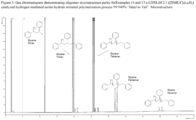
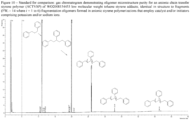
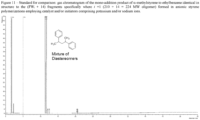
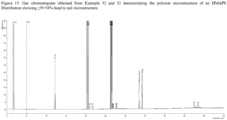
- ethylbenzene when used as a chain transfer agent under prior art conditions such as in EP O 741 147, such process conditions provide polystyrene compositions of non-uniform microstructure with added impurities and impurity distributions (see Figure 12 ).
- Such undesired impurities and impurity distributions arise from chain isomerization and fragmentation processes (see Figures 1 and 2 ).
- compositions such as the Examples of EP O 741 147 are in toto distributions that includes undesired ensembles of isomeric polymer microstructures - microstructures less desired for aromatic electrophilic substitution reactions.
- impurities and impurity distributions can be problematic in further derivatization of such anionic chain transfer compositions.
- a high level of any discrete impurity - an amount of 1000 ppm or greater- is undesirable in terms of producing a product for market.
- compositions having greatly reduced or essentially no undesired polymer microstructure features or impurity fragments and said compositions are desired to be comprised solely (/98 wt%) of polymerized styrene monomer.
- Example D a monometallic lithium based catalyst system is ineffective, or at best very inefficient, at catalyzing anionic chain transfer polymerization of styrene with ethylbenzene. What is more is that it is well documented that monometallic TMEDA butyllithium catalyst forming reagents exhibit poor regioselectivity with regard to the metalation of ethylbenzene. In a paper authored by Broaddus ( Broaddus, C. D., J. Org. Chem.
- Such a process requires consistently and repeatedly reforming the hydride catalyst in an active form.
- a hydrogen mediated saline hydride initiated polymerization process should be high yielding of dimer and above and feature catalyst efficiencies where the amount of catalyst is reduced from 200% to 10,000%.
- a primary problem with ethylbenzene as a chain transfer agent is that the p K a of ethylbenzene is of the same order of magnitude if not equal to the approximate value of that of the conjugate acid of a poly(styryl) anion. It is desirable to have a new catalyst and anionic chain transfer polymerization conditions that can provide soluble catalyst compositions such that in turn provide the advantages of: 1) lower molecular weight polystyrene distributions with M n ⁇ 930 even ⁇ 700 Daltons; 2) more economical use of reagents; and 3) shorter time periods with more efficient use and productivity of the polymerization reactor.
- the hydrogen mediated saline hydride initiated process technology of this invention in fact provides such advantages.
- Deffieux further reports that: "However, the slow addition of LiH to styrene with respect to propagation yields incomplete initiation.” Deffieux reports that with addition of an added organometallic Lewis acid reagent ( n,sec -Bu 2 Mg, or BuMgOBT or i -Bu 3 Al) the solubility and reinitiation efficiency of the LiH is improved but the catalyst efficiency is only between 50 and 150%.
- organometallic Lewis acid reagent n,sec -Bu 2 Mg, or BuMgOBT or i -Bu 3 Al
- the bimetallic complex formed decreases the rate of termination and the half-life of the active or living poly(styryl)lithium species is greatly increased from 40 min for uncomplexed poly(styryl)lithium to 34 hours for the bimetallic complexed poly(styryl)lithium at 50°C in cyclohexane and 1.1 atm H 2 . In fact they report that it requires 50 atmospheres (ca. 50 bar) H 2 to restore the half-life of the living poly(styryl)lithium species to 50 minutes. Deffieux and co-workers teach that soluble lithium hydride is a potential initiator of styrene polymerization:
- Such “initially clear solutions” are prepared by treating 3,5-di-tert-butyl-1 H- pyrazole (pzH) with more than one equivalent of n -butyllithium in aromatic or aliphatic solvents, followed by addition of phenyl- or diphenylsilane to convert the excess alkyllithium groups to hydrides.
- Stash has prepared the first soluble NaH complex [(pz) 6 Na 7 H] by the same synthetic strategy as the LiH/Li(pz) methodology again using the sterically demanding pyrazolate ligand (pz) by the reaction of [Na(pz)], [Na(nBu)] and diphenylsilane in aromatic solvents.
- LiAlH 4 , NaBH 4 , and other related commercial derivatives such as L-selectride ® , N-selectride ® , and K-selectride ® (lithium, sodium, potassium tri-sec-butyl(hydrido)borate), or derivatives with sterically demanding ligands. " emphasis added.
- saline hydrides meaning ionic hydrides
- H - a negatively charged ion
- Deffieux and coworkers provide the following background ( ibid ): "To the best of our knowledge, very few papers deal with anionic polymerization of vinylic monomers initiated by metal hydrides. Williams briefly mentioned one styrene polymerization experiment initiated by NaH in hexane at 25 °C. However, the initiation efficiency was very low and the conversion reached only 90% after 3 days. "
- Liao and coworkers reported a form of highly active alkali metal hydrides having nanometric ( ⁇ 20 nm) particle size distributions ( Liao, S.; et.al. Journal of Molecular Catalysis, 1993, 84, 211 .)
- Liao reports formation of highly active saline hydrides (HASH) from the corresponding alkali metal and hydrogen (1 atm) in THF (40°C) catalyzed by TiCl 4 and naphthalene.
- HASH highly active saline hydrides
- nanometric saline hydrides were found to have some utility in the dechlorination and debromination of certain arylhalides. They were also reported to be active as co-catalyst for the hydrogenation of olefins such as 1-hexene when used in certain transition metal complexes. Turnover frequencies in the range of 0.003 to 45.3 s -1 were reported. Thus highly active alkali metal hydrides (50 - 300 mol) when used in conjunction with a transition metal catalyst (1 mol) only reduces olefins, no disclosure of polymerization or even dimerization of the olefin is made.
- APS anionic polystyrene
- Zhang and co-workers report highly active catalysts for the hydrogenation of styrene (2 ml) in toluene (9 ml) under hydrogen atmosphere at -17°C to 42°C ( Zhang, M.; et.al. Catal Lett 2008, 124, 146 .).
- styrene can be catalytically hydrogenated (20°C, 20 atmospheres H 2 , 15 hours in benzene) with 2.5 mole% of the organocalcium catalyst [DIPPnacnacCaH ⁇ THF] 2 initially formed from phenylsilane (see. Harder, S., Speilman, J., Buch, F. Angew. Chem. 2008, 120, 9576 also published as Angew. Chem. Int. Ed. 2008, 47, 9434 .).
- organocalcium catalyst DIPPnacnacCaH ⁇ THF
- Tetrahydrofuran soluble forms of magnesium hydride were produced by Ashby and coworkers from ortho-substituted (2,6-dimethyl- and 2,6-di-isopropylphenoxides) aryloxymagnesium reagents and an active form of solid magnesium hydride. Tetrahydrofuran insoluble forms of magnesium hydride resulted from alkoxymagnesium reagents and the solid magnesium hydride reagent (see Ashbey, E. C., Goel, A. B., Lin, J. J.
- Ashby also reported the formation of tetrahydrofuran soluble dialkylaminomagnesium hydrides from a series of bulky dialkyl and bulky alkylsubstituted cycloalkyl secondary amines by reaction with an active form of solid magnesium hydride.
- Said active form of magnesium hydride was prepared by the reduction of dimethylmagnesium with LiAlH 4 in diethyl ether.
- Michalczyk report the formation in ethereal or hydrocarbon solvents in the presence of "appropriate ligands" the formation of a precipitated form of magnesium hydride MgH 2 L x .
- appropriate ligands included tetrahydrofuran, ethylene glycol dimethyl ether, and TMEDA.
- the reducing agent employed was phenylsilane (see Michalczyk, M. J. Organometallics, 1992, 11, 2307 ).
- Molecular Early Main Group Metal Hydrides: Synthetic Challenge, Structures and Applications Harder reviews the state of the art of the controlled synthesis of well-defined Group 1 and Group 2 metal hydrides.
- a common feature of all approaches to forming soluble saline hydride compositions is the use of bulky (usually isopropylated ligands) to achieve solubility.
- bulky usually isopropylated ligands
- the saline hydride complexes were formed from some other reagent other than molecular hydrogen.
- SASH super active saline hydrides
- the prior art does not disclose the use of a lithium aminoalkoxide complexed saline hydride (LOXSH) species for anionic-chain transfer polymerization of vinyl aromatic monomers such as a styrenic monomers.
- LOXSH lithium aminoalkoxide complexed saline hydride
- the prior art does not even anticipate the formation of the LOXSH catalysts, especially as hydrocarbon soluble species and particularly when formed from simple non bulky ligands much less directly from H 2 .
- the inventor has discovered these hydrides as well as the surprising fact that the use of these novel hydrides can catalyze hydrogen mediated saline hydride initiated polymerization process.
- this invention provides a process for the efficient anionic chain transfer polymerization of vinyl aromatic monomers under mild temperatures (e.g., about 20°C to less than 100°C) where hydrogen is the principal or sole chain transfer agent. Said process can be conducted at relatively low to very low hydrogen partial pressures. Furthermore the inventor has discovered that the novel polymerization catalysts of this invention provide low molecular weight anionically polymerized styrene distributions comprised solely of styrene (/98wt% styrene) with unique, uniform and beneficial "Head to Tail" microstructure essentially if not completely free of quaternary carbons in the polymer microstructure.
- polystyrene distributions have less than 3.0wt%, preferably less than 2.0wt%, and more preferably less than 1.0wt% of the polystyrene polymer chains with a quaternary carbon in the polymer chain backbone.
- compositions in toto have less than 1000 ppm even less than 200 ppm and even less than 20 ppm quaternary carbons present.
- the polystyrene compositions of this invention have less than 1.0 %, preferably less 0.5% and most preferably less than 0.1% of polymer chain distributions or impurities resulting from fragmentation of the desired anionic chain transfer polystyrene distribution.
- PTA is an acronym for a general class of polytertiaryamines used as promotors, the usage of "•XPTA” where X is a positive number and indicates the number, whole or fractional, of moles of PTA complexed to a catalyst composition.
- TMEDA is an acronym for N,N,N',N' -tetramethylethylenediamine a PTA, the usage of "•XTMEDA" where X is a positive number and indicates the number, whole or fractional, of moles of TMEDA used and/or complexed to a catalyst composition.
- PCAH is an acronym for a the general class of polarizing complexing agents used in forming the catalyst of this invention denoting the polarizing complexing agent as the neutral alcohol
- the usage of [PCA - ] denotes the polarizing complexing agent as the alkoxide having given up one proton to a more basic chemical species.
- the use of [PCA - ] hereinafter is thus for convenience in showing that an alkoxide has been formed from PCAH.
- the use of in a formula such as [PCA - ] x M y H z is to be interpreted as a neutral catalyst complex or aggregate where the charge of the y-metal atoms is balanced by the charge of x [PCA - ] anions in combination with z hydride ions.
- DMEAH is an acronym for N,N -dimethylethanolamine (Synonym: N,N -Dimethyl-2-hydroxyethylamine, N,N -Dimethylethanolamine) as the neutral aminoalcohol, the usage of [DMEA - ] represents N,N -dimethylethanolamine as an alkoxide having given up one proton to a more basic species.
- DMAEOEH is an acronym for 2- N,N -dimethylaminoethoxyethanol (N(CH 3 ) 2 CH 2 CH 2 O-CH 2 CH 2 OH) as the neutral amino ether-alcohol, the usage of [DMAEOE - ] represents N,N -dimethylaminoethoxyethanol as an alkoxide having given up one proton to a more basic species.
- MEOEH is an acronym for 2-methoxyethanol as the neutral ether-alcohol, the usage of [MEOE - ] represents 2-methoxyethanol as an alkoxide having given up one proton to a more basic species.
- the hydrogen mediated saline hydride initiated polymerization (HMSHIP) processes of this invention features: a) the novel ability of soluble saline hydride species to rapidly add to a vinyl aromatic monomer to form an initiating species; b) the novel high efficiency in which the addition of the saline hydride species to monomer takes place and thus allows competition between the reinitiation step to compete with the propagation reaction step to grow the active transient living poly(styryl)anion chains thus maintaining a constant or near constant number of active growing chains; and c) the capacity of chain transfer from hydrogen under the mild and novel process conditions to terminate such living poly(styryl)anionic species and regenerate the saline hydride in a form capable of effectively and efficiently reinitiating the polymerization process.
- this invention relates to a process of conducting hydrogen mediated saline hydride initiated polymerizations which features feeding one or more anionically polymerizable hydrocarbon monomers to a reaction medium containing a soluble saline hydride catalyst under an atmosphere comprising molecular hydrogen. Without such features the chemical process would otherwise produce either mainly reduced monomer on one extreme or high molecular weight polymer at the other.
- the forgoing features act in concert and in balanced competition yielding anionic chain transfer polymer distributions with high yield, great efficiency and exceptional control of polymer chain length microstructure.
- the present invention also relates to a process for anionic chain transfer polymerization comprising feeding a vinyl aromatic monomer and/or preferably a styrenic monomer to a reaction mixture under an atmosphere comprising molecular hydrogen in a reactor vessel, wherein said reaction mixture was formed from (i) an organolithium compound and/or an organomagnesium compound; (ii) optionally a polytertiaryamine compound; (iii) a polarizing complexing agent selected from a tertiary aminoalcohol compound; a tertiary amino ether-alcohol, an ether-alcohol or combinations thereof; (iv) optionally an alkali metal or metal alloy and/or a solid saline hydride and/or a saline metal amide; (v) optionally an aromatic hydrocarbon having at least one C-H covalent bond p K a within the range of 2.75 p K a units above that of the p K a of toluene to -4
- the present invention also relates to highly hydrocarbon soluble bimetallic tertiary aminoalkoxide and/or tertiary amino ether-alkoxide and/or ether-alkoxide complexed lithium hydride and/or magnesium hydride catalysts and/or reagents formed from a reaction medium comprising: (i) molecular hydrogen; (ii) an organolithium compound and/or an organomagnesium compound; (iii) optionally a polytertiaryamine compound; (iv) a polarizing complexing agent selected from a tertiary aminoalcohol compound; a tertiary amino ether-alcohol, an ether-alcohol or combinations thereof; (v) optionally an alkali metal or metal alloy and/or a solid saline hydride and/or a saline metal amide; (vi) optionally an aromatic hydrocarbon having at least one C-H covalent bond p K a within the range of 2.75 p K
- This invention also relates to hydrogen mediated anionic polymerization of styrene (HMAPS) processes which features: a) the novel ability of soluble lithium hydride species to rapidly polymerize styrene; b) the novel high efficiency in which the addition of the lithium hydride species to styrene monomer takes place and thus allows the reinitiation step to compete with the propagation reaction step to grow the active transient living poly(styryl)lithium anionic chains thus maintaining a constant or near constant number of active growing chains; c) the capacity of chain transfer from hydrogen under mild and novel process conditions to terminate such living poly(styryl)lithium anionic species and regenerate the soluble lithium hydride in a form capable of effectively reinitiating the polymerization process; d) eliminates or nearly eliminates intramolecular chain transfer steps that otherwise lead to undesired quaternary carbon formation in the anionic polystyrene polymer chains; and f) control of the MWD is accomplished via high relative monomer to catalyst
- the present invention also relates to saline hydride initiated anionic polystyrene and anionic chain transfer polystyrene distributions in which the polystyrene chain length distribution of individual or discrete polymer chain constituents have the general formula: wherein n is the number of repeating styrene monomer units covalently bonded between the initiating styrene monomer and the terminating styrene monomer; wherein the chain length distribution of the general formula above comprises at least about 97.0 wt.%, preferably at least about 98.0 wt.%, more preferably at least about 99.0% and most preferably comprises at least about 99.2 wt% of the total weight of the polystyrene composition; and wherein the balance of the chain length distribution is comprised of not more than 3.0 wt.%.
- FW structural formula weight
- the present invention further relates to lithium hydride initiated anionic polystyrene and anionic chain transfer polystyrene distributions in which the polystyrene chain length distribution of individual or discrete polymer chain constituents have the general formula 1: wherein n is the number of repeating styrene monomer units covalently bonded between the initiating styrene monomer and the terminating styrene monomer; wherein the chain length distribution of the general formula above comprises at least about 99.0% and preferably comprises at least about 99.2 wt% of the total weight of the polystyrene composition; and wherein the balance of the chain length distribution is comprised of not more than 1.0 wt.%.
- polymer refers to the term “polymer” as defined in the context of the OECD definition of “polymer”, which is as follows: "A chemical substance consisting of molecules characterized by the sequence of one or more types of monomer units and comprising a simple weight majority of molecules containing at least three monomer units which are covalently bound to at least one other monomer unit or other reactant and which consists of less than a simple weight majority of molecules of the same molecular weight. Such molecules must be distributed over a range of molecular weights wherein differences in the molecular weight are primarily attributable to differences in the number of monomer units. "
- Saline Hydrides meaning ionic hydrides
- H - a negatively charged ion
- said alkali metals include lithium, sodium, potassium, rubidium, and cesium
- said alkaline earth metals include magnesium and calcium.
- Saline metal amide are metallic amides or diamides formed from ammonia and/or a primary amine and/or a secondary amine wherein the metal ion in combination with the amide is an alkali metal selected from lithium, sodium, potassium, rubidium, and cesium; and in combination with the diamide is an alkaline earth and includes magnesium and calcium.
- Polymer microstructure refers to a discrete polymer chain's (or chain length distribution of such chains) configuration in terms of its composition, sequence distribution, steric configuration, geometric and substitutional isomerism.
- head to tail polymer microstructure is the description of the microstructure exhibited by the styrene polymer structure ( 1 ) presented above.
- a head to tail microstructure exist when the head (being formed from the vinyl carbon bearing the phenyl substituent) of each styrenic monomer unit is covalently bonded to the tail (being formed from the vinylidene carbon) of one and only one other styrenic monomer unit.
- tail to tail microstructure exists when the tail of a styrenic monomer unit is covalently bonded to the tail of another styrenic monomer unit. Such tail to tail microstructure is common as part of the microstructure of anionic polymerizations of styrenic monomers initiated by electron transfer mechanisms.
- tail to head to tail microstructure means a polymer backbone linkage where the head of one styrenic monomer is covalently bonded to the tail of two other styrenic monomers.
- This microstructure produces an irregularity in the polymer backbone and incorporates an undesired chemically labile (easily cleaved under certain reaction conditions) quaternary carbon in the polymer chain.
- organolithium (active) alkyl means the total amount of either of these organometallic compounds as the metal alkyl charged above the amount of organolithium and/or organomagnesium compound needed to titrate any protic reagent as well as any protic impurity species such as water, and/or alcohol and/or a primary or secondary amine.
- the molar amount of active organolithium is equal to the molar amount of saline hydride formed on a 1:1 basis. It is also considered to be that one mole equivalent of active organomagnesium compound forms up to 2 equivalent moles of a saline hydride.
- active metal alkyl represents lithium and/or magnesium covalently bonded alkyl radicals wherein the bonded alkyl radical can be an aliphatic, cycloaliphatic, aromatic, allylic, benzylic or vinylic hydrocarbon radical.
- Protic when in combination with the term species, or reagent, or solvent or impurity means a chemical species having a covalently bonded proton (H + ) with a p K a below that of H 2 under the conditions of the chemical processes of this invention (see Buncel, E., Menon, B J. Am. Chem. Soc., 1977, 99, 4457: "Carbanion mechanisms. 6. Metalation of Arylmethanes by Potassium Hydride/18-Crown-6 Ether in Tetrahydrofuran and the Acidity of Hydrogen ").
- LOXSH means a lithium aminoalkoxide or a lithium amine-ether-alkoxide or a lithium ether-alkoxide complexed saline hydride formed from: (i) molecular hydrogen; (ii) an organolithium compound with or without an organomagnesium compound; (iii) optionally a polytertiaryamine compound; (iv) a tertiary amino alcohol and/or a tertiary amino ether-alcohol and/or a ether-alcohol; (v) an optional solid alkali or alkaline earth metal hydride or an alkali metal or alkali metal alloy (vi) optionally an aromatic hydrocarbon having at least one C-H covalent bond pKa within the range of 2.75 p K a units above that of the p K a of toluene to -4.30 p K a units below the p K a of toluene; and in (vii) a hydrocarbon solvent with
- LOXLiH is a term denoting the monometallic form of LOXSH where the catalyst/reagent is formed with lithium reagents as the only metal reagents.
- LOXKH is term denoting a bimetallic catalyst comprised of lithium and potassium wherein a portion of the active saline hydride is potassium hydride.
- LOXMgH 2 is term denoting a bimetallic catalyst comprised of lithium and magnesium wherein a portion of the active saline hydride is a magnesium hydride.
- [DMEA - ] x Li y H z represents chemical formulae for catalyst or reagent component compositions of hydrocarbon soluble lithium aminoalkoxide complexed lithium hydride formed from: (i) molecular hydrogen; (ii) about y equivalents organolithium compound; (iii) optionally TMEDA; (iv) about x equivalents of dimethylaminoethanol; (v) optionally ethylbenzene; and in (vii) a hydrocarbon solvent with a p K a greater than H 2 ; wherein the hydrocarbon solvent may be ethylbenzene or different (see: Daasbjerg, K, Acta Chemica Scandinavica, 1995, 49, 878: "Estimation of the pKa for some Hydrocarbons and Aldehydes and Solvantion Energys of the Corresponding Anions "); wherein the index values x, y and z are positive real numbers where the equivalents of hydride formed is z,
- molecular hydrogen means H 2 as 1 H 2 but can also include the isotopes of hydrogen 2 H 2 or 3 H 2 either as mixtures of the isotopes or enriched in a particular isotope whether in the gas state in the vapor space or dissolved in the condensed phase.
- alkali metal alloy means a metal alloy of at least two metals wherein at least one of which is an alkali metal however such an alkali metal alloy can be comprised of two alkali metals such as NaK or NaK 2 and may have such alkali metals dissolved or in some physical combination with the alloy.
- a and/or B means “A” alone, “B” alone, or a combination of A and B.
- a with or without B means "A” alone or a combination of A and B.
- organiclithium compound means an organic group bonded to a lithium atom.
- organic groups may be aliphatic (e.g., an alkyl group), cycloaliphatic (e.g., cycloalkyl), vinyl group, allylic group, benzylic group, an aromatic group (e.g., phenyl) or a poly(styryl)lithium.
- organomagnesium compound means an organic group bonded to a magnesium atom.
- organic groups may be aliphatic (e.g., an alkyl group), cycloaliphatic (e.g., cycloalkyl), vinyl group, allylic group, benzylic group, an aromatic group (e.g., phenyl) or a poly(styryl)magnesium.
- Preferred organomagnesium compounds are organomagnesium compounds with two organic groups.
- the "term polytertiaryamine (PTA) promotor” means a compound containing at least two tertiary amine groups that promotes or activates the formation of the hydride catalyst during the HMSHIP process.
- polarizing complexing agent is a general term for the neutral alcohol used in forming the catalyst of this invention such as a tertiary amino alcohol, a tertiary amino ether-alcohol or a ether-alcohol.
- alkali or alkaline earth aminoalkoxide is alkoxides formed from the tertiary amino alcohol or a tertiary amino ether-alcohol or a ether-alcohol, respectively and an alkali metal, and/or alkali or alkaline earth metal hydride, and/or alkali or alkaline earth metal amide or and/or alkali or alkaline earth metal alkyl.
- n 0 than the group within the parentheses does not exist and the structure is intended to mean that the chemical bond is between the two groups or atoms that interconnect the two sides of the parentheses.
- Preferred aminoalcohols included dimethylaminoethanol, diethylaminoethanol, 3-Dimethylamino-1-propanol, N -methyl-deiethanolamine. tri-ethanolamine, 2-[2-(dimethylamino)ethoxy]ethanol, 1-(2-hydroxyethyl)piperidine, 1-(2-hydroxyethyl)morpholine, 1-(2-hydroxyethyl)pyrolidine, 1-methyl-2-pyrolidinemethanol and the like.
- the tertiary amino alcohols or tertiary amino ether-alcohols or ether-alcohols do not undergo additional metalation reactions other than the reaction to form the alkoxide.
- tertiary amino alcohols or tertiary amino ether-alcohols or ether-alcohols are suitable for use in forming some catalyst compositions, especially compositions formed with an excess amount of certain organolithium compounds - in particular alkyllithium reagents.
- An excess amount means a molar quantity greater than the molar quantity of the alcohol moiety of the tertiary amino alcohols or tertiary amino ether-alcohols or a ether-alcohols used to form the catalyst.
- tertiary amino alkoxide or tertiary amino ether-alkoxide or ether-alkoxide should serve as solubilizing spectator ligand. That means that other than to function as activating polarizing complexing agent that imparts solubility to the saline hydride of the catalyst composition and contributes to the activation and formation of the saline hydride during the HMSHIP process.
- the polarizing ligand is otherwise inert and does not participate in the polymerization process nor participate in catalyst degradation reactions. It is undesirable to incorporate the tertiary amino alcohols or tertiary amino ether-alcohols or ether-alcohols degradation products of such ligands or in the polymer structure or product distribution.
- the present invention relates a process of conducting hydrogen mediated saline hydride initiated polymerizations (HMSHIP) of anionically polymerizable hydrocarbon monomers, catalyst compositions for conducting such a process and under certain preferred conditions the formation of novel and beneficial low molecular weight anionic chain transfer polymer distributions of very pure "head to tail" microstructure.
- the process features feeding at least one anionically polymerizable hydrocarbon monomer to a suitable solvent containing an active and generally soluble saline hydride catalyst under an atmosphere comprising molecular hydrogen wherein chain transfer from molecular hydrogen is a significant component of the mechanism that determines the kinetic chain length (v) distribution and hence the number average molecular weight (M n ) of the resulting product distribution.
- HMSHIP hydrogen mediated saline hydride initiated polymerizations
- One embodiment of the present invention relates to a process for hydrogen mediated anionic polymerization of vinyl aromatic monomers such as styrenic monomers such as styrene using a hydrocarbon soluble LOXSH catalyst.
- the hydrocarbon soluble LOXSH catalyst is formed from a reaction medium comprising (i) an organolithium compound with or without an organomagnesium compound; (ii) an optional polytertiaryamine promotor compound; (iii) a polarizing complexing agent selected from a tertiary amino alcohol, a tertiary amino ether-alcohol an ether-alcohol or combinations thereof; (iv) optionally an aromatic hydrocarbon having at least one C-H covalent bond pKa within the range of 2.75 pKa units above that of the pKa of toluene to -4.30 pKa units below the pKa of toluene; (v) an optional solid alkali or alkaline earth metal hydride
- the LOXSH catalyst can be optionally formed in a variety of methods which are not limited by but include:
- the LOXLiH and LOXMgH 2 catalyst/reagent is conveniently prepared in a very active and soluble form according to methods E and F under a hydrogen atmosphere of 1.0 to 2.0 atmospheres H 2 pressure though higher or lower H 2 pressures can be employed.
- the LOXMgH 2 catalyst was not reduced to the hydride or at least was not completely reduced to the hydride by hydrogen until the monomer styrene was introduced. Introduction of styrene forms a poly(styryl)magnesium reagent that is completely reduced to the hydride during the hydrogen mediated chain transfer polymerization.
- the LOXMgH 2 may require the presence of a vinyl aromatic monomer in order to completely form the catalyst in such cases feeding monomer is necessary and not optional.
- the initial temperatures of about -5°C to about 40°C have been employed as set forth in the Examples below in forming the LOXLiH and LOXMgH 2 catalysts and or reagents of this invention. Lower or higher initial temperatures can be used to form the catalyst especially when using an aminoalkoxide.
- the organolithium ( n -butyllithium) and or the organomagnesium (di-n-butylmagnesisum) compound (i) is then fed slowly to the well stirred reaction mixture comprising dissolved H 2 , (ii), (iii), in (vi) using a modest backpressure across a metering needle valve.
- the reactor pressure will rise if the organolithium and/or organomagnesium compounds produce light hydrocarbons such as butane during the catalyst forming process. Subsequently the temperature has been observed to continue to rise however the reactor pressure will generally drop below the initial pressure or remain constant as hydrogen is consumed in the catalyst forming process.
- the initial pressure is 0 PSIG then a negative pressure or slight vacuum is or can be created in the reactor.
- the H 2 pressure will usually drop during the feed of the organolithium reagent. However in some Examples when temperatures below 15°C and or when an organomagnesium reagent is used, the reactor pressure does not appear to drop during the introduction of the organometallic reagent.
- H 2 pressures from 0.25 bar to 10.00 bar and a more preferred range is from 0.5 bar to 7.0 bar and the most preferred range is from 0.75 bar to about 5.0 bar. It has not escaped our attention that pressures as high as 100 G Pascals could in theory and perhaps in fact produce polyhydride compositions from the catalyst and reagents of this invention and hence the application of such pressures and formation of such products are within the scope of this invention.
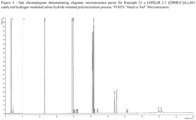
- organomagnesium compounds may contain about 0.12 to 0.25 wt% triethylaluminum (TEA) as an additive to the reagent which is usually supplied in heptanes. Because such organoaluminum reagents can have a retarding effect on anionic polymerization reactions, it is desired that the ratio of lithium metal to aluminum metal be greater than 50.0:1.0 and preferably greater than 101.0:1.0. As is depicted in Figure 8 there was no evidence of initiation by or participation of TEA in the HMSHIP process of the LOXMgH 2 runs made.
- TSA triethylaluminum
- organometallic reagents such as organoaluminum, and or organoberyllium, and or organoboron agents can be present in the reaction mixture so long as the added reagent does not retard the HMSHIP process to the point that hydride addition to monomer is inhibited and/or that hydrogen chain transfer to the growing polymer chain is arrested or otherwise substantially interfered with and consequently form a distribution of undesired molecular weight parameters.
- Non-limiting preferred examples of organolithium compounds suitable for forming the LOXSH catalysts are n -butyllithium, sec -butyllithium, t -butyllithium, allyllithium, vinyllithium, phenyllithium, 1-hexyl-1-phenyllithium, 1-hexyl-1,1-diphenyllithium, cyclohexyllithium, and poly(styryl)lithium compounds which can be added or generated in situ.
- Non-limiting preferred examples of organomagnesium compounds suitable for forming LOXMgH 2 catalysts are butylethylmagnesium (BEM), di- n -butylmagnesium (DBM), n -butyl- n- octylmagnesium, di- n -octylmagnesium, di-cyclohexylmagnesium, and poly(styryl)magnesium compounds.
- BEM butylethylmagnesium
- DBM di- n -butylmagnesium
- n -butyl- n- octylmagnesium di- n -octylmagnesium
- di-cyclohexylmagnesium di-cyclohexylmagnesium
- poly(styryl)magnesium compounds A comprehensive list of potential organomagnesium compounds is provided in US Patent 3,817,955 .
- LOXMgH 2 catalyst it is possible to pre-form an "ate" complex having the stioichiometry R 3 MgLi or R 4 MgLi 2 where the group R is independently an alkyl, vinyl, cycloalkyl, poly(styry), phenyl selected from but not limited by any combination of the organolithium with an organomagnesium recited above.
- Non-limiting alkali or alkaline earth aminoalkoxide, alkali or alkaline earth amino ether-alkoxide and alkali or alkaline earth ether-alkoxide (designated as [PCA - ]M + or as [PCA - ] 2 M 2+ for alkali and alkaline earth alkoxides respectively) formed in the process of forming a LOXSH catalysts are formed from the generic structures of suitable polarizing complexing agents [PCAH] hereinabove.
- the [PCA - ]M + and/or as [PCA - ] 2 M 2+ formed can be formed in situ when forming the LOXSH catalysts and/or they can be formed well in advance and charged to the catalyst forming reactor as the alkali or alkaline earth aminoalkoxide, alkali or alkaline earth amino ether-alkoxide and alkali or alkaline earth ether-alkoxide.
- any alkali or alkaline earth reagent capable of forming either [PCA - ]M + and/or as [PCA - ] 2 M 2+ from a PCAH and/or a [PCA - ] precursor e.g.
- reagents such as solid alkali and alkali metal hydrides, alkali metal and alkali metal alloys, alkali metal and alkaline earth alkyls, alkali metal and/or alkaline earth amides (saline metal amides) can be used in the practice of this invention to react with a PCAH and/or a [PCA - ] precursor to form the [PCA - ] that comprises the catalysts and reagents of this invention.
- Said formation of the [PCA - ]M + and/or as [PCA - ] 2 M 2+ can be conducted either; (a) in situ in the catalyst forming reactor well in advance of catalyst formation and/or during catalyst formation; and/or (b) in an external reactor associated with the catalyst forming reactor or completely separate from the catalyst forming reactor.
- a saline metal amide could potentially result in the incorporation of an amine functionality in the polymer compositions of this invention and in some applications is not desired.
- a complexed metal hydride such as LiAH 4 to form a [PCA - ]Li + could require separation of the [PCA - ]Li + thus formed from the aluminum co-product of such a reaction.
- Examples 28 and 29 hereinafter demonstrate that the amino ether-alkoxides can under certain conditions degrade or decompose when formed or during the course of a LOXLiH catalyzed HMSHIP process.
- Example 30 demonstrates that under certain process conditions the LOXLiH catalyst formed from an ether-alkoxide formed from 2-methoxyethanol and an organolithium compound does not sufficiently activate the hydrogen chain transfer process.
- the preferred polarizing complexing agents especially for a LOXLiH process are the aminoalkoxides. It is to be understood however that the amino ether-alkoxides may be well suited for LOXSH bimetallic catalyst low in LiH activity. Likewise conditions or processes where the LOXLiH catalyst formed from 2-methoxyethanol is more suitable or more active can likely be found by through the practice of this invention.
- chiral tertiary aminoalcohols available that can be synthesized by reduction and further synthetic elaboration of chiral amino acids for example so a list of suitable aminoalcohols can be endless. Any advantage that the use of such chiral tertiary amino alcohols may provide in terms of selectivity, tacticity or stereo regularity is well within the scope of this invention. Nonetheless, the less complex tertiary aminoalcohols which may be prepared by the simple reaction of an amine with reactive cyclic ethers such as ethylene oxide or other epoxides are preferred.
- Non-limiting examples of such tertiary aminoalcohols that are readily available include: dimethylaminoethanol, diethylaminoethanol, N -methyl-diethanolamine, 3-dimethylamino-1-propanol, 2-[2-(dimethylamino)ethoxy]ethanol, 1-(2-hydroxyethyl)piperidine, 1-(2-hydroxyethyl)morpholine, 1-(2-hydroxyethyl)pyrolidine, 1-methyl-2-pyrolidinemethanol and the like.
- Non-limiting examples of poly(tertiary amine) promotors useful in LOXSH catalysts include di(tertiary amine) ligands derived from propylene diamine, di(tertiary amine) ligands derived from ethylene diamine or from polyethylene imine.
- Preferred examples include N,N,N',N' -tetramethylethylenediamine (TMEDA), N,N,N',N";N" -pentamethyldiethylenetriamine (PMDETA), sparteine, isosparteine, and 1,4-methylpiperazine wherein TMEDA is most preferred.
- the most preferred poly(tertiary amine) promotor ligands are the most volatile and/or the most water and/or acid soluble compounds thus TMEDA is preferred.
- the presence of the polytertiaryamine promotor compound appears to facilitate formation of the LOXSH catalyst/reagent.
- a LOXSH process can be conducted in the absence of the polytertiaryamine promotor however the presence of the polytertiaryamine promotor in some Examples provided LOXSH PS distributions of lower asymmetry and in increased yields at reduced monomer feed rates and at reduced hydrogen pressure.
- the preferred aromatic hydrocarbon which may be used is any aromatic hydrocarbon having a p K a relative to toluene ⁇ 2.75 p K a units however it is conceivable that an aromatic hydrocarbon such as diphenylmethane with a p K a of 4.32 units less than toluene can be employed so long as: 1) the incorporation of diphenylmethane moiety in the polymer microstructure does not affect the ultimate end use; and/or 2) the p K a of such hydrocarbons are sufficiently above that of H 2 under the reaction conditions so as to not interfere with the hydrogen mediated chain transfer mechanism.
- Non-limiting examples of aromatic hydrocarbons that may be used are benzene, toluene, mesitylene, ethylbenzene, n-propylbenzene, n- butylbenzene, iso-butylbenzne, amylbenzene, 1,2-diarylethanes, 1,3-diarylpropanes, cumene, t- butylbenzene, a 1-alkyl naphthalene, 2-alylnaphthalene or a styrene dimer or low molecular weight oligomer distribution (styrene dimers, trimers, tetramers and pentamers).
- aromatic hydrocarbons are optional, their use is preferred in that it is believed their presence diminishes or preempts or otherwise mitigates the undesired attack of the organolithium more specifically an alkyllithium reagent on the polytertiaryamine promotor.
- LOXSH catalysts can mitigate or inhibit the attack of the organolithium reagent on the alkali or alkaline earth aminoalkoxide, alkali or alkaline earth amino ether-alkoxide and "alkali or alkaline earth ether-alkoxide comprising the said catalyst.
- Hydrocarbons that are easily removed from the product distribution by distillation or by polymer precipitation are preferred.
- the most preferred aromatic hydrocarbon for HMSHIP process utilizing styrene is ethylbenzene.
- hydrocarbon solvent which may be used in any hydrocarbon having a p K a greater than molecular hydrogen (H 2 ) under the reaction conditions.
- preferred solvents are cyclohexane, methyl cyclohexane, and the aromatic hydrocarbons listed above.
- Other hydrocarbon solvents can be used as long as their use does not affect the solubility of the saline hydride catalyst, reactive intermediates, transient living polymer chains and the polymer chain distribution product.
- the aromatic hydrocarbon and the aromatic solvent may be the same or different.
- the aromatic hydrocarbon can act as both the aromatic hydrocarbon and the solvent.
- ethylbenzene is a preferred component in the polymerization of styrene and can be used as both the aromatic hydrocarbon and the solvent.
- components (iv) and (vi) would merge into one component (or limitation) and be the same.
- the aromatic hydrocarbon may be ethylbenzene and the hydrocarbon may be cyclohexane.
- components (iv) and (vi) would be different.
- component (iv) may be optional if no aromatic hydrocarbon is used and, for example, cyclohexane is used as component (vi).
- the partial pressure of hydrogen in the above LOXSH catalysts forming process is maintained at pressures between about 0.001 to about 10.0 Bar, or about 0.3 to about 6.8 Bar, or about 0.5 to about 5.2 Bar or about 1.0 to about 4.2 Bar.
- a ratio of tertiaryaminoalcohol to organolithium can vary widely. It should be understood however, in order to form a lithium hydride species, a molar excess of the organolithium compound over the molar equivalent amount of tertiaryaminoalcohol must be used such that a lithium-carbon bond is available for reduction to the lithium hydride species. It is conceivable to employ charge ratios of 40 moles of tertiaryaminoalcohol per 41 moles of organolithium reagent; however such charge ratios are a waste of expensive reagents.
- Preferred charge ratios is in the range of from (1.00: 1.05) to about (1:6), a more preferred range is from (1.00:1.10) to about (1:5); an even more preferred range is from (1.0:1.2) to about (1:4); and the most preferred range is from (1.00: 1.40) to about (1:3).
- Examples 35 and 36 indicate that a 1:2 ratio of DMEAH to n-butyllithium provides tetra-hydride catalyst with the formula [DMEA - ] 4 Li 8 H 4 where only one of the four hydrides initiate polymerization of styrene under a hydrogen atmosphere.
- a (1:3) charge ratio as used in Example 37) produced a soluble hydride catalyst with the formula [DMEA - ] 2 Li 6 H 4 where only approximately 1 in 9 hydrides initiated polymerization of styrene in a cyclohexane atmosphere.
- this preferred catalyst composition in theory includes a mixture of aggregates having the empirical formulae [DMEA - ] 4 Li 12 H 8 in combination with [DMEA - ] 5 Li 15 H 10 wherein both catalyst only one hydride is available for initiation of styrene polymerization in the absence of additional molecular hydrogen.
- a Most preferred catalyst composition is comprised of catalyst aggregates having the overall empirical formula: (a) [DMEA - ] 5 Li 12 H 7 ; and/or (b)
- the LOXLiH catalyst when formed under hydrogen exist as aggregates which under certain stoichiometry exist as well defined species of a fixed molecular weight while other stoichiometry or charge ratios provide catalyst that are not well defined but exists as mixtures of non-uniform aggregates. It is further believed that the presence of a polytertiaryamine promotor can additionally either stabilize certain aggregates or help to break up other less uniform mixtures of larger aggregates into smaller more active aggregates. Thus the activity of a catalyst system can vary greatly, but as a whole this class of catalyst is relatively poor at initiation of living anionic polymerization.
- the hydrocarbon soluble LOXSH catalyst may have the following empirical chemical formulas: a) [PCA - ] 4 Li 6 H 2; b) [PCA - ] 4 Li 8 H 4 ; c) [PCA - ] 2 Li 6 H 4 ; d) [PCA - ] 4 Li 12 H 8 ; e) [PCA - ] 5 Li 15 H 10 ; f) [PCA - ] 5 Li 12 H 7 ; g) [PCA - ] 2 Li 5 H 3 ; h) [PCA - ] 4 Li 4 MgH 2; i) [PCA - ] 4 Li 4 Mg 2 H 4 ; j) [PCA - ] 2 Li 4 MgH 4 ; k) [PCA - ] 4 Li 6 Mg 3 H 8 ; 1) [PCA - ] 5 Li 9 Mg 3 H 10 ; m) [PCA - ] 5 Li 6 Mg 3 H 7 ; n
- the ratio of tertiaryaminoalcohol to total alkali metal is in the range of range of from (1.00:1.05) to about (1:6), a more preferred range is from (1.00:1.10) to about (1:5); an even more preferred range is from (1.0:1.2) to about (1:4); and the most preferred range is from (1.00:1.40) to about (1:3).
- the ratio of lithium to alkali metal excluding lithium is from (10,000:1) to (1:2), the preferred ratio are in the range of (34:1) to (2:1), and most preferred are (17:1) to (3:1). It is to be understood that in this connection a charge ratio of (10,000:1) can represent the unintended presence of alkali metal, potassium in particular, in even trace quantities due to an amount left in the reactor or charge lines or tanks from previous runs where the alkali metal was intentionally charged.
- Potassium and other alkali metal based bimetallic lithium catalysts have a tendency to deposit trace levels of catalyst or catalyst by-products on reactor walls such trace levels have been found to negatively impact the otherwise highly selective microstructure delivered by a pure LOXLiH catalyst system during the hydrogen mediated saline hydride initiate polymerization of styrene.
- Bimetallic lithium with sodium and/or with potassium and/or with cesium bimetallic complex LOXSH catalyst with the empirical chemical formulae: a) [DMEA - ] 4 Na 4 Li 4 H 4 ; b) [DMEA - ] 6 Na 4 Li 4 H 2 ); c) [DMEA - ] 6 Na 4 Li 6 H 4 ; d) [DMEA - ] 4 K 4 Li 4 H 4 ; e) [DMEA - ] 6 K 4 L 14 H 2 ); f) [DMEA - ] 6 K 4 Li 6 H 4 ; g) [DMEA - ] 4 Cs 4 Li 4 H 4 ; h) [DMEA - ] 6 Cs 4 Li 4 H 2 ); and i) [DMEA - ] 6 Cs 4 Li 6 H 4 are producible from this invention. Additionally such bimetallic LOXSH catalyst formulations in combination with the monometallic LOXLiH catalyst formulations from above are within
- the ratio of (tertiaryaminoalcohol:total-metal-equivalents) where lithium provides one equivalent and magnesium provides 2 is in the range from (1.00:1.05) to about (1:6), a more preferred range is from (1.00:1.10) to about (1:5); an even more preferred range is from (1.0:1.2) to about (1:4); and the most preferred range is from (1.00:1.40) to about (1:3).
- soluble bimetallic lithium magnesium hydride complexes can be used.
- the same preferred ranges can be applied to form soluble bimetallic lithium calcium hydride complexes, catalyst and reagents from tertiaryaminoalcohols and/or tertiary amino ether-alcohols and/or ether-alcohols.
- the invention further relates to a hydrocarbon soluble catalyst or reagent composition formed from reagents comprising a solid alkali hydride, an alkali metal and/or an alkali metal alloy wherein the ratio of polarizing complexing agent to total alkali metal is in the range of range of from about 1:1.05 to about 1:6; and the molar ratio of organolithium compound to alkali metal is from 10,000:1 to 1:2.
- Another embodiment is a hydrocarbon soluble catalyst or reagent composition
- Another embodiment is a process for forming a hydrocarbon soluble catalyst or reagent composition formed from: (i) molecular hydrogen; (ii) an organolithium compound and/or an organomagnesium compound; (iii) optionally a polytertiaryamine compound; (iv) a polarizing complexing agent selected from a tertiary aminoalcohol compound; a tertiary amino ether-alcohol, an ether-alcohol or combinations thereof; (v) optionally an alkali metal or metal alloy and/or a solid saline hydride and/or a alkali amide; (vi) optionally an aromatic hydrocarbon having at least one C-H covalent bond p K a within the range of 2.75 p K a units above that of the p K a of toluene to -4.30 p K a units below the p K a of toluene; and in (vii) a hydrocarbon solvent with a p K a
- the hydrogen partial pressure used in forming the catalyst or reagent is in the range of from about 0.1 bar to about 300 bar.
- the temperature used in forming the catalyst or reagent is in the range of from about -96°C to about 130°C.
- the molar equivalent charge ratios of the polarizing complexing agent to the organolithium compound and/or an organomagnesium is in the range of from about 1:1.05 to about 1:6 moles of polarizing complexing agent per mole of metal-alkyl equivalents where lithium provides one equivalent and magnesium provides 2 equivalents.
- the molar ratios of the PTA to total metal is from about 10,000:1.0 to about 1:8.
- the process may further comprises feeding styrenic monomer to form a poly(styryl)magnesium and/or a poly(styryl)lithium compound prior to reduction by contacting with molecular hydrogen to form the soluble saline hydride wherein the molar ratio of styrenic monomer to total metal is from about 1:10 to about 20:1.
- the process may further comprises feeding styrenic monomer to form a transient 1-phenyl-hexylmagneisium compound and/or poly(styryl)magnesium compound which is further reduced by molecular hydrogen to the soluble saline hydride wherein the molar ratio of styrenic monomer to magnesium is from about 1:5 to about 20:1
- the preferred styrenic monomer is styrene.
- a hydrocarbon soluble catalyst or reagent composition formed from: (i) molecular hydrogen; (ii) an organolithium compound and/or an organomagnesium compound; (iii) optionally a polytertiaryamine compound; (iv) a polarizing complexing agent selected from a tertiary aminoalcohol compound; a tertiary amino ether-alcohol, an ether-alcohol or combinations thereof; (v) optionally an alkali metal or metal alloy and/or a solid saline hydride and/or a alkali amide; (vi) optionally an aromatic hydrocarbon having at least one C-H covalent bond p K a within the range of 2.75 p K a units above that of the p K a of toluene to -4.30 p K a units below the p K a of toluene; (vii) a vinylaromatic monomer; and in (viii) a
- Another embodiment of the present invention is a catalyst or reagent composition formed from: (i) molecular hydrogen; (ii) an organolithium compound and/or an organomagnesium compound; (iii) optionally a polytertiaryamine compound; (iv) a tertiary aminoalcohol compound and/or a tertiary amino ether-alcohol and/or a ether-alcohol; (v) optionally an alkali metal or metal alloy and/or a solid saline hydride (vi) optionally an aromatic hydrocarbon having at least one C-H covalent bond p K a within the range of 2.75 p K a units above that of the p K a of toluene to -4.30 p K a units below the p K a of toluene; and in (vii) a hydrocarbon solvent with a p K a greater than H 2 ; wherein the aromatic hydrocarbon and hydrocarbon solvent may be the same or different.
- a most desired LOXSH catalyst are the bimetallic LOXMgH 2 catalyst compositions or aggregates formed when the tertiary aminoalcohol is N,N -dimethylaminoalcohol (DMEAH) and depending on the reagent's charge ratios can have the empirical and/or molecular formulae as a well-defined composition or as the average composition of the catalyst mixture in solution: a) [DMEA - ] 4 Li 4 MgH 2; b) [DMEA - ] 4 Li 4 Mg 2 H 4 ; c) [DMEA - ] 2 Li 4 MgH 4 ; d) [DMEA - ] 4 Li 6 Mg 3 H 8 ; e) [DMEA - ] 5 Li 9 Mg 3 H 10 ; (f) [DMEA - ] 5 Li 6 Mg 3 H 7 ; and (b) [DMEA - ] 2 Li 3 MgH 3 .
- DMEAH N,N
- LOXSH catalyst the monometallic LOXLiH catalyst compositions or aggregates formed when the tertiary aminoalcohol is N,N- dimethylaminoalcohol (DMEAH) and depending on the reagent's charge ratios can have the empirical and/or molecular formulae as a well-defined composition or as the average composition of the catalyst mixture in solution: a) [DMEA - ] 4 Li 6 H 2; b) [DMEA - ] 4 Li 8 H 4 ; c) [DMEA - ] 2 Li 6 H 4 ; d) [DMEA - ] 4 Li 12 H 8 ; e) [DMEA - ] 5 Li 15 H 10 ; (f) [DMEA - ] 5 L 12 H 7 ; and (g) [DMEA - ] 2 Li 5 H 3 .
- DMEAH N,N- dimethylaminoalcohol
- this invention also relates to a hydrocarbon soluble catalyst or reagent composition formed from reagents comprising hydrogen, an organolithium compound and dimethylaminoethanol and depending on the reagent's charge ratios can have the empirical and/or molecular formulae as I) a well-defined LiH aggregate composition of 1) - 105) in solution; or II) as the average LiH aggregate composition as any two or more of 1) - 105) in any proportion in solution; or III) one or more well-defined LiH aggregate composition or average composition in solution in combination with some insoluble LiH aggregate composition of 1) - 105) out of solution; of one or more of the following 1) [DMEA - ]Li 2 H; 2) [DMEA - ] 2 Li 3 H; 3) [DMEA - ]Li 3 H 2 ; 4) [DMEA - ]Li 4 H 3 ; 35) [DMEA - ] 7 Li 9 H 2 ; 66) [DMEA - ] 11 Li 12 H;
- [DMEA - ] x Li y H z catalysts can be optionally formed in a variety of methods which are not limited by but include:
- the initial temperatures of -96° to above 100°C can be employed in forming the [DMEA - ] x Li y H z catalysts and or reagents of this invention depending on the melting points of (iv) and (v) and the solubilities and stabilities of (i), (ii) and (iii) under the reaction conditions.
- the [DMEA - ] x Li y H z catalyst were conveniently prepared at temperatures in the range of 35° to 40°C.
- the temperature will rise (1.0° to 3.0° C in the reactor described in the Examples) and the pressure will either stabilize or decrease by 1 to 3 PSIG depending on the conditions used in forming the [DMEA - ] x Li y H z catalyst.
- the most active and most reproducible catalyst are formed when the [DMEA - ] x Li y H z catalyst is held at the desired or near the hydrogen mediated anionic polymerization reaction temperature (about 68° to about 82°C) for a period greater than about one hour, preferably greater than about 2 to more than about 5 hours and then can be vented to the desired H 2 pressure for the polymerization. It is not necessary for the practice of this invention to perform such catalyst aging procedures; however the run to run reproducibility is more favored by this technique.
- the catalyst aging process may provide the highest concentration of available hydride in the form of well-defined catalyst compositions having 2, or 3 or 4 LiH moieties within the discrete aggregate - depending on the charge ratio of (i):(iii).
- the catalyst aging process is considered as an equilibration or redistribution of initially formed higher aggregates having greater than 4 LiH moieties or equivalents per aggregate and or redistribution of catalyst aggregate compositions of less desired ratios of x:y:z to form in higher concentration of catalyst aggregates of desired ratio of x:y:z.
- organolithium reagents prepared from chiral vicinal lithium aminoalkoxides are made more enantioselective towards the addition of the organolithium reagent to ketones by following certain charge protocols and aging under cryogenic conditions the reagent components prior to introduction of the ketone.
- Collumn, D. B.; et.al. Highly Enantioselective 1,2 Addition of Lithium Acetylide-Ephedrate Complexes: Spectroscopic Evidence for Reaction Proceeding via 2:2 Tetramer, and X-ray Characterization of Related Complexes", J. Am. Chem. Soc. 2000, 122. 11212 .
- Non-limiting preferred examples of organolithium compounds suitable for forming the LOXSH catalysts are n -butyllithium, sec -butyllithium, t -butyllithium, allyllithium, vinyllithium, phenyllithium, 1-hexyl-1-phenyllithium, 1-hexyl-1,1-diphenyllithium, cyclohexyllithium, and poly(styryl)lithium compounds which can be added or generated in situ.
- the ratio of dimethylaminoethanol to organolithium can vary widely. It should be understood however, in order to form a lithium hydride species a molar excess of the organolithium compound over the molar equivalent amount of dimethylaminoethanol must be used such that a lithium-carbon bond is available for reduction to the lithium hydride species. It is conceivable to employ charge ratios of 40 moles of dimethylaminoethanol per 41 moles of organolithium reagent; however such charge ratios are a waste of expensive reagents.
- Preferred charge ratios (dimethylaminoethanol:organolithium) is in the range of from (1.00:1.05) to about (1:6), a more preferred range is from (1.00:1.10) to about (1:5); an even more preferred range is from (1.0:1.2) to about (1:4); and the most preferred range is from (1.00:1.40) to about (1:3).
- the [DMEA - ] 4 Li 6 H 2 catalyst of the Examples were formed from a charge ratio of about 2 moles of dimethylaminoethanol to 3 moles of n -butyllithium.
- the [DMEA - ] x Li y H z catalyst when formed under a hydrogen atmosphere exist as aggregates which under certain stoichiometry can exist as well defined species of a fixed molecular weight while other stoichiometry or charge ratios provide catalyst that are not well defined but exists as mixtures of non-uniform aggregates or super aggregates.
- a polytertiaryamine promotor or any other suitable organic Lewis base e.g . tetrahydrofuran
- the activity of a catalyst system can vary greatly based on the charge ratios, catalyst components and the protocol followed in preparing the catalyst.
- the partial pressure of molecular hydrogen employed in forming the [DMEA - ] x Li y H z catalyst is maintained at pressures between about 0.1 to about 300 Bar, or about 0. 5 to about 12.0 bar, or about 1.0 to about 10.0 Bar or about 1.1 to about 5.0 Bar.
- Low or high partial pressures of hydrogen can be employed so long as adequate mixing is provided for mass transfer of H 2 from the vapor phase to the condensed phase thus mixing is critical in forming the [DMEA - ]xLiyHz catalyst in reasonably short periods of time.
- the temperature employed in forming the [DMEA - ]xLiyHz catalyst is maintained in the range of about -96°C to about 130°C, more preferably in the range of about 20°C to about 110°C and most preferred in the 30°C to 90°C.
- the catalyst components can be combined and reacted at the temperature just above the melting temperature of the hydrocarbon solvent (or mixture of solvents) or the freezing point of the monomer that is or will be fed. Combining the catalyst components at low temperatures (i.e. -10 to 15 °C) and even under cryogenic conditions (-10°C to -126°C) may have the benefit of avoiding or suppressing lithiation reactions that can lead to partial decomposition of the TMEDA promotor and/or DMEAH used.
- N 2 may be reduced by - the [DMEA - ]xLiyHz catalyst of this invention it is potentially desirable but perhaps not necessary to eliminate or at least minimize N 2 from the reactor headspace and system. It is possible to operate with other gases present which are generally deemed inert toward activated hydrides such as a noble gas (He, Ne, Ar) or a relatively light aliphatic or cycloaliphatic hydrocarbon (hydrocarbon with boiling point close to or less than the reaction temperature).
- a noble gas He, Ne, Ar
- a relatively light aliphatic or cycloaliphatic hydrocarbon hydrocarbon with boiling point close to or less than the reaction temperature.
- the relatively light hydrocarbons are preferred (including any C4 hydrocarbons formed from a butyllithium reagent) because such hydrocarbons are generally soluble in the reaction medium and hence do not displace H 2 with decreasing head space volume and thereby or reduce the partial pressure of H 2 in significantly varying amounts during the course of the monomer feed at a constant reactor pressure.
- inert gases that become compressed in the head space as the condensed phase volume increases are less desired.
- the presence of such low solubility gases such as the noble gases in a continuous process where the headspace volume is fixed may perhaps be used to some benefit.
- TMEDA can optionally be present during the reduction or hydride forming process or be optionally added subsequent to hydride formation.
- TMEDA may facilitate formation or the [DMEA - ]xLiyHz catalyst under certain conditions or it may be beneficial in promoting the [DMEA - ]xLiyHz catalyst activity during its use but it is not necessary for forming the catalyst. In fact there is some evidence that the presence of even trace amounts of TMEDA during catalyst formation can lead to diminished catalyst activity. It is presumed that TMEDA complexed organolithium reagents can undergo competitive reduction to form Schleyer's super active nanometric sized LiH ( Schleyer, P. v.
- TMEDA When employing a TMEDA, it is present in a molar ratio of lithium to TMEDA (lithium: TMEDA), in a ratio of from about the limit of ( ⁇ :1) or more practically (10,000:1) to about (1:8), or preferably about (5:1) or about (1:5) or even more preferably (3:1) to about (1:3). It is to be understood that in this connection a charge ratio of ( ⁇ :1) or more practically (10,000:1) can represent the unintended presence of the TMEDA promotor in even trace quantities due to an amount left in the reactor or charge lines or tanks from previous runs where the TMEDA was intentionally charged.
- the hydrocarbon solvent which may be used in forming the LOXLiH [DMEA - ]xLiyHz catalyst is any hydrocarbon having a p K a greater than molecular hydrogen (H 2 ) under the reaction conditions.
- Non-limiting examples of such preferred solvents are cyclohexane, methylcyclohexane, used with or without ethylbenzene.
- hydrocarbon solvents may be used as long as their use does not affect: 1) the solubility of the saline hydride catalyst, reactive intermediates, transient living polymer chains and the polymer chain distribution product; or 2) when using the catalyst for an HMSHIP or HMAPS process, the solvent does not act as an organic chain transfer agent of sufficient activity that the hydrocarbon solvent is incorporated in the HMAPS product distribution at a level of about 2 wt% or more.
- Another embodiment of the present application relates to a process for hydrogen mediated anionic chain transfer polymerization comprising feeding an anionically polymerizable monomer such as a vinyl aromatic, and/or a styrenic monomer under an atmosphere comprising molecular hydrogen to a reactor vessel containing a reaction mixture of a hydrocarbon solvent and a hydrocarbon soluble saline hydride catalyst.
- the soluble saline hydride catalyst includes a LOXSH catalyst either used separately or in combination.
- M n of such polymers when the monomer is styrene is given by: M n ⁇ moles styrene moles Hydrogen ⁇ 104 + 2 wherein the moles of styrene is the amount of styrene fed, the moles of hydrogen consumed and wherein the moles of ethylbenzene produced is small preferably less than 10wt%, more preferably less than 7wt% and most preferably less than 5wt% of the product composition.
- the present invention also relates to a LOXSH catalyst process for anionic chain transfer polymerization comprising feeding an anionically polymerizable monomer (e.g. vinyl aromatic monomers and/or preferably a styrenic monomers) to a reaction mixture under an atmosphere comprising molecular hydrogen in a reactor vessel, wherein said reaction mixture was formed from (i) an organolithium compound and/or an organomagnesium compound; (ii) optionally a polytertiaryamine compound; (iii) a polarizing complexing agent selected from a tertiary aminoalcohol compound; a tertiary amino ether-alcohol, an ether-alcohol or combinations thereof; (iv) optionally an alkali metal or metal alloy and/or a solid saline hydride and/or a saline metal amide; (v) optionally an aromatic hydrocarbon having at least one C-H covalent bond p K a within the range of 2.75 p K a
- the hydrocarbon and aromatic hydrocarbon solvent may be the same or different. This means that the aromatic hydrocarbon can act as both the aromatic hydrocarbon and the solvent.
- Ethylbenzene is a preferred component in a commercial hydrogen mediated anionic polymerization of styrene given that a portion of the styrene is reduced to ethylbenzene and thus ethylbenzene is a likely component of recycled solvent unless great care, time and energy is taken in the fractional distillation of the co-product ethylbenzene from the hydrocarbon solvent used in forming the LOXSH catalyst as well as to conduct the LOXSH process of this invention.
- the anionically polymerizable hydrocarbon monomers can include one or more vinyl aromatic monomers, especially styrenic monomers.
- the vinyl aromatic monomer is a styrenic monomer such as styrene, or alkylated styrene monomers such as the o- m-, and p-, isomers of methyl styrene, p -isopropylstyrene, 2,4-diethylstyrene, o -ethylstyrene, 3,5-di-isobutylstyrene, 2,6-dimethylstyrene, 2-ethyl-4-methylstyrene and combinations thereof.
- styrene is the preferred vinyl aromatic monomer.
- Alkylated styrene monomers under certain process conditions will themselves behave as chain transfer agents and result in some degree of branching and potential cross linking.
- Divinyl aromatic monomers such as divinylbenzene can also be used as co-monomers however branching and crosslinking can occur.
- Styrenic monomers such as alpha alkylated styrenes (e.g. ⁇ -methylstyrene) generally do not homopolymerize under chain transfer conditions but can be used as co-monomers especially with conjugated dienes.
- alpha alkylated styrene will result in formation of quaternary carbons in the polymer microstructure.
- alpha alkylated styrenes should be avoided for styrenic polymers formed as substrates for derivatization by electrophilic aromatic substation reactions.
- the partial pressure of molecular hydrogen employed in the above LOXSH catalyst process is maintained at pressures between about 0.5 to about 19.0 Bar, or about 1.5 to about 12.0 bar, or about 2.5 to about 10.0 Bar or about 3.0 to about 7.0 Bar.
- a hydrogen partial pressure greater than about about 10.0 Bar is permissible for a period of time during the process when process conditions entail routine operation with adequate mixing to maintain hydrogen transfer to the condensed phase. However a substantial amount of time at such increased hydrogen partial pressures will generally result in hydrogenation of the monomer with a substantial reduction of polymer molecular weight. Conversely, hydrogen pressures below 0.1 Bar (less than 1.5 PSI) are permissible during routine operation of the processes involving potassium hydride forms of the LOXKH catalysts. Under such conditions of low hydrogen partial pressure and hence low H 2 activity in the condensed phase, chain transfer from the organic chain transfer agents whether added or formed during the course of the run will compete more substantially.
- N 2 may be reduced by - the saline hydride catalyst of this invention and because as the reactor headspace volume is reduced by the monomer feed when operating under semi-batch conditions, it is potentially desirable but perhaps not necessary to eliminate or at least minimize N 2 from the reactor headspace and system. It is possible to operate with other gases present which are generally deemed inert toward activated hydrides such as a noble gas (He, Ne, Ar) or a relatively light aliphatic or cycloaliphatic hydrocarbon (hydrocarbon with boiling point close to or less than the reaction temperature).
- a noble gas He, Ne, Ar
- a relatively light aliphatic or cycloaliphatic hydrocarbon hydrocarbon with boiling point close to or less than the reaction temperature.
- the relatively light hydrocarbons are preferred because such hydrocarbons are generally soluble in the reaction medium and hence do not displace H 2 and thereby do not reduce the partial pressure of H 2 in significantly varying amounts during the course of the monomer feed at a constant reactor pressure.
- inert gases that become compressed in the head space as the condensed phase volume increases are less desired.
- low solubility gases such as the noble gases in a continuous process where the headspace volume is fixed may perhaps be used to some benefit.
- It is difficult to operate a commercial reactor at low positive pressures of constant pressure thus it may be advantageous to have present low boiling (e.g. petroleum ethers) hydrocarbons such that a desired H 2 partial pressure and hence activity can be maintained at a higher overall reactor pressure.
- Such light hydrocarbons can even provide the added benefit of some means of refluxive cooling.
- the temperature of the reaction mixture and/or process is maintained in the range of about 20°C to about 130°C, more preferably in the range of about 40°C to about 110°C and most preferred in the range of about 60°C to about 90°C.
- the molar ratio of the total charge of monomer to metal hydride compound initially formed, (monomer:metal hydride), is about (10:1) to about (1000:1), or about (10:1) to about (600: 1)or about (40:1) to about (600:1), or about (150:1) to about (360: 1).
- the molar quantity of metal hydride formed is taken as being equal to the molar quantity of organometallic bonds - organolithium and/or organomagnesium carbon-metal bonds, the conjugate acid thereof having a p K a > H 2 - that remain after reaction with all protic species having a p K a ⁇ H 2 under the conditions of the catalyst forming reactions.
- any decrease in the amount of metal hydride due to decomposition reactions is not taken into account and conditions (e.g. temperatures) as well as reagents (e.g. organic species such as certain ethers that easily undergo metalation and decomposition by organolithium reagents) that contribute to catalyst deactivation of simply best avoided.
- reagents e.g. organic species such as certain ethers that easily undergo metalation and decomposition by organolithium reagents
- the monomer e.g. styrene
- the reaction medium hence the initial ratio monomer to saline metal hydride formed at the very instant that the vapor from the first drop or increment of monomer fed is mathematically approaches the limit (1: ⁇ ).
- a molar ratio in the range of from the limit of (1.00: ⁇ to 1.00:0.101) which is about (1:10,000 to about 9.9:1.0) monomer to saline metal hydride formed - are demonstrated as workable ranges at the outset of each of the Examples provided below. However the monomer feed is generally continued until the higher desired monomer to metal hydride ratio is complete.
- the practice of a charge molar ratio limited to (1:10,000 to about 9.9:1.0) is within the scope of the invention but simply represent uneconomical utilization of the organolithium compound and/or organomagnesium compound.
- the polytertiaryamine (PTA) promotor is optional.
- the PTA promotors is present in a molar ratio of total alkali and alkali earth metal to PTA (metal:PTA), in a ratio of from about the limit of ( ⁇ :1) or more practically (10,000:1) to about (1:8), or preferably about (5:1) or about (1:5) or even more preferably (3:1) to about (1:3). It is to be understood that in this connection a charge ratio of (1: ⁇ ) or more practically (10,000:1) can represent the unintended presence of the PTA promoter in even trace quantities due to an amount left in the reactor or charge lines or tanks from previous runs where the PTA was intentionally charged.
- the monomer feed rates relative to the amount of catalyst is among the determining kinetic factors with regard to setting the polymer composition's polydispersity, PD n , and hence the overall molecular weight distribution (MWD) as measured by the values of M n , M w , M z , PD n , number average standard deviation ( ⁇ n ), and asymmetry ( n ⁇ 3 ). It is therefore advisable to feed the monomer in certain relative rates at given H 2 activity (or partial pressure) in a given reactor design or geometry. It should be clear that a very small relative feed rate (i.e.
- the hourly feed rate of monomer to saline hydride compound should be in the range of from about 10 to about 500 moles of monomer per hour per mole of active saline hydride reagent charged in the reactor, or more preferably in the range of from about 65 to about 380 moles of monomer per hour per mole of saline hydride initially formed in the reactor.
- the equivalent mole of saline hydride is taken as being equal to the molar equivalent of the active organolithium alkyl and/or molar equivalents of the active organomagnesium alkyl initially charged.
- active organolithium alkyl and/or molar equivalents of the active organomagnesium alkyl means the amount of organolithium alkyl and/or the amount of magnesium alkyl radicals left after reaction with any and all protic species having a p K a less than H 2 present in the reaction mixture.
- the temperature of the reaction mixture during the course of the monomer feed is maintained in the range of about 20°C to about 130°C, or in the range of about 40°C to about 99°C, or in the range of about 60°C to about 90°C. It is conceivable that higher temperatures can be employed during the entire run or during a portion of the run; however temperatures that accelerate any decomposition of the catalyst and/or cause the elimination of hydride from the polymer chains and formation of chain lengths terminated with unsaturated bonds are best avoided. The amount of such hydride elimination termination reactions should vary with temperature and catalyst composition.
- the catalyst can be combined at the temperature just above the melting temperature of the hydrocarbon solvent (or mixture of solvents) or the freezing point of the monomer that is being fed.
- Combining the catalyst components at low temperatures (i.e. -10 to 15 °C) and even under cryogenic conditions (-10°C to -126°C) may have the benefit of avoiding or suppressing lithiation or other metalation reactions that can lead to partial decomposition of the polytertiaryamine promotor and/or the polarizing complexing agents used.
- conditions that result in precipitation of the saline hydride catalyst or its precursor complexes and reagents are perhaps best avoided.
- the desired level of dispersal of monomer in the reaction medium will depend upon the efficiency by which hydrogen is transported from the vapor phase and/or hydrogen gas feed to the condensed phase throughout the course of a run.
- a commercial scale, pilot scale and even bench scale reactor can be designed and configured such that hydrogen transfer from the vapor phase to the condensed phase is essentially uniform throughout the course of the monomer feed. Under such uniform hydrogen transport between phases, it is desirable to minimize the reduction of monomer to its saturated analog by feeding the monomer such that a locally high concentration exists in the reactor.
- bench or small pilot scale reactors such locally high monomer concentrations is accomplished by employing very high relative monomer to catalyst feed rates and ratios with the use of relatively low feed velocities.
- the reaction mixture is maintained under hydrogen pressure and then transferred to a wash reactor for quenching and water washing.
- the wash reactor is charged with water (with or without a mineral acid such as H 2 SO 4 and/or an organic acid such as acetic acid). Additionally the wash reactor can be previously charged with an optional additional amount of a solvent, preferably a hydrocarbon solvent.
- the quench can be conducted with cooling or at ambient temperatures up to the temperature at which the hydrocarbon solvent forms an azeotrope with water under the pressure conditions of the wash reactor.
- the product is water washed to remove alkali metal salts and at least a portion of the PTA promotor if present and polarizing complexing agent. Under very acidic conditions such reagents are nearly completely removed with the alkali and alkaline earth metal salts formed from the acid. Under basic conditions where an equivalent of acid or less is used the PTA promotor if present and the polarizing complexing agent is partitioned between the organic reaction mixture and the aqueous wash. Water washing is continued until the desired pH of the exiting wash water is obtained. Under basic conditions a pH of 9 to a pH of 11 indicates that all the alkali and alkali earth metal salts have been removed. Under acidic conditions, a pH of 6 to a pH of 8 (depending on the alkalinity of the wash water) indicates that all acidic species have been removed or at least neutralized.
- the present invention relates a process of conducting hydrogen mediated anionic polymerization of styrene (HMAPS) which under certain preferred conditions the formation of novel and beneficial low molecular weight anionic chain transfer polymer distributions low in asymmetry with very pure "head to tail" microstructure are formed in high yields.
- the process features feeding styrene monomer to a suitable solvent the containing the [DMEA - ]xLiyHz catalyst under an atmosphere comprising molecular hydrogen wherein chain transfer from molecular hydrogen is the significant component of the mechanism that determines the number average molecular weight (M n ) of the resulting product distribution including the ethylbenzene co-product.
- M n 2 + styrene H 2 ⁇ 104
- HMAPS M molecular weight distribution
- the hydrocarbon solvent which may be used is any hydrocarbon having a p K a greater than molecular hydrogen (H 2 ) under the reaction conditions.
- Non-limiting examples of preferred such solvents are cyclohexane, methylcyclohexane, used with or without ethylbenzene.
- Other hydrocarbon solvents can be used as long as their use does not affect: 1) the solubility of the saline hydride catalyst, reactive intermediates, transient living polymer chains and the polymer chain distribution product; or 2) act as an organic chain transfer agent of sufficient activity that the hydrocarbon solvent is incorporated in the HMAPS product distribution at a level of 2 wt% or more.
- the monomer feed relative to lithium hydride is generally in the range of from about (10:1) to about (1000:1), preferably from about (50:1) to about (800:1) and most preferably (100:1) to about (600:1) with a lithium hydride concentration of about 200 ppm to about 750 ppm at the start of a run and from about 65 ppm to about 350 ppm at the end of the run for a semi-batch operation of this process depending the total amount of styrene monomer is fed.
- the lithium hydride concentration is between from about 200 ppm to about 500 ppm throughout the course of the operation.
- the monomer i.e. styrene
- the reaction medium hence the initial ratio monomer to [DMEA - ]xLiyHz catalyst formed at the very instant that the vapor from the first drop or increment of monomer fed mathematically approaches the limit (1: ⁇ ).
- a molar ratio in the range of from the limit of (1.00: ⁇ to 1.00:0.101) which is about (1:10,000 to about 9.9:1.0) monomer to [DMEA - ]xLiyHz catalyst formed - are demonstrated as workable ranges at the outset of each of the Examples provided below. However the monomer feed is generally continued until the higher desired monomer to lithium hydride ratio is complete.
- the practice of a charge molar ratio limited to (1:10,000 to about 9.9:1.0) is within the scope of the invention but simply represent uneconomical utilization of the organolithium compound used in forming the [DMEA - ]xLiyHz catalyst.
- the monomer feed rates relative to the amount of [DMEA - ]xLiyHz catalyst is among the determining kinetic factors with regard to setting the polymer composition's polydispersity, PDn, and hence the overall molecular weight distribution (MWD) as measured by the values of M n , M w , M z , PD n , number average standard deviation ( ⁇ n ), and asymmetry ( n ⁇ 3 ). It is therefore advisable to feed the monomer in certain relative rates at given H 2 activity (or partial pressure) in a given reactor design or geometry. It should be clear that a very small relative feed rate (i.e.
- HMAPS Compositions having M w in the range of 850 to 1050 can be easily prepared in from about 82% to about 90 % yield after stripping ethylbenzene (yields as low as 4% to 6% yield) and dimer (yields as low as 8% to 12% yield).
- the temperature of the reaction mixture during the course of the monomer feed is maintained in the range of about 20°C to about 130°C, or in the range of about 40°C to about 99°C, or in the range of about 60°C to about 90°C. It is conceivable that higher temperatures can be employed during the entire run or during a portion of the run; however temperatures that accelerate any decomposition of the catalyst and/or cause the elimination of hydride from the polymer chains and formation of significant levels of chain length distributions terminated with unsaturated bonds are best avoided. The amount of such hydride elimination termination reactions may vary with temperature and catalyst composition.
- the desired level of dispersal of monomer in the reaction medium will depend upon the efficiency by which hydrogen is transported from the vapor phase and/or hydrogen gas feed to the condensed phase throughout the course of a run.
- a commercial scale, pilot scale and even bench scale reactor can be designed and configured such that hydrogen transfer from the vapor phase to the condensed phase is essentially uniform throughout the course of the monomer feed. Under such uniform hydrogen transport between phases, it is desirable to minimize the reduction of monomer to its saturated analog by feeding the monomer such that a locally high concentration exists in the reactor.
- the [DMEA - ]xLiyHz catalysts have the advantage in that such catalyst appears to be quite stable under the process conditions and do not suffer from degradation of catalyst activity and thus do not lead to the formation of impurities derived from the polytertiaryamine promotor or the aminoalkoxide polarizing complexing agent used.
- the formation of reduced ethylbenzene is kept to well below 10% of the total monomer charged.
- Dimer content can also be kept below 12% of the product distribution. Yields of HMAPS distributions stripped to less than 2% preferably less than 1% styrene dimer content and thus comprising > 98% trimer and above can well exceed 80% to 90% based on total monomer charged.
- the catalyst is then ready for use for the hydrogen mediated anionic polymerization process of this invention.
- styrene monomer is fed to the [DMEA - ]xLiyHz catalyst composition under a partial pressure of hydrogen between about 0.001 to about 10.0 Bar, or about 0.3 to about 6.8 Bar, or about 0.5 to about 5.2 Bar or about 1.0 to about 4.2 Bar.
- a hydrogen partial pressure greater than about 10.0 Bar is permissible for a period of time during the process when process conditions entail routine operation with adequate mixing to maintain hydrogen transfer to the condensed phase.
- reaction conditions that can result in increased viscosity are: 1) reaction temperature; and/or 2) less than optimum catalyst concentration; and/or 3) less then optimum monomer to catalyst charge ratio; and/or 4) too high of a localized monomer concentration: and/or 5) periods of the feed when mixing has become inefficient due to poor reactor geometry/design.
- the reaction mixture is maintained under hydrogen pressure and then transferred to a wash reactor for quenching and water washing.
- the wash reactor is charged with water (with or without a mineral acid such as H 2 SO 4 and/or an organic acid such as acetic acid). Additionally the wash reactor can be previously charged with an optional additional amount of a solvent, preferably a hydrocarbon solvent.
- the quench can be conducted with cooling or at ambient temperatures up to the temperature at which the hydrocarbon solvent forms an azeotrope with water under the pressure conditions of the wash reactor.
- the product is water washed to remove alkali lithium salts and at least a portion of the TMEDA promotor if present and polarizing complexing agent. Under very acidic conditions such reagents are nearly completely removed with the alkali and alkaline earth lithium salts formed from the acid. Under basic conditions where an equivalent of acid or less is used the TMEDA promotor if present and the DMEAH reagent is partitioned between the organic reaction mixture and the aqueous wash. Water washing is continued until the desired pH of the exiting wash water is obtained. Under basic conditions a pH of 9 to a pH of 11 indicates that all the alkali and alkali earth lithium salts have been removed.
- a pH of 6 to a pH of 8 indicates that all acidic species have been removed or at least neutralized. It may be desirable at times under acidic wash conditions to add a small (20 mg for two liter run) amount of a surfactant such as sodium dodecylsulfate to disrupt any emulsion or micelle formation
- the HMAPS process featuring the ability to form the lithium alkoxides in situ is both a laboratory convenience and a major commercial advantage in forming a hydrocarbon soluble saline metal hydride catalyst.
- forming the lithium and/or magnesium alkoxide reagent precursor in situ (1) avoids the handling of flammable air and moisture reactive solids; (2) eliminates dissolving a metal alkoxide in a concentrate of the large molar excesses of the polytertiaryamine promotor; (3) eliminates the need to remove trace levels of by product alcohol from process streams prior to recycle of solvents and other reagents, and (4) greatly reduces and in some embodiments eliminates the amount of polytertiaryamine promotor needed.
- Both the LOXLiH and LOXMgH 2 catalyst appears to be more uniformly soluble in the catalyst forming and/or polymerization reaction mixture.
- the LOXKH catalyst process as well as the HASH and SASH processes generally produce polystyrene compositions with less desired microstructures (see Figures 5-7 ), which are also common to the prior technologies (see also Figures 12-14 ).
- the LOXLiH PS and LOXMgH 2 PS compositions are greatly advantageous in forming commercial product derived from further chemistry such as aromatic electrophilic substitution reactions conducted upon the product distributions. It should be understood that judicious selection of the aminoalcohol component - including optically active aminoalcohols - of the catalyst, along with further experimentation, the practitioner of this invention may discover methods of controlling other microstructure features such as tacticity for vinyl aromatic polymers.
- anionic chain transfer styrenic polymer distributions initiated with a saline hydride and having a polymer microstructure that is greater than 97% head to tail microstructure, more preferably greater than 98% head to tail microstructure and most preferred greater than 99% head to tail microstructure as depicted by the polymeric polystyrene structure 12 above (shown specifically for but not limited to styrene).
- the anionic chain transfer styrenic polymer compositions of this invention are initiated via addition of a saline hydride to a styrenic monomer and have chain length distributions wherein less than 3.0%, more preferably less than 2.0% and most preferably less than 0.8% of the polymer chains have one or more quaternary carbons in the polymer microstructure.
- the most preferred initially formed hydrogen mediated saline hydride initiated styrenic distributions are formed exclusively from styrene monomer and hydrogen and have a chain length distribution of the above structure (12).
- Said chain length distribution is comprised of i -1 discrete polymer chain lengths in a statistical number average distribution of the relative molar content where i is the total number of monomers incorporated in a given discrete polymer chain.
- the ( i -1) th discrete polymer chain is the discrete polymer chain of the greatest chain length.
- PDF Gamma probability density function
- the molecular weight distributions of the chain length distributions of this invention when styrene is the monomer are characterized where M n is in the range of from 315 to 934 Daltons; M w is in the range of from about 392 to about 1705 Daltons; and M z is in the range of about 512 to 2930 Daltons; PD n is in the range of 1.24 to 1.82; with a standard deviation in the range of 156 to 849 Daltons and the asymmetry is in the range of 1.40 to about 3.00.
- compositions have molecular weight distributions where M n is in the range of from 410 to 680 Daltons; M w is in the range of from about 553 to about 1205 Daltons; and M z is in the range of about 745 to 1950 Daltons; PD n is in the range of 1.29 to 1.82; with a standard deviation in the range of 257 to 600 Daltons and the asymmetry is in the range of 1.50 to about 2.60.
- compositions have molecular weight distributions where M n is in the range of from 444 to 683 Daltons; M w is in the range of from about 600 to about 1150 Daltons; and M z is in the range of about 798 to 1768 Daltons; PD n is in the range of 1.35 to 1.68; with a standard deviation in the range of 263 to 565 Daltons and the asymmetry is in the range of 1.50 to about 2.31.
- Preferred non-blended compositions of this invention are comprised essentially only if not solely of styrene, have greater than 97 wt% "Head to Tail" microstructure and have had their chain length distribution further shaped or modified by removal of a portion of the lowest molecular weight chains. Removal of the lower molecular weight chains, especially styrene dimer - like removing the lowest value(s) or a portion of the lowest value(s) from all other arithmetic averages (e.g. a grade point average) - results in a new average with an increased overall molecular weight distribution.
- arithmetic averages e.g. a grade point average
- modified molecular weight distributions of this invention will overlap with the unaltered distributions but may not lie within the range of molecular weight distributions or molecular weight parameters specified above because of the simple numerical consequence of having been altered by the removal of a portion of the lower molecular weight fraction of the distribution.
- compositions where the dimer content has been reduced but is still present and represents about 0.1 to about 1.0 wt% (as determined by GPC analysis) of the entire distribution have molecular weight or chain length distributions where M n is in the range of from 407 to 1018 Daltons; M w is in the range of from about 487 to about 1741 Daltons; and M z is in the range of about 579 to 2938 Daltons; PD n is in the range of 1.40 to 1.71; with a standard deviation in the range of 180 to 858 Daltons and the asymmetry is in the range of 1.31 to about 3.016.
- compositions have molecular weight distributions where M n is in the range of from 494 to 788 Daltons; M w is in the range of from about 623 to about 1278 Daltons; and M z is in the range of about 782 to 1964 Daltons; PD n is in the range of 1.26 to 1.62; with a standard deviation in the range of 253 to 621 Daltons and the asymmetry is in the range of 1.40 to about 2.40.
- compositions have molecular weight distributions where M n is in the range of from 521 to 737 Daltons; M w is in the range of from about 661 to about 1202 Daltons; and M z is in the range of about 827 to 1783 Daltons; PD n is in the range of 1.27 to 1.63; with a standard deviation in the range of 270 to 586 Daltons and the asymmetry is in the range of 1.40 to about 2.50.
- HMAPS distributions are LOXLIH PS distributions designated as HMAPS distributions.
- HMAPS distributions have M n ⁇ [styrene]/[H 2 ] and M w and M z set or by the relative feed rate of styrene to catalyst at for a given catalyst composition, catalyst concentration and hydrogen pressure.
- HMAPS distributions are initiated with a lithium hydride, terminated by a proton from hydrogen and possess a polymer microstructure that is greater than 97% head to tail microstructure, more preferably greater than 98% head to tail microstructure and most preferred greater than 99% head to tail microstructure as depicted by the polymeric polystyrene structure 12 above.
- the HMAPS polymer compositions of this invention are initiated via addition of lithium hydride to a styrene monomer and have chain length distributions wherein less than 3.0%, more preferably less than 2.0% and most preferably less than 0.8% of the polymer chains have one or more quaternary carbons in the polymer microstructure.
- the most preferred initially formed HMAPS distribution have chain length distribution is comprised of i -1 discrete polymer chain lengths in a statistical number average distribution of the relative molar content where i is the total number of monomers incorporated in a given discrete polymer chain.
- the ( i -1) th discrete polymer chain is the discrete polymer chain of the greatest chain length.
- PDF Gamma probability density function
- the molecular weight distributions of the HMAPS compositions of this invention are characterized by GPC (UV detector) analysis wherein the M n is in the range of from 400 to 800 Daltons; the M w is in the range of from about 600 to about 1200 Daltons; the PD n is in the range of about 1.35 to about 1.75; the standard deviation is in the range of about 270 to about 550 Daltons and the M w 10% High is less than about 3300 Daltons.
- GPC UV detector
- compositions are HMAPS polymer, distributions are characterized as measured by GPC (UV detector) analysis wherein the M n is in the range of from about 400 to about 800 Daltons; the M w is in the range of from about 600 to about 1200 Daltons; the M z is in the range of about 750 to about 1500 Daltons; the PD n is in the range of about 1.35 to about 1.75; the standard deviation is in the range of about 270 to about 550 Daltons; the asymmetry is in the range of about 1.60 to about 2.2; and the M w 10% High is less than about 2400 Daltons.
- GPC UV detector
- Preferred HMAPS distributions of this invention are comprised essentially only if not solely of styrene, have greater than 97 wt% "Head to Tail" microstructure and have had their chain length distribution further shaped or modified by removal of a portion of the lowest molecular weight chains. Removal of the lower molecular weight chains, especially styrene dimer results in a new higher value for each moment of the molecular weight distribution (i.e. M n ; M w ; and M z ) and thus an increased and alteration of the overall MWD.
- modified molecular weight distributions of this invention will overlap with the unaltered distributions but may not lie within the range of molecular weight distributions or molecular weight parameters specified above because of the simple numerical consequence of having been altered by the removal of a portion of the lower molecular weight fraction of the distribution.
- HMAPS distributions wherein the dimer content has been reduced but is still present and represents from about 0.1 to about 1.5 wt% (as determined by GPC analysis UV detector) of the entire distribution have molecular weight or chain length distributions where M n is in the range of from about 500 to about 800 Daltons; M w is in the range of from about 650 to about 1200 Daltons; and M z is in the range of about 900 to about 1500 Daltons; PD n is in the range of about 1.25 to about 1.70; with a standard deviation in the range of about 280 to about 600 Daltons; the asymmetry is in the range of about 1.45 to about 3.20; and a M w 10% High in the range of about about 1500 Daltons to about 3500 Daltons.
- this invention also relates polymeric flame retardant compositions formed from electrophilic aromatic bromination of pure polystyrene compositions.
- Said brominated polystyrene compositions having been prepared by processes that entails bromination with bromine and a bromination catalyst in a solvent, or other known bromination processes for polystyrene compositions, formed from the saline hydride initiated hydrogen mediated anionic polymerization of styrene monomer.
- this invention provides flame retardant composition
- a brominated polystyrene of the HMAPS distributions described above wherein the composition: (i) has a bromine content in the range of about 73 wt% to about 77 wt%; (ii) , a thermal HBr value at 300°C below the detection limit of 50 ppm and no more than about 1000 ppm, the wt% and ppm values being based upon the total weight of the composition; a thermogravimetric (TGA) weight loss of 5% occurring at a temperature greater than about 355°C to about 375°C; and a glass transition temperature in the range of about 110°C to about 155°C.
- TGA thermogravimetric
- the apparatus used for HMSHIP processes is as follows.
- a 316 stainless steel 2-liter Parr autoclave having thermal couple, bottom drain valve, cooling coils, hot oil jacket and either two or three or four pitch-blade turbine impellers (with placement of each impeller as noted below and specified in the Examples) was further equipped with a piston pump, a diaphragm pump, nitrogen purged 250 ml stainless charge vessel, a well calibrated high pressure metering pump and a 1/16th inch OD subsurface monomer feed line having either a 0.02", or a 0.01" or a 0.007" ID terminal section (as noted or as otherwise noted in the Examples).
- the magnetic drive on the agitator is connected to a high speed air driven motor and generally operated (unless otherwise noted in the Examples) such that the stirrer impellers spin at a rate of 1130 ⁇ 25 RPMs during the polymerization.
- the autoclave is vented to an oil bubbler and/or to a 6-liter oil jacketed creased wash vessel having a bottom drain and outfitted for overhead stirring and distillation.
- the bottom drain valve and the dip-leg sampling port of the autoclave are both plumbed to the wash vessel for direct transfer of the unquenched reaction mixture.
- Bulk solvent e.g., cyclohexane or methylcyclohexane or ethylbenzene or mixtures thereof recovered from a previous run
- the catalyst components e.g., TMEDA / potassium t -butoxide / solvent solution and butyllithium
- the contents of the charge vessel are pressure transferred with a minimum of nitrogen bsck-pressure to the autoclave having either nitrogen or a hydrogen or a hydrogen/nitrogen atmosphere.
- Styrene is fed via high pressure metering pump through basic alumina columns (1 or 2 0.5" O.D columns each w/ 11.0 g of 60-325 mesh Al 2 O 3 ) to remove the inhibitor at predetermined constant rate.
- Hydrogen is fed to the head space and/or subsurface and maintained at the desired pressure.
- the autoclave reactor is heated with oil having a temperature set point at or just above (+1°C to +3°C) the desired reaction temperature and the reaction temperature was tightly maintained at the predetermined set point once the reactor controller lined out (generally after the first 20-30 minutes of the monomer feed when starting at ambient temperature).
- the reaction temperature might have brief excursion in temperature generally no more than 5°C above the desired set-point temperature.
- the 2-liter autoclave is a cylinder having 10 inches in depth, thus each inch represents 200 ml of volume.
- Configuration II and III with three impellers resulted in uniform uptake of hydrogen throughout the course of the feed so long as the feed was limited such that the total volume in the reactor did not significantly go above the level where the top impeller became ineffective at mass transfer.
- Configuration IV with the use of 4 pitched blade impellers is the preferred configuration for operation of this invention - especially with the LOXSH catalyst of this invention - in the Parr 2-liter reactor, this configuration allowed for the full use of the reactor's volume with uniform mass transfer of the vapor space to the condensed phase and hence uptake of hydrogen throughout the styrene monomer feed.
- the polymerization reactor is 2000 ml in volume having a maximum working volume of 1750 ml and the initially formed reaction mixture is typically 400 to 600 ml in volume
- the maximum volume of styrene that can be safely fed is in the range of 1350 ml to 1150 ml (not accounting for temperature or changes in density upon polymerization).
- feeding such volumes of styrene (1150 ml to 1350 ml) is deemed as a full charge of styrene or of monomer for this reactor configuration.
- the autoclave reactor When charges are made to the polymerization reactor under a nitrogen atmosphere, the autoclave reactor is purged at least 3 times by pressurizing and then venting with 65 PSIG H 2 (65 PSIG vented to 0 PSIG). The polymerization reactor is then pressurized to the desired H 2 pressure. If reactor charges are made to the reactor containing a hydrogen atmosphere, then the reactor is typically pressurized and vented 2 times with 50 PSIG H 2 .
- Styrene (99%, Acros), TMEDA (Aldrich), 2-methoxymethanol (99.9% Aldrich HPLC grade), 2- N,N- dimethylethanolamine (99.5% Aldrich), 2-[2-(dimethylamino)ethoxy]ethanol (98%, Aldrich), Potassium Hydride (30% in mineral oil, Aldrich), di-n-butylmagnesium 1.0 M in heptanes and n- butyllithium (2M in Cyclohexane (Aldrich) are each used as received from the vendor. Anhydrous cyclohexane methylcyclohexane and ethylbenzene (all Aldrich) are handled under an inert dry nitrogen atmosphere.
- Examples 1-24 The experimental details of Examples 1-24 (reaction conditions, reagent charges, and initial as well as final catalyst concentration), scale-up parameters (relative feeds and relative hourly feed rates) and results (polymer molecular weight distribution [MWD] as determined by GPC and polymer yield) are presented in tabular form in Tables III-VI.
- the LOXSH catalyst and polymerization reaction conditions of this invention provide countless combinations of the reagents from which they are synthesized and the reaction parameters under which a process is conducted.
- Examples 1-5 and Examples 6-13 comprise the initial scoping experiments designed to explore this novel catalyst system and reaction conditions. Accordingly these Examples only utilized about 25% to 50% of the preferred amount of monomer per experiment.
- these LOXLiH PS compositions are essentially free of any fragmentation polymerization impurities or co-product distributions.
- statistical models Weight PDF of these distribution indicate that between 99.986 mole% and 99.999 mole% of the styrene repeating units have either 2° (methylene) or 3° (methine) benzylic carbon atoms.
- these LOXLiH PS compositions have less than 10 ppm to no more than 140 ppm quaternary carbon "tail to head to tail" linkages in the microstructure.
- the heating was conducted with 81°C oil on the reactor jacket. Upon reaching 70°C the styrene monomer feed was initiated, feeding 257.2g g (2.47 mol.) of styrene.
- the styrene was fed through a subsurface feed line (0.02" ID tip, 2.02 ft/s) against the hydrogen head pressure of 6 PSIG over a period of 38 minutes controlling the reaction temperature at 80°C.
- Within 10 minutes of initiation of the monomer feed the reactor temperature reached 79°C and the pressure was increased to 13 PSIG.
- Periodically the hydrogen uptake was monitored by closing the valve to the regulator and timing the period required to drop 5 PSIG. Thus the period in seconds required for the pressure to drop (-1) one PSIG was recorded.
- the monomer feed line to the reactor including the alumina columns (basic alumina), were flushed with 50 ml of anhydrous ethylbenzene.
- the styrene feed and flush to the reactor was deemed complete when no further heat of reaction was observed generally signified by the permanent closing of the automated control valve on the coiling coils.
- the unquenched polymerization reaction mixture was transferred with positive H 2 pressure to the wash vessel previously heated (N 2 atmosphere) and previously charged with 300 ml of deoxygenated water and 200 ml of cyclohexane.
- the sample was essentially water white - i.e. colorless and transparent to light - with no settled or suspended solids.
- the sample was quenched by the addition of a drop of methanol from a transfer pipet.
- the methanol quench produced hydrogen very slowly but constantly over a period greater than one hour - with hydrogen appearing to evolve from extremely small particles that only formed upon the initial quench. Accordingly the catalyst thus formed is surprisingly very slow to undergo methanolysis in cyclohexane under the ending conditions of the polymerization.
- the water washed product mixture was stripped in the wash reactor of cyclohexane and ethylbenzene by normal distillation while gradually heating the wash reactor's jacket temperature to 165°C. The distillation was deemed complete when the pot temperature reached a temperature above 140°C. The solution was allowed to cool before collecting 394.75 g of solution. The solution was then further stripped of ethylbenzene with the use of a wiped film evaporator (WFE, 2" glass Pope Still, operated at 50.0 mmHg vacuum, 140°C, wiper speed 60% of full rate, feeding at 1.0 liters/ hr).
- WFE wiped film evaporator
- Anhydrous cyclohexane, 150 ml of 300 ml (233.7 g) was charged to the reactor at 37°C under a dry hydrogen (10 PSIG H 2 ) atmosphere.
- a stirred solvent 800 RPM, three pitched blade turbines with Configuration III above
- the charge vessel and transfer line to the reactor was flushed with a 50 ml portion of anhydrous cyclohexane from the total amount above.
- the heating was conducted with 81°C oil flowing through the reactor jacket.
- a reaction temperature of 73°C the styrene monomer feed was initiated, feeding 960.4g g (9.22 mol.) of styrene.
- the styrene was fed through a subsurface feed line (0.02" ID tip, 1.88 ft/s) against the hydrogen head pressure over a period of 151 minutes controlling the reaction temperature at 80°C.
- the hydrogen regulator was set to maintain a pressure of 16 PSIG.
- the hydrogen uptake was monitored by closing the valve to the regulator and timing the period required to drop 5 PSIG. Thus the period in seconds required for the pressure to drop (-1) one PSIG was recorded.
- this value was adjusted for estimated reactor headspace, the hydrogen uptake in terms of mole H 2 per mole of styrene feed appeared constant or near constant.
- the monomer feed line to the reactor including the alumina columns (basic alumina), were flushed with 50 ml of anhydrous ethylbenzene.
- the styrene feed and flush to the reactor was deemed complete when no further heat of reaction was observed generally signified by the permanent closing of the automated control valve on the coiling coils.
- the unquenched polymerization reaction mixture was transferred with positive H 2 pressure to the wash vessel previously heated (N 2 atmosphere) and previously charged with 300 ml of deoxygenated water. Thus the reaction mixture was quenched with care in the wash reactor.
- Example 15 The above process was repeated as Example 15 with the identical charges and conditions to within minor run to run variations in measuring out the reagents and reproducing the conditions except that 1020.4g g (9.80 mol.) of styrene was fed over a period of 160 minutes. As noted above during the added 9 minutes of feed hydrogen uptake and was reduced somewhat.
- a third WFE operation was performed to obtain the low molecular weight oligomers in order to determine the LOXLiH PS distribution microstructure.
- Examples 14 and 15 are nearly identical except that an additional amount of styrene monomer was employed in Example 15.
- These Examples utilized impeller configuration III which was more than adequate for uniform for hydrogen transfer to the condensed phase for Example 14 but proved to be just less than fully adequate for the added 60 grams of monomer fed in Example 15. This is reflected in the increased values of PD n , ⁇ n and n ⁇ 3 for the MWD of Example 15 as compared to Example 14 (Table V).
- a fourth impeller was added to the agitator shaft spaced as indicated above for Configuration IV.
- Configuration IV was utilized in Example 20-21 and 24.
- Example 21 was identical to Example 20 except that Example 21 utilized only 25% of the preferred total monomer feed.
- the charge vessel and transfer line to the reactor was flushed with a 50 ml portion of anhydrous methylcyclohexane from the total amount above.
- the reactor was then heated to 70°C by the time the reactor temperature had reached 18°C the pressure had built only 2 PSIG to 42 PSIG indicating uptake of hydrogen upon heating.
- the H 2 pressure was increased to 46 PSIG, by the time the reactor reached 72°C the pressure had built to 60 PSIG.
- the heating process was conducted with 81°C oil flowing throuhg the reactor jacket.
- styrene monomer feed was initiated, feeding 1042.5 g (10.01 mol.) of styrene.
- the styrene was fed through a subsurface feed line (0.02" ID tip, 1.88 ft/s) against the hydrogen head pressure over a period of 164 minutes controlling the reaction temperature at 80°C.
- the reactor temperature reached 80°C and the pressure had dropped to 32 PSIG.
- the hydrogen regulator was set to maintain a pressure of 14 PSIG. Periodically the hydrogen uptake monitored by closing the valve to the regulator and timing the period required to drop 4 PSIG. Thus the period in seconds required for the pressure to drop (-1) one PSIG was recorded. When this value was adjusted for estimated reactor headspace, the hydrogen uptake in terms of mole H 2 per mole of styrene feed appeared constant or near constant.
- the monomer feed line to the reactor including the alumina columns (basic alumina), were flushed with 50 ml of anhydrous ethylbenzene.
- the styrene feed and flush to the reactor was deemed complete when no further heat of reaction was observed generally signified by the permanent closing of the automated control valve on the coiling coils.
- the unquenched polymerization reaction mixture was transferred with positive H 2 pressure to the wash vessel previously heated (N 2 atmosphere) and previously charged with 300 ml of deoxygenated water. Thus the reaction mixture was quenched with care in the wash reactor.
- Example 21 The above process was repeated as Example 21 with the identical charges and conditions to within minor run to run variations in measuring out the reagents and reproducing the conditions except that 255.0 g (2.45 mol.) of styrene was fed over a period of 40 minutes.
- the charge vessel and transfer line to the reactor was flushed with a 50 ml portion of anhydrous methylcyclohexane from the total amount above.
- the reactor was then heated to 73°C, by the time the reactor temperature reached 72°C the pressure had built to 62 PSIG.
- the heating process was conducted with 81°C oil flowing through the reactor jacket.
- 73°C the styrene monomer feed was initiated, feeding 1041.0 g (10.00 mol.) of styrene.
- the styrene was fed through a subsurface feed line (0.02" ID tip, 1.88 ft/s) against the hydrogen head pressure over a period of 164 minutes controlling the reaction temperature at 80°C.
- Within 10 minutes of initiation of the monomer feed the reactor temperature reached 81°C and the pressure had dropped to 34 PSIG.
- the hydrogen regulator was set to maintain a pressure of 14 PSIG.
- the monomer feed line to the reactor including the alumina columns (acidic alumina), were flushed with 50 ml of anhydrous ethylbenzene.
- the styrene feed and flush to the reactor was deemed complete when no further heat of reaction was observed generally signified by the permanent closing of the automated control valve on the coiling coils.
- the unquenched polymerization reaction mixture was transferred with positive H 2 pressure to the wash vessel previously heated (N 2 atmosphere) and previously charged with 300 ml of deoxygenated water. Thus the reaction mixture was quenched with care in the wash reactor.
- a third WFE operation was performed to obtain the low molecular weight oligomers in order to determine the LOXLiH PS distribution microstructure.
- Examples 25-29 The experimental details of Examples 25-29 (reaction conditions, reagent charges, and initial as well as final catalyst concentration), scale-up parameters (relative feeds and relative hourly feed rates) and results (polymer molecular weight distribution as determined by GPC and polymer yield) are presented in tabular form in Table VII.
- the LOXSH catalyst and polymerization reaction conditions of this invention provide countless combinations of the reagents from which they are synthesized and the reaction parameters under which a process is conducted.
- These Examples 25-29 include bimetallic catalyst involving other saline hydrides.
- Examples 25-27 entail the use of potassium hydride in forming the LOXKH catalyst and Examples 28-29 entail formation of LOXMgH 2 catalyst using an organomagnesium reagent. Examples 26, 28 and 29 are described in greater detail.
- Analyses of the LOXKH produced oligomers showed very high levels - 8 to 12 % of the discrete polymer chains - of the composition with a single quaternary carbon head "tail to head to tail” linkages.
- the LOXKH compositions can have less than 99.725 mole% of the styrene repeating units with either a 2° (methylene) or a 3° (methine) benzylic carbon atoms. This means that these compositions can have greater than 2750 ppm quaternary carbon "tail to head to tail” linkages rendering them less preferred compositions for certain applications.
- Example 27 Surprisingly even the composition of Example 27 produced from a LOXKH catalyst having a Li:K ratio of 15:1 produced a composition with greater than 8wt% of the chains with the undesired single quaternary carbon "tail to head to tail” linkages. It is assumed in part based on results to be presented in Table VII, that a catalyst formed from one part DMEAH to 2 parts of a Group I metal (M + ) exist as an aggregate with the formula [DNMA - ] 4 M 8 H 4 . Based on this assumption the catalysts of Example 27 (15:1 Li:K) could be comprised of 1 aggregate having the formula [DMEA - ] 4 Li 8 H 4 and one aggregate having the formula [DMEA - ] 4 Li 7 KH 4 .
- the catalyst of Example 25 (3:1 Li:K) may well be an aggregate or aggregates having the formula [DMEA - ] 4 Li 6 K 2 H 4 and the catalyst of Example 26 (7:1 Li:K) may be an aggregate having the formula [DMEA - ] 4 Li 7 KH 4 .
- the most active hydride species is the KH in terms of initiation and consequently in terms of formation of less desired polymer microstructure - as these three Examples (25, 26 and 27) provided just like all other potassium based catalyst systems.
- Examples 28 and 29 which are representative of LOXMgH 2 aggregate catalyst systems, it would appear that a LOXLiH aggregate catalyst is more active than the LOXMgH 2 .
- the stoichiometric ratio of DMEAH to n- butyllithium to dibutylmagnesium is such that if one single aggregate were formed it would have the empirical formula [DMEA - ] 2 Li 28 Mg 4 H 15 , and thus there should or at least could exist both LiH and MgH 2 active species. It is anticipated that several different aggregates form and some of which may be free of magnesium and hence a form of LiH as the active reagent should exist in the catalyst composition.
- Example 29 the n -butyllithium and dibutylmagnesium charges were such as to consume all of the lithium alkyl radicals (butyllithium groups) leaving only magnesium alkyl radicals (dibutylmagnesium groups).
- the stoichiometry and anticipated empirical formula of Example 29 is [DMEA - ] 4 Li 4 MgH 2 and thus no explicit form of LiH should exist.
- Example 28 could be run at a significantly lower hydrogen pressure than Example 29 to obtain similar product MWDs, it is surmised that an all lithium catalyst aggregate is likely present and is more active as a catalyst for the hydrogen mediated saline hydride initiated polymerization process then a catalyst aggregate comprising some amount of magnesium hydride.
- the catalyst was formed such that no active LiH would be present (i.e. the moles of DMEAH was in excess of the moles of organolithium charged). This catalyst system was very effective but required a much higher H 2 pressure than Example 28.
- the potassium alkoxide formed from N,N -dimethylethanolamine, [DMEA - ]K appears to be poorly soluble even with TMEDA added.
- a mixed metal alkoxide formed from potassium hydride, n -butyllithium and DMEAH was easily dissolved in ethylbenzene.
- the charge vessel and transfer line to the reactor was flushed with a 50 ml portion of anhydrous cyclohexane from the total amount above.
- 20.66 ml (0.0413 mole) 2.0 M n -butyllithium diluted with 42.71 g (0.403) of anhydrous EB was transferred through the charge vessel to the reactor followed by two 50 ml aliquots of the anhydrous cyclohexane from the total amount above.
- organolithium charge agitation speed was increased to 1130 RPM and the reactor pressure decreased to 8 PSIG over the course of the 18 minute charge period.
- the reactor head space was purged and vented with 50 PSIG with dry H 2 (through a subsurface feedline) three times (slowly venting to keep the contents from foaming out of the reactor) leaving the reactor at 41PSIG.
- the reactor was then heated to 75°C with the pressuring building to 62 PSIG. The heating was conducted with 81°C oil on the reactor jacket.
- the styrene monomer feed was initiated, feeding 996.9 g (9.57 mol.) of styrene.
- the styrene was fed through a subsurface feed line (0.02" ID tip, 1.88 ft/s) against the hydrogen head pressure over a period of 156 minutes controlling the reaction temperature at 81.5°C.
- the monomer feed line to the reactor including the alumina columns (basic alumina), were flushed with 50 ml of anhydrous ethylbenzene.
- the styrene feed and flush to the reactor was deemed complete when no further heat of reaction was observed generally signified by the permanent closing of the automated control valve on the coiling coils.
- the unquenched polymerization reaction mixture was transferred with positive H 2 pressure to the wash vessel previously heated (N 2 atmosphere) and previously charged with 300 ml of deoxygenated water. During the transfer of the unquenched reaction mixture a 10 ml sample of the reaction mixture was obtained for analyses. The sample was red in color and transparent to light with no settled or suspended solids.
- the sample was quenched by the addition of a drop of methanol from a transfer pipet.
- the methanol quench immediately resulted in the formation and evolution of hydrogen gas.
- a third WFE operation was performed to obtain the low molecular weight oligomers in order to determine the LOXKH PS distribution microstructure.
- the reactor pressure increased to 16 PSIG over the course of the 15 minute charge period.
- the reactor head space was purged and vented with 50 PSIG with dry H 2 (through a subsurface feedline) three times (slowly venting to keep the contents from foaming out of the reactor) leaving the reactor at 46 PSIG and -3.4°C.
- the reactor was then heated to 40°C by the time (45 min.) the reactor temperature reached 40°C the pressure had built to 55 PSIG.
- the reactor was vented to 46 PSIG and heating continued. After an additional 15 minutes of heating the reactor reached 67°C and the pressure was set to 63 PSIG.
- the heating process was conducted with 81°C oil on the reactor jacket. Upon reaching 72°C and 64 PSIG the styrene monomer feed was initiated, feeding 1009.0 g (9.69 mol.) of styrene.
- the styrene was fed through a subsurface feed line (0.02" ID tip, 1.88 ft/s) against the hydrogen head pressure over a period of 159 minutes controlling the reaction temperature at 82°C.
- Within 10 minutes of initiation of the monomer feed the reactor temperature reached 80°C and the pressure had dropped to 36 PSIG.
- the hydrogen regulator was set to maintain a pressure of 14 PSIG for the next 40 minutes of feed. After a total of 60 minutes of feeding monomer, the hydrogen pressure was set to 11 PSIG.
- the hydrogen uptake was monitored by closing the valve to the regulator and timing the period required to drop 4 PSIG. Thus the period in seconds required for the pressure to drop (-1) one PSIG was recorded. When this value was adjusted for estimated reactor headspace, the hydrogen uptake in terms of mole H 2 per mole of styrene feed appeared near constant.
- the monomer feed line to the reactor including the alumina columns (acidic alumina), were flushed with 50 ml of anhydrous ethylbenzene.
- the styrene feed and flush to the reactor was deemed complete when no further heat of reaction was observed generally signified by the permanent closing of the automated control valve on the coiling coils.
- the unquenched polymerization reaction mixture was transferred with positive H 2 pressure to the wash vessel previously heated (N 2 atmosphere) and previously charged with 300 ml of 3wt% H 2 SO 4 . During the transfer of the unquenched reaction mixture a 10 ml sample of the reaction mixture was obtained for analyses. The sample was light yellow in color with no solids observed.
- the two phase product mixture was heated to 82°C in the wash reactor and then the phases were separated. Phase cuts were easily made at 82°C, and were rapid requiring little settling time.
- the organic phase was then washed with 4X300 ml of tap water until an ending pH of 7 was achieved.
- the standard solvent strip from the above standard product isolation provided 1561.8 g of solution.
- the reactor pressure increased to 17 PSIG over the course of the 16 minute charge period.
- the reactor head space was vented to 0 PSIG and then pressured to 65 PSIG with dry H 2 (through a subsurface feedline) and venting three times (slowly venting to keep the contents from foaming out of the reactor) leaving the reactor at 44 PSIG and -4.4°C.
- the reactor was then heated to 71°C over 120 minutes with the heating process conducted with 81°C oil on the reactor jacket.
- the styrene monomer feed was initiated, feeding 509.0 g (4.89 mol.) of styrene.
- the styrene was fed through a subsurface feed line (0.02" ID tip, 1.88 ft/s) against the hydrogen head pressure over a period of 80 minutes controlling the reaction temperature at 81°C. Within 10 minutes of initiation of the monomer feed the reactor temperature reached 80°C and the pressure had dropped to 49 PSIG. (However it is pointed out that hydrogen consumption as evidence in a drop in pressure was delayed by about 0.25 to 0.75 minutes when compared to a LOXLiH run.) The hydrogen regulator was set to maintain a pressure of 46 PSIG for the next 40 minutes of feed. After total of 60 minutes of feeding monomer the hydrogen pressure was then controlled at 65 PSIG. Periodically the hydrogen uptake was monitored by closing the valve to the regulator and timing the period required to drop 4 PSIG. Thus the period in seconds required for the pressure to drop (-1) one PSIG was recorded. When this value was adjusted for estimated reactor headspace, the hydrogen uptake in terms of mole H 2 per mole of styrene feed appeared near constant.
- the monomer feed line to the reactor including the alumina columns (basic alumina), were flushed with 50 ml of anhydrous ethylbenzene.
- the styrene feed and flush to the reactor was deemed complete when no further heat of reaction was observed generally signified by the permanent closing of the automated control valve on the coiling coils.
- the unquenched polymerization reaction mixture was transferred with positive H 2 pressure to the wash vessel previously heated (N 2 atmosphere) and previously charged with 300 ml of 3wt% H 2 SO 4 . During the transfer of the unquenched reaction mixture a 10 ml sample of the reaction mixture was obtained for analyses. The sample was light yellow in color with some large particles that settled.
- Example 28 The work-up and strip procedure of Example 28 yielded 729.9 g of solution.
- a third WFE operation was performed to obtain the low molecular weight oligomers in order to determine the LOXMgH 2 PS distribution microstructure.
- Examples 30-32 The experimental details of Examples 30-32 (reaction conditions, reagent charges, and initial as well as final catalyst concentration), scale-up parameters (relative feeds and relative hourly feed rates) and results (polymer molecular weight distribution as determined by GPC and polymer yield) are presented in tabular form in Table VIII.
- Examples 30-32 entail the formation of other LOXLiH catalyst and processes where the complexing ligand is either lithium methoxyethoxide [MEOE - ]Li + or lithium 2-N,N-dimethylaminoethoxyethoxide [DMAEOE - ]Li + .
- Example 30 demonstrates that a hydrocarbon soluble lithium hydride reagent or catalyst having the empirical formula of [MEOE - ] 4 Li 8 H 4 ⁇ 4TMEDA can be formed from 2-methoxyethanol [MEOEH], n-butylithium in the presence of TMEDA under a hydrogen atmosphere.
- Example 30 also demonstrates that this catalyst system will initiate polymerization of styrene monomer, however the hydrogen mediated or chain transfer process is inefficient under the conditions of the Example producing only 0.86 moles of polymer chains per mole of complexed lithium hydride.
- hydrocarbon soluble lithium hydride compositions having the empirical formula [MEOE - ] 4 Li 12 H 8 would have very high hydride content - 2.06 wt% hydride - for a hydrocarbon soluble form of LiH.
- a composition with empirical formula [NMOE - ] 4 Li 8 H 4 would have a high hydride content - 1.12 wt% hydride.
- Example 31 N -dimethylaminoethoxyethanol [DMAEOEH] was used to form the hydride reagent or catalyst species.
- the reagent charge used in Example 31 was such that a catalyst having the empirical formula [DMAEOE - ] 4 Li 8 H 4 ⁇ 4TMEDA would be formed.
- TMEDA facilitated the decomposition of the [DMAEOE - ]Li + species by n -butyllithium.
- the reagent charge used in Example 32 was such that a catalyst having the empirical formula [DMAEOE - ] 4 Li 6 H 2 free of TMEDA would be formed. Additionally the catalyst was initially formed at -5°C.
- the decomposition of [DMAEOE - ]Li + whether during catalyst formation or during the polymerization process is believed to entail metalation alpha to the dimethylamino function followed by elimination of a di-lithium alkoxide of ethylene glycol and formation of vinyldimethylamine (an enamine) as shown below.
- this ligand and any other ligand susceptible to such possible degradation processes are less preferred to DMEAH for forming catalysts for hydrogen mediated saline hydride initiated polymerization processes involving a monometallic lithium catalyst.
- Anhydrous cyclohexane 400 ml of 550 ml (428.5 g) was charged to the reactor at 20°C under a dry hydrogen (0 PSIG H 2 ) atmosphere.
- To the stirred solvent 800 RPM, three pitched blade turbines with Configuration III above
- a solution previously formed from 2.10 g (0.0276 mol.) 2-methoxymethanol, 15.0 g (0.14 mol) ethylbenzene and 3.35 g (0.029 mol) of TMEDA The charge vessel and transfer line to the reactor was flushed with a 50 ml portion of anhydrous cyclohexane from the total amount above.
- the reactor head space was then purged and vented with 50 PSIG to 0 PSIG dry H 2 (through a subsurface feedline) three times (slowly venting to keep the contents from foaming out of the reactor) leaving the reactor at 35 PSIG.
- the reactor was then heated to 73°C over 60 minutes with the heating process conducted with 81°C oil flowing through the reactor jacket.
- the styrene monomer feed was initiated, feeding 160.0 g (1.54 mol.) of styrene.
- the styrene was fed through a subsurface feed line (0.02" ID tip, 1.35 ft/s) against the hydrogen head pressure over a period of 35 minutes controlling the reaction temperature at 80°C.
- the monomer feed line to the reactor including the alumina columns (basic alumina), were flushed with 50 ml of anhydrous ethylbenzene.
- the styrene feed and flush to the reactor was deemed complete when no further heat of reaction was observed generally signified by the permanent closing of the automated control valve on the coiling coils.
- the unquenched polymerization reaction mixture was transferred with positive H 2 pressure to the wash vessel previously heated (N 2 atmosphere) and previously charged with 300 ml of deoxygenated water. During the transfer of the unquenched reaction mixture a 10 ml sample of the reaction mixture was obtained. The sample was colorless and transparent to light with no settled or suspended solids. The sample was quenched by the addition of a drop of methanol from a transfer pipet. The methanol quench immediately resulted in the formation and evolution of hydrogen gas.
- the charge vessel and transfer line to the reactor was flushed with a 50 ml portion of anhydrous methylcyclohexane from the total amount above.
- the reactor was then heated to 73°C over 60 minutes with the heating process conducted with 81°C oil on the reactor jacket.
- the styrene monomer feed was initiated, feeding 131.1 g (1.26 mol.) of styrene.
- the styrene was fed through a subsurface feed line (0.02" ID tip, 1.35 ft/s) against the hydrogen head pressure over a period of 29 minutes controlling the reaction temperature at 80°C.
- Within 10 minutes of initiation of the monomer feed the reactor temperature had reached 82°C and the pressure had dropped to 52 PSIG.
- the hydrogen regulator was set to 36 PSIG.
- the process appeared to run comparable to a catalyst system formed from DMEA. However it was quite apparent that by 20 minutes the uptake of hydrogen was quickly diminishing.
- the monomer feed line to the reactor including the alumina columns (acidic alumina), were flushed with 50 ml of anhydrous ethylbenzene.
- the styrene feed and flush to the reactor was deemed complete when no further heat of reaction was observed generally signified by the permanent closing of the automated control valve on the coiling coils.
- the unquenched polymerization reaction mixture was transferred with positive H 2 pressure to the wash vessel previously heated (N 2 atmosphere) and previously charged with 300 ml of deoxygenated water. During the transfer of the unquenched reaction mixture a 10 ml sample of the reaction mixture was obtained. The sample was colorless and transparent to light with no settled or suspended solids. The sample was quenched by the addition of a drop of methanol from a transfer pipet. The methanol quench immediately resulted in the formation and evolution of hydrogen gas.
- this charge of TMEDA appears to increase the efficiency and perhaps the availability of hydride for a catalyst formed from 2 moles of DMEAH and 3 moles of n -butyllithium.
- the catalyst system of Examples 35 and 36 has surprisingly completely different behavior.
- Examples 35 and 36 utilized a catalyst having the empirical formula [DMEA - ]LiH (Example 35 w/o TMEDA and Example 36 w/ TMEDA 0.5 mole TMEDA per mole total lithium). As is indicated in Table VIII, the % Efficiency of Example 35 and 36 were 35% and 26% respectively. Again assuming little to no participation of ethylbenzene as a chain transfer agent, this would indicate formation of catalysts having compositions with empirical or actual chemical formulae of [DMEA - ] 3 Li 6 H 3 and [DMEA - ] 4 Li 8 H 4 ⁇ 4TMEDA respectively, where in both cases only one hydride is available to add to styrene and form the polymer initiating species.
- Examples 33-37 clearly demonstrate the four points (1) - (4) above.
- Example 37 is presented to be representative of Examples 33-37.
- Anhydrous cyclohexane 450 ml of 650 ml (506.4 g) was charged to the reactor at 10°C under a dry hydrogen (11 PSIG H 2 ) atmosphere.
- To the stirred solvent 800 RPM, three pitched blade turbines with Configuration III above was charged through the charge vessel via positive nitrogen pressure, a solution previously formed from 3.02 g (0.0339 mol.) N,N- dimethylaminoethanol and 7.90 g (0.068 mol) of TMEDA dissolved in 50 ml of the total amount of anhydrous cyclohexane above.
- the charge vessel and transfer line to the reactor was flushed with a 50 ml portion of anhydrous cyclohexane from the total amount above.
- the reactor head space was then pressured to 50 PSIG with dry H 2 (through a subsurface feedline) and then vented to 0 PSIG, repeating for a total of three times (slowly venting to keep the contents from foaming out of the reactor) leaving the reactor at 46 PSIG.
- the reactor was then heated to 70°C over 50 minutes with the heating process conducted with 85°C oil flowing through the reactor jacket.
- the hydrogen atmosphere was vented to a mineral oil bubbler (0 PSIG). Heating was continued until the reactor temperature reached 82°C and the vent line began to warm from the condensing cyclohexane vapors thus purging remaining hydrogen and establishing a hydrocarbon atmosphere.
- the valve to the mineral oil bubbler was closed and the agitation was reduced to 794 RPM and styrene monomer feed was initiated, feeding 131.3 g (1.26 mol.) of styrene.
- the styrene was fed through a subsurface feed line (0.02" ID tip, 1.29 ft/s) against the hydrocarbon atmosphere over a period of 30 minutes controlling the reaction temperature at 82°C.
- the monomer feed line to the reactor including the alumina columns (basic alumina), were flushed with 50 ml of anhydrous ethylbenzene.
- the reactor was pressured to 65 PSIG H 2 with the pressure dropping to 60 PSIG upon increasing the agitation to 1130 RPM.
- the thus hydrogen quenched anionic polymerization reaction mixture was transferred with positive H 2 pressure to the wash vessel previously heated (N 2 atmosphere) and previously charged with 300 ml of deoxygenated water.
- N 2 atmosphere previously heated
- deoxygenated water 300 ml of deoxygenated water.
- a 10 ml sample of the reaction mixture was obtained. The sample was faintly pink in color and transparent to light with no settled or suspended solids.
- Examples 38-40 are examples of hydrogen mediated saline hydride initiated polymerization processes involving styrene monomer and other forms of saline hydride as catalyst.
- the super active saline hydride (SASH) catalyst of Example 38 was prepared from butyllithium and t-butyl alcohol in the presence of TMEDA. This catalyst is sparingly soluble at best and consequently produced HMSHIP distributions high in molecular weight.
- the SASH catalyst of Example 39 was prepared from potassium t-butoxide in addition to butyllithium in the presence of TMEDA.
- Example 40 utilized a highly active saline hydride (HASH) catalyst formed by feeding styrene monomer to sodium potassium alloy dispersion in THF under a hydrogen atmosphere.
- HASH highly active saline hydride
- the HASH catalyst was relatively inefficient based on the gram-atoms of sodium and potassium required to produce the obtained molecular weight distribution.
- the HASH catalyst not surprisingly provided a complex mixture of polymer distributions of different microstructures especially fragmentation oligomers.
- Anhydrous ethylbenzene 300 g was charged to the reactor at 20°C under a hydrogen atmosphere (0 PSIG).
- To the stirred solvent 800 RPM, twin pitch blade impellers, blade placement Configuration III
- To the stirred solvent 800 RPM, twin pitch blade impellers, blade placement Configuration III
- To the stirred solvent 800 RPM, twin pitch blade impellers, blade placement Configuration III
- To the stirred solvent 800 RPM, twin pitch blade impellers, blade placement Configuration III
- was charged through the charge vessel a solution previously formed from 3.62 g (0.0489 mol.) of tert-butyl alcohol, 69.9 g (0.66 mol.) of ethylbenzene, and 23.50 g (0.202 mol.) of TMEDA.
- the charge vessel and transfer line to the reactor was flushed with a 50 g portion of ethylbenzene.
- Trace N 2 introduced during the catalyst component charge was purged by pressuring to 50 PSIG with dry H 2 (through the headspace) and venting three times (slowly venting to keep the contents from foaming out of the reactor).
- the H 2 regulator was set initially to 21 PSIG.
- Styrene 462.2 g (4.44 mol.) was fed through a subsurface feed line (0.02" ID tip, 1.2 ft/s) against the hydrogen head pressure over a period of 116 minutes controlling the temperature at 90°C and gradually increasing the hydrogen pressure to 41 PSIG.
- the monomer feed line to the reactor including the alumina columns, were flushed with 50 ml of anhydrous cyclohexane.
- the styrene feed and flush to the reactor was deemed complete when no further heat of reaction was observed generally signified by the permanent closing of the automated control valve on the coiling coils.
- the valve to the hydrogen regulator was periodically closed to verify uptake of hydrogen during the styrene feed. The reaction did take up hydrogen albeit very slowly.
- the unquenched content of the reaction mixture was transferred to the wash vessel (N2 atmosphere) previously charged with 300 ml of deoxygenated water heated to 65°C and then washed with deoxygenated water (3x300 ml). This reaction mixture was then properly discarded upon separation of the aqueous quench. During the course of the transfer of the unquenched reaction mixture, a 10 ml aliquot of the unquenched reaction mixture was obtained. This colorless sample was full of uniformly suspended extremely finely divided solids. The sample was quenched with methanol resulting in the immediate production and evolution of hydrogen gas from the viscous mixture.
- the H 2 regulator was set to 11 PSIG and 800 g (7.68 mol.) styrene was fed through a subsurface feed line (0.01" ID tip, 5.2 ft/s) against the hydrogen head pressure over a period of 183 minutes controlling the temperature at 70°C.
- the monomer feed line to the reactor including the alumina columns, were flushed with 50 ml of anhydrous cyclohexane.
- the styrene feed and flush to the reactor was deemed complete when no further heat of reaction was observed generally signified by the permanent closing of the automated control valve on the coiling coils.
- the unquenched polymerization reaction mixture was transferred with positive H 2 pressure to the wash vessel previously heated (N 2 atmosphere) and previously charged with 300 ml of deoxygenated water along with 500 ml of recovered cyclohexane distilled from previous runs.
- a 10 ml sample of the reaction mixture was obtained for analysis.
- the sample was red in color and transparent to light giving it an appearance similar to the color of a living APS process sample.
- the sample's appearance was completely unlike the characteristic dark black-red (black cherry) color of samples anionic chain transfer polymerization conducted in the absence of a hydrogen atmosphere.
- Such samples of SASH catalyst where the catalyst components are combined under N 2 before forming the hydride generally can contain large (mm size) catalyst particles.
- a third WFE operation was performed to obtain the low molecular weight oligomers in order to determine the SASH PS distribution microstructure.
- the anionic chain transfer process was conducted in the modified 2-liter autoclave reactor described in US patents 5,777,162 and 5,866,720 .
- Anhydrous tetrahydrofuran 818 g and 6.2 g (0.183 g-atoms alkali metal) of sodium potassium alloy (NaK 2 ) were charged to the reactor at 20°C under a dry nitrogen atmosphere.
- the unstirred reaction mixture was purged of nitrogen with hydrogen (3X70 PSIG) and the pressurized to 70 PSIG H 2 .
- the second WFE operation provided 18.2 g of complex mixture of dimers, trimers, tetramers, pentamers and hexamers. GC analysis demonstrates that this complex mixture arises from reaction pathways that include head to tail polymerization, chain isomerization and chain fragmentation polymerization (see Figure 5 ).
- compositions were further tested as polymeric flame retardants in high impact polystyrene (HIPS) and were found to provide flame retarded (UL 94 V0 at 1/8" and 1/16") HIPS formulations with excellent overall properties including color (YI), Izod Impact, heat distortion temperature and VICAT softening temperature.
- HIPS high impact polystyrene
- catalyst composition of Examples 14 and 15 were comprised of [DMEA - ]Li 3 H 2 ⁇ 1.0 TMEDA, and this composition provided excellent over all properties once brominated, further development of this particular LOXLiH catalyst and the resulting hydrogen mediated anionic polystyrene (HMAPS) was deemed warrented.
- HMAPS hydrogen mediated anionic polystyrene
- Examples 41-42 furhther demonstrate experiments designed to further elucidate the complex stoichiometry of the [DMEA - ] x Li y H z . These Examples were run under identical conditions except for the charge ratio of the DMEAH:n-butyllithium. The numerical details of these two Examples are presented in Table IX. The experimental details are presented below.
- Anhydrous cyclohexane 220 ml of a total of 500 ml (385.3 g) was charged to the reactor at 37.6°C under a dry hydrogen (20 PSIG H 2 ) atmosphere.
- a stirred solvent 600 RPM, four pitched blade turbines with Configuration IV above was charged through the charge vessel via positive nitrogen pressure, a solution previously formed from 5.18 g (0.0581 mol.) N,N-dimethylaminoethanol dissolved in 20 ml of the total amount of anhydrous cyclohexane above.
- the charge vessel and transfer line to the reactor was flushed with a 50 ml portion of anhydrous cyclohexane from the total amount above.
- the reactor head space was then pressured to 53 PSIG with dry H 2 (through a subsurface feedline), agitation was increased to 1000 RPMs and the catalyst solution heated over a period of 30 minutes to 69.9°C. During the course of the heating process the H 2 pressure reached 64 PSIG. The reactor was further pressured to 76 PSIG and left to stir for 2.5 hours before venting to 0 PSIG at 73.2°C. The reactor was then heated to 92°C over 30 minutes with the heating process conducted with 115°C oil flowing through the reactor jacket. Upon reaching 92°C and 8 PSIG the hydrogen atmosphere was vented to a mineral oil bubbler to 4 PSIG when cyclohexane vapors began to condense in the overhead establishing a hydrocarbon atmosphere. The valve to the mineral oil bubbler was closed and the agitation was reduced increased to 1100 RPM and the reactor was cooled to 76.9°C and -2 PSIG pressure.
- Styrene monomer 98.0 g (0.94 mol.) was combined with 90 g of cyclohexane.
- the styrene / cyclohexane feed was fed through a subsurface feed line (0.02" ID tip) against the hydrocarbon atmosphere over a period of 60 minutes (5.0 ml / min.) controlling the reaction temperature at the reaction temperature never rising above 79.4°C (80-85°C) oil on the jacket.
- the monomer feed line to the reactor including the alumina columns (basic alumina), were flushed with 50 ml of anhydrous cyclohexane.
- the reactor was pressured to 65 PSIG H 2 .
- the hydrogen quenched anionic polymerization reaction mixture was transferred with positive H 2 pressure to the wash vessel previously heated (N 2 atmosphere) and previously charged with 300 ml of deoxygenated water.
- a 10 ml sample of the reaction mixture was obtained. The sample was faintly pink in color and transparent to light with no settled or suspended solids. Shaking the sample with the air entrapped in the sample vial quenched the faint pink color.
- Examples 42 through 51 demonstrate the improved yield generally brought on by reduced formation of the co-product ethylbenzene and styrene dimer (increased M n ) resulting from faster relative feed rates and slightly reduced hydrogen pressure when using TMEDA as a promotor at a catalyst concentration that varies over the course of the feed from about 275 ⁇ 50 ppm LiH down to about 80 ⁇ 20 ppm LiH.
- TMEDA co-product ethylbenzene and styrene dimer
- Example 42 - 47 TMEDA was charged to the reactor only after combining the DMEAH and n-butyllithium under a hydrogen atmosphere wherein the reactor would have contained some amount of a heal from the previous run (except for Example 42 where the reactor had be previously cleaned).
- M n generally increases with increased feed rate and decreased H 2 pressure.
- Example 48 M n dropped to 457 Daltons with the increased feed rate and decreased H 2 (9 PSIG) pressure employed.
- a period of time greater than 2 weeks had past been running Example 47 and 48 and thus during this time any reaction mixture - which would contain TMEDA - left on the surfaces of the reactor had flowed to the bottom of the reactor.
- the catalyst component charges were made to a well rinsed reactor.
- TMEDA promotes the formation of super active yet insoluble lithium hydride which would be formed directly from n-butyllithium, TMEDA and hydrogen without the intermediary DMEAH which provides the hydrocarbon soluble form of LiH.
- Examples 50 and 51 together is representative of the Examples of Table X and are deemed as representative of the preferred process of the Examples of that Table.
- the styrene was fed through a subsurface feed line (0.02" ID tip) against the hydrogen head pressure of 11 PSIG over a period of 116 minutes attempting to control the reaction temperature at 80°C. Within 10 minutes of initiation of the monomer feed the reactor temperature reached 82.8°C. Periodically the hydrogen uptake was monitored by closing the valve to the regulator and timing the period required to drop 5 PSIG. Thus the period in seconds required for the pressure to drop (-1) one PSIG was recorded. When this value was adjusted for estimated reactor headspace, the hydrogen uptake in terms of mole H 2 per mole of styrene feed appeared constant or near constant.
- the monomer feed line to the reactor including the alumina columns (basic alumina), were flushed with 50 ml of anhydrous cyclohexane.
- the styrene feed and flush to the reactor was deemed complete when no further heat of reaction was observed generally signified by the permanent closing of the automated control valve on the coiling coils.
- the unquenched polymerization reaction mixture was transferred with positive H 2 pressure to the wash vessel previously heated (N 2 atmosphere) and previously charged with 300 ml of 5 wt% aqueous H 2 SO 4 . Thus the reaction mixture was quenched with care in the wash reactor.
- the charge vessel and the reactor were then rinsed with 300 ml of anhydrous cyclohexane and the rinse solution transferred to the wash reactor and combined with the crude quenched reaction mixture.
- Example 51 The above process was repeated as Example 51 with the identical charges and conditions to within minor run to run variations in measuring out the reagents and reproducing the conditions except that 10 PSIG H 2 was employed. Despite the near 10% reduction in H 2 activity, hydrogen uptake was still faster for Example 51 vs. Example 50.
- Examples 52 through 59 demonstrate the HMAPS process can be run without the benefit of an added aromatic solvent including ethylbenzene. These Examples well demonstrate that the HMAPS process is very robust in that it reproducibly produces near identical HMAPS distributions under a variety of process conditions. Examples 56 - 59 demonstrate that any process benefit provided by the use of the promoter TMEDA, can be offset with increased hydrogen pressure thereby reducing and even eliminating the use of a promotor.
- the reactor was then heated to 73.2°C with the pressuring building to 63 PSIG. The heating was conducted with 80°C oil flowing through the reactor jacket.
- the styrene monomer feed was initiated, feeding 1061.0 g (10.19 mol.) of styrene.
- the styrene was fed through a subsurface feed line (0.02" ID tip) against the hydrogen head pressure of 15-17 PSIG over a period of 117 minutes controling the reaction temperature at 80°C.
- Within 10 minutes of initiation of the monomer feed the reactor temperature reached 81.7°C.
- Periodically the hydrogen uptake was monitored by closing the valve to the regulator and timing the period required to drop 5 PSIG. Thus the period in seconds required for the pressure to drop (-1) one PSIG was recorded.
- the hydrogen uptake in terms of mole H 2 per mole of styrene feed appeared constant or near constant.
- the monomer feed line to the reactor including the alumina columns (basic alumina), were flushed with 50 ml of anhydrous cyclohexane.
- the styrene feed and flush to the reactor was deemed complete when no further heat of reaction was observed generally signified by the permanent closing of the automated control valve on the coiling coils.
- the unquenched polymerization reaction mixture was transferred with positive H 2 pressure to the wash vessel previously heated (N 2 atmosphere) and previously charged with 300 ml of 5 wt% aqueous H 2 SO 4 and ⁇ 250 g of ethylbenzene recovered from the wiped film evaporator from the solvent strip of a previous runs.
- the reaction mixture was quenched with care in the wash reactor.
- the charge vessel and the reactor were then rinsed with 200 ml of anhydrous cyclohexane and the rinse solution transferred to the wash reactor and combined with the crude quenched reaction mixture.
- Example 59 The above process was repeated as Example 59 with the identical charges and conditions to within minor run to run variations in measuring out the reagents with the exception that the catalyst was allowed to age for 3 hours consequently the H 2 was adjusted down to 14 PSIG in order to match the uptake of Example 58. It is clear however that the HMAPS distributions produced were near identical except that Example 59 had a lower asymmetry than Example 58; asymmetry of 1.826 vs. 1.928 respectively.
- a third WFE operation was performed to obtain the low molecular weight oligomers in order to determine the HMAPS PS distribution microstructure.
- a 125 g sample of the 1825 g product distribution recovered from the 2 nd WFE operation was stripped of oligomers (0.13 mmHg vacuum, 199.5°C, wiper speed 85% of full rate, feeding at 2.0 g / min.).
- This third WFE operation produced 22 g of a styrene oligomer GC analysis of which indicated that 99.97% of the chains had the desired "head to tail" microstructure, with only a trace if any of chains having assumed to be (FWi-2) microstructure wherein lithium hydride elimination had occurred producing an unsaturated chain end (See Figure 16 ).
- a spiking experiment of authentic (FWi-14) material clearly proved the composition to be free of this microstructure.
- Examples 60 through 67 demonstrate the HMAPS process can be run with dried ( ⁇ 10 ppm moisture) recycled solvent obtain from previous Examples.
- Recycle of solvent entails combining cyclohexane and ethylbenzene from the wash reactor strip and the first WFE operation, azeotropic distillation of water followed by simple distillation to a pot temperature of about 140°C at one atmosphere. Further drying is accomplished with the use of activated molecular sieves. Due to the less than preferred process conditions employed Examples 61 and 62; and to a lesser extent Examples 60 and 67, these Examples produced high molecular weight material at the end of the monomer feed as evidenced by the MWD formed and the reduced uptake of H 2 during the last 8 to 13% of the feed.
- Example 61 produced the least preferred result forming a high molecular weight tail with M w 10% High of 2629 Daltons.
- Example 61 a lower catalyst loading was employed and thus under the resulting less preferred relative styrene to catalyst feed rate, hydrogen mass transfer became inefficient during the last 13% of the feed.
- Example 60 is comparable to Example 58 (no ageing) and 59 (3 hr ageing) except that the catalyst was aged for 1 hr and the solvent contained recycle ethylbenzene. Initially the catalyst appeared more active than either Example 58 or 59; however catalyst activity appeared to fall off during the last 8 minutes of the styrene feed producing a slightly higher molecular weight.
- Example 61 an attempt was made to reduce the catalyst loading by 20% however this resulted in a high molecular weight tail when during the last 13 minutes of the feed Hydrogen uptake slowed.
- Example 62-67 it was found that a reduction in mixing (1000 rpms vs. the standard 1130 rpms) could be offset by: i) increased temperature; and/or ii) reduced total monomer feed; and/or iii) decreased monomer feed rate; and/or iv) increase hydrogen pressure; v) increased catalyst aging time.
- Table XII Examples 64 and 65 are deemed representative.
- Recycled anhydrous solvent [79.4 wt% cyclohexane (CH), 20.6 wt% Ethylbenzene (EB)], 220 ml of 320 ml (252.65 g) total was charged to the well rinsed reactor at 37°C under a dry hydrogen (16 PSIG H 2 ) atmosphere.
- To the stirred solvent 800 RPM, four pitched blade turbines with Configuration IV above was charged through the charge vessel via positive nitrogen pressure, a solution previously formed from 2.55 g (0.0285 mol.) N,N- dimethylethanolamine and 20 ml of cyclohexane further combined with 50 ml of the recycle solvent from above.
- the reactor head space was vented to 0 PSIG and then pressured to 45 PSIG with dry H 2 (through a subsurface feedline).
- the reactor was then heated to 72°C with the pressuring building to 63 PSIG and further pressured to 72 PSIG.
- the heating was conducted with 80°C oil flowing through the reactor jacket - holding the reactor at 72°C and 72 PSIG for 60 minutes before venting to 17 PSIG.
- the reactor was then heated to 82°C with the pressuring maintained at 17 PSIG by venting as needed.
- the heating was conducted with 90°C oil flowing through the reactor jacket - holding the reactor at 82°C and 17 PSIG for 75 minutes at which time styrene monomer feed was initiated, feeding 1015.0 g (9.75 mol.) of styrene.
- the styrene was fed through a subsurface feed line (0.02" ID tip) against the hydrogen head pressure of 13-15 PSIG over a period of 119 minutes controling the reaction temperature at 80°C. Within 10 minutes of initiation of the monomer feed the reactor temperature reached 81.7°C. Periodically the hydrogen uptake was monitored by closing the valve to the regulator and timing the period required to drop 5 PSIG. Thus the period in seconds required for the pressure to drop (-1) one PSIG was recorded. When this value was adjusted for estimated reactor headspace, the hydrogen uptake in terms of mole H 2 per mole of styrene feed appeared constant or near constant.
- the monomer feed line to the reactor including the alumina columns (basic alumina), were flushed with 50 ml of anhydrous cyclohexane.
- the styrene feed and flush to the reactor was deemed complete when no further heat of reaction was observed generally signified by the permanent closing of the automated control valve on the coiling coils.
- the unquenched polymerization reaction mixture was transferred with positive H 2 pressure to the wash vessel previously heated (N 2 atmosphere) and previously charged with 300 ml of 5.13 g of Acetic Acid dissolved in 300 g H 2 O and 300 recovered solvent previously recovered from the initial solvent strip of a previous runs.
- the reaction mixture was quenched with care in the wash reactor.
- the charge vessel and the reactor were then rinsed with 200 ml of recycle solvent and the rinse solution transferred to the wash reactor and combined with the crude quenched reaction mixture.
- Example 65 The above process was repeated as Example 65 with the identical charges and conditions to within minor run to run variations in measuring out the reagents with the exception that 1035.8 g of styrene was fed oer121 minutes the catalyst was allowed to age for 34 minutes at 72°C and 26 minutes at 82°C. It is clear that the HMAPS distributions produced were near identical to within the experimental error of the GPC analyses.
- a third WFE operation was performed to obtain the low molecular weight oligomers in order to determine the HMAPS PS distribution microstructure.
- a 125 g sample of the 1825 g product distribution recovered from the 2 nd WFE operation was stripped of oligomers (0.13 mmHg vacuum, 199.5°C, wiper speed 85% of full rate, feeding at 2.0 g / min.).
- This third WFE operation produced 22 g of a styrene oligomer GC analysis of which indicated that 99.93% of the chains had the desired "head to tail" microstructure, with only a trace if any of chains having assumed to be (FW i -2) microstructure wherein lithium hydride elimination had occurred producing an unsaturated chain end (See Figure 17 ).
- Examples 68 through 74 demonstrate the HMAPS process can be run with 100% dried ( ⁇ 10 ppm moisture) recycled solvent obtain from previous Examples.
- recycle of solvent entails combining cyclohexane and ethylbenzene from the wash reactor strip and the first WFE operation, azeotropic distillation of water followed by simple distillation to a pot temperature of about 140°C at one atmosphere. Further drying is accomplished with the use of activated molecular sieves.
- Examples 68 and 69 are near identical to Examples 66 and 67 from above except for the change in the solvent used to further dilute the 2.0 M n-butyllithium before charging.
- fresh anhydrous cyclohexane was used to initially dissolve the organolithium reagent.
- Examples 70 - 73 demonstrate that the activity of the catalyst formed by first dilution with some amount of ethylbenzene (without any promoter used in the process) could be curtailed by reducing the RPMs of the agitator and hence amount of mixing during the polymerization. However this was less preferred in that there was a propensity to form high molecular material at the end of the styrene feed which could be offset by increasing the RPMs and/or the hydrogen pressure and/or reducing the total amount of styrene monomer fed.
- Examples 72 and 73 demonstrate that having more ethylbenzene present had less of an affect than forming the catalyst at a slightly reduce RPMs. Accordingly the catalyst is generally formed at 800 RPM which is sufficient for effective mass transfer of hydrogen to the condensed phase during catalyst formation with the present reactor geometry. For Example 73 the catalyst components were combined at 500 RPMs mixing which is less sufficient than 800 but clearly adequate to form surprisingly an even more active catalyst. In Example 74 200 RPMs and 2 PSIG hydrogen was used to form the catalyst. This catalyst was initially very active and had to be run at 9 to 11 PSIG and even at that hydrogen activity H 2 uptake was too great.
- Recycled anhydrous solvent [85.0 wt% cyclohexane (CH), 15.0 wt% Ethylbenzene (EB)], 220 ml of 500 ml (392 g) total was charged to the well rinsed reactor at 37°C under a dry hydrogen (16 PSIG H 2 ) atmosphere.
- To the stirred solvent 800 RPM, four pitched blade turbines with Configuration IV above was charged through the charge vessel via positive nitrogen pressure a thoroughly mixed solution formed from 2.54 g (0.0285 mol.) N,N- dimethylethanolamine and 20 ml of the recycle solvent from above to which an additional 50 ml of aliquot of the recycle solvent was added with little if any mixing when combining in said charge vessel.
- the reactor was then heated to 72°C with the pressuring building to 63 PSIG and further pressured to 72 PSIG.
- the heating was conducted with 80°C oil flowing through the reactor jacket - holding the reactor at 72°C and 72 PSIG for 150 minutes before venting to 17 PSIG.
- the reactor was then heated to 80°C with the pressure increased to 20 PSIG with 90°C oil flowing through the reactor jacket.
- the RPMs was adjusted to 960 time and styrene monomer feed was initiated, feeding 1000.0 g (9.60 mol.) of styrene.
- the styrene was fed through a subsurface feed line (0.02" ID tip) against the hydrogen head pressure of 15-17 PSIG over a period of 122 minutes controlling the reaction temperature at 91°C. Within 10 minutes of initiation of the monomer feed the reactor temperature reached 90.5°C. Periodically the hydrogen uptake was monitored by closing the valve to the regulator and timing the period required to drop 5 PSIG. Thus the period in seconds required for the pressure to drop (-1) one PSIG was recorded. When this value was adjusted for estimated reactor headspace, the hydrogen uptake in terms of mole H 2 per mole of styrene feed appeared constant or near constant. At the end of the run the RPMs were adjusted to 975 and the hydrogen pressure increased to 18 PSIG.
- the monomer feed line to the reactor including the alumina columns (basic alumina), were flushed with 50 ml of anhydrous cyclohexane.
- the styrene feed and flush to the reactor was deemed complete when no further heat of reaction was observed generally signified by the permanent closing of the automated control valve on the coiling coils.
- the unquenched polymerization reaction mixture was transferred with positive H 2 pressure to the wash vessel previously heated (N 2 atmosphere) and previously charged with 300 ml of 5.13 g of Acetic Acid dissolved in 300 g H 2 O water and 300 recovered solvent previously recovered from the initial solvent strip of a previous runs.
- the reaction mixture was quenched with care in the wash reactor.
- the charge vessel and the reactor were then rinsed with 200 ml of recycle solvent and the rinse solution transferred to the wash reactor and combined with the crude quenched reaction mixture.
- Example 73 The above process was repeated as Example 73 with the identical charges and conditions to within minor run to run variations in measuring out the reagents with the exception that 911.3 g of styrene was fed over 111 minutes against a hydrogen pressure of 14 PSIG, the catalyst components were combined with 500 RPM mixing instead of 800 RPMs. The reduction in the amount of feed precluded the need to increase the RPMs or hydrogen pressure at the end of the feed. It is clear that the HMAPS distributions produced were very similar except that Example 72 produce a small amount of a high molecular weight composition at the end of the feed.
- Example 42 through 74 Upon completion of Examples 42 through 74 (a total of 32 runs) the reactor was rinsed with 1 liter of recycle solvent blown free of organics with nitrogen and then opened for inspection. The reactor was found to be generally very clean with no polymer and only trace levels of solids on the walls and surfaces at the level which marks the volume of solvent used to form the catalyst. The reactor was wiped cleaned with a damp cloth and then with a cloth wetted with methanol. The monomer the 0.02" I.D. feed tip was replaced with one of equal length but having an I.D. of ⁇ 0.45". The reactor was sealed dried under stream of nitrogen while heating the jacket with 100°C oil.
- Example 75 through 79 the catalyst was formed with 500 RPM mixing with 18 to 21 PSIG hydrogen pressure with further aging at 72°C and 72 PSIG hydrogen pressure for a period of between 200 and 240 minutes.
- Examples 75 through 77 utilized the 0.045" I.D. monomer feed line tip 80°C and 1130 RPM mixing, different styrene feed rates and different recycle solvent charges and compositions. Of the three runs, the HMAPS process of Example 77 was preferred.
- Example 78 utilized the 0.045" I.D. styrene feed tip and fresh anhydrous methylcyclohexane (MCH) solvent, thus during this run there was no initial dilution of the organolithium reagent with ethylbenzene.
- MCH anhydrous methylcyclohexane
- Example 75-78 Upon completion of Examples 75-78, the reactor was again flushed and purged of organics with nitrogen and opened for inspection. The reactor was found to be clean and free of any solids at the line that marks the volume of the reactor during catalyst formation. It is surmised that the lower RPMs employed during catalyst formation may also bring the benefit of less splashing of the catalyst forming reaction mixture and thereby reduce the deposition of catalyst components due to solvent flashing off the exposed and heated reactor surfaces.
- the less preferred 0.045" I.D. styrene feed tip was removed and replaced with the preferred 0.02" styrene feed tip and then prepared for the final run (Example 79) in this series.
- Example 79 which utilized a catalyst formed in MCH and ethylbenzene is described in greater detail below.
- Anhydrous methylcyclohexane (MCH) solvent 220 of 320 ml (246.4 g) total was charged to the well rinsed reactor at 37.6°C under a dry hydrogen (18 PSIG H 2 ) atmosphere.
- MCH methylcyclohexane
- the reactor was then heated to 73.2°C with the pressuring building to 59 PSIG and further pressured to 75 PSIG (60 minutes having elapsed since completing the organolithium charge to the reactor).
- the heating was conducted with 80°C oil flowing through the reactor jacket - holding the reactor at 73.9°C and 75 PSIG for 205 minutes before venting to 15 PSIG.
- ca. 4 hours had passed since the starting the charge of the organolithium reagent solution in ethylbenzene to the reactor.
- the mixing was adjusted to 1130 RPMs time and styrene monomer feed was initiated, feeding 1023.9 g (9.83 mol.) of styrene.
- the styrene was fed through a subsurface feed line (0.02" ID tip) against the hydrogen head pressure of 11-15 PSIG over a period of 113 minutes controlling the reaction temperature at 82.5°C. Within 10 minutes of initiation of the monomer feed the reactor temperature reached 83.6°C. Periodically the hydrogen uptake was monitored by closing the valve to the regulator and timing the period required to drop 5 PSIG. Thus the period in seconds required for the pressure to drop (-1) one PSIG was recorded. When this value was adjusted for estimated reactor headspace, the hydrogen uptake in terms of mole H 2 per mole of styrene feed appeared constant or near constant.
- the monomer feed line to the reactor including the alumina columns (basic alumina), were flushed with 50 ml of anhydrous MCH.
- the styrene feed and flush to the reactor was deemed complete when no further heat of reaction was observed generally signified by the permanent closing of the automated control valve on the coiling coils.
- the unquenched polymerization reaction mixture was transferred with positive H 2 pressure to the wash vessel previously heated (N 2 atmosphere) and previously charged with 400 ml of 6 g of Acetic Acid and 14 g H2 SO4 dissolved in 380 g H 2 O water and 300 ml of fresh MCH.
- the charge vessel and the reactor were then rinsed with 200 ml of recycle solvent and the rinse solution transferred to the wash reactor and combined with the crude quenched reaction mixture.
- HMAPS Distributions prepared from Examples 42 - 79 were brominated according to the process technology of PCT Pub. No.: WO2010/127091 ( US 8,802,787 B2 ) to form brominated anionic chain transfer vinylaromatic polymers (Br-ACTVAP).
- WO2010/127091 US 8,802,787 B2
- brominated anionic chain transfer vinylaromatic polymers Br-ACTVAP
- compositions were further tested as polymeric flame retardants in high impact polystyrene (HIPS) and were found to provide flame retarded (UL 94 V0 at 1/8" and 1/16") HIPS formulations with excellent overall properties including color (YI), Izod Impact, heat distortion temperature and VICAT softening temperature.
- HIPS high impact polystyrene
- the process technologies of this invention that employ the LOXLiH and/or the LOXMgH 2 aggregates as the catalyst, provide greatly improved overall polymer microstructure. That is to say that the LOXLiH and the LOXMgH 2 catalyst produce polystyrene distributions comprised almost exclusively of oligomer chains of the most desired "head to tail" microstructure. Surprisingly these reagents and catalyst of this invention for all intents and purposes nearly eliminate all undesired competing pathways and afford only chain transfer distributions of the most desired polymer microstructure (i.e. polymer structure 1 above) in ranges of molecular weight distributions already proven to be useful in forming polymeric products such as polymeric brominated flame retardants.
- Such competing polymerization reaction pathways are undesirable because they generally lead to quaternary carbon atoms in the polymer chain backbone (i.e polymermicrostructure).
- Such quaternary carbon atoms render a polymer distribution as less compatible with aromatic electrophilic substitution catalyst which include either Brönstead acids (e.g. sulphonation) or Lewis acids (e.g. halogenation).
- the cyclohexane solvent and ethylbenzene chain transfer agent were distilled from the polymer to an ending condition of 150°C in the kugelrohr oven and 1.0 mmHg vacuum in the bulb tube.
- the receiver with the solvent was removed and replace with a fresh receiver, distillation was continued until a final temperature of 220°C in the oven and ⁇ 0.1 mmHg vacuum in the bulb tube the distillation was continued until no evidence of a condensate in the receiver could be perceived.
- the content of the receiver was dissolved in methylene chloride and analyzed by gas chromatography.
- a second WFE operation (195°C 25 mmHg) yielded 2070 g of an ACTVAP composition having GPC MWD: M n : 297, M w : 334, M z : 385, PD: 1.126.
- a third WFE operation (135°C 0.5 mmHg) on 1106 g of the 2070 g from the first yielded 909.25 g of a composition essentially free of the major reaction product of the process, the mono-adduct of ethylbenzene to styrene (structurally identical to the head to tail styrene dimer).
- a fourth WFE operation (199.5°C, 0.12 mmHg) provided 449.02 g of a distillate.
- To the stirred solvent 1000 RPM, twin pitch blade impellers, blade placement Configuration I) was charged through the charge vessel a solution previously formed from 4.57 g (0.0407 mol.) potassium t -butoxide, 44 g (0.41 mol.) ethylbenzene and 20.83 g (0.179 mol.) of TMEDA.
- the charge vessel and transfer line to the reactor was flushed with a 50 g portion of anhydrous ethylbenzene of the 356 g above.
- the monomer feed line to the reactor including the alumina columns, were flushed with 50 ml of anhydrous cyclohexane.
- the styrene feed and flush to the reactor was deemed complete when no further heat of reaction was observed generally signified by the permanent closing of the automated control valve on the coiling coils.
- the unquenched polymerization reaction mixture was transferred with positive N 2 pressure to the wash vessel previously heated (N 2 atmosphere) and previously charged with 300 ml of deoxygenated water along with 500 ml of cyclohexane.
- a 10 ml sample of the reaction mixture is obtained for analysis.
- the sample is dark black-red (black cherry) in color and not transparent to light typical of all other ACTVAP and ACTSP processes previously observed.
- the sample was quenched by the addition of a drop of methanol which immediately quenches the dark red color without the formation of a gas.
- the conditions of this Comparative Example and that of Example 40 are identical except for the atmosphere employed.
- the hydrogen mediation of Example 40 greatly improved the chain transfer efficiency and provided a MWD with much lower values for M n , M w and M z .
- a third WFE operation was performed to obtain the low molecular weight oligomers in order to determine the ACTVAP distribution microstructure.
- a 131.2 g sample of the 849.4 g product distribution recovered from the 2 nd WFE operation was stripped of oligomers ( ⁇ 0.1mmHg vacuum, 199.5°C, wiper speed 85% of full rate, feeding at 2.0 g / min.).
- This third WFE operation produced 19.07 g of a styrene oligomer mixture having MWD: of M n : 318, M w : 338, M z : 357, PD: 1.061.
- the charge vessel and transfer line to the reactor was flushed with a 50 g portion of anhydrous n -propylbenzene of the 381 g above.
- the monomer feed line to the reactor including the alumina columns, were flushed with 50 ml of anhydrous cyclohexane.
- the styrene feed and flush to the reactor was deemed complete when no further heat of reaction was observed generally signified by the permanent closing of the automated control valve on the coiling coils.
- the unquenched polymerization reaction mixture was transferred with positive N 2 pressure to the wash vessel previously heated (N 2 atmosphere) and previously charged with 300 ml of deoxygenated water along with 500 ml of cyclohexane.
- a 10 ml sample of the reaction mixture is obtained for analysis.
- the sample is dark black-red (black cherry) in color and not transparent to light typical of all other ACTVAP and ACTSP processes previously observed.
- the sample was quenched by the addition of a drop of methanol which immediately quenches the dark red color without the formation of a gas.
- Wiped film evaporation (WFE, 2" glass Pope Still, operated at 50.0 mmHg vacuum, 140°C, 60% of full wiper speed, feeding at 1.0 liters/ hr).
- the conditions of this Comparative Example and that of Comparative Example 43 are identical except for the chain transfer agent employed and thus the compositions in terms of their MWD are nearly identical.
- a third WFE operation was performed to obtain the low molecular weight oligomers in order to determine the ACTVAP distribution microstructure.
- a 161.4 g sample of the 866.04g product distribution recovered from the 2 nd WFE operation was stripped of oligomers ( ⁇ 0.1mmHg vacuum, 199.5°C, wiper speed 85% of full rate, feeding at 2.0 g / min.).
- This third WFE operation produced 16.33 g of the ACTVAP oligomer mixture.
- GC analysis indicated that 99.08 % of the chains had the desired "head to tail" microstructure (See Figure 9 ).
- the transition state or activated complex involves 6 atoms (5 carbons and one proton) and is suppressed when the group alpha to the proton to be transferred is large and a stronger electron donor.
- the nature of the cation associated with the anion has a dramatic effect on the proton transfer reaction.
- the intramolecular proton transfer of the living trimer is greatly suppressed by magnesium and essentially eliminated by lithium as compared to other alkali and alkaline earth metals.
- sodium, potassium and all other Group 1 and Group 2 metals promote the undesired intramolecular proton transfer and this backbiting reaction produces composition with less desired polymer microstructure. This is particularly problematic when forming compositions from either ethylbenzene in combination with styrene, or from styrene alone.
- Ethylbenzene is an ineffective chain transfer agent when using lithium based chain transfer catalyst (e.g. catalyst formed form ethylbenzene, butyllithium and TMEDA, Table I above Example D from EP O 741 147 ).
- lithium based chain transfer catalyst e.g. catalyst formed form ethylbenzene, butyllithium and TMEDA, Table I above Example D from EP O 741 147 .
- novel monometallic lithium and the novel bimetallic lithium and magnesium catalysts used in combination with the novel hydrogen mediated saline hydride initiated polymerization process of this invention afford for the first time anionic chain transfer polystyrene distributions free of an added organic chain transfer agent and having very high - greater than 97% even greater than 99.2% - of the desired "head to tail" polymer microstructure and incorporating essentially no other initiating species other than a hydride ion - such microstructure integrity that is necessary for further derivatization via aromatic electrophilic substitution reactions of polys
- M w , M n , M z , PD and Mw 10% High values for low molecular weight (M w ⁇ 1600 Daltons) were obtained by GPC using a Viscotek TDA modular system equipped with a UV detector, autosampler, pump, and temperature controlled column compartment.
- the columns used were Agilent Oligopore columns, 300 mm by 7.5 mm, part number 1113-6520.
- the solvent used was tetrahydrofuran, HPLC grade.
- the test procedure used entailed dissolving approximately 0.06-0.1 g of sample in 10 mL of THF. An aliquot of this solution is filtered and 200 ⁇ L is injected on the columns.
- peaks are identified according to their order of elution as 1,3-diphenylbutane, 1,3,5-triphenylhexane, 1,3,5,7-tetraphenyloctane (tetramer), 1,3,5,7,9-pentaphenyldecane (pentamer), etc. .
- the individual peaks of the oligomeric material are then assigned theoretical molecular weight values.
- a calibration curve is constructed using these theoretical values and their corresponding retention times. Based on this calibration, the overall distribution data is calculated and reported. The calculations were performed by the Viscotek Omnisec, version 4.2.0.237 gel permeation chromatography (GPC) data collection and processing system.
- Molecular weight distributions in terms of M w , M n , M z and PD values for higher molecular weight (M w > 1600 Daltons) were obtained by GPC using a Viscotek TDA modular system equipped with a UV detector, autosampler, pump, and temperature controlled column compartment.
- the following three Agilent Technologies columns were used in series to perform the separation: (1) Oligopore column, 300 mm by 7.5 mm, part number 1113-6520, (1) Mixed Bed E, 300mm x 7.5 mm, part number 1110-6300, and (1) Mixed Bed D, 300 mm x 7.5 mm, part number 1110-6504.
- the solvent used was tetrahydrofuran, HPLC grade.
- test procedure used entailed dissolving approximately 0.06-0.1 g of sample in 10 mL of THF. An aliquot of this solution is filtered and 200 ⁇ L is injected on the columns. Based on isolated 1,3-diphenylbutane(dimer) and 1,3,5-triphenylhexane (trimer) adducts, and the mode of separation is size exclusion, peaks are identified according to their order of elution as 1,3-diphenylbutane, 1,3,5-triphenylhexane, 1,3,5,7-tetraphenyloctane (tetramer), 1,3,5,7,9-pentaphenyldecane (pentamer), etc.
- the individual peaks of the oligomeric material are then assigned theoretical molecular weight values.
- a calibration curve is constructed using these theoretical values and their corresponding retention times along with the retention times of polystyrene reference standards of known molecular weight. Based on this calibration, the overall distribution data is calculated and reported. As above the calculations were performed by the Viscotek Omnisec, version 4.2.0.237 gel permeation chromatography (GPC) data collection and processing system.
- the gas chromatography method and conditions for analyses of low molecular styrene oligomers was as follows. Styrene oligomeric mixtures obtained from wiped film distillation and/or kugelrohr distillation from the product resin were analyzed using a Hewlett Packard HP 6850 gas chromatograph equipped with an Agilent Technologies DB-5 30 meter, 0.25 mm I.D., 0.25 ⁇ m column. Oligomer samples were prepared as 2.5wt% solutions in methylene chloride and manually injected (injection temperature of 270°C), separated using a temperature program with a helium carrier gas and response measured using a flame ionization detector.
- the temperature program was as follows: a) 100°C initial temperature w/ 2 min hold w/ carrier gas flow rate of 1.5 ml/min; b) programed temperature rise to 300°C at 8°C/min w/ carrier gas flow rate of 2.0 ml/min; c) 10.0 min hold ant 300°C w/ carrier gas flow rate of 2.0 ml/min; d) programed temperature rise to 320°C at 3.0 °C/min w/ carrier gas flow rate of 2.0 ml/min; and e) 15.0 min hold at 320°C w/ carrier gas flow rate of 2.0 ml/min. Data was collected and analyzed using Atlas 8.2.3 chromatography data system.
- Microstructure assignment was made based on isolated standards or mixtures of standards for the oligomers grouped based on the number of styrene monomer units (i.e dimers separate from trimers separate from tetramers separate from pentamers separate from hexamers) incorporated in the oligomer microstructure and normalized based on total area counts for said group.
- compositionally related yet quite different prior art technologies provide compositions with drastically dissimilar and undesirable amounts of oligomeric microstructures for the first six discrete oligomer structures.
- this technique of analyzing the dimers thru hexamers product mixture, especially the trimeric and tetrameric oligomers is deemed to be predictive of the microstructure integrity or purity of entire polymeric distribution. Thus it is deemed sufficient that the microstructure purity of the entire distribution can be established by this oligomer analyses.
- the preferred LOXSH PS and HMAPS compositions are easily differentiated from prior art compositions by the oligomer test whether the GC analyses is conducted over the first 5 (dimers through hexamers) oligomers or only the trimers and tetramers.
- Such microstructure purity is deemed to be a superior advantage over the prior art and is an advancement in forming polystyrene compositions deemed as polymeric by the OECD definition of a polymer and comprised essentially if not solely of styrene monomer.
- n -butyllithium agents in the aggregate of the associated alkyllithium compound initiates living polymerization; one in four for both sec -butyllithium and t -butyllithium.
- a concept of this invention is that by analogy only one hydride per aggregate of the catalyst composition will initiate anionic polymerization.
- the inverse ratio of the number of polymers formed to the number of aggregates that in theory could be formed under living anionic polymerization should provide evidence for the average constitutional catalyst compositions of this invention.
- empirical formula as commonly used in the art is a chemical formula in which the subscripts are the smallest integers that give the ratio of atoms in one molecule.
- empirical formula as the chemical formula of the constituents as the whole number ratio of the polarizing complexing agent(s), the saline metal(s) and the total ionic hydride present in the catalyst composition.
- the catalyst composition is taken as the constituent composition of the catalysts aggregates wherein each aggregate will initiate only one living anionic polystyrene chain.
- the catalyst compositions of this invention in terms of their constituents are known because: (1) well understood and well characterized reagents are used in forming the catalyst compositions; and (2) the relative charge ratios clearly define the catalyst reaction mixture in terms of (a) the relative ratios of the polarizing complexing agent(s), (b) the saline metal(s) and (c) the active metal alkyl and hence the total ionic hydride present.
- the state of aggregation of the catalyst(s) cannot be known simply based on these simple charge ratios of known components.
- a simple test to determine the average or in this context "empirical formula" (as defined in this context above) of the catalyst aggregate composition has been devised.
- This test entails the application of the catalyst as reagents as initiators for living anionic polymerization of styrene (APS) under inert hydrogen free atmosphere (i.e. free of all forms of chain transfer, Examples 33-37).
- the ratio of the number average molecular weight of the resulting APS distribution (M n APS) is then related to the theoretical number average molecular weight M n-Th .
- Example 36 is reviewed.
- a catalyst was formed from a charge ration that entails 1 mole of dimethylethanolamine, 2 moles of n-butyllithium and 1 mole of hydrogen.
- this catalyst forming reaction would produce a catalyst composition having the chemical formula [DMEA - ]Li 2 H.
- This empirical formula [DMEA - ] 4 Li 8 H 4 compares well with the molecular formula [(DipNPPh 2 ) 4 Li 8 H 4 ] obtained by x-ray crystallography by Stasch for his aggregate formed from one mole of the bulky phosphinous amide ligand DipNHPPh 2 , 2 mole of sec-butyllithium, and phenylsilane.
- the empirical formula [DMEA - ] 4 Li 8 H 4 is in fact the molecular formula for at least a portion of the catalyst composition aggregates of Example 36.
- Example 1 2 3 4 5 Temp Catalyst Formed, °C 20-24 23 25-27 30-32 31-48 Temperature, °C 80 80 80 80 80 80 80 Hydrogen, psig 5 6 13 13 13 13 Solvent EB EB CH CH CH Mass, g 434.2 434.2 384.9 384.9 384.9 Ethylbenzene moles 4.09 4.09 0.00 0.00 0.00 DMEAH (g) 2.36 1.22 2.27 2.30 2.30 moles 0.0265 0.0137 0.0255 0.0258 0.0258 Ethylbenzene (g) 71.5 139.5 134.7 135.01 135.01 moles 0.67 1.32 1.27 1.27 1.27 vol, ml 82 161 155 156 156 TMEDA (g) 12.13 6.31 12.22 6.50 3.25 moles 0.104 0.054 0.105 0.056 0.028 vol, ml 15.65 8.14 15.77 8.39 4.19 n-Butyllithium, M 2.0 2.0 2.0 2.0 2.0 2.0 vol, ml 28.82 15.03 30.37
- Example 14 15 16 17 18 19 Temp Catalyst Initially Formed 37 37 37 37 8 8 Temperature, °C 80 80 80 80 80 80 80 80 80 80 80 80 80 80 80 80 80 80 80 80 Hydrogen (psig) 16 12 19 21 13 13 Cyclohexane (g) 233.7 233.7 350.6 428.5 233.7 233.7 vol, ml 300 300 450 550 300 300 DMEAH (g) 2.72 2.68 2.51 3.60 1.42 1.69 moles 0.0305 0.0301 0.0281 0.0404 0.0159 0.0190 Ethylbenzene (g) 140.00 140.00 82.00 60.00 140.0 140.0 moles 1.32 1.32 0.77 0.57 1.32 1.32 vol, ml 161 161 95 69 161 161 TMEDA (g) 1.82 1.78 2.47 3.55 3.70 3.30 moles 0.0157 0.0153 0.0213 0.0306 0.032 0.028 vol, ml 2.35 2.30 3.19 4.58 4.77 4.26 n -Butyllithium, M 2.0
- Example 20 21 22 23 24 Temp Catalyst Initially Formed -5 -5 5 -5 -5 Temperature, °C 80 80 80 80 80 80 80 80 Hydrogen (psig) 14 20 to 15 25 15 13 Methylcyclohexane (g) 231.0 231.0 231.0 231.0 231.0 vol, ml 300 300 300 300 300 DMEAH (g) 1.00 1.00 1.35 1.35 2.27 moles 0.0112 0.0112 0.0151 0.0151 0.0255 Ethylbenzene (g) 140.0 140.0 140.0 140.0 140.0 moles 1.32 1.32 1.32 1.32 vol, ml 161 161 161 161 161 TMEDA (g) 2.60 2.60 3.53 3.53 12.40 moles 0.022 0.022 0.030 0.030 0.107 vol, ml 3.35 3.35 4.55 4.55 16.00 n-Butyllithium, M 2.0 2.0 2.0 2.0 2.0 2.0 vol, ml 16.81 16.81 22.73 22.73 30.79 moles 0.0336 0.0336 0.
- Example 30 31 32 33* 34 35 36 37 Catalyst or Initiator Formed (°C) 20 15 -5 20 20 20 20 20 20 Rxn. Temperature (°C) 80 80 80 82 82 82 82 82 82 Reactor Atmosphere H2 H 2 H 2 CH CH CH CH CH CH Reactor pressure (psig) 55 60 60 0 0 0 0 0 0 Solvent CH CH MCH CH CH CH CH CH mass (g) 428.5 389.5 231.0 506.4 506.4 428.5 506.4 506.4 vol.
- the reaction mass had the characteristic red color of a living anionic polymerization.
- the living anionic polymer distributions of Examples (34-37) were terminated with 65PSIG H 2 and then subsequently transferred to the wash reactor after observing a pressure drop of 2-5 PSIG H 2 .
- the transferred reaction masses were light pink in color before further quenching with water thus indicating termination of most if not essentially all of the living anionic polymer chains by H 2 . **Yields below 100% are the result of sampling as well as hold up of these relatively high molecular weight polymers in the wash reactor after stripping ethylbenzene - no evidence of incomplete conversion of styrene or significant formation of ethylbenzene.
- Table IX Lithium hydride initiated Living APS Distributions Prepared at from either: 1) [DMEA - ] 8 Li 12 H 4 w/ [DMEA - ] 9 Li 14 H 5 Empirical Catalyst Composition; or 2) [DMEA - ] 17 Li 22 H 5 w/ [DMEA - ] 16 Li 20 H 4 Empirical Catalyst Composition; Under a Cyclohexane Atmosphere.
- Example 40 41 Temperature, °C 77-79 77-79 Atmosphere Cyclohexane Cyclohexane Cyclohexane (psig) -2 to 0 -1 to 0 RPM 1130 1130 Cyclohexane (ml) 500 500 Cyclohexane (g) 385 385 Targeted [DMEA - ] x Li y H z catalyst component ratio [DMEA - ] 2 Li 3 H [DMEA - ] 3 Li 4 H DMEAH (g) 5.18 5.18 moles 0.0581 0.0581 2 M n-Butyllithium (ml) 44.95 38.64 moles 0.0899 0.0773 Styrene, g 98.0 102.0 moles 0.94 0.98 Cyclohexane diluent (g) 90 90 Total Styrene Feed vol.
- Example 68 69 70 71 72 73 74 Catalyst Aging Time (min) 338 120 180 120 150 150 120 Catalyst Combined intial RPM and psig 800, 16-20 800, 16-20 800, 16-20 800, 16-20 500, 16-20 200, 2 H 2 (psig) 13 14 16-17(25) 17 15-17 (18) 14 9-11 RPM (HMAPS Process) 1000 1000 950 (1000) 950 950 (975) 950 1065 Total Recycle Solvent (ml) 498 498 498 498 500 500 500 Cyclohexane (g) 364.3 364.3 364.3 364.3 333.2 333.2 333.2 Ethylbenzene g 26.74 26.74 26.74 26.74 58.80 58.80 58.80 58.80 58.80 DMEAH moles 0.0282 0.0283 0.0285 0.0284 0.0285 0.0285 0.0285 2 M n -Butyllithium (ml) 21.40 21.42 21.42 21.47 21
- Example 75 76 77 78 79 Feed tip Diameter (cm) 0.12 0.12 0.12 0.12 0.051 Feed tip Diameter (inches) 0.045 0.045 0.045 0.045 0.020 H 2 , (psig) 19 19-21 19-21 15 15-11 Solvent Recycle CH Recycle CH Recycle CH MCH MCH & EB Cycloaliphatic hydrocarbon (g) 399.9 227.1 320.2 396.4 246.4 Ethylbenzene (g) 70.56 39.40 71.73 0.00 156.00 Total Solvent vol.
Landscapes
- Chemical & Material Sciences (AREA)
- Health & Medical Sciences (AREA)
- Chemical Kinetics & Catalysis (AREA)
- Medicinal Chemistry (AREA)
- Polymers & Plastics (AREA)
- Organic Chemistry (AREA)
- Engineering & Computer Science (AREA)
- Materials Engineering (AREA)
- Polymerization Catalysts (AREA)
- Addition Polymer Or Copolymer, Post-Treatments, Or Chemical Modifications (AREA)
- Polymerisation Methods In General (AREA)
Applications Claiming Priority (4)
| Application Number | Priority Date | Filing Date | Title |
|---|---|---|---|
| US201662318258P | 2016-04-05 | 2016-04-05 | |
| US201662320003P | 2016-04-08 | 2016-04-08 | |
| EP17720613.3A EP3440120B1 (de) | 2016-04-05 | 2017-04-04 | Verfahren und kohlenwasserstofflöslicher katalysator mit salzartigem hydrid zur wasserstoffvermittelten, durch salzartiges hydrid initiierten anikonischen kettenübertragungspolymerisierung und daraus hergestellte polymerverteilungszusammensetzungen |
| PCT/US2017/025926 WO2017176740A1 (en) | 2016-04-05 | 2017-04-04 | Process and hydrocarbon soluble saline hydride catalyst for hydrogen mediated saline hydride iniated anionic chain transfer polymerization and polymer distribution compositions produced therefrom |
Related Parent Applications (2)
| Application Number | Title | Priority Date | Filing Date |
|---|---|---|---|
| EP17720613.3A Division-Into EP3440120B1 (de) | 2016-04-05 | 2017-04-04 | Verfahren und kohlenwasserstofflöslicher katalysator mit salzartigem hydrid zur wasserstoffvermittelten, durch salzartiges hydrid initiierten anikonischen kettenübertragungspolymerisierung und daraus hergestellte polymerverteilungszusammensetzungen |
| EP17720613.3A Division EP3440120B1 (de) | 2016-04-05 | 2017-04-04 | Verfahren und kohlenwasserstofflöslicher katalysator mit salzartigem hydrid zur wasserstoffvermittelten, durch salzartiges hydrid initiierten anikonischen kettenübertragungspolymerisierung und daraus hergestellte polymerverteilungszusammensetzungen |
Publications (2)
| Publication Number | Publication Date |
|---|---|
| EP4289870A2 true EP4289870A2 (de) | 2023-12-13 |
| EP4289870A3 EP4289870A3 (de) | 2024-03-06 |
Family
ID=58645374
Family Applications (2)
| Application Number | Title | Priority Date | Filing Date |
|---|---|---|---|
| EP17720613.3A Active EP3440120B1 (de) | 2016-04-05 | 2017-04-04 | Verfahren und kohlenwasserstofflöslicher katalysator mit salzartigem hydrid zur wasserstoffvermittelten, durch salzartiges hydrid initiierten anikonischen kettenübertragungspolymerisierung und daraus hergestellte polymerverteilungszusammensetzungen |
| EP23205173.0A Pending EP4289870A3 (de) | 2016-04-05 | 2017-04-04 | Verfahren und kohlenwasserstofflöslicher salzhydridkatalysator für wasserstoffvermittelte salzhydridinierte anionische kettentransferpolymerisation und daraus hergestellte polymerverteilungszusammensetzungen |
Family Applications Before (1)
| Application Number | Title | Priority Date | Filing Date |
|---|---|---|---|
| EP17720613.3A Active EP3440120B1 (de) | 2016-04-05 | 2017-04-04 | Verfahren und kohlenwasserstofflöslicher katalysator mit salzartigem hydrid zur wasserstoffvermittelten, durch salzartiges hydrid initiierten anikonischen kettenübertragungspolymerisierung und daraus hergestellte polymerverteilungszusammensetzungen |
Country Status (13)
| Country | Link |
|---|---|
| US (3) | US10941226B2 (de) |
| EP (2) | EP3440120B1 (de) |
| JP (3) | JP2019513862A (de) |
| KR (2) | KR102681291B1 (de) |
| CN (2) | CN113061204B (de) |
| CA (1) | CA3020160A1 (de) |
| ES (1) | ES2967869T3 (de) |
| HU (1) | HUE066094T2 (de) |
| IL (2) | IL294426B2 (de) |
| MX (2) | MX2018012248A (de) |
| PL (1) | PL3440120T3 (de) |
| SG (1) | SG11201808773TA (de) |
| WO (1) | WO2017176740A1 (de) |
Families Citing this family (8)
| Publication number | Priority date | Publication date | Assignee | Title |
|---|---|---|---|---|
| CN116253819A (zh) * | 2016-04-20 | 2023-06-13 | 雅宝公司 | 用于氢介导的盐型氢化物引发的阴离子链转移聚合的方法和催化剂 |
| ES3041140T3 (en) * | 2018-04-09 | 2025-11-07 | Albemarle Corp | Flame retardants for textile applications |
| US12479950B2 (en) | 2020-02-14 | 2025-11-25 | Lg Chem, Ltd. | Anionic polymerization initiator, anionic polymerization initiator composition, and production method therefor |
| EP4192906A1 (de) | 2020-08-07 | 2023-06-14 | Albemarle Corporation | Zusätze für flammhemmende polyolefine |
| MX2023002225A (es) * | 2020-09-01 | 2023-04-21 | Albemarle Corp | Proceso y catalizadores para la polimerización aniónica mediada por hidrógeno de dienos conjugados y polímeros líquidos de estos. |
| CN112516794B (zh) * | 2020-11-16 | 2024-03-26 | 中国科学院青海盐湖研究所 | 用于沉淀分离锂同位素的方法 |
| EP4486808A4 (de) * | 2022-03-01 | 2026-03-11 | Albemarle Corp | Verfahren und katalysatoren zur wasserstoffvermittelten anionischen copolymerisation von konjugierten dienen und flüssigen copolymeren davon |
| CN117617643A (zh) | 2022-08-15 | 2024-03-01 | Ykk株式会社 | 隐形拉链组件 |
Citations (8)
| Publication number | Priority date | Publication date | Assignee | Title |
|---|---|---|---|---|
| US3817955A (en) | 1970-08-24 | 1974-06-18 | Gulf Resources & Chem Corp | Preparation of polymers using complexes of organomagnesiums with certain hydrides as catalysts |
| EP0741147A1 (de) | 1995-05-05 | 1996-11-06 | Basf Aktiengesellschaft | Verfahren zur Herstellung von Styrol-Oligomeren und deren Verwendung als Schmiermittel in Thermoplasten |
| US5777162A (en) | 1991-09-30 | 1998-07-07 | Zeneca Limited | Intermediates for the preparation of fungicides |
| US5866720A (en) | 1997-07-01 | 1999-02-02 | Albemarle Corporation | Production of high purity alkali metal diarylphosphide and cycloalkyldiarylphosphines |
| WO2008154453A1 (en) | 2007-06-07 | 2008-12-18 | Albemarle Corporation | Low molecular weight brominated polymers and their use in thermoplastic formulations |
| WO2010065468A1 (en) | 2008-12-02 | 2010-06-10 | Albermarle Corporation | Brominated flame retardants and precursors therefor |
| WO2010127091A1 (en) | 2009-05-01 | 2010-11-04 | Albemarle Corporation | Bromination of low molecular weight aromatic polymer compositions |
| US8217120B2 (en) | 2008-08-13 | 2012-07-10 | Designer Molecules, Inc. | Functionalized styrene oligomers and polymers |
Family Cites Families (19)
| Publication number | Priority date | Publication date | Assignee | Title |
|---|---|---|---|---|
| US3520858A (en) | 1967-09-06 | 1970-07-21 | Texas Us Chem Co | Polymerization process |
| US3555066A (en) * | 1968-12-13 | 1971-01-12 | Dow Corning | Organo-lithium derivatives of alpha-silylmethyl sulfides |
| US3992561A (en) | 1975-07-07 | 1976-11-16 | The General Tire & Rubber Company | Preparation of solution polymers |
| DE3101229A1 (de) * | 1981-01-16 | 1982-09-02 | Veb Chemische Werke Buna, Ddr 4212 Schkopau | Verfahren zur selektiven butadien-polymerisation aus c(pfeil abwaerts)4(pfeil abwaerts)-fraktionen |
| GB2092163A (en) * | 1981-02-03 | 1982-08-11 | Buna Chem Werke Veb | Selective Polymerization of Butadiene from C4 Fractions |
| CA1326479C (en) | 1987-11-16 | 1994-01-25 | Grace Y. Lo | Amine containing initiator system for anionic polymerization |
| US5171800A (en) * | 1989-06-28 | 1992-12-15 | Basf Aktiengesellschaft | Anionic polymerization with bifunctional initiators |
| DE3921140A1 (de) * | 1989-06-28 | 1991-03-14 | Basf Ag | Bifunktionelle initiatoren fuer die anionische polymerisation und verfahren zu ihrer herstellung |
| US5143990A (en) | 1990-05-14 | 1992-09-01 | Shell Oil Company | Termination of anionic polymerization using hydrogen |
| JPH07188325A (ja) | 1993-12-27 | 1995-07-25 | Idemitsu Kosan Co Ltd | スチレン系重合体の製造方法 |
| JP3838668B2 (ja) | 1996-08-19 | 2006-10-25 | ビーエーエスエフ アクチェンゲゼルシャフト | アニオン重合 |
| US6011120A (en) * | 1996-12-23 | 2000-01-04 | Exxon Chemical Patents, Inc. | Alkenyl silane functionalization of alkylstyrene homopolyers and copolymers |
| FR2761996B1 (fr) * | 1997-04-10 | 1999-06-25 | Atochem Elf Sa | Systeme d'amorcage comprenant un ligand aminoalcoolate pour la (co)polymerisation anionique de monomere(s) (meth)acryliques et procede l'utilisant |
| US6759498B2 (en) * | 2000-05-08 | 2004-07-06 | Asahi Kadei Kabushiki Kaisha | Process for producing styrene resin reduced in content of low-molecular ingredient |
| US6770587B1 (en) | 2000-07-26 | 2004-08-03 | Fmc Corporation | Chain extended functionalized initiators and methods of preparing and using the same |
| ATE367406T1 (de) * | 2002-11-14 | 2007-08-15 | Ciba Sc Holding Ag | Verfahren zur herstellung von hydroxy-vinyl aromatische polymere oder copolymere durch anionische oder kontrollierte radikal polymerisation |
| DE102004008199A1 (de) | 2004-02-18 | 2005-09-01 | Basf Ag | Verbessertes Verfahren zur Herstellung von schlagzähem Polystyrol |
| US7022792B2 (en) | 2004-03-16 | 2006-04-04 | E. I. Dupont De Nemours And Company | Initiation of polymerization by hydrogen atom donation |
| US8993684B2 (en) | 2008-06-06 | 2015-03-31 | Albemarle Corporation | Low molecular weight brominated polymers, processes for their manufacture and their use in thermoplastic formulations |
-
2017
- 2017-04-04 EP EP17720613.3A patent/EP3440120B1/de active Active
- 2017-04-04 SG SG11201808773TA patent/SG11201808773TA/en unknown
- 2017-04-04 MX MX2018012248A patent/MX2018012248A/es unknown
- 2017-04-04 WO PCT/US2017/025926 patent/WO2017176740A1/en not_active Ceased
- 2017-04-04 HU HUE17720613A patent/HUE066094T2/hu unknown
- 2017-04-04 US US16/091,795 patent/US10941226B2/en active Active
- 2017-04-04 CN CN202110421282.2A patent/CN113061204B/zh active Active
- 2017-04-04 PL PL17720613.3T patent/PL3440120T3/pl unknown
- 2017-04-04 JP JP2018552708A patent/JP2019513862A/ja active Pending
- 2017-04-04 KR KR1020227044949A patent/KR102681291B1/ko active Active
- 2017-04-04 CN CN201780034718.4A patent/CN109312027B/zh active Active
- 2017-04-04 CA CA3020160A patent/CA3020160A1/en active Pending
- 2017-04-04 EP EP23205173.0A patent/EP4289870A3/de active Pending
- 2017-04-04 IL IL294426A patent/IL294426B2/en unknown
- 2017-04-04 KR KR1020187032134A patent/KR102481040B1/ko active Active
- 2017-04-04 IL IL262147A patent/IL262147B/en unknown
- 2017-04-04 ES ES17720613T patent/ES2967869T3/es active Active
-
2018
- 2018-10-05 MX MX2024003599A patent/MX2024003599A/es unknown
-
2021
- 2021-02-25 US US17/184,764 patent/US11739170B2/en active Active
- 2021-02-25 US US17/184,774 patent/US11667736B2/en active Active
-
2022
- 2022-04-08 JP JP2022064292A patent/JP7560505B2/ja active Active
-
2024
- 2024-09-19 JP JP2024161895A patent/JP2024178289A/ja active Pending
Patent Citations (9)
| Publication number | Priority date | Publication date | Assignee | Title |
|---|---|---|---|---|
| US3817955A (en) | 1970-08-24 | 1974-06-18 | Gulf Resources & Chem Corp | Preparation of polymers using complexes of organomagnesiums with certain hydrides as catalysts |
| US5777162A (en) | 1991-09-30 | 1998-07-07 | Zeneca Limited | Intermediates for the preparation of fungicides |
| EP0741147A1 (de) | 1995-05-05 | 1996-11-06 | Basf Aktiengesellschaft | Verfahren zur Herstellung von Styrol-Oligomeren und deren Verwendung als Schmiermittel in Thermoplasten |
| US5866720A (en) | 1997-07-01 | 1999-02-02 | Albemarle Corporation | Production of high purity alkali metal diarylphosphide and cycloalkyldiarylphosphines |
| WO2008154453A1 (en) | 2007-06-07 | 2008-12-18 | Albemarle Corporation | Low molecular weight brominated polymers and their use in thermoplastic formulations |
| US8217120B2 (en) | 2008-08-13 | 2012-07-10 | Designer Molecules, Inc. | Functionalized styrene oligomers and polymers |
| WO2010065468A1 (en) | 2008-12-02 | 2010-06-10 | Albermarle Corporation | Brominated flame retardants and precursors therefor |
| WO2010127091A1 (en) | 2009-05-01 | 2010-11-04 | Albemarle Corporation | Bromination of low molecular weight aromatic polymer compositions |
| US8802787B2 (en) | 2009-05-01 | 2014-08-12 | Albemarle Corporation | Bromination of low molecular weight aromatic polymer compositions |
Non-Patent Citations (25)
| Title |
|---|
| A. RUDIN: "The Elements of Polymer Science and Engineering", 1982, ACADEMIC PRESS, pages: 54 - 58 |
| ANGEW. CHEM. INT. ED., vol. 47, 2008, pages 9434 |
| ASHBEY, E. C.GOEL, A. B.LIN, J. J., J. OR. CHEM., vol. 43, 1978, pages 1564 |
| ASHBEY, E. C.GOEL, A. B.LIN, J. J., TETRAHEDRON LETTERS, 1977, pages 3133 |
| BROADDUS, C. D., J. ORG. CHEM., vol. 35, 1970, pages 10 |
| BUNCEL, E.MENON, B: "Carbanion mechanisms. 6. Metalation of Arylmethanes by Potassium Hydride/18-Crown-6 Ether in Tetrahydrofuran and the Acidity of Hydrogen", J. AM. CHEM. SOC., vol. 99, 1977, pages 4457 |
| CHIEN, JC W.TOMOTSU, N. ET AL.: "Syndiospecific Polymerization of Styrene", JOURNAL OF MOLECULAR CATALYSIS A: CHEMICAL, vol. 128, no. 1, 1998, pages 167 |
| COLLUMN, D. B.: "Highly Enantioselective 1,2 Addition of Lithium Acetylide-Ephedrate Complexes: Spectroscopic Evidence for Reaction Proceeding via 2:2 Tetramer, and X-ray Characterization of Related Complexes", J. AM. CHEM. SOC., vol. 122, 2000, pages 11212 |
| DAASBJERG, K: "Estimation of the pK for some Hydrocarbons and Aldehydes and Solvantion Energies of the Corresponding Anions", ACTA CHEMICA SCANDINAVICA, vol. 49, 1995, pages 878 |
| DAASBJERG, K: "Estimation of the pKa for some Hydrocarbons and Aldehydes and Solvantion Energies of the Corresponding Anions", ACTA CHEMICA SCANDINAVICA, vol. 49, 1995, pages 878 |
| HARDER, MOLECULAR EARLY MAIN GROUP METAL HYDRIDES: SYNTHETIC CHALLENGE, STRUCTURES AND APPLICATIONS |
| HARDER, S.SPEILMAN, J.BUCH, F, ANGEW. CHEM., vol. 120, 2008, pages 9576 |
| HSIEH H. L.QUIRK, R. P.: "Anionic Polymerization Principles and Practical Applications", 1996, MARCEL DEKKER, pages: 135 - 132 |
| LIAO, S., JOURNAL OF MOLECULAR CATALYSIS, vol. 84, 1993, pages 211 |
| LIPTROT, D. J.: "Springer Thesis: Group 2 Mediated Dehydrocoupling", 2016, SPRINGER INTERNATIONAL PUBLISHING, article "Group 1-Group 2 Bimetallic Alkyls and Hydrides", pages: 41 - 61 |
| MICHALCZYK, M. J., ORGANOMETALLICS, vol. 11, 1992, pages 2307 |
| MURAHASHI, S.NOZAKURA, S.UTSUHARA Y.: "Polymerization of Styrene with the Ziegler-Natta Catalysts in the Presence of Molecular Hydrogen", BULLETIN OF THE CHEMICAL SOCIETY OF JAPAN, vol. 33, 1960, pages 431 |
| SCHLEYER, P. V. R., ANGEW CHEM INT. ED. ENGL., vol. 25, 1986, pages 465 |
| SCHLEYER, P. V. R., J. ORG. CHEM., vol. 52, 1987, pages 4299 |
| STASCH, A, ANGEW. CHEM. INT. ED., vol. 51, 2012, pages 1930 |
| STASCH, AFOHLMEISTER, L, AUST. J. CHEM., vol. 68, 2015, pages 1190 - 1201 |
| THOMAS, D, ANGEW. CHEM. INT. ED., vol. 37, 1998, pages 1537 |
| THOMAS, D, J. AM. CHEM SOC., vol. 119, 1997, pages 11998 |
| TOMOTSU, N.KURAMOTO, MTAKEUCHI, M.MAEZAWA, H., METALLOCENES, vol. 96, 1996, pages 211 |
| ZHANG, M., CATAL LETT, vol. 124, 2008, pages 146 |
Also Published As
Similar Documents
| Publication | Publication Date | Title |
|---|---|---|
| US11667736B2 (en) | Process and hydrocarbon soluble saline hydride catalyst for hydrogen mediated saline hydride initiated anionic chain transfer polymerization and polymer distribution compositions produced therefrom | |
| US12234304B2 (en) | Process and catalyst for hydrogen mediated saline hydride initiated anionic chain transfer polymerization | |
| HK40055808A (en) | Hydrocarbon soluble saline hydride catalyst and method for preparing the same | |
| HK40055808B (zh) | 烃可溶性类盐氢化物催化剂及其制备方法 | |
| HK40095399A (zh) | 用於氢介导的盐型氢化物引发的阴离子链转移聚合的方法和催化剂 | |
| HK40003904B (en) | Process and catalyst for hydrogen mediated saline hydride initiated aniconic chain transfer polymerization | |
| HK40003904A (en) | Process and catalyst for hydrogen mediated saline hydride initiated aniconic chain transfer polymerization |
Legal Events
| Date | Code | Title | Description |
|---|---|---|---|
| PUAI | Public reference made under article 153(3) epc to a published international application that has entered the european phase |
Free format text: ORIGINAL CODE: 0009012 |
|
| STAA | Information on the status of an ep patent application or granted ep patent |
Free format text: STATUS: REQUEST FOR EXAMINATION WAS MADE |
|
| 17P | Request for examination filed |
Effective date: 20231023 |
|
| AC | Divisional application: reference to earlier application |
Ref document number: 3440120 Country of ref document: EP Kind code of ref document: P |
|
| AK | Designated contracting states |
Kind code of ref document: A2 Designated state(s): AL AT BE BG CH CY CZ DE DK EE ES FI FR GB GR HR HU IE IS IT LI LT LU LV MC MK MT NL NO PL PT RO RS SE SI SK SM TR |
|
| REG | Reference to a national code |
Ref country code: DE Ref legal event code: R079 Free format text: PREVIOUS MAIN CLASS: C08F0004480000 Ipc: C08F0112080000 |
|
| PUAL | Search report despatched |
Free format text: ORIGINAL CODE: 0009013 |
|
| AK | Designated contracting states |
Kind code of ref document: A3 Designated state(s): AL AT BE BG CH CY CZ DE DK EE ES FI FR GB GR HR HU IE IS IT LI LT LU LV MC MK MT NL NO PL PT RO RS SE SI SK SM TR |
|
| RIC1 | Information provided on ipc code assigned before grant |
Ipc: C08F 4/48 20060101ALI20240131BHEP Ipc: C08F 112/08 20060101AFI20240131BHEP |
|
| STAA | Information on the status of an ep patent application or granted ep patent |
Free format text: STATUS: EXAMINATION IS IN PROGRESS |
|
| 17Q | First examination report despatched |
Effective date: 20250725 |