EP4286705A1 - Kupplungseinheit - Google Patents
Kupplungseinheit Download PDFInfo
- Publication number
- EP4286705A1 EP4286705A1 EP22745918.7A EP22745918A EP4286705A1 EP 4286705 A1 EP4286705 A1 EP 4286705A1 EP 22745918 A EP22745918 A EP 22745918A EP 4286705 A1 EP4286705 A1 EP 4286705A1
- Authority
- EP
- European Patent Office
- Prior art keywords
- input
- ring member
- output
- housing
- sliding
- Prior art date
- Legal status (The legal status is an assumption and is not a legal conclusion. Google has not performed a legal analysis and makes no representation as to the accuracy of the status listed.)
- Withdrawn
Links
Images


Classifications
-
- B—PERFORMING OPERATIONS; TRANSPORTING
- B60—VEHICLES IN GENERAL
- B60N—SEATS SPECIALLY ADAPTED FOR VEHICLES; VEHICLE PASSENGER ACCOMMODATION NOT OTHERWISE PROVIDED FOR
- B60N2/00—Seats specially adapted for vehicles; Arrangement or mounting of seats in vehicles
- B60N2/02—Seats specially adapted for vehicles; Arrangement or mounting of seats in vehicles the seat or part thereof being movable, e.g. adjustable
- B60N2/04—Seats specially adapted for vehicles; Arrangement or mounting of seats in vehicles the seat or part thereof being movable, e.g. adjustable the whole seat being movable
- B60N2/16—Seats specially adapted for vehicles; Arrangement or mounting of seats in vehicles the seat or part thereof being movable, e.g. adjustable the whole seat being movable height-adjustable
- B60N2/1635—Seats specially adapted for vehicles; Arrangement or mounting of seats in vehicles the seat or part thereof being movable, e.g. adjustable the whole seat being movable height-adjustable characterised by the drive mechanism
-
- B—PERFORMING OPERATIONS; TRANSPORTING
- B60—VEHICLES IN GENERAL
- B60N—SEATS SPECIALLY ADAPTED FOR VEHICLES; VEHICLE PASSENGER ACCOMMODATION NOT OTHERWISE PROVIDED FOR
- B60N2/00—Seats specially adapted for vehicles; Arrangement or mounting of seats in vehicles
- B60N2/02—Seats specially adapted for vehicles; Arrangement or mounting of seats in vehicles the seat or part thereof being movable, e.g. adjustable
- B60N2/04—Seats specially adapted for vehicles; Arrangement or mounting of seats in vehicles the seat or part thereof being movable, e.g. adjustable the whole seat being movable
- B60N2/16—Seats specially adapted for vehicles; Arrangement or mounting of seats in vehicles the seat or part thereof being movable, e.g. adjustable the whole seat being movable height-adjustable
- B60N2/1605—Seats specially adapted for vehicles; Arrangement or mounting of seats in vehicles the seat or part thereof being movable, e.g. adjustable the whole seat being movable height-adjustable characterised by the cinematic
- B60N2/161—Rods
- B60N2/1615—Parallelogram-like structure
-
- B—PERFORMING OPERATIONS; TRANSPORTING
- B60—VEHICLES IN GENERAL
- B60N—SEATS SPECIALLY ADAPTED FOR VEHICLES; VEHICLE PASSENGER ACCOMMODATION NOT OTHERWISE PROVIDED FOR
- B60N2/00—Seats specially adapted for vehicles; Arrangement or mounting of seats in vehicles
- B60N2/02—Seats specially adapted for vehicles; Arrangement or mounting of seats in vehicles the seat or part thereof being movable, e.g. adjustable
- B60N2/04—Seats specially adapted for vehicles; Arrangement or mounting of seats in vehicles the seat or part thereof being movable, e.g. adjustable the whole seat being movable
- B60N2/16—Seats specially adapted for vehicles; Arrangement or mounting of seats in vehicles the seat or part thereof being movable, e.g. adjustable the whole seat being movable height-adjustable
- B60N2/1635—Seats specially adapted for vehicles; Arrangement or mounting of seats in vehicles the seat or part thereof being movable, e.g. adjustable the whole seat being movable height-adjustable characterised by the drive mechanism
- B60N2/165—Gear wheel driven mechanism
-
- B—PERFORMING OPERATIONS; TRANSPORTING
- B60—VEHICLES IN GENERAL
- B60N—SEATS SPECIALLY ADAPTED FOR VEHICLES; VEHICLE PASSENGER ACCOMMODATION NOT OTHERWISE PROVIDED FOR
- B60N2/00—Seats specially adapted for vehicles; Arrangement or mounting of seats in vehicles
- B60N2/02—Seats specially adapted for vehicles; Arrangement or mounting of seats in vehicles the seat or part thereof being movable, e.g. adjustable
- B60N2/04—Seats specially adapted for vehicles; Arrangement or mounting of seats in vehicles the seat or part thereof being movable, e.g. adjustable the whole seat being movable
- B60N2/16—Seats specially adapted for vehicles; Arrangement or mounting of seats in vehicles the seat or part thereof being movable, e.g. adjustable the whole seat being movable height-adjustable
- B60N2/1635—Seats specially adapted for vehicles; Arrangement or mounting of seats in vehicles the seat or part thereof being movable, e.g. adjustable the whole seat being movable height-adjustable characterised by the drive mechanism
- B60N2/167—Ratchet mechanism
-
- B—PERFORMING OPERATIONS; TRANSPORTING
- B60—VEHICLES IN GENERAL
- B60N—SEATS SPECIALLY ADAPTED FOR VEHICLES; VEHICLE PASSENGER ACCOMMODATION NOT OTHERWISE PROVIDED FOR
- B60N2/00—Seats specially adapted for vehicles; Arrangement or mounting of seats in vehicles
- B60N2/02—Seats specially adapted for vehicles; Arrangement or mounting of seats in vehicles the seat or part thereof being movable, e.g. adjustable
- B60N2/04—Seats specially adapted for vehicles; Arrangement or mounting of seats in vehicles the seat or part thereof being movable, e.g. adjustable the whole seat being movable
- B60N2/16—Seats specially adapted for vehicles; Arrangement or mounting of seats in vehicles the seat or part thereof being movable, e.g. adjustable the whole seat being movable height-adjustable
- B60N2/168—Seats specially adapted for vehicles; Arrangement or mounting of seats in vehicles the seat or part thereof being movable, e.g. adjustable the whole seat being movable height-adjustable and provided with braking systems
-
- B—PERFORMING OPERATIONS; TRANSPORTING
- B60—VEHICLES IN GENERAL
- B60N—SEATS SPECIALLY ADAPTED FOR VEHICLES; VEHICLE PASSENGER ACCOMMODATION NOT OTHERWISE PROVIDED FOR
- B60N2/00—Seats specially adapted for vehicles; Arrangement or mounting of seats in vehicles
- B60N2/90—Details or parts not otherwise provided for
- B60N2/919—Positioning and locking mechanisms
- B60N2/933—Positioning and locking mechanisms rotatable
- B60N2/938—Positioning and locking mechanisms rotatable and provided with braking systems
-
- F—MECHANICAL ENGINEERING; LIGHTING; HEATING; WEAPONS; BLASTING
- F16—ENGINEERING ELEMENTS AND UNITS; GENERAL MEASURES FOR PRODUCING AND MAINTAINING EFFECTIVE FUNCTIONING OF MACHINES OR INSTALLATIONS; THERMAL INSULATION IN GENERAL
- F16D—COUPLINGS FOR TRANSMITTING ROTATION; CLUTCHES; BRAKES
- F16D41/00—Freewheels or freewheel clutches
- F16D41/06—Freewheels or freewheel clutches with intermediate wedging coupling members between an inner and an outer surface
- F16D41/063—Freewheels or freewheel clutches with intermediate wedging coupling members between an inner and an outer surface the intermediate members wedging by moving along the inner and the outer surface without pivoting or rolling, e.g. sliding wedges
-
- F—MECHANICAL ENGINEERING; LIGHTING; HEATING; WEAPONS; BLASTING
- F16—ENGINEERING ELEMENTS AND UNITS; GENERAL MEASURES FOR PRODUCING AND MAINTAINING EFFECTIVE FUNCTIONING OF MACHINES OR INSTALLATIONS; THERMAL INSULATION IN GENERAL
- F16D—COUPLINGS FOR TRANSMITTING ROTATION; CLUTCHES; BRAKES
- F16D41/00—Freewheels or freewheel clutches
- F16D41/06—Freewheels or freewheel clutches with intermediate wedging coupling members between an inner and an outer surface
- F16D41/064—Freewheels or freewheel clutches with intermediate wedging coupling members between an inner and an outer surface the intermediate members wedging by rolling and having a circular cross-section, e.g. balls
- F16D41/066—Freewheels or freewheel clutches with intermediate wedging coupling members between an inner and an outer surface the intermediate members wedging by rolling and having a circular cross-section, e.g. balls all members having the same size and only one of the two surfaces being cylindrical
- F16D41/067—Freewheels or freewheel clutches with intermediate wedging coupling members between an inner and an outer surface the intermediate members wedging by rolling and having a circular cross-section, e.g. balls all members having the same size and only one of the two surfaces being cylindrical and the members being distributed by a separate cage encircling the axis of rotation
-
- F—MECHANICAL ENGINEERING; LIGHTING; HEATING; WEAPONS; BLASTING
- F16—ENGINEERING ELEMENTS AND UNITS; GENERAL MEASURES FOR PRODUCING AND MAINTAINING EFFECTIVE FUNCTIONING OF MACHINES OR INSTALLATIONS; THERMAL INSULATION IN GENERAL
- F16D—COUPLINGS FOR TRANSMITTING ROTATION; CLUTCHES; BRAKES
- F16D41/00—Freewheels or freewheel clutches
- F16D41/06—Freewheels or freewheel clutches with intermediate wedging coupling members between an inner and an outer surface
- F16D41/08—Freewheels or freewheel clutches with intermediate wedging coupling members between an inner and an outer surface with provision for altering the freewheeling action
- F16D41/084—Freewheels or freewheel clutches with intermediate wedging coupling members between an inner and an outer surface with provision for altering the freewheeling action the intermediate coupling members wedging by pivoting or rocking
-
- F—MECHANICAL ENGINEERING; LIGHTING; HEATING; WEAPONS; BLASTING
- F16—ENGINEERING ELEMENTS AND UNITS; GENERAL MEASURES FOR PRODUCING AND MAINTAINING EFFECTIVE FUNCTIONING OF MACHINES OR INSTALLATIONS; THERMAL INSULATION IN GENERAL
- F16D—COUPLINGS FOR TRANSMITTING ROTATION; CLUTCHES; BRAKES
- F16D67/00—Combinations of couplings and brakes; Combinations of clutches and brakes
- F16D67/02—Clutch-brake combinations
-
- F—MECHANICAL ENGINEERING; LIGHTING; HEATING; WEAPONS; BLASTING
- F16—ENGINEERING ELEMENTS AND UNITS; GENERAL MEASURES FOR PRODUCING AND MAINTAINING EFFECTIVE FUNCTIONING OF MACHINES OR INSTALLATIONS; THERMAL INSULATION IN GENERAL
- F16D—COUPLINGS FOR TRANSMITTING ROTATION; CLUTCHES; BRAKES
- F16D41/00—Freewheels or freewheel clutches
- F16D41/06—Freewheels or freewheel clutches with intermediate wedging coupling members between an inner and an outer surface
- F16D41/08—Freewheels or freewheel clutches with intermediate wedging coupling members between an inner and an outer surface with provision for altering the freewheeling action
- F16D41/10—Freewheels or freewheel clutches with intermediate wedging coupling members between an inner and an outer surface with provision for altering the freewheeling action with self-actuated reversing
Definitions
- the present disclosure relates to a clutch unit.
- a clutch unit is known as such described in Patent Literature 1.
- Patent Literature 1 JP2020-069852A
- a clutch unit for use in a vehicle seat according to the present disclosure includes:
- the facing portion of the operation bracket faces the bottom surface of the housing with the gap therebetween, the facing portion does not contribute to friction between the operation bracket and the housing.
- the fastened portion and the sliding-contact portion extending from the facing portion toward the output-side clutch, the fastened portion penetrates the through hole of the housing, so the fastened portion also does not contribute to the friction between the operation bracket and the housing. Since only the sliding-contact portion comes into sliding-contact with the bottom surface of the housing, a sliding resistance between the housing and the operation bracket is limited.
- Fig. 1 is a side view showing a state in which a clutch unit according to the present embodiment is applied to a vehicle seat lifter.
- a clutch unit 100 according to the present embodiment is used in a vehicle seat 40.
- the vehicle seat 40 includes a seating seat 40a, a backrest 40b, and a seat frame 40c.
- the clutch unit 100 is fixed to the seat frame 40c of the seating seat 40a.
- a vehicle seat lifter 41 is mounted on the vehicle seat 40.
- the vehicle seat lifter 41 includes the clutch unit 100.
- the vehicle seat lifter 41 includes a sector gear 41f and a link mechanism.
- the clutch unit 100 includes an operation lever 21 that is rotated in forward and reverse directions.
- the link mechanism includes a first link member 41c extending substantially in an upper-lower direction, a second link member 41d extending substantially in the upper-lower direction, and a third link member 41e extending substantially horizontally.
- first link member 41c and an upper portion of the second link member 41d are rotatably connected to the seat frame 40c by shaft members 41c1 and 41d1, respectively.
- a lower portion of the first link member 41c and a lower portion of the second link member 41d are rotatably connected to a slide movable member 41b1 of a seat slide adjuster 41b by shaft members 41c2 and 41d2, respectively.
- One end of the third link member 41e is connected to the first link member 41c by a shaft member 41e1 above the shaft member 41cl.
- the other end of the third link member 41e is rotatably connected to the sector gear 41f by a shaft member 41e2.
- the clutch unit 100 brakes rotation of the output shaft member 30 (pinion gear 31). Therefore, even when a force in the upper-lower direction is applied to the seating seat 40a, the seating seat 40a is prevented from moving in the upper-lower direction.
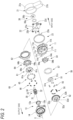
- Fig. 2 is an exploded perspective view of the clutch unit 100.
- the clutch unit 100 includes the operation lever 21, the output shaft member 30, an input-side clutch 50, an output-side clutch 60, and a housing 11.
- the input-side clutch 50 is driven (operated) by the operation lever 21 to transmit rotation of the operation lever 21 to the output shaft member 30.
- the output-side clutch 60 prevents the rotation of the output shaft member 30 even when a force in the upper-lower direction is applied to the seating seat 40a.
- the input-side clutch 50 and the output-side clutch 60 are accommodated in the housing 11.
- the housing 11 is a member that does not rotate when the operation lever 21 is operated.
- the output shaft member 30 is a shaft member extending from a lower left side to an upper right side in Fig. 2 .
- the output shaft member 30 is rotatable about a rotation axis X extending from the lower left side to the upper right side in Fig. 2 .
- a "direction of the rotation axis X" means a direction in which the output shaft member 30 extends.
- the output shaft member 30 penetrates the output-side clutch 60 and the input-side clutch 50 in this order from a left side to a right side in Fig. 2 .
- the lower left side in Fig. 2 may be referred to as an output side
- the upper right side in Fig. 2 may be referred to as an input side.
- a circumferential direction and a radial direction are defined with respect to the rotation axis X unless otherwise specified.
- the output shaft member 30 is provided with the pinion gear 31, a large-diameter cylindrical portion 32, a spline portion 33, and a small-diameter cylindrical portion 34 in this order from the output side toward the input side.
- the pinion gear 31 is provided at an output-side end of the output shaft member 30.
- the large-diameter cylindrical portion 32 penetrates a metal bush 13 fixed to a cover member 14 of the output-side clutch 60, which will be described later.
- the small-diameter cylindrical portion 34 penetrates an input-side inner ring member 51 and an input-side outer ring member 52 of the input-side clutch 50, and the housing 11, which will be described later.
- the spline portion 33 is spline-coupled to an output-side inner ring member 61 of the output-side clutch 60, which will be described later.
- a stopper ring 36 is attached to the small-diameter cylindrical portion 34 of the output shaft member 30.
- the stopper ring 36 has a cylindrical fitting portion 36a and a circular plate-shaped flange portion 36b located on an output side of the fitting portion 36a.
- the small-diameter cylindrical portion 34 of the output shaft member 30 is fitted into the fitting portion 36a.
- the flange portion 36b prevents an operation plate 22, the housing 11, the input-side clutch 50, and the output-side clutch 60, which will be described later, from coming out of the output shaft member 30.
- the housing 11 is a cup-shaped (bottomed cylindrical) member, and includes a bottom surface 11a and a tubular portion 11b. Two fixing flanges 11c protruding in the radial direction are formed at an output-side end of the tubular portion 11b.
- the fixing flange 11c has a fixing bolt insertion hole 11d.
- the housing 11 is fixed to the seat frame 40c by screwing bolts (not shown) inserted into the fixing bolt insertion holes 11d into screw holes of the seat frame 40c.
- the housing 11 may be fixed to the seat frame 40c by providing a crimped portion on the housing 11 and crimping the crimped portion to the seat frame 40c.
- the input-side clutch 50 and the output-side clutch 60 are accommodated in a space formed by the housing 11 and the cover member.
- the housing 11 is provided with a spring locking piece 11k.
- the spring locking piece 11k extends toward the input side.
- a tubular bearing 11g is formed in a central portion of the bottom surface 11a in the radial direction by burring.
- the bearing 11g extends from the bottom surface 11a toward the input side.
- the bearing 11g rotatably supports the output shaft member 30 with respect to the housing 11.
- the bottom surface 11a has three windows 11h respectively formed of arc-shaped elongated holes and three protruding pieces 11i respectively extending from edges of the windows 11h toward the output side.
- the operation lever 21 is made of synthetic resin, for example, and is fixed to the operation plate 22, which will be described later.
- the operation lever 21 includes a fixed portion 21a fixed to the operation plate 22, and a rod-shaped grip portion 21b extending outward in the radial direction from the fixed portion 21a.
- the operation plate 22 is provided between the housing 11 and the operation lever 21 in the direction of the rotation axis X.
- the operation plate 22 rotates in the forward and reverse directions integrally with the operation lever 21.
- the operation plate 22 has an insertion hole 22a at a center thereof in the radial direction.
- the small-diameter cylindrical portion 34 of the output shaft member 30 is inserted through the insertion hole 22a.
- the operation plate 22 has three rectangular engagement holes 22b around the insertion hole 22a. Claw portions 54c of an operation bracket 54, which will be described later, are respectively inserted into the engagement holes 22b, and the operation lever 21 rotates together with the operation bracket 54 via the operation plate 22.
- An operation piece 22d is provided on an outer peripheral edge of the operation plate 22.
- the operation piece 22d extends toward the output side.
- a return spring 23 is provided on an outer periphery of the housing 11.
- the return spring 23 is a spring that returns the operation lever 21 and the operation plate 22 to a neutral position when no operation force is applied to the operation lever 21.
- the return spring 23 is, for example, an arc-shaped helical spring formed by bringing both free end portions 23a close to each other. Both the free end portions 23a of the return spring 23 are locked to the spring locking piece 11k of the housing 11 and the operation piece 22d of the operation plate 22.
- one free end portion 23a of the pair of free end portions 23a maintains a state of engagement with the spring locking piece 11k of the housing 11, and the other free end portion 23a engages with the operation piece 22d of the operation plate 22, and moves in a direction away from the one free end portion 23a against an elastic restoring force of the return spring 23. Therefore, the return spring 23 is bent and a return force to the neutral position is applied.
- the input-side clutch 50 includes the input-side inner ring member 51, the input-side outer ring member 52, an operation bracket 54 (an example of an operation member), input-side clutch rollers 55 (examples of input-side transmission members), and input-side roller biasing springs 56.
- the input-side inner ring member 51 is a cylindrical member extending in the direction of the rotation axis X.
- the input-side inner ring member 51 has, at a center thereof, an insertion hole 51a through which the small-diameter cylindrical portion 34 of the output shaft member 30 is inserted.
- Three wedge cam portions 51c bulging outward are formed at equal intervals on an outer peripheral edge of the input-side inner ring member 51.
- Three protrusions 51b are formed on an input-side surface of the input-side inner ring member 51.
- the operation bracket 54 is a plate-shaped member.
- the operation bracket 54 has, at a center in the radial direction, an insertion hole 54a through which the small-diameter cylindrical portion 34 of the output shaft member 30 is inserted.
- the operation bracket 54 has three fitting holes 54b (see Fig. 2 ) into which the protrusions 51b of the input-side inner ring member 51 are fitted. According to a fitting structure of the protrusions 51b of the input-side inner ring member 51 and the fitting holes 54b, the input-side inner ring member 51 and the operation bracket 54, which are separate from each other, are connected to each other so as to rotate integrally with each other and to be relatively movable in the direction of the rotation axis X.
- Three claw portions 54c are provided on an outer peripheral edge of the operation bracket 54.
- the claw portions 54c penetrate the windows 11h formed in the bottom surface 11a of the housing 11, and are fitted into the engagement holes 22b of the operation plate 22, respectively. Accordingly, the operation bracket 54 is connected to the operation plate 22 and rotates integrally with the operation plate 22.
- the input-side outer ring member 52 is a dish-shaped member.
- the input-side outer ring member 52 includes a bottom portion 52b, an outer ring portion 52c, and fixing portions 52d.
- the bottom portion 52b is a circular plate-shaped portion.
- An insertion hole 52a through which the small-diameter cylindrical portion 34 of the output shaft member 30 is inserted is formed at a center of the bottom portion 52b in the radial direction.
- the outer ring portion 52c is a cylindrical portion extending from an outer edge portion of the bottom portion 52b toward the input side.
- the bottom portion 52b is provided on an output side of the outer ring portion 52c.
- the fixing portions 52d are protrusions protruding from the bottom portion 52b toward the output side.
- the fixing portions 52d are coupled to a release bracket 64 of the output-side clutch 60, which will be described later.
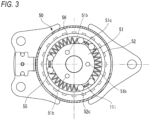
- Fig. 3 shows the input-side clutch 50 in the neutral state.
- a gap is formed between an inner peripheral surface of the input-side outer ring member 52 and an outer peripheral surface of the input-side inner ring member 51.
- the inner peripheral surface of the input-side outer ring member 52 is a circumferential surface, whereas the outer peripheral surface of the input-side inner ring member 51 is provided with the three wedge cam portions 51c bulging outward. Therefore, spaces whose both ends in the radial direction are tapered in a wedge shape are formed in the gap between the inner peripheral surface of the input-side outer ring member 52 and the outer peripheral surface of the input-side inner ring member 51.
- the protruding pieces 11i of the housing 11 protrude into the gap. When the input-side inner ring member 51 is rotated by the operation lever 21, the protruding pieces 11i restrict movement of the input-side clutch rollers 55.
- the input-side clutch 50 includes six input-side clutch rollers 55 and three input-side roller biasing springs 56.
- the input-side clutch rollers 55 and the input-side roller biasing spring 56 are disposed between the outer peripheral surface of the input-side inner ring member 51 and the inner peripheral surface of the outer ring portion 52c of the input-side outer ring member 52.
- the input-side roller biasing spring 56 is disposed between the wedge cam portions 51c of the input-side inner ring member 51 in the circumferential direction.
- a pair of input-side clutch rollers 55 are disposed on both sides of the wedge cam portion 51c of the input-side inner ring member 51.
- the protruding piece 11i of the housing 11 is disposed between the pair of input-side clutch rollers 55. That is, in the gap between the input-side inner ring member 51 and the input-side outer ring member 52, the input-side roller biasing spring 56, the input-side clutch roller 55, the protruding piece 11i, and the input-side clutch roller 55 are provided counterclockwise in this order.
- the input-side clutch roller 55 in the neutral state, in the input-side clutch 50, the input-side clutch roller 55 is in contact with the input-side roller biasing spring 56, and the input-side clutch roller 55 is biased toward a top portion of the wedge cam portion 51c by the input-side roller biasing spring 56. Therefore, in the neutral state, the input-side clutch roller 55 is bitten between the input-side inner ring member 51 and the input-side outer ring member 52.
- the input-side clutch roller 55 is provided in a wedge-shaped space narrowed clockwise between the input-side inner ring member 51 and the input-side outer ring member 52.
- the outer peripheral surface of the input-side inner ring member 51 applies a force to bite input-side clutch roller 55 in the wedge-shaped space narrowed clockwise.
- the input-side clutch roller 55 applies a force having a component pressing the inner peripheral surface of the input-side outer ring member 52 outward in the radial direction and a component pressing the inner peripheral surface of the input-side outer ring member 52 counterclockwise.
- the input-side clutch roller 55 applies a counterclockwise pressing force to the input-side outer ring member 52. In this way, when the input-side inner ring member 51 rotates counterclockwise, the input-side outer ring member 52 rotates counterclockwise together with the input-side clutch rollers 55.
- the output-side clutch 60 includes the output-side inner ring member 61, an output-side outer ring member 62, the release bracket 64, output-side clutch rollers 65, and output-side roller biasing springs 66.
- the output-side outer ring member 62 is a substantially cylindrical member.
- the output-side outer ring member 62 is coaxial with the output shaft member 30 and is rotatable relative to the output-side inner ring member 61.
- the output-side outer ring member 62 is disposed on an outer peripheral side of the output-side inner ring member 61.
- the output-side inner ring member 61 is coaxial with the output shaft member 30 and rotates integrally with the output shaft member 30.
- the output-side inner ring member 61 has a diameter smaller than that of the output-side outer ring member 62.
- a plurality of grooves are formed in an inner peripheral surface of the output-side inner ring member 61, and serve as a spline portion 61a to which the spline portion 33 of the output shaft member 30 is coupled.
- Six protrusions 61b are formed on an input-side surface of the output-side inner ring member 61 (see Fig. 4 ).
- recesses which are traces left when the protrusions 61b are formed by press working, are visible on an output-side surface.
- Six wedge cam portions 61c bulging outward are formed at equal intervals on an outer peripheral portion of the output-side inner ring member 61.
- the release bracket 64 is a substantially circular plate-shaped member, and is disposed on an input side of the output-side inner ring member 61.
- the release bracket 64 can transmit a force applied from the input-side clutch 50 to the output-side clutch rollers 65.
- An outer diameter of the release bracket 64 is larger than an outer diameter of the output-side inner ring member 61 and smaller than an inner diameter of the output-side outer ring member 62.
- the release bracket 64 is a member separate from the output-side inner ring member 61, the output-side outer ring member 62, the input-side inner ring member 51, and the input-side outer ring member 52.
- a plurality of first engagement holes 64a are formed in the release bracket 64.
- the fixing portions 52d of the input-side outer ring member 52 are respectively inserted into the first engagement holes 64a. Accordingly, the release bracket 64 is rotatable together with the input-side outer ring member 52.
- the output-side inner ring member 61 is provided with the protrusions 61b (see Fig. 4 ) protruding toward the input side.
- the release bracket 64 has a plurality of elongated holes 64b into which the protrusions 61b are respectively inserted.
- the elongated holes 64b extend in the circumferential direction.
- the protrusions 61b are slightly displaceable in the circumferential direction in the elongated holes 64b, respectively. That is, the release bracket 64 and the output-side inner ring member 61 are relatively rotatable within a range in which the protrusions 61b are respectively displaced in the elongated holes 64b.
- Six claw portions 64c extending toward the output side are provided on an outer peripheral edge of the release bracket 64.
- the claw portion 64c is provided between a pair of output-side clutch rollers 65.
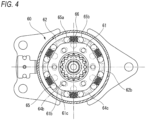
- Fig. 4 shows the output-side clutch 60 in the neutral state.
- a gap is formed between an inner peripheral surface of the output-side outer ring member 62 and an outer peripheral surface of the output-side inner ring member 61.
- the inner peripheral surface of the output-side outer ring member 62 is a circumferential surface, whereas the outer peripheral surface of the output-side inner ring member 61 is provided with the wedge cam portions 61c bulging outward. Therefore, spaces whose both ends in the radial direction are tapered in a wedge shape are formed in the gap between the inner peripheral surface of the output-side outer ring member 62 and the outer peripheral surface of the output-side inner ring member 61.
- the claw portions 64c of the release bracket 64 protrude into the gap having the paces. When the release bracket 64 is rotated, the claw portions 64c move inside the gap.
- the output-side clutch 60 includes 12 output-side clutch rollers 65 and six output-side roller biasing springs 66.
- the output-side clutch rollers 65 and the output-side roller biasing springs 66 are disposed in the gap between the outer peripheral surface of the output-side inner ring member 61 and the inner peripheral surface of the output-side outer ring member 62.
- the output-side clutch rollers 65 are members that are disposed between the outer peripheral surface of the output-side inner ring member 61 and the inner peripheral surface of the output-side outer ring member 62 and can transmit a rotational force between the output-side inner ring member 61 and the output-side outer ring member 62.
- a circumferential surface of the cylindrical output-side clutch roller 65 abuts the claw portion 64c of the release bracket 64.
- the output-side roller biasing spring 66 is disposed between the wedge cam portions 61c of the output-side inner ring member 61 in the circumferential direction.
- a pair of output-side clutch rollers 65 are disposed on both sides of the wedge cam portion 61c of the output-side inner ring member 61.
- the claw portion 64c of the release bracket 64 is disposed between the pair of output-side clutch rollers 65.
- the output-side clutch roller 65 is biased toward a top portion of the wedge cam portion 61c by the output-side roller biasing spring 66.
- the claw portion 64c, the output-side clutch roller 65, the output-side roller biasing spring 66, and the output-side clutch roller 65 are provided counterclockwise in this order.
- Fig. 4 shows the output-side clutch 60 in the neutral state.
- the output-side clutch roller 65 in the neutral state, in the output-side clutch 60, the output-side clutch roller 65 is biased toward the top portion of the wedge cam portion 61c by the output-side roller biasing spring 66. Accordingly, the output-side clutch roller 65 is bitten in the wedge-shaped space between the wedge cam portion 61c of the output-side inner ring member 61 and the inner peripheral surface of the output-side outer ring member 62.
- a first output-side clutch roller 65a and a second output-side clutch roller 65b located on a clockwise side via the first output-side clutch roller 65a and the output-side roller biasing spring 66 will be described more specifically.
- the gap where the first output-side clutch roller 65a is located is tapered counterclockwise.
- the first output-side clutch roller 65a is biased counterclockwise by the output-side roller biasing spring 66. Therefore, the first output-side clutch roller 65a is bitten counterclockwise between the output-side inner ring member 61 and the output-side outer ring member 62.
- the gap where the second output-side clutch roller 65b is located is tapered clockwise.
- the second output-side clutch roller 65b is biased clockwise by the output-side roller biasing spring 66. Therefore, the second output-side clutch roller 65b is bitten clockwise between the output-side inner ring member 61 and the output-side outer ring member 62.
- the output-side outer ring member 62 is immovable with respect to the housing 11.
- the first output-side clutch roller 65a and the second output-side clutch roller 65b are bitten counterclockwise and clockwise between both the output-side inner ring member 61 and the output-side outer ring member 62. Therefore, the output-side inner ring member 61 and the output-side outer ring member 62 cannot rotate. As a result, the output shaft member 30 spline-coupled to the output-side inner ring member 61 cannot rotate.
- the output shaft member 30 does not rotate even when a rotational force is applied to the output shaft member 30 from a side close to the vehicle seat 40. Accordingly, the vehicle seat 40 is fixed while the height thereof is maintained.
- the input-side outer ring member 52 of the input-side clutch 50 rotates counterclockwise as described above.
- the input-side outer ring member 52 is spline-coupled to the release bracket 64. Therefore, when the operation lever 21 is rotated counterclockwise, the release bracket 64 also rotates counterclockwise.
- the release bracket 64 is coupled to the protrusions 61b of the output-side inner ring member 61 via the elongated holes 64b. Therefore, the release bracket 64 (1) first rotates counterclockwise in a state in which the output-side inner ring member 61 does not rotate, and (2) rotates counterclockwise together with the output-side inner ring member 61 after the protrusions 61b respectively abut edges of the elongated holes 64b.
- the output-side inner ring member 61 becomes rotatable relative to the output-side outer ring member 62, (2) the protrusions 61b of the output-side inner ring member 61 respectively abut the edges of the elongated holes 64b of the release bracket 64. Then, the output-side inner ring member 61 rotates counterclockwise together with the release bracket 64.
- the output-side clutch 60 does not rotate the output shaft member 30 when no operation force is applied to the operation lever 21 in the neutral state, and rotates the output shaft member 30 only when an operation force is applied to the operation lever 21.
- the clutch unit 100 for use in the vehicle seat 40 includes:
- the input-side clutch 50 includes
- Fig. 5 is a view of the operation bracket 54 as viewed from a side close to the operation lever 21.
- Fig. 6 is a view of the operation bracket 54 as viewed from a direction VI in Fig. 5 .
- the operation bracket 54 is a plate-shaped member.
- the operation bracket 54 has, at a center in the radial direction, an insertion hole 54a through which the small-diameter cylindrical portion 34 of the output shaft member 30 is inserted.
- the operation bracket 54 has the three fitting holes 54b (engagement portions) into which the protrusions of the input-side inner ring member 51 are fitted. According to the fitting structure of the protrusions 51b of the input-side inner ring member 51 and the fitting holes 54b, the input-side inner ring member 51 and the operation bracket 54, which are separate from each other, are connected to each other so as to rotate integrally with each other and to be relatively movable in the direction of the rotation axis X.
- the three claw portions 54c (fastened portions) are provided on the outer peripheral edge of the operation bracket 54.
- the claw portions 54c penetrate the windows 11h formed in the bottom surface 11a of the housing 11, and are fitted into the engagement holes 22b of the operation plate 22, respectively. Accordingly, the operation bracket 54 is connected to the operation plate 22 and rotates integrally with the operation plate 22.
- the operation bracket 54 further includes a facing portion 54d and sliding-contact portions 54e.
- the facing portion 54d is a plate-shaped portion extending in the radial direction of the rotation axis X. Fitting holes 54b are formed in the facing portion 54d.
- the claw portions 54c and the sliding-contact portions 54e are provided on a radially outer edge of the facing portion 54d. In the shown example, the three claw portions 54c and three sliding-contact portions 54e are provided on the operation bracket 54.
- the claw portion 54c extends from the outer edge of the facing portion 54d toward the input side.
- tip ends of the claw portion 54c have a two-forked shape, and the tip ends extend in directions away from each other.
- the sliding-contact portion 54e extends from the outer edge of the facing portion 54d toward the input side, and then extends in the radial direction of the rotation axis X. In the direction of the rotation axis X, a tip end portion of the sliding-contact portion 54e is located on an input side of the facing portion 54d.
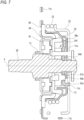
- Fig. 7 is a cross-sectional view of the clutch unit 100.
- the facing portion 54d faces the bottom surface 11a of the housing 11 with a gap therebetween.
- the claw portions 54c extend from the facing portion 54d toward the operation lever 21, respectively penetrate the windows 11h (through holes) formed in the bottom surface 11a of the housing 11, and are fastened to the operation plate 22.
- the sliding-contact portions 54e extend from the facing portion 54d toward the bottom surface 11a of the housing 11 and come into sliding-contact with the bottom surface 11a of the housing 11.
- the facing portion 54d of the operation bracket 54 faces the bottom surface 11a of the housing 11 with the gap therebetween, the facing portion 54d does not contribute to friction between the operation bracket 54 and the housing 11.
- the claw portions 54c fastened portion
- the sliding-contact portions 54e extending from the facing portion 54d toward the operation lever 21
- the claw portions 54c respectively penetrate the windows 11h (through holes) of the housing 11, so the claw portions 54c also do not contribute to the friction between the operation bracket 54 and the housing 11. Since only the sliding-contact portions 54e come into sliding-contact with the bottom surface 11a of the housing 11, a sliding resistance between the housing 11 and the operation bracket 54 is limited.
- the sliding-contact portion 54e extends from an outer end portion of the facing portion 54d in the radial direction of the rotation axis X toward the operation lever 21.
- the sliding-contact portion 54e is provided at a position away from the rotation axis X, a load acting on the sliding-contact portion 54e can be reduced when a force twisting the operation lever 21 is applied to the sliding-contact portion 54e.
- the sliding-contact portion 54e includes a sliding-contact surface portion 54f extending outward in the radial direction of the rotation axis X.
- the sliding-contact portion 54e includes the sliding-contact surface portion 54f and a connection portion 54g connecting the sliding-contact surface portion 54f and the facing portion 54d.
- the sliding-contact surface portion 54f is located closer to the operation lever 21 than the facing portion 54d in the direction of the rotation axis X.
- a surface of the sliding-contact surface portion 54f on a side close to the operation lever 21 comes into sliding-contact with the bottom surface 11a of the housing 11.
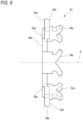
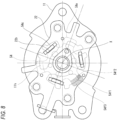
- Fig. 8 is a view showing overlapping of the operation plate 22, the housing 11, and the operation bracket 54.
- Fig. 8 shows how the three members overlap when the operation lever 21 is rotated to the maximum movable range.
- a part 54f1 of the sliding-contact surface portion 54f overlaps the window 11h formed in the bottom surface 11a of the housing 11.
- the clutch unit 100 of the present embodiment when the operation lever 21 is rotated to the maximum movable range, only the part 54f1 of the sliding-contact surface portion 54f overlaps the window 11h, and another part 54f2 of the sliding-contact surface portion 54f overlaps the bottom surface 11a of the housing 11 without overlapping the window 11h.
- the part 54f2 overlapping the bottom surface 11a of the housing 11 prevents the sliding-contact portion 54e from coming off the window 11h.
- the clutch unit may increase in size, or an operation angle of the operation lever may decrease.
- the clutch unit 100 of the present embodiment since the sliding-contact surface portion 54f (54f1) is also provided at a position overlapping the window 11h, it is possible to prevent an increase in size of the clutch unit 100 and to ensure a large operation angle.
- the sliding-contact surface portion 54f comes into sliding-contact with the bottom surface 11a of the housing 11 outward of the window 11h in the radial direction.
- the sliding-contact surface portion 54f has a part 54f3 that is located outward of the window 11h in the radial direction and outward of the parts 54f1 and 54f2 in the radial direction.
- the sliding-contact surface portion 54f and the bottom surface 11a of the housing 11 can be brought into contact with each other at a position far from the rotation axis X by the part 54f3, it is possible to reduce a force applied to a contact surface between the sliding-contact surface portion 54f and the bottom surface 11a when the operation lever 21 is operated. Since the part 54f3 of the sliding-contact surface portion 54f comes into contact with the bottom surface 11a of the housing 11 outward of the window 11h in the radial direction, the sliding-contact surface portion 54f can normally come into contact with the bottom surface 11a of the housing 11 regardless of an operation of the operation lever 21. Accordingly, the operation bracket 54 can be more effectively prevented from coming off the window 11h to outside of the housing 11.
- a plurality of sliding-contact portions 54e are provided at equal intervals in the circumferential direction of the rotation axis X.
- three sliding-contact portions 54e are provided at intervals of 120 degrees in the circumferential direction of the rotation axis X.
- a force applied between the operation bracket 54 and the bottom surface 11a of the housing 11 when the operation lever 21 is operated can be received in a distributed manner by the three sliding-contact portions 54e. Since the operation bracket 54 does not have directionality, workability when the operational bracket 54 is assembled to the housing 11 is improved.
- the operation bracket 54 engages with the input-side inner ring member 51 has been described in the above-described embodiment, but the operation bracket 54 may engage with the input-side outer ring member 52.
- the input-side outer ring member 52 is disposed at a position closer to the bottom surface 11a of the housing 11 than is the input-side inner ring member 51.
- the facing portion of the operation bracket faces the bottom surface of the housing with the gap therebetween, the facing portion does not contribute to friction between the operation bracket and the housing.
- the fastened portion and the sliding-contact portion extending from the facing portion toward the output-side clutch, the fastened portion penetrates the through hole of the housing, so the fastened portion also does not contribute to the friction between the operation bracket and the housing. Since only the sliding-contact portion comes into sliding-contact with the bottom surface of the housing, a sliding resistance between the housing and the operation bracket is limited.
Landscapes
- Engineering & Computer Science (AREA)
- Mechanical Engineering (AREA)
- General Engineering & Computer Science (AREA)
- Aviation & Aerospace Engineering (AREA)
- Transportation (AREA)
- Mechanical Operated Clutches (AREA)
- Braking Arrangements (AREA)
- Seats For Vehicles (AREA)
Applications Claiming Priority (2)
| Application Number | Priority Date | Filing Date | Title |
|---|---|---|---|
| JP2021013325A JP7482805B2 (ja) | 2021-01-29 | 2021-01-29 | クラッチユニット |
| PCT/JP2022/002889 WO2022163699A1 (ja) | 2021-01-29 | 2022-01-26 | クラッチユニット |
Publications (2)
| Publication Number | Publication Date |
|---|---|
| EP4286705A1 true EP4286705A1 (de) | 2023-12-06 |
| EP4286705A4 EP4286705A4 (de) | 2024-07-24 |
Family
ID=82653420
Family Applications (1)
| Application Number | Title | Priority Date | Filing Date |
|---|---|---|---|
| EP22745918.7A Withdrawn EP4286705A4 (de) | 2021-01-29 | 2022-01-26 | Kupplungseinheit |
Country Status (4)
| Country | Link |
|---|---|
| US (1) | US12097787B2 (de) |
| EP (1) | EP4286705A4 (de) |
| JP (1) | JP7482805B2 (de) |
| WO (1) | WO2022163699A1 (de) |
Families Citing this family (1)
| Publication number | Priority date | Publication date | Assignee | Title |
|---|---|---|---|---|
| CN116221300B (zh) * | 2023-02-27 | 2025-07-22 | 中国石油大学(北京) | 棘轮机构 |
Family Cites Families (12)
| Publication number | Priority date | Publication date | Assignee | Title |
|---|---|---|---|---|
| JP5717283B2 (ja) * | 2011-03-09 | 2015-05-13 | Ntn株式会社 | クラッチユニット |
| KR101835524B1 (ko) * | 2016-06-29 | 2018-03-08 | 주식회사 다스 | 자동차 시트의 높이 조절장치 |
| JP6712700B2 (ja) | 2016-08-22 | 2020-06-24 | リイマジンコンサルティング株式会社 | 共済の運用するための方法、プログラム及びシステム |
| JP6738691B2 (ja) * | 2016-08-30 | 2020-08-12 | Ntn株式会社 | クラッチユニット |
| JP6745188B2 (ja) | 2016-10-07 | 2020-08-26 | シロキ工業株式会社 | 車両用クラッチユニット |
| JP2019032070A (ja) * | 2017-08-09 | 2019-02-28 | シロキ工業株式会社 | 車両用クラッチユニット |
| JP6970642B2 (ja) | 2018-05-31 | 2021-11-24 | シロキ工業株式会社 | 車両用クラッチユニット |
| JP7377597B2 (ja) * | 2018-05-31 | 2023-11-10 | アイシンシロキ株式会社 | 車両用クラッチユニット |
| JP2020046018A (ja) | 2018-09-20 | 2020-03-26 | シロキ工業株式会社 | クラッチユニット |
| JP2020046017A (ja) * | 2018-09-20 | 2020-03-26 | シロキ工業株式会社 | クラッチユニット |
| JP2020069852A (ja) | 2018-10-30 | 2020-05-07 | トヨタ紡織株式会社 | リフタ装置 |
| JP7372588B2 (ja) | 2019-07-11 | 2023-11-01 | 日本製紙株式会社 | 菓子類および菓子類の製造方法 |
-
2021
- 2021-01-29 JP JP2021013325A patent/JP7482805B2/ja active Active
-
2022
- 2022-01-26 WO PCT/JP2022/002889 patent/WO2022163699A1/ja not_active Ceased
- 2022-01-26 EP EP22745918.7A patent/EP4286705A4/de not_active Withdrawn
- 2022-01-26 US US18/043,817 patent/US12097787B2/en active Active
Also Published As
| Publication number | Publication date |
|---|---|
| WO2022163699A1 (ja) | 2022-08-04 |
| US20240116405A1 (en) | 2024-04-11 |
| JP2022116904A (ja) | 2022-08-10 |
| US12097787B2 (en) | 2024-09-24 |
| JP7482805B2 (ja) | 2024-05-14 |
| EP4286705A4 (de) | 2024-07-24 |
Similar Documents
| Publication | Publication Date | Title |
|---|---|---|
| EP3805586B1 (de) | Kupplungseinheit für ein fahrzeug | |
| JP6754634B2 (ja) | 車両用クラッチユニット | |
| US10927903B2 (en) | Clutch unit | |
| EP3805587B1 (de) | Kupplungseinheit für ein fahrzeug | |
| EP3434924B1 (de) | Kupplungseinheit | |
| CN107917151B (zh) | 用于车辆的离合器单元 | |
| EP4286705A1 (de) | Kupplungseinheit | |
| JP6745188B2 (ja) | 車両用クラッチユニット | |
| EP4148294B1 (de) | Kupplungseinheit | |
| EP4286703A1 (de) | Kupplungseinheit | |
| JP2020046018A (ja) | クラッチユニット | |
| WO2017104385A1 (ja) | 車両用クラッチユニット | |
| JP7291101B2 (ja) | 車両用クラッチユニット | |
| JP2020046016A (ja) | クラッチユニット | |
| JP2020034083A (ja) | クラッチユニット | |
| JP6647787B2 (ja) | クラッチユニット | |
| US20210404520A1 (en) | Clutch unit | |
| EP3686453A1 (de) | Kupplungseinheit |
Legal Events
| Date | Code | Title | Description |
|---|---|---|---|
| STAA | Information on the status of an ep patent application or granted ep patent |
Free format text: STATUS: THE INTERNATIONAL PUBLICATION HAS BEEN MADE |
|
| PUAI | Public reference made under article 153(3) epc to a published international application that has entered the european phase |
Free format text: ORIGINAL CODE: 0009012 |
|
| STAA | Information on the status of an ep patent application or granted ep patent |
Free format text: STATUS: REQUEST FOR EXAMINATION WAS MADE |
|
| 17P | Request for examination filed |
Effective date: 20230308 |
|
| AK | Designated contracting states |
Kind code of ref document: A1 Designated state(s): AL AT BE BG CH CY CZ DE DK EE ES FI FR GB GR HR HU IE IS IT LI LT LU LV MC MK MT NL NO PL PT RO RS SE SI SK SM TR |
|
| DAV | Request for validation of the european patent (deleted) | ||
| DAX | Request for extension of the european patent (deleted) | ||
| REG | Reference to a national code |
Ref country code: DE Ref legal event code: R079 Free format text: PREVIOUS MAIN CLASS: F16D0067020000 Ipc: B60N0002900000 |
|
| A4 | Supplementary search report drawn up and despatched |
Effective date: 20240621 |
|
| RIC1 | Information provided on ipc code assigned before grant |
Ipc: F16D 41/10 20060101ALI20240617BHEP Ipc: F16D 41/067 20060101ALI20240617BHEP Ipc: F16D 41/06 20060101ALI20240617BHEP Ipc: F16D 65/16 20060101ALI20240617BHEP Ipc: F16D 67/02 20060101ALI20240617BHEP Ipc: B60N 2/16 20060101ALI20240617BHEP Ipc: B60N 2/90 20180101AFI20240617BHEP |
|
| RAP1 | Party data changed (applicant data changed or rights of an application transferred) |
Owner name: NTN CORPORATION Owner name: TOYOTA BOSHOKU KABUSHIKI KAISHA |
|
| STAA | Information on the status of an ep patent application or granted ep patent |
Free format text: STATUS: THE APPLICATION IS DEEMED TO BE WITHDRAWN |
|
| 18D | Application deemed to be withdrawn |
Effective date: 20250110 |