EP4279985B1 - Anzeigevorrichtung und fortbewegungsmittel - Google Patents
Anzeigevorrichtung und fortbewegungsmittel Download PDFInfo
- Publication number
- EP4279985B1 EP4279985B1 EP23170127.7A EP23170127A EP4279985B1 EP 4279985 B1 EP4279985 B1 EP 4279985B1 EP 23170127 A EP23170127 A EP 23170127A EP 4279985 B1 EP4279985 B1 EP 4279985B1
- Authority
- EP
- European Patent Office
- Prior art keywords
- display device
- cavities
- light
- support elements
- display panel
- Prior art date
- Legal status (The legal status is an assumption and is not a legal conclusion. Google has not performed a legal analysis and makes no representation as to the accuracy of the status listed.)
- Active
Links
Images


Classifications
-
- F—MECHANICAL ENGINEERING; LIGHTING; HEATING; WEAPONS; BLASTING
- F21—LIGHTING
- F21V—FUNCTIONAL FEATURES OR DETAILS OF LIGHTING DEVICES OR SYSTEMS THEREOF; STRUCTURAL COMBINATIONS OF LIGHTING DEVICES WITH OTHER ARTICLES, NOT OTHERWISE PROVIDED FOR
- F21V7/00—Reflectors for light sources
- F21V7/0083—Array of reflectors for a cluster of light sources, e.g. arrangement of multiple light sources in one plane
-
- B—PERFORMING OPERATIONS; TRANSPORTING
- B60—VEHICLES IN GENERAL
- B60K—ARRANGEMENT OR MOUNTING OF PROPULSION UNITS OR OF TRANSMISSIONS IN VEHICLES; ARRANGEMENT OR MOUNTING OF PLURAL DIVERSE PRIME-MOVERS IN VEHICLES; AUXILIARY DRIVES FOR VEHICLES; INSTRUMENTATION OR DASHBOARDS FOR VEHICLES; ARRANGEMENTS IN CONNECTION WITH COOLING, AIR INTAKE, GAS EXHAUST OR FUEL SUPPLY OF PROPULSION UNITS IN VEHICLES
- B60K35/00—Instruments specially adapted for vehicles; Arrangement of instruments in or on vehicles
- B60K35/20—Output arrangements, i.e. from vehicle to user, associated with vehicle functions or specially adapted therefor
-
- B—PERFORMING OPERATIONS; TRANSPORTING
- B60—VEHICLES IN GENERAL
- B60K—ARRANGEMENT OR MOUNTING OF PROPULSION UNITS OR OF TRANSMISSIONS IN VEHICLES; ARRANGEMENT OR MOUNTING OF PLURAL DIVERSE PRIME-MOVERS IN VEHICLES; AUXILIARY DRIVES FOR VEHICLES; INSTRUMENTATION OR DASHBOARDS FOR VEHICLES; ARRANGEMENTS IN CONNECTION WITH COOLING, AIR INTAKE, GAS EXHAUST OR FUEL SUPPLY OF PROPULSION UNITS IN VEHICLES
- B60K35/00—Instruments specially adapted for vehicles; Arrangement of instruments in or on vehicles
- B60K35/20—Output arrangements, i.e. from vehicle to user, associated with vehicle functions or specially adapted therefor
- B60K35/21—Output arrangements, i.e. from vehicle to user, associated with vehicle functions or specially adapted therefor using visual output, e.g. blinking lights or matrix displays
- B60K35/22—Display screens
-
- B—PERFORMING OPERATIONS; TRANSPORTING
- B60—VEHICLES IN GENERAL
- B60K—ARRANGEMENT OR MOUNTING OF PROPULSION UNITS OR OF TRANSMISSIONS IN VEHICLES; ARRANGEMENT OR MOUNTING OF PLURAL DIVERSE PRIME-MOVERS IN VEHICLES; AUXILIARY DRIVES FOR VEHICLES; INSTRUMENTATION OR DASHBOARDS FOR VEHICLES; ARRANGEMENTS IN CONNECTION WITH COOLING, AIR INTAKE, GAS EXHAUST OR FUEL SUPPLY OF PROPULSION UNITS IN VEHICLES
- B60K37/00—Dashboards
-
- G—PHYSICS
- G02—OPTICS
- G02F—OPTICAL DEVICES OR ARRANGEMENTS FOR THE CONTROL OF LIGHT BY MODIFICATION OF THE OPTICAL PROPERTIES OF THE MEDIA OF THE ELEMENTS INVOLVED THEREIN; NON-LINEAR OPTICS; FREQUENCY-CHANGING OF LIGHT; OPTICAL LOGIC ELEMENTS; OPTICAL ANALOGUE/DIGITAL CONVERTERS
- G02F1/00—Devices or arrangements for the control of the intensity, colour, phase, polarisation or direction of light arriving from an independent light source, e.g. switching, gating or modulating; Non-linear optics
- G02F1/01—Devices or arrangements for the control of the intensity, colour, phase, polarisation or direction of light arriving from an independent light source, e.g. switching, gating or modulating; Non-linear optics for the control of the intensity, phase, polarisation or colour
- G02F1/13—Devices or arrangements for the control of the intensity, colour, phase, polarisation or direction of light arriving from an independent light source, e.g. switching, gating or modulating; Non-linear optics for the control of the intensity, phase, polarisation or colour based on liquid crystals, e.g. single liquid crystal display cells
- G02F1/133—Constructional arrangements; Operation of liquid crystal cells; Circuit arrangements
- G02F1/1333—Constructional arrangements; Manufacturing methods
- G02F1/1335—Structural association of cells with optical devices, e.g. polarisers or reflectors
- G02F1/1336—Illuminating devices
- G02F1/133602—Direct backlight
- G02F1/133603—Direct backlight with LEDs
-
- G—PHYSICS
- G02—OPTICS
- G02F—OPTICAL DEVICES OR ARRANGEMENTS FOR THE CONTROL OF LIGHT BY MODIFICATION OF THE OPTICAL PROPERTIES OF THE MEDIA OF THE ELEMENTS INVOLVED THEREIN; NON-LINEAR OPTICS; FREQUENCY-CHANGING OF LIGHT; OPTICAL LOGIC ELEMENTS; OPTICAL ANALOGUE/DIGITAL CONVERTERS
- G02F1/00—Devices or arrangements for the control of the intensity, colour, phase, polarisation or direction of light arriving from an independent light source, e.g. switching, gating or modulating; Non-linear optics
- G02F1/01—Devices or arrangements for the control of the intensity, colour, phase, polarisation or direction of light arriving from an independent light source, e.g. switching, gating or modulating; Non-linear optics for the control of the intensity, phase, polarisation or colour
- G02F1/13—Devices or arrangements for the control of the intensity, colour, phase, polarisation or direction of light arriving from an independent light source, e.g. switching, gating or modulating; Non-linear optics for the control of the intensity, phase, polarisation or colour based on liquid crystals, e.g. single liquid crystal display cells
- G02F1/133—Constructional arrangements; Operation of liquid crystal cells; Circuit arrangements
- G02F1/1333—Constructional arrangements; Manufacturing methods
- G02F1/1335—Structural association of cells with optical devices, e.g. polarisers or reflectors
- G02F1/1336—Illuminating devices
- G02F1/133602—Direct backlight
- G02F1/133605—Direct backlight including specially adapted reflectors
-
- G—PHYSICS
- G02—OPTICS
- G02F—OPTICAL DEVICES OR ARRANGEMENTS FOR THE CONTROL OF LIGHT BY MODIFICATION OF THE OPTICAL PROPERTIES OF THE MEDIA OF THE ELEMENTS INVOLVED THEREIN; NON-LINEAR OPTICS; FREQUENCY-CHANGING OF LIGHT; OPTICAL LOGIC ELEMENTS; OPTICAL ANALOGUE/DIGITAL CONVERTERS
- G02F1/00—Devices or arrangements for the control of the intensity, colour, phase, polarisation or direction of light arriving from an independent light source, e.g. switching, gating or modulating; Non-linear optics
- G02F1/01—Devices or arrangements for the control of the intensity, colour, phase, polarisation or direction of light arriving from an independent light source, e.g. switching, gating or modulating; Non-linear optics for the control of the intensity, phase, polarisation or colour
- G02F1/13—Devices or arrangements for the control of the intensity, colour, phase, polarisation or direction of light arriving from an independent light source, e.g. switching, gating or modulating; Non-linear optics for the control of the intensity, phase, polarisation or colour based on liquid crystals, e.g. single liquid crystal display cells
- G02F1/133—Constructional arrangements; Operation of liquid crystal cells; Circuit arrangements
- G02F1/1333—Constructional arrangements; Manufacturing methods
- G02F1/1335—Structural association of cells with optical devices, e.g. polarisers or reflectors
- G02F1/1336—Illuminating devices
- G02F1/133602—Direct backlight
- G02F1/133608—Direct backlight including particular frames or supporting means
-
- G—PHYSICS
- G02—OPTICS
- G02F—OPTICAL DEVICES OR ARRANGEMENTS FOR THE CONTROL OF LIGHT BY MODIFICATION OF THE OPTICAL PROPERTIES OF THE MEDIA OF THE ELEMENTS INVOLVED THEREIN; NON-LINEAR OPTICS; FREQUENCY-CHANGING OF LIGHT; OPTICAL LOGIC ELEMENTS; OPTICAL ANALOGUE/DIGITAL CONVERTERS
- G02F1/00—Devices or arrangements for the control of the intensity, colour, phase, polarisation or direction of light arriving from an independent light source, e.g. switching, gating or modulating; Non-linear optics
- G02F1/01—Devices or arrangements for the control of the intensity, colour, phase, polarisation or direction of light arriving from an independent light source, e.g. switching, gating or modulating; Non-linear optics for the control of the intensity, phase, polarisation or colour
- G02F1/13—Devices or arrangements for the control of the intensity, colour, phase, polarisation or direction of light arriving from an independent light source, e.g. switching, gating or modulating; Non-linear optics for the control of the intensity, phase, polarisation or colour based on liquid crystals, e.g. single liquid crystal display cells
- G02F1/133—Constructional arrangements; Operation of liquid crystal cells; Circuit arrangements
- G02F1/1333—Constructional arrangements; Manufacturing methods
- G02F1/1335—Structural association of cells with optical devices, e.g. polarisers or reflectors
- G02F1/1336—Illuminating devices
- G02F1/133602—Direct backlight
- G02F1/133611—Direct backlight including means for improving the brightness uniformity
-
- F—MECHANICAL ENGINEERING; LIGHTING; HEATING; WEAPONS; BLASTING
- F21—LIGHTING
- F21Y—INDEXING SCHEME ASSOCIATED WITH SUBCLASSES F21K, F21L, F21S and F21V, RELATING TO THE FORM OR THE KIND OF THE LIGHT SOURCES OR OF THE COLOUR OF THE LIGHT EMITTED
- F21Y2115/00—Light-generating elements of semiconductor light sources
- F21Y2115/10—Light-emitting diodes [LED]
-
- G—PHYSICS
- G02—OPTICS
- G02F—OPTICAL DEVICES OR ARRANGEMENTS FOR THE CONTROL OF LIGHT BY MODIFICATION OF THE OPTICAL PROPERTIES OF THE MEDIA OF THE ELEMENTS INVOLVED THEREIN; NON-LINEAR OPTICS; FREQUENCY-CHANGING OF LIGHT; OPTICAL LOGIC ELEMENTS; OPTICAL ANALOGUE/DIGITAL CONVERTERS
- G02F2201/00—Constructional arrangements not provided for in groups G02F1/00 - G02F7/00
- G02F2201/50—Protective arrangements
- G02F2201/503—Arrangements improving the resistance to shock
Definitions
- the present invention relates to a display device and a means of transport with such a display device.
- Display devices in vehicle interiors are located directly in front of the vehicle occupants and are therefore always at risk of head impact. A new product must therefore pass a certified head impact test before it can be used.
- a display device is at increased risk of failing such a test if the display's cover glass shatters during the test. To prevent this, the display's cover glass or display panel is supported as extensively and as early as possible. To achieve this, the distances between the components within the display device must be kept as small as possible. Minimizing the gaps within the display device places increased demands on the precision of the manufacturing of the individual parts and the assembly.
- US 2006/0203480 A1 a backlight comprising a plurality of lamps for generating light, a diffuser, a housing, and a first support member.
- the diffuser is arranged over the lamps and diffuses the light.
- the housing has a bottom portion and a sidewall portion extending from the bottom portion to provide a receiving space for the lamps.
- the first support member is arranged on the bottom portion to support the diffuser and has two mutually inclined portions, which make it possible to reduce the impact forces transmitted from the diffuser to the bottom portion.
- CN 103742840 A A backlight comprising a hollow body in which light-emitting diodes are arranged, and an optical plate arranged on the hollow body.
- the side walls of the hollow body are reflective. Support columns for supporting the optical plate are arranged in the hollow body.
- US 2020/0292885 A1 Describes a display with a backlight.
- the backlight comprises an array of cells. Each cell contains a light source and a cavity reflector that reflects light from the light source outward through a diffuser.
- the light sources are mounted on a printed circuit board. Support posts on the printed circuit board hold the diffuser at a fixed distance from the printed circuit board.
- a reflector is arranged between the light sources and the display panel, filling the design-related gap between the light sources and the display panel or another optical component arranged below the display panel.
- This reflector has a plurality of reflective cavities, each of which contains a light source. The cavities orient the light emerging from the light sources toward the display panel. Additional support elements prevent breakage of the display panel or cover glass.
- the use of support elements makes it possible to use different materials for the support elements and the reflector. Since the support elements protrude from the cavities, the walls of the cavities do not reach the display panel or the other optical component. This could otherwise lead to unlit areas and thus a visible grid structure.
- the support elements are transparent and therefore do not affect the homogeneity of the illumination.
- the support elements are embedded in the walls of the cavities.
- This design of the reflector allows it to absorb energy.
- the support elements can be embedded in the walls, for example, using press-fit technology or hot-staking.
- the entire surface of the backlight is not necessarily provided with support elements. Local positioning is also possible, e.g., limited to edge areas or a central area of the display panel. By varying the wall thicknesses or heights, the energy absorption of the reflector can be adjusted and thus tailored to the display device.
- the support elements rest on a circuit board on which the light sources are arranged.
- the support elements can also be used to stiffen the reflector.
- the support elements can, for example, be glued to the circuit board as columns.
- the walls of the cavities are rounded, and the cavities are designed to reflect the light emitted by the light sources toward the display panel.
- the rounding allows the emitted light to be reflected more precisely toward the display panel.
- the rounding ensures increased buckling strength and a reduced notch effect in the direction of impact in the event of a head impact.
- the light sources are side-emitting light-emitting diodes.
- the use of side-emitting light-emitting diodes has the advantage of preventing the formation of light spots in the backlight. This ensures a particularly homogeneous illumination of the display panel.
- the side-emitting LEDs emit light from all sides. This further increases the homogeneity of the display panel's illumination.
- a gap is located between the support elements and a component to be supported by the support elements.
- a gap has the advantage of enabling tolerance compensation of the individual parts and compensation for temperature expansion without generating additional stress in the height structure.
- the gap can serve to mix the light of the individual cavities to ensure homogeneous illumination.
- the component to be supported can be, for example, the display panel or an optical plate arranged between the reflector and the display panel.
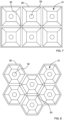
- the cavities form a rectangular grid or a hexagonal grid.
- the reflector can be configured in various ways. Both the arrangement of the cavities in a rectangular grid and the arrangement of the cavities in a hexagonal grid allow the reflector to be formed from a gapless matrix of cavities.
- a display device is used in a means of transportation.
- the means of transportation may be, for example, a motor vehicle, but alternatively also an aircraft, a rail vehicle, or a watercraft.
- Fig. 1 shows a schematic view of a section of a display device 1 according to the invention.
- the display device 1 has a display panel 2 which is glued to a cover glass 4.
- the cover glass 4 closes off a housing 8 of the display device 1 from the environment.
- a backlight 3 for the display panel 2 is arranged in a further housing 7.
- the backlight 3 has a reflector 30 with a plurality of cavities 31.
- a light source 32 typically a light-emitting diode, is arranged in each of the cavities 31.
- the light sources 32 are arranged on a printed circuit board 35, which can be glued to the housing 7 of the backlight 3. Additional support elements 33 prevent the display panel 2 or the cover glass 4 from breaking in the event of a head impact.
- the support elements 33 are transparent to the light emitted by the light sources 32 and protrude relative to the cavities 31.
- an optical plate 5 with a foil stack 6 arranged thereon is located between the backlight 3 and the display panel 2.
- the foils of the optical foil stack 6 have the task of scattering, collecting, or directing the light from the reflector 30 in such a way that the requirements for the solid angle of the backlight 3 are met.
- Typical foils for light alignment are brightness enhancement films (BEF) and light control films (LCF).
- BEF brightness enhancement films
- LCDF light control films
- the optical plate 5 is a transparent plate that ensures the optical distance between the optical film stack 6 and the light sources 32.
- the cover glass 4, the optical plate 5 and the housing 7 of the backlight 3 are connected to one another by suitable connecting elements 10, e.g. adhesives.
- gap 9 between the film stack 6 and the display panel 2.
- Another gap 9' is located between the optical plate 5 and the cavities 31.
- the gap 9 between the display panel 2 and the optical plate 5 with the film stack 6 arranged thereon is so narrow that the cover glass 4 does not break when it is deformed to the extent that it has reduced this gap 9 to zero.
- the cover glass 4 comes into contact with the support elements 33 via the optical plate 5 and the foil stack 6 and is supported by them in such a way that it does not bend further but is supported by the parts underneath.
- Fig. 2 shows a schematic detail view of a display device 1 according to the invention.
- the cover glass 4 with the display panel 2, the optical plate 5 with the film stack 6 and the background lighting 3 with the housing 7, the circuit board 35 with the light sources 32 arranged thereon and the reflector 30 can be seen.
- the light sources 32 are laterally emitting light diodes, which preferably emit light L from all sides.
- the reflective walls 34 of the cavities 31 of the reflector 30 are rounded and orient the light L emerging from the light sources 32 in the direction of the display panel 2. At the same time, the rounding ensures increased buckling strength or a lower notch effect in the direction of impact in the event of a head impact.
- the transparent support elements 33 allow the light L to pass through, apart from a Fig.
- the total construction height of the display device is preferably in the range of ⁇ 13.3 mm.
- the height of the reflector 30 can be ⁇ 3.72 mm, the width of the walls 34 at their widest point ⁇ 6.13 mm.
- the gap 9 between the foil stack 6 and the display panel 2 has a height of ⁇ 1.31 mm, the gap 9' between the reflector 30 and the optical plate 5 has a height of ⁇ 1.05 mm.
- the distance between the light sources 32 can be ⁇ 9.13 mm, for example.
- Fig. 3 shows a schematic of an embodiment of a support element 33.
- the figures show the optical plate 5 with the film stack 6 and the backlight 3 with the housing 7, the circuit board 35 with the light sources 32 arranged thereon and the reflector 30.
- the transparent support element 33 is placed on a wall 34 of the cavities 31 and extends as far as the optical plate 5.
- the support element 33 can, for example, be manufactured by means of two-component injection molding or can be glued to the reflector.
- Fig. 4 shows schematically a further embodiment of a support element 33.
- the figures show the optical plate 5 with the film stack 6 and the background lighting 3 with the housing 7, the circuit board 35 with the light sources 32 arranged thereon and the reflector 30.
- the transparent support element 33 is embedded in a wall 34 of the cavities 31. There is a gap 36 between the support element 33 and the optical plate 5.
- the support element 33 can reach up to the optical plate 5.
- the support element 33 can be embedded in the wall 34, for example, using a press-fit technique or hot caulking.
- Fig. 5 shows schematically an embodiment of a support element 33 according to the invention.
- the transparent support element 33 is embedded in a wall 34 of the cavities 31, but it rests on the circuit board 35.
- the support elements 33 can additionally be used to stiffen the reflector 30.
- a gap 36 is located between the support element 33 and the optical plate 5.
- the support element 33 can reach up to the optical plate 5.
- the support element 33 can, for example, be glued to the circuit board 35 as a column.
- Fig. 6 shows schematically a further embodiment of a support element 33.
- the optical plate 5 with the film stack 6 and the background lighting 3 with the housing 7, the circuit board 35 with the light sources 32 arranged thereon and the reflector 30 can be seen.
- the transparent support element 33 is an integral part of the optical plate 5 in this embodiment.
- Fig. 7 shows a schematic of a reflector 30 in which a rectangular grid is formed.
- the arrangement of the cavities 31 and light sources 32 in a rectangular grid allows the reflector 30 to be formed from a continuous matrix of cavities 31.
- the entire surface of the backlight is not necessarily provided with support elements 33. Local positioning is also possible, e.g., limited to edge areas or a central area with respect to the display panel.
- Fig. 8 schematically shows a reflector 30 in which a hexagonal grid is formed.
- the arrangement of the cavities 31 and light sources 32 in a hexagonal grid also allows the reflector 30 to be formed from a continuous matrix of cavities 31. In this case, too, the entire surface of the backlight is not necessarily provided with support elements 33.
- Local positioning is also possible, e.g. limited to edge areas or a central area in relation to the display panel.
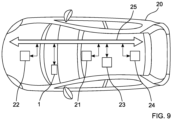
- Fig. 9 schematically shows a means of transport 20 that uses a display device 1 according to the invention.
- the means of transport 20 is a motor vehicle.
- the motor vehicle has a display device 1 according to the invention, which is arranged in a dashboard.
- Data on the vehicle's surroundings can be acquired using a sensor system 21.
- the sensor system 21 can, in particular, comprise sensors for environmental detection, e.g., ultrasonic sensors, laser scanners, radar sensors, lidar sensors, or cameras.
- the information acquired by the sensor system 21 can be used to generate content to be displayed on the display device 1.
- Further components of the motor vehicle in this example are a navigation system 22, through which position information can be provided, and a data transmission unit 23.
- a connection to a backend can be established, for example, to obtain updated software for components of the motor vehicle.
- a memory 24 is provided for storing data. The data exchange between the various components of the motor vehicle takes place via a network 25.
Landscapes
- Physics & Mathematics (AREA)
- Nonlinear Science (AREA)
- Chemical & Material Sciences (AREA)
- General Physics & Mathematics (AREA)
- Mathematical Physics (AREA)
- Crystallography & Structural Chemistry (AREA)
- Optics & Photonics (AREA)
- Engineering & Computer Science (AREA)
- Mechanical Engineering (AREA)
- Transportation (AREA)
- Combustion & Propulsion (AREA)
- General Engineering & Computer Science (AREA)
- Illuminated Signs And Luminous Advertising (AREA)
- Devices For Indicating Variable Information By Combining Individual Elements (AREA)
Description
- Die vorliegende Erfindung betrifft eine Anzeigevorrichtung sowie ein Fortbewegungsmittel mit einer solchen Anzeigevorrichtung.
- Anzeigevorrichtungen im Fahrzeuginnenraum befinden sich direkt vor den Fahrzeuginsassen und sind daher immer der Gefahr eines Kopfaufpralls ausgesetzt. Ein neues Produkt muss daher einen zertifizierten Kopfaufschlagtest bestehen, um verwendet werden zu dürfen.
- Bei einer Anzeigevorrichtung besteht ein erhöhtes Risiko, einen solchen Test nicht zu bestehen, falls es bei dem Test zu einem Splittern des Deckglases der Anzeigevorrichtung kommt. Um dies zu verhindern, wird das Deckglas bzw. das Anzeigepaneel der Anzeigevorrichtung möglichst flächig und frühzeitig unterstützt. Hierzu ist es notwendig, die Abstände der Komponenten innerhalb der Anzeigevorrichtung so gering wie möglich auszuführen. Durch die Spaltminimierung innerhalb der Anzeigevorrichtung werden an die Fertigung der Einzelteile sowie auch an die Montage erhöhte Ansprüche hinsichtlich der Präzision gestellt.
- In diesem Zusammenhang beschreibt
US 2006/0203480 A1 eine Hintergrundbeleuchtung mit einer Vielzahl von Lampen zur Lichterzeugung, einer Streuscheibe, einem Gehäuse und einem ersten Stützelement. Die Streuscheibe ist über den Lampen angeordnet und streut das Licht. Das Gehäuse hat einen Bodenabschnitt und einen Seitenwandabschnitt, der sich von dem Bodenabschnitt aus erstreckt, um einen Aufnahmeraum für die Lampen zu schaffen. Das erste Stützelement ist auf dem Bodenabschnitt angeordnet, um die Streuscheibe zu stützen, und hat zwei zueinander geneigte Abschnitte, die es ermöglichen, die von der Streuscheibe auf den Bodenabschnitt übertragenen Stoßkräfte zu verringern. - Matrix-Hintergrundbeleuchtungen nutzen eine Vielzahl von in einer Matrix angeordneten Lichtquellen zur Lichterzeugung. Dies erfordert allerdings einen größeren Abstand zwischen den Lichtquellen und dem Anzeigepaneel der Anzeigevorrichtung zur Homogenisierung des Lichtes. Dieser größere Abstand erschwert die flächige und frühzeitige Unterstützung des Anzeigepaneels und somit das Bestehen des Kopfaufschlagtest.
- Vor diesem Hintergrund beschreibt
CN 103742840 A eine Hintergrundbeleuchtung mit einem Hohlkörper, in dem Leuchtdioden angeordnet sind, und einer optischen Platte, die auf dem Hohlkörper angeordnet ist. Die Seitenwände des Hohlkörpers sind reflektierend ausgestaltet. Im Hohlköper sind Stützsäulen zum Stützen der optischen Platte angeordnet. -
US 2020/0292885 A1 beschreibt ein Display mit einer Hintergrundbeleuchtung. Die Hintergrundbeleuchtung umfasst eine Anordnung von Zellen. Jede Zelle enthält eine Lichtquelle und einen Hohlraumreflektor, der Licht von der Lichtquelle durch einen Diffusor nach außen reflektiert. Die Lichtquellen sind auf einer gedruckten Schaltung montiert. Stützpfosten auf der gedruckten Schaltung halten den Diffusor in einem festen Abstand zur gedruckten Schaltung. -
US 2011/0304798 A1 beschreibt eine Beleuchtungsvorrichtung mit ersten Trennwänden, durch die eine Vielzahl von lichtemittierenden Bereichen getrennt sind, Lichtquellen, die in den jeweiligen lichtemittierenden Bereichen angeordnet sind, zweiten Trennwänden, die höher als die ersten Trennwände sind und die die Vielzahl von lichtemittierenden Bereichen einschließen, und optischen Mitteln zum Streuen des von den Lichtquellen emittierten Lichts, wobei die optischen Mittel durch die zweiten Trennwände und durch zusätzliche Stützelemente gestützt werden. - Es ist eine Aufgabe der Erfindung, eine verbesserte Anzeigevorrichtung mit einer Matrix-Hintergrundbeleuchtung bereitzustellen.
- Diese Aufgabe wird durch eine Anzeigevorrichtung mit den Merkmalen des Anspruchs 1 und durch ein Fortbewegungsmittel gemäß Anspruch 10 gelöst. Bevorzugte Ausgestaltungen der Erfindung sind Gegenstand der abhängigen Ansprüche.
- Gemäß einem ersten Aspekt der Erfindung weist eine Anzeigevorrichtung ein Anzeigepaneel und eine Hintergrundbeleuchtung für das Anzeigepaneel auf, wobei die Hintergrundbeleuchtung aufweist:
- einen Reflektor mit einer Vielzahl von reflektierend ausgestalteten Kavitäten;
- eine Vielzahl von jeweils in den Kavitäten angeordneten Lichtquellen; und
- Stützelemente, die für von den Lichtquellen emittiertes Licht transparent sind, sich auf eine Leiterplatte stützen, auf der die Lichtquellen angeordnet sind, und zumindest teilweise in einen Spalt zwischen den Kavitäten und einer unterhalb des Anzeigepaneels angeordneten optischen Komponente hineinragen, wobei die Stützelemente in Wände der Kavitäten eingelassen sind.
- Bei der erfindungsgemäßen Lösung ist ein Reflektor zwischen den Lichtquellen und dem Anzeigepaneel angeordnet, der die bauartbedingte Lücke zwischen den Lichtquellen und dem Anzeigepaneel oder einer weiteren unterhalb des Anzeigepaneels angeordneten optischen Komponente füllt. Dieser Reflektor weist eine Vielzahl von reflektierend ausgestalteten Kavitäten auf, in denen jeweils eine Lichtquelle angeordnet ist. Die Kavitäten orientieren das aus den Lichtquellen austretende Licht in Richtung des Anzeigepaneels. Durch zusätzliche Stützelemente wird ein Brechen des Anzeigepaneels bzw. des Deckglases vermieden. Der Einsatz von Stützelementen ermöglicht es, unterschiedliche Materialien für die Stützelemente und den Reflektor zu verwenden. Da die Stützelemente gegenüber den Kavitäten hervorstehen, reichen die Wände der Kavitäten nicht bis an das Anzeigepaneel oder die weitere optische Komponente heran. Dies könnte andernfalls zu nicht ausgeleuchteten Bereichen und somit zu einer sichtbaren Gitterstruktur führen. Die Stützelemente sind transparent ausgeführt und beeinflussen die Homogenität der Ausleuchtung daher nicht.
- Erfindungsgemäß sind die Stützelemente in Wände der Kavitäten eingelassen. Durch diese Ausführung des Reflektors kann dieser Energie absorbieren. Das Einlassen der Stützelemente in die Wände kann z.B. mittels Einpresstechnik oder Heißverstemmen erfolgen. Es ist nicht notwendigerweise die gesamte Fläche der Hintergrundbeleuchtung mit Stützelementen versehen. Eine lokale Positionierung ist ebenso möglich, z.B. beschränkt auf Randbereiche oder einen Mittenbereich des Anzeigepaneels. Durch eine Variation der Wandstärken oder Wandhöhen kann die Energieabsorption des Reflektors eingestellt und so auf die Anzeigevorrichtung abgestimmt werden.
- Erfindungsgemäß stützen sich die Stützelemente auf eine Leiterplatte, auf der die Lichtquellen angeordnet sind. Auf diese Weise können die Stützelemente zusätzlich dazu genutzt werden, den Reflektor zu versteifen. Die Stützelemente können z.B. als Säulen mit der Leiterplatte verklebt sein.
- Gemäß einem Aspekt der Erfindung sind Wände der Kavitäten verrundetet und die Kavitäten sind ausgestaltet, das von den Lichtquellen emittierte Licht in Richtung des Anzeigepaneels zu reflektieren. Durch die Verrundung kann das emittierte Licht gezielter in Richtung des Anzeigepaneels reflektiert werden. Zugleich sorgt die Verrundung bei einem Kopfaufprall für eine erhöhte Knickfestigkeit bzw. eine geringere Kerbwirkung in der Aufprallrichtung.
- Gemäß einem Aspekt der Erfindung sind die Lichtquellen seitlich emittierende Leuchtdioden. Die Verwendung von seitlich emittierenden Leuchtdioden hat den Vorteil, dass eine Ausbildung von Lichtspots in der Hintergrundbeleuchtung verhindert wird. Diese sorgt für eine besonders homogen wirkende Beleuchtung des Anzeigepaneels.
- Gemäß einem Aspekt der Erfindung emittieren die seitlich emittierenden Leuchtdioden allseitig Licht. Dies sorgt für eine zusätzliche Steigerung der Homogenität der Ausleuchtung des Anzeigepaneels.
- Gemäß einem Aspekt der Erfindung befindet sich zwischen den Stützelementen und einer von den Stützelementen zu stützenden Komponente ein Spalt. Ein solcher Spalt hat den Vorteil, dass ein Toleranzausgleich der Einzelteile sowie eine Kompensation von Temperaturausdehnungen ermöglicht werden, ohne zusätzliche Spannung im Höhenaufbau zu erzeugen. Zudem kann der Spalt zur Lichtmischung der einzelnen Kavitäten dienen, um eine homogene Ausleuchtung sicherzustellen. Bei der zu stützenden Komponente kann es sich beispielsweise um das Anzeigepaneel handeln oder um eine zwischen dem Reflektor und dem Anzeigepaneel angeordnete optische Platte.
- Gemäß einem Aspekt der Erfindung bilden die Kavitäten ein Rechteckgitter oder ein Hexagonalgitter. Der Reflektor kann auf verschiedene Weise ausgestaltet sein. Sowohl die Anordnung der Kavitäten in einem Rechteckgitter als auch die Anordnung der Kavitäten in einem Hexagonalgitter erlaubt es, den Reflektor aus einer lückenlosen Matrix von Kavitäten zu bilden.
- Gemäß einem Aspekt der Erfindung sind die Stützelemente aus Polycarbonat oder Polymethylmethacrylat gebildet. Diese Materialien haben den Vorteil, dass sie die gewünschte Transparenz aufweisen und zugleich kostengünstig und leicht zu verarbeiten sind.
- Vorzugsweise wird eine erfindungsgemäße Anzeigevorrichtung in einem Fortbewegungsmittel eingesetzt. Bei dem Fortbewegungsmittel kann es sich beispielsweise um ein Kraftfahrzeug handeln, alternativ aber auch um ein Luftfahrzeug, ein Schienenfahrzeug oder ein Wasserfahrzeug.
- Weitere Merkmale der vorliegenden Erfindung werden aus der nachfolgenden Beschreibung und den angehängten Ansprüchen in Verbindung mit den Figuren ersichtlich.
-
- Fig. 1
- zeigt schematisch einen Ausschnitt einer erfindungsgemäßen Anzeigevorrichtung;
- Fig. 2
- zeigt schematisch eine Detailansicht einer erfindungsgemäßen Anzeigevorrichtung;
- Fig. 3
- zeigt schematisch eine Ausführungsform eines Stützelements;
- Fig. 4
- zeigt schematisch eine weitere Ausführungsform eines Stützelements;
- Fig. 5
- zeigt schematisch eine erfindungsgemäße Ausführungsform eines Stützelements;
- Fig. 6
- zeigt schematisch eine weitere Ausführungsform eines Stützelements;
- Fig. 7
- zeigt schematisch einen Reflektor, bei dem ein Rechteckgitter ausgebildet ist;
- Fig. 8
- zeigt schematisch einen Reflektor, bei dem ein Hexagonalgitter ausgebildet ist; und
- Fig. 9
- zeigt schematisch ein Fortbewegungsmittel, das eine erfindungsgemäße Anzeigevorrichtung nutzt.
- Zum besseren Verständnis der Prinzipien der vorliegenden Erfindung werden nachfolgend Ausführungsformen der Erfindung anhand der Figuren detaillierter erläutert. Gleiche Bezugszeichen werden in den Figuren für gleiche oder gleichwirkende Elemente verwendet und nicht notwendigerweise zu jeder Figur erneut beschrieben. Es versteht sich, dass sich die Erfindung nicht auf die dargestellten Ausführungsformen beschränkt und dass die beschriebenen Merkmale auch kombiniert oder modifiziert werden können, ohne den Schutzbereich der Erfindung zu verlassen, wie er in den angehängten Ansprüchen definiert ist.
-
Fig. 1 zeigt schematisch einen Ausschnitt einer erfindungsgemäßen Anzeigevorrichtung 1. Die Anzeigevorrichtung 1 weist ein Anzeigepaneel 2 auf, das mit einem Deckglas 4 verklebt ist. Das Deckglas 4 schließt ein Gehäuse 8 der Anzeigevorrichtung 1 gegenüber der Umgebung ab. In einem weiteren Gehäuse 7 ist eine Hintergrundbeleuchtung 3 für das Anzeigepaneel 2 angeordnet. Die Hintergrundbeleuchtung 3 weist einen Reflektor 30 mit einer Vielzahl von Kavitäten 31 auf. In den Kavitäten 31 ist jeweils eine Lichtquelle 32 angeordnet, typischerweise eine Leuchtdiode. Die Lichtquellen 32 sind auf einer Leiterplatte 35 angeordnet, die mit dem Gehäuse 7 der Hintergrundbeleuchtung 3 verklebt sein kann. Durch zusätzliche Stützelemente 33 wird ein Brechen des Anzeigepaneels 2 bzw. des Deckglases 4 bei einem Kopfaufprall verhindert. Die Stützelemente 33 sind für das von den Lichtquellen 32 emittierte Licht transparent und stehen gegenüber den Kavitäten 31 hervor. Zwischen der Hintergrundbeleuchtung 3 und dem Anzeigepaneel 2 befindet sich im dargestellten Beispiel eine optische Platte 5 mit einem darauf angeordneten Folienstapel 6. Die Folien des optischen Folienstapels 6 haben die Aufgabe, das Licht aus dem Reflektor 30 so zu streuen, zu sammeln oder zu richten, dass die Anforderungen an die Raumwinkel der Hintergrundbeleuchtung 3 erfüllt werden. Typische Folien zur Lichtausrichtung sind Helligkeitsverbesserungsfilme (engl. Brightness Enhancement Film, BEF) und Lichtkontrollfilme (engl. Light Control Film, LCF). Bei der optischen Platte 5 handelt es sich um eine transparente Platte, die den optischen Abstand zwischen dem optischen Folienstapel 6 und den Lichtquellen 32 sicherstellt. Das Deckglas 4, die optische Platte 5 und das Gehäuse 7 der Hintergrundbeleuchtung 3 sind durch geeignete Verbindungselemente 10, z.B. Verklebungen, miteinander verbunden. Zwischen dem Folienstapel 6 und dem Anzeigepaneel 2 befindet sich ein Spalt 9. Ein weiterer Spalt 9' befindet sich zwischen der optischen Platte 5 und den Kavitäten 31. Der Spalt 9 zwischen dem Anzeigepaneel 2 und der optischen Platte 5 mit dem darauf angeordneten Folienstapel 6 ist so schmal, dass das Deckglas 4 noch nicht bricht, wenn es soweit verformt wird, das es diesen Spalt 9 auf Null reduziert hat. Bei einer weiteren Verformung kommt das Deckglas 4 über die optische Platte 5 und den Folienstapel 6 mit den Stützelementen 33 in Kontakt und wird durch diese so unterstützt, dass es sich nicht weiter durchbiegt, sondern durch die darunterliegenden Teile abgestützt wird. -
Fig. 2 zeigt schematisch eine Detailansicht einer erfindungsgemäßen Anzeigevorrichtung 1. Zu sehen sind das Deckglas 4 mit dem Anzeigepaneel 2, die optische Platte 5 mit dem Folienstapel 6 und die Hintergrundbeleuchtung 3 mit dem Gehäuse 7, der Leiterplatte 35 mit den darauf angeordneten Lichtquellen 32 und dem Reflektor 30. Bei den Lichtquellen 32 handelt es sich hier um seitlich emittierende Leuchtdioden, die vorzugsweise allseitig Licht L emittieren. Die reflektierend ausgestalteten Wände 34 der Kavitäten 31 des Reflektors 30 sind verrundet ausgestaltet und orientieren das aus den Lichtquellen 32 austretende Licht L in Richtung des Anzeigepaneels 2. Zugleich sorgt die Verrundung bei einem Kopfaufprall für eine erhöhte Knickfestigkeit bzw. eine geringere Kerbwirkung in der Aufprallrichtung. Die transparenten Stützelemente 33 lassen das Licht L, abgesehen von einer inFig. 2 nicht dargestellten Brechung, ungehindert passieren. Geeignete Materialien für die Stützelemente 33 sind z.B. Polycarbonat oder Polymethylmethacrylat. In einer exemplarischen Ausgestaltung liegt die gesamte Aufbauhöhe der Anzeigevorrichtung vorzugsweise im Bereich von ~13,3 mm. Die Höhe des Reflektors 30 kann ~3,72 mm betragen, die Breite der Wände 34 an ihrer breitesten Stelle ~6,13 mm. Der Spalt 9 zwischen dem Folienstapel 6 und dem Anzeigepaneel 2 hat eine Höhe von ~1,31 mm, der Spalt 9' zwischen dem Reflektor 30 und der optischen Platte 5 hat eine Höhe von ~1,05 mm. Der Abstand zwischen den Lichtquellen 32 kann z.B. ~9,13 mm betragen. Durch eine Variation der Wandstärken oder Wandhöhen kann die Energieabsorption des Reflektors 30 eingestellt und so auf die Anzeigevorrichtung 1 abgestimmt werden. -
Fig. 3 zeigt schematisch eine Ausführungsform eines Stützelements 33. Zu sehen sind die optische Platte 5 mit dem Folienstapel 6 und die Hintergrundbeleuchtung 3 mit dem Gehäuse 7, der Leiterplatte 35 mit den darauf angeordneten Lichtquellen 32 und dem Reflektor 30. Bei dieser Ausführungsform ist das transparente Stützelement 33 auf eine Wand 34 der Kavitäten 31 aufgesetzt und reicht bis an die optische Platte 5 heran. Allerdings kann sich stattdessen auch ein Spalt zwischen dem Stützelement 33 und der optischen Platte 5 befinden. Das Stützelement 33 kann beispielsweise mittels Zweikomponenten-Spritzgießen gefertigt werden oder auf den Reflektor geklebt werden. -
Fig. 4 zeigt schematisch eine weitere Ausführungsform eines Stützelements 33. Zu sehen sind die optische Platte 5 mit dem Folienstapel 6 und die Hintergrundbeleuchtung 3 mit dem Gehäuse 7, der Leiterplatte 35 mit den darauf angeordneten Lichtquellen 32 und dem Reflektor 30. Bei dieser Ausführungsform ist das transparente Stützelement 33 in eine Wand 34 der Kavitäten 31 eingelassen. Zwischen dem Stützelement 33 und der optischen Platte 5 befindet sich ein Spalt 36. Alternativ kann das Stützelement 33 bis an die optische Platte 5 heranreichen. Das Einlassen des Stützelements 33 in die Wand 34 kann z.B. mittels Einpresstechnik oder Heißverstemmen erfolgen. -
Fig. 5 zeigt schematisch eine erfindungsgemäße Ausführungsform eines Stützelements 33. Zu sehen sind die optische Platte 5 mit dem Folienstapel 6 und die Hintergrundbeleuchtung 3 mit dem Gehäuse 7, der Leiterplatte 35 mit den darauf angeordneten Lichtquellen 32 und dem Reflektor 30. Bei dieser Ausführungsform ist das transparente Stützelement 33 in eine Wand 34 der Kavitäten 31 eingelassen, allerdings stützt es sich auf die Leiterplatte 35. Auf diese Weise können die Stützelemente 33 zusätzlich dazu genutzt werden, den Reflektor 30 zu versteifen. Zwischen dem Stützelement 33 und der optischen Platte 5 befindet sich ein Spalt 36. Alternativ kann das Stützelement 33 bis an die optische Platte 5 heranreichen. Das Stützelement 33 kann z.B. als Säule mit der Leiterplatte 35 verklebt sein. -
Fig. 6 zeigt schematisch eine weitere Ausführungsform eines Stützelements 33. Zu sehen sind die optische Platte 5 mit dem Folienstapel 6 und die Hintergrundbeleuchtung 3 mit dem Gehäuse 7, der Leiterplatte 35 mit den darauf angeordneten Lichtquellen 32 und dem Reflektor 30. Allerdings ist das transparente Stützelement 33 bei dieser Ausführungsform integraler Bestandteil der optischen Platte 5. -
Fig. 7 zeigt schematisch einen Reflektor 30, bei dem ein Rechteckgitter ausgebildet ist. Die Anordnung der Kavitäten 31 und Lichtquellen 32 in einem Rechteckgitter erlaubt es, den Reflektor 30 aus einer lückenlosen Matrix von Kavitäten 31 zu bilden. Es ist dabei nicht notwendigerweise die gesamte Fläche der Hintergrundbeleuchtung mit Stützelementen 33 versehen. Eine lokale Positionierung ist ebenso möglich, z.B. beschränkt auf Randbereiche oder einen Mittenbereich in Bezug auf das Anzeigepaneel. -
Fig. 8 zeigt schematisch einen Reflektor 30, bei dem ein Hexagonalgitter ausgebildet ist. Auch die Anordnung der Kavitäten 31 und Lichtquellen 32 in einem Hexagonalgitter erlaubt es, den Reflektor 30 aus einer lückenlosen Matrix von Kavitäten 31 zu bilden. Auch in diesem Fall ist nicht notwendigerweise die gesamte Fläche der Hintergrundbeleuchtung mit Stützelementen 33 versehen. - Eine lokale Positionierung ist ebenso möglich, z.B. beschränkt auf Randbereiche oder einen Mittenbereich in Bezug auf das Anzeigepaneel.
-
Fig. 9 zeigt schematisch ein Fortbewegungsmittel 20, das eine erfindungsgemäße Anzeigevorrichtung 1 nutzt. Bei dem Fortbewegungsmittel 20 handelt es sich in diesem Beispiel um ein Kraftfahrzeug. Das Kraftfahrzeug weist eine erfindungsgemäße Anzeigevorrichtung 1 auf, die in einer Armaturentafel angeordnet ist. Mit einer Sensorik 21 können Daten zur Fahrzeugumgebung erfasst werden. Die Sensorik 21 kann insbesondere Sensoren zur Umfelderkennung umfassen, z.B. Ultraschallsensoren, Laserscanner, Radarsensoren, Lidarsensoren oder Kameras. Die von der Sensorik 21 erfassten Informationen können genutzt werden, um anzuzeigende Inhalte für die Anzeigevorrichtung 1 zu generieren. Weitere Bestandteile des Kraftfahrzeugs sind in diesem Beispiel ein Navigationssystem 22, durch das Positionsinformationen bereitgestellt werden können, sowie eine Datenübertragungseinheit 23. Mittels der Datenübertragungseinheit 23 kann z.B. eine Verbindung zu einem Backend aufgebaut werden, beispielsweise um aktualisierte Software für Komponenten des Kraftfahrzeugs zu beziehen. Zur Speicherung von Daten ist ein Speicher 24 vorhanden. Der Datenaustausch zwischen den verschiedenen Komponenten des Kraftfahrzeugs erfolgt über ein Netzwerk 25. -
- 1
- Anzeigevorrichtung
- 2
- Anzeigepaneel
- 3
- Hintergrundbeleuchtung
- 30
- Reflektor
- 31
- Kavität
- 32
- Lichtquelle
- 33
- Stützelement
- 34
- Wand
- 35
- Leiterplatte
- 36
- Spalt
- 4
- Deckglas
- 5
- Optische Platte
- 6
- Folienstapel
- 7
- Gehäuse der Hintergrundbeleuchtung
- 8
- Gehäuse der Anzeigevorrichtung
- 9, 9'
- Spalt
- 10
- Verbindungselement
- 20
- Fortbewegungsmittel
- 21
- Sensorik
- 22
- Navigationssystem
- 23
- Datenübertragungseinheit
- 24
- Speicher
- 25
- Netzwerk
- L
- Licht
Claims (10)
- Anzeigevorrichtung (1) mit einem Anzeigepaneel (2) und einer Hintergrundbeleuchtung (3) für das Anzeigepaneel (2), wobei die Hintergrundbeleuchtung (3) aufweist:- einen Reflektor (30) mit einer Vielzahl von reflektierend ausgestalteten Kavitäten (31);- eine Vielzahl von jeweils in den Kavitäten (31) angeordneten Lichtquellen (32); und- Stützelemente (33), die für von den Lichtquellen (32) emittiertes Licht (L) transparent sind, sich auf eine Leiterplatte (35) stützen, auf der die Lichtquellen (32) angeordnet sind, und zumindest teilweise in einen Spalt (9') zwischen den Kavitäten (31) und einer unterhalb des Anzeigepaneels (2) angeordneten optischen Komponente (5) hineinragen;dadurch gekennzeichnet, dass die Stützelemente (33) in Wände (34) der Kavitäten (31) eingelassen sind.
- Anzeigevorrichtung (1) gemäß Anspruch 1, wobei die Stützelemente (33) mittels Einpresstechnik oder Heißverstemmen in die Wände (34) der Kavitäten (31) eingelassen sind.
- Anzeigevorrichtung (1) gemäß Anspruch 1 oder 2, wobei die Hintergrundbeleuchtung (3) lediglich in Randbereichen oder in einem Mittenbereich des Anzeigepaneels (2) Stützelemente (33) aufweist.
- Anzeigevorrichtung (1) gemäß einem der vorherigen Ansprüche, wobei Wände (34) der Kavitäten (31) verrundetet sind und die Kavitäten (31) ausgestaltet sind, das von den Lichtquellen (32) emittierte Licht (L) in Richtung des Anzeigepaneels (2) zu reflektieren.
- Anzeigevorrichtung (1) gemäß Anspruch 4, wobei die Lichtquellen (32) seitlich emittierende Leuchtdioden sind.
- Anzeigevorrichtung (1) gemäß Anspruch 5, wobei die seitlich emittierenden Leuchtdioden allseitig Licht (L) emittieren.
- Anzeigevorrichtung (1) gemäß einem der vorherigen Ansprüche, wobei sich zwischen den Stützelementen (33) und einer von den Stützelementen (33) zu stützenden Komponente (2, 5) ein Spalt (36) befindet.
- Anzeigevorrichtung (1) gemäß einem der vorherigen Ansprüche, wobei die Kavitäten (31) ein Rechteckgitter oder ein Hexagonalgitter bilden.
- Anzeigevorrichtung (1) gemäß einem der vorherigen Ansprüche, wobei die Stützelemente (33) aus Polycarbonat oder Polymethylmethacrylat gebildet sind.
- Fortbewegungsmittel (20) mit einer Anzeigevorrichtung (1) gemäß einem der vorherigen Ansprüche.
Applications Claiming Priority (1)
| Application Number | Priority Date | Filing Date | Title |
|---|---|---|---|
| DE102022205083.5A DE102022205083A1 (de) | 2022-05-20 | 2022-05-20 | Anzeigevorrichtung und Fortbewegungsmittel |
Publications (2)
| Publication Number | Publication Date |
|---|---|
| EP4279985A1 EP4279985A1 (de) | 2023-11-22 |
| EP4279985B1 true EP4279985B1 (de) | 2025-04-09 |
Family
ID=86226992
Family Applications (1)
| Application Number | Title | Priority Date | Filing Date |
|---|---|---|---|
| EP23170127.7A Active EP4279985B1 (de) | 2022-05-20 | 2023-04-26 | Anzeigevorrichtung und fortbewegungsmittel |
Country Status (6)
| Country | Link |
|---|---|
| US (1) | US12259125B2 (de) |
| EP (1) | EP4279985B1 (de) |
| KR (1) | KR102809282B1 (de) |
| CN (1) | CN117092851A (de) |
| DE (1) | DE102022205083A1 (de) |
| TW (1) | TWI883439B (de) |
Family Cites Families (60)
| Publication number | Priority date | Publication date | Assignee | Title |
|---|---|---|---|---|
| GB1148694A (en) | 1967-10-12 | 1969-04-16 | Automobilwerk Eisenach Veb | Improvements in or relating to storage compartments for motor vehicles |
| JPS6118517A (ja) | 1984-07-06 | 1986-01-27 | Nissan Shatai Co Ltd | 車両用開閉ル−フ |
| DE4217177C2 (de) | 1992-05-23 | 1994-05-19 | Daimler Benz Ag | Abdeckung eines Unterbringungsraumes für einen Gassack |
| DE4227528C1 (de) | 1992-08-20 | 1993-12-23 | Daimler Benz Ag | Anordnung eines aufblasbaren Beifahreraufprallschutzes |
| US6175170B1 (en) | 1999-09-10 | 2001-01-16 | Sridhar Kota | Compliant displacement-multiplying apparatus for microelectromechanical systems |
| AU7289801A (en) | 2000-04-11 | 2001-10-23 | Sandia Corp | Microelectromechanical apparatus for elevating and tilting a platform |
| WO2003088195A1 (en) | 2002-04-17 | 2003-10-23 | Kabushiki Kaisha Box | Surface light emitting device |
| FR2862268B1 (fr) | 2003-11-17 | 2008-10-17 | Faurecia Interieur Ind | Planche de bord a partie inferieure mobile en cas de choc et vehicule automobile correspondant |
| KR101129427B1 (ko) | 2005-03-09 | 2012-06-12 | 삼성전자주식회사 | 백라이트 어셈블리 및 이를 갖는 표시장치 |
| KR20070079649A (ko) | 2006-02-03 | 2007-08-08 | 삼성전자주식회사 | 백라이트 어셈블리 및 이를 갖는 표시 장치 |
| JP4640264B2 (ja) | 2006-06-02 | 2011-03-02 | ソニー株式会社 | 面状光源装置及び表示装置組立体 |
| TW200815860A (en) * | 2006-09-18 | 2008-04-01 | Au Optronics Corp | Backlight module |
| US7692127B1 (en) | 2007-03-26 | 2010-04-06 | The United States Of America As Represented By The Secretary Of The Navy | MEMS type thermally actuated out-of-plane lever |
| CA2721132A1 (en) | 2007-04-13 | 2008-10-23 | Flexsys, Inc. | Surface vibration using compliant mechanical amplifiers |
| TW200842448A (en) | 2007-04-24 | 2008-11-01 | Chi Mei Optoelectronics Corp | Rear plate of backlight module and applications thereof |
| TW200931120A (en) | 2008-01-14 | 2009-07-16 | Chi Hsin Electronics Corp | Backframe structure for backlight module |
| DE102008023469A1 (de) | 2008-05-14 | 2009-12-03 | Continental Automotive Gmbh | Anzeigeeinrichtung |
| TWM344703U (en) | 2008-07-03 | 2008-11-11 | Gemtek Technology Co Ltd | Bearing structure |
| DE102008052007A1 (de) | 2008-10-10 | 2010-04-15 | Dr. Ing. H.C. F. Porsche Aktiengesellschaft | Cockpitquerträger für ein Kraftfahrzeug |
| JP2010135204A (ja) * | 2008-12-05 | 2010-06-17 | Citizen Electronics Co Ltd | 面状光源及び液晶表示装置 |
| TWI396906B (zh) | 2010-03-04 | 2013-05-21 | Au Optronics Corp | 背光模組 |
| US20110304798A1 (en) * | 2010-06-10 | 2011-12-15 | Sharp Kabushiki Kaisha | Illumination device and liquid crystal display device |
| US20130128128A1 (en) * | 2010-07-30 | 2013-05-23 | Sharp Kabushiki Kaisha | Lighting device, display device and television device |
| JP5548578B2 (ja) | 2010-10-15 | 2014-07-16 | 日本発條株式会社 | 高強度マグネシウム合金線材及びその製造方法、高強度マグネシウム合金部品、並びに高強度マグネシウム合金ばね |
| US20140301025A1 (en) | 2013-04-03 | 2014-10-09 | Asustek Computer Inc. | Anti-vibration fixing structure and electronic device using the same |
| EP3006773B1 (de) | 2013-06-04 | 2019-02-27 | Nichias Corporation | Schwingungsdämpfungsstruktur und abschirmung mit der schwingungsdämpfungsstruktur |
| CN103742840B (zh) | 2014-01-27 | 2016-02-17 | 冠捷显示科技(厦门)有限公司 | 背光模组及背光模组中的支撑件的设计方法 |
| DE102014001862B4 (de) | 2014-02-11 | 2015-10-22 | Audi Ag | Anzeigevorrichtung für ein Kraftfahrzeug |
| US9979923B1 (en) | 2014-07-31 | 2018-05-22 | Rockwell Collins, Inc. | Impact-resistant mounting designs |
| DE102014111676A1 (de) | 2014-08-15 | 2016-02-18 | Visteon Global Technologies, Inc. | Vorrichtung zur Halterung eines Anzeigeelementes in einem Kraftfahrzeug |
| DE102014221505B4 (de) | 2014-10-23 | 2023-05-11 | Robert Bosch Gmbh | Gehäuseeinrichtung in einem Kraftfahrzeug und Verfahren zum Führen einer Gehäuseeinrichtung in einer Instrumententafel sowie Instrumententafel mit einer Gehäuseeinrichtung |
| JP6355567B2 (ja) | 2015-01-13 | 2018-07-11 | アルパイン株式会社 | 車載用表示装置 |
| DE102015010295A1 (de) | 2015-08-07 | 2017-02-09 | Audi Ag | Anzeigevorrichtung für ein Kraftfahrzeug |
| JP2017037832A (ja) * | 2015-08-11 | 2017-02-16 | キヤノン株式会社 | 発光装置および画像表示装置 |
| KR102422037B1 (ko) | 2015-11-26 | 2022-07-15 | 엘지디스플레이 주식회사 | 백라이트 유닛 및 이를 이용한 액정 표시 장치 |
| DE102015224942A1 (de) | 2015-12-11 | 2017-06-14 | Bayerische Motoren Werke Aktiengesellschaft | Vorrichtung zur Anzeige von Hinweisen in Kraftfahrzeugen |
| DE102016200902A1 (de) | 2016-01-22 | 2017-07-27 | Robert Bosch Gmbh | Bildschirmeinrichtung und Informationsvorrichtung für ein Fahrzeug sowie Verfahren zum Herstellen einer Informationsvorrichtung |
| DE102016004156A1 (de) | 2016-04-06 | 2016-09-29 | Daimler Ag | Halteanordnung einer Anzeigeeinrichtung für einen Kraftwageninnenraum |
| KR20180062573A (ko) * | 2016-11-30 | 2018-06-11 | 엘지디스플레이 주식회사 | 직하형 백라이트 유닛 및 이를 포함하는 디스플레이 장치 |
| US10739638B2 (en) * | 2017-05-03 | 2020-08-11 | Apple Inc. | Backlight units with support posts and cavity height monitoring |
| EP3529662A1 (de) * | 2017-05-03 | 2019-08-28 | Apple Inc. | Anzeigen mit rückbeleuchtungseinheiten mit stützpfosten und hohlraumhöhenüberwachung |
| DE102018110548B4 (de) | 2018-05-03 | 2020-10-29 | Lisa Dräxlmaier GmbH | Displayanordnung für ein kraftfahrzeug |
| WO2020008237A1 (en) | 2018-07-04 | 2020-01-09 | Bosch Car Multimedia Portugal, S.A. | System carrier for instrument clusters |
| DE102018218328B3 (de) | 2018-10-26 | 2020-03-26 | Audi Ag | Anzeigevorrichtung für ein Kraftfahrzeug sowie Kraftfahrzeug mit einer derartigen Anzeigevorrichtung |
| US10962828B2 (en) * | 2018-11-24 | 2021-03-30 | Sharp Kabushiki Kaisha | Illumination device and display using light reflector |
| CN115875637A (zh) | 2019-03-04 | 2023-03-31 | 群创光电股份有限公司 | 电子装置 |
| TWI686633B (zh) * | 2019-04-09 | 2020-03-01 | 佳世達科技股份有限公司 | 背光模組 |
| US11752872B2 (en) | 2019-06-07 | 2023-09-12 | Ford Global Technologies, Llc | Interior vehicle component |
| JP2022540034A (ja) * | 2019-06-26 | 2022-09-14 | コーニング インコーポレイテッド | 表示デバイス及びそのためのバックライトユニット |
| TWI701486B (zh) * | 2019-08-29 | 2020-08-11 | 瑞軒科技股份有限公司 | 背光模組及具有背光模組之顯示裝置 |
| DE102019215197B4 (de) | 2019-10-02 | 2022-09-29 | Volkswagen Aktiengesellschaft | Positionierungssystem zur Positionierung einer Anzeigeeinrichtung in einem Kraftfahrzeug sowie ein Kraftfahrzeug |
| JP6993589B2 (ja) * | 2019-12-11 | 2022-02-04 | 日亜化学工業株式会社 | 発光装置及び発光装置を用いた面発光装置 |
| WO2021218478A1 (zh) * | 2020-04-28 | 2021-11-04 | 海信视像科技股份有限公司 | 一种显示装置 |
| DE102020112133B4 (de) | 2020-05-05 | 2026-01-15 | Kirchhoff Automotive Deutschland Gmbh | Baugruppe für ein Fahrzeug |
| TWI766274B (zh) * | 2020-05-11 | 2022-06-01 | 瑞軒科技股份有限公司 | 增亮支撐柱以及具有增亮支撐柱的背光模組 |
| JP2021182462A (ja) * | 2020-05-18 | 2021-11-25 | ミネベアミツミ株式会社 | 面状照明装置 |
| EP4157663A2 (de) | 2020-05-27 | 2023-04-05 | Corning Incorporated | Verbesserte kraftfahrzeug-anzeigetafeln |
| US11363745B1 (en) | 2020-07-07 | 2022-06-14 | Waymo Llc | Housing for display electromagnetic shielding and electrostatic grounding |
| DE102020128465B3 (de) | 2020-10-29 | 2022-03-24 | Dr. Ing. H.C. F. Porsche Aktiengesellschaft | Aufnahmevorrichtung für die Aufnahme einer Anzeigevorrichtung in dem Innenraum eines Fahrzeugs |
| DE102021103740A1 (de) | 2021-02-17 | 2022-08-18 | Dr. Ing. H.C. F. Porsche Aktiengesellschaft | Türsystem für eine Tür für ein Fahrzeug zum Schutz eines Fahrzeug-Insassen bei einem Seitencrash |
-
2022
- 2022-05-20 DE DE102022205083.5A patent/DE102022205083A1/de active Pending
-
2023
- 2023-04-26 EP EP23170127.7A patent/EP4279985B1/de active Active
- 2023-05-06 CN CN202310501940.8A patent/CN117092851A/zh active Pending
- 2023-05-16 KR KR1020230063424A patent/KR102809282B1/ko active Active
- 2023-05-19 US US18/199,477 patent/US12259125B2/en active Active
- 2023-05-19 TW TW112118715A patent/TWI883439B/zh active
Also Published As
| Publication number | Publication date |
|---|---|
| TW202401111A (zh) | 2024-01-01 |
| KR102809282B1 (ko) | 2025-05-16 |
| CN117092851A (zh) | 2023-11-21 |
| US20230375154A1 (en) | 2023-11-23 |
| TWI883439B (zh) | 2025-05-11 |
| KR20230162546A (ko) | 2023-11-28 |
| US12259125B2 (en) | 2025-03-25 |
| DE102022205083A1 (de) | 2023-11-23 |
| EP4279985A1 (de) | 2023-11-22 |
Similar Documents
| Publication | Publication Date | Title |
|---|---|---|
| EP4286930B1 (de) | Anzeigevorrichtung und fortbewegungsmittel | |
| DE102013212353B4 (de) | Kraftfahrzeugbeleuchtungseinrichtung mit einer eine Einkoppeloptik und eine Transport- und Umformoptik aufweisenden Lichtleiteranordnung | |
| WO2003034125A1 (de) | Anzeigevorrichtung | |
| EP3790756B1 (de) | Bedien- und/oder anzeigeelement für ein kraftfahrzeug | |
| DE102014117989A1 (de) | Anzeigevorrichtung | |
| DE102018104261A1 (de) | Lichtquellenmodul, Beleuchtungsvorrichtung und beweglicher Körper | |
| DE102009008749B4 (de) | Hintergrundbeleuchtungseinheit | |
| EP4279985B1 (de) | Anzeigevorrichtung und fortbewegungsmittel | |
| EP4286929A1 (de) | Anzeigevorrichtung und fortbewegungsmittel | |
| DE112021003290T5 (de) | Signalbeleuchtungseinrichtung eines Kraftfahrzeuges | |
| DE10229064B4 (de) | Flüssigkristall-Display | |
| EP4445176A1 (de) | RADARKOMPATIBLE AUßENANZEIGEVORRICHTUNG FÜR EIN FAHRZEUG | |
| DE102024209830A1 (de) | Anzeigevorrichtung und Fortbewegungsmittel | |
| DE102023107551A1 (de) | Beleuchtungsvorrichtung zum Aus- oder Hinterleuchten einer Lichtsignatur und Leuchteinheit mit einer aus- oder hinterleuchtbaren Lichtsignatur und einer solchen Beleuchtungsvorrichtung | |
| DE102021116840A9 (de) | Lichtmodul, insbesondere für eine Beleuchtungseinrichtung eines Fahrzeuges, und Beleuchtungseinrichtung eines Fahrzeuges | |
| DE102023207283A1 (de) | Anzeigevorrichtung und Fortbewegungsmittel | |
| DE102023210756A1 (de) | Hintergrundbeleuchtung für ein Anzeigepaneel, Anzeigevorrichtung und Fortbewegungsmittel | |
| DE102020133712A1 (de) | Lichtvorrichtung, insbesondere eine Signallampe, für ein Kraftfahrzeug | |
| EP4488749A1 (de) | Anzeigevorrichtung und fortbewegungsmittel | |
| WO2024217639A1 (de) | Anzeigevorrichtung und fortbewegungsmittel | |
| DE102024210489A1 (de) | Anzeigevorrichtung und Fortbewegungsmittel | |
| DE102013208221A1 (de) | Beleuchtungsanordnung und Flüssigkristallbildschirm mit Beleuchtungsanordnung | |
| DE202024100876U1 (de) | Lichtquellenmodul | |
| DE102023207884A1 (de) | Anzeigevorrichtung und Fortbewegungsmittel | |
| DE102018218441A1 (de) | Flächenleuchtelement und Innenausstattungselement für ein Kraftfahrzeug mit einem Flächenleuchtelement |
Legal Events
| Date | Code | Title | Description |
|---|---|---|---|
| PUAI | Public reference made under article 153(3) epc to a published international application that has entered the european phase |
Free format text: ORIGINAL CODE: 0009012 |
|
| STAA | Information on the status of an ep patent application or granted ep patent |
Free format text: STATUS: THE APPLICATION HAS BEEN PUBLISHED |
|
| AK | Designated contracting states |
Kind code of ref document: A1 Designated state(s): AL AT BE BG CH CY CZ DE DK EE ES FI FR GB GR HR HU IE IS IT LI LT LU LV MC ME MK MT NL NO PL PT RO RS SE SI SK SM TR |
|
| RAP3 | Party data changed (applicant data changed or rights of an application transferred) |
Owner name: CONTINENTAL AUTOMOTIVE TECHNOLOGIES GMBH |
|
| STAA | Information on the status of an ep patent application or granted ep patent |
Free format text: STATUS: REQUEST FOR EXAMINATION WAS MADE |
|
| 17P | Request for examination filed |
Effective date: 20240522 |
|
| RBV | Designated contracting states (corrected) |
Designated state(s): AL AT BE BG CH CY CZ DE DK EE ES FI FR GB GR HR HU IE IS IT LI LT LU LV MC ME MK MT NL NO PL PT RO RS SE SI SK SM TR |
|
| GRAP | Despatch of communication of intention to grant a patent |
Free format text: ORIGINAL CODE: EPIDOSNIGR1 |
|
| STAA | Information on the status of an ep patent application or granted ep patent |
Free format text: STATUS: GRANT OF PATENT IS INTENDED |
|
| INTG | Intention to grant announced |
Effective date: 20241128 |
|
| GRAS | Grant fee paid |
Free format text: ORIGINAL CODE: EPIDOSNIGR3 |
|
| GRAA | (expected) grant |
Free format text: ORIGINAL CODE: 0009210 |
|
| STAA | Information on the status of an ep patent application or granted ep patent |
Free format text: STATUS: THE PATENT HAS BEEN GRANTED |
|
| AK | Designated contracting states |
Kind code of ref document: B1 Designated state(s): AL AT BE BG CH CY CZ DE DK EE ES FI FR GB GR HR HU IE IS IT LI LT LU LV MC ME MK MT NL NO PL PT RO RS SE SI SK SM TR |
|
| REG | Reference to a national code |
Ref country code: GB Ref legal event code: FG4D Free format text: NOT ENGLISH |
|
| REG | Reference to a national code |
Ref country code: CH Ref legal event code: EP |
|
| REG | Reference to a national code |
Ref country code: DE Ref legal event code: R081 Ref document number: 502023000795 Country of ref document: DE Owner name: CONTINENTAL AUTOMOTIVE TECHNOLOGIES GMBH, DE Free format text: FORMER OWNER: CONTINENTAL AUTOMOTIVE TECHNOLOGIES GMBH, 30173 HANNOVER, DE Ref country code: DE Ref legal event code: R081 Ref document number: 502023000795 Country of ref document: DE Owner name: AUMOVIO GERMANY GMBH, DE Free format text: FORMER OWNER: CONTINENTAL AUTOMOTIVE TECHNOLOGIES GMBH, 30173 HANNOVER, DE |
|
| REG | Reference to a national code |
Ref country code: DE Ref legal event code: R096 Ref document number: 502023000795 Country of ref document: DE |
|
| REG | Reference to a national code |
Ref country code: IE Ref legal event code: FG4D Free format text: LANGUAGE OF EP DOCUMENT: GERMAN |
|
| PGFP | Annual fee paid to national office [announced via postgrant information from national office to epo] |
Ref country code: DE Payment date: 20250430 Year of fee payment: 3 |
|
| PGFP | Annual fee paid to national office [announced via postgrant information from national office to epo] |
Ref country code: AT Payment date: 20250721 Year of fee payment: 3 |
|
| REG | Reference to a national code |
Ref country code: NL Ref legal event code: MP Effective date: 20250409 |
|
| PG25 | Lapsed in a contracting state [announced via postgrant information from national office to epo] |
Ref country code: NL Free format text: LAPSE BECAUSE OF FAILURE TO SUBMIT A TRANSLATION OF THE DESCRIPTION OR TO PAY THE FEE WITHIN THE PRESCRIBED TIME-LIMIT Effective date: 20250409 |
|
| PG25 | Lapsed in a contracting state [announced via postgrant information from national office to epo] |
Ref country code: FI Free format text: LAPSE BECAUSE OF FAILURE TO SUBMIT A TRANSLATION OF THE DESCRIPTION OR TO PAY THE FEE WITHIN THE PRESCRIBED TIME-LIMIT Effective date: 20250409 Ref country code: PT Free format text: LAPSE BECAUSE OF FAILURE TO SUBMIT A TRANSLATION OF THE DESCRIPTION OR TO PAY THE FEE WITHIN THE PRESCRIBED TIME-LIMIT Effective date: 20250811 Ref country code: ES Free format text: LAPSE BECAUSE OF FAILURE TO SUBMIT A TRANSLATION OF THE DESCRIPTION OR TO PAY THE FEE WITHIN THE PRESCRIBED TIME-LIMIT Effective date: 20250409 |
|
| REG | Reference to a national code |
Ref country code: LT Ref legal event code: MG9D |
|
| PG25 | Lapsed in a contracting state [announced via postgrant information from national office to epo] |
Ref country code: GR Free format text: LAPSE BECAUSE OF FAILURE TO SUBMIT A TRANSLATION OF THE DESCRIPTION OR TO PAY THE FEE WITHIN THE PRESCRIBED TIME-LIMIT Effective date: 20250710 Ref country code: NO Free format text: LAPSE BECAUSE OF FAILURE TO SUBMIT A TRANSLATION OF THE DESCRIPTION OR TO PAY THE FEE WITHIN THE PRESCRIBED TIME-LIMIT Effective date: 20250709 |
|
| PG25 | Lapsed in a contracting state [announced via postgrant information from national office to epo] |
Ref country code: PL Free format text: LAPSE BECAUSE OF FAILURE TO SUBMIT A TRANSLATION OF THE DESCRIPTION OR TO PAY THE FEE WITHIN THE PRESCRIBED TIME-LIMIT Effective date: 20250409 |
|
| PG25 | Lapsed in a contracting state [announced via postgrant information from national office to epo] |
Ref country code: BG Free format text: LAPSE BECAUSE OF FAILURE TO SUBMIT A TRANSLATION OF THE DESCRIPTION OR TO PAY THE FEE WITHIN THE PRESCRIBED TIME-LIMIT Effective date: 20250409 |
|
| PG25 | Lapsed in a contracting state [announced via postgrant information from national office to epo] |
Ref country code: HR Free format text: LAPSE BECAUSE OF FAILURE TO SUBMIT A TRANSLATION OF THE DESCRIPTION OR TO PAY THE FEE WITHIN THE PRESCRIBED TIME-LIMIT Effective date: 20250409 |
|
| PG25 | Lapsed in a contracting state [announced via postgrant information from national office to epo] |
Ref country code: RS Free format text: LAPSE BECAUSE OF FAILURE TO SUBMIT A TRANSLATION OF THE DESCRIPTION OR TO PAY THE FEE WITHIN THE PRESCRIBED TIME-LIMIT Effective date: 20250709 |
|
| REG | Reference to a national code |
Ref country code: CH Ref legal event code: W10 Free format text: ST27 STATUS EVENT CODE: U-0-0-W10-W00 (AS PROVIDED BY THE NATIONAL OFFICE) Effective date: 20251022 |
|
| PG25 | Lapsed in a contracting state [announced via postgrant information from national office to epo] |
Ref country code: IS Free format text: LAPSE BECAUSE OF FAILURE TO SUBMIT A TRANSLATION OF THE DESCRIPTION OR TO PAY THE FEE WITHIN THE PRESCRIBED TIME-LIMIT Effective date: 20250809 |
|
| PG25 | Lapsed in a contracting state [announced via postgrant information from national office to epo] |
Ref country code: LV Free format text: LAPSE BECAUSE OF FAILURE TO SUBMIT A TRANSLATION OF THE DESCRIPTION OR TO PAY THE FEE WITHIN THE PRESCRIBED TIME-LIMIT Effective date: 20250409 |
|
| RAP4 | Party data changed (patent owner data changed or rights of a patent transferred) |
Owner name: AUMOVIO GERMANY GMBH |
|
| PG25 | Lapsed in a contracting state [announced via postgrant information from national office to epo] |
Ref country code: LU Free format text: LAPSE BECAUSE OF NON-PAYMENT OF DUE FEES Effective date: 20250426 |
|
| REG | Reference to a national code |
Ref country code: BE Ref legal event code: MM Effective date: 20250430 |
|
| REG | Reference to a national code |
Ref country code: DE Ref legal event code: R097 Ref document number: 502023000795 Country of ref document: DE |
|
| PG25 | Lapsed in a contracting state [announced via postgrant information from national office to epo] |
Ref country code: DK Free format text: LAPSE BECAUSE OF FAILURE TO SUBMIT A TRANSLATION OF THE DESCRIPTION OR TO PAY THE FEE WITHIN THE PRESCRIBED TIME-LIMIT Effective date: 20250409 Ref country code: SM Free format text: LAPSE BECAUSE OF FAILURE TO SUBMIT A TRANSLATION OF THE DESCRIPTION OR TO PAY THE FEE WITHIN THE PRESCRIBED TIME-LIMIT Effective date: 20250409 |
|
| PG25 | Lapsed in a contracting state [announced via postgrant information from national office to epo] |
Ref country code: BE Free format text: LAPSE BECAUSE OF NON-PAYMENT OF DUE FEES Effective date: 20250430 |
|
| PG25 | Lapsed in a contracting state [announced via postgrant information from national office to epo] |
Ref country code: CZ Free format text: LAPSE BECAUSE OF FAILURE TO SUBMIT A TRANSLATION OF THE DESCRIPTION OR TO PAY THE FEE WITHIN THE PRESCRIBED TIME-LIMIT Effective date: 20250409 |
|
| PG25 | Lapsed in a contracting state [announced via postgrant information from national office to epo] |
Ref country code: EE Free format text: LAPSE BECAUSE OF FAILURE TO SUBMIT A TRANSLATION OF THE DESCRIPTION OR TO PAY THE FEE WITHIN THE PRESCRIBED TIME-LIMIT Effective date: 20250409 |
|
| REG | Reference to a national code |
Ref country code: DE Ref legal event code: R081 Ref document number: 502023000795 Country of ref document: DE Owner name: AUMOVIO GERMANY GMBH, DE Free format text: FORMER OWNER: CONTINENTAL AUTOMOTIVE TECHNOLOGIES GMBH, 30175 HANNOVER, DE |
|
| PG25 | Lapsed in a contracting state [announced via postgrant information from national office to epo] |
Ref country code: SK Free format text: LAPSE BECAUSE OF FAILURE TO SUBMIT A TRANSLATION OF THE DESCRIPTION OR TO PAY THE FEE WITHIN THE PRESCRIBED TIME-LIMIT Effective date: 20250409 |
|
| PG25 | Lapsed in a contracting state [announced via postgrant information from national office to epo] |
Ref country code: IT Free format text: LAPSE BECAUSE OF FAILURE TO SUBMIT A TRANSLATION OF THE DESCRIPTION OR TO PAY THE FEE WITHIN THE PRESCRIBED TIME-LIMIT Effective date: 20250409 |
|
| PG25 | Lapsed in a contracting state [announced via postgrant information from national office to epo] |
Ref country code: MC Free format text: LAPSE BECAUSE OF FAILURE TO SUBMIT A TRANSLATION OF THE DESCRIPTION OR TO PAY THE FEE WITHIN THE PRESCRIBED TIME-LIMIT Effective date: 20250409 |
|
| PLBE | No opposition filed within time limit |
Free format text: ORIGINAL CODE: 0009261 |
|
| STAA | Information on the status of an ep patent application or granted ep patent |
Free format text: STATUS: NO OPPOSITION FILED WITHIN TIME LIMIT |
|
| REG | Reference to a national code |
Ref country code: CH Ref legal event code: L10 Free format text: ST27 STATUS EVENT CODE: U-0-0-L10-L00 (AS PROVIDED BY THE NATIONAL OFFICE) Effective date: 20260218 |
|
| PG25 | Lapsed in a contracting state [announced via postgrant information from national office to epo] |
Ref country code: RO Free format text: LAPSE BECAUSE OF FAILURE TO SUBMIT A TRANSLATION OF THE DESCRIPTION OR TO PAY THE FEE WITHIN THE PRESCRIBED TIME-LIMIT Effective date: 20250409 |
|
| 26N | No opposition filed |
Effective date: 20260112 |
|
| PG25 | Lapsed in a contracting state [announced via postgrant information from national office to epo] |
Ref country code: IE Free format text: LAPSE BECAUSE OF NON-PAYMENT OF DUE FEES Effective date: 20250426 |
|
| PG25 | Lapsed in a contracting state [announced via postgrant information from national office to epo] |
Ref country code: FR Free format text: LAPSE BECAUSE OF NON-PAYMENT OF DUE FEES Effective date: 20250609 |