EP4265762A1 - Tôle d'acier pour amortisseur sismique ayant une propriété de ténacité supérieure et son procédé de fabrication - Google Patents
Tôle d'acier pour amortisseur sismique ayant une propriété de ténacité supérieure et son procédé de fabrication Download PDFInfo
- Publication number
- EP4265762A1 EP4265762A1 EP21906923.4A EP21906923A EP4265762A1 EP 4265762 A1 EP4265762 A1 EP 4265762A1 EP 21906923 A EP21906923 A EP 21906923A EP 4265762 A1 EP4265762 A1 EP 4265762A1
- Authority
- EP
- European Patent Office
- Prior art keywords
- steel sheet
- content
- seismic damper
- scale layer
- less
- Prior art date
- Legal status (The legal status is an assumption and is not a legal conclusion. Google has not performed a legal analysis and makes no representation as to the accuracy of the status listed.)
- Pending
Links
Images

Classifications
-
- C—CHEMISTRY; METALLURGY
- C22—METALLURGY; FERROUS OR NON-FERROUS ALLOYS; TREATMENT OF ALLOYS OR NON-FERROUS METALS
- C22C—ALLOYS
- C22C38/00—Ferrous alloys, e.g. steel alloys
- C22C38/001—Ferrous alloys, e.g. steel alloys containing N
-
- C—CHEMISTRY; METALLURGY
- C21—METALLURGY OF IRON
- C21D—MODIFYING THE PHYSICAL STRUCTURE OF FERROUS METALS; GENERAL DEVICES FOR HEAT TREATMENT OF FERROUS OR NON-FERROUS METALS OR ALLOYS; MAKING METAL MALLEABLE, e.g. BY DECARBURISATION OR TEMPERING
- C21D6/00—Heat treatment of ferrous alloys
- C21D6/005—Heat treatment of ferrous alloys containing Mn
-
- C—CHEMISTRY; METALLURGY
- C21—METALLURGY OF IRON
- C21D—MODIFYING THE PHYSICAL STRUCTURE OF FERROUS METALS; GENERAL DEVICES FOR HEAT TREATMENT OF FERROUS OR NON-FERROUS METALS OR ALLOYS; MAKING METAL MALLEABLE, e.g. BY DECARBURISATION OR TEMPERING
- C21D6/00—Heat treatment of ferrous alloys
- C21D6/008—Heat treatment of ferrous alloys containing Si
-
- C—CHEMISTRY; METALLURGY
- C21—METALLURGY OF IRON
- C21D—MODIFYING THE PHYSICAL STRUCTURE OF FERROUS METALS; GENERAL DEVICES FOR HEAT TREATMENT OF FERROUS OR NON-FERROUS METALS OR ALLOYS; MAKING METAL MALLEABLE, e.g. BY DECARBURISATION OR TEMPERING
- C21D8/00—Modifying the physical properties of ferrous metals or ferrous alloys by deformation combined with, or followed by, heat treatment
- C21D8/02—Modifying the physical properties of ferrous metals or ferrous alloys by deformation combined with, or followed by, heat treatment during manufacturing of plates or strips
-
- C—CHEMISTRY; METALLURGY
- C21—METALLURGY OF IRON
- C21D—MODIFYING THE PHYSICAL STRUCTURE OF FERROUS METALS; GENERAL DEVICES FOR HEAT TREATMENT OF FERROUS OR NON-FERROUS METALS OR ALLOYS; MAKING METAL MALLEABLE, e.g. BY DECARBURISATION OR TEMPERING
- C21D8/00—Modifying the physical properties of ferrous metals or ferrous alloys by deformation combined with, or followed by, heat treatment
- C21D8/02—Modifying the physical properties of ferrous metals or ferrous alloys by deformation combined with, or followed by, heat treatment during manufacturing of plates or strips
- C21D8/0221—Modifying the physical properties of ferrous metals or ferrous alloys by deformation combined with, or followed by, heat treatment during manufacturing of plates or strips characterised by the working steps
- C21D8/0226—Hot rolling
-
- C—CHEMISTRY; METALLURGY
- C21—METALLURGY OF IRON
- C21D—MODIFYING THE PHYSICAL STRUCTURE OF FERROUS METALS; GENERAL DEVICES FOR HEAT TREATMENT OF FERROUS OR NON-FERROUS METALS OR ALLOYS; MAKING METAL MALLEABLE, e.g. BY DECARBURISATION OR TEMPERING
- C21D8/00—Modifying the physical properties of ferrous metals or ferrous alloys by deformation combined with, or followed by, heat treatment
- C21D8/02—Modifying the physical properties of ferrous metals or ferrous alloys by deformation combined with, or followed by, heat treatment during manufacturing of plates or strips
- C21D8/0278—Modifying the physical properties of ferrous metals or ferrous alloys by deformation combined with, or followed by, heat treatment during manufacturing of plates or strips involving a particular surface treatment
-
- C—CHEMISTRY; METALLURGY
- C21—METALLURGY OF IRON
- C21D—MODIFYING THE PHYSICAL STRUCTURE OF FERROUS METALS; GENERAL DEVICES FOR HEAT TREATMENT OF FERROUS OR NON-FERROUS METALS OR ALLOYS; MAKING METAL MALLEABLE, e.g. BY DECARBURISATION OR TEMPERING
- C21D8/00—Modifying the physical properties of ferrous metals or ferrous alloys by deformation combined with, or followed by, heat treatment
- C21D8/02—Modifying the physical properties of ferrous metals or ferrous alloys by deformation combined with, or followed by, heat treatment during manufacturing of plates or strips
- C21D8/0278—Modifying the physical properties of ferrous metals or ferrous alloys by deformation combined with, or followed by, heat treatment during manufacturing of plates or strips involving a particular surface treatment
- C21D8/0284—Application of a separating or insulating coating
-
- C—CHEMISTRY; METALLURGY
- C21—METALLURGY OF IRON
- C21D—MODIFYING THE PHYSICAL STRUCTURE OF FERROUS METALS; GENERAL DEVICES FOR HEAT TREATMENT OF FERROUS OR NON-FERROUS METALS OR ALLOYS; MAKING METAL MALLEABLE, e.g. BY DECARBURISATION OR TEMPERING
- C21D9/00—Heat treatment, e.g. annealing, hardening, quenching or tempering, adapted for particular articles; Furnaces therefor
- C21D9/46—Heat treatment, e.g. annealing, hardening, quenching or tempering, adapted for particular articles; Furnaces therefor for sheet metals
-
- C—CHEMISTRY; METALLURGY
- C22—METALLURGY; FERROUS OR NON-FERROUS ALLOYS; TREATMENT OF ALLOYS OR NON-FERROUS METALS
- C22C—ALLOYS
- C22C38/00—Ferrous alloys, e.g. steel alloys
- C22C38/002—Ferrous alloys, e.g. steel alloys containing In, Mg, or other elements not provided for in one single group C22C38/001 - C22C38/60
-
- C—CHEMISTRY; METALLURGY
- C22—METALLURGY; FERROUS OR NON-FERROUS ALLOYS; TREATMENT OF ALLOYS OR NON-FERROUS METALS
- C22C—ALLOYS
- C22C38/00—Ferrous alloys, e.g. steel alloys
- C22C38/02—Ferrous alloys, e.g. steel alloys containing silicon
-
- C—CHEMISTRY; METALLURGY
- C22—METALLURGY; FERROUS OR NON-FERROUS ALLOYS; TREATMENT OF ALLOYS OR NON-FERROUS METALS
- C22C—ALLOYS
- C22C38/00—Ferrous alloys, e.g. steel alloys
- C22C38/04—Ferrous alloys, e.g. steel alloys containing manganese
-
- C—CHEMISTRY; METALLURGY
- C22—METALLURGY; FERROUS OR NON-FERROUS ALLOYS; TREATMENT OF ALLOYS OR NON-FERROUS METALS
- C22C—ALLOYS
- C22C38/00—Ferrous alloys, e.g. steel alloys
- C22C38/06—Ferrous alloys, e.g. steel alloys containing aluminium
-
- C—CHEMISTRY; METALLURGY
- C22—METALLURGY; FERROUS OR NON-FERROUS ALLOYS; TREATMENT OF ALLOYS OR NON-FERROUS METALS
- C22C—ALLOYS
- C22C38/00—Ferrous alloys, e.g. steel alloys
- C22C38/12—Ferrous alloys, e.g. steel alloys containing tungsten, tantalum, molybdenum, vanadium, or niobium
-
- C—CHEMISTRY; METALLURGY
- C22—METALLURGY; FERROUS OR NON-FERROUS ALLOYS; TREATMENT OF ALLOYS OR NON-FERROUS METALS
- C22C—ALLOYS
- C22C38/00—Ferrous alloys, e.g. steel alloys
- C22C38/14—Ferrous alloys, e.g. steel alloys containing titanium or zirconium
-
- C—CHEMISTRY; METALLURGY
- C23—COATING METALLIC MATERIAL; COATING MATERIAL WITH METALLIC MATERIAL; CHEMICAL SURFACE TREATMENT; DIFFUSION TREATMENT OF METALLIC MATERIAL; COATING BY VACUUM EVAPORATION, BY SPUTTERING, BY ION IMPLANTATION OR BY CHEMICAL VAPOUR DEPOSITION, IN GENERAL; INHIBITING CORROSION OF METALLIC MATERIAL OR INCRUSTATION IN GENERAL
- C23C—COATING METALLIC MATERIAL; COATING MATERIAL WITH METALLIC MATERIAL; SURFACE TREATMENT OF METALLIC MATERIAL BY DIFFUSION INTO THE SURFACE, BY CHEMICAL CONVERSION OR SUBSTITUTION; COATING BY VACUUM EVAPORATION, BY SPUTTERING, BY ION IMPLANTATION OR BY CHEMICAL VAPOUR DEPOSITION, IN GENERAL
- C23C8/00—Solid state diffusion of only non-metal elements into metallic material surfaces; Chemical surface treatment of metallic material by reaction of the surface with a reactive gas, leaving reaction products of surface material in the coating, e.g. conversion coatings, passivation of metals
- C23C8/06—Solid state diffusion of only non-metal elements into metallic material surfaces; Chemical surface treatment of metallic material by reaction of the surface with a reactive gas, leaving reaction products of surface material in the coating, e.g. conversion coatings, passivation of metals using gases
- C23C8/08—Solid state diffusion of only non-metal elements into metallic material surfaces; Chemical surface treatment of metallic material by reaction of the surface with a reactive gas, leaving reaction products of surface material in the coating, e.g. conversion coatings, passivation of metals using gases only one element being applied
- C23C8/10—Oxidising
-
- C—CHEMISTRY; METALLURGY
- C21—METALLURGY OF IRON
- C21D—MODIFYING THE PHYSICAL STRUCTURE OF FERROUS METALS; GENERAL DEVICES FOR HEAT TREATMENT OF FERROUS OR NON-FERROUS METALS OR ALLOYS; MAKING METAL MALLEABLE, e.g. BY DECARBURISATION OR TEMPERING
- C21D2211/00—Microstructure comprising significant phases
- C21D2211/005—Ferrite
Definitions
- the present disclosure relates to a steel material for a seismic damper used to secure seismic resistance of a structure against an earthquake and a manufacturing method of the same.
- a seismic damper is used as a device for absorbing such seismic energy
- a steel material for a seismic damper has an ultra-low yield point characteristic.
- the conventional steel material for the seismic damper utilizes ultra-low carbon steel to have a coarse ferrite structure, thereby exhibiting continuous yield behavior in which a yield point phenomenon is not exhibited during a tensile test. For this reason, while absorbing plastic strain energy generated by the earthquake, work hardening occurs rapidly, and the increase in yield strength is large, so there is a problem to be improved as a steel material for a damper for absorbing earthquake energy.
- Patent Document 1 Patent Publication No. 2008-0088605
- An aspect of the present disclosure is to provide a steel sheet for a seismic damper, which has a low yield strength and can be used to secure seismic resistance of a structure against an earthquake and a manufacturing method of the same.
- an aspect of the present disclosure is to provide a steel sheet for a seismic damper having a low yield strength and excellent low-temperature impact toughness simultaneously, and a manufacturing method of the same.
- An object of the present disclosure is not limited to the above description.
- the object of the present disclosure will be understood from the entire content of the present specification, and a person skilled in the art to which the present disclosure pertains will understand an additional object of the present disclosure without difficulty.
- a steel sheet for a seismic damper including: a base steel sheet;
- the base steel sheet includes, by wt%, 0.005 to 0.02% of C, 0.05 to 0.2% of Si, 0.1 to 0.5% of Mn, 0.02% or less of P, 0.01% or less of S, 0.005 to 0.05% of Al, 0.005% or less of N, 0.02 to 0.06% of Nb, 48/14 ⁇ [N] to 0.05% of Ti, with a balance of Fe and other unavoidable impurities,
- the base steel sheet includes, by area fraction, 95% or more of ferrite as a microstructure
- a total content of FeO and Fe 2 SiO 4 in the scale layer is 2 to 5%, by wt%.
- a manufacturing method of a steel sheet for a seismic damper including:
- reheating a steel slab including, by wt%, 0.005 to 0.02% of C, 0.05 to 0.2% of Si, 0.1 to 0.5% of Mn, 0.02% or less of P, 0.01% or less of S, 0.005 to 0.05% of Al, 0.005% or less of N, 0.02 to 0.06% of Nb, 48/14 ⁇ [N] to 0.05% of Ti, with a balance of Fe and other unavoidable impurities, to a temperature within a range of 1050 to 1250°C;
- a steel sheet that can be suitably used for a seismic damper used to secure seismic resistance of a structure against an earthquake and a manufacturing method of the same may be provided.
- a steel sheet for a seismic damper having a low yield strength and excellent low-temperature impact toughness and a manufacturing method of the same may be provided.
- the present inventors have developed a steel sheet for a seismic damper having a low yield strength and excellent low-temperature impact toughness, exhibiting a yield point phenomenon, resulting in completing a technology that can suppress an increase in yield strength by lowering rapid work hardening due to plastic deformation in the event of an earthquake.
- a steel sheet for a seismic damper includes a base steel plate; and a scale layer formed on at least one surface of the base steel sheet.
- the base steel sheet may include, by wt%, 0.005 to 0.02% of C, 0.05 to 0.2% of Si, 0.1 to 0.5% of Mn, 0.02% or less of P, 0.01% or less of S, 0.005 to 0.05 % of Al, 0.005% or less of N, 0.02 to 0.06% of Nb, 48/14 ⁇ [N] to 0.05% of Ti, with a balance of Fe and other unavoidable impurities.
- a C content in order to be suitably used as a steel material for a seismic damper, a C content needs to be controlled to 0.005% or more, and when the C content exceeds 0.02%, an appropriate strength for use as a seismic damper may be exceeded. Therefore, in the present disclosure, the C content is controlled to be 0.005 to 0.02%. However, more preferably, a lower limit of the C content may be 0.011%, or an upper limit of the C content may be 0.018%.
- Si like C
- Si is an element causing solid solution strengthening, and increases yield strength and lowers elongation, in order to be suitably used as a steel for a seismic damper, it is preferred to lower a Si content as much as possible.
- a Si content is controlled to 0.05% or more in terms of securing the adhesion of the secondary scale, and the Si content is controlled to 0.2% or less in terms of securing low yield strength.
- a lower limit of the Si content may be 0.07%, or an upper limit of the Si content may be 0.15%.
- Mn is an element causing solid solution strengthening, to increase yield strength and lower elongation. Therefore, in order to be suitably used as a steel material for a seismic damper, in the present disclosure, a Mn content is controlled to 0.1% or more in terms of securing appropriate strength, and an upper limit thereof is controlled to 0.5% or less in order to avoid excessive solid solution strengthening effects. However, more preferably, a lower limit of the Mn content may be 0.18%, and the upper limit of the Mn content may be 0.35%.
- the P content may be controlled to 0.02% or less, more preferably 0.013% or less.
- 0% may be excluded, considering an inevitably incorporated case, and more preferably, the lower limit of the P content may be 0.0005%.
- the S content may be controlled to be 0.01% or less, more preferably 0.004% or less.
- the lower limit of the S content 0% may be excluded considering an inevitably incorporated case, and more preferably, the lower limit of the S content may be 0.0005% or more.
- Al is an element capable of inexpensively deoxidizing molten steel, and an upper limit of an Al content is controlled to 0.05% in terms of securing impact toughness while sufficiently lowering yield strength.
- the upper limit of the Al content may be controlled to 0.035%, and a lower limit of the Al content may be controlled to 0.005% in terms of securing the minimum deoxidation performance.
- the lower limit of the Al content may be 0.01%, and the upper limit of the Al content may be 0.035%.
- N is an element causing solid solution strengthening and is fixed to dislocations in a free state to increase yield strength and decrease elongation. Therefore, the lower an N content, the better, so the N content is controlled to be 0.005% or less in terms of securing low yield strength.
- a lower limit of the N content 0% may be excluded considering an inevitably incorporated case, and more preferably, the lower limit of the N content may be 0.001% or more.
- Nb is an important element in manufacturing TMCP steel, and is an element precipitated in a form of NbC or NbCN.
- Nb dissolved during reheating to a high temperature suppresses recrystallization of austenite, thereby exhibiting an effect of refining the structure.
- Nb 0.02% or more of Nb is preferably added in order to promote desired deformation of organic precipitates.
- Nb it is preferable to add Nb to 0.06% or less in order to prevent deterioration of impact toughness due to coarsening of precipitates.
- a lower limit of the Nb content may be 0.03%, and an upper limit of the Nb content may be 0.05%.
- Ti is an element that serves to prevent N from being fixed to dislocations by precipitating in a form of TiN. Therefore, in order to adhere N in steel in an appropriate range, considering the added N content (weight %), Ti should be added in an amount of 48/14 ⁇ [N]% or more, where [N] refers to a content (weight %) of N in the base steel sheet. Meanwhile, when Ti is excessively added, there is a concern that impact toughness may deteriorate due to coarsening of precipitates, so Ti is controlled to 0.05% or less in terms of securing impact toughness. However, more preferably, a lower limit of the Ti content may be 0.02%, and an upper limit of the Ti content may be 0.045%.
- the base steel sheet satisfies the following Relational Expression 1. 0.001 ⁇ C ⁇ 12 / 93 ⁇ Nb ⁇ 12 / 48 ⁇ A ⁇ 0.01
- [C] represents an average content (weight %) of C in the base steel sheet
- [Nb] represents an average content (weight %) of Nb in the base steel sheet
- [A] represents a value defined by the following Relational Expression 2.
- A Ti ⁇ 48 / 12 ⁇ N
- a value of Free C expressed as [C]-12/93 ⁇ [Nb]-12/48 ⁇ [A] may be controlled in a range of 0.001 to 0.01%.
- the value of Free C described above is less than 0.001%, it may be difficult that a yield point phenomenon is expressed, and the value thereof exceeds 0.01%, there is a risk of exceeding the appropriate strength that can be suitably used for the purpose of the seismic damper. That is, in the present disclosure, by satisfying the Relational Expression 1, it is possible to obtain a steel sheet in which excessive work hardening does not occur when an earthquake occurs by promoting the expression of an upper yield point.
- a steel sheet for a seismic damper having excellent low-temperature impact toughness, having a yield strength in a range of 205 to 245 MPa, a tensile strength of 300 MPa or more, and a Charpy impact transition temperature of -20°C or lower.
- remainder is Fe.
- impurities since in the common manufacturing process, unintended impurities may be inevitably incorporated from raw materials or the surrounding environment, the component may not be excluded. Since these impurities are known to any person skilled in the common manufacturing process, the entire contents thereof are not particularly mentioned in the present specification.
- the base steel sheet may include by area fraction, 95% or more (more preferably 99% or more) of ferrite as a microstructure, with a balance of 5% or less (including 0%) of other phases such as pearlite, or the like.
- the base steel sheet has a single structure of ferrite (i.e., the base steel sheet includes, by area fraction, 1000 of ferrite as a microstructure.
- the average ferrite grain size in the base steel sheet, may be in a range of 20 to 50 ⁇ m, more preferably 30 to 50 um.
- the average ferrite grain size is less than 20 um, a problem of exceeding a target yield strength may occur for use as a seismic damper.
- the average ferrite grain size exceeds 50 ⁇ m, dislocations can easily move due to the coarse ferrite grain size, resulting in a problem of exhibiting continuous yield behavior.
- the average ferrite grain size described above refers to an average value of values obtained by measuring an equivalent circle diameter of the grains, and specifically, assuming that a spherical particle drawn with the longest length penetrating an inside of the grain as a particle diameter, the average ferrite grain size described above is an average value of the measured grain sizes.
- a scale layer may be formed on at least one surface of the base steel sheet.
- the scale layer may refer to a layer formed of FeO, Fe 2 SiO 4 , Fe 2 O 3 , Fe 3 O 4 , oxides of other alloying elements, and the like. depending on conditions in the manufacturing process of the steel sheet.
- a total content of FeO and Fe 2 SiO 4 may be 2 to 5%, by wt%.
- the total content of FeO and Fe 2 SiO 4 is less than 2% by wt% with respect to the total content of the scale layer, the adhesion of the scale layer may deteriorate, resulting in irregular peeling of scale on the surface thereof.
- the yield strength may exceed 245 MPa.
- a lower limit of the total content of FeO and Fe 2 SiO 4 with respect to the total content of the scale layer may be 2.28%, or the upper limit of the total content of FeO and Fe 2 SiO 4 with respect to the total content of the scale layer may be 4%.
- the content of FeO in the scale layer may be 0.5 to 2%, by wt%, and/or the content of Fe 2 SiO 4 in the scale layer may be 1 to 4.5%, by wt%.
- a lower limit of the content of FeO in the scale layer may be 0.79%, or an upper limit of the content of FeO in the scale layer may be 1.5%.
- a lower limit of the content of FeO in the scale layer may be 0.79%, or an upper limit of the content of FeO in the scale layer may be 1.5%.
- a lower limit of the content of FeO in the scale layer may be 0.79%, or an upper limit of the content of FeO in the scale layer may be 1.5%.
- a ratio (W1/W2) of a Fe 2 SiO 4 content (W1) and a FeO content (W2) in the scale layer may be 1 to 9.
- a ratio of W1/W2 when the ratio of W1/W2 is less than 1.0, a problem of weakening adhesion of scale due to an insufficient ratio of Fe 2 SiO 4 may occur, and when the ratio of W1/W2 exceeds 9, a problem of red scale may occur on the surface of the steel sheet.
- a lower limit of the ratio (W1/W2) may be 1.06, or an upper limit of the ratio (W1/W2) may be 4.
- an average thickness of the scale layer may be 10 to 100 um.
- a problem of weakening the adhesion of the scale may occur, and when the average thickness exceeds 100 um, a problem in processing may occur.
- a lower limit of the average thickness of the scale layer may be 31 um, or an upper limit of the average thickness of the scale layer may be 45 um.
- the manufacturing method of the steel sheet for a damper a seismic damper of the present disclosure does not necessarily mean that it must be manufactured by the following manufacturing method.
- a manufacturing method of a steel material for a seismic damper may include an operation of reheating a steel slab satisfying the composition described above, wherein the reheating may be performed to a temperature within a range of 1050 to 1250°C.
- a heating temperature of the steel slab is controlled to be 1050°C or higher in order to sufficiently dissolve a carbonitride of Ti and/or Nb formed during casting.
- the slab when heated to an excessively high temperature, there may a concern of coarsening austenite, and it takes an excessive amount of time for a temperature of a surface thereof after rough rolling to reach a cooling start temperature of a surface layer portion, the slab may be preferably heated at 1250°C or lower.
- high-pressure water having a pressure of 150 to 200 bars may be provided to the surface of the steel slab to perform a descaling treatment.
- the reheated steel slab may further include an operation of performing rough rolling to adjust a shape of the slab, and a temperature during rough rolling may be controlled to a temperature at which recrystallization of austenite stops (Tnr)+ 50°C or higher. It is possible to obtain an effect of destroying structural structures such as dentrite, or the like, formed during casting by rough rolling, and it is also possible to obtain an effect of reducing a size of austenite. Meanwhile, more preferably the rough rolling may be performed in a range of 999 to 1155°C.
- high-pressure water having a pressure of 150 to bars may be selectively provided to a surface of the rough-rolled bar, to perform a descaling treatment, and the pressure of the high-pressure water in an operation of the secondary descaling treatment may be controlled to be within a range of 1 to 1.2 times the pressure of the high-pressure water in an operation of the primary descaling treatment. More preferably, the pressure may be controlled to be within a range of 1.02 to 1.2 times.
- the rough-rolled bar described above may be hot-rolled in a temperature range of Tnr or higher, and may be cooled by air cooling after the hot rolling.
- the hot rolling temperature is lower than Tnr, as illustrated in FIG. 3 , a large amount of non-uniform deformation zone is introduced into austenite grains to act as a ferrite nucleation site, and fine ferrite is transformed, so that a yield strength may exceed 245 MPa. That is, when the hot rolling temperature is lower than the non-recrystallization stop temperature Tnr, the yield strength exceeds 245 MPa due to a rapid increase in yield strength. Therefore, a rolling end temperature should be higher than the non-recrystallization stop temperature (Tnr).
- the Tnr is not separately defined in the present disclosure since a Tnr formula used in normal ultra-low carbon steel is equally applicable.
- the hot rolling may be performed in a temperature range of 922 to 962°C.
- a steel slab having the alloy composition and properties illustrated in Table 1 below was prepared.
- a content of each component in Table 1 below is represented by wt%, and a balance thereof is Fe and inevitable impurities. That is, in the steel slabs described in Tables 1 and 2 below, Inventive Steels A to D illustrate an example matching a range of alloy compositions defined by the present disclosure, and Comparative Steels E to I illustrate an example deviating from the range of alloy compositions defined by the present disclosure.
- slab reheating - rough rolling -hot rolling were performed under the conditions illustrated in Table 3 below to manufacture a steel material.
- high pressure water having a pressure of 150 bars was provided on a surface of the slab to perform a primary descaling treatment
- high pressure water having a pressure of 180 bars was provided on a surface of the rough-rolled bar to perform a secondary descaling treatment.
- Hot rolling condition Produc t thickn ess [mm] Slab thickn ess [mm] Reheati ng extract ion tempera ture[°C] Rough rolling end temperat ure[°C] Rolling start temperat ure [°C] Rolling end tempera ture [°C] Invent ive Steel A A-1 30 285 1150 1050 995 939 Recommended conditions A-2 20 295 1115 1035 1021 940 Recommended conditions A-3 35 280 1135 995 945 872 Hot rolling end temperature being less than Tnr Invent ive Steel B B-1 20 280 1175 1015 995 923 Recommended conditions B-2 25 285 1125 1002 985 922 Recommended conditions B-3 30 255 1085 975 915 865 Hot rolling end temperature being less than Tnr Invent ive Steel C C-1 25 285 1155 1155 1085 952 Recommended conditions C-2 20 280 1125 1055 1011 962 Recommended conditions C-3 18 275 1110 1054 970 870 Hot rolling end temperature being less
- the steel sheet thus obtained was polishing-etched and then observed with an optical microscope. Therefore, it was confirmed that the base steel sheet has a ferrite single structure.
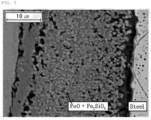
- an average thickness of the scale layer was measured by being imaged with an optical microscope to observe the scale layer, which was shown in Table 4 below.
- a content of FeO and Fe 2 SiO 4 in the scale layer were measured using a scanning electron microscope and EDS, which was shown in Table 4 below.
- the average ferrite grain size was measured using a line measurement method, and a point at which yielding occurs using a tensile tester was set to be a yield strength, and a strength when necking occurs was set to be tensile strength.
- a Charpy impact transition temperature an impact absorption energy was measured using a Charpy impact tester and a temperature at which fracture transitions from ductility to brittleness was shown.
- a surface of the steel sheet having an area of 1m 2 was observed with a naked eye, and then a peeling area of the scale layer was measured and evaluated according to the following criteria.
- a total content of FeO and Fe 2 SiO 4 in the scale layer satisfies a range of 2 to 5%, by wt%, and thereby, adhesion was excellent without peeling of the scale layer, so excellent surface properties were confirmed. It is determined that this is because SiO 2 formed at a boundary between the scale and a base material reacts with FeO to form Fe 2 SiO 4 (Fayalite), which increases binding force between the scale and the base material, resulting in a stable scale state.
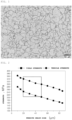
- FIG. 1 a photograph of a microstructure captured with an optical microscope is shown in FIG. 1 .
- the microstructure of the steel sheet is a ferrite single structure, and it could be confirmed that an average ferrite grain size was in a range of 20 to 50 ⁇ m.
- Comparative Example 1 a C content was less than a lower limit specified in the present disclosure, and a value of Free C was insufficient, resulting in continuous yield, and the yield strength was less than 205 MPa.
- Comparative Example 4 showed a case in which the manufacturing conditions of the present disclosure are all satisfied, but a Ti content exceeded an upper limit specified in the present disclosure, and in Comparative Example 5, the Charpy impact transition temperature exceeded -20°C due to the formation of coarse precipitates.
- Comparative Example 5 the yield strength was less than 205 MPa due to an insufficient Si content specified in the present disclosure, and a total content of FeO and Fe 2 SiO 4 in the scale layer was less than 2%, by wt%, confirming that the surface properties were deteriorated.
- a state in which the scale layer is peeled for Comparative Example 5 was shown in FIG. 4 .
Landscapes
- Chemical & Material Sciences (AREA)
- Engineering & Computer Science (AREA)
- Materials Engineering (AREA)
- Mechanical Engineering (AREA)
- Metallurgy (AREA)
- Organic Chemistry (AREA)
- Physics & Mathematics (AREA)
- Thermal Sciences (AREA)
- Crystallography & Structural Chemistry (AREA)
- Chemical Kinetics & Catalysis (AREA)
- Heat Treatment Of Steel (AREA)
Applications Claiming Priority (2)
| Application Number | Priority Date | Filing Date | Title |
|---|---|---|---|
| KR1020200179049A KR102488496B1 (ko) | 2020-12-18 | 2020-12-18 | 충격 인성이 우수한 제진 댐퍼용 강판 및 이의 제조방법 |
| PCT/KR2021/017872 WO2022131618A1 (fr) | 2020-12-18 | 2021-11-30 | Tôle d'acier pour amortisseur sismique ayant une propriété de ténacité supérieure et son procédé de fabrication |
Publications (2)
| Publication Number | Publication Date |
|---|---|
| EP4265762A1 true EP4265762A1 (fr) | 2023-10-25 |
| EP4265762A4 EP4265762A4 (fr) | 2025-07-23 |
Family
ID=82059213
Family Applications (1)
| Application Number | Title | Priority Date | Filing Date |
|---|---|---|---|
| EP21906923.4A Pending EP4265762A4 (fr) | 2020-12-18 | 2021-11-30 | Tôle d'acier pour amortisseur sismique ayant une propriété de ténacité supérieure et son procédé de fabrication |
Country Status (6)
| Country | Link |
|---|---|
| US (1) | US20240052451A1 (fr) |
| EP (1) | EP4265762A4 (fr) |
| JP (1) | JP7762721B2 (fr) |
| KR (1) | KR102488496B1 (fr) |
| CN (1) | CN116635552B (fr) |
| WO (1) | WO2022131618A1 (fr) |
Family Cites Families (18)
| Publication number | Priority date | Publication date | Assignee | Title |
|---|---|---|---|---|
| JP3411217B2 (ja) * | 1998-05-29 | 2003-05-26 | 新日本製鐵株式会社 | 母材および溶接部靭性の優れた降伏比の高い低降伏点鋼 |
| JP3774577B2 (ja) * | 1998-10-05 | 2006-05-17 | 新日本製鐵株式会社 | 制震デバイス用低降伏点鋼 |
| JP4177539B2 (ja) | 2000-03-28 | 2008-11-05 | 新日本製鐵株式会社 | レーザ溶接用鋼の製造方法 |
| JP4438600B2 (ja) * | 2004-10-28 | 2010-03-24 | 住友金属工業株式会社 | 熱延鋼帯およびその製造方法 |
| JP4705508B2 (ja) * | 2006-04-17 | 2011-06-22 | 新日本製鐵株式会社 | ダンパー用低降伏点鋼およびその製造方法 |
| ES2873923T3 (es) | 2007-02-09 | 2021-11-04 | Sekisui Chemical Co Ltd | Material de amortiguación de vibraciones y estructura de amortiguación de vibraciones |
| JP4705601B2 (ja) * | 2007-03-29 | 2011-06-22 | 新日本製鐵株式会社 | 靭性に優れたダンパー用低降伏点鋼およびその製造方法 |
| CN101775535B (zh) * | 2009-01-13 | 2012-03-28 | 宝山钢铁股份有限公司 | 160MPa级抗震用低屈服强度钢、钢板及其制造方法 |
| JP2011189394A (ja) * | 2010-03-16 | 2011-09-29 | Nisshin Steel Co Ltd | 表面性状に優れた熱延鋼板の製造方法 |
| JP5534319B2 (ja) * | 2010-03-25 | 2014-06-25 | 日新製鋼株式会社 | 酸洗性および加工性に優れた熱延鋼板の製造方法 |
| KR20120132839A (ko) * | 2011-05-30 | 2012-12-10 | 현대제철 주식회사 | 저항복비를 가지는 내진용 댐퍼강 및 그 제조방법 |
| JP6101132B2 (ja) * | 2012-04-20 | 2017-03-22 | 株式会社神戸製鋼所 | 耐水素誘起割れ性に優れた鋼材の製造方法 |
| KR101482359B1 (ko) * | 2012-12-27 | 2015-01-13 | 주식회사 포스코 | 극저온 인성이 우수하고 저항복비 특성을 갖는 고강도 강판 및 그의 제조방법 |
| CN103710622A (zh) * | 2013-12-20 | 2014-04-09 | 钢铁研究总院 | 屈服强度690MPa级低屈强比抗震钢及其制造方法 |
| CN108291282B (zh) * | 2016-04-20 | 2020-03-03 | 日本制铁株式会社 | 热轧钢板、钢材以及容器 |
| CN106636924B (zh) * | 2016-12-30 | 2018-04-03 | 武钢集团昆明钢铁股份有限公司 | 一种235MPa级别建筑结构用抗震热轧钢板、钢带及其制备方法 |
| CN110461487B (zh) * | 2017-04-07 | 2021-03-30 | 杰富意钢铁株式会社 | 黑皮热轧钢板及其制造方法 |
| CN209674071U (zh) * | 2019-04-24 | 2019-11-22 | 艾景奇 | 一种电力通信光缆引下线防冰冻保护管 |
-
2020
- 2020-12-18 KR KR1020200179049A patent/KR102488496B1/ko active Active
-
2021
- 2021-11-30 CN CN202180084766.0A patent/CN116635552B/zh active Active
- 2021-11-30 WO PCT/KR2021/017872 patent/WO2022131618A1/fr not_active Ceased
- 2021-11-30 US US18/267,674 patent/US20240052451A1/en active Pending
- 2021-11-30 EP EP21906923.4A patent/EP4265762A4/fr active Pending
- 2021-11-30 JP JP2023535596A patent/JP7762721B2/ja active Active
Also Published As
| Publication number | Publication date |
|---|---|
| WO2022131618A1 (fr) | 2022-06-23 |
| US20240052451A1 (en) | 2024-02-15 |
| JP7762721B2 (ja) | 2025-10-30 |
| CN116635552A (zh) | 2023-08-22 |
| CN116635552B (zh) | 2026-01-06 |
| EP4265762A4 (fr) | 2025-07-23 |
| KR102488496B1 (ko) | 2023-01-13 |
| JP2023554331A (ja) | 2023-12-27 |
| KR20220088225A (ko) | 2022-06-27 |
Similar Documents
| Publication | Publication Date | Title |
|---|---|---|
| EP2264205B1 (fr) | Tôle d'acier à haute résistance présentant une excellente ténacité à basse température, tuyau en acier et procédés pour la production des deux | |
| EP2272994A1 (fr) | Acier ayant une résistance à la traction élevée et son procédé de fabrication | |
| EP2623625B1 (fr) | Tôle d'acier pour tube de canalisation, présentant une excellente résistance à la fissuration sous hydrogène, et son procédé de préparation | |
| KR100799421B1 (ko) | 용접성이 우수한 490MPa급 저항복비 냉간성형강관 및 그제조방법 | |
| KR102379443B1 (ko) | 열간성형용 강재, 열간성형 부재 및 이들의 제조방법 | |
| EP3480332B1 (fr) | Plaque d'acier à haute résistance présentant d'excellentes caractéristiques de faible coefficient d'élasticité et une ténacité à basse température et son procédé de fabrication | |
| JP3499084B2 (ja) | 脆性き裂伝播停止特性に優れた建築用低降伏比高張力鋼材及びその製造方法 | |
| JPH1017982A (ja) | 耐破壊性能に優れた建築用低降伏比高張力鋼材及びその製造方法 | |
| JP7221475B6 (ja) | 延性及び低温靭性に優れた高強度鋼材及びその製造方法 | |
| JP4344073B2 (ja) | 高温強度に優れた高張力鋼およびその製造方法 | |
| KR20250011608A (ko) | 절삭성 및 충격인성이 우수한 비조질 선재 및 그 제조방법 | |
| JP3817887B2 (ja) | 高靭性高張力鋼およびその製造方法 | |
| KR100833076B1 (ko) | 저온인성과 취성균열전파정지특성이 우수한 고강도저항복비 구조용 강재 및 그 제조방법 | |
| JP7265008B2 (ja) | 水素誘起割れ抵抗性に優れた圧力容器用鋼材及びその製造方法 | |
| KR100711371B1 (ko) | 극저온 인성이 우수한 라인파이프용 후강판 및 그 제조방법 | |
| EP4438761A1 (fr) | Tôle d'acier laminée à chaud et son procédé de fabrication | |
| KR102255829B1 (ko) | 충격인성이 우수한 제진 댐퍼용 강재 및 이의 제조방법 | |
| KR102488496B1 (ko) | 충격 인성이 우수한 제진 댐퍼용 강판 및 이의 제조방법 | |
| KR100723156B1 (ko) | 변형능 및 취성파괴 정지 특성이 우수한 항복강도552MPa 급 라인파이프용 후강판 및 그 제조방법 | |
| KR100833075B1 (ko) | 저온인성과 취성균열전파정지특성이 우수한 고강도저항복비 구조용 강재 및 그 제조방법 | |
| JP3376195B2 (ja) | 板内均質性に優れかつ脆性亀裂伝播停止特性と溶接性を兼ね備えた高張力厚鋼板の製造方法 | |
| EP4261304A1 (fr) | Matériau d'acier pour amortisseur sismique présentant une grande résistance au choc et son procédé de fabrication | |
| EP4265795A1 (fr) | Plaque d'acier ultra-épaisse ayant une excellente ténacité à l'impact à basse température et son procédé de fabrication | |
| KR102181788B1 (ko) | 고강도 내진용 중탄소강 및 그 제조방법 | |
| KR100508513B1 (ko) | 저항복비를 보유한 고강도-고인성 라인파이프용 열연강재제조방법 |
Legal Events
| Date | Code | Title | Description |
|---|---|---|---|
| STAA | Information on the status of an ep patent application or granted ep patent |
Free format text: STATUS: THE INTERNATIONAL PUBLICATION HAS BEEN MADE |
|
| PUAI | Public reference made under article 153(3) epc to a published international application that has entered the european phase |
Free format text: ORIGINAL CODE: 0009012 |
|
| STAA | Information on the status of an ep patent application or granted ep patent |
Free format text: STATUS: REQUEST FOR EXAMINATION WAS MADE |
|
| 17P | Request for examination filed |
Effective date: 20230627 |
|
| AK | Designated contracting states |
Kind code of ref document: A1 Designated state(s): AL AT BE BG CH CY CZ DE DK EE ES FI FR GB GR HR HU IE IS IT LI LT LU LV MC MK MT NL NO PL PT RO RS SE SI SK SM TR |
|
| DAV | Request for validation of the european patent (deleted) | ||
| DAX | Request for extension of the european patent (deleted) | ||
| REG | Reference to a national code |
Ref country code: DE Ref legal event code: R079 Free format text: PREVIOUS MAIN CLASS: C22C0038000000 Ipc: C21D0008020000 |
|
| A4 | Supplementary search report drawn up and despatched |
Effective date: 20250624 |
|
| RIC1 | Information provided on ipc code assigned before grant |
Ipc: C21D 8/02 20060101AFI20250617BHEP Ipc: C21D 9/46 20060101ALI20250617BHEP Ipc: C22C 38/02 20060101ALI20250617BHEP Ipc: C22C 38/04 20060101ALI20250617BHEP Ipc: C22C 38/12 20060101ALI20250617BHEP Ipc: C22C 38/14 20060101ALI20250617BHEP Ipc: C23C 8/10 20060101ALI20250617BHEP |