EP4250371A1 - Semiconductor device - Google Patents
Semiconductor device Download PDFInfo
- Publication number
- EP4250371A1 EP4250371A1 EP22194298.0A EP22194298A EP4250371A1 EP 4250371 A1 EP4250371 A1 EP 4250371A1 EP 22194298 A EP22194298 A EP 22194298A EP 4250371 A1 EP4250371 A1 EP 4250371A1
- Authority
- EP
- European Patent Office
- Prior art keywords
- region
- concentration
- silicon carbide
- type
- face
- Prior art date
- Legal status (The legal status is an assumption and is not a legal conclusion. Google has not performed a legal analysis and makes no representation as to the accuracy of the status listed.)
- Pending
Links
Images




Classifications
-
- H—ELECTRICITY
- H10—SEMICONDUCTOR DEVICES; ELECTRIC SOLID-STATE DEVICES NOT OTHERWISE PROVIDED FOR
- H10D—INORGANIC ELECTRIC SEMICONDUCTOR DEVICES
- H10D30/00—Field-effect transistors [FET]
- H10D30/60—Insulated-gate field-effect transistors [IGFET]
- H10D30/64—Double-diffused metal-oxide semiconductor [DMOS] FETs
- H10D30/66—Vertical DMOS [VDMOS] FETs
-
- H—ELECTRICITY
- H10—SEMICONDUCTOR DEVICES; ELECTRIC SOLID-STATE DEVICES NOT OTHERWISE PROVIDED FOR
- H10D—INORGANIC ELECTRIC SEMICONDUCTOR DEVICES
- H10D12/00—Bipolar devices controlled by the field effect, e.g. insulated-gate bipolar transistors [IGBT]
- H10D12/01—Manufacture or treatment
- H10D12/031—Manufacture or treatment of IGBTs
-
- H—ELECTRICITY
- H10—SEMICONDUCTOR DEVICES; ELECTRIC SOLID-STATE DEVICES NOT OTHERWISE PROVIDED FOR
- H10D—INORGANIC ELECTRIC SEMICONDUCTOR DEVICES
- H10D62/00—Semiconductor bodies, or regions thereof, of devices having potential barriers
- H10D62/10—Shapes, relative sizes or dispositions of the regions of the semiconductor bodies; Shapes of the semiconductor bodies
- H10D62/102—Constructional design considerations for preventing surface leakage or controlling electric field concentration
- H10D62/103—Constructional design considerations for preventing surface leakage or controlling electric field concentration for increasing or controlling the breakdown voltage of reverse-biased devices
- H10D62/105—Constructional design considerations for preventing surface leakage or controlling electric field concentration for increasing or controlling the breakdown voltage of reverse-biased devices by having particular doping profiles, shapes or arrangements of PN junctions; by having supplementary regions, e.g. junction termination extension [JTE]
- H10D62/108—Constructional design considerations for preventing surface leakage or controlling electric field concentration for increasing or controlling the breakdown voltage of reverse-biased devices by having particular doping profiles, shapes or arrangements of PN junctions; by having supplementary regions, e.g. junction termination extension [JTE] having localised breakdown regions, e.g. built-in avalanching regions
-
- H—ELECTRICITY
- H10—SEMICONDUCTOR DEVICES; ELECTRIC SOLID-STATE DEVICES NOT OTHERWISE PROVIDED FOR
- H10D—INORGANIC ELECTRIC SEMICONDUCTOR DEVICES
- H10D62/00—Semiconductor bodies, or regions thereof, of devices having potential barriers
- H10D62/10—Shapes, relative sizes or dispositions of the regions of the semiconductor bodies; Shapes of the semiconductor bodies
- H10D62/124—Shapes, relative sizes or dispositions of the regions of semiconductor bodies or of junctions between the regions
- H10D62/126—Top-view geometrical layouts of the regions or the junctions
- H10D62/127—Top-view geometrical layouts of the regions or the junctions of cellular field-effect devices, e.g. multicellular DMOS transistors or IGBTs
-
- H—ELECTRICITY
- H10—SEMICONDUCTOR DEVICES; ELECTRIC SOLID-STATE DEVICES NOT OTHERWISE PROVIDED FOR
- H10D—INORGANIC ELECTRIC SEMICONDUCTOR DEVICES
- H10D62/00—Semiconductor bodies, or regions thereof, of devices having potential barriers
- H10D62/10—Shapes, relative sizes or dispositions of the regions of the semiconductor bodies; Shapes of the semiconductor bodies
- H10D62/13—Semiconductor regions connected to electrodes carrying current to be rectified, amplified or switched, e.g. source or drain regions
- H10D62/149—Source or drain regions of field-effect devices
- H10D62/151—Source or drain regions of field-effect devices of IGFETs
- H10D62/156—Drain regions of DMOS transistors
- H10D62/157—Impurity concentrations or distributions
-
- H—ELECTRICITY
- H10—SEMICONDUCTOR DEVICES; ELECTRIC SOLID-STATE DEVICES NOT OTHERWISE PROVIDED FOR
- H10D—INORGANIC ELECTRIC SEMICONDUCTOR DEVICES
- H10D62/00—Semiconductor bodies, or regions thereof, of devices having potential barriers
- H10D62/10—Shapes, relative sizes or dispositions of the regions of the semiconductor bodies; Shapes of the semiconductor bodies
- H10D62/17—Semiconductor regions connected to electrodes not carrying current to be rectified, amplified or switched, e.g. channel regions
- H10D62/393—Body regions of DMOS transistors or IGBTs
-
- H—ELECTRICITY
- H10—SEMICONDUCTOR DEVICES; ELECTRIC SOLID-STATE DEVICES NOT OTHERWISE PROVIDED FOR
- H10D—INORGANIC ELECTRIC SEMICONDUCTOR DEVICES
- H10D62/00—Semiconductor bodies, or regions thereof, of devices having potential barriers
- H10D62/80—Semiconductor bodies, or regions thereof, of devices having potential barriers characterised by the materials
- H10D62/83—Semiconductor bodies, or regions thereof, of devices having potential barriers characterised by the materials being Group IV materials, e.g. B-doped Si or undoped Ge
- H10D62/832—Semiconductor bodies, or regions thereof, of devices having potential barriers characterised by the materials being Group IV materials, e.g. B-doped Si or undoped Ge being Group IV materials comprising two or more elements, e.g. SiGe
- H10D62/8325—Silicon carbide
-
- H—ELECTRICITY
- H10—SEMICONDUCTOR DEVICES; ELECTRIC SOLID-STATE DEVICES NOT OTHERWISE PROVIDED FOR
- H10D—INORGANIC ELECTRIC SEMICONDUCTOR DEVICES
- H10D84/00—Integrated devices formed in or on semiconductor substrates that comprise only semiconducting layers, e.g. on Si wafers or on GaAs-on-Si wafers
- H10D84/101—Integrated devices comprising main components and built-in components, e.g. IGBT having built-in freewheel diode
- H10D84/141—VDMOS having built-in components
- H10D84/146—VDMOS having built-in components the built-in components being Schottky barrier diodes
Definitions
- Embodiments described herein relate generally to a semiconductor device.
- Silicon carbide is expected as a material for next-generation semiconductor devices.
- Silicon carbide has physical properties such as a band gap, a breakdown field strength, and a thermal conductivity that are about 3 times, about 10 times, and about 3 times better than those of silicon, respectively.
- a metal oxide semiconductor field effect transistor MOSFET capable of operating at a high breakdown voltage, a low loss, and a high temperature can be realized.
- a semiconductor device of an embodiment includes: a silicon carbide layer having a first face and a second face facing the first face; a first silicon carbide region of a first conductive type provided in the silicon carbide layer, the first silicon carbide region including a first region, a second region, and a third region, the second region is disposed between the first region and the first face, the third region is disposed between the first region and the first face, a first-conductivity type impurity concentration in the second region is equal to or higher than a first-conductivity type impurity concentration in the first region, and a first-conductivity type impurity concentration in the third region is higher than the first-conductivity type impurity concentration in the second region; a second silicon carbide region of a second conductive type provided in the silicon carbide layer and disposed between the first silicon carbide region and the first face, the second silicon carbide region including a fourth region and a fifth region, the fourth region is in contact with the second region, the fifth region is in contact with the third region,
- n ++ indicates an n-type impurity concentration relatively higher than that of n +
- n + indicates an n-type impurity concentration relatively higher than that of n
- n - indicates an n-type impurity concentration relatively lower than that of n.
- p ++ indicates a p-type impurity concentration relatively higher than that of p +
- p + indicates a p-type impurity concentration relatively higher than that of p
- p - indicates a p-type impurity concentration relatively lower than that of p.
- an n + -type and an n - -type may be simply referred to as an n-type
- a p + - type and a p - - type may be simply referred to as a p-type.
- An impurity concentration can be measured by, for example, secondary ion mass spectrometry (SIMS).
- SIMS secondary ion mass spectrometry
- a relative level of the impurity concentration can also be determined from a level of a carrier concentration obtained by, for example, scanning capacitance microscopy (SCM).
- SCM scanning capacitance microscopy
- a distance such as a width or a depth of an impurity region can be obtained by, for example, SIMS.
- the distance such as the width or the depth of the impurity region can be obtained from, for example, an SCM image or a scanning electron microscope (SEM) image.
- a thickness or the like of an insulating layer can be measured on, for example, an SIMS, SEM, or transmission electron microscope (TEM) image.
- a "p-type impurity concentration" in a p-type silicon carbide region means a net p-type impurity concentration obtained by subtracting an n-type impurity concentration in the corresponding region from the p-type impurity concentration in the corresponding region.
- an "n-type impurity concentration" in an n-type silicon carbide region means a net n-type impurity concentration obtained by subtracting a p-type impurity concentration in the corresponding region from the n-type impurity concentration in the corresponding region.
- the impurity concentration in a specific region is represented by the impurity concentration at the central portion of the corresponding region.
- a semiconductor device of a first embodiment includes: a silicon carbide layer having a first face and a second face facing the first face; a first silicon carbide region of a first conductive type provided in the silicon carbide layer, the first silicon carbide region including a first region, a second region, and a third region, the second region is disposed between the first region and the first face, the third region is disposed between the first region and the first face, a first-conductivity type impurity concentration in the second region is equal to or higher than a first-conductivity type impurity concentration in the first region, and a first-conductivity type impurity concentration in the third region is higher than the first-conductivity type impurity concentration in the second region; a second silicon carbide region of a second conductive type provided in the silicon carbide layer and disposed between the first silicon carbide region and the first face, the second silicon carbide region including a fourth region and a fifth region, the fourth region is in contact with the second region, the fifth region is in contact with the third
- the semiconductor device of the first embodiment is a vertical metal oxide semiconductor field effect transistor (MOSFET) 100 of a planar gate type using silicon carbide.
- MOSFET 100 of the first embodiment is, for example, a double implantation MOSFET (DIMOSFET) in which a body region and a source region are formed by ion implantation.
- DIMOSFET double implantation MOSFET
- the MOSFET 100 is a MOSFET of a vertical n-channel type using electrons as carriers.
- FIG. 1 is a schematic cross-sectional view of the semiconductor device of the first embodiment.
- FIGS. 2 and 3 are schematic top views of the semiconductor device of the first embodiment.
- FIG. 2 is a schematic view illustrating patterns of gate electrodes and impurity regions formed on an upper face of the silicon carbide layer.
- FIG. 3 is a schematic view illustrating the patterns of the impurity regions formed on the upper face of the silicon carbide layer excluding the gate electrodes from FIG. 2 .
- FIG. 1 is a cross-sectional view taken along line AA' of FIGS. 2 and 3 .
- the MOSFET 100 includes a silicon carbide layer 10, a source electrode 12 (first electrode), a drain electrode 14 (second electrode), a first gate insulating layer 16a, a second gate insulating layer 16b, a third gate insulating layer 16c, a first gate electrode 18a, a second gate electrode 18b, a third gate electrode 18c, and an interlayer insulating layer 20.
- the source electrode 12 has a contact electrode portion 12x (first portion).
- an n + -type drain region 22 an n-type drift region 24 (first silicon carbide region), a p-type body region 26 (second silicon carbide region), and an n ++ -type source region 30 (third silicon carbide region) are provided.
- the n-type drift region 24 includes an n - -type lower region 24x (first region), an n-type first low-concentration n region 24y1 (second region), an n-type second low-concentration n region 24y2 (sixth region), an n-type third low-concentration n region 24y3, an n + -type first high-concentration n region 24z1 (third region), and an n + -type second high-concentration n region 24z2 (seventh region).
- the p-type body region 26 includes a p-type first low-concentration p region 26x1 (fourth region), a p-type second low-concentration p region 26x2 (eighth region), a p-type third low-concentration p region 26x3, a p + -type first high-concentration p region 26y1 (fifth region), a p + -type second high-concentration p region 26y2 (ninth region), and a p ++ -type contact region 26z (tenth region).
- the silicon carbide layer 10 is provided between the source electrode 12 and the drain electrode 14.
- the silicon carbide layer 10 is single crystal SiC.
- the silicon carbide layer 10 is, for example, 4H-SiC.
- the silicon carbide layer 10 has a first face ("F1" in FIG. 1 ) and a second face ("F2" in FIG. 1 ).
- first face F1 may be referred to as a surface
- second face F2 may be referred to as a back surface.
- the first face F1 is disposed on a side of the silicon carbide layer 10 close to the source electrode 12.
- the second face F2 is disposed on a side of the silicon carbide layer 10 close to the drain electrode 14.
- the first face F1 and the second face F2 face each other.
- a "depth" refers to a depth in a direction toward the second face based on the first face.
- a first direction and a second direction are parallel to the first face F1.
- the second direction is perpendicular to the first direction.
- a direction from the first face F1 to the second face F2 is a third direction.
- the third direction is perpendicular to the first direction and the second direction.
- the first face F1 is, for example, a face inclined at equal to or more than 0° and equal to or less than 8° with respect to a (0001) face.
- the second face F2 is, for example, a face inclined at equal to or more than 0° and equal to or less than 8° with respect to a (000-1) face.
- the (0001) face is referred to as a silicon face.
- the (000-1) face is referred to as a carbon face.
- the n + -type drain region 22 is provided on the back surface of the silicon carbide layer 10.
- the drain region 22 contains, for example, nitrogen (N) as n-type impurities.
- An n-type impurity concentration in the drain region 22 is, for example, equal to or more than 1 ⁇ 10 18 cm -3 and equal to or less than 1 ⁇ 10 21 cm -3 .
- the n-type drift region 24 is provided between the drain region 22 and the first face F1.
- the n-type drift region 24 is provided between the source electrode 12 and the drain electrode 14.
- the n-type drift region 24 is provided on the drain region 22.
- the drift region 24 contains, for example, nitrogen (N) as n-type impurities.
- An n-type impurity concentration in the drift region 24 is lower than the n-type impurity concentration in the drain region 22.
- a thickness of the drift region 24 is, for example, equal to or more than 3 ⁇ m and equal to or less than 150 ⁇ m.
- the drift region 24 includes an n - -type lower region 24x (first region), an n-type first low-concentration n region 24y1 (second region), an n-type second low-concentration n region 24y2 (sixth region), an n-type third low-concentration n region 24y3, an n + -type first high-concentration n region 24z1 (third region), and an n + -type second high-concentration n region 24z2 (seventh region).
- the n - -type lower region 24x is provided on a side of the drift region 24 close to the second face F2.
- the lower region 24x is in contact with the drain region 22.
- the lower region 24x contains, for example, nitrogen (N) as n-type impurities.
- An n-type impurity concentration in the lower region 24x is, for example, equal to or more than 4 ⁇ 10 14 cm -3 and equal to or less than 1 ⁇ 1017 cm -3 .
- the n-type first low-concentration n region 24y1, the n-type second low-concentration n region 24y2, and the n-type third low-concentration n region 24y3 are disposed between the lower region 24x and the first face F1.
- the first low-concentration n region 24y1, the second low-concentration n region 24y2, and the third low-concentration n region 24y3 are disposed between the lower region 24x and the body region 26.
- the first low-concentration n region 24y1, the second low-concentration n region 24y2, and the third low-concentration n region 24y3 are in contact with the body region 26.
- the first low-concentration n region 24y1, the second low-concentration n region 24y2, and the third low-concentration n region 24y3 extend in the first direction.
- the first low-concentration n region 24y1, the second low-concentration n region 24y2, and the third low-concentration n region 24y3 contain, for example, nitrogen (N) as n-type impurities.
- An n-type impurity concentration in each of the first low-concentration n region 24y1, the second low-concentration n region 24y2, and the third low-concentration n region 24y3 is equal to or higher than the n-type impurity concentration in the lower region 24x.
- the n-type impurity concentration in each of the first low-concentration n region 24y1, the second low-concentration n region 24y2, and the third low-concentration n region 24y3 is equal to or more than 4 ⁇ 10 14 cm -3 and equal to or less than 2 ⁇ 1017 cm -3 .
- the n + -type first high-concentration n region 24z1 and the n + -type second high-concentration n region 24z2 are disposed between the lower region 24x and the first face F1.
- the first high-concentration n region 24z1 and the second high-concentration n region 24z2 are disposed between the lower region 24x and the body region 26.
- the first high-concentration n region 24z1 and the second high-concentration n region 24z2 are in contact with the body region 26.
- the first high-concentration n region 24z1 and the second high-concentration n region 24z2 extend in the first direction.
- the first high-concentration n region 24z1 is disposed between the first low-concentration n region 24y1 and the second low-concentration n region 24y2.
- the second high-concentration n region 24z2 is disposed between the second low-concentration n region 24y2 and the third low-concentration n region 24y3.
- the first high-concentration n region 24z1 and the second high-concentration n region 24z2 contain, for example, nitrogen (N) as n-type impurities.
- An n-type impurity concentration in each of the first high-concentration n region 24z1 and the second high-concentration n region 24z2 is higher than the n-type impurity concentration in each of the first low-concentration n region 24y1, the second low-concentration n region 24y2, and the third low-concentration n region 24y3.
- the n-type impurity concentration in each of the first high-concentration n region 24z1 and the second high-concentration n region 24z2 is, for example, equal to or more than 1.5 times and equal to or less than 10 times the n-type impurity concentration in each of the first low-concentration n region 24y1, the second low-concentration n region 24y2, and the third low-concentration n region 24y3.
- the n-type impurity concentration in each of the first high-concentration n region 24z1 and the second high-concentration n region 24z2 is, for example, equal to or more than 1 ⁇ 10 15 cm -3 and equal to or less than 2 ⁇ 10 17 cm -3 .
- the p-type body region 26 is provided between the drift region 24 and the first face F1.
- the body region 26 extends in the first direction.
- the body region 26 functions as a channel region of the MOSFET 100.
- a part of the body region 26 is in contact with the first face F1.
- the part of the body region 26 faces the first gate electrode 18a, the second gate electrode 18b, and the third gate electrode 18c.
- the part of the body region 26 serves as the channel region of the MOSFET 100.
- the body region 26 contains, for example, aluminum (Al) as p-type impurities.
- a depth of the body region 26 is, for example, equal to or more than 500 nm and equal to or less than 900 nm.
- the body region 26 is electrically connected to the source electrode 12.
- the body region 26 is fixed to an electric potential of the source electrode 12.
- the body region 26 includes a p-type first low-concentration p region 26x1 (fourth region), a p-type second low-concentration p region 26x2 (eighth region), a p-type third low-concentration p region 26x3, a p + -type first high-concentration p region 26y1 (fifth region), a p + -type second high-concentration p region 26y2 (ninth region), and a p ++ -type contact region 26z (tenth region).
- the first low-concentration p region 26x1 is in contact with the first low-concentration n region 24y1.
- the first low-concentration p region 26x1 is disposed in the third direction of the first low-concentration n region 24y1.
- the second low-concentration p region 26x2 is in contact with the second low-concentration n region 24y2.
- the second low-concentration p region 26x2 is disposed in the third direction of the second low-concentration n region 24y2.
- the third low-concentration p region 26x3 is in contact with the third low-concentration n region 24y3.
- the third low-concentration p region 26x3 is disposed in the third direction of the third low-concentration n region 24y3.
- the first low-concentration p region 26x1, the second low-concentration p region 26x2, and the third low-concentration p region 26x3 contain, for example, aluminum (Al) as p-type impurities.
- a p-type impurity concentration in each of the first low-concentration p region 26x1, the second low-concentration p region 26x2, and the third low-concentration p region 26x3 is, for example, equal to or more than 5 ⁇ 10 16 cm -3 and equal to or less than 5 ⁇ 10 19 cm -3 .
- the first high-concentration p region 26y1 is in contact with the first high-concentration n region 24z1.
- the first high-concentration p region 26y1 is disposed in the third direction of the first high-concentration n region 24z1.
- the first high-concentration p region 26y1 is disposed between the first low-concentration p region 26x1 and the second low-concentration p region 26x2.
- the first high-concentration p region 26y1 is disposed, for example, in the third direction of the contact electrode portion 12x.
- the first high-concentration p region 26y1 is disposed, for example, directly below the contact electrode portion 12x.
- the first high-concentration p region 26y1 is disposed, for example, in the third direction of the contact region 26z.
- the first high-concentration p region 26y1 is disposed, for example, directly below the contact region 26z.
- the first high-concentration p region 26y1 is in contact with, for example, the contact region 26z.
- the second high-concentration p region 26y2 is in contact with the second high-concentration n region 24z2.
- the second high-concentration p region 26y2 is disposed in the third direction of the second high-concentration n region 24z2.
- the second high-concentration p region 26y2 is disposed between the second low-concentration p region 26x2 and the third low-concentration p region 26x3.
- the second high-concentration p region 26y2 is disposed, for example, in the third direction of the contact electrode portion 12x.
- the second high-concentration p region 26y2 is disposed, for example, directly below the contact electrode portion 12x.
- the second high-concentration p region 26y2 is disposed, for example, in the third direction of the contact region 26z.
- the second high-concentration p region 26y2 is disposed, for example, directly below the contact region 26z.
- the second high-concentration p region 26y2 is in contact with, for example, the contact region 26z.
- the first high-concentration p region 26y1 and the second high-concentration p region 26y2 contain, for example, aluminum (Al) as p-type impurities.
- a p-type impurity concentration in each of the first high-concentration p region 26y1 and the second high-concentration p region 26y2 is higher than the p-type impurity concentration in each of the first low-concentration p region 26x1, the second low-concentration p region 26x2, and the third low-concentration p region 26x3.
- the p-type impurity concentration in each of the first high-concentration p region 26y1 and the second high-concentration p region 26y2 is, for example, equal to or more than 1.5 times and equal to or less than 10 times the p-type impurity concentration in each of the first low-concentration p region 26x1, the second low-concentration p region 26x2, and the third low-concentration p region 26x3.
- the p-type impurity concentration in each of the first high-concentration p region 26y1 and the second high-concentration p region 26y2 is, for example, equal to or more than 5 ⁇ 10 16 cm -3 and equal to or less than 1 ⁇ 10 20 cm -3 .
- the p ++ -type contact region 26z is positioned between the first high-concentration p region 26y1 and the first face F1.
- the contact region 26z is positioned between the first high-concentration p region 26y1 and the source electrode 12.
- the contact region 26z is positioned between the first high-concentration p region 26y1 and the contact electrode portion 12x of the source electrode 12.
- the contact region 26z is disposed, for example, in the third direction of the first high-concentration p region 26y1.
- the contact region 26z is in contact with the first high-concentration p region 26y1.
- the contact region 26z is positioned between the second high-concentration p region 26y2 and the first face F1.
- the contact region 26z is positioned between the second high-concentration p region 26y2 and the source electrode 12.
- the contact region 26z is positioned between the second high-concentration p region 26y2 and the contact electrode portion 12x of the source electrode 12.
- the contact region 26z is disposed, for example, in the third direction of the second high-concentration p region 26y2.
- the contact region 26z is in contact with the second high-concentration p region 26y2.
- the contact region 26z is in contact with the source electrode 12.
- the contact region 26z is electrically connected to the source electrode 12.
- the contact between the contact region 26z and the source electrode 12 is, for example, an ohmic contact.
- the contact region 26z is fixed to the electric potential of the source electrode 12.
- the contact region 26z is in contact with the contact electrode portion 12x of the source electrode 12.
- a depth of the contact region 26z is, for example, equal to or more than 200 nm and equal to or less than 500 nm.
- the contact region 26z contains, for example, aluminum (Al) as p-type impurities.
- a p-type impurity concentration in the contact region 26z is higher than the p-type impurity concentration in each of the first high-concentration p region 26y1 and the second high-concentration p region 26y2.
- the p-type impurity concentration in the contact region 26z is, for example, equal to or more than 1 ⁇ 10 19 cm -3 and equal to or less than 5 ⁇ 10 21 cm -3 .
- the n + -type source region 30 is provided between the body region 26 and the first face F1.
- the source region 30 is provided, for example, between the first low-concentration p region 26x1 and the first face F1.
- the source region 30 is provided, for example, between the first high-concentration p region 26y1 and the first face F1.
- the source region 30 is provided, for example, between the third low-concentration p region 26x3 and the first face F1.
- the source region 30 is provided, for example, between the second high-concentration p region 26y2 and the first face F1.
- the source region 30 contains, for example, phosphorus (P) or nitrogen (N) as n-type impurities.
- An n-type impurity concentration in the source region 30 is higher than the n-type impurity concentration in the drift region 24.
- the n-type impurity concentration in the source region 30 is, for example, equal to or more than 1 ⁇ 10 19 cm -3 and equal to or less than 5 ⁇ 10 21 cm -3 .
- a depth of the source region 30 is shallower than the depth of the body region 26.
- the depth of the source region 30 is, for example, equal to or more than 80 nm and equal to or less than 200 nm.
- the source region 30 is in contact with the source electrode 12.
- the source region 30 is electrically connected to the source electrode 12.
- the contact between the source region 30 and the source electrode 12 is, for example, an ohmic contact.
- the source region 30 is fixed to the electric potential of the source electrode 12.
- the source region 30 is in contact with the contact electrode portion 12x of the source electrode 12.
- the first gate electrode 18a is provided on a side of the first face F1 of the silicon carbide layer 10.
- the first gate electrode 18a extends in the first direction.
- the first gate electrode 18a faces the body region 26 provided on the first face F1.
- the second gate electrode 18b is provided on the side of the first face F1 of the silicon carbide layer 10.
- the second gate electrode 18b extends in the first direction.
- the second gate electrode 18b is provided in the second direction with respect to the first gate electrode 18a.
- the second gate electrode 18b faces the body region 26 provided on the first face F1.
- the third gate electrode 18c is provided on the side of the first face F1 of the silicon carbide layer 10.
- the third gate electrode 18c extends in the first direction.
- the third gate electrode 18c is provided in the second direction with respect to the second gate electrode 18b.
- the second gate electrode 18b is provided between the first gate electrode 18a and the third gate electrode 18c.
- the third gate electrode 18c faces the body region 26 provided on the first face F1.
- the first gate electrode 18a, the second gate electrode 18b, and the third gate electrode 18c are conductive layers.
- the first gate electrode 18a, the second gate electrode 18b, and the third gate electrode 18c are, for example, polycrystalline silicon containing p-type impurities or n-type impurities.
- the first gate insulating layer 16a is provided between the first gate electrode 18a and the body region 26.
- the second gate insulating layer 16b is provided between the second gate electrode 18b and the body region 26.
- the third gate insulating layer 16c is provided between the third gate electrode 18c and the body region 26.
- the first gate insulating layer 16a, the second gate insulating layer 16b, and the third gate insulating layer 16c contain, for example, silicon oxide.
- Each of the first gate insulating layer 16a, the second gate insulating layer 16b, and the third gate insulating layer 16c includes, for example, a silicon oxide layer.
- a high dielectric constant insulating material can be applied to each of the first gate insulating layer 16a, the second gate insulating layer 16b, and the third gate insulating layer 16c.
- a stacked structure of a silicon oxide layer and a high dielectric constant insulating layer can be applied to each of the first gate insulating layer 16a, the second gate insulating layer 16b, and the third gate insulating layer 16c.
- a thickness of each of the first gate insulating layer 16a, the second gate insulating layer 16b, and the third gate insulating layer 16c is, for example, equal to or more than 30 nm and equal to or less than 100 nm.
- the interlayer insulating layer 20 is provided on the first gate electrode 18a, the second gate electrode 18b, and the third gate electrode 18c.
- the interlayer insulating layer 20 is provided between the first gate electrode 18a and the source electrode 12, between the second gate electrode 18b and the source electrode 12, and between the third gate electrode 18c and the source electrode 12.
- the interlayer insulating layer 20 electrically isolates the first gate electrode 18a from the source electrode 12, the second gate electrode 18b from the source electrode 12, and the third gate electrode 18c from the source electrode 12.
- the interlayer insulating layer 20 contains, for example, silicon oxide.
- the interlayer insulating layer 20 is, for example, a silicon oxide layer.
- the source electrode 12 is provided on the side of the first face F1 of the silicon carbide layer 10. The source electrode 12 is in contact with the silicon carbide layer 10. The source electrode 12 is in contact with the contact region 26z and the source region 30.
- the source electrode 12 has the contact electrode portion 12x.
- the contact electrode portion 12x is provided between the first gate electrode 18a and the second gate electrode 18b.
- the contact electrode portion 12x is in contact with the contact region 26z and the source region 30.
- the source electrode 12 contains a metal.
- the source electrode 12 has, for example, a stacked structure of a barrier metal film and a metal film.
- the barrier metal film contains, for example, titanium (Ti), tungsten (W), or tantalum (Ta).
- the barrier metal film is, for example, a titanium film, a titanium nitride film, a tungsten nitride film, or a tantalum nitride film.
- the metal film contains, for example, aluminum (Al).
- the metal film is, for example, an aluminum film.
- the contact electrode portion 12x of the source electrode 12 includes, for example, a metal silicide layer.
- the metal silicide layer is in contact with, for example, the contact region 26z.
- the metal silicide layer is in contact with, for example, the source region 30.
- the metal silicide layer contains, for example, nickel (Ni), titanium (Ti), or cobalt (Co).
- the metal silicide layer is, for example, a nickel silicide layer, a titanium silicide layer, or a cobalt silicide layer.
- the drain electrode 14 is provided on a side of the second face F2 of the silicon carbide layer 10.
- the drain electrode 14 is provided on the second face F2 of the silicon carbide layer 10.
- the drain electrode 14 is in contact with the second face F2.
- the drain electrode 14 contains, for example, a metal or a metal semiconductor compound.
- the drain electrode 14 includes, for example, a nickel silicide layer, a titanium layer, a nickel layer, a silver layer, or a gold layer.
- the drain electrode 14 is electrically connected to the drain region 22.
- the drain electrode 14 is in contact with, for example, the drain region 22.
- FIG. 4 is a schematic cross-sectional view of a semiconductor device of a comparative example.
- FIG. 4 is a view corresponding to FIG. 1 of the first embodiment.
- the semiconductor device of the comparative example is a MOSFET 900 of a planar gate type using silicon carbide.
- the MOSFET 900 is different from the MOSFET 100 of the first embodiment in that an n-type drift region 24 does not include an n + -type first high-concentration n region 24z1 and an n + -type second high-concentration n region 24z2.
- the MOSFET 900 is different from the MOSFET 100 of the first embodiment in that a p-type body region 26 does not include a p + -type first high-concentration p region 26y1 and a p + -type second high-concentration p region 26y2.
- avalanche breakdown occurs at a pn junction, and an avalanche current flows.
- avalanche current flows, for example, a temperature of the MOSFET is increased, such that the MOSFET may be broken.
- avalanche resistance a current or energy allowed by the MOSFET is referred to as avalanche resistance.
- a breakdown voltage of the pn junction between the p-type body region 26 and the n-type drift region 24 provided in a cell portion is too high, such that the reverse bias voltage at which avalanche breakdown occurs is increased, and the avalanche resistance may be decreased.
- the avalanche resistance is decreased. This is because an area of the termination region is smaller than an area of the cell portion. Therefore, a current to flow through the MOSFET 900 is limited.
- the n-type drift region 24 includes the n + -type first high-concentration n region 24z1 and the n + -type second high-concentration n region 24z2.
- the p-type body region 26 includes the p + -type first high-concentration p region 26y1 and the p + -type second high-concentration p region 26y2.
- the MOSFET 100 includes a pn junction formed in the n + -type first high-concentration n region 24z1 and the p + -type first high-concentration p region 26y1, and a pn junction formed in the n + -type second high-concentration n region 24z2 and the p + -type second high-concentration p region 26y2. Since the MOSFET 100 partially includes a pn junction having a high impurity concentration in the cell portion, avalanche breakdown easily occurs in the cell portion. Therefore, the avalanche resistance of the MOSFET 100 is improved.
- the avalanche resistance is improved.
- the first high-concentration p region 26y1 is preferably disposed in the third direction of the contact region 26z.
- the first high-concentration p region 26y1 is preferably disposed directly below the contact region 26z.
- the first high-concentration p region 26y1 is preferably in contact with the contact region 26z.
- the second high-concentration p region 26y2 is preferably disposed in the third direction of the contact region 26z.
- the second high-concentration p region 26y2 is preferably disposed directly below the contact region 26z.
- the second high-concentration p region 26y2 is preferably in contact with the contact region 26z.
- the p-type impurity concentration in each of the first high-concentration p region 26y1 and the second high-concentration p region 26y2 is preferably equal to or more than 1.5 times and more preferably equal to or more than 2 times the p-type impurity concentration in each of the first low-concentration p region 26x1, the second low-concentration p region 26x2, and the third low-concentration p region 26x3.
- FIG. 5 is a schematic cross-sectional view of a semiconductor device of a modification of the first embodiment.
- FIG. 5 is a view corresponding to FIG. 1 of the first embodiment.
- the semiconductor device of the modification is a MOSFET 101 of a planar gate type using silicon carbide.
- the MOSFET 101 is different from the MOSFET 100 of the first embodiment in that an n-type drift region 24 does not include an n-type second low-concentration n region 24y2 and an n + -type second high-concentration n region 24z2.
- the MOSFET 101 is different from the MOSFET 100 of the first embodiment in that a p-type body region 26 does not include a p-type second low-concentration p region 26x2 and a p + -type second high-concentration p region 26y2.
- Avalanche resistance of the MOSFET 101 is improved by the same function as that of the MOSFET 100 of the first embodiment.
- a semiconductor device of a second embodiment is different from the semiconductor device of the first embodiment in that a first silicon carbide region further includes an eleventh region in contact with a first face, a first electrode further has a second portion in contact with the eleventh region, the second portion is provided between a first gate electrode and a second gate electrode, and the second portion is disposed in a first direction of a first portion.
- a first silicon carbide region further includes an eleventh region in contact with a first face
- a first electrode further has a second portion in contact with the eleventh region
- the second portion is provided between a first gate electrode and a second gate electrode
- the second portion is disposed in a first direction of a first portion.
- the semiconductor device of the second embodiment is a vertical MOSFET 200 of a planar gate type using silicon carbide.
- the MOSFET 200 of the second embodiment is a DIMOSFET.
- the MOSFET 200 of the second embodiment includes a schottky barrier diode (SBD) as a built-in diode.
- SBD schottky barrier diode
- the MOSFET 200 is a MOSFET of a vertical n-channel type using electrons as carriers.
- FIGS. 6 and 7 are schematic cross-sectional views of the semiconductor device of the second embodiment.
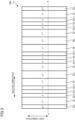
- FIGS. 8 and 9 are schematic top views of the semiconductor device of the second embodiment.
- FIG. 8 is a schematic view illustrating patterns of gate electrodes and impurity regions formed on an upper face of a silicon carbide layer.
- FIG. 9 is a schematic view illustrating the patterns of the impurity regions formed on the upper face of the silicon carbide layer excluding the gate electrodes from FIG. 8 .
- FIG. 6 is a cross-sectional view taken along line BB' of FIGS. 8 and 9 .
- FIG. 7 is a cross-sectional view taken along line BB' of FIGS. 8 and 9 .
- the MOSFET 200 includes a silicon carbide layer 10, a source electrode 12 (first electrode), a drain electrode 14 (second electrode), a first gate insulating layer 16a, a second gate insulating layer 16b, a third gate insulating layer 16c, a first gate electrode 18a, a second gate electrode 18b, a third gate electrode 18c, and an interlayer insulating layer 20.
- the source electrode 12 has a contact electrode portion 12x (first portion) and a diode electrode portion 12y (second portion).
- an n + -type drain region 22 an n-type drift region 24 (first silicon carbide region), a p-type body region 26 (second silicon carbide region), and an n ++ -type source region 30 (third silicon carbide region) are provided.
- the n-type drift region 24 includes an n - -type lower region 24x (first region), an n-type first low-concentration n region 24y1 (second region), an n-type second low-concentration n region 24y2 (sixth region), an n-type third low-concentration n region 24y3, an n + -type first high-concentration n region 24z1 (third region), an n + -type second high-concentration n region 24z2 (seventh region), and a JBS region 24s (eleventh region).
- the p-type body region 26 includes a p-type first low-concentration p region 26x1 (fourth region), a p-type second low-concentration p region 26x2 (eighth region), a p-type third low-concentration p region 26x3, a p + -type first high-concentration p region 26y1 (fifth region), a p + -type second high-concentration p region 26y2 (ninth region), and a p ++ -type contact region 26z (tenth region).
- the source electrode 12 has the contact electrode portion 12x and the diode electrode portion 12y.
- the contact electrode portion 12x and the diode electrode portion 12y are provided between the first gate electrode 18a and the second gate electrode 18b.
- the contact electrode portion 12x and the diode electrode portion 12y are provided between the second gate electrode 18b and the third gate electrode 18c.
- the diode electrode portion 12y is disposed in the first direction of the contact electrode portion 12x.
- the n-type drift region 24 includes the JBS region 24s.
- the JBS region 24s is in contact with the first face F1.
- the JBS region 24s is surrounded by the body region 26.
- the JBS region 24s is in contact with the diode electrode portion 12y of the source electrode 12.
- the JBS region 24s functions as a cathode region of the SBD.
- the n + -type first high-concentration n region 24z1 and the n + -type second high-concentration n region 24z2 do not exist.
- the p + -type first high-concentration p region 26y1 and the p + -type second high-concentration p region 26y2 do not exist.
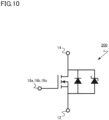
- FIG. 10 is an equivalent circuit diagram of the semiconductor device of the second embodiment.
- a pn diode and the SBD are connected as built-in diodes in parallel with the transistor between the source electrode 12 and the drain electrode 14.
- the body region 26 is an anode region of a pn junction diode
- the drift region 24 is a cathode region of the pn junction diode.
- the source electrode 12 is an anode electrode of the SBD
- the JBS region 24s is a cathode region of the SBD.
- a case where the MOSFET 200 is used as a switching device connected to an inductive load is considered.
- a voltage that is positive with respect to the drain electrode 14 may be applied to the source electrode 12 due to an induced current caused by the inductive load.
- a forward current flows through the built-in diode. This state is also referred to as a reverse conduction state.
- the MOSFET does not include the SBD
- a forward current flows through the pn junction diode.
- the pn junction diode performs a bipolar operation.
- a reflux current flows using the pn junction diode that performs a bipolar operation
- a stacking defect occurs in the silicon carbide layer due to recombination energy of the carriers.
- the stacking defect occurs in the silicon carbide layer
- An increase in on-resistance of the MOSFET causes a decrease in reliability of the MOSFET.
- the MOSFET 200 includes the SBD.
- a forward voltage (Vf) at which the forward current starts to flow through the SBD is lower than a forward voltage (Vf) of the pn junction diode. Therefore, the forward current flows through the SBD prior to the pn junction diode.
- the forward voltage (Vf) of the SBD is, for example, equal to or more than 1.0 V and less than 2.0 V.
- the forward voltage (Vf) of the pn junction diode is, for example, equal to or more than 2.0 V and equal to or less than 3.0 V.
- the SBD performs a unipolar operation. Therefore, even when the forward current flows, the stacking defect does not occur in the silicon carbide layer 10 due to the recombination energy of the carriers. Therefore, the increase in on-resistance of the MOSFET 200 is suppressed. As a result, the reliability of the MOSFET 200 is increased.
- the MOSFET 200 includes a pn junction formed in the n + -type first high-concentration n region 24z1 and the p + -type first high-concentration p region 26y1, and a pn junction formed in the n + -type second high-concentration n region 24z2 and the p + -type second high-concentration p region 26y2. Therefore, avalanche resistance of the MOSFET 200 is improved by the same function as that of the MOSFET 100.
- the n + -type first high-concentration n region 24z1 and the n + -type second high-concentration n region 24z2 do not exist.
- the p + -type first high-concentration p region 26y1 and the p + -type second high-concentration p region 26y2 do not exist.
- avalanche breakdown occurs in the vicinity of the JBS region 24s, and an avalanche current is suppressed from flowing. Therefore, characteristic degradation of a schottky junction of the SBD due to heat generation can be suppressed.
- the case of 4H-SiC is described as an example of the crystal structure of SiC, but the present disclosure can also be applied to devices using SiC having other crystal structures such as 6H-SiC and 3C-SiC.
- the case where the first conductive type is an n-type and the second conductive type is a p-type is described as an example, but the first conductive type can be a p-type, and the second conductive type can be an n-type.
- aluminum (Al) is exemplified as the p-type impurities, but boron (B) can also be used.
- nitrogen (N) and phosphorous (P) are exemplified as the n-type impurities, but arsenic (As), antimony (Sb), and the like can also be applied.
- IGBT insulated gate bipolar transistor
Landscapes
- Electrodes Of Semiconductors (AREA)
- Metal-Oxide And Bipolar Metal-Oxide Semiconductor Integrated Circuits (AREA)
Applications Claiming Priority (1)
| Application Number | Priority Date | Filing Date | Title |
|---|---|---|---|
| JP2022045801A JP7691393B2 (ja) | 2022-03-22 | 2022-03-22 | 半導体装置 |
Publications (1)
| Publication Number | Publication Date |
|---|---|
| EP4250371A1 true EP4250371A1 (en) | 2023-09-27 |
Family
ID=83507430
Family Applications (1)
| Application Number | Title | Priority Date | Filing Date |
|---|---|---|---|
| EP22194298.0A Pending EP4250371A1 (en) | 2022-03-22 | 2022-09-07 | Semiconductor device |
Country Status (4)
| Country | Link |
|---|---|
| US (1) | US12464794B2 (https=) |
| EP (1) | EP4250371A1 (https=) |
| JP (2) | JP7691393B2 (https=) |
| CN (1) | CN116825840A (https=) |
Families Citing this family (2)
| Publication number | Priority date | Publication date | Assignee | Title |
|---|---|---|---|---|
| JP2024137537A (ja) * | 2023-03-24 | 2024-10-07 | 株式会社東芝 | 半導体装置 |
| US20250113531A1 (en) * | 2023-09-28 | 2025-04-03 | Wolfspeed, Inc. | Power silicon carbide based semiconductor devices with selective jfet implants that are self-aligned with the well regions and methods of making such devices |
Citations (4)
| Publication number | Priority date | Publication date | Assignee | Title |
|---|---|---|---|---|
| US20120025262A1 (en) * | 2010-08-02 | 2012-02-02 | Fuji Electric Co., Ltd. | MOS Type Semiconductor Device and Method of Manufacturing Same |
| US20130234158A1 (en) * | 2012-02-29 | 2013-09-12 | Kabushiki Kaisha Toshiba | Semiconductor device and method for manufacturing the same |
| US20140210008A1 (en) * | 2013-01-30 | 2014-07-31 | Mitsubishi Electric Corporation | Semiconductor device and method of manufacturing the same |
| US20200279940A1 (en) * | 2019-03-01 | 2020-09-03 | Kabushiki Kaisha Toshiba | Semiconductor device |
Family Cites Families (14)
| Publication number | Priority date | Publication date | Assignee | Title |
|---|---|---|---|---|
| JP3656744B2 (ja) | 2001-11-21 | 2005-06-08 | 株式会社デンソー | 半導体装置 |
| AU2003275541A1 (en) | 2002-10-18 | 2004-05-04 | National Institute Of Advanced Industrial Science And Technology | Silicon carbide semiconductor device and its manufacturing method |
| JP4903439B2 (ja) | 2005-05-31 | 2012-03-28 | 株式会社東芝 | 電界効果トランジスタ |
| CN104584221B (zh) | 2013-02-13 | 2017-04-19 | 富士电机株式会社 | 半导体装置 |
| JP6183087B2 (ja) | 2013-09-13 | 2017-08-23 | 富士電機株式会社 | 炭化珪素半導体装置および炭化珪素半導体装置の製造方法 |
| JP6666224B2 (ja) * | 2016-09-21 | 2020-03-13 | 株式会社東芝 | 半導体装置 |
| JP6926869B2 (ja) | 2017-09-13 | 2021-08-25 | 富士電機株式会社 | 半導体装置 |
| JP7078226B2 (ja) | 2018-07-19 | 2022-05-31 | 国立研究開発法人産業技術総合研究所 | 半導体装置 |
| JP7003019B2 (ja) * | 2018-09-15 | 2022-01-20 | 株式会社東芝 | 半導体装置 |
| WO2020184338A1 (ja) | 2019-03-08 | 2020-09-17 | 株式会社新川 | ワイヤボンディング装置 |
| JP6737379B2 (ja) | 2019-05-31 | 2020-08-05 | 富士電機株式会社 | 半導体装置 |
| JP7439422B2 (ja) | 2019-09-06 | 2024-02-28 | 富士電機株式会社 | 炭化珪素半導体装置および炭化珪素半導体装置の製造方法 |
| JP7362546B2 (ja) | 2020-05-14 | 2023-10-17 | 株式会社東芝 | 半導体装置、インバータ回路、駆動装置、車両、及び、昇降機 |
| JP7593225B2 (ja) * | 2021-05-14 | 2024-12-03 | 株式会社デンソー | 炭化珪素半導体装置 |
-
2022
- 2022-03-22 JP JP2022045801A patent/JP7691393B2/ja active Active
- 2022-07-11 CN CN202210811219.4A patent/CN116825840A/zh active Pending
- 2022-09-07 EP EP22194298.0A patent/EP4250371A1/en active Pending
- 2022-09-08 US US17/940,373 patent/US12464794B2/en active Active
-
2025
- 2025-05-30 JP JP2025090369A patent/JP7852123B2/ja active Active
Patent Citations (4)
| Publication number | Priority date | Publication date | Assignee | Title |
|---|---|---|---|---|
| US20120025262A1 (en) * | 2010-08-02 | 2012-02-02 | Fuji Electric Co., Ltd. | MOS Type Semiconductor Device and Method of Manufacturing Same |
| US20130234158A1 (en) * | 2012-02-29 | 2013-09-12 | Kabushiki Kaisha Toshiba | Semiconductor device and method for manufacturing the same |
| US20140210008A1 (en) * | 2013-01-30 | 2014-07-31 | Mitsubishi Electric Corporation | Semiconductor device and method of manufacturing the same |
| US20200279940A1 (en) * | 2019-03-01 | 2020-09-03 | Kabushiki Kaisha Toshiba | Semiconductor device |
Also Published As
| Publication number | Publication date |
|---|---|
| JP7852123B2 (ja) | 2026-04-27 |
| JP2023139981A (ja) | 2023-10-04 |
| JP7691393B2 (ja) | 2025-06-11 |
| CN116825840A (zh) | 2023-09-29 |
| JP2025113483A (ja) | 2025-08-01 |
| US20230307502A1 (en) | 2023-09-28 |
| US12464794B2 (en) | 2025-11-04 |
Similar Documents
| Publication | Publication Date | Title |
|---|---|---|
| JP7214508B2 (ja) | 半導体装置 | |
| US10872974B2 (en) | Semiconductor device | |
| JP2018049951A (ja) | 半導体装置 | |
| US11955543B2 (en) | Semiconductor device | |
| EP4156280A1 (en) | Semiconductor device | |
| JP2020047683A (ja) | 半導体装置 | |
| US12107127B2 (en) | Semiconductor device | |
| JP7852123B2 (ja) | 半導体装置 | |
| EP4016641B1 (en) | Semiconductor device and layout for gate electrodes | |
| US12255253B2 (en) | Semiconductor device | |
| EP4156301A1 (en) | Semiconductor device | |
| US20240321968A1 (en) | Semiconductor device | |
| US20260040658A1 (en) | Semiconductor device | |
| US20250169104A1 (en) | Semiconductor device | |
| US20260090072A1 (en) | Semiconductor device | |
| WO2025062707A1 (ja) | 半導体装置 | |
| CN121014272A (zh) | 半导体装置 |
Legal Events
| Date | Code | Title | Description |
|---|---|---|---|
| PUAI | Public reference made under article 153(3) epc to a published international application that has entered the european phase |
Free format text: ORIGINAL CODE: 0009012 |
|
| STAA | Information on the status of an ep patent application or granted ep patent |
Free format text: STATUS: REQUEST FOR EXAMINATION WAS MADE |
|
| 17P | Request for examination filed |
Effective date: 20220907 |
|
| AK | Designated contracting states |
Kind code of ref document: A1 Designated state(s): AL AT BE BG CH CY CZ DE DK EE ES FI FR GB GR HR HU IE IS IT LI LT LU LV MC MK MT NL NO PL PT RO RS SE SI SK SM TR |