EP4243123B1 - Negativelektrode für lithiumsekundärbatterie, verfahren zur herstellung einer negativelektrode für lithiumsekundärbatterie und lithiumsekundärbatterie mit negativelektrode - Google Patents
Negativelektrode für lithiumsekundärbatterie, verfahren zur herstellung einer negativelektrode für lithiumsekundärbatterie und lithiumsekundärbatterie mit negativelektrode Download PDFInfo
- Publication number
- EP4243123B1 EP4243123B1 EP22838035.8A EP22838035A EP4243123B1 EP 4243123 B1 EP4243123 B1 EP 4243123B1 EP 22838035 A EP22838035 A EP 22838035A EP 4243123 B1 EP4243123 B1 EP 4243123B1
- Authority
- EP
- European Patent Office
- Prior art keywords
- negative electrode
- active material
- electrode active
- material layer
- weight
- Prior art date
- Legal status (The legal status is an assumption and is not a legal conclusion. Google has not performed a legal analysis and makes no representation as to the accuracy of the status listed.)
- Active
Links
Images



Classifications
-
- H—ELECTRICITY
- H01—ELECTRIC ELEMENTS
- H01M—PROCESSES OR MEANS, e.g. BATTERIES, FOR THE DIRECT CONVERSION OF CHEMICAL ENERGY INTO ELECTRICAL ENERGY
- H01M10/00—Secondary cells; Manufacture thereof
- H01M10/05—Accumulators with non-aqueous electrolyte
- H01M10/052—Li-accumulators
-
- H—ELECTRICITY
- H01—ELECTRIC ELEMENTS
- H01M—PROCESSES OR MEANS, e.g. BATTERIES, FOR THE DIRECT CONVERSION OF CHEMICAL ENERGY INTO ELECTRICAL ENERGY
- H01M4/00—Electrodes
- H01M4/02—Electrodes composed of, or comprising, active material
- H01M4/04—Processes of manufacture in general
- H01M4/0402—Methods of deposition of the material
- H01M4/0404—Methods of deposition of the material by coating on electrode collectors
-
- H—ELECTRICITY
- H01—ELECTRIC ELEMENTS
- H01M—PROCESSES OR MEANS, e.g. BATTERIES, FOR THE DIRECT CONVERSION OF CHEMICAL ENERGY INTO ELECTRICAL ENERGY
- H01M4/00—Electrodes
- H01M4/02—Electrodes composed of, or comprising, active material
- H01M4/13—Electrodes for accumulators with non-aqueous electrolyte, e.g. for lithium-accumulators; Processes of manufacture thereof
- H01M4/131—Electrodes based on mixed oxides or hydroxides, or on mixtures of oxides or hydroxides, e.g. LiCoOx
-
- H—ELECTRICITY
- H01—ELECTRIC ELEMENTS
- H01M—PROCESSES OR MEANS, e.g. BATTERIES, FOR THE DIRECT CONVERSION OF CHEMICAL ENERGY INTO ELECTRICAL ENERGY
- H01M4/00—Electrodes
- H01M4/02—Electrodes composed of, or comprising, active material
- H01M4/13—Electrodes for accumulators with non-aqueous electrolyte, e.g. for lithium-accumulators; Processes of manufacture thereof
- H01M4/133—Electrodes based on carbonaceous material, e.g. graphite-intercalation compounds or CFx
-
- H—ELECTRICITY
- H01—ELECTRIC ELEMENTS
- H01M—PROCESSES OR MEANS, e.g. BATTERIES, FOR THE DIRECT CONVERSION OF CHEMICAL ENERGY INTO ELECTRICAL ENERGY
- H01M4/00—Electrodes
- H01M4/02—Electrodes composed of, or comprising, active material
- H01M4/13—Electrodes for accumulators with non-aqueous electrolyte, e.g. for lithium-accumulators; Processes of manufacture thereof
- H01M4/134—Electrodes based on metals, Si or alloys
-
- H—ELECTRICITY
- H01—ELECTRIC ELEMENTS
- H01M—PROCESSES OR MEANS, e.g. BATTERIES, FOR THE DIRECT CONVERSION OF CHEMICAL ENERGY INTO ELECTRICAL ENERGY
- H01M4/00—Electrodes
- H01M4/02—Electrodes composed of, or comprising, active material
- H01M4/13—Electrodes for accumulators with non-aqueous electrolyte, e.g. for lithium-accumulators; Processes of manufacture thereof
- H01M4/139—Processes of manufacture
- H01M4/1393—Processes of manufacture of electrodes based on carbonaceous material, e.g. graphite-intercalation compounds or CFx
-
- H—ELECTRICITY
- H01—ELECTRIC ELEMENTS
- H01M—PROCESSES OR MEANS, e.g. BATTERIES, FOR THE DIRECT CONVERSION OF CHEMICAL ENERGY INTO ELECTRICAL ENERGY
- H01M4/00—Electrodes
- H01M4/02—Electrodes composed of, or comprising, active material
- H01M4/13—Electrodes for accumulators with non-aqueous electrolyte, e.g. for lithium-accumulators; Processes of manufacture thereof
- H01M4/139—Processes of manufacture
- H01M4/1395—Processes of manufacture of electrodes based on metals, Si or alloys
-
- H—ELECTRICITY
- H01—ELECTRIC ELEMENTS
- H01M—PROCESSES OR MEANS, e.g. BATTERIES, FOR THE DIRECT CONVERSION OF CHEMICAL ENERGY INTO ELECTRICAL ENERGY
- H01M4/00—Electrodes
- H01M4/02—Electrodes composed of, or comprising, active material
- H01M4/36—Selection of substances as active materials, active masses, active liquids
- H01M4/362—Composites
- H01M4/364—Composites as mixtures
-
- H—ELECTRICITY
- H01—ELECTRIC ELEMENTS
- H01M—PROCESSES OR MEANS, e.g. BATTERIES, FOR THE DIRECT CONVERSION OF CHEMICAL ENERGY INTO ELECTRICAL ENERGY
- H01M4/00—Electrodes
- H01M4/02—Electrodes composed of, or comprising, active material
- H01M4/36—Selection of substances as active materials, active masses, active liquids
- H01M4/362—Composites
- H01M4/366—Composites as layered products
-
- H—ELECTRICITY
- H01—ELECTRIC ELEMENTS
- H01M—PROCESSES OR MEANS, e.g. BATTERIES, FOR THE DIRECT CONVERSION OF CHEMICAL ENERGY INTO ELECTRICAL ENERGY
- H01M4/00—Electrodes
- H01M4/02—Electrodes composed of, or comprising, active material
- H01M4/36—Selection of substances as active materials, active masses, active liquids
- H01M4/38—Selection of substances as active materials, active masses, active liquids of elements or alloys
- H01M4/386—Silicon or alloys based on silicon
-
- H—ELECTRICITY
- H01—ELECTRIC ELEMENTS
- H01M—PROCESSES OR MEANS, e.g. BATTERIES, FOR THE DIRECT CONVERSION OF CHEMICAL ENERGY INTO ELECTRICAL ENERGY
- H01M4/00—Electrodes
- H01M4/02—Electrodes composed of, or comprising, active material
- H01M4/36—Selection of substances as active materials, active masses, active liquids
- H01M4/48—Selection of substances as active materials, active masses, active liquids of inorganic oxides or hydroxides
- H01M4/483—Selection of substances as active materials, active masses, active liquids of inorganic oxides or hydroxides for non-aqueous cells
-
- H—ELECTRICITY
- H01—ELECTRIC ELEMENTS
- H01M—PROCESSES OR MEANS, e.g. BATTERIES, FOR THE DIRECT CONVERSION OF CHEMICAL ENERGY INTO ELECTRICAL ENERGY
- H01M4/00—Electrodes
- H01M4/02—Electrodes composed of, or comprising, active material
- H01M4/36—Selection of substances as active materials, active masses, active liquids
- H01M4/58—Selection of substances as active materials, active masses, active liquids of inorganic compounds other than oxides or hydroxides, e.g. sulfides, selenides, tellurides, halogenides or LiCoFy; of polyanionic structures, e.g. phosphates, silicates or borates
-
- H—ELECTRICITY
- H01—ELECTRIC ELEMENTS
- H01M—PROCESSES OR MEANS, e.g. BATTERIES, FOR THE DIRECT CONVERSION OF CHEMICAL ENERGY INTO ELECTRICAL ENERGY
- H01M4/00—Electrodes
- H01M4/02—Electrodes composed of, or comprising, active material
- H01M4/36—Selection of substances as active materials, active masses, active liquids
- H01M4/58—Selection of substances as active materials, active masses, active liquids of inorganic compounds other than oxides or hydroxides, e.g. sulfides, selenides, tellurides, halogenides or LiCoFy; of polyanionic structures, e.g. phosphates, silicates or borates
- H01M4/583—Carbonaceous material, e.g. graphite-intercalation compounds or CFx
-
- H—ELECTRICITY
- H01—ELECTRIC ELEMENTS
- H01M—PROCESSES OR MEANS, e.g. BATTERIES, FOR THE DIRECT CONVERSION OF CHEMICAL ENERGY INTO ELECTRICAL ENERGY
- H01M4/00—Electrodes
- H01M4/02—Electrodes composed of, or comprising, active material
- H01M4/36—Selection of substances as active materials, active masses, active liquids
- H01M4/58—Selection of substances as active materials, active masses, active liquids of inorganic compounds other than oxides or hydroxides, e.g. sulfides, selenides, tellurides, halogenides or LiCoFy; of polyanionic structures, e.g. phosphates, silicates or borates
- H01M4/583—Carbonaceous material, e.g. graphite-intercalation compounds or CFx
- H01M4/587—Carbonaceous material, e.g. graphite-intercalation compounds or CFx for inserting or intercalating light metals
-
- H—ELECTRICITY
- H01—ELECTRIC ELEMENTS
- H01M—PROCESSES OR MEANS, e.g. BATTERIES, FOR THE DIRECT CONVERSION OF CHEMICAL ENERGY INTO ELECTRICAL ENERGY
- H01M4/00—Electrodes
- H01M4/02—Electrodes composed of, or comprising, active material
- H01M4/62—Selection of inactive substances as ingredients for active masses, e.g. binders, fillers
- H01M4/621—Binders
-
- H—ELECTRICITY
- H01—ELECTRIC ELEMENTS
- H01M—PROCESSES OR MEANS, e.g. BATTERIES, FOR THE DIRECT CONVERSION OF CHEMICAL ENERGY INTO ELECTRICAL ENERGY
- H01M4/00—Electrodes
- H01M4/02—Electrodes composed of, or comprising, active material
- H01M4/62—Selection of inactive substances as ingredients for active masses, e.g. binders, fillers
- H01M4/624—Electric conductive fillers
-
- H—ELECTRICITY
- H01—ELECTRIC ELEMENTS
- H01M—PROCESSES OR MEANS, e.g. BATTERIES, FOR THE DIRECT CONVERSION OF CHEMICAL ENERGY INTO ELECTRICAL ENERGY
- H01M4/00—Electrodes
- H01M4/02—Electrodes composed of, or comprising, active material
- H01M4/62—Selection of inactive substances as ingredients for active masses, e.g. binders, fillers
- H01M4/624—Electric conductive fillers
- H01M4/625—Carbon or graphite
-
- H—ELECTRICITY
- H01—ELECTRIC ELEMENTS
- H01M—PROCESSES OR MEANS, e.g. BATTERIES, FOR THE DIRECT CONVERSION OF CHEMICAL ENERGY INTO ELECTRICAL ENERGY
- H01M4/00—Electrodes
- H01M4/02—Electrodes composed of, or comprising, active material
- H01M2004/021—Physical characteristics, e.g. porosity, surface area
-
- H—ELECTRICITY
- H01—ELECTRIC ELEMENTS
- H01M—PROCESSES OR MEANS, e.g. BATTERIES, FOR THE DIRECT CONVERSION OF CHEMICAL ENERGY INTO ELECTRICAL ENERGY
- H01M4/00—Electrodes
- H01M4/02—Electrodes composed of, or comprising, active material
- H01M2004/026—Electrodes composed of, or comprising, active material characterised by the polarity
- H01M2004/027—Negative electrodes
-
- Y—GENERAL TAGGING OF NEW TECHNOLOGICAL DEVELOPMENTS; GENERAL TAGGING OF CROSS-SECTIONAL TECHNOLOGIES SPANNING OVER SEVERAL SECTIONS OF THE IPC; TECHNICAL SUBJECTS COVERED BY FORMER USPC CROSS-REFERENCE ART COLLECTIONS [XRACs] AND DIGESTS
- Y02—TECHNOLOGIES OR APPLICATIONS FOR MITIGATION OR ADAPTATION AGAINST CLIMATE CHANGE
- Y02E—REDUCTION OF GREENHOUSE GAS [GHG] EMISSIONS, RELATED TO ENERGY GENERATION, TRANSMISSION OR DISTRIBUTION
- Y02E60/00—Enabling technologies; Technologies with a potential or indirect contribution to GHG emissions mitigation
- Y02E60/10—Energy storage using batteries
Definitions
- the present application relates to a negative electrode for a lithium secondary battery, a method for preparing a negative electrode for a lithium secondary battery, and a lithium secondary battery including the negative electrode.
- an electrochemical device using such electrochemical energy includes a secondary battery, and the usage areas thereof are increasing more and more.
- lithium secondary batteries having high energy density and voltage, long cycle life, and low self-discharge rate have been commercialized and widely used. Further, as an electrode for such a high capacity lithium secondary battery, studies have been actively conducted on a method for preparing a high-density electrode having a higher energy density per unit volume.
- a secondary battery in general, includes a positive electrode, a negative electrode, an electrolyte, and a separator.
- the negative electrode includes a negative electrode active material for intercalating and deintercalating lithium ions from the positive electrode, and as the negative electrode active material, a silicon-based particle having high discharge capacity may be used.
- the silicon-based compound which is a high-capacity material, is a material having a high capacity compared to graphite used in the related art, and has excellent capacity characteristics, but the volume rapidly expands during the charging process to disconnect the conductive path, resulting in deterioration in battery characteristics, and accordingly, the capacity decreases from the initial stage.
- the present application relates to a negative electrode for a lithium secondary battery, which satisfies the range of Equation 1, a method for preparing a negative electrode for a lithium secondary battery, and a lithium secondary battery including the negative electrode.
- first negative electrode active material layer may be in contact with part or an entire surface of the negative electrode current collector layer
- second negative electrode active material layer may be in contact with part or an entire surface of the first negative electrode active material layer
- a lithium secondary battery including: a positive electrode; the negative electrode for a lithium secondary battery according to the present application; a separator provided between the positive electrode and the negative electrode; and an electrolyte.
- the negative electrode for a lithium secondary battery has a double layer active material layer including a first negative electrode active material layer and a second negative electrode active material layer.
- the second negative electrode active material included in the second negative electrode active material layer includes one or more selected from the group consisting of a carbon-based active material, a silicon-based active material, a metal-based active material capable of forming an alloy with lithium and a lithium-containing nitride.
- the negative electrode for a lithium secondary battery according to the present application is characterized by adjusting the pre-lithiation ratio to a specific range according to the discharge capacity of the second negative electrode active material layer composition. That is, in the negative electrode for a lithium secondary battery according to the present application, the capacity of lithium imparted by pre-lithiation with respect to the discharge capacity of a second active material layer including a silicon-based active material was adjusted to the range of Equation 1.
- the negative electrode for a lithium secondary battery according to the present application may be that wherein the first negative electrode active material layer and the second negative electrode active material layer are included as a double layer to which a specific composition and a specific pre-lithiation ratio are applied in order to take an advantage of an electrode to which a high content of Si particles as an active material having a single layer are applied and simultaneously solve a surface degradation problem, a problem of uniformity during pre-lithiation and a problem of service life characteristics, which are disadvantages when the electrode has the advantage.
- 'p to q' means a range of 'p or more and q or less'.
- specific surface area is measured by the BET method, and is specifically calculated from an amount of nitrogen gas adsorbed under liquid nitrogen temperature (77K) using BELSORP-mini II manufactured by BEL Japan, Inc. That is, in the present application, the BET specific surface area may mean a specific surface area measured by the measurement method.
- Dn means the particle diameter distribution, and means the particle diameter at the n% point of the cumulative distribution of the number of particles according to the particle diameter. That is, D50 is the particle diameter (average particle diameter, median particle diameter) at the 50% point of the cumulative distribution of the number of particles according to the particle diameter, D90 is the particle diameter at the 90% point of the cumulative distribution of the number of particles according to the particle diameter, and D10 is the particle diameter at the 10% point of the cumulative distribution of the number of particles according to the particle diameter. Meanwhile, the particle diameter distribution may be measured using a laser diffraction method.
- a particle diameter distribution is calculated by introducing the resulting dispersion into a commercially available laser diffraction particle diameter measurement device (for example, Microtrac S3500) to measure the difference in diffraction pattern according to the particle size when particles pass through the laser beam.
- a laser diffraction particle diameter measurement device for example, Microtrac S3500
- a polymer includes a monomer as a monomer unit means that the monomer participates in a polymerization reaction, and thus is included as a repeating unit in the polymer.
- the polymer when the polymer includes a monomer, it is interpreted to be the same as when the polymer includes a monomer as a monomer unit.
- the 'polymer' is understood to be used in a broad sense, including a copolymer, unless otherwise specified as a 'homopolymer'.
- a weight average molecular weight (Mw) and a number average molecular weight (Mn) are polystyrene-conversion molecular weights measured by gel permeation chromatography (GPC) using a monodisperse polystyrene polymer (standard sample) with various degrees of polymerization commercially available for the measurement of the molecular weight as a standard material.
- the molecular weight means a weight average molecular weight unless otherwise described.
- the negative electrode for a lithium secondary battery uses a second negative electrode active material layer having a role of a buffer layer in order to successfully use a first negative electrode active material included in a first negative electrode active material layer, and has a feature that pre-lithiation may be performed without damaging the first negative electrode active material layer because the second negative electrode active material layer satisfies the range of Equation 1.
- the second negative active material layer of the present invention can serve as a buffer layer.
- Si electrodes have superior capacity characteristics when compared to SiO electrodes and carbon-based electrodes.
- degradation at the surface is concentrated due to the rapid reaction with Li ions during charging/discharging. This also occurs in the pre-lithiation process when Li ions are applied to the negative electrode in advance.
- a buffer layer is applied in the pre-lithiation process to prevent direct contact between the Si electrode and lithium and to prevent surface degradation. Therefore, it is described as an effect that the second negative electrode active material layer of the present invention can play the same role as the buffer layer during the pre-lithiation process.
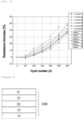
- FIG. 1 is a view illustrating the stacking structure of a negative electrode for a lithium secondary battery according to an exemplary embodiment of the present application. Specifically, it is possible to confirm a negative electrode 100 for a lithium secondary battery, including a first negative electrode active material layer 20 and a second negative electrode active material layer 10 on one surface of a negative electrode current collector layer 30, and FIG. 1 illustrates the first negative electrode active material layer on one surface of the negative electrode current collector layer, but the first negative electrode active material layer may be formed on both surfaces of the negative electrode current collector layer. As shown, the first negative electrode active material layer may be contact with an entire surface of the negative electrode current collector layer, and the second negative electrode active material layer may be in contact with an entire surface of the first negative electrode active material layer.
- a first negative electrode active material layer 20 and a second negative electrode active material layer 10 may be formed on both surfaces of a negative electrode current collector layer 30.
- the arrangement may be 10>20>30>20>10. Additional arrangements may be 10>20>30>20, 10>20>30>10, 10>20>30>10>20.
- the composition of the active material layer to be coated on both sides may be the same or different from each other. It is preferable that both sides of the active material layer have the same composition, e.g., 10>20>30>20>10.
- a negative electrode for a lithium secondary battery including: a negative electrode current collector layer; a first negative electrode active material layer on one surface or both surfaces of the negative electrode current collector layer; and a second negative electrode active material layer on a surface opposite to a surface of the first negative electrode active material layer facing the negative electrode current collector layer.
- the negative electrode current collector layer generally has a thickness of 1 ⁇ m to 100 ⁇ m.
- the negative electrode current collector layer is not particularly limited as long as the negative electrode current collector layer has high conductivity without causing a chemical change to the battery, and for example, it is possible to use copper, stainless steel, aluminum, nickel, titanium, fired carbon, a material in which the surface of copper or stainless steel is surface-treated with carbon, nickel, titanium, silver, and the like, an aluminum-cadmium alloy, and the like.
- the negative electrode current collector layer may also increase the bonding strength of a negative electrode active material by forming fine convex and concave irregularities on the surface thereof, and the negative electrode current collector layer may be used in various forms such as a film, a sheet, a foil, a net, a porous body, a foam body, and a non-woven fabric body.
- the negative electrode current collector layer may have a thickness of 1 ⁇ m or more and 100 ⁇ m or less.
- a negative electrode for a lithium secondary battery in which the first negative electrode active material layer has a thickness of 10 ⁇ m or more and 200 ⁇ m or less, and the second negative electrode active material layer has a thickness of 10 ⁇ m or more and 100 ⁇ m or less.
- the thickness may be variously modified depending on the type and use of the negative electrode used, and is not limited thereto.
- a negative electrode for a lithium secondary battery in which a weight loading amount (a) of first negative electrode active material layer composition satisfies 1.5-fold or more of a weight loading amount (b) of second negative electrode active material layer composition.
- the weight loading amount (a) of first negative electrode active material layer composition may satisfy a range of 1.5-fold or more and 10-fold or less, preferably 2.2-fold or more and 6-fold or less of the weight loading amount (b) of second negative electrode active material layer composition.
- the weight loading amount may mean the weight of a composition for forming a negative electrode active material layer, and specifically, the weight loading amount of the composition may have the same meaning as a loading amount of a slurry including the composition.
- the weight loading amount (a) of first negative electrode active material layer composition may satisfy a range of 2 mg/cm 2 or more and 5 mg/cm 2 or less, preferably 2.2 mg/cm 2 or more and 4 mg/cm 2 or less.
- the weight loading amount (b) of second negative electrode active material layer composition may satisfy a range of 0.5 mg/cm 2 or more and 1.5 mg/cm 2 or less, preferably 0.8 mg/cm 2 or more and 1.3 mg/cm2 or less.
- the first negative electrode active material layer composition and the second negative electrode active material layer composition may satisfy Equation 1, thereby regulating the ratio of active material included in the first negative electrode active material layer and the second negative electrode active material layer. That is, capacity characteristics may be optimized by regulating the amount of first negative electrode active material included in the first negative electrode active material layer, and simultaneously, the amount of second negative electrode active material included in the second negative electrode active material layer may be set and regulated to suppress the surface reaction of the negative electrode without making capacity characteristics deteriorate, thereby having a feature of enhancing service life characteristics.
- pure silicon (Si) particles may be used as the first negative electrode active material.
- the first negative electrode active material used in the first negative electrode active material layer of the present invention may be subjected to a very complicated crystal change in a reaction of electrochemically absorbing, storing and releasing lithium atoms.
- the reaction of electrochemically absorbing, storing and releasing lithium atoms progresses, the composition and crystal structure of silicon particles are changed to Si (crystal structure: Fd3m), LiSi (crystal structure: I41/a), Li 2 Si (crystal structure: C2/m), Li7Si2 (Pbam), Li 22 Si 5 (F23), and the like.
- the volume of silicon particles expands about 4-fold depending on complex changes in crystal structure.
- pure silicon particles When pure silicon particles are included in a high content, the capacity characteristics are excellent, but service life deterioration characteristics due to the surface heterogeneous reaction according to the excellent capacity characteristics occur. Accordingly, the aforementioned problem was solved by including the second negative electrode active material layer according to the present invention in a specific weight loading amount.
- the first negative electrode active material of the present invention may have an average particle diameter (D50) of 3 ⁇ m to 10 ⁇ m, specifically 4 ⁇ m to 8 ⁇ m, and more specifically 5 ⁇ m to 7 ⁇ m.
- D50 average particle diameter
- the average particle diameter is included in the above range of 3 ⁇ m to 10 ⁇ m, the viscosity of a negative electrode slurry is formed in a suitable range because the specific surface area of the particle is included in a suitable range. Accordingly, the dispersion of the particles constituting the negative electrode slurry is facilitated.
- the size of the first negative electrode active material has a value equal to or more than the above lower limit value range, and since a composite including a conductive material and a binder in the negative electrode slurry makes a contact area between silicon particles and conductive materials excellent, the possibility that the conductive network lasts is increased, so that the capacity retention rate is increased. Meanwhile, when the average particle diameter satisfied the above range, excessively large silicon particles are eliminated to form a smooth surface of the negative electrode, and accordingly, it is possible to prevent the heterogeneous phenomenon of the current density during charging and discharging.
- the first negative electrode active material generally has a characteristic BET specific surface area.
- the BET specific surface area of the first negative electrode active material is preferably 0.01 m 2 /g to 150.0 m 2 /g, more preferably 0.1 m 2 /g to 100.0 m 2 /g, particularly preferably 0.2 m 2 /g to 80.0 m 2 /g, and most preferably 0.2 m 2 /g to 18.0 m 2 /g.
- the BET specific surface area is measured by DIN 66131 (using nitrogen).
- the first negative electrode active material may be present, for example, in a crystalline or amorphous form, and preferably is not porous.
- the silicon particles are preferably spherical or fragment-shaped particles. Alternatively, but less preferably, the silicon particles may also have a fibrous structure or be present in the form of a film or coating including silicon.
- the first negative electrode active material may have a non-circular form, and the circularity thereof is, for example, 0.9 or less, for example, 0.7 to 0.9, for example, 0.8 to 0.9, and for example, 0.85 to 0.9.
- the circularity is determined by the following Equation A-1, where A is the area and P is the boundary line. 4 ⁇ A / P 2
- a negative electrode for a lithium secondary battery in which the first negative electrode active material is present in an amount of 60 parts by weight or more based on 100 parts by weight of the first negative electrode active material layer composition.
- the first negative electrode active material may be included in an amount of 60 parts by weight or more, preferably 65 parts by weight or more, and more preferably 70 parts by weight or more, and 95 parts by weight or less, preferably 90 parts by weight or less, and more preferably 80 parts by weight or less, based on 100 parts by weight of the first negative electrode active material layer composition.
- the first negative electrode active material layer composition according to the present application may solve one or more of a surface degradation problem in charging and discharging, a problem of uniformity during pre-lithiation, and a problem of service life characteristics without making the capacity performance of the entire negative electrode deteriorate by together using a second negative electrode active material layer to be described below even though a first negative electrode active material having a remarkably high capacity is used in the above range.
- the first negative electrode active material layer composition may further include one or more selected from the group consisting of a first negative electrode conductive material; and a first negative electrode binder.
- first negative electrode conductive material and first negative electrode binder included in the first negative electrode active material layer composition those used in the art may be used without limitation.
- the first negative electrode conductive material a material that may be generally used in the art may be used without limitation, and specifically, it is possible to include one or more selected from the group consisting of a dotted conductive material; a planar conductive material; and a linear conductive material.
- the dotted conductive material may be used to enhance the conductivity of the negative electrode, and means a conductive material having conductivity without inducing a chemical change and having a dot shape or spherical shape.
- the dotted conductive material may be at least one selected from the group consisting of natural graphite, artificial graphite, carbon black, acetylene black, Ketjen black, channel black, furnace black, lamp black, thermal black, a conductive fiber, fluorocarbon, an aluminum powder, a nickel powder, zinc oxide, potassium titanate, titanium oxide and a polyphenylene derivative, and may preferably include carbon black in terms of implementing high conductivity and being excellent in dispersibility.
- the dotted conductive material may have a BET specific surface area of 40 m 2 /g or more and 70 m 2 /g or less, preferably 45 m 2 /g or more and 65 m 2 /g or less, and more preferably 50 m 2 /g or more and 60 m 2 /g or less.
- the dotted conductive material may have a particle diameter of 10 nm to 100 nm, preferably 20 nm to 90 nm, and more preferably 20 nm to 60 nm.
- the first negative electrode conductive material may include a planar conductive material.
- the planar conductive material may increase the surface contact between silicon particles in the negative electrode to improve conductivity and simultaneously suppress the disconnection of the conductive path due to the volume expansion, and may be expressed as a plate-like conductive material or bulk conductive material.
- the planar conductive material may include at least one selected from the group consisting of plate-like graphite, graphene, graphene oxide, and graphite flake, and may be preferably plate-like graphite.
- the planar conductive material may have an average particle diameter (D50) of 2 ⁇ m to 7 ⁇ m, specifically 3 ⁇ m to 6 ⁇ m, and more specifically 4 ⁇ m to 5 ⁇ m.
- D50 average particle diameter
- the average particle diameter satisfied the above range, sufficient particle diameter facilitates dispersion without causing an excessive increase in viscosity of the negative electrode slurry. Therefore, the dispersion effect is excellent when particles are dispersed using the same equipment and time.
- the planar conductive material provides a negative electrode active material layer composition having a D10 of 0.5 ⁇ m or more and 1.5 ⁇ m or less, a D50 of 2.5 ⁇ m or more and 3.5 ⁇ m or less, and a D90 of 7.0 ⁇ m or more and 15.0 ⁇ m or less.
- planar conductive material it is possible to use a high specific surface area planar conductive material having a high BET specific surface area; or a low specific surface area planar conductive material.
- planar conductive material a high specific surface area planar conductive material; or a low specific surface area planar conductive material may be used without limitation, but in particular, the planar conductive material according to the present application may be affected by the dispersion effect to some extent in the electrode performance, so that it may be particularly desirable to use a low specific surface area planar conductive material that does not cause a problem in dispersion.
- the planar conductive material may have a BET specific surface area of 5 m 2 /g or more.
- the planar conductive material may have a BET specific surface area of 5 m 2 /g or more and 500 m 2 /g or less, preferably 5 m 2 /g or more and 300 m 2 /g or less, and more preferably 5 m 2 /g or more and 250 m 2 /g or less.
- the planar conductive material is a high specific surface area planar conductive material, and the BET specific surface area may satisfy a range of 50 m 2 /g or more and 500 m 2 /g or less, preferably 80 m 2 /g or more and 300 m 2 /g or less, and more preferably 100 m 2 /g or more and 300 m 2 /g or less.
- the planar conductive material is a low specific surface area planar conductive material, and the BET specific surface area may satisfy a range of 5 m 2 /g or more and 40 m 2 /g or less, preferably 5 m 2 /g or more and 30 m 2 /g or less, and more preferably 5 m 2 /g or more and 25 m 2 /g or less.
- the carbon nanotubes may be bundle type carbon nanotubes.
- the bundle type carbon nanotubes may include a plurality of carbon nanotube units.
- the term 'bundle type' used herein refers to a secondary shape in the form of a bundle or rope in which the plurality of carbon nanotube units is aligned side by side or intertwined in substantially the same orientation as a longitudinal axis of the carbon nanotube unit.
- a graphite sheet has a cylindrical shape with a nano-sized diameter and has a sp2 bond structure.
- the carbon nanotube unit may exhibit characteristics of a conductor or semiconductor depending on a structure and an angle at which the graphite sheet is rolled.
- the bundle type carbon nanotubes may be uniformly dispersed during the preparation of a negative electrode compared to entangled type carbon nanotubes, and the conductivity of the negative electrode may be improved by smoothly forming a conductive network in the negative electrode.
- linear conductive material single-walled carbon nanotube; or multi-walled carbon nanotube may be used.
- the single-walled carbon nanotube is a material in which carbon atoms arranged in a hexagonal shape form a tube form, exhibits non-conductor, conductor or semiconductor properties depending on the unique chirality thereof, and has a tensile strength about 100-fold higher than that of steel, has excellent flexibility, elasticity and the like, and also has chemically stable properties because carbon atoms are linked by strong covalent bonds.
- the single-walled carbon nanotubes have an average diameter of 0.5 nm to 15 nm.
- the single-walled carbon nanotubes may have an average diameter of 1 nm to 10 nm, or 1 nm to 5 nm, or 1 nm to 2 nm.
- the electrical conductivity of the negative electrode may be maintained even though the single-walled carbon nanotubes are included in a very small content, and preferred viscosity and solid content can be derived during the preparation of a conductive material dispersion.
- single-walled carbon nanotubes are aggregated with each other, and thus may be present in an entangled state (aggregate).
- the average diameter may be derived by dividing the diameter of the aggregates by the number of single-walled carbon nanotubes constituting the aggregate.
- the single-walled carbon nanotubes may have a BET specific surface area of 500 m 2 /g to 1,500 m 2 /g, or 900 m 2 /g to 1,200 m 2 /g, and specifically 250 m 2 /g to 330 m 2 /g.
- a conductive material dispersion having a preferred solid content is derived, and the viscosity of the negative electrode slurry is prevented from being excessively increased.
- the BET specific surface area may be measured by a nitrogen adsorption BET method.
- the single-walled carbon nanotubes may have an aspect ratio of 50 to 20,000, or may have a length of 5 to 100 ⁇ m, or 5 to 50 ⁇ m.
- the aspect ratio or length satisfies such a range, the specific surface area is at a high level, so that the single-walled carbon nanotubes in the negative electrode may be adsorbed to the active material particles by a strong attractive force. Accordingly, the conductive network may be smoothly maintained even in the volume expansion of the negative electrode active material.
- the aspect ratio may be confirmed by obtaining the average of aspect ratios of 15 single-walled carbon nanotubes with a high aspect ratio and 15 single-walled carbon nanotubes with a low aspect ratio when the single-walled carbon nanotube powder is observed through SEM.
- the single-walled carbon nanotubes have a higher aspect ratio than those of multi-walled carbon nanotubes and double-walled carbon nanotubes, the single-walled carbon nanotubes have a long length and a large volume, and thus are advantageous in that an electrical network can be constructed even though only a small amount is used.
- the first negative electrode conductive material may satisfy 10 parts by weight or more and 40 parts by weight or less based on 100 parts by weight of the first negative electrode active material layer composition.
- the first negative electrode conductive material may be included in an amount of 10 parts by weight or more and 40 parts by weight or less, preferably 10 parts by weight or more and 30 parts by weight or less, and more preferably 15 parts by weight or more and 25 parts by weight or less, based on 100 parts by weight of the first negative electrode active material layer composition.
- the first negative electrode conductive material includes: a dotted conductive material; a planar conductive material; and a linear conductive material
- the dotted conductive material: planar conductive material: linear conductive material may satisfy a ratio of 1:1:0.01 to 1:1:1.
- the dotted conductive material may satisfy a range of 1 part by weight or more and 60 parts by weight or less, preferably 5 parts by weight or more and 50 parts by weight or less, and more preferably 10 parts by weight or more and 50 parts by weight or less, based on 100 parts by weight of the first negative electrode conductive material.
- the planar conductive material may satisfy a range of 1 part by weight or more and 60 parts by weight or less, preferably 5 parts by weight or more and 50 parts by weight or less, and more preferably 10 parts by weight or more and 50 parts by weight or less, based on 100 parts by weight of the first negative electrode conductive material.
- the linear conductive material may satisfy a range of 0.01 part by weight or more and 10 parts by weight or less, preferably 0.05 part by weight or more and 8 parts by weight or less, and more preferably 0.1 part by weight or more and 5 parts by weight or less, based on 100 parts by weight of the first negative electrode conductive material.
- the first negative electrode conductive material may include: a linear conductive material; and a planar conductive material.
- the first negative electrode conductive material includes a linear conductive material and a planar conductive material, and the ratio of linear conductive material : planar conductive material may satisfy 0.01:1 to 0.1:1.
- a negative electrode active material layer composition in which the first negative electrode conductive material includes a dotted conductive material and a planar conductive material, and 45 to 60 parts by weight of the dotted conductive material; and 40 to 55 parts by weight of the planar conductive material based on 100 parts by weight of the first negative electrode conductive material.
- the first negative electrode conductive material includes a dotted conductive material and a planar conductive material, and may include 45 to 60 parts by weight, preferably 47 to 58 parts by weight, and more preferably 50 to 55 parts by weight of the dotted conductive material based on 100 parts by weight of the first negative electrode conductive material.
- the first negative electrode conductive material includes a dotted conductive material and a planar conductive material, and may include 40 to 55 parts by weight, preferably 42 to 53 parts by weight, and more preferably 45 to 50 parts by weight of the planar conductive material based on 100 parts by weight of the first negative electrode conductive material.
- the ratio of the dotted conductive material : the planar conductive material may satisfy 1:1.
- the first negative electrode conductive material satisfies the composition and ratio, the first negative electrode conductive material has a feature in which output characteristics at high C-rate are excellent because the service life characteristics of the existing lithium secondary battery are not greatly affected and points where the battery can be charged and discharged are increased.
- the first negative electrode conductive material according to the present application has a completely different configuration from a conductive material applied to the positive electrode. That is, the first negative electrode conductive material according to the present application serves to capture a contact point between silicon-based active materials in which the volume expansion of the electrode is very large due to charging and discharging, and the positive electrode conductive material serves to impart partial conductivity while playing a buffer role as a cushioning role when rolled, and the configuration and role thereof are completely different from those of the negative electrode conductive material of the present invention.
- the first negative electrode conductive material according to the present application may be applied to a silicon-based active material, and has a completely different configuration from a conductive material applied to a graphite-based active material. That is, the conductive material used for the electrode having the graphite-based active material simply has small particles with respect to the active material, and thus has the characteristics of enhancing the output characteristics and imparting partial conductivity, and the configuration and role thereof are completely different from those of the first negative electrode conductive material applied together with the silicon-based active material as in the present invention.
- the first negative electrode binder may include at least one selected from the group consisting of a polyvinylidene fluoride-hexafluoropropylene copolymer (PVDF-co-HFP), polyvinylidene fluoride, polyacrylonitrile, polymethylmethacrylate, polyvinyl alcohol, carboxymethyl cellulose (CMC), starch, hydroxypropyl cellulose, regenerated cellulose, polyvinylpyrrolidone, polytetrafluoroethylene, polyethylene, polypropylene, polyacrylic acid, an ethylene-propylene-diene monomer (EPDM), a sulfonated EPDM, styrene butadiene rubber (SBR), fluorine rubber, polyacrylic acid and a material in which the hydrogen thereof is substituted with Li, Na, Ca, or the like, and may also include various copolymers thereof.
- PVDF-co-HFP polyvinylidene fluoride-hexafluoropropylene cop
- the first negative electrode binder may serve to capture the first negative electrode active material and the first negative electrode conductive material in order to prevent the distortion and structural deformation of the negative electrode structure in the volume expansion and relaxation of the first negative electrode active material, and when the above role is satisfied, all general binders can be applied, specifically, a water-based binder can be used, and more specifically, a PAM-based binder can be used.
- the first negative electrode binder may be included in an amount of 30 parts by weight or less, preferably 25 parts by weight or less, and more preferably 20 parts by weight or less, and may be included in an amount of 5 parts by weight or more and 10 parts by weight or more, based on 100 parts by weight of the first negative electrode active material layer composition.
- a water-based binder may be applied by the aforementioned parts by weight, so that a dotted conductive material can be used, and depending on the feature, the dotted conductive material has hydrophobicity to have a feature in which the bonding strength with the conductive material/binder becomes excellent.
- the second negative electrode active material includes a one or more selected from the group consisting of a carbon-based active material, a silicon-based active material, a metal-based active material capable of forming an alloy with lithium and a lithium-containing nitride, and the silicon-based active material may be present in an amount of 1 part by weight or more and 100 parts by weight or less based on 100 parts by weight of the second negative electrode active material.
- the second negative electrode active material includes one or more and three or less selected from the group consisting of a carbon-based active material, a silicon-based active material, a metal-based active material capable of forming an alloy with lithium and a lithium-containing nitride, and the silicon-based active material may be present in an amount of 1 part by weight or more and 100 parts by weight or less based on 100 parts by weight of the second negative electrode active material.
- the second negative electrode active material may include a carbon-based active material and a silicon-based active material.
- a negative electrode for a lithium secondary battery in which the second negative electrode active material includes a silicon-based active material and a carbon-based active material, and includes 1 part by weight or more and 95 parts by weight or less of the silicon-based active material based on 100 parts by weight of second negative electrode active material.
- the silicon-based active material included in the second negative electrode active material may include one or more selected from the group consisting of SiOx (0 ⁇ x ⁇ 2), SiC, and a Si alloy.
- the silicon-based active material included in the second negative electrode active material includes one or more selected from the group consisting of SiOx (0 ⁇ x ⁇ 2), SiC, and a Si alloy, and may include 1 part by weight or more of SiOx (0 ⁇ x ⁇ 2) based on 100 parts by weight of the second negative electrode active material.
- the silicon-based active material included in the second negative electrode active material includes one or more selected from the group consisting of SiOx (0 ⁇ x ⁇ 2), SiC, and a Si alloy, and may include 1 part by weight or more, 10 parts by weight or more, and 99 parts by weight or less of SiOx (0 ⁇ x ⁇ 2) based on 100 parts by weight of the second negative electrode active material.
- the silicon-based active material included in the second negative electrode active material may include SiOx (0 ⁇ x ⁇ 2).
- the silicon-based active material included in the second negative electrode active material may include SiC.
- the negative electrode for a lithium secondary battery according to the present application includes the aforementioned second negative electrode active material in the second negative electrode active material layer as described above. Accordingly, while maintaining the characteristics of high capacity and high density by including the above-described first negative electrode active material, the second negative electrode active material serves as a buffer layer, and thus has a feature capable of solving a surface degradation problem during charging and discharging, a problem of uniformity during pre-lithiation and a problem of service life characteristics.
- representative examples of the carbon-based active material include natural graphite, artificial graphite, expandable graphite, carbon fiber, non-graphitizable carbon, carbon black, carbon nanotubes, fullerene, activated carbon, or the like, and the carbon-based active material can be used without limitation as long as the carbon-based active material is typically used in a carbon material for a lithium secondary battery, and specifically may be processed into a form of a spherical or dot shape and used.
- a negative electrode for a lithium secondary battery in which the carbon-based active material includes graphite, the graphite includes artificial graphite and natural graphite, and the weight ratio of the artificial graphite and the natural graphite is 5:5 to 9.5:0.5.
- the artificial graphite according to an exemplary embodiment of the present invention may be in the form of primary particles, or may be in the form of secondary particles in which the plurality of primary particles are aggregated.
- primary particle means an original particle when a different type of particle is formed from one particle, and a plurality of primary particles may be aggregated, bonded or assembled to form a secondary particle.
- secondary particles means large physically distinguishable particles formed by aggregating, bonding or assembling individual primary particles.
- the artificial graphite of the primary particles may be prepared by heat-treating one or more selected from the group consisting of needle cokes, mosaic cokes and coal tar pitch.
- the artificial graphite is generally prepared by carbonizing raw materials such as coal tar, coal tar pitch and petroleum-based heavy oil to 2,500°C or higher, and after such graphitization, particles subjected to adjustment such as pulverization and formation of secondary particles may also be used as a negative electrode active material.
- the crystals are randomly distributed in the particles, the sphericity is lower than that of natural graphite, and the shape is slightly sharp.
- Examples of the artificial graphite used in an exemplary embodiment of the present invention include mesophase carbon microbeads (MCMB) and mesophase pitch-based carbon fiber (MPCF), which are commercially widely used, artificial graphite graphitized in block form, graphitized in powder form, and the like.
- the artificial graphite may have a sphericity of 0.91 or less, or 0.6 to 0.91, or 0.7 to 0.9.
- the artificial graphite may have a particle diameter of 5 to 30 ⁇ m, preferably 10 to 25 ⁇ m.
- the artificial graphite primary particles may have a D50 of 6 ⁇ m to 15 ⁇ m, or 6 ⁇ m to 10 ⁇ m, or 6 ⁇ m to 9 ⁇ m.
- the initial particles may be formed so as to have high graphitization, the orientation index of the negative electrode active material particles is appropriately secured, so that the quick charging performance may be improved.
- the artificial graphite secondary particles may be formed by assembling primary particles. That is, the secondary particles may be a structure formed by aggregating the primary particles with each other through an assembly process.
- the secondary particles may include a carbonaceous matrix that aggregates the primary particles.
- the carbonaceous matrix may include at least one of soft carbon and graphite.
- the soft carbon may be formed by heat-treating pitch.
- the carbonaceous matrix may be included in an amount of 8 wt% to 16 wt%, specifically 9 wt% to 12 wt% in the secondary particles.
- the above range is at a level lower than the content of a carbonaceous matrix used in typical artificial graphite secondary particles.
- the particle size of the primary particles in the secondary particles is controlled, so that structurally stable secondary particles may be prepared even with a small amount of carbonaceous matrix required for assembly, and the amount of primary particles constituting secondary particles may also be uniform.
- the surface of the artificial graphite secondary particles includes a carbon coating layer, and the carbon coating layer may include at least one of amorphous carbon and crystalline carbon.
- the crystalline carbon may further improve the conductivity of the negative electrode active material.
- the crystalline carbon may include at least one selected from the group consisting of fullerene and graphene.
- the amorphous carbon may suppress the expansion of the natural graphite by appropriately maintaining the strength of the coating layer.
- the amorphous carbon may be a carbide of at least one material selected from the group consisting of tar, pitch and other organic materials, or may be a carbon-based material formed using a hydrocarbon as a source of a chemical vapor deposition method.
- the carbide of the other organic materials may be a carbide of sucrose, glucose, galactose, fructose, lactose, mannose, ribose, aldohexose or ketohexose and a carbide of an organic material selected from combinations thereof.
- the artificial graphite secondary particles may have a D50 of 10 ⁇ m to 25 ⁇ m, specifically 12 ⁇ m to 22 ⁇ m, and more specifically 13 ⁇ m to 20 ⁇ m. When the above range of 10 ⁇ m to 25 ⁇ m is satisfied, the artificial graphite secondary particles may be uniformly dispersed in the slurry, and the charging performance of a battery may also be improved.
- the artificial graphite secondary particles may have a tap density of 0.85 g/cc to 1.30 g/cc, specifically 0.90 g/cc to 1.10 g/cc, and more specifically 0.90 g/cc to 1.07 g/cc.
- packing of artificial graphite secondary particles may be smoothly performed in the negative electrode, which means that the negative electrode adhesion may be improved.
- the natural graphite may be generally in the form of plate-like aggregates before being processed, and the plate-like particles may be prepared in the form of a sphere having a smooth surface through a post-treatment processing such as particle pulverization and re-assembly process for use as an active material for the preparation of an electrode.
- a post-treatment processing such as particle pulverization and re-assembly process for use as an active material for the preparation of an electrode.
- the natural graphite used in an exemplary embodiment of the present invention may have a sphericity of more than 0.91 and 0.97 or less, or 0.93 to 0.97, or 0.94 to 0.96.
- the natural graphite may have a particle diameter of 5 to 30 ⁇ m, or 10 to 25 ⁇ m.
- the weight ratio of the artificial graphite and the natural graphite may be 5:5 to 9.5:0.5, or 5:5 to 9.3:0.7, or 5:5 to 9:1, or 6:4 to 9:1.
- the weight ratio of the artificial graphite and the natural graphite satisfies such a range, better output may be exhibited, which may be advantageous in terms of service life and quick charging performance.
- the planar conductive material used as the above-described negative electrode conductive material has a structure and a role different from those of a carbon-based active material generally used as a negative electrode active material.
- the carbon-based active material used as the negative electrode active material may be artificial graphite or natural graphite, and means a material that is processed into a spherical or dot shape and used in order to facilitate the storage and release of lithium ions.
- planar conductive material used as the negative electrode conductive material is a material having a planar or plate-like shape, and may be expressed as plate-like graphite. That is, the planar conductive material is a material included to maintain the conductive path in the negative electrode active material layer, and means a material for securing a conductive path in the form of a plane in the negative electrode active material layer rather than a role of storing and releasing lithium.
- the fact that plate-like graphite is used as a conductive material means that the graphite is processed into a planar or plate-like shape and used as a material that secures a conductive path rather than a role of storing or releasing lithium.
- the negative electrode active material included together has high capacity characteristics for lithium storage and release, and plays a role capable of storing and releasing all lithium ions transmitted from the positive electrode.
- the fact that a carbon-based active material is used as an active material means that the carbon-based active material is processed into a dot or spherical shape and used as a material that serves to store or release lithium.
- the BET specific surface area of artificial graphite or natural graphite which is a carbon-based active material may satisfy a range of 0.1 m 2 /g or more and 4.5 m 2 /g or less.
- plate-like graphite which is a planar conductive material, is in a planar form, and may have a BET specific surface area of 5 m 2 /g or more.
- a representative example of the metal-based active material may be a compound containing any one or two or more metal elements selected from the group consisting of Al, Sn, Ag, Bi, Mg, Zn, In, Ge, Pb, Pd, Pt, Ti, Sb, Ga, Mn, Fe, Co, Ni, Cu, Sr, and Ba and the like.
- These metal compounds may be used in any form such as an elemental substance , an alloy, an oxide (TiO 2 , SnO 2 and the like), a nitride, a sulfide, a boride, and an alloy with lithium, but the elemental substance, the alloy, the oxide, and the alloy with lithium may be increased in capacity.
- a negative electrode for a lithium secondary battery in which the second negative electrode active material is present in an amount of 60 parts by weight or more based on 100 parts by weight of the second negative electrode active material layer composition.
- the second negative electrode active material may be present in an amount of 60 parts by weight or more based on 100 parts by weight of the second negative electrode active material layer composition, and may satisfy 100 parts by weight or less, and 99 parts by weight or less.
- the second negative electrode active material layer composition according to the present application may have a feature of enhancing service life characteristics via suppressing the surface reaction of the negative electrode without making the capacity performance of the negative electrode deteriorate by using a second negative electrode active material which has lower capacity characteristics, but has less particle cracking according to the charging and discharging than the first negative electrode active material in the above range.
- a negative electrode for a lithium secondary battery in which the second negative electrode active material layer composition further includes one or more selected from the group consisting of a second negative electrode conductive material; and a second negative electrode binder.
- the same contents as those of the above-described first negative electrode conductive material and first negative electrode binder may be applied to the contents of the second negative electrode conductive material and the second negative electrode binder.
- a negative electrode for a lithium secondary battery in which the second negative electrode active material layer satisfies the following Equation 1: 0.5 ⁇ B / A ⁇ 2
- Equation 1 satisfies a range of 0.5 ⁇ B/A ⁇ 2, and may satisfy a ratio of preferably 0.7 ⁇ B/A ⁇ 1.8, more preferably 0.9 ⁇ B/A ⁇ 1.6.
- the upper limit and lower limit values can be applied in any combination of 0.5, 0.6, 0.7, 0.8, 0.9, 1.0, 1.1, 1.2, 1.3, 1.4, 1.5, 1.6, 1.7, 1.8, 1.9 and 2.0.
- Exemplary, but non-limiting ranges include 0.6 ⁇ B/A ⁇ 1.9, 0.8 ⁇ B/A ⁇ 1.7, 1.0 ⁇ B/A ⁇ 1.5, 1.1 ⁇ B/A ⁇ 1.4, and 1.2 ⁇ B/A ⁇ 1.3.
- the negative electrode for a lithium secondary battery according to the present application may have two negative electrode active material layers.
- the negative electrode according to the present application is subjected to a pre-lithiation process in order to prevent electrode surface degradation and impart a reservoir role by limiting the proportion of silicon-based active material used during initial charging and discharging.
- the negative electrode according to the present application may be that having an excellent effect by satisfying the pre-lithiation proportion of Equation 1 based on the discharge capacity of silicon included in the second negative electrode active material layer composition to optimize the capacity characteristics and the service life characteristics.
- the maximum state of charge for realizing the service life performance of Si is usually at a level of 100 mV, and the crystalline phase of LixSiy (generally, for LixSiy, a crystalline phase is generated if the x/y value range is 3.75 or higher) is formed in a range equal to or less than the above range (0.5 ⁇ B/A ⁇ 2). Therefore, when the range exceeds the range of Equation 1, the cycle proceeds while Li is deeply charged to the first negative electrode active material of the first negative electrode active material layer, so that the volume of Si particles increased, and the effect of causing pulverization is even greater, and as a result, fading becomes faster. In addition, when the range is less than the range of Equation 1, it is difficult to expect an increase in service life characteristics, which is an effect caused by pre-lithiation.
- the negative electrode for a lithium secondary battery according to the present application may have a double layer structure by coating the second negative electrode active material layer as a buffer layer role of the first negative electrode active material layer, and is characterized by achieving the maximization of service life characteristics as the range of Equation 1 is satisfied while minimizing the pre-lithiation of even the first negative electrode active material layer particularly during pre-lithiation.
- the negative electrode for a lithium secondary battery may be pre-lithiated.
- the negative electrode for a lithium secondary battery according to the present application may have a double layer, and particularly, a second negative electrode active material layer having a specific loading amount serves as a buffer layer during pre-lithiation, and thus also has a role of helping a uniform lithiation to occur in the electrode depth direction during the cycle charging and discharging.
- the above-described contents may be applied to the composition and content included in each step.
- forming a first negative electrode active material layer by applying a first negative electrode active material layer composition to one surface or both surfaces of the negative electrode current collector layer.
- the step is forming an active material layer on a negative electrode current collector layer, and may mean forming an active material layer on a surface (lower portion) facing a negative electrode current collector layer in a double layer structure.
- the applying of the first negative electrode active material layer composition includes applying a first negative electrode slurry including the first negative electrode active material layer composition; and a negative electrode slurry solvent and drying the applied first negative electrode slurry.
- the solid content of the first negative electrode slurry may satisfy a range of 10% to 40%.
- the forming of the first negative electrode active material layer may include: mixing the first negative electrode slurry; and coating one surface or both surfaces of the negative electrode current collector layer with the mixed first negative electrode slurry, and for the coating, a coating method generally used in the art may be used.
- a weight loading amount of the above-described first negative electrode active material layer composition may be used as the same meaning of the weight loading amount of the first negative electrode slurry.
- forming a second negative electrode active material layer by applying a second negative electrode active material layer composition to a surface opposite to a surface of the first negative electrode active material layer facing the negative electrode current collector layer.
- the step is forming a second negative electrode active material layer on the first negative electrode active material layer, and may mean forming an active material layer on a surface (upper portion) apart from the negative electrode current collector layer in the double layer structure. If the first negative electrode active material layer is formed on both surfaces of the current collector layer, the second negative electrode active material layer may be applied to one or both of such first negative electrode active material layers.
- the applying of the second negative electrode active material layer composition includes applying a second negative electrode slurry including the second negative electrode active material layer composition; and a negative electrode slurry solvent and drying the applied second negative electrode slurry.
- the solid content of the second negative electrode slurry may satisfy a range of 10% to 40%.
- a method for preparing a negative electrode for a lithium secondary battery in which the forming of the second negative electrode active material layer includes: mixing the second negative electrode slurry; and coating a surface opposite to a surface of the first negative electrode active material layer facing the negative electrode current collector layer with the mixed second negative electrode slurry.
- a coating method generally used in the art may be used.
- a weight loading amount of the above-described second negative electrode active material layer composition may be used as the same meaning as the weight loading amount of the second negative electrode slurry.
- the description of forming the first negative electrode active material layer may be equally applied to the forming of the second negative electrode active material layer.
- a method for preparing a negative electrode for a lithium secondary battery in which the forming of the second negative electrode active material layer on the first negative electrode active material layer includes a wet on dry process; or a wet on wet process.
- the wet on dry process may mean a process of applying a first negative electrode active material layer composition, then partially or completely drying the applied composition, and applying a second negative electrode active material layer composition to the upper portion thereof.
- An exemplary wet on dry process is shown in the flowchart of Fig. 5 .
- the first negative electrode slurry mixture is prepared, and then applied onto the current collector.
- the first negative electrode slurry mixture is dried to form the first layer.
- the second negative electrode slurry mixture is prepared, and then applied on the first layer.
- the second negative electrode slurry mixture is dried to form the second layer.
- the layers may be rolled and pressed to form the negative electrode.
- the negative electrode may be slitted two times using a single coating die.
- the wet on wet process means a process of applying a first negative electrode active material layer composition, and then applying a second negative electrode active material layer composition to the upper portion thereof without drying the applied first negative electrode active material layer composition.
- An exemplary wet on wet process is shown in the flowchart of Fig. 6 .
- the first negative electrode slurry mixture is prepared, and then applied onto the collector as the first layer.
- the second negative electrode slurry mixture is prepared, and then applied on the first layer.
- the second negative electrode slurry mixture is dried to form the second layer.
- the layers may be rolled and pressed to form the negative electrode.
- the negative electrode may be slitted two times using a single coating die.
- the wet on dry process applies a first negative electrode active material layer composition, then partially or completely dries the applied composition, and then applies a second negative electrode active material layer composition to the upper portion thereof, and by the process as described above, the first negative electrode active material layer and the second negative electrode active material layer may have a clear or discrete boundary. Accordingly, it may be characterized in that the compositions included in the first negative electrode active material layer and the second negative electrode active material layer are not mixed and may include a double layer.
- the negative electrode slurry solvent can be used without limitation as long as the solvent can dissolve a first negative electrode active material layer composition and a second negative electrode active material layer composition, and specifically, water or NMP may be used.
- the viscosity of the first negative electrode active material layer composition may be lower than that of the second negative electrode active material layer composition such that inter-mixing occurs at the junction region and the process can proceed.
- the interface is clearly formed by applying the second negative electrode active material layer composition.
- intermixing occurs at the interface to form a junction region by applying the second negative electrode active material layer composition while the first negative electrode active material layer composition is not completely dried (or applying the first negative electrode active material layer composition and the second negative electrode active material layer composition at the same time).
- a method for preparing a negative electrode for a lithium secondary battery including: subjecting a negative electrode in which a first negative electrode active material layer and a second negative electrode active material layer are formed on the negative electrode current collector layer to at least one of four pre-lithiation processes, in which the subjecting of the negative electrode to pre-lithiation includes: a lithium electroplating process; a lithium metal transfer process; a lithium metal deposition process; or a stabilized lithium metal powder (SLMP) coating process.
- SLMP stabilized lithium metal powder
- the second negative electrode active material layer as described above includes the above-described second negative electrode active material, is provided with a mixed composition of a silicon-based active material and a carbon-based active material, and may have an advantage of fast charging as it is, and in particular, since the second negative electrode active material has a mixed composition and thus is highly irreversible, it is possible to obtain an advantageous effect even in the pre-lithiation process in which the negative electrode is charged in advance.
- the second negative electrode active material has the composition as described above, and thus a uniform pre-lithiation process can be performed on the upper portion of the negative electrode, and accordingly, the negative electrode has a feature in which the service life may be improved.
- the porosities of the first and second negative electrode active material layers may satisfy a range of 10% or more and 60% or less.
- the porosities of the first and second negative electrode active material layers may satisfy a range of 10% or more and 60% or less, preferably 20% or more and 50% or less, and more preferably 30% or more and 45% or less.
- the porosity varies depending on the composition and content of the active material; conductive material; and binder included in the first and second negative electrode active material layers, and accordingly, the electric conductivity and resistance in the electrode are characterized by having appropriate ranges.
- a lithium secondary battery including: a positive electrode; the negative electrode for a lithium secondary battery according to the present application; a separator provided between the positive electrode and the negative electrode; and an electrolyte.
- the secondary battery according to an exemplary embodiment of the present specification may particularly include the above-described negative electrode for a lithium secondary battery.
- the secondary battery may include a negative electrode, a positive electrode, a separator interposed between the positive electrode and the negative electrode, and an electrolyte, and the negative electrode is the same as the above-described negative electrode. Since the negative electrode has been described in detail, a specific description thereof will be omitted.
- the positive electrode may include a positive electrode current collector layer and a positive electrode active material layer formed on the positive electrode current collector layer and including a positive electrode active material.
- the positive electrode current collector layer is not particularly limited as long as the positive electrode current collector layer has conductivity without causing a chemical change to the battery, and for example, it is possible to use stainless steel, aluminum, nickel, titanium, fired carbon, or a material in which the surface of aluminum or stainless steel is surface-treated with carbon, nickel, titanium, silver, and the like.
- the positive electrode current collector layer may typically have a thickness of 3 ⁇ m to 500 ⁇ m, and the adhesion of the positive electrode active material may also be enhanced by forming fine convex and concave irregularities on the surface of the current collector.
- the positive electrode current collector layer may be used in various forms such as a film, a sheet, a foil, a net, a porous body, a foam body, and a non-woven fabric body.
- the positive electrode active material may be a typically used positive electrode active material.
- the positive electrode active material includes: a layered compound such as lithium cobalt oxide (LiCoO 2 ) and lithium nickel oxide (LiNiO 2 ) or a compound substituted with one or more transition metals; a lithium iron oxide such as LiFe 3 O 4 ; a lithium manganese oxide such as chemical formula Li 1+c1 Mn 2-c1 O 4 (0 ⁇ c1 ⁇ 0.33), LiMnO 3 , LiMn 2 O 3 , and LiMnO 2 ; a lithium copper oxide (Li 2 CuO 2 ); a vanadium oxide such as LiV 3 O 8 , V 2 O 5 , and Cu 2 V 2 O 7 ; a Ni site type lithium nickel oxide expressed as chemical formula LiNi 1-c2 M c2 O 2 (here, M is at least any one selected from the group consisting of Co, Mn, Al, Cu, Fe, Mg, B and Ga, and c2 satisfies 0.
- the positive electrode active material layer may include a positive electrode conductive material and a positive electrode binder together with the above-described positive electrode active material.
- the positive electrode conductive material is used to impart conductivity to the electrode, and can be used without particular limitation as long as the positive electrode conductive material has electron conductivity without causing a chemical change in a battery to be constituted.
- Specific examples thereof include graphite such as natural graphite or artificial graphite; a carbon-based material such as carbon black, acetylene black, Ketjen black, channel black, furnace black, lamp black, thermal black, and carbon fiber; metal powder or metal fiber such as copper, nickel, aluminum, and silver; a conductive whisker such as zinc oxide and potassium titanate; a conductive metal oxide such as titanium oxide; or a conductive polymer such as a polyphenylene derivative, and any one thereof or a mixture of two or more thereof may be used.
- the positive electrode binder serves to improve the adhesion between positive electrode active material particles and the adhesion between the positive electrode active material and the positive electrode current collector.
- Specific examples thereof may include polyvinylidene fluoride (PVDF), a polyvinylidene fluoride-hexafluoropropylene copolymer (PVDF-co-HFP), polyvinyl alcohol, polyacrylonitrile, carboxymethyl cellulose (CMC), starch, hydroxypropyl cellulose, regenerated cellulose, polyvinylpyrrolidone, polytetrafluoroethylene, polyethylene, polypropylene, an ethylene-propylene-diene monomer (EPDM), a sulfonated EPDM, styrene-butadiene rubber (SBR), fluorine rubber, or various copolymers thereof, and any one thereof or a mixture of two or more thereof may be used.
- PVDF polyvinylidene fluoride
- PVDF-co-HFP polyvin
- the separator separates the negative electrode and the positive electrode and provides a passage for movement of lithium ions, and can be used without particular limitation as long as the separator is typically used as a separator in a secondary battery, and in particular, a separator having an excellent ability to retain moisture of an electrolyte as well as low resistance to ion movement in the electrolyte is preferable.
- a porous polymer film for example, a porous polymer film formed of a polyolefin-based polymer such as an ethylene homopolymer, a propylene homopolymer, an ethylene/butene copolymer, an ethylene/hexene copolymer, and an ethylene/methacrylate copolymer, or a laminated structure of two or more layers thereof.
- a typical porous non-woven fabric for example, a non-woven fabric made of a glass fiber having a high melting point, a polyethylene terephthalate fiber, and the like may also be used.
- a coated separator including a ceramic component or a polymeric material may be used to secure heat resistance or mechanical strength and may be selectively used as a single-layered or multi-layered structure.
- Examples of the electrolyte include an organic liquid electrolyte, an inorganic liquid electrolyte, a solid polymer electrolyte, a gel-type polymer electrolyte, a solid inorganic electrolyte, a molten-type inorganic electrolyte, and the like, which can be used in the preparation of a lithium secondary battery, but are not limited thereto.
- the electrolyte may include a non-aqueous organic solvent and a metal salt.
- an aprotic organic solvent such as N-methyl-2-pyrrolidinone, propylene carbonate, ethylene carbonate, butylene carbonate, dimethyl carbonate, diethyl carbonate, ⁇ -butyrolactone, 1,2-dimethoxy ethane, tetrahydrofuran, 2-methyl tetrahydrofuran, dimethyl sulfoxide, 1,3-dioxolane, formamide, dimethylformamide, dioxolane, acetonitrile, nitromethane, methyl formate, methyl acetate, phosphate triester, trimethoxy methane, a dioxolane derivative, sulfolane, methyl sulfolane, 1,3-dimethyl-2-imidazolidinone, a propylene carbonate derivative, a tetrahydrofuran derivative, ether, methyl propionate, and ethylene carbonate derivative, a tetrahydrofuran derivative, ether
- cyclic carbonates ethylene carbonate and propylene carbonate may be preferably used because the cyclic carbonates have high permittivity as organic solvents of a high viscosity and thus dissociate a lithium salt well; and when the cyclic carbonate is mixed with a linear carbonate of a low viscosity and low permittivity such as dimethyl carbonate and diethyl carbonate in an appropriate ratio, it is able to prepare an electrolyte having a high electric conductivity, therefore such a combined use is more preferable.
- a lithium salt may be used, the lithium salt is a material which is easily dissolved in the non-aqueous electrolyte, and for example, as an anion of the lithium salt, it is possible to use one or more selected from the group consisting of F - , Cl - , I - , NO 3 - , N(CN) 2 - , BF 4 - , ClO 4 - , PF 6 - , (CF 3 ) 2 PF 4 - , (CF 3 ) 3 PF 3 - , (CF 3 ) 4 PF 2 - , (CF 3 ) 5 PF - , (CF 3 ) 6 P - , CF 3 SO 3 - , CF 3 CF 2 SO 3 - , (CF 3 SO 2 ) 2 N - , (FSO 2 ) 2 N - , CF 3 CF 2 (CF 3 ) 2 CO - , (CF 3 SO 2 ) 2 CH - , (FSO 2
- one or more additives such as, for example, a halo-alkylene carbonate-based compound such as difluoroethylene carbonate, pyridine, triethylphosphite, triethanolamine, cyclic ether, ethylenediamine, n-glyme, hexaphosphoric triamide, a nitrobenzene derivative, sulfur, a quinone imine dye, N-substituted oxazolidinone, N,N-substituted imidazolidine, ethylene glycol dialkyl ether, an ammonium salt, pyrrole, 2-methoxy ethanol, or aluminum trichloride may be further included in addition to the above electrolyte constituent components.
- a halo-alkylene carbonate-based compound such as difluoroethylene carbonate, pyridine, triethylphosphite, triethanolamine, cyclic ether, ethylenediamine, n-glyme, hexaphosphoric tri
- An exemplary embodiment of the present invention provides a battery module including the secondary battery as a unit cell, and a battery pack including the same.
- the battery module and the battery pack include the secondary battery which has high capacity, high rate properties, and cycle properties, and thus, may be used as a power source of a medium-and-large sized device selected from the group consisting of an electric car, a hybrid electric vehicle, a plug-in hybrid electric vehicle, and a power storage system.
- Example 1 Preparation of negative electrode Preparation of first negative electrode active material layer
- a first negative electrode active material layer composition including Si (average particle diameter (D50): 5 ⁇ m) as a silicon-based active material, a first conductive material, a second conductive material, a third conductive material and polyacrylamide as a binder at a weight ratio of 70:9.8:10:0.2:10 was prepared.
- a first negative electrode slurry was prepared by adding the first negative electrode active material layer composition to distilled water as a solvent for forming a negative electrode slurry (solid concentration of 25 wt%).
- the first conductive material was carbon black C (specific surface area: 58 m 2 /g, diameter: 37 nm)
- the second conductive material was plate-like graphite (specific surface area: 17 m 2 /g, average particle diameter (D50): 3.5 ⁇ m)
- the third conductive material was carbon nanotubes.
- the first conductive material, the second conductive material, the third conductive material, the binder and water were dispersed at 2500 rpm for 30 minutes using a homo mixer as a mixing method, the active material was added thereto, and then the resulting mixture was dispersed at 2500 rpm for 30 minutes to prepare a first negative electrode slurry.
- Both surfaces of a copper current collector (thickness: 8 ⁇ m) as a negative electrode current collector were coated with the first negative electrode slurry in a loading amount of 2.75 mg/cm 2 , and the copper current collector was roll-pressed and dried in a vacuum oven at 130°C for 10 hours to form a first negative electrode active material layer (thickness: 33 ⁇ m).
- a second negative electrode active material layer composition including SiO (average particle diameter (D50): 3.5 ⁇ m) as a silicon-based active material, a first conductive material, a second conductive material, and polyacrylamide as a binder at a weight ratio of 70:19.8:0.2:10 was prepared.
- a second negative electrode slurry was prepared by adding the second negative electrode active material layer composition to distilled water as a solvent for forming a negative electrode slurry (solid concentration of 25 wt%).
- the first conductive material was plate-like graphite (specific surface area: 17 m 2 /g, average particle diameter (D50): 3.5 ⁇ m), and the second conductive material was carbon nanotubes.
- the first conductive material, the second conductive material, the binder and water were dispersed at 2500 rpm for 30 minutes using a homo mixer as a mixing method, the active material was added thereto, and then the resulting mixture was dispersed at 2500 rpm for 30 minutes to prepare the second negative electrode slurry.
- the first negative electrode active material layer was coated with the second negative electrode slurry in a loading amount of 1 mg/cm 2 , roll-pressed and dried in a vacuum oven at 130°C for 10 hours to form a second negative electrode active material layer (thickness: 15 ⁇ m).
- pre-lithiation was performed by transferring lithium metal to the upper portion of the second negative electrode active material layer.
- Equation 1 and the pre-lithiation dosage of Example 1 are as shown in the following Table 1, and negative electrodes of Examples 2 and 3 and Comparative Examples 1 to 3 were manufactured, except that the Equation 1 and pre-lithiation dosage of the following Table 1 were changed.
- Equation 1 (0.5 ⁇ B/A ⁇ 2)
- Pre-lithiation dosage (%) Example 1 0.9 9.27
- Example 3 2 20.6 Comparative Example 1 2.5 25.75 Comparative Example 2 0.3 3.1 Comparative Example 3 0 0 0
- pre-lithiation dosages of Examples and Comparative Examples can be calculated by the following Equation A'.
- Pre-lithiation lithium capacity/Negative electrode charge capacity first negative electrode active material layer + second negative electrode active material layer
- Example 4 Preparation of negative electrode Preparation of first negative electrode active material _ layer
- a first negative electrode active material layer was prepared in the same manner as in Example 1.
- a negative electrode active material layer was prepared in the same manner as in Example 1, except that a second negative electrode slurry (solid concentration of 25 wt%) was prepared by adding SiO (average particle diameter (D50): 3.5 ⁇ m) as a silicon-based active material, artificial graphite as a carbon-based active material, a first conductive material, a second conductive material, and polyacrylamide as a binder at a weight ratio of 30:50:5:5:10 to distilled water as a solvent for forming a negative electrode slurry in Example 1.
- SiO average particle diameter (D50): 3.5 ⁇ m)
- the first conductive material was carbon black C (specific surface area: 58 m 2 /g, diameter: 37 nm), and the second conductive material was plate-like graphite (specific surface area: 17 m 2 /g, average particle diameter (D50): 3.5 ⁇ m).
- Equation 1 (0.5 ⁇ B/A ⁇ 2) satisfied 1.8, and the pre-lithiation dosage satisfied 19.1%.
- a negative electrode was prepared under the same conditions as in Example 1 (solid concentration of 25 wt%), except that in the preparation of the second negative electrode active material layer in Example 1, a second negative electrode active material layer composition including SiC (average particle diameter (D50): 3.5 ⁇ m) as a silicon-based active material, a first conductive material, a second conductive material, and polyacrylamide as a binder at a weight ratio of 70:19.8:0.2:10 was prepared, and added to distilled water as a solvent for forming a negative electrode slurry to prepare a second negative electrode slurry.
- Equation 1 (0.5 ⁇ B/A ⁇ 2) satisfied 1.6
- the pre-lithiation dosage satisfied 16.48%.
- Example 6 Preparation of negative electrode Preparation of first negative electrode active material _ layer
- a first negative electrode active material layer was prepared in the same manner as in Example 1.
- Example 1 a second negative electrode active material layer composition including SiO (average particle diameter (D50): 3.5 ⁇ m) as a silicon-based active material, artificial graphite, a first conductive material, a second conductive material, and polyacrylamide as a binder at a weight ratio of 50:20:10:10:10 was prepared.
- a second negative electrode active material layer was prepared in the same manner as in Example 1, except that a second negative electrode slurry (solid concentration of 25 wt%) was prepared by adding the second negative electrode active material layer composition to distilled water as a solvent for forming a negative electrode slurry.
- the first conductive material was plate-like graphite (specific surface area: 17 m 2 /g, average particle diameter (D50): 3.5 ⁇ m), and the second conductive material was carbon nanotubes.
- Equation 1 (0.5 ⁇ B/A ⁇ 2) satisfied 1.5, and the pre-lithiation dosage satisfied 15.74%.
- An active material layer composition including Si (average particle diameter (D50): 5 ⁇ m) as a silicon-based active material, a first conductive material, and polyacrylamide as a binder at a weight ratio of 70:20:10 was prepared.
- a negative electrode slurry was prepared by adding the active material layer composition to distilled water as a solvent for forming a negative electrode slurry (solid concentration of 25 wt%).
- carbon black C (specific surface area: 58 m 2 /g, diameter: 37 nm) was used.
- the binder and water were dispersed at 2500 rpm for 30 minutes using a homo mixer as a mixing method, an active material was added thereto, and then the resulting mixture was dispersed at 2500 rpm for 30 minutes to prepare a slurry.
- Both surfaces of a copper current collector (thickness: 8 ⁇ m) as a negative electrode current collector were coated with the negative electrode slurry in a loading amount of 85 mg/25 cm 2 , and the copper current collector was roll-pressed and dried in a vacuum oven at 130°C for 10 hours to form a negative electrode active material layer (thickness: 33 ⁇ m).
- Equation 1 satisfied 1.6 (0.5 ⁇ B/A ⁇ 2), and the pre-lithiation dosage satisfied 17.28%.
- a negative electrode was prepared in the same manner as in Example 1, except that the stacking order of the first negative electrode active material layer and the second negative electrode active material layer was changed in Example 1.
- Equation 1 satisfied 1.6 (0.5 ⁇ B/A ⁇ 2), and the pre-lithiation dosage satisfied 17.28%.
- An active material layer composition was prepared by mixing Si (average particle diameter (D50): 5 ⁇ m), SiO (average particle diameter (D50): 3.5 ⁇ m), a first conductive material, a second conductive material, a third conductive material and polyacrylamide as a binder at a weight ratio of 52.5:17.5:9.8:10:0.2:10.
- a negative electrode slurry was prepared by adding the active material layer composition to distilled water as a solvent for forming a negative electrode slurry (solid concentration of 25 wt%).
- the first conductive material was carbon black C (specific surface area: 58 m 2 /g, diameter: 37 nm)
- the second conductive material was plate-like graphite (specific surface area: 17 m 2 /g, average particle diameter (D50): 3.5 ⁇ m)
- the third conductive material was carbon nanotubes.
- the first conductive material, the second conductive material, the third conductive material, the binder and water were dispersed at 2500 rpm for 30 minutes using a homo mixer as a mixing method, an active material was added thereto, and then the resulting mixture was dispersed at 2500 rpm for 30 minutes to prepare a slurry.
- Both surfaces of a copper current collector (thickness: 8 ⁇ m) as a negative electrode current collector were coated with the negative electrode slurry in a loading amount of 85 mg/25 cm 2 , and the copper current collector was roll-pressed and dried in a vacuum oven at 130°C for 10 hours to form a negative electrode active material layer (thickness: 33 ⁇ m).
- Equation 1 satisfied 1.6 (0.5 ⁇ B/A ⁇ 2), and the pre-lithiation dosage satisfied 14.8%.
- a positive electrode slurry was prepared by adding LiNi 0.6 Co 0.2 Mn 0.2 O 2 (average particle diameter (D50): 15 ⁇ m) as a positive electrode active material, carbon black (product name: Super C65, manufacturer: Timcal) as a conductive material, and polyvinylidene fluoride (PVdF) as a binder at a weight ratio of 97:1.5:1.5 to N-methyl-2-pyrrolidone (NMP) as a solvent for forming a positive electrode slurry (solid concentration of 78 wt%).
- LiNi 0.6 Co 0.2 Mn 0.2 O 2 average particle diameter (D50): 15 ⁇ m
- carbon black product name: Super C65, manufacturer: Timcal
- PVdF polyvinylidene fluoride
- NMP N-methyl-2-pyrrolidone
- Both surfaces of an aluminum current collector (thickness: 12 ⁇ m) as a positive electrode current collector were coated with the positive electrode slurry in a loading amount of 537 mg/25 cm 2 , and the aluminum current collector was roll-pressed and dried in a vacuum oven at 130°C for 10 hours to form a positive electrode active material layer (thickness: 65 ⁇ m), thereby preparing a positive electrode (thickness of the positive electrode: 77 ⁇ m, porosity of 26%).
- a lithium secondary battery was prepared by interposing a polyethylene separator between the positive electrode and the negative electrode of each of the Examples and the Comparative Examples and injecting an electrolyte thereinto.
- the electrolyte was obtained by adding 3 wt% of vinylene carbonate based on the total weight of the electrolyte to an organic solvent in which fluoroethylene carbonate (FEC) and diethyl carbonate (DEC) were mixed at a volume ratio of 30:70 and adding LiPF 6 as a lithium salt at a concentration of 1 M thereto.
- FEC fluoroethylene carbonate
- DEC diethyl carbonate
- Capacity retention rate (%) ⁇ (Discharge capacity in the Nth cycle)/(Discharge capacity in the 1st cycle) ⁇ X 100
- FIG. 2 is a graph of RPT capacity retention rates according to Examples and Comparative Examples.
- FIG. 3 is a graph of RPT resistance increase rates according to the Examples and the Comparative Examples. Specifically, the graph means a graph of the RPT (measured at 2.5 C pulse in the discharge direction at SOC50 after charging/discharging at 0.33 C/0.33 C, 4.2-3.0 V every 50 cycles during the in-situ continuous cycle test) resistance increase rate according to the Examples and the Comparative Examples.
- the capacity of lithium imparted by pre-lithiation with respect to the discharge capacity of a second active material layer including a silicon-based active material was adjusted to the range of Equation 1.
- Table 2 it could be confirmed that in order to have a first negative electrode active material layer composition having high capacity characteristics and solve the service life characteristics, it is possible to obtain an excellent effect by including a second negative electrode active material layer composition, limiting the proportion of silicon-based active material used during initial charging and discharging, and imparting a reservoir role to optimize capacity characteristics and service life characteristics.
- Comparative Example 1 and Comparative Example 2 correspond to cases where the ranges thereof exceed or are less than the range of Equation 1 according to the present application, and Comparative Example 3 corresponds to the case where pre-lithiation is not performed. Furthermore, Comparative Example 4 is the case where the range of Equation 1 is satisfied, but the negative electrode thereof corresponds to a single layer negative electrode having 100% pure Si, Comparative Example 5 is the case where the range of Equation 1 is satisfied, but the order of the first layer and the second layer is changed unlike Example 1, and Comparative Example 6 corresponds to the case where the range of Equation 1 is satisfied, but the mixed active material layer of Si and SiO is present as a single layer.
- the present invention is characterized by a negative electrode having a double layer in which the first and second negative electrode active material layers are used in order to improve the service life characteristics and capacity characteristics, and furthermore, it could be confirmed through the data of the Examples and the Comparative Examples that the present invention is characterized by optimizing the pre-lithiation ratio in order to maximize the service life characteristics.
Landscapes
- Chemical & Material Sciences (AREA)
- Chemical Kinetics & Catalysis (AREA)
- Electrochemistry (AREA)
- General Chemical & Material Sciences (AREA)
- Engineering & Computer Science (AREA)
- Materials Engineering (AREA)
- Manufacturing & Machinery (AREA)
- Inorganic Chemistry (AREA)
- Composite Materials (AREA)
- Battery Electrode And Active Subsutance (AREA)
Claims (11)
- Negative Elektrode für eine Lithium-Sekundärbatterie, umfassend:eine Negativelektrodenstromkollektorschicht;eine erste Negativelektrodenaktivmaterialschicht auf einer Oberfläche oder beiden Oberflächen der Negativelektrodenstromkollektorschicht; undeine zweite Negativelektrodenaktivmaterialschicht auf einer Oberfläche, die einer Oberfläche der ersten Negativelektrodenaktivmaterialschicht gegenüberliegt und der Negativelektrodenstromkollektorschicht zugewandt ist,wobei die erste Negativelektrodenaktivmaterialschicht eine erste Negativelektrodenaktivmaterialschicht-Zusammensetzung umfasst, die ein erstes Negativelektrodenaktivmaterial umfasst, und die zweite Negativelektrodenaktivmaterialschicht eine zweite Negativelektrodenaktivmaterialschicht-Zusammensetzung umfasst, die ein zweites Negativelektrodenaktivmaterial umfasst,das erste Negativelektrodenaktivmaterial eines oder mehrere ausgewählt aus der Gruppe bestehend aus SiOx, worin x=0 und SiOx, worin 0<x<2, umfasst und 95 Gewichtsteile oder mehr des SiOx, worini x=0, bezogen auf 100 Gewichtsteile des ersten Negativelektrodenaktivmaterials umfasst,das zweite Negativelektrodenaktivmaterial eines oder mehrere ausgewählt aus der Gruppe bestehend aus einem Aktivmaterial auf Kohlenstoffbasis, einem Aktivmaterial auf Siliziumbasis, einem Aktivmaterial auf Metallbasis, das in der Lage ist, eine Legierung mit Lithium zu bilden, und einem lithiumhaltigen Nitrid umfasst,das Aktivmaterial auf Siliziumbasis in einer Menge von 1 Gewichtsteil oder mehr und 100 Gewichtsteilen oder weniger, bezogen auf 100 Gewichtsteile des zweiten Negativelektrodenaktivmaterials, vorhanden ist, unddie zweite Negativelektrodenaktivmaterialschicht die folgende Gleichung 1 erfüllt:
 A eine Entladekapazität der zweiten Negativelektrodenaktivmaterialschicht, undB bedeutet eine Kapazität von Lithium vor der Lithiierung.
 - Negative Elektrode nach Anspruch 1, wobei das Aktivmaterial auf Siliziumbasis eines oder mehrere ausgewählt aus der Gruppe bestehend aus SiOx, worin 0<x<2, SiC und einer Si-Legierung umfasst.
- Negative Elektrode nach Anspruch 1, wobei das Aktivmaterial auf Siliziumbasis SiOx, worin 0<x<2, umfasst.
- Negative Elektrode nach Anspruch 1, wobei das erste Negativelektrodenaktivmaterial in einer Menge von 60 Gewichtsteilen oder mehr, bezogen auf 100 Gewichtsteile der Negativelektrodenaktivmaterialschicht-Zusammensetzung, vorhanden ist.
- Negative Elektrode nach Anspruch 1, wobei die erste Negativelektrodenaktivmaterialschicht eine Dicke von 10 µm oder mehr und 200 µm oder weniger aufweist, und
die zweite Negativelektrodenaktivmaterialschicht eine Dicke von 10 µm oder mehr und 100 µm oder weniger aufweist. - Negative Elektrode nach Anspruch 1, wobei eine Gewichtsbelastungsmenge (a) der ersten Negativelektrodenaktivmaterialschicht-Zusammensetzung das 1,5-fache oder mehr einer Gewichtsbelastungsmenge (b) der zweiten Negativelektrodenaktivmaterialschicht-Zusammensetzung ausmacht.
- Negative Elektrode nach Anspruch 1, wobei die erste Negativelektrodenaktivmaterialschicht-Zusammensetzung ferner eines oder mehrere ausgewählt aus der Gruppe bestehend aus einem ersten Negativelektroden-Leitmaterial und einem ersten Negativelektroden-Bindemittel umfasst, und die zweite Negativelektrodenaktivmaterialschicht-Zusammensetzung ferner eines oder mehrere ausgewählt aus der Gruppe bestehend aus einem zweiten Negativelektroden-Leitmaterial und einem zweiten Negativelektroden-Bindemittel umfasst.
- Negative Elektrode nach Anspruch 7, wobei das erste Negativelektroden-Leitmaterial und das Negativelektroden-Leitmaterial unabhängig voneinander eines oder mehrere ausgewählt aus der Gruppe bestehend aus einem punktförmigen leitfähigen Material, einem linearen leitfähigen Material und einem planaren leitfähigen Material umfassen.
- Verfahren zur Herstellung einer negativen Elektrode für eine Lithium-Sekundärbatterie, wobei das Verfahren folgendes umfasst:Bereitstellen einer Negativelektrodenstromkollektorschicht;Bilden einer ersten Negativelektrodenaktivmaterialschicht durch Aufbringen einer ersten Negativelektrodenaktivmaterialschicht-Zusammensetzung auf eine Oberfläche oder beide Oberflächen der Negativelektrodenstromkollektorschicht; undBilden einer zweiten Negativelektrodenaktivmaterialschicht durch Aufbringen einer zweiten Negativelektrodenaktivmaterialschicht-Zusammensetzung auf eine Oberfläche, die einer Oberfläche der ersten Negativelektrodenaktivmaterialschicht gegenüberliegt und der Negativelektrodenstromkollektorschicht zugewandt ist,wobei das erste Negativelektrodenaktivmaterial eines oder mehrere ausgewählt aus der Gruppe bestehend aus SiOx, worin x=0 und SiOx, worin 0<x<2, umfasst und 95 Gewichtsteile oder mehr des SiOx, worini x=0, bezogen auf 100 Gewichtsteile des ersten Negativelektrodenaktivmaterials umfasst,das zweite Negativelektrodenaktivmaterial eines oder mehrere ausgewählt aus der Gruppe bestehend aus einem Aktivmaterial auf Kohlenstoffbasis, einem Aktivmaterial auf Siliziumbasis, einem Aktivmaterial auf Metallbasis, das in der Lage ist, eine Legierung mit Lithium zu bilden, und einem lithiumhaltigen Nitrid umfasst,das Aktivmaterial auf Siliziumbasis in einer Menge von 1 Gewichtsteil oder mehr und 100 Gewichtsteilen oder weniger, bezogen auf 100 Gewichtsteile des zweiten Negativelektrodenaktivmaterials, vorhanden ist, unddie zweite Negativelektrodenaktivmaterialschicht die folgende Gleichung 1 erfüllt:
 A eine Entladekapazität der zweiten Negativelektrodenaktivmaterialschicht, undB bedeutet eine Kapazität von Lithium vor der Lithiierung.
 - Verfahren nach Anspruch 9, wobei das Verfahren ferner folgendes umfasst: Unterziehen einer negativen Elektrode, bei der die erste Negativelektrodenaktivmaterialschicht und die zweite Negativelektrodenaktivmaterialschicht auf der Oberfläche des Negativelektrodenstromkollektors vorhanden sind, einer Vorlithiierung,
wobei das Unterziehen der negativen Elektrode einer Vorlithiierung mindestens eines der folgenden Verfahren umfasst: ein Lithium-Elektroplattierungsverfahren, ein Lithiummetall-Transferverfahren, ein Lithiummetall-Abscheidungsverfahren oder ein Beschichtungsverfahren mit stabilisiertem Lithiummetall-Pulver (SLMP). - Lithium-Sekundärbatterie, umfassend:eine positive Elektrode;die negative Elektrode für eine Lithium-Sekundärbatterie nach Anspruch 1;einen zwischen der positiven Elektrode und der negativen Elektrode angeordneten Separator; undeinen Elektrolyten.
Applications Claiming Priority (4)
| Application Number | Priority Date | Filing Date | Title |
|---|---|---|---|
| KR20210090580 | 2021-07-09 | ||
| KR20210189600 | 2021-12-28 | ||
| KR20220066756 | 2022-05-31 | ||
| PCT/KR2022/009908 WO2023282683A1 (ko) | 2021-07-09 | 2022-07-08 | 리튬 이차 전지용 음극, 리튬 이차 전지용 음극의 제조 방법 및 음극을 포함하는 리튬 이차 전지 |
Publications (3)
| Publication Number | Publication Date |
|---|---|
| EP4243123A1 EP4243123A1 (de) | 2023-09-13 |
| EP4243123A4 EP4243123A4 (de) | 2024-10-30 |
| EP4243123B1 true EP4243123B1 (de) | 2025-05-21 |
Family
ID=84801978
Family Applications (1)
| Application Number | Title | Priority Date | Filing Date |
|---|---|---|---|
| EP22838035.8A Active EP4243123B1 (de) | 2021-07-09 | 2022-07-08 | Negativelektrode für lithiumsekundärbatterie, verfahren zur herstellung einer negativelektrode für lithiumsekundärbatterie und lithiumsekundärbatterie mit negativelektrode |
Country Status (8)
| Country | Link |
|---|---|
| US (1) | US20230021692A1 (de) |
| EP (1) | EP4243123B1 (de) |
| JP (1) | JP7625331B2 (de) |
| KR (1) | KR102698878B1 (de) |
| ES (1) | ES3033558T3 (de) |
| HU (1) | HUE071767T2 (de) |
| PL (1) | PL4243123T3 (de) |
| WO (1) | WO2023282683A1 (de) |
Families Citing this family (2)
| Publication number | Priority date | Publication date | Assignee | Title |
|---|---|---|---|---|
| JP2024534485A (ja) * | 2022-02-09 | 2024-09-20 | エルジー エナジー ソリューション リミテッド | リチウム二次電池用負極、リチウム二次電池用負極の製造方法、および負極を含むリチウム二次電池 |
| WO2025049785A1 (en) * | 2023-08-29 | 2025-03-06 | Cuberg, Inc. | Negative electrodes comprising polymer base layers for lithium-metal and lithium-ion electrochemical cells |
Family Cites Families (23)
| Publication number | Priority date | Publication date | Assignee | Title |
|---|---|---|---|---|
| JP3664252B2 (ja) * | 2002-11-19 | 2005-06-22 | ソニー株式会社 | 負極およびそれを用いた電池 |
| EP1566855A4 (de) * | 2002-11-29 | 2009-06-24 | Mitsui Mining & Smelting Co | Negativelektrode für eine sekundärzelle mit wasserfreiem elektrolyt und verfahren zu ihrer herstellung und sekundärzelle mit wasserfreiem elektrolyt |
| JP4953610B2 (ja) * | 2005-09-29 | 2012-06-13 | 三洋電機株式会社 | リチウム二次電池 |
| JP5252386B2 (ja) | 2007-09-25 | 2013-07-31 | 学校法人東京理科大学 | リチウムイオン電池用負極 |
| JP2011029075A (ja) * | 2009-07-28 | 2011-02-10 | Nissan Motor Co Ltd | リチウムイオン二次電池用負極およびこれを用いたリチウムイオン二次電池 |
| CN104347842B (zh) * | 2013-07-23 | 2017-08-25 | 华为技术有限公司 | 一种锂离子二次电池复合负极片及其制备方法和锂离子二次电池 |
| JP2016081881A (ja) * | 2014-10-22 | 2016-05-16 | トヨタ自動車株式会社 | 非水電解液二次電池 |
| KR101820445B1 (ko) * | 2015-01-13 | 2018-01-22 | 주식회사 엘지화학 | 규소계 물질을 포함하는 다층 구조의 음극 및 이를 포함하는 이차전지 |
| DE102016208250A1 (de) * | 2015-05-19 | 2016-11-24 | Semiconductor Energy Laboratory Co., Ltd. | Elektrode, Energiespeichervorrichtung und elektronische Vorrichtung |
| WO2017081918A1 (ja) * | 2015-11-10 | 2017-05-18 | ソニー株式会社 | 負極活物質、二次電池用の負極及びリチウムイオン二次電池 |
| KR102014579B1 (ko) * | 2016-01-13 | 2019-08-26 | 연세대학교 산학협력단 | 리튬이차전지용 음극활물질, 그의 제조방법 및 그를 포함하는 리튬이차전지 |
| KR101986626B1 (ko) * | 2016-08-26 | 2019-09-30 | 주식회사 엘지화학 | 리튬 이차전지용 음극 및 이를 포함하는 리튬 이차전지 |
| JPWO2018042842A1 (ja) * | 2016-08-31 | 2019-03-14 | 株式会社村田製作所 | 電池、電池パック、電子機器、電動車両、蓄電装置および電力システム |
| JP6962032B2 (ja) | 2017-02-28 | 2021-11-05 | 株式会社豊田自動織機 | リチウム負極複合体の製造方法 |
| KR102268077B1 (ko) * | 2017-07-12 | 2021-06-23 | 주식회사 엘지에너지솔루션 | 리튬 이차전지 및 이의 제조 방법 |
| KR102490867B1 (ko) * | 2017-12-04 | 2023-01-20 | 삼성에스디아이 주식회사 | 리튬금속전지용 음극 및 이를 포함한 리튬금속전지 |
| EP3721491A1 (de) * | 2017-12-07 | 2020-10-14 | Enevate Corporation | Prälithiierung und verfahren zur prälithiierung einer energiespeichervorrichtung |
| JP6973189B2 (ja) * | 2018-03-07 | 2021-11-24 | トヨタ自動車株式会社 | 全固体電池 |
| EP3780169B1 (de) * | 2018-03-30 | 2026-03-04 | Panasonic Holdings Corporation | Negativelektrode für sekundärbatterie mit wasserfreiem elektrolyt und sekundärbatterie mit wasserfreiem elektrolyt |
| KR102386321B1 (ko) * | 2018-04-03 | 2022-04-14 | 주식회사 엘지에너지솔루션 | 리튬 이차전지용 음극, 이의 제조방법 및 이를 포함하는 리튬 이차전지 |
| JP2020140896A (ja) * | 2019-02-28 | 2020-09-03 | 積水化学工業株式会社 | リチウムイオン二次電池用電極及びリチウムイオン二次電池 |
| CN111982137B (zh) | 2020-06-30 | 2022-08-12 | 阿波罗智能技术(北京)有限公司 | 生成路线规划模型的方法、装置、设备和存储介质 |
| KR20220066756A (ko) | 2020-11-16 | 2022-05-24 | 주식회사 위풋테크놀로지 | 양말 속지 삽입 보조 장치 |
-
2022
- 2022-07-08 EP EP22838035.8A patent/EP4243123B1/de active Active
- 2022-07-08 WO PCT/KR2022/009908 patent/WO2023282683A1/ko not_active Ceased
- 2022-07-08 ES ES22838035T patent/ES3033558T3/es active Active
- 2022-07-08 PL PL22838035.8T patent/PL4243123T3/pl unknown
- 2022-07-08 KR KR1020220084156A patent/KR102698878B1/ko active Active
- 2022-07-08 JP JP2023537372A patent/JP7625331B2/ja active Active
- 2022-07-08 HU HUE22838035A patent/HUE071767T2/hu unknown
- 2022-07-08 US US17/860,464 patent/US20230021692A1/en active Pending
Also Published As
| Publication number | Publication date |
|---|---|
| US20230021692A1 (en) | 2023-01-26 |
| JP2024500141A (ja) | 2024-01-04 |
| JP7625331B2 (ja) | 2025-02-03 |
| WO2023282683A1 (ko) | 2023-01-12 |
| PL4243123T3 (pl) | 2025-07-28 |
| EP4243123A1 (de) | 2023-09-13 |
| ES3033558T3 (en) | 2025-08-05 |
| KR20230010171A (ko) | 2023-01-18 |
| EP4243123A4 (de) | 2024-10-30 |
| HUE071767T2 (hu) | 2025-09-28 |
| KR102698878B1 (ko) | 2024-08-27 |
Similar Documents
| Publication | Publication Date | Title |
|---|---|---|
| EP4287320B1 (de) | Anode für lithiumsekundärbatterie, herstellungsverfahren für die anode für lithiumsekundärbatterie und lithiumsekundärbatterie mit der anode | |
| EP4345946A1 (de) | Anodenzusammensetzung, anode für lithiumsekundärbatterie damit, lithiumsekundärbatterie mit anode und verfahren zur herstellung der anodenzusammensetzung | |
| EP4333111A1 (de) | Negativelektrodenzusammensetzung, negativelektrode für lithiumsekundärbatterie damit, lithiumsekundärbatterie mit negativelektrode und verfahren zur herstellung der negativelektrodenzusammensetzung | |
| US20250372615A1 (en) | Negative electrode for lithium secondary battery, lithium secondary battery comprising negative electrode, and method for preparing negative electrode for lithium secondary battery | |
| EP4462506A1 (de) | Anode für lithiumsekundärbatterie, verfahren zur herstellung einer anode für lithiumsekundärbatterie und lithiumsekundärbatterie mit der anode | |
| EP4243123A1 (de) | Negativelektrode für lithiumsekundärbatterie, verfahren zur herstellung einer negativelektrode für lithiumsekundärbatterie und lithiumsekundärbatterie mit negativelektrode | |
| US20230253551A1 (en) | Negative electrode for lithium secondary battery, method for preparing negative electrode for lithium secondary battery, and lithium secondary battery comprising negative electrode | |
| CN116918103A (zh) | 锂二次电池用负极、锂二次电池用负极的制造方法以及包含负极的锂二次电池 | |
| EP4451366A1 (de) | Anode für lithiumsekundärbatterie, verfahren zur herstellung einer anode für lithiumsekundärbatterie und lithiumsekundärbatterie mit der anode | |
| EP4546447A1 (de) | Anode für lithiumsekundärbatterie, verfahren zur herstellung einer anode für lithiumsekundärbatterie und lithiumsekundärbatterie mit der anode | |
| EP4542674A1 (de) | Negativelektrode für lithiumsekundärbatterie und lithiumsekundärbatterie mit negativelektrode | |
| EP4439705A1 (de) | Negativelektrode für lithiumsekundärbatterie, verfahren zur herstellung einer negativelektrode für lithiumsekundärbatterie und lithiumsekundärbatterie mit negativelektrode | |
| EP4322248B1 (de) | Negativelektrodenzusammensetzung, negativelektrode für lithiumsekundärbatterie damit, lithiumsekundärbatterie mit negativelektrode und verfahren zur herstellung der negativelektrodenzusammensetzung | |
| EP4618214A1 (de) | Lithiumsekundärbatterie | |
| EP4542681A1 (de) | Anodenzusammensetzung, anode für lithiumsekundärbatterie damit und lithiumsekundärbatterie mit anode | |
| EP4439704A1 (de) | Lithiumsekundärbatterieanode, verfahren zur herstellung der lithiumsekundärbatterieanode und lithiumsekundärbatterie mit der anode | |
| US20250379223A1 (en) | Negative active material, method for preparing same, negative electrode composition, negative electrode comprising same for lithium secondary battery, and lithium secondary battery comprising negative electrode | |
| US20260112614A1 (en) | Negative electrode active material, negative electrode composition, negative electrode and secondary battery including the same | |
| EP4539146A1 (de) | Negativelektrode für lithiumsekundärbatterie, verfahren zur herstellung einer negativelektrode für lithiumsekundärbatterie und lithiumsekundärbatterie mit negativelektrode | |
| US20250054960A1 (en) | Negative electrode for lithium secondary battery, method for manufacturing negative electrode for lithium secondary battery, and lithium secondary battery comprising negative electrode | |
| EP4730436A1 (de) | Negativelektrode für lithiumsekundärbatterie, verfahren zur herstellung einer negativelektrode für lithiumsekundärbatterie und lithiumsekundärbatterie mit negativelektrode | |
| CN118541826A (zh) | 锂二次电池用负极、制造锂二次电池用负极的方法和包含负极的锂二次电池 | |
| CN118511302A (zh) | 锂二次电池用负极、锂二次电池用负极的制造方法及包含负极的锂二次电池 | |
| KR20240010697A (ko) | 리튬 이차 전지용 음극, 리튬 이차 전지용 음극의 제조방법 및 음극을 포함하는 리튬 이차 전지 | |
| CN116745933A (zh) | 锂二次电池用负极、锂二次电极用负极的制备方法以及包含负极的锂二次电池 |
Legal Events
| Date | Code | Title | Description |
|---|---|---|---|
| STAA | Information on the status of an ep patent application or granted ep patent |
Free format text: STATUS: THE INTERNATIONAL PUBLICATION HAS BEEN MADE |
|
| PUAI | Public reference made under article 153(3) epc to a published international application that has entered the european phase |
Free format text: ORIGINAL CODE: 0009012 |
|
| STAA | Information on the status of an ep patent application or granted ep patent |
Free format text: STATUS: REQUEST FOR EXAMINATION WAS MADE |
|
| 17P | Request for examination filed |
Effective date: 20230607 |
|
| AK | Designated contracting states |
Kind code of ref document: A1 Designated state(s): AL AT BE BG CH CY CZ DE DK EE ES FI FR GB GR HR HU IE IS IT LI LT LU LV MC MK MT NL NO PL PT RO RS SE SI SK SM TR |
|
| REG | Reference to a national code |
Ref country code: DE Ref legal event code: R079 Free format text: PREVIOUS MAIN CLASS: H01M0004587000 Ipc: H01M0004360000 Ref country code: DE Ref legal event code: R079 Ref document number: 602022015059 Country of ref document: DE Free format text: PREVIOUS MAIN CLASS: H01M0004587000 Ipc: H01M0004360000 |
|
| DAV | Request for validation of the european patent (deleted) | ||
| DAX | Request for extension of the european patent (deleted) | ||
| A4 | Supplementary search report drawn up and despatched |
Effective date: 20240925 |
|
| RIC1 | Information provided on ipc code assigned before grant |
Ipc: H01M 4/02 20060101ALI20240920BHEP Ipc: H01M 10/0525 20100101ALI20240920BHEP Ipc: H01M 4/62 20060101ALI20240920BHEP Ipc: H01M 4/139 20100101ALI20240920BHEP Ipc: H01M 4/13 20100101ALI20240920BHEP Ipc: H01M 4/38 20060101ALI20240920BHEP Ipc: H01M 4/48 20100101ALI20240920BHEP Ipc: H01M 4/587 20100101ALI20240920BHEP Ipc: H01M 4/36 20060101AFI20240920BHEP |
|
| GRAP | Despatch of communication of intention to grant a patent |
Free format text: ORIGINAL CODE: EPIDOSNIGR1 |
|
| STAA | Information on the status of an ep patent application or granted ep patent |
Free format text: STATUS: GRANT OF PATENT IS INTENDED |
|
| INTG | Intention to grant announced |
Effective date: 20241223 |
|
| GRAS | Grant fee paid |
Free format text: ORIGINAL CODE: EPIDOSNIGR3 |
|
| GRAA | (expected) grant |
Free format text: ORIGINAL CODE: 0009210 |
|
| STAA | Information on the status of an ep patent application or granted ep patent |
Free format text: STATUS: THE PATENT HAS BEEN GRANTED |
|
| AK | Designated contracting states |
Kind code of ref document: B1 Designated state(s): AL AT BE BG CH CY CZ DE DK EE ES FI FR GB GR HR HU IE IS IT LI LT LU LV MC MK MT NL NO PL PT RO RS SE SI SK SM TR |
|
| P01 | Opt-out of the competence of the unified patent court (upc) registered |
Free format text: CASE NUMBER: APP_17977/2025 Effective date: 20250414 |
|
| REG | Reference to a national code |
Ref country code: GB Ref legal event code: FG4D |
|
| REG | Reference to a national code |
Ref country code: CH Ref legal event code: EP |
|
| REG | Reference to a national code |
Ref country code: DE Ref legal event code: R096 Ref document number: 602022015059 Country of ref document: DE |
|
| REG | Reference to a national code |
Ref country code: IE Ref legal event code: FG4D |
|
| REG | Reference to a national code |
Ref country code: NL Ref legal event code: FP |
|
| PGFP | Annual fee paid to national office [announced via postgrant information from national office to epo] |
Ref country code: NL Payment date: 20250623 Year of fee payment: 4 Ref country code: BE Payment date: 20250623 Year of fee payment: 4 |
|
| REG | Reference to a national code |
Ref country code: SE Ref legal event code: TRGR |
|
| PGFP | Annual fee paid to national office [announced via postgrant information from national office to epo] |
Ref country code: FR Payment date: 20250624 Year of fee payment: 4 |
|
| PGFP | Annual fee paid to national office [announced via postgrant information from national office to epo] |
Ref country code: TR Payment date: 20250624 Year of fee payment: 4 |
|
| PGFP | Annual fee paid to national office [announced via postgrant information from national office to epo] |
Ref country code: SE Payment date: 20250624 Year of fee payment: 4 |
|
| REG | Reference to a national code |
Ref country code: ES Ref legal event code: FG2A Ref document number: 3033558 Country of ref document: ES Kind code of ref document: T3 Effective date: 20250805 |
|
| PGFP | Annual fee paid to national office [announced via postgrant information from national office to epo] |
Ref country code: HU Payment date: 20250721 Year of fee payment: 4 |
|
| REG | Reference to a national code |
Ref country code: HU Ref legal event code: AG4A Ref document number: E071767 Country of ref document: HU |
|
| PG25 | Lapsed in a contracting state [announced via postgrant information from national office to epo] |
Ref country code: FI Free format text: LAPSE BECAUSE OF FAILURE TO SUBMIT A TRANSLATION OF THE DESCRIPTION OR TO PAY THE FEE WITHIN THE PRESCRIBED TIME-LIMIT Effective date: 20250521 Ref country code: PT Free format text: LAPSE BECAUSE OF FAILURE TO SUBMIT A TRANSLATION OF THE DESCRIPTION OR TO PAY THE FEE WITHIN THE PRESCRIBED TIME-LIMIT Effective date: 20250922 |
|
| PGFP | Annual fee paid to national office [announced via postgrant information from national office to epo] |
Ref country code: ES Payment date: 20250822 Year of fee payment: 4 |
|
| PGFP | Annual fee paid to national office [announced via postgrant information from national office to epo] |
Ref country code: DE Payment date: 20250624 Year of fee payment: 4 |
|
| REG | Reference to a national code |
Ref country code: LT Ref legal event code: MG9D |
|
| PG25 | Lapsed in a contracting state [announced via postgrant information from national office to epo] |
Ref country code: GR Free format text: LAPSE BECAUSE OF FAILURE TO SUBMIT A TRANSLATION OF THE DESCRIPTION OR TO PAY THE FEE WITHIN THE PRESCRIBED TIME-LIMIT Effective date: 20250822 Ref country code: NO Free format text: LAPSE BECAUSE OF FAILURE TO SUBMIT A TRANSLATION OF THE DESCRIPTION OR TO PAY THE FEE WITHIN THE PRESCRIBED TIME-LIMIT Effective date: 20250821 |
|
| PGFP | Annual fee paid to national office [announced via postgrant information from national office to epo] |
Ref country code: IT Payment date: 20250731 Year of fee payment: 4 Ref country code: PL Payment date: 20250626 Year of fee payment: 4 |
|
| PG25 | Lapsed in a contracting state [announced via postgrant information from national office to epo] |
Ref country code: BG Free format text: LAPSE BECAUSE OF FAILURE TO SUBMIT A TRANSLATION OF THE DESCRIPTION OR TO PAY THE FEE WITHIN THE PRESCRIBED TIME-LIMIT Effective date: 20250521 |
|
| PG25 | Lapsed in a contracting state [announced via postgrant information from national office to epo] |
Ref country code: HR Free format text: LAPSE BECAUSE OF FAILURE TO SUBMIT A TRANSLATION OF THE DESCRIPTION OR TO PAY THE FEE WITHIN THE PRESCRIBED TIME-LIMIT Effective date: 20250521 |
|
| PGFP | Annual fee paid to national office [announced via postgrant information from national office to epo] |
Ref country code: AT Payment date: 20251020 Year of fee payment: 4 |
|
| PG25 | Lapsed in a contracting state [announced via postgrant information from national office to epo] |
Ref country code: RS Free format text: LAPSE BECAUSE OF FAILURE TO SUBMIT A TRANSLATION OF THE DESCRIPTION OR TO PAY THE FEE WITHIN THE PRESCRIBED TIME-LIMIT Effective date: 20250821 |
|
| PG25 | Lapsed in a contracting state [announced via postgrant information from national office to epo] |
Ref country code: IS Free format text: LAPSE BECAUSE OF FAILURE TO SUBMIT A TRANSLATION OF THE DESCRIPTION OR TO PAY THE FEE WITHIN THE PRESCRIBED TIME-LIMIT Effective date: 20250921 |
|
| PG25 | Lapsed in a contracting state [announced via postgrant information from national office to epo] |
Ref country code: LV Free format text: LAPSE BECAUSE OF FAILURE TO SUBMIT A TRANSLATION OF THE DESCRIPTION OR TO PAY THE FEE WITHIN THE PRESCRIBED TIME-LIMIT Effective date: 20250521 |
|
| REG | Reference to a national code |
Ref country code: AT Ref legal event code: MK05 Ref document number: 1797573 Country of ref document: AT Kind code of ref document: T Effective date: 20250521 |
|
| PG25 | Lapsed in a contracting state [announced via postgrant information from national office to epo] |
Ref country code: SM Free format text: LAPSE BECAUSE OF FAILURE TO SUBMIT A TRANSLATION OF THE DESCRIPTION OR TO PAY THE FEE WITHIN THE PRESCRIBED TIME-LIMIT Effective date: 20250521 Ref country code: AT Free format text: LAPSE BECAUSE OF FAILURE TO SUBMIT A TRANSLATION OF THE DESCRIPTION OR TO PAY THE FEE WITHIN THE PRESCRIBED TIME-LIMIT Effective date: 20250521 Ref country code: DK Free format text: LAPSE BECAUSE OF FAILURE TO SUBMIT A TRANSLATION OF THE DESCRIPTION OR TO PAY THE FEE WITHIN THE PRESCRIBED TIME-LIMIT Effective date: 20250521 |
|
| PG25 | Lapsed in a contracting state [announced via postgrant information from national office to epo] |
Ref country code: CZ Free format text: LAPSE BECAUSE OF FAILURE TO SUBMIT A TRANSLATION OF THE DESCRIPTION OR TO PAY THE FEE WITHIN THE PRESCRIBED TIME-LIMIT Effective date: 20250521 |
|
| PG25 | Lapsed in a contracting state [announced via postgrant information from national office to epo] |
Ref country code: EE Free format text: LAPSE BECAUSE OF FAILURE TO SUBMIT A TRANSLATION OF THE DESCRIPTION OR TO PAY THE FEE WITHIN THE PRESCRIBED TIME-LIMIT Effective date: 20250521 |
|
| PG25 | Lapsed in a contracting state [announced via postgrant information from national office to epo] |
Ref country code: SK Free format text: LAPSE BECAUSE OF FAILURE TO SUBMIT A TRANSLATION OF THE DESCRIPTION OR TO PAY THE FEE WITHIN THE PRESCRIBED TIME-LIMIT Effective date: 20250521 |
|
| REG | Reference to a national code |
Ref country code: CH Ref legal event code: H13 Free format text: ST27 STATUS EVENT CODE: U-0-0-H10-H13 (AS PROVIDED BY THE NATIONAL OFFICE) Effective date: 20260224 Ref country code: DE Ref legal event code: R097 Ref document number: 602022015059 Country of ref document: DE |
|
| PG25 | Lapsed in a contracting state [announced via postgrant information from national office to epo] |
Ref country code: RO Free format text: LAPSE BECAUSE OF FAILURE TO SUBMIT A TRANSLATION OF THE DESCRIPTION OR TO PAY THE FEE WITHIN THE PRESCRIBED TIME-LIMIT Effective date: 20250521 |
|
| PG25 | Lapsed in a contracting state [announced via postgrant information from national office to epo] |
Ref country code: LU Free format text: LAPSE BECAUSE OF NON-PAYMENT OF DUE FEES Effective date: 20250708 |
|
| PLBE | No opposition filed within time limit |
Free format text: ORIGINAL CODE: 0009261 |
|
| STAA | Information on the status of an ep patent application or granted ep patent |
Free format text: STATUS: NO OPPOSITION FILED WITHIN TIME LIMIT |
|
| REG | Reference to a national code |
Ref country code: CH Ref legal event code: L10 Free format text: ST27 STATUS EVENT CODE: U-0-0-L10-L00 (AS PROVIDED BY THE NATIONAL OFFICE) Effective date: 20260402 |
|
| PG25 | Lapsed in a contracting state [announced via postgrant information from national office to epo] |
Ref country code: CH Free format text: LAPSE BECAUSE OF NON-PAYMENT OF DUE FEES Effective date: 20250731 |
|
| 26N | No opposition filed |
Effective date: 20260224 |