EP4238151B1 - Blended cathode materials for secondary batteries - Google Patents
Blended cathode materials for secondary batteries Download PDFInfo
- Publication number
- EP4238151B1 EP4238151B1 EP21801324.1A EP21801324A EP4238151B1 EP 4238151 B1 EP4238151 B1 EP 4238151B1 EP 21801324 A EP21801324 A EP 21801324A EP 4238151 B1 EP4238151 B1 EP 4238151B1
- Authority
- EP
- European Patent Office
- Prior art keywords
- formula
- active material
- lvpf
- positive electrode
- battery
- Prior art date
- Legal status (The legal status is an assumption and is not a legal conclusion. Google has not performed a legal analysis and makes no representation as to the accuracy of the status listed.)
- Active
Links
Images


Classifications
-
- H—ELECTRICITY
- H01—ELECTRIC ELEMENTS
- H01M—PROCESSES OR MEANS, e.g. BATTERIES, FOR THE DIRECT CONVERSION OF CHEMICAL ENERGY INTO ELECTRICAL ENERGY
- H01M4/00—Electrodes
- H01M4/02—Electrodes composed of, or comprising, active material
- H01M4/13—Electrodes for accumulators with non-aqueous electrolyte, e.g. for lithium-accumulators; Processes of manufacture thereof
- H01M4/131—Electrodes based on mixed oxides or hydroxides, or on mixtures of oxides or hydroxides, e.g. LiCoOx
-
- H—ELECTRICITY
- H01—ELECTRIC ELEMENTS
- H01M—PROCESSES OR MEANS, e.g. BATTERIES, FOR THE DIRECT CONVERSION OF CHEMICAL ENERGY INTO ELECTRICAL ENERGY
- H01M10/00—Secondary cells; Manufacture thereof
- H01M10/05—Accumulators with non-aqueous electrolyte
- H01M10/052—Li-accumulators
-
- H—ELECTRICITY
- H01—ELECTRIC ELEMENTS
- H01M—PROCESSES OR MEANS, e.g. BATTERIES, FOR THE DIRECT CONVERSION OF CHEMICAL ENERGY INTO ELECTRICAL ENERGY
- H01M10/00—Secondary cells; Manufacture thereof
- H01M10/05—Accumulators with non-aqueous electrolyte
- H01M10/052—Li-accumulators
- H01M10/0525—Rocking-chair batteries, i.e. batteries with lithium insertion or intercalation in both electrodes; Lithium-ion batteries
-
- H—ELECTRICITY
- H01—ELECTRIC ELEMENTS
- H01M—PROCESSES OR MEANS, e.g. BATTERIES, FOR THE DIRECT CONVERSION OF CHEMICAL ENERGY INTO ELECTRICAL ENERGY
- H01M10/00—Secondary cells; Manufacture thereof
- H01M10/42—Methods or arrangements for servicing or maintenance of secondary cells or secondary half-cells
- H01M10/425—Structural combination with electronic components, e.g. electronic circuits integrated to the outside of the casing
-
- H—ELECTRICITY
- H01—ELECTRIC ELEMENTS
- H01M—PROCESSES OR MEANS, e.g. BATTERIES, FOR THE DIRECT CONVERSION OF CHEMICAL ENERGY INTO ELECTRICAL ENERGY
- H01M10/00—Secondary cells; Manufacture thereof
- H01M10/42—Methods or arrangements for servicing or maintenance of secondary cells or secondary half-cells
- H01M10/48—Accumulators combined with arrangements for measuring, testing or indicating the condition of cells, e.g. the level or density of the electrolyte
- H01M10/482—Accumulators combined with arrangements for measuring, testing or indicating the condition of cells, e.g. the level or density of the electrolyte for several batteries or cells simultaneously or sequentially
-
- H—ELECTRICITY
- H01—ELECTRIC ELEMENTS
- H01M—PROCESSES OR MEANS, e.g. BATTERIES, FOR THE DIRECT CONVERSION OF CHEMICAL ENERGY INTO ELECTRICAL ENERGY
- H01M4/00—Electrodes
- H01M4/02—Electrodes composed of, or comprising, active material
- H01M4/13—Electrodes for accumulators with non-aqueous electrolyte, e.g. for lithium-accumulators; Processes of manufacture thereof
- H01M4/136—Electrodes based on inorganic compounds other than oxides or hydroxides, e.g. sulfides, selenides, tellurides, halogenides or LiCoFy
-
- H—ELECTRICITY
- H01—ELECTRIC ELEMENTS
- H01M—PROCESSES OR MEANS, e.g. BATTERIES, FOR THE DIRECT CONVERSION OF CHEMICAL ENERGY INTO ELECTRICAL ENERGY
- H01M4/00—Electrodes
- H01M4/02—Electrodes composed of, or comprising, active material
- H01M4/36—Selection of substances as active materials, active masses, active liquids
- H01M4/362—Composites
- H01M4/364—Composites as mixtures
-
- H—ELECTRICITY
- H01—ELECTRIC ELEMENTS
- H01M—PROCESSES OR MEANS, e.g. BATTERIES, FOR THE DIRECT CONVERSION OF CHEMICAL ENERGY INTO ELECTRICAL ENERGY
- H01M4/00—Electrodes
- H01M4/02—Electrodes composed of, or comprising, active material
- H01M4/36—Selection of substances as active materials, active masses, active liquids
- H01M4/48—Selection of substances as active materials, active masses, active liquids of inorganic oxides or hydroxides
- H01M4/50—Selection of substances as active materials, active masses, active liquids of inorganic oxides or hydroxides of manganese
- H01M4/505—Selection of substances as active materials, active masses, active liquids of inorganic oxides or hydroxides of manganese of mixed oxides or hydroxides containing manganese for inserting or intercalating light metals, e.g. LiMn2O4 or LiMn2OxFy
-
- H—ELECTRICITY
- H01—ELECTRIC ELEMENTS
- H01M—PROCESSES OR MEANS, e.g. BATTERIES, FOR THE DIRECT CONVERSION OF CHEMICAL ENERGY INTO ELECTRICAL ENERGY
- H01M4/00—Electrodes
- H01M4/02—Electrodes composed of, or comprising, active material
- H01M4/36—Selection of substances as active materials, active masses, active liquids
- H01M4/48—Selection of substances as active materials, active masses, active liquids of inorganic oxides or hydroxides
- H01M4/52—Selection of substances as active materials, active masses, active liquids of inorganic oxides or hydroxides of nickel, cobalt or iron
- H01M4/525—Selection of substances as active materials, active masses, active liquids of inorganic oxides or hydroxides of nickel, cobalt or iron of mixed oxides or hydroxides containing iron, cobalt or nickel for inserting or intercalating light metals, e.g. LiNiO2, LiCoO2 or LiCoOxFy
-
- H—ELECTRICITY
- H01—ELECTRIC ELEMENTS
- H01M—PROCESSES OR MEANS, e.g. BATTERIES, FOR THE DIRECT CONVERSION OF CHEMICAL ENERGY INTO ELECTRICAL ENERGY
- H01M4/00—Electrodes
- H01M4/02—Electrodes composed of, or comprising, active material
- H01M4/36—Selection of substances as active materials, active masses, active liquids
- H01M4/58—Selection of substances as active materials, active masses, active liquids of inorganic compounds other than oxides or hydroxides, e.g. sulfides, selenides, tellurides, halogenides or LiCoFy; of polyanionic structures, e.g. phosphates, silicates or borates
- H01M4/5825—Oxygenated metallic salts or polyanionic structures, e.g. borates, phosphates, silicates, olivines
-
- H—ELECTRICITY
- H01—ELECTRIC ELEMENTS
- H01M—PROCESSES OR MEANS, e.g. BATTERIES, FOR THE DIRECT CONVERSION OF CHEMICAL ENERGY INTO ELECTRICAL ENERGY
- H01M4/00—Electrodes
- H01M4/02—Electrodes composed of, or comprising, active material
- H01M2004/026—Electrodes composed of, or comprising, active material characterised by the polarity
- H01M2004/028—Positive electrodes
-
- H—ELECTRICITY
- H01—ELECTRIC ELEMENTS
- H01M—PROCESSES OR MEANS, e.g. BATTERIES, FOR THE DIRECT CONVERSION OF CHEMICAL ENERGY INTO ELECTRICAL ENERGY
- H01M10/00—Secondary cells; Manufacture thereof
- H01M10/42—Methods or arrangements for servicing or maintenance of secondary cells or secondary half-cells
- H01M10/425—Structural combination with electronic components, e.g. electronic circuits integrated to the outside of the casing
- H01M2010/4271—Battery management systems including electronic circuits, e.g. control of current or voltage to keep battery in healthy state, cell balancing
-
- Y—GENERAL TAGGING OF NEW TECHNOLOGICAL DEVELOPMENTS; GENERAL TAGGING OF CROSS-SECTIONAL TECHNOLOGIES SPANNING OVER SEVERAL SECTIONS OF THE IPC; TECHNICAL SUBJECTS COVERED BY FORMER USPC CROSS-REFERENCE ART COLLECTIONS [XRACs] AND DIGESTS
- Y02—TECHNOLOGIES OR APPLICATIONS FOR MITIGATION OR ADAPTATION AGAINST CLIMATE CHANGE
- Y02E—REDUCTION OF GREENHOUSE GAS [GHG] EMISSIONS, RELATED TO ENERGY GENERATION, TRANSMISSION OR DISTRIBUTION
- Y02E60/00—Enabling technologies; Technologies with a potential or indirect contribution to GHG emissions mitigation
- Y02E60/10—Energy storage using batteries
Definitions
- the present disclosure relates to blended cathode materials intended to be used in the positive electrode material (or cathode material) of a rechargeable electrochemical cell (or secondary cell) (such as a lithium-ion secondary battery) and also relates to a secondary battery including a cathode having the blended cathode materials.
- the present disclosure is directed to blended cathode materials that provide one or more benefits, such as improved determination of state of charge (SOC), energy density, cycle life, coating quality, adhesion, safety, and electrode density.
- SOC state of charge
- an active material is a material which participates in the electrochemical reactions to produce electrical energy when the secondary cell is discharging.
- cathode active material of a secondary cell many materials for use as the cathode active material of a secondary cell are conventionally known, such as NCA, NMC, LFP, LMP, LFMP, LCP, LCO, LNO, LMO, and LNMO (which are described in detail below).
- Lithium vanadium fluorophosphate e.g., LiVPO 4 F and its derivatives
- LVPF Lithium vanadium fluorophosphate
- Li + /Li the V 4+ /V 3+ redox pair
- LVPF lithium phosphate
- BMS battery management system
- SOC state of charge
- cathode active material for a secondary cell that beneficially provides one or more of high energy density, high cycling life, improved rate capability, and improved ease of use with a BMS.
- WO2019/204659 discloses a cathode electrode material comprising a coated high-nickel active cathode material may including one or more of the NCA or the NCM.
- the coating may be a lithium vanadium fluorophosphate (LVPF) coating.
- CN104103 832 discloses a LiFePO4-LiVPO4F cathode material for a lithium ion battery.
- LIN YI-CHUAN ET AL "Synthesis and electrochemical properties ofxLiFePO4.(1 - x)LiVPO4F composites prepared by aqueous precipitation and carbothermal reductio", JOURNAL OF POWER SOURCES, ELSEVIER, AMSTERDAM, NL, vol. 244, 18 April 2013 (2013-04-18), pages 63-71 ; discloses a cathode material having the composition: xLiFePO4(1 - x)LiVPO4F.
- aspects of certain embodiments of the present disclosure overcome the above disadvantages and/or other disadvantages not described above.
- aspects of the embodiments are not required to overcome the disadvantages described above, and aspects of the embodiments may not overcome any of the disadvantages described above.
- the embodiments of the present disclosure are directed to blended cathode materials including a lithium vanadium fluorophosphate.
- the blended cathode materials according to the present disclosure include a blend of a first active material, which is lithium vanadium fluorophosphate (LVPF) or a derivative thereof, with a second active material (the second active material being a conventionally used cathode active material other than LVPF).
- the second active material and/or an amount thereof can be selected for the purpose of generating a voltage slope at the beginning of charge and end of discharge.
- the first active material (LVPF or a derivative thereof) can also be blended with a second active material for the purpose of achieving one or more of a higher energy density, an improved cycling life, and/or an improved rate capacity.
- the first active material (LVPF or a derivative thereof) can be added to the second active material to improve processability of the second active material (e.g., LFMP).
- the present disclosure provides a positive electrode active material for use in a secondary battery, the positive electrode active material including:
- LVPF LVPF
- LMO refers to the Formula (C)
- LCO refers to Formula (D).
- the value r corresponding to the weight of the first active material can be any value greater than 0 and less than 1.
- the value for r can be 0.1 ⁇ r ⁇ 0.9, 0.2 ⁇ r ⁇ 0.9, 0.3 ⁇ r ⁇ 0.9, 0.4 ⁇ r ⁇ 0.9, 0.5 ⁇ r ⁇ 0.9, 0.6 ⁇ r ⁇ 0.9, 0.7 ⁇ r ⁇ 0.9, 0.8 ⁇ r ⁇ 0.9.
- the second active material is represented by a well-known cathode active material selected from LFP, LMP, LCP, (optionally doped) LFMP, NMC, LNMO, NCA, NMCA, LMO, or LCO or a blend thereof.
- the second active material is represented by one of the following Formula (A1) to (A4) or a blend thereof: Li 1+x FePO 4 Formula (A1),
- LFP refers to Formula (A1)
- LMP refers to Formula (A2)
- LCP refers to Formula (A3)
- LFMP optionally-doped LFMP
- the second active material is represented by one of the following Formula (B1) to (B4) or a blend thereof: Li w (Ni x Mn y Co z M t )O 2 Formula (B1),
- NMC refers to the Formula (B1)
- LNMO refers to the Formula (B2)
- NCA refers to the Formula (B3)
- NMCA refers to the Formula (B4).
- the second active material represented by the Formula (B1) is selected from LiNi 0.33 Mn 0.33 Co 0.33 O 2 , LiNi 0.5 Mn 0.3 Co 0.2 O 2 , LiNi 0.6 Mno 0.2 Co 0.2 O 2 , or LiNi 0.8 Mn 0.1 Co 0.1 O 2 .
- the second active material is represented by a blend of the Formula (A) with the Formula (B).
- the second active material is represented by a blend of the following Formula (A4) with the following Formula (B1): Li 1+xF e y Mn z X b PO 4 Formula (A4),
- a weight ratio of the Formula (A4) to the Formula (B1) is m : (1-m), wherein 0 ⁇ m ⁇ 1.
- the second active material is represented by a blend of the following Formula (A4) with the following Formula (B3): Li 1+xF e y Mn z X b PO 4 Formula (A4),
- a weight ratio of the Formula (A4) to the Formula (B3) is m : (1-m), wherein 0 ⁇ m ⁇ 1.
- Formula (A4) (corresponding to optionally-doped LFMP) can be blended with Formula (B1) (NMC), wherein a weight ratio of Formula (A4) to Formula (B1) is a : (1-a), where the value a is any value greater than 0 and less than 1 (i.e., 0 ⁇ a ⁇ 1).
- the value a can be 0.1 ⁇ a ⁇ 0.9, 0.2 ⁇ a ⁇ 0.8, 0.3 ⁇ a ⁇ 0.7, or 0.4 ⁇ a ⁇ 0.6.
- Formula (A4) (optionally-doped LFMP) can be blended with Formula (B3) (NCA), wherein a weight ratio of Formula (A4) to Formula (B3) is b : (1-b), where the value b is any value greater than 0 and less than 1 (i.e., 0 ⁇ b ⁇ 1).
- the value b can be 0.1 ⁇ b ⁇ 0.9, 0.2 ⁇ b ⁇ 0.8, 0.3 ⁇ b ⁇ 0.7, or 0.4 ⁇ b ⁇ 0.6.
- LVPF 20 wt.% to 40 wt.% of LVPF (0.2 ⁇ r ⁇ 0.4) is blended with a non-phosphate cathode material (such as NMC, NCA, LCO, LNMO, etc.) for the benefit of improved safety, without significantly sacrificing the energy density.
- a non-phosphate cathode material such as NMC, NCA, LCO, LNMO, etc.
- the positive electrode material includes a binder material and/or a conductive material.
- the present disclosure provides a secondary battery using one of the cathode material blends according to the present disclosure.
- the secondary battery is a lithium-ion secondary battery.
- the secondary battery includes at least a cathode including the positive electrode material according to the present disclosure; an anode including a negative electrode active material; and an electrolytic solution including a supporting salt and an organic solvent.
- the supporting salt can be a well-known lithium salt.
- the present disclosure provides a battery system that includes a plurality of electrically connected secondary batteries according the present disclosure.
- the battery system includes a plurality of secondary batteries according the present disclosure, the plurality of batteries being electrically connected; and a battery management system configured to monitor a state of charge of the plurality of batteries based on a voltage of one or more battery of the plurality of batteries.
- the blended cathode material of one or more of the plurality of batteries of the battery system is selected for generating a voltage slope generated at the beginning of charge and end of discharge.
- the blended cathode materials of the disclosure include a blend of a first active material, which is lithium vanadium fluorophosphate (LVPF) or derivative thereof, with a second active material, which is a conventional cathode active material other than LVPF.
- a first active material which is lithium vanadium fluorophosphate (LVPF) or derivative thereof
- a second active material which is a conventional cathode active material other than LVPF.
- the first active material is selected from a lithium vanadium fluorophosphate (LVPF) represented by the following Formula (1) or a LVPF derivative represented by the following Formula (2): Li 1+x VPO 4 F Formula (1),
- LVPF lithium vanadium fluorophosphate
- Formula (2) Li 1+x VPO 4 F Formula (1)
- the first active material can be a blend of Formula (1) and Formula (2).
- the weight ratio of Formula (1) to Formula (2) can be s : (1-s), wherein 0 ⁇ s ⁇ 1.
- the value for s can be, for example, 0.1 ⁇ s ⁇ 0.9, 0.2 ⁇ s ⁇ 0.8, 0.3 ⁇ s ⁇ 0.7, or 0.4 ⁇ s ⁇ 0.6.
- LiY x V 1-x PO 4 F (0 ⁇ x ⁇ 0.5), LiCr x V 1-x PO 4 F (0 ⁇ x ⁇ 0.5), LiCo x V 1-x PO 4 F (0 ⁇ x ⁇ 0.5), LiMn x V 1-x PO 4 F (0 ⁇ x ⁇ 0.5), LiTi x V 1-x PO 4 F (0 ⁇ x ⁇ 0.5), LiFe x V 1-x PO 4 F (0 ⁇ x ⁇ 0.5) are thought to be particularly preferred.
- the second active material can be any known cathode active material other than LVPF.
- the second active material is one of the following well-known materials NCA, NMC, LFP, LMP, optionally-doped LFMP, LCP, LCO, LNO, LMO, or LNMO or a blend thereof.
- the second active material can be generally represented by one or more of the following formulae (A) to (D).
- Formula (A) (e.g., LFP, LMP, LCP, and optionally-doped LFMP)
- the second active material according to the Formula (A) can be one of the following Formula (A1) (i.e., LFP), Formula (A2) (i.e., LMP), Formula (A3) (i.e., LCP) or Formula (A4) (i.e., optionally-doped LFMP) or a blend thereof: Li 1+x FePO 4 Formula (A1),
- LFP means Formula (A1)
- LMP means Formula (A2)
- LCP means Formula (A3)
- optionally-doped LFMP or "LFMP” alone mean Formula (A4).
- Formula (B) (e.g., NMC, LNMO, NCA, and NMCA)
- the second active material according to the Formula (A) can be one of the following Formula (B1) to (B4): Li w (Ni x Mn y Co z M t )O 2 Formula (B1),
- Formula (B) include, for example, NMC (see Formula B1), LNMO (see Formula B2), NCA (see Formula B3), and NMCA (see Formula B4).
- NMC means Formula (B1)
- LNMO means Formula (B2)
- NCA means Formula (B3)
- NMCA mean Formula (B4).
- Formula (B1) include, for example, LiNi 0.33 Mn 0.33 Co 0.33 O 2 (NMC 111), LiNi 0.5 Mn 0.3 Co 0.2 O 2 (NMC 532), LiNi 0.6 Mn 0.2 Co 0.2 O 2 (NMC 622), or LiNi 0.8 Mn 0.1 Co 0.1 O 2 (NMC 811).
- the second active material can be represented by the following Formula (C): Li 1+x Mn 2 O 4 Formula (C), wherein, in Formula (C), 0 ⁇ x ⁇ 0.15.
- LMO means Formula (C).
- the second active material can be represented by the following Formula (D): Li 1+x CoO 2 Formula (D), wherein, in Formula (D), 0 ⁇ x ⁇ 0.15.
- the weight ratio of the first active material (i.e., LVPF or derivative) to the second active material is r : (1-r), wherein 0 ⁇ r ⁇ 1.
- the term "r" corresponds to the weight percent of the first active material when a total of the first active material and second active material is considered to be 100%. For example, when r is 0.9, this corresponds to 90 wt.% first active material and 10 wt.% of the second active material.
- r can be any value greater than 0 and less than 1, and r is not required to be an integer (e.g., r can be 0.75 to 0.85).
- the value for r can be, for example, 0.1 ⁇ r ⁇ 0.9, 0.2 ⁇ r ⁇ 0.9, 0.3 ⁇ r ⁇ 0.9, 0.4 ⁇ r ⁇ 0.9, 0.5 ⁇ r ⁇ 0.9, 0.6 ⁇ r ⁇ 0.9, 0.7 ⁇ r ⁇ 0.9, 0.8 ⁇ r ⁇ 0.9, etc.
- the first active material is blended with Formula (A4) (LFMP) as the second active material in the weight ratio r:(1-r) in order to generate a sloped discharge curve to facilitate determining SOC.
- LFMP Formula
- the second plateau ( ⁇ 3.5V) of the LFMP can serve as an excellent SOC indicator in discharge.
- r is not particularly limited. However, in certain aspects, r is preferably 0.4 ⁇ r ⁇ 0.6.
- Formula (A4) (LFMP) can be blended with Formula (B 1) (NMC) as the second active material, wherein a weight ratio of LFMP to NMC in this blend is a:(1-a) (i.e., LVPF r (LMFP a NMC 1-a ) 1-r ), where the value a is any value greater than 0 and less than 1 (i.e., 0 ⁇ a ⁇ 1).
- the value a can be 0. 1 ⁇ a ⁇ 0.9, 0.2 ⁇ a ⁇ 0.8, 0.3 ⁇ a ⁇ 0.7, or 0.4 ⁇ a ⁇ 0.6.
- Formula (A4) (LFMP) can be blended with Formula (B3) (NCA) as the second active material, wherein a weight ratio of LFMP to NCA in this blend is b:(1-b) (i.e., LVPF r (LMFP b NCA 1-b ) 1-r ), where the value b is any value greater than 0 and less than 1 (i.e., 0 ⁇ b ⁇ 1).
- the value b can be 0.1 ⁇ b ⁇ 0.9, 0.2 ⁇ b ⁇ 0.8, 0.3 ⁇ b ⁇ 0.7, or 0.4 ⁇ b ⁇ 0.6.
- the first active material is blended with Formula (B1) (NMC (e.g., NMC111, NMC532, NMC622, NMC811, etc.)) as the second active material in the weight ratio r:(1-r).
- NMC e.g., NMC111, NMC532, NMC622, NMC811, etc.
- the value for r is preferably 0.4 ⁇ r ⁇ 0.6.
- the first active material is blended with Formula (B3) (NCA) as the second active material in the weight ratio r:(1-r).
- r is preferably 0.4 ⁇ r ⁇ 0.6.
- LVPF is added to Formula (A4) (LFMP) as the second active material in the weight ratio r:(1-r) for the purpose of improving one or both of the capacity retention and processability of the LFMP.
- r may be 0.1 ⁇ r ⁇ 0.6.
- blending LVPF into non-phosphate cathode materials can improve the safety of the cells.
- non-phosphate cathode materials such as NMC, NCA, LCO, LNMO, etc.
- blending the LVPF can suppress oxygen release from the non-phosphate cathode materials during cycling, lower the exothermic heat during thermal run away or abusing situation and/or raise the decomposition temperature, etc.
- a blended cathode material is particularly disclosed in which 20 wt.% to 40 wt.% of LVPF (0.2 ⁇ r ⁇ 0.4) is blended with a non-phosphate cathode material (such as NMC, NCA, LCO, LNMO, etc.) for the benefit of improved safety, without significantly sacrificing the energy density.
- a non-phosphate cathode material such as NMC, NCA, LCO, LNMO, etc.
- the present disclosure also provides a secondary battery including a cathode having the positive electrode active material (blended cathode materials) of the present disclosure, an anode, and an electrolytic solution.
- a separator can be disposed between the anode and the cathode.
- the individual electrochemical cells of the present disclosure can be of any known type, such as cylindrical cell, button cell, prismatic cell, and pouch.
- the structure of the cathode is not particularly limited, except that the cathode includes at least the positive electrode active material (blended cathode materials) of the present disclosure on a current collector.
- the cathode material can also include one or more binder materials and one or more conductive materials.
- the current collector is not particularly limited and known materials and designs can be used.
- the current collector is a two-dimensional conducting support such as a solid or perforated sheet, based on carbon or metal, for example aluminum, nickel, steel, stainless steel, or carbon coated aluminum.
- the binder material is not particularly limited and known materials for this function can be used.
- the binder material may contain one or more of the following components: polyvinylidene fluoride (PVdF) and its copolymers, polytetrafluoroethylene (PTFE), polyacrylonitrile (PAN), polymethyl or polybutyl methacrylate, polyvinyl chloride (PVC), polyvinylformal, polyesters and amide block polyethers, polymers of acrylic acid, methylacrylic acid, acrylamide, itaconic acid, sulfonic acid, and their derivatives with lithium salt elastomers and cellulose compounds.
- PVdF polyvinylidene fluoride
- PTFE polytetrafluoroethylene
- PAN polyacrylonitrile
- PVC polymethyl or polybutyl methacrylate
- PVC polyvinylformal
- polyesters and amide block polyethers polymers of acrylic acid, methylacrylic acid,
- EPDM ethylene/propylene/diene terpolymers
- SBR styrene/butadiene copolymers
- NBR acryl
- the cellulose compound may be, for example, a carboxymethylcellulose (CMC), a hydroxypropylmethylcellulose (HPMC), a hydroxypropylcellulose (HPC), a hydroxyethylcellulose (HEC) or other cellulose derivative.
- CMC carboxymethylcellulose
- HPMC hydroxypropylmethylcellulose
- HPMC hydroxypropylcellulose
- HPC hydroxypropylcellulose
- HEC hydroxyethylcellulose
- the conductive material is not particularly limited and any known conductive material can be used.
- the conductive material can be selected from graphite, carbon black, acetylene black (AB), carbon nanotubes (CNT), carbon filber (CF), soot or one of their mixtures.
- the cathode material can be combined with a binder material and/or a conductive material and applied to a current collector by a known method.
- granules including the cathode material could be formed and pressed to the current collector by a known method, or a slurry including the cathode material and a solvent could be coated on the current collector and then dried by a known method.
- the amounts of a binder, conductive material, and other additives are not particularly limited, and suitable ratios are well known in the art.
- the amount of the conductive material is preferably 1 wt% to 20 wt% (or any amount within this range, e.g., 4 wt% to 18 wt%), and the amount of the binder is preferably 1 wt% to 20 wt% (or any amount within this range, e.g., 1 wt% to 7 wt%), when a total weight of the positive electrode material is considered 100 wt%.
- the structure of the negative electrode (or anode) is not particularly limited and known anode active materials can be used, as long as the material can function as the negative electrode active material of the lithium-ion battery.
- the active material of the anode can include carbon-based negative electrode active materials, such as graphite and coke, alloy-based negative electrode active materials such as Si and/or Sn, SiOx, a lithium metal, a lithium titanate oxide (LTO), or a blend thereof.
- the anode active material can include particles of one these materials coated with a layer of conductive carbon (e.g., graphitic carbon) (e.g., particles of SiOx coated with carbon).
- the anode material can include the anode active material and a binder, and the anode material can be applied to a current collector.
- the anode active material of the present disclosure can account for 50 wt% to 99 wt% of the anode material (or any amount within this range, e.g., 95 wt% to 99 wt%, or 97 wt% to 99 wt%) of the anode material.
- the electrolytic solution can be a known non-aqueous electrolytic solution, which includes a supporting salt (e.g., a lithium salt) dissolved in a solvent.
- a supporting salt e.g., a lithium salt
- the lithium salt is not particularly limited and known lithium salts for use in non-aqueous lithium-ion batteries can be used.
- the electrolyte salt may include one or more of lithium bis(fluorosulfonyl)imide (“LiFSI”), lithium bis(trifluoromethanesulfonyl)imide (“LiTFSI”), LiBF 4 , lithium bis(oxalato)borate (“LiBOB”), LiClO 4 , LiAsF 6 , LiPF 6 , LiCF 3 SO 3 , LiAlCl 4 , lithium 4,5-dicyano-2-(trifluoromethyl)imidazole (“LiTDI”), LiPO 2 F 2 , and the like.
- LiFSI lithium bis(fluorosulfonyl)imide
- LiTFSI lithium bis(trifluoromethanesulfonyl)imide
- LiBF 4 Li bis(oxalato)borate
- LiClO 4 LiA
- the lithium salt concentration in the electrolytic solution is more than 0.8M, more than 1.0M, more than 1.2M, more than 1.4M, more than 1.5M, more than 1.6M, more than 1.7M, more than 1.8M, or more than 2.0M.
- the salt concentration is less than 4.0M, less than 3.6M, less than 3.2M, less than 2.8M, less than 2.4M, less than 2.0M, less than 1.6M, or less than 1.2M.
- the solvent is not particularly limited and known solvents for non-aqueous lithium-ion batteries can be used.
- the solvent can be a single solvent or a mixture of a plurality solvents.
- the solvent can be selected from usual organic solvents, notably saturated cyclic carbonates, unsaturated cyclic carbonates, non-cyclic (or linear) carbonates, alkyl esters such as formates, acetates, propionates or butyrates, ethers, lactones such as gamma-butyrolactone, tetrahydrothiophene bioxide, nitrile solvents and mixtures thereof.
- saturated cyclic carbonates specific mention may be made, for example, of ethylene carbonate (EC), propylene carbonate (PC), butylene carbonate (BC), and mixtures thereof.
- unsaturated cyclic carbonates specific mention may be made, for example, of vinylene carbonate (VC), its derivatives and mixtures thereof.
- non-cyclic carbonates specific mention may be made, for example, of dimethyl carbonate (DMC), diethyl carbonate (DEC), ethyl methyl carbonate (EMC), dipropyl carbonate (DPC) and mixtures thereof.
- alkyl esters specific mention may be made, for example, of methyl acetate, ethyl acetate, methyl propionate, ethyl propionate, butyl propionate, methyl butyrate, ethyl butyrate, propyl butyrate and mixtures thereof.
- ethers mention may for example be made of dimethyl ether (DME) or diethyl ether (DEE), and mixtures thereof.
- fluorinated solvents can also be used, including, for example, fluorinated benzenes (such as hexafluorobenzene, pentafluorobenzene, 1,2,3,4-tetrafluorobenzene, etc.), fluorine substituted linear carbonates, etc.
- fluorinated benzenes such as hexafluorobenzene, pentafluorobenzene, 1,2,3,4-tetrafluorobenzene, etc.
- fluorine substituted linear carbonates etc.
- the electrolytic solution may include a known additive for use in a non-aqueous lithium-ion battery.
- One type of additive that may be included in the electrolytic solution is a gas-generation agent used for implementing a pressure-type current interrupt device (CID).
- exemplary gas-generation agents include cyclohexylbenzene (CHB), biphenyls, and fluorinated biphenyls having an oxidation potential lower than that of the solvent in the electrolyte solution.
- CHB cyclohexylbenzene
- biphenyls biphenyls
- fluorinated biphenyls having an oxidation potential lower than that of the solvent in the electrolyte solution.
- the amount of the gas-generation agent is preferably 0.01 wt% to 10 wt% (or any amount within this range, such as, for example, 0.1 wt% to 5 wt%; or 1 wt% to 3 wt%).
- one such additive includes fluorinated compound additives, such as fluorinated ethylene carbonate (FEC).
- FEC fluorinated ethylene carbonate
- FEC (and/or another additive) can be added to the solvent in an amount of 0.1 to 20 wt% based on the total weight of the solvent, or can be added in any amount with this range, such as, for example, 1 to 10 wt%, 2 to 9 wt%, 3 to 8 wt%, 4 to 7 wt%, 5 to 6 wt%, 1 to 5 wt%, 1 to 4 wt%, 1 to 3 wt%, 1 to 2 wt%, 2 to 3 wt%, or 0.1 to 1 wt%.
- separators are placed between both electrodes, and typically show high ionic conductivity (e.g., allow cations (e.g., Li + ) to pass therethrough), mechanical stability, and thermal stability. Separators are also known which stop the growth of a dendrite.
- separators include microporous membranes, nonwoven membranes, electrospun membranes, membranes with external surface modification, composite membranes, and polymer blends.
- the separator is a microporous membrane made of a polyolefin-based material, such as, for example, a microporous membrane made of polyethylene (PE), polypropylene (PP) or the like.
- the battery does not contain an electrolytic solution and a separator.
- a solid electrolyte layer can be used that meets the function of both the separator and the electrolytic solution (i.e., a solvent-free electrolyte), such as a solid ion-conducting polymer that is in contact with both the negative electrode and the positive electrode.
- Solid electrolytes rely on ion hopping through rigid structures. Solid electrolytes may be also referred to as fast ion conductors or super-ionic conductors. Solid electrolytes may be also used for electrically insulating the positive and negative electrodes of a cell while allowing for the conduction of ions, e.g., Li + , through the electrolyte.
- a solid electrolyte layer may be also referred to as a solid electrolyte separator.
- solid electrolyte separator is not particularly limited.
- Known solid electrolytes include polymer-based materials (e.g., polyethylene oxide (PEO), PEO-based materials (e.g., PEO-PPO, PEO-epichlorohydrin, methyleneoxy-PEO, PEO-PAAM, PEO-PMHS (polymethylhydrogen-siloxane), etc.)), ceramic-based materials, and cellulose based materials.
- a battery module according to the present disclosure is a structure containing multiple secondary cells arranged side by side in a common casing; a battery pack is a structure containing a plurality of electrically connected battery modules; and a battery system is a structure containing a plurality of electrically connected cells or battery modules.
- a battery module or pack may contain one or more control systems (e.g., BMS).
- a battery system may comprise additional structure, including a BMS and a cooling system.
- SOC state of charge
- BMS battery management systems
- Battery modules and/or battery systems of the present disclosure may include a known BMS, which is configured, for example, with known programing (e.g., algorithms) for determining SOC.
- battery modules and systems of the present disclosure may be configured to be operated and/or monitored by an external BMS.
- Example 1 single layer pouch cells were prepared having the following configuration.
- the cathode was made by blending LVPF (LiVPO 4 F) as the first active material with NMC622 (LiNi 0.6 Mn 0.2 Co 0.2 O 2 ) as the second active material in weight ratios of the first active material to the second active material (i.e., r:(1-r)) from 0.1:0.9 to 1:0 (i.e., weight ratios for the cells ranged from 10% LVPF to 100% LVPF);
- the anode was Li metal; and the electrolyte was 1M LiPF 6 in an organic solvent blend of ethylene carbonate, ethyl methyl carbonate, and dimethyl carbonate in a volume ratio (EC/EMC/DMC) of 1:1:1.
- Table 1 Cell # Cathode Material (wt. ratio) Anode Electrolyte Salt & Solvent (vol. ratio) 1A LVPF Li metal 1M LiPF 6 EC/EMC/DMC (1:1:1) 1B LVPF/NMC622 (0.9:0.1) Li metal 1M LiPF 6 EC/EMC/DMC (1:1:1) 1C LVPF/NMC622 (0.7:0.3) Li metal 1M LiPF 6 EC/EMC/DMC (1:1:1) 1D LVPF/NMC622 (0.4:0.6) Li metal 1M LiPF 6 EC/EMC/DMC (1:1:1) 1E LVPF/NMC622 (0.1:0.9) Li metal 1M LiPF 6 EC/EMC/DMC (1:1:1)
- the prepared cells were tested as follows.
- LVPF was found to have a very flat voltage plateau versus state of charge (SOC) or depth of discharge (DOD), which makes it difficult, if not impossible, for BMS to detect SOC or DOD by voltage. This is shown, for example, in FIGS. 1 and 2 .
- SOC state of charge
- DOD depth of discharge
- FIGS. 1 and 2 To create the curves in FIGS. 1 and 2 , the prepared cells were charged ( FIG. 1 ) or discharged ( FIG. 2 ) at a constant rate (0.1 C) at a temperature of about 25°C.
- Cell 1A containing only LVPF had a very flat voltage versus SOC during charge and DOD during discharge.
- Cells 1B to 1E demonstrate that blending LVPF with NMC as the second active material generates slope at the beginning of charge and the end of discharge. This makes it possible for BMS to detect SOC or DOD by voltage.
- the prepared cells were also tested for rate capability (retention (%) of specific capacity at different current (C)-rates). The results are shown in FIG. 3 . As shown, LVPF significantly improved the rate capability of NMC, particularly at higher C rates.
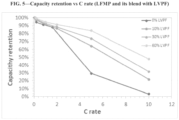
- Example 2 single layer pouch cells were prepared having a configuration the same as Example 1, except that the second active material was LFMP (LiFe 0.22 Mn 0.78 PO 4 ).
- the configurations for the cells are summarized Table 2 below.
- Table 2 Cell # Cathode Material (wt. ratio) Anode Electrolyte Salt & Solvent (vol.
- the prepared cells were tested as follows.
- the prepared cells were tested for rate capability (retention (%) of specific capacity at different current (C)-rates). The results are shown in FIG. 5 . As shown, LVPF significantly improved the rate capability of LFMP, particularly at higher C rates.
- LVPF also improved the processability of LFMP, demonstrating that LVPF has excellent processability.
- blending LVPF with LFMP was found to make the slurry more stable over time and easy to coat, thereby making the both slurry preparation process and the electrode coating process more controllable and robust.
Landscapes
- Chemical & Material Sciences (AREA)
- Chemical Kinetics & Catalysis (AREA)
- Electrochemistry (AREA)
- General Chemical & Material Sciences (AREA)
- Engineering & Computer Science (AREA)
- Inorganic Chemistry (AREA)
- Manufacturing & Machinery (AREA)
- Composite Materials (AREA)
- Materials Engineering (AREA)
- Crystallography & Structural Chemistry (AREA)
- Microelectronics & Electronic Packaging (AREA)
- Battery Electrode And Active Subsutance (AREA)
- Secondary Cells (AREA)
Applications Claiming Priority (2)
| Application Number | Priority Date | Filing Date | Title |
|---|---|---|---|
| US17/084,374 US11955624B2 (en) | 2020-10-29 | 2020-10-29 | Blended cathode materials for secondary batteries |
| PCT/US2021/053330 WO2022093486A1 (en) | 2020-10-29 | 2021-10-04 | Blended cathode materials for secondary batteries |
Publications (2)
| Publication Number | Publication Date |
|---|---|
| EP4238151A1 EP4238151A1 (en) | 2023-09-06 |
| EP4238151B1 true EP4238151B1 (en) | 2024-09-25 |
Family
ID=78463946
Family Applications (1)
| Application Number | Title | Priority Date | Filing Date |
|---|---|---|---|
| EP21801324.1A Active EP4238151B1 (en) | 2020-10-29 | 2021-10-04 | Blended cathode materials for secondary batteries |
Country Status (6)
| Country | Link |
|---|---|
| US (1) | US11955624B2 (pl) |
| EP (1) | EP4238151B1 (pl) |
| CN (1) | CN116368636A (pl) |
| HU (1) | HUE070355T2 (pl) |
| PL (1) | PL4238151T3 (pl) |
| WO (1) | WO2022093486A1 (pl) |
Families Citing this family (4)
| Publication number | Priority date | Publication date | Assignee | Title |
|---|---|---|---|---|
| US12051805B2 (en) * | 2022-10-27 | 2024-07-30 | Saft America | Cathode having multi-layer cathode coating |
| TWI821118B (zh) * | 2023-02-14 | 2023-11-01 | 台灣立凱電能科技股份有限公司 | 高電壓複合式正極材料及其製造方法 |
| US20240297304A1 (en) | 2023-02-21 | 2024-09-05 | Saft America | Electrolyte additive for phosphate cathode |
| CN121123581A (zh) * | 2024-06-12 | 2025-12-12 | 宁德时代新能源科技股份有限公司 | 电池单体、电池装置、储能装置和用电装置 |
Citations (2)
| Publication number | Priority date | Publication date | Assignee | Title |
|---|---|---|---|---|
| US20050196673A1 (en) * | 2003-12-23 | 2005-09-08 | Saft | Electrochemically active material for the positive electrode of a lithium rechargeable electrochemical cell |
| WO2019078965A1 (en) * | 2017-10-19 | 2019-04-25 | Battelle Memorial Institute | LOW FLAMMABLE ELECTROLYTES FOR THE STABLE OPERATION OF ELECTROCHEMICAL DEVICES |
Family Cites Families (20)
| Publication number | Priority date | Publication date | Assignee | Title |
|---|---|---|---|---|
| US6964827B2 (en) | 2000-04-27 | 2005-11-15 | Valence Technology, Inc. | Alkali/transition metal halo- and hydroxy-phosphates and related electrode active materials |
| CA2320661A1 (fr) * | 2000-09-26 | 2002-03-26 | Hydro-Quebec | Nouveau procede de synthese de materiaux limpo4 a structure olivine |
| FR2944162B1 (fr) | 2009-04-03 | 2011-04-22 | Saft Groupe Sa | Systeme d'alimentation electrique et procede de controle de charge de generateurs electrochimiques |
| FR2952367B1 (fr) * | 2009-11-10 | 2012-09-28 | Commissariat Energie Atomique | Synthese d'un fluorophosphate metallique et utilisation comme materiau actif d'electrode pour accumulateur |
| CN102079518A (zh) | 2009-11-29 | 2011-06-01 | 宁波大学 | 一种低温液相制备锂离子电池正极材料氟化磷酸钒锂的方法 |
| US20110168550A1 (en) | 2010-01-13 | 2011-07-14 | Applied Materials, Inc. | Graded electrode technologies for high energy lithium-ion batteries |
| CN102013469B (zh) * | 2010-11-05 | 2013-09-25 | 东莞新能源科技有限公司 | 锂离子二次电池及其正极极片 |
| US9525290B2 (en) | 2013-10-25 | 2016-12-20 | Saft | Bypassable battery modules |
| CN104103832A (zh) * | 2014-07-23 | 2014-10-15 | 中南大学 | 锂离子电池正极材料磷酸亚铁锂-氟磷酸钒锂的制备方法 |
| CN107004841B (zh) * | 2014-12-05 | 2021-08-17 | 株式会社Lg 化学 | 正极活性材料、制备其的方法以及包含其的锂二次电池 |
| KR20180069017A (ko) | 2015-10-28 | 2018-06-22 | 사빅 글로벌 테크놀러지스 비.브이. | 리튬이온전지 전극용 바인더 조성물 |
| KR102064991B1 (ko) * | 2016-01-15 | 2020-01-10 | 주식회사 엘지화학 | 2층으로 장착된 전지모듈들을 포함하는 전지팩 |
| CN107104249B (zh) * | 2016-02-23 | 2019-08-30 | 东莞新能源科技有限公司 | 锂离子电池充电方法 |
| FR3050326B1 (fr) | 2016-04-14 | 2021-12-24 | Accumulateurs Fixes | Assemblage d'elements electrochimiques par un procede de fabrication additive |
| US20180198125A1 (en) * | 2017-01-09 | 2018-07-12 | XingFox Energy Technology Co., Ltd. | Polymer coated cathode material, cathode and battery |
| CN107146877B (zh) * | 2017-05-03 | 2021-02-19 | 武汉理工大学 | 一种氟氧磷酸盐锂离子电池材料的制备方法及正极片与锂离子电池 |
| FR3074374B1 (fr) | 2017-11-28 | 2019-10-18 | Saft | Architecture de modules batterie connectes en parallele |
| US12362354B2 (en) * | 2018-04-19 | 2025-07-15 | A123 Systems Llc | Method and systems for coated cathode materials and use of coated cathode materials |
| JP7396270B2 (ja) * | 2018-05-02 | 2023-12-12 | 株式会社ジェイテクト | リチウムイオン二次電池 |
| CN108666558A (zh) | 2018-07-12 | 2018-10-16 | 西安交通大学 | 一种双层碳包覆制备氟磷酸钒锂锂离子电池正极材料的制备方法 |
-
2020
- 2020-10-29 US US17/084,374 patent/US11955624B2/en active Active
-
2021
- 2021-10-04 HU HUE21801324A patent/HUE070355T2/hu unknown
- 2021-10-04 EP EP21801324.1A patent/EP4238151B1/en active Active
- 2021-10-04 WO PCT/US2021/053330 patent/WO2022093486A1/en not_active Ceased
- 2021-10-04 PL PL21801324.1T patent/PL4238151T3/pl unknown
- 2021-10-04 CN CN202180072990.8A patent/CN116368636A/zh active Pending
Patent Citations (2)
| Publication number | Priority date | Publication date | Assignee | Title |
|---|---|---|---|---|
| US20050196673A1 (en) * | 2003-12-23 | 2005-09-08 | Saft | Electrochemically active material for the positive electrode of a lithium rechargeable electrochemical cell |
| WO2019078965A1 (en) * | 2017-10-19 | 2019-04-25 | Battelle Memorial Institute | LOW FLAMMABLE ELECTROLYTES FOR THE STABLE OPERATION OF ELECTROCHEMICAL DEVICES |
Non-Patent Citations (1)
| Title |
|---|
| ZHANG ZENGQI ET AL: "Improved performance of CoS2 nanoparticles encapsulated in carbon micro-polyhedron for propelling redox reaction of polysulfide", ELECTROCHIMICA ACTA, ELSEVIER, AMSTERDAM, NL, vol. 324, 17 September 2019 (2019-09-17), XP085860697, ISSN: 0013-4686, [retrieved on 20190917], DOI: 10.1016/J.ELECTACTA.2019.134899 * |
Also Published As
| Publication number | Publication date |
|---|---|
| WO2022093486A1 (en) | 2022-05-05 |
| US20220140316A1 (en) | 2022-05-05 |
| EP4238151A1 (en) | 2023-09-06 |
| CN116368636A (zh) | 2023-06-30 |
| HUE070355T2 (hu) | 2025-05-28 |
| US11955624B2 (en) | 2024-04-09 |
| PL4238151T3 (pl) | 2025-02-17 |
Similar Documents
| Publication | Publication Date | Title |
|---|---|---|
| US12046715B2 (en) | Electrolyte for lithium secondary battery and lithium secondary battery including the same | |
| EP4238151B1 (en) | Blended cathode materials for secondary batteries | |
| KR101607024B1 (ko) | 리튬 이차전지 | |
| KR102135631B1 (ko) | 리튬 축전지용 양극 | |
| EP3723181A1 (en) | Electrolyte solution for nonaqueous electrolyte batteries, and nonaqueous electrolyte battery using same | |
| US11804601B2 (en) | Cathode materials for lithium ion batteries | |
| US11831001B2 (en) | Pre-lithiation method and pre-lithiated lithium-ion secondary battery | |
| EP3723180A1 (en) | Liquid electrolyte for non-aqueous electrolyte cell, and non-aqueous electrolyte cell in which said liquid electrolyte for non-aqueous electrolyte cell is used | |
| CN111048831A (zh) | 用于二次电池的电解液以及包含电解液的锂二次电池 | |
| KR20180041602A (ko) | 리튬 이차전지용 전해액 및 이를 포함하는 리튬 이차전지 | |
| CN107925128B (zh) | 用于锂二次电池的电解质溶液和包括该电解质溶液的锂二次电池 | |
| KR102488633B1 (ko) | 이차전지용 전해액 첨가제, 이를 포함하는 리튬 이차전지용 비수 전해액, 및 이를 포함하는 리튬 이차전지 | |
| KR20090056739A (ko) | 리튬 이차 전지용 비수전해질 및 이를 포함하는 리튬 이차전지 | |
| KR101816949B1 (ko) | 비수성 전해액 및 이를 포함하는 리튬 이차전지 | |
| JP2000133305A (ja) | 非水電解液及びそれを用いたリチウム二次電池 | |
| EP3965205A1 (en) | Non-aqueous electrolyte solution | |
| US12051805B2 (en) | Cathode having multi-layer cathode coating | |
| JP4075180B2 (ja) | 非水電解液およびそれを用いたリチウム二次電池 | |
| EP4421918A1 (en) | Lithium-ion secondary battery with electrolyte additive | |
| US20230327111A1 (en) | Lithium-ion secondary battery | |
| KR102566944B1 (ko) | 리튬 전극 제조용 구조체 및 리튬 전극 제조용 구조체의 제조 방법 | |
| KR20080112490A (ko) | 리튬이온전지용 유기전해액 및 이를 포함하는 리튬이온전지 | |
| KR20240162750A (ko) | 리튬 금속 이차전지 | |
| KR20240105888A (ko) | 리튬 이차전지 전해액 및 이를 포함하는 리튬 이차전지 | |
| KR20240105889A (ko) | 리튬 이차전지 전해액 및 이를 포함하는 리튬 이차전지 |
Legal Events
| Date | Code | Title | Description |
|---|---|---|---|
| STAA | Information on the status of an ep patent application or granted ep patent |
Free format text: STATUS: UNKNOWN |
|
| STAA | Information on the status of an ep patent application or granted ep patent |
Free format text: STATUS: THE INTERNATIONAL PUBLICATION HAS BEEN MADE |
|
| PUAI | Public reference made under article 153(3) epc to a published international application that has entered the european phase |
Free format text: ORIGINAL CODE: 0009012 |
|
| STAA | Information on the status of an ep patent application or granted ep patent |
Free format text: STATUS: REQUEST FOR EXAMINATION WAS MADE |
|
| 17P | Request for examination filed |
Effective date: 20230530 |
|
| AK | Designated contracting states |
Kind code of ref document: A1 Designated state(s): AL AT BE BG CH CY CZ DE DK EE ES FI FR GB GR HR HU IE IS IT LI LT LU LV MC MK MT NL NO PL PT RO RS SE SI SK SM TR |
|
| DAV | Request for validation of the european patent (deleted) | ||
| DAX | Request for extension of the european patent (deleted) | ||
| P01 | Opt-out of the competence of the unified patent court (upc) registered |
Effective date: 20240130 |
|
| GRAP | Despatch of communication of intention to grant a patent |
Free format text: ORIGINAL CODE: EPIDOSNIGR1 |
|
| STAA | Information on the status of an ep patent application or granted ep patent |
Free format text: STATUS: GRANT OF PATENT IS INTENDED |
|
| INTG | Intention to grant announced |
Effective date: 20240429 |
|
| RIN1 | Information on inventor provided before grant (corrected) |
Inventor name: CAO, FRANK Inventor name: CHEN, XILIN |
|
| GRAS | Grant fee paid |
Free format text: ORIGINAL CODE: EPIDOSNIGR3 |
|
| GRAA | (expected) grant |
Free format text: ORIGINAL CODE: 0009210 |
|
| STAA | Information on the status of an ep patent application or granted ep patent |
Free format text: STATUS: THE PATENT HAS BEEN GRANTED |
|
| AK | Designated contracting states |
Kind code of ref document: B1 Designated state(s): AL AT BE BG CH CY CZ DE DK EE ES FI FR GB GR HR HU IE IS IT LI LT LU LV MC MK MT NL NO PL PT RO RS SE SI SK SM TR |
|
| REG | Reference to a national code |
Ref country code: GB Ref legal event code: FG4D |
|
| REG | Reference to a national code |
Ref country code: CH Ref legal event code: EP |
|
| REG | Reference to a national code |
Ref country code: DE Ref legal event code: R096 Ref document number: 602021019393 Country of ref document: DE |
|
| REG | Reference to a national code |
Ref country code: IE Ref legal event code: FG4D |
|
| REG | Reference to a national code |
Ref country code: LT Ref legal event code: MG9D |
|
| PG25 | Lapsed in a contracting state [announced via postgrant information from national office to epo] |
Ref country code: NO Free format text: LAPSE BECAUSE OF FAILURE TO SUBMIT A TRANSLATION OF THE DESCRIPTION OR TO PAY THE FEE WITHIN THE PRESCRIBED TIME-LIMIT Effective date: 20241225 |
|
| PG25 | Lapsed in a contracting state [announced via postgrant information from national office to epo] |
Ref country code: GR Free format text: LAPSE BECAUSE OF FAILURE TO SUBMIT A TRANSLATION OF THE DESCRIPTION OR TO PAY THE FEE WITHIN THE PRESCRIBED TIME-LIMIT Effective date: 20241226 Ref country code: FI Free format text: LAPSE BECAUSE OF FAILURE TO SUBMIT A TRANSLATION OF THE DESCRIPTION OR TO PAY THE FEE WITHIN THE PRESCRIBED TIME-LIMIT Effective date: 20240925 |
|
| PG25 | Lapsed in a contracting state [announced via postgrant information from national office to epo] |
Ref country code: BG Free format text: LAPSE BECAUSE OF FAILURE TO SUBMIT A TRANSLATION OF THE DESCRIPTION OR TO PAY THE FEE WITHIN THE PRESCRIBED TIME-LIMIT Effective date: 20240925 |
|
| PG25 | Lapsed in a contracting state [announced via postgrant information from national office to epo] |
Ref country code: LV Free format text: LAPSE BECAUSE OF FAILURE TO SUBMIT A TRANSLATION OF THE DESCRIPTION OR TO PAY THE FEE WITHIN THE PRESCRIBED TIME-LIMIT Effective date: 20240925 |
|
| PG25 | Lapsed in a contracting state [announced via postgrant information from national office to epo] |
Ref country code: RS Free format text: LAPSE BECAUSE OF FAILURE TO SUBMIT A TRANSLATION OF THE DESCRIPTION OR TO PAY THE FEE WITHIN THE PRESCRIBED TIME-LIMIT Effective date: 20241225 |
|
| REG | Reference to a national code |
Ref country code: NL Ref legal event code: MP Effective date: 20240925 |
|
| PG25 | Lapsed in a contracting state [announced via postgrant information from national office to epo] |
Ref country code: RS Free format text: LAPSE BECAUSE OF FAILURE TO SUBMIT A TRANSLATION OF THE DESCRIPTION OR TO PAY THE FEE WITHIN THE PRESCRIBED TIME-LIMIT Effective date: 20241225 Ref country code: NO Free format text: LAPSE BECAUSE OF FAILURE TO SUBMIT A TRANSLATION OF THE DESCRIPTION OR TO PAY THE FEE WITHIN THE PRESCRIBED TIME-LIMIT Effective date: 20241225 Ref country code: LV Free format text: LAPSE BECAUSE OF FAILURE TO SUBMIT A TRANSLATION OF THE DESCRIPTION OR TO PAY THE FEE WITHIN THE PRESCRIBED TIME-LIMIT Effective date: 20240925 Ref country code: GR Free format text: LAPSE BECAUSE OF FAILURE TO SUBMIT A TRANSLATION OF THE DESCRIPTION OR TO PAY THE FEE WITHIN THE PRESCRIBED TIME-LIMIT Effective date: 20241226 Ref country code: FI Free format text: LAPSE BECAUSE OF FAILURE TO SUBMIT A TRANSLATION OF THE DESCRIPTION OR TO PAY THE FEE WITHIN THE PRESCRIBED TIME-LIMIT Effective date: 20240925 Ref country code: BG Free format text: LAPSE BECAUSE OF FAILURE TO SUBMIT A TRANSLATION OF THE DESCRIPTION OR TO PAY THE FEE WITHIN THE PRESCRIBED TIME-LIMIT Effective date: 20240925 |
|
| REG | Reference to a national code |
Ref country code: AT Ref legal event code: MK05 Ref document number: 1727428 Country of ref document: AT Kind code of ref document: T Effective date: 20240925 |
|
| PG25 | Lapsed in a contracting state [announced via postgrant information from national office to epo] |
Ref country code: NL Free format text: LAPSE BECAUSE OF FAILURE TO SUBMIT A TRANSLATION OF THE DESCRIPTION OR TO PAY THE FEE WITHIN THE PRESCRIBED TIME-LIMIT Effective date: 20240925 |
|
| PG25 | Lapsed in a contracting state [announced via postgrant information from national office to epo] |
Ref country code: IS Free format text: LAPSE BECAUSE OF FAILURE TO SUBMIT A TRANSLATION OF THE DESCRIPTION OR TO PAY THE FEE WITHIN THE PRESCRIBED TIME-LIMIT Effective date: 20250125 Ref country code: PT Free format text: LAPSE BECAUSE OF FAILURE TO SUBMIT A TRANSLATION OF THE DESCRIPTION OR TO PAY THE FEE WITHIN THE PRESCRIBED TIME-LIMIT Effective date: 20250127 |
|
| PG25 | Lapsed in a contracting state [announced via postgrant information from national office to epo] |
Ref country code: SM Free format text: LAPSE BECAUSE OF FAILURE TO SUBMIT A TRANSLATION OF THE DESCRIPTION OR TO PAY THE FEE WITHIN THE PRESCRIBED TIME-LIMIT Effective date: 20240925 Ref country code: RO Free format text: LAPSE BECAUSE OF FAILURE TO SUBMIT A TRANSLATION OF THE DESCRIPTION OR TO PAY THE FEE WITHIN THE PRESCRIBED TIME-LIMIT Effective date: 20240925 |
|
| PG25 | Lapsed in a contracting state [announced via postgrant information from national office to epo] |
Ref country code: ES Free format text: LAPSE BECAUSE OF FAILURE TO SUBMIT A TRANSLATION OF THE DESCRIPTION OR TO PAY THE FEE WITHIN THE PRESCRIBED TIME-LIMIT Effective date: 20240925 |
|
| PGFP | Annual fee paid to national office [announced via postgrant information from national office to epo] |
Ref country code: HU Payment date: 20241219 Year of fee payment: 4 |
|
| PG25 | Lapsed in a contracting state [announced via postgrant information from national office to epo] |
Ref country code: EE Free format text: LAPSE BECAUSE OF FAILURE TO SUBMIT A TRANSLATION OF THE DESCRIPTION OR TO PAY THE FEE WITHIN THE PRESCRIBED TIME-LIMIT Effective date: 20240925 Ref country code: AT Free format text: LAPSE BECAUSE OF FAILURE TO SUBMIT A TRANSLATION OF THE DESCRIPTION OR TO PAY THE FEE WITHIN THE PRESCRIBED TIME-LIMIT Effective date: 20240925 |
|
| PG25 | Lapsed in a contracting state [announced via postgrant information from national office to epo] |
Ref country code: CZ Free format text: LAPSE BECAUSE OF FAILURE TO SUBMIT A TRANSLATION OF THE DESCRIPTION OR TO PAY THE FEE WITHIN THE PRESCRIBED TIME-LIMIT Effective date: 20240925 |
|
| PG25 | Lapsed in a contracting state [announced via postgrant information from national office to epo] |
Ref country code: IT Free format text: LAPSE BECAUSE OF FAILURE TO SUBMIT A TRANSLATION OF THE DESCRIPTION OR TO PAY THE FEE WITHIN THE PRESCRIBED TIME-LIMIT Effective date: 20240925 Ref country code: SK Free format text: LAPSE BECAUSE OF FAILURE TO SUBMIT A TRANSLATION OF THE DESCRIPTION OR TO PAY THE FEE WITHIN THE PRESCRIBED TIME-LIMIT Effective date: 20240925 |
|
| REG | Reference to a national code |
Ref country code: HU Ref legal event code: AG4A Ref document number: E070355 Country of ref document: HU |
|
| REG | Reference to a national code |
Ref country code: CH Ref legal event code: PL |
|
| REG | Reference to a national code |
Ref country code: DE Ref legal event code: R097 Ref document number: 602021019393 Country of ref document: DE |
|
| PG25 | Lapsed in a contracting state [announced via postgrant information from national office to epo] |
Ref country code: MC Free format text: LAPSE BECAUSE OF FAILURE TO SUBMIT A TRANSLATION OF THE DESCRIPTION OR TO PAY THE FEE WITHIN THE PRESCRIBED TIME-LIMIT Effective date: 20240925 |
|
| PG25 | Lapsed in a contracting state [announced via postgrant information from national office to epo] |
Ref country code: DK Free format text: LAPSE BECAUSE OF FAILURE TO SUBMIT A TRANSLATION OF THE DESCRIPTION OR TO PAY THE FEE WITHIN THE PRESCRIBED TIME-LIMIT Effective date: 20240925 |
|
| PG25 | Lapsed in a contracting state [announced via postgrant information from national office to epo] |
Ref country code: LU Free format text: LAPSE BECAUSE OF NON-PAYMENT OF DUE FEES Effective date: 20241004 Ref country code: BE Free format text: LAPSE BECAUSE OF NON-PAYMENT OF DUE FEES Effective date: 20241031 |
|
| PG25 | Lapsed in a contracting state [announced via postgrant information from national office to epo] |
Ref country code: CH Free format text: LAPSE BECAUSE OF NON-PAYMENT OF DUE FEES Effective date: 20241031 |
|
| PLBE | No opposition filed within time limit |
Free format text: ORIGINAL CODE: 0009261 |
|
| STAA | Information on the status of an ep patent application or granted ep patent |
Free format text: STATUS: NO OPPOSITION FILED WITHIN TIME LIMIT |
|
| REG | Reference to a national code |
Ref country code: BE Ref legal event code: MM Effective date: 20241031 |
|
| 26N | No opposition filed |
Effective date: 20250626 |
|
| PG25 | Lapsed in a contracting state [announced via postgrant information from national office to epo] |
Ref country code: SE Free format text: LAPSE BECAUSE OF FAILURE TO SUBMIT A TRANSLATION OF THE DESCRIPTION OR TO PAY THE FEE WITHIN THE PRESCRIBED TIME-LIMIT Effective date: 20240925 |
|
| PGFP | Annual fee paid to national office [announced via postgrant information from national office to epo] |
Ref country code: PL Payment date: 20250820 Year of fee payment: 5 |
|
| PG25 | Lapsed in a contracting state [announced via postgrant information from national office to epo] |
Ref country code: IE Free format text: LAPSE BECAUSE OF NON-PAYMENT OF DUE FEES Effective date: 20241004 |
|
| PGFP | Annual fee paid to national office [announced via postgrant information from national office to epo] |
Ref country code: DE Payment date: 20251031 Year of fee payment: 5 |
|
| PGFP | Annual fee paid to national office [announced via postgrant information from national office to epo] |
Ref country code: GB Payment date: 20251031 Year of fee payment: 5 |
|
| PG25 | Lapsed in a contracting state [announced via postgrant information from national office to epo] |
Ref country code: HR Free format text: LAPSE BECAUSE OF FAILURE TO SUBMIT A TRANSLATION OF THE DESCRIPTION OR TO PAY THE FEE WITHIN THE PRESCRIBED TIME-LIMIT Effective date: 20240925 |
|
| PGFP | Annual fee paid to national office [announced via postgrant information from national office to epo] |
Ref country code: FR Payment date: 20251030 Year of fee payment: 5 |
|
| PG25 | Lapsed in a contracting state [announced via postgrant information from national office to epo] |
Ref country code: CY Free format text: LAPSE BECAUSE OF FAILURE TO SUBMIT A TRANSLATION OF THE DESCRIPTION OR TO PAY THE FEE WITHIN THE PRESCRIBED TIME-LIMIT; INVALID AB INITIO Effective date: 20211004 |