EP4234497A1 - Positivelektrodenmaterial, herstellungsverfahren dafür und verwendung davon - Google Patents
Positivelektrodenmaterial, herstellungsverfahren dafür und verwendung davon Download PDFInfo
- Publication number
- EP4234497A1 EP4234497A1 EP21881514.0A EP21881514A EP4234497A1 EP 4234497 A1 EP4234497 A1 EP 4234497A1 EP 21881514 A EP21881514 A EP 21881514A EP 4234497 A1 EP4234497 A1 EP 4234497A1
- Authority
- EP
- European Patent Office
- Prior art keywords
- positive electrode
- electrode material
- optionally
- preparation
- silica sol
- Prior art date
- Legal status (The legal status is an assumption and is not a legal conclusion. Google has not performed a legal analysis and makes no representation as to the accuracy of the status listed.)
- Pending
Links
Images
Classifications
-
- C—CHEMISTRY; METALLURGY
- C01—INORGANIC CHEMISTRY
- C01B—NON-METALLIC ELEMENTS; COMPOUNDS THEREOF; METALLOIDS OR COMPOUNDS THEREOF NOT COVERED BY SUBCLASS C01C
- C01B25/00—Phosphorus; Compounds thereof
- C01B25/16—Oxyacids of phosphorus; Salts thereof
- C01B25/26—Phosphates
- C01B25/38—Condensed phosphates
- C01B25/40—Polyphosphates
-
- C—CHEMISTRY; METALLURGY
- C01—INORGANIC CHEMISTRY
- C01G—COMPOUNDS CONTAINING METALS NOT COVERED BY SUBCLASSES C01D OR C01F
- C01G53/00—Compounds of nickel
- C01G53/40—Complex oxides containing nickel and at least one other metal element
- C01G53/42—Complex oxides containing nickel and at least one other metal element containing alkali metals, e.g. LiNiO2
- C01G53/44—Complex oxides containing nickel and at least one other metal element containing alkali metals, e.g. LiNiO2 containing manganese
- C01G53/50—Complex oxides containing nickel and at least one other metal element containing alkali metals, e.g. LiNiO2 containing manganese of the type (MnO2)n-, e.g. Li(NixMn1-x)O2 or Li(MyNixMn1-x-y)O2
-
- B—PERFORMING OPERATIONS; TRANSPORTING
- B82—NANOTECHNOLOGY
- B82Y—SPECIFIC USES OR APPLICATIONS OF NANOSTRUCTURES; MEASUREMENT OR ANALYSIS OF NANOSTRUCTURES; MANUFACTURE OR TREATMENT OF NANOSTRUCTURES
- B82Y40/00—Manufacture or treatment of nanostructures
-
- C—CHEMISTRY; METALLURGY
- C01—INORGANIC CHEMISTRY
- C01B—NON-METALLIC ELEMENTS; COMPOUNDS THEREOF; METALLOIDS OR COMPOUNDS THEREOF NOT COVERED BY SUBCLASS C01C
- C01B25/00—Phosphorus; Compounds thereof
- C01B25/16—Oxyacids of phosphorus; Salts thereof
- C01B25/26—Phosphates
- C01B25/38—Condensed phosphates
- C01B25/40—Polyphosphates
- C01B25/41—Polyphosphates of alkali metals
- C01B25/418—After-treatment
-
- C—CHEMISTRY; METALLURGY
- C01—INORGANIC CHEMISTRY
- C01B—NON-METALLIC ELEMENTS; COMPOUNDS THEREOF; METALLOIDS OR COMPOUNDS THEREOF NOT COVERED BY SUBCLASS C01C
- C01B33/00—Silicon; Compounds thereof
- C01B33/113—Silicon oxides; Hydrates thereof
- C01B33/12—Silica; Hydrates thereof, e.g. lepidoic silicic acid
-
- C—CHEMISTRY; METALLURGY
- C01—INORGANIC CHEMISTRY
- C01B—NON-METALLIC ELEMENTS; COMPOUNDS THEREOF; METALLOIDS OR COMPOUNDS THEREOF NOT COVERED BY SUBCLASS C01C
- C01B33/00—Silicon; Compounds thereof
- C01B33/113—Silicon oxides; Hydrates thereof
- C01B33/12—Silica; Hydrates thereof, e.g. lepidoic silicic acid
- C01B33/14—Colloidal silica, e.g. dispersions, gels, sols
- C01B33/141—Preparation of hydrosols or aqueous dispersions
- C01B33/142—Preparation of hydrosols or aqueous dispersions by acidic treatment of silicates
- C01B33/143—Preparation of hydrosols or aqueous dispersions by acidic treatment of silicates of aqueous solutions of silicates
-
- H—ELECTRICITY
- H01—ELECTRIC ELEMENTS
- H01M—PROCESSES OR MEANS, e.g. BATTERIES, FOR THE DIRECT CONVERSION OF CHEMICAL ENERGY INTO ELECTRICAL ENERGY
- H01M10/00—Secondary cells; Manufacture thereof
- H01M10/05—Accumulators with non-aqueous electrolyte
- H01M10/052—Li-accumulators
- H01M10/0525—Rocking-chair batteries, i.e. batteries with lithium insertion or intercalation in both electrodes; Lithium-ion batteries
-
- H—ELECTRICITY
- H01—ELECTRIC ELEMENTS
- H01M—PROCESSES OR MEANS, e.g. BATTERIES, FOR THE DIRECT CONVERSION OF CHEMICAL ENERGY INTO ELECTRICAL ENERGY
- H01M4/00—Electrodes
- H01M4/02—Electrodes composed of, or comprising, active material
- H01M4/04—Processes of manufacture in general
- H01M4/0471—Processes of manufacture in general involving thermal treatment, e.g. firing, sintering, backing particulate active material, thermal decomposition, pyrolysis
-
- H—ELECTRICITY
- H01—ELECTRIC ELEMENTS
- H01M—PROCESSES OR MEANS, e.g. BATTERIES, FOR THE DIRECT CONVERSION OF CHEMICAL ENERGY INTO ELECTRICAL ENERGY
- H01M4/00—Electrodes
- H01M4/02—Electrodes composed of, or comprising, active material
- H01M4/13—Electrodes for accumulators with non-aqueous electrolyte, e.g. for lithium-accumulators; Processes of manufacture thereof
- H01M4/131—Electrodes based on mixed oxides or hydroxides, or on mixtures of oxides or hydroxides, e.g. LiCoOx
-
- H—ELECTRICITY
- H01—ELECTRIC ELEMENTS
- H01M—PROCESSES OR MEANS, e.g. BATTERIES, FOR THE DIRECT CONVERSION OF CHEMICAL ENERGY INTO ELECTRICAL ENERGY
- H01M4/00—Electrodes
- H01M4/02—Electrodes composed of, or comprising, active material
- H01M4/36—Selection of substances as active materials, active masses, active liquids
- H01M4/362—Composites
-
- H—ELECTRICITY
- H01—ELECTRIC ELEMENTS
- H01M—PROCESSES OR MEANS, e.g. BATTERIES, FOR THE DIRECT CONVERSION OF CHEMICAL ENERGY INTO ELECTRICAL ENERGY
- H01M4/00—Electrodes
- H01M4/02—Electrodes composed of, or comprising, active material
- H01M4/36—Selection of substances as active materials, active masses, active liquids
- H01M4/362—Composites
- H01M4/366—Composites as layered products
-
- H—ELECTRICITY
- H01—ELECTRIC ELEMENTS
- H01M—PROCESSES OR MEANS, e.g. BATTERIES, FOR THE DIRECT CONVERSION OF CHEMICAL ENERGY INTO ELECTRICAL ENERGY
- H01M4/00—Electrodes
- H01M4/02—Electrodes composed of, or comprising, active material
- H01M4/36—Selection of substances as active materials, active masses, active liquids
- H01M4/38—Selection of substances as active materials, active masses, active liquids of elements or alloys
- H01M4/386—Silicon or alloys based on silicon
-
- H—ELECTRICITY
- H01—ELECTRIC ELEMENTS
- H01M—PROCESSES OR MEANS, e.g. BATTERIES, FOR THE DIRECT CONVERSION OF CHEMICAL ENERGY INTO ELECTRICAL ENERGY
- H01M4/00—Electrodes
- H01M4/02—Electrodes composed of, or comprising, active material
- H01M4/36—Selection of substances as active materials, active masses, active liquids
- H01M4/48—Selection of substances as active materials, active masses, active liquids of inorganic oxides or hydroxides
- H01M4/50—Selection of substances as active materials, active masses, active liquids of inorganic oxides or hydroxides of manganese
- H01M4/505—Selection of substances as active materials, active masses, active liquids of inorganic oxides or hydroxides of manganese of mixed oxides or hydroxides containing manganese for inserting or intercalating light metals, e.g. LiMn2O4 or LiMn2OxFy
-
- H—ELECTRICITY
- H01—ELECTRIC ELEMENTS
- H01M—PROCESSES OR MEANS, e.g. BATTERIES, FOR THE DIRECT CONVERSION OF CHEMICAL ENERGY INTO ELECTRICAL ENERGY
- H01M4/00—Electrodes
- H01M4/02—Electrodes composed of, or comprising, active material
- H01M4/36—Selection of substances as active materials, active masses, active liquids
- H01M4/48—Selection of substances as active materials, active masses, active liquids of inorganic oxides or hydroxides
- H01M4/52—Selection of substances as active materials, active masses, active liquids of inorganic oxides or hydroxides of nickel, cobalt or iron
- H01M4/525—Selection of substances as active materials, active masses, active liquids of inorganic oxides or hydroxides of nickel, cobalt or iron of mixed oxides or hydroxides containing iron, cobalt or nickel for inserting or intercalating light metals, e.g. LiNiO2, LiCoO2 or LiCoOxFy
-
- H—ELECTRICITY
- H01—ELECTRIC ELEMENTS
- H01M—PROCESSES OR MEANS, e.g. BATTERIES, FOR THE DIRECT CONVERSION OF CHEMICAL ENERGY INTO ELECTRICAL ENERGY
- H01M4/00—Electrodes
- H01M4/02—Electrodes composed of, or comprising, active material
- H01M4/36—Selection of substances as active materials, active masses, active liquids
- H01M4/58—Selection of substances as active materials, active masses, active liquids of inorganic compounds other than oxides or hydroxides, e.g. sulfides, selenides, tellurides, halogenides or LiCoFy; of polyanionic structures, e.g. phosphates, silicates or borates
-
- H—ELECTRICITY
- H01—ELECTRIC ELEMENTS
- H01M—PROCESSES OR MEANS, e.g. BATTERIES, FOR THE DIRECT CONVERSION OF CHEMICAL ENERGY INTO ELECTRICAL ENERGY
- H01M4/00—Electrodes
- H01M4/02—Electrodes composed of, or comprising, active material
- H01M4/36—Selection of substances as active materials, active masses, active liquids
- H01M4/58—Selection of substances as active materials, active masses, active liquids of inorganic compounds other than oxides or hydroxides, e.g. sulfides, selenides, tellurides, halogenides or LiCoFy; of polyanionic structures, e.g. phosphates, silicates or borates
- H01M4/5825—Oxygenated metallic salts or polyanionic structures, e.g. borates, phosphates, silicates, olivines
-
- H—ELECTRICITY
- H01—ELECTRIC ELEMENTS
- H01M—PROCESSES OR MEANS, e.g. BATTERIES, FOR THE DIRECT CONVERSION OF CHEMICAL ENERGY INTO ELECTRICAL ENERGY
- H01M4/00—Electrodes
- H01M4/02—Electrodes composed of, or comprising, active material
- H01M4/62—Selection of inactive substances as ingredients for active masses, e.g. binders, fillers
- H01M4/621—Binders
-
- H—ELECTRICITY
- H01—ELECTRIC ELEMENTS
- H01M—PROCESSES OR MEANS, e.g. BATTERIES, FOR THE DIRECT CONVERSION OF CHEMICAL ENERGY INTO ELECTRICAL ENERGY
- H01M4/00—Electrodes
- H01M4/02—Electrodes composed of, or comprising, active material
- H01M4/62—Selection of inactive substances as ingredients for active masses, e.g. binders, fillers
- H01M4/621—Binders
- H01M4/622—Binders being polymers
-
- H—ELECTRICITY
- H01—ELECTRIC ELEMENTS
- H01M—PROCESSES OR MEANS, e.g. BATTERIES, FOR THE DIRECT CONVERSION OF CHEMICAL ENERGY INTO ELECTRICAL ENERGY
- H01M4/00—Electrodes
- H01M4/02—Electrodes composed of, or comprising, active material
- H01M4/62—Selection of inactive substances as ingredients for active masses, e.g. binders, fillers
- H01M4/628—Inhibitors, e.g. gassing inhibitors, corrosion inhibitors
-
- B—PERFORMING OPERATIONS; TRANSPORTING
- B82—NANOTECHNOLOGY
- B82Y—SPECIFIC USES OR APPLICATIONS OF NANOSTRUCTURES; MEASUREMENT OR ANALYSIS OF NANOSTRUCTURES; MANUFACTURE OR TREATMENT OF NANOSTRUCTURES
- B82Y30/00—Nanotechnology for materials or surface science, e.g. nanocomposites
-
- H—ELECTRICITY
- H01—ELECTRIC ELEMENTS
- H01M—PROCESSES OR MEANS, e.g. BATTERIES, FOR THE DIRECT CONVERSION OF CHEMICAL ENERGY INTO ELECTRICAL ENERGY
- H01M4/00—Electrodes
- H01M4/02—Electrodes composed of, or comprising, active material
- H01M2004/021—Physical characteristics, e.g. porosity, surface area
-
- H—ELECTRICITY
- H01—ELECTRIC ELEMENTS
- H01M—PROCESSES OR MEANS, e.g. BATTERIES, FOR THE DIRECT CONVERSION OF CHEMICAL ENERGY INTO ELECTRICAL ENERGY
- H01M4/00—Electrodes
- H01M4/02—Electrodes composed of, or comprising, active material
- H01M2004/026—Electrodes composed of, or comprising, active material characterised by the polarity
- H01M2004/028—Positive electrodes
-
- Y—GENERAL TAGGING OF NEW TECHNOLOGICAL DEVELOPMENTS; GENERAL TAGGING OF CROSS-SECTIONAL TECHNOLOGIES SPANNING OVER SEVERAL SECTIONS OF THE IPC; TECHNICAL SUBJECTS COVERED BY FORMER USPC CROSS-REFERENCE ART COLLECTIONS [XRACs] AND DIGESTS
- Y02—TECHNOLOGIES OR APPLICATIONS FOR MITIGATION OR ADAPTATION AGAINST CLIMATE CHANGE
- Y02E—REDUCTION OF GREENHOUSE GAS [GHG] EMISSIONS, RELATED TO ENERGY GENERATION, TRANSMISSION OR DISTRIBUTION
- Y02E60/00—Enabling technologies; Technologies with a potential or indirect contribution to GHG emissions mitigation
- Y02E60/10—Energy storage using batteries
Definitions
- the present application belongs to the field of lithium-ion batteries, and relates to a positive electrode material, a preparation method therefor and use thereof.
- Lithium-ion batteries which have high energy density, high output power, environmental friendliness, and contain no toxic substances such as lead, cadmium and mercury, have a wide application prospect in the field of electrical equipment.
- the lithium-ion battery positive electrode material, negative electrode material and electrolyte are the three main components of lithium-ion batteries, and their performance basically determines the performance of lithium-ion batteries.
- the common lithium-ion batteries cannot be applied at a high temperature of 80°C. It has been a hot spot in the development of lithium-ion battery technology about how to broaden the use temperature range of lithium-ion batteries.
- the research results show that the structure of positive electrode materials of lithium-ion batteries will be destroyed continuously during the high-temperature storage, resulting in storage failure. Meanwhile, the active surface of positive electrode materials can react with the electrolyte unfavourably, which will accelerate the damage of positive electrode materials. The residual moisture in the electrolyte will accelerate the decomposition of LiPF 6 , resulting in high-temperature storage failure.
- lithium salt LiPF 6 will be decomposed continuously and produce HF and PF 5 .
- Those two substances are unfavorable for high-temperature storage, and HF will corrode the positive electrode materials, resulting in the surface structure destruction of positive electrode materials.
- CN101308925A discloses a composite coated positive electrode material for lithium-ion batteries and a preparation method therefor.
- the positive electrode material includes Li 0.8-1.2 Ni 0.7 Co 0.2 Mn 0.1 O 2 , Li 0.8-1.2 Ni 0.8 Co 0.1 Mn 0.1 O 2 or Li 0.8-1.2 Ni 0.9 Co 0.05 Mn 0.05 O 2 as a matrix, the crystal structure is hexagonal system, and the surface of the matrix is coated with a gradient functional material layer which is 1-20% of a matrix mass ratio.
- the preparation method includes powder preparation, raw material mixing, sintering, surface coating, heat treatment and organic coating. The high nickel ternary material is prevented from contacting with the electrolyte, and the cycle stability of the battery is improved.
- the metal oxides used are inert materials, and their ionic conductivity is not high, which reduces the capacity and rate capability of the positive electrode materials. Moreover, their thermal conductivity is insufficient, and thus the heat generated by the electrode materials cannot be dissipated in time, the heat will be continuously accumulated, and finally the temperature rises, resulting in potential safety hazards. Moreover, the battery is difficult to store at high temperature under this condition.
- CN107742711A discloses a surface coating method for a ternary positive electrode material, which reacts hydroxypropyl guanidine gum with borax to generate a gel system with three-dimensional network effect.
- Borax is used as a cross-linking agent, and when the boron cross-linking agent is cross-linked with guanidine gum, it firstly generates multi-stage ionization to generate borate ion B(OH) 4 - , and then forms stable hydrogen bonds with cis-ortho position hydroxyl groups in guanidine gum molecules.
- a viscoelastic gel is generated through intermolecular cross-linking reaction, and then coated with boride after sintering.
- this method has disadvantages: the hydroxypropyl guanidine gum is an organic substance, which can be carbonized after the sintering at high temperature, resulting in the reduction of the positive electrode material and the destruction of the corresponding structure.
- CN108199047A discloses a method for coating oxide on the surface of a lithium-ion ternary positive electrode material. Firstly, a lithium-ion ternary positive electrode material powder is dispersed in a certain amount of deionized water; after the powder is evenly dispersed, a certain amount of organic acid or salt and insoluble metal salt are added into the system to react for a certain time; then the treated ternary positive electrode material is dried, and subjected to heat treatment at a certain temperature for a period of time to obtain the oxide-coated lithium ion ternary positive electrode material.
- the method for wet coating sediment is adopted, and polyacrylic acid or salt and insoluble salt are adopted. This method has limitations, and the particle size of insoluble salt seriously affects the coating effect.
- the common lithium-ion batteries generally cannot be stored at high temperature. In the environment of more than 80°C, the batteries cannot serve basically because of the decomposition of electrolyte or the decay of positive electrode materials.
- An object of the present application is to provide a positive electrode material, a preparation method therefor and use thereof.
- the positive electrode material is effectively relieved from the surface structure damage and thus improved in high-temperature storage performance by mixing the ternary positive electrode material with aluminum tripolyphosphate.
- the present application provides a preparation method of a positive electrode material, and the preparation method includes the following steps:
- the colloidal silica sol is coated uniformly on the surface of the ternary positive electrode material, and aluminum tripolyphosphate is dispersed uniformly among the ternary positive electrode material particles as well as on the surface, which can effectively extend the storage time of the lithium-ion battery at 80-85°C to more than two months.
- the aluminum tripolyphosphate has a mass fraction of 0.1-1%, such as 0.1%, 0.2%, 0.3%, 0.4%, 0.5%, 0.6%, 0.7%, 0.8%, 0.9% or 1.0%.
- aluminum tripolyphosphate with more than 1% amount will reduce the gram capacity of the positive electrode material; aluminum tripolyphosphate with less than 0.1% amount will lead to uneven surface coating.
- step (1) is carried out in a manner of dry mixing.
- the dry mixing is ball-milling dry mixing.
- the ball-milling dry mixing has a ball-to-material ratio of 1.5:1-2:1, such as 1.5:1, 1.6:1, 1.7:1, 1.8:1, 1.9:1, 2.0:1 or 2.1:1.
- the ball-milling dry mixing has large balls of 4 mm and small balls of 2 mm.
- the ball-milling dry mixing has a mixing time of 5-25 min, such as 5 min, 6 min, 7 min, 8 min, 9 min, 10 min, 11 min, 12 min, 13 min, 14 min, 15 min, 16 min, 17 min, 18 min, 19 min, 20 min, 2 1min, 22 min, 23 min, 24 min or 25 min.
- the ball-milling mixing can uniformly mix the ternary positive electrode material with aluminum tripolyphosphate, and the agglomerated particles of nanoscale aluminum tripolyphosphate can be dispersed under the shear force of ball milling and fully mixed with the positive electrode material.
- a preparation method of the colloidal silica sol in step (2) includes: dissolving a sodium silicate aqueous solution , and adding acid and/or CO 2 to form the colloidal silica sol.
- the acid and/or CO 2 added has a molar ratio of more than 1.
- the sodium silicate aqueous solution has a concentration of 5-25%, such as 5%, 6%, 7%, 8%, 9%, 10%, 11%, 12%, 13%, 14%, 15%, 16%, 17%, 18%, 19%, 20%, 21%, 22%, 23%, 24% or 25%.
- the acid includes any one or a combination of at least two of hydrochloric acid, phosphoric acid or sulfuric acid.
- the colloidal silica sol has a net silicon content of 0. 1-1%, such as 0.1%, 0.2%, 0.3%, 0.4%, 0.5%, 0.6%, 0.7%, 0.8%, 0.9% or 1.0%.
- the colloidal silica sol plays the role of binder to bind aluminum tripolyphosphate on the surface of the positive electrode material, in which the aluminum tripolyphosphate is also dispersed among the ternary positive electrode material.
- the colloidal silica sol is water-base silica sol Si(OH) 4 .
- the water-base silica sol Si(OH) 4 can realize surface bonding effect by contact with the active oxygen on the surface of the positive electrode material, and thus effectively reduce the alkali content on the surface of the ternary positive electrode material and improve the battery performance.
- the drying in step (3) includes vacuum drying, blast drying and/or air drying, optionally vacuum drying.
- the vacuum drying has a temperature of 100-150°C, such as 100°C, 110°C, 120°C, 130°C, 140°C or 150°C.
- the vacuum drying has a vacuum degree of -0.05 Mpa to 0.1 Mpa, such as -0.05 Mpa, -0.04 Mpa, -0.03 Mpa, -0.02 Mpa, -0.01 Mpa, 0 Mpa, 0.01 Mpa, 0.02 Mpa, 0.03 Mpa, 0.04 Mpa, 0.05 Mpa, 0.06 Mpa, 0.07 Mpa, 0.08 Mpa, 0.09 Mpa or 0.1 Mpa.
- a vacuum degree of -0.05 Mpa to 0.1 Mpa such as -0.05 Mpa, -0.04 Mpa, -0.03 Mpa, -0.02 Mpa, -0.01 Mpa, 0 Mpa, 0.01 Mpa, 0.02 Mpa, 0.03 Mpa, 0.04 Mpa, 0.05 Mpa, 0.06 Mpa, 0.07 Mpa, 0.08 Mpa, 0.09 Mpa or 0.1 Mpa
- the vacuum drying has a time of 1-10 h, such as 1 h, 2 h, 3 h, 4 h, 5 h, 6 h, 7 h, 8 h, 9 h or 10 h.
- the vacuum drying is selected because it can remove water more quickly, protect the material from CO 2 and reduce the generation of lithium carbonate on the surface.
- the sintering in step (4) has a temperature of 450-650°C, such as 450°C, 460°C, 470°C, 480°C, 490°C, 500°C, 510°C, 520°C, 530°C, 540°C, 550°C, 560°C, 570°C, 580°C, 590°C, 600°C, 610°C, 620°C, 630°C, 640°C or 650°C.
- 450-650°C such as 450°C, 460°C, 470°C, 480°C, 490°C, 500°C, 510°C, 520°C, 530°C, 540°C, 550°C, 560°C, 570°C, 580°C, 590°C, 600°C, 610°C, 620°C, 630°C, 640°C or 650°C.
- the sintering in step (4) has a time of 1-10 h, such as 1 h, 2 h, 3 h, 4 h, 5 h, 6 h, 7 h, 8 h, 9 h or 10 h.
- step (4) further includes subjecting the product obtained from the sintering to post-treatment.
- the colloidal silica sol which is coated on the ternary positive electrode material through step (2), is finally coated on the surface of the ternary positive electrode material in the form of silica after a series of treatments such as drying and sintering.
- the post-treatment is carried out in a manner which includes any one or a combination of at least two of crushing, sieving or iron removal.
- the preparation method of a positive electrode material in the present application includes:
- the present application provides a positive electrode material prepared by the preparation method of a positive electrode material according to the first aspect.
- the positive electrode material includes a ternary positive electrode material, aluminum tripolyphosphate and a binder.
- the aluminum tripolyphosphate in the positive electrode material can be hydrolyzed to generate triphosphate ions, which can effectively chelate metal ions in the ternary positive electrode material, thereby preventing the deposition of metal ions on the negative electrode, protecting the SEI film, and further reducing the high-temperature storage performance of the lithium-ion battery, especially in the environment at 80-85°C.
- the aluminum tripolyphosphate is dispersed among the ternary positive electrode material and on the surface of the ternary positive electrode material.
- the aluminum tripolyphosphate is nanoparticles.
- the aluminum tripolyphosphate has a particle size of 2-20 nm, such as 2 nm, 3 nm, 4 nm, 5 nm, 6 nm, 7 nm, 8 nm, 9 nm, 10 nm, 11 nm, 12 nm, 13 nm, 14 nm, 15 nm, 16 nm, 17 nm, 18 nm, 19 nm or 20 nm.
- the nanoscale aluminum tripolyphosphate has a large specific surface area, and thus can play the role of inorganic binder, and its cross-linking network effect facilitates the coating material covering the surface of active materials well and covering the active sites more exhaustively.
- the particle size of aluminum tripolyphosphate is too large, the specific surface area of the coating material will be too small, which can lead to insufficient coating of the positive electrode material and uneven coating.
- the binder is a colloidal silica sol.
- a silica coating layer is obtained by drying the colloidal silica sol.
- the silica coating layer has a thickness of 1-10 nm, such as 1 nm, 2 nm, 3 nm, 4 nm, 5 nm, 6 nm, 7 nm, 8 nm, 9 nm or 10 nm.
- the present application also provides a lithium-ion battery, which includes the positive electrode material according to the second aspect.
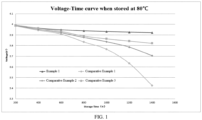
- FIG. 1 is a voltage graph of lithium-ion batteries provided by Example 1 and Comparative Examples 1-3 which are stored at 80°C.
- a preparation method of a positive electrode material includes the following steps:
- the positive electrode material prepared in this example includes the ternary positive electrode material, aluminum tripolyphosphate and a silica coating layer.
- the aluminum tripolyphosphate is dispersed among the ternary positive electrode material, on the surface of the ternary positive electrode material, and inside the ternary positive electrode material; the silica coating layer is coated on the surface of the ternary positive electrode material.
- aluminum tripolyphosphate has a mass percentage of 0.1%, and the silica coating layer has a thickness of 10 nm.
- the positive electrode material obtained in this example, conductive agent SP and 5130 PVDF binder were prepared into a slurry according to a ratio of 96.9%:2%:1.1%, the slurry was prepared into an electrode sheet, and a 18650 lithium-ion battery was assembled, charged to 4.1 V, stored in a high-temperature box at 80°C for 1500 hours, and tested for the voltage condition every 200 hours.
- a preparation method of a positive electrode material includes the following steps:
- the positive electrode material prepared in this example includes the ternary positive electrode material, aluminum tripolyphosphate and a silica coating layer.
- the aluminum tripolyphosphate is dispersed among the ternary positive electrode material, on the surface of the ternary positive electrode material, and inside the ternary positive electrode material; the silica coating layer is coated on the surface of the ternary positive electrode material.
- aluminum tripolyphosphate has a mass percentage of 1%, and the silica coating layer has a thickness of 1 nm.
- the battery was prepared and tested in the same way as in Example 1.
- a preparation method of a positive electrode material includes the following steps:
- the positive electrode material prepared in this example includes the ternary positive electrode material, aluminum tripolyphosphate and a silica coating layer.
- the aluminum tripolyphosphate is dispersed among the ternary positive electrode material, on the surface of the ternary positive electrode material, and inside the ternary positive electrode material; the silica coating layer is coated on the surface of the ternary positive electrode material.
- aluminum tripolyphosphate has a mass percentage of 0.4%, and the silica coating layer has a thickness of 5 nm.
- the battery was prepared and tested in the same way as in Example 1.
- a preparation method of a positive electrode material includes the following steps:
- the positive electrode material prepared in this example includes the ternary positive electrode material, aluminum tripolyphosphate and a silica coating layer.
- the aluminum tripolyphosphate is dispersed among the ternary positive electrode material, on the surface of the ternary positive electrode material, and inside the ternary positive electrode material; the silica coating layer is coated on the surface of the ternary positive electrode material.
- aluminum tripolyphosphate has a mass percentage of 0.5%, and the silica coating layer has a thickness of 4 nm.
- the battery was prepared and tested in the same way as in Example 1.
- Example 1 Compared with Example 1, this example has the same preparation steps as in Example 1 except step (1) was adjusted as follows.
- Example 1 Compared with Example 1, this example has the same preparation steps as in Example 1 except step (1) was adjusted as follows.
- Example 1 Compared with Example 1, this example has the same preparation steps as in Example 1 except the preparation of colloidal silica sol in step (2) was adjusted as follows.
- a colloidal silica sol was firstly prepared by dissolving a 25% sodium silicate aqueous solution and adding excessive CO 2 , and thus the colloidal silica sol with a net silicon content of 1% was prepared.
- Example 1 Compared with Example 1, this example has the same preparation steps as in Example 1 except the preparation of colloidal silica sol in step (2) was adjusted as follows.
- a colloidal silica sol was firstly prepared by dissolving a 10% sodium silicate aqueous solution and adding excessive hydrochloric acid, and thus the colloidal silica sol with a net silicon content of 0.5% was prepared.
- this comparative example has the same preparation steps as in Example 1 except step (1) was adjusted as follows.
- the positive electrode material in this comparative example includes the ternary positive electrode material and the colloidal silica sol, and the colloidal silica sol is coated on the surface of the ternary positive electrode material. Otherwise this comparative example is the same as Example 1.
- this comparative example has the same preparation steps as in Example 1 except step (2) was omitted.
- the positive electrode material in this comparative example includes the ternary positive electrode material and the aluminum tripolyphosphate powders mixed, but no colloidal silica sol is coated on the surface of the ternary positive electrode material. Otherwise this comparative example is the same as Example 1.
- the lithium-ion battery provided by Example 1 has obviously increased storage time at 80°C and slower decay.
- the storage time at 80°C is much shorter than that of the lithium-ion battery provided by Example 1.
- Table 1 shows the voltage values (V) of the batteries in different examples and comparative examples stored in a high-temperature box at 80°C every 200 hours.
- Comparative Example 3 the voltage value of the battery prepared from the positive electrode material, which is mixed with nanoscale aluminum tripolyphosphate and has no colloidal silica sol as a binder, began to decay rapidly at day 45. Therefore, it can be found that by coating with aluminum tripolyphosphate and adopting the colloidal silica sol as a binder, the ternary positive electrode material in the present application can achieve the technical effect that the battery has improved high-temperature resistance and especially can be stored at 80-85°C for a long time.
Landscapes
- Chemical & Material Sciences (AREA)
- Chemical Kinetics & Catalysis (AREA)
- Electrochemistry (AREA)
- General Chemical & Material Sciences (AREA)
- Engineering & Computer Science (AREA)
- Organic Chemistry (AREA)
- Inorganic Chemistry (AREA)
- Manufacturing & Machinery (AREA)
- Materials Engineering (AREA)
- Composite Materials (AREA)
- Nanotechnology (AREA)
- Crystallography & Structural Chemistry (AREA)
- Physics & Mathematics (AREA)
- Condensed Matter Physics & Semiconductors (AREA)
- General Physics & Mathematics (AREA)
- Dispersion Chemistry (AREA)
- Battery Electrode And Active Subsutance (AREA)
Applications Claiming Priority (2)
| Application Number | Priority Date | Filing Date | Title |
|---|---|---|---|
| CN202011134254.4A CN112357977B (zh) | 2020-10-21 | 2020-10-21 | 一种正极材料,其制备方法及用途 |
| PCT/CN2021/089627 WO2022083089A1 (zh) | 2020-10-21 | 2021-04-25 | 一种正极材料、其制备方法及用途 |
Publications (2)
| Publication Number | Publication Date |
|---|---|
| EP4234497A1 true EP4234497A1 (de) | 2023-08-30 |
| EP4234497A4 EP4234497A4 (de) | 2025-07-02 |
Family
ID=74511491
Family Applications (1)
| Application Number | Title | Priority Date | Filing Date |
|---|---|---|---|
| EP21881514.0A Pending EP4234497A4 (de) | 2020-10-21 | 2021-04-25 | Positivelektrodenmaterial, herstellungsverfahren dafür und verwendung davon |
Country Status (4)
| Country | Link |
|---|---|
| US (1) | US20230395775A1 (de) |
| EP (1) | EP4234497A4 (de) |
| CN (1) | CN112357977B (de) |
| WO (1) | WO2022083089A1 (de) |
Families Citing this family (5)
| Publication number | Priority date | Publication date | Assignee | Title |
|---|---|---|---|---|
| CN112357977B (zh) * | 2020-10-21 | 2022-02-08 | 横店集团东磁股份有限公司 | 一种正极材料,其制备方法及用途 |
| CN114620704B (zh) * | 2022-03-14 | 2023-06-06 | 湖州南木纳米科技有限公司 | 一种提高电池安全性的材料及其制备方法和应用 |
| CN115732695A (zh) * | 2022-12-16 | 2023-03-03 | 蜂巢能源科技(上饶)有限公司 | 一种三聚磷酸铝包覆负极活性物质及其制备方法和应用 |
| CN115986111B (zh) * | 2023-02-14 | 2024-06-21 | 江苏正力新能电池技术有限公司 | 一种钠离子电池层状氧化物正极材料及其制备方法与应用 |
| CN116314808B (zh) * | 2023-03-21 | 2026-03-20 | 福建理工大学 | 一种用于锂硫电池的磷铝无机胶粘剂及其制备方法 |
Family Cites Families (18)
| Publication number | Priority date | Publication date | Assignee | Title |
|---|---|---|---|---|
| CN101308925B (zh) | 2008-07-04 | 2011-02-02 | 深圳市贝特瑞新能源材料股份有限公司 | 锂离子电池复合包覆正极材料及其制备方法 |
| US20120040247A1 (en) * | 2010-07-16 | 2012-02-16 | Colorado State University Research Foundation | LAYERED COMPOSITE MATERIALS HAVING THE COMPOSITION: (1-x-y)LiNiO2(xLi2Mn03)(yLiCoO2), AND SURFACE COATINGS THEREFOR |
| CN102569789B (zh) * | 2010-12-29 | 2014-10-08 | 清华大学 | 正极复合材料及其制备方法,以及锂离子电池 |
| CN103000899A (zh) * | 2011-09-14 | 2013-03-27 | 比亚迪股份有限公司 | 一种正极材料的表面包覆方法 |
| CN102324515B (zh) * | 2011-09-20 | 2014-06-11 | 湖南升华科技有限公司 | 尖晶石型锰酸锂制备方法及由其制得的锰酸锂和电池 |
| CN102738458B (zh) * | 2012-06-13 | 2015-03-11 | 北京有色金属研究总院 | 一种富锂正极材料的表面改性方法 |
| HUE062621T2 (hu) * | 2012-10-02 | 2023-11-28 | Massachusetts Inst Technology | Nagykapacitású pozitív elektród aktív anyaga |
| CN102956895B (zh) * | 2012-11-15 | 2015-10-14 | 北大先行科技产业有限公司 | 表面复合包覆的正极材料及其制备方法和锂离子电池 |
| CN104124449B (zh) * | 2014-08-04 | 2016-05-11 | 天津巴莫科技股份有限公司 | 锂离子电池用高能量密度型镍系复合正极材料及制备方法 |
| CN105655566B (zh) * | 2016-04-12 | 2019-06-28 | 北京工业大学 | 一种二氧化硅包覆富锂锰基正极材料的合成方法 |
| CN109659507A (zh) * | 2017-10-11 | 2019-04-19 | 深圳市贝特瑞新能源材料股份有限公司 | 一种固态电解质包覆正极材料的复合材料及其制备方法 |
| CN107742711B (zh) | 2017-10-19 | 2020-07-10 | 陕西省石油化工研究设计院 | 一种三氧化二硼包覆三元正极材料的制备方法 |
| CN108023087A (zh) * | 2017-12-01 | 2018-05-11 | 洛阳师范学院 | 一种SiO2包覆的镍锰酸锂正极材料的制备方法 |
| CN108199047A (zh) | 2017-12-27 | 2018-06-22 | 清远佳致新材料研究院有限公司 | 一种在锂离子三元正极材料表面包覆氧化物的方法 |
| CN109378469A (zh) * | 2018-11-30 | 2019-02-22 | 清远佳致新材料研究院有限公司 | 三元正极材料的制备方法及其制得的三元正极材料、锂离子电池和电动车辆 |
| CN110611093A (zh) * | 2019-10-25 | 2019-12-24 | 中南大学 | 一种表面包覆改性锂离子电池高镍三元正极材料的制备方法及应用 |
| CN110931774B (zh) * | 2019-11-21 | 2021-05-14 | 广东邦普循环科技有限公司 | 一种复合包覆Ni65型镍钴锰三元正极材料及其制备方法与应用 |
| CN112357977B (zh) * | 2020-10-21 | 2022-02-08 | 横店集团东磁股份有限公司 | 一种正极材料,其制备方法及用途 |
-
2020
- 2020-10-21 CN CN202011134254.4A patent/CN112357977B/zh active Active
-
2021
- 2021-04-25 US US18/249,503 patent/US20230395775A1/en active Pending
- 2021-04-25 EP EP21881514.0A patent/EP4234497A4/de active Pending
- 2021-04-25 WO PCT/CN2021/089627 patent/WO2022083089A1/zh not_active Ceased
Also Published As
| Publication number | Publication date |
|---|---|
| EP4234497A4 (de) | 2025-07-02 |
| CN112357977A (zh) | 2021-02-12 |
| US20230395775A1 (en) | 2023-12-07 |
| CN112357977B (zh) | 2022-02-08 |
| WO2022083089A1 (zh) | 2022-04-28 |
Similar Documents
| Publication | Publication Date | Title |
|---|---|---|
| EP4234497A1 (de) | Positivelektrodenmaterial, herstellungsverfahren dafür und verwendung davon | |
| CN108134090B (zh) | 一种纳米铋/碳复合材料及其制备方法 | |
| CN113437274A (zh) | 一种锂离子电池负极材料及其制备方法 | |
| EP4712160A1 (de) | Positivelektrodenfolie und herstellungsverfahren dafür, sekundärbatterie und elektrische vorrichtung | |
| CN104332608B (zh) | 一种锂离子电池硅复合负极材料及其制备方法 | |
| EP4199145A1 (de) | Negatives elektrodenmaterial aus silicium-kohlenstoff-verbundstoff und herstellungsverfahren dafür sowie lithium-ionen-batterie | |
| CN110350161B (zh) | 一种硅碳负极前驱体的制备方法 | |
| CN111293311A (zh) | 导电剂浆料、导电剂浆料制备方法以及电池正极浆料 | |
| CN111725493A (zh) | 一种改性铌钛氧化物及其制备方法和用途 | |
| CN108134091B (zh) | 一种纳米锡/碳复合材料及其制备方法 | |
| EP4567928A1 (de) | Lithium-eisenphosphat-batterie und hybridfahrzeug | |
| CN113517430A (zh) | 一种抑制释氧的铝包覆正极材料及包括其的电池 | |
| CN114665069A (zh) | 一种富锂锰基复合正极材料及其制备方法和应用 | |
| CN108470901A (zh) | 一种碳纳米管锰酸锂纳米复合材料及制备方法与应用 | |
| CN114497538B (zh) | 一种梯度包覆的高性能磷酸铁锂复合材料及其制备方法 | |
| CN120356926B (zh) | 一种银粒子修饰碳包覆的磷酸锰铁锂正极材料及其制备方法 | |
| CN115621540A (zh) | 二维碳材料修饰的硫化物固态电解质及其制备方法与应用 | |
| CN106299312A (zh) | 一种模板法制备锂离子电池阳极复合材料的方法 | |
| CN119252920A (zh) | 一种双层包覆补锂剂及其制备方法和应用 | |
| CN107104235B (zh) | 用于锂离子电池负极材料的石墨烯纳米铜复合材料的制备方法 | |
| CN114497481B (zh) | 一种导电聚合物包覆纳米硅粉及其制备方法和应用以及硅碳负极材料 | |
| EP4507033A1 (de) | Negativelektrodenmaterial und herstellungsverfahren dafür sowie lithium-ionen-batterie | |
| CN116154120A (zh) | 一种双层包覆的Li5FeO4及其制备方法 | |
| CN114927675A (zh) | 一种复合金属包覆碳化硅基负极材料及其制备方法和应用 | |
| CN114538379B (zh) | 一种含有界面缺陷的金属氧化物/镁硼氢氨化物高导电率固体电解质复合材料及其制备方法 |
Legal Events
| Date | Code | Title | Description |
|---|---|---|---|
| STAA | Information on the status of an ep patent application or granted ep patent |
Free format text: STATUS: THE INTERNATIONAL PUBLICATION HAS BEEN MADE |
|
| PUAI | Public reference made under article 153(3) epc to a published international application that has entered the european phase |
Free format text: ORIGINAL CODE: 0009012 |
|
| STAA | Information on the status of an ep patent application or granted ep patent |
Free format text: STATUS: REQUEST FOR EXAMINATION WAS MADE |
|
| 17P | Request for examination filed |
Effective date: 20230425 |
|
| AK | Designated contracting states |
Kind code of ref document: A1 Designated state(s): AL AT BE BG CH CY CZ DE DK EE ES FI FR GB GR HR HU IE IS IT LI LT LU LV MC MK MT NL NO PL PT RO RS SE SI SK SM TR |
|
| DAV | Request for validation of the european patent (deleted) | ||
| DAX | Request for extension of the european patent (deleted) | ||
| A4 | Supplementary search report drawn up and despatched |
Effective date: 20250603 |
|
| RIC1 | Information provided on ipc code assigned before grant |
Ipc: H01M 4/58 20100101ALI20250527BHEP Ipc: H01M 4/525 20100101ALI20250527BHEP Ipc: H01M 4/505 20100101ALI20250527BHEP Ipc: H01M 4/36 20060101ALI20250527BHEP Ipc: H01M 4/131 20100101ALI20250527BHEP Ipc: H01M 4/04 20060101ALI20250527BHEP Ipc: H01M 4/62 20060101ALI20250527BHEP Ipc: C01B 25/41 20060101ALI20250527BHEP Ipc: C01B 33/12 20060101ALI20250527BHEP Ipc: C01G 53/00 20060101AFI20250527BHEP |