EP4215399B1 - Anzeige- und bedienvorrichtung, kraftfahrzeug und verfahren zum betrieb einer anzeige- und bedienvorrichtung - Google Patents
Anzeige- und bedienvorrichtung, kraftfahrzeug und verfahren zum betrieb einer anzeige- und bedienvorrichtung Download PDFInfo
- Publication number
- EP4215399B1 EP4215399B1 EP23152762.3A EP23152762A EP4215399B1 EP 4215399 B1 EP4215399 B1 EP 4215399B1 EP 23152762 A EP23152762 A EP 23152762A EP 4215399 B1 EP4215399 B1 EP 4215399B1
- Authority
- EP
- European Patent Office
- Prior art keywords
- display
- operating element
- operating
- information
- function
- Prior art date
- Legal status (The legal status is an assumption and is not a legal conclusion. Google has not performed a legal analysis and makes no representation as to the accuracy of the status listed.)
- Active
Links
Images

Classifications
-
- B—PERFORMING OPERATIONS; TRANSPORTING
- B60—VEHICLES IN GENERAL
- B60K—ARRANGEMENT OR MOUNTING OF PROPULSION UNITS OR OF TRANSMISSIONS IN VEHICLES; ARRANGEMENT OR MOUNTING OF PLURAL DIVERSE PRIME-MOVERS IN VEHICLES; AUXILIARY DRIVES FOR VEHICLES; INSTRUMENTATION OR DASHBOARDS FOR VEHICLES; ARRANGEMENTS IN CONNECTION WITH COOLING, AIR INTAKE, GAS EXHAUST OR FUEL SUPPLY OF PROPULSION UNITS IN VEHICLES
- B60K35/00—Instruments specially adapted for vehicles; Arrangement of instruments in or on vehicles
- B60K35/80—Arrangements for controlling instruments
- B60K35/81—Arrangements for controlling instruments for controlling displays
-
- B—PERFORMING OPERATIONS; TRANSPORTING
- B60—VEHICLES IN GENERAL
- B60K—ARRANGEMENT OR MOUNTING OF PROPULSION UNITS OR OF TRANSMISSIONS IN VEHICLES; ARRANGEMENT OR MOUNTING OF PLURAL DIVERSE PRIME-MOVERS IN VEHICLES; AUXILIARY DRIVES FOR VEHICLES; INSTRUMENTATION OR DASHBOARDS FOR VEHICLES; ARRANGEMENTS IN CONNECTION WITH COOLING, AIR INTAKE, GAS EXHAUST OR FUEL SUPPLY OF PROPULSION UNITS IN VEHICLES
- B60K35/00—Instruments specially adapted for vehicles; Arrangement of instruments in or on vehicles
- B60K35/10—Input arrangements, i.e. from user to vehicle, associated with vehicle functions or specially adapted therefor
-
- B—PERFORMING OPERATIONS; TRANSPORTING
- B60—VEHICLES IN GENERAL
- B60K—ARRANGEMENT OR MOUNTING OF PROPULSION UNITS OR OF TRANSMISSIONS IN VEHICLES; ARRANGEMENT OR MOUNTING OF PLURAL DIVERSE PRIME-MOVERS IN VEHICLES; AUXILIARY DRIVES FOR VEHICLES; INSTRUMENTATION OR DASHBOARDS FOR VEHICLES; ARRANGEMENTS IN CONNECTION WITH COOLING, AIR INTAKE, GAS EXHAUST OR FUEL SUPPLY OF PROPULSION UNITS IN VEHICLES
- B60K35/00—Instruments specially adapted for vehicles; Arrangement of instruments in or on vehicles
- B60K35/20—Output arrangements, i.e. from vehicle to user, associated with vehicle functions or specially adapted therefor
- B60K35/21—Output arrangements, i.e. from vehicle to user, associated with vehicle functions or specially adapted therefor using visual output, e.g. blinking lights or matrix displays
- B60K35/212—Output arrangements, i.e. from vehicle to user, associated with vehicle functions or specially adapted therefor using visual output, e.g. blinking lights or matrix displays displaying on manual operation elements, e.g. on a knob
-
- B—PERFORMING OPERATIONS; TRANSPORTING
- B60—VEHICLES IN GENERAL
- B60K—ARRANGEMENT OR MOUNTING OF PROPULSION UNITS OR OF TRANSMISSIONS IN VEHICLES; ARRANGEMENT OR MOUNTING OF PLURAL DIVERSE PRIME-MOVERS IN VEHICLES; AUXILIARY DRIVES FOR VEHICLES; INSTRUMENTATION OR DASHBOARDS FOR VEHICLES; ARRANGEMENTS IN CONNECTION WITH COOLING, AIR INTAKE, GAS EXHAUST OR FUEL SUPPLY OF PROPULSION UNITS IN VEHICLES
- B60K35/00—Instruments specially adapted for vehicles; Arrangement of instruments in or on vehicles
- B60K35/20—Output arrangements, i.e. from vehicle to user, associated with vehicle functions or specially adapted therefor
- B60K35/25—Output arrangements, i.e. from vehicle to user, associated with vehicle functions or specially adapted therefor using haptic output
-
- B—PERFORMING OPERATIONS; TRANSPORTING
- B60—VEHICLES IN GENERAL
- B60K—ARRANGEMENT OR MOUNTING OF PROPULSION UNITS OR OF TRANSMISSIONS IN VEHICLES; ARRANGEMENT OR MOUNTING OF PLURAL DIVERSE PRIME-MOVERS IN VEHICLES; AUXILIARY DRIVES FOR VEHICLES; INSTRUMENTATION OR DASHBOARDS FOR VEHICLES; ARRANGEMENTS IN CONNECTION WITH COOLING, AIR INTAKE, GAS EXHAUST OR FUEL SUPPLY OF PROPULSION UNITS IN VEHICLES
- B60K35/00—Instruments specially adapted for vehicles; Arrangement of instruments in or on vehicles
- B60K35/20—Output arrangements, i.e. from vehicle to user, associated with vehicle functions or specially adapted therefor
- B60K35/28—Output arrangements, i.e. from vehicle to user, associated with vehicle functions or specially adapted therefor characterised by the type of the output information, e.g. video entertainment or vehicle dynamics information; characterised by the purpose of the output information, e.g. for attracting the attention of the driver
-
- B—PERFORMING OPERATIONS; TRANSPORTING
- B60—VEHICLES IN GENERAL
- B60K—ARRANGEMENT OR MOUNTING OF PROPULSION UNITS OR OF TRANSMISSIONS IN VEHICLES; ARRANGEMENT OR MOUNTING OF PLURAL DIVERSE PRIME-MOVERS IN VEHICLES; AUXILIARY DRIVES FOR VEHICLES; INSTRUMENTATION OR DASHBOARDS FOR VEHICLES; ARRANGEMENTS IN CONNECTION WITH COOLING, AIR INTAKE, GAS EXHAUST OR FUEL SUPPLY OF PROPULSION UNITS IN VEHICLES
- B60K35/00—Instruments specially adapted for vehicles; Arrangement of instruments in or on vehicles
- B60K35/60—Instruments characterised by their location or relative disposition in or on vehicles
-
- G—PHYSICS
- G06—COMPUTING OR CALCULATING; COUNTING
- G06F—ELECTRIC DIGITAL DATA PROCESSING
- G06F3/00—Input arrangements for transferring data to be processed into a form capable of being handled by the computer; Output arrangements for transferring data from processing unit to output unit, e.g. interface arrangements
- G06F3/01—Input arrangements or combined input and output arrangements for interaction between user and computer
- G06F3/011—Arrangements for interaction with the human body, e.g. for user immersion in virtual reality
- G06F3/013—Eye tracking input arrangements
-
- G—PHYSICS
- G06—COMPUTING OR CALCULATING; COUNTING
- G06F—ELECTRIC DIGITAL DATA PROCESSING
- G06F3/00—Input arrangements for transferring data to be processed into a form capable of being handled by the computer; Output arrangements for transferring data from processing unit to output unit, e.g. interface arrangements
- G06F3/01—Input arrangements or combined input and output arrangements for interaction between user and computer
- G06F3/016—Input arrangements with force or tactile feedback as computer generated output to the user
-
- B—PERFORMING OPERATIONS; TRANSPORTING
- B60—VEHICLES IN GENERAL
- B60K—ARRANGEMENT OR MOUNTING OF PROPULSION UNITS OR OF TRANSMISSIONS IN VEHICLES; ARRANGEMENT OR MOUNTING OF PLURAL DIVERSE PRIME-MOVERS IN VEHICLES; AUXILIARY DRIVES FOR VEHICLES; INSTRUMENTATION OR DASHBOARDS FOR VEHICLES; ARRANGEMENTS IN CONNECTION WITH COOLING, AIR INTAKE, GAS EXHAUST OR FUEL SUPPLY OF PROPULSION UNITS IN VEHICLES
- B60K2360/00—Indexing scheme associated with groups B60K35/00 or B60K37/00 relating to details of instruments or dashboards
- B60K2360/11—Instrument graphical user interfaces or menu aspects
- B60K2360/111—Instrument graphical user interfaces or menu aspects for controlling multiple devices
-
- B—PERFORMING OPERATIONS; TRANSPORTING
- B60—VEHICLES IN GENERAL
- B60K—ARRANGEMENT OR MOUNTING OF PROPULSION UNITS OR OF TRANSMISSIONS IN VEHICLES; ARRANGEMENT OR MOUNTING OF PLURAL DIVERSE PRIME-MOVERS IN VEHICLES; AUXILIARY DRIVES FOR VEHICLES; INSTRUMENTATION OR DASHBOARDS FOR VEHICLES; ARRANGEMENTS IN CONNECTION WITH COOLING, AIR INTAKE, GAS EXHAUST OR FUEL SUPPLY OF PROPULSION UNITS IN VEHICLES
- B60K2360/00—Indexing scheme associated with groups B60K35/00 or B60K37/00 relating to details of instruments or dashboards
- B60K2360/11—Instrument graphical user interfaces or menu aspects
- B60K2360/115—Selection of menu items
-
- B—PERFORMING OPERATIONS; TRANSPORTING
- B60—VEHICLES IN GENERAL
- B60K—ARRANGEMENT OR MOUNTING OF PROPULSION UNITS OR OF TRANSMISSIONS IN VEHICLES; ARRANGEMENT OR MOUNTING OF PLURAL DIVERSE PRIME-MOVERS IN VEHICLES; AUXILIARY DRIVES FOR VEHICLES; INSTRUMENTATION OR DASHBOARDS FOR VEHICLES; ARRANGEMENTS IN CONNECTION WITH COOLING, AIR INTAKE, GAS EXHAUST OR FUEL SUPPLY OF PROPULSION UNITS IN VEHICLES
- B60K2360/00—Indexing scheme associated with groups B60K35/00 or B60K37/00 relating to details of instruments or dashboards
- B60K2360/126—Rotatable input devices for instruments
-
- B—PERFORMING OPERATIONS; TRANSPORTING
- B60—VEHICLES IN GENERAL
- B60K—ARRANGEMENT OR MOUNTING OF PROPULSION UNITS OR OF TRANSMISSIONS IN VEHICLES; ARRANGEMENT OR MOUNTING OF PLURAL DIVERSE PRIME-MOVERS IN VEHICLES; AUXILIARY DRIVES FOR VEHICLES; INSTRUMENTATION OR DASHBOARDS FOR VEHICLES; ARRANGEMENTS IN CONNECTION WITH COOLING, AIR INTAKE, GAS EXHAUST OR FUEL SUPPLY OF PROPULSION UNITS IN VEHICLES
- B60K2360/00—Indexing scheme associated with groups B60K35/00 or B60K37/00 relating to details of instruments or dashboards
- B60K2360/145—Instrument input by combination of touch screen and hardware input devices
-
- B—PERFORMING OPERATIONS; TRANSPORTING
- B60—VEHICLES IN GENERAL
- B60K—ARRANGEMENT OR MOUNTING OF PROPULSION UNITS OR OF TRANSMISSIONS IN VEHICLES; ARRANGEMENT OR MOUNTING OF PLURAL DIVERSE PRIME-MOVERS IN VEHICLES; AUXILIARY DRIVES FOR VEHICLES; INSTRUMENTATION OR DASHBOARDS FOR VEHICLES; ARRANGEMENTS IN CONNECTION WITH COOLING, AIR INTAKE, GAS EXHAUST OR FUEL SUPPLY OF PROPULSION UNITS IN VEHICLES
- B60K35/00—Instruments specially adapted for vehicles; Arrangement of instruments in or on vehicles
- B60K35/80—Arrangements for controlling instruments
Definitions
- the invention relates to a display and operating device comprising a display, an operating element, and a control device.
- the operating element is arranged behind the display, a first portion of the operating element being concealed by the display, and a second, manually operable portion of the operating element protruding laterally next to the display.
- the invention relates to a motor vehicle and a method for operating a display and operating device.
- Different types of operating devices are used, for example, in motor vehicles to activate and adjust various functions.
- One known example is the use of an operating device designed as a rotary push button, which can be used to make selections from a menu displayed on a display of the motor vehicle associated with the operating device.
- Another method for selecting and/or adjusting functions, particularly in a motor vehicle is the use of touchscreens, which enable manual operation directly on the display surface and thus directly on the displayed information.
- Other display and/or input devices are known from the prior art.
- a combined display and input device for a vehicle is described.
- a virtual first input unit is provided, which is designed as a touch-sensitive screen for operating several functions and for displaying information.
- a physical second input unit is provided, wherein the functions can be selected by means of the first input unit and/or the second input unit and displayed on the touch-sensitive screen.
- the operating device for setting functions in a motor vehicle.
- the operating device comprises a touchscreen for displaying vehicle functions, as well as for detecting touches and controlling the vehicle functions.
- the operating device has a rotary push-button, which is mobile and can be variably positioned on the touchscreen. Inputs can also be made to the operating device via the rotary push-button coupled to the touchscreen.
- a touch-sensitive display device with an integrated mechanical control element for motor vehicles is known.
- the control element is held to the surface of a touch-sensitive display device by a magnetic force generated by a holding magnet.
- Sensor elements beneath the surface of the display device can detect the switching position of the control element, allowing the control element to be used for inputs on the display device.
- the US 2004/0066405 A1 discloses an input device with a display and a rotary wheel, wherein by rotating the rotary wheel a column is preselected for a character set shown on the display in rows and columns.
- the US 2020/0180435 A1 discloses a user interface for a vehicle with a display and a customizable control unit, such as a rotary dial. By operating the control unit, the display can be temporarily locked for inputs to prevent incorrect inputs.
- the US 2004/0076444 A1 discloses a portable device with a display and a movable input device, for example, a rotating ring that protrudes beyond the housing of the device on both sides.
- the display has two sections, one displaying graphical objects in an arcuate array, and the other displaying the display status and menu information.
- By rotating the rotating ring a user can scroll through the array of graphical objects, preferably in the same direction in which the rotating ring is moved.
- the rotating ring is guided by a disc with bearing blocks, which includes recesses that form click-in positions for the rotating ring.
- the invention is based on the object of providing an improved display and operating device which, in particular, enables precise operation of at least one function which can be operated via the display and operating device.
- the invention provides for a display and operating device of the type mentioned above, in which the control device is configured to control the display to show at least one item of information at least partially on the partial area of the display that covers the first section of the operating element, wherein the information is assigned to at least one function that can be set via the operating element.
- the operating element is, in particular, a mechanical operating element.
- the control element is partially overlapped by the display, so that the first section of the control element is located behind the display relative to the viewing direction of the display and is thus concealed by a portion of the display.
- the second section of the control element protrudes laterally next to the display so that it can be operated manually. When viewing the display from the intended viewing direction, the second section can therefore be seen, whereas the first section of the control element is concealed behind the display.
- the display and operating device is designed or configured such that at least one function can be operated via the operating element.
- Displaying the information at least partially on the partial area of the display behind which the first section of the operating element is arranged makes it possible to virtually expand the hidden, first section of the operating element with the displayed information.
- the haptic operability of a conventional input element such as a rotary knob or a rotary push-button, is advantageously combined with the flexible and intuitive display options of a touchscreen or a display. It is therefore possible to virtually supplement the operating element with information associated with the at least one function that can be operated via the operating element.
- the information can describe or clearly identify the function currently operable via the control element, so that it is intuitively and immediately recognizable which function or parameter of a function, or similar, can currently be adjusted via the control element.
- Manual operation or adjustment of the function is performed via the control element, in particular via the second section of the control element protruding to the side next to the display, enabling precise operation due to the haptic feedback of the control element.
- the display and operating device has the further advantage that settings can be made using the manually operable control element without necessarily having to look at the display, as can be the case with a touchscreen, for example, due to the lack of haptic feedback.
- this offers the advantage that the function can be operated more easily while driving, or that at least one function can be operated while driving, since no or only a significantly short averting of the gaze from the traffic situation is required.
- the manual operability of the control element can convey a high-quality impression, since the haptic feedback generated by the manually operated control element enables precise and pleasant operation as well as precise adjustment of the function.
- the ability to display different information on the display allows the display and operating device to be advantageously used for a variety of different functions, with the display enabling quick and intuitive grasp of the current setting option or a currently adjustable or set parameter of the functions, or similar. Due to the spatial relationship between the information presented in the partial area of the display covering the first section of the operating element and the adjacent, manually operable second section of the operating element, an intuitive and quickly graspable user interface is provided.
- the haptic operability of the control element can thus be supplemented with virtually displayed information on the display or expanded according to the concept of "augmented reality.” This advantageously combines the flexibility of the information presentation via the display with the functionality of the manually operable, in particular manually rotatable, control element.
- At least one parameter of the function can be set by the operating element, wherein a currently set value of the parameter and/or an adjustable value range of the parameter, in particular as a scale, at least as part of the information can be displayed.
- a currently set value of the parameter and/or an adjustable value range of the parameter in particular as a scale, at least as part of the information can be displayed.
- the value range can be displayed, in particular, as a scale that can include various numerical values and/or lines, for example, to display intermediate values.
- At least one graphic corresponding to the contour of the first section of the operating element can be displayed as at least part of the information, wherein the graphic can be displayed in particular as a function of a currently set value of the or a parameter of the function and/or a current movement of the operating element.
- the contour of the first section can be shown on the display, so that the display of the information in that partial area of the display virtually completes the second section of the control element.
- the display of the information can thus virtually complement the control element or the function that can be set via the control element.
- the graphic can be displayed in particular as a function of a currently set value of the function or a parameter of the function and/or a current movement, in particular a rotary movement, of the control element.
- This makes it possible, for example, to display a graphic corresponding to a rotary knob, wherein, for example, a marking on the rotary knob with a scale that is also displayed as part of the information indicates a currently set value of the function or of a changeable parameter of the function.
- the graphic can be displayed corresponding to a movement of the second section, so that, for example, a marking on a displayed rotary knob is virtually rotated in accordance with the manual operation of the control element.
- the directly set value can also be displayed as part of the information, for example, as a numerical value or similar.
- the graphic can be presented as an animated graphic that can be changed by rotating the control element, so that a rotating movement of the control element or another type of operation of the control element can be visualized accordingly.
- a mechanism it is possible for a mechanism to be depicted as a graphic that virtually moves with manual operation, e.g., rotating the control element, and is displayed continuously or as a continuously adjusted video.
- a plurality of functions can be set via the operating element, wherein at least part of the information can be displayed as a function of the function currently to be set via the operating element, and/or that at least part of the information can be displayed as a function of selection information describing a user selection relating to the function.
- the function to be operated can thus be directly recognized visually.
- the information can, for example, comprise pictograms and/or representations, which can be displayed in different shapes and/or colors for different operable functions. Due to the flexibility of the information presentation via the display, it is advantageously possible for the function or the respective Information assigned to functions can be adapted depending on selection information describing a user selection.
- a user for example, a motor vehicle operator, can select which type of information or information presentation should be displayed for different functions adjustable via the control element.
- This further improves usability and intuitive understanding of the function operable via the display and control device, as the information presentation can be adapted to the user's wishes and preferences.
- a haptic grid and/or a stop for a movement of the control element can be adjusted depending on the function to be set.
- the adjustable haptic grid is implemented by a magnetorheological adjustability of the control element, so that the grid is actually present during a manual movement, e.g., a rotation, of the control element and can thus be detected haptically.
- the intervals of the clicks that form the grid are thus predetermined by the control device and are generated accordingly by the control element. This enables software-based adjustability of the haptic grid of the control element and thus its adaptation to a function to be set via the control element.
- a stop for a movement of the control element can also be mechanically adjusted.
- a mechanical adjustment of a stop for a movement such as a rotation of the control element is also possible, for example, via a magnetorheological adjustability, so that a maximum available range within which settings can be made by manual operation or movement of the control element can be adjusted.
- other adjustability options that directly influence the mechanical behavior of the control element are also possible.
- a fixed A predefined grid and/or fixed stops on the control element must be provided.
- the invention provides that at least part of the information can be displayed depending on the currently set grid and/or the currently set stop.
- a grid for example the grid of a rotary movement of the control element, can be adapted to the function to be set and thus, for example, to the values to be set or the increments or intermediate steps available for the setting.
- the set haptic grid corresponds to the displayed information, so that, for example, the set haptic grid corresponds to the scaling of a scale or similar displayed as part of the information. This advantageously further improves the usability of the display and operating device.
- a corresponding representation of the stop, for example, as one end of a scale displayed as part of the information, is also visualized accordingly by the information shown on the display.
- the operating element is disc-shaped and/or that the operating element is rotatable and/or that the operating element is tiltable and/or that the operating element is sliding and/or that the operating element can be pressed as a button.
- the operating element in the rotatable embodiment can in particular be rotatable about a rotation axis of the operating element, which axis is at least substantially perpendicular to a display surface of the display.
- both the first section of the operating element concealed by the display and the second section protruding laterally next to the display are each disc-segment-shaped.
- a graphic adapted to the contour of the operating element for example, a graphic corresponding to the disc segment shape of the first section or a graphic adapted to the disc segment shape of the first section can be displayed.
- the control element in the tiltable embodiment can, in particular, be tiltable about a tilt axis of the control element, which is at least substantially perpendicular to a display surface of the display.
- the control element can, for example, be designed as a toggle or rocker switch.
- the control element in the sliding embodiment can, in particular, be displaceable along a sliding surface of the control element, which runs at least substantially parallel to a display surface of the display.
- the control element can, for example, be designed as a sliding switch.
- the operating element in the depressible configuration can be depressed, in particular, along a pressing axis of the operating element, which runs at least substantially parallel to a display surface of the display.
- a switchable part of the operating element can thus be pushed in, like a button, parallel to the display surface toward the display when actuated, and can be extended (preferably automatically) or reset.
- the operating element can be designed, for example, as a push-button switch or key.
- the operating element is designed to detect a pressing and/or a pivoting and/or a displacement of the second section.
- a lateral pressing on the second section may be possible, wherein the second section is pressed in the direction of the display.
- a confirmation of a selected function and/or a set parameter can occur.
- Pivoting of the second section of the operating element i.e. tilting of the second section or of the entire operating element, in particular about a tilt axis lying in the plane of the display, is also possible.
- the tilt axis can, for example, run parallel or orthogonal to an edge of the display at which the second section of the operating element protrudes.
- the display can be designed as a touch display. This allows, in addition to displaying information on the display, operator inputs to be made on the display.
- the operator inputs can be made, for example, by pressing or tapping the display.
- the touch display can, for example, comprise a means for force detection and/or a means for capacitively measuring a touch or touch position.
- the function to be set can be selected and/or at least partially set via inputs on the touch display and/or that a setting of the function made via the control element can be confirmed via the touch display.
- the function can be selected, for example, by displaying information outside the concealed partial area. For example, pictograms or the like can be used to select a function to be subsequently operated via the control element from a plurality of available functions. Setting the parameter or another parameter of the function via the touch display is also possible in principle. Furthermore, inputs made via the control element or set parameters can be confirmed via the touch display.
- a motor vehicle for a motor vehicle according to the invention, it is provided that it comprises at least one display and operating device according to the invention.
- the display and operating device can be arranged on a door, an armrest, a center console, a steering wheel, and/or a dashboard of the motor vehicle.
- the display and operating device can be used to operate various vehicle functions.
- the display and operating device can be used to operate driver assistance systems of the motor vehicle, comfort systems of the motor vehicle, multimedia systems of the motor vehicle, driving functions, and/or other functions of the motor vehicle.
- the display and control device can be used to operate a heater, air conditioning system, or other temperature control device in the motor vehicle.
- motor vehicle functions that can be operated via the display and control device include setting the vehicle's navigation system, calling up or using a telephone function, selecting different radio stations, setting the wiper intervals of a windshield wiper, activating or adjusting seat heating, or similar functions.
- Other vehicle functions not listed above can also be operated via the display and control device.
- a display and operating device which comprises a display, an operating element and a control device, wherein the operating element is arranged behind the display and a first section of the operating element is concealed by the display, wherein a second, manually operable section of the operating element protrudes laterally next to the display
- the display is controlled by the control device to show at least one item of information at least partially on the partial area of the display which conceals the first section of the operating element, wherein the information is assigned to at least one function which can be set via the operating element.
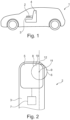
- Fig. 1 An exemplary embodiment of a motor vehicle 1 is shown.
- the motor vehicle 1 comprises a display and operating device 2, which in this case is arranged on an armrest 3 of a vehicle seat 4.
- the motor vehicle 1 can comprise further display and operating devices 2. These can be arranged, for example, on further armrests, on at least one door of the motor vehicle 1, on a center console of the motor vehicle 1, on a steering wheel of the motor vehicle 1 and/or on a dashboard of the motor vehicle 1.
- Various vehicle functions of the motor vehicle 1, for example driver assistance systems of the motor vehicle 1, comfort systems of the motor vehicle 1, multimedia systems of the motor vehicle 1, driving functions and/or other functions of the motor vehicle 1, can be operated via the display and operating devices 2.
- the display and operating device 2 comprises a display 5, a rotatable operating element 6 and a control device 7, which is shown schematically here.
- the control device 7 can also be integrated in the armrest 3 or arranged at another location within the motor vehicle 1, wherein the control device 7 is connected to the display 5 and the operating element 6.
- the control device 7 communicate with other control units of the motor vehicle 1, which are designed or configured to implement the functions operable via the display and operating device 2.
- the indicator 5 can be designed as a display. It is also possible for the indicator 5 to be designed as a touch display, so that additional operating inputs can be made via the indicator 5.
- the operating element 6 is arranged behind the indicator 5, with a first section 8 of the operating element 6 being concealed by the indicator 5. A second section 9 of the operating element 6 protrudes laterally next to the indicator 5.
- the control element 6 can be operated manually via the second section 9.
- the control device 7 is configured to control the display 5 to display at least one piece of information at least partially on a partial area 10 of the display 5 that covers the first section 8 of the control element 6, wherein the information is assigned to a function that can be set via the control element 6.
- the operating element 6 is disc-shaped and rotatable about a rotation axis 11, which is at least substantially perpendicular to a display surface of the display 5. Furthermore, the operating element 6 is designed to detect a pressing and/or pivoting of the second section 9.
- the second section 9 can be designed to be pivotable, for example, about a pivot axis 12 extending along the armrest 3, which in particular runs parallel to the edge of the display 5 at which the second section 9 protrudes. Additionally or alternatively, an operating input can be made via the operating element 6 by pressing on the second section 9, in particular by pressing the second section 9 in the direction of the armrest 3 or the display 5.
- the operating element 6 can be designed in such a way that a haptic grid and/or a stop for a rotation of the operating element 6 can be set depending on the function to be set.
- the haptic grid can be achieved by a magnetorheological
- the adjustability of the control element 6 can be adjusted.
- a mechanical stop of the control element 6, which limits rotation of the control element 6 in at least one direction of rotation can be set.
- the stop of a rotational movement of the control element 6 can also be adjusted by a magnetorheological adjustability of the control element.
- the stop can also be deactivated, so that a stop-free, unlimited rotation of the control element 6 in at least one direction of rotation about the rotation axis 11 is possible.
- the second section 9 of the control element 6 protrudes laterally next to the display so that it can be operated manually.
- the portion of the disc-shaped control element 6, which protrudes as the second section next to the display 5, can depend on the location of use or the arrangement of the display and control device 2. It is possible for the control element 6 to be at least partially covered or enclosed by an interior panel of the motor vehicle 1 and/or a cover of the armrest 3, thereby enabling improved integration of the display and control device 2 in the motor vehicle 1.
- Fig. 3 A first embodiment of an information display is shown.
- the display and operating device 2 serves, for example, to adjust a heater and/or air conditioning system of the motor vehicle 1.
- a parameter of the function which can be set by the control element 6—in this case, a temperature of the passenger compartment of the motor vehicle 1—is set, with a currently set value of the parameter being displayed as part of the information in subarea 10.
- the display is a numerical value, which in this case, by way of example, indicates an interior temperature of 23°.
- a scale 13 is also displayed, which visualizes the different increments of the temperature setting.
- the endpoints of the scale can also represent the currently set stops of the control element 6.
- the grids haptically detectable via the control element 6 can correspond to the increments of the scale 13.
- the position of the current value of the set parameter on the scale 13 can also be displayed as part of the information, in this case as a triangle 14.
- a graphic 15 corresponding to the contour of the first section 8 of the control element 6 is displayed as part of the information, so that the first section 8 of the control element 6 is virtually displayed or supplemented by the displayed information.
- the graphic 15 displayed in the sub-area 10 and the visible second section 9 of the control element 6 form a completely circular rotary actuator.
- the use of the display 5 makes it possible to adapt the information presentation for different functions that can be operated via the display and operating device 2.
- a variety of other functions can also be operated via the operating device 2, whereby the information displayed can be displayed accordingly depending on the function that can be set via the operating element 6.
- the information can also be displayed depending on selection information describing a user selection regarding the function to be set. This makes it possible to adapt the information display to the respective function to be set and, if necessary, to take a user selection into account, so that the information display in subarea 10 can be based on the preferences of a user of the motor vehicle 1.
- a function that can be set via the display and operating device 2 can, for example, be selected via the display 5 if the latter is designed as a touch display.
- a plurality of pictograms 16 are shown schematically, which are displayed outside the subarea 10 and via which various functions, for example a navigation function, a telephone function or a music function, can be selected.
- Confirmation of a selection and/or setting made via the control element can also be made, for example, via an operating input on the display 5 designed as a touch display.
- the operating inputs can, for example, be made by pressing or tapping on the display 5.
- the display 5 designed as a touch display can, for example, comprise a means for detecting force and/or a means for capacitively measuring a touch or a touch position.
- FIG. 4 A further embodiment of an information display via the display and operating device 2 is shown.
- a scale 13 is also shown, which, however, differs in terms of incrementation from the one in Fig. 3 shown scale 13.
- one of a total of five possible intervals for windshield wiper operation can be set via the display and operating device 2.
- the information is shown on the display 5 in particular as a function of a currently set grid and/or the currently set stop of the operating element 6, so that the haptically detectable increments during manual operation of the operating element 6 correspond to the incrementation of the scale 13.
- the display in subarea 10 can be configured differently for setting the windshield wiper operation, so that the function to be set and/or a current value of a variable parameter of the function can be recognized simply by looking at the virtually enhanced part of the control element 6.
- a set, first interval of windshield wiper operation is displayed as a numerical value as part of the information or as a variable parameter.
- the numerical value is displayed differently than in the previously described interior temperature setting. Furthermore, a different graphic 15 is also displayed, so that the function to be set can be immediately identified from the information presented.
- the information presented here is purely schematic and can also be displayed in other ways.
- the information can be displayed depending on a current rotational movement of the operating element 6, so that, for example, the marking 14 is moved accordingly, particularly synchronously, with a rotational movement of the operating element 6. This reinforces the impression that the virtually displayed part of the operating element 6 in the sub-area 10 is connected to the physically tactile second section 9 of the operating element 6.
- the information can be displayed in many different ways and can, for example, also include more complex graphics, e.g., the display of a complete mechanism that can be moved upon manual movement of the operating element 6 on the display 5 and/or additional image and/or video elements.
- the display 5 is controlled by the control device 7 to display the information at least partially on the partial area 10 of the display 5 that covers the first section 8 of the operating element 6, wherein the information is assigned to at least one function that can be set via the operating element 6.
- the information is displayed in particular as described above.
- control element 6 In addition to the illustrated arrangement of the control element 6 in the area of a front right-hand corner of the display 5 relative to the armrest 3, other locations for the arrangement of the control element 6 are also possible. Furthermore, the relationship between the concealed first section 8 and the free-standing second section 9 of the control element 6 can also be designed differently.
- the motor vehicle 1 can in particular have several display and control devices 2, which are arranged at different locations in the motor vehicle and/or assigned to different functions.
- a fixed grid and/or fixed stops can also be provided on the control element 6. A design of the control element 6 without a grid and/or without stops is also possible.
Landscapes
- Engineering & Computer Science (AREA)
- Chemical & Material Sciences (AREA)
- Combustion & Propulsion (AREA)
- Transportation (AREA)
- Mechanical Engineering (AREA)
- General Engineering & Computer Science (AREA)
- Theoretical Computer Science (AREA)
- Human Computer Interaction (AREA)
- Physics & Mathematics (AREA)
- General Physics & Mathematics (AREA)
- Mechanical Control Devices (AREA)
Description
- Die Erfindung betrifft eine Anzeige- und Bedienvorrichtung umfassend eine Anzeige, ein Bedienelement und eine Steuereinrichtung, wobei das Bedienelement hinter der Anzeige angeordnet ist, wobei ein erster Abschnitt des Bedienelements von der Anzeige verdeckt ist und zweiter, manuell bedienbarer Abschnitt des Bedienelements seitlich neben der Anzeige hervorsteht. Weiterhin betrifft die Erfindung ein Kraftfahrzeug sowie ein Verfahren zum Betrieb einer Anzeige- und Bedienvorrichtung.
- Zur Aktivierung und Einstellung von verschiedenen Funktionen werden beispielsweise in Kraftfahrzeugen unterschiedliche Arten von Bedieneinrichtungen verwendet. Bekannt ist beispielsweise der Einsatz einer als Dreh-Drück-steller ausgebildeten Bedieneinrichtung, über welche beispielsweise Auswahlen aus einem Menü, welches auf einem der Bedieneinrichtung zugeordneten Display des Kraftfahrzeugs dargestellt wird, getroffen werden können. Eine weitere Methode für die Auswahl und/oder Einstellung von Funktionen, insbesondere in einem Kraftfahrzeug, ist die Verwendung von Touchscreens, welche eine manuelle Bedienung direkt auf der Anzeigefläche und somit unmittelbar an den angezeigten Informationen ermöglichen. Aus dem Stand der Technik sind weitere Anzeige- und/oder Eingabevorrichtungen bekannt.
- In
DE 10 2010 042 376 A1 wird eine kombinierte Anzeige- und Eingabevorrichtung für ein Fahrzeug beschrieben. Dabei ist eine virtuelle erste Eingabeeinheit vorgesehen, welche als berührungsempfindlicher Bildschirm zur Bedienung mehrerer Funktionen sowie zur Anzeige von Informationen ausgebildet ist. Weiterhin vorgesehen ist eine physische zweite Eingabeeinheit, wobei die Funktionen mittels der ersten Eingabeeinheit und/oder der zweiten Eingabeeinheit anwählbar und auf dem berührungsempfindlichen Bildschirm anzeigbar sind. -
DE 10 2019 122 630 A1 offenbart eine Bedienvorrichtung zum Einstellen von Funktionen in einem Kraftfahrzeug. Die Bedienvorrichtung umfasst dazu einen Touchbildschirm zum Anzeigen von Fahrzeugfunktionen sowie zum Erfassen von Berührungen und zum Steuern der Fahrzeugfunktionen. Weiterhin weist die Bedienvorrichtung einen Dreh-Drück-Steller auf, welcher mobil ausgeführt und variabel auf dem Touchscreen positionierbar ist. Über den mit dem Touchbildschirm gekoppelten Dreh-Drück-Steller können dabei ebenfalls Eingaben an der Bedienvorrichtung vorgenommen werden. - Aus
DE 10 2008 040 755 A1 ist eine berührungsempfindliche Anzeigevorrichtung mit integriertem mechanischen Bedienelement für Kraftfahrzeuge bekannt. Das Bedienelement wird dabei durch eine mittels eines Haltemagnet erzeugten Magnetkraft auf der Oberfläche einer berührungsempfindlichen Anzeigevorrichtung gehalten. Über Sensorelemente unter der Fläche der Anzeigevorrichtung kann die Schaltstellung des Bedienelements ermittelt werden, so dass das Bedienelement zu Eingaben an der Anzeigevorrichtung verwendbar ist. - Die
US 2004/0066405 A1 offenbart ein Eingabegerät mit Display und einem Drehrad, wobei durch Drehen des Drehrads eine Spalte für einen auf dem Display in Zeilen und Spalten angezeigten Zeichensatz vorausgewählt wird. - Die
US 2020/0180435 A1 offenbart eine Benutzeroberfläche für ein Fahrzeug mit einem Display und einem anpassbaren Steuergerät, wie beispielsweise einem Drehrad. Durch Betätigen des Steuergeräts kann das Display für Eingaben temporär gesperrt werden, um Fehleingaben zu vermeiden. - Die
US 2004/0076444 A1 offenbart ein portables Gerät mit Display und bewegbarem Eingabegerät, beispielsweise einen Drehring, der über das Gehäuse des Geräts zu beiden Seiten hervorsteht. Das Display zeigt zwei Abschnitte, wobei auf einem in einem bogenförmigen Array graphische Objekte dargestellt sind und auf dem anderen der Display Status und Menüinformationen dargestellt sind. Durch Drehen des Drehrings kann ein Nutzer durch das Array graphischer Objekte scrollen, vorzugsweise in dieselbe Richtung, in die der Drehring bewegt wird. Der Drehring wird von einer Scheibe mit Lagerblöcken geführt, der Aussparungen umfasst, die Einrastpositionen für den Drehring bilden. - Der Erfindung liegt die Aufgabe zugrunde, eine verbesserte Anzeige- und Bedienvorrichtung anzugeben, welche insbesondere eine präzise Bedienung wenigstens einer über die Anzeige- und Bedienvorrichtung bedienbaren Funktion ermöglicht.
- Zur Lösung dieser Aufgabe ist bei einer Anzeige- und Bedienvorrichtung der eingangs genannten Art erfindungsgemäß vorgesehen, dass die Steuereinrichtung dazu eingerichtet ist, die Anzeige zur Darstellung wenigstens einer Information zumindest teilweise auf dem den ersten Abschnitt des Bedienelements verdeckenden Teilbereich der Anzeige anzusteuern, wobei die Information wenigstens einer über das Bedienelement einstellbaren Funktion zugeordnet ist. Das Bedienelement ist insbesondere ein mechanisches Bedienelement.
- Das Bedienelement wird teilweise von der Anzeige überlappt, so dass der erste Abschnitt des Bedienelements bezogen auf eine Betrachtungsrichtung der Anzeige hinter der Anzeige angeordnet ist und somit durch einen Teilbereich der Anzeige verdeckt wird. Der zweite Abschnitt des Bedienelements steht seitlich neben der Anzeige hervor, so dass er manuell bedient werden kann. Bei Betrachten der Anzeige aus der vorgesehenen Blickrichtung kann der zweite Abschnitt daher zu erkennen sein, wohingegen der erste Abschnitt des Bedienelements hinter der Anzeige verdeckt ist.
- Die Anzeige- und Bedienvorrichtung ist dazu ausgebildet bzw. eingerichtet, dass über das Bedienelement wenigstens eine Funktion bedient werden kann. Das Darstellen der Information zumindest teilweise auf dem Teilbereich der Anzeige, hinter dem der erste Abschnitt des Bedienelements angeordnet ist, ermöglicht es, den verdeckten, ersten Abschnitt des Bedienelements virtuell mit der dargestellten Information zu erweitern. Vorteilhaft wird auf diese Weise die haptische Bedienbarkeit eines klassischen Eingabeelements, wie beispielsweise eines Drehstellers oder eines Dreh-Drück-Stellers, mit den flexiblen und intuitiven Darstellungsmöglichkeiten eines Touchscreens bzw. eines Displays kombiniert. Es ist also mithin die virtuelle Ergänzung des Bedienelements mit einer der wenigstens einen über das Bedienelement bedienbaren Funktion zugeordneten Information möglich.
- Vorteilhaft kann die Information die jeweils aktuell über das Bedienelement bedienbare Funktion beschreiben bzw. eindeutig kenntlich machen, so dass intuitiv und unmittelbar erkennbar ist, welche Funktion bzw. welcher Parameter einer Funktion oder ähnliches über das Bedienelement aktuell einstellbar ist. Die manuelle Bedienung bzw. Einstellung der Funktion erfolgt über das Bedienelement, insbesondere über den seitlich neben der Anzeige hervorstehenden zweiten Abschnitt des Bedienelements, so dass aufgrund der haptischen Rückmeldung des Bedienelements eine präzise Bedienung ermöglicht wird.
- Gegenüber der Verwendung eines Touchdisplays hat die erfindungsgemäße Anzeige- und Bedienvorrichtung den weiteren Vorteil, dass durch das manuell bedienbare Bedienelement Einstellungen vorgenommen werden können, ohne dass dazu der Blick zwingend auf die Anzeige gerichtet werden muss, wie dies beispielsweise bei einem Touchscreen mangels haptischer Rückmeldung der Fall sein kann. Insbesondere bei Verwendung der Anzeige- und Bedienvorrichtung in einem Kraftfahrzeug bietet das den Vorteil, dass die Bedienbarkeit der Funktion während der Fahrt erleichtert wird bzw. dass die wenigstens eine Funktion als während der Fahrt als bedienbar ausgeführt werden kann, da keine oder nur eine deutlich kürze Abwendung des Blicks vom Verkehrsgeschehen erforderlich ist.
- Weiterhin kann die manuelle Bedienbarkeit des Bedienelements einen hochwertigen Eindruck vermitteln, da aufgrund des durch das manuell bedienbare Bedienelement erzeugten haptischen Feedbacks eine präzise und als angenehm empfundene Bedienung sowie eine präzise Einstellung der Funktion ermöglicht wird.
- Durch die Möglichkeit, auf der Anzeige unterschiedliche Informationen darzustellen, kann die Anzeige- und Bedienvorrichtung vorteilhaft für eine Vielzahl von unterschiedlichen Funktionen verwendet werden, wobei aufgrund der Darstellung ein schnelles und intuitives Erfassen der aktuellen Einstellungsmöglichkeit bzw. eines aktuell einstellbaren oder eingestellten Parameters der Funktionen oder ähnliches möglich ist. Aufgrund des räumlichen Zusammenhangs zwischen der Darstellung der Information in dem den ersten Abschnitt des Bedienelements verdeckenden Teilbereich der Anzeige sowie dem sich angrenzend dazu erstreckenden zweiten, manuell bedienbaren Abschnitt des Bedienelements wird eine intuitive und schnell erfassbare Benutzerschnittstelle bereitgestellt.
- Erfindungsgemäß kann vorgesehen sein, dass durch die Anzeige der Information in dem den ersten Abschnitt des Bedienelements verdeckenden Teilbereich der Anzeige eine virtuelle Erweiterung des zweiten Abschnitts bzw. eine virtuelle Erweiterung des Bedienelements erreicht werden kann. Vorteilhaft kann so die haptische Bedienbarkeit des Bedienelements mit virtuell dargestellten Informationen auf der Anzeige ergänzt bzw. nach dem Konzept der "Augmented Reality" erweitert werden. Dadurch kann mit Vorteil die Flexibilität der Informationsdarstellung über die Anzeige mit der Funktionsweise des manuell bedienbaren, insbesondere manuell drehbaren, Bedienelements kombiniert werden.
- Erfindungsgemäß kann vorgesehen sein, dass durch das Bedienelement wenigstens ein Parameter der Funktion einstellbar ist, wobei ein aktuell eingestellter Wert des Parameters und/oder ein einstellbarer Wertbereich des Parameters, insbesondere als eine Skala, zumindest als ein Teil der Information darstellbar ist. Auf diese Weise kann einfach dargestellt werden, auf welchen Wert der Parameter der einzustellenden Funktion aktuell eingestellt ist bzw. welcher gesamte Wertebereich zur Einstellung des Parameters zur Verfügung steht. Der Wertebereich kann insbesondere als eine Skala dargestellt werden, welche verschiedene Zahlenwerte und/oder Striche, beispielsweise zur Darstellung von Zwischenwerten, umfassen kann.
- In einer bevorzugten Ausgestaltung der Erfindung kann vorgesehen, dass zumindest als ein Teil der Information wenigstens eine der Kontur des ersten Abschnitts des Bedienelements entsprechende Grafik anzeigbar ist, wobei die Grafik insbesondere in Abhängigkeit eines aktuell eingestellten Werts des oder eines Parameters der Funktion und/oder einer aktuellen Bewegung des Bedienelements darstellbar ist.
- Beispielsweise bei einem als drehbar ausgeführten Bedienelement kann somit die Kontur des ersten Abschnitts auf der Anzeige dargestellt werden, so dass durch die Darstellung der Information in dem Teilbereich der Anzeige eine virtuelle Vervollständigung des zweiten Abschnitts des Bedienelements erfolgt. Vorteilhaft kann somit durch die Darstellung der Information eine virtuelle Ergänzung des Bedienelements bzw. der über das Bedienelement einstellbaren Funktion erfolgen.
- Die Grafik kann dabei insbesondere in Abhängigkeit eines aktuell eingestellten Werts des oder eines Parameters der Funktion und/oder einer aktuellen Bewegung, insbesondere einer Drehbewegung, des Bedienelements dargestellt werden. Dies ermöglicht beispielsweise, eine einem Drehsteller entsprechende Grafik anzuzeigen, wobei beispielsweise eine Markierung des Drehstellers mit einer weiterhin als Teil der Information dargestellten Skala einen aktuell eingestellten Wert der Funktion bzw. eines veränderbaren Parameters der Funktion angibt. Bei einer Bedienung des zweiten Abschnitts des Bedienelements kann die Darstellung der Grafik dabei korrespondierend zu einer Bewegung des zweiten Abschnitts dargestellt werden, so dass beispielsweise eine Markierung eines dargestellten Drehstellers entsprechend der manuellen Bedienung des Bedienelements virtuell mitgedreht wird.
- Insbesondere ist es möglich, dass bei der manuellen Bedienung des Bedienelements, beispielsweise bei einem Drehen des Bedienelements, die Grafik, welche auf der Anzeige dargestellt wird, zeitsynchron mitbewegt bzw. mitgedreht wird, so dass die Illusion einer mechanischen Verbindung zwischen dem tatsächlich haptisch bedienbaren zweiten Abschnitt des Bedienelements und der virtuellen Grafik als Teil der dargestellten Information erzeugt wird.
- Zusätzlich oder alternativ dazu kann auch als Teil der Information der direkt eingestellte Wert beispielsweise als Zahlenwert oder ähnliches, angezeigt werden. Es ist auch möglich, dass die Grafik als eine animierte Grafik dargestellt wird, welche durch eine Drehbewegung des Bedienelements änderbar ist, so dass durch die Grafik auch eine Drehbewegung des Bedienelements, oder eine andere Art der Bedienung des Bedienelements, entsprechend visualisiert werden kann. Beispielsweise ist es möglich, dass als Grafik eine Mechanik abgebildet wird, welche sich bei einer manuellen Bedienung, beispielsweise eine Drehung, des Bedienelements virtuell mitbewegt und dazu kontinuierlich bzw. als Video fortlaufend entsprechend angepasst dargestellt wird.
- Erfindungsgemäß kann vorgesehen sein, dass über das Bedienelement mehrere Funktionen einstellbar sind, wobei wenigstens ein Teil der Information in Abhängigkeit der aktuell über das Bedienelement einzustellenden Funktion darstellbar ist, und/oder dass wenigstens ein Teil der Information in Abhängigkeit einer eine die Funktion betreffende Nutzerauswahl beschreibenden Auswahlinformation darstellbar ist.
- Vorteilhaft kann somit die zu bedienende Funktion direkt optisch erkannt werden. Die Information kann beispielsweise Piktogramme und/oder Darstellungen umfassen, welche beispielsweise in unterschiedlichen Formen und/oder Farben für unterschiedliche, bedienbare Funktionen dargestellt werden können. Aufgrund der Flexibilität der Darstellung der Information über die Anzeige ist es vorteilhaft möglich, dass die der Funktion bzw. die jeweils den Funktionen zugeordnete Information in Abhängigkeit einer eine Nutzerauswahl beschreibenden Auswahlinformation angepasst werden kann.
- Auf diese Weise kann von einem Benutzer, beispielsweise einem Benutzer eines Kraftfahrzeugs, ausgewählt werden, welche Art von Information bzw. Informationsdarstellung für unterschiedliche über das Bedienelement einstellbare Funktionen angezeigt werden sollen. Dies verbessert weiterhin die Bedienbarkeit sowie die intuitive Erfassung der über die Anzeige- und Bedienvorrichtung bedienbaren Funktion, da die Informationsdarstellung an die Wünsche und Vorlieben eines Benutzers angepasst werden kann.
- Erfindungsgemäß ist vorgesehen, dass eine haptische Rasterung und/oder ein Anschlag einer Bewegung des Bedienelements in Abhängigkeit der einzustellenden Funktion einstellbar ist. Die einstellbare haptische Rasterung ist durch eine magnetorheologische Einstellbarkeit des Bedienelements umgesetzt, so dass die Rasterung bei einer manuellen Bewegung, beispielsweise einer Drehung, des Bedienelements tatsächlich vorhanden und somit haptisch erfassbar ist. Die Intervalle der Klicks, welche die Rasterung bilden, sind somit von der Steuereinrichtung vorgegeben und werden von dem Bedienelement entsprechend erzeugt. Dies ermöglicht eine softwareseitige Einstellbarkeit der haptischen Rasterung des Bedienelements und somit deren Anpassung an eine über das Bedienelement einzustellende Funktion.
- Zusätzlich oder alternativ zu der haptischen Rasterung kann auch ein Anschlag einer Bewegung des Bedienelements mechanisch eingestellt werden. Auch eine mechanische Einstellung eines Anschlags einer Bewegung wie einer Drehung des Bedienelements ist beispielsweise über eine magnetorheologische Einstellbarkeit möglich, so dass ein maximal zur Verfügung stehender Bereich, innerhalb dessen durch eine manuelle Bedienung bzw. Bewegung des Bedienelements Einstellungen vorgenommen werden können, anpassbar ist. Neben einer magnetorheologischen Einstellbarkeit sind auch weitere, unmittelbar das mechanische Verhalten des Bedienelements beeinflussende Einstellbarkeiten möglich. Alternativ zu einer einstellbaren haptischen Rasterung und/oder einstellbaren Anschlägen können auch eine fest vorgegebene Rasterung und/oder fest vorgegebene Anschläge am Bedienelement vorgesehen sein.
- In der Erfindung ist vorgesehen, dass zumindest ein Teil der Information in Abhängigkeit der aktuell eingestellten Rasterung und/oder des aktuell eingestellten Anschlags darstellbar ist. Auf diese Weise kann eine Rasterung, beispielsweise die Rasterung einer Drehbewegung des Bedienelements, an die einzustellende Funktion und somit beispielsweise an die jeweils einzustellenden Werte bzw. die für die Einstellung zur Verfügung stehenden Inkremente bzw. Zwischenschritte angepasst werden.
- Die eingestellte haptische Rasterung korrespondiert mit der dargestellten Information, so dass beispielsweise die eingestellte haptische Rasterung mit der Skalierung einer als Teil der Information dargestellten Skala oder ähnliches übereinstimmt. Vorteilhaft wird somit weiterhin die Bedienbarkeit der Anzeige- und Bedienvorrichtung verbessert. Auch eine korrespondierende Darstellung des Anschlags, beispielsweise als ein Ende einer als Teil der Information dargestellten Skala, ist entsprechend durch die auf der Anzeige dargestellte Information visualisiert.
- Erfindungsgemäß kann vorgesehen sein, dass das Bedienelement scheibenförmig ist und/oder dass das Bedienelement drehbar ist und/oder das Bedienelement kippbar ist und/oder das Bedienelement schiebbar ist und/oder das Bedienelement als Taste eindrückbar ist. Das Bedienelement in der drehbaren Ausgestaltung kann insbesondere um eine Drehachse des Bedienelements drehbar sein, welche zumindest im Wesentlichen senkrecht zu einer Anzeigefläche der Anzeige steht. Bei einem scheibenförmigen Bedienelement sind sowohl der von der Anzeige verdeckte erste Abschnitt des Bedienelements als auch der seitlich neben der Anzeige hervorstehende zweite Abschnitt jeweils scheibensegmentförmig. Als eine an die Kontur des Bedienelements angepasste Grafik kann beispielsweise eine der Scheibensegmentform des ersten Abschnitts entsprechende bzw. eine an die Scheibensegmentform des ersten Abschnitts angepasste Grafik dargestellt werden.
- Das Bedienelement in der kippbaren Ausgestaltung kann insbesondere um eine Kippachse des Bedienelements kippbar sein, welche zumindest im Wesentlichen senkrecht zu einer Anzeigefläche der Anzeige steht. Das Bedienelement kann zum Beispiel als Kipp- oder Wippschalter ausgebildet sein. Das Bedienelement in der schiebbaren Ausgestaltung kann insbesondere entlang einer Schiebefläche des Bedienelements verschiebbar sein, welche zumindest im Wesentlichen parallel zu einer Anzeigefläche der Anzeige verläuft. Das Bedienelement kann zum Beispiel als Schiebeschalter ausgebildet sein.
- Das Bedienelement in der eindrückbaren Ausgestaltung kann insbesondere entlang einer Drückachse des Bedienelements eindrückbar sein, welche zumindest im Wesentlichen parallel zu einer Anzeigefläche der Anzeige verläuft. Ein schaltbarer Teil des Bedienelements ist somit wie eine Taste beim Betätigen parallel zur Anzeigefläche in Richtung der Anzeige einschiebbar und (bevorzugt automatisch) ausschiebbar oder rückstellbar. Das Bedienelement kann zum Beispiel als Drückschalter oder Taste ausgebildet sein.
- In einer bevorzugten Ausgestaltung kann vorgesehen sein, dass das Bedienelement zum Erfassen eines Drückens und/oder eines Verschwenkens und/oder eines Verschiebens des zweiten Abschnitts ausgebildet ist. Beispielsweise kann ein seitliches Drücken auf den zweiten Abschnitt möglich sein, wobei der zweite Abschnitt in Richtung der Anzeige eingedrückt wird. Durch das Drücken kann beispielsweise eine Bestätigung einer ausgewählten Funktion und/oder eines eingestellten Parameters erfolgen. Auch ein Verschwenken des zweiten Abschnitts des Bedienelements, also ein Verkippen des zweiten Abschnitts bzw. des gesamten Bedienelements insbesondere um eine in der Ebene der Anzeige liegende Kippachse, ist möglich. Die Kippachse kann dabei beispielsweise parallel oder orthogonal zu einer Kante der Anzeige, an der der zweite Abschnitt des Bedienelements hervorragt, verlaufen.
- Erfindungsgemäß kann vorgesehen sein, dass die Anzeige als ein Touchdisplay ausgeführt ist. Dies ermöglicht es, dass neben der Darstellung der Information auf der Anzeige auch Bedieneingaben an der Anzeige vorgenommen werden können. Die Bedieneingaben können beispielsweise durch einen Druck oder einen Tap auf das Display erfolgen. Das Touchdisplay kann z. B. ein Mittel zur Krafterkennung und/oder ein Mittel zur kapazitiven Messung einer Berührung bzw. einer Berührposition umfassen.
- In einer bevorzugten Ausgestaltung der Erfindung kann vorgesehen sein, dass über Eingaben über auf dem Touchdisplay die einzustellende Funktion auswählbar und/oder zumindest teilweise einstellbar ist und/oder dass eine über das Bedienelement vorgenommene Einstellung der Funktion über das Touchdisplay bestätigbar ist. Die Auswahl der Funktion kann beispielsweise durch Darstellung von Informationen außerhalb des verdeckenden Teilbereichs erfolgen. Beispielsweise kann über Piktogramme oder ähnliches eine Anwahl einer anschließend über das Bedienelement zu bedienenden Funktion aus einer Mehrzahl von zur Verfügung stehenden Funktionen erfolgen. Auch eine Einstellung des Parameters oder eines weiteren Parameters der Funktion über das Touchdisplay ist grundsätzlich möglich. Weiterhin können durch das Bedienelement getätigte Eingaben bzw. eingestellte Parameter über das Touchdisplay bestätigt werden.
- Für ein erfindungsgemäßes Kraftfahrzeug ist vorgesehen, dass es wenigstens eine erfindungsgemäße Anzeige- und Bedienvorrichtung umfasst.
- Erfindungsgemäß kann vorgesehen sein, dass die Anzeige- und Bedienvorrichtung an einer Tür, an einer Armlehne, an einer Mittelkonsole, an einem Lenkrad und/oder an einem Armaturenbrett des Kraftfahrzeugs angeordnet ist. Die Anzeige- und Bedienvorrichtung kann zur Bedienung unterschiedlicher Fahrzeugfunktionen verwendet werden. Zum Beispiel können über die Anzeige- und Bedienvorrichtung Fahrerassistenzsysteme des Kraftfahrzeugs, Komfortsysteme des Kraftfahrzeugs, Multimediasysteme des Kraftfahrzeugs, Fahrbetriebsfunktionen und/oder weitere Funktionen des Kraftfahrzeugs bedient werden.
- Beispielsweise ist es möglich, dass über die Anzeige- und Bedienvorrichtung eine Bedienung einer Heizung, einer Klimaanlage oder einer anderen Temperiervorrichtung des Kraftfahrzeugs erfolgen kann. Weitere Beispiele für über die Anzeige- und Bedienvorrichtung bedienbare Kraftfahrzeugfunktionen können z. B. die Einstellung eines Navigationssystems des Kraftfahrzeugs, das Aufrufen oder Verwenden einer Telefonfunktion, die Auswahl von verschiedenen Radiosendern, die Einstellung von Wischintervallen eines Scheibenwischers, die Aktivierung oder Einstellung einer Sitzheizung oder ähnliches sein. Auch andere, vorangehend nicht aufgezählte Fahrzeugfunktionen können über die Anzeige- und Bedienvorrichtung bedient werden.
- Für ein erfindungsgemäßes Verfahren zum Betrieb einer Anzeige- und Bedienvorrichtung, welche eine Anzeige, ein Bedienelement und eine Steuereinrichtung umfasst, wobei das Bedienelement hinter der Anzeige angeordnet ist und ein erster Abschnitt des Bedienelements von der Anzeige verdeckt ist, wobei ein zweiter, manuell bedienbarer Abschnitt des Bedienelements seitlich neben der Anzeige hervorsteht, ist vorgesehen, dass die Anzeige durch die Steuereinrichtung zur Darstellung wenigstens einer Information zumindest teilweise auf dem ersten Abschnitt des Bedienelements verdeckenden Teilbereich der Anzeige angesteuert wird, wobei die Information wenigstens einer über das Bedienelement einstellbaren Funktion zugeordnet ist.
- Sämtliche vorangehend in Bezug zu der erfindungsgemäßen Anzeige- und Bedienvorrichtung beschriebenen Vorteile und Ausgestaltungen gelten entsprechend für das erfindungsgemäße Kraftfahrzeug und umgekehrt. Auch gelten die für die Anzeige- und Bedienvorrichtung sowie für das Kraftfahrzeug beschriebenen Vorteile und Ausgestaltungen für das erfindungsgemäße Verfahren und umgekehrt.
- Weitere Vorteile und Einzelheiten der Erfindung ergeben sich aus den im Folgenden beschriebenen Ausführungsbeispielen sowie anhand der Zeichnungen. Diese sind schematische Darstellungen und zeigen:
- Fig. 1
- ein Ausführungsbeispiel eines erfindungsgemäßen Kraftfahrzeugs,
- Fig. 2
- ein Ausführungsbeispiel einer erfindungsgemäßen Anzeige- und Bedienvorrichtung,
- Fig. 3 und 4
- Darstellungen unterschiedlicher Informationsdarstellungen auf einer erfindungsgemäßen Anzeige- und Bedienvorrichtung zur Erläuterung eines Ausführungsbeispiels eines erfindungsgemäßen Verfahrens.
- In
Fig. 1 ist ein Ausführungsbeispiel eines Kraftfahrzeugs 1 dargestellt. Das Kraftfahrzeug 1 umfasst eine Anzeige- und Bedienvorrichtung 2, welche vorliegend an einer Armlehne 3 eines Fahrzeugsitzes 4 angeordnet ist. Zusätzlich zu der dargestellten Anzeige- und Bedienvorrichtung 2 kann das Kraftfahrzeug 1 weitere Anzeige- und Bedienvorrichtungen 2 umfassen. Diese können beispielsweise an weiteren Armlehnen, an wenigstens einer Tür des Kraftfahrzeugs 1, an einer Mittelkonsole des Kraftfahrzeugs 1, an einem Lenkrad des Kraftfahrzeugs 1 und/oder an einem Armaturenbrett des Kraftfahrzeugs 1 angeordnet sein. Über die Anzeige- und Bedienvorrichtungen 2 können unterschiedliche Fahrzeugfunktionen des Kraftfahrzeugs 1, beispielsweise Fahrerassistenzsysteme des Kraftfahrzeugs 1, Komfortsysteme des Kraftfahrzeugs 1, Multimediasysteme des Kraftfahrzeugs 1, Fahrbetriebsfunktionen und/oder weitere Funktionen des Kraftfahrzeugs 1 bedient werden. - In
Fig. 2 ist ein Ausführungsbeispiel der Anzeige- und Bedienvorrichtung 2 dargestellt. Die Anzeige- und Bedienvorrichtung 2 umfasst eine Anzeige 5, ein drehbares Bedienelement 6 sowie eine Steuereinrichtung 7, welche vorliegend schematisch dargestellt ist. Die Steuereinrichtung 7 kann ebenfalls in der Armlehne 3 integriert sein oder an einem anderen Ort innerhalb des Kraftfahrzeugs 1 angeordnet sein, wobei die Steuereinrichtung 7 mit der Anzeige 5 und dem Bedienelement 6 verbunden ist. Ferner kann die Steuereinrichtung 7 mit weiteren Steuergeräten des Kraftfahrzeugs 1, welche zur Umsetzung der über die Anzeige- und Bedienvorrichtung 2 bedienbaren Funktionen ausgebildet bzw. eigerichtet sind, kommunizieren. - Die Anzeige 5 kann als ein Display ausgeführt sein. Es ist auch möglich, dass die Anzeige 5 als ein Touchdisplay ausgeführt ist, so dass zusätzlich Bedieneingaben über die Anzeige 5 erfolgen können. Das Bedienelement 6 ist hinter der Anzeige 5 angeordnet, wobei ein erster Abschnitt 8 des Bedienelements 6 von der Anzeige 5 verdeckt ist. Ein zweiter Abschnitt 9 des Bedienelements 6 steht seitlich neben der Anzeige 5 hervor.
- Über den zweiten Abschnitt 9 kann das Bedienelement 6 manuell bedient werden. Die Steuereinrichtung 7 ist dazu eingerichtet, die Anzeige 5 zur Darstellung wenigstens einer Information zumindest teilweise auf einem den ersten Abschnitt 8 des Bedienelements 6 verdeckenden Teilbereich 10 der Anzeige 5 anzusteuern, wobei die Information einer über das Bedienelement 6 einstellbaren Funktion zugeordnet ist.
- Das Bedienelement 6 ist scheibenförmig und um eine Drehachse 11, welche zumindest im Wesentlichen senkrecht zu einer Anzeigefläche der Anzeige 5 steht, drehbar. Weiterhin ist das Bedienelement 6 zum Erfassen eines Drückens und/oder eines Verschwenkens des zweiten Abschnitts 9 ausgebildet. Der zweite Abschnitt 9 kann verschwenkbar ausgeführt sein, beispielsweise um eine sich entlang der Armlehne 3 erstreckende Verschwenkachse 12, welche insbesondere parallel zu der Kante der Anzeige 5, an der der zweite Abschnitt 9 hervorsteht, verläuft. Zusätzlich oder alternativ dazu kann über das Bedienelement 6 eine Bedieneingabe durch ein Drücken auf den zweiten Abschnitt 9, insbesondere ein Eindrücken des zweiten Abschnitts 9 in Richtung der Armlehne 3 bzw. der Anzeige 5, erfolgen.
- Das Bedienelement 6 kann derart ausgeführt sein, dass eine haptische Rasterung und/oder ein Anschlag einer Drehung des Bedienelements 6 in Abhängigkeit der einzustellenden Funktion eingestellt werden kann. Dabei kann beispielsweise die haptische Rasterung durch eine magnetorheologische Einstellbarkeit des Bedienelements 6 anpassbar sein. Zusätzlich oder alternativ dazu kann ein mechanischer Anschlag des Bedienelements 6, welcher eine Drehung des Bedienelements 6 in wenigstens einer Drehrichtung begrenzt, eingestellt werden. Auch der Anschlag einer Drehbewegung des Bedienelements 6 kann durch eine magnetorheologische Einstellbarkeit des Bedienelements eingestellt werden. Ferner ist auch ein Abschalten des Anschlags möglich, so dass eine anschlagsfreie, unbegrenzte Drehung des Bedienelements 6 in wenigstens einer Drehrichtung um die Drehachse 11 möglich ist.
- Der zweite Abschnitt 9 des Bedienelements 6 steht seitlich neben der Anzeige hervor, so dass er manuell bedient werden kann. Der Anteil des scheibenförmigen Bedienelements 6, welcher als zweiter Abschnitt neben der Anzeige 5 hervorsteht, kann dabei vom Einsatzort bzw. dem Ort der Anordnung der Anzeige- und Bedienvorrichtung 2 abhängen. Es ist möglich, dass das Bedienelement 6 zumindest teilweise auch von einer Innenraumverkleidung des Kraftfahrzeugs 1 und/oder einem Überzug der Armlehne 3 abgedeckt bzw. eingefasst wird, wodurch eine verbesserte Integration der Anzeige- und Bedienvorrichtung 2 im Kraftfahrzeug 1 möglich ist.
- In
Fig. 3 ist ein erstes Ausführungsbeispiel einer Informationsdarstellung gezeigt. Hierbei dient die Anzeige- und Bedienvorrichtung 2 beispielsweise zur Einstellung einer Heizung und/oder einer Klimaanlage des Kraftfahrzeugs 1. - In dem Teilbereich 10 wird ein durch das Bedienelement 6 einstellbarer Parameter der Funktion, vorliegend eine Temperatur des Fahrgastraums des Kraftfahrzeugs 1, eingestellt, wobei ein aktuell eingestellter Wert des Parameters als Teil der Information in dem Teilbereich 10 dargestellt wird. Die Darstellung erfolgt dabei als ein Zahlenwert, welcher vorliegend beispielhaft eine Innenraumtemperatur von 23° angibt.
- Als ein weiterer Teil der Information wird zusätzlich eine Skala 13 dargestellt, welche die unterschiedlichen Inkremente der Temperatureinstellung visualisiert. Zusätzlich können auch durch die Endpunkte der Skala die jeweils eingestellten Anschläge des Bedienelements 6 dargestellt werden. Insbesondere bei einem Bedienelement 6 mit einstellbarer haptischer Rasterung kann die über das Bedienelement 6 haptisch erfassbare Rasterung den Inkrementen der Skala 13 entsprechen. Die Position des aktuellen Werts des eingestellten Parameters auf der Skala 13 kann zusätzlich als Teil der Information, vorliegend als ein Dreieck 14, dargestellt werden.
- Weiterhin wird als ein Teil der Information eine der Kontur des ersten Abschnitts 8 des Bedienelements 6 entsprechende Grafik 15 angezeigt, so dass der erste Abschnitt 8 des Bedienelements 6 virtuell dargstellt bzw. durch die dargestellte Information ergänzt wird. Dabei wird durch die im Teilbereich 10 dargestellte Grafik 15 sowie den sichtbaren, zweiten Abschnitt 9 des Bedienelements 6 ein komplett kreisförmiger Drehsteller gebildet.
- Die Verwendung der Anzeige 5 ermöglicht es, die Informationsdarstellung für unterschiedliche, über die Anzeige- und Bedienvorrichtung 2 zu bedienende Funktionen anzupassen. Neben der vorliegend dargestellten Temperatureinstellung einer Heizungs- bzw. Klimaanlage des Kraftfahrzeugs 1 kann auch eine Vielzahl von anderen Funktionen über die Bedienvorrichtung 2 bedient werden, wobei entsprechend die dargestellte Information in Abhängigkeit der über das Bedienelement 6 einstellbaren Funktion angezeigt werden kann.
- Dabei ist es insbesondere möglich, dass über das Bedienelement mehrere Funktionen einstellbar sind, wobei wenigstens ein Teil der Information in Abhängigkeit der aktuell über das Bedienelement 6 einzustellenden Funktion darstellbar ist. Zusätzlich oder alternativ dazu ist auch die Darstellung der Information in Abhängigkeit einer eine Nutzerauswahl bezüglich der einzustellenden Funktion beschreibenden Auswahlinformation möglich. Dies ermöglicht es, die Informationsdarstellung an die jeweils einzustellende Funktion anzupassen und dabei gegebenenfalls eine Nutzerauswahl zu berücksichtigen, so dass die Informationsdarstellung im Teilbereich 10 nach den Vorlieben eines Benutzers des Kraftfahrzeugs 1 erfolgen kann.
- Eine über die Anzeige- und Bedienvorrichtung 2 einstellbare Funktion kann beispielsweise über die Anzeige 5 ausgewählt werden, wenn diese als ein Touchdisplay ausgebildet ist. Dazu sind schematisch mehrere Piktogramme 16 dargestellt, welche außerhalb des Teilbereichs 10 dargestellt werden und über welche verschiedene Funktionen, beispielsweise eine Navigationsfunktion, eine Telefonfunktion oder eine Musikfunktion, ausgewählt werden können. Auch eine Bestätigung einer über das Bedienelement vorgenommenen Auswahl und/oder Einstellung kann zum Beispiel über eine Bedieneingabe an der als Touchdisplay ausgebildeten Anzeige 5 erfolgen. Die Bedieneingaben können beispielsweise durch einen Druck oder einen Tap auf die Anzeige 5 erfolgen. Die als Touchdisplay ausgebildete Anzeige 5 kann dazu z. B. ein Mittel zur Krafterkennung und/oder ein Mittel zur kapazitiven Messung einer Berührung bzw. einer Berührposition umfassen.
- In
Fig. 4 ist ein weiteres Ausführungsbeispiel einer Informationsdarstellung über die Anzeige- und Bedienvorrichtung 2 dargestellt. In diesem Ausführungsbeispiel wird ebenfalls eine Skala 13 dargestellt, welche sich jedoch hinsichtlich der Inkrementierung von der inFig. 3 dargestellten Skala 13 unterscheidet. Beispielsweise kann über die Anzeige- und Bedienvorrichtung 2 eines von insgesamt fünf möglichen Intervallen eines Scheibenwischerbetriebs eingestellt werden. Die Darstellung der Information auf der Anzeige 5 erfolgt dabei insbesondere in Abhängigkeit einer aktuell eingestellten Rasterung und/oder des aktuell eingestellten Anschlags des Bedienelements 6, so dass die haptisch erfassbaren Inkremente bei der manuellen Bedienung des Bedienelements 6 mit der Inkrementierung der Skala 13 übereinstimmen. - Die Darstellung im Teilbereich 10 kann dabei für die Einstellung des Scheibenwischerbetriebs in einer anderen Art erfolgen, so dass bereits bei Blick auf den virtuell ergänzten Teil des Bedienelements 6 die einzustellende Funktion und/oder ein aktueller Wert eines veränderbaren Parameters der Funktion erkannt werden kann. Vorliegend wird als Teil der Information bzw. als veränderbarer Parameter eine eingestelltes, erstes Intervall des Scheibenwischerbetriebs als Zahlenwert dargestellt.
- Die Darstellung des Zahlenwerts erfolgt dabei in anderer Weise als bei der vorangehend beschriebenen Einstellung der Innenraumtemperatur. Ferner wird auch eine andersartige Grafik 15 dargestellt, so dass unmittelbar anhand der dargestellten Information die einzustellende Funktion erkannt werden kann. Die vorliegenden Darstellungen der Information sind rein schematisch und können insbesondere auch in anderer Weise erfolgen.
- Es ist möglich, dass die Darstellung der Information in Abhängigkeit einer aktuellen Drehbewegung des Bedienelements 6 erfolgt, so dass beispielsweise die Markierung 14 entsprechend bei einer Drehbewegung des Bedienelements 6 insbesondere zeitsynchron mitbewegt wird. Dies verstärkt den Eindruck, dass der virtuell dargestellte Teil des Bedienelements 6 im Teilbereich 10 mit dem physisch ertastbaren zweiten Abschnitt 9 des Bedienelements 6 verbunden ist. Die Informationsdarstellung kann in vielerlei Varianten erfolgen und beispielsweise auch komplexere Grafiken, z. B. die Darstellung einer kompletten, bei manueller Bewegung des Bedienelements 6 bewegbaren Mechanik auf der Anzeige 5 und/oder weiterer Bild- und/oder Videoelemente umfassen.
- In einem Verfahren zum Betrieb der Anzeige- und Bedienvorrichtung 2 wird die Anzeige 5 durch die Steuereinrichtung 7 zur Darstellung der Information zumindest teilweise auf dem ersten Abschnitt 8 des Bedienelements 6 verdeckenden Teilbereich 10 der Anzeige 5 angesteuert wird, wobei die Information wenigstens einer über das Bedienelement 6 einstellbaren Funktion zugeordnet ist. Die Informationsdarstellung erfolgt dabei insbesondere so wie es vorangehend beschrieben wurde.
- Neben der dargestellten Anordnung des Bedienelements 6 im Bereich einer bezogen auf die Armlehne 3 vorderen, rechten Ecke der Anzeige 5 sind auch andere Orte der Anordnung des Bedienelements 6 möglich. Ferner kann auch das Verhältnis zwischen dem verdeckten ersten Abschnitt 8 und dem freistehenden zweiten Abschnitt 9 des Bedienelements 6 unterschiedlich ausgeführt werden. Das Kraftfahrzeug 1 kann insbesondere mehrere Anzeige- und Bedienvorrichtungen 2 aufweisen, welche an unterschiedlichen Orten im Kraftfahrzeug angeordnet und/oder unterschiedlichen Funktionen zugeordnet sein können. Alternativ zu einer einstellbaren haptischen Rasterung und/oder einstellbaren Anschlägen können auch eine fest vorgegebene Rasterung und/oder fest vorgegebene Anschläge am Bedienelement 6 vorgesehen sein. Auch eine Ausführung des Bedienelements 6 ohne Rasterung und/oder ohne Anschläge ist möglich.
Claims (12)
- Anzeige- und Bedienvorrichtung umfassend eine Anzeige (5), ein Bedienelement (6) und eine Steuereinrichtung (7), wobei das Bedienelement (6) hinter der Anzeige (5) angeordnet ist, wobei ein erster Abschnitt (8) des Bedienelements (6) von der Anzeige (5) verdeckt ist und ein zweiter, manuell bedienbarer Abschnitt (9) des Bedienelements (6) seitlich neben der Anzeige (5) hervorsteht, wobei die Steuereinrichtung (7) dazu eingerichtet ist, die Anzeige (5) zur Darstellung wenigstens einer Information zumindest teilweise auf dem den ersten Abschnitt des Bedienelements (6) verdeckenden Teilbereich (10) der Anzeige (5) anzusteuern, wobei die Information wenigstens einer über das Bedienelement (6) einstellbaren Funktion zugeordnet ist
dadurch gekennzeichnet, dass
eine haptische Rasterung und/oder ein Anschlag einer Bewegung des Bedienelements (6) in Abhängigkeit der einzustellenden Funktion einstellbar ist, wobei die Einstellbarkeit des Bedienelements magnetorheologisch umgesetzt ist und die Intervalle der Klicks, welche die Rasterung bilden, von der Steuereinrichtung vorgegeben und von dem Bedienelement entsprechend erzeugt werden, wobei zumindest ein Teil der Information in Abhängigkeit der aktuell eingestellten Rasterung und/oder des aktuell eingestellten Anschlags darstellbar ist, wobei die eingestellte haptische Rasterung und/oder der aktuell eingestellte Anschlag mit der dargestellten Information korrespondiert. - Anzeige- und Bedienvorrichtung nach Anspruch 1,
dadurch gekennzeichnet,
dass die Anzeige (5) ausgebildet ist, den verdeckten, ersten Abschnitt (8) des Bedienelements (6) virtuell mit der wenigstens einen Information zu erweitern. - Anzeige- und Bedienvorrichtung nach einem der vorhergehenden Ansprüche,
dadurch gekennzeichnet,
dass durch das Bedienelement (6) wenigstens ein Parameter der Funktion einstellbar ist, wobei ein aktuell eingestellter Wert des Parameters und/oder ein einstellbarer Wertebereich des Parameters, insbesondere als eine Skala, zumindest als ein Teil der Information darstellbar ist. - Anzeige- und Bedienvorrichtung nach einem der vorhergehenden Ansprüche,
dadurch gekennzeichnet,
dass zumindest als ein Teil der Information wenigstens eine der Kontur des ersten Abschnitts (8) des Bedienelements (6) entsprechende Grafik (15) angezeigt wird, wobei die Grafik (15) insbesondere in Abhängigkeit eines aktuell eingestellten Werts des oder eines Parameters der Funktion und/oder einer aktuellen Bewegung des Bedienelements (6) darstellbar ist. - Anzeige- und Bedienvorrichtung nach einem der vorangehenden Ansprüche,
dadurch gekennzeichnet,
dass über das Bedienelement (6) mehrere Funktionen einstellbar sind, wobei wenigstens ein Teil der Information in Abhängigkeit der aktuell über das Bedienelement (6) einzustellenden Funktion darstellbar ist, und/oder dass wenigstens ein Teil der Information in Abhängigkeit einer eine die Funktion betreffende Nutzerauswahl beschreibenden Auswahlinformation darstellbar ist. - Anzeige- und Bedienvorrichtung nach einem der vorangehenden Ansprüche,
dadurch gekennzeichnet,
dass das Bedienelement (6) scheibenförmig ist und/oder dass das Bedienelement (6) drehbar ist und/oder das Bedienelement (6) kippbar ist und/oder das Bedienelement (6) schiebbar ist und/oder das Bedienelement (6) als Taste eindrückbar ist. - Anzeige- und Bedienvorrichtung nach einem der vorangehenden Ansprüche,
dadurch gekennzeichnet,
dass das Bedienelement (6) zum Erfassen eines Drückens und/oder eines Verschwenkens des zweiten Abschnitts (9) und/oder eines Verschiebens des zweiten Abschnitts (9) ausgebildet ist. - Anzeige- und Bedienvorrichtung nach einem der vorangehenden Ansprüche,
dadurch gekennzeichnet,
dass die Anzeige (5) als ein Touchdisplay ausgeführt ist. - Anzeige- und Bedienvorrichtung nach Anspruch 8,
dadurch gekennzeichnet,
dass über Eingaben auf dem Touchdisplay die einzustellende Funktion auswählbar und/oder zumindest teilweise einstellbar ist und/oder dass eine durch das Bedienelement (6) vorgenommene Einstellung der Funktion über das Touchdisplay bestätigbar ist. - Kraftfahrzeug umfassend wenigstens eine Anzeige- und Bedienvorrichtung nach einem der vorangehenden Ansprüche.
- Kraftfahrzeug nach Anspruch 10,
dadurch gekennzeichnet,
dass die Anzeige- und Bedienvorrichtung an einer Tür, an einer Armlehne (3), an einer Mittelkonsole, an einem Lenkrad und/oder an einem Armaturenbrett des Kraftfahrzeugs (1) angeordnet ist. - Verfahren zum Betrieb einer Anzeige- und Bedienvorrichtung (2) zur Informationsdarstellung, umfassend eine Anzeige (5), ein Bedienelement (6) und eine Steuereinrichtung (7), wobei das Bedienelement (6) hinter der Anzeige (5) angeordnet ist und ein erster Abschnitt (8) des Bedienelements (6) von der Anzeige (5) verdeckt ist, wobei ein zweiter, manuell bedienbarer Abschnitt (9) des Bedienelements (6) seitlich neben der Anzeige (5) hervorsteht, wobei die Anzeige (5) durch die Steuereinrichtung (7) zur Darstellung wenigstens einer Information zumindest teilweise auf dem den ersten Abschnitt (8) des Bedienelements (6) verdeckenden Teilbereich (10) der Anzeige (5) angesteuert wird, wobei die Information wenigstens einer über das Bedienelement (6) einstellbaren Funktion zugeordnet ist,
dadurch gekennzeichnet, dass
eine haptische Rasterung und/oder ein Anschlag einer Bewegung des Bedienelements (6) in Abhängigkeit der einzustellenden Funktion eingestellt wird, wobei die Einstellbarkeit des Bedienelements magnetorheologisch umgesetzt wird, und die Intervalle der Klicks, welche die Rasterung bilden, von der Steuereinrichtung vorgegeben werden und von dem Bedienelement entsprechend erzeugt werden, und wobei zumindest ein Teil der Information in Abhängigkeit der aktuell eingestellten Rasterung und/oder des aktuell eingestellten Anschlags dargestellt wird, wobei die die eingestellte haptische Rasterung und/oder der aktuell eingestellte Anschlag mit der dargestellten Information korrespondiert.
Applications Claiming Priority (1)
| Application Number | Priority Date | Filing Date | Title |
|---|---|---|---|
| DE102022101457.6A DE102022101457A1 (de) | 2022-01-21 | 2022-01-21 | Anzeige- und Bedienvorrichtung, Kraftfahrzeug und Verfahren zum Betrieb einer Anzeige- und Bedienvorrichtung |
Publications (2)
| Publication Number | Publication Date |
|---|---|
| EP4215399A1 EP4215399A1 (de) | 2023-07-26 |
| EP4215399B1 true EP4215399B1 (de) | 2025-06-18 |
Family
ID=85017538
Family Applications (1)
| Application Number | Title | Priority Date | Filing Date |
|---|---|---|---|
| EP23152762.3A Active EP4215399B1 (de) | 2022-01-21 | 2023-01-20 | Anzeige- und bedienvorrichtung, kraftfahrzeug und verfahren zum betrieb einer anzeige- und bedienvorrichtung |
Country Status (2)
| Country | Link |
|---|---|
| EP (1) | EP4215399B1 (de) |
| DE (1) | DE102022101457A1 (de) |
Family Cites Families (11)
| Publication number | Priority date | Publication date | Assignee | Title |
|---|---|---|---|---|
| US5825353A (en) * | 1995-04-18 | 1998-10-20 | Will; Craig Alexander | Control of miniature personal digital assistant using menu and thumbwheel |
| JP3508961B2 (ja) * | 1995-07-21 | 2004-03-22 | ソニー株式会社 | 端末装置 |
| DE19855005A1 (de) | 1998-11-20 | 2000-05-25 | Inst Halbleiterphysik Gmbh | Mobile Telekommunikationseinheit mit verbessertem Bedienungskomfort |
| DE10036421A1 (de) * | 2000-07-26 | 2002-02-07 | Olaf Wesler | Verfahren zur einhändigen Texteingabe in tastaturlose Mobilgeräte |
| DE10242378A1 (de) | 2002-09-12 | 2004-03-18 | Siemens Ag | Einrichtung zur Eingabe von Zeichen mittels eines Eigabeelements und Mobiltelefon |
| JP2004164618A (ja) * | 2002-10-14 | 2004-06-10 | Oce Technol Bv | 携帯端末における選択メカニズム |
| DE102005062707A1 (de) | 2005-12-24 | 2007-07-05 | Rapp, Stefan, Dr. | Verfahren und Vorrichtung zur Zeicheneingabe bei Geräten mit einem Display |
| DE102008040755B4 (de) | 2008-07-25 | 2011-10-06 | Visteon Global Technologies, Inc. | Berührungsempfindliche Anzeigevorrichtung mit integriertem mechanischem Bedienelement für Kraftfahrzeuge |
| DE102010042376A1 (de) | 2010-05-28 | 2011-12-01 | Johnson Controls Gmbh | Anzeigevorrichtung für ein Fahrzeug |
| DE102018221352A1 (de) * | 2018-12-10 | 2020-06-10 | Volkswagen Aktiengesellschaft | Verfahren zum Bereitstellen einer Benutzerschnittstelle und Benutzerschnittstelle eines Fahrzeugs |
| DE102019122630A1 (de) | 2019-08-22 | 2021-02-25 | Bayerische Motoren Werke Aktiengesellschaft | Bedienvorrichtung für ein Kraftfahrzeug |
-
2022
- 2022-01-21 DE DE102022101457.6A patent/DE102022101457A1/de active Pending
-
2023
- 2023-01-20 EP EP23152762.3A patent/EP4215399B1/de active Active
Also Published As
| Publication number | Publication date |
|---|---|
| EP4215399A1 (de) | 2023-07-26 |
| DE102022101457A1 (de) | 2023-07-27 |
Similar Documents
| Publication | Publication Date | Title |
|---|---|---|
| EP2552726B1 (de) | Vorrichtung zur bedienung unterschiedlicher funktionen eines kraftfahrzeugs | |
| DE102011114051B4 (de) | Bedienvorrichtung in einem Kraftfahrzeug | |
| EP1592575B1 (de) | Innenausstattungsteil für ein fahrzeug und verfahren zu sein er herstellung | |
| EP2545430B1 (de) | Verfahren und vorrichtung zum betreiben einer benutzerschnittstelle | |
| DE102008049122B4 (de) | System zur Auswahl von Anzeigeelementen auf Displays in Kraftfahrzeugen | |
| DE102007005889B4 (de) | Bedieneinheit | |
| DE102015218518A1 (de) | Innovativer Drehregler mit variabler haptischer Rückmeldung | |
| DE102008000405A1 (de) | Benutzerschnittstelle zur Einstellung von Parametern für Klimaanlagen in Fahrzeugen | |
| DE102012018211B4 (de) | Verfahren zum Bedienen einer Funktionseinrichtung eines Kraftfahrzeugs | |
| EP3468828B1 (de) | Lenkrad mit bedienelementen und verfahren zur einstellung einer funktion für ein fahrzeug | |
| EP2328783A2 (de) | Bedienelement für eine anzeigevorrichtung in einem transportmittel | |
| WO2012104070A2 (de) | Vorrichtung zur bedienung mehrerer unterschiedlicher funktionen eines kraftfahrzeugs | |
| EP2425321B1 (de) | Verfahren und vorrichtung zum anzeigen von in listen geordneter information | |
| DE102010018637B4 (de) | Bedienvorrichtung in einem Straßenfahrzeug | |
| DE10245333A1 (de) | Eingabevorrichtung | |
| WO2014106570A1 (de) | Bedienverfahren und bediensystem in einem fahrzeug | |
| DE102006024252A1 (de) | Steuersystem für ein Fahrzeugcockpit | |
| DE102011116175B4 (de) | Verfahren und Vorrichtung zum Bereitstellen einer Nutzerschnittstelle, insbesondere in einem Fahrzeug | |
| DE102005004202B4 (de) | Anzeigevorrichtung für eine Datenverarbeitungseinrichtung in einem Fahrzeug | |
| EP4440862B1 (de) | Multifunktionale bedienvorrichtung für ein kraftfahrzeug und kraftfahrzeug | |
| EP4215399B1 (de) | Anzeige- und bedienvorrichtung, kraftfahrzeug und verfahren zum betrieb einer anzeige- und bedienvorrichtung | |
| DE102009037401A1 (de) | Fahrzeug mit einer Bedieneinrichtung | |
| WO2011082921A1 (de) | Vorrichtung zur anzeige und steuerung von kraftfahrzeugbezogenen funktionen in einem kraftfahrzeug | |
| DE102015011648B4 (de) | Kraftfahrzeug-Bedienvorrichtung mit Schiebereglern und Verfahren zum Betreiben einer Bedienvorrichtung | |
| DE19959702A1 (de) | Anzeige- und Bedieneinheit |
Legal Events
| Date | Code | Title | Description |
|---|---|---|---|
| PUAI | Public reference made under article 153(3) epc to a published international application that has entered the european phase |
Free format text: ORIGINAL CODE: 0009012 |
|
| STAA | Information on the status of an ep patent application or granted ep patent |
Free format text: STATUS: THE APPLICATION HAS BEEN PUBLISHED |
|
| AK | Designated contracting states |
Kind code of ref document: A1 Designated state(s): AL AT BE BG CH CY CZ DE DK EE ES FI FR GB GR HR HU IE IS IT LI LT LU LV MC ME MK MT NL NO PL PT RO RS SE SI SK SM TR |
|
| STAA | Information on the status of an ep patent application or granted ep patent |
Free format text: STATUS: REQUEST FOR EXAMINATION WAS MADE |
|
| 17P | Request for examination filed |
Effective date: 20230905 |
|
| RBV | Designated contracting states (corrected) |
Designated state(s): AL AT BE BG CH CY CZ DE DK EE ES FI FR GB GR HR HU IE IS IT LI LT LU LV MC ME MK MT NL NO PL PT RO RS SE SI SK SM TR |
|
| REG | Reference to a national code |
Ref country code: DE Ref legal event code: R079 Free format text: PREVIOUS MAIN CLASS: B60K0035000000 Ipc: B60K0035100000 Ref country code: DE Ref legal event code: R079 Ref document number: 502023001154 Country of ref document: DE Free format text: PREVIOUS MAIN CLASS: B60K0035000000 Ipc: B60K0035100000 |
|
| GRAP | Despatch of communication of intention to grant a patent |
Free format text: ORIGINAL CODE: EPIDOSNIGR1 |
|
| STAA | Information on the status of an ep patent application or granted ep patent |
Free format text: STATUS: GRANT OF PATENT IS INTENDED |
|
| RIC1 | Information provided on ipc code assigned before grant |
Ipc: G06F 3/01 20060101ALI20250123BHEP Ipc: B60K 35/81 20240101ALI20250123BHEP Ipc: B60K 35/60 20240101ALI20250123BHEP Ipc: B60K 35/28 20240101ALI20250123BHEP Ipc: B60K 35/21 20240101ALI20250123BHEP Ipc: B60K 35/10 20240101AFI20250123BHEP |
|
| INTG | Intention to grant announced |
Effective date: 20250218 |
|
| GRAS | Grant fee paid |
Free format text: ORIGINAL CODE: EPIDOSNIGR3 |
|
| GRAA | (expected) grant |
Free format text: ORIGINAL CODE: 0009210 |
|
| STAA | Information on the status of an ep patent application or granted ep patent |
Free format text: STATUS: THE PATENT HAS BEEN GRANTED |
|
| AK | Designated contracting states |
Kind code of ref document: B1 Designated state(s): AL AT BE BG CH CY CZ DE DK EE ES FI FR GB GR HR HU IE IS IT LI LT LU LV MC ME MK MT NL NO PL PT RO RS SE SI SK SM TR |
|
| REG | Reference to a national code |
Ref country code: GB Ref legal event code: FG4D Free format text: NOT ENGLISH |
|
| REG | Reference to a national code |
Ref country code: CH Ref legal event code: EP |
|
| P01 | Opt-out of the competence of the unified patent court (upc) registered |
Free format text: CASE NUMBER: APP_26181/2025 Effective date: 20250603 |
|
| REG | Reference to a national code |
Ref country code: DE Ref legal event code: R096 Ref document number: 502023001154 Country of ref document: DE |
|
| REG | Reference to a national code |
Ref country code: CH Ref legal event code: EP |
|
| REG | Reference to a national code |
Ref country code: IE Ref legal event code: FG4D Free format text: LANGUAGE OF EP DOCUMENT: GERMAN |
|
| PG25 | Lapsed in a contracting state [announced via postgrant information from national office to epo] |
Ref country code: FI Free format text: LAPSE BECAUSE OF FAILURE TO SUBMIT A TRANSLATION OF THE DESCRIPTION OR TO PAY THE FEE WITHIN THE PRESCRIBED TIME-LIMIT Effective date: 20250618 |
|
| REG | Reference to a national code |
Ref country code: LT Ref legal event code: MG9D |
|
| PG25 | Lapsed in a contracting state [announced via postgrant information from national office to epo] |
Ref country code: GR Free format text: LAPSE BECAUSE OF FAILURE TO SUBMIT A TRANSLATION OF THE DESCRIPTION OR TO PAY THE FEE WITHIN THE PRESCRIBED TIME-LIMIT Effective date: 20250919 Ref country code: NO Free format text: LAPSE BECAUSE OF FAILURE TO SUBMIT A TRANSLATION OF THE DESCRIPTION OR TO PAY THE FEE WITHIN THE PRESCRIBED TIME-LIMIT Effective date: 20250918 |
|
| PG25 | Lapsed in a contracting state [announced via postgrant information from national office to epo] |
Ref country code: BG Free format text: LAPSE BECAUSE OF FAILURE TO SUBMIT A TRANSLATION OF THE DESCRIPTION OR TO PAY THE FEE WITHIN THE PRESCRIBED TIME-LIMIT Effective date: 20250618 |
|
| PG25 | Lapsed in a contracting state [announced via postgrant information from national office to epo] |
Ref country code: HR Free format text: LAPSE BECAUSE OF FAILURE TO SUBMIT A TRANSLATION OF THE DESCRIPTION OR TO PAY THE FEE WITHIN THE PRESCRIBED TIME-LIMIT Effective date: 20250618 |
|
| PG25 | Lapsed in a contracting state [announced via postgrant information from national office to epo] |
Ref country code: RS Free format text: LAPSE BECAUSE OF FAILURE TO SUBMIT A TRANSLATION OF THE DESCRIPTION OR TO PAY THE FEE WITHIN THE PRESCRIBED TIME-LIMIT Effective date: 20250918 |
|
| REG | Reference to a national code |
Ref country code: NL Ref legal event code: MP Effective date: 20250618 |
|
| PG25 | Lapsed in a contracting state [announced via postgrant information from national office to epo] |
Ref country code: LV Free format text: LAPSE BECAUSE OF FAILURE TO SUBMIT A TRANSLATION OF THE DESCRIPTION OR TO PAY THE FEE WITHIN THE PRESCRIBED TIME-LIMIT Effective date: 20250618 |
|
| PG25 | Lapsed in a contracting state [announced via postgrant information from national office to epo] |
Ref country code: NL Free format text: LAPSE BECAUSE OF FAILURE TO SUBMIT A TRANSLATION OF THE DESCRIPTION OR TO PAY THE FEE WITHIN THE PRESCRIBED TIME-LIMIT Effective date: 20250618 |
|
| PG25 | Lapsed in a contracting state [announced via postgrant information from national office to epo] |
Ref country code: PT Free format text: LAPSE BECAUSE OF FAILURE TO SUBMIT A TRANSLATION OF THE DESCRIPTION OR TO PAY THE FEE WITHIN THE PRESCRIBED TIME-LIMIT Effective date: 20251020 |
|
| PG25 | Lapsed in a contracting state [announced via postgrant information from national office to epo] |
Ref country code: IS Free format text: LAPSE BECAUSE OF FAILURE TO SUBMIT A TRANSLATION OF THE DESCRIPTION OR TO PAY THE FEE WITHIN THE PRESCRIBED TIME-LIMIT Effective date: 20251018 |
|
| PG25 | Lapsed in a contracting state [announced via postgrant information from national office to epo] |
Ref country code: SM Free format text: LAPSE BECAUSE OF FAILURE TO SUBMIT A TRANSLATION OF THE DESCRIPTION OR TO PAY THE FEE WITHIN THE PRESCRIBED TIME-LIMIT Effective date: 20250618 |
|
| PG25 | Lapsed in a contracting state [announced via postgrant information from national office to epo] |
Ref country code: CZ Free format text: LAPSE BECAUSE OF FAILURE TO SUBMIT A TRANSLATION OF THE DESCRIPTION OR TO PAY THE FEE WITHIN THE PRESCRIBED TIME-LIMIT Effective date: 20250618 |
|
| PG25 | Lapsed in a contracting state [announced via postgrant information from national office to epo] |
Ref country code: PL Free format text: LAPSE BECAUSE OF FAILURE TO SUBMIT A TRANSLATION OF THE DESCRIPTION OR TO PAY THE FEE WITHIN THE PRESCRIBED TIME-LIMIT Effective date: 20250618 |
|
| PG25 | Lapsed in a contracting state [announced via postgrant information from national office to epo] |
Ref country code: EE Free format text: LAPSE BECAUSE OF FAILURE TO SUBMIT A TRANSLATION OF THE DESCRIPTION OR TO PAY THE FEE WITHIN THE PRESCRIBED TIME-LIMIT Effective date: 20250618 |
|
| PG25 | Lapsed in a contracting state [announced via postgrant information from national office to epo] |
Ref country code: SK Free format text: LAPSE BECAUSE OF FAILURE TO SUBMIT A TRANSLATION OF THE DESCRIPTION OR TO PAY THE FEE WITHIN THE PRESCRIBED TIME-LIMIT Effective date: 20250618 |
|
| PG25 | Lapsed in a contracting state [announced via postgrant information from national office to epo] |
Ref country code: ES Free format text: LAPSE BECAUSE OF FAILURE TO SUBMIT A TRANSLATION OF THE DESCRIPTION OR TO PAY THE FEE WITHIN THE PRESCRIBED TIME-LIMIT Effective date: 20250618 |
|
| PG25 | Lapsed in a contracting state [announced via postgrant information from national office to epo] |
Ref country code: DK Free format text: LAPSE BECAUSE OF FAILURE TO SUBMIT A TRANSLATION OF THE DESCRIPTION OR TO PAY THE FEE WITHIN THE PRESCRIBED TIME-LIMIT Effective date: 20250618 |
|
| PGFP | Annual fee paid to national office [announced via postgrant information from national office to epo] |
Ref country code: DE Payment date: 20260131 Year of fee payment: 4 |
|
| PGFP | Annual fee paid to national office [announced via postgrant information from national office to epo] |
Ref country code: AT Payment date: 20260301 Year of fee payment: 4 |
|
| PG25 | Lapsed in a contracting state [announced via postgrant information from national office to epo] |
Ref country code: IT Free format text: LAPSE BECAUSE OF FAILURE TO SUBMIT A TRANSLATION OF THE DESCRIPTION OR TO PAY THE FEE WITHIN THE PRESCRIBED TIME-LIMIT Effective date: 20250618 |
|
| PGFP | Annual fee paid to national office [announced via postgrant information from national office to epo] |
Ref country code: FR Payment date: 20260128 Year of fee payment: 4 |
|
| PLBE | No opposition filed within time limit |
Free format text: ORIGINAL CODE: 0009261 |
|
| STAA | Information on the status of an ep patent application or granted ep patent |
Free format text: STATUS: NO OPPOSITION FILED WITHIN TIME LIMIT |
|
| REG | Reference to a national code |
Ref country code: CH Ref legal event code: L10 Free format text: ST27 STATUS EVENT CODE: U-0-0-L10-L00 (AS PROVIDED BY THE NATIONAL OFFICE) Effective date: 20260430 |