EP4182190B1 - Gurtaufroller - Google Patents
Gurtaufroller Download PDFInfo
- Publication number
- EP4182190B1 EP4182190B1 EP21749110.9A EP21749110A EP4182190B1 EP 4182190 B1 EP4182190 B1 EP 4182190B1 EP 21749110 A EP21749110 A EP 21749110A EP 4182190 B1 EP4182190 B1 EP 4182190B1
- Authority
- EP
- European Patent Office
- Prior art keywords
- coupling element
- belt
- force
- transmission
- gear mechanism
- Prior art date
- Legal status (The legal status is an assumption and is not a legal conclusion. Google has not performed a legal analysis and makes no representation as to the accuracy of the status listed.)
- Active
Links
Images

Classifications
-
- B—PERFORMING OPERATIONS; TRANSPORTING
- B60—VEHICLES IN GENERAL
- B60R—VEHICLES, VEHICLE FITTINGS, OR VEHICLE PARTS, NOT OTHERWISE PROVIDED FOR
- B60R22/00—Safety belts or body harnesses in vehicles
- B60R22/34—Belt retractors, e.g. reels
- B60R22/46—Reels with means to tension the belt in an emergency by forced winding up
-
- B—PERFORMING OPERATIONS; TRANSPORTING
- B60—VEHICLES IN GENERAL
- B60R—VEHICLES, VEHICLE FITTINGS, OR VEHICLE PARTS, NOT OTHERWISE PROVIDED FOR
- B60R22/00—Safety belts or body harnesses in vehicles
- B60R22/34—Belt retractors, e.g. reels
-
- B—PERFORMING OPERATIONS; TRANSPORTING
- B60—VEHICLES IN GENERAL
- B60R—VEHICLES, VEHICLE FITTINGS, OR VEHICLE PARTS, NOT OTHERWISE PROVIDED FOR
- B60R22/00—Safety belts or body harnesses in vehicles
- B60R22/34—Belt retractors, e.g. reels
- B60R22/44—Belt retractors, e.g. reels with means for reducing belt tension during use under normal conditions
- B60R2022/442—Belt retractors, e.g. reels with means for reducing belt tension during use under normal conditions using one spring and one additional retraction device in parallel
- B60R2022/444—Belt retractors, e.g. reels with means for reducing belt tension during use under normal conditions using one spring and one additional retraction device in parallel the additional retraction device being an electric actuator
-
- B—PERFORMING OPERATIONS; TRANSPORTING
- B60—VEHICLES IN GENERAL
- B60R—VEHICLES, VEHICLE FITTINGS, OR VEHICLE PARTS, NOT OTHERWISE PROVIDED FOR
- B60R22/00—Safety belts or body harnesses in vehicles
- B60R22/34—Belt retractors, e.g. reels
- B60R22/46—Reels with means to tension the belt in an emergency by forced winding up
- B60R2022/4666—Reels with means to tension the belt in an emergency by forced winding up characterised by electric actuators
Definitions
- the present invention relates to a belt retractor having the features of the preamble of claim 1.
- Belt retractors consist of a load-bearing frame and a belt reel mounted rotatably within the frame, onto which a safety belt can be wound.
- the frame also serves as a mounting point for attachment to a seat structure or vehicle structure.
- the frame is made of a suitably thick sheet steel bent into a U-shaped frame.
- belt retractors in modern safety belt systems are equipped with electric motors which, when activated, drive the belt shaft in the winding direction, for example, for reversible belt tensioning.
- the electric motor is also attached to the frame and arranged to the side of the belt shaft with a drive shaft aligned parallel to the axis of rotation of the belt shaft.
- a gear unit between the belt shaft and the electric motor, by which the speed of the electric motor is translated into a predetermined speed of the belt shaft.
- the use of the gear unit also makes it possible to use an electric motor that is as small as possible with a high speed. Overall, this results in a belt retractor with an increased installation space requirement, despite the use of the small electric motor made possible by the gear unit.
- Such a belt retractor is known, for example, from the publication WO 03/0 99 619 A2 known.
- a belt retractor is known in which the installation space requirement is further reduced by driving the transmission as an assembly in a first power transmission path, and by providing a clutch which activates the transmission through a switching operation and opens a second power transmission path.
- This allows a transmission with a single power transmission path to be used to realize two different gear ratios.
- the transmission itself is driven as an assembly in the first power transmission path, i.e. as a block, without the transmission parts moving relative to one another.
- the clutch here has a drive wheel driven by the electric motor with three triangular openings that narrow radially outwards, into each of which a clutch pawl with a control pin engages.
- the clutch pawls are longitudinally displaceable, guided in the radial direction, and each spring-loaded radially outwards by a spring. To engage the clutch, the clutch pawls are pulled radially inwards against the spring force when a certain rotational acceleration of the drive wheel is exceeded, whereby the rotary connection between the clutch pawls and a first part assigned to the transmission.
- the coupling element is mounted on a second part of the transmission, and the second part has a gear wheel connected in a rotationally fixed manner, with which it is in meshing engagement with one or more gear wheels of a transmission gear, and the spring is formed by a bow spring which is connected at a first end to the coupling element and at a second end to the second part.
- the second part of the gear, on which the coupling element is mounted simultaneously forms the drive via the non-rotatably connected gear, through which the rotary motion is transmitted to the transmission gear.
- the coupling element transmit the rotational movement of the drive wheel below the predetermined speed and/or below the predetermined torque to the first part of the transmission.
- This allows the rotational movement of the electric motor, at low torques, speeds, and/or rotational accelerations, to be transmitted in a first power transmission path directly via the coupling element to the first part of the transmission, e.g., to the belt shaft at a transmission ratio of 1:1.
- This allows, for example, a winding aid for the seat belt into the parking position, a comfort function for adjusting the retraction force acting on the belt shaft, or similar functions to be implemented.
- the coupling element can preferably have an engagement section engaging the first part of the transmission, and the coupling element can have at least two force-transmitting sections symmetrically formed with respect to an axis of symmetry extending through the engagement section, with which the coupling element bears against the polygonal force-transmitting profile of the drive gear.
- the coupling element transmits the rotational movement via the engagement section to the first part. Due to the symmetrical force-transmitting sections, the power is transmitted from the drive gear to the coupling element in both directions of rotation with force ratios that are as identical as possible, and the coupling element can be mounted in two different orientations.
- the polygonal force transmission profile has a triangular profile in cross-section, and that the coupling element encompasses the triangular profile at two corners.
- the coupling element encompasses the force transmission profile at two corners with a positive overlap and transmits This allows the drive rotation to be carried in both directions. Furthermore, if one of the predetermined conditions is exceeded, the coupling element is positively engaged and pulled out of the engaged position.
- Symmetrical power transmission with force ratios as identical as possible in both directions of rotation can preferably be achieved by having the triangular profile with the geometry of an equilateral triangle. Furthermore, this can simplify assembly, as the belt retractor can be installed with the drive wheel in three different positions. Since the tips of the triangular profile thus have an identical geometry, it is particularly irrelevant which of the tips the coupling element with the power transmission section(s) rests against.
- the second part has a stop surface against which the drive wheel with the power transmission profile comes into contact in a force-transmitting manner by executing a relative movement.
- the relative movement is triggered when the predetermined speed, the predetermined torque and/or the predetermined rotational acceleration are exceeded.
- the coupling element is moved out of the engaged position, and the drive wheel comes into force-transmitting contact with the second part.
- the drive wheel drives the second part and, via the gearwheel connected to it in a rotationally fixed manner, also the transmission gear, while a rotary connection between the drive wheel and the first part is simultaneously released.
- the second part can preferably have a guide in which the coupling element is guided with the engagement section.
- the movement of the coupling element is controlled by the Spring force and the movement of the drive wheel are triggered, while the direction of movement is defined by the guidance of the coupling element on the second part. Guiding the coupling element in the area of the engagement section is particularly advantageous, as the coupling element is thereby preferably guided as close as possible to the connection to be made with the first part and is supported there.
- a belt retractor 1 according to the invention with a housing composed of two housing shells 2 and 3, which serves both for fastening the belt retractor 1 to a vehicle, preferably in a narrow, elongated installation space of a vehicle seat, and for storing and fastening the individual parts of the belt retractor 1, which are described in more detail below.
- the housing can also be part of a higher-level structure of the vehicle seat or vehicle, such as a strut or a pillar.
- the housing is provided on the inside with several webs 24 for supporting the belt retractor 1, which webs are aligned perpendicular to the axis of rotation of the belt retractor and are connected to the housing in a form-fitting and rotationally fixed manner with respect to the axis of rotation.
- the belt retractor 1 has as its basic component a belt shaft 4, onto which a safety belt intended to restrain an occupant can be wound.
- an irreversible belt tensioner 7 is provided for driving the belt shaft 4 in the winding direction and thus for removing any slack in the belt in the early phase of an accident.
- An electric motor 5 and a gear 6 are also provided.
- the belt shaft 4, the irreversible belt tensioner 7, the electric motor 5 and the gear 6 are arranged coaxially with one another.
- the external dimensions of the electric motor 5, the gear 6 and the irreversible belt tensioner 7 are dimensioned perpendicular to the rotational axis of the belt shaft such that they are smaller than the maximum diameter of the fully wound belt reel on the belt shaft 4. Since the housing has a square cross-section, additional free spaces remain in the corners, which can be used, for example, to arrange a tensioner drive tube of the irreversible belt tensioner 7 or other attachments, such as control units or electrical cables. The maximum external dimensions are thus determined by the maximum diameter of the belt reel.
- the belt retractor 1 Since the maximum diameter is in turn determined by the thickness of the belt webbing and the maximum length of the belt webbing to be wound up and cannot be reduced without changing the belt webbing, the belt retractor 1 thus has the smallest possible dimensions perpendicular to the rotational axis of the belt shaft 4 and can therefore also be used in very narrow and elongated free spaces of the vehicle seat and the vehicle structure.
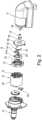
- the transmission 6 comprises the clutch 8, a transmission gear 9, which is designed here as a planetary gear, and a transmission housing 10 as its basic components.
- the transmission 6 is enclosed externally by the transmission housing 10 and has a cylindrical basic shape.
- the transmission housing 10 itself is tubular or ring-shaped and has internal teeth on its inside, in which the planetary gears of the planetary gear roll.
- the electric motor 5 has a protruding drive shaft 18, on which a drive gear 17 is fixed in a rotationally fixed manner via a toothed engagement.
- the electric motor 8 thus directly drives the drive gear 17 upon activation.
- the basic structure of the clutch 8 comprises a first part 13, a second part 14, a clutch element 15, and a spring 12.
- the first part 13 is in the form of a ring with a regular tooth profile 30 arranged radially on the inside. Furthermore, the first part 13 has a plurality of recesses on the radial outside, which are aligned with recesses on the gear housing 10.
- the first part 13 is covered on the front side by a cover plate 16, which additionally has axially projecting fingers, with which it engages in the radially outer recesses of the first part 13 and the gear housing 10, thereby fixing the first part 13 in a rotationally fixed manner relative to the gear housing 10 in the circumferential direction.
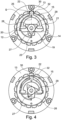
- the first part 13 has a circular free space radially inward, in which the second part 14 of the coupling 8 is rotatably arranged, as also in the Figures 3 and 4 can be seen.
- the cover plate 16 further has a central opening through which the drive wheel 17 extends.
- the drive wheel 17 has a polygonal force transmission profile 19 at its free end, with which it engages in a free space provided radially on the inside of the second part 14.
- the coupling element 15 is arranged in the free space of the second part 14 such that it surrounds the force transmission profile 19 radially on the outside.
- the polygonal power transmission profile 19 of the drive wheel 17 has the geometry of an equilateral triangle with three corners 27, 28, and 29 with identical angles and thus identically aligned lateral power transmission surfaces.
- the coupling element 15 has a radially projecting engagement section 22, with which it is guided radially displaceably in a guide 32 of the second part 14. Furthermore, the coupling element 15 has two arcuate arms symmetrically formed with respect to an axis of symmetry S running through the center of the engagement section 22, which arms approximately complement each other to form a semicircle.
- the coupling element 15 is each formed with radially inwardly directed power transmission sections 20, 21, with which it each encompasses a corner 28, 29 of the power transmission profile 19 of the drive shaft 17, as shown in the Figure 3
- the spring 12 is designed in the form of a bow spring and is connected with a first end 25 to the coupling element 15 in a radially inwardly towards the engagement section 22, in an opening arranged on the axis of symmetry S. Furthermore, the spring 12 is suspended with a second end 23 in an opening in the second part 14, which is arranged such that in the unloaded arrangement of the coupling element 15, i.e. when the electric motor 5 is at a standstill, it also lies on the axis of symmetry S.
- the spring 12 is designed in its spring characteristic and in the arrangement of the two fixed ends 25 and 23 such that it urges the coupling element 15 with the engagement section 22 radially outwards into engagement with the tooth profile 30 of the first part 13. As a result, a rotary connection is created between the first part 13 and the second part 14 by the coupling element 15 in the unloaded state.
- the drive wheel 17 drives the first part 13 via the power transmission profile 19 and the coupling element 15. Since the first part 13 is connected to the gear housing 10 in a rotationally fixed manner via the cover plate 16, the entire gear 6 is driven as an assembly and, via it, the belt shaft 4 in a transmission ratio of 1:1.
- the belt shaft 4 can be driven in both directions of rotation via the two power transmission sections 20, 21, whereby the power is transmitted only via one of the power transmission sections 20 or 21 depending on the direction of rotation. Since both the coupling element 15 and the power transmission profile 19 are in the position of Figure 3 symmetrical to the symmetry axis S are aligned, identical force ratios result in both directions of rotation.
- the second part 14 has a centrally arranged gear 31 on its axial end face facing the planetary gear system, which engages with the toothing of the planetary gears of the planetary gear system. Since the second part 14 rotates at an identical speed to the first part 13, the entire gear system 6 is also driven by the central gear 31. The entire gear system 6 rotates together with the first part 13 and the second part 14 as an assembly at the speed driven by the drive shaft 17, without the gears of the gear system 6 performing any further relative rotational movements to one another.
- the clutch 8 is opened by increasing the power of the electric motor 5, e.g., for reversible belt tensioning, to such an extent that a predetermined speed, a predetermined torque and/or a predetermined rotational acceleration is exceeded.
- the drive wheel 17 rotates so fast that the clutch element 15 remains behind and, against the spring force of the spring 12, is moved into the position specified in the Figure 4 to be recognized.
- the coupling element 15 with the engagement section 22 disengages from the toothed profile 30 and the rotary connection between the first part 13 and the second part 14 is released.
- the coupling 8 is thus opened.
- the drive shaft 17 comes into contact with a side surface of the power transmission profile 19 against a stop surface 26 of the second part 14 and thereby subsequently drives the second part 14 directly to a rotary movement, while the first part 13 is no longer driven due to the opened coupling 8.
- clutch 8 To engage clutch 8, the significantly higher drive speed of 5,000 to 15,000 rpm is used compared to the drive speed of 60 to 180 rpm when driving belt shaft 4 in the first power transmission path.
- clutch 8 or the transmission 6 with integrated clutch 8 can be designed such that it only opens when the drive speed exceeds 1,000 rpm, for example.
- the clutch 8 can also open if the torque to be overcome suddenly increases at the same or decreasing speed. Such a situation can arise, for example, when the seat belt is wound into the parking position at high speed. When the seat belt is then almost completely wound, the torque to be overcome increases, and the clutch 8 switches automatically. By switching the clutch 8, the speed of the output gear 23 is reduced and the torque exerted by the output gear 23 is increased, so that the seat belt is subsequently wound up at a lower retraction speed and with an increased retraction force.
- the transmission 6 has a single power transmission path through the planetary gearing, in this case a two-stage planetary gearing.
- the proposed solution for transmitting the drive rotational movement via the transmission 6 rotating as an assembly creates a first power transmission path for implementing a first function, in this case winding the seat belt into the parking position, without requiring additional installation space.
- the clutch 8 is engaged very simply by increasing the speed, so that the second power transmission path is automatically opened when the speed of the electric motor 5 is increased to tighten the seat belt—i.e., for its second function. The engagement of the clutch 8 is thus directly controlled by the change in function of the electric motor 5 itself.
- both the electric motor 5 and the gear 6 are cylindrical and aligned coaxially to one another and coaxially to the axis of rotation of the belt shaft 4. Furthermore, both the electric motor 5 and the gear 6 have a diameter in cross-section to their axis of rotation that is smaller than the outer diameter of the belt reel when the belt is wound up to its maximum. This results in a very slim, elongated design of the belt retractor, the maximum outer dimensions of which are predetermined by the maximum outer diameter of the belt reel. Since the maximum outer diameter of the belt reel is mandatory due to the thickness and length of the belt reel to be wound up and cannot be reduced, the belt retractor can thus be designed with the smallest possible dimensions perpendicular to the axis of rotation of the belt shaft 4.
- the clutch 8 is understood here as an assembly of the transmission 6, so that the first part 13 and the second part 14 are, of course, parts of the clutch 8 but thus also parts of the higher-level assembly of the transmission 6.
- the clutch 8 is preferably arranged on the input side of the transmission 6 facing the electric motor 5.
- the electric motor 5 is preferably voltage-controlled and, by applying different voltages, causes different torques acting on the belt shaft 4 or different retraction forces exerted on the safety belt.
- a voltage of 2 to 3 V is applied, which reduces the retraction force to the lowest possible level, but which is still sufficient to reliably pull the safety belt towards the occupant after the occupant has moved.
- the voltage is increased to 9 V, so that the seat belt is wound into the parking position with increased retraction force.
- the voltage is also increased to 12 V during a reversible tensioning process, which can be increased to approximately 36 V for a possibly additional reversible belt tensioning function with increased retraction force.
Landscapes
- Engineering & Computer Science (AREA)
- Mechanical Engineering (AREA)
- Automotive Seat Belt Assembly (AREA)
Description
- Die vorliegende Erfindung betrifft einen Gurtaufroller mit den Merkmalen des Oberbegriffs von Anspruch 1.
- Gurtaufroller weisen als Grundbauteile einen lasttragenden Rahmen und eine in dem Rahmen drehbar gelagerte Gurtspule auf, auf welcher ein Sicherheitsgurt aufwickelbar ist. Der Rahmen dient neben der Lagerung der Gurtspule außerdem zur Befestigung an einer Sitzstruktur oder an einer Fahrzeugstruktur und ist dafür aus einem entsprechend dicken Stahlblech hergestellt, welches zu einem U-förmigen Rahmen gebogen ist.
- Ferner werden Gurtaufroller in modernen Sicherheitsgurteinrichtungen mit Elektromotoren versehen, welche die Gurtwelle bei einer Aktivierung zum Beispiel zu einer reversiblen Gurtstraffung in Aufwickelrichtung antreiben. Der Elektromotor ist dabei ebenfalls an dem Rahmen befestigt und seitlich der Gurtwelle mit einer parallel zu der Drehachse der Gurtwelle ausgerichteten Antriebswelle angeordnet. Ferner ist es bekannt, zwischen der Gurtwelle und dem Elektromotor ein Getriebe vorzusehen, durch welches die Drehzahl des Elektromotors in eine vorbestimmte Drehzahl der Gurtwelle übersetzt wird. Durch die Verwendung des Getriebes wird es außerdem ermöglicht, einen möglichst kleinbauenden Elektromotor mit einer hohen Drehzahl zu verwenden. Insgesamt ergibt sich dadurch trotz der durch das Getriebe ermöglichten Verwendung des kleinbauenden Elektromotors ein Gurtaufroller mit einem vergrößerten Bauraumbedarf. Ein solcher Gurtaufroller ist z.B. aus der Druckschrift
WO 03/0 99 619 A2 - Sofern die Gurtwelle mit unterschiedlichen Drehzahlen und Drehmomenten angetrieben werden soll, müssen weitere Getriebestufen vorgesehen werden, welche den Bauraumbedarf weiter vergrößern. Ein solcher Gurtaufroller ist z.B. aus der Druckschrift
DE 199 27 731 C2 bekannt. - Da die an der Sitzstruktur der Fahrzeugsitze oder auch allgemein in sehr kleinen Fahrzeugen zur Verfügung stehenden Bauräume in ihrer Größe sehr begrenzt sind und aus Designgründen nicht beliebig vergrößert werden können, ist die Anordnung eines derartigen Gurtaufrollers am Fahrzeugsitz oder auch in einem kleinen Fahrzeug grundsätzlich problematisch.
- Aus der
DE 10 2018 219 040 A1 ist ein Gurtaufroller bekannt, bei dem der Bauraumbedarf dadurch weiter reduziert, indem das Getriebe in einem ersten Kraftübertragungsweg als Baugruppe angetrieben wird, und indem eine Kupplung vorgesehen ist, welche durch einen Schaltvorgang das Getriebe aktiviert und einen zweiten Kraftübertragungsweg eröffnet. Dadurch kann ein Getriebe mit einem einzigen Kraftübertragungsweg zur Verwirklichung von zwei verschiedenen Übersetzungen genutzt werden. Dabei wird das Getriebe selbst in dem ersten Kraftübertragungsweg als Baugruppe also als ein Block angetrieben, ohne dass die Getriebeteile in sich eine Relativbewegung zueinander ausführen. Die Kupplung weist hier ein von dem Elektromotor angetriebenes Antriebsrad mit drei dreieckförmigen sich radial nach außen verengenden Öffnungen auf, in welche jeweils eine Kupplungsklinke mit jeweils einem Steuerstift eingreifen. Die Kupplungsklinken sind längsverschieblich, in Radialrichtung geführt und jeweils über eine Feder radial nach außen federbelastet. Zur Schaltung der Kupplung werden die Kupplungsklinken durch bei dem Überschreiten einer bestimmten Drehbeschleunigung des Antriebsrades entgegen der Federkraft radial nach innen gezogen, wodurch die Drehverbindung zwischen den Kupplungsklinken und einem dem Getriebe zugeordneten ersten Teil aufgehoben wird. - Vor diesem Hintergrund liegt der Erfindung die Aufgabe zugrunde, einen verbesserten Gurtaufroller mit einem Elektromotor und einem Getriebe mit einer Kupplung mit einem vereinfachten Aufbau zu schaffen.
- Zur Lösung der Aufgabe wird ein Gurtaufroller mit den Merkmalen von Anspruch 1 vorgeschlagen. Weitere bevorzugte Weiterentwicklungen der Erfindung sind den Unteransprüchen, den Figuren und der zugehörigen Beschreibung zu entnehmen.
- Gemäß dem Grundgedanken der Erfindung wird nach Anspruch 1 vorgeschlagen, dass das Kupplungselement an einem zweiten Teil des Getriebes gelagert ist, und das zweite Teil ein drehfest verbundenes Zahnrad aufweist, mit welchem es sich in einem Verzahnungseingriff mit einem oder mehr Zahnrädern eines Übersetzungsgetriebes befindet, und die Feder durch eine Bogenfeder gebildet ist, welche mit einem ersten Ende mit dem Kupplungselement und mit einem zweiten Ende mit dem zweiten Teil verbunden ist.
- Das zweite Teil des Getriebes, an dem das Kupplungselement gelagert ist, bildet damit über das damit drehfest verbundene Zahnrad gleichzeitig den Antrieb, über den die Drehbewegung in das Übersetzungsgetriebe eingeleitet wird. Die Vorteile der Verwendung einer Bogenfeder liegen darin, dass sie kostengünstig ist, dass sie einfach zu montieren ist und außerdem sehr einfach z.B. durch Öffnungen oder Anschlagflächen kraftübertragend mit dem Kupplungselement und dem zweiten Teil verbunden werden kann.
- Weiterhin wird vorgeschlagen, dass das Kupplungselement die Drehbewegung des Antriebsrades unterhalb der vorbestimmten Drehzahl und/oder unterhalb des vorbestimmten Drehmomentes auf das erste Teil des Getriebes überträgt. Hierdurch kann die Drehbewegung des Elektromotors bei kleinen Drehmomenten, Drehzahlen und/oder Drehbeschleunigungen in einem ersten Kraftübertragungsweg direkt über das Kupplungselement auf das erste Teil des Getriebes z.B. in einem Übersetzungsverhältnis von 1:1 auf die Gurtwelle übertragen werden, wodurch z.B. eine Aufwickelhilfe des Sicherheitsgurtes in die Parkposition, eine Komfortfunktion zur Verstellung der auf die Gurtwelle wirkenden Rückzugskraft oder Ähnliches verwirklicht werden.
- Dabei kann das Kupplungselement bevorzugt einen in das erste Teil des Getriebes eingreifenden Eingriffsabschnitt aufweisen, und das Kupplungselement kann wenigstens zwei zu einer durch den Eingriffsabschnitt verlaufenden Symmetrieachse symmetrisch ausgebildete Kraftübertragungsabschnitte aufweisen, mit welchen das Kupplungselement an dem polygonförmigen Kraftübertragungsprofil des Antriebsrades anliegt. Das Kupplungselement überträgt dabei die Drehbewegung über den Eingriffsabschnitt auf das erste Teil. Die Kraftübertragung von dem Antriebsrad auf das Kupplungselement erfolgt aufgrund der symmetrischen Kraftübertragungsabschnitte.in beide Drehrichtungen mit möglichst identischen Kraftverhältnissen, und das Kupplungselement kann in zwei verschiedenen Ausrichtungen montiert werden.
- Weiter wird vorgeschlagen, dass das polygonförmige Kraftübertragungsprofil im Querschnitt ein Dreieckprofil aufweist, und das Kupplungselement das Dreieckprofil an zwei Ecken umfasst. Das Kupplungselement umfasst das Kraftübertragungsprofil an zwei Ecken mit einer formschlüssigen Überlappung und überträgt dadurch die Antriebsdrehbewegung in beide Drehrichtungen. Ferner wird das Kupplungselement dadurch bei einem Überschreiten einer der vorbestimmten Bedingungen formschlüssig mitgenommen und aus der Eingriffsstellung gezogen.
- Dabei kann die symmetrische Kraftübertragung mit möglichst identischen Kraftverhältnissen in beide Drehrichtungen bevorzugt dadurch verwirklicht werden, indem das Dreieckprofil die Geometrie eines gleichseitigen Dreiecks aufweist. Ferner kann dadurch die Montage erleichtert werden, da die Montage des Gurtaufrollers dadurch mit drei verschiedenen Stellungen des Antriebsrades möglich ist. Da die Spitzen des Dreieckprofils dadurch eine identische Geometrie aufweisen, ist es insbesondere unerheblich, an welcher der Spitzen das Kupplungselement mit dem oder den Kraftübertragungsabschnitt(en) anliegt.
- Weiter wird vorgeschlagen, dass in diesem Fall das zweite Teil eine Anschlagfläche aufweist, an welcher Antriebsrad mit dem Kraftübertragungsprofil durch die Ausführung einer Relativbewegung kraftübertragend zur Anlage gelangt. Die Relativbewegung wird ausgelöst, wenn die vorbestimmte Drehzahl, das vorbestimmte Drehmoment und/oder die vorbestimmte Drehbeschleunigung überschritten wird. Dadurch wird das Kupplungselement aus der Eingriffsstellung herausbewegt, und das Antriebsrad gelangt in eine kraftübertragende Anlage an dem zweiten Teil. Dadurch treibt das Antriebsrad das zweite Teil und über das damit drehfest verbunden Zahnrad auch das Übersetzungsgetriebe bei einer gleichzeitig gelösten Drehverbindung zwischen dem Antriebsrad und dem ersten Teil an.
- Dabei kann das zweite Teil bevorzugt eine Führung aufweisen, in welcher das Kupplungselement mit dem Eingriffsabschnitt geführt ist. Die Bewegung des Kupplungselementes wird durch die Federkraft und die Bewegung des Antriebsrades ausgelöst, während die Richtung der Bewegung durch die Führung des Kupplungselementes an dem zweiten Teil definiert ist. Dabei ist die Führung des Kupplungselementes im Bereich des Eingriffsabschnittes von besonderem Vorteil, da das Kupplungselement dadurch bevorzugt möglichst nahe der zu verwirklichenden Verbindung mit dem ersten Teil geführt ist und dort eine Abstützung findet.
- Die Erfindung wird im Folgenden anhand bevorzugter Ausführungsformen unter Bezugnahme auf die beigefügten Figuren erläutert. Dabei zeigt
-
Fig. 1 ein erfindungsgemäßer Gurtaufroller mit zwei Gehäuseschalen montiert und demontiert -
Fig. 2 ein Getriebe, ein Elektromotor und eine dazwischen angeordnete Kupplung des Gurtaufrollers in Explosionsdarstellung -
Fig. 3 eine Schnittdarstellung mit der Kupplung in einer ersten Stellung, und -
Fig. 4 eine Schnittdarstellung mit der Kupplung in einer zweiten Stellung. - In der
Figur 1 ein erfindungsgemäßer Gurtaufroller 1 mit einem durch zwei Gehäuseschalen 2 und 3 zusammengesetzten Gehäuse zu erkennen, welches sowohl der Befestigung des Gurtaufrollers 1 an einem Fahrzeug, bevorzugt in einem schmalen länglichen Bauraum eines Fahrzeugsitzes, als auch zur Lagerung und Befestigung der nachfolgend noch näher beschriebenen Einzelteile des Gurtaufrollers 1 dient. Das Gehäuse kann auch Teil einer übergeordneten Struktur des Fahrzeugsitzes oder des Fahrzeugs, wie z.B. eine Strebe oder ein Holm, sein. - Das Gehäuse ist innenseitig mit mehreren Stegen 24 zur Lagerung des Gurtaufrollers 1 versehen, welche senkrecht zu der Drehachse des Gurtaufrollers ausgerichtet und in Bezug zu der Drehachse formschlüssig und drehfest mit dem Gehäuse verbunden sind. Der Gurtaufroller 1 weist als Grundbauteil eine Gurtwelle 4 auf, auf welcher ein zur Rückhaltung eines Insassen vorgesehener Sicherheitsgurt aufwickelbar ist. Ferner ist ein irreversibler Gurtstraffer 7 zum Antrieb der Gurtwelle 4 in Aufwickelrichtung und damit zum Herausziehen vorhandener Gurtlose in einer Frühphase eines Unfalles vorgesehen. Außerdem ist ein Elektromotor 5 und ein Getriebe 6 vorgesehen. Die Gurtwelle 4, der irreversible Gurtstraffer 7, der Elektromotor 5 und das Getriebe 6 sind koaxial zueinander angeordnet. Ferner sind der Elektromotor 5, das Getriebe 6 und der irreversible Gurtstraffer 7 in den Außenabmaßen senkrecht zu der Drehachse der Gurtwelle so bemessen, dass sie kleiner als der maximale Durchmesser des vollständig aufgewickelten Gurtwickels auf der Gurtwelle 4 sind. Da das Gehäuse hier im Querschnitt eckig ausgebildet ist, bleiben in den Ecken zusätzliche Freiräume, welche z.B. zur Anordnung eines Strafferantriebsrohres des irreversiblen Gurtstraffers 7 oder anderer Anbauteile, wie z.B. Steuereinheiten oder auch elektrischen Leitungen genutzt werden können. Damit sind die maximalen Außenabmaße durch den maximalen Durchmesser des Gurtwickels vorgegeben. Da der maximale Durchmesser wiederum durch die Dicke des Gurtbandes und die maximal aufzuwickelnde Länge des Gurtbandes vorgegeben ist und ohne eine Änderung des Gurtbandes nicht verringert werden kann, weist der Gurtaufroller 1 damit die kleinstmöglichen Abmaße senkrecht zu der Drehachse der Gurtwelle 4 auf und kann damit auch in sehr schmalen und länglichen Freiräumen des Fahrzeugsitzes und der Fahrzeugstruktur angeordnet und befestigt werden.
- In der
Figur 2 ist der Elektromotor 5 mit dem Getriebe 6, einer dazwischen angeordneten Kupplung 8 und einer zusätzlich vorgesehenen optionalen Kraftbegrenzungseinheit 11 gezeigt. - Das Getriebe 6 umfasst als Grundbauteile die Kupplung 8, ein Übersetzungsgetriebe 9, welches hier als Planetengetriebe ausgebildet ist, und ein Getriebegehäuse 10. Das Getriebe 6 wird außen von dem Getriebegehäuse 10 umfasst und weist eine zylindrische Grundform auf. Das Getriebegehäuse 10 selbst ist rohr- oder ringförmig ausgebildet und weist an seiner Innenseite eine Innenverzahnung auf, in der sich die Planetenräder des Planetengetriebes abwälzen.
- Der Elektromotor 5 weist eine herausgeführte Antriebswelle 18 auf, auf der ein Antriebsrad 17 drehfest über einen Verzahnungseingriff festgelegt ist. Der Elektromotor 8 treibt das Antriebsrad 17 damit bei einer Aktivierung unmittelbar an.
- Die Kupplung 8 umfasst in ihrem Grundaufbau ein erstes Teil 13, ein zweites Teil 14, ein Kupplungselement 15 und eine Feder 12. Das erste Teil 13 ist in Form eines Ringes mit einem radial innen angeordneten regelmäßigen Verzahnungsprofil 30 ausgebildet. Ferner weist das erste Teil 13 radial außen mehrere Ausnehmungen auf, welche mit Ausnehmungen an dem Getriebegehäuse 10 fluchten. Das erste Teil 13 ist über eine Abdeckscheibe 16 stirnseitig abgedeckt, welche zusätzlich axial vorstehende Finger aufweist, mit denen es in die radial äußeren Ausnehmungen des ersten Teils 13 und des Getriebegehäuse 10 eingreift und dadurch das erste Teil 13 in Umfangsrichtung drehfest gegenüber dem Getriebegehäuse 10 fixiert. Sofern die Verbindung über einen Presssitz verwirklicht ist, kann dadurch zusätzlich eine axiale Sicherung des ersten Teils 13 gegenüber dem Getriebegehäuse 10 verwirklicht werden. Das erste Teil 13 weist radial innen einen kreisförmigen Freiraum auf, in dem das zweite Teil 14 der Kupplung 8 drehbar angeordnet ist, wie auch in den
Figuren 3 und 4 zu erkennen ist. Damit ist nach dem Aufsetzen der Abdeckscheibe 16 auch das zweite Teil 14 axial fixiert. Die Abdeckscheibe 16 weist ferner eine zentrale Öffnung auf, durch die sich das Antriebsrad 17 erstreckt. Das Antriebsrad 17 weist an seinem freien Ende ein polygonförmiges Kraftübertragungsprofil 19 auf, mit dem es in einen radial innen an dem zweiten Teil 14 vorgesehen Freiraum eingreift. Ferner ist in dem Freiraum des zweiten Teils 14 das Kupplungselement 15 so angeordnet, dass es das Kraftübertragungsprofil 19 radial außen umfasst. - Das polygonförmige Kraftübertragungsprofil 19 des Antriebsrades 17 weist die Geometrie eines gleichseitigen Dreiecks mit drei Ecken 27,28 und 29 mit identischen Winkeln und dadurch identisch zueinander ausgerichteten seitlichen Kraftübertragungsflächen auf. Das Kupplungselement 15 weist einen radial vorstehenden Eingriffsabschnitt 22 auf, mit dem es in einer Führung 32 des zweiten Teils 14 radial verschieblich geführt ist. Ferner weist das Kupplungselement 15 zwei zu einer durch die Mitte des Eingriffsabschnittes 22 verlaufenden Symmetrieachse S symmetrisch ausgebildete, bogenförmige Arme auf, welche sich in etwa zu einem Halbkreis ergänzen. An den Enden der Arme ist das Kupplungselement 15 jeweils mit radial einwärts gerichteten Kraftübertragungsabschnitten 20,21 geformt, mit denen es jeweils eine Ecke 28,29 des Kraftübertragungsprofils 19 der Antriebswelle 17 umfasst, wie in der
Figur 3 zu erkennen ist. Die Feder 12 ist in Form einer Bogenfeder ausgebildet und mit einem ersten Ende 25 an dem Kupplungselement 15 in einer radial einwärts zu dem Eingriffsabschnitt 22, auf der Symmetrieachse S angeordneten Öffnung eingehängt. Weiter ist die Feder 12 mit einem zweiten Ende 23 in einer Öffnung des zweiten Teils 14 eingehängt, welche so angeordnet ist, dass sie in der unbelasteten Anordnung des Kupplungselementes 15 also im Stillstand des Elektromotors 5 ebenfalls auf der Symmetrieachse S liegt. Die Feder 12 ist in ihrer Federcharakteristik und in der Anordnung der beiden fixierten Enden 25 und 23 so ausgelegt, dass sie das Kupplungselement 15 mit dem Eingriffsabschnitt 22 radial nach außen zu einem Eingriff in das Verzahnungsprofil 30 des ersten Teils 13 drängt. Dadurch wird durch das Kupplungselement 15 im unbelasteten Zustand eine Drehverbindung zwischen dem ersten Teil 13 und dem zweiten Teil 14 geschaffen. - Für den Fall, dass der Elektromotor 5 in der in
Figur 3 zu erkennenden Ausgangsstellung des Kupplungselementes 15 mit kleinen Drehmomenten, Drehzahlen und/oder Drehbeschleunigungen betrieben wird, wie dies z.B. zu einem Aufwickeln des Sicherheitsgurtes in die Parkposition oder zu einer Verstellung der auf die Gurtwelle 4 ausgeübten Rückzugskraft (Komfortfunktion) der Fall ist, treibt das Antriebsrad 17 das erste Teil 13 über das Kraftübertragungsprofil 19 und das Kupplungselement 15 an. Da das erste Teil 13 über die Abdeckscheibe 16 drehfest mit dem Getriebegehäuse 10 verbunden ist, wird dabei das gesamte Getriebe 6 als Baugruppe und darüber die Gurtwelle 4 in einem Übersetzungsverhältnis von 1:1 angetrieben. Dabei kann die Gurtwelle 4 über die beiden Kraftübertragungsabschnitte 20,21 in beide Drehrichtungen angetrieben werden, wobei die Kraftübertragung je nach der Drehrichtung nur über einen der Kraftübertragungsabschnitte 20 oder 21 erfolgt. Da sowohl das Kupplungselement 15, als auch das Kraftübertragungsprofil 19 in der Stellung derFigur 3 symmetrisch zu der Symmetrieachse S ausgerichtet sind, ergeben sich identische Kraftverhältnisse in beide Drehrichtungen. Das zweite Teil 14 weist an seiner dem Planetengetriebe zugewandten axialen Stirnseite ein zentrisch angeordnetes Zahnrad 31 auf, welches in die Verzahnungen der Planetenräder des Planetengetriebes eingreift. Da das zweite Teil 14 mit einer identischen Drehzahl wie das erste Teil 13 dreht, wird das gesamte Getriebe 6 auch über das zentrische Zahnrad 31 mitgenommen. Das gesamte Getriebe 6 dreht zusammen mit dem ersten Teil 13 und dem zweiten Teil 14 mit der von der Antriebswelle 17 angetriebenen Drehzahl als Baugruppe, ohne dass die Zahnräder des Getriebes 6 darüberhinaus weitere Relativdrehbewegungen zueinander ausführen. - Das Öffnen der Kupplung 8 erfolgt dadurch, indem die Leistung des Elektromotors 5 z.B. zu einer reversiblen Gurtstraffung soweit erhöht wird, dass eine vorbestimmte Drehzahl, ein vorbestimmtes Drehmoment und/oder eine vorbestimmte Drehbeschleunigung überschritten wird. In diesem Fall dreht das Antriebsrad 17 so schnell, dass das Kupplungselement 15 zurückbleibt und entgegen der Federkraft der Feder 12 in die in der
Figur 4 zu erkennende Position gezogen wird. Dabei gelangt das Kupplungselement 15 mit dem Eingriffsabschnitt 22 außer Eingriff des Verzahnungsprofils 30 und die Drehverbindung zwischen dem ersten Teil 13 und dem zweiten Teil 14 wird aufgehoben. Die Kupplung 8 wird damit geöffnet. Gleichzeitig gelangt die Antriebswelle 17 mit einer Seitenfläche des Kraftübertragungsprofils 19 zur Anlage an einer Anschlagfläche 26 des zweiten Teils 14 und treibt dadurch nachfolgend das zweite Teil 14 direkt zu einer Drehbewegung an, während das erste Teil 13 aufgrund der geöffneten Kupplung 8 nicht mehr angetrieben wird. - Die Drehbewegung des zweiten Teils 14 wird in diesem Fall über das zentrische Zahnrad 31 auf die Zahnräder des Planetengetriebes übertragen. Das Getriebegehäuse 10 wird nicht mehr angetrieben und kann zusätzlich über eine Blockiereinrichtung 33 fahrzeugfest blockiert sein, jedenfalls drehen die Zahnräder des Planetengetriebes gegenüber dem Getriebegehäuse 10 und die Drehbewegung der Antriebswelle 17 wird nun in einem Übersetzungsverhältnis von 1:80 in eine langsamere Drehzahl auf die Gurtwelle 4 übersetzt. Aufgrund der Übersetzung der höheren Drehzahl in die kleinere Drehzahl wird gleichzeitig das auf die Gurtwelle 4 ausgeübte Drehmoment und die dadurch auf den Sicherheitsgurt ausgeübte Rückzugskraft erhöht.
- Der Elektromotor 5 kann dadurch in einem ersten Kraftübertragungsweg bei geschlossener Kupplung 8 und deaktiviertem Getriebe 6 mit einem Übersetzungsverhältnis von 1:1 und einer Drehzahl 60 bis 180 U/min zum Aufwickeln des Gurtbandes nach dem Abschnallen in die Parkposition betrieben werden, indem das Getriebe 6 als Block gedreht wird. Sofern die vorgeschlagene Drehzahl auch die Drehzahl der Gurtwelle 4 sein soll, kann die Antriebsdrehbewegung dann auch in einem Übersetzungsverhältnis von 1:1 weiter auf die Gurtwelle 4 übertragen werden. Zur reversiblen Gurtstraffung kann die Drehzahl des Elektromotors 5 schlagartig auf 5000 bis 15000 U/min erhöht werden, welche durch das Getriebe 6 in dem durch die geöffnete Kupplung 8 eröffneten zweiten Kraftübertragungsweg auf die kleinere Drehzahl von ca. 140 bis 420 U/min des Abtriebszahnrades 23 in dem Übersetzungsverhältnis von 1:80 übersetzt wird. Dabei wird zur Schaltung der Kupplung 8 die deutlich höhere Antriebsdrehzahl von 5000 bis 15000 U/min im Vergleich zu der Antriebsdrehzahl von 60 bis 180 U/min beim Antreiben der Gurtwelle 4 in dem ersten Kraftübertragungsweg genutzt. So kann die Kupplung 8 bzw. das Getriebe 6 mit der integrierten Kupplung 8 so ausgelegt werden, dass sie z.B. erst bei einem Überschreiten einer Antriebsdrehzahl von 1000 U/min öffnet.
- Damit erfolgt die Übertragung der Antriebsdrehbewegung von 60 bis 180 U/min in dem ersten Kraftübertragungsweg prozesssicher, und ein unbeabsichtigtes Öffnen der Kupplung 8 während des Aufwickelvorganges des Sicherheitsgurtes in die Parkposition kann verhindert werden. Ferner kann die Kupplung 8 alternativ zu der drehzahlgesteuerten Öffnung auch dann öffnen, wenn das zu überwindende Drehmoment bei gleicher oder abnehmender Drehzahl plötzlich ansteigt. Eine solche Situation kann z.B. dann gegeben sein, wenn der Sicherheitsgurt mit hoher Geschwindigkeit in die Parkposition aufgerollt wird. Wenn der Sicherheitsgurt dann fast vollständig aufgewickelt ist, steigt das zu überwindende Drehmoment an, und die Kupplung 8 schaltet selbsttätig. Durch das Schalten der Kupplung 8 wird die Drehzahl des Abtriebszahnrades 23 verringert und das von dem Abtriebszahnrad 23 ausgeübte Drehmoment vergrößert, so dass der Sicherheitsgurt nachfolgend mit einer geringeren Rückzugsgeschwindigkeit und einer erhöhten Rückzugskraft aufgewickelt wird.
- Das Getriebe 6 weist durch das Planetengetriebe einen einzigen Kraftübertragungsweg, hier ein zweistufiges Planetengetriebe auf. Durch die vorgeschlagene Lösung der Übertragung der Antriebsdrehbewegung über das als Baugruppe drehende Getriebe 6 wird ohne einen zusätzlichen Bauraumbedarf ein erster Kraftübertragungsweg zur Verwirklichung einer ersten Funktion, hier das Aufwickeln des Sicherheitsgurtes in die Parkposition, geschaffen. Außerdem erfolgt die Schaltung der Kupplung 8 auf sehr einfache Weise durch die Erhöhung der Drehzahl, so dass der zweite Kraftübertragungsweg selbsttätig eröffnet wird, wenn die Drehzahl des Elektromotor 5 zur Straffung des Sicherheitsgurtes also zu seiner zweiten Funktion erhöht wird. Die Schaltung der Kupplung 8 wird damit direkt durch den Funktionswechsel des Elektromotors 5 selbst gesteuert.
- Ferner sind der Elektromotor 5 und das Getriebe 6 zylinderförmig ausgebildet sowie koaxial zueinander und koaxial zu der Drehachse der Gurtwelle 4 ausgerichtet. Außerdem weisen sowohl der Elektromotor 5 als auch das Getriebe 6 einen Durchmesser im Querschnitt zu ihrer Drehachse auf, welcher kleiner als der Außendurchmesser des Gurtwickels bei maximal aufgewickeltem Gurtband ist. Damit ergibt sich ein sehr schlanker, länglicher Aufbau des Gurtaufrollers, dessen maximale Außenabmaße durch den maximalen Außendurchmesser des Gurtwickels vorgegeben sind. Da der maximale Außendurchmesser des Gurtwickels aufgrund der Dicke und der Länge des aufzuwickelnden Gurtbandes zwingend vorgegeben ist und nicht verringert werden kann, kann der Gurtaufroller damit mit geringstmöglichen Abmaßen senkrecht zu der Drehachse der Gurtwelle 4 ausgebildet werden.
- Die Kupplung 8 wird hier als Baugruppe des Getriebes 6 verstanden, so dass das erste Teil 13 und das zweite Teil 14 selbstverständlich Teile der Kupplung 8 aber damit auch Teile der übergeordneten Baugruppe des Getriebes 6 sind. Die Kupplung 8 ist dafür bevorzugt an der dem Elektromotor 5 zugewandten Eingangsseite des Getriebes 6 angeordnet.
- Der Elektromotor 5 ist bevorzugt spannungsgesteuert und bewirkt durch das Anlegen unterschiedlicher Spannungen unterschiedliche auf die Gurtwelle 4 einwirkende Drehmomente bzw. unterschiedliche auf den Sicherheitsgurt ausgeübte Rückzugskräfte. In dem normalen Tragezustand des Sicherheitsgurtes wird dabei eine Spannung von 2 bis 3 V angelegt, durch welche die Rückzugskraft auf ein möglichst niedriges Niveau reduziert ist, welche aber dennoch ausreicht, den Sicherheitsgurt nach einem Bewegen des Insassen funktionssicher an den Insassen heranzuziehen. Zum Aufwickeln des Sicherheitsgurtes in die Parkposition nach dem Abschnallen wird die Spannung auf 9 V erhöht, so dass der Sicherheitsgurt mit einer erhöhten Rückzugskraft in die Parkposition aufgewickelt wird. Ferner wird die Spannung auch während eines reversiblen Straffvorganges auf 12 V erhöht, welche für eine eventuell zusätzlich vorzusehende Funktion eines reversiblen Gurtstraffens mit einer erhöhten Rückzugskraft auf ca. 36 V erhöht werden kann.
Claims (7)
- Gurtaufroller (1) mit- einer in einem fahrzeugfest befestigbaren Gehäuse drehbar gelagerten Gurtwelle (4), auf welcher ein Sicherheitsgurt aufwickelbar ist, und- einem Elektromotor (5) zum Antrieb der Gurtwelle (4) zu einer Drehbewegung, und- einem die Drehbewegung von dem Elektromotor (5) auf die Gurtwelle (4) übertragenden Getriebe (6), wobei- das Getriebe (6) in einem ersten Kraftübertragungsweg als Baugruppe zum Antrieb der Gurtwelle (4) mit einem ersten Drehmoment antreibbar ist, und- das Getriebe (6) durch Schalten einer drehzahl- und/oder drehmomentgesteuerten Kupplung (8) unter Eröffnung eines zweiten Kraftübertragungsweges zum Antrieb der Gurtwelle (4) mit einem zweiten Drehmoment antreibbar ist, wobei- die Kupplung (8) wenigstens ein durch eine Feder (12) in einen Eingriff in ein erstes Teil (13) des Getriebes (6) federbelastetes Kupplungselement (15) aufweist, wobei- ein drehfest mit dem Elektromotor (5) verbundenes Antriebsrad (17) mit einem polygonförmigen Kraftübertragungsprofil (19) vorgesehen ist, und- das Kupplungselement (15) wenigstens einen an dem polygonförmigen Kraftübertragungsprofil (19) anliegenden Kraftübertragungsabschnitt (20,21) aufweist, durch welchen das Kupplungselement (15) bei einem Überschreiten einer von dem Antriebsrad (17) übertragenen vorbestimmten Drehzahl und/oder eines vorbestimmten Drehmomentes und/oder einer vorbestimmten Drehbeschleunigung aufgrund einer Relativbewegung des Antriebsrades (17) zu dem Kupplungselement (15) entgegen der Kraft der Feder (12) aus dem Eingriff in das erste Teil (13) des Getriebes (6) heraus bewegbar ist, und- das Kupplungselement (15) an einem zweiten Teil (14) des Getriebes (6) gelagert ist, und- das zweite Teil (14) ein drehfest verbundenes Zahnrad (31) aufweist, mit welchem es sich in einem Verzahnungseingriff mit einem oder mehr Zahnrädern eines Übersetzungsgetriebes (9) befindet, dadurch gekennzeichnet, dass- die Feder (12) durch eine Bogenfeder gebildet ist, welche mit einem ersten Ende (25) mit dem Kupplungselement (15) und mit einem zweiten Ende (23) mit dem zweiten Teil (14) verbunden ist.
- Gurtaufroller (1) nach Anspruch 1, dadurch gekennzeichnet, dass- das Kupplungselement (15) die Drehbewegung des Antriebsrades (17) unterhalb der vorbestimmten Drehzahl und/oder unterhalb des vorbestimmten Drehmomentes auf das erste Teil (13) des Getriebes (6) überträgt.
- Gurtaufroller (1) nach einem der Ansprüche 1 oder 2,
dadurch gekennzeichnet, dass- das Kupplungselement (15) einen in das erste Teil (13) des Getriebes (6) eingreifenden Eingriffsabschnitt (22) aufweist, und- das Kupplungselement (15) wenigstens zwei zu einer durch den Eingriffsabschnitt (22) verlaufenden Symmetrieachse (S) symmetrisch ausgebildete Kraftübertragungsabschnitte (20,21) aufweist, mit welchen das Kupplungselement (15) an dem polygonförmigen Kraftübertragungsprofil (19) des Antriebsrades (17) anliegt. - Gurtaufroller (1) nach einem der vorangegangenen Ansprüche, dadurch gekennzeichnet, dass- das polygonförmige Kraftübertragungsprofil (19) im Querschnitt ein Dreieckprofil aufweist, und- das Kupplungselement (15) das Dreieckprofil an zwei Ecken (27,28,29) umfasst.
- Gurtaufroller (1) nach Anspruch 4, dadurch gekennzeichnet, dass- das Dreieckprofil die Geometrie eines gleichseitigen Dreiecks aufweist.
- Gurtaufroller (1) nach einem der Ansprüche 1 bis 5,
dadurch gekennzeichnet, dass- das zweite Teil (14) eine Anschlagfläche (26) aufweist, an welcher das Antriebsrad (17) mit dem Kraftübertragungsprofil (19) durch die Ausführung der Relativbewegung kraftübertragend zur Anlage gelangt. - Gurtaufroller (1) nach einem der Ansprüche 1 bis 6,
dadurch gekennzeichnet, dass- das zweite Teil (14) eine Führung (32) aufweist, in welcher das Kupplungselement (15) mit dem Eingriffsabschnitt (22) geführt ist.
Applications Claiming Priority (2)
| Application Number | Priority Date | Filing Date | Title |
|---|---|---|---|
| DE102020208905.1A DE102020208905A1 (de) | 2020-07-16 | 2020-07-16 | Gurtaufroller |
| PCT/EP2021/069257 WO2022013118A1 (de) | 2020-07-16 | 2021-07-12 | Gurtaufroller |
Publications (2)
| Publication Number | Publication Date |
|---|---|
| EP4182190A1 EP4182190A1 (de) | 2023-05-24 |
| EP4182190B1 true EP4182190B1 (de) | 2025-04-16 |
Family
ID=77168215
Family Applications (1)
| Application Number | Title | Priority Date | Filing Date |
|---|---|---|---|
| EP21749110.9A Active EP4182190B1 (de) | 2020-07-16 | 2021-07-12 | Gurtaufroller |
Country Status (7)
| Country | Link |
|---|---|
| US (1) | US12304420B2 (de) |
| EP (1) | EP4182190B1 (de) |
| JP (1) | JP7729846B2 (de) |
| KR (1) | KR20230038536A (de) |
| CN (1) | CN116133908B (de) |
| DE (1) | DE102020208905A1 (de) |
| WO (1) | WO2022013118A1 (de) |
Families Citing this family (4)
| Publication number | Priority date | Publication date | Assignee | Title |
|---|---|---|---|---|
| DE102019218307A1 (de) * | 2019-11-26 | 2021-05-27 | Autoliv Development Ab | Gurtaufroller |
| DE102021105013A1 (de) * | 2021-03-02 | 2022-09-08 | Autoliv Development Ab | Lasttragender Gurtaufroller |
| KR102617421B1 (ko) * | 2023-04-24 | 2023-12-27 | 아우토리브 디벨롭먼트 아베 | 시트벨트 리트랙터 |
| DE102024123201A1 (de) * | 2024-08-14 | 2026-02-19 | Zf Automotive Germany Gmbh | Kupplungsbauteil zum Verbinden eines reversiblen Gurtstrafferantriebs und Verfahren zur Verstellung einer Kupplungsklinke eines Kupplungsbauteils |
Family Cites Families (17)
| Publication number | Priority date | Publication date | Assignee | Title |
|---|---|---|---|---|
| EP1178906B1 (de) | 1999-05-20 | 2004-05-12 | Breed Automotive Technology, Inc. | Sicherheitsgurtaufroller |
| DE10101045A1 (de) | 2001-01-11 | 2002-07-18 | Takata Europa Vehicle Safety T | Sicherheitsgurtvorrichtung |
| DE10101048A1 (de) | 2001-01-11 | 2002-07-18 | Takata Europa Vehicle Safety T | Sicherheitsgurtvorrichtung |
| DE50210442D1 (de) * | 2001-09-06 | 2007-08-23 | Trw Automotive Electron & Comp | Gurtaufroller |
| US20130256445A1 (en) | 2002-05-29 | 2013-10-03 | Autoliv Development Ab | Safety belt retractor having a pretensioning device |
| ATE375901T1 (de) * | 2002-05-29 | 2007-11-15 | Autoliv Dev | Sicherheitsgurtaufroller mit einer vorstraffeinrichtung |
| JP3924213B2 (ja) * | 2002-07-11 | 2007-06-06 | 株式会社東海理化電機製作所 | ウエビング巻取装置及びクラッチ機構 |
| JP4379783B2 (ja) * | 2003-09-19 | 2009-12-09 | タカタ株式会社 | シートベルトリトラクタおよびこれを備えたシートベルト装置 |
| DE10347992A1 (de) * | 2003-10-15 | 2005-05-12 | Trw Repa Gmbh | Gurtaufroller für einen Fahrzeug-Sicherheitsgurt |
| JP2008195085A (ja) * | 2007-02-08 | 2008-08-28 | Tokai Rika Co Ltd | ウエビング巻取装置 |
| JP4758967B2 (ja) * | 2007-05-25 | 2011-08-31 | オートリブ ディベロップメント エイビイ | シートベルトのウェビングロッキング防止装置 |
| KR101264107B1 (ko) * | 2011-07-26 | 2013-05-14 | 주식회사 삼송 | 리트랙터 및 이를 구비한 시트벨트 |
| JP5784563B2 (ja) * | 2012-09-24 | 2015-09-24 | 株式会社東海理化電機製作所 | ウェビング巻取装置 |
| DE102014200312A1 (de) * | 2014-01-10 | 2015-07-16 | Autoliv Development Ab | Reversibler Gurtstraffer |
| DE102015221572B4 (de) * | 2015-11-04 | 2020-07-16 | Autoliv Development Ab | Antriebseinrichtung für ein Gurtschloss einer Sicherheitsgurteinrichtung |
| DE102018219040B4 (de) | 2018-11-08 | 2024-02-15 | Autoliv Development Ab | Gurtaufroller |
| JP2020097359A (ja) * | 2018-12-19 | 2020-06-25 | 三菱自動車工業株式会社 | シートベルト装置 |
-
2020
- 2020-07-16 DE DE102020208905.1A patent/DE102020208905A1/de active Pending
-
2021
- 2021-07-12 JP JP2022580300A patent/JP7729846B2/ja active Active
- 2021-07-12 CN CN202180060108.8A patent/CN116133908B/zh active Active
- 2021-07-12 US US18/005,154 patent/US12304420B2/en active Active
- 2021-07-12 KR KR1020237004904A patent/KR20230038536A/ko active Pending
- 2021-07-12 WO PCT/EP2021/069257 patent/WO2022013118A1/de not_active Ceased
- 2021-07-12 EP EP21749110.9A patent/EP4182190B1/de active Active
Also Published As
| Publication number | Publication date |
|---|---|
| KR20230038536A (ko) | 2023-03-20 |
| CN116133908A (zh) | 2023-05-16 |
| US12304420B2 (en) | 2025-05-20 |
| EP4182190A1 (de) | 2023-05-24 |
| DE102020208905A1 (de) | 2022-01-20 |
| JP7729846B2 (ja) | 2025-08-26 |
| US20230256933A1 (en) | 2023-08-17 |
| WO2022013118A1 (de) | 2022-01-20 |
| JP2023533923A (ja) | 2023-08-07 |
| CN116133908B (zh) | 2025-11-25 |
Similar Documents
| Publication | Publication Date | Title |
|---|---|---|
| EP4182190B1 (de) | Gurtaufroller | |
| DE102018219040B4 (de) | Gurtaufroller | |
| EP4168278B1 (de) | Gurtaufroller | |
| DE102021113744B4 (de) | Gurtaufroller mit einem Elektromotor | |
| EP2342100A2 (de) | Kraftbegrenzungseinrichtung für ein kraftfahrzeug | |
| DE202004009949U1 (de) | Aufwickelvorrichtung für einen Sicherheitsgurt eines Fahrzeugs | |
| DE102018116126B4 (de) | Gurtaufroller für eine Sicherheitsgurteinrichtung eines Kraftfahrzeuges | |
| EP1658208B1 (de) | Gurtaufroller mit zwei straffvorrichtungen | |
| WO2024156555A1 (de) | Gurtaufroller für eine sicherheitsgurteinrichtung eines kraftfahrzeuges | |
| WO2005039942A1 (de) | Gurtstrafferaggregat | |
| EP4065426B1 (de) | Gurtaufroller | |
| DE102020207557B3 (de) | Gurtaufroller | |
| DE102004045452A1 (de) | Gurtaufroller mit reversiblem Gurtstraffer und Rutschkupplung | |
| DE102019203356B4 (de) | Reversibler Gurtstraffer für einen Sicherheitsgurt | |
| WO2024061787A1 (de) | Gurtaufroller für eine sicherheitsgurteinrichtung eines kraftfahrzeuges | |
| DE102020121236A1 (de) | Gurtaufroller | |
| DE102013217234B4 (de) | Gurtaufroller für einen Sicherheitsgurt eines Kraftfahrzeuges | |
| DE102004010420B4 (de) | Feststellbremseinrichtung für Fahrzeuge | |
| DE102021102381B4 (de) | Gurtaufroller mit einer elektromotorischen Antriebseinrichtung und einem Leistungsstraffer | |
| DE102013208148B4 (de) | Reversibler Gurtstraffer | |
| WO2015118054A1 (de) | Gurtaufroller mit einer geschwindigkeitsgeregelten kraftbegrenzungseinrichtung | |
| WO2024208608A1 (de) | Gurtaufroller für eine sicherheitsgurteinrichtung eines kraftfahrzeuges | |
| DE102022200401B3 (de) | Gurtaufroller für eine Sicherheitsgurteinrichtung eines Kraftfahrzeuges | |
| DE102013212033B4 (de) | Reversibler Gurtstraffer | |
| WO2024061788A1 (de) | Gurtaufroller für eine sicherheitsgurteinrichtung eines kraftfahrzeuges |
Legal Events
| Date | Code | Title | Description |
|---|---|---|---|
| STAA | Information on the status of an ep patent application or granted ep patent |
Free format text: STATUS: UNKNOWN |
|
| STAA | Information on the status of an ep patent application or granted ep patent |
Free format text: STATUS: THE INTERNATIONAL PUBLICATION HAS BEEN MADE |
|
| PUAI | Public reference made under article 153(3) epc to a published international application that has entered the european phase |
Free format text: ORIGINAL CODE: 0009012 |
|
| STAA | Information on the status of an ep patent application or granted ep patent |
Free format text: STATUS: REQUEST FOR EXAMINATION WAS MADE |
|
| 17P | Request for examination filed |
Effective date: 20230201 |
|
| AK | Designated contracting states |
Kind code of ref document: A1 Designated state(s): AL AT BE BG CH CY CZ DE DK EE ES FI FR GB GR HR HU IE IS IT LI LT LU LV MC MK MT NL NO PL PT RO RS SE SI SK SM TR |
|
| DAV | Request for validation of the european patent (deleted) | ||
| DAX | Request for extension of the european patent (deleted) | ||
| STAA | Information on the status of an ep patent application or granted ep patent |
Free format text: STATUS: EXAMINATION IS IN PROGRESS |
|
| 17Q | First examination report despatched |
Effective date: 20240313 |
|
| GRAP | Despatch of communication of intention to grant a patent |
Free format text: ORIGINAL CODE: EPIDOSNIGR1 |
|
| STAA | Information on the status of an ep patent application or granted ep patent |
Free format text: STATUS: GRANT OF PATENT IS INTENDED |
|
| INTG | Intention to grant announced |
Effective date: 20241115 |
|
| GRAS | Grant fee paid |
Free format text: ORIGINAL CODE: EPIDOSNIGR3 |
|
| GRAA | (expected) grant |
Free format text: ORIGINAL CODE: 0009210 |
|
| STAA | Information on the status of an ep patent application or granted ep patent |
Free format text: STATUS: THE PATENT HAS BEEN GRANTED |
|
| AK | Designated contracting states |
Kind code of ref document: B1 Designated state(s): AL AT BE BG CH CY CZ DE DK EE ES FI FR GB GR HR HU IE IS IT LI LT LU LV MC MK MT NL NO PL PT RO RS SE SI SK SM TR |
|
| REG | Reference to a national code |
Ref country code: GB Ref legal event code: FG4D Free format text: NOT ENGLISH |
|
| REG | Reference to a national code |
Ref country code: CH Ref legal event code: EP Ref country code: DE Ref legal event code: R096 Ref document number: 502021007233 Country of ref document: DE |
|
| REG | Reference to a national code |
Ref country code: IE Ref legal event code: FG4D Free format text: LANGUAGE OF EP DOCUMENT: GERMAN |
|
| REG | Reference to a national code |
Ref country code: NL Ref legal event code: MP Effective date: 20250416 |
|
| PG25 | Lapsed in a contracting state [announced via postgrant information from national office to epo] |
Ref country code: NL Free format text: LAPSE BECAUSE OF FAILURE TO SUBMIT A TRANSLATION OF THE DESCRIPTION OR TO PAY THE FEE WITHIN THE PRESCRIBED TIME-LIMIT Effective date: 20250416 |
|
| PG25 | Lapsed in a contracting state [announced via postgrant information from national office to epo] |
Ref country code: FI Free format text: LAPSE BECAUSE OF FAILURE TO SUBMIT A TRANSLATION OF THE DESCRIPTION OR TO PAY THE FEE WITHIN THE PRESCRIBED TIME-LIMIT Effective date: 20250416 Ref country code: PT Free format text: LAPSE BECAUSE OF FAILURE TO SUBMIT A TRANSLATION OF THE DESCRIPTION OR TO PAY THE FEE WITHIN THE PRESCRIBED TIME-LIMIT Effective date: 20250818 Ref country code: ES Free format text: LAPSE BECAUSE OF FAILURE TO SUBMIT A TRANSLATION OF THE DESCRIPTION OR TO PAY THE FEE WITHIN THE PRESCRIBED TIME-LIMIT Effective date: 20250416 |
|
| PGFP | Annual fee paid to national office [announced via postgrant information from national office to epo] |
Ref country code: DE Payment date: 20250728 Year of fee payment: 5 |
|
| REG | Reference to a national code |
Ref country code: LT Ref legal event code: MG9D |
|
| PG25 | Lapsed in a contracting state [announced via postgrant information from national office to epo] |
Ref country code: NO Free format text: LAPSE BECAUSE OF FAILURE TO SUBMIT A TRANSLATION OF THE DESCRIPTION OR TO PAY THE FEE WITHIN THE PRESCRIBED TIME-LIMIT Effective date: 20250716 Ref country code: GR Free format text: LAPSE BECAUSE OF FAILURE TO SUBMIT A TRANSLATION OF THE DESCRIPTION OR TO PAY THE FEE WITHIN THE PRESCRIBED TIME-LIMIT Effective date: 20250717 |
|
| PG25 | Lapsed in a contracting state [announced via postgrant information from national office to epo] |
Ref country code: PL Free format text: LAPSE BECAUSE OF FAILURE TO SUBMIT A TRANSLATION OF THE DESCRIPTION OR TO PAY THE FEE WITHIN THE PRESCRIBED TIME-LIMIT Effective date: 20250416 |
|
| PG25 | Lapsed in a contracting state [announced via postgrant information from national office to epo] |
Ref country code: BG Free format text: LAPSE BECAUSE OF FAILURE TO SUBMIT A TRANSLATION OF THE DESCRIPTION OR TO PAY THE FEE WITHIN THE PRESCRIBED TIME-LIMIT Effective date: 20250416 |
|
| PGFP | Annual fee paid to national office [announced via postgrant information from national office to epo] |
Ref country code: GB Payment date: 20250722 Year of fee payment: 5 |
|
| PG25 | Lapsed in a contracting state [announced via postgrant information from national office to epo] |
Ref country code: HR Free format text: LAPSE BECAUSE OF FAILURE TO SUBMIT A TRANSLATION OF THE DESCRIPTION OR TO PAY THE FEE WITHIN THE PRESCRIBED TIME-LIMIT Effective date: 20250416 |
|
| PGFP | Annual fee paid to national office [announced via postgrant information from national office to epo] |
Ref country code: FR Payment date: 20250725 Year of fee payment: 5 Ref country code: AT Payment date: 20251020 Year of fee payment: 5 |
|
| PG25 | Lapsed in a contracting state [announced via postgrant information from national office to epo] |
Ref country code: RS Free format text: LAPSE BECAUSE OF FAILURE TO SUBMIT A TRANSLATION OF THE DESCRIPTION OR TO PAY THE FEE WITHIN THE PRESCRIBED TIME-LIMIT Effective date: 20250716 |
|
| PG25 | Lapsed in a contracting state [announced via postgrant information from national office to epo] |
Ref country code: IS Free format text: LAPSE BECAUSE OF FAILURE TO SUBMIT A TRANSLATION OF THE DESCRIPTION OR TO PAY THE FEE WITHIN THE PRESCRIBED TIME-LIMIT Effective date: 20250816 |
|
| PG25 | Lapsed in a contracting state [announced via postgrant information from national office to epo] |
Ref country code: LV Free format text: LAPSE BECAUSE OF FAILURE TO SUBMIT A TRANSLATION OF THE DESCRIPTION OR TO PAY THE FEE WITHIN THE PRESCRIBED TIME-LIMIT Effective date: 20250416 |
|
| PG25 | Lapsed in a contracting state [announced via postgrant information from national office to epo] |
Ref country code: DK Free format text: LAPSE BECAUSE OF FAILURE TO SUBMIT A TRANSLATION OF THE DESCRIPTION OR TO PAY THE FEE WITHIN THE PRESCRIBED TIME-LIMIT Effective date: 20250416 Ref country code: SM Free format text: LAPSE BECAUSE OF FAILURE TO SUBMIT A TRANSLATION OF THE DESCRIPTION OR TO PAY THE FEE WITHIN THE PRESCRIBED TIME-LIMIT Effective date: 20250416 |
|
| REG | Reference to a national code |
Ref country code: DE Ref legal event code: R097 Ref document number: 502021007233 Country of ref document: DE |
|
| PG25 | Lapsed in a contracting state [announced via postgrant information from national office to epo] |
Ref country code: CZ Free format text: LAPSE BECAUSE OF FAILURE TO SUBMIT A TRANSLATION OF THE DESCRIPTION OR TO PAY THE FEE WITHIN THE PRESCRIBED TIME-LIMIT Effective date: 20250416 |
|
| PG25 | Lapsed in a contracting state [announced via postgrant information from national office to epo] |
Ref country code: EE Free format text: LAPSE BECAUSE OF FAILURE TO SUBMIT A TRANSLATION OF THE DESCRIPTION OR TO PAY THE FEE WITHIN THE PRESCRIBED TIME-LIMIT Effective date: 20250416 |
|
| PG25 | Lapsed in a contracting state [announced via postgrant information from national office to epo] |
Ref country code: SK Free format text: LAPSE BECAUSE OF FAILURE TO SUBMIT A TRANSLATION OF THE DESCRIPTION OR TO PAY THE FEE WITHIN THE PRESCRIBED TIME-LIMIT Effective date: 20250416 |
|
| PG25 | Lapsed in a contracting state [announced via postgrant information from national office to epo] |
Ref country code: IT Free format text: LAPSE BECAUSE OF FAILURE TO SUBMIT A TRANSLATION OF THE DESCRIPTION OR TO PAY THE FEE WITHIN THE PRESCRIBED TIME-LIMIT Effective date: 20250416 |
|
| PLBE | No opposition filed within time limit |
Free format text: ORIGINAL CODE: 0009261 |
|
| STAA | Information on the status of an ep patent application or granted ep patent |
Free format text: STATUS: NO OPPOSITION FILED WITHIN TIME LIMIT |
|
| REG | Reference to a national code |
Ref country code: CH Ref legal event code: H13 Free format text: ST27 STATUS EVENT CODE: U-0-0-H10-H13 (AS PROVIDED BY THE NATIONAL OFFICE) Effective date: 20260224 |
|
| REG | Reference to a national code |
Ref country code: CH Ref legal event code: L10 Free format text: ST27 STATUS EVENT CODE: U-0-0-L10-L00 (AS PROVIDED BY THE NATIONAL OFFICE) Effective date: 20260225 |
|
| PG25 | Lapsed in a contracting state [announced via postgrant information from national office to epo] |
Ref country code: RO Free format text: LAPSE BECAUSE OF FAILURE TO SUBMIT A TRANSLATION OF THE DESCRIPTION OR TO PAY THE FEE WITHIN THE PRESCRIBED TIME-LIMIT Effective date: 20250416 |
|
| PG25 | Lapsed in a contracting state [announced via postgrant information from national office to epo] |
Ref country code: LU Free format text: LAPSE BECAUSE OF NON-PAYMENT OF DUE FEES Effective date: 20250712 |
|
| 26N | No opposition filed |
Effective date: 20260119 |
|
| REG | Reference to a national code |
Ref country code: BE Ref legal event code: MM Effective date: 20250731 |
|
| PG25 | Lapsed in a contracting state [announced via postgrant information from national office to epo] |
Ref country code: BE Free format text: LAPSE BECAUSE OF NON-PAYMENT OF DUE FEES Effective date: 20250731 |
|
| PG25 | Lapsed in a contracting state [announced via postgrant information from national office to epo] |
Ref country code: CH Free format text: LAPSE BECAUSE OF NON-PAYMENT OF DUE FEES Effective date: 20250731 |