EP4170024A1 - Compositions and methods to prevent aav vector aggregation - Google Patents
Compositions and methods to prevent aav vector aggregation Download PDFInfo
- Publication number
- EP4170024A1 EP4170024A1 EP22193904.4A EP22193904A EP4170024A1 EP 4170024 A1 EP4170024 A1 EP 4170024A1 EP 22193904 A EP22193904 A EP 22193904A EP 4170024 A1 EP4170024 A1 EP 4170024A1
- Authority
- EP
- European Patent Office
- Prior art keywords
- aggregation
- vector
- virions
- aav2
- aav
- Prior art date
- Legal status (The legal status is an assumption and is not a legal conclusion. Google has not performed a legal analysis and makes no representation as to the accuracy of the status listed.)
- Pending
Links
- 230000002776 aggregation Effects 0.000 title claims abstract description 117
- 238000004220 aggregation Methods 0.000 title claims abstract description 117
- 238000000034 method Methods 0.000 title claims abstract description 76
- 239000000203 mixture Substances 0.000 title abstract description 63
- 239000013598 vector Substances 0.000 title description 164
- 210000002845 virion Anatomy 0.000 claims abstract description 48
- 238000002360 preparation method Methods 0.000 claims abstract description 38
- 239000002245 particle Substances 0.000 claims description 48
- 238000002296 dynamic light scattering Methods 0.000 claims description 20
- 238000011084 recovery Methods 0.000 claims description 18
- 108010034546 Serratia marcescens nuclease Proteins 0.000 claims description 11
- 238000001914 filtration Methods 0.000 claims description 11
- 238000009472 formulation Methods 0.000 abstract description 30
- 101710163270 Nuclease Proteins 0.000 abstract description 21
- 239000000243 solution Substances 0.000 abstract description 20
- 238000003860 storage Methods 0.000 abstract description 13
- 150000003839 salts Chemical class 0.000 abstract description 12
- 229920001983 poloxamer Polymers 0.000 abstract description 11
- 239000001509 sodium citrate Substances 0.000 abstract description 11
- NLJMYIDDQXHKNR-UHFFFAOYSA-K sodium citrate Chemical compound O.O.[Na+].[Na+].[Na+].[O-]C(=O)CC(O)(CC([O-])=O)C([O-])=O NLJMYIDDQXHKNR-UHFFFAOYSA-K 0.000 abstract description 11
- 108020004707 nucleic acids Proteins 0.000 abstract description 6
- 102000039446 nucleic acids Human genes 0.000 abstract description 6
- 150000007523 nucleic acids Chemical class 0.000 abstract description 6
- 239000004094 surface-active agent Substances 0.000 abstract description 5
- 239000011550 stock solution Substances 0.000 abstract description 3
- FAPWRFPIFSIZLT-UHFFFAOYSA-M Sodium chloride Chemical compound [Na+].[Cl-] FAPWRFPIFSIZLT-UHFFFAOYSA-M 0.000 description 29
- 239000000546 pharmaceutical excipient Substances 0.000 description 27
- PEDCQBHIVMGVHV-UHFFFAOYSA-N Glycerine Chemical compound OCC(O)CO PEDCQBHIVMGVHV-UHFFFAOYSA-N 0.000 description 24
- 238000000746 purification Methods 0.000 description 20
- 241000700605 Viruses Species 0.000 description 18
- 210000004027 cell Anatomy 0.000 description 18
- AIYUHDOJVYHVIT-UHFFFAOYSA-M caesium chloride Chemical compound [Cl-].[Cs+] AIYUHDOJVYHVIT-UHFFFAOYSA-M 0.000 description 17
- 239000013607 AAV vector Substances 0.000 description 16
- 238000002474 experimental method Methods 0.000 description 14
- 239000011780 sodium chloride Substances 0.000 description 14
- 230000000694 effects Effects 0.000 description 12
- 150000002500 ions Chemical class 0.000 description 12
- 108090000623 proteins and genes Proteins 0.000 description 12
- 239000001488 sodium phosphate Substances 0.000 description 12
- 229910000162 sodium phosphate Inorganic materials 0.000 description 12
- RYFMWSXOAZQYPI-UHFFFAOYSA-K trisodium phosphate Chemical compound [Na+].[Na+].[Na+].[O-]P([O-])([O-])=O RYFMWSXOAZQYPI-UHFFFAOYSA-K 0.000 description 12
- CSNNHWWHGAXBCP-UHFFFAOYSA-L Magnesium sulfate Chemical compound [Mg+2].[O-][S+2]([O-])([O-])[O-] CSNNHWWHGAXBCP-UHFFFAOYSA-L 0.000 description 10
- 238000012360 testing method Methods 0.000 description 10
- 238000011026 diafiltration Methods 0.000 description 9
- 238000010790 dilution Methods 0.000 description 9
- 239000012895 dilution Substances 0.000 description 9
- 238000010361 transduction Methods 0.000 description 9
- 150000001413 amino acids Chemical class 0.000 description 8
- 230000029087 digestion Effects 0.000 description 8
- 230000026683 transduction Effects 0.000 description 8
- 238000013060 ultrafiltration and diafiltration Methods 0.000 description 8
- 239000007983 Tris buffer Substances 0.000 description 7
- 235000001014 amino acid Nutrition 0.000 description 7
- LENZDBCJOHFCAS-UHFFFAOYSA-N tris Chemical compound OCC(N)(CO)CO LENZDBCJOHFCAS-UHFFFAOYSA-N 0.000 description 7
- 108020004414 DNA Proteins 0.000 description 6
- DHMQDGOQFOQNFH-UHFFFAOYSA-N Glycine Chemical compound NCC(O)=O DHMQDGOQFOQNFH-UHFFFAOYSA-N 0.000 description 6
- 239000000872 buffer Substances 0.000 description 6
- 210000000234 capsid Anatomy 0.000 description 6
- 230000001351 cycling effect Effects 0.000 description 6
- 238000001727 in vivo Methods 0.000 description 6
- 239000000463 material Substances 0.000 description 6
- 239000002953 phosphate buffered saline Substances 0.000 description 6
- 235000018102 proteins Nutrition 0.000 description 6
- 102000004169 proteins and genes Human genes 0.000 description 6
- 238000002560 therapeutic procedure Methods 0.000 description 6
- 238000005199 ultracentrifugation Methods 0.000 description 6
- 238000003556 assay Methods 0.000 description 5
- 239000007975 buffered saline Substances 0.000 description 5
- 230000003993 interaction Effects 0.000 description 5
- 229910052943 magnesium sulfate Inorganic materials 0.000 description 5
- 235000019341 magnesium sulphate Nutrition 0.000 description 5
- 241000701161 unidentified adenovirus Species 0.000 description 5
- KRKNYBCHXYNGOX-UHFFFAOYSA-K Citrate Chemical compound [O-]C(=O)CC(O)(CC([O-])=O)C([O-])=O KRKNYBCHXYNGOX-UHFFFAOYSA-K 0.000 description 4
- 239000013504 Triton X-100 Substances 0.000 description 4
- 229920004890 Triton X-100 Polymers 0.000 description 4
- 238000004458 analytical method Methods 0.000 description 4
- 238000005277 cation exchange chromatography Methods 0.000 description 4
- 239000013592 cell lysate Substances 0.000 description 4
- 238000005119 centrifugation Methods 0.000 description 4
- 239000003085 diluting agent Substances 0.000 description 4
- 238000001415 gene therapy Methods 0.000 description 4
- 239000012535 impurity Substances 0.000 description 4
- 208000015181 infectious disease Diseases 0.000 description 4
- 230000007935 neutral effect Effects 0.000 description 4
- 239000006174 pH buffer Substances 0.000 description 4
- 239000000047 product Substances 0.000 description 4
- 239000000523 sample Substances 0.000 description 4
- 241000894007 species Species 0.000 description 4
- 239000000758 substrate Substances 0.000 description 4
- 239000004475 Arginine Substances 0.000 description 3
- 108091003079 Bovine Serum Albumin Proteins 0.000 description 3
- 108090000565 Capsid Proteins Proteins 0.000 description 3
- 102100023321 Ceruloplasmin Human genes 0.000 description 3
- FBPFZTCFMRRESA-FSIIMWSLSA-N D-Glucitol Natural products OC[C@H](O)[C@H](O)[C@@H](O)[C@H](O)CO FBPFZTCFMRRESA-FSIIMWSLSA-N 0.000 description 3
- 241000702421 Dependoparvovirus Species 0.000 description 3
- 238000002965 ELISA Methods 0.000 description 3
- LFQSCWFLJHTTHZ-UHFFFAOYSA-N Ethanol Chemical compound CCO LFQSCWFLJHTTHZ-UHFFFAOYSA-N 0.000 description 3
- WHUUTDBJXJRKMK-UHFFFAOYSA-N Glutamic acid Natural products OC(=O)C(N)CCC(O)=O WHUUTDBJXJRKMK-UHFFFAOYSA-N 0.000 description 3
- 239000004471 Glycine Substances 0.000 description 3
- CKLJMWTZIZZHCS-REOHCLBHSA-N L-aspartic acid Chemical compound OC(=O)[C@@H](N)CC(O)=O CKLJMWTZIZZHCS-REOHCLBHSA-N 0.000 description 3
- KDXKERNSBIXSRK-UHFFFAOYSA-N Lysine Natural products NCCCCC(N)C(O)=O KDXKERNSBIXSRK-UHFFFAOYSA-N 0.000 description 3
- 239000004472 Lysine Substances 0.000 description 3
- 229910019142 PO4 Inorganic materials 0.000 description 3
- PMZURENOXWZQFD-UHFFFAOYSA-L Sodium Sulfate Chemical compound [Na+].[Na+].[O-]S([O-])(=O)=O PMZURENOXWZQFD-UHFFFAOYSA-L 0.000 description 3
- 108700019146 Transgenes Proteins 0.000 description 3
- ODKSFYDXXFIFQN-UHFFFAOYSA-N arginine Natural products OC(=O)C(N)CCCNC(N)=N ODKSFYDXXFIFQN-UHFFFAOYSA-N 0.000 description 3
- 235000003704 aspartic acid Nutrition 0.000 description 3
- OQFSQFPPLPISGP-UHFFFAOYSA-N beta-carboxyaspartic acid Natural products OC(=O)C(N)C(C(O)=O)C(O)=O OQFSQFPPLPISGP-UHFFFAOYSA-N 0.000 description 3
- 239000008280 blood Substances 0.000 description 3
- 210000004369 blood Anatomy 0.000 description 3
- 229940098773 bovine serum albumin Drugs 0.000 description 3
- 238000004440 column chromatography Methods 0.000 description 3
- 238000009295 crossflow filtration Methods 0.000 description 3
- 230000001419 dependent effect Effects 0.000 description 3
- 239000003814 drug Substances 0.000 description 3
- 235000013922 glutamic acid Nutrition 0.000 description 3
- 239000004220 glutamic acid Substances 0.000 description 3
- HNDVDQJCIGZPNO-UHFFFAOYSA-N histidine Natural products OC(=O)C(N)CC1=CN=CN1 HNDVDQJCIGZPNO-UHFFFAOYSA-N 0.000 description 3
- 239000012510 hollow fiber Substances 0.000 description 3
- 230000028993 immune response Effects 0.000 description 3
- 230000005847 immunogenicity Effects 0.000 description 3
- 230000002458 infectious effect Effects 0.000 description 3
- 230000005764 inhibitory process Effects 0.000 description 3
- 230000007246 mechanism Effects 0.000 description 3
- 238000002156 mixing Methods 0.000 description 3
- 238000012986 modification Methods 0.000 description 3
- 230000004048 modification Effects 0.000 description 3
- NBIIXXVUZAFLBC-UHFFFAOYSA-K phosphate Chemical compound [O-]P([O-])([O-])=O NBIIXXVUZAFLBC-UHFFFAOYSA-K 0.000 description 3
- 239000010452 phosphate Substances 0.000 description 3
- 235000010482 polyoxyethylene sorbitan monooleate Nutrition 0.000 description 3
- 229920000053 polysorbate 80 Polymers 0.000 description 3
- 238000012216 screening Methods 0.000 description 3
- 229910052938 sodium sulfate Inorganic materials 0.000 description 3
- 235000011152 sodium sulphate Nutrition 0.000 description 3
- 239000000600 sorbitol Substances 0.000 description 3
- HDTRYLNUVZCQOY-UHFFFAOYSA-N α-D-glucopyranosyl-α-D-glucopyranoside Natural products OC1C(O)C(O)C(CO)OC1OC1C(O)C(O)C(O)C(CO)O1 HDTRYLNUVZCQOY-UHFFFAOYSA-N 0.000 description 2
- JKMHFZQWWAIEOD-UHFFFAOYSA-N 2-[4-(2-hydroxyethyl)piperazin-1-yl]ethanesulfonic acid Chemical compound OCC[NH+]1CCN(CCS([O-])(=O)=O)CC1 JKMHFZQWWAIEOD-UHFFFAOYSA-N 0.000 description 2
- FBPFZTCFMRRESA-KVTDHHQDSA-N D-Mannitol Chemical compound OC[C@@H](O)[C@@H](O)[C@H](O)[C@H](O)CO FBPFZTCFMRRESA-KVTDHHQDSA-N 0.000 description 2
- ODKSFYDXXFIFQN-BYPYZUCNSA-P L-argininium(2+) Chemical compound NC(=[NH2+])NCCC[C@H]([NH3+])C(O)=O ODKSFYDXXFIFQN-BYPYZUCNSA-P 0.000 description 2
- WHUUTDBJXJRKMK-VKHMYHEASA-N L-glutamic acid Chemical compound OC(=O)[C@@H](N)CCC(O)=O WHUUTDBJXJRKMK-VKHMYHEASA-N 0.000 description 2
- HNDVDQJCIGZPNO-YFKPBYRVSA-N L-histidine Chemical compound OC(=O)[C@@H](N)CC1=CN=CN1 HNDVDQJCIGZPNO-YFKPBYRVSA-N 0.000 description 2
- KDXKERNSBIXSRK-YFKPBYRVSA-N L-lysine Chemical compound NCCCC[C@H](N)C(O)=O KDXKERNSBIXSRK-YFKPBYRVSA-N 0.000 description 2
- TWRXJAOTZQYOKJ-UHFFFAOYSA-L Magnesium chloride Chemical compound [Mg+2].[Cl-].[Cl-] TWRXJAOTZQYOKJ-UHFFFAOYSA-L 0.000 description 2
- 229930195725 Mannitol Natural products 0.000 description 2
- 239000002202 Polyethylene glycol Substances 0.000 description 2
- CZMRCDWAGMRECN-UGDNZRGBSA-N Sucrose Chemical compound O[C@H]1[C@H](O)[C@@H](CO)O[C@@]1(CO)O[C@@H]1[C@H](O)[C@@H](O)[C@H](O)[C@@H](CO)O1 CZMRCDWAGMRECN-UGDNZRGBSA-N 0.000 description 2
- 229930006000 Sucrose Natural products 0.000 description 2
- QAOWNCQODCNURD-UHFFFAOYSA-L Sulfate Chemical compound [O-]S([O-])(=O)=O QAOWNCQODCNURD-UHFFFAOYSA-L 0.000 description 2
- HDTRYLNUVZCQOY-WSWWMNSNSA-N Trehalose Natural products O[C@@H]1[C@@H](O)[C@@H](O)[C@@H](CO)O[C@@H]1O[C@@H]1[C@H](O)[C@@H](O)[C@@H](O)[C@@H](CO)O1 HDTRYLNUVZCQOY-WSWWMNSNSA-N 0.000 description 2
- 230000002411 adverse Effects 0.000 description 2
- HDTRYLNUVZCQOY-LIZSDCNHSA-N alpha,alpha-trehalose Chemical compound O[C@@H]1[C@@H](O)[C@H](O)[C@@H](CO)O[C@@H]1O[C@@H]1[C@H](O)[C@@H](O)[C@H](O)[C@@H](CO)O1 HDTRYLNUVZCQOY-LIZSDCNHSA-N 0.000 description 2
- 150000001720 carbohydrates Chemical class 0.000 description 2
- 235000014633 carbohydrates Nutrition 0.000 description 2
- 239000012141 concentrate Substances 0.000 description 2
- 239000013078 crystal Substances 0.000 description 2
- 238000013480 data collection Methods 0.000 description 2
- 230000002939 deleterious effect Effects 0.000 description 2
- 229940079593 drug Drugs 0.000 description 2
- 239000000594 mannitol Substances 0.000 description 2
- 235000010355 mannitol Nutrition 0.000 description 2
- 238000005259 measurement Methods 0.000 description 2
- 239000002773 nucleotide Substances 0.000 description 2
- 125000003729 nucleotide group Chemical group 0.000 description 2
- 239000013612 plasmid Substances 0.000 description 2
- 229920001223 polyethylene glycol Polymers 0.000 description 2
- 239000000244 polyoxyethylene sorbitan monooleate Substances 0.000 description 2
- 229940068968 polysorbate 80 Drugs 0.000 description 2
- 230000008569 process Effects 0.000 description 2
- 238000003753 real-time PCR Methods 0.000 description 2
- 239000012925 reference material Substances 0.000 description 2
- 230000010076 replication Effects 0.000 description 2
- 239000007858 starting material Substances 0.000 description 2
- 239000005720 sucrose Substances 0.000 description 2
- 235000000346 sugar Nutrition 0.000 description 2
- 150000008163 sugars Chemical class 0.000 description 2
- 239000006228 supernatant Substances 0.000 description 2
- LWIHDJKSTIGBAC-UHFFFAOYSA-K tripotassium phosphate Chemical compound [K+].[K+].[K+].[O-]P([O-])([O-])=O LWIHDJKSTIGBAC-UHFFFAOYSA-K 0.000 description 2
- XZKIHKMTEMTJQX-UHFFFAOYSA-N 4-Nitrophenyl Phosphate Chemical compound OP(O)(=O)OC1=CC=C([N+]([O-])=O)C=C1 XZKIHKMTEMTJQX-UHFFFAOYSA-N 0.000 description 1
- 102000002260 Alkaline Phosphatase Human genes 0.000 description 1
- 108020004774 Alkaline Phosphatase Proteins 0.000 description 1
- 208000002109 Argyria Diseases 0.000 description 1
- UXVMQQNJUSDDNG-UHFFFAOYSA-L Calcium chloride Chemical compound [Cl-].[Cl-].[Ca+2] UXVMQQNJUSDDNG-UHFFFAOYSA-L 0.000 description 1
- 101150044789 Cap gene Proteins 0.000 description 1
- 241000283707 Capra Species 0.000 description 1
- CURLTUGMZLYLDI-UHFFFAOYSA-N Carbon dioxide Chemical compound O=C=O CURLTUGMZLYLDI-UHFFFAOYSA-N 0.000 description 1
- 102000004031 Carboxy-Lyases Human genes 0.000 description 1
- 108090000489 Carboxy-Lyases Proteins 0.000 description 1
- 102100022641 Coagulation factor IX Human genes 0.000 description 1
- FBPFZTCFMRRESA-JGWLITMVSA-N D-glucitol Chemical compound OC[C@H](O)[C@@H](O)[C@H](O)[C@H](O)CO FBPFZTCFMRRESA-JGWLITMVSA-N 0.000 description 1
- 102000053602 DNA Human genes 0.000 description 1
- 239000006144 Dulbecco’s modified Eagle's medium Substances 0.000 description 1
- KCXVZYZYPLLWCC-UHFFFAOYSA-N EDTA Chemical compound OC(=O)CN(CC(O)=O)CCN(CC(O)=O)CC(O)=O KCXVZYZYPLLWCC-UHFFFAOYSA-N 0.000 description 1
- 108090000790 Enzymes Proteins 0.000 description 1
- 102000004190 Enzymes Human genes 0.000 description 1
- 108010076282 Factor IX Proteins 0.000 description 1
- 239000006173 Good's buffer Substances 0.000 description 1
- 239000007995 HEPES buffer Substances 0.000 description 1
- 101000884046 Homo sapiens Aromatic-L-amino-acid decarboxylase Proteins 0.000 description 1
- 101000823435 Homo sapiens Coagulation factor IX Proteins 0.000 description 1
- 241000713666 Lentivirus Species 0.000 description 1
- FYYHWMGAXLPEAU-UHFFFAOYSA-N Magnesium Chemical compound [Mg] FYYHWMGAXLPEAU-UHFFFAOYSA-N 0.000 description 1
- 241000755649 Midgee Species 0.000 description 1
- 241000699670 Mus sp. Species 0.000 description 1
- 241000283973 Oryctolagus cuniculus Species 0.000 description 1
- 229930040373 Paraformaldehyde Natural products 0.000 description 1
- 239000012518 Poros HS 50 resin Substances 0.000 description 1
- 241000125945 Protoparvovirus Species 0.000 description 1
- 238000011529 RT qPCR Methods 0.000 description 1
- 108020005202 Viral DNA Proteins 0.000 description 1
- 210000000612 antigen-presenting cell Anatomy 0.000 description 1
- 235000009697 arginine Nutrition 0.000 description 1
- 238000010364 biochemical engineering Methods 0.000 description 1
- 239000008366 buffered solution Substances 0.000 description 1
- 230000003139 buffering effect Effects 0.000 description 1
- 239000001110 calcium chloride Substances 0.000 description 1
- 229910001628 calcium chloride Inorganic materials 0.000 description 1
- 235000011089 carbon dioxide Nutrition 0.000 description 1
- 238000005341 cation exchange Methods 0.000 description 1
- 238000011072 cell harvest Methods 0.000 description 1
- 210000003169 central nervous system Anatomy 0.000 description 1
- 238000004587 chromatography analysis Methods 0.000 description 1
- 230000000295 complement effect Effects 0.000 description 1
- 238000011035 continuous diafiltration Methods 0.000 description 1
- 230000003247 decreasing effect Effects 0.000 description 1
- 238000000326 densiometry Methods 0.000 description 1
- 238000011161 development Methods 0.000 description 1
- 239000012538 diafiltration buffer Substances 0.000 description 1
- ZBCBWPMODOFKDW-UHFFFAOYSA-N diethanolamine Chemical compound OCCNCCO ZBCBWPMODOFKDW-UHFFFAOYSA-N 0.000 description 1
- 210000002889 endothelial cell Anatomy 0.000 description 1
- 229960004222 factor ix Drugs 0.000 description 1
- 239000013020 final formulation Substances 0.000 description 1
- 238000012395 formulation development Methods 0.000 description 1
- 230000005714 functional activity Effects 0.000 description 1
- 239000001963 growth medium Substances 0.000 description 1
- 230000002440 hepatic effect Effects 0.000 description 1
- 210000003547 hepatic macrophage Anatomy 0.000 description 1
- 210000003494 hepatocyte Anatomy 0.000 description 1
- 102000047109 human DDC Human genes 0.000 description 1
- 229940052349 human coagulation factor ix Drugs 0.000 description 1
- 239000000819 hypertonic solution Substances 0.000 description 1
- 229940021223 hypertonic solution Drugs 0.000 description 1
- 230000006872 improvement Effects 0.000 description 1
- 238000011534 incubation Methods 0.000 description 1
- 230000001939 inductive effect Effects 0.000 description 1
- 238000011835 investigation Methods 0.000 description 1
- NBQNWMBBSKPBAY-UHFFFAOYSA-N iodixanol Chemical compound IC=1C(C(=O)NCC(O)CO)=C(I)C(C(=O)NCC(O)CO)=C(I)C=1N(C(=O)C)CC(O)CN(C(C)=O)C1=C(I)C(C(=O)NCC(O)CO)=C(I)C(C(=O)NCC(O)CO)=C1I NBQNWMBBSKPBAY-UHFFFAOYSA-N 0.000 description 1
- 229960004359 iodixanol Drugs 0.000 description 1
- 238000004255 ion exchange chromatography Methods 0.000 description 1
- 210000004185 liver Anatomy 0.000 description 1
- 239000006166 lysate Substances 0.000 description 1
- 235000018977 lysine Nutrition 0.000 description 1
- 239000011777 magnesium Substances 0.000 description 1
- 229910052749 magnesium Inorganic materials 0.000 description 1
- 229910001629 magnesium chloride Inorganic materials 0.000 description 1
- 239000002609 medium Substances 0.000 description 1
- 238000000386 microscopy Methods 0.000 description 1
- 239000011259 mixed solution Substances 0.000 description 1
- 229920002866 paraformaldehyde Polymers 0.000 description 1
- 239000008188 pellet Substances 0.000 description 1
- 239000011148 porous material Substances 0.000 description 1
- 229910000160 potassium phosphate Inorganic materials 0.000 description 1
- 235000011009 potassium phosphates Nutrition 0.000 description 1
- 230000000750 progressive effect Effects 0.000 description 1
- 239000012460 protein solution Substances 0.000 description 1
- 239000013646 rAAV2 vector Substances 0.000 description 1
- 239000013643 reference control Substances 0.000 description 1
- 230000004044 response Effects 0.000 description 1
- 238000013207 serial dilution Methods 0.000 description 1
- 238000002415 sodium dodecyl sulfate polyacrylamide gel electrophoresis Methods 0.000 description 1
- 239000012064 sodium phosphate buffer Substances 0.000 description 1
- 239000007787 solid Substances 0.000 description 1
- 230000000087 stabilizing effect Effects 0.000 description 1
- 239000000126 substance Substances 0.000 description 1
- 230000009897 systematic effect Effects 0.000 description 1
- 230000008685 targeting Effects 0.000 description 1
- 238000001890 transfection Methods 0.000 description 1
- 238000012546 transfer Methods 0.000 description 1
- 239000003656 tris buffered saline Substances 0.000 description 1
- 238000000108 ultra-filtration Methods 0.000 description 1
- 241001430294 unidentified retrovirus Species 0.000 description 1
- 230000002792 vascular Effects 0.000 description 1
- 239000013603 viral vector Substances 0.000 description 1
- 230000000007 visual effect Effects 0.000 description 1
- 238000011179 visual inspection Methods 0.000 description 1
- 238000005406 washing Methods 0.000 description 1
- XLYOFNOQVPJJNP-UHFFFAOYSA-N water Substances O XLYOFNOQVPJJNP-UHFFFAOYSA-N 0.000 description 1
Images


Classifications
-
- C—CHEMISTRY; METALLURGY
- C12—BIOCHEMISTRY; BEER; SPIRITS; WINE; VINEGAR; MICROBIOLOGY; ENZYMOLOGY; MUTATION OR GENETIC ENGINEERING
- C12N—MICROORGANISMS OR ENZYMES; COMPOSITIONS THEREOF; PROPAGATING, PRESERVING, OR MAINTAINING MICROORGANISMS; MUTATION OR GENETIC ENGINEERING; CULTURE MEDIA
- C12N7/00—Viruses; Bacteriophages; Compositions thereof; Preparation or purification thereof
-
- C—CHEMISTRY; METALLURGY
- C12—BIOCHEMISTRY; BEER; SPIRITS; WINE; VINEGAR; MICROBIOLOGY; ENZYMOLOGY; MUTATION OR GENETIC ENGINEERING
- C12N—MICROORGANISMS OR ENZYMES; COMPOSITIONS THEREOF; PROPAGATING, PRESERVING, OR MAINTAINING MICROORGANISMS; MUTATION OR GENETIC ENGINEERING; CULTURE MEDIA
- C12N2750/00—MICROORGANISMS OR ENZYMES; COMPOSITIONS THEREOF; PROPAGATING, PRESERVING, OR MAINTAINING MICROORGANISMS; MUTATION OR GENETIC ENGINEERING; CULTURE MEDIA ssDNA viruses
- C12N2750/00011—Details
- C12N2750/14011—Parvoviridae
- C12N2750/14111—Dependovirus, e.g. adenoassociated viruses
-
- C—CHEMISTRY; METALLURGY
- C12—BIOCHEMISTRY; BEER; SPIRITS; WINE; VINEGAR; MICROBIOLOGY; ENZYMOLOGY; MUTATION OR GENETIC ENGINEERING
- C12N—MICROORGANISMS OR ENZYMES; COMPOSITIONS THEREOF; PROPAGATING, PRESERVING, OR MAINTAINING MICROORGANISMS; MUTATION OR GENETIC ENGINEERING; CULTURE MEDIA
- C12N2750/00—MICROORGANISMS OR ENZYMES; COMPOSITIONS THEREOF; PROPAGATING, PRESERVING, OR MAINTAINING MICROORGANISMS; MUTATION OR GENETIC ENGINEERING; CULTURE MEDIA ssDNA viruses
- C12N2750/00011—Details
- C12N2750/14011—Parvoviridae
- C12N2750/14111—Dependovirus, e.g. adenoassociated viruses
- C12N2750/14151—Methods of production or purification of viral material
Definitions
- the present invention relates to compositions and methods of preparing and storing AAV virions that prevent aggregation.
- Recombinant adeno-associated virus is a promising vector for human gene transfer.
- rAAV Recombinant adeno-associated virus
- AAV is a member of the Dependovirus genus of the parvoviruses.
- AAV serotype 2 (AAV2) is composed of a single-strand DNA molecule of 4680 nucleotides encoding replication ( rep ) and encapsidation ( cap ) genes flanked by inverted terminal repeat (ITR) sequences. Berns, K. I. (1996) in Fields Virology (B. N. Fields et. al. Eds.), pp. 2173-2197. Lippincott-Raven Publishers, Philadelphia . The genome is packaged by three capsid proteins (VP1, VP2 and VP3), which are amino-terminal variants of the cap gene product. The resulting icosahedral virus particle has a diameter of ⁇ 26 nm. A high resolution crystal structure of AAV2 has been reported. Xie, Q. et al. (2002) Proc. Natl. Acad. Sci. U.S.A. 99: 10405-10410 .
- Huang and co-workers reported that AAV vectors undergo concentration-dependent aggregation. Huang, J. et al. (2000) Mol. Therapy 1: S286 . Xie and coworkers ( Xie, Q. et al. (2004) J. Virol. Methods 122: 17-27 ) similarly reported that at concentrations exceeding 0.1mg/mL, AAV2 vectors require elevated concentrations of salt to prevent aggregation. Aggregation of AAV2 vectors occurs at particle concentrations exceeding 10 13 particles/mL in commonly used neutral-buffered solutions such as phosphate- and Tris-buffered saline.
- the effective vector concentration limit may be even lower for vectors purified using column chromatography techniques because excess empty capsids are co-purified and contribute to particle concentration.
- Particle aggregation is a significant and not fully resolved issue for adenovirus vectors as well. Stability of a recently established adenovirus reference material (ARM) was recently reported. Adadevoh, K. et al. (2002) BioProcessing 1(2): 62-69 . Aggregation of the reference material, formulated in 20mM Tris, 25 mM NaCl, and 2.5% glycerol at pH 8.0, was assessed by dynamic light scattering, photon correlation spectroscopy and visual appearance. A variable level of vector aggregation following either freeze-thaw cycling or non-frozen storage was observed, resulting in restrictive protocols for the use of the ARM.
- AAV2 vectors can lead to losses during purification and inconsistencies in testing of purified vector preparations.
- the in vivo administration of AAV2 vectors to certain sites, such as the central nervous system, may require small volumes of highly concentrated vector, and the maximum achievable dose may be limited by low vector solubility.
- Vector aggregation is also likely to influence biodistribution following in vivo administration, and cause adverse immune responses to vectors following their administration.
- aggregation of vector may increase immunogenicity by targeting the vector to antigen presenting cells, and inducing enhanced immune responses to the capsid proteins and transgene product.
- the reports of immune responses to AAV vectors in pre-clinical Chenuaud, P. et al. (2004) Blood 103: 3303-3304 ; Flotte, T. R. (2004) Human Gene Ther. 15: 716-717 ; Gao, G. et al. (2004) Blood 103: 3300-3302 ) and clinical ( High, K. A. et al. (2004) Blood 104: 121 a) studies illustrate the need to address all factors that may contribute to vector immunogenicity.
- AAV vectors such as rAAV2
- the present invention provides high ionic strength solutions for use in preparing and storing AAV vectors that maintain high infectivity titer and transduction efficiency, even after freeze-thaw cycles.
- the invention relates to methods of preventing aggregation of virions in a preparation of virions by adding excipients to achieve an ionic strength high enough to prevent aggregation.
- the invention relates to compositions of virions having an ionic strength high enough to prevent aggregation.
- the ionic strength is at least about 150mM, 200mM, 250mM, 300mM, 350mM, 400mM, 450mM, 500mM, 600mM, 700mM or more. In some embodiments this ionic strength is accomplished using excipients comprising one or more multivalent ions, for example citrate, sulfate, magnesium or phosphate.
- the osmolarity of the preparation of virions is maintained at near isotonic levels, for example 200mOsm, 250mOsm, 280mOsm, 300mOsm, 350mOsm or 400mOsm, even though the ionic strength is high enough to prevent virion aggregation.
- the virions are adeno-associated virus (AAV) virions, for example AAV-2.
- AAV adeno-associated virus
- nuclease treatment is combined with addition of excipients that achieve an ionic strength high enough to prevent aggregation.
- the surfactant Pluronic ® F68 is added to a preparation of virions, for example to 0.001%.
- the composition comprises purified virus particles, 10 mM Tris pH 8.0, 100mM sodium citrate and 0.001% Pluronic ® F68.
- AAV vectors can be stored as compositions of the present invention at concentrations exceeding 1 ⁇ 10 13 vg/mL, for example 2 ⁇ 10 13 , 3 ⁇ 10 13 , 4 ⁇ 10 13 , 5 ⁇ 10 13 and up to 6.4 ⁇ 10 13 vg/mL, without significant aggregation.
- AAV vectors stored using the methods and compositions of the invention do not exhibit significant aggregation when stored at 4°C for five days.
- AAV vectors that are stored as such compositions do not exhibit significant aggregation after one, five, ten or more freeze-thaw cycles at -20°C or at -80°C.
- preparations of virions stored according to the methods and compositions of the invention exhibit an average particle radius ( Rh ), as measured by dynamic light scattering, indicating that no significant aggregation of virions has taken place. In some embodiments, preparations of virions stored according to the methods and compositions of the invention exhibit an average particle radius ( Rh ) greater than about 15nm, 20nm, or 30nm.
- recovery of virions from preparations of virions stored according to the methods and compositions of the invention is greater than about 85%, 90% or 95% following filtration through a 0.22 ⁇ m filter.
- kits comprising the high ionic strength formulations of the invention.
- the kit comprises a pre-mixed solution of excipients.
- the kit comprises two or more separate components of a high ionic strength composition of the present invention to be mixed by a user.
- the kit comprises sodium citrate, Tris ® and Pluronic ® F68.
- the kit further comprises instructions for making a composition or performing a method of the present invention.
- AAV2 vector aggregation is frequently observed in concentrated preparations of vectors and can affect purification recovery, and in vivo potency and safety.
- an important objective for the development AAV2 vectors is to identify methods and formulations that prevent aggregation of vectors when concentrated stocks are prepared.
- vector refers to a recombinant AAV virion, or virus particle, regardless of the frequent use of “vector” to also refer to non-viral DNA molecules, such as plasmids, in other contexts.
- the present invention is based in part on the observation that solution ionic strength is an important parameter in AAV vector aggregation, implicating the involvement of ionic interactions between virus particles in the aggregation process.
- elevated ionic strength increases AAV2 vector solubility regardless of the identity of the charged excipient supports the hypothesis that ionic strength of solution per se, rather than interactions involving a specific ionic species, is the relevant physico-chemical parameter.
- a threshold ionic strength of at least 200mM is required to prevent aggregation at vector particle concentrations examined herein.
- salts of sulfate, citrate, and phosphate) that are commonly used as excipients in human parenteral formulations can provide the level of ionic strength needed to prevent AAV2 vector aggregation when used at isotonic concentrations.
- isotonic (150mM) sodium chloride has an ionic strength of 150mM, a value insufficient to maintain AAV2 solubility at high vector concentrations
- isotonic sodium citrate with an ionic strength of ⁇ 500mM, can support AAV2 vector concentrations of at least 6.4 ⁇ 10 13 vg/mL without aggregation.
- the low solubility of AAV2 particles may be caused by their highly symmetrical nature in conjunction with the stabilizing effect of complementary charged regions between neighbouring particles in aggregates.
- the surface charge density based on the crystal structure of AAV2 ( Xie, Q. et al. (2002) Proc. Natl. Acad. Sci. U.S.A. 99: 10405-10410 ) reveals a pattern of positive and negative charges on the virus surface.
- Previous reports have shown that AAV2 vector aggregation is pH dependent, and hypothesized that amino acids with charged side groups are involved in inter-particle binding. Qu, G. et al. (2003) Mol. Therapy 7: S238.
- Vector aggregation at low ionic strength was also found to be reduced but not prevented by efficient nuclease treatment of purified vector particles. Digestion at an earlier stage of the purification process (clarified HEK cell lysate) did not reduce aggregation following vector purification. It is likely that digestion of already purified virions is more efficient because of a higher enzyme to nucleic acid substrate ratio.
- One mechanism to explain these results is that residual nucleic acid impurities (e.g. host cell and plasmid DNA) bound to the vector surface can bridge to binding sites on neighbouring virus particles and thus cause aggregation.
- Purified AAV2 vectors empty capsid free have been reported to contain approximately 1% non-vector DNA. Smith, P. et al.
- the use of high ionic strength solutions during AAV2 vector purification and final formulation, and efficient removal of residual vector surface DNA are two effective strategies to achieve highly concentrated solutions of AAV2 vectors for use in pre-clinical and clinical studies.
- High ionic strength solutions and nuclease treatment can be used in combination or separately.
- the composition and methods of the present invention may also be useful with other AAV serotypes / variants, or other viral vectors such as adenoviruses, lentiviruses and retroviruses.
- Vector aggregation can be caused by dilution (5-fold) of vector in neutral-buffered saline with low concentration buffer (20mM sodium phosphate, pH 7.2). Excipients are screened using this "dilution-stress" method to identify excipients that are able to prevent vector aggregation when included in the diluent. For screening, aggregation is measured by dynamic light scattering (DLS). Classes of excipients examined included selected inorganic salts, amino acids, uncharged carbohydrates, and surfactants. Results are presented in Table 1.
- charged excipients prevent aggregation when present at sufficient concentrations.
- salt concentrations required to prevent vector aggregation vary, ranging from 180 mOsm for magnesium sulfate, to 320 mOsm for sodium chloride.
- the amino acids arginine, aspartic acid, glutamic acid, glycine, histidine, and lysine do not prevent aggregation at 200 mOsm, but lysine, aspartic acid, and glutamic acid prevent aggregation at 300-320 mOsm.
- Arginine, glycine and histidine were not tested at concentrations other than 200 mOsm.
- Selected carbohydrates have no effect on vector particle aggregation when present at concentrations up to 5% w/v. For example, 5% w/v glycerol (543 mOsm) does not prevent aggregation.
- the surfactants Polysorbate80 (1% w/v) and Pluronic ® F68 (10% w/v) similarly have no effect on aggregation using the "dilution-stress" method.
- FIGS. 1A and 1B show the results of a more detailed analysis of vector aggregation as a function of the concentration of various salts.
- FIG. 1A shows vector aggregation as a function of the osmolarity of selected excipients. For charged species a concentration-dependent inhibition of AAV2 vector aggregation is observed. Salts with multivalent ions achieve a similar degree of inhibition of aggregation at lower concentrations than monovalent sodium chloride. For example, magnesium sulfate prevents aggregation at 200 mOsm whereas sodium chloride requires 350 mOsm to achieve a similar effect. Sodium citrate, sodium sulfate, and sodium phosphate are intermediate in their potency to prevent vector aggregation.
- FIG. 1B shows the data of FIG. 1A plotted as a function of the calculated ionic strength, rather than osmolarity, for each excipient.
- FIG. 1B demonstrates that vector aggregation is prevented when ionic strength is ⁇ 200 mM or greater regardless of which salt is used.
- Ionic strengths useful to prevent aggregation in embodiments of the present invention include, for example, 250 mM, 300 mM, 350 mM, 400 mM, 450 mM, 500 mM, 600 mM, 700 mM or higher ionic strengths.
- Multivalent ions are preferred to achieve these ionic strengths in methods and formulations of the present invention, such as divalent, trivalent, tetravalent, pentavalent ions and ions of even higher valency.
- the pH buffer in solutions and formulations of the present invention may be phosphate, Tris, or HEPES (or other Good's buffers), but any other suitable pH buffer may be used.
- the multivalent ions and buffer are selected to be compatible with the target tissue for the vector being prepared.
- High ionic strength compositions of the present invention may be nearly isotonic, and may be, for example, about 200mOsm, 250mOsm, 280mOsm, 300mOsm, 350mOsm or 400mOsm, although other osmolarities may be acceptable for some uses of the compositions.
- FIG. 2 shows vector aggregation as a function of ionic strength for several preparations of AAV differing in the purification method. Purification methods are described in Example 1. Sodium chloride is used to vary the ionic strength. AAV2-FIX vectors purified by double cesium chloride gradient ultracentrifugation (Method 1), by cation exchange column chromatography (Method 2), or by combined column and cesium chloride gradient ultracentrifugation (Method 3) each demonstrate similar aggregation responses as ionic strength is decreased. In contrast, AAV2-FIX purified by the column method and then subjected to a nuclease digestion step (Method 2 + nuclease) shows reduced aggregation at low ionic strength.
- Methodhod 2 + nuclease shows reduced aggregation at low ionic strength.
- Table 1 and FIGS. 1A, 1B and 2 involve vector aggregation at an analytical scale, employing DLS to measure aggregation.
- Table 2 shows the effects of elevated ionic strength and nuclease treatment on AAV2 vector aggregation at a larger scale, using methods to induce and quantify vector aggregation that are relevant to preparative scale vector purification.
- Experimental details are provided in Example 2. Purified AAV vectors are diafiltered into solutions of various ionic strengths, the volume is reduced to achieve high vector concentrations, and aggregation is then assessed by measuring vector recovery after filtration through a 0.22 ⁇ m filter.
- Aliquots from a single pool of AAV2-AADC vector purified by Method 1 through the second CsCl gradient centrifugation step (1.8 ⁇ 10 15 vg in 91mL, 1.8 ⁇ 10 13 vg/mL, in ⁇ 3M CsCl) are used as starting material in the diafiltration experiments.
- Tangential flow filtration using hollow fibers is used for diafiltration because it is scalable and yet it still enables preparation of volumes (min. 1.4mL), and thus AAV concentrations, at which aggregation would be expected in neutral buffered saline.
- AAV2-AADC is concentrated to a higher target value (6.7 ⁇ 10 13 vg/mL) in CF or TF2.
- Vector recovery using TF2 (96 ⁇ 4.4%) is again significantly higher than recovery using CF (59 ⁇ 6.0%).
- vector was recovered fully at both target concentrations using TF2, indicating that aggregation was prevented.
- significant aggregation was observed at both target concentrations using CF, and the extent of aggregation (i.e. loss following 0.22 ⁇ m filtration) was higher at the higher target vector concentration.
- Experiment 3 examines the effect of prior nuclease digestion of purified vector on aggregation. In the absence of nuclease digestion recovery of AAV2-AADC in CF is 68 ⁇ 11%, similar to the recoveries in Experiments 1 and 2. In contrast, purified vector treated with nuclease and then concentrated in CF gives higher recovery (91 ⁇ 12%). These prep scale results reflect the same effect of nuclease digestion shown in FIG. 2 using the "dilution-stress" (analytical scale) method.
- Croyle and coworkers reported a significant loss of titer of AAV and adenovirus following multiple freeze-thaw cycling in sodium phosphate buffer, and demonstrated that the better pH buffering provided by potassium phosphate during freeze-thaw cycling prevented titer loss.
- Croyle, M. A. et al. 2001) Gene Therapy 8: 1281-1290 .
- Results of our freeze-thaw stability study using sodium phosphate support these findings. We find that while 150mM sodium phosphate provides sufficient ionic strength to prevent aggregation during preparation and non-frozen storage of concentrated AAV2-AADC vector, even a single freeze-thaw cycle at -20 or -80 °C results in aggregation.
- AAV stability after storage or freeze-thaw (F/T) cycling is assessed in buffers of the present invention as follows.
- the concentrated vectors prepared in CF, TF1, and TF2 (Table 2, Experiment 1) are subjected to a short stability study to investigate whether aggregation will occur during refrigerated storage, or following multiple freeze-thaw (F/T) cycles.
- Aggregation is assessed by DLS using undiluted samples, and Rh values >20nm are deemed to indicate the occurrence of some level of aggregation.
- AAV2-AADC vector prepared in CF shows some aggregation after 5 days of storage at 4 °C, as well as following one or more F/T cycles at -20 or -80°C.
- vector prepared in TF1 no aggregation occurs after 5 days at 4°C, but aggregation occurs following a single F/T cycle at -20 or -80 °C as indicated by a DLS signal intensity that is too high to measure. Visual inspection of these samples reveals slight cloudiness, which is consistent with aggregation.
- no aggregation is observed at 4 °C, or following up to 10 F/T cycles at -20 °C. Some aggregation is observed following 5 and 10 F/T cycles at -80 °C.
- AAV activity after storage or F/T cycling in TF2 is assessed as follows.
- the high ionic strength, isotonic formulation TF2 effectively prevents vector aggregation during concentration and storage, and therefore represents a promising candidate for further study.
- An important question is whether preparation and storage of the vector in high ionic strength TF2 would adversely affect its functional activity. To assess this, assays are performed to measure the infectious titer and the transduction efficiency of vectors prepared and stored for an extended period of time in TF2.
- AAV2-AADC is prepared in TF2 at a concentration of 6.4 ⁇ 10 13 vg/mL. After being stored for 45 days at 4 °C the preparation has a vector genome to infectious unit ratio (vg/IU) of 13, compared to a value of 16 vg/IU for the reference vector. This difference is not significant given the reported variability of this assay (RSD ⁇ 50%).
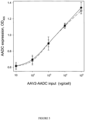
- Transduction efficiency is assessed by measuring the expression of AADC protein by ELISA following transduction of D7/4 cells.
- FIG. 3 shows no significant difference between vector prepared in TF2 and the reference control for vector input ranging from 10 to 10 5 vg/cell. Together, these data indicate that preparation and storage of AAV2 vectors in high ionic strength TF2 does not have a deleterious effect on vector infectivity or transduction efficiency.
- the effect of ionic strength ( ⁇ ) on virus particle interactions is determined to elucidate the mechanism of vector aggregation.
- Inclusion of sugars (sorbitol, sucrose, mannitol, trehalose, glycerol) at concentrations up to 5% (w/v) or of surfactants Tween80 ® (1%) or Pluronic ® F68 (10%) does not prevent aggregation of vector particles.
- Elevated ionic strength solutions using isotonic excipient concentrations for in vivo administration are prepared with salts of multivalent ions, including sodium citrate, sodium phosphate, and magnesium sulfate.
- An isotonic formulation containing 10mM Tris, 100mM sodium citrate, 0.001% Pluronic ® F68, pH 8.0 ( ⁇ ⁇ 500mM) enables concentration of AAV2-AADC vectors to 6.4 ⁇ 10 13 vg/mL with no aggregation observed during preparation and following ten freeze-thaw cycles at -20 °C. See Table 3, below, and accompanying discussion.
- AAV2-AADC vectors prepared and stored for an extended period in elevated ionic strength formulation retain high infectivity titer (13 IU/vg) and transduction efficiency.
- Nuclease treatment of purified AAV2 vectors reduces the degree of vector aggregation, implicating vector surface nucleic acid impurities in inter-particle interactions.
- purification methods to efficiently remove vector surface residual nucleic acids coupled with the use of elevated ionic strength isotonic formulations, are useful methods to prevent AAV2 vector aggregation.
- AAV2 vectors expressing human coagulation factor IX (FIX) or human amino acid decarboxylase (AADC) are produced by triple transfection of HEK293 cells as previously described ( Matsushita, T. et al. (1998) Gene Therapy 5: 938-945 ), with modifications.
- FIX human coagulation factor IX
- AADC human amino acid decarboxylase
- transfected HEK293 cells in roller bottles are collected by centrifugation (1000g, 15min), resuspended in 10mM sodium phosphate, 500mM sodium chloride, pH 7.2, and lysed by three freeze / thaw cycles (alternating an ethanol / dry ice bath and a 37°C water bath).
- the cell lysate is clarified by centrifugation (8,000g, 15 min).
- the supernatant is then diluted to 200mM NaCl by addition of 10mM sodium phosphate, pH 7.2, and digested with Benzonase ® (Merck, Purity Grade 1; 200 U/mL, 1h, 37 °C).
- the lysate is adjusted to 25mM CaCl 2 using a 1M stock solution, and incubated at 4°C for one hour.
- the mixture is centrifuged (8,000g, 15 min), and the supernatant containing vector is collected.
- polyethylene glycol PEG8000
- PEG8000 polyethylene glycol
- the pellets containing vector are re-suspended with mixing in 0.15M NaCl, 50mM Hepes, 25mM EDTA, pH 8.0 and incubated at 4°C for 16 hours.
- the resuspended material is pooled, and solid cesium chloride is added to a final density of 1.40 gm/ml.
- Vector is then banded by ultracentrifugation (SW28, 27,000rpm, 24h, 20°C) using a Beckman model LE-80 centrifuge.
- the centrifugation tubes are fractionated, and densities from 1.38 to 1.42 gm/mL containing vector are pooled.
- This material is banded a second time by ultracentrifugation (NVT65 rotor, 65,000 rpm, 16h, 20°C), and fractions containing purified AAV2 vectors are pooled.
- NVT65 rotor 65,000 rpm, 16h, 20°C
- fractions containing purified AAV2 vectors are pooled.
- To concentrate vector and to perform buffer exchange vectors in concentrated cesium chloride solution are subjected to ultrafiltration / diafiltration (UF/DF) by tangential flow filtration as described below (Example 2).
- cell harvests containing AAV are microfluidized and filtered sequentially through 0.65 and 0.22 ⁇ m filters (Sartorius).
- Virus is purified from the clarified cell lysates by cation exchange chromatography using Poros HS50 resin as previously described.
- U.S. Pat. No. 6,593,123 For the nuclease digestion described in FIG. 2 , column-purified vectors are incubated (4h, RT) with 100 U/mL Benzonase and 10 U/mL DNAse I (RNAse free, Roche Diagnostics, Indianapolis, Indiana).
- AAV2 vectors purified by cation exchange chromatography are subjected to an additional cesium chloride gradient ultracentrifugation step (SW28, 27,000rpm, 20h) to remove empty capsids prior to UF/DF.
- Real time quantitative PCR is used to quantify AAV preparations as previously described. Sommer, J. M. et al. (2003) Mol. Therapy 7: 122-128 . Vectors purified by each of the three methods are analyzed by SDS-PAGE / silver staining analysis, and in all cases VP1, VP2 and VP3 are present in the expected ratios, with the capsid proteins representing >95% of total proteins as determined by scanning densitometry. However, unlike gradient-purified AAV2 vectors purified using Methods 1 and 3, vectors purified by Method 2 (column chromatography) contain empty capsids, ranging from 3-10 empty capsids per vector genome.
- Disposable hollow fiber tangential flow filtration devices (Amersham BioSciences 8" Midgee, 100 kDa nominal pore size) are used to concentrate and diafilter AAV2 vectors purified by the methods described above, and for the UF/DF experiments described in Table 2.
- a volume of diafiltration buffer corresponding to 10x the product volume is used, and it is added in ⁇ 1mL increments to approximate continuous diafiltration.
- the calculated residual CsCl after diafiltration is ⁇ 0.5mM.
- diafiltration is performed at a volume corresponding to a 2 ⁇ 10 13 vg/mL, and the volume is then reduced to a value corresponding to 6.7 ⁇ 10 13 vg/mL.
- AAV2-AADC (approximately 1.2 ⁇ 10 14 vg) is first diafiltered into TF1 (a formulation compatible with nuclease activity) and then passed through a 0.22 ⁇ m filter. The titer of this material is determined, and the volume is adjusted to correspond to a concentration of 1 ⁇ 10 13 vg/mL. To 10 mL of this material, MgCl 2 is added to a concentration of 2 mM, and then divided into two equal aliquots. One aliquot is incubated with Benzonase (200 U/mL, 4h, RT), and the second is mock-incubated.
- a "dilution-stress" method is used to assess the effect of varying excipients on vector aggregation. In this method, 80 ⁇ L of test diluent is added to 20 ⁇ L of vector solution with mixing in the actual cuvette used for DLS measurement, and data collection is initiated within 10 seconds of mixing. Prior to addition of test diluents, the Rh value for AAV2 vector preparations is measured and confirmed to be ⁇ 15 nm to ensure that the starting material is monomeric. Samples that are not 100% monomeric are passed through a 0.22 ⁇ m syringe disc filter (Sartorius, low protein binding) to remove aggregates.
- the osmolarity and ionic strength values given in FIGS. 1 and 2 are calculated using all excipients present in the mixture (i.e. weighted: test diluent (80%) and starting vector formulation (20%)).
- a progressive increase in Rh is observed over the course of data collection.
- Infectivity of AAV2-AADC vectors is determined using a highly sensitive assay as previously described. Zhen, Z. et al. (2004) Human Gene Ther. 15: 709-715 . Briefly, samples are serially diluted (10-fold dilutions, 10 replicates / dilution) and added to D7/4 cells (modified HeLa cells expressing AAV rep and cap ) grown in 96 well tissue culture plates (Falcon, cat. #353227) in DMEM medium containing 10% FBS. Adenovirus (Ad-5, 100 vp/cell) is added to each well to provide helper functions.
- test sample is run concurrently with an AAV2-AADC reference previously prepared in CF and stored at -80 °C.
- the transduction efficiency of AAV2 vectors is quantified by a whole cell ELISA.
- D7/4 cells grown in 96 well plates are infected with 10-fold serial dilutions of the test sample and reference vector, corresponding to 10 to 10 5 vg / cell input (5 replicates / dilution). After 48h, the culture medium is removed, and cells are washed twice with 200 ⁇ L PBS (10 mM sodium phosphate, 140mM sodium chloride, pH 7.2). Cells are then permeabilized and fixed by addition of 100 ⁇ L of PBS containing 0.5% Triton X-100 and 4% paraformaldehyde to each well (15 min).
- the fixing solution is removed, and the cells are washed twice with PBS containing 0.5% Triton X-100. Non-specific sites are blocked by adding PBS containing 3% bovine serum albumin (BSA) and 0.5% Triton X-100 (60min).
- BSA bovine serum albumin
Landscapes
- Health & Medical Sciences (AREA)
- Life Sciences & Earth Sciences (AREA)
- Chemical & Material Sciences (AREA)
- Wood Science & Technology (AREA)
- Genetics & Genomics (AREA)
- Organic Chemistry (AREA)
- Engineering & Computer Science (AREA)
- Bioinformatics & Cheminformatics (AREA)
- Zoology (AREA)
- Biochemistry (AREA)
- General Health & Medical Sciences (AREA)
- Microbiology (AREA)
- Immunology (AREA)
- Biomedical Technology (AREA)
- Medicinal Chemistry (AREA)
- General Engineering & Computer Science (AREA)
- Biotechnology (AREA)
- Virology (AREA)
- Medicines Containing Material From Animals Or Micro-Organisms (AREA)
- Medicinal Preparation (AREA)
- Micro-Organisms Or Cultivation Processes Thereof (AREA)
- Medicines That Contain Protein Lipid Enzymes And Other Medicines (AREA)
- Lubricants (AREA)
- Curing Cements, Concrete, And Artificial Stone (AREA)
Applications Claiming Priority (5)
| Application Number | Priority Date | Filing Date | Title |
|---|---|---|---|
| US57599704P | 2004-06-01 | 2004-06-01 | |
| US63922204P | 2004-12-22 | 2004-12-22 | |
| EP17186206.3A EP3290513B1 (en) | 2004-06-01 | 2005-06-01 | Compositions and methods to prevent aav vector aggregation |
| PCT/US2005/019235 WO2005118792A1 (en) | 2004-06-01 | 2005-06-01 | Compositions and methods to prevent aav vector aggregation |
| EP05755269.7A EP1751275B1 (en) | 2004-06-01 | 2005-06-01 | Compositions and methods to prevent aav vector aggregation |
Related Parent Applications (2)
| Application Number | Title | Priority Date | Filing Date |
|---|---|---|---|
| EP17186206.3A Division EP3290513B1 (en) | 2004-06-01 | 2005-06-01 | Compositions and methods to prevent aav vector aggregation |
| EP05755269.7A Division EP1751275B1 (en) | 2004-06-01 | 2005-06-01 | Compositions and methods to prevent aav vector aggregation |
Publications (1)
| Publication Number | Publication Date |
|---|---|
| EP4170024A1 true EP4170024A1 (en) | 2023-04-26 |
Family
ID=35462907
Family Applications (3)
| Application Number | Title | Priority Date | Filing Date |
|---|---|---|---|
| EP22193904.4A Pending EP4170024A1 (en) | 2004-06-01 | 2005-06-01 | Compositions and methods to prevent aav vector aggregation |
| EP17186206.3A Expired - Lifetime EP3290513B1 (en) | 2004-06-01 | 2005-06-01 | Compositions and methods to prevent aav vector aggregation |
| EP05755269.7A Expired - Lifetime EP1751275B1 (en) | 2004-06-01 | 2005-06-01 | Compositions and methods to prevent aav vector aggregation |
Family Applications After (2)
| Application Number | Title | Priority Date | Filing Date |
|---|---|---|---|
| EP17186206.3A Expired - Lifetime EP3290513B1 (en) | 2004-06-01 | 2005-06-01 | Compositions and methods to prevent aav vector aggregation |
| EP05755269.7A Expired - Lifetime EP1751275B1 (en) | 2004-06-01 | 2005-06-01 | Compositions and methods to prevent aav vector aggregation |
Country Status (10)
| Country | Link |
|---|---|
| US (4) | US7704721B2 (enExample) |
| EP (3) | EP4170024A1 (enExample) |
| JP (5) | JP2008501339A (enExample) |
| BR (1) | BRPI0511764B8 (enExample) |
| CA (1) | CA2569244C (enExample) |
| DK (2) | DK3290513T3 (enExample) |
| ES (2) | ES2932278T3 (enExample) |
| HU (2) | HUE035418T2 (enExample) |
| MX (3) | MX360727B (enExample) |
| WO (1) | WO2005118792A1 (enExample) |
Families Citing this family (112)
| Publication number | Priority date | Publication date | Assignee | Title |
|---|---|---|---|---|
| CA2668417A1 (en) * | 2006-11-03 | 2008-05-15 | Alphavax, Inc. | Alphavirus and alphavirus replicon particle formulations and methods |
| US20090111099A1 (en) * | 2007-10-27 | 2009-04-30 | Yongsheng Ma | Promoter Detection and Analysis |
| US8067241B2 (en) * | 2009-08-26 | 2011-11-29 | General Electric Company | Method and apparatus for antigen retrieval process |
| PT2529020T (pt) | 2010-01-28 | 2018-07-30 | Childrens Hospital Philadelphia | Plataforma de fabrico escalável para purificação de vetor viral e vetores virais assim purificados para utilização na terapia génica |
| BR112012026095A2 (pt) | 2010-04-14 | 2015-09-15 | Emd Millipore Corp | métodos de produção de estoques de vírus de alta pureza e altos títulos e métodos de uso dos mesmos. |
| WO2012018628A1 (en) | 2010-07-26 | 2012-02-09 | Board Of Regents, The University Of Texas System | Methods for inducing an immune response via buccal and/or sublingual administration of a vaccine |
| US9879229B2 (en) * | 2011-03-14 | 2018-01-30 | National Research Council Of Canada | Method of viral production in cells |
| JP6348064B2 (ja) | 2011-11-22 | 2018-06-27 | ザ チルドレンズ ホスピタル オブ フィラデルフィア | 効率の高いトランスジーン送達のためのウイルスベクター |
| ES2717876T3 (es) * | 2011-12-12 | 2019-06-26 | Childrens Hospital Philadelphia | Sistema de producción de un vector lentiviral a gran escala comercial y vectores así producidos |
| US9974850B2 (en) | 2013-01-25 | 2018-05-22 | Board Of Regents, The University Of Texas System | Immunogenic compositions and uses thereof |
| BR112015031541A2 (pt) | 2013-06-17 | 2017-07-25 | De Staat Der Nederlanden Vert Door De Mini Van Vws Miniie Van Volksgezondheid Welzijn En Sport | métodos para o impedimento da agregação de componentes virais |
| US10161011B2 (en) | 2013-11-29 | 2018-12-25 | Takara Bio Inc. | Method for quantifying adeno-associated virus |
| DK3546585T3 (da) | 2014-04-25 | 2025-11-03 | Genethon | Nukleinsyrer med en modificeret intron til brug i behandlingen af hyperbilirubinæmi |
| WO2015191508A1 (en) | 2014-06-09 | 2015-12-17 | Voyager Therapeutics, Inc. | Chimeric capsids |
| US10526583B2 (en) | 2014-07-02 | 2020-01-07 | University Of Florida Research Foundation, Incorporated | Compositions and methods for purifying recombinant adeno-associated virus |
| CN107106689A (zh) | 2014-11-05 | 2017-08-29 | 沃雅戈治疗公司 | 用于治疗帕金森病的aadc多核苷酸 |
| KR102584655B1 (ko) | 2014-11-14 | 2023-10-06 | 보이저 테라퓨틱스, 인크. | 조절성 폴리뉴클레오티드 |
| MX2017006216A (es) | 2014-11-14 | 2018-08-29 | Voyager Therapeutics Inc | Composiciones y métodos para tratar la esclerosis lateral amiotrófica (ela). |
| US11697825B2 (en) | 2014-12-12 | 2023-07-11 | Voyager Therapeutics, Inc. | Compositions and methods for the production of scAAV |
| WO2016114992A2 (en) | 2015-01-13 | 2016-07-21 | Alfa Wassermann, Inc. | Methods of purifying adeno-associated virus (aav) and/or recombinant adeno-associated virus (raav) and gradients and flow-through buffers therefore |
| EP3054007A1 (en) | 2015-02-09 | 2016-08-10 | Institut National De La Sante Et De La Recherche Medicale (Inserm) | Recombinant adeno-associated virus particle purification comprising an immuno-affinity purification step |
| EP3368054A4 (en) | 2015-10-28 | 2019-07-03 | Voyager Therapeutics, Inc. | REGULATORY EXPRESSION USING THE ADENO-ASSOCIATED VIRUS (AAV) |
| KR102877920B1 (ko) | 2015-11-16 | 2025-10-30 | 더 리서치 인스티튜트 앳 네이션와이드 칠드런스 하스피탈 | 티틴-기반 근증 및 다른 티틴성병증의 치료를 위한 물질 및 방법 |
| ES2934848T3 (es) * | 2015-12-11 | 2023-02-27 | Univ Pennsylvania | Método de purificación escalable para AAV8 |
| WO2017172772A1 (en) * | 2016-03-28 | 2017-10-05 | Dimension Therapeutics | Methods of heat inactivation of adenovirus |
| US11326182B2 (en) | 2016-04-29 | 2022-05-10 | Voyager Therapeutics, Inc. | Compositions for the treatment of disease |
| WO2017189964A2 (en) | 2016-04-29 | 2017-11-02 | Voyager Therapeutics, Inc. | Compositions for the treatment of disease |
| RU2758488C2 (ru) | 2016-05-18 | 2021-10-28 | Вояджер Терапьютикс, Инк. | Модулирующие полинуклеотиды |
| AU2017268382B2 (en) | 2016-05-18 | 2023-09-28 | Voyager Therapeutics, Inc. | Compositions and methods of treating Huntington's disease |
| DK3488007T3 (da) * | 2016-07-21 | 2024-02-19 | Spark Therapeutics Inc | Skalerbare fremgangsmåder med høj indvinding til fremstilling af højt udbytte rekombinant adeno-associeret viral (raav) vektor og rekombinante adeno-associeret virale (raav) vektorer produceret derved |
| EP3510161A4 (en) | 2016-08-23 | 2020-04-22 | Akouos, Inc. | COMPOSITIONS AND METHODS FOR TREATING NON-AGE-ASSOCIATED HEARING DEFICIENCY IN A HUMAN SUBJECT |
| JP2019531787A (ja) | 2016-08-30 | 2019-11-07 | ザ リージェンツ オブ ザ ユニバーシティ オブ カリフォルニア | 生物医学的ターゲティング及びデリバリーの方法並びにそれを実行するための装置及びシステム |
| EP3293203A1 (en) | 2016-09-12 | 2018-03-14 | Genethon | Acid-alpha glucosidase variants and uses thereof |
| EP3293259A1 (en) | 2016-09-12 | 2018-03-14 | Genethon | Acid-alpha glucosidase variants and uses thereof |
| EP3293260A1 (en) | 2016-09-12 | 2018-03-14 | Genethon | Acid-alpha glucosidase variants and uses thereof |
| MX2019002842A (es) | 2016-09-12 | 2019-08-29 | Genethon | Variantes de alfa-glucosidasa acida y usos de las mismas. |
| WO2018050872A1 (en) | 2016-09-16 | 2018-03-22 | Leukocare Ag | A novel method for obtaining efficient viral vector-based compositions for vaccination or gene therapy |
| JP7545210B2 (ja) * | 2016-11-04 | 2024-09-04 | 武田薬品工業株式会社 | アデノ随伴ウイルス製剤 |
| US10626376B2 (en) | 2016-11-14 | 2020-04-21 | St. Jude Children's Research Hospital | Method for isolating and purifying adeno-associated virus particles using salt |
| US10294452B2 (en) * | 2016-11-22 | 2019-05-21 | Dao-Yao He | Lysis, extraction and purification of adeno-associated virus and adenovirus from host cells |
| WO2018141865A1 (en) | 2017-02-01 | 2018-08-09 | Centre National De La Recherche Scientifique | Particles and compositions comprising the same for transfection |
| EP3592848A1 (en) | 2017-03-10 | 2020-01-15 | Genethon | Treatment of glycogen storage disease iii |
| AU2018261790B2 (en) | 2017-05-05 | 2024-10-03 | Voyager Therapeutics, Inc. | Compositions and methods of treating amyotrophic lateral sclerosis (ALS) |
| WO2018204803A1 (en) | 2017-05-05 | 2018-11-08 | Voyager Therapeutics, Inc. | Compositions and methods of treating huntington's disease |
| JOP20190269A1 (ar) | 2017-06-15 | 2019-11-20 | Voyager Therapeutics Inc | بولي نوكليوتيدات aadc لعلاج مرض باركنسون |
| CN111132626B (zh) | 2017-07-17 | 2024-01-30 | 沃雅戈治疗公司 | 轨迹阵列引导系统 |
| EP3662060A2 (en) | 2017-08-03 | 2020-06-10 | Voyager Therapeutics, Inc. | Compositions and methods for delivery of aav |
| EP3687582A4 (en) | 2017-09-29 | 2021-07-14 | Voyager Therapeutics, Inc. | RESCUE OF CENTRAL AND PERIPHERAL NEUROLOGICAL PHENOTYPE OF FRIEDREICH ATAXIA BY INTRAVENOUS ADMINISTRATION |
| EP4454654A3 (en) | 2017-10-16 | 2025-02-19 | Voyager Therapeutics, Inc. | Treatment of amyotrophic lateral sclerosis (als) |
| US11434502B2 (en) | 2017-10-16 | 2022-09-06 | Voyager Therapeutics, Inc. | Treatment of amyotrophic lateral sclerosis (ALS) |
| CN120505370A (zh) * | 2017-11-08 | 2025-08-19 | 诺华股份有限公司 | 制备病毒载体的手段和方法及其用途 |
| CA3084802A1 (en) * | 2017-12-05 | 2019-06-13 | Applied Genetic Technologies Corporation | Formulation optimization for viral particles |
| SG11202006722RA (en) | 2018-01-31 | 2020-08-28 | Res Inst Nationwide Childrens Hospital | Gene therapy for limb-girdle muscular dystrophy type 2c |
| CN120665951A (zh) | 2018-02-07 | 2025-09-19 | 吉尼松公司 | 杂合调控元件 |
| US20210010028A1 (en) | 2018-03-06 | 2021-01-14 | Voyager Therapeutics, Inc. | Insect cell manufactured partial self-complementary aav genomes |
| US12129476B2 (en) | 2018-04-27 | 2024-10-29 | Voyager Therapeutics, Inc. | Methods for measuring the potency of AADC viral vectors |
| MX2020012077A (es) | 2018-05-15 | 2021-03-09 | Voyager Therapeutics Inc | Composiciones y metodos para el tratamiento de la enfermedad de parkinson. |
| EP3793686A1 (en) | 2018-05-16 | 2021-03-24 | Voyager Therapeutics, Inc. | Aav serotypes for brain specific payload delivery |
| WO2019222444A2 (en) | 2018-05-16 | 2019-11-21 | Voyager Therapeutics, Inc. | Directed evolution |
| EP3801638A1 (en) | 2018-06-08 | 2021-04-14 | Novartis AG | Cell-based assay for measuring drug product potency |
| KR20210028162A (ko) | 2018-06-29 | 2021-03-11 | 더 리서치 인스티튜트 앳 네이션와이드 칠드런스 하스피탈 | 지대근 이영양증 2a형을 치료하기 위한 재조합 아데노 연관 바이러스 생성물 및 방법 |
| AU2019296451B2 (en) * | 2018-06-29 | 2021-04-29 | Wuhan Neurophth Biotechnology Limited Company | Compositions and methods for treating leber's hereditary optic neuropathy |
| AU2019299861A1 (en) | 2018-07-02 | 2021-01-14 | Voyager Therapeutics, Inc. | Treatment of amyotrophic lateral sclerosis and disorders associated with the spinal cord |
| MX2020013953A (es) * | 2018-07-11 | 2021-03-09 | Takeda Pharmaceuticals Co | Composiciones de virus adenoasociado (aav). |
| WO2020023612A1 (en) | 2018-07-24 | 2020-01-30 | Voyager Therapeutics, Inc. | Systems and methods for producing gene therapy formulations |
| CA3107572A1 (en) | 2018-08-08 | 2020-02-13 | Genethon | Mini-gde for the treatment of glycogen storage disease iii |
| KR20210043580A (ko) * | 2018-08-10 | 2021-04-21 | 리젠엑스바이오 인크. | 재조합 aav 생산을 위한 규모 조정 가능한 방법 |
| SG11202101032VA (en) | 2018-08-20 | 2021-02-25 | Wuhan Neurophth Biotechnology Ltd Company | Compositions and methods for treating leber's hereditary optic neuropathy |
| SG11202103151RA (en) | 2018-09-28 | 2021-04-29 | Voyager Therapeutics Inc | Frataxin expression constructs having engineered promoters and methods of use thereof |
| EP3861113A1 (en) | 2018-10-04 | 2021-08-11 | Voyager Therapeutics, Inc. | Methods for measuring the titer and potency of viral vector particles |
| CN113631225A (zh) | 2019-01-18 | 2021-11-09 | 沃雅戈治疗公司 | 用于生产aav颗粒的方法和系统 |
| CA3131390A1 (en) | 2019-02-26 | 2020-09-03 | Research Institute Of Nationwide Children's Hospital | Adeno-associated virus vector delivery of b-sarcoglycan and the treatment of muscular dystrophy |
| CN113747926A (zh) | 2019-04-08 | 2021-12-03 | 吉尼松公司 | 用于肌肉表达的杂合启动子 |
| JP7630443B2 (ja) | 2019-04-19 | 2025-02-17 | レジェンクスバイオ インコーポレーテッド | アデノ随伴ウイルスベクター製剤及び方法 |
| KR20210153069A (ko) | 2019-04-19 | 2021-12-16 | 제네똥 | 섬유아세포 성장 인자 23 관련 저인산혈증성 질환의 유전자 요법 |
| US20220243225A1 (en) | 2019-04-29 | 2022-08-04 | Voyager Therapeutics, Inc. | SYSTEMS AND METHODS FOR PRODUCING BACULOVIRAL INFECTED INSECT CELLS (BIICs) IN BIOREACTORS |
| EP4004213A1 (en) | 2019-07-25 | 2022-06-01 | Novartis AG | Regulatable expression systems |
| WO2021030125A1 (en) | 2019-08-09 | 2021-02-18 | Voyager Therapeutics, Inc. | Cell culture medium for use in producing gene therapy products in bioreactors |
| US20220325250A1 (en) | 2019-08-14 | 2022-10-13 | Leukocare Ag | Method for obtaining efficient compositions comprising viral vectors for vaccination or gene therapy |
| US11155835B2 (en) * | 2019-08-19 | 2021-10-26 | The Catholic University Of America | Prokaryotic-eukaryotic hybrid viral vector for delivery of large cargos of genes and proteins into human cells |
| US11401530B2 (en) | 2019-08-19 | 2022-08-02 | The Catholic University Of America | Bacteriophage-based artificial viruses for human genome remodeling |
| HRP20240505T1 (hr) | 2019-08-21 | 2024-07-05 | Research Institute At Nationwide Children's Hospital | Dostava alfa-sarkoglikana vektorom povezanim s adenovirusom i liječenje mišićne distrofije |
| EP4022070A1 (en) | 2019-08-26 | 2022-07-06 | Voyager Therapeutics, Inc. | Controlled expression of viral proteins |
| CN114728049A (zh) | 2019-10-07 | 2022-07-08 | 再生生物股份有限公司 | 腺相关病毒载体药物组合物和方法 |
| WO2021078833A1 (en) | 2019-10-22 | 2021-04-29 | Genethon | Chimeric polypeptides and uses thereof |
| WO2021078834A1 (en) | 2019-10-22 | 2021-04-29 | Genethon | Chimeric acid-alpha glucosidase polypeptides and uses thereof |
| CN113025633B (zh) | 2019-12-09 | 2024-08-27 | 武汉纽福斯生物科技有限公司 | 编码人nadh脱氢酶亚单位1蛋白的核酸及其应用 |
| KR102167829B1 (ko) * | 2020-02-10 | 2020-10-20 | 주식회사 이노테라피 | 아데노연관바이러스용 안정화제 및 이를 이용한 아데노연관바이러스의 안정화 방법 |
| WO2021168362A1 (en) | 2020-02-21 | 2021-08-26 | Akouos, Inc. | Compositions and methods for treating non-age-associated hearing impairment in a human subject |
| WO2021236908A2 (en) | 2020-05-20 | 2021-11-25 | Biomarin Pharmaceutical Inc. | Use of regulatory proteins for the production of adeno-associated virus |
| EP3913060A1 (en) | 2020-05-22 | 2021-11-24 | Genethon | Vectors encoding a glucose-6-phosphatase (g6pase-a) for gene therapy |
| EP4157301A4 (en) * | 2020-06-02 | 2025-03-19 | Janssen Biotech, Inc. | Materials and methods for viral purification |
| US20230295656A1 (en) | 2020-08-06 | 2023-09-21 | Voyager Therapeutics, Inc. | Cell culture medium for use in producing gene therapy products in bioreactors |
| CN116323925A (zh) * | 2020-08-07 | 2023-06-23 | 詹森生物科技公司 | 高度纯化的病毒颗粒的制剂 |
| US20230313152A1 (en) | 2020-08-24 | 2023-10-05 | Genethon | C-terminal truncated gde for the treatment of glycogen storage disease iii |
| WO2022094461A1 (en) | 2020-11-02 | 2022-05-05 | Biomarin Pharmaceutical Inc. | Process for enriching adeno-associated virus |
| EP4259790A1 (en) | 2020-12-09 | 2023-10-18 | Genethon | Lysosomal acid lipase variants and uses thereof |
| US20240141378A1 (en) | 2021-03-03 | 2024-05-02 | Voyager Therapeutics, Inc. | Controlled expression of viral proteins |
| WO2022187473A2 (en) | 2021-03-03 | 2022-09-09 | Voyager Therapeutics, Inc. | Controlled expression of viral proteins |
| EP4333896A4 (en) * | 2021-05-07 | 2025-03-19 | Board of Regents, The University of Texas System | Methods and compositions for transport, storage, and delivery of adeno-associated viral vectors and other molecules |
| CN117897492A (zh) | 2021-08-04 | 2024-04-16 | 吉尼松公司 | 用于肌肉和cns中的基因表达的杂合启动子 |
| CN117980484A (zh) | 2021-09-16 | 2024-05-03 | 诺华股份有限公司 | 新颖的转录因子 |
| EP4219726A1 (en) | 2021-10-15 | 2023-08-02 | Research Institute at Nationwide Children's Hospital | Self-complementary adeno-associated virus vector and its use in treatment of muscular dystrophy |
| WO2023073526A1 (en) | 2021-10-25 | 2023-05-04 | Novartis Ag | Methods for improving adeno-associated virus (aav) delivery |
| WO2023175584A1 (en) | 2022-03-17 | 2023-09-21 | Innoskel | Polynucleotides encoding the alpha-1 chain of human type ii collagen and methods of their use |
| WO2023175585A1 (en) | 2022-03-17 | 2023-09-21 | Innoskel | Hybrid promoters and their use in osteolysis syndrome |
| US20250353883A1 (en) | 2022-05-06 | 2025-11-20 | Novartis Ag | Novel recombinant aav vp2 fusion polypeptides |
| CN119343446A (zh) | 2022-06-09 | 2025-01-21 | 吉尼松公司 | 用于治疗糖原贮积病iii的n-端截短gde |
| WO2024054983A1 (en) | 2022-09-08 | 2024-03-14 | Voyager Therapeutics, Inc. | Controlled expression of viral proteins |
| TW202426017A (zh) * | 2022-11-24 | 2024-07-01 | 俄羅斯聯邦商拜奧卡德聯合股份公司 | 非包膜病毒的藥物組合物 |
| WO2025003477A1 (en) | 2023-06-29 | 2025-01-02 | Genethon | N-terminal truncated glycogen debranching enzymes for the treatment of glycogen storage disease iii |
| EP4606892A1 (en) | 2024-02-23 | 2025-08-27 | Merck Patent GmbH | Methods for the production of viral particles |
Citations (4)
| Publication number | Priority date | Publication date | Assignee | Title |
|---|---|---|---|---|
| WO1998022588A2 (en) * | 1996-11-20 | 1998-05-28 | Introgen Therapeutics, Inc. | An improved method for the production and purification of adenoviral vectors |
| WO2000032754A1 (en) * | 1998-12-01 | 2000-06-08 | Introgen Therapeutics, Inc. | An improved method for the production and purification of adenoviral vectors |
| US6593123B1 (en) | 2000-08-07 | 2003-07-15 | Avigen, Inc. | Large-scale recombinant adeno-associated virus (rAAV) production and purification |
| WO2003097797A2 (en) * | 2002-05-14 | 2003-11-27 | Merck & Co., Inc. | Methods of adenovirus purification |
Family Cites Families (4)
| Publication number | Priority date | Publication date | Assignee | Title |
|---|---|---|---|---|
| SE420977B (sv) * | 1976-03-18 | 1981-11-16 | Kabi Ab | Forfarande for rening och isolering av hepatitvirus for vaccinframstellning |
| US6566118B1 (en) * | 1997-09-05 | 2003-05-20 | Targeted Genetics Corporation | Methods for generating high titer helper-free preparations of released recombinant AAV vectors |
| US6146874A (en) * | 1998-05-27 | 2000-11-14 | University Of Florida | Method of preparing recombinant adeno-associated virus compositions |
| JP5118798B2 (ja) * | 2000-03-07 | 2013-01-16 | メルク・シャープ・エンド・ドーム・コーポレイション | アデノウイルス製剤 |
-
2005
- 2005-06-01 EP EP22193904.4A patent/EP4170024A1/en active Pending
- 2005-06-01 MX MX2014006734A patent/MX360727B/es unknown
- 2005-06-01 HU HUE05755269A patent/HUE035418T2/en unknown
- 2005-06-01 DK DK17186206.3T patent/DK3290513T3/da active
- 2005-06-01 EP EP17186206.3A patent/EP3290513B1/en not_active Expired - Lifetime
- 2005-06-01 US US11/141,996 patent/US7704721B2/en not_active Expired - Lifetime
- 2005-06-01 ES ES17186206T patent/ES2932278T3/es not_active Expired - Lifetime
- 2005-06-01 JP JP2007515525A patent/JP2008501339A/ja active Pending
- 2005-06-01 HU HUE17186206A patent/HUE060433T2/hu unknown
- 2005-06-01 ES ES05755269.7T patent/ES2647477T3/es not_active Expired - Lifetime
- 2005-06-01 WO PCT/US2005/019235 patent/WO2005118792A1/en not_active Ceased
- 2005-06-01 DK DK05755269.7T patent/DK1751275T3/da active
- 2005-06-01 EP EP05755269.7A patent/EP1751275B1/en not_active Expired - Lifetime
- 2005-06-01 CA CA2569244A patent/CA2569244C/en not_active Expired - Lifetime
- 2005-06-01 MX MXPA06014030A patent/MXPA06014030A/es active IP Right Grant
- 2005-06-01 BR BRPI0511764A patent/BRPI0511764B8/pt active IP Right Grant
-
2006
- 2006-11-30 MX MX2019006353A patent/MX2019006353A/es unknown
-
2010
- 2010-03-19 US US12/661,553 patent/US9051542B2/en not_active Expired - Lifetime
-
2012
- 2012-02-27 JP JP2012040561A patent/JP5769650B2/ja not_active Expired - Lifetime
-
2014
- 2014-01-29 JP JP2014014070A patent/JP2014111625A/ja active Pending
-
2015
- 2015-05-01 US US14/702,008 patent/US20160083694A1/en not_active Abandoned
-
2016
- 2016-03-23 JP JP2016058761A patent/JP2016195587A/ja active Pending
- 2016-10-06 US US15/287,037 patent/US20170247664A1/en not_active Abandoned
-
2018
- 2018-11-22 JP JP2018218970A patent/JP2019058177A/ja active Pending
Patent Citations (4)
| Publication number | Priority date | Publication date | Assignee | Title |
|---|---|---|---|---|
| WO1998022588A2 (en) * | 1996-11-20 | 1998-05-28 | Introgen Therapeutics, Inc. | An improved method for the production and purification of adenoviral vectors |
| WO2000032754A1 (en) * | 1998-12-01 | 2000-06-08 | Introgen Therapeutics, Inc. | An improved method for the production and purification of adenoviral vectors |
| US6593123B1 (en) | 2000-08-07 | 2003-07-15 | Avigen, Inc. | Large-scale recombinant adeno-associated virus (rAAV) production and purification |
| WO2003097797A2 (en) * | 2002-05-14 | 2003-11-27 | Merck & Co., Inc. | Methods of adenovirus purification |
Non-Patent Citations (27)
| Title |
|---|
| ADADEVOH, K. ET AL., BIOPROCESSING, vol. 1, no. 2, 2002, pages 62 - 69 |
| BERNS, K. I., FIELDS VIROLOGY, 1996, pages 2173 - 2197 |
| BRAUN, A. ET AL., PHARM. RES., vol. 14, 1997, pages 1472 - 1478 |
| CHEN, B. ET AL., J. PHARM. SCI., vol. 83, 1994, pages 1657 - 1661 |
| CHENUAUD, P. ET AL., BLOOD, vol. 104, 2004, pages 121a - 3302 |
| CROYLE, M. A. ET AL., GENE THERAPY, vol. 8, 2001, pages 1281 - 1290 |
| FLOTTE, T. R., HUMAN GENE THER, 2004 |
| GRIMM, D.KLEINSCHMIDT, J. A., HUM GENE THER., vol. 10, 1999, pages 2445 - 2450 |
| HIGH, K. A., ANN. N. Y. ACAD. SCI., vol. 953, 2001, pages 64 - 67 |
| HUANG, J ET AL.: "1", MOL. THERAPY, 2000, pages S286 |
| HUANG, J. ET AL., MOL. THERAPY, vol. 1, 2000, pages S286 |
| MATSUSHITA, T. ET AL., GENE THERAPY, vol. 5, 1998, pages 938 - 945 |
| MEIJER, K. D. F.MOLEMA, G., SEM. LIVER DIS, vol. 15, 1995, pages 206 |
| PFEIFER, A.VERMA, I. M., ANN. REV. GENOMICS HUM. GENET., vol. 2, 2001, pages 177 - 211 |
| QUICKR KAYLA S ET AL: "166. Dynamic Light Scattering as a Useful Tool for the Physical Characterization of Recombinant Viral Vectors during Production and Development", MOLECULAR THERAPY, VOL 5, NO 5, SUPPLEMENT, 1 May 2002 (2002-05-01), pages S56 - S57, XP093027911, Retrieved from the Internet <URL:https://www.cell.com/action/showPdf?pii=S1525-0016%2816%2942996-5> [retrieved on 20230301], DOI: 2 * |
| SHIRE, S. J. ET AL., J. PHARM. SCI., vol. 93, 2004, pages 1390 - 1402 |
| SMITH JONATHAN ET AL: "519. A Dynamic Light Scattering (DLS) Assay for the Analysis of Aggregated Adenovector Particles", MOLECULAR THERAPY, VOL. 7, NO. 5, SUPPLEMENT, 1 May 2003 (2003-05-01), pages S202 - S203, XP093027928, Retrieved from the Internet <URL:https://www.cell.com/action/showPdf?pii=S1525-0016%2816%2940961-5> [retrieved on 20230301] * |
| SOMMER, J. M. ET AL., MOL. THERAPY, vol. 7, 2003, pages S348 - 128 |
| WANG, W., INT. J. PHARM., vol. 185, 1999, pages 129 - 188 |
| WON, C. M. ET AL., INT. J. PHARM., vol. 167, 1998, pages 25 - 36 |
| WRIGHT J F ET AL: "Identification of factors that contribute to recombinant AAV2 particle aggregation and methods to prevent its occurrence during vector purification and formulation", MOLECULAR THERAPY, ACADEMIC PRESS, SAN DIEGO, CA,, US, vol. 12, no. 1, July 2005 (2005-07-01), pages 171 - 178, XP004974961, ISSN: 1525-0016 * |
| WRIGHT J FRASER ET AL: "Recombinant adeno-associated virus: formulation challenges and strategies for a gene therapy vector.", CURRENT OPINION IN DRUG DISCOVERY & DEVELOPMENT MAR 2003, vol. 6, no. 2, March 2003 (2003-03-01), pages 174 - 178, XP009092903, ISSN: 1367-6733 * |
| WRIGHT, J. F. ET AL., CURR. OPIN. DRUG DISC. DEV., vol. 6, 2003, pages 174 - 178 |
| XIE, Q. ET AL., J. VIROL. METHODS, vol. 122, 2004, pages 17 - 27 |
| XIE, Q. ET AL., PROC. NATL. ACAD. SCI. U.S.A., vol. 99, 2002, pages 10405 - 10410 |
| XIE, Q. ET AL.: "122", J. VIRAL. METHODS, 2004, pages 17 - 27 |
| ZHEN, Z. ET AL., HUMAN GENE THER., vol. 15, 2004, pages 709 - 715 |
Also Published As
| Publication number | Publication date |
|---|---|
| EP3290513A1 (en) | 2018-03-07 |
| EP3290513B1 (en) | 2022-09-07 |
| JP2019058177A (ja) | 2019-04-18 |
| DK1751275T3 (da) | 2017-11-27 |
| EP1751275A1 (en) | 2007-02-14 |
| JP2014111625A (ja) | 2014-06-19 |
| CA2569244C (en) | 2017-02-14 |
| JP2008501339A (ja) | 2008-01-24 |
| ES2932278T3 (es) | 2023-01-17 |
| BRPI0511764B8 (pt) | 2021-05-25 |
| JP2012143233A (ja) | 2012-08-02 |
| EP1751275B1 (en) | 2017-08-16 |
| US20110076744A1 (en) | 2011-03-31 |
| US9051542B2 (en) | 2015-06-09 |
| US20160083694A1 (en) | 2016-03-24 |
| DK3290513T3 (da) | 2022-12-12 |
| US20170247664A1 (en) | 2017-08-31 |
| HUE060433T2 (hu) | 2023-03-28 |
| MXPA06014030A (es) | 2007-10-08 |
| MX2019006353A (es) | 2022-06-27 |
| JP2016195587A (ja) | 2016-11-24 |
| BRPI0511764A (pt) | 2008-01-08 |
| JP5769650B2 (ja) | 2015-08-26 |
| BRPI0511764B1 (pt) | 2017-10-24 |
| CA2569244A1 (en) | 2005-12-15 |
| EP1751275A4 (en) | 2008-01-23 |
| US7704721B2 (en) | 2010-04-27 |
| MX360727B (es) | 2018-11-14 |
| US20060035364A1 (en) | 2006-02-16 |
| ES2647477T3 (es) | 2017-12-21 |
| WO2005118792A1 (en) | 2005-12-15 |
| HUE035418T2 (en) | 2018-05-02 |
Similar Documents
| Publication | Publication Date | Title |
|---|---|---|
| EP1751275B1 (en) | Compositions and methods to prevent aav vector aggregation | |
| US20240252562A1 (en) | Methods of heat inactivation of adenovirus | |
| US20210285013A1 (en) | Gene therapy for treating familial hypercholesterolemia | |
| US10294452B2 (en) | Lysis, extraction and purification of adeno-associated virus and adenovirus from host cells | |
| US11554147B2 (en) | Gene therapy for treating familial hypercholesterolemia | |
| Lagor et al. | Adeno-associated viruses as liver-directed gene delivery vehicles: focus on lipoprotein metabolism | |
| CN101018858A (zh) | 防止aav载体聚集的组合物和方法 | |
| HK40091911A (en) | Compositions and methods to prevent aav vector aggregation | |
| JP7591579B2 (ja) | 核磁気共鳴緩和測定によってaav粒子のローディング状態を決定するための方法 | |
| US20220017922A1 (en) | Methods and compositions for treating glycogen storage diseases | |
| Tamura et al. | Production of Adeno-Associated Virus Vector Serotype rh. 10 and Optimization of Its Purification via Chloroform Extraction | |
| US20230374468A1 (en) | Formulations for viral vectors | |
| WO2024119031A1 (en) | Adeno-associated virus production platform | |
| Francis et al. | Production of research and clinical‐grade recombinant adeno‐associated virus vectors |
Legal Events
| Date | Code | Title | Description |
|---|---|---|---|
| PUAI | Public reference made under article 153(3) epc to a published international application that has entered the european phase |
Free format text: ORIGINAL CODE: 0009012 |
|
| STAA | Information on the status of an ep patent application or granted ep patent |
Free format text: STATUS: THE APPLICATION HAS BEEN PUBLISHED |
|
| AC | Divisional application: reference to earlier application |
Ref document number: 1751275 Country of ref document: EP Kind code of ref document: P Ref document number: 3290513 Country of ref document: EP Kind code of ref document: P |
|
| AK | Designated contracting states |
Kind code of ref document: A1 Designated state(s): AT BE BG CH CY CZ DE DK EE ES FI FR GB GR HU IE IS IT LI LT LU MC NL PL PT RO SE SI SK TR |
|
| STAA | Information on the status of an ep patent application or granted ep patent |
Free format text: STATUS: REQUEST FOR EXAMINATION WAS MADE |
|
| 17P | Request for examination filed |
Effective date: 20231026 |
|
| RBV | Designated contracting states (corrected) |
Designated state(s): AT BE BG CH CY CZ DE DK EE ES FI FR GB GR HU IE IS IT LI LT LU MC NL PL PT RO SE SI SK TR |
|
| REG | Reference to a national code |
Ref country code: HK Ref legal event code: DE Ref document number: 40091911 Country of ref document: HK |