EP4157376B1 - Neue antimikrobielle topische hautverschlusszusammensetzungen und systeme - Google Patents
Neue antimikrobielle topische hautverschlusszusammensetzungen und systeme Download PDFInfo
- Publication number
- EP4157376B1 EP4157376B1 EP21729022.0A EP21729022A EP4157376B1 EP 4157376 B1 EP4157376 B1 EP 4157376B1 EP 21729022 A EP21729022 A EP 21729022A EP 4157376 B1 EP4157376 B1 EP 4157376B1
- Authority
- EP
- European Patent Office
- Prior art keywords
- composition
- silicone
- wound closure
- cross
- compositions
- Prior art date
- Legal status (The legal status is an assumption and is not a legal conclusion. Google has not performed a legal analysis and makes no representation as to the accuracy of the status listed.)
- Active
Links
Images




Classifications
-
- C—CHEMISTRY; METALLURGY
- C08—ORGANIC MACROMOLECULAR COMPOUNDS; THEIR PREPARATION OR CHEMICAL WORKING-UP; COMPOSITIONS BASED THEREON
- C08G—MACROMOLECULAR COMPOUNDS OBTAINED OTHERWISE THAN BY REACTIONS ONLY INVOLVING UNSATURATED CARBON-TO-CARBON BONDS
- C08G77/00—Macromolecular compounds obtained by reactions forming a linkage containing silicon with or without sulfur, nitrogen, oxygen or carbon in the main chain of the macromolecule
- C08G77/04—Polysiloxanes
- C08G77/06—Preparatory processes
- C08G77/08—Preparatory processes characterised by the catalysts used
-
- A—HUMAN NECESSITIES
- A61—MEDICAL OR VETERINARY SCIENCE; HYGIENE
- A61K—PREPARATIONS FOR MEDICAL, DENTAL OR TOILETRY PURPOSES
- A61K31/00—Medicinal preparations containing organic active ingredients
- A61K31/075—Ethers or acetals
- A61K31/085—Ethers or acetals having an ether linkage to aromatic ring nuclear carbon
-
- A—HUMAN NECESSITIES
- A61—MEDICAL OR VETERINARY SCIENCE; HYGIENE
- A61L—METHODS OR APPARATUS FOR STERILISING MATERIALS OR OBJECTS IN GENERAL; DISINFECTION, STERILISATION OR DEODORISATION OF AIR; CHEMICAL ASPECTS OF BANDAGES, DRESSINGS, ABSORBENT PADS OR SURGICAL ARTICLES; MATERIALS FOR BANDAGES, DRESSINGS, ABSORBENT PADS OR SURGICAL ARTICLES
- A61L15/00—Chemical aspects of, or use of materials for, bandages, dressings or absorbent pads
- A61L15/16—Bandages, dressings or absorbent pads for physiological fluids such as urine or blood, e.g. sanitary towels, tampons
- A61L15/42—Use of materials characterised by their function or physical properties
- A61L15/46—Deodorants or malodour counteractants, e.g. to inhibit the formation of ammonia or bacteria
-
- A—HUMAN NECESSITIES
- A61—MEDICAL OR VETERINARY SCIENCE; HYGIENE
- A61L—METHODS OR APPARATUS FOR STERILISING MATERIALS OR OBJECTS IN GENERAL; DISINFECTION, STERILISATION OR DEODORISATION OF AIR; CHEMICAL ASPECTS OF BANDAGES, DRESSINGS, ABSORBENT PADS OR SURGICAL ARTICLES; MATERIALS FOR BANDAGES, DRESSINGS, ABSORBENT PADS OR SURGICAL ARTICLES
- A61L15/00—Chemical aspects of, or use of materials for, bandages, dressings or absorbent pads
- A61L15/16—Bandages, dressings or absorbent pads for physiological fluids such as urine or blood, e.g. sanitary towels, tampons
- A61L15/42—Use of materials characterised by their function or physical properties
- A61L15/58—Adhesives
-
- A—HUMAN NECESSITIES
- A61—MEDICAL OR VETERINARY SCIENCE; HYGIENE
- A61L—METHODS OR APPARATUS FOR STERILISING MATERIALS OR OBJECTS IN GENERAL; DISINFECTION, STERILISATION OR DEODORISATION OF AIR; CHEMICAL ASPECTS OF BANDAGES, DRESSINGS, ABSORBENT PADS OR SURGICAL ARTICLES; MATERIALS FOR BANDAGES, DRESSINGS, ABSORBENT PADS OR SURGICAL ARTICLES
- A61L15/00—Chemical aspects of, or use of materials for, bandages, dressings or absorbent pads
- A61L15/16—Bandages, dressings or absorbent pads for physiological fluids such as urine or blood, e.g. sanitary towels, tampons
- A61L15/42—Use of materials characterised by their function or physical properties
- A61L15/60—Liquid-swellable gel-forming materials, e.g. super-absorbents
-
- A—HUMAN NECESSITIES
- A61—MEDICAL OR VETERINARY SCIENCE; HYGIENE
- A61L—METHODS OR APPARATUS FOR STERILISING MATERIALS OR OBJECTS IN GENERAL; DISINFECTION, STERILISATION OR DEODORISATION OF AIR; CHEMICAL ASPECTS OF BANDAGES, DRESSINGS, ABSORBENT PADS OR SURGICAL ARTICLES; MATERIALS FOR BANDAGES, DRESSINGS, ABSORBENT PADS OR SURGICAL ARTICLES
- A61L26/00—Chemical aspects of, or use of materials for, wound dressings or bandages in liquid, gel or powder form
- A61L26/0004—Chemical aspects of, or use of materials for, wound dressings or bandages in liquid, gel or powder form containing inorganic materials
-
- A—HUMAN NECESSITIES
- A61—MEDICAL OR VETERINARY SCIENCE; HYGIENE
- A61L—METHODS OR APPARATUS FOR STERILISING MATERIALS OR OBJECTS IN GENERAL; DISINFECTION, STERILISATION OR DEODORISATION OF AIR; CHEMICAL ASPECTS OF BANDAGES, DRESSINGS, ABSORBENT PADS OR SURGICAL ARTICLES; MATERIALS FOR BANDAGES, DRESSINGS, ABSORBENT PADS OR SURGICAL ARTICLES
- A61L26/00—Chemical aspects of, or use of materials for, wound dressings or bandages in liquid, gel or powder form
- A61L26/0009—Chemical aspects of, or use of materials for, wound dressings or bandages in liquid, gel or powder form containing macromolecular materials
- A61L26/0019—Chemical aspects of, or use of materials for, wound dressings or bandages in liquid, gel or powder form containing macromolecular materials obtained otherwise than by reactions only involving carbon-to-carbon unsaturated bonds
-
- A—HUMAN NECESSITIES
- A61—MEDICAL OR VETERINARY SCIENCE; HYGIENE
- A61L—METHODS OR APPARATUS FOR STERILISING MATERIALS OR OBJECTS IN GENERAL; DISINFECTION, STERILISATION OR DEODORISATION OF AIR; CHEMICAL ASPECTS OF BANDAGES, DRESSINGS, ABSORBENT PADS OR SURGICAL ARTICLES; MATERIALS FOR BANDAGES, DRESSINGS, ABSORBENT PADS OR SURGICAL ARTICLES
- A61L26/00—Chemical aspects of, or use of materials for, wound dressings or bandages in liquid, gel or powder form
- A61L26/0061—Use of materials characterised by their function or physical properties
- A61L26/0066—Medicaments; Biocides
-
- A—HUMAN NECESSITIES
- A61—MEDICAL OR VETERINARY SCIENCE; HYGIENE
- A61L—METHODS OR APPARATUS FOR STERILISING MATERIALS OR OBJECTS IN GENERAL; DISINFECTION, STERILISATION OR DEODORISATION OF AIR; CHEMICAL ASPECTS OF BANDAGES, DRESSINGS, ABSORBENT PADS OR SURGICAL ARTICLES; MATERIALS FOR BANDAGES, DRESSINGS, ABSORBENT PADS OR SURGICAL ARTICLES
- A61L26/00—Chemical aspects of, or use of materials for, wound dressings or bandages in liquid, gel or powder form
- A61L26/0095—Composite materials, i.e. containing one material dispersed in a matrix of the same or different material
-
- B—PERFORMING OPERATIONS; TRANSPORTING
- B01—PHYSICAL OR CHEMICAL PROCESSES OR APPARATUS IN GENERAL
- B01J—CHEMICAL OR PHYSICAL PROCESSES, e.g. CATALYSIS OR COLLOID CHEMISTRY; THEIR RELEVANT APPARATUS
- B01J21/00—Catalysts comprising the elements, oxides, or hydroxides of magnesium, boron, aluminium, carbon, silicon, titanium, zirconium, or hafnium
- B01J21/06—Silicon, titanium, zirconium or hafnium; Oxides or hydroxides thereof
- B01J21/08—Silica
-
- B—PERFORMING OPERATIONS; TRANSPORTING
- B01—PHYSICAL OR CHEMICAL PROCESSES OR APPARATUS IN GENERAL
- B01J—CHEMICAL OR PHYSICAL PROCESSES, e.g. CATALYSIS OR COLLOID CHEMISTRY; THEIR RELEVANT APPARATUS
- B01J31/00—Catalysts comprising hydrides, coordination complexes or organic compounds
- B01J31/02—Catalysts comprising hydrides, coordination complexes or organic compounds containing organic compounds or metal hydrides
- B01J31/12—Catalysts comprising hydrides, coordination complexes or organic compounds containing organic compounds or metal hydrides containing organo-metallic compounds or metal hydrides
- B01J31/123—Organometallic polymers, e.g. comprising C-Si bonds in the main chain or in subunits grafted to the main chain
- B01J31/124—Silicones or siloxanes or comprising such units
- B01J31/126—Silicones or siloxanes or comprising such units the siloxanes or siloxane units, cyclic or not, comprising an additional Si-H bond, e.g. polyhydromethylsiloxane [PHMS]
-
- B—PERFORMING OPERATIONS; TRANSPORTING
- B01—PHYSICAL OR CHEMICAL PROCESSES OR APPARATUS IN GENERAL
- B01J—CHEMICAL OR PHYSICAL PROCESSES, e.g. CATALYSIS OR COLLOID CHEMISTRY; THEIR RELEVANT APPARATUS
- B01J31/00—Catalysts comprising hydrides, coordination complexes or organic compounds
- B01J31/02—Catalysts comprising hydrides, coordination complexes or organic compounds containing organic compounds or metal hydrides
- B01J31/12—Catalysts comprising hydrides, coordination complexes or organic compounds containing organic compounds or metal hydrides containing organo-metallic compounds or metal hydrides
- B01J31/123—Organometallic polymers, e.g. comprising C-Si bonds in the main chain or in subunits grafted to the main chain
- B01J31/124—Silicones or siloxanes or comprising such units
- B01J31/127—Silicones or siloxanes or comprising such units the siloxane units, e.g. silsesquioxane units, being grafted onto other polymers or inorganic supports, e.g. via an organic linker
-
- B—PERFORMING OPERATIONS; TRANSPORTING
- B01—PHYSICAL OR CHEMICAL PROCESSES OR APPARATUS IN GENERAL
- B01J—CHEMICAL OR PHYSICAL PROCESSES, e.g. CATALYSIS OR COLLOID CHEMISTRY; THEIR RELEVANT APPARATUS
- B01J31/00—Catalysts comprising hydrides, coordination complexes or organic compounds
- B01J31/16—Catalysts comprising hydrides, coordination complexes or organic compounds containing coordination complexes
- B01J31/1608—Catalysts comprising hydrides, coordination complexes or organic compounds containing coordination complexes the ligands containing silicon
-
- B—PERFORMING OPERATIONS; TRANSPORTING
- B01—PHYSICAL OR CHEMICAL PROCESSES OR APPARATUS IN GENERAL
- B01J—CHEMICAL OR PHYSICAL PROCESSES, e.g. CATALYSIS OR COLLOID CHEMISTRY; THEIR RELEVANT APPARATUS
- B01J31/00—Catalysts comprising hydrides, coordination complexes or organic compounds
- B01J31/16—Catalysts comprising hydrides, coordination complexes or organic compounds containing coordination complexes
- B01J31/22—Organic complexes
- B01J31/2282—Unsaturated compounds used as ligands
- B01J31/2291—Olefins
-
- C—CHEMISTRY; METALLURGY
- C07—ORGANIC CHEMISTRY
- C07F—ACYCLIC, CARBOCYCLIC OR HETEROCYCLIC COMPOUNDS CONTAINING ELEMENTS OTHER THAN CARBON, HYDROGEN, HALOGEN, OXYGEN, NITROGEN, SULFUR, SELENIUM OR TELLURIUM
- C07F15/00—Compounds containing elements of Groups 8, 9, 10 or 18 of the Periodic Table
- C07F15/0006—Compounds containing elements of Groups 8, 9, 10 or 18 of the Periodic Table compounds of the platinum group
- C07F15/0086—Platinum compounds
-
- C—CHEMISTRY; METALLURGY
- C07—ORGANIC CHEMISTRY
- C07F—ACYCLIC, CARBOCYCLIC OR HETEROCYCLIC COMPOUNDS CONTAINING ELEMENTS OTHER THAN CARBON, HYDROGEN, HALOGEN, OXYGEN, NITROGEN, SULFUR, SELENIUM OR TELLURIUM
- C07F7/00—Compounds containing elements of Groups 4 or 14 of the Periodic Table
- C07F7/02—Silicon compounds
- C07F7/08—Compounds having one or more C—Si linkages
- C07F7/0834—Compounds having one or more O-Si linkage
- C07F7/0838—Compounds with one or more Si-O-Si sequences
-
- C—CHEMISTRY; METALLURGY
- C08—ORGANIC MACROMOLECULAR COMPOUNDS; THEIR PREPARATION OR CHEMICAL WORKING-UP; COMPOSITIONS BASED THEREON
- C08G—MACROMOLECULAR COMPOUNDS OBTAINED OTHERWISE THAN BY REACTIONS ONLY INVOLVING UNSATURATED CARBON-TO-CARBON BONDS
- C08G77/00—Macromolecular compounds obtained by reactions forming a linkage containing silicon with or without sulfur, nitrogen, oxygen or carbon in the main chain of the macromolecule
- C08G77/04—Polysiloxanes
- C08G77/12—Polysiloxanes containing silicon bound to hydrogen
-
- C—CHEMISTRY; METALLURGY
- C08—ORGANIC MACROMOLECULAR COMPOUNDS; THEIR PREPARATION OR CHEMICAL WORKING-UP; COMPOSITIONS BASED THEREON
- C08G—MACROMOLECULAR COMPOUNDS OBTAINED OTHERWISE THAN BY REACTIONS ONLY INVOLVING UNSATURATED CARBON-TO-CARBON BONDS
- C08G77/00—Macromolecular compounds obtained by reactions forming a linkage containing silicon with or without sulfur, nitrogen, oxygen or carbon in the main chain of the macromolecule
- C08G77/04—Polysiloxanes
- C08G77/20—Polysiloxanes containing silicon bound to unsaturated aliphatic groups
-
- C—CHEMISTRY; METALLURGY
- C08—ORGANIC MACROMOLECULAR COMPOUNDS; THEIR PREPARATION OR CHEMICAL WORKING-UP; COMPOSITIONS BASED THEREON
- C08K—Use of inorganic or non-macromolecular organic substances as compounding ingredients
- C08K5/00—Use of organic ingredients
- C08K5/0008—Organic ingredients according to more than one of the "one dot" groups of C08K5/01 - C08K5/59
- C08K5/0058—Biocides
-
- C—CHEMISTRY; METALLURGY
- C08—ORGANIC MACROMOLECULAR COMPOUNDS; THEIR PREPARATION OR CHEMICAL WORKING-UP; COMPOSITIONS BASED THEREON
- C08K—Use of inorganic or non-macromolecular organic substances as compounding ingredients
- C08K5/00—Use of organic ingredients
- C08K5/54—Silicon-containing compounds
- C08K5/541—Silicon-containing compounds containing oxygen
- C08K5/5415—Silicon-containing compounds containing oxygen containing at least one Si—O bond
- C08K5/5419—Silicon-containing compounds containing oxygen containing at least one Si—O bond containing at least one Si—C bond
-
- C—CHEMISTRY; METALLURGY
- C09—DYES; PAINTS; POLISHES; NATURAL RESINS; ADHESIVES; COMPOSITIONS NOT OTHERWISE PROVIDED FOR; APPLICATIONS OF MATERIALS NOT OTHERWISE PROVIDED FOR
- C09J—ADHESIVES; NON-MECHANICAL ASPECTS OF ADHESIVE PROCESSES IN GENERAL; ADHESIVE PROCESSES NOT PROVIDED FOR ELSEWHERE; USE OF MATERIALS AS ADHESIVES
- C09J183/00—Adhesives based on macromolecular compounds obtained by reactions forming in the main chain of the macromolecule a linkage containing silicon, with or without sulfur, nitrogen, oxygen, or carbon only; Adhesives based on derivatives of such polymers
- C09J183/04—Polysiloxanes
-
- A—HUMAN NECESSITIES
- A61—MEDICAL OR VETERINARY SCIENCE; HYGIENE
- A61L—METHODS OR APPARATUS FOR STERILISING MATERIALS OR OBJECTS IN GENERAL; DISINFECTION, STERILISATION OR DEODORISATION OF AIR; CHEMICAL ASPECTS OF BANDAGES, DRESSINGS, ABSORBENT PADS OR SURGICAL ARTICLES; MATERIALS FOR BANDAGES, DRESSINGS, ABSORBENT PADS OR SURGICAL ARTICLES
- A61L2300/00—Biologically active materials used in bandages, wound dressings, absorbent pads or medical devices
- A61L2300/10—Biologically active materials used in bandages, wound dressings, absorbent pads or medical devices containing or releasing inorganic materials
- A61L2300/102—Metals or metal compounds, e.g. salts such as bicarbonates, carbonates, oxides, zeolites, silicates
- A61L2300/104—Silver, e.g. silver sulfadiazine
-
- A—HUMAN NECESSITIES
- A61—MEDICAL OR VETERINARY SCIENCE; HYGIENE
- A61L—METHODS OR APPARATUS FOR STERILISING MATERIALS OR OBJECTS IN GENERAL; DISINFECTION, STERILISATION OR DEODORISATION OF AIR; CHEMICAL ASPECTS OF BANDAGES, DRESSINGS, ABSORBENT PADS OR SURGICAL ARTICLES; MATERIALS FOR BANDAGES, DRESSINGS, ABSORBENT PADS OR SURGICAL ARTICLES
- A61L2300/00—Biologically active materials used in bandages, wound dressings, absorbent pads or medical devices
- A61L2300/20—Biologically active materials used in bandages, wound dressings, absorbent pads or medical devices containing or releasing organic materials
- A61L2300/202—Biologically active materials used in bandages, wound dressings, absorbent pads or medical devices containing or releasing organic materials with halogen atoms, e.g. triclosan, povidone-iodine
-
- A—HUMAN NECESSITIES
- A61—MEDICAL OR VETERINARY SCIENCE; HYGIENE
- A61L—METHODS OR APPARATUS FOR STERILISING MATERIALS OR OBJECTS IN GENERAL; DISINFECTION, STERILISATION OR DEODORISATION OF AIR; CHEMICAL ASPECTS OF BANDAGES, DRESSINGS, ABSORBENT PADS OR SURGICAL ARTICLES; MATERIALS FOR BANDAGES, DRESSINGS, ABSORBENT PADS OR SURGICAL ARTICLES
- A61L2300/00—Biologically active materials used in bandages, wound dressings, absorbent pads or medical devices
- A61L2300/20—Biologically active materials used in bandages, wound dressings, absorbent pads or medical devices containing or releasing organic materials
- A61L2300/204—Biologically active materials used in bandages, wound dressings, absorbent pads or medical devices containing or releasing organic materials with nitrogen-containing functional groups, e.g. aminoxides, nitriles, guanidines
- A61L2300/206—Biguanides, e.g. chlorohexidine
-
- A—HUMAN NECESSITIES
- A61—MEDICAL OR VETERINARY SCIENCE; HYGIENE
- A61L—METHODS OR APPARATUS FOR STERILISING MATERIALS OR OBJECTS IN GENERAL; DISINFECTION, STERILISATION OR DEODORISATION OF AIR; CHEMICAL ASPECTS OF BANDAGES, DRESSINGS, ABSORBENT PADS OR SURGICAL ARTICLES; MATERIALS FOR BANDAGES, DRESSINGS, ABSORBENT PADS OR SURGICAL ARTICLES
- A61L2300/00—Biologically active materials used in bandages, wound dressings, absorbent pads or medical devices
- A61L2300/40—Biologically active materials used in bandages, wound dressings, absorbent pads or medical devices characterised by a specific therapeutic activity or mode of action
- A61L2300/404—Biocides, antimicrobial agents, antiseptic agents
-
- B—PERFORMING OPERATIONS; TRANSPORTING
- B01—PHYSICAL OR CHEMICAL PROCESSES OR APPARATUS IN GENERAL
- B01J—CHEMICAL OR PHYSICAL PROCESSES, e.g. CATALYSIS OR COLLOID CHEMISTRY; THEIR RELEVANT APPARATUS
- B01J2531/00—Additional information regarding catalytic systems classified in B01J31/00
- B01J2531/80—Complexes comprising metals of Group VIII as the central metal
- B01J2531/82—Metals of the platinum group
- B01J2531/828—Platinum
-
- B—PERFORMING OPERATIONS; TRANSPORTING
- B01—PHYSICAL OR CHEMICAL PROCESSES OR APPARATUS IN GENERAL
- B01J—CHEMICAL OR PHYSICAL PROCESSES, e.g. CATALYSIS OR COLLOID CHEMISTRY; THEIR RELEVANT APPARATUS
- B01J2540/00—Compositional aspects of coordination complexes or ligands in catalyst systems
- B01J2540/10—Non-coordinating groups comprising only oxygen beside carbon or hydrogen
-
- B—PERFORMING OPERATIONS; TRANSPORTING
- B01—PHYSICAL OR CHEMICAL PROCESSES OR APPARATUS IN GENERAL
- B01J—CHEMICAL OR PHYSICAL PROCESSES, e.g. CATALYSIS OR COLLOID CHEMISTRY; THEIR RELEVANT APPARATUS
- B01J2540/00—Compositional aspects of coordination complexes or ligands in catalyst systems
- B01J2540/60—Groups characterized by their function
- B01J2540/62—Activating groups
-
- C—CHEMISTRY; METALLURGY
- C08—ORGANIC MACROMOLECULAR COMPOUNDS; THEIR PREPARATION OR CHEMICAL WORKING-UP; COMPOSITIONS BASED THEREON
- C08G—MACROMOLECULAR COMPOUNDS OBTAINED OTHERWISE THAN BY REACTIONS ONLY INVOLVING UNSATURATED CARBON-TO-CARBON BONDS
- C08G2170/00—Compositions for adhesives
- C08G2170/40—Compositions for pressure-sensitive adhesives
-
- C—CHEMISTRY; METALLURGY
- C08—ORGANIC MACROMOLECULAR COMPOUNDS; THEIR PREPARATION OR CHEMICAL WORKING-UP; COMPOSITIONS BASED THEREON
- C08G—MACROMOLECULAR COMPOUNDS OBTAINED OTHERWISE THAN BY REACTIONS ONLY INVOLVING UNSATURATED CARBON-TO-CARBON BONDS
- C08G2340/00—Filter material
-
- C—CHEMISTRY; METALLURGY
- C08—ORGANIC MACROMOLECULAR COMPOUNDS; THEIR PREPARATION OR CHEMICAL WORKING-UP; COMPOSITIONS BASED THEREON
- C08K—Use of inorganic or non-macromolecular organic substances as compounding ingredients
- C08K5/00—Use of organic ingredients
- C08K5/04—Oxygen-containing compounds
- C08K5/10—Esters; Ether-esters
Definitions
- TSA's silicone-based topical skin adhesives
- Elastic versions of the TSA are especially needed in orthopedic surgery. Aggressive motion of joints may compromise the quality of the closure at the interface between the adhesive and the skin. Watertight closure is also desirable in a product in order to lessen the possibility of post-surgical infections. Silicone types of adhesives are one solution for both these two key customer requirements due to its elasticity and sealing properties.
- Silicone is known for its inertness and commonly used as OTC scar reduction products. Reducing skin reactions and improvement of cosmesis are the extra benefits provided by silicone-based TSA.
- US 2012/237461 describes therapeutic formulations and methods of use thereof, wherein the formulation comprises (a) a first reactive reinforcing component; and (b) a second cross-linking component; wherein said cross-linking component facilitates in situ cross-linking of the reactive reinforcing component such that a film is formed on skin.
- novel catalytic compositions silicone based curable adhesive compositions, and wound closure systems are disclosed, further containing an antimicrobial agent and/or an indicator such as for detecting wound exudate discharge or wound moisture.
- compositions comprise a mixture of vinyl terminated polydimethylsiloxane, and polydimethylhydro-co-polydimethylsiloxane cross linker, surface treated silica particles as bonding agent, and a novel, non-conventional platinum catalyst, optionally with common low boiling point organic solvent such as aliphatic organic solvent such as hexane or its commercial derivatives, and SiH terminated polydimethyl siloxane chain extender, further comprising an antimicrobial agent.
- the proposed silicone adhesive can be dried on skin at body temperature in less than 3 minutes. The skin holding forces between the proposed silicone adhesive and skin is comparable or better than the typical cyanoacrylate-based TSA products.
- the invented silicone-based TSA when combined with traditional wound closure devices can be stretched 160% of its original length and fully recover to its original unstretched dimension.
- the antimicrobial agent, triclosan a traditional wound closure device, as hereinafter demonstrated, was stretched to 145% of its original length and fully recovered to its original unstretched dimension.
- the bonding formation is enabled by the condensation reaction between the silanol functions on the surface of silica particle and the OH functions on the skin.
- Silanol condensation tends to be sluggish at ambient temperature and the novel non-conventional catalyst enables this reaction to occur in a short period of time.
- the platinum based novel catalyst also activates vinyl silylation reaction to allow vinyl terminated silicone polymer to cross link simultaneously to the condensation reaction.
- the invention relates to a composition
- a composition comprising:
- the silica-containing composition may be added as a separate component, but more preferably it is contained in the cross-linkable silicone polymer.
- Another aspect of the present invention is an antimicrobial medical device having a surface, wherein at least part of the surface is coated with the above-described novel silicone coating composition.
- compositions of the present invention comprise a novel platinum catalyst for use with cross-linkable silicone coatings.
- compositions of the present invention may be used as a topical skin adhesive and as a topical skin adhesive in conjunction with wound closure devices as systems or kits to close wounds, further having an antimicrobial agent and/or an indicator such as for detecting wound exudate discharge or wound moisture incorporated therein.
- silicone and siloxane are conventionally used interchangeably in this art, and that usage has been adopted herein.
- One aspect of the present invention is directed to novel wound closure compositions which are particularly useful for closing lacerations and surgical incisions. These compositions are suitable for use as topical skin adhesives and as adhesives in conjunction with wound closure devices.
- the compositions include a mixture of a cross-linkable siloxane polymer and a silica-containing composition which may be added as a separate component, but more preferably contained in the cross-linkable silicone polymer, a conventional silicone cross-linking agent, and a platinum catalyst.
- the silicone polymer components are blended with conventional aromatic organic solvents, including, for example, aliphatic organic solvents (such as, for example, hexane, heptane or its commercial derivatives) to form coating solutions or compositions.
- Other solvent suitable for coating solution includes and not limited to low molecular weight siloxane, e.g., hexamethyldisiloxane.
- Examples include but are not limited to the following vinyl terminated siloxane polymers: polydimethyl siloxane, polydiphenylsilane-dimethylsiloxane copolymer, polyphenylmethylsiloxane, polyfluoropropylmethyl-dimethylsiloxane copolymer and polydiethylsiloxane. It is particularly preferred to use vinyl terminated cross-linkable polymethyl siloxane.
- the cross-linking agents that can be used in the compositions of the present invention include conventional silicone cross-linking agents such as, for example, polymethylhydro siloxane, polymethylhydro-co-polydimethylsiloxane, polyethyhydrosiloxane, polymethylhydrosiloxane-co-octylmethylsiloxane, polymethylhydrosiloxane-co-methylphenylsiloxane.
- the preferred conventional crosslinkers for use in the compositions of the present invention are polymethylhydro siloxane and polymethylhydro-co-polydimethylsiloxane.
- Precise control of cross-link density in the coatings of the present invention is achieved by precise control of the ratio of non-cross-linkable silicone polymer (e.g., polydimethylsiloxane) to fully cross-linked polymer.
- the fully cross-linked polymer is formed by a reaction between the functionalized cross-linkable polymer and the cross-linking agent, for example, a vinylsilylation reaction between vinyl-terminated polydimethylsiloxane and polymethylhydrosiloxane optionally in the presence of a platinum complex catalyst.
- this polymer include but are not limited to: Gelest Product Code No.
- the typical molecular structure of vinyl terminated polydimethyldisiloxane is the following: wherein n is defined by the molecular weight.
- the molecular weights of the silicone polymers used wherein can be estimated based on the relationship between viscosity and molecular weight ( page 11, SILICONE FLUIDS: STABLE, INERT MEDIA ENGINEERING AND DESIGN PROPERTIES, Catalog published by Gelest, Inc. 11 East Steel Rd. Morrisville, PA 19067 ).
- M molecular weights
- cSt centistokes
- the polymethyhydrosiloxane cross-linkers, or cross-linking agents, used in the practice of the present invention will have a molecular weight between about 1000 and about 3000, and preferably between about 1400 and about 2100.
- An example of this polymer cross-linker includes, but is not limited to, Gelest Product Code No. HMS-991, HMS-992, available from Gelest, Inc., Morrisville, Pa. 19607.
- the typical molecular structure of the polymethylhydrosiloxane cross-linker is the following: wherein n is defined by the molecular weight.
- silica is incorporated into composition of this invention to act as a bonding agent to skin and other substrate materials. It is believed that the OH groups on the surface of silica particles react with the OH functions on the surface of substrate material including human skin under a certain condition, as illustrated below.
- Silica particles were incorporated into the cross linkable silicone polymers. Hexamethyl silyl surface treatment is needed for the silica particles to enable its compatibility to the polysiloxane polymer matrix which prevents phase separation.
- An example of treated silica includes hexamethyldisilazane treated silica i.e., trimethyl silyl surface treated silica filler (Gelest SIS6962.0).
- a novel platinum comparable catalyst is needed to activate the OH condensation between silica particle and substrate material, to enable rapid adhesion formation between silicone and a given substrate material.
- a platinum based novel catalyst of the present invention is able to activate both vinyl silylation and OH condensation simultaneously.
- the novel catalyst is prepared by reacting Karstedt's catalyst with diethyl maleate according to scheme 1.
- the novel platinum tetramethyldivinyl disiloxane diethyl maleate catalyst enables both vinyl silylation and condensation reaction. This is referred to as "dual functional silicone catalyst”.
- the novel catalyst (which is comprised in the compositions of the present invention) may be prepared in the following manner.
- Karstedt catalyst in xylene solution is mixed with a low concentration of vinylcyclohexanol in a xylene solution at ambient temperature for a sufficiently effective time to complete the reaction, e.g., a half an hour, and completion of the reaction is indicated by a change of the color of the reaction mixture, from clear to light brown.
- the resulting catalyst solution containing the novel catalyst (which is comprised in the compositions of the present invention) is ready to use in a composition useful as a topical skin adhesive.
- the formula of the resulting platinum complex catalyst platinum tetramethyldivinyl disiloxane diethyl maleate complex
- the resulting catalyst reaction mixture will contain a small amount of the reaction product divinyltetramethyldisiloxane. This component does not affect the catalyst and is a low boiling point component that is rapidly evaporated. Accordingly, purification of the catalyst mixture to remove divinyltetramethyldisiloxane is optional, and it is believed that its presence at ultra-low concentrations will not affect the cross-linking reaction of a cross-linkable silicone polymer.
- the novel catalyst (which is comprised in the compositions of the present invention) also activates the bonding formation between silanol groups on the surface of silica fillers and OH functions on a given surface, that is, the catalyst is capable to activate two reactions. This allows for curing the cross-linkable components in silicone coatings to rapidly form coating films at desired curing temperatures and provides bonding to a given substrate such as human skin.
- Some commercially produced filler reinforced cross linkable silicone polymers (silicone base rubber) have high viscosity, typically higher than 500,000 and up to many millions of cPs. Hereby 1 cPs equals 1 mPa ⁇ s. It is impossible to mix and spread such high viscosity material onto skin and low hazardous organic solvent is needed to reduce its viscosity.
- Examples of this type of polymer include, but are not limited to: Gelest Product Code No. DMS-H21, DMS-H31, etc.
- the typical molecular structure of SiH terminated polydimethyldisiloxane is illustrated below
- the above silicone polymers and novel platinum catalyst are dispersed into low boiling point organic solvents to form the coating solution.
- Low temperature aliphatic solvents are used for the silicone dispersion.
- Aromatic solvents and hexamethyldisiloxane are commonly used for silicone dispersion. Typical examples include, but are not limited to, pentane, heptanes, hexane and their mixtures.
- the organic solvents are added at a concentration sufficient to allow effective blending of the silicone polymer components into a homogeneous coating solution.
- the total solvent concentration is from about 80 wt.% to about 99 wt.%, and is more typically from about 85 wt. % to about 93 wt. %, depending upon the coating thickness requirement.
- the coating thickness can be engineered by changing the solids content of the coating solution.
- compositions as described above further comprise at least one antimicrobial agent.
- the antimicrobial agent can be any medicant having antibiotic or antimicrobial or antipathogen function, including triclosan, chlorhexidine, polyhexamethylene biguanide (PHMB), octenidine, elemental silver, and silver salts, for example.
- the inventive composition comprises triclosan.
- compositions described above may further comprise at least one wound exudate or wound moisture absorbent and/or indicator.
- Suitable absorbents are those that have water or moisture or exudate absorbent particles that are capable to absorb water, in quantities of at least 10% the weight of particles, more preferably at least 30% absorbed water vs. the weight of particles.
- the absorbent particles when presence in the composition of this invention may possess the property to change color to indicate presence of wound exudate or moisture as herein after described.
- silica-based desiccant particles with an indicator have been incorporated into the silicone matrix described above prior to curing. After curing, the composition forms a thin layer suitable as a TSA/dressing having good adherence, absorbency and indicator properties.
- absorbent materials include silica and anhydrous inorganic salts
- anhydrous inorganic salts include copper copper(II) sulfate and cobalt(II) chloride. These types of absorbent materials change color when they contact water and are used as indicator for commercial desiccants with indicating property, which is typically a mixture of silica and an inorganic salt indicator such as cobalt(II) chloride.
- Examples of commercial desiccant include t.h.e. ® Desiccant produced by EMD Millipore Corporation. Drierite TM Indicating Absorbents produced by W.A. Hammond
- superabsorbent materials may be utilized instead or in combination with the salt-based desiccants and absorbent materials. Color-changing is due to the salt hydration, but most of the water absorption is by the superabsorbent particles.
- superabsorbent materials can be utilized as absorbent particles or desiccant particles of the present invention, including (a) cross-linked polyacrylates and polyacrylamides; (b) hydrolyzed cellulose-polyacrylonitrile, c) cross-linked copolymers of maleic anhydride. Materials useful for such application are exemplified by cross-linked sodium polyacrylate, various acrylonitrile and acrylamide-based polymers, e.g., starch-g-polyacrylonitrile.
- superabsorbent materials that can be useful are based on various polysaccharides, such as starch, chitosan and guar gum.
- composite superabsorbents can be utilized made by incorporating kaolin, attapulgite, humates, mica, bentonite, montmorillonite and sodium silicate.
- the amount of the absorbent/indicator will range from 5 to 25 % by weight of the total formulation.
- Fig. 7 is a schematic that indicates water ingress into the lower surface of the film (for example, the surface that would be in constant, intimate contact with a substrate such as a moisture-containing or exudate-generating wound or tissue surface,); changes in color of the embedded absorbent/indicator particles upon absorption into the film of water or moisture such as from wound exudate; and moisture repellency on the upper surface of the film.
- the intimate and prolonged contact of the lower surface with wound discharge/moisture will allow absorption into the silicone film over time while the hydrophobic upper surface will repel moisture provided that the film is not immersed in water for a prolonged period of time.
- the moisture-resistant properties of the upper surface of the film are ideally suited for patients that may wish to shower after the film cures.
- a silica-containing composition of this invention was immersed in water to simulate the intimate contact with a source of moisture on its surface. Prior to immersion blue coloration was observed ( FIG. 7a ). After immersion, the coloration had changed to red/pink, indicating water ingress ( Fig. 7b ). Further, the hydrophobic nature of the compositions of this invention for instances simulating contact that is not prolonged and intimate (such as splashing with water in a shower) is illustrated by viewing the surface of the cured composition, as in Fig. 7c , where drops of moisture (for example, element 500) are seen to bead.
- the absorbent/indicator components may be incorporated into the compositions of this invention in various ways.
- wound 360 of tissue 340 is approximated with wound closure device 300.
- a topical skin adhesive 320 containing the absorbent/indicator particles Over the top and sides of wound closure device 300 is applied a topical skin adhesive 320 containing the absorbent/indicator particles.
- the absorbent/indicator particles may be applied to wound closure device 400 or applied as coating 450 onto wound closure device 400 as shown in Fig. 6c .
- the sequence of the addition of components is important.
- the typical coating composition is prepared in the following manner.
- the vinyl terminated polydimethylsiloxane is dispersed into the first solution such as hexamethyldisiloxane together with surface treated silica for up to two hours until fully homogeneous (solution 2).
- Heptane is then added (solution 3) and further mixing for one hour prior to the addition of polymethylhydrosiloxane cross linker.
- the solution is fully blended for one more hour after all of the catalyst is added as the final component
- the wt. % is the wt. % of total solid content in the coating solution.
- the novel coating compositions of the present invention will contain sufficient amounts of the polymeric components, silica-containing composition, cross-linking agent, catalyst, and solvent to effectively provide a silicone coating having high flexibility and durability.
- the amount of the silica in the coating solution will be about 5 wt. % to about 40 wt. % (total solids), more typically about 10 wt. % to about 30 wt. % (total solids), and preferably about 15 wt. % to about 25 wt. % (total solids).
- the amount of the cross-linkable silicone polymer will typically be about 60 wt. % to about 95 wt. % (total solids), more typically about 70 wt. % to about 90 wt. % (total solids), and preferably about 75 wt. % to about 85 wt. % (total solids).
- the amount of the silicone cross-linking agent will typically be about 1 wt. % to about 15 wt. % (total solids), more typically about 2 wt. % to about 10 wt. % (total solids), and preferably about 3 wt. % to about 8 wt. % (total solids).
- the amount of the platinum catalyst is based upon the total solids in the novel silicone coating compositions (platinum element in total solids) of the present invention will typically be about 0.06 wt. % to about 0.003wt. %, more typically about 0.04 wt. % to about 0.008 wt. %, and preferably about 0.03 wt. % to about 0.01 wt. %.
- the amount of the antimicrobial agent is based upon the total solids in the novel silicone coating compositions present invention will typically be about 0.05 wt. % to about 2 wt. %, more typically about 0.1 wt. % to about 1.5 wt. %, and preferably about 0.2 wt. % to about 1 wt. %.
- the amount of organic solvent in the compositions of the present invention will typically be about 0wt. % to about 30 wt. %, more typically about 10 wt. % to about 20 wt. %, and preferably about 12 wt. % to about 18 wt. %.
- the factors typically considered include the method of application, the method of cure, the coating equipment utilized, ambient conditions, thickness, etc. It will be appreciated that each of the components of the coating compositions of the present invention may consist of blends of those components. For example, two or more cross-linkable silicone polymers having different functionalities and/or molecular weights may be used, etc.
- the silicone-based topical skin adhesive of this invention is delivered in a two-part kit by mixing equal volumes of the Part A and Part B components as hereinafter described.
- vinyl terminated polydimethylsiloxane is mixed with Platinum tetramethyldivinyl disiloxane diethyl maleate catalyst, silica particles and optionally aliphatic organic solvent using a high-speed mixer to form part A of the kit.
- Vinyl terminated polydimethylsiloxane are mixed with polymethylhydro-co-polydimethylsiloxane cross linker, silica particle, antimicrobial agent (when desired) and optionally aliphatic organic solvent using high speed mixer to form part B of the kit.
- compositions of this invention are well suited for wound closure applications such as topical skin adhesives. Generally, these compositions have been demonstrated to cure to a non-tacky nature or touch at temperatures at about 19 C. At temperatures of about 28 C, the compositions cure in about 2-5 minutes.
- the silicone compositions of this invention cure in several minutes to films that are neither sticky nor tacky.
- some silicone adhesives such as silicone pressure sensitive adhesives (PSA's) are by nature sticky or tacky and are intended to be such for the entire usable life of the adhesive.
- PSA's silicone pressure sensitive adhesives
- Such useable life of the tacky silicone PSA's may be upwards to several years.
- the non-tackiness of the compositions and examples of this invention is measured by ASTM C679.
- ASTM C679 consists of lightly touching a surface of a curing sealant with a polyethylene film at regular intervals until the sealant does not attach itself to the film and the film appears clean when peel from the surface. More specifically a strip of polyethylene film is placed on the surface of the curing elastomer and a 30g weight is placed on the film. The weight is left in place for 30 seconds, then removed and the polyethylene strip is removed and examined for sealant attachment to the film. The length of time from when the sealant was first applied onto a given surface until the time the sealant is no longer picked up by the film is called tack-free time and is the time point at which the film exhibits a non-tacky nature which evidences that the sealant has cured.
- the curable compositions of the present invention exhibit stretchable, flexible and elastic properties especially useful for applications over wound closure on bendable joints, such as knees, elbows.
- the curable compositions of the present invention optionally in combinations with various wound closure devices can be applied over any wound closures, including wounds over bendable joints or wounds not over bendable joints, such general surgical closures such over any tissue area, e.g., body, abdominal, arm, leg, shoulder, back areas and similar.
- compositions of this invention can be applied onto wounds directly as a curable liquid or semi-liquid, flowable composition, or applied over a porous, flowable composition-permeable wound closure device.
- compositions of this invention are suitable for use in combination with wound closure devices.
- Wound closure devices suitable for use in this invention comprise any device that is configured to close a wound.
- the wound closure devices most useful are wound closure strips, tapes, patches or any other materials suitable for closing a wound, most preferably a strip.
- the wound closure device is porous and will allow a flowable, polymerizable adhesive to permeate the device and to allow adequate bonding of the device to a tissue surface being bonded.
- the wound closure device comprises a wound facing side and a top side.
- the wound facing side may further comprise an adhesive such as a pressure sensitive adhesive (PSA) applied over at least a portion of the wound facing side.
- PSA pressure sensitive adhesive
- the wound closure device is preferably porous.
- porous is meant herein either that the bulk of the wound closure device has pores, such that subsequently applied polymerizable adhesive composition is soaked up or absorbed by the bulk material, or that the bulk of the wound closure device has voids (like a net or screen), such that the subsequently applied polymerizable adhesive composition passes directly through the bulk material, with or without being soaked up or absorbed by the bulk material.
- wound is generally used to mean that the applied adhesive composition permeates and passes through interstices between the fibers but does not necessarily pass into and through the fibers themselves.
- wound closure device is a mesh strip.
- porosity (or other properties such as hydrophobicity or hydrophilicity) will also allow a polymerization initiator or rate modifier to be loaded in or on the wound closure device prior to use, to initiate the subsequently applied polymerizable adhesive composition.
- porosity will also preferably allow air and fluid to pass through the wound closure device, either through pores per se, or through voids in the bulk material.
- porosity of the mesh or ability of air and fluid to permeate through the mesh may be tailored either to remain after a final composite material is formed, or to be absent therefrom.
- the wound closure device is also preferably non-toxic, as it is intended to be used cover a wound, such as on biological tissues.
- the wound closure device should be biologically compatible with the desired substrate (such as tissue, skin, organ, or the like), and is preferably a material that is governmentally approved or generally regarded as safe for the desired purpose.
- suitable wound closure devices are mesh materials and are disclosed in United States Patent Applications 2006/0009099 and 2005/0182443 .
- the wound closure device may be a textile or mesh/web material. Suitable textile materials may be formed of either synthetic or natural materials. Such textile material may be formed of either woven or non-woven fabrics or materials.
- the wound closure device may be, for example, any suitable polymeric film, plastic foam (including open celled foam), a woven fabric, knitted fabric, a non-woven fabric, mixture thereof, or the like.
- suitable wound closure devices may thus be prepared, for example, from nylons, polyolefins such as polyethylene, polypropylene, ethylene propylene copolymers, and ethylene butylene copolymers, acrylics, rayons, polyurethanes, polyurethane foams, polystyrenes, plasticized polyvinylchlorides, polyesters such as polyethylene terephthalate (PET), polyamides, polylactic acids, polyglycolic acids, polycaprolactones, copolymer mixtures of the above, natural materials such as cotton, silk and linen, polytetrafluoroethylene (PTFE), biovascular material, collagen, Gore-Tex ® , DACRON ® , etc.
- PET polyethylene terephthalate
- PTFE polytetrafluoroethylene
- the preferred wound closure device materials are those that contain an OH functionality on its surface whether occurring naturally or by surface treatment to impart an OH functionality ("OH surface-treated”). These materials include and are not limited to polyesters, nylons, acrylic, rayon, polyurethanes, polyurethane foams, polystyrenes, polyesters, polyethylene terephthalate (PET), polyamides, polylactic acid, polyglycolic acid, polycaprolactone, copolymer mixtures of the above, and cotton, silk and linen. Suitable OH surface-treated materials that impart an OH functionality to their surfaces include but are not limited to OH surface-treated PTFE, OH surface-treated polypropylene and OH surface-treated polyethylene.
- the wound closure device may be formed of a synthetic, semi-synthetic, or natural organic material.
- the mesh may be formed of a synthetic or natural polymer material, but not from a material such as metal (such as silver, steel or the like) or glass or ceramic.
- the wound closure device may be either biodegradable, or not biodegradable.
- the wound closure device is preferably resistant to tearing.
- the thickness of the wound closure device may be from about 0.1 mm to about 25 mm. In another embodiment, the thickness of the wound closure device is from about 0.5 mm to about 20 mm, preferably from about 0.7 mm to about 10 mm, most preferably from about 1 mm to about 5 mm.
- the strip When the wound closure device is a strip, the strip may be from about 2 cm to about 40 cm, preferably from about 10 to about 30 cm, most preferably 25 cm in length.
- the strip may be from 0.1 to about 8 cm, preferably from about 2 to 6 cm, more preferably about 4 cm in width.
- the wound closure device may include one or more chemical materials located in or on it.
- one or more chemical substances may be dispersed in or on the wound closure device, such as being chemically bound, physically bound, absorbed, or adsorbed to it.
- Such chemical materials that may be present in or on the wound closure device include, but are not limited to, any suitable and preferably compatible additive that enhances performance of the composite structure.
- additional chemical substances may be bioactive or non-bioactive.
- Suitable other chemical substances thus include, but are not limited to, colorants (such as inks, dyes and pigments), scents, protective coatings that do not chemically detach, temperature sensitive agents, drugs, wound-healing agents, anti-microbial agents and the like.
- Gelest SIP 6831.2 (2.2% platinum divinyl tetramethyldisiloxane complex in xylene, Karstedt catalyst) was mixed with 2g of diethyl maleate for 24 hours at ambient temperature. Samples were taken out after 3 hours, 18 hours, and 24 hours for NMR testing and the NMR spectra for the 3 hour sample is shown in FIG. 1 .
- the silicone-based topical skin adhesive is delivered in a two-part kit by mixing equal volumes of the Part A and Part B components.
- the following examples describe the components of each part of the compositions which were prepared and which are subsequently mixed together.
- Control Example Control Example without Silica Bonding Agent and Using Conventional Karstedt Catalyst - No Antimicrobial Agent
- Example 4D Control Example: Preparation of Silicone-based Topical Skin Adhesive with 0% Loading of Triclosan
- This test evaluated the force required to separate the substrate approximated with the PSA coated mesh and the applied silicone TSA compositions. This method was based on ASTMF2458: Standard test method for wound closure strength in tissue adhesive and sealant.
- Synthetic substrate (Mylar) was used for the test, selected samples were also tested on porcine skin. The width of the synthetic substrate was 1 inch and porcine skin was 2 inches and the strain rate was 20 inches per minute.
- T-peel strength test was performed following ASTM F2256: Standard test method for Strength Properties of Tissue Adhesives in T-Peel by Tension Loading.
- the average peel strength of mesh coated with silicone-based TSA in T-peel configuration is performed at a strain rate of 10 inches per minute.
- the triclosan containing silicone TSA test article is placed into an agar medium that is inoculated with the test organism.
- the antimicrobial agent triclosan diffuses through the silicone carrier into the agar medium, and as long as the concentration of the antimicrobial agent is above the minimum inhibitory concentration (MIC), none of the susceptible organisms will grow on or around the disk for some distance. This distance is called a Zone of Inhibition (ZOI).
- ZOI Zone of Inhibition
- the diameter of the ZOI is inversely proportional to the MIC.
- ZOI testing is a conventional method for estimating the inhibitory effects of antimicrobial substances against specific bacterial strains of interest.
- ZOI assays are useful for testing diffusible agents. As the agent diffuses away from the disk, the concentration decreases logarithmically. The sensitivity of the organism to the agent is judged by the appearance and size of a zone where no growth occurs, i.e., the Zone of Inhibition.
- the triclosan containing silicone coated test articles were aseptically placed in individual sterile Petri dishes and challenged with 100 micro liters of inoculum containing 10 colony-forming units (CFU) of Staphylococcus aureus or Escherichia coli. Trypticase soy agar was poured into each dish and allowed to solidify. The plates were incubated at 37° C. for 48 hours. After incubation, the plates were examined under a darkfield colony counter and the Zones of Inhibition were measured.
- CFU colony-forming units
- a 2 inch by 8 inch sample of porcine skin was cut in two halves with the dimensions of 2 inches by 4 inches.
- a 1.5 inch wide PSA (pressure sensitive adhesive) coated polyester mesh was placed along the cutting line to hold the two half pieces together.
- the two-part silicone TSA composition was mixed (Example 3) and evenly applied onto the mesh to cover the entire area of the mesh using a conventional rubber spatula.
- Synthetic substrate Polyethylene film, 0.05 inch thick Duralar ® film, Grafix Plastics, Maple Heights, OH. Hereby 1 inch equals 2.54 cm.
- a 5 inch by 5 inch PSA (pressure sensitive adhesive) coated on polyester mesh (Lot# 16204, Innovize, St Paul, MN) was placed on the polyester substrate of the same dimensions.
- the two-part silicone TSA compositions of each of the following examples were respectively mixed (Example 2, Example 3, Control Example, Examples 4A, 4B, 4C and Control Example 4D) and applied onto the mesh evenly to cover the entire area of the mesh using a conventional rubber spatula. 5, 1 inch wide specimens were cut for testing after each of the covered mesh samples were dried and maintained at 31C over night (i.e., at least 8 hours).
- a 3 inch by 1 inch PSA (pressure sensitive adhesive) coated on polyester mesh was placed on the left arm of a 55 year old Asian male.
- the two-part silicone TSA compositions of each of the following examples were respectively mixed (Example 3 and Control Example) and applied onto the mesh evenly to cover the entire area of the mesh using a conventional rubber spatula.
- a 5 inch by 1.5 inch PSA (pressure sensitive adhesive) coated on polyester mesh (Lot# 16204, Innovize, St Paul, MN) was placed on a piece of porcine skin with approximately the same dimension.
- the two-part silicone TSA composition of examples 3 was mixed and applied onto the mesh evenly to cover the entire area of the mesh using a conventional rubber spatula .
- a 5 inch by 5 inch PSA (pressure sensitive adhesive) coated polyester mesh (Lot# 16204, Innovize, St Paul, MN) was placed on a Teflon substrate.
- the two-part silicone TSA composition was mixed (Example 3 and Example 4C) and applied onto the mesh evenly to cover the entire area of the mesh using a conventional rubber spatula.
- the silicone coated polyester mesh was peeled off from the Teflon substrate after 1 hour. 5, 1 inch -wide silicone coated mesh specimens were cut for testing.
- Example 4A 11.6
- Example 4B 11.0
- Example 4C 10.5
- Example 4D 13.1 Referring to Table 1, it can be seen that the holding force for the polyester substrate is significantly better in the inventive examples made from polysiloxane polymer and commercial bases, compared to conventional cross-linked silicone polymer using the Karstedt catalyst (Control Example). Additionally, a decrease in holding force is observed between the antimicrobial containing examples (Examples 4A, 4B, and 4C) and the non-antimicrobial containing examples (Examples 2, 3, and 4D).
- the peel force of silicone TSA made in inventive Example 3 is significantly higher than the Control Example. Also, the peel force of silicone TSA on human skin is very similar to the peel force of the same material on polyester substrate (see Table 3).
- Example 3 was stretched to 160% of its original length.
- the dimensions of the testing sample were measured before and after the stretch and the image is shown in FIGS. 2a, 2b and 2c .
- Example 4C was stretch to 145% of its original length.
- the dimensions of the testing sample were measured before and after the stretch and the image is shown in FIGS. 3a, 3b and 3c .
- Example 3 can be elongated to 160% of its original dimensions and recover fully, while the sample of Example 4C could be stretched to 145% and fully recover without .
- a cyanoacrylate coated polyester mesh sample could only be elongated to 101% of its original dimension. That is a 1% stretch was sufficient to create permanent deformation.
- Example 4A Zone of Inhibition (mm) - S.aureus Sample ID Zone of Inhibition (mm) Average 4 measurements around the sample (mm)
- Example 4A replicate 1 9.7 9.7 10.1 10.2 9.9
- Example 4A replicate 2 10.4 10.2 10.2 10.4 10.3
- Example 4B replicate 1 11.9 11.9 11.4 11.9 11.8
- Example 4B replicate 2 11.2 11.3 11.3 11.2 11.3
- Example 4C replicate 1 13.2 13.1 13.4 13.1 13.2
- Example 4C replicate 2 11.4 12.2 12.2 11.8 11.9 Control Example 4D, replicate 1 0 0 0 0 0.0
- Control Example 4D replicate 2 0 0 0 0 0.0
- compositions containing an antimicrobial agent are effective against S. aureus versus the non-antimicrobial composition (Control Example 4D) which is not effective against S. aureus.
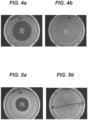
- FIG. 4a and FIG. 4b depict the ZOI with respect to Example 4C (0.75% loading of triclosan) and Control Example - 4D (no antimicrobial), respectively, on a trypticase soy agar plate challenged with A. aureus.
- Example 4C demonstrates that the compositions of this invention are able to effectively carry antimicrobial agents
- Table 5 Zone of Inhibition (mm) - E.coli Sample ID Zone of Inhibition (mm) Average 4 measurements around the sample (mm)
- Example 4A replicate 1 5.4 5.3 5.9 5.6 5.6
- Example 4A replicate 2 6.5 6.2 6.4 6.1 6.3
- Example 4B replicate 1 7.2 7.3 6.8 6.2 6.9
- Example 4B replicate 2 7.1 7.8 6.4 7.2 7.1
- Example 4C replicate 1 10.1 9.7 9.7 9 9.6
- Example 4C replicate 2 10.1 10.2 9.9 9.6 10.0
- Control Example 4D replicate 1 0 0 0 0 0.0
- Control Example 4D replicate 2 0 0 0 0 0.0
- compositions containing an antimicrobial agent are effective against E. coli versus the non-antimicrobial composition (Control Example 4D) which is not effective against E. coli.
- FIG. 5a and FIG. 5b depict the ZOI with respect to Example 4C (0.75% loading of triclosan) and Control Example - 4D (no antimicrobial), respectively, on a trypticase soy agar plate challenged with E colic.
- Example 4C demonstrates that the compositions of this invention are able to effectively carry antimicrobial agents.
- organic solvent free mixing compositions are more desirable .
- Such embodiments include situations where contents of a mixing device, such as a dual-barrel syringe, may be made with a solvent in which contents of the syringe leak past seals of the syringe or the solvent evaporates.
- a mixing device such as a dual-barrel syringe
- suitable compositions are possible without use of organic solvents by substituting a low molecular weight ( 3000 to 9000 ) vinyl terminated polydimethylsiloxane and/or low molecular wight ( 3000 to 9000) hydride terminated polydimethylsiloxane.
- both these types of low molecular vinyl terminated or hydride terminated polydimethylsiloxane compounds have viscosities in the 40-150 cPs range.
- 1 cPs equals 1 mPa ⁇ s.
- these solvent free formulations are capable of lowering viscosity of high viscosity silicone bases that that have viscosities typically higher than 500,000 and up to several million centipoise.
- the Part A compositions will typically comprise a silicone base (containing vinyl terminated polydimethyl silicone base polymer and fumed silica particles) ranging from 60 to 95 wt.
- Part B compositions will typically comprise a silicone base (containing vinyl terminated polydimethyl silicone base polymer and fumed silica particles) ranging from 60 to 80 wt. % when controlling to a Part B viscosity of 45,000 to 75,000 cPs base, (or 0 to 30 wt.% when controlling to a Part B viscosity of 15,000 - 45,000 cPs base, or 70 to 100 wt. % when controlling to a Part B viscosity of 75,000 to 105,000 cPs base);10 to 40 wt.% polymethylhydro-co-polydimethyl siloxane cross linker; and 3 to 12 wt. % hydride terminated polydimethylsiloxane.
- a silicone base containing vinyl terminated polydimethyl silicone base polymer and fumed silica particles
- the viscosity of both the Part A and Part B compositions will independently range between 25,000 and 100,000 cPs prior to mixing and will be of similar viscosity when Part A and Part B are used in conjunction with each other around a low, medium or high viscosity level.
- Elkem 55 experimental base also known as Elkem Silbione 4020-55, containing vinyl terminated polydimethyl silicone base polymer and fumed silica particles
- Example 1-SF a high-speed centrifugal mixer
- This composition had a viscosity of 32,090 cPs (see Example7a-SF).
- Example 3- SF, Mid- viscosity (45,000 to 75,000 cPs, hereby 1 cPs equals 1 mPa ⁇ s)
- Elkem 55 experimental base was mixed with 20g of Elkem 44 experimental base (also known as Elkem Silbione 4020-44, containing vinyl terminated polydimethyl silicone base polymer and fumed silica particles) and 15g of Example 1-SF using a high-speed centrifugal mixer (FlackTek DAC150 FV-K) at 3470 rpm for 3 minutes.
- This composition had a viscosity of 57,900 cPs (see Example7a-SF).
- Example 4 -SF High viscosity (75,000 to 105,000 cPs, hereby 1 cPs equals 1 mPa ⁇ s)
- a 1.5 inch wide PSA (pressure sensitive adhesive) coated polyester mesh (Lot# 16204, Innovize, St Paul, MN) was placed along the cutting line to hold together the two half pieces of the Duralar film of 4 inches by 11 inches described above.
- the two-part silicone TSA compositions in each of the following examples were respectively mixed (Example 2-SF, Example 3-SF, Examples 4-SF) and evenly applied onto the mesh to cover the entire area of the mesh using a conventional rubber spatula. The samples were cured between 1 to 3 minutes at 31 deg C and maintain at this temperature overnight. 5 pieces of 1 inch wide strips of each of the covered mesh samples were cut for testing.
- Synthetic substrate Polyethylene film, 0.05 inch thick Duralar ® film, Grafix Plastics, Maple Heights, OH. Hereby 1 inch equals 2.54 cm.
- a 5 inch by 5 inch PSA (pressure sensitive adhesive) coated on polyester mesh (Lot# 16204, Innovize, St Paul, MN) was placed on the polyester substrate of the same dimensions.
- the two-part silicone TSA compositions of each of the following examples were respectively mixed (Example 2-SF, Example 3-SF, Examples 4-SF) and applied onto the mesh evenly to cover the entire area of the mesh using a conventional rubber spatula. 5, 1 inch wide specimens were cut for testing after each of the covered mesh samples were cured and maintained at 31degC over night (i.e., at least 8 hours).
- a 5 inch by 5 inch PSA (pressure sensitive adhesive) coated polyester mesh (Lot# 16204, Innovize, St Paul, MN) was placed on a polyethylene substrate.
- the two-part silicone TSA composition was mixed (Examples 2-SF, 3-SF and 4-SF) and, applied onto the mesh evenly to cover the entire area of the mesh using a conventional rubber spatula.
- the silicone coated polyester mesh was peeled off from the Teflon substrate after 1 hour. 5, 1 inch -wide silicone coated mesh specimens were cut for testing.
- Viscosity measurements were performed on Examples 2-SF, 3-SF and 4-SF, using a Brookfield DV II+CP viscometer. Spindle 12 was used for all measurements and the speed was 1RPM.
- ASTMC679 Standard test method for tack-free time of elastomeric sealants. The test consists of lightly touching a surface of a curing sealant with a polyethylene film at regular intervals until the sealant does not attach itself to the film and the film appears clean when peeled from the surface. More specifically a strip of polyethylene film is placed on the surface of the curing elastomer and a 30g weight is placed on the film. The weight is left in place for 30 seconds, then removed and the polyethylene strip is removed and examined for sealant attachment to the film.
- the length of time from when the sealant was first applied onto a given surface until the time the sealant is no longer picked up by the film is call tack-free time and is the time point at which the film exhibits a non-tacky nature which evidences that the sealant has cured.
- T-peel strength test was performed following ASTM F2256: Standard test method for Strength Properties of Tissue Adhesives in T-Peel by Tension Loading.
- the average peel strength of mesh coated with silicone-based TSA in T-peel configuration is performed at a strain rate of 10 inches per minute, whereby 1 inch equals 2.54 cm.
- This test evaluated the force required to separate the substrate approximated with the PSA coated mesh and the applied silicone TSA compositions. This method was based on ASTMF2458: Standard test method for wound closure strength in tissue adhesive and sealant. Synthetic substrate (Mylar) was used for the test. The width of the synthetic substrate was 1 inch and the strain rate was 20 inches/minute.
- Example 2-SF Holding test on Polyester film was performed for the compositions of Example 2-SF, 3-SF and 4-SF; the results are summarized in Table 1c-SF.
- 1 lb/in equals 175 N/m.
- Table 1c-SF Sample Holding Strength (lb/in) Example 2-SF 11.5
- Example 3-SF 14.9
- Example 4-SF 15.2 Control Example (see Table 1) 0.7 Referring to Table 1c-SF, it can be seen that the holding force for the polyester substrate is significantly better in the inventive examples made from polysiloxane polymer and commercial bases, compared to conventional cross-linked silicone polymer using the Karstedt catalyst (Control Example, Table 1).
- compositions allow for the formation of medical grade silicone adhesive, in particular suitable for human skin.
- the compositions provide a durable elastic structure, which provides both mechanical properties and adhesion properties.
- the catalyst provides dual cured catalytic action, enabling the cross link of polysiloxane chains to form a film rapidly while forming adhesion properties on a given hydroxyl containing substrates.
- the silanol functions on the surface of silicone fillers in the compositions reacts with the hydroxyl functions on a given surface in the presence of this novel dual functional catalyst provide the adhesion properties on this novel silicone based adhesive.
- compositions of this invention demonstrate the feasibility of embodiments of the compositions of this invention incorporating wound exudate/moisture absorbent particles and/or indicators to absorb moisture when in intimate contact with a source of moisture (and to indicate such moisture absorption) while maintaining critical adherence and flexibility characteristics required for use as a wound closure device.
- the water absorbable silicone based topical skin adhesives (TSA) of this invention is delivered in an equal 1 to 1 volume two-part kit.
- the foregoing composition are made with the solvent-free silicone compositions hereinbefore described above.
- vinyl terminated polydimethylsiloxane is mixed with platinum tetramethyldivinyl disiloxane diethyl maleate catalyst, silica particles and optionally aliphatic organic solvent using a high- speed mixer to form part A of the kit.
- Vinyl terminated polydimethylsiloxane is mixed with polymethylhydro-co-polydimethylsiloxane cross linker, silica particles and optionally aliphatic organic solvent using a high-speed mixer to form part B of the kit.
- the silica desiccant particles are blended into part B during its preparation process.
- Example 7a Preparation of silicone-based, water absorbable TSA with 23% loading of desiccant
- E-Kem 55 experimental base (containing vinyl terminated polydimethyl silicone base polymer and fumed silica particles) was mixed with 0.62g of Example 1, 0.60g of Gelest SIP 6830.3 (3% platinum divinyl tetramethyldisiloxane complex in vinyl terminated polydimethyl siloxane), 9.0g of low molecular weight vinyl terminated polydimethyl silicone base polymer (Gelest DMS V21) using a high-speed centrifugal mixer (FlackTek DAC150 FV-K) at 3470 rpm for 5 minutes.
- E-Kem 55 experimental base containing vinyl terminated polydimethyl silicone-based polymer and fumed silica particles
- 20.5g of polymethylhydro-co-polydimethyl siloxane cross linker Gelest DMS H071
- 1.6g of SiH terminated polydimethylsiloxane chain extensor Gelest DMS H21
- 45.8g of silica desiccant t.h.e. ® Desiccant, 100% indicating, EMD Millipore Corporation, Billerica, MA
- FlackTek DAC150 FV-K a high-speed centrifugal mixer
- E-Kem 55 experimental base (containing vinyl terminated polydimethyl silicone base polymer and fumed silica particles) was mixed with 0.62g of example 1, 0.62g of Example 1, 0.60g of Gelest SIP 6830.3 (3% platinum divinyl tetramethyldisiloxane complex in vinyl terminated polydimethyl siloxane), 9.0g of low molecular weight vinyl terminated polydimethyl silicone base polymer (Gelest DMS V21) using a high speed centrifugal mixer (FlackTek DAC150 FV-K) at 3470 rpm for 5 minutes.
- E-Kem 55 experimental base containing vinyl terminated polydimethyl silicone base polymer and fume silica particles
- 41g of polymethylhydro-co-polydimethyl siloxane cross linker (Gelest DMS H071), 3.2g of SiH terminated polydimethylsiloxane chain extensor (Gelest DMS H21) using a high speed centrifugal mixer (FlackTek DAC150 FV-K) at 3470 rpm for 5 minutes.
- Synthetic substrate (Polyester film, 0.05 inch thick Duralar film, Grafic Plastics, Maple Heights, OH) 8 inch by 11 inch was cut in two halves with the dimension of 4 inch by 11 inch.
- a 1 inch width PSA (pressure sensitive adhesive) coated polyester mesh (Lot# 16204, Innovize, St Paul, MN) was placed along the cutting line to hold the two half pieces together, whereby 1 inch equals 2.54 cm.
- the two-part silicone TSA compositions in each of the following examples were respectively mixed (Example 7a and Control Example 7b) and evenly applied onto the mesh to cover the entire area of the mesh using a conventional rubber spatula.
- the samples dried in 3 minutes at 31 C, according to ASTM 678. A 1- inch wide strip was cut for testing after being placed at 31 C for 1 hour.
- Synthetic substrate Polyethylene film, 0.05 inch thick Duralar film, Grafic Plastics, Maple Heights, OH
- a 5 inch by 5 inch PSA (pressure sensitive adhesive) coated polyester mesh (Lot# 16204, Innovize, St Paul, MN) was placed on a Mylar substrate with the same dimension.
- the two-part silicone TSA compositions in each of the following examples were respectively mixed (Example 7a and Control Example 7b) and evenly applied onto the mesh to cover the entire area of the mesh using a conventional rubber spatula. 1 inch-wide specimens were cut for testing after the samples were dried and placed at 31 C overnight.
- a 5 inch by 5 inch PSA (pressure sensitive adhesive) coated polyester mesh (Lot# 16204, Innovize, St Paul, MN) was placed on a Teflon substrate.
- the two-part silicone TSA compositions in each of the following examples were respectively mixed (Example 7a and Control Example 7b) and evenly applied onto the mesh to cover the entire area of the mesh using a conventional rubber spatula.
- the silicone coated polyester mesh was peel off from Teflon substrate after the 1 hour. 1x5 inch silicone coated mesh specimens were cut for stretch testing.
- Example 7a Holding tests on Polyester film were performed on the test samples of Example 7a and Control Example 7b the results are summarized below.
- 1 lb/in equals 175 N/m.
- Sample Holding Strength (lb/in) Example 7a 11.5
- Control Example 7b 11.1
- the holding force on the polyester substrate for the water absorbable silicone-based TSA (Example 7a,dessicant containing)) is comparable the holding force of the non-desiccant silicone-based TSA (Control Example 7b)
- Example 7a The sample of Example 7a was stretched to 150% of its original length. The dimensions of the testing sample were measured before and after the stretch and the images of this is shown in Fig. 7d Fig. 7e and Fig. 7f .
- Example 7a A test specimen of Example 7a with the dimension of approximately 3.5 X 3.5 X 0.1 cm was immersed into water at ambient temperature for 24 hours. 4.82% weight gain was observed after water immersion. A specimen of Control Sample 7b was tested at the same time and no weight gain was observed. The color of the specimen (Example 7a) changed from blue to brown, as illustrated in Fig. 7g and Fig. 7h .
- incorporation of silica-based desiccants into silicone TSA is capable of indicating color changes when immersed in water.
- the hydrophobicity of the cross-linked polydimethylsiloxane appears not to prevent water ingression into the matrix of silicone TSA, when the silicone TSA is fully contacted with water by immersion and one would expect the same to be true with intimate contact over a period of time with a source of moisture such as a wound closure device in contact with wound exudate/discharge.
- a source of moisture such as a wound closure device in contact with wound exudate/discharge.
- the incorporation of desiccant appears not to impact the adhesion and mechanical properties of the silicone-based TSA when compared to control examples not containing the desiccant.
- compositions allow for the formation of medical grade silicone adhesive, in particular suitable for human skin.
- the compositions provide a durable elastic structure, which provides both mechanical properties and adhesion properties.
- the catalyst provides dual cured catalytic action, enabling the cross link of polysiloxane chains to form a film rapidly while forming adhesion properties on a given hydroxyl containing substrates.
- the silanol functions on the surface of silicone fillers in the compositions reacts with the hydroxyl functions on a given surface in the presence of this novel dual functional catalyst provide the adhesion properties on this novel silicone-based adhesive.
- triclosan containing silicone TSA provides an effective means to deliver the antimicrobial agent via skin closure devices.
- the incorporation of triclosan appears not to significantly impact the adhesion properties of the adhesive and surgical performance of the silicone-based TSA.
Landscapes
- Chemical & Material Sciences (AREA)
- Health & Medical Sciences (AREA)
- Organic Chemistry (AREA)
- Engineering & Computer Science (AREA)
- Materials Engineering (AREA)
- Chemical Kinetics & Catalysis (AREA)
- Life Sciences & Earth Sciences (AREA)
- General Health & Medical Sciences (AREA)
- Epidemiology (AREA)
- Animal Behavior & Ethology (AREA)
- Public Health (AREA)
- Veterinary Medicine (AREA)
- Inorganic Chemistry (AREA)
- Medicinal Chemistry (AREA)
- Polymers & Plastics (AREA)
- Hematology (AREA)
- Composite Materials (AREA)
- Dispersion Chemistry (AREA)
- Pharmacology & Pharmacy (AREA)
- Biodiversity & Conservation Biology (AREA)
- Materials For Medical Uses (AREA)
- Medicinal Preparation (AREA)
- Acyclic And Carbocyclic Compounds In Medicinal Compositions (AREA)
- Pharmaceuticals Containing Other Organic And Inorganic Compounds (AREA)
Claims (17)
- Zusammensetzung, die für Wundverschlussanwendungen geeignet ist, umfassend:ein vernetzbares Silikonpolymer, das reaktive Funktionalitäten aufweist;eine Siliziumdioxid-haltige Zusammensetzung;ein Silikonvernetzungsmittel;einen Katalysator, wobei der Katalysator einen Platintetramethyldivinyldisiloxandiethylmaleatkomplex umfasst, der die Formel aufweist:
Pt[(CH2 = CH)(CH3)2Si]2O (COCH = CHCO)(C2H5O)2;
undein antimikrobielles Mittel. - Zusammensetzung nach Anspruch 1, wobei das vernetzbare Silikonpolymer aus der Gruppe ausgewählt ist, bestehend aus Vinyl-endständigem Polydialkylsiloxan, Vinyl-endständigem Polydimethylsiloxan, Vinyl-endständigem Polydiphenylsilan-Dimethylsiloxan-Copolymer, Vinyl-endständigem Polyphenylmethylsiloxan, Vinyl-endständigem Polyfluorpropylmethyl-Dimethylsiloxan-Copolymer, Vinyl-endständigem Polydiethylsiloxan und SiHendständigem Polydimethyldisiloxan.
- Zusammensetzung nach Anspruch 1, wobei das vernetzbare Silikonpolymer Vinyl-endständiges Polydimethylsiloxan umfasst.
- Zusammensetzung nach Anspruch 1, wobei die Siliziumdioxid-haltige Zusammensetzung einen mit Trimethylsilyl oberflächenbehandelten Siliziumdioxidfüllstoff umfasst.
- Zusammensetzung nach Anspruch 1, wobei das Silikonvernetzungsmittel aus der Gruppe ausgewählt ist, bestehend aus Polymethylhydrosiloxan, Polymethylhydro-co-Polydimethylsiloxan, Polyethylhydrosiloxan, Polymethylhydrosiloxan-co-Octylmethylsiloxan und Polymethylhydrosiloxan-co-Methylphenylsiloxan.
- Zusammensetzung nach Anspruch 1, wobei das Silikonvernetzungsmittel Polymethylhydrosiloxan, Polymethylhydro-co-polydimethylsiloxan und Kombinationen davon umfasst.
- Zusammensetzung nach Anspruch 1, wobei die Zusammensetzung zusätzlich zu 0 Gew.-% bis 30 Gew.-% ein organisches Lösungsmittel, basierend auf dem Gewicht der Zusammensetzung, umfasst.
- Zusammensetzung nach Anspruch 1, wobei die Zusammensetzung zu 1 Gew. % bis 15 Gew. % das Silikonvernetzungsmittel basierend auf den Gesamtfeststoffen umfasst, wobei die Beschichtungszusammensetzung zusätzlich zu 0 Gew. % bis 30 Gew. % ein organisches Lösungsmittel basierend auf dem Gewicht der Beschichtungszusammensetzung umfasst.
- Zusammensetzung nach Anspruch 1, wobei die Beschichtungszusammensetzung zu 0,003 Gew.-% bis 0,06 Gew.-% den Platinkatalysator, basierend auf den Gesamtfeststoffen, umfasst, wobei die Beschichtungszusammensetzung zusätzlich zu 0 Gew.-% bis 30 Gew.-% ein organisches Lösungsmittel, basierend auf dem Gewicht der Beschichtungszusammensetzung, umfasst.
- Zusammensetzung nach Anspruch 1, wobei die Beschichtungszusammensetzung zusätzlich ein Lösungsmittel umfasst, das aus der Gruppe ausgewählt ist, bestehend aus Pentanen, Heptanen, Hexanen und deren Mischungen.
- Zusammensetzung nach Anspruch 1, wobei das antimikrobielle Mittel aus der Gruppe ausgewählt ist, bestehend aus Triclosan, Chlorhexidin, Polyhexamethylenbiguanid (PHMB), Octenidin, elementarem Silber und Silbersalzen, optional wobei das antimikrobielle Mittel Triclosan ist, ferner optional wobei das Triclosan 0,05 Gew.-% bis 2,0 Gew.-% der Zusammensetzung oder 0,1 Gew.-% bis 1,5 Gew.-% der Zusammensetzung oder 0,2 Gew.-% bis 1,0 Gew.-% der Zusammensetzung umfasst.
- Beschichtungszusammensetzung nach Anspruch 1, wobei die Zusammensetzung bei Temperaturen von 19 °C härtbar ist, optional wobei die Zusammensetzung bei Temperaturen von 28 °C in 2-5 Minuten härtbar ist.
- Kit, umfassend:a) eine Wundverschlussvorrichtung; undb) die Zusammensetzung nach Anspruch 1;optional wobei die Wundverschlussvorrichtung ein Wundverschlussstreifen ist, optional wobei der Wundverschlussstreifen aus der Gruppe ausgewählt ist, bestehend aus Netzen, Polymerfolien, Kunststoffschäumen (einschließlich offenzelligem Schaum), gewebten Stoffen, gestrickten Stoffen, Vliesstoffen und Kombinationen davon, optional wobei der Wundverschlussstreifen ein Netz ist, ferner optional wobei die Wundverschlussvorrichtung Materialien umfasst, die aus der Gruppe ausgewählt sind, bestehend aus Polyestern, Nylons, Acrylstoffen, Viskosereyonen, Polyurethanen, Polyurethanschäumen, Polystyrolen, Polyestern, Polyethylenterephthalat (PET), Polyamiden, Polymilchsäuren, Polyglykolsäuren, Polycaprolaktonen und Mischungen davon; Baumwolle, Seide und Leinen; und oberflächenbehandelte Materialien, die ihren Oberflächen eine OH-Funktionalität verleihen, einschließlich, jedoch nicht beschränkt auf OH-oberflächenbehandeltes PTFE, OH-oberflächenbehandeltes Polypropylen und OH-oberflächenbehandeltes Polyethylen.
- Kit nach Anspruch 13, wobei das antimikrobielle Mittel Triclosan ist.
- Zusammensetzung, die für Wundverschlussanwendungen geeignet ist, umfassend:ein vernetzbares Silikonpolymer, das reaktive Funktionalitäten aufweist;eine Siliziumdioxid-haltige Zusammensetzung;ein Silikonvernetzungsmittel;einen Katalysator, wobei der Katalysator einen Platintetramethyldivinyldisiloxandiethylmaleatkomplex umfasst, der die Formel aufweist:
Pt[(CH2 = CH)(CH3)2Si]2O (COCH = CHCO)(C2H5O)2;
undein Absorptionsmittel und/oder ein Indikator für Wundexsudat oder Wundfeuchtigkeit. - Zusammensetzung nach Anspruch 15, wobei das Absorptionsmittel und/oder der Indikator ist:(a) Siliziumdioxid;(b) ein Superabsorbtionsmittel; oder(c) ein anhydrisches anorganisches Salz.
- Kit, umfassend:a) eine Wundverschlussvorrichtung; undb) die Zusammensetzung nach Anspruch 15;optional wobei die Wundverschlussvorrichtung ein Wundverschlussstreifen ist, ferner optional wobei das Absorptionsmittel und/oder der Indikator für Wundexsudat oder Wundfeuchtigkeit auf den Wundverschlussstreifen aufgetragen oder beschichtet ist.
Applications Claiming Priority (3)
| Application Number | Priority Date | Filing Date | Title |
|---|---|---|---|
| US16/885,366 US12465577B2 (en) | 2020-05-28 | 2020-05-28 | Antimicrobial topical skin closure compositions and systems |
| US17/327,952 US12528913B2 (en) | 2020-05-28 | 2021-05-24 | Antimicrobial anhydrous topical skin closure compositions and systems |
| PCT/IB2021/054518 WO2021240357A1 (en) | 2020-05-28 | 2021-05-25 | Novel antimicrobial topical skin closure compositions and systems |
Publications (3)
| Publication Number | Publication Date |
|---|---|
| EP4157376A1 EP4157376A1 (de) | 2023-04-05 |
| EP4157376C0 EP4157376C0 (de) | 2025-03-05 |
| EP4157376B1 true EP4157376B1 (de) | 2025-03-05 |
Family
ID=76197509
Family Applications (1)
| Application Number | Title | Priority Date | Filing Date |
|---|---|---|---|
| EP21729022.0A Active EP4157376B1 (de) | 2020-05-28 | 2021-05-25 | Neue antimikrobielle topische hautverschlusszusammensetzungen und systeme |
Country Status (9)
| Country | Link |
|---|---|
| US (1) | US12528913B2 (de) |
| EP (1) | EP4157376B1 (de) |
| JP (1) | JP7722626B2 (de) |
| KR (1) | KR20230017288A (de) |
| CN (1) | CN115666666A (de) |
| AU (1) | AU2021281113A1 (de) |
| BR (1) | BR112022024126A2 (de) |
| MX (1) | MX2022014941A (de) |
| WO (1) | WO2021240357A1 (de) |
Families Citing this family (10)
| Publication number | Priority date | Publication date | Assignee | Title |
|---|---|---|---|---|
| EP3886925A2 (de) | 2018-11-29 | 2021-10-06 | Ethicon, Inc | Applikator und verfahren zur beschichtung von operationssälen |
| US12465577B2 (en) | 2020-05-28 | 2025-11-11 | Ethicon, Inc. | Antimicrobial topical skin closure compositions and systems |
| US11479669B2 (en) | 2020-05-28 | 2022-10-25 | Ethicon, Inc. | Topical skin closure compositions and systems |
| US11718753B2 (en) | 2020-05-28 | 2023-08-08 | Ethicon, Inc. | Topical skin closure compositions and systems |
| US11518604B2 (en) * | 2020-05-28 | 2022-12-06 | Ethicon, Inc. | Systems, methods and devices for aerosol spraying of silicone based topical skin adhesives for sealing wounds |
| US11589867B2 (en) * | 2020-05-28 | 2023-02-28 | Ethicon, Inc. | Anisotropic wound closure systems |
| US12528913B2 (en) | 2020-05-28 | 2026-01-20 | Ethicon, Inc. | Antimicrobial anhydrous topical skin closure compositions and systems |
| US11712229B2 (en) | 2020-05-28 | 2023-08-01 | Ethicon, Inc. | Systems, devices and methods for dispensing and curing silicone based topical skin adhesives |
| US20260021221A1 (en) * | 2024-07-22 | 2026-01-22 | Ethicon, Inc. | Mixing and delivery devices for topical skin adhesives, containing antimicrobial agents inside the device expression tip or static mixer |
| US20260115352A1 (en) | 2024-10-28 | 2026-04-30 | Cilag Gmbh International | Verteporfin Containing Silicone Topical Skin Adhesive for Wound Closure and Reduced Scarring |
Family Cites Families (153)
| Publication number | Priority date | Publication date | Assignee | Title |
|---|---|---|---|---|
| US2941696A (en) | 1957-08-19 | 1960-06-21 | Ortho Pharma Corp | Dispensing container |
| US3187752A (en) | 1962-04-27 | 1965-06-08 | American Cyanamid Co | Non-absorbable silicone coated sutures and method of making |
| NL129346C (de) | 1966-06-23 | |||
| US3490651A (en) | 1968-01-08 | 1970-01-20 | Abplanalp Robert H | Dispenser system for simultaneous dispensing of separately stored fluids |
| FR2032202A5 (de) | 1969-02-21 | 1970-11-20 | Oreal | |
| US3814730A (en) | 1970-08-06 | 1974-06-04 | Gen Electric | Platinum complexes of unsaturated siloxanes and platinum containing organopolysiloxanes |
| US3775452A (en) | 1971-04-28 | 1973-11-27 | Gen Electric | Platinum complexes of unsaturated siloxanes and platinum containing organopolysiloxanes |
| US4234108A (en) | 1977-11-25 | 1980-11-18 | Diamond George B | Piston for aerosol container |
| US4340155A (en) | 1979-08-24 | 1982-07-20 | Aerosol Service Ag | Two-compartment pack |
| US4482662A (en) | 1982-07-26 | 1984-11-13 | Plasti-Kote Company, Inc. | Water-soluble aerosol paint compositions |
| FR2589737A1 (fr) | 1985-11-12 | 1987-05-15 | Dow Corning Sa | Procedes de fabrication de pansements |
| JPH0781080B2 (ja) | 1986-07-10 | 1995-08-30 | 東レ・ダウコ−ニング・シリコ−ン株式会社 | シリコ−ンゴム粒状物の製造方法 |
| US5026768A (en) | 1987-12-09 | 1991-06-25 | Dow Corning Corporation | Method of producing silicone emulsion |
| DE3914517A1 (de) | 1989-03-10 | 1990-09-13 | Coster Tecnologie Speciali Spa | Zweikammerpackung |
| US5020694A (en) | 1989-03-16 | 1991-06-04 | Chesebrough-Pond's, Inc. | Multi-cavity dispensing container |
| WO1993007924A1 (en) | 1991-10-18 | 1993-04-29 | Spire Corporation | Bactericidal coatings for implants |
| NZ250363A (en) | 1992-12-04 | 1996-11-26 | Susanna Elizabeth Chalmers | A topical dressing containing a dessicant and an antimicrobial or antiseptic agent |
| JPH08502712A (ja) | 1993-08-20 | 1996-03-26 | アー. ケラー,ヴィルヘルム | 折りたためるカートリッジを備えた多成分計量および相対比例配分装置 |
| US5431303A (en) | 1993-09-30 | 1995-07-11 | Miskell; David L. | Two-part aerosol dispenser employing fusible plug |
| CA2134741A1 (en) | 1993-11-01 | 1995-05-02 | William Mcjames | Process for manufacturing surgical needles |
| US5447987A (en) | 1993-12-24 | 1995-09-05 | Shin-Etsu Chemical Co., Ltd. | Organopolysiloxane compositions |
| US5527837A (en) | 1994-04-25 | 1996-06-18 | Shin-Etsu Chemical Co., Ltd. | Heat-curable silicone elastomer compositions |
| US5414023A (en) | 1994-05-18 | 1995-05-09 | Dow Corning Corporation | Thixotropic foamable organosiloxane compositions |
| DE9414136U1 (de) | 1994-09-01 | 1994-11-03 | Vosschemie GmbH, 25436 Uetersen | Abschneidevorrichtung für in dosenförmigen Behältern abgepackte Stamm-Massen, insbesondere Spachtelmassen und Kitte und Härterpasten |
| JP3517479B2 (ja) | 1995-03-31 | 2004-04-12 | 東レ・ダウコーニング・シリコーン株式会社 | 1液型室温硬化性シリコーンエラストマー組成物の製造方法 |
| US5772640A (en) | 1996-01-05 | 1998-06-30 | The Trustees Of Columbia University Of The City Of New York | Triclosan-containing medical devices |
| US6537246B1 (en) | 1997-06-18 | 2003-03-25 | Imarx Therapeutics, Inc. | Oxygen delivery agents and uses for the same |
| US6770050B2 (en) | 1997-04-14 | 2004-08-03 | Baxter International Inc. | Multipurpose fluid applicator and method, with surgical uses |
| WO1999051192A2 (en) | 1998-04-03 | 1999-10-14 | Colgate-Palmolive Company | Low residue cosmetic composition |
| JPH11349897A (ja) | 1998-06-10 | 1999-12-21 | Ge Toshiba Silicone Kk | コーティング材組成物 |
| ATE343379T1 (de) | 1998-08-20 | 2006-11-15 | 3M Innovative Properties Co | Sprühverband und wirkstoffabgabesystem |
| EP1013292A1 (de) | 1998-12-23 | 2000-06-28 | Dow Corning France S.A. | Biokompatible Beschichtungen |
| JP3746394B2 (ja) | 1999-04-14 | 2006-02-15 | 東レ・ダウコーニング株式会社 | シリコーンゲル組成物 |
| ATE338577T1 (de) | 2000-05-08 | 2006-09-15 | Pfizer Prod Inc | Sprühbares hautschutzmittel |
| US6613185B1 (en) | 2000-07-24 | 2003-09-02 | Specialty Silicone Products, Inc. | Curable silicone elastomer and process of production thereof and method of bonding therewith |
| DE50113857D1 (de) | 2000-11-29 | 2008-05-29 | Sulzer Chemtech Ag | Adapter für einen statischen Mischer |
| CA2442281C (en) | 2001-03-27 | 2010-06-08 | Galen (Chemicals) Limited | Intravaginal drug delivery devices for the administration of an antimicrobial agent |
| US6830758B2 (en) | 2001-04-02 | 2004-12-14 | Lectec Corporation | Psoriasis patch |
| US20090026660A1 (en) | 2001-04-11 | 2009-01-29 | Helix Medical, Llc | Methods of making antimicrobial voice prothesis devices |
| US7520897B2 (en) | 2001-04-11 | 2009-04-21 | Helix Medical, Llc | Medical devices having antimicrobial properties |
| US20020193879A1 (en) | 2001-04-11 | 2002-12-19 | Seder Edmund V. | Medical devices having antimicrobial properties |
| US7393547B2 (en) | 2001-04-11 | 2008-07-01 | Helix Medical, Llc | Antimicrobial elastomer composition and method for making |
| US6767551B2 (en) | 2001-08-15 | 2004-07-27 | Sherwood Services Ag | Coating for use with medical devices and method of making same |
| US7037289B2 (en) | 2001-09-12 | 2006-05-02 | 3M Innovative Properties Company | Apparatus and methods for dispensing an adhesive tissue sealant |
| CA2422244A1 (en) | 2002-03-14 | 2003-09-14 | Homax Products, Inc. | Aerosol systems and methods for mixing and dispensing two-part materials |
| ATE508954T1 (de) | 2002-05-21 | 2011-05-15 | Seaquist Perfect Dispensing Foreign Inc | Aerosolabgabevorrichtung zum mischen und abgeben von mehreren fluidprodukten |
| US8911831B2 (en) | 2002-07-19 | 2014-12-16 | Northwestern University | Surface independent, surface-modifying, multifunctional coatings and applications thereof |
| US20060134313A1 (en) | 2002-09-10 | 2006-06-22 | Josef-Peter Guggenbichler | Methods for producing an anti-microbial plastic product |
| US7906473B2 (en) | 2002-09-13 | 2011-03-15 | Bissell Homecare, Inc. | Manual spray cleaner |
| US7967220B2 (en) | 2002-09-13 | 2011-06-28 | Bissell Homecare, Inc. | Manual sprayer with dual bag-on-valve assembly |
| US8112973B2 (en) | 2002-10-04 | 2012-02-14 | Ethicon, Inc. | Method of making a packaged antimicrobial suture |
| US20040220614A1 (en) | 2002-10-04 | 2004-11-04 | Howard Scalzo | Packaged antimicrobial medical device and method of preparing same |
| US7122712B2 (en) | 2002-12-02 | 2006-10-17 | Lutri Thomas P | Surgical bandage and methods for treating open wounds |
| JP2004244109A (ja) | 2003-01-24 | 2004-09-02 | Toyo Aerosol Ind Co Ltd | 二液分配用エアゾ−ル装置。 |
| US20040181943A1 (en) | 2003-03-18 | 2004-09-23 | Michael Kwiecien | Shaving systems |
| CA2531640C (en) | 2003-07-10 | 2013-06-18 | Galen (Chemicals) Limited | Intravaginal drug delivery devices |
| US8870814B2 (en) | 2003-07-31 | 2014-10-28 | Boston Scientific Scimed, Inc. | Implantable or insertable medical devices containing silicone copolymer for controlled delivery of therapeutic agent |
| US7381751B2 (en) | 2003-08-26 | 2008-06-03 | Shantha Sarangapani | Antimicrobial composition for medical articles |
| ES2331474T3 (es) | 2003-12-12 | 2010-01-05 | Medmix Systems Ag | Dispositivo de aplicacion de fluidos para un aparato dispensador de fluidos. |
| US20050182443A1 (en) | 2004-02-18 | 2005-08-18 | Closure Medical Corporation | Adhesive-containing wound closure device and method |
| US20050181116A1 (en) | 2004-02-18 | 2005-08-18 | Rob Worsham | Method for coating a medical device using a matrix assisted pulsed-laser evaporation technique and associated system and medical device |
| US20060009099A1 (en) | 2004-07-12 | 2006-01-12 | Closure Medical Corporation | Adhesive-containing wound closure device and method |
| US8357147B2 (en) | 2005-08-17 | 2013-01-22 | Spinal Restoration, Inc. | Method for repairing intervertebral discs |
| DE102004054040A1 (de) | 2004-11-05 | 2006-05-11 | Bayer Innovation Gmbh | Wirkstoffhaltige Silikonelastomere |
| US8128947B2 (en) | 2005-10-11 | 2012-03-06 | Dpt Laboratories, Ltd. | Surfactant-free dispersions, compositions, and use in topical formulations |
| EP1815876A3 (de) | 2006-02-02 | 2007-10-17 | Bristol-Myers Squibb Company | Heißschmelzsilikonbasiertes Klebemittel zur Befestigung auf der Haut für Ostomie und Wundpflege |
| BRPI0708169B1 (pt) | 2006-02-24 | 2015-08-04 | Lubrizol Advanced Mat Inc | Composição |
| CN101443241B (zh) | 2006-03-20 | 2011-01-12 | 诺信公司 | 推进剂驱动的双流体筒以及用于组装该双流体筒的方法 |
| TW200813159A (en) | 2006-04-26 | 2008-03-16 | Dow Corning Korea Ltd | A liquid silicone rubber composition for forming breathable coating film on a textile and process for forming a breathable coating film on a textile |
| EP2015702A2 (de) | 2006-05-11 | 2009-01-21 | Dentsply International Inc. | Aerosol-ausgabesystem zur ausgabe zahnärztlicher zusammensetzungen |
| US7871399B2 (en) | 2006-05-17 | 2011-01-18 | Alcon Research, Ltd. | Disposable ophthalmic injection device |
| US20070292305A1 (en) | 2006-06-09 | 2007-12-20 | Sinead Dempsey | Sterilization of medical devices |
| US20080275403A1 (en) | 2007-05-04 | 2008-11-06 | Armand Maaskamp | Dual syringe assembly |
| WO2016094084A1 (en) | 2014-12-09 | 2016-06-16 | The Trustees Of Columbia University In The City Of New York | Bio-film resistant surfaces |
| SG195525A1 (en) | 2007-06-26 | 2013-12-30 | Warner Chilcott Co Llc | Intravaginal drug delivery devices for the delivery of macromolecules and water-soluble drugs |
| US9408971B2 (en) | 2008-03-31 | 2016-08-09 | Covidien Lp | Self-capping syringe assembly with one-way valve |
| EP2310458B1 (de) | 2008-07-30 | 2016-08-17 | Bluestar Silicones France SAS | Silikonzusammensetzung zum beschichten eines flexiblen trägers zur bildung eines vernetzten überzugs mit verbesserter haftung, mechanischer festigkeit und reaktivität |
| US8419793B2 (en) | 2008-09-19 | 2013-04-16 | Mentor Worldwide Llc | Coating with antimicrobial agents |
| US11147722B2 (en) | 2008-11-10 | 2021-10-19 | Kimberly-Clark Worldwide, Inc. | Absorbent article with a multifunctional acrylate skin-adhesive composition |
| CA2755523A1 (en) | 2009-04-30 | 2010-11-04 | Hyperbranch Medical Technology, Inc. | Applicator system for the delivery of surgical sealants |
| NL2002835C2 (nl) | 2009-05-04 | 2010-11-08 | Mahayana Holding B V | Houder voor een aan een lichaam toevoeren van vloeibaar materiaal die verwarmbaar is door een exotherme reactie. |
| DE102009034774A1 (de) | 2009-07-25 | 2011-01-27 | Bona Gmbh Deutschland | Auftragsdüse für viskose Klebstoffe |
| FR2948584B1 (fr) | 2009-07-30 | 2012-08-03 | Prod Dentaires Pierre Rolland | Embout d'application |
| US8133423B2 (en) | 2009-10-20 | 2012-03-13 | The Hong Kong Polytechnic University | Method for fabrication of silicone composite with antimicrobial coating |
| KR101226572B1 (ko) | 2009-12-01 | 2013-01-25 | 도요 에어로졸 고교 가부시키가이샤 | 복수액 분배용 에어졸장치 |
| US20110143148A1 (en) | 2009-12-13 | 2011-06-16 | General Electric Company | Articles comprising a weather resistant silicone coating |
| ES2576132T3 (es) | 2009-12-15 | 2016-07-05 | Universitetet I Oslo | Composición que comprende nanopartículas de TiO2 |
| CN102753634B (zh) | 2009-12-23 | 2015-10-07 | 蓝星有机硅法国公司 | 氢化硅烷化反应的抑制剂及其在涂布方法中的应用 |
| ES2619847T5 (es) | 2010-03-05 | 2024-06-24 | Momentive Performance Mat Gmbh | Uso de una composición de poliorganosiloxano curable como encapsulante para un módulo de célula solar |
| DE102010019219B4 (de) | 2010-05-04 | 2013-12-12 | Heraeus Medical Gmbh | Kartuschenverschluss und Kartusche mit einem solchen Verschluss |
| DE102010019223B4 (de) | 2010-05-04 | 2012-02-16 | Heraeus Medical Gmbh | Kartuschensystem mit Druckgaspatrone |
| KR101619077B1 (ko) | 2010-06-11 | 2016-05-10 | 레오 파마 에이/에스 | 비타민 d 유사체 및 코르티코스테로이드를 포함하는 약제학적 분무 조성물 |
| US20120237461A1 (en) | 2010-08-31 | 2012-09-20 | Betty Yu | Skin compositions and methods of use thereof |
| CN107033596A (zh) | 2010-11-25 | 2017-08-11 | 史密夫及内修公开有限公司 | 组合物i – ii及其产品和用途 |
| GB201020005D0 (en) | 2010-11-25 | 2011-01-12 | Smith & Nephew | Composition 1-1 |
| WO2012151295A2 (en) | 2011-05-02 | 2012-11-08 | Mouse Trap Design, Llc | Mixing and dispensing device |
| US20130004586A1 (en) | 2011-06-24 | 2013-01-03 | Vachon David J | Biologically Efficacious Compositions, Articles of Manufacture and Processes for Producing and/or Using Same |
| JP5827834B2 (ja) | 2011-07-22 | 2015-12-02 | 日東電工株式会社 | シリコーン樹脂組成物、シリコーン樹脂シート、シリコーン樹脂シートの製造方法および光半導体装置 |
| FR2978743B1 (fr) | 2011-08-01 | 2014-11-21 | Valois Sas | Distributeur de produit fluide. |
| US9764099B2 (en) | 2011-09-13 | 2017-09-19 | Tautona Group Lp | Syringe with temperature modulation capabilities |
| US8728599B2 (en) | 2011-10-26 | 2014-05-20 | General Electric Company | Articles comprising a hydrate-inhibiting silicone coating |
| US9434857B2 (en) | 2011-11-15 | 2016-09-06 | Ethicon, Inc. | Rapid cure silicone lubricious coatings |
| US20150159066A1 (en) | 2011-11-25 | 2015-06-11 | Smith & Nephew Plc | Composition, apparatus, kit and method and uses thereof |
| US20130150828A1 (en) | 2011-12-08 | 2013-06-13 | Rochester Medical Corporation | Antifungal catheter |
| WO2013103535A1 (en) | 2012-01-04 | 2013-07-11 | Momentive Performance Materials Inc. | Curable compositions of ionic silicones |
| US9386772B2 (en) | 2012-02-14 | 2016-07-12 | Allegiance Corporation | Antimicrobial elastomeric articles |
| US10245025B2 (en) | 2012-04-06 | 2019-04-02 | Ethicon, Inc. | Packaged antimicrobial medical device having improved shelf life and method of preparing same |
| US20160220497A1 (en) | 2012-06-25 | 2016-08-04 | Dow Corning Corporation | Method For The Therapeutic Treatment Of Keratinous Substrate, Mucous Membrane Or Tooth |
| CN104884098A (zh) | 2012-12-18 | 2015-09-02 | 3M创新有限公司 | 医用密封剂组合物及其使用方法 |
| US9272075B2 (en) | 2013-02-04 | 2016-03-01 | W.L. Gore & Associates, Inc. | Coating for substrate |
| US8883245B2 (en) | 2013-03-13 | 2014-11-11 | Ethicon, Inc. | Method of coating surgical needles |
| EP2968676B1 (de) | 2013-03-15 | 2017-05-03 | Baxter International Inc | Immobilisierung eines wirkstoffs auf einem substrat |
| EP2970715B1 (de) | 2013-03-15 | 2016-10-26 | Dow Corning Corporation | 2-aminoimidazol-funktionale silikonzusammensetzungen und verfahren zur herstellung davon |
| US20160120706A1 (en) | 2013-03-15 | 2016-05-05 | Smith & Nephew Plc | Wound dressing sealant and use thereof |
| ES2660595T3 (es) | 2013-06-07 | 2018-03-23 | Baxter International Inc. | Inmovilización de un agente activo sobre un sustrato empleando compuestos que incluyen grupos trihidroxifenilo |
| JP6191549B2 (ja) | 2013-08-09 | 2017-09-06 | 信越化学工業株式会社 | 導電性液状シリコーンゴム組成物及び高電圧ケーブル用常温収縮ゴム部材 |
| EP2857350A1 (de) | 2013-09-10 | 2015-04-08 | ESPCI Innov | Verwendung von Nanopartikeln zum Verkleben von Gels |
| US20150122837A1 (en) | 2013-11-07 | 2015-05-07 | Mouse Trap Design, Llc | Mixing and dispensing device |
| US20150147375A1 (en) | 2013-11-27 | 2015-05-28 | Medline Industries, Inc. | Non-sticky antimicrobial medical articles |
| GB201405947D0 (en) | 2013-12-04 | 2014-05-14 | Trio Healthcare Ltd | Skin compatible curing adhesives for adhering devices to mammalian body |
| US9511034B1 (en) | 2013-12-09 | 2016-12-06 | Bio-Silicote, Inc. | Method for applying a skin treatment |
| US10874773B2 (en) | 2014-06-23 | 2020-12-29 | Ethicon, Inc. | Two-step batch process for coating surgical needles |
| CN105586001A (zh) | 2014-10-21 | 2016-05-18 | 佛山市新翔星化工有限公司 | 低粘度高透明自粘性有机硅灌封胶及其制备方法 |
| MA40473A (fr) | 2014-10-22 | 2016-04-28 | Int Partnership For Microbicides Inc | Dispositifs d'administration de médicaments à base d'une silicone catalysée par du platine, et leurs procédés d'utilisation |
| CN104531056A (zh) | 2015-01-22 | 2015-04-22 | 烟台德邦先进硅材料有限公司 | 一种用于led灯丝封装的有机硅封装胶 |
| EP3135304A1 (de) | 2015-08-26 | 2017-03-01 | Mölnlycke Health Care AB | Geschäumtes silikon zur wundbehandlung |
| WO2017075320A1 (en) | 2015-10-31 | 2017-05-04 | Dermalink Technologies, Inc. | Skin adhesives, antimicrobial compositions, articles, and methods for the use thereof |
| DK3429644T3 (da) | 2016-03-14 | 2023-02-20 | Trio Healthcare Ltd | Hudkompatibel klæbesammensætning |
| CN106009688A (zh) | 2016-05-19 | 2016-10-12 | 强新正品(苏州)环保材料科技有限公司 | 导热硅胶片配方 |
| US10501671B2 (en) | 2016-07-26 | 2019-12-10 | Honeywell International Inc. | Gel-type thermal interface material |
| US10465094B2 (en) * | 2016-12-08 | 2019-11-05 | Ethicon, Inc. | Method of applying rapid cure silicone lubricious coatings |
| US10531949B2 (en) | 2016-12-30 | 2020-01-14 | Ethicon, Inc. | Silicone foam compositions rapidly cross-linkable at ambient temperatures and methods of making and using same |
| US10533074B2 (en) | 2016-12-30 | 2020-01-14 | Ethicon, Inc. | Silicone compositions rapidly cross-linkable at ambient temperatures and methods of making and using same |
| EP3388037A1 (de) | 2017-04-12 | 2018-10-17 | Trulife Limited | Am körper tragbare druckpflegevorrichtungen oder -kissen |
| EP3652255A1 (de) | 2017-07-12 | 2020-05-20 | Dow Silicones Corporation | Flüssige silikonkautschukzusammensetzung |
| US10219793B2 (en) | 2017-08-04 | 2019-03-05 | Ethicon, Inc. | Delivery systems for flowable substances stored in squeezable containers |
| EP3787589A4 (de) | 2018-05-04 | 2022-03-09 | Bio-Nature Laboratories LLC | Pristin-graphen und zusammensetzungen mit natürlichem haftklebeverfahren für anwendungen auf der haut |
| JP6991938B2 (ja) | 2018-07-17 | 2022-01-13 | 信越化学工業株式会社 | 皮膚貼付用付加反応硬化型シリコーン粘着剤組成物及び皮膚貼付用粘着テープ |
| JP2020015865A (ja) | 2018-07-27 | 2020-01-30 | 信越化学工業株式会社 | 皮膚貼付用付加反応硬化型シリコーン粘着剤組成物及び皮膚貼付用粘着テープ |
| TW202007730A (zh) | 2018-07-31 | 2020-02-16 | 美商陶氏全球科技公司 | 組成物、形成自該組成物之經發泡聚矽氧彈性體、及形成方法 |
| US11131048B2 (en) | 2018-09-14 | 2021-09-28 | Electrolux Home Products, Inc. | Method and apparatus for cleaning laundry |
| JP2022502396A (ja) | 2018-09-27 | 2022-01-11 | 株式会社 資生堂 | 皮膚に塗布する組成物及び方法 |
| EP3886925A2 (de) | 2018-11-29 | 2021-10-06 | Ethicon, Inc | Applikator und verfahren zur beschichtung von operationssälen |
| CN115135705A (zh) | 2020-02-05 | 2022-09-30 | 陶氏环球技术有限责任公司 | 发泡有机硅弹性体的制备 |
| US12465577B2 (en) | 2020-05-28 | 2025-11-11 | Ethicon, Inc. | Antimicrobial topical skin closure compositions and systems |
| US11589867B2 (en) | 2020-05-28 | 2023-02-28 | Ethicon, Inc. | Anisotropic wound closure systems |
| US11712229B2 (en) | 2020-05-28 | 2023-08-01 | Ethicon, Inc. | Systems, devices and methods for dispensing and curing silicone based topical skin adhesives |
| US11718753B2 (en) | 2020-05-28 | 2023-08-08 | Ethicon, Inc. | Topical skin closure compositions and systems |
| US12528913B2 (en) | 2020-05-28 | 2026-01-20 | Ethicon, Inc. | Antimicrobial anhydrous topical skin closure compositions and systems |
| US11479669B2 (en) | 2020-05-28 | 2022-10-25 | Ethicon, Inc. | Topical skin closure compositions and systems |
| US11518604B2 (en) | 2020-05-28 | 2022-12-06 | Ethicon, Inc. | Systems, methods and devices for aerosol spraying of silicone based topical skin adhesives for sealing wounds |
| WO2022032277A1 (en) | 2020-08-03 | 2022-02-10 | Henkel IP & Holding GmbH | Low viscosity thermally conductive paste |
| US20230250249A1 (en) | 2022-02-09 | 2023-08-10 | Cilag Gmbh International | Porous Silicone Rubber with Closed-Cell Porosity |
-
2021
- 2021-05-24 US US17/327,952 patent/US12528913B2/en active Active
- 2021-05-25 JP JP2022572600A patent/JP7722626B2/ja active Active
- 2021-05-25 AU AU2021281113A patent/AU2021281113A1/en active Pending
- 2021-05-25 CN CN202180038527.1A patent/CN115666666A/zh active Pending
- 2021-05-25 BR BR112022024126A patent/BR112022024126A2/pt unknown
- 2021-05-25 WO PCT/IB2021/054518 patent/WO2021240357A1/en not_active Ceased
- 2021-05-25 EP EP21729022.0A patent/EP4157376B1/de active Active
- 2021-05-25 MX MX2022014941A patent/MX2022014941A/es unknown
- 2021-05-25 KR KR1020227045974A patent/KR20230017288A/ko active Pending
Also Published As
| Publication number | Publication date |
|---|---|
| JP2023527018A (ja) | 2023-06-26 |
| MX2022014941A (es) | 2023-03-06 |
| EP4157376A1 (de) | 2023-04-05 |
| US12528913B2 (en) | 2026-01-20 |
| AU2021281113A1 (en) | 2023-02-02 |
| JP7722626B2 (ja) | 2025-08-13 |
| EP4157376C0 (de) | 2025-03-05 |
| KR20230017288A (ko) | 2023-02-03 |
| WO2021240357A1 (en) | 2021-12-02 |
| BR112022024126A2 (pt) | 2022-12-27 |
| US20210371596A1 (en) | 2021-12-02 |
| CN115666666A (zh) | 2023-01-31 |
Similar Documents
| Publication | Publication Date | Title |
|---|---|---|
| US12528913B2 (en) | Antimicrobial anhydrous topical skin closure compositions and systems | |
| US12465577B2 (en) | Antimicrobial topical skin closure compositions and systems | |
| EP4157374B1 (de) | Anisotrope wundverschlusssysteme | |
| US11479669B2 (en) | Topical skin closure compositions and systems | |
| EP4157520B1 (de) | Neue topische hautverschlusszusammensetzungen und systeme | |
| EP2750723B1 (de) | Saugfähige silikonhaftschicht | |
| RU2341292C2 (ru) | Защитный препарат, образующий эластомер | |
| US8124675B2 (en) | Adhesive composition | |
| CA2632572C (en) | Conformable bandage and coating material | |
| AU2019389899A1 (en) | Antimicrobial-containing silicone lubricious coatings | |
| EP2745851A1 (de) | Silikonfilm | |
| EP2766445A1 (de) | Hochviskoser silikonklebstoff | |
| WO2005051442A1 (en) | Method for adhering silicone gels to plastics | |
| WO2025026956A1 (en) | Low trauma grafted psa silicone compositions with high adhesion |
Legal Events
| Date | Code | Title | Description |
|---|---|---|---|
| STAA | Information on the status of an ep patent application or granted ep patent |
Free format text: STATUS: UNKNOWN |
|
| STAA | Information on the status of an ep patent application or granted ep patent |
Free format text: STATUS: THE INTERNATIONAL PUBLICATION HAS BEEN MADE |
|
| PUAI | Public reference made under article 153(3) epc to a published international application that has entered the european phase |
Free format text: ORIGINAL CODE: 0009012 |
|
| STAA | Information on the status of an ep patent application or granted ep patent |
Free format text: STATUS: REQUEST FOR EXAMINATION WAS MADE |
|
| 17P | Request for examination filed |
Effective date: 20221222 |
|
| AK | Designated contracting states |
Kind code of ref document: A1 Designated state(s): AL AT BE BG CH CY CZ DE DK EE ES FI FR GB GR HR HU IE IS IT LI LT LU LV MC MK MT NL NO PL PT RO RS SE SI SK SM TR |
|
| DAV | Request for validation of the european patent (deleted) | ||
| DAX | Request for extension of the european patent (deleted) | ||
| GRAP | Despatch of communication of intention to grant a patent |
Free format text: ORIGINAL CODE: EPIDOSNIGR1 |
|
| STAA | Information on the status of an ep patent application or granted ep patent |
Free format text: STATUS: GRANT OF PATENT IS INTENDED |
|
| RIC1 | Information provided on ipc code assigned before grant |
Ipc: B01J 31/22 20060101ALI20241009BHEP Ipc: C07F 7/08 20060101ALI20241009BHEP Ipc: B01J 31/16 20060101ALI20241009BHEP Ipc: B01J 31/12 20060101ALI20241009BHEP Ipc: C09J 183/04 20060101ALI20241009BHEP Ipc: C07F 15/00 20060101ALI20241009BHEP Ipc: A61L 26/00 20060101ALI20241009BHEP Ipc: A61L 15/60 20060101ALI20241009BHEP Ipc: A61L 15/58 20060101ALI20241009BHEP Ipc: A61L 15/46 20060101AFI20241009BHEP |
|
| INTG | Intention to grant announced |
Effective date: 20241018 |
|
| GRAJ | Information related to disapproval of communication of intention to grant by the applicant or resumption of examination proceedings by the epo deleted |
Free format text: ORIGINAL CODE: EPIDOSDIGR1 |
|
| STAA | Information on the status of an ep patent application or granted ep patent |
Free format text: STATUS: REQUEST FOR EXAMINATION WAS MADE |
|
| GRAP | Despatch of communication of intention to grant a patent |
Free format text: ORIGINAL CODE: EPIDOSNIGR1 |
|
| STAA | Information on the status of an ep patent application or granted ep patent |
Free format text: STATUS: GRANT OF PATENT IS INTENDED |
|
| INTC | Intention to grant announced (deleted) | ||
| INTG | Intention to grant announced |
Effective date: 20241217 |
|
| GRAS | Grant fee paid |
Free format text: ORIGINAL CODE: EPIDOSNIGR3 |
|
| GRAA | (expected) grant |
Free format text: ORIGINAL CODE: 0009210 |
|
| STAA | Information on the status of an ep patent application or granted ep patent |
Free format text: STATUS: THE PATENT HAS BEEN GRANTED |
|
| AK | Designated contracting states |
Kind code of ref document: B1 Designated state(s): AL AT BE BG CH CY CZ DE DK EE ES FI FR GB GR HR HU IE IS IT LI LT LU LV MC MK MT NL NO PL PT RO RS SE SI SK SM TR |
|
| REG | Reference to a national code |
Ref country code: GB Ref legal event code: FG4D |
|
| REG | Reference to a national code |
Ref country code: CH Ref legal event code: EP |
|
| REG | Reference to a national code |
Ref country code: IE Ref legal event code: FG4D |
|
| REG | Reference to a national code |
Ref country code: DE Ref legal event code: R096 Ref document number: 602021027157 Country of ref document: DE |
|
| U01 | Request for unitary effect filed |
Effective date: 20250327 |
|
| U07 | Unitary effect registered |
Designated state(s): AT BE BG DE DK EE FI FR IT LT LU LV MT NL PT RO SE SI Effective date: 20250403 |
|
| U20 | Renewal fee for the european patent with unitary effect paid |
Year of fee payment: 5 Effective date: 20250407 |
|
| PG25 | Lapsed in a contracting state [announced via postgrant information from national office to epo] |
Ref country code: RS Free format text: LAPSE BECAUSE OF FAILURE TO SUBMIT A TRANSLATION OF THE DESCRIPTION OR TO PAY THE FEE WITHIN THE PRESCRIBED TIME-LIMIT Effective date: 20250605 |
|
| PG25 | Lapsed in a contracting state [announced via postgrant information from national office to epo] |
Ref country code: ES Free format text: LAPSE BECAUSE OF FAILURE TO SUBMIT A TRANSLATION OF THE DESCRIPTION OR TO PAY THE FEE WITHIN THE PRESCRIBED TIME-LIMIT Effective date: 20250305 |
|
| PG25 | Lapsed in a contracting state [announced via postgrant information from national office to epo] |
Ref country code: NO Free format text: LAPSE BECAUSE OF FAILURE TO SUBMIT A TRANSLATION OF THE DESCRIPTION OR TO PAY THE FEE WITHIN THE PRESCRIBED TIME-LIMIT Effective date: 20250605 |
|
| PG25 | Lapsed in a contracting state [announced via postgrant information from national office to epo] |
Ref country code: HR Free format text: LAPSE BECAUSE OF FAILURE TO SUBMIT A TRANSLATION OF THE DESCRIPTION OR TO PAY THE FEE WITHIN THE PRESCRIBED TIME-LIMIT Effective date: 20250305 |
|
| PG25 | Lapsed in a contracting state [announced via postgrant information from national office to epo] |
Ref country code: GR Free format text: LAPSE BECAUSE OF FAILURE TO SUBMIT A TRANSLATION OF THE DESCRIPTION OR TO PAY THE FEE WITHIN THE PRESCRIBED TIME-LIMIT Effective date: 20250606 |
|
| PG25 | Lapsed in a contracting state [announced via postgrant information from national office to epo] |
Ref country code: SM Free format text: LAPSE BECAUSE OF FAILURE TO SUBMIT A TRANSLATION OF THE DESCRIPTION OR TO PAY THE FEE WITHIN THE PRESCRIBED TIME-LIMIT Effective date: 20250305 |
|
| PG25 | Lapsed in a contracting state [announced via postgrant information from national office to epo] |
Ref country code: PL Free format text: LAPSE BECAUSE OF FAILURE TO SUBMIT A TRANSLATION OF THE DESCRIPTION OR TO PAY THE FEE WITHIN THE PRESCRIBED TIME-LIMIT Effective date: 20250305 |
|
| PG25 | Lapsed in a contracting state [announced via postgrant information from national office to epo] |
Ref country code: CZ Free format text: LAPSE BECAUSE OF FAILURE TO SUBMIT A TRANSLATION OF THE DESCRIPTION OR TO PAY THE FEE WITHIN THE PRESCRIBED TIME-LIMIT Effective date: 20250305 |
|
| PG25 | Lapsed in a contracting state [announced via postgrant information from national office to epo] |
Ref country code: SK Free format text: LAPSE BECAUSE OF FAILURE TO SUBMIT A TRANSLATION OF THE DESCRIPTION OR TO PAY THE FEE WITHIN THE PRESCRIBED TIME-LIMIT Effective date: 20250305 |
|
| PG25 | Lapsed in a contracting state [announced via postgrant information from national office to epo] |
Ref country code: IS Free format text: LAPSE BECAUSE OF FAILURE TO SUBMIT A TRANSLATION OF THE DESCRIPTION OR TO PAY THE FEE WITHIN THE PRESCRIBED TIME-LIMIT Effective date: 20250705 |
|
| REG | Reference to a national code |
Ref country code: CH Ref legal event code: H13 Free format text: ST27 STATUS EVENT CODE: U-0-0-H10-H13 (AS PROVIDED BY THE NATIONAL OFFICE) Effective date: 20251223 |
|
| PLBE | No opposition filed within time limit |
Free format text: ORIGINAL CODE: 0009261 |
|
| STAA | Information on the status of an ep patent application or granted ep patent |
Free format text: STATUS: NO OPPOSITION FILED WITHIN TIME LIMIT |
|
| REG | Reference to a national code |
Ref country code: CH Ref legal event code: L10 Free format text: ST27 STATUS EVENT CODE: U-0-0-L10-L00 (AS PROVIDED BY THE NATIONAL OFFICE) Effective date: 20260114 |
|
| PG25 | Lapsed in a contracting state [announced via postgrant information from national office to epo] |
Ref country code: CH Free format text: LAPSE BECAUSE OF NON-PAYMENT OF DUE FEES Effective date: 20250531 |
|
| PG25 | Lapsed in a contracting state [announced via postgrant information from national office to epo] |
Ref country code: MC Free format text: LAPSE BECAUSE OF FAILURE TO SUBMIT A TRANSLATION OF THE DESCRIPTION OR TO PAY THE FEE WITHIN THE PRESCRIBED TIME-LIMIT Effective date: 20250305 |
|
| 26N | No opposition filed |
Effective date: 20251208 |
|
| GBPC | Gb: european patent ceased through non-payment of renewal fee |
Effective date: 20250605 |
|
| PG25 | Lapsed in a contracting state [announced via postgrant information from national office to epo] |
Ref country code: GB Free format text: LAPSE BECAUSE OF NON-PAYMENT OF DUE FEES Effective date: 20250605 |
|
| PG25 | Lapsed in a contracting state [announced via postgrant information from national office to epo] |
Ref country code: IE Free format text: LAPSE BECAUSE OF NON-PAYMENT OF DUE FEES Effective date: 20250525 |