EP4157034B1 - Mundbehandlungseinheit und entsprechende mundbehandlungsvorrichtung - Google Patents
Mundbehandlungseinheit und entsprechende mundbehandlungsvorrichtung Download PDFInfo
- Publication number
- EP4157034B1 EP4157034B1 EP21726412.6A EP21726412A EP4157034B1 EP 4157034 B1 EP4157034 B1 EP 4157034B1 EP 21726412 A EP21726412 A EP 21726412A EP 4157034 B1 EP4157034 B1 EP 4157034B1
- Authority
- EP
- European Patent Office
- Prior art keywords
- electromagnetic field
- oral treatment
- frequency
- treatment unit
- unit
- Prior art date
- Legal status (The legal status is an assumption and is not a legal conclusion. Google has not performed a legal analysis and makes no representation as to the accuracy of the status listed.)
- Active
Links
Images







Classifications
-
- A—HUMAN NECESSITIES
- A46—BRUSHWARE
- A46B—BRUSHES
- A46B15/00—Other brushes; Brushes with additional arrangements
- A46B15/0002—Arrangements for enhancing monitoring or controlling the brushing process
- A46B15/0016—Arrangements for enhancing monitoring or controlling the brushing process with enhancing means
- A46B15/0022—Arrangements for enhancing monitoring or controlling the brushing process with enhancing means with an electrical means
-
- A—HUMAN NECESSITIES
- A61—MEDICAL OR VETERINARY SCIENCE; HYGIENE
- A61C—DENTISTRY; APPARATUS OR METHODS FOR ORAL OR DENTAL HYGIENE
- A61C17/00—Devices for cleaning, polishing, rinsing or drying teeth, teeth cavities or prostheses; Saliva removers; Dental appliances for receiving spittle
- A61C17/16—Power-driven cleaning or polishing devices
- A61C17/22—Power-driven cleaning or polishing devices with brushes, cushions, cups, or the like
- A61C17/221—Control arrangements therefor
-
- A—HUMAN NECESSITIES
- A61—MEDICAL OR VETERINARY SCIENCE; HYGIENE
- A61C—DENTISTRY; APPARATUS OR METHODS FOR ORAL OR DENTAL HYGIENE
- A61C17/00—Devices for cleaning, polishing, rinsing or drying teeth, teeth cavities or prostheses; Saliva removers; Dental appliances for receiving spittle
- A61C17/16—Power-driven cleaning or polishing devices
- A61C17/22—Power-driven cleaning or polishing devices with brushes, cushions, cups, or the like
- A61C17/228—Self-contained intraoral toothbrush, e.g. mouth-guard toothbrush without handle
Definitions
- the invention relates to the field of oral cleaning devices, and more specifically to the field of oral cleaning devices utilizing an electromagnetic field.
- RF radio frequency
- Figure 1 shows a simulation result of a simplified example of an existing oral treatment unit 10 comprising: a non-conductive, dielectric barrier 12; a first RF electrode 13; and a second RF electrode 14.
- an electric signal in the radio frequency range is provided to the first and second RF electrodes, thereby generating an RF field 15 between the two electrodes.
- the RF field lines cannot pass through the non-conductive barrier 12, the RF field is shaped around the dielectric barrier and redirected/deflected towards the teeth and gums of the user.
- the example of Figure 1 delivers an RF field using three elements: two exposed metallic conductors and one insulator, as well as the non-conducting barrier needed to shape and re-direct the electromagnetic field to go near the teeth.
- Figure 1 requires numerous separate, powered components increasing the complexity of manufacture and requires exposed metal electrical contacts to be positioned within the user's mouth, the latter giving rise to a higher risk of injury or in-mouth discomfort due to mechanically sharp and electrically active exposed elements in the oral cavity.
- the existing solution provides only rough control of the RF field confinement and is prone to electromagnetic energy leakage in the form of radiation.
- a radio frequency (RF) electromagnetic field referred to herein as a RF field
- a RF field proximate to the teeth and gums of a user is subject to size limitations in order to comfortably fit in the oral cavity.
- oral treatment unit for confining and modulating an electromagnetic field having a frequency in the range of 1 MHz to 300 GHz and adapted to be inserted into the oral cavity of a user, the oral treatment unit comprising:
- the oral treatment unit comprising the electromagnetic field focusing element provides for a modulation of an incoming electromagnetic field into a desired frequency range, such as a radio frequency range.
- Electromagnetic fields with a frequency in the radio frequency range are desirable for oral treatment applications; however, material structures having a passive electromagnetic field focusing function tuned for radio frequencies may not be suitable for application in oral treatment applications, for example, due to material structure form factor or manufacturing costs. Material structures having a passive electromagnetic field focusing function tuned for frequencies greater than radio frequencies, such as GHz frequencies, may be manufactured to a smaller form factor using conventional manufacturing techniques, thereby reducing the cost of manufacturing; however, electromagnetic fields having frequencies in the GHz range are not always optimal for oral treatment applications.
- the oral treatment unit may include a material structure tuned to focus and confine electromagnetic fields in the high electromagnetic frequency range, such as GHz frequency range, and the modulation function may modulate the frequency of the focused EM field to bring the frequency into the radio frequency range for use in treatment of the oral cavity.
- the modulation function may comprise a frequency downshift function, which modulates the initial frequency of the confined electromagnetic field, thereby generating a modulated, confined electromagnetic field having a modulated frequency in a desired frequency range lower than the initial frequency.
- the initial frequency of the confined EM field which may for example be in the GHz range, may be shifted down to a desired frequency range, such as the radiofrequency range.
- the modulation function may be adapted to modulate one or more of a frequency of the confined electromagnetic field; an amplitude of the confined electromagnetic field; and a phase of the confined electromagnetic field.
- the initial EM field may be modulated in any desirable manner according to the application.
- the material structure is an example of a so-called metamaterial, and more specifically an electromagnetic metamaterial.
- electromagnetic metamaterials can be designed with tailorable and exotic electromagnetic properties, such as: a negative or near-zero effective permittivity; a negative or near-zero effective permeability; and a negative or near-zero refractive index.
- the EM fields of interest to the invention may have a wide range of frequencies, such as from the radiofrequency (RF) range to microwaves, for example from 100 kHz - 300 GHz, the wavelengths are generally long, in the meter range, which is particularly large for small devices, such as oral cleaning devices. Therefore, unit cells of metamaterials may be miniaturized towards dimensions for the deep sub-wavelength region. Wavelength to unit cell size ratios of 2000 up to 14400 are currently possible, enabling miniaturized compact RF metamaterial structures, suitable for oral care devices.
- RF radiofrequency
- the material structure, or metamaterials, described above, which possess a negative or near-zero dielectric permittivity ⁇ and/or negative or near-zero magnetic permeability ⁇ and/or negative or near-zero refractive index, are considered as passive elements.
- the transmitted RF field, received by the material structure, thereby passing through the metamaterial produces either an evanescent wave, i.e., an oscillating electric and/or magnetic field that does not propagate as an electromagnetic wave but whose energy is spatially concentrated, and in particular within the near-field region of the material structure, or a redirected propagating wave in the case of frequencies in the GHz frequency range as discussed further below.
- metamaterials make use of internally resonant unit cells, as building blocks.
- the underlying physical phenomenon in metamaterials results from the interaction between internal resonance and the incoming electromagnetic wave, as well as the interaction between unit cells, in the form of signal interference. Both interactions combined give rise to a band gap, a frequency band within which evanescent waves occur, promoting wave attenuation.
- Having only one resonator (unit cell) provides only local attenuation (only modal coupling at a particular frequency). Having a collective arrangement of resonators generates global attenuation, and thus a band gap and corresponding evanescent wave is generated.
- in silico models may be used to design and measure the effective properties of proposed metamaterials.
- the in silico designed materials can be manufactured in a straightforward manner using commercially available standard manufacturing technologies such as: thin film manufacturing processes, additive manufacturing and printed circuit board photolithography.
- metamaterials with certain target properties may be designed using existing design processes such as machine learning, which can be used to explore large parametric design spaces and even design metamaterial structures from scratch.
- trial and error parametric exploration may be used to optimize the design within a given set of constraints, such as the design of an initial metamaterial repeating unit with some adjustable parameters.
- New fabrication techniques including 3D printing are enabling fast and cheap production of materials with complex internal structures, including electromagnetic metamaterials.
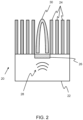
- the oral treatment unit 20 comprising the material structure 26 as described above, provides a means of shaping and focusing the received radio frequency signal 28 by way of a focusing function implemented, for example, by an array of unit cells as described above.
- the material structure 26 may either transform propagating electromagnetic fields 28 into an evanescent wave, thereby promoting a passive EM field 30, or manipulate/redirect propagating waves, as for instance, promoting negative refraction, and enabling field focusing 30.
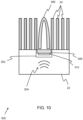
- Figure 4 shows a further example of an oral treatment unit 60 according to an aspect of the invention.
- Reference numerals shared with Figure 2 refer to similar features.
- the oral treatment unit 60 further comprises an additional cleaning element 62, and wherein the material structure 26 is incorporated into the additional cleaning element or wherein the material structure 26 is arranged to form the additional cleaning element 62 itself.
- the metamaterial unit cell or the additional cleaning element 62 comprising the metamaterial structure may perform a dual function: the first being mechanical cleaning alongside the unmodified cleaning elements 24, i.e. bristles; and the second being EM field focusing, by means of a material structure incorporated into the additional cleaning element 62 which may comprise either an elongated out of plane spiral resonator embedded in a dielectric matrix or large diameter (wide) polymeric cleaning elements (e.g. bristles) with planar spiral metamaterial structures printed on top and bottom layers, which may be connected by a conductive wire passing through the length of the additional cleaning element.
- a material structure incorporated into the additional cleaning element 62 which may comprise either an elongated out of plane spiral resonator embedded in a dielectric matrix or large diameter (wide) polymeric cleaning elements (e.g. bristles) with planar spiral metamaterial structures printed on top and bottom layers, which may be connected by a conductive wire passing through the length of the additional cleaning element.
- the basic design of the unit cells of the material structure may be the same as the one shown in Figure 3a .
- a cleaning function is added to the material structure as the metamaterial is directly integrated in a cleaning element, such as a bristle, a silicone pillar, a rubbery pad or a prophy cup.
- Figure 5 shows a further example of an oral treatment unit 70 according to an aspect of the invention.
- Reference numerals shared with Figure 2 refer to similar features.
- the oral treatment unit 70 further comprises a transmitter coil 72 adapted to transmit an electromagnetic field 28 to be received by the material structure 26 as described above.
- a transmitter coil which may comprise a single loop or a solenoid, transmitting the electromagnetic field is located within platen of the oral treatment unit.
- the transmitter coil may be integrated into to the oral treatment unit or be temporarily attached to the oral treatment unit.
- the material structure is positioned at a fixed distance from the transmitter coil, typically 0.5-5 mm. The distance may be adjusted to optimize the coupling between the transmitter coil and the material structure.
- the coil loops and the spiral metamaterial may be faced parallel and coaxially to each other and coaxially aligned in one plane to efficiently couple the electromagnetic field into the metamaterial.
- the negative or near-zero effective properties (permittivity, refractive index and permeability) of the metamaterial minimizes electromagnetic field and energy leakage and promotes better near-field focusing 30 towards the tooth or gum tissue.
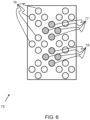
- Figure 6 shows a further example of an oral treatment unit 75 comprising a plurality of cleaning elements 76, an array of first unit cells 77 adapted to receive and confine an electromagnetic field with a first frequency within a first frequency range and an array of second unit cells 78, adapted to receive and confine an electromagnetic field with a second frequency within a second frequency range different from the first frequency range.
- the oral treatment unit or the material structure may comprise one or more arrays of multiple unit cells, each working as an electromagnetic field lens tailored to a different operation frequency, thus promoting multiple operation modes which can be implemented in oral care devices such as toothbrushes and mouthpieces.
- either one multi-harmonic transmitter coil or multiple transmitter coils transmitting the electromagnetic field at multiple frequencies may be incorporated into the oral treatment unit or the base unit.
- the oral treatment unit may include an array of metamaterials configured to provide enhanced EM field confinement for different resonance frequencies, with the possibility of allowing multiple operation modes targeting specific zones in the oral cavity, such as dental calculus, biofilm, stains, gum tissue, pockets, dental implants, orthodontics and the like.
- multiple EM energy levels can be provided on demand, without the need to activate different device operation modes.
- the oral treatment unit may perform a cleaning mode for stain removal, a calculus treatment mode, or a gum health mode for treatment of gingival pockets all of which may require different device settings.
- the oral treatment units described above may be part of or integrated in an electric toothbrush head to be used in combination with a base unit, such as an electric toothbrush handle.
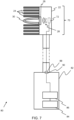
- Figure 7 shows an example of an oral cleaning device 80 according to aspects of the invention, wherein the energy and signal transmission path to a transmitter coil 72 inside the oral treatment unit 70 is indicated by a dotted line.
Landscapes
- Health & Medical Sciences (AREA)
- Dentistry (AREA)
- Epidemiology (AREA)
- Life Sciences & Earth Sciences (AREA)
- Animal Behavior & Ethology (AREA)
- General Health & Medical Sciences (AREA)
- Public Health (AREA)
- Veterinary Medicine (AREA)
- Brushes (AREA)
- Dental Tools And Instruments Or Auxiliary Dental Instruments (AREA)
Claims (14)
- Mundbehandlungseinheit (300) zum Eindämmen und Modulieren eines elektromagnetischen Felds, das eine Frequenz in dem Bereich von 1 MHz bis 300 GHz aufweist, und dazu eingerichtet, in eine Mundhöhle eines Benutzers eingeführt zu werden, die Mundbehandlungseinheit umfassend:ein erstes Reinigungselement (24), das an die Mundbehandlungseinheit gekoppelt oder in diese integriert ist; undein Element zum Fokussieren des elektromagnetischen Felds (302), das an die Mundbehandlungseinheit gekoppelt ist oder in diese integriert ist, und das dazu eingerichtet ist, ein elektromagnetisches Feld zu empfangen, das eine anfängliche Frequenz aufweist, und ein fokussiertes elektromagnetisches Feld auszugeben, wobei das Element zum Fokussieren des elektromagnetischen Felds eine erste Metamaterialstruktur (308) umfasst, wobei die erste Metamaterialstruktur eine Vielzahl von Einheitszellen umfasst und eine negative oder nahe Null liegende dielektrische Permittivität und/oder eine nahe Null liegende magnetische Permittivität und/oder einen negativen oder nahe Null liegenden Brechungsindex aufweist, um dadurch eine erste passive elektromagnetische Feldfokussierungsfunktion bereitzustellen, die das empfangene elektromagnetische Feld in einem gegebenen Abstand von der ersten Metamaterialstruktur eindämmt, indem sie eines oder mehrere durchführt von:einer Dämpfungsratensteuerfunktion in dem Nahfeldbereich der ersten Metamaterialstruktur; odereiner Ausbreitungsrichtungsmodifizierungsfunktion auf dem elektromagnetischen Feld; undwobei das Element zum Fokussieren des elektromagnetischen Felds eine Modulationsfunktion aufweist, die das eingedämmte elektromagnetische Feld moduliert und dadurch ein moduliertes elektromagnetisches Feld erzeugt,wobei das Element zum Fokussieren des elektromagnetischen Felds (302) einen mechanischen Aktuator (310) zum Durchführen der Modulationsfunktion umfasst, wobei der mechanische Aktuator dazu eingerichtet ist, die erste Metamaterialstruktur in eine mechanische Oszillation zu versetzen.
- Mundbehandlungseinheit nach Anspruch 1, wobei der mechanische Aktuator eine flexible Komponente (335) umfasst, und wobei die erste Metamaterialstruktur in den mechanischen Aktuator integriert ist.
- Mundbehandlungseinheit nach Anspruch 1 oder 2, wobei die Modulationsfunktion eine Frequenzabwärtsverschiebungsfunktion umfasst, die die anfängliche Frequenz des eingedämmten elektromagnetischen Felds moduliert und dadurch ein moduliertes, eingedämmtes elektromagnetisches Feld erzeugt, das eine modulierte Frequenz in einem gewünschten Frequenzbereich aufweist, die niedriger als die anfängliche Frequenz ist.
- Mundbehandlungseinheit nach einem der Ansprüche 1 bis 3, wobei die Modulationsfunktion dazu eingerichtet ist, eines oder mehrere zu modulieren von:einer Frequenz des eingedämmten elektromagnetischen Felds;einer Amplitude des eingedämmten elektromagnetischen Felds; undeiner Phase des eingedämmten elektromagnetischen Felds.
- Mundbehandlungseinheit (300) nach einem der Ansprüche 1 bis 4, wobei der mechanische Aktuator eines oder mehrere umfasst von:einem CMUT;einem elektroaktiven Polymer;einem ferroelektrischen Polymeraktuator;einem piezoelektrischen Aktuator;einem piezoelektrischen Biegeaktuator; undeiner MEMS-Kippbewegungsvorrichtung.
- Mundbehandlungseinheit (300) zum Eindämmen und Modulieren eines elektromagnetischen Felds, das eine Frequenz in dem Bereich von 1 MHz bis 300 GHz aufweist, und dazu eingerichtet, in eine Mundhöhle eines Benutzers eingeführt zu werden, die Mundbehandlungseinheit umfassend:ein erstes Reinigungselement (24), das an die Mundbehandlungseinheit gekoppelt oder in diese integriert ist; undein Element zum Fokussieren des elektromagnetischen Felds (302), das an die Mundbehandlungseinheit gekoppelt ist oder in diese integriert ist, und das dazu eingerichtet ist, ein elektromagnetisches Feld zu empfangen, das eine anfängliche Frequenz aufweist, und ein fokussiertes elektromagnetisches Feld auszugeben, wobei das Element zum Fokussieren des elektromagnetischen Felds eine erste Metamaterialstruktur (308) umfasst, wobei die erste Metamaterialstruktur eine Vielzahl von Einheitszellen umfasst und eine negative oder nahe Null liegende dielektrische Permittivität und/oder eine nahe Null liegende magnetische Permittivität und/oder einen negativen oder nahe Null liegenden Brechungsindex aufweist, um dadurch eine erste passive elektromagnetische Feldfokussierungsfunktion bereitzustellen, die das empfangene elektromagnetische Feld in einem gegebenen Abstand von der ersten Metamaterialstruktur eindämmt, indem sie eines oder mehrere durchführt von:einer Dämpfungsratensteuerfunktion in dem Nahfeldbereich der ersten Metamaterialstruktur; odereiner Ausbreitungsrichtungsmodifizierungsfunktion auf dem elektromagnetischen Feld; undwobei das Element zum Fokussieren des elektromagnetischen Felds eine Modulationsfunktion aufweist, die das eingedämmte elektromagnetische Feld moduliert und dadurch ein moduliertes elektromagnetisches Feld erzeugt,wobei:die erste Metamaterialstruktur eine zweite passive elektromagnetische Feldfokussierungsfunktion aufweist, und wobei die erste passive elektromagnetische Feldfokussierungsfunktion auf eine erste Frequenzkomponente des empfangenen elektromagnetischen Felds wirkt und die zweite passive elektromagnetische Feldfokussierungsfunktion auf eine zweite Frequenzkomponente des empfangenen elektromagnetischen Felds wirkt; oderdas Element zum Fokussieren des elektromagnetischen Felds eine zweite Metamaterialstruktur (355) umfasst, wobei die zweite Metamaterialstruktur eine Vielzahl von Einheitszellen umfasst und eine negative oder nahe Null liegende dielektrische Permittivität und/oder eine nahe Null liegende magnetische Permittivität und/oder einen negativen oder nahe Null liegenden Brechungsindex aufweist, um dadurch eine zweite passive elektromagnetische Feldfokussierungsfunktion bereitzustellen, und wobei die erste passive elektromagnetische Feldfokussierungsfunktion auf eine erste Frequenzkomponente des empfangenen elektromagnetischen Felds wirkt und die zweite passive elektromagnetische Feldfokussierungsfunktion auf eine zweite Frequenzkomponente des empfangenen elektromagnetischen Felds wirkt.
- Mundbehandlungseinheit (340) nach Anspruch 6, umfassend einer erste und einer zweite Metamaterialstruktur, wobei die erste Metamaterialstruktur (350) relativ zu der zweiten Metamaterialstruktur (355) angeordnet ist, sodass die fokussierte erste Frequenzkomponente und die fokussierte zweite Frequenzkomponente innerhalb sowohl der ersten Metamaterialstruktur als auch der zweiten Metamaterialstruktur eingedämmt sind, wodurch bewirkt wird, das eine Frequenzmischung zwischen der fokussierten ersten Frequenzkomponente des empfangenen elektromagnetischen Felds und der fokussierten zweiten Frequenzkomponente des empfangenen elektromagnetischen Felds stattfindet, wodurch die Frequenzmodulationsfunktion durchgeführt wird.
- Mundbehandlungseinheit (340) nach Anspruch 7, wobei die erste Metamaterialstruktur und/oder die zweite Metamaterialstruktur eine Zeitverzögerungsfunktion aufweist, die bewirkt, dass dem fokussierten elektromagnetischen Feld eine Zeitdomänen-Wellenform verliehen wird.
- Mundbehandlungsvorrichtung nach einem der Ansprüche 1 bis 8, wobei die oder jede Metamaterialstruktur (26) eines oder mehrere aufweist von:einer negativen oder nahe Null liegenden effektiven Permittivität;einer negativen oder nahe Null liegenden effektiven Permeabilität; undeinem negativen oder nahe Null liegenden Brechungsindex.
- Mundbehandlungseinheit (300) nach einem der Ansprüche 1 bis 9, wobei das Element zum Fokussieren des elektromagnetischen Felds weiter eine nicht-lineare elektronische Komponente umfasst, die dazu eingerichtet ist, die Frequenzmodulationsfunktion auf dem empfangenen elektromagnetischen Feld durchzuführen und, optional, wobei die nicht-lineare elektronische Komponente einer oder mehrere umfasst von:einer Diode;einer Vielzahl von Dioden;einer MIM-Vorrichtung;einem Transistor; undeinem passiven Transistor.
- Mundbehandlungseinheit (300) nach einem der Ansprüche 1 bis 10, wobei die Mundbehandlungseinheit weiter eine oder mehrere Übertragungsspulen umfasst, die dazu eingerichtet sind, das elektromagnetische Feld zu erzeugen, das durch das Element zum Fokussieren des elektromagnetischen Felds zu empfangen ist.
- Mundbehandlungsvorrichtung (10), umfassend:eine oder mehrere Mundbehandlungseinheiten (300) nach einem der Ansprüche 1 bis 10, undeine Basiseinheit (135), die dazu eingerichtet ist, mit der Mundbehandlungseinheit (300) nach einem der Ansprüche 1 bis 10 verwendet zu werden, die Basiseinheit umfassend eine Leistungsquelle (140), eine Einheit zur Erzeugung eines elektrischen Signals (145), die an die Leistungsquelle gekoppelt ist und dazu eingerichtet ist, ein elektrisches Signal zu erzeugen, das eine Frequenz in einem gegebenen Frequenzbereich aufweist, und eine oder mehrere Übertragungsspulen (130), die mit dem elektrischen Signalerzeuger in Kommunikation stehen und dazu eingerichtet sind, mindestens ein elektromagnetisches Feld, das eine Frequenz innerhalb des gegebenen Frequenzbereichs aufweist, zu erzeugen und an die Mundbehandlungseinheit zu übertragen.wobei die Mundbehandlungseinheit dazu eingerichtet ist, vorübergehend an die Basiseinheit gekoppelt zu werden.
- Mundbehandlungsvorrichtung (80), umfassend:eine oder mehrere Mundbehandlungseinheiten (300) nach Anspruch 11,eine Basiseinheit (82), die dazu eingerichtet ist, mit der einen oder den mehreren Mundbehandlungseinheiten (300) verwendet zu werden, die Basiseinheit umfassend eine Leistungsquelle (84) und eine Einheit (86) zur Erzeugung eines elektrischen Signals, die an die Leistungsquelle gekoppelt ist und dazu eingerichtet ist, ein elektrisches Antriebssignal zu erzeugen, das eine Frequenz in einem gegebenen Frequenzbereich aufweist, das die eine oder die mehreren Übertragungsspulen der Mundbehandlungseinheit speist,wobei die Mundbehandlungseinheit dazu eingerichtet ist, vorübergehend an die Basiseinheit gekoppelt zu werden, und wobei die Mundbehandlungseinheit weiter einen ersten elektrischen Kontakt (88) umfasst und die Basiseinheit weiter einen zweiten elektrischen Kontakt (90) umfasst, wobei der erste elektrische Kontakt und der zweite elektrische Kontakt in Kontakt stehen, wenn die Mundbehandlungseinheit an die Basiseinheit gekoppelt ist.
- Mundbehandlungsvorrichtung (80, 100) nach Anspruch 12 oder 13, wobei:die Mundbehandlungseinheit ein elektrischer Zahnbürstenkopf oder ein Teil eines elektrischen Zahnbürstenkopfs ist, wobei der elektrische Zahnbürstenkopf optional eine Fluidabgabedüse umfasst und wobei die Basiseinheit ein elektrischer Zahnbürstengriff ist; odereine oder mehrere Mundbehandlungseinheiten dazu eingerichtet sind, mindestens einen Teil eines Bogens eines Mundbehandlungsmundstücks zu bilden, und wobei die Basiseinheit ein elektrischer Mundstückgriff ist.
Applications Claiming Priority (2)
| Application Number | Priority Date | Filing Date | Title |
|---|---|---|---|
| EP20176968.4A EP3915436A1 (de) | 2020-05-28 | 2020-05-28 | Mundbehandlungsvorrichtung |
| PCT/EP2021/063400 WO2021239550A1 (en) | 2020-05-28 | 2021-05-20 | An oral treatment device |
Publications (2)
| Publication Number | Publication Date |
|---|---|
| EP4157034A1 EP4157034A1 (de) | 2023-04-05 |
| EP4157034B1 true EP4157034B1 (de) | 2025-07-09 |
Family
ID=70918247
Family Applications (2)
| Application Number | Title | Priority Date | Filing Date |
|---|---|---|---|
| EP20176968.4A Withdrawn EP3915436A1 (de) | 2020-05-28 | 2020-05-28 | Mundbehandlungsvorrichtung |
| EP21726412.6A Active EP4157034B1 (de) | 2020-05-28 | 2021-05-20 | Mundbehandlungseinheit und entsprechende mundbehandlungsvorrichtung |
Family Applications Before (1)
| Application Number | Title | Priority Date | Filing Date |
|---|---|---|---|
| EP20176968.4A Withdrawn EP3915436A1 (de) | 2020-05-28 | 2020-05-28 | Mundbehandlungsvorrichtung |
Country Status (5)
| Country | Link |
|---|---|
| US (1) | US12274354B2 (de) |
| EP (2) | EP3915436A1 (de) |
| JP (1) | JP2023526994A (de) |
| CN (1) | CN115715162A (de) |
| WO (1) | WO2021239550A1 (de) |
Citations (1)
| Publication number | Priority date | Publication date | Assignee | Title |
|---|---|---|---|---|
| WO2014016718A1 (en) * | 2012-07-25 | 2014-01-30 | Koninklijke Philips N.V. | Tooth cleaning device and method of operation therefor |
Family Cites Families (7)
| Publication number | Priority date | Publication date | Assignee | Title |
|---|---|---|---|---|
| GB2523741A (en) * | 2014-02-26 | 2015-09-09 | Medical Wireless Sensing Ltd | Sensor |
| US10201701B2 (en) * | 2015-03-29 | 2019-02-12 | Home Skinovations Ltd. | Oral electrical cleaning device |
| EP3277124B1 (de) * | 2015-03-31 | 2024-02-14 | Koninklijke Philips N.V. | Mundreinigungsvorrichtung mit anpassbarer form und mundpflegeverfahren |
| RO131088A0 (ro) * | 2015-09-01 | 2016-05-30 | Denticare Implantology Center S.R.L. | Trusă stomatologică |
| US10312597B2 (en) * | 2015-09-25 | 2019-06-04 | The Boeing Company | Ferrite-enhanced metamaterials |
| US10218080B2 (en) | 2016-09-14 | 2019-02-26 | Verizon Patent And Licensing Inc. | Passive metamaterial heterodyning antenna |
| EP3915513A1 (de) | 2020-05-28 | 2021-12-01 | Koninklijke Philips N.V. | Mundbehandlungsvorrichtung |
-
2020
- 2020-05-28 EP EP20176968.4A patent/EP3915436A1/de not_active Withdrawn
-
2021
- 2021-05-20 WO PCT/EP2021/063400 patent/WO2021239550A1/en not_active Ceased
- 2021-05-20 EP EP21726412.6A patent/EP4157034B1/de active Active
- 2021-05-20 CN CN202180038397.1A patent/CN115715162A/zh active Pending
- 2021-05-20 US US17/927,689 patent/US12274354B2/en active Active
- 2021-05-20 JP JP2022572345A patent/JP2023526994A/ja active Pending
Patent Citations (1)
| Publication number | Priority date | Publication date | Assignee | Title |
|---|---|---|---|---|
| WO2014016718A1 (en) * | 2012-07-25 | 2014-01-30 | Koninklijke Philips N.V. | Tooth cleaning device and method of operation therefor |
Also Published As
| Publication number | Publication date |
|---|---|
| CN115715162A (zh) | 2023-02-24 |
| WO2021239550A1 (en) | 2021-12-02 |
| US12274354B2 (en) | 2025-04-15 |
| JP2023526994A (ja) | 2023-06-26 |
| EP4157034A1 (de) | 2023-04-05 |
| US20230172351A1 (en) | 2023-06-08 |
| EP3915436A1 (de) | 2021-12-01 |
Similar Documents
| Publication | Publication Date | Title |
|---|---|---|
| Meng et al. | Design and optimization of ultrasonic wireless power transmission links for millimeter-sized biomedical implants | |
| JP6360487B2 (ja) | 複数の高調波モードを有するマイクロ機械加工超音波変換器アレイ | |
| Jiang et al. | Multichannel piezo‐ultrasound implant with hybrid waterborne acoustic metastructure for selective wireless energy transfer at megahertz frequencies | |
| Kashani et al. | Design and optimization of ultrasonic links with phased arrays for wireless power transmission to biomedical implants | |
| US20110257532A1 (en) | Ultrasonic probe and method of preparing ultrasonic probe | |
| KR102472295B1 (ko) | 초음파 변환기 | |
| JP2008009435A (ja) | 光ファイバ上に屈曲波を励起するアクチュエータ | |
| EP4157142B1 (de) | Mundbehandlungsvorrichtung | |
| EP4157034B1 (de) | Mundbehandlungseinheit und entsprechende mundbehandlungsvorrichtung | |
| CN217774689U (zh) | 一种用于超声波牙刷头的纵波超声换能器 | |
| CN115697135B (zh) | 口腔清洁和/或处理装置及其配置方法 | |
| CN118298794A (zh) | 一种可调控声学透射/反射螺旋聚焦透镜 | |
| JPH02503753A (ja) | 改良された接続回路を備えるエコーグラフィー用プローブ | |
| KR20030084401A (ko) | 진동촉각 디스플레이 모듈 및 다채널 진동촉각 장치 | |
| JP5605567B2 (ja) | アレイ型超音波送波器 | |
| JPWO2021239548A5 (de) | ||
| KR20190045531A (ko) | 선집속 초음파 트랜스듀서 및 이를 포함하는 고강도 선집속 초음파 구동장치 | |
| US20240082876A1 (en) | Imaging devices having piezoelectric transceivers with harmonic characteristics | |
| Ghanbari et al. | Optimizing Volumetric Efficiency and Modeling Backscatter Communication in Biosensing Ultrasonic Implants | |
| KR102080258B1 (ko) | 고강도 선집속 초음파 구동시스템 | |
| Abbasi Shakooh | Data Rate Enhancement in Ultrasonic Data Telemetry Links | |
| WO2022211836A1 (en) | Imaging devices having piezoelectric transceivers with harmonic characteristics | |
| JP2021101510A (ja) | 超音波放射器具及び超音波装置 | |
| JP2002034995A (ja) | 超音波手術装置 |
Legal Events
| Date | Code | Title | Description |
|---|---|---|---|
| STAA | Information on the status of an ep patent application or granted ep patent |
Free format text: STATUS: UNKNOWN |
|
| STAA | Information on the status of an ep patent application or granted ep patent |
Free format text: STATUS: THE INTERNATIONAL PUBLICATION HAS BEEN MADE |
|
| PUAI | Public reference made under article 153(3) epc to a published international application that has entered the european phase |
Free format text: ORIGINAL CODE: 0009012 |
|
| STAA | Information on the status of an ep patent application or granted ep patent |
Free format text: STATUS: REQUEST FOR EXAMINATION WAS MADE |
|
| 17P | Request for examination filed |
Effective date: 20230102 |
|
| AK | Designated contracting states |
Kind code of ref document: A1 Designated state(s): AL AT BE BG CH CY CZ DE DK EE ES FI FR GB GR HR HU IE IS IT LI LT LU LV MC MK MT NL NO PL PT RO RS SE SI SK SM TR |
|
| STAA | Information on the status of an ep patent application or granted ep patent |
Free format text: STATUS: EXAMINATION IS IN PROGRESS |
|
| 17Q | First examination report despatched |
Effective date: 20230727 |
|
| DAV | Request for validation of the european patent (deleted) | ||
| DAX | Request for extension of the european patent (deleted) | ||
| GRAP | Despatch of communication of intention to grant a patent |
Free format text: ORIGINAL CODE: EPIDOSNIGR1 |
|
| STAA | Information on the status of an ep patent application or granted ep patent |
Free format text: STATUS: GRANT OF PATENT IS INTENDED |
|
| INTG | Intention to grant announced |
Effective date: 20250127 |
|
| GRAS | Grant fee paid |
Free format text: ORIGINAL CODE: EPIDOSNIGR3 |
|
| GRAA | (expected) grant |
Free format text: ORIGINAL CODE: 0009210 |
|
| STAA | Information on the status of an ep patent application or granted ep patent |
Free format text: STATUS: THE PATENT HAS BEEN GRANTED |
|
| AK | Designated contracting states |
Kind code of ref document: B1 Designated state(s): AL AT BE BG CH CY CZ DE DK EE ES FI FR GB GR HR HU IE IS IT LI LT LU LV MC MK MT NL NO PL PT RO RS SE SI SK SM TR |
|
| REG | Reference to a national code |
Ref country code: GB Ref legal event code: FG4D |
|
| REG | Reference to a national code |
Ref country code: CH Ref legal event code: EP |
|
| REG | Reference to a national code |
Ref country code: IE Ref legal event code: FG4D |
|
| REG | Reference to a national code |
Ref country code: DE Ref legal event code: R096 Ref document number: 602021033783 Country of ref document: DE |
|
| REG | Reference to a national code |
Ref country code: NL Ref legal event code: MP Effective date: 20250709 |