EP4153063B1 - Tupfer zur entnahme biologischer proben und verfahren zur herstellung eines solchen tupfers - Google Patents
Tupfer zur entnahme biologischer proben und verfahren zur herstellung eines solchen tupfers Download PDFInfo
- Publication number
- EP4153063B1 EP4153063B1 EP21731292.5A EP21731292A EP4153063B1 EP 4153063 B1 EP4153063 B1 EP 4153063B1 EP 21731292 A EP21731292 A EP 21731292A EP 4153063 B1 EP4153063 B1 EP 4153063B1
- Authority
- EP
- European Patent Office
- Prior art keywords
- rod
- fibres
- swab
- textile substrate
- end portion
- Prior art date
- Legal status (The legal status is an assumption and is not a legal conclusion. Google has not performed a legal analysis and makes no representation as to the accuracy of the status listed.)
- Active
Links
Images




Classifications
-
- A—HUMAN NECESSITIES
- A61—MEDICAL OR VETERINARY SCIENCE; HYGIENE
- A61F—FILTERS IMPLANTABLE INTO BLOOD VESSELS; PROSTHESES; DEVICES PROVIDING PATENCY TO, OR PREVENTING COLLAPSING OF, TUBULAR STRUCTURES OF THE BODY, e.g. STENTS; ORTHOPAEDIC, NURSING OR CONTRACEPTIVE DEVICES; FOMENTATION; TREATMENT OR PROTECTION OF EYES OR EARS; BANDAGES, DRESSINGS OR ABSORBENT PADS; FIRST-AID KITS
- A61F13/00—Bandages or dressings; Absorbent pads
- A61F13/15—Absorbent pads, e.g. sanitary towels, swabs or tampons for external or internal application to the body; Supporting or fastening means therefor; Tampon applicators
- A61F13/38—Swabs having a stick-type handle, e.g. cotton tips
- A61F13/385—Apparatus or processes of manufacturing
-
- A—HUMAN NECESSITIES
- A61—MEDICAL OR VETERINARY SCIENCE; HYGIENE
- A61B—DIAGNOSIS; SURGERY; IDENTIFICATION
- A61B10/00—Instruments for taking body samples for diagnostic purposes; Other methods or instruments for diagnosis, e.g. for vaccination diagnosis, sex determination or ovulation-period determination; Throat striking implements
- A61B10/0045—Devices for taking samples of body liquids
-
- A—HUMAN NECESSITIES
- A61—MEDICAL OR VETERINARY SCIENCE; HYGIENE
- A61B—DIAGNOSIS; SURGERY; IDENTIFICATION
- A61B10/00—Instruments for taking body samples for diagnostic purposes; Other methods or instruments for diagnosis, e.g. for vaccination diagnosis, sex determination or ovulation-period determination; Throat striking implements
- A61B10/02—Instruments for taking cell samples or for biopsy
-
- A—HUMAN NECESSITIES
- A61—MEDICAL OR VETERINARY SCIENCE; HYGIENE
- A61F—FILTERS IMPLANTABLE INTO BLOOD VESSELS; PROSTHESES; DEVICES PROVIDING PATENCY TO, OR PREVENTING COLLAPSING OF, TUBULAR STRUCTURES OF THE BODY, e.g. STENTS; ORTHOPAEDIC, NURSING OR CONTRACEPTIVE DEVICES; FOMENTATION; TREATMENT OR PROTECTION OF EYES OR EARS; BANDAGES, DRESSINGS OR ABSORBENT PADS; FIRST-AID KITS
- A61F13/00—Bandages or dressings; Absorbent pads
- A61F13/15—Absorbent pads, e.g. sanitary towels, swabs or tampons for external or internal application to the body; Supporting or fastening means therefor; Tampon applicators
- A61F13/38—Swabs having a stick-type handle, e.g. cotton tips
-
- A—HUMAN NECESSITIES
- A61—MEDICAL OR VETERINARY SCIENCE; HYGIENE
- A61B—DIAGNOSIS; SURGERY; IDENTIFICATION
- A61B10/00—Instruments for taking body samples for diagnostic purposes; Other methods or instruments for diagnosis, e.g. for vaccination diagnosis, sex determination or ovulation-period determination; Throat striking implements
- A61B10/0096—Casings for storing test samples
-
- A—HUMAN NECESSITIES
- A61—MEDICAL OR VETERINARY SCIENCE; HYGIENE
- A61B—DIAGNOSIS; SURGERY; IDENTIFICATION
- A61B10/00—Instruments for taking body samples for diagnostic purposes; Other methods or instruments for diagnosis, e.g. for vaccination diagnosis, sex determination or ovulation-period determination; Throat striking implements
- A61B10/02—Instruments for taking cell samples or for biopsy
- A61B2010/0216—Sampling brushes
Definitions
- the present invention relates to a swab for taking biological samples, and to a method for making such a swab.
- a swab essentially consists of a support rod which, at a free end or tip portion thereof, is coated with a fibrous layer, consisting of synthetic fibres (e.g., rayon, polyester, polyamide) or natural fibres (e.g., cotton).
- the layer of fibres is made so to have hydrophilic properties so as to allow a rapid absorption of an amount of sample to be taken and tested.
- the fibres forming the fibrous layer are fixed to the rod by a layer of adhesive.
- Cotton swabs are made by winding a wad of fibres around a tip portion of the support rod, on which a layer of adhesive has been previously applied.
- Cotton swabs ensure a good liquid sample absorption capacity and are generally used for seeding on culture mediums to check for bacterial growth. Very often, after taking the sample, the absorbent part of the swab is stored inside a test-tube containing a gelatinous substance, referred to as transport medium, which has the task of preserving the taken sample until the analytical step.
- transport medium a gelatinous substance
- the release of the sample from a cotton swab occurs simply by grasping the swab rod and gently swiping the tip with the fibrous layer impregnated with liquid, for example, on a Petri dish with culture medium.
- the sample is spread on the dish with an operation referred to as swabbing.
- the swabbing operation is repeated and accurate, it does not, however, allow the entire absorbed sample volume to be released since the part of the sample which has penetrated inside the volume of the wad, towards the tip, during such an operation is unable to be squeezed towards the surface and then released from the swab.
- Flocked swabs are made by applying fibres by means of flocking to the tip portion of the swab support rod, as described in patent EP 1608268 B2 .
- the flocking process has been known for a long time in various fields: textiles, furniture, automotive, cosmetics.
- Flocking consists in projecting natural or artificial fibres of small dimensions against a surface coated with adhesive.
- the energy to orient and accelerate the fibres, so as to make them penetrate the adhesive layer is provided by an electrostatic field applied between the fibre dispenser and the surface to be flocked.
- the distribution and positioning of the fibres can be obtained mechanically by means of appropriate vibrators.
- the fibres used for the flocking process can have lengths ranging from a few tenths of a millimetre to a few millimetres and very low counts. They can be obtained with a physical-chemical process from polyamide, rayon, viscose, cotton fibres in an infinite variety of colours and sizes.
- the fibres deposited with the electrostatic flocking technique tend to arrange themselves in an orthogonal manner with respect to the gluing surface; this arrangement of the fibres favours the absorption of the liquid sample and the subsequent release thereof into the transport medium.
- a flocked swab ensures a release of up to 900 of the absorbed sample, much higher than that of a cotton swab, which is about 400.
- flocking is an onerous process which requires long production times and complex plants.
- the glue it is necessary to wait for the glue to dry and then clean the swab of any residual fibres which have not adhered to the adhesive layer, or of particles which have detached from the adhesive layer.
- the cleaning is carried out by brushing, vacuuming, or blowing, for example. This further complicates the production process.
- JP 2013 224951 A discloses a swab according to the preamble of claim 1.
- a swab for taking biological samples which has a layer of fibres arranged orthogonally to the surface of the support rod and which can be made in an operatively simpler manner than a flocked swab.
- the present invention relates to a swab for taking biological samples, intended in particular for taking samples from the oral-nasal, ocular, rectal, urethral, or vaginal cavities of a patient.
- the scope of the invention is defined by independent claims 1, 11 and 12. Preferred embodiments are defined in the dependent claims.
- reference numeral 1 indicates as a whole a swab for taking biological samples according to the invention.
- the swab 1 for taking biological samples comprises a support rod 2 having an end portion 2a coated with a layer of fibres 10.
- Some examples of swabs 1 are diagrammatically depicted in Figures 1a, b, c, d, e .
- the support rod 2 can be of any length and shape according to the specific requirements which the swab must fulfil.
- the end portion 2a intended to be coated can be cylindrical, ogival in shape or have protruding appendages defining localized enlargements.
- the support rod 2 can be provided with one or more circumferential bottlenecks 5, included as breaking points of the rod 2, so as to separate the end portion coated with the layer of fibres 10 from the rest of the rod 2.
- the rod 2 can be made of any suitable material, which gives an adequate rigidity to the rod itself to allow the operation thereof during use.
- the rod 2 is made of plastic material, such as polypropylene, polyester, polyethylene, polyamide, shockproof polystyrene, etc.
- Each of the fibres 10 of such a layer extends in length substantially orthogonally to the surface of the support rod 2 with a corresponding free end portion 10a.
- the aforesaid layer of fibres 10 has hydrophilic properties to allow the absorption of biological samples.
- the hydrophilic properties of the layer of fibres 10 result from the arrangement of the fibres themselves inside the layer and from the phenomena of capillarity induced by the mass of fibres.
- each of the aforementioned fibres 10 is mechanically anchored at the bottom portion 10b thereof to a textile substrate 20.
- the textile substrate 20 is fixed to a surface of the end portion 2a of the rod 2.
- the fibres are not deposited on the support rod directly by flocking, but by means of a textile substrate.
- the formation of the layer of fibres can be carried out separately from the step of fixing such a layer to the support rod. This significantly simplifies the manufacturing process of the swab 1, completely freeing it from the flocking technique.
- the function of absorbing biological samples is performed by the layer of fibres 10, mainly due to capillarity phenomena between the fibres.
- the amount of biological sample which can be collected from a swab 1 depends on the features of the layer of fibres 10 (fibre count, length, surface distribution density) and on the surface extension of the layer of fibres 10.
- the substrate 20 itself can also partially contribute to the absorption function of the biological samples, in addition to the layer of fibres.
- the layer of adhesive to which the fibres are directly fixed in flocked swabs cannot contribute to the absorption of biological samples.
- each of the aforementioned fibres 10 is wedged in the weave of the textile substrate so as to be mechanically retained thereby.
- each of the aforesaid fibres 10 crosses the textile substrate 20 so that:
- the aforesaid fibres 10 are joined together in pairs at the respective bottom portions 10b to form a single body.
- each pair of "joined" fibres is defined by a single fibre piece passing through the substrate 20 in two different points.
- the two ends of such a piece protruding from the outer face 20a of the substrate 20 at two different points, form the free end portions 10a of two fibres 10, while the portion of the piece which is located below the substrate, adjacent to the inner face 20b of the latter, forms the bottom portions 10b of such two fibres 10.
- the textile substrate 20 and the fibres 10 are associated with the aforesaid end portion 2a of the rod 2 as a pre-assembled body.
- the aforesaid pre-assembled body consists of a velvet ribbon.
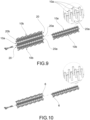
- FIG. 9 and 10 The production process of a velvet ribbon is well known per se and is diagrammatically shown in Figures 9 and 10 . More in detail, two textile ribbons, preferably edged in a longitudinal direction by selvedges 6, are tightly sewn together, until the surface between the two edges of the ribbon is filled with stitches. The two ribbons are then separated from each other by cutting the sewing threads at the gap existing therebetween. The cut sewing threads separate, creating a layer of free hairs (fibres) on one face of each ribbon, which are anchored to the ribbon (textile substrate) at the bottom thereof. The density of the free hair layer depends on the density of the stitches.
- the fibres 10 extend from the textile substrate 20 outwards with substantially the same length.
- the layer of fibres 10 has a substantially uniform height.
- such a length is between 0.5mm and 3mm, and even more preferably between 1.0mm and 1.30mm.
- the aforementioned fibres 10 are uniformly distributed on the textile substrate 20. Even more preferably, the aforementioned fibres 10 are uniformly distributed on the textile substrate 20 with a surface density between 80 and 130 fibres/mm2.
- fibres within the aforesaid count ranges allows to increase the mechanical strength of the fibres themselves, reducing the risk of accidental breakage of the fibres themselves and consequent dispersion thereof during the operations of taking biological samples.
- fibres within the aforesaid count ranges allows to reduce the incidence of intertwining fibres compared to the use of fibres with lower counts.
- the fibres 10 can be:
- the fibres 10 are made of polyamide, preferably nylon 6 or nylon 6,6.
- the aforesaid textile substrate 20 is fixed directly to the surface of the end portion 2a of the rod 2.
- the aforesaid textile substrate 20 is glued to the surface of the end portion 2a of the rod 2.
- a layer of adhesive 3 can form between the textile substrate 20 and the surface of the rod 2, which can partially penetrate the textile substrate 20.
- the adhesive does not go beyond the textile substrate 20 so as not to invade the layer of fibres 10 extending from the outer face 20a of the substrate 20 and which come into direct contact with the patient's body in use.
- the adhesive layer 3 can, however, come into contact with the bottom portions 10b of the fibres. This further contributes to stabilizing the fibres 10 on the swab 1, reducing the risk of accidental detachment of the fibres themselves.
- the substrate 20 to the rod 2 can be included, for example by heat or ultrasound, as a function of the material with which the substrate itself is made.
- gluing is the preferred method.
- the aforesaid textile substrate 20 can be made with threads:
- said textile substrate 20 consists of polyamide threads, preferably nylon 6 or nylon 6,6.
- the textile substrate 20 is made of the same material as the fibres 10, although different materials can also be used.
- the textile substrate 20 consists of threads having a count between 30 dtex and 120 dtex.
- the warp and weft threads can have the same count. However, it is possible to differentiate the count of the weft threads with respect to the warp threads. For example, it is possible to make a textile substrate in which the weft threads have a count of 33 dtex, while the warp threads have a count of 110 dtex.
- the aforesaid textile substrate 20 has a weight between 20 g/m2 and 600 g/m2.
- the weight of the substrate 20 is chosen as a function of the contribution in terms of absorption of the biological samples to be obtained from the substrate 20.
- the present invention also relates to a kit for taking and transporting biological samples.
- a kit for taking and transporting biological samples.
- Such a kit comprises a test-tube containing a culture medium (preferably liquid), and a swab 1 according to the invention, and in particular as described above.
- the present invention also relates to a method for making a swab 1 for taking biological samples according to the invention, and in particular as described above.
- the method comprises the following operating steps:
- the covering step c) is carried out by fixing the textile substrate 20 to the rod 2 at a second face 20b of the substrate 20, opposite said first face 20a, so that the fibres 10 extend orthogonally from the surface of the free end portion 2a of the rod 2 covered by the substrate, forming a layer of fibres 10 which extends all around the aforesaid free end portion 2a.
- the textile substrate 20 provided with fibres 10 consists of a velvet ribbon.
- the aforesaid textile substrate 20 is fixed to the rod 2 by gluing by application of an adhesive to said textile substrate 20 and/or to the rod 2.
- the substrate 20 is adhered to the portion of the rod to be coated by interposing a layer of glue/adhesive between the substrate and the rod.
- the method comprises a step d) of applying a glue on the second face 20b of said textile substrate 20.
- the application of the glue / adhesive is carried out before the covering step c).
- the adhesive/glue can be applied on the rod 2, rather than on the textile substrate. However, it is preferable to apply the adhesive on the substrate rather than on the rod 2 as this is not only operatively simpler but ensures a better and more precise fixing of the substrate on the rod.
- the aforesaid glue/adhesive is chosen with a sufficiently high viscosity as not to completely penetrate the textile substrate 20 and thereby not be absorbed by capillarity by the fibres 10 extending from the first face 20a of the substrate 20.
- the aforesaid textile substrate 20 is ribbon-shaped having a prevailing longitudinal direction of extension X, while the free end portion 2a of the rod 2 has a prevailing extension axis Y.
- the textile substrate 20 (in the form of a ribbon) is wound along the aforesaid prevailing longitudinal direction of extension X on said free end portion 2a of the rod 2 around the prevailing extension axis Y until it covers all said free end portion 2a.
- the winding may require a single turn, or several turns, for example according to a spiral pattern.
- the substrate 20 is wound around said free end portion 2a so that a portion 21 of the substrate 20 itself protrudes beyond the free end of the rod 2.
- the portion 21 of substrate protruding beyond the free end of the rod 2 is partially cut.
- the selvedge of the edge is cut, and the dimensions of the protruding portion are adapted to the portion of the rod still to be covered.
- the residual protruding strips are then forced to close radially on the free end 2a to form a continuous surface also at the free end of the rod 2.
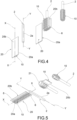
- the winding mode described above ( fig. 5 ) is particularly suitable for coating portions of rods with larger diameters.
- a portion of textile substrate 20 (in the form of a ribbon) is placed at the centre thereof on the end of the rod 2.
- the two symmetrical strips of the substrate are then folded on the rod 2 so as to form a cap which is then pressed so as to adhere to the rod itself.
- the excess ribbon (and in particular the selvedges of the edges) is cut along cutting lines parallel to the prevailing extension axis Y of the rod 2 and the remaining ribbon is made to adhere to the rod to obtain a continuous surface along said cutting lines.
- the winding mode just described ( fig. 4 ) is particularly suitable for coating portions of rods with smaller diameters.
- the method according to the invention can be automated and allow to make swabs in a simple manner, making them immediately available for packaging, unlike production by flocking which requires long drying times and subsequent cleaning of excess fibres.
- the swabs according to the invention allow a higher release of the sample, which can be estimated at about 10%-15% more.
- the swab according to the invention had the following features: - surface coated with fibres equal to 130 mm2; - textile substrate with a weight of 170 g/m2; warp threads 110 dtex; weft threads 33 dtex; protruding fibres 78 dtex and length 1.2 mm (extension with respect to the substrate); substrate and fibres made of 100% polyamide (nylon 6).
- the swab according to the invention had a surface coated with fibres equivalent to that of the flocked swab.
- the comparative test was carried out in two parts: in the first part the amount absorbed by the swabs was evaluated, while in the second part (immediately sequential to the first part) the amount released by the swabs was evaluated.
- Deionized water was taken from a container using a pipette and deposited in a dish. Several tests were conducted by varying the amount of water available in the dish and then by varying the amount absorbed by the swabs.
- the use of deionized water allows the density to be dependent only on temperature (and minimally) and the absorption to not be linked to the absorbed liquid/substrate affinity. Once the drop was placed on the dish, the amount in grams deposited was measured on a thousandth scale (division 1mg).
- the swab under examination was taken and, for a time of 5 seconds, an attempt was made to absorb the maximum amount of liquid by turning the swab around the drop. Once the swab was extracted, the remaining amount was measured in grams. The amount absorbed by the swab is equal to the difference between the deposited amount and the remaining amount. Differential measurement is a measurement which also has the advantage of being free from any absolute measurement error which the scale could have.
- the following procedure was carried out to evaluate the amount released by the swabs.
- a previously prepared piece of filter paper (50x50 mm squares) was placed on the scale and the scale was tared. Taking the swab just soaked in ionized water, it was rotated for 5 seconds around the filter paper while applying light pressure, in order to transfer the maximum amount of liquid from the swab to the filter paper. The entire surface of the filter paper was used. Also in this case, by means of differential measurement, the amount of liquid released by the swab was thus determined.
- the tests were conducted on three different volumes of water available on the dish: 50 ⁇ L, 100 ⁇ L and 200 ⁇ L.
- the volumes 50uL and 100 ⁇ L were chosen because they correspond to the volumes of bacterial suspension which are normally inoculated in quality control tests.
- the volume 200 ⁇ L was chosen to highlight how the trend of the absorption and release cycle stabilizes at infinite volume.
- Table A shown in Figure 11 , collects the data related to the comparative tests between the swab according to the invention and the flocked swab, carried out having a volume of water available on the dish equal to 50 ⁇ L.
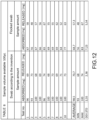
- Table B shown in Figure 12 , collects the data related to the comparative tests between the swab according to the invention and the flocked swab, carried out having a volume of water available on the dish equal to 100 ⁇ L.
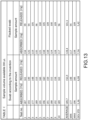
- Table C shown in Figure 13 , collects the data related to the comparative tests between the swab according to the invention and the flocked swab, carried out having a volume of water available on the dish equal to 200 ⁇ L.
- the comparative tests conducted highlight that the swab according to the invention has features and functionality comparable to the flocked swabs available on the market, which currently represent the standard in the microbiological field, especially as regards virological analyses.
- the tests highlighted a greater absorption capacity in absolute terms of the swab according to the invention with respect to flocked swabs, both as regards samples of 100 ⁇ L and 200 ⁇ L, and as regards samples of 50 ⁇ L.
- the comparative tests demonstrated that the swab according to the invention, over a period of a few seconds (time corresponding to clinical use), absorbs a certain amount of sample, and is then able to release a large part of this absorbed amount.
- a swab for taking biological samples according to the invention has at least a biological sample absorption and release capacity which is comparable to (if not even higher than) that of a flocked swab.
- the invention allows to obtain several advantages which have been explained in the description.
- the swab for taking biological samples according to the invention has a layer of fibres arranged orthogonally to the surface of the support rod and can be made in an operatively simpler manner than a flocked swab.
- the swab for taking biological samples according to the invention has a biological sample absorption and release capacity which is comparable to that of a flocked swab.
Landscapes
- Health & Medical Sciences (AREA)
- Life Sciences & Earth Sciences (AREA)
- Engineering & Computer Science (AREA)
- General Health & Medical Sciences (AREA)
- Veterinary Medicine (AREA)
- Heart & Thoracic Surgery (AREA)
- Biomedical Technology (AREA)
- Animal Behavior & Ethology (AREA)
- Public Health (AREA)
- Epidemiology (AREA)
- Vascular Medicine (AREA)
- Pathology (AREA)
- Medical Informatics (AREA)
- Molecular Biology (AREA)
- Surgery (AREA)
- Manufacturing & Machinery (AREA)
- Hematology (AREA)
- Sampling And Sample Adjustment (AREA)
Claims (19)
- Ein Tupfer zur Entnahme biologischer Proben, umfassend einen Stützstab (2) mit einem Endabschnitt (2a), der mit einer Schicht von Fasern (10) beschichtet ist, wobei sich jede Faser in ihrer Länge orthogonal zu einer Oberfläche des Stützstabes (2) mit einem entsprechenden freien Endabschnitt (10a) erstreckt, wobei die genannte Schicht von Fasern (10) hydrophile Eigenschaften aufweist, um die Absorption von biologischen Proben zu ermöglichen, wobei jede der genannten Fasern (10) an einem Bodenabschnitt (10b) mechanisch an einem textilen Substrat (20) verankert ist, das seinerseits an einer Oberfläche des Endabschnitts (2a) des genannten Stabes befestigt ist, dadurch gekennzeichnet, dass die genannten Fasern (10) einen Wert zwischen 60 dtex und 90 dtex aufweisen.
- Der Tupfer nach Anspruch 1, wobei jede der genannten Fasern (10) das genannte textile Substrat (20) so kreuzt, dass der jeweilige freie Endabschnitt (10a) sich orthogonal von einer Außenfläche (20a) des genannten textilen Substrats (20) aus erstreckt und der jeweilige Bodenabschnitt (10b) sich von einer Innenfläche (20b) des genannten textilen Substrats (20) aus erstreckt, die der genannten Außenfläche (20a) gegenüberliegt, und zwischen der genannten Innenfläche (20b) und der Oberfläche des Endabschnitts (2a) des genannten Stabes (2) angeordnet ist.
- Der Tupfer nach Anspruch 2, wobei die genannten Fasern (10) paarweise an den jeweiligen Bodenabschnitten (10b) zusammengefügt sind, um einem einzigen Körper zu bilden.
- Der Tupfer nach irgendeinem der vorstehenden Ansprüche, wobei das genannte textile Substrat (20) und die genannten Fasern (10) als vormontierter Körper an den genannten Endabschnitt (2a) des genannten Stabes angefügt sind.
- Der Tupfer nach Anspruch 4, wobei der genannte vormontierte Körper aus einem Samtband besteht.
- Der Tupfer nach irgendeinem der vorstehenden Ansprüche, wobei sich die genannten Fasern (10) vom genannten textilen Substrat (20) im Wesentlichen mit der gleichen Länge nach außen erstrecken, wobei vorzugsweise die genannte Länge zwischen 0,5 mm und 3 mm und noch bevorzugter zwischen 1,0 mm und 1,30 mm liegt.
- Der Tupfer nach irgendeinem der vorstehenden Ansprüche, wobei die genannten Fasern (10) gleichmäßig über das genannte textile Substrat (20) verteilt sind, vorzugsweise mit einer Oberflächendichte zwischen 80 und 130 Fasern/mm2.
- Der Tupfer nach irgendeinem der vorstehenden Ansprüche, wobei das genannte textile Substrat (20) direkt an der Oberfläche des Endabschnitts (2a) des genannten Stabes (2) angebracht ist.
- Der Tupfer nach irgendeinem der vorstehenden Ansprüche, wobei das genannte textile Substrat (20) aus Fäden mit einem Wert zwischen 30 dtex und 120 dtex besteht.
- Der Tupfer nach irgendeinem der vorstehenden Ansprüche, wobei das genannte textile Substrat (20) ein Gewicht zwischen 20 g/m2 und 600 g/m2 hat.
- Ein Kit zur Entnahme und zum Transport biologischer Proben, dadurch gekennzeichnet, dass es ein Teströhrchen umfasst, das ein Kulturmedium enthält, und einen Tupfer (1) nach irgendeinem der vorstehenden Ansprüche.
- Ein Verfahren zur Herstellung eines Tupfers (1) zur Entnahme biologischer Proben nach irgendeinem der Ansprüche von 1 bis 10, wobei das genannte Verfahren die folgenden Arbeitsschritte umfasst:(a) Bereitstellen eines Stützstabes (2), der einen freien Endabschnitt (2a) umfasst;(b) Bereitstellen eines textilen Substrats (20), das eine erste Fläche (20a) umfasst, von der sich eine Vielzahl von Fasern (10), die mechanisch am genannten textilen Substrat (2) verankert sind, orthogonal erstreckt; und(c) Bedecken des freien Endabschnitts (2a) des genannten Stabes (2) mit dem genannten textilen Substrat (20) durch Befestigen des genannten textilen Substrats (20) am genannten Stab (2) an einer zweiten Fläche (20b), die der genannten ersten Fläche (20a) gegenüberliegt, sodass sich die genannten Fasern (10) von der Oberfläche des Endabschnitts (2a) des genannten Stabes (2) orthogonal erstrecken und eine Schicht aus Fasern (10) bilden, die sich rundherum um den genannten Endabschnitt (2a) erstreckt.
- Das Verfahren nach Anspruch 12, wobei das genannte textile Substrat (20) mit den Fasern (10) aus einem Samtband besteht.
- Das Verfahren nach Anspruch 12 oder 13, wobei das genannte textile Substrat (20) am genannten Stab (2) durch Verkleben durch Auftragen eines Klebstoffs auf das genannte textile Substrat (20) und/oder auf dem genannten Stab (2) befestigt wird.
- Das Verfahren nach Anspruch 14, umfassend einen Schritt (d) des Auftragens eines Klebstoffs auf die genannte zweite Fläche (20b) des genannten textilen Substrats (20) vor dem genannten Schritt des Bedeckens (c).
- Das Verfahren nach Anspruch 14 oder 15, wobei der genannte Klebstoff mit einer ausreichend hohen Viskosität gewählt wird, um das textile Substrat (20) nicht vollständig zu durchdringen und dadurch nicht durch Kapillarität von den Fasern (10) absorbiert zu werden, die sich von der ersten Fläche (20a) des genannten textilen Substrats (20) aus erstrecken.
- Das Verfahren nach irgendeinem der Ansprüche von 12 bis 16, wobei das genannte textile Substrat (20) bandförmig ist mit einer vorherrschenden Längsausdehnungsrichtung (X) und wobei der Endabschnitt (2a) des genannten Stabes (2) eine vorherrschende Ausdehnungsachse (Y) aufweist, und wobei während des genannten Schrittes c) des Bedeckens, das genannte Substrat (20) entlang der genannten vorherrschenden Längsausdehnungsrichtung (X) auf den genannten Endabschnitt (2a) des genannten Stabes (2) um die genannte vorherrschende Ausdehnungsachse (Y) gewickelt wird, bis es den gesamten genannten Endabschnitt (2a) bedeckt.
- Das Verfahren nach Anspruch 17, wobei das genannte Substrat (20) so um den genannten Endabschnitt (2a) gewickelt wird, dass ein Abschnitt des Substrats selbst (20) über das freie Ende des Stabes (2) hinausragt, und wobei der genannte, über das freie Ende des Stabes (2) hinausragende Abschnitt des Substrats teilweise abgeschnitten wird und die verbleibenden überstehenden Streifen dazu gezwungen werden, sich radial auf dem freien Ende (2a) zu schließen, um auch am freien Ende des Stabes (2) eine durchgehende Oberfläche zu bilden.
- Das Verfahren nach irgendeinem der Ansprüche von 12 bis 16, wobei das genannte Substrat (20) bandförmig ist mit einer vorherrschenden Längserstreckungsrichtung (X) und wobei der Endabschnitt (2a) des genannten Stabes (2) eine vorherrschende Erstreckungsachse (Y) aufweist, und wobei, während des genannten Schritts c) des Bedeckens, ein Abschnitt des genannten Bandes (20) mit seiner Mitte bzw. mittig auf das Ende des Stabes (2) gelegt wird, und wobei die beiden symmetrischen Streifen dann auf den Stab (2) so gebogen werden, dass eine Kappe gebildet wird, die dann gepresst wird, um am Stab zu haften, wobei vorzugsweise das überschüssige Band entlang von Schnittlinien parallel zur vorherrschenden Erstreckungsachse (Y) des Stabes (2) geschnitten wird, und das verbleibende Band dazu gebracht wird, am Stab zu haften, um entlang der genannten Schnittlinien eine kontinuierliche Oberfläche zu erhalten.
Applications Claiming Priority (2)
| Application Number | Priority Date | Filing Date | Title |
|---|---|---|---|
| IT102020000011683A IT202000011683A1 (it) | 2020-05-20 | 2020-05-20 | Tampone per il prelievo di campioni biologici e metodo per realizzare tale tampone |
| PCT/IB2021/054265 WO2021234564A1 (en) | 2020-05-20 | 2021-05-18 | Swab for taking biological samples and method for making such a swab |
Publications (3)
| Publication Number | Publication Date |
|---|---|
| EP4153063A1 EP4153063A1 (de) | 2023-03-29 |
| EP4153063C0 EP4153063C0 (de) | 2024-02-28 |
| EP4153063B1 true EP4153063B1 (de) | 2024-02-28 |
Family
ID=72178922
Family Applications (1)
| Application Number | Title | Priority Date | Filing Date |
|---|---|---|---|
| EP21731292.5A Active EP4153063B1 (de) | 2020-05-20 | 2021-05-18 | Tupfer zur entnahme biologischer proben und verfahren zur herstellung eines solchen tupfers |
Country Status (4)
| Country | Link |
|---|---|
| US (1) | US20230172762A1 (de) |
| EP (1) | EP4153063B1 (de) |
| IT (1) | IT202000011683A1 (de) |
| WO (1) | WO2021234564A1 (de) |
Families Citing this family (4)
| Publication number | Priority date | Publication date | Assignee | Title |
|---|---|---|---|---|
| MX2022013452A (es) * | 2020-05-01 | 2023-04-03 | Harvard College | Hisopo de recoleccion de muestra. |
| ES3038607T3 (en) * | 2021-03-18 | 2025-10-14 | Chaffringeon Bernard Marie | Breakable swab applicator for use with a sampling cloth and a swab kit |
| CN116448494A (zh) * | 2022-01-10 | 2023-07-18 | 浙江东方基因生物制品股份有限公司 | 一种生产制造收集样本的收集器的设备 |
| US12082788B1 (en) * | 2023-08-03 | 2024-09-10 | King Faisal University | Gingival crevicular fluid absorbing brush |
Family Cites Families (9)
| Publication number | Priority date | Publication date | Assignee | Title |
|---|---|---|---|---|
| IT1272598B (it) | 1993-09-09 | 1997-06-26 | Copan Italia Spa | Dispositivo per il prelievo e trasporto di campioni in vitro principalmente per uso diagnostico |
| JP3895212B2 (ja) * | 2002-04-12 | 2007-03-22 | エヌアイ帝人商事株式会社 | 清掃用立毛布帛およびモップ |
| ITMI20030643A1 (it) | 2003-04-01 | 2004-10-02 | Copan Innovation Ltd | Tampone per il prelievo di campioni biologici |
| US8323211B2 (en) * | 2006-06-01 | 2012-12-04 | Daniel Larkin | Sexually transmitted infection sampling device |
| US20200093467A1 (en) * | 2018-09-20 | 2020-03-26 | Histologics Llc | Scrape and sweep frictional tissue sampling and collection method and device |
| DE102012214640A1 (de) * | 2012-08-17 | 2014-02-20 | Aesculap Ag | Beflockter medizinischer Schlauch |
| JP6128790B2 (ja) * | 2012-10-15 | 2017-05-17 | 株式会社リブドゥコーポレーション | 吸収性物品 |
| JP5686853B2 (ja) * | 2013-06-13 | 2015-03-18 | デンカ生研株式会社 | 生物学的検体の採取用スワブ、該スワブの製造方法及び該スワブを用いたキット |
| WO2020014174A1 (en) * | 2018-07-11 | 2020-01-16 | The University Of Akron | Methods and devices that change color to indicate the presence of opioids and other narcotics |
-
2020
- 2020-05-20 IT IT102020000011683A patent/IT202000011683A1/it unknown
-
2021
- 2021-05-18 EP EP21731292.5A patent/EP4153063B1/de active Active
- 2021-05-18 US US17/924,098 patent/US20230172762A1/en active Pending
- 2021-05-18 WO PCT/IB2021/054265 patent/WO2021234564A1/en not_active Ceased
Also Published As
| Publication number | Publication date |
|---|---|
| US20230172762A1 (en) | 2023-06-08 |
| IT202000011683A1 (it) | 2021-11-20 |
| EP4153063C0 (de) | 2024-02-28 |
| WO2021234564A1 (en) | 2021-11-25 |
| EP4153063A1 (de) | 2023-03-29 |
Similar Documents
| Publication | Publication Date | Title |
|---|---|---|
| EP4153063B1 (de) | Tupfer zur entnahme biologischer proben und verfahren zur herstellung eines solchen tupfers | |
| US11446012B2 (en) | Swab for collecting biological specimens | |
| JP7183340B2 (ja) | 生物学的な液体サンプルの収集、搬送のための検体採取器及び検体採取器の製造方法 | |
| US9170177B2 (en) | Device and a method for collecting and transferring samples of biological material | |
| EP3014240B1 (de) | Geflockter abstrich und verfahren zum sammeln und transportieren von proben eines biologischen materials | |
| ITMI20110004A1 (it) | Procedimento per realizzare un dispositivo per il prelievo ed il trasferimento di campioni per biologia molecolare | |
| CN101147057B (zh) | 用于分析体液的测试元件 | |
| JP5757371B2 (ja) | 液体検査用具 | |
| KR101181396B1 (ko) | 검체 용기 | |
| JP2002527726A (ja) | 生体サンプルの採取装置及び採取方法 | |
| JP5686853B2 (ja) | 生物学的検体の採取用スワブ、該スワブの製造方法及び該スワブを用いたキット | |
| JP5290131B2 (ja) | 生物学的検体の採取用スワブ、該スワブの製造方法及び該スワブを用いたキット | |
| JPH0915111A (ja) | 分析すべきサンプルを採集し、輸送しそして保存するための構成要素及びシステム | |
| US5460781A (en) | Hemoglobin sampler | |
| WO2018008672A1 (ja) | 検体採取チップ、検体調製容器および検体調製キット | |
| US12496576B2 (en) | Apparatus and method for collecting liquid samples | |
| US8263020B2 (en) | Analytical test element and process for its production | |
| CN120882396A (zh) | 月经垫收集系统 | |
| CN208922633U (zh) | 一种吸液指示部件和液体检测装置 | |
| WO2014057701A1 (ja) | 液体検査用具 | |
| CN213209499U (zh) | 一种整体滚轮拭子 | |
| KR20110051090A (ko) | 치료 및 진단 분석을 위한 시료 채취용 흡수성 물질층을 포함하는 장치 | |
| JP3200644U (ja) | 膣内挿入用の衛生物品 | |
| WO2011137172A1 (en) | Method of forming a reagent card | |
| IE83806B1 (en) | Solid phase analytical device |
Legal Events
| Date | Code | Title | Description |
|---|---|---|---|
| STAA | Information on the status of an ep patent application or granted ep patent |
Free format text: STATUS: UNKNOWN |
|
| STAA | Information on the status of an ep patent application or granted ep patent |
Free format text: STATUS: THE INTERNATIONAL PUBLICATION HAS BEEN MADE |
|
| PUAI | Public reference made under article 153(3) epc to a published international application that has entered the european phase |
Free format text: ORIGINAL CODE: 0009012 |
|
| STAA | Information on the status of an ep patent application or granted ep patent |
Free format text: STATUS: REQUEST FOR EXAMINATION WAS MADE |
|
| 17P | Request for examination filed |
Effective date: 20221104 |
|
| AK | Designated contracting states |
Kind code of ref document: A1 Designated state(s): AL AT BE BG CH CY CZ DE DK EE ES FI FR GB GR HR HU IE IS IT LI LT LU LV MC MK MT NL NO PL PT RO RS SE SI SK SM TR |
|
| DAV | Request for validation of the european patent (deleted) | ||
| DAX | Request for extension of the european patent (deleted) | ||
| GRAP | Despatch of communication of intention to grant a patent |
Free format text: ORIGINAL CODE: EPIDOSNIGR1 |
|
| STAA | Information on the status of an ep patent application or granted ep patent |
Free format text: STATUS: GRANT OF PATENT IS INTENDED |
|
| RIC1 | Information provided on ipc code assigned before grant |
Ipc: A61F 13/38 20060101ALN20230907BHEP Ipc: A61B 10/02 20060101ALI20230907BHEP Ipc: A61B 10/00 20060101AFI20230907BHEP |
|
| INTG | Intention to grant announced |
Effective date: 20230922 |
|
| RIC1 | Information provided on ipc code assigned before grant |
Ipc: A61F 13/38 20060101ALN20230908BHEP Ipc: A61B 10/02 20060101ALI20230908BHEP Ipc: A61B 10/00 20060101AFI20230908BHEP |
|
| GRAS | Grant fee paid |
Free format text: ORIGINAL CODE: EPIDOSNIGR3 |
|
| GRAA | (expected) grant |
Free format text: ORIGINAL CODE: 0009210 |
|
| STAA | Information on the status of an ep patent application or granted ep patent |
Free format text: STATUS: THE PATENT HAS BEEN GRANTED |
|
| AK | Designated contracting states |
Kind code of ref document: B1 Designated state(s): AL AT BE BG CH CY CZ DE DK EE ES FI FR GB GR HR HU IE IS IT LI LT LU LV MC MK MT NL NO PL PT RO RS SE SI SK SM TR |
|
| REG | Reference to a national code |
Ref country code: GB Ref legal event code: FG4D |
|
| REG | Reference to a national code |
Ref country code: CH Ref legal event code: EP |
|
| REG | Reference to a national code |
Ref country code: DE Ref legal event code: R096 Ref document number: 602021009902 Country of ref document: DE |
|
| REG | Reference to a national code |
Ref country code: IE Ref legal event code: FG4D |
|
| U01 | Request for unitary effect filed |
Effective date: 20240312 |
|
| U07 | Unitary effect registered |
Designated state(s): AT BE BG DE DK EE FI FR IT LT LU LV MT NL PT SE SI Effective date: 20240321 |
|
| U20 | Renewal fee for the european patent with unitary effect paid |
Year of fee payment: 4 Effective date: 20240423 |
|
| PG25 | Lapsed in a contracting state [announced via postgrant information from national office to epo] |
Ref country code: IS Free format text: LAPSE BECAUSE OF FAILURE TO SUBMIT A TRANSLATION OF THE DESCRIPTION OR TO PAY THE FEE WITHIN THE PRESCRIBED TIME-LIMIT Effective date: 20240628 |
|
| PG25 | Lapsed in a contracting state [announced via postgrant information from national office to epo] |
Ref country code: GR Free format text: LAPSE BECAUSE OF FAILURE TO SUBMIT A TRANSLATION OF THE DESCRIPTION OR TO PAY THE FEE WITHIN THE PRESCRIBED TIME-LIMIT Effective date: 20240529 |
|
| PG25 | Lapsed in a contracting state [announced via postgrant information from national office to epo] |
Ref country code: HR Free format text: LAPSE BECAUSE OF FAILURE TO SUBMIT A TRANSLATION OF THE DESCRIPTION OR TO PAY THE FEE WITHIN THE PRESCRIBED TIME-LIMIT Effective date: 20240228 Ref country code: RS Free format text: LAPSE BECAUSE OF FAILURE TO SUBMIT A TRANSLATION OF THE DESCRIPTION OR TO PAY THE FEE WITHIN THE PRESCRIBED TIME-LIMIT Effective date: 20240528 |
|
| PG25 | Lapsed in a contracting state [announced via postgrant information from national office to epo] |
Ref country code: ES Free format text: LAPSE BECAUSE OF FAILURE TO SUBMIT A TRANSLATION OF THE DESCRIPTION OR TO PAY THE FEE WITHIN THE PRESCRIBED TIME-LIMIT Effective date: 20240228 |
|
| PG25 | Lapsed in a contracting state [announced via postgrant information from national office to epo] |
Ref country code: RS Free format text: LAPSE BECAUSE OF FAILURE TO SUBMIT A TRANSLATION OF THE DESCRIPTION OR TO PAY THE FEE WITHIN THE PRESCRIBED TIME-LIMIT Effective date: 20240528 Ref country code: NO Free format text: LAPSE BECAUSE OF FAILURE TO SUBMIT A TRANSLATION OF THE DESCRIPTION OR TO PAY THE FEE WITHIN THE PRESCRIBED TIME-LIMIT Effective date: 20240528 Ref country code: IS Free format text: LAPSE BECAUSE OF FAILURE TO SUBMIT A TRANSLATION OF THE DESCRIPTION OR TO PAY THE FEE WITHIN THE PRESCRIBED TIME-LIMIT Effective date: 20240628 Ref country code: HR Free format text: LAPSE BECAUSE OF FAILURE TO SUBMIT A TRANSLATION OF THE DESCRIPTION OR TO PAY THE FEE WITHIN THE PRESCRIBED TIME-LIMIT Effective date: 20240228 Ref country code: GR Free format text: LAPSE BECAUSE OF FAILURE TO SUBMIT A TRANSLATION OF THE DESCRIPTION OR TO PAY THE FEE WITHIN THE PRESCRIBED TIME-LIMIT Effective date: 20240529 Ref country code: ES Free format text: LAPSE BECAUSE OF FAILURE TO SUBMIT A TRANSLATION OF THE DESCRIPTION OR TO PAY THE FEE WITHIN THE PRESCRIBED TIME-LIMIT Effective date: 20240228 |
|
| PG25 | Lapsed in a contracting state [announced via postgrant information from national office to epo] |
Ref country code: PL Free format text: LAPSE BECAUSE OF FAILURE TO SUBMIT A TRANSLATION OF THE DESCRIPTION OR TO PAY THE FEE WITHIN THE PRESCRIBED TIME-LIMIT Effective date: 20240228 |
|
| PG25 | Lapsed in a contracting state [announced via postgrant information from national office to epo] |
Ref country code: PL Free format text: LAPSE BECAUSE OF FAILURE TO SUBMIT A TRANSLATION OF THE DESCRIPTION OR TO PAY THE FEE WITHIN THE PRESCRIBED TIME-LIMIT Effective date: 20240228 |
|
| PG25 | Lapsed in a contracting state [announced via postgrant information from national office to epo] |
Ref country code: SM Free format text: LAPSE BECAUSE OF FAILURE TO SUBMIT A TRANSLATION OF THE DESCRIPTION OR TO PAY THE FEE WITHIN THE PRESCRIBED TIME-LIMIT Effective date: 20240228 |
|
| PG25 | Lapsed in a contracting state [announced via postgrant information from national office to epo] |
Ref country code: CZ Free format text: LAPSE BECAUSE OF FAILURE TO SUBMIT A TRANSLATION OF THE DESCRIPTION OR TO PAY THE FEE WITHIN THE PRESCRIBED TIME-LIMIT Effective date: 20240228 |
|
| PG25 | Lapsed in a contracting state [announced via postgrant information from national office to epo] |
Ref country code: SK Free format text: LAPSE BECAUSE OF FAILURE TO SUBMIT A TRANSLATION OF THE DESCRIPTION OR TO PAY THE FEE WITHIN THE PRESCRIBED TIME-LIMIT Effective date: 20240228 |
|
| PG25 | Lapsed in a contracting state [announced via postgrant information from national office to epo] |
Ref country code: SM Free format text: LAPSE BECAUSE OF FAILURE TO SUBMIT A TRANSLATION OF THE DESCRIPTION OR TO PAY THE FEE WITHIN THE PRESCRIBED TIME-LIMIT Effective date: 20240228 Ref country code: SK Free format text: LAPSE BECAUSE OF FAILURE TO SUBMIT A TRANSLATION OF THE DESCRIPTION OR TO PAY THE FEE WITHIN THE PRESCRIBED TIME-LIMIT Effective date: 20240228 Ref country code: RO Free format text: LAPSE BECAUSE OF FAILURE TO SUBMIT A TRANSLATION OF THE DESCRIPTION OR TO PAY THE FEE WITHIN THE PRESCRIBED TIME-LIMIT Effective date: 20240228 Ref country code: CZ Free format text: LAPSE BECAUSE OF FAILURE TO SUBMIT A TRANSLATION OF THE DESCRIPTION OR TO PAY THE FEE WITHIN THE PRESCRIBED TIME-LIMIT Effective date: 20240228 |
|
| REG | Reference to a national code |
Ref country code: DE Ref legal event code: R097 Ref document number: 602021009902 Country of ref document: DE |
|
| REG | Reference to a national code |
Ref country code: CH Ref legal event code: PL |
|
| PLBE | No opposition filed within time limit |
Free format text: ORIGINAL CODE: 0009261 |
|
| STAA | Information on the status of an ep patent application or granted ep patent |
Free format text: STATUS: NO OPPOSITION FILED WITHIN TIME LIMIT |
|
| PG25 | Lapsed in a contracting state [announced via postgrant information from national office to epo] |
Ref country code: MC Free format text: LAPSE BECAUSE OF FAILURE TO SUBMIT A TRANSLATION OF THE DESCRIPTION OR TO PAY THE FEE WITHIN THE PRESCRIBED TIME-LIMIT Effective date: 20240228 |
|
| PG25 | Lapsed in a contracting state [announced via postgrant information from national office to epo] |
Ref country code: MC Free format text: LAPSE BECAUSE OF FAILURE TO SUBMIT A TRANSLATION OF THE DESCRIPTION OR TO PAY THE FEE WITHIN THE PRESCRIBED TIME-LIMIT Effective date: 20240228 Ref country code: CH Free format text: LAPSE BECAUSE OF NON-PAYMENT OF DUE FEES Effective date: 20240531 |
|
| 26N | No opposition filed |
Effective date: 20241129 |
|
| PG25 | Lapsed in a contracting state [announced via postgrant information from national office to epo] |
Ref country code: IE Free format text: LAPSE BECAUSE OF NON-PAYMENT OF DUE FEES Effective date: 20240518 |
|
| U20 | Renewal fee for the european patent with unitary effect paid |
Year of fee payment: 5 Effective date: 20250422 |
|
| PG25 | Lapsed in a contracting state [announced via postgrant information from national office to epo] |
Ref country code: CY Free format text: LAPSE BECAUSE OF FAILURE TO SUBMIT A TRANSLATION OF THE DESCRIPTION OR TO PAY THE FEE WITHIN THE PRESCRIBED TIME-LIMIT; INVALID AB INITIO Effective date: 20210518 |
|
| PG25 | Lapsed in a contracting state [announced via postgrant information from national office to epo] |
Ref country code: HU Free format text: LAPSE BECAUSE OF FAILURE TO SUBMIT A TRANSLATION OF THE DESCRIPTION OR TO PAY THE FEE WITHIN THE PRESCRIBED TIME-LIMIT; INVALID AB INITIO Effective date: 20210518 |
|
| GBPC | Gb: european patent ceased through non-payment of renewal fee |
Effective date: 20250518 |