EP4152402A1 - Anzeigetafel und anzeigevorrichtung - Google Patents
Anzeigetafel und anzeigevorrichtung Download PDFInfo
- Publication number
- EP4152402A1 EP4152402A1 EP20904250.6A EP20904250A EP4152402A1 EP 4152402 A1 EP4152402 A1 EP 4152402A1 EP 20904250 A EP20904250 A EP 20904250A EP 4152402 A1 EP4152402 A1 EP 4152402A1
- Authority
- EP
- European Patent Office
- Prior art keywords
- base substrate
- light shielding
- display panel
- shielding portion
- conductive layer
- Prior art date
- Legal status (The legal status is an assumption and is not a legal conclusion. Google has not performed a legal analysis and makes no representation as to the accuracy of the status listed.)
- Granted
Links
Images





Classifications
-
- H—ELECTRICITY
- H10—SEMICONDUCTOR DEVICES; ELECTRIC SOLID-STATE DEVICES NOT OTHERWISE PROVIDED FOR
- H10D—INORGANIC ELECTRIC SEMICONDUCTOR DEVICES
- H10D86/00—Integrated devices formed in or on insulating or conducting substrates, e.g. formed in silicon-on-insulator [SOI] substrates or on stainless steel or glass substrates
- H10D86/40—Integrated devices formed in or on insulating or conducting substrates, e.g. formed in silicon-on-insulator [SOI] substrates or on stainless steel or glass substrates characterised by multiple TFTs
- H10D86/441—Interconnections, e.g. scanning lines
-
- H—ELECTRICITY
- H04—ELECTRIC COMMUNICATION TECHNIQUE
- H04M—TELEPHONIC COMMUNICATION
- H04M1/00—Substation equipment, e.g. for use by subscribers
- H04M1/02—Constructional features of telephone sets
-
- H—ELECTRICITY
- H04—ELECTRIC COMMUNICATION TECHNIQUE
- H04M—TELEPHONIC COMMUNICATION
- H04M1/00—Substation equipment, e.g. for use by subscribers
- H04M1/02—Constructional features of telephone sets
- H04M1/0202—Portable telephone sets, e.g. cordless phones, mobile phones or bar type handsets
- H04M1/026—Details of the structure or mounting of specific components
- H04M1/0266—Details of the structure or mounting of specific components for a display module assembly
-
- H—ELECTRICITY
- H04—ELECTRIC COMMUNICATION TECHNIQUE
- H04M—TELEPHONIC COMMUNICATION
- H04M1/00—Substation equipment, e.g. for use by subscribers
- H04M1/02—Constructional features of telephone sets
- H04M1/22—Illumination; Arrangements for improving the visibility of characters on dials
-
- H—ELECTRICITY
- H10—SEMICONDUCTOR DEVICES; ELECTRIC SOLID-STATE DEVICES NOT OTHERWISE PROVIDED FOR
- H10D—INORGANIC ELECTRIC SEMICONDUCTOR DEVICES
- H10D86/00—Integrated devices formed in or on insulating or conducting substrates, e.g. formed in silicon-on-insulator [SOI] substrates or on stainless steel or glass substrates
- H10D86/40—Integrated devices formed in or on insulating or conducting substrates, e.g. formed in silicon-on-insulator [SOI] substrates or on stainless steel or glass substrates characterised by multiple TFTs
- H10D86/481—Integrated devices formed in or on insulating or conducting substrates, e.g. formed in silicon-on-insulator [SOI] substrates or on stainless steel or glass substrates characterised by multiple TFTs integrated with passive devices, e.g. auxiliary capacitors
-
- H—ELECTRICITY
- H10—SEMICONDUCTOR DEVICES; ELECTRIC SOLID-STATE DEVICES NOT OTHERWISE PROVIDED FOR
- H10D—INORGANIC ELECTRIC SEMICONDUCTOR DEVICES
- H10D86/00—Integrated devices formed in or on insulating or conducting substrates, e.g. formed in silicon-on-insulator [SOI] substrates or on stainless steel or glass substrates
- H10D86/40—Integrated devices formed in or on insulating or conducting substrates, e.g. formed in silicon-on-insulator [SOI] substrates or on stainless steel or glass substrates characterised by multiple TFTs
- H10D86/60—Integrated devices formed in or on insulating or conducting substrates, e.g. formed in silicon-on-insulator [SOI] substrates or on stainless steel or glass substrates characterised by multiple TFTs wherein the TFTs are in active matrices
-
- H—ELECTRICITY
- H10—SEMICONDUCTOR DEVICES; ELECTRIC SOLID-STATE DEVICES NOT OTHERWISE PROVIDED FOR
- H10K—ORGANIC ELECTRIC SOLID-STATE DEVICES
- H10K59/00—Integrated devices, or assemblies of multiple devices, comprising at least one organic light-emitting element covered by group H10K50/00
- H10K59/10—OLED displays
- H10K59/12—Active-matrix OLED [AMOLED] displays
- H10K59/121—Active-matrix OLED [AMOLED] displays characterised by the geometry or disposition of pixel elements
-
- H—ELECTRICITY
- H10—SEMICONDUCTOR DEVICES; ELECTRIC SOLID-STATE DEVICES NOT OTHERWISE PROVIDED FOR
- H10K—ORGANIC ELECTRIC SOLID-STATE DEVICES
- H10K59/00—Integrated devices, or assemblies of multiple devices, comprising at least one organic light-emitting element covered by group H10K50/00
- H10K59/10—OLED displays
- H10K59/12—Active-matrix OLED [AMOLED] displays
- H10K59/124—Insulating layers formed between TFT elements and OLED elements
-
- H—ELECTRICITY
- H10—SEMICONDUCTOR DEVICES; ELECTRIC SOLID-STATE DEVICES NOT OTHERWISE PROVIDED FOR
- H10K—ORGANIC ELECTRIC SOLID-STATE DEVICES
- H10K59/00—Integrated devices, or assemblies of multiple devices, comprising at least one organic light-emitting element covered by group H10K50/00
- H10K59/10—OLED displays
- H10K59/12—Active-matrix OLED [AMOLED] displays
- H10K59/126—Shielding, e.g. light-blocking means over the TFTs
-
- H—ELECTRICITY
- H10—SEMICONDUCTOR DEVICES; ELECTRIC SOLID-STATE DEVICES NOT OTHERWISE PROVIDED FOR
- H10K—ORGANIC ELECTRIC SOLID-STATE DEVICES
- H10K59/00—Integrated devices, or assemblies of multiple devices, comprising at least one organic light-emitting element covered by group H10K50/00
- H10K59/10—OLED displays
- H10K59/12—Active-matrix OLED [AMOLED] displays
- H10K59/131—Interconnections, e.g. wiring lines or terminals
-
- H—ELECTRICITY
- H10—SEMICONDUCTOR DEVICES; ELECTRIC SOLID-STATE DEVICES NOT OTHERWISE PROVIDED FOR
- H10K—ORGANIC ELECTRIC SOLID-STATE DEVICES
- H10K59/00—Integrated devices, or assemblies of multiple devices, comprising at least one organic light-emitting element covered by group H10K50/00
- H10K59/60—OLEDs integrated with inorganic light-sensitive elements, e.g. with inorganic solar cells or inorganic photodiodes
- H10K59/65—OLEDs integrated with inorganic image sensors
Definitions
- the present disclosure relates to the field of display technologies, and in particular to a display panel and a display device.
- an "under- screen camera” solution has emerged.
- imaging modules such as cameras are embedded in the display region to reduce a size of a frame region of the display device, thereby increasing the screen-to-body ratio.
- the "under-screen camera” solution on the basis of increasing the screen-to-body ratio of the display device, it has become an important project concerned by the researchers that how to ensure a light transmittance at a location of the display panel where the imaging module is correspondingly provided and an imaging effect of the imaging module.
- a display panel including: a base substrate: a plurality of pixel units arranged on the base substrate in an array, wherein each pixel unit includes a pixel driving circuit and a light-emitting element, and the driving circuit structure is configured to drive the light-emitting element; a plurality of signal lines, the plurality of signal lines being electrically connected to the pixel driving circuit, respectively; and a light shielding portion on the base substrate, wherein orthographic projections of at least two ones of the plurality of signal lines on the base substrate are spaced apart from each other by a gap, at least one of interference and diffraction is generated due to a plurality of gaps in response to that at least a part of light passes through the plurality of gaps, and an orthographic projection of the light shielding portion on the base substrate covers at least orthographic projections of the plurality of gaps on the base substrate.
- the display panel includes a first display region and a second display region, the first display region has a first pixel density, the second display region has a second pixel density, and the first pixel density is larger than the second density; and the orthographic projection of the light shielding portion on the base substrate at least falls within an orthographic projection of the second display region on the base substrate.
- the plurality of gaps include a first gap and a second gap, the first gap is located inside the pixel units in the second display region, and the second gap is located between any two ones of the pixel units in the second display region; and the orthographic projection of the light shielding projection on the base substrate covers an orthographic projection of each of the first gap and the second gap on the base substrate.
- the pixel driving circuit includes a storage capacitor and at least one thin film transistor, each thin film transistor includes an active layer, a gate electrode, a source electrode and a drain electrode, the storage capacitor includes a first capacitor electrode and a second capacitor electrode; the light-emitting element includes an anode; the display panel further includes a conductive connecting portion, and the conductive connecting portion is configured to electrically connect one of the source electrode and the drain electrode to the anode; and the display panel includes: a first conductive layer on a side of the active layer away from the base substrate, wherein the gate electrode and the second capacitor electrode are located in the first conductive layer; a second conductive layer on a side of the first conductive layer away from the base substrate, wherein the first capacitor electrode is located in the second conductive layer; a third conductive layer on a side of the second conductive layer away from the base substrate, wherein the source electrode and the drain electrode are located in the third conductive layer; and a fourth conductive layer on a side of the third conductive layer;
- the light shielding portion is located in a layer different from all of the first conductive layer, the second conductive layer, the third conductive layer and the fourth conductive layer.
- the plurality of signal lines include at least a driving voltage line configured to supply a power voltage signal, the driving voltage line is located in the third conductive layer, and the light shielding portion is electrically connected to the driving voltage line.
- the display panel further includes: a gate insulating layer between the active layer and the first conductive layer; a first interlayer insulating layer between the first conductive layer and the second conductive layer; a second interlayer insulating layer between the second conductive layer and the third conductive layer; a first planarization layer between the third conductive layer and the fourth conductive layer; and a second planarization layer between the fourth conductive layer and the anode.
- the light shielding portion is located between the active layer and the base substrate.
- the orthographic projection of the light shielding portion on the base substrate covers orthographic projections of various pixel units in the second display region on the base substrate, and also covers orthographic projections of portions of the plurality of signal lines in the second display region on the base substrate.
- the light shielding portion extends continuously in the second display region.
- a profile of the orthographic projection of the light shielding portion on the base substrate has an arc-shaped boundary line; and/or a profile of the orthographic projection of the light shielding portion on the base substrate has an arc-shaped transition portion at corners.
- the display panel further includes a plurality of light transmittance regions in the second display region, orthographic projections of the plurality of light transmittance regions on the base substrate do not overlap the orthographic projection of the light shielding portion on the base substrate, and an orthographic projection of each of the plurality of light transmittance regions on the base substrate has a rectangular shape with rounded corners.
- a profile of an orthographic projection of a part of the light shielding portion for shielding each pixel unit in the second display region on the base substrate has an approximately rectangular shape, and the approximately rectangular shape has an arc-shaped transition at each of four corners.
- the display panel includes: a first buffer layer on the base substrate; and a second buffer layer between the first buffer layer and the active layer, wherein the light shielding portion is located between the first buffer layer and the second buffer layer.
- the light shielding portion is located in the fourth conductive layer.
- the orthographic projection of the light shielding portion on the base substrate is spaced apart from an orthographic projection of the conductive connecting portion on the base substrate by an interval.
- the orthographic projection of the light shielding portion on the base substrate surrounds an orthographic projection of the anode on the base substrate, and the orthographic projection of the light shielding portion on the base substrate is spaced apart from the orthographic projection of the anode on the base substrate by an interval.
- the light shielding portion includes a first light shielding portion and a second light shielding portion, the first light shielding portion is located between the active layer and the base substrate, and the second light shielding portion is located in the fourth conductive layer.
- the display panel further includes a conductive transfer portion, and the conductive transfer portion is located in the first conductive layer; the driving voltage line is electrically connected to the conductive transfer portion through a first via hole penetrating both the first interlayer insulating layer and the second interlayer insulating layer; and the conductive transfer portion is electrically connected to the light shielding portion through a second via hole penetrating both the gate insulating layer and the second buffer layer.
- the light shielding portion is electrically connected to the driving voltage line through a third via hole penetrating the first planarization layer.
- the plurality of signal lines include a scanning signal line, a light-emitting control line, a data line, a driving voltage line, an initialization voltage line and a power supply line.
- the scanning signal line, the light-emitting control line and the initialization voltage line are arranged in a row direction
- the data line and the driving voltage line are arranged in a column direction
- each of the scanning signal line, the light-emitting control line, the initialization voltage line, the data line and the driving voltage line includes a first portion inside the pixel unit and a second portion between two adjacent pixel units
- the plurality of gaps include a first gap
- the first gap is formed between any two ones of the first portions of the scanning signal line, the light-emitting control line, the initialization voltage line, the data line and the driving voltage line
- the orthographic projection of the light shielding portion on the base substrate at least covers an orthographic projection of the first gap on the base substrate.
- the scanning signal line for the pixel units in the first display region includes an signal line extension portion passing through the second display region in the row direction, a second gap is formed between any two ones of the signal line extension portion and the second portions of the scanning signal line, the light-emitting control line and the initialization voltage line, and the orthographic projection of the light shielding portion on the base substrate also at least covers an orthographic projection of the second gap on the base substrate.
- a display device including: the display panel as described above; and an image sensor, wherein the image sensor is located on a side of the base substrate away from the light shielding portion, and an orthographic projection of the image sensor on the base substrate falls within the orthographic projection of the second display region on the base substrate.
- connection When an element is described as being “on”, “connected to” or “coupled to” another element, the element may be directly on the other element, directly connected to the other element or directly coupled to the other element, or an intervening element may be present. However, when an element is described as being “directly on”, “directly connected to” or “directly coupled to” another element, there is no intervening element.
- Other terms and/or expressions used to describe the relationship between elements should be interpreted in a similar manner, for example, “between” and “directly between”, “adjacent” and “directly adjacent” “or “above” and “directly above” etc.
- the term “connected” may refer to a physical connection, an electrical connection, a communication connection, and/or a fluid connection.
- the X axis, the Y axis, and the Z axis are not limited to the three axes of the Cartesian coordinate system, and may be interpreted in a broader meaning.
- the X axis, Y axis, and Z axis may be perpendicular to each other, or may represent different directions that are not perpendicular to each other.
- X, Y, and Z and "at least one selected from the group consisting of X, Y, and Z” may be interpreted as only X, only Y, only Z, or any combination of two or more of X, Y, and Z such as XYZ, XYY, YZ, and ZZ.
- the term “and/or” includes any and all combinations of one or more of the listed related items.
- first component, the first member, the first element, the first region, the first layer, and/or the first portion discussed below may be referred to as the second component, the second member, the second element, the second region, the second layer and/or the second portion without departing from the teaching of the present disclosure.
- spatial relationship terms for example, “upper”, “lower”, “left”, “right”, etc. may be used herein to describe the relationship between one element or feature and another element or feature as shown in the drawings. It should be understood that the spatial relationship terms are intended to cover other different orientations of the device in use or operation in addition to the orientations described in the drawings. For example, if the device in the drawings is turned upside down, the element described as being “below” or “beneath” other elements or features will be oriented “above” or “on” the other elements or features.
- an expression “height” or “thickness” refers to a size in a direction perpendicular to a surface of respective film layers arranged on the display panel, that is, the size in a light-emitting direction of the display panel, or may be referred to as a size in the normal direction of the display device or a size in the Z direction in the drawings.
- pixel density refers to the number of pixel units or sub-pixel units per unit area.
- row direction and column direction refer to two directions in which pixel units or sub-pixels are arranged in an array
- the “row direction” and “column direction” are two directions crossing each other, which may be two directions perpendicular to each other, and may also be two directions that form an angle different from 90°.
- the embodiments of the present disclosure provide at least a display panel, including: a base substrate: a plurality of pixel units arranged on the base substrate in an array, wherein each pixel unit comprises a pixel driving circuit and a light-emitting element, and the driving circuit structure is configured to drive the light-emitting element; a plurality of signal lines, the plurality of signal lines being electrically connected to the pixel driving circuit, respectively; and a light shielding portion on the base substrate, wherein orthographic projections of at least two ones of the plurality of signal lines on the base substrate are spaced apart from each other by a gap, at least one of interference and diffraction is generated due to a plurality of gaps in response to that at least a part of light passes through the plurality of gaps, and an orthographic projection of the light shielding portion on the base substrate covers at least orthographic projections of the plurality of gaps on the base substrate.
- the diffraction and interference of the light for imaging may be avoided, so that a brightness change in a local region in the field of view may be reduced, and the visibility of an object may be increased. In this way, a glare phenomenon of the under-screen camera may be effectively eliminated, and the imaging effect may be increased.
- FIG. 1 is a schematic plan view of a display panel according to some exemplary embodiments of the present disclosure.
- FIG. 2 is a schematic cross-sectional view of the display panel according to some exemplary embodiments of the present disclosure taken along line EE' in FIG. 1 .
- FIG. 3 is a schematic partial enlarged view of the display panel in FIG. 1 , in which each rectangle represents a pixel unit.
- the display panel includes a first display region AA1 and a second display region AA2 at least partially surrounded by the first display region AA1.
- the first display region AA1 includes a plurality of first pixel units P1 arranged in an array
- the second display region AA2 includes a plurality of second pixel units P2 arranged in an array.
- the first pixel units P1 may further include a plurality of sub-pixel units, such as a red sub-pixel unit, a green sub-pixel unit, and a blue sub-pixel unit; similarly, the second pixel units P2 may further include a plurality of sub-pixel units, such as a red sub-pixel unit, a green sub-pixel unit, and a blue sub-pixel unit.
- the first display region AA1 has a first pixel density
- the second display region AA2 has a second pixel density smaller than the first pixel density
- a blank region between the plurality of second pixel units P2 may allow more light to pass through, thereby increasing a light transmittance of the region. Therefore, the second display region AA2 has a greater light transmittance than the first display region AA1.
- the blank region between the plurality of second pixel units P2 may be referred to as a light transmittance region TRA.
- the display panel may include a base substrate 1.
- An image sensor 2 may be arranged on a back side (shown as the lower side in FIG. 2 ) of the base substrate 1 in the second display region AA2, and the second display region AA2 may meet imaging requirements of the image sensor 2 for the light transmittance.
- OLED display technology may be used.
- OLED display panels have advantages of wide viewing angle, high contrast, fast response, low power consumption, foldability, flexibility, etc., they are more and more widely used in display products.
- the demand for high screen-to-body ratio displays is becoming stronger and stronger.
- an under-screen camera solution is adopted. In this way, a notch region may be eliminated, forming a hole in the display screen may be avoided, and the screen-to-body ratio may be increased, thereby obtaining a better visual experience.
- the display panel may further include a driving circuit layer, a light-emitting element layer, and an encapsulating layer on the base substrate 1.
- the driving circuit layer 3, the light-emitting element layer 4, and the encapsulating layer 5 are schematically shown in FIG. 2 .
- the driving circuit layer 3 includes a driving circuit structure
- the light-emitting element layer 4 includes a light-emitting element such as an OLED.
- the driving circuit structure controls the light-emitting element of each sub-pixel unit to emit light so as to realize the display function.
- the driving circuit structure includes thin film transistors, storage capacitors, and various signal lines.
- the various signal lines include scanning signal lines, data lines, ELVDD power supply lines, ELVSS power supply lines, and the like, so as to provide control signals, data signals, power supply voltages, and the like, for the pixel driving circuit in each sub-pixel unit in the pixel unit.
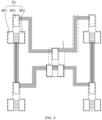
- FIG. 4 is a schematic view of the second display region AA2 of the display panel in the related art, in which several (for example, five) pixel units are schematically shown.
- the second display region AA2 includes a plurality of second pixel units P2 arranged in an array.
- each second pixel unit P2 may further include a plurality of sub-pixel units, such as a red sub-pixel unit SP1, a green sub-pixel unit SP2, and a blue sub-pixel unit SP3.
- the pixel units and the sub-pixel units are shown schematically in rectangular shape, however, this does not limit the shapes of the pixel units and the sub-pixel units included in the display panel provided in the embodiments of the present disclosure.
- the three sub-pixel units SP1, SP2, and SP3 included in each pixel unit SP are arranged in a delta shape, and this arrangement does not limit the display panel according to the embodiments of the present disclosure, either.
- the light for imaging may include at least one of visible light or infrared light, but the embodiments of the present disclosure do not limit this.
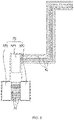
- FIG. 5 is a partial enlarged view of section I in FIG. 4 .
- the display panel includes various signal lines that provide signals such as control signals, data signals, and power supply voltages for each sub-pixel unit, for example, the signal lines may include a scanning signal line, a data line, an ELVDD power supply line, an ELVSS power supply line, a reset line, a light-emitting control line, and the like, and these signal lines may be formed in different layers.
- the scanning signal line may be located in the same layer as a gate electrode of the thin film transistor (for example, formed by the same patterning process), and the data line may be located in the same layer as a source electrode and a drain electrode of the thin film transistor (for example, formed by the same patterning process).
- the various signal lines as described above extend inside each of the various pixel units and between any two ones of the various pixel units.
- some relatively small gaps are formed between any two ones of various signal lines. These gaps may be formed inside each of the various pixel units, as indicated by gaps 51 shown in FIG. 5 ; and may also be formed between any two ones of the various pixel units, as indicated by gaps 52 shown in FIG. 5 .
- incoming light may pass through these gaps so that single-slit diffraction or double-slit interference may be produced, thereby causing diffraction or interference stripes and then resulting in uneven brightness when the incoming light reaches the camera.
- glare that is, excessive brightness or excessive brightness change occurs in a certain local portion in the field of view
- a diffraction or interference may cause a decrease in the image quality of the image sensor 2 located below the second display region AA2.
- the display panel may be an organic light-emitting diode (i.e., OLED) display panel.
- OLED organic light-emitting diode
- the display panel may include a plurality of sub-pixel units, and each sub-pixel unit may include a pixel driving circuit for controlling the sub-pixel units to perform light-emitting display.
- 7T1C pixel driving circuit As an example, a structure of the pixel driving circuit will be described in detail.
- the embodiments of the present disclosure are not limited to the 7T1C pixel driving circuit.
- Other known structures of pixel driving circuit may be applied to the embodiments of the present disclosure without conflict.
- FIG. 6 is an equivalent circuit diagram of a pixel driving circuit of the display panel according to some exemplary embodiments of the present disclosure.
- the pixel driving circuit may include: a plurality of signal lines 61, 62, 63, 64, 65, 66 and 67, a plurality of thin film transistors T1, T2, T3, T4, T5, T6 and T7, and a storage capacitor Cst.
- the pixel driving circuit is used to drive an organic light-emitting diode (i.e., OLED).
- OLED organic light-emitting diode
- the plurality of thin film transistors include a driving thin film transistor T1, a switching thin film transistor T2, a compensating thin film transistor T3, an initialization thin film transistor T4, an operation control thin film transistor T5, a light-emitting control thin film transistor T6, and a bypass thin film transistor T7.
- the plurality of signal lines include: a scanning signal line 61 for transmitting a scanning signal Sn, a previous scanning signal line 62 for transmitting a previous scanning signal Sn-1 to the initialization thin film transistor T4, a light-emitting control line 63 for transmitting the light-emitting control signal En to the operation control thin film transistor T5 and the light-emitting control thin film transistor T6, a data line 64 for transmitting the data signal Dm, a driving voltage line 65 for transmitting the driving voltage ELVDD, an initialization voltage line 66 for transmitting an initialization voltage Vint that initializes the driving thin film transistor T1, and a power supply line 67 for transmitting the ELVSS voltage.
- a gate electrode G1 of the driving thin film transistor T1 is electrically connected to one end Cst1 (hereinafter referred to as a first capacitor electrode) of the storage capacitor Cst, a source electrode S 1 of the driving thin film transistor T1 is electrically connected to the driving voltage line 65 via the operation control thin film transistor T5, a drain electrode D1 of the thin film transistor T1 is electrically connected to an anode of the OLED via the light-emitting control thin film transistor T6.
- the driving thin film transistor T1 receives the data signal Dm according to a switching operation of the switching thin film transistor T2 to supply driving currents Id to the OLED.
- a gate electrode G2 of the switching thin film transistor T2 is electrically connected to the scanning signal line 61, a source electrode S2 of the switching thin film transistor T2 is electrically connected to the data line 64, a drain electrode D2 of the switching thin film transistor T2 is electrically connected to the driving voltage line 65 via the operation control thin film transistor T5, and is also electrically connected to the source electrode S1 of the driving thin film transistor T1.
- the switching thin film transistor T2 is turned on according to the scanning signal Sn transmitted through the scanning signal line 61 to perform the switching operation, so as to transmit the data signal Dm transmitted to the data line 64 to the source electrode S1 of the driving thin film transistor T1.
- a gate electrode G3 of the compensating thin film transistor T3 is electrically connected to the scanning signal line 61
- a source electrode S3 of the compensating thin film transistor T3 is electrically connected to the anode of the OLED via the light-emitting control thin film transistor T6, and is also electrically connected to the drain electrode D1 of the driving thin film transistor T1.
- a drain electrode D3 of the compensating thin film transistor T3, one end (i.e., the first capacitor electrode) Cst1 of the storage capacitor Cst, a drain electrode D4 of the initialization thin film transistor T4, and the gate electrode G1 of the driving thin film transistor T1 are electrically connected together.
- the compensation thin film transistor T3 is turned on according to the scanning signal Sn transmitted through the scanning signal line 61 to connect the gate electrode G1 and the drain electrode D1 of the driving thin film transistor T1, thereby performing a diode connection for the driving thin film transistor T1.
- a gate electrode G4 of the initialization thin film transistor T4 is electrically connected to the previous scanning signal line 62, and a source electrode S4 of the initialization thin film transistor T4 is electrically connected to the initialization voltage line 66. Further, the drain electrode D4 of the initializing thin film transistor T4, one end Cst1 of the storage capacitor Cst, the drain electrode D3 of the compensating thin film transistor T3, and the gate electrode G1 of the driving thin film transistor T1 are electrically connected together.
- the initialization thin film transistor T4 is turned on according to the previous scanning signal Sn-1 transmitted through the previous scanning signal line 62 to transmit the initialization voltage Vint to the gate electrode G1 of the driving thin film transistor T1, thereby performing an initialization operation to initialize a voltage at the gate electrode G1 of the driving thin film transistor T1.
- a gate electrode G5 of the operation control thin film transistor T5 is electrically connected to the light-emitting control line 63, and a source electrode S5 of the operation control thin film transistor T5 is electrically connected to the driving voltage line 65. Further, a drain electrode D5 of the operation control thin film transistor T5, the source electrode S1 of the driving thin film transistor T1, and the drain electrode D2 of the switching thin film transistor T2 are electrically connected together.
- a gate electrode G6 of the light-emitting control thin film transistor T6 is electrically connected to the light-emitting control line 63
- a source electrode S6 of the light-emitting control thin film transistor T6 is electrically connected to the drain electrode D1 of the driving thin film transistor T1 and is electrically connected to the source electrode S3 of the compensation thin film transistor T3.
- a drain electrode D6 of the light-emitting control thin film transistor T6 is electrically connected to the anode of the OLED.
- the operation control thin film transistor T5 and the light-emitting control thin film transistor T6 are turned on concurrently (e.g., simultaneously) according to the light-emitting control signal En transmitted through the light-emitting control line 63 to transmit the driving voltage ELVDD to the OLED, thereby allowing the driving current Id to flow into the OLED.
- the bypass thin film transistor T7 includes: a gate electrode G7 connected to the previous scanning signal line 62; a source electrode S7 connected to both the drain electrode D6 of the light emitting control thin film transistor T6 and the anode of the OLED; and a drain electrode D7 connected to the initialization voltage line 66.
- the bypass thin film transistor T7 transmits the previous scanning signal Sn-1 from the previous scanning signal line 62 to the gate electrode G7.
- the other end (hereinafter referred to as a second capacitance electrode) Cst2 of the storage capacitor Cst is electrically connected to the driving voltage line 65, and a cathode of the OLED is electrically connected to the power supply line 67 to receive the common voltage ELVSS.
- the OLED receives the driving current Id from the driving thin film transistor T1 to emit light, thereby displaying an image.
- each of the thin film transistors T1, T2, T3, T4, T5, T6, and T7 has a single gate structure.
- the embodiments of the present disclosure are not limited to this, at least some of the thin film transistors T1, T2, T3, T4, T5, T6, and T7 may have a double gate structure.
- each of the thin film transistors T1, T2, T3, T4, T5, T6, and T7 is a p-channel field effect transistor.
- the embodiments of the present disclosure are not limited to this, and at least some of the thin film transistors T1, T2, T3, T4, T5, T6, and T7 may be n-channel field effect transistors.
- the previous scanning signal Sn-1 with a low level is supplied through the previous scanning signal line 62.
- the initialization thin film transistor T4 is turned on based on the low level of the previous scanning signal Sn-1, and the initialization voltage Vint from the initialization voltage line 66 is transmitted to the gate electrode G1 of the driving thin film transistor T1 through the initialization thin film transistor T4. Therefore, the driving thin film transistor T1 is initialized due to the initialization voltage Vint.
- the scanning signal Sn with a low level is supplied through the scanning signal line 61. Subsequently, the switching thin film transistor T2 and the compensation thin film transistor T3 are turned on based on the low level of the scanning signal Sn. Therefore, the driving thin film transistor T1 is placed in a diode connection state and biased in the forward direction as the compensation thin film transistor T3 is turned on.
- a compensation voltage Dm+Vth (for example, Vth is a negative value), that is obtained by subtracting the threshold voltage Vth of the driving thin film transistor T1 from the data signal Dm supplied via the data line 64, is applied to the gate electrode G1 of the driving thin film transistor T1.
- the driving voltage ELVDD and the compensation voltage Dm+Vth are applied to two ends of the storage capacitor Cst, respectively, so that an electric charge corresponding to voltage difference between the corresponding ends is stored in the storage capacitor Cst.
- the light-emitting control signal En from the light-emitting control line 63 changes from a high level to a low level.
- the operation control thin film transistor T5 and the light-emitting control thin film transistor T6 are turned on based on the low level of the light-emitting control signal En.
- the driving current is generated based on a difference between the voltage of the gate electrode G1 of the driving thin film transistor T1 and the driving voltage ELVDD.
- the driving current Id corresponding to the difference between the driving current and the bypass current is supplied to the OLED through the light-emitting control thin film transistor T6.
- a gate-source voltage of the driving thin film transistor T1 is maintained at (Dm+Vth)-ELVDD due to the storage capacitor Cst.
- the drive current Id is proportional to (Dm-ELVDD) 2 . Therefore, the driving current Id may not be affected by a variation of the threshold voltage Vth of the driving thin film transistor T1.
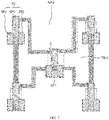
- FIG. 7 is a schematic view of the second display region AA2 of the display panel according to some exemplary embodiments of the present disclosure, wherein several (for example, five) pixel units are shown schematically.
- FIG. 8 is a schematic partial enlarged view of section II in FIG. 7 .
- the display panel includes a plurality of signal lines on the base substrate 1, for example, the aforementioned signal lines 61, 62, 63, 64, 65, 66, and 67.
- the second display region AA2 includes a plurality of second pixel units P2 arranged in an array.
- each second pixel unit P2 may further include a plurality of sub-pixel units, such as a red sub-pixel unit SP1, a green sub-pixel unit SP2, and a blue sub-pixel unit SP3.
- the light for imaging may include at least one of visible light or infrared light, but the embodiments of the present disclosure do not limit this.
- various signal lines 61, 62, 63, 64, 65, 66, and 67 as described above extend inside each of the various pixel units and between any two ones of the various pixel units.
- some relatively small gaps are formed between any two ones of the various signal lines.
- These gaps may be formed inside each of the various pixel units, as indicated by gaps 71 (hereinafter referred to as first gaps) as shown in FIG. 8 ; and may also be formed between any two ones of the various pixel units, as indicated by gaps 72 (hereinafter referred to as second gaps) as shown in FIG. 8 .
- the gaps 71 are formed between any two ones of the plurality of signal lines inside the pixel unit
- the gaps 72 are formed between any two ones of the plurality of signal lines extending between any two pixel units.
- the display panel further includes a light shielding portion 100 provided on the base substrate 1.
- the light shielding portion 100 is made of a material that may shield the light for imaging.
- the transmittance of the material to the light for imaging (such as infrared light or visible light) is less than 10%, for example, less than 5%, or, for example, less than 1%.
- an orthographic projection of the light shielding portion 100 on the base substrate 1 at least covers an orthographic projection of each of the gaps 71 and the gaps 72 on the base substrate 1.
- the diffraction and interference of the light for imaging may be avoided, so that a brightness change in a local region in the field of view may be reduced, and a visibility of the object may be improved. In this way, a glare phenomenon of the under-screen camera may be effectively eliminated, and the image quality may be improved.
- FIG. 7 and FIG. 8 schematically show a distribution of sub-pixels in the second display region AA2 of the display panel according to some exemplary embodiments of the present disclosure, hereinafter, an exemplary implementation of the distribution of sub-pixels and signal lines in the second display region AA2 of the display panel according to some exemplary embodiments of the present disclosure will be described in more details with reference to the drawings.
- FIG. 9 is a plan view illustrating exemplary implementations of sub-pixels in the second display region AA2 of the display panel according to some exemplary embodiments of the present disclosure.
- FIG. 10 to FIG. 14 are plan views showing some film layers in the exemplary implementations of sub-pixels in FIG. 9 . It should be noted that, in order to clearly show positional relationships between various film layers or traces, FIG. 9 to FIG. 14 do not show all film layer structures in the sub-pixels, that is, some structures are omitted. It should also be noted that, FIG. 9 to FIG. 13 show partial plan views of one sub-pixel included in the pixel units in FIG. 7 and FIG. 8 , and FIG. 14 shows a plan view of a light shielding portion corresponding to one pixel unit in FIG. 7 and FIG. 8 .
- FIG. 10 to FIG. 14 show schematic plan views of an active layer, a first conductive layer, a second conductive layer, a third conductive layer and a light shielding portion in one sub-pixel, respectively.
- the first conductive layer, the second conductive layer, and the third conductive layer will be described in further detail below.
- an insulating layer may be provided between any two adjacent ones of the active layer, the conductive layers and the light shielding portion, and a via hole may be provided in the insulating layer to electrically connect structures located in different layers.
- the sub-pixels include a scanning signal line 61, a previous scanning signal line 62, a light-emitting control line 63 and an initialization voltage line 66 arranged in a row direction.
- the scanning signal line 61, the previous scanning signal line 62, the light-emitting control line 63 and the initialization voltage line 66 are configured to apply a scanning signal Sn, a previous scanning signal Sn-1, a light-emitting control signal En, and an initialization voltage Vint to the sub-pixels, respectively.
- the sub-pixels may include a data line 64 and a driving voltage line 65 that cross the scanning signal line 61, the previous scanning signal line 62, the light-emitting control line 63, and the initialization voltage line 66.
- the data line 64 and the driving voltage line 65 are configured to apply a data signal Dm and a driving voltage ELVDD to the sub-pixels, respectively.
- the sub-pixels may include: a driving thin film transistor T1, a switching thin film transistor T2, a compensation thin film transistor T3, an initialization thin film transistor T4, an operation control thin film transistor T5, a light-emitting control thin film transistor T6, a bypass thin film transistor T7, a storage capacitor Cst, and an organic light-emitting diode OLED.
- the driving thin film transistor T1, the switching thin film transistor T2, the compensation thin film transistor T3, the initialization thin film transistor T4, the operation control thin film transistor T5, the light-emitting control thin film transistor T6, and the bypass thin film transistor T7 may be formed along the active layer as shown in FIG. 10 .
- the active layer may have a curved shape or polyline shape, and may include a driving active layer 20a corresponding to the driving thin film transistor T1, a switching active layer 20b corresponding to the switching thin film transistor T2, a compensation active layer 20c corresponding to the compensation thin film transistor T3, an initialization active layer 20d corresponding to the initialization thin film transistor T4, an operation control active layer 20e corresponding to the operation control thin film transistor T5, a light-emitting control active layer 20f corresponding to the light-emitting control thin film transistor T6, and a bypass active layer 20g corresponding to the bypasses thin film transistor T7.
- the active layer may include, for example, polysilicon, and includes, for example, a channel region, a source region, and a drain region.
- the channel region may not be doped with impurities, and therefore have semiconductor characteristics.
- the source region and the drain region are respectively located on both sides of the channel region, and are doped with impurities, and therefore have conductivity. Impurities may vary depending on whether the TFT is an N-type or a P-type transistor.
- the driving thin film transistor T1 includes a driving active layer 20a and a driving gate electrode G1.
- the driving active layer 20a includes a driving source region 203a, a driving drain region 205a, and a driving channel region 201a connecting the driving source region 203a and the driving drain region 205a.
- the driving source region 203a and the driving drain region 205a extend in two directions with respect to the driving channel region 201a.
- the driving source region 203a of the driving thin film transistor T1 is connected to a switching drain region 205b and an operation control drain region 205e.
- the driving drain region 205a is connected to a compensation source region 203c and a light-emitting control source region 203f.
- the gate electrode G1 of the driving thin film transistor T1 is connected to a compensation gate electrode G3 of the compensation thin film transistor T3 through via holes VAH1 and VAH2.
- the switching thin film transistor T2 includes a switching active layer 20b and a switching gate electrode G2.
- the switching active layer 20b includes a switching channel region 201b, a switching source region 203b, and a switching drain region 205b.
- the switching thin film transistor T2 is used as a switching device for selecting a target sub-pixel to emit light.
- the switching gate electrode G2 is connected to the scanning signal line 61, the switching source region 203b is connected to the data line 64 through a via hole VAH4, and the switching drain region 205b is connected to the driving thin film transistor T1 and the operation control thin film transistor T5.
- the compensation thin film transistor T3 includes a compensation active layer 20c and a compensation gate electrode G3.
- the compensation active layer 20c includes a compensation channel region 201c, a compensation source region 203c, and a compensation drain region 205c.
- the initialization thin film transistor T4 includes an initialization active layer 20d and an initialization gate electrode G4.
- the initialized active layer 20d includes an initialization channel region 201d, an initialization source region 203d, and an initialization drain region 205d.
- the initialization source region 203d is connected to the initialization voltage line 66 through a via hole VAH5.
- the operation control thin film transistor T5 includes an operation control active layer 20e and an operation control gate electrode G5.
- the operation control active layer 20e includes an operation control channel region 201e, an operation control source region 203e, and an operation control drain region 205e.
- the operation control source region 203e may be connected to the driving voltage line 65 through a via hole VAH6.
- the light-emitting control thin film transistor T6 includes a light-emitting control active layer 20f and a light-emitting control gate electrode G6, and the light-emitting control active layer 20f includes a light-emitting control channel region 201f, a light-emitting control source region 203f, and a light-emitting control drain region 205f.
- the light-emitting control drain region 205f may be connected to an anode of the OLED through a via hole VAH7.
- the bypass thin film transistor T7 includes a bypass active layer 20g and a bypass gate electrode G7.
- the bypass active layer 20g includes a bypass source region 203g, a bypass drain region 205g, and a bypass channel region 201g.
- the bypass drain region 205g is connected to the initialization source region 203d of the initialization thin film transistor T4.
- the bypass drain region 205g may be connected to the initialization voltage line 66 through a via hole VAH8.
- the second storage capacitor plate Cst2 may be connected to the driving voltage line 65 through a via hole VAH9 located in the insulating layer.
- some signal lines are shown schematically, for example, including the scanning signal line 61, the previous scanning signal line 62, the light-emitting control line 63, and the initialization voltage line 66 arranged in the row direction to respectively apply the scanning signal Sn, the previous scanning signal Sn-1, the light-emitting control signal En, and the initialization voltage Vint to the sub-pixels, the data line 64 and the driving voltage line 65 crossing the scanning signal line 61, the previous scanning signal line 62, the light-emitting control line 63, and the initialization voltage line 66 to respectively apply the data signal Dm and the driving voltage ELVDD to the sub-pixels.
- a part of the previous scanning signal line 62 and another part of the previous scanning signal line 62 may be located in different layers and connected with each other through the via hole VAH3.
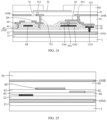
- FIG. 15 is a schematic cross-sectional view of the display panel according to some exemplary embodiments of the present disclosure taken along line AA' in FIG. 9 .
- FIG. 16 is a schematic cross-sectional view of the display panel according to some exemplary embodiments of the present disclosure taken along line BB' in FIG. 9 .
- some structures and layers are omitted in the cross-sectional views of FIG. 15 and FIG. 16 .
- only one thin film transistor which may be the light-emitting control thin film transistor T6 shown in FIG. 6 , is shown in FIG. 15 .
- the insulating layer may include at least some of a gate insulating layer 30, a first interlayer insulating layer 40, a second interlayer insulating layer 41, a first planarization layer 50, and a second planarization layer 51.
- the display panel may include: an active layer 20 on the base substrate 1, a gate insulating layer 30 on a side of the active layer 20 away from the base substrate 1, a gate electrode G6 and a second capacitor electrode Cst2 on a side of the gate insulating layer 30 away from the base substrate 1, a first interlayer insulating layer 40 on a side of the gate electrode G6 and the second capacitor electrode Cst2 away from the base substrate 1, a first capacitor electrode Cst1 on a side of the first interlayer insulating layer 40 away from the base substrate 1, a second interlayer insulating layer 41 on a side of the first capacitor electrode Cst1 away from the base substrate 1, a source electrode S6 and a drain electrode D6 on a side of the second interlayer insulating layer 41 away from the base substrate 1, and a first planarization layer 50 covering the source electrode S6 and the drain electrode D6.
- the source electrode S6 and the drain electrode D6 are respectively connected to the active layer 20 through via holes
- the active layer 20 may be, for example, the film layer shown in FIG. 10 , which may include the active layers 20a, 20b, 20c, 20d, 20e, 20f, and 20g of various thin film transistors.
- the active layer 20, the gate electrode G6, the source electrode S6, and the drain electrode D6 form a light-emitting control thin film transistor T6, the first capacitor electrode Cst1 and the second capacitor electrode Cst2 are opposite to each other, and are spaced apart by the first interlayer insulating layer 40 to form the storage capacitor Cst.
- the display panel may further include: a conductive connecting portion 70 on a side of the first planarization layer 50 away from the base substrate 1, a second planarization layer 51 on a side of the conductive connecting portion 70 away from the base substrate 1, an anode 81 of the OLED on a side of the second planarization layer 51 away from the base substrate 1, and a pixel defining layer 90 on a side of the anode 81 away from the base substrate 1.
- the OLED may also include an organic light-emitting layer and a cathode disposed on a side of the anode 81 away from the base substrate 1.
- the anode 81 is electrically connected to the conductive connecting portion 70 through a via hole 811, and the conductive connecting portion 70 is electrically connected to the drain electrode D6 through a via hole 701, that is, the anode 81 is electrically connected to the drain electrode D6 via the conductive connecting portion 70.
- the second capacitor electrode Cst2 and the gate electrode G6 are located in the same layer, for example, formed by the same patterning process.
- the layer where the second capacitor electrode Cst2 and the gate electrode G6 are located may be referred to as a first conductive layer.
- the first capacitor electrode Cst1 is located between the first conductive layer and a conductive layer where the source electrode S6 and the drain electrode D6 are located.
- the layer where the first capacitor electrode Cst1 is located may be referred to as a second conductive layer
- the layer where the source electrode S6 and the drain electrode D6 are located may be referred to as a third conductive layer.
- the conductive connecting portion 70 is located on a side of the third conductive layer away from the base substrate 1.
- the layer where the conductive connecting portion 70 is located may be referred to as a fourth conductive layer.
- the aforementioned various signal lines 61, 62, 63, 64, 65, 66, and 67 may be located in at least one conductive layer selected from the first conductive layer, the second conductive layer, the third conductive layer, and the fourth conductive layer, respectively.
- the scanning signal line 61 and the previous scanning signal line 62 may be located in the first conductive layer
- the light-emitting control line 63 may be located in the second conductive layer
- the data line 64 and the driving voltage line 65 may be located in the third conductive layer
- the initialization voltage line 66 may be located in the fourth conductive layer.
- a signal line may also be located in a plurality of conductive layers.
- some driving voltage lines 65 may be located in the third conductive layer
- some other driving voltage lines 65 may be located in the fourth conductive layer.
- the first conductive layer and the second conductive layer may be conductive layers made of a material forming the gate electrode
- the third conductive layer and the fourth conductive layer may be conductive layers made of a material forming the source electrode and the drain electrode.
- the material forming the gate electrode may include metal materials, such as Mo, Al, Cu, other metals and alloys thereof.
- the material forming the source electrode and the drain electrode may include metal materials, such as Mo, Al, Cu, other metals and alloys thereof.
- the semiconductor material forming the active layer may include, for example, amorphous silicon, polysilicon, an oxide semiconductor, etc., and the oxide semiconductor material may include, for example, IGZO (Indium Gallium Zinc Oxide), ZnO (Zinc Oxide), etc..
- the light shielding portion 100 may be a film layer that is provided separately. With Reference to FIG. 15 and FIG. 16 , the light shielding portion 100 is provided under the active layer 20, that is, on a side of the active layer 20 close to the base substrate 1. That is, the light shielding portion 100 is located in a layer different from all of the first conductive layer, the second conductive layer, the third conductive layer, and the fourth conductive layer, that is, it is a separate film layer.
- the light shielding portion 100 may be made of a metal light shielding material, and the metal light shielding material may be the same material as the material forming the gate electrode or the material forming the source electrode and the drain electrode, or may be a material different from the material forming the gate electrode or the material forming the source electrode and the drain electrode.
- the light shielding portion 100 is shown as a gray pattern, and in FIG. 9 to FIG. 16 and subsequent drawings, the light shielding portion 100 is shown as a pattern with an oblique hatching, which is only to make the drawings clear.
- the display panel may include a first buffer layer 11 and a second buffer layer 12 on the base substrate 1.
- the first buffer layer 11 may be located between the base substrate 1 and the light shielding portion 100.
- the second buffer layer 12 may be located between the light shielding portion 100 and the active layer 20.
- an orthographic projection of the light shielding portion 100 on the base substrate 1 at least covers orthographic projections of the gaps between any two ones of the plurality of signal lines (including the gaps 71 and the gaps 72) on the base substrate 1.
- orthographic projections of the driving thin film transistor T1, the switching thin film transistor T2, the compensation thin film transistor T3, the initialization thin film transistor T4, the operation control thin film transistor T5, the light-emitting control thin film transistor T6 and the bypass thin film transistor T7, together with the various signal lines 61, 62, 63, 64, 65, 66, and 67 on the base substrate 1 do not completely cover the base substrate 1, thereby forming some gaps. Gaps inside each pixel unit are marked as the first gaps 71, and gaps between any two ones of various pixel units are marked as the second gaps 72.
- the scanning signal line 61, the previous scanning signal line 62, the light-emitting control line 63, and the initialization voltage line 66 arranged in the row direction have a first portion located inside the sub-pixels, the data line 64 and the driving voltage line 65 crossing the scanning signal line 61, the previous scanning signal line 62, the light-emitting control line 63 and the initialization voltage line 66 also have a first portion located inside the sub-pixels.
- the first gaps 71 are also formed between any two ones of the first portions of the scanning signal line 61, the previous scanning signal line 62, the light-emitting control line 63, the initialization voltage line 66, the data line 64 and the driving voltage line 65.
- the scanning signal line 61, the previous scanning signal line 62, the light-emitting control line 63, and the initialization voltage line 66 also extend in the row direction to adjacent pixel units, that is, the scanning signal line 61, the previous scanning signal line 62, the light-emitting control line 63, and the initialization voltage line 66 have a second portion located between any two ones of the pixel units.
- a pixel density in the first display region AA1 is greater than a pixel density in the second display region AA2, the scanning signal lines in the first display region AA1 need to pass through the second display region AA2 in the row direction, as indicated by a signal line extension portion 120 in FIG. 9 . That is, the signal line extension portion 120 in FIG.
- the second gaps 72 are also formed between any two ones of the second portions of the scanning signal line 61, the previous scanning signal line 62, the light-emitting control line 63 and the initialization voltage line 66 as well as the signal line extension portion 120.
- the orthographic projection of the light shielding portion 100 on the base substrate 1 at least covers the orthographic projection of each of the first gaps 71 and the second gaps 72 on the base substrate 1.
- the orthographic projection of the light shielding portion 100 on the base substrate 1 covers orthographic projections of portions of the plurality of signal lines in the second display region AA2 on the base substrate 1, and the orthographic projection of the light shielding portion 100 on the base substrate 1 also covers orthographic projections of the plurality of thin film transistors T1 ⁇ T7 and the storage capacitor Cst in the second display region AA2 on the base substrate 1.
- the orthographic projection of the light shielding portion 100 on the base substrate 1 does not overlap most of an orthographic projection of the light transmittance region TRA between any two pixel units P2 in the second display region AA2 on the base substrate 1. In this way, there is still a large area of the light transmittance region TRA between any two pixel units P2 in the second display region AA2, so that it is beneficial for the light for imaging to passing through the light transmittance region TRA so as to be incident onto the image sensor 2 provided in the second display region AA2.
- the light shielding portion 100 is electrically connected to the driving voltage line 65.
- the driving voltage line 65 is used to supply the ELVDD voltage signal. That is to say, the light shielding portion 100 is also used to supply the ELVDD voltage signal.
- the driving voltage line 65 is electrically connected to a conductive transfer portion 110 through a via hole 651, and the conductive transfer portion 110 is electrically connected to the light shielding portion 100 through a via hole 1101. Since there is a relatively large distance between the driving voltage line 65 and the light shielding portion 100 in a direction perpendicular to the base substrate 1, the provision of the conductive transfer portion 110 facilitates the electrical connection between the light shielding portion 100 and the driving voltage line 65.
- the conductive transfer portion 110 may be located in the aforementioned first conductive layer, that is, the conductive transfer portion 110 is located in the same layer as the gate electrode G6 and the second capacitor electrode Cst2.
- the via hole 651 penetrates the first interlayer insulating layer 40 and the second interlayer insulating layer 41 to expose a part of the conductive transfer portion 110.
- the via hole 1101 penetrates the gate insulating layer 30 and the second buffer layer 12 to expose a part of the light shielding portion 100.
- the driving voltage line 65 is also electrically connected to the second capacitor electrode Cst2, for example, the driving voltage line 65 is electrically connected to the second capacitor electrode Cst2 through a via hole 652.
- the via hole 652 may penetrate the first interlayer insulating layer 40, the first capacitor electrode Cst1, and the second interlayer insulating layer 41 to expose a part of the second capacitor electrode Cst2.
- the light shielding portion 100 is electrically connected to a stable DC voltage signal, and the electric charge generated due to the floating of the light shielding portion 100 may be avoided, so that an ESD phenomenon may be prevented.
- both the light shielding portion 100 and the driving voltage line 65 are used as signal lines for supplying the ELVDD voltage signal, so that the IR Drop effect may be effectively reduced, thereby achieving an effect of compensating for brightness uniformity.
- FIG. 17 to FIG. 20 are schematic plan views of the light shielding portion included in the display panel according to some exemplary embodiments of the present disclosure, respectively.
- the light shielding portion 100 is a film layer which is provided separately, so that there is not a positional interference between the light shielding portion 100 and other film layers such as the first conductive layer, the second conductive layer, the third conductive layer and the fourth conductive layer. Thus, it is allowed to design a shape of an orthographic projection of the light shielding portion 100 on the base substrate 1.
- the orthographic projection of the light shielding portion 100 on the base substrate 1 may extend continuously, that is, a portion 101 of the light shielding portion 100 for shielding the gaps 71 inside each pixel unit may be connected to a portion 102 of the light shielding portion 100 for shielding the gaps 72 between any two pixel units. In this way, it is beneficial for forming the light shielding portion 100.
- the orthographic projection of the light shielding portion 100 on the base substrate 1 may cover orthographic projections of various pixel units in the second display region AA2 on the base substrate 1, and an area of the orthographic projection of the light shielding portion 100 on the base substrate 1 may be larger than an overall area of the orthographic projections of various pixel units in the second display region AA2 on the base substrate 1.
- the orthographic projection of the light shielding portion 100 on the base substrate 1 may cover orthographic projections of portions of the signal lines between any two ones of the pixel units in the second display region AA2 on the base substrate 1, and the area of the orthographic projection of the light shielding portion 100 on the base substrate 1 may be larger than an overall area of the orthographic projections of portions of the signal lines between any two ones of the pixel units in the second display region AA2 on the base substrate 1.
- the light shielding portion 100 may cover the various pixel units and edges of the signal lines between any two ones of the pixel units sufficiently, so that a shielding effect of the light shielding portion for each gap may be improved.
- the shape of the orthographic projection of the light shielding portion 100 on the base substrate 1 may be designed.
- a profile of the orthographic projection of the light shielding portion 100 on the base substrate 1 may have an arc shape at a corner or a boundary. In this way, the arc-shaped corner or boundary may reduce the diffraction effect when the light for imaging passes, thereby further improving the imaging quality.
- the boundary 100S of the profile of the orthographic projection of the light-shielding portion 100 on the base substrate 1 may be closely adjacent to boundaries of the orthographic projections of various pixel units on the base substrate 1 and boundaries of the orthographic projections of the signal lines between any two ones of the pixel units on the base substrate 1.
- an expression “closely adjacent to” may be understood as follows: in the second display region AA2, the orthographic projection of the light shielding portion 100 on the base substrate 1 may cover the orthographic projections of various pixel units on the base substrate 1 and the orthographic projections of the signal lines between any two ones of the pixel units on the base substrate 1, and the area of the orthographic projection of the light shielding portion 100 on the base substrate 1 may be slightly larger than an overall area of the orthographic projections of various pixel units and the orthographic projections of the signal lines between any two ones of the pixel units on the base substrate 1. In this way, an area of the light transmittance region may be made as large as possible while ensuring the light shielding effect, so that the image quality may be further improved.
- the boundary 100S of the profile of the orthographic projection of the light shielding portion 100 on the base substrate 1 has an arc shape at each corner (for example, corners 103 and 104 exemplarily shown in FIG. 17 ), that is, an arc transition is formed at each corner.
- the arc-shaped corner or boundary may reduce the diffraction effect when the light for imaging passes, thereby further improving the imaging quality.
- the profile of the orthographic projection of the light shielding portion 100 on the base substrate 1 has an arc-shaped boundary 100S.
- the arc-shaped profile may reduce the diffraction effect when the light for imaging passes, thereby further improving the imaging quality.
- the profile 100S of the orthographic projection of the light shielding portion 100 on the base substrate 1 has an arc shape at each corner (such as corners 105 and 106 exemplarily shown in FIG. 19 ), that is, an arc transition is formed.
- the arc-shaped corners may reduce the diffraction effect when the light for imaging passes, thereby further improving the imaging quality.
- the orthographic projection of each light transmittance region TRA on the base substrate 1 has a rectangular shape with rounded corners.
- the formed pattern is relatively regular, so that it is beneficial to forming the light shielding portion, and it also facilitates improving the uniformity of the light for imaging incident onto the imaging module.
- a profile of an orthographic projection of a part 101 of the light shielding portion 100 for shielding the gaps inside each pixel unit on the base substrate 1 has an approximately rectangular shape, and four corners of the rectangle form arc transitions to reduce the diffraction effect when the light for imaging passes.
- a profile of an orthographic projection of a part of the light shielding portion 100 for shielding the gaps between any two ones of the pixel units on the base substrate 1 is closely adjacent to the profile of the orthographic projections of the signal lines between any two ones of the sub-pixel units on the base substrate 1.
- the light shielding portion 100 may be located in at least one layer selected from the above-mentioned first conductive layer, second conductive layer, third conductive layer, or fourth conductive layer.
- FIG. 21 is a schematic cross-sectional view of the display panel according to some exemplary embodiments of the present disclosure taken along line CC' in FIG. 8 .
- FIG. 22 is a schematic cross-sectional view of the display panel according to some exemplary embodiments of the present disclosure taken along line DD' in FIG. 8 .
- FIG. 23 is a partial enlarged view of a portion, between two sub-pixel units, of the display panel according to some exemplary embodiments of the present disclosure.
- FIG. 21 in order to clearly show the relative positional relationship of the light shielding portion, some structures and film layers are omitted in FIG. 21 to FIG. 23 , for example, only one thin film transistor is shown in FIG. 21 , and the thin film transistor may be the light-emitting control thin film transistor T6 as shown in FIG. 6 .
- the display panel may include: an active layer 20 on the base substrate 1, a gate insulating layer 30 on a side of the active layer 20 away from the base substrate 1, a gate electrode G6 and a second capacitor electrode Cst2 on a side of the gate insulating layer 30 away from the base substrate 1, a first interlayer insulating layer 40 on a side of the gate electrode G6 and the second capacitor electrode Cst2 away from the base substrate 1, a first capacitor electrode Cst1 on a side of the first interlayer insulating layer 40 away from the base substrate 1, a second interlayer insulating layer 41 on a side of the first capacitor electrode Cst1 away from the base substrate 1, a source electrode S6 and a drain electrode D6 on a side of the second interlayer insulating layer 41 away from the base substrate 1, a first planarization layer 50 covering the source electrode S6 and the drain electrode D6.
- the source electrode S6 and the drain electrode D6 are respectively connected to the active layer 20 through via holes.
- the active layer 20, the gate electrode G6, the source electrode S6 and the drain electrode D6 form the light-emitting control thin film transistor T6.
- the first capacitor electrode Cst1 and the second capacitor electrode Cst2 are opposite to each other, and are spaced apart by the first interlayer insulating layer 40 to form a storage capacitor Cst.
- the display panel may further include: a conductive connecting portion 70 on a side of the first planarization layer 50 away from the base substrate 1, a second planarization layer 51 on a side of the conductive connecting portion 70 away from the base substrate 1, an anode 81 of the OLED on a side of the second planarization layer 51 away from the base substrate 1, and a pixel defining layer 90 on a side of the anode 81 away from the base substrate 1.
- the OLED may also include an organic light-emitting layer and a cathode on a side of the anode 81 away from the base substrate 1.
- the anode 81 is electrically connected to the conductive connecting portion 70 through a via hole 811, and the conductive connecting portion 70 is electrically connected to the drain electrode D6 through a via hole 701, that is, the anode 81 is electrically connected to the drain electrode D6 via the conductive connecting portion 70.
- the second capacitor electrode Cst2 and the gate electrode G6 are located in the same layer, for example, formed by the same patterning process.
- the layer where the second capacitor electrode Cst2 and the gate electrode G6 are located may be referred to as a first conductive layer.
- the first capacitor electrode Cst1 is located between the first conductive layer and the conductive layer where the source electrode S6 and the drain electrode D6 are located.
- the layer where the first capacitor electrode Cst1 is located may be referred to as a second conductive layer
- the layer where the source electrode S6 and the drain electrode D6 are located may be referred to as a third conductive layer.
- the conductive connecting portion 70 is located on a side of the third conductive layer away from the base substrate 1, for the convenience of description, the layer where the conductive connecting portion 70 is located may be referred to as a fourth conductive layer.
- the aforementioned various signal lines 61, 62, 63, 64, 65, 66, and 67 may be respectively located on at least one conductive layer selected from the first conductive layer, the second conductive layer, the third conductive layer, and the fourth conductive layer.
- the scanning signal line 61 and the previous scanning signal line 62 may be located in the first conductive layer
- the light-emitting control line 63 may be located in the second conductive layer
- the data line 64 and the driving voltage line 65 may be located in the third conductive layer
- the initialization voltage line 66 may be located in the fourth conductive layer.
- a signal line may also be located in a plurality of conductive layers, for example, some driving voltage lines 65 may be located in the third conductive layer, and some other driving voltage lines 65 may be located in the fourth conductive layer.
- the first conductive layer and the second conductive layer may be conductive layers made of the gate material
- the third conductive layer and the fourth conductive layer may be conductive layers made of the source/drain material.
- the gate material may include metal materials, such as Mo, Al, Cu, other metals and alloys thereof.
- the source/drain material may include metal materials, such as Mo, Al, Cu, other metals and alloys thereof.
- the semiconductor material constituting the active layer may include, for example, amorphous silicon, polysilicon, an oxide semiconductor, etc., and the oxide semiconductor material may include, for example, IGZO (Indium Gallium Zinc Oxide), ZnO (Zinc Oxide), etc..
- the light shielding portion 100 is provided in the fourth conductive layer, that is, the light shielding portion 100 and the conductive connecting portion 70 are located in the same layer.
- both the light shielding portion 100 and the conductive connecting portion 70 may include the source/drain material and formed by the same patterning process.
- the display panel may include a first buffer layer 11 on the base substrate 1.
- the first buffer layer 11 may be located between the base substrate 1 and the active layer 20.
- the orthographic projection of the light shielding portion 100 on the base substrate 1 at least covers orthographic projections of the gaps between the plurality of signal lines (including the gaps 71 and 72 as mentioned above) on the base substrate 1.
- the orthographic projection of the light shielding portion 100 on the base substrate 1 overlaps the orthographic projections of the portions of the plurality of signal lines in the second display region AA2 on the base substrate 1, and the orthographic projection of the light shielding portion 100 on the base substrate 1 also overlaps the orthographic projections of the plurality of thin film transistors T1 ⁇ T7 and the storage capacitor Cst in the second display region AA2 on the base substrate 1.
- both the gaps inside respective sub-pixel units and the gaps between any two ones of the signal lines located between the sub-pixel units may be shielded, thereby avoiding the diffraction and interference of the light for imaging.
- the orthographic projection of the light shielding portion 100 on the base substrate 1 does not overlaps an orthographic projection of the anode 81 on the base substrate 1.
- the anode 81 may be made of a light shielding material such as Ag, that is, the anode 81 may also serve to shield the light. In this way, an occupied area of the light shielding portion 100 may be reduced.
- the orthographic projection of the light shielding portion 100 on the base substrate 1 and the orthographic projection of the anode 81 on the base substrate 1 are spaced apart from each other, that is, there is a certain interval between the orthographic projection of the light shielding portion 100 on the base substrate 1 and the orthographic projection of the anode 81 on the base substrate 1. In this way, the light shielding portion 100 does not overlap the anode 81, so that a crosstalk phenomenon caused by the overlap between the light shielding portion 100 and the anode 81 may be reduced or avoided.
- the orthographic projection of the light shielding portion 100 on the base substrate 1 does not overlap most of the orthographic projection of the light transmittance region TRA between any two ones of the pixel units P2 in the second display region AA2 on the base substrate 1. In this way, there is still a large area of the light transmittance region TRA between any two ones of the pixel units P2 in the second display region AA2, so that the light for imaging may pass through the light transmittance region TRA to be incident onto the image sensor 2 provided in the second display region AA2.
- the light shielding portion 100 is electrically connected to the driving voltage line 65.
- the driving voltage line 65 is used to supply the ELVDD voltage signal. That is to say, the light shielding portion 100 is also used to supply the ELVDD voltage signal.
- the driving voltage line 65 is electrically connected to the light shielding portion 100 through a via hole 653.
- the driving voltage line 65 is also electrically connected to the second capacitor electrode Cst2, for example, the driving voltage line 65 is electrically connected to the second capacitor electrode Cst2 through a via hole 652.
- the via hole 653 may penetrate the first planarization layer 50 to expose a part of the driving voltage line 65.
- the via hole 652 may penetrate the first interlayer insulating layer 40, the first capacitor electrode Cst1, and the second interlayer insulating layer 41 to expose a part of the second capacitor electrode Cst2.
- the light shielding portion 100 is electrically connected to a stable DC voltage signal, and the electric charge generated due to the floating of the light shielding portion 100 may be avoided, so that the ESD phenomenon may be prevented.
- both the light shielding portion 100 and the driving voltage line 65 are used as signal lines for supplying the ELVDD voltage signal, so that the IR Drop effect may be effectively reduced, thereby achieving the effect of compensating for brightness uniformity.
- FIG. 24 is a schematic cross-sectional view of the display panel according to some exemplary embodiments of the present disclosure taken along line CC' in FIG. 8 .
- FIG. 25 is a schematic cross-sectional view of the display panel according to some exemplary embodiments of the present disclosure taken along line DD' in FIG. 8 .
- the display substrate may include two light shielding portions, that is, a first light shielding portion 100A and a second light shielding portion 100B.
- the first light shielding portion 100A may be the light shielding portion in the embodiments as shown in FIG. 15 and FIG. 16
- the second light shielding portion 100B may be the light shielding portion in the embodiments as shown in FIG. 21 and FIG. 22 . That is to say, the light shielding portions in the above embodiments may be used in combination to ensure a better light shielding effect.
- the first light shielding portion 100A may be a film layer that is separately provided, and it is provided under the active layer 20 and located between the first buffer layer 11 and the second buffer layer 12.
- the second light shielding portion 100B may be located in the fourth conductive layer, that is, it is located in the same layer as the conductive connecting portion 70.
- Both the first light shielding portion 100A and the second light shielding portion 100B may be electrically connected to the driving voltage line 65.
- the display device may include the display panel and the image sensor 2 (for example, a camera) as described above.
- the display panel includes a first display region and a second display region, and a pixel density of the first display region is greater than a pixel density of the second display region.
- the image sensor 2 is located on a side of the base substrate 1 away from the pixel array, and a photosensitive surface of the image sensor 2 faces the display panel.
- the orthographic projection of the image sensor 2 on the base substrate 1 overlaps the orthographic projection of the second display region on the base substrate 1, for example, is located within the orthographic projection of the second display region on the base substrate 1.
- light passing through the second display region may be used for imaging, thereby realizing the function of an under-screen camera.
- the image sensor 2 may adopt a structure known in the art, for example, including a complementary metal oxide semiconductor (CMOS) image sensor or a charge coupled device (CCD) image sensor.
- CMOS complementary metal oxide semiconductor
- CCD charge coupled device
- the image sensor 2 may be electrically connected to an image processor.
- an imaging module including the image sensor may, for example, further includes a lens assembly, so as to achieve a better imaging effect.
- the lens assembly and the image sensor may be arranged along an optical axis of the lens assembly in sequence in a direction perpendicular to the base substrate 1.
- the display device may include any device or product with a display function.
- the display device may be a smart phone, a mobile phone, an e-book reader, a desktop computer (PC), a laptop PC, a netbook PC, a personal digital assistant (PDA), a portable multimedia player (PMP), a digital audio player, a mobile medical device, a camera, a wearable device (such as a head-mounted device, electronic clothing, an electronic bracelet, an electronic necklace, an electronic accessory, an electronic tattoo, or a smart watch), a television, etc.
Landscapes
- Engineering & Computer Science (AREA)
- Microelectronics & Electronic Packaging (AREA)
- Signal Processing (AREA)
- Physics & Mathematics (AREA)
- Geometry (AREA)
- Chemical & Material Sciences (AREA)
- Inorganic Chemistry (AREA)
- Life Sciences & Earth Sciences (AREA)
- Sustainable Development (AREA)
- Devices For Indicating Variable Information By Combining Individual Elements (AREA)
- Electroluminescent Light Sources (AREA)
Priority Applications (1)
| Application Number | Priority Date | Filing Date | Title |
|---|---|---|---|
| EP25212030.8A EP4665127A3 (de) | 2020-05-11 | 2020-05-11 | Anzeigetafel und anzeigevorrichtung |
Applications Claiming Priority (1)
| Application Number | Priority Date | Filing Date | Title |
|---|---|---|---|
| PCT/CN2020/089600 WO2021226787A1 (zh) | 2020-05-11 | 2020-05-11 | 显示面板和显示装置 |
Related Child Applications (2)
| Application Number | Title | Priority Date | Filing Date |
|---|---|---|---|
| EP25212030.8A Division EP4665127A3 (de) | 2020-05-11 | 2020-05-11 | Anzeigetafel und anzeigevorrichtung |
| EP25212030.8A Division-Into EP4665127A3 (de) | 2020-05-11 | 2020-05-11 | Anzeigetafel und anzeigevorrichtung |
Publications (3)
| Publication Number | Publication Date |
|---|---|
| EP4152402A1 true EP4152402A1 (de) | 2023-03-22 |
| EP4152402A4 EP4152402A4 (de) | 2023-08-02 |
| EP4152402B1 EP4152402B1 (de) | 2026-05-06 |
Family
ID=78526049
Family Applications (2)
| Application Number | Title | Priority Date | Filing Date |
|---|---|---|---|
| EP20904250.6A Active EP4152402B1 (de) | 2020-05-11 | 2020-05-11 | Anzeigetafel und anzeigevorrichtung |
| EP25212030.8A Pending EP4665127A3 (de) | 2020-05-11 | 2020-05-11 | Anzeigetafel und anzeigevorrichtung |
Family Applications After (1)
| Application Number | Title | Priority Date | Filing Date |
|---|---|---|---|
| EP25212030.8A Pending EP4665127A3 (de) | 2020-05-11 | 2020-05-11 | Anzeigetafel und anzeigevorrichtung |
Country Status (4)
| Country | Link |
|---|---|
| US (3) | US12048195B2 (de) |
| EP (2) | EP4152402B1 (de) |
| CN (2) | CN114175263B (de) |
| WO (1) | WO2021226787A1 (de) |
Families Citing this family (11)
| Publication number | Priority date | Publication date | Assignee | Title |
|---|---|---|---|---|
| CN111583793B (zh) * | 2020-05-12 | 2021-09-24 | 武汉华星光电半导体显示技术有限公司 | 柔性显示屏 |
| CN115707309B (zh) * | 2021-08-05 | 2023-10-20 | 荣耀终端有限公司 | 显示面板及终端设备 |
| CN113690223B (zh) * | 2021-08-11 | 2023-10-31 | 武汉华星光电半导体显示技术有限公司 | 显示面板及显示装置 |
| CN114156282B (zh) * | 2021-11-30 | 2025-03-28 | 京东方科技集团股份有限公司 | 显示装置、显示面板、驱动背板及其制造方法 |
| WO2023225966A1 (zh) * | 2022-05-26 | 2023-11-30 | 京东方科技集团股份有限公司 | 显示基板及显示装置 |
| CN114975566A (zh) * | 2022-06-21 | 2022-08-30 | 合肥维信诺科技有限公司 | 阵列基板及显示面板 |
| CN115274712B (zh) * | 2022-08-15 | 2024-11-12 | 京东方科技集团股份有限公司 | 显示背板及其制备方法、显示装置 |
| KR20240091363A (ko) * | 2022-12-13 | 2024-06-21 | 삼성디스플레이 주식회사 | 표시 장치 및 이의 제조 방법 |
| CN115732464B (zh) * | 2022-12-16 | 2026-01-16 | 武汉华星光电半导体显示技术有限公司 | 显示面板和显示装置 |
| WO2024174231A1 (en) * | 2023-02-24 | 2024-08-29 | Boe Technology Group Co., Ltd. | Array substrate and display apparatus |
| CN119173091A (zh) * | 2023-06-20 | 2024-12-20 | 合肥维信诺科技有限公司 | 显示面板及显示装置 |
Family Cites Families (20)
| Publication number | Priority date | Publication date | Assignee | Title |
|---|---|---|---|---|
| JP4176400B2 (ja) * | 2001-09-06 | 2008-11-05 | シャープ株式会社 | 表示装置 |
| US8731618B2 (en) | 2009-04-23 | 2014-05-20 | Apple Inc. | Portable electronic device |
| CA2933951A1 (en) * | 2013-12-20 | 2015-06-25 | Koninklijke Philips N.V. | Autostereoscopic display device |
| JP2017151339A (ja) * | 2016-02-26 | 2017-08-31 | 株式会社ジャパンディスプレイ | 表示装置 |
| CN106710528B (zh) * | 2017-01-23 | 2019-03-12 | 上海天马有机发光显示技术有限公司 | 有机发光像素驱动电路、驱动方法以及有机发光显示面板 |
| CN107025451B (zh) * | 2017-04-27 | 2019-11-08 | 上海天马微电子有限公司 | 一种显示面板及显示装置 |
| CN109148540B (zh) * | 2018-08-30 | 2021-04-02 | 京东方科技集团股份有限公司 | Oled显示面板及显示装置 |
| CN109686773A (zh) * | 2018-12-28 | 2019-04-26 | 上海天马微电子有限公司 | 一种有机电致发光显示面板、其制造方法及显示装置 |
| KR102719414B1 (ko) * | 2019-03-19 | 2024-10-22 | 삼성디스플레이 주식회사 | 터치 감지 기능을 갖는 표시 패널 및 그것을 포함하는 표시 장치 |
| CN110047845A (zh) | 2019-03-27 | 2019-07-23 | 武汉华星光电半导体显示技术有限公司 | 一种tft阵列基板以及全面屏显示装置 |
| KR102743357B1 (ko) * | 2019-04-24 | 2024-12-18 | 삼성디스플레이 주식회사 | 표시 장치 |
| CN113284911B (zh) * | 2019-04-30 | 2024-05-07 | 武汉天马微电子有限公司 | 一种显示面板及显示装置 |
| CN110365819A (zh) * | 2019-06-18 | 2019-10-22 | 武汉华星光电半导体显示技术有限公司 | 显示屏及显示装置 |
| WO2020258262A1 (zh) | 2019-06-28 | 2020-12-30 | 京东方科技集团股份有限公司 | 显示面板及其制备方法、显示装置 |
| CN110634930B (zh) * | 2019-09-27 | 2022-02-25 | 京东方科技集团股份有限公司 | 显示面板和显示装置 |
| CN110618557A (zh) * | 2019-09-30 | 2019-12-27 | 武汉天马微电子有限公司 | 一种显示面板和显示装置 |
| CN115347033B (zh) * | 2019-11-27 | 2025-10-21 | 武汉天马微电子有限公司 | 一种显示面板及显示装置 |
| CN110767739B (zh) * | 2019-11-28 | 2025-09-09 | 京东方科技集团股份有限公司 | 显示基板及显示装置 |
| CN111129092A (zh) * | 2019-12-20 | 2020-05-08 | 武汉华星光电半导体显示技术有限公司 | 显示面板及其制作方法 |
| CN114864651B (zh) * | 2019-12-31 | 2025-10-10 | 武汉天马微电子有限公司 | 一种显示面板及显示装置 |
-
2020
- 2020-05-11 CN CN202080000709.5A patent/CN114175263B/zh active Active
- 2020-05-11 WO PCT/CN2020/089600 patent/WO2021226787A1/zh not_active Ceased
- 2020-05-11 EP EP20904250.6A patent/EP4152402B1/de active Active
- 2020-05-11 CN CN202511186796.9A patent/CN121013599A/zh active Pending
- 2020-05-11 US US17/271,398 patent/US12048195B2/en active Active
- 2020-05-11 EP EP25212030.8A patent/EP4665127A3/de active Pending
-
2024
- 2024-06-18 US US18/746,495 patent/US12532540B2/en active Active
-
2025
- 2025-10-29 US US19/372,560 patent/US20260059860A1/en active Pending
Also Published As
| Publication number | Publication date |
|---|---|
| WO2021226787A1 (zh) | 2021-11-18 |
| CN114175263B (zh) | 2025-08-22 |
| US20220130913A1 (en) | 2022-04-28 |
| CN114175263A (zh) | 2022-03-11 |
| US12532540B2 (en) | 2026-01-20 |
| EP4152402A4 (de) | 2023-08-02 |
| US20260059860A1 (en) | 2026-02-26 |
| CN121013599A (zh) | 2025-11-25 |
| EP4665127A3 (de) | 2026-03-04 |
| EP4665127A2 (de) | 2025-12-17 |
| EP4152402B1 (de) | 2026-05-06 |
| US12048195B2 (en) | 2024-07-23 |
| US20240341119A1 (en) | 2024-10-10 |
Similar Documents
| Publication | Publication Date | Title |
|---|---|---|
| EP4152402B1 (de) | Anzeigetafel und anzeigevorrichtung | |
| US12127455B2 (en) | Display substrate, display panel and display apparatus | |
| KR102935418B1 (ko) | 디스플레이 기판 및 디스플레이 디바이스 | |
| CN113674693B (zh) | 显示基板和显示装置 | |
| EP4131409B1 (de) | Anzeigesubstrat, anzeigetafel und anzeigevorrichtung | |
| WO2022011582A1 (zh) | 显示基板、显示面板和显示装置 | |
| WO2022001435A1 (zh) | 显示基板和显示装置 | |
| US20250160165A1 (en) | Display substrate, display panel and display apparatus | |
| US20220310709A1 (en) | Display substrate, mask, and display device | |
| US12615930B2 (en) | Display substrate and display device | |
| CN114156282A (zh) | 显示装置、显示面板、驱动背板及其制造方法 | |
| US20230032526A1 (en) | Display substrate and display apparatus | |
| WO2023016335A1 (zh) | 显示基板及显示装置 |
Legal Events
| Date | Code | Title | Description |
|---|---|---|---|
| STAA | Information on the status of an ep patent application or granted ep patent |
Free format text: STATUS: UNKNOWN |
|
| STAA | Information on the status of an ep patent application or granted ep patent |
Free format text: STATUS: THE INTERNATIONAL PUBLICATION HAS BEEN MADE |
|
| PUAI | Public reference made under article 153(3) epc to a published international application that has entered the european phase |
Free format text: ORIGINAL CODE: 0009012 |
|
| STAA | Information on the status of an ep patent application or granted ep patent |
Free format text: STATUS: REQUEST FOR EXAMINATION WAS MADE |
|
| 17P | Request for examination filed |
Effective date: 20210629 |
|
| AK | Designated contracting states |
Kind code of ref document: A1 Designated state(s): AL AT BE BG CH CY CZ DE DK EE ES FI FR GB GR HR HU IE IS IT LI LT LU LV MC MK MT NL NO PL PT RO RS SE SI SK SM TR |
|
| REG | Reference to a national code |
Ref country code: DE Ref legal event code: R079 Free format text: PREVIOUS MAIN CLASS: H01L0027320000 Ipc: H10K0059121000 Ref document number: 602020071902 Country of ref document: DE |
|
| A4 | Supplementary search report drawn up and despatched |
Effective date: 20230704 |
|
| RIC1 | Information provided on ipc code assigned before grant |
Ipc: H10K 59/124 20230101ALI20230628BHEP Ipc: H10K 59/126 20230101ALI20230628BHEP Ipc: H10K 59/131 20230101ALI20230628BHEP Ipc: H04M 1/02 20060101ALI20230628BHEP Ipc: H10K 59/121 20230101AFI20230628BHEP |
|
| DAV | Request for validation of the european patent (deleted) | ||
| DAX | Request for extension of the european patent (deleted) | ||
| GRAP | Despatch of communication of intention to grant a patent |
Free format text: ORIGINAL CODE: EPIDOSNIGR1 |
|
| STAA | Information on the status of an ep patent application or granted ep patent |
Free format text: STATUS: GRANT OF PATENT IS INTENDED |
|
| RIC1 | Information provided on ipc code assigned before grant |
Ipc: H10K 59/121 20230101AFI20260114BHEP Ipc: H04M 1/02 20060101ALI20260114BHEP Ipc: H10K 59/131 20230101ALI20260114BHEP Ipc: H10K 59/126 20230101ALI20260114BHEP Ipc: H10K 59/124 20230101ALI20260114BHEP Ipc: H10D 86/40 20250101ALI20260114BHEP Ipc: H10D 86/60 20250101ALI20260114BHEP |
|
| INTG | Intention to grant announced |
Effective date: 20260205 |
|
| GRAS | Grant fee paid |
Free format text: ORIGINAL CODE: EPIDOSNIGR3 |
|
| GRAA | (expected) grant |
Free format text: ORIGINAL CODE: 0009210 |
|
| STAA | Information on the status of an ep patent application or granted ep patent |
Free format text: STATUS: THE PATENT HAS BEEN GRANTED |
|
| AK | Designated contracting states |
Kind code of ref document: B1 Designated state(s): AL AT BE BG CH CY CZ DE DK EE ES FI FR GB GR HR HU IE IS IT LI LT LU LV MC MK MT NL NO PL PT RO RS SE SI SK SM TR |
|
| REG | Reference to a national code |
Ref country code: CH Ref legal event code: F10 Free format text: ST27 STATUS EVENT CODE: U-0-0-F10-F00 (AS PROVIDED BY THE NATIONAL OFFICE) Effective date: 20260506 Ref country code: GB Ref legal event code: FG4D |
|
| REG | Reference to a national code |
Ref country code: DE Ref legal event code: R096 Ref document number: 602020071902 Country of ref document: DE |
|
| REG | Reference to a national code |
Ref country code: IE Ref legal event code: FG4D |
|
| PGFP | Annual fee paid to national office [announced via postgrant information from national office to epo] |
Ref country code: GB Payment date: 20260518 Year of fee payment: 7 |
|
| PGFP | Annual fee paid to national office [announced via postgrant information from national office to epo] |
Ref country code: DE Payment date: 20260629 Year of fee payment: 7 |
|
| PGFP | Annual fee paid to national office [announced via postgrant information from national office to epo] |
Ref country code: FR Payment date: 20260519 Year of fee payment: 7 |