EP4129953B1 - Ceramic, probe-guiding part, probe card and socket for inspecting package - Google Patents
Ceramic, probe-guiding part, probe card and socket for inspecting package Download PDFInfo
- Publication number
- EP4129953B1 EP4129953B1 EP21784340.8A EP21784340A EP4129953B1 EP 4129953 B1 EP4129953 B1 EP 4129953B1 EP 21784340 A EP21784340 A EP 21784340A EP 4129953 B1 EP4129953 B1 EP 4129953B1
- Authority
- EP
- European Patent Office
- Prior art keywords
- ceramic
- zro
- probe
- crystal
- guiding member
- Prior art date
- Legal status (The legal status is an assumption and is not a legal conclusion. Google has not performed a legal analysis and makes no representation as to the accuracy of the status listed.)
- Active
Links
Images
Classifications
-
- C—CHEMISTRY; METALLURGY
- C04—CEMENTS; CONCRETE; ARTIFICIAL STONE; CERAMICS; REFRACTORIES
- C04B—LIME, MAGNESIA; SLAG; CEMENTS; COMPOSITIONS THEREOF, e.g. MORTARS, CONCRETE OR LIKE BUILDING MATERIALS; ARTIFICIAL STONE; CERAMICS; REFRACTORIES; TREATMENT OF NATURAL STONE
- C04B35/00—Shaped ceramic products characterised by their composition; Ceramics compositions; Processing powders of inorganic compounds preparatory to the manufacturing of ceramic products
- C04B35/515—Shaped ceramic products characterised by their composition; Ceramics compositions; Processing powders of inorganic compounds preparatory to the manufacturing of ceramic products based on non-oxide ceramics
- C04B35/58—Shaped ceramic products characterised by their composition; Ceramics compositions; Processing powders of inorganic compounds preparatory to the manufacturing of ceramic products based on non-oxide ceramics based on borides, nitrides, i.e. nitrides, oxynitrides, carbonitrides or oxycarbonitrides or silicides
- C04B35/584—Shaped ceramic products characterised by their composition; Ceramics compositions; Processing powders of inorganic compounds preparatory to the manufacturing of ceramic products based on non-oxide ceramics based on borides, nitrides, i.e. nitrides, oxynitrides, carbonitrides or oxycarbonitrides or silicides based on silicon nitride
-
- C—CHEMISTRY; METALLURGY
- C04—CEMENTS; CONCRETE; ARTIFICIAL STONE; CERAMICS; REFRACTORIES
- C04B—LIME, MAGNESIA; SLAG; CEMENTS; COMPOSITIONS THEREOF, e.g. MORTARS, CONCRETE OR LIKE BUILDING MATERIALS; ARTIFICIAL STONE; CERAMICS; REFRACTORIES; TREATMENT OF NATURAL STONE
- C04B35/00—Shaped ceramic products characterised by their composition; Ceramics compositions; Processing powders of inorganic compounds preparatory to the manufacturing of ceramic products
- C04B35/01—Shaped ceramic products characterised by their composition; Ceramics compositions; Processing powders of inorganic compounds preparatory to the manufacturing of ceramic products based on oxide ceramics
- C04B35/48—Shaped ceramic products characterised by their composition; Ceramics compositions; Processing powders of inorganic compounds preparatory to the manufacturing of ceramic products based on oxide ceramics based on zirconium or hafnium oxides, zirconates, zircon or hafnates
-
- C—CHEMISTRY; METALLURGY
- C04—CEMENTS; CONCRETE; ARTIFICIAL STONE; CERAMICS; REFRACTORIES
- C04B—LIME, MAGNESIA; SLAG; CEMENTS; COMPOSITIONS THEREOF, e.g. MORTARS, CONCRETE OR LIKE BUILDING MATERIALS; ARTIFICIAL STONE; CERAMICS; REFRACTORIES; TREATMENT OF NATURAL STONE
- C04B35/00—Shaped ceramic products characterised by their composition; Ceramics compositions; Processing powders of inorganic compounds preparatory to the manufacturing of ceramic products
- C04B35/01—Shaped ceramic products characterised by their composition; Ceramics compositions; Processing powders of inorganic compounds preparatory to the manufacturing of ceramic products based on oxide ceramics
- C04B35/48—Shaped ceramic products characterised by their composition; Ceramics compositions; Processing powders of inorganic compounds preparatory to the manufacturing of ceramic products based on oxide ceramics based on zirconium or hafnium oxides, zirconates, zircon or hafnates
- C04B35/486—Fine ceramics
- C04B35/488—Composites
-
- C—CHEMISTRY; METALLURGY
- C04—CEMENTS; CONCRETE; ARTIFICIAL STONE; CERAMICS; REFRACTORIES
- C04B—LIME, MAGNESIA; SLAG; CEMENTS; COMPOSITIONS THEREOF, e.g. MORTARS, CONCRETE OR LIKE BUILDING MATERIALS; ARTIFICIAL STONE; CERAMICS; REFRACTORIES; TREATMENT OF NATURAL STONE
- C04B35/00—Shaped ceramic products characterised by their composition; Ceramics compositions; Processing powders of inorganic compounds preparatory to the manufacturing of ceramic products
- C04B35/515—Shaped ceramic products characterised by their composition; Ceramics compositions; Processing powders of inorganic compounds preparatory to the manufacturing of ceramic products based on non-oxide ceramics
- C04B35/58—Shaped ceramic products characterised by their composition; Ceramics compositions; Processing powders of inorganic compounds preparatory to the manufacturing of ceramic products based on non-oxide ceramics based on borides, nitrides, i.e. nitrides, oxynitrides, carbonitrides or oxycarbonitrides or silicides
- C04B35/584—Shaped ceramic products characterised by their composition; Ceramics compositions; Processing powders of inorganic compounds preparatory to the manufacturing of ceramic products based on non-oxide ceramics based on borides, nitrides, i.e. nitrides, oxynitrides, carbonitrides or oxycarbonitrides or silicides based on silicon nitride
- C04B35/587—Fine ceramics
-
- C—CHEMISTRY; METALLURGY
- C04—CEMENTS; CONCRETE; ARTIFICIAL STONE; CERAMICS; REFRACTORIES
- C04B—LIME, MAGNESIA; SLAG; CEMENTS; COMPOSITIONS THEREOF, e.g. MORTARS, CONCRETE OR LIKE BUILDING MATERIALS; ARTIFICIAL STONE; CERAMICS; REFRACTORIES; TREATMENT OF NATURAL STONE
- C04B35/00—Shaped ceramic products characterised by their composition; Ceramics compositions; Processing powders of inorganic compounds preparatory to the manufacturing of ceramic products
- C04B35/622—Forming processes; Processing powders of inorganic compounds preparatory to the manufacturing of ceramic products
- C04B35/626—Preparing or treating the powders individually or as batches ; preparing or treating macroscopic reinforcing agents for ceramic products, e.g. fibres; mechanical aspects section B
- C04B35/62605—Treating the starting powders individually or as mixtures
- C04B35/62645—Thermal treatment of powders or mixtures thereof other than sintering
- C04B35/62655—Drying, e.g. freeze-drying, spray-drying, microwave or supercritical drying
-
- C—CHEMISTRY; METALLURGY
- C04—CEMENTS; CONCRETE; ARTIFICIAL STONE; CERAMICS; REFRACTORIES
- C04B—LIME, MAGNESIA; SLAG; CEMENTS; COMPOSITIONS THEREOF, e.g. MORTARS, CONCRETE OR LIKE BUILDING MATERIALS; ARTIFICIAL STONE; CERAMICS; REFRACTORIES; TREATMENT OF NATURAL STONE
- C04B35/00—Shaped ceramic products characterised by their composition; Ceramics compositions; Processing powders of inorganic compounds preparatory to the manufacturing of ceramic products
- C04B35/622—Forming processes; Processing powders of inorganic compounds preparatory to the manufacturing of ceramic products
- C04B35/626—Preparing or treating the powders individually or as batches ; preparing or treating macroscopic reinforcing agents for ceramic products, e.g. fibres; mechanical aspects section B
- C04B35/62605—Treating the starting powders individually or as mixtures
- C04B35/62695—Granulation or pelletising
-
- C—CHEMISTRY; METALLURGY
- C04—CEMENTS; CONCRETE; ARTIFICIAL STONE; CERAMICS; REFRACTORIES
- C04B—LIME, MAGNESIA; SLAG; CEMENTS; COMPOSITIONS THEREOF, e.g. MORTARS, CONCRETE OR LIKE BUILDING MATERIALS; ARTIFICIAL STONE; CERAMICS; REFRACTORIES; TREATMENT OF NATURAL STONE
- C04B35/00—Shaped ceramic products characterised by their composition; Ceramics compositions; Processing powders of inorganic compounds preparatory to the manufacturing of ceramic products
- C04B35/622—Forming processes; Processing powders of inorganic compounds preparatory to the manufacturing of ceramic products
- C04B35/64—Burning or sintering processes
- C04B35/645—Pressure sintering
-
- G—PHYSICS
- G01—MEASURING; TESTING
- G01R—MEASURING ELECTRIC VARIABLES; MEASURING MAGNETIC VARIABLES
- G01R1/00—Details of instruments or arrangements of the types included in groups G01R5/00 - G01R13/00 and G01R31/00
- G01R1/02—General constructional details
- G01R1/04—Housings; Supporting members; Arrangements of terminals
- G01R1/0408—Test fixtures or contact fields; Connectors or connecting adaptors; Test clips; Test sockets
- G01R1/0433—Sockets for IC's or transistors
-
- G—PHYSICS
- G01—MEASURING; TESTING
- G01R—MEASURING ELECTRIC VARIABLES; MEASURING MAGNETIC VARIABLES
- G01R1/00—Details of instruments or arrangements of the types included in groups G01R5/00 - G01R13/00 and G01R31/00
- G01R1/02—General constructional details
- G01R1/04—Housings; Supporting members; Arrangements of terminals
- G01R1/0408—Test fixtures or contact fields; Connectors or connecting adaptors; Test clips; Test sockets
- G01R1/0433—Sockets for IC's or transistors
- G01R1/0441—Details
- G01R1/0466—Details concerning contact pieces or mechanical details, e.g. hinges or cams; Shielding
-
- G—PHYSICS
- G01—MEASURING; TESTING
- G01R—MEASURING ELECTRIC VARIABLES; MEASURING MAGNETIC VARIABLES
- G01R1/00—Details of instruments or arrangements of the types included in groups G01R5/00 - G01R13/00 and G01R31/00
- G01R1/02—General constructional details
- G01R1/06—Measuring leads; Measuring probes
- G01R1/067—Measuring probes
- G01R1/073—Multiple probes
-
- G—PHYSICS
- G01—MEASURING; TESTING
- G01R—MEASURING ELECTRIC VARIABLES; MEASURING MAGNETIC VARIABLES
- G01R1/00—Details of instruments or arrangements of the types included in groups G01R5/00 - G01R13/00 and G01R31/00
- G01R1/02—General constructional details
- G01R1/06—Measuring leads; Measuring probes
- G01R1/067—Measuring probes
- G01R1/073—Multiple probes
- G01R1/07307—Multiple probes with individual probe elements, e.g. needles, cantilever beams or bump contacts, fixed in relation to each other, e.g. bed of nails fixture or probe card
- G01R1/07314—Multiple probes with individual probe elements, e.g. needles, cantilever beams or bump contacts, fixed in relation to each other, e.g. bed of nails fixture or probe card the body of the probe being perpendicular to test object, e.g. bed of nails or probe with bump contacts on a rigid support
-
- G—PHYSICS
- G01—MEASURING; TESTING
- G01R—MEASURING ELECTRIC VARIABLES; MEASURING MAGNETIC VARIABLES
- G01R1/00—Details of instruments or arrangements of the types included in groups G01R5/00 - G01R13/00 and G01R31/00
- G01R1/02—General constructional details
- G01R1/06—Measuring leads; Measuring probes
- G01R1/067—Measuring probes
- G01R1/073—Multiple probes
- G01R1/07307—Multiple probes with individual probe elements, e.g. needles, cantilever beams or bump contacts, fixed in relation to each other, e.g. bed of nails fixture or probe card
- G01R1/07364—Multiple probes with individual probe elements, e.g. needles, cantilever beams or bump contacts, fixed in relation to each other, e.g. bed of nails fixture or probe card with provisions for altering position, number or connection of probe tips; Adapting to differences in pitch
- G01R1/07371—Multiple probes with individual probe elements, e.g. needles, cantilever beams or bump contacts, fixed in relation to each other, e.g. bed of nails fixture or probe card with provisions for altering position, number or connection of probe tips; Adapting to differences in pitch using an intermediate card or back card with apertures through which the probes pass
-
- C—CHEMISTRY; METALLURGY
- C04—CEMENTS; CONCRETE; ARTIFICIAL STONE; CERAMICS; REFRACTORIES
- C04B—LIME, MAGNESIA; SLAG; CEMENTS; COMPOSITIONS THEREOF, e.g. MORTARS, CONCRETE OR LIKE BUILDING MATERIALS; ARTIFICIAL STONE; CERAMICS; REFRACTORIES; TREATMENT OF NATURAL STONE
- C04B2235/00—Aspects relating to ceramic starting mixtures or sintered ceramic products
- C04B2235/02—Composition of constituents of the starting material or of secondary phases of the final product
- C04B2235/30—Constituents and secondary phases not being of a fibrous nature
- C04B2235/32—Metal oxides, mixed metal oxides, or oxide-forming salts thereof, e.g. carbonates, nitrates, (oxy)hydroxides, chlorides
- C04B2235/3205—Alkaline earth oxides or oxide forming salts thereof, e.g. beryllium oxide
- C04B2235/3206—Magnesium oxides or oxide-forming salts thereof
-
- C—CHEMISTRY; METALLURGY
- C04—CEMENTS; CONCRETE; ARTIFICIAL STONE; CERAMICS; REFRACTORIES
- C04B—LIME, MAGNESIA; SLAG; CEMENTS; COMPOSITIONS THEREOF, e.g. MORTARS, CONCRETE OR LIKE BUILDING MATERIALS; ARTIFICIAL STONE; CERAMICS; REFRACTORIES; TREATMENT OF NATURAL STONE
- C04B2235/00—Aspects relating to ceramic starting mixtures or sintered ceramic products
- C04B2235/02—Composition of constituents of the starting material or of secondary phases of the final product
- C04B2235/30—Constituents and secondary phases not being of a fibrous nature
- C04B2235/32—Metal oxides, mixed metal oxides, or oxide-forming salts thereof, e.g. carbonates, nitrates, (oxy)hydroxides, chlorides
- C04B2235/3205—Alkaline earth oxides or oxide forming salts thereof, e.g. beryllium oxide
- C04B2235/3208—Calcium oxide or oxide-forming salts thereof, e.g. lime
-
- C—CHEMISTRY; METALLURGY
- C04—CEMENTS; CONCRETE; ARTIFICIAL STONE; CERAMICS; REFRACTORIES
- C04B—LIME, MAGNESIA; SLAG; CEMENTS; COMPOSITIONS THEREOF, e.g. MORTARS, CONCRETE OR LIKE BUILDING MATERIALS; ARTIFICIAL STONE; CERAMICS; REFRACTORIES; TREATMENT OF NATURAL STONE
- C04B2235/00—Aspects relating to ceramic starting mixtures or sintered ceramic products
- C04B2235/02—Composition of constituents of the starting material or of secondary phases of the final product
- C04B2235/30—Constituents and secondary phases not being of a fibrous nature
- C04B2235/32—Metal oxides, mixed metal oxides, or oxide-forming salts thereof, e.g. carbonates, nitrates, (oxy)hydroxides, chlorides
- C04B2235/3217—Aluminum oxide or oxide forming salts thereof, e.g. bauxite, alpha-alumina
-
- C—CHEMISTRY; METALLURGY
- C04—CEMENTS; CONCRETE; ARTIFICIAL STONE; CERAMICS; REFRACTORIES
- C04B—LIME, MAGNESIA; SLAG; CEMENTS; COMPOSITIONS THEREOF, e.g. MORTARS, CONCRETE OR LIKE BUILDING MATERIALS; ARTIFICIAL STONE; CERAMICS; REFRACTORIES; TREATMENT OF NATURAL STONE
- C04B2235/00—Aspects relating to ceramic starting mixtures or sintered ceramic products
- C04B2235/02—Composition of constituents of the starting material or of secondary phases of the final product
- C04B2235/30—Constituents and secondary phases not being of a fibrous nature
- C04B2235/32—Metal oxides, mixed metal oxides, or oxide-forming salts thereof, e.g. carbonates, nitrates, (oxy)hydroxides, chlorides
- C04B2235/3224—Rare earth oxide or oxide forming salts thereof, e.g. scandium oxide
- C04B2235/3225—Yttrium oxide or oxide-forming salts thereof
-
- C—CHEMISTRY; METALLURGY
- C04—CEMENTS; CONCRETE; ARTIFICIAL STONE; CERAMICS; REFRACTORIES
- C04B—LIME, MAGNESIA; SLAG; CEMENTS; COMPOSITIONS THEREOF, e.g. MORTARS, CONCRETE OR LIKE BUILDING MATERIALS; ARTIFICIAL STONE; CERAMICS; REFRACTORIES; TREATMENT OF NATURAL STONE
- C04B2235/00—Aspects relating to ceramic starting mixtures or sintered ceramic products
- C04B2235/02—Composition of constituents of the starting material or of secondary phases of the final product
- C04B2235/30—Constituents and secondary phases not being of a fibrous nature
- C04B2235/32—Metal oxides, mixed metal oxides, or oxide-forming salts thereof, e.g. carbonates, nitrates, (oxy)hydroxides, chlorides
- C04B2235/3224—Rare earth oxide or oxide forming salts thereof, e.g. scandium oxide
- C04B2235/3229—Cerium oxides or oxide-forming salts thereof
-
- C—CHEMISTRY; METALLURGY
- C04—CEMENTS; CONCRETE; ARTIFICIAL STONE; CERAMICS; REFRACTORIES
- C04B—LIME, MAGNESIA; SLAG; CEMENTS; COMPOSITIONS THEREOF, e.g. MORTARS, CONCRETE OR LIKE BUILDING MATERIALS; ARTIFICIAL STONE; CERAMICS; REFRACTORIES; TREATMENT OF NATURAL STONE
- C04B2235/00—Aspects relating to ceramic starting mixtures or sintered ceramic products
- C04B2235/02—Composition of constituents of the starting material or of secondary phases of the final product
- C04B2235/30—Constituents and secondary phases not being of a fibrous nature
- C04B2235/32—Metal oxides, mixed metal oxides, or oxide-forming salts thereof, e.g. carbonates, nitrates, (oxy)hydroxides, chlorides
- C04B2235/3231—Refractory metal oxides, their mixed metal oxides, or oxide-forming salts thereof
- C04B2235/3232—Titanium oxides or titanates, e.g. rutile or anatase
-
- C—CHEMISTRY; METALLURGY
- C04—CEMENTS; CONCRETE; ARTIFICIAL STONE; CERAMICS; REFRACTORIES
- C04B—LIME, MAGNESIA; SLAG; CEMENTS; COMPOSITIONS THEREOF, e.g. MORTARS, CONCRETE OR LIKE BUILDING MATERIALS; ARTIFICIAL STONE; CERAMICS; REFRACTORIES; TREATMENT OF NATURAL STONE
- C04B2235/00—Aspects relating to ceramic starting mixtures or sintered ceramic products
- C04B2235/02—Composition of constituents of the starting material or of secondary phases of the final product
- C04B2235/30—Constituents and secondary phases not being of a fibrous nature
- C04B2235/32—Metal oxides, mixed metal oxides, or oxide-forming salts thereof, e.g. carbonates, nitrates, (oxy)hydroxides, chlorides
- C04B2235/3231—Refractory metal oxides, their mixed metal oxides, or oxide-forming salts thereof
- C04B2235/3239—Vanadium oxides, vanadates or oxide forming salts thereof, e.g. magnesium vanadate
-
- C—CHEMISTRY; METALLURGY
- C04—CEMENTS; CONCRETE; ARTIFICIAL STONE; CERAMICS; REFRACTORIES
- C04B—LIME, MAGNESIA; SLAG; CEMENTS; COMPOSITIONS THEREOF, e.g. MORTARS, CONCRETE OR LIKE BUILDING MATERIALS; ARTIFICIAL STONE; CERAMICS; REFRACTORIES; TREATMENT OF NATURAL STONE
- C04B2235/00—Aspects relating to ceramic starting mixtures or sintered ceramic products
- C04B2235/02—Composition of constituents of the starting material or of secondary phases of the final product
- C04B2235/30—Constituents and secondary phases not being of a fibrous nature
- C04B2235/32—Metal oxides, mixed metal oxides, or oxide-forming salts thereof, e.g. carbonates, nitrates, (oxy)hydroxides, chlorides
- C04B2235/3231—Refractory metal oxides, their mixed metal oxides, or oxide-forming salts thereof
- C04B2235/3241—Chromium oxides, chromates, or oxide-forming salts thereof
-
- C—CHEMISTRY; METALLURGY
- C04—CEMENTS; CONCRETE; ARTIFICIAL STONE; CERAMICS; REFRACTORIES
- C04B—LIME, MAGNESIA; SLAG; CEMENTS; COMPOSITIONS THEREOF, e.g. MORTARS, CONCRETE OR LIKE BUILDING MATERIALS; ARTIFICIAL STONE; CERAMICS; REFRACTORIES; TREATMENT OF NATURAL STONE
- C04B2235/00—Aspects relating to ceramic starting mixtures or sintered ceramic products
- C04B2235/02—Composition of constituents of the starting material or of secondary phases of the final product
- C04B2235/30—Constituents and secondary phases not being of a fibrous nature
- C04B2235/32—Metal oxides, mixed metal oxides, or oxide-forming salts thereof, e.g. carbonates, nitrates, (oxy)hydroxides, chlorides
- C04B2235/3231—Refractory metal oxides, their mixed metal oxides, or oxide-forming salts thereof
- C04B2235/3244—Zirconium oxides, zirconates, hafnium oxides, hafnates, or oxide-forming salts thereof
-
- C—CHEMISTRY; METALLURGY
- C04—CEMENTS; CONCRETE; ARTIFICIAL STONE; CERAMICS; REFRACTORIES
- C04B—LIME, MAGNESIA; SLAG; CEMENTS; COMPOSITIONS THEREOF, e.g. MORTARS, CONCRETE OR LIKE BUILDING MATERIALS; ARTIFICIAL STONE; CERAMICS; REFRACTORIES; TREATMENT OF NATURAL STONE
- C04B2235/00—Aspects relating to ceramic starting mixtures or sintered ceramic products
- C04B2235/02—Composition of constituents of the starting material or of secondary phases of the final product
- C04B2235/30—Constituents and secondary phases not being of a fibrous nature
- C04B2235/32—Metal oxides, mixed metal oxides, or oxide-forming salts thereof, e.g. carbonates, nitrates, (oxy)hydroxides, chlorides
- C04B2235/3231—Refractory metal oxides, their mixed metal oxides, or oxide-forming salts thereof
- C04B2235/3251—Niobium oxides, niobates, tantalum oxides, tantalates, or oxide-forming salts thereof
-
- C—CHEMISTRY; METALLURGY
- C04—CEMENTS; CONCRETE; ARTIFICIAL STONE; CERAMICS; REFRACTORIES
- C04B—LIME, MAGNESIA; SLAG; CEMENTS; COMPOSITIONS THEREOF, e.g. MORTARS, CONCRETE OR LIKE BUILDING MATERIALS; ARTIFICIAL STONE; CERAMICS; REFRACTORIES; TREATMENT OF NATURAL STONE
- C04B2235/00—Aspects relating to ceramic starting mixtures or sintered ceramic products
- C04B2235/02—Composition of constituents of the starting material or of secondary phases of the final product
- C04B2235/30—Constituents and secondary phases not being of a fibrous nature
- C04B2235/32—Metal oxides, mixed metal oxides, or oxide-forming salts thereof, e.g. carbonates, nitrates, (oxy)hydroxides, chlorides
- C04B2235/3231—Refractory metal oxides, their mixed metal oxides, or oxide-forming salts thereof
- C04B2235/3256—Molybdenum oxides, molybdates or oxide forming salts thereof, e.g. cadmium molybdate
-
- C—CHEMISTRY; METALLURGY
- C04—CEMENTS; CONCRETE; ARTIFICIAL STONE; CERAMICS; REFRACTORIES
- C04B—LIME, MAGNESIA; SLAG; CEMENTS; COMPOSITIONS THEREOF, e.g. MORTARS, CONCRETE OR LIKE BUILDING MATERIALS; ARTIFICIAL STONE; CERAMICS; REFRACTORIES; TREATMENT OF NATURAL STONE
- C04B2235/00—Aspects relating to ceramic starting mixtures or sintered ceramic products
- C04B2235/02—Composition of constituents of the starting material or of secondary phases of the final product
- C04B2235/30—Constituents and secondary phases not being of a fibrous nature
- C04B2235/32—Metal oxides, mixed metal oxides, or oxide-forming salts thereof, e.g. carbonates, nitrates, (oxy)hydroxides, chlorides
- C04B2235/327—Iron group oxides, their mixed metal oxides, or oxide-forming salts thereof
- C04B2235/3275—Cobalt oxides, cobaltates or cobaltites or oxide forming salts thereof, e.g. bismuth cobaltate, zinc cobaltite
-
- C—CHEMISTRY; METALLURGY
- C04—CEMENTS; CONCRETE; ARTIFICIAL STONE; CERAMICS; REFRACTORIES
- C04B—LIME, MAGNESIA; SLAG; CEMENTS; COMPOSITIONS THEREOF, e.g. MORTARS, CONCRETE OR LIKE BUILDING MATERIALS; ARTIFICIAL STONE; CERAMICS; REFRACTORIES; TREATMENT OF NATURAL STONE
- C04B2235/00—Aspects relating to ceramic starting mixtures or sintered ceramic products
- C04B2235/02—Composition of constituents of the starting material or of secondary phases of the final product
- C04B2235/30—Constituents and secondary phases not being of a fibrous nature
- C04B2235/32—Metal oxides, mixed metal oxides, or oxide-forming salts thereof, e.g. carbonates, nitrates, (oxy)hydroxides, chlorides
- C04B2235/327—Iron group oxides, their mixed metal oxides, or oxide-forming salts thereof
- C04B2235/3279—Nickel oxides, nickalates, or oxide-forming salts thereof
-
- C—CHEMISTRY; METALLURGY
- C04—CEMENTS; CONCRETE; ARTIFICIAL STONE; CERAMICS; REFRACTORIES
- C04B—LIME, MAGNESIA; SLAG; CEMENTS; COMPOSITIONS THEREOF, e.g. MORTARS, CONCRETE OR LIKE BUILDING MATERIALS; ARTIFICIAL STONE; CERAMICS; REFRACTORIES; TREATMENT OF NATURAL STONE
- C04B2235/00—Aspects relating to ceramic starting mixtures or sintered ceramic products
- C04B2235/02—Composition of constituents of the starting material or of secondary phases of the final product
- C04B2235/30—Constituents and secondary phases not being of a fibrous nature
- C04B2235/32—Metal oxides, mixed metal oxides, or oxide-forming salts thereof, e.g. carbonates, nitrates, (oxy)hydroxides, chlorides
- C04B2235/3284—Zinc oxides, zincates, cadmium oxides, cadmiates, mercury oxides, mercurates or oxide forming salts thereof
-
- C—CHEMISTRY; METALLURGY
- C04—CEMENTS; CONCRETE; ARTIFICIAL STONE; CERAMICS; REFRACTORIES
- C04B—LIME, MAGNESIA; SLAG; CEMENTS; COMPOSITIONS THEREOF, e.g. MORTARS, CONCRETE OR LIKE BUILDING MATERIALS; ARTIFICIAL STONE; CERAMICS; REFRACTORIES; TREATMENT OF NATURAL STONE
- C04B2235/00—Aspects relating to ceramic starting mixtures or sintered ceramic products
- C04B2235/02—Composition of constituents of the starting material or of secondary phases of the final product
- C04B2235/30—Constituents and secondary phases not being of a fibrous nature
- C04B2235/32—Metal oxides, mixed metal oxides, or oxide-forming salts thereof, e.g. carbonates, nitrates, (oxy)hydroxides, chlorides
- C04B2235/3286—Gallium oxides, gallates, indium oxides, indates, thallium oxides, thallates or oxide forming salts thereof, e.g. zinc gallate
-
- C—CHEMISTRY; METALLURGY
- C04—CEMENTS; CONCRETE; ARTIFICIAL STONE; CERAMICS; REFRACTORIES
- C04B—LIME, MAGNESIA; SLAG; CEMENTS; COMPOSITIONS THEREOF, e.g. MORTARS, CONCRETE OR LIKE BUILDING MATERIALS; ARTIFICIAL STONE; CERAMICS; REFRACTORIES; TREATMENT OF NATURAL STONE
- C04B2235/00—Aspects relating to ceramic starting mixtures or sintered ceramic products
- C04B2235/02—Composition of constituents of the starting material or of secondary phases of the final product
- C04B2235/30—Constituents and secondary phases not being of a fibrous nature
- C04B2235/34—Non-metal oxides, non-metal mixed oxides, or salts thereof that form the non-metal oxides upon heating, e.g. carbonates, nitrates, (oxy)hydroxides, chlorides
- C04B2235/3418—Silicon oxide, silicic acids or oxide forming salts thereof, e.g. silica sol, fused silica, silica fume, cristobalite, quartz or flint
-
- C—CHEMISTRY; METALLURGY
- C04—CEMENTS; CONCRETE; ARTIFICIAL STONE; CERAMICS; REFRACTORIES
- C04B—LIME, MAGNESIA; SLAG; CEMENTS; COMPOSITIONS THEREOF, e.g. MORTARS, CONCRETE OR LIKE BUILDING MATERIALS; ARTIFICIAL STONE; CERAMICS; REFRACTORIES; TREATMENT OF NATURAL STONE
- C04B2235/00—Aspects relating to ceramic starting mixtures or sintered ceramic products
- C04B2235/02—Composition of constituents of the starting material or of secondary phases of the final product
- C04B2235/30—Constituents and secondary phases not being of a fibrous nature
- C04B2235/38—Non-oxide ceramic constituents or additives
- C04B2235/3817—Carbides
- C04B2235/3826—Silicon carbides
-
- C—CHEMISTRY; METALLURGY
- C04—CEMENTS; CONCRETE; ARTIFICIAL STONE; CERAMICS; REFRACTORIES
- C04B—LIME, MAGNESIA; SLAG; CEMENTS; COMPOSITIONS THEREOF, e.g. MORTARS, CONCRETE OR LIKE BUILDING MATERIALS; ARTIFICIAL STONE; CERAMICS; REFRACTORIES; TREATMENT OF NATURAL STONE
- C04B2235/00—Aspects relating to ceramic starting mixtures or sintered ceramic products
- C04B2235/02—Composition of constituents of the starting material or of secondary phases of the final product
- C04B2235/30—Constituents and secondary phases not being of a fibrous nature
- C04B2235/38—Non-oxide ceramic constituents or additives
- C04B2235/3852—Nitrides, e.g. oxynitrides, carbonitrides, oxycarbonitrides, lithium nitride, magnesium nitride
- C04B2235/3856—Carbonitrides, e.g. titanium carbonitride, zirconium carbonitride
-
- C—CHEMISTRY; METALLURGY
- C04—CEMENTS; CONCRETE; ARTIFICIAL STONE; CERAMICS; REFRACTORIES
- C04B—LIME, MAGNESIA; SLAG; CEMENTS; COMPOSITIONS THEREOF, e.g. MORTARS, CONCRETE OR LIKE BUILDING MATERIALS; ARTIFICIAL STONE; CERAMICS; REFRACTORIES; TREATMENT OF NATURAL STONE
- C04B2235/00—Aspects relating to ceramic starting mixtures or sintered ceramic products
- C04B2235/02—Composition of constituents of the starting material or of secondary phases of the final product
- C04B2235/30—Constituents and secondary phases not being of a fibrous nature
- C04B2235/38—Non-oxide ceramic constituents or additives
- C04B2235/3852—Nitrides, e.g. oxynitrides, carbonitrides, oxycarbonitrides, lithium nitride, magnesium nitride
- C04B2235/3865—Aluminium nitrides
-
- C—CHEMISTRY; METALLURGY
- C04—CEMENTS; CONCRETE; ARTIFICIAL STONE; CERAMICS; REFRACTORIES
- C04B—LIME, MAGNESIA; SLAG; CEMENTS; COMPOSITIONS THEREOF, e.g. MORTARS, CONCRETE OR LIKE BUILDING MATERIALS; ARTIFICIAL STONE; CERAMICS; REFRACTORIES; TREATMENT OF NATURAL STONE
- C04B2235/00—Aspects relating to ceramic starting mixtures or sintered ceramic products
- C04B2235/02—Composition of constituents of the starting material or of secondary phases of the final product
- C04B2235/30—Constituents and secondary phases not being of a fibrous nature
- C04B2235/38—Non-oxide ceramic constituents or additives
- C04B2235/3852—Nitrides, e.g. oxynitrides, carbonitrides, oxycarbonitrides, lithium nitride, magnesium nitride
- C04B2235/3873—Silicon nitrides, e.g. silicon carbonitride, silicon oxynitride
-
- C—CHEMISTRY; METALLURGY
- C04—CEMENTS; CONCRETE; ARTIFICIAL STONE; CERAMICS; REFRACTORIES
- C04B—LIME, MAGNESIA; SLAG; CEMENTS; COMPOSITIONS THEREOF, e.g. MORTARS, CONCRETE OR LIKE BUILDING MATERIALS; ARTIFICIAL STONE; CERAMICS; REFRACTORIES; TREATMENT OF NATURAL STONE
- C04B2235/00—Aspects relating to ceramic starting mixtures or sintered ceramic products
- C04B2235/02—Composition of constituents of the starting material or of secondary phases of the final product
- C04B2235/50—Constituents or additives of the starting mixture chosen for their shape or used because of their shape or their physical appearance
- C04B2235/54—Particle size related information
- C04B2235/5418—Particle size related information expressed by the size of the particles or aggregates thereof
- C04B2235/5436—Particle size related information expressed by the size of the particles or aggregates thereof micrometer sized, i.e. from 1 to 100 micron
-
- C—CHEMISTRY; METALLURGY
- C04—CEMENTS; CONCRETE; ARTIFICIAL STONE; CERAMICS; REFRACTORIES
- C04B—LIME, MAGNESIA; SLAG; CEMENTS; COMPOSITIONS THEREOF, e.g. MORTARS, CONCRETE OR LIKE BUILDING MATERIALS; ARTIFICIAL STONE; CERAMICS; REFRACTORIES; TREATMENT OF NATURAL STONE
- C04B2235/00—Aspects relating to ceramic starting mixtures or sintered ceramic products
- C04B2235/02—Composition of constituents of the starting material or of secondary phases of the final product
- C04B2235/50—Constituents or additives of the starting mixture chosen for their shape or used because of their shape or their physical appearance
- C04B2235/54—Particle size related information
- C04B2235/5418—Particle size related information expressed by the size of the particles or aggregates thereof
- C04B2235/5445—Particle size related information expressed by the size of the particles or aggregates thereof submicron sized, i.e. from 0,1 to 1 micron
-
- C—CHEMISTRY; METALLURGY
- C04—CEMENTS; CONCRETE; ARTIFICIAL STONE; CERAMICS; REFRACTORIES
- C04B—LIME, MAGNESIA; SLAG; CEMENTS; COMPOSITIONS THEREOF, e.g. MORTARS, CONCRETE OR LIKE BUILDING MATERIALS; ARTIFICIAL STONE; CERAMICS; REFRACTORIES; TREATMENT OF NATURAL STONE
- C04B2235/00—Aspects relating to ceramic starting mixtures or sintered ceramic products
- C04B2235/65—Aspects relating to heat treatments of ceramic bodies such as green ceramics or pre-sintered ceramics, e.g. burning, sintering or melting processes
- C04B2235/656—Aspects relating to heat treatments of ceramic bodies such as green ceramics or pre-sintered ceramics, e.g. burning, sintering or melting processes characterised by specific heating conditions during heat treatment
- C04B2235/6567—Treatment time
-
- C—CHEMISTRY; METALLURGY
- C04—CEMENTS; CONCRETE; ARTIFICIAL STONE; CERAMICS; REFRACTORIES
- C04B—LIME, MAGNESIA; SLAG; CEMENTS; COMPOSITIONS THEREOF, e.g. MORTARS, CONCRETE OR LIKE BUILDING MATERIALS; ARTIFICIAL STONE; CERAMICS; REFRACTORIES; TREATMENT OF NATURAL STONE
- C04B2235/00—Aspects relating to ceramic starting mixtures or sintered ceramic products
- C04B2235/65—Aspects relating to heat treatments of ceramic bodies such as green ceramics or pre-sintered ceramics, e.g. burning, sintering or melting processes
- C04B2235/658—Atmosphere during thermal treatment
-
- C—CHEMISTRY; METALLURGY
- C04—CEMENTS; CONCRETE; ARTIFICIAL STONE; CERAMICS; REFRACTORIES
- C04B—LIME, MAGNESIA; SLAG; CEMENTS; COMPOSITIONS THEREOF, e.g. MORTARS, CONCRETE OR LIKE BUILDING MATERIALS; ARTIFICIAL STONE; CERAMICS; REFRACTORIES; TREATMENT OF NATURAL STONE
- C04B2235/00—Aspects relating to ceramic starting mixtures or sintered ceramic products
- C04B2235/70—Aspects relating to sintered or melt-casted ceramic products
- C04B2235/74—Physical characteristics
- C04B2235/76—Crystal structural characteristics, e.g. symmetry
-
- C—CHEMISTRY; METALLURGY
- C04—CEMENTS; CONCRETE; ARTIFICIAL STONE; CERAMICS; REFRACTORIES
- C04B—LIME, MAGNESIA; SLAG; CEMENTS; COMPOSITIONS THEREOF, e.g. MORTARS, CONCRETE OR LIKE BUILDING MATERIALS; ARTIFICIAL STONE; CERAMICS; REFRACTORIES; TREATMENT OF NATURAL STONE
- C04B2235/00—Aspects relating to ceramic starting mixtures or sintered ceramic products
- C04B2235/70—Aspects relating to sintered or melt-casted ceramic products
- C04B2235/74—Physical characteristics
- C04B2235/76—Crystal structural characteristics, e.g. symmetry
- C04B2235/762—Cubic symmetry, e.g. beta-SiC
-
- C—CHEMISTRY; METALLURGY
- C04—CEMENTS; CONCRETE; ARTIFICIAL STONE; CERAMICS; REFRACTORIES
- C04B—LIME, MAGNESIA; SLAG; CEMENTS; COMPOSITIONS THEREOF, e.g. MORTARS, CONCRETE OR LIKE BUILDING MATERIALS; ARTIFICIAL STONE; CERAMICS; REFRACTORIES; TREATMENT OF NATURAL STONE
- C04B2235/00—Aspects relating to ceramic starting mixtures or sintered ceramic products
- C04B2235/70—Aspects relating to sintered or melt-casted ceramic products
- C04B2235/74—Physical characteristics
- C04B2235/76—Crystal structural characteristics, e.g. symmetry
- C04B2235/765—Tetragonal symmetry
-
- C—CHEMISTRY; METALLURGY
- C04—CEMENTS; CONCRETE; ARTIFICIAL STONE; CERAMICS; REFRACTORIES
- C04B—LIME, MAGNESIA; SLAG; CEMENTS; COMPOSITIONS THEREOF, e.g. MORTARS, CONCRETE OR LIKE BUILDING MATERIALS; ARTIFICIAL STONE; CERAMICS; REFRACTORIES; TREATMENT OF NATURAL STONE
- C04B2235/00—Aspects relating to ceramic starting mixtures or sintered ceramic products
- C04B2235/70—Aspects relating to sintered or melt-casted ceramic products
- C04B2235/74—Physical characteristics
- C04B2235/77—Density
-
- C—CHEMISTRY; METALLURGY
- C04—CEMENTS; CONCRETE; ARTIFICIAL STONE; CERAMICS; REFRACTORIES
- C04B—LIME, MAGNESIA; SLAG; CEMENTS; COMPOSITIONS THEREOF, e.g. MORTARS, CONCRETE OR LIKE BUILDING MATERIALS; ARTIFICIAL STONE; CERAMICS; REFRACTORIES; TREATMENT OF NATURAL STONE
- C04B2235/00—Aspects relating to ceramic starting mixtures or sintered ceramic products
- C04B2235/70—Aspects relating to sintered or melt-casted ceramic products
- C04B2235/80—Phases present in the sintered or melt-cast ceramic products other than the main phase
-
- C—CHEMISTRY; METALLURGY
- C04—CEMENTS; CONCRETE; ARTIFICIAL STONE; CERAMICS; REFRACTORIES
- C04B—LIME, MAGNESIA; SLAG; CEMENTS; COMPOSITIONS THEREOF, e.g. MORTARS, CONCRETE OR LIKE BUILDING MATERIALS; ARTIFICIAL STONE; CERAMICS; REFRACTORIES; TREATMENT OF NATURAL STONE
- C04B2235/00—Aspects relating to ceramic starting mixtures or sintered ceramic products
- C04B2235/70—Aspects relating to sintered or melt-casted ceramic products
- C04B2235/94—Products characterised by their shape
- C04B2235/945—Products containing grooves, cuts, recesses or protusions
-
- C—CHEMISTRY; METALLURGY
- C04—CEMENTS; CONCRETE; ARTIFICIAL STONE; CERAMICS; REFRACTORIES
- C04B—LIME, MAGNESIA; SLAG; CEMENTS; COMPOSITIONS THEREOF, e.g. MORTARS, CONCRETE OR LIKE BUILDING MATERIALS; ARTIFICIAL STONE; CERAMICS; REFRACTORIES; TREATMENT OF NATURAL STONE
- C04B2235/00—Aspects relating to ceramic starting mixtures or sintered ceramic products
- C04B2235/70—Aspects relating to sintered or melt-casted ceramic products
- C04B2235/96—Properties of ceramic products, e.g. mechanical properties such as strength, toughness, wear resistance
-
- C—CHEMISTRY; METALLURGY
- C04—CEMENTS; CONCRETE; ARTIFICIAL STONE; CERAMICS; REFRACTORIES
- C04B—LIME, MAGNESIA; SLAG; CEMENTS; COMPOSITIONS THEREOF, e.g. MORTARS, CONCRETE OR LIKE BUILDING MATERIALS; ARTIFICIAL STONE; CERAMICS; REFRACTORIES; TREATMENT OF NATURAL STONE
- C04B2235/00—Aspects relating to ceramic starting mixtures or sintered ceramic products
- C04B2235/70—Aspects relating to sintered or melt-casted ceramic products
- C04B2235/96—Properties of ceramic products, e.g. mechanical properties such as strength, toughness, wear resistance
- C04B2235/9607—Thermal properties, e.g. thermal expansion coefficient
-
- C—CHEMISTRY; METALLURGY
- C04—CEMENTS; CONCRETE; ARTIFICIAL STONE; CERAMICS; REFRACTORIES
- C04B—LIME, MAGNESIA; SLAG; CEMENTS; COMPOSITIONS THEREOF, e.g. MORTARS, CONCRETE OR LIKE BUILDING MATERIALS; ARTIFICIAL STONE; CERAMICS; REFRACTORIES; TREATMENT OF NATURAL STONE
- C04B2235/00—Aspects relating to ceramic starting mixtures or sintered ceramic products
- C04B2235/70—Aspects relating to sintered or melt-casted ceramic products
- C04B2235/96—Properties of ceramic products, e.g. mechanical properties such as strength, toughness, wear resistance
- C04B2235/963—Surface properties, e.g. surface roughness
Definitions
- the present invention relates to ceramic, probe guiding member, probe card and socket for package inspection.
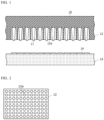
- FIG. 1 shows a cross-sectional view illustrating the configuration of the probe card
- FIG. 2 shows a top view illustrating the configuration of the probe guide.
- the probe card 10 is an inspection jig including a needle-shaped probe 11 and a probe guide (probe guiding member) 12 having a plurality of through holes 12a for conducting each probe 11.
- the inspection of the IC chip 14 is performed by bringing a plurality of probes 11 into contact with the IC chip 14 formed on the silicon wafer 13.
- Patent Document 1 exemplifies a ceramic having a mixture of 25 to 60% by mass of silicon nitride and 40 to 75% by mass of boron nitride as a main raw material. Further, Patent Document 2 discloses an invention relating to free-machining ceramic, wherein the main component is 30 to 50% by mass of boron nitride and 50 to 70% by mass of zirconia.
- the probe guides used in the inspection apparatus is needed to have a coefficient of thermal expansion similar to that of the silicon wafer 13, and the mechanical strength (flexural strength) that can withstand the probe load. It is also required to machine a large number of holes for a microprobe with high accuracy.
- the probe guide 12 needs to be provided with the through holes 12a at positions corresponding to the probes 11 of the probe card 10.
- Setting positions, a shape, and the like of the probes 11 of the probe card 10 vary according to specifications of the inspection apparatus, and setting positions, a shape, and the like of the through holes 12a vary accordingly.
- a circular hole is adapted for the through holes 12a, and the through holes 12a need to be formed in various shapes according to the shape of the probes 11.
- An inner diameter of the holes and a pitch of the holes depend on a kind or an arrangement of the probes 11; for example, there is a case where round shape through holes having a diameter of 50 ⁇ m or 50 ⁇ m square through holes are arranged with a 60 ⁇ m pitch (a wall thickness between the through holes is about 10 ⁇ m). It is necessary to provide tens of thousands of such small through holes. This requires a material that facilitates precise machining. In particular, particles which could be produced when the through holes 12a of the probe guide 12 come into contact with the probes 11 may give rise to damage to the device, a poor inspection, and an increase in number of maintenance times of the probe card 10. Therefore, the through holes 12a of the probe guide 12 are also required to have inner surfaces with a low roughness, that is, smooth machined surfaces.
- the probe guide is required to have extremely excellent mechanical properties.
- Patent Documents 1 and 2 cannot obtain sufficient mechanical strength (specifically, flexural strength of 600 MPa or more).
- the present inventors also proposed in Patent Document 3, in order to smooth the processed surface formed by laser processing (for example, the inner surface of the through hole of the probe guide), the high-strength ceramic Si 3 N 4 is used.
- ZrO 2 of expanded ceramic and predetermined oxides at least one selected from MgO, Y 2 O 3 , CeO 2 , CaO, HfO 2 , TiO 2 , Al 2 O 3 , SiO 2 , MoO 3 , CrO, CoO, ZnO, Ga 2 O 3 , Ta 2 O 5 , NiO and V 2 O 5 ), and has a coefficient of thermal expansion similar to that of a silicon wafer, and a high-strength ceramic.
- Non-Patent Document 1 Takeshi Yoshida et al., Machining Characteristics of Ceramics in YAG Laser Irradiation, Academic Lecture 2001 of Production and Machining, 3rd Production Machining / Machine Tool Division Supporters Association, Japan Society of Mechanical Engineers, November 21, 2001
- Patent Document 3 examines a case where laser processing is performed on a ceramic material in which ZrO 2 is composited with Si 3 N 4 , and appropriate amount of oxides such as MgO, Y 2 O 3 , CeO 2 , CaO, HfO 2 , TiO 2 , Al 2 O 3 , SiO 2 , MoO 3 , CrO, CoO, ZnO, Ga 2 O 3 , Ta 2 O 5 , NiO and V 2 O 5 are contained in order to smooth a processed surface formed by laser processing (for example, the inner surface of a through hole of a probe guide)
- machining speed for example, the inner surface of a through hole of a probe guide
- Non-Patent Document 1 It is known to be easy, for example, when drilling is performed by irradiating a YAG laser, the ceramic of ZrO 2 alone is generally processed as compared with the ceramic of Si 3 N 4 alone. Non-Patent Document 1 explains that the reason is that ceramic having a higher thermal conductivity require a larger irradiation energy.
- the present invention is capable of high-efficiency laser machining with a coefficient of thermal expansion similar to that of silicon, excellent mechanical strength and workability (high-precision fine machining, excellent machining surface properties, and suppression of particle generation). It is an object of the present invention to provide a certain ceramic, a probe guiding member using the ceramic, a probe card, and an inspection socket.
- the present inventors have conducted intensive studies for the purpose of improving the processing speed of ceramic in which ZrO 2 and a predetermined oxide are combined with Si 3 N 4 .
- the part where ZrO 2 is present is difficult to process, and the part where ZrO 2 is not present is easy to process.
- the inventers have studied, and it was considered that ZrO 2 has a high laser reflectance and lowered the laser absorption rate. Therefore, the present inventors have made extensive studies on compounds that reduce the laser reflectance of the composite ceramic, and by allowing appropriate amounts of SiC and AlN to be present according to the amounts of Si 3 N 4 and ZrO 2 , basically. It has been found that the processing speed of a laser can be improved without deteriorating the performance (coefficient of thermal expansion similar to that of silicon, excellent mechanical strength and workability).
- the present invention has been made based on the above findings, and the following inventions are the gist of the present invention.
- Fn SiC + 3 AlN / Si 3 N 4 + ZrO 2
- the coefficient of thermal expansion similar to that of silicon, excellent mechanical strength and workability (high-precision fine processing, excellent processing surface texture, suppression of particle generation), and high-efficiency laser processing are achieved. Since possible ceramic can be obtained, it is particularly useful as a probe guiding member, probe card and inspection socket.
- the ceramic according to the present invention contains, in mass %:
- Si 3 N 4 is effective for improving high strength of ceramic, and in order to obtain a high flexural strength of 700 MPa or more, it is necessary to contain 20.0% or more.
- the content of Si 3 N 4 exceeds 60.0%, it becomes difficult to obtain coefficient of thermal expansion similar to that of a silicon wafer, that is, it is difficult to obtain a coefficient of thermal expansion at -50 to 500 °C of 3.0 ⁇ 10 -6 /°C or more. Therefore, the content of Si 3 N 4 is 20.0 to 60.0%.
- the lower limit is preferably set 25.0%, more preferably 30.0%.
- the upper limit is preferably set 55.0%, more preferably 50.0%.
- ZrO 2 is effective for improving high coefficient of thermal expansion of ceramic, and it is necessary to be contained 25.0% or more.
- the content of ZrO 2 exceeds 70.0%, the coefficient of thermal expansion becomes too high, and it becomes difficult to obtain a coefficient of thermal expansion similar to that of a silicon wafer, that is, it is difficult to obtain a coefficient of thermal expansion at -50 to 500 °C. of 6.0 ⁇ 10 -6 /°C or less. Therefore, the content of ZrO 2 is set to 25.0 to 70.0%.
- the lower limit is preferably set 30.0%, more preferably 35.0%.
- the upper limit is preferably set 65.0%, more preferably 60.0%.
- Some ZrO 2 have a crystalline structure being a monoclinic crystal, a tetragonal crystal, or a cubic crystal. Since the monoclinic ZrO 2 has a lower strength than the tetragonal or cubic ZrO 2 , it is preferable that the ratio of the monoclinic ZrO 2 to the entire ZrO 2 is as small as possible even when the monoclinic ZrO 2 is contained as a crystal structure. If the ratio of monoclinic crystals is too large, it will be difficult to achieve a flexural strength of 600 MPa. Therefore, the ratio of monoclinic crystals to the entire ZrO 2 is preferably 10% or less, and 5% or less. More preferably, it may be 0%.
- a tetragonal crystal ZrO 2 with several percent of oxides dissolved therein is preferably used.
- this tetragonal crystal ZrO 2 is exposed for a long time, the tetragonal crystal undergoes phase transition to a monoclinic crystal even when the exposure occurs at a low temperature (less than 200°C), and this phase transition changes dimensions of the ceramic. For example, this phase transition proceeds at 40°C or more, and proceeds more significantly at 150°C or more.
- the probe guiding member fulfills a function of a probe guiding member at room temperature, whereas as a temperature range for use increases, positions of a plurality of through holes and/or slits through which probes are to be inserted may deviate to inhibit the insertion of the probes. For that reason, it is more preferable to use a cubic crystal ZrO 2 , which does not undergo the phase transition, that is, does not change the dimensions in a use temperature. Note that the cubic crystal ZrO 2 contains about 3 mol% of elements such that Y, and the content of ZrO 2 also includes an amount of these elements.
- Pulse laser machining which is a non-thermal machining method, is used for precision machining of ceramic. Pulsed laser machining is a method of machining ceramic without melting them, but there is a heat-affected region that is heated by the influence of heat during machining at a site near the laser irradiation position. As the size of the through hole provided by processing becomes smaller, the laser diameter becomes larger with respect to the diameter of the through hole, the heat-affected zone becomes relatively larger, and defects such as shape defects and reattachment of the removed material are likely to occur.
- SiC and AlN have extremely high thermal conductivity as compared with Si 3 N 4 and ZrO 2 . Therefore, in ceramic in which ZrO 2 and a predetermined oxide are composited with Si 3 N 4 , if one or more of SiC and AlN are contained, it is easy to dissipate heat in the heat-affected region generated during laser processing, which is basic. The processing speed of the laser can be improved without deteriorating the performance (coefficient of thermal expansion similar to that of silicon, excellent mechanical strength and workability). Therefore, 2.0% or more of one or more selected from SiC and AlN is contained.
- (SiC + 3AlN) / (Si 3 N 4 + ZrO 2 ) it is necessary to set (SiC + 3AlN) / (Si 3 N 4 + ZrO 2 ) to 0.02 or more.
- the content of one or more types selected from SiC and AlN is set to 17.0% or less (however, AlN is 10.0% or less).
- (SiC + 3AlN) / (Si 3 N 4 + ZrO 2 ) is set to 0.40 or less.
- SiC and AlN have lower flexural strengths than Si 3 N 4 and ZrO 2 , especially when these compounds are present in the sintered body as coarse particles, the bending of the sintered body is performed. May reduce strength. Therefore, it is desirable that these compounds are uniformly dispersed in a size of 5.0 um or less in average particle size. It is more desirable that the average particle size is 2.0 um or less and the particles are uniformly dispersed. In order to realize this, it is preferable to use a raw material powder having a fine particle size, and as the raw material powder, a powder having an average particle size of 3.0 um or less is preferable, and a powder having an average particle size of 1.0 um or less is more preferable.
- the ceramic according to the present invention In a case where the ceramic according to the present invention is used to various applications, the ceramic needs to be subjected to fine machining. For example, in order to use the ceramic as a probe guiding member, a plurality of through holes and/or slits need to be formed.
- the ceramic according to the present invention is a high hardness material containing Si 3 N 4 and ZrO 2 as main components, it is difficult to perform this fine machining by mechanical work. Its machined surfaces (e.g., inner surfaces of the through holes of the probe guide) are therefore rough, and when a member subjected to such work is used, particles are produced, which incur damage to various devices or poor inspection.
- the ceramic according to the present invention is made to contain a proper amount of oxides in order to smooth the processed surface formed by laser processing (for example, the inner surface of the through hole of the probe guide). That is, one or more oxides selected from MgO, Y 2 O 3 , CeO 2 , CaO, HfO 2 , TiO 2 , Al 2 O 3 , SiO 2 , MoO 3 , CrO, CoO, ZnO, Ga 2 O 3 , Ta 2 O 5 , NiO, and V 2 O 5 need to be contained at 5.0% or more.
- the content of one or more of these oxides is to be 15.0% or less. Therefore, the content of one or more oxides selected from MgO, Y 2 O 3 , CeO 2 , CaO, HfO 2 , TiO 2 , Al 2 O 3 , SiO 2 , MoO 3 , CrO, CoO, ZnO, Ga 2 O 3 , Ta 2 O 5 , NiO, and V 2 O 5 is to range from 5.0 to 15.0%.
- a lower limit of the content is preferably 7.0%, and more preferably 9.0%.
- An upper limit of the content is preferably 13.0%, and more preferably 11.0%.
- MgO, Y 2 O 3 , CeO 2 , CaO, and HfO 2 each act as a sintering agent as well as the above effect and are additionally effective for stabilizing the crystalline structure of ZrO 2 in a form of the cubic crystal.
- TiO 2 , Al 2 O 3 , SiO 2 , MoO 3 , CrO, CoO, ZnO, Ga 2 O 3 , Ta 2 O 5 , NiO, and V 2 O 5 each act as a sintering agent as well as the above effect.
- the ceramic it is preferable for the ceramic to contain one or more oxides selected from MgO, Y 2 O 3 , CeO 2 , CaO, and HfO 2 , and one or more oxides selected from TiO 2 , Al 2 O 3 , SiO 2 , MoO 3 , CrO, CoO, ZnO, Ga 2 O 3 , Ta 2 O 5 , NiO, and V 2 O 5 .
- Contents of the respective components can be measured by the ICP emission spectral analysis.
- a content of the balance is preferably 10.0% or less, more preferably 5.0% or less, and may be 0%.
- the balance include BN, and the like. Especially, BN may deteriorate strength and its amount should be as low as possible. It is preferably set 3.0% or less, more preferably 1.5% or less.
- the ceramic according to the present invention is used for a probe guide
- the ceramic is required to have a coefficient of thermal expansion as high as that of a silicon wafer on which IC chips are formed. This is because, when a temperature in the inspection changes, positions of the IC chips move with thermal expansion of the silicon wafer.
- the probe guide has a coefficient of thermal expansion as high as that of the silicon wafer
- the probe guide moves in synchronization with expansion and contraction of the silicon wafer, which enables a high precision inspection to be kept.
- a reference coefficient of thermal expansion at -50 to 500°C is 3.0 ⁇ 10 -6 to 6.0 ⁇ 10 -6 /°C.
- the ceramic according to the present invention is required to have mechanical properties sufficient to withstand contact and a load of probes and the like in the inspection.
- the ceramic is required to have a flexural strength that is higher than ever before, in order to meet a demand for reductions of size and thickness of probe guides.
- a reference flexural strength is 600 MPa or more, and more preferably 700 MPa or more.
- a machining precision of pulse laser machining performed on a ceramic material having a thickness of 0.3 mm to form nine 50- ⁇ m-square through holes or nine 30- ⁇ m-square through holes is evaluated.
- the evaluation is carried out by obtaining images taken with optical microscope (for example, VHX7000 manufactured by Keyence Co., Ltd.), and by observing the obtained images with an image measuring machine (for example, Quick Vision manufactured by Mitutoyo Co., Ltd.).
- optical microscope for example, VHX7000 manufactured by Keyence Co., Ltd.
- image measuring machine for example, Quick Vision manufactured by Mitutoyo Co., Ltd.
- a processing speed is evaluated by measuring the time from the start to the end of the formation of the through holes when the nine through holes are machined at the maximum speed at which the above-mentioned good fine workability can be maintained, and calculating the ratio (t 1 / t 0 ) of the processing time (t 1 ) of the ceramic to the processing time (t 0 ) of the ceramic having the standard composition. It is considered that the case where the ratio (t 1 / t 0 ) is 1.05 or more is good. When it is 1.10 or more, and further, 1.15 or more, it is evaluated that the processing speed is further excellent.
- the reference composition means ceramic having a composition excluding SiC and AlN under the condition that the ratio of Si 3 N 4 and ZrO 2 is constant from the ceramic to be evaluated.
- the ceramic of the present invention has a through hole or slit having an inscribed circle diameter of 100 ⁇ m or less, more preferably a through hole or slit having an inscribed circle diameter of 50 ⁇ m or less, and even more preferably an inner circle. It is useful for manufacturing probe guiding member having through holes or slits having a tangent circle diameter of 30 ⁇ m or less.
- the diameter of the inscribed circle of the slit is synonymous with the width of the slit. Further, the thicker the ceramic, the longer it takes to form the through hole, and the heat-affected region becomes relatively large. Therefore, the ceramic of the present invention is useful to manufacture a probe guiding member in which the ratio of the diameter of the inscribed circle (depth / diameter of the inscribed circle) to the depth of the through hole is 6.0 or more, particularly 10.0 or more.
- a roughness of the machined surface nine 50- ⁇ m square through holes are formed on a ceramic material having a thickness of 0.3 mm by the pulse laser machining, given five visual fields of inner surfaces of the machined holes are measured over a length of 100 ⁇ m or more under a laser confocal microscope (VK-X150 from KEYENCE CORPORATION), skew correction is performed to calculate Ra, and an average value of Ra is evaluated. Ra being 0.25 ⁇ m or less is rated as good.
- a ceramic material having a thickness 0.3 mm is heated from room temperature to 150°C at 5°C/min, retained at 150°C for 100 hours, then allowed to be naturally cooled at room temperature, and after being left still for 5 hours since a temperature of the ceramic reaches the room temperature, five or more visual fields of the ceramic are captured under a digital microscope (VHX-6000 from KEYENCE CORPORATION) at 200x observation magnification, and from captured images, whether a crack occurs is evaluated.
- VHX-6000 from KEYENCE CORPORATION
- the obtained slurry is formed into grains by a known method such as spray drying and a method using a decompression evaporator. That is, the slurry is spray-dried by a spray dryer to be formed into granules or is dried by the decompression evaporator to be formed into powder.
- the obtained powder is sintered under a high temperature and a high pressure by, for example, a known method such as hot pressing and hot isostatic pressing (HIP) to be formed into a sintered ceramic body.
- the powder may be calcined in a nitrogen atmosphere.
- a temperature of the calcination is to range from 1300 to 1800°C. If the temperature is excessively low, the sintering becomes insufficient, and if the temperature is excessively high, a problem such as liquating oxide components arises.
- An appropriate pressing force range from 10 to 50 MPa.
- a duration of maintaining the pressing force is normally about 1 to 4 hours, which however depends on the temperature or the dimensions.
- calcination conditions including the temperature and the pressing force are to be set as appropriate.
- a known calcination method such as a pressure less calcination method and an atmosphere pressing calcination may be adopted.
- Si 3 N 4 powder, ZrO 2 powder, SiC and/or AlN powder, and one or more oxide powders selected from MgO, Y 2 O 3 , Al 2 O 3 , SiO 2 , CeO 2 , TiO 2 , and H 2 MoO 4 (to be MoO 3 after sintering) were mixed at various compounding ratios with water, dispersant, resin, and ceramic-made balls, and obtained slurries were each spray-dried by a spray dryer to be formed into granules.
- the obtained granules were charged into a graphite-made dice (mold) and subjected to hot pressing calcination in a nitrogen atmosphere, under a pressure of 30 MPa, at 1700°C, for 2 hours, to be formed into test materials being 150 mm long ⁇ 150 mm wide ⁇ 30 mm thick.
- test specimens were taken and subjected to various kinds of tests.
- a coefficient of thermal expansion of each of the test materials at -50 to 500°C was determined in conformity with JIS R1618.
- a reference coefficient of thermal expansion at -50 to 500°C is 3.0 ⁇ 10 -6 to 6.0 ⁇ 10 -6 /°C.
- a three-point flexural strength of each of the test materials was determined in conformity with JIS R1601.
- a reference flexural strength is 600 MPa or more.
- a bulk density of each of the test materials was determined in conformity with JIS C2141, and the determined bulk density was divided by a theoretical density, by which a relative density was determined.
- a reference relative density is 95% or more.
- a Young's modulus of each of the test materials was determined in conformity with JIS R1602.
- a reference Young's modulus is 240 GPa or more.
- a machining precision of pulse laser machining performed on a ceramic material having a thickness of 0.3 mm to form nine 50- ⁇ m-square through holes or nine 30- ⁇ m-square through holes is evaluated.
- the evaluation is carried out by obtaining images taken with optical microscope (for example, VHX7000 manufactured by Keyence Co., Ltd.), and by observing the obtained images with an image measuring machine (for example, Quick Vision manufactured by Mitutoyo Co., Ltd.).
- a pulse laser having a wavelength of 1064 nm was used for processing a 50 ⁇ m square through hole, and a pulse laser having a wavelength of 532 nm was used for processing a 30 ⁇ m square through hole.
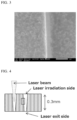
- FIG. 4 shows a schematic view of a state at the time of laser processing. As illustrated in FIG.
- a side of a ceramic to be irradiated with laser light will be referred to as a laser irradiation side, and a side of the ceramic opposite to the laser irradiation will be referred to as a laser beam coming-out side.
- a processing speed is evaluated by measuring the time from the start to the end of the formation of the nine through holes, and calculating the ratio (t 1 / t 0 ) of the processing time (t 1 ) of the ceramic to the processing time (t 0 ) of the ceramic having the standard composition. It is considered that the case where the ratio (t 1 / t 0 ) is 1.05 or more is good. When it is 1.10 or more, and further, 1.15 or more, it is evaluated that the processing speed is further excellent.
- the reference composition means ceramic having a composition excluding SiC and AlN under the condition that the ratio of Si 3 N 4 and ZrO 2 is constant from the ceramic to be evaluated.
- a roughness of the machined surface nine 50- ⁇ m square through holes were formed on the ceramic material having a thickness of 0.3 mm by the pulse laser machining, given five visual fields of inner surfaces of the machined holes were measured over a length of 100 ⁇ m or more under a laser confocal microscope (VK-X150 from KEYENCE CORPORATION), skew correction was performed to calculate Ra, and an average value of Ra was evaluated. Ra being 0.25 ⁇ m or less was rated as good.
- the roughness of the machined surface is determined by observing a cross section of the ceramic material parallel to a thickness direction of the ceramic material in an area including a thickness center portion of an inner surface of each hole (specifically, a portion surrounded by a rectangle illustrated in Figure 8).
- a ceramic material having a thickness 0.3 mm is heated from room temperature to 150°C at 5°C/min, retained at 150°C for 100 hours, then allowed to be naturally cooled at room temperature, and after being left still for 5 hours since a temperature of the ceramic reaches the room temperature, five or more visual fields of the ceramic are captured under a digital microscope (VHX-6000 from KEYENCE CORPORATION) at 200x observation magnification, and from captured images, whether a crack occurs is evaluated.
- VHX-6000 from KEYENCE CORPORATION
- Examples 7 to 11 of the present invention are ceramic sintered bodies using one or more of SiC and AlN as raw material powders having various particle sizes. As shown in Examples 7 to 11 of the present invention, there is a tendency that the smaller the average particle size of SiC and AlN in the ceramic sintered body, the higher the flexural strength.
- the coefficient of thermal expansion similar to that of silicon, excellent mechanical strength and workability (high-precision fine processing, excellent processing surface texture, suppression of particle generation), and high-efficiency laser processing are achieved. Since possible ceramic can be obtained, it is particularly useful as a probe guiding member, probe card and inspection socket.
Landscapes
- Chemical & Material Sciences (AREA)
- Engineering & Computer Science (AREA)
- Ceramic Engineering (AREA)
- Manufacturing & Machinery (AREA)
- Materials Engineering (AREA)
- Structural Engineering (AREA)
- Organic Chemistry (AREA)
- Physics & Mathematics (AREA)
- Composite Materials (AREA)
- General Physics & Mathematics (AREA)
- Inorganic Chemistry (AREA)
- Computer Hardware Design (AREA)
- Microelectronics & Electronic Packaging (AREA)
- Thermal Sciences (AREA)
- Compositions Of Oxide Ceramics (AREA)
- Measuring Leads Or Probes (AREA)
- Testing Or Measuring Of Semiconductors Or The Like (AREA)
- Ceramic Products (AREA)
Applications Claiming Priority (2)
| Application Number | Priority Date | Filing Date | Title |
|---|---|---|---|
| JP2020071158 | 2020-04-10 | ||
| PCT/JP2021/014925 WO2021206148A1 (ja) | 2020-04-10 | 2021-04-08 | セラミックス、プローブ案内部品、プローブカードおよびパッケージ検査用ソケット |
Publications (3)
| Publication Number | Publication Date |
|---|---|
| EP4129953A1 EP4129953A1 (en) | 2023-02-08 |
| EP4129953A4 EP4129953A4 (en) | 2024-05-01 |
| EP4129953B1 true EP4129953B1 (en) | 2025-03-12 |
Family
ID=78023625
Family Applications (1)
| Application Number | Title | Priority Date | Filing Date |
|---|---|---|---|
| EP21784340.8A Active EP4129953B1 (en) | 2020-04-10 | 2021-04-08 | Ceramic, probe-guiding part, probe card and socket for inspecting package |
Country Status (6)
| Country | Link |
|---|---|
| US (1) | US20230312423A1 (https=) |
| EP (1) | EP4129953B1 (https=) |
| JP (1) | JP7373651B2 (https=) |
| KR (1) | KR102778666B1 (https=) |
| TW (1) | TWI773238B (https=) |
| WO (1) | WO2021206148A1 (https=) |
Families Citing this family (2)
| Publication number | Priority date | Publication date | Assignee | Title |
|---|---|---|---|---|
| CN120826382A (zh) * | 2023-03-02 | 2025-10-21 | 日本磁性技术股份有限公司 | 陶瓷、探针导向部件、探针卡和封装检验用插座 |
| WO2025131266A1 (de) * | 2023-12-20 | 2025-06-26 | Kyocera Fineceramics Europe Gmbh | Keramisches bauteil |
Family Cites Families (12)
| Publication number | Priority date | Publication date | Assignee | Title |
|---|---|---|---|---|
| JPS6168374A (ja) * | 1984-09-12 | 1986-04-08 | 品川白煉瓦株式会社 | 溶融金属鋳造用ノズルの製造方法 |
| JP2603950B2 (ja) * | 1987-06-30 | 1997-04-23 | 東芝セラミックス株式会社 | 高強度・高耐食性セラミックスの製造方法 |
| JPS6433072A (en) * | 1987-07-30 | 1989-02-02 | Mazda Motor | High toughness silicon nitride sintered body |
| JP4066591B2 (ja) | 2000-06-09 | 2008-03-26 | 住友金属工業株式会社 | プローブガイド |
| JP4089261B2 (ja) | 2002-03-27 | 2008-05-28 | 住友金属工業株式会社 | 快削性セラミックスとその製造方法およびプローブ案内部品 |
| TWI276618B (en) * | 2003-09-25 | 2007-03-21 | Sumitomo Metal Ind | Machinable ceramic |
| JP4400360B2 (ja) * | 2003-09-25 | 2010-01-20 | 株式会社フェローテックセラミックス | 快削性セラミックスとその製造方法およびプローブ案内部品 |
| CN100488916C (zh) * | 2007-03-09 | 2009-05-20 | 西南科技大学 | 含立方氮化硅粉体的陶瓷及其制备方法 |
| JP2010180105A (ja) | 2009-02-06 | 2010-08-19 | Denki Kagaku Kogyo Kk | プローブ案内部材 |
| KR101871570B1 (ko) * | 2016-03-29 | 2018-06-27 | 한국세라믹기술원 | 프로브 카드용 세라믹 가이드 플레이트의 제조방법 |
| CN111247115A (zh) * | 2017-10-20 | 2020-06-05 | 飞罗得材料技术股份有限公司 | 陶瓷、探针引导构件、探针卡及封装检查用插座 |
| EP3689838A4 (en) * | 2017-11-10 | 2021-06-23 | Ferrotec Material Technologies Corporation | CERAMICS, PROBE GUIDE COMPONENTS, PROBE CARD AND PACKAGING TEST SOCKET |
-
2021
- 2021-04-08 JP JP2022514122A patent/JP7373651B2/ja active Active
- 2021-04-08 KR KR1020227039201A patent/KR102778666B1/ko active Active
- 2021-04-08 US US17/917,880 patent/US20230312423A1/en active Pending
- 2021-04-08 WO PCT/JP2021/014925 patent/WO2021206148A1/ja not_active Ceased
- 2021-04-08 EP EP21784340.8A patent/EP4129953B1/en active Active
- 2021-04-09 TW TW110112856A patent/TWI773238B/zh active
Also Published As
| Publication number | Publication date |
|---|---|
| US20230312423A1 (en) | 2023-10-05 |
| EP4129953A4 (en) | 2024-05-01 |
| JP7373651B2 (ja) | 2023-11-02 |
| JPWO2021206148A1 (https=) | 2021-10-14 |
| TWI773238B (zh) | 2022-08-01 |
| KR20220163481A (ko) | 2022-12-09 |
| WO2021206148A1 (ja) | 2021-10-14 |
| TW202212290A (zh) | 2022-04-01 |
| EP4129953A1 (en) | 2023-02-08 |
| KR102778666B1 (ko) | 2025-03-12 |
Similar Documents
| Publication | Publication Date | Title |
|---|---|---|
| EP3689838A1 (en) | Ceramic, probe guidance component, probe card, and package inspecting socket | |
| EP4129953B1 (en) | Ceramic, probe-guiding part, probe card and socket for inspecting package | |
| KR102419954B1 (ko) | 세라믹스, 프로브 안내 부품, 프로브 카드 및 패키지 검사용 소켓 | |
| HK40081816B (en) | Ceramic, probe-guiding part, probe card and socket for inspecting package | |
| HK40081816A (en) | Ceramic, probe-guiding part, probe card and socket for inspecting package | |
| US20250340490A1 (en) | Silicon nitride composite material and probe-guiding part | |
| JP4089261B2 (ja) | 快削性セラミックスとその製造方法およびプローブ案内部品 | |
| HK40028016A (en) | Ceramic, probe guidance component, probe card, and package inspecting socket | |
| JP6698395B2 (ja) | プローブ案内部材及びその製造方法 | |
| JP7610660B1 (ja) | 窒化ケイ素焼結体、絶縁回路基板、および半導体装置 | |
| JP2010083749A (ja) | 快削性セラミックス複合材料 | |
| TWI898450B (zh) | 陶瓷、探針引導零件、探針卡及封裝檢查用插座 | |
| WO2025124690A1 (en) | Ceramic for the manufacture of ceramic plates for probe cards | |
| Huang et al. | Vat photopolymerization of Nb2O5-Doped 3Y-TZP ceramics: Correlation between microstructure, mechanical properties, and aging resistance | |
| WO2025203832A1 (ja) | セラミック組成物、およびセラミック部品 | |
| TW202610964A (zh) | 氧化鋯增韌氧化鋁、燒結陶瓷體、及相關方法 | |
| Fornabaio et al. | Design and processing of novel ceramic composite structures for use in medical surgery | |
| HK40029528A (en) | Ceramic, probe-guiding part, probe card and socket for inspecting package |
Legal Events
| Date | Code | Title | Description |
|---|---|---|---|
| STAA | Information on the status of an ep patent application or granted ep patent |
Free format text: STATUS: THE INTERNATIONAL PUBLICATION HAS BEEN MADE |
|
| PUAI | Public reference made under article 153(3) epc to a published international application that has entered the european phase |
Free format text: ORIGINAL CODE: 0009012 |
|
| STAA | Information on the status of an ep patent application or granted ep patent |
Free format text: STATUS: REQUEST FOR EXAMINATION WAS MADE |
|
| 17P | Request for examination filed |
Effective date: 20221104 |
|
| AK | Designated contracting states |
Kind code of ref document: A1 Designated state(s): AL AT BE BG CH CY CZ DE DK EE ES FI FR GB GR HR HU IE IS IT LI LT LU LV MC MK MT NL NO PL PT RO RS SE SI SK SM TR |
|
| REG | Reference to a national code |
Ref country code: HK Ref legal event code: DE Ref document number: 40081816 Country of ref document: HK |
|
| DAV | Request for validation of the european patent (deleted) | ||
| DAX | Request for extension of the european patent (deleted) | ||
| A4 | Supplementary search report drawn up and despatched |
Effective date: 20240328 |
|
| RIC1 | Information provided on ipc code assigned before grant |
Ipc: G01R 1/04 20060101ALI20240322BHEP Ipc: G01R 1/073 20060101ALI20240322BHEP Ipc: C04B 35/645 20060101ALI20240322BHEP Ipc: C04B 35/626 20060101ALI20240322BHEP Ipc: C04B 35/587 20060101ALI20240322BHEP Ipc: C04B 35/488 20060101AFI20240322BHEP |
|
| GRAP | Despatch of communication of intention to grant a patent |
Free format text: ORIGINAL CODE: EPIDOSNIGR1 |
|
| STAA | Information on the status of an ep patent application or granted ep patent |
Free format text: STATUS: GRANT OF PATENT IS INTENDED |
|
| RIC1 | Information provided on ipc code assigned before grant |
Ipc: G01R 1/04 20060101ALI20240927BHEP Ipc: G01R 1/073 20060101ALI20240927BHEP Ipc: C04B 35/645 20060101ALI20240927BHEP Ipc: C04B 35/626 20060101ALI20240927BHEP Ipc: C04B 35/587 20060101ALI20240927BHEP Ipc: C04B 35/488 20060101AFI20240927BHEP |
|
| INTG | Intention to grant announced |
Effective date: 20241030 |
|
| GRAS | Grant fee paid |
Free format text: ORIGINAL CODE: EPIDOSNIGR3 |
|
| GRAA | (expected) grant |
Free format text: ORIGINAL CODE: 0009210 |
|
| STAA | Information on the status of an ep patent application or granted ep patent |
Free format text: STATUS: THE PATENT HAS BEEN GRANTED |
|
| P01 | Opt-out of the competence of the unified patent court (upc) registered |
Free format text: CASE NUMBER: APP_2262/2025 Effective date: 20250114 |
|
| AK | Designated contracting states |
Kind code of ref document: B1 Designated state(s): AL AT BE BG CH CY CZ DE DK EE ES FI FR GB GR HR HU IE IS IT LI LT LU LV MC MK MT NL NO PL PT RO RS SE SI SK SM TR |
|
| REG | Reference to a national code |
Ref country code: GB Ref legal event code: FG4D |
|
| REG | Reference to a national code |
Ref country code: CH Ref legal event code: EP |
|
| REG | Reference to a national code |
Ref country code: NL Ref legal event code: FP |
|
| REG | Reference to a national code |
Ref country code: DE Ref legal event code: R096 Ref document number: 602021027575 Country of ref document: DE |
|
| REG | Reference to a national code |
Ref country code: IE Ref legal event code: FG4D |
|
| PGFP | Annual fee paid to national office [announced via postgrant information from national office to epo] |
Ref country code: NL Payment date: 20250418 Year of fee payment: 5 |
|
| PG25 | Lapsed in a contracting state [announced via postgrant information from national office to epo] |
Ref country code: RS Free format text: LAPSE BECAUSE OF FAILURE TO SUBMIT A TRANSLATION OF THE DESCRIPTION OR TO PAY THE FEE WITHIN THE PRESCRIBED TIME-LIMIT Effective date: 20250612 |
|
| PG25 | Lapsed in a contracting state [announced via postgrant information from national office to epo] |
Ref country code: FI Free format text: LAPSE BECAUSE OF FAILURE TO SUBMIT A TRANSLATION OF THE DESCRIPTION OR TO PAY THE FEE WITHIN THE PRESCRIBED TIME-LIMIT Effective date: 20250312 |
|
| PGFP | Annual fee paid to national office [announced via postgrant information from national office to epo] |
Ref country code: DE Payment date: 20250430 Year of fee payment: 5 |
|
| PG25 | Lapsed in a contracting state [announced via postgrant information from national office to epo] |
Ref country code: ES Free format text: LAPSE BECAUSE OF FAILURE TO SUBMIT A TRANSLATION OF THE DESCRIPTION OR TO PAY THE FEE WITHIN THE PRESCRIBED TIME-LIMIT Effective date: 20250312 |
|
| PGFP | Annual fee paid to national office [announced via postgrant information from national office to epo] |
Ref country code: GB Payment date: 20250423 Year of fee payment: 5 |
|
| REG | Reference to a national code |
Ref country code: LT Ref legal event code: MG9D |
|
| PG25 | Lapsed in a contracting state [announced via postgrant information from national office to epo] |
Ref country code: NO Free format text: LAPSE BECAUSE OF FAILURE TO SUBMIT A TRANSLATION OF THE DESCRIPTION OR TO PAY THE FEE WITHIN THE PRESCRIBED TIME-LIMIT Effective date: 20250612 |
|
| PG25 | Lapsed in a contracting state [announced via postgrant information from national office to epo] |
Ref country code: HR Free format text: LAPSE BECAUSE OF FAILURE TO SUBMIT A TRANSLATION OF THE DESCRIPTION OR TO PAY THE FEE WITHIN THE PRESCRIBED TIME-LIMIT Effective date: 20250312 |
|
| PG25 | Lapsed in a contracting state [announced via postgrant information from national office to epo] |
Ref country code: LV Free format text: LAPSE BECAUSE OF FAILURE TO SUBMIT A TRANSLATION OF THE DESCRIPTION OR TO PAY THE FEE WITHIN THE PRESCRIBED TIME-LIMIT Effective date: 20250312 |
|
| PG25 | Lapsed in a contracting state [announced via postgrant information from national office to epo] |
Ref country code: GR Free format text: LAPSE BECAUSE OF FAILURE TO SUBMIT A TRANSLATION OF THE DESCRIPTION OR TO PAY THE FEE WITHIN THE PRESCRIBED TIME-LIMIT Effective date: 20250613 Ref country code: BG Free format text: LAPSE BECAUSE OF FAILURE TO SUBMIT A TRANSLATION OF THE DESCRIPTION OR TO PAY THE FEE WITHIN THE PRESCRIBED TIME-LIMIT Effective date: 20250312 |
|
| REG | Reference to a national code |
Ref country code: AT Ref legal event code: MK05 Ref document number: 1774936 Country of ref document: AT Kind code of ref document: T Effective date: 20250312 |
|
| PG25 | Lapsed in a contracting state [announced via postgrant information from national office to epo] |
Ref country code: SE Free format text: LAPSE BECAUSE OF FAILURE TO SUBMIT A TRANSLATION OF THE DESCRIPTION OR TO PAY THE FEE WITHIN THE PRESCRIBED TIME-LIMIT Effective date: 20250312 |
|
| PG25 | Lapsed in a contracting state [announced via postgrant information from national office to epo] |
Ref country code: SM Free format text: LAPSE BECAUSE OF FAILURE TO SUBMIT A TRANSLATION OF THE DESCRIPTION OR TO PAY THE FEE WITHIN THE PRESCRIBED TIME-LIMIT Effective date: 20250312 |
|
| PG25 | Lapsed in a contracting state [announced via postgrant information from national office to epo] |
Ref country code: PT Free format text: LAPSE BECAUSE OF FAILURE TO SUBMIT A TRANSLATION OF THE DESCRIPTION OR TO PAY THE FEE WITHIN THE PRESCRIBED TIME-LIMIT Effective date: 20250714 |
|
| PG25 | Lapsed in a contracting state [announced via postgrant information from national office to epo] |
Ref country code: PL Free format text: LAPSE BECAUSE OF FAILURE TO SUBMIT A TRANSLATION OF THE DESCRIPTION OR TO PAY THE FEE WITHIN THE PRESCRIBED TIME-LIMIT Effective date: 20250312 |
|
| PGFP | Annual fee paid to national office [announced via postgrant information from national office to epo] |
Ref country code: IT Payment date: 20250627 Year of fee payment: 5 |
|
| PG25 | Lapsed in a contracting state [announced via postgrant information from national office to epo] |
Ref country code: AT Free format text: LAPSE BECAUSE OF FAILURE TO SUBMIT A TRANSLATION OF THE DESCRIPTION OR TO PAY THE FEE WITHIN THE PRESCRIBED TIME-LIMIT Effective date: 20250312 |
|
| PG25 | Lapsed in a contracting state [announced via postgrant information from national office to epo] |
Ref country code: CZ Free format text: LAPSE BECAUSE OF FAILURE TO SUBMIT A TRANSLATION OF THE DESCRIPTION OR TO PAY THE FEE WITHIN THE PRESCRIBED TIME-LIMIT Effective date: 20250312 Ref country code: EE Free format text: LAPSE BECAUSE OF FAILURE TO SUBMIT A TRANSLATION OF THE DESCRIPTION OR TO PAY THE FEE WITHIN THE PRESCRIBED TIME-LIMIT Effective date: 20250312 |
|
| PG25 | Lapsed in a contracting state [announced via postgrant information from national office to epo] |
Ref country code: RO Free format text: LAPSE BECAUSE OF FAILURE TO SUBMIT A TRANSLATION OF THE DESCRIPTION OR TO PAY THE FEE WITHIN THE PRESCRIBED TIME-LIMIT Effective date: 20250312 |
|
| PG25 | Lapsed in a contracting state [announced via postgrant information from national office to epo] |
Ref country code: SK Free format text: LAPSE BECAUSE OF FAILURE TO SUBMIT A TRANSLATION OF THE DESCRIPTION OR TO PAY THE FEE WITHIN THE PRESCRIBED TIME-LIMIT Effective date: 20250312 |
|
| PG25 | Lapsed in a contracting state [announced via postgrant information from national office to epo] |
Ref country code: IS Free format text: LAPSE BECAUSE OF FAILURE TO SUBMIT A TRANSLATION OF THE DESCRIPTION OR TO PAY THE FEE WITHIN THE PRESCRIBED TIME-LIMIT Effective date: 20250712 |
|
| REG | Reference to a national code |
Ref country code: CH Ref legal event code: H13 Free format text: ST27 STATUS EVENT CODE: U-0-0-H10-H13 (AS PROVIDED BY THE NATIONAL OFFICE) Effective date: 20251125 |
|
| PG25 | Lapsed in a contracting state [announced via postgrant information from national office to epo] |
Ref country code: LU Free format text: LAPSE BECAUSE OF NON-PAYMENT OF DUE FEES Effective date: 20250408 |
|
| REG | Reference to a national code |
Ref country code: DE Ref legal event code: R097 Ref document number: 602021027575 Country of ref document: DE |
|
| PG25 | Lapsed in a contracting state [announced via postgrant information from national office to epo] |
Ref country code: MC Free format text: LAPSE BECAUSE OF FAILURE TO SUBMIT A TRANSLATION OF THE DESCRIPTION OR TO PAY THE FEE WITHIN THE PRESCRIBED TIME-LIMIT Effective date: 20250312 |
|
| REG | Reference to a national code |
Ref country code: BE Ref legal event code: MM Effective date: 20250430 |
|
| PG25 | Lapsed in a contracting state [announced via postgrant information from national office to epo] |
Ref country code: DK Free format text: LAPSE BECAUSE OF FAILURE TO SUBMIT A TRANSLATION OF THE DESCRIPTION OR TO PAY THE FEE WITHIN THE PRESCRIBED TIME-LIMIT Effective date: 20250312 |
|
| PG25 | Lapsed in a contracting state [announced via postgrant information from national office to epo] |
Ref country code: BE Free format text: LAPSE BECAUSE OF NON-PAYMENT OF DUE FEES Effective date: 20250430 |
|
| PLBE | No opposition filed within time limit |
Free format text: ORIGINAL CODE: 0009261 |
|
| STAA | Information on the status of an ep patent application or granted ep patent |
Free format text: STATUS: NO OPPOSITION FILED WITHIN TIME LIMIT |
|
| PG25 | Lapsed in a contracting state [announced via postgrant information from national office to epo] |
Ref country code: CH Free format text: LAPSE BECAUSE OF NON-PAYMENT OF DUE FEES Effective date: 20250430 |
|
| REG | Reference to a national code |
Ref country code: CH Ref legal event code: L10 Free format text: ST27 STATUS EVENT CODE: U-0-0-L10-L00 (AS PROVIDED BY THE NATIONAL OFFICE) Effective date: 20260121 |
|
| 26N | No opposition filed |
Effective date: 20251215 |
|
| PG25 | Lapsed in a contracting state [announced via postgrant information from national office to epo] |
Ref country code: IE Free format text: LAPSE BECAUSE OF NON-PAYMENT OF DUE FEES Effective date: 20250408 |
|
| PG25 | Lapsed in a contracting state [announced via postgrant information from national office to epo] |
Ref country code: FR Free format text: LAPSE BECAUSE OF NON-PAYMENT OF DUE FEES Effective date: 20250512 |