EP4123685B1 - Steuervorrichtung einer glühvorrichtung, glühvorrichtung und glühverfahren - Google Patents
Steuervorrichtung einer glühvorrichtung, glühvorrichtung und glühverfahren Download PDFInfo
- Publication number
- EP4123685B1 EP4123685B1 EP22183898.0A EP22183898A EP4123685B1 EP 4123685 B1 EP4123685 B1 EP 4123685B1 EP 22183898 A EP22183898 A EP 22183898A EP 4123685 B1 EP4123685 B1 EP 4123685B1
- Authority
- EP
- European Patent Office
- Prior art keywords
- beam spot
- annealing
- annealed target
- annealed
- pulsed laser
- Prior art date
- Legal status (The legal status is an assumption and is not a legal conclusion. Google has not performed a legal analysis and makes no representation as to the accuracy of the status listed.)
- Active
Links
Images





Classifications
-
- B—PERFORMING OPERATIONS; TRANSPORTING
- B23—MACHINE TOOLS; METAL-WORKING NOT OTHERWISE PROVIDED FOR
- B23K—SOLDERING OR UNSOLDERING; WELDING; CLADDING OR PLATING BY SOLDERING OR WELDING; CUTTING BY APPLYING HEAT LOCALLY, e.g. FLAME CUTTING; WORKING BY LASER BEAM
- B23K26/00—Working by laser beam, e.g. welding, cutting or boring
- B23K26/352—Working by laser beam, e.g. welding, cutting or boring for surface treatment
- B23K26/354—Working by laser beam, e.g. welding, cutting or boring for surface treatment by melting
-
- H—ELECTRICITY
- H10—SEMICONDUCTOR DEVICES; ELECTRIC SOLID-STATE DEVICES NOT OTHERWISE PROVIDED FOR
- H10P—GENERIC PROCESSES OR APPARATUS FOR THE MANUFACTURE OR TREATMENT OF DEVICES COVERED BY CLASS H10
- H10P95/00—Generic processes or apparatus for manufacture or treatments not covered by the other groups of this subclass
- H10P95/90—Thermal treatments, e.g. annealing or sintering
-
- B—PERFORMING OPERATIONS; TRANSPORTING
- B23—MACHINE TOOLS; METAL-WORKING NOT OTHERWISE PROVIDED FOR
- B23K—SOLDERING OR UNSOLDERING; WELDING; CLADDING OR PLATING BY SOLDERING OR WELDING; CUTTING BY APPLYING HEAT LOCALLY, e.g. FLAME CUTTING; WORKING BY LASER BEAM
- B23K26/00—Working by laser beam, e.g. welding, cutting or boring
- B23K26/08—Devices involving relative movement between laser beam and workpiece
- B23K26/082—Scanning systems, i.e. devices involving movement of the laser beam relative to the laser head
-
- B—PERFORMING OPERATIONS; TRANSPORTING
- B23—MACHINE TOOLS; METAL-WORKING NOT OTHERWISE PROVIDED FOR
- B23K—SOLDERING OR UNSOLDERING; WELDING; CLADDING OR PLATING BY SOLDERING OR WELDING; CUTTING BY APPLYING HEAT LOCALLY, e.g. FLAME CUTTING; WORKING BY LASER BEAM
- B23K26/00—Working by laser beam, e.g. welding, cutting or boring
- B23K26/02—Positioning or observing the workpiece, e.g. with respect to the point of impact; Aligning, aiming or focusing the laser beam
- B23K26/06—Shaping the laser beam, e.g. by masks or multi-focusing
- B23K26/062—Shaping the laser beam, e.g. by masks or multi-focusing by direct control of the laser beam
- B23K26/0622—Shaping the laser beam, e.g. by masks or multi-focusing by direct control of the laser beam by shaping pulses
-
- B—PERFORMING OPERATIONS; TRANSPORTING
- B23—MACHINE TOOLS; METAL-WORKING NOT OTHERWISE PROVIDED FOR
- B23K—SOLDERING OR UNSOLDERING; WELDING; CLADDING OR PLATING BY SOLDERING OR WELDING; CUTTING BY APPLYING HEAT LOCALLY, e.g. FLAME CUTTING; WORKING BY LASER BEAM
- B23K26/00—Working by laser beam, e.g. welding, cutting or boring
- B23K26/02—Positioning or observing the workpiece, e.g. with respect to the point of impact; Aligning, aiming or focusing the laser beam
- B23K26/06—Shaping the laser beam, e.g. by masks or multi-focusing
- B23K26/064—Shaping the laser beam, e.g. by masks or multi-focusing by means of optical elements, e.g. lenses, mirrors or prisms
-
- B—PERFORMING OPERATIONS; TRANSPORTING
- B23—MACHINE TOOLS; METAL-WORKING NOT OTHERWISE PROVIDED FOR
- B23K—SOLDERING OR UNSOLDERING; WELDING; CLADDING OR PLATING BY SOLDERING OR WELDING; CUTTING BY APPLYING HEAT LOCALLY, e.g. FLAME CUTTING; WORKING BY LASER BEAM
- B23K26/00—Working by laser beam, e.g. welding, cutting or boring
- B23K26/02—Positioning or observing the workpiece, e.g. with respect to the point of impact; Aligning, aiming or focusing the laser beam
- B23K26/06—Shaping the laser beam, e.g. by masks or multi-focusing
- B23K26/073—Shaping the laser spot
- B23K26/0732—Shaping the laser spot into a rectangular shape
-
- B—PERFORMING OPERATIONS; TRANSPORTING
- B23—MACHINE TOOLS; METAL-WORKING NOT OTHERWISE PROVIDED FOR
- B23K—SOLDERING OR UNSOLDERING; WELDING; CLADDING OR PLATING BY SOLDERING OR WELDING; CUTTING BY APPLYING HEAT LOCALLY, e.g. FLAME CUTTING; WORKING BY LASER BEAM
- B23K26/00—Working by laser beam, e.g. welding, cutting or boring
- B23K26/352—Working by laser beam, e.g. welding, cutting or boring for surface treatment
-
- G—PHYSICS
- G02—OPTICS
- G02B—OPTICAL ELEMENTS, SYSTEMS OR APPARATUS
- G02B26/00—Optical devices or arrangements for the control of light using movable or deformable optical elements
- G02B26/08—Optical devices or arrangements for the control of light using movable or deformable optical elements for controlling the direction of light
- G02B26/10—Scanning systems
- G02B26/105—Scanning systems with one or more pivoting mirrors or galvano-mirrors
-
- G—PHYSICS
- G02—OPTICS
- G02B—OPTICAL ELEMENTS, SYSTEMS OR APPARATUS
- G02B27/00—Optical systems or apparatus not provided for by any of the groups G02B1/00 - G02B26/00, G02B30/00
- G02B27/09—Beam shaping, e.g. changing the cross-sectional area, not otherwise provided for
- G02B27/0916—Adapting the beam shape of a semiconductor light source such as a laser diode or an LED, e.g. for efficiently coupling into optical fibers
-
- H—ELECTRICITY
- H10—SEMICONDUCTOR DEVICES; ELECTRIC SOLID-STATE DEVICES NOT OTHERWISE PROVIDED FOR
- H10P—GENERIC PROCESSES OR APPARATUS FOR THE MANUFACTURE OR TREATMENT OF DEVICES COVERED BY CLASS H10
- H10P34/00—Irradiation with electromagnetic or particle radiation of wafers, substrates or parts of devices
- H10P34/40—Irradiation with electromagnetic or particle radiation of wafers, substrates or parts of devices with high-energy radiation
- H10P34/42—Irradiation with electromagnetic or particle radiation of wafers, substrates or parts of devices with high-energy radiation with electromagnetic radiation, e.g. laser annealing
-
- H—ELECTRICITY
- H10—SEMICONDUCTOR DEVICES; ELECTRIC SOLID-STATE DEVICES NOT OTHERWISE PROVIDED FOR
- H10P—GENERIC PROCESSES OR APPARATUS FOR THE MANUFACTURE OR TREATMENT OF DEVICES COVERED BY CLASS H10
- H10P72/00—Handling or holding of wafers, substrates or devices during manufacture or treatment thereof
- H10P72/04—Apparatus for manufacture or treatment
- H10P72/0431—Apparatus for thermal treatment
- H10P72/0436—Apparatus for thermal treatment mainly by radiation
-
- B—PERFORMING OPERATIONS; TRANSPORTING
- B23—MACHINE TOOLS; METAL-WORKING NOT OTHERWISE PROVIDED FOR
- B23K—SOLDERING OR UNSOLDERING; WELDING; CLADDING OR PLATING BY SOLDERING OR WELDING; CUTTING BY APPLYING HEAT LOCALLY, e.g. FLAME CUTTING; WORKING BY LASER BEAM
- B23K2103/00—Materials to be soldered, welded or cut
- B23K2103/50—Inorganic materials other than metals or composite materials
- B23K2103/56—Inorganic materials other than metals or composite materials being semiconducting
-
- H—ELECTRICITY
- H10—SEMICONDUCTOR DEVICES; ELECTRIC SOLID-STATE DEVICES NOT OTHERWISE PROVIDED FOR
- H10P—GENERIC PROCESSES OR APPARATUS FOR THE MANUFACTURE OR TREATMENT OF DEVICES COVERED BY CLASS H10
- H10P14/00—Formation of materials, e.g. in the shape of layers or pillars
- H10P14/20—Formation of materials, e.g. in the shape of layers or pillars of semiconductor materials
- H10P14/38—Formation of materials, e.g. in the shape of layers or pillars of semiconductor materials characterised by treatments done after the formation of the materials
- H10P14/3802—Crystallisation or recrystallisation of non-monocrystalline semiconductor materials, e.g. regrowth
- H10P14/3808—Crystallisation or recrystallisation of non-monocrystalline semiconductor materials, e.g. regrowth using laser beams
- H10P14/381—Beam shaping, e.g. using a mask
-
- H—ELECTRICITY
- H10—SEMICONDUCTOR DEVICES; ELECTRIC SOLID-STATE DEVICES NOT OTHERWISE PROVIDED FOR
- H10P—GENERIC PROCESSES OR APPARATUS FOR THE MANUFACTURE OR TREATMENT OF DEVICES COVERED BY CLASS H10
- H10P14/00—Formation of materials, e.g. in the shape of layers or pillars
- H10P14/20—Formation of materials, e.g. in the shape of layers or pillars of semiconductor materials
- H10P14/38—Formation of materials, e.g. in the shape of layers or pillars of semiconductor materials characterised by treatments done after the formation of the materials
- H10P14/3802—Crystallisation or recrystallisation of non-monocrystalline semiconductor materials, e.g. regrowth
- H10P14/3808—Crystallisation or recrystallisation of non-monocrystalline semiconductor materials, e.g. regrowth using laser beams
- H10P14/3816—Pulsed laser beam
-
- H—ELECTRICITY
- H10—SEMICONDUCTOR DEVICES; ELECTRIC SOLID-STATE DEVICES NOT OTHERWISE PROVIDED FOR
- H10P—GENERIC PROCESSES OR APPARATUS FOR THE MANUFACTURE OR TREATMENT OF DEVICES COVERED BY CLASS H10
- H10P14/00—Formation of materials, e.g. in the shape of layers or pillars
- H10P14/20—Formation of materials, e.g. in the shape of layers or pillars of semiconductor materials
- H10P14/38—Formation of materials, e.g. in the shape of layers or pillars of semiconductor materials characterised by treatments done after the formation of the materials
- H10P14/3802—Crystallisation or recrystallisation of non-monocrystalline semiconductor materials, e.g. regrowth
- H10P14/382—Scanning of a beam
Definitions
- the disclosure relates to a control device of an annealing device, an annealing device, and an annealing method.
- a dopant doped in a flat plate-shaped annealed target such as a silicon wafer
- a circuit element is formed on one surface of a semiconductor wafer, and then an impurity is doped on the other surface to perform annealing.
- a protective tape made of resin is attached to the circuit forming surface. In order to prevent the protective tape from melting, it is desired to suppress the temperature of the circuit forming surface from rising.
- Patent Literature 1 Japanese Patent Laid-Open No. 2020-202242
- Document CN 112 864 040 discloses the preamble of claims 1 and 4.
- An object of the disclosure is to provide a control device of an annealing device, an annealing device, and an annealing method which are capable of further suppressing the temperature of the surface opposite to the laser irradiation surface from rising.
- an annealing device according to claim 1 is provided.
- an annealing method according to claim 4 is provided.
- FIG. 1 is a schematic perspective view of the annealing device according to an embodiment.
- a laser light source 10 outputs a pulsed laser beam.
- the pulsed laser beam output from the laser light source 10 passes through a beam expander 11, a beam shaping optical element 12, reflective mirrors 13 and 14, a beam scanner 15, and an f ⁇ lens 16 to be incident on the laser irradiation surface of an annealed target 60.
- the annealed target 60 is, for example, a semiconductor wafer in which a dopant is ion-implanted.
- the annealed target 60 is held by a chuck mechanism 18 supported by a movable stage 17.
- the movable stage 17 moves the chuck mechanism 18 in two directions in a horizontal plane.
- the movement of the chuck mechanism 18 causes the annealed target 60 to move.
- An XY stage for example, is used as the movable stage 17.
- the beam expander 11 adjusts the beam size (diameter of the beam cross section) at the incident position of the laser beam on the beam shaping optical element 12.
- the beam shaping optical element 12 shapes the beam spot on the beam irradiation surface of the annealed target 60 into a long shape in one direction and makes the intensity distribution uniform.
- a diffractive optical element for example, is used as the beam shaping optical element 12.
- the beam scanner 15 includes a galvano mirror 15A and a motor 15B.
- the motor 15B rotates the galvano mirror 15A within a range in the tilting direction to scan the pulsed laser beam in one-dimensional direction. By this scanning, the beam spot moves in the longitudinal direction thereof on the surface of the annealed target 60.
- the f ⁇ lens 16 concentrates the pulsed laser beam scanned by the beam scanner 15 on the laser irradiation surface of the annealed target 60.
- FIG. 2 is a schematic view of a laser annealing device according to the present embodiment. The description of the contents overlapping with the description of FIG. 1 will be omitted.
- a fiber laser oscillator is used as the laser light source 10.
- An input side optical fiber 32 is connected to one end of a gain fiber 31 doped with a laser active medium, and an output side optical fiber 34 is connected to the other end.
- a high reflectance type fiber Bragg grating 33 is formed on the input side optical fiber 32, and a low reflectance type fiber Bragg grating 35 is formed on the output side optical fiber 34.
- An optical resonator is constituted by the high reflectance type fiber Bragg grating 33 and the low reflectance type fiber Bragg grating 35.
- An excitation light output from a laser diode 30 is introduced into the gain fiber 31 through the input side optical fiber 32.
- the laser active medium doped in the gain fiber 31 is excited by the excitation light. Induced emission occurs when the laser active medium transitions to a low energy state, and a laser light is generated.
- the laser light generated by the gain fiber 31 passes through the output side optical fiber 34 and is incident on a wavelength conversion element 36.
- the laser beam wavelength-converted by the wavelength conversion element 36 passes through the beam expander 11, the beam shaping optical element 12, the reflective mirrors 13 and 14, the beam scanner 15, and the f ⁇ lens 16 to be incident on the annealed target 60.
- the gain fiber 31 outputs, for example, a laser light in an infrared region, and the wavelength conversion element 36 converts the laser light in the infrared region into a laser light in a green wavelength region.
- a driver 37 drives the laser diode 30 based on a command from a control device 40.
- the command received from the control device 40 includes information that specifies the repetition frequency of the laser pulse output from the laser diode 30.
- the driver 37 outputs the excitation laser light from the laser diode 30 at the repetition frequency of the laser pulse commanded by the control device 40. As a result, the pulsed laser beam is output from the laser light source 10 at the commanded repetition frequency.
- the movable stage 17 and the chuck mechanism 18 are arranged in a chamber 50.
- a laser transmission window 51 is attached to a wall surface of the chamber 50 above the annealed target 60 held by the chuck mechanism 18.
- the pulsed laser beam transmitted through the f ⁇ lens 16 passes through the laser transmission window 51 and is incident on the laser irradiation surface of the annealed target 60.
- the laser annealing device according to the present embodiment performs activation annealing on the dopant doped in the annealed target 60, for example.
- the annealed target 60 is, for example, a silicon wafer.
- the control device 40 includes a console to be operated by a user.
- the user operates the console to input information that specifies the repetition frequency of the pulse of the pulsed laser beam.
- the control device 40 gives the driver 37 the information that specifies the repetition frequency of the input pulse.
- the control device 40 further controls the beam scanner 15 and the movable stage 17 to move the beam spot on the laser irradiation surface of the annealed target 60.
- an xyz orthogonal coordinate system is defined in which the direction in which the beam spot moves is an x direction and the direction orthogonal to the x direction in the laser irradiation surface is a y direction.
- the beam spot of the pulsed laser beam has a long shape in the x direction.
- the operation of operating the beam scanner 15 to move the beam spot in the x direction is referred to as a "sweep operation.”
- the control device 40 controls the movable stage 17 to move the annealed target 60 in the y direction
- the position of the beam spot is displaced in the y direction (shifted in the y direction) on the surface of the annealed target 60.
- the operation of displacing the position of the beam spot in the y direction is referred to as a "step operation.”
- the beam spot can be moved in the x direction or the y direction on the surface of the annealed target 60.
- the beam scanner 15 and the movable stage 17 constitute a movement mechanism 20 that moves the beam spot in a two-dimensional direction on the surface of the annealed target 60.
- the maximum length by which the beam spot can be swept in the x direction depends on the swing angle of the pulsed laser beam of the beam scanner 15 and the performance of the f ⁇ lens 16. If the maximum length of the sweep is shorter than the dimensions of the annealed target 60, almost the entire area of the annealed target 60 can be annealed by repeating the sweep operation and the step operation and executing a plurality of times the procedure of annealing in a part of the range in the x direction by shifting the annealed target 60 in the x direction.
- t is the elapsed time from the start of heating
- C is the specific heat of the annealed target 60
- ⁇ is the density of the annealed target 60
- ⁇ is the thermal conductivity of the annealed target 60.
- the unit of the surface temperature T is "K”
- the unit of the power density P is "W/cm 2 ”
- the unit of the elapsed time t is "second”
- the unit of the specific heat C is "J/g ⁇ K”
- the unit of the density ⁇ is "g/cm 3
- the unit of the thermal conductivity ⁇ is "W/cm-K.”
- the power density P and the pulse width t 0 required to raise the temperature to the target value are determined.
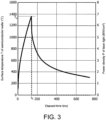
- FIG. 3 is a graph showing the calculated value of the temporal change of the surface temperature T when one shot of the pulsed laser beam is incident on the silicon wafer.
- the horizontal axis represents the elapsed time t from the rising point of the laser pulse in the unit "ns”
- the left vertical axis represents the surface temperature T of the annealed target 60 in the unit “°C”
- the right vertical axis represents the power density P of the pulsed laser beam in the unit "MW/cm 2 .”
- the broken line in the graph shows the temporal change of the power density P of the pulsed laser beam
- the solid line shows the temporal change of the surface temperature T of the annealed target 60.
- the pulse width of the pulsed laser beam is t 0
- the peak power density is 5 MW/cm 2 .
- the surface temperature T rises according to Equation (1).
- the surface temperature T gradually decreases.
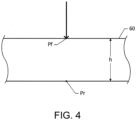
- FIG. 4 is a cross-sectional view of the annealed target 60 on which the pulsed laser beam is incident.
- the incident position of the laser beam is a heat source Pf.
- Q is the heat input from the heat source Pf to the annealed target 60
- h is the thickness of the annealed target 60
- v is the sweep speed of the heat source Pf
- k is the thermal diffusivity of the annealed target 60.
- the unit of the input heat Q is "W”
- the unit of the thickness h of the annealed target 60 is "cm”
- the unit of the sweep speed v is "cm/s”
- the unit of the thermal diffusivity k is "cm 2 /s.”
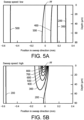
- FIG. 5A and FIG. 5B are graphs showing an example of the calculation result of the temperature distribution in the cross section of the annealed target 60.
- FIG. 5A and FIG. 5B show the temperature distribution in the cross section of the annealed target 60 under the conditions of a finite thickness and the back surface being adiabatic.
- the horizontal axis represents the position of the heat source Pf in the sweep direction.
- the current position of the heat source Pf is defined as the origin of the horizontal axis, and the movement direction of the heat source is defined as positive.
- the vertical axis represents the depth from the beam irradiation surface in the unit " ⁇ m.”
- FIG. 5A and FIG. 5B show the temperature distribution when the sweep speed v of the heat source Pf is different.
- FIG. 5B shows the temperature distribution when the sweep speed v of the heat source Pf is faster than that of FIG. 5A .
- the curves in the graph represent isotherms, and the numerical values attached to the curves represent the temperatures
- FIG. 6 is a flowchart showing the procedure of the annealing method according to the embodiment.
- the control device 40 controls the laser light source 10 and the beam scanner 15 to execute the sweep operation of moving the beam spot in the longitudinal direction thereof while causing the pulsed laser beam to be incident on the annealed target 60 (step S1).
- control device 40 controls the movable stage 17 to execute the step operation of shifting the annealed target 60 in the direction intersecting the longitudinal direction of the beam spot (step S2).
- the sweep operation of step S1 and the step operation of step S2 are repeated until almost the entire area of the surface of the annealed target 60 is annealed (step S3).
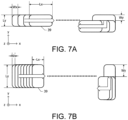
- FIG. 7A and FIG. 7B are schematic views showing the trajectory of the beam spot 39 when annealing is performed by the annealing methods according to the embodiment and the comparative example, respectively.
- the white arrows in FIG. 7A and FIG. 7B indicate the direction of movement of the beam spot 39 with respect to the annealed target 60.
- the sweep direction of the beam spot 39 is parallel to the x direction.
- the sweep of the beam spot 39 is performed by operating the beam scanner 15 ( FIG. 1 and FIG. 2 ).
- the step operation of shifting the beam spot 39 in the y direction is performed.
- the annealing is performed by alternately repeating the sweep operation and the step operation.
- the dimension of the beam spot 39 in the x direction is marked as Lx, and the dimension in the y direction is marked as Ly.
- the distance by which the beam spot 39 moves in the x direction during one cycle of the pulsed laser beam is marked as Wx.
- the distance by which the beam spot 39 moves in the y direction in one step operation is marked as Wy.
- the dimension Lx of the beam spot 39 in the x direction is larger than the dimension Ly in the y direction.
- the beam spot 39 is swept in the longitudinal direction thereof.
- the dimension Ly in the y direction is larger than the dimension Lx in the x direction.
- the beam spot 39 is swept in a direction orthogonal to the longitudinal direction thereof.
- the dimension Lx in the x direction and the dimension Ly in the y direction of the beam spot 39 according to the embodiment are respectively equal to the dimension Ly in the y direction and the dimension Lx in the x direction of the beam spot 39 according to the comparative example is considered. That is, the beam spot 39 according to the embodiment and the beam spot 39 according to the comparative example have the same size and shape. Further, the overlap rates OVx in the x direction and the overlap rates OVy in the y direction are the same in the embodiment and the comparative example.
- the numbers of shots required to anneal almost the entire area of the annealed target 60 are substantially the same in the embodiment and the comparative example. Further, the pulse energy densities are the same in the embodiment and the comparative example. Therefore, as shown in FIG. 3 , the reached maximum temperatures of the surface of the annealed target 60 are also substantially the same in the embodiment and the comparative example. Therefore, when activation annealing of the annealed target 60 is performed, the activation rates are also substantially the same.
- the sweep speed of the beam spot 39 is faster in the embodiment than in the comparative example. Therefore, as described with reference to FIG. 5A and FIG. 5B , the reached maximum temperature of the back surface of the annealed target 60 is lower in the embodiment than in the comparative example.
- the present embodiment can suppress the temperature of the back surface of the annealed target 60 from rising as compared with the comparative example.
- the sweep speed of the beam spot 39, the activation rate, and the reached maximum temperature of the back surface of the annealed target 60 were obtained by calculation.
- the calculation result will be described with reference to FIG. 8 .
- FIG. 8 is a graph showing the relationship between the sweep speed of the beam spot 39 and the activation rate, and the relationship between the sweep speed of the beam spot 39 and the reached maximum temperature of the back surface of the annealed target 60.
- the horizontal axis represents the sweep speed of the beam spot
- the vertical axis of the upper graph represents the activation rate in the unit "%”
- the vertical axis of the lower graph represents the reached maximum temperature of the back surface of the annealed target 60.
- the thick solid line and the thin solid line in the graph show the calculation result when annealing was performed by the methods according to the embodiment ( FIG. 7A ) and the comparative example ( FIG. 7B ), respectively.
- the dimension Lx of the beam spot 39 in the x direction was double the dimension Ly in the y direction
- the dimension Ly of the beam spot 39 in the y direction was double the dimension Lx in the x direction
- the repetition frequencies of the pulse and the pulse energy densities were set to be the same in the embodiment and the comparative example.
- the activation rate decreases as the sweep speed of the beam spot 39 increases, and the reached maximum temperature of the back surface of the annealed target 60 also decreases.
- the reached maximum temperature of the back surface of the annealed target 60 is lower when the annealing method according to the embodiment is adopted than when the annealing method according to the comparative example is adopted.
- the annealing method according to the present embodiment it is possible to achieve the desired activation rate while keeping the reached maximum temperature of the back surface low.
- FIG. 9 is a graph showing the relationship between the aspect ratio of the beam spot 39, the reached maximum temperature of the back surface of the annealed target 60, and the activation rate.
- the aspect ratio is defined as the ratio of the dimension Lx in the x direction to the dimension Ly in the y direction of the beam spot 39.
- the horizontal axis of the graph shown in FIG. 9 represents the aspect ratio
- the left vertical axis represents the reached maximum temperature of the back surface of the annealed target 60 in the unit "°C”
- the right vertical axis represents the activation rate in the unit "%.”
- the solid line in the graph shown in FIG. 9 indicates the reached maximum temperature of the back surface of the annealed target 60
- the broken line indicates the activation rate.
- the graph shown in FIG. 9 was obtained by calculation.
- the annealed target 60 was a silicon wafer having a thickness of 50 ⁇ m, and the repetition frequency of the pulse of the pulsed laser beam was set to 800 kHz. Phosphorus ions were used as the dopant, and the acceleration energy at the time of ion implantation was set to 2.5 MeV. Even though the aspect ratio of the beam spot 39 was changed, the area of the beam spot 39 and the overlap rate OVx (Equation (4)) in the sweep direction were kept constant.
- the reached maximum temperature of the back surface of the annealed target 60 gradually decreases. This is because the sweep speed becomes faster.
- the activation rate drops sharply at the point when the aspect ratio exceeds about 3.
- the aspect ratio of the beam spot 39 is preferably smaller than the aspect ratio at the point when the activation rate starts to drop sharply. In accordance with the invention, the aspect ratio is 2.5 or less.
- the aspect ratio is set to 1.5 or more.
- FIG. 10 is a graph showing the relationship between the sweep speed when the aspect ratio of the beam spot 39 is 1, the reached maximum temperature of the back surface of the annealed target 60, and the activation rate.
- the horizontal axis of the graph shown in FIG. 10 represents the sweep speed in the unit [m/s]
- the left vertical axis represents the reached maximum temperature of the back surface of the annealed target 60 in the unit "°C”
- the right vertical axis represents the activation rate in the unit "%.”
- the solid line in the graph shown in FIG. 10 indicates the reached maximum temperature of the back surface of the annealed target 60, and the broken line indicates the activation rate.
- the sweep speed increases, the reached maximum temperature of the back surface of the annealed target 60 decreases, and the activation rate also decreases.
- the sweep speed has to be 4 m/s or more. From the calculation result shown in FIG. 9 , it can be seen that, when the aspect ratio is increased from 1 to 2.5, the reached maximum temperature of the back surface of the annealed target 60 decreases by about 100 °C. Also, in the example shown in FIG. 10 , when the aspect ratio of the beam spot 39 is set to about 2.5, the reached maximum temperature of the back surface is expected to decrease by about 100 °C. Then, even if the sweep speed is reduced to 2 m/s, the reached maximum temperature of the back surface can be suppressed to about 200 °C.
- the selectable range of the sweep speed can be expanded.
- the beam spot 39 ( FIG. 7A ) is swept in the x direction by operating the beam scanner 15 ( FIG. 2 ). Therefore, it is possible to increase the sweep speed as compared with the case where the movable stage 17 is operated to move the annealed target 60 in the x direction for sweeping.
- the sweep speed v is increased as much as possible, as can be seen from Equation (3).
- the sweep speed v is increased under the condition that the repetition frequency of the pulse of the pulsed laser beam and the dimension Lx of the beam spot 39 ( FIG. 7A ) in the x direction are constant, the overlap rate OVx in the x direction may become small or there may be no overlap.
- the dimension Lx of the beam spot 39 in the x direction is increased in order to maintain the overlap rate OVx when the sweep speed v is increased, the power density P on the surface of the annealed target 60 may be lowered.
- the pulse width t 0 has to be lengthened. If the pulse width t 0 is lengthened, the amount of heat transfer conducted in the thickness direction during the period in which the laser pulse is incident increases. As a result, the temperature of the irradiated surface becomes high. Accordingly, the dimension Lx cannot be increased unconditionally.
- the repetition frequency f of the pulse may be increased.
- the repetition frequency f of the pulse is preferably set to 15 kHz or more, more preferably 100 kHz or more.
Landscapes
- Physics & Mathematics (AREA)
- Optics & Photonics (AREA)
- Engineering & Computer Science (AREA)
- Plasma & Fusion (AREA)
- Mechanical Engineering (AREA)
- General Physics & Mathematics (AREA)
- Recrystallisation Techniques (AREA)
- Electromagnetism (AREA)
- Health & Medical Sciences (AREA)
- Toxicology (AREA)
- Mechanical Light Control Or Optical Switches (AREA)
Claims (6)
- Glühvorrichtung, umfassend:eine Laserlichtquelle (10), die einen gepulsten Laserstrahl ausgibt;ein optisches Strahlformungselement (12), das einen Strahlfleck (39) des gepulsten Laserstrahls, der von der Laserlichtquelle ausgegeben wird, auf einer Fläche eines geglühten Targets (60) in eine längliche Form geformt wird,einen Bewegungsmechanismus (20), der den gepulsten Laserstrahl abtastet und den Strahlfleck in einer Längsrichtung des Strahlflecks bewegt; undeine Steuervorrichtung (40), die die Laserlichtquelle und den Bewegungsmechanismus steuert,wobei die Steuervorrichtung ein Glühen durchführt, indem sie eine Sweep-Operation durchführt, bei dem der Strahlfleck in der Längsrichtung des Strahlflecks in Bezug auf das geglühte Target bewegt wird, während der gepulste Laserstrahl veranlasst wird auf das geglühte Target aufzutreffen, dadurch gekennzeichnet, dass ein Seitenverhältnis des geformten länglichen Strahlflecks (39) innerhalb eines Bereichs von 1,5 bis 2,5 liegt.
- Glühvorrichtung gemäß Anspruch 1, wobei der Bewegungsmechanismus eine Funktion aufweist, den Strahlfleck in einer Richtung zu bewegen, die die Längsrichtung des Strahlflecks schneidet, unddie Steuervorrichtung fernereinen Schrittvorgang zum Verschieben des Strahlflecks in einer Richtung, die die Längsrichtung des Strahlflecks schneidet, in Bezug auf das geglühte Target durchführt, wenn eine Sweep-Operation abgeschlossen ist, unddas Glühen durch Wiederholen der Sweep-Operation und des Schrittvorgangs durchführt.
- Glühvorrichtung gemäß Anspruch 1 oder 2, wobei die Steuervorrichtung die Laserlichtquelle so steuert, dass die Wiederholungsfrequenz eines Pulses des gepulsten Laserstrahls während der Sweep-Operation auf 100 kHz oder mehr eingestellt wird.
- Glühverfahren, um einen gepulsten Laserstrahl auf eine Oberfläche eines geglühten Targets (60) auftreffen zu lassen und Glühen durchzuführen, während ein Strahlfleck (39) bewegt wird,wobei der Strahlfleck eine längliche Form aufweist, unddas Glühverfahren das Durchführen des Glühens durch Durchführen einer Sweep-Operation des Bewegens des Strahlflecks in einer Längsrichtung des Strahlflecks (S1) umfasst, dadurch gekennzeichnet, dass ein Seitenverhältnis des geformten Strahlflecks (39) innerhalb eines Bereichs von 1,5 bis 2,5 liegt.
- Glühverfahren gemäß Anspruch 4, umfassend Durchführen eines Schrittvorgangs des Verschiebens des Strahlflecks in einer Richtung, die die Längsrichtung des Strahlflecks in Bezug auf das geglühte Target schneidet, wenn eine Sweep-Operation abgeschlossen ist (S2), und
Durchführen des Glühens durch Wiederholen der Sweep-Operation und des Schrittvorgangs (S3). - Glühverfahren gemäß Anspruch 4 oder 5, wobei während der Sweep-Operation die Wiederholungsfrequenz eines Pulses des gepulsten Laserstrahls, der auf das geglühte Target einfällt, 100 kHz oder mehr beträgt.
Applications Claiming Priority (1)
| Application Number | Priority Date | Filing Date | Title |
|---|---|---|---|
| JP2021115132A JP7795880B2 (ja) | 2021-07-12 | 2021-07-12 | アニール装置の制御装置、アニール装置、及びアニール方法 |
Publications (2)
| Publication Number | Publication Date |
|---|---|
| EP4123685A1 EP4123685A1 (de) | 2023-01-25 |
| EP4123685B1 true EP4123685B1 (de) | 2024-09-18 |
Family
ID=82403580
Family Applications (1)
| Application Number | Title | Priority Date | Filing Date |
|---|---|---|---|
| EP22183898.0A Active EP4123685B1 (de) | 2021-07-12 | 2022-07-08 | Steuervorrichtung einer glühvorrichtung, glühvorrichtung und glühverfahren |
Country Status (6)
| Country | Link |
|---|---|
| US (1) | US20230008862A1 (de) |
| EP (1) | EP4123685B1 (de) |
| JP (1) | JP7795880B2 (de) |
| KR (1) | KR20230010591A (de) |
| CN (1) | CN115621161A (de) |
| TW (1) | TWI869691B (de) |
Families Citing this family (1)
| Publication number | Priority date | Publication date | Assignee | Title |
|---|---|---|---|---|
| JP2025067025A (ja) * | 2023-10-12 | 2025-04-24 | 住友重機械工業株式会社 | レーザアニール装置、レーザアニール方法、記憶媒体 |
Family Cites Families (23)
| Publication number | Priority date | Publication date | Assignee | Title |
|---|---|---|---|---|
| JP3211357B2 (ja) * | 1992-03-30 | 2001-09-25 | ソニー株式会社 | レーザー照射装置 |
| JPH0851074A (ja) * | 1994-08-08 | 1996-02-20 | Sanyo Electric Co Ltd | 多結晶半導体膜の製造方法 |
| KR20050070109A (ko) | 2002-11-05 | 2005-07-05 | 소니 가부시끼 가이샤 | 광조사장치 및 광조사방법 |
| US6747245B2 (en) * | 2002-11-06 | 2004-06-08 | Ultratech Stepper, Inc. | Laser scanning apparatus and methods for thermal processing |
| US7387922B2 (en) * | 2003-01-21 | 2008-06-17 | Semiconductor Energy Laboratory Co., Ltd. | Laser irradiation method, method for manufacturing semiconductor device, and laser irradiation system |
| US7220627B2 (en) * | 2003-04-21 | 2007-05-22 | Semiconductor Energy Laboratory Co., Ltd. | Method for manufacturing a semiconductor device where the scanning direction changes between regions during crystallization and process |
| US20050237895A1 (en) * | 2004-04-23 | 2005-10-27 | Semiconductor Energy Laboratory Co., Ltd. | Laser irradiation apparatus and method for manufacturing semiconductor device |
| JP5072197B2 (ja) * | 2004-06-18 | 2012-11-14 | 株式会社半導体エネルギー研究所 | レーザ照射装置およびレーザ照射方法 |
| JP4715119B2 (ja) | 2004-07-21 | 2011-07-06 | ソニー株式会社 | レーザー加工装置 |
| JP4549996B2 (ja) | 2006-03-30 | 2010-09-22 | 株式会社日本製鋼所 | レーザ照射装置 |
| JP2007273833A (ja) * | 2006-03-31 | 2007-10-18 | Sharp Corp | 半導体膜の結晶化装置および結晶化方法 |
| US7935584B2 (en) * | 2006-08-31 | 2011-05-03 | Semiconductor Energy Laboratory Co., Ltd. | Method for manufacturing crystalline semiconductor device |
| KR101094284B1 (ko) * | 2009-09-02 | 2011-12-19 | 삼성모바일디스플레이주식회사 | 기판 절단 장치 및 이를 이용한 기판 절단 방법 |
| JP4678700B1 (ja) * | 2009-11-30 | 2011-04-27 | 株式会社日本製鋼所 | レーザアニール装置およびレーザアニール方法 |
| US9302348B2 (en) * | 2011-06-07 | 2016-04-05 | Ultratech Inc. | Ultrafast laser annealing with reduced pattern density effects in integrated circuit fabrication |
| JP5726031B2 (ja) * | 2011-09-27 | 2015-05-27 | 住友重機械工業株式会社 | レーザアニール装置及びレーザアニール方法 |
| US9558973B2 (en) * | 2012-06-11 | 2017-01-31 | Ultratech, Inc. | Laser annealing systems and methods with ultra-short dwell times |
| US20140083984A1 (en) * | 2012-09-23 | 2014-03-27 | Timothy Gerke | Formation Of Laser Induced Periodic Surface Structures (LIPSS) With Picosecond Pulses |
| JP6313926B2 (ja) | 2013-01-21 | 2018-04-18 | 株式会社ブイ・テクノロジー | レーザアニール方法、レーザアニール装置 |
| WO2018074282A1 (ja) * | 2016-10-20 | 2018-04-26 | 株式会社日本製鋼所 | レーザアニール方法およびレーザアニール装置 |
| JP7428481B2 (ja) | 2019-06-07 | 2024-02-06 | 住友重機械工業株式会社 | レーザアニール方法及びレーザ制御装置 |
| CN112864040B (zh) | 2019-11-26 | 2025-01-28 | 上海微电子装备(集团)股份有限公司 | 激光退火装置 |
| CN111952158B (zh) * | 2020-08-17 | 2022-08-30 | 北京中科镭特电子有限公司 | 一种激光退火装置及退火方法 |
-
2021
- 2021-07-12 JP JP2021115132A patent/JP7795880B2/ja active Active
-
2022
- 2022-07-08 KR KR1020220084131A patent/KR20230010591A/ko active Pending
- 2022-07-08 EP EP22183898.0A patent/EP4123685B1/de active Active
- 2022-07-11 CN CN202210808731.3A patent/CN115621161A/zh active Pending
- 2022-07-11 US US17/861,252 patent/US20230008862A1/en active Pending
- 2022-07-11 TW TW111125939A patent/TWI869691B/zh active
Also Published As
| Publication number | Publication date |
|---|---|
| JP2023011329A (ja) | 2023-01-24 |
| EP4123685A1 (de) | 2023-01-25 |
| KR20230010591A (ko) | 2023-01-19 |
| TW202303711A (zh) | 2023-01-16 |
| JP7795880B2 (ja) | 2026-01-08 |
| US20230008862A1 (en) | 2023-01-12 |
| TWI869691B (zh) | 2025-01-11 |
| CN115621161A (zh) | 2023-01-17 |
Similar Documents
| Publication | Publication Date | Title |
|---|---|---|
| US12263537B2 (en) | Control device for laser annealing apparatus and laser annealing method | |
| US7943534B2 (en) | Semiconductor device manufacturing method and semiconductor device manufacturing system | |
| JP4678700B1 (ja) | レーザアニール装置およびレーザアニール方法 | |
| US6791059B2 (en) | Laser processing | |
| JP6116656B2 (ja) | 超短期滞留時間でのレーザアニーリングシステム及び方法 | |
| EP2674967B1 (de) | Laserglühverfahren und laserglühvorrichtung | |
| US9302348B2 (en) | Ultrafast laser annealing with reduced pattern density effects in integrated circuit fabrication | |
| EP4123685B1 (de) | Steuervorrichtung einer glühvorrichtung, glühvorrichtung und glühverfahren | |
| TWI752484B (zh) | 雷射退火方法及雷射控制裝置 | |
| JP2016127157A (ja) | レーザアニール装置及び半導体素子の製造方法 | |
| JP5517832B2 (ja) | レーザアニール装置及びレーザアニール方法 | |
| JP5661009B2 (ja) | 半導体装置の製造方法 | |
| JP2011114052A (ja) | 半導体基板の製造方法及びレーザアニール装置 | |
| JP2015115401A (ja) | レーザアニール方法およびレーザアニール装置 | |
| JP5595152B2 (ja) | レーザアニール方法 | |
| JP2006135232A (ja) | 半導体デバイスの製造方法と製造装置 | |
| HK1095207B (en) | Process for fabricating semiconductor device |
Legal Events
| Date | Code | Title | Description |
|---|---|---|---|
| PUAI | Public reference made under article 153(3) epc to a published international application that has entered the european phase |
Free format text: ORIGINAL CODE: 0009012 |
|
| STAA | Information on the status of an ep patent application or granted ep patent |
Free format text: STATUS: REQUEST FOR EXAMINATION WAS MADE |
|
| 17P | Request for examination filed |
Effective date: 20220708 |
|
| AK | Designated contracting states |
Kind code of ref document: A1 Designated state(s): AL AT BE BG CH CY CZ DE DK EE ES FI FR GB GR HR HU IE IS IT LI LT LU LV MC MK MT NL NO PL PT RO RS SE SI SK SM TR |
|
| RBV | Designated contracting states (corrected) |
Designated state(s): AL AT BE BG CH CY CZ DE DK EE ES FI FR GB GR HR HU IE IS IT LI LT LU LV MC MK MT NL NO PL PT RO RS SE SI SK SM TR |
|
| REG | Reference to a national code |
Ref country code: DE Ref legal event code: R079 Free format text: PREVIOUS MAIN CLASS: H99Z9999999999 Ref country code: DE Ref legal event code: R079 Ref document number: 602022006155 Country of ref document: DE Free format text: PREVIOUS MAIN CLASS: H99Z9999999999 Ipc: B23K0026073000 |
|
| GRAP | Despatch of communication of intention to grant a patent |
Free format text: ORIGINAL CODE: EPIDOSNIGR1 |
|
| STAA | Information on the status of an ep patent application or granted ep patent |
Free format text: STATUS: GRANT OF PATENT IS INTENDED |
|
| RIC1 | Information provided on ipc code assigned before grant |
Ipc: H01L 21/02 20060101ALI20240314BHEP Ipc: B23K 26/352 20140101ALI20240314BHEP Ipc: B23K 26/082 20140101ALI20240314BHEP Ipc: B23K 26/073 20060101AFI20240314BHEP |
|
| INTG | Intention to grant announced |
Effective date: 20240416 |
|
| GRAS | Grant fee paid |
Free format text: ORIGINAL CODE: EPIDOSNIGR3 |
|
| GRAA | (expected) grant |
Free format text: ORIGINAL CODE: 0009210 |
|
| STAA | Information on the status of an ep patent application or granted ep patent |
Free format text: STATUS: THE PATENT HAS BEEN GRANTED |
|
| AK | Designated contracting states |
Kind code of ref document: B1 Designated state(s): AL AT BE BG CH CY CZ DE DK EE ES FI FR GB GR HR HU IE IS IT LI LT LU LV MC MK MT NL NO PL PT RO RS SE SI SK SM TR |
|
| REG | Reference to a national code |
Ref country code: GB Ref legal event code: FG4D |
|
| REG | Reference to a national code |
Ref country code: CH Ref legal event code: EP |
|
| REG | Reference to a national code |
Ref country code: IE Ref legal event code: FG4D |
|
| REG | Reference to a national code |
Ref country code: DE Ref legal event code: R096 Ref document number: 602022006155 Country of ref document: DE |
|
| REG | Reference to a national code |
Ref country code: LT Ref legal event code: MG9D |
|
| PG25 | Lapsed in a contracting state [announced via postgrant information from national office to epo] |
Ref country code: NO Free format text: LAPSE BECAUSE OF FAILURE TO SUBMIT A TRANSLATION OF THE DESCRIPTION OR TO PAY THE FEE WITHIN THE PRESCRIBED TIME-LIMIT Effective date: 20241218 |
|
| PG25 | Lapsed in a contracting state [announced via postgrant information from national office to epo] |
Ref country code: GR Free format text: LAPSE BECAUSE OF FAILURE TO SUBMIT A TRANSLATION OF THE DESCRIPTION OR TO PAY THE FEE WITHIN THE PRESCRIBED TIME-LIMIT Effective date: 20241219 Ref country code: FI Free format text: LAPSE BECAUSE OF FAILURE TO SUBMIT A TRANSLATION OF THE DESCRIPTION OR TO PAY THE FEE WITHIN THE PRESCRIBED TIME-LIMIT Effective date: 20240918 |
|
| PG25 | Lapsed in a contracting state [announced via postgrant information from national office to epo] |
Ref country code: BG Free format text: LAPSE BECAUSE OF FAILURE TO SUBMIT A TRANSLATION OF THE DESCRIPTION OR TO PAY THE FEE WITHIN THE PRESCRIBED TIME-LIMIT Effective date: 20240918 |
|
| PG25 | Lapsed in a contracting state [announced via postgrant information from national office to epo] |
Ref country code: LV Free format text: LAPSE BECAUSE OF FAILURE TO SUBMIT A TRANSLATION OF THE DESCRIPTION OR TO PAY THE FEE WITHIN THE PRESCRIBED TIME-LIMIT Effective date: 20240918 |
|
| PG25 | Lapsed in a contracting state [announced via postgrant information from national office to epo] |
Ref country code: HR Free format text: LAPSE BECAUSE OF FAILURE TO SUBMIT A TRANSLATION OF THE DESCRIPTION OR TO PAY THE FEE WITHIN THE PRESCRIBED TIME-LIMIT Effective date: 20240918 |
|
| REG | Reference to a national code |
Ref country code: NL Ref legal event code: MP Effective date: 20240918 |
|
| PG25 | Lapsed in a contracting state [announced via postgrant information from national office to epo] |
Ref country code: RS Free format text: LAPSE BECAUSE OF FAILURE TO SUBMIT A TRANSLATION OF THE DESCRIPTION OR TO PAY THE FEE WITHIN THE PRESCRIBED TIME-LIMIT Effective date: 20241218 |
|
| PG25 | Lapsed in a contracting state [announced via postgrant information from national office to epo] |
Ref country code: RS Free format text: LAPSE BECAUSE OF FAILURE TO SUBMIT A TRANSLATION OF THE DESCRIPTION OR TO PAY THE FEE WITHIN THE PRESCRIBED TIME-LIMIT Effective date: 20241218 Ref country code: NO Free format text: LAPSE BECAUSE OF FAILURE TO SUBMIT A TRANSLATION OF THE DESCRIPTION OR TO PAY THE FEE WITHIN THE PRESCRIBED TIME-LIMIT Effective date: 20241218 Ref country code: LV Free format text: LAPSE BECAUSE OF FAILURE TO SUBMIT A TRANSLATION OF THE DESCRIPTION OR TO PAY THE FEE WITHIN THE PRESCRIBED TIME-LIMIT Effective date: 20240918 Ref country code: HR Free format text: LAPSE BECAUSE OF FAILURE TO SUBMIT A TRANSLATION OF THE DESCRIPTION OR TO PAY THE FEE WITHIN THE PRESCRIBED TIME-LIMIT Effective date: 20240918 Ref country code: GR Free format text: LAPSE BECAUSE OF FAILURE TO SUBMIT A TRANSLATION OF THE DESCRIPTION OR TO PAY THE FEE WITHIN THE PRESCRIBED TIME-LIMIT Effective date: 20241219 Ref country code: FI Free format text: LAPSE BECAUSE OF FAILURE TO SUBMIT A TRANSLATION OF THE DESCRIPTION OR TO PAY THE FEE WITHIN THE PRESCRIBED TIME-LIMIT Effective date: 20240918 Ref country code: BG Free format text: LAPSE BECAUSE OF FAILURE TO SUBMIT A TRANSLATION OF THE DESCRIPTION OR TO PAY THE FEE WITHIN THE PRESCRIBED TIME-LIMIT Effective date: 20240918 |
|
| REG | Reference to a national code |
Ref country code: AT Ref legal event code: MK05 Ref document number: 1724274 Country of ref document: AT Kind code of ref document: T Effective date: 20240918 |
|
| PG25 | Lapsed in a contracting state [announced via postgrant information from national office to epo] |
Ref country code: NL Free format text: LAPSE BECAUSE OF FAILURE TO SUBMIT A TRANSLATION OF THE DESCRIPTION OR TO PAY THE FEE WITHIN THE PRESCRIBED TIME-LIMIT Effective date: 20240918 |
|
| PG25 | Lapsed in a contracting state [announced via postgrant information from national office to epo] |
Ref country code: IS Free format text: LAPSE BECAUSE OF FAILURE TO SUBMIT A TRANSLATION OF THE DESCRIPTION OR TO PAY THE FEE WITHIN THE PRESCRIBED TIME-LIMIT Effective date: 20250118 Ref country code: PT Free format text: LAPSE BECAUSE OF FAILURE TO SUBMIT A TRANSLATION OF THE DESCRIPTION OR TO PAY THE FEE WITHIN THE PRESCRIBED TIME-LIMIT Effective date: 20250120 |
|
| PG25 | Lapsed in a contracting state [announced via postgrant information from national office to epo] |
Ref country code: RO Free format text: LAPSE BECAUSE OF FAILURE TO SUBMIT A TRANSLATION OF THE DESCRIPTION OR TO PAY THE FEE WITHIN THE PRESCRIBED TIME-LIMIT Effective date: 20240918 Ref country code: SM Free format text: LAPSE BECAUSE OF FAILURE TO SUBMIT A TRANSLATION OF THE DESCRIPTION OR TO PAY THE FEE WITHIN THE PRESCRIBED TIME-LIMIT Effective date: 20240918 |
|
| PG25 | Lapsed in a contracting state [announced via postgrant information from national office to epo] |
Ref country code: ES Free format text: LAPSE BECAUSE OF FAILURE TO SUBMIT A TRANSLATION OF THE DESCRIPTION OR TO PAY THE FEE WITHIN THE PRESCRIBED TIME-LIMIT Effective date: 20240918 |
|
| PG25 | Lapsed in a contracting state [announced via postgrant information from national office to epo] |
Ref country code: EE Free format text: LAPSE BECAUSE OF FAILURE TO SUBMIT A TRANSLATION OF THE DESCRIPTION OR TO PAY THE FEE WITHIN THE PRESCRIBED TIME-LIMIT Effective date: 20240918 Ref country code: AT Free format text: LAPSE BECAUSE OF FAILURE TO SUBMIT A TRANSLATION OF THE DESCRIPTION OR TO PAY THE FEE WITHIN THE PRESCRIBED TIME-LIMIT Effective date: 20240918 |
|
| PG25 | Lapsed in a contracting state [announced via postgrant information from national office to epo] |
Ref country code: CZ Free format text: LAPSE BECAUSE OF FAILURE TO SUBMIT A TRANSLATION OF THE DESCRIPTION OR TO PAY THE FEE WITHIN THE PRESCRIBED TIME-LIMIT Effective date: 20240918 Ref country code: PL Free format text: LAPSE BECAUSE OF FAILURE TO SUBMIT A TRANSLATION OF THE DESCRIPTION OR TO PAY THE FEE WITHIN THE PRESCRIBED TIME-LIMIT Effective date: 20240918 |
|
| PG25 | Lapsed in a contracting state [announced via postgrant information from national office to epo] |
Ref country code: SK Free format text: LAPSE BECAUSE OF FAILURE TO SUBMIT A TRANSLATION OF THE DESCRIPTION OR TO PAY THE FEE WITHIN THE PRESCRIBED TIME-LIMIT Effective date: 20240918 Ref country code: IT Free format text: LAPSE BECAUSE OF FAILURE TO SUBMIT A TRANSLATION OF THE DESCRIPTION OR TO PAY THE FEE WITHIN THE PRESCRIBED TIME-LIMIT Effective date: 20240918 |
|
| REG | Reference to a national code |
Ref country code: DE Ref legal event code: R097 Ref document number: 602022006155 Country of ref document: DE |
|
| PG25 | Lapsed in a contracting state [announced via postgrant information from national office to epo] |
Ref country code: DK Free format text: LAPSE BECAUSE OF FAILURE TO SUBMIT A TRANSLATION OF THE DESCRIPTION OR TO PAY THE FEE WITHIN THE PRESCRIBED TIME-LIMIT Effective date: 20240918 |
|
| PLBE | No opposition filed within time limit |
Free format text: ORIGINAL CODE: 0009261 |
|
| STAA | Information on the status of an ep patent application or granted ep patent |
Free format text: STATUS: NO OPPOSITION FILED WITHIN TIME LIMIT |
|
| 26N | No opposition filed |
Effective date: 20250619 |
|
| PG25 | Lapsed in a contracting state [announced via postgrant information from national office to epo] |
Ref country code: SE Free format text: LAPSE BECAUSE OF FAILURE TO SUBMIT A TRANSLATION OF THE DESCRIPTION OR TO PAY THE FEE WITHIN THE PRESCRIBED TIME-LIMIT Effective date: 20240918 |
|
| PGFP | Annual fee paid to national office [announced via postgrant information from national office to epo] |
Ref country code: DE Payment date: 20250528 Year of fee payment: 4 |
|
| REG | Reference to a national code |
Ref country code: CH Ref legal event code: H13 Free format text: ST27 STATUS EVENT CODE: U-0-0-H10-H13 (AS PROVIDED BY THE NATIONAL OFFICE) Effective date: 20260224 |
|
| PG25 | Lapsed in a contracting state [announced via postgrant information from national office to epo] |
Ref country code: LU Free format text: LAPSE BECAUSE OF NON-PAYMENT OF DUE FEES Effective date: 20250708 |
|
| REG | Reference to a national code |
Ref country code: BE Ref legal event code: MM Effective date: 20250731 |
|
| PG25 | Lapsed in a contracting state [announced via postgrant information from national office to epo] |
Ref country code: BE Free format text: LAPSE BECAUSE OF NON-PAYMENT OF DUE FEES Effective date: 20250731 |
|
| PG25 | Lapsed in a contracting state [announced via postgrant information from national office to epo] |
Ref country code: FR Free format text: LAPSE BECAUSE OF NON-PAYMENT OF DUE FEES Effective date: 20250731 |