EP4123634B1 - Anzeigesubstrat und anzeigevorrichtung - Google Patents
Anzeigesubstrat und anzeigevorrichtung Download PDFInfo
- Publication number
- EP4123634B1 EP4123634B1 EP21932130.4A EP21932130A EP4123634B1 EP 4123634 B1 EP4123634 B1 EP 4123634B1 EP 21932130 A EP21932130 A EP 21932130A EP 4123634 B1 EP4123634 B1 EP 4123634B1
- Authority
- EP
- European Patent Office
- Prior art keywords
- electrode
- transistor
- capacitor
- electrically connected
- clock signal
- Prior art date
- Legal status (The legal status is an assumption and is not a legal conclusion. Google has not performed a legal analysis and makes no representation as to the accuracy of the status listed.)
- Active
Links
Images







Classifications
-
- G—PHYSICS
- G09—EDUCATION; CRYPTOGRAPHY; DISPLAY; ADVERTISING; SEALS
- G09G—ARRANGEMENTS OR CIRCUITS FOR CONTROL OF INDICATING DEVICES USING STATIC MEANS TO PRESENT VARIABLE INFORMATION
- G09G3/00—Control arrangements or circuits, of interest only in connection with visual indicators other than cathode-ray tubes
- G09G3/20—Control arrangements or circuits, of interest only in connection with visual indicators other than cathode-ray tubes for presentation of an assembly of a number of characters, e.g. a page, by composing the assembly by combination of individual elements arranged in a matrix no fixed position being assigned to or needed to be assigned to the individual characters or partial characters
-
- G—PHYSICS
- G09—EDUCATION; CRYPTOGRAPHY; DISPLAY; ADVERTISING; SEALS
- G09G—ARRANGEMENTS OR CIRCUITS FOR CONTROL OF INDICATING DEVICES USING STATIC MEANS TO PRESENT VARIABLE INFORMATION
- G09G3/00—Control arrangements or circuits, of interest only in connection with visual indicators other than cathode-ray tubes
- G09G3/20—Control arrangements or circuits, of interest only in connection with visual indicators other than cathode-ray tubes for presentation of an assembly of a number of characters, e.g. a page, by composing the assembly by combination of individual elements arranged in a matrix no fixed position being assigned to or needed to be assigned to the individual characters or partial characters
- G09G3/22—Control arrangements or circuits, of interest only in connection with visual indicators other than cathode-ray tubes for presentation of an assembly of a number of characters, e.g. a page, by composing the assembly by combination of individual elements arranged in a matrix no fixed position being assigned to or needed to be assigned to the individual characters or partial characters using controlled light sources
- G09G3/30—Control arrangements or circuits, of interest only in connection with visual indicators other than cathode-ray tubes for presentation of an assembly of a number of characters, e.g. a page, by composing the assembly by combination of individual elements arranged in a matrix no fixed position being assigned to or needed to be assigned to the individual characters or partial characters using controlled light sources using electroluminescent panels
- G09G3/32—Control arrangements or circuits, of interest only in connection with visual indicators other than cathode-ray tubes for presentation of an assembly of a number of characters, e.g. a page, by composing the assembly by combination of individual elements arranged in a matrix no fixed position being assigned to or needed to be assigned to the individual characters or partial characters using controlled light sources using electroluminescent panels semiconductive, e.g. using light-emitting diodes [LED]
- G09G3/3208—Control arrangements or circuits, of interest only in connection with visual indicators other than cathode-ray tubes for presentation of an assembly of a number of characters, e.g. a page, by composing the assembly by combination of individual elements arranged in a matrix no fixed position being assigned to or needed to be assigned to the individual characters or partial characters using controlled light sources using electroluminescent panels semiconductive, e.g. using light-emitting diodes [LED] organic, e.g. using organic light-emitting diodes [OLED]
- G09G3/3266—Details of drivers for scan electrodes
-
- G—PHYSICS
- G09—EDUCATION; CRYPTOGRAPHY; DISPLAY; ADVERTISING; SEALS
- G09G—ARRANGEMENTS OR CIRCUITS FOR CONTROL OF INDICATING DEVICES USING STATIC MEANS TO PRESENT VARIABLE INFORMATION
- G09G3/00—Control arrangements or circuits, of interest only in connection with visual indicators other than cathode-ray tubes
- G09G3/20—Control arrangements or circuits, of interest only in connection with visual indicators other than cathode-ray tubes for presentation of an assembly of a number of characters, e.g. a page, by composing the assembly by combination of individual elements arranged in a matrix no fixed position being assigned to or needed to be assigned to the individual characters or partial characters
- G09G3/34—Control arrangements or circuits, of interest only in connection with visual indicators other than cathode-ray tubes for presentation of an assembly of a number of characters, e.g. a page, by composing the assembly by combination of individual elements arranged in a matrix no fixed position being assigned to or needed to be assigned to the individual characters or partial characters by control of light from an independent source
- G09G3/36—Control arrangements or circuits, of interest only in connection with visual indicators other than cathode-ray tubes for presentation of an assembly of a number of characters, e.g. a page, by composing the assembly by combination of individual elements arranged in a matrix no fixed position being assigned to or needed to be assigned to the individual characters or partial characters by control of light from an independent source using liquid crystals
- G09G3/3611—Control of matrices with row and column drivers
- G09G3/3674—Details of drivers for scan electrodes
- G09G3/3677—Details of drivers for scan electrodes suitable for active matrices only
-
- G—PHYSICS
- G11—INFORMATION STORAGE
- G11C—STATIC STORES
- G11C19/00—Digital stores in which the information is moved stepwise, e.g. shift registers
- G11C19/28—Digital stores in which the information is moved stepwise, e.g. shift registers using semiconductor elements
-
- H—ELECTRICITY
- H10—SEMICONDUCTOR DEVICES; ELECTRIC SOLID-STATE DEVICES NOT OTHERWISE PROVIDED FOR
- H10D—INORGANIC ELECTRIC SEMICONDUCTOR DEVICES
- H10D86/00—Integrated devices formed in or on insulating or conducting substrates, e.g. formed in silicon-on-insulator [SOI] substrates or on stainless steel or glass substrates
- H10D86/40—Integrated devices formed in or on insulating or conducting substrates, e.g. formed in silicon-on-insulator [SOI] substrates or on stainless steel or glass substrates characterised by multiple TFTs
- H10D86/421—Integrated devices formed in or on insulating or conducting substrates, e.g. formed in silicon-on-insulator [SOI] substrates or on stainless steel or glass substrates characterised by multiple TFTs having a particular composition, shape or crystalline structure of the active layer
- H10D86/423—Integrated devices formed in or on insulating or conducting substrates, e.g. formed in silicon-on-insulator [SOI] substrates or on stainless steel or glass substrates characterised by multiple TFTs having a particular composition, shape or crystalline structure of the active layer comprising semiconductor materials not belonging to the Group IV, e.g. InGaZnO
-
- H—ELECTRICITY
- H10—SEMICONDUCTOR DEVICES; ELECTRIC SOLID-STATE DEVICES NOT OTHERWISE PROVIDED FOR
- H10D—INORGANIC ELECTRIC SEMICONDUCTOR DEVICES
- H10D86/00—Integrated devices formed in or on insulating or conducting substrates, e.g. formed in silicon-on-insulator [SOI] substrates or on stainless steel or glass substrates
- H10D86/40—Integrated devices formed in or on insulating or conducting substrates, e.g. formed in silicon-on-insulator [SOI] substrates or on stainless steel or glass substrates characterised by multiple TFTs
- H10D86/60—Integrated devices formed in or on insulating or conducting substrates, e.g. formed in silicon-on-insulator [SOI] substrates or on stainless steel or glass substrates characterised by multiple TFTs wherein the TFTs are in active matrices
-
- G—PHYSICS
- G09—EDUCATION; CRYPTOGRAPHY; DISPLAY; ADVERTISING; SEALS
- G09G—ARRANGEMENTS OR CIRCUITS FOR CONTROL OF INDICATING DEVICES USING STATIC MEANS TO PRESENT VARIABLE INFORMATION
- G09G2300/00—Aspects of the constitution of display devices
- G09G2300/04—Structural and physical details of display devices
- G09G2300/0404—Matrix technologies
- G09G2300/0408—Integration of the drivers onto the display substrate
-
- G—PHYSICS
- G09—EDUCATION; CRYPTOGRAPHY; DISPLAY; ADVERTISING; SEALS
- G09G—ARRANGEMENTS OR CIRCUITS FOR CONTROL OF INDICATING DEVICES USING STATIC MEANS TO PRESENT VARIABLE INFORMATION
- G09G2300/00—Aspects of the constitution of display devices
- G09G2300/04—Structural and physical details of display devices
- G09G2300/0404—Matrix technologies
- G09G2300/0417—Special arrangements specific to the use of low carrier mobility technology
-
- G—PHYSICS
- G09—EDUCATION; CRYPTOGRAPHY; DISPLAY; ADVERTISING; SEALS
- G09G—ARRANGEMENTS OR CIRCUITS FOR CONTROL OF INDICATING DEVICES USING STATIC MEANS TO PRESENT VARIABLE INFORMATION
- G09G2300/00—Aspects of the constitution of display devices
- G09G2300/04—Structural and physical details of display devices
- G09G2300/0421—Structural details of the set of electrodes
- G09G2300/0426—Layout of electrodes and connections
-
- G—PHYSICS
- G09—EDUCATION; CRYPTOGRAPHY; DISPLAY; ADVERTISING; SEALS
- G09G—ARRANGEMENTS OR CIRCUITS FOR CONTROL OF INDICATING DEVICES USING STATIC MEANS TO PRESENT VARIABLE INFORMATION
- G09G2310/00—Command of the display device
- G09G2310/02—Addressing, scanning or driving the display screen or processing steps related thereto
- G09G2310/0264—Details of driving circuits
- G09G2310/0267—Details of drivers for scan electrodes, other than drivers for liquid crystal, plasma or OLED displays
-
- G—PHYSICS
- G09—EDUCATION; CRYPTOGRAPHY; DISPLAY; ADVERTISING; SEALS
- G09G—ARRANGEMENTS OR CIRCUITS FOR CONTROL OF INDICATING DEVICES USING STATIC MEANS TO PRESENT VARIABLE INFORMATION
- G09G2310/00—Command of the display device
- G09G2310/02—Addressing, scanning or driving the display screen or processing steps related thereto
- G09G2310/0264—Details of driving circuits
- G09G2310/0286—Details of a shift registers arranged for use in a driving circuit
-
- G—PHYSICS
- G09—EDUCATION; CRYPTOGRAPHY; DISPLAY; ADVERTISING; SEALS
- G09G—ARRANGEMENTS OR CIRCUITS FOR CONTROL OF INDICATING DEVICES USING STATIC MEANS TO PRESENT VARIABLE INFORMATION
- G09G2320/00—Control of display operating conditions
- G09G2320/02—Improving the quality of display appearance
- G09G2320/0209—Crosstalk reduction, i.e. to reduce direct or indirect influences of signals directed to a certain pixel of the displayed image on other pixels of said image, inclusive of influences affecting pixels in different frames or fields or sub-images which constitute a same image, e.g. left and right images of a stereoscopic display
-
- G—PHYSICS
- G09—EDUCATION; CRYPTOGRAPHY; DISPLAY; ADVERTISING; SEALS
- G09G—ARRANGEMENTS OR CIRCUITS FOR CONTROL OF INDICATING DEVICES USING STATIC MEANS TO PRESENT VARIABLE INFORMATION
- G09G2320/00—Control of display operating conditions
- G09G2320/02—Improving the quality of display appearance
- G09G2320/0209—Crosstalk reduction, i.e. to reduce direct or indirect influences of signals directed to a certain pixel of the displayed image on other pixels of said image, inclusive of influences affecting pixels in different frames or fields or sub-images which constitute a same image, e.g. left and right images of a stereoscopic display
- G09G2320/0214—Crosstalk reduction, i.e. to reduce direct or indirect influences of signals directed to a certain pixel of the displayed image on other pixels of said image, inclusive of influences affecting pixels in different frames or fields or sub-images which constitute a same image, e.g. left and right images of a stereoscopic display with crosstalk due to leakage current of pixel switch in active matrix panels
-
- G—PHYSICS
- G09—EDUCATION; CRYPTOGRAPHY; DISPLAY; ADVERTISING; SEALS
- G09G—ARRANGEMENTS OR CIRCUITS FOR CONTROL OF INDICATING DEVICES USING STATIC MEANS TO PRESENT VARIABLE INFORMATION
- G09G2320/00—Control of display operating conditions
- G09G2320/02—Improving the quality of display appearance
- G09G2320/0233—Improving the luminance or brightness uniformity across the screen
-
- G—PHYSICS
- G09—EDUCATION; CRYPTOGRAPHY; DISPLAY; ADVERTISING; SEALS
- G09G—ARRANGEMENTS OR CIRCUITS FOR CONTROL OF INDICATING DEVICES USING STATIC MEANS TO PRESENT VARIABLE INFORMATION
- G09G2330/00—Aspects of power supply; Aspects of display protection and defect management
- G09G2330/02—Details of power systems and of start or stop of display operation
- G09G2330/021—Power management, e.g. power saving
Definitions
- At least one embodiment of the present disclosure relates to a display substrate and a display device.
- a pixel array of a liquid crystal display panel or an organic light-emitting diode (OLED) display panel usually includes rows of gate lines and columns of data lines intersecting with the gate lines.
- the driving of the gate lines can be realized by a bonded integrated driving circuit.
- the gate line driving circuit can also be directly integrated on the thin film transistor array substrate to form GOA (Gate driver On Array) to drive the gate lines.
- a GOA including a plurality of cascaded shift register units can be used to provide on-off voltage signals (scanning signals) for the rows of gate lines of the pixel array, so as to control the rows of gate lines to be turned on sequentially, and meanwhile, the data lines provide data signals to pixel units of corresponding row in the pixel array, so as to form grayscale voltages required for displaying the grayscales of the image in each pixel unit, and then display a frame of image.
- CN111540313A1 discloses a shifting register, a driving method, a driving circuit, a display substrate and a device.
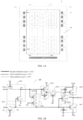
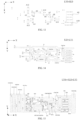
- FIG 1A is a schematic diagram of an overall circuit architecture of a display panel.
- a rectangular frame indicated by reference sign 101 represents an overall outer frame line of the display panel.
- the display panel 101 includes a display region (i.e., a pixel array region) 102 and a peripheral region 106 located at the periphery of the display region 102, and the display region 102 includes pixel units 103 arranged in an array.
- the peripheral region 106 includes a scanning driving shift register unit 104, and a plurality of the scanning driving shift register units 104 that are cascaded form a gate driving circuit (Gate GOA), which is used to provide, for example, gate scanning signals shifted row by row to the pixel units 103 arranged in an array in the display region 102 of the display panel 101.
- GOA gate driving circuit
- the peripheral region 106 further includes a light-emitting control shift register unit 105, and a plurality of the light-emitting control shift register units 105 that are cascaded constitute a light-emitting control driving circuit array (EM GOA), which is used to provide, for example, light-emitting control signals shifted row by row to the pixel units 103 arranged in an array in the display region 102 of the display panel 101, that is, light-emitting control driving circuit array is a gate driving circuit for outputting the light-emitting control signals.
- EM GOA light-emitting control driving circuit array
- an output signal output by an output circuit of one shift register unit 104 is correspondingly output to two rows of pixel units 103, and the embodiments of the present disclosure include but are not limited thereto.
- the data lines DL1 to DLN (N is an integer greater than 1) connected with a data driving chip IC longitudinally pass through the display region 102 to provide data signals to the pixel units 103 arranged in an array.
- the gate lines GL1 to GLM (M is an integer greater than 1) connected with the scanning driving shift register units 104 and the light-emitting control shift register units 105 laterally cross the display region 102 to provide the gate scanning signals and the light-emitting control signals to the pixel units 103 arranged in an array.
- each pixel unit 103 includes a pixel circuit having a circuit structure such as 7T1C, 8T2C or 4T1C in the art and a light-emitting element, and the pixel circuit is operated under the control of the data signal transmitted through the data lines and the gate scanning signals and the light-emitting control signals transmitted through the gate lines to drive the light-emitting element to emit light, so as to implement display and other operations.
- the light-emitting element is, for example, an organic light-emitting diode (OLED) or a quantum dot light-emitting diode (QLED).
- the oxide semiconductors have the characteristics of ultra-low leakage to meet the demand.
- LTPO low temperature polycrystalline oxide
- LTPS low temperature poly-silicon
- oxide semiconductors two types of TFT devices, i.e., low temperature poly-silicon (LTPS) and oxide, are integrated in the same pixel unit.
- FIG 1B is a schematic diagram of a shift register unit.
- FIG 1C is a signal timing diagram of the shift register unit shown in FIG 1B during operation.
- an operation process of the shift register unit includes 6 phases, namely a first phase PS1, a second phase PS2, a third phase PS3, a fourth phase PS4, a fifth phase PS5, and a sixth phase PS6.
- the first phase PS1 is an input phase
- the second phase PS2 is an output phase
- the third phase PS3 is a reset phase
- the fourth phase PS4 is a first keeping period
- the fifth phase PS5 is a second keeping period
- the sixth phase PS6 is a third keeping period. That is, the fourth phase PS4, the fifth phase PS5, and the sixth phase PS6 constitute a keeping phase.
- the shift register unit adopts a 10T3C structure including ten transistors (T1 to T10) and three capacitors (capacitor C1 to capacitor C3).
- T1 to T10 transistors
- capacitor C1 to capacitor C3 capacitors
- the influence of reset delay may be ignored.
- the structure is used in switch control of an oxide thin film transistor in the display substrate fabricated by the LTPO process, it will seriously affect the charging time of the pixel units.
- the data lines of the AMOLED are shared to charge the pixel units row by row.
- the GOA provides a switching signal to the pixel units.
- the data signal may only be changed to data of next row after the switch is closed, that is, after GOA output is reset, and the pixel units cannot be charged effectively during this period of waiting for GOA reset.
- the total time available for each row of pixel units is determined, so that the faster the GOA reset, the longer the pixel charging time, and conversely, the shorter the pixel charging time, because reset step delay may reach as long as 2 rows.
- a first electrode of a transistor T1 in a first-stage shift register unit is connected with an input terminal EI.
- the input terminal EI is configured to be connected with a trigger signal line to receive a trigger signal as an input signal
- a first electrode of a transistors T1 in other respective stage of shift register unit is electrically connected with an output terminal EOUT of a previous-stage shift register unit to receive an output signal output by the output terminal EOUT of the previous-stage shift register unit as an input signal, thereby implementing shift output, so as to provide, for example, the light-emitting control signal shifted row by row to the pixel units 103 arranged in an array in the display region 102 of the display panel 101.
- the shift register unit further includes a clock signal terminal CK and a clock signal terminal CB.
- one of the clock signal terminal CK and the clock signal terminal CB is configured to provide a first clock signal
- the other of the clock signal terminal CK and the clock signal terminal CB is configured to provide a second clock signal.
- the first clock signal and the second clock signal respectively adopts a pulse signal with a duty ratio greater than 50%, and a difference between the two pulse signals is, for example, a half cycle.
- VGL represents a first power line and a first power voltage provided by the first power line
- VGH represents a second power line and a second power voltage provided by the second power line
- the second power voltage is greater than the first power voltage.
- the second power voltage is at a direct-current high level
- the first power voltage is at a direct-current low level.
- N1, N2, N3 and N4 respectively represent a first node, a second node, a third node and a fourth node in a circuit schematic diagram.
- the first power voltage VGL is VSS
- the second power voltage VGH is VDD.
- FIG 1B shows a semiconductor layer LY0, a first conductive layer LY1 and a second conductive layer LY2.
- the semiconductor layer LY0 includes active layers of respective transistors
- the first conductive layer LY1 includes source electrodes and drain electrodes of respective transistors
- the second conductive layer LY2 includes various connection lines.
- a charge pump circuit is introduced into a denoising module to facilitate the denoising module to be continuously turned on during the keeping phase, so as to eliminate noise interference in time, thereby ensuring stability of GOA output and improving stability of the driving circuit and display.
- the denoising module includes a charge pump circuit and a denoising transistor.
- the denoising transistor includes a first output transistor T10.
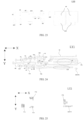
- FIG 2A is a schematic diagram of a shift register unit.
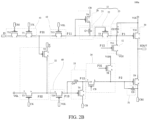
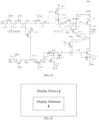
- FIG 2B is a circuit diagram of a shift register unit.
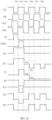
- FIG 2C is a signal timing diagram of the shift register unit shown in FIG 2B during operation. The operation process of the shift register unit is briefly introduced below in conjunction with FIG 2A to FIG 2C .
- the shift register unit 100 includes a charge pump circuit 11.
- the charge pump circuit 11 is respectively electrically connected with a first input node P11, a first clock signal terminal CB, and a first node P1, and is configured to, under the control of the first clock signal provided by the first clock signal terminal CB during the first period, convert the potential of the first input node P11 from a first voltage signal to a second voltage signal, and transmit the second voltage signal to the first node P1, and is further configured to maintain the potential of the first node P1 during the second period. That is, in the second period, the potential of the first node P1 is maintained as the second voltage signal.
- the polarity of the first voltage signal is the same as the polarity of the second voltage signal, and the absolute value of the voltage value of the second voltage signal is greater than the absolute value of the voltage value of the first voltage signal.
- the voltage signal of the first input node P11 may be adjusted to the first voltage signal.
- the first period is a first keeping period
- the second period is a second keeping period.
- the voltage signal of the first input node P11 may be the first voltage signal.
- the first period is a first keeping period
- the second period is a third keeping period.
- FIG 2C shows the first voltage signal V01 and the second voltage signal V02.
- the charge pump is a structure similar to a water pump in a circuit, which implements redistribution of charges and achieves a purpose of boosting (or bucking) mainly through a capacitor, clock, and diode rectification structure.
- the shift register unit including the charge pump circuit 11 can sufficiently buck or boost the potential of the first node P1 during the keeping phase through the charge pump circuit 11, so that in the keeping phase, the first output transistor controlled by the first node P1 is kept on, which further allows the potential of the driving signal output by the shift register unit not to be affected by noise interference during the keeping phase.
- the polarity of the first voltage signal being the same as the polarity of the second voltage signal refers to that: when the first voltage signal is a positive voltage signal, the second voltage signal is a positive voltage signal; and when the first voltage signal is a negative voltage signal, the second voltage signal is a negative voltage signal.
- the absolute value of the voltage value of the second voltage signal being greater than the absolute value of the voltage value of the first voltage signal refers to that: when the first voltage signal is a positive voltage signal, the voltage value of the second voltage signal is greater than the voltage value of the first voltage signal; and when the first voltage signal is a negative voltage signal, the voltage value of the second voltage signal is less than the voltage value of the second voltage signal.
- the charge pump circuit 11 can further buck or boost the potential of the first node P1 during the keeping phase.
- the charge pump circuit can pump the potential of the first voltage signal 2 to 3 times lower, but is not limited thereto.
- the shift register unit 100a includes 14 transistors T1 to T14 and 4 capacitors (a first capacitor C1, a second capacitor C2, a third capacitor C3, and a fourth capacitor C4).
- FIG 2B shows first electrodes a and second electrodes b of the respective transistors, and first electrode plates a and second electrode plates b of the respective capacitors.
- T1 to T14 shown in the drawings are simplified as transistors T1 to T14.
- the transistor T1 is referred to as a second control transistor T1
- the transistor T2 is referred to as a fourth control transistor T2
- the transistor T3 is referred to as a third control transistor T3
- the transistor T4 is referred to as a second transistor T4
- the transistor T5 is referred to as a first transistor T5
- the transistor T6 is referred to as a fifth control transistor T6
- the transistor T7 is referred to as a sixth control transistor T7
- the transistor T8 is referred to as a seventh control transistor T8
- the transistor T9 is referred to as a second output transistor T9
- the transistor T10 is referred to as a first output transistor T10
- the transistor T11 is referred to as a first node control transistor T11
- the transistor T12 is referred to as a first control transistor T12
- the transistor T13 is referred to as a first isolation transistor T13
- the transistor T14 is referred to as a second isolation transistor T14.
- a first electrode of the first control transistor T12 in the first-stage shift register unit 100a is connected with an input terminal EI.
- the input terminal EI is configured to be connected with the trigger signal line to receive the trigger signal as the input signal
- a first electrode of the first control transistor T12 in other respective stage of shift register unit 100a is electrically connected with the output terminal EOUT of a previous-stage shift register unit 100a to receive an output signal output by the output terminal EOUT of the previous-stage shift register unit as the input signal, thereby implementing shift output, so as to provide, for example, the light-emitting control signal shifted row by row to the pixel units 103 arranged in an array in the display region 102 of the display panel 101.
- the shift register unit 100a further includes a first clock signal terminal CB and a second clock signal terminal CB2.
- the first clock signal terminal CB is connected with the first clock signal line or the second clock signal line to receive the first clock signal.
- the first clock signal line provides the first clock signal;
- the second clock signal line provides the first clock signal, which specifically depends on an actual situation, and is not limited in the embodiments of the present disclosure.
- the second clock signal terminal CB2 is connected with the second clock signal line or the first clock signal line to receive the second clock signal.
- the first clock signal terminal CB is connected with the first clock signal line to receive the first clock signal
- the second clock signal terminal CB2 is connected with the second clock signal line to receive the second clock signal as an example, which is not limited in the embodiments of the present disclosure.
- the first clock signal and the second clock signal respectively adopts a pulse signal with a duty ratio greater than 50%, and a difference between the two pulse signals is, for example, a half cycle.
- the shift register unit further includes a third clock signal terminal CK and a fourth clock signal terminal CK2 (not shown in FIG 2B ).
- the third clock signal terminal CK shown in FIG 2B is replaced with the fourth clock signal terminal CK2.
- the third clock signal terminal CK is connected with the third clock signal line or the fourth clock signal line to receive a third clock signal.
- the third clock signal terminal CK when the third clock signal terminal CK is connected with the third clock signal line, the third clock signal line provides the third clock signal; when the third clock signal terminal CK is connected with the fourth clock signal line, the fourth clock signal line provides the third clock signal, which specifically depends on an actual situation, and is not limited in the embodiments of the present disclosure.
- the fourth clock signal terminal CK2 is connected with the third clock signal line or the fourth clock signal line to receive a fourth clock signal.
- the third clock signal terminal CK is connected with the third clock signal line to receive the third clock signal
- the fourth clock signal terminal CK2 is connected with the fourth clock signal line to receive the fourth clock signal as an example, which is not limited in the embodiments of the present disclosure.
- the third clock signal and the fourth clock signal respectively adopts a pulse signal with a duty ratio greater than 50%, and a difference between the two pulse signals is, for example, a half cycle.
- VGL represents the first power line and the first power voltage provided by the first power line
- VGH represents the second power line and the second power voltage provided by the second power line
- the first power voltage is greater than the second power voltage.
- the first power voltage is at a direct-current high level
- the second power voltage is at a direct-current low level.
- P31, P11, P1, P2, P12, P13 and P32 respectively represent the first isolation node, the first input node, the first node, the second node, the second input node, the third input node, and the second isolation node in the circuit schematic diagrams.
- FIG 2B shows the first isolation node P31, the first input node P11, the first node P1, the second node P2, the second input node P12, the third input node P13, and the second isolation node P32.
- the shift register unit 100a includes a charge pump circuit 11, a first isolation node control sub-circuit 41, a first isolating sub-circuit 42, a first tank circuit 31, a first node control circuit 12, a second isolation node control sub-circuit 32, a second isolating sub-circuit 40, a second input node control sub-circuit 33, a second node control sub-circuit 34, and an output circuit 30.
- the charge pump circuit 11 includes a first clock signal terminal CB, a first capacitor C1, a first transistor T5, and a second capacitor C2.
- a first electrode plate of the first capacitor C1 is connected with the first clock signal terminal CB, and a second electrode plate of the first capacitor C1 is connected with the first input node P11.
- a first electrode of the first transistor T5 is connected with the first input node P11, and a second electrode of the first transistor T5 is connected with the first node P1.
- a gate electrode of the first transistor T5 is connected with the first electrode or the second electrode of the first transistor T5 to form a diode-connected triode.
- a first electrode plate of the second capacitor C2 is connected with the first power line VGL, and a second electrode plate of the second capacitor C2 is connected with the first node P1.
- the charge pump circuit 11 further includes a second transistor T4.
- a gate electrode of the second transistor T4 is electrically connected with the first input node P11, a first electrode of the second transistor T4 is electrically connected with the first clock signal terminal CB, and a second electrode of the second transistor T4 is electrically connected with the first electrode plate of the first capacitor C1.
- the output circuit 30 is respectively connected with the first node P1, the second node P2, the first power line VGL, the second clock signal terminal CB2, and the output terminal EOUT.
- the output circuit 30 is configured to output the first power voltage to the output terminal EOUT for reset under the control of the potential of the first node P1, and output the second clock signal to the output terminal EOUT to output a valid driving signal, under the control of the potential of the second node P2.
- the output circuit 30 includes a first output transistor T10 and a second output transistor T9.
- a gate electrode of the first output transistor T10 is electrically connected with the first node P1
- a first electrode of the first output transistor T10 is electrically connected with the first power line VGL
- a second electrode of the first output transistor T10 is electrically connected with the driving signal output terminal EOUT.
- a gate electrode of the second output transistor T9 is electrically connected with the second node P2
- a first electrode of the second output transistor T9 is electrically connected with the driving signal output terminal EOUT
- a second electrode of the second output transistor T9 is electrically connected with the second clock signal terminal CB2.
- an operation process of the shift register unit includes 6 phases, namely, a first phase PS1, a second phase PS2, a third phase PS3, a fourth phase PS4, a fifth phase PS5, and a sixth phase PS6.
- the first phase PS1 is an input phase
- the second phase PS2 is an output phase
- the third phase PS3 is a reset phase
- the fourth phase PS4 is a first keeping period
- the fifth phase PS5 is a second keeping period
- the sixth phase PS6 is a third keeping period. That is, the fourth phase PS4, the fifth phase PS5, and the sixth phase PS6 constitute a keeping phase.
- one operating cycle of the shift register unit may include an input phase, an output phase, a reset phase, and a keeping phase that are sequentially set; in the input phase, the input terminal provides an input signal; in the output phase, the shift register unit outputs a valid driving signal; in the reset phase, the driving signal is reset so that the shift register unit outputs an invalid driving signal; and in the keeping phase, the shift register unit needs to keep outputting an invalid driving signal.
- the first isolation node control sub-circuit 41 is respectively electrically connected with the second clock signal terminal CB2, the third clock signal terminal CK, the input terminal EI, and the first isolation node P31, and is configured to transmit the input signal of the input terminal EI to the first isolation node P31 under the control of the second clock signal and the third clock signal.
- the input terminal EI is connected with the trigger signal line to receive the trigger signal.
- the input terminal EI is connected with an output terminal EOUT of a previous-stage shift register unit thereof.
- the first isolation node control sub-circuit 41 includes only the first control transistor T12 or only the second control transistor T1. For example, providing the first control transistor T12 and the second control transistor T1 can help to reduce leakage current.
- the first isolating sub-circuit 42 is respectively electrically connected with the first power line VGL, the first isolation node P31, and the first input node P11, and is configured to control whether the first isolation node P31 and the first input node P11 are connected. For example, providing the first isolating sub-circuit 42 can reduce leakage current from the first input node P11 to the first isolation node P31, that is, the potential of the first isolation node P31 is maintained when the potential of the first input node P11 changes, so as to improve the response speed of driving signal output. As shown in FIG 2B , the first isolating sub-circuit 42 includes a first isolation transistor T13.
- a gate electrode of the first isolation transistor T13 is electrically connected with the first power line VGL
- a first electrode of the first isolation transistor T13 is electrically connected with the first input node P11
- a second electrode of the first isolation transistor T13 is electrically connected with the first isolation node P31.
- providing the first isolation transistor T13 can reduce leakage current from the first input node P11 to the first isolation node P31, so that the response speed of driving signal output is faster.
- the first isolating sub-circuit 42 is not provided, in this case, the first isolation node P31 and the first input node P11 are the same node.
- the second node control sub-circuit 34 is respectively electrically connected with the first clock signal terminal CB, the second input node P12, the second node P2, the first isolation node P31, and the second power line VGH.
- the second node control sub-circuit 34 is configured to turn on or off the connection between the second input node P12 and the second node P2 under the control of the first clock signal, and is configured to write the second power voltage into the second node P2 under the control of the potential of the first isolation node P31, so as to control the potential of the second node P2.
- the second node control sub-circuit 34 includes a sixth control transistor T7 and a seventh control transistor T8.
- a gate electrode of the sixth control transistor T7 is electrically connected with the first clock signal terminal CB
- a first electrode of the sixth control transistor T7 is electrically connected with the second input node P12
- a second electrode of the sixth control transistor T7 is electrically connected with the second node P2.
- a gate electrode of the seventh control transistor T8 is electrically connected with the first isolation node P31
- a first electrode of the seventh control transistor T8 is electrically connected with the second power line VGH
- a second electrode of the seventh control transistor T8 is electrically connected with the second node P2.
- the sixth control transistor T7 can prevent leakage to the second input node P12, isolate influence of the fourth capacitor C4 on the second node P2, and enhance the coupling effect of the second clock signal provided by the second clock signal terminal CB2 on the second node P2, so that when the potential of the second clock signal decreases, the potential of the second node P2 can be lower, thereby accelerating the discharge speed of the second output transistor T9 to the output terminal EOUT.
- the second input node control sub-circuit 33 is respectively electrically connected with the third input node P13, the second input node P12, and the first clock signal terminal CB.
- the second input node control sub-circuit 33 is configured to write the first clock signal into the second input node P12 under the control of the potential of the third input node P13, and is configured to control the potential of the second input node P12 according to the potential of the third input node P13.
- the second input node control sub-circuit 33 includes a fifth control transistor T6 and a fourth capacitor C4.
- a gate electrode of the fifth control transistor T6 is electrically connected with the third input node P13, a first electrode of the fifth control transistor T6 is electrically connected with the second input node P12, and a second electrode of the fifth control transistor T6 is electrically connected with the first clock signal terminal CB.
- a first electrode plate of the fourth capacitor C4 is electrically connected with the third input node P13, and a second electrode plate of the fourth capacitor C4 is electrically connected with the second input node P12.
- the second isolation node control sub-circuit 32 is respectively connected with the first isolation node P31, the second isolation node P32, the third clock signal terminal CK, and the first power line VGL, and is configured to input the first power voltage or the third clock signal to the second isolation node P32, under the control of the potential of the first isolation node P31 and the third clock signal, to control the potential of the second isolation node P32.
- the second isolation node control sub-circuit 32 includes a third control transistor T3 and a fourth control transistor T2.
- a gate electrode of the third control transistor T3 is electrically connected with the third clock signal terminal CK
- a first electrode of the third control transistor T3 is electrically connected with the first power line VGL
- a second electrode of the third control transistor T3 is electrically connected with the second isolation node P32.
- a gate electrode of the fourth control transistor T2 is electrically connected with the first isolation node P31, a first electrode of the fourth control transistor T2 is electrically connected with the third clock signal terminal CK, and a second electrode of the fourth control transistor T2 is electrically connected with the second isolation node P32.
- the second isolating sub-circuit 40 is respectively connected with the second isolation node P32, the third input node P13, and the first power line VGL, and is configured to control whether the second isolation node P32 and the third input node P13 are connected.
- the second isolating sub-circuit 40 is provided to prevent leakage from the third input node P13 to the second isolation node P32, and isolate influence of the fourth capacitor C4 on the second isolation node P32.
- the second isolating sub-circuit 40 includes a second isolation transistor T14.
- a gate electrode of the second isolation transistor T14 is electrically connected with the first power line VGL
- a first electrode of the second isolation transistor T14 is electrically connected with the second isolation node P32
- a second electrode of the second isolation transistor T14 is electrically connected with the third input node P13.
- Providing the second isolation transistor T14 can reduce leakage of the third input node P13 to the second isolation node P32, so that the response speed of driving signal output is faster.
- the second isolation transistor T14 is not provided, in this case, the second isolation node P32 and the third input node P13 are the same node.
- the first node control circuit 12 is respectively electrically connected with the second input node P12, the second power line VGH, and the first node P1, and is configured to write the second power voltage into the first node P1 under the control of the potential of the second input node P12 to control the potential of the first node P1.
- the first node control circuit 12 includes a first node control transistor T11.
- a gate electrode of the first node control transistor T11 is electrically connected with the second input node P12, a first electrode of the first node control transistor T11 is electrically connected with the second power line VGH, and a second electrode of the first node control transistor T11 is electrically connected with the first node P1.
- the transistors in the shift register unit 100a shown in FIG 2B are all described by taking P-type transistors as an example, that is, the respective transistors are turned on when the gate electrodes are input by a low level (ON level), and are turned off when the gate electrodes are input by a high level (OFF level).
- the first electrode of the transistor is a source electrode
- the second electrode of the transistor is a drain electrode.
- the shift register unit includes, but is not limited to, the setting mode of FIG 2B , for example, the respective transistors in the shift register unit 100a may also adopt N-type transistors or a mixture of P-type transistors and N-type transistors, as long as each electrode of the transistor of selected type is correspondingly connected with reference to each electrode of the corresponding transistor employed in examples of the embodiments of the present disclosure.
- the transistors adopted in the shift register unit may all be thin film transistors or field effect transistors or other switch devices with same characteristics.
- the active layer (a channel region) of the transistor is made of a semiconductor material, for example, polysilicon (e.g., low-temperature polysilicon or high-temperature polysilicon), amorphous silicon, indium gallium zinc oxide (IGZO), etc.
- the gate electrode, the source electrode, and the drain electrode are made of metal materials, for example, metal aluminum or aluminum alloy.
- the source electrode and the drain electrode of the transistor adopted here may be symmetrical in structure, so the source electrode and the drain electrode thereof may be structurally indistinguishable.
- electrode plates of the capacitor may be metal electrodes or one of the electrode plates may be made of a semiconductor material (e.g., doped polysilicon). The material of the electrode plate of the capacitor according to the embodiments of the present disclosure is described by taking metal as an example.
- FIG 2C is a signal timing diagram of the shift register unit 100a shown in FIG 2B during operation and a schematic diagram of potential waveforms of respective nodes.
- the operation process of the shift register unit is described in detail below in conjunction with FIG 2B and FIG 2C .
- the operation process of the shift register unit includes 6 phases, namely, a first phase PS1, a second phase PS2, a third phase PS3, a fourth phase PS4, a fifth phase PS5, and a sixth phase PS6, and
- FIG 2C shows timing waveforms of respective signals in each phase.
- the first phase PS1 is an input phase
- the second phase PS2 is an output phase
- the third phase PS3 is a reset phase
- the fourth phase PS4 is a first keeping period
- the fifth phase PS5 is a second keeping period
- the sixth phase PS6 is a third keeping period. That is, the fourth phase PS4, the fifth phase PS5, and the sixth phase PS6 constitute a keeping phase.
- the third clock signal terminal CK provides a low voltage
- the first clock signal terminal CB provides a high voltage
- the second clock signal terminal CB2 provides a low voltage
- the input terminal EI provides a high voltage
- the first control transistor T12 and the second control transistor T1 are turned on
- the first isolation transistor T13 is turned on
- the potential of the first input node P11 is a high voltage
- the potential of the first isolation node P31 is a high voltage
- the first transistor T5 and the second transistor T4 are both turned off.
- the fourth control transistor T2 is turned off, the third control transistor T3 is turned on, the second isolation transistor T14 is turned on, the potential of the second isolation node P32 is a low voltage, the potential of the third input node P13 is a low voltage, the fifth control transistor T6 is turned on, the potential of the second input node P12 is a high voltage, the sixth control transistor T7 is turned off, the seventh control transistor T8 is turned off, the first node control transistor T11 is turned off, the potential of the first node P1 is maintained as a low voltage, the potential of the second node P2 is maintained as a high voltage, the first output transistor T10 is turned on, the second output transistor T9 is turned off, and the output terminal EOUT outputs a low voltage.
- the third clock signal terminal CK provides a high voltage
- the first clock signal terminal CB provides a low voltage
- the second clock signal terminal CB2 provides a high voltage
- the input terminal EI provides a low voltage
- both the first control transistor T12 and the second control transistor T1 are turned off. Due to the storage effect of the first capacitor C1, the potential of the first input node P11 is maintained as a high voltage, the first isolation transistor T13 is turned on, and the potential of the first isolation node P31 is a high voltage.
- the second transistor T4 is turned off, the first transistor T5 is turned off, the fourth control transistor T2 is turned off, the third control transistor T3 is turned off, the potential of the second isolation node P32 is maintained as a low voltage, the second isolation transistor T14 is turned off, the potential of the third input node P13 is further bucked by the fourth capacitor C4, the fifth control transistor T6 is turned on, the potential of the second input node P12 is a low voltage, the sixth control transistor T7 is turned on, the seventh control transistor T8 is turned off, the first node control transistor T11 is turned on, the potential of the first node P1 is a high voltage, the potential of the second node P2 is a low voltage, the second output transistor T9 is turned on, the first output transistor T10 is turned off, and the output terminal EOUT outputs a high voltage.
- the third clock signal terminal CK provides a low voltage
- the first clock signal terminal CB provides a high voltage
- the second clock signal terminal CB2 provides a low voltage
- the input terminal EI provides a low voltage
- the first control transistor T12 and the second control transistor T1 are both turned on, the potential of the first input node P11 is bucked
- the first isolation transistor T13 is turned on
- the potential of the first isolation node P31 is bucked
- the fourth control transistor T2 is turned on
- the second transistor T4 is turned on
- the first transistor T5 is turned on
- the potential of the first node P1 is bucked.
- the first output transistor T10 is turned on, the third control transistor T3 is turned on, the potential of the second isolation node P32 is a low voltage, the second isolation transistor T14 is turned on, the fifth control transistor T6 is turned on, the potential of the third input node P13 and the potential of the second input node P12 are boosted, the sixth control transistor T7 is turned off, and the first node control transistor T11 is turned off.
- the seventh control transistor T8 is turned on, the potential of the second node P2 is a high voltage, the second output transistor T9 is turned off, and the output terminal EOUT outputs a low voltage.
- the third clock signal terminal CK provides a high voltage
- the first clock signal terminal CB provides a low voltage
- the second clock signal terminal CB2 provides a high voltage
- the input terminal EI provides a low voltage
- the first control transistor T12 and the second control transistor T1 are both turned off
- the second transistor T4 is turned on
- the first clock signal terminal CB bucks the potential of the first input node P11 through the first capacitor C1
- the first isolation transistor T13 is turned off
- the potential of the first isolation node P31 is maintained as a low voltage
- the first transistor T5 is turned on, so that the potential of the first node P1 is bucked and maintained to be lower than VSS+Vth, where Vth is a threshold voltage of the first output transistor T10, so that the first output transistor T10 is turned on, and further the potential of the driving signal output by the output terminal EOUT is maintained as VSS, without being affected by noise interference.
- the third control transistor T3 is turned off, the fourth control transistor T2 is turned on, the potential of the second isolation node P32 is a high voltage, the second isolation transistor T14 is turned on, the potential of the third input node P13 is a high voltage, the fifth control transistor T6 is turned off, the potential of the second input node P12 is a high voltage, the sixth control transistor T7 is turned on, the seventh control transistor T8 is turned on, the potential of the second node P2 is a high voltage, and the second output transistor T9 is turned off.
- the third clock signal terminal CK provides a low voltage
- the first clock signal terminal CB provides a high voltage
- the second clock signal terminal CB2 provides a low voltage
- the input terminal EI provides a low voltage
- the first control transistor T12 and the second control transistor T1 are both turned on
- the potential of the first input node P11 is a low voltage
- the first isolation transistor T13 is turned on
- the second transistor T4 is turned on
- the potential of the first clock signal provided by the first clock signal terminal CB is boosted, so that the potential of the first input node P11 is boosted through the first capacitor C1, and the first transistor T5 is turned off without affecting the potential of the first node P1.
- the potential of the first node P1 is maintained to be lower than VSS+Vth, where Vth is the threshold voltage of the first output transistor T10, so that the first output transistor T10 is turned on, and further the potential of the driving signal output by the output terminal EOUT is maintained at VSS, without being affected by noise interference.
- the third control transistor T3 is turned on, the fourth control transistor T2 is turned on, the potential of the second isolation node P32 is a low voltage, the second isolation transistor T14 is turned on, the potential of the third input node P13 is a low voltage, the fifth control transistor T6 is turned on, the potential of the second input node P12 is a high voltage, the first node control transistor T11 is turned off, the sixth control transistor T7 is turned off, the seventh control transistor T8 is turned on, the potential of the second node P2 is a high voltage, and the second output transistor T9 is turned off.
- the third clock signal terminal CK provides a high voltage
- the first clock signal terminal CB provides a low voltage
- the second clock signal terminal CB2 provides a high voltage
- the input terminal EI provides a low voltage
- the first control transistor T12 and the second control transistor T1 are both turned off
- the potential of the first input node P11 is maintained as a low voltage
- the second transistor T4 is turned on
- the first clock signal terminal CB bucks the potential of the first input node P11 through the first capacitor C1
- the first transistor T5 is turned on, so that the potential of the first node P1 is maintained to be lower than VSS+Vth, where Vth is the threshold voltage of the first output transistor T10, so that the first output transistor T10 is turned on, and further the potential of the driving signal output by the output terminal EOUT is maintained as VSS, without being affected by noise interference.
- the first isolation transistor T13 is turned off, the potential of the first isolation node P31 is maintained as a low voltage, the third control transistor T3 is turned off, the fourth control transistor T2 is turned on, the potential of the second isolation node P32 is a high voltage, the second isolation transistor T14 is turned on, the potential of the third input node P13 is a high voltage, the fifth control transistor T6 is turned off, the potential of the second input node P12 is a high voltage, the first node control transistor T11 is turned off, the sixth control transistor T7 is turned on, the seventh control transistor T8 is turned on, the potential of the second node P2 is a high voltage, and the second output transistor T9 is turned off.
- the potential of the first node P1 is maintained to be lower than VSS+Vth, where Vth is the threshold voltage of the first output transistor T10, so that the first output transistor T10 is turned on, and further the potential of the driving signal output by the output terminal EOUT is maintained as VSS, without being affected by noise interference.
- the first input node P11 is at a low level VSS
- the transistor T1 and the transistor T12 are used to initialize the first input node P11 to VSS
- the first capacitor C1 and the second transistor T4 are used to further buck the potential of the first input node P11 at a falling edge of the first clock signal, and save the low level to the first node P1 through the first transistor T5 with the diode structure, and meanwhile store charges through the second capacitor C2 to maintain the potential.
- FIG 2C shows the first voltage signal V01 and the second voltage signal V02.
- the first voltage signal V01 and the second voltage signal V02 have same polarity, and the absolute value of the voltage value of the second voltage signal V02 is greater than the absolute value of the voltage value of the first voltage signal V01.
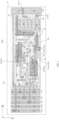
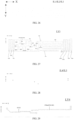
- FIG 3 is a schematic diagram of a layout of the shift register unit 100a shown in FIG 2B in the display substrate.
- the display substrate includes a base substrate 10, and a shift register unit 100aa, a first power line VGL, a second power line VGH, and a plurality of clock signal lines which are provided on the base substrate 10.
- the plurality of clock signal lines include the first clock signal line ECB, the second clock signal line ECB2, the third clock signal line ECK, and the fourth clock signal line ECK2 shown in the diagram, and may also include a trigger signal line (not shown).
- the shift register unit 100aa is a light-emitting control shift register unit.
- the first power line VGL, the second power line VGH, and the plurality of clock signal lines all extend along a first direction Y on the base substrate 10, and are configured to respectively provide a first power voltage, a second power voltage, and a plurality of clock signals (e.g., the first clock signal, second clock signal, etc. as described above) to the shift register unit 100aa.
- the first power line VGL is configured to provide a first power voltage to the shift register unit 100aa
- the second power line VGH is configured to provide a second power voltage to the shift register unit 100aa.
- the embodiments of the present disclosure are described by taking the case where the third clock signal line ECK provides the third clock signal to the shift register unit 100aa, and the fourth clock signal line ECK2 provides the fourth clock signal to the shift register unit 100aa, and the embodiments of the present disclosure include but are not limited thereto.
- the third clock signal line ECK may also provide the fourth clock signal to the shift register unit 100aa, and the fourth clock signal line ECK2 provides the third clock signal to the shift register unit 100aa, which is not limited in the embodiments of the present disclosure.
- first power line VGL, the second power line VGH, and the plurality of clock signal lines may extend along the first direction Y and be arranged parallel to each other, or may also cross by a certain angle (e.g., less than or equal to 20°), which is not limited in the embodiments of the present disclosure.
- the base substrate 10 is made of, for example, glass, plastic, quartz, or other suitable materials, which is not limited in the embodiment of the present disclosure.
- the display substrate 1 includes a display region 102 (e.g., the display region 102 may also be referred to as a pixel array region) and a peripheral region 106 located on at least one side of the pixel array region.
- the shift register unit 100aa provided by the embodiment of the present disclosure may be the light-emitting control shift register unit 105 shown in FIG. 1A .
- the first power line VGL, the second power line VGH, the plurality of clock signal lines and the shift register unit 100aa as described above are located in the peripheral region 106 of the base substrate 10 and located on one side of the base substrate 10 (as shown in FIG.
- an orthogonal projection of the first power line VGL on the base substrate 10 and an orthogonal projection of the plurality of clock signal lines on the base substrate 10 are located on a side of an orthogonal projection of the shift register unit 100aa on the base substrate 10 that is away from the display region 102, for example, in the second direction X, both are located on the left side of the shift register unit 100aa shown in FIG 3 .
- the second power line VGH is located on a side of the orthogonal projection of the shift register unit 100aa on the base substrate 10 that is close to the display region 102, for example, in the second direction X, located on the right side of the shift register unit 100aa shown in FIG 3 .
- the plurality of clock signal lines described above may further include a trigger signal line for providing a trigger signal.
- a trigger signal line for providing a trigger signal.
- an orthogonal projection of the trigger signal line on the base substrate 10 is located on a side of the orthogonal projection of the second clock signal line ECB2 on the base substrate 10 that is away from the orthogonal projection of the shift register unit 100aa on the base substrate 10. That is, the trigger signal line, the second clock signal line ECB2, the fourth clock signal line ECK2, the first clock signal line ECB, and the third clock signal line ECK are sequentially arranged on the base substrate 10 from left to right along the second direction X.
- an included angle between the first direction Y and the second direction X is between 70° and 90°, and includes70 ° and 90°.
- the included angle between the first direction Y and the second direction X is 70°, 75°, 85°, 90°, or 80°, etc., and the specific value of the included angle is set according to actual conditions, which is not limited in the embodiment of the present disclosure.
- the display region 102 includes a plurality of pixel units 103 arranged in an array.
- each of the plurality of pixel units 103 includes a pixel circuit, for example, further includes a light-emitting element (not shown).
- the light-emitting element includes an organic light-emitting diode, but is not limited thereto.
- a plurality of shift register units 100aa i.e., light-emitting control shift register units 100aa
- EM GOA light-emitting control driving circuit array
- the output terminals EOUT of the plurality of shift register units 100aa are respectively connected with light-emitting control signal terminals of respective rows of pixel circuits located in the pixel array region to provide output signals (e.g., light-emitting control signals) to the respective rows of pixel circuits, so as to implement driving the light-emitting element to emit light.
- the pixel circuit is a pixel circuit including a circuit structure such as 7T1C, 2T1C, 4T2C, 8T2C, etc. in the art, and details are not repeated here.
- FIG 3 only shows a Kth-stage (K is an even number greater than or equal to 2) shift register unit 100aa in the gate driving circuit.
- a first clock signal terminal CB (as shown in FIG 2B ) of the first-stage shift register unit (not shown) is connected with the third clock signal line ECK to receive the first clock signal
- a second clock signal terminal CB2 of the first-stage shift register unit is connected with the fourth clock signal line ECK2 to receive the second clock signal
- a third clock signal terminal CK (as shown in FIG 2B ) of the first-stage shift register unit is connected with the first clock signal line ECB to receive the third clock signal
- a fourth clock signal terminal CK2 of the first-stage shift register unit is connected with the fourth clock signal line ECB2 to receive the fourth clock signal
- an input terminal of the first-stage shift register unit is connected with the trigger signal line (not shown) to receive the trigger signal
- a first clock signal terminal CB of the second-stage shift register unit is connected
- a first clock signal terminal CB of the Kth-stage (K is an even number greater than or equal to 2) shift register unit 100aa is connected with the first clock signal line ECB to receive the first clock signal
- a second clock signal terminal CB2 of the Kth-stage shift register unit is connected with the second clock signal line ECB2 to receive the second clock signal
- a third clock signal terminal CK of the Kth-stage shift register unit (not shown) is connected with the third clock signal line ECK to receive the third clock signal
- a fourth clock signal terminal CK2 of the Kth-stage shift register unit is connected with the fourth clock signal line ECK2 to receive the fourth clock signal
- a first clock signal terminal CB of a (K+1)th-stage shift register unit is connected with the third clock signal line ECK to receive the first clock signal
- a second clock signal terminal CB2 of the (K+1)th-stage shift register unit is connected with the fourth clock signal line ECK2 to receive the second clock signal
- connection modes of the respective stages of shift register units and the clock signal lines may also be other connection modes in the art, which is not limited in the embodiments of the present disclosure.
- the input terminal EI of the first-stage shift register unit is connected with the trigger signal line to receive the trigger signal as an input signal
- the input terminal of the second-stage shift register unit is connected with an output terminal EOUT of a previous-stage shift register unit (i.e., the first-stage shift register unit)
- the connection modes of input terminals of other respective stages of shift register units are similar thereto.
- the structure of the Kth-stage (K is an even number greater than or equal to 2) shift register unit 100aa is described below as an example, which is not limited in the embodiments of the present disclosure.
- the embodiment of the present disclosure only schematically shows four clock signal lines (the first clock signal line ECB, the second clock signal line ECB2, the third clock signal line ECK, and the fourth clock signal line ECK2)
- the display substrate provided by the embodiment of the present disclosure may further include 6 or 8 or more clock signal lines, which is not limited by the embodiments of the present disclosure.
- the connection relationship between the shift register units 100aa and the clock signal lines in the display substrate also changes accordingly.
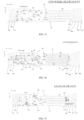
- FIG 4 to FIG 12 are plan views of wiring or via holes of respective layers of the display substrate shown in FIG 3 .
- FIG 13 to FIG 19 are plan views of a plurality of film layers in the display substrate shown in FIG 3 .
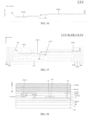
- FIG 20A is a cross-sectional view taken along line A-B in FIG 3 .
- FIG 20B is a cross-sectional view taken along line E1-F1, E2-F2, E3-F3 or E4-F4 in FIG 3 .
- FIG 21 is a schematic diagram of the arrangement positions of respective connection lines, connection electrodes, and conductive lines in the display substrate shown in FIG 3 .
- FIG 4 is a plan view of an active layer of a display substrate provided by at least one embodiment of the present disclosure
- FIG 5 is a plan view of a first conductive layer of a display substrate provided by at least one embodiment of the present disclosure
- FIG 6 is a plan view of a second conductive layer of a display substrate provided by at least one embodiment of the present disclosure
- FIG 7 is a distribution diagram of via holes penetrating a third insulating layer (a second interlayer insulating layer) of a display substrate provided by at least one embodiment of the present disclosure
- FIG 8 is a distribution diagram of via holes penetrating a first insulating layer of a display substrate provided by at least one embodiment of the present disclosure
- FIG 9 is a plan view of a third conductive layer of a display substrate provided by at least one embodiment of the present disclosure
- FIG 10 is a distribution diagram of via holes penetrating a fourth insulating layer (a passivation layer) of a display substrate provided by at least one embodiment of the present disclosure
- FIG 11
- FIG 13 is a schematic diagram of a laminate of a semiconductor layer LY0 and a via hole penetrating an interlayer insulating layer ILD (a first insulating layer IL1, a second insulating layer IL2, and a third insulating layer IL3) of a display substrate provided by at least one embodiment of the present disclosure.
- FIG 14 is a schematic diagram of a laminate of a via hole penetrating an interlayer insulating layer ILD and a first conductive layer LY1 of a display substrate provided by at least one embodiment of the present disclosure.
- FIG 15 is a schematic diagram of a laminate of a semiconductor layer LY0, the via hole penetrating the interlayer insulating layer ILD, and a third conductive layer LY3 of a display substrate provided by at least one embodiment of the present disclosure.
- FIG 16 is a schematic diagram of a laminate of a first conductive layer LY1, the via hole penetrating the interlayer insulating layer ILD, and a third conductive layer LY3 of a display substrate provided by at least one embodiment of the present disclosure.
- FIG 17 is a schematic diagram of a laminate of a second conductive layer LY2 and a via hole penetrating a second interlayer insulating layer ILD2 of a display substrate provided by at least one embodiment of the present disclosure.
- FIG 18 is a schematic diagram of a laminate of the second conductive layer LY2, the via hole penetrating the second interlayer insulating layer ILD2, and the third conductive layer LY3 of a display substrate provided by at least one embodiment of the present disclosure.
- FIG 19 is a schematic diagram of a laminate of the third conductive layer LY3, a via hole in a fourth insulating layer, and a via hole in a fifth insulating layer of a display substrate provided by at least one embodiment of the present disclosure.
- a single-layer structure and a stacked structure of the display substrate provided by at least one embodiment of the present disclosure are described in detail in conjunction with FIG 3 to FIG 21 .
- the insulating layer of the display substrate includes a first insulating layer IL1, a second insulating layer IL2, a third insulating layer IL3, a fourth insulating layer IL4, a fifth insulating layer IL5, etc.
- the first insulating layer IL1 (as shown in FIG 20A ) is located between the semiconductor layer LY0 shown in FIG 4 and the first conductive layer LY1 shown in FIG 5
- the second insulating layer IL2 (as shown in FIG 20A ) is located between the first conductive layer LY1 shown in FIG 5 and the second conductive layer LY2 shown in FIG 6 (referring to FIG 20B )
- the third insulating layer IL3 (as shown in FIG 20A ) is located between the second conductive layer LY2 shown in FIG 6 and the third conductive layer LY3 shown in FIG 9 .
- the fourth insulating layer IL4 (as shown in FIG 20B ) is located between the third conductive layer LY3 shown in FIG 9 and the fourth conductive layer LY4 shown in FIG 12 .
- FIG 20B shows a fifth insulating layer IL5.
- the via holes shown in FIG 7 are via holes penetrating the third insulating layer IL3.
- the via holes shown in FIG 8 are via holes penetrating one or more layers of the first insulating layer IL1, the second insulating layer IL2, and the third insulating layer IL3.
- FIG 20B shows a sixth insulating layer IL6.
- the sixth insulating layer IL6 is located on the fourth conductive layer LY4, and is used to protect the fourth conductive layer LY4.
- the first insulating layer IL1 includes a first gate insulating layer GI1
- the second insulating layer IL2 includes a first interlayer insulating layer ILD1
- the third insulating layer IL3 includes a second interlayer insulating layer ILD2
- the fourth insulating layer IL4 includes a passivation layer PVX
- the fifth insulating layer IL5 includes a first planarization layer PLN1
- the sixth insulating layer IL6 includes a second planarization layer PLN2.
- the first insulating layer IL1, the second insulating layer IL2, the third insulating layer IL3, the fourth insulating layer IL4, the fifth insulating layer IL5, and the sixth insulating layer IL6 are all made of insulating materials.
- the materials of the first insulating layer IL1, the second insulating layer IL2, the third insulating layer IL3, and the fourth insulating layer IL4 include inorganic insulating materials such as SiNx, SiOx, SiNxOy, etc., or other suitable materials
- the materials of the fifth insulating layer IL5 and the sixth insulating layer IL6 include organic insulating materials such as organic resins, or other suitable materials, which is not limited in the embodiments of the present disclosure.
- the thicknesses of the fifth insulating layer IL5 and the sixth insulating layer IL6 are larger, and a thickness of each of the fifth insulating layer IL5 and the sixth insulating layer IL6 is greater than a thickness of each of the first insulating layer IL1, the second insulating layer IL2, the third insulating layer IL3 and the fourth insulating layer IL4.
- the display substrate shown in FIG 3 is described by taking the layout design of the Kth-stage shift register unit in the light-emitting control driving circuit array and the first power line, the second power line, and the clock signal lines connected therewith as an example, for the layout implementation of the other respective stages of shift register units, reference may be made to the layout mode shown in FIG 3 , which is not repeated here.
- other suitable layout modes may also be adopted, which are not limited in the embodiments of the present disclosure.
- the layout mode shown in FIG 3 may also be referred to, or other suitable layout modes may also be adopted, which are not limited in the embodiments of the present disclosure.
- the display substrate provided by at least one embodiment of the present disclosure is described in detail below in conjunction with FIG 3 to FIG 21 .
- abbreviation of the respective transistors may be used to simplify description.
- the active layers A1-A14 of the transistors T1 to T14 of the shift register unit 100aa shown in FIG 3 may refer to the pattern of the semiconductor layer LY0 shown in FIG 4 .
- the semiconductor layer LY0 may be formed by patterning a semiconductor material.
- the semiconductor layer LY0 may include a short rod-shaped portion or a portion having a curved or bent shape to form the active layers A1 to A14 of the above-described transistors T1 to T14.
- An active layer of each transistor may include a source electrode region, a drain electrode region, and a channel region located between the source electrode region and the drain electrode region.
- the channel region has semiconductor characteristics
- the source electrode region and the drain electrode region are on both sides of the channel region, are doped with impurities, and thus have conductivity.
- the source electrode region is a portion of the active layer, and a metal electrode (e.g., located in the third conductive layer LY3) in contact with the source electrode region corresponds to the source electrode (or referred to as the first electrode) of the transistor.
- the drain electrode region is a portion of the active layer, and a metal electrode (e.g., located in the third conductive layer LY3) in contact with the drain electrode region corresponds to the drain electrode (or referred to as the second electrode) of the transistor.
- the source electrode region is connected with the metal electrode (the source electrode) corresponding thereto through via holes penetrating the first insulating layer IL1, the second insulating layer IL2, and the third insulating layer IL3, and the drain electrode region is connected with the metal electrode (the drain electrode) corresponding thereto through via holes penetrating the first insulating layer IL1, the second insulating layer IL2 and the third insulating layer IL3.
- an connection electrode located in the third conductive layer is a metal electrode. At least a portion of the connection electrode serves as the source electrode or the drain electrode of the transistor.
- the material of the semiconductor layer LY0 includes an oxide semiconductor, an organic semiconductor or amorphous silicon, polysilicon, etc.
- the oxide semiconductor includes a metal oxide semiconductor (e.g., Indium Gallium Zinc Oxide (IGZO)), and polysilicon includes low-temperature polysilicon or high-temperature polysilicon, etc., which is not limited in the embodiments of the present disclosure.
- IGZO Indium Gallium Zinc Oxide
- the source electrode region and drain electrode region described above may be regions doped with n-type impurities or p-type impurities, which is not limited in the embodiments of the present disclosure.
- first electrodes and second electrodes of respective transistors may also be located in other conductive layers, and are connected with active layers corresponding thereto through via holes in the insulating layer between the same and the semiconductor layer, which is not limited in the embodiments of the present disclosure.
- FIG 5 shows the first conductive layer LY1 of the display substrate, and the first conductive layer LY1 is provided on the first insulating layer IL1 so as to be insulated from the semiconductor layer LY0.
- the first conductive layer LY1 includes second electrode plates C1b, C2b, C3b, C4b of the first capacitor C1 to the fourth capacitor C4, gate electrodes G1 to G14 of transistors T1 to T14, respective connection lines (e.g., connection lines L1 to L5), and conductive lines (e.g., conductive line M1, conductive line M2, and conductive line M3) for connection with signal lines or connection electrodes, etc., in the third conductive layer LY3.
- connection lines e.g., connection lines L1 to L5
- conductive lines e.g., conductive line M1, conductive line M2, and conductive line M3
- the conductive line M1, conductive line M2, and conductive line M3 are all independent patterns.
- the gate electrodes G1 to G14 of transistors T1 to T14 are portions enclosed by a circular or oval dashed line, that is, portions where the semiconductor layer structures of the respective transistors overlap with the electrodes or lines in the first conductive layer LY1.
- the second electrode plates C1b, C2b, C3b, C4b of the first capacitor C1 to the fourth capacitor C4 respectively include first portions C1b1, C2b1, C3b1, C4b1 of the second plate electrode plates C1b, C2b, C3b, C4b of the first capacitor C1 to the fourth capacitor C4.
- the gate electrode G5 of the transistor T5, the connection line L1, the first portion C1b1 of the second electrode plate C1b of the first capacitor C1, the connection line L2, and the gate electrode G4 of the transistor T4 are connected and formed integrally.
- the first portion C4b1 of the second electrode plate C4b of the fourth capacitor C4, the connection line L3, and the gate electrode G11 of the transistor T11 are connected and formed integrally.
- the connection line L4, the gate electrode G12 of the transistor T12, and the first portion C3b1 of the second electrode plate C3b of the third capacitor C3 are connected and formed integrally.
- the connection line L5, the gate electrode G2 of the transistor T2, and the gate electrode G8 of the transistor T8 are formed integrally.
- FIG 6 shows the second conductive layer LY2 of the display substrate, and the second conductive layer LY2 includes the first electrode plates C1a, C2a, C3a, C4a of the first capacitor C1 to the fourth capacitor C4 and an output terminal EOUT1.
- the first electrode plates C1a, C2a, C3a, C4a of the first capacitor C1 to the fourth capacitor C4 include a first portion C1a1 of the first electrode plate C1a, a first portion C2a1 of the first electrode plate C2a, a first portion C3a1 of the first electrode plate C3a, and a first portion C4a1 of the first electrode plate C4a.
- the output terminal EOUT1 located in the second conductive layer LY2 is used to provide output signals to the pixel units in the display region; while in some other embodiments of the present disclosure, the output signal of the output terminal EOUT1 of the shift register unit 100aa is also provided by electrodes located in other layers, that is, the output terminal EOUT1 may also be provided in another layer different from the second conductive layer LY2, for example, may be provided in the first conductive layer LY1, which is not limited in the embodiments of the present disclosure.
- FIG 7 shows distribution of via holes in the third insulating layer IL3 of the display substrate.
- the via holes shown in FIG 7 are via holes penetrating the third insulating layer IL3.
- FIG 9 shows the third conductive layer LY3 of the display substrate, and the third conductive layer LY3 includes a plurality of signal lines (e.g., the first clock signal line ECB, the second clock signal line ECB2, the third clock signal line ECK, and the fourth clock signal line ECK2), the first power line VGL, the second power line VGH, etc.
- the third conductive layer LY3 includes a plurality of signal lines (e.g., the first clock signal line ECB, the second clock signal line ECB2, the third clock signal line ECK, and the fourth clock signal line ECK2), the first power line VGL, the second power line VGH, etc.
- FIG 9 shows a first portion ECBa of the first clock signal line ECB, a first portion ECB2a of the second clock signal line ECB2, a first portion ECKa of the third clock signal line ECK, a first portion ECK2a of the fourth clock signal line ECK2, a first portion VGLa of the first power line VGL, a first portion VGHa of the second power line VGH, a second portion C1b2 of the second electrode plate C1b of the first capacitor C1, a second portion C2b2 of the second electrode plate C2b of the second capacitor C2, a second portion C3b2 of the second electrode plate C3b of the third capacitor C3, and a second portion C4b2 of the second electrode plate C4b of the fourth capacitor C4.
- the third conductive layer LY3 also includes connection electrodes ET1 to ET14, an connection electrode ET5a, an connection electrode ETI, an connection electrode ETa, an connection electrode ETb, an connection electrode ETc and an connection electrode ETd, etc. connecting between the respective transistors, capacitors, and signal lines.
- the connection electrode ETI is connected with the input terminal EI located in the fourth conductive layer LY4 through a via hole structure.
- the input terminal EI may also be referred to as an input line.
- the input terminal EI of the shift register unit 100aa may also be located in another layer, for example, it may be located in the third conductive layer LY3 to be directly connected with the connection electrode ETI.
- the connection electrode ETI may be integrally formed with the input terminal EI, for example, the connection electrode ETI includes the input terminal EI, which is not limited in the embodiments of the present disclosure.
- FIG 10 shows distribution of via holes in the fourth insulating layer IL4 (a passivation layer PVX) of the display substrate.
- FIG 11 shows distribution of via holes in the fifth insulating layer IL5 (a first planarization layer PLN1) of the display substrate.
- the area of the via hole in the fifth insulating layer IL5 is greater than the area of the via hole in the fourth insulating layer IL4 (the passivation layer PVX) in a corresponding position, to facilitate implementing connection between the elements in the third conductive layer LY3 and the elements in the fourth conductive layer LY4, and to reduce the distance between two opposite electrode plates of the capacitor, so as to increase capacitance.
- the area of the via hole H0 penetrating the fifth insulating layer IL5 is greater than the area of the via hole H22 penetrating the fourth insulating layer IL4, to facilitate reducing the distance between the first electrode plate Ca and the second electrode plate Cb, to increase capacitance. Furthermore, in the case where the capacitors are connected in parallel, the distance between the second portion Ca2 of the first electrode plate Ca and the second portion Cb2 of the second electrode plate Cb may be reduced to increase capacitance.
- FIG 12 shows the fourth conductive layer LY4 of the display substrate.
- the fourth conductive layer LY4 includes second portions C1a2, C2a2, C3a2, C4a2 of the first electrode plates of the first capacitor C1 to the fourth capacitor C4, a second portion ECBb of the first clock signal line ECB, a second portion ECB2b of the second clock signal line ECB2, a second portion ECKb of the third clock signal line ECK, a second portion ECK2b of the fourth clock signal line ECK2, a second portion VGLb of the first power line VGL, a second portion VGHb of the second power line VGH, the input terminal EI, and an output terminal EOUT2.
- the output terminal EOUT2 is used for connection with the input terminal EI of a next-stage shift register unit to provide an input signal to the input terminal EI of the next-stage shift register unit. It should be noted that, the output terminal EOUT2 may also be located in another conductive layer.
- the input terminal EI is used to receive an output signal of an output terminal of a previous-stage shift register unit as an input signal of an input terminal of a present-stage shift register unit.
- connection electrode ET5 is connected and formed integrally with the second electrode of the transistor T5, and the second electrode of the transistor T5 is connected with the active layer A5 of the transistor T5 through a via hole.
- the connection electrode ET5 serves as the second electrode of the transistor T5.
- the connection electrode ET5 is connected with the active layer A5 of the transistor T5 through a via hole.
- the second portion C1b2 of the second electrode C1b of the first capacitor C1 is connected with the active layer A5 of the transistor T5 through a first via hole H1, and the second portion C1b2 of the second electrode C1b of the first capacitor C1 is connected with the gate electrode G5 of the transistor T5 through a second via hole H2.
- the second portion C1b2 of the second electrode C1b of the first capacitor C1 may also be referred to as a conductive portion CP.
- the first electrode of the first transistor is connected with the active layer of the first transistor T5 through the first via hole H1.
- the second electrode of the transistor T11 is connected and formed integrally with the connection electrode ET11, and the second electrode of the transistor T11 is connected with the active layer A11 of the transistor T11 through a via hole.
- the connection electrode ET11 is connected with the active layer A11 of the transistor T11 through a via hole.
- at least a portion of the connection electrode ET11 serves as the second electrode of the transistor T11.
- the connection electrode ET11, the connection electrode ET5, and the second portion C1b2 of the second electrode C1b of the first capacitor C1 are connected and formed integrally.
- the input terminal EI is connected with the connection electrode ETI through a via hole, and the connection electrode ETI is connected and formed integrally with the first electrode of the transistor T12.
- the connection electrode ETI serves as the first electrode of the transistor T12.
- the first electrode of the transistor T12 is connected with the active layer A12 through a via hole.
- the connection electrode ET12 is connected and formed integrally with the second electrode of the transistor T12, and is connected and formed integrally with the first electrode of the transistor T1.
- connection electrode ET12 serves as the second electrode of the transistor T12, and at least a portion of the connection electrode ET12 serves as the first electrode of transistor T1.
- the first electrode of the transistor T1 is connected with the active layer A1 of the transistor T1 through a via hole, and the connection electrode ET1 is connected and formed integrally with the second electrode of the transistor T1 and is connected and formed integrally with the second electrode of the transistor T13.
- at least a portion of the connection electrode ET1 serves as the second electrode of the transistor T1
- at least a portion of the connection electrode ET1 serves as the second electrode of the transistor T13.
- connection electrode ET1 is connected with the connection line L5 through a via hole.
- one end of the conductive line M1 is connected with the first portion ECBa of the first clock signal line ECB through a via hole
- the other end of the conductive line M1 is connected with the connection electrode ET6 through a via hole
- the other end of the connection electrode ET6 is connected with the active layer A4 of the transistor T4 through a via hole.
- the connection electrode ET6 is connected and integrally formed with the first electrode of the transistor T6, and is connected and integrally formed with the first electrode of the transistor T4.
- at least a portion of the connection electrode ET6 serves as the first electrode of the transistor T6, and at least a portion of the connection electrode ET6 serves as the first electrode of the transistor T4.
- connection electrode ET4 is connected with the active layer A4 of the transistor T4 through a via hole, and the connection electrode ET4 is connected and formed integrally with the second electrode of the transistor T4. In other words, at least a portion of the connection electrode ET4 serves as the second electrode of the transistor T4.
- the connection electrode ETd is connected with the active layer A6 of the transistor T6 and the active layer A7 of the transistor T7 through a via hole, the connection electrode ETd is connected and formed integrally with the second portion C4b2 of the second electrode plate C4b of the fourth capacitor C4, and the second portion C4b2 of the second electrode plate C4b of the fourth capacitor C4 is connected and formed integrally with the first electrode of the transistor T6, and is connected and formed integrally with the first electrode of the transistor T7.
- the second portion C4b2 of the second electrode plate C4b of the fourth capacitor C4 serves as the first electrode of the transistor T6, and at least a portion of the second portion C4b2 of the second electrode plate C4b of the fourth capacitor C4 serves as the first electrode of the transistor T7.
- the second portion C1b2 of the second electrode plate C1b of the first electrode C1 is connected with the connection electrode ET4 through a via hole.
- connection electrode ET7 is connected with the gate electrode G9 of the transistor T9 through a via hole.
- the other end of the connection electrode ET7 is connected with the active layer A7 of the transistor T7, and a further end of the connection electrode ET7 is connected with the active layer A8 of the transistor T8 through a via hole.
- the connection electrode ET7 is connected and formed integrally with the second electrode of the transistor T7, and is connected and formed integrally with the second electrode of the transistor T8. In other words, at least a portion of the connection electrode ET7 serves as the second electrode of the transistor T7, and at least a portion of the connection electrode ET7 serves as the second electrode of the transistor T8.
- the gate electrode G12 of the transistor T12 is connected with the first portion ECB2a of the second clock signal line ECB2 through a via hole
- the gate electrode G1 of the transistor T1 is connected with the first portion ECKa of the third clock signal line ECK through a via hole
- the conductive line M1 is connected with the first portion ECBa of the first clock signal line ECB through a via hole
- the gate electrode G13 of the transistor T13 is connected with the first portion VGLa of the first power line VGL through a via hole.
- the connection electrode ETc is connected and integrally formed with the first portion VGLa of the first power line VGL.
- connection electrode ET9 serves as the second electrode of the transistor T9.
- the second portion C3b2 (the connection electrode ET9) is connected with the first portion C3b1 of the second electrode C3b of the third capacitor C3 through a via hole, and is further coupled to the second clock signal line ECB2.
- connection electrode ET2 is connected with the active layer A2 of the transistor T2 through a via hole, and the other end of the connection electrode ET2 is connected with the gate electrode G3 of the transistor T3 through a via hole, and is connected with the first portion ECKa of the third clock signal line ECK through the gate electrode G3.
- the connection electrode ET2 is connected and formed integrally with the first electrode of the transistor T2. In other words, at least a portion of the connection electrode ET2 serves as the first electrode of the transistor T2.
- connection electrode ET3 is connected with the gate electrode G14 of the transistor T14, and the other end of the connection electrode ET3 is connected with the gate electrode G1 of the transistor T1, and further connected with the first portion VGLa of the first power line VGL.
- connection electrode ETa is connected with the gate electrode G6 of the transistor T6 through a via hole, the connection electrode ETa is connected with the active layer A14 of the transistor T14 through a via hole, and the connection electrode ETa is connected and formed integrally with the second electrode of the transistor T14. In other words, at least a portion of the connection electrode ETa serves as the second electrode of the transistor T14.
- the second portion C2b2 of the second electrode plate C2b of the second capacitor C2 is connected with the gate electrode G10 of the transistor T10 through a via hole.
- the first portion C1a1 of the first electrode plate C1a of the first capacitor C1 is connected with the connection electrode ET4 through a via hole.
- the first portion C2a1 of the first electrode plate C2a of the second capacitor C2 is connected with the connection electrode ETc through a via hole.
- the first portion C3a1 of the first electrode plate C3a of the third capacitor C3 is connected with the connection electrode ET7 through a via hole.
- the first portion C4a1 of the first electrode plate C4a of the fourth capacitor C4 is connected with the connection electrode ETa through a via hole.
- connection electrode ET1 or the connection line L5 may serve as the first isolation node P31
- the connection electrode ET13 or the gate electrode G4 of the transistor T4 or the second electrode plate of the first capacitor C1 may serve as the first input node P11
- the connection electrode ET14 may serve as the second isolation node P32
- the connection electrode ETa may serve as the third input node P13
- the connection electrode ET7 may serve as the second node P2
- the connection electrode ET5 (the connection electrode ET11), the second electrode plate C2b of the second capacitor C2 or the gate electrode G10 of the transistor T10 may serve as the first node P1
- the connection electrode ETd may serve as the second input node P12.
- the charge pump circuit 11 includes the first capacitor C1, the first transistor T5, and the second capacitor C2.
- the first electrode plate of the first capacitor C1 is connected with the first clock signal line ECB, and the second electrode plate of the first capacitor C1 is connected with the first electrode of the first transistor T5.
- the first electrode plate of the second capacitor C2 is connected with the first power line VGL, the second electrode plate of the second capacitor C2 is connected with the second electrode of the first transistor T5, and the gate electrode of the first transistor T5 is connected with the first electrode or the second electrode of the first transistor T5.
- the foregoing description may be referred to.
- an orthogonal projection of the first capacitor C1 on the base substrate 10 is adjacent to an orthogonal projection of the first transistor T5 on the base substrate 10
- an orthogonal projection of the second capacitor C2 on the base substrate 10 is adjacent to the orthogonal projection of the first transistor T5 on the base substrate 10.
- the first capacitor C1 is adjacent to the first transistor T5
- the second capacitor C2 is adjacent to the first transistor T5, which facilitates layout of the shift register unit and reduces a frame of the display substrate.
- the orthogonal projection of the first capacitor C1 on the base substrate 10 partially overlaps with the orthogonal projection of the first transistor T5 on the base substrate 10
- an orthogonal projection of the second capacitor C2 on the base substrate 10 partially overlaps with the orthogonal projection of the first transistor T5 on the base substrate 10.
- elements being arranged adjacent to each other refers to that no other elements are arranged between the elements. In other words, elements being arranged adjacent to each other refers to that the elements are directly connected, rather than indirectly connected through other elements.
- the elements according to the embodiments of the present disclosure include capacitors and transistors.
- element A and element B being adjacent to each other refers to that there is no other element A and no other element B between the two elements.
- a capacitor and a transistor being adjacent to each other refers to that there are no other capacitor and no other transistors between the capacitor and the transistor.
- element A and element B being adjacent to each other refers to that there are no other capacitors and no other transistors between the two elements.
- element A includes a capacitor or a transistor
- element B includes a capacitor or a transistor.
- the first capacitor C1 and the second capacitor C2 are arranged around the first transistor T5. Such arrangement can increase layout density and is favorable for a narrow frame.
- the first capacitor C1 and the second capacitor C2 are both located on a left side of the first transistor T5.
- the first capacitor C1 and the second capacitor C2 are both located on a right side of the first transistor T5.
- one of the first capacitor C1 and the second capacitor C2 is located on the left side of the first transistor T5, and the other of the first capacitor C1 and the second capacitor C2 is located on the right side of the first transistor T5.
- one of the first capacitor C1 and the second capacitor C2 is located on an upper side of the first transistor T5, and the other of the first capacitor C1 and the second capacitor C2 is located on a lower side of the first transistor T5.
- an orthogonal projection of the second electrode plate C1b of the first capacitor C1 on the base substrate 10 partially overlaps with an orthogonal projection of the first electrode of the first transistor T5 on the base substrate 10
- an orthogonal projection of the second electrode plate C2b of the second capacitor C2 on the base substrate 10 partially overlaps with an orthogonal projection of the second electrode of the first transistor T5 on the base substrate.
- the second portion C1b2 of the second electrode plate C1b of the first capacitor C1 is connected with the active layer A5 of the first transistor T5, and the second portion C2b2 of the second electrode plate C2b of the second capacitor C2 is connected with the active layer A5 of the first transistor T5.
- the second portion C1b2 of the second electrode plate C1b of the first capacitor C1 also serves as the first electrode of the first transistor T5, and the second portion C2b2 of the second electrode plate C2b of the second capacitor C2 also serves as the second electrode of the first transistor T5.
- the second portion C1b2 of the second electrode plate C1b of the first capacitor C1 is connected and formed integrally with the first electrode of the first transistor T5
- the second portion C2b2 of the second electrode plate C2b of the second capacitor C2 is connected and formed integrally with the second electrode of the transistor T5.
- the capacitance value of the first capacitor C1 is greater than or equal to the capacitance value of the second capacitor C2.
- the capacitance value of the first capacitor C1 is less than or equal to ten times the capacitance value of the second capacitor C2.
- the capacitance value of the first capacitor C1 is four to six times the capacitance value of the second capacitor C2.
- the capacitance value of the second capacitor C2 ranges from 0.01 pF to 2 pF.
- the second capacitor C2 within the value range facilitates setting of the capacitance values of the first capacitor C1 and the second capacitor C2, facilitates implementing functions of the first capacitor C1 and the second capacitor C2, and further facilitates implementing a narrow frame.
- the first clock signal line ECB extends along the first direction Y on the base substrate 10, and the first capacitor C1, the first transistor T5, and the second capacitor C2 are sequentially arranged in the second direction X.
- the first direction Y and the second direction X intersect with each other.
- the first direction Y and the second direction X are directions parallel to a main surface of the base substrate 10, and the main surface of the base substrate 10 is a surface for fabricating respective film layers.
- the gate electrode of the first transistor T5 and the first electrode of the first transistor T5 are connected through the conductive portion CP to form a diode structure.
- the conductive portion CP is connected with the active layer A5 of the first transistor T5 through the first via hole H1.
- an orthogonal projection of a channel CNL of the first transistor T5 on the base substrate 10 does not overlap with the orthogonal projection of the first via hole H1 on the base substrate 10, so as to avoid a destructive effect on the channel of the first transistor T5 during a process of forming the via hole, which can effectively implement a unidirectional current flow function of the diode-connected first transistor T5, and effectively eliminate noise interference in the keeping phase.
- the conductive portion CP is the second portion C1b2 of the second electrode plate C1b of the first capacitor C1.
- a height h2 of the second via hole H2 in a direction perpendicular to the base substrate 10 is smaller than a height h1 of the first via hole H1 in the direction perpendicular to the base substrate 10.
- the first via hole H1 penetrates the third insulating layer IL3, the second insulating layer IL2, and the first insulating layer IL1, and the second via hole H2 penetrates the third insulating layer IL3 and the second insulating layer IL2.
- the orthogonal projection of the channel CNL of the first transistor T5 on the base substrate 10 partially overlaps with the orthogonal projection of the gate electrode G5 of the first transistor T5 on the base substrate 10.
- a portion of the active layer A5 that is covered by the gate electrode G5 is the channel CNL.
- the channel CNL of the first transistor T5 includes a first channel CNL1 and a second channel CNL2, and
- FIG 20A shows the first gate electrode G51 overlapping with the first channel CNL1 of the first transistor T5 and the second gate electrode G52 overlapping with the second channel CNL2 of the first transistor T5.
- the first gate electrode G51 and the second gate electrode G52 are both connected and formed integrally with the connection line L1.
- an orthogonal projection of the second transistor T4 on the base substrate 10 partially overlaps with the orthogonal projection of the first capacitor C1 on the base substrate 10.
- the orthogonal projection of the second transistor T4 on the base substrate 10 is adjacent to the orthogonal projection of the first capacitor C1 on the base substrate 10.
- the second transistor T4 is arranged adjacent to the first capacitor C1 to facilitate reducing an occupied area of the charge pump circuit and reducing the frame of the display substrate.
- the second transistor T4, the first capacitor C1, the first transistor T5, and the second capacitor C2 are sequentially arranged in the second direction X to facilitate connection of the charge pump circuit with other structures and arrangement of other structures, to facilitate increasing layout density, and to facilitate reducing the frame of the display substrate.
- the second clock signal line ECB2 extends in the first direction Y on the base substrate 10
- the third clock signal line ECK extends in the first direction Y on the base substrate 10
- the fourth clock signal line ECK2 extends in the first direction Y on the base substrate 10
- the first power line VGL extends in the first direction Y on the base substrate 10
- the second power line VGH extends in the first direction Y on the base substrate 10.
- the via holes H01, H02, H03 and H04 in the fifth insulating layer IL5 respectively have substantially same shapes and substantially same areas as the second portions C1a2, C2a2, C3a2 and C4a2 of the first electrode plates of the first capacitor C1 to the fourth capacitor C4, so that orthogonal projections of the second portions of the first electrode plates of the first capacitor C1 to the fourth capacitor C4 on the base substrate completely fall within orthogonal projections of the via holes in the fifth insulating layer IL5 on the base substrate, so as to facilitate reducing the distance between the electrode plates of the capacitor, and increasing capacitance, and to facilitate connection of the second portions of the first electrode plates of the first capacitor C1 to the fourth capacitor C4 with the connection electrode ET (referring to FIG 20B ).
- dielectric layers between the second portions of the first electrode plates of the first capacitor C1 to the fourth capacitor C4 and the second portions of the second electrode plates of the first capacitor C1 to the fourth capacitor C4 do not include the fifth insulating layer IL5 (referring to FIG 20B ).
- the signal line may be in a form of two portions connected in parallel and located in different layers to reduce resistance of the signal line.
- the first portion ECBa and the second portion ECBb are connected in parallel to form the first clock signal line ECB
- the first portion ECB2a and the second portion ECB2b are connected in parallel to form the second clock signal line ECB2
- the first portion ECKa and the second portion ECKb are connected in parallel to form the third clock signal line ECK
- the first portion ECK2a and the second portion ECK2b are connected in parallel to form the fourth clock signal line ECK2.
- the first portion VGLa and the second portion VGLb are connected in parallel to form the first power line VGL, and the first portion VGHa and the second portion VGHb are connected in parallel to form the second power line VGH.
- the two portions of the signal line can be connected by providing a via hole penetrating an insulating layer between the two portions in corresponding positions.
- the plurality of signal lines, the first power line VGL, and the second power line VGH are connected with the transistors and the capacitors in the remaining respective layers that need to be connected therewith through at least one via hole shown in FIG 8 .
- the respective transistors and capacitors may also be connected with each other through at least one via hole or bridged through a connection electrode, which is not repeated here.
- the materials of the first conductive layer LY1, the second conductive layer LY2, the third conductive layer LY3, and the fourth conductive layer LY4 include metal.
- the material of the third conductive layer LY3 includes titanium, titanium alloy, aluminum, aluminum alloy, copper, copper alloy, or any other suitable composite material, which is not limited in the embodiments of the present disclosure.
- the material of the fourth conductive layer LY4 may have the same selection range as the material of the third conductive layer LY3, but is not limited thereto.
- the material of the first conductive layer LY1 includes molybdenum, nickel, molybdenum alloy, nickel alloy, etc.
- the material of the second conductive layer LY2 has the same selection range as the material of the first conductive layer LY1, but is not limited thereto.
- the active layer A9 of the transistor T9 and the active layer A10 of the transistor T10 have an integral structure
- the active layer A2 of the transistor T2 and the active layer A14 of the transistor T14 have an integral structure
- the active layer A6 of the transistor T6 and the active layer A7 of the transistor T7 have an integral structure.
- the active layers of the transistors may also be arranged separately.
- the gate electrode G12 of the transistor T12 is connected with the first portion C3b1 of the second electrode plate C3b of the third capacitor C3 through a connection line L4.
- the gate electrode G12 of the transistor T12, the first portion C3b1 of the second electrode plate C3b of the third capacitor C3, and the connection line L4 have an integral structure.
- the gate electrode G11 of the transistor T11 is connected with the first portion C4b1 of the second electrode plate C4b of the fourth capacitor C4 through a connection line L3, for example, the gate electrode G11 of the transistor T11, the connection line L3 and the first portion C4b1 of the second electrode plate C4b of the fourth capacitor C4 have an integral structure.
- the fourth control transistor T2 includes a first gate electrode G21 and a second gate electrode G22, and both the first gate electrode G21 and the second gate electrode G22 are connected with the connection line L5.
- the connection line L5 is located on one side of the gate electrode G2 of the fourth control transistor T2, and extends along the second direction X, and the connection line L5 is connected with the gate electrode G8 of the seventh control transistor T8.
- the gate electrode G2 of the fourth control transistor T2 forms a "U"-shaped structure, which further enhances stability of the fourth control transistor T2 and improves performance of the fourth control transistor T2.
- the active layer A8 of the transistor T8 has a "U"-shaped structure, so that the transistor T8 has a double-gate structure.
- the active layer A11 of the transistor T11 has a "U"-shaped structure, so that the transistor T11 has a double-gate structure.
- the active layer of the fourth control transistor T2 has a "U"-shaped structure.
- the gate electrode of the fourth control transistor T2 has an "I"-shaped structure overlapping with the "U"-shaped active layer to form a double-gate structure, as long as arrangement of other structures are not affected and the width of the shift register unit is not excessively increased, which is not limited in the embodiments of the present disclosure.
- the case may also be that a single gate electrode overlaps with the active layer of the fourth control transistor T2, which is not limited in the embodiments of the present disclosure.
- the conductive line M1 extends along the second direction X
- the conductive line M2 extends along the first direction Y
- the conductive line M3 extends along the second direction X.
- the gate electrode G11 of the transistor T11 is connected with the first portion C4b1 of the second electrode plate C4b of the fourth capacitor C4 through a connection line L3, and the gate electrode G11 of the transistor T11, the connection line L3, and the first portion C4b1 of the second electrode plate C4b of the fourth capacitor C4 have an integral structure.
- the gate electrode G4 of the transistor T4 is connected with the first portion C1b1 of the first electrode plate C1b of the first capacitor through the connection line L2, and the gate electrode G4 of the transistor T4, the connection line L2 and the first portion C1b1 of the first electrode plate C1b of the first capacitor have an integral structure.
- the gate electrode G4 of the transistor T4, the gate electrode of the transistor T5, the connection line L2, the connection line L1 and the first portion C1b1 of the first electrode plate C1b of the first capacitor have an integral structure.
- the gate electrode of the second output transistor T9 has a comb-shaped structure to improve stability of the second output transistor T9.
- the extension direction of the active layer A4 of the second transistor T4 intersects with the extension direction of the active layer A5 of the first transistor T5, to facilitate arrangement of the first transistor T5 and the second transistor T4, to facilitate reducing the occupied area of the charge pump circuit, and to facilitate improving layout density, and reducing the size of the shift register unit to reduce the frame.
- the active layer A4 of the second transistor T4 extends in the first direction Y
- the active layer A5 of the first transistor T5 extends in the second direction X.
- the active layer A1 of the second control transistor T1 extends along the first direction Y
- the active layer A12 of the first control transistor T12 extends along the first direction Y
- the active layer A13 of the first isolation transistor T13 extends along the first direction Y
- the active layer A1 is located between the active layer A12 and the active layer A13.
- the active layer A12, the active layer A1, and the active layer A13 are sequentially arranged along the first direction Y.
- the active layer A12, the active layer A1, and the active layer A13 are located on the same straight line.
- the active layer A2 the active layer A14, the active layer A6 and the active layer A7 all extend along the second direction X, and the active layer A3 and the active layer A4 both extend along the first direction Y.
- a via hole H041, a via hole H031, a via hole H021 and a via hole H011 are respectively via holes penetrating the fourth insulating layer IL4 (the passivation layer PVX), and a via hole H04, a via hole H03, a via hole H02 and a via hole H01 are respectively via holes penetrating the fifth insulating layer IL5 (the first planarization layer PLN1).
- the via hole H041 and the via hole H04 overlap and connect with each other
- the via hole H031 and the via hole H03 overlap and connect with each other
- the via hole H021 and the via hole H02 overlap and connect with each other
- the via hole H011 and the via hole H01 overlap and connect with each other, to facilitate reducing the distance between the electrode plates of the capacitor, and increasing capacitance and to facilitate arrangement of electrode plates of the capacitor.
- the first capacitor C1, the second capacitor C2, the third capacitor C3, and the fourth capacitor C4 adopt the same structure, and all adopt a structure of three capacitors connected in parallel.
- the capacitor C includes a first electrode plate Ca and a second electrode plate Cb
- the first electrode plate Ca includes a first portion Ca1 and a second portion Ca2
- the second electrode plate Cb includes a first portion Cb1 and a second portion Cb2
- the first portion Ca1 is connected with the second portion Ca2 through an connection electrode ET
- the first portion Cb1 is connected with the second portion Cb2.
- the first portion Cb1 and the first portion Ca1 directly face each other to form a capacitor
- the first portion Ca1 and the second portion Cb2 directly face each other to form a capacitor
- the second portion Cb2 and the second portion Ca2 directly face each other to form a capacitor.
- Such arrangement facilitates increasing capacitance, and reducing the occupied area of the capacitor, and facilitates implementing a narrow frame of the display substrate.
- FIG 20B only schematically shows the structure of three capacitors connected in parallel, and the insulating layer provided between the electrode plates of the capacitor may include at least one insulating layer.
- the second portion Ca2 is connected with the connection electrode ET through a via hole H22 penetrating the fourth insulating layer IL4, the connection electrode ET is connected with the first portion Ca1 through a via hole H21 penetrating the third insulating layer IL3, and the second portion Cb2 is connected with the first portion Cb1 through a via hole H23 penetrating the third insulating layer IL3 and the second insulating layer IL2.
- the first electrode plate Ca shown in FIG 20B is the first electrode plate C1a
- the first portion Ca1 shown in FIG 20B is the first portion C1a1.
- the second portion Ca2 shown in FIG 20B is the second portion C1a2
- the second electrode plate Cb shown in FIG 20B is the second electrode plate C1b
- the first portion Cb1 shown in FIG 20B is the first portion C1b1
- the second portion Cb2 shown in FIG 20B is the second portion C1b2
- the connection electrode ET shown in FIG 20B is the connection electrode ET4, which may also be referred to as an connection portion or a first connection portion.
- the first electrode plate Ca shown in FIG20B is the first electrode plate C2a
- the first portion Ca1 shown in FIG20B is the first portion C2a1
- the second portion Ca2 shown in FIG20B is the second portion C2a2.
- the second electrode plate Cb shown in FIG20B is the second electrode plate C2b
- the first portion Cb1 shown in FIG20B is the first portion C2b1
- the second portion Cb2 shown in FIG20B is the second portion C2b2
- the connection electrode ET shown in FIG 20B is the connection electrode ETc, which may also be referred to as an connection portion or a second connection portion.
- the first electrode plate Ca shown in FIG 20B is the first electrode plate C3a
- the first portion Ca1 shown in FIG 20B is the first portion C3a1
- the second portion Ca2 shown in FIG 20B is the second portion C3a2.
- the second electrode plate Cb shown in FIG 20B is the second electrode plate C3b
- the first portion Cb1 shown in FIG 20B is the first portion C3b1
- the second portion Cb2 shown in FIG 20B is the second portion C3b2
- the connection electrode ET shown in FIG 20B is the connection electrode ET7, which may also be referred to as an connection portion or a third connection portion.
- the first electrode plate Ca shown in FIG20B is the first electrode plate C4a
- the first portion Ca1 shown in FIG20B is the first portion C4a1
- the second portion Ca2 shown in FIG20B is the second portion C4a2.
- the second electrode plate Cb shown in FIG20B is the second electrode plate C4b
- the first portion Cb1 shown in FIG20B is the first portion C4b1
- the second portion Cb2 shown in FIG20B is the second portion C4b2
- the connection electrode ET shown in FIG 20B is the connection electrode ETa, which may also be referred to as an connection portion or a fourth connection portion.
- At least one of the first capacitor C1, the second capacitor C2, the third capacitor C3, and the fourth capacitor C4 is the structure of three capacitors connected in parallel, and the structure of three capacitors connected in parallel includes the first portion of the second electrode plate, the second portion of the second electrode plate, the first portion of the first electrode plate, and the second portion of the first electrode plate.
- the first portion of the second electrode plate is connected with the second portion of the second electrode plate through the third via hole (via hole H23)
- the first portion of the first electrode plate is connected with the second portion of the first electrode plate through the connection electrode ET
- the third via hole (via hole H23) and the connection electrode ET are respectively located on two opposite sides of the structure of three capacitors connected in parallel.
- the first portion of the second electrode plate, the first portion of the first electrode plate, the second portion of the second electrode plate, and the second portion of the first electrode plate are arranged sequentially to form the structure of three capacitors connected in parallel, and the connection electrode ET and the second portion of the second electrode plate are located in the same layer and insulated from each other.
- the first portion of the second electrode plate, the first portion of the first electrode plate, the second portion of the second electrode plate, and the second portion of the first electrode plate are formed sequentially.
- the connection electrode ET and the second portion Cb2 of the second electrode plate Cb are located in the same layer and are spaced apart from each other to be insulated from each other.
- the gate electrode of the first output transistor T10 is electrically connected with the second portion C2b2 of the second electrode C2b of the second capacitor C2, the first electrode of the first output transistor T10 is electrically connected with the first portion VGLa of the first power line VGL, and the second electrode of the first output transistor T10 is electrically connected with the driving signal output terminal.
- the gate electrode of the second output transistor T9 is electrically connected with the first portion C3a1 of the first electrode plate C3a of the third capacitor C3 through the connection electrode ET7.
- the first electrode of the second output transistor T9 is electrically connected with the driving signal output terminal EOUT1 through a via hole
- the second electrode of the second output transistor T9 is connected with the first portion C3b1 of the second electrode plate C3b of the third capacitor C3 through the connection electrode ET9, and is further connected with the connection line L4, and is further electrically connected with the second clock signal line ECB2.
- the first portion C3b1 of the second electrode plate C3b of the third capacitor C3 is electrically connected with the first portion ECB2a of the second clock signal line ECB2.
- An orthogonal projection of the third capacitor C3 on the base substrate is adjacent to an orthogonal projection of the second output transistor T9 on the base substrate.
- the third capacitor C3 is arranged adjacent to the second output transistor T9 to facilitate signal transmission.
- the area of the second portion Ca2 of the first electrode plate Ca is less than or equal to the area of the via hole H0 penetrating the fifth insulating layer IL5, so as to minimize the distance between the electrode plates of the capacitor, and increase capacitance.
- an orthogonal projection of the second portion Ca2 of the first electrode plate Ca on the base substrate 10 completely falls within an orthogonal projection of the via hole H0 penetrating the fifth insulating layer IL5 on the base substrate 10.
- the shift register unit 100aa further includes a first control transistor T12, a second control transistor T1, and a first isolation transistor T13.
- a gate electrode of the first control transistor T12 is electrically connected with the second clock signal line ECB2 through a via hole
- a first electrode of the first control transistor T12 is electrically connected with the input terminal EI through the connection electrode ETI
- a gate electrode of the second control transistor T1 is electrically connected with the third clock signal line ECK through a via hole
- a first electrode of the second control transistor T1 is electrically connected with a second electrode of the first control transistor T12 through the connection electrode ET12
- a second electrode of the second control transistor T1 is electrically connected with a second electrode of the first isolation transistor T13 through the connection electrode ET1
- a first electrode of the first isolation transistor T13 is electrically connected with the second electrode plate of the first capacitor C1 through the connection electrode ET13
- a gate electrode of the first isolation transistor T13 is electrically connected with the first portion VG
- the first control transistor T12 is arranged close to the second clock signal line ECB2.
- An orthogonal projection of the first control transistor T12 on the base substrate and an orthogonal projection of the second clock signal line ECB2 on the base substrate are located on the same side of the orthogonal projection of the second output transistor T9 on the base substrate.
- the first control transistor T12 and the second clock signal line ECB2 are located on the same side of the second output transistor T9.
- the first control transistor T12 and the second clock signal line ECB2 are both located on a left side of the second output transistor T9.
- the orthogonal projection of the second clock signal line ECB2 on the base substrate, the orthogonal projection of the first control transistor T12 on the base substrate, and the orthogonal projection of the second output transistor T9 on the base substrate are sequentially arranged along the second direction X.
- the second clock signal line ECB2, the first control transistor T12, and the second output transistor T9 are sequentially arranged along the second direction X.
- the second clock signal line ECB2 the first control transistor T12, the first capacitor C1, the second capacitor C2, and the second output transistor T9 are sequentially arranged along the second direction X.
- the second clock signal line ECB2 the first control transistor T12, the fourth capacitor C4, the third capacitor C3, and the second output transistor T9 are sequentially arranged along the second direction X.
- the shift register unit 100aa further includes a third control transistor T3, a fourth control transistor T2, and a second isolation transistor T14.
- a gate electrode of the third control transistor T3 is electrically connected with the third clock signal line ECK through a via hole
- a first electrode of the third control transistor T3 is electrically connected with the first power line VGL through the connection electrode ET3 (as shown in FIG 16 ) and the conductive line M3
- a second electrode of the third control transistor T3 is electrically connected with a second electrode of the fourth control transistor T2 through the connection electrode ET14 (as shown in FIG 16 ).
- a gate electrode of the fourth control transistor T2 is electrically connected with the connection line L5, and is further electrically connected with the connection electrode ET1, the connection line L5 and/or the connection electrode ET1 may serve as the first isolation node P31, a first electrode of the fourth control transistor T2 is electrically connected with the third clock signal line ECK through the connection electrode ET2 and the gate electrode of the third control transistor T3, and a second electrode of the fourth control transistor T2 is electrically connected with the second electrode of the third control transistor T3 through the connection electrode ET14
- a gate electrode of the second isolation transistor T14 is electrically connected with the first power line VGL through the connection electrode ET3 and the conductive line M3, a first electrode of the second isolation transistor T14 is electrically connected with the second electrode of the fourth control transistor T2 through the connection electrode ET14, and a second electrode of the second isolation transistor T14 is connected with the connection electrode ETa.
- the shift register unit 100aa further includes a fifth control transistor T6, a sixth control transistor T7, a seventh control transistor T8, and a fourth capacitor C4.
- a first electrode plate of the fourth capacitor C4 is electrically connected with the connection electrode ETa, and is further connected with the second electrode of the second isolation transistor T14.
- a gate electrode G6 of the fifth control transistor T6 is electrically connected with the first electrode plate C4a (the first portion C4a1 and the second portion C4a2 of the first electrode plate C4a) of the fourth capacitor C4 through the connection electrode ETa, a first electrode of the fifth control transistor T6 is electrically connected with the second electrode plate C4b of the fourth capacitor C4 through the connection electrode ETd, and a second electrode of the fifth control transistor T6 is electrically connected with the first clock signal line ECB through the connection electrode ET6 and the conductive line M1.
- a gate electrode G7 of the sixth control transistor T7 is electrically connected with the first clock signal line ECB through the connection electrode ET6 and the conductive line M1, a first electrode of the sixth control transistor T7 is electrically connected with the second electrode plate of the fourth capacitor C4 through the connection electrode ETd, and a second electrode of the sixth control transistor T7 is electrically connected with the first electrode plate C3a of the third capacitor C3 through the connection electrode ET7.
- a gate electrode G8 of the seventh control transistor T8 is electrically connected with the second electrode of the second control transistor T1 through the connection line L5 and the connection electrode ET1, a first electrode of the seventh control transistor T8 is electrically connected with the second power line VGH through the connection electrode ET8, the conductive line M2 and the connection electrode ETb, and a second electrode of the seventh control transistor T8 is electrically connected with the first electrode plate C3a of the third capacitor C3 through the connection electrode ET7.
- the fourth capacitor C4 is arranged adjacent to the fifth control transistor T6 and the sixth control transistor T7.
- An orthogonal projection of the fourth capacitor C4 on the base substrate is adjacent to an orthogonal projection of the fifth control transistor T6 on the base substrate, and the orthogonal projection of the fourth capacitor C4 on the base substrate is adjacent to an orthogonal projection of the sixth control transistor T7 on the base substrate.
- the fourth capacitor C4 is arranged close to the fifth control transistor T6 and the sixth control transistor T7 to facilitate signal transmission.
- connection lines between centers of the fourth capacitor C4, the fifth control transistor T6 and the sixth control transistor T7 constitute an obtuse triangle.
- the center of the fourth capacitor C4 includes a center of the first electrode plate C4a or a center of the second electrode plate C4b of the fourth capacitor C4.
- the center of the fifth control transistor T6 includes a center of the active layer A6, and the center of the sixth control transistor T7 includes a center of the active layer A7.
- the center of the transistor may refer to the center of the active layer of the transistor, and the center of the capacitor may refer to a center of any one of the electrode plates thereof.
- a center of an element may refer to a geometric center of the element.
- the fifth control transistor T6 and the sixth control transistor T7 are arranged along the second direction X, and the fifth control transistor T6 and the sixth control transistor T7 are located on the same side of the fourth capacitor C4. As shown in FIG 3 , the fifth control transistor T6 and the sixth control transistor T7 are located on a lower side of the fourth capacitor C4. As shown in FIG 3 , the connection line L4 is located on an upper side of the fourth capacitor C4, then, the fifth control transistor T6 and the sixth control transistor T7, and the connection line L4 are separately arranged on opposite sides of the fourth capacitor C4.
- the fifth control transistor T6 and the sixth control transistor T7 are both located between the seventh control transistor T8 and the fourth capacitor C4.
- the fifth control transistor T6, the sixth control transistor T7 and the seventh control transistor T8 are located in a region surrounded by the first capacitor C1, the second capacitor C2, and the fourth capacitor C4.
- the fifth control transistor T6, the sixth control transistor T7, and the seventh control transistor T8 are located in a region surrounded by the first capacitor C1, the second capacitor C2, the third capacitor C3, and the fourth capacitor C4.
- the first capacitor C1 and the third capacitor C3 are arranged in the second direction X
- the second capacitor C2 and the fourth capacitor C4 are arranged in the first direction Y
- the second capacitor C2 is located between the first capacitor C1 and the third capacitor C3
- the fourth capacitor C4 is located between the first capacitor C1 and the third capacitor C3.
- the distance between the third capacitor C3 and the second capacitor C2 in the second direction X is less than the distance between the first capacitor C1 and the second capacitor C2 in the second direction X.
- the distance between the third capacitor C3 and the fourth capacitor C4 in the second direction X is greater than the distance between the first capacitor C1 and the fourth capacitor C4 in the second direction X.
- FIG 23 is a plan view of an active layer of a display substrate provided by at least one embodiment of the present disclosure.
- FIG 24 is a plan view of a first conductive layer of a display substrate provided by at least one embodiment of the present disclosure.
- FIG 25 is a plan view of a second conductive layer of a display substrate provided by at least one embodiment of the present disclosure.
- FIG 26 is a distribution diagram of via holes penetrating at least one of a first insulating layer, a second insulating layer, and a third insulating layer of a display substrate provided by at least one embodiment of the present disclosure.
- FIG 27 is a plan view of a third conductive layer of a display substrate provided by at least one embodiment of the present disclosure.
- FIG 28 is a distribution diagram of via holes penetrating a fourth insulating layer and a fifth insulating layer of a display substrate provided by at least one embodiment of the present disclosure.
- FIG 29 is a distribution diagram of via holes penetrating a fourth insulating layer (a first planarization layer) of a display substrate provided by at least one embodiment of the present disclosure.
- FIG 30 is a schematic diagram of a laminate of a semiconductor layer LY0 and a via hole penetrating an interlayer insulating layer ILD (a first insulating layer IL1, a second insulating layer IL2, and a third insulating layer IL3) of a display substrate provided by at least one embodiment of the present disclosure.
- ILD interlayer insulating layer
- FIG 31 is a schematic diagram of a laminate of a first conductive layer LY1 and a via hole penetrating an interlayer insulating layer ILD of a display substrate provided by at least one embodiment of the present disclosure.
- FIG 32 is a schematic diagram of a laminate of a second conductive layer LY2 and a via hole penetrating an interlayer insulating layer ILD of a display substrate provided by at least one embodiment of the present disclosure.
- FIG 33 is a schematic diagram of a laminate of a semiconductor layer LY0, a via hole penetrating an interlayer insulating layer ILD, and a third conductive layer LY3 of a display substrate provided by at least one embodiment of the present disclosure.
- FIG 34 is a schematic diagram of a laminate of a first conductive layer LY1, a via hole penetrating an interlayer insulating layer ILD, and a third conductive layer LY3 of a display substrate provided by at least one embodiment of the present disclosure.
- FIG 35 is a schematic diagram of a laminate of a second conductive layer LY2, a via hole penetrating an interlayer insulating layer ILD, and a third conductive layer LY3 of a display substrate provided by at least one embodiment of the present disclosure.
- FIG 36 is a schematic diagram of a laminate of a fourth conductive layer LY4, and a via hole penetrating a fourth insulating layer and a fifth insulating layer of a display substrate provided by at least one embodiment of the present disclosure.
- FIG 37 is a schematic diagram of a laminate of a third conductive layer LY3, a via hole penetrating a fourth insulating layer and a fifth insulating layer, and a fourth conductive layer LY4 of a display substrate provided by at least one embodiment of the present disclosure.
- some clock signal lines and the first power line VGL are located on one side of the shift register unit 100ab, and the other clock signal lines and the second power line VGH are located on the other side of the shift register unit 100aa.
- the first control transistor T12 is arranged close to or adjacent to the second output transistor T9, and the first control transistor T12 and the second clock signal line ECB2 are located on two opposite sides of the second output transistor T9.
- the orthogonal projection of the first control transistor T12 on the base substrate and the orthogonal projection of the second clock signal line ECB2 on the base substrate are located on two opposite sides of the orthogonal projection of the second output transistor T9 on the base substrate.
- the first control transistor T12, the second output transistor T9, and the second clock signal line ECB2 are sequentially arranged along the second direction X.
- the orthogonal projection of the first control transistor T12 on the base substrate, the orthogonal projection of the second output transistor T9 on the base substrate, and the orthogonal projection of the second clock signal line ECB2 on the base substrate are arranged sequentially along the second direction X.
- the orthogonal projection of the second control transistor T1 on the base substrate, the orthogonal projection of the first control transistor T12 on the base substrate, the orthogonal projection of the second output transistor T9 on the base substrate, and the orthogonal projection of the second clock signal line ECB2 on the base substrate are sequentially arranged along the second direction X.
- the orthogonal projection of the second control transistor T1 on the base substrate, the orthogonal projection of the second capacitor C2 on the base substrate, the orthogonal projection of the first control transistor T12 on the base substrate, the orthogonal projection of the second output transistor T9 on the base substrate, and the orthogonal projection of the second clock signal line ECB2 on the base substrate are sequentially arranged along the second direction X.
- connection lines between centers of the first control transistor T12, the second control transistor T1, and the first isolation transistor T13 constitute an acute triangle.
- connection lines between the center of the first control transistor T12, the center of the first node control transistor T11, and the center of the seventh control transistor T8 constitute an acute triangle.
- the center of the orthogonal projection of the first control transistor T12 on the base substrate, the center of the orthogonal projection of the first node control transistor T11 on the base substrate, and the center of the orthogonal projection of the seventh control transistor T8 on the base substrate constitute an acute triangle.
- the first control transistor T12, the first node control transistor T11, and the seventh control transistor T8 are arranged adjacent to each other.
- the orthogonal projection of the first control transistor T12 on the base substrate, the orthogonal projection of the first node control transistor T11 on the base substrate, and the orthogonal projection of the seventh control transistor T8 on the base substrate are arranged adjacent to each other.
- the orthogonal projection of the first control transistor T12 on the base substrate is located between the orthogonal projection of the second output transistor T9 on the base substrate and the orthogonal projection of the first node control transistor T11 on the base substrate.
- the orthogonal projection of the first node control transistor T11 on the base substrate and the orthogonal projection of the seventh control transistor T8 on the base substrate are arranged along the first direction Y
- the orthogonal projection of the first node control transistor T11 on the base substrate and the orthogonal projection of the second output transistor T9 on the base substrate are arranged along the second direction X.
- the orthogonal projection of the third capacitor C3 on the base substrate is located between the orthogonal projection of the second output transistor T9 on the base substrate and the orthogonal projection of the second power line VGH on the base substrate.
- the respective clock signal lines, the first power line VGL, and the second power line VGL do not adopt a form of two-layer metal structures connected in parallel, and the first capacitor C1, the second capacitor C2, the third capacitor C3, and the fourth capacitor C4 do not adopt a form of three capacitors connected in parallel.
- the first conductive layer LY1 is provided with the conductive line M1 and the conductive line M2, as compared with the display substrate shown in FIG 3 , the first conductive layer LY1 is not provided with the conductive line M3.
- the third conductive layer LY3 is provided with an connection electrode ET3m, an connection electrode ET0, and an connection electrode ET121.
- FIG 27 further shows the connection electrode ET1, the connection electrodes ET3 to ET14, the connection electrode ET5a, the connection electrode ETI, the connection electrode ETa, the connection electrode ETc and the connection electrode ETd, etc.
- the fourth conductive layer LY4 is provided with an connection electrode ET122 and an connection electrode ETbm.
- the connection electrode ET5a is connected and formed integrally with the first electrode of the first transistor T5. In other words, at least a portion of the connection electrode ET5a serves as the first electrode of the first transistor T5.
- connection electrode ET3m is equivalent to integrating the functions of the connection electrode ET3 and the conductive line M3 in the display substrate shown in FIG 3 .
- connection electrode ETbm is equivalent to integrating the functions of the connection electrode ETb and the conductive line M2 in the display substrate shown in FIG 3 .
- connection electrode ET0 is connected with the connection electrode ET121 through the connection electrode ET122.
- a first end of the connection electrode ET122 is connected with the connection electrode ET121
- a second end of the connection electrode ET122 is connected with the connection electrode ET0.
- the connection electrode ET121 is connected and formed integrally with the second electrode of the first control transistor T12, in other words, at least a portion of the connection electrode ET121 serves as the second electrode of the first control transistor T12.
- the connection electrode ET0 is connected and formed integrally with the first electrode of the transistor T1, in other words, at least a portion of the connection electrode ET0 serves as the first electrode of the transistor T1.
- connection electrode ET0, the connection electrode ET121, and the connection electrode ET122 in the display substrate shown in FIG 22 may play the same role as the connection electrode ET12 in the display substrate shown in FIG 3 .
- the second power line VGH is connected with the connection electrode ET8 through the connection electrode ETbm.
- the capacitors shown in FIG 22 are all formed by arranging the first electrode plate and the second electrode plate opposite to each other with an insulating layer sandwiched therebetween.
- FIG 32 and FIG 35 show the first electrode plate C1a of the first capacitor C1, the first electrode plate C2a of the second capacitor C2, the second electrode plate C3b of the third capacitor C3, and the first electrode plate C4a of the fourth capacitor C4.
- FIG 31 shows the second electrode plate C1b of the first capacitor C1, the second electrode plate C2b of the second capacitor C2, the first electrode plate C31 of the third capacitor C3, and the second electrode plate C4b of the fourth capacitor C4.
- first capacitor C1, the second capacitor C2, the third capacitor C3, and the fourth capacitor C4 in the display substrate shown in FIG 22 do not adopt the form of a plurality of capacitors connected in parallel, when describing the connection structure thereof, with respect to the capacitor in the display substrate shown in FIG 3 , it is only necessary to replace both the first portion Ca1 and the second portion Ca2 of the first electrode plate Ca by the first electrode plate Ca, and replace both the first portion Cb1 and the second portion Cb2 of the second electrode plate Cb by the second electrode plate Cb.
- the first electrode plate C1a of the first capacitor C1 is connected with the connection electrode ET4 through a via hole
- the first electrode plate C2a of the second capacitor C2 is connected with the connection electrode ETc through a via hole
- the second electrode plate C3b of the third capacitor C3 is connected with the second clock signal line ECB2 through a via hole
- the first electrode plate C4a of the fourth capacitor C4 is connected with the connection electrode ETa through a via hole.
- the second electrode plate C3b of the third capacitor C3 is connected with the connection electrode ET9 through a via hole.
- the output terminal EOUT1 is connected with the connection electrode ET10 through a via hole.
- connection modes and functions of the remaining connection electrodes shown in FIG 34 reference may be made to the connection modes and the functions of the respective connection electrodes shown in FIG 3 .
- the position of the transistor T12 is adjusted, and further some wiring design is adjusted.
- the gate electrode G12 of the transistor T12 is connected with the connection electrode ET9 through a via hole, is further connected with the second electrode plate C3b of the third capacitor C3, and is further connected with the second clock signal line ECB2.
- connection electrode ET5a may also be referred to as the conductive portion CP.
- FIG 38 shows the gate electrode G5 of the first transistor T5 and the channel CNL of the first transistor T5, and the gate electrode G5 of the first transistor T5 partially overlaps with the channel CNL of the first transistor T5 in a third direction Z.
- the third direction Z is a direction perpendicular to the base substrate 10.
- the gate electrode of the first transistor T5 is connected with the first electrode of the first transistor T5 through the conductive portion CP (the connection electrode ET5a) to form a diode structure.
- the conductive portion CP is connected with the active layer A5 of the first transistor T5 through the first via hole H1.
- the orthogonal projection of the channel CNL of the first transistor T5 on the base substrate 10 does not overlap with the orthogonal projection of the first via hole H1 on the base substrate 10, so as to avoid a destructive effect on the channel of the first transistor T5 in a process of forming the via hole, which may effectively implement a unidirectional current flow function of the diode-connected first transistor T5, and effectively eliminate noise interference in the keeping phase.
- the conductive portion CP is connected with the gate electrode G5 of the first transistor T5 through the second via hole H2, and the orthogonal projection of the channel CNL of the first transistor T5 on the base substrate 10 does not overlap with the orthogonal projection of the second via hole H2 on the base substrate 10, so as to avoid a destructive effect on the channel of the first transistor T5 during the process of forming the via hole.
- the capacitor C includes a first electrode plate Ca and a second electrode plate Cb, the connection electrode ET01 is connected with the first electrode plate Ca, the connection electrode ET02 is connected with the second electrode plate Cb, the second electrode plate Cb is located in the second conductive layer LY2, the first electrode plate Ca is located in the first conductive layer LY1, and the connection electrode ET01 and the connection electrode ET02 are located in the second conductive layer LY3.
- the first electrode plate Ca and the second electrode plate Cb are arranged opposite to each other with a dielectric layer sandwiched therebetween to form a capacitor, and the capacitor C may be at least one of the first capacitor C1, the second capacitor C2, and the fourth capacitor C4.
- the first electrode plate Ca is the first electrode plate C1a
- the second electrode plate Cb is the second electrode plate C1b
- the connection electrode ET01 is the connection electrode ET4
- the connection electrode ET02 is the connection electrode ET5a.
- the first electrode plate Ca is the first electrode plate C2a
- the second electrode plate Cb is the second electrode plate C2b
- the connection electrode ET01 is the connection electrode ETc
- the connection electrode ET02 is the connection electrode ET5.
- the first electrode plate Ca is the first electrode plate C4a
- the second electrode plate Cb is the second electrode plate C4b
- the connection electrode ET01 is the connection electrode ETa
- the connection electrode ET02 is the connection electrode ETd.
- the first electrode plate C1a, the first electrode plate C2a and the first electrode plate C4a are located in the second conductive layer LY2, and the second electrode plate C1b, the second electrode plate C2b and the second electrode plate C4b are located in the first conductive layer LY1.
- the first electrode plate C3a is located in the first conductive layer LY1
- the second electrode plate C3b is located in the second conductive layer LY2.
- the first electrode plate C3a and the second electrode plate C3b are directly opposite to each other with a dielectric layer sandwiched therebetween, thereby forming a capacitor.
- the second electrode plate C1b, the second electrode plate C2b, the first electrode plate C3a and the second electrode plate C4b are located in the first conductive layer LY1, and the first electrode plate C1a, the first electrode plate C2a, the second electrode plate C3b and the first electrode plate C4a are located in the second conductive layer LY2.
- the orthogonal projection of the first capacitor C1 on the base substrate 10 partially overlaps with the orthogonal projection of the first transistor T5 on the base substrate 10
- the orthogonal projection of the second capacitor C2 on the base substrate 10 partially overlaps with the orthogonal projection of the first transistor T5 on the base substrate 10.
- the centers of the fourth capacitor C4, the fifth control transistor T6, and the sixth control transistor T7 constitute an acute triangle.
- the third control transistor T3, the fourth control transistor T2, and the second isolation transistor T14 are arranged sequentially along the second direction X.
- the orthogonal projection of the third control transistor T3 on the base substrate is adjacent to the orthogonal projection of the fourth control transistor T2 on the base substrate
- the orthogonal projection of the second isolation transistor T14 on the base substrate is adjacent to the orthogonal projection of the fourth control transistor T2 on the base substrate.
- the display substrate further includes a gate driving circuit (not shown) and a trigger signal line.
- the trigger signal line is configured to provide a trigger signal to the gate driving circuit
- the orthogonal projection of the trigger signal line on the base substrate 10 is located on a side of the orthogonal projection of the second clock signal line ECB2 on the base substrate 10 that is away from the display region 102.
- the gate driving circuit is the light-emitting control driving circuit array (EM GOA) described above, which includes a plurality of shift register units 100aa which are cascaded or includes a plurality of shift register units 100ab which are cascaded, so that the light-emitting control signals may be output row by row.
- EM GOA light-emitting control driving circuit array
- the trigger signal line is connected with the first electrode of the transistor T12 of the first-stage shift register unit of the gate driving circuit to provide the trigger signal.
- the line width of the line in each layer is, for example, generally 3 micrometers, and the spacing between lines in the same layer is, for example, greater than 3 micrometers.
- the spacing between lines is related to the accuracy of an exposure machine, the higher the accuracy of the exposure machine, the smaller the spacing may be, which may be specifically determined according to actual conditions, and is not limited in the embodiments of the present disclosure.
- a necessary spacing must be left between the lines in the same layer to avoid line adhesion, signal short, etc., in the actual process.
- the spacing between the orthogonal projection of the respective lines of the first conductive layer LY1 on the base substrate 10 and the orthogonal projection of the respective lines of the second conductive layer LY2 on the base substrate 10 is generally 1.5 micrometers, for example, the gate electrode of the transistor in the first conductive layer LY1 should exceed an active layer thereof on the semiconductor layer LY0, for example, by more than 2 micrometers.
- the "U"-shaped double gate electrode of the transistor T2 extends beyond the active layer of the transistor T2 by more than 2 micrometers on both sides of the active layer of the transistor T2 in the first direction Y, for example, the length of a portion that does not overlap with the active layer of the transistor T2 in the first direction Y is 2 micrometers or more, which is not limited in the embodiments of the present disclosure.
- the spacing between the orthogonal projection of the active layers of the respective transistors in the semiconductor layer LY0 on the base substrate 10 and the orthogonal projection of respective gate lines in the first conductive layer LY1 on the base substrate 10 is 1.5 micrometers or more, so that a channel effect between the gate lines and the active layers of the respective transistors in the semiconductor layer LY0 can be avoided.
- the spacing between the orthogonal projection of the semiconductor layer LY0 on the base substrate 10 and the orthogonal projection of the second conductive layer LY2 on the base substrate 10 may be unlimited, for example, may be arranged overlapping with each other.
- a certain spacing should be reserved as far as possible between the lines of different layers (the spacing is less than the spacing between lines in the same layer), so that unnecessary overlap may be reduced to reduce or avoid excessive parasitic capacitance which generates crosstalk.
- the width of each line in the third conductive layer LY3 should cover (e.g., completely cover) its corresponding via hole, for example, may exceed the sizes of the via hole (e.g., the diameter of the via hole) by more than 1 micrometer, for example, the sizes of the via hole is 2.0 micrometers to 2.5 micrometers, and the width of each line in the third conductive layer LY3 that covers the via hole is 4 micrometers to 5 micrometers.
- the widths of lines of the first output transistor T10 and the second output transistor T9 that correspond to the via holes both exceed by 1 micrometer above and below the via hole, which are for example, 4.0 micrometers to 4.5 micrometers.
- the widths of lines that are located in the third conductive layer LY3 and connected with other transistors only needs to meet the requirements of covering the via holes exceeding 1 micron at the via hole positions, for example, the widths of the lines between the via holes can be thinner.
- the spacing between the lines such as the first clock signal line ECB, the second clock signal line ECB2, the third clock signal line ECK, the fourth clock signal line ECK2, the first power line VGL, the second power line VGH, etc., located in the third conductive layer LY3 is 3 micrometers or more, and the line widths of the first clock signal line ECB, the second clock signal line ECB2, the third clock signal line ECK, and the fourth clock signal line ECK2 are set to 4 micrometers or more in order to meet driving capability requirements.
- the line width of each clock signal line is 4 micrometers to 10 micrometers.
- the line width of each clock signal line is 8 micrometers or 10 micrometers.
- the line width of the first power line VGL may be 6, 9 or 10 micrometers
- the line width of the second power line VGH is, for example, 10 micrometers
- the first power voltage provided by the first power line VGL is generally -7 V, for example.
- the thicknesses of the first conductive layer LY1 and the second conductive layer LY2 are respectively 2,000 to 3,000 angstroms, and the thicknesses of the third conductive layer LY3 and the fourth conductive layer LY4 are respectively 5,000 to 8,000 angstroms, which are not limited in the embodiments of the present disclosure.
- connection electrodes For example, by arranging the above-described connection electrodes, conductive lines and connection lines, problems such as line adhesion, signal short, etc., caused by dense lines in the same layer can be alleviated or avoided.
- connection electrodes, conductive lines, and connection lines can function as connections or jumper connections.
- the display substrate provided by the above-described embodiments of the present disclosure optimizes the line connection and structural layout of the shift register unit, compresses the length of the shift register unit in the first direction or the second direction to a certain extent, further reduces the size of the shift register unit, facilitates implementing narrow frame design of the display substrate, and meanwhile ensures display quality achieved by the display substrate.
- any capacitor in the display substrate shown in FIG 22 may also adopt the mode of connection in parallel as adopted by any capacitor in the display substrate shown in FIG 3 .
- capacitance of the second capacitor C2 and the third capacitor C3 may be increased, for example, at least one of the second capacitor C2 and the third capacitor C3 in the display substrate shown in FIG 22 is designed as a parallel capacitor.
- FIG 21 shows a schematic diagram of arrangement positions of the respective connection electrodes, the respective connection lines, and the respective conductive lines in the display substrate shown in FIG 3 .
- FIG 41 shows a schematic diagram of arrangement positions of the respective connection electrodes, the respective connection line, and the respective conductive lines in the display substrate shown in FIG 22 .
- the display substrate shown in FIG 22 is not provided with the connection line L4, the conductive line M2, and the conductive line M3.
- the display substrate shown in FIG 22 is the same as the display substrate shown in FIG 3 in that: connection lines L1 to L3 and connection line L5 are provided, and the conductive line M1 is provided.
- connection electrode ET12 in the display substrate shown in FIG 3 is replaced by functions of the structure combined by the connection electrode ET121, the connection electrode ET122, and the connection electrode ET0 in the display substrate shown in FIG 22
- the integral structure of the connection electrode ET5, the connection electrode ET11, and the second electrode plate C2b of the second electrode in the display substrate shown in FIG 3 is replaced by functions of the structure combined by the connection electrode ET5, the connection electrode ET11, and the second electrode plate C2b of the second electrode respectively provided in the display substrate shown in FIG 22
- the connection electrode ETb in the display substrate shown in FIG 3 is replaced by the connection electrode ETbm in the display substrate shown in FIG. 22 .
- the components in the display substrate shown in FIG 3 are in the light-colored dashed frame (where the arrow starts), which are replaced by the components in the dark-colored dashed frame (where the arrow ends) to form the display substrate shown in FIG 22 .
- the elements in the solid-line frame are the elements that are not provided in the display substrate shown in FIG 22 but are provided in the display substrate shown in FIG 3 .
- connection line L5 may be referred to as the first connection line
- the connection line L1 may be referred to as the second connection line
- the connection line L2 may be referred to as the third connection line
- the connection line L3 may be referred to as the fourth connection line
- the connection line L4 may be referred to as the fifth connection line.
- the connection line may be directly connected with the elements located at both ends thereof, or the connection line may be formed integrally with the elements located at both ends thereof.
- the conductive line M1 may be referred to as a first conductive line
- the conductive line M2 may be referred to as a second conductive line
- the conductive line M3 may be referred to as a third conductive line.
- connection electrode ET5a may be referred to as a first connection electrode TR1
- the connection electrode ET5 may be referred to as a second connection electrode TR2
- the connection electrode ET4 may be referred to as a third connection electrode TR3
- the connection electrode ET13 may be referred to as a fourth connection electrode TR4
- the connection electrode ET6 may be referred to as a fifth connection electrode TR5
- the connection electrode ET11 may be referred to as a sixth connection electrode TR6
- the connection electrode ETc may be referred to as a seventh connection electrode TR7
- the connection electrode ET10 may be referred to as an eighth connection electrode TR8
- the connection electrode ET7 may be referred to as a ninth connection electrode TR9
- the connection electrode ET9 may be referred to as a tenth connection electrode TR10
- the connection electrode ET8 may be referred to as an eleventh connection electrode TR11
- the connection electrode ETI may be referred to as a twelfth connection electrode TR12
- FIG 42 is a schematic diagram of a display device provided by at least one embodiment of the present disclosure.
- the display device 2 includes a display substrate 1, and the display substrate 1 may be a display substrate provided by any one embodiment of the present disclosure, for example, the display substrate shown in the FIG 3 or FIG 22 described above.
- the display device 2 may be an OLED panel, an OLED television, a QLED panel, a QLED television, a mobile phone, a tablet computer, a laptop, a digital photo frame, a navigator, or any other product or component having a display function.
- the display device 2 may further include other components, for example, a data driving circuit, a timing controller, etc., which is not limited in the embodiments of the present disclosure.
- the display device 2 may be used for a low-frequency GOA display device, but is not limited thereto.
- the technical effects of the display substrate e.g., the display substrate shown in the above-described FIG 2
- the technical effects of the display substrate e.g., the display substrate shown in the above-described FIG 2
- the embodiments of the present disclosure may be referred to, and no details will be repeated here.
- At least one embodiment of the present disclosure further provides a fabrication method of a display substrate, for example, a fabrication method of the display substrate provided by any one embodiment of the present disclosure.
- the method can be used for fabricating the display substrate provided by any one embodiment of the present disclosure, for example, can be used for fabricating the display substrate shown in the above-described FIG 2 .
- the fabrication method of the display substrate includes step S110 to step S120.
- Step S110 providing a base substrate.
- Step S120 forming shift register units, a first power line providing a first power voltage, a second power line providing a second power voltage, a first clock signal line, a second clock signal line, a third clock signal line and a fourth clock signal line on the base substrate.
- forming a semiconductor layer, a first insulating layer, a first conductive layer, a second insulating layer, a second conductive layer, a third insulating layer, a third conductive layer, a fourth insulating layer, a fifth insulating layer, and a fourth conductive layer respectively includes forming corresponding material layers (e.g., a semiconductor material layer, an insulating material layer, or a conductive material layer), and then respectively forming corresponding pattern structures (e.g., active layers, electrode patterns, lines, via holes, etc.) by using a patterning process.
- corresponding material layers e.g., a semiconductor material layer, an insulating material layer, or a conductive material layer
- corresponding pattern structures e.g., active layers, electrode patterns, lines, via holes, etc.
- the patterning process is, for example, a photoetching process, for example, including: coating a photoresist layer on a material layer that needs to be patterned, exposing the photoresist layer with a mask, developing the exposed photoresist layer to obtain the photoresist pattern, etching the structure layer with the photoresist pattern, and then optionally removing the photoresist pattern.
- a photoetching process for example, including: coating a photoresist layer on a material layer that needs to be patterned, exposing the photoresist layer with a mask, developing the exposed photoresist layer to obtain the photoresist pattern, etching the structure layer with the photoresist pattern, and then optionally removing the photoresist pattern.
- the base substrate 10 is made of, for example, glass, plastic, quartz, or other suitable materials, which is not limited in the embodiments of the present disclosure.
- the shift register unit 100aa, the first power line VGL, the second power line VGH, the first power line VGL, the first clock signal line ECB, the second clock signal line ECB2, the third clock signal line ECK and the fourth clock signal line ECK2 are formed on the base substrate 10.
- forming the shift register unit 100aa includes: sequentially forming a semiconductor layer LY0, a first insulating layer IL1, a first conductive layer LY1, a second insulating layer IL2, a second conductive layer LY2, a third insulating layer IL3, a third conductive layer LY3, a fourth insulating layer IL4, a fifth insulating layer IL5, and a fourth conductive layer LY4 in a direction perpendicular to the base substrate 10.
- the active layers of the respective transistors are located in the semiconductor layer LY0, the gate electrodes of the respective transistors and the first portions of the second electrode plates of the respective capacitors are located in the first conductive layer LY1, the first portions of the first electrode plates of the respective capacitors are located in the second conductive layer LY2, the second portions of the second electrode plates of the respective capacitors are located in the third conductive layer LY3, the second portions of the first electrode plates of the respective capacitors are located in the fourth conductive layer LY4, and the first portion of the first power line VGL, the first portion of the second power line VGH, the first portion of the first clock signal line ECB, the first portion of the second clock signal line ECB2, the first portion of the third clock signal line ECK, the first portion of the fourth clock signal line ECK2, and the first electrodes and second electrodes of the respective transistors are located in the third conductive layer LY3.
- the second portion of the first power line VGL, the second portion of the second power line VGH, the second portion of the first clock signal line ECB, the second portion of the second clock signal line ECB2, the second portion of the third clock signal line ECK, and the second portion of the fourth clock signal line ECK2 are located in the fourth conductive layer LY4.
- the respective transistors and the respective capacitors are connected with each other through the via holes penetrating the first insulating layer IL1, the second insulating layer IL2, or the third insulating layer IL3, and are connected with the first power line VGL, the second power line VGH, the first clock signal line ECB, the second clock signal line ECB2, the third clock signal line ECK, and the fourth clock signal line ECK2.
- connection structures of the respective transistors and capacitors of the shift register unit 100aa with the second power line VGH, the first power line VGL, and the plurality of clock signal lines, as well as the connection lines, the conductive lines, and the connection electrodes, reference may be made to the corresponding description of the corresponding drawing, and details are not repeated here.
- forming a shift register unit 100ab includes sequentially forming a semiconductor layer LY0, a first insulating layer IL1, a first conductive layer LY1, a second insulating layer IL2, a second conductive layer LY2, a third insulating layer IL3, a third conductive layer LY3, a fourth insulating layer IL4, a fifth insulating layer IL5, and a fourth conductive layer LY4 in a direction perpendicular to the base substrate 10.
- the active layers of the respective transistors are located in the semiconductor layer LY0, the gate electrodes of the respective transistors, a second electrode plate of a first capacitor C1, a second electrode plate of a second capacitor C2, a second electrode plate of a fourth capacitor C4, and a first electrode plate of a third capacitor C3 are located in the first conductive layer LY1, a first electrode plate of the first capacitor C1, a first electrode plate of the second capacitor C2, a first electrode plate of the fourth capacitor C4, and a second electrode plate of the third capacitor C3 are located in the second conductive layer LY2, the first power line VGL, the second power line VGH, the first clock signal line ECB, the second clock signal line ECB2, the third clock signal line ECK and the fourth clock signal line ECK2, as well as first electrodes and second electrodes of the respective transistors are located in the third conductive layer LY3, and the connection electrode ET122 and the connection electrode ETbm are located in the fourth conductive layer LY4.
- forming a semiconductor layer LY0 includes doping with the first conductive layer LY1 as a mask, so that the portion of the active layer that is not covered by the pattern of the first conductive layer LY1 is conducted to form a source electrode region or a drain electrode region, and the portion of the active layer that is covered by the pattern of the first conductive layer LY1 maintains semiconductor characteristics, so as to form a channel of the transistor.
- forming the first conductive layer LY1 includes forming a first conductive thin film, and patterning the first conductive thin film to form the first conductive layer LY1.
- forming the second conductive layer LY2 includes forming a second conductive thin film, and patterning the second conductive thin film to form the second conductive layer LY2.
- a third insulating thin film is formed on the second conductive layer LY2, and the third insulating thin film is patterned to form via holes in the third insulating thin film, so as to form a third insulating layer IL3.
- the via holes in the third insulating layer IL3 are shown in FIG 8
- a third conductive thin film is formed on the third insulating layer IL3
- the third conductive thin film is patterned to form a third conductive layer
- the pattern of the third conductive layer is shown in FIG 9 .
- some elements in the pattern of the third conductive layer are connected with the elements at corresponding positions in the semiconductor layer LY0 through the via holes penetrating the third insulating layer IL3, the second insulating layer IL2, and the first insulating layer IL1, some elements in the pattern of the third conductive layer are connected with the elements at corresponding positions in the first conductive layer LY1 through the via holes penetrating the third insulating layer IL3 and the second insulating layer IL2, and some elements in the pattern of the third conductive layer are connected with the elements at corresponding positions in the second conductive layer LY2 through the via holes penetrating the third insulating layer IL3.
- a fourth conductive thin film is formed on the third conductive layer LY3, the fourth conductive thin film is patterned to form a fourth conductive layer LY4, and the pattern of the fourth conductive layer LY4 is shown in FIG 12 .
- the elements in the fourth conductive layer LY4 are connected with the elements at corresponding positions in the third conductive layer LY3 through the via holes penetrating the fourth insulating layer LY4.
- the elements in the semiconductor layer LY0 are connected with the elements located in the third conductive layer LY3 through via holes
- the elements in the first conductive layer LY1 are connected with the elements located in the third conductive layer LY3 through via holes
- the elements in the second conductive layer LY2 are connected with the elements in the third conductive layer LY3 through via holes
- the elements in the third conductive layer LY3 are connected with the elements in the fourth conductive layer LY4 through via holes.
- the elements in the semiconductor layer LY0 are connected with the elements located in the second conductive layer LY2 through the elements located in the third conductive layer LY3, and the elements in the first conductive layer LY1 are connected with the elements located in the second conductive layer LY2 through the elements located in the third conductive layer LY3.
- the elements in the semiconductor layer LY0 are not directly connected with the elements located in the second conductive layer LY2, and the elements in the first conductive layer LY1 are not directly connected with the elements located in the second conductive layer LY2.
- the elements in the semiconductor layer LY0 are not in direct contact with the elements located in the second conductive layer LY2, and the elements in the first conductive layer LY1 are not in direct contact with the elements located in the second conductive layer LY2.
- the flow of the fabrication method of the display substrate may include more or fewer operations, and these operations may be executed sequentially or in parallel.
- the flow of the fabrication method as described above includes a plurality of operations appearing in a specific order, it should be clearly understood that, the order of the plurality of operations is not limited.
- the above-described fabrication method may be executed once, or may also be executed a plurality of times according to predetermined conditions.
- the transistor T1 may be referred to as a second control transistor T1
- the transistor T2 may be referred to as a fourth control transistor T2
- the transistor T3 may be referred to as a third control transistor T3
- the transistor T4 may be referred to as a second transistor T4
- the transistor T5 may be referred to as a first transistor T5
- the transistor T6 may be referred to as a fifth control transistor T6
- the transistor T7 may be referred to as a sixth control transistor T7
- the transistor T8 may be referred to as a seventh control transistor T8
- the transistor T9 may be referred to as a second output transistor T9
- the transistor T10 may be referred to as a first output transistor T10
- the transistor T11 may be referred to as a first node control transistor T11
- the transistor T12 may be referred to as a first control transistor T12
- the transistor T13 may be referred to as a first isolation transistor T13
- the transistor T14 may be
- Table 1 Respective nodes and connection electrodes corresponding thereto Node Corresponding connection electrode First isolation node P31 Connection electrode ET1 or connection line L5 First input node P11 Connection electrode ET13 or gate electrode G4 of transistor T4 or second electrode plate of first capacitor C1 Second isolation node P32 Connection electrode ET14 Third input node P13 Connection electrode ETa Second node P2 Connection electrode ET7 First node P1 Connection electrode ET5 (connection electrode ET11), second electrode plate C2b of second capacitor C2 or gate electrode G10 of transistor T10 Second input node P12 Connection electrode ETd Table 2 Correspondence relationship between connection electrode ET and connection electrode TR Connection electrode TR Connection electrode ET First connection electrode TR1 Connection electrode ET5a Second connection electrode TR2 Connection electrode ET5 Third connection electrode TR3 Connection electrode ET4 Fourth connection electrode TR4 Connection electrode ET13 Fifth connection electrode TR5 Connection electrode ET6 Sixth connection electrode TR6 Connection electrode ET11 Seventh connection electrode
Landscapes
- Engineering & Computer Science (AREA)
- Physics & Mathematics (AREA)
- Computer Hardware Design (AREA)
- General Physics & Mathematics (AREA)
- Theoretical Computer Science (AREA)
- Chemical & Material Sciences (AREA)
- Crystallography & Structural Chemistry (AREA)
- Control Of Indicators Other Than Cathode Ray Tubes (AREA)
- Devices For Indicating Variable Information By Combining Individual Elements (AREA)
Claims (15)
- Anzeigesubstrat, umfassend:ein Basissubstrat (10), undeine Schieberegistereinheit, eine erste Taktsignalleitung (ECB) und eine erste Versorgungsleitung (VGL), die alle in einem peripheren Bereich des Basissubstrats (10) vorgesehen sind, wobei die Schieberegistereinheit eine Ladungspumpenschaltung (11) umfasst,die erste Taktsignalleitung (ECB) konfiguriert ist, um ein erstes Taktsignal an die Schieberegistereinheit zu liefern,die erste Versorgungsleitung (VGL) konfiguriert ist, um eine erste Versorgungsspannung an die Schieberegistereinheit zu liefern,das Anzeigesubstrat außerdem eine zweite Taktsignalleitung (ECB2) und eine zweite Versorgungsleitung (VGH) umfasst,die zweite Taktsignalleitung (ECB2) konfiguriert ist, um der Schieberegistereinheit ein zweites Taktsignal zuzuführen, die zweite Versorgungsleitung (VGH) konfiguriert ist, um der Schieberegistereinheit eine zweite Versorgungsspannung zuzuführen,das Anzeigesubstrat außerdem eine dritte Taktsignalleitung (ECK) umfasst, wobei die dritte Taktsignalleitung (ECK) konfiguriert ist, um ein drittes Taktsignal an die Schieberegistereinheit zu liefern,die Ladungspumpenschaltung (11) einen ersten Kondensator (C1), einen ersten Transistor (T5) und einen zweiten Kondensator (C2) umfasst, und die Ladungspumpenschaltung (11) elektrisch mit einem ersten Eingangsknoten (P11) bzw. einem ersten Knoten (P1) verbunden ist;eine erste Elektrodenplatte (C1a) des ersten Kondensators (C1) mit der ersten Taktsignalleitung (ECB) verbunden ist, eine zweite Elektrodenplatte (C1b) des ersten Kondensators (C1) mit dem ersten Eingangsknoten (P11) verbunden ist;eine erste Elektrodenplatte (C2a) des zweiten Kondensators (C2) mit der ersten Versorgungsleitung (VGL) verbunden ist und eine zweite Elektrodenplatte (C2b) des zweiten Kondensators (C2) mit dem ersten Knoten (P1) verbunden ist; undwobei eine Gate-Elektrode (G5) des ersten Transistors (T5) mit einer ersten Elektrode oder einer zweiten Elektrode des ersten Transistors (T5) verbunden ist, eine erste Elektrode des ersten Transistors (T5) mit der zweiten Elektrodenplatte (C1b) des ersten Kondensators (C1) verbunden ist, eine zweite Elektrode des ersten Transistors (T5) mit der zweiten Elektrodenplatte (C2b) des zweiten Kondensators (C2) verbunden ist,die Schieberegistereinheit außerdem eine erste Tankschaltung (31) umfasst, die erste Tankschaltung (31) einen dritten Kondensator (C3) umfasst, eine erste Elektrodenplatte des dritten Kondensators (C3) elektrisch mit einem zweiten Knoten (P2) verbunden ist, und eine zweite Elektrodenplatte des dritten Kondensators (C3) mit der zweiten Taktsignalleitung (ECB2 ) verbunden ist,die Schieberegistereinheit außerdem einen Eingangsanschluss (EI) und einen Ausgangsanschluss (EOUT) umfasst, wobei der Eingangsanschluss (EI) konfiguriert ist, um mit einer Triggersignalleitung verbunden zu sein, um ein Triggersignal als ein Eingangssignal zu empfangen, oder elektrisch mit einem Ausgangsanschluss (EOUT) einer Vorstufen-Schieberegistereinheit verbunden zu sein, um ein Ausgangssignal, das mittels des Ausgangsanschlusses (EOUT) der Vorstufen-Schieberegistereinheit ausgegeben wird, als ein Eingangssignal zu empfangen, wodurch eine Schiebeausgabe implementiert wird,die Schieberegistereinheit außerdem eine erste Isolationsknotensteuersubschaltung (41) umfasst, wobei die erste Isolationsknotensteuersubschaltung (41) einen ersten Steuertransistor (T12) und einen zweiten Steuertransistor (T1) umfasst, eine Gate-Elektrode des ersten Isolationstransistors (T12) elektrisch mit der zweiten Taktsignalleitung (ECB2) verbunden ist und eine erste Elektrode des ersten Isolationstransistors (T12) elektrisch mit dem Eingangsanschluss (EI) verbunden ist, eine Gate-Elektrode des zweiten Isolationstransistors (T1) elektrisch mit der dritten Taktsignalleitung (ECK) verbunden ist, eine erste Elektrode des zweiten Isolationstransistors (T1) elektrisch mit einer zweiten Elektrode des ersten Isolationstransistors (T12) verbunden ist, und eine zweite Elektrode des zweiten Isolationstransistors (T1) elektrisch mit einem ersten Isolationsknoten (P31) verbunden ist,die Schieberegistereinheit außerdem eine erste isolierende Subschaltung (42) umfasst, und die erste isolierende Subschaltung (42) einen ersten Isolationstransistor (T13) umfasst, wobei eine Gate-Elektrode des ersten Isolationstransistors (T13) elektrisch mit der ersten Versorgungsleitung (VGL) verbunden ist, eine erste Elektrode des ersten Isolationstransistors (T13) elektrisch mit dem ersten Eingangsknoten (P11) verbunden ist, und eine zweite Elektrode des ersten Isolationstransistors (T13) elektrisch mit dem ersten Isolationsknoten (P31) verbunden ist,die Schieberegistereinheit außerdem eine zweite Knotensteuersubschaltung (34) umfasst, die zweite Knotensteuersubschaltung (34) einen sechsten Steuertransistor (T7) und einen siebten Steuertransistor (T8) umfasst, eine Gate-Elektrode des sechsten Isolationstransistors (T7) elektrisch mit der ersten Taktsignalleitung (ECB) verbunden ist, eine erste Elektrode des sechsten Isolationstransistors (T7) elektrisch mit einem zweiten Eingangsknoten (P12) verbunden ist, und eine zweite Elektrode des sechsten Isolationstransistors (T7) elektrisch mit dem zweiten Knoten (P2) verbunden ist, eine Gate-Elektrode des siebten Isolationstransistors (T8) elektrisch mit dem ersten Isolationsknoten (P31) verbunden ist, eine erste Elektrode des siebten Isolationstransistors (T8) elektrisch mit der zweiten Versorgungsleitung (VGH) verbunden ist, und eine zweite Elektrode des siebten Isolationstransistors (T8) elektrisch mit dem zweiten Knoten (P2) verbunden ist;die Schieberegistereinheit außerdem eine zweite Eingangsknotensteuersubschaltung (33) umfasst, wobei die zweite Eingangsknotensteuersubschaltung (33) einen fünften Steuertransistor (T6) und einen vierten Kondensator (C4) umfasst, eine Gate-Elektrode des fünften Isolationstransistors (T6) elektrisch mit einem dritten Eingangsknoten (P13) verbunden ist, eine erste Elektrode des fünften Isolationstransistors (T6) elektrisch mit dem zweiten Eingangsknoten (P12) verbunden ist, und eine zweite Elektrode des fünften Isolationstransistors (T6) elektrisch mit der ersten Taktsignalleitung (ECB) verbunden ist, eine erste Elektrodenplatte des vierten Kondensators (C4) elektrisch mit einem dritten Eingangsknoten (P13) verbunden ist und eine zweite Elektrodenplatte des vierten Kondensators (C4) elektrisch mit dem zweiten Eingangsknoten (P12) verbunden ist,die Schieberegistereinheit außerdem eine zweite Isolationsknotensteuersubschaltung (32) umfasst, die zweite Isolationsknotensteuersubschaltung (32) einen dritten Steuertransistor (T3) und einen vierten Steuertransistor (T2) umfasst, eine Gate-Elektrode des dritten Isolationstransistors (T3) elektrisch mit der dritten Taktsignalleitung (ECK) verbunden ist, eine erste Elektrode des dritten Isolationstransistors (T3) elektrisch mit der ersten Versorgungsleitung (VGL) verbunden ist, und eine zweite Elektrode des dritten Isolationstransistors (T3) elektrisch mit einem zweiten Isolationsknoten (P32) verbunden ist, eine Gate-Elektrode des vierten Isolationstransistors (T2) elektrisch mit dem ersten Isolationsknoten (P31) verbunden ist, eine erste Elektrode des vierten Isolationstransistors (T2) elektrisch mit der dritten Taktsignalleitung (ECK) verbunden ist, und eine zweite Elektrode des vierten Isolationstransistors (T2) elektrisch mit dem zweiten Isolationsknoten (P32) verbunden ist,die Schieberegistereinheit außerdem eine zweite isolierende Subschaltung (40) umfasst, wobei die zweite isolierende Subschaltung (40) einen zweiten Isolationstransistor (T14) umfasst, eine Gate-Elektrode des zweiten Isolationstransistors (T14) elektrisch mit der ersten Versorgungsleitung (VGL) verbunden ist, eine erste Elektrode des zweiten Isolationstransistors (T14) elektrisch mit dem zweiten Isolationsknoten (P32) verbunden ist und eine zweite Elektrode des zweiten Isolationstransistors (T14) elektrisch mit dem dritten Eingangsknoten (P13) verbunden ist,die Schieberegistereinheit außerdem eine erste Knotensteuerschaltung (12) umfasst, wobei die erste Knotensteuerschaltung (12) einen ersten Knotensteuertransistor (T11) enthält, eine Gate-Elektrode des ersten KnotenIsolationstransistors (T11) elektrisch mit dem zweiten Eingangsknoten (P12) verbunden ist, eine erste Elektrode des ersten KnotenIsolationstransistors (T11) elektrisch mit der zweiten Versorgungsleitung (VGH) verbunden ist und eine zweite Elektrode des ersten KnotenIsolationstransistors (T11) elektrisch mit dem ersten Knoten (P1) verbunden ist,die Schieberegistereinheit außerdem eine Ausgangsschaltung (30) umfasst, wobei die Ausgangsschaltung (30) einen ersten Ausgangstransistor (T10) und einen zweiten Ausgangstransistor (T9) umfasst, eine Gate-Elektrode des ersten Ausgangstransistors (T10) elektrisch mit dem ersten Knoten (P1) verbunden ist, eine erste Elektrode des ersten Ausgangstransistors (T10) elektrisch mit der ersten Versorgungsleitung (VGL) verbunden ist, und eine zweite Elektrode des ersten Ausgangstransistors (T10) elektrisch mit dem Ausgangsanschluss (EOUT) verbunden ist, eine Gate-Elektrode des zweiten Ausgangstransistors (T9) elektrisch mit dem zweiten Knoten (P2) verbunden ist, eine erste Elektrode des zweiten Ausgangstransistors (T9) elektrisch mit dem Ausgangsanschluss (EOUT) verbunden ist und eine zweite Elektrode des zweiten Ausgangstransistors (T9) elektrisch mit der zweiten Taktsignalleitung (ECB2) verbunden ist,die Ladungspumpenschaltung (11) außerdem einen zweiten Transistor (T4) umfasst, eine Gate-Elektrode des zweiten Transistors (T4) elektrisch mit dem ersten Eingangsknoten (P11) verbunden ist, eine erste Elektrode des zweiten Transistors (T4) elektrisch mit der ersten Taktsignalleitung (ECB) verbunden ist, und eine zweite Elektrode des zweiten Transistors (T4) elektrisch mit der ersten Elektrodenplatte des ersten Kondensators (C1) verbunden ist,und eine orthogonale Projektion des ersten Kondensators (C1) auf das Basissubstrat (10) zu einer orthogonalen Projektion des ersten Transistors (T5) auf das Basissubstrat (10) unmittelbar benachbart ist, und eine orthogonale Projektion des zweiten Kondensators (C2) auf das Basissubstrat zu der orthogonalen Projektion des ersten Transistors (T5) auf das Basissubstrat unmittelbar benachbart ist,wobei sich die erste Taktsignalleitung (ECB) entlang einer ersten Richtung (Y) auf dem Basissubstrat (10) erstreckt, der erste Kondensator (C1), der erste Transistor (T5) und der zweite Kondensator (C2) sequentiell in einer zweiten Richtung (X) angeordnet sind, und die erste Richtung (Y) sich mit der zweiten Richtung (X) schneidet.
- Anzeigesubstrat gemäß Anspruch 1, wobei die Ladungspumpenschaltung (11) konfiguriert ist, um unter Steuerung des ersten Taktsignals, das mittels der ersten Taktsignalleitung (ECB) während einer ersten Periode zugeführt wird, ein Potential des ersten Eingangsknotens (P11) von einem ersten Spannungssignal in ein zweites Spannungssignal umzuwandeln und das zweite Spannungssignal an den ersten Knoten (P1) zu übertragen, und konfiguriert ist, um ein Potential des ersten Knotens (P1) während einer zweiten Periode aufrechtzuerhalten.
- Anzeigesubstrat gemäß Anspruch 1 oder 2, außerdem umfassend eine erste Verbindungselektrode (TR1) und eine zweite Verbindungselektrode (TR2), wobei
die Gate-Elektrode des ersten Transistors (T5) mit der ersten Elektrode des ersten Transistors (T5) durch die erste Verbindungselektrode (TR1) verbunden ist, um eine Diodenstruktur zu bilden, ein erstes Ende der ersten Verbindungselektrode (TR1) mit der ersten Elektrode des ersten Transistors (T5) verbunden ist, ein zweites Ende der ersten Verbindungselektrode (TR1) mit der Gate-Elektrode des ersten Transistors (T5) verbunden ist, ein erstes Ende der zweiten Verbindungselektrode (TR2) mit der zweiten Elektrode des ersten Transistors (T5) verbunden ist, ein zweites Ende der zweiten Verbindungselektrode (TR2) mit der zweiten Elektrodenplatte des zweiten Kondensators (C2) verbunden ist, die erste Elektrode des ersten Transistors (T5) mit einer aktiven Schicht des ersten Transistors (T5) durch ein erstes Durchgangsloch (H1) verbunden ist, und eine orthogonale Projektion eines Kanals des ersten Transistors (T5) auf das Basissubstrat (10) sich nicht mit einer orthogonalen Projektion des ersten Durchgangslochs (H1) auf das Basissubstrat (10) überschneidet. - Anzeigesubstrat gemäß Anspruch 3, wobei die erste Verbindungselektrode (TR1) mit der Gate-Elektrode des ersten Transistors (T5) durch ein zweites Durchgangsloch (H2) verbunden ist und die orthogonale Projektion des Kanals des ersten Transistors (T5) auf das Basissubstrat (10) nicht mit einer orthogonalen Projektion des zweiten Durchgangslochs (H2) auf das Basissubstrat (10) überlappt;vorzugsweise eine Höhe des zweiten Durchgangslochs (H2) in einer Richtung senkrecht zu dem Basissubstrat (10) kleiner ist als eine Höhe des ersten Durchgangslochs (H1) in der Richtung senkrecht zu dem Basissubstrat (10);vorzugsweise das erste Durchgangsloch (H1) eine erste Isolierschicht (IL1), eine zweite Isolierschicht (IL2) und eine dritte Isolierschicht (IL3) durchdringt, und das zweite Durchgangsloch (H2) die zweite Isolierschicht (IL2) und die dritte Isolierschicht (IL3) durchdringt;vorzugsweise die orthogonale Projektion des Kanals des ersten Transistors (T5) auf das Basissubstrat (10) teilweise mit einer orthogonalen Projektion der Gate-Elektrode des ersten Transistors (T5) auf das Basissubstrat (10) überlappt.
- Anzeigesubstrat gemäß einem der Ansprüche 1 bis 4, wobei der erste Kondensator (C1) eine Struktur aus drei parallel geschalteten Kondensatoren ist, und die Struktur aus drei parallel geschalteten Kondensatoren einen ersten Abschnitt der zweiten Elektrodenplatte, einen zweiten Abschnitt der zweiten Elektrodenplatte, einen ersten Abschnitt der ersten Elektrodenplatte und einen zweiten Abschnitt der ersten Elektrodenplatte umfasst;der erste Abschnitt der zweiten Elektrodenplatte mit dem zweiten Abschnitt der zweiten Elektrodenplatte durch ein drittes Durchgangsloch verbunden ist, der erste Abschnitt der ersten Elektrodenplatte mit dem zweiten Abschnitt der ersten Elektrodenplatte durch einen Verbindungsabschnitt verbunden ist und das dritte Durchgangsloch und der Verbindungsabschnitt jeweils auf zwei gegenüberliegenden Seiten der Struktur von drei parallel geschalteten Kondensatoren lokalisiert sind; undder erste Abschnitt der zweiten Elektrodenplatte, der erste Abschnitt der ersten Elektrodenplatte, der zweite Abschnitt der zweiten Elektrodenplatte und der zweite Abschnitt der ersten Elektrodenplatte sequentiell angeordnet sind, um die Struktur von drei parallel geschalteten Kondensatoren zu bilden, undder Verbindungsabschnitt und der zweite Abschnitt der zweiten Elektrodenplatte in derselben Schicht lokalisiert sind und voneinander isoliert sind.
- Anzeigesubstrat gemäß einem der Ansprüche 1 bis 5, wobei die zweite Elektrodenplatte (C1b) des ersten Kondensators (C1) einen ersten Abschnitt (C1b1) aufweist, und der erste Abschnitt (C1b1) und die Gate-Elektrode (G5) des ersten Transistors (T5) von integraler Struktur sind.
- Anzeigesubstrat gemäß einem der Ansprüche 1 bis 6, außerdem umfassend eine erste leitfähige Leitung und eine dritte Verbindungselektrode (TR3), wobei ein erstes Ende der ersten leitfähigen Leitung mit der ersten Taktsignalleitung (ECB) verbunden ist, ein zweites Ende der ersten leitfähigen Leitung mit einem ersten Ende der dritten Verbindungselektrode (TR3) verbunden ist, und ein zweites Ende der dritten Verbindungselektrode (TR3) mit der ersten Elektrodenplatte des ersten Kondensators (C1) verbunden ist.
- Anzeigesubstrat gemäß Anspruch 7, wobei das Anzeigesubstrat außerdem eine vierte Verbindungselektrode (TR4) und eine fünfte Verbindungselektrode (TR5) umfasst, wobei ein erstes Ende der vierten Verbindungselektrode (TR4) mit einer Gate-Elektrode des zweiten Transistors (T4) verbunden ist, das erste Ende der vierten Verbindungselektrode (TR4) mit der zweiten Elektrodenplatte des ersten Kondensators (C1) verbunden ist, ein erstes Ende der fünften Verbindungselektrode (TR5) mit einer ersten Elektrode des zweiten Transistors (T4) verbunden ist, ein zweites Ende der fünften Verbindungselektrode (TR5) mit der ersten leitfähigen Leitung verbunden ist, die erste leitfähige Leitung mit der ersten Taktsignalleitung (ECB) verbunden ist, und eine zweite Elektrode des zweiten Transistors (T4) mit der dritten Verbindungselektrode (TR3) verbunden ist.
- Anzeigesubstrat gemäß Anspruch 8, außerdem umfassend eine sechste Verbindungselektrode (TR6), eine siebte Verbindungselektrode (TR7), eine achte Verbindungselektrode (TR8), eine neunte Verbindungselektrode (TR9), eine zehnte Verbindungselektrode (TR10) und eine elfte Verbindungselektrode (TR11), wobeieine Gate-Elektrode des ersten Ausgangstransistors (T10) durch die sechste Verbindungselektrode (TR6) elektrisch mit der zweiten Elektrodenplatte (C2b) des zweiten Kondensators (C2) verbunden ist, eine erste Elektrode des ersten Ausgangstransistors (T10) durch die siebte Verbindungselektrode (TR7) elektrisch mit der ersten Versorgungsleitung (VGL) verbunden ist, und eine zweite Elektrode des ersten Ausgangstransistors (T10) durch die achte Verbindungselektrode (TR8) elektrisch mit einem Treibersignalausgangsanschluss (EOUT) verbunden ist;eine Gate-Elektrode des zweiten Ausgangstransistors (T9) durch die neunte Verbindungselektrode (TR9) elektrisch mit einer ersten Elektrodenplatte des dritten Kondensators (C3) verbunden ist, eine erste Elektrode des zweiten Ausgangstransistors (T9) durch die achte Verbindungselektrode (TR8) elektrisch mit dem Treibersignalausgangsanschluss (EOUT) verbunden ist, und eine zweite Elektrode des zweiten Ausgangstransistors (T9) durch die zehnte Verbindungselektrode (TR10) elektrisch mit der zweiten Taktsignalleitung (ECB2) verbunden ist;eine zweite Elektrodenplatte des dritten Kondensators (C3) elektrisch mit der zweiten Taktsignalleitung (ECB2) verbunden ist;eine erste Elektrode des ersten KnotenIsolationstransistors (T11) durch die sechste Verbindungselektrode (TR6) elektrisch mit der zweiten Versorgungsleitung (VGH) verbunden ist, und eine zweite Elektrode des ersten KnotenIsolationstransistors (T11) durch die elfte Verbindungselektrode (TR11) elektrisch mit dem ersten Knoten (P1) verbunden ist;eine orthogonale Projektion des dritten Kondensators (C3) auf das Basissubstrat (10) benachbart zu einer orthogonalen Projektion des zweiten Ausgangstransistors (T9) auf das Basissubstrat (10) ist;die zweite Versorgungsleitung (VGH) und die erste Versorgungsleitung (VGL) getrennt auf beiden Seiten der Schieberegistereinheit vorgesehen sind; unddie zweite Taktsignalleitung (ECB2) und die zweite Versorgungsleitung (VGH) auf der gleichen Seite der Schieberegistereinheit lokalisiert ist, oder die zweite Taktsignalleitung (ECB2) und die erste Versorgungsleitung (VGL) auf der gleichen Seite der Schieberegistereinheit lokalisiert sind.
- Anzeigesubstrat gemäß Anspruch 9, außerdem umfassend eine zwölfte Verbindungselektrode (TR12), eine dreizehnte Verbindungselektrode (TR13) und eine vierzehnte Verbindungselektrode (TR14), wobeieine Gate-Elektrode des ersten Isolationstransistors (T12) elektrisch mit der zweiten Taktsignalleitung (ECB2) verbunden ist, und eine erste Elektrode des ersten Isolationstransistors (T12) durch die zwölfte Verbindungselektrode (TR12) elektrisch mit einem Eingangsanschluss (EI) verbunden ist;eine Gate-Elektrode des zweiten Isolationstransistors (T1) elektrisch mit der dritten Taktsignalleitung (ECK) verbunden ist, eine erste Elektrode des zweiten Isolationstransistors (T1) elektrisch mit einer zweiten Elektrode des ersten Isolationstransistors (T12) durch die dreizehnte Verbindungselektrode (TR13) verbunden ist, eine zweite Elektrode des zweiten Isolationstransistors (T1) mit einer zweiten Elektrode des ersten Isolationstransistors (T13) durch die vierzehnte Verbindungselektrode (TR14) elektrisch verbunden ist, eine erste Elektrode des ersten Isolationstransistors (T13) mit der zweiten Elektrodenplatte des ersten Kondensators (C1) durch die vierte Verbindungselektrode (TR4) elektrisch verbunden ist, und eine Gate-Elektrode des ersten Isolationstransistors (T13) mit der ersten Versorgungsleitung (VGL) elektrisch verbunden ist.
- Anzeigesubstrat gemäß Anspruch 10, außerdem umfassend eine fünfzehnte Verbindungselektrode (TR15), eine sechzehnte Verbindungselektrode (TR16), eine siebzehnte Verbindungselektrode (TR17) und eine achtzehnte Verbindungselektrode (TR18), wobeieine Gate-Elektrode des dritten Steuertransistors (T3) elektrisch mit der dritten Taktsignalleitung (ECK) verbunden ist, und eine erste Elektrode des dritten Steuertransistors (T3) durch die fünfzehnte Verbindungselektrode (TR15) elektrisch mit der ersten Versorgungsleitung (VGL) verbunden ist;eine Gate-Elektrode des vierten Steuertransistors (T2) elektrisch mit der zweiten Elektrode des zweiten Steuertransistors (T1) verbunden ist, eine erste Elektrode des vierten Steuertransistors (T2) elektrisch mit der dritten Taktsignalleitung (ECK) durch die siebzehnte Verbindungselektrode (TR17) verbunden ist, und eine zweite Elektrode des vierten Steuertransistors (T2) elektrisch mit der zweiten Elektrode des dritten Steuertransistors (T3) über die sechzehnte Verbindungselektrode (TR16) verbunden ist;eine Gate-Elektrode des zweiten Isolationstransistors (T14) elektrisch mit der ersten Versorgungsleitung (VGL) verbunden ist, eine erste Elektrode des zweiten Isolationstransistors (T14) elektrisch mit der zweiten Elektrode des vierten Steuertransistors (T2) durch die sechzehnte Verbindungselektrode (TR16) verbunden ist und eine zweite Elektrode des zweiten Isolationstransistors (T14) mit der achtzehnten Verbindungselektrode (TR18) verbunden ist; undder dritte Steuertransistor (T3), der vierte Steuertransistor (T2) und der zweite Isolationstransistor (T14) sequentiell entlang der zweiten Richtung (X) angeordnet sind, eine orthogonale Projektion des dritten Steuertransistors (T3) auf das Basissubstrat (10) benachbart zu einer orthogonalen Projektion des vierten Steuertransistors (T2) auf das Basissubstrat (10) ist und eine orthogonale Projektion des zweiten Isolationstransistors (T14) auf das Basissubstrat (10) ist benachbart zu der orthogonalen Projektion des vierten Steuertransistors (T2) auf das Basissubstrat (10).
- Anzeigesubstrat gemäß Anspruch 11, außerdem umfassend eine Verbindungsleitung und eine neunzehnte Verbindungselektrode (TR19), wobeieine erste Elektrode des vierten Kondensators (C4) elektrisch mit der achtzehnten Verbindungselektrode (TR18) verbunden ist, eine Gate-Elektrode des fünften Steuertransistors (T6) elektrisch mit einer ersten Elektrodenplatte des vierten Kondensators (C4) durch die achtzehnte Verbindungselektrode (TR18) verbunden ist, eine erste Elektrode des fünften Steuertransistors (T6) mit einer zweiten Elektrodenplatte des vierten Kondensators (C4) durch die neunzehnte Verbindungselektrode (TR19) elektrisch verbunden ist, und eine zweite Elektrode des fünften Steuertransistors (T6) mit der ersten Taktsignalleitung (ECB) durch die fünfte Verbindungselektrode (TR5) elektrisch verbunden ist;eine Gate-Elektrode des sechsten Steuertransistors (T7) durch die fünfte Verbindungselektrode (TR5) elektrisch mit der ersten Taktsignalleitung (ECB) verbunden ist, eine erste Elektrode des sechsten Steuertransistors (T7) durch die neunzehnte Verbindungselektrode (TR19) elektrisch mit der zweiten Elektrodenplatte des vierten Kondensators (C4) verbunden ist, und eine zweite Elektrode des sechsten Steuertransistors (T7) durch die neunte Verbindungselektrode (TR9) elektrisch mit der ersten Elektrodenplatte des dritten Kondensators (C3) verbunden ist;eine Gate-Elektrode des siebten Steuertransistors (T8) mit der zweiten Elektrode des zweiten Steuertransistors (T1) durch die Verbindungsleitung und die vierzehnte Verbindungselektrode (TR14) elektrisch verbunden ist, eine erste Elektrode des siebten Steuertransistors (T8) mit der zweiten Leistungsleitung (VGH) über die elfte Verbindungselektrode (TR11) elektrisch verbunden ist, und eine zweite Elektrode des siebten Steuertransistors (T8) mit der Gate-Elektrode des zweiten Ausgangstransistors (T9) durch die neunte Verbindungselektrode (TR9) elektrisch verbunden ist; undeine Gate-Elektrode des Steuertransistors des ersten Knotens (P1) mit der zweiten Elektrodenplatte des vierten Kondensators (C4) verbunden ist.
- Anzeigesubstrat gemäß Anspruch 12, wobei eine orthogonale Projektion des fünften Steuertransistors (T6) auf das Basissubstrat (10) benachbart zu einer orthogonalen Projektion des vierten Kondensators (C4) auf das Basissubstrat (10) ist, und eine orthogonale Projektion des sechsten Steuertransistors (T7) auf das Basissubstrat (10) benachbart zu der orthogonalen Projektion des vierten Kondensators (C4) auf das Basissubstrat (10) ist.
- Anzeigesubstrat gemäß Anspruch 12 oder 13, wobeieine orthogonale Projektion der zweiten Elektrodenplatte des zweiten Kondensators (C2) auf das Basissubstrat (10) teilweise mit einer orthogonalen Projektion der zweiten Elektrode des ersten Transistors (T5) auf das Basissubstrat (10) überlappt;der erste Kondensator (C1) und der dritte Kondensator (C3) in der ersten Richtung (Y) angeordnet sind, der zweite Kondensator (C2) und der vierte Kondensator (C4) in der zweiten Richtung (X) angeordnet sind, der zweite Kondensator (C2) zwischen dem ersten Kondensator (C1) und dem dritten Kondensator (C3) lokalisiert ist, und der vierte Kondensator (C4) zwischen dem ersten Kondensator (C1) und dem dritten Kondensator (C3) lokalisiert ist; undein Abstand zwischen dem dritten Kondensator (C3) und dem zweiten Kondensator (C2) in der zweiten Richtung (X) größer ist als ein Abstand zwischen dem ersten Kondensator (C1) und dem zweiten Kondensator (C2) in der zweiten Richtung (X).
- Anzeigevorrichtung, umfassend das Anzeigesubstrat gemäß einem der Ansprüche 1 bis 14.
Applications Claiming Priority (1)
| Application Number | Priority Date | Filing Date | Title |
|---|---|---|---|
| PCT/CN2021/082769 WO2022198502A1 (zh) | 2021-03-24 | 2021-03-24 | 显示基板和显示装置 |
Publications (3)
| Publication Number | Publication Date |
|---|---|
| EP4123634A1 EP4123634A1 (de) | 2023-01-25 |
| EP4123634A4 EP4123634A4 (de) | 2023-06-14 |
| EP4123634B1 true EP4123634B1 (de) | 2025-05-14 |
Family
ID=83395069
Family Applications (1)
| Application Number | Title | Priority Date | Filing Date |
|---|---|---|---|
| EP21932130.4A Active EP4123634B1 (de) | 2021-03-24 | 2021-03-24 | Anzeigesubstrat und anzeigevorrichtung |
Country Status (4)
| Country | Link |
|---|---|
| US (2) | US12205506B2 (de) |
| EP (1) | EP4123634B1 (de) |
| CN (2) | CN115398527B (de) |
| WO (1) | WO2022198502A1 (de) |
Families Citing this family (7)
| Publication number | Priority date | Publication date | Assignee | Title |
|---|---|---|---|---|
| DE102021200003A1 (de) * | 2021-01-04 | 2022-07-07 | Robert Bosch Gesellschaft mit beschränkter Haftung | Verfahren und Vorrichtung zur Verwendung eines Halbleiterbauelements |
| US12340753B2 (en) * | 2023-03-29 | 2025-06-24 | Chengdu Boe Optoelectronics Technology Co., Ltd. | Driving circuit, driving method, driving module and display device |
| US12512028B2 (en) | 2023-04-28 | 2025-12-30 | Chengdu Boe Optoelectronics Technology Co., Ltd. | Scan circuit, array substrate, and display apparatus |
| KR20240166065A (ko) | 2023-05-16 | 2024-11-26 | 삼성디스플레이 주식회사 | 드라이버 및 표시 장치 |
| CN119948564A (zh) * | 2023-08-31 | 2025-05-06 | 京东方科技集团股份有限公司 | 移位寄存器单元、显示驱动电路、显示面板和控制方法 |
| EP4593017A4 (de) * | 2023-10-31 | 2025-11-19 | Boe Technology Group Co Ltd | Schieberegistereinheit, gate-treiberschaltung und steuerungsverfahren |
| CN118887903A (zh) * | 2024-08-16 | 2024-11-01 | 天马新型显示技术研究院(厦门)有限公司 | 显示面板和显示装置 |
Family Cites Families (26)
| Publication number | Priority date | Publication date | Assignee | Title |
|---|---|---|---|---|
| JP5291874B2 (ja) * | 2005-10-18 | 2013-09-18 | 株式会社半導体エネルギー研究所 | 半導体装置、シフトレジスタ、表示装置 |
| TWI373019B (en) * | 2007-05-09 | 2012-09-21 | Chunghwa Picture Tubes Ltd | Shift register and shift register apparatus therein |
| TWI328283B (en) * | 2008-05-16 | 2010-08-01 | Au Optronics Corp | Manufacturing method of thin film transistor array substrate and liquid crystal display panel |
| JP5188382B2 (ja) * | 2008-12-25 | 2013-04-24 | 三菱電機株式会社 | シフトレジスタ回路 |
| KR101891590B1 (ko) * | 2011-09-01 | 2018-08-27 | 삼성디스플레이 주식회사 | 게이트 구동회로, 이를 포함하는 표시 기판 및 표시 기판의 제조 방법 |
| TWI469119B (zh) * | 2012-08-06 | 2015-01-11 | Au Optronics Corp | 顯示器及其閘極驅動器 |
| CN104332144B (zh) * | 2014-11-05 | 2017-04-12 | 深圳市华星光电技术有限公司 | 液晶显示面板及其栅极驱动电路 |
| CN106057147B (zh) * | 2016-06-28 | 2018-09-11 | 京东方科技集团股份有限公司 | 移位寄存器单元及其驱动方法、栅极驱动电路、显示装置 |
| CN106448539B (zh) * | 2016-10-28 | 2023-09-19 | 合肥京东方光电科技有限公司 | 移位寄存器单元及其驱动方法、栅极驱动电路、显示装置 |
| CN107784977B (zh) * | 2017-12-11 | 2023-12-08 | 京东方科技集团股份有限公司 | 移位寄存器单元及其驱动方法、栅极驱动电路、显示装置 |
| CN208141792U (zh) * | 2018-05-28 | 2018-11-23 | 北京京东方技术开发有限公司 | 移位寄存器单元、电路结构、驱动电路及显示装置 |
| JP6808689B2 (ja) * | 2018-07-23 | 2021-01-06 | 株式会社Joled | 薄膜トランジスタ基板および発光装置 |
| US10825414B2 (en) * | 2018-10-26 | 2020-11-03 | Sharp Kabushiki Kaisha | Scanning signal line drive circuit, display device provided with same, and drive method for scanning signal line |
| CN110010078B (zh) * | 2019-03-14 | 2022-02-08 | 合肥京东方卓印科技有限公司 | 移位寄存器单元、栅极驱动电路和显示装置 |
| US11170682B2 (en) * | 2019-03-25 | 2021-11-09 | Boe Technology Group Co., Ltd. | Shift register and driving method thereof, gate driving circuit and display device |
| CN110518022A (zh) * | 2019-09-10 | 2019-11-29 | 合肥京东方卓印科技有限公司 | 栅极驱动结构、阵列基板及显示装置 |
| CN110767665B (zh) * | 2019-11-29 | 2022-05-31 | 京东方科技集团股份有限公司 | 一种显示面板、其制备方法及显示装置 |
| CN210837103U (zh) * | 2019-12-18 | 2020-06-23 | 京东方科技集团股份有限公司 | 移位寄存器、栅极驱动电路以及显示装置 |
| TWI724776B (zh) * | 2020-02-04 | 2021-04-11 | 友達光電股份有限公司 | 畫素結構與顯示面板 |
| CN111326558B (zh) * | 2020-02-27 | 2023-11-28 | 合肥京东方卓印科技有限公司 | 显示面板和电子装置 |
| KR102905610B1 (ko) * | 2020-03-06 | 2025-12-30 | 삼성디스플레이 주식회사 | 표시 장치 |
| CN111508974B (zh) * | 2020-04-26 | 2023-10-17 | 京东方科技集团股份有限公司 | 阵列基板及其制作方法、移位寄存器单元、显示面板 |
| CN111415624B (zh) | 2020-04-29 | 2021-05-14 | 京东方科技集团股份有限公司 | 移位寄存器电路及其驱动方法、栅极驱动电路、显示装置 |
| CN113823640B (zh) * | 2020-05-11 | 2024-10-18 | 京东方科技集团股份有限公司 | 显示基板和显示装置 |
| CN111508433B (zh) | 2020-05-28 | 2021-08-31 | 京东方科技集团股份有限公司 | 信号生成电路、信号生成方法、信号生成模组和显示装置 |
| CN112838109B (zh) * | 2020-08-28 | 2025-02-07 | 京东方科技集团股份有限公司 | 显示基板及其制作方法、显示装置 |
-
2021
- 2021-03-24 US US17/781,988 patent/US12205506B2/en active Active
- 2021-03-24 CN CN202180000576.6A patent/CN115398527B/zh active Active
- 2021-03-24 CN CN202211385609.6A patent/CN115798413B/zh active Active
- 2021-03-24 WO PCT/CN2021/082769 patent/WO2022198502A1/zh not_active Ceased
- 2021-03-24 EP EP21932130.4A patent/EP4123634B1/de active Active
-
2024
- 2024-12-16 US US18/982,451 patent/US20250191507A1/en active Pending
Also Published As
| Publication number | Publication date |
|---|---|
| US12205506B2 (en) | 2025-01-21 |
| CN115798413B (zh) | 2023-09-22 |
| CN115398527B (zh) | 2023-08-04 |
| WO2022198502A1 (zh) | 2022-09-29 |
| US20240161669A1 (en) | 2024-05-16 |
| EP4123634A1 (de) | 2023-01-25 |
| EP4123634A4 (de) | 2023-06-14 |
| CN115398527A (zh) | 2022-11-25 |
| US20250191507A1 (en) | 2025-06-12 |
| CN115798413A (zh) | 2023-03-14 |
Similar Documents
| Publication | Publication Date | Title |
|---|---|---|
| EP4123634B1 (de) | Anzeigesubstrat und anzeigevorrichtung | |
| US10847111B2 (en) | Gate driving circuit and display apparatus having the same | |
| CN108598087B (zh) | 阵列基板及其制造方法、显示面板、电子装置 | |
| TWI858415B (zh) | 半導體裝置和顯示裝置 | |
| US11594184B2 (en) | Display substrate and manufacturing method thereof, display device | |
| CN116564231B (zh) | 显示基板及其制作方法、显示装置 | |
| CN111540313A (zh) | 移位寄存器及驱动方法、驱动电路、显示基板和装置 | |
| CN119997608A (zh) | 显示面板和显示装置 | |
| WO2022067634A1 (zh) | 显示基板及其制作方法、显示装置 | |
| US12148393B2 (en) | Display substrate and manufacturing method thereof, and display device | |
| WO2023122980A1 (zh) | 显示基板及其制备方法、显示装置 | |
| US20240203343A1 (en) | Display Substrate and Display Apparatus | |
| US20250148975A1 (en) | Pixel Circuit, Driving Method Therefor, Display Substrate, and Display Apparatus | |
| CN216871964U (zh) | 显示面板和显示装置 | |
| KR20160114781A (ko) | 박막 트랜지스터 표시판 및 그 제조 방법 | |
| EP4415022A1 (de) | Anzeigesubstrat und anzeigevorrichtung | |
| US12118935B2 (en) | Display substrate and display apparatus | |
| US12367823B2 (en) | Display substrate and display apparatus | |
| US20250225900A1 (en) | Scan circuit, array substrate, and display apparatus | |
| CN121034228A (zh) | 显示面板及显示装置 | |
| CN119895479A (zh) | 显示基板和显示装置 |
Legal Events
| Date | Code | Title | Description |
|---|---|---|---|
| STAA | Information on the status of an ep patent application or granted ep patent |
Free format text: STATUS: THE INTERNATIONAL PUBLICATION HAS BEEN MADE |
|
| PUAI | Public reference made under article 153(3) epc to a published international application that has entered the european phase |
Free format text: ORIGINAL CODE: 0009012 |
|
| STAA | Information on the status of an ep patent application or granted ep patent |
Free format text: STATUS: REQUEST FOR EXAMINATION WAS MADE |
|
| 17P | Request for examination filed |
Effective date: 20221017 |
|
| AK | Designated contracting states |
Kind code of ref document: A1 Designated state(s): AL AT BE BG CH CY CZ DE DK EE ES FI FR GB GR HR HU IE IS IT LI LT LU LV MC MK MT NL NO PL PT RO RS SE SI SK SM TR |
|
| A4 | Supplementary search report drawn up and despatched |
Effective date: 20230512 |
|
| RIC1 | Information provided on ipc code assigned before grant |
Ipc: G09G 3/36 20060101ALI20230508BHEP Ipc: H01L 27/02 20060101ALI20230508BHEP Ipc: G09G 3/3266 20160101AFI20230508BHEP |
|
| STAA | Information on the status of an ep patent application or granted ep patent |
Free format text: STATUS: EXAMINATION IS IN PROGRESS |
|
| 17Q | First examination report despatched |
Effective date: 20240124 |
|
| DAV | Request for validation of the european patent (deleted) | ||
| DAX | Request for extension of the european patent (deleted) | ||
| GRAP | Despatch of communication of intention to grant a patent |
Free format text: ORIGINAL CODE: EPIDOSNIGR1 |
|
| STAA | Information on the status of an ep patent application or granted ep patent |
Free format text: STATUS: GRANT OF PATENT IS INTENDED |
|
| INTG | Intention to grant announced |
Effective date: 20241028 |
|
| GRAJ | Information related to disapproval of communication of intention to grant by the applicant or resumption of examination proceedings by the epo deleted |
Free format text: ORIGINAL CODE: EPIDOSDIGR1 |
|
| STAA | Information on the status of an ep patent application or granted ep patent |
Free format text: STATUS: EXAMINATION IS IN PROGRESS |
|
| REG | Reference to a national code |
Ref legal event code: R079 Ipc: G09G0003360000 Ref country code: DE Ref legal event code: R079 Ref document number: 602021030965 Country of ref document: DE Free format text: PREVIOUS MAIN CLASS: G09G0003326600 Ipc: G09G0003360000 |
|
| GRAP | Despatch of communication of intention to grant a patent |
Free format text: ORIGINAL CODE: EPIDOSNIGR1 |
|
| STAA | Information on the status of an ep patent application or granted ep patent |
Free format text: STATUS: GRANT OF PATENT IS INTENDED |
|
| INTC | Intention to grant announced (deleted) | ||
| RIC1 | Information provided on ipc code assigned before grant |
Ipc: G09G 3/3266 20160101ALI20250109BHEP Ipc: G09G 3/36 20060101AFI20250109BHEP |
|
| INTG | Intention to grant announced |
Effective date: 20250117 |
|
| GRAS | Grant fee paid |
Free format text: ORIGINAL CODE: EPIDOSNIGR3 |
|
| GRAA | (expected) grant |
Free format text: ORIGINAL CODE: 0009210 |
|
| STAA | Information on the status of an ep patent application or granted ep patent |
Free format text: STATUS: THE PATENT HAS BEEN GRANTED |
|
| AK | Designated contracting states |
Kind code of ref document: B1 Designated state(s): AL AT BE BG CH CY CZ DE DK EE ES FI FR GB GR HR HU IE IS IT LI LT LU LV MC MK MT NL NO PL PT RO RS SE SI SK SM TR |
|
| REG | Reference to a national code |
Ref country code: GB Ref legal event code: FG4D |
|
| REG | Reference to a national code |
Ref country code: CH Ref legal event code: EP |
|
| REG | Reference to a national code |
Ref country code: DE Ref legal event code: R096 Ref document number: 602021030965 Country of ref document: DE |
|
| REG | Reference to a national code |
Ref country code: IE Ref legal event code: FG4D |
|
| REG | Reference to a national code |
Ref country code: NL Ref legal event code: MP Effective date: 20250514 |
|
| PG25 | Lapsed in a contracting state [announced via postgrant information from national office to epo] |
Ref country code: PT Free format text: LAPSE BECAUSE OF FAILURE TO SUBMIT A TRANSLATION OF THE DESCRIPTION OR TO PAY THE FEE WITHIN THE PRESCRIBED TIME-LIMIT Effective date: 20250915 Ref country code: FI Free format text: LAPSE BECAUSE OF FAILURE TO SUBMIT A TRANSLATION OF THE DESCRIPTION OR TO PAY THE FEE WITHIN THE PRESCRIBED TIME-LIMIT Effective date: 20250514 Ref country code: ES Free format text: LAPSE BECAUSE OF FAILURE TO SUBMIT A TRANSLATION OF THE DESCRIPTION OR TO PAY THE FEE WITHIN THE PRESCRIBED TIME-LIMIT Effective date: 20250514 |
|
| REG | Reference to a national code |
Ref country code: LT Ref legal event code: MG9D |
|
| PG25 | Lapsed in a contracting state [announced via postgrant information from national office to epo] |
Ref country code: NO Free format text: LAPSE BECAUSE OF FAILURE TO SUBMIT A TRANSLATION OF THE DESCRIPTION OR TO PAY THE FEE WITHIN THE PRESCRIBED TIME-LIMIT Effective date: 20250814 Ref country code: GR Free format text: LAPSE BECAUSE OF FAILURE TO SUBMIT A TRANSLATION OF THE DESCRIPTION OR TO PAY THE FEE WITHIN THE PRESCRIBED TIME-LIMIT Effective date: 20250815 |
|
| PG25 | Lapsed in a contracting state [announced via postgrant information from national office to epo] |
Ref country code: NL Free format text: LAPSE BECAUSE OF FAILURE TO SUBMIT A TRANSLATION OF THE DESCRIPTION OR TO PAY THE FEE WITHIN THE PRESCRIBED TIME-LIMIT Effective date: 20250514 Ref country code: PL Free format text: LAPSE BECAUSE OF FAILURE TO SUBMIT A TRANSLATION OF THE DESCRIPTION OR TO PAY THE FEE WITHIN THE PRESCRIBED TIME-LIMIT Effective date: 20250514 |
|
| REG | Reference to a national code |
Ref country code: AT Ref legal event code: MK05 Ref document number: 1795520 Country of ref document: AT Kind code of ref document: T Effective date: 20250514 |
|
| PG25 | Lapsed in a contracting state [announced via postgrant information from national office to epo] |
Ref country code: BG Free format text: LAPSE BECAUSE OF FAILURE TO SUBMIT A TRANSLATION OF THE DESCRIPTION OR TO PAY THE FEE WITHIN THE PRESCRIBED TIME-LIMIT Effective date: 20250514 |
|
| PG25 | Lapsed in a contracting state [announced via postgrant information from national office to epo] |
Ref country code: HR Free format text: LAPSE BECAUSE OF FAILURE TO SUBMIT A TRANSLATION OF THE DESCRIPTION OR TO PAY THE FEE WITHIN THE PRESCRIBED TIME-LIMIT Effective date: 20250514 |
|
| PG25 | Lapsed in a contracting state [announced via postgrant information from national office to epo] |
Ref country code: AT Free format text: LAPSE BECAUSE OF FAILURE TO SUBMIT A TRANSLATION OF THE DESCRIPTION OR TO PAY THE FEE WITHIN THE PRESCRIBED TIME-LIMIT Effective date: 20250514 |
|
| PG25 | Lapsed in a contracting state [announced via postgrant information from national office to epo] |
Ref country code: RS Free format text: LAPSE BECAUSE OF FAILURE TO SUBMIT A TRANSLATION OF THE DESCRIPTION OR TO PAY THE FEE WITHIN THE PRESCRIBED TIME-LIMIT Effective date: 20250814 |
|
| PG25 | Lapsed in a contracting state [announced via postgrant information from national office to epo] |
Ref country code: IS Free format text: LAPSE BECAUSE OF FAILURE TO SUBMIT A TRANSLATION OF THE DESCRIPTION OR TO PAY THE FEE WITHIN THE PRESCRIBED TIME-LIMIT Effective date: 20250914 |
|
| PG25 | Lapsed in a contracting state [announced via postgrant information from national office to epo] |
Ref country code: LV Free format text: LAPSE BECAUSE OF FAILURE TO SUBMIT A TRANSLATION OF THE DESCRIPTION OR TO PAY THE FEE WITHIN THE PRESCRIBED TIME-LIMIT Effective date: 20250514 |
|
| PG25 | Lapsed in a contracting state [announced via postgrant information from national office to epo] |
Ref country code: DK Free format text: LAPSE BECAUSE OF FAILURE TO SUBMIT A TRANSLATION OF THE DESCRIPTION OR TO PAY THE FEE WITHIN THE PRESCRIBED TIME-LIMIT Effective date: 20250514 Ref country code: SM Free format text: LAPSE BECAUSE OF FAILURE TO SUBMIT A TRANSLATION OF THE DESCRIPTION OR TO PAY THE FEE WITHIN THE PRESCRIBED TIME-LIMIT Effective date: 20250514 |